WO2021095574A1 - 電極および電気化学デバイス - Google Patents
電極および電気化学デバイス Download PDFInfo
- Publication number
- WO2021095574A1 WO2021095574A1 PCT/JP2020/040890 JP2020040890W WO2021095574A1 WO 2021095574 A1 WO2021095574 A1 WO 2021095574A1 JP 2020040890 W JP2020040890 W JP 2020040890W WO 2021095574 A1 WO2021095574 A1 WO 2021095574A1
- Authority
- WO
- WIPO (PCT)
- Prior art keywords
- group
- independently
- integer
- formula
- anhydride
- Prior art date
- Legal status (The legal status is an assumption and is not a legal conclusion. Google has not performed a legal analysis and makes no representation as to the accuracy of the status listed.)
- Ceased
Links
Classifications
-
- H—ELECTRICITY
- H01—ELECTRIC ELEMENTS
- H01M—PROCESSES OR MEANS, e.g. BATTERIES, FOR THE DIRECT CONVERSION OF CHEMICAL ENERGY INTO ELECTRICAL ENERGY
- H01M4/00—Electrodes
- H01M4/02—Electrodes composed of, or comprising, active material
- H01M4/13—Electrodes for accumulators with non-aqueous electrolyte, e.g. for lithium-accumulators; Processes of manufacture thereof
-
- C—CHEMISTRY; METALLURGY
- C08—ORGANIC MACROMOLECULAR COMPOUNDS; THEIR PREPARATION OR CHEMICAL WORKING-UP; COMPOSITIONS BASED THEREON
- C08G—MACROMOLECULAR COMPOUNDS OBTAINED OTHERWISE THAN BY REACTIONS ONLY INVOLVING UNSATURATED CARBON-TO-CARBON BONDS
- C08G65/00—Macromolecular compounds obtained by reactions forming an ether link in the main chain of the macromolecule
- C08G65/02—Macromolecular compounds obtained by reactions forming an ether link in the main chain of the macromolecule from cyclic ethers by opening of the heterocyclic ring
- C08G65/32—Polymers modified by chemical after-treatment
- C08G65/329—Polymers modified by chemical after-treatment with organic compounds
- C08G65/336—Polymers modified by chemical after-treatment with organic compounds containing silicon
-
- C—CHEMISTRY; METALLURGY
- C08—ORGANIC MACROMOLECULAR COMPOUNDS; THEIR PREPARATION OR CHEMICAL WORKING-UP; COMPOSITIONS BASED THEREON
- C08G—MACROMOLECULAR COMPOUNDS OBTAINED OTHERWISE THAN BY REACTIONS ONLY INVOLVING UNSATURATED CARBON-TO-CARBON BONDS
- C08G65/00—Macromolecular compounds obtained by reactions forming an ether link in the main chain of the macromolecule
- C08G65/002—Macromolecular compounds obtained by reactions forming an ether link in the main chain of the macromolecule from unsaturated compounds
- C08G65/005—Macromolecular compounds obtained by reactions forming an ether link in the main chain of the macromolecule from unsaturated compounds containing halogens
- C08G65/007—Macromolecular compounds obtained by reactions forming an ether link in the main chain of the macromolecule from unsaturated compounds containing halogens containing fluorine
-
- C—CHEMISTRY; METALLURGY
- C09—DYES; PAINTS; POLISHES; NATURAL RESINS; ADHESIVES; COMPOSITIONS NOT OTHERWISE PROVIDED FOR; APPLICATIONS OF MATERIALS NOT OTHERWISE PROVIDED FOR
- C09D—COATING COMPOSITIONS, e.g. PAINTS, VARNISHES OR LACQUERS; FILLING PASTES; CHEMICAL PAINT OR INK REMOVERS; INKS; CORRECTING FLUIDS; WOODSTAINS; PASTES OR SOLIDS FOR COLOURING OR PRINTING; USE OF MATERIALS THEREFOR
- C09D171/00—Coating compositions based on polyethers obtained by reactions forming an ether link in the main chain; Coating compositions based on derivatives of such polymers
-
- H—ELECTRICITY
- H01—ELECTRIC ELEMENTS
- H01G—CAPACITORS; CAPACITORS, RECTIFIERS, DETECTORS, SWITCHING DEVICES, LIGHT-SENSITIVE OR TEMPERATURE-SENSITIVE DEVICES OF THE ELECTROLYTIC TYPE
- H01G11/00—Hybrid capacitors, i.e. capacitors having different positive and negative electrodes; Electric double-layer [EDL] capacitors; Processes for the manufacture thereof or of parts thereof
- H01G11/22—Electrodes
- H01G11/26—Electrodes characterised by their structure, e.g. multi-layered, porosity or surface features
-
- H—ELECTRICITY
- H01—ELECTRIC ELEMENTS
- H01G—CAPACITORS; CAPACITORS, RECTIFIERS, DETECTORS, SWITCHING DEVICES, LIGHT-SENSITIVE OR TEMPERATURE-SENSITIVE DEVICES OF THE ELECTROLYTIC TYPE
- H01G11/00—Hybrid capacitors, i.e. capacitors having different positive and negative electrodes; Electric double-layer [EDL] capacitors; Processes for the manufacture thereof or of parts thereof
- H01G11/22—Electrodes
- H01G11/30—Electrodes characterised by their material
-
- H—ELECTRICITY
- H01—ELECTRIC ELEMENTS
- H01G—CAPACITORS; CAPACITORS, RECTIFIERS, DETECTORS, SWITCHING DEVICES, LIGHT-SENSITIVE OR TEMPERATURE-SENSITIVE DEVICES OF THE ELECTROLYTIC TYPE
- H01G11/00—Hybrid capacitors, i.e. capacitors having different positive and negative electrodes; Electric double-layer [EDL] capacitors; Processes for the manufacture thereof or of parts thereof
- H01G11/22—Electrodes
- H01G11/30—Electrodes characterised by their material
- H01G11/32—Carbon-based
- H01G11/38—Carbon pastes or blends; Binders or additives therein
-
- H—ELECTRICITY
- H01—ELECTRIC ELEMENTS
- H01G—CAPACITORS; CAPACITORS, RECTIFIERS, DETECTORS, SWITCHING DEVICES, LIGHT-SENSITIVE OR TEMPERATURE-SENSITIVE DEVICES OF THE ELECTROLYTIC TYPE
- H01G11/00—Hybrid capacitors, i.e. capacitors having different positive and negative electrodes; Electric double-layer [EDL] capacitors; Processes for the manufacture thereof or of parts thereof
- H01G11/22—Electrodes
- H01G11/30—Electrodes characterised by their material
- H01G11/50—Electrodes characterised by their material specially adapted for lithium-ion capacitors, e.g. for lithium-doping or for intercalation
-
- H—ELECTRICITY
- H01—ELECTRIC ELEMENTS
- H01M—PROCESSES OR MEANS, e.g. BATTERIES, FOR THE DIRECT CONVERSION OF CHEMICAL ENERGY INTO ELECTRICAL ENERGY
- H01M10/00—Secondary cells; Manufacture thereof
- H01M10/05—Accumulators with non-aqueous electrolyte
- H01M10/052—Li-accumulators
- H01M10/0525—Rocking-chair batteries, i.e. batteries with lithium insertion or intercalation in both electrodes; Lithium-ion batteries
-
- H—ELECTRICITY
- H01—ELECTRIC ELEMENTS
- H01M—PROCESSES OR MEANS, e.g. BATTERIES, FOR THE DIRECT CONVERSION OF CHEMICAL ENERGY INTO ELECTRICAL ENERGY
- H01M10/00—Secondary cells; Manufacture thereof
- H01M10/05—Accumulators with non-aqueous electrolyte
- H01M10/054—Accumulators with insertion or intercalation of metals other than lithium, e.g. with magnesium or aluminium
-
- H—ELECTRICITY
- H01—ELECTRIC ELEMENTS
- H01M—PROCESSES OR MEANS, e.g. BATTERIES, FOR THE DIRECT CONVERSION OF CHEMICAL ENERGY INTO ELECTRICAL ENERGY
- H01M4/00—Electrodes
- H01M4/02—Electrodes composed of, or comprising, active material
- H01M4/36—Selection of substances as active materials, active masses, active liquids
- H01M4/362—Composites
- H01M4/366—Composites as layered products
-
- H—ELECTRICITY
- H01—ELECTRIC ELEMENTS
- H01M—PROCESSES OR MEANS, e.g. BATTERIES, FOR THE DIRECT CONVERSION OF CHEMICAL ENERGY INTO ELECTRICAL ENERGY
- H01M4/00—Electrodes
- H01M4/02—Electrodes composed of, or comprising, active material
- H01M4/62—Selection of inactive substances as ingredients for active masses, e.g. binders, fillers
-
- H—ELECTRICITY
- H01—ELECTRIC ELEMENTS
- H01M—PROCESSES OR MEANS, e.g. BATTERIES, FOR THE DIRECT CONVERSION OF CHEMICAL ENERGY INTO ELECTRICAL ENERGY
- H01M4/00—Electrodes
- H01M4/02—Electrodes composed of, or comprising, active material
- H01M4/62—Selection of inactive substances as ingredients for active masses, e.g. binders, fillers
- H01M4/621—Binders
- H01M4/622—Binders being polymers
- H01M4/623—Binders being polymers fluorinated polymers
-
- H—ELECTRICITY
- H01—ELECTRIC ELEMENTS
- H01G—CAPACITORS; CAPACITORS, RECTIFIERS, DETECTORS, SWITCHING DEVICES, LIGHT-SENSITIVE OR TEMPERATURE-SENSITIVE DEVICES OF THE ELECTROLYTIC TYPE
- H01G11/00—Hybrid capacitors, i.e. capacitors having different positive and negative electrodes; Electric double-layer [EDL] capacitors; Processes for the manufacture thereof or of parts thereof
- H01G11/04—Hybrid capacitors
- H01G11/06—Hybrid capacitors with one of the electrodes allowing ions to be reversibly doped thereinto, e.g. lithium ion capacitors [LIC]
-
- H—ELECTRICITY
- H01—ELECTRIC ELEMENTS
- H01G—CAPACITORS; CAPACITORS, RECTIFIERS, DETECTORS, SWITCHING DEVICES, LIGHT-SENSITIVE OR TEMPERATURE-SENSITIVE DEVICES OF THE ELECTROLYTIC TYPE
- H01G11/00—Hybrid capacitors, i.e. capacitors having different positive and negative electrodes; Electric double-layer [EDL] capacitors; Processes for the manufacture thereof or of parts thereof
- H01G11/22—Electrodes
- H01G11/30—Electrodes characterised by their material
- H01G11/48—Conductive polymers
-
- H—ELECTRICITY
- H01—ELECTRIC ELEMENTS
- H01M—PROCESSES OR MEANS, e.g. BATTERIES, FOR THE DIRECT CONVERSION OF CHEMICAL ENERGY INTO ELECTRICAL ENERGY
- H01M4/00—Electrodes
- H01M4/02—Electrodes composed of, or comprising, active material
- H01M2004/026—Electrodes composed of, or comprising, active material characterised by the polarity
- H01M2004/027—Negative electrodes
-
- H—ELECTRICITY
- H01—ELECTRIC ELEMENTS
- H01M—PROCESSES OR MEANS, e.g. BATTERIES, FOR THE DIRECT CONVERSION OF CHEMICAL ENERGY INTO ELECTRICAL ENERGY
- H01M4/00—Electrodes
- H01M4/02—Electrodes composed of, or comprising, active material
- H01M2004/026—Electrodes composed of, or comprising, active material characterised by the polarity
- H01M2004/028—Positive electrodes
-
- H—ELECTRICITY
- H01—ELECTRIC ELEMENTS
- H01M—PROCESSES OR MEANS, e.g. BATTERIES, FOR THE DIRECT CONVERSION OF CHEMICAL ENERGY INTO ELECTRICAL ENERGY
- H01M2220/00—Batteries for particular applications
- H01M2220/30—Batteries in portable systems, e.g. mobile phone, laptop
-
- Y—GENERAL TAGGING OF NEW TECHNOLOGICAL DEVELOPMENTS; GENERAL TAGGING OF CROSS-SECTIONAL TECHNOLOGIES SPANNING OVER SEVERAL SECTIONS OF THE IPC; TECHNICAL SUBJECTS COVERED BY FORMER USPC CROSS-REFERENCE ART COLLECTIONS [XRACs] AND DIGESTS
- Y02—TECHNOLOGIES OR APPLICATIONS FOR MITIGATION OR ADAPTATION AGAINST CLIMATE CHANGE
- Y02E—REDUCTION OF GREENHOUSE GAS [GHG] EMISSIONS, RELATED TO ENERGY GENERATION, TRANSMISSION OR DISTRIBUTION
- Y02E60/00—Enabling technologies; Technologies with a potential or indirect contribution to GHG emissions mitigation
- Y02E60/10—Energy storage using batteries
Definitions
- This disclosure relates to electrochemical devices.
- Electrochemical devices such as alkali metal ion batteries and electrochemical capacitors can have features such as small size, high capacity, and light weight, and are used in various electronic devices.
- lithium-ion secondary batteries are lightweight, have high capacity, and have high energy density. Therefore, particularly small electronic devices such as smartphones, mobile phones, tablet terminals, video cameras, and laptop computers are portable devices. Widely used in.
- the purpose of the present disclosure is to provide an electrochemical device having both a long life and a low resistance.
- An electrode containing a fluoropolyether group-containing compound wherein the fluoropolyether group-containing compound has the following formula (1) or (2):
- R F1 is independently at each occurrence, Rf 1 -R F -O q - a and; R F2 is -R f 2 p -RF -O q- ;
- Rf 1 is a C 1-16 alkyl group that may be independently substituted with one or more fluorine atoms at each appearance;
- Rf 2 is a C 1-6 alkylene group that may be substituted with one or more fluorine atoms;
- RF is a divalent fluoropolyether group independently at each appearance;
- p is 0 or 1;
- q is 0 or 1 independently at each appearance;
- R Si is independent of each appearance
- R a1 is -Z 1- SiR 21 p1 R 22 q1 R 23 r1 independently in each appearance
- Z 1 is an oxygen atom
- Rf 1 is a C 1-16 perfluoroalkyl group independently at each appearance.
- Rf 2 is a C 1-6 perfluoroalkylene group independently at each appearance.
- RF is independent of each appearance, and the formula: - (OC 6 F 12) a - (OC 5 F 10) b - (OC 4 F 8) c - (OC 3 R Fa 6) d - (OC 2 F 4) e - (OCF 2) f - [In the formula, R Fa is a hydrogen atom, a fluorine atom or a chlorine atom independently at each appearance.
- a, b, c, d, e and f are independently integers from 0 to 200, and the sum of a, b, c, d, e and f is 1 or more, and a, b,
- the order of existence of each repeating unit in parentheses with c, d, e or f is arbitrary in the equation.
- [4] The electrode according to the above [3], wherein R Fa is a fluorine atom.
- RF is independently generated in each appearance by the following equations (f1), (f2), (f3), (f4) or (f5): -(OC 3 F 6 ) d- (f1) [In the formula, d is an integer from 1 to 200.
- c and d are independently integers from 0 to 30; e and f are independently integers from 1 to 200; The sum of c, d, e and f is an integer from 10 to 200; The order of existence of each repeating unit with the subscripts c, d, e or f in parentheses is arbitrary in the equation.
- R 6 is OCF 2 or OC 2 F 4 ;
- R 7 is a group selected from OC 2 F 4 , OC 3 F 6 , OC 4 F 8 , OC 5 F 10 and OC 6 F 12 , or two or three selected from these groups.
- a combination of groups; g is an integer from 2 to 100.
- e is an integer of 1 or more and 200 or less, and a, b, c, d and f are independently integers of 0 or more and 200 or less, and a, b, c, d and e.
- the order of existence of each repeating unit enclosed in parentheses with f is arbitrary in the equation.
- f is an integer of 1 or more and 200 or less, and a, b, c, d and e are independently integers of 0 or more and 200 or less, and a, b, c, d and e.
- the order of existence of each repeating unit enclosed in parentheses with f is arbitrary in the equation.
- RF is the following formula (f1'): -(OCF (CF 3 ) CF 2 ) d- (f1') [In the formula, d is an integer from 1 to 200. ]
- RF is the following equation (f2'): - (OCF 2 CF 2 CF 2 CF 2) c - (OCF 2 CF 2 CF 2) d - (OCF 2 CF 2) e - (OCF 2) f - (f2 ')
- c and d are independently integers from 0 to 30; e and f are independently integers from 1 to 200; The sum of c, d, e and f is an integer from 10 to 200;
- the order of existence of each repeating unit with the subscripts c, d, e or f in parentheses is arbitrary in the equation.
- An electrochemical device comprising the electrode according to any one of the above [1] to [17].
- the electrochemical device according to the above [18] which is an alkali metal battery or an alkaline earth metal battery.
- the electrochemical device according to the above [9] which is a lithium ion secondary battery.
- the performance of the electrochemical device can be enhanced by using an electrode treated with a specific perfluoropolyether group-containing compound.
- the electrodes of the present disclosure (hereinafter, used including the positive electrode and the negative electrode) contain a fluoropolyether group-containing compound.
- the fact that the electrode contains a fluoropolyether group-containing compound includes that the electrode has a layer formed from a composition containing the fluoropolyether group-containing compound.
- the electrodes of the present disclosure may be composed of an electrode material (hereinafter, used including a positive electrode material and a negative electrode material) and a coating layer of a fluoropolyether group-containing compound formed on the surface thereof, or may be composed of a coating layer. , It may be composed of an electrode material containing an active material having a coating layer of a fluoropolyether group-containing compound formed on the surface.
- the electrodes of the present disclosure contain a perfluoropolyether group-containing compound.
- the fluoropolyether group-containing compound has the following formula (1) or (2): [During the ceremony: R F1 is independently at each occurrence, Rf 1 -R F -O q - a and; R F2 is -R f 2 p -RF -O q- ; Rf 1 is a C 1-16 alkyl group that may be independently substituted with one or more fluorine atoms at each appearance; Rf 2 is a C 1-6 alkylene group that may be substituted with one or more fluorine atoms; RF is a divalent fluoropolyether group independently at each appearance; p is 0 or 1; q is 0 or 1 independently at each appearance; R Si is independent of each appearance, and the formula (S): [During the ceremony: R a1 is -Z 1- SiR 21 p1 R 22 q1 R 23 r1 independently in each appearance; Z 1 is an oxygen atom or a divalent organic group, independently of each appearance; R 21 is independently at each occurrence
- X A is each independently a single bond or a 2-10 valent organic group
- ⁇ is an integer from 1 to 9
- ⁇ is an integer from 1 to 9
- ⁇ is an integer of 1 to 9 independently of each other.
- It is a fluoropolyether group-containing compound represented by.
- the electrodes of the present disclosure By containing a fluoropolyether group-containing compound having a group represented by the above formula (S), the electrodes of the present disclosure have excellent characteristics, specifically, resistance increase rate, residual capacity retention rate, and gas increase rate. , And an electrochemical device having an excellent cycle capacity retention rate can be provided. That is, the electrode of the present disclosure can provide an electrochemical device having both a long life and a low resistance by containing a fluoropolyether group-containing compound having a group represented by the above formula (S). ..
- the electrode containing the fluoropolyether group-containing compound is in a form in which the fluoropolyether group-containing compound is condensed with each other, or an electrode material, in addition to the embodiment in which the fluoropolyether group-containing compound is contained as it is.
- an electrode containing a fluoropolyether group-containing compound includes an electrode having a coating layer formed by treating the surface of an electrode material or an active material with a fluoropolyether group-containing compound.
- R F1 is Rf 1 ⁇ R F ⁇ O q ⁇ independently at each appearance.
- R F2 is, -Rf 2 p -R F -O q - is.
- Rf 1 is a C 1-16 alkyl group that may be independently substituted with one or more fluorine atoms at each appearance.
- the "C 1-16 alkyl group" in the C 1-16 alkyl group which may be substituted with one or more fluorine atoms may be a straight chain or a branched chain, and is preferable. Is a linear or branched C 1-6 alkyl group, particularly a C 1-3 alkyl group, more preferably a linear C 1-6 alkyl group, particularly a C 1-3 alkyl group.
- the Rf 1 is preferably a one or more C 1-16 alkyl group substituted by fluorine atoms, more preferably CF 2 H-C 1-15 perfluoroalkylene group, more preferably Is a C 1-16 perfluoroalkyl group.
- the C 1-16 perfluoroalkyl group may be linear or branched, preferably a linear or branched C 1-6 perfluoroalkyl group, particularly C 1-.
- a 3 perfluoroalkyl group more preferably a linear C 1-6 perfluoroalkyl group, particularly a C 1-3 perfluoroalkyl group, specifically -CF 3 , -CF 2 CF 3 , or -CF. 2 CF 2 CF 3 .
- Rf 2 is a C 1-6 alkylene group which may be substituted with one or more fluorine atoms.
- the "C 1-6 alkylene group" in the C 1-6 alkylene group which may be substituted with one or more fluorine atoms may be a straight chain or a branched chain, and is preferable. Is a straight chain or branched C 1-3 alkylene group, more preferably a straight chain C 1-3 alkylene group.
- the Rf 2 is preferably a one or more C 1-6 alkylene group substituted with a fluorine atom, more preferably a C 1-6 perfluoroalkylene group, more preferably C 1- 3 Perfluoroalkylene group.
- the C 1-6 perfluoroalkylene group may be a straight chain or a branched chain, preferably a straight chain or a branched C 1-3 perfluoroalkylene group, and more preferably. is -CF 2 C 1-3 perfluoroalkyl group linear, specifically -, - CF 2 CF 2 - , or -CF 2 CF 2 CF 2 - it is.
- p is 0 or 1. In one embodiment, p is 0. In another embodiment p is 1.
- q is 0 or 1 independently at each appearance. In one embodiment, q is 0. In another embodiment q is 1.
- RF is a divalent fluoropolyether group independently at each appearance.
- RF is preferably the formula: - (OC 6 F 12) a - (OC 5 F 10) b - (OC 4 F 8) c - (OC 3 R Fa 6) d - (OC 2 F 4) e - (OCF 2) f -
- R Fa is a hydrogen atom, a fluorine atom or a chlorine atom independently at each appearance.
- a, b, c, d, e and f are independently integers from 0 to 200, and the sum of a, b, c, d, e and f is 1 or more.
- the order of existence of each repeating unit in parentheses with a, b, c, d, e or f is arbitrary in the equation. ] It is a group represented by.
- R Fa is preferably a hydrogen atom or a fluorine atom, and more preferably a fluorine atom.
- a, b, c, d, e and f are preferably independently integers of 0 to 100, such as 0 to 50, 0 to 30, 0 to 20, 1 to 50, 1 to 30, or 1 respectively. It may be an integer of ⁇ 20.
- the sum of a, b, c, d, e and f is preferably 5 or more, more preferably 10 or more, and may be, for example, 15 or more, 20 or more, or 30 or more.
- the sum of a, b, c, d, e and f is preferably 200 or less, more preferably 100 or less, still more preferably 60 or less, and may be, for example, 50 or less or 30 or less.
- repeating units may be linear or branched.
- the repeating units are-(OC 6 F 12 )-,-(OCF 2 CF 2 CF 2 CF 2 CF 2 CF 2 )-,-(OCF (CF 3 ) CF 2 CF 2 CF 2 ).
- -(OC 3 F 6 )-(that is, R Fa is a fluorine atom in the above formula) is-(OCF 2 CF 2 CF 2 )-,-(OCF (CF 3 ) CF 2 )-and-( It may be any of OCF 2 CF (CF 3))-.
- -(OC 2 F 4 )- may be either-(OCF 2 CF 2 )-and-(OCF (CF 3 ))-.
- the repeating unit is linear.
- the repeating unit is branched chain.
- R F are each independently in each occurrence is a group represented by any one of the following formulas (f1) ⁇ (f5). -(OC 3 F 6 ) d- (f1) [In the formula, d is an integer from 1 to 200. ]; - (OC 4 F 8) c - (OC 3 F 6) d - (OC 2 F 4) e - (OCF 2) f - (f2) [In the formula, c and d are independently integers of 0 or more and 30 or less, and e and f are independently integers of 1 or more and 200 or less.
- e is an integer of 1 or more and 200 or less, and a, b, c, d and f are independently integers of 0 or more and 200 or less, and a, b, c, d and e.
- the sum of and f is at least 1, and the order of existence of each repeating unit in parentheses with a, b, c, d, e or f is arbitrary in the equation.
- f is an integer of 1 or more and 200 or less, and a, b, c, d and e are independently integers of 0 or more and 200 or less, and a, b, c, d and e.
- the sum of and f is at least 1, and the order of existence of each repeating unit in parentheses with a, b, c, d, e or f is arbitrary in the equation.
- d is preferably an integer of 5 to 200, more preferably 10 to 100, still more preferably 15 to 50, for example 25 to 35.
- the above formula (f1) is preferably a group represented by ⁇ (OCF 2 CF 2 CF 2 ) d ⁇ or ⁇ (OCF (CF 3 ) CF 2 ) d ⁇ .
- the above formula (f1) is a group represented by ⁇ (OCF (CF 3 ) CF 2 ) d ⁇ .
- the above formula (f1) is a group represented by ⁇ (OCF 2 CF 2 CF 2 ) d ⁇ .
- e and f are independently, preferably 5 or more and 200 or less, more preferably an integer of 10 to 200, for example, an integer of 10 to 100, 10 to 80 or 20 to 60.
- the sum of c, d, e and f is preferably 5 or more, more preferably 10 or more, and may be, for example, 15 or more or 20 or more.
- the sum of c, d, e and f is preferably 200 or less, more preferably 100 or less, still more preferably 60 or less, and may be, for example, 50 or less or 30 or less.
- the above formula (f2) is preferably ⁇ (OCF 2 CF 2 CF 2 CF 2 ) c ⁇ (OCF 2 CF 2 CF 2 ) d ⁇ (OCF 2 CF 2 ) e ⁇ (OCF 2 ). It is a group represented by f ⁇ . In another embodiment, the formula (f2) may be a group represented by ⁇ (OC 2 F 4 ) e ⁇ (OCF 2 ) f ⁇ .
- R 6 is preferably OC 2 F 4 .
- R 7 is preferably a group selected from OC 2 F 4 , OC 3 F 6 and OC 4 F 8 , or 2 or independently selected from these groups. It is a combination of three groups, more preferably a group selected from OC 3 F 6 and OC 4 F 8.
- the combination of two or three groups independently selected from OC 2 F 4 , OC 3 F 6 and OC 4 F 8 is not particularly limited, but is, for example, -OC 2 F 4 OC 3 F 6- , -OC.
- g is preferably an integer of 3 or more, more preferably 5 or more, for example, an integer of 10 or more.
- the g is preferably an integer of 50 or less, for example, an integer of 30 or less.
- OC 2 F 4 , OC 3 F 6 , OC 4 F 8 , OC 5 F 10 and OC 6 F 12 may be either linear or branched, preferably straight. It is a chain.
- the above formula (f3) is preferably ⁇ (OC 2 F 4 ⁇ OC 3 F 6 ) g ⁇ or ⁇ (OC 2 F 4 ⁇ OC 4 F 8 ) g ⁇ .
- e is preferably an integer of 1 or more and 100 or less, more preferably 5 or more and 100 or less.
- the sum of a, b, c, d, e and f is preferably 5 or more, more preferably 10 or more, for example 10 or more and 100 or less.
- f is preferably an integer of 1 or more and 100 or less, and more preferably 5 or more and 100 or less.
- the sum of a, b, c, d, e and f is preferably 5 or more, more preferably 10 or more, for example 10 or more and 100 or less.
- the R F is a group represented by the formula (f1).
- the R F is a group represented by the formula (f2).
- the R F is a group represented by the formula (f3).
- the R F is a group represented by the above formula (f4).
- the R F is a group represented by the above formula (f5).
- the R F is a group OC 3 F 6 is represented by OCF (CF 3) CF 2 a is the formula (f1).
- the R F is a group OC 3 F 6 is represented by the above formula is OCF 2 CF 2 CF 2 (f1 ).
- the R F is a group represented by the formula (f2).
- the ratio of e for f (hereinafter, referred to as "e / f ratio”) is 0.1 to 10, preferably from 0.2 to 5, more preferably 0.2 to 2 Yes, more preferably 0.2 to 1.5, and even more preferably 0.2 to 0.85.
- the e / f ratio is preferably 0.2 to 0.95, more preferably 0.2 to 0.9.
- the e / f ratio is preferably 1.0 or more, and more preferably 1.0 to 2.0.
- a number average molecular weight of R F1 and R F2 portion is not particularly limited, for example, 500 to 30,000, preferably 1,500 to 30,000, more preferably It is 2,000 to 10,000.
- the number average molecular weight of R F1 and R F2 is a value measured by 19 F-NMR.
- the number average molecular weight of R F1 and R F2 portion 500 to 30,000, preferably more preferably 1,000 to 20,000, more preferably 2,000 to 15,000, further 2, It can be between 000 and 10,000, for example 3,000 and 6,000.
- the number average molecular weight of R F1 and R F2 portion 4,000 to 30,000, preferably be 5,000 to 10,000, more preferably 6,000 to 10,000.
- R Si is independent of each other at each appearance.
- R a1 is -Z 1- SiR 21 p1 R 22 q1 R 23 r1 independently in each appearance;
- Z 1 is an oxygen atom or a divalent organic group, independently of each appearance;
- R 21 is independently at each occurrence, be a -Z 1 '-SiR 21' p1 ' R 22' q1 'R 23' r1 ';
- R 22 is a hydroxyl group or a hydrolyzable group independently at each appearance;
- R 23 is an independent hydrogen atom or monovalent organic group at each appearance;
- p1 is an integer from 0 to 3 independently for each occurrence;
- q1 is an integer from 0 to 3 independently for each occurrence;
- r1 is an integer from 0 to 3 independently for each occurrence;
- R 21 ' are each independently at each occurrence, be
- R a1 is -Z 1- SiR 21 p1 R 22 q1 R 23 r1 independently at each appearance.
- Z 1 is an oxygen atom or a divalent organic group independently at each appearance.
- the right side is coupled to (SiR 21 p1 R 22 q1 R 23 r1).
- Z 1 is a divalent organic group.
- Z 1 does not include those that form a siloxane bond with the Si atom to which Z 1 is attached.
- Si-Z 1 -Si does not contain a siloxane bond.
- Z 1 is preferably a C 1-6 alkylene group,-(CH 2 ) z1 -O- (CH 2 ) z2- (in the formula, z1 is an integer of 0 to 6, for example, an integer of 1 to 6).
- z2 is an integer of 0 to 6, for example, an integer of 1 to 6) or-(CH 2 ) z3 -phenylene- (CH 2 ) z4- (in the formula, z3 is an integer of 0 to 6,
- z4 is an integer of 0 to 6, for example, an integer of 1 to 6).
- the C 1-6 alkylene group may be a straight chain or a branched chain, but is preferably a straight chain.
- These groups may be substituted with one or more substituents selected from, for example, a fluorine atom, a C 1-6 alkyl group, a C 2-6 alkenyl group, and a C 2-6 alkynyl group. However, it is preferably unsubstituted.
- Z 1 is a C 1-6 alkylene group or- (CH 2 ) z3-phenylene- (CH 2 ) z4- , preferably -phenylene- (CH 2 ) z4-.
- the Z 1 is a C 1-3 alkylene group. In one embodiment, Z 1 can be -CH 2 CH 2 CH 2- . In another embodiment, Z 1 can be -CH 2 CH 2- .
- R 21 is ⁇ Z 1 ′ ⁇ SiR 21 ′ p1 ′ R 22 ′ q1 ′ R 23 ′ r1 ′ independently at each appearance.
- the Z 1 ' are each independently at each occurrence, is an oxygen atom or a divalent organic group.
- Z 1 'structure described as the right SiR 21' binds to p1 'R 22' q1 'R 23' r1 '.
- Z 1 ' is a divalent organic group.
- Z 1 ' is, Z 1' do not include those that form a siloxane bond and Si atoms are bonded.
- Si-Z 1 '-Si does not contain a siloxane bond.
- the Z 1 ' are preferably, C 1-6 alkylene group, - (CH 2) z1' -O- (CH 2) z2 '- ( wherein, z1' is an integer of 0 to 6, such as 1 to It is an integer of 6, and z2'is an integer of 0 to 6, for example, an integer of 1 to 6) or-(CH 2 ) z3'- phenylene- (CH 2 ) z4' -(in the formula, z3' Is an integer of 0 to 6, for example, an integer of 1 to 6, and z4'is an integer of 0 to 6, for example, an integer of 1 to 6).
- the C 1-6 alkylene group may be a straight chain or a branched chain, but is preferably a straight chain. These groups may be substituted with one or more substituents selected from, for example, a fluorine atom, a C 1-6 alkyl group, a C 2-6 alkenyl group, and a C 2-6 alkynyl group. However, it is preferably unsubstituted.
- Z 1 ' is, C 1-6 alkylene group or - (CH 2) z3' - phenylene - (CH 2) z4 '- , preferably - phenylene - (CH 2) z4' - a.
- the Z 1 ' is a C 1-3 alkylene group. In one embodiment, Z 1 'is, -CH 2 CH 2 CH 2 - may be. In another embodiment, Z 1 'is, -CH 2 CH 2 - may be.
- the R 21 ' are each independently at each occurrence, is -Z 1 "-SiR 22" q1 " R 23" r1 ".
- Z 1 " is an oxygen atom or a divalent organic group independently at each appearance.
- the right side is (SiR 22 “ q1" R 23 " r1”. ).
- Z 1 " is a divalent organic group.
- Z 1 " does not include those forming a siloxane bond with the Si atom to which Z 1" is attached.
- (Si—Z 1 ′′ -Si) does not contain a siloxane bond.
- Z 1 " is preferably a C 1-6 alkylene group,-(CH 2 ) z1" -O- (CH 2 ) z2 " -(in the formula, z1" is an integer of 0 to 6, for example, 1 to 1. It is an integer of 6, and z2 "is an integer of 0 to 6, for example, an integer of 1 to 6) or-(CH 2 ) z3" -phenylene- (CH 2 ) z4 " -(in the formula, z3". Is an integer of 0 to 6, for example an integer of 1 to 6, and z4 "is an integer of 0 to 6, for example, an integer of 1 to 6).
- Such a C 1-6 alkylene group is a straight chain.
- These groups are, for example, a fluorine atom, a C 1-6 alkyl group, a C 2-6 alkenyl group, and a C 2-. It may be substituted with one or more substituents selected from the 6 alkynyl groups, but is preferably unsubstituted.
- Z 1 " is a C 1-6 alkylene group or- (CH 2 ) z 3" -phenylene- (CH 2 ) z 4 " -, preferably -phenylene- (CH 2 ) z 4" -.
- the Z 1 " is a C 1-3 alkylene group. In one embodiment, the Z 1" can be -CH 2 CH 2 CH 2- . In another embodiment, Z 1 " can be -CH 2 CH 2- .
- the R 22 " is an hydroxyl group or a hydrolyzable group independently at each appearance.
- hydrolyzable group means a group capable of undergoing a hydrolysis reaction, that is, a group capable of being eliminated from the main skeleton of the compound by the hydrolysis reaction.
- R 22 " is preferably an independently hydrolyzable group at each appearance.
- h is a substituted or unsubstituted C 1-4 alkyl group), more preferably ⁇ OR h (that is, an alkoxy group).
- R h is a methyl group, an ethyl group, a propyl group, or an isopropyl.
- Unsubstituted alkyl groups such as groups, n-butyl groups and isobutyl groups; substituted alkyl groups such as chloromethyl groups are mentioned.
- alkyl groups particularly unsubstituted alkyl groups are preferable, and methyl groups or ethyl groups are more preferable.
- R h is a methyl group and in another embodiment, R h is an ethyl group.
- the R 23 ′′ is a hydrogen atom or a monovalent organic group independently at each appearance.
- the monovalent organic group is a monovalent organic group excluding the hydrolyzable group.
- the monovalent organic group is preferably a C 1-20 alkyl group, more preferably a C 1-6 alkyl group, and even more preferably a methyl group.
- the q1 " is an integer of 0 to 3 independently at each appearance, and the r1" is an integer of 0 to 3 independently at each appearance.
- the total of q1 "and r1" is 3 in the unit of (SiR 22 " q1" R 23 " r1").
- q1 is an integer of preferably 1 to 3, more preferably 2 to 3, and further preferably 3 independently for each unit (SiR 22 " q1" R 23 " r1").
- the R 22 ' are each independently at each occurrence, it is a hydroxyl group or a hydrolyzable group.
- R 22' is preferably an independently hydrolyzable group at each appearance.
- R h include an unsubstituted alkyl group such as a methyl group, an ethyl group, a propyl group, an isopropyl group, an n-butyl group and an isobutyl group; and a substituted alkyl group such as a chloromethyl group.
- an alkyl group particularly an unsubstituted alkyl group is preferable, and a methyl group or an ethyl group is more preferable.
- R h is a methyl group and in another embodiment, R h is an ethyl group.
- the R 23' is a hydrogen atom or a monovalent organic group independently at each appearance.
- a monovalent organic group is a monovalent organic group excluding the hydrolyzable group.
- the monovalent organic group is preferably a C 1-20 alkyl group, more preferably a C 1-6 alkyl group, and even more preferably a methyl group.
- p1' is an integer of 0 to 3 independently at each appearance
- q1' is an integer of 0 to 3 independently at each appearance
- r1' is an integer of 0 to 3 independently at each appearance. Then, it is an integer of 0 to 3.
- p'1 the sum of q1 'and r1', in (SiR 21 'p1' R 22 'q1' R 23 'r1') units, is 3.
- p1' is 0.
- p1 ' is, (SiR 21' p1 'R 22' q1 'R 23' r1 ') independently for each unit, the integer of 1 to 3, 2-3 integer or 3, met You may. In a preferred embodiment, p1'is 3.
- q1 ' is, (SiR 21' p1 'R 22' q1 'R 23' r1 ') independently for each unit in an integer of 1 to 3, preferably an integer of 2 to 3, More preferably, it is 3.
- p1 ' is 0, q1' is, (SiR 21 'p1' R 22 'q1' R 23 'r1') independently for each unit, an integer of 1 to 3, preferably Is an integer of 2 to 3, more preferably 3.
- R 22 is a hydroxyl group or a hydrolyzable group independently at each appearance.
- R 22 is preferably an independently hydrolyzable group at each appearance.
- R h include an unsubstituted alkyl group such as a methyl group, an ethyl group, a propyl group, an isopropyl group, an n-butyl group and an isobutyl group; and a substituted alkyl group such as a chloromethyl group.
- an alkyl group particularly an unsubstituted alkyl group is preferable, and a methyl group or an ethyl group is more preferable.
- R h is a methyl group and in another embodiment, R h is an ethyl group.
- the R 23 is a hydrogen atom or a monovalent organic group independently at each appearance.
- a monovalent organic group is a monovalent organic group excluding the hydrolyzable group.
- the monovalent organic group is preferably a C 1-20 alkyl group, more preferably a C 1-6 alkyl group, and even more preferably a methyl group.
- p1 is an integer of 0 to 3 independently in each appearance
- q1 is an integer of 0 to 3 independently in each appearance
- r1 is an integer of 0 to 3 independently in each appearance. It is an integer from 0 to 3.
- the total of p1, q1 and r1 is 3 in the unit of (SiR 21 p1 R 22 q1 R 23 r1).
- p1 is 0.
- p1 may be an integer of 1 to 3, an integer of 2 to 3, or 3 independently for each unit (SiR 21 p1 R 22 q1 R 23 r1). In a preferred embodiment, p1 is 3.
- q1 is an integer of 1 to 3 independently of each unit (SiR 21 p1 R 22 q1 R 23 r1 ), preferably an integer of 2 to 3, and more preferably 3.
- p1 is 0 and q1 is an integer of 1 to 3 independently of each unit (SiR 21 p1 R 22 q1 R 23 r1 ), preferably an integer of 2 to 3, and further. It is preferably 3.
- R b1 is a hydroxyl group or a hydrolyzable group independently at each appearance.
- R b1 is preferably an independently hydrolyzable group at each appearance.
- R h include an unsubstituted alkyl group such as a methyl group, an ethyl group, a propyl group, an isopropyl group, an n-butyl group and an isobutyl group; and a substituted alkyl group such as a chloromethyl group.
- an alkyl group particularly an unsubstituted alkyl group is preferable, and a methyl group or an ethyl group is more preferable.
- R h is a methyl group and in another embodiment, R h is an ethyl group.
- R c1 is a hydrogen atom or a monovalent organic group independently at each appearance.
- a monovalent organic group is a monovalent organic group excluding the hydrolyzable group.
- the monovalent organic group is preferably a C 1-20 alkyl group, more preferably a C 1-6 alkyl group, and even more preferably a methyl group.
- k1 is an integer of 0 to 3 independently in each appearance
- l1 is an integer of 0 to 3 independently in each appearance
- m1 is an independent integer in each appearance. It is an integer from 0 to 3.
- the total of k1, l1 and m1 is 3 in the unit of (SiR a1 k1 R b1 l1 R c1 m1).
- k1 is an integer of 1 to 3, preferably 2 or 3, more preferably 3, independently of each unit (SiR a1 k1 R b1 l1 R c1 m1). In a preferred embodiment, k1 is 3.
- R Si is a group represented by the formula (S)
- a hydroxyl group or a hydrolyzable group is preferably formed at the terminal portions of the formulas (1) and (2).
- the group represented by the formula (S) during -Z 1 -SiR 22 q1 R 23 r1 (wherein, q1 is an integer of 1 to 3, preferably 2 or 3, more preferably 3 in it, r1 is an integer of 0 ⁇ 2), -.
- R 21' is present in formula (S), in at least one, preferably all R 21' , q1 "is an integer of 1 to 3, preferably 2 or 3, more. It is preferably 3.
- R 21 is present in formula (S)
- p1' is 0 and q1'is an integer of 1-3, preferably in at least one, preferably all R 21,. Is 2 or 3, more preferably 3.
- Ra1 when Ra1 is present, in at least one, preferably all Ra1 , p1 is 0 and q1 is an integer of 1-3, preferably 2. Or 3, more preferably 3.
- k1 is 2 or 3, preferably 3, p1 is 0, and q1 is 2 or 3, preferably 3.
- X A is fluoropolyether portion and (R F1 and R F2), is understood as a linker for connecting the parts (R Si) that provides a binding capability to a substrate To.
- the X A may be any one compound of the formula (1) and (2) can exist stably, may be a single bond, may be any group.
- ⁇ is an integer of 1 to 9
- ⁇ is an integer of 1 to 9.
- ⁇ and ⁇ can vary depending on the valence of X A.
- the sum of ⁇ and ⁇ is the same as the valence of X A.
- X A is a 10-valent organic group
- the sum of ⁇ and ⁇ is 10, for example, ⁇ is 9 and ⁇ is 1, ⁇ is 5 and ⁇ is 5, or ⁇ is 1 and ⁇ is 9. obtain.
- ⁇ and ⁇ are 1.
- ⁇ is an integer of 1 to 9. ⁇ can vary depending on the valence of X A. That is, ⁇ is a value obtained by subtracting 1 from the valence of X A.
- X A is a single bond or a 2- to 10-valent organic group, respectively.
- 2-10 divalent organic groups represented by X A is preferably 2-8 monovalent organic group.
- the divalent to 10 valent organic group is preferably a 2 to 4 valent organic group, more preferably a divalent organic group.
- the divalent to 10 valent organic group is preferably a 3 to 8 valent organic group, more preferably a 3 to 6 valent organic group.
- X A is a single bond or divalent organic group, ⁇ is 1 and ⁇ is 1.
- X A is a single bond or divalent organic group and ⁇ is 1.
- X A is 3 to hexavalent organic group, alpha is 1, beta is 2-5.
- X A is 3 to hexavalent organic group, gamma is 2-5.
- X A is a trivalent organic radical, alpha is 1, beta is 2.
- X A is a trivalent organic group and ⁇ is 2.
- X A is a single bond.
- X A is a divalent organic group.
- the X A for example, a single bond or the following formula: -(R 51 ) p5- (X 51 ) q5- [During the ceremony: R 51 represents a single bond,-(CH 2 ) s5- or o-, m- or p-phenylene group, preferably ⁇ (CH 2 ) s5- .
- s5 is an integer of 1 to 20, preferably an integer of 1 to 6, more preferably an integer of 1 to 3, and even more preferably 1 or 2.
- X 51 represents-(X 52 ) l5-, and represents X 52 is an independent -O-, -S-, o-, m- or p-phenylene group, -C (O) O-, -Si (R 53 ) 2 -,-( Si (R 53) 2 O) m5 -Si (R 53) 2 -, - CONR 54 -, - O-CONR 54 -, - NR 54 - and - (CH 2) n5 - group selected from the group consisting of Represents R 53 independently represents a phenyl group, a C 1-6 alkyl group or a C 1-6 alkoxy group at each appearance, preferably a phenyl group or a C 1-6 alkyl group, more preferably a methyl group.
- R 54 independently represents a hydrogen atom, a phenyl group or a C 1-6 alkyl group (preferably a methyl group) at each appearance.
- m5 is an integer of 1 to 100, preferably an integer of 1 to 20, independently of each occurrence.
- n5 is an integer of 1 to 20, preferably an integer of 1 to 6, and more preferably an integer of 1 to 3, independently of each occurrence.
- l5 is an integer of 1 to 10, preferably an integer of 1 to 5, more preferably an integer of 1 to 3.
- p5 is 0 or 1 and q5 is 0 or 1 and
- at least one of p5 and q5 is 1, and the order of existence of each repeating unit in parentheses with p5 or q5 is arbitrary].
- RA typically the hydrogen atom of RA
- RA is substituted with one or more substituents selected from fluorine atoms, C 1-3 alkyl groups and C 1-3 fluoroalkyl groups. May be.
- RA is not substituted with these groups.
- the X A are each independently, - (R 51) p5 - (X 51) q5 -R 56 - it is.
- R 56 represents a single bond,-(CH 2 ) t5- or o-, m- or p-phenylene group, preferably ⁇ (CH 2 ) t5- .
- t5 is an integer of 1 to 20, preferably an integer of 2 to 6, and more preferably an integer of 2 to 3.
- R 56 (typically the hydrogen atom of R 56 ) is substituted with one or more substituents selected from fluorine atoms, C 1-3 alkyl groups and C 1-3 fluoroalkyl groups. May be. In a preferred embodiment, R 56 is not substituted with these groups.
- the X A are each, independently, Single bond, C 1-20 alkylene group, -R 51 -X 53 -R 52- , or -X 54 -R 5- [In the formula, R 51 and R 52 have the same meaning as above.
- X 53 is -O-, -S-, -C (O) O-, -CONR 54 -, -O-CONR 54 -, -Si (R 53 ) 2- , - (Si (R 53) 2 O) m5 -Si (R 53) 2 -, -O- (CH 2) u5 - ( Si (R 53) 2 O) m5 -Si (R 53) 2 -, -O- (CH 2) u5 -Si ( R 53) 2 -O-Si (R 53) 2 -CH 2 CH 2 -Si (R 53) 2 -O-Si (R 53) 2 -, -O- (CH 2 ) u5-Si (OCH 3 ) 2 OSI (OCH 3 ) 2- , -CONR 54 - (CH 2) u5 - (Si (R 53) 2 O) m5 -Si (R 53) 2 -, -CONR 54
- u5 is an integer of 1 to 20, preferably an integer of 2 to 6, and more preferably an integer of 2 to 3.
- X 54 is -S-, -C (O) O-, -CONR 54 -, -O-CONR 54 -, -CONR 54 - (CH 2) u5 - (Si (R 54) 2 O) m5 -Si (R 54) 2 -, -CONR 54 - (CH 2) u5 -N (R 54) -, or -CONR 54 - (o-, m- or p- phenylene) -Si (R 54) 2 - (In the formula, each symbol has the same meaning as above.) Represents. ] Can be.
- the X A are each, independently, Single bond, C 1-20 alkylene group, - (CH 2) s5 -X 53 -, - (CH 2) s5 -X 53 - (CH 2) t5 - -X 54 -, or -X 54 - (CH 2) t5 - [In the formula, X 53 , X 54 , s5 and t5 have the same meaning as above. ] Is.
- the X A are each, independently, Single bond, C 1-20 alkylene group, - (CH 2) s5 -X 53 - (CH 2) t5 -, or -X 54 - (CH 2) t5 - [In the formula, each symbol has the same meaning as above. ] Can be.
- the X A are each, independently, Single bond C 1-20 alkylene group, - (CH 2) s5 -X 53 -, or - (CH 2) s5 -X 53 - (CH 2) t5 -
- X 53 is, -O -, - CONR 54 - , or -O-CONR 54 - a and, R 54 independently represents a hydrogen atom, a phenyl group or a C 1-6 alkyl group at each appearance.
- s5 is an integer from 1 to 20 and t5 is an integer from 1 to 20.
- the X A are each, independently, Single bond, C 1-20 alkylene group, -(CH 2 ) s5- O- (CH 2 ) t5- , - (CH 2) s5 - ( Si (R 53) 2 O) m5 -Si (R 53) 2 - (CH 2) t5 -, - (CH 2) s5 -O- ( CH 2) u5 - (Si (R 53) 2 O) m5 -Si (R 53) 2 - (CH 2) t5 -, or - (CH 2) s5 -O- (CH 2) t5 -Si (R 53) 2 - (CH 2) u5 -Si (R 53) 2 - (C v H 2v) - [In the formula, R 53 , m5, s5, t5 and u5 have the same meaning as above, and v5 is an integer of 1 to 20, preferably an integer of 2 to 6, and more preferably an integer of
- - (C v H 2v) - can be linear, may be branched, for example, -CH 2 CH 2 -, - CH 2 CH 2 CH 2 -, - CH It can be (CH 3 )-,-CH (CH 3 ) CH 2- .
- Said X A are each independently a fluorine atom, C 1-3 (preferably, C 1-3 perfluoroalkyl group) alkyl and C 1-3 fluoroalkyl group one or more selected from It may be substituted with a substituent. In one embodiment, X A is unsubstituted.
- X A is the left side of each formula is bound to R F1 or R F2, the right side is attached to the R Si.
- X A are each independently be other than -O-C 1-6 alkylene group.
- R 41 is independently a hydrogen atom, a phenyl group, an alkyl group having 1 to 6 carbon atoms, or a C 1-6 alkoxy group, preferably a methyl group;
- D is -CH 2 O (CH 2 ) 2- , -CH 2 O (CH 2 ) 3- , -CF 2 O (CH 2 ) 3- , -(CH 2 ) 2- , -(CH 2 ) 3- , - (CH 2) 4 -, -CONH- (CH 2 ) 3- , -CON (CH 3 )-(CH 2 ) 3- , -CON (Ph)-(CH 2 ) 3- (In the formula, Ph means phenyl), and (Wherein, R 42 are each independently a hydrogen atom, an alkyl group or an alkoxy group C 1-6 of C 1-6, preferably methyl group or a methoxy group, more preferably a
- R 41 is independently a hydrogen atom, a phenyl group, an alkyl group having 1 to 6 carbon atoms, or a C 1-6 alkoxy group, preferably a methyl group;
- R F1 or R F2 molecular backbone -CH 2 O (CH 2 ) 2- , -CH 2 O (CH 2 ) 3- , -CF 2 O (CH 2 ) 3- , -(CH 2 ) 2- , -(CH 2 ) 3- , - (CH 2) 4 -, -CONH- (CH 2 ) 3- , -CON (CH 3 )-(CH 2 ) 3- , -CON (Ph)-(CH 2 ) 3- (In the formula, Ph means phenyl), or Wherein, R 42 are each independently a hydrogen atom, an alkyl group or an al
- the radical trapping group is not particularly limited as long as it can trap radicals generated by light irradiation, but for example, benzophenones, benzotriazoles, benzoic acid esters, phenyl salicylate, crotonic acids, malonic acid esters, organoacrylates, etc. , Hindered amines, hindered phenols, or triazine residues.
- the ultraviolet absorbing group is not particularly limited as long as it can absorb ultraviolet rays, and for example, benzotriazoles, hydroxybenzophenones, esters of substituted and unsubstituted benzoic acid or salicylic acid compounds, acrylates or alkoxycinnamates, oxamides, etc. Included are residues of oxanilides, benzoxadinones and benzoxazoles.
- the preferred radical scavenging group or UV absorbing group is Can be mentioned.
- X A are each independently be 3-10 monovalent organic group.
- the number average molecular weight of the fluoropolyether group-containing compound is not particularly limited, but is, for example, 1,000 to 30,000, preferably 1,500 to 30,000, and more preferably 2,000 to 10, It may be 000, for example 4,500 to 10,000. In the present specification, the number average molecular weight of the fluoropolyether group-containing compound is a value measured by 19 F-NMR.
- the fluorine-containing silane compound in the surface treatment agent used in the present disclosure is a compound represented by the formula (1).
- the fluorine-containing silane compound in the surface treatment agent used in the present disclosure is a compound represented by the formula (2).
- the fluorine-containing silane compound is a compound represented by the formula (1) and a compound represented by the formula (2).
- the compound represented by the above formula (1) and the compound represented by (2) can be produced by a known method.
- the electrode of the present disclosure is composed of an electrode material and a coating layer of a fluoropolyether group-containing compound formed on the surface thereof.
- the coating layer in the above embodiment does not have to be formed on the entire surface of the electrode material, but may be formed on the contact surface between the electrode and the electrolyte. Preferably, the coating layer is formed over the entire surface of the electrode material.
- the electrode of the present disclosure is composed of an electrode material containing an active material having a coating layer of a fluoropolyether group-containing compound formed on the surface. That is, the electrode of the present disclosure is an electrode formed by forming a layer of a fluoropolyether group-containing compound on the surface of the active material and then using the active material.
- the coating layer can be formed by treating the electrode or the active material with a composition containing a fluoropolyether group-containing compound or a fluoropolyether group-containing compound.
- the fluoropolyether group-containing compound is 0.01% by mass to 99.9% by mass, preferably 0.1% by mass to 50% by mass, and more preferably 0.1% by mass to 30% by mass. More preferably, it may be contained in an amount of 0.1% by mass to 20% by mass, for example, 1% by mass to 30% by mass or 5% by mass to 20% by mass. Further, in the composition, the fluoropolyether group-containing compound may be 100 mol% (that is, contains only the fluoropolyether group-containing compound) with respect to the component excluding the solvent, and is 1 mol%.
- mol% preferably 10 mol% to 99 mol%, more preferably 30 mol% to 99 mol%, still more preferably 50 mol% to 98 mol%, for example 60 mol% to 95 mol%, 70 mol. It may be% to 95 mol%, or 80 mol% to 95 mol%.
- the amount of the compound represented by the formula (2) is 0.1 mol% or more and 35 mol based on the total of the compound represented by the formula (1) and the compound represented by the formula (2). % Or less.
- the lower limit of the content of the compound represented by the formula (2) with respect to the total of the compound represented by the formula (1) and the compound represented by the formula (2) is preferably 0.1 mol%, more preferably 0.1 mol%. It can be 0.2 mol%, even more preferably 0.5 mol%, even more preferably 1 mol%, particularly preferably 2 mol%, and particularly 5 mol%.
- the upper limit of the content of the compound represented by the formula (2) with respect to the total of the compound represented by the formula (1) and the compound represented by the formula (2) is preferably 35 mol%, more preferably 30 mol%. %, More preferably 20 mol%, even more preferably 15 mol% or 10 mol%.
- the compound represented by the formula (2) is preferably 0.1 mol% or more and 30 mol% or less, more preferably 0.1 mol% or more and 30 mol% or less, based on the total of the compound represented by the formula (1) and the compound represented by the formula (2).
- 0.1 mol% or more and 20 mol% or less more preferably 0.2 mol% or more and 10 mol% or less, still more preferably 0.5 mol% or more and 10 mol% or less, particularly preferably 1 mol% or more and 10 mol% or less.
- it is 2 mol% or more and 10 mol% or less, or 5 mol% or more and 10 mol% or less.
- the above composition may contain other components in addition to the compound represented by the formula (1) or (2).
- Such other components are not particularly limited, but are, for example, a (non-reactive) fluoropolyether compound that can be understood as a fluorine-containing oil, preferably a perfluoro (poly) ether compound (hereinafter, “containing”. Fluorine oil), silicone compounds (non-reactive) that can be understood as silicone oil (hereinafter referred to as “silicone oil”), catalysts, and the like can be mentioned.
- Other components include alcohols, transition metals, halide ions, compounds containing atoms having unshared electron pairs in the molecular structure, and the like.
- the other component is a fluorinated oil.
- the fluorine-containing oil is not particularly limited, and examples thereof include a compound represented by the following general formula (3) (perfluoro (poly) ether compound).
- R 21 represents a C 1-16 alkyl group (preferably a C 1-16 perfluoroalkyl group) which may be substituted with one or more fluorine atoms
- R 22 is Represents a C 1-16 alkyl group (preferably a C 1-16 perfluoroalkyl group), a fluorine atom or a hydrogen atom which may be substituted with one or more fluorine atoms , R 21 and R 22.
- a', b', c'and d' represent the number of four types of repeating units of perfluoro (poly) ether constituting the main skeleton of the polymer, and are integers of 0 or more and 300 or less independently of each other.
- A', b', c'and d' are at least 1, preferably 1 to 300, more preferably 20 to 300.
- the order of existence of each repeating unit in parentheses with the subscripts a', b', c'or d' is arbitrary in the equation.
- -(OC 3 F 6 )- is either-(OCF 2 CF 2 CF 2 )-,-(OCF (CF 3 ) CF 2 )-and-(OCF 2 CF (CF 3 ))- Often, preferably-(OCF 2 CF 2 CF 2 )-.
- -(OC 2 F 4 )- may be any of-(OCF 2 CF 2 )-and-(OCF (CF 3 ))-, but is preferably-(OCF 2 CF 2 )-.
- R 21 and R 22 are as described above; in equation (3a), b ′′ is an integer greater than or equal to 1 and less than 100; in equation (3b), a ′′ and b ′′ are Each is an integer of 0 or more and 30 or less independently, and c'' and d''' are independently integers of 1 or more and 300 or less.
- the compound represented by the formula (3b) is represented by the formula (3b) in which the ratio of c'' to d'' (c'' / d'' ratio) is 0.2 or more and 2 or less.
- the ratio of c'' to d'' c'' / d'' ratio
- the fluorine-containing oil may have an average molecular weight of 1,000 to 30,000.
- the compound represented by the formula (3) is preferably 0 with respect to the total of the compound represented by the formula (1) or (2) and the compound represented by the formula (3). .1 mol% or more and 50 mol% or less, more preferably 1 mol% or more and 40 mol% or less, still more preferably 5 mol% or more and 30 mol% or less.
- the silicone oil is preferably 0 to 300 parts by mass, for example, with respect to a total of 100 parts by mass of the above fluoropolyether group-containing compound (in the case of two or more kinds, the total of these, the same applies hereinafter). Can be included in 50-200 parts by mass.
- the catalyst examples include acids (for example, acetic acid, trifluoroacetic acid, etc.), bases (for example, ammonia, triethylamine, diethylamine, etc.), transition metals (for example, Ti, Ni, Sn, etc.) and the like.
- acids for example, acetic acid, trifluoroacetic acid, etc.
- bases for example, ammonia, triethylamine, diethylamine, etc.
- transition metals for example, Ti, Ni, Sn, etc.
- the catalyst promotes hydrolysis and dehydration condensation of the above fluoropolyether group-containing compound, and promotes the formation of a coating layer.
- transition metal examples include platinum, ruthenium, rhodium and the like.
- halide ion examples include chloride ion and the like.
- the compound containing an atom having an unshared electron pair in the molecular structure preferably contains at least one atom selected from the group consisting of a nitrogen atom, an oxygen atom, a phosphorus atom and a sulfur atom, and preferably contains a sulfur atom or a nitrogen atom. It is more preferable to include.
- the compound containing an atom having an unshared electron pair in the molecular structure is at least one compound selected from the group consisting of an aliphatic amine compound, an aromatic amine compound, a phosphate amide compound, an amide compound, a urea compound and a sulfoxide compound. It is more preferable that it is at least one compound selected from the group consisting of aliphatic amine compounds, aromatic amines, phosphate amides, urea compounds and sulfoxide compounds, and sulfoxide compounds, aliphatic amine compounds and It is particularly preferably at least one compound selected from the group consisting of aromatic amine compounds, and even more preferably a sulfoxide compound.
- Examples of the aliphatic amine compound include diethylamine and triethylamine.
- Examples of the aromatic amine compound include aniline and pyridine.
- Examples of the phosphoric acid amide compound include hexamethylphosphoramide and the like.
- Examples of the amide compound include N, N-diethylacetamide, N, N-diethylformamide, N, N-dimethylacetamide, N-methylformamide, N, N-dimethylformamide, N-methylpyrrolidone and the like. it can.
- Examples of the urea compound include tetramethylurea and the like.
- sulfoxide compound examples include dimethyl sulfoxide (DMSO), tetramethylene sulfoxide, methylphenyl sulfoxide, diphenyl sulfoxide and the like. Among these compounds, it is preferable to use dimethyl sulfoxide or tetramethylene sulfoxide.
- examples of other components include tetraethoxysilane, methyltrimethoxysilane, 3-aminopropyltrimethoxysilane, 3-glycidoxypropyltrimethoxysilane, methyltriacetoxysilane, and the like.
- Examples of other components include alcohol compounds having 1 to 6 carbon atoms in addition to the above.
- a coating layer of a fluoropolyether group-containing compound on the surface of an electrode or an active material for example, a film of a fluoropolyether group-containing compound is formed on the electrode material or the active material, and this film is required.
- a method of post-treating according to the above and thereby forming a coating layer can be mentioned.
- the method of forming a film of a fluoropolyether group-containing compound on an electrode material or an active material is carried out by applying a fluoropolyether group-containing compound to the surface of the electrode material so as to cover the surface. It can.
- the coating method is not particularly limited. For example, a wet coating method and a dry coating method can be used.
- the perfluoropolyether group-containing compound may be applied directly by itself, or may be mixed with other components such as a solvent and applied as a composition.
- the following solvents are used: C 5-12 perfluoroaliphatic hydrocarbons (eg, perfluorohexane, perfluoromethylcyclohexane and perfluoro-1,3- dimethylcyclohexane); polyfluoro aromatic hydrocarbons (e.g., bis (trifluoromethyl) benzene); polyfluoro aliphatic hydrocarbons (e.g., C 6 F 13 CH 2 CH 3 ( e.g., Asahi Glass ASAHIKLIN Co., Ltd.
- C 5-12 perfluoroaliphatic hydrocarbons eg, perfluorohexane, perfluoromethylcyclohexane and perfluoro-1,3- dimethylcyclohexane
- polyfluoro aromatic hydrocarbons e.g., bis (trifluoromethyl) benzene
- polyfluoro aliphatic hydrocarbons e.g., C 6 F 13 CH 2 CH 3 (e.g., As
- Alkyl perfluoroalkyl ethers such as F 5 CF (OCH 3 ) C 3 F 7 ) (for example, Novec (trade name) 7300 manufactured by Sumitomo 3M Co., Ltd.) (perfluoroalkyl groups and alkyl groups are linear or branched) , CF 3 CH 2 OCF 2 CHF 2 (for example, Asahiclean® AE-3000 manufactured by Asahi Glass Co., Ltd.), 1,2-dichloro-1,3,3,3-tetra Fluoro-1-propene (for example, Bertrel® Psion manufactured by Mitsui-Dupont Fluorochemicals), etc.
- These solvents can be used alone or in combination of two or more as a mixture. For example, it can be mixed with another solvent in order to adjust the solubility of the fluoropolyether group-containing silane compound.
- the above composition may contain other components.
- examples of such other components include, but are not limited to, catalysts and the like.
- the catalyst examples include acids (for example, acetic acid, trifluoroacetic acid, etc.), bases (for example, ammonia, triethylamine, diethylamine, etc.), transition metals (for example, Ti, Ni, Sn, etc.) and the like.
- acids for example, acetic acid, trifluoroacetic acid, etc.
- bases for example, ammonia, triethylamine, diethylamine, etc.
- transition metals for example, Ti, Ni, Sn, etc.
- the catalyst promotes hydrolysis and dehydration condensation of the fluoropolyether group-containing silane compound, and promotes the formation of a coating layer.
- wet coating methods include dip coating, spin coating, flow coating, spray coating, roll coating, gravure coating and similar methods.
- Examples of the dry coating method include the PVD method, the CVD method and similar methods.
- the PVD method is to heat a solid raw material in a vacuum (vacuum vapor deposition) or irradiate it with high-speed electrons or ions to give physical energy to atoms on the solid surface to vaporize it, and then apply it on the electrode material. It is a method of forming a thin film by recombining with.
- the PVD method is not particularly limited, and examples thereof include a vapor deposition method (usually a vacuum vapor deposition method) and sputtering. Specific examples of the vapor deposition method (usually, vacuum vapor deposition method) include resistance heating, high-frequency heating using an electron beam, a microwave, an ion beam, and a similar method.
- the CVD method include plasma-CVD, optical CVD, thermal CVD and similar methods.
- the PVD method is preferable, and the vapor deposition method, for example, resistance heating vapor deposition or electron beam deposition is preferable, and electron beam deposition is more preferable.
- the treatment of the electrode material or active material is performed by dip coating, spray coating, or PVD.
- the treatment of the electrode material or active material is performed by dip coating.
- the treatment of the electrode material or active material is performed by spray coating.
- the treatment of the electrode material or active material is performed by PVD.
- This post-treatment is not particularly limited, but may be, for example, heating, hydration, or both.
- post-treatment can be carried out to improve the durability of the coating layer (and thus the cycle characteristics or storage stability of the lithium ion secondary battery), but it is not an essential step.
- the fluoropolyether group-containing compound after applying the fluoropolyether group-containing compound, it may be left as it is.
- a coating layer derived from a film of a fluoropolyether group-containing compound is formed on the electrode material or the active material.
- the thickness of the coating layer is not particularly limited, but is preferably in the range of 0.1 to 50 nm, preferably 0.3 to 50 nm, more preferably 0.5 to 30 nm, and further preferably 1 to 10 nm.
- the coating layer is a monolayer.
- the coating layer is a monolayer.
- the electrodes of the present disclosure improve electrical properties when used in an electrochemical device by containing a compound having a fluoropolyether group having a specific structure.
- the electrodes of the present disclosure make it possible to improve the residual capacity retention rate of the battery chemical device, suppress gas generation, improve the cycle characteristics, and suppress the resistance increase rate.
- the electrode material means a member constituting a main part of an electrode of an electrochemical device, and is a member generally used in various electrochemical devices. Those skilled in the art can appropriately select such an electrode material according to the type of electrochemical device.
- the electrode material may be an active material-containing portion containing an active material (hereinafter, used including a positive electrode active material and a negative electrode active material).
- the electrode material may consist of an active material-containing moiety and a current collector.
- the active material-containing moiety is layered on the current collector.
- the electrode material may be a portion forming the electric double layer at the interface with the electrolytic solution, for example, a portion containing carbon or graphite.
- the above electrodes can be used as either a positive electrode or a negative electrode in an electrochemical device.
- the electrodes of the present disclosure can suppress oxidative decomposition of the electrolytic solution, and can suppress deterioration of the battery and decomposition of the positive electrode structure due to decomposition of the electrolytic solution.
- the electrodes of the present disclosure can suppress the resistance increase rate, improve the residual capacity retention rate, and suppress the gas increase rate.
- the electrode of the present disclosure stabilizes the structure of the solid electrolyte interface (SEI) formed at the electrode / electrolyte interface and improves the movement of lithium ions to suppress an increase in resistance. can do.
- the electrodes of the present disclosure can improve the cycle capacity retention rate when used as a negative electrode.
- the above electrode contains a fluoropolyether group-containing compound on its surface as described above, good electrical characteristics can be achieved in the electrochemical device by using it as a positive electrode and / or a negative electrode of the electrochemical device. ..
- Electrodes of the present disclosure can be used in various electrochemical devices.
- an electrochemical device comprising the electrodes of the present disclosure.
- An electrochemical device means a device having at least a pair of electrodes and an electrolytic solution interposed between the pair of electrodes.
- the electrochemical device is not particularly limited, and examples thereof include a battery, an electrochemical sensor, an electrochemical element, an electrochemical switching element, an electrolytic capacitor, and an electrochemical capacitor.
- the battery is not particularly limited as long as it has an electrode and an electrolytic solution, and examples thereof include an alkali metal battery, an alkali metal ion battery, an alkaline earth metal ion battery, a radical battery, a solar cell, and a fuel cell. ..
- the battery is particularly an alkali metal battery, an alkali metal ion battery, or an alkaline earth metal battery, and is, for example, a lithium battery, a lithium ion battery, a sodium ion battery, a magnesium battery, a lithium air battery, or a sodium sulfur battery.
- a lithium sulfur battery preferably a lithium ion battery.
- the above battery may be a primary battery or a secondary battery.
- the battery is an alkali metal ion secondary battery, particularly a lithium ion secondary battery.
- the alkali metal ion secondary battery may have a general structure as an alkali metal ion secondary battery.
- the alkali metal ion secondary battery of the present disclosure may have a positive electrode, a negative electrode, a separator, an electrolytic solution, and the like in an outer case.
- the alkali metal ion secondary battery of the present disclosure further includes other members such as a positive electrode current collecting tab, a negative electrode current collecting tab, and a battery lid, or a member for protecting a battery such as an internal pressure release valve or a PTC element. And so on.
- the electrochemical sensor is a sensor that detects or measures mechanical, electromagnetic, thermal, acoustic, chemical properties of natural phenomena or artificial objects, or spatial information / temporal information indicated by them. It means a sensor having an electrode and an electrolytic solution to which an electrochemical principle is applied. Examples of such an electrochemical sensor include an actuator, a humidity sensor, a gas concentration sensor, an ion concentration sensor, an odor sensor and the like.
- the electrochromic element is an element that reversibly causes optical absorption when a voltage or current is applied, and means an element having an electrode and an electrolytic solution utilizing an electrochemical reaction.
- Examples of such an electrochromic element include an electrochromic element whose color changes with electricity.
- the electrochemical switching element is not particularly limited as long as it is an electrochemical switching element having an electrode and an electrolytic solution, and examples thereof include an electrochemical transistor and a field effect transistor.
- the electrolytic capacitor is not particularly limited as long as it is an electrolytic capacitor having an electrode and an electrolytic solution, and examples thereof include an aluminum electrolytic capacitor and a tantalum electrolytic capacitor.
- the electrochemical capacitor is not particularly limited as long as it is an electrochemical capacitor having an electrode and an electrolytic solution, and examples thereof include an electric double layer capacitor, a redox capacitor, and a hybrid capacitor such as a lithium ion capacitor.
- the electrochemical device of the present disclosure is not limited to the above example, and is not particularly limited as long as it is a device having at least a pair of electrodes and an electrolytic solution interposed between the pair of electrodes. Further, in the electrochemical device of the present disclosure, as at least one electrode, an electrode containing a fluoropolyether group-containing compound on the surface and an electrolytic solution may be used, and other configurations are the same as those of the conventional one unless otherwise specified. It can have a similar configuration.
- the electrochemical device of the present disclosure may use only one of the electrodes of the present disclosure.
- the electrochemical device of the present disclosure may use the electrodes of the present disclosure only on the negative electrode or only on the positive electrode.
- the electrochemical device of the present disclosure may use the electrodes of the present disclosure only on the positive electrode.
- the electrochemical device of the present disclosure may use the electrodes of the present disclosure for both the positive electrode and the negative electrode.
- the electrochemical device of the present disclosure is not limited to the above examples, and is not particularly limited as long as it is a device having at least a pair of electrodes and an electrolyte interposed between the pair of electrodes. Further, in the electrochemical device of the present disclosure, the electrode of the present disclosure may be used as at least one electrode, and other configurations may be the same as those of the conventional one unless otherwise specified.
- the electrolytic solution is a solvent in which an electrolyte salt is dissolved.
- the electrolytic solution used in the present disclosure preferably contains a solvent.
- the solvent preferably contains at least one selected from the group consisting of carbonates and carboxylic acid esters.
- the above carbonate may be a cyclic carbonate or a chain carbonate.
- the cyclic carbonate may be a non-fluorinated cyclic carbonate or a fluorinated cyclic carbonate.
- non-fluorinated cyclic carbonate examples include a non-fluorinated saturated cyclic carbonate, preferably a non-fluorinated saturated alkylene carbonate having an alkylene group having 2 to 6 carbon atoms, and a non-fluorine having an alkylene group having 2 to 4 carbon atoms. Saturated alkylene carbonate is more preferred.
- the non-fluorinated saturated cyclic carbonate has a high dielectric constant and a suitable viscosity, and thus ethylene carbonate, propylene carbonate, cis-2,3-pentylene carbonate, and cis-2,3-butylene carbonate.
- 2,3-Pentylene carbonate, 2,3-butylene carbonate, 1,2-pentylene carbonate, 1,2-butylene carbonate and at least one selected from the group consisting of butylene carbonate are preferable.
- non-fluorinated saturated cyclic carbonate one type may be used alone, or two or more types may be used in combination in any combination and ratio.
- the content of the non-fluorinated saturated cyclic carbonate is preferably 5 to 90% by volume, more preferably 10 to 60% by volume, based on the solvent. It is preferably 15 to 45% by volume, more preferably.
- the above-mentioned fluorinated cyclic carbonate is a cyclic carbonate having a fluorine atom.
- the solvent containing the fluorinated cyclic carbonate can be suitably used even under a high voltage.
- high voltage means a voltage of 4.2V or more.
- the upper limit of "high voltage” is preferably 4.9V.
- the fluorinated cyclic carbonate may be a fluorinated saturated cyclic carbonate or a fluorinated unsaturated cyclic carbonate.
- the above-mentioned fluorinated saturated cyclic carbonate is a saturated cyclic carbonate having a fluorine atom, and specifically, the following general formula (A):
- X 1 to X 4 are the same or different, and each has an -H, -CH 3 , -C 2 H 5 , -F, a fluorinated alkyl group which may have an ether bond, or an ether bond.
- a represents an even better fluorinated alkoxy group.
- at least one of X 1 ⁇ X 4 are, -F, good fluorinated alkyl group which may have an ether bond, or may have an ether bond It is a good fluorinated alkoxy group.
- the fluorinated alkyl group is -CF 3 , -CF 2 H, -CH 2 F, or the like.
- the oxidation resistance of the electrolytic solution is improved when the electrolytic solution used in the present disclosure is applied to a high-voltage lithium ion secondary battery or the like, and stable and excellent charge / discharge characteristics can be obtained. ..
- the "ether bond” is a bond represented by —O—.
- Dielectric constant, the oxidation resistance is good point, one or two of X 1 ⁇ X 4, -F, good fluorinated alkyl group which may have an ether bond, or may have an ether bond It is preferably a fluorinated alkoxy group.
- X 1 ⁇ X 4 are, -H, -F, a fluorinated alkyl group (a), an ether bond It is preferably an alkyl fluorinated group (b) or an alkoxy fluorinated group (c).
- the fluorinated alkyl group (a) is obtained by substituting at least one hydrogen atom of the alkyl group with a fluorine atom.
- the fluorinated alkyl group (a) preferably has 1 to 20 carbon atoms, more preferably 1 to 17 carbon atoms, further preferably 1 to 7 carbon atoms, and particularly preferably 1 to 5 carbon atoms. If the carbon number is too large, the low temperature characteristics may be deteriorated or the solubility of the electrolyte salt may be lowered. If the carbon number is too small, the solubility of the electrolyte salt may be lowered, the discharge efficiency may be lowered, and further, the solubility of the electrolyte salt may be lowered. Increased viscosity may be seen.
- those having 1 carbon atom include CFH 2- , CF 2 H-, and CF 3- .
- CF 2 H- or CF 3 - is the high-temperature storage characteristics
- CF 3 - are most preferred.
- R 1- R 2- (a-1) those having 2 or more carbon atoms are selected from the following general formula (a-1): R 1- R 2- (a-1)
- R 1 is an alkyl group having 1 or more carbon atoms which may have a fluorine atom
- R 2 is an alkylene group having 1 to 3 carbon atoms which may have a fluorine atom; however, R 1 and
- the alkyl fluorinated group represented by (at least one of R 2 has a fluorine atom) can be preferably exemplified from the viewpoint of good solubility of the electrolyte salt.
- R 1 and R 2 may further have other atoms other than carbon atom, hydrogen atom and fluorine atom.
- R 1 is an alkyl group having 1 or more carbon atoms which may have a fluorine atom.
- R 1 a linear or branched alkyl group having 1 to 16 carbon atoms is preferable.
- the number of carbon atoms of R 1 is more preferably 1 to 6, and even more preferably 1 to 3.
- R 1 particularly, as a linear or branched alkyl group, CH 3 -, CH 3 CH 2 -, CH 3 CH 2 CH 2 -, CH 3 CH 2 CH 2 CH 2 -, CH 3 CH 2 CH 2 CH 2 -,
- R 1 is a linear alkyl group having a fluorine atom, CF 3- , CF 3 CH 2- , CF 3 CF 2- , CF 3 CH 2 CH 2- , CF 3 CF 2 CH 2- , CF 3 CF 2 CF 2- , CF 3 CH 2 CF 2- , CF 3 CH 2 CH 2 CH 2- , CF 3 CH 2 CF 2 CH 2- , CF 3 CH 2 CF 2 CH 2- , CF 3 CH 2 CF 2 CH 2- , CF 3 CF 2 CF 2 CH 2- , CF 3 CF 2 CF 2 CH 2- , CF 3 CF 2 CH 2 CF 2- , CF 3 CH 2 CH 2 CF 2- , CF 3 CH 2 CH 2 CH 2- , CF 3 CH 2 CF 2 CH 2 CH 2- , CF 3 CH 2 CF 2 CH 2 CH 2- , CF 3 CH 2 CF 2 CH 2 CH 2- , CF 3 CH 2 CF 2 CH 2 CH 2- , CF 3 CH 2 CF 2 CH 2-
- R 1 is a branched-chain alkyl group having a fluorine atom
- Etc. are preferably mentioned. However, if it has a branch of CH 3- or CF 3- , the viscosity tends to be high, so the number is more preferably small (1) or zero.
- R 2 is an alkylene group having 1 to 3 carbon atoms which may have a fluorine atom.
- R 2 may be linear or branched. An example of the smallest structural unit constituting such a linear or branched alkylene group is shown below. R 2 is composed of these alone or in combination.
- the unit is composed of a Cl-free structural unit because the dehydrochloric acid reaction by a base does not occur and it is more stable.
- R 2 is linear, it is composed of only the linear minimum structural unit described above, and among them, -CH 2- , -CH 2 CH 2- or -CF 2 --is preferable. -CH 2- or -CH 2 CH 2 --is more preferable from the viewpoint that the solubility of the electrolyte salt can be further improved.
- R 2 When R 2 is in the form of a branched chain, it contains at least one of the above-mentioned minimum structural units in the form of a branched chain, and the general formula-(CX a X b )-(X a is H, F). , CH 3 or CF 3 ; X b is CH 3 or CF 3. However, when X b is CF 3 , X a is H or CH 3 ). These can further improve the solubility of the electrolyte salt in particular.
- Examples of the preferable alkyl fluorinated group (a) include the following groups.
- the fluorinated alkyl group (b) having an ether bond is one in which at least one hydrogen atom of the alkyl group having an ether bond is replaced with a fluorine atom.
- the fluorinated alkyl group (b) having an ether bond preferably has 2 to 17 carbon atoms. If the number of carbon atoms is too large, the viscosity of the fluorinated saturated cyclic carbonate becomes high, and the number of fluorine-containing groups increases, so that the solubility of the electrolyte salt decreases due to the decrease in the dielectric constant and the compatibility with other solvents. May be seen to decrease. From this viewpoint, the number of carbon atoms of the fluorinated alkyl group (b) having an ether bond is more preferably 2 to 10, and even more preferably 2 to 7.
- the alkylene group constituting the ether portion of the fluorinated alkyl group (b) having an ether bond may be a linear or branched alkylene group.
- An example of the smallest structural unit constituting such a linear or branched alkylene group is shown below.
- the alkylene group may be composed of these minimum structural units alone, and may be linear (i) or branched chain (ii) or linear (i) and branched chain (ii). It may be composed of combinations. Preferred specific examples will be described later.
- the unit is composed of a Cl-free structural unit because the dehydrochloric acid reaction by a base does not occur and it is more stable.
- R 3- OR 4 ) n1- (b-1)
- R 3 may have a fluorine atom, preferably an alkyl group having 1 to 6 carbon atoms
- R 4 may have a fluorine atom, preferably an alkylene having 1 to 4 carbon atoms.
- n1 is an integer of 1 to 3; provided that at least one of R 3 and R 4 include those represented by and has a fluorine atom).
- R 3 and R 4 include the following, and these can be appropriately combined to form a fluorinated alkyl group (b) having an ether bond represented by the above general formula (b-1). , Not limited to these.
- R 3 the general formula: X c 3 C- (R 5 ) n 2- (three X c are the same or different, and all are H or F; R 5 is a fluorine atom having 1 to 5 carbon atoms.
- examples of R 3 include CH 3- , CF 3- , HCF 2-, and H 2 CF-.
- n2 is 1, assuming that R 3 is linear, CF 3 CH 2- , CF 3 CF 2- , CF 3 CH 2 CH 2- , CF 3 CF 2- CH 2- , CF 3 CF 2 CF 2- , CF 3 CH 2 CF 2- , CF 3 CH 2 CH 2 CH 2- , CF 3 CH 2 CF 2 CH 2- , CF 3 CH 2 CF 2 CH 2- , CF 3 CH 2 CF 2 CH 2- , CF 3 CF 2 CF 2 CH 2- , CF 3 CF 2 CF 2 CH 2- , CF 3 CF 2 CH 2 CF 2- , CF 3 CH 2 CH 2 CF 2- , CF 3 CH 2 CH 2 CH 2- , CF 3 CH 2 CF 2 CH 2 CH 2- , CF 3 CH 2 CF 2 CH 2 CH 2- , CF 3 CH 2 CF 2 CH 2 CH 2- , CF 3 CF 2 CF 2 CH 2 CH 2- , CF 3 CF 2 CF 2 CH 2- , CF 3 CF 2
- n2 is 1 and R 3 are as those of the branched, include groups shown below.
- n1 is an integer of 1 to 3, preferably 1 or 2.
- R 4 may be the same or different.
- R 4 As a preferable specific example of R 4 , the following linear or branched chain can be exemplified.
- branched chain-like substances include the following groups.
- the fluorinated alkoxy group (c) is obtained by substituting at least one hydrogen atom of the alkoxy group with a fluorine atom.
- the fluorinated alkoxy group (c) preferably has 1 to 17 carbon atoms. More preferably, it has 1 to 6 carbon atoms.
- the fluorinated alkoxy group (c) has a general formula: X d 3 C- (R 6 ) n3- O- (three X d are the same or different, and H or F; R 6 is preferably carbon number. 1 - alkylene group which may have a fluorine atom 5; n3 is 0 or 1; with the proviso that one of the three X d is a fluorinated alkoxy group represented by contains fluorine atom) are particularly preferred.
- fluorinated alkoxy group (c) a fluorinated alkoxy group terminal oxygen atom is bonded to an alkyl group exemplified as R 1 in formula (a-1) can be mentioned.
- the fluorine content of the fluorinated alkyl group (a), the fluorinated alkyl group (b) having an ether bond, and the fluorinated alkoxy group (c) in the fluorinated saturated cyclic carbonate is preferably 10% by mass or more. If the fluorine content is too low, the effect of lowering the viscosity at low temperature and the effect of raising the flash point may not be sufficiently obtained. From this viewpoint, the fluorine content is more preferably 12% by mass or more, and further preferably 15% by mass or more. The upper limit is usually 76% by mass.
- the fluorine content of the fluorinated alkyl group (a), the fluorinated alkyl group (b) having an ether bond, and the fluorinated alkoxy group (c) is determined by ⁇ (the number of fluorine atoms) based on the structural formula of each group. It is a value calculated by ⁇ 19) / formula amount of each group ⁇ ⁇ 100 (%).
- the fluorine content of the entire fluorinated saturated cyclic carbonate is preferably 10% by mass or more, more preferably 15% by mass or more.
- the upper limit is usually 76% by mass.
- the fluorine content of the fluorinated saturated cyclic carbonate is determined by ⁇ (number of fluorine atoms ⁇ 19) / molecular weight of the fluorinated saturated cyclic carbonate ⁇ ⁇ 100 (%) based on the structural formula of the fluorinated saturated cyclic carbonate. It is a calculated value.
- fluorinated saturated cyclic carbonate examples include the following.
- fluorinated saturated cyclic carbonate in which at least one of X 1 to X 4 is ⁇ F include the following compounds.
- fluorinated saturated cyclic carbonate in which at least one of X 1 to X 4 is a fluorinated alkyl group (a) and the rest are all ⁇ H include the following compounds.
- Fluorinated Saturated Cyclic Carbonate in which at least one of X 1 to X 4 is a fluorinated alkyl group (b) having an ether bond or a fluorinated alkoxy group (c), and the rest are all ⁇ H.
- X 1 to X 4 is a fluorinated alkyl group (b) having an ether bond or a fluorinated alkoxy group (c), and the rest are all ⁇ H.
- Examples thereof include the following compounds.
- the fluorinated saturated cyclic carbonate is preferably any of the following compounds.
- fluorinated saturated cyclic carbonate examples include trans-4,5-difluoro-1,3-dioxolane-2-one, 5- (1,1-difluoroethyl) -4,4-difluoro-1, 3-Dioxolane-2-one, 4-methylene-1,3-dioxolane-2-one, 4-methyl-5-trifluoromethyl-1,3-dioxolane-2-one, 4-ethyl-5-fluoro- 1,3-Dioxolane-2-one, 4-ethyl-5,5-difluoro-1,3-dioxolane-2-one, 4-ethyl-4,5-difluoro-1,3-dioxolane-2-one, 4-Ethyl-4,5,5-trifluoro-1,3-dioxolane-2-one, 4,4-difluoro-5-methyl-1,3-dioxolane-2-one, 4-fluoro-5-methyl
- fluorinated saturated cyclic carbonate examples include fluoroethylene carbonate, difluoroethylene carbonate, trifluoromethylethylene carbonate (3,3,3-trifluoropropylene carbonate), and 2,2,3,3,3-pentafluoro. Propylethylene carbonate is more preferred.
- the fluorinated unsaturated cyclic carbonate is a cyclic carbonate having an unsaturated bond and a fluorine atom, and a fluorinated ethylene carbonate derivative substituted with an aromatic ring or a substituent having a carbon-carbon double bond is preferable.
- the above-mentioned fluorinated cyclic carbonate may be used alone or in combination of two or more in any combination and ratio.
- the content of the fluorinated cyclic carbonate is preferably 5 to 90% by volume, more preferably 10 to 60% by volume, and 15 to 15 to 60% by volume with respect to the solvent. It is more preferably 45% by volume.
- the above-mentioned chain carbonate may be a non-fluorinated chain carbonate or a fluorinated chain carbonate.
- non-fluorinated chain carbonate examples include CH 3 OCOOCH 3 (dimethyl carbonate: DMC), CH 3 CH 2 OCOOCH 2 CH 3 (diethyl carbonate: DEC), and CH 3 CH 2 OCOOCH 3 (ethyl methyl carbonate: EMC).
- non-fluorinated chain carbonate one type may be used alone, or two or more types may be used in combination in any combination and ratio.
- the content of the non-fluorinated chain carbonate is preferably 10 to 90% by volume, more preferably 40 to 85% by volume with respect to the solvent. It is preferably 50 to 80% by volume, more preferably 50 to 80% by volume.
- the above-mentioned fluorinated chain carbonate is a chain carbonate having a fluorine atom.
- the solvent containing the fluorinated chain carbonate can be suitably used even under a high voltage.
- the fluorinated chain carbonate has the general formula (B): Rf 2 OCOOR 7 (B) (In the formula, Rf 2 is a fluorinated alkyl group having 1 to 7 carbon atoms, and R 7 is an alkyl group which may contain a fluorine atom having 1 to 7 carbon atoms.) Can be mentioned.
- Rf 2 is a fluorinated alkyl group having 1 to 7 carbon atoms
- R 7 is an alkyl group which may contain a fluorine atom having 1 to 7 carbon atoms.
- the above-mentioned fluorinated alkyl group is obtained by substituting at least one hydrogen atom of the alkyl group with a fluorine atom.
- R 7 is an alkyl group containing a fluorine atom, it becomes a fluorinated alkyl group.
- Rf 2 and R 7 preferably have 1 to 7 carbon atoms, and more preferably 1 to 2 carbon atoms in that they have low viscosity.
- the carbon number is too large, the low temperature characteristics may be deteriorated or the solubility of the electrolyte salt may be lowered. If the carbon number is too small, the solubility of the electrolyte salt may be lowered, the discharge efficiency may be lowered, and further, the solubility of the electrolyte salt may be lowered. Increased viscosity may be seen.
- fluorinated alkyl group having 1 carbon atom examples include CFH 2- , CF 2 H-, CF 3- and the like.
- CFH 2- or CF 3 - is preferable in terms of high-temperature storage characteristics.
- Examples of the fluorinated alkyl group having 2 or more carbon atoms include the following general formula (d-1): R 1- R 2- (d-1) (In the formula, R 1 is an alkyl group having 1 or more carbon atoms which may have a fluorine atom; R 2 is an alkylene group having 1 to 3 carbon atoms which may have a fluorine atom; however, R 1 and The alkyl fluorinated group represented by (at least one of R 2 has a fluorine atom) can be preferably exemplified from the viewpoint of good solubility of the electrolyte salt. In addition, R 1 and R 2 may further have other atoms other than carbon atom, hydrogen atom and fluorine atom.
- R 1 is an alkyl group having 1 or more carbon atoms which may have a fluorine atom.
- R 1 a linear or branched alkyl group having 1 to 6 carbon atoms is preferable.
- the number of carbon atoms of R 1 is more preferably 1 to 3.
- R 1 particularly, as a linear or branched alkyl group, CH 3 -, CF 3 - , CH 3 CH 2 -, CH 3 CH 2 CH 2 -, CH 3 CH 2 CH 2 CH 2- , And so on.
- R 1 is a linear alkyl group having a fluorine atom, CF 3- , CF 3 CH 2- , CF 3 CF 2- , CF 3 CH 2 CH 2- , CF 3 CF 2 CH 2- , CF 3 CF 2 CF 2- , CF 3 CH 2 CF 2- , CF 3 CH 2 CH 2 CH 2- , CF 3 CH 2 CF 2 CH 2- , CF 3 CH 2 CF 2 CH 2- , CF 3 CH 2 CF 2 CH 2- , CF 3 CF 2 CF 2 CH 2- , CF 3 CF 2 CF 2 CH 2- , CF 3 CF 2 CH 2 CF 2- , CF 3 CH 2 CH 2 CF 2- , CF 3 CH 2 CH 2 CH 2- , CF 3 CH 2 CF 2 CH 2 CH 2- , CF 3 CH 2 CF 2 CH 2 CH 2- , CF 3 CH 2 CF 2 CH 2 CH 2- , CF 3 CH 2 CF 2 CH 2 CH 2- , CF 3 CH 2 CF 2 CH 2-
- R 1 is a branched-chain alkyl group having a fluorine atom
- the following groups and the like are preferably mentioned.
- the viscosity tends to be high, so the number is more preferably small (1) or zero.
- R 2 is an alkylene group having 1 to 3 carbon atoms which may have a fluorine atom.
- R 2 may be linear or branched. An example of the smallest structural unit constituting such a linear or branched alkylene group is shown below. R 2 is composed of these alone or in combination.
- the unit is composed of a Cl-free structural unit because the dehydrochloric acid reaction by a base does not occur and it is more stable.
- R 2 is linear, it is composed of only the linear minimum structural unit described above, and among them, -CH 2- , -CH 2 CH 2- or -CF 2 --is preferable. -CH 2- or -CH 2 CH 2 --is more preferable from the viewpoint that the solubility of the electrolyte salt can be further improved.
- R 2 When R 2 is in the form of a branched chain, it contains at least one of the above-mentioned minimum structural units in the form of a branched chain, and the general formula-(CX a X b )-(X a is H, F). , CH 3 or CF 3 ; X b is CH 3 or CF 3. However, when X b is CF 3 , X a is H or CH 3 ). These can further improve the solubility of the electrolyte salt in particular.
- preferred alkyl fluorinated group include the following groups.
- fluorinated alkyl groups of Rf 2 and R 7 CF 3- , CF 3 CF 2- , (CF 3 ) 2 CH-, CF 3 CH 2- , C 2 F 5 CH 2- , CF 3 CF 2 CH 2- , HCF 2 CF 2 CH 2- , CF 3 CFHCF 2 CH 2- , CFH 2- , CF 2 H- are preferable, and they have high flame retardancy and good rate characteristics and oxidation resistance. , CF 3 CH 2- , CF 3 CF 2 CH 2- , HCF 2 CF 2- CH 2- , CFH 2- , CF 2 H- are more preferable.
- R 7 is an alkyl group containing no fluorine atom, it is an alkyl group having 1 to 7 carbon atoms.
- R 7 preferably has 1 to 4 carbon atoms and more preferably 1 to 3 carbon atoms in that it has a low viscosity.
- alkyl group containing no above fluorine atom for example, CH 3 -, CH 3 CH 2 -, (CH 3) 2 CH-, C 3 H 7 - , and the like.
- CH 3- and CH 3 CH 2- are preferable because of their low viscosity and good rate characteristics.
- the fluorinated chain carbonate preferably has a fluorine content of 15 to 70% by mass.
- the fluorine content is more preferably 20% by mass or more, further preferably 30% by mass or more, particularly preferably 35% by mass or more, further preferably 60% by mass or less, still more preferably 50% by mass or less.
- the fluorine content is based on the structural formula of the fluorinated chain carbonate. ⁇ (Number of fluorine atoms x 19) / Molecular weight of fluorinated chain carbonate ⁇ x 100 (%) It is a value calculated by.
- the fluorinated chain carbonate is preferably one of the following compounds in terms of low viscosity.
- fluorinated chain carbonate one type may be used alone, or two or more types may be used in combination in any combination and ratio.
- the content of the fluorinated chain carbonate is preferably 10 to 90% by volume, more preferably 40 to 85% by volume with respect to the solvent. It is more preferably 50 to 80% by volume.
- the carboxylic acid ester may be a cyclic carboxylic acid ester or a chain carboxylic acid ester.
- the cyclic carboxylic acid ester may be a non-fluorinated cyclic carboxylic acid ester or a fluorinated cyclic carboxylic acid ester.
- non-fluorinated cyclic carboxylic acid ester examples include non-fluorinated saturated cyclic carboxylic acid esters, and non-fluorinated saturated cyclic carboxylic acid esters having an alkylene group having 2 to 4 carbon atoms are preferable.
- non-fluorinated saturated cyclic carboxylic acid ester having an alkylene group having 2 to 4 carbon atoms include ⁇ -propiolactone, ⁇ -butyrolactone, ⁇ -caprolactone, ⁇ -valerolactone, and ⁇ -methyl- ⁇ -.
- Butyrolactone can be mentioned. Of these, ⁇ -butyrolactone and ⁇ -valerolactone are particularly preferable from the viewpoint of improving the degree of lithium ion dissociation and improving the load characteristics.
- non-fluorinated saturated cyclic carboxylic acid ester one type may be used alone, or two or more types may be used in combination in any combination and ratio.
- the content of the non-fluorinated saturated cyclic carboxylic acid ester is preferably 0 to 90% by volume, preferably 0.001 to 90% by volume, based on the solvent. %, More preferably 1 to 60% by volume, and particularly preferably 5 to 40% by volume.
- the chain carboxylic acid ester may be a non-fluorinated chain carboxylic acid ester or a fluorinated chain carboxylic acid ester.
- the solvent contains the chain carboxylic acid ester, an increase in resistance of the electrolytic solution after storage at a high temperature can be further suppressed.
- non-fluorinated chain carboxylic acid ester examples include methyl acetate, ethyl acetate, propyl acetate, butyl acetate, methyl propionate, ethyl propionate, propyl propionate, butyl propionate, tert-butyl propionate, and tert.
- butyl acetate, methyl propionate, ethyl propionate, propyl propionate, and butyl propionate are preferable, and ethyl propionate and propyl propionate are particularly preferable.
- non-fluorinated chain carboxylic acid ester one type may be used alone, or two or more types may be used in combination in any combination and ratio.
- the content of the non-fluorinated chain carboxylic acid ester is preferably 0 to 90% by volume, preferably 0.001 to 90% by volume, based on the solvent. %, More preferably 1 to 60% by volume, and particularly preferably 5 to 40% by volume.
- the fluorinated chain carboxylic acid ester is a chain carboxylic acid ester having a fluorine atom.
- the solvent containing the fluorinated chain carboxylic acid ester can be suitably used even under a high voltage.
- the fluorinated chain carboxylic acid ester has the following general formula: R 31 COOR 32 (In the formula, R 31 and R 32 are alkyl groups which may contain fluorine atoms having 1 to 4 carbon atoms independently of each other, and at least one of R 31 and R 32 contains a fluorine atom.)
- R 31 and R 32 are alkyl groups which may contain fluorine atoms having 1 to 4 carbon atoms independently of each other, and at least one of R 31 and R 32 contains a fluorine atom.
- the fluorinated chain carboxylic acid ester shown is preferable from the viewpoint of good compatibility with other solvents and oxidation resistance.
- R 31 and R 32 include a methyl group (-CH 3 ), an ethyl group (-CH 2 CH 3 ), a propyl group (-CH 2 CH 2 CH 3 ), and an isopropyl group (-CH (CH 3 ) 2 ).
- methyl group, ethyl group, -CF 3 , -CF 2 H, -CF 2 CF 3 , -CH 2 CF 3 , -CH 2 CF 3 , -CH 2 CF 2 H, -CH 2 CFH 2 , -CH 2 CH 2 CF 3 , -CH 2 CF 2 CF 3 , -CH 2 CF 2 CF 2 H, and -CH 2 CF 2 CFH 2 are particularly preferable because they have good compatibility with other solvents, viscosity, and oxidation resistance.
- fluorinated chain carboxylic acid ester one type may be used alone, or two or more types may be used in combination in any combination and ratio.
- the content of the fluorinated chain carboxylic acid ester is preferably 10 to 90% by volume and 40 to 85% by volume with respect to the solvent. Is more preferable, and 50 to 80% by volume is further preferable.
- the solvent preferably contains at least one selected from the group consisting of the cyclic carbonate, the chain carbonate and the chain carboxylic acid ester, and the cyclic carbonate, the chain carbonate and the chain carboxylic acid. It is more preferable to include at least one selected from the group consisting of esters.
- the cyclic carbonate is preferably a saturated cyclic carbonate.
- the solvent contains the cyclic carbonate and at least one selected from the group consisting of the chain carbonate and the chain carboxylic acid ester, the cyclic carbonate, the chain carbonate and the chain carboxylic acid ester It is preferable to contain at least one selected from the group consisting of 10 to 100% by volume, more preferably 30 to 100% by volume, and even more preferably 50 to 100% by volume.
- the solvent contains the cyclic carbonate and at least one selected from the group consisting of the chain carbonate and the chain carboxylic acid ester
- the cyclic carbonate, the chain carbonate and the chain carboxylic acid ester As the volume ratio with at least one selected from the group consisting of, 5/95 to 95/5 is preferable, 10/90 or more is more preferable, 15/85 or more is further preferable, and 20/80 or more is particularly preferable. , 90/10 or less is more preferable, 60/40 or less is further preferable, and 50/50 or less is particularly preferable.
- the solvent also preferably contains at least one selected from the group consisting of the non-fluorinated saturated cyclic carbonate, the non-fluorinated chain carbonate and the non-fluorinated chain carboxylic acid ester, and the non-fluorinated one. It is more preferable to contain a saturated cyclic carbonate and at least one selected from the group consisting of the non-fluorinated chain carbonate and the non-fluorinated chain carboxylic acid ester.
- An electrolytic solution containing a solvent having the above composition can be suitably used for an electrochemical device used at a relatively low voltage.
- the solvent contains the non-fluorinated saturated cyclic carbonate and at least one selected from the group consisting of the non-fluorinated chain carbonate and the non-fluorinated chain carboxylic acid ester
- the non-fluorinated saturated cyclic carbonate is preferably contained in a total of 5 to 100% by volume, preferably 20 to 100% by volume. It is more preferable to contain it, and it is further preferable to contain it in an amount of 30 to 100% by volume.
- the electrolytic solution contains the non-fluorinated saturated cyclic carbonate and at least one selected from the group consisting of the non-fluorinated chain carbonate and the non-fluorinated chain carboxylic acid ester
- the non-fluorinated saturated The volume ratio of the cyclic carbonate to at least one selected from the group consisting of the non-fluorinated chain carbonate and the non-fluorinated chain carboxylic acid ester is preferably 5/95 to 95/5, and is preferably 10/95.
- 90 or more is more preferable, 15/85 or more is further preferable, 20/80 or more is particularly preferable, 90/10 or less is more preferable, 60/40 or less is further preferable, and 50/50 or less is particularly preferable.
- the solvent also preferably contains at least one selected from the group consisting of the fluorinated saturated cyclic carbonate, the fluorinated chain carbonate and the fluorinated chain carboxylic acid ester, and the fluorinated saturated cyclic carbonate. And at least one selected from the group consisting of the fluorinated chain carbonate and the fluorinated chain carboxylic acid ester.
- the electrolytic solution containing the solvent having the above composition can be suitably used not only for an electrochemical device used at a relatively low voltage but also for an electrochemical device used at a relatively high voltage.
- the solvent contains the fluorinated saturated cyclic carbonate and at least one selected from the group consisting of the fluorinated chain carbonate and the fluorinated chain carboxylic acid ester, the fluorinated saturated cyclic carbonate and the above
- the total content of at least one selected from the group consisting of the fluorinated chain carbonate and the fluorinated chain carboxylic acid ester is preferably 5 to 100% by volume, more preferably 10 to 100% by volume. It is more preferable to contain 30 to 100% by volume.
- the solvent contains the fluorinated saturated cyclic carbonate and at least one selected from the group consisting of the fluorinated chain carbonate and the fluorinated chain carboxylic acid ester, the fluorinated saturated cyclic carbonate and the above
- the volume ratio with at least one selected from the group consisting of the fluorinated chain carbonate and the above fluorinated chain carboxylic acid ester is preferably 5/95 to 95/5, more preferably 10/90 or more, and 15 / 85 or more is further preferable, 20/80 or more is particularly preferable, 90/10 or less is more preferable, 60/40 or less is further preferable, and 50/50 or less is particularly preferable.
- An ionic liquid can also be used as the solvent.
- An "ionic liquid” is a liquid composed of ions in which an organic cation and an anion are combined.
- the organic cation is not particularly limited, and examples thereof include imidazolium ions such as dialkyl imidazolium cations and trialkyl imidazolium cations; tetraalkylammonium ions; alkylpyridinium ions; dialkylpyrrolidinium ions; and dialkylpiperidinium ions. ..
- the anions that serve as counters for these organic cations are not particularly limited, but are, for example, PF 6 anions, PF 3 (C 2 F 5 ) 3 anions, PF 3 (CF 3 ) 3 anions, BF 4 anions, and BF 2 ( CF 3 ) 2 anion, BF 3 (CF 3 ) anion, bisoxalate borate anion, P (C 2 O 4 ) F 2 anion, Tf (trifluoromethanesulfonyl) anion, Nf (nonafluorobutanesulfonyl) anion, bis ( Fluorosulfonyl) imide anion, bis (trifluoromethanesulfonyl) imide anion, bis (pentafluoroethanesulfonyl) imide anion, dicyanoamine anion, and halide anion can be used.
- the solvent is preferably a non-aqueous solvent
- the electrolytic solution used in the present disclosure is preferably a non-aqueous electrolytic solution.
- the content of the solvent is preferably 70 to 99.999% by mass, more preferably 80% by mass or more, and more preferably 92% by mass or less in the electrolytic solution.
- the electrolytic solution used in the present disclosure may further contain the compound (5) represented by the general formula (5).
- a a + is a metal ion, a hydrogen ion or an onium ion.
- A is an integer of 1 to 3
- b is an integer of 1 to 3
- p is b / a
- n203 is an integer of 1 to 4
- n201 is 0 to.
- An integer of 8 n202 is 0 or 1
- Z 201 is a transition metal, and an element of Group III, Group IV or Group V of the periodic table.
- X 201 is O, S, an alkylene group having 1 to 10 carbon atoms, a halogenated alkylene group having 1 to 10 carbon atoms, an arylene group having 6 to 20 carbon atoms, or a halogenated arylene group having 6 to 20 carbon atoms (alkylene group). , a halogenated alkylene group, an arylene group, and halogenated arylene group substituent in its structure, n203 amino X 201 when the may have a hetero atom, and n202 is at 1 n203 is 2-4 Each may be combined).
- L 201 is a halogen atom, a cyano group, an alkyl group having 1 to 10 carbon atoms, an alkyl halide group having 1 to 10 carbon atoms, an aryl group having 6 to 20 carbon atoms, and an aryl halide group having 6 to 20 carbon atoms ( alkylene group, a halogenated alkylene group, an arylene group, and halogenated arylene group substituent in its structure, may have a hetero atom, and when n201 is 2 to 8, respectively n201 amino L 201 May be combined to form a ring) or -Z 203 Y 203 .
- Y 201 , Y 202 and Z 203 are independently O, S, NY 204 , hydrocarbon groups or fluorinated hydrocarbon groups, respectively.
- Y 203 and Y 204 are independently H, F, an alkyl group having 1 to 10 carbon atoms, an alkyl halide group having 1 to 10 carbon atoms, an aryl group having 6 to 20 carbon atoms, or a halogen having 6 to 20 carbon atoms.
- the aryl group (alkyl group, alkyl halide group, aryl group and aryl halide group may have a substituent and a hetero atom in the structure, respectively, when a plurality of Y 203 or Y 204 are present, respectively. May combine to form a ring).
- a a + includes lithium ion, sodium ion, potassium ion, magnesium ion, calcium ion, barium ion, cesium ion, silver ion, zinc ion, copper ion, cobalt ion, iron ion, nickel ion, manganese ion, titanium ion, etc.
- a a + is preferably lithium ion, sodium ion, magnesium ion, tetraalkylammonium ion, or hydrogen ion, and lithium ion is particularly preferable.
- the valence a of the cation of A a + is an integer of 1 to 3. If it is larger than 3, the crystal lattice energy becomes large, which causes a problem that it becomes difficult to dissolve in a solvent. Therefore, 1 is more preferable when solubility is required.
- the valence b of the anion is also an integer of 1 to 3, and 1 is particularly preferable.
- the constant p representing the ratio of cations and anions is inevitably determined by the ratio b / a of the valences of both.
- the ligand portion of the general formula (5) will be described.
- the organic or inorganic moiety bound to Z 201 in the general formula (5) is referred to as a ligand.
- Z 201 is preferably Al, B, V, Ti, Si, Zr, Ge, Sn, Cu, Y, Zn, Ga, Nb, Ta, Bi, P, As, Sc, Hf or Sb, and Al. , B or P is more preferable.
- X 201 represents O, S, an alkylene group having 1 to 10 carbon atoms, a halogenated alkylene group having 1 to 10 carbon atoms, an arylene group having 6 to 20 carbon atoms, or a halogenated arylene group having 6 to 20 carbon atoms.
- alkylene groups and arylene groups may have substituents and heteroatoms in their structures.
- a halogen atom instead of hydrogen on the alkylene group and the arylene group, a halogen atom, a chain or cyclic alkyl group, an aryl group, an alkenyl group, an alkoxy group, an aryloxy group, a sulfonyl group, an amino group, a cyano group, and a carbonyl group. It may have a group, an acyl group, an amide group, or a hydroxyl group as a substituent, or it may have a structure in which nitrogen, sulfur, or oxygen is introduced instead of carbon on alkylene and arylene. Also when n202 is at 1 n203 is 2 to 4, n203 amino X 201 may be bonded respectively. Such examples include ligands such as ethylenediaminetetraacetic acid.
- L 201 is a halogen atom, a cyano group, an alkyl group having 1 to 10 carbon atoms, an alkyl halide group having 1 to 10 carbon atoms, an aryl group having 6 to 20 carbon atoms, an aryl halide group having 6 to 20 carbon atoms, or the like.
- -Z 203 Y 203 Z 203 and Y 203 will be described later.
- the alkyl group and aryl group may also have a substituent and a hetero atom in the structure, and when n 201 is 2 to 8, n 201 L 201 are bonded to each other. May form a ring.
- a fluorine atom or a cyano group is preferable. This is because, in the case of a fluorine atom, the solubility and dissociation of the salt of the anionic compound are improved, and the ionic conductivity is improved accordingly. In addition, the oxidation resistance is improved, which can suppress the occurrence of side reactions.
- Y 201 , Y 202 and Z 203 independently represent O, S, NY 204 , hydrocarbon groups or fluorinated hydrocarbon groups.
- Y 201 and Y 202 are preferably O, S or NY 204 , and more preferably O. Since the compound (5) has a bond with Z 201 by Y 201 and Y 202 in the same ligand, these ligands form a chelate structure with Z 201. Due to the effect of this chelate, the heat resistance, chemical stability, and hydrolysis resistance of this compound are improved.
- n202 in this ligand is 0 or 1, but in particular, when it is 0, the chelating ring becomes a five-membered ring, so that the chelating effect is most strongly exerted and the stability is increased, which is preferable.
- the fluorinated hydrocarbon group is a group in which at least one hydrogen atom of the hydrocarbon group is replaced with a fluorine atom.
- Y 203 and Y 204 are independent of each other and have H, F, an alkyl group having 1 to 10 carbon atoms, an alkyl halide group having 1 to 10 carbon atoms, an aryl group having 6 to 20 carbon atoms, or an aryl group having 6 to 20 carbon atoms. It is an aryl halide group, and these alkyl groups and aryl groups may have a substituent or a hetero atom in the structure, and when a plurality of Y 203 or Y 204 are present, each of them is bonded. May form a ring.
- the constant n203 related to the number of ligands described above is an integer of 1 to 4, preferably 1 or 2, and more preferably 2.
- the constant n201 related to the number of ligands described above is an integer of 0 to 8, preferably an integer of 0 to 4, and more preferably 0, 2 or 4. Further, it is preferable that n201 is 2 when n203 is 1, and n201 is 0 when n203 is 2.
- the alkyl group, the alkyl halide group, the aryl group, and the aryl halide group include those having other functional groups such as a branch, a hydroxyl group, and an ether bond.
- the compound (5) has a general formula: (In the formula, A a + , a, b, p, n201, Z 201 and L 201 are as described above), or a general formula: (In the formula, A a + , a, b, p, n201, Z 201 and L 201 are as described above).
- Examples of the compound (5) include lithium oxalate borate salts, which have the following formula: Lithium bis (oxalate) borate (LIBOB) represented by, the following formula: Lithium difluorooxalatoborate (LIDFOB), indicated by
- the compound (5) also includes the following formula: Lithium difluorooxalatphosphanite (LIDFOP) represented by, the following formula: Lithium tetrafluorooxalatphosphanite (LITFOP) represented by, the following formula: Examples thereof include lithium bis (oxalate) difluorophosphanite represented by.
- LIDFOP Lithium difluorooxalatphosphanite
- LITFOP Lithium tetrafluorooxalatphosphanite
- Examples thereof include lithium bis (oxalate) difluorophosphanite represented by.
- dicarboxylic acid complex salt in which the complex central element is boron include lithium bis (malonato) borate, lithium difluoro (malonato) borate, lithium bis (methylmalonato) borate, lithium difluoro (methylmalonato) borate, and lithium bis (. Examples thereof include dimethylmalonato) borate and lithium difluoro (dimethylmalonato) borate.
- dicarboxylic acid complex salt in which the central element of the complex is phosphorus include lithium tris (oxalat) phosphate, lithium tris (malonato) phosphate, lithium difluorobis (malonato) phosphate, lithium tetrafluoro (malonato) phosphate, and lithium tris (lithium tris (malonato) phosphate.
- Methylmalonato) phosphate lithium difluorobis (methylmalonato) phosphate, lithium tetrafluoro (methylmalonato) phosphate, lithiumtris (dimethylmalonato) phosphate, lithium difluorobis (dimethylmalonato) phosphate, lithium tetrafluoro (dimethylmalonato) phosphate, etc. Can be mentioned.
- dicarboxylic acid complex salt in which the complex central element is aluminum examples include LiAl (C 2 O 4 ) 2 , LiAl F 2 (C 2 O 4 ) and the like.
- lithium bis (oxalat) borate lithium difluoro (oxalat) borate, lithium tris (oxalat) phosphate, lithium difluorobis (oxalat) phosphate, and lithium tetrafluoro (oxalat) phosphate are easily available and have a stable film-like structure. It is more preferably used because it can contribute to the formation of an object.
- lithium bis (oxalate) borate is particularly preferable.
- the content of compound (5) is preferably 0.001% by mass or more, more preferably 0.01% by mass or more, and 10% by mass, based on the above solvent, because further excellent cycle characteristics can be obtained. % Or less is preferable, and 3% by mass or less is more preferable.
- the electrolytic solution used in the present disclosure preferably further contains an electrolyte salt (however, excluding compounds (1) and (5)).
- an electrolyte salt in addition to lithium salt, ammonium salt and metal salt, liquid salt (ionic liquid), inorganic polymer type salt, organic polymer type salt and the like can be used in the electrolyte solution. Any one can be used.
- a lithium salt is preferable. Any of the above lithium salts can be used, and specific examples thereof include the following.
- Inorganic lithium salts such as LiPO 2 F 2; Lithium tungstates such as LiWOF 5; HCO 2 Li, CH 3 CO 2 Li, CH 2 FCO 2 Li, CHF 2 CO 2 Li, CF 3 CO 2 Li, CF 3 CH 2 CO 2 Li, CF 3 CF 2 CO 2 Li, CF 3 CF 2 CF 2 Lithium carboxylic acid salts such as CO 2 Li, CF 3 CF 2 CF 2 CO 2 Li; FSO 3 Li, CH 3 SO 3 Li, CH 2 FSO 3 Li
- LiPF 6 LiN (FSO 2 ) 2 and LiBF 4.
- Lithium salt is most preferable.
- electrolyte salts may be used alone or in combination of two or more.
- a preferable example when two or more kinds are used in combination is a combination of LiPF 6 and LiBF 4 , or a combination of LiPF 6 and LiPO 2 F 2 , C 2 H 5 OSO 3 Li or FSO 3 Li, which have high temperature storage characteristics. , Has the effect of improving load characteristics and cycle characteristics.
- the blending amount of LiBF 4 , LiPO 2 F 2 , C 2 H 5 OSO 3 Li or FSO 3 Li with respect to 100% by mass of the entire electrolytic solution is not limited and is arbitrary as long as the effects of the present disclosure are not significantly impaired.
- 0.01% by mass or more preferably 0.1% by mass or more, and usually 30% by mass or less, preferably 20% by mass or less, more preferably, with respect to the electrolytic solution used in the present disclosure. It is 10% by mass or less, more preferably 5% by mass or less.
- Organolithium salts include CF 3 SO 3 Li, LiN (FSO 2 ) 2 , LiN (FSO 2 ) (CF 3 SO 2 ), LiN (CF 3 SO 2 ) 2 , LiN (C 2 F 5 SO 2 ) 2 , Lithium Cyclic 1,2-Perfluoroethanedisulfonylimide, Lithium Cyclic 1,3-Perfluoropropanedisulfonylimide, LiC (FSO 2 ) 3 , LiC (CF 3 SO 2 ) 3 , LiC (C 2 F 5 SO) 2 ) 3 , LiBF 3 CF 3 , LiBF 3 C 2 F 5 , LiPF 3 (CF 3 ) 3 , LiPF 3 (C 2 F 5 ) 3, etc.
- the ratio of the organolithium salt to 100% by mass of the entire electrolytic solution is preferably 0.1% by mass or more, particularly preferably 0.5% by mass or more, and preferably 30% by mass or less, particularly. It is preferably 20% by mass or less.
- the concentration of these electrolyte salts in the electrolytic solution is not particularly limited as long as the effects of the present disclosure are not impaired.
- the total molar concentration of lithium in the electrolytic solution is preferably 0.3 mol / L or more, more preferably 0.4 mol / L, from the viewpoint of keeping the electric conductivity of the electrolytic solution in a good range and ensuring good battery performance. As mentioned above, it is more preferably 0.5 mol / L or more, preferably 3 mol / L or less, more preferably 2.5 mol / L or less, still more preferably 2.0 mol / L or less.
- the electrical conductivity of the electrolyte may be insufficient, while if the concentration is too high, the electrical conductivity may decrease due to the increase in viscosity, resulting in poor battery performance. May be done.
- an ammonium salt As the electrolyte salt of the electrolytic solution for the electric double layer capacitor, an ammonium salt is preferable.
- the ammonium salt include the following (IIa) to (IIe).
- R 1a, R 2a, R 3a and R 4a are the same or different and each is an alkyl group which may contain an ether bond having 1 to 6 carbon atoms;
- X - is an anion
- the tetraalkyl quaternary ammonium salt represented by is preferably exemplified. Further, it is also preferable that a part or all of the hydrogen atoms of this ammonium salt are substituted with a fluorine atom and / or a fluorine-containing alkyl group having 1 to 4 carbon atoms from the viewpoint of improving oxidation resistance.
- Tetraalkyl quaternary ammonium salt represented by, general formula (IIa-2):
- R 5a is an alkyl group having 1 to 6 carbon atoms
- R 6a is a divalent hydrocarbon group having 1 to 6 carbon atoms
- R 7a is an alkyl group having 1 to 4 carbon atoms
- z is 1 or 2
- X - is an anion
- the anion X ⁇ may be an inorganic anion or an organic anion.
- the inorganic anions such as AlCl 4 -, BF 4 -, PF 6 -, AsF 6 -, TaF 6 -, I -, SbF 6 - and the like.
- the organic anion include bisoxalatoborate anion, difluorooxalatoborate anion, tetrafluorooxarat phosphate anion, difluorobisoxarat phosphate anion, CF 3 COO ⁇ , CF 3 SO 3 ⁇ , (CF 3 SO 2 ). 2 N -, (C 2 F 5 SO 2) 2 N - , and the like.
- BF 4 -, PF 6 - , AsF 6 -, SbF 6 - are preferred.
- Suitable specific examples of the tetraalkyl quaternary ammonium salt include Et 4 NBF 4 , Et 4 NClO 4 , Et 4 NPF 6 , Et 4 NAsF 6 , Et 4 NSbF 6 , Et 4 NCF 3 SO 3 , Et 4 N.
- Et 4 NC 4 F 9 SO 3 Et 3 MeNBF 4, Et 3 MeNClO 4, Et 3 MeNPF 6, Et 3 MeNAsF 6, Et 3 MeNSbF 6, Et 3 MeNCF 3 SO 3, Et 3 MeN (CF 3 SO 2) 2 N, may be used Et 3 MeNC 4 F 9 SO 3 , in particular, Et 4 NBF 4, Et 4 NPF 6, Et 4 NSbF 6, Et 4 NAsF 6, Et 3 MeNBF 4 , N, N-diethyl-N-methyl-N- (2-methoxyethyl) ammonium salt and the like.
- R 8a and R 9a are the same or different, and both are alkyl groups having 1 to 4 carbon atoms; X ⁇ is an anion; n1 is an integer of 0 to 5; n2 is an integer of 0 to 5).
- Spiro ring bipyrrolidinium salt represented by, general formula (IIb-2):
- R 10a and R 11a are the same or different, and both are alkyl groups having 1 to 4 carbon atoms; X ⁇ is an anion; n3 is an integer of 0 to 5; n4 is an integer of 0 to 5).
- Spiro ring bipyrrolidinium salt represented by, or general formula (IIb-3):
- R 12a and R 13a are the same or different, and both are alkyl groups having 1 to 4 carbon atoms; X ⁇ is an anion; n5 is an integer of 0 to 5; n6 is an integer of 0 to 5).
- the spiro ring bipyrrolidinium salt represented by is preferably mentioned. Further, it is also preferable that a part or all of the hydrogen atoms of the spiro ring bipyrrolidinium salt are substituted with fluorine atoms and / or fluorine-containing alkyl groups having 1 to 4 carbon atoms from the viewpoint of improving oxidation resistance.
- anion X ⁇ are the same as in the case of (IIa). Among them, high dissociative, terms the internal resistance is low under a high voltage, BF 4 -, PF 6 - , (CF 3 SO 2) 2 N- or (C 2 F 5 SO 2) 2 N- is preferable.
- Preferred specific examples of the spiro ring bipyrrolidinium salt include, for example, the following salts.
- This spiro ring bipyrrolidinium salt is excellent in solvent solubility, oxidation resistance, and ionic conductivity.
- R 14a and R 15a are the same or different, and both are alkyl groups having 1 to 6 carbon atoms; X - is an anion).
- the imidazolium salt represented by is preferably exemplified. Further, it is also preferable that a part or all of the hydrogen atoms of this imidazolium salt are substituted with a fluorine atom and / or a fluorine-containing alkyl group having 1 to 4 carbon atoms from the viewpoint of improving oxidation resistance.
- anion X ⁇ are the same as in (IIa).
- Preferred specific examples include, for example, the following compounds and the like.
- This imidazolium salt is excellent in that it has low viscosity and good solubility.
- R 16a is an alkyl group having 1 to 6 carbon atoms; X - is an anion).
- the N-alkylpyridinium salt represented by is preferably exemplified. Further, it is also preferable that a part or all of the hydrogen atoms of this N-alkylpyridinium salt are substituted with fluorine atoms and / or fluorine-containing alkyl groups having 1 to 4 carbon atoms from the viewpoint of improving oxidation resistance.
- anion X ⁇ are the same as in (IIa).
- Preferred specific examples include, for example, the following compounds and the like.
- This N-alkylpyridinium salt is excellent in that it has low viscosity and good solubility.
- R 17a and R 18a are the same or different, and both are alkyl groups having 1 to 6 carbon atoms; X - is an anion).
- the N, N-dialkylpyrrolidinium salt represented by is preferably exemplified. Further, the oxidation resistance is also improved when a part or all of the hydrogen atoms of the N, N-dialkylpyrrolidinium salt are substituted with fluorine atoms and / or fluorine-containing alkyl groups having 1 to 4 carbon atoms. It is preferable from the point of view.
- anion X ⁇ are the same as in (IIa).
- Preferred specific examples include, for example, the following.
- This N, N-dialkylpyrrolidinium salt is excellent in that it has low viscosity and good solubility.
- ammonium salts (IIa), (IIb) and (IIc) are preferable in terms of good solubility, oxidation resistance and ionic conductivity, and further.
- Me is a methyl group
- Et is an ethyl group
- X ⁇ , x, y are the same as in formula (IIa-1)
- a lithium salt may be used as the electrolyte salt for the electric double layer capacitor.
- the lithium salt LiPF 6, LiBF 4, LiN (FSO 2) 2, LiAsF 6, LiSbF 6, LiN (SO 2 C 2 H 5) 2 is preferred.
- Magnesium salts may be used to further improve the volume.
- the magnesium salt for example, Mg (ClO 4 ) 2 , Mg (OOC 2 H 5 ) 2, and the like are preferable.
- the concentration is preferably 0.7 mol / liter or more. If it is less than 0.7 mol / liter, not only the low temperature characteristics deteriorate, but also the initial internal resistance may increase.
- the concentration of the electrolyte salt is more preferably 0.9 mol / liter or more.
- the upper limit of the concentration is preferably 2.0 mol / liter or less, and more preferably 1.5 mol / liter or less in terms of low temperature characteristics.
- the ammonium salt is triethylmethylammonium tetrafluoroborate (TEMABF 4 )
- the concentration thereof is preferably 0.7 to 1.5 mol / liter in terms of excellent low temperature characteristics.
- SBPBF 4 spirobipyrrolidinium tetrafluoride
- the electrolytic solution used in the present disclosure may be added with an additive so that the capacity retention rate is less likely to decrease even when stored at a high temperature and the amount of gas generated can be further suppressed.
- the content of the additive in the electrolytic solution is preferably 10% by mass or less, more preferably 5% by mass or less, still more preferably 1% by mass or less, and particularly preferably 0.1% by mass or less. More specifically, it contains 0% by mass, that is, no additives. By reducing the amount of the additive, the resistance of the electrolytic solution can be made smaller.
- the general formula (2) is preferable.
- X 21 is a group containing at least H or C
- n 21 is an integer of 1 to 3
- Y 21 and Z 21 are the same or different
- n 22 is a group containing at least H, C, O or F
- n 22 is 0.
- 1, Y 21 and Z 21 may be combined with each other to form a ring.
- the compound (2) shown by is mentioned.
- the electrolytic solution contains the compound (2), the capacity retention rate is less likely to decrease and the amount of gas generated is less likely to increase even when stored at a high temperature.
- n21 is 2 or 3
- two or three X 21 may be different even in the same.
- the plurality of Y 21 and Z 21 may be the same or different.
- the group is preferred.
- Y 21 includes H-, F-, CH 3- , CH 3 CH 2- , CH 3 CH 2 CH 2- , CF 3- , CF 3 CF 2- , CH 2 FCH 2- and CF 3 CF 2 CF. At least one selected from the group consisting of 2-is preferable.
- Z 21 includes H-, F-, CH 3- , CH 3 CH 2- , CH 3 CH 2 CH 2- , CF 3- , CF 3 CF 2- , CH 2 FCH 2- and CF 3 CF 2 CF. At least one selected from the group consisting of 2-is preferable.
- Y 21 and Z 21 can be bonded to each other to form a carbocycle or heterocycle which may contain unsaturated bonds and may have aromaticity.
- the number of carbon atoms in the ring is preferably 3 to 20.
- the "related material” refers to an acid anhydride obtained by replacing a part of the structure of the exemplified acid anhydride with another structure within a range not contrary to the purpose of the present disclosure.
- a dimer, a trimeric and a tetramer composed of a plurality of acid anhydrides, or a substituent having the same carbon number but having a branched chain and having a branched chain the substituent is an acid. Examples thereof include those having different sites that bind to the anhydride.
- acid anhydride forming a 5-membered ring structure examples include succinic anhydride, methylsuccinic anhydride (4-methylsuccinic anhydride), and dimethylsuccinic anhydride (4,4-dimethylsuccinic anhydride).
- acid anhydride forming a 6-membered ring structure examples include cyclohexanedicarboxylic acid anhydride (cyclohexane-1,2-dicarboxylic acid anhydride, etc.), 4-cyclohexene-1,2-dicarboxylic acid anhydride, and the like.
- Examples thereof include glutacon anhydride, glutaconic anhydride, 2-phenylglutaric anhydride and the like, and their analogs.
- acid anhydrides forming a cyclic structure include 5-norbornene-2,3-dicarboxylic acid anhydride, cyclopentanetetracarboxylic acid dianhydride, pyromellitic acid anhydride, and diglycolic acid anhydride. Etc., and their analogs and the like.
- acid anhydride that forms a cyclic structure and is substituted with a halogen atom examples include monofluorosuccinic anhydride (4-fluorosuccinic anhydride, etc.), 4,4-difluorosuccinic anhydride, and 4 , 5-Difluorosuccinate anhydride, 4,4,5-trifluorosuccinate anhydride, trifluoromethylsuccinic anhydride, tetrafluorosuccinate anhydride (4,5,5-tetrafluorosuccinate anhydride) ), 4-Fluoromaleic anhydride, 4,5-difluoromaleic anhydride, trifluoromethylmaleic anhydride, 5-fluoroitaconic anhydride, 5,5-difluoroitaconic anhydride, etc., and them.
- Anhydrides and the like can be mentioned.
- Examples of the compound (2) include glutacon anhydride, citraconic anhydride, glutaconic anhydride, itaconic anhydride, diglycolic acid anhydride, cyclohexanedicarboxylic acid anhydride, cyclopentanetetracarboxylic dianhydride, and 4-cyclohexene.
- Compound (2) is the general formula (3):
- X 41 and X 42 are the same or different, and preferably at least one selected from the group consisting of the compound (4) represented by the compound (group containing at least H, C, O or F). ..
- X 31 to X 34 at least one selected from the group consisting of an alkyl group, a fluorinated alkyl group, an alkenyl group and a fluorinated alkenyl group is preferable.
- the carbon number of X 31 to X 34 is preferably 1 to 10, and more preferably 1 to 3.
- X 31 to X 34 are the same or different, H-, F-, CH 3- , CH 3 CH 2- , CH 3 CH 2 CH 2- , CF 3- , CF 3 CF 2- , CH 2 FCH. 2 - and CF 3 CF 2 CF 2 - at least one member selected from the group consisting of is more preferable.
- X 41 and X 42 at least one selected from the group consisting of an alkyl group, a fluorinated alkyl group, an alkenyl group and a fluorinated alkenyl group is preferable.
- the carbon number of X 41 and X 42 is preferably 1 to 10, and more preferably 1 to 3.
- X 41 and X 42 are the same or different, H-, F-, CH 3- , CH 3 CH 2- , CH 3 CH 2 CH 2- , CF 3- , CF 3 CF 2- , CH 2 FCH. 2 - and CF 3 CF 2 CF 2 - at least one member selected from the group consisting of is more preferable.
- Compound (3) is preferably any of the following compounds.
- Compound (4) is preferably any of the following compounds.
- the content of the compound (2) is more preferably 0.01 to 10% by mass, further preferably 0.1 to 3% by mass, and particularly preferably 0.1 to 1.0% by mass.
- the capacity retention rate is less likely to decrease and the amount of gas generated is less likely to increase even when stored at a high temperature.
- 0.08 to 2.50% by mass of the compound (3) and 0.02 to 1.50% by mass of the compound (4) are preferably contained with respect to the above electrolytic solution, and 0.80 to 2.50. It is more preferable to contain the mass% of the compound (3) and the compound (4) of 0.08 to 1.50% by mass.
- the electrolytic solution used in the present disclosure may contain at least one selected from the group consisting of nitrile compounds represented by the following general formulas (1a), (1b) and (1c).
- Ra and R b are independent hydrogen atoms, cyano groups (CN), halogen atoms, alkyl groups, or groups in which at least a part of the hydrogen atoms of the alkyl group are replaced with halogen atoms. Represents.
- N represents an integer from 1 to 10.
- R c is a hydrogen atom, a halogen atom, an alkyl group, a group in which at least a part of the hydrogen atom of the alkyl group is replaced with a halogen atom, or NC-R c1- X c1- (R c1 is an alkylene group).
- X c1 is .
- R d and R e represents a group represented by an oxygen atom or a sulfur atom.
- R f , R g , R h and Ri are each independently at least one of a group containing a cyano group (CN), a hydrogen atom (H), a halogen atom, an alkyl group, or an alkyl group. the part hydrogen atoms represents a group obtained by substituting a halogen atom. However, at least one of R f, R g, R h and R i is a group containing a cyano group .l represents an integer of 1 to 3 .
- the above nitrile compounds may be used alone, or two or more thereof may be used in any combination and ratio.
- Ra and R b independently use a hydrogen atom, a cyano group (CN), a halogen atom, an alkyl group, or at least a part of the hydrogen atom of the alkyl group as a halogen atom. It is a substituted group.
- the halogen atom include a fluorine atom, a chlorine atom, a bromine atom and an iodine atom. Of these, a fluorine atom is preferable.
- the alkyl group preferably has 1 to 5 carbon atoms.
- alkyl group examples include a methyl group, an ethyl group, a propyl group, an isopropyl group, a butyl group, an isobutyl group, a tert-butyl group and the like.
- group in which at least a part of the hydrogen atom of the alkyl group is replaced with a halogen atom examples include a group in which at least a part of the hydrogen atom of the above-mentioned alkyl group is replaced with the above-mentioned halogen atom.
- Ra and R b are alkyl groups or groups in which at least a part of hydrogen atoms of the alkyl groups are substituted with halogen atoms, Ra and R b are bonded to each other to form a ring structure (for example, cyclohexane ring). ) May be formed.
- R a and R b are preferably hydrogen atoms or alkyl groups.
- n is an integer of 1 to 10.
- n pieces of R a may be the same for all, it may be at least partially different.
- R b is preferably an integer of 1 to 7, and more preferably an integer of 2 to 5.
- dinitrile and tricarbonitrile are preferable.
- dinitrile include malononitrile, succinonitrile, glutaronitrile, adiponitrile, pimeronitrile, suberonitrile, azeranitrile, sebaconitrile, undecandinitrile, dodecandinitrile, methylmalononitrile, ethylmalononitrile, isopropylmalononitrile, and tert-butyl Marononitrile, methylsuccinonitrile, 2,2-dimethylsuccinonitrile, 2,3-dimethylsuccinonitrile, 2,3,3-trimethylsuccinonitrile, 2,2,3,3-tetramethylsuccinonitrile , 2,3-diethyl-2,3-dimethylsuccinonitrile, 2,2-diethyl-3,3-dimethylsuccinonitrile, bicyclohexyl-1,
- succinonitrile particularly preferred are succinonitrile, glutaronitrile, and adiponitrile.
- the tricarbonitrile include pentantricarbonitrile, propantricarbonitrile, 1,3,5-hexanetricarbonitrile, 1,3,6-hexanetricarbonitrile, heptanetricarbonitrile, 1, Examples thereof include 2,3-propanetricarbonitrile, 1,3,5-pentanetricarbonitrile, cyclohexanetricarbonitrile, triscyanoethylamine, triscyanoethoxypropane, tricyanoethylene, tris (2-cyanoethyl) amine and the like.
- Preferred are 1,3,6-hexanetricarbonitrile, cyclohexanetricarbonitrile, and most preferred are cyclohexanetricarbonitrile.
- R c is a hydrogen atom, a halogen atom, an alkyl group, a group in which at least a part of hydrogen atoms of the alkyl group is replaced with a halogen atom, or NC-R c1- X c1- (R).
- c1 is an alkylene group
- X c1 is an oxygen atom or a sulfur atom
- R d and Re are independently hydrogen atoms, halogen atoms, alkyl groups, or alkyl groups. It is a group in which at least a part of hydrogen atoms are replaced with halogen atoms.
- halogen atom examples include those exemplified by the above general formula (1a).
- the NC-R c1 -X c1 - in R c1 is an alkylene group.
- the alkylene group an alkylene group having 1 to 3 carbon atoms is preferable.
- R c , R d and Re are independently hydrogen atoms, halogen atoms, alkyl groups, or groups in which at least a part of the hydrogen atoms of the alkyl groups are substituted with halogen atoms.
- At least one of R c , R d and Re is preferably a halogen atom or a group in which at least a part of the hydrogen atom of the alkyl group is replaced with a halogen atom, and at least a fluorine atom or an alkyl group. More preferably, it is a group in which some hydrogen atoms are replaced with fluorine atoms.
- R d and Re are alkyl groups or groups in which at least a part of hydrogen atoms of the alkyl groups are substituted with halogen atoms, R d and Re are bonded to each other to form a ring structure (for example, cyclohexane ring). ) May be formed.
- m is an integer of 1 to 10.
- all m R ds may be the same, or at least a part thereof may be different.
- m is preferably an integer of 2 to 7, and more preferably an integer of 2 to 5.
- nitrile compound represented by the general formula (1b) examples include acetonitrile, propionitrile, butyronitrile, isobutyronitrile, valeronitrile, isovaleronitrile, lauronitrile, 3-methoxypropionitrile, and 2-methylbutyro.
- R f, R g, R h and R i are each independently, a group containing a cyano group (CN), a hydrogen atom, a halogen atom, an alkyl group, or at least an alkyl group It is a group in which some hydrogen atoms are replaced with halogen atoms.
- CN cyano group
- Examples of the halogen atom, the alkyl group, and the group in which at least a part of the hydrogen atom of the alkyl group is replaced with the halogen atom include those exemplified by the above general formula (1a).
- Examples of the group containing a cyano group include a cyano group and a group in which at least a part of hydrogen atoms of an alkyl group is replaced with a cyano group.
- Examples of the alkyl group in this case include those exemplified for the above general formula (1a).
- R f, R g, at least one of R h and R i is a group containing a cyano group.
- R f, R g, at least two of R h and R i is a group containing a cyano group, more preferably, is that R h and R i is a group containing a cyano group .
- R f and R g are preferably hydrogen atoms.
- l is an integer of 1 to 3.
- all l R fs may be the same, or at least a part thereof may be different.
- the same applies to R g. l is preferably an integer of 1 to 2.
- Examples of the nitrile compound represented by the general formula (1c) include 3-hexendinitrile, mucononitrile, maleonitrile, fumaronitrile, acrylonitrile, methacrylonitrile, crotononitrile, 3-methylcrotononitrile, and 2-methyl-2-.
- Butenenitrile, 2-pentenenitrile, 2-methyl-2-pentenenitrile, 3-methyl-2-pentenenitrile, 2-hexenenitrile and the like are exemplified, and 3-hexenedinitrile and mucononitrile are preferable, and 3-hexenedinitrile is particularly preferable.
- Nitrile is preferred.
- the content of the nitrile compound is preferably 0.2 to 7% by mass with respect to the electrolytic solution. As a result, the high-voltage storage characteristics and safety of the electrochemical device can be further improved.
- the lower limit of the total content of the nitrile compounds is more preferably 0.3% by mass, further preferably 0.5% by mass.
- the upper limit is more preferably 5% by mass, further preferably 2% by mass, and particularly preferably 0.5% by mass.
- the electrolytic solution used in the present disclosure may contain a compound having an isocyanato group (hereinafter, may be abbreviated as "isocyanate”).
- isocyanate is not particularly limited, and any isocyanate can be used. Examples of isocyanates include monoisocyanates, diisocyanates, triisocyanates and the like.
- monoisocyanates include isocyanatomethane, isocyanatoetane, 1-isocyanatopropane, 1-isocyanatobutane, 1-isocyanatopentane, 1-isocyanatohexane, 1-isocyanatoheptane, 1-isocyanate.
- diisocyanates include 1,4-diisocyanatobutane, 1,5-diisocyanatopentane, 1,6-diisocyanatohexane, 1,7-diisocyanatoheptane, and 1,8-diisocyanate.
- 1,6-diisocyanatohexane, 1,3-bis (isocyanatomethyl) cyclohexane, 1,3,5-tris (6-isocyanatohexa-1-yl) -1,3,5-triazine- 2,4,6 (1H, 3H, 5H) -trione, 2,4,4-trimethylhexamethylene diisocyanate, 2,2,4-trimethylhexamethylene diisocyanate are industrially readily available. Therefore, it is preferable in that the production cost of the electrolytic solution can be kept low, and it can contribute to the formation of a stable film-like structure from a technical point of view, and is more preferably used.
- the content of isocyanate is not particularly limited and is arbitrary as long as the effects of the present disclosure are not significantly impaired, but is preferably 0.001% by mass or more and 1.0% by mass or less with respect to the electrolytic solution.
- the content of isocyanate is more preferably 0.01% by mass or more, further preferably 0.1% by mass or more, particularly preferably 0.2% by mass or more, still more preferably 0.8% by mass or less, still more preferable. Is 0.7% by mass or less, particularly preferably 0.6% by mass or less.
- the electrolytic solution used in the present disclosure may contain a cyclic sulfonic acid ester.
- the cyclic sulfonic acid ester is not particularly limited, and any cyclic sulfonic acid ester can be used.
- Examples of the cyclic sulfonic acid ester include saturated cyclic sulfonic acid ester, unsaturated cyclic sulfonic acid ester, saturated cyclic disulfonic acid ester, unsaturated cyclic disulfonic acid ester and the like.
- saturated cyclic sulfonic acid ester examples include 1,3-propanesulton, 1-fluoro-1,3-propanesulton, 2-fluoro-1,3-propanesulton, 3-fluoro-1,3-propanesulton.
- unsaturated cyclic sulfonic acid ester examples include 1-propen-1,3-sulton, 2-propen-1,3-sulton, 1-fluoro-1-propen-1,3-sulton, and 2-fluoro-.
- 1,3-propane sultone, 1-fluoro-1,3-propane sultone, 2-fluoro-1,3-propane sultone, 3-fluoro-1,3-propane sultone, 1-propene-1,3- Sultone is more preferably used because it is easily available and can contribute to the formation of a stable film-like structure.
- the content of the cyclic sulfonic acid ester is not particularly limited and is arbitrary as long as the effects of the present disclosure are not significantly impaired, but is preferably 0.001% by mass or more and 3.0% by mass or less with respect to the electrolytic solution. is there.
- the content of the cyclic sulfonic acid ester is more preferably 0.01% by mass or more, further preferably 0.1% by mass or more, particularly preferably 0.2% by mass or more, and even more preferably 2.5% by mass or less. It is more preferably 2.0% by mass or less, and particularly preferably 1.8% by mass or less.
- the electrolytic solution used in the present disclosure may further contain polyethylene oxide having a weight average molecular weight of 2000 to 4000 and having -OH, -OCOOH, or -COOH at the end.
- polyethylene oxide having a weight average molecular weight of 2000 to 4000 and having -OH, -OCOOH, or -COOH at the end.
- polyethylene oxide examples include polyethylene oxide monool, polyethylene oxide carboxylic acid, polyethylene oxide diol, polyethylene oxide dicarboxylic acid, polyethylene oxide triol, and polyethylene oxide tricarboxylic acid. These may be used alone or in combination of two or more. Among them, a mixture of polyethylene oxide monool and polyethylene oxide diol and a mixture of polyethylene carboxylic acid and polyethylene dicarboxylic acid are preferable in that the characteristics of the electrochemical device are improved.
- the weight average molecular weight of the above polyethylene oxide is too small, it may be easily oxidatively decomposed.
- the weight average molecular weight is more preferably 3000 to 4000.
- the weight average molecular weight can be measured by polystyrene conversion by a gel permeation chromatography (GPC) method.
- the content of the polyethylene oxide is preferably 1 ⁇ 10 -6 to 1 ⁇ 10 ⁇ 2 mol / kg in the electrolytic solution. If the content of the polyethylene oxide is too high, the characteristics of the electrochemical device may be impaired.
- the content of the polyethylene oxide is more preferably 5 ⁇ 10-6 mol / kg or more.
- the electrolytic solution used in the present disclosure may further contain a fluorinated saturated cyclic carbonate, an unsaturated cyclic carbonate, an overcharge inhibitor, other known auxiliary agents, and the like as additives. As a result, deterioration of the characteristics of the electrochemical device can be suppressed.
- fluorinated saturated cyclic carbonate examples include the compound represented by the above-mentioned general formula (A). Among them, fluoroethylene carbonate, difluoroethylene carbonate, monofluoromethylethylene carbonate, trifluoromethylethylene carbonate, 2,2,3,3,3-pentafluoropropylethylene carbonate (4- (2,2,3,3) 3-Pentafluoro-propyl)-[1,3] dioxolane-2-one) is preferred.
- fluorinated saturated cyclic carbonate one type may be used alone, or two or more types may be used in combination in any combination and ratio.
- the content of the fluorinated saturated cyclic carbonate is preferably 0.001 to 10% by mass, more preferably 0.01 to 5% by mass, and 0.1 to 3% with respect to the electrolytic solution. It is more preferably mass%.
- unsaturated cyclic carbonates vinylene carbonates, ethylene carbonates substituted with a substituent having an aromatic ring or a carbon-carbon double bond or a carbon-carbon triple bond, phenyl carbonates, vinyl carbonates, allyl carbonates, etc. Examples thereof include catechol carbonates.
- vinylene carbonates examples include vinylene carbonate, methylvinylene carbonate, 4,5-dimethylvinylene carbonate, phenylvinylene carbonate, 4,5-diphenylvinylene carbonate, vinylvinylene carbonate, 4,5-divinylvinylene carbonate, allylvinylene carbonate, 4 , 5-Diallyl vinylene carbonate, 4-Fluorovinylene carbonate, 4-Fluoro-5-methylvinylene carbonate, 4-Fluoro-5-phenylvinylene carbonate, 4-Fluoro-5-vinylvinylene carbonate, 4-allyl-5-fluoro Examples thereof include vinylene carbonate, ethynylethylene carbonate, propargylethylene carbonate, methylvinylene carbonate, dimethylvinylene carbonate and the like.
- ethylene carbonates substituted with a substituent having an aromatic ring or a carbon-carbon double bond or a carbon-carbon triple bond include vinyl ethylene carbonate, 4,5-divinylethylene carbonate, and 4-methyl-5.
- the unsaturated cyclic carbonates include vinylene carbonate, methylvinylene carbonate, 4,5-dimethylvinylene carbonate, vinyl vinylene carbonate, 4,5-vinylvinylene carbonate, allylvinylene carbonate, 4,5-diallylvinylene carbonate, and vinyl.
- the molecular weight of the unsaturated cyclic carbonate is not particularly limited and is arbitrary as long as the effects of the present disclosure are not significantly impaired.
- the molecular weight is preferably 50 or more and 250 or less. Within this range, the solubility of the unsaturated cyclic carbonate in the electrolytic solution can be easily ensured, and the effects of the present disclosure can be sufficiently exhibited.
- the molecular weight of the unsaturated cyclic carbonate is more preferably 80 or more, and more preferably 150 or less.
- the method for producing the unsaturated cyclic carbonate is not particularly limited, and a known method can be arbitrarily selected for production.
- unsaturated cyclic carbonate one type may be used alone, or two or more types may be used in any combination and ratio.
- the content of the unsaturated cyclic carbonate is not particularly limited and is arbitrary as long as the effects of the present disclosure are not significantly impaired.
- the content of the unsaturated cyclic carbonate is preferably 0.001% by mass or more, more preferably 0.01% by mass or more, and further preferably 0.1% by mass or more in 100% by mass of the electrolytic solution.
- the content is preferably 5% by mass or less, more preferably 4% by mass or less, and further preferably 3% by mass or less.
- the electrochemical device using the electrolytic solution is likely to exhibit a sufficient effect of improving the cycle characteristics, the high temperature storage characteristics are lowered, the amount of gas generated is increased, and the discharge capacity retention rate is lowered. It is easy to avoid such a situation.
- a fluorinated unsaturated cyclic carbonate in addition to the non-fluorinated unsaturated cyclic carbonate as described above, a fluorinated unsaturated cyclic carbonate can also be preferably used.
- Fluorinated unsaturated cyclic carbonates are cyclic carbonates having unsaturated bonds and fluorine atoms.
- the number of fluorine atoms contained in the fluorinated unsaturated cyclic carbonate is not particularly limited as long as it is 1 or more. Among them, the number of fluorine atoms is usually 6 or less, preferably 4 or less, and one or two are most preferable.
- fluorinated unsaturated cyclic carbonate examples include a fluorinated vinylene carbonate derivative, a fluorinated ethylene carbonate derivative substituted with an aromatic ring or a substituent having a carbon-carbon double bond, and the like.
- fluorinated vinylene carbonate derivative examples include 4-fluorovinylene carbonate, 4-fluoro-5-methylvinylene carbonate, 4-fluoro-5-phenylvinylene carbonate, 4-allyl-5-fluorovinylene carbonate, and 4-fluoro-5-.
- Vinyl vinylene carbonate and the like can be mentioned.
- fluorinated ethylene carbonate derivative substituted with an aromatic ring or a substituent having a carbon-carbon double bond examples include 4-fluoro-4-vinylethylene carbonate, 4-fluoro-4-allylethylene carbonate, and 4-fluoro-5.
- -Vinyl ethylene carbonate 4-fluoro-5-allylethylene carbonate, 4,4-difluoro-4-vinylethylene carbonate, 4,4-difluoro-4-allylethylene carbonate, 4,5-difluoro-4-vinylethylene carbonate , 4,5-Difluoro-4-allylethylene carbonate, 4-fluoro-4,5-divinylethylene carbonate, 4-fluoro-4,5-diallylethylene carbonate, 4,5-difluoro-4,5-divinylethylene carbonate , 4,5-Difluoro-4,5-diallylethylene carbonate, 4-fluoro-4-phenylethylene carbonate, 4-fluoro-5-phenylethylene carbonate, 4,4-difluoro-5-phenylethylene carbonate, 4,5 -Difluoro-4-phenylethylene carbonate and the like can be mentioned.
- fluorinated unsaturated cyclic carbonate 4-fluorovinylene carbonate, 4-fluoro-5-methylvinylene carbonate, 4-fluoro-5-vinylvinylene carbonate, 4-allyl-5-fluorovinylene carbonate, 4- Fluoro-4-vinylethylene carbonate, 4-fluoro-4-allylethylene carbonate, 4-fluoro-5-vinylethylene carbonate, 4-fluoro-5-allylethylene carbonate, 4,4-difluoro-4-vinylethylene carbonate, 4,4-Difluoro-4-allylethylene carbonate, 4,5-difluoro-4-vinylethylene carbonate, 4,5-difluoro-4-allylethylene carbonate, 4-fluoro-4,5-divinylethylene carbonate, 4- Fluoro-4,5-diallylethylene carbonate, 4,5-difluoro-4,5-divinylethylene carbonate, 4,5-difluoro-4,5-diallylethylene carbonate form a fluoro-4,5-
- the molecular weight of the fluorinated unsaturated cyclic carbonate is not particularly limited and is arbitrary as long as the effects of the present disclosure are not significantly impaired.
- the molecular weight is preferably 50 or more and 500 or less. Within this range, it is easy to secure the solubility of the fluorinated unsaturated cyclic carbonate in the electrolytic solution.
- the method for producing the fluorinated unsaturated cyclic carbonate is not particularly limited, and a known method can be arbitrarily selected for production.
- the molecular weight is more preferably 100 or more, and more preferably 200 or less.
- the fluorinated unsaturated cyclic carbonate one type may be used alone, or two or more types may be used in combination in any combination and ratio.
- the content of the fluorinated unsaturated cyclic carbonate is not particularly limited and is arbitrary as long as the effects of the present disclosure are not significantly impaired.
- the content of the fluorinated unsaturated cyclic carbonate is usually 0.001% by mass or more, more preferably 0.01% by mass or more, still more preferably 0.1% by mass or more in 100% by mass of the electrolytic solution. Further, it is preferably 5% by mass or less, more preferably 4% by mass or less, and further preferably 3% by mass or less.
- the electrochemical device using the electrolytic solution is likely to exhibit a sufficient effect of improving the cycle characteristics, the high temperature storage characteristics are lowered, the amount of gas generated is increased, and the discharge capacity retention rate is lowered. It is easy to avoid such a situation.
- the electrolytic solution used in the present disclosure may contain a compound having a triple bond.
- the type of the compound is not particularly limited as long as it is a compound having one or more triple bonds in the molecule.
- Specific examples of the compound having a triple bond include the following compounds.
- Phosphoric acid (methyl) (2-propenyl) (2-propynyl), phosphoric acid (ethyl) (2-propenyl) (2-propynyl), phosphoric acid (2-butenyl) (methyl) (2-propynyl), phosphoric acid (2-Butenyl) (ethyl) (2-propynyl), phosphoric acid (1,1-dimethyl-2-propynyl) (methyl) (2-propenyl), phosphoric acid (1,1-dimethyl-2-propynyl) ( Ethyl) (2-propenyl), phosphoric acid (2-butenyl) (1,1-dimethyl-2-propynyl) (methyl), and phosphoric acid (2-butenyl) (ethyl) (1,1-dimethyl-2- Phosphate esters such as propynyl);
- a compound having an alkynyloxy group is preferable because it forms a negative electrode film more stably in the electrolytic solution.
- 2- Compounds such as propynyl and di-2-propynyl oxalate are particularly preferable from the viewpoint of improving storage characteristics.
- the compound having the above triple bond one type may be used alone, or two or more types may be used in combination in any combination and ratio.
- the amount of the compound having a triple bond to the entire electrolytic solution used in the present disclosure is not limited and is arbitrary as long as the effect of the present disclosure is not significantly impaired. Contained at a concentration of 01% by mass or more, preferably 0.05% by mass or more, more preferably 0.1% by mass or more, and usually 5% by mass or less, preferably 3% by mass or less, more preferably 1% by mass or less. Let me. When the above range is satisfied, the effects such as output characteristics, load characteristics, cycle characteristics, and high temperature storage characteristics are further improved.
- an overcharge inhibitor is used in order to effectively suppress the explosion and ignition of the battery when the electrochemical device using the electrolytic solution is in a state of overcharging or the like. Can be done.
- overcharge inhibitor examples include unsubstituted or alkyl-substituted terphenyl derivatives such as biphenyl, o-terphenyl, m-terphenyl, and p-terphenyl, and unsubstituted or alkyl-substituted terphenyl derivatives.
- Partial hydride Partial hydride, cyclohexylbenzene, t-butylbenzene, t-amylbenzene, diphenyl ether, dibenzofuran, diphenylcyclohexane, 1,1,3-trimethyl-3-phenylindane, cyclopentylbenzene, cyclohexylbenzene, cumene, 1,3- Aromatic compounds such as diisopropylbenzene, 1,4-diisopropylbenzene, t-butylbenzene, t-amylbenzene, t-hexylbenzene, anisole; 2-fluorobiphenyl, 4-fluorobiphenyl, o-cyclohexylfluorobenzene, p- Partial fluorides of the above aromatic compounds such as cyclohexylfluorobenzene, o-cyclohexylfluorobenzene, p-cyclohe
- Examples thereof include a biphenyl derivative which is unsubstituted or substituted with an alkyl group.
- aromatic compounds such as biphenyl, alkylbiphenyl, terphenyl, partially hydride of terphenyl, cyclohexylbenzene, t-butylbenzene, t-amylbenzene, diphenyl ether and dibenzofuran, diphenylcyclohexane, 1,1,3-trimethyl.
- -3-Phenylindan 3-propylphenylacetate, 2-ethylphenylacetate, benzylphenylacetate, methylphenylacetate, benzylacetate, diphenylcarbonate, methylphenylcarbonate and the like are preferable. These may be used alone or in combination of two or more. When two or more kinds are used in combination, in particular, a combination of cyclohexylbenzene and t-butylbenzene or t-amylbenzene, a partially hydride of biphenyl, alkylbiphenyl, terphenyl, terphenyl, cyclohexylbenzene, t-butylbenzene, etc.
- Overcharge prevention characteristics and high temperature storage characteristics are to be used in combination with at least one selected from oxygen-free aromatic compounds such as t-amylbenzene and at least one selected from oxygen-containing aromatic compounds such as diphenyl ether and dibenzofuran. It is preferable from the viewpoint of the balance of.
- a carboxylic acid anhydride (excluding compound (2)) may be used as the electrolytic solution used in the present disclosure.
- the compound represented by the following general formula (6) is preferable.
- the method for producing the carboxylic acid anhydride is not particularly limited, and a known method can be arbitrarily selected for production.
- R 61 and R 62 each independently represent a hydrocarbon group having 1 or more and 15 or less carbon atoms, which may have a substituent.
- R 61 and R 62 are not particularly limited as long as they are monovalent hydrocarbon groups.
- it may be an aliphatic hydrocarbon group or an aromatic hydrocarbon group, or may be a bond of an aliphatic hydrocarbon group and an aromatic hydrocarbon group.
- the aliphatic hydrocarbon group may be a saturated hydrocarbon group or may contain an unsaturated bond (carbon-carbon double bond or carbon-carbon triple bond).
- the aliphatic hydrocarbon group may be chain-like or cyclic, and in the case of chain-like, it may be linear or branched-chain. Further, it may be a combination of a chain and a ring.
- R 61 and R 62 may be the same as each other or may be different from each other.
- the type of the substituent is not particularly limited as long as it is not contrary to the gist of the present disclosure, and examples thereof include a fluorine atom, a chlorine atom and a bromine atom. , Halogen atom such as iodine atom, preferably fluorine atom.
- examples of the substituent other than the logene atom include a substituent having a functional group such as an ester group, a cyano group, a carbonyl group and an ether group, and a cyano group and a carbonyl group are preferable.
- the hydrocarbon groups of R 61 and R 62 may have only one of these substituents, or may have two or more of them. If they have two or more substituents, they may be the same or different from each other.
- the carbon number of each hydrocarbon group of R 61 and R 62 is usually 1 or more, and is usually 15 or less, preferably 12 or less, more preferably 10 or less, and further preferably 9 or less.
- the number of carbon atoms of the divalent hydrocarbon group is usually 1 or more, and usually 15 or less, preferably 15 or less. It is 13 or less, more preferably 10 or less, still more preferably 8 or less.
- the hydrocarbon groups of R 61 and R 62 have a substituent containing a carbon atom, it is preferable that the total number of carbon atoms of R 61 and R 62 including the substituent satisfies the above range.
- the "related material” refers to an acid anhydride obtained by replacing a part of the structure of the exemplified acid anhydride with another structure within a range not contrary to the purpose of the present disclosure.
- a dimer, a trimeric and a tetramer composed of a plurality of acid anhydrides, or a substituent having the same carbon number but having a branched chain and having a branched chain the substituent is an acid. Examples thereof include those having different sites that bind to the anhydride.
- acid anhydrides in which R 61 and R 62 are chain alkyl groups include acetic anhydride, propionic anhydride, butanoic anhydride, 2-methylpropionic anhydride, and 2,2-dimethylpropionic anhydride.
- R 61 and R 62 are cyclic alkyl groups
- Specific examples of the acid anhydride in which R 61 and R 62 are cyclic alkyl groups include cyclopropanecarboxylic acid anhydride, cyclopentane carboxylic acid anhydride, cyclohexanecarboxylic acid anhydride, and their analogs. ..
- acid anhydrides in which R 61 and R 62 are alkenyl groups include acrylate anhydrides, 2-methyl acrylate anhydrides, 3-methyl acrylate anhydrides, and 2,3-dimethyl acrylate anhydrides. 3,3-Dimethylacrylic anhydride, 2,3,3-trimethylacrylic anhydride, 2-phenylacrylic anhydride, 3-phenylacrylic anhydride, 2,3-diphenylacrylic anhydride, 3, 3-Diphenylacrylic anhydride, 3-butenoic anhydride, 2-methyl-3-butenoic anhydride, 2,2-dimethyl-3-butenoic anhydride, 3-methyl-3-tenic anhydride, 2-Methyl-3-methyl-3-butenoic anhydride, 2,2-dimethyl-3-methyl-3-butenoic anhydride, 3-pentenoic anhydride, 4-pentenoic anhydride, 2-cyclopentencarboxylic acid Examples thereof include acid anhydrides, 3-cyclopentenecarboxy
- acid anhydrides in which R 61 and R 62 are alkynyl groups include propic acid anhydride, 3-phenylpropic acid anhydride, 2-butynic anhydride, 2-pentinic anhydride, and 3-butynic acid.
- acid anhydrides in which R 61 and R 62 are alkynyl groups include propic acid anhydride, 3-phenylpropic acid anhydride, 2-butynic anhydride, 2-pentinic anhydride, and 3-butynic acid.
- examples thereof include anhydrides, 3-pentanoic anhydrides, 4-pentanoic anhydrides and the like, and their analogs.
- acid anhydrides in which R 61 and R 62 are aryl groups include benzoic anhydride, 4-methylbenzoic anhydride, 4-ethylbenzoic anhydride, 4-tert-butylbenzoic anhydride, and the like.
- examples thereof include 2-methylbenzoic anhydride, 2,4,6-trimethylbenzoic anhydride, 1-naphthalenecarboxylic acid anhydride, 2-naphthalenecarboxylic acid anhydride and the like, and their analogs.
- an example of an acid anhydride in which R 61 and R 62 are substituted with a halogen atom an example of an acid anhydride in which R 61 and R 62 are mainly substituted with a fluorine atom is given below, and some or all of these fluorine atoms are used.
- An acid anhydride obtained by substituting a chlorine atom, a bromine atom or an iodine atom is also included in the exemplary compound.
- Examples of acid anhydrides in which R 61 and R 62 are chain alkyl groups substituted with halogen atoms include fluoroacetic anhydride, difluoroacetic anhydride, trifluoroacetic anhydride, 2-fluoropropionic anhydride, and the like.
- 2,2-Difluoropropionic acid anhydride 2,3-difluoropropionic acid anhydride, 2,2,3-trifluoropropionic acid anhydride, 2,3,3-trifluoropropionic acid anhydride, 2,2 3,3-Tetrapropionic acid anhydride, 2,3,3,3-tetrapropionic acid anhydride, 3-fluoropropionic acid anhydride, 3,3-difluoropropionic acid anhydride, 3,3,3-trifluoro Examples thereof include propionic acid anhydride, perfluoropropionic acid anhydride and the like, and their analogs.
- Examples of acid anhydrides in which R 61 and R 62 are cyclic alkyl groups substituted with halogen atoms include 2-fluorocyclopentanecarboxylic acid anhydride, 3-fluorocyclopentanecarboxylic acid anhydride, and 4-fluorocyclopentane. Examples thereof include carboxylic acid anhydrides and the like, and their analogs.
- Examples of acid anhydrides in which R 61 and R 62 are alkenyl groups substituted with halogen atoms include 2-fluoroacrylic acid anhydride, 3-fluoroacrylic acid anhydride, 2,3-difluoroacrylic acid anhydride, and so on.
- Examples of acid anhydrides in which R 61 and R 62 are alkynyl groups substituted with halogen atoms include 3-fluoro-2-propic acid anhydride and 3- (4-fluorophenyl) -2-propic acid anhydride. , 3- (2,3,4,5,6-pentafluorophenyl) -2-propynic anhydride, 4-fluoro-2-butynic anhydride, 4,4-difluoro-2-butynic anhydride, Examples thereof include 4,4,4-trifluoro-2-butanoic anhydride and the like, and their analogs.
- R 61 and R 62 are aryl groups substituted with halogen atoms
- 4-fluorobenzoic anhydride 2,3,4,5,6-pentafluorobenzoic anhydride, 4 -Trifluoromethylbenzoic anhydride and the like, and their analogs and the like can be mentioned.
- Examples of combinations of chain alkyl groups include propionic anhydride, butanoic anhydride, propionic butanoate, 2-methylpropionic anhydride, and the like.
- Examples of the combination of the chain alkyl group and the cyclic alkyl group include cyclopentanoic acid anhydride, cyclohexaneic acid acetate anhydride, propionic anhydride, and the like.
- Examples of the combination of the chain alkyl group and the alkenyl group include acrylic anhydride, 3-methylacrylic acetate, 3-butenoacetate, propionic anhydride, and the like.
- Examples of combinations of chain alkyl groups and alkynyl groups include propic acid anhydride, 2-butyrate acetate anhydride, 3-butyrate acetate anhydride, 3-phenylpropic acid anhydride propionate propionic anhydride. , Etc. can be mentioned.
- Examples of the combination of the chain alkyl group and the aryl group include benzoic anhydride anhydride, 4-methylbenzoic anhydride anhydride, 1-naphthalenecarboxylic acid anhydride, propionic anhydride and the like.
- Examples of combinations of chain alkyl groups and functional group hydrocarbon groups include fluoroacetic acid anhydride, trifluoroacetic acid anhydride, 4-fluorobenzoic acid anhydride, fluoropropionic acid anhydride, alkyl acetate.
- Examples thereof include oxalic acid anhydride, 2-cyanoacetic acid anhydride, 2-oxopropionic acid acetate, methoxymethoxyacetic acid anhydride, and propionic acid methoxyacetate anhydride.
- Examples of combinations of cyclic alkyl groups include cyclopentanoic acid cyclohexaneic anhydride and the like.
- Examples of combinations of cyclic alkyl groups and alkenyl groups include cyclopentanoic anhydride, 3-methylacrylic anhydride, cyclopentanoic anhydride, 3-butenoic acid, cyclohexaneic anhydride, and the like. Can be mentioned.
- Examples of the combination of the cyclic alkyl group and the alkynyl group include cyclopentanoic anhydride, 2-butynate cyclopentanoic anhydride, cyclohexaneic anhydride, and the like.
- Examples of the combination of the cyclic alkyl group and the aryl group include cyclopentanoic anhydride of benzoate, cyclopentanoic anhydride of 4-methylbenzoate, cyclohexanoic anhydride of benzoate, and the like.
- Examples of combinations of cyclic alkyl groups and hydrocarbon groups having functional groups include cyclopentanoic anhydride, cyclopentanoic acid trifluoroacetic anhydride, cyclopentanoic 2-cyanoacetic acid anhydride, and methoxyacetic acid cyclopentanoate.
- Anhydride, cyclohexanoic acid fluoroacetic anhydride, and the like can be mentioned.
- Examples of combinations of alkenyl groups include 2-methylacrylic anhydride of acrylate, 3-methylacrylic anhydride of acrylate, 3-butenoic anhydride of acrylate, and 3-methylacrylic anhydride of 2-methylacrylate. Things, etc. can be mentioned.
- Examples of the combination of the alkenyl group and the alkynyl group include acrylic acid propicic anhydride, acrylic acid 2-butynic anhydride, 2-methylacrylic acid propicic anhydride, and the like.
- Examples of the combination of the alkenyl group and the aryl group include acrylic acid benzoic anhydride, 4-methylbenzoic anhydride, 2-methylacrylic anhydride, and the like.
- Examples of combinations of an alkenyl group and a hydrocarbon group having a functional group include fluoroacetic acid anhydride, trifluoroacetic acid anhydride, 2-cyanoacetic acid anhydride, methoxyacetic acid anhydride, 2-. Examples thereof include methyl acrylate fluoroacetic acid anhydride.
- Examples of combinations of alkynyl groups include propanoic acid 2-butynic anhydride, propic acid 3-butynic anhydride, 2-butynic acid 3-butynic anhydride, and the like.
- Examples of the combination of the alkynyl group and the aryl group include benzoic acid propicic anhydride, 4-methylbenzoic acid propicic anhydride, benzoic acid 2-butynic anhydride, and the like.
- Examples of combinations of an alkynyl group and a hydrocarbon group having a functional group include fluoroacetate anhydride, trifluoroacetate anhydride, 2-cyanoacetate propate anhydride, methoxyacetic acid anhydride, 2-. Fluoroacetate butynate anhydride, etc. may be mentioned.
- Examples of combinations of aryl groups include 4-methylbenzoic acid anhydride, 1-naphthalenecarboxylic acid anhydride, 4-methylbenzoic acid 1-naphthalenecarboxylic acid anhydride, and the like.
- Examples of combinations of aryl and functional hydrocarbon groups include fluoroacetic anhydride, trifluoroacetic anhydride, 2-cyanoacetate benzoate, methoxyacetic anhydride, benzoate, 4-. Fluoroacetic anhydride of methylbenzoate, and the like can be mentioned.
- hydrocarbon groups having functional groups examples include fluoroacetic acid trifluoroacetic acid anhydride, fluoroacetic acid 2-cyanoacetic acid anhydride, fluoroacetic acid methoxyacetic acid anhydride, trifluoroacetic acid 2-cyanoacetic acid anhydride, and the like. Can be mentioned.
- acrylic acids such as acetic anhydride, propionic acid anhydride, 2-methylpropionic acid anhydride, cyclopentanecarboxylic acid anhydride, cyclohexanecarboxylic acid anhydride and the like are preferable.
- Anhydride 2-methylacrylic acid anhydride, 3-methylacrylic acid anhydride, 2,3-dimethylacrylic acid anhydride, 3,3-dimethylacrylic acid anhydride, 3-butenoic acid anhydride, 2-methyl- 3-butenoic acid anhydride, propic acid anhydride, 2-butanoic acid anhydride, benzoic acid anhydride, 2-methylbenzoic acid anhydride, 4-methylbenzoic acid anhydride, 4-tert-butylbenzoic acid anhydride, Trifluoroacetate anhydride, 3,3,3-trifluoropropionic acid anhydride, 2- (trifluoromethyl) acrylic acid anhydride, 2- (4-fluorophenyl) acrylic acid anhydride, 4-fluorobenzoic acid anhydride , 2,3,4,5,6-pentafluorobenzoic acid anhydride, methoxygic acid anhydride, ethoxygic acid anhydride, more preferably acrylic acid anhydride, 2-methylacrylic acid anhydr
- These compounds can improve the charge / discharge rate characteristics, input / output characteristics, and impedance characteristics, especially after the durability test, by appropriately forming a bond with the lithium oxalate salt to form a film having excellent durability. It is preferable from the viewpoint of being able to do it.
- the molecular weight of the carboxylic acid anhydride is not limited and is arbitrary as long as the effects of the present disclosure are not significantly impaired, but is usually 90 or more, preferably 95 or more, while usually 300 or less, preferably 200 or less. is there.
- the molecular weight of the carboxylic acid anhydride is within the above range, an increase in the viscosity of the electrolytic solution can be suppressed, and the film density is optimized, so that the durability can be appropriately improved.
- the method for producing the carboxylic acid anhydride is not particularly limited, and a known method can be arbitrarily selected for production.
- the carboxylic acid anhydride described above may contain any one of them alone in the non-aqueous electrolyte solution of the present disclosure, or may contain two or more of them in any combination and ratio.
- the content of the carboxylic acid anhydride in the electrolytic solution used in the present disclosure is not particularly limited and is arbitrary as long as the effect of the present disclosure is not significantly impaired, but the electrolytic solution used in the present disclosure is usually used. It is desirable to contain it in a concentration of 0.01% by mass or more, preferably 0.1% by mass or more, and usually 5% by mass or less, preferably 3% by mass or less.
- the content of the carboxylic acid anhydride is within the above range, the effect of improving the cycle characteristics is likely to be exhibited, and the reactivity is preferable, so that the battery characteristics are likely to be improved.
- auxiliaries can be used in the electrolytic solution used in the present disclosure.
- Other auxiliaries include Pentane, heptane, octane, nonane, decane, cycloheptane, benzene, furan, naphthalene, 2-phenylbicyclohexyl, cyclohexane, 2,4,8,10-tetraoxaspiro [5.5] undecane, 3,9-divinyl -2,4,8,10-Tetraoxaspiro [5.5] Hydrocarbon compounds such as undecane; Fluorobenzene, difluorobenzene, hexafluorobenzene, benzotrifluoride, monofluorobenzene, 1-fluoro-2-cyclohexylbenzene, 1-fluoro-4-tert-butylbenzene, 1-fluoro-3-cyclohexylbenzene, 1-fluoro Fluoro-containing aromatic compounds such as -2-
- a phosphorus-containing compound is preferable, and tris (trimethylsilyl) phosphate and phosphite (tristrimethylsilyl) are preferable.
- the amount of other auxiliaries blended is not particularly limited and is arbitrary as long as the effects of the present disclosure are not significantly impaired.
- the other auxiliary agent is preferably 0.01% by mass or more and 5% by mass or less in 100% by mass of the electrolytic solution. Within this range, the effects of other auxiliaries are likely to be sufficiently exhibited, and it is easy to avoid situations such as deterioration of battery characteristics such as high load discharge characteristics.
- the blending amount of the other auxiliary agent is more preferably 0.1% by mass or more, further preferably 0.2% by mass or more, still more preferably 3% by mass or less, still more preferably 1% by mass or less. ..
- the electrolytic solution used in the present disclosure is a cyclic and chain carboxylic acid ester, an ether compound, a nitrogen-containing compound, a boron-containing compound, an organic silicon-containing compound, and a non-flammable (flame-retardant) agent as long as the effects of the present disclosure are not impaired.
- Surfactant, high dielectricing additive, cycle property and rate property improving agent, sulfone compound and the like may be further contained as an additive.
- Examples of the cyclic carboxylic acid ester include those having a total carbon atom number of 3 to 12 in the structural formula. Specific examples thereof include gamma-butyrolactone, gamma-valerolactone, gamma caprolactone, epsilon caprolactone, 3-methyl- ⁇ -butyrolactone and the like. Of these, gamma-butyrolactone is particularly preferable from the viewpoint of improving the characteristics of the electrochemical device due to the improvement in the degree of lithium ion dissociation.
- the blending amount of the cyclic carboxylic acid ester as an additive is usually 0.1% by mass or more, more preferably 1% by mass or more in 100% by mass of the solvent. Within this range, the electrical conductivity of the electrolytic solution can be improved, and the large-current discharge characteristics of the electrochemical device can be easily improved.
- the blending amount of the cyclic carboxylic acid ester is preferably 10% by mass or less, more preferably 5% by mass or less.
- cyclic carboxylic acid ester a fluorinated cyclic carboxylic acid ester (fluorinated lactone) can also be preferably used.
- fluorine-containing lactone for example, the following formula (C):
- X 15 to X 20 are the same or different, all of which are -H, -F, -Cl, -CH 3 or fluorinated alkyl groups; where at least one of X 15 to X 20 is fluorinated alkyl. Is the basis) Fluorine-containing lactones indicated by.
- Examples of the fluorinated alkyl group in X 15 to X 20 include -CFH 2 , -CF 2 H, -CF 3 , -CH 2 CF 3 , -CF 2 CF 3 , -CH 2 CF 2 CF 3 , and -CF. (CF 3 ) 2 and the like are mentioned, and -CH 2 CF 3 and -CH 2 CF 2 CF 3 are preferable from the viewpoint of high oxidation resistance and safety improving effect.
- X 15 to X 20 is a fluorinated alkyl group
- the -H, -F, -Cl, -CH 3 or fluorinated alkyl group is replaced with only one of X 15 to X 20. It may be replaced with a plurality of places. It is preferably 1 to 3 places, more preferably 1 to 2 places from the viewpoint of good solubility of the electrolyte salt.
- X 17 and / or X 18 is, in particular X 17 or X 18 is a fluorinated alkyl group, inter alia -CH 2 CF 3 , -CH 2 CF 2 CF 3 is preferable.
- X 15 to X 20 other than the fluorinated alkyl group are ⁇ H, ⁇ F, ⁇ Cl or CH 3 , and ⁇ H is particularly preferable from the viewpoint of good solubility of the electrolyte salt.
- a or B is CX 226 X 227 (X 226 and X 227 are the same or different, and both have -H, -F, -Cl, -CF 3 , -CH 3 or a hydrogen atom.
- the fluorine-containing lactone represented by the formula (D) includes the following formula (E):
- Examples of the chain carboxylic acid ester include those having a total carbon number of 3 to 7 in the structural formula. Specifically, methyl acetate, ethyl acetate, -n-propyl acetate, isopropyl acetate, -n-butyl acetate, isobutyl acetate, -t-butyl acetate, methyl propionate, ethyl propionate, -n-propyl propionate, Isobutyl propionate, -n-butyl propionate, methylbutyrate, isobutyl propionate, -t-butyl propionate, methyl butyrate, ethyl butyrate, -n-propyl butyrate, isopropyl butyrate, methyl isobutyrate, ethyl isobutyrate, iso Examples thereof include butyrate-n-propyl and isopropyl isobutyrate.
- methyl acetate, ethyl acetate, -n-propyl acetate, -n-butyl acetate, methyl propionate, ethyl propionate, -n-propyl propionate, isopropyl propionate, methyl butyrate, ethyl butyrate and the like are ions due to a decrease in viscosity. It is preferable from the viewpoint of improving conductivity.
- a chain ether having 2 to 10 carbon atoms and a cyclic ether having 3 to 6 carbon atoms are preferable.
- the chain ether having 2 to 10 carbon atoms include dimethyl ether, diethyl ether, di-n-butyl ether, dimethoxymethane, methoxyethoxymethane, diethoxymethane, dimethoxyethane, methoxyethoxyethane, diethoxyethane, and ethylene glycol di-n.
- Examples thereof include -propyl ether, ethylene glycol di-n-butyl ether, diethylene glycol, diethylene glycol dimethyl ether, pentaethylene glycol, triethylene glycol dimethyl ether, triethylene glycol, tetraethylene glycol, tetraethylene glycol dimethyl ether and diisopropyl ether.
- fluorinated ether can also be preferably used as the ether compound.
- the fluorinated ether has the following general formula (I): Rf 3- O-Rf 4 (I) (In the formula, Rf 3 and Rf 4 are the same or different, and are an alkyl group having 1 to 10 carbon atoms or a fluorinated alkyl group having 1 to 10 carbon atoms. However, at least one of Rf 3 and Rf 4 is fluorine. It is an alkylated group.) Fluorinated ether (I) represented by. By containing the fluorinated ether (I), the flame retardancy of the electrolytic solution is improved, and the stability and safety at high temperature and high voltage are improved.
- Rf 3 and Rf 4 may be a fluorinated alkyl group having 1 to 10 carbon atoms, but the electrolytic solution is flame-retardant, stable at high temperature and high voltage, and safe. From the viewpoint of further improving the properties, it is preferable that both Rf 3 and Rf 4 are fluorinated alkyl groups having 1 to 10 carbon atoms. In this case, Rf 3 and Rf 4 may be the same or different from each other. Among them, Rf 3 and Rf 4 are the same or different, Rf 3 is a fluorinated alkyl group having 3 to 6 carbon atoms, and Rf 4 is a fluorinated alkyl group having 2 to 6 carbon atoms. More preferred.
- the fluorinated ether (I) preferably has a fluorine content of 40 to 75% by mass.
- the fluorine content is in this range, the balance between nonflammability and compatibility becomes particularly excellent. It is also preferable from the viewpoint of good oxidation resistance and safety.
- the lower limit of the fluorine content is more preferably 45% by mass, further preferably 50% by mass, and particularly preferably 55% by mass.
- the upper limit is more preferably 70% by mass, further preferably 66% by mass.
- the fluorine content of the fluorinated ether (I) is ⁇ (number of fluorine atoms ⁇ 19) / molecular weight of the fluorinated ether (I) ⁇ ⁇ 100 (%) based on the structural formula of the fluorinated ether (I). ) Is the value calculated by.
- the Rf 3 for example, CF 3 CF 2 CH 2 - , CF 3 CFHCF 2 -, HCF 2 CF 2 CF 2 -, HCF 2 CF 2 CH 2 -, CF 3 CF 2 CH 2 CH 2 -, CF 3 CFHCF 2 CH 2- , HCF 2 CF 2 CF 2 CF 2- , HCF 2 CF 2 CH 2- , HCF 2 CF (CF 3 ) CH 2- and the like can be mentioned.
- Rf 4 for example, -CH 2 CF 2 CF 3 , -CF 2 CFHCF 3 , -CF 2 CF 2 CF 2 H, -CH 2 CF 2 CF 2 H, -CH 2 CH 2 CF 2 CF 3 , -CH 2 CF 2 CFHCF 3 , -CF 2 CF 2 CF 2 CF 2 H, -CH 2 CF 2 CF 2 H, -CH 2 CH 2 CF 2 CF 2 H, -CH 2 CF (CF 3 )
- Examples thereof include CF 2 H, -CF 2 CF 2 H, -CH 2 CF 2 H, and -CF 2 CH 3.
- fluorinated ether (I) examples include, for example, HCF 2 CF 2 CH 2 OCF 2 CF 2 H, CF 3 CF 2 CH 2 OCF 2 CF 2 H, HCF 2 CF 2 CH 2 OCF 2 CFHCF 3 , CF.
- fluorinated ether (I) having a high boiling point.
- the boiling point of the fluorinated ether (I) is preferably 67 to 120 ° C. It is more preferably 80 ° C. or higher, and even more preferably 90 ° C. or higher.
- fluorinated ether (I) examples include CF 3 CH 2 OCF 2 CFHCF 3 , CF 3 CF 2 CH 2 OCF 2 CFHCF 3 , HCF 2 CF 2 CH 2 OCF 2 CFHCF 3 , HCF 2 CF 2 CH. 2 OCH 2 CF 2 CF 2 H, CF 3 CFHCF 2 CH 2 OCF 2 CFHCF 3 , HCF 2 CF 2 CH 2 OCF 2 CF 2 H, CF 3 CF 2 CH 2 OCF 2 CF 2 H, etc.
- the above can be mentioned.
- HCF 2 CF 2 CH 2 OCF 2 CFHCF 3 (boiling point 106 ° C) and CF 3 CF 2 CH are advantageous in that they have a high boiling point, compatibility with other solvents, and solubility of electrolyte salts.
- HCF 2 OCF 2 CFHCF 3 (boiling point 82 ° C), HCF 2 CF 2 CH 2 OCF 2 CF 2 H (boiling point 92 ° C) and CF 3 CF 2 CH 2 OCF 2 CF 2 H (boiling point 68 ° C) at least it is at least one that is preferably selected from the group consisting of HCF 2 CF 2 CH 2 OCF 2 CFHCF 3 ( boiling point 106 ° C.) and HCF 2 CF 2 CH 2 OCF 2 CF 2 H ( boiling point 92 ° C.) It is more preferable that it is one kind.
- Cyclic ethers having 3 to 6 carbon atoms include 1,2-dioxane, 1,3-dioxane, 2-methyl-1,3-dioxane, 4-methyl-1,3-dioxane, 1,4-dioxane, and meta.
- Formaldehyde, 2-methyl-1,3-dioxolane, 1,3-dioxolane, 4-methyl-1,3-dioxolane, 2- (trifluoroethyl) dioxolane 2,2, -bis (trifluoromethyl) -1 examples thereof include 3-dioxolane and the like, and fluorinated compounds thereof.
- dimethoxymethane, diethoxymethane, ethoxymethoxymethane, ethylene glycol-n-propyl ether, ethylene glycol di-n-butyl ether, diethylene glycol dimethyl ether, and crown ether have high solvation ability to lithium ions and have a high degree of ion dissociation.
- Dimethoxymethane, diethoxymethane, and ethoxymethoxymethane are preferable in terms of improvement, and particularly preferably because they have low viscosity and give high ionic conductivity.
- nitrogen-containing compound examples include nitrile, fluorine-containing nitrile, carboxylic acid amide, fluorine-containing carboxylic acid amide, sulfonic acid amide, fluorine-containing sulfonic acid amide, acetamide, and formamide.
- 1-methyl-2-pyrrolidinone, 1-methyl-2-piperidone, 3-methyl-2-oxadiridinone, 1,3-dimethyl-2-imidazolidinone, N-methylsuccinimide and the like can also be used.
- the nitrile compounds represented by the general formulas (1a), (1b) and (1c) are not included in the nitrogen-containing compounds.
- boron-containing compound examples include borate esters such as trimethylborate and triethylborate, borate ether, and alkyl borate.
- organosilicon-containing compound examples include (CH 3 ) 4 -Si, (CH 3 ) 3 -Si-Si (CH 3 ) 3 , and silicon oil.
- non-flammable (flame retardant) agent examples include phosphoric acid esters and phosphazene compounds.
- phosphoric acid ester examples include a fluorine-containing alkyl phosphoric acid ester, a non-fluorine-based alkyl phosphoric acid ester, and an aryl phosphoric acid ester.
- a fluorine-containing alkyl phosphate is preferable because it can exert a non-combustible effect even in a small amount.
- the phosphazene-based compounds include, for example, methoxypentafluorocyclotriphosphazene, phenoxypentafluorocyclotriphosphazene, dimethylaminopentafluorocyclotriphosphazene, diethylaminopentafluorocyclotriphosphazene, ethoxypentafluorocyclotriphosphazene, ethoxyheptafluorocyclotetraphosphazene and the like. Can be mentioned.
- fluorine-containing alkyl phosphate ester examples include the fluorine-containing dialkyl phosphoric acid ester described in JP-A-11-233141 and the cyclic alkyl phosphate ester described in JP-A-11-283669. , Or, a fluorine-containing trialkyl phosphoric acid ester and the like can be mentioned.
- the surfactant may be any of a cationic surfactant, an anionic surfactant, a nonionic surfactant, and an amphoteric surfactant, but the fluorine atom is good in cycle characteristics and rate characteristics. It is preferable that it contains.
- Examples of the surfactant containing such a fluorine atom include the following formula (30): Rf 5 COO - M + (30) (Wherein, Rf 5 is a fluorine-containing alkyl group which may contain an ether bond having 3 to 10 carbon atoms; M + is Li +, Na +, K + or NHR '3 + (R' are the same or different , Both are H or alkyl groups with 1 to 3 carbon atoms)) Fluorine-containing carboxylate represented by, and the following formula (40): Rf 6 SO 3 - M + (40) (Wherein, Rf 6 is a fluorine-containing alkyl group which may contain an ether bond having 3 to 10 carbon atoms; M + is Li +, Na +, K + or NHR '3 + (R' are the same or different , Both are H or alkyl groups with 1 to 3 carbon atoms)) A fluorine-containing sulfonate represented by is preferable.
- the content of the surfactant is preferably 0.01 to 2% by mass in the electrolytic solution from the viewpoint that the surface tension of the electrolytic solution can be reduced without deteriorating the charge / discharge cycle characteristics.
- high-dielectric additive examples include sulfolane, methyl sulfolane, ⁇ -butyrolactone, ⁇ -valerolactone and the like.
- cycle characteristic and rate characteristic improving agent examples include methyl acetate, ethyl acetate, tetrahydrofuran, 1,4-dioxane and the like.
- electrolytic solution used in the present disclosure may be further combined with a polymer material to form a gel-like (plasticized) gel electrolytic solution.
- polymer materials include conventionally known polyethylene oxides and polypropylene oxides and modified products thereof (Japanese Patent Laid-Open Nos. 8-222270 and 2002-100405); polyacrylate-based polymers, polyacrylonitrile, and polyvinylidene fluoride.
- Fluororesin such as vinylidene fluoride-hexafluoropropylene copolymer (Japanese Patent Laid-Open No. 4-506726, Japanese Patent Application Laid-Open No. 8-507407, JP-A-10-294131);
- Examples thereof include a composite with a resin (Japanese Patent Laid-Open No. 11-35765, Japanese Patent Application Laid-Open No. 11-86630) and the like.
- the electrolytic solution used in the present disclosure may also contain an ionic conductive compound described in Japanese Patent Application No. 2004-301934.
- This ionic conductive compound has the formula (101): A- (D) -B (101) [In the formula, D is the formula (201): -(D1) n- (FAE) m- (AE) p- (Y) q- (201) (In the formula, D1 is the formula (2a):
- Rf is a fluorine-containing ether group which may have a crosslinkable functional group; groups R 10 couples Rf main chain or a bond
- An ether unit having a fluorine-containing ether group in the side chain indicated by; FAE is the formula (2b):
- Rfa is hydrogen atom, a crosslinkable good fluorinated alkyl group optionally having a functional group; R 11 couples Rfa main chain group or a bond
- An ether unit having an alkyl fluorinated group in the side chain indicated by; AE is the formula (2c):
- R 13 has a hydrogen atom, an alkyl group which may have a crosslinkable functional group, an aliphatic ring hydrocarbon group which may have a crosslinkable functional group, or a crosslinkable functional group. May be aromatic hydrocarbon group; R 12 is a group or bond that binds the main chain to R 13) Ether unit indicated by; Y is the formula (2d-1) to (2d-3):
- a and B are the same or different, an alkyl group which may contain a hydrogen atom, a fluorine atom and / or a crosslinkable functional group, a phenyl group which may contain a fluorine atom and / or a crosslinkable functional group, -COOH.
- R is an alkyl group which may contain a hydrogen atom or a fluorine atom and / or a crosslinkable functional group
- an ester group or a carbonate group (provided that D is an oxygen atom, a -COOH group, -OR, not ester group and carbonate group)]
- D is an oxygen atom, a -COOH group, -OR, not ester group and carbonate group
- the electrolytic solution used in the present disclosure may contain a sulfone compound.
- a sulfone compound a cyclic sulfone having 3 to 6 carbon atoms and a chain sulfone having 2 to 6 carbon atoms are preferable.
- the number of sulfonyl groups in one molecule is preferably 1 or 2.
- cyclic sulfone examples include trimethylene sulfones, tetramethylene sulfones, hexamethylene sulfones, which are monosulfone compounds; trimethylene disulfones, tetramethylene disulfones, hexamethylene disulfones, etc., which are disulfone compounds.
- tetramethylene sulfones tetramethylene disulfones, hexamethylene sulfones, and hexamethylene disulfones are more preferable, and tetramethylene sulfones (sulfolanes) are particularly preferable, from the viewpoint of dielectric constant and viscosity.
- sulfolanes As the sulfolanes, sulfolanes and / or sulfolane derivatives (hereinafter, sulfolanes may be abbreviated as "sulfolanes") are preferable.
- the sulfolane derivative is preferably one in which one or more hydrogen atoms bonded on the carbon atom constituting the sulfolane ring are substituted with a fluorine atom or an alkyl group.
- chain sulfone examples include dimethyl sulfone, ethyl methyl sulfone, diethyl sulfone, n-propyl methyl sulfone, n-propyl ethyl sulfone, di-n-propyl sulfone, isopropyl methyl sulfone, isopropyl ethyl sulfone, diisopropyl sulfone, and n-.
- the content of the sulfone compound is not particularly limited and is arbitrary as long as the effects of the present disclosure are not significantly impaired, but is usually 0.3% by volume or more, preferably 0.5% by volume or more in 100% by volume of the above solvent. , More preferably 1% by volume or more, and usually 40% by volume or less, preferably 35% by volume or less, more preferably 30% by volume or less.
- the content of the sulfone compound is within the above range, the effect of improving durability such as cycle characteristics and storage characteristics can be easily obtained, and the viscosity of the non-aqueous electrolyte solution is set within an appropriate range to reduce the electrical conductivity. Can be avoided, and the input / output characteristics and charge / discharge rate characteristics of the non-aqueous electrolyte secondary battery can be set in an appropriate range.
- lithium fluorophosphate salts examples include lithium monofluorophosphate (LiPO 3 F) and lithium difluorophosphate (LiPO 2 F 2 ).
- LiPO 2 F 2 , FSO 3 Li, and C 2 H 5 OSO 3 Li are particularly preferable.
- the content of the compound (7) is preferably 0.001 to 20% by mass, more preferably 0.01 to 15% by mass, and 0.1 to 10% by mass with respect to the electrolytic solution. It is more preferably 0.1 to 7% by mass, and particularly preferably 0.1 to 7% by mass.
- additives may be added to the electrolytic solution used in the present disclosure.
- additives include metal oxides, glass and the like.
- the electrolytic solution used in the present disclosure preferably has a hydrogen fluoride (HF) content of 5 to 200 ppm.
- HF hydrogen fluoride
- the content of HF is more preferably 10 ppm or more, further preferably 20 ppm or more.
- the content of HF is also more preferably 100 ppm or less, further preferably 80 ppm or less, and particularly preferably 50 ppm or less.
- the content of HF can be measured by the neutralization titration method.
- the electrolytic solution used in the present disclosure may be prepared by an arbitrary method using the above-mentioned components.
- the electrolytic solution used in the present disclosure can be suitably applied to an electrochemical device such as a lithium ion secondary battery, a lithium ion capacitor, a hybrid capacitor, and an electric double layer capacitor.
- an electrochemical device such as a lithium ion secondary battery, a lithium ion capacitor, a hybrid capacitor, and an electric double layer capacitor.
- the non-aqueous electrolyte battery can adopt a known structure, and typically includes a positive electrode and a positive electrode capable of occluding and releasing ions (for example, lithium ions), and the electrolytic solution used in the present disclosure. ..
- a positive electrode and a positive electrode capable of occluding and releasing ions for example, lithium ions
- electrolytic solution used in the present disclosure for example, lithium ions
- Such an electrochemical device including an electrolytic solution used in the present disclosure is also one of the present disclosures.
- Electrochemical devices include lithium ion secondary batteries, lithium ion capacitors, capacitors (hybrid capacitors, electric double layer capacitors), radical batteries, solar cells (particularly dye-sensitized solar cells), lithium ion primary batteries, fuel cells, etc. Examples thereof include various electrochemical sensors, electrochromic elements, electrochemical switching elements, aluminum electrolytic capacitors, and tantalum electrolytic capacitors, and lithium ion secondary batteries, lithium ion capacitors, and electric double layer capacitors are suitable.
- a module including the above electrochemical device is also one of the present disclosures.
- the electrochemical device of the present disclosure can be a lithium ion secondary battery.
- the lithium ion secondary battery preferably includes a positive electrode, a negative electrode, and the above-mentioned electrolytic solution.
- the positive electrode is composed of a positive electrode active material layer containing a positive electrode active material and a current collector. Further, the positive electrode may contain a fluoropolyether group-containing compound on its surface as described above.
- the positive electrode active material is not particularly limited as long as it can electrochemically occlude and release lithium ions, and is not particularly limited.
- a lithium-containing transition metal composite oxide, a lithium-containing transition metal phosphoric acid compound, and a sulfide (sulfur). Materials), conductive polymers and the like are preferable, and a lithium-containing transition metal composite oxide that produces a high voltage is particularly preferable.
- the transition metal of the lithium-containing transition metal composite oxide is preferably V, Ti, Cr, Mn, Fe, Co, Ni, Cu or the like, and specific examples thereof include a lithium-cobalt composite oxide such as LiCoO 2 or LiNiO 2.
- Lithium-nickel composite oxides, lithium-manganese composite oxides such as LiMnO 2 , LiMn 2 O 4 , Li 2 MnO 4, etc., and some of the transition metal atoms that are the main components of these lithium transition metal composite oxides are Na.
- replacedd with other elements such as K, B, F, Al, Ti, V, Cr, Mn, Fe, Co, Li, Ni, Cu, Zn, Mg, Ga, Zr, Si, Nb, Mo, Sn, W And so on.
- substituted ones include, for example, LiNi 0.5 Mn 0.5 O 2 , LiNi 0.85 Co 0.10 Al 0.05 O 2 , LiNi 0.5 Co 0.2 Mn 0.3 O. 2 , LiNi 0.6 Co 0.2 Mn 0.2 O 2 , LiNi 0.33 Co 0.33 Mn 0.33 O 2 , LiNi 0.45 Co 0.10 Al 0.45 O 2 , LiMn 1. 8 Al 0.2 O 4 , LiMn 1.5 Ni 0.5 O 4, and the like can be mentioned.
- the lithium-containing transition metal composite oxides include LiMn 1.5 Ni 0.5 O 4 , LiNi 0.5 Co 0.2 Mn 0.3 O 2 , which has a high energy density even at a high voltage.
- LiNi 0.6 Co 0.2 Mn 0.2 O 2 is preferable.
- LiMn 1.5 Ni 0.5 O 4 is preferable in the case of a high voltage of 4.4 V or more.
- the transition metal of the lithium-containing transition metal phosphoric acid compound is preferably V, Ti, Cr, Mn, Fe, Co, Ni, Cu or the like, and specific examples thereof include, for example, LiFePO 4 , Li 3 Fe 2 (PO 4 ). 3. Iron phosphates such as LiFeP 2 O 7 , cobalt phosphates such as LiCoPO 4 , and some of the transition metal atoms that are the main constituents of these lithium transition metal phosphate compounds are Al, Ti, V, Cr, Mn. , Fe, Co, Li, Ni, Cu, Zn, Mg, Ga, Zr, Nb, Si and the like substituted with other elements.
- lithium-containing transition metal composite oxide examples include, for example.
- positive electrode active materials include LiFePO 4 , LiNi 0.8 Co 0.2 O 2 , Li 1.2 Fe 0.4 Mn 0.4 O 2 , LiNi 0.5 Mn 0.5 O 2 , and LiV 3. Examples thereof include O 6 , Li 2 MnO 3.
- a material containing a sulfur atom can be exemplified, and at least one selected from the group consisting of elemental sulfur, metal sulfide, and an organic sulfur compound is preferable, and elemental sulfur is more preferable.
- the metal sulfide may be a metal polysulfide.
- the organic sulfur compound may be an organic polysulfide.
- Examples of the metal sulfide include a compound represented by LiS x (0 ⁇ x ⁇ 8); a compound represented by Li 2 S x (0 ⁇ x ⁇ 8); a two-dimensional layered structure such as TiS 2 or MoS 2.
- organic sulfur compound examples include carbon sulfide compounds.
- the organic sulfur compound may be carried on a material having pores such as carbon and used as a carbon composite material.
- the content of sulfur contained in the carbon composite material is preferably 10 to 99% by mass, more preferably 20% by mass or more, based on the above carbon composite material, because the cycle performance is further excellent and the overvoltage is further reduced. It is preferable, more preferably 30% by mass or more, particularly preferably 40% by mass or more, and preferably 85% by mass or less.
- the positive electrode active material is the elemental sulfur
- the content of sulfur contained in the positive electrode active material is equal to the content of the elemental sulfur.
- Examples of the conductive polymer include a p-doping type conductive polymer and an n-doping type conductive polymer.
- Examples of the conductive polymer include polyacetylene-based, polyphenylene-based, heterocyclic polymer, ionic polymer, ladder and network polymer.
- lithium phosphate in the positive electrode active material because the continuous charging characteristics are improved.
- the use of lithium phosphate is not limited, but it is preferable to use a mixture of the above-mentioned positive electrode active material and lithium phosphate.
- the lower limit of the amount of lithium phosphate used is preferably 0.1% by mass or more, more preferably 0.3% by mass or more, still more preferably 0.5% by mass, based on the total of the positive electrode active material and lithium phosphate. % Or more, and the upper limit is preferably 10% by mass or less, more preferably 8% by mass or less, and further preferably 5% by mass or less.
- a substance having a composition different from this may be used on the surface of the positive electrode active material.
- Surface adhering substances include aluminum oxide, silicon oxide, titanium oxide, zirconium oxide, magnesium oxide, calcium oxide, boron oxide, antimony oxide, bismuth oxide and other oxides, lithium sulfate, sodium sulfate, potassium sulfate, magnesium sulfate, calcium sulfate. , Sulfates such as aluminum sulfate, carbonates such as lithium carbonate, calcium carbonate, magnesium carbonate, carbon and the like.
- These surface-adhering substances are, for example, dissolved or suspended in a solvent and impregnated with the positive electrode active material and dried, or after the surface-adhering substance precursor is dissolved or suspended in the solvent and impregnated with the positive electrode active material. It can be attached to the surface of the positive electrode active material by a method of reacting by heating or the like, a method of adding to the positive electrode active material precursor and firing at the same time, or the like. When carbon is attached, a method of mechanically attaching the carbon substance later in the form of activated carbon or the like can also be used.
- the amount of the surface adhering substance is preferably 0.1 ppm or more, more preferably 1 ppm or more, further preferably 10 ppm or more, and the upper limit is preferably 20% or less, more preferably 20% or less, in terms of mass with respect to the positive electrode active material. Is used at 10% or less, more preferably 5% or less.
- the surface adhering substance can suppress the oxidation reaction of the electrolytic solution on the surface of the positive electrode active material and improve the battery life, but if the adhering amount is too small, the effect is not sufficiently exhibited and is often present. If it is too much, resistance may increase because it blocks the ingress and egress of lithium ions.
- the shape of the particles of the positive electrode active material includes, as conventionally used, a lump, a polyhedron, a sphere, an elliptical sphere, a plate, a needle, a column, and the like. Further, the primary particles may be aggregated to form secondary particles.
- the tap density of the positive electrode active material is preferably 0.5 g / cm 3 or more, more preferably 0.8 g / cm 3 or more, and further preferably 1.0 g / cm 3 or more.
- the tap density of the positive electrode active material is less than the above lower limit, the amount of the dispersion medium required for forming the positive electrode active material layer increases, and the required amount of the conductive material and the binder increases, so that the positive electrode to the positive electrode active material layer is formed.
- the filling rate of the active material is restricted, and the battery capacity may be restricted.
- the composite oxide powder having a high tap density a high density positive electrode active material layer can be formed.
- the larger the tap density is, the more preferable it is, and there is no particular upper limit.
- the upper limit is preferably 4.0 g / cm 3 or less, more preferably 3.7 g / cm 3 or less, and further preferably 3.5 g / cm 3 or less.
- the tap density is the powder packing density (tap density) g / cm 3 when 5 to 10 g of positive electrode active material powder is placed in a 10 ml glass graduated cylinder and tapped 200 times with a stroke of about 20 mm. Ask as.
- the median diameter d50 of the particles of the positive electrode active material is preferably 0.3 ⁇ m or more, more preferably 0.5 ⁇ m or more, still more preferably. Is 0.8 ⁇ m or more, most preferably 1.0 ⁇ m or more, and preferably 30 ⁇ m or less, more preferably 27 ⁇ m or less, still more preferably 25 ⁇ m or less, and most preferably 22 ⁇ m or less. If it falls below the above lower limit, a high tap density product may not be obtained, and if it exceeds the upper limit, it takes time to diffuse lithium in the particles, which causes deterioration of battery performance or preparation of a positive electrode of the battery, that is, an active material.
- the median diameter d50 is measured by a known laser diffraction / scattering particle size distribution measuring device.
- LA-920 manufactured by HORIBA is used as the particle size distribution meter
- a 0.1 mass% sodium hexametaphosphate aqueous solution is used as the dispersion medium used in the measurement, and the measured refractive index is set to 1.24 after ultrasonic dispersion for 5 minutes. Is measured.
- the average primary particle diameter of the positive electrode active material is preferably 0.05 ⁇ m or more, more preferably 0.1 ⁇ m or more, still more preferably 0. It is 2 ⁇ m or more, and the upper limit is preferably 5 ⁇ m or less, more preferably 4 ⁇ m or less, still more preferably 3 ⁇ m or less, and most preferably 2 ⁇ m or less. If it exceeds the above upper limit, it is difficult to form spherical secondary particles, which adversely affects the powder filling property and greatly reduces the specific surface area, so that there is a high possibility that the battery performance such as output characteristics will deteriorate. is there. On the contrary, if it is less than the above lower limit, problems such as inferior reversibility of charge / discharge may occur because the crystal is usually underdeveloped.
- the primary particle size is measured by observation using a scanning electron microscope (SEM). Specifically, in a photograph at a magnification of 10000, the longest value of the intercept by the left and right boundary lines of the primary particles with respect to the horizontal straight line is obtained for any 50 primary particles, and the average value is taken. Be done.
- SEM scanning electron microscope
- BET specific surface area of the positive electrode active material is preferably 0.1 m 2 / g or more, more preferably 0.2 m 2 / g or more, further preferably 0.3 m 2 / g or more, and the upper limit is preferably 50 m 2 / It is g or less, more preferably 40 m 2 / g or less, still more preferably 30 m 2 / g or less. If the BET specific surface area is smaller than this range, the battery performance tends to deteriorate, and if it is large, the tap density does not easily increase, and a problem may easily occur in the coatability at the time of forming the positive electrode active material layer.
- the BET specific surface area is large after pre-drying the sample at 150 ° C. for 30 minutes under nitrogen flow using a surface area meter (for example, a fully automatic surface area measuring device manufactured by Okura Riken Co., Ltd.). It is defined by the value measured by the nitrogen adsorption BET 1-point method by the gas flow method using a nitrogen helium mixed gas accurately adjusted so that the value of the relative pressure of nitrogen with respect to the atmospheric pressure is 0.3.
- the particles of the positive electrode active material are mainly secondary particles. Is preferable.
- the particles of the positive electrode active material preferably contain 0.5 to 7.0% by volume of fine particles having an average particle size of 40 ⁇ m or less and an average primary particle size of 1 ⁇ m or less.
- a general method is used as a method for producing an inorganic compound.
- various methods can be considered for producing a spherical or elliptical spherical active material.
- the raw material of the transition metal is dissolved or pulverized and dispersed in a solvent such as water, and the pH is adjusted while stirring.
- a method of obtaining an active material by preparing and recovering a spherical precursor, drying the precursor as necessary, adding a Li source such as LiOH, Li 2 CO 3 , or LiNO 3 and firing at a high temperature can be mentioned. ..
- the positive electrode active material may be used alone, or two or more kinds having different compositions may be used in any combination or ratio.
- a preferable combination is LiCoO 2 and LiMn 2 O 4 such as LiNi 0.33 Co 0.33 Mn 0.33 O 2, or a combination in which a part of this Mn is replaced with another transition metal or the like.
- a combination with LiCoO 2 or a part of this Co substituted with another transition metal or the like can be mentioned.
- the content of the positive electrode active material is preferably 50 to 99.5% by mass, more preferably 80 to 99% by mass of the positive electrode mixture in terms of high battery capacity.
- the content of the positive electrode active material in the positive electrode active material layer is preferably 80% by mass or more, more preferably 82% by mass or more, and particularly preferably 84% by mass or more.
- the upper limit is preferably 99% by mass or less, more preferably 98% by mass or less. If the content of the positive electrode active material in the positive electrode active material layer is low, the electric capacity may be insufficient. On the contrary, if the content is too high, the strength of the positive electrode may be insufficient.
- the positive electrode mixture preferably further contains a binder, a thickener, and a conductive material.
- a binder any material can be used as long as it is a material that is safe for the solvent and electrolytic solution used in electrode production, and for example, polyethylene, polypropylene, polyethylene terephthalate, polymethyl methacrylate, and fragrance.
- Resin-based polymer such as group polyamide, chitosan, alginic acid, polyacrylic acid, polyimide, cellulose, nitrocellulose; SBR (styrene-butadiene rubber), isoprene rubber, butadiene rubber, fluororubber, NBR (acrylonitrile-butadiene rubber), ethylene -Rubber polymer such as propylene rubber; styrene-butadiene-styrene block copolymer or hydrogen additive thereof; EPDM (ethylene-propylene-diene ternary copolymer), styrene-ethylene-butadiene-styrene copolymer, Thermoplastic elastomeric polymers such as styrene / isoprene / styrene block copolymer or hydrogenated products thereof; syndiotactic-1,2-polybutadiene, polyvinyl acetate, ethylene / vinyl acetate cop
- the content of the binder is usually 0.1% by mass or more, preferably 1% by mass or more, more preferably 1.5% by mass or more, as the proportion of the binder in the positive electrode active material layer, and also. It is usually 80% by mass or less, preferably 60% by mass or less, more preferably 40% by mass or less, and most preferably 10% by mass or less. If the proportion of the binder is too low, the positive electrode active material cannot be sufficiently retained, the mechanical strength of the positive electrode is insufficient, and the battery performance such as cycle characteristics may be deteriorated. On the other hand, if it is too high, it may lead to a decrease in battery capacity and conductivity.
- thickener examples include carboxymethyl cellulose, methyl cellulose, hydroxymethyl cellulose, ethyl cellulose, polyvinyl alcohol, oxidized starch, phosphorylated starch, casein, polyvinylpyrrolidone, and salts thereof.
- One type may be used alone, or two or more types may be used in any combination and ratio.
- the ratio of the thickener to the active material is usually 0.1% by mass or more, preferably 0.2% by mass or more, more preferably 0.3% by mass or more, and usually 5% by mass or less, preferably 3%. It is in the range of mass% or less, more preferably 2 mass% or less. Below this range, the coatability may be significantly reduced. If it exceeds, the ratio of the active material to the positive electrode active material layer decreases, which may cause a problem that the capacity of the battery decreases and a problem that the resistance between the positive electrode active materials increases.
- a known conductive material can be arbitrarily used. Specific examples include metal materials such as copper and nickel, graphite such as natural graphite and artificial graphite (graphite), carbon black such as acetylene black, ketjen black, channel black, furnace black, lamp black, and thermal black, and needle coke. , Carbon nanotubes, fullerene, carbon materials such as amorphous carbon such as VGCF, and the like. It should be noted that one of these may be used alone, or two or more thereof may be used in any combination and ratio.
- the conductive material is usually 0.01% by mass or more, preferably 0.1% by mass or more, more preferably 1% by mass or more, and usually 50% by mass or less, preferably 30% by mass in the positive electrode active material layer. It is used so as to contain% or less, more preferably 15% by mass or less. If the content is lower than this range, the conductivity may be insufficient. On the contrary, if the content is higher than this range, the battery capacity may decrease.
- the solvent for forming the slurry is particularly selected as long as it is a solvent capable of dissolving or dispersing the positive electrode active material, the conductive material, the binder, and the thickener used as required.
- aqueous solvent include water, a mixed medium of alcohol and water, and the like.
- organic solvent include aliphatic hydrocarbons such as hexane; aromatic hydrocarbons such as benzene, toluene, xylene and methylnaphthalene; heterocyclic compounds such as quinoline and pyridine; and ketones such as acetone, methyl ethyl ketone and cyclohexanone.
- esters such as methyl acetate and methyl acrylate
- amines such as diethylenetriamine, N, N-dimethylaminopropylamine
- ethers such as diethyl ether, propylene oxide and tetrahydrofuran (THF); N-methylpyrrolidone (NMP) , Dimethylformamides, dimethylacetamides and the like
- aprotonic polar solvents such as hexamethylphosphalamides and dimethylsulfoxides and the like.
- Examples of the material of the current collector for the positive electrode include metals such as aluminum, titanium, tantalum, stainless steel and nickel, or metal materials such as alloys thereof; carbon materials such as carbon cloth and carbon paper. Of these, metal materials, especially aluminum or alloys thereof, are preferable.
- Examples of the shape of the current collector include metal foil, metal cylinder, metal coil, metal plate, metal thin film, expanded metal, punch metal, foamed metal, etc. in the case of metal material, and carbon plate, carbon in the case of carbon material.
- Examples include a thin film and a carbon column. Of these, a metal thin film is preferable.
- the thin film may be formed in a mesh shape as appropriate.
- the thickness of the thin film is arbitrary, but is usually 1 ⁇ m or more, preferably 3 ⁇ m or more, more preferably 5 ⁇ m or more, and usually 1 mm or less, preferably 100 ⁇ m or less, more preferably 50 ⁇ m or less. If the thin film is thinner than this range, the strength required as a current collector may be insufficient. On the contrary, if the thin film is thicker than this range, the handleability may be impaired.
- the surface of the current collector is coated with a conductive auxiliary agent from the viewpoint of reducing the electrical contact resistance between the current collector and the positive electrode active material layer.
- a conductive auxiliary agent include carbon and precious metals such as gold, platinum, and silver.
- the ratio of the thickness of the current collector to the positive electrode active material layer is not particularly limited, but the value of (thickness of the positive electrode active material layer on one side immediately before the electrolytic solution injection) / (thickness of the current collector) is 20. It is preferably less than or equal to, more preferably 15 or less, most preferably 10 or less, and preferably 0.5 or more, more preferably 0.8 or more, and most preferably 1 or more. If it exceeds this range, the current collector may generate heat due to Joule heat during high current density charging / discharging. Below this range, the volume ratio of the current collector to the positive electrode active material may increase and the capacity of the battery may decrease.
- the positive electrode can be manufactured by a conventional method.
- the above-mentioned binder, thickener, conductive material, solvent, etc. are added to the above-mentioned positive electrode active material to form a slurry-like positive electrode mixture, which is applied to a current collector, dried, and then pressed to obtain a high density.
- the high density can be achieved by a hand press, a roller press, or the like.
- the density of the positive electrode active material layer is preferably 1.5 g / cm 3 or more, more preferably 2 g / cm 3 or more, further preferably 2.2 g / cm 3 or more, and preferably 5 g / cm 3 or less.
- the range is more preferably 4.5 g / cm 3 or less, still more preferably 4 g / cm 3 or less. If it exceeds this range, the permeability of the electrolytic solution to the vicinity of the current collector / active material interface decreases, and the charge / discharge characteristics particularly at a high current density may decrease, so that high output may not be obtained. If it is lower than that, the conductivity between the active materials decreases, the battery resistance increases, and high output may not be obtained.
- the area of the positive electrode active material layer is larger than the outer surface area of the battery outer case from the viewpoint of enhancing the stability at high output and high temperature.
- the total area of the electrode areas of the positive electrode with respect to the surface area of the exterior of the secondary battery is preferably 15 times or more, and more preferably 40 times or more in terms of area ratio.
- the outer surface area of the battery outer case is the total area calculated from the vertical, horizontal, and thickness dimensions of the case part filled with power generation elements excluding the protruding part of the terminal in the case of a bottomed square shape.
- the geometric surface area approximates the case portion filled with the power generation element excluding the protruding portion of the terminal as a cylinder.
- the total electrode area of the positive electrode is the geometric surface area of the positive electrode mixture layer facing the mixture layer containing the negative electrode active material, and in a structure in which the positive electrode mixture layer is formed on both sides via a current collector foil. , Refers to the sum of the areas calculated separately for each surface.
- the thickness of the positive electrode plate is not particularly limited, but from the viewpoint of high capacity and high output, the thickness of the mixture layer obtained by subtracting the metal leaf thickness of the core material is preferable as the lower limit with respect to one side of the current collector. Is 10 ⁇ m or more, more preferably 20 ⁇ m or more, and preferably 500 ⁇ m or less, more preferably 450 ⁇ m or less.
- a substance having a composition different from this may be used on the surface of the positive electrode plate.
- Surface adhering substances include aluminum oxide, silicon oxide, titanium oxide, zirconium oxide, magnesium oxide, calcium oxide, boron oxide, antimony oxide, bismuth oxide and other oxides, lithium sulfate, sodium sulfate, potassium sulfate, magnesium sulfate, calcium sulfate. , Sulfates such as aluminum sulfate, carbonates such as lithium carbonate, calcium carbonate, magnesium carbonate, carbon and the like.
- the negative electrode is composed of a negative electrode active material layer containing a negative electrode active material and a current collector. Further, the negative electrode may contain a fluoropolyether group-containing compound on its surface as described above.
- the negative electrode material is not particularly limited as long as it can electrochemically occlude and release lithium ions.
- Specific examples include carbon materials, alloy-based materials, lithium-containing metal composite oxide materials, conductive polymers, and the like. These may be used alone or in combination of two or more.
- the negative electrode active material is a carbonaceous material that can occlude and release lithium such as pyrolysis of organic substances and artificial graphite and natural graphite under various thermal decomposition conditions; and occludes and releases lithium such as tin oxide and silicon oxide.
- Possible metal oxide materials; lithium metals; various lithium alloys; lithium-containing metal composite oxide materials and the like can be mentioned. Two or more kinds of these negative electrode active materials may be mixed and used.
- the material is obtained by carbonizing after applying the above-mentioned material, and the natural graphite, the artificial graphite, the artificial carbonaceous substance, the carbonic material obtained by heat-treating the artificial graphite material at least once in the range of 400 to 3200 ° C.
- a material selected from a carbonaceous material having an interface in contact with the graphite is more preferable because it has a good balance between initial irreversible capacitance and high current density charge / discharge characteristics.
- one of these carbon materials may be used alone, or two or more of these carbon materials may be used in any combination and ratio.
- coal-based coke As the carbonaceous material obtained by heat-treating the above-mentioned artificial carbonaceous substance and artificial graphite substance at least once in the range of 400 to 3200 ° C., coal-based coke, petroleum-based coke, coal-based pitch, petroleum-based pitch, and these pitches are oxidized.
- Treated, needle coke, pitch coke and partially graphitized carbon agents, furnace black, acetylene black, thermal decomposition products of organic substances such as pitch carbon fibers, carbonizable organic substances and their carbonized products, or carbonizable Examples thereof include solutions in which various organic substances are dissolved in low molecular weight organic solvents such as benzene, toluene, xylene, quinoline, and n-hexane, and carbonized products thereof.
- the metal material used as the negative electrode active material if lithium can be stored and released, lithium alone, a single metal and alloy forming a lithium alloy, or oxidation thereof. It may be any compound such as a substance, a carbide, a nitride, a silicide, a sulfide or a phosphor, and is not particularly limited.
- the single metal and alloy forming the lithium alloy are preferably materials containing group 13 and group 14 metal / semi-metal elements, and more preferably aluminum, silicon and tin (hereinafter, abbreviated as “specific metal element”). ) Is a single metal and an alloy or compound containing these atoms. One of these may be used alone, or two or more thereof may be used in any combination and ratio.
- the negative electrode active material having at least one kind of atom selected from the specific metal element, one kind or two or more kinds of specific metal alone of any one kind of specific metal element, an alloy composed of two or more kinds of specific metal elements Alloys consisting of metal elements and other one or more metal elements, compounds containing one or more specific metal elements, and oxides, carbides, nitrides, and silicates of the compounds. , Complex compounds such as sulfides or phosphates. By using these metal simple substances, alloys or metal compounds as the negative electrode active material, it is possible to increase the capacity of the battery.
- these composite compounds are complicatedly bonded to several kinds of elements such as elemental metals, alloys or non-metal elements.
- elements such as elemental metals, alloys or non-metal elements.
- silicon and tin an alloy of these elements and a metal that does not act as a negative electrode can be used.
- tin it is possible to use a complex compound containing 5 to 6 kinds of elements in combination with a metal that acts as a negative electrode other than tin and silicon, a metal that does not act as a negative electrode, and a non-metal element. it can.
- the second constituent element is, for example, at least one of cobalt, iron, magnesium, titanium, vanadium, chromium, manganese, nickel, copper, zinc, gallium and zirconium.
- the third constituent element is, for example, at least one of boron, carbon, aluminum and phosphorus.
- the metal material silicon or tin alone (may contain a trace amount of impurities), SiO v (0 ⁇ v ⁇ 2), SnO w (0). ⁇ w ⁇ 2), Si—Co—C composite material, Si—Ni—C composite material, Sn—Co—C composite material, Sn—Ni—C composite material are preferable.
- the lithium-containing metal composite oxide material used as the negative electrode active material is not particularly limited as long as it can store and release lithium, but a material containing titanium and lithium is preferable from the viewpoint of high current density charge / discharge characteristics. More preferably, a lithium-containing composite metal oxide material containing titanium is preferable, and a composite oxide of lithium and titanium (hereinafter, abbreviated as "lithium titanium composite oxide”) is preferable. That is, it is particularly preferable to use a lithium-titanium composite oxide having a spinel structure contained in the negative electrode active material for an electrolytic solution battery because the output resistance is greatly reduced.
- the lithium-titanium composite oxide has a general formula: Li x Ti y M z O 4 [In the formula, M represents at least one element selected from the group consisting of Na, K, Co, Al, Fe, Ti, Mg, Cr, Ga, Cu, Zn and Nb. ] It is preferably a compound represented by.
- compositions of the compounds are Li 4/3 Ti 5/3 O 4 for (i), Li 1 Ti 2 O 4 for (ii), and Li 4/5 Ti 11/5 O for (iii). It is 4.
- Li 4/3 Ti 4/3 Al 1/3 O 4 is preferable.
- the negative electrode mixture preferably further contains a binder, a thickener, and a conductive material.
- the binder examples include the same binders that can be used for the positive electrode described above.
- the ratio of the binder to the negative electrode active material is preferably 0.1% by mass or more, more preferably 0.5% by mass or more, particularly preferably 0.6% by mass or more, and preferably 20% by mass or less, 15% by mass. It is more preferably mass% or less, further preferably 10 mass% or less, and particularly preferably 8 mass% or less. If the ratio of the binder to the negative electrode active material exceeds the above range, the ratio of the binder whose amount does not contribute to the battery capacity increases, which may lead to a decrease in the battery capacity. Further, if it falls below the above range, the strength of the negative electrode may decrease.
- the ratio of the binder to the negative electrode active material is usually 0.1% by mass or more, preferably 0.5% by mass or more. , 0.6% by mass or more, and usually 5% by mass or less, preferably 3% by mass or less, and further preferably 2% by mass or less.
- the ratio to the negative electrode active material is usually 1% by mass or more, preferably 2% by mass or more, and further 3% by mass or more. It is preferable, and usually it is 15% by mass or less, preferably 10% by mass or less, and further preferably 8% by mass or less.
- the thickener examples include the same thickeners that can be used for the positive electrode described above.
- the ratio of the thickener to the negative electrode active material is usually 0.1% by mass or more, preferably 0.5% by mass or more, further preferably 0.6% by mass or more, and usually 5% by mass or less. It is preferably 3% by mass or less, and more preferably 2% by mass or less. If the ratio of the thickener to the negative electrode active material is less than the above range, the coatability may be significantly reduced. On the other hand, if it exceeds the above range, the ratio of the negative electrode active material to the negative electrode active material layer decreases, which may cause a problem that the capacity of the battery decreases and an increase in resistance between the negative electrode active materials.
- Examples of the conductive material of the negative electrode include metal materials such as copper and nickel; carbon materials such as graphite and carbon black.
- the solvent for forming the slurry is particularly selected as long as it is a solvent capable of dissolving or dispersing the negative electrode active material, the binder, and the thickener and the conductive material used as needed.
- a solvent capable of dissolving or dispersing the negative electrode active material, the binder, and the thickener and the conductive material used as needed There is no limitation, and either an aqueous solvent or an organic solvent may be used.
- aqueous solvent examples include water, alcohol and the like
- organic solvent examples include N-methylpyrrolidone (NMP), dimethylformamide, dimethylacetamide, methylethylketone, cyclohexanone, methyl acetate, methyl acrylate, diethyltriamine, N, N-.
- NMP N-methylpyrrolidone
- dimethylformamide dimethylacetamide, methylethylketone, cyclohexanone, methyl acetate, methyl acrylate, diethyltriamine, N, N-.
- THF tetrahydrofuran
- toluene acetone
- diethyl ether dimethylacetamide
- hexamethylphosphalamide dimethyl sulfoxide
- benzene xylene
- quinoline pyridine
- methylnaphthalene and hexane examples include water, alcohol and the like
- organic solvent examples include N-methylpyrroli
- Examples of the material of the current collector for the negative electrode include copper, nickel, stainless steel, and the like. Of these, copper foil is preferable from the viewpoint of easy processing into a thin film and cost.
- the thickness of the current collector is usually 1 ⁇ m or more, preferably 5 ⁇ m or more, and usually 100 ⁇ m or less, preferably 50 ⁇ m or less. If the thickness of the negative electrode current collector is too thick, the capacity of the entire battery may be reduced too much, and conversely, if it is too thin, handling may be difficult.
- the negative electrode may be manufactured by a conventional method. For example, there is a method in which the above-mentioned binder, thickener, conductive material, solvent and the like are added to the above-mentioned negative electrode material to form a slurry, which is applied to a current collector, dried and then pressed to increase the density. ..
- a method of forming a thin film layer (negative electrode active material layer) containing the above-mentioned negative electrode active material by a method such as a vapor deposition method, a sputtering method, or a plating method is also used.
- the electrode structure when the negative electrode active material is converted into an electrode is not particularly limited, but the density of the negative electrode active material existing on the current collector is preferably 1 g ⁇ cm -3 or more, and 1.2 g ⁇ cm -3 or more. Is more preferable, 1.3 g ⁇ cm -3 or more is particularly preferable, 2.2 g ⁇ cm -3 or less is preferable, 2.1 g ⁇ cm -3 or less is more preferable, and 2.0 g ⁇ cm -3 or less is more preferable. More preferably, 1.9 g ⁇ cm -3 or less is particularly preferable.
- the density of the negative electrode active material existing on the current collector exceeds the above range, the negative electrode active material particles are destroyed, the initial irreversible capacity is increased, and the electrolytic solution near the current collector / negative electrode active material interface is increased. High current density charge / discharge characteristics may deteriorate due to a decrease in permeability. On the other hand, if it falls below the above range, the conductivity between the negative electrode active materials may decrease, the battery resistance may increase, and the capacity per unit volume may decrease.
- the thickness of the negative electrode plate is designed according to the positive electrode plate to be used and is not particularly limited, but the thickness of the mixture layer after subtracting the metal leaf thickness of the core material is usually 15 ⁇ m or more, preferably 20 ⁇ m or more. , More preferably 30 ⁇ m or more, and usually 300 ⁇ m or less, preferably 280 ⁇ m or less, more preferably 250 ⁇ m or less.
- a substance having a composition different from this may be used on the surface of the negative electrode plate.
- Surface adhering substances include aluminum oxide, silicon oxide, titanium oxide, zirconium oxide, magnesium oxide, calcium oxide, boron oxide, antimony oxide, bismuth oxide and other oxides, lithium sulfate, sodium sulfate, potassium sulfate, magnesium sulfate, calcium sulfate. , Sulfates such as aluminum sulfate, carbonates such as lithium carbonate, calcium carbonate, magnesium carbonate and the like.
- These surface-adhering substances are, for example, dissolved or suspended in a solvent and impregnated with the positive electrode active material and dried, or after the surface-adhering substance precursor is dissolved or suspended in the solvent and impregnated with the positive electrode active material. It can be attached to the surface of the positive electrode active material by a method of reacting by heating or the like, a method of adding to the positive electrode active material precursor and firing at the same time, or the like. When carbon is attached, a method of mechanically attaching the carbon substance later in the form of activated carbon or the like can also be used.
- the amount of the surface adhering substance is preferably 0.1 ppm or more, more preferably 1 ppm or more, further preferably 10 ppm or more, and the upper limit is preferably 20% or less, more preferably 20% or less, in terms of mass with respect to the positive electrode active material. Is used at 10% or less, more preferably 5% or less.
- the surface adhering substance can suppress the oxidation reaction of the electrolytic solution on the surface of the positive electrode active material and improve the battery life, but if the adhering amount is too small, the effect is not sufficiently exhibited and is often present. If it is too much, resistance may increase because it blocks the ingress and egress of lithium ions.
- the shape of the particles of the positive electrode active material includes, as conventionally used, a lump, a polyhedron, a sphere, an elliptical sphere, a plate, a needle, a column, and the like. Further, the primary particles may be aggregated to form secondary particles.
- the tap density of the positive electrode active material is preferably 0.5 g / cm 3 or more, more preferably 0.8 g / cm 3 or more, and further preferably 1.0 g / cm 3 or more.
- the tap density of the positive electrode active material is less than the above lower limit, the amount of the dispersion medium required for forming the positive electrode active material layer increases, and the required amount of the conductive material and the binder increases, so that the positive electrode to the positive electrode active material layer is formed.
- the filling rate of the active material is restricted, and the battery capacity may be restricted.
- the composite oxide powder having a high tap density a high density positive electrode active material layer can be formed.
- the larger the tap density is, the more preferable it is, and there is no particular upper limit.
- the upper limit is preferably 4.0 g / cm 3 or less, more preferably 3.7 g / cm 3 or less, and further preferably 3.5 g / cm 3 or less.
- the tap density is the powder packing density (tap density) g / cm 3 when 5 to 10 g of positive electrode active material powder is placed in a 10 ml glass graduated cylinder and tapped 200 times with a stroke of about 20 mm. Ask as.
- the median diameter d50 of the particles of the positive electrode active material is preferably 0.3 ⁇ m or more, more preferably 0.5 ⁇ m or more, still more preferably. Is 0.8 ⁇ m or more, most preferably 1.0 ⁇ m or more, and preferably 30 ⁇ m or less, more preferably 27 ⁇ m or less, still more preferably 25 ⁇ m or less, and most preferably 22 ⁇ m or less. If it falls below the above lower limit, a high tap density product may not be obtained, and if it exceeds the upper limit, it takes time to diffuse lithium in the particles, which causes deterioration of battery performance or preparation of a positive electrode of the battery, that is, an active material.
- the median diameter d50 is measured by a known laser diffraction / scattering particle size distribution measuring device.
- LA-920 manufactured by HORIBA is used as the particle size distribution meter
- a 0.1 mass% sodium hexametaphosphate aqueous solution is used as the dispersion medium used in the measurement, and the measured refractive index is set to 1.24 after ultrasonic dispersion for 5 minutes. Is measured.
- the average primary particle diameter of the positive electrode active material is preferably 0.05 ⁇ m or more, more preferably 0.1 ⁇ m or more, still more preferably 0. It is 2 ⁇ m or more, and the upper limit is preferably 5 ⁇ m or less, more preferably 4 ⁇ m or less, still more preferably 3 ⁇ m or less, and most preferably 2 ⁇ m or less. If it exceeds the above upper limit, it is difficult to form spherical secondary particles, which adversely affects the powder filling property and greatly reduces the specific surface area, so that there is a high possibility that the battery performance such as output characteristics will deteriorate. is there. On the contrary, if it is less than the above lower limit, problems such as inferior reversibility of charge / discharge may occur because the crystal is usually underdeveloped.
- the primary particle size is measured by observation using a scanning electron microscope (SEM). Specifically, in a photograph at a magnification of 10000, the longest value of the intercept by the left and right boundary lines of the primary particles with respect to the horizontal straight line is obtained for any 50 primary particles, and the average value is taken. Be done.
- SEM scanning electron microscope
- BET specific surface area of the positive electrode active material is preferably 0.1 m 2 / g or more, more preferably 0.2 m 2 / g or more, further preferably 0.3 m 2 / g or more, and the upper limit is preferably 50 m 2 / It is g or less, more preferably 40 m 2 / g or less, still more preferably 30 m 2 / g or less. If the BET specific surface area is smaller than this range, the battery performance tends to deteriorate, and if it is large, the tap density does not easily increase, and a problem may easily occur in the coatability at the time of forming the positive electrode active material layer.
- the BET specific surface area is large after pre-drying the sample at 150 ° C. for 30 minutes under nitrogen flow using a surface area meter (for example, a fully automatic surface area measuring device manufactured by Okura Riken Co., Ltd.). It is defined by the value measured by the nitrogen adsorption BET 1-point method by the gas flow method using a nitrogen helium mixed gas accurately adjusted so that the value of the relative pressure of nitrogen with respect to the atmospheric pressure is 0.3.
- the particles of the positive electrode active material are mainly secondary particles. Is preferable.
- the particles of the positive electrode active material preferably contain 0.5 to 7.0% by volume of fine particles having an average particle size of 40 ⁇ m or less and an average primary particle size of 1 ⁇ m or less.
- a general method is used as a method for producing an inorganic compound.
- various methods can be considered for producing a spherical or elliptical spherical active material.
- the raw material of the transition metal is dissolved or pulverized and dispersed in a solvent such as water, and the pH is adjusted while stirring.
- a method of obtaining an active material by preparing and recovering a spherical precursor, drying the precursor as necessary, adding a Li source such as LiOH, Li 2 CO 3 , or LiNO 3 and firing at a high temperature can be mentioned. ..
- the positive electrode active material may be used alone, or two or more kinds having different compositions may be used in any combination or ratio.
- a preferable combination is LiCoO 2 and LiMn 2 O 4 such as LiNi 0.33 Co 0.33 Mn 0.33 O 2, or a combination in which a part of this Mn is replaced with another transition metal or the like.
- a combination with LiCoO 2 or a part of this Co substituted with another transition metal or the like can be mentioned.
- the content of the positive electrode active material is preferably 50 to 99.5% by mass, more preferably 80 to 99% by mass of the positive electrode mixture in terms of high battery capacity.
- the content of the positive electrode active material in the positive electrode active material layer is preferably 80% by mass or more, more preferably 82% by mass or more, and particularly preferably 84% by mass or more.
- the upper limit is preferably 99% by mass or less, more preferably 98% by mass or less. If the content of the positive electrode active material in the positive electrode active material layer is low, the electric capacity may be insufficient. On the contrary, if the content is too high, the strength of the positive electrode may be insufficient.
- the positive electrode mixture preferably further contains a binder, a thickener, and a conductive material.
- a binder any material can be used as long as it is a material that is safe for the solvent and electrolytic solution used in electrode production, and for example, polyethylene, polypropylene, polyethylene terephthalate, polymethyl methacrylate, and fragrance.
- Resin-based polymer such as group polyamide, chitosan, alginic acid, polyacrylic acid, polyimide, cellulose, nitrocellulose; SBR (styrene-butadiene rubber), isoprene rubber, butadiene rubber, fluororubber, NBR (acrylonitrile-butadiene rubber), ethylene -Rubber polymer such as propylene rubber; styrene-butadiene-styrene block copolymer or hydrogen additive thereof; EPDM (ethylene-propylene-diene ternary copolymer), styrene-ethylene-butadiene-styrene copolymer, Thermoplastic elastomeric polymers such as styrene / isoprene / styrene block copolymer or hydrogenated products thereof; syndiotactic-1,2-polybutadiene, polyvinyl acetate, ethylene / vinyl acetate cop
- the content of the binder is usually 0.1% by mass or more, preferably 1% by mass or more, more preferably 1.5% by mass or more, as the proportion of the binder in the positive electrode active material layer, and also. It is usually 80% by mass or less, preferably 60% by mass or less, more preferably 40% by mass or less, and most preferably 10% by mass or less. If the proportion of the binder is too low, the positive electrode active material cannot be sufficiently retained, the mechanical strength of the positive electrode is insufficient, and the battery performance such as cycle characteristics may be deteriorated. On the other hand, if it is too high, it may lead to a decrease in battery capacity and conductivity.
- thickener examples include carboxymethyl cellulose, methyl cellulose, hydroxymethyl cellulose, ethyl cellulose, polyvinyl alcohol, oxidized starch, phosphorylated starch, casein, polyvinylpyrrolidone, and salts thereof.
- One type may be used alone, or two or more types may be used in any combination and ratio.
- the ratio of the thickener to the active material is usually 0.1% by mass or more, preferably 0.2% by mass or more, more preferably 0.3% by mass or more, and usually 5% by mass or less, preferably 3%. It is in the range of mass% or less, more preferably 2 mass% or less. Below this range, the coatability may be significantly reduced. If it exceeds, the ratio of the active material to the positive electrode active material layer decreases, which may cause a problem that the capacity of the battery decreases and a problem that the resistance between the positive electrode active materials increases.
- a known conductive material can be arbitrarily used. Specific examples include metal materials such as copper and nickel, graphite such as natural graphite and artificial graphite (graphite), carbon black such as acetylene black, ketjen black, channel black, furnace black, lamp black, and thermal black, and needle coke. , Carbon nanotubes, fullerene, carbon materials such as amorphous carbon such as VGCF, and the like. It should be noted that one of these may be used alone, or two or more thereof may be used in any combination and ratio.
- the conductive material is usually 0.01% by mass or more, preferably 0.1% by mass or more, more preferably 1% by mass or more, and usually 50% by mass or less, preferably 30% by mass in the positive electrode active material layer. It is used so as to contain% or less, more preferably 15% by mass or less. If the content is lower than this range, the conductivity may be insufficient. On the contrary, if the content is higher than this range, the battery capacity may decrease.
- the solvent for forming the slurry is particularly selected as long as it is a solvent capable of dissolving or dispersing the positive electrode active material, the conductive material, the binder, and the thickener used as required.
- aqueous solvent include water, a mixed medium of alcohol and water, and the like.
- organic solvent include aliphatic hydrocarbons such as hexane; aromatic hydrocarbons such as benzene, toluene, xylene and methylnaphthalene; heterocyclic compounds such as quinoline and pyridine; and ketones such as acetone, methyl ethyl ketone and cyclohexanone.
- esters such as methyl acetate and methyl acrylate
- amines such as diethylenetriamine, N, N-dimethylaminopropylamine
- ethers such as diethyl ether, propylene oxide and tetrahydrofuran (THF); N-methylpyrrolidone (NMP) , Dimethylformamides, dimethylacetamides and the like
- aprotonic polar solvents such as hexamethylphosphalamides and dimethylsulfoxides and the like.
- Examples of the material of the current collector for the positive electrode include metals such as aluminum, titanium, tantalum, stainless steel and nickel, or metal materials such as alloys thereof; carbon materials such as carbon cloth and carbon paper. Of these, metal materials, especially aluminum or alloys thereof, are preferable.
- Examples of the shape of the current collector include metal foil, metal cylinder, metal coil, metal plate, metal thin film, expanded metal, punch metal, foamed metal, etc. in the case of metal material, and carbon plate, carbon in the case of carbon material.
- Examples include a thin film and a carbon column. Of these, a metal thin film is preferable.
- the thin film may be formed in a mesh shape as appropriate.
- the thickness of the thin film is arbitrary, but is usually 1 ⁇ m or more, preferably 3 ⁇ m or more, more preferably 5 ⁇ m or more, and usually 1 mm or less, preferably 100 ⁇ m or less, more preferably 50 ⁇ m or less. If the thin film is thinner than this range, the strength required as a current collector may be insufficient. On the contrary, if the thin film is thicker than this range, the handleability may be impaired.
- the surface of the current collector is coated with a conductive auxiliary agent from the viewpoint of reducing the electrical contact resistance between the current collector and the positive electrode active material layer.
- a conductive auxiliary agent include carbon and precious metals such as gold, platinum, and silver.
- the ratio of the thickness of the current collector to the positive electrode active material layer is not particularly limited, but the value of (thickness of the positive electrode active material layer on one side immediately before the electrolytic solution injection) / (thickness of the current collector) is 20. It is preferably less than or equal to, more preferably 15 or less, most preferably 10 or less, and preferably 0.5 or more, more preferably 0.8 or more, and most preferably 1 or more. If it exceeds this range, the current collector may generate heat due to Joule heat during high current density charging / discharging. Below this range, the volume ratio of the current collector to the positive electrode active material may increase and the capacity of the battery may decrease.
- the positive electrode can be manufactured by a conventional method.
- the above-mentioned binder, thickener, conductive material, solvent, etc. are added to the above-mentioned positive electrode active material to form a slurry-like positive electrode mixture, which is applied to a current collector, dried, and then pressed to obtain a high density.
- the high density can be achieved by a hand press, a roller press, or the like.
- the density of the positive electrode active material layer is preferably 1.5 g / cm 3 or more, more preferably 2 g / cm 3 or more, further preferably 2.2 g / cm 3 or more, and preferably 5 g / cm 3 or less.
- the range is more preferably 4.5 g / cm 3 or less, still more preferably 4 g / cm 3 or less. If it exceeds this range, the permeability of the electrolytic solution to the vicinity of the current collector / active material interface decreases, and the charge / discharge characteristics particularly at a high current density may decrease, so that high output may not be obtained. If it is lower than that, the conductivity between the active materials decreases, the battery resistance increases, and high output may not be obtained.
- the area of the positive electrode active material layer is larger than the outer surface area of the battery outer case from the viewpoint of enhancing the stability at high output and high temperature.
- the total area of the electrode areas of the positive electrode with respect to the surface area of the exterior of the secondary battery is preferably 15 times or more, and more preferably 40 times or more in terms of area ratio.
- the outer surface area of the battery outer case is the total area calculated from the vertical, horizontal, and thickness dimensions of the case part filled with power generation elements excluding the protruding part of the terminal in the case of a bottomed square shape.
- the geometric surface area approximates the case portion filled with the power generation element excluding the protruding portion of the terminal as a cylinder.
- the total electrode area of the positive electrode is the geometric surface area of the positive electrode mixture layer facing the mixture layer containing the negative electrode active material, and in a structure in which the positive electrode mixture layer is formed on both sides via a current collector foil. , Refers to the sum of the areas calculated separately for each surface.
- the thickness of the positive electrode plate is not particularly limited, but from the viewpoint of high capacity and high output, the thickness of the mixture layer obtained by subtracting the metal leaf thickness of the core material is preferable as the lower limit with respect to one side of the current collector. Is 10 ⁇ m or more, more preferably 20 ⁇ m or more, and preferably 500 ⁇ m or less, more preferably 450 ⁇ m or less.
- a substance having a composition different from this may be used on the surface of the positive electrode plate.
- Surface adhering substances include aluminum oxide, silicon oxide, titanium oxide, zirconium oxide, magnesium oxide, calcium oxide, boron oxide, antimony oxide, bismuth oxide and other oxides, lithium sulfate, sodium sulfate, potassium sulfate, magnesium sulfate, calcium sulfate. , Sulfates such as aluminum sulfate, carbonates such as lithium carbonate, calcium carbonate, magnesium carbonate, carbon and the like.
- the negative electrode is composed of a negative electrode active material layer containing a negative electrode active material and a current collector. Further, the negative electrode may contain a fluoropolyether group-containing compound on its surface as described above.
- the negative electrode material is not particularly limited as long as it can electrochemically occlude and release lithium ions.
- Specific examples include carbon materials, alloy-based materials, lithium-containing metal composite oxide materials, conductive polymers, and the like. These may be used alone or in combination of two or more.
- the negative electrode active material is a carbonaceous material that can occlude and release lithium such as thermal decomposition products of organic substances and artificial graphite and natural graphite under various thermal decomposition conditions; and occludes and releases lithium such as tin oxide and silicon oxide.
- Possible metal oxide materials; lithium metals; various lithium alloys; lithium-containing metal composite oxide materials and the like can be mentioned. Two or more kinds of these negative electrode active materials may be mixed and used.
- the material is obtained by carbonizing after applying the above-mentioned material, and the natural graphite, artificial graphite, artificial carbonaceous substance, and the carbonaceous material and the negative electrode active material layer obtained by heat-treating the artificial graphite material at least once in the range of 400 to 3200 ° C.
- a material selected from a carbonaceous material having an interface in contact with the graphite is more preferable because it has a good balance between initial irreversible capacitance and high current density charge / discharge characteristics.
- one of these carbon materials may be used alone, or two or more of these carbon materials may be used in any combination and ratio.
- coal-based coke As the carbonaceous material obtained by heat-treating the above-mentioned artificial carbonaceous substance and artificial graphite substance at least once in the range of 400 to 3200 ° C., coal-based coke, petroleum-based coke, coal-based pitch, petroleum-based pitch, and these pitches are oxidized.
- Treated, needle coke, pitch coke and partially graphitized carbon agents, furnace black, acetylene black, thermal decomposition products of organic substances such as pitch carbon fibers, carbonizable organic substances and their carbonized products, or carbonizable Examples thereof include solutions in which various organic substances are dissolved in low molecular weight organic solvents such as benzene, toluene, xylene, quinoline, and n-hexane, and carbonized products thereof.
- the metal material used as the negative electrode active material if lithium can be stored and released, lithium alone, a single metal and alloy forming a lithium alloy, or oxidation thereof. It may be any compound such as a substance, a carbide, a nitride, a silicide, a sulfide or a phosphor, and is not particularly limited.
- the single metal and alloy forming the lithium alloy are preferably materials containing group 13 and group 14 metal / semi-metal elements, and more preferably aluminum, silicon and tin (hereinafter, abbreviated as “specific metal element”). ) Is a single metal and an alloy or compound containing these atoms. One of these may be used alone, or two or more thereof may be used in any combination and ratio.
- the negative electrode active material having at least one kind of atom selected from the specific metal element, one kind or two or more kinds of specific metal alone of any one kind of specific metal element, an alloy composed of two or more kinds of specific metal elements Alloys consisting of metal elements and other one or more metal elements, compounds containing one or more specific metal elements, and oxides, carbides, nitrides, and silicates of the compounds. , Complex compounds such as sulfides or phosphates. By using these metal simple substances, alloys or metal compounds as the negative electrode active material, it is possible to increase the capacity of the battery.
- these composite compounds are complicatedly bonded to several kinds of elements such as elemental metals, alloys or non-metal elements.
- elements such as elemental metals, alloys or non-metal elements.
- silicon and tin an alloy of these elements and a metal that does not act as a negative electrode can be used.
- tin it is possible to use a complex compound containing 5 to 6 kinds of elements in combination with a metal that acts as a negative electrode other than tin and silicon, a metal that does not act as a negative electrode, and a non-metal element. it can.
- the second constituent element is, for example, at least one of cobalt, iron, magnesium, titanium, vanadium, chromium, manganese, nickel, copper, zinc, gallium and zirconium.
- the third constituent element is, for example, at least one of boron, carbon, aluminum and phosphorus.
- the metal material silicon or tin alone (may contain a trace amount of impurities), SiO v (0 ⁇ v ⁇ 2), SnO w (0). ⁇ w ⁇ 2), Si—Co—C composite material, Si—Ni—C composite material, Sn—Co—C composite material, Sn—Ni—C composite material are preferable.
- the lithium-containing metal composite oxide material used as the negative electrode active material is not particularly limited as long as it can store and release lithium, but a material containing titanium and lithium is preferable from the viewpoint of high current density charge / discharge characteristics. More preferably, a lithium-containing composite metal oxide material containing titanium is preferable, and a composite oxide of lithium and titanium (hereinafter, abbreviated as "lithium titanium composite oxide”) is preferable. That is, it is particularly preferable to use a lithium-titanium composite oxide having a spinel structure contained in the negative electrode active material for an electrolytic solution battery because the output resistance is greatly reduced.
- the lithium-titanium composite oxide has a general formula: Li x Ti y M z O 4 [In the formula, M represents at least one element selected from the group consisting of Na, K, Co, Al, Fe, Ti, Mg, Cr, Ga, Cu, Zn and Nb. ] It is preferably a compound represented by.
- compositions of the compounds are Li 4/3 Ti 5/3 O 4 for (i), Li 1 Ti 2 O 4 for (ii), and Li 4/5 Ti 11/5 O for (iii). It is 4.
- Li 4/3 Ti 4/3 Al 1/3 O 4 is preferable.
- the negative electrode mixture preferably further contains a binder, a thickener, and a conductive material.
- the binder examples include the same binders that can be used for the positive electrode described above.
- the ratio of the binder to the negative electrode active material is preferably 0.1% by mass or more, more preferably 0.5% by mass or more, particularly preferably 0.6% by mass or more, and preferably 20% by mass or less, 15% by mass. It is more preferably mass% or less, further preferably 10 mass% or less, and particularly preferably 8 mass% or less. If the ratio of the binder to the negative electrode active material exceeds the above range, the ratio of the binder whose amount does not contribute to the battery capacity increases, which may lead to a decrease in the battery capacity. Further, if it falls below the above range, the strength of the negative electrode may decrease.
- the ratio of the binder to the negative electrode active material is usually 0.1% by mass or more, preferably 0.5% by mass or more. , 0.6% by mass or more, and usually 5% by mass or less, preferably 3% by mass or less, and further preferably 2% by mass or less.
- the ratio to the negative electrode active material is usually 1% by mass or more, preferably 2% by mass or more, and further 3% by mass or more. It is preferable, and usually it is 15% by mass or less, preferably 10% by mass or less, and further preferably 8% by mass or less.
- the thickener examples include the same thickeners that can be used for the positive electrode described above.
- the ratio of the thickener to the negative electrode active material is usually 0.1% by mass or more, preferably 0.5% by mass or more, further preferably 0.6% by mass or more, and usually 5% by mass or less. It is preferably 3% by mass or less, and more preferably 2% by mass or less. If the ratio of the thickener to the negative electrode active material is less than the above range, the coatability may be significantly reduced. On the other hand, if it exceeds the above range, the ratio of the negative electrode active material to the negative electrode active material layer decreases, which may cause a problem that the capacity of the battery decreases and an increase in resistance between the negative electrode active materials.
- Examples of the conductive material of the negative electrode include metal materials such as copper and nickel; carbon materials such as graphite and carbon black.
- the solvent for forming the slurry is particularly selected as long as it is a solvent capable of dissolving or dispersing the negative electrode active material, the binder, and the thickener and the conductive material used as needed.
- a solvent capable of dissolving or dispersing the negative electrode active material, the binder, and the thickener and the conductive material used as needed There is no limitation, and either an aqueous solvent or an organic solvent may be used.
- aqueous solvent examples include water, alcohol and the like
- organic solvent examples include N-methylpyrrolidone (NMP), dimethylformamide, dimethylacetamide, methylethylketone, cyclohexanone, methyl acetate, methyl acrylate, diethyltriamine, N, N-.
- NMP N-methylpyrrolidone
- dimethylformamide dimethylacetamide, methylethylketone, cyclohexanone, methyl acetate, methyl acrylate, diethyltriamine, N, N-.
- THF tetrahydrofuran
- toluene acetone
- diethyl ether dimethylacetamide
- hexamethylphosphalamide dimethyl sulfoxide
- benzene xylene
- quinoline pyridine
- methylnaphthalene and hexane examples include water, alcohol and the like
- organic solvent examples include N-methylpyrroli
- Examples of the material of the current collector for the negative electrode include copper, nickel, stainless steel, and the like. Of these, copper foil is preferable from the viewpoint of easy processing into a thin film and cost.
- the thickness of the current collector is usually 1 ⁇ m or more, preferably 5 ⁇ m or more, and usually 100 ⁇ m or less, preferably 50 ⁇ m or less. If the thickness of the negative electrode current collector is too thick, the capacity of the entire battery may be reduced too much, and conversely, if it is too thin, handling may be difficult.
- the negative electrode may be manufactured by a conventional method. For example, there is a method in which the above-mentioned binder, thickener, conductive material, solvent and the like are added to the above-mentioned negative electrode material to form a slurry, which is applied to a current collector, dried and then pressed to increase the density. ..
- a method of forming a thin film layer (negative electrode active material layer) containing the above-mentioned negative electrode active material by a method such as a vapor deposition method, a sputtering method, or a plating method is also used.
- the electrode structure when the negative electrode active material is converted into an electrode is not particularly limited, but the density of the negative electrode active material existing on the current collector is preferably 1 g ⁇ cm -3 or more, and 1.2 g ⁇ cm -3 or more. Is more preferable, 1.3 g ⁇ cm -3 or more is particularly preferable, 2.2 g ⁇ cm -3 or less is preferable, 2.1 g ⁇ cm -3 or less is more preferable, and 2.0 g ⁇ cm -3 or less is more preferable. More preferably, 1.9 g ⁇ cm -3 or less is particularly preferable.
- the density of the negative electrode active material existing on the current collector exceeds the above range, the negative electrode active material particles are destroyed, the initial irreversible capacity is increased, and the electrolytic solution near the current collector / negative electrode active material interface is increased. High current density charge / discharge characteristics may deteriorate due to a decrease in permeability. On the other hand, if it falls below the above range, the conductivity between the negative electrode active materials may decrease, the battery resistance may increase, and the capacity per unit volume may decrease.
- the thickness of the negative electrode plate is designed according to the positive electrode plate to be used and is not particularly limited, but the thickness of the mixture layer after subtracting the metal leaf thickness of the core material is usually 15 ⁇ m or more, preferably 20 ⁇ m or more. , More preferably 30 ⁇ m or more, and usually 300 ⁇ m or less, preferably 280 ⁇ m or less, more preferably 250 ⁇ m or less.
- a substance having a composition different from this may be used on the surface of the negative electrode plate.
- Surface adhering substances include aluminum oxide, silicon oxide, titanium oxide, zirconium oxide, magnesium oxide, calcium oxide, boron oxide, antimony oxide, bismuth oxide and other oxides, lithium sulfate, sodium sulfate, potassium sulfate, magnesium sulfate, calcium sulfate. , Sulfates such as aluminum sulfate, carbonates such as lithium carbonate, calcium carbonate, magnesium carbonate and the like.
- the lithium ion secondary battery of the present disclosure preferably further includes a separator.
- the material and shape of the separator are not particularly limited as long as they are stable in the electrolytic solution and have excellent liquid retention properties, and known ones can be used. Among them, resins, glass fibers, inorganic substances, etc., which are formed of a material stable to the electrolytic solution used in the present disclosure, are used, and a porous sheet or a non-woven fabric-like material having excellent liquid retention is used. Is preferable.
- the material of the resin and the glass fiber separator for example, polyolefins such as polyethylene and polypropylene, aromatic polyamides, polytetrafluoroethylene, polyether sulfone, glass filters and the like can be used. These materials, such as polypropylene / polyethylene two-layer film and polypropylene / polyethylene / polypropylene three-layer film, may be used alone or in any combination and ratio of two or more.
- the separator is preferably a porous sheet or a non-woven fabric made of a polyolefin such as polyethylene or polypropylene because it has good permeability of the electrolytic solution and a good shutdown effect.
- the thickness of the separator is arbitrary, but is usually 1 ⁇ m or more, preferably 5 ⁇ m or more, more preferably 8 ⁇ m or more, and usually 50 ⁇ m or less, preferably 40 ⁇ m or less, further preferably 30 ⁇ m or less. If the separator is too thin than the above range, the insulating property and mechanical strength may decrease. Further, if it is too thick than the above range, not only the battery performance such as rate characteristics may be deteriorated, but also the energy density of the electrolytic solution battery as a whole may be lowered.
- the porosity of the separator is arbitrary, but is usually 20% or more, preferably 35% or more, still more preferably 45% or more. Further, it is usually 90% or less, preferably 85% or less, and further preferably 75% or less. If the porosity is too small than the above range, the film resistance tends to increase and the rate characteristics tend to deteriorate. On the other hand, if it is larger than the above range, the mechanical strength of the separator tends to decrease, and the insulating property tends to decrease.
- the average pore size of the separator is also arbitrary, but is usually 0.5 ⁇ m or less, preferably 0.2 ⁇ m or less, and usually 0.05 ⁇ m or more. If the average pore diameter exceeds the above range, a short circuit is likely to occur. Further, if it falls below the above range, the film resistance may increase and the rate characteristics may deteriorate.
- oxides such as alumina and silicon dioxide
- nitrides such as aluminum nitride and silicon nitride
- sulfates such as barium sulfate and calcium sulfate are used, and those having a particle shape or a fiber shape are used. Used.
- a thin film such as a non-woven fabric, a woven cloth, or a microporous film is used.
- a thin film shape a thin film having a pore diameter of 0.01 to 1 ⁇ m and a thickness of 5 to 50 ⁇ m is preferably used.
- a separator formed by forming a composite porous layer containing the above-mentioned inorganic particles on the surface layer of the positive electrode and / or the negative electrode by using a resin binder can be used.
- alumina particles having a 90% particle size of less than 1 ⁇ m may be formed on both sides of the positive electrode by using a fluororesin as a binder to form a porous layer.
- the electrode group has a laminated structure in which the positive electrode plate and the negative electrode plate are formed through the separator, and a structure in which the positive electrode plate and the negative electrode plate are spirally wound through the separator. Either may be used.
- the ratio of the volume of the electrode group to the internal volume of the battery (hereinafter referred to as the electrode group occupancy rate) is usually 40% or more, preferably 50% or more, and usually 90% or less, preferably 80% or less. ..
- the battery capacity decreases. Further, if it exceeds the above range, the void space is small, and the internal pressure rises due to the expansion of the member due to the high temperature of the battery and the increase of the vapor pressure of the liquid component of the electrolyte, and the charge / discharge repeatability as a battery is repeated. In some cases, various characteristics such as high temperature storage may be deteriorated, and further, a gas discharge valve that releases internal pressure to the outside may operate.
- the current collecting structure is not particularly limited, but in order to more effectively improve the charge / discharge characteristics of the high current density by the electrolytic solution used in the present disclosure, the structure is made to reduce the resistance of the wiring portion and the joint portion. Is preferable. When the internal resistance is reduced in this way, the effect of using the electrolytic solution used in the present disclosure is particularly well exhibited.
- the electrode group has the above-mentioned laminated structure
- a structure formed by bundling the metal core portions of each electrode layer and welding them to the terminals is preferably used.
- the internal resistance becomes large. Therefore, it is also preferably used to reduce the resistance by providing a plurality of terminals in the electrode.
- the internal resistance can be reduced by providing a plurality of lead structures on the positive electrode and the negative electrode and bundling them in the terminals.
- the material of the outer case is not particularly limited as long as it is a substance that is stable with respect to the electrolytic solution used. Specifically, a nickel-plated steel plate, stainless steel, aluminum or aluminum alloy, metals such as magnesium alloy, or a laminated film (laminated film) of resin and aluminum foil is used. From the viewpoint of weight reduction, aluminum or aluminum alloy metal or laminated film is preferably used.
- the metals are welded together by laser welding, resistance welding, or ultrasonic welding to form a sealed and sealed structure, or the above metals are used to form a caulking structure via a resin gasket. Things can be mentioned.
- Examples of the outer case using the above-mentioned laminated film include a case in which resin layers are heat-sealed to form a sealed and sealed structure.
- a resin different from the resin used for the laminate film may be interposed between the resin layers.
- the resin layer is heat-sealed via the current collecting terminal to form a closed structure, the metal and the resin are bonded to each other. Resin is preferably used.
- the shape of the lithium ion secondary battery disclosed in the present disclosure is arbitrary, and examples thereof include a cylindrical type, a square type, a laminated type, a coin type, and a large size.
- the shapes and configurations of the positive electrode, the negative electrode, and the separator can be changed and used according to the shape of each battery.
- a module including the lithium ion secondary battery of the present disclosure is also one of the present disclosures.
- the positive electrode includes a positive electrode current collector and a positive electrode active material layer containing a positive electrode active material, and the positive electrode active material is characterized by containing Mn.
- the lithium ion secondary battery is also one of the preferred embodiments. Since the positive electrode active material layer containing the positive electrode active material containing Mn is provided, the lithium ion secondary battery is more excellent in high temperature storage characteristics.
- LiMn 1.5 Ni 0.5 O 4 and LiNi 0.5 Co 0.2 Mn 0 can be provided because a lithium ion secondary battery having high energy density and high output can be provided. .3 O 2 and LiNi 0.6 Co 0.2 Mn 0.2 O 2 are preferable.
- the content of the positive electrode active material in the positive electrode active material layer is preferably 80% by mass or more, more preferably 82% by mass or more, and particularly preferably 84% by mass or more.
- the upper limit is preferably 99% by mass or less, more preferably 98% by mass or less. If the content of the positive electrode active material in the positive electrode active material layer is low, the electric capacity may be insufficient. On the contrary, if the content is too high, the strength of the positive electrode may be insufficient.
- the positive electrode active material layer may further contain a conductive material, a thickener and a binder.
- any material can be used as long as it is a material that is safe against the solvent and electrolytic solution used in the manufacture of the electrode.
- any material can be used as long as it is a material that is safe against the solvent and electrolytic solution used in the manufacture of the electrode.
- polyvinylidene fluoride, polytetrafluoroethylene, polyethylene, polypropylene can be used.
- SBR Styrene-butadiene rubber
- isoprene rubber butadiene rubber
- ethylene-acrylic acid copolymer ethylene-methacrylic acid copolymer
- polyethylene terephthalate polymethylmethacrylate
- polyimide aromatic polyamide
- cellulose nitrocellulose
- NBR Acrylonitrile-butadiene rubber
- fluororubber ethylene-propylene rubber
- styrene-butadiene-styrene block copolymer or its hydrogen additive EPDM (ethylene-propylene-diene ternary copolymer), styrene-ethylene-butadiene- Ethylene copolymer, styrene / isoprene / styrene block copolymer or hydrogen additive thereof, syndiotactic-1,2-polybutadiene, polyvinyl acetate, ethylene / vinyl acetate copolymer, propylene
- the content of the binder is usually 0.1% by mass or more, preferably 1% by mass or more, more preferably 1.5% by mass or more, as the proportion of the binder in the positive electrode active material layer, and also. It is usually 80% by mass or less, preferably 60% by mass or less, more preferably 40% by mass or less, and most preferably 10% by mass or less. If the proportion of the binder is too low, the positive electrode active material cannot be sufficiently retained, the mechanical strength of the positive electrode is insufficient, and the battery performance such as cycle characteristics may be deteriorated. On the other hand, if it is too high, it may lead to a decrease in battery capacity and conductivity.
- thickener examples include carboxymethyl cellulose, methyl cellulose, hydroxymethyl cellulose, ethyl cellulose, polyvinyl alcohol, oxidized starch, phosphorylated starch, casein and salts thereof.
- One type may be used alone, or two or more types may be used in any combination and ratio.
- the ratio of the thickener to the active material is usually 0.1% by mass or more, preferably 0.2% by mass or more, more preferably 0.3% by mass or more, and usually 5% by mass or less, preferably 3%. It is in the range of mass% or less, more preferably 2 mass% or less. Below this range, the coatability may be significantly reduced. If it exceeds, the ratio of the active material to the positive electrode active material layer decreases, which may cause a problem that the capacity of the battery decreases and a problem that the resistance between the positive electrode active materials increases.
- a known conductive material can be arbitrarily used. Specific examples include metal materials such as copper and nickel, graphite (graphite) such as natural graphite and artificial graphite, carbon black such as acetylene black, and carbon materials such as amorphous carbon such as needle coke. It should be noted that one of these may be used alone, or two or more thereof may be used in any combination and ratio.
- the conductive material is usually 0.01% by mass or more, preferably 0.1% by mass or more, more preferably 1% by mass or more, and usually 50% by mass or less, preferably 30% by mass in the positive electrode active material layer. It is used so as to contain% or less, more preferably 15% by mass or less. If the content is lower than this range, the conductivity may be insufficient. On the contrary, if the content is higher than this range, the battery capacity may decrease.
- the positive electrode current collector is preferably made of a valve metal or an alloy thereof because the high temperature storage characteristics are further improved.
- the valve metal include aluminum, titanium, tantalum, and chromium. It is more preferable that the positive electrode current collector is made of aluminum or an alloy of aluminum.
- the portion of the portion electrically connected to the positive electrode current collector that comes into contact with the electrolytic solution is also made of a valve metal or an alloy thereof. It is preferably configured.
- the battery outer case and the parts of the lead wires and safety valves housed in the battery outer case that are electrically connected to the positive electrode current collector and that come into contact with the non-aqueous electrolytic solution are made of valve metal or. It is preferably composed of the alloy. Stainless steel coated with a valve metal or an alloy thereof may be used.
- the method for producing the positive electrode is as described above.
- the above-mentioned binder, thickener, conductive material, solvent and the like are added to the above-mentioned positive electrode active material to prepare a slurry-like positive electrode mixture, which is used as described above.
- examples thereof include a method in which the film is applied to a positive electrode current collector, dried, and then pressed to increase the density.
- the configuration of the negative electrode is as described above.
- the electric double layer capacitor may include a positive electrode, a negative electrode, and the above-mentioned electrolytic solution.
- at least one of the positive electrode and the negative electrode is a polarizable electrode, and the following electrodes described in detail in JP-A-9-7896 can be used as the polarizable electrode and the non-polarizing electrode.
- the polarizable electrode mainly composed of activated carbon used in the present disclosure preferably contains an activated carbon having a large specific surface area and a conductive agent such as carbon black that imparts electron conductivity.
- the polar electrode can be formed by various methods.
- a polarized electrode made of activated carbon and carbon black can be formed by mixing activated carbon powder, carbon black, and a phenolic resin, and firing and activating them in an inert gas atmosphere and a steam atmosphere after press molding.
- the polarizing electrode is bonded to the current collector with a conductive adhesive or the like.
- activated carbon powder, carbon black and a binder can be kneaded in the presence of alcohol, formed into a sheet, and dried to obtain a polar electrode.
- a binder for example, polytetrafluoroethylene is used.
- activated carbon powder, carbon black, a binder and a solvent may be mixed to form a slurry, and this slurry may be coated on a metal foil of a current collector and dried to form a polar electrode integrated with the current collector. it can.
- a polarization electrode mainly composed of activated carbon may be used for both electrodes to form an electric double layer capacitor, but a configuration using a non-polarizing electrode on one side, for example, a positive electrode mainly composed of a battery active material such as a metal oxide and activated carbon.
- a configuration in combination with a polar positive electrode is also possible.
- carbonaceous materials such as carbon black, graphite, expanded graphite, porous carbon, carbon nanotubes, carbon nanohorns, and Ketjen black may be used in place of or in combination with activated carbon.
- the non-polarizing electrode is preferably mainly composed of a carbon material that can occlude and occlude lithium ions reversibly, and the carbon material that occludes lithium ions is used for the electrode.
- a lithium salt is used as the electrolyte. According to the electric double layer capacitor of this configuration, a higher withstand voltage exceeding 4V can be obtained.
- the solvent used for preparing the slurry in the preparation of the electrode is preferably one in which a binder is dissolved, and N-methylpyrrolidone, dimethylformamide, toluene, xylene, isophorone, methyl ethyl ketone, ethyl acetate, methyl acetate, and phthal are used according to the type of the binder. Dimethyl acetate, ethanol, methanol, butanol or water are appropriately selected.
- the activated carbon used for the polarizing electrode examples include phenol resin-based activated carbon, palm-based activated carbon, petroleum coke-based activated carbon, and the like. Of these, petroleum coke-based activated carbon or phenol resin-based activated carbon is preferably used because a large capacity can be obtained. Further, the activated carbon activation treatment method includes a steam activation treatment method, a molten KOH activation treatment method, and the like, and it is preferable to use the activated carbon by the molten KOH activation treatment method in that a larger capacity can be obtained.
- Preferred conductive agents used for the polarized electrode include carbon black, Ketjen black, acetylene black, natural graphite, artificial graphite, metal fiber, conductive titanium oxide, and ruthenium oxide.
- the mixing amount of the conductive agent such as carbon black used for the polar electrode is 1 to 1 in the total amount with activated carbon because good conductivity (low internal resistance) is obtained and the capacity of the product decreases if it is too large. It is preferably 50% by mass.
- an activated carbon having an average particle size of 20 ⁇ m or less and a specific surface area of 1500 to 3000 m 2 / g is used so that an electric double layer capacitor having a large capacity and low internal resistance can be obtained.
- carbon materials for forming an electrode mainly composed of a carbon material capable of reversibly occluding and releasing lithium ions natural graphite, artificial graphite, graphitized mesocarbon globules, graphitized whiskers, and air layer Examples thereof include a calcined product of grown carbon fiber, a furfuryl alcohol resin, and a calcined product of novolak resin.
- the current collector may be chemically and electrochemically corrosion resistant.
- Stainless steel, aluminum, titanium or tantalum can be preferably used as the current collector of the polar electrode mainly composed of activated carbon.
- stainless steel or aluminum is a particularly preferable material in terms of both characteristics and price of the obtained electric double layer capacitor.
- Stainless steel, copper or nickel is preferably used as the current collector of the electrode mainly composed of a carbon material capable of reversibly occluding and releasing lithium ions.
- (1) powdered lithium is mixed with a carbon material capable of reversibly storing and releasing lithium ions.
- Method of leaving (2) A lithium foil is placed on an electrode formed of a carbon material and a binder that can reversibly store and release lithium ions, and this electrode is placed in a state of being in electrical contact with the electrode as a lithium salt.
- a method of ionizing lithium by immersing it in an electrolytic solution in which lithium ions are dissolved and incorporating lithium ions into a carbon material.
- the electric double layer capacitor As the electric double layer capacitor, a wound type electric double layer capacitor, a laminated type electric double layer capacitor, a coin type electric double layer capacitor and the like are generally known, and the above electric double layer capacitor can also be of these types. ..
- a positive electrode and a negative electrode made of a laminate (electrode) of a current collector and an electrode layer are wound via a separator to produce a wound element, and the wound element is made of aluminum. It is assembled by putting it in a case such as the above, filling it with an electrolytic solution, preferably a non-aqueous electrolytic solution, and then sealing it with a rubber sealing body.
- an electrolytic solution preferably a non-aqueous electrolytic solution
- separator a conventionally known material and composition can be used.
- polyethylene porous membrane, polytetrafluoroethylene, polypropylene fiber, glass fiber, non-woven fabric of cellulose fiber and the like can be mentioned.
- a laminated electric double layer capacitor in which a sheet-shaped positive electrode and a negative electrode are laminated via an electrolytic solution and a separator, or a coin-shaped positive electrode and a negative electrode are formed into a coin type via an electrolytic solution and a separator by fixing with a gasket. It can also be a configured coin-type electric double layer capacitor.
- the electrolytic solution used in the present disclosure is useful as an electrolytic solution for a large lithium ion secondary battery for a hybrid vehicle or a distributed power source, or for an electric double layer capacitor.
- Example A -Electrolytic solution Ethylene carbonate and ethyl methyl carbonate were mixed so as to have a volume ratio of 30:70 to produce an electrolytic solution.
- -Electrode Positive electrode Li Ni 1/3 Mn 1/3 Co 1/3 ) O 2 90% by mass, acetylene black 5% by mass as a conductive material, and polyvinylidene fluoride (PVdF) as a binder ) 5% by mass was mixed in an N-methylpyrrolidone solvent to form a slurry.
- the obtained slurry was applied to one side of a 15 ⁇ m-thick aluminum foil coated with a conductive auxiliary agent in advance, dried, and rolled by a press machine.
- the size of the active material layer was 50 mm in width and 50 mm in length.
- a positive electrode material was cut out into a shape having a width of 30 mm and a size of an uncoated portion of 5 mm in width and 9 mm in length.
- the positive electrode material and the negative electrode material obtained above were treated with the coating composition and coating method shown in Table 1 below.
- the following coating composition was dissolved in hydrofluoroether (HFE7200, manufactured by Sumitomo 3M Ltd.) so that the concentration of the fluoropolyether group-containing compound was 0.1%. After that, the spray discharge amount is adjusted so that the fluoropolyether group-containing compound has a treatment amount of 50 mg per 1 m 2 (0.01 mg per electrode) in terms of solid content, and then sprayed onto the positive electrode material or the negative electrode material. The injection was carried out.
- hydrofluoroether HFE7200, manufactured by Sumitomo 3M Ltd.
- PVD Physical Vapor Deposition
- the positive electrode and negative electrode are opposed to each other via a microporous polyethylene film (separator) having a thickness of 20 ⁇ m, and the electrolytic solution prepared above is injected, and the electrolytic solution sufficiently penetrates into the separator or the like. After that, the film was sealed, precharged, and aged to prepare an aluminum laminated cell (lithium ion secondary battery).
- Example B instead of treating the positive electrode material with the coating composition , particles (average particle size 12 ⁇ m) of the positive electrode active material (Li (Ni 1/3 Mn 1/3 Co 1/3 ) O 2 ) are used in the coating composition shown in Table 2.
- An aluminum laminate cell was prepared in the same manner as in Example A except that the positive electrode material was prepared by treating with a material and a coating method and using the treated positive electrode active material.
- the battery was charged to 4.35 V with a constant current corresponding to 0.2 C, and then discharged to 3.0 V with a constant current of 0.2 C. This is performed for 2 cycles to stabilize the battery, and in the 3rd cycle, after charging to 4.35V with a constant current of 0.2C, charging is performed with a constant voltage of 4.35V until the current value reaches 0.05C. , 0.2C constant current was discharged to 3.0V, and the initial discharge capacity was determined. Then, after charging to 4.35V with a constant current of 0.2C, charging was carried out with a constant voltage of 4.35V until the current value became 0.05C, and a storage test was conducted.
- 1C represents a current value that discharges the reference capacity of the battery in 1 hour
- 5C is a current value that is 5 times that value
- 0.1C is a current value that is 1/10 of that
- 0.2C Represents a current value of 1/5 of that.
- Resistance increase rate (%) Resistance after storage test ( ⁇ ) / Resistance after initial discharge capacity calculation ( ⁇ ) x 100
- the aluminum laminate cell using the electrode of the present disclosure in which the positive electrode material or the positive electrode active material is treated with a fluoropolyether group-containing compound having a group represented by the formula (S) is compound 5. Resistance increase rate, residual capacity retention rate, gas increase rate as compared with aluminum laminate cells of Comparative Examples treated with other fluoropolyether group-containing compounds such as and compounds having functional groups such as compounds 6 and 7. , And the cycle capacity retention rate were all confirmed to be excellent. Further, the aluminum laminate cell using the electrode of the present disclosure in which the negative electrode material is treated with a fluoropolyether group-containing compound having a group represented by the formula (S) has a cycle capacity as compared with the aluminum laminate cell of the comparative example. It was confirmed that the retention rate was excellent.
- the electrochemical device of the present disclosure has a low resistance and a long life, it can be usefully used in various electronic devices.
Landscapes
- Chemical & Material Sciences (AREA)
- Engineering & Computer Science (AREA)
- Chemical Kinetics & Catalysis (AREA)
- General Chemical & Material Sciences (AREA)
- Electrochemistry (AREA)
- Power Engineering (AREA)
- Materials Engineering (AREA)
- Composite Materials (AREA)
- Organic Chemistry (AREA)
- Microelectronics & Electronic Packaging (AREA)
- Health & Medical Sciences (AREA)
- Medicinal Chemistry (AREA)
- Polymers & Plastics (AREA)
- Manufacturing & Machinery (AREA)
- Wood Science & Technology (AREA)
- Life Sciences & Earth Sciences (AREA)
- Battery Electrode And Active Subsutance (AREA)
- Secondary Cells (AREA)
- Electric Double-Layer Capacitors Or The Like (AREA)
- Polyethers (AREA)
Abstract
Description
[1] フルオロポリエーテル基含有化合物を含有する電極であって、該フルオロポリエーテル基含有化合物は、下記式(1)又は(2):
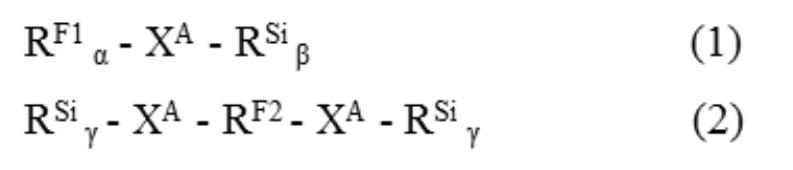
RF1は、各出現においてそれぞれ独立して、Rf1-RF-Oq-であり;
RF2は、-Rf2 p-RF-Oq-であり;
Rf1は、各出現においてそれぞれ独立して、1個又はそれ以上のフッ素原子により置換されていてもよいC1-16アルキル基であり;
Rf2は、1個又はそれ以上のフッ素原子により置換されていてもよいC1-6アルキレン基であり;
RFは、各出現においてそれぞれ独立して、2価のフルオロポリエーテル基であり;
pは、0又は1であり;
qは、各出現においてそれぞれ独立して、0又は1であり;
RSiは、各出現においてそれぞれ独立して、

Ra1は、各出現においてそれぞれ独立して、-Z1-SiR21 p1R22 q1R23 r1であり;
Z1は、各出現においてそれぞれ独立して、酸素原子又は2価の有機基であり;
R21は、各出現においてそれぞれ独立して、-Z1’-SiR21’ p1’R22’ q1’R23’ r1’であり;
R22は、各出現においてそれぞれ独立して、水酸基又は加水分解可能な基であり;
R23は、各出現においてそれぞれ独立して、水素原子又は1価の有機基であり;
p1は、各出現においてそれぞれ独立して、0~3の整数であり;
q1は、各出現においてそれぞれ独立して、0~3の整数であり;
r1は、各出現においてそれぞれ独立して、0~3の整数であり;
Z1’は、各出現においてそれぞれ独立して、酸素原子又は2価の有機基であり;
R21’は、各出現においてそれぞれ独立して、-Z1”-SiR22” q1”R23” r1”であり;
R22’は、各出現においてそれぞれ独立して、水酸基又は加水分解可能な基であり;
R23’は、各出現においてそれぞれ独立して、水素原子又は1価の有機基であり;
p1’は、各出現においてそれぞれ独立して、0~3の整数であり;
q1’は、各出現においてそれぞれ独立して、0~3の整数であり;
r1’は、各出現においてそれぞれ独立して、0~3の整数であり;
Z1”は、各出現においてそれぞれ独立して、酸素原子又は2価の有機基であり;
R22”は、各出現においてそれぞれ独立して、水酸基又は加水分解可能な基であり;
R23”は、各出現においてそれぞれ独立して、水素原子又は1価の有機基であり;
q1”は、各出現においてそれぞれ独立して、0~3の整数であり;
r1”は、各出現においてそれぞれ独立して、0~3の整数であり;
Rb1は、各出現においてそれぞれ独立して、水酸基又は加水分解可能な基であり;
Rc1は、各出現においてそれぞれ独立して、水素原子又は1価の有機基であり;
k1は、各出現においてそれぞれ独立して、0~3の整数であり;
l1は、各出現においてそれぞれ独立して、0~3の整数であり;
m1は、各出現においてそれぞれ独立して、0~3の整数である。]
で表される基であり;
XAは、それぞれ独立して、単結合又は2~10価の有機基であり;
αは、1~9の整数であり;
βは、1~9の整数であり;
γは、それぞれ独立して、1~9の整数である。]
で表されるフルオロポリエーテル基含有化合物である、電極。
[2] Rf1は、各出現においてそれぞれ独立して、C1-16パーフルオロアルキル基であり、
Rf2は、各出現においてそれぞれ独立して、C1-6パーフルオロアルキレン基である、上記[1]に記載の電極。
[3] RFは、各出現においてそれぞれ独立して、式:
-(OC6F12)a-(OC5F10)b-(OC4F8)c-(OC3RFa 6)d-(OC2F4)e-(OCF2)f-
[式中、RFaは、各出現においてそれぞれ独立して、水素原子、フッ素原子または塩素原子であり、
a、b、c、d、eおよびfは、それぞれ独立して、0~200の整数であって、a、b、c、d、eおよびfの和は1以上であり、a、b、c、d、eまたはfを付して括弧でくくられた各繰り返し単位の存在順序は式中において任意である。]
で表される基である、上記[1]または[2]に記載の電極。
[4] RFaは、フッ素原子である、上記[3]に記載の電極。
[5] RFは、各出現においてそれぞれ独立して、下記式(f1)、(f2)、(f3)、(f4)または(f5):
-(OC3F6)d- (f1)
[式中、dは1~200の整数である。]、
-(OC4F8)c-(OC3F6)d-(OC2F4)e-(OCF2)f- (f2)
[式中、cおよびdは、それぞれ独立して、0~30の整数であり;
eおよびfは、それぞれ独立して、1~200の整数であり;
c、d、eおよびfの和は、10~200の整数であり;
添字c、d、eまたはfを付して括弧でくくられた各繰り返し単位の存在順序は、式中において任意である。]、
-(R6-R7)g- (f3)
[式中、R6は、OCF2またはOC2F4であり;
R7は、OC2F4、OC3F6、OC4F8、OC5F10およびOC6F12から選択される基であるか、あるいは、これらの基から選択される2または3つの基の組み合わせであり;
gは、2~100の整数である。]、
-(OC6F12)a-(OC5F10)b-(OC4F8)c-(OC3F6)d-(OC2F4)e-(OCF2)f- (f4)
[式中、eは、1以上200以下の整数であり、a、b、c、dおよびfは、それぞれ独立して0以上200以下の整数であって、a、b、c、d、eまたはfを付して括弧でくくられた各繰り返し単位の存在順序は式中において任意である。]
-(OC6F12)a-(OC5F10)b-(OC4F8)c-(OC3F6)d-(OC2F4)e-(OCF2)f- (f5)
[式中、fは、1以上200以下の整数であり、a、b、c、dおよびeは、それぞれ独立して0以上200以下の整数であって、a、b、c、d、eまたはfを付して括弧でくくられた各繰り返し単位の存在順序は式中において任意である。]
で表される基である、上記[1]~[4]のいずれか1項に記載の電極。
[6] RFは、下記式(f1’):
-(OCF(CF3)CF2)d- (f1’)
[式中、dは1~200の整数である。]
で表される基である、上記[1]~[5]のいずれか1項に記載の電極。
[7] RFは、下記式(f2’):
-(OCF2CF2CF2CF2)c-(OCF2CF2CF2)d-(OCF2CF2)e-(OCF2)f- (f2’)
[式中、c及びdは、それぞれ独立して、0~30の整数であり;
e及びfは、それぞれ独立して、1~200の整数であり;
c、d、e及びfの和は、10~200の整数であり;
添字c、d、e又はfを付して括弧でくくられた各繰り返し単位の存在順序は、式中において任意である。]
で表される基である、上記[1]~[5]のいずれか1項に記載の電極。
[8] α、β、及びγは、1である、上記[1]~[7]のいずれか1項に記載の電極。
[9] k1は3であり、l1およびm1は0であり、
p1およびr1は0であり、q1は1である、上記[1]~[8]のいずれか1項に記載の電極。
[10] 前記フルオロポリエーテル基含有化合物は、2種以上である、上記[1]~[9]のいずれか1項に記載の電極。
[11] 前記フルオロポリエーテル基含有化合物は、式(1)で表されるフルオロポリエーテル基含有化合物である、上記[1]~[9]のいずれか1項に記載の電極。
[12] 前記フルオロポリエーテル基含有化合物は、式(2)で表されるフルオロポリエーテル基含有化合物である、上記[1]~[9]のいずれか1項に記載の電極。
[13] 前記フルオロポリエーテル基含有化合物は、式(1)で表されるフルオロポリエーテル基含有化合物及び式(2)で表されるフルオロポリエーテル基含有化合物である、上記[1]~[10]のいずれか1項に記載の電極。
[14] 前記フルオロポリエーテル基含有化合物は、電極の表面を被覆している、上記[1]~[13]のいずれか1項に記載の電極。
[15] 前記フルオロポリエーテル基含有化合物は、電極の活物質を被覆している、上記[1]~[14]のいずれか1項に記載の電極。
[16] さらに、含フッ素オイル、シリコーンオイル、および触媒から選択される1種またはそれ以上の他の成分を含有する、上記[1]~[15]のいずれか1項に記載の電極。
[17] 含フッ素オイルを含有する、上記[1]~[16]のいずれか1項に記載の電極。
[18] 上記[1]~[17]のいずれか1項に記載の電極を含む、電気化学デバイス。
[19] アルカリ金属電池またはアルカリ土類金属電池である、上記[18]に記載の電気化学デバイス。
[20] リチウムイオン二次電池である、上記[9]に記載の電気化学デバイス。
[21] 前記電池の正極が、上記[1]~[17]のいずれか1項に記載の電極である、上記[19]または[20]に記載の電気化学デバイス。
[22] 前記電池の負極が、上記[1]~[17]のいずれか1項に記載の電極である、上記[19]または[20]に記載の電気化学デバイス。
[23] 前記電池の正極および負極が、上記[1]~[17]のいずれか1項に記載の電極である、上記[19]または[20]に記載の電気化学デバイス。
[24]上記[18]~[23]のいずれか1項に記載の電気化学デバイスを備える、モジュール。
本開示の電極(以下、正極および負極を包含して用いられる)は、フルオロポリエーテル基含有化合物を含有する。電極がフルオロポリエーテル基含有化合物を含有するとは、電極が該フルオロポリエーテル基含有化合物を含有する組成物から形成された層を有することを包含する。例えば、本開示の電極は、電極材(以下、正極材および負極材を包含して用いられる)と、その表面に形成されたフルオロポリエーテル基含有化合物の被覆層から構成されてもよく、あるいは、表面に形成されたフルオロポリエーテル基含有化合物の被覆層を有する活物質を含む電極材から構成されてもよい。
上記したように本開示の電極は、パーフルオロポリエーテル基含有化合物を含有する。
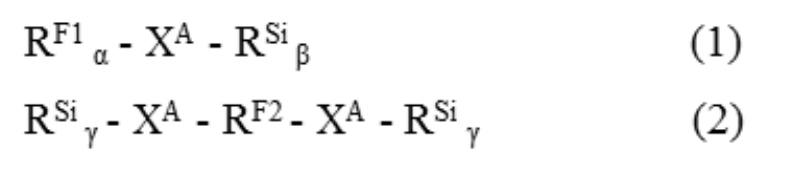
RF1は、各出現においてそれぞれ独立して、Rf1-RF-Oq-であり;
RF2は、-Rf2 p-RF-Oq-であり;
Rf1は、各出現においてそれぞれ独立して、1個又はそれ以上のフッ素原子により置換されていてもよいC1-16アルキル基であり;
Rf2は、1個又はそれ以上のフッ素原子により置換されていてもよいC1-6アルキレン基であり;
RFは、各出現においてそれぞれ独立して、2価のフルオロポリエーテル基であり;
pは、0又は1であり;
qは、各出現においてそれぞれ独立して、0又は1であり;
RSiは、各出現においてそれぞれ独立して、式(S):

Ra1は、各出現においてそれぞれ独立して、-Z1-SiR21 p1R22 q1R23 r1であり;
Z1は、各出現においてそれぞれ独立して、酸素原子又は2価の有機基であり;
R21は、各出現においてそれぞれ独立して、-Z1’-SiR21’ p1’R22’ q1’R23’ r1’であり;
R22は、各出現においてそれぞれ独立して、水酸基又は加水分解可能な基であり;
R23は、各出現においてそれぞれ独立して、水素原子又は1価の有機基であり;
p1は、各出現においてそれぞれ独立して、0~3の整数であり;
q1は、各出現においてそれぞれ独立して、0~3の整数であり;
r1は、各出現においてそれぞれ独立して、0~3の整数であり;
Z1’は、各出現においてそれぞれ独立して、酸素原子又は2価の有機基であり;
R21’は、各出現においてそれぞれ独立して、-Z1”-SiR22” q1”R23” r1”であり;
R22’は、各出現においてそれぞれ独立して、水酸基又は加水分解可能な基であり;
R23’は、各出現においてそれぞれ独立して、水素原子又は1価の有機基であり;
p1’は、各出現においてそれぞれ独立して、0~3の整数であり;
q1’は、各出現においてそれぞれ独立して、0~3の整数であり;
r1’は、各出現においてそれぞれ独立して、0~3の整数であり;
Z1”は、各出現においてそれぞれ独立して、酸素原子又は2価の有機基であり;
R22”は、各出現においてそれぞれ独立して、水酸基又は加水分解可能な基であり;
R23”は、各出現においてそれぞれ独立して、水素原子又は1価の有機基であり;
q1”は、各出現においてそれぞれ独立して、0~3の整数であり;
r1”は、各出現においてそれぞれ独立して、0~3の整数であり;
Rb1は、各出現においてそれぞれ独立して、水酸基又は加水分解可能な基であり;
Rc1は、各出現においてそれぞれ独立して、水素原子又は1価の有機基であり;
k1は、各出現においてそれぞれ独立して、0~3の整数であり;
l1は、各出現においてそれぞれ独立して、0~3の整数であり;
m1は、各出現においてそれぞれ独立して、0~3の整数である。]
で表される基であり;
XAは、それぞれ独立して、単結合又は2~10価の有機基であり;
αは、1~9の整数であり;
βは、1~9の整数であり;
γは、それぞれ独立して、1~9の整数である。]
で表されるフルオロポリエーテル基含有化合物である。
-(OC6F12)a-(OC5F10)b-(OC4F8)c-(OC3RFa 6)d-(OC2F4)e-(OCF2)f-
[式中:
RFaは、各出現においてそれぞれ独立して、水素原子、フッ素原子または塩素原子であり、
a、b、c、d、eおよびfは、それぞれ独立して、0~200の整数であって、a、b、c、d、eおよびfの和は1以上である。a、b、c、d、eまたはfを付して括弧でくくられた各繰り返し単位の存在順序は式中において任意である。]
で表される基である。
-(OC3F6)d- (f1)
[式中、dは、1~200の整数である。];
-(OC4F8)c-(OC3F6)d-(OC2F4)e-(OCF2)f- (f2)
[式中、cおよびdは、それぞれ独立して0以上30以下の整数であり、eおよびfは、それぞれ独立して1以上200以下の整数であり、
c、d、eおよびfの和は2以上であり、
添字c、d、eまたはfを付して括弧でくくられた各繰り返し単位の存在順序は、式中において任意である。];
-(R6-R7)g- (f3)
[式中、R6は、OCF2またはOC2F4であり、
R7は、OC2F4、OC3F6、OC4F8、OC5F10およびOC6F12から選択される基であるか、あるいは、これらの基から独立して選択される2または3つの基の組み合わせであり、
gは、2~100の整数である。];
-(OC6F12)a-(OC5F10)b-(OC4F8)c-(OC3F6)d-(OC2F4)e-(OCF2)f- (f4)
[式中、eは、1以上200以下の整数であり、a、b、c、dおよびfは、それぞれ独立して0以上200以下の整数であって、a、b、c、d、eおよびfの和は少なくとも1であり、また、a、b、c、d、eまたはfを付して括弧でくくられた各繰り返し単位の存在順序は式中において任意である。]
-(OC6F12)a-(OC5F10)b-(OC4F8)c-(OC3F6)d-(OC2F4)e-(OCF2)f- (f5)
[式中、fは、1以上200以下の整数であり、a、b、c、dおよびeは、それぞれ独立して0以上200以下の整数であって、a、b、c、d、eおよびfの和は少なくとも1であり、また、a、b、c、d、eまたはfを付して括弧でくくられた各繰り返し単位の存在順序は式中において任意である。]

Ra1は、各出現においてそれぞれ独立して、-Z1-SiR21 p1R22 q1R23 r1であり;
Z1は、各出現においてそれぞれ独立して、酸素原子又は2価の有機基であり;
R21は、各出現においてそれぞれ独立して、-Z1’-SiR21’ p1’R22’ q1’R23’ r1’であり;
R22は、各出現においてそれぞれ独立して、水酸基又は加水分解可能な基であり;
R23は、各出現においてそれぞれ独立して、水素原子又は1価の有機基であり;
p1は、各出現においてそれぞれ独立して、0~3の整数であり;
q1は、各出現においてそれぞれ独立して、0~3の整数であり;
r1は、各出現においてそれぞれ独立して、0~3の整数であり;
Z1’は、各出現においてそれぞれ独立して、酸素原子又は2価の有機基であり;
R21’は、各出現においてそれぞれ独立して、-Z1”-SiR22” q1”R23” r1”であり;
R22’は、各出現においてそれぞれ独立して、水酸基又は加水分解可能な基であり;
R23’は、各出現においてそれぞれ独立して、水素原子又は1価の有機基であり;
p1’は、各出現においてそれぞれ独立して、0~3の整数であり;
q1’は、各出現においてそれぞれ独立して、0~3の整数であり;
r1’は、各出現においてそれぞれ独立して、0~3の整数であり;
Z1”は、各出現においてそれぞれ独立して、酸素原子又は2価の有機基であり;
R22”は、各出現においてそれぞれ独立して、水酸基又は加水分解可能な基であり;
R23”は、各出現においてそれぞれ独立して、水素原子又は1価の有機基であり;
q1”は、各出現においてそれぞれ独立して、0~3の整数であり;
r1”は、各出現においてそれぞれ独立して、0~3の整数であり;
Rb1は、各出現においてそれぞれ独立して、水酸基又は加水分解可能な基であり;
Rc1は、各出現においてそれぞれ独立して、水素原子又は1価の有機基であり;
k1は、各出現においてそれぞれ独立して、0~3の整数であり;
l1は、各出現においてそれぞれ独立して、0~3の整数であり;
m1は、各出現においてそれぞれ独立して、0~3の整数である。]
で表される基である。

-(R51)p5-(X51)q5-
[式中:
R51は、単結合、-(CH2)s5-またはo-、m-もしくはp-フェニレン基を表し、好ましくは-(CH2)s5-であり、
s5は、1~20の整数、好ましくは1~6の整数、より好ましくは1~3の整数、さらにより好ましくは1または2であり、
X51は、-(X52)l5-を表し、
X52は、各出現においてそれぞれ独立して、-O-、-S-、o-、m-もしくはp-フェニレン基、-C(O)O-、-Si(R53)2-、-(Si(R53)2O)m5-Si(R53)2-、-CONR54-、-O-CONR54-、-NR54-および-(CH2)n5-からなる群から選択される基を表し、
R53は、各出現においてそれぞれ独立して、フェニル基、C1-6アルキル基またはC1-6アルコキシ基を表し、好ましくはフェニル基またはC1-6アルキル基であり、より好ましくはメチル基であり、
R54は、各出現においてそれぞれ独立して、水素原子、フェニル基またはC1-6アルキル基(好ましくはメチル基)を表し、
m5は、各出現において、それぞれ独立して、1~100の整数、好ましくは1~20の整数であり、
n5は、各出現において、それぞれ独立して、1~20の整数、好ましくは1~6の整数、より好ましくは1~3の整数であり、
l5は、1~10の整数、好ましくは1~5の整数、より好ましくは1~3の整数であり、
p5は、0または1であり、
q5は、0または1であり、
ここに、p5およびq5の少なくとも一方は1であり、p5またはq5を付して括弧でくくられた各繰り返し単位の存在順序は任意である]
で表される2価の有機基が挙げられる。ここに、RA(典型的にはRAの水素原子)は、フッ素原子、C1-3アルキル基およびC1-3フルオロアルキル基から選択される1個またはそれ以上の置換基により置換されていてもよい。好ましい態様において、RAは、これらの基により置換されていない。
単結合、
C1-20アルキレン基、
-R51-X53-R52-、または
-X54-R5-
[式中、R51およびR52は、上記と同意義であり、
X53は、
-O-、
-S-、
-C(O)O-、
-CONR54-、
-O-CONR54-、
-Si(R53)2-、
-(Si(R53)2O)m5-Si(R53)2-、
-O-(CH2)u5-(Si(R53)2O)m5-Si(R53)2-、
-O-(CH2)u5-Si(R53)2-O-Si(R53)2-CH2CH2-Si(R53)2-O-Si(R53)2-、
-O-(CH2)u5-Si(OCH3)2OSi(OCH3)2-、
-CONR54-(CH2)u5-(Si(R53)2O)m5-Si(R53)2-、
-CONR54-(CH2)u5-N(R54)-、または
-CONR54-(o-、m-またはp-フェニレン)-Si(R53)2-
(式中、R53、R54およびm5は、上記と同意義であり、
u5は1~20の整数、好ましくは2~6の整数、より好ましくは2~3の整数である。)を表し、
X54は、
-S-、
-C(O)O-、
-CONR54-、
-O-CONR54-、
-CONR54-(CH2)u5-(Si(R54)2O)m5-Si(R54)2-、
-CONR54-(CH2)u5-N(R54)-、または
-CONR54-(o-、m-またはp-フェニレン)-Si(R54)2-
(式中、各記号は、上記と同意義である。)
を表す。]
であり得る。
単結合、
C1-20アルキレン基、
-(CH2)s5-X53-、
-(CH2)s5-X53-(CH2)t5-
-X54-、または
-X54-(CH2)t5-
[式中、X53、X54、s5およびt5は、上記と同意義である。]
である。
単結合、
C1-20アルキレン基、
-(CH2)s5-X53-(CH2)t5-、または
-X54-(CH2)t5-
[式中、各記号は、上記と同意義である。]
であり得る。
単結合
C1-20アルキレン基、
-(CH2)s5-X53-、または
-(CH2)s5-X53-(CH2)t5-
[式中、
X53は、-O-、-CONR54-、または-O-CONR54-であり、
R54は、各出現においてそれぞれ独立して、水素原子、フェニル基またはC1-6アルキル基を表し、
s5は、1~20の整数であり、
t5は、1~20の整数である。]
であり得る。
単結合、
C1-20アルキレン基、
-(CH2)s5-O-(CH2)t5-、
-(CH2)s5-(Si(R53)2O)m5-Si(R53)2-(CH2)t5-、
-(CH2)s5-O-(CH2)u5-(Si(R53)2O)m5-Si(R53)2-(CH2)t5-、または
-(CH2)s5-O-(CH2)t5-Si(R53)2-(CH2)u5-Si(R53)2-(CvH2v)-
[式中、R53、m5、s5、t5およびu5は、上記と同意義であり、v5は1~20の整数、好ましくは2~6の整数、より好ましくは2~3の整数である。]
である。
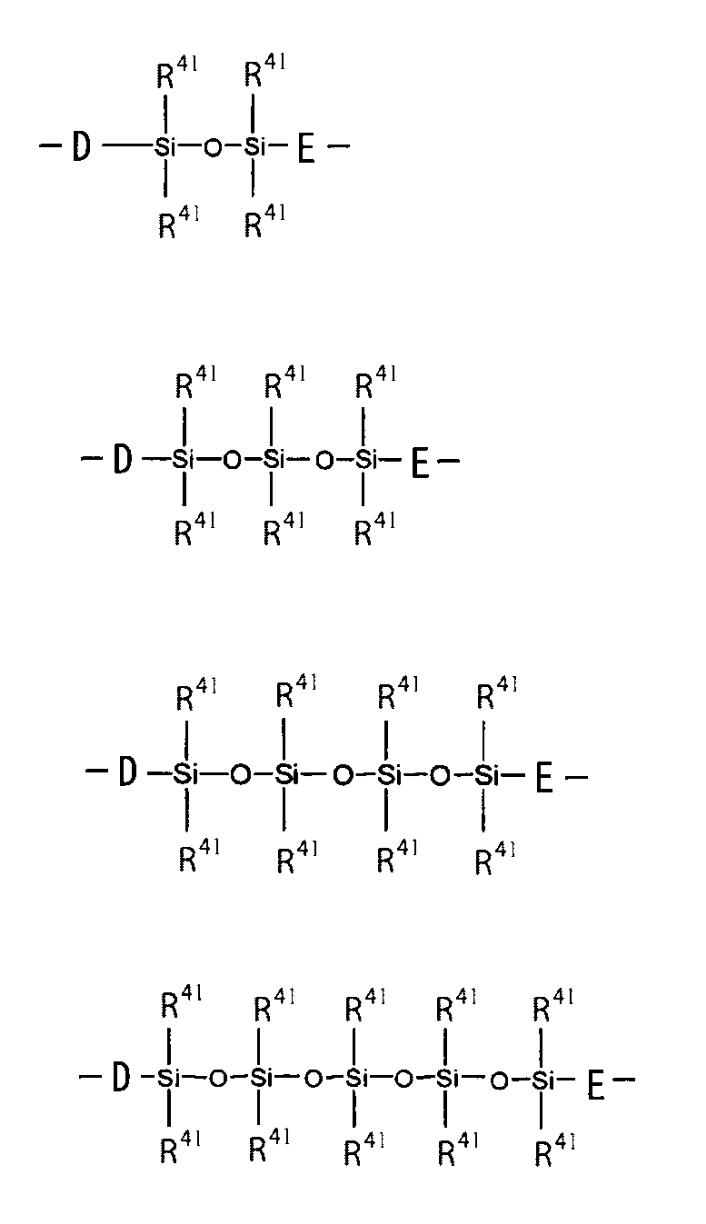
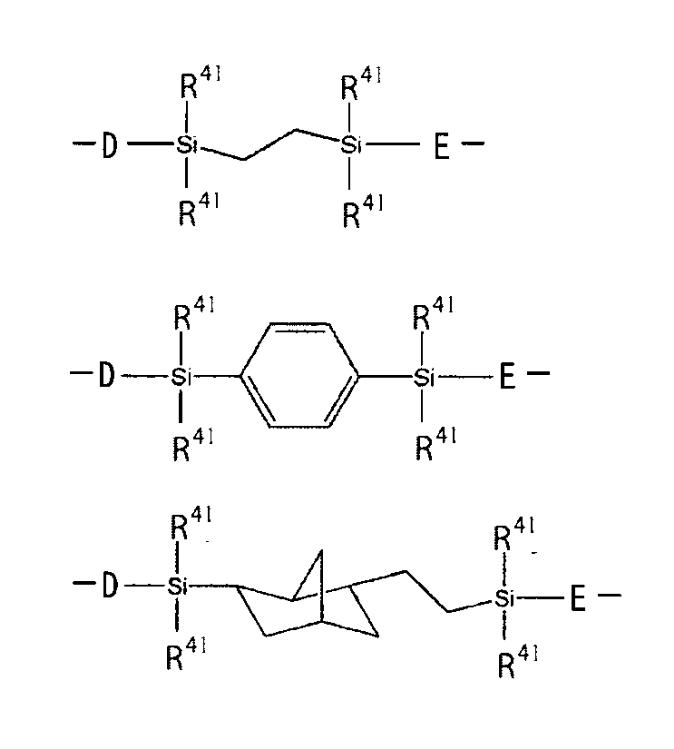
Dは、
-CH2O(CH2)2-、
-CH2O(CH2)3-、
-CF2O(CH2)3-、
-(CH2)2-、
-(CH2)3-、
-(CH2)4-、
-CONH-(CH2)3-、
-CON(CH3)-(CH2)3-、
-CON(Ph)-(CH2)3-(式中、Phはフェニルを意味する)、および

から選択される基であり、
Eは、-(CH2)n-(nは2~6の整数)であり、
Dは、分子主鎖のRF1またはRF2に結合し、Eは、RSiに結合する。]
単結合、
-CH2OCH2-、
-CH2O(CH2)2-、
-CH2O(CH2)3-、
-CH2O(CH2)6-、
-CF2-CH2-O-CH2-、
-CF2-CH2-O-(CH2)2-、
-CF2-CH2-O-(CH2)3-、
-CF2-CH2-O-(CH2)6-、
-CH2O(CH2)3Si(CH3)2OSi(CH3)2(CH2)2-、
-CH2O(CH2)3Si(CH3)2OSi(CH3)2OSi(CH3)2(CH2)2-、
-CH2O(CH2)3Si(CH3)2O(Si(CH3)2O)2Si(CH3)2(CH2)2-、
-CH2O(CH2)3Si(CH3)2O(Si(CH3)2O)3Si(CH3)2(CH2)2-、
-CH2O(CH2)3Si(CH3)2O(Si(CH3)2O)10Si(CH3)2(CH2)2-、
-CH2O(CH2)3Si(CH3)2O(Si(CH3)2O)20Si(CH3)2(CH2)2-、
-CH2OCF2CHFOCF2-、
-CH2OCF2CHFOCF2CF2-、
-CH2OCF2CHFOCF2CF2CF2-、
-CH2OCH2CF2CF2OCF2-、
-CH2OCH2CF2CF2OCF2CF2-、
-CH2OCH2CF2CF2OCF2CF2CF2-、
-CH2OCH2CF2CF2OCF(CF3)CF2OCF2-、
-CH2OCH2CF2CF2OCF(CF3)CF2OCF2CF2-、
-CH2OCH2CF2CF2OCF(CF3)CF2OCF2CF2CF2-、
-CH2OCH2CHFCF2OCF2-、
-CH2OCH2CHFCF2OCF2CF2-、
-CH2OCH2CHFCF2OCF2CF2CF2-、
-CH2OCH2CHFCF2OCF(CF3)CF2OCF2-、
-CH2OCH2CHFCF2OCF(CF3)CF2OCF2CF2-、
-CH2OCH2CHFCF2OCF(CF3)CF2OCF2CF2CF2-、
-CH2OCF2CHFOCF2CF2CF2-C(O)NH-CH2-、
-CH2OCH2(CH2)7CH2Si(OCH3)2OSi(OCH3)2(CH2)2Si(OCH3)2OSi(OCH3)2(CH2)2-、
-CH2OCH2CH2CH2Si(OCH3)2OSi(OCH3)2(CH2)3-、
-CH2OCH2CH2CH2Si(OCH2CH3)2OSi(OCH2CH3)2(CH2)3-、
-CH2OCH2CH2CH2Si(OCH3)2OSi(OCH3)2(CH2)2-、
-CH2OCH2CH2CH2Si(OCH2CH3)2OSi(OCH2CH3)2(CH2)2-、
-(CH2)2-Si(CH3)2-(CH2)2-、
-CH2-、
-(CH2)2-、
-(CH2)3-、
-(CH2)4-、
-(CH2)5-、
-(CH2)6-、
-CF2-CH2-、
-CF2-(CH2)2-、
-CF2-(CH2)3-、
-CF2-(CH2)4-、
-CF2-(CH2)5-、
-CF2-(CH2)6-、
-CO-、
-CONH-、
-CONH-CH2-、
-CONH-(CH2)2-、
-CONH-(CH2)3-、
-CONH-(CH2)6-、
-CF2CONHCH2-、
-CF2CONH(CH2)2-、
-CF2CONH(CH2)3-、
-CF2CONH(CH2)6-、
-CON(CH3)-(CH2)3-、
-CON(Ph)-(CH2)3-(式中、Phはフェニルを意味する)、
-CON(CH3)-(CH2)6-、
-CON(Ph)-(CH2)6-(式中、Phはフェニルを意味する)、
-CF2-CON(CH3)-(CH2)3-、
-CF2-CON(Ph)-(CH2)3-(式中、Phはフェニルを意味する)、
-CF2-CON(CH3)-(CH2)6-、
-CF2-CON(Ph)-(CH2)6-(式中、Phはフェニルを意味する)、
-CONH-(CH2)2NH(CH2)3-、
-CONH-(CH2)6NH(CH2)3-、
-CH2O-CONH-(CH2)3-、
-CH2O-CONH-(CH2)6-、
-S-(CH2)3-、
-(CH2)2S(CH2)3-、
-CONH-(CH2)3Si(CH3)2OSi(CH3)2(CH2)2-、
-CONH-(CH2)3Si(CH3)2OSi(CH3)2OSi(CH3)2(CH2)2-、
-CONH-(CH2)3Si(CH3)2O(Si(CH3)2O)2Si(CH3)2(CH2)2-、
-CONH-(CH2)3Si(CH3)2O(Si(CH3)2O)3Si(CH3)2(CH2)2-、
-CONH-(CH2)3Si(CH3)2O(Si(CH3)2O)10Si(CH3)2(CH2)2-、
-CONH-(CH2)3Si(CH3)2O(Si(CH3)2O)20Si(CH3)2(CH2)2-、
-C(O)O-(CH2)3-、
-C(O)O-(CH2)6-、
-CH2-O-(CH2)3-Si(CH3)2-(CH2)2-Si(CH3)2-(CH2)2-、
-CH2-O-(CH2)3-Si(CH3)2-(CH2)2-Si(CH3)2-CH(CH3)-、
-CH2-O-(CH2)3-Si(CH3)2-(CH2)2-Si(CH3)2-(CH2)3-、
-CH2-O-(CH2)3-Si(CH3)2-(CH2)2-Si(CH3)2-CH(CH3)-CH2-、
-OCH2-、
-O(CH2)3-、
-OCFHCF2-、

などが挙げられる。
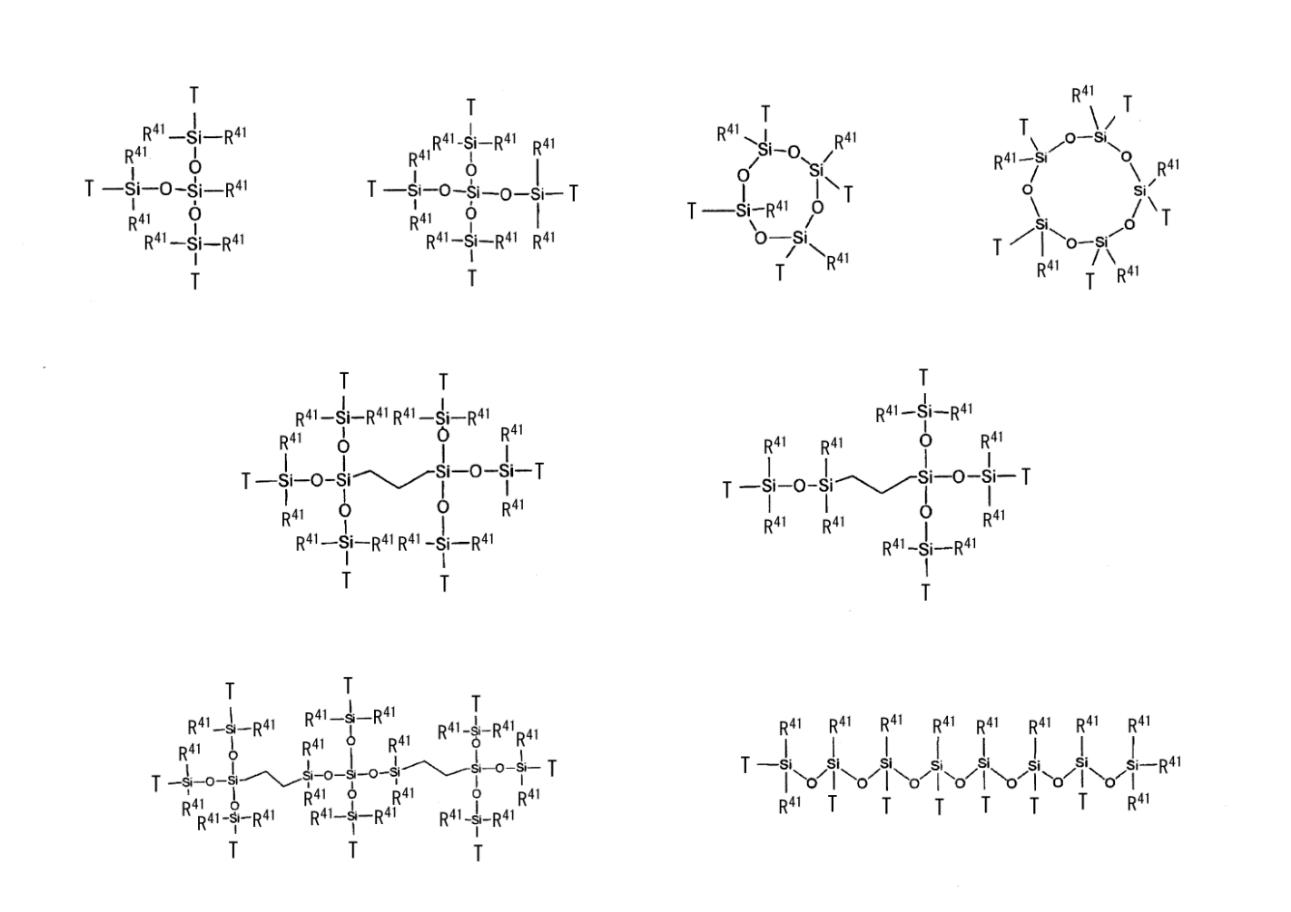
R41は、それぞれ独立して、水素原子、フェニル基、炭素数1~6のアルキル基、またはC1-6アルコキシ基好ましくはメチル基であり;
各X101基において、Tのうち任意のいくつかは、分子主鎖のRF1またはRF2に結合する以下の基:
-CH2O(CH2)2-、
-CH2O(CH2)3-、
-CF2O(CH2)3-、
-(CH2)2-、
-(CH2)3-、
-(CH2)4-、
-CONH-(CH2)3-、
-CON(CH3)-(CH2)3-、
-CON(Ph)-(CH2)3-(式中、Phはフェニルを意味する)、または
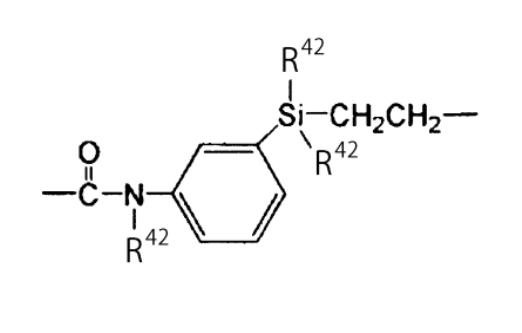
であり、別のTのいくつかは、分子主鎖のRSiに結合し、存在する場合、残りのTは、それぞれ独立して、メチル基、フェニル基、C1-6アルコキシ基またはラジカル捕捉基または紫外線吸収基である。
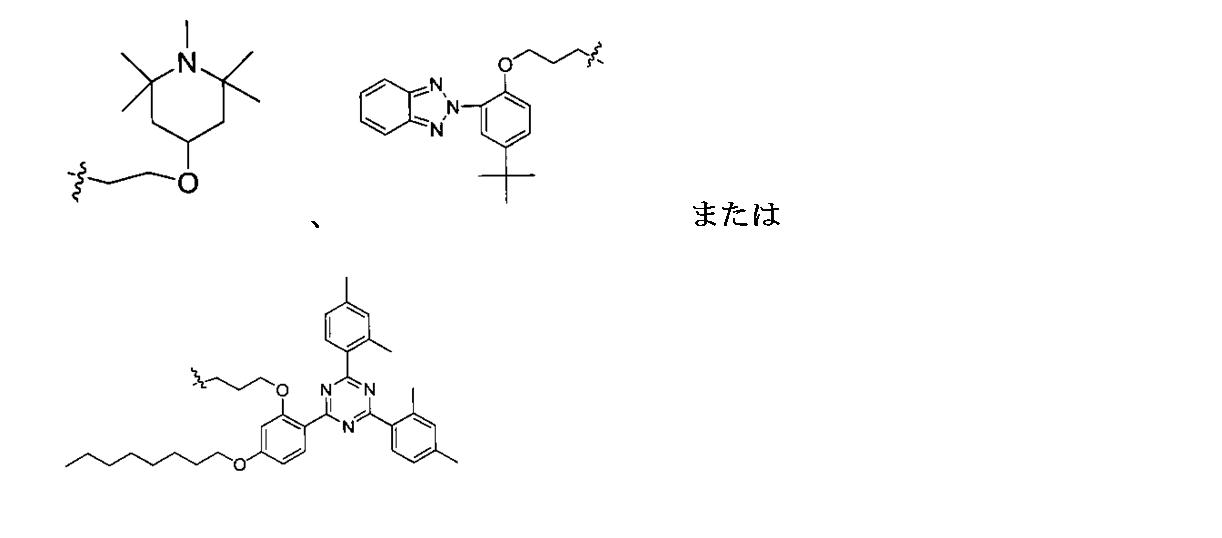
が挙げられる。
R21-(OC4F8)a’-(OC3F6)b’-(OC2F4)c’-(OCF2)d’-R22 ・・・(3)
式中、R21は、1個またはそれ以上のフッ素原子により置換されていてもよいC1-16のアルキル基(好ましくは、C1-16のパーフルオロアルキル基)を表し、R22は、1個またはそれ以上のフッ素原子により置換されていてもよいC1-16のアルキル基(好ましくは、C1-16のパーフルオロアルキル基)、フッ素原子または水素原子を表し、R21およびR22は、より好ましくは、それぞれ独立して、C1-3のパーフルオロアルキル基である。
a’、b’、c’およびd’は、ポリマーの主骨格を構成するパーフルオロ(ポリ)エーテルの4種の繰り返し単位数をそれぞれ表し、互いに独立して0以上300以下の整数であって、a’、b’、c’およびd’の和は少なくとも1、好ましくは1~300、より好ましくは20~300である。添字a’、b’、c’またはd’を付して括弧でくくられた各繰り返し単位の存在順序は、式中において任意である。これら繰り返し単位のうち、-(OC4F8)-は、-(OCF2CF2CF2CF2)-、-(OCF(CF3)CF2CF2)-、-(OCF2CF(CF3)CF2)-、-(OCF2CF2CF(CF3))-、-(OC(CF3)2CF2)-、-(OCF2C(CF3)2)-、-(OCF(CF3)CF(CF3))-、-(OCF(C2F5)CF2)-および-(OCF2CF(C2F5))-のいずれであってもよいが、好ましくは-(OCF2CF2CF2CF2)-である。-(OC3F6)-は、-(OCF2CF2CF2)-、-(OCF(CF3)CF2)-および-(OCF2CF(CF3))-のいずれであってもよく、好ましくは-(OCF2CF2CF2)-である。-(OC2F4)-は、-(OCF2CF2)-および-(OCF(CF3))-のいずれであってもよいが、好ましくは-(OCF2CF2)-である。
R21-(OCF2CF2CF2)b’’-R22 ・・・(3a)
R21-(OCF2CF2CF2CF2)a’’-(OCF2CF2CF2)b’’-(OCF2CF2)c’’-(OCF2)d’’-R22 ・・・(3b)
これら式中、R21およびR22は上記の通りであり;式(3a)において、b’’は1以上100以下の整数であり;式(3b)において、a’’およびb’’は、それぞれ独立して0以上30以下の整数であり、c’’およびd’’はそれぞれ独立して1以上300以下の整数である。添字a’’、b’’、c’’、d’’を付して括弧でくくられた各繰り返し単位の存在順序は、式中において任意である。
上記電極材は、電気化学デバイスの電極の主要部を構成する部材を意味し、各種電気化学デバイスにおいて一般的に用いられる部材である。このような電極材は、当業者であれば、電気化学デバイスの種類に応じて、適宜選択することができる。例えば、アルカリ金属イオン電池においては、電極材は、活物質(以下、正極活物質及び負極活物質を包含して用いられる)を含有する活物質含有部分であり得る。典型的には、電極材は、活物質含有部分及び集電体から構成され得る。一の態様において、活物質含有部分は、集電体上に層状に存在する。また、電気二重層キャパシタにおいては、電極材は、電解液との界面で電気二重層を形成する部分、例えば炭素又は黒鉛を含有する部分であり得る。
本開示の電極は、種々の電気化学デバイスにおいて用いることができる。
電気化学デバイスは、少なくとも一対の電極と、当該一対の電極間を介在する電解液とを有して成るデバイスを意味する。
電解液は、溶媒に電解質塩が溶解されたものである。
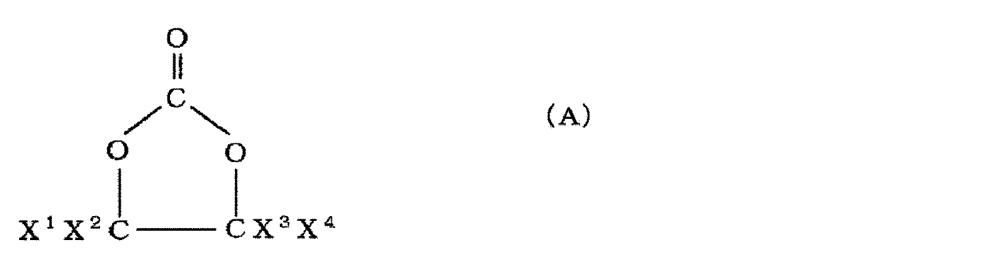
R1-R2- (a-1)
(式中、R1はフッ素原子を有していてもよい炭素数1以上のアルキル基;R2はフッ素原子を有していてもよい炭素数1~3のアルキレン基;ただし、R1及びR2の少なくとも一方はフッ素原子を有している)で示されるフッ素化アルキル基が、電解質塩の溶解性が良好な点から好ましく例示できる。
なお、R1及びR2は、更に、炭素原子、水素原子及びフッ素原子以外の、その他の原子を有していてもよい。

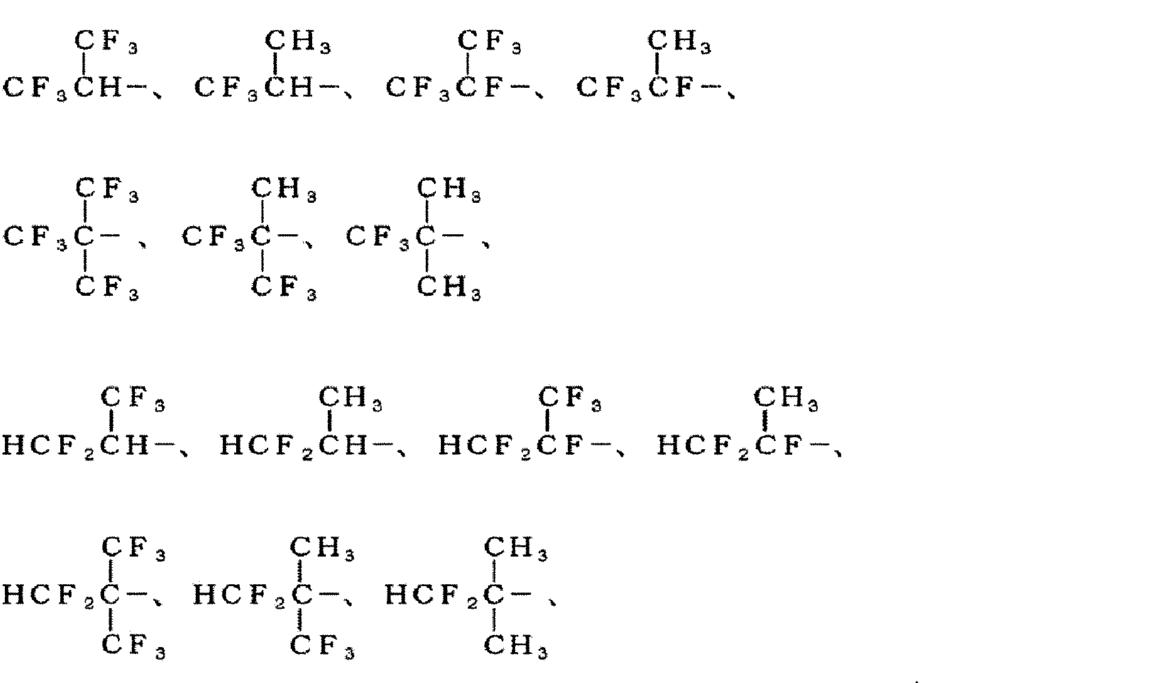
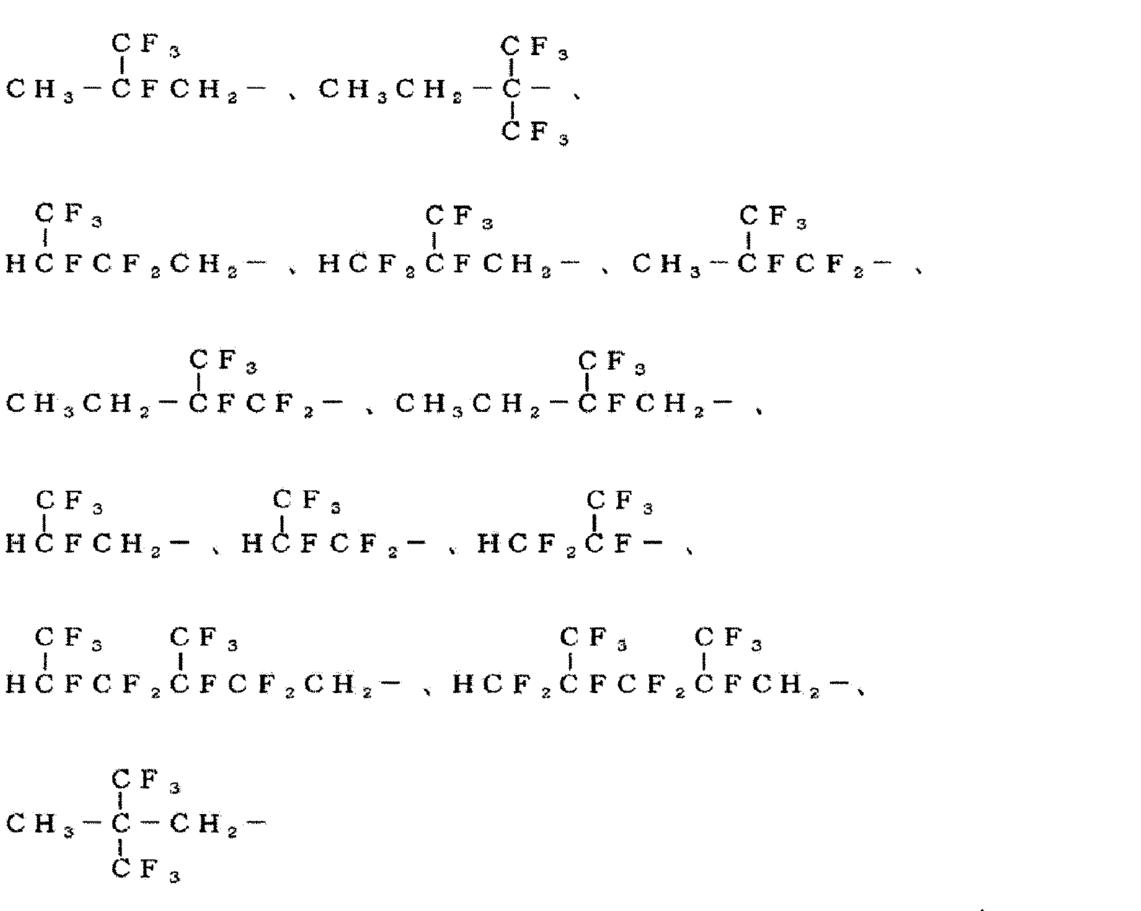
-CH2-、-CHF-、-CF2-、-CHCl-、-CFCl-、-CCl2-
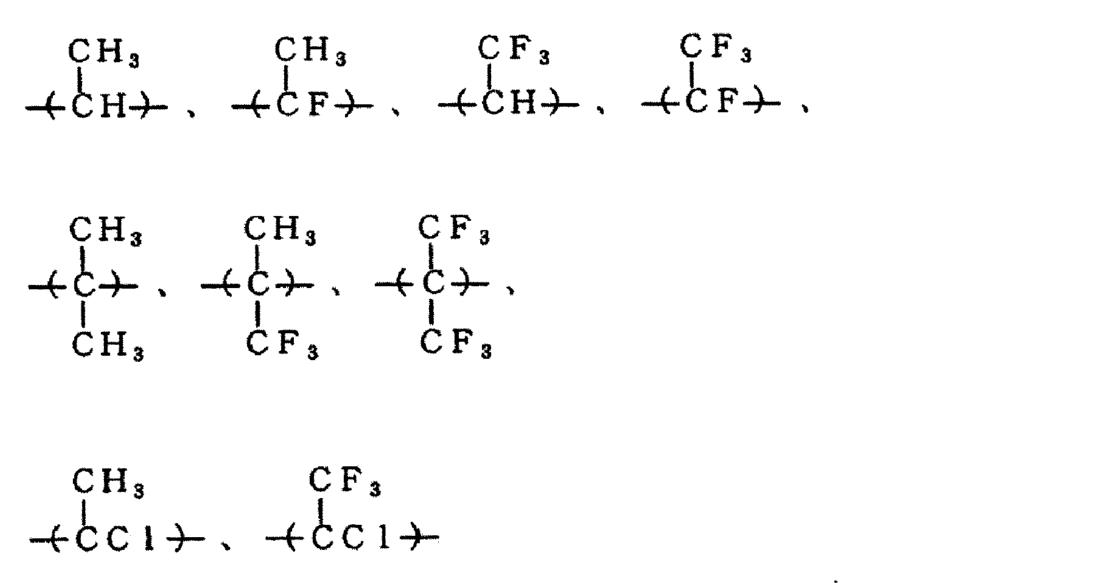
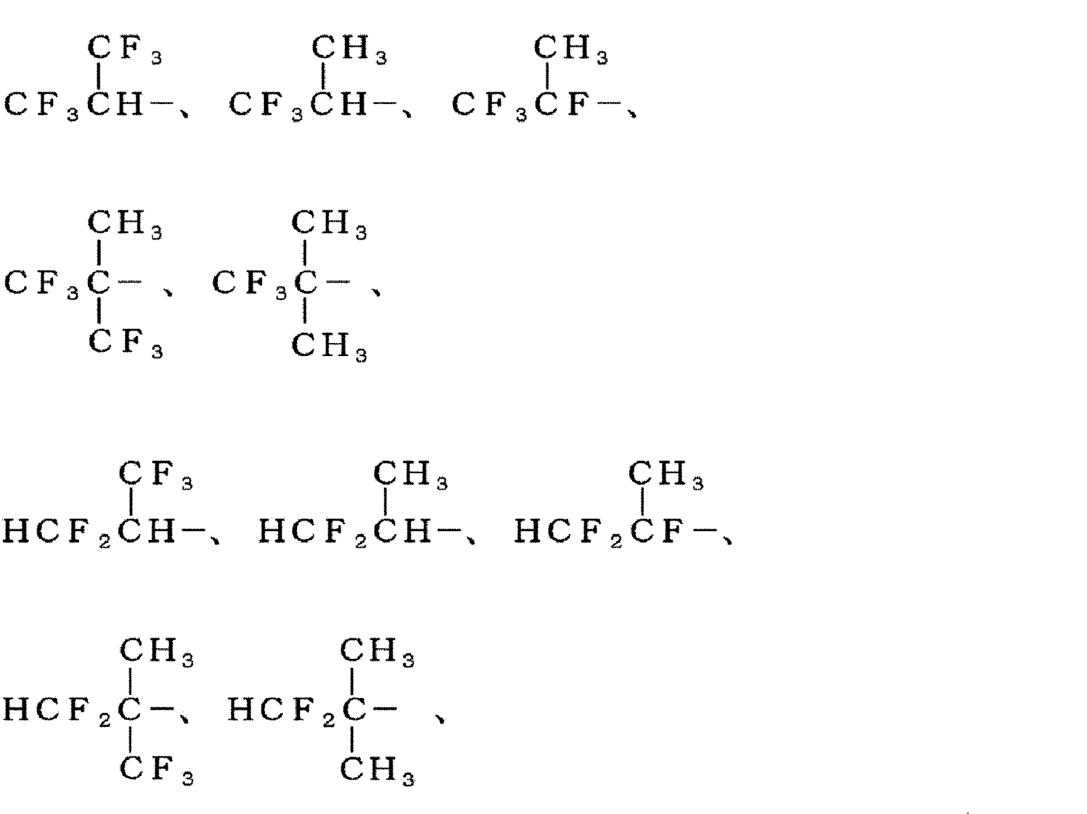

-CH2-、-CHF-、-CF2-、-CHCl-、-CFCl-、-CCl2-
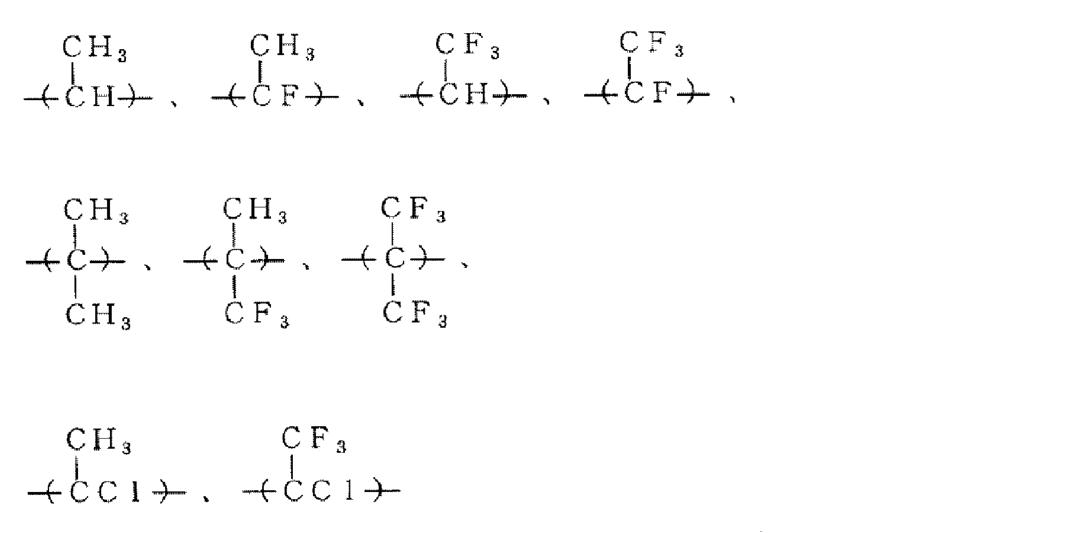
R3-(OR4)n1- (b-1)
(式中、R3はフッ素原子を有していてもよい、好ましくは炭素数1~6のアルキル基;R4はフッ素原子を有していてもよい、好ましくは炭素数1~4のアルキレン基;n1は1~3の整数;ただし、R3及びR4の少なくとも1つはフッ素原子を有している)で示されるものが挙げられる。
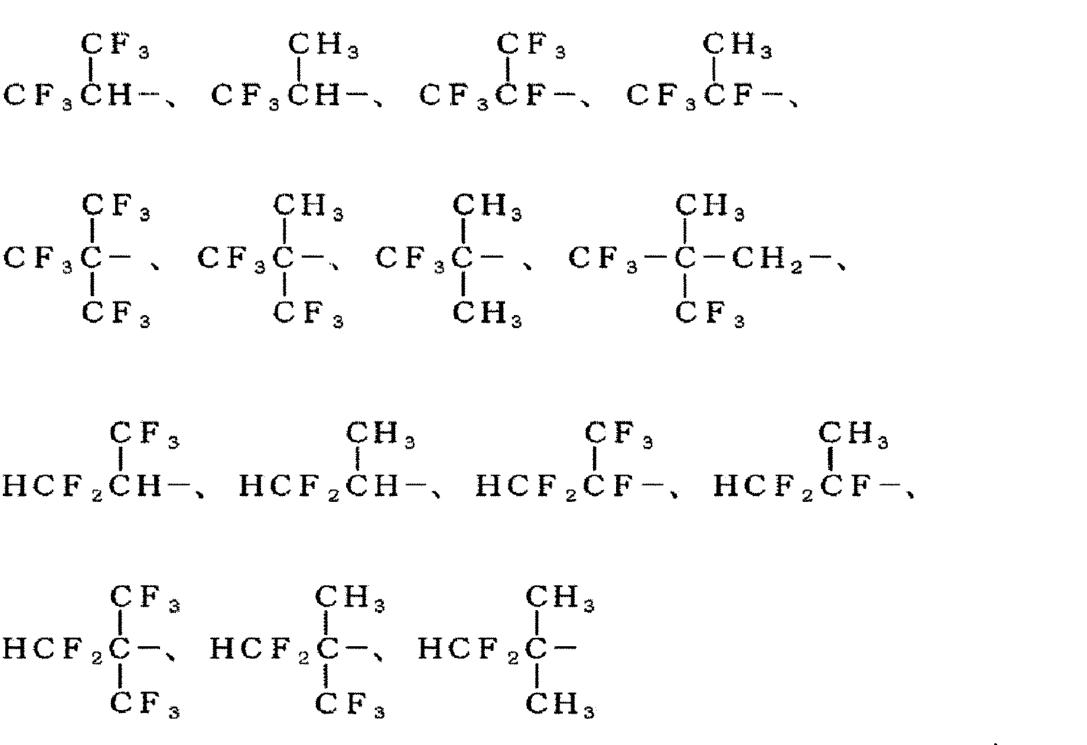

フッ素化アルキル基(a)、エーテル結合を有するフッ素化アルキル基(b)、及び、フッ素化アルコキシ基(c)のフッ素含有率は、各基の構造式に基づいて、{(フッ素原子の個数×19)/各基の式量}×100(%)により算出した値である。
なお、上記フッ素化飽和環状カーボネートのフッ素含有率は、フッ素化飽和環状カーボネートの構造式に基づいて、{(フッ素原子の個数×19)/フッ素化飽和環状カーボネートの分子量}×100(%)により算出した値である。

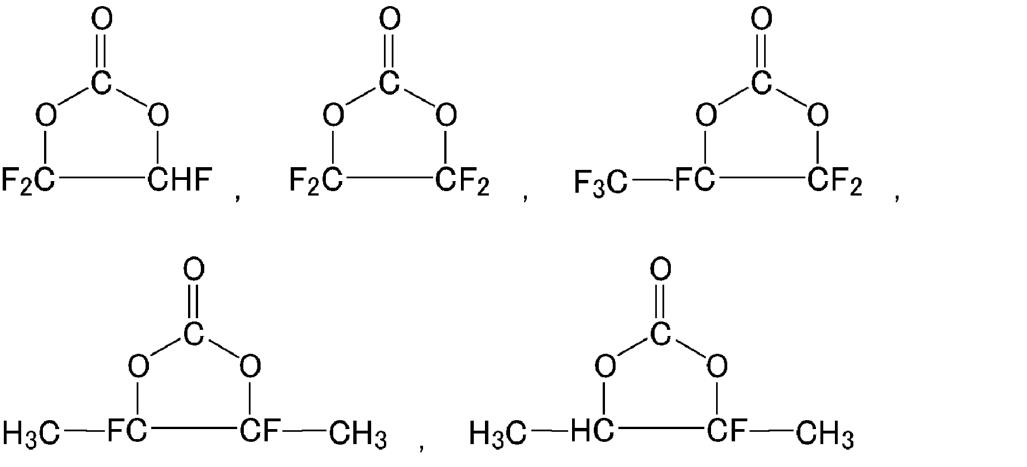
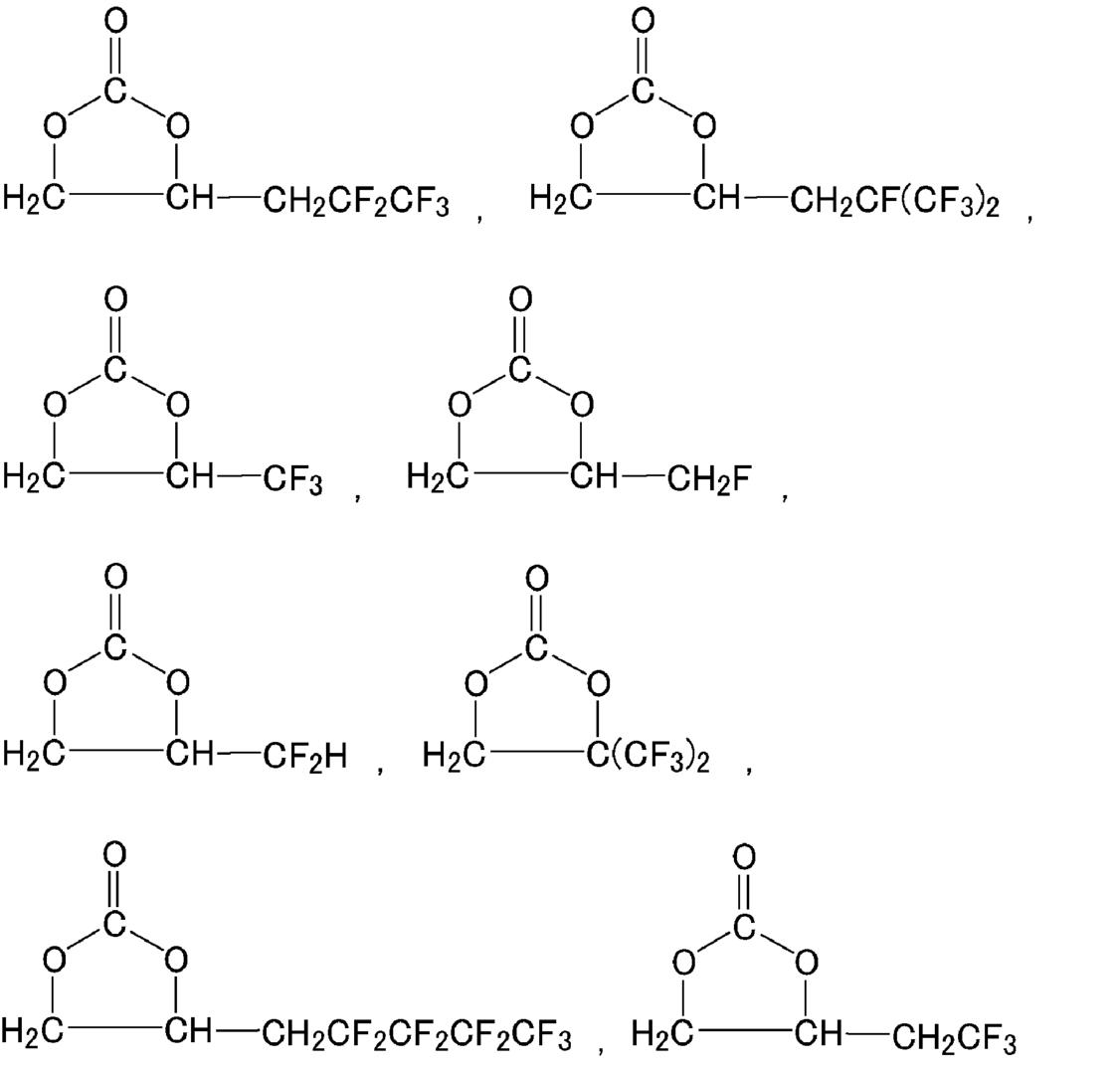


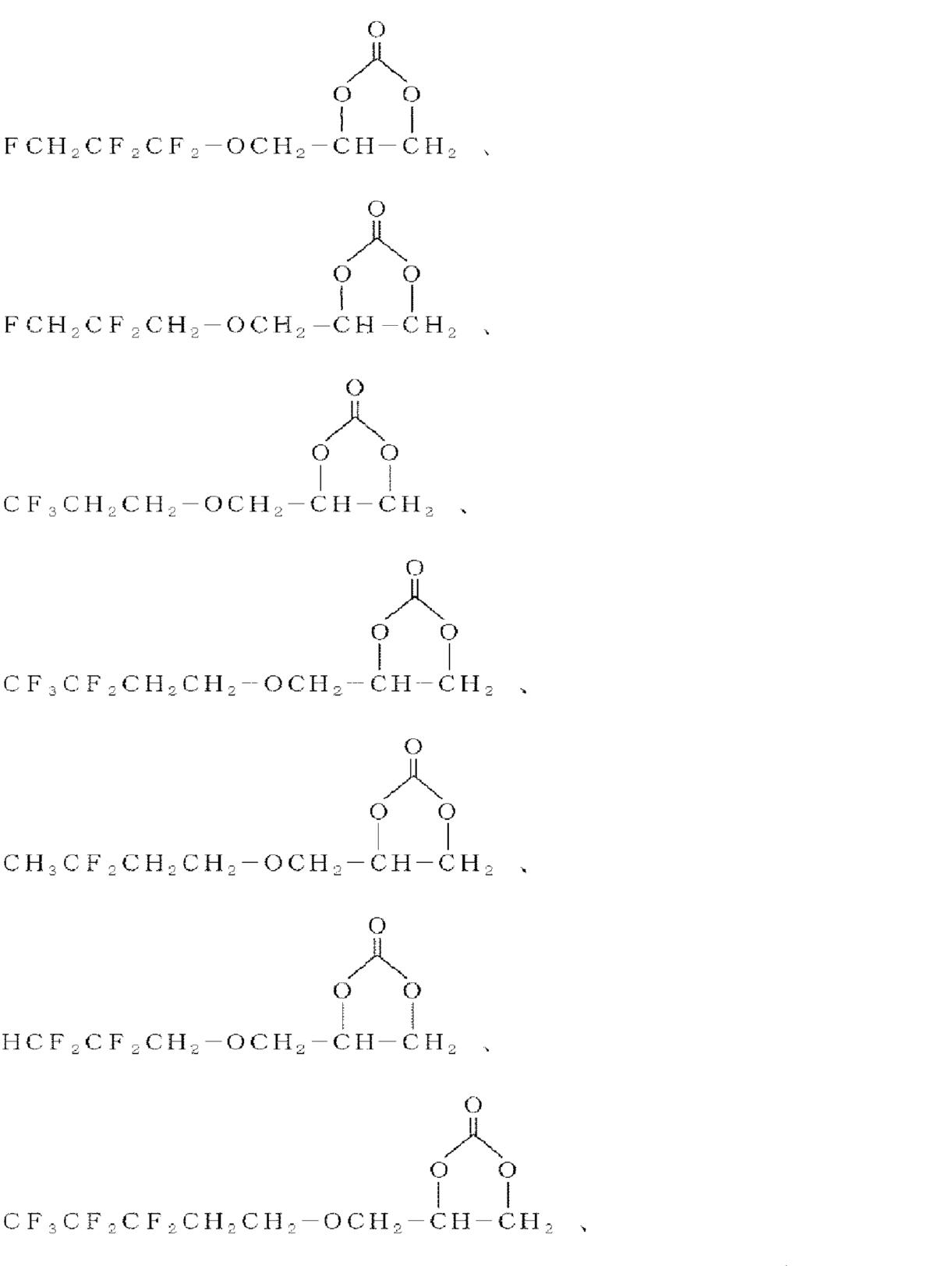
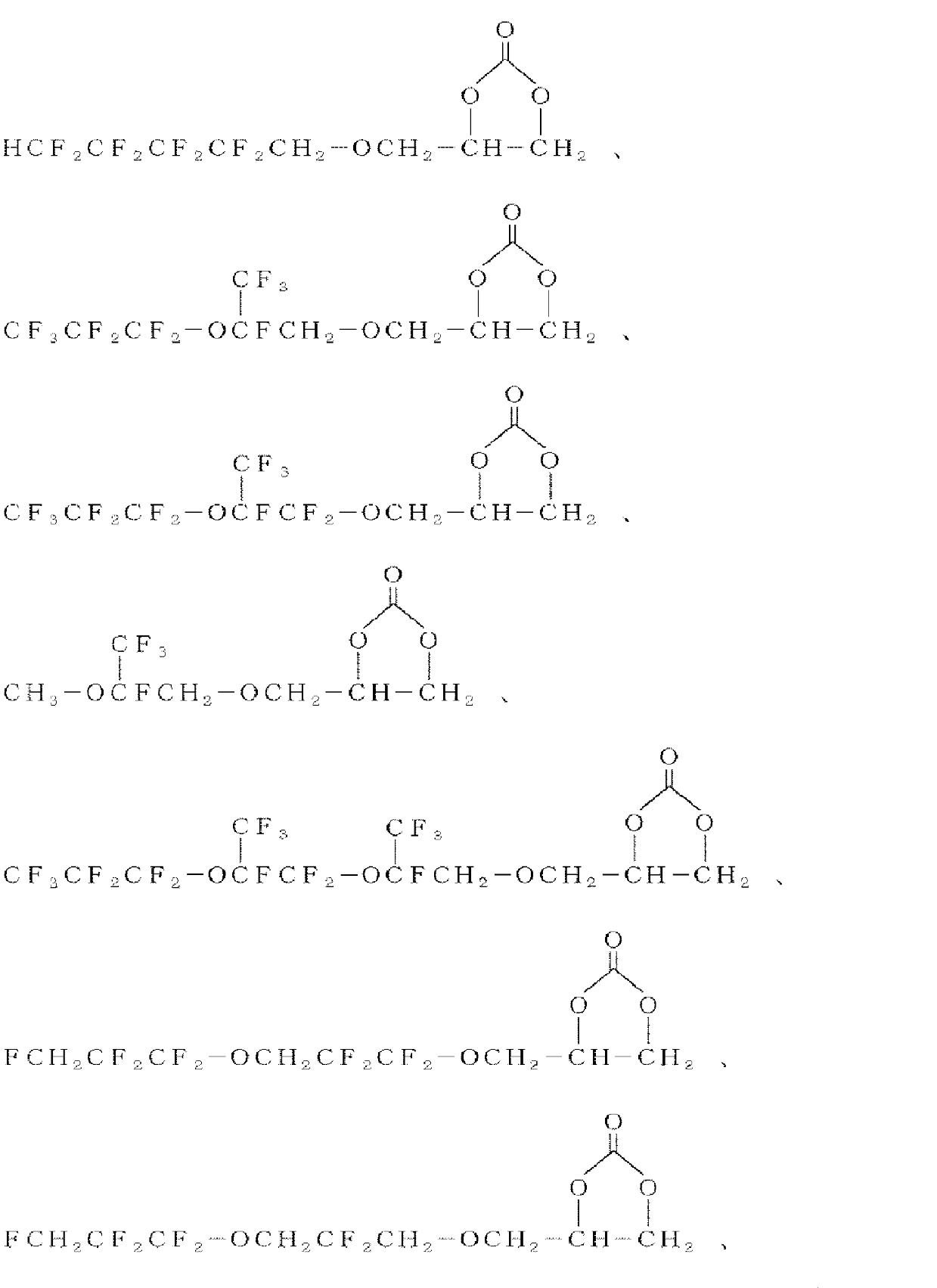
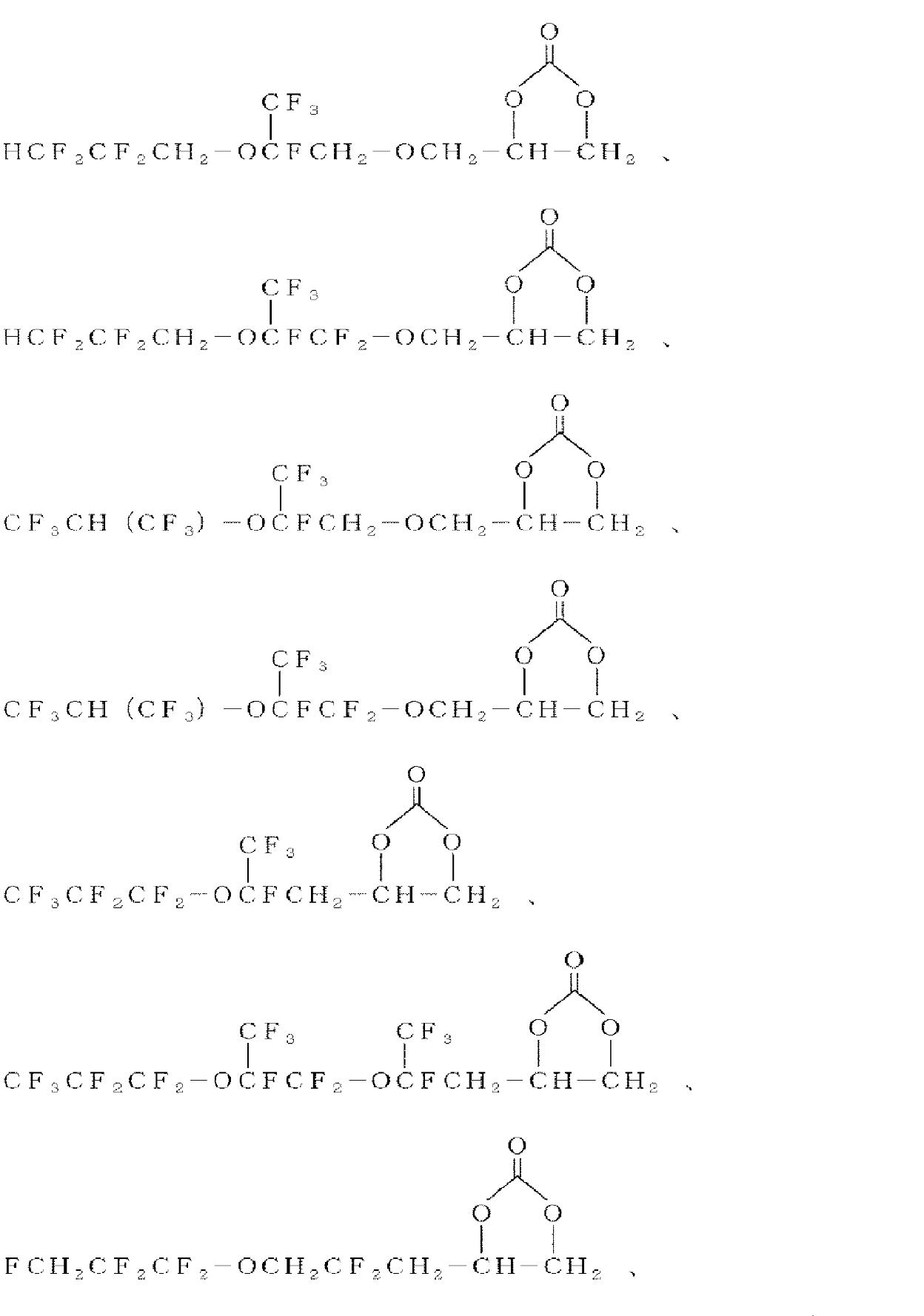
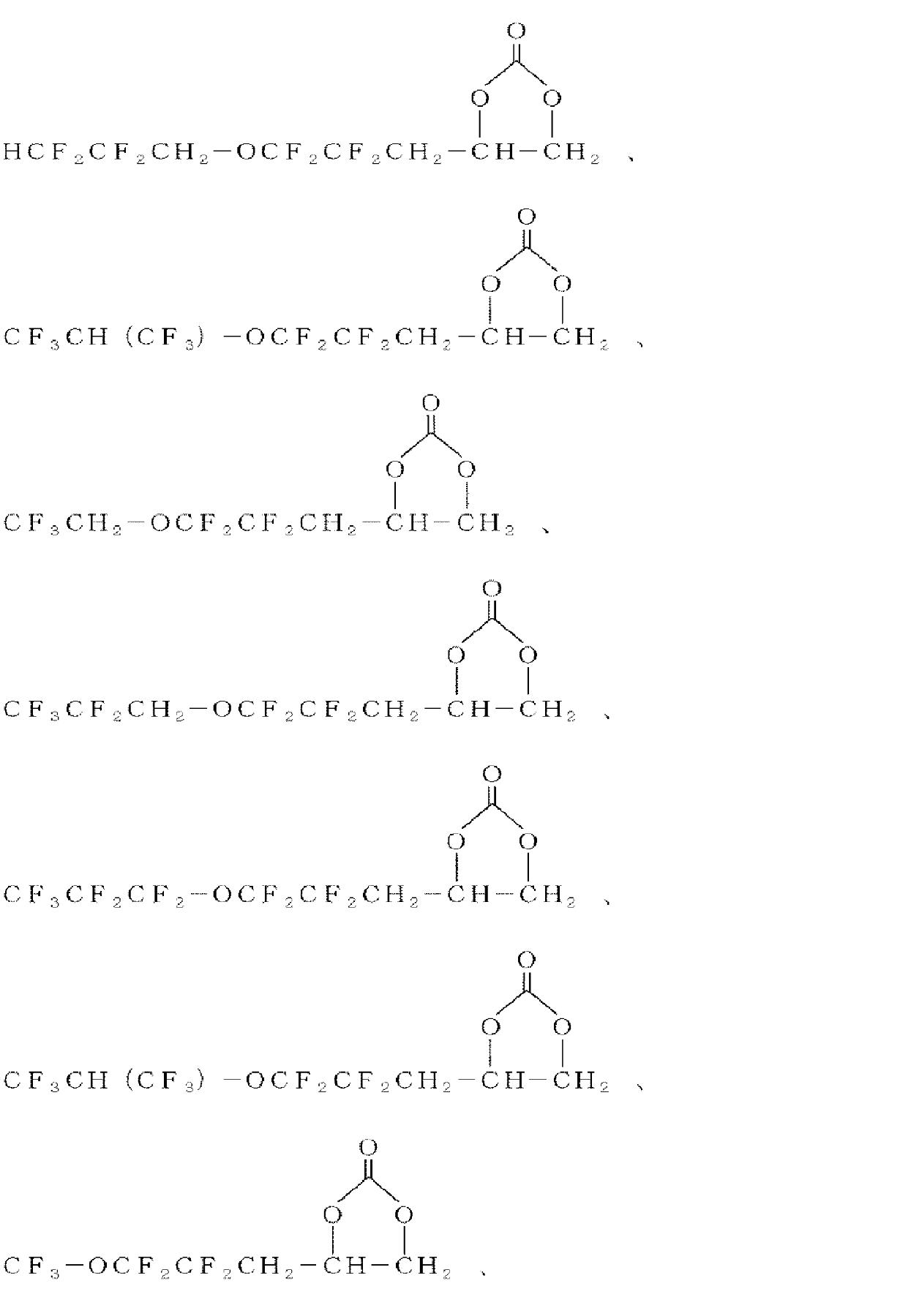
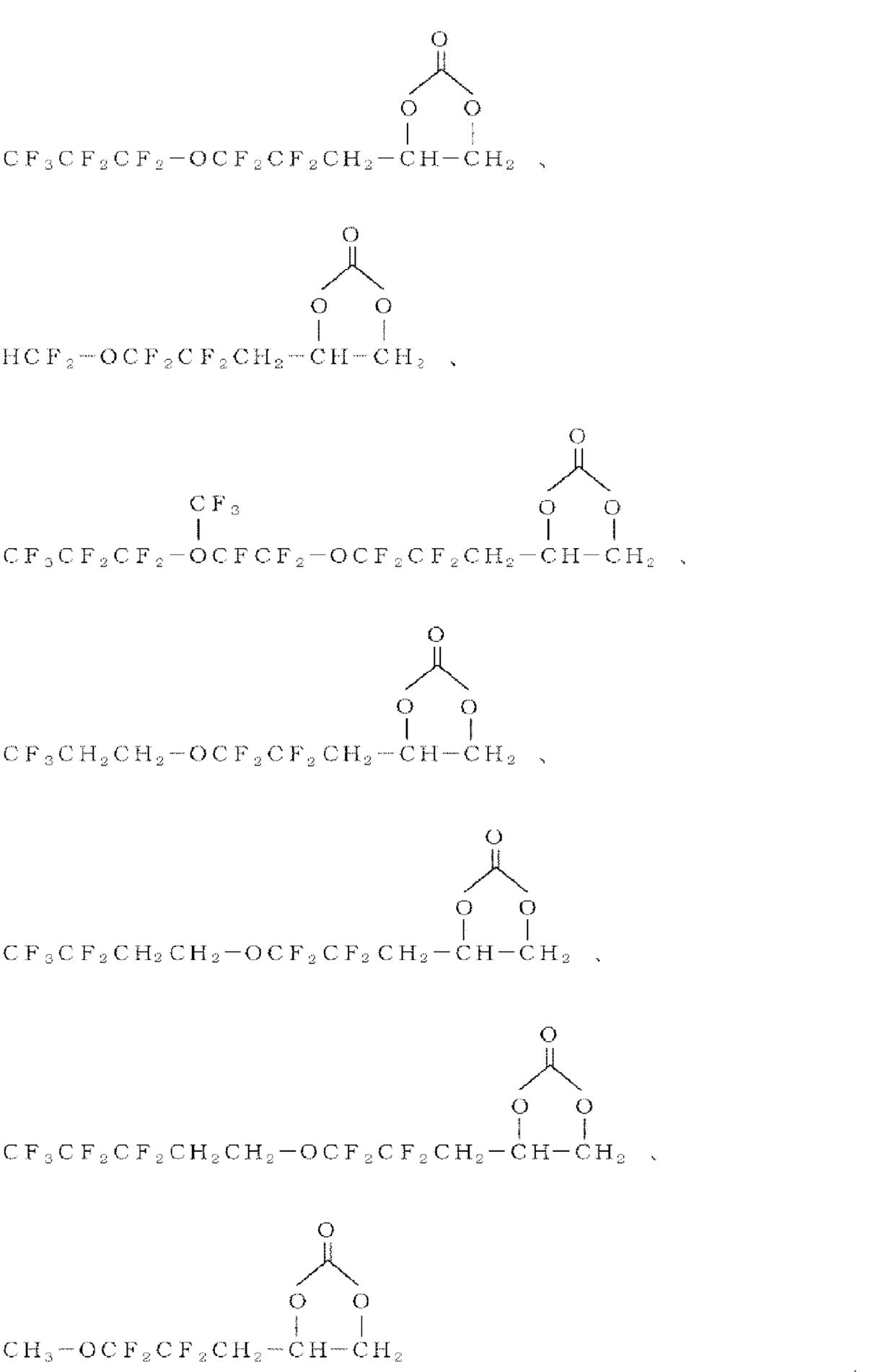
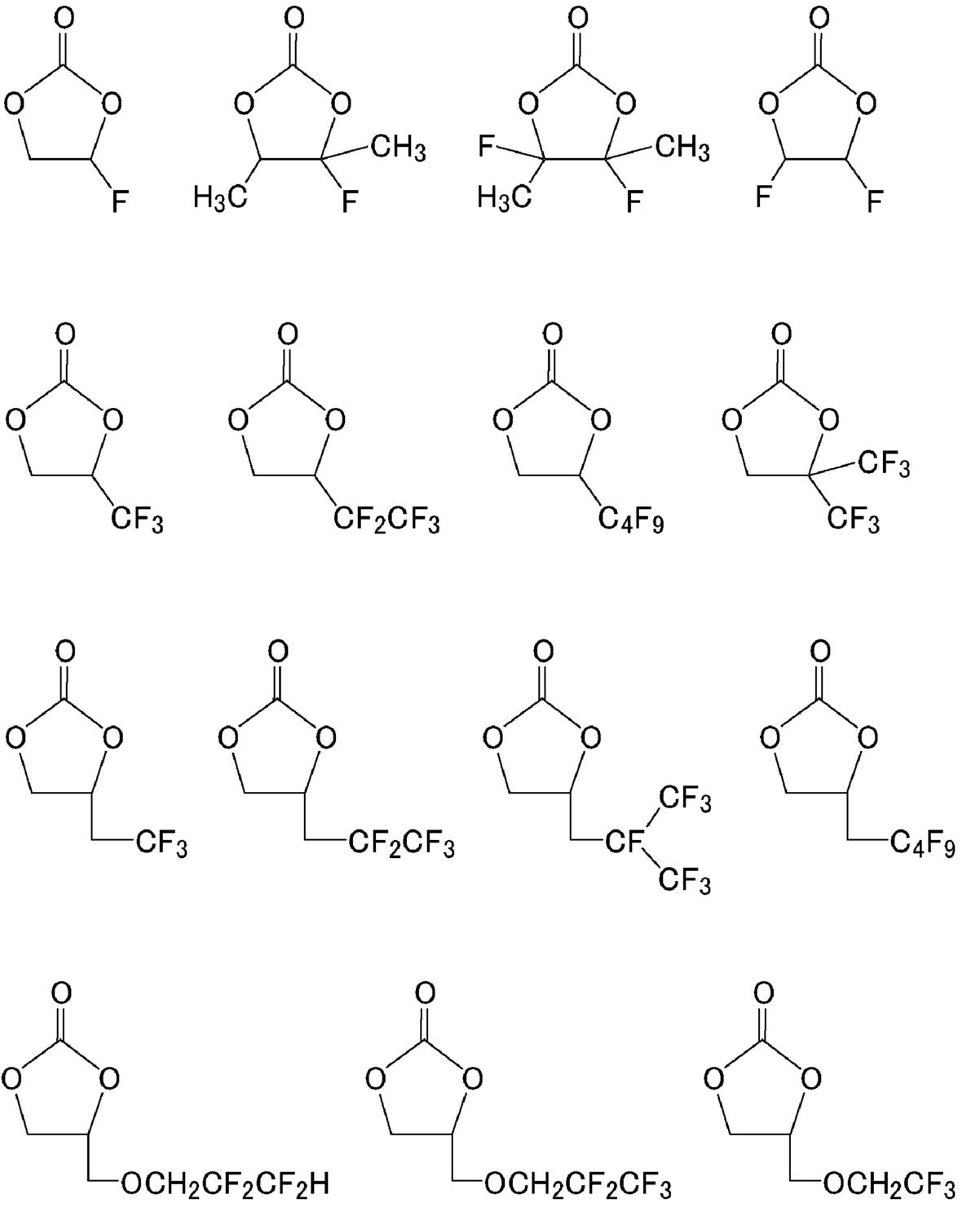
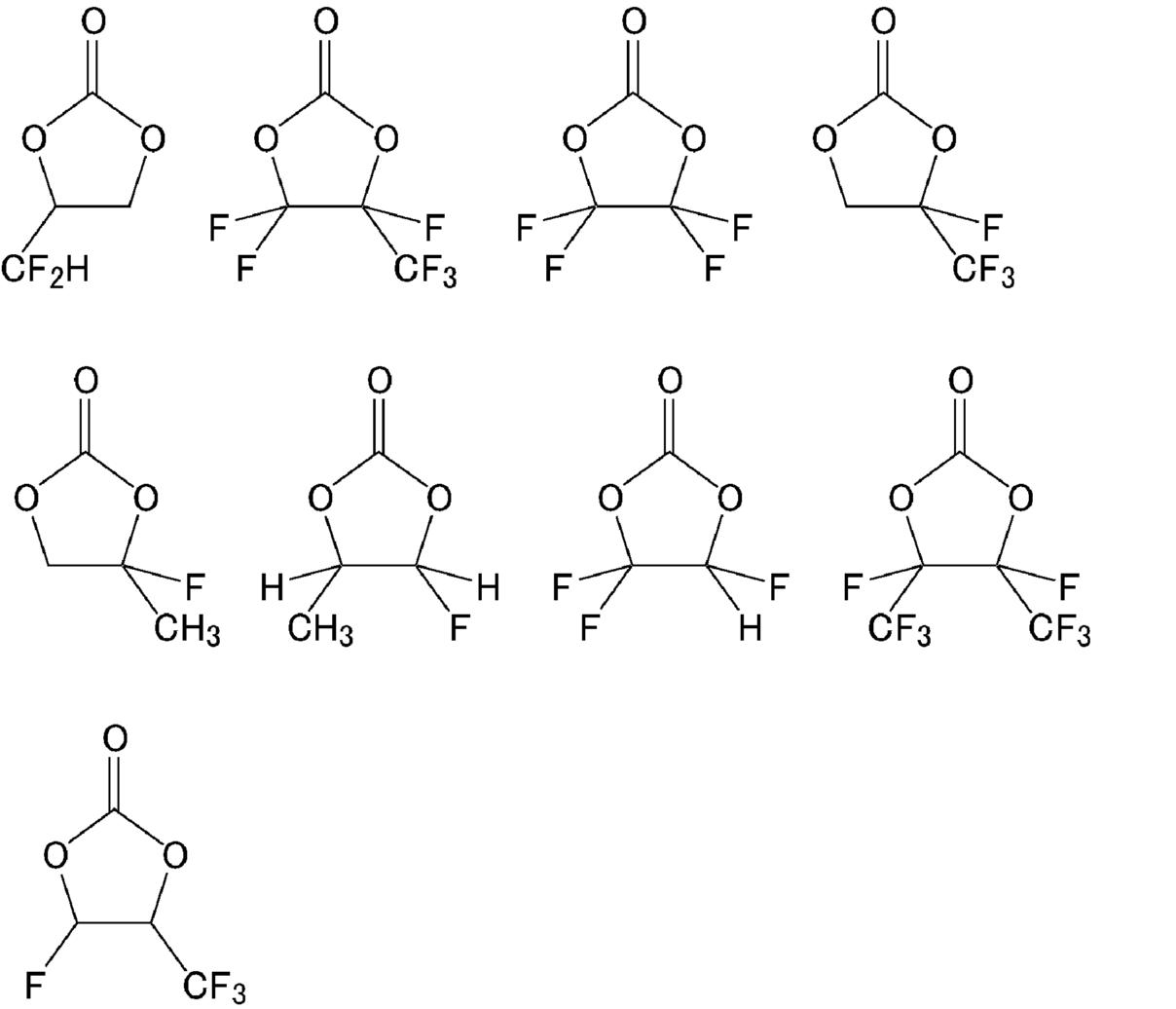
Rf2OCOOR7 (B)
(式中、Rf2は、炭素数1~7のフッ素化アルキル基であり、R7は、炭素数1~7のフッ素原子を含んでいてもよいアルキル基である。)で示される化合物を挙げることができる。
上記フッ素化アルキル基は、アルキル基が有する水素原子の少なくとも1つをフッ素原子で置換したものである。R7がフッ素原子を含むアルキル基である場合、フッ素化アルキル基となる。
Rf2及びR7は、低粘性である点で、炭素数が1~7であることが好ましく、1~2であることがより好ましい。
炭素数が大きくなりすぎると低温特性が低下したり、電解質塩の溶解性が低下したりするおそれがあり、炭素数が少な過ぎると、電解質塩の溶解性の低下、放電効率の低下、更には粘性の増大等がみられることがある。
R1-R2- (d-1)
(式中、R1はフッ素原子を有していてもよい炭素数1以上のアルキル基;R2はフッ素原子を有していてもよい炭素数1~3のアルキレン基;ただし、R1及びR2の少なくとも一方はフッ素原子を有している)で示されるフッ素化アルキル基が、電解質塩の溶解性が良好な点から好ましく例示できる。
なお、R1及びR2は、更に、炭素原子、水素原子及びフッ素原子以外の、その他の原子を有していてもよい。
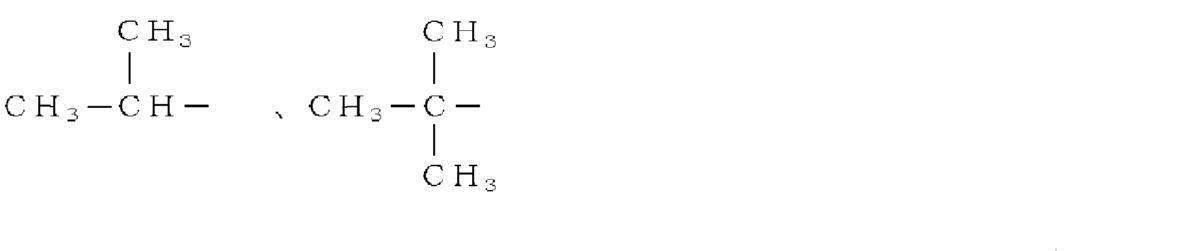
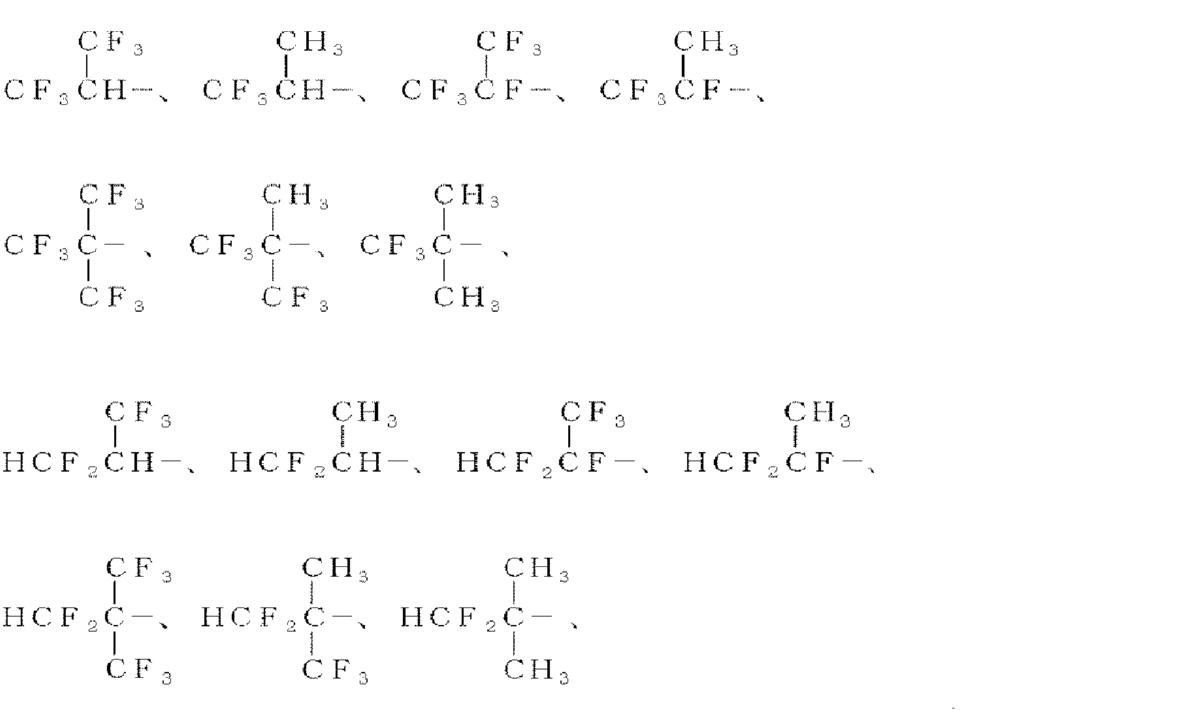

-CH2-、-CHF-、-CF2-、-CHCl-、-CFCl-、-CCl2-
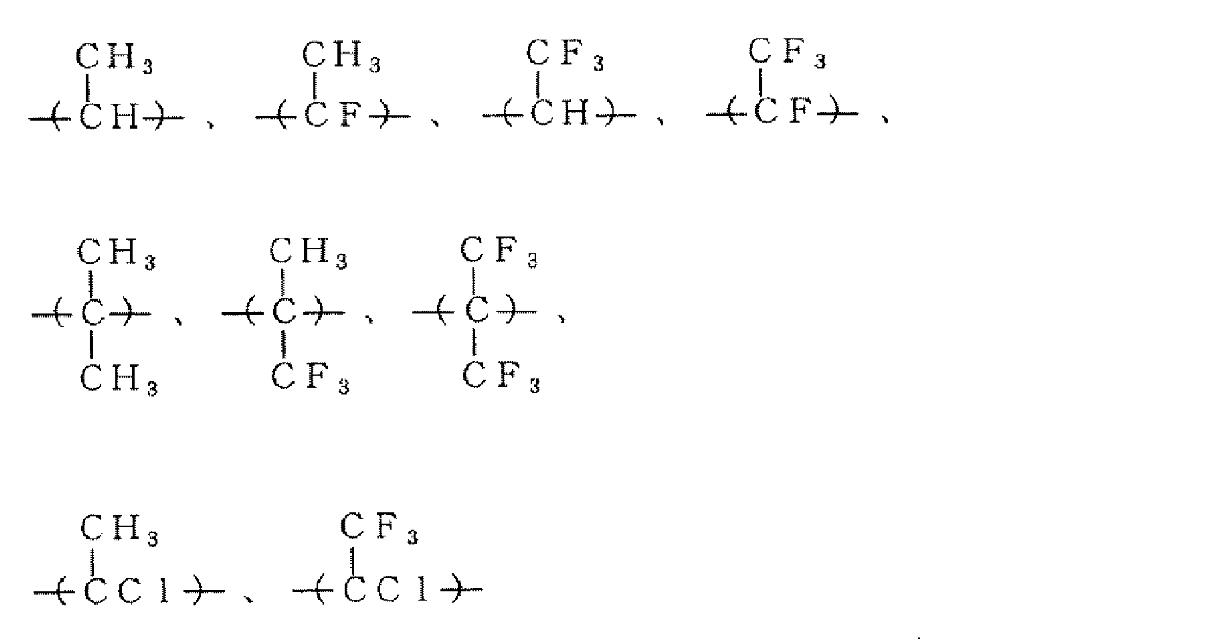
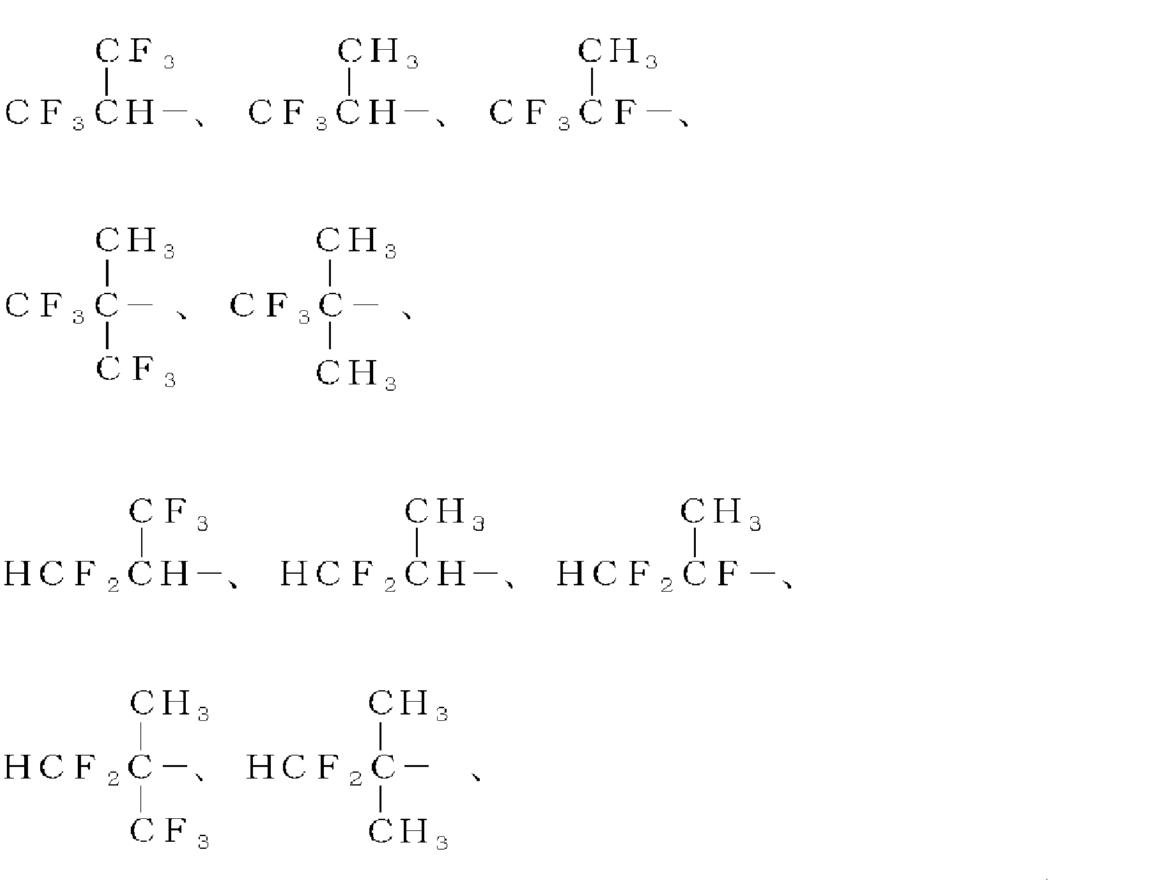
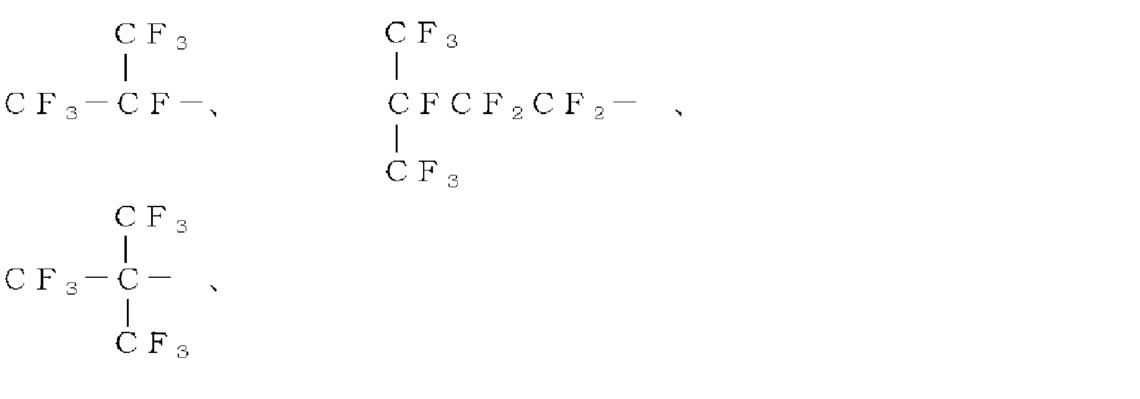
なお、本開示においてフッ素含有率は、上記フッ素化鎖状カーボネートの構造式に基づいて、
{(フッ素原子の個数×19)/フッ素化鎖状カーボネートの分子量}×100(%)
により算出した値である。
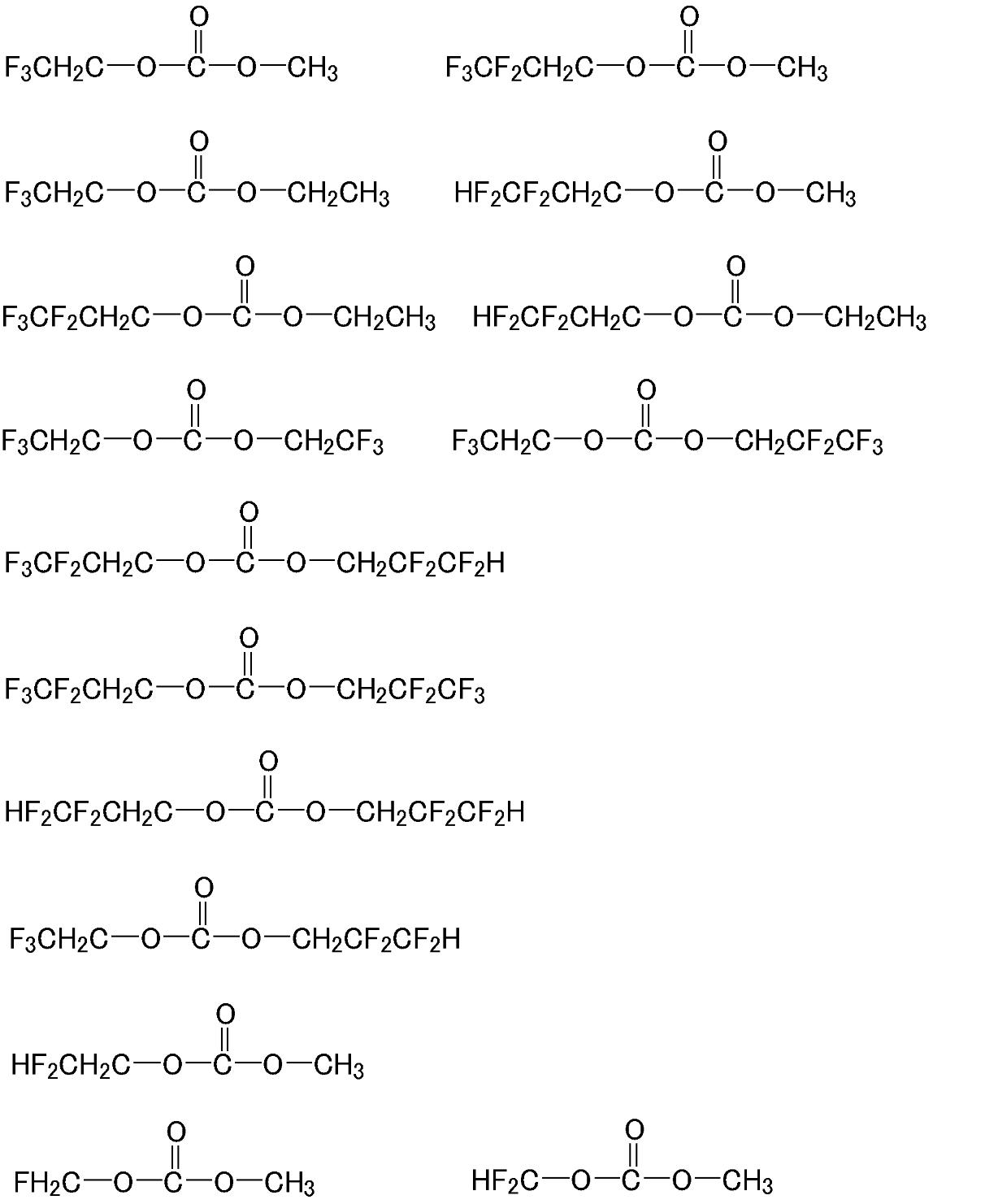
R31COOR32
(式中、R31及びR32は、互いに独立に、炭素数1~4のフッ素原子を含んでいてもよいアルキル基であり、R31及びR32の少なくとも一方はフッ素原子を含む。)で示されるフッ素化鎖状カルボン酸エステルが、他溶媒との相溶性や耐酸化性が良好な点から好ましい。
なかでもCF3CH2C(=O)OCH3、HCF2C(=O)OCH3、HCF2C(=O)OC2H5、CF3C(=O)OCH2C2F5、CF3C(=O)OCH2CF2CF2H、CF3C(=O)OCH2CF3、CF3C(=O)OCH(CF3)2、ペンタフルオロ酪酸エチル、ペンタフルオロプロピオン酸メチル、ペンタフルオロプロピオン酸エチル、ヘプタフルオロイソ酪酸メチル、トリフルオロ酪酸イソプロピル、トリフルオロ酢酸エチル、トリフルオロ酢酸tert-ブチル、トリフルオロ酢酸n-ブチル、テトラフルオロ-2-(メトキシ)プロピオン酸メチル、酢酸2,2-ジフルオロエチル、酢酸2,2,3,3-テトラフルオロプロピル、CH3C(=O)OCH2CF3、酢酸1H,1H-ヘプタフルオロブチル、4,4,4-トリフルオロ酪酸メチル、4,4,4-トリフルオロ酪酸エチル、3,3,3-トリフルオロプロピオン酸エチル、3,3,3-トリフルオロプロピオン酸3,3,3-トリフルオロプロピル、3-(トリフルオロメチル)酪酸エチル、2,3,3,3-テトラフルオロプロピオン酸メチル、2,2-ジフルオロ酢酸ブチル、2,2,3,3-テトラフルオロプロピオン酸メチル、2-(トリフルオロメチル)-3,3,3-トリフルオロプロピオン酸メチル、ヘプタフルオロ酪酸メチルが、他溶媒との相溶性及びレート特性が良好な点から好ましく、CF3CH2C(=O)OCH3、HCF2C(=O)OCH3、HCF2C(=O)OC2H5、CH3C(=O)OCH2CF3がより好ましく、HCF2C(=O)OCH3、HCF2C(=O)OC2H5、CH3C(=O)OCH2CF3が特に好ましい。
上記溶媒の含有量は、電解液中70~99.999質量%であることが好ましく、80質量%以上がより好ましく、92質量%以下がより好ましい。
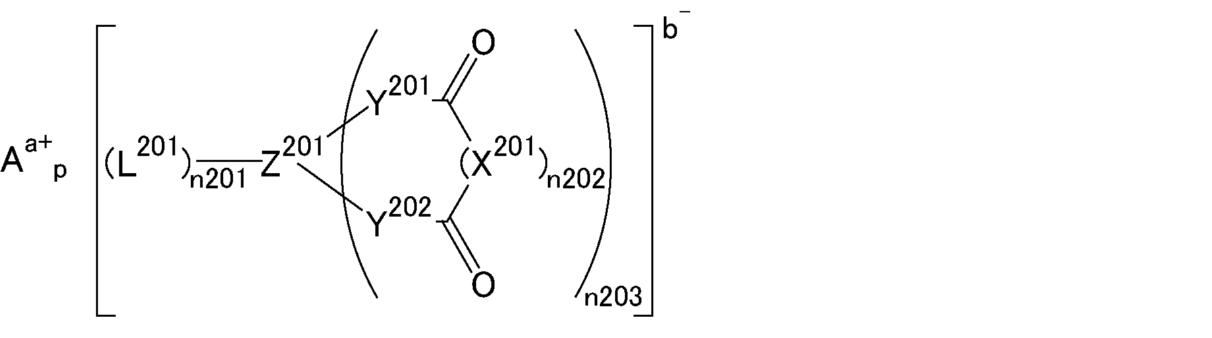
X201は、O、S、炭素数1~10のアルキレン基、炭素数1~10のハロゲン化アルキレン基、炭素数6~20のアリーレン基又は炭素数6~20のハロゲン化アリーレン基(アルキレン基、ハロゲン化アルキレン基、アリーレン基、及び、ハロゲン化アリーレン基はその構造中に置換基、ヘテロ原子を持っていてもよく、またn202が1でn203が2~4のときにはn203個のX201はそれぞれが結合していてもよい)。
L201は、ハロゲン原子、シアノ基、炭素数1~10のアルキル基、炭素数1~10のハロゲン化アルキル基、炭素数6~20のアリール基、炭素数6~20のハロゲン化アリール基(アルキレン基、ハロゲン化アルキレン基、アリーレン基、及び、ハロゲン化アリーレン基はその構造中に置換基、ヘテロ原子を持っていてもよく、またn201が2~8のときにはn201個のL201はそれぞれが結合して環を形成してもよい)又は-Z203Y203。
Y201、Y202及びZ203は、それぞれ独立でO、S、NY204、炭化水素基又はフッ素化炭化水素基。Y203及びY204は、それぞれ独立でH、F、炭素数1~10のアルキル基、炭素数1~10のハロゲン化アルキル基、炭素数6~20のアリール基又は炭素数6~20のハロゲン化アリール基(アルキル基、ハロゲン化アルキル基、アリール基及びハロゲン化アリール基はその構造中に置換基、ヘテロ原子を持っていてもよく、Y203又はY204が複数個存在する場合にはそれぞれが結合して環を形成してもよい)。
なお、本明細書において、フッ素化炭化水素基は、炭化水素基の水素原子の少なくとも1つがフッ素原子に置換された基である。


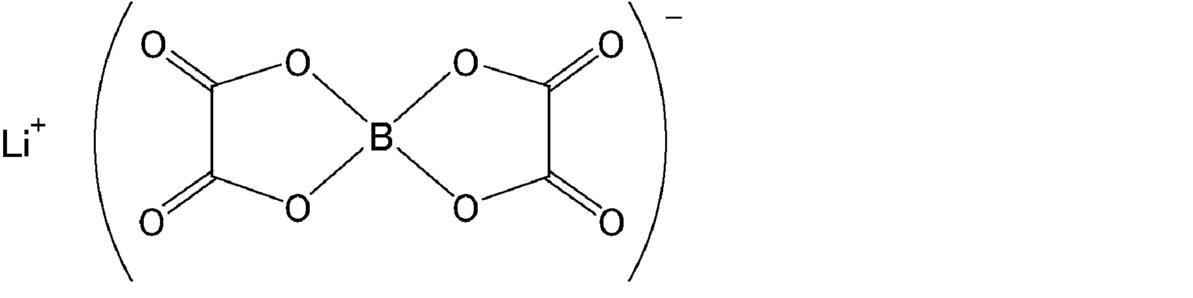

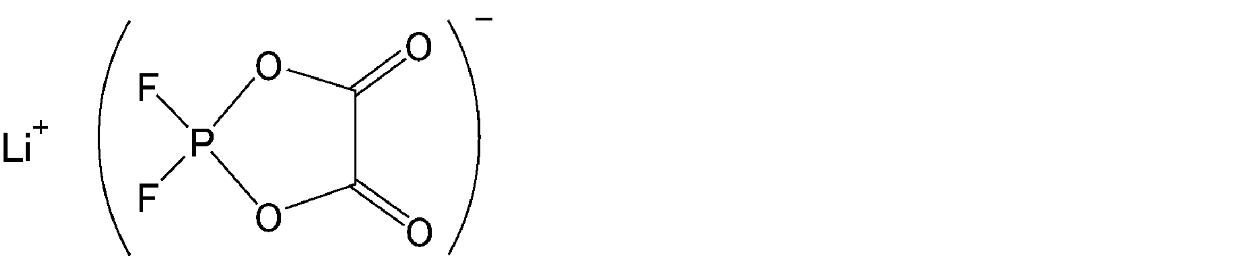

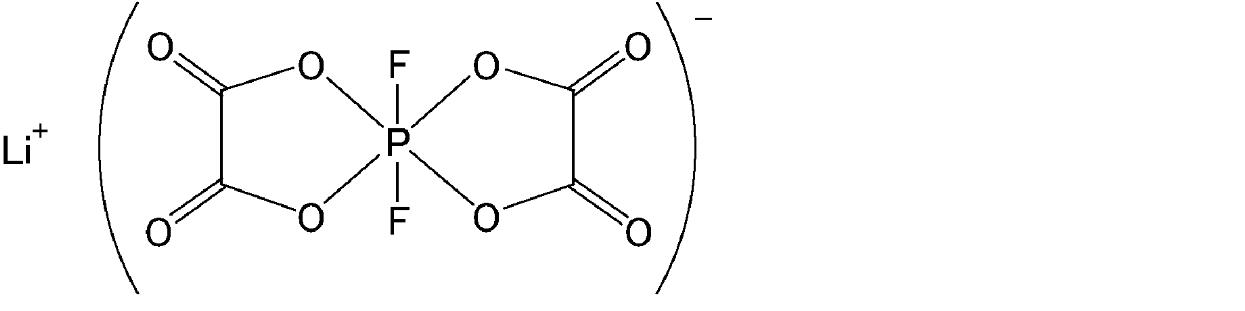
化合物(5)としては、リチウムビス(オキサラト)ボレートが特に好ましい。
上記リチウム塩として任意のものを用いることができ、具体的には以下のものが挙げられる。例えば、LiPF6、LiBF4、LiClO4、LiAlF4、LiSbF6、LiTaF6、LiWF7、LiAsF6,LiAlCl4,LiI、LiBr、LiCl、LiB10Cl10、Li2SiF6、Li2PFO3、LiPO2F2等の無機リチウム塩;
LiWOF5等のタングステン酸リチウム類;
HCO2Li、CH3CO2Li、CH2FCO2Li、CHF2CO2Li、CF3CO2Li、CF3CH2CO2Li、CF3CF2CO2Li、CF3CF2CF2CO2Li、CF3CF2CF2CF2CO2Li等のカルボン酸リチウム塩類;
FSO3Li、CH3SO3Li、CH2FSO3Li、CHF2SO3Li、CF3SO3Li、CF3CF2SO3Li、CF3CF2CF2SO3Li、CF3CF2CF2CF2SO3Li、リチウムメチルサルフェート、リチウムエチルサルフェート(C2H5OSO3Li)、リチウム2,2,2-トリフルオロエチルサルフェート等のS=O基を有するリチウム塩類;
LiN(FCO)2、LiN(FCO)(FSO2)、LiN(FSO2)2、LiN(FSO2)(CF3SO2)、LiN(CF3SO2)2、LiN(C2F5SO2)2、リチウムビスパーフルオロエタンスルホニルイミド、リチウム環状1,2-パーフルオロエタンジスルホニルイミド、リチウム環状1,3-パーフルオロプロパンジスルホニルイミド、リチウム環状1,2-エタンジスルホニルイミド、リチウム環状1,3-プロパンジスルホニルイミド、リチウム環状1,4-パーフルオロブタンジスルホニルイミド、LiN(CF3SO2)(FSO2)、LiN(CF3SO2)(C3F7SO2)、LiN(CF3SO2)(C4F9SO2)、LiN(POF2)2等のリチウムイミド塩類;
LiC(FSO2)3、LiC(CF3SO2)3、LiC(C2F5SO2)3等のリチウムメチド塩類;
その他、式:LiPFa(CnF2n+1)6-a(式中、aは0~5の整数であり、nは1~6の整数である)で表される塩(例えばLiPF3(C2F5)3、LiPF3(CF3)3、LiPF3(iso-C3F7)3、LiPF5(iso-C3F7)、LiPF4(CF3)2、LiPF4(C2F5)2)、LiPF4(CF3SO2)2、LiPF4(C2F5SO2)2、LiBF3CF3、LiBF3C2F5、LiBF3C3F7、LiBF2(CF3)2、LiBF2(C2F5)2、LiBF2(CF3SO2)2、LiBF2(C2F5SO2)2等の含フッ素有機リチウム塩類、LiSCN、LiB(CN)4、LiB(C6H5)4、Li2(C2O4)、LiP(C2O4)3、Li2B12FbH12-b(bは0~3の整数)等が挙げられる。
(IIa)テトラアルキル4級アンモニウム塩
一般式(IIa):

で示されるテトラアルキル4級アンモニウム塩が好ましく例示できる。また、このアンモニウム塩の水素原子の一部又は全部がフッ素原子及び/又は炭素数1~4の含フッ素アルキル基で置換されているものも、耐酸化性が向上する点から好ましい。

で示されるテトラアルキル4級アンモニウム塩、一般式(IIa-2):

で示されるアルキルエーテル基含有トリアルキルアンモニウム塩、
等が挙げられる。アルキルエーテル基を導入することにより、粘性の低下を図ることができる。
一般式(IIb-1):
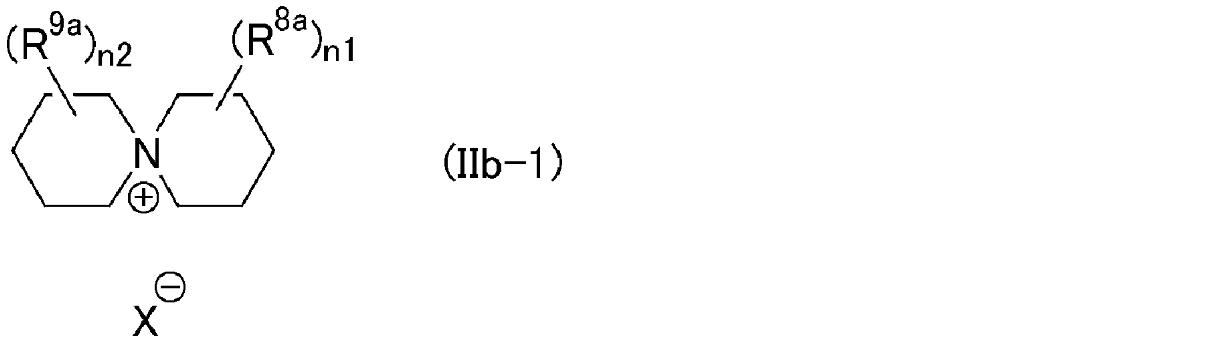
で示されるスピロ環ビピロリジニウム塩、一般式(IIb-2):

で示されるスピロ環ビピロリジニウム塩、又は、一般式(IIb-3):

で示されるスピロ環ビピロリジニウム塩が好ましく挙げられる。また、このスピロ環ビピロリジニウム塩の水素原子の一部又は全部がフッ素原子及び/又は炭素数1~4の含フッ素アルキル基で置換されているものも、耐酸化性が向上する点から好ましい。
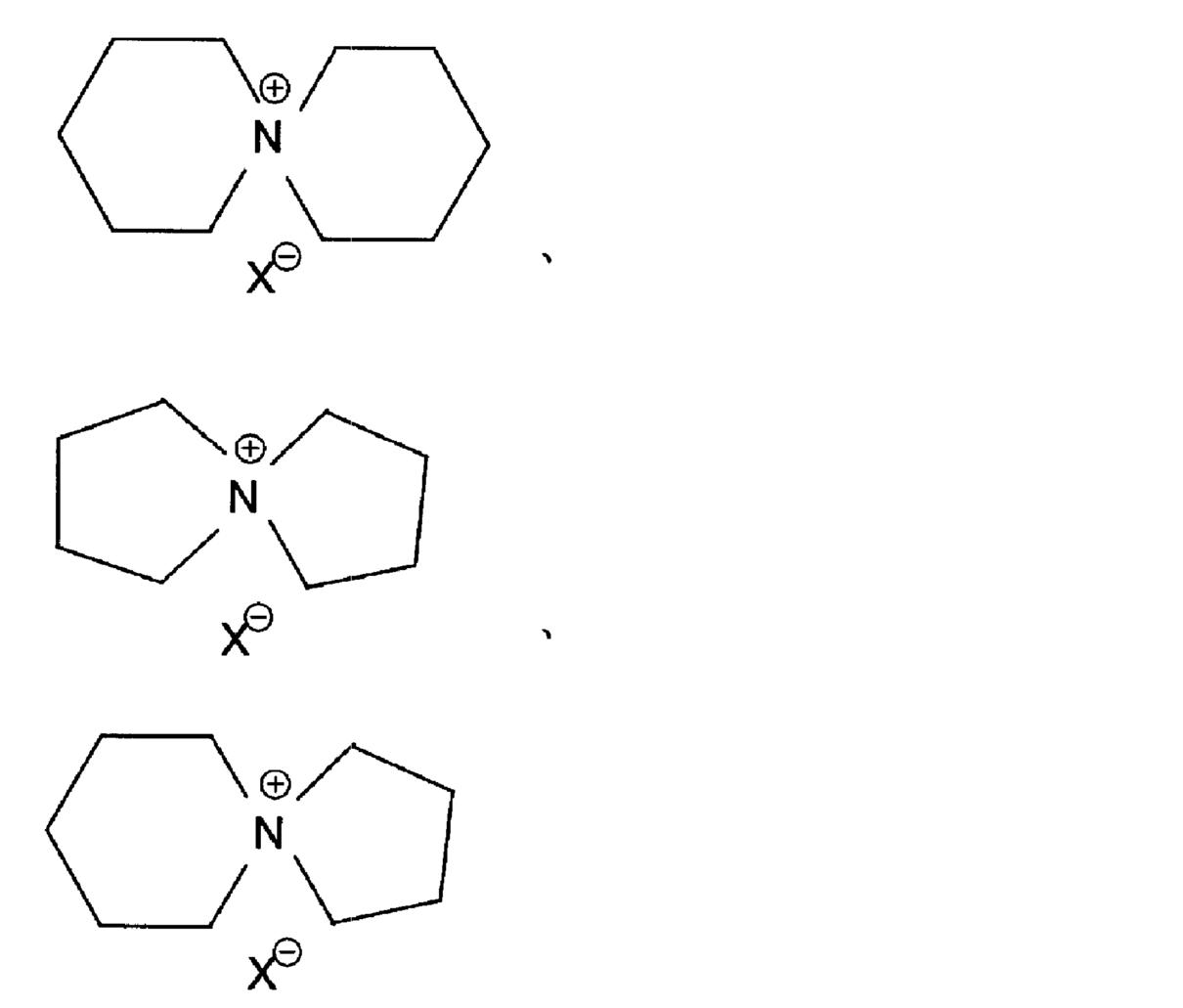
一般式(IIc):

で示されるイミダゾリウム塩が好ましく例示できる。また、このイミダゾリウム塩の水素原子の一部又は全部がフッ素原子及び/又は炭素数1~4の含フッ素アルキル基で置換されているものも、耐酸化性が向上する点から好ましい。

一般式(IId):

で示されるN-アルキルピリジニウム塩が好ましく例示できる。また、このN-アルキルピリジニウム塩の水素原子の一部又は全部がフッ素原子及び/又は炭素数1~4の含フッ素アルキル基で置換されているものも、耐酸化性が向上する点から好ましい。
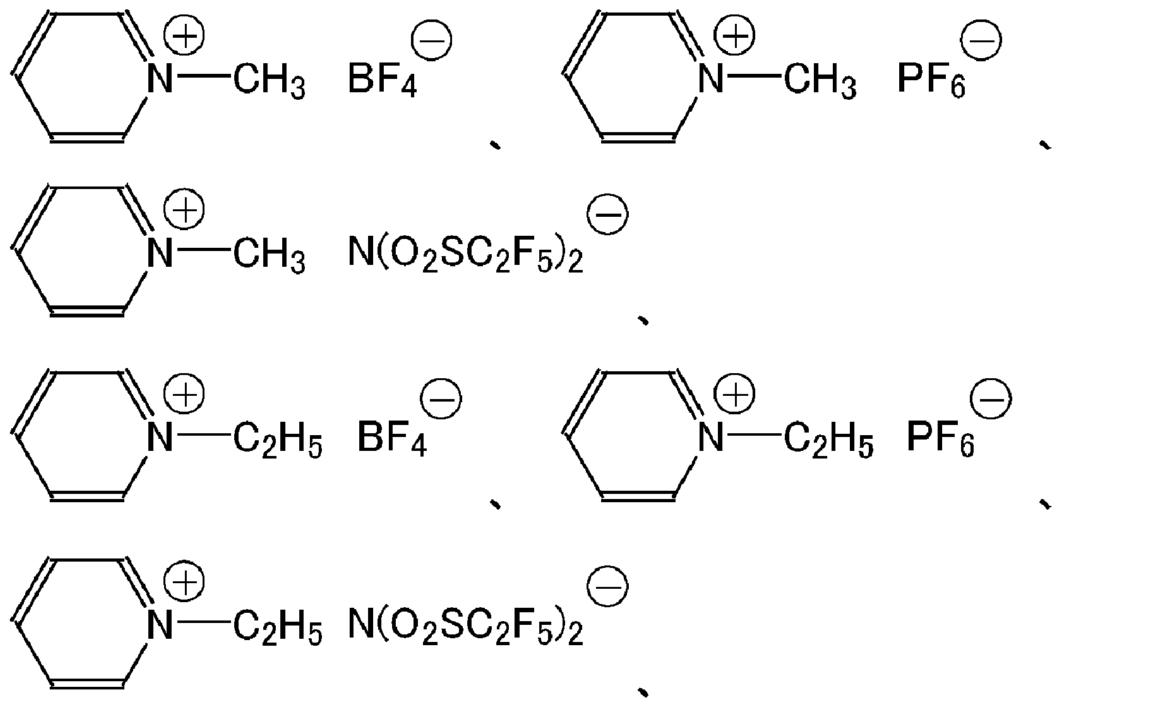
一般式(IIe):

で示されるN,N-ジアルキルピロリジニウム塩が好ましく例示できる。また、このN,N-ジアルキルピロリジニウム塩の水素原子の一部又は全部がフッ素原子及び/又は炭素数1~4の含フッ素アルキル基で置換されているものも、耐酸化性が向上する点から好ましい。

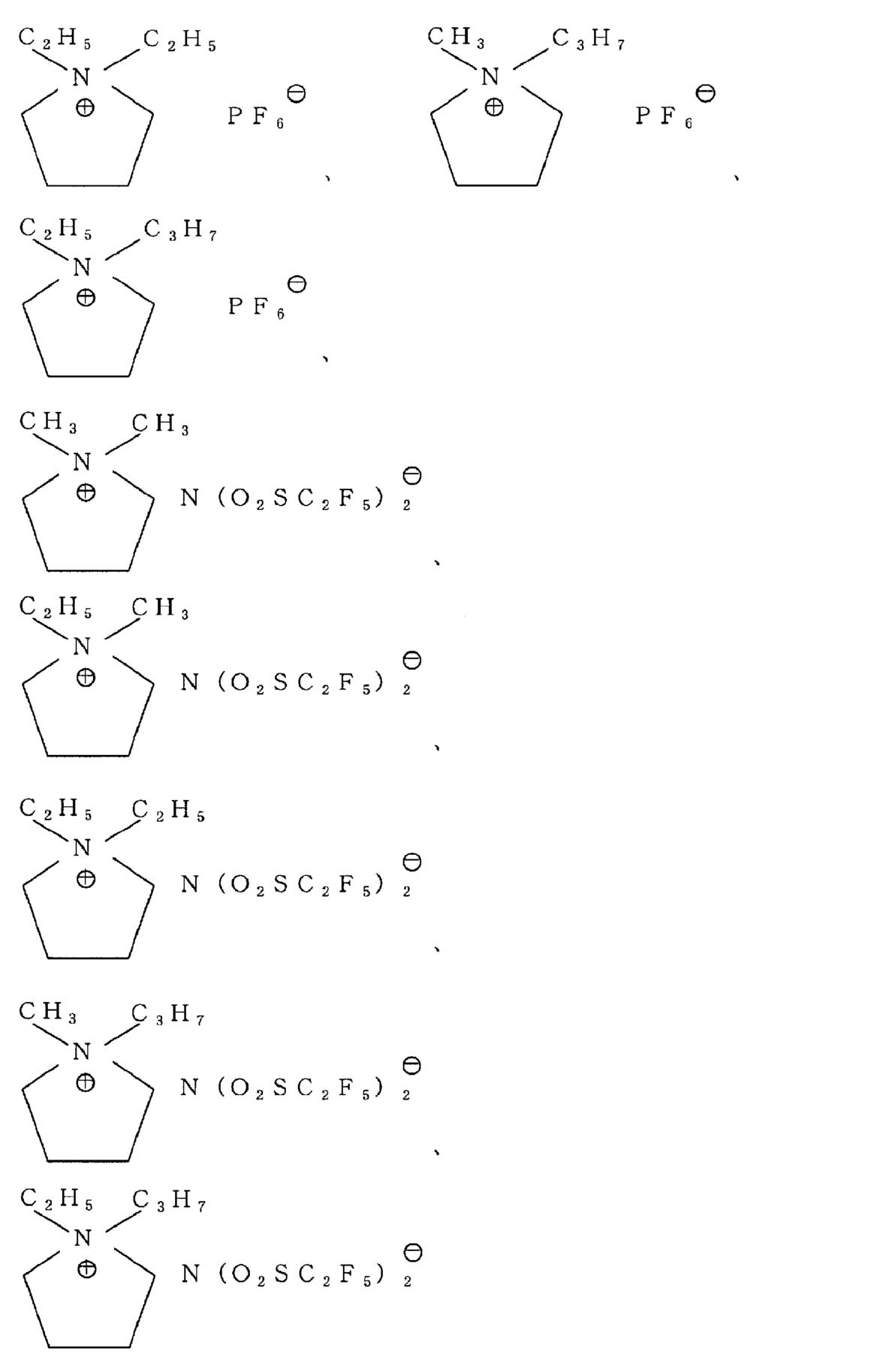
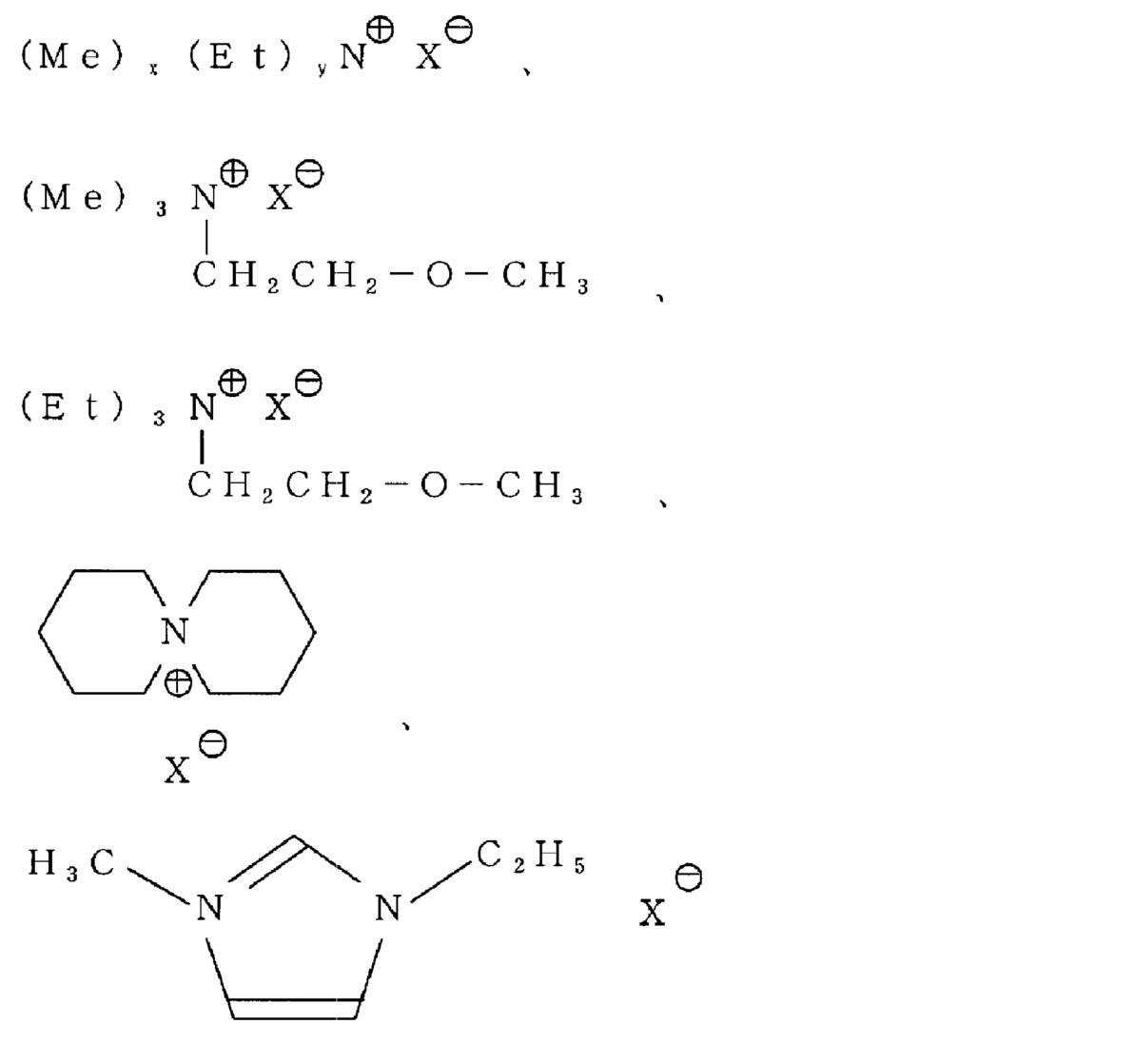
が好ましい。
更に容量を向上させるために、マグネシウム塩を用いてもよい。マグネシウム塩としては、例えば、Mg(ClO4)2、Mg(OOC2H5)2等が好ましい。
上記濃度の上限は、低温特性の点で、2.0モル/リットル以下であることが好ましく、1.5モル/リットル以下であることがより好ましい。
上記アンモニウム塩が、4フッ化ホウ酸トリエチルメチルアンモニウム(TEMABF4)の場合、その濃度は、低温特性に優れる点で、0.7~1.5モル/リットルであることが好ましい。
また、4フッ化ホウ酸スピロビピロリジニウム(SBPBF4)の場合は、0.7~2.0モル/リットルであることが好ましい。

で示される化合物(2)が挙げられる。上記電解液が化合物(2)を含むと、高温で保管した場合でも、容量保持率が一層低下しにくく、ガスの発生量が更に増加しにくい。
Z21としては、H-、F-、CH3-、CH3CH2-、CH3CH2CH2-、CF3-、CF3CF2-、CH2FCH2-及びCF3CF2CF2-からなる群より選択される少なくとも1種が好ましい。


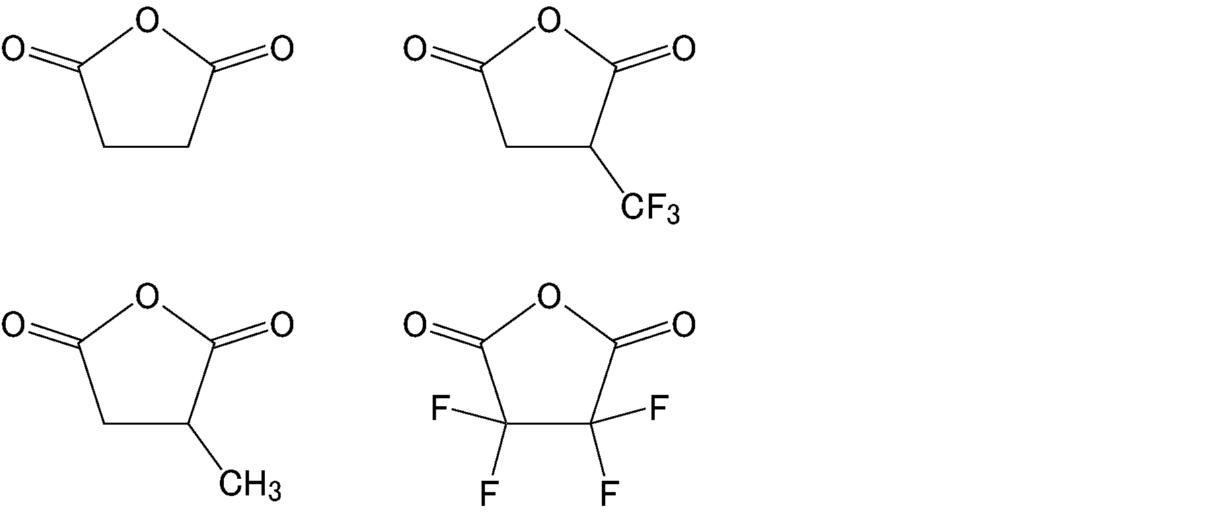
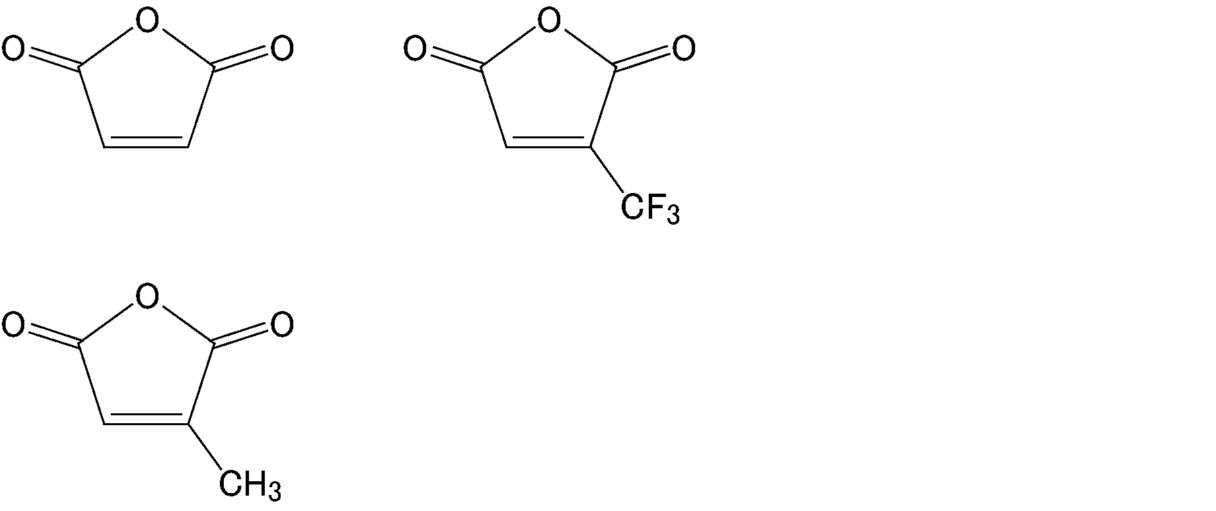



これにより、電気化学デバイスの高温保存特性を向上させることができる。上記ニトリル化合物を単独で用いてもよく、2種以上を任意の組み合わせ及び比率で併用してもよい。
ハロゲン原子としては、例えば、フッ素原子、塩素原子、臭素原子、ヨウ素原子が挙げられる。中でもフッ素原子が好ましい。
アルキル基としては、炭素数1~5のものが好ましい。アルキル基の具体例としては、メチル基、エチル基、プロピル基、イソプロピル基、ブチル基、イソブチル基、tert-ブチル基等が挙げられる。
アルキル基の少なくとも一部の水素原子をハロゲン原子で置換した基としては、上述したアルキル基の少なくとも一部の水素原子を上述したハロゲン原子で置換した基が挙げられる。
Ra及びRbがアルキル基、又は、アルキル基の少なくとも一部の水素原子をハロゲン原子で置換した基である場合は、RaとRbとが互いに結合して環構造(例えば、シクロヘキサン環)を形成していてもよい。
Ra及びRbは、水素原子又はアルキル基であることが好ましい。
ジニトリルの具体例としては、マロノニトリル、スクシノニトリル、グルタロニトリル、アジポニトリル、ピメロニトリル、スベロニトリル、アゼラニトリル、セバコニトリル、ウンデカンジニトリル、ドデカンジニトリル、メチルマロノニトリル、エチルマロノニトリル、イソプロピルマロノニトリル、tert-ブチルマロノニトリル、メチルスクシノニトリル、2,2-ジメチルスクシノニトリル、2,3-ジメチルスクシノニトリル、2,3,3-トリメチルスクシノニトリル、2,2,3,3-テトラメチルスクシノニトリル、2,3-ジエチル-2,3-ジメチルスクシノニトリル、2,2-ジエチル-3,3-ジメチルスクシノニトリル、ビシクロヘキシル-1,1-ジカルボニトリル、ビシクロヘキシル-2,2-ジカルボニトリル、ビシクロヘキシル-3,3-ジカルボニトリル、2,5-ジメチル-2,5-ヘキサンジカルボニトリル、2,3-ジイソブチル-2,3-ジメチルスクシノニトリル、2,2-ジイソブチル-3,3-ジメチルスクシノニトリル、2-メチルグルタロニトリル、2,3-ジメチルグルタロニトリル、2,4-ジメチルグルタロニトリル、2,2,3,3-テトラメチルグルタロニトリル、2,2,4,4-テトラメチルグルタロニトリル、2,2,3,4-テトラメチルグルタロニトリル、2,3,3,4-テトラメチルグルタロニトリル、1,4-ジシアノペンタン、2,6-ジシアノヘプタン、2,7-ジシアノオクタン、2,8-ジシアノノナン、1,6-ジシアノデカン、1,2-ジジアノベンゼン、1,3-ジシアノベンゼン、1,4-ジシアノベンゼン、3,3’-(エチレンジオキシ)ジプロピオニトリル、3,3’-(エチレンジチオ)ジプロピオニトリル、3,9-ビス(2-シアノエチル)-2,4,8,10-テトラオキサスピロ[5,5]ウンデカン、ブタンニトリル、フタロニトリル等を例示できる。これらのうち、特に好ましいのはスクシノニトリル、グルタロニトリル、アジポニトリルである。
また、トリカルボニトリルの具体例としては、ペンタントリカルボニトリル、プロパントリカルボニトリル、1,3,5-ヘキサントリカルボニトリル、1,3,6-ヘキサントリカルボニトリル、ヘプタントリカルボニトリル、1,2,3-プロパントリカルボニトリル、1,3,5-ペンタントリカルボニトリル、シクロヘキサントリカルボニトリル、トリスシアノエチルアミン、トリスシアノエトキシプロパン、トリシアノエチレン、トリス(2-シアノエチル)アミン等が挙げられ特に好ましいものは、1,3,6-ヘキサントリカルボニトリル、シクロヘキサントリカルボニトリルであり、最も好ましいものはシクロヘキサントリカルボニトリルである。
ハロゲン原子、アルキル基、及び、アルキル基の少なくとも一部の水素原子をハロゲン原子で置換した基については、上記一般式(1a)について例示したものが挙げられる。
上記NC-Rc1-Xc1-におけるRc1はアルキレン基である。アルキレン基としては、炭素数1~3のアルキレン基が好ましい。
Rc、Rd及びReは、それぞれ独立して、水素原子、ハロゲン原子、アルキル基、又は、アルキル基の少なくとも一部の水素原子をハロゲン原子で置換した基であることが好ましい。
Rc、Rd及びReの少なくとも1つは、ハロゲン原子、又は、アルキル基の少なくとも一部の水素原子をハロゲン原子で置換した基であることが好ましく、フッ素原子、又は、アルキル基の少なくとも一部の水素原子をフッ素原子で置換した基であることがより好ましい。
Rd及びReがアルキル基、又は、アルキル基の少なくとも一部の水素原子をハロゲン原子で置換した基である場合は、RdとReとが互いに結合して環構造(例えば、シクロヘキサン環)を形成していてもよい。
ハロゲン原子、アルキル基、及び、アルキル基の少なくとも一部の水素原子をハロゲン原子で置換した基については、上記一般式(1a)について例示したものが挙げられる。
シアノ基を含む基としては、シアノ基のほか、アルキル基の少なくとも一部の水素原子をシアノ基で置換した基が挙げられる。この場合のアルキル基としては、上記一般式(1a)について例示したものが挙げられる。
Rf、Rg、Rh及びRiのうち少なくとも1つはシアノ基を含む基である。好ましくは、Rf、Rg、Rh及びRiのうち少なくとも2つがシアノ基を含む基であることであり、より好ましくは、Rh及びRiがシアノ基を含む基であることである。Rh及びRiがシアノ基を含む基である場合、Rf及びRgは、水素原子であることが好ましい。
なかでも、電気化学デバイスの特性がより良好となる点で、ポリエチレンオキシドモノオールとポリエチレンオキシドジオールの混合物、及び、ポリエチレンカルボン酸とポリエチレンジカルボン酸の混合物であることが好ましい。
フッ素化不飽和環状カーボネートは、不飽和結合とフッ素原子とを有する環状カーボネートである。フッ素化不飽和環状カーボネートが有するフッ素原子の数は1以上があれば、特に制限されない。中でもフッ素原子が通常6以下、好ましくは4以下であり、1個又は2個のものが最も好ましい。
1-ペンチン、2-ペンチン、1-ヘキシン、2-ヘキシン、3-ヘキシン、1-ヘプチン、2-ヘプチン、3-ヘプチン、1-オクチン、2-オクチン、3-オクチン、4-オクチン、1-ノニン、2-ノニン、3-ノニン、4-ノニン、1-ドデシン、2-ドデシン、3-ドデシン、4-ドデシン、5-ドデシン、フェニルアセチレン、1-フェニル-1-プロピン、1-フェニル-2-プロピン、1-フェニル-1-ブチン、4-フェニル-1-ブチン、4-フェニル-1-ブチン、1-フェニル-1-ペンチン、5-フェニル-1-ペンチン、1-フェニル-1-ヘキシン、6-フェニル-1-ヘキシン、ジフェニルアセチレン、4-エチニルトルエン、ジシクロヘキシルアセチレン等の炭化水素化合物;

ペンタン、ヘプタン、オクタン、ノナン、デカン、シクロヘプタン、ベンゼン、フラン、ナフタレン、2-フェニルビシクロヘキシル、シクロヘキサン、2,4,8,10-テトラオキサスピロ[5.5]ウンデカン、3,9-ジビニル-2,4,8,10-テトラオキサスピロ[5.5]ウンデカン等の炭化水素化合物;
フルオロベンゼン、ジフルオロベンゼン、ヘキサフルオロベンゼン、ベンゾトリフルオライド、モノフルオロベンゼン、1-フルオロ-2-シクロヘキシルベンゼン、1-フルオロ-4-tert-ブチルベンゼン、1-フルオロ-3-シクロヘキシルベンゼン、1-フルオロ-2-シクロヘキシルベンゼン、フッ素化ビフェニル等の含フッ素芳香族化合物;
エリスリタンカーボネート、スピロ-ビス-ジメチレンカーボネート、メトキシエチル-メチルカーボネート等のカーボネート化合物;
ジオキソラン、ジオキサン、2,5,8,11-テトラオキサドデカン、2,5,8,11,14-ペンタオキサペンタデカン、エトキシメトキシエタン、トリメトキシメタン、グライム、エチルモノグライム等のエーテル系化合物;
ジメチルケトン、ジエチルケトン、3-ペンタノン等のケトン系化合物;
2-アリル無水コハク酸等の酸無水物;
シュウ酸ジメチル、シュウ酸ジエチル、シュウ酸エチルメチル、シュウ酸ジ(2-プロピニル)、シュウ酸メチル2-プロピニル、コハク酸ジメチル、グルタル酸ジ(2-プロピニル)、ギ酸メチル、ギ酸エチル、ギ酸2-プロピニル、2-ブチン-1,4-ジイルジホルメート、メタクリル酸2-プロピニル、マロン酸ジメチル等のエステル化合物;
アセトアミド、N-メチルホルムアミド、N,N-ジメチルホルムアミド、N,N-ジメチルアセトアミド等のアミド系化合物;
硫酸エチレン、硫酸ビニレン、亜硫酸エチレン、フルオロスルホン酸メチル、フルオロスルホン酸エチル、メタンスルホン酸メチル、メタンスルホン酸エチル、ブスルファン、スルホレン、ジフェニルスルホン、N,N-ジメチルメタンスルホンアミド、N,N-ジエチルメタンスルホンアミド、ビニルスルホン酸メチル、ビニルスルホン酸エチル、ビニルスルホン酸アリル、ビニルスルホン酸プロパルギル、アリルスルホン酸メチル、アリルスルホン酸エチル、アリルスルホン酸アリル、アリルスルホン酸プロパルギル、1,2-ビス(ビニルスルホニロキシ)エタン、無水プロパンジスルホン酸、無水スルホ酪酸、無水スルホ安息香酸、無水スルホプロピオン酸、無水エタンジスルホン酸、メチレンメタンジスルホネート、メタンスルホン酸2-プロピニル、ペンテンサルファイト、ペンタフルオロフェニルメタンスルホネート、プロピレンサルフェート、プロピレンサルファイト、プロパンサルトン、ブチレンサルファイト、ブタン-2,3-ジイルジメタンスルホネート、2-ブチン-1,4-ジイルジメタンスルホネート、ビニルスルホン酸2-プロピニル、ビス(2-ビニルスルホニルエチル)エーテル、5-ビニル-ヘキサヒドロ-1,3,2-ベンゾジオキサチオール-2-オキシド、2-(メタンスルホニルオキシ)プロピオン酸2-プロピニル、5,5-ジメチル-1,2-オキサチオラン-4-オン2,2-ジオキシド、3-スルホ-プロピオン酸無水物トリメチレンメタンジスルホネート2-メチルテトラヒドロフラン、トリメチレンメタンジスルホネート、テトラメチレンスルホキシド、ジメチレンメタンジスルホネート、ジフルオロエチルメチルスルホン、ジビニルスルホン、1,2-ビス(ビニルスルホニル)エタン、エチレンビススルホン酸メチル、エチレンビススルホン酸エチル、エチレンサルフェート、チオフェン1-オキシド等の含硫黄化合物;
1-メチル-2-ピロリジノン、1-メチル-2-ピペリドン、3-メチル-2-オキサゾリジノン、1,3-ジメチル-2-イミダゾリジノン及びN-メチルスクシンイミド、ニトロメタン、ニトロエタン、エチレンジアミン等の含窒素化合物;
亜リン酸トリメチル、亜リン酸トリエチル、亜リン酸トリフェニル、リン酸トリメチル、リン酸トリエチル、リン酸トリフェニル、メチルホスホン酸ジメチル、エチルホスホン酸ジエチル、ビニルホスホン酸ジメチル、ビニルホスホン酸ジエチル、ジエチルホスホノ酢酸エチル、ジメチルホスフィン酸メチル、ジエチルホスフィン酸エチル、トリメチルホスフィンオキシド、トリエチルホスフィンオキシド、リン酸ビス(2,2-ジフルオロエチル)2,2,2-トリフルオロエチル、リン酸ビス(2,2,3,3-テトラフルオロプロピル)2,2,2-トリフルオロエチル、リン酸ビス(2,2,2-トリフルオロエチル)メチル、リン酸ビス(2,2,2-トリフルオロエチル)エチル、リン酸ビス(2,2,2-トリフルオロエチル)2,2-ジフルオロエチルリン酸ビス(2,2,2-トリフルオロエチル)2,2,3,3-テトラフルオロプロピル、リン酸トリブチル、リン酸トリス(2,2,2-トリフルオロエチル)、リン酸トリス(1,1,1,3,3,3-ヘキサフルオロプロパン-2-イル)、リン酸トリオクチル、リン酸2-フェニルフェニルジメチル、リン酸2-フェニルフェニルジエチル、リン酸(2,2,2-トリフルオロエチル)(2,2,3,3-テトラフルオロプロピル)メチル、メチル2-(ジメトキシホスホリル)アセテート、メチル2-(ジメチルホスホリル)アセテート、メチル2-(ジエトキシホスホリル)アセテート、メチル2-(ジエチルホスホリル)アセテート、メチレンビスホスホン酸メチル、メチレンビスホスホン酸エチル、エチレンビスホスホン酸メチル、エチレンビスホスホン酸エチル、ブチレンビスホスホン酸メチル、ブチレンビスホスホン酸エチル、酢酸2-プロピニル2-(ジメトキシホスホリル)、酢酸2-プロピニル2-(ジメチルホスホリル)、酢酸2-プロピニル2-(ジエトキシホスホリル)、酢酸2-プロピニル2-(ジエチルホスホリル)、リン酸トリス(トリメチルシリル)、リン酸トリス(トリエチルシリル)、リン酸トリス(トリメトキシシリル)、亜リン酸トリス(トリメチルシリル)、亜リン酸トリス(トリエチルシリル)、亜リン酸トリス(トリメトキシシリル)、ポリリン酸トリメチルシリル等の含燐化合物;
ホウ酸トリス(トリメチルシリル)、ホウ酸トリス(トリメトキシシリル)等の含ホウ素化合物;
ジメトキシアルミノキシトリメトキシシラン、ジエトキシアルミノキシトリエトキシシラン、ジプロポキシアルミノキシトリエトキシシラン、ジブトキシアルミノキシトリメトキシシラン、ジブトキシアルミノキシトリエトキシシラン、チタンテトラキス(トリメチルシロキシド)、チタンテトラキス(トリエチルシロキシド)、テトラメチルシラン等のシラン化合物;
等が挙げられる。これらは1種を単独で用いても、2種以上を併用してもよい。これらの助剤を添加することにより、高温保存後の容量維持特性やサイクル特性を向上させることができる。

で示される含フッ素ラクトンが挙げられる。
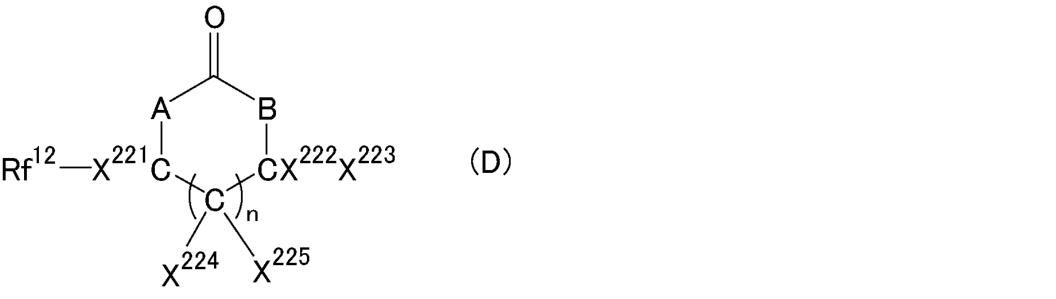
で示される含フッ素ラクトン等も挙げられる。

で示される5員環構造が、合成が容易である点、化学的安定性が良好な点から好ましく挙げられ、更には、AとBの組合せにより、下記式(F):

で示される含フッ素ラクトンと、下記式(G):

で示される含フッ素ラクトンがある。
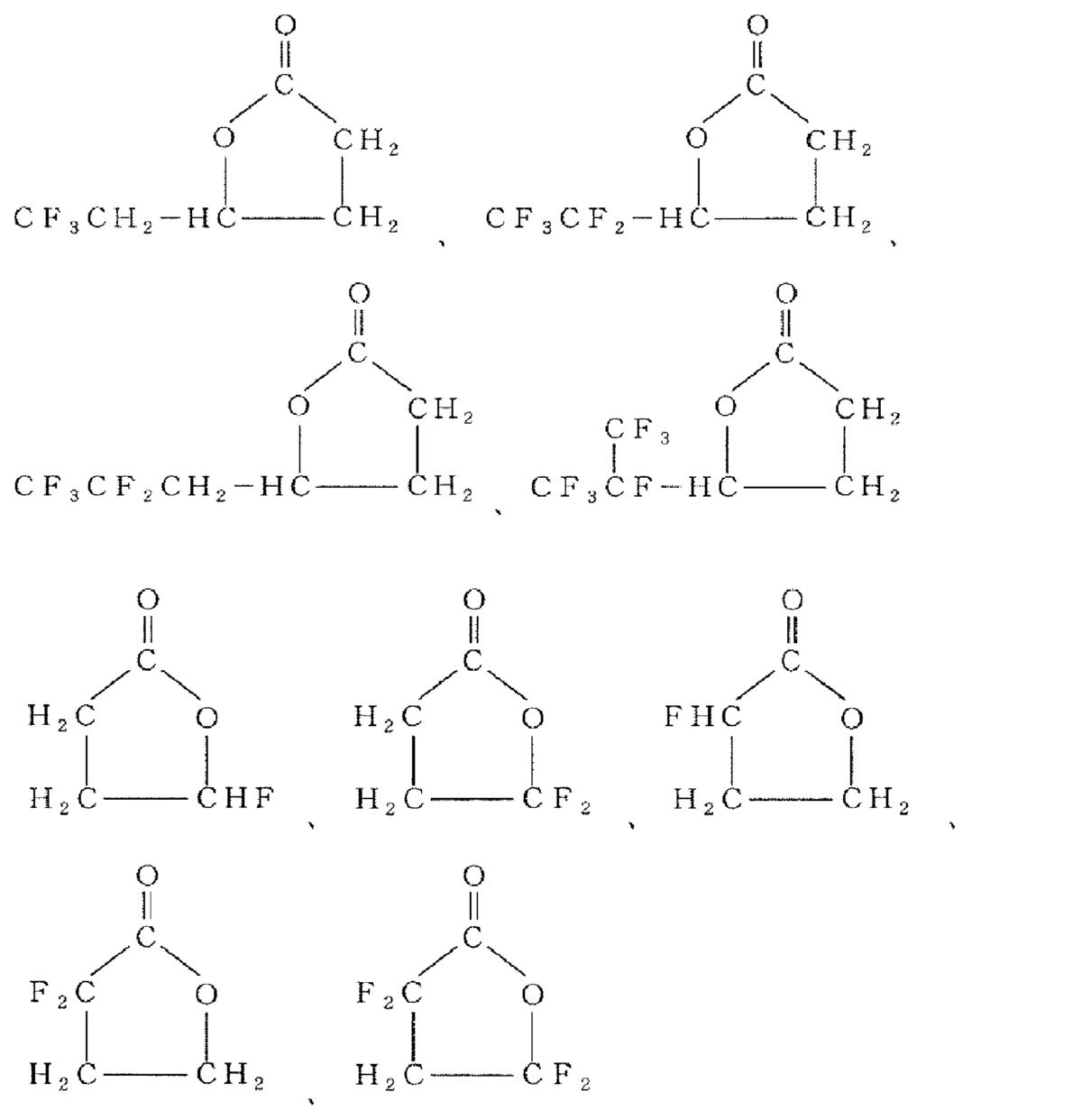
フッ素化環状カルボン酸エステルを含有させることにより、イオン伝導度の向上、安全性の向上、高温時の安定性向上といった効果が得られる。
炭素数2~10の鎖状エーテルとしては、ジメチルエーテル、ジエチルエーテル、ジ-n-ブチルエーテル、ジメトキシメタン、メトキシエトキシメタン、ジエトキシメタン、ジメトキシエタン、メトキシエトキシエタン、ジエトキシエタン、エチレングリコールジ-n-プロピルエーテル、エチレングリコールジ-n-ブチルエーテル、ジエチレングリコール、ジエチレングリコールジメチルエーテル、ペンタエチレングリコール、トリエチレングリコールジメチルエーテル、トリエチレングリコール、テトラエチレングリコール、テトラエチレングリコールジメチルエーテル、ジイソプロピルエーテル等が挙げられる。
上記フッ素化エーテルとしては、下記一般式(I):
Rf3-O-Rf4 (I)
(式中、Rf3及びRf4は同じか又は異なり、炭素数1~10のアルキル基又は炭素数1~10のフッ素化アルキル基である。ただし、Rf3及びRf4の少なくとも一方は、フッ素化アルキル基である。)
で表されるフッ素化エーテル(I)が挙げられる。フッ素化エーテル(I)を含有させることにより、電解液の難燃性が向上するとともに、高温高電圧での安定性、安全性が向上する。
なかでも、Rf3及びRf4が、同じか又は異なり、Rf3が炭素数3~6のフッ素化アルキル基であり、かつ、Rf4が炭素数2~6のフッ素化アルキル基であることがより好ましい。
上記フッ素含有率の下限は、45質量%がより好ましく、50質量%が更に好ましく、55質量%が特に好ましい。上限は70質量%がより好ましく、66質量%が更に好ましい。
なお、フッ素化エーテル(I)のフッ素含有率は、フッ素化エーテル(I)の構造式に基づいて、{(フッ素原子の個数×19)/フッ素化エーテル(I)の分子量}×100(%)により算出した値である。
なかでも、高沸点、他の溶媒との相溶性や電解質塩の溶解性が良好な点で有利なことから、HCF2CF2CH2OCF2CFHCF3(沸点106℃)、CF3CF2CH2OCF2CFHCF3(沸点82℃)、HCF2CF2CH2OCF2CF2H(沸点92℃)及びCF3CF2CH2OCF2CF2H(沸点68℃)からなる群より選択される少なくとも1種であることが好ましく、HCF2CF2CH2OCF2CFHCF3(沸点106℃)及びHCF2CF2CH2OCF2CF2H(沸点92℃)からなる群より選択される少なくとも1種であることがより好ましい。
Rf5COO-M+ (30)
(式中、Rf5は炭素数3~10のエーテル結合を含んでいてもよい含フッ素アルキル基;M+はLi+、Na+、K+又はNHR’3 +(R’は同じか又は異なり、いずれもH又は炭素数が1~3のアルキル基)である)
で表される含フッ素カルボン酸塩や、下記式(40):
Rf6SO3 -M+ (40)
(式中、Rf6は炭素数3~10のエーテル結合を含んでいてもよい含フッ素アルキル基;M+はLi+、Na+、K+又はNHR’3 +(R’は同じか又は異なり、いずれもH又は炭素数が1~3のアルキル基)である)
で表される含フッ素スルホン酸塩等が好ましい。
A-(D)-B (101)
[式中、Dは式(201):
-(D1)n-(FAE)m-(AE)p-(Y)q- (201)
(式中、D1は、式(2a):

で示される側鎖に含フッ素エーテル基を有するエーテル単位;
FAEは、式(2b):

で示される側鎖にフッ素化アルキル基を有するエーテル単位;
AEは、式(2c):

で示されるエーテル単位;
Yは、式(2d-1)~(2d-3):
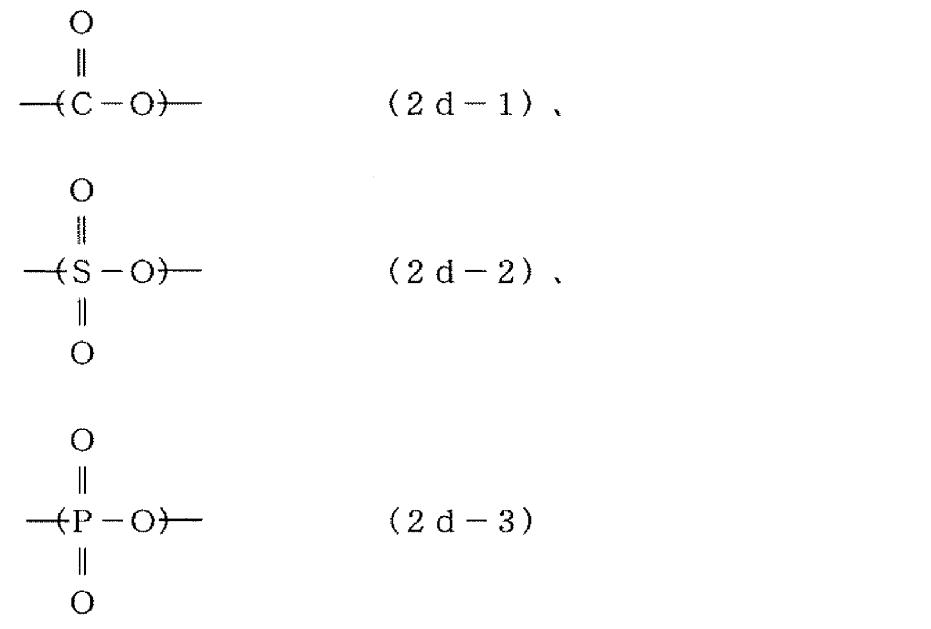
nは0~200の整数;mは0~200の整数;pは0~10000の整数;qは1~100の整数;ただしn+mは0ではなく、D1、FAE、AE及びYの結合順序は特定されない);
A及びBは同じか又は異なり、水素原子、フッ素原子及び/又は架橋性官能基を含んでいてもよいアルキル基、フッ素原子及び/又は架橋性官能基を含んでいてもよいフェニル基、-COOH基、-OR(Rは水素原子又はフッ素原子及び/又は架橋性官能基を含んでいてもよいアルキル基)、エステル基又はカーボネート基(ただし、Dの末端が酸素原子の場合は-COOH基、-OR、エステル基及びカーボネート基ではない)]
で表される側鎖に含フッ素基を有する非晶性含フッ素ポリエーテル化合物である。
なお、添加剤として化合物(7)を使用する場合、上述した電解質塩としては、化合物(7)以外の化合物を使用することが好ましい。
上記S=O基を有するリチウム塩類としては、モノフルオロスルホン酸リチウム(FSO3Li)、メチル硫酸リチウム(CH3OSO3Li)、エチル硫酸リチウム(C2H5OSO3Li)、2,2,2-トリフルオロエチル硫酸リチウム等が挙げられる。
化合物(7)としては、中でも、LiPO2F2、FSO3Li、C2H5OSO3Liが好ましい。
HFの含有量は、10ppm以上がより好ましく、20ppm以上が更に好ましい。HFの含有量はまた、100ppm以下がより好ましく、80ppm以下が更に好ましく、50ppm以下が特に好ましい。HFの含有量は、中和滴定法により測定することができる。
本開示の電気化学デバイスはリチウムイオン二次電池であり得る。上記リチウムイオン二次電池は、正極、負極、及び、上述の電解液を備えることが好ましい。
正極は、正極活物質を含む正極活物質層と、集電体とから構成される。また、正極は、上記したようにフルオロポリエーテル基含有化合物をその表面に含み得る。
式:LiaMn2-bM1 bO4(式中、0.9≦a;0≦b≦1.5;M1はFe、Co、Ni、Cu、Zn、Al、Sn、Cr、V、Ti、Mg、Ca、Sr、B、Ga、In、Si及びGeよりなる群から選ばれる少なくとも1種の金属)で表されるリチウム・マンガンスピネル複合酸化物、
式:LiNi1-cM2 cO2(式中、0≦c≦0.5;M2はFe、Co、Mn、Cu、Zn、Al、Sn、Cr、V、Ti、Mg、Ca、Sr、B、Ga、In、Si及びGeよりなる群から選ばれる少なくとも1種の金属)で表されるリチウム・ニッケル複合酸化物、又は、
式:LiCo1-dM3 dO2(式中、0≦d≦0.5;M3はFe、Ni、Mn、Cu、Zn、Al、Sn、Cr、V、Ti、Mg、Ca、Sr、B、Ga、In、Si及びGeよりなる群から選ばれる少なくとも1種の金属)で表されるリチウム・コバルト複合酸化物が挙げられる。
上記正極活物質が上記硫黄単体の場合、上記正極活物質に含まれる硫黄の含有量は、上記硫黄単体の含有量と等しい。
なお、本開示では、タップ密度は、正極活物質粉体5~10gを10mlのガラス製メスシリンダーに入れ、ストローク約20mmで200回タップした時の粉体充填密度(タップ密度)g/cm3として求める。
上記正極活物質の粒子は、二次粒子の平均粒子径が40μm以下で、かつ、平均一次粒子径が1μm以下の微粒子を、0.5~7.0体積%含むものであることが好ましい。平均一次粒子径が1μm以下の微粒子を含有させることにより、電解液との接触面積が大きくなり、電極と電解液との間でのリチウムイオンの拡散をより速くすることができ、その結果、電池の出力性能を向上させることができる。
上記結着剤としては、電極製造時に使用する溶媒や電解液に対して安全な材料であれば、任意のものを使用することができ、例えば、ポリエチレン、ポリプロピレン、ポリエチレンテレフタレート、ポリメチルメタクリレート、芳香族ポリアミド、キトサン、アルギン酸、ポリアクリル酸、ポリイミド、セルロース、ニトロセルロース等の樹脂系高分子;SBR(スチレン・ブタジエンゴム)、イソプレンゴム、ブタジエンゴム、フッ素ゴム、NBR(アクリロニトリル・ブタジエンゴム)、エチレン・プロピレンゴム等のゴム状高分子;スチレン・ブタジエン・スチレンブロック共重合体又はその水素添加物;EPDM(エチレン・プロピレン・ジエン三元共重合体)、スチレン・エチレン・ブタジエン・スチレン共重合体、スチレン・イソプレン・スチレンブロック共重合体又はその水素添加物等の熱可塑性エラストマー状高分子;シンジオタクチック-1,2-ポリブタジエン、ポリ酢酸ビニル、エチレン・酢酸ビニル共重合体、プロピレン・α-オレフィン共重合体等の軟質樹脂状高分子;ポリフッ化ビニリデン、ポリテトラフルオロエチレン、フッ化ビニリデン共重合体、テトラフルオロエチレン・エチレン共重合体等のフッ素系高分子;アルカリ金属イオン(特にリチウムイオン)のイオン伝導性を有する高分子組成物等が挙げられる。これらは、1種を単独で用いても、2種以上を任意の組み合わせ及び比率で併用してもよい。
負極は、負極活物質を含む負極活物質層と、集電体とから構成される。また、負極は、上記したようにフルオロポリエーテル基含有化合物をその表面に含み得る。
また、Si又はSnを第一の構成元素とし、それに加えて第2、第3の構成元素を含む複合材料が挙げられる。第2の構成元素は、例えば、コバルト、鉄、マグネシウム、チタン、バナジウム、クロム、マンガン、ニッケル、銅、亜鉛、ガリウム及びジルコニウムのうち少なくとも1種である。第3の構成元素は、例えば、ホウ素、炭素、アルミニウム及びリンのうち少なくとも1種である。
特に、高い電池容量及び優れた電池特性が得られることから、上記金属材料として、ケイ素又はスズの単体(微量の不純物を含んでよい)、SiOv(0<v≦2)、SnOw(0≦w≦2)、Si-Co-C複合材料、Si-Ni-C複合材料、Sn-Co-C複合材料、Sn-Ni-C複合材料が好ましい。
LixTiyMzO4
[式中、Mは、Na、K、Co、Al、Fe、Ti、Mg、Cr、Ga、Cu、Zn及びNbからなる群より選ばれる少なくとも1種の元素を表わす。]
で表される化合物であることが好ましい。
上記組成の中でも、
(i)1.2≦x≦1.4、1.5≦y≦1.7、z=0
(ii)0.9≦x≦1.1、1.9≦y≦2.1、z=0
(iii)0.7≦x≦0.9、2.1≦y≦2.3、z=0
の構造が、電池性能のバランスが良好なため特に好ましい。
なお、本開示では、タップ密度は、正極活物質粉体5~10gを10mlのガラス製メスシリンダーに入れ、ストローク約20mmで200回タップした時の粉体充填密度(タップ密度)g/cm3として求める。
上記正極活物質の粒子は、二次粒子の平均粒子径が40μm以下で、かつ、平均一次粒子径が1μm以下の微粒子を、0.5~7.0体積%含むものであることが好ましい。平均一次粒子径が1μm以下の微粒子を含有させることにより、電解液との接触面積が大きくなり、電極と電解液との間でのリチウムイオンの拡散をより速くすることができ、その結果、電池の出力性能を向上させることができる。
上記結着剤としては、電極製造時に使用する溶媒や電解液に対して安全な材料であれば、任意のものを使用することができ、例えば、ポリエチレン、ポリプロピレン、ポリエチレンテレフタレート、ポリメチルメタクリレート、芳香族ポリアミド、キトサン、アルギン酸、ポリアクリル酸、ポリイミド、セルロース、ニトロセルロース等の樹脂系高分子;SBR(スチレン・ブタジエンゴム)、イソプレンゴム、ブタジエンゴム、フッ素ゴム、NBR(アクリロニトリル・ブタジエンゴム)、エチレン・プロピレンゴム等のゴム状高分子;スチレン・ブタジエン・スチレンブロック共重合体又はその水素添加物;EPDM(エチレン・プロピレン・ジエン三元共重合体)、スチレン・エチレン・ブタジエン・スチレン共重合体、スチレン・イソプレン・スチレンブロック共重合体又はその水素添加物等の熱可塑性エラストマー状高分子;シンジオタクチック-1,2-ポリブタジエン、ポリ酢酸ビニル、エチレン・酢酸ビニル共重合体、プロピレン・α-オレフィン共重合体等の軟質樹脂状高分子;ポリフッ化ビニリデン、ポリテトラフルオロエチレン、フッ化ビニリデン共重合体、テトラフルオロエチレン・エチレン共重合体等のフッ素系高分子;アルカリ金属イオン(特にリチウムイオン)のイオン伝導性を有する高分子組成物等が挙げられる。これらは、1種を単独で用いても、2種以上を任意の組み合わせ及び比率で併用してもよい。
負極は、負極活物質を含む負極活物質層と、集電体とから構成される。また、負極は、上記したようにフルオロポリエーテル基含有化合物をその表面に含み得る。
また、Si又はSnを第一の構成元素とし、それに加えて第2、第3の構成元素を含む複合材料が挙げられる。第2の構成元素は、例えば、コバルト、鉄、マグネシウム、チタン、バナジウム、クロム、マンガン、ニッケル、銅、亜鉛、ガリウム及びジルコニウムのうち少なくとも1種である。第3の構成元素は、例えば、ホウ素、炭素、アルミニウム及びリンのうち少なくとも1種である。
特に、高い電池容量及び優れた電池特性が得られることから、上記金属材料として、ケイ素又はスズの単体(微量の不純物を含んでよい)、SiOv(0<v≦2)、SnOw(0≦w≦2)、Si-Co-C複合材料、Si-Ni-C複合材料、Sn-Co-C複合材料、Sn-Ni-C複合材料が好ましい。
LixTiyMzO4
[式中、Mは、Na、K、Co、Al、Fe、Ti、Mg、Cr、Ga、Cu、Zn及びNbからなる群より選ばれる少なくとも1種の元素を表わす。]
で表される化合物であることが好ましい。
上記組成の中でも、
(i)1.2≦x≦1.4、1.5≦y≦1.7、z=0
(ii)0.9≦x≦1.1、1.9≦y≦2.1、z=0
(iii)0.7≦x≦0.9、2.1≦y≦2.3、z=0
の構造が、電池性能のバランスが良好なため特に好ましい。
本開示のリチウムイオン二次電池は、更に、セパレータを備えることが好ましい。
上記セパレータの材質や形状は、電解液に安定であり、かつ、保液性に優れていれば特に限定されず、公知のものを使用することができる。なかでも、本開示で用いられる電解液に対し安定な材料で形成された、樹脂、ガラス繊維、無機物等が用いられ、保液性に優れた多孔性シート又は不織布状の形態の物等を用いるのが好ましい。
電極群は、上記の正極板と負極板とを上記のセパレータを介してなる積層構造のもの、及び上記の正極板と負極板とを上記のセパレータを介して渦巻き状に捲回した構造のもののいずれでもよい。電極群の体積が電池内容積に占める割合(以下、電極群占有率と称する)は、通常40%以上であり、50%以上が好ましく、また、通常90%以下であり、80%以下が好ましい。
上記電気二重層キャパシタでは、正極及び負極の少なくとも一方は分極性電極であり、分極性電極及び非分極性電極としては特開平9-7896号公報に詳しく記載されている以下の電極が使用できる。
フルオロポリエーテル基含有化合物として下記化合物1~6を準備した。
化合物1






含フッ素オイルとして下記化合物Aを準備した。
化合物A

・電解液
エチレンカーボネートおよびエチルメチルカーボネートを、体積比30対70になるように混合して、電解液を製造した。
正極活物質としてのLi(Ni1/3Mn1/3Co1/3)O290質量%と、導電材としてのアセチレンブラック5質量%と、結着剤としてのポリフッ化ビニリデン(PVdF)5質量%とを、N-メチルピロリドン溶媒中で混合して、スラリー化した。得られたスラリーを、予め導電助剤を塗布した厚さ15μmのアルミ箔の片面に塗布して、乾燥し、プレス機にてロールプレスしたものを、活物質層のサイズとして幅50mm、長さ30mm、及び未塗工部のサイズとして幅5mm、長さ9mmのを有する形状に切り出して正極材とした。
下記コーティング用組成物を、フルオロポリエーテル基含有化合物の濃度0.1%になるように、ハイドロフルオロエーテル(住友スリーエム株式会社製、HFE7200)に溶解させた。その後フルオロポリエーテル基含有化合物が固形分換算で1m2当たり50mgの処理量(電極1枚当たり0.01mg)になるようになるようスプレー吐出量を調整した後、上記正極材もしくは負極材へスプレー噴射を実施した。
下記コーティング用組成物を銅製の容器に秤量して真空チャンバー内の抵抗加熱容器に、電極材をチャンバー上部にセットした後、真空ポンプにてチャンバー内部圧力を10-3Paにした後、抵抗加熱により銅容器内の化合物を加熱、蒸着して、フルオロポリエーテル基含有化合物で表面処理された電極を得た。尚、フルオロポリエーテル基含有化合物は固形分換算で1m2当たり50mgの処理量(電極1枚当たり0.01mg)になるようになるようセットすることで蒸着機チャンバー内部に設置された水晶振動子にて測定される膜厚で9~10nmに相当する。
下記コーティング用組成物を、フルオロポリエーテル基含有化合物の濃度0.1%になるように、ハイドロフルオロエーテル(住友スリーエム株式会社製、HFE7200)に溶解させて、電極材を1分間浸漬させた後、HFE7200にて電極材表面に付着した余分な化合物を洗い流した後に乾燥させ、フルオロポリエーテル基含有化合物で表面処理された電極を得た。

上記の正極および負極を厚さ20μmの微孔性ポリエチレンフィルム(セパレータ)を介して対向させ、上記で作製した電解液を注入し、該電解液がセパレータ等に充分に浸透した後、封止し予備充電、エージングを行い、アルミラミネートセル(リチウムイオン二次電池)を作製した。
正極材をコーティング組成物で処理する代わりに、正極活物質(Li(Ni1/3Mn1/3Co1/3)O2)の粒子(平均粒径12μm)を、表2に示すコーティング組成物およびコーティング法で処理し、処理後の正極活物質を用いて正極材を作製した以外は、実施例Aと同様にして、アルミラミネートセルを作製した。
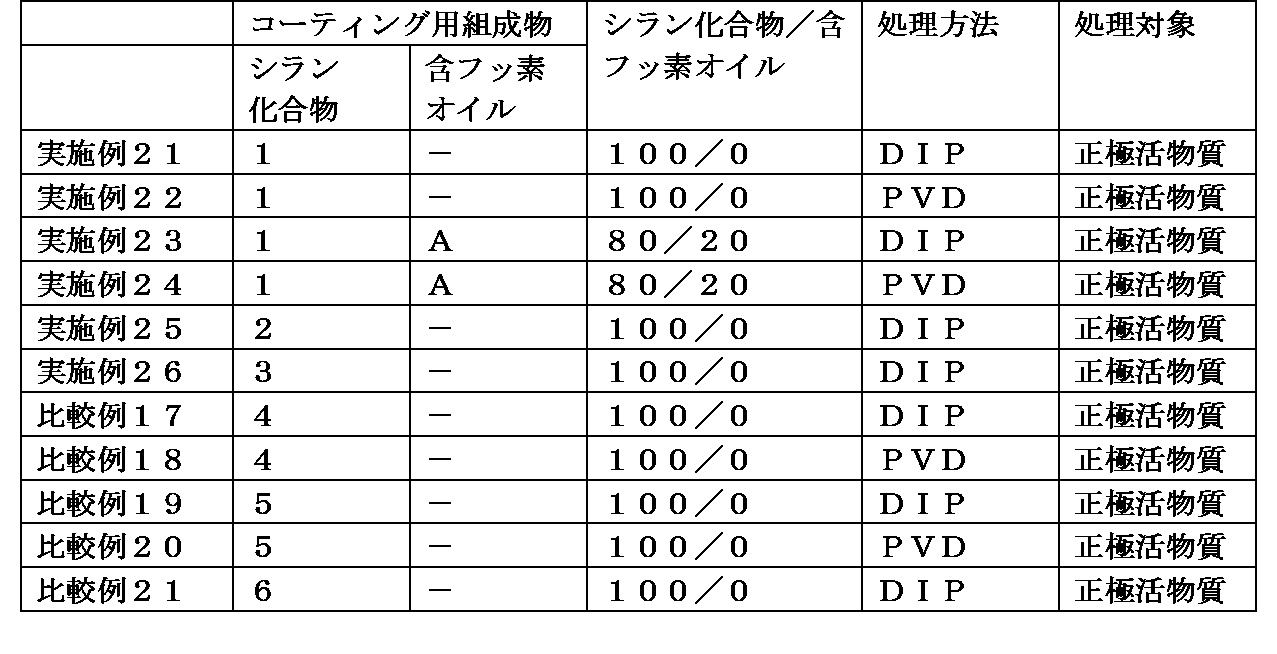
上記で得られたアルミラミネートセルについて、下記のように、抵抗増加率、残存容量保持率、ガス増加率、およびサイクル容量保持率を調べた。結果を表3および4に示す。
25℃において、0.2Cに相当する定電流で4.35Vまで充電した後、0.2Cの定電流で3.0Vまで放電した。これを2サイクル行って電池を安定させ、3サイクル目は、0.2Cの定電流で4.35Vまで充電後、4.35Vの定電圧で電流値が0.05Cになるまで充電を実施し、0.2Cの定電流で3.0Vまで放電し、初期放電容量を求めた。その後、0.2Cの定電流で4.35Vまで充電後、4.35Vの定電圧で電流値が0.05Cになるまで充電を実施し保存試験を行った。
ここで、1Cとは電池の基準容量を1時間で放電する電流値を表し、5Cとはその5倍の電流値を、0.1Cとはその1/10の電流値を、また0.2Cとはその1/5の電流値を表す。
初期特性評価が終了後の充電状態の二次電池を、60℃672時間の条件で高温保存した。電池を十分に冷却させた後、25℃において0.2Cで3Vまで放電し、残存容量を求めた。
下記式に基づき残存容量保持率(%)を求めた。
(残存容量)/(初期放電容量)×100=残存容量保持率(%)
上記のように安定化させた初期放電容量算出時の電池の抵抗と保存試験後の抵抗とを測定した。測定温度は-20℃とした。下記式に基づき、保存試験後抵抗増加率を求めた。結果を下記表3および4に示す。
抵抗増加率(%)=保存試験後の抵抗(Ω)/初期放電容量算出後の抵抗(Ω)×100
初期特性評価が終了後の充電状態の二次電池を、比重測定装置(エー・アンド・デイ社製)を用いて体積量を測定し、初期体積量を求めた。その後60℃672時間の条件で高温保存した。電池を十分に冷却させた後、25℃において0.2Cで3Vまで放電し、その後、0.2Cの定電流で4.35Vまで充電後、比重測定装置(エー・アンド・デイ社製)を用いて体積量を測定し、保存後体積量を求めた。
下記式に基づきガス増加率(%)を求めた。
(保存後体積量)/(初期体積量)×100=ガス増加率(%)
25℃において、1Cの定電流で4.35Vまで充電後、4.35Vの定電圧で電流値が0.05Cになるまで充電を実施し、1Cの定電流で3.0Vまで放電し、初期放電容量を求めた。同様の方法で充放電を行い、500サイクル後の放電容量を測定した。下記式に基づき、500サイクル後の放電容量の初期放電容量に対する割合を求め、これをサイクル容量保持率(%)とした。サイクル試験の測定温度は、25℃とした。
(500サイクル後の放電容量)/(初期放電容量)×100=サイクル容量保持率(%)


Claims (24)
- フルオロポリエーテル基含有化合物を含有する電極であって、該フルオロポリエーテル基含有化合物は、下記式(1)又は(2):

RF1は、各出現においてそれぞれ独立して、Rf1-RF-Oq-であり;
RF2は、-Rf2 p-RF-Oq-であり;
Rf1は、各出現においてそれぞれ独立して、1個又はそれ以上のフッ素原子により置換されていてもよいC1-16アルキル基であり;
Rf2は、1個又はそれ以上のフッ素原子により置換されていてもよいC1-6アルキレン基であり;
RFは、各出現においてそれぞれ独立して、2価のフルオロポリエーテル基であり;
pは、0又は1であり;
qは、各出現においてそれぞれ独立して、0又は1であり;
RSiは、各出現においてそれぞれ独立して、

Ra1は、各出現においてそれぞれ独立して、-Z1-SiR21 p1R22 q1R23 r1であり;
Z1は、各出現においてそれぞれ独立して、酸素原子又は2価の有機基であり;
R21は、各出現においてそれぞれ独立して、-Z1’-SiR21’ p1’R22’ q1’R23’ r1’であり;
R22は、各出現においてそれぞれ独立して、水酸基又は加水分解可能な基であり;
R23は、各出現においてそれぞれ独立して、水素原子又は1価の有機基であり;
p1は、各出現においてそれぞれ独立して、0~3の整数であり;
q1は、各出現においてそれぞれ独立して、0~3の整数であり;
r1は、各出現においてそれぞれ独立して、0~3の整数であり;
Z1’は、各出現においてそれぞれ独立して、酸素原子又は2価の有機基であり;
R21’は、各出現においてそれぞれ独立して、-Z1”-SiR22” q1”R23” r1”であり;
R22’は、各出現においてそれぞれ独立して、水酸基又は加水分解可能な基であり;
R23’は、各出現においてそれぞれ独立して、水素原子又は1価の有機基であり;
p1’は、各出現においてそれぞれ独立して、0~3の整数であり;
q1’は、各出現においてそれぞれ独立して、0~3の整数であり;
r1’は、各出現においてそれぞれ独立して、0~3の整数であり;
Z1”は、各出現においてそれぞれ独立して、酸素原子又は2価の有機基であり;
R22”は、各出現においてそれぞれ独立して、水酸基又は加水分解可能な基であり;
R23”は、各出現においてそれぞれ独立して、水素原子又は1価の有機基であり;
q1”は、各出現においてそれぞれ独立して、0~3の整数であり;
r1”は、各出現においてそれぞれ独立して、0~3の整数であり;
Rb1は、各出現においてそれぞれ独立して、水酸基又は加水分解可能な基であり;
Rc1は、各出現においてそれぞれ独立して、水素原子又は1価の有機基であり;
k1は、各出現においてそれぞれ独立して、0~3の整数であり;
l1は、各出現においてそれぞれ独立して、0~3の整数であり;
m1は、各出現においてそれぞれ独立して、0~3の整数である。]
で表される基であり;
XAは、それぞれ独立して、単結合又は2~10価の有機基であり;
αは、1~9の整数であり;
βは、1~9の整数であり;
γは、それぞれ独立して、1~9の整数である。]
で表されるフルオロポリエーテル基含有化合物である、電極。 - Rf1は、各出現においてそれぞれ独立して、C1-16パーフルオロアルキル基であり、
Rf2は、各出現においてそれぞれ独立して、C1-6パーフルオロアルキレン基である、請求項1に記載の電極。 - RFは、各出現においてそれぞれ独立して、式:
-(OC6F12)a-(OC5F10)b-(OC4F8)c-(OC3RFa 6)d-(OC2F4)e-(OCF2)f-
[式中、RFaは、各出現においてそれぞれ独立して、水素原子、フッ素原子または塩素原子であり、
a、b、c、d、eおよびfは、それぞれ独立して、0~200の整数であって、a、b、c、d、eおよびfの和は1以上であり、a、b、c、d、eまたはfを付して括弧でくくられた各繰り返し単位の存在順序は式中において任意である。]
で表される基である、請求項1または2に記載の電極。 - RFaは、フッ素原子である、請求項3に記載の電極。
- RFは、各出現においてそれぞれ独立して、下記式(f1)、(f2)、(f3)、(f4)または(f5):
-(OC3F6)d- (f1)
[式中、dは1~200の整数である。]、
-(OC4F8)c-(OC3F6)d-(OC2F4)e-(OCF2)f- (f2)
[式中、cおよびdは、それぞれ独立して、0~30の整数であり;
eおよびfは、それぞれ独立して、1~200の整数であり;
c、d、eおよびfの和は、10~200の整数であり;
添字c、d、eまたはfを付して括弧でくくられた各繰り返し単位の存在順序は、式中において任意である。]、
-(R6-R7)g- (f3)
[式中、R6は、OCF2またはOC2F4であり;
R7は、OC2F4、OC3F6、OC4F8、OC5F10およびOC6F12から選択される基であるか、あるいは、これらの基から選択される2または3つの基の組み合わせであり;
gは、2~100の整数である。]、
-(OC6F12)a-(OC5F10)b-(OC4F8)c-(OC3F6)d-(OC2F4)e-(OCF2)f- (f4)
[式中、eは、1以上200以下の整数であり、a、b、c、dおよびfは、それぞれ独立して0以上200以下の整数であって、a、b、c、d、eまたはfを付して括弧でくくられた各繰り返し単位の存在順序は式中において任意である。]
-(OC6F12)a-(OC5F10)b-(OC4F8)c-(OC3F6)d-(OC2F4)e-(OCF2)f- (f5)
[式中、fは、1以上200以下の整数であり、a、b、c、dおよびeは、それぞれ独立して0以上200以下の整数であって、a、b、c、d、eまたはfを付して括弧でくくられた各繰り返し単位の存在順序は式中において任意である。]
で表される基である、請求項1~4のいずれか1項に記載の電極。 - RFは、下記式(f1’):
-(OCF(CF3)CF2)d- (f1’)
[式中、dは1~200の整数である。]
で表される基である、請求項1~5のいずれか1項に記載の電極。 - RFは、下記式(f2’):
-(OCF2CF2CF2CF2)c-(OCF2CF2CF2)d-(OCF2CF2)e-(OCF2)f- (f2’)
[式中、c及びdは、それぞれ独立して、0~30の整数であり;
e及びfは、それぞれ独立して、1~200の整数であり;
c、d、e及びfの和は、10~200の整数であり;
添字c、d、e又はfを付して括弧でくくられた各繰り返し単位の存在順序は、式中において任意である。]
で表される基である、請求項1~5のいずれか1項に記載の電極。 - α、β、及びγは、1である、請求項1~7のいずれか1項に記載の電極。
- k1は3であり、l1およびm1は0であり、
p1およびr1は0であり、q1は3である、
請求項1~8のいずれか1項に記載の電極。 - 前記フルオロポリエーテル基含有化合物は、2種以上である、請求項1~9のいずれか1項に記載の電極。
- 前記フルオロポリエーテル基含有化合物は、式(1)で表されるフルオロポリエーテル基含有化合物である、請求項1~9のいずれか1項に記載の電極。
- 前記フルオロポリエーテル基含有化合物は、式(2)で表されるフルオロポリエーテル基含有化合物である、請求項1~9のいずれか1項に記載の電極。
- 前記フルオロポリエーテル基含有化合物は、式(1)で表されるフルオロポリエーテル基含有化合物及び式(2)で表されるフルオロポリエーテル基含有化合物である、請求項1~10のいずれか1項に記載の電極。
- 前記フルオロポリエーテル基含有化合物は、電極の表面を被覆している、請求項1~13のいずれか1項に記載の電極。
- 前記フルオロポリエーテル基含有化合物は、電極の活物質を被覆している、請求項1~14のいずれか1項に記載の電極。
- さらに、含フッ素オイル、シリコーンオイル、および触媒から選択される1種またはそれ以上の他の成分を含有する、請求項1~15のいずれか1項に記載の電極。
- 含フッ素オイルを含有する、請求項1~16のいずれか1項に記載の電極。
- 請求項1~17のいずれか1項に記載の電極を含む、電気化学デバイス。
- アルカリ金属電池またはアルカリ土類金属電池である、請求項18に記載の電気化学デバイス。
- リチウムイオン二次電池である、請求項19に記載の電気化学デバイス。
- 前記電池の正極が、請求項1~17のいずれか1項に記載の電極である、請求項19または20に記載の電気化学デバイス。
- 前記電池の負極が、請求項1~17のいずれか1項に記載の電極である、請求項19または20に記載の電気化学デバイス。
- 前記電池の正極および負極が、請求項1~17のいずれか1項に記載の電極である、請求項19または20に記載の電気化学デバイス。
- 請求項18~23のいずれか1項に記載の電気化学デバイスを備える、モジュール。
Priority Applications (5)
| Application Number | Priority Date | Filing Date | Title |
|---|---|---|---|
| JP2021556022A JP7315870B2 (ja) | 2019-11-13 | 2020-10-30 | 電極および電気化学デバイス |
| CN202080078562.1A CN114730876B (zh) | 2019-11-13 | 2020-10-30 | 电极和电化学器件 |
| KR1020227012320A KR102805944B1 (ko) | 2019-11-13 | 2020-10-30 | 전극 및 전기 화학 디바이스 |
| EP20887810.8A EP4059986A4 (en) | 2019-11-13 | 2020-10-30 | Electrode and electrochemical device |
| US17/743,176 US20220282040A1 (en) | 2019-11-13 | 2022-05-12 | Electrode and electrochemical device |
Applications Claiming Priority (2)
| Application Number | Priority Date | Filing Date | Title |
|---|---|---|---|
| JP2019-205501 | 2019-11-13 | ||
| JP2019205501 | 2019-11-13 |
Related Child Applications (1)
| Application Number | Title | Priority Date | Filing Date |
|---|---|---|---|
| US17/743,176 Continuation US20220282040A1 (en) | 2019-11-13 | 2022-05-12 | Electrode and electrochemical device |
Publications (1)
| Publication Number | Publication Date |
|---|---|
| WO2021095574A1 true WO2021095574A1 (ja) | 2021-05-20 |
Family
ID=75912362
Family Applications (1)
| Application Number | Title | Priority Date | Filing Date |
|---|---|---|---|
| PCT/JP2020/040890 Ceased WO2021095574A1 (ja) | 2019-11-13 | 2020-10-30 | 電極および電気化学デバイス |
Country Status (7)
| Country | Link |
|---|---|
| US (1) | US20220282040A1 (ja) |
| EP (1) | EP4059986A4 (ja) |
| JP (1) | JP7315870B2 (ja) |
| KR (1) | KR102805944B1 (ja) |
| CN (1) | CN114730876B (ja) |
| TW (1) | TWI826743B (ja) |
| WO (1) | WO2021095574A1 (ja) |
Cited By (3)
| Publication number | Priority date | Publication date | Assignee | Title |
|---|---|---|---|---|
| WO2023057852A1 (ja) * | 2021-10-08 | 2023-04-13 | 株式会社半導体エネルギー研究所 | 二次電池 |
| WO2023079399A1 (ja) * | 2021-11-05 | 2023-05-11 | 株式会社半導体エネルギー研究所 | 二次電池 |
| JP2023536669A (ja) * | 2021-06-25 | 2023-08-28 | エルジー エナジー ソリューション リミテッド | リチウム二次電池用電解液及びこれを含むリチウム二次電池 |
Families Citing this family (2)
| Publication number | Priority date | Publication date | Assignee | Title |
|---|---|---|---|---|
| US11258067B2 (en) * | 2016-11-02 | 2022-02-22 | Daikin Industries, Ltd. | Electrode and electrochemical device |
| CN118176236A (zh) * | 2021-10-28 | 2024-06-11 | 大金工业株式会社 | 表面处理剂 |
Citations (13)
| Publication number | Priority date | Publication date | Assignee | Title |
|---|---|---|---|---|
| JPH08222270A (ja) | 1994-12-13 | 1996-08-30 | Japan Energy Corp | イオン伝導体 |
| JPH10294131A (ja) | 1997-04-18 | 1998-11-04 | Asahi Glass Co Ltd | ポリマー電解質を有するリチウム電池 |
| JPH1135765A (ja) | 1997-07-24 | 1999-02-09 | Sharp Corp | 高分子固体電解質とその製造方法 |
| JPH1186630A (ja) | 1997-09-16 | 1999-03-30 | Yuasa Corp | ゲル電解質 |
| JPH11233141A (ja) | 1997-12-02 | 1999-08-27 | Denso Corp | 難燃性電解液および非水電解液二次電池 |
| JPH11283669A (ja) | 1998-03-31 | 1999-10-15 | Denso Corp | 難燃性電解液および非水電解液二次電池 |
| JP2002083632A (ja) | 2000-06-26 | 2002-03-22 | Matsushita Electric Ind Co Ltd | 非水電解液およびこれを用いた非水電解液二次電池 |
| JP2002100405A (ja) | 2000-09-20 | 2002-04-05 | Hitachi Chem Co Ltd | ゲル状高分子固体電解質用樹脂組成物およびゲル状高分子固体電解質 |
| JP2004301934A (ja) | 2003-03-28 | 2004-10-28 | Toshiba Matsushita Display Technology Co Ltd | 液晶表示装置の製造方法 |
| JP2011040205A (ja) * | 2009-08-07 | 2011-02-24 | Daikin Industries Ltd | 水素吸蔵合金電極およびニッケル水素電池 |
| WO2014050873A1 (ja) * | 2012-09-28 | 2014-04-03 | ダイキン工業株式会社 | 電解液、電気化学デバイス、リチウム電池、及び、モジュール |
| WO2018084265A1 (ja) * | 2016-11-02 | 2018-05-11 | ダイキン工業株式会社 | 電極および電気化学デバイス |
| WO2019216177A1 (ja) * | 2018-05-10 | 2019-11-14 | ダイキン工業株式会社 | 電極および電気化学デバイス |
Family Cites Families (9)
| Publication number | Priority date | Publication date | Assignee | Title |
|---|---|---|---|---|
| DE3324768A1 (de) * | 1983-07-08 | 1985-01-17 | Bayer Ag, 5090 Leverkusen | Verfahren zur herstellung elektrisch leitfaehiger polymerer |
| JP5470696B2 (ja) * | 2007-10-31 | 2014-04-16 | ソニー株式会社 | リチウムイオン二次電池用負極およびリチウムイオン二次電池 |
| KR101743851B1 (ko) * | 2012-11-05 | 2017-06-05 | 다이킨 고교 가부시키가이샤 | 퍼플루오로(폴리)에테르기 함유 실란 화합물 |
| CN105514487A (zh) | 2015-12-30 | 2016-04-20 | 中国科学院广州能源研究所 | 一种有机硅电解液和硅基电极材料配合使用的方法 |
| KR102262121B1 (ko) * | 2017-03-17 | 2021-06-09 | 다이킨 고교 가부시키가이샤 | 퍼플루오로(폴리)에테르기 함유 실란 화합물 |
| JP7156276B2 (ja) * | 2017-05-26 | 2022-10-19 | Agc株式会社 | 含フッ素エーテル化合物、含フッ素エーテル組成物、コーティング液、物品およびその製造方法 |
| CN111194495B (zh) * | 2017-10-30 | 2023-06-16 | 大金工业株式会社 | 二次电池用粘结剂、二次电池用电极合剂、二次电池用电极和二次电池 |
| KR102528832B1 (ko) * | 2018-02-02 | 2023-05-08 | 다이킨 고교 가부시키가이샤 | 전자 기기 |
| US20190341614A1 (en) | 2018-05-02 | 2019-11-07 | Ford Global Technologies, Llc | Perfluoropolyether additives for lithium ion battery anodes |
-
2020
- 2020-10-30 JP JP2021556022A patent/JP7315870B2/ja active Active
- 2020-10-30 WO PCT/JP2020/040890 patent/WO2021095574A1/ja not_active Ceased
- 2020-10-30 KR KR1020227012320A patent/KR102805944B1/ko active Active
- 2020-10-30 EP EP20887810.8A patent/EP4059986A4/en active Pending
- 2020-10-30 CN CN202080078562.1A patent/CN114730876B/zh active Active
- 2020-11-05 TW TW109138638A patent/TWI826743B/zh active
-
2022
- 2022-05-12 US US17/743,176 patent/US20220282040A1/en active Pending
Patent Citations (13)
| Publication number | Priority date | Publication date | Assignee | Title |
|---|---|---|---|---|
| JPH08222270A (ja) | 1994-12-13 | 1996-08-30 | Japan Energy Corp | イオン伝導体 |
| JPH10294131A (ja) | 1997-04-18 | 1998-11-04 | Asahi Glass Co Ltd | ポリマー電解質を有するリチウム電池 |
| JPH1135765A (ja) | 1997-07-24 | 1999-02-09 | Sharp Corp | 高分子固体電解質とその製造方法 |
| JPH1186630A (ja) | 1997-09-16 | 1999-03-30 | Yuasa Corp | ゲル電解質 |
| JPH11233141A (ja) | 1997-12-02 | 1999-08-27 | Denso Corp | 難燃性電解液および非水電解液二次電池 |
| JPH11283669A (ja) | 1998-03-31 | 1999-10-15 | Denso Corp | 難燃性電解液および非水電解液二次電池 |
| JP2002083632A (ja) | 2000-06-26 | 2002-03-22 | Matsushita Electric Ind Co Ltd | 非水電解液およびこれを用いた非水電解液二次電池 |
| JP2002100405A (ja) | 2000-09-20 | 2002-04-05 | Hitachi Chem Co Ltd | ゲル状高分子固体電解質用樹脂組成物およびゲル状高分子固体電解質 |
| JP2004301934A (ja) | 2003-03-28 | 2004-10-28 | Toshiba Matsushita Display Technology Co Ltd | 液晶表示装置の製造方法 |
| JP2011040205A (ja) * | 2009-08-07 | 2011-02-24 | Daikin Industries Ltd | 水素吸蔵合金電極およびニッケル水素電池 |
| WO2014050873A1 (ja) * | 2012-09-28 | 2014-04-03 | ダイキン工業株式会社 | 電解液、電気化学デバイス、リチウム電池、及び、モジュール |
| WO2018084265A1 (ja) * | 2016-11-02 | 2018-05-11 | ダイキン工業株式会社 | 電極および電気化学デバイス |
| WO2019216177A1 (ja) * | 2018-05-10 | 2019-11-14 | ダイキン工業株式会社 | 電極および電気化学デバイス |
Non-Patent Citations (1)
| Title |
|---|
| See also references of EP4059986A4 |
Cited By (4)
| Publication number | Priority date | Publication date | Assignee | Title |
|---|---|---|---|---|
| JP2023536669A (ja) * | 2021-06-25 | 2023-08-28 | エルジー エナジー ソリューション リミテッド | リチウム二次電池用電解液及びこれを含むリチウム二次電池 |
| JP7522300B2 (ja) | 2021-06-25 | 2024-07-24 | エルジー エナジー ソリューション リミテッド | リチウム二次電池用電解液及びこれを含むリチウム二次電池 |
| WO2023057852A1 (ja) * | 2021-10-08 | 2023-04-13 | 株式会社半導体エネルギー研究所 | 二次電池 |
| WO2023079399A1 (ja) * | 2021-11-05 | 2023-05-11 | 株式会社半導体エネルギー研究所 | 二次電池 |
Also Published As
| Publication number | Publication date |
|---|---|
| KR20220065800A (ko) | 2022-05-20 |
| EP4059986A1 (en) | 2022-09-21 |
| CN114730876B (zh) | 2024-09-27 |
| TWI826743B (zh) | 2023-12-21 |
| JPWO2021095574A1 (ja) | 2021-05-20 |
| CN114730876A (zh) | 2022-07-08 |
| EP4059986A4 (en) | 2023-11-22 |
| TW202128830A (zh) | 2021-08-01 |
| US20220282040A1 (en) | 2022-09-08 |
| JP7315870B2 (ja) | 2023-07-27 |
| KR102805944B1 (ko) | 2025-05-15 |
Similar Documents
| Publication | Publication Date | Title |
|---|---|---|
| JP6863462B2 (ja) | 電解液、電気化学デバイス、リチウムイオン二次電池及びモジュール | |
| JP6970358B2 (ja) | 電解液、電気化学デバイス、リチウムイオン二次電池及びモジュール | |
| JP6831409B2 (ja) | リチウムイオン二次電池用電解液、リチウムイオン二次電池及びモジュール | |
| JP6974767B2 (ja) | 電解液、電気化学デバイス、リチウムイオン二次電池及びモジュール | |
| JP6963194B2 (ja) | 電解液、電気化学デバイス、リチウムイオン二次電池及びモジュール | |
| JPWO2019188210A1 (ja) | 電解液、電気化学デバイス、リチウムイオン二次電池及びモジュール | |
| JP7315870B2 (ja) | 電極および電気化学デバイス | |
| JP7284422B2 (ja) | 電解液、電気化学デバイス、リチウムイオン二次電池及びモジュール | |
| JP7048904B2 (ja) | 電解液、電気化学デバイス、リチウムイオン二次電池及びモジュール | |
| JPWO2019159703A1 (ja) | 電解液、電気化学デバイス、リチウムイオン二次電池及びモジュール | |
| JP7284423B2 (ja) | 電解液、電気化学デバイス、リチウムイオン二次電池及びモジュール | |
| JP2019102434A (ja) | 電解液、電気化学デバイス、リチウムイオン二次電池及びモジュール | |
| JP7168897B2 (ja) | 化合物、組成物、電気化学デバイス、リチウムイオン二次電池及びモジュール | |
| JP6947296B2 (ja) | 電解液、電気化学デバイス、リチウムイオン二次電池及びモジュール | |
| JP7277701B2 (ja) | リチウムイオン二次電池用電解液、リチウムイオン二次電池及びモジュール | |
| JP2019087497A (ja) | 電解液、電気化学デバイス、リチウムイオン二次電池及びモジュール | |
| JPWO2019181240A1 (ja) | 電解液、電気化学デバイス、リチウムイオン二次電池及びモジュール | |
| JP2019114418A (ja) | 電解液、電気化学デバイス、リチウムイオン二次電池及びモジュール | |
| JP2019114419A (ja) | 電解液、電気化学デバイス、リチウムイオン二次電池及びモジュール | |
| JP2019087498A (ja) | 電解液、電気化学デバイス、リチウムイオン二次電池及びモジュール | |
| JP6939905B2 (ja) | 電解液、電気化学デバイス、リチウムイオン二次電池及びモジュール | |
| JP6962383B2 (ja) | 電解液、電気化学デバイス、リチウムイオン二次電池及びモジュール | |
| WO2019093159A1 (ja) | 電解液、電気化学デバイス、リチウムイオン二次電池及びモジュール | |
| JP2026035532A (ja) | 電解液用組成物、電気化学デバイス、二次電池及びリチウムイオン二次電池 |
Legal Events
| Date | Code | Title | Description |
|---|---|---|---|
| 121 | Ep: the epo has been informed by wipo that ep was designated in this application |
Ref document number: 20887810 Country of ref document: EP Kind code of ref document: A1 |
|
| ENP | Entry into the national phase |
Ref document number: 2021556022 Country of ref document: JP Kind code of ref document: A |
|
| ENP | Entry into the national phase |
Ref document number: 20227012320 Country of ref document: KR Kind code of ref document: A |
|
| NENP | Non-entry into the national phase |
Ref country code: DE |
|
| ENP | Entry into the national phase |
Ref document number: 2020887810 Country of ref document: EP Effective date: 20220613 |