WO2021106834A1 - Matériau d'électrode - Google Patents
Matériau d'électrode Download PDFInfo
- Publication number
- WO2021106834A1 WO2021106834A1 PCT/JP2020/043579 JP2020043579W WO2021106834A1 WO 2021106834 A1 WO2021106834 A1 WO 2021106834A1 JP 2020043579 W JP2020043579 W JP 2020043579W WO 2021106834 A1 WO2021106834 A1 WO 2021106834A1
- Authority
- WO
- WIPO (PCT)
- Prior art keywords
- polymer
- group
- formula
- electrode
- electrode material
- Prior art date
- Legal status (The legal status is an assumption and is not a legal conclusion. Google has not performed a legal analysis and makes no representation as to the accuracy of the status listed.)
- Ceased
Links
- AVMHULDXJBHNDY-UHFFFAOYSA-N CC(CC1C)CC1C1=CC2Nc3nc4ccccc4nc3NC2C=C1 Chemical compound CC(CC1C)CC1C1=CC2Nc3nc4ccccc4nc3NC2C=C1 AVMHULDXJBHNDY-UHFFFAOYSA-N 0.000 description 2
- 0 *c(cc1)cc2c1Nc1nc3ccccc3nc1N2 Chemical compound *c(cc1)cc2c1Nc1nc3ccccc3nc1N2 0.000 description 1
- KIYBPGMNGHGGEA-UHFFFAOYSA-N C1C2C=CC1CC2c1ccc2Nc3nc(cccc4)c4nc3Nc2c1 Chemical compound C1C2C=CC1CC2c1ccc2Nc3nc(cccc4)c4nc3Nc2c1 KIYBPGMNGHGGEA-UHFFFAOYSA-N 0.000 description 1
Images


Classifications
-
- H—ELECTRICITY
- H01—ELECTRIC ELEMENTS
- H01M—PROCESSES OR MEANS, e.g. BATTERIES, FOR THE DIRECT CONVERSION OF CHEMICAL ENERGY INTO ELECTRICAL ENERGY
- H01M4/00—Electrodes
- H01M4/02—Electrodes composed of, or comprising, active material
- H01M4/36—Selection of substances as active materials, active masses, active liquids
- H01M4/362—Composites
- H01M4/364—Composites as mixtures
-
- C—CHEMISTRY; METALLURGY
- C07—ORGANIC CHEMISTRY
- C07D—HETEROCYCLIC COMPOUNDS
- C07D487/00—Heterocyclic compounds containing nitrogen atoms as the only ring hetero atoms in the condensed system, not provided for by groups C07D451/00 - C07D477/00
- C07D487/02—Heterocyclic compounds containing nitrogen atoms as the only ring hetero atoms in the condensed system, not provided for by groups C07D451/00 - C07D477/00 in which the condensed system contains two hetero rings
- C07D487/04—Ortho-condensed systems
-
- C—CHEMISTRY; METALLURGY
- C08—ORGANIC MACROMOLECULAR COMPOUNDS; THEIR PREPARATION OR CHEMICAL WORKING-UP; COMPOSITIONS BASED THEREON
- C08F—MACROMOLECULAR COMPOUNDS OBTAINED BY REACTIONS ONLY INVOLVING CARBON-TO-CARBON UNSATURATED BONDS
- C08F132/00—Homopolymers of cyclic compounds containing no unsaturated aliphatic radicals in a side chain, and having one or more carbon-to-carbon double bonds in a carbocyclic ring system
- C08F132/08—Homopolymers of cyclic compounds containing no unsaturated aliphatic radicals in a side chain, and having one or more carbon-to-carbon double bonds in a carbocyclic ring system having condensed rings
-
- C—CHEMISTRY; METALLURGY
- C08—ORGANIC MACROMOLECULAR COMPOUNDS; THEIR PREPARATION OR CHEMICAL WORKING-UP; COMPOSITIONS BASED THEREON
- C08G—MACROMOLECULAR COMPOUNDS OBTAINED OTHERWISE THAN BY REACTIONS ONLY INVOLVING UNSATURATED CARBON-TO-CARBON BONDS
- C08G61/00—Macromolecular compounds obtained by reactions forming a carbon-to-carbon link in the main chain of the macromolecule
- C08G61/02—Macromolecular compounds containing only carbon atoms in the main chain of the macromolecule, e.g. polyxylylenes
- C08G61/04—Macromolecular compounds containing only carbon atoms in the main chain of the macromolecule, e.g. polyxylylenes only aliphatic carbon atoms
- C08G61/06—Macromolecular compounds containing only carbon atoms in the main chain of the macromolecule, e.g. polyxylylenes only aliphatic carbon atoms prepared by ring-opening of carbocyclic compounds
- C08G61/08—Macromolecular compounds containing only carbon atoms in the main chain of the macromolecule, e.g. polyxylylenes only aliphatic carbon atoms prepared by ring-opening of carbocyclic compounds of carbocyclic compounds containing one or more carbon-to-carbon double bonds in the ring
-
- C—CHEMISTRY; METALLURGY
- C08—ORGANIC MACROMOLECULAR COMPOUNDS; THEIR PREPARATION OR CHEMICAL WORKING-UP; COMPOSITIONS BASED THEREON
- C08G—MACROMOLECULAR COMPOUNDS OBTAINED OTHERWISE THAN BY REACTIONS ONLY INVOLVING UNSATURATED CARBON-TO-CARBON BONDS
- C08G65/00—Macromolecular compounds obtained by reactions forming an ether link in the main chain of the macromolecule
- C08G65/02—Macromolecular compounds obtained by reactions forming an ether link in the main chain of the macromolecule from cyclic ethers by opening of the heterocyclic ring
- C08G65/04—Macromolecular compounds obtained by reactions forming an ether link in the main chain of the macromolecule from cyclic ethers by opening of the heterocyclic ring from cyclic ethers only
- C08G65/22—Cyclic ethers having at least one atom other than carbon and hydrogen outside the ring
-
- H—ELECTRICITY
- H01—ELECTRIC ELEMENTS
- H01M—PROCESSES OR MEANS, e.g. BATTERIES, FOR THE DIRECT CONVERSION OF CHEMICAL ENERGY INTO ELECTRICAL ENERGY
- H01M10/00—Secondary cells; Manufacture thereof
- H01M10/05—Accumulators with non-aqueous electrolyte
- H01M10/052—Li-accumulators
- H01M10/0525—Rocking-chair batteries, i.e. batteries with lithium insertion or intercalation in both electrodes; Lithium-ion batteries
-
- H—ELECTRICITY
- H01—ELECTRIC ELEMENTS
- H01M—PROCESSES OR MEANS, e.g. BATTERIES, FOR THE DIRECT CONVERSION OF CHEMICAL ENERGY INTO ELECTRICAL ENERGY
- H01M4/00—Electrodes
- H01M4/02—Electrodes composed of, or comprising, active material
- H01M4/36—Selection of substances as active materials, active masses, active liquids
- H01M4/58—Selection of substances as active materials, active masses, active liquids of inorganic compounds other than oxides or hydroxides, e.g. sulfides, selenides, tellurides, halogenides or LiCoFy; of polyanionic structures, e.g. phosphates, silicates or borates
- H01M4/5825—Oxygenated metallic salts or polyanionic structures, e.g. borates, phosphates, silicates, olivines
-
- H—ELECTRICITY
- H01—ELECTRIC ELEMENTS
- H01M—PROCESSES OR MEANS, e.g. BATTERIES, FOR THE DIRECT CONVERSION OF CHEMICAL ENERGY INTO ELECTRICAL ENERGY
- H01M4/00—Electrodes
- H01M4/02—Electrodes composed of, or comprising, active material
- H01M4/36—Selection of substances as active materials, active masses, active liquids
- H01M4/60—Selection of substances as active materials, active masses, active liquids of organic compounds
- H01M4/602—Polymers
- H01M4/606—Polymers containing aromatic main chain polymers
- H01M4/608—Polymers containing aromatic main chain polymers containing heterocyclic rings
-
- H—ELECTRICITY
- H01—ELECTRIC ELEMENTS
- H01M—PROCESSES OR MEANS, e.g. BATTERIES, FOR THE DIRECT CONVERSION OF CHEMICAL ENERGY INTO ELECTRICAL ENERGY
- H01M4/00—Electrodes
- H01M4/02—Electrodes composed of, or comprising, active material
- H01M4/62—Selection of inactive substances as ingredients for active masses, e.g. binders, fillers
- H01M4/621—Binders
- H01M4/622—Binders being polymers
- H01M4/623—Binders being polymers fluorinated polymers
-
- H—ELECTRICITY
- H01—ELECTRIC ELEMENTS
- H01M—PROCESSES OR MEANS, e.g. BATTERIES, FOR THE DIRECT CONVERSION OF CHEMICAL ENERGY INTO ELECTRICAL ENERGY
- H01M4/00—Electrodes
- H01M4/02—Electrodes composed of, or comprising, active material
- H01M4/62—Selection of inactive substances as ingredients for active masses, e.g. binders, fillers
- H01M4/624—Electric conductive fillers
- H01M4/625—Carbon or graphite
-
- Y—GENERAL TAGGING OF NEW TECHNOLOGICAL DEVELOPMENTS; GENERAL TAGGING OF CROSS-SECTIONAL TECHNOLOGIES SPANNING OVER SEVERAL SECTIONS OF THE IPC; TECHNICAL SUBJECTS COVERED BY FORMER USPC CROSS-REFERENCE ART COLLECTIONS [XRACs] AND DIGESTS
- Y02—TECHNOLOGIES OR APPLICATIONS FOR MITIGATION OR ADAPTATION AGAINST CLIMATE CHANGE
- Y02E—REDUCTION OF GREENHOUSE GAS [GHG] EMISSIONS, RELATED TO ENERGY GENERATION, TRANSMISSION OR DISTRIBUTION
- Y02E60/00—Enabling technologies; Technologies with a potential or indirect contribution to GHG emissions mitigation
- Y02E60/10—Energy storage using batteries
Definitions
- the present invention relates to an electrode material containing a polymer having a full-off-flavin skeleton in the side chain.
- Non-aqueous electrolyte secondary batteries such as lithium-ion batteries have been put into practical use as compact, lightweight, and high-capacity rechargeable and discharge batteries. It is used in communication equipment.
- Lithium-ion secondary batteries have high energy density and have excellent advantages such as higher capacity and operating voltage than other batteries. However, due to its high energy density, there is a risk of overheating depending on the usage conditions, and there is a risk of accidents such as ignition, so high safety is required. In particular, hybrid vehicles, which have been in the limelight recently, require higher energy density and output characteristics, and therefore require even higher safety.
- a lithium ion secondary battery is composed of a positive electrode, a negative electrode, and an electrolyte.
- lithium ions escape from the positive electrode active material into the electrolyte and are inserted into a negative electrode active material such as carbon particles.
- lithium ions escape from the negative electrode active material into the electrolyte and are inserted into the positive electrode active material, so that a current can be taken out to an external circuit.
- charging and discharging are performed by the lithium ions moving back and forth between the positive electrode and the negative electrode via the electrolyte.
- the theoretical capacity of the positive electrode active material is much lower than the theoretical capacity of the negative electrode active material. Therefore, in order to realize high capacity and high output of the lithium ion battery, it is necessary to give the positive electrode high conductivity and ionic conductivity. Therefore, in order to improve the electron conductivity in the positive electrode, a method of adding a carbon material to the electrode is used as a conductive auxiliary agent.
- a carbon material graphite, acetylene black, ketjen black, and in recent years, examples of using carbon nanotubes and graphene have been reported. However, if the amount of such a conductive auxiliary agent is increased, the amount of the active material in the electrode decreases, and the capacity of the battery decreases.
- the particle surface of the electrode active material is covered with an organic compound which is a carbon source, and then the organic compound is carbonized to form a carbonaceous film on the surface of the electrode active material.
- An electrode material in which carbon of this carbonaceous film is interposed as an electron conductive substance has also been proposed (for example, Patent Document 1).
- the carbonization step requires a long-term heat treatment at a high temperature of 500 ° C. or higher in an inert gas atmosphere, and this heat treatment reduces the capacity of the electrode.
- the cathode active material itself may be reduced because it is heated in a reducing atmosphere or an inert atmosphere at a high temperature of 500 to 800 ° C.
- the positive electrode active material that can be used is available.
- the carbon source was limited to the conductive polymer material. As described above, the materials suitable for improving the electron conductivity of the electrode material are still limited, and further improvement is desired.
- the present invention has been made in view of the above circumstances, and provides an electrode material that can be suitably used as a material for forming an electrode used in a lithium ion secondary battery or the like and can improve the rate characteristics of the battery.
- the purpose is to improve the rate characteristics of the battery.
- the present inventors have obtained a battery produced by using an electrode material containing a polymer having a full-of-flavin skeleton in a small amount of side chains and an inorganic active material.
- the present invention has been completed by finding that the characteristics are excellent.
- the present invention provides the following electrode materials.
- 1. An electrode material containing a polymer having a fuloflavin skeleton in a side chain and an inorganic active material, wherein the polymer has a solid content of 1% by mass or less.
- 2. The electrode material of 1 in which the polymer is a polymer containing a repeating unit represented by the following formula (1). [In the formula, Z is the following formula (Z-1), (Z-2) or (Z-3).
- RM represents a hydrogen atom or a methyl group.
- Represents the partial structure represented by Y represents a single bond, -O -, - CO -, - COO -, - OCO -, - CH 2 -, - NH -, - NCH 3 -, - NHCO -, - CONH -, - CH 2 NHCO-, Represents -CONHCH 2- or -S- R 1 is independently substituted with a hydrogen atom, a halogen atom, a hydroxyl group, a carboxy group, an alkyl group having 1 to 10 carbon atoms which may be substituted with a halogen atom, and an alkyl group having 1 to 10 carbon atoms which may be substituted with a halogen atom.
- Five electrode materials in which the inorganic active material is at least one selected from metals, semi-metals, metal alloys, metal oxides, semi-metal oxides, metal phosphor oxides, metal sulfides and metal nitrides. 7.
- any of 1 to 6 electrode materials containing a solvent 8. Further, the electrode material according to any one of 1 to 7, which contains a conductive auxiliary agent and a binder. 9. An electrode having an active material layer made of any of the electrode materials 1 to 8. 10. A secondary battery with 9 electrodes. 11. A polymer containing a repeating unit represented by the following formula (1). [In the formula, Z is the following formula (Z-1), (Z-2) or (Z-3).
- RM represents a hydrogen atom or a methyl group.
- Y represents a single bond, -O -, - CO -, - COO -, - OCO -, - CH 2 -, - NH -, - NCH 3 -, - NHCO -, - CONH -, - CH 2 NHCO-, Represents -CONHCH 2- or -S- (however, if Z is a partial structure represented by the formula (Z-1), it does not become -CH 2 NHCO-, but in the formula (Z-2).
- R 1 is independently substituted with a hydrogen atom, a halogen atom, a hydroxyl group, a carboxy group, an alkyl group having 1 to 10 carbon atoms which may be substituted with a halogen atom, and an alkyl group having 1 to 10 carbon atoms which may be substituted with a halogen atom.
- * represents a bond.
- the electrode material of the present invention By using the electrode material of the present invention, it is possible to provide a battery having excellent rate characteristics.
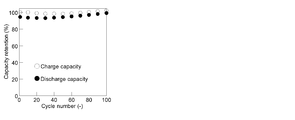
- Example 3 is a cyclic voltammogram of the polymer lithium secondary battery produced in Example 2. It is a graph which shows the measurement result of the potential difference from the reference electrode at the time of changing the charge / discharge capacity in the polymer lithium secondary battery produced in Example 2. It is a figure which shows the charge / discharge cycle characteristic of the polymer lithium secondary battery produced in Example 2.
- the electrode material of the present invention contains a polymer having a full-flavin skeleton in the side chain (hereinafter, may be referred to as "full-flavin skeleton-containing polymer” or simply “polymer”) and an inorganic active material.
- the polymer is characterized in that it is 1% by mass or less in the solid content.
- the solid content referred to here means a component other than the solvent contained in the electrode material of the present invention.
- the fuloflavin skeleton-containing polymer is not particularly limited as long as it has a fuloffflavin skeleton in the side chain, but in the present invention, a polymer containing a repeating unit represented by the following formula (1) is preferable.
- Z is the following formula (Z-1), (Z-2) or (Z-3). (Wherein *, .R M representing a bond is a hydrogen atom or a methyl group.) Represents the partial structure represented by. Among these, the partial structure represented by the above formula (Z-1) is preferable.
- Y represents a single bond, -O -, - CO -, - COO -, - OCO -, - CH 2 -, - NH -, - NCH 3 -, - NHCO -, - CONH -, - CH 2 NHCO-, Represents -CONHCH 2- or -S-.
- Z is a partial structure represented by the formula (Z-1) or (Z-3)
- the above Y is preferably a single bond.
- Z is a partial structure represented by the formula (Z-2)
- the above Y is preferably ⁇ COO ⁇ .
- R 1 is independently substituted with a hydrogen atom, a halogen atom, a hydroxyl group, a carboxy group, an alkyl group having 1 to 10 carbon atoms which may be substituted with a halogen atom, and an alkyl group having 1 to 10 carbon atoms which may be substituted with a halogen atom. It represents an alkoxy group of up to 10 or an aryl group having 6 to 12 carbon atoms which may be substituted with a halogen atom.
- halogen atom examples include a fluorine atom, a chlorine atom, a bromine atom, an iodine atom and the like.
- Examples of the alkyl group having 1 to 10 carbon atoms include a methyl group, an ethyl group, an n-propyl group, an isopropyl group, an n-butyl group, an i-butyl group, an s-butyl group, a t-butyl group and an n-pentyl group. Examples thereof include a group, an n-hexyl group, an n-heptyl group, an n-octyl group, an n-nonyl group and an n-decyl group. Among these, an alkyl group having 1 to 5 carbon atoms is preferable, and an alkyl group having 1 to 3 carbon atoms is more preferable.
- Examples of the alkoxy group having 1 to 10 carbon atoms include a methoxy group, an ethoxy group, an n-propoxy group, an i-propoxy group, an n-butoxy group, an i-butoxy group, an s-butoxy group, a t-butoxy group and n.
- -Pentoxy group, n-hexyloxy group, n-heptyloxy group, n-octyloxy group, n-nonyloxy group, n-decyloxy group can be mentioned.
- an alkoxy group having 1 to 5 carbon atoms is preferable, and an alkoxy group having 1 to 3 carbon atoms is more preferable.
- Examples of the aryl group having 6 to 12 carbon atoms include a phenyl group, a 1-naphthyl group, a 2-naphthyl group, a 1-biphenylyl group, and a 2-biphenylyl group. Among these, a phenyl group is preferable.
- halogen atom examples include those similar to those exemplified above.
- R 1 is preferably a hydrogen atom and an alkyl group, and more preferably a hydrogen atom.
- RM represents a hydrogen atom or a methyl group, preferably a hydrogen atom.
- the mode of the repeating unit represented by the formula (1) the one represented by the following formula (1-1) is preferable.
- repeating unit represented by the formula (1) includes those represented by the following formulas (2-1) to (2-3), but are not limited thereto. ..
- repeating unit represented by the formula (1) includes, but are not limited to, those represented by the following formulas (3-1) to (3-3). ..
- the weight average molecular weight of the fluoflavin skeleton-containing polymer is usually 1,000 to 500,000, preferably 2,000 to 200,000.
- the weight average molecular weight is a polystyrene-equivalent value measured by gel permeation chromatography (GPC).
- the blending amount of the full-flavin skeleton-containing polymer is 1% by mass or less in the solid content, and is preferably 0.01 to 0.8% by mass from the viewpoint of effectively improving the rate characteristics and cycle characteristics of the obtained secondary battery. %, More preferably 0.05 to 0.5% by mass.
- the polymer When the polymer is used in combination with an inorganic active material, it is considered that the polymer itself has a charge storage ability, so that even a small amount of addition as described above exerts an excellent effect. ..
- “having a charge storage capacity” means providing a discharge capacity of 10 mAh / g or more in a secondary battery provided with an electrode using only a full-flavin skeleton-containing polymer having a charge storage capacity as an active material. means. From the viewpoint of improving the rate characteristics and cycle characteristics, the discharge capacity is preferably 30 mAh / g or more, and more preferably 45 mAh / g or more.
- the upper limit is not particularly limited, but is usually 200 mAh / g or less in consideration of deterioration during the cycle.
- the discharge capacity is in the above range, the decrease in charge capacity is small as compared with the case where a compound having no capacity by itself is blended.
- X 1 represents a halogen atom.
- a fluoflavin derivative (10) having a halogen atom and 2,5-norbornadiene (11) are reacted in a solvent in the presence of a catalyst to synthesize a fluoflavin skeleton-containing monomer (12) (first). Stage). Then, the obtained monomer (12) is polymerized in a solvent in the presence of a catalyst (second step) to synthesize a fluorinated flavin skeleton-containing polymer (3-1).
- the fuloflavin derivative (10) can be synthesized according to a known synthetic method. As the synthesis method, for example, the method described in Journal of Photochemistry and Photobiology A: Chemistry 198 (2008) 60-68 can be referred to for synthesis.
- fluoflavin derivative (10) examples include 2-chloro-5,11-dihydroquinoxaline [2,3-b] quinoxaline and 2-bromo-5,11-dihydroquinoxaline [2,3-b]. ] Quinoxaline, but is not limited to these.
- the solvent used in the first step is not particularly limited as long as it can disperse or dissolve the raw materials used.
- examples of such a solvent include dimethylsulfoxide, N, N-dimethylformamide, N, N-dimethylacetamide, N-methyl-2-pyrrolidone, hexamethylphosphate triamide, acetonitrile, acetone, and alcohols (methanol, ethanol).
- glycols ethylene glycol, triethylene glycol, etc.
- cellosolves ethylcellosolve, methylcellosolve, etc.
- polyhydric alcohols glycols
- pentaerythritol, etc. polyhydric alcohols
- tetrahydrofuran toluene
- examples thereof include ethyl acetate, butyl acetate, benzene, toluene, xylene, pentane, hexane, heptane, chlorobenzene, dichlorobenzene, trichlorobenzene, hexadecane, benzyl alcohol and oleylamine.
- N, N-dimethylformamide, N, N-dimethylacetamide, and N-methyl-2-pyrrolidone are preferable from the viewpoint of reaction temperature and reaction concentration.
- These solvents may be appropriately selected depending on the raw materials used.
- the solvent may be used alone or in combination of two or more.
- Examples of the catalyst used in the first step include copper catalysts such as copper chloride, copper bromide, and copper iodide; Pd (PPh 3 ) 4 (tetrakis (triphenylphosphine) palladium), Pd (PPh 3 ) 2 Cl.
- copper catalysts such as copper chloride, copper bromide, and copper iodide
- Pd (PPh 3 ) 4 tetrakis (triphenylphosphine) palladium
- Pd (PPh 3 ) 2 Cl examples of the catalyst used in the first step.
- Pd (dba) 2 bis (triphenylphosphine) dichloropalladium
- Pd (dba) 2 bis (dibenzylideneacetone) palladium
- Pd 2 (dba) 3 tris (dibenzylideneacetone) dipalladium
- Pd (Pt- Examples thereof include palladium catalysts such as Bu 3 ) 2 (bis (tri (t-butylphosphine)) palladium) and Pd (OAc) 2 (palladium acetate). These catalysts may be used alone or in combination of two or more. These catalysts may also be used with suitable known ligands.
- ligands examples include triphenylphosphine, tri-o-tolylphosphine, diphenylmethylphosphine, phenyldimethylphosphine, trimethylphosphine, triethylphosphine, tributylphosphine, tri-t-butylphosphine, and di-t-butyl.
- the amount of the catalyst used can be about 0.01 to 0.2 mol with respect to 1 mol of the fluoflavin derivative represented by the formula (10), but about 0.02 to 0.1 mol is preferable. Is. When a ligand is used, the amount used can be 0.1 to 5 equivalents with respect to the metal complex (catalyst) used, but 1 to 2 equivalents are preferable.
- a base may be used, and examples of the base that can be used include sodium hydride, pyridine, triethylamine, diisopropylethylamine and the like, and sodium hydride, pyridine and triethylamine are preferable.
- the amount of the base used is preferably 1 time to 1 mol to 1 mol of the solvent amount with respect to 1 mol of the fluoflavin derivative.
- the compounding ratio (molar ratio) of 2,5-norbornadiene and the fluoflavin derivative is not particularly limited, but from the viewpoint of preventing the produced monomers from polymerizing with each other, whether both components are equimolar. , Or an excess of 2,5-norbornadiene relative to the fluoflavin derivative.
- 1 to 8 mol is preferable, and 1.5 to 5 mol is more preferable with respect to 1 mol of the monomer.
- the reaction temperature in the first stage may be appropriately set in the range from the melting point to the boiling point of the solvent used, but is particularly preferably about 0 to 200 ° C, more preferably 30 to 130 ° C. Further, at the time of heating, reflux may be performed.
- the reaction time cannot be unconditionally specified because it depends on the reaction temperature and the reactivity of the raw material, but it is usually about 1 to 48 hours, and when the reaction temperature is 30 to 130 ° C., it is about 10 to 30 hours. is there.
- post-treatment is carried out according to a conventional method to obtain a monomer which is a source of the desired fluorinyl skeleton-containing polymer.
- the full-flavin skeleton-containing monomer (12) obtained in the first step is polymerized in a solvent.
- the polymerization is usually carried out by ring-opening metathesis polymerization.
- a conventionally known method such as an olefin metathesis reaction using a Grubbs catalyst may be used.
- the solvent used in the second step is not particularly limited as long as it can disperse or dissolve the raw materials used.
- examples of such a solvent include, for example, dimethylsulfoxide, N, N-dimethylformamide, N, N-dimethylacetamide, N-methyl-2-pyrrolidone, hexamethylphosphate triamide, and ethylene glycol.
- Alcohols methanol, ethanol, 1-propanol, 2-propanol, etc.
- glycols ethylene glycol, triethylene glycol, etc.
- cellosolves ethylcellosolve, methylcellosolve, etc.
- polyhydric alcohols glycols, Pentaerythritol, etc.
- tetrahydrofuran toluene, ethyl acetate, butyl acetate
- N, N-dimethylformamide, N, N-dimethylacetamide, and N-methyl-2-pyrrolidone are preferable from the viewpoint of reaction temperature and reaction concentration.
- These solvents may be appropriately selected depending on the raw materials used.
- the solvent may be used alone or in combination of two or more.
- Grubbs catalysts When polymerizing by a ring-opening metathesis reaction, various Grubbs catalysts can be used as the catalyst, but in the present invention, a third generation Grubbs catalyst can be preferably used.
- the amount of the catalyst used can be about 0.005 to 0.1 mol, but preferably about 0.005 to 0.05 mol with respect to 1 mol of the monomer.
- the reaction temperature may be appropriately set in the range from the melting point to the boiling point of the solvent to be used, but is particularly preferably about 0 to 200 ° C, more preferably 20 to 100 ° C. Further, at the time of heating, reflux may be performed.
- the reaction time cannot be unconditionally specified because it depends on the reaction temperature and the reactivity of the raw material, but it is usually about 1 to 48 hours, and when the reaction temperature is 20 to 100 ° C., it is about 1 to 10 hours. is there.
- post-treatment is carried out according to a conventional method to obtain a desired full-flavin skeleton-containing polymer.
- Ra represents a methyl group, an ethyl group, a propyl group or a butyl group.
- a full-flavin skeleton-containing polymer monomer (2-hydroxy-5,11-dihydroquinoxaline [2,3-b] quinoxaline (20) and an acrylic acid ester compound (21) are transesterified by a transesterification reaction. 22) is synthesized (first stage). Then, the obtained monomer (22) is polymerized in a solution in the presence of a catalyst (second step) to synthesize a fluorinated flavin skeleton-containing polymer (3-2).
- the fuloflavin derivative (20) can be synthesized according to a known synthetic method. As the synthesis method, for example, the method described in Journal of Photochemistry and Photobiology A: Chemistry 198 (2008) 60-68 can be referred to for synthesis.
- acrylic acid ester compound (21) examples include methyl acrylate, ethyl acrylate, propyl acrylate, butyl acrylate and the like.
- the solvent used in the transesterification reaction is not particularly limited as long as it can disperse or dissolve the raw materials used.
- solvents include, for example, dimethylsulfoxide, N, N-dimethylformamide, N, N-dimethylacetamide, N-methyl-2-pyrrolidone, hexamethylphosphate triamide, acetonitrile.
- Alcohols methanol, ethanol, 1-propanol, 2-propanol, etc.
- glycols ethylene glycol, triethylene glycol, etc.
- cellosolves ethylcellosolve, methylcellosolve, etc.
- polyhydric alcohols glycerin, Pentaerythritol, etc.
- tetrahydrofuran toluene, benzene, toluene, xylene, pentane, hexane, heptane, chlorobenzene, dichlorobenzene, trichlorobenzene, hexadecane, benzyl alcohol, oleylamine and the like.
- solvents may be appropriately selected depending on the raw materials used.
- the solvent may be used alone or in combination of two or more.
- an appropriate acid or base can be used as a catalyst.
- specific examples include inorganic acids such as hydrochloric acid, sulfuric acid, nitrate and phosphoric acid; organic carboxylic acids such as acetic acid, propionic acid, phthalic acid and benzoic acid; methyl sulfonic acid, benzene sulfonic acid, p-toluene sulfonic acid and trifluoromethane.
- Organic sulfonic acids such as sulfonic acids; hydroxides of alkali metals or alkaline earth metals such as sodium hydroxide, potassium hydroxide, magnesium hydroxide; alkali metals or alkaline soils such as sodium hydrogen carbonate, potassium carbonate, calcium hydrogen carbonate Examples thereof include carbonates and hydrogen carbonates of similar metals.
- a known polymerization inhibitor may be added in the transesterification reaction.
- the polymerization inhibitor include phenols such as hydroquinone and hydroquinone monomethyl ether; sulfur compounds such as phenothiazine and ethylenethiourea; copper salts such as copper dibutyldithiocarbamate; manganese salts such as manganese acetate; nitro compounds, nitroso compounds, 4 Examples thereof include N-oxyl compounds such as -hydroxy-2,2,6,6-tetramethylpiperidinooxyl.
- transesterification reaction it can be carried out by a method generally known among those skilled in the art as a method for producing an acrylic acid ester.
- a method for producing an acrylic acid ester it is necessary to azeotrope the by-produced lower alcohol with a lower acrylic ester and / or solvent. Therefore, as the reaction device, for example, a batch type reaction tank attached to a rectification column is used.
- the full-flavin skeleton-containing monomer (22) obtained in the first step is polymerized in a solvent.
- the polymerization method is not particularly limited, and can be appropriately selected from the polymerization methods usually used in the polymerization of acrylic polymers. Examples of the polymerization method include a solution polymerization method, an emulsion polymerization method, and a suspension polymerization method.
- R b represents a methyl group, an ethyl group, an n-propyl group or an n-butyl group, and X 1 is the same as above.
- a vinyl group is introduced into the fluoflavin derivative (10) by a still cross-coupling reaction using an organotin compound (30) in the presence of a palladium catalyst in a solvent to introduce the fluoflavin derivative (10).
- the fluorinated flavin skeleton-containing polymer (3-3) can be synthesized by polymerizing the obtained monomer (32) (third step).
- the palladium catalyst those known to be used for the still cross-coupling reaction can be used, and for example, the same as the palladium catalyst exemplified in the reaction of (10) and (11) above. Can be mentioned.
- the organotin compound (30) one in which R b is an n-butyl group is preferable from the viewpoint of increasing the reaction rate and suppressing side reactions.
- the solvent used in the stille coupling is not particularly limited as long as it can disperse or dissolve the raw materials used.
- examples of such a solvent include dimethylsulfoxide, N, N-dimethylformamide, N, N-dimethylacetamide, N-methyl-2-pyrrolidone, hexamethylphosphate triamide, acetonitrile, acetone, and alcohols (methanol, ethanol).
- Oxidation of the allyl group introduced in the second step can be performed by a known method such as a method of oxidizing the allyl group with an oxidizing agent such as peroxide.
- the full-flavin skeleton-containing monomer (32) obtained in the second step is polymerized.
- the method and conditions may be appropriately selected from the methods and conditions usually used in cationic ring-opening polymerization of epoxides.
- active material various active materials conventionally used for electrodes for energy storage devices such as secondary batteries can be used, for example. Examples include metals, semi-metals, metal alloys, metal oxides, semi-metal oxides, metal phosphorus oxides, metal sulfides and metal nitrides.
- Examples of the above-mentioned inorganic active material include the following.
- Examples of the active material of the metal include Al, Sn and Zn.
- Examples of the active material of the metalloid include Si, Ge and As.
- Examples of the active material of the metal alloy include Li—Al alloys, Li—Mg alloys, Li—Al—Ni alloys, Na—Hg alloys, Na—Zn alloys and the like.
- Active materials for metal oxides include AlO x , SnO x , SbO x , BiO x , PbO x , ZnO x , CdO x , InO x , TiO x and GaO x (where 0 ⁇ x ⁇ 2), V 2 O 6 , V 6 O 13 , MnO 2 , LiCoO 2 , LiMnO 2 , LiMn 2 O 4 , LiMo 2 O 4 , LiV 3 O 8 , LiNiO 2 , Li z Ni y M 1-y O 2 (However, M is , Co, Mn, Ti, Cr, V, Al, Sn, Pb, and Zn, representing at least one metal element, 0.05 ⁇ z ⁇ 1.10, 0.5 ⁇ y ⁇ 1.
- zinc oxide oxidation examples thereof include substances (SnSiO 3 ), bismuth lithium oxide (Li 3 BiO 4 ), zinc oxide (Li 2 ZnO 2 ), and titanium oxide (Li 4 Ti 5 O 12 ).
- the active material of the metalloid oxide include SiO x , GeO x, AsO x (where 0 ⁇ x ⁇ 2) and the like.
- Examples of the active material of the metal phosphate include lithium iron phosphate (LiFePO 4 , LFP) and the like.
- Active materials for metal sulfides include FeS 2 , TiS 2 , MoS 2 , Li 2 S, lithium iron sulfide (Li x FeS 2 (however, 0 ⁇ x ⁇ 3)) and lithium copper sulfide (Li x CuS (however)). , 0 ⁇ x ⁇ 3)) and the like.
- NCM523 Beijing Esping Material Technology, JIANGSU Esping Material Technology,
- the blending amount of the inorganic active material varies depending on the required electrical and thermal properties, viscosity of the composition, production cost, etc., but is preferably 80 to 99.8% by mass in the solid content. It is more preferably 85 to 98.5% by mass, and even more preferably 89 to 98% by mass.
- the mass ratio of the inorganic active material and the fluoflavine skeleton-containing polymer is preferably 100: 0.01 to 100: 1.25, preferably 100: 0.1 to 100: 1.05. Is more preferable, 100: 0.1 to 100: 0.9 is even more preferable, and 100: 0.1 to 100: 0.6 is even more preferable.
- the electrode material of the present invention preferably further contains a conductive auxiliary agent, a binder and a solvent (dispersion medium), if necessary.
- Examples of the conductive auxiliary agent include carbon materials such as graphite, carbon black, acetylene black, vapor-grown carbon fibers, carbon nanotubes, carbon nanohorns and graphene, and conductive polymers such as polyaniline, polypyrrole, polythiophene, polyacetylene and polyacene. Be done.
- the above-mentioned conductive auxiliaries can be used alone or in combination of two or more.
- the blending amount of the conductive auxiliary agent is not particularly limited, but is preferably 0.05 to 9% by mass, more preferably 0.1 to 6% by mass, and 0.2 to 3% by mass in the solid content. Even more preferable. Good electrical conductivity can be obtained by setting the blending amount of the conductive auxiliary agent within the above range.
- the binder can be appropriately selected from known materials and used, and is not particularly limited.
- the binder that can be used in the present invention include polyvinylidene fluoride (PVdF), polytetrafluoroethylene, and tetra. Fluoroethylene-hexafluoropropylene copolymer, vinylidene fluoride-hexafluoropropylene copolymer, vinylidene fluoride-ethylene trifluoride copolymer, polyvinyl alcohol, polyimide, ethylene-propylene-diene ternary copolymer, Examples thereof include styrene-butadiene rubber, carboxymethyl cellulose, polyacrylic acid, polyaniline, polyvinylpyrrolidone, tetrafluoroethylene, polyethylene and polypropylene. These can be used alone or in combination of two or more.
- the blending amount of the binder is not particularly limited, but is preferably 0.1 to 15% by mass, more preferably 0.5 to 12% by mass, and even more preferably 1 to 10% by mass in the solid content.
- the binder may be used by dissolving it in an appropriate solvent described later before mixing.
- the solvent is not particularly limited as long as it can disperse or dissolve the raw materials used.
- solvents include water, dimethylsulfoxide, N, N-dimethylformamide, N, N-dimethylacetamide, N-methyl-2-pyrrolidone (NMP), hexamethylphosphate triamide, acetonitrile, acetone, alcohols ( Methanol, ethanol, 1-propanol, 2-propanol, etc.), glycols (ethylene glycol, triethylene glycol, etc.), cellosolves (ethylcellosolve, methylcellosolve, etc.), polyhydric alcohols (glycerin, pentaerythritol, etc.), tetrahydrofuran , Toluene, ethyl acetate, butyl acetate, benzene, toluene, xylene, pentane, hexane, heptane, chlorobenzene, dichloro
- water NMP, dimethyl sulfoxide, ethylene carbonate, propylene carbonate, dimethyl carbonate, diethyl carbonate, methyl ethyl carbonate, ⁇ -butyrolactone, tetrahydrofuran, dioxolane, sulfolane, dimethylformamide, dimethylacetamide and the like are preferable.
- These solvents may be appropriately selected depending on the raw materials used, but NMP is preferable when a water-insoluble binder such as PVdF is used.
- the solvent may be used alone or in combination of two or more.
- the preparation method is not particularly limited, and each component may be blended and prepared in any order.
- the fuloflavin skeleton-containing polymer when the solvent used in the synthesis is the same as the solvent exemplified above or a solvent miscible with them, the obtained reaction solution may be used as it is.
- the solvent used for the synthesis of the fluoflavin skeleton-containing polymer is a solvent that is immiscible with the solvent exemplified above, the solvent is removed from the obtained reaction solution and isolated, or an appropriate solvent is used. It is preferable to use a solvent substituted with a solvent.
- the electrode of the present invention has an active material layer (thin film) made of the electrode material described above formed on a substrate which is a current collector.
- the method for forming the active material layer is a method of pressure-molding an electrode-forming composition prepared without using a solvent on the substrate (dry method), or a method of forming the active material layer on the substrate.
- a method of preparing an electrode forming composition (electrode slurry) using a solvent, applying the composition to a current collector, and drying the composition can be mentioned.
- these methods are not particularly limited, and various conventionally known methods can be used.
- examples of the wet method include various printing methods such as offset printing and screen printing, a doctor blade method, a dip coating method, a spin coating method, a bar coating method, a slit coating method, and an inkjet method.
- the substrate used for the electrode examples include metal substrates such as platinum, gold, iron, stainless steel, copper, aluminum, and lithium, alloy substrates made of any combination of these metals, indium tin oxide (ITO), and the like.
- metal substrates such as platinum, gold, iron, stainless steel, copper, aluminum, and lithium
- alloy substrates made of any combination of these metals indium tin oxide (ITO), and the like.
- oxide substrates such as indium zinc oxide (IZO) and antimony tin oxide (ATO)
- carbon substrates such as glassy carbon, pyrolytic graphite, and carbon felt.
- the film thickness of the active material layer is not particularly limited, but is preferably about 0.01 to 1,000 ⁇ m, and more preferably about 1 to 200 ⁇ m. When the thin film is used alone as an electrode, the film thickness is preferably 10 ⁇ m or more.
- the active material layer may further contain a polyalkylene oxide and an ionic conductive salt, or the electrode may be coated with a protective film.
- the protective film preferably contains a polyalkylene oxide and an ionic conductive salt.
- the polyalkylene oxide is not particularly limited, but polyethylene oxide, polypropylene oxide and the like are preferable.
- the number average molecular weight of the polyalkylene oxide is preferably 300,000 to 900,000, more preferably 500,000 to 700,000.
- the number average molecular weight is a polystyrene-equivalent measurement value by gel permeation chromatography (GPC) using tetrahydrofuran as a solvent.
- the ion conductive salt examples include lithium bis (trifluoromethanesulfonyl) imide (LiTFSI), lithium bis (pentafluoroethanesulfonyl) imide (LiBETI), lithium trifluoromethanesulfonate (LiCF 3 SO 3 ), and perchlorate.
- Examples thereof include lithium (LiClO 4 ), lithium tetrafluoroborate (LiBF 4 ), lithium hexafluorophosphate (LiPF 6 ) and the like.
- the ionic conductive salt is preferably contained in an amount of 5 to 50 parts by mass with respect to 100 parts by mass of the polyalkylene oxide.
- the protective film for example, a composition containing a polyalkylene oxide, an ionic conductive salt and a solvent is applied onto a substrate on which the active material layer is formed by a method such as a dip method, and the protective film is 30 to 120 at 40 to 60 ° C. It can be formed by drying for minutes.
- the solvent acetonitrile, dichloromethane and the like are preferable.
- the film thickness of the protective film is not particularly limited, but is preferably about 10 to 1,000 ⁇ m, and more preferably about 50 to 500 ⁇ m.
- the secondary battery of the present invention is provided with the above-mentioned electrodes, and more specifically, is configured to include at least a pair of positive and negative electrodes, a separator interposed between each of these electrodes, and an electrolyte. At least one of the negative electrodes is composed of the electrodes described above. Other components of the battery element may be appropriately selected from conventionally known components and used.
- Examples of the material used for the separator include porous polyolefin, polyamide, polyester and the like.
- an electrolytic solution composed of an electrolyte salt, which is the main body of ionic conduction, and a solvent or the like can be preferably used from the viewpoint of easily exhibiting practically sufficient performance.
- electrolyte salt e.g., LiPF 6, LiBF 4, LiN (C 2 F 5 SO 2) 2, LiAsF 6, LiSbF 6, LiAlF 4, LiGaF 4, LiInF 4, LiClO 4, LiN (CF 3 SO 2) 2 , LiCF 3 SO 3 , LiSiF 6 , LiN (CF 3 SO 2 ) (C 4 F 9 SO 2 ) and other lithium salts, LiI, NaI, KI, CsI, CaI 2 and other metal iodides, quaternary imidazolium Examples thereof include iodide salts of compounds, iodide salts of tetraalkylammonium compounds and perchlorates, and metal bromides such as LiBr, NaBr, KBr, CsBr, and CaBr 2. These electrolyte salts can be used alone or in admixture of two or more.
- the solvent is not particularly limited as long as it does not cause corrosion or decomposition of the substances constituting the battery to deteriorate the performance and dissolves the electrolyte salt.
- cyclic esters such as ethylene carbonate, propylene carbonate, butylene carbonate and ⁇ -butyrolactone, ethers such as tetrahydrofuran and dimethoxyethane, and chain esters such as dimethyl carbonate, diethyl carbonate and ethyl methyl carbonate. Etc. are used.
- These solvents can be used alone or in admixture of two or more.
- the electrodes may be pressed if necessary.
- the press pressure is preferably 1 kN / cm or more.
- the pressing method a generally adopted method can be used, but a die pressing method and a roll pressing method are particularly preferable.
- the press pressure is not particularly limited, but is preferably 2 kN / cm or more, and more preferably 3 kN / cm or more.
- the upper limit of the press pressure is preferably about 40 kN / cm, more preferably about 30 kN / cm.
- Batteries manufactured using the above electrode materials have excellent rate characteristics and cycle characteristics as compared with general secondary batteries.
- the form of the secondary battery and the type of the electrolyte are not particularly limited, and any form such as a lithium ion battery, a nickel hydrogen battery, a manganese battery, and an air battery may be used, but the lithium ion battery is preferable. ..
- the laminating method and the production method are not particularly limited.
- the form of the cell is not particularly limited, and cells having various conventionally known forms such as a cylindrical type, a flat winding angular type, a laminated square type, a coin type, a flat winding laminated type, and a laminated laminated type can be used. Can be adopted.
- the electrode of the present invention described above may be punched into a predetermined disk shape.
- a lithium ion secondary battery one electrode is installed on a lid to which a washer and a spacer of a coin cell are welded, and a separator of the same shape impregnated with an electrolytic solution is superposed on the electrode, and the battery is activated from above. It can be produced by stacking the electrodes of the present invention with the material layer facing down, placing the case and gasket, and sealing with a coin cell caulking machine.
- 2-Bromo-5,11-dihydroquinoxaline [2,3-b] quinoxaline (12) was prepared with reference to the method described in Journal of Photochemistry and Photobiology A: Chemistry 198 (2008) 60-68. It was synthesized as follows. In a 100 mL flask, 1.0 g (5.35 mmol) of 4-bromo-1,2-phenylenediamine (11) (manufactured by Tokyo Chemical Industry Co., Ltd.) and 1.6 g (12) of 2,3-dichloroquinoxaline (8). 03 mmol) (manufactured by Aldrich Co., Ltd.) was added, 10 mL of ethylene glycol was added, and then the reaction was carried out at 150 ° C. for 2 hours.
- Example 1-1 Synthesis of polymer A (PFNB) In a 30 mL flask, 2-norbornene-5,11-dihydroquinoxalino [2,3-b] (500.0 mg, 1. 54 mmol), Grubbs catalyst 3rd generation (manufactured by Aldrich Co., Ltd.) (13.6 mg, 0.0154 mmol) and 31 mL of DMF were added and reacted at 60 ° C. for 3 hours.
- PFNB polymer A
- the reaction solution is added dropwise to 300 mL of methanol, the precipitated solid is filtered off, the insoluble material is recovered by socksley purification with methanol, and the insoluble material is vacuum dried to obtain a polymer consisting of a repeating unit represented by the following formula (3-1).
- A was obtained as a brown solid.
- the CP-MS spectrum is shown in FIG.
- the polymer lithium secondary battery was manufactured by the following method. The polymer / carbon composite electrode was cut out to a radius of 10 mm, and the separator was cut out to a radius of 16 mm.
- a polymer lithium secondary battery (coin cell) is installed by stacking a plastic gasket, carbon composite electrode, separator, metallic lithium, spacer, and washer in this order on the positive terminal case, fitting the cap, and sufficiently caulking using the caulking machine holder. Made.
- the battery produced in the same manner was charged with a constant current of 5.78 ⁇ A (0.5 C) until the voltage became 4.2 V, and then discharged at 5.78 ⁇ A (0.5 C).
- the Coulomb efficiency was about 91%. This confirmed that the polymer A was operating as an effective charge storage material.
- FIG. 3 shows the measurement result of the potential difference from the reference electrode when the charge / discharge capacity is changed
- FIG. 4 shows the cycle characteristics at the time of charge / discharge. The charge / discharge capacity was maintained at 98% or more even after the charge / discharge was repeated 100 times.
- NMP solution of polyvinylidene fluoride (PVdF) (12% by mass, Kleha Co., Ltd., KF polymer L # 1120) 0.352 g, acetylene black 0.0106 g as a conductive additive (solid content mass ratio 89.9: 0.1) : 8.0: 2.0), and 0.210 g of NMP was further mixed so that the total solid content concentration was 48% by mass. This was mixed with a rotation / revolution mixer (2,000 rpm, 10 minutes 3 times) to prepare a slurry for electrode formation.
- PVdF polyvinylidene fluoride
- NMP solution of polyvinylidene fluoride (PVdF) (12% by mass, Kleha Co., Ltd., KF polymer L # 1120) 0.352 g, acetylene black 0.0106 g as a conductive additive (solid content mass ratio 89.9: 0.1) : 8.0: 2.0), and 0.210 g of NMP was further mixed so that the total solid content concentration was 48% by mass. This was mixed with a rotation / revolution mixer (2,000 rpm, 10 minutes 3 times) to prepare a slurry for electrode formation.
- PVdF polyvinylidene fluoride
- Example 4-1 The electrode C1 obtained in Example 3-1 was punched into a disk shape having a diameter of 10 mm, the mass was measured, vacuum dried at 100 ° C. for 15 hours, and the electrode C1 was transferred to a glove box filled with argon. A lithium foil (manufactured by Honjo Chemical Co., Ltd., thickness 1.0 mm) punched to a diameter of 15 mm is installed on the lid to which the washer and spacer of the 2032 type coin cell (manufactured by Hosen Co., Ltd.) are welded.
- One punched separator (2400 manufactured by Cellguard Co., Ltd.) was stacked. Further, from above, the electrodes were stacked with the surface on which the active material layer was formed facing down. After dropping one drop of the electrolytic solution, the case and the gasket were placed and sealed with a coin cell caulking machine. After that, it was allowed to stand for 24 hours to be used as a secondary battery for testing.
- Example 4-1 With respect to the lithium ion secondary batteries produced in Example 4-1 and Comparative Examples 4-1 to 4-4, the physical characteristics of the electrodes were evaluated under the following conditions using a charge / discharge measuring device. Table 1 shows the discharge voltage and discharge capacity at the discharge rate of each secondary battery at 10 C discharge. [Measurement condition] ⁇ Rate characteristics: Current: 0.5C constant current charge, 10C constant current discharge (LFP capacity is 152mAh / g) -Cutoff voltage: 4.20V-2.00V ⁇ Temperature: Room temperature
- Example 4-1 With respect to the lithium ion secondary batteries produced in Example 4-1 and Comparative Examples 4-1 to 4-5, the physical characteristics of the electrodes were evaluated under the following conditions using a charge / discharge measuring device. Table 2 shows the charging voltage and the discharging capacity at the charging rate of each secondary battery at 10C charging. [Measurement condition] ⁇ Rate characteristics: Current: 10C constant current charge, 0.5C constant current discharge (LFP capacity is 152mAh / g) -Cutoff voltage: 4.20V-2.00V ⁇ Temperature: Room temperature
Landscapes
- Chemical & Material Sciences (AREA)
- Chemical Kinetics & Catalysis (AREA)
- Electrochemistry (AREA)
- General Chemical & Material Sciences (AREA)
- Organic Chemistry (AREA)
- Composite Materials (AREA)
- Engineering & Computer Science (AREA)
- Health & Medical Sciences (AREA)
- Medicinal Chemistry (AREA)
- Polymers & Plastics (AREA)
- Manufacturing & Machinery (AREA)
- Crystallography & Structural Chemistry (AREA)
- Inorganic Chemistry (AREA)
- Materials Engineering (AREA)
- Battery Electrode And Active Subsutance (AREA)
Abstract
L'invention concerne un matériau d'électrode convenant à une utilisation en tant que matériau pour former des électrodes destinées à être utilisées dans des batteries secondaires au lithium-ion, etc., et permettant d'améliorer les caractéristiques de batteries. Le matériau d'électrode est caractérisé en ce qu'il comprend un polymère disposant, dans une chaîne latérale, d'un squelette de fluoflavine tel que celui représenté par la formule et d'un matériau actif inorganique, la quantité du polymère étant inférieure ou égale à 1 % en masse par rapport aux composants solides.
Priority Applications (2)
| Application Number | Priority Date | Filing Date | Title |
|---|---|---|---|
| US17/780,718 US12051807B2 (en) | 2019-11-29 | 2020-11-24 | Electrode material |
| JP2021561400A JP7686196B2 (ja) | 2019-11-29 | 2020-11-24 | 電極材料 |
Applications Claiming Priority (2)
| Application Number | Priority Date | Filing Date | Title |
|---|---|---|---|
| JP2019-216361 | 2019-11-29 | ||
| JP2019216361 | 2019-11-29 |
Publications (1)
| Publication Number | Publication Date |
|---|---|
| WO2021106834A1 true WO2021106834A1 (fr) | 2021-06-03 |
Family
ID=76130464
Family Applications (1)
| Application Number | Title | Priority Date | Filing Date |
|---|---|---|---|
| PCT/JP2020/043579 Ceased WO2021106834A1 (fr) | 2019-11-29 | 2020-11-24 | Matériau d'électrode |
Country Status (3)
| Country | Link |
|---|---|
| US (1) | US12051807B2 (fr) |
| JP (1) | JP7686196B2 (fr) |
| WO (1) | WO2021106834A1 (fr) |
Citations (2)
| Publication number | Priority date | Publication date | Assignee | Title |
|---|---|---|---|---|
| US3563917A (en) * | 1966-01-24 | 1971-02-16 | Research Corp | Quinoxaline polymers |
| JP2017071714A (ja) * | 2015-10-08 | 2017-04-13 | 学校法人早稲田大学 | 縮環キノン置換ポリノルボルネン、電極活物質及び二次電池 |
Family Cites Families (4)
| Publication number | Priority date | Publication date | Assignee | Title |
|---|---|---|---|---|
| CA2223562A1 (fr) * | 1997-12-02 | 1999-06-02 | Hydro-Quebec | Nouveaux materiau d'electrodes derives de composes ioniques poly uinoniques, leurs utilisations comme dans les generateurs electrochimiques |
| CA2270771A1 (fr) | 1999-04-30 | 2000-10-30 | Hydro-Quebec | Nouveaux materiaux d'electrode presentant une conductivite de surface elevee |
| FR3014883B1 (fr) * | 2013-12-13 | 2016-11-11 | Urgo Lab | Composition liquide photopolymerisable |
| JP2016134201A (ja) * | 2015-01-15 | 2016-07-25 | 東洋インキScホールディングス株式会社 | 蓄電材料、蓄電デバイス用電極、及び蓄電デバイス |
-
2020
- 2020-11-24 WO PCT/JP2020/043579 patent/WO2021106834A1/fr not_active Ceased
- 2020-11-24 US US17/780,718 patent/US12051807B2/en active Active
- 2020-11-24 JP JP2021561400A patent/JP7686196B2/ja active Active
Patent Citations (2)
| Publication number | Priority date | Publication date | Assignee | Title |
|---|---|---|---|---|
| US3563917A (en) * | 1966-01-24 | 1971-02-16 | Research Corp | Quinoxaline polymers |
| JP2017071714A (ja) * | 2015-10-08 | 2017-04-13 | 学校法人早稲田大学 | 縮環キノン置換ポリノルボルネン、電極活物質及び二次電池 |
Non-Patent Citations (1)
| Title |
|---|
| KISHIDA ET AL.: "Synthesis of polyfluoflavin derivatives and application to organic electrode active materials", PROCEEDINGS OF THE 95TH ANNUAL MEETING OF THE CHEMICAL SOCIETY OF JAPAN (2015) III, 11 March 2015 (2015-03-11), pages 741 * |
Also Published As
| Publication number | Publication date |
|---|---|
| JP7686196B2 (ja) | 2025-06-02 |
| US20230026457A1 (en) | 2023-01-26 |
| US12051807B2 (en) | 2024-07-30 |
| JPWO2021106834A1 (fr) | 2021-06-03 |
Similar Documents
| Publication | Publication Date | Title |
|---|---|---|
| JP6860783B2 (ja) | 非水系電解液、及び非水系電解液二次電池 | |
| JP5270600B2 (ja) | ポリキノン系イオン性化合物から得られる新規電極材料及びそれらの電気化学的ジェネレーターにおける使用 | |
| JP5383913B2 (ja) | 非水電解質二次電池 | |
| JP3292441B2 (ja) | 有機ジスルフィド化合物を含有する電極およびその製造方法 | |
| JP7084587B2 (ja) | ポリマー、電極活物質及び二次電池 | |
| EP3182501B1 (fr) | Électrolyte pour batterie secondaire non aqueuse et batterie secondaire non aqueuse l'utilisant | |
| KR102341408B1 (ko) | 리튬 전지용 전해질, 및 이를 포함하는 리튬 전지 | |
| KR20190133659A (ko) | 유기전해액 및 상기 전해액을 채용한 리튬 전지 | |
| KR20170028945A (ko) | 3,3,3-트리플루오로프로피오네이트기를 갖는 에스테르를 포함하는 비수 전해액, 및 그것을 사용한 비수 전해액 전지 | |
| JP4527690B2 (ja) | 有機電解液及びそれを採用したリチウム電池 | |
| CN110931858B (zh) | 锂电池 | |
| JP5843885B2 (ja) | 重合体およびそれを用いた二次電池 | |
| JP5455669B2 (ja) | 二次電池用活物質及び二次電池 | |
| JP4214691B2 (ja) | 電極材料、該電極材料の製造方法、該電極材料を用いた電池用電極及び該電極を用いた電池 | |
| JP2014201599A (ja) | 重合体および二次電池 | |
| JP6364820B2 (ja) | 正極活物質用有機硫黄化合物、その製造方法、二次電池用正極活物質、二次電池 | |
| KR20180042739A (ko) | 리튬이차전지 전해질용 첨가제, 및 이를 포함하는 리튬이차전지 전해질 및 리튬이차전지 | |
| JP5280806B2 (ja) | 二次電池用活物質及び二次電池 | |
| JP7686196B2 (ja) | 電極材料 | |
| JP6814064B2 (ja) | 有機化合物、電極活物質及びこれを用いた二次電池 | |
| US10301424B2 (en) | Polythiophene derivative, secondary cell positive electrode active material, and secondary cell | |
| JP2013251068A (ja) | 非水電解質二次電池 | |
| JP2013196821A (ja) | 重合体および二次電池 | |
| KR102537230B1 (ko) | 리튬 전지 | |
| JP3444463B2 (ja) | 有機ジスルフィド化合物を含有する電極およびその製造方法 |
Legal Events
| Date | Code | Title | Description |
|---|---|---|---|
| 121 | Ep: the epo has been informed by wipo that ep was designated in this application |
Ref document number: 20892106 Country of ref document: EP Kind code of ref document: A1 |
|
| ENP | Entry into the national phase |
Ref document number: 2021561400 Country of ref document: JP Kind code of ref document: A |
|
| NENP | Non-entry into the national phase |
Ref country code: DE |
|
| 122 | Ep: pct application non-entry in european phase |
Ref document number: 20892106 Country of ref document: EP Kind code of ref document: A1 |