WO2021106887A1 - ポリアセタール繊維及びその製造方法、並びに、延伸用材料 - Google Patents
ポリアセタール繊維及びその製造方法、並びに、延伸用材料 Download PDFInfo
- Publication number
- WO2021106887A1 WO2021106887A1 PCT/JP2020/043713 JP2020043713W WO2021106887A1 WO 2021106887 A1 WO2021106887 A1 WO 2021106887A1 JP 2020043713 W JP2020043713 W JP 2020043713W WO 2021106887 A1 WO2021106887 A1 WO 2021106887A1
- Authority
- WO
- WIPO (PCT)
- Prior art keywords
- polyacetal
- mass
- parts
- inorganic filler
- fibers
- Prior art date
- Legal status (The legal status is an assumption and is not a legal conclusion. Google has not performed a legal analysis and makes no representation as to the accuracy of the status listed.)
- Ceased
Links
Images

Classifications
-
- D—TEXTILES; PAPER
- D01—NATURAL OR MAN-MADE THREADS OR FIBRES; SPINNING
- D01F—CHEMICAL FEATURES IN THE MANUFACTURE OF ARTIFICIAL FILAMENTS, THREADS, FIBRES, BRISTLES OR RIBBONS; APPARATUS SPECIALLY ADAPTED FOR THE MANUFACTURE OF CARBON FILAMENTS
- D01F6/00—Monocomponent artificial filaments or the like of synthetic polymers; Manufacture thereof
- D01F6/44—Monocomponent artificial filaments or the like of synthetic polymers; Manufacture thereof from mixtures of polymers obtained by reactions only involving carbon-to-carbon unsaturated bonds as major constituent with other polymers or low-molecular-weight compounds
- D01F6/50—Monocomponent artificial filaments or the like of synthetic polymers; Manufacture thereof from mixtures of polymers obtained by reactions only involving carbon-to-carbon unsaturated bonds as major constituent with other polymers or low-molecular-weight compounds of polyalcohols, polyacetals or polyketals
-
- D—TEXTILES; PAPER
- D01—NATURAL OR MAN-MADE THREADS OR FIBRES; SPINNING
- D01F—CHEMICAL FEATURES IN THE MANUFACTURE OF ARTIFICIAL FILAMENTS, THREADS, FIBRES, BRISTLES OR RIBBONS; APPARATUS SPECIALLY ADAPTED FOR THE MANUFACTURE OF CARBON FILAMENTS
- D01F6/00—Monocomponent artificial filaments or the like of synthetic polymers; Manufacture thereof
- D01F6/58—Monocomponent artificial filaments or the like of synthetic polymers; Manufacture thereof from homopolycondensation products
- D01F6/66—Monocomponent artificial filaments or the like of synthetic polymers; Manufacture thereof from homopolycondensation products from polyethers
-
- D—TEXTILES; PAPER
- D01—NATURAL OR MAN-MADE THREADS OR FIBRES; SPINNING
- D01F—CHEMICAL FEATURES IN THE MANUFACTURE OF ARTIFICIAL FILAMENTS, THREADS, FIBRES, BRISTLES OR RIBBONS; APPARATUS SPECIALLY ADAPTED FOR THE MANUFACTURE OF CARBON FILAMENTS
- D01F6/00—Monocomponent artificial filaments or the like of synthetic polymers; Manufacture thereof
- D01F6/88—Monocomponent artificial filaments or the like of synthetic polymers; Manufacture thereof from mixtures of polycondensation products as major constituent with other polymers or low-molecular-weight compounds
- D01F6/94—Monocomponent artificial filaments or the like of synthetic polymers; Manufacture thereof from mixtures of polycondensation products as major constituent with other polymers or low-molecular-weight compounds of other polycondensation products
-
- C—CHEMISTRY; METALLURGY
- C08—ORGANIC MACROMOLECULAR COMPOUNDS; THEIR PREPARATION OR CHEMICAL WORKING-UP; COMPOSITIONS BASED THEREON
- C08K—Use of inorganic or non-macromolecular organic substances as compounding ingredients
- C08K3/00—Use of inorganic substances as compounding ingredients
- C08K3/34—Silicon-containing compounds
- C08K3/346—Clay
-
- D—TEXTILES; PAPER
- D01—NATURAL OR MAN-MADE THREADS OR FIBRES; SPINNING
- D01D—MECHANICAL METHODS OR APPARATUS IN THE MANUFACTURE OF ARTIFICIAL FILAMENTS, THREADS, FIBRES, BRISTLES OR RIBBONS
- D01D5/00—Formation of filaments, threads, or the like
- D01D5/08—Melt spinning methods
-
- D—TEXTILES; PAPER
- D01—NATURAL OR MAN-MADE THREADS OR FIBRES; SPINNING
- D01F—CHEMICAL FEATURES IN THE MANUFACTURE OF ARTIFICIAL FILAMENTS, THREADS, FIBRES, BRISTLES OR RIBBONS; APPARATUS SPECIALLY ADAPTED FOR THE MANUFACTURE OF CARBON FILAMENTS
- D01F1/00—General methods for the manufacture of artificial filaments or the like
- D01F1/02—Addition of substances to the spinning solution or to the melt
- D01F1/10—Other agents for modifying properties
-
- C—CHEMISTRY; METALLURGY
- C08—ORGANIC MACROMOLECULAR COMPOUNDS; THEIR PREPARATION OR CHEMICAL WORKING-UP; COMPOSITIONS BASED THEREON
- C08K—Use of inorganic or non-macromolecular organic substances as compounding ingredients
- C08K2201/00—Specific properties of additives
- C08K2201/002—Physical properties
- C08K2201/005—Additives being defined by their particle size in general
-
- D—TEXTILES; PAPER
- D10—INDEXING SCHEME ASSOCIATED WITH SUBLASSES OF SECTION D, RELATING TO TEXTILES
- D10B—INDEXING SCHEME ASSOCIATED WITH SUBLASSES OF SECTION D, RELATING TO TEXTILES
- D10B2331/00—Fibres made from polymers obtained otherwise than by reactions only involving carbon-to-carbon unsaturated bonds, e.g. polycondensation products
- D10B2331/06—Fibres made from polymers obtained otherwise than by reactions only involving carbon-to-carbon unsaturated bonds, e.g. polycondensation products polyethers
Definitions
- the present invention relates to a polyacetal fiber containing a polyacetal resin and an inorganic filler, a method for producing the same, and a drawing material containing the polyacetal resin and the inorganic filler.
- Polyacetal is also called an oximethylene polymer, and includes a homopolymer obtained by polymerizing formaldehyde and a copolymer obtained by polymerizing a cyclic oligomer such as trioxane and a comonomer.
- Polyacetal has an excellent balance of mechanical properties, chemical resistance, slidability, etc., and its processing is easy. Therefore, as a typical engineering plastic, it is widely used mainly for electric / electronic parts, automobile parts and other various mechanical parts. However, due to physical properties such as high crystallinity, polyacetal has been difficult to apply to fibers and drawn materials. Further, the polyacetal fiber has a problem that uneven thickness is likely to occur.
- Patent Document 1 describes the semi-crystallization time when the temperature is lowered from the molten state at 200 ° C. to 150 ° C. at a cooling rate of 80 ° C./min and kept constant at the temperature of 150 ° C.
- a polyoxymethylene fiber composed of a polyoxymethylene copolymer that lasts for 30 seconds or longer is disclosed.
- the fiber disclosed in Patent Document 1 is a fibrous material discharged from a discharge nozzle of a melt spinning apparatus at the time of spinning when a polyoxymethylene copolymer is melt-spun to produce a polyoxymelene fiber. It was necessary to take it up while heating it to 140 to 250 ° C., which was complicated to operate.
- [1] Containing 0.05 to 1.3 parts by mass of the inorganic filler with respect to 100 parts by mass of the polyacetal resin.
- the primary average particle size of the inorganic filler is larger than 0.5 ⁇ m and 10 ⁇ m or less.
- the polyacetal resin contains 0.05 to 1.3 parts by mass of the inorganic filler with respect to 100 parts by mass, the primary average particle size of the inorganic filler is larger than 0.5 ⁇ m and 10 ⁇ m or less, and the melt flow index.
- a method for producing a polyacetal fiber which comprises subjecting a polyacetal resin composition having a weight of 15 to 45 g / 10 min to a melt spinning method to produce a polyacetal fiber.
- One aspect of the present invention relates to polyacetal fibers containing a polyacetal resin and an inorganic filler.
- the polyacetal fiber of the present invention suppresses the occurrence of "thread breakage" in which the filament (mainly monofilament in the case of multifilament) breaks when wound during spinning, and has a uniform appearance. The occurrence of "appearance unevenness” is also suppressed. As described above, the spinning stability is excellent and the appearance is uniform.
- the polyacetal resin is also called an oxymethylene polymer, and includes a homopolymer and a copolymer.
- polyacetal resin or "oxymethylene polymer” is simply used, it means both a homopolymer and a copolymer. Shall be referred to as "oxymethylene copolymer”.
- the polyacetal resin has an oxymethylene unit (-OCH 2- ) in the molecule.
- the oxymethylene copolymer has an oxyalkylene unit represented by the following formula (1) in addition to the oxymethylene unit.
- R 0 and R 0' may be the same or different and represent a hydrogen atom, an alkyl group, a phenyl group or an oxyalkylene group.
- M is an integer of 2 to 6.
- the alkyl group represented by R 0 and R 0' is a linear or branched alkyl group having 1 to 20 carbon atoms, for example, methyl, ethyl, n-propyl, i-propyl, n-butyl, i. -Butyl, t-butyl, pentyl, hexyl, decyl, dodecyl, octadecyl and the like can be mentioned.
- a linear or branched alkyl group having 1 to 4 carbon atoms is preferable.
- the alkyl groups represented by R 0 and R 0' are unsubstituted or substituted.
- substituents examples include a hydroxy group, an amino group, an alkoxy group, an alkenyloxymethyl group and a halogen.
- alkoxy group as a substituent examples include methoxy, ethoxy, propoxy and the like.
- alkenyloxymethyl group as the substituent examples include allyloxymethyl and the like.
- halogen means an element belonging to Group 17 of the periodic table, and specific examples thereof include fluorine, chlorine, bromine, iodine, and astatine.
- Oxyalkylene group represented by R 0, R 0 ' is an alkyl radical which is interrupted by one or more ether bonds, preferably, a group represented by the following formula (2).
- -CH 2- O- (R 1- O) p- R 2 (2) (In the formula, R 1, .R 2 .p is an integer of 0 to 20 representing an alkylene group, a hydrogen atom, alkyl group, phenyl group, or a glycidyl group.
- the alkylene group represented by R 1 is a linear or branched alkylene group having 2 to 20 carbon atoms, and examples thereof include ethylene, propylene, butylene, 2-ethylhexylene, and ethylene or propylene. preferable.
- the alkylene group represented by R 1 is unsubstituted or substituted. Examples of the substituent include a hydroxy group, an amino group, an alkoxy group, an alkenyloxymethyl group and a halogen. Examples of the alkoxy group as a substituent include methoxy, ethoxy, propoxy and the like.
- alkenyloxymethyl group as the substituent examples include allyloxymethyl and the like.
- the alkyl group represented by R 2 a straight-chain or branched alkyl group having 1 to 20 carbon atoms, such as methyl, ethyl, n- propyl, i- propyl, n- butyl, i- butyl, Examples thereof include t-butyl, pentyl, hexyl, decyl, dodecyl and octadecyl.
- a linear or branched alkyl group having 1 to 4 carbon atoms is preferable.
- the alkyl group represented by R 2 is unsubstituted or substituted.
- Examples of the substituent include a hydroxy group, an amino group, an alkoxy group, an alkenyloxymethyl group and a halogen.
- Examples of the alkoxy group as a substituent include methoxy, ethoxy, propoxy and the like.
- Examples of the alkenyloxymethyl group as the substituent include allyloxymethyl and the like.
- the phenyl group represented by R 2 is unsubstituted or substituted.
- Examples of the substituent include an alkyl group, an aryl group, a halogen and the like.
- R 0 and R 0' are the same and are hydrogen atoms.
- Examples of the oxyalkylene unit represented by the above formula (1) include an oxyethylene unit, an oxypropylene unit, an oxybutylene unit, an oxypentylene unit, and an oxyhexylene unit. Oxyethylene units, oxypropylene units or oxybutylene units are preferable, and oxyethylene units are more preferable.
- the polyacetal resin When the polyacetal resin is an oxymethylene copolymer, it can further have a unit represented by the following formula (3). -CH (CH 3 ) -CHR 3- (3) (In the formula, R 3 is a group represented by the following formula (4).) -O- (R 1- O) p- R 4 (4) (In the formula, R 4 represents a hydrogen atom, an alkyl group, an alkenyl group, a phenyl group or a phenyl alkyl group. R 1 and p are as defined in the formula (2).)
- the alkyl group represented by R 4 is a linear or branched alkyl group having 1 to 20 carbon atoms, for example, methyl, ethyl, n-propyl, i-propyl, n-butyl, i-butyl, t. -Butyl, pentyl, hexyl, decyl, dodecyl, octadecyl and the like.
- a linear or branched alkyl group having 1 to 4 carbon atoms is preferable.
- the alkyl group represented by R 4 is unsubstituted or substituted.
- the phenyl group represented by R 4 is unsubstituted or substituted.
- the substituent include an alkyl group, an aryl group, a halogen and the like.
- the alkyl group as the substituent include a linear or branched alkyl group having 1 to 20 carbon atoms, for example, methyl, ethyl, n-propyl, i-propyl, n-butyl, i-butyl, t-. Butyl, pentyl, hexyl, decyl, dodecyl, octadecyl and the like can be mentioned.
- a linear or branched alkyl group having 1 to 4 carbon atoms is preferable.
- the aryl group as a substituent include phenyl, naphthyl, anthracyl and the like.
- the polyacetal resin is an oxymethylene copolymer
- the alkenyl group in the above can serve as a cross-linking point in a further polymerization reaction, whereby a cross-linked structure is formed.
- the polyacetal fiber of the present invention contains an inorganic filler.
- the material of the inorganic filler is not particularly limited, and for example, glass fiber, talc, mica, calcium carbonate, potassium titanate whisker, pigment, boron nitride and the like can be used.
- Inorganic fillers containing at least one of magnesium and silicon are preferred, talc or mica is more preferred, and talc is particularly preferred.
- the primary average particle size of the inorganic filler is larger than 0.5 ⁇ m and 10 ⁇ m or less.
- the primary average particle size is preferably 0.6 to 9.0 ⁇ m, and particularly preferably 0.7 to 8.0 ⁇ m. More preferably, it is 0.7 ⁇ m or more and less than 4.8 ⁇ m, and most preferably 0.7 to 1.2 ⁇ m.
- the primary average particle size is a 50% volume average particle size obtained from the particle size distribution measured by the laser diffraction method, as shown in Examples described later.
- the polyacetal fiber of the present invention contains an inorganic filler in an amount of 0.05 to 1.3 parts by mass with respect to 100 parts by mass of the polyacetal resin. If the amount of the inorganic filler is too small or too large, filament breakage and uneven appearance are likely to occur. In addition, the fiber strength tends to be impaired.
- the content of the inorganic filler is preferably 0.06 to 1.0 parts by mass, more preferably 0.07 to 0.8 parts by mass, and particularly preferably 0.07 to 0.5 parts by mass. Is. Most preferably, it is 0.07 to 0.3 parts by mass.
- the polyacetal fiber of the present invention may contain known components to be blended in the polyacetal resin composition at the time of production. Known components will be described in detail later.
- the melt flow index of the polyacetal fiber of the present invention is 15 to 45 g / 10 min, preferably 18 to 42 g / 10 min, and particularly preferably 20 to 40 g / 10 min, from the viewpoint of neatly winding the fiber during spinning. Is. If the value of the melt flow index is too small, some of the melt flow indexes may or may not be solidified by the take-up process of the molten spinn, which may lead to uneven appearance. If the value of the melt flow index is too large, yarn breakage may occur frequently in the drawing step and the yarn may not be sufficiently drawn. As a result, if the melt flow index value is too small or too large, filament breakage and appearance unevenness are likely to occur.
- the melt flow index can be measured by a method compliant with ISO 1133, for example, using a melt indexer manufactured by Toyo Seiki Co., Ltd.
- the measurement conditions are 190 ° C. and a load of 2.16 kg.
- the polyacetal fiber of the present invention may be a monofilament or a multifilament in which a plurality of filaments are bundled, but a multifilament is preferable.
- the thickness of the multifilament may be appropriately determined according to the intended use, but is preferably 36 to 400 denier, more preferably 40 to 350 denier.
- the number of monofilaments constituting the multifilament may be appropriately determined depending on the intended use, but is preferably 12 to 48, more preferably 20 to 40.
- the thickness of the monofilament constituting the multifilament may be appropriately determined according to the intended use, but is preferably 1 to 12 denier, more preferably 3 to 10 denier.
- the polyacetal fiber of the present invention can be applied to various uses such as woven fabrics, knitted fabrics, non-woven fabrics, strings, and papermaking. Preferably, it can be used for woven fabrics, knitted fabrics or non-woven fabrics.
- the polyacetal fiber of the present invention can be produced by any method, but preferably, the primary average particle size is within the above-mentioned numerical range (greater than 0.5 ⁇ m and 10 ⁇ m or less, preferably 0.6 to 9.
- melt flow index is in the above-mentioned numerical range (15 to 45 g / 10 min, preferably 18 to 42 g / 10 min, in particular.
- a polyacetal resin composition of preferably 20 to 40 g / 10 min) is prepared, and the polyacetal resin composition is produced by subjecting it to a melt spinning method.
- the method for producing the polyacetal resin composition is not particularly limited.
- a cyclic oligomer and a polymerization catalyst are used to carry out a polymerization reaction to obtain a polyacetal resin, and an inorganic filler is added to the obtained polyacetal resin.
- the method of addition can be mentioned.
- the polyacetal resin is an oxymethylene copolymer
- a comonomer is also used in the polymerization reaction.
- cyclic oligomer As the cyclic oligomer, a cyclic oligomer of formaldehyde such as trioxane which is a cyclic trimer of formaldehyde and tetraoxane which is a cyclic tetramer is used, but trioxane is preferable.
- Trioxane may contain water, formic acid, methanol, and formaldehyde as impurities that are inevitably generated during industrial production, but trioxane containing these impurities can also be used.
- the comonomer is not particularly limited, but a cyclic ether or cyclic formal having at least one carbon-carbon bond is preferable.
- the cyclic ether or cyclic formal having at least one carbon-carbon bond include 1,3-dioxolane, 2-ethyl-1,3-dioxolane, 2-propyl-1,3-dioxolane, and 2-butyl-1,3.
- R 0 and R 0 ' are, be the same hydrogen atom oxyalkylene units represented by the formula (1) is formed.
- cyclic ether or cyclic formal having at least one carbon-carbon bond cyclic formal having an oxyalkylene group having 2 carbon atoms (-OCH 2 CH 2- ) is preferable, and 1,3-dioxolane is particularly preferable.
- R 0 and R 0 is represented by 'are not simultaneously a hydrogen atom (R 0 and R 0' or one is other than hydrogen atoms, both are other than hydrogen atoms)
- the unit can be formed, for example, by copolymerizing a glycidyl ether compound and / or an epoxy compound.
- the glycidyl ether and the epoxy compound are not particularly limited; epichlorohydrin; alkyl glycidyl formal such as methyl glycidyl formal, ethyl glycidyl formal, propyl glycidyl formal and butyl glycidyl formal; ethylene glycol diglycidyl ether, propylene glycol diglycidyl ether, 1,4 -Butanediol diglycidyl ether, hexamethylene glycol diglycidyl ether, rugsinol diglycidyl ether, bisphenol A diglycidyl ether, hydroquinone diglycidyl ether, polyethylene glycol diglycidyl ether, polypropylene glycol diglycidyl ether and polybutylene glycol diglycidyl ether Diglycidyl ethers such as glycerin triglycidyl ethers, triglycidyl ethers such as
- the oxymethylene copolymer may be a binary copolymer or a multiple copolymer, and as the oxymethylene copolymer, an oxymethylene unit and an oxyalkylene unit represented by the above formula (1).
- an oxymethylene copolymer containing an oxymethylene unit, an oxyalkylene unit represented by the above formula (1) and a unit represented by the above formula (3) can be widely used. ..
- the oxymethylene copolymer may have a crosslinked structure.
- the unit represented by the formula (3) can be formed, for example, by copolymerizing an allyl ether compound.
- polyethylene glycol allyl ether polyethylene glycol allyl ether, methoxypolyethylene glycol allyl ether, polyethylene glycol-polypropylene glycol allyl ether, polypropylene glycol allyl ether, butoxypolyethylene glycol-polypropylene glycol allyl ether, polypropylene glycol diallyl ether, phenylethyl allyl ether, phenylbutyl
- examples thereof include allyl ether, 4-methoxybenzylallyl ether, 2-methoxybenzylallyl ether and 1,4-diallyloxymethylbenzene.
- the blending amount of the comonomer may be appropriately determined according to the type of comonomer, the physical properties of the target oxymethylene copolymer, etc., but is 0.1 to 20 mass by mass with respect to 100 parts by mass of the cyclic oligomer which is the main monomer. Amount of parts, particularly 1 to 15 parts by mass, is preferable.
- the oxymethylene copolymer preferably has an oxymethylene unit and an oxyethylene unit (included in the oxyalkylene unit represented by the above formula (1)).
- the content of the oxyethylene unit per 100 mol of the oxymethylene unit is preferably 0.5 to 7.5 mol, more preferably 0.5 to 7.0 mol, still more preferably 1.0 to 4.0 mol. Particularly preferably, it is 1.0 to 2.5 mol.
- the contents of oxymethylene units and oxyethylene units in the oxymethylene copolymer can be measured by a nuclear magnetic resonance (NMR) method.
- NMR nuclear magnetic resonance
- Any polymer catalyst can be used as the polymerization catalyst used in producing the polyacetal resin.
- cationic polymerization catalysts such as boron trifluoride compound, arylboron fluoride compound, perchloric acid, and heteropolyacid can be used.
- the polymerization catalyst may be used alone or in combination of two or more. The amount of the polymerization catalyst used may be appropriately determined.
- the catalysts may be individually introduced into the reaction system, or may be mixed in advance to form a polymerization catalyst mixture before being subjected to a polymerization reaction.
- a chain transfer agent (also called a molecular weight adjusting agent or a viscosity adjusting agent) may be used to adjust the degree of polymerization.
- the type of the chain transfer agent is not particularly limited, and examples thereof include carboxylic acids, carboxylic acid anhydrides, esters, amides, imides, phenols, acetal compounds, and the like, particularly phenol, 2,6-dimethylphenol, and the like.
- Methylar, polyacetal dimethoxydo, methoxymethylal, dimethoxymethylal, trimethoxymethylal, and oxymethylenedi-n-butyl ether are preferably used. The most preferable of these is methylal.
- the chain transfer agent can be used by diluting it with a solvent inert to the polymerization reaction, if necessary.
- the content of the chain transfer agent may be appropriately determined according to MFI and the like. Generally, it is adjusted to 0.5% by mass or less with respect to the cyclic oligomer in the polymerization raw material.
- the lower limit of the addition amount is not particularly limited, and may be more than 0% by mass.
- the above-mentioned raw materials are blended so that the MFI of the polyacetal resin composition is 15 to 45 g / 10 min, preferably 18 to 42 g / 10 min, and more preferably 20 to 40 g / 10 min, and subjected to a polymerization reaction.
- the form of the polymerization reaction is not particularly limited, and can be carried out in the same manner as a conventionally known method for producing a polyacetal resin. That is, it may be any of bulk polymerization, suspension polymerization, solution polymerization, melt polymerization and the like, but bulk polymerization is particularly preferable.
- Bulk polymerization is a polymerization method that uses a monomer in a molten state and substantially does not use a solvent. In bulk polymerization, as the polymerization progresses, the polymer crystallizes in the monomer mixed solution, and eventually the entire system is bulked and powdered to obtain a solid polymer.
- the polymerization is carried out using a known polymerization machine in the absence of oxygen, preferably in a nitrogen atmosphere.
- the polymerization catalyst may be added directly to the reaction system, but since the catalyst can be uniformly dispersed in the reaction system, it is preferable to dilute it with an organic solvent that does not adversely affect the polymerization reaction.
- the temperature of the polymerization reaction is not particularly limited, and is usually 60 to 120 ° C.
- the pressure during the polymerization reaction is not particularly limited, but when the atmospheric pressure is 100 kPa, the absolute pressure is preferably in the range of 99.0 to 101.00 kPa.
- the time of the polymerization reaction (residence time in the polymerization apparatus) is not particularly limited, and is usually 2 to 30 minutes.
- the rotation speed of the stirring blade is preferably 10 to 100 rpm, particularly preferably 20 to 60 rpm.
- a known terminator may be mixed with the reaction system to inactivate the polymerization catalyst and the polymerization growth terminal, and the polymerization reaction may be stopped, if necessary. This process is called a stop process.
- Trivalent organic phosphorus compounds such as triphenylphosphine as known terminators; alkali metal hydroxides; alkaline earth metal hydroxides; diethylamine, triethylamine, tributylamine, triethanolamine, N-methyldiethanolamine, N , N-diethylhydroxylamine, N-isopropylhydroxylamine, N, N-bisoctadecylhydroxylamine, N, N-dibenzylhydroxylamine and other amine compounds are known.
- the amount of the terminating agent is not particularly limited as long as it is an amount sufficient to deactivate the catalyst, the molar ratio to the catalyst, in the range of 1.0 ⁇ 10 -1 ⁇ 1.0 ⁇ 10 1 Usually used.
- the terminator may be used in the form of a solution or suspension.
- the temperature at which the terminator is added and mixed is not particularly limited, and is preferably 0 to 160 ° C, particularly preferably 0 to 120 ° C.
- the pressure is not particularly limited, but when the atmospheric pressure is 100 kPa, the absolute pressure is preferably in the range of 99.0 to 101.0 kPa.
- the time for mixing after the addition is not particularly limited, and is preferably 1 to 150 minutes, particularly preferably 1 to 120 minutes.
- a crude polyacetal resin can be obtained by a polymerization reaction and an appropriately stopping step.
- the crude polyacetal resin is in a state before removing unreacted raw materials and the like.
- the polymerization termination step performed as necessary has been completed, and the crude polyacetal resin has been obtained
- the crude polyacetal resin discharged from the polymerization machine is pulverized with a turbo mill or the like, and the pulverized crude polymer is obtained.
- known stabilizers are blended and heated, melted and kneaded by a single-screw or twin-screw extruder, a twin-screw paddle type continuous mixer, or the like. This process is called a stabilization process.
- Blending may be performed by a known method, and for example, melt-kneading may be performed using a mixer connected in series with the polymerization machine.
- the device for performing melt kneading preferably has a vent function, and such a device includes, for example, a single-screw or multi-screw continuous extrusion kneader having at least one vent hole, or a biaxial one. Examples include a surface-renewal type horizontal kneader. Each of these devices may be used alone, or two or more devices may be used in combination.
- the crude polymer and the stabilizer may be supplied to the twin-screw extruder on a separate line and blended in the twin-screw extruder.
- Known stabilizers include, for example, antioxidants such as ethylene bis (oxyethylene) bis [3- (5-tert-butyl-4-hydroxy-m-tolyl) propionate; thermal stabilizers such as melamine; formaldehyde scavengers.
- Agent An acid scavenger or the like can be used.
- Additives such as agents may be added.
- transesterification catalysts, various monomers, coupling agents (including other polyfunctional isocyanate compounds, etc.), end treatment agents, other resins, wood flour, starch and other naturally occurring organic fillers are added. May be good.
- the temperature at which the melt-kneading is performed is not particularly limited as long as it is equal to or higher than the melting point of the product obtained by the polymerization reaction, and is preferably in the temperature range of 170 ° C. or higher and 270 ° C. or lower, and more preferably 190 ° C. or higher and 250 ° C. or lower.
- the pressure at the time of melt-kneading is not particularly limited, but is degassed under reduced pressure in order to remove the cyclic oligomer of the unreacted raw material, the formaldehyde component derived from the cyclic oligomer, the formaldehyde derived from the hemiformal terminal, and the like. It is preferable to carry out with the treatment.
- degassing under reduced pressure is performed through the above-mentioned vent hole.
- the pressure of melt-kneading is preferably in the range of 10 to 100 kPa, more preferably in the range of 10 to 70 kPa, and particularly preferably in the range of 10 to 50 kPa, when the atmospheric pressure is 100 kPa.
- the rotation speed of the stirring blade during melt kneading is preferably 50 to 200 rpm in a twin-screw extruder. In a biaxial surface renewal type horizontal kneader, 1 to 100 rpm is preferable.
- the time for performing melt-kneading is not particularly limited, and is preferably 1 to 60 minutes, particularly preferably 1 to 40 minutes.
- composition after the stabilization step is pulverized as necessary, and the above-mentioned inorganic filler having the primary average particle size is obtained in such an amount that the inorganic filler content of the finally obtained polyacetal fiber becomes the above-mentioned value.
- Blend with and melt and knead are the same as in the stabilization step.
- the manufacturing process of the polyacetal resin composition described above is an example, and the steps may be added or omitted as appropriate, and the content of each step may be changed.
- the inorganic filler may be blended and melt-kneaded with known stabilizers in the stabilization step rather than after the stabilization step.
- the crude polymer may be washed, unreacted monomers may be separated and recovered, and dried.
- purification is required, after stabilization, washing, separation and recovery of unreacted monomers, drying and the like may be performed.
- the above-mentioned material may be used in a step different from the above-mentioned step, and for example, an antioxidant or a heat stabilizer may be used in the polymerization termination step.
- the polyacetal resin composition is subjected to a known melt spinning method to produce polyacetal fibers.
- a known melt spinning method to produce polyacetal fibers.
- Polyacetal fibers are manufactured by taking up a plurality of fibrous materials (filaments) discharged from the discharge port of a spinning machine with a take-up roller to form fibers, and further drawing the fibers using a pre-stretching roller and a drawing roller. If necessary, the fibers drawn by the take-up roller may be taken up after the drawing step. It is preferable that the taking-up step and the stretching step are continuous steps.
- the method for producing a polyacetal fiber of the present invention can be used not only for the multifilament spinning method as shown in FIG. 2 but also for the monofilament spinning method.
- the configuration of the spinning machine used in the production method of the present invention is not particularly limited as long as it can melt the polyacetal resin composition and discharge the polyacetal fibers from the discharge port.
- the polyacetal resin composition may be melt-kneaded in a spinning machine equipped with an extruder or the like.
- the spinning machine include a multifilament or monofilament melt spinning device composed of a general single-screw extruder, a gear pump, a screen, and a die.
- the cylinder temperature of the extruder, the gear pump temperature, the number of holes of the discharge nozzle, and the like can be appropriately adjusted as needed.
- the fineness (fiber thickness) of the stretched fiber can be appropriately adjusted by the feed amount of the raw material and the winding roller speed.
- the filament discharged from the discharge port of the spinning machine is first picked up as polyacetal fibers by a take-up roller, then sent to a pre-stretching roller, and then stretched using one or more stretching rollers.
- the "pre-stretching roller” is a roller located between the stretching roller and the take-up roller, and usually the fiber is not stretched between the pre-stretching roller and the take-up roller, or the spinning is stable. It is only slightly stretched to ensure its properties.
- the "stretching roller” is a roller arranged after the pre-stretching roller, and the fiber is stretched between the pre-stretching roller and the stretching roller and / or between a plurality of stretching rollers.
- at least one drawing roller is used, and preferably two or more drawing rollers are used. It is preferable to use two or more drawing rollers because the polyacetal fiber can be drawn in a plurality of stages.
- the take-up speed (m / min) of the take-up roller and the take-up speed (m / min) of the take-up roller are appropriately determined according to the conditions such as the fiber composition and the spinning device.
- the take-up speed of the take-up roller may be substantially the same as the rotation speed of the draw roller, and the take-up speed is 0.1 to 10%, preferably 0.3, than the rotation speed of the draw roller in consideration of the shrinkage of the polyacetal fiber. It may be delayed by up to 5%, more preferably 0.5 to 2%.
- the stretching ratio in the stretching step is preferably 1.0 to 10.0 times.
- the "drawing ratio" is a value indicating how much the fiber before drawing is stretched in the drawing step, and is obtained by dividing the rotation speed of the drawing roller by the rotation speed of the pre-stretching roller. Can be calculated.
- stretching can be performed in multiple stages using a pre-stretching roller and two or more stretching rollers. Spinning stability and secondary workability can be improved by drawing in multiple stages. More preferably, in the stretching step, stretching can be performed in two steps using a pre-stretching roller and two or more stretching rollers.
- the stretching step is preferably performed using a pre-stretching roller and two or more stretching rollers, and in the stretching step, the polyacetal fiber passes through the two or more stretching rollers after passing through the pre-stretching roller, and 2
- the temperature of at least one of the one or more stretching rollers is 3 to 20 ° C., more preferably 5 to 20 ° C. higher than the temperature of the pre-stretching roller.
- the pre-stretching roller By adjusting the temperature of the drawing roller, spinning stability is improved.
- the temperature of the pre-stretching roller and the temperature of at least one of the two or more stretching rollers are 130 to 155 ° C.
- ⁇ Material for stretching> As described above, when a polyacetal resin composition containing a specific particle size inorganic filler in a specific amount and having a melt flow index adjusted to a specific range is used, Stretching can be performed uniformly during spinning, but this characteristic can be applied not only to fibers but also to other molded products that require a drawing step during manufacturing. Therefore, according to one aspect of the present invention, an inorganic filler having a primary average particle size of more than 0.5 ⁇ m and 10 ⁇ m or less is contained in an amount of 0.05 to 1.3 parts by mass with respect to 100 parts by mass of the polyacetal resin. , A drawing material having a melt flow index of 15-45 g / 10 min is provided. The drawing material of the present invention may have the characteristics described in the section of polyacetal fibers herein.
- ⁇ Primary average particle size> The inorganic filler used in each Example and Comparative Example was scooped with a small stainless steel spatula about 3 to 4 tablespoons, collected in a glass bottle with 5 ml of water, and sealed to obtain a sample. After stirring the obtained sample, the particle size distribution was measured by laser diffraction. The 50% volume average particle size obtained from the obtained particle size distribution was taken as the primary average particle size.
- melt indexer manufactured by Toyo Seiki Co., Ltd. was used as a measuring device, and the melt flow index (hereinafter referred to as MFI) of polyacetal (B) used in each Example and Comparative Example was measured.
- MFI melt flow index
- the measurement was performed in accordance with ISO 1133 under the conditions of a temperature of 190 ° C. and a load of 2.16 kg.
- the polyacetal fibers obtained in each Example and Comparative Example were temperature-controlled and humidity-controlled for 24 hours or more in an environment of a temperature of 23 ° C. and a humidity of 50%.
- the fibers after temperature control and humidity control were subjected to a tensile test using an Autograph AGS-X 1 kN manufactured by Shimadzu Corporation. During the measurement, 120 mm long fibers were pulled at a speed of 100 mm / min.
- polyacetal (B) which is a raw material for polyacetal fibers
- polyacetal (B) which is a raw material for polyacetal fibers
- polyacetal (B) a polyacetal resin composition
- 100 parts by mass of trioxane and 4.0 parts by mass of 1,3-dioxolane as a comonomer are mixed, 0.045 mmol of boron trifluoride diethyl etherate per 1 mol of trioxane is supplied as a catalyst, and a paddle that meshes with each other is provided.
- Polymerization was carried out in a biaxial kneader.
- polyacetal (A) as an intermediate raw material was obtained.
- talc manufactured by Imerys Specialties Japan Co., Ltd., trade name: Mistron Vapor
- talc manufactured by Imerys Specialties Japan Co., Ltd., trade name: Mistron Vapor
- the MFI of polyacetal (B) was 27 g / 10 min.
- the obtained polyacetal (B) was supplied to a spinning machine (manufactured by Uniplus Co., Ltd.) equipped with an extruder having a cylinder set temperature of 190 ° C., a gear pump, and a discharge nozzle, and spun.
- the discharge rate was 1 kg / h
- the number of holes in the discharge nozzle was 36
- the take-up speed was 100 m / min
- the drawing roller speed was 500 m / min
- the winding speed was 500 m / min
- the temperature of the drawing roller was 150 ° C. .. At this time, the draw ratio was 5 times.
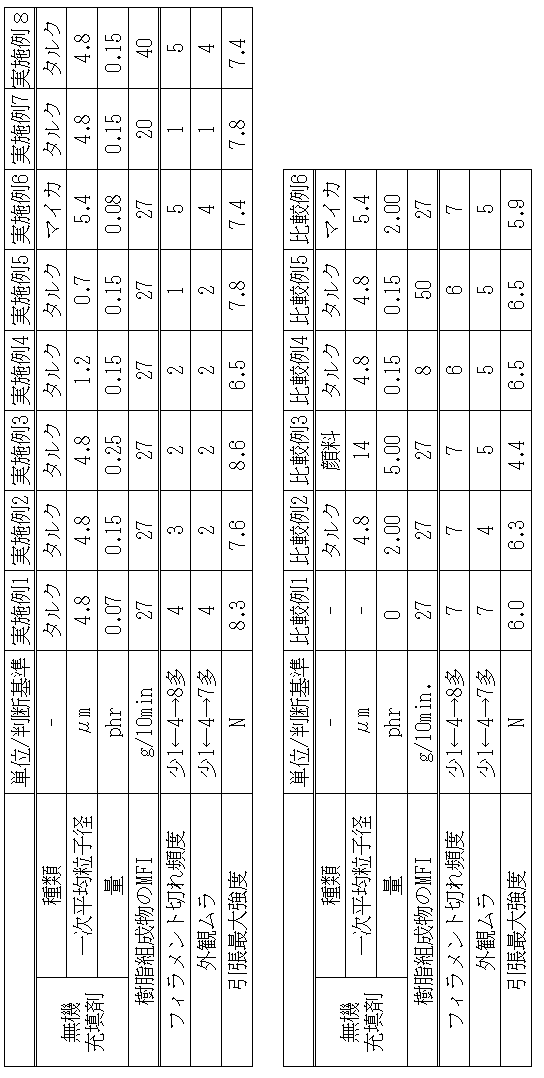
- Example 2 Polyacetal fibers were obtained in the same manner as in Example 1 except that the amount of talc blended was 0.15 parts by mass per 100 parts by mass of polyacetal (A). Various properties of the obtained polyacetal fibers were measured, and the results are shown in Table 1.
- Example 3 Polyacetal fibers were obtained in the same manner as in Example 1 except that the amount of talc blended was 0.25 parts by mass per 100 parts by mass of polyacetal (A). Various properties of the obtained polyacetal fibers were measured, and the results are shown in Table 1.
- Example 4 Polyacetal fibers were obtained in the same manner as in Example 2 except that talc having an average primary particle size of 1.2 ⁇ m (manufactured by Nippon Talc Co., Ltd., trade name: SG-2000) was used. Various properties of the obtained polyacetal fibers were measured, and the results are shown in Table 1.
- Example 5 Polyacetal fibers were obtained in the same manner as in Example 2 except that talc having an average primary particle size of 0.7 ⁇ m (manufactured by Nippon Talc Co., Ltd., trade name: D-600) was used. Various properties of the obtained polyacetal fibers were measured, and the results are shown in Table 1.
- Example 7 Polyacetal fibers were obtained in the same manner as in Example 2 except that the MFI of polyacetal (B) was adjusted to 20 g / 10 min. Various properties of the obtained polyacetal fibers were measured, and the results are shown in Table 1.
- Example 8 Polyacetal fibers were obtained in the same manner as in Example 2 except that the MFI of polyacetal (B) was adjusted to 40 g / 10 min. Various properties of the obtained polyacetal fibers were measured, and the results are shown in Table 1.
Landscapes
- Engineering & Computer Science (AREA)
- Textile Engineering (AREA)
- Chemical & Material Sciences (AREA)
- Chemical Kinetics & Catalysis (AREA)
- General Chemical & Material Sciences (AREA)
- Manufacturing & Machinery (AREA)
- Mechanical Engineering (AREA)
- Dispersion Chemistry (AREA)
- Health & Medical Sciences (AREA)
- Medicinal Chemistry (AREA)
- Polymers & Plastics (AREA)
- Organic Chemistry (AREA)
- Compositions Of Macromolecular Compounds (AREA)
- Artificial Filaments (AREA)
- Polyoxymethylene Polymers And Polymers With Carbon-To-Carbon Bonds (AREA)
Abstract
Description
[1]ポリアセタール樹脂100質量部に対して、無機充填剤0.05~1.3質量部を含み、
前記無機充填剤の一次平均粒子径が0.5μmより大きく10μm以下であり、
メルトフローインデックスが、15~45g/10minであることを特徴とする、ポリアセタール繊維。
[2]前記無機充填剤が、マグネシウムおよびケイ素の少なくとも一方を含む、上記[1]に記載のポリアセタール繊維。
[3]前記無機充填剤が、タルクである、上記[1]または[2]に記載のポリアセタール繊維。
[4]マルチフィラメントである、上記[1]から[3]の何れかに記載のポリアセタール繊維。
[5]太さが36~400デニールのマルチフィラメントである、上記[4]に記載のポリアセタール繊維。
[6]12~48本のモノフィラメントからなるマルチフィラメントである、上記[4]または[5]に記載のポリアセタール繊維。
[7]太さが1~12デニールのモノフィラメントからなるマルチフィラメントである、上記[4]~[6]の何れかに記載のポリアセタール繊維。
[8]織物、編物または不織布用である、上記[1]から[7]の何れかに記載のポリアセタール繊維。
[9]ポリアセタール樹脂100質量部に対して、無機充填剤0.05~1.3質量部を含み、
前記無機充填剤の一次平均粒子径が0.5μmより大きく10μm以下であり、
メルトフローインデックスが、15~45g/10minであることを特徴とする、延伸用材料。
[10]ポリアセタール樹脂100質量部に対して無機充填剤0.05~1.3質量部を含み、前記無機充填剤の一次平均粒子径が0.5μmより大きく10μm以下であり、かつメルトフローインデックスが15~45g/10minであるポリアセタール樹脂組成物を、溶融紡糸法に供してポリアセタール繊維を製造することを特徴とする、ポリアセタール繊維の製造方法。
本発明の一態様は、ポリアセタール樹脂と無機充填剤を含有するポリアセタール繊維に関する。本発明のポリアセタール繊維は、紡糸時に巻き取られる際、フィラメント(マルチフィラメントの場合は、主にモノフィラメント)が切れる「糸切れ」の発生が抑制されており、また、均一な外観を有しており「外観ムラ」の発生も抑制されている。このように、紡糸安定性に優れ、外観が均一である。
ポリアセタール樹脂は、オキシメチレン重合体とも呼ばれ、ホモポリマーと共重合体とがある。本明細書において、単に「ポリアセタール樹脂」「オキシメチレン重合体」と記載するときは、ホモポリマーと共重合体の両方を意味し、ホモポリマーについては、「オキシメチレンホモポリマー」、共重合体については「オキシメチレン共重合体」と呼び分けるものとする。

R0、R0’で表されるアルキル基は、非置換であるか、置換されている。置換基としては、ヒドロキシ基、アミノ基、アルコキシ基、アルケニルオキシメチル基及びハロゲンなどが挙げられる。置換基であるアルコキシ基としては、メトキシ、エトキシ及びプロポキシ等が挙げられる。置換基であるアルケニルオキシメチル基としては、アリルオキシメチル等が挙げられる。本明細書において、ハロゲンは、周期表第17族に属する元素を意味し、その具体例としてはフッ素、塩素、臭素、ヨウ素、アスタチンが挙げられる。
-CH2-O-(R1-O)p-R2 (2)
(式中、R1は、アルキレン基を表す。pは0~20の整数を表す。R2は、水素原子、アルキル基、フェニル基又はグリシジル基を表す。各(R1-O)単位は、同一であっても、異なっていてもよい。)
R1で表されるアルキレン基は、直鎖又は分岐状の、炭素原子数2~20のアルキレン基であり、例えばエチレン、プロピレン、ブチレン、2-エチルへキシレン等が挙げられ、エチレン又はプロピレンが好ましい。R1で表されるアルキレン基は、非置換であるか、置換されている。置換基としては、ヒドロキシ基、アミノ基、アルコキシ基、アルケニルオキシメチル基及びハロゲンなどが挙げられる。置換基であるアルコキシ基としては、メトキシ、エトキシ及びプロポキシ等が挙げられる。置換基であるアルケニルオキシメチル基としては、アリルオキシメチル等が挙げられる。
R2で表されるアルキル基としては、炭素原子数1~20の直鎖又は分岐状のアルキル基であり、例えばメチル、エチル、n-プロピル、i-プロピル、n-ブチル、i-ブチル、t-ブチル、ペンチル、ヘキシル、デシル、ドデシル及びオクタデシル等が挙げられる。炭素原子数1~4の直鎖又は分岐状のアルキル基が好ましい。R2で表されるアルキル基は、非置換であるか、置換されている。置換基としては、ヒドロキシ基、アミノ基、アルコキシ基、アルケニルオキシメチル基及びハロゲンなどが挙げられる。置換基であるアルコキシ基としては、メトキシ、エトキシ及びプロポキシ等が挙げられる。置換基であるアルケニルオキシメチル基としては、アリルオキシメチル等が挙げられる。
R2で表されるフェニル基は、非置換であるか、置換されている。置換基としては、アルキル基、アリール基、ハロゲンなどがあげられる。置換基であるアルキル基として、炭素原子数1~20の直鎖又は分岐状のアルキル基が挙げられ、例えばメチル、エチル、n-プロピル、i-プロピル、n-ブチル、i-ブチル、t-ブチル、ペンチル、ヘキシル、デシル、ドデシル及びオクタデシル等が挙げられる。炭素原子数1~4の直鎖又は分岐状のアルキル基が好ましい。置換基であるアリール基として、フェニル、ナフチル及びアントラシル等が挙げられる。
-CH(CH3)-CHR3- (3)
(式中、R3は、下記式(4)で表される基である。)
-O-(R1-O)p-R4 (4)
(式中、R4は、水素原子、アルキル基、アルケニル基、フェニル基又はフェニルアルキル基を表す。R1及びpは、式(2)で定義されたとおりである。)
R4で表されるアルキル基は、非置換であるか、置換されている。置換基としては、ヒドロキシ基、アミノ基、アルコキシ基、アルケニルオキシメチル基及びハロゲンなどが挙げられる。置換基であるアルコキシ基としては、メトキシ、エトキシ及びプロポキシ等が挙げられる。置換基であるアルケニルオキシメチル基としては、アリルオキシメチル等が挙げられる。
本発明のポリアセタール繊維には、無機充填剤が含まれている。
一次平均粒子径は、後述の実施例に示されるとおり、レーザー回折法により測定された粒度分布から得られる、50%体積平均粒子径である。
本発明のポリアセタール繊維には、ポリアセタール樹脂と無機充填剤以外に、製造時にポリアセタール樹脂組成物に配合される公知の成分を含んでいてよい。公知の成分については、後で詳述する。
本発明のポリアセタール繊維は、任意の方法により製造することができるが、好適には、一次平均粒子径が前述した数値範囲内(0.5μmより大きく10μm以下、好適には0.6~9.0μm、より好適には0.7~8.0μm、特に好適には0.7μm以上4.8μm未満、最も好適には0.7~1.2μm)にある無機充填剤を、前述した量(ポリアセタール樹脂100質量部あたり0.05~1.3質量部、好適には0.06~1.0質量部、より好適には0.07~0.8質量部、特に好適には0.07~0.5質量部、最も好適には0.07~0.3質量部)で含み、かつメルトフローインデックスが前述した数値範囲(15~45g/10min、好適には18~42g/10min、特に好適には20~40g/10min)であるポリアセタール樹脂組成物を用意し、このポリアセタール樹脂組成物を溶融紡糸法に供して製造する。
ポリアセタール樹脂組成物の製造方法は、特に限定されるものではないが、例えば、環状オリゴマー、並びに、重合触媒を用いて重合反応させてポリアセタール樹脂を得て、得られたポリアセタール樹脂に無機充填剤を添加する方法が挙げられる。ポリアセタール樹脂がオキシメチレン共重合体である場合には、重合反応においてコモノマーも使用する。
また、エステル交換触媒、各種モノマー、カップリング剤(例えば他の多官能イソシアネート化合物等が挙げられる)、末端処理剤、その他の樹脂、木粉、でんぷんをはじめとする天然由来の有機フィラーを加えてもよい。
ポリアセタール樹脂組成物を公知の溶融紡糸法に供し、ポリアセタール繊維を製造する。紡糸方法の一態様を、図2を用いて説明する。
本明細書でこれまで述べてきたとおり、特定の粒子径の無機充填剤を特定の量で含有しており、かつ、メルトフローインデックスが特定の範囲に調整されたポリアセタール樹脂組成物を用いると、紡糸時に延伸を均一に行うことができるのであるが、この特性は、繊維に限らず、製造時に延伸工程を要する他の成形品にも言えることである。したがって、本発明の一態様によれば、一次平均粒子径が0.5μmより大きく10μm以下である無機充填剤を、ポリアセタール樹脂100質量部に対して0.05~1.3質量部含み、かつ、メルトフローインデックスが、15~45g/10minである、延伸用材料が提供される。本発明の延伸用材料は、本明細書のポリアセタール繊維の項で説明した特徴を有してもよい。
各実施例及び比較例で使用した無機充填剤を、ステンレス製小型薬さじで3~4杯程度すくい、5mlの水とともにガラス瓶に採取し、密栓してサンプルを得た。得られたサンプルを攪拌した後、レーザー回折により粒度分布を測定した。得られた粒度分布から得られる、50%体積平均粒子径を一次平均粒子径とした。
測定機器として、東洋精機株式会社製のメルトインデクサーを用い、各実施例及び比較例で用いたポリアセタール(B)のメルトフローインデックス(以下、MFIとする)を測定した。測定は、ISO 1133に準拠して、温度190℃、荷重2.16kgの条件で行った。
繊維を巻き取っている際、巻取り回転数と同じ周波数を持つストロボフラッシュを連続して照射することで、巻取り部で繊維が止まっているように見える。この際、フィラメント切れ(モノフィラメントが切れること)が発生すると巻取りローラーの表面にケバが発生する。目視によりこのケバをカウントした。評価基準は以下のとおりである。
1)10分間で1回もフィラメント切れ無し。
2)10分間で1回だけフィラメント切れが確認できる。
3)3分間で1回だけフィラメント切れが確認できる。
4)1分間で1~2回フィラメント切れが確認できる。
5)1分間で3~6回フィラメント切れが確認できる。
6)1分間で7~9回フィラメント切れが確認できる。
7)1分間で10回以上フィラメント切れが確認できる。
8)繊維が得られない。
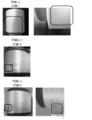
ポリアセタール繊維を適切に延伸することが出来れば外観は均一で透明になるが、何らかの外的要因で均一に延伸されなかった場合、その部分が白く不透明となる。そこで、各実施例および比較例で得られた繊維ボビンの一定範囲を観察し、不透明部分が見られる頻度を目視でカウントした。評価基準は以下のとおりである。
1)すべて透明に見える。
2)ボビンの15cm×15cm範囲で1箇所だけ、白い不透明な部分が見える。
3)ボビンの5cm×5cm範囲で1箇所だけ、白い不透明な部分が見える。
4)ボビンの5cm×5cm範囲で2~3箇所、白い不透明な部分が見える。
5)ボビンの5cm×5cm範囲で4~6箇所、白い不透明な部分が見える。
6)ボビンの5cm×5cm範囲で7~9箇所、白い不透明な部分が見える。
7)ボビンの5cm×5cm範囲で10か所以上、白い不透明な部分が見える。
上記評価基準のうち、評価1,4,6の一例を図1に示す。
各実施例および比較例で得られたポリアセタール繊維を、温度23℃、湿度50%の環境下で24時間以上調温調湿した。(株)島津製作所製オートグラフ AGS-X 1kNを用いて、調温調湿後の繊維を引張試験に供した。測定の際は、120mm長の繊維を100mm/minの速度で引っ張った。
(1)ポリアセタールの調製
ポリアセタール繊維の原料であるポリアセタール樹脂組成物(以下、ポリアセタール(B)と呼ぶことがある。)を、下記の方法で調製した。
まず、トリオキサン100質量部とコモノマーとして1,3-ジオキソラン4.0質量部を混合し、トリオキサン1モル当り0.045ミリモルの三フッ化ホウ素ジエチルエーテラートを触媒として供給し、互いにかみ合うパドルを持つ二軸のニーダー中で重合を行った。この際、粘度調整剤としてメチラールをトリオキサン100質量部に対して0.12質量部加え、粘度調整を行った。重合終了後、少量のトリフェニルホスフィンのベンゼン溶液を添加して触媒を失活処理し、粉砕し、粗ポリアセタールを得た。
得られた粗ポリアセタールに、添加剤(Irganox(登録商標)245(BASFジャパン(株)製)とメラミン(三井化学(株)製)を加えブレンドした後、得られたブレンド物を同方向二軸押出機((株)日本製鋼所製、内径69mm、L/D=31.5)に60kg/時間で導入し、粗ポリアセタールをベント部で20kPaの減圧として220℃で溶融させ、連続的に二軸の表面更新型横型混練機(実効内容積60L:全内容積から攪拌翼が占める体積を除いた体積)に導入した。二軸の表面更新型横型混練機滞在時間が25分となるように液面を調整し、20kPaの減圧下220℃で減圧脱揮を行いながら、連続的にギアポンプで抜き出すことでペレット化し、中間原料となるポリアセタール(A)を得た。
一次平均粒子径4.8μmのタルク(イメリススペシャリティーズジャパン(株)製、商品名:Mistron Vapor)を、ポリアセタール(A)100質量部あたり0.07質量部加えてブレンドした後、同方向二軸押出機((株)日本製鋼所製、内径58mm、L/D=49.0)に100kg/時間で導入しよく混合した後にペレット化し、原料となるポリアセタール(B)を得た。
ポリアセタール(B)のMFIは、27g/10minであった。
シリンダー設定温度190℃の押出機、ギアポンプ、吐出ノズルを備えた紡糸機(ユニプラス(株)製)に、得られたポリアセタール(B)を供給し、紡糸した。吐出量は1kg/h、吐出ノズルのホール数は36穴、引取り速度は100m/min、延伸ローラー速度は500m/min、巻取り速度は500m/min、延伸ローラーの温度は150℃であった。この時、延伸倍率は5倍であった。
単繊維(モノフィラメント)の太さが8デニールであり、36本のモノフィラメントで構成されており、マルチフィラメントの繊維太さが300デニールであるポリアセタール繊維を得た。得られたポリアセタール繊維の各種特性を測定し、結果を表1に示した。
紡糸時のフィラメント切れ頻度は1分間で1回だけ確認された。外観ムラとしては得られた繊維ボビンの5cm×5cm範囲で2箇所、白い不透明な部分が見えた。引張最大強度は8.3Nであった。
タルクの配合量を、ポリアセタール(A)100質量部あたり0.15質量部とした点以外は、実施例1と同様にしてポリアセタール繊維を得た。得られたポリアセタール繊維の各種特性を測定し、結果を表1に示した。
タルクの配合量を、ポリアセタール(A)100質量部あたり0.25質量部とした点以外は、実施例1と同様にしてポリアセタール繊維を得た。得られたポリアセタール繊維の各種特性を測定し、結果を表1に示した。
平均一次粒子径が1.2μmのタルク(日本タルク(株)製、商品名:SG-2000)を使用した点以外は、実施例2と同様にしてポリアセタール繊維を得た。得られたポリアセタール繊維の各種特性を測定し、結果を表1に示した。
平均一次粒子径が0.7μmのタルク(日本タルク(株)製、商品名:D-600)を使用した点以外は、実施例2と同様にしてポリアセタール繊維を得た。得られたポリアセタール繊維の各種特性を測定し、結果を表1に示した。
タルクの代わりに、平均一次粒子径が5.4μmのマイカ(片倉コープアグリ(株)製、商品名:ミクロマイカMK-100)を、ポリアセタール(A)100質量部あたり0.08質量部配合した点以外は、実施例1と同様にしてポリアセタール繊維を得た。得られたポリアセタール繊維の各種特性を測定し、結果を表1に示した。
ポリアセタール(B)のMFIを20g/10minに調節した点以外は、実施例2と同様にしてポリアセタール繊維を得た。得られたポリアセタール繊維の各種特性を測定し、結果を表1に示した。
ポリアセタール(B)のMFIを40g/10minに調節した点以外は、実施例2と同様にしてポリアセタール繊維を得た。得られたポリアセタール繊維の各種特性を測定し、結果を表1に示した。
無機充填剤を使用しなかった点以外は、実施例1と同様にしてポリアセタール繊維を得た。得られたポリアセタール繊維の各種特性を測定し、結果を表1に示した。
タルクの配合量を、ポリアセタール(A)100質量部あたり2.00質量部とした点以外は、実施例1と同様にしてポリアセタール繊維を得た。得られたポリアセタール繊維の各種特性を測定し、結果を表1に示した。
タルクの代わりに、平均一次粒子径が14μmの赤色顔料を、ポリアセタール(A)100質量部あたり5.00質量部配合した点以外は、実施例1と同様にしてポリアセタール繊維を得た。得られたポリアセタール繊維の各種特性を測定し、結果を表1に示した。
ポリアセタール(B)のMFIを8g/10minに調節した点以外は、実施例2と同様にしてポリアセタール繊維を得た。得られたポリアセタール繊維の各種特性を測定し、結果を表1に示した。
ポリアセタール(B)のMFIを50g/10minに調節した点以外は、実施例2と同様にしてポリアセタール繊維を得た。得られたポリアセタール繊維の各種特性を測定し、結果を表1に示した。
マイカを、ポリアセタール(A)100質量部あたり2.00質量部配合した点以外は、実施例6と同様にしてポリアセタール繊維を得た。得られたポリアセタール繊維の各種特性を測定し、結果を表1に示した。
Claims (10)
- ポリアセタール樹脂100質量部に対して、無機充填剤0.05~1.3質量部を含み、
前記無機充填剤の一次平均粒子径が0.5μmより大きく10μm以下であり、
メルトフローインデックスが、15~45g/10minであることを特徴とする、ポリアセタール繊維。 - 前記無機充填剤が、マグネシウムおよびケイ素の少なくとも一方を含む、請求項1に記載のポリアセタール繊維。
- 前記無機充填剤が、タルクである、請求項1または2に記載のポリアセタール繊維。
- マルチフィラメントである、請求項1から3の何れか一項に記載のポリアセタール繊維。
- 太さが36~400デニールのマルチフィラメントである、請求項4に記載のポリアセタール繊維。
- 12~48本のモノフィラメントからなるマルチフィラメントである、請求項4または5に記載のポリアセタール繊維。
- 太さが1~12デニールのモノフィラメントからなるマルチフィラメントである、請求項4~6の何れか一項に記載のポリアセタール繊維。
- 織物、編物または不織布用である、請求項1から7の何れか一項に記載のポリアセタール繊維。
- ポリアセタール樹脂100質量部に対して、無機充填剤0.05~1.3質量部を含み、
前記無機充填剤の一次平均粒子径が0.5μmより大きく10μm以下であり、
メルトフローインデックスが、15~45g/10minであることを特徴とする、延伸用材料。 - ポリアセタール樹脂100質量部に対して無機充填剤0.05~1.3質量部を含み、前記無機充填剤の一次平均粒子径が0.5μmより大きく10μm以下であり、かつメルトフローインデックスが15~45g/10minであるポリアセタール樹脂組成物を、溶融紡糸法に供してポリアセタール繊維を製造することを特徴とする、ポリアセタール繊維の製造方法。
Priority Applications (6)
| Application Number | Priority Date | Filing Date | Title |
|---|---|---|---|
| CN202080017876.0A CN113557327B (zh) | 2019-11-29 | 2020-11-25 | 聚缩醛纤维及其制造方法、以及拉伸用材料 |
| KR1020217026122A KR102509158B1 (ko) | 2019-11-29 | 2020-11-25 | 폴리아세탈 섬유 및 그의 제조 방법, 및 연신용 재료 |
| EP20894043.7A EP4050134A4 (en) | 2019-11-29 | 2020-11-25 | POLYACETAL FIBERS, PROCESS FOR THEIR MANUFACTURE AND DRAWING EQUIPMENT |
| MYPI2021004237A MY189731A (en) | 2019-11-29 | 2020-11-25 | Polyacetal fibers, method for producing same and material for drawing |
| JP2021516845A JP6915764B1 (ja) | 2019-11-29 | 2020-11-25 | ポリアセタール繊維及びその製造方法、並びに、延伸用材料 |
| US17/426,283 US20210388534A1 (en) | 2019-11-29 | 2020-11-25 | Polyacetal fibers, method for producing same and material for drawing |
Applications Claiming Priority (2)
| Application Number | Priority Date | Filing Date | Title |
|---|---|---|---|
| JP2019-216893 | 2019-11-29 | ||
| JP2019216893 | 2019-11-29 |
Publications (1)
| Publication Number | Publication Date |
|---|---|
| WO2021106887A1 true WO2021106887A1 (ja) | 2021-06-03 |
Family
ID=76130524
Family Applications (1)
| Application Number | Title | Priority Date | Filing Date |
|---|---|---|---|
| PCT/JP2020/043713 Ceased WO2021106887A1 (ja) | 2019-11-29 | 2020-11-25 | ポリアセタール繊維及びその製造方法、並びに、延伸用材料 |
Country Status (8)
| Country | Link |
|---|---|
| US (1) | US20210388534A1 (ja) |
| EP (1) | EP4050134A4 (ja) |
| JP (1) | JP6915764B1 (ja) |
| KR (1) | KR102509158B1 (ja) |
| CN (1) | CN113557327B (ja) |
| MY (1) | MY189731A (ja) |
| TW (1) | TWI746291B (ja) |
| WO (1) | WO2021106887A1 (ja) |
Families Citing this family (1)
| Publication number | Priority date | Publication date | Assignee | Title |
|---|---|---|---|---|
| CN118932581A (zh) * | 2024-08-02 | 2024-11-12 | 李宁(中国)体育用品有限公司 | 聚甲醛纤维织物及其应用 |
Citations (4)
| Publication number | Priority date | Publication date | Assignee | Title |
|---|---|---|---|---|
| JP2003089925A (ja) | 2001-09-18 | 2003-03-28 | Polyplastics Co | ポリオキシメチレン繊維及びその製造方法 |
| JP2005330463A (ja) * | 2004-04-23 | 2005-12-02 | Toray Ind Inc | ポリオキシメチレン樹脂組成物、およびその製造方法 |
| JP2006009196A (ja) * | 2004-06-25 | 2006-01-12 | Polyplastics Co | ポリオキシメチレン樹脂製繊維及びその製造方法 |
| WO2019012876A1 (ja) * | 2017-07-14 | 2019-01-17 | 三菱瓦斯化学株式会社 | ポリアセタール繊維の製造方法 |
Family Cites Families (17)
| Publication number | Priority date | Publication date | Assignee | Title |
|---|---|---|---|---|
| GB966487A (en) * | 1961-08-01 | 1964-08-12 | Ici Ltd | Coloured articles of polyoxymethylene and copolyoxymethylenes |
| TW245733B (ja) * | 1991-11-21 | 1995-04-21 | Du Pont | |
| DE19723592A1 (de) * | 1997-06-05 | 1998-12-17 | Hoechst Ag | Farbige Polyacetalformmasse mit verringerter Emission von Spaltprodukten |
| JPH11315221A (ja) * | 1998-05-06 | 1999-11-16 | Mitsui Chem Inc | 無機充填剤および該無機充填剤が配合された樹脂組成物 |
| DE19828797A1 (de) * | 1998-06-27 | 1999-12-30 | Basf Ag | Stabilisierte Polyoxymethylen-Formmassen |
| TW587110B (en) * | 2000-09-21 | 2004-05-11 | Outlast Technologies Inc | Multi-component fibers having enhanced reversible thermal properties and methods of manufacturing thereof |
| JP4306258B2 (ja) * | 2002-02-07 | 2009-07-29 | 東レ株式会社 | 樹脂組成物ならびにそれからなる成形品 |
| DE10319740A1 (de) * | 2003-04-30 | 2004-11-18 | Basf Ag | Polyoxymethylenformmassen |
| JP2004360146A (ja) * | 2003-06-09 | 2004-12-24 | Polyplastics Co | ポリオキシメチレン樹脂製不織布及びその製造方法 |
| US7385013B2 (en) * | 2004-05-12 | 2008-06-10 | Toray Industries, Inc. | Polymer alloy, thermoplastic resin composition, and molded article |
| KR101535398B1 (ko) * | 2006-12-04 | 2015-07-08 | 미츠비시 가스 가가쿠 가부시키가이샤 | 연신 재료용 옥시메틸렌 공중합체 조성물, 연신 재료, 구조체 및 그 제조 방법 |
| US20110185527A1 (en) * | 2008-03-31 | 2011-08-04 | Mitsubishi Gas Chemical Company, Inc. | Polyacetal-containing brush |
| CN102677217B (zh) * | 2012-05-18 | 2014-06-18 | 东华大学 | 一种改性pom纤维及其制备方法 |
| US10253160B2 (en) * | 2012-09-26 | 2019-04-09 | Mitsubishi Gas Chemical Company, Inc. | Polyacetal stretched fiber |
| JP2015003954A (ja) * | 2013-06-19 | 2015-01-08 | 旭化成ケミカルズ株式会社 | ポリアセタール樹脂組成物 |
| TWI565792B (zh) * | 2016-01-12 | 2017-01-11 | Auspring Co Ltd | Pest control fiber masterbatch composition |
| JP6931312B2 (ja) * | 2017-10-04 | 2021-09-01 | 旭化成株式会社 | ポリアセタール樹脂組成物 |
-
2020
- 2020-11-25 EP EP20894043.7A patent/EP4050134A4/en active Pending
- 2020-11-25 MY MYPI2021004237A patent/MY189731A/en unknown
- 2020-11-25 US US17/426,283 patent/US20210388534A1/en not_active Abandoned
- 2020-11-25 KR KR1020217026122A patent/KR102509158B1/ko active Active
- 2020-11-25 CN CN202080017876.0A patent/CN113557327B/zh active Active
- 2020-11-25 JP JP2021516845A patent/JP6915764B1/ja active Active
- 2020-11-25 WO PCT/JP2020/043713 patent/WO2021106887A1/ja not_active Ceased
- 2020-11-27 TW TW109141707A patent/TWI746291B/zh active
Patent Citations (4)
| Publication number | Priority date | Publication date | Assignee | Title |
|---|---|---|---|---|
| JP2003089925A (ja) | 2001-09-18 | 2003-03-28 | Polyplastics Co | ポリオキシメチレン繊維及びその製造方法 |
| JP2005330463A (ja) * | 2004-04-23 | 2005-12-02 | Toray Ind Inc | ポリオキシメチレン樹脂組成物、およびその製造方法 |
| JP2006009196A (ja) * | 2004-06-25 | 2006-01-12 | Polyplastics Co | ポリオキシメチレン樹脂製繊維及びその製造方法 |
| WO2019012876A1 (ja) * | 2017-07-14 | 2019-01-17 | 三菱瓦斯化学株式会社 | ポリアセタール繊維の製造方法 |
Non-Patent Citations (1)
| Title |
|---|
| See also references of EP4050134A4 |
Also Published As
| Publication number | Publication date |
|---|---|
| CN113557327B (zh) | 2022-06-28 |
| EP4050134A1 (en) | 2022-08-31 |
| TW202129104A (zh) | 2021-08-01 |
| TWI746291B (zh) | 2021-11-11 |
| MY189731A (en) | 2022-02-28 |
| KR102509158B1 (ko) | 2023-03-10 |
| CN113557327A (zh) | 2021-10-26 |
| JPWO2021106887A1 (ja) | 2021-12-02 |
| JP6915764B1 (ja) | 2021-08-04 |
| US20210388534A1 (en) | 2021-12-16 |
| EP4050134A4 (en) | 2023-05-17 |
| KR20210109638A (ko) | 2021-09-06 |
Similar Documents
| Publication | Publication Date | Title |
|---|---|---|
| JP4907023B2 (ja) | ポリオキシメチレン繊維の製造方法 | |
| JP4468086B2 (ja) | ポリオキシメチレン樹脂製複合繊維 | |
| JP6915764B1 (ja) | ポリアセタール繊維及びその製造方法、並びに、延伸用材料 | |
| JP4302394B2 (ja) | ポリオキシメチレン樹脂製延伸体の製造方法 | |
| CN110869547B (zh) | 聚缩醛纤维的制造方法 | |
| JP2006009196A (ja) | ポリオキシメチレン樹脂製繊維及びその製造方法 | |
| KR102494183B1 (ko) | 폴리아세탈 섬유의 제조 방법 | |
| JP2004360146A (ja) | ポリオキシメチレン樹脂製不織布及びその製造方法 | |
| JP4912768B2 (ja) | ポリオキシメチレン樹脂繊維の製造方法 | |
| JP2005256189A (ja) | ポリオキシメチレン樹脂製撚糸 | |
| KR102167672B1 (ko) | 형태안정성이 향상된 재생 폴리에스테르 이형단면사 및 이의 제조방법 |
Legal Events
| Date | Code | Title | Description |
|---|---|---|---|
| ENP | Entry into the national phase |
Ref document number: 2021516845 Country of ref document: JP Kind code of ref document: A |
|
| 121 | Ep: the epo has been informed by wipo that ep was designated in this application |
Ref document number: 20894043 Country of ref document: EP Kind code of ref document: A1 |
|
| ENP | Entry into the national phase |
Ref document number: 20217026122 Country of ref document: KR Kind code of ref document: A |
|
| NENP | Non-entry into the national phase |
Ref country code: DE |
|
| ENP | Entry into the national phase |
Ref document number: 2020894043 Country of ref document: EP Effective date: 20210729 |