WO2021106981A1 - Composé complexe et son procédé de production - Google Patents
Composé complexe et son procédé de production Download PDFInfo
- Publication number
- WO2021106981A1 WO2021106981A1 PCT/JP2020/043947 JP2020043947W WO2021106981A1 WO 2021106981 A1 WO2021106981 A1 WO 2021106981A1 JP 2020043947 W JP2020043947 W JP 2020043947W WO 2021106981 A1 WO2021106981 A1 WO 2021106981A1
- Authority
- WO
- WIPO (PCT)
- Prior art keywords
- group
- substituted
- complex compound
- fine particles
- resin fine
- Prior art date
- Legal status (The legal status is an assumption and is not a legal conclusion. Google has not performed a legal analysis and makes no representation as to the accuracy of the status listed.)
- Ceased
Links
Images


Classifications
-
- B—PERFORMING OPERATIONS; TRANSPORTING
- B01—PHYSICAL OR CHEMICAL PROCESSES OR APPARATUS IN GENERAL
- B01J—CHEMICAL OR PHYSICAL PROCESSES, e.g. CATALYSIS OR COLLOID CHEMISTRY; THEIR RELEVANT APPARATUS
- B01J31/00—Catalysts comprising hydrides, coordination complexes or organic compounds
- B01J31/16—Catalysts comprising hydrides, coordination complexes or organic compounds containing coordination complexes
- B01J31/24—Phosphines, i.e. phosphorus bonded to only carbon atoms, or to both carbon and hydrogen atoms, including e.g. sp2-hybridised phosphorus compounds such as phosphabenzene, phosphole or anionic phospholide ligands
- B01J31/2404—Cyclic ligands, including e.g. non-condensed polycyclic ligands, the phosphine-P atom being a ring member or a substituent on the ring
- B01J31/2409—Cyclic ligands, including e.g. non-condensed polycyclic ligands, the phosphine-P atom being a ring member or a substituent on the ring with more than one complexing phosphine-P atom
-
- C—CHEMISTRY; METALLURGY
- C08—ORGANIC MACROMOLECULAR COMPOUNDS; THEIR PREPARATION OR CHEMICAL WORKING-UP; COMPOSITIONS BASED THEREON
- C08G—MACROMOLECULAR COMPOUNDS OBTAINED OTHERWISE THAN BY REACTIONS ONLY INVOLVING UNSATURATED CARBON-TO-CARBON BONDS
- C08G83/00—Macromolecular compounds not provided for in groups C08G2/00 - C08G81/00
- C08G83/008—Supramolecular polymers
-
- B—PERFORMING OPERATIONS; TRANSPORTING
- B01—PHYSICAL OR CHEMICAL PROCESSES OR APPARATUS IN GENERAL
- B01J—CHEMICAL OR PHYSICAL PROCESSES, e.g. CATALYSIS OR COLLOID CHEMISTRY; THEIR RELEVANT APPARATUS
- B01J31/00—Catalysts comprising hydrides, coordination complexes or organic compounds
- B01J31/16—Catalysts comprising hydrides, coordination complexes or organic compounds containing coordination complexes
- B01J31/165—Polymer immobilised coordination complexes, e.g. organometallic complexes
- B01J31/1658—Polymer immobilised coordination complexes, e.g. organometallic complexes immobilised by covalent linkages, i.e. pendant complexes with optional linking groups, e.g. on Wang or Merrifield resins
-
- B—PERFORMING OPERATIONS; TRANSPORTING
- B01—PHYSICAL OR CHEMICAL PROCESSES OR APPARATUS IN GENERAL
- B01J—CHEMICAL OR PHYSICAL PROCESSES, e.g. CATALYSIS OR COLLOID CHEMISTRY; THEIR RELEVANT APPARATUS
- B01J31/00—Catalysts comprising hydrides, coordination complexes or organic compounds
- B01J31/16—Catalysts comprising hydrides, coordination complexes or organic compounds containing coordination complexes
- B01J31/24—Phosphines, i.e. phosphorus bonded to only carbon atoms, or to both carbon and hydrogen atoms, including e.g. sp2-hybridised phosphorus compounds such as phosphabenzene, phosphole or anionic phospholide ligands
-
- B—PERFORMING OPERATIONS; TRANSPORTING
- B01—PHYSICAL OR CHEMICAL PROCESSES OR APPARATUS IN GENERAL
- B01J—CHEMICAL OR PHYSICAL PROCESSES, e.g. CATALYSIS OR COLLOID CHEMISTRY; THEIR RELEVANT APPARATUS
- B01J31/00—Catalysts comprising hydrides, coordination complexes or organic compounds
- B01J31/16—Catalysts comprising hydrides, coordination complexes or organic compounds containing coordination complexes
- B01J31/24—Phosphines, i.e. phosphorus bonded to only carbon atoms, or to both carbon and hydrogen atoms, including e.g. sp2-hybridised phosphorus compounds such as phosphabenzene, phosphole or anionic phospholide ligands
- B01J31/2404—Cyclic ligands, including e.g. non-condensed polycyclic ligands, the phosphine-P atom being a ring member or a substituent on the ring
-
- C—CHEMISTRY; METALLURGY
- C07—ORGANIC CHEMISTRY
- C07F—ACYCLIC, CARBOCYCLIC OR HETEROCYCLIC COMPOUNDS CONTAINING ELEMENTS OTHER THAN CARBON, HYDROGEN, HALOGEN, OXYGEN, NITROGEN, SULFUR, SELENIUM OR TELLURIUM
- C07F9/00—Compounds containing elements of Groups 5 or 15 of the Periodic Table
- C07F9/02—Phosphorus compounds
- C07F9/28—Phosphorus compounds with one or more P—C bonds
- C07F9/38—Phosphonic acids [RP(=O)(OH)2]; Thiophosphonic acids ; [RP(=X1)(X2H)2(X1, X2 are each independently O, S or Se)]
- C07F9/40—Esters thereof
- C07F9/4003—Esters thereof the acid moiety containing a substituent or a structure which is considered as characteristic
- C07F9/4015—Esters of acyclic unsaturated acids
-
- C—CHEMISTRY; METALLURGY
- C08—ORGANIC MACROMOLECULAR COMPOUNDS; THEIR PREPARATION OR CHEMICAL WORKING-UP; COMPOSITIONS BASED THEREON
- C08F—MACROMOLECULAR COMPOUNDS OBTAINED BY REACTIONS ONLY INVOLVING CARBON-TO-CARBON UNSATURATED BONDS
- C08F8/00—Chemical modification by after-treatment
- C08F8/40—Introducing phosphorus atoms or phosphorus-containing groups
-
- B—PERFORMING OPERATIONS; TRANSPORTING
- B01—PHYSICAL OR CHEMICAL PROCESSES OR APPARATUS IN GENERAL
- B01J—CHEMICAL OR PHYSICAL PROCESSES, e.g. CATALYSIS OR COLLOID CHEMISTRY; THEIR RELEVANT APPARATUS
- B01J2231/00—Catalytic reactions performed with catalysts classified in B01J31/00
- B01J2231/30—Addition reactions at carbon centres, i.e. to either C-C or C-X multiple bonds
- B01J2231/32—Addition reactions to C=C or C-C triple bonds
-
- B—PERFORMING OPERATIONS; TRANSPORTING
- B01—PHYSICAL OR CHEMICAL PROCESSES OR APPARATUS IN GENERAL
- B01J—CHEMICAL OR PHYSICAL PROCESSES, e.g. CATALYSIS OR COLLOID CHEMISTRY; THEIR RELEVANT APPARATUS
- B01J2231/00—Catalytic reactions performed with catalysts classified in B01J31/00
- B01J2231/30—Addition reactions at carbon centres, i.e. to either C-C or C-X multiple bonds
- B01J2231/32—Addition reactions to C=C or C-C triple bonds
- B01J2231/323—Hydrometalation, e.g. bor-, alumin-, silyl-, zirconation or analoguous reactions like carbometalation, hydrocarbation
-
- B—PERFORMING OPERATIONS; TRANSPORTING
- B01—PHYSICAL OR CHEMICAL PROCESSES OR APPARATUS IN GENERAL
- B01J—CHEMICAL OR PHYSICAL PROCESSES, e.g. CATALYSIS OR COLLOID CHEMISTRY; THEIR RELEVANT APPARATUS
- B01J2531/00—Additional information regarding catalytic systems classified in B01J31/00
- B01J2531/80—Complexes comprising metals of Group VIII as the central metal
- B01J2531/82—Metals of the platinum group
- B01J2531/822—Rhodium
-
- B—PERFORMING OPERATIONS; TRANSPORTING
- B01—PHYSICAL OR CHEMICAL PROCESSES OR APPARATUS IN GENERAL
- B01J—CHEMICAL OR PHYSICAL PROCESSES, e.g. CATALYSIS OR COLLOID CHEMISTRY; THEIR RELEVANT APPARATUS
- B01J2531/00—Additional information regarding catalytic systems classified in B01J31/00
- B01J2531/80—Complexes comprising metals of Group VIII as the central metal
- B01J2531/82—Metals of the platinum group
- B01J2531/824—Palladium
-
- B—PERFORMING OPERATIONS; TRANSPORTING
- B01—PHYSICAL OR CHEMICAL PROCESSES OR APPARATUS IN GENERAL
- B01J—CHEMICAL OR PHYSICAL PROCESSES, e.g. CATALYSIS OR COLLOID CHEMISTRY; THEIR RELEVANT APPARATUS
- B01J2531/00—Additional information regarding catalytic systems classified in B01J31/00
- B01J2531/80—Complexes comprising metals of Group VIII as the central metal
- B01J2531/84—Metals of the iron group
- B01J2531/847—Nickel
-
- C—CHEMISTRY; METALLURGY
- C07—ORGANIC CHEMISTRY
- C07B—GENERAL METHODS OF ORGANIC CHEMISTRY; APPARATUS THEREFOR
- C07B2200/00—Indexing scheme relating to specific properties of organic compounds
- C07B2200/11—Compounds covalently bound to a solid support
Definitions
- the present invention relates to a complex compound. More specifically, the present invention relates to complex compounds useful as catalysts for hydrophosphorylation reactions. The present invention also relates to a method for producing the complex compound.
- Organophosphorus compounds are chemical substances widely used in various products such as flame retardants, plasticizers, pesticides, medical pesticides, and ligands for metal complexes.
- organic phosphorus compounds have attracted particular industrial attention in the fields of metal surface treatment agents as functional materials, constituent materials such as flame-retardant resins, and electronic materials.
- the alkenylphosphonic acid derivative is a useful precursor substance of the above-mentioned various chemical substances, and therefore various production methods have been studied conventionally.
- an alkenylphosphonic acid derivative has been produced by an addition reaction of a P (O) -H bond of a phosphonic acid to an alkyne (hereinafter referred to as a hydrophosphorylation reaction) using a catalyst.
- a hydrophosphorylation reaction a catalyst in which a transition metal is immobilized on a polystyrene resin to which triphenylphosphine is bound.
- Non-Patent Document 1 the catalyst in which the transition metal is immobilized on the polystyrene resin to which triphenylphosphine is bound as described in Non-Patent Document 1 does not have a sufficient phosphorus content on the resin surface, and it is very difficult to add the phosphorus amount required for the reaction. There are problems that a large amount of resin is required, the reaction efficiency is low, the metal component is leached from the resin surface a lot, and side reactions proceed a lot. Therefore, there is room for improvement in the reaction efficiency when used in the hydrophosphorylation reaction.
- an object of the present invention is to provide a complex compound useful as a catalyst for a hydrophosphorylation reaction.
- the present inventor has obtained a complex compound useful as a catalyst for a hydrophosphorylation reaction by reacting a resin having a phosphine substituent on the surface with a transition metal. It was found that this was possible, and the present invention was completed.
- R 1 represents a substituted or unsubstituted hydrocarbon group
- R 2 represents a substituted or unsubstituted alkyl group or a substituted or unsubstituted aryl group
- R 3 and R 4 Independently indicate a hydrogen atom, a substituted or unsubstituted alkyl group, or a substituted or unsubstituted aryl group
- the value of n is 20 to 100% with respect to the total of 100% of the values of n and m.
- a complex compound of resin fine particles represented by and a transition metal [2] The complex compound according to [1], wherein the substance amount ratio of the phosphine group and the transition metal in the resin fine particles is 10: 1 to 1: 2. [3] The complex compound according to [1] or [2] , wherein R 1 is a hydrocarbon group having 6 to 12 carbon atoms in the general formula (1). [4] In the general formula (1), R 2 is described in any one of [1] to [3], wherein R 2 is an alkyl group having 1 to 8 carbon atoms or an aryl group having 5 to 12 carbon atoms. Complex compound.
- R 3 and R 4 are any of [1] to [4], which are an alkyl group having 1 to 8 carbon atoms or an aryl group having 5 to 12 carbon atoms.
- the complex compound according to. [6] The complex compound according to any one of [1] to [5], wherein the transition metal is nickel or palladium.
- R 1 represents a substituted or unsubstituted hydrocarbon group
- R 2 represents a substituted or unsubstituted alkyl group or a substituted or unsubstituted aryl group
- R 3 and R 4 Independently indicate a hydrogen atom, a substituted or unsubstituted alkyl group, or a substituted or unsubstituted aryl group
- the value of n is 20 to 100% with respect to the total of 100% of the values of n and m.
- a method for producing a complex compound which comprises a step of reacting the resin fine particles represented by (1) and a transition metal compound in the presence of an organic solvent. [9] The method for producing a complex compound according to [8], wherein the transition metal compound is a zero-valent nickel compound. [10]
- the zero-valent nickel compound is at least one selected from the group consisting of bis (1,5-cyclooctadiene) nickel (0), tetrakis (triphenylphosphine) nickel (0), and nickel carbonyl.
- the present invention it is possible to provide a complex compound useful as a catalyst for a hydrophosphorylation reaction and a method for producing the same.
- the complex compound of the present invention can efficiently proceed with the hydrophosphorylation reaction under temperature conditions of room temperature or higher as a catalyst. Moreover, since an inexpensive commercially available material can be used as a raw material for the complex compound of the present invention, the production cost can be reduced.
- the complex compound of the present invention is a complex compound (resin-supported transition metal complex) of a resin fine particle described in detail below and a transition metal, and can be used as a catalyst for a hydrophosphorylation reaction.
- a complex compound resin-supported transition metal complex
- phosphine substituents on the surface of the resin fine particles, such a complex compound can efficiently proceed with the hydrophosphorylation reaction under temperature conditions of room temperature or higher.
- the resin fine particles forming the complex compound are represented by the following general formula (1).
- R 1 represents a substituted or unsubstituted hydrocarbon group
- R 2 represents a substituted or unsubstituted alkyl group or a substituted or unsubstituted aryl group
- R 3 and R 4 Independently indicate a hydrogen atom, a substituted or unsubstituted alkyl group, or a substituted or unsubstituted aryl group
- the value of n is 20 to 100% with respect to the total of 100% of the values of n and m.
- the value of m is in the range of 0 to 80%, and * is bonded to the surface of the resin fine particles.
- a hydrocarbon group having 6 to 12 carbon atoms is preferable as the substituted or unsubstituted hydrocarbon group of R 1 .
- the carbon number of the substituent does not include the carbon number of the substituent.
- the hydrocarbon group having 6 to 12 carbon atoms include an alkylene group such as a hexylene group, a heptylene group and an octylene group, a cycloalkylene group such as a cyclohexylene group, an aromatic hydrocarbon group such as a phenylene group and a naphthylene group.
- R 1 is preferably an aromatic hydrocarbon group, more preferably a phenylene group.
- examples of the substituted or unsubstituted alkyl group R 2 preferably an alkyl group having 1 to 8 carbon atoms
- examples of the substituted or unsubstituted aryl group, an aryl having a carbon number of 5 to 12 Groups are preferred.
- the carbon number of the substituent does not include the carbon number of the substituent.
- alkyl group having 1 to 8 carbon atoms examples include a methyl group, an ethyl group, a propyl group, an isopropyl group, an n-butyl group, an isobutyl group, a sec-butyl group, a tert-butyl group, a pentyl group, a hexyl group and the like. ..
- aryl group having 5 to 12 carbon atoms include a phenyl group, a tolyl group, a xsilyl group, and a naphthyl group.
- R 2 is preferably an aromatic hydrocarbon group, more preferably a phenyl group.
- the substituted or unsubstituted alkyl group of R 3 and R 4 is preferably an alkyl group having 1 to 8 carbon atoms, and the substituted or unsubstituted aryl group has 5 to 5 carbon atoms. Twelve aryl groups are preferred.
- the carbon number of the substituent does not include the carbon number of the substituent.
- alkyl group having 1 to 8 carbon atoms examples include a methyl group, an ethyl group, a propyl group, an isopropyl group, an n-butyl group, an isobutyl group, a sec-butyl group, a tert-butyl group, a pentyl group, a hexyl group and the like. ..
- aryl group having 5 to 12 carbon atoms include a phenyl group, a tolyl group, a xsilyl group, and a naphthyl group.
- R 3 and R 4 are each independently a hydrogen atom, a methyl group, or a phenyl group.
- examples of the substituents that R 1 , R 2 , R 3 and R 4 may have include an alkyl group, a cycloalkyl group, an alkoxy group, a cycloalkoxy group and a heterocyclic group.
- examples thereof include an alkylidene group, an amino group, a silyl group, an acyl group, an acyloxy group, a carboxy group, a cyano group, a nitro group, a hydroxy group, a mercapto group, and an oxo group.
- the number of carbon atoms contained in the substituent is preferably 1 to 6, more preferably 1 to 4, and even more preferably 1 to 3.
- R 1 , R 2 , R 3 and R 4 may have a fluorine atom.
- resin represented by the general formula (1) examples include a resin represented by the following formula.
- the value of n is 20 to 100%, preferably 50 to 100%, and more preferably 80 to 100% with respect to the total of 100% of the values of n and m.
- the value of m is 0 to 80%, preferably 0 to 50%, and more preferably 0 to 20%.
- the resin fine particles represented by the general formula (1) can be produced by the following method. For example, in a nitrogen atmosphere, a melifield resin and an alkali metal organophosphorus compound or a trivalent organophosphorus compound having an ester bond are added and reacted at ⁇ 20 to 150 ° C. for 1 to 48 hours. Resin fine particles can be produced.
- the Merrifield resin is a styrene / chloromethylstyrene crosslinked resin.
- the alkali metal organophosphorus compound include sodium diphenyl phosphide and sodium methyl phenyl phosphide.
- the trivalent organophosphorus compound having an ester bond include triethyl phosphate, methyl diphenyl subphosphine and the like.
- ethenylphenylmethylmagnesium chloride and phosphine halide are added to the reaction vessel and reacted at 0 to 100 ° C. for 1 to 48 hours to obtain phosphinylmethylstyrene, styrene, and a cross-linking agent.
- Resin fine particles can be produced by turbid polymerization.
- the phosphorus content on the surface is high, preferably 1.3 mmol / g or more, more preferably 2.0 mmol / g or more, and further preferably 2. It is 5.5 mmol / g or more.
- the phosphorus content on the surface of the resin fine particles can be measured by elemental analysis, the amount of adsorbed organic halide compound, and redox titration.
- the resin fine particles can be adjusted to a desired particle size by classifying them by a conventionally known method or adjusting the reaction conditions.
- the size of the resin fine particles is not particularly limited, but the average particle size is preferably 1 to 1000 ⁇ m, more preferably 10 to 100 ⁇ m, from the viewpoint of ease of forming a complex with the transition metal and reaction efficiency. Yes, more preferably 30-75 ⁇ m.
- the average particle size of the resin fine particles can be measured using a laser diffraction type particle size distribution measuring device or a sieving method (JIS K 0069: 1992).
- transition metal examples include nickel, palladium, and rhodium, with nickel being preferred.
- the hydrophosphorylation reaction can be efficiently promoted under temperature conditions of room temperature (20 ° C.) or higher and lower than 100 ° C.
- the substance amount ratio of the phosphine group and the transition metal in the resin fine particles is not particularly limited as long as a complex compound can be formed, but is preferably 10: 1 to 1: 2, and more preferably 8: 1 to 1: 1. More preferably, it is 5: 1 to 2: 1.
- the method for producing a complex compound of the present invention includes a step of reacting the resin fine particles represented by the above general formula (1) with a transition metal compound in the presence of an organic solvent.
- the resin fine particles represented by the general formula (1) are as described in detail above.
- the transition metal compound used in the method for producing a complex compound is preferably a nickel compound or a palladium compound, and more preferably a zero-valent nickel compound.
- the zero-valent nickel compound include bis (1,5-cyclooctadiene) nickel (0), tetrakis (triphenylphosphine) nickel (0), and nickel carbonyl.
- a complex compound can be formed by using a zero-valent nickel compound having a ligand having a coordination force weaker than that of phosphine existing on the surface of the resin fine particles.
- the reaction temperature of the resin fine particles and the transition metal compound is not particularly limited, but is preferably ⁇ 10 to 100 ° C., more preferably 0 to 60 ° C. in consideration of reaction efficiency, reaction rate, and by-products. More preferably, it is 10 to 30 ° C.
- the reaction time between the resin fine particles and the transition metal compound is not particularly limited, but is preferably 10 minutes to 24 hours, more preferably 1 hour to 18 hours in consideration of reaction efficiency, reaction rate, and by-products. , More preferably 6-18 hours.
- the organic solvent used for the reaction between the resin fine particles and the transition metal compound is not particularly limited, and examples thereof include ethers, hydrocarbons, ketones, esters, aromatic hydrocarbons, and the like, and ethers such as tetrahydrofuran are used. Is preferable.
- the reaction between the resin fine particles and the transition metal compound is preferably carried out in an inert gas atmosphere in consideration of the reaction efficiency, reaction rate and by-products.
- the inert gas it is preferable to use nitrogen, argon or the like.
- the above complex compound can be suitably used as a catalyst for the hydrophosphorylation reaction.
- an alkenyl phosphorus compound can be efficiently synthesized from a phosphorus compound and an alkynyl compound, which are raw materials, under a temperature condition of room temperature or higher.
- a phosphorus compound represented by the following general formula (2) can be used as the raw material for the hydrophosphorylation reaction.
- R 5 and R 6 are independently substituted or unsubstituted alkyl groups, substituted or unsubstituted alkoxy groups, substituted or unsubstituted cycloalkyl groups, substituted or unsubstituted, respectively. It represents an aralkyl group, a substituted or unsubstituted aryl group, or a substituted or unsubstituted aryloxy group. Further, R 5 and R 6 may be bonded to each other to form a cyclic structure.
- the alkyl group of R 5 and R 6, an alkoxy group, a cycloalkyl group, an aralkyl group, an aryl group, the number of carbon atoms of the aryloxy group is preferably 1-10.
- the carbon number of the substituent does not include the carbon number of the substituent.
- R 5 and R 6 include an alkyl group such as a methyl group, an ethyl group, a propyl group, an isopropyl group, an n-butyl group, an isobutyl group, a sec-butyl group, a pentyl group and a hexyl group, a methoxy group and an ethoxy group.
- Aalkyl groups such as butoxy groups, cycloalkyl groups such as cyclohexyl groups, aralkyl groups such as benzyl groups and phenethyl groups, aryl groups such as phenyl groups, trill groups, xsilyl groups and naphthyl groups, and aryloxy groups such as phenoxy groups.
- cycloalkyl groups such as cyclohexyl groups
- aralkyl groups such as benzyl groups and phenethyl groups
- aryl groups such as phenyl groups, trill groups, xsilyl groups and naphthyl groups
- aryloxy groups such as phenoxy groups.
- examples of the substituent that R 5 and R 6 may have include an alkyl group, a cycloalkyl group, an alkoxy group, a cycloalkoxy group, a heterocyclic group, an alkylidene group, a silyl group and an acyl group.
- examples thereof include a group, an acyloxy group, a carboxy group, a cyano group, a nitro group, a hydroxy group, a mercapto group, an oxo group and the like.
- the number of carbon atoms contained in the substituent is preferably 1 to 6, more preferably 1 to 4, and even more preferably 1 to 3.
- an alkynyl compound represented by the following general formula (3) can be used as a raw material for the hydrophosphorylation reaction.
- R 7 and R 8 are independently hydrogen atom, substituted or unsubstituted alkyl group, substituted or unsubstituted cycloalkyl group, substituted or unsubstituted aralkyl group, substituted or substituted.
- R 7 and R 8 include methyl group, ethyl group, propyl group, isopropyl group, n-butyl group, isobutyl group, sec-butyl group, pentyl group, hexyl group and other alkyl groups, cyclohexyl group and other cyclos.
- Aralkyl group such as alkyl group, benzyl group, phenethyl group, aryl group such as phenyl group, tolyl group, xylyl group, naphthyl group, 1-butenyl group, 2-butenyl group, 1,3-butadienyl group, pentenyl group, hexenyl
- alkenyl group such as a group, an alkoxy group such as a methoxy group, an ethoxy group and a butoxy group, and an aryloxy group such as a phenoxy group.
- examples of the substituent that R 7 and R 8 may have include an alkyl group, a cycloalkyl group, an alkoxy group, a cycloalkoxy group, a heterocyclic group, an alkylidene group, a silyl group and an acyl group.
- examples thereof include a group, an acyloxy group, a carboxy group, a cyano group, a nitro group, a hydroxy group, a mercapto group, an oxo group and the like.
- the number of carbon atoms contained in the substituent is preferably 1 to 6, more preferably 1 to 4, and even more preferably 1 to 3.
- the substance amount ratio of the phosphorus compound represented by the general formula (2) and the alkynyl compound represented by the general formula (3) of the raw material for the hydrophosphorylation reaction is preferably 10: 1 to 0.1: 1. , More preferably 3: 1 to 0.7: 1, and even more preferably 1.1: 1 to 0.9: 1.
- the amount of the complex compound (catalyst) used in the hydrophosphorylation reaction is not particularly limited as long as the reaction proceeds sufficiently, but is preferably 0.001 to 0.5 mol with respect to 1 mol of the phosphorus compound as a raw material. It is more preferably 0.01 to 0.1 mol, and even more preferably 0.025 to 0.05 mol.
- the reaction temperature of the hydrophosphorylation reaction is not particularly limited, but is preferably 50 to 120 ° C., more preferably 50 to 80 ° C., and even more preferably 50 to 80 ° C. in consideration of reaction efficiency, reaction rate, and by-products. It is 50 to 60 ° C.
- the reaction time of the hydrophosphorylation reaction is not particularly limited, but is preferably 30 minutes to 40 hours, more preferably 1 hour to 24 hours, and further, in consideration of reaction efficiency, reaction rate, and by-products. It is preferably 4 to 18 hours.
- the hydrophosphorylation reaction may be carried out under an organic solvent or without a solvent.
- the organic solvent used for the hydrophosphorylation reaction is not particularly limited, and examples thereof include alcohols, ethers, hydrocarbons, ketones, esters, aromatic hydrocarbons and the like.
- the hydrophosphorylation reaction is preferably carried out in an inert gas atmosphere in consideration of reaction efficiency, reaction rate and by-products.
- the inert gas it is preferable to use nitrogen, argon or the like.
- alkenyl phosphorus compound represented by the following general formula (4)
- R 5 and R 6 has the general formula (2) have the same meanings as R 5 and R 6 of, R 7 and R 8 of the general formula in (2) R 7 and R It is synonymous with 8.
- the phosphorus content on the surface of the obtained resin fine particles (I) was measured by the following organic halide adsorption method and found to be 2.34 mmol / g.
- 100 mg of resin fine particles and 2.0 mL of a 5.5 mass% benzyl bromide THF solution were weighed into a vial, and the mixture was stirred at 60 ° C. for 18 hours.
- the supernatant was withdrawn, and the amount of substance of benzyl bromide adsorbed by the internal standard method (standard substance diphenyl ether) was calculated using GC-FID to determine the phosphorus content of the resin fine particles.
- the obtained resin fine particles (I) were sieved through a 300 mesh sieve, and the passed material was collected. As a result, 15.9 g of pale yellow resin fine particles were obtained.
- Nickel (0) is considered to have reacted with the resin fine particles (I) to form a complex.
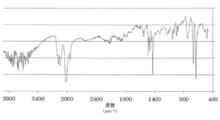
- the obtained resin fine particles (I) were measured by IR.
- the obtained IR spectrum is shown in FIG.
- the formation of vinyl phosphorus was confirmed by coordinating with Ni above. From these results, it can be said that a chemical bond of phosphorus was formed on the surface of the resin fine particles.
- Example 2 Under a nitrogen atmosphere, 132 mL of THF and 20.17 g of triphenylphosphine were added to the reaction vessel and stirred well. Subsequently, 25.4 g of a metallic sodium dispersion (sodium content of about 25% by mass, average particle diameter of metallic sodium fine particles: 10 ⁇ m, manufactured by Shinko Environmental Solution Co., Ltd., SD) was added to the reaction vessel, and then the temperature was 25 ° C. The mixture was stirred for 18 hours to obtain sodium diphenylphosphide (Ph 2 P-Na).
- a metallic sodium dispersion sodium content of about 25% by mass, average particle diameter of metallic sodium fine particles: 10 ⁇ m, manufactured by Shinko Environmental Solution Co., Ltd., SD
- the phosphorus content on the surface of the obtained resin fine particles (II) was measured in the same manner as in Example 1 and found to be 2.96 mmol / g. (In the above formula, the value of n is 100% and the value of m is 0% with respect to the total of 100% of the values of n and m.)
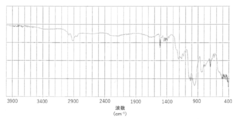
- the obtained resin fine particles (II) were measured by IR.
- the obtained IR spectrum is shown in FIG.
- the formation of vinyl phosphorus was confirmed by coordinating with Ni above. From these results, it can be said that a chemical bond of phosphorus was formed on the surface of the resin fine particles.
- Example 3 Under an argon gas atmosphere, 30 mL of THF and 5.0 g of methyldiphenylphosphine were added to the reaction vessel. Next, 4.8 g of a metallic sodium dispersion (sodium content of about 25% by mass, average particle diameter of metallic sodium fine particles: 10 ⁇ m, SD manufactured by Shinko Environmental Solution Co., Ltd.) was added, and then the mixture was reacted at 0 ° C. for 18 hours. Sodium methylphenylphosphide (MePhP-Na) was obtained. 31 When confirmed by P-NMR, the yield was 70.0%.
- a metallic sodium dispersion sodium content of about 25% by mass, average particle diameter of metallic sodium fine particles: 10 ⁇ m, SD manufactured by Shinko Environmental Solution Co., Ltd.
- the phosphorus content on the surface of the obtained resin fine particles (III) was measured in the same manner as in Example 1 and found to be 3.85 mmol / g. (In the above formula, the value of n is 100% and the value of m is 0% with respect to the total of 100% of the values of n and m.)
- the obtained resin fine particles (III) were measured by IR.
- the obtained IR spectrum is shown in FIG.
- the formation of vinyl phosphorus was confirmed by coordinating with Ni above. From these results, it can be said that a chemical bond of phosphorus was formed on the surface of the resin fine particles.
- Example 4 Under a nitrogen atmosphere, 20 g of Merifield resin (manufactured by Sigma-Aldrich Japan LLC, 5.5 mmol Cl / g, cross-linking agent: divinylbenzene 5 mol%, particle size 16-50 mesh) and triethyl phosphate ((EtO)) were placed in the reaction vessel. ) 3 P) 50 mL was added, and heating and stirring were performed at 130 ° C. for 20 hours. The precipitate was collected from the reaction solution allowed to cool to room temperature and washed 5 times with 20 mL of acetone, 3 times with 20 mL of water, and 3 times with 20 mL of acetone to obtain 25.08 g of pale yellow resin fine particles.
- Merifield resin manufactured by Sigma-Aldrich Japan LLC, 5.5 mmol Cl / g, cross-linking agent: divinylbenzene 5 mol%, particle size 16-50 mesh
- (EtO) triethyl phosphate
- Table 1 shows a list of the results of the above synthesis examples 1 to 6.
- Table 2 shows a list of the results of the above synthesis examples 7 to 10.
Landscapes
- Chemical & Material Sciences (AREA)
- Organic Chemistry (AREA)
- Inorganic Chemistry (AREA)
- Chemical Kinetics & Catalysis (AREA)
- Engineering & Computer Science (AREA)
- Materials Engineering (AREA)
- Health & Medical Sciences (AREA)
- Polymers & Plastics (AREA)
- Medicinal Chemistry (AREA)
- General Chemical & Material Sciences (AREA)
- Life Sciences & Earth Sciences (AREA)
- Biochemistry (AREA)
- General Health & Medical Sciences (AREA)
- Molecular Biology (AREA)
- Catalysts (AREA)
Abstract
Priority Applications (4)
| Application Number | Priority Date | Filing Date | Title |
|---|---|---|---|
| CN202080006756.0A CN113195597B (zh) | 2019-11-27 | 2020-11-26 | 配位化合物及其制造方法 |
| EP20894359.7A EP3971222A4 (fr) | 2019-11-27 | 2020-11-26 | Composé complexe et son procédé de production |
| JP2021518804A JP7677883B2 (ja) | 2019-11-27 | 2020-11-26 | 錯体化合物およびその製造方法 |
| US17/595,443 US12280364B2 (en) | 2019-11-27 | 2020-11-26 | Complex compound and method for manufacturing the same |
Applications Claiming Priority (2)
| Application Number | Priority Date | Filing Date | Title |
|---|---|---|---|
| JP2019214682 | 2019-11-27 | ||
| JP2019-214682 | 2019-11-27 |
Publications (1)
| Publication Number | Publication Date |
|---|---|
| WO2021106981A1 true WO2021106981A1 (fr) | 2021-06-03 |
Family
ID=76129406
Family Applications (1)
| Application Number | Title | Priority Date | Filing Date |
|---|---|---|---|
| PCT/JP2020/043947 Ceased WO2021106981A1 (fr) | 2019-11-27 | 2020-11-26 | Composé complexe et son procédé de production |
Country Status (5)
| Country | Link |
|---|---|
| US (1) | US12280364B2 (fr) |
| EP (1) | EP3971222A4 (fr) |
| JP (1) | JP7677883B2 (fr) |
| CN (1) | CN113195597B (fr) |
| WO (1) | WO2021106981A1 (fr) |
Cited By (1)
| Publication number | Priority date | Publication date | Assignee | Title |
|---|---|---|---|---|
| JP2021084875A (ja) * | 2019-11-27 | 2021-06-03 | 丸善石油化学株式会社 | アルケニルリン化合物の製造方法 |
Families Citing this family (2)
| Publication number | Priority date | Publication date | Assignee | Title |
|---|---|---|---|---|
| CN117504938B (zh) * | 2023-10-19 | 2025-10-10 | 中国石油化工股份有限公司 | 一种金属Rh基催化剂、其负载型催化剂及制备方法和应用 |
| CN117551225B (zh) * | 2024-01-11 | 2024-04-09 | 上海稀固科技有限公司 | 含磷树脂及其制备方法与应用 |
Citations (6)
| Publication number | Priority date | Publication date | Assignee | Title |
|---|---|---|---|---|
| JPS4621642B1 (fr) * | 1969-09-30 | 1971-06-19 | ||
| JPS4828273B1 (fr) * | 1969-10-20 | 1973-08-30 | ||
| US5369133A (en) * | 1992-09-26 | 1994-11-29 | Korea Advanced Institute Of Science And Technology | Method for preparing an improved porous polymer bead |
| JP2004026655A (ja) * | 2002-05-17 | 2004-01-29 | Japan Science & Technology Corp | アルケニルリン化合物の製造方法 |
| JP2007519628A (ja) * | 2003-12-23 | 2007-07-19 | サノフイ−アベンテイス | 1−ピペラジン−および1−ホモピペラジン−カルボキシレートの誘導体、その調製方法、およびfaah酵素の阻害剤としてのその使用 |
| JP2010524661A (ja) * | 2007-04-16 | 2010-07-22 | ユニヴェルシテ ドゥ オートゥ アルザス | 不均一系パラジウム触媒の合成方法、得られる触媒およびこの使用 |
Family Cites Families (13)
| Publication number | Priority date | Publication date | Assignee | Title |
|---|---|---|---|---|
| US3708462A (en) * | 1971-04-08 | 1973-01-02 | Dow Chemical Co | Cross-linked styrylphosphine resins |
| US5258454A (en) | 1988-09-01 | 1993-11-02 | Riso National Laboratory | Peptide synthesis method and solid support for use in the method |
| EP0433345B1 (fr) | 1988-09-01 | 1994-04-20 | Forskningscenter Riso | Procede de synthese de peptides et support solide de realisation dudit procede |
| DE10111140A1 (de) * | 2001-03-08 | 2002-09-19 | Merck Patent Gmbh | Katalytisch aktiver Träger |
| JP3836459B2 (ja) | 2003-09-03 | 2006-10-25 | 独立行政法人科学技術振興機構 | アルケニルホスホン酸エステルの製造方法 |
| DE10350676A1 (de) | 2003-10-30 | 2005-06-02 | Basf Ag | Verfahren zur Herstellung eines Alkenylphosphonsäure-Derivats |
| WO2005061555A1 (fr) | 2003-12-23 | 2005-07-07 | The University Of Leeds | Polymerisation effectuee a l'aide d'agents de transfert de chaine |
| JP4102879B2 (ja) | 2004-02-18 | 2008-06-18 | 独立行政法人産業技術総合研究所 | 有機リン化合物の製造方法 |
| EP2168680A4 (fr) * | 2007-07-11 | 2013-09-04 | Univ Kyoto | Composition catalytique et procédé pour produire un composé par couplage croisé utilisant celle-ci |
| JP2010126639A (ja) | 2008-11-27 | 2010-06-10 | Mitsubishi Rayon Co Ltd | 重合体担持粒状体とその製造方法、制御ラジカル重合用触媒及びそれを用いた制御ラジカル重合方法 |
| CN107949564B (zh) | 2015-09-11 | 2019-11-29 | 丸善石油化学株式会社 | 烯基磷化合物的制造方法 |
| CN108368142B (zh) | 2015-12-02 | 2021-02-19 | 住友化学株式会社 | 芳香族化合物的制造方法和钯配合物 |
| CN108305535A (zh) | 2018-01-15 | 2018-07-20 | 段皓然 | 一种适用于盲人的学习机方法及学习机 |
-
2020
- 2020-11-26 WO PCT/JP2020/043947 patent/WO2021106981A1/fr not_active Ceased
- 2020-11-26 CN CN202080006756.0A patent/CN113195597B/zh active Active
- 2020-11-26 EP EP20894359.7A patent/EP3971222A4/fr active Pending
- 2020-11-26 US US17/595,443 patent/US12280364B2/en active Active
- 2020-11-26 JP JP2021518804A patent/JP7677883B2/ja active Active
Patent Citations (6)
| Publication number | Priority date | Publication date | Assignee | Title |
|---|---|---|---|---|
| JPS4621642B1 (fr) * | 1969-09-30 | 1971-06-19 | ||
| JPS4828273B1 (fr) * | 1969-10-20 | 1973-08-30 | ||
| US5369133A (en) * | 1992-09-26 | 1994-11-29 | Korea Advanced Institute Of Science And Technology | Method for preparing an improved porous polymer bead |
| JP2004026655A (ja) * | 2002-05-17 | 2004-01-29 | Japan Science & Technology Corp | アルケニルリン化合物の製造方法 |
| JP2007519628A (ja) * | 2003-12-23 | 2007-07-19 | サノフイ−アベンテイス | 1−ピペラジン−および1−ホモピペラジン−カルボキシレートの誘導体、その調製方法、およびfaah酵素の阻害剤としてのその使用 |
| JP2010524661A (ja) * | 2007-04-16 | 2010-07-22 | ユニヴェルシテ ドゥ オートゥ アルザス | 不均一系パラジウム触媒の合成方法、得られる触媒およびこの使用 |
Non-Patent Citations (3)
| Title |
|---|
| CHEM. LETT., vol. 42, 2013, pages 1065 - 1067 |
| CHEN TIEQIAO, ZHOU YONGBO, GUO CANCHENG, HAN LI-BIAO: "Selective Addition of P(O)–H Bonds to Alkynes Catalyzed by Transition Metals Immobilized on Polystyrene-bound Triphenylphosphine", CHEMISTRY LETTERS, vol. 42, no. 9, 30 November 2012 (2012-11-30), JP , pages 1065 - 1067, XP009532355, ISSN: 0366-7022, DOI: 10.1246/cl.130374 * |
| See also references of EP3971222A4 |
Cited By (2)
| Publication number | Priority date | Publication date | Assignee | Title |
|---|---|---|---|---|
| JP2021084875A (ja) * | 2019-11-27 | 2021-06-03 | 丸善石油化学株式会社 | アルケニルリン化合物の製造方法 |
| JP7282017B2 (ja) | 2019-11-27 | 2023-05-26 | 丸善石油化学株式会社 | アルケニルリン化合物の製造方法 |
Also Published As
| Publication number | Publication date |
|---|---|
| EP3971222A4 (fr) | 2024-02-21 |
| US20220212177A1 (en) | 2022-07-07 |
| CN113195597A (zh) | 2021-07-30 |
| JPWO2021106981A1 (fr) | 2021-06-03 |
| JP7677883B2 (ja) | 2025-05-15 |
| US12280364B2 (en) | 2025-04-22 |
| EP3971222A1 (fr) | 2022-03-23 |
| CN113195597B (zh) | 2023-01-03 |
Similar Documents
| Publication | Publication Date | Title |
|---|---|---|
| WO2021106981A1 (fr) | Composé complexe et son procédé de production | |
| Khristolyubov et al. | Ln (II) and Ca (II) NC sp3 N pincer type diarylmethanido complexes–promising catalysts for C–C and C–E (E= Si, P, N, S) bond formation | |
| Baishya et al. | N-Heterocyclic Carbene–Carbodiimide (“NHC–CDI”) Adduct or Zwitterionic-Type Neutral Amidinate-Supported Magnesium (II) and Zinc (II) Complexes | |
| Kalden et al. | Surprisingly Different Reaction Behavior of Alkali and Alkaline Earth Metal Bis (trimethylsilyl) amides toward Bulky N‐(2‐Pyridylethyl)‐N′‐(2, 6‐diisopropylphenyl) pivalamidine | |
| Jia et al. | Scandium and gadolinium complexes with aryldiimine NCN pincer ligands: Synthesis, characterization, and catalysis on isoprene and 1, 5-hexadiene polymerization | |
| Wu et al. | Reactivity of germylene toward phosphorus-containing compounds: Nucleophilic addition and tautomerism | |
| JP7349335B2 (ja) | 錯体化合物の製造方法 | |
| CN113179642B (zh) | 烯基磷化合物的制造方法 | |
| Knapp et al. | Platinum phosphinito catalysts for nitrile hydration | |
| JP7282017B2 (ja) | アルケニルリン化合物の製造方法 | |
| CN116113613B (zh) | 烯基磷化合物的制造方法 | |
| WO2003066643A1 (fr) | Procede de production de phosphine tertiaire a groupe hydrocarbone volumineux lie | |
| JP2004043492A (ja) | アルケニルリン化合物を製造する方法 | |
| JP2794089B2 (ja) | アルケニルホスフィンオキシド化合物の製造法 | |
| EP0794190B1 (fr) | Procédé de préparation d'oxydes d'alcénylphosphines ou d'oxydes de bis(alcénylphosphines) | |
| CN103467524B (zh) | 一种双亚磷酸三(3,3’,5,5’-四叔丁基-2,2’-联苯酚)酯的微波合成方法 | |
| JP4863258B2 (ja) | リン化合物およびその製造方法 | |
| i Zubiri et al. | The preparation and coordination of 1, 3-C6H4-{C (O) N (PPh2) CH2Ph} 2–a new multidentate ligand | |
| JP2849712B2 (ja) | アルケニルホスフィンオキシド化合物の製造方法 | |
| JP3987937B2 (ja) | 含リン有機ポリマーとその製造法 | |
| JP4572390B2 (ja) | リン化合物およびその製造方法 | |
| JP3041396B1 (ja) | 不飽和ホスホン酸エステルを製造する方法 | |
| Rieb et al. | Rare Earth Metal Complexes with N-Heterocyclic Carbenes | |
| Bhowmick | Synthesis and characterization of transition metal cluster containing diphosphine ligands | |
| JP2005232065A (ja) | 含リンブタジエン化合物の製造方法 |
Legal Events
| Date | Code | Title | Description |
|---|---|---|---|
| ENP | Entry into the national phase |
Ref document number: 2021518804 Country of ref document: JP Kind code of ref document: A |
|
| 121 | Ep: the epo has been informed by wipo that ep was designated in this application |
Ref document number: 20894359 Country of ref document: EP Kind code of ref document: A1 |
|
| ENP | Entry into the national phase |
Ref document number: 2020894359 Country of ref document: EP Effective date: 20211214 |
|
| NENP | Non-entry into the national phase |
Ref country code: DE |
|
| WWG | Wipo information: grant in national office |
Ref document number: 17595443 Country of ref document: US |