WO2021117465A1 - プリプレグ、積層体および一体化成形品 - Google Patents
プリプレグ、積層体および一体化成形品 Download PDFInfo
- Publication number
- WO2021117465A1 WO2021117465A1 PCT/JP2020/043339 JP2020043339W WO2021117465A1 WO 2021117465 A1 WO2021117465 A1 WO 2021117465A1 JP 2020043339 W JP2020043339 W JP 2020043339W WO 2021117465 A1 WO2021117465 A1 WO 2021117465A1
- Authority
- WO
- WIPO (PCT)
- Prior art keywords
- resin
- prepreg
- laminate
- component
- curing agent
- Prior art date
- Legal status (The legal status is an assumption and is not a legal conclusion. Google has not performed a legal analysis and makes no representation as to the accuracy of the status listed.)
- Ceased
Links
Images
Classifications
-
- C—CHEMISTRY; METALLURGY
- C08—ORGANIC MACROMOLECULAR COMPOUNDS; THEIR PREPARATION OR CHEMICAL WORKING-UP; COMPOSITIONS BASED THEREON
- C08J—WORKING-UP; GENERAL PROCESSES OF COMPOUNDING; AFTER-TREATMENT NOT COVERED BY SUBCLASSES C08B, C08C, C08F, C08G or C08H
- C08J5/00—Manufacture of articles or shaped materials containing macromolecular substances
- C08J5/24—Impregnating materials with prepolymers which can be polymerised in situ, e.g. manufacture of prepregs
- C08J5/241—Impregnating materials with prepolymers which can be polymerised in situ, e.g. manufacture of prepregs using inorganic fibres
- C08J5/243—Impregnating materials with prepolymers which can be polymerised in situ, e.g. manufacture of prepregs using inorganic fibres using carbon fibres
-
- B—PERFORMING OPERATIONS; TRANSPORTING
- B32—LAYERED PRODUCTS
- B32B—LAYERED PRODUCTS, i.e. PRODUCTS BUILT-UP OF STRATA OF FLAT OR NON-FLAT, e.g. CELLULAR OR HONEYCOMB, FORM
- B32B27/00—Layered products comprising a layer of synthetic resin
- B32B27/28—Layered products comprising a layer of synthetic resin comprising synthetic resins not wholly covered by any one of the sub-groups B32B27/30 - B32B27/42
- B32B27/281—Layered products comprising a layer of synthetic resin comprising synthetic resins not wholly covered by any one of the sub-groups B32B27/30 - B32B27/42 comprising polyimides
-
- B—PERFORMING OPERATIONS; TRANSPORTING
- B29—WORKING OF PLASTICS; WORKING OF SUBSTANCES IN A PLASTIC STATE IN GENERAL
- B29C—SHAPING OR JOINING OF PLASTICS; SHAPING OF MATERIAL IN A PLASTIC STATE, NOT OTHERWISE PROVIDED FOR; AFTER-TREATMENT OF THE SHAPED PRODUCTS, e.g. REPAIRING
- B29C70/00—Shaping composites, i.e. plastics material comprising reinforcements, fillers or preformed parts, e.g. inserts
- B29C70/003—Shaping composites, i.e. plastics material comprising reinforcements, fillers or preformed parts, e.g. inserts characterised by the matrix material, e.g. material composition or physical properties
- B29C70/0035—Shaping composites, i.e. plastics material comprising reinforcements, fillers or preformed parts, e.g. inserts characterised by the matrix material, e.g. material composition or physical properties comprising two or more matrix materials
-
- B—PERFORMING OPERATIONS; TRANSPORTING
- B32—LAYERED PRODUCTS
- B32B—LAYERED PRODUCTS, i.e. PRODUCTS BUILT-UP OF STRATA OF FLAT OR NON-FLAT, e.g. CELLULAR OR HONEYCOMB, FORM
- B32B27/00—Layered products comprising a layer of synthetic resin
- B32B27/12—Layered products comprising a layer of synthetic resin next to a fibrous or filamentary layer
-
- B—PERFORMING OPERATIONS; TRANSPORTING
- B32—LAYERED PRODUCTS
- B32B—LAYERED PRODUCTS, i.e. PRODUCTS BUILT-UP OF STRATA OF FLAT OR NON-FLAT, e.g. CELLULAR OR HONEYCOMB, FORM
- B32B27/00—Layered products comprising a layer of synthetic resin
- B32B27/16—Layered products comprising a layer of synthetic resin specially treated, e.g. irradiated
-
- B—PERFORMING OPERATIONS; TRANSPORTING
- B32—LAYERED PRODUCTS
- B32B—LAYERED PRODUCTS, i.e. PRODUCTS BUILT-UP OF STRATA OF FLAT OR NON-FLAT, e.g. CELLULAR OR HONEYCOMB, FORM
- B32B27/00—Layered products comprising a layer of synthetic resin
- B32B27/28—Layered products comprising a layer of synthetic resin comprising synthetic resins not wholly covered by any one of the sub-groups B32B27/30 - B32B27/42
- B32B27/285—Layered products comprising a layer of synthetic resin comprising synthetic resins not wholly covered by any one of the sub-groups B32B27/30 - B32B27/42 comprising polyethers
-
- B—PERFORMING OPERATIONS; TRANSPORTING
- B32—LAYERED PRODUCTS
- B32B—LAYERED PRODUCTS, i.e. PRODUCTS BUILT-UP OF STRATA OF FLAT OR NON-FLAT, e.g. CELLULAR OR HONEYCOMB, FORM
- B32B27/00—Layered products comprising a layer of synthetic resin
- B32B27/28—Layered products comprising a layer of synthetic resin comprising synthetic resins not wholly covered by any one of the sub-groups B32B27/30 - B32B27/42
- B32B27/286—Layered products comprising a layer of synthetic resin comprising synthetic resins not wholly covered by any one of the sub-groups B32B27/30 - B32B27/42 comprising polysulphones; polysulfides
-
- B—PERFORMING OPERATIONS; TRANSPORTING
- B32—LAYERED PRODUCTS
- B32B—LAYERED PRODUCTS, i.e. PRODUCTS BUILT-UP OF STRATA OF FLAT OR NON-FLAT, e.g. CELLULAR OR HONEYCOMB, FORM
- B32B27/00—Layered products comprising a layer of synthetic resin
- B32B27/34—Layered products comprising a layer of synthetic resin comprising polyamides
-
- B—PERFORMING OPERATIONS; TRANSPORTING
- B32—LAYERED PRODUCTS
- B32B—LAYERED PRODUCTS, i.e. PRODUCTS BUILT-UP OF STRATA OF FLAT OR NON-FLAT, e.g. CELLULAR OR HONEYCOMB, FORM
- B32B27/00—Layered products comprising a layer of synthetic resin
- B32B27/36—Layered products comprising a layer of synthetic resin comprising polyesters
-
- B—PERFORMING OPERATIONS; TRANSPORTING
- B32—LAYERED PRODUCTS
- B32B—LAYERED PRODUCTS, i.e. PRODUCTS BUILT-UP OF STRATA OF FLAT OR NON-FLAT, e.g. CELLULAR OR HONEYCOMB, FORM
- B32B27/00—Layered products comprising a layer of synthetic resin
- B32B27/38—Layered products comprising a layer of synthetic resin comprising epoxy resins
-
- B—PERFORMING OPERATIONS; TRANSPORTING
- B32—LAYERED PRODUCTS
- B32B—LAYERED PRODUCTS, i.e. PRODUCTS BUILT-UP OF STRATA OF FLAT OR NON-FLAT, e.g. CELLULAR OR HONEYCOMB, FORM
- B32B3/00—Layered products comprising a layer with external or internal discontinuities or unevennesses, or a layer of non-planar shape; Layered products comprising a layer having particular features of form
- B32B3/02—Layered products comprising a layer with external or internal discontinuities or unevennesses, or a layer of non-planar shape; Layered products comprising a layer having particular features of form characterised by features of form at particular places, e.g. in edge regions
- B32B3/08—Layered products comprising a layer with external or internal discontinuities or unevennesses, or a layer of non-planar shape; Layered products comprising a layer having particular features of form characterised by features of form at particular places, e.g. in edge regions characterised by added members at particular parts
- B32B3/085—Layered products comprising a layer with external or internal discontinuities or unevennesses, or a layer of non-planar shape; Layered products comprising a layer having particular features of form characterised by features of form at particular places, e.g. in edge regions characterised by added members at particular parts spaced apart pieces on the surface of a layer
-
- B—PERFORMING OPERATIONS; TRANSPORTING
- B32—LAYERED PRODUCTS
- B32B—LAYERED PRODUCTS, i.e. PRODUCTS BUILT-UP OF STRATA OF FLAT OR NON-FLAT, e.g. CELLULAR OR HONEYCOMB, FORM
- B32B5/00—Layered products characterised by the non- homogeneity or physical structure, i.e. comprising a fibrous, filamentary, particulate or foam layer; Layered products characterised by having a layer differing constitutionally or physically in different parts
- B32B5/02—Layered products characterised by the non- homogeneity or physical structure, i.e. comprising a fibrous, filamentary, particulate or foam layer; Layered products characterised by having a layer differing constitutionally or physically in different parts characterised by structural features of a fibrous or filamentary layer
- B32B5/12—Layered products characterised by the non- homogeneity or physical structure, i.e. comprising a fibrous, filamentary, particulate or foam layer; Layered products characterised by having a layer differing constitutionally or physically in different parts characterised by structural features of a fibrous or filamentary layer characterised by the relative arrangement of fibres or filaments of different layers, e.g. the fibres or filaments being parallel or perpendicular to each other
-
- B—PERFORMING OPERATIONS; TRANSPORTING
- B32—LAYERED PRODUCTS
- B32B—LAYERED PRODUCTS, i.e. PRODUCTS BUILT-UP OF STRATA OF FLAT OR NON-FLAT, e.g. CELLULAR OR HONEYCOMB, FORM
- B32B5/00—Layered products characterised by the non- homogeneity or physical structure, i.e. comprising a fibrous, filamentary, particulate or foam layer; Layered products characterised by having a layer differing constitutionally or physically in different parts
- B32B5/22—Layered products characterised by the non- homogeneity or physical structure, i.e. comprising a fibrous, filamentary, particulate or foam layer; Layered products characterised by having a layer differing constitutionally or physically in different parts characterised by the presence of two or more layers which are next to each other and are fibrous, filamentary, formed of particles or foamed
- B32B5/24—Layered products characterised by the non- homogeneity or physical structure, i.e. comprising a fibrous, filamentary, particulate or foam layer; Layered products characterised by having a layer differing constitutionally or physically in different parts characterised by the presence of two or more layers which are next to each other and are fibrous, filamentary, formed of particles or foamed one layer being a fibrous or filamentary layer
- B32B5/26—Layered products characterised by the non- homogeneity or physical structure, i.e. comprising a fibrous, filamentary, particulate or foam layer; Layered products characterised by having a layer differing constitutionally or physically in different parts characterised by the presence of two or more layers which are next to each other and are fibrous, filamentary, formed of particles or foamed one layer being a fibrous or filamentary layer another layer next to it also being fibrous or filamentary
-
- C—CHEMISTRY; METALLURGY
- C08—ORGANIC MACROMOLECULAR COMPOUNDS; THEIR PREPARATION OR CHEMICAL WORKING-UP; COMPOSITIONS BASED THEREON
- C08J—WORKING-UP; GENERAL PROCESSES OF COMPOUNDING; AFTER-TREATMENT NOT COVERED BY SUBCLASSES C08B, C08C, C08F, C08G or C08H
- C08J5/00—Manufacture of articles or shaped materials containing macromolecular substances
- C08J5/24—Impregnating materials with prepolymers which can be polymerised in situ, e.g. manufacture of prepregs
- C08J5/248—Impregnating materials with prepolymers which can be polymerised in situ, e.g. manufacture of prepregs using pre-treated fibres
-
- C—CHEMISTRY; METALLURGY
- C08—ORGANIC MACROMOLECULAR COMPOUNDS; THEIR PREPARATION OR CHEMICAL WORKING-UP; COMPOSITIONS BASED THEREON
- C08J—WORKING-UP; GENERAL PROCESSES OF COMPOUNDING; AFTER-TREATMENT NOT COVERED BY SUBCLASSES C08B, C08C, C08F, C08G or C08H
- C08J5/00—Manufacture of articles or shaped materials containing macromolecular substances
- C08J5/24—Impregnating materials with prepolymers which can be polymerised in situ, e.g. manufacture of prepregs
- C08J5/249—Impregnating materials with prepolymers which can be polymerised in situ, e.g. manufacture of prepregs characterised by the additives used in the prepolymer mixture
-
- B—PERFORMING OPERATIONS; TRANSPORTING
- B32—LAYERED PRODUCTS
- B32B—LAYERED PRODUCTS, i.e. PRODUCTS BUILT-UP OF STRATA OF FLAT OR NON-FLAT, e.g. CELLULAR OR HONEYCOMB, FORM
- B32B2255/00—Coating on the layer surface
- B32B2255/10—Coating on the layer surface on synthetic resin layer or on natural or synthetic rubber layer
-
- B—PERFORMING OPERATIONS; TRANSPORTING
- B32—LAYERED PRODUCTS
- B32B—LAYERED PRODUCTS, i.e. PRODUCTS BUILT-UP OF STRATA OF FLAT OR NON-FLAT, e.g. CELLULAR OR HONEYCOMB, FORM
- B32B2255/00—Coating on the layer surface
- B32B2255/26—Polymeric coating
-
- B—PERFORMING OPERATIONS; TRANSPORTING
- B32—LAYERED PRODUCTS
- B32B—LAYERED PRODUCTS, i.e. PRODUCTS BUILT-UP OF STRATA OF FLAT OR NON-FLAT, e.g. CELLULAR OR HONEYCOMB, FORM
- B32B2260/00—Layered product comprising an impregnated, embedded, or bonded layer wherein the layer comprises an impregnation, embedding, or binder material
- B32B2260/02—Composition of the impregnated, bonded or embedded layer
- B32B2260/021—Fibrous or filamentary layer
- B32B2260/023—Two or more layers
-
- B—PERFORMING OPERATIONS; TRANSPORTING
- B32—LAYERED PRODUCTS
- B32B—LAYERED PRODUCTS, i.e. PRODUCTS BUILT-UP OF STRATA OF FLAT OR NON-FLAT, e.g. CELLULAR OR HONEYCOMB, FORM
- B32B2260/00—Layered product comprising an impregnated, embedded, or bonded layer wherein the layer comprises an impregnation, embedding, or binder material
- B32B2260/04—Impregnation, embedding, or binder material
- B32B2260/046—Synthetic resin
-
- B—PERFORMING OPERATIONS; TRANSPORTING
- B32—LAYERED PRODUCTS
- B32B—LAYERED PRODUCTS, i.e. PRODUCTS BUILT-UP OF STRATA OF FLAT OR NON-FLAT, e.g. CELLULAR OR HONEYCOMB, FORM
- B32B2262/00—Composition or structural features of fibres which form a fibrous or filamentary layer or are present as additives
- B32B2262/10—Inorganic fibres
- B32B2262/106—Carbon fibres, e.g. graphite fibres
-
- B—PERFORMING OPERATIONS; TRANSPORTING
- B32—LAYERED PRODUCTS
- B32B—LAYERED PRODUCTS, i.e. PRODUCTS BUILT-UP OF STRATA OF FLAT OR NON-FLAT, e.g. CELLULAR OR HONEYCOMB, FORM
- B32B2305/00—Condition, form or state of the layers or laminate
- B32B2305/72—Cured, e.g. vulcanised, cross-linked
-
- B—PERFORMING OPERATIONS; TRANSPORTING
- B32—LAYERED PRODUCTS
- B32B—LAYERED PRODUCTS, i.e. PRODUCTS BUILT-UP OF STRATA OF FLAT OR NON-FLAT, e.g. CELLULAR OR HONEYCOMB, FORM
- B32B2307/00—Properties of the layers or laminate
- B32B2307/30—Properties of the layers or laminate having particular thermal properties
- B32B2307/308—Heat stability
-
- B—PERFORMING OPERATIONS; TRANSPORTING
- B32—LAYERED PRODUCTS
- B32B—LAYERED PRODUCTS, i.e. PRODUCTS BUILT-UP OF STRATA OF FLAT OR NON-FLAT, e.g. CELLULAR OR HONEYCOMB, FORM
- B32B2307/00—Properties of the layers or laminate
- B32B2307/50—Properties of the layers or laminate having particular mechanical properties
- B32B2307/538—Roughness
-
- B—PERFORMING OPERATIONS; TRANSPORTING
- B32—LAYERED PRODUCTS
- B32B—LAYERED PRODUCTS, i.e. PRODUCTS BUILT-UP OF STRATA OF FLAT OR NON-FLAT, e.g. CELLULAR OR HONEYCOMB, FORM
- B32B2307/00—Properties of the layers or laminate
- B32B2307/50—Properties of the layers or laminate having particular mechanical properties
- B32B2307/54—Yield strength; Tensile strength
-
- B—PERFORMING OPERATIONS; TRANSPORTING
- B32—LAYERED PRODUCTS
- B32B—LAYERED PRODUCTS, i.e. PRODUCTS BUILT-UP OF STRATA OF FLAT OR NON-FLAT, e.g. CELLULAR OR HONEYCOMB, FORM
- B32B2307/00—Properties of the layers or laminate
- B32B2307/50—Properties of the layers or laminate having particular mechanical properties
- B32B2307/542—Shear strength
-
- B—PERFORMING OPERATIONS; TRANSPORTING
- B32—LAYERED PRODUCTS
- B32B—LAYERED PRODUCTS, i.e. PRODUCTS BUILT-UP OF STRATA OF FLAT OR NON-FLAT, e.g. CELLULAR OR HONEYCOMB, FORM
- B32B2307/00—Properties of the layers or laminate
- B32B2307/50—Properties of the layers or laminate having particular mechanical properties
- B32B2307/558—Impact strength, toughness
-
- B—PERFORMING OPERATIONS; TRANSPORTING
- B32—LAYERED PRODUCTS
- B32B—LAYERED PRODUCTS, i.e. PRODUCTS BUILT-UP OF STRATA OF FLAT OR NON-FLAT, e.g. CELLULAR OR HONEYCOMB, FORM
- B32B2307/00—Properties of the layers or laminate
- B32B2307/70—Other properties
- B32B2307/738—Thermoformability
-
- C—CHEMISTRY; METALLURGY
- C08—ORGANIC MACROMOLECULAR COMPOUNDS; THEIR PREPARATION OR CHEMICAL WORKING-UP; COMPOSITIONS BASED THEREON
- C08J—WORKING-UP; GENERAL PROCESSES OF COMPOUNDING; AFTER-TREATMENT NOT COVERED BY SUBCLASSES C08B, C08C, C08F, C08G or C08H
- C08J2363/00—Characterised by the use of epoxy resins; Derivatives of epoxy resins
-
- C—CHEMISTRY; METALLURGY
- C08—ORGANIC MACROMOLECULAR COMPOUNDS; THEIR PREPARATION OR CHEMICAL WORKING-UP; COMPOSITIONS BASED THEREON
- C08J—WORKING-UP; GENERAL PROCESSES OF COMPOUNDING; AFTER-TREATMENT NOT COVERED BY SUBCLASSES C08B, C08C, C08F, C08G or C08H
- C08J2365/00—Characterised by the use of macromolecular compounds obtained by reactions forming a carbon-to-carbon link in the main chain; Derivatives of such polymers
-
- C—CHEMISTRY; METALLURGY
- C08—ORGANIC MACROMOLECULAR COMPOUNDS; THEIR PREPARATION OR CHEMICAL WORKING-UP; COMPOSITIONS BASED THEREON
- C08J—WORKING-UP; GENERAL PROCESSES OF COMPOUNDING; AFTER-TREATMENT NOT COVERED BY SUBCLASSES C08B, C08C, C08F, C08G or C08H
- C08J2367/00—Characterised by the use of polyesters obtained by reactions forming a carboxylic ester link in the main chain; Derivatives of such polymers
- C08J2367/02—Polyesters derived from dicarboxylic acids and dihydroxy compounds
-
- C—CHEMISTRY; METALLURGY
- C08—ORGANIC MACROMOLECULAR COMPOUNDS; THEIR PREPARATION OR CHEMICAL WORKING-UP; COMPOSITIONS BASED THEREON
- C08J—WORKING-UP; GENERAL PROCESSES OF COMPOUNDING; AFTER-TREATMENT NOT COVERED BY SUBCLASSES C08B, C08C, C08F, C08G or C08H
- C08J2371/00—Characterised by the use of polyethers obtained by reactions forming an ether link in the main chain; Derivatives of such polymers
-
- C—CHEMISTRY; METALLURGY
- C08—ORGANIC MACROMOLECULAR COMPOUNDS; THEIR PREPARATION OR CHEMICAL WORKING-UP; COMPOSITIONS BASED THEREON
- C08J—WORKING-UP; GENERAL PROCESSES OF COMPOUNDING; AFTER-TREATMENT NOT COVERED BY SUBCLASSES C08B, C08C, C08F, C08G or C08H
- C08J2377/00—Characterised by the use of polyamides obtained by reactions forming a carboxylic amide link in the main chain; Derivatives of such polymers
- C08J2377/02—Polyamides derived from omega-amino carboxylic acids or from lactams thereof
-
- C—CHEMISTRY; METALLURGY
- C08—ORGANIC MACROMOLECULAR COMPOUNDS; THEIR PREPARATION OR CHEMICAL WORKING-UP; COMPOSITIONS BASED THEREON
- C08J—WORKING-UP; GENERAL PROCESSES OF COMPOUNDING; AFTER-TREATMENT NOT COVERED BY SUBCLASSES C08B, C08C, C08F, C08G or C08H
- C08J2377/00—Characterised by the use of polyamides obtained by reactions forming a carboxylic amide link in the main chain; Derivatives of such polymers
- C08J2377/06—Polyamides derived from polyamines and polycarboxylic acids
-
- C—CHEMISTRY; METALLURGY
- C08—ORGANIC MACROMOLECULAR COMPOUNDS; THEIR PREPARATION OR CHEMICAL WORKING-UP; COMPOSITIONS BASED THEREON
- C08J—WORKING-UP; GENERAL PROCESSES OF COMPOUNDING; AFTER-TREATMENT NOT COVERED BY SUBCLASSES C08B, C08C, C08F, C08G or C08H
- C08J2379/00—Characterised by the use of macromolecular compounds obtained by reactions forming in the main chain of the macromolecule a linkage containing nitrogen with or without oxygen, or carbon only, not provided for in groups C08J2361/00 - C08J2377/00
- C08J2379/04—Polycondensates having nitrogen-containing heterocyclic rings in the main chain; Polyhydrazides; Polyamide acids or similar polyimide precursors
- C08J2379/08—Polyimides; Polyester-imides; Polyamide-imides; Polyamide acids or similar polyimide precursors
-
- C—CHEMISTRY; METALLURGY
- C08—ORGANIC MACROMOLECULAR COMPOUNDS; THEIR PREPARATION OR CHEMICAL WORKING-UP; COMPOSITIONS BASED THEREON
- C08J—WORKING-UP; GENERAL PROCESSES OF COMPOUNDING; AFTER-TREATMENT NOT COVERED BY SUBCLASSES C08B, C08C, C08F, C08G or C08H
- C08J2381/00—Characterised by the use of macromolecular compounds obtained by reactions forming in the main chain of the macromolecule a linkage containing sulfur with or without nitrogen, oxygen, or carbon only; Polysulfones; Derivatives of such polymers
- C08J2381/04—Polysulfides
Definitions
- the present invention relates to a prepreg obtained by impregnating a reinforcing fiber with a thermosetting resin and a thermoplastic resin, and a laminate or an integrally molded product containing the thermosetting resin, the thermoplastic resin and the reinforcing fiber.
- a fiber-reinforced composite material that uses a thermosetting resin or a thermoplastic resin as a matrix and is combined with reinforcing fibers such as carbon fiber and glass fiber is lightweight, yet has mechanical properties such as strength and rigidity, heat resistance, and corrosion resistance. Due to its superiority, it has been applied in many fields such as aerospace, automobiles, railroad vehicles, ships, civil engineering and construction and sporting goods. However, these fiber-reinforced composite materials are not suitable for manufacturing parts and structures having complicated shapes in a single molding process, and in the above-mentioned applications, a member made of the fiber-reinforced composite material is produced. Then it is necessary to integrate with the same or different members.
- a mechanical joining method such as bolts, rivets, and screws, or a joining method using an adhesive is used.
- the mechanical joining method requires a process of pre-processing the joint part such as drilling, it leads to a long manufacturing process and an increase in manufacturing cost, and there is a problem that the material strength is lowered due to drilling. there were.
- the joining method using an adhesive requires a bonding step and a curing step including preparation of the adhesive and application of the adhesive, which leads to a long manufacturing process and sufficient reliability in terms of adhesive strength. There was a problem that I could't get enough satisfaction.
- thermoplastic resin for the fiber-reinforced composite material using a thermoplastic resin as a matrix
- a method of joining members by welding can be applied, so that joining between members can be applied. It may be possible to reduce the time required for.
- heat resistance and resistance are higher than those of fiber-reinforced composite materials composed of thermosetting resins and reinforcing fibers. There was a problem that the chemical properties were not sufficient.
- Patent Document 1 discloses a method of joining a fiber-reinforced composite material composed of a thermosetting resin and reinforcing fibers via an adhesive.
- Patent Document 2 discloses a method of integrating a member formed of a thermoplastic resin and a member formed of a fiber-reinforced composite material made of a thermosetting resin. That is, a thermoplastic resin film is laminated on the surface of a prepreg sheet made of a reinforcing fiber and a thermosetting resin, and a fiber-reinforced composite material is obtained by heating and pressurizing.
- Patent Document 3 discloses a method for producing a laminate in which a thermoplastic resin adhesive layer is formed on the surface of a composite material composed of a thermosetting resin and a reinforcing fiber, and another method is described via the thermoplastic resin. It is stated that it exhibits an adhesive effect with the member.
- Patent Document 4 discloses a prepreg and a fiber-reinforced composite material thereof in which particles, fibers, or films made of a thermoplastic resin are arranged on the surface layer of a prepreg made of a reinforcing fiber and a thermosetting resin.
- Japanese Unexamined Patent Publication No. 2018-161801 Japanese Unexamined Patent Publication No. 10-138354 Japanese Patent No. 3906319 Japanese Unexamined Patent Publication No. 8-259713
- Patent Document 1 is a method of joining a fiber-reinforced composite material made of a reinforcing fiber and a thermosetting resin to each other with an adhesive, and since the thermosetting resin is a matrix resin, the fiber is reinforced as it is. Welding cannot be applied as a method of joining composite materials. Since it takes time to cure the adhesive, there is a problem that the joining process takes time, and further, the developed bonding strength is not sufficient. In the method described in Patent Document 2, the bonding strength at the bonding portion between the thermosetting resin and the thermoplastic resin film in the fiber-reinforced composite material was not sufficient.
- Patent Document 3 The fiber-reinforced composite material according to Patent Document 3 can be integrated by welding via a thermoplastic resin and exhibits excellent bonding strength at room temperature, but the bonding strength at high temperature is not sufficient.
- Patent Document 4 shows that particles, fibers or films made of a thermoplastic resin improve the interlaminar fracture toughness value. However, in this method, the thermosetting resin and the thermoplastic resin in the fiber-reinforced composite material are used. The joint strength at the boundary with and was not sufficient.
- the prepreg of the present invention has the following configuration. That is, it is a prepreg containing the following components [A], [B], and [C], [C] is present on the surface of the prepreg, and [B] is the first curing agent [b1].
- the laminate which is another aspect of the present invention, has any of the following configurations. That is, a laminated body in which the cured product of the above prepreg constitutes at least a part of the layers, or a laminated body having the following structure. That is, a layer containing the following components [A], [C] and [D] is included, and both resin regions straddle the boundary surface between the resin region containing [C] and the resin region containing [D]. A laminate in which the reinforcing fibers of [A] in contact are present. [A] Reinforcing fiber [C] Thermoplastic resin [D] A thermosetting resin cured product obtained by curing a thermosetting resin containing a first curing agent [b1] and a second curing agent [b2].
- laminate refers to any of these laminates depending on the context.
- the laminate of the present invention can be typically produced by using a preform containing the prepreg of the present invention. It is a resin.
- the prepreg and the laminate of the present invention use a thermosetting resin and a thermoplastic resin, and both are firmly bonded to each other and can be well welded to members of the same type or different types.
- a thermosetting resin and a thermoplastic resin For a fiber-reinforced composite material composed of a thermosetting resin and reinforcing fibers, the time required for the joining process can be shortened, and the molding of structural members can be speeded up. Further, by controlling the reactivity of the prepreg, it is possible to start the reaction from a low temperature while suppressing sudden heat generation, and it is possible to shorten the molding time of the structural member and improve the dimensional accuracy of the obtained member.
- the form and arrangement of the reinforcing fibers can be appropriately selected from the unidirectional arrangement of the reinforcing fibers, the laminate of the unidirectionally arranged fibers, the form of the woven fabric, etc., but the weight and durability are higher.
- the reinforcing fibers are arranged in one direction in the form of long fibers (fiber bundles) or continuous fibers such as woven fabrics in each prepreg.
- the reinforcing fiber bundle may be composed of a plurality of fibers having the same form, or may be composed of a plurality of fibers having different forms.
- the number of reinforcing fibers constituting one reinforcing fiber bundle is usually 300 to 60,000, but considering the production of the base material, it is preferably 300 to 48,000, and more preferably 1,000. ⁇ 24,000.
- the range may be a combination of any of the above upper limits and any of the lower limits.
- the strand tensile strength of the reinforcing fiber of the component [A] measured according to the resin impregnated strand test method of JIS R7608 (2007) is 5.5 GPa or more, it has excellent bonding strength in addition to the tensile strength. It is preferable because a laminated body can be obtained. It is more preferable that the strand tensile strength is 5.8 GPa.
- the joint strength referred to here refers to a tensile shear joint strength obtained in accordance with ISO4587: 1995 (JIS K6850 (1994)).
- the reinforcing fiber of the component [A] it is preferable to use a fiber having a surface free energy of 10 to 50 mJ / m 2 measured by the Wilhelmy method.
- a method of controlling the surface free energy of the reinforcing fiber a method of oxidizing the surface and adjusting the amount of oxygen-containing functional groups such as a carboxyl group and a hydroxyl group, or a method of adhering a simple substance or a plurality of compounds to the surface. There is a way to control it.
- a plurality of compounds are attached to the surface, those having high surface free energy and those having low surface free energy may be mixed and attached.
- a method for calculating the surface free energy of the reinforcing fiber will be described.
- the surface free energy is calculated by measuring the contact angles of the reinforcing fibers and three types of solvents (purified water, ethylene glycol, and tricresyl phosphate), and then calculating the surface free energy using the Owens approximation formula. it can.
- the procedure is shown below, but the measuring equipment and detailed method are not necessarily limited to the following.
- DCAT11 manufactured by DataPhysics
- one single fiber is taken out from the reinforcing fiber bundle, cut into eight fibers to a length of 12 ⁇ 2 mm, and then placed in a special holder FH12 (a flat plate whose surface is coated with an adhesive substance). Paste in parallel with a distance of 2 to 3 mm between the single fibers. After that, the tips of the single fibers are trimmed and set in the DCAT11 of the holder.
- the cell containing each solvent is brought close to the lower end of eight single fibers at a speed of 0.2 mm / s, and the cells are immersed up to 5 mm from the tip of the single fibers.
- the single fiber is pulled up at a speed of 0.2 mm / s. This operation is repeated 4 times or more.
- the force F received by the single fiber when immersed in the liquid is measured with an electronic balance.
- the contact angle ⁇ is calculated by the following equation.
- COS ⁇ (force F (mN) received by eight single fibers) / ((8 (number of single fibers) x circumference of single fibers (m) x surface tension of solvent (mJ / m 2 )))
- the measurement was carried out on single fibers extracted from different locations of the three reinforcing fiber bundles. That is, the average value of the contact angles of a total of 24 single fibers for one reinforcing fiber bundle was obtained.
- the surface free energy ⁇ f of the reinforcing fiber is calculated as the sum of the polar component ⁇ p f of the surface free energy and the non-polar component ⁇ d f of the surface free energy.
- the polar component ⁇ p f of the surface free energy is the surface tension of each liquid according to the approximate expression of Owens (the expression composed of the polar component and the non-polar component of the surface tension peculiar to each solvent, and the contact angle ⁇ ). After substituting the components and contact angles of, and plotting them on X and Y, it is obtained by the self-power of the inclination a when linearly approximated by the minimum self-polarization method.
- the non-polar component ⁇ d f of the surface free energy is obtained by the square of the intercept b.
- the surface free energy ⁇ f of the reinforcing fiber is the sum of the square of the slope a and the square of the intercept b.
- the polar and non-polar components of the surface tension of each solvent are as follows. Purified water surface tension 72.8mJ / m 2, the polar component 51.0mJ / m 2, the non-polar component 21.8 (mJ / m 2) Ethylene glycol surface tension 48.0mJ / m 2, the polar component 19.0mJ / m 2, the non-polar component 29.0 (mJ / m 2) - phosphate tricresol surface tension 40.9mJ / m 2, the polar component 1.7 mJ / m 2, the non-polar component 39.2 (mJ / m 2)
- the prepreg of the present invention has a peak width at half maximum of 50 ° C. or higher and 100 ° C. or lower when differential scanning calorimetry is performed at a heating rate of 5 ° C./min in an inert gas atmosphere. preferable.
- the half-value width of the peak is 50 ° C. or higher and 100 ° C. or lower, a rapid exothermic reaction can be suppressed, excessive heat storage inside the laminate can be suppressed, the unevenness of the reaction rate of the thermosetting resin is small, and excellent dimensions are obtained. An accurate laminate can be obtained.
- the molding of the laminated body can be completed in a short time. More preferably, the half width of the peak appearing as an exothermic reaction is 70 ° C.
- the exothermic peak has two or more peaks (hereinafter referred to as small exothermic peaks) in the curve, and the first small exothermic peak has its apex at 150 ° C. or higher and 180 ° C. or lower. It is also preferable that the peak of the small exothermic peak of No. 2 exists at 185 ° C. or higher and 220 ° C. or lower, and the difference between the peaks of the two small exothermic peak temperatures is 20 ° C. or higher and 50 ° C. or lower.
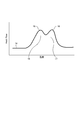
- FIG. 3 is a schematic diagram of a chart having a first small exothermic peak and a second small exothermic peak by differential scanning calorimetry. In the chart 14 shown in FIG.
- the first small exothermic peak 15 has an apex 16 and the second small exothermic peak 17 has an apex 18. Since the apex 16 of the first small heat generation peak 15 exists at 150 ° C. or higher and 180 ° C. or lower, the molding time of the laminate can be shortened, and the peak 18 of the second small heat generation peak 17 is 185 ° C. or higher and 220 ° C. or higher. When the temperature is below ° C and the difference between the peaks of both small exothermic peak temperatures is 20 ° C or more and 50 ° C or less, rapid heat generation due to the reaction can be suppressed, and a laminate with high dimensional accuracy can be obtained. ..
- thermosetting resin cured product of the component [D] in the laminate of the present invention is typically a thermosetting resin of the component [B] in the prepreg of the present invention.
- the temperature conditions for heat curing can be appropriately set according to the type and amount of the thermosetting resin and the curing agent or accelerator.
- the thermosetting resin contains an epoxy resin and the amine compound is diaminodiphenylsulfone.
- the temperature condition of 180 ° C. for 2 hours can be preferably used, and when dicyandiamide is used as the curing agent, the temperature condition of 135 ° C. for 2 hours can be preferably used.
- epoxy resin is preferable because it has excellent mechanical properties, heat resistance, and adhesiveness to reinforcing fibers.
- the main agent of the epoxy resin include bisphenol A type epoxy resin, bisphenol F type epoxy resin, bisphenol AD type epoxy resin, bisphenol S type epoxy resin and other bisphenol type epoxy resins, and tetrabromobisphenol A diglycidyl ether and other brominated epoxy.
- Novolak type epoxy resin such as resin, epoxy resin having biphenyl skeleton, epoxy resin having naphthalene skeleton, epoxy resin having dicyclopentadiene skeleton, phenol novolac type epoxy resin, cresol novolac type epoxy resin, N, N, O-tri Glycidyl-m-aminophenol, N, N, O-triglycidyl-p-aminophenol, N, N, O-triglycidyl-4-amino-3-methylphenol, N, N, N', N'-tetra Glycidyl-4,4'-methylenedianiline, N, N, N', N'-tetraglycidyl-2,2'-diethyl-4,4'-methylenedianiline, N, N, N', N'- Examples thereof include glycidylamine type epoxy resins such as tetraglycidyl-m-xylylene diamine, N, N-diglycidylaniline, N, N-
- the thermosetting resin of the component [B] preferably contains an epoxy resin, and 40 to 40 to 100 parts by mass of the total epoxy resin contained in the thermosetting resin contains glycidylamine type epoxy resin containing 3 or more glycidyl groups. By including 100 parts by mass, a cured product having high heat resistance can be obtained, which is a more preferable embodiment.
- the glycidylamine type epoxy resin containing three or more glycidyl groups include N, N, O-triglycidyl-m-aminophenol, N, N, O-triglycidyl-p-aminophenol, N, N, O-tri.
- N, N, N', N'-tetraglycidyl-4,4'-methylenedianiline, N, N, N', N'-tetraglycidyl-2,2' -Diethyl-4,4'-methylenedianiline, N, N, N', N'-tetraglycidyl-m-xylylene diamine and the like can be mentioned.
- the component [B] of the present invention contains at least two types of curing agents, and the two types of curing agents are hereinafter referred to as a first curing agent [b1] and a second curing agent [b2].
- the first curing agent [b1] is an amine compound having neither a carbonyl group nor a sulfinyl group
- the second curing agent [b2] is a carboxylic acid hydrazide, or a carbonyl group or sulfoxide. It is an aromatic amine having a group.
- the first curing agent [b1] of the epoxy resin is preferably an aromatic amine curing agent having neither a carbonyl group nor a sulfinyl group, and the first curing agent [b1] is an aromatic amine curing agent having neither a carbonyl group nor a sulfinyl group.
- an epoxy resin having good heat resistance can be obtained.
- the aromatic amine compound include 3,3'-diisopropyl-4,4'-diaminodiphenylsulfone, 3,3′-di-t-butyl-4,4′-diaminodiphenylsulfone, 3,3′-.
- a carboxylic acid hydrazide or an aromatic amine having a carbonyl group or a sulfinyl group as the second curing agent [b2] of the epoxy resin because the heat generation behavior preferable for the molding of the prepreg can be controlled.
- these curing agents exhibit a strong interaction with the thermoplastic resin of the component [C] due to the hydrazide structure and the hydrogen bonding property of the carbonyl group or the sulfinyl group, so that the resin containing [B] or [D] is contained.
- the interfacial strength between the region and the resin region including [C] is improved, and an excellent bonding strength as an integrally molded product is exhibited.
- carboxylic acid hydrazide As the second curing agent [b2], it is more preferable to use carboxylic acid hydrazide from the viewpoint of high molding time shortening effect (fast curing property) and high dimensional accuracy.
- carboxylic acid hydrazide examples include 3-hydroxy-2-naphthoic acid hydrazide, 2,6-naphthalenedicarbodihydrazide, salicylate hydrazide, terephthalic acid dihydrazide, and isophthalic acid dihydrazide.
- aromatic amine having a carbonyl group used as the second curing agent [b2] examples include 4,4'-diaminodiphenyl ketone, 4,4'-diamino-3,3', 5,5'-tetraethyldiphenyl ketone.
- Aromatic amines having a sulfinyl group used as the second curing agent [b2] include 4,4'-diaminodiphenyl sulfoxide, 4,4'-diamino-3,3', 5,5'-tetraethyldiphenyl sulfoxide.
- the blending ratio of the first curing agent [b1] and the second curing agent [b2] is 0.05 ⁇ [b2] in moles / [b1] in moles ⁇ 2.
- the value is 0.0, it is possible to suppress rapid heat generation due to the reaction, shorten the molding time of the laminated body, and obtain a laminated body with high dimensional accuracy, which is preferable.
- the first curing agent [b1] and the second curing agent [b2] are the main components as the curing agent, but other curing agents or curing. It may contain an accelerator. It is preferable that the total mass of [b1] and [b2] is 80% or more with respect to the total mass of the curing agent and the curing accelerator contained in the thermosetting resin of [B].
- examples of other curing agents include acid anhydrides and phenol novolac compounds
- examples of curing accelerators include phosphorus-based curing accelerators such as triphenylphosphine and tetraarylphosphonium tetraarylborate, cationic polymerization initiators, and the like. Examples thereof include tertiary amines, imidazole compounds, and urea compounds.
- thermosetting resin of the component [B] preferably contains a thermoplastic resin component soluble in the thermosetting resin in a dissolved state as a viscosity modifier.
- a thermoplastic resin component is another thermoplastic resin component different from the component [C].
- soluble in a thermosetting resin means that a temperature region forming a uniform phase exists by heating or heating and stirring a mixture of a thermoplastic resin component and a thermosetting resin.
- forming a uniform phase means that a state without visual separation can be obtained.
- the "dissolved state” refers to a state in which a thermosetting resin containing a thermoplastic resin component is brought into a certain temperature range to form a uniform phase. Once a uniform phase is formed in a certain temperature range, separation may occur at room temperature other than that temperature range.
- Polyaramid, polyvinylformal, polyvinylbutyral, phenoxy resin, polyethernitrile and polybenzimidazole, at least one resin selected from the group is suitable.
- Preferable examples include imides and polyether sulfones.
- Polyoxymethylene polyamides such as polyamide 6 and polyamide 66, polycarbonates, polymethylmethacrylates, polyvinyl chlorides, polyphenylene sulfides, polyphenylene ethers, modified polyphenylene ethers, polyimides, etc.
- Polyarylene ether ketones such as polyamideimide, polyetherimide, polysulfone, modified polysulfone, polyethersulfone, polyketone, polyetherketone, polyetheretherketone, polyetherketoneketone, polyarylate, polyethernitrile, phenolic resin, Examples include phenoxy resin.
- thermoplastic resins may be copolymers and modified products of the above-mentioned resins, and / or resins in which two or more kinds are blended.
- one or more selected from polyarylene ether ketone, polyphenylene sulfide or polyetherimide is contained in the thermoplastic resin of the component [C] in an amount of 60% by mass or more. Is preferable.
- An elastomer or rubber component may be added to improve impact resistance. Further, depending on the intended use, other fillers and additives may be appropriately contained as long as the object of the present invention is not impaired.
- inorganic fillers for example, inorganic fillers, flame retardants, conductivity-imparting agents, crystal nucleating agents, UV absorbers, antioxidants, anti-vibration agents, antibacterial agents, insect repellents, deodorants, anti-coloring agents, heat stabilizers, mold release agents.
- Antistatic agents plasticizers, lubricants, colorants, pigments, dyes, foaming agents, antifoaming agents, coupling agents and the like.
- the two resin regions are straddled from directions having an angle 45 degrees different from the fiber direction of any [A] in contact with the two resin regions, regardless of whether it is clockwise or counterclockwise.
- the roughness average length RSm defined in B0601 (2001) is 100 ⁇ m or less and the roughness average height Rc is 3.5 ⁇ m or more from the viewpoint of improving the bonding strength.
- the roughness average height Rc is more preferably 10 ⁇ m or more.
- the average roughness length RSm is 100 ⁇ m or less, not only chemical and / or physical bonding force but also mechanical bonding force called confounding is applied, and the resin region including the component [B] and the component [C] ] Is difficult to peel off from the resin region.
- the lower limit value is not particularly limited, but is preferably 15 ⁇ m or more from the viewpoint of avoiding a decrease in mechanical bonding force due to stress concentration.
- the roughness average height Rc of the cross-sectional curve is 3.5 ⁇ m or more, not only the mechanical coupling force is expressed by confounding, but also the component [A] existing on the boundary surface is the component [A].
- the prepreg of the present invention preferably has a reinforcing fiber amount of 30 to 2,000 g / m 2 per unit area.
- the amount of the reinforcing fibers is 30 g / m 2 or more, the number of laminated fibers for obtaining a predetermined thickness at the time of forming the laminate can be reduced, and the work is easy to be simplified.
- the amount of reinforcing fibers is 2,000 g / m 2 or less, the drape property of the prepreg is likely to be improved.
- the reinforcing fiber mass content of the prepreg of the present invention is preferably 30 to 90% by mass, more preferably 35 to 85% by mass, and further preferably 40 to 80% by mass.
- the range may be a combination of any of the above upper limits and any of the lower limits.
- the roughness average length RSm defined in JIS B0601 (2001) is 100 ⁇ m or less, and the roughness average height Rc is 3.5 ⁇ m or more.
- the roughness average height Rc is more preferably 10 ⁇ m or more.
- the lower limit of RSm and the upper limit of Rc are not particularly limited, but RSm is preferably 15 ⁇ m or more, and Rc is preferably 100 ⁇ m or less from the viewpoint of concern about a decrease in mechanical bonding force due to stress concentration.
- another member that is, a member (adhesive material) of the same type and / or a different type from the member constituting the laminated body, is formed by some heating means on the surface where [C] is present, particularly on the laminated body. It can be joined to the component [C] existing on the surface and integrated (welded) with the laminate via the component [C] to form an integrally molded product.
- members include members made of thermoplastic resin and members made of metal material.
- the member made of a thermoplastic resin may contain reinforcing fibers, fillers, and the like.
- the integration method is not particularly limited, and examples thereof include heat welding, vibration welding, ultrasonic welding, laser welding, resistance welding, induction welding, insert injection molding, and outsert injection molding.
- the laminate of the present invention is preferably used for computer applications such as aircraft structural members, wind turbine blades, automobile outer panels, IC trays and laptop housings, and for sports applications such as golf shafts and tennis rackets.
- the unit "parts" of the composition ratio means parts by mass unless otherwise specified. Unless otherwise specified, various characteristics were measured in an environment with a temperature of 23 ° C. and a relative humidity of 50%.
- ⁇ Measurement method of glass transition temperature of thermosetting resin cured product A test piece having a width of 12.7 mm and a length of 45 mm was cut out from the cured resin plate produced by the above method, and the test piece was dried in a vacuum oven at 60 ° C. for 24 hours, and according to JIS K 7244-7 (2007).
- a storage elastic modulus curve was obtained by a dynamic viscoelasticity test, and in such a storage elastic modulus curve, the value of the temperature at the intersection of the tangent line in the glass state and the tangent line in the transition state was defined as the glass transition temperature.
- the measurement was performed at a heating rate of 5 ° C./min and a frequency of 1 Hz.
- thermosetting resin according to the component [B] selected as shown in Tables 2 and 3 is coated on the release paper with a resin grain of 100 g / m 2 using a knife coater to prepare a thermosetting resin film.
- This resin film is laminated on both sides of the reinforcing fiber (grain 193 g / m 2 ) of the component [A] aligned in one direction, and the carbon fiber is impregnated with the thermosetting resin while heating and pressurizing using a heat roll. To obtain a prepreg [II].
- the obtained test sample was subjected to dynamic viscoelasticity measurement at a heating rate of 1.5 ° C./min, and the intersection of the obtained storage elastic modulus curve and loss elastic modulus curve was defined as the gel point.
- the time required from the start of the test at ° C to the gel point was defined as the gel time.
- the evaluation was made as follows based on the measurement results. The results are shown in the table. Less than 80 minutes: A 80 minutes or more and less than 90 minutes: B 90 minutes or more and less than 100 minutes: C 100 minutes or more: D (failed)
- a rectangular test piece having a length of 150 mm and a width of 20 mm was cut out with the reinforcing fiber shaft as the length direction of the test piece, and dried in a vacuum oven at 60 ° C. for 24 hours.
- the obtained prepreg is cut to a predetermined size, and after laminating 8 sheets in the same direction for [0 ° / 90 °] 2s or in the same direction for joint strength evaluation and flatness evaluation, respectively, the pressure is 3 MPa with a press machine. And heated at 250 ° C. for 10 minutes to obtain each laminate. From the obtained laminate, the joint strength and flatness were measured by the method described in Examples.
- the prepreg [I] was cut to a predetermined size, a total of 20 sheets were laminated so as to have the same reinforcing fiber direction, and a preliminary crack was formed at a position between the 10th and 11th sheets in the center.
- a preform was prepared by sandwiching a release film for introduction.
- Comparative Example 3 the prepreg [II] (without the component [C]) was cut to a predetermined size, laminated in the same manner as in Example 16, and the release film was sandwiched to obtain a preform.
- Comparative Example 4 polyamide particles (SP-500, manufactured by Toray Industries, Inc.) were placed on one side surface of the prepreg [II] (not containing the component [C]) cut to a predetermined size per prepreg unit area. After uniformly spraying so that the particle amount was 7 g / m 2 , the particles were laminated in the same manner as in Example 5, and the release film was sandwiched to obtain a preform.
- the obtained preforms were heated at 180 ° C. for 120 minutes by applying a pressure of 0.6 MPa with a press to obtain a laminate, and then the above-mentioned Examples.
- the interlayer fracture toughness value ( GIIC ) was evaluated by the method described in 1.
Landscapes
- Chemical & Material Sciences (AREA)
- Engineering & Computer Science (AREA)
- Materials Engineering (AREA)
- Organic Chemistry (AREA)
- Manufacturing & Machinery (AREA)
- Health & Medical Sciences (AREA)
- Chemical Kinetics & Catalysis (AREA)
- Medicinal Chemistry (AREA)
- Polymers & Plastics (AREA)
- Inorganic Chemistry (AREA)
- Mathematical Physics (AREA)
- Physics & Mathematics (AREA)
- Composite Materials (AREA)
- Mechanical Engineering (AREA)
- Reinforced Plastic Materials (AREA)
- Laminated Bodies (AREA)
Abstract
Description
熱可塑性樹脂をマトリックスに用いた繊維強化複合材料は、上記の機械的接合方法および接着剤を用いた接合に加え、溶着により部材間を接合する方法を適用することができるため、部材間の接合に要する時間を短縮できる可能性がある。一方で、航空機用構造部材のように、高温での力学特性や優れた薬品への耐性が求められる場合は、熱硬化性樹脂と強化繊維からなる繊維強化複合材料に比べて、耐熱性、耐薬品性が十分ではないという課題があった。
特許文献2には、熱可塑性樹脂で形成される部材と、熱硬化性樹脂からなる繊維強化複合材料で形成される部材を一体化する手法が示されている。すなわち、強化繊維と熱硬化性樹脂からなるプリプレグシートの表面に熱可塑性樹脂フィルムを積層し、加熱・加圧により、繊維強化複合材料を得る。その後、得られた繊維強化複合材料を金型に入れ、熱可塑性樹脂を射出成形し、射出成形により形成された熱可塑性樹脂部材と繊維強化複合材料を接合させる。
また、特許文献3には、熱硬化性樹脂と強化繊維からなる複合材料の表面に、熱可塑性樹脂接着層を形成した積層体の製造方法が示されており、熱可塑性樹脂を介して他の部材との接着効果を示すことが述べられている。
特許文献4には、強化繊維と熱硬化性樹脂からなるプリプレグの表層に、熱可塑性樹脂からなる粒子、または繊維、またはフィルムが配置されてなるプリプレグおよびその繊維強化複合材料が示されている。
特許文献2に記載の方法では、繊維強化複合材料中の熱硬化性樹脂と熱可塑性樹脂フィルムとの接合部における接合強度が十分ではなかった。
特許文献3に係る繊維強化複合材料は、熱可塑性樹脂を介して溶着による一体化を行うことができ、室温では優れた接合強度を示すが、高温での接合強度は十分ではなかった。
特許文献4では、熱可塑性樹脂からなる粒子、繊維またはフィルムにより、層間破壊靭性値が向上することが示されているが、この方法では、繊維強化複合材料中の熱硬化性樹脂と熱可塑性樹脂との境界部における接合強度が十分ではなかった。
[A]強化繊維
[B]熱硬化性樹脂
[C]熱可塑性樹脂
[A]強化繊維
[C]熱可塑性樹脂
[D]第1の硬化剤[b1]および第2の硬化剤[b2]を含む熱硬化性樹脂を硬化してなる、熱硬化性樹脂硬化物
強化繊維の形態や配列については、強化繊維が一方向に配列されているか、一方向に配列されたものの積層物か、または織物の形態等から適宜選択できるが、軽量で耐久性がより高い水準にある積層体を得るためには、各プリプレグにおいて、強化繊維が一方向に配列された長繊維(繊維束)または織物等連続繊維の形態であることが好ましい。
また、構成要素[A]の強化繊維としては、ウィルヘルミー法によって測定される表面自由エネルギーが10~50mJ/m2であるものを用いることが好ましい。表面自由エネルギーをこの範囲に制御することで、前記強化繊維は[B]の熱硬化性樹脂または[D]の熱硬化性樹脂硬化物及び[C]の熱可塑性樹脂と高い親和性を発現し、強化繊維がまたがって存在する[B]または[D]を含む樹脂領域と[C]を含む樹脂領域の境界面において、高い接合強度を発現する。加えて、前記強化繊維同士の凝集を抑制し、成形品中での強化繊維の分散が良好となり、接合強度のばらつき(変動係数)が小さくなる。前記強化繊維の表面自由エネルギーは、好ましくは、15~40mJ/m2、より好ましくは、18~35mJ/m2である。
COSθ=(8本の単繊維が受ける力F(mN))/((8(単繊維の数)×単繊維の円周(m)×溶媒の表面張力(mJ/m2))
なお、測定は、3箇所の強化繊維束の異なる場所から抜き出した単繊維について実施した。すなわち、一つの強化繊維束に対して合計24本の単繊維についての接触角の平均値を求めた。
強化繊維の表面自由エネルギーγfは、表面自由エネルギーの極性成分γp f、及び表面自由エネルギーの非極性成分γd fの和として算出される。
Y=a・X+b
X=√(溶媒の表面張力の極性成分(mJ/m2))/√(溶媒の表面張力の非極性成分(mJ/m2)
Y=(1+COSθ)・(溶媒の表面張力の極性成分(mJ/m2))/2√(溶媒の表面張力の非極性成分(mJ/m2)
強化繊維の表面自由エネルギーの極性成分γp f=a2
強化繊維の表面自由エネルギーの非極性成分γd f=b2
トータルの表面自由エネルギーγf=a2+b2
・精製水
表面張力72.8mJ/m2、極性成分51.0mJ/m2、非極性成分21.8(mJ/m2)
・エチレングリコール
表面張力48.0mJ/m2、極性成分19.0mJ/m2、非極性成分29.0(mJ/m2 )
・燐酸トリクレゾール
表面張力40.9mJ/m2、極性成分1.7mJ/m2、非極性成分39.2(mJ/m2)
カルボン酸ヒドラジドとしては、3-ヒドロキシ-2-ナフトエ酸ヒドラジド、2,6-ナフタレンジカルボジヒドラジド、サリチル酸ヒドラジド、テレフタル酸ジヒドラジド、および、イソフタル酸ジヒドラジド等が挙げられる。
本発明の構成要素[B]の熱硬化性樹脂は、前記第1の硬化剤[b1]と第2の硬化剤[b2]が硬化剤としての主成分であるが、その他の硬化剤または硬化促進剤を含んでいても良い。[B]の熱硬化性樹脂中に含まれる硬化剤と硬化促進剤の総質量に対し、[b1]と[b2]の合計質量が80%以上となることが好ましい。他の硬化剤としては、酸無水物、フェノールノボラック化合物等が挙げられ、硬化促進剤としては、例えば、トリフェニルホスフィンやテトラアリールホスホニウムテトラアリールボレート等のリン系硬化促進剤、カチオン重合開始剤、三級アミン、イミダゾール化合物、尿素化合物などが挙げられる。
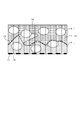
本発明のプリプレグにおいて、層状をなして隣接しているとは、例えば図2に示すように、プリプレグ平面方向に対し垂直にカットして得られる断面において、面方向に連続した[C]を含む樹脂領域7と[B]を含む樹脂領域8とが、境界面10を形成しつつ密着して存在する状態である。[C]を含む樹脂領域7が層状で連続した状態ではなく、粒子状、繊維状、不織布状等で存在している場合、表面において[B]の熱硬化性樹脂が露出している面積の割合が増加し、最表面における[C]の被覆率が低下するため、溶着性が低下する傾向にある。
断面曲線13の粗さ平均高さRcおよび粗さ平均長さRSmの測定方法の一例(断面曲線要素の測定方法1)を示す。長方形型の観察画像9の構成要素[B]を含む樹脂領域側の端部を基準線11として、構成要素[B]を含む樹脂領域8から構成要素[C]を含む樹脂領域7に向かって5μm間隔で垂基線12を描く。基準線11から描かれる垂基線12が初めて構成要素[C]と交わる点をプロットし、プロットされた点を結んだ線を断面曲線13とする。得られた断面曲線13につき、JIS B0601(2001)に基づくフィルタリング処理を行い、断面曲線13の粗さ平均高さRcおよび粗さ平均長さRSmを算出する。
積層体を平面視したとき、かかる両樹脂領域と接する任意の[A]の繊維方向に対し、時計回りか反時計回りかを問わず45度異なる角度の方向から、上記両樹脂領域をまたいで存在する[A]が含まれる積層体の平面に垂直な断面、すなわち、積層体平面方向に対し垂直にカットするなどして得られる断面において、両樹脂領域の密着する境界面が形成する断面曲線の、JIS B0601(2001)で定義される粗さ平均長さRSmが100μm以下であり、粗さ平均高さRcが3.5μm以上であることが好ましい。粗さ平均高さRcは10μm以上であることがさらに好ましい。RSmの下限値およびRcの上限値は特に限定されないが、応力集中による機械的な結合力の低下の懸念の観点から、RSmは好ましくは15μm以上であり、Rcは好ましくは100μm以下である。
断面曲線の粗さ平均高さRcおよび粗さ平均長さRSmの測定方法としては、本発明のプリプレグの測定方法と同様に、上記の手法により求めることができる。
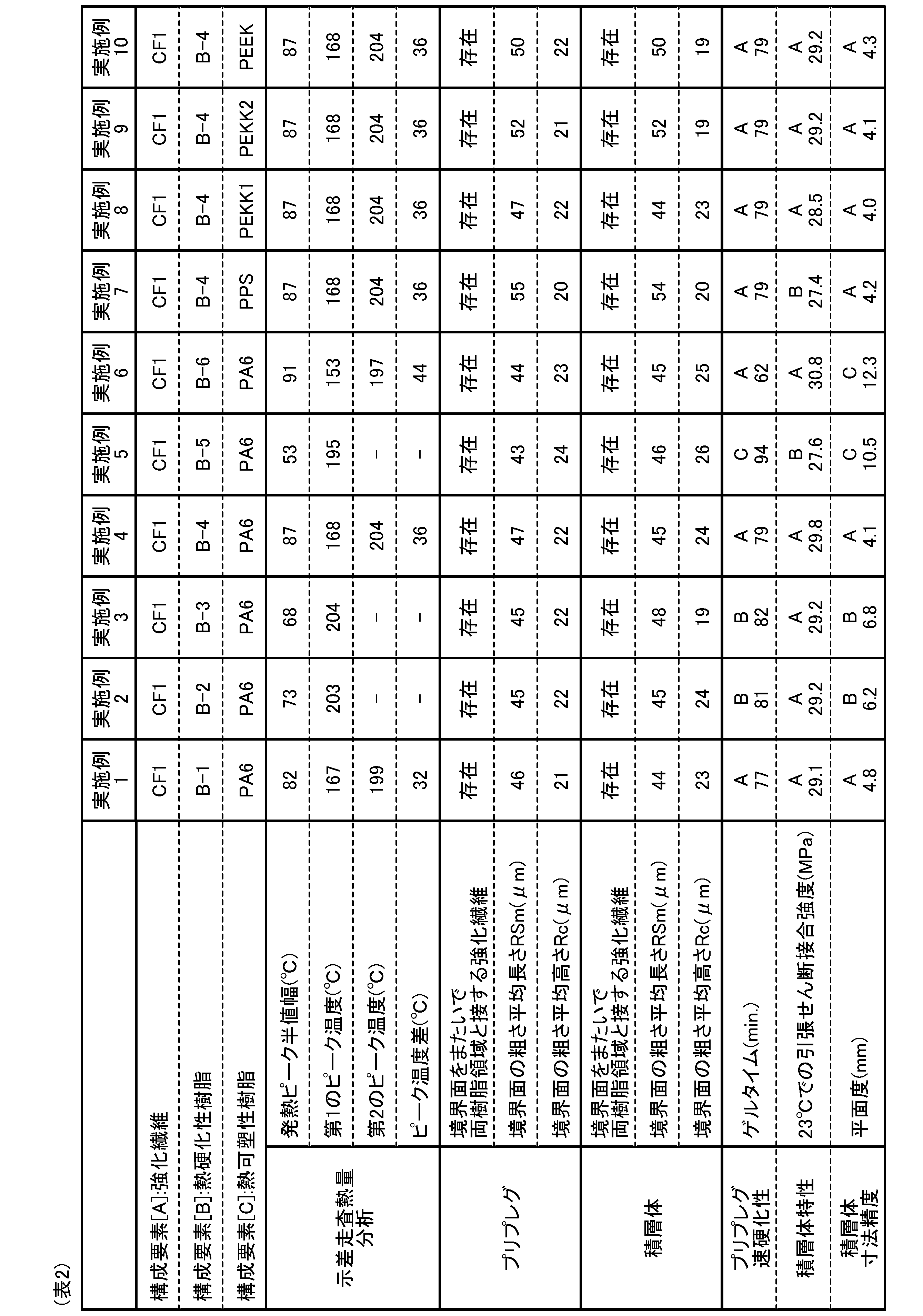
以下に示す構成要素[A]、[B]及び[C]を用いた。それぞれの実施例および比較例で用いた構成要素は、表1~3に示すとおりである。
以下の方法で原料となる共通の炭素繊維束を得た後、各種サイジング剤用化合物を塗布することで得た。まず、イタコン酸を共重合したアクリロニトリル共重合体を紡糸し、焼成することで、総フィラメント数24,000本、比重1.8g/cm3、ストランド引張強度5.9GPa、ストランド引張弾性率294GPaの炭素繊維束を得た。その後、各種サイジング剤用化合物をアセトンと混合し、化合物が均一に溶解した約1質量%の溶液を得た。浸漬法により各化合物を上記炭素繊維束に塗布した後、210℃で90秒間熱処理をし、各化合物の付着量が、各化合物が付着した炭素繊維100質量部に対して、0.5質量部となるように調整した。各炭素繊維に用いたサイジング剤用化合物および、サイジング剤塗布後の表面自由エネルギーは以下の通り。
・CF1:ポリエチレングリコールジグリシジルエーテル(“デナコール”(登録商標)EX-841、ナガセケムテックス(株)社製)
表面自由エネルギー:20mJ/m2
・CF2:ビスフェノールA型ジグリシジルエーテル(“jER”(登録商標)828、三菱ケミカル(株)社製) 表面自由エネルギー:9mJ/m2
・CF3:ソルビトールポリグリシジルエーテル(“デナコール”(登録商標)EX-614B、ナガセケムテックス(株)社製)
表面自由エネルギー:32mJ/m2
・PA6:ポリアミド6(“アミラン”(登録商標)CM1007(東レ(株)製、融点225℃、ガラス転移温度48℃、))からなる目付120g/m2のフィルム
・PPS:ポリフェニレンスルフィド(“トレリナ”(登録商標)A670T05(東レ(株)製、融点278℃、ガラス転移温度90℃))からなる目付120g/m2のフィルム
・PEKK1:ポリエーテルケトンケトン(“KEPSTAN”(登録商標)6002(アルケマ社製、融点300℃、ガラス転移温度160℃))からなる目付120g/m2のフィルム
・PEKK2:ポリエーテルケトンケトン(“KEPSTAN”(登録商標)7002(アルケマ社製、融点331℃、ガラス転移温度162℃))からなる目付120g/m2のフィルム
・PEEK:ポリエーテルエーテルケトン(PEEK 450G(Victrex社製、融点343℃、ガラス転移温度143℃))からなる目付120g/m2のフィルム
・半芳香族PA:ポリアミド6T(融点320℃、ガラス転移温度125℃)からなる目付120g/m2のフィルム
・PEI:ポリエーテルイミド(“ULTEM”(登録商標)1010(SABIC社製、ガラス転移温度217℃))からなる目付120g/m2のフィルム
・PEs:ポリエステル(“ハイトレル”(登録商標)2551(東レデュポン(株)社製、融点164℃))からなる目付120g/m2のフィルム。
熱可塑性樹脂の融点は、JIS K7121(2012)に基づいて、示差走査熱量計(DSC)を用いて測定した。混合物などで融点が複数観測される場合は、最も高い融点をその熱可塑性樹脂の融点として採用した。
表1に記載の各具体例の熱硬化性樹脂を、以下の化合物を用いて作製した。
(1)エポキシ樹脂
・テトラグリシジルジアミノジフェニルメタン(“アラルダイト”(登録商標)MY721、ハンツマン・アドバンスト・マテリアルズ社製)エポキシ当量:113(g/eq.)、4官能のグリシジルアミン型エポキシ樹脂)
・ビスフェノールA型エポキシ樹脂(“jER”(登録商標)825、三菱ケミカル(株)製)エポキシ当量:175(g/eq.))
(2)芳香族アミン化合物(b1:第1の硬化剤)
・4,4’-ジアミノジフェニルスルホン(セイカキュアS、和歌山精化工業(株)製)
(3)カルボン酸ヒドラジド(b2:第2の硬化剤)
・イソフタル酸ジヒドラジド(大塚化学(株)製)
(4)カルボニル基またはスルフィニル基を有する芳香族アミン(b2:第2の硬化剤)
・4,4’-ジアミノジフェニルケトン
・4,4’-ジアミノジフェニルスルホキシド
(5)粘度調整剤
・ポリエーテルスルホン(“スミカエクセル”(登録商標)PES5003P 住友化学(株)製)
(6)熱硬化性樹脂の調製方法
混練装置中に、表1に記載のエポキシ樹脂および粘度調整剤を投入し、加熱混練を行い、粘度調整剤を溶解させた。次いで、混練を続けたまま100℃以下の温度まで降温させ、表1に記載の硬化剤から適宜選択されたものを加えて撹拌し、B-1~B-7までの熱硬化性樹脂を得た。
上記の方法で調製した熱硬化性樹脂をモールドに注入し、熱風乾燥機中で30℃から速度1.5℃/分で180℃まで昇温し、180℃で120分間加熱硬化した後、30℃まで速度2.5℃/分で降温して、厚さ2mmの板状の樹脂硬化物を作製した。得られた熱硬化性樹脂硬化物より、以下の方法にて、表1に記載の各具体例の評価を実施した。
上記の方法で作製した樹脂硬化物板から、幅12.7mm、長さ45mmの試験片を切り出し、試験片を60℃真空オーブン中で24時間乾燥させ、JIS K 7244-7(2007)に従い、動的粘弾性試験により貯蔵弾性率曲線を得て、かかる貯蔵弾性率曲線において、ガラス状態での接線と転移状態での接線との交点における温度の値をガラス転移温度とした。ここでは、昇温速度5℃/分、周波数1Hzで測定した。
プリプレグは、以下の2種の方法により作製した。各例で使用した構成要素は表2,3記載のそれぞれのとおりである。
[I]構成要素[A]の強化繊維(目付193g/m2)を、一方向に整列させた連続した状態の強化繊維シートを引き出し、一方向に走行させつつ、構成要素[C]からなる目付120g/m2の樹脂シートを連続強化繊維シート上に配置して、IRヒータで加熱して構成要素[C]を溶融し、連続強化繊維シート片面全面に付着させ、表面温度が構成要素[C]の融点以下に保たれたニップロールで加圧して、強化繊維シートに含浸したものを冷却させて繊維強化樹脂中間体を得た。表2,3記載のとおり選定した構成要素[B]に係る熱硬化性樹脂を、ナイフコーターを用いて樹脂目付100g/m2で離型紙上にコーティングし、熱硬化性樹脂フィルムを作製した後、上記中間体における構成要素[C]を含浸させた反対の表面に上記熱硬化性樹脂フィルムを重ね、ヒートロールにより加熱加圧しながら熱硬化性樹脂を中間体に含浸させ、プリプレグ[I]を得た。
[II]表2,3記載のとおり選定した構成要素[B]に係る熱硬化性樹脂を、ナイフコーターを用いて樹脂目付50g/m2で離型紙上にコーティングし、樹脂フィルムを作製した。この樹脂フィルムを、一方向に引き揃えた構成要素[A]の強化繊維(目付193g/m2)の両側に重ね合せてヒートロールを用い、加熱加圧しながら熱硬化性樹脂を炭素繊維に含浸させ、プリプレグ[II]を得た。
(1)示差走査熱量分析
上記で作製したプリプレグ[I]を、示差走査熱量計を用いて、窒素雰囲気中で5℃/分の昇温速度で測定し、反応性を評価した。得られた発熱曲線の発熱ピーク温度および発熱ピークの半値幅を算出した。ここで、発熱ピークは、ベースラインから50mW/g以上発熱したピークを指す。
(2)粘弾性測定による速硬化性評価
上記で作製したプリプレグ[I]を、直径25mmにカットし、6枚重ねて試験試料を得た。得られた試験試料を、1.5℃/minの昇温速度で動的粘弾性測定を実施し、得られた貯蔵弾性率曲線および損失弾性率曲線が交わった点をゲル化点とし、40℃での試験開始からゲル化点に至るまでに要した時間をゲルタイムとした。測定結果に基づいて以下のように評価した。結果を表に示す。
80分未満:A
80分以上90分未満:B
90分以上100分未満:C
100分以上:D(不合格)
(1)引張せん断接合強度の測定方法
上記で作製したプリプレグ[I]および[II]を所定の大きさにカットし、プリプレグ[I]を2枚とプリプレグ[II]を6枚得た。強化繊維の軸方向を0°とし、軸直交方向を90°と定義して、[0°/90°]2s(記号sは、鏡面対称を示す)で積層し、プリフォームを作製した。このとき両面それぞれの最外層の2枚はプリプレグ[I]となるように積層し、プリフォームの両の表層が、構成要素[C]を含む熱可塑性樹脂層となるように配置した。このプリフォームをプレス成形金型にセットし、必要に応じ、治具やスペーサーを使用して、この形状を維持させたまま、プレス機で0.6MPaの圧力をかけ、180℃で120分間加温することで、積層体を得た。
得られた積層体を、0°方向を試験片の長さ方向として、幅250mm、長さ92.5mmの形状に2枚カットし、真空オーブン中で24時間乾燥させた。その後、2枚のパネルを、0°方向を長さ方向として、幅25mm×長さ12.5mmとして重ね合わせ、用いた構成要素[C]の熱可塑性樹脂の融点よりも20℃高い温度にて、3MPaの圧力をかけて、1分間保持することで、重ね合わせた面を溶着し、一体化成形品を得た。得られた一体化成形品に、ISO4587:1995(JIS K6850(1994))に準拠してタブを接着し、幅25mmでカットすることで、目的の試験片を得た。
得られた試験片を、真空オーブン中で24時間乾燥させ、ISO4587:1995(JIS K6850(1994))に基づき、環境温度23℃の引張せん断接合強度を測定し、測定結果に基づいて以下のように評価した。結果を表2および3に示す。
28MPa以上:A
25MPa以上28MPa未満:B
20MPa以上25MPa未満:C
20MPa未満:D(不合格)
上記で作製したプリプレグ[I]および[II]を長さ250mm、幅125mmの大きさにカットし、プリプレグ[I]を2枚とプリプレグ[II]を6枚得た。両面それぞれの最外層の2枚はプリプレグ[I]として、間にプリプレグ[II]を挟んで、全て同一の強化繊維方向となるよう、計8枚積層し、プリフォームを作製した。このとき、プリフォームの両の表層が構成要素[C]を含む熱可塑性樹脂層となるように配置した。このプリフォームをプレス成形金型にセットし、必要に応じ、治具やスペーサーを使用して、この形状を維持させたまま、プレス機で0.6MPaの圧力をかけ、180℃で120分間加温することで、積層体を得た。
得られた積層体の平面度を、JIS B7513(1992)に準拠して評価した。得られた積層体の端4点の内3点を精密定盤上に接地して、残りの1点の盤面からの高さを求めた。積層体の端4点のそれぞれを、順に上記精密定盤上に接地しない1点として、上記方法にてそれぞれの盤面からの高さを求め、得られた盤面からの高さ4点のうち最も高い値を積層体の平面度とした。測定結果に基づいて以下のように評価した。結果を表2および3に示す。
5mm未満:A
5mm以上10mm未満:B
10mm以上15mm未満:C
15mm以上:D(不合格)
上記で作製したプリプレグ[I]を所定の大きさにカットし、同一の強化繊維方向となるよう、計20枚積層した。このとき、中央の10枚目と11枚目の間の位置に予備亀裂導入のための離型フィルムを挟み込み、プリフォームを作製した。このプリフォームをプレス成形金型にセットし、必要に応じ、治具やスペーサーを使用して、この形状を維持させたまま、プレス機で0.6MPaの圧力をかけ、180℃で120分間加温することで、積層体を得た。
得られた積層体より、強化繊維軸を試験片の長さ方向として、長さ150mm、幅20mmの矩形試験片を切り出し、60℃の真空オーブン中で24時間乾燥させた。得られた試験片を、JIS K7086(1993)に従い、23℃環境下において、層間破壊靱性値(GIIC)を評価した。
上記で作製したプリプレグ[I]を用い、前記両樹脂領域と接する[A]の任意の繊維方向に対し、プリプレグの平面視における45度の角度にてプリプレグ平面方向に対し垂直にカットした断面において、光学顕微鏡を用いて、1000倍の画像を撮影した。得られた画像において、[C]を含む樹脂領域と[B]を含む樹脂領域の境界面に強化繊維が存在し、その強化繊維が、[C]を含む樹脂領域にも、[B]を含む樹脂領域にも接していれば、「境界面をまたいで両樹脂領域と接する強化繊維」が存在する状態とした。得られた画像中の任意の500μm四方の観察範囲において、前記断面曲線要素の測定方法1により得られる断面曲線要素のJIS B0601(2001)で定義される、粗さ平均長さRSmおよび粗さ平均高さRcを測定した。積層体の場合も、(1)引張せん断接合強度の測定方法に記載の積層体を用い、平面方向に対し垂直にカットした観察断面において、光学顕微鏡を用いて1000倍の画像を撮影した後、後は上記プリプレグの場合と同様に測定した。
実施例1~15および比較例1では、(1)引張せん断接合強度の測定方法に記載の方法、および(2)平面度の測定方法に記載の方法で積層体を作成した。
比較例2では、一方向平面状に配列させた強化繊維シートの両面に、フィルム目付50g/m2のポリアミド6(“アミラン”(登録商標)CM1007(東レ(株)製))のフィルムを貼り付け、250℃で加熱加圧して、強化炭素繊維目付193g/m2のプリプレグを得た。得られたプリプレグを、所定のサイズにカットし、それぞれ、接合強度評価用および平面度評価用に、[0°/90°]2sまたは同一方向に8枚積層した後、プレス機で3MPaの圧力をかけ、250℃で10分間加温することで、それぞれ積層体を得た。得られた積層体より、実施例に記載の方法で接合強度と平面度を測定した。
実施例16では、上記プリプレグ[I]を所定の大きさにカットし、同一の強化繊維方向となるよう、計20枚積層し、中央の10枚目と11枚目の間の位置に予備亀裂導入のための離型フィルムを挟み込み、プリフォームを作製した。
比較例3では、プリプレグ[II](構成要素[C]非含有)を所定の大きさにカットし、実施例16と同じ方法で積層し、離型フィルムを挟み込み、プリフォームを得た。
比較例4では、所定の大きさにカットしたプリプレグ[II](構成要素[C]非含有)の片側表面に、ポリアミド粒子(SP-500、東レ(株)製)を、プリプレグ単位面積あたりの粒子量が7g/m2となるよう均一に散布したのち、実施例5と同じ方法で積層し、離型フィルムを挟み込み、プリフォームを得た。実施例16、比較例3,4とも、得られたプリフォームを、プレス機で0.6MPaの圧力をかけ、180℃で120分間加温することで、積層体を得た後、上記実施例に記載の方法で、層間破壊靱性値(GIIC)を評価した。


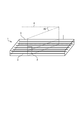
2:構成要素[A]
3:構成要素[C]および構成要素[B]または構成要素[D]
4:任意の繊維束の軸方向
5:観察断面
6:構成要素[A]
7:構成要素[C]を含む樹脂領域
8:構成要素[B]または構成要素[D]を含む樹脂領域
9:観察画像
10:境界面
11:基準線
12:垂基線
13:断面曲線
14:示差走査熱量分析によるチャート
15:第1の小発熱ピーク
16:第1の小発熱ピークの頂点
17:第2の小発熱ピーク
18:第2の小発熱ピークの頂点
Claims (15)
- 次の構成要素[A]、[B]、及び[C]を含むプリプレグであって、
プリプレグの表面に[C]が存在しており、[B]は第1の硬化剤[b1]と第2の硬化剤[b2]を含み、[B]を含む樹脂領域と[C]を含む樹脂領域との境界面をまたいで両樹脂領域と接する[A]の強化繊維が存在するプリプレグ。
[A]強化繊維
[B]熱硬化性樹脂
[C]熱可塑性樹脂 - 前記プリプレグの平面視において、前記両樹脂領域と接する任意の[A]の繊維方向に対し45度異なる角度の方向から、前記[A]を含むプリプレグ平面に垂直な断面を得た場合に、前記断面における、両樹脂領域の密着する境界面が形成する断面曲線の、JIS B0601(2001)で定義される粗さ平均長さRSmが100μm以下であり、粗さ平均高さRcが3.5μm以上である、請求項1に記載のプリプレグ。
- 前記[B]を含む樹脂領域と[C]を含む樹脂領域がそれぞれ層状をなして隣接することにより前記境界面を形成している、請求項1または2に記載のプリプレグ。
- 第1の硬化剤[b1]は、カルボニル基もスルフィニル基も有しないアミン化合物であり、第2の硬化剤[b2]は、カルボン酸ヒドラジド、または、カルボニル基もしくはスルフィニル基を有する芳香族アミンである、請求項1から3のいずれか1つに記載のプリプレグ。
- 昇温速度5℃/minでの示差走査熱量分析によるチャートが、以下の[1]または[2]の少なくとも一方を満たす、請求項1から4のいずれか1つに記載のプリプレグ。
[1]発熱ピークの半値幅が50℃以上100℃以下である。
[2]発熱ピークは、二つ以上の小発熱ピークを有し、第1の小発熱ピークはその頂点が150℃以上180℃以下に存在し、第2の小発熱ピークはその頂点が185℃以上220℃以下に存在し、両の小発熱ピーク温度の頂点間の差は、20℃以上50℃以下である。 - 次の構成要素[A]、[C]及び[D]を含む層が含まれる積層体であって、
[C]を含む樹脂領域と[D]を含む樹脂領域との境界面をまたいで両樹脂領域と接する[A]の強化繊維が存在する積層体。
[A]強化繊維
[C]熱可塑性樹脂
[D]第1の硬化剤[b1]および第2の硬化剤[b2]を含む熱硬化性樹脂を硬化してなる、熱硬化性樹脂硬化物 - 前記積層体の平面視において、前記両樹脂領域と接する任意の[A]の繊維方向に対し45度異なる角度の方向から、前記[A]を含む積層体の平面に垂直な断面を得た場合に、前記断面における両樹脂領域の密着する境界面が形成する断面曲線の、JIS B0601(2001)で定義される粗さ平均長さRSmが100μm以下であり、粗さ平均高さRcが3.5μm以上である、請求項6に記載の積層体。
- 前記[C]を含む樹脂領域と[D]を含む樹脂領域がそれぞれ層状をなして隣接することにより前記境界面を形成している、請求項6または7に記載の積層体。
- 表面または層間の少なくとも一方に、構成要素[C]が存在する、請求項6から8のいずれか1つに記載の積層体。
- 第1の硬化剤[b1]は、カルボニル基もスルフィニル基も有しないアミン化合物であり、第2の硬化剤[b2]は、カルボン酸ヒドラジド、または、カルボニル基もしくはスルフィニル基を有する芳香族アミンである、請求項6から9のいずれか1つに記載の積層体。
- 第1の硬化剤[b1]と第2の硬化剤[b2]の配合比率が、以下を満たす、請求項4に記載のプリプレグ、または、請求項10に記載の積層体。
0.05≦[b2]のモル数/[b1]のモル数≦2.0 - 構成要素[C]はアミド基、カルボニル基、イミド基、スルフィド基、スルホニル基およびエステル結合のいずれかから選ばれる官能基を、一つ以上有する熱可塑性樹脂である、請求項1から5のいずれか1つに記載のプリプレグ、または、請求項6から11のいずれか1つに記載の積層体。
- 構成要素[A]として、ウィルヘルミー法によって測定される表面自由エネルギーが10~50mJ/m2である強化繊維を用いる、請求項1から5のいずれか1つに記載のプリプレグ、または、請求項6から12のいずれか1つに記載の積層体。
- 請求項1から5のいずれか1つに記載のプリプレグの硬化物が少なくとも一部の層を構成する積層体。
- 別の部材が、構成要素[C]が存在する面に接合することにより、請求項6から14のいずれか1つに記載の積層体と一体化されてなる、一体化成形品。
Priority Applications (4)
| Application Number | Priority Date | Filing Date | Title |
|---|---|---|---|
| EP20900649.3A EP4074766A4 (en) | 2019-12-11 | 2020-11-20 | PREPREG, LAMINATE AND INTEGRATED MOLDING |
| CN202080083319.9A CN114746491B (zh) | 2019-12-11 | 2020-11-20 | 预浸料坯、层叠体及一体化成型品 |
| US17/781,845 US12454603B2 (en) | 2019-12-11 | 2020-11-20 | Prepreg, laminate, and integrated product |
| JP2020568827A JP7088320B2 (ja) | 2019-12-11 | 2020-11-20 | プリプレグ、積層体および一体化成形品 |
Applications Claiming Priority (2)
| Application Number | Priority Date | Filing Date | Title |
|---|---|---|---|
| JP2019-223482 | 2019-12-11 | ||
| JP2019223482 | 2019-12-11 |
Publications (1)
| Publication Number | Publication Date |
|---|---|
| WO2021117465A1 true WO2021117465A1 (ja) | 2021-06-17 |
Family
ID=76329810
Family Applications (1)
| Application Number | Title | Priority Date | Filing Date |
|---|---|---|---|
| PCT/JP2020/043339 Ceased WO2021117465A1 (ja) | 2019-12-11 | 2020-11-20 | プリプレグ、積層体および一体化成形品 |
Country Status (6)
| Country | Link |
|---|---|
| US (1) | US12454603B2 (ja) |
| EP (1) | EP4074766A4 (ja) |
| JP (1) | JP7088320B2 (ja) |
| CN (1) | CN114746491B (ja) |
| TW (1) | TWI849261B (ja) |
| WO (1) | WO2021117465A1 (ja) |
Cited By (1)
| Publication number | Priority date | Publication date | Assignee | Title |
|---|---|---|---|---|
| JP2024511705A (ja) * | 2021-03-31 | 2024-03-15 | 東レ株式会社 | エポキシ樹脂組成物、プリプレグ、及び繊維強化複合材料 |
Families Citing this family (1)
| Publication number | Priority date | Publication date | Assignee | Title |
|---|---|---|---|---|
| JPWO2021246466A1 (ja) * | 2020-06-03 | 2021-12-09 |
Citations (9)
| Publication number | Priority date | Publication date | Assignee | Title |
|---|---|---|---|---|
| JPH08259713A (ja) | 1995-03-22 | 1996-10-08 | Toray Ind Inc | プリプレグおよび繊維強化複合材料 |
| JPH10138354A (ja) | 1996-11-08 | 1998-05-26 | Yamaha Corp | 炭素繊維強化樹脂成形物とその製造方法 |
| WO2017130659A1 (ja) * | 2016-01-26 | 2017-08-03 | 東レ株式会社 | エポキシ樹脂組成物、プリプレグおよび繊維強化複合材料 |
| JP2017183227A (ja) * | 2016-03-31 | 2017-10-05 | 住友ベークライト株式会社 | 熱硬化性樹脂組成物、キャリア付樹脂膜、プリント配線基板および半導体装置 |
| WO2018003694A1 (ja) * | 2016-06-28 | 2018-01-04 | 東レ株式会社 | プリプレグおよびその製造方法 |
| WO2018079475A1 (ja) * | 2016-10-26 | 2018-05-03 | 東レ株式会社 | プリプレグ積層体、繊維強化複合材料および繊維強化複合材料の製造方法 |
| WO2018173953A1 (ja) * | 2017-03-24 | 2018-09-27 | 東レ株式会社 | プリプレグおよび炭素繊維強化複合材料 |
| JP2018161801A (ja) | 2017-03-27 | 2018-10-18 | 三菱ケミカル株式会社 | 接着構造部材 |
| JP2019038939A (ja) * | 2017-08-25 | 2019-03-14 | 東レ株式会社 | プリプレグおよび繊維強化複合材料 |
Family Cites Families (11)
| Publication number | Priority date | Publication date | Assignee | Title |
|---|---|---|---|---|
| TWI304321B (en) | 2002-12-27 | 2008-12-11 | Toray Industries | Layered products, electromagnetic wave shielding molded articles and method for production thereof |
| JP4543696B2 (ja) * | 2003-02-21 | 2010-09-15 | 東レ株式会社 | 繊維強化複合材料およびその製造方法並びに一体化成形品 |
| CN101824205B (zh) | 2004-02-27 | 2014-04-16 | 东丽株式会社 | 一体化成型品、纤维增强复合材料板及电气·电子设备用外壳 |
| TWI414538B (zh) * | 2006-04-25 | 2013-11-11 | Yokohama Rubber Co Ltd | 纖維強化複合材料用環氧樹脂組成物 |
| KR101951058B1 (ko) | 2011-03-30 | 2019-02-21 | 도레이 카부시키가이샤 | 프리프레그, 섬유 강화 복합 재료 및 섬유 강화 복합 재료의 제조 방법 |
| JP5655976B1 (ja) * | 2013-01-28 | 2015-01-21 | 東レ株式会社 | プリプレグ、繊維強化複合材料および熱可塑性樹脂粒子 |
| FR3043935B1 (fr) | 2015-11-20 | 2018-02-23 | Geco Ingenierie | Procede et dispositif de moulage d'une piece composite, piece composite et embarcation |
| WO2017110991A1 (ja) | 2015-12-25 | 2017-06-29 | 東レ株式会社 | プリプレグおよびその製造方法 |
| JP2017119432A (ja) | 2015-12-25 | 2017-07-06 | 東レ株式会社 | 繊維強化プラスチックの製造方法および繊維強化プラスチック |
| JP6555360B2 (ja) | 2016-10-04 | 2019-08-07 | 三菱ケミカル株式会社 | プリプレグ、プリプレグ積層体、および繊維強化複合材料 |
| RU2019125620A (ru) * | 2017-01-19 | 2021-02-19 | Торэй Индастриз, Инк. | Препрег, способ его получения и разрезной ленточный препрег |
-
2020
- 2020-11-20 EP EP20900649.3A patent/EP4074766A4/en active Pending
- 2020-11-20 TW TW109140770A patent/TWI849261B/zh active
- 2020-11-20 US US17/781,845 patent/US12454603B2/en active Active
- 2020-11-20 JP JP2020568827A patent/JP7088320B2/ja active Active
- 2020-11-20 CN CN202080083319.9A patent/CN114746491B/zh active Active
- 2020-11-20 WO PCT/JP2020/043339 patent/WO2021117465A1/ja not_active Ceased
Patent Citations (9)
| Publication number | Priority date | Publication date | Assignee | Title |
|---|---|---|---|---|
| JPH08259713A (ja) | 1995-03-22 | 1996-10-08 | Toray Ind Inc | プリプレグおよび繊維強化複合材料 |
| JPH10138354A (ja) | 1996-11-08 | 1998-05-26 | Yamaha Corp | 炭素繊維強化樹脂成形物とその製造方法 |
| WO2017130659A1 (ja) * | 2016-01-26 | 2017-08-03 | 東レ株式会社 | エポキシ樹脂組成物、プリプレグおよび繊維強化複合材料 |
| JP2017183227A (ja) * | 2016-03-31 | 2017-10-05 | 住友ベークライト株式会社 | 熱硬化性樹脂組成物、キャリア付樹脂膜、プリント配線基板および半導体装置 |
| WO2018003694A1 (ja) * | 2016-06-28 | 2018-01-04 | 東レ株式会社 | プリプレグおよびその製造方法 |
| WO2018079475A1 (ja) * | 2016-10-26 | 2018-05-03 | 東レ株式会社 | プリプレグ積層体、繊維強化複合材料および繊維強化複合材料の製造方法 |
| WO2018173953A1 (ja) * | 2017-03-24 | 2018-09-27 | 東レ株式会社 | プリプレグおよび炭素繊維強化複合材料 |
| JP2018161801A (ja) | 2017-03-27 | 2018-10-18 | 三菱ケミカル株式会社 | 接着構造部材 |
| JP2019038939A (ja) * | 2017-08-25 | 2019-03-14 | 東レ株式会社 | プリプレグおよび繊維強化複合材料 |
Cited By (2)
| Publication number | Priority date | Publication date | Assignee | Title |
|---|---|---|---|---|
| JP2024511705A (ja) * | 2021-03-31 | 2024-03-15 | 東レ株式会社 | エポキシ樹脂組成物、プリプレグ、及び繊維強化複合材料 |
| JP7609292B2 (ja) | 2021-03-31 | 2025-01-07 | 東レ株式会社 | エポキシ樹脂組成物、プリプレグ、及び繊維強化複合材料 |
Also Published As
| Publication number | Publication date |
|---|---|
| US12454603B2 (en) | 2025-10-28 |
| US20230017689A1 (en) | 2023-01-19 |
| EP4074766A4 (en) | 2023-12-27 |
| JPWO2021117465A1 (ja) | 2021-06-17 |
| EP4074766A1 (en) | 2022-10-19 |
| TW202130719A (zh) | 2021-08-16 |
| TWI849261B (zh) | 2024-07-21 |
| CN114746491A (zh) | 2022-07-12 |
| JP7088320B2 (ja) | 2022-06-21 |
| CN114746491B (zh) | 2024-07-05 |
Similar Documents
| Publication | Publication Date | Title |
|---|---|---|
| JP7047923B2 (ja) | プリプレグ、積層体および成形品 | |
| JP7524763B2 (ja) | プリプレグ、積層体および成形品 | |
| JP7803040B2 (ja) | プリプレグ、積層体および一体化成形品 | |
| JP7647099B2 (ja) | プリプレグ | |
| CN109196026B (zh) | 预浸料坯及其制造方法 | |
| JP7491217B2 (ja) | プリプレグ、積層体および成形品 | |
| US12492289B2 (en) | Prepreg, laminate, and molding | |
| JP7088320B2 (ja) | プリプレグ、積層体および一体化成形品 | |
| JP7180790B2 (ja) | プリプレグ、繊維強化樹脂成形体および一体化成形品 | |
| JP7676777B2 (ja) | プリプレグ、積層体および一体化成形品 | |
| WO2022107563A1 (ja) | 繊維強化樹脂および一体化成形品 |
Legal Events
| Date | Code | Title | Description |
|---|---|---|---|
| ENP | Entry into the national phase |
Ref document number: 2020568827 Country of ref document: JP Kind code of ref document: A |
|
| 121 | Ep: the epo has been informed by wipo that ep was designated in this application |
Ref document number: 20900649 Country of ref document: EP Kind code of ref document: A1 |
|
| NENP | Non-entry into the national phase |
Ref country code: DE |
|
| ENP | Entry into the national phase |
Ref document number: 2020900649 Country of ref document: EP Effective date: 20220711 |
|
| WWG | Wipo information: grant in national office |
Ref document number: 17781845 Country of ref document: US |