WO2021118433A1 - Wax compositions for use in candles and methods of preparing wax compositions - Google Patents
Wax compositions for use in candles and methods of preparing wax compositions Download PDFInfo
- Publication number
- WO2021118433A1 WO2021118433A1 PCT/SE2020/051170 SE2020051170W WO2021118433A1 WO 2021118433 A1 WO2021118433 A1 WO 2021118433A1 SE 2020051170 W SE2020051170 W SE 2020051170W WO 2021118433 A1 WO2021118433 A1 WO 2021118433A1
- Authority
- WO
- WIPO (PCT)
- Prior art keywords
- wax composition
- fatty acid
- oil
- wax
- triacylglycerols
- Prior art date
- Legal status (The legal status is an assumption and is not a legal conclusion. Google has not performed a legal analysis and makes no representation as to the accuracy of the status listed.)
- Ceased
Links
Classifications
-
- C—CHEMISTRY; METALLURGY
- C11—ANIMAL OR VEGETABLE OILS, FATS, FATTY SUBSTANCES OR WAXES; FATTY ACIDS THEREFROM; DETERGENTS; CANDLES
- C11C—FATTY ACIDS FROM FATS, OILS OR WAXES; CANDLES; FATS, OILS OR FATTY ACIDS BY CHEMICAL MODIFICATION OF FATS, OILS, OR FATTY ACIDS OBTAINED THEREFROM
- C11C5/00—Candles
- C11C5/002—Ingredients
-
- C—CHEMISTRY; METALLURGY
- C11—ANIMAL OR VEGETABLE OILS, FATS, FATTY SUBSTANCES OR WAXES; FATTY ACIDS THEREFROM; DETERGENTS; CANDLES
- C11C—FATTY ACIDS FROM FATS, OILS OR WAXES; CANDLES; FATS, OILS OR FATTY ACIDS BY CHEMICAL MODIFICATION OF FATS, OILS, OR FATTY ACIDS OBTAINED THEREFROM
- C11C3/00—Fats, oils, or fatty acids by chemical modification of fats, oils, or fatty acids obtained therefrom
- C11C3/04—Fats, oils, or fatty acids by chemical modification of fats, oils, or fatty acids obtained therefrom by esterification of fats or fatty oils
- C11C3/10—Ester interchange
-
- C—CHEMISTRY; METALLURGY
- C11—ANIMAL OR VEGETABLE OILS, FATS, FATTY SUBSTANCES OR WAXES; FATTY ACIDS THEREFROM; DETERGENTS; CANDLES
- C11C—FATTY ACIDS FROM FATS, OILS OR WAXES; CANDLES; FATS, OILS OR FATTY ACIDS BY CHEMICAL MODIFICATION OF FATS, OILS, OR FATTY ACIDS OBTAINED THEREFROM
- C11C3/00—Fats, oils, or fatty acids by chemical modification of fats, oils, or fatty acids obtained therefrom
- C11C3/12—Fats, oils, or fatty acids by chemical modification of fats, oils, or fatty acids obtained therefrom by hydrogenation
-
- C—CHEMISTRY; METALLURGY
- C11—ANIMAL OR VEGETABLE OILS, FATS, FATTY SUBSTANCES OR WAXES; FATTY ACIDS THEREFROM; DETERGENTS; CANDLES
- C11C—FATTY ACIDS FROM FATS, OILS OR WAXES; CANDLES; FATS, OILS OR FATTY ACIDS BY CHEMICAL MODIFICATION OF FATS, OILS, OR FATTY ACIDS OBTAINED THEREFROM
- C11C5/00—Candles
Definitions
- the present invention relates generally to wax compositions for the manufacture of candles and methods to produce the wax composition.
- Candles have been used for illumination purposes for thousands of years. More recently, natural waxes such as beeswax and tallow were substituted by paraffin, which is obtained from the petroleum refining industry.
- the document WO02/092736A1 describes a triacylglycerol-based candle wax having a polyol partial ester component and a melting point of 54 °C to 63 °C.
- the iodine value of the wax is 20-40.
- the document US2017/0253832A1 describes a wax composition comprising a hydrogenate natural oil with at least about 50 wt % of a triacylglycerol component having a fatty acid composition from about 14 to about 25 wt % C16:0 fatty acid, about 45 to about 60 wt % C18:l fatty acid and about 20 to about 30 wt % C18:0 fatty acid, (ii) a nickel content of less than 1 ppm, and (iii) a melt point of about 49 °C. to about 57 °C.
- the document US7128766B2 describes a wax composition having a high triacylglycerol content and a melting point of about 50 °C to 57°C.
- the fatty acid composition includes about 14 to 25 wt. % % 16:0 fatty acid, about 20 to 30 wt. %
- the document US6773469B2 describes a triacylglycerol-based wax, which includes a triacylglycerol component and a polyol fatty acid partial ester component, and a candle made from a triacylglycerol-based wax.
- the triacylglycerol-based wax generally has a melting point of about 60° C. to 66 °C. and an iodine value from 10 to 20.
- the triacylglycerol component generally has a fatty acid composition including about 5 to 15 wt. %. 16:0 fatty acid.
- the triacylglycerol component generally has a fatty acid composition including about 75 to 85 wt.% total saturated fatty acid. Further, the triacylglycerol component generally has a fatty acid composition including about 65 to 80 wt.% 18:0 fatty acid.
- the document W02008/103289A1 describes a wax composition comprising the (trans)esterification product of a wax-forming composition comprising: (a) a triacylglycerol stock, a fatty acid stock, or a mixture thereof; and (b) a glycerol-based composition comprising glycerol, polyglycerol, or a mixture thereof.
- An object of the present invention is to reduce or eliminate one or more of the above shortcomings by providing an improved wax composition.
- the improved wax composition may be used for the manufacture of candles.
- One object of the invention is to provide a candle with reduced or absent frosting effect, i.e., ensuring a nice appearance even when used.
- Another object of the invention is to provide a wax composition that produces a candle with good burn rate.
- the composition disclosed in the application can be regarded as safer since a lower temperature is needed during the manufacture of candles.
- the composition can be regarded as having a good energy saving rate during manufacturing of candles.
- Another object of the invention is that the disclosed wax composition can be combined with cheaper waxes, therefore generating an improved or more stable and low-cost candle.
- the invention relates to providing a wax composition comprising at least 70 wt.% of triacylglycerols (based on the total weight of the composition), wherein the triacylglycerols comprise 0.5 to 50 wt.% of C22 fatty acid (based on the total weight of the triacylglycerols).
- the invention relates to providing a wax composition comprising at least 70 wt.% of triacylglycerol and below 5% of monoacylglycerols (based on the total weight of the composition), wherein the triacylglycerols comprise 0.5 to 50 wt. % of C22 fatty acid (based on the total weight of the triacylglycerols).
- the triacylglycerols may be obtained from partly hydrogenated oils, fully hydrogenated oils or non-hydrogenated oils.
- the triacylglycerols may be obtained from a combination of partly hydrogenated oils, fully hydrogenated oils or non-hydrogenated oils.
- the wax composition may comprise a triacylglycerol comprising 0.5 to 100 wt.% of partially hydrogenated high erucic rapeseed oil.
- the wax composition may comprise a triacylglycerol comprising 0.5 to 100 wt.% of fully hydrogenated or non-hydrogenated high erucic rapeseed oil.
- Fully hydrogenated oil refers to an oil which has been hydrogenated to an Iodine Value of no more than about 4.
- Partially hydrogenated oil refers to an oil which has been partially hydrogenated to an iodine value of 4-75.
- oils such as sunflower, corn oil, cottonseed oil, shea butter, cocoa butter, sal butter, mango butter, olive oil, safflower oil, palm kernel oil and other vegetable oils are suitable as part of a wax composition.
- the vegetable oil used in the wax composition is typically refined, bleached and/or deodorized.
- the vegetable oil may be subjected to refining, fractioning and/or hydrogenation prior to use.
- the wax composition comprises at least 90 wt. % of triacylglycerols (based on the total weight of the composition), wherein the triacylglycerols comprises 0.5 to 49 wt. % of partially hydrogenated high erucic rapeseed oil and 0.5 to 26 wt. % of C22 fatty acid (based on the total weight of the triacylglycerols).
- the triacylglycerols comprise up to 20 wt. % of C22:0 fatty acid and 0.5 to 25 % wt. of C22:l fatty acid.
- CX means that the fatty acid comprises X carbon atoms, e.g. a C22 fatty acid has 22 carbon atoms while a C8 fatty acid has 8 carbon atoms.
- CX:Y means that the fatty acid comprises X carbon atoms and Y double bonds, e.g. a C22:0 fatty acid has 22 carbon atoms and 0 double bonds while a C22:l fatty acid has 22 carbon atoms and 1 double bond.
- the C22:0 fatty acids are saturated fatty acids having 22 carbons with formula C21H43COOH.
- C22:0 fatty acids can be called behenic acid or docosanoic acid.
- C22:l fatty acids can be called erucic acid.
- the wax composition may comprise triacylglycerols comprising 2 to 29 wt. % of partially hydrogenated high erucic rapeseed oil and 1 to 15 wt. % of C22 fatty acid.
- the wax composition may comprise triacylglycerols comprising up to 8 wt. % of C22:0 fatty acid and 1 to 15 % wt. of C22:l fatty acid, preferably up to 8 wt.
- the wax composition may comprise triacylglycerols comprising up to 10 wt. % of C22:0 fatty acid and 0.5 to 34 % wt. of C22:l fatty acid, preferably up to 10 wt. % of C22:0 fatty acid and 1.1 to 34 wt. % of
- C22:l fatty acid preferably up to 10 wt. % of C22:0 fatty acid and 2 to 34 wt. % of
- C22:l fatty acid preferably up to 10 wt. % of C22:0 fatty acid and 4 to 34 wt. % of
- C22:l fatty acid preferably up to 10 wt. % of C22:0 fatty acid and 5 to 34 wt. % of
- C22:l fatty acid preferably up to 10 wt. % of C22:0 fatty acid and 16 to 34 wt. % of C22:l fatty acid.
- the wax composition may comprise triacylglycerols comprising up to 10 wt. % of C22:0 fatty acid and 0.5 to 34 % wt. of C22:l fatty acid, preferably up to 5 wt. % of C22:0 fatty acid and 0.5 to 5 wt. % of C22:l fatty acid, preferably up to 5 wt. % of C22:0 fatty acid and 2 to 20 wt. % of C22:l fatty acid.
- the wax composition has a melting point of 35 °C to 52 °C. It is known in the art that the melting point of a wax composition may depend on the amount of saturated and unsaturated fatty acids. Typically, an increasing concentration of saturated fatty acids is followed by an increase in the melting point of the wax composition. On the other hand, an increase in the unsaturated fatty acid concentration may lead to a decrease in the melting point of the wax composition.
- the partially hydrogenated high erucic rapeseed oil has an iodine value of 6 to 75. Measuring the iodine value of a wax composition is known in the art. The iodine value is a measure of the unsaturation of the fatty acids present in a triacylglycerol. The higher the level of unsaturation, the higher the iodine value.
- the wax composition may comprise a second oil, preferably soybean oil, palm oil, coconut oil or rapeseed oil.
- the oils may be subsequently partially hydrogenated after blending. In another embodiment, at least one of the oils may be partially hydrogenated before blending.
- One advantage of the disclosed invention is to provide a wax composition that may be blended with a second oil.
- the wax composition may be blended with a cheaper oil, therefore improving the composition by, for instance, increasing the stabilization of the wax composition, and generating a cheaper wax composition or candle.
- the wax composition can be blended with another oil in a concentration ranging from 10 to 100 wt. %, preferably 10 to 15 wt. %.
- the wax composition may be partially or fully hydrogenated before blending with a second oil.
- the wax composition may be partially or fully hydrogenated after blending with a second oil.
- a partially hydrogenated high erucic rape seed oil can be used alone or in a blend to make the wax composition.
- the wax composition may further comprise at least one polyol-based material, preferably sorbitan tristearate, sorbitan monostearate, monoacylglycerol, polyglycerol stearate, propyleneglycol stearate or polyglycerol polyricinolates and combinations thereof.
- polyol-based material preferably sorbitan tristearate, sorbitan monostearate, monoacylglycerol, polyglycerol stearate, propyleneglycol stearate or polyglycerol polyricinolates and combinations thereof.
- the skilled person knows that any combination of those polyol- based materials and their variants can be used in the wax composition.
- the wax composition may also further comprise paraffin.
- the wax composition may comprise a partially hydrogenated high erucic rapeseed oil blended with a fully hydrogenated high erucic rapeseed oil to a final concentration of 1-100 wt. %.
- the wax composition may comprise triacylglycerols comprising an interesterified triacylglycerol.
- Triacylglycerols can be subjected to a process of interesterification, which can be defined as a rearrangement of the fatty acids in an oil.
- the interesterification process can be enzymatically or chemically driven.
- Another embodiment of the invention is to provide a method of preparing a wax composition comprising the steps of: a. providing a triacylglycerol comprising 0.5 to 50 wt. % of C22 fatty acid; b. mixing the triacylglycerol with at least one oil, preferably soybean oil, palm oil, coconut oil or rapeseed oil; and c. obtaining the wax composition.
- oils such as sunflower, corn oil, cottonseed oil, shea butter, cocoa butter, sal butter, mango butter, olive oil, safflower oil, palm kernel oil and other vegetable oils are suitable as part of a method of preparing a wax composition.
- a triacylglycerol provided in this method may comprise 0.5 to 26 wt. % of C22 fatty acid, preferably 1 to 26 wt. %, even more preferably 2 to 20 wt. %.
- the obtained wax composition can be handled at safer temperatures, with less or no risk of severe burning during the manufacture of candles.
- the wax composition showed reduced or absent frosting effects, ensuring a nice appearance for the customer - even when used - and with good burn rate.
- One advantage of the invention is to provide a wax composition that generates a candle with less or no cracks, i.e., the candle is less prone to break during the manufacturing process or after extinguishing the flame from the candle.
- Another advantage of the invention is to provide a wax composition that generates a candle with good burn rate.
- the burn rate can be defined as the amount of candle substrate consumed per hour when the candle is in use. For instance, the burn rate can be measured by grams/hour.
- Another advantage of the invention is to provide a wax composition that generates a candle having a good height of the flame. It is known by the skilled person in the art that the higher the height of the flame, the more volume is illuminated. It is desirable to have a candle having a good ratio of average flame height per consumed material per time (mm/g/h). A ratio of at least 5 mm/g/h can be regarded as a good ratio.
- Yet another advantage of the invention is to provide a wax composition that generates a candle with a smooth surface.
- the smooth surface is related to the visual aspect of the surface of the candle, where a smooth shiny surface is preferred.
- Another exemplary embodiment of the method of preparing a wax composition comprises obtaining 0.5 to 50 wt. % of C22 fatty acid from a high erucic rapeseed oil.
- at least one of the oils may be a partially hydrogenated oil.
- the method of preparing a wax composition may further comprise a step of interesterification of triacylglycerols.
- the method of preparing a wax composition may further comprise adding at least one polyol-based material to the wax composition, preferably sorbitan tristearate, monoacylglycerol sorbitan monostearate, polyglycerol stearate, propyleneglycol stearate or polyglycerol polyricinolates and combinations thereof.
- the method may further comprise mixing paraffin to the wax composition.
- Another exemplary embodiment of the invention is to provide a candle comprising a wax composition according to previous embodiments.
- the candle may be prepared according to method of preparing a wax composition from previous embodiments.
- the candle according to the disclosed embodiments may have a reduced or absent frosting effect, i.e., the candle keeps a nice appearance even when used.
- Another advantage of the invention is to provide a candle with good burn rate.
- the candle disclosed in the application can be regarded as safer since a lower temperature is needed during manufacture of candles.
- the method of preparing a wax composition can be regarded as having a good energy saving rate due to the lower temperature needed.
- Another advantage of the invention is that the disclosed candle can be produced by combining the disclosed wax composition with cheaper waxes, therefore generating an improved or more stable and low-cost candle.
- Item 1 A wax composition, comprising at least 70 wt.% triacylglycerols based on the total weight of the composition, wherein the triacylglycerols comprise 0.5 to 50 wt. % of C22 fatty acid based on the total weight of the triacylglycerols.
- Item 2 The wax composition according to item 1, wherein the triacylglycerols comprise 0.5 to 100 wt. % of partially hydrogenated high erucic rapeseed oil.
- Item 3 The wax composition according to item 2, wherein the wax comprises at least 90 wt% of triacylglycerols based on the total weight of the composition, and wherein the triacylglycerols comprise 0.5 to 49 wt. % of partially hydrogenated high erucic rapeseed oil and 0.5 to 26 wt. % of C22 fatty acid based on the total weight of the triacylglycerols.
- Item 4 The wax composition according to any one of items 1-3, wherein the triacylglycerols comprise up to 20 wt. % of C22:0 fatty acid and 0.5 to 25 wt. %. of C22:l fatty acid.
- Item 5 The wax composition according to any one of items 1-4, wherein the triacylglycerols comprise 2 to 29 wt. % of partially hydrogenated high erucic rapeseed oil and 1 to 15 wt. % of C22 fatty acid.
- Item 6 The wax composition according to any one of items 1-5, wherein the triacylglycerols comprise up to 8 wt. % of C22:0 fatty acid and 1 to 15 wt. %. of C22:l fatty acid, preferably up to 8 wt. % of C22:0 fatty acid and 2.5 to 15 wt. % of C22:l fatty acid.
- Item 7 The wax composition according to any one of items 1-6, wherein the wax composition comprises at least 70 wt.% of triacylglycerol and below 5% of monoacylglycerols based on the total weight of the composition, wherein the triacylglycerols comprise 0.5 to 50 wt. % of C22 fatty acid based on the total weight of the triglycerides.
- Item 8 The wax composition according to any one of items 1-7, wherein at least 0.5 wt. % of the C22 is in the form of C22:l.
- Item 98 The wax composition according to any one of items 1-8, wherein the wax has a melting point of 35 °C to 52 °C.
- Item 10 The wax composition according to any one of items 2-9, wherein the partially hydrogenated high erucic rapeseed oil has an iodine value of 6 to 75.
- Item 11 The wax composition according to any one items 1-10, further comprising at least a second oil, preferably soybean oil, palm oil, coconut oil or rapeseed oil.
- a second oil preferably soybean oil, palm oil, coconut oil or rapeseed oil.
- Item 12 The wax composition according to item 11, wherein said oils are subsequently partially hydrogenated after blending.
- Item 13 The wax composition according to any one of items 1-112, wherein the wax further comprises at least one polyol-based material, preferably a sorbitan tristearate, monoacylglycerol, sorbitan monostearate, polyglycerol stearate, propyleneglycol stearate or polyglycerol polyricinolates and combinations thereof.
- polyol-based material preferably a sorbitan tristearate, monoacylglycerol, sorbitan monostearate, polyglycerol stearate, propyleneglycol stearate or polyglycerol polyricinolates and combinations thereof.
- Item 14 The wax composition according to any one of items 1-13, wherein the wax further comprises a paraffin.
- Item 15 The wax composition according to any of items 2-14, wherein the partially hydrogenated high erucic rapeseed oil is blended to a fully hydrogenated high erucic rapeseed oil to a final concentration of 1-100 wt. %.
- Item 16 The wax composition according to any of items 1-15, wherein the triacylglycerols comprise an interesterified triacylglycerol.
- Item 17 A method of preparing a wax composition comprising the steps of: a. providing a triacylglycerol comprising 0.5 to 50 wt. % of C22 fatty acid; b. mixing the triacylglycerol with at least one oil, preferably soybean oil, palm oil, coconut oil or rapeseed oil; and c. obtaining the wax composition.
- Item 18 The method according to item 17, wherein the triacylglycerol comprising 0.5 to 50 wt. % of C22 fatty acid is obtained from a high erucic rapeseed oil.
- Item 19 The method according to items 17 or 18, wherein at least one of the oils is a partially hydrogenated oil.
- Item 20 The method according to any one of items 17-19, further comprising a step of interesterification of triacylglycerols.
- Item 21 The method according to any of items 17-20, further comprising adding at least one polyol-based material, preferably sorbitan tristearate, monoacylglycerol, sorbitan monostearate, polyglycerol stearate, propyleneglycol stearate or polyglycerol polyricinolates and combinations thereof.
- polyol-based material preferably sorbitan tristearate, monoacylglycerol, sorbitan monostearate, polyglycerol stearate, propyleneglycol stearate or polyglycerol polyricinolates and combinations thereof.
- Item 22 The method according to any of items 17-21, further comprising a step of mixing paraffin to the wax composition.
- Item 23 A candle comprising a wax composition according to any one of items 1 to 16.
- Item 24 The candle according to claim 23, prepared by a method according to any one of items 17 to 22. Examples:
- the iodine value in the below examples was calculated based on fatty acid composition according to AOCS Cd lc-85.
- the fatty acid composition in the below examples was analyzed according to lUPAC 2.304.
- Akofine R is a commercially available fully hydrogenated rapeseed oil characterized by the triacylglycerols as in table 8 below and by having ⁇ 2 in iodine value.
- Example 6 116 grams of example 6, 40 grams of example 7 and 744 g of Example 8 was blended creating a wax composition with the characterization as set in Table 10 below.
- the triacylglycerol level was above 99%.
- Example 9 120 gram of Example 9 and 880 grams of Example 5 was blended giving the total wax composition as characterized in Table 11 below.
- the triacylglycerol level was above 99%.
- compositions El and E2 were melted to 80 °C and kept at 80 °C for 30 minutes.
- E3-E5, E9 and E10 were melted to 50 °C and kept at 50 °C for 30 minutes.
- 250 grams of each composition (E1-E5, E9 and E10) were added to glass jars including a wicket, respectively.
- the wicket used was Wick / TLR 15/50/23 - NST-7.
- the filled jars were cooled to room temperature under ambient conditions. After two weeks of storage the samples were evaluated as seen in Table 12 below.
- Table 12 Smooth surface represents the visual aspect of the surface, where a smooth shiny surface is wished for resulting in a score of 5. A score of one (1) is a rough and not attractive surface.
- Frosting is related to the appearance of white patches on the top or side of the candles. They appear very quickly after the cooling process and is not considered nice. A score of 5 means no sign of white patches which a score of one is full coverage of white patches. Scores which is 4 and 5 are acceptable levels for all parameters evaluated.
- Example El and E2 required much higher handling temperatures (80 °C) than the samples E9 and E10 due to the high melting point of the wax composition. Samples E9 and E10 required a lower and safer temperature of 50 °C. Therefore, this ensures a safer working environment and is thus an advantage. In addition, the surfaces of El and E2 were not smooth. Especially for sample El, the frosting parameter were extremely poor.
- E5 had a rather reasonable frosting effect but the surface was not smooth at all hence ended in an overall less desirable appearance.
- E9 was the only sample reaching acceptable levels in all criteria. It was shown (E10) that a small addition of high erucic rapeseed oil (resulting in 0.5 % of C22:l fatty acids) was enough to improve the overall appearance of E5 and especially the surface appearance.
- Example 12 A partially hydrogenated rape seed oil followed by bleaching and deodorization was made.
- the created wax composition was characterized as set in Table 13 below.
- the triacylglycerol level was above 99%.
- a partially hydrogenated blend of rape seed oil (19 %) and palm oil (81 %) followed by bleaching and deodorization was made.
- the created wax composition was characterized as set in Table 14 below.
- the triacylglycerol level was above 99%.
- a partially hydrogenated rape seed oil followed by bleaching and deodorization was made.
- the created wax composition was characterized as set in Table 15 below.
- the triacylglycerol level was above 99%.
- Example 15 970 grams of Example 15 and 30 grams of sorbitan tristearate (STS, CAS 26658-19-5) blended giving the total wax composition as characterized in Table 17 below.
- the triacylglycerol level was above 97%.
- STS is a polyolester.
- example 6 120 grams of example 6 and 880 grams of example 12 was blended resulting in a wax composition characterized as set in Table 18 below.
- the triacylglycerol level was above 99%.
- example 6 350 grams of example 6 and 650 grams of example 14 were blended giving a wax composition characterized as set in Table 20 below.
- the triacylglycerol level was above 99%.
- example 6 60 grams of example 6 and 940 grams of example 16 was blended resulting in a wax composition characterized as set in Table 21 below.
- the triacylglycerol level was above 97% and 3% of a polyol (STS)
- a blend of High erucic rape seed oil (25%) and low erucic rape seed oil (75%) were partially hydrogenated, bleached and deodorized resulting in a wax composition characterized as set in Table 22 below.
- the triacylglycerol level was above 99%.
- compositions E17-E20 and E23 were melted to 55 °C and kept at 55 °C for 30 minutes. After that, 250 grams of each components were added into glass jars, separately. The filled jars were cooled to room temperature. After two weeks of storage, the samples were evaluated. The result of this evaluation is summarized in the Table 25 below.
- Example 25 Those parameters were previously described on Example 11. The acceptable scores 4 and 5 were achieved on all compositions evaluated.
- the height of the flame was measured every 15 minutes for four continuous hours of burning.
- the numbers represent the height of the flames in millimeters.
- the wicket used was Wick / TLR 15/50/23 - NST 7.
- the examples E9 and E10 generated larger clearer flames than the examples E1-E5.
- the examples E9 and E10 resulted in stable flames of above 30 mm while E1-E5 all generated flames having an average height below 30 mm.
- composition El The lowest amount of consumed material after 4 hours of burning was found on composition El.
- the composition E5 showed a larger amount of consumed material.
- the yield can be defined as the flame height per consumed material per hour. This indicates how much light can one gram of the wax composition produce every hour while burning.
- the examples E9 and E10 showed the highest and clearest flames per gram consumed material per hour.
- the composition E4 also achieved a reasonable yield of above 5, but as the flame height was the second lowest, it does not reach a positive total score.
- the wax composition was characterized as set in the Table 32 below.
- the triacylglycerol level was above 99%.
- compositions E6 and E28-E30 were melted to 55 °C and kept at 55 °C for 30 minutes. 250 grams of each composition were added into glass jars, separately. The filled jars were cooled to room temperature. After two weeks of storage, the samples were evaluated. The result of this evaluation is summarized in the Table 34 below.
- the wax was further bleached and deodorized resulting in a wax composition characterized as set in the Table 35 below.
- the triacylglycerol level was above 98%.
- Example 15 940 grams of Example 15, 30 grams of sorbitan tristearate (STS, CAS 26658-19-5) and 30 grams of a monoglyceride (CAS 31566-31-1) were blended, giving the total wax composition as characterized in the Table 37 below.
- the triacylglycerol level was above 94%.
- Both glyceryl monostearate and STS are polyol esters.
- Example 19 960 grams of Example 19 and 40 grams of a monoglyceride (CAS 31566-31-1) was blended giving the total wax composition as characterized in Table 39.
- the triglyceride level was above 95%.
- Glyceryl monostearate is a polyol ester.
- Example 37 200 gram of the blend in example 19 and 36 respectively were melted completely and poured in a see through glass jar. The pull away from the glass was studied, see Table 40. The addition of the monoglyceride improved the pull away further.
Landscapes
- Chemical & Material Sciences (AREA)
- General Chemical & Material Sciences (AREA)
- Life Sciences & Earth Sciences (AREA)
- Engineering & Computer Science (AREA)
- Chemical Kinetics & Catalysis (AREA)
- Oil, Petroleum & Natural Gas (AREA)
- Wood Science & Technology (AREA)
- Organic Chemistry (AREA)
- Fats And Perfumes (AREA)
Abstract
A wax composition is disclosed, comprising at least 70% triacylglycerols, wherein the triacylglycerols comprise 0.5 to 50 wt. % of C22 fatty acid. A method of preparing a wax composition is disclosed. A candle comprising the wax composition and a method of preparing a candle are also disclosed.
Description
WAX COMPOSITIONS FOR USE IN CANDLES AND METHODS OF PREPARING WAX
COMPOSITIONS
Technical field
The present invention relates generally to wax compositions for the manufacture of candles and methods to produce the wax composition.
Background
Candles have been used for illumination purposes for thousands of years. More recently, natural waxes such as beeswax and tallow were substituted by paraffin, which is obtained from the petroleum refining industry.
The document WO02/092736A1 describes a triacylglycerol-based candle wax having a polyol partial ester component and a melting point of 54 °C to 63 °C. The iodine value of the wax is 20-40.
The document US2017/0253832A1 describes a wax composition comprising a hydrogenate natural oil with at least about 50 wt % of a triacylglycerol component having a fatty acid composition from about 14 to about 25 wt % C16:0 fatty acid, about 45 to about 60 wt % C18:l fatty acid and about 20 to about 30 wt % C18:0 fatty acid, (ii) a nickel content of less than 1 ppm, and (iii) a melt point of about 49 °C. to about 57 °C.
The document US7128766B2 describes a wax composition having a high triacylglycerol content and a melting point of about 50 °C to 57°C. The fatty acid composition includes about 14 to 25 wt. % % 16:0 fatty acid, about 20 to 30 wt. %
18:0 fatty acid and about 45 to 60 wt. % 18:1 fatty acid.
The document US6773469B2 describes a triacylglycerol-based wax, which includes a triacylglycerol component and a polyol fatty acid partial ester component, and a candle made from a triacylglycerol-based wax. The triacylglycerol-based wax generally has a melting point of about 60° C. to 66 °C. and an iodine value from 10 to 20. The triacylglycerol component generally has a fatty acid composition including about 5 to 15 wt. %. 16:0 fatty acid. The triacylglycerol component generally has a fatty acid composition including about 75 to 85 wt.% total saturated fatty acid.
Further, the triacylglycerol component generally has a fatty acid composition including about 65 to 80 wt.% 18:0 fatty acid.
The document W02008/103289A1 describes a wax composition comprising the (trans)esterification product of a wax-forming composition comprising: (a) a triacylglycerol stock, a fatty acid stock, or a mixture thereof; and (b) a glycerol-based composition comprising glycerol, polyglycerol, or a mixture thereof.
Environmental concerns have urged the industry to find alternatives to paraffin, especially regarding renewable wax sources. Moreover, it would be advantageous to produce candles with reduced frosting effect and cracks, while maintaining a good burning rate.
Summary of the invention
An object of the present invention is to reduce or eliminate one or more of the above shortcomings by providing an improved wax composition. The improved wax composition may be used for the manufacture of candles.
DETAILED DESCRIPTION
One object of the invention is to provide a candle with reduced or absent frosting effect, i.e., ensuring a nice appearance even when used. Another object of the invention is to provide a wax composition that produces a candle with good burn rate. The composition disclosed in the application can be regarded as safer since a lower temperature is needed during the manufacture of candles. Moreover, the composition can be regarded as having a good energy saving rate during manufacturing of candles. Another object of the invention is that the disclosed wax composition can be combined with cheaper waxes, therefore generating an improved or more stable and low-cost candle.
Thus, the invention relates to providing a wax composition comprising at least 70 wt.% of triacylglycerols (based on the total weight of the composition), wherein the triacylglycerols comprise 0.5 to 50 wt.% of C22 fatty acid (based on the total weight of the triacylglycerols). In one embodiment the invention relates to providing a wax composition comprising at least 70 wt.% of triacylglycerol and below 5% of
monoacylglycerols (based on the total weight of the composition), wherein the triacylglycerols comprise 0.5 to 50 wt. % of C22 fatty acid (based on the total weight of the triacylglycerols). The triacylglycerols may be obtained from partly hydrogenated oils, fully hydrogenated oils or non-hydrogenated oils. The triacylglycerols may be obtained from a combination of partly hydrogenated oils, fully hydrogenated oils or non-hydrogenated oils. The wax composition may comprise a triacylglycerol comprising 0.5 to 100 wt.% of partially hydrogenated high erucic rapeseed oil. The wax composition may comprise a triacylglycerol comprising 0.5 to 100 wt.% of fully hydrogenated or non-hydrogenated high erucic rapeseed oil.
Fully hydrogenated oil refers to an oil which has been hydrogenated to an Iodine Value of no more than about 4. Partially hydrogenated oil refers to an oil which has been partially hydrogenated to an iodine value of 4-75.
In addition to varieties of rape seed oil, palm oil, soy bean oil and palm oil, also other oils such as sunflower, corn oil, cottonseed oil, shea butter, cocoa butter, sal butter, mango butter, olive oil, safflower oil, palm kernel oil and other vegetable oils are suitable as part of a wax composition.
The vegetable oil used in the wax composition is typically refined, bleached and/or deodorized. The vegetable oil may be subjected to refining, fractioning and/or hydrogenation prior to use.
In one exemplary embodiment, the wax composition comprises at least 90 wt. % of triacylglycerols (based on the total weight of the composition), wherein the triacylglycerols comprises 0.5 to 49 wt. % of partially hydrogenated high erucic rapeseed oil and 0.5 to 26 wt. % of C22 fatty acid (based on the total weight of the triacylglycerols). In another embodiment, the triacylglycerols comprise up to 20 wt. % of C22:0 fatty acid and 0.5 to 25 % wt. of C22:l fatty acid.
By using the nomenclature CX means that the fatty acid comprises X carbon atoms, e.g. a C22 fatty acid has 22 carbon atoms while a C8 fatty acid has 8 carbon atoms.
By using the nomenclature CX:Y means that the fatty acid comprises X carbon atoms and Y double bonds, e.g. a C22:0 fatty acid has 22 carbon atoms and 0 double bonds while a C22:l fatty acid has 22 carbon atoms and 1 double bond.
The C22:0 fatty acids are saturated fatty acids having 22 carbons with formula C21H43COOH. C22:0 fatty acids can be called behenic acid or docosanoic acid.
The C22:l fatty acids are unsaturated fatty acids having 22 carbons and formula CH3(CH2)7CH=CH(CH2)IICOOH. C22:l fatty acids can be called erucic acid.
In another exemplary embodiment, the wax composition may comprise triacylglycerols comprising 2 to 29 wt. % of partially hydrogenated high erucic rapeseed oil and 1 to 15 wt. % of C22 fatty acid. In yet another exemplary embodiment, the wax composition may comprise triacylglycerols comprising up to 8 wt. % of C22:0 fatty acid and 1 to 15 % wt. of C22:l fatty acid, preferably up to 8 wt.
% of C22:0 fatty acid and 2.5 to 15 wt. % of C22:l fatty acid.
In yet another exemplary embodiment, the wax composition may comprise triacylglycerols comprising up to 10 wt. % of C22:0 fatty acid and 0.5 to 34 % wt. of C22:l fatty acid, preferably up to 10 wt. % of C22:0 fatty acid and 1.1 to 34 wt. % of
C22:l fatty acid, preferably up to 10 wt. % of C22:0 fatty acid and 2 to 34 wt. % of
C22:l fatty acid, preferably up to 10 wt. % of C22:0 fatty acid and 4 to 34 wt. % of
C22:l fatty acid, preferably up to 10 wt. % of C22:0 fatty acid and 5 to 34 wt. % of
C22:l fatty acid, preferably up to 10 wt. % of C22:0 fatty acid and 16 to 34 wt. % of C22:l fatty acid.
In yet another exemplary embodiment, the wax composition may comprise triacylglycerols comprising up to 10 wt. % of C22:0 fatty acid and 0.5 to 34 % wt. of C22:l fatty acid, preferably up to 5 wt. % of C22:0 fatty acid and 0.5 to 5 wt. % of C22:l fatty acid, preferably up to 5 wt. % of C22:0 fatty acid and 2 to 20 wt. % of C22:l fatty acid.
From the Examples it is clear that a minimum of 0.5 wt. % C22:l is beneficial for the overall appearance and efficacy of burning of said candles. Thus, in a preferred embodiment at least 0.5 wt. % of the C22 is in the form of C22:l.
In some embodiments, the wax composition has a melting point of 35 °C to 52 °C. It is known in the art that the melting point of a wax composition may depend on the amount of saturated and unsaturated fatty acids. Typically, an increasing concentration of saturated fatty acids is followed by an increase in the melting point
of the wax composition. On the other hand, an increase in the unsaturated fatty acid concentration may lead to a decrease in the melting point of the wax composition.
In another exemplary embodiment, the partially hydrogenated high erucic rapeseed oil has an iodine value of 6 to 75. Measuring the iodine value of a wax composition is known in the art. The iodine value is a measure of the unsaturation of the fatty acids present in a triacylglycerol. The higher the level of unsaturation, the higher the iodine value.
In one exemplary embodiment, the wax composition may comprise a second oil, preferably soybean oil, palm oil, coconut oil or rapeseed oil. The oils may be subsequently partially hydrogenated after blending. In another embodiment, at least one of the oils may be partially hydrogenated before blending.
One advantage of the disclosed invention is to provide a wax composition that may be blended with a second oil. The wax composition may be blended with a cheaper oil, therefore improving the composition by, for instance, increasing the stabilization of the wax composition, and generating a cheaper wax composition or candle. The wax composition can be blended with another oil in a concentration ranging from 10 to 100 wt. %, preferably 10 to 15 wt. %. The wax composition may be partially or fully hydrogenated before blending with a second oil. The wax composition may be partially or fully hydrogenated after blending with a second oil. A partially hydrogenated high erucic rape seed oil can be used alone or in a blend to make the wax composition.
The wax composition may further comprise at least one polyol-based material, preferably sorbitan tristearate, sorbitan monostearate, monoacylglycerol, polyglycerol stearate, propyleneglycol stearate or polyglycerol polyricinolates and combinations thereof. The skilled person knows that any combination of those polyol- based materials and their variants can be used in the wax composition. The wax composition may also further comprise paraffin.
The wax composition may comprise a partially hydrogenated high erucic rapeseed oil blended with a fully hydrogenated high erucic rapeseed oil to a final concentration of 1-100 wt. %.
In some embodiments, the wax composition may comprise triacylglycerols comprising an interesterified triacylglycerol. Triacylglycerols can be subjected to a process of interesterification, which can be defined as a rearrangement of the fatty acids in an oil. The interesterification process can be enzymatically or chemically driven.
Another embodiment of the invention is to provide a method of preparing a wax composition comprising the steps of: a. providing a triacylglycerol comprising 0.5 to 50 wt. % of C22 fatty acid; b. mixing the triacylglycerol with at least one oil, preferably soybean oil, palm oil, coconut oil or rapeseed oil; and c. obtaining the wax composition.
In addition to varieties of rape seed oil, palm oil, soy bean oil and palm oil, also other oils such as sunflower, corn oil, cottonseed oil, shea butter, cocoa butter, sal butter, mango butter, olive oil, safflower oil, palm kernel oil and other vegetable oils are suitable as part of a method of preparing a wax composition.
A triacylglycerol provided in this method may comprise 0.5 to 26 wt. % of C22 fatty acid, preferably 1 to 26 wt. %, even more preferably 2 to 20 wt. %.
Surprisingly, it was found that the obtained wax composition can be handled at safer temperatures, with less or no risk of severe burning during the manufacture of candles. The wax composition showed reduced or absent frosting effects, ensuring a nice appearance for the customer - even when used - and with good burn rate.
One advantage of the invention is to provide a wax composition that generates a candle with less or no cracks, i.e., the candle is less prone to break during the manufacturing process or after extinguishing the flame from the candle.
Another advantage of the invention is to provide a wax composition that generates a candle with good burn rate. The burn rate can be defined as the amount of candle substrate consumed per hour when the candle is in use. For instance, the burn rate can be measured by grams/hour.
Another advantage of the invention is to provide a wax composition that generates a candle having a good height of the flame. It is known by the skilled person in the art that the higher the height of the flame, the more volume is illuminated. It is desirable to have a candle having a good ratio of average flame height per consumed material per time (mm/g/h). A ratio of at least 5 mm/g/h can be regarded as a good ratio.
Yet another advantage of the invention is to provide a wax composition that generates a candle with a smooth surface. The smooth surface is related to the visual aspect of the surface of the candle, where a smooth shiny surface is preferred.
Another exemplary embodiment of the method of preparing a wax composition comprises obtaining 0.5 to 50 wt. % of C22 fatty acid from a high erucic rapeseed oil. In another embodiment, at least one of the oils may be a partially hydrogenated oil. The method of preparing a wax composition may further comprise a step of interesterification of triacylglycerols.
The method of preparing a wax composition may further comprise adding at least one polyol-based material to the wax composition, preferably sorbitan tristearate, monoacylglycerol sorbitan monostearate, polyglycerol stearate, propyleneglycol stearate or polyglycerol polyricinolates and combinations thereof. In another embodiment, the method may further comprise mixing paraffin to the wax composition.
Another exemplary embodiment of the invention is to provide a candle comprising a wax composition according to previous embodiments. The candle may be prepared according to method of preparing a wax composition from previous embodiments.
Surprisingly, it was found that the candle according to the disclosed embodiments may have a reduced or absent frosting effect, i.e., the candle keeps a nice appearance even when used. Another advantage of the invention is to provide a candle with good burn rate. The candle disclosed in the application can be regarded as safer since a lower temperature is needed during manufacture of candles. Moreover, the method of preparing a wax composition can be regarded as having a good energy saving rate due to the lower temperature needed. Another advantage of the invention is that the disclosed candle can be produced by combining the disclosed wax composition with
cheaper waxes, therefore generating an improved or more stable and low-cost candle.
THE INVENTION IS FURTHER DESCRIBED IN FOLLOWING NON-LIMITING ITEMS
Item 1: A wax composition, comprising at least 70 wt.% triacylglycerols based on the total weight of the composition, wherein the triacylglycerols comprise 0.5 to 50 wt. % of C22 fatty acid based on the total weight of the triacylglycerols.
Item 2: The wax composition according to item 1, wherein the triacylglycerols comprise 0.5 to 100 wt. % of partially hydrogenated high erucic rapeseed oil.
Item 3: The wax composition according to item 2, wherein the wax comprises at least 90 wt% of triacylglycerols based on the total weight of the composition, and wherein the triacylglycerols comprise 0.5 to 49 wt. % of partially hydrogenated high erucic rapeseed oil and 0.5 to 26 wt. % of C22 fatty acid based on the total weight of the triacylglycerols.
Item 4: The wax composition according to any one of items 1-3, wherein the triacylglycerols comprise up to 20 wt. % of C22:0 fatty acid and 0.5 to 25 wt. %. of C22:l fatty acid.
Item 5: The wax composition according to any one of items 1-4, wherein the triacylglycerols comprise 2 to 29 wt. % of partially hydrogenated high erucic rapeseed oil and 1 to 15 wt. % of C22 fatty acid.
Item 6: The wax composition according to any one of items 1-5, wherein the triacylglycerols comprise up to 8 wt. % of C22:0 fatty acid and 1 to 15 wt. %. of C22:l fatty acid, preferably up to 8 wt. % of C22:0 fatty acid and 2.5 to 15 wt. % of C22:l fatty acid.
Item 7: The wax composition according to any one of items 1-6, wherein the wax composition comprises at least 70 wt.% of triacylglycerol and below 5% of
monoacylglycerols based on the total weight of the composition, wherein the triacylglycerols comprise 0.5 to 50 wt. % of C22 fatty acid based on the total weight of the triglycerides.
Item 8: The wax composition according to any one of items 1-7, wherein at least 0.5 wt. % of the C22 is in the form of C22:l.
Item 98: The wax composition according to any one of items 1-8, wherein the wax has a melting point of 35 °C to 52 °C.
Item 10: The wax composition according to any one of items 2-9, wherein the partially hydrogenated high erucic rapeseed oil has an iodine value of 6 to 75.
Item 11: The wax composition according to any one items 1-10, further comprising at least a second oil, preferably soybean oil, palm oil, coconut oil or rapeseed oil.
Item 12: The wax composition according to item 11, wherein said oils are subsequently partially hydrogenated after blending.
Item 13: The wax composition according to any one of items 1-112, wherein the wax further comprises at least one polyol-based material, preferably a sorbitan tristearate, monoacylglycerol, sorbitan monostearate, polyglycerol stearate, propyleneglycol stearate or polyglycerol polyricinolates and combinations thereof.
Item 14: The wax composition according to any one of items 1-13, wherein the wax further comprises a paraffin.
Item 15: The wax composition according to any of items 2-14, wherein the partially hydrogenated high erucic rapeseed oil is blended to a fully hydrogenated high erucic rapeseed oil to a final concentration of 1-100 wt. %.
Item 16: The wax composition according to any of items 1-15, wherein the triacylglycerols comprise an interesterified triacylglycerol.
Item 17: A method of preparing a wax composition comprising the steps of: a. providing a triacylglycerol comprising 0.5 to 50 wt. % of C22 fatty acid; b. mixing the triacylglycerol with at least one oil, preferably soybean oil, palm oil, coconut oil or rapeseed oil; and c. obtaining the wax composition.
Item 18: The method according to item 17, wherein the triacylglycerol comprising 0.5 to 50 wt. % of C22 fatty acid is obtained from a high erucic rapeseed oil.
Item 19: The method according to items 17 or 18, wherein at least one of the oils is a partially hydrogenated oil.
Item 20: The method according to any one of items 17-19, further comprising a step of interesterification of triacylglycerols.
Item 21: The method according to any of items 17-20, further comprising adding at least one polyol-based material, preferably sorbitan tristearate, monoacylglycerol, sorbitan monostearate, polyglycerol stearate, propyleneglycol stearate or polyglycerol polyricinolates and combinations thereof.
Item 22: The method according to any of items 17-21, further comprising a step of mixing paraffin to the wax composition.
Item 23: A candle comprising a wax composition according to any one of items 1 to 16.
Item 24: The candle according to claim 23, prepared by a method according to any one of items 17 to 22.
Examples:
The iodine value in the below examples was calculated based on fatty acid composition according to AOCS Cd lc-85.
The fatty acid composition in the below examples was analyzed according to lUPAC 2.304.
Raw material:
One example of a high erucic rapeseed oil composition can be found on Table 1:
Table 1
 Example 1: (El)
1150 grams of a palm oil and 3850 grams of a low erucic rape seed oil was blended and partially hydrogenated, then bleached and deodorized. The composition was characterised as set in Table 2. The triacylglycerol level was above 99%.

Table 2 Example 2: (E2)
1 kg of bleached and deodorized wax composition of a palm oil fraction with the characterization as set in Table 3. The triacylglycerol level was above 99%.

Table 3
Example 3: (E3)
5 kg of wax composition of a partially hydrogenated, fractionated, bleached and deodorized palm oil with the characterization as set in Table 4. The triacylglycerol level was above 99%.

Table 4
Example 4: (E4)
1 kg of wax composition of a bleached and deodorized blend of palm oil (30 %) and fully hydrogenated soy bean oil (70%) with the characterization as set in Table 5. The triacylglycerol level was above 99%.
 Table 5
Example 5: (E5)
1 kg of wax composition of bleached and deodorized palm oil fraction with the characterization as set in Table 6. The triacylglycerol level was above 99%.
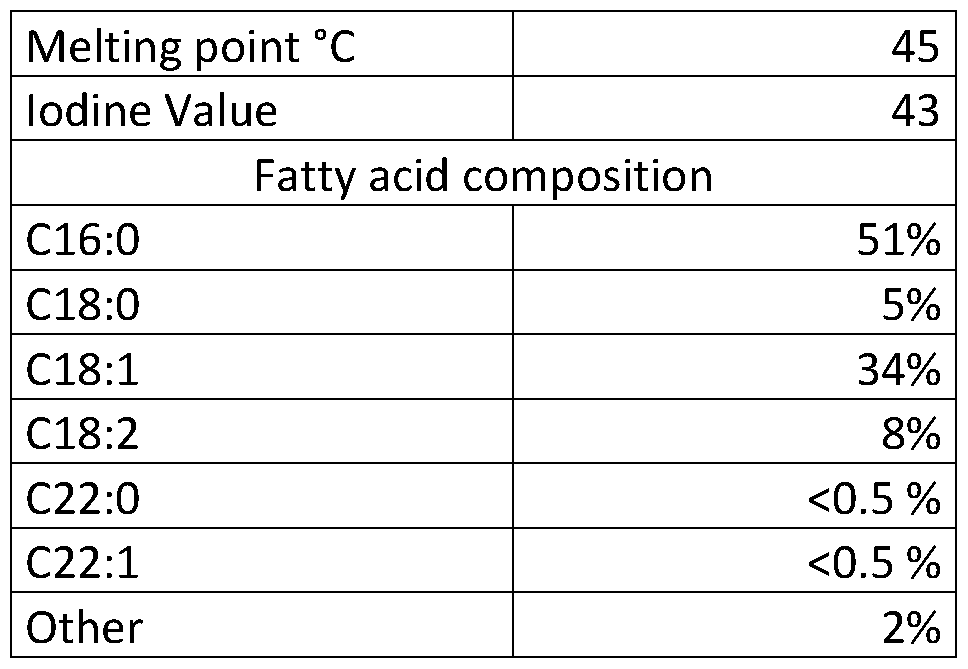 Table 6
Example 6: (E6)
5 kg of a high erucic oil were partially hydrogenated, bleached and deodorized. The partially hydrogenated High erucic wax composition was characterized as set in Table 7 below. The triacylglycerol level was above 99%.
 Table 7
Example 7: (E7)
Akofine R is a commercially available fully hydrogenated rapeseed oil characterized by the triacylglycerols as in table 8 below and by having < 2 in iodine value.


Table 8
Example 8: (E8)
5 kg of a rape seed oil, low in erucic acid was partially hydrogenated, bleached and deodorized. The partially hydrogenated wax composition was characterized as set in Table 9 below. The triacylglycerol level was above 99%.

Table 9
Example 9: (E9)
116 grams of example 6, 40 grams of example 7 and 744 g of Example 8 was blended creating a wax composition with the characterization as set in Table 10 below. The triacylglycerol level was above 99%.

Table 10
Example 10 (E10)
120 gram of Example 9 and 880 grams of Example 5 was blended giving the total wax composition as characterized in Table 11 below. The triacylglycerol level was above 99%.

Table 11
Example 11
The compositions El and E2 were melted to 80 °C and kept at 80 °C for 30 minutes. E3-E5, E9 and E10 were melted to 50 °C and kept at 50 °C for 30 minutes. 250 grams of each composition (E1-E5, E9 and E10) were added to glass jars including a wicket, respectively. The wicket used was Wick / TLR 15/50/23 - NST-7. The filled jars were cooled to room temperature under ambient conditions. After two weeks of storage the samples were evaluated as seen in Table 12 below.
 Table 12
Smooth surface represents the visual aspect of the surface, where a smooth shiny surface is wished for resulting in a score of 5. A score of one (1) is a rough and not attractive surface.
Table 12
Smooth surface represents the visual aspect of the surface, where a smooth shiny surface is wished for resulting in a score of 5. A score of one (1) is a rough and not attractive surface.
Cracks are not wished for. No cracks results in a score of 5 while a score of 1 represent several large cracks.
Frosting is related to the appearance of white patches on the top or side of the candles. They appear very quickly after the cooling process and is not considered nice. A score of 5 means no sign of white patches which a score of one is full coverage of white patches. Scores which is 4 and 5 are acceptable levels for all parameters evaluated.
Example El and E2 required much higher handling temperatures (80 °C) than the samples E9 and E10 due to the high melting point of the wax composition. Samples E9 and E10 required a lower and safer temperature of 50 °C. Therefore, this ensures a safer working environment and is thus an advantage. In addition, the surfaces of El and E2 were not smooth. Especially for sample El, the frosting parameter were extremely poor.
E3 and E4 resulted in poor surface appearances as well as low frosting scores.
E5 had a rather reasonable frosting effect but the surface was not smooth at all hence ended in an overall less desirable appearance. E9 was the only sample reaching acceptable levels in all criteria. It was shown (E10) that a small addition of high erucic rapeseed oil (resulting in 0.5 % of C22:l fatty acids) was enough to improve the overall appearance of E5 and especially the surface appearance.
Example 12 (E12) A partially hydrogenated rape seed oil followed by bleaching and deodorization was made. The created wax composition was characterized as set in Table 13 below. The triacylglycerol level was above 99%.


Table 13
Example 13 (E13)
A partially hydrogenated blend of rape seed oil (19 %) and palm oil (81 %) followed by bleaching and deodorization was made. The created wax composition was characterized as set in Table 14 below. The triacylglycerol level was above 99%.
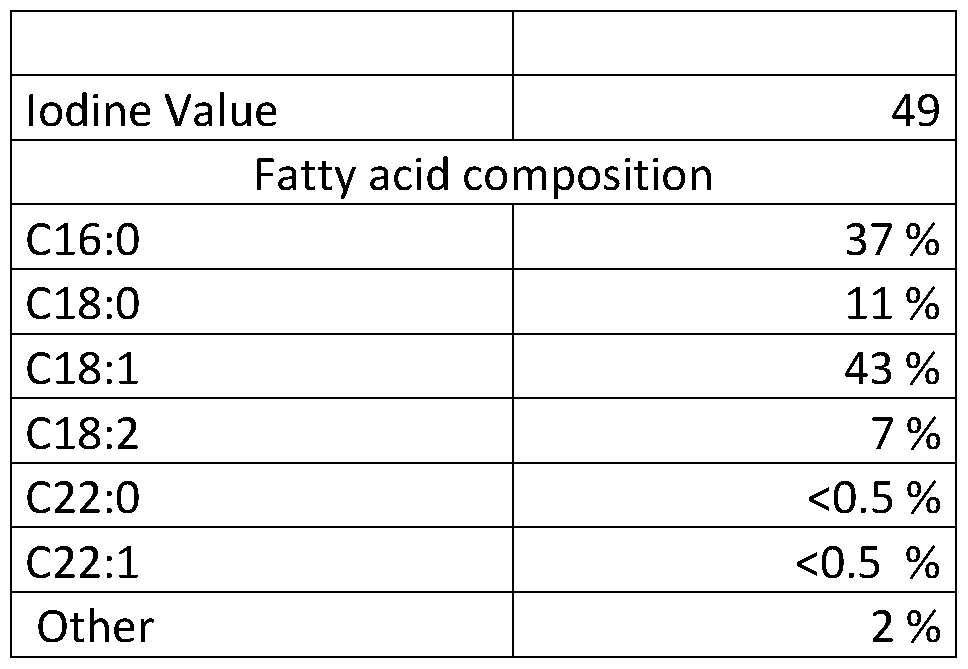
Table 14
Example 14 (E14)
A partially hydrogenated rape seed oil followed by bleaching and deodorization was made. The created wax composition was characterized as set in Table 15 below. The triacylglycerol level was above 99%.

Table 15
Example 15 (E15)
5 kg of wax composition of a blend of palm oil (10%), coco nut oil (10 %) and rape seed oil (80%) were partially hydrogenated, bleached and deodorized characterized as set in Table 16 below. The triacylglycerol level was above 99%.

Table 16
Example 16 (E16)
970 grams of Example 15 and 30 grams of sorbitan tristearate (STS, CAS 26658-19-5) blended giving the total wax composition as characterized in Table 17 below. The triacylglycerol level was above 97%. STS is a polyolester.

Table 17
Example 17 (E17)
120 grams of example 6 and 880 grams of example 12 was blended resulting in a wax composition characterized as set in Table 18 below. The triacylglycerol level was above 99%.


Table 18
Example 18 (E18)
470 grams of example 6 and 530 grams of example 13 was blended resulting in a wax composition characterized as set in Table 19 below. The triacylglycerol level was above 99%.

Table 19
Example 19 (E19)
350 grams of example 6 and 650 grams of example 14 were blended giving a wax composition characterized as set in Table 20 below. The triacylglycerol level was above 99%.

Table 20
Example 20 (E20)
60 grams of example 6 and 940 grams of example 16 was blended resulting in a wax composition characterized as set in Table 21 below. The triacylglycerol level was above 97% and 3% of a polyol (STS)

Table 21
Example 21 (E21)
A blend of High erucic rape seed oil (25%) and low erucic rape seed oil (75%) were partially hydrogenated, bleached and deodorized resulting in a wax composition characterized as set in Table 22 below. The triacylglycerol level was above 99%.

Table 22
Example 22 (E22)
A partial hydrogenation of a low erucic rape seed oil followed by bleaching and deodorization resulting in a wax composition characterized as set in Table 23 below. The triacylglycerol level was above 99%.
 Other 1%
Table 23
Example 23 (E23)
490 grams of E21 and 510 grams of E22 were blended resulting in a wax composition characterized as set in Table 24 below. The triacylglycerol level was above 99%.
 Table 24
Example 24
The compositions E17-E20 and E23 were melted to 55 °C and kept at 55 °C for 30 minutes. After that, 250 grams of each components were added into glass jars, separately. The filled jars were cooled to room temperature. After two weeks of storage, the samples were evaluated. The result of this evaluation is summarized in the Table 25 below.

Table 25
Those parameters were previously described on Example 11. The acceptable scores 4 and 5 were achieved on all compositions evaluated. Example 25:
The burning of the compositions in examples E1-E5, E9 and E10 were evaluated.
The height of the flame was measured every 15 minutes for four continuous hours of burning.

Table 26
The numbers represent the height of the flames in millimeters. The wicket used was Wick / TLR 15/50/23 - NST 7.
The examples E9 and E10 generated larger clearer flames than the examples E1-E5. The examples E9 and E10 resulted in stable flames of above 30 mm while E1-E5 all generated flames having an average height below 30 mm.
The jars were weighed before and after 240 minutes of burning, resulting in the amount of burned material, as seen bellow:
 Table 27
The lowest amount of consumed material after 4 hours of burning was found on composition El. The composition E5 showed a larger amount of consumed material.
The yield can be defined as the flame height per consumed material per hour. This indicates how much light can one gram of the wax composition produce every hour while burning.

Table 28
The examples E9 and E10 showed the highest and clearest flames per gram consumed material per hour. The composition E4 also achieved a reasonable yield of above 5, but as the flame height was the second lowest, it does not reach a positive total score.
Example 26: (E26)
5 kg of a high erucic oil were partially hydrogenated, bleached and deodorized. The partially hydrogenated High erucic wax composition was characterized as set in Table 29 below. The triacylglycerol level was above 99%.
 Table 29
Example 27 (E27)
5 kg of a high erucic oil were partially hydrogenated, bleached and deodorized. The partially hydrogenated High erucic wax composition was characterized as set in Table 30 below. The triacylglycerol level was above 99%.


Table 30
Example 28 (E28)
900 grams of E27 and 100 grams of E7 were blended. The wax composition was characterized as set in the Table 31 below. The triacylglycerol level was above 99%.
 Table 31
Example 29 (E29)
150 grams of E26 and 850 grams of E8 was blended. The wax composition was characterized as set in the Table 32 below. The triacylglycerol level was above 99%.

Table 32 Example 30 (E30)
280 grams of E9 and 720 grams of E5 was blended giving the total wax composition as characterized in the Table 33 below. The triacylglycerol level was above 99%.


Table 33
Example 31
The compositions E6 and E28-E30 were melted to 55 °C and kept at 55 °C for 30 minutes. 250 grams of each composition were added into glass jars, separately. The filled jars were cooled to room temperature. After two weeks of storage, the samples were evaluated. The result of this evaluation is summarized in the Table 34 below.

Table 34
Those parameters were previously described on Example 11. The acceptable scores 4 and 5 were achieved on all compositions evaluated.
Example 32 (E32)
A blend of High erucic rape seed oil (25%) and low erucic rape seed oil (75%) were interesterifed followed by partially hydrogenation. The wax was further bleached and deodorized resulting in a wax composition characterized as set in the Table 35 below. The triacylglycerol level was above 98%.


Table 35
Example 33: (E33)
5 kg of a high erucic oil were partially hydrogenated followed by bleaching and deodorization. The partially hydrogenated high erucic oil was interesterified creating a wax composition characterized as set in Table 36 below. The triacylglycerol level was above 98%.

Table 36
Example 34 (E34)
940 grams of Example 15, 30 grams of sorbitan tristearate (STS, CAS 26658-19-5) and 30 grams of a monoglyceride (CAS 31566-31-1) were blended, giving the total wax composition as characterized in the Table 37 below. The triacylglycerol level was above 94%. Both glyceryl monostearate and STS are polyol esters.
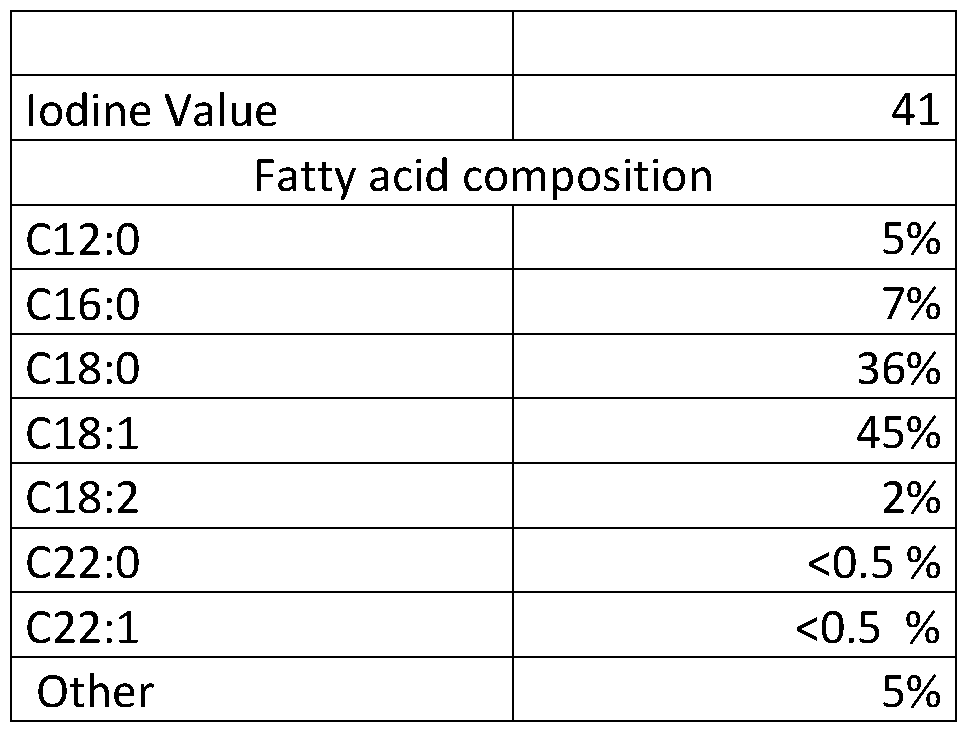
Table 37
Example 35: (E35)
750 grams of example 9 and 250 grams of a commercial paraffin wax, named Paraffin wax SW 5803, were melted at 80 °C and blended creating a wax composition with the fatty acid composition characterized as set in the Table 38 below. The triacylglycerol level was 75 %.

Table 38
Example 36 (E36)
960 grams of Example 19 and 40 grams of a monoglyceride (CAS 31566-31-1) was blended giving the total wax composition as characterized in Table 39. The triglyceride level was above 95%. Glyceryl monostearate is a polyol ester.

Table 39
Example 37 (E37) 200 gram of the blend in example 19 and 36 respectively were melted completely and poured in a see through glass jar. The pull away from the glass was studied, see Table 40. The addition of the monoglyceride improved the pull away further.

Table 40: 4 and 5 are acceptable results
Claims
1. A wax composition, comprising at least 70 wt.% triacylglycerols based on the total weight of the composition, wherein the triacylglycerols comprise 0.5 to 50 wt. % of C22 fatty acid based on the total weight of the triacylglycerols.
2. The wax composition according to claim 1, wherein the triacylglycerols comprise 0.5 to 100 wt. % of partially hydrogenated high erucic rapeseed oil.
3. The wax composition according to claim 2, wherein the wax comprises at least 90 wt.% of triacylglycerols based on the total weight of the composition, and wherein the triacylglycerols comprise 0.5 to 49 wt. % of partially hydrogenated high erucic rapeseed oil and 0.5 to 26 wt. % of C22 fatty acid based on the total weight of the triacylglycerols.
4. The wax composition according to any one of claims 1-3, wherein the triacylglycerols comprise up to 20 wt. % of C22:0 fatty acid and 0.5 to 25 wt.
%. of C22:l fatty acid.
5. The wax composition according to any one of claims 1-4, wherein the triacylglycerols comprise 2 to 29 wt. % of partially hydrogenated high erucic rapeseed oil and 1 to 15 wt. % of C22 fatty acid.
6. The wax composition according to any one of claims 1-5, wherein the triacylglycerols comprise up to 8 wt. % of C22:0 fatty acid and 1 to 15 wt. %. of C22:l fatty acid, preferably up to 8 wt. % of C22:0 fatty acid and 2.5 to 15 wt. % of C22:l fatty acid.
7. The wax composition according to any one of claims 1-6, wherein the wax has a melting point of 35 °C to 52 °C.
8. The wax composition according to any one of claims 2-7, wherein the partially hydrogenated high erucic rapeseed oil has an iodine value of 6 to 75.
9. The wax composition according to any one of claims 1-8, further comprising at least a second oil, preferably soybean oil, palm oil, coconut oil or rapeseed oil.
10. The wax composition according to claim 9, wherein said oils are subsequently partially hydrogenated after blending.
11. The wax composition according to any one of claims 1-10, wherein the wax further comprises at least one polyol-based material, preferably a sorbitan tristearate, monoacylglycerol, sorbitan monostearate, polyglycerol stearate, propyleneglycol stearate or polyglycerol polyricinolates and combinations thereof.
12. The wax composition according to any one of claims 1-11, wherein the wax further comprises a paraffin.
13. The wax composition according to any of claims 2-12, wherein the partially hydrogenated high erucic rapeseed oil is blended to a fully hydrogenated high erucic rapeseed oil to a final concentration of 1-100 wt.%.
14. The wax composition according to any of claims 1-13, wherein the triacylglycerols comprise an interesterified triacylglycerol.
15. A method of preparing a wax composition comprising the steps of: a. providing a triacylglycerol comprising 0.5 to 50 wt. % of C22 fatty acid; b. mixing the triacylglycerol with at least one oil, preferably soybean oil, palm oil, coconut oil or rapeseed oil; and c. obtaining the wax composition.
16. The method according to claim 15, wherein the triacylglycerol comprising 0.5 to 50 wt. % of C22 fatty acid is obtained from a high erucic rapeseed oil.
17. The method according to claims 15 or 16, wherein at least one of the oils is a partially hydrogenated oil.
18. The method according to any one of claims 15-17, further comprising a step of interesterification of triacylglycerols.
19. The method according to any of claims 15-18, further comprising adding at least one polyol-based material, preferably sorbitan tristearate, monoacylglycerol, sorbitan monostearate, polyglycerol stearate, propyleneglycol stearate or polyglycerol polyricinolates and combinations thereof.
20. The method according to any of claims 15-19, further comprising a step of mixing paraffin to the wax composition.
21. A candle comprising a wax composition according to any one of claims 1 to 14.
22. The candle according to claim 21, prepared by a method according to any one of claims 15 to 20.
Priority Applications (3)
| Application Number | Priority Date | Filing Date | Title |
|---|---|---|---|
| EP20899254.5A EP4073214A4 (en) | 2019-12-09 | 2020-12-04 | Wax compositions for use in candles and methods of preparing wax compositions |
| US17/757,042 US12305145B2 (en) | 2019-12-09 | 2020-12-04 | Wax compositions for use in candles and methods of preparing wax compositions |
| US19/185,829 US12516267B2 (en) | 2019-12-09 | 2025-04-22 | Wax compositions for use in candles and methods of preparing wax compositions |
Applications Claiming Priority (2)
| Application Number | Priority Date | Filing Date | Title |
|---|---|---|---|
| SE1951416-5 | 2019-12-09 | ||
| SE1951416 | 2019-12-09 |
Related Child Applications (2)
| Application Number | Title | Priority Date | Filing Date |
|---|---|---|---|
| US17/757,042 A-371-Of-International US12305145B2 (en) | 2019-12-09 | 2020-12-04 | Wax compositions for use in candles and methods of preparing wax compositions |
| US19/185,829 Continuation US12516267B2 (en) | 2019-12-09 | 2025-04-22 | Wax compositions for use in candles and methods of preparing wax compositions |
Publications (1)
| Publication Number | Publication Date |
|---|---|
| WO2021118433A1 true WO2021118433A1 (en) | 2021-06-17 |
Family
ID=76330600
Family Applications (1)
| Application Number | Title | Priority Date | Filing Date |
|---|---|---|---|
| PCT/SE2020/051170 Ceased WO2021118433A1 (en) | 2019-12-09 | 2020-12-04 | Wax compositions for use in candles and methods of preparing wax compositions |
Country Status (3)
| Country | Link |
|---|---|
| US (2) | US12305145B2 (en) |
| EP (1) | EP4073214A4 (en) |
| WO (1) | WO2021118433A1 (en) |
Citations (7)
| Publication number | Priority date | Publication date | Assignee | Title |
|---|---|---|---|---|
| EP0196780A2 (en) * | 1985-03-01 | 1986-10-08 | Kao Corporation | Use of mixed acid triglycerides as a fat blooming inhibitor |
| WO2002092736A1 (en) * | 2001-05-11 | 2002-11-21 | Cargill, Inc. | Triacylglycerol based candle wax |
| WO2003037095A1 (en) * | 2001-11-02 | 2003-05-08 | Aarhus United A/S | Non-lauric, non-trans, non-temper fat compositions |
| US6852140B1 (en) * | 1999-09-24 | 2005-02-08 | Cleanwax, Llc | Low-soot, low-smoke renewable resource candle |
| EP2724620A1 (en) * | 2012-10-26 | 2014-04-30 | Walter RAU Neusser Öl und Fett AG | Oleochmical composition |
| CN104312736A (en) * | 2014-11-24 | 2015-01-28 | 大连达伦特工艺品有限公司 | Canola oil candle and manufacturing method thereof |
| WO2018111181A1 (en) * | 2016-12-16 | 2018-06-21 | Aak Ab (Publ) | A petrolatum substitution preparation |
Family Cites Families (66)
| Publication number | Priority date | Publication date | Assignee | Title |
|---|---|---|---|---|
| US605436A (en) | 1898-06-07 | Inhaler | ||
| US642748A (en) | 1899-02-23 | 1900-02-06 | Arthur Manners | Inhaler. |
| US658436A (en) | 1900-05-28 | 1900-09-25 | Hans Hennerich Groth | Insufflator. |
| US746749A (en) | 1903-03-18 | 1903-12-15 | George E Seidel | Nasal medicator. |
| US794641A (en) | 1905-03-06 | 1905-07-11 | Alfred H Ramey | Inhaler. |
| US902832A (en) | 1907-09-20 | 1908-11-03 | Edward F Philbrook | Inhaler. |
| GB8925352D0 (en) * | 1989-11-09 | 1989-12-28 | Unilever Plc | Fats |
| CA2210717C (en) | 1995-01-23 | 2001-09-11 | Direct-Haler A/S | An inhaler |
| US5797392C1 (en) | 1996-01-22 | 2001-01-09 | Direct Haler As | Inhaler |
| DE69825995T2 (en) | 1997-05-27 | 2005-09-08 | Direct-Haler A/S | INHALER FOR POWDERY MEDICAMENTS |
| US20030061760A1 (en) | 2001-03-08 | 2003-04-03 | Bernard Tao | Vegetable lipid-based composition and candle |
| SI1180378T1 (en) | 1999-03-03 | 2011-04-29 | Optinose As | Nasal delivery device |
| GB0114272D0 (en) | 2001-06-12 | 2001-08-01 | Optinose As | Nasal delivery device |
| GB0121568D0 (en) | 2001-09-06 | 2001-10-24 | Optinose As | Nasal delivery device |
| GB0015309D0 (en) | 2000-06-21 | 2000-08-16 | Djupesland Per G | Apparatus |
| ZA200306564B (en) | 2001-02-26 | 2004-10-15 | Optinose As | Nasal devices. |
| CA2449562A1 (en) * | 2001-08-02 | 2003-02-13 | Archer Daniels Midland Company | Vegetable fat-based candles |
| US7128766B2 (en) | 2001-09-25 | 2006-10-31 | Cargill, Incorporated | Triacylglycerol based wax compositions |
| GB0207422D0 (en) | 2002-03-28 | 2002-05-08 | Optinose As | Nasal devices |
| GB0207817D0 (en) | 2002-04-04 | 2002-05-15 | Optinose As | Nasal devices |
| GB0209494D0 (en) | 2002-04-25 | 2002-06-05 | Optinose As | Nasal devices |
| US7842746B2 (en) * | 2002-05-02 | 2010-11-30 | Archer-Daniels-Midland Company | Hydrogenated and partially hydrogenated heat-bodied oils and uses thereof |
| GB0215270D0 (en) | 2002-07-02 | 2002-08-14 | Optinose As | Nasal devices |
| GB0215904D0 (en) | 2002-07-09 | 2002-08-21 | Team Holdings Uk Ltd | Drug delivery system and method |
| US6773469B2 (en) | 2002-11-12 | 2004-08-10 | Cargill, Incorporated | Triacylglycerol based wax for use in candles |
| GB0300008D0 (en) | 2003-01-02 | 2003-02-05 | Optinose As | Delivery devices |
| US7192457B2 (en) * | 2003-05-08 | 2007-03-20 | Cargill, Incorporated | Wax and wax-based products |
| FI20030735L (en) | 2003-05-16 | 2004-11-17 | Steris Europe Inc | Method and device for treating water |
| GB0311570D0 (en) | 2003-05-20 | 2003-06-25 | Optinose As | Delivery device and method |
| GB0319119D0 (en) | 2003-08-14 | 2003-09-17 | Optinose As | Delivery devices |
| GB0320171D0 (en) | 2003-08-28 | 2003-10-01 | Optinose As | Delivery devices |
| USD530815S1 (en) | 2004-03-19 | 2006-10-24 | Optinose As | Nasal delivery device |
| GB0420513D0 (en) | 2004-09-15 | 2004-10-20 | Optinose As | Powder delivery devices |
| GB0503738D0 (en) | 2005-02-23 | 2005-03-30 | Optinose As | Powder delivery devices |
| WO2007083073A1 (en) | 2006-01-19 | 2007-07-26 | Optinose As | Nasal administration |
| GB0602980D0 (en) | 2006-02-14 | 2006-03-29 | Optinose As | Delivery device and method |
| US8171929B2 (en) | 2006-02-14 | 2012-05-08 | Optinose As | Delivery device and method |
| GB0604319D0 (en) | 2006-03-03 | 2006-04-12 | Optinose As | Nasal delivery |
| GB0604444D0 (en) | 2006-03-06 | 2006-04-12 | Optinose As | Nasal devices |
| GB0605799D0 (en) | 2006-03-23 | 2006-05-03 | Optinose As | Nasal delivery devices |
| GB2437488A (en) | 2006-04-25 | 2007-10-31 | Optinose As | Pharmaceutical oily formulation for nasal or buccal administration |
| GB2438834A (en) | 2006-06-08 | 2007-12-12 | Optinose As | Intranasal protein administration |
| GB2440316A (en) | 2006-07-25 | 2008-01-30 | Optinose As | Nasal inhaler with scrubber |
| GB0623732D0 (en) | 2006-11-28 | 2007-01-10 | Optinose As | Powder delivery devices |
| GB0623731D0 (en) | 2006-11-28 | 2007-01-10 | Optinose As | Delivery device |
| GB0623728D0 (en) | 2006-11-28 | 2007-01-10 | Optinose As | Delivery devices |
| WO2008103289A1 (en) | 2007-02-16 | 2008-08-28 | Elevance Renewable Sciences, Inc. | Wax compositions and methods of preparing wax compositions |
| US20100199984A1 (en) | 2007-04-02 | 2010-08-12 | Abbott Laboratories | Breath actuated nasal pump |
| GB2448183A (en) | 2007-04-05 | 2008-10-08 | Optinose As | Nasal powder delivery device |
| GB2448193A (en) | 2007-04-05 | 2008-10-08 | Optinose As | Nasal delivery device |
| GB0719299D0 (en) | 2007-10-03 | 2007-11-14 | Optinose As | Nasal delivery devices |
| US8899230B2 (en) | 2008-02-15 | 2014-12-02 | Nasologix, Inc. | Aerosol therapy device with high frequency delivery |
| US20110318345A1 (en) | 2008-09-15 | 2011-12-29 | Optinose As | Nasal delivery |
| GB201015371D0 (en) | 2010-09-14 | 2010-10-27 | Optinose As | Nasal delivery |
| US9949923B2 (en) | 2011-03-15 | 2018-04-24 | Optinose As | Nasal delivery |
| MY170349A (en) | 2012-02-24 | 2019-07-22 | Optinose As | Nasal delivery devices |
| DK2817052T3 (en) | 2012-02-24 | 2017-11-27 | Optinose As | NASAL SUBMISSION DEVICES |
| JP6382723B2 (en) | 2012-02-24 | 2018-08-29 | オプティノーズ アズ | Nasal delivery device |
| US20140230314A1 (en) | 2013-02-17 | 2014-08-21 | Elevance Renewable Sciences, Inc. | Wax compositions and the effect of metals on burn rates |
| US11554229B2 (en) | 2013-03-26 | 2023-01-17 | OptiNose Inc. | Nasal administration |
| PL2978482T3 (en) | 2013-03-26 | 2022-10-03 | Optinose As | Nasal administration |
| USD761951S1 (en) | 2013-05-23 | 2016-07-19 | Optinose As | Nosepiece unit |
| USD723156S1 (en) | 2013-05-23 | 2015-02-24 | Optinose As | Nasal delivery device |
| USD725769S1 (en) | 2013-05-23 | 2015-03-31 | Optinose As | Nasal delivery device |
| WO2016079271A1 (en) | 2014-11-19 | 2016-05-26 | Optinose As | Intranasal administration |
| WO2020070321A2 (en) | 2018-10-04 | 2020-04-09 | Optinose As | Exhalation delivery system for and method of treating sinus disease |
-
2020
- 2020-12-04 US US17/757,042 patent/US12305145B2/en active Active
- 2020-12-04 WO PCT/SE2020/051170 patent/WO2021118433A1/en not_active Ceased
- 2020-12-04 EP EP20899254.5A patent/EP4073214A4/en active Pending
-
2025
- 2025-04-22 US US19/185,829 patent/US12516267B2/en active Active
Patent Citations (7)
| Publication number | Priority date | Publication date | Assignee | Title |
|---|---|---|---|---|
| EP0196780A2 (en) * | 1985-03-01 | 1986-10-08 | Kao Corporation | Use of mixed acid triglycerides as a fat blooming inhibitor |
| US6852140B1 (en) * | 1999-09-24 | 2005-02-08 | Cleanwax, Llc | Low-soot, low-smoke renewable resource candle |
| WO2002092736A1 (en) * | 2001-05-11 | 2002-11-21 | Cargill, Inc. | Triacylglycerol based candle wax |
| WO2003037095A1 (en) * | 2001-11-02 | 2003-05-08 | Aarhus United A/S | Non-lauric, non-trans, non-temper fat compositions |
| EP2724620A1 (en) * | 2012-10-26 | 2014-04-30 | Walter RAU Neusser Öl und Fett AG | Oleochmical composition |
| CN104312736A (en) * | 2014-11-24 | 2015-01-28 | 大连达伦特工艺品有限公司 | Canola oil candle and manufacturing method thereof |
| WO2018111181A1 (en) * | 2016-12-16 | 2018-06-21 | Aak Ab (Publ) | A petrolatum substitution preparation |
Non-Patent Citations (3)
| Title |
|---|
| GUAN MEI, CHEN HONG, XIONG XINGHUA, LU XIN, LI XUN, HUANG FENGHONG, GUAN CHUNYUN: "A Study on Triacylglycerol Composition and the Structure of High-Oleic Rapeseed Oil", ENGINEERING, vol. 2, no. 2, 22 June 2016 (2016-06-22), pages 258 - 262, XP055835848 * |
| SANYAL ANUSHREE, PINOCHET XAVIER, MERRIEN ANDRÉ, LAUSTRIAT MARIE, DECOCQ GUILLAUME, FINE FRÉDÉRIC: "Erucic acid rapeseed: 1. Prospects of improvements", OCL, vol. 22, no. 3, 1 May 2015 (2015-05-01), pages D303, XP055938332, ISSN: 2272-6977, DOI: 10.1051/ocl/2015011 * |
| See also references of EP4073214A4 * |
Also Published As
| Publication number | Publication date |
|---|---|
| US20230027101A1 (en) | 2023-01-26 |
| EP4073214A4 (en) | 2023-12-27 |
| US12516267B2 (en) | 2026-01-06 |
| EP4073214A1 (en) | 2022-10-19 |
| US12305145B2 (en) | 2025-05-20 |
| US20250250505A1 (en) | 2025-08-07 |
Similar Documents
| Publication | Publication Date | Title |
|---|---|---|
| US12559698B2 (en) | Wax compositions and the effect of metals on burn rates | |
| US7731767B2 (en) | Vegetable lipid-based composition and candle | |
| US9816052B2 (en) | Candles comprising vegetable oil that is low in polyunsaturation and gelling agent | |
| EP2956010B2 (en) | Fat composition | |
| CN102395665B (en) | Modifier for plastic grease | |
| JPH04179444A (en) | fat obtained from rapeseed | |
| US12516267B2 (en) | Wax compositions for use in candles and methods of preparing wax compositions | |
| EP3247780B1 (en) | Palm oil product for use as a candle wax and process | |
| EP2636312B1 (en) | Glyceride composition | |
| US20260132355A1 (en) | Wax compositions and the effect of metals on burn rates | |
| WO2025117431A1 (en) | Plant-based wax | |
| WO2026075021A1 (en) | Method for producing oil-and-fat composition, method for producing interesterified oil-and-fat composition, method for suppressing crystal precipitation of oil-and-fat composition, and method for suppressing crystal precipitation of interesterified oil-and-fat composition |
Legal Events
| Date | Code | Title | Description |
|---|---|---|---|
| 121 | Ep: the epo has been informed by wipo that ep was designated in this application |
Ref document number: 20899254 Country of ref document: EP Kind code of ref document: A1 |
|
| NENP | Non-entry into the national phase |
Ref country code: DE |
|
| ENP | Entry into the national phase |
Ref document number: 2020899254 Country of ref document: EP Effective date: 20220711 |
|
| WWG | Wipo information: grant in national office |
Ref document number: 17757042 Country of ref document: US |