WO2021172384A1 - 二次電池用結着剤 - Google Patents
二次電池用結着剤 Download PDFInfo
- Publication number
- WO2021172384A1 WO2021172384A1 PCT/JP2021/006946 JP2021006946W WO2021172384A1 WO 2021172384 A1 WO2021172384 A1 WO 2021172384A1 JP 2021006946 W JP2021006946 W JP 2021006946W WO 2021172384 A1 WO2021172384 A1 WO 2021172384A1
- Authority
- WO
- WIPO (PCT)
- Prior art keywords
- secondary battery
- binder
- active material
- repeating unit
- mass
- Prior art date
- Legal status (The legal status is an assumption and is not a legal conclusion. Google has not performed a legal analysis and makes no representation as to the accuracy of the status listed.)
- Ceased
Links
Classifications
-
- H—ELECTRICITY
- H01—ELECTRIC ELEMENTS
- H01M—PROCESSES OR MEANS, e.g. BATTERIES, FOR THE DIRECT CONVERSION OF CHEMICAL ENERGY INTO ELECTRICAL ENERGY
- H01M4/00—Electrodes
- H01M4/02—Electrodes composed of, or comprising, active material
- H01M4/62—Selection of inactive substances as ingredients for active masses, e.g. binders, fillers
- H01M4/621—Binders
- H01M4/622—Binders being polymers
-
- C—CHEMISTRY; METALLURGY
- C08—ORGANIC MACROMOLECULAR COMPOUNDS; THEIR PREPARATION OR CHEMICAL WORKING-UP; COMPOSITIONS BASED THEREON
- C08F—MACROMOLECULAR COMPOUNDS OBTAINED BY REACTIONS ONLY INVOLVING CARBON-TO-CARBON UNSATURATED BONDS
- C08F20/00—Homopolymers and copolymers of compounds having one or more unsaturated aliphatic radicals, each having only one carbon-to-carbon double bond, and only one being terminated by only one carboxyl radical or a salt, anhydride, ester, amide, imide or nitrile thereof
- C08F20/02—Monocarboxylic acids having less than ten carbon atoms, Derivatives thereof
- C08F20/10—Esters
-
- C—CHEMISTRY; METALLURGY
- C08—ORGANIC MACROMOLECULAR COMPOUNDS; THEIR PREPARATION OR CHEMICAL WORKING-UP; COMPOSITIONS BASED THEREON
- C08F—MACROMOLECULAR COMPOUNDS OBTAINED BY REACTIONS ONLY INVOLVING CARBON-TO-CARBON UNSATURATED BONDS
- C08F216/00—Copolymers of compounds having one or more unsaturated aliphatic radicals, each having only one carbon-to-carbon double bond, and at least one being terminated by an alcohol, ether, aldehydo, ketonic, acetal or ketal radical
- C08F216/02—Copolymers of compounds having one or more unsaturated aliphatic radicals, each having only one carbon-to-carbon double bond, and at least one being terminated by an alcohol, ether, aldehydo, ketonic, acetal or ketal radical by an alcohol radical
- C08F216/04—Acyclic compounds
- C08F216/06—Polyvinyl alcohol ; Vinyl alcohol
-
- C—CHEMISTRY; METALLURGY
- C08—ORGANIC MACROMOLECULAR COMPOUNDS; THEIR PREPARATION OR CHEMICAL WORKING-UP; COMPOSITIONS BASED THEREON
- C08F—MACROMOLECULAR COMPOUNDS OBTAINED BY REACTIONS ONLY INVOLVING CARBON-TO-CARBON UNSATURATED BONDS
- C08F220/00—Copolymers of compounds having one or more unsaturated aliphatic radicals, each having only one carbon-to-carbon double bond, and only one being terminated by only one carboxyl radical or a salt, anhydride ester, amide, imide or nitrile thereof
- C08F220/02—Monocarboxylic acids having less than ten carbon atoms; Derivatives thereof
- C08F220/10—Esters
- C08F220/12—Esters of monohydric alcohols or phenols
- C08F220/14—Methyl esters, e.g. methyl (meth)acrylate
-
- C—CHEMISTRY; METALLURGY
- C08—ORGANIC MACROMOLECULAR COMPOUNDS; THEIR PREPARATION OR CHEMICAL WORKING-UP; COMPOSITIONS BASED THEREON
- C08F—MACROMOLECULAR COMPOUNDS OBTAINED BY REACTIONS ONLY INVOLVING CARBON-TO-CARBON UNSATURATED BONDS
- C08F8/00—Chemical modification by after-treatment
- C08F8/12—Hydrolysis
-
- C—CHEMISTRY; METALLURGY
- C08—ORGANIC MACROMOLECULAR COMPOUNDS; THEIR PREPARATION OR CHEMICAL WORKING-UP; COMPOSITIONS BASED THEREON
- C08L—COMPOSITIONS OF MACROMOLECULAR COMPOUNDS
- C08L33/00—Compositions of homopolymers or copolymers of compounds having one or more unsaturated aliphatic radicals, each having only one carbon-to-carbon double bond, and only one being terminated by only one carboxyl radical, or of salts, anhydrides, esters, amides, imides or nitriles thereof; Compositions of derivatives of such polymers
- C08L33/04—Homopolymers or copolymers of esters
-
- H—ELECTRICITY
- H01—ELECTRIC ELEMENTS
- H01M—PROCESSES OR MEANS, e.g. BATTERIES, FOR THE DIRECT CONVERSION OF CHEMICAL ENERGY INTO ELECTRICAL ENERGY
- H01M10/00—Secondary cells; Manufacture thereof
- H01M10/05—Accumulators with non-aqueous electrolyte
- H01M10/052—Li-accumulators
- H01M10/0525—Rocking-chair batteries, i.e. batteries with lithium insertion or intercalation in both electrodes; Lithium-ion batteries
-
- H—ELECTRICITY
- H01—ELECTRIC ELEMENTS
- H01M—PROCESSES OR MEANS, e.g. BATTERIES, FOR THE DIRECT CONVERSION OF CHEMICAL ENERGY INTO ELECTRICAL ENERGY
- H01M4/00—Electrodes
- H01M4/02—Electrodes composed of, or comprising, active material
- H01M4/13—Electrodes for accumulators with non-aqueous electrolyte, e.g. for lithium-accumulators; Processes of manufacture thereof
-
- H—ELECTRICITY
- H01—ELECTRIC ELEMENTS
- H01M—PROCESSES OR MEANS, e.g. BATTERIES, FOR THE DIRECT CONVERSION OF CHEMICAL ENERGY INTO ELECTRICAL ENERGY
- H01M4/00—Electrodes
- H01M4/02—Electrodes composed of, or comprising, active material
- H01M4/13—Electrodes for accumulators with non-aqueous electrolyte, e.g. for lithium-accumulators; Processes of manufacture thereof
- H01M4/133—Electrodes based on carbonaceous material, e.g. graphite-intercalation compounds or CFx
-
- H—ELECTRICITY
- H01—ELECTRIC ELEMENTS
- H01M—PROCESSES OR MEANS, e.g. BATTERIES, FOR THE DIRECT CONVERSION OF CHEMICAL ENERGY INTO ELECTRICAL ENERGY
- H01M4/00—Electrodes
- H01M4/02—Electrodes composed of, or comprising, active material
- H01M4/13—Electrodes for accumulators with non-aqueous electrolyte, e.g. for lithium-accumulators; Processes of manufacture thereof
- H01M4/134—Electrodes based on metals, Si or alloys
-
- H—ELECTRICITY
- H01—ELECTRIC ELEMENTS
- H01M—PROCESSES OR MEANS, e.g. BATTERIES, FOR THE DIRECT CONVERSION OF CHEMICAL ENERGY INTO ELECTRICAL ENERGY
- H01M4/00—Electrodes
- H01M4/02—Electrodes composed of, or comprising, active material
- H01M4/36—Selection of substances as active materials, active masses, active liquids
- H01M4/362—Composites
- H01M4/364—Composites as mixtures
-
- H—ELECTRICITY
- H01—ELECTRIC ELEMENTS
- H01M—PROCESSES OR MEANS, e.g. BATTERIES, FOR THE DIRECT CONVERSION OF CHEMICAL ENERGY INTO ELECTRICAL ENERGY
- H01M4/00—Electrodes
- H01M4/02—Electrodes composed of, or comprising, active material
- H01M4/36—Selection of substances as active materials, active masses, active liquids
- H01M4/38—Selection of substances as active materials, active masses, active liquids of elements or alloys
- H01M4/386—Silicon or alloys based on silicon
-
- H—ELECTRICITY
- H01—ELECTRIC ELEMENTS
- H01M—PROCESSES OR MEANS, e.g. BATTERIES, FOR THE DIRECT CONVERSION OF CHEMICAL ENERGY INTO ELECTRICAL ENERGY
- H01M4/00—Electrodes
- H01M4/02—Electrodes composed of, or comprising, active material
- H01M4/36—Selection of substances as active materials, active masses, active liquids
- H01M4/48—Selection of substances as active materials, active masses, active liquids of inorganic oxides or hydroxides
- H01M4/483—Selection of substances as active materials, active masses, active liquids of inorganic oxides or hydroxides for non-aqueous cells
-
- H—ELECTRICITY
- H01—ELECTRIC ELEMENTS
- H01M—PROCESSES OR MEANS, e.g. BATTERIES, FOR THE DIRECT CONVERSION OF CHEMICAL ENERGY INTO ELECTRICAL ENERGY
- H01M4/00—Electrodes
- H01M4/02—Electrodes composed of, or comprising, active material
- H01M4/36—Selection of substances as active materials, active masses, active liquids
- H01M4/58—Selection of substances as active materials, active masses, active liquids of inorganic compounds other than oxides or hydroxides, e.g. sulfides, selenides, tellurides, halogenides or LiCoFy; of polyanionic structures, e.g. phosphates, silicates or borates
- H01M4/583—Carbonaceous material, e.g. graphite-intercalation compounds or CFx
- H01M4/587—Carbonaceous material, e.g. graphite-intercalation compounds or CFx for inserting or intercalating light metals
-
- Y—GENERAL TAGGING OF NEW TECHNOLOGICAL DEVELOPMENTS; GENERAL TAGGING OF CROSS-SECTIONAL TECHNOLOGIES SPANNING OVER SEVERAL SECTIONS OF THE IPC; TECHNICAL SUBJECTS COVERED BY FORMER USPC CROSS-REFERENCE ART COLLECTIONS [XRACs] AND DIGESTS
- Y02—TECHNOLOGIES OR APPLICATIONS FOR MITIGATION OR ADAPTATION AGAINST CLIMATE CHANGE
- Y02E—REDUCTION OF GREENHOUSE GAS [GHG] EMISSIONS, RELATED TO ENERGY GENERATION, TRANSMISSION OR DISTRIBUTION
- Y02E60/00—Enabling technologies; Technologies with a potential or indirect contribution to GHG emissions mitigation
- Y02E60/10—Energy storage using batteries
Definitions
- the present invention relates to a binder for a secondary battery, a mixture for a secondary battery electrode, an electrode for a secondary battery, and a secondary battery.
- Lithium-ion secondary batteries have high working voltage and energy density, and are therefore used as power sources for notebook computers, mobile phones, electric vehicles, and the like. In these applications, it is necessary to repeatedly charge and discharge the lithium ion secondary battery and reuse it, so that the life of the battery is required to be extended.
- the electrode of a lithium ion secondary battery is usually a battery electrode in which an active material (electrode active material), a conductive auxiliary agent, etc. are mixed with a solution or slurry in which a binder for a battery electrode is dissolved in a solvent or dispersed in a dispersion medium.
- a mixture slurry (hereinafter, may be simply referred to as a slurry) is applied to a current collector, and the solvent and dispersion medium are removed by a method such as drying to bind the active material current collectors and the active materials together.
- the positive electrode is a positive electrode mixture in which an active material (lithium cobalt oxide (LiCoO 2 ), etc.), a binder (polyvinylidene fluoride (PVDF), etc.), a conductive auxiliary agent (carbon black, etc.) are dispersed in a dispersion medium.
- the slurry is obtained by coating and drying on an aluminum foil current collector.
- the negative electrode is made of active material (graphite (graphite), etc.), binder (carboxymethyl cellulose (CMC), styrene-butadiene rubber (SBR), PVDF, polyimide, etc.), conductive auxiliary agent (carbon black), etc. in water or organic. It is obtained by applying and drying a negative electrode mixture slurry dispersed in a solvent on a copper foil current collector.
- Japanese Unexamined Patent Publication No. 7-240201 Japanese Unexamined Patent Publication No. 10-294112 International Publication No. 2004/049475 Japanese Unexamined Patent Publication No. 10-302799
- Lithium secondary battery p. 132 (Ohmsha Co., Ltd., issued on March 20, 2008)
- the negative electrode active material when silicon-containing particles such as silicon particles and silicon oxide particles are used as the negative electrode active material, the volume change of the negative electrode active material due to the occlusion and release reaction of lithium ions during charging and discharging is remarkably large, so that the negative electrode current collection It is known that the negative electrode mixture is peeled off from the body and the negative electrode active material is easily separated.
- PVDF Polyvinylidene fluoride
- Styrene-butadiene rubber which is a rubbery polymer, is being studied as an aqueous binder that is expected to have the effect of reducing the environmental load without reducing the binding force.
- SBR Styrene-butadiene rubber
- the main object of the present invention is to provide a binder for a secondary battery, which has excellent binding power.
- Another object of the present invention is to provide a mixture for a secondary battery electrode, an electrode for a secondary battery, and a secondary battery using the binder for the secondary battery.
- the present inventors have diligently studied to solve the above-mentioned problems. As a result, it is a binder for a secondary battery containing a polymer compound, contains an acrylic repeating unit, and the yellowness of a 3% by mass aqueous solution of the polymer compound is not more than a predetermined value. I found that I could exert my strength.
- the present invention is an invention completed through further diligent studies based on such findings.
- the present invention provides an invention having the following configuration.
- Item 1 A binder for secondary batteries containing a polymer compound.
- the polymer compound contains an acrylic repeating unit and contains A binder for a secondary battery, wherein the yellowness of the 3% by mass aqueous solution of the polymer compound is 14 or less.
- Item 2. Item 2.
- R 1 is independently a hydrogen atom or a methyl group
- R 2 is independently an NH 2 , an OH group, an ONa group or an OLi group.
- a mixture for a secondary battery electrode which comprises the binder for a secondary battery according to Item 1 or 2 and an active material.
- Item 4. Item 3. The mixture for a secondary battery electrode according to Item 3, wherein the active material contains a carbon material.
- Item 5. Item 3. The mixture for a secondary battery electrode according to Item 3 or 4, wherein the active material contains at least one of silicon and a silicon oxide.
- An electrode for a secondary battery which comprises the mixture for the secondary battery electrode according to any one of Items 3 to 5.
- Item 8. A lithium ion secondary battery including the electrode for a secondary battery according to item 6.
- a binder for a secondary battery which has excellent binding power. Further, according to the present invention, a mixture for a secondary battery electrode, an electrode for a secondary battery, and a secondary battery (such as a lithium ion secondary battery) using the binder for the secondary battery are provided. Also aims.
- the binder for a secondary battery of the present invention is a binder for a secondary battery containing a polymer compound, and the polymer compound contains an acrylic repeating unit and is yellow in a 3% by mass aqueous solution of the polymer compound. The degree is 14 or less.
- the binder for a secondary battery of the present invention (hereinafter, may be referred to as a "binding agent”) exhibits excellent binding properties by having such characteristics.
- the binder for a secondary battery of the present invention a mixture for a secondary battery electrode using the binder, an electrode for a secondary battery, and a secondary battery (such as a lithium ion secondary battery) will be described in detail.
- the numerical values connected by "-" mean a numerical range including the numerical values before and after "-" as the lower limit value and the upper limit value.
- any lower limit value and upper limit value can be selected and connected by " ⁇ ".
- the binder for secondary batteries of the present invention is a binder for secondary batteries containing a polymer compound.
- the polymer compound contains an acrylic repeating unit.
- the yellowness of the 3% by mass aqueous solution of the polymer compound is 14 or less.
- the binder for a secondary battery of the present invention exhibits excellent binding properties when a polymer compound satisfies such a constitution. Regarding the relationship between the yellowness and the binding force, it is considered that the presence of impurities as coloring components between the binder and the base material inhibits the binding of the binder. That is, a polymer compound containing an acrylic repeating unit is likely to be colored by an unreacted monomer when each monomer forming these repeating units is copolymerized.
- the amount of unreacted monomer is as small as possible, but it is difficult to completely eliminate it, which affects the magnitude of yellowness, and the coloring changes depending on the amount and type of the unreacted monomer, and the yellowness also changes.
- the yellowness also changes depending on the saponification conditions (saponification temperature, mixing speed of each component, etc.) when producing the polymer compound.
- the addition of hydrazine or the like that reacts with the unreacted monomer in the production process also affects the yellowness, and the magnitude of the yellowness can be adjusted.
- the yellowness of the 3% by mass aqueous solution of the polymer compound lowers the saponification temperature, mixes each component at once at the time of saponification, or uses hydrazine or the like. This makes it easier to set the yellowness to 14 or less.
- the yellowness is a YI value measured using a spectrophotometer, and a specific measurement method is as follows. First, 0.6 g of the polymer compound is measured, 19.4 g of water is added, and the mixture is heated and dissolved at 80 ° C. for 3 hours to obtain a 3% by mass aqueous solution of each copolymer. Using the obtained 3% by mass aqueous solution as a measurement sample, the yellowness (YI value) is measured using a spectrophotometer. At the time of measurement, the measurement sample is heated in a water bath at 93 ° C. and immediately taken into a quartz cell (optical path length 10 mm) after the internal temperature reaches 90 ° C.
- the yellowness of the 3% by mass aqueous solution of the polymer compound may be 14 or less, but from the viewpoint of further enhancing the binding force, it is preferably 12 or less, more preferably 8. Below, it is more preferably 6 or less.
- the lower limit of the yellowness of the 3% by mass aqueous solution of the polymer compound is 0.
- the acrylic repeating unit is, for example, a repeating unit represented by the formula (1).
- R 1 is an independent hydrogen atom or a methyl group
- R 2 is an independent NH 2 , OH group, ONa group or OLi group, respectively.
- the polymer compound includes at least a repeating unit in which R 2 is an NH 2 group, a repeating unit in which R 2 is an OH group, a repeating unit in which R 2 is an ONa group, and a repeating unit in which R 2 is an OLi group. It suffices if one is included. That is, the repeating unit of the above formula (1) contained in the polymer compound may be only a repeating unit in which R 2 is an NH 2 group, or may be only a repeating unit in which R 2 is an OH group.
- R 2 may be only a repeating unit in which R 2 is an ONa group, or it may be only a repeating unit in which R 2 is an OLi group.
- a repeating unit in which R 2 is an ONa group and a repeating unit in which an OH group is an OH group may be included, or in the above formula (1), a repeating unit in which R 2 is an OLi group and an OH group. It may contain a repeating unit in which R 2 is an NH 2 group and a repeating unit in which R 2 is an OH group in the above formula (1), or R in the above formula (1).
- R 2 may also include a repeating unit is a repeating unit ONa groups are recurring units and OH group is NH 2 group, the repeating units and OH in the formula (1)
- R 2 is NH 2 group A repeating unit which is a group, a repeating unit which is an ONa group, and a repeating unit which is an OLi group may be included, or a repeating unit in which R 2 is an OH group and a repeating unit which is an OLi group in the above formula (1).
- 2 NHs may be included in the repeating unit.
- the acrylic repeating unit is not particularly limited, for example, the ratio of the repeating unit represented by the formula (1). From the viewpoint of further improving the binding force of the binder for a secondary battery of the present invention, it is represented by the above formula (1) when the total ratio of the repeating units constituting the polymer compound is 100 mol%.
- the total proportion of the repeating units is preferably 5 to 95 mol%, more preferably 10 to 90 mol%, still more preferably 10 to 80 mol%.
- the polymer compound preferably contains a vinyl alcohol-based repeating unit. Specifically, it is more preferable to include a repeating unit represented by the formula (2).
- the total ratio thereof is not particularly limited. From the viewpoint of further improving the binding force of the binder for a secondary battery of the present invention, it is represented by the above formula (2) when the total ratio of the repeating units constituting the polymer compound is 100 mol%.
- the total proportion of the repeating units is preferably 5 to 95 mol%, more preferably 20 to 90 mol%, still more preferably 50 to 90 mol%.
- the polymer compound contains an acrylic repeating unit (for example, a repeating unit represented by the formula (1)) and a vinyl alcohol-based repeating unit (for example, a repeating unit represented by the formula (2)).
- the sequence may be random or block, and is preferably random from the viewpoint of further enhancing the binding force.
- the polymer compound contains an acrylic repeating unit (for example, a repeating unit represented by the formula (1)) and a vinyl alcohol-based repeating unit (for example, a repeating unit represented by the formula (2)).
- the molar ratio of the monomer forming the repeating unit represented by the formula (1) to the monomer forming the repeating unit represented by the formula (2) is preferably 5/95 to 95/5. 10/90 to 70/30 is more preferable, and 15/85 to 65/35 is even more preferable. If the molar ratio of the content of the monomer forming the repeating unit represented by the formula (1) is less than 5/95, the binding force when used as a binder is not sufficient, and 95/5. If it exceeds the molar ratio, it may become brittle when used as a binder, which may be unfavorable.
- the total ratio of the repeating units constituting the polymer compound is 100 mol%
- the total ratio of the acrylic-based repeating units and the total ratio of the vinyl alcohol-based repeating units in the polymer compound is the result.
- it is preferably 80 mol% or more, more preferably 90 mol% or more, further preferably 95 mol% or more, particularly preferably 95 mol% or more, and 100 mol% (that is, a repeating unit constituting the polymer compound). May be only the acrylic-based repeating unit and the vinyl alcohol-based repeating unit).
- repeating units may be included as the repeating unit constituting the polymer compound.
- the other repeating unit may be a repeating unit formed of a monomer copolymerizable with the acrylic repeating unit.
- copolymerizable monomers include monomers having an ethylenically unsaturated bond.
- Specific examples of the monomer having an ethylenically unsaturated bond include styrene, vinyl chloride, ethylene, vinyl sulfonic acid, maleic acid and the like.
- the yellowness of the 3% by mass aqueous solution of the polymer compound can be suitably adjusted by the saponification conditions (saponification temperature, mixing speed of each component, etc.) of the polymer compound.
- the number average molecular weight of the polymer compound is not particularly limited, and is, for example, about 10,000 to 8,000,000, preferably about 30,000 to 1,000,000.
- the number average molecular weight of the polymer compound is a value calculated by GPC (gel permeation chromatography) based on standard polyethylene glycol / polyethylene oxide.
- the method for producing the polymer compound containing the acrylic repeating unit is not particularly limited, and the polymer compound can be produced by using a known method for producing a copolymer.
- a known method for producing a copolymer for example, a method for producing a copolymer of a vinyl alcohol and an ethylenically unsaturated carboxylate alkali metal neutralized product described in WO2017 / 168947 can be mentioned, and the copolymer can be used.
- the yellowness of the 3% by mass aqueous solution of the polymer compound it is possible to adjust the yellowness of the 3% by mass aqueous solution of the polymer compound to 14 or less by cross-linking the polymer compound with a cross-linking agent, as well as the copolymerization conditions (saponification temperature, mixing rate of each component, etc.). can.
- the monomer components thereof may be mixed at the time of polymerization.
- the proportion of the polymer compound is preferably 80% by mass or more, more preferably 90% by mass or more, still more preferably 95% by mass, as long as it exhibits excellent binding force. % Or more, and may be 100% by mass (that is, the binder of the present invention comprises only the above-mentioned polymer compound).
- the binder of the present invention may contain other binder materials different from the above-mentioned polymer compounds.
- Other binder materials include water-based binders that are soluble or dispersible in water.
- Specific examples of other binder materials include, for example, carboxymethyl cellulose (CMC), acrylic resin, sodium polyacrylate, sodium alginate, polyimide (PI), polyamide, polyamideimide, polyacrylic, and styrene butadiene rubber (SBR). , Styrene-ethylene-butylene-styrene copolymer (SEBS), polyvinyl alcohol (PVA), ethylene vinyl acetate copolymer (EVA) and the like.
- CMC carboxymethyl cellulose
- SEBS Styrene-ethylene-butylene-styrene copolymer
- PVA polyvinyl alcohol
- EVA ethylene vinyl acetate copolymer
- the other binder material contained in the binder of the present invention may be one kind or two or more kinds.
- the binder of the present invention contains another binder material, the content thereof can be appropriately adjusted in the range of 0 to 100 parts by mass with respect to 100 parts by mass of the polymer compound. ..
- the binder of the present invention can be suitably used as a binder for a secondary battery, and in particular, is preferably used as a binder contained in a mixture for a secondary battery electrode.
- the secondary battery electrode can be applied to both the positive electrode and the negative electrode.
- Electrode mixture The secondary battery electrode mixture of the present invention (hereinafter, may be referred to as “electrode mixture”) is active with the above-mentioned secondary battery binder of the present invention. It is characterized by containing a substance. As described above, since the binder of the present invention has excellent binding force, it can be suitably used as a mixture for a secondary battery electrode together with an active material.
- the content of the binder of the present invention is preferably 0.5 to 40% by mass, more preferably 1 to 25% by mass, and further preferably 1.5 to 10% by mass. be.
- the content of the binder of the present invention is 0.5% by mass or more, deterioration of cycle life characteristics due to insufficient binding force and aggregation due to insufficient viscosity of the slurry can be suppressed.
- the content is set to 40% by mass or less, a high capacity tends to be obtained when the battery is charged and discharged.
- the electrode mixture of the present invention can be produced by using the binder of the present invention and using a known method. For example, it can be produced by mixing an active material, a binder of the present invention, water, and if necessary, a conductive auxiliary agent, a dispersion auxiliary agent, and the like to form a paste-like slurry.
- the timing of adding water is not particularly limited, and the binder of the present invention may be dissolved in water in advance and then mixed with an active material or the like to form a slurry, or the active material, the binder of the present invention, and further. If necessary, a conductive auxiliary agent, a dispersion auxiliary agent, or the like may be mixed in a solid state, and then water may be added to form a paste-like slurry.
- the proportion of water is preferably 40 to 2000 parts by mass, more preferably 50 to 1000 parts by mass with respect to 100 parts by mass of the solid content of the electrode mixture.
- the active material is an electrode active material, and examples thereof include a negative electrode active material and a positive electrode active material.
- a negative electrode active material it can include, for example, a carbon material, and can include, for example, at least one of silicon and silicon oxide. Specific materials for the negative electrode active material and the positive electrode active material are illustrated below.
- the negative electrode active material is not particularly limited, and a negative electrode active material used in the present technical field can be used, and for example, a carbon material such as crystalline carbon or amorphous carbon can be used.
- crystalline carbons include amorphous, plate-like, scaly, spherical or fibrous natural graphite or graphite such as artificial graphite.
- amorphous carbon include soft carbon (easy graphitizing carbon) or hard carbon (non-graphitizable carbon), mesophase pitch carbides, calcined coke and the like.
- the negative electrode active material a material capable of occluding and releasing a large amount of lithium ions such as silicon (Si), tin (Sn), Ti (titanium) and the like can be used. As long as it is such a material, it is possible to exert the effect of the present invention regardless of whether it is a simple substance, an alloy, a compound, a solid solution and a silicon-containing material, a tin-containing material, or a composite active material containing a titanium-containing material. be. Silicon-containing materials include Si, SiOx (0.05 ⁇ x ⁇ 1.95), or any of these, B, Mg, Ni, Ti, Mo, Co, Ca, Cr, Cu, Fe, Mn, Nb.
- an alloy or compound in which a part of Si is replaced with at least one element selected from the group, a solid solution, or the like can be used. These can be referred to as silicon or silicon oxide.
- silicon or silicon oxide As the tin-containing material, Ni 2 Sn 4 , Mg 2 Sn, SnOx (0 ⁇ x ⁇ 2), SnO 2 , SnSiO 3 , LiSnO and the like can be applied.
- the titanium-containing material lithium titanate such as Li 2 TiO 3 and Li 4 Ti 5 O 12 and a titanium niobium composite compound can be applied. These materials may be used alone or in combination of two or more. Among these, silicon or silicon oxide such as Si alone or silicon oxide is preferable.
- the negative electrode active material silicon or silicon oxide is used as the first negative electrode active material
- the carbon material is used as the second negative electrode active material
- the composite obtained by mixing the first and second negative electrode active materials is used as the negative electrode active material. It is more preferable to use it.
- the mixing ratio of the first and second negative electrode active materials is preferably 5/95 to 95/5 in terms of mass ratio.
- the carbon material any carbon material generally used in non-aqueous electrolyte secondary batteries can be used, and typical examples thereof include crystalline carbon, amorphous carbon, or both of them. May be good. Examples of crystalline carbon include those mentioned above.
- the method for producing the negative electrode active material there are no particular restrictions on the method for producing the negative electrode active material.
- the method for producing the negative electrode active material include a method of mixing the first negative electrode active material and the second negative electrode active material with a ball mill.
- a method of supporting the second negative electrode active material precursor on the particle surface of the first negative electrode active material and carbonizing the precursor by a heat treatment method can be mentioned.
- the second negative electrode active material precursor may be any carbon precursor that can become a carbon material by heat treatment, for example, glucose, citric acid, pitch, tar, binder material (for example, polyvinylidene fluoride, carboxymethyl cellulose, etc.).
- Acrylic resin sodium polyacrylate, sodium alginate, polyimide, polytetrafluoroethylene, polyamide, polyamideimide, polyacrylic, styrene butadiene rubber, polyvinyl alcohol, ethylene vinyl acetate copolymer, etc.
- the heat treatment method is a non-oxidizing atmosphere (reducing atmosphere, inert atmosphere, reduced pressure atmosphere, or other atmosphere that is difficult to oxidize), and heat treatment is performed at 600 to 4000 ° C. to carbonize the carbon precursor to obtain conductivity.
- reducing atmosphere inert atmosphere, reduced pressure atmosphere, or other atmosphere that is difficult to oxidize
- heat treatment is performed at 600 to 4000 ° C. to carbonize the carbon precursor to obtain conductivity.
- the positive electrode active material is not particularly limited, and a positive electrode active material used in the present technical field can be used, and the positive electrode active material may be a lithium-containing composite oxide.
- the conductive auxiliary agent is not particularly limited, and a conductive auxiliary agent used in the present technical field can be used.
- the conductive auxiliary agent is not particularly limited as long as it has conductivity, but carbon powder is preferable.
- Commonly used carbon powders include, for example, acetylene black (AB), ketjen black (KB), graphite, carbon fiber, carbon tube, graphene, amorphous carbon, hard carbon, soft carbon, and glassy carbon. , Carbon materials such as carbon nanofibers and carbon nanotubes. These may be used alone or in combination of two or more.
- the ratio of the conductive auxiliary agent is not particularly limited, but is preferably 0.1 to 30% by mass, preferably 0.5 to 30% by mass, based on 100% by mass of the total mass of the active material, the binder, and the conductive auxiliary agent. 10% by mass is more preferable, and 2 to 5% by mass is further preferable. If the proportion of the conductive auxiliary agent is less than 0.1% by mass, the conductivity of the electrode may not be sufficiently improved. When the proportion of the conductive additive exceeds 30% by mass, the proportion of the active material decreases relatively, so that it is difficult to obtain a high capacity during charging and discharging of the battery, and it is difficult to uniformly disperse the carbon because it repels water. It is not preferable in that it causes aggregation of the active material, and because it is smaller than the active material, the surface area becomes large and the amount of the binder used increases.
- the electrode mixture of the present invention may further contain a dispersion aid.
- the dispersion aid is not particularly limited, and an organic acid containing at least one substituent selected from the group consisting of a hydroxyl group, an amino group and an imino group and a carboxy group, or humic acid is preferable.
- the organic acid having a hydroxyl group and a carboxy group include lactic acid, tartaric acid, citric acid, malic acid, glycolic acid, tartronic acid, glucuronic acid, and fumic acid.
- organic acids having an amino group and a carboxyl group examples include glycine, alanine, phenylalanine, 4-aminobutyric acid, leucine, isoleucine, lysine, glutamic acid, aspartic acid, glutamine, aspartic acid, histidine, tryptophan, cysteine, and these.
- examples include polymers.
- the organic acid having an imino group and a carboxyl group include proline, 3-hydroxyproline, 4-hydroxyproline, pipecolic acid and the like. Among these, glutamic acid, humic acid, glycine, polyglycine, aspartic acid, and glutamic acid are preferable from the viewpoint of availability.
- the total mass of the active material, the binder and the conductive auxiliary agent is 100 parts by mass, and if it is 0.01 parts by mass or more, the active material etc. at the time of preparing the active material dispersion liquid can be efficiently used. And it can be effectively finely dispersed.
- the addition amount thereof is sufficient to be 5.0 parts by mass or less.
- the electrode mixture of the present invention may contain other conventional additives and the like.
- the binder of the present invention is used for the purpose of adhering active materials to each other, active materials and conductive auxiliary agents, and these and a current collector. That is, it is used to form a good active material layer when the slurry is applied onto the current collectors of both poles and dried.
- Electrodes for secondary batteries include the above-mentioned mixture for secondary battery electrodes of the present invention.
- the electrode of the present invention is produced by utilizing the mixture for the secondary battery electrode of the present invention (that is, utilizing the binder of the present invention) and by a method used in the present art. That is, the electrode of the present invention can be produced, for example, by applying the electrode mixture of the present invention to a current collector and drying it.
- the materials constituting the current collector include, for example, C, Cu, Ni, Fe, V, Nb, Ti, Cr, Mo, Ru, Rh, Ta, W, Os, etc. Conductive substances such as Ir, Pt, Au, and Al, and alloys containing two or more of these conductive substances (for example, stainless steel) can be used. Further, the current collector may be Fe plated with Cu. Cu, Ni, stainless steel, etc. are preferable as the material of the current collector of the negative electrode from the viewpoint of high electrical conductivity, stability in the electrolytic solution, and excellent oxidation resistance, and Cu, Ni are used from the viewpoint of material cost. preferable.
- the material constituting the current collector is, for example, conductive such as C, Ti, Cr, Mo, Ru, Rh, Ta, W, Os, Ir, Pt, Au, Al and the like.
- conductive such as C, Ti, Cr, Mo, Ru, Rh, Ta, W, Os, Ir, Pt, Au, Al and the like.
- An alloy containing two or more kinds of a sex substance and these conductive substances can be used.
- C, Al, stainless steel and the like are preferable as the material of the current collector of the positive electrode from the viewpoint of high electrical conductivity, stability in the electrolytic solution and excellent oxidation resistance, and Al is preferable from the viewpoint of material cost.
- the shape of the current collector is not particularly limited, but for example, a foil-like base material, a three-dimensional base material, or the like can be used. However, if a three-dimensional base material (foam metal, mesh, woven fabric, non-woven fabric, expand, etc.) is used, an electrode having a high capacity density can be obtained even with a binder that lacks adhesion to the current collector. .. In addition, the high rate charge / discharge characteristics are also good.
- the secondary battery of the present invention includes the above-mentioned electrode for the secondary battery of the present invention.
- the secondary battery of the present invention may include the electrode for the secondary battery of the present invention as either or both of the positive electrode and the negative electrode.
- the electrode for the secondary battery of the present invention is used (that is, the binder of the present invention is used), and the secondary battery is manufactured by a method used in the present technology.
- the secondary battery of the present invention is preferably a non-aqueous electrolyte secondary battery, and particularly preferably a lithium ion secondary battery. Since the lithium ion secondary battery needs to contain lithium ions, a lithium salt is preferable as the electrolyte. Examples of this lithium salt include lithium hexafluorophosphate, lithium perchlorate, lithium tetrafluoroborate, lithium trifluoromethanesulfonate, and lithium imidelithium trifluoromethanesulfonate.
- One type of electrolyte may be used alone, or two or more types may be used in combination.
- the electrolytic solution for example, propylene carbonate, ethylene carbonate, dimethyl carbonate, diethyl carbonate, ⁇ -butyrolactone and the like can be used.
- One type of electrolytic solution may be used alone, or two or more types may be used in combination.
- propylene carbonate alone, a mixture of ethylene carbonate and diethyl carbonate, or ⁇ -butyrolactone alone is preferable.
- the mixing ratio of the above-mentioned mixture of ethylene carbonate and diethyl carbonate can be arbitrarily adjusted within a range of 10 to 90% by volume of one component.
- the obtained copolymer contains a structure derived from each repeating unit represented by the above formulas (1) and (2). Was confirmed.
- the YI value is 250 nm or more using UH-4150 (manufactured by Hitachi, Ltd.) as a spectrophotometer in accordance with JIS K7373-2006, and using an auxiliary illuminant C and a 2 degree field by a spectrophotometric method.
- Example 1 Preparation of mixture for secondary battery electrodes and electrodes.
- 4 parts by mass of the copolymer obtained in Production Example 1 was dissolved in 96 parts by mass of water to obtain an aqueous solution of a binder (binding agent composition).
- a binder binder (binding agent composition)
- an electrode active material 90.2 parts by mass of artificial graphite (MAG-D manufactured by Hitachi Kasei Co., Ltd.), 6.8 parts by mass of silicon monoxide (Osaka Titanium Technologies) and 75 parts by mass of an aqueous binder solution are added and kneaded. bottom.
- 96 parts by mass of water for adjusting the viscosity was added and kneaded to prepare a slurry negative electrode mixture.
- the obtained negative electrode mixture is applied onto a rolled copper foil having a thickness of 18 ⁇ m, dried, and then the rolled copper foil and the coating film are closely bonded by a roll press machine (manufactured by Ohno Roll Co., Ltd.).
- a negative electrode was prepared by performing heat treatment (reduced pressure, 120 ° C., 12 hours or more).
- the thickness of the active material layer in the obtained negative electrode was 42 ⁇ m, and the capacitance density of the negative electrode was 3.24 mAh / cm 2 .
- Example 2 A negative electrode was produced in the same manner as in Example 1 except that the copolymer obtained in Production Example 2 was used as a binder.
- Example 3 A negative electrode was produced in the same manner as in Example 1 except that the copolymer obtained in Production Example 3 was used as a binder.
- Example 1 A negative electrode was prepared in the same manner as in Example 1 except that the copolymer obtained in Production Example 4 was used as a binder.
- Example 2 A negative electrode was produced in the same manner as in Example 1 except that the copolymer obtained in Production Example 5 was used as the binder.
- a tensile tester small tabletop tester EZ-SX manufactured by Shimadzu Corporation
- a 90-degree peel test of the negative electrode on a stainless steel plate (adhesive tape on the negative electrode fixed to the stainless steel plate).
- a 90-degree peel test was carried out, and the peel strength between the active material layer and the current collector at the negative electrode was measured.
- Table 1 shows the evaluation results of the peeling test (peeling strength).
- the electrode (negative electrode) of Example 1-3 contains the binder (acryl-based repeating unit) produced in Production Example 1-3, and has a copolymer weight of 14 or less in a 3% by mass aqueous solution of the copolymer. It is an electrode for a secondary battery using a binder for a secondary battery containing a coalescence (polymer compound) and an electrode mixture containing an active material. It can be seen that the electrodes of Examples 1-3 have a high binding force of the binder.
Landscapes
- Chemical & Material Sciences (AREA)
- Chemical Kinetics & Catalysis (AREA)
- General Chemical & Material Sciences (AREA)
- Electrochemistry (AREA)
- Engineering & Computer Science (AREA)
- Materials Engineering (AREA)
- Inorganic Chemistry (AREA)
- Health & Medical Sciences (AREA)
- Medicinal Chemistry (AREA)
- Polymers & Plastics (AREA)
- Organic Chemistry (AREA)
- Composite Materials (AREA)
- Manufacturing & Machinery (AREA)
- Battery Electrode And Active Subsutance (AREA)
- Addition Polymer Or Copolymer, Post-Treatments, Or Chemical Modifications (AREA)
Abstract
本発明は、結着力に優れる、二次電池用結着剤を提供する。 高分子化合物を含む二次電池用結着剤であって、 前記高分子化合物は、アクリル系繰り返し単位を含み、 前記高分子化合物の3質量%水溶液の黄色度が、14以下である、二次電池用結着剤。
Description
本発明は、二次電池用結着剤、二次電池電極用合剤、二次電池用電極、及び二次電池に関する。
近年、環境問題の解決、持続可能な循環型社会の実現に対する関心が高まるにつれ、リチウムイオン二次電池に代表される非水電解液二次電池の研究が盛んに行われている。リチウムイオン二次電池は、高い使用電圧とエネルギー密度を有していることから、ノート型パソコン、携帯電話、電気自動車等の電源として用いられている。これらの用途では、リチウムイオン二次電池を繰り返し充放電し、再利用する必要があることから、電池の高寿命化が求められている。
リチウムイオン二次電池の電極は、通常、電池電極用結着剤を溶媒に溶解または分散媒に分散させた溶液もしくはスラリーに、活物質(電極活物質)、導電助剤などを混合した電池電極用合剤スラリー(以下、単にスラリーということがある)を集電体に塗布し、溶媒や分散媒を乾燥などの方法で除去して、活物質集電体間および活物質同士間を結着させて製造される。
例えば、正極は、活物質(コバルト酸リチウム(LiCoO2)など)、結着剤(ポリフッ化ビニリデン(PVDF)など)、導電助剤(カーボンブラックなど)などを分散媒に分散させた正極合剤のスラリーを、アルミニウム箔集電体上に塗工・乾燥することで得られる。
また、負極は、活物質(黒鉛(グラファイト)など)、結着剤(カルボキシメチルセルロース(CMC)、スチレンブタジエンゴム(SBR)、PVDF、ポリイミドなど)、導電助剤(カーボンブラック)などを水または有機溶媒中に分散させた負極合剤スラリーを、銅箔集電体上に塗工・乾燥することで得られる。
リチウム二次電池、p.132(株式会社オーム社、平成20年3月20日発行)
リチウムイオン二次電池の利用拡大に伴い、主に電池の大容量化を目的として、電極反応に直接寄与する負極活物質として、種々の炭素材料(例えば、黒鉛)の利用が検討されている。
また、リチウムイオン二次電池のさらなる大容量化を目的として、電極反応に直接寄与する電極活物質として種々の化合物が提案されており、負極活物質としてリチウムと合金化するケイ素(Si)、スズ(Sn)、ゲルマニウム(Ge)やこれらの酸化物および合金などが検討されている。これらの負極活物質材料の理論容量密度は、炭素材料に比べて大きい。特に、ケイ素粒子や酸化ケイ素粒子などのケイ素含有粒子は安価なため、幅広く検討されている(特許文献1、2および非特許文献1参照)。
しかしながら、ケイ素粒子や酸化ケイ素粒子などのケイ素含有粒子を負極活物質として使用した場合、充放電時におけるリチウムイオンの吸蔵及び放出反応に起因する負極活物質の体積変化が著しく大きいため、負極集電体から負極合剤が剥離し、負極活物質が脱離しやすいことが知られている。
従来、結着剤として用いられているポリフッ化ビニリデン(PVDF)は、結着力と柔軟性が低いため多量に使用する必要があり、さらに、有機溶剤にしか溶解しないため環境負荷の低減できる結着剤が求められてきた(特許文献3および4参照)。
結着力を低下させずに環境負荷を低減させる効果が期待される水系結着剤として、ゴム質重合体であるスチレンブタジエンゴム(SBR)を使用することが検討されている。しかしながら、ケイ素含有粒子を使用した負極のような膨張収縮の大きい活物質を使用した際の結着力に課題がある。
このような状況下、本発明は、結着力に優れる、二次電池用結着剤を提供することを主な目的とする。また、本発明は、当該二次電池用結着剤を利用した、二次電池電極用合剤、二次電池用電極、及び二次電池を提供することも目的とする。
本発明者らは、前記課題を解決するために鋭意検討した。その結果、高分子化合物を含む二次電池用結着剤であって、アクリル系繰り返し単位を含み、高分子化合物の3質量%水溶液の黄色度が、所定値以下であることにより、優れた結着力が発揮されることを見出した。本発明は、このような知見に基づき、さらに鋭意検討を重ねて完成した発明である。
すなわち、本発明は、下記の構成を備える発明を提供する。
項1. 高分子化合物を含む二次電池用結着剤であって、
前記高分子化合物は、アクリル系繰り返し単位を含み、
前記高分子化合物の3質量%水溶液の黄色度が、14以下である、二次電池用結着剤。
項2. 前記高分子化合物は、下記式(1)で表される繰り返し単位を含む、項1記載の二次電池用結着剤。

〔式(1)において、R1は、それぞれ独立に、水素原子又はメチル基であり、R2は、それぞれ独立に、NH2基、OH基、ONa基又はOLi基である。〕
項3. 項1又は2に記載の二次電池用結着剤と、活物質と、を含む、二次電池電極用合剤。
項4. 前記活物質が、炭素材料を含む、項3に記載の二次電池電極用合剤。
項5. 前記活物質が、ケイ素及びケイ素酸化物のうち少なくとも一方を含む、項3又は4に記載の二次電池電極用合剤。
項6. 項3~5のいずれか1項に記載の二次電池電極用合剤を含む、二次電池用電極。
項7. 項6に記載の二次電池用電極を含む、二次電池。
項8. 項6に記載の二次電池用電極を含む、リチウムイオン二次電池。
項1. 高分子化合物を含む二次電池用結着剤であって、
前記高分子化合物は、アクリル系繰り返し単位を含み、
前記高分子化合物の3質量%水溶液の黄色度が、14以下である、二次電池用結着剤。
項2. 前記高分子化合物は、下記式(1)で表される繰り返し単位を含む、項1記載の二次電池用結着剤。
項3. 項1又は2に記載の二次電池用結着剤と、活物質と、を含む、二次電池電極用合剤。
項4. 前記活物質が、炭素材料を含む、項3に記載の二次電池電極用合剤。
項5. 前記活物質が、ケイ素及びケイ素酸化物のうち少なくとも一方を含む、項3又は4に記載の二次電池電極用合剤。
項6. 項3~5のいずれか1項に記載の二次電池電極用合剤を含む、二次電池用電極。
項7. 項6に記載の二次電池用電極を含む、二次電池。
項8. 項6に記載の二次電池用電極を含む、リチウムイオン二次電池。
本発明によれば、結着力に優れる、二次電池用結着剤を提供することができる。また、本発明によれば、当該二次電池用結着剤を利用した、二次電池電極用合剤、二次電池用電極、及び二次電池(リチウムイオン二次電池など)を提供することも目的とする。
本発明の二次電池用結着剤は、高分子化合物を含む二次電池用結着剤であって、高分子化合物は、アクリル系繰り返し単位を含み、高分子化合物の3質量%水溶液の黄色度が、14以下であることを特徴とする。本発明の二次電池用結着剤(以下、「結着剤」と表記することがある)は、このような特徴を備えることにより、優れた結着性を発揮する。以下、本発明の二次電池用結着剤、及びこれを利用した二次電池電極用合剤、二次電池用電極、及び二次電池(リチウムイオン二次電池など)について、詳述する。
なお、本明細書において、「含む」とは、「本質的にからなる」と、「からなる」をも包含する(The term "comprising" includes "consisting essentially of" and "consisting of".)。また、本明細書において、「(メタ)アクリル」とは「アクリル又はメタクリル」を意味し、「(メタ)アクリレート」とは「アクリレート又はメタクリレート」を意味する。
また、本明細書において、「~」で結ばれた数値は、「~」の前後の数値を下限値及び上限値として含む数値範囲を意味する。複数の下限値と複数の上限値が別個に記載されている場合、任意の下限値と上限値を選択し、「~」で結ぶことができるものとする。
1.二次電池用結着剤
本発明の二次電池用結着剤は、高分子化合物を含む二次電池用結着剤である。高分子化合物は、アクリル系繰り返し単位を含む。また、高分子化合物の3質量%水溶液の黄色度は、14以下である。本発明の二次電池用結着剤は、高分子化合物がこのような構成を充足することにより、優れた結着性を発揮する。黄色度と結着力の関係については着色成分となる不純物が結着剤と基材間に存在することにより、結着剤の結着を阻害することが考えられる。すなわち、アクリル系繰り返し単位を含む高分子化合物は、これら繰り返し単位を形成する各モノマーを共重合した場合、未反応のモノマーによる着色が生じやすい。未反応モノマーは、なるべく少ないことが望ましいが、完全に無くすことは困難であり、黄色度の大きさに影響を与え、その量や種類によって着色が変化し、黄色度も変化する。また、黄色度は、高分子化合物を製造する際のけん化条件(けん化温度や、各成分の混合速度など)によっても変化する。さらに、未反応のモノマーと反応するヒドラジン等の製造工程における添加も、黄色度に影響し、黄色度の大きさを調整することができる。従って、本発明の二次電池用結着剤において、高分子化合物の3質量%水溶液の黄色度は、けん化温度を低くしたり、けん化時において各成分を一括で混合したり、ヒドラジンなどを用いることにより、黄色度を14以下に設定しやすくなる。
本発明の二次電池用結着剤は、高分子化合物を含む二次電池用結着剤である。高分子化合物は、アクリル系繰り返し単位を含む。また、高分子化合物の3質量%水溶液の黄色度は、14以下である。本発明の二次電池用結着剤は、高分子化合物がこのような構成を充足することにより、優れた結着性を発揮する。黄色度と結着力の関係については着色成分となる不純物が結着剤と基材間に存在することにより、結着剤の結着を阻害することが考えられる。すなわち、アクリル系繰り返し単位を含む高分子化合物は、これら繰り返し単位を形成する各モノマーを共重合した場合、未反応のモノマーによる着色が生じやすい。未反応モノマーは、なるべく少ないことが望ましいが、完全に無くすことは困難であり、黄色度の大きさに影響を与え、その量や種類によって着色が変化し、黄色度も変化する。また、黄色度は、高分子化合物を製造する際のけん化条件(けん化温度や、各成分の混合速度など)によっても変化する。さらに、未反応のモノマーと反応するヒドラジン等の製造工程における添加も、黄色度に影響し、黄色度の大きさを調整することができる。従って、本発明の二次電池用結着剤において、高分子化合物の3質量%水溶液の黄色度は、けん化温度を低くしたり、けん化時において各成分を一括で混合したり、ヒドラジンなどを用いることにより、黄色度を14以下に設定しやすくなる。
黄色度は、分光光度計を用いて測定されるYI値であり、具体的な測定方法は、次の通りである。まず、高分子化合物0.6gを測りとり、水19.4gを添加し、80℃で3時間加熱溶解して、各共重合体の3質量%水溶液を得る。得られた3質量%水溶液を測定サンプルとし、分光光度計を用いて黄色度(YI値)を測定する。なお、測定時には、測定サンプルを93℃のウォーターバスにて加熱し、内温が90℃到達後すぐに石英セル(光路長10mm)に取る。YI値は、JIS K7373-2006に準拠して、分光光度計(例えばUH-4150((株)日立製作所製)を用い、分光測色方法により、補助イルミナントC、2度視野を用いて、250nm以上800nm以下の範囲を1nm間隔で測定される透過率をもとに、XYZ表色系における三刺激値X,Y,Zを求め、そのX,Y,Zの値から以下の式より算出する。
黄色度(YI)=100(1.2769X-1.0592Z)/Y
黄色度(YI)=100(1.2769X-1.0592Z)/Y
本発明の二次電池用結着剤において、高分子化合物の3質量%水溶液の黄色度は、14以下であればよいが、より結着力を高める観点から、好ましくは12以下、より好ましくは8以下、さらに好ましくは6以下である。なお、高分子化合物の3質量%水溶液の黄色度の下限値は、0である。
前記アクリル系繰り返し単位は、例えば、式(1)で表される繰り返し単位である。

式(1)において、R1は、それぞれ独立に、水素原子又はメチル基であり、R2は、それぞれ独立に、NH2基、OH基、ONa基又はOLi基である。高分子化合物にはR2がNH2基である繰り返し単位、R2がOH基である繰り返し単位、R2がONa基である繰り返し単位、及びR2がOLi基である繰り返し単位のうち、少なくとも1つが含まれていればよい。すなわち、高分子化合物に含まれる前記式(1)の繰り返し単位は、R2がNH2基である繰り返し単位のみであってもよいし、R2がOH基である繰り返し単位のみであってもよいし、R2がONa基である繰り返し単位のみであってもよいし、R2がOLi基である繰り返し単位のみであってもよい。また、前記式(1)においてR2がONa基である繰り返し単位とOH基である繰り返し単位を含んでいてもよいし、前記式(1)においてR2がOLi基である繰り返し単位とOH基である繰り返し単位を含んでいてもよいし、前記式(1)においてR2がNH2基である繰り返し単位とOH基である繰り返し単位を含んでいてもよいし、前記式(1)においてR2がNH2基である繰り返し単位とOH基である繰り返し単位とONa基である繰り返し単位とを含んでいてもよいし、前記式(1)においてR2がNH2基である繰り返し単位とOH基である繰り返し単位とONa基である繰り返し単位とOLi基である繰り返し単位とを含んでいてもよいし、前記式(1)においてR2がOH基である繰り返し単位とOLi基である繰り返し単位とNH2基である繰り返し単位を含んでもいてもよい。
高分子化合物において、アクリル系繰り返し単位としては、例えば、式(1)で表される繰り返し単位の割合については、特に制限されない。本発明の二次電池用結着剤の結着力をより一層向上させる観点からは、高分子化合物を構成する繰り返し単位の合計割合を100mol%とした場合に、前記式(1)で表される繰り返し単位の合計割合は、好ましくは5~95mol%であり、より好ましくは10~90mol%であり、さらに好ましくは10~80mol%である。
前記高分子化合物はビニルアルコール系繰り返し単位を含有していていることが好ましい。具体的には、式(2)で表される繰り返し単位を含むことがより好ましい。

高分子化合物において、前記式(2)で表される繰り返し単位を含む場合、その合計割合については、特に制限されない。本発明の二次電池用結着剤の結着力をより一層向上させる観点からは、高分子化合物を構成する繰り返し単位の合計割合を100mol%とした場合に、前記式(2)で表される繰り返し単位の合計割合は、好ましくは5~95mol%であり、より好ましくは20~90mol%であり、さらに好ましくは50~90mol%である。
高分子化合物において、アクリル系繰り返し単位(例えば、前記式(1)で表される繰り返し単位)、及びビニルアルコール系繰り返し単位(例えば、前記式(2)で表される繰り返し単位)を含む場合、その配列は、ランダムであってもよいし、ブロックであってもよく、結着力をより一層高める観点からは、ランダムであることが好ましい。
高分子化合物において、アクリル系繰り返し単位(例えば、前記式(1)で表される繰り返し単位)、及びビニルアルコール系繰り返し単位(例えば、前記式(2)で表される繰り返し単位)を含む場合、前記式(1)で表される繰り返し単位を形成する単量体と、前記式(2)で表される繰り返し単位を形成する単量体のモル比は、5/95~95/5が好ましく、10/90~70/30がより好ましく、15/85~65/35がさらに好ましい。前記式(1)で表される繰り返し単位を形成する単量体の含有量のモル比が5/95より少ないと、結着剤として使用した際の結着力が十分でなく、95/5のモル比を超えると、結着剤として使用した際に脆くなり好ましくない場合がある。
高分子化合物を構成する繰り返し単位の合計割合を100mol%とした場合に、高分子化合物において、前記アクリル系繰り返し単位の合計割合と、ビニルアルコール系繰り返し単位の合計割合とを合計した割合は、結着力を好適に高める観点から、好ましくは80mol%以上、より好ましくは90mol%以上、さらに好ましくは95mol%以上、特に好ましくは95mol%以上であり、100mol%(すなわち、高分子化合物を構成する繰り返し単位は、前記アクリル系繰り返し単位及びビニルアルコール系繰り返し単位のみ)であってもよい。
高分子化合物を構成する繰り返し単位として、他の繰り返し単位が含まれていてもよい。このような他の繰り返し単位としては、前記アクリル系繰り返し単位と、共重合し得る単量体によって形成される繰り返し単位であればよい。このような共重合し得る単量体としては、エチレン性不飽和結合を有する単量体が挙げられる。前記エチレン性不飽和結合を有する単量体としては、具体的にはスチレン、塩化ビニル、エチレン、ビニルスルホン酸、マレイン酸等が挙げられる。
前述の通り、高分子化合物の3質量%水溶液の黄色度は、高分子化合物のけん化条件(けん化温度、各成分の混合速度など)によって好適に調整することができる。
高分子化合物の数平均分子量としては、特に制限されず、例えば10,000~8,000,000程度、好ましくは30,000~1,000,000程度である。高分子化合物の数平均分子量は、GPC(ゲル浸透クロマトグラフィー)により標準ポリエチレングリコール/ポリエチレンオキサイドを基準にして算出した値である。
前記アクリル系繰り返し単位を含む高分子化合物の製造方法については、特に制限されず、公知の共重合体の製造方法を利用して製造することができる。公知の共重合体の製造方法としては、例えば、WO2017/168947に記載のビニルアルコールとエチレン性不飽和カルボン酸アルカリ金属中和物との共重合体の製造方法が挙げられ、当該共重合体を製造において、けん化条件(けん化温度や各成分の混合速度など)、さらには、高分子化合物を架橋剤で架橋して、高分子化合物の3質量%水溶液の黄色度を14以下に調整することができる。その他の繰り返し単位を高分子化合物に含ませる場合には、そのモノマー成分を重合時に混合すればよい。
本発明の結着剤において、前記の高分子化合物の割合としては、優れた結着力を発揮することを限度として、好ましくは80質量%以上、より好ましくは90質量%以上、さらに好ましくは95質量%以上であり、100質量%(すなわち、本発明の結着剤は、前記の高分子化合物のみからなる)であってもよい。
本発明の結着剤には、前記の高分子化合物とは異なる、他の結着剤材料が含まれていてもよい。他の結着剤材料は、水に可溶又は可分散である、水系結着剤が挙げられる。他の結着剤材料の具体例としては、例えば、カルボキシメチルセルロース(CMC)、アクリル樹脂、ポリアクリル酸ナトリウム、アルギン酸ナトリウム、ポリイミド(PI)、ポリアミド、ポリアミドイミド、ポリアクリル、スチレンブタジエンゴム(SBR)、スチレン-エチレン-ブチレン-スチレン共重合体(SEBS)、ポリビニルアルコール(PVA)、エチレン酢酸ビニル共重合体(EVA)等が挙げられる。本発明の結着剤に含まれる他の結着剤材料は、1種類であってもよいし、2種類以上であってもよい。本発明の結着剤に他の結着剤材料が含まれる場合、その含有量としては、前記の高分子化合物100質量部に対して、0~100質量部の範囲で適宜調整することができる。
本発明の結着剤は、二次電池の結着剤として好適に使用することができ、特に、二次電池電極用合剤に含まれる結着剤として、好適に使用される。なお、二次電池電極は、正極及び負極のいずれにも適用可能である。
2.二次電池電極用合剤
本発明の二次電池電極用合剤(以下、「電極用合剤」と表記することがある)は、前記の本発明の二次電池用結着剤と、活物質とを含むことを特徴とする。前述の通り、本発明の結着剤は、結着力に優れているため、活物質と共に二次電池電極用合剤として好適に使用することができる。
本発明の二次電池電極用合剤(以下、「電極用合剤」と表記することがある)は、前記の本発明の二次電池用結着剤と、活物質とを含むことを特徴とする。前述の通り、本発明の結着剤は、結着力に優れているため、活物質と共に二次電池電極用合剤として好適に使用することができる。
本発明の電極用合剤において、本発明の結着剤の含有率は、好ましくは0.5~40質量%、より好ましくは1~25質量%、さらに好ましくは1.5~10質量%である。本発明の結着剤の含有率が0.5質量%以上であることにより、結着力不足によるサイクル寿命特性の悪化、スラリーの粘性不足による凝集などを抑制することができる。一方、当該含有率を40質量%以下とすることにより、電池の充放電時に高容量が得られる傾向がある。
本発明の電極用合剤は、本発明の結着剤を用い、公知の方法を利用して製造することができる。例えば、活物質、本発明の結着剤、水、さらには必要に応じて、導電助剤、分散助剤などを混合して、ペースト状のスラリーとすることによって、製造することができる。水を加えるタイミングは特に限定されず、本発明の結着剤をあらかじめ水に溶解させてから、活物質などを混合してスラリーとしてもよいし、活物質、本発明の結着剤、さらには必要に応じて、導電助剤、分散助剤などを固体状態で混合した後、水を加えてペースト状のスラリーとしてもよい。
本発明の電極用合剤において、水の割合は、電極用合剤の固形分100質量部に対して、好ましくは40~2000質量部、より好ましくは50~1000質量部が挙げられる。水の割合を上記範囲とすることで、本発明の電極用合剤(スラリー)の取り扱い性がより向上する傾向がある。
[活物質]
活物質は、電極活物質であり、負極活物質または正極活物質が挙げられる。活物質は、例えば負極活物質である場合には、例えば炭素材料などを含むことができ、また、例えばケイ素及びケイ素酸化物のうち少なくとも一方を含むことができる。負極活物質及び正極活物質の具体的材料について、以下に例示する。
活物質は、電極活物質であり、負極活物質または正極活物質が挙げられる。活物質は、例えば負極活物質である場合には、例えば炭素材料などを含むことができ、また、例えばケイ素及びケイ素酸化物のうち少なくとも一方を含むことができる。負極活物質及び正極活物質の具体的材料について、以下に例示する。
(負極活物質)
負極活物質としては、特に制限されず、本技術分野で使用される負極活物質を使用でき、例えば、結晶質炭素や非晶質炭素等の炭素材料を使用することができる。結晶質炭素の例としては、無定形、板状、鱗片状(flake)、球状もしくは繊維状の天然黒鉛または人造黒鉛のような黒鉛が挙げられる。非晶質炭素の例としては、ソフトカーボン(易黒鉛化性炭素)またはハードカーボン(難黒鉛化性炭素)、メソフェーズピッチ炭化物、焼成されたコークス等が挙げられる。また、負極活物質として、ケイ素(Si)、スズ(Sn)、Ti(チタン)などのようにリチウムイオンを大量に吸蔵放出可能な材料を用いることができる。このような材料であれば、単体、合金、化合物、固溶体およびケイ素含有材料、スズ含有材料、チタン含有材料を含む複合活物質のいずれであっても、本発明の効果を発揮させることは可能である。ケイ素含有材料としては、Si、SiOx(0.05<x<1.95)、またはこれらのいずれかにB、Mg、Ni、Ti、Mo、Co、Ca、Cr、Cu、Fe、Mn、Nb、Ta、V、W、Zn、C、N、及びSnからなる群から選択される少なくとも1つ以上の元素でSiの一部を置換した合金や化合物、または固溶体などを用いることができる。これらはケイ素又はケイ素酸化物ということができる。スズ含有材料としてはNi2Sn4、Mg2Sn、SnOx(0<x<2)、SnO2、SnSiO3、LiSnOなどが適用できる。チタン含有材料としてはLi2TiO3,Li4Ti5O12等のチタン酸リチウム、チタンニオブ複合化合物等が適用できる。これらの材料は、一種を単独で使用することもできるし、二種以上を組み合わせて使用することもできる。これらの中でも、Si単体や酸化ケイ素などのケイ素又はケイ素酸化物が好ましい。
負極活物質としては、特に制限されず、本技術分野で使用される負極活物質を使用でき、例えば、結晶質炭素や非晶質炭素等の炭素材料を使用することができる。結晶質炭素の例としては、無定形、板状、鱗片状(flake)、球状もしくは繊維状の天然黒鉛または人造黒鉛のような黒鉛が挙げられる。非晶質炭素の例としては、ソフトカーボン(易黒鉛化性炭素)またはハードカーボン(難黒鉛化性炭素)、メソフェーズピッチ炭化物、焼成されたコークス等が挙げられる。また、負極活物質として、ケイ素(Si)、スズ(Sn)、Ti(チタン)などのようにリチウムイオンを大量に吸蔵放出可能な材料を用いることができる。このような材料であれば、単体、合金、化合物、固溶体およびケイ素含有材料、スズ含有材料、チタン含有材料を含む複合活物質のいずれであっても、本発明の効果を発揮させることは可能である。ケイ素含有材料としては、Si、SiOx(0.05<x<1.95)、またはこれらのいずれかにB、Mg、Ni、Ti、Mo、Co、Ca、Cr、Cu、Fe、Mn、Nb、Ta、V、W、Zn、C、N、及びSnからなる群から選択される少なくとも1つ以上の元素でSiの一部を置換した合金や化合物、または固溶体などを用いることができる。これらはケイ素又はケイ素酸化物ということができる。スズ含有材料としてはNi2Sn4、Mg2Sn、SnOx(0<x<2)、SnO2、SnSiO3、LiSnOなどが適用できる。チタン含有材料としてはLi2TiO3,Li4Ti5O12等のチタン酸リチウム、チタンニオブ複合化合物等が適用できる。これらの材料は、一種を単独で使用することもできるし、二種以上を組み合わせて使用することもできる。これらの中でも、Si単体や酸化ケイ素などのケイ素又はケイ素酸化物が好ましい。
負極活物質としては、ケイ素またはケイ素酸化物を第1負極活物質とし、炭素材料を第2負極活物質として、第1および第2負極活物質を混合して得られる複合体を負極活物質として使用することがより好ましい。この時、第1および第2負極活物質の混合比率は、質量比で5/95~95/5が好ましい。炭素材料としては、非水電解質二次電池で一般に使用される炭素材料であれば如何なるものでも使用でき、その代表的な例としては、結晶質炭素、非晶質炭素またはこれらを共に使用してもよい。結晶質炭素の例としては、前記したものが挙げられる。
負極活物質の製造方法に関しては、特に制限されない。第1負極活物質と第2負極活物質を混合した活物質複合体を製造する際は、両者が均一に分散される方法であれば特に限定されない。負極活物質の製造方法としては、例えば、第1負極活物質と第2負極活物質とをボールミルで混合する方法が挙げられる。その他、例えば、第1負極活物質の粒子表面に、第2負極活物質前駆体を担持させ、これを加熱処理法により炭化する方法が挙げられる。第2負極活物質前駆体としては、加熱処理により炭素材料となり得る炭素前駆体であればよく、例えば、グルコース、クエン酸、ピッチ、タール、結着剤材料(例えば、ポリフッ化ビニリデン、カルボキシメチルセルロース、アクリル樹脂、ポリアクリル酸ナトリウム、アルギン酸ナトリウム、ポリイミド、ポリテトラフルオロエチレン、ポリアミド、ポリアミドイミド、ポリアクリル、スチレンブタジエンゴム、ポリビニルアルコール、エチレン酢酸ビニル共重合体等)等が挙げられる。
加熱処理法とは、非酸化性雰囲気(還元雰囲気、不活性雰囲気、減圧雰囲気等の酸化されにくい雰囲気)で、600~4000℃で加熱処理を施して炭素前駆体を炭化させ、導電性を得る方法である。
(正極活物質)
正極活物質としては、特に制限されず、本技術分野で使用される正極活物質を使用でき、正極活物質は、リチウム含有複合酸化物であってもよい。リチウム含有複合酸化物は、例えば、LiMnO2、LiFeO2、LiCoO2、LiMn2O4、Li2FeSiO4、LiNi1/3Co1/3Mn1/3O2、LiNi0.5Co0.2Mn0.3O2、LiNi0.6Co0.2Mn0.2O2、LiNi0.8Co0.1Mn0.1O2、LiNixCoyMzO2(但し、0.01<x<1、0≦y≦1、0≦z≦1、x+y+z=1であり、MはMn、V、Mg、Mo、Nb、Fe、Cu及びAlからなる群より選ばれる少なくとも1種の元素である。)、LiFePO4等が挙げられる。
正極活物質としては、特に制限されず、本技術分野で使用される正極活物質を使用でき、正極活物質は、リチウム含有複合酸化物であってもよい。リチウム含有複合酸化物は、例えば、LiMnO2、LiFeO2、LiCoO2、LiMn2O4、Li2FeSiO4、LiNi1/3Co1/3Mn1/3O2、LiNi0.5Co0.2Mn0.3O2、LiNi0.6Co0.2Mn0.2O2、LiNi0.8Co0.1Mn0.1O2、LiNixCoyMzO2(但し、0.01<x<1、0≦y≦1、0≦z≦1、x+y+z=1であり、MはMn、V、Mg、Mo、Nb、Fe、Cu及びAlからなる群より選ばれる少なくとも1種の元素である。)、LiFePO4等が挙げられる。
[導電助剤]
導電助剤としては、特に制限されず、本技術分野で使用される導電助剤を使用することができる。導電助剤としては、導電性を有するものであれば特に限定されないが、炭素粉末が好ましい。炭素粉末としては、通常用いられているもの、例えば、アセチレンブラック(AB)、ケッチェンブラック(KB)、黒鉛、カーボンファイバー、カーボンチューブ、グラフェン、非晶質炭素、ハードカーボン、ソフトカーボン、グラッシーカーボン、カーボンナノファイバー、カーボンナノチューブ等の炭素材料が挙げられる。これらは一種を単独で用いてもよいし、又は二種以上を併用してもよい。
導電助剤としては、特に制限されず、本技術分野で使用される導電助剤を使用することができる。導電助剤としては、導電性を有するものであれば特に限定されないが、炭素粉末が好ましい。炭素粉末としては、通常用いられているもの、例えば、アセチレンブラック(AB)、ケッチェンブラック(KB)、黒鉛、カーボンファイバー、カーボンチューブ、グラフェン、非晶質炭素、ハードカーボン、ソフトカーボン、グラッシーカーボン、カーボンナノファイバー、カーボンナノチューブ等の炭素材料が挙げられる。これらは一種を単独で用いてもよいし、又は二種以上を併用してもよい。
導電助剤の割合については、特に限定的ではないが、例えば、活物質、結着剤、及び導電助剤の合計質量100質量%中、0.1~30質量%が好ましく、0.5~10質量%がより好ましく、2~5質量%がさらに好ましい。導電助剤の割合が0.1質量%未満であると、電極の導電性を十分に向上させることができないおそれがある。導電助剤の割合が30質量%を超えると、活物質の割合が相対的に減少するため電池の充放電時に高容量が得られにくいこと、カーボンが水を弾くため均一分散することが難しいため活物質の凝集を招くこと、活物質と比較して小さいため表面積が大きくなり使用する結着剤の量が増えることなどの点で好ましくない。
[分散助剤]
本発明の電極用合剤は、さらに分散助剤を含んでいてもよい。分散助剤としては、特に制限されず、ヒドロキシル基、アミノ基及びイミノ基からなる群から選ばれる少なくとも一種の置換基と、カルボキシ基とを含む有機酸、又はフミン酸が好ましい。ヒドロキシル基とカルボキシ基とを有する有機酸としては、例えば、乳酸、酒石酸、クエン酸、リンゴ酸、グリコール酸、タルトロン酸、グルクロン酸、フミン酸などが挙げられる。アミノ基とカルボキシル基とを有する有機酸としては、例えば、グリシン、アラニン、フェニルアラニン、4-アミノ酪酸、ロイシン、イソロイシン、リジン、グルタミン酸、アスパラギン酸、グルタミン、アスパラギン、ヒスチジン、トリプトファン、システイン、およびこれらのポリマーなどが挙げられる。イミノ基とカルボキシル基とを有する有機酸としては、例えば、プロリン、3-ヒドロキシプロリン、4-ヒドロキシプロリン、ピペコリン酸などが挙げられる。これらの中でも、入手のしやすさの観点から、グルクロン酸、フミン酸、グリシン、ポリグリシン、アスパラギン酸、グルタミン酸が好ましい。
本発明の電極用合剤は、さらに分散助剤を含んでいてもよい。分散助剤としては、特に制限されず、ヒドロキシル基、アミノ基及びイミノ基からなる群から選ばれる少なくとも一種の置換基と、カルボキシ基とを含む有機酸、又はフミン酸が好ましい。ヒドロキシル基とカルボキシ基とを有する有機酸としては、例えば、乳酸、酒石酸、クエン酸、リンゴ酸、グリコール酸、タルトロン酸、グルクロン酸、フミン酸などが挙げられる。アミノ基とカルボキシル基とを有する有機酸としては、例えば、グリシン、アラニン、フェニルアラニン、4-アミノ酪酸、ロイシン、イソロイシン、リジン、グルタミン酸、アスパラギン酸、グルタミン、アスパラギン、ヒスチジン、トリプトファン、システイン、およびこれらのポリマーなどが挙げられる。イミノ基とカルボキシル基とを有する有機酸としては、例えば、プロリン、3-ヒドロキシプロリン、4-ヒドロキシプロリン、ピペコリン酸などが挙げられる。これらの中でも、入手のしやすさの観点から、グルクロン酸、フミン酸、グリシン、ポリグリシン、アスパラギン酸、グルタミン酸が好ましい。
分散助剤の割合については、活物質、結着剤及び導電助剤の合計質量を100質量部として、0.01質量部以上であれば、活物質分散液調製時の活物質等を効率よくかつ効果的に微分散することができる。なお、微分散性および分散安定性を維持するためには、その添加量は5.0質量部以下で十分である。
本発明の電極用合剤は、その他慣用の添加剤等を含んでいてもよい。
本発明の電極用合剤において、本発明の結着剤は、活物質同士、活物質と導電助剤、およびこれらと集電体との接着を目的として使用される。すなわち、両極の集電体上にスラリーを塗布し、乾燥させたときに良好な活物質層を形成するために使用される。
3.二次電池用電極
本発明の二次電池用電極(以下、「電極」と表記することがある)は、前述の本発明の二次電池電極用合剤を含む。本発明の電極は、本発明の二次電池電極用合剤を利用し(すなわち、本発明の結着剤を利用し)、本技術分野で使用される手法によって作製される。すなわち、本発明の電極は、例えば、本発明の電極用合剤を集電体に塗布し、乾燥させることによって作製することができる。
本発明の二次電池用電極(以下、「電極」と表記することがある)は、前述の本発明の二次電池電極用合剤を含む。本発明の電極は、本発明の二次電池電極用合剤を利用し(すなわち、本発明の結着剤を利用し)、本技術分野で使用される手法によって作製される。すなわち、本発明の電極は、例えば、本発明の電極用合剤を集電体に塗布し、乾燥させることによって作製することができる。
本発明の電極が負極である場合、集電体を構成する素材としては、例えば、C、Cu、Ni、Fe、V、Nb、Ti、Cr、Mo、Ru、Rh、Ta、W、Os、Ir、Pt、Au、Al等の導電性物質、これら導電性物質の二種以上を含有する合金(例えば、ステンレス鋼)を使用し得る。また、集電体は、FeにCuをめっきしたものであってもよい。電気伝導性が高く、電解液中の安定性と耐酸化性に優れる観点で、負極の集電体の素材としてはCu、Ni、ステンレス鋼等が好ましく、さらに材料コストの観点からCu、Niが好ましい。
本発明の電極が正極である場合、集電体を構成する素材としては、例えば、C、Ti、Cr、Mo、Ru、Rh、Ta、W、Os、Ir、Pt、Au、Al等の導電性物質、これら導電性物質の二種以上を含有する合金(例えば、ステンレス鋼)を使用し得る。電気伝導性が高く、電解液中の安定性と耐酸化性に優れる観点で、正極の集電体の素材としてはC、Al、ステンレス鋼等が好ましく、さらに材料コストの観点からAlが好ましい。
集電体の形状には特に制約はないが、例えば、箔状基材、三次元基材等を用いることができる。但し、三次元基材(発泡メタル、メッシュ、織布、不織布、エキスパンド等)を用いると、集電体との密着性に欠けるような結着剤であっても高い容量密度の電極が得られる。加えて高率充放電特性も良好となる。
4.二次電池
本発明の二次電池は、前述の本発明の二次電池用電極を含む。本発明の二次電池は、正極及び負極のいずれか一方又は両方として、本発明の二次電池用電極を備えるものであればよい。本発明の二次電池の製造方法としては、本発明の二次電池用電極を利用し(すなわち、本発明の結着剤を利用し)、本技術分野で使用される手法によって作製される。
本発明の二次電池は、前述の本発明の二次電池用電極を含む。本発明の二次電池は、正極及び負極のいずれか一方又は両方として、本発明の二次電池用電極を備えるものであればよい。本発明の二次電池の製造方法としては、本発明の二次電池用電極を利用し(すなわち、本発明の結着剤を利用し)、本技術分野で使用される手法によって作製される。
本発明の二次電池は、好ましくは非水電解質二次電池であり、特にリチウムイオン二次電池であることが好ましい。リチウムイオン二次電池は、リチウムイオンを含有する必要があることから、電解質としてはリチウム塩が好ましい。このリチウム塩としては、例えば、ヘキサフルオロリン酸リチウム、過塩素酸リチウム、テトラフルオロホウ酸リチウム、トリフルオロメタンスルホン酸リチウム、トリフルオロメタンスルホン酸イミドリチウム等が挙げられる。電解質は、一種を単独で使用することもできるし、二種以上を組み合わせて使用することもできる。
電解液としては、例えば、プロピレンカーボネート、エチレンカーボネート、ジメチルカーボネート、ジエチルカーボネート、γ-ブチロラクトン等を用いることができる。電解液は、一種を単独で使用することもできるし、二種以上を組み合わせて使用することもできる。特に、プロピレンカーボネート単体、エチレンカーボネートとジエチルカーボネートとの混合物、またはγ-ブチロラクトン単体が好ましい。なお、上述のエチレンカーボネートとジエチルカーボネートとの混合物の混合比は、一方の成分が10~90体積%となる範囲で任意に調整可能である。
その他の二次電池の構成についても、公知の二次電池の構成を採用することができる。
以下に実施例及び比較例を示して本発明を詳細に説明する。但し、本発明は実施例に限定されるものではない。
[二次電池用結着剤の合成]
(製造例1)
攪拌機、温度計、N2ガス導入管、還流冷却機および滴下ロートを備えた反応槽に、水768質量部および無水硫酸ナトリウム12質量部を仕込み、N2ガスを吹き込んで系内を脱酸素した。続いて、部分ケン化ポリビニルアルコール(ケン化度88%)1質量部およびラウリルパーオキシド1質量部を仕込み、内温を60℃まで昇温した後、アクリル酸メチル51.8質量部および酢酸ビニル208質量部を滴下漏斗により4時間かけて滴下した。その後、内温を65℃で2時間保持した。その後、固形分を濾別した。上記同様の反応槽に、メタノール450質量部、水420質量部、水酸化ナトリウム132質量部、ヒドラジン0.52質量部を仕込み、前記固形分を10分割し、30℃の環境で10時間かけて分割添加した。全量添加した後、30℃の条件下で3時間撹拌しながら、混合した。攪拌終了後、固体を濾別後、メタノールで洗浄し、70℃で8時間乾燥し、ビニルアルコール/アクリル酸エステル共重合体(二次電池用結着剤)を取得した。得られた共重合体について、以下の条件で1H-NMR(BRUKER)測定を行った結果、前記式(1)及び(2)で表される各繰り返し単位に由来する構造を含んでいることが確認された。
(製造例1)
攪拌機、温度計、N2ガス導入管、還流冷却機および滴下ロートを備えた反応槽に、水768質量部および無水硫酸ナトリウム12質量部を仕込み、N2ガスを吹き込んで系内を脱酸素した。続いて、部分ケン化ポリビニルアルコール(ケン化度88%)1質量部およびラウリルパーオキシド1質量部を仕込み、内温を60℃まで昇温した後、アクリル酸メチル51.8質量部および酢酸ビニル208質量部を滴下漏斗により4時間かけて滴下した。その後、内温を65℃で2時間保持した。その後、固形分を濾別した。上記同様の反応槽に、メタノール450質量部、水420質量部、水酸化ナトリウム132質量部、ヒドラジン0.52質量部を仕込み、前記固形分を10分割し、30℃の環境で10時間かけて分割添加した。全量添加した後、30℃の条件下で3時間撹拌しながら、混合した。攪拌終了後、固体を濾別後、メタノールで洗浄し、70℃で8時間乾燥し、ビニルアルコール/アクリル酸エステル共重合体(二次電池用結着剤)を取得した。得られた共重合体について、以下の条件で1H-NMR(BRUKER)測定を行った結果、前記式(1)及び(2)で表される各繰り返し単位に由来する構造を含んでいることが確認された。
(1H-NMR測定)
得られた共重合体2gを測りとり、重水33gを添加し、90℃で3時間、加熱溶解する。得られた重水溶液を下記条件にてNMR測定を実施した。
装置:Bruker社製 AVANCE IIIHD400 (AVANCE III400)
測定法:1H-NMR
測定核周波数:bf1(400.1300000)
スペクトル幅:Sw(20.5524)
観測ポイント:td(65536)
データポイント:Si(65536)
測定温度:27℃
得られた共重合体2gを測りとり、重水33gを添加し、90℃で3時間、加熱溶解する。得られた重水溶液を下記条件にてNMR測定を実施した。
装置:Bruker社製 AVANCE IIIHD400 (AVANCE III400)
測定法:1H-NMR
測定核周波数:bf1(400.1300000)
スペクトル幅:Sw(20.5524)
観測ポイント:td(65536)
データポイント:Si(65536)
測定温度:27℃
(黄色度の測定)
得られた共重合体0.6gを測りとり、水19.4gを添加し、80℃で3時間加熱溶解して、各共重合体の3質量%水溶液を得た。得られた3質量%水溶液を測定サンプルとし、分光光度計を用いて黄色度(YI値)を測定した。測定サンプルを93℃のウォーターバスにて加熱し、内温が90℃到達後すぐに石英セル(光路長10mm)に取った。YI値は、JIS K7373-2006に準拠して、分光光度計としてUH-4150((株)日立製作所製)を用い、分光測色方法により、補助イルミナントC、2度視野を用いて、250nm以上800nm以下の範囲を1nm間隔で測定される透過率をもとに、XYZ表色系における三刺激値X,Y,Zを求め、そのX,Y,Zの値から以下の式より算出した。結果を表1に示す。
黄色度(YI)=100(1.2769X-1.0592Z)/Y
得られた共重合体0.6gを測りとり、水19.4gを添加し、80℃で3時間加熱溶解して、各共重合体の3質量%水溶液を得た。得られた3質量%水溶液を測定サンプルとし、分光光度計を用いて黄色度(YI値)を測定した。測定サンプルを93℃のウォーターバスにて加熱し、内温が90℃到達後すぐに石英セル(光路長10mm)に取った。YI値は、JIS K7373-2006に準拠して、分光光度計としてUH-4150((株)日立製作所製)を用い、分光測色方法により、補助イルミナントC、2度視野を用いて、250nm以上800nm以下の範囲を1nm間隔で測定される透過率をもとに、XYZ表色系における三刺激値X,Y,Zを求め、そのX,Y,Zの値から以下の式より算出した。結果を表1に示す。
黄色度(YI)=100(1.2769X-1.0592Z)/Y
(製造例2)
製造例1において、上記固形分、メタノール450質量部、水420質量部、水酸化ナトリウム132質量部、ヒドラジン0.52質量部を、30℃に保持しながら一括混合し、そのまま3時間撹拌したこと以外は、製造例1と同様にして、ビニルアルコール/アクリル酸エステル共重合体(二次電池用結着剤)を取得した。得られた共重合体について、前記と同様にして1H-NMR(BRUKER)測定を行った結果、前記式(1)及び(2)で表される繰り返し単位に由来する構造を含んでいることが確認された。また、製造例1と同様にして、得られた共重合体の3質量%水溶液の黄色度の測定を行った。結果を表1に示す。
製造例1において、上記固形分、メタノール450質量部、水420質量部、水酸化ナトリウム132質量部、ヒドラジン0.52質量部を、30℃に保持しながら一括混合し、そのまま3時間撹拌したこと以外は、製造例1と同様にして、ビニルアルコール/アクリル酸エステル共重合体(二次電池用結着剤)を取得した。得られた共重合体について、前記と同様にして1H-NMR(BRUKER)測定を行った結果、前記式(1)及び(2)で表される繰り返し単位に由来する構造を含んでいることが確認された。また、製造例1と同様にして、得られた共重合体の3質量%水溶液の黄色度の測定を行った。結果を表1に示す。
(製造例3)
製造例1におけるラウリルパーオキシド1質量部を、ジメチル2,2-アゾビス(2-メチルプロピオネート)0.5質量部に変更した以外は、製造例1と同様にして、ビニルアルコール/アクリル酸エステル共重合体(二次電池用結着剤)を取得した。得られた共重合体について、前記と同様にして1H-NMR(BRUKER)測定を行った結果、前記式(1)及び(2)で表される繰り返し単位に由来する構造を含んでいることが確認された。また、製造例1と同様にして、得られた共重合体の3質量%水溶液の黄色度の測定を行った。結果を表1に示す。
製造例1におけるラウリルパーオキシド1質量部を、ジメチル2,2-アゾビス(2-メチルプロピオネート)0.5質量部に変更した以外は、製造例1と同様にして、ビニルアルコール/アクリル酸エステル共重合体(二次電池用結着剤)を取得した。得られた共重合体について、前記と同様にして1H-NMR(BRUKER)測定を行った結果、前記式(1)及び(2)で表される繰り返し単位に由来する構造を含んでいることが確認された。また、製造例1と同様にして、得られた共重合体の3質量%水溶液の黄色度の測定を行った。結果を表1に示す。
(製造例4)
製造例1において、上記固形分を、40℃に保持しながら10時間かけて撹拌、混合したこと以外は、製造例1と同様にして、ビニルアルコール/アクリル酸エステル共重合体(二次電池用結着剤)を取得した。得られた共重合体について、前記と同様にして1H-NMR(BRUKER)測定を行った結果、前記式(1)及び(2)で表される繰り返し単位が確認された。また、製造例1と同様にして、得られた共重合体の3質量%水溶液の黄色度の測定を行った。結果を表1に示す。
製造例1において、上記固形分を、40℃に保持しながら10時間かけて撹拌、混合したこと以外は、製造例1と同様にして、ビニルアルコール/アクリル酸エステル共重合体(二次電池用結着剤)を取得した。得られた共重合体について、前記と同様にして1H-NMR(BRUKER)測定を行った結果、前記式(1)及び(2)で表される繰り返し単位が確認された。また、製造例1と同様にして、得られた共重合体の3質量%水溶液の黄色度の測定を行った。結果を表1に示す。
(製造例5)
製造例1において、上記固形分を、50℃に保持しながら10時間かけて撹拌、混合したこと以外は、製造例1と同様にして、ビニルアルコール/アクリル酸エステル共重合体(二次電池用結着剤)を取得した。得られた共重合体について、前記と同様にして1H-NMR(BRUKER)測定を行った結果、前記式(1)及び(2)で表される繰り返し単位に由来する構造を含んでいることが確認された。また、製造例1と同様にして、得られた共重合体の3質量%水溶液の黄色度の測定を行った。結果を表1に示す。
製造例1において、上記固形分を、50℃に保持しながら10時間かけて撹拌、混合したこと以外は、製造例1と同様にして、ビニルアルコール/アクリル酸エステル共重合体(二次電池用結着剤)を取得した。得られた共重合体について、前記と同様にして1H-NMR(BRUKER)測定を行った結果、前記式(1)及び(2)で表される繰り返し単位に由来する構造を含んでいることが確認された。また、製造例1と同様にして、得られた共重合体の3質量%水溶液の黄色度の測定を行った。結果を表1に示す。
[二次電池電極用合剤及び電極の作製]
(実施例1)
製造例1で得られた共重合体4質量部を水96質量部に溶解させ、結着剤(結着剤組成物)の水溶液を得た。次に、電極活物質として人造黒鉛(日立化成株式会社製、MAG-D)90.2質量部、一酸化ケイ素(大阪チタニウムテクノロジーズ)6.8質量部および結着剤水溶液75質量部に加え混練した。さらに、粘度調製用の水96質量部を添加して混練することで、スラリー状の負極合剤を調製した。得られた負極合剤を厚さ18μmの圧延銅箔上に塗布し、乾燥させた後、ロールプレス機(大野ロール株式会社製)により、圧延銅箔と塗膜とを密着接合させ、次に加熱処理(減圧、120℃、12時間以上)を行って負極を作製した。得られた負極における活物質層の厚みは42μmであり、当該負極の容量密度は3.24mAh/cm2であった。
(実施例1)
製造例1で得られた共重合体4質量部を水96質量部に溶解させ、結着剤(結着剤組成物)の水溶液を得た。次に、電極活物質として人造黒鉛(日立化成株式会社製、MAG-D)90.2質量部、一酸化ケイ素(大阪チタニウムテクノロジーズ)6.8質量部および結着剤水溶液75質量部に加え混練した。さらに、粘度調製用の水96質量部を添加して混練することで、スラリー状の負極合剤を調製した。得られた負極合剤を厚さ18μmの圧延銅箔上に塗布し、乾燥させた後、ロールプレス機(大野ロール株式会社製)により、圧延銅箔と塗膜とを密着接合させ、次に加熱処理(減圧、120℃、12時間以上)を行って負極を作製した。得られた負極における活物質層の厚みは42μmであり、当該負極の容量密度は3.24mAh/cm2であった。
(実施例2)
結着剤として製造例2で得られた共重合体を使用したこと以外は、実施例1と同様にして負極を作製した。
結着剤として製造例2で得られた共重合体を使用したこと以外は、実施例1と同様にして負極を作製した。
(実施例3)
結着剤として製造例3で得られた共重合体を使用したこと以外は、実施例1と同様にして負極を作製した。
結着剤として製造例3で得られた共重合体を使用したこと以外は、実施例1と同様にして負極を作製した。
(比較例1)
結着剤として製造例4で得られた共重合体を使用したこと以外は、実施例1と同様にして負極を作製した。
結着剤として製造例4で得られた共重合体を使用したこと以外は、実施例1と同様にして負極を作製した。
(比較例2)
結着剤として製造例5で得られた共重合体を使用したこと以外は、実施例1と同様にして負極を作製した。
結着剤として製造例5で得られた共重合体を使用したこと以外は、実施例1と同様にして負極を作製した。
[結着力]
実施例1-3及び比較例1-2で得られた負極について、それぞれ、集電極である銅箔から活物質層を剥離したときの剥離強度(N/15mm)を測定し、結着力とした。具体的な方法として、負極を幅80mm×15mmに切り出して粘着テープを表面(負極活物質層側)に貼り付けた後、両面テープでステンレス製の板に貼り付け負極(集電体側)を固定し、これを評価用サンプルとした。この評価用サンプルを用いて引張試験機(株式会社島津製作所製 小型卓上試験機EZ-SX)にてステンレス製の板に対する負極の90度剥離試験(ステンレス製の板に固定した負極に対する粘着テープの90度剥離試験)を実施し、負極における活物質層と集電体間の剥離強度を測定した。表1に剥離試験(剥離強度)の評価結果を示す。
実施例1-3及び比較例1-2で得られた負極について、それぞれ、集電極である銅箔から活物質層を剥離したときの剥離強度(N/15mm)を測定し、結着力とした。具体的な方法として、負極を幅80mm×15mmに切り出して粘着テープを表面(負極活物質層側)に貼り付けた後、両面テープでステンレス製の板に貼り付け負極(集電体側)を固定し、これを評価用サンプルとした。この評価用サンプルを用いて引張試験機(株式会社島津製作所製 小型卓上試験機EZ-SX)にてステンレス製の板に対する負極の90度剥離試験(ステンレス製の板に固定した負極に対する粘着テープの90度剥離試験)を実施し、負極における活物質層と集電体間の剥離強度を測定した。表1に剥離試験(剥離強度)の評価結果を示す。
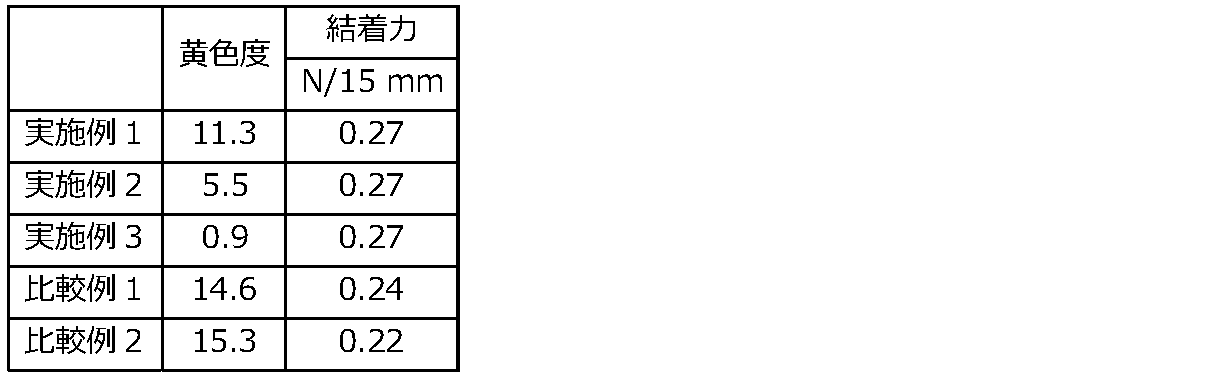
実施例1-3の電極(負極)は、製造例1-3で製造された結着剤(アクリル系繰り返し単位を含み、共重合体の3質量%水溶液の黄色度が14以下である共重合体(高分子化合物)を含む二次電池用結着剤)と、活物質とを含む電極用合剤を利用した二次電池用電極である。実施例1-3の電極は、結着剤の結着力が高いことが分かる。
Claims (8)
- 高分子化合物を含む二次電池用結着剤であって、
前記高分子化合物は、アクリル系繰り返し単位を含み、
前記高分子化合物の3質量%水溶液の黄色度が、14以下である、二次電池用結着剤。 - 前記高分子化合物は、下記式(1)で表される繰り返し単位を含む、請求項1記載の二次電池用結着剤。

- 請求項1又は2に記載の二次電池用結着剤と、活物質と、を含む、二次電池電極用合剤。
- 前記活物質が、炭素材料を含む、請求項3に記載の二次電池電極用合剤。
- 前記活物質が、ケイ素及びケイ素酸化物のうち少なくとも一方を含む、請求項3又は4に記載の二次電池電極用合剤。
- 請求項3~5のいずれか1項に記載の二次電池電極用合剤を含む、二次電池用電極。
- 請求項6に記載の二次電池用電極を含む、二次電池。
- 請求項6に記載の二次電池用電極を含む、リチウムイオン二次電池。
Priority Applications (5)
| Application Number | Priority Date | Filing Date | Title |
|---|---|---|---|
| CA3169313A CA3169313A1 (en) | 2020-02-26 | 2021-02-24 | Binder for secondary battery |
| US17/904,991 US11978906B2 (en) | 2020-02-26 | 2021-02-24 | Binder for secondary battery |
| CN202180015811.7A CN115176360A (zh) | 2020-02-26 | 2021-02-24 | 二次电池用粘结剂 |
| KR1020227028698A KR20220146454A (ko) | 2020-02-26 | 2021-02-24 | 이차전지용 결착제 |
| EP21761782.8A EP4112653A4 (en) | 2020-02-26 | 2021-02-24 | Binder for secondary battery |
Applications Claiming Priority (2)
| Application Number | Priority Date | Filing Date | Title |
|---|---|---|---|
| JP2020030542A JP6888139B1 (ja) | 2020-02-26 | 2020-02-26 | 二次電池用結着剤 |
| JP2020-030542 | 2020-02-26 |
Publications (1)
| Publication Number | Publication Date |
|---|---|
| WO2021172384A1 true WO2021172384A1 (ja) | 2021-09-02 |
Family
ID=76310249
Family Applications (1)
| Application Number | Title | Priority Date | Filing Date |
|---|---|---|---|
| PCT/JP2021/006946 Ceased WO2021172384A1 (ja) | 2020-02-26 | 2021-02-24 | 二次電池用結着剤 |
Country Status (8)
| Country | Link |
|---|---|
| US (1) | US11978906B2 (ja) |
| EP (1) | EP4112653A4 (ja) |
| JP (1) | JP6888139B1 (ja) |
| KR (1) | KR20220146454A (ja) |
| CN (1) | CN115176360A (ja) |
| CA (1) | CA3169313A1 (ja) |
| TW (1) | TW202138525A (ja) |
| WO (1) | WO2021172384A1 (ja) |
Families Citing this family (4)
| Publication number | Priority date | Publication date | Assignee | Title |
|---|---|---|---|---|
| JP2022147190A (ja) * | 2021-03-23 | 2022-10-06 | Tdk株式会社 | リチウムイオン二次電池用負極及びリチウムイオン二次電池 |
| CN118922995A (zh) * | 2022-03-31 | 2024-11-08 | 日本瑞翁株式会社 | 非水系二次电池功能层用浆料组合物及其制造方法、非水系二次电池用间隔件以及非水系二次电池 |
| KR102815268B1 (ko) * | 2022-10-24 | 2025-05-30 | 주식회사 한솔케미칼 | Paa-pva 공중합체의 제조 방법, 이를 포함하는 바인더 및 이를 포함하는 리튬 이차 전지 |
| KR102766321B1 (ko) * | 2023-12-26 | 2025-02-14 | 주식회사 한솔케미칼 | 공중합체를 포함하는 바인더, 상기 바인더를 포함하는 이차전지용 음극 및 상기 음극을 포함하는 이차전지 |
Citations (13)
| Publication number | Priority date | Publication date | Assignee | Title |
|---|---|---|---|---|
| JPH07240201A (ja) | 1994-02-25 | 1995-09-12 | Mitsubishi Cable Ind Ltd | 負極及びLi二次電池 |
| JPH10294112A (ja) | 1997-02-24 | 1998-11-04 | Hitachi Metals Ltd | リチウム二次電池 |
| JPH10302799A (ja) | 1997-04-25 | 1998-11-13 | Jsr Corp | 非水系電池電極用バインダー |
| WO2004049475A1 (ja) | 2002-11-22 | 2004-06-10 | Kureha Chemical Industry Company, Limited | 非水電解液電池の電極用バインダー組成物およびそれを用いた電極合剤、電極並びに電池 |
| JP2004234877A (ja) * | 2003-01-28 | 2004-08-19 | Nippon Nyukazai Kk | リチウム二次電池用高純度モノ及びジ(メタ)アクリル酸エステルの製造法 |
| WO2007122947A1 (ja) * | 2006-03-31 | 2007-11-01 | Zeon Corporation | リチウムイオン二次電池 |
| JP2009040875A (ja) * | 2007-08-08 | 2009-02-26 | Nippon Shokubai Co Ltd | (メタ)アクリル酸塩水溶液の安定化処理方法、(メタ)アクリル酸塩水溶液の製造方法及び水溶性ポリ(メタ)アクリル酸塩の製造方法 |
| WO2017168947A1 (ja) | 2016-03-30 | 2017-10-05 | 住友精化株式会社 | 非水電解質二次電池電極用バインダー、非水電解質二次電池用電極合剤、非水電解質二次電池用電極、非水電解質二次電池、および電気機器 |
| WO2018173975A1 (ja) * | 2017-03-23 | 2018-09-27 | 日本ゼオン株式会社 | 非水系二次電池正極用バインダー組成物、非水系二次電池正極用組成物、非水系二次電池用正極および非水系二次電池 |
| WO2018173717A1 (ja) * | 2017-03-24 | 2018-09-27 | 日本ゼオン株式会社 | 非水系二次電池用バインダー組成物及び非水系二次電池用スラリー組成物 |
| WO2018180812A1 (ja) * | 2017-03-28 | 2018-10-04 | 東亞合成株式会社 | 架橋重合体又はその塩の製造方法 |
| WO2019021810A1 (ja) * | 2017-07-24 | 2019-01-31 | 株式会社クラレ | 非水電解質電池用分離膜及びそれを用いた非水電解質電池 |
| JP2019110125A (ja) * | 2017-12-19 | 2019-07-04 | 株式会社クラレ | 非水電解質電池電極用バインダー溶液 |
Family Cites Families (7)
| Publication number | Priority date | Publication date | Assignee | Title |
|---|---|---|---|---|
| JPH0264108A (ja) * | 1988-08-30 | 1990-03-05 | Mitsubishi Rayon Co Ltd | メタクリルイミド基含有重合体の製造法およびそれにより得られる該重合体を構成成分とする光伝送繊維 |
| JPH10168104A (ja) | 1996-12-10 | 1998-06-23 | Mitsubishi Chem Corp | 塩化ビニル系単量体の重合方法 |
| EP2924785B1 (en) * | 2012-10-12 | 2018-12-05 | National Institute of Advanced Industrial Science and Technology | Binder for use in positive electrode for lithium ion secondary battery, positive electrode for lithium ion secondary battery containing said binder, lithium ion secondary battery using said positive electrode, and electrical machinery and apparatus |
| CN105340110B (zh) | 2013-06-28 | 2018-08-24 | 住友精化株式会社 | 非水电解质二次电池用负极合剂、含有该合剂的非水电解质二次电池用负极、具备该负极的非水电解质二次电池、以及电气设备 |
| EP3287472B1 (en) | 2015-04-23 | 2021-09-29 | Mitsubishi Chemical Corporation | Ethylene-vinyl alcohol copolymer, manufacturing method therefor, and laminate |
| CN111095635A (zh) | 2017-09-29 | 2020-05-01 | 住友精化株式会社 | 非水电解质二次电池电极用粘合剂、非水电解质二次电池用电极合剂、非水电解质二次电池用电极、非水电解质二次电池和电气设备 |
| CN110832684A (zh) * | 2017-09-29 | 2020-02-21 | 住友精化株式会社 | 非水电解质二次电池电极用粘合剂、非水电解质二次电池用电极合剂、非水电解质二次电池用电极、非水电解质二次电池及电气设备 |
-
2020
- 2020-02-26 JP JP2020030542A patent/JP6888139B1/ja active Active
-
2021
- 2021-02-24 EP EP21761782.8A patent/EP4112653A4/en active Pending
- 2021-02-24 KR KR1020227028698A patent/KR20220146454A/ko active Pending
- 2021-02-24 CN CN202180015811.7A patent/CN115176360A/zh active Pending
- 2021-02-24 CA CA3169313A patent/CA3169313A1/en active Pending
- 2021-02-24 US US17/904,991 patent/US11978906B2/en active Active
- 2021-02-24 WO PCT/JP2021/006946 patent/WO2021172384A1/ja not_active Ceased
- 2021-02-25 TW TW110106806A patent/TW202138525A/zh unknown
Patent Citations (13)
| Publication number | Priority date | Publication date | Assignee | Title |
|---|---|---|---|---|
| JPH07240201A (ja) | 1994-02-25 | 1995-09-12 | Mitsubishi Cable Ind Ltd | 負極及びLi二次電池 |
| JPH10294112A (ja) | 1997-02-24 | 1998-11-04 | Hitachi Metals Ltd | リチウム二次電池 |
| JPH10302799A (ja) | 1997-04-25 | 1998-11-13 | Jsr Corp | 非水系電池電極用バインダー |
| WO2004049475A1 (ja) | 2002-11-22 | 2004-06-10 | Kureha Chemical Industry Company, Limited | 非水電解液電池の電極用バインダー組成物およびそれを用いた電極合剤、電極並びに電池 |
| JP2004234877A (ja) * | 2003-01-28 | 2004-08-19 | Nippon Nyukazai Kk | リチウム二次電池用高純度モノ及びジ(メタ)アクリル酸エステルの製造法 |
| WO2007122947A1 (ja) * | 2006-03-31 | 2007-11-01 | Zeon Corporation | リチウムイオン二次電池 |
| JP2009040875A (ja) * | 2007-08-08 | 2009-02-26 | Nippon Shokubai Co Ltd | (メタ)アクリル酸塩水溶液の安定化処理方法、(メタ)アクリル酸塩水溶液の製造方法及び水溶性ポリ(メタ)アクリル酸塩の製造方法 |
| WO2017168947A1 (ja) | 2016-03-30 | 2017-10-05 | 住友精化株式会社 | 非水電解質二次電池電極用バインダー、非水電解質二次電池用電極合剤、非水電解質二次電池用電極、非水電解質二次電池、および電気機器 |
| WO2018173975A1 (ja) * | 2017-03-23 | 2018-09-27 | 日本ゼオン株式会社 | 非水系二次電池正極用バインダー組成物、非水系二次電池正極用組成物、非水系二次電池用正極および非水系二次電池 |
| WO2018173717A1 (ja) * | 2017-03-24 | 2018-09-27 | 日本ゼオン株式会社 | 非水系二次電池用バインダー組成物及び非水系二次電池用スラリー組成物 |
| WO2018180812A1 (ja) * | 2017-03-28 | 2018-10-04 | 東亞合成株式会社 | 架橋重合体又はその塩の製造方法 |
| WO2019021810A1 (ja) * | 2017-07-24 | 2019-01-31 | 株式会社クラレ | 非水電解質電池用分離膜及びそれを用いた非水電解質電池 |
| JP2019110125A (ja) * | 2017-12-19 | 2019-07-04 | 株式会社クラレ | 非水電解質電池電極用バインダー溶液 |
Non-Patent Citations (2)
| Title |
|---|
| "Lithium Secondary Batteries", 20 March 2008, OHMSHA LTD, pages: 132 |
| See also references of EP4112653A4 |
Also Published As
| Publication number | Publication date |
|---|---|
| KR20220146454A (ko) | 2022-11-01 |
| CN115176360A (zh) | 2022-10-11 |
| JP2021136121A (ja) | 2021-09-13 |
| JP6888139B1 (ja) | 2021-06-16 |
| US11978906B2 (en) | 2024-05-07 |
| EP4112653A4 (en) | 2025-04-09 |
| EP4112653A1 (en) | 2023-01-04 |
| TW202138525A (zh) | 2021-10-16 |
| CA3169313A1 (en) | 2021-09-02 |
| US20230138888A1 (en) | 2023-05-04 |
Similar Documents
| Publication | Publication Date | Title |
|---|---|---|
| US10873086B2 (en) | Binder for nonaqueous electrolyte secondary battery electrodes, electrode mixture for nonaqueous electrolyte secondary batteries, electrode for nonaqueous electrolyte secondary batteries, nonaqueous electrolyte secondary battery and electrical device | |
| US11978906B2 (en) | Binder for secondary battery | |
| JP6923689B1 (ja) | 二次電池用結着剤 | |
| JP6829754B1 (ja) | 二次電池用結着剤 | |
| EP4064393B1 (en) | Binder for secondary batteries | |
| JP6765022B1 (ja) | 二次電池用結着剤に用いられる高分子化合物の製造方法 |
Legal Events
| Date | Code | Title | Description |
|---|---|---|---|
| 121 | Ep: the epo has been informed by wipo that ep was designated in this application |
Ref document number: 21761782 Country of ref document: EP Kind code of ref document: A1 |
|
| ENP | Entry into the national phase |
Ref document number: 3169313 Country of ref document: CA |
|
| NENP | Non-entry into the national phase |
Ref country code: DE |
|
| ENP | Entry into the national phase |
Ref document number: 2021761782 Country of ref document: EP Effective date: 20220926 |