WO2021172585A1 - ポリビニリデンフルオライド、結着剤、電極合剤、電極および二次電池 - Google Patents
ポリビニリデンフルオライド、結着剤、電極合剤、電極および二次電池 Download PDFInfo
- Publication number
- WO2021172585A1 WO2021172585A1 PCT/JP2021/007676 JP2021007676W WO2021172585A1 WO 2021172585 A1 WO2021172585 A1 WO 2021172585A1 JP 2021007676 W JP2021007676 W JP 2021007676W WO 2021172585 A1 WO2021172585 A1 WO 2021172585A1
- Authority
- WO
- WIPO (PCT)
- Prior art keywords
- vdf
- mol
- group
- pvdf
- binder
- Prior art date
- Legal status (The legal status is an assumption and is not a legal conclusion. Google has not performed a legal analysis and makes no representation as to the accuracy of the status listed.)
- Ceased
Links
Classifications
-
- H—ELECTRICITY
- H01—ELECTRIC ELEMENTS
- H01M—PROCESSES OR MEANS, e.g. BATTERIES, FOR THE DIRECT CONVERSION OF CHEMICAL ENERGY INTO ELECTRICAL ENERGY
- H01M4/00—Electrodes
- H01M4/02—Electrodes composed of, or comprising, active material
- H01M4/62—Selection of inactive substances as ingredients for active masses, e.g. binders, fillers
- H01M4/621—Binders
- H01M4/622—Binders being polymers
- H01M4/623—Binders being polymers fluorinated polymers
-
- C—CHEMISTRY; METALLURGY
- C08—ORGANIC MACROMOLECULAR COMPOUNDS; THEIR PREPARATION OR CHEMICAL WORKING-UP; COMPOSITIONS BASED THEREON
- C08F—MACROMOLECULAR COMPOUNDS OBTAINED BY REACTIONS ONLY INVOLVING CARBON-TO-CARBON UNSATURATED BONDS
- C08F214/00—Copolymers of compounds having one or more unsaturated aliphatic radicals, each having only one carbon-to-carbon double bond, and at least one being terminated by a halogen
- C08F214/18—Monomers containing fluorine
- C08F214/22—Vinylidene fluoride
- C08F214/225—Vinylidene fluoride with non-fluorinated comonomers
-
- C—CHEMISTRY; METALLURGY
- C08—ORGANIC MACROMOLECULAR COMPOUNDS; THEIR PREPARATION OR CHEMICAL WORKING-UP; COMPOSITIONS BASED THEREON
- C08F—MACROMOLECULAR COMPOUNDS OBTAINED BY REACTIONS ONLY INVOLVING CARBON-TO-CARBON UNSATURATED BONDS
- C08F220/00—Copolymers of compounds having one or more unsaturated aliphatic radicals, each having only one carbon-to-carbon double bond, and only one being terminated by only one carboxyl radical or a salt, anhydride ester, amide, imide or nitrile thereof
- C08F220/02—Monocarboxylic acids having less than ten carbon atoms; Derivatives thereof
- C08F220/04—Acids; Metal salts or ammonium salts thereof
-
- C—CHEMISTRY; METALLURGY
- C08—ORGANIC MACROMOLECULAR COMPOUNDS; THEIR PREPARATION OR CHEMICAL WORKING-UP; COMPOSITIONS BASED THEREON
- C08K—Use of inorganic or non-macromolecular organic substances as compounding ingredients
- C08K3/00—Use of inorganic substances as compounding ingredients
- C08K3/02—Elements
- C08K3/04—Carbon
-
- C—CHEMISTRY; METALLURGY
- C09—DYES; PAINTS; POLISHES; NATURAL RESINS; ADHESIVES; COMPOSITIONS NOT OTHERWISE PROVIDED FOR; APPLICATIONS OF MATERIALS NOT OTHERWISE PROVIDED FOR
- C09D—COATING COMPOSITIONS, e.g. PAINTS, VARNISHES OR LACQUERS; FILLING PASTES; CHEMICAL PAINT OR INK REMOVERS; INKS; CORRECTING FLUIDS; WOODSTAINS; PASTES OR SOLIDS FOR COLOURING OR PRINTING; USE OF MATERIALS THEREFOR
- C09D127/00—Coating compositions based on homopolymers or copolymers of compounds having one or more unsaturated aliphatic radicals, each having only one carbon-to-carbon double bond, and at least one being terminated by a halogen; Coating compositions based on derivatives of such polymers
- C09D127/02—Coating compositions based on homopolymers or copolymers of compounds having one or more unsaturated aliphatic radicals, each having only one carbon-to-carbon double bond, and at least one being terminated by a halogen; Coating compositions based on derivatives of such polymers not modified by chemical after-treatment
- C09D127/12—Coating compositions based on homopolymers or copolymers of compounds having one or more unsaturated aliphatic radicals, each having only one carbon-to-carbon double bond, and at least one being terminated by a halogen; Coating compositions based on derivatives of such polymers not modified by chemical after-treatment containing fluorine atoms
- C09D127/16—Homopolymers or copolymers of vinylidene fluoride
-
- H—ELECTRICITY
- H01—ELECTRIC ELEMENTS
- H01G—CAPACITORS; CAPACITORS, RECTIFIERS, DETECTORS, SWITCHING DEVICES, LIGHT-SENSITIVE OR TEMPERATURE-SENSITIVE DEVICES OF THE ELECTROLYTIC TYPE
- H01G11/00—Hybrid capacitors, i.e. capacitors having different positive and negative electrodes; Electric double-layer [EDL] capacitors; Processes for the manufacture thereof or of parts thereof
- H01G11/22—Electrodes
- H01G11/30—Electrodes characterised by their material
- H01G11/32—Carbon-based
- H01G11/38—Carbon pastes or blends; Binders or additives therein
-
- H—ELECTRICITY
- H01—ELECTRIC ELEMENTS
- H01M—PROCESSES OR MEANS, e.g. BATTERIES, FOR THE DIRECT CONVERSION OF CHEMICAL ENERGY INTO ELECTRICAL ENERGY
- H01M10/00—Secondary cells; Manufacture thereof
- H01M10/05—Accumulators with non-aqueous electrolyte
- H01M10/052—Li-accumulators
-
- H—ELECTRICITY
- H01—ELECTRIC ELEMENTS
- H01M—PROCESSES OR MEANS, e.g. BATTERIES, FOR THE DIRECT CONVERSION OF CHEMICAL ENERGY INTO ELECTRICAL ENERGY
- H01M10/00—Secondary cells; Manufacture thereof
- H01M10/05—Accumulators with non-aqueous electrolyte
- H01M10/052—Li-accumulators
- H01M10/0525—Rocking-chair batteries, i.e. batteries with lithium insertion or intercalation in both electrodes; Lithium-ion batteries
-
- H—ELECTRICITY
- H01—ELECTRIC ELEMENTS
- H01M—PROCESSES OR MEANS, e.g. BATTERIES, FOR THE DIRECT CONVERSION OF CHEMICAL ENERGY INTO ELECTRICAL ENERGY
- H01M4/00—Electrodes
- H01M4/02—Electrodes composed of, or comprising, active material
-
- H—ELECTRICITY
- H01—ELECTRIC ELEMENTS
- H01M—PROCESSES OR MEANS, e.g. BATTERIES, FOR THE DIRECT CONVERSION OF CHEMICAL ENERGY INTO ELECTRICAL ENERGY
- H01M4/00—Electrodes
- H01M4/02—Electrodes composed of, or comprising, active material
- H01M4/04—Processes of manufacture in general
-
- H—ELECTRICITY
- H01—ELECTRIC ELEMENTS
- H01M—PROCESSES OR MEANS, e.g. BATTERIES, FOR THE DIRECT CONVERSION OF CHEMICAL ENERGY INTO ELECTRICAL ENERGY
- H01M4/00—Electrodes
- H01M4/02—Electrodes composed of, or comprising, active material
- H01M4/13—Electrodes for accumulators with non-aqueous electrolyte, e.g. for lithium-accumulators; Processes of manufacture thereof
-
- H—ELECTRICITY
- H01—ELECTRIC ELEMENTS
- H01M—PROCESSES OR MEANS, e.g. BATTERIES, FOR THE DIRECT CONVERSION OF CHEMICAL ENERGY INTO ELECTRICAL ENERGY
- H01M4/00—Electrodes
- H01M4/02—Electrodes composed of, or comprising, active material
- H01M4/13—Electrodes for accumulators with non-aqueous electrolyte, e.g. for lithium-accumulators; Processes of manufacture thereof
- H01M4/139—Processes of manufacture
-
- H—ELECTRICITY
- H01—ELECTRIC ELEMENTS
- H01M—PROCESSES OR MEANS, e.g. BATTERIES, FOR THE DIRECT CONVERSION OF CHEMICAL ENERGY INTO ELECTRICAL ENERGY
- H01M4/00—Electrodes
- H01M4/02—Electrodes composed of, or comprising, active material
- H01M4/36—Selection of substances as active materials, active masses, active liquids
- H01M4/48—Selection of substances as active materials, active masses, active liquids of inorganic oxides or hydroxides
- H01M4/50—Selection of substances as active materials, active masses, active liquids of inorganic oxides or hydroxides of manganese
- H01M4/505—Selection of substances as active materials, active masses, active liquids of inorganic oxides or hydroxides of manganese of mixed oxides or hydroxides containing manganese for inserting or intercalating light metals, e.g. LiMn2O4 or LiMn2OxFy
-
- H—ELECTRICITY
- H01—ELECTRIC ELEMENTS
- H01M—PROCESSES OR MEANS, e.g. BATTERIES, FOR THE DIRECT CONVERSION OF CHEMICAL ENERGY INTO ELECTRICAL ENERGY
- H01M4/00—Electrodes
- H01M4/02—Electrodes composed of, or comprising, active material
- H01M4/36—Selection of substances as active materials, active masses, active liquids
- H01M4/48—Selection of substances as active materials, active masses, active liquids of inorganic oxides or hydroxides
- H01M4/52—Selection of substances as active materials, active masses, active liquids of inorganic oxides or hydroxides of nickel, cobalt or iron
- H01M4/525—Selection of substances as active materials, active masses, active liquids of inorganic oxides or hydroxides of nickel, cobalt or iron of mixed oxides or hydroxides containing iron, cobalt or nickel for inserting or intercalating light metals, e.g. LiNiO2, LiCoO2 or LiCoOxFy
-
- H—ELECTRICITY
- H01—ELECTRIC ELEMENTS
- H01M—PROCESSES OR MEANS, e.g. BATTERIES, FOR THE DIRECT CONVERSION OF CHEMICAL ENERGY INTO ELECTRICAL ENERGY
- H01M4/00—Electrodes
- H01M4/02—Electrodes composed of, or comprising, active material
- H01M4/62—Selection of inactive substances as ingredients for active masses, e.g. binders, fillers
-
- C—CHEMISTRY; METALLURGY
- C08—ORGANIC MACROMOLECULAR COMPOUNDS; THEIR PREPARATION OR CHEMICAL WORKING-UP; COMPOSITIONS BASED THEREON
- C08F—MACROMOLECULAR COMPOUNDS OBTAINED BY REACTIONS ONLY INVOLVING CARBON-TO-CARBON UNSATURATED BONDS
- C08F2800/00—Copolymer characterised by the proportions of the comonomers expressed
- C08F2800/10—Copolymer characterised by the proportions of the comonomers expressed as molar percentages
-
- C—CHEMISTRY; METALLURGY
- C08—ORGANIC MACROMOLECULAR COMPOUNDS; THEIR PREPARATION OR CHEMICAL WORKING-UP; COMPOSITIONS BASED THEREON
- C08K—Use of inorganic or non-macromolecular organic substances as compounding ingredients
- C08K3/00—Use of inorganic substances as compounding ingredients
- C08K3/18—Oxygen-containing compounds, e.g. metal carbonyls
- C08K3/20—Oxides; Hydroxides
- C08K3/22—Oxides; Hydroxides of metals
- C08K2003/2203—Oxides; Hydroxides of metals of lithium
-
- C—CHEMISTRY; METALLURGY
- C08—ORGANIC MACROMOLECULAR COMPOUNDS; THEIR PREPARATION OR CHEMICAL WORKING-UP; COMPOSITIONS BASED THEREON
- C08K—Use of inorganic or non-macromolecular organic substances as compounding ingredients
- C08K3/00—Use of inorganic substances as compounding ingredients
- C08K3/18—Oxygen-containing compounds, e.g. metal carbonyls
- C08K3/20—Oxides; Hydroxides
- C08K3/22—Oxides; Hydroxides of metals
- C08K2003/2217—Oxides; Hydroxides of metals of magnesium
-
- C—CHEMISTRY; METALLURGY
- C08—ORGANIC MACROMOLECULAR COMPOUNDS; THEIR PREPARATION OR CHEMICAL WORKING-UP; COMPOSITIONS BASED THEREON
- C08K—Use of inorganic or non-macromolecular organic substances as compounding ingredients
- C08K3/00—Use of inorganic substances as compounding ingredients
- C08K3/18—Oxygen-containing compounds, e.g. metal carbonyls
- C08K3/20—Oxides; Hydroxides
- C08K3/22—Oxides; Hydroxides of metals
- C08K2003/2289—Oxides; Hydroxides of metals of cobalt
-
- C—CHEMISTRY; METALLURGY
- C08—ORGANIC MACROMOLECULAR COMPOUNDS; THEIR PREPARATION OR CHEMICAL WORKING-UP; COMPOSITIONS BASED THEREON
- C08K—Use of inorganic or non-macromolecular organic substances as compounding ingredients
- C08K3/00—Use of inorganic substances as compounding ingredients
- C08K3/18—Oxygen-containing compounds, e.g. metal carbonyls
- C08K3/20—Oxides; Hydroxides
- C08K3/22—Oxides; Hydroxides of metals
- C08K2003/2293—Oxides; Hydroxides of metals of nickel
-
- Y—GENERAL TAGGING OF NEW TECHNOLOGICAL DEVELOPMENTS; GENERAL TAGGING OF CROSS-SECTIONAL TECHNOLOGIES SPANNING OVER SEVERAL SECTIONS OF THE IPC; TECHNICAL SUBJECTS COVERED BY FORMER USPC CROSS-REFERENCE ART COLLECTIONS [XRACs] AND DIGESTS
- Y02—TECHNOLOGIES OR APPLICATIONS FOR MITIGATION OR ADAPTATION AGAINST CLIMATE CHANGE
- Y02E—REDUCTION OF GREENHOUSE GAS [GHG] EMISSIONS, RELATED TO ENERGY GENERATION, TRANSMISSION OR DISTRIBUTION
- Y02E60/00—Enabling technologies; Technologies with a potential or indirect contribution to GHG emissions mitigation
- Y02E60/10—Energy storage using batteries
Definitions
- the present disclosure relates to polyvinylidene fluoride, a binder, an electrode mixture, an electrode and a secondary battery.
- VDF vinylidene fluoride
- MA hydrophilic acrylic monomer
- binders for forming electrodes of lithium batteries and / or electric double-layer capacitors.
- composition (C). At least 50 mol% relative to the total moles of the repeating units of the polymer (F1) and at least 0.
- R 1, R 2 and R 3 are independently selected from hydrogen atoms and C 1 ⁇ C 3 hydrocarbon group, -R OH is a C 1 to C 5 hydrocarbon moiety containing a hydrogen atom or at least one hydroxyl group
- a semi-crystalline fluoropolymer [polymer (F1)] comprising a repeating unit derived from at least one functional hydrogen-containing monomer comprising at least one hydrophilic (meth) acrylic monomer (MA) of the above.
- the polymer (F1) is measured in dimethylformamide at 25 ° C.
- the polymer (F1) is divided by the total weight of the composition (C) to form at least 10% by weight, and the polymer (F2) is the composition.
- a composition (C) has been proposed that is divided by the total weight of (C) to form a maximum of 90% by weight.
- Patent Document 3 a binder composition used for binding an electrode active material to a current collector to which the electrode active material is applied, the first fluoride having an intrinsic viscosity of 1.7 dl / g or more.
- a binder composition comprising a vinylidene polymer and a second vinylidene fluoride polymer containing acrylic acid or methacrylic acid as a monomer unit has been proposed.
- polyvinylidene fluoride and a binder which are excellent in electrolyte swelling resistance and adhesion to a metal foil and can form an electrode having excellent flexibility, and polyvinylidene fluoride and a binder are disclosed. It is an object of the present invention to provide an electrode mixture, an electrode and a secondary battery using an agent.
- Y in the formula (1) is, H, Li, Na, K , Mg, Ca, preferably represents at least one selected from the group consisting of Al and NH 4.
- the weight average molecular weight is preferably 50,000 to 20000000.
- a binder containing the above-mentioned polyvinylidene fluoride is provided.
- the above-mentioned polyvinylidene fluoride or the above-mentioned binder, powder electrode material, and an electrode mixture containing water or a non-aqueous solvent are provided.
- an electrode containing the above-mentioned polyvinylidene fluoride or the above-mentioned binder is provided.
- a secondary battery provided with the above electrodes is provided.
- An electrode mixture using a binder, an electrode, and a secondary battery can be provided.
- the polyvinylidene fluoride (PVdF) of the present disclosure contains a vinylidene fluoride (VdF) unit and a pentenoic acid unit.
- Y represents an inorganic cation and / or an organic cation.
- the inorganic cation include cations such as H, Li, Na, K, Mg, Ca, Al and Fe.
- the organic cation, NH 4, NH 3 R 5 , NH 2 R 5 2, NHR 5 3, NR 5 4 (R 5 are independently. Represents an alkyl group having 1 to 4 carbon atoms) cations such as Can be mentioned.
- Y at least one selected from the group consisting of H, Li, Na, K, Mg, Ca, Al and NH 4 is preferable, and the group consisting of H, Li, Na, K, Mg, Al and NH 4 is preferable.
- At least one selected from the group consisting of H, Li, Al and NH 4 is more preferable, and H is particularly preferable.
- Specific examples of the inorganic cation and the organic cation are described by omitting the reference numerals and valences for convenience.
- the PVdF of the present disclosure contains 95.0 to 99.99 mol% of VdF units and 0.01 to 5.0 mol% of pentenoic acid units with respect to all the monomer units of PVdF.
- the PVdF of the present disclosure contains VdF units and pentenoic acid units, and further, since the content of VdF units and the content of pentene acid units are appropriately adjusted, the electrolyte swelling resistance and the metal leaf It is possible to form an electrode having excellent adhesion to and having excellent flexibility.
- Acrylic acid units have been introduced in order to improve the adhesion of PVdF to metal foil (collector), as opposed to PVdF, which has been conventionally used as a binder for forming electrodes such as secondary batteries and capacitors.
- the technology to do is known.
- PVdF is required to have excellent electrolytic solution swelling resistance and flexibility while ensuring sufficient adhesion to a metal foil (current collector).
- the electrolyte swelling resistance of PVdF is obtained by selecting the pentenoic acid unit as the monomer unit to be introduced into PVdF, and further adjusting the content of the VdF unit and the content of the pentenoic acid unit within a specific range. It was found that PVdF can be remarkably improved, sufficient adhesion of PVdF to a metal foil (current collector) can be ensured, and an electrode having excellent flexibility can be formed.
- the PVdF of the present disclosure is a novel polymer completed based on such findings.
- the electrode material layer and the metal foil (current collector) are sufficiently adhered to each other by using the PVdF of the present disclosure. Therefore, it is possible to form an electrode having a sufficient holding power of a powder electrode material, and it is possible to prepare a positive electrode mixture having an appropriate viscosity even though it contains a high concentration of PVdF. Electrodes exhibiting excellent characteristics can be produced with high productivity.
- the polar group of the binder when the secondary battery is stored at a high temperature, the polar group of the binder may be decomposed and the resistance may increase. Since the content of the pentene acid unit of PVdF of the present disclosure is appropriately adjusted, the influence caused by the decomposition of polar groups in a high temperature environment is suppressed. Therefore, by using the PVdF of the present disclosure, it is possible to form an electrode in which the electrode material layer and the metal foil (current collector) are sufficiently in close contact with each other, and the resistance value does not easily increase even when stored at a high temperature. Batteries can be made.
- the rate of increase in the resistance value of the secondary battery can be obtained by, for example, the following method.
- a secondary battery (cell) placed in a constant temperature bath at 25 ° C. is charged to 4.4 V by the constant current-constant voltage method of 0.5C-0.05C Rate, and then initially using an AC impedance measuring instrument. Measure the resistance value of.
- the cell is stored in a constant temperature bath at 40 ° C. for 1 week, and then placed in a constant temperature bath at 25 ° C. for 3 hours to lower the cell temperature to 25 ° C., and then the resistance value of the cell after the durability test is measured.
- the rate of increase (%) of the resistance value after the durability test with respect to the initial resistance value ((resistance value after the durability test-initial resistance value) / initial resistance value x 100) Ask.
- the powder electrode material may peel off from the electrode material layer and the discharge capacity may decrease. Since the content of the pentene acid unit of the PVdF of the present disclosure is appropriately adjusted, by using the PVdF of the present disclosure, the powder electrode material does not easily peel off from the electrode material layer even after repeated charging and discharging, which is sufficient. It is possible to manufacture a secondary battery (a secondary battery having a high capacity retention rate) in which a large discharge capacity is maintained.
- the capacity retention rate of the secondary battery can be evaluated by, for example, the following method.
- constant current-constant voltage charging hereinafter referred to as CC / CV charging
- the battery is discharged to 3.0V with a constant current of 0.5C, and this is regarded as one cycle, and the initial discharge capacity is obtained from the discharge capacity of the third cycle.
- 1C represents a current value that discharges the reference capacity of the battery in 1 hour
- 0.5C represents, for example, a current value that is 1/2 of that.
- a 300 cycle cycle test is performed at an operating voltage of 3.0-4.2V.
- the capacity retention rate is the discharge capacity of the 300th cycle when the initial discharge capacity of the 3rd cycle is 100%.
- the content of VdF units of PVdF is 95.0 to 99.99 mol%, preferably more than 95.0 mol%, and more preferably 97.0 mol% with respect to all the monomer units of PVdF. % Or more, more preferably 98.0 mol% or more, particularly preferably 98.5 mol% or more, most preferably 99.0 mol% or more, and preferably 99.95 mol% or less.
- the content of the VdF unit is within the above range, the electrolytic solution swelling resistance and the adhesion to the metal foil can be further improved, and an electrode having more excellent flexibility can be formed.
- the content of the pentenic acid unit of PVdF is 0.01 to 5.0 mol%, preferably less than 5.0 mol%, and more preferably 3.0, based on all the monomer units of PVdF. It is mol% or less, more preferably 2.0 mol% or less, particularly preferably 1.5 mol% or less, most preferably 1.0 mol% or less, and preferably 0.05 mol% or more. Is.
- the content of the pentene acid unit is within the above range, the swelling resistance of the electrolytic solution and the adhesion to the metal foil can be further improved, and an electrode having more excellent flexibility can be formed.
- the composition of PVdF can be measured, for example, by 19 F-NMR measurement.
- the content of the pentenoic acid unit of PVdF can be measured by 1 H-NMR measurement using the esterified PVdF after esterifying the carboxyl group (-COOY) of the pentenoic acid unit.
- PVdF may further contain fluorinated monomer units (excluding VdF units).
- VdF units fluorinated monomer units
- an electrode having more excellent flexibility can be formed.
- fluorinated monomer examples include tetrafluoroethylene (TFE), vinyl fluoride, trifluoroethylene, chlorotrifluoroethylene (CTFE), fluoroalkyl vinyl ether, hexafluoropropylene (HFP), (perfluoroalkyl) ethylene, and 2 , 3,3,3-tetrafluoropropene, trans-1,3,3,3-tetrafluoropropene and the like.
- the fluorinated monomer at least one selected from the group consisting of CTFE, HFP, fluoroalkyl vinyl ether and 2,3,3,3-tetrafluoropropene because an electrode having more excellent flexibility can be formed.
- Species are preferred, at least one selected from the group consisting of CTFE, HFP and fluoroalkyl vinyl ethers is more preferred, and at least one selected from the group consisting of HFP and fluoroalkyl vinyl ethers is even more preferred.
- fluorovinyl ether a fluoroalkyl vinyl ether having a fluoroalkyl group having 1 to 5 carbon atoms is preferable, and at least selected from the group consisting of perfluoro (methyl vinyl ether), perfluoro (ethyl vinyl ether) and perfluoro (propyl vinyl ether). One is more preferable.
- PVdF preferably does not contain TFE units from the viewpoint of further improving the electrolytic solution swelling resistance and the adhesion to the metal foil.
- the content of the fluorinated monomer unit of PVdF is preferably 0 to 4.99 mol%, more preferably 0.01 mol% or more, still more preferably, with respect to all the monomer units of PVdF. Is 0.05 mol% or more, more preferably 1.95 mol% or less, still more preferably 0.95 mol% or less.
- PVdF may further contain a non-fluorinated monomer unit (excluding the pentenoic acid unit represented by the formula (1)).
- a non-fluorinated monomer unit excluding the pentenoic acid unit represented by the formula (1).
- the non-fluorinated monomer include ethylene and propylene.
- the weight average molecular weight (in terms of polystyrene) of PVdF is preferable because it has an appropriate viscosity while ensuring sufficient adhesion to a metal foil, and an electrode mixture having excellent coatability can be prepared. Is 50,000 to 2000000, more preferably 80,000 or more, still more preferably 100,000 or more, particularly preferably 200,000 or more, still more preferably 190000 or less, still more preferably 1700000 or less, and particularly preferably. It is 1500000 or less.
- the weight average molecular weight can be measured by gel permeation chromatography (GPC) using N, N-dimethylformamide as a solvent.
- the number average molecular weight (in terms of polystyrene) of PVdF is preferable because it has an appropriate viscosity while ensuring sufficient adhesion to a metal foil, and an electrode mixture having excellent coatability can be prepared. Is 20,000 to 1500,000, more preferably 40,000 or more, still more preferably 70,000 or more, particularly preferably 140,000 or more, still more preferably 140000 or less, still more preferably 120000 or less, and particularly preferably. It is less than 110000.
- the number average molecular weight can be measured by gel permeation chromatography (GPC) using dimethylformamide as a solvent.
- the higher the molecular weight of PVdF the better the adhesion of the electrode material layer to the metal foil.
- the viscosity of the electrode mixture increases and the coatability of the electrode mixture tends to decrease.
- the PVdF of the present disclosure can form an electrode material layer exhibiting sufficient adhesion to a metal foil, and can prepare an electrode mixture having an appropriate viscosity and excellent coatability.
- the PVdF of the present disclosure has a weight average molecular weight or a number average molecular weight within the above range, high adhesion of the electrode material layer to the metal foil and excellent coatability of the electrode mixture can be obtained. It can be compatible at a higher level.
- the content of the powder electrode material and the binder in the electrode mixture can be conventionally adjusted without changing the ratio between the amount of the powder electrode material and the amount of the binder. Even when the amount of the non-aqueous solvent is increased and the amount of the non-aqueous solvent is reduced, the electrode mixture having the same viscosity as the conventional electrode mixture can be prepared, and a sufficient metal foil can be prepared. It is possible to form an electrode material layer that exhibits adhesion. Therefore, by using the PVdF of the present disclosure as a binder, it is possible to form an electrode exhibiting excellent characteristics, improve the productivity of the electrode, and reduce the cost of a non-aqueous solvent.
- the solution viscosity of PVdF is preferably 10 to 4000 mPa ⁇ s because it can further improve the adhesion to the metal foil and can prepare an electrode mixture having an appropriate viscosity and excellent coatability. It is more preferably 50 mPa ⁇ s or more, further preferably 100 mPa ⁇ s or more, particularly preferably 150 mPa ⁇ s or more, more preferably 3000 mPa ⁇ s or less, still more preferably 2000 mPa ⁇ s or less. It is particularly preferably 1500 mPa ⁇ s or less.
- the solution viscosity of PVdF is the viscosity of an N-methyl-2-pyrrolidone (NMP) solution containing 5% by mass of PVdF.
- NMP N-methyl-2-pyrrolidone
- the viscosity of the NMP solution can be measured at 25 ° C. using a B-type viscometer.
- the electrode mixture having an appropriate viscosity is not only excellent in coatability, but also easy to feed, and good dispersibility of the powder electrode material in the electrode mixture can be obtained. Therefore, an electrode mixture having an appropriate viscosity can shorten the time required for liquid feeding, the powder electrode material is less likely to aggregate during liquid feeding and storage, and the viscosity after liquid feeding or storage can be easily readjusted. be. Further, since the electrode mixture having an appropriate viscosity can easily give an appropriate shearing force to the electrode mixture by stirring, the powder electrode material can be easily dispersed in a non-aqueous solvent. When the PVdF of the present disclosure has a solution viscosity within the above range, an electrode mixture having an appropriate viscosity and excellent coatability can be more easily prepared.
- the melting point of PVdF is preferably 100 to 240 ° C.
- the melting point can be determined as the temperature with respect to the maximum value in the heat of fusion curve when the temperature is raised at a rate of 10 ° C./min using a differential scanning calorimetry (DSC) device.
- DSC differential scanning calorimetry
- the storage elastic modulus of PVdF at 30 ° C. is preferably 2000 MPa or less, more preferably 1800 MPa or less.
- the storage elastic modulus of PVdF at 60 ° C. is preferably 1500 MPa or less, more preferably 1300 MPa or less.
- the storage elastic modulus of PVdF at 30 ° C. is preferably 1000 MPa or more, more preferably 1100 MPa or more.
- the storage elastic modulus of PVdF at 60 ° C. is preferably 600 MPa or more, more preferably 700 MPa or more.
- the storage elastic modulus of a sample having a length of 30 mm, a width of 5 mm, and a thickness of 50 to 100 ⁇ m was measured by a dynamic viscoelastic device DVA220 manufactured by IT Measurement Control Co., Ltd. in a tensile mode, a grip width of 20 mm, and a measurement temperature of -30. It is a measured value at 30 ° C. and 60 ° C. when measured under the conditions of ° C. to 160 ° C., a heating rate of 2 ° C./min, and a frequency of 1 Hz.
- a solution obtained by dissolving PVdF in N-methyl-2-pyrrolidone (NMP) so as to have a concentration of 10 to 20% by mass is cast on a glass plate and dried at 100 ° C. for 12 hours. Then, it is further dried under vacuum at 100 ° C. for 12 hours, and the obtained film having a thickness of 50 to 100 ⁇ m can be produced by cutting it into a length of 30 mm and a width of 5 mm.
- NMP N-methyl-2-pyrrolidone
- the distribution state of the pentenoic acid unit in the main chain of PVdF is not particularly limited, but the pentenoic acid unit is further improved in adhesion to the metal foil, electrolyte swelling resistance and flexibility, and also in heat resistance. Is preferably distributed as randomly as possible.
- the "ratio of randomly distributed pentenoic acid units" indicating the ratio of randomly distributed pentenoic acid units to the total number of pentenoic acid units in PVdF is preferably 5% or more, more preferably 10% or more. It is more preferably 15% or more.
- the pentenoic acid unit sequence can be measured by, for example, 19 F-NMR measurement and 1 H-NMR measurement.
- the pentenoic acid unit sequence is an isolated pentenoic acid unit contained between two VdF units, and the larger the number of pentenoic acid unit sequences, the higher the fraction of the randomly distributed pentenoic acid units.
- the fraction of the randomly distributed pentenoic acid units is 100% because the average number of the pentenoic acid unit sequences is equal to the average total number of the pentenoic acid units.
- the PVdF of the present disclosure can be produced by polymerizing at least a monomer mixture containing VdF and pentenoic acid represented by the formula (1).
- the polymerization method methods such as suspension polymerization, emulsion polymerization, and solution polymerization can be adopted, but suspension polymerization and emulsion polymerization are preferable from the viewpoint of ease of post-treatment and the like.
- a polymerization initiator In the above polymerization, a polymerization initiator, a surfactant, a chain transfer agent and a solvent can be used, and conventionally known ones can be used for each.
- a polymerization initiator an oil-soluble radical polymerization initiator or a water-soluble radical polymerization initiator can be used.
- the oil-soluble radical polymerization initiator may be a known oil-soluble peroxide, for example.
- Dialkyl peroxy carbonates such as dinormal propyl peroxy dicarbonate, diisopropyl peroxy dicarbonate, disec-butyl peroxy dicarbonate; t-Butylperoxyisobutyrate, t-Butylperoxypivalate, t-hexylperoxy2-ethylhexanoate, t-butylperoxy-2-ethylhexanoate, 1,1,3,3- Peroxyesters such as tetramethylbutylperoxy-2-ethylhexanoate; Dialkyl peroxides such as dit-butyl peroxide; Di [fluoro (or fluorochloro) acyl] peroxides; Etc. are typical examples.
- Di [fluoro (or fluorochloro) acyl] peroxides include diacyls represented by [(RfCOO)-] 2 (Rf is a perfluoroalkyl group, ⁇ -hydroperfluoroalkyl group or fluorochloroalkyl group). Peroxide is mentioned.
- di [fluoro (or fluorochloro) acyl] peroxides examples include di ( ⁇ -hydro-dodecafluorohexanoyl) peroxide, di ( ⁇ -hydro-tetradecafluoroheptanoid) peroxide, and di ( ⁇ ).
- the water-soluble radical polymerization initiator may be a known water-soluble peroxide, for example, ammonium salts such as persulfate, perboric acid, perchloric acid, perphosphoric acid, and percarbonic acid, potassium salts, and sodium salts.
- ammonium salts such as persulfate, perboric acid, perchloric acid, perphosphoric acid, and percarbonic acid, potassium salts, and sodium salts.
- Organic peroxides such as disuccinic acid peroxide and diglutaric acid peroxide, t-butyl permalate, t-butyl hydroperoxide and the like.
- a reducing agent such as sulfite may be used in combination with the peroxide, and the amount used may be 0.1 to 20 times that of the peroxide.
- a known surfactant can be used, and for example, a nonionic surfactant, an anionic surfactant, a cationic surfactant, or the like can be used.
- a fluorine-containing anionic surfactant is preferable, and an ether bond may be contained (that is, an oxygen atom may be inserted between carbon atoms), and a linear or branched fluorine-containing surfactant having 4 to 20 carbon atoms is preferable.
- Anionic surfactants are more preferred.
- the amount of the surfactant added (against the solvent) is preferably 50 to 5000 ppm.
- chain transfer agent examples include hydrocarbons such as ethane, isopentan, n-hexane and cyclohexane; aromatics such as toluene and xylene; ketones such as acetone; acetates such as ethyl acetate and butyl acetate; methanol. , Ethanes and the like; mercaptans such as methyl mercaptan; halogenated hydrocarbons such as carbon tetrachloride, chloroform, methylene chloride, methyl chloride and the like.
- the amount of the chain transfer agent added may vary depending on the magnitude of the chain transfer constant of the chain transfer agent, but is usually in the range of 0.01 to 20% by mass with respect to the solvent.
- Examples of the solvent include water, a mixed solvent of water and alcohol, and the like.
- Fluorine-based solvent In polymerization such as suspension polymerization, a fluorine-based solvent may be used in addition to water. Fluorine-based solvents include hydrochloroalkanes such as CH 3 CClF 2 , CH 3 CCl 2 F, CF 3 CF 2 CCl 2 H, CF 2 ClCF 2 CF HCl ; CF 2 ClCFClCF 2 CF 3 , CF 3 CFClCFClCF 3, etc.
- Chlorofluoroalkanes such as perfluorocyclobutane, CF 3 CF 2 CF 2 CF 3 , CF 3 CF 2 CF 2 CF 2 CF 3 , CF 3 CF 2 CF 2 CF 2 CF 3 ; CF 2 HCF 2 CF 2 CF 2 H, CF 3 CFHCF 2 CF 2 CF 3 , CF 3 CF 2 CF 2 CF 2 H, CF 3 CF 2 CFHCF 2 CF 3 , CF 3 CFHC FHCF 2 CF 3 , CF 2 HCF 2 CF 2 CF 2 CF 2 H, CF 2 HCFHCF 2 CF 2 CF 3 , CF 3 CF 2 CF 2 CF 2 CF 2 CF 2 H, CF 3 CH (CF 3 ) CF 3 CF 2 CF 3 , CF 3 CF (CF) 3 ) CFHCF 2 CF 3 , CF 3 CF (CF) 3 ) CFHCF
- (perfluoroalkyl) alkyl ethers CF 3 CH 2 OCF 2 CHF 2 , CHF 2 CF 2 CH 2 OCF 2 CHF 2 , CF 3 CF 2 CH 2 OCF 2 CHF 2 etc.
- alkyl ethers examples thereof include alkyl ethers, and among them, perfluoroalkanes are preferable.
- the amount of the fluorine-based solvent used is preferably 10 to 100% by mass with respect to the solvent from the viewpoint of suspension and economy.
- the polymerization temperature and the polymerization pressure are appropriately determined according to other polymerization conditions such as the type and amount of the solvent used, the vapor pressure, and the polymerization temperature.
- PVdF can be efficiently produced, it is also preferable to polymerize a monomer mixture containing at least VdF and pentenoic acid represented by the formula (1) under the condition that VdF is in a supercritical state.
- the critical temperature of VdF is 30.1 ° C. and the critical pressure is 4.38 MPa.
- the monomer mixture in the reactor is also preferable to supply the monomer mixture to the reactor so that the density of the monomer mixture in the reactor is sufficiently high.
- the density in the polymerization initial temperature of the monomer mixture in the reactor preferably at 0.20 g / cm 3 or more, more preferably 0.23 g / cm 3 or more, more preferably 0.25 g / cm It is 3 or more, and the upper limit is not particularly limited. However, if the density is too high, the pressure change in the reactor tends to be too large due to the change in the temperature in the reactor. 70 g / cm 3 or less is preferable. Density of the monomer mixture in the reactor, the supply amount of the monomer mixture was fed to the reactor (g), by subtracting the contents of the reactor volume (cm 3) from the water volume (cm 3) value It can be obtained by dividing by.
- a suspension agent such as methyl cellulose, methoxylated methyl cellulose, propoxylated methyl cellulose, hydroxyethyl cellulose, hydroxypropyl cellulose, polyvinyl alcohol, polyethylene oxide, gelatin, etc. is added to water at 0.005. It can be added and used in the range of ⁇ 1.0% by mass, preferably 0.01 to 0.4% by mass.
- the polymerization initiators include diisopropyl peroxydicarbonate, dinormal propyl peroxy dicarbonate, dinormal heptafluoropropyl peroxy dicarbonate, isobutyryl peroxide, di (chlorofluoroacyl) peroxide, and di (per). Fluoroacyl) peroxide and the like can be used.
- the amount used is preferably 0.001 to 5% by mass with respect to the total amount of the monomers.
- a chain transfer agent such as ethyl acetate, methyl acetate, acetone, methanol, ethanol, n-propanol, acetaldehyde, propylaldehyde, ethyl propionate, carbon tetrachloride is added to adjust the degree of polymerization of the obtained polymer. You may.
- the amount used is usually 0.001 to 5% by mass, preferably 0.005 to 3% by mass, based on the total amount of the monomers.
- the total amount of monomers charged is 2: 1 to 1:10, preferably 1: 1 to 1: 5 in the ratio of total amount of monomers: mass ratio of water.
- the above-mentioned PVdF can be suitably used as a binder.
- the above-mentioned electrode mixture containing PVdF as a binder, it is possible to form an electrode material layer having excellent adhesion to a metal foil, electrolyte swelling resistance, and flexibility.
- the binder of the present disclosure contains the above-mentioned PVdF. Since the binder of the present disclosure contains the above-mentioned PVdF, it is excellent in adhesion to a metal foil, electrolytic solution swelling resistance, and flexibility. Further, by using the electrode mixture containing the binder of the present disclosure, it is possible to form an electrode material layer having excellent adhesion to a metal foil, electrolyte swelling resistance and flexibility.
- the binder of the present disclosure may contain a polymer other than the above-mentioned PVdF.
- polymers other than the above-mentioned PVdF include fluoropolymers (excluding the above-mentioned PVdF), polymethacrylate, polymethylmethacrylate, polyacrylonitrile, polyimide, polyamide, polyamideimide, polycarbonate, styrene rubber, and butadiene rubber. ..
- the binder of the present disclosure preferably contains a VdF polymer (excluding the above-mentioned PVdF) as a polymer other than the above-mentioned PVdF.
- VdF polymer include VdF homopolymers, VdF units, and polymers containing units based on VdF and monomers copolymerizable with VdF (excluding VdF and pentenoic acid represented by the formula (1)). Can be mentioned.
- the VdF polymer As the VdF polymer, the adhesion of the binder to the metal foil, the swelling resistance of the electrolytic solution, and the flexibility can be further improved, and an electrode mixture whose viscosity does not easily increase can be obtained. Therefore, the VdF unit and VdF can be obtained. It is preferable to contain a unit based on a monomer copolymerizable with (excluding VdF and pentenoic acid represented by the formula (1)).
- Examples of the monomer copolymerizable with VdF include a fluorinated monomer and a non-fluorinated monomer.
- TFE tetrafluoroethylene
- CFE chlorotrifluoroethylene
- HFP fluoroalkyl vinyl ether
- perfluoroalkyl ethylene 2,3 , 3,3-Tetrafluoropropene and at least one selected from the group consisting of trans-1,3,3,3-tetrafluoropropene, and at least one selected from the group consisting of TFE, CTFE and HFP.
- TFE is particularly preferable in that swelling with respect to the electrolytic solution can be suppressed and the battery characteristics can be improved.
- the fluorinated monomer unit (excluding the VdF unit) may or may not have a polar group.
- non-fluorinated monomer examples include a non-fluorinated monomer having no polar group such as ethylene and propylene, and a non-fluorinated monomer having a polar group (hereinafter, may be referred to as a polar group-containing monomer). And so on.
- a non-fluorinated monomer having a polar group When a non-fluorinated monomer having a polar group is used, a polar group is introduced into the VdF polymer, which further improves the adhesion of the binder to the metal foil.
- the VdF polymer may have a polar group, which further improves the adhesion of the binder to the metal leaf.
- the polar group is not particularly limited as long as it is a functional group having polarity, but since the adhesion of the binder to the metal foil is further improved, a carbonyl group-containing group, an epoxy group, a hydroxy group, and a sulfonic acid group. , At least one selected from the group consisting of a sulfate group, a phosphoric acid group, an amino group, an amide group and an alkoxy group, and at least one selected from the group consisting of a carbonyl group-containing group, an epoxy group and a hydroxy group.
- a carbonyl group-containing group is even more preferable.
- the hydroxy group does not include a hydroxy group that constitutes a part of the carbonyl group-containing group.
- the amino group is a monovalent functional group obtained by removing hydrogen from ammonia, a primary or secondary amine.
- the carbonyl group-containing group is represented by the general formula: -COOR (R represents a hydrogen atom, an alkyl group or a hydroxyalkyl group) because the adhesion of the binder to the metal foil is further improved.
- a group or a carboxylic acid anhydride group is preferable, and a group represented by the general formula: -COOR is more preferable.
- the number of carbon atoms of the alkyl group and the hydroxyalkyl group is preferably 1 to 16, more preferably 1 to 6, and further preferably 1 to 3.
- the carbonyl group-containing group has a general formula: -X-COOR
- X represents an atomic group having a main chain consisting of 1 to 20 atoms and a molecular weight of 500 or less.
- R is a hydrogen atom, an alkyl group or an alkyl group. It may be a group represented by (representing a hydroxyalkyl group).
- the number of carbon atoms of the alkyl group and the hydroxyalkyl group is preferably 1 to 16, more preferably 1 to 6, and further preferably 1 to 3.
- the amide group includes a group represented by the general formula: -CO-NRR'(R and R'independently represent a hydrogen atom or a substituted or unsubstituted alkyl group), or a general formula:-. Bonds represented by CO-NR "-(R” represents a hydrogen atom, a substituted or unsubstituted alkyl group or a substituted or unsubstituted phenyl group) are preferable.
- the polar group can be introduced into a VdF polymer by polymerizing VdF and a polar group-containing monomer, or can be introduced into a VdF polymer by reacting the VdF polymer with a compound having the polar group to obtain a VdF weight. Although it can be introduced into the coalescence, it is preferable to polymerize VdF and the polar group-containing monomer from the viewpoint of productivity.
- polar group-containing monomer examples include hydroxyalkyl (meth) acrylates such as hydroxyethyl acrylate and 2-hydroxypropyl acrylate; alkylidene malonic acid esters such as dimethyl methylidene malonate; vinyl carboxymethyl ether, vinyl carboxyethyl ether and the like.
- Vinyl carboxyalkyl ethers such as 2-carboxyethyl acrylate and 2-carboxyethyl methacrylate; acryloyloxyethyl succinic acid, acryloyloxypropyl succinic acid, methacryloyloxyethyl succinic acid, acryloyloxyethyl phthalic acid, (Meta) acryloyloxyalkyldicarboxylic acid esters such as methacryloyloxyethyl phthalic acid; monoesters of unsaturated dibasic acids such as maleic acid monomethyl ester, maleic acid monoethyl ester, citraconic acid monomethyl ester, citraconic acid monoethyl ester; formula (2): (In the formula, R 1 to R 3 independently represent a hydrogen atom or a hydrocarbon group having 1 to 8 carbon atoms.
- R 4 represents a single bond or a hydrocarbon group having 1 to 8 carbon atoms.
- Y 1 Is a monomer (2) represented by an inorganic cation and / or an organic cation (excluding the pentenic acid represented by the formula (1)); and the like.
- the VdF polymer preferably contains a unit based on the monomer (2) represented by the formula (2) as the polar group-containing monomer.
- Y 1 represents an inorganic cation and / or an organic cation.
- the inorganic cation include cations such as H, Li, Na, K, Mg, Ca, Al and Fe.
- the organic cation, NH 4, NH 3 R 5 , NH 2 R 5 2, NHR 5 3, NR 5 4 (R 5 are independently. Represents an alkyl group having 1 to 4 carbon atoms) cations such as Can be mentioned.
- Y 1 H, Li, Na, K, Mg, Ca, Al, NH 4 are preferable, H, Li, Na, K, Mg, Al, NH 4 are more preferable, and H, Li, Al, NH 4 Is more preferable, and H is particularly preferable.
- Specific examples of the inorganic cation and the organic cation are described by omitting the reference numerals and valences for convenience.
- R 1 to R 3 independently represent a hydrogen atom or a hydrocarbon group having 1 to 8 carbon atoms.
- the hydrocarbon group is a monovalent hydrocarbon group.
- the hydrocarbon group preferably has 4 or less carbon atoms.
- Examples of the hydrocarbon group include an alkyl group having the above carbon number, an alkenyl group, an alkynyl group and the like, and a methyl group or an ethyl group is preferable.
- R 1 and R 2 are preferably hydrogen atoms, methyl groups or ethyl groups independently, and R 3 is preferably hydrogen atoms or methyl groups.
- R 4 represents a single bond or a hydrocarbon group having 1 to 8 carbon atoms.
- the hydrocarbon group is a divalent hydrocarbon group.
- the hydrocarbon group preferably has 4 or less carbon atoms.
- Examples of the hydrocarbon group include the above-mentioned alkylene group having carbon number and alkenylene group, and among them, at least one selected from the group consisting of a methylene group, an ethylene group, an ethylidene group, a propyridene group and an isopropylidene group is selected.
- a methylene group is more preferred.
- Examples of the monomer (2) include (meth) acrylic acid and its salt, vinyl acetic acid (3-butenoic acid) and its salt, 3-pentenoic acid and its salt, 3-hexenoic acid and its salt, and 4-heptenoic acid. And a salt thereof, and at least one selected from the group consisting of 5-hexenoic acid and a salt thereof is preferable.
- the polar group-containing monomer or the VdF weight is used as the compound having the polar group.
- a silane-based coupling agent or a titanate-based coupling agent having a coalescence-reactive group and a hydrolyzable group can be used.
- the hydrolyzable group is preferably an alkoxy group.
- the VdF polymer is also obtained by partially defluorinating the VdF polymer with a base and then further reacting the partially defluorinated hydrogen-treated VdF polymer with an oxidizing agent.
- an oxidizing agent include hydrogen peroxide, hypochlorite, palladium halide, chromium halide, alkali metal permanganate, peracid compound, alkyl peroxide, alkyl persulfate and the like.
- the content of the polar group-containing monomer unit of the VdF polymer is preferably 0 with respect to all the monomer units of the VdF polymer because the adhesion of the binder to the metal foil is further improved. It is 001 to 8.0 mol%, more preferably 0.01 to 5.0 mol%, and even more preferably 0.30 to 3.0 mol%.
- the composition of the VdF polymer can be measured, for example, by 19 F-NMR measurement.
- the content of the polar group-containing monomer unit in the VdF polymer is, for example, an acid group when the polar group is an acid group such as a carboxylic acid. It can be measured by acid-base titration of.
- the VdF polymer a polymer containing VdF units and fluorinated monomer units (excluding VdF units) is preferable.
- the VdF polymer may contain non-fluorinated monomer units such as polar group-containing monomer units.
- the content of the VdF unit of the VdF polymer is preferably 57.0 to 99.9 mol%, more preferably 60.0 mol% or more, based on all the monomer units of the VdF polymer. More preferably, it is 63.0 mol% or more, and more preferably 99.5 mol% or less.
- the content of the fluorinated monomer unit of the VdF polymer is preferably 0.1 to 43.0 mol%, more preferably 0.5 mol, based on all the monomer units of the VdF polymer. % Or more, more preferably 40.0 mol% or less, still more preferably 37.0 mol% or less.
- the VdF polymer contains a relatively small amount of VdF units and a relatively large amount of fluorinated monomer units.
- the content of VdF units is preferably 57.0 mol% or more, more preferably 60.0 mol% or more, still more preferably 63, based on all the monomer units of the VdF polymer. It is 0.0 mol% or more, preferably 95.0 mol% or less, more preferably 90.0 mol% or less, and further preferably 85.0 mol% or less.
- the content of the fluorinated monomer unit is preferably 5.0 mol% or more, more preferably 8.0 mol% or more, and particularly preferably 8.0 mol% or more, based on all the monomer units of the VdF polymer. Is 10.0 mol% or more, most preferably 15.0 mol% or more, preferably 43.0 mol% or less, more preferably 40.0 mol% or less, still more preferably 38.0. It is mol% or less, and particularly preferably 37.0 mol% or less.
- the VdF polymer containing a relatively small amount of VdF units and a relatively large amount of fluorinated monomer units preferably further contains a polar group-containing monomer unit.
- the content of the polar group-containing monomer unit is preferably 0.01 to 2.0 mol%, more preferably 0.05 mol% or more, based on all the monomer units of the VdF polymer. Yes, more preferably 1.0 mol% or less.
- the VdF polymer contains a relatively large amount of VdF units and a relatively small amount of VdF and a monomer unit copolymerizable with VdF.
- the content of VdF units is preferably 92.0 to 99.9 mol%, more preferably 95.0 mol% or more, and more preferably 95.0 mol% or more, based on all the monomer units of the VdF polymer. It is preferably 99.5 mol% or less.
- the content of the monomer unit copolymerizable with VdF is preferably 0.10 to 8.0 mol%, more preferably 0.50 mol%, based on all the monomer units of the VdF polymer. The above is more preferably 5.0 mol% or less.
- the weight average molecular weight (in terms of polystyrene) of the VdF polymer is preferably 50,000 to 3,000, more preferably 80,000 or more, further preferably 100,000 or more, particularly preferably 200,000 or more, and more preferably 240000 or less. It is more preferably 22000000 or less, and particularly preferably 20000 or less.
- the weight average molecular weight can be measured by gel permeation chromatography (GPC) at 50 ° C. using dimethylformamide as a solvent.
- the number average molecular weight (in terms of polystyrene) of the VdF polymer is preferably 20,000 to 1500,000, more preferably 40,000 or more, further preferably 70,000 or more, particularly preferably 140,000 or more, and more preferably 140000 or less. It is more preferably 120000 or less, and particularly preferably 110000 or less.
- the above number average molecular weight can be measured by gel permeation chromatography (GPC) at 50 ° C. using dimethylformamide as a solvent.
- the melting point of the VdF polymer is preferably 100 to 240 ° C.
- the melting point can be determined as the temperature with respect to the maximum value in the heat of fusion curve when the temperature is raised at a rate of 10 ° C./min using a differential scanning calorimetry (DSC) device.
- DSC differential scanning calorimetry
- the VdF polymer preferably has a storage elastic modulus of 1100 MPa or less at 30 ° C. and a storage elastic modulus of 500 MPa or less at 60 ° C.
- the storage elastic modulus of the VdF polymer at 30 ° C. is 1100 MPa or less and the storage elastic modulus at 60 ° C. is 500 MPa or less, the flexibility is further improved.
- the storage elastic modulus of the VdF polymer at 30 ° C. is more preferably 800 MPa or less, still more preferably 600 MPa or less.
- the storage elastic modulus of the VdF polymer at 60 ° C. is more preferably 350 MPa or less.
- the storage elastic modulus of the VdF polymer at 60 ° C. is preferably 50 MPa or more, more preferably 80 MPa or more, and further preferably 130 MPa or more.
- the storage elastic modulus of the VdF polymer can be measured by the same method as the storage elastic modulus of PVdF.
- VdF copolymer examples include a VdF / TFE copolymer, a VdF / HFP copolymer, a VdF / 2,3,3,3-tetrafluoropropene copolymer, a VdF / TFE / HFP copolymer, and a VdF / TFE / 2,3,3,3-tetrafluoropropene copolymer, VdF / TFE / (meth) acrylic acid copolymer, VdF / HFP / (meth) acrylic acid copolymer, VdF / CTFE copolymer, VdF / CTFE / TFE copolymer, VdF / TFE / 3-butenoic acid copolymer, VdF / TFE / HFP / (meth) acrylic acid copolymer, VdF / TFE / HFP / 3-butenoic acid copolymer, VdF / T
- VdF copolymers VdF / TFE copolymer, VdF / HFP copolymer, VdF / 2,3,3,3-tetrafluoropropene copolymer, VdF / TFE / HFP copolymer, VdF / TFE / 2,3,3,3-tetrafluoropropene copolymer, VdF / TFE / (meth) acrylic acid copolymer, VdF / HFP / (meth) acrylic acid copolymer, VdF / CTFE copolymer And at least one selected from the group consisting of VdF / CTFE / TFE copolymers is preferable.
- the VdF / TFE copolymer contains VdF units and TFE units.
- the content of VdF units is preferably 50 to 95 mol%, more preferably 55 mol% or more, still more preferably 60 mol%, based on all the monomer units of the VdF / TFE copolymer. It is more preferably 92 mol% or less, still more preferably 89 mol% or less.
- the content of TFE units is preferably 50 to 5 mol%, more preferably 45 mol% or less, still more preferably 40 mol%, based on all the monomer units of the VdF / TFE copolymer. It is less than or equal to, more preferably 8 mol% or more, still more preferably 11 mol% or more.
- the VdF / TFE copolymer is based on VdF units and TFE units, as well as monomers copolymerizable with VdF and TFE (excluding VdF, TFE and pentenoic acid represented by the formula (1)). It may include a unit.
- the content of the unit based on the monomer copolymerizable with VdF and TFE is preferably 3.0 mol with respect to all the monomer units of the VdF / TFE copolymer from the viewpoint of electrolytic solution swelling resistance. % Or less.
- Examples of the monomer copolymerizable with VdF and TFE include the above-mentioned fluorinated monomer and the above-mentioned non-fluorinated monomer.
- the monomer copolymerizable with VdF and TFE at least one selected from the group consisting of a fluorinated monomer and a polar group-containing monomer is preferable, and HFP, 2,3,3 At least one selected from the group consisting of 3-tetrafluoropropene and the monomer (2) (excluding the pentenic acid represented by the formula (1)) is more preferable.
- the weight average molecular weight (in terms of polystyrene) of the VdF / TFE copolymer is preferably 50,000 to 2000000, more preferably 80,000 to 1700000, and even more preferably 100,000 to 1500,000.
- the number average molecular weight (in terms of polystyrene) of the VdF / TFE copolymer is 35,000 to 1400,000, more preferably 40,000 to 1,300,000, and further preferably 50,000 to 1,200,000.
- the VdF / HFP copolymer contains VdF units and HFP units.
- the content of VdF units is preferably 80 to 98 mol%, more preferably 83 mol% or more, still more preferably 85 mol%, based on all the monomer units of the VdF / HFP copolymer.
- the above is more preferably 97 mol% or less, still more preferably 96 mol% or less.
- the content of the HFP unit is preferably 20 to 2 mol%, more preferably 17 mol% or less, still more preferably 15 mol%, based on all the monomer units of the VdF / HFP copolymer. It is less than or equal to, more preferably 3 mol% or more, still more preferably 4 mol% or more.
- the VdF / HFP copolymer is based on VdF units and HFP units, as well as monomers copolymerizable with VdF and HFP (excluding VdF, HFP and pentenoic acid represented by the formula (1)). It may include a unit.
- the content of the unit based on the monomer copolymerizable with VdF and HFP is preferably 3.0 mol with respect to all the monomer units of the VdF / HFP copolymer from the viewpoint of electrolytic solution swelling resistance. % Or less.
- Examples of the monomer copolymerizable with VdF and HFP include the above-mentioned fluorinated monomer and the above-mentioned non-fluorinated monomer.
- the monomer copolymerizable with VdF and HFP at least one selected from the group consisting of a fluorinated monomer and a polar group-containing monomer is preferable, and TFE, 2,3,3, At least one selected from the group consisting of 3-tetrafluoropropene and the monomer (2) (excluding the pentenoic acid represented by the formula (1)) is more preferable, and the monomer (2) (however). , Excluding the pentenic acid represented by the formula (1)) is more preferable.
- the weight average molecular weight (in terms of polystyrene) of the VdF / HFP copolymer is preferably 50,000 to 2000000, more preferably 80,000 to 1700000, and further preferably 100,000 to 1500,000.
- the number average molecular weight (in terms of polystyrene) of the VdF / HFP copolymer is preferably 35,000 to 1400,000, more preferably 40,000 to 1,300,000, and further preferably 50,000 to 1,200,000.
- the VdF / CTFE copolymer contains VdF units and CTFE units.
- the content of VdF units is preferably 80 to 98 mol%, more preferably 85 mol% or more, still more preferably 90 mol%, based on all the monomer units of the VdF / CTFE copolymer.
- the above is more preferably 97.5 mol% or less, still more preferably 97 mol% or less.
- the content of CTFE units is preferably 20 to 2 mol%, more preferably 15 mol% or less, still more preferably 10 mol%, based on all the monomer units of the VdF / CTFE copolymer. It is less than or equal to, more preferably 2.5 mol% or more, still more preferably 3 mol% or more.
- the VdF / CTFE copolymer is based on VdF units and CTFE units, as well as monomers that can copolymerize with VdF and CTFE (excluding VdF, CTFE and pentenoic acid represented by the formula (1)). It may include a unit.
- the content of the unit based on the monomer copolymerizable with VdF and CTFE is preferably 3.0 mol with respect to all the monomer units of the VdF / CTFE copolymer from the viewpoint of electrolytic solution swelling resistance. % Or less.
- Examples of the monomer copolymerizable with VdF and CTFE include the above-mentioned fluorinated monomer and the above-mentioned non-fluorinated monomer.
- the monomer copolymerizable with VdF and CTFE at least one selected from the group consisting of a fluorinated monomer and a polar group-containing monomer is preferable, and TFE, HFP, 2,3, At least one selected from the group consisting of 3,3-tetrafluoropropene and the monomer (2) (excluding the pentenic acid represented by the formula (1)) is more preferable, and TFE is even more preferable.
- the weight average molecular weight (in terms of polystyrene) of the VdF / CTFE copolymer is preferably 50,000 to 2000000, more preferably 80,000 to 1700000, and further preferably 100,000 to 1500,000.
- the number average molecular weight (in terms of polystyrene) of the VdF / CTFE copolymer is preferably 35,000 to 1400,000, more preferably 40,000 to 1,300,000, and further preferably 50,000 to 1,200,000.
- the VdF / 2,3,3,3-tetrafluoropropene copolymer contains VdF units and 2,3,3,3-tetrafluoropropene units.
- the content of VdF units is preferably 80 to 98 mol%, more preferably 85 mol%, based on all the monomer units of the VdF / 2,3,3,3-tetrafluoropropene copolymer. It is more preferably 90 mol% or more, more preferably 97.5 mol% or less, still more preferably 97 mol% or less.
- the content of 2,3,3,3-tetrafluoropropene units is preferably 20 to 2 mol with respect to all the monomer units of the VdF / 2,3,3,3-tetrafluoropropene copolymer. %, More preferably 15 mol% or less, still more preferably 10 mol% or less, more preferably 2.5 mol% or more, still more preferably 3 mol% or more.
- the VdF / 2,3,3,3-tetrafluoropropene copolymer includes VdF and 2,3,3,3-tetrafluoropropene in addition to the VdF unit and the 2,3,3,3-tetrafluoropropene unit. It may contain a unit based on a monomer copolymerizable with (excluding VdF, 2,3,3,3-tetrafluoropropene and pentenoic acid represented by the formula (1)).
- the content of the unit based on the monomer copolymerizable with VdF and 2,3,3,3-tetrafluoropropene is VdF / 2,3,3,3-tetrafluoro from the viewpoint of electrolytic solution swelling resistance. It is preferably 3.0 mol% or less with respect to all the monomer units of the propene copolymer.
- Examples of the monomer copolymerizable with VdF and 2,3,3,3-tetrafluoropropene include the above-mentioned fluorinated monomer and the above-mentioned non-fluorinated monomer.
- the monomer copolymerizable with VdF and 2,3,3,3-tetrafluoropropene at least one selected from the group consisting of a fluorinated monomer and a polar group-containing monomer is selected.
- the weight average molecular weight (in terms of polystyrene) of the VdF / 2,3,3,3-tetrafluoropropene copolymer is preferably 50,000 to 2000000, more preferably 80,000 to 1700000, and further preferably 100,000 to 15000000. Is.
- the number average molecular weight (in terms of polystyrene) of the VdF / 2,3,3,3-tetrafluoropropene copolymer is preferably 35,000 to 1400,000, more preferably 40,000 to 1,300,000, and further preferably 50,000 to 1,200,000. Is.
- the mass ratio ((A) / (B)) of PVdF (A) and VdF polymer (B) in the binder it is possible to obtain an electrode mixture having improved flexibility and less viscosity. Therefore, it is preferably 95/5 to 10/90, more preferably 90/10 or less, more preferably 40/60 or more, still more preferably 45/55 or more, and particularly preferably 50/50. That is all.
- the PVdF and the binder of the present disclosure can be suitably used as a material for forming a secondary battery.
- the PVdF and the binder of the present disclosure are excellent in electrolyte swelling resistance and adhesion to a metal foil, and can form an electrode having excellent flexibility. Therefore, the binder used for the electrode of a secondary battery. Is suitable as.
- the PVdF and the binder of the present disclosure can also be used as a binder for the separator coating of the secondary battery. By using the PVdF and the binder of the present disclosure, it is possible to produce a secondary battery in which the resistance value does not easily increase even when stored at a high temperature, and a sufficient discharge capacity is maintained even after repeated charging and discharging. can.
- the PVdF of the present disclosure may be PVdF for a secondary battery.
- the PVdF for a secondary battery includes PVdF used for the positive electrode, the negative electrode, and the separator of the secondary battery.
- the binder of the present disclosure may be a binder for a secondary battery.
- the binder for a secondary battery includes a binder used for the positive electrode, the negative electrode, and the separator of the secondary battery.
- the secondary battery is preferably a lithium ion secondary battery.
- the PVdF or binder of the present disclosure can also form an electrode mixture together with a powder electrode material, water or a non-aqueous solvent.
- the secondary battery to which the PVdF or the binder of the present disclosure is applied is a positive electrode in which the positive electrode mixture is held in the positive electrode current collector, a negative electrode in which the negative electrode mixture is held in the negative electrode current collector, and electrolysis. It has a liquid.
- the electrode mixture of the present disclosure contains the above-mentioned PVdF or binder, powder electrode material, and water or a non-aqueous solvent.
- the electrode mixture of the present disclosure may be an electrode mixture for a secondary battery, or may be an electrode mixture for a lithium ion secondary battery. Since the electrode mixture of the present disclosure contains the above-mentioned PVdF or binder, the viscosity suitable for coating on the current collector even when the PVdF or binder is contained in a high concentration. It is possible to form an electrode having excellent flexibility, having excellent electrolytic solution swelling resistance and adhesion to a metal foil.
- the electrode mixture of the present disclosure contains the above-mentioned PVdF or binder, it is a sufficient metal foil (current collector) even when it is adjusted to an appropriate viscosity and has excellent coatability. Adhesion to the powder electrode material and sufficient holding power of the powder electrode material can be ensured. Furthermore, by using the electrode mixture of the present disclosure, it is possible to produce a secondary battery in which the resistance value does not easily increase even when stored at a high temperature, and a sufficient discharge capacity is maintained even after repeated charging and discharging. can.
- the electrode mixture may be a positive electrode mixture used for producing a positive electrode or a negative electrode mixture used for producing a negative electrode, but a positive electrode mixture is preferable.
- the electrode material layer formed from the electrode mixture of the present disclosure may be a positive electrode material layer or a negative electrode material layer as long as it contains the above-mentioned PVdF or a binder and a powder electrode material. May be good.
- the powder electrode material is a powder electrode material used for a battery, and preferably contains an electrode active material.
- the electrode active material is divided into a positive electrode active material and a negative electrode active material.
- the positive electrode active material is not particularly limited as long as it can electrochemically occlude and release lithium ions, but a lithium composite oxide is preferable, and a lithium transition metal composite oxide is preferable. More preferred.
- a lithium-containing transition metal phosphoric acid compound is also preferable. It is also preferable that the positive electrode active material is a substance containing lithium and at least one transition metal, such as a lithium transition metal composite oxide and a lithium-containing transition metal phosphoric acid compound.
- the transition metal of the lithium transition metal composite oxide is preferably V, Ti, Cr, Mn, Fe, Co, Ni, Cu or the like, and a specific example of the lithium transition metal composite oxide is a lithium-cobalt composite such as LiCoO 2.
- substitutions include lithium-nickel-manganese composite oxide, lithium-nickel-cobalt-aluminum composite oxide, lithium-nickel-cobalt-manganese composite oxide, lithium-manganese-aluminum composite oxide, and lithium-titanium.
- examples thereof include composite oxides, and more specifically, LiNi 0.5 Mn 0.5 O 2 , LiNi 0.85 Co 0.10 Al 0.05 O 2 , LiNi 0.33 Co 0.33 Mn 0.
- LiNi 0.5 Mn 0.3 Co 0.2 O 2 LiNi 0.6 Mn 0.2 Co 0.2 O 2 , LiNi 0.8 Mn 0.1 Co 0.1 O 2 , Examples thereof include LiMn 1.8 Al 0.2 O 4 , LiMn 1.5 Ni 0.5 O 4 , Li 4 Ti 5 O 12 , LiNi 0.82 Co 0.15 Al 0.03 O 2.
- the transition metal of the lithium-containing transition metal phosphoric acid compound is preferably V, Ti, Cr, Mn, Fe, Co, Ni, Cu or the like, and specific examples of the lithium-containing transition metal phosphoric acid compound include, for example, LiFePO 4 . li 3 Fe 2 (PO 4) 3, LiFeP 2 O 7 , etc. of phosphorus Santetsurui, cobalt phosphate such as LiCoPO 4, a part of the transition metal atom comprised mainly of these lithium transition metal phosphate compound Al , Ti, V, Cr, Mn, Fe, Co, Li, Ni, Cu, Zn, Mg, Ga, Zr, Nb, Si and the like substituted with other metals.
- LiCoO 2 , LiNiO 2 , LiMn 2 O 4 , LiNi 0.82 Co 0.15 Al 0.03 O 2 , LiNi 0.33 Mn 0.33 Co 0.33 O 2 , LiNi 0.5 Mn 0.3 Co 0.2 O 2 , LiNi 0.6 Mn 0.2 Co 0.2 O 2 , LiNi 0.8 Mn 0.1 Co 0.1 O 2 and LiFePO 4 are preferable.
- a substance having a composition different from that of the substance constituting the main positive electrode active material attached to the surface of these positive electrode active materials include aluminum oxide, silicon oxide, titanium oxide, zirconium oxide, magnesium oxide, calcium oxide, boron oxide, antimony oxide, bismuth oxide and other oxides, lithium sulfate, sodium sulfate, potassium sulfate, magnesium sulfate, calcium sulfate. , Sulfates such as aluminum sulfate, carbonates such as lithium carbonate, calcium carbonate, magnesium carbonate and the like.
- surface-adhering substances are, for example, dissolved or suspended in a solvent and impregnated with the positive electrode active material and dried, or the surface-adhering substance precursor is dissolved or suspended in the solvent and impregnated with the positive electrode active material and then heated. It can be attached to the surface of the positive electrode active material by a method of reacting with the positive electrode active material, a method of adding to the positive electrode active material precursor and firing at the same time, or the like.
- the amount of the surface adhering substance is preferably 0.1 ppm or more, more preferably 1 ppm or more, still more preferably 10 ppm or more, and the upper limit is preferably 20% or less, more preferably 10 in terms of mass with respect to the positive electrode active material. % Or less, more preferably 5% or less.
- the surface adhering substance can suppress the oxidation reaction of the non-aqueous electrolyte solution on the surface of the positive electrode active material and improve the battery life, but if the adhering amount is too small, the effect is not sufficiently exhibited. If it is too much, the resistance may increase because it inhibits the ingress and egress of lithium ions.
- the particles of the positive electrode active material lumps, polyhedrons, spheres, elliptical spheres, plates, needles, columns, etc., which are conventionally used, are used.
- the primary particles aggregate to form secondary particles. It is preferably formed and the secondary particles have a spherical or elliptical spherical shape.
- the active material in the electrode expands and contracts with the charge and discharge, so that the stress tends to cause deterioration such as destruction of the active material and breakage of the conductive path.
- the primary particles aggregate to form the secondary particles rather than the single particle active material containing only the primary particles because the stress of expansion and contraction is alleviated and deterioration is prevented.
- the expansion and contraction of the electrode during charging and discharging is also smaller, and the electrode is created. Even when mixed with the conductive agent, it is preferable because it is easy to be mixed uniformly.
- the tap density of the positive electrode active material is usually 1.3 g / cm 3 or more, preferably 1.5 g / cm 3 or more, more preferably 1.6 g / cm 3 or more, and most preferably 1.7 g / cm 3 or more. ..
- the tap density of the positive electrode active material is less than the above lower limit, the amount of the dispersion medium required for forming the positive electrode material layer increases, and the required amount of the conductive agent and the binder increases, so that the positive electrode active material is applied to the positive electrode material layer.
- the filling rate may be constrained and the battery capacity may be constrained.
- the diffusion of lithium ions using the non-aqueous electrolyte solution as a medium in the positive electrode material layer becomes rate-determining, and the load characteristics may be easily deteriorated. It is usually 2.5 g / cm 3 or less, preferably 2.4 g / cm 3 or less.
- the tap density of the positive electrode active material is determined by passing a sieve having a mesh size of 300 ⁇ m, dropping a sample into a tapping cell of 20 cm 3 to fill the cell volume, and then using a powder density measuring instrument (for example, a tap density manufactured by Seishin Enterprise Co., Ltd.). ) Is used to perform tapping with a stroke length of 10 mm 1000 times, and the density obtained from the volume and the weight of the sample at that time is defined as the tap density.
- a powder density measuring instrument for example, a tap density manufactured by Seishin Enterprise Co., Ltd.
- the median diameter d50 of the particles of the positive electrode active material is usually 0.1 ⁇ m or more, preferably 0.5 ⁇ m or more, more preferably 1 ⁇ m. As described above, it is most preferably 3 ⁇ m or more, usually 20 ⁇ m or less, preferably 18 ⁇ m or less, more preferably 16 ⁇ m or less, and most preferably 15 ⁇ m or less. If it falls below the above lower limit, a high bulk density product may not be obtained, and if it exceeds the upper limit, it takes time to diffuse lithium in the particles, resulting in deterioration of battery performance or making a positive electrode of the battery, that is, as an active material.
- the median diameter d50 in the present disclosure is measured by a known laser diffraction / scattering type particle size distribution measuring device.
- LA-920 manufactured by HORIBA is used as the particle size distribution meter
- a 0.1 mass% sodium hexametaphosphate aqueous solution is used as the dispersion medium used in the measurement, and the measured refractive index is set to 1.24 after ultrasonic dispersion for 5 minutes. Is measured.
- the average primary particle diameter of the positive electrode active material is usually 0.01 ⁇ m or more, preferably 0.05 ⁇ m or more, and more preferably 0.08 ⁇ m or more. It is most preferably 0.1 ⁇ m or more, usually 3 ⁇ m or less, preferably 2 ⁇ m or less, still more preferably 1 ⁇ m or less, and most preferably 0.6 ⁇ m or less. If it exceeds the above upper limit, it is difficult to form spherical secondary particles, which adversely affects the powder filling property and greatly reduces the specific surface area, so that there is a high possibility that the battery performance such as output characteristics is deteriorated. be.
- the primary particle size is measured by observation using a scanning electron microscope (SEM). Specifically, in a photograph at a magnification of 10000, the longest value of the intercept by the left and right boundary lines of the primary particles with respect to the horizontal straight line is obtained for any 50 primary particles, and the average value is taken. Be done.
- the BET specific surface area of the positive electrode active material is 0.2 m 2 / g or more, preferably 0.3 m 2 / g or more, more preferably 0.4 m 2 / g or more, and 4.0 m 2 / g or less, preferably 2 .5m 2 / g, more preferably not more than 1.5 m 2 / g. If the BET specific surface area is smaller than this range, the battery performance tends to deteriorate, and if it is large, the tap density does not easily increase, and a problem may easily occur in the coatability at the time of forming the positive electrode material layer.
- the BET specific surface area is determined by pre-drying the sample at 150 ° C. for 30 minutes using a surface area meter (for example, a fully automatic surface area measuring device manufactured by Okura Riken), and then measuring the relative pressure of nitrogen with respect to atmospheric pressure. It is defined by the value measured by the nitrogen adsorption BET 1-point method by the gas flow method using a nitrogen-helium mixed gas accurately adjusted so that the value is 0.3.
- a surface area meter for example, a fully automatic surface area measuring device manufactured by Okura Riken
- a general method is used as a method for producing an inorganic compound.
- various methods can be considered for producing spherical or elliptical spherical active materials.
- transition metal raw materials such as transition metal nitrates and sulfates and, if necessary, raw materials of other elements such as water can be used.
- Dissolve or pulverize and disperse in a solvent adjust the pH while stirring to prepare and recover a spherical precursor, dry it if necessary, and then Li such as LiOH, Li 2 CO 3 , Li NO 3, etc.
- Li sources such as LiOH, Li 2 CO 3 , and LiNO 3
- transition metal raw materials such as transition metal nitrates, sulfates, hydroxides, and oxides
- Li sources such as LiOH, Li 2 CO 3 , and Li NO 3
- one type of positive electrode active material powder may be used alone, or two or more types having different compositions or different powder physical characteristics may be used in combination in any combination and ratio.
- the negative electrode active material is not particularly limited as long as it can electrochemically store and release lithium ions, and is a carbonaceous material, a metal oxide such as tin oxide or silicon oxide, a metal composite oxide, or lithium alone.
- Lithium alloys such as lithium-aluminum alloys, metals such as Sn and Si that can be alloyed with lithium, and the like. These may be used alone or in any combination and ratio of two or more. Of these, carbonaceous materials or lithium composite oxides are preferably used from the viewpoint of safety.
- the metal composite oxide is not particularly limited as long as it can occlude and release lithium, but it is preferable that titanium and / or lithium is contained as a constituent component from the viewpoint of high current density charge / discharge characteristics.
- Natural graphite As a carbonaceous material, (1) Natural graphite, (2) Artificial carbonaceous substances and artificial graphite substances; carbonaceous substances ⁇ for example, natural graphite, coal-based coke, petroleum-based coke, coal-based pitch, petroleum-based pitch, or oxidation-treated pitches, needle coke, pitch.
- Thermal decomposition products of coke and organic substances such as carbon materials obtained by partially graphiteing them, furnace black, acetylene black, and pitch-based carbon fibers, carbonizable organic substances (for example, coal tar pitch from soft pitch to hard pitch, or dry distillation).
- Coal-based heavy oils such as liquefied oils, atmospheric residual oils, straight-run heavy oils such as decompressed residual oils, crude oils, cracked petroleum heavy oils such as ethylene tar that are by-produced during thermal decomposition of naphtha, and acenaftylene.
- Aromatic hydrocarbons such as decacyclene, anthracene and phenanthrene, N-ring compounds such as phenazine and acrydin, S-ring compounds such as thiophene and bithiophene, polyphenylene such as biphenyl and terphenyl, polyvinyl chloride, polyvinyl alcohol, polyvinyl butyral, these.
- organic polymers such as nitrogen-containing polyacrylonitrile and polypyrrole, organic polymers such as sulfur-containing polythiophene and polystyrene, typified by cellulose, lignin, mannan, polygalactouronic acid, chitosan and saccharose.
- Natural polymers such as polysaccharides, thermoplastic resins such as polyphenylene sulfide and polyphenylene oxide, thermocurable resins such as furfuryl alcohol resin, phenol-formaldehyde resin, and imide resin) and their charcoal or carbonizable organic substances are benzene.
- a solution in which a solution is dissolved in a low molecular weight organic solvent such as toluene, xylene, quinoline, n-hexane, and carbides thereof ⁇ are heat-treated at least once in the range of 400 to 3200 ° C.
- the one selected from is preferable because it has a good balance of initial irreversible capacitance and high current density charge / discharge characteristics.
- the content of the electrode active material (positive electrode active material or negative electrode active material) is preferably 40% by mass or more in the electrode mixture in order to increase the volume of the obtained electrode.
- the powder electrode material may further contain a conductive agent.
- a conductive agent examples include carbon blacks such as acetylene black and Ketjen black, carbon materials such as graphite, carbon fibers, carbon nanotubes, and carbon nanohorns.
- the ratio of the powder component (active material and conductive agent) in the electrode mixture to the PVdF or binder described above is usually about 80:20 to 99.5: 0.5 in terms of mass ratio, and the powder. It is determined in consideration of the retention of components, the adhesiveness to the current collector, and the conductivity of the electrodes.
- the above-mentioned PVdF or binder cannot completely fill the voids between the powder components, but PVdF or as a solvent. It is preferable to use a liquid that dissolves or disperses the binder well because PVdF or the binder is uniformly dispersed and knitted in the electrode material layer after drying, and the powder component is well retained.
- the liquid examples include water and a non-aqueous solvent.
- the non-aqueous solvent include nitrogen-containing organic solvents such as N-methyl-2-pyrrolidone, N, N-dimethylacetamide and dimethylformamide; ketone solvents such as acetone, methyl ethyl ketone, cyclohexanone and methyl isobutyl ketone; ethyl acetate. , Ester solvent such as butyl acetate; Ether solvent such as tetrahydrofuran and dioxane; Further, general-purpose organic solvent having a low boiling point such as a mixed solvent thereof can be mentioned.
- at least one selected from the group consisting of N-methyl-2-pyrrolidone and N, N-dimethylacetamide is selected from the viewpoint of excellent stability and coatability of the electrode mixture. preferable.
- the amount of the liquid in the electrode mixture is determined in consideration of the coatability to the current collector, the thin film forming property after drying, and the like.
- the ratio of PVdF or binder to the above liquid is preferably 0.5: 99.5 to 20:80 in terms of mass ratio.
- the PVdF or the binder described above is used in a small particle size having an average particle size of 1000 ⁇ m or less, particularly 50 to 350 ⁇ m, in order to enable rapid dissolution or dispersion in the liquid.
- the electrode mixture may further contain, for example, an acrylic resin such as polymethacrylate or polymethylmethacrylate, a polyimide, a polyamide, a polyamide-imide resin, or the like in order to further improve the adhesiveness to the current collector. ..
- a cross-linking agent may be added and a cross-linked structure may be formed by irradiating with radiation such as ⁇ -ray or electron beam.
- the cross-linking treatment method is not limited to irradiation, and other cross-linking methods, for example, an amine group-containing compound capable of thermal cross-linking, a cyanurate group-containing compound, and the like may be added for thermal cross-linking.
- a dispersant such as a resin-based surfactant having a surfactant action, a cationic surfactant, or a nonionic surfactant may be added to the electrode mixture.
- the content of PVdF or the binder in the electrode mixture is preferably 0.1 to 20% by mass, more preferably 1 to 10% by mass, based on the mass of the electrode mixture.
- Examples of the method for preparing the electrode mixture include a method in which the powder electrode material is dispersed and mixed in a solution or dispersion in which PVdF or a binder is dissolved or dispersed in the above liquid. Then, the obtained electrode mixture is uniformly applied to a current collector such as a metal foil or a metal net, dried, and pressed as necessary to form a thin electrode material layer on the current collector to form a thin-film electrode. do.
- a current collector such as a metal foil or a metal net
- the powder of PVdF or the binder and the powder of the electrode material may be mixed first, and then the above liquid may be added to prepare an electrode mixture.
- PVdF or binder powder and electrode material powder are heated and melted and extruded by an extruder to prepare a thin electrode mixture, and a current collector coated with a conductive adhesive or a general-purpose organic solvent.
- An electrode sheet can also be produced by laminating on top.
- a solution or dispersion of PVdF or binder powder and electrode material powder may be applied to the preformed electrode material.
- the method of application as PVdF or a binder is not particularly limited.
- the electrodes of the present disclosure contain the PVdF or binder described above. Since the electrodes of the present disclosure contain the above-mentioned PVdF or binder, the powder electrode material does not crack even when the powder electrode material is thickly coated, rolled, and pressed for high density, and the powder electrode material falls off. And there is no peeling from the current collector. Further, the electrodes of the present disclosure are also excellent in electrolytic solution swelling resistance. Further, by using the above electrodes, it is possible to manufacture a secondary battery in which the resistance value does not easily increase even when stored at a high temperature and a sufficient discharge capacity is maintained even after repeated charging and discharging.
- the electrode preferably includes a current collector and an electrode material layer containing the powder electrode material and the PVdF or binder formed on the current collector.
- the electrode may be a positive electrode or a negative electrode, but is preferably a positive electrode.
- Examples of the current collector include metal foils such as iron, stainless steel, copper, aluminum, nickel, and titanium, or metal nets. Among them, aluminum foil or the like is preferable as the positive electrode current collector, and copper foil or the like is preferable as the negative electrode current collector.
- the electrodes of the present disclosure can be manufactured, for example, by the method described above. Since the above-mentioned electrode mixture is excellent in coatability, by producing the electrode of the present disclosure using the above-mentioned electrode mixture, an electrode having a smooth and uniform thick electrode material layer can be easily produced. be able to.
- the secondary battery of the present disclosure includes the above-mentioned electrodes.
- at least one of the positive electrode and the negative electrode may be the above-mentioned electrodes, and the positive electrode is preferably the above-mentioned electrode.
- the secondary battery is preferably a lithium ion secondary battery.
- the secondary batteries of the present disclosure exhibit a low resistance increase rate and a high capacity retention rate.
- the secondary battery of the present disclosure preferably further includes a non-aqueous electrolyte solution.
- the non-aqueous electrolyte solution is not particularly limited, but propylene carbonate, ethylene carbonate, butylene carbonate, ⁇ -butyl lactone, 1,2-dimethoxyethane, 1,2-diethoxyethane, dimethyl carbonate, diethyl carbonate, etc.
- Known hydrocarbon solvents such as ethyl methyl carbonate; one or more of fluorine solvents such as fluoroethylene carbonate, fluoroether and fluorinated carbonate can be used.
- Any conventionally known electrolyte can be used, and LiClO 4 , LiAsF 6 , LiPF 6 , LiBF 4 , LiCl, LiBr, CH 3 SO 3 Li, CF 3 SO 3 Li, cesium carbonate and the like can be used.
- a separator may be interposed between the positive electrode and the negative electrode.
- a conventionally known separator may be used, or a separator using the above-mentioned PVdF or a binder for coating may be used.
- PVdF or binder for at least one of the positive electrode, the negative electrode and the separator of the secondary battery (preferably a lithium ion secondary battery).
- the above-mentioned film for a secondary battery made of PVdF or a binder is also one of the preferred forms of the present disclosure.
- a laminate for a secondary battery having a base material and a layer made of PVdF or a binder formed on the base material is also one of the preferred forms of the present disclosure.
- the base material include those exemplified as the current collector, known base materials (porous film and the like) used for separators of secondary batteries, and the like.
- Viscosity of positive electrode mixture After preparing the positive electrode mixture, the viscosity of the positive electrode mixture was measured immediately. Using a B-type viscometer (TV-10M, manufactured by Toki Sangyo Co., Ltd.), the rotor No. The viscosity of the positive electrode mixture was measured 10 minutes after the start of the measurement under the conditions of M4 and a rotation speed of 6 rpm.
- Density of positive electrode material layer The density of the positive electrode material layer was calculated from these values by measuring the area, film thickness and weight of the positive electrode material layer.
- a test piece of 2 cm ⁇ 10 cm was prepared by cutting off the positive electrode, wound around a round bar having a diameter of 3.0 mm, and the positive electrode was visually confirmed and evaluated according to the following criteria. ⁇ : No cracks or breaks were observed. ⁇ : Cracks were observed in the positive electrode material layer, but no breakage of the positive electrode material layer and the current collector was observed. X: The positive electrode material layer and the current collector were broken.
- the cycle capacity retention rate was measured using the aluminum laminate cell (secondary battery) produced in the experimental example.
- the secondary battery is charged at 25 ° C. with a constant current corresponding to 0.5 C to 4.2 V, and then charged at a constant voltage of 4.2 V until the current value reaches 0.1 C, and then charged to 0.5 C. It was discharged to 3.0V with the constant current of. This was performed for 3 cycles to stabilize the battery.
- the secondary battery is charged to 4.2 V with a constant current of 0.5 C, charged with a constant voltage of 4.2 V until the current value reaches 0.1 C, and 3 with a constant current of 0.5 C.
- the current was discharged to 0.0 V, and the initial discharge capacity was determined.
- Example 1 In an autoclave with an internal volume of 2.5 liters, 668 g of VdF was charged together with 1,546 g of pure water, 1.5 g of methyl cellulose, 1 ml of 4-pentenoic acid, 2 ml of methanol, and 1 g of dinormal propyl peroxydicarbonate, and took 1.5 hours. After raising the temperature to 31 ° C., the temperature was maintained at 31 ° C. for 9 hours. The maximum ultimate pressure during this period was 7 MPaG.
- Polymerization was completed 9 hours after the temperature was raised to 31 ° C. After completion of the polymerization, the obtained polymer slurry was recovered, dehydrated and washed with water, and further dried at 118 ° C. for 12 hours to obtain a PVdF powder.
- Example 2 In an autoclave with an internal volume of 2.5 liters, 520 g of VdF was charged together with 1,700 g of pure water, 1.7 g of methyl cellulose, 2 ml of 4-pentenoic acid, 2 ml of methanol, and 1 g of dinormal propyl peroxydicarbonate, and took 1.5 hours. After raising the temperature to 36 ° C., the temperature was maintained at 36 ° C. for 30 hours. The maximum ultimate pressure during this period was 7 MPaG.
- Polymerization was completed 30 hours after the temperature was raised to 36 ° C. After completion of the polymerization, the obtained polymer slurry was recovered, dehydrated and washed with water, and further dried at 118 ° C. for 12 hours to obtain a PVdF powder.
- Example 3 In an autoclave with an internal volume of 2.5 liters, 520 g of VdF was charged together with 1,700 g of pure water, 1.7 g of methyl cellulose, 2 ml of 4-pentenoic acid, 2 ml of methanol, and 1 g of dinormal propyl peroxydicarbonate, and took 1.5 hours. After raising the temperature to 36 ° C., 36 ° C. was maintained for 37 hours. The maximum ultimate pressure during this period was 7 MPaG.
- Polymerization was completed 37 hours after the temperature was raised to 36 ° C. After completion of the polymerization, the obtained polymer slurry was recovered, dehydrated and washed with water, and further dried at 118 ° C. for 12 hours to obtain a PVdF powder.
- Example 4 In an autoclave with an internal volume of 2.5 liters, 520 g of VdF was charged together with 1,700 g of pure water, 1.7 g of methyl cellulose, 2 ml of 4-pentenoic acid, 2 ml of methanol, and 1 g of dinormal propyl peroxydicarbonate, and took 1.5 hours. After raising the temperature to 36 ° C., the temperature was maintained at 36 ° C. for 39 hours. The maximum ultimate pressure during this period was 7 MPaG.
- Polymerization was completed 39 hours after the temperature was raised to 36 ° C. After completion of the polymerization, the obtained polymer slurry was recovered, dehydrated and washed with water, and further dried at 118 ° C. for 12 hours to obtain a PVdF powder.
- Example 5 In an autoclave with an internal volume of 2 liters, 357 g of VdF was charged together with 700 g of pure water, 0.35 g of methyl cellulose, 0.8 ml of 4-pentenoic acid, 1.0 ml of methanol, and 2.0 g of t-butylperoxy-2-ethylhexanoate. After raising the temperature to 72 ° C. over 1.5 hours, the temperature was maintained at 72 ° C. for 18 hours. The maximum ultimate pressure during this period was 7.9 MPaG.
- Polymerization was completed 18 hours after the temperature was raised to 72 ° C. After completion of the polymerization, the obtained polymer slurry was recovered, dehydrated and washed with water, and further dried at 118 ° C. for 12 hours to obtain a PVdF powder.
- Comparative Example 1 In an autoclave with an internal volume of 2.5 liters, 839 g of pure water, 0.84 g of methyl cellulose, 2 ml of methanol, and 1 g of dinormal propyl peroxydicarbonate were charged with 1173 g of VdF, and the temperature was raised to 31 ° C. over 1.5 hours. , 31 ° C. was maintained for 3 hours. The maximum ultimate pressure during this period was 7 MPaG.
- Polymerization was completed 3 hours after the temperature was raised to 31 ° C. After completion of the polymerization, the obtained polymer slurry was recovered, dehydrated and washed with water, and further dried at 118 ° C. for 12 hours to obtain a PVdF powder.
- the obtained positive electrode mixture was uniformly applied to one side of the positive electrode current collector (aluminum foil having a thickness of 20 ⁇ m) so that the coating amount was 22.5 mg / cm 2, and after the NMP was completely volatilized.
- a positive electrode having a positive electrode material layer and a positive electrode current collector was produced by applying a pressure of 10 tons and pressing with a roll press machine.
- the density of the positive electrode material layer was 2.75 g / cc.
- Ethylene carbonate which is a high dielectric constant solvent
- ethyl methyl carbonate which is a low viscosity solvent
- LiPF 6 is added to the mixture so as to have a concentration of 1.0 mol / liter.
- 2% by volume of vinylene carbonate was added thereto to obtain a non-aqueous electrolytic solution.
- the positive electrode obtained above was cut into a shape having a coated portion (positive electrode material layer) having a width of 50 mm and a length of 30 mm and an uncoated portion having a width of 5 mm and a length of 9 mm.
- the coated portion (negative electrode material layer) having a width of 52 mm and a length of 32 mm, and a width of 5 mm and a length of 9 mm were obtained. It was cut out into a shape having an uncoated portion of No. 1 and used as a negative electrode.
- the positive electrode and the negative electrode are opposed to each other via a microporous polyethylene film (separator) having a thickness of 20 ⁇ m, and the non-aqueous electrolyte solution obtained above is injected, and the non-aqueous electrolyte solution is used as a separator or the like. After sufficient penetration, it was sealed, precharged, and aged to prepare an aluminum laminated cell (lithium ion secondary battery).
Landscapes
- Chemical & Material Sciences (AREA)
- Chemical Kinetics & Catalysis (AREA)
- Engineering & Computer Science (AREA)
- Electrochemistry (AREA)
- General Chemical & Material Sciences (AREA)
- Materials Engineering (AREA)
- Organic Chemistry (AREA)
- Health & Medical Sciences (AREA)
- Polymers & Plastics (AREA)
- Medicinal Chemistry (AREA)
- Manufacturing & Machinery (AREA)
- Power Engineering (AREA)
- Inorganic Chemistry (AREA)
- Microelectronics & Electronic Packaging (AREA)
- Life Sciences & Earth Sciences (AREA)
- Wood Science & Technology (AREA)
- Battery Electrode And Active Subsutance (AREA)
- Addition Polymer Or Copolymer, Post-Treatments, Or Chemical Modifications (AREA)
- Secondary Cells (AREA)
- Adhesives Or Adhesive Processes (AREA)
- Developing Agents For Electrophotography (AREA)
Abstract
Description
-ポリマー(F1)の繰り返し単位の総モルに対して少なくとも50モル%の量でフッ化ビニリデン(VDF)に由来する繰り返し単位、およびポリマー(F1)の繰り返し単位の総モルに対して少なくとも0.1モル%、好ましくは少なくとも0.3モル%、さらにより好ましくは少なくとも0.5モル%、そして5モル%以下の量で式(I):

-互いに等しいかもしくは異なる、R1、R2およびR3は独立して、水素原子およびC1~C3炭化水素基から選択され、
-ROHは、水素原子または少なくとも1個のヒドロキシル基を含むC1~C5炭化水素部分である)
の少なくとも1つの親水性(メタ)アクリルモノマー(MA)を含む少なくとも1つの官能性含水素モノマーに由来する繰り返し単位を含む少なくとも1つの半結晶性フルオロポリマー[ポリマー(F1)]であって、前記ポリマー(F1)が、1.4dl/gより高い、好ましくは2dl/gより高い、さらにより好ましくは2.5dl/gより高い、そして5dl/gより低い25℃でのジメチルホルムアミド中で測定される固有粘度を有するポリマー(F1)と;
-ポリマー(F2)の繰り返し単位の総モルに対して少なくとも50モル%の量でフッ化ビニリデン(VDF)に由来する繰り返し単位、およびポリマー(F2)の繰り返し単位の総モルに対して少なくとも2.5モル%、好ましくは少なくとも4.0モル%、さらにより好ましくは少なくとも6モル%の量でフッ化ビニリデンとは異なる少なくとも1つのフッ素化モノマー(FM)に由来する繰り返し単位を含む、(F1)とは異なる、少なくとも1つのフルオロポリマー[ポリマー(F2)]とを含み、ポリマー(F1)が組成物(C)の総重量で割って少なくとも10重量%を形成し、ポリマー(F2)が組成物(C)の総重量で割って最大でも90重量%を形成する組成物(C)が提案されている。
重量平均分子量が、50000~2000000であることが好ましい。
PVdFの60℃における貯蔵弾性率は、好ましくは1500MPa以下であり、より好ましくは1300MPa以下である。
PVdFの30℃における貯蔵弾性率は、好ましくは1000MPa以上であり、より好ましくは1100MPa以上である。
PVdFの60℃における貯蔵弾性率は、好ましくは600MPa以上であり、より好ましくは700MPa以上である。
30℃または60℃におけるPVdFの貯蔵弾性率が上記の範囲内にあると、PVdFの柔軟性が向上し、結着剤として用いた場合に割れにくい電極を容易に形成できる。
(分率(%))=(ペンテン酸単位配列の平均数(%))/(ペンテン酸単位の平均全数(%))×100
式中、ペンテン酸単位配列は、たとえば、19F-NMR測定および1H-NMR測定により測定できる。
ペンテン酸単位配列とは、2つのVdF単位の間に含まれる孤立したペンテン酸単位であり、ペンテン酸単位配列の数が多いほど、ランダムに分布したペンテン酸単位の分率は高くなる。ペンテン酸単位が完全にランダムに分布している場合、ペンテン酸単位配列の平均数とペンテン酸単位の平均全数とが等しいことから、ランダムに分布したペンテン酸単位の分率は100%である。
ジノルマルプロピルパーオキシジカーボネート、ジイソプロピルパーオキシジカーボネート、ジsec-ブチルパーオキシジカーボネートなどのジアルキルパーオキシカーボネート類;
t-ブチルパーオキシイソブチレート、t-ブチルパーオキシピバレート、t-ヘキシルパーオキシ2-エチルヘキサノエート、t-ブチルパーオキシ-2-エチルヘキサノエート、1,1,3,3-テトラメチルブチルパーオキシ-2-エチルヘキサノエートなどのパーオキシエステル類;
ジt-ブチルパーオキサイドなどのジアルキルパーオキサイド類;
ジ[フルオロ(またはフルオロクロロ)アシル]パーオキサイド類;
などが代表的なものとしてあげられる。

VdF重合体の30℃における貯蔵弾性率は、より好ましくは800MPa以下であり、さらに好ましくは600MPa以下である。
VdF重合体の60℃における貯蔵弾性率は、より好ましくは350MPa以下である。
VdF重合体の30℃における貯蔵弾性率は、好ましくは100MPa以上であり、より好ましくは150MPa以上であり、さらに好ましくは200MPa以上である。
VdF重合体の60℃における貯蔵弾性率は、好ましくは50MPa以上であり、より好ましくは80MPa以上であり、さらに好ましくは130MPa以上である。
VdF重合体の貯蔵弾性率は、PVdFの貯蔵弾性率と同様の方法により測定できる。
また、本開示の結着剤は、二次電池用結着剤であってよい。本開示において、二次電池用結着剤には、二次電池の正極、負極、セパレータに用いる結着剤が含まれる。 二次電池はリチウムイオン二次電池であることが好ましい。
(1)天然黒鉛、
(2)人造炭素質物質並びに人造黒鉛質物質;炭素質物質{たとえば天然黒鉛、石炭系コークス、石油系コークス、石炭系ピッチ、石油系ピッチ、或いはこれらピッチを酸化処理したもの、ニードルコークス、ピッチコークスおよびこれらを一部黒鉛化した炭素材、ファーネスブラック、アセチレンブラック、ピッチ系炭素繊維等の有機物の熱分解物、炭化可能な有機物(たとえば、軟ピッチから硬ピッチまでのコールタールピッチ、或いは乾留液化油等の石炭系重質油、常圧残油、減圧残油の直留系重質油、原油、ナフサ等の熱分解時に副生するエチレンタール等分解系石油重質油、さらにアセナフチレン、デカシクレン、アントラセン、フェナントレン等の芳香族炭化水素、フェナジンやアクリジン等のN環化合物、チオフェン、ビチオフェン等のS環化合物、ビフェニル、テルフェニル等のポリフェニレン、ポリ塩化ビニル、ポリビニルアルコール、ポリビニルブチラール、これらのものの不溶化処理品、含窒素性のポリアクリロニトリル、ポリピロール等の有機高分子、含硫黄性のポリチオフェン、ポリスチレン等の有機高分子、セルロース、リグニン、マンナン、ポリガラクトウロン酸、キトサン、サッカロースに代表される多糖類等の天然高分子、ポリフェニレンサルファイド、ポリフェニレンオキシド等の熱可塑性樹脂、フルフリルアルコール樹脂、フェノール-ホルムアルデヒド樹脂、イミド樹脂等の熱硬化性樹脂)およびこれらの炭化物、または炭化可能な有機物をベンゼン、トルエン、キシレン、キノリン、n-へキサン等の低分子有機溶媒に溶解させた溶液およびこれらの炭化物}を400から3200℃の範囲で一回以上熱処理された炭素質材料、
(3)負極材料層が少なくとも2種類以上の異なる結晶性を有する炭素質から成り立ちかつ/又はその異なる結晶性の炭素質が接する界面を有している炭素質材料、
(4)負極材料層が少なくとも2種類以上の異なる配向性を有する炭素質から成り立ちかつ/又はその異なる配向性の炭素質が接する界面を有している炭素質材料、
から選ばれるものが初期不可逆容量、高電流密度充放電特性のバランスが良く好ましい。
なかでも、上記液体としては、電極合剤の安定性、塗工性に優れている点から、N-メチル-2-ピロリドンおよびN,N-ジメチルアセトアミドからなる群より選択される少なくとも1種が好ましい。
PVdFにおけるペンテン酸単位の含有量は、ペンテン酸単位のカルボキシル基をエステル化することによりエステル基に変換した後、1H-NMRを用いてエステル化したPVdFを分析することによって測定した。具体的には、400mgのPVdF、10mgのトリメチルシリルジアゾメタンおよび3mgのメタノールを25℃で12時間反応させ、得られたポリマーをメタノールで洗浄し、70℃で24時間真空乾燥させた後、1H-NMRを用いて乾燥させたポリマーを分析し、1H-NMRの3.7ppmのスペクトルから求めた。
PVdF(結着剤)のNMP溶液(5質量%)を調製した。B型粘度計(東機産業社製、TV-10M)を用いて、25℃、ロータNo.M4、回転速度6rpmの条件にて、測定開始から10分経過後のNMP溶液の粘度を測定した。
ゲルパーミエーションクロマトグラフィ(GPC)により測定した。東ソー社製のAS-8010、CO-8020、カラム(GMHHR-Hを3本直列に接続)および島津製作所社製RID-10Aを用い、溶媒としてジメチルホルムアミド(DMF)を流速1.0ml/分で流して測定したデータ(リファレンス:ポリスチレン)より算出した。
示差走査熱量測定(DSC)装置を用い、30℃から220℃まで10℃/分の速度で昇温し、その後10℃/分で30℃まで降下させ、再度10℃/分の速度で220℃まで昇温したときの融解熱曲線における極大値に対する温度を、融点として求めた。
PVdF(結着剤)のNMP溶液(8質量%)を、ガラス製シャーレ上にキャストし、100℃で6時間真空乾燥を行って、厚み200μmフィルムを作製した。得られたフィルムを10mmΦの大きさに切り取り、電解液(エチレンカーボネートとエチルメチルカーボネートの3/7(体積比)の溶媒にLiPF6を1M濃度で溶解した溶液)が入ったサンプル瓶に入れ、60℃で1週間静置した後、次式より重量増加率を求めることで、耐電解液膨潤性を評価した。
重量増加率(%)=(電解液浸漬後のフィルム重量/電解液浸漬前のフィルム重量)×100
正極合剤を調製した後、速やかに正極合剤の粘度を測定した。B型粘度計(東機産業社製、TV-10M)を用いて、25℃、ロータNo.M4、回転速度6rpmの条件にて、測定開始から10分経過後の正極合剤の粘度を測定した。
正極材料層の密度は、正極材料層の面積、膜厚および重量を測定し、これらの値から算出した。
正極を切り取ることにより、1.2cm×7.0cmの試験片を作製した。試験片の正極材料層側を両面テープで可動式治具に固定した後、正極集電体の表面にテープを張り、100mm/分の速度でテープを90度に引っ張った時の応力(N/cm)をオートグラフにて測定した。オートグラフのロードセルには1Nを用いた。
正極を切り取ることにより、2cm×10cmの試験片を作製し、直径3.0mmの丸棒に巻き付けて、正極を目視で確認し、以下の基準で評価した。
〇:ひび割れおよび破断が観察されなかった。
△:正極材料層にひび割れが観察されたが、正極材料層および集電体の破断は観察されなかった。
×:正極材料層および集電体が破断していた。
実験例で作製したアルミラミネートセル(二次電池)を用いて、サイクル容量維持率を測定した。二次電池を、25℃において、0.5Cに相当する定電流で4.2Vまで充電した後、4.2Vの定電圧で電流値が0.1Cになるまで充電を実施し、0.5Cの定電流で3.0Vまで放電した。これを3サイクル行って電池を安定させた。その後、二次電池を、0.5Cの定電流で4.2Vまで充電後、4.2Vの定電圧で電流値が0.1Cになるまで充電を実施し、0.5Cの定電流で3.0Vまで放電し、初期放電容量を求めた。同様の方法で充放電を行い、300サイクル後の放電容量を測定した。下記式に基づき、300サイクル後の放電容量の初期放電容量に対する割合を求め、これをサイクル容量維持率(%)とした。結果を表2に示す。
(300サイクル後の放電容量)/(初期放電容量)×100=サイクル容量維持率(%)
内容積2.5リットルのオートクレーブに、純水1,546g、メチルセルロース1.5g、4-ペンテン酸1ml、メタノール2ml、およびジノルマルプロピルパーオキシジカーボネート1gと共に、VdF668gを仕込み、1.5時間かけて31℃まで昇温した後、31℃を9時間維持した。この間の最高到達圧力は7MPaGであった。
内容積2.5リットルのオートクレーブに、純水1,700g、メチルセルロース1.7g、4-ペンテン酸2ml、メタノール2ml、およびジノルマルプロピルパーオキシジカーボネート1gと共に、VdF520gを仕込み、1.5時間かけて36℃まで昇温した後、36℃を30時間維持した。この間の最高到達圧力は7MPaGであった。
内容積2.5リットルのオートクレーブに、純水1,700g、メチルセルロース1.7g、4-ペンテン酸2ml、メタノール2ml、およびジノルマルプロピルパーオキシジカーボネート1gと共に、VdF520gを仕込み、1.5時間かけて36℃まで昇温した後、36℃を37時間維持した。この間の最高到達圧力は7MPaGであった。
内容積2.5リットルのオートクレーブに、純水1,700g、メチルセルロース1.7g、4-ペンテン酸2ml、メタノール2ml、およびジノルマルプロピルパーオキシジカーボネート1gと共に、VdF520gを仕込み、1.5時間かけて36℃まで昇温した後、36℃を39時間維持した。この間の最高到達圧力は7MPaGであった。
内容積2リットルのオートクレーブに、純水700g、メチルセルロース0.35g、4-ペンテン酸0.8ml、メタノール1.0ml、およびt-ブチルペルオキシ-2-エチルヘキサノエート2.0gと共に、VdF357gを仕込み、1.5時間かけて72℃まで昇温した後、72℃を18時間維持した。この間の最高到達圧力は7.9MPaGであった。
内容積2.5リットルのオートクレーブに、純水839g、メチルセルロース0.84g、メタノール2ml、およびジノルマルプロピルパーオキシジカーボネート1gと共に、VdF1173gを仕込み、1.5時間かけて31℃まで昇温した後、31℃を3時間維持した。この間の最高到達圧力は7MPaGであった。
(正極合剤の調製)
NMP溶液中のPVdF(結着剤)の濃度が8質量%になるように、実施例および比較例で得られたPVdF(結着剤)をN-メチル-2-ピロリドン(NMP)に溶解させて、NMP溶液を調製した。得られたNMP溶液に、正極活物質(NMC(811)(LiNi0.8Mn0.1Co0.1O2))および導電剤(アセチレンブラック(AB))を加え、撹拌機で十分に混合して、正極合剤を調製した。正極合剤における、正極活物質、導電剤およびPVdF(結着剤)の質量比は、96/2/2であった。また、正極合剤の固形分濃度は、表1に記載するとおりであった。
得られた正極合剤を、正極集電体(厚さ20μmのアルミ箔)の片面に、塗布量が22.5mg/cm2となるように均一に塗布し、NMPを完全に揮発させた後、ロールプレス機を用いて、10tの圧力を印加してプレスすることにより、正極材料層および正極集電体を備える正極を作製した。正極材料層の密度は、2.75g/ccであった。
高誘電率溶媒であるエチレンカーボネートおよび低粘度溶媒であるエチルメチルカーボネートを、体積比30対70になるように混合し、これにLiPF6を1.0モル/リットルの濃度となるように添加し、これにビニレンカーボネートを2質量%添加することで非水電解液を得た。
上記で得られた正極を、幅50mm、長さ30mmの塗工部(正極材料層)、および、幅5mm、長さ9mmの未塗工部を有する形状に切り出した。
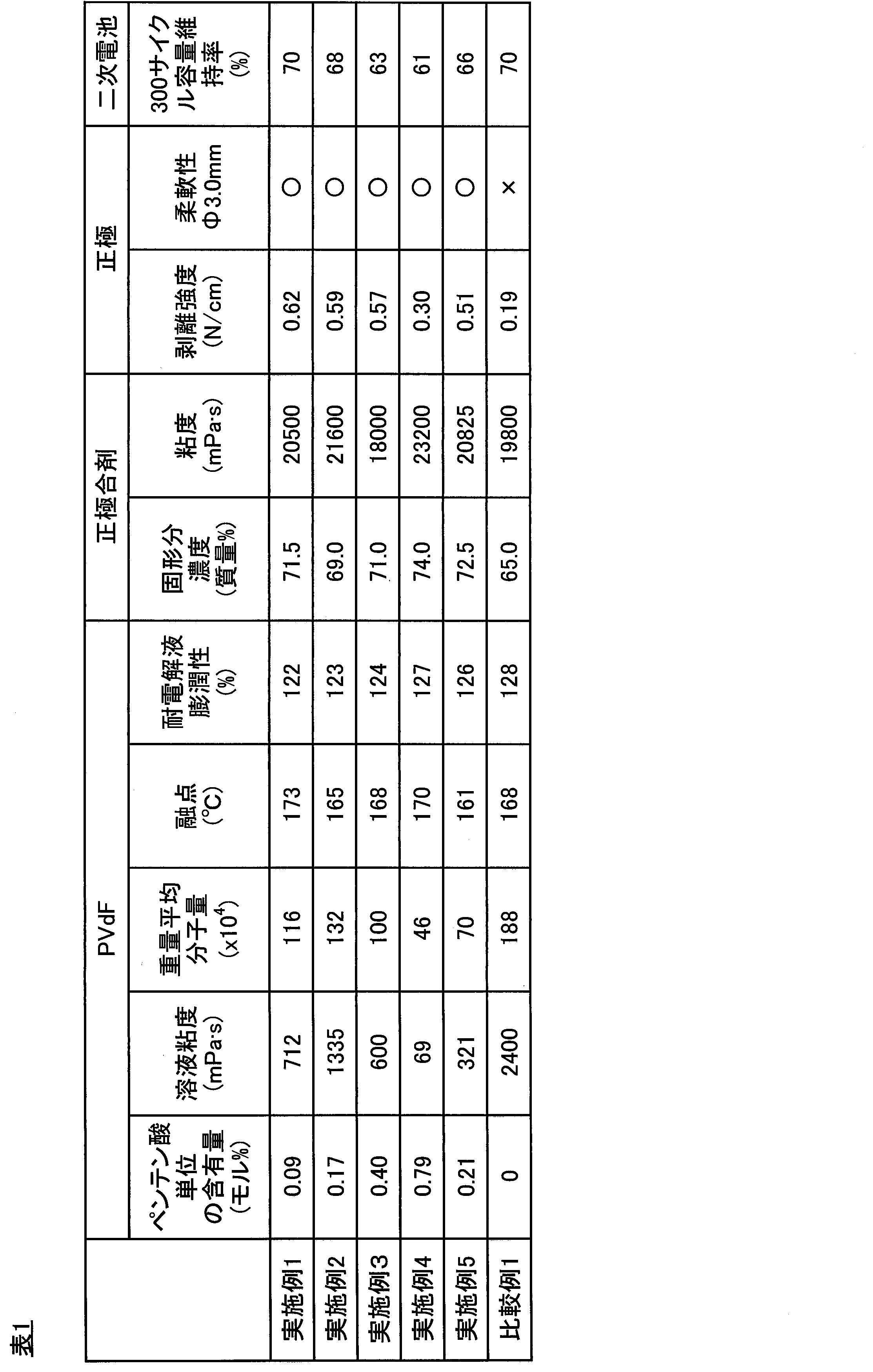
Claims (7)
- ビニリデンフルオライド単位、および、式(1):CH2=CH-(CH)2-COOY(式中、Yは、無機カチオンおよび有機カチオンからなる群より選択される少なくとも1種を表す)で表されるペンテン酸単位を含有するポリビニリデンフルオライドであって、
ビニリデンフルオライド単位の含有量が、前記ポリビニリデンフルオライドの全単量体単位に対して、95.0~99.99モル%であり、
前記ペンテン酸単位の含有量が、前記ポリビニリデンフルオライドの全単量体単位に対して、0.01~5.0モル%である
ポリビニリデンフルオライド。 - Yが、H、Li、Na、K、Mg、Ca、AlおよびNH4からなる群より選択される少なくとも1種を表す請求項1に記載のポリビニリデンフルオライド。
- 重量平均分子量が、50000~2000000である請求項1または2に記載のポリビニリデンフルオライド。
- 請求項1~3のいずれかに記載のポリビニリデンフルオライドを含有する結着剤。
- 請求項1~3のいずれかに記載のポリビニリデンフルオライドまたは請求項4に記載の結着剤、粉末電極材料、および、水または非水溶剤を含有する電極合剤。
- 請求項1~3のいずれかに記載のポリビニリデンフルオライドまたは請求項4に記載の結着剤を含有する電極。
- 請求項6に記載の電極を備える二次電池。
Priority Applications (6)
| Application Number | Priority Date | Filing Date | Title |
|---|---|---|---|
| KR1020227029097A KR102836390B1 (ko) | 2020-02-28 | 2021-03-01 | 폴리비닐리덴플루오라이드, 결착제, 전극 합제, 전극 및 이차 전지 |
| CN202180013252.6A CN115052909B (zh) | 2020-02-28 | 2021-03-01 | 聚偏二氟乙烯、粘结剂、电极合剂、电极和二次电池 |
| JP2022503386A JP7752599B2 (ja) | 2020-02-28 | 2021-03-01 | ポリビニリデンフルオライド、結着剤、電極合剤、電極および二次電池 |
| EP21761347.0A EP4112659B1 (en) | 2020-02-28 | 2021-03-01 | Polyvinylidene fluoride, binder, electrode mixture, electrode, and secondary battery |
| US17/896,199 US12603289B2 (en) | 2020-02-28 | 2022-08-26 | Polyvinylidene fluoride, binder, electrode mixture, electrode, and secondary battery |
| JP2023221171A JP2024026579A (ja) | 2020-02-28 | 2023-12-27 | ポリビニリデンフルオライド、結着剤、電極合剤、電極および二次電池 |
Applications Claiming Priority (2)
| Application Number | Priority Date | Filing Date | Title |
|---|---|---|---|
| JP2020034056 | 2020-02-28 | ||
| JP2020-034056 | 2020-02-28 |
Related Child Applications (1)
| Application Number | Title | Priority Date | Filing Date |
|---|---|---|---|
| US17/896,199 Continuation US12603289B2 (en) | 2020-02-28 | 2022-08-26 | Polyvinylidene fluoride, binder, electrode mixture, electrode, and secondary battery |
Publications (1)
| Publication Number | Publication Date |
|---|---|
| WO2021172585A1 true WO2021172585A1 (ja) | 2021-09-02 |
Family
ID=77491653
Family Applications (1)
| Application Number | Title | Priority Date | Filing Date |
|---|---|---|---|
| PCT/JP2021/007676 Ceased WO2021172585A1 (ja) | 2020-02-28 | 2021-03-01 | ポリビニリデンフルオライド、結着剤、電極合剤、電極および二次電池 |
Country Status (7)
| Country | Link |
|---|---|
| US (1) | US12603289B2 (ja) |
| EP (1) | EP4112659B1 (ja) |
| JP (2) | JP7752599B2 (ja) |
| KR (1) | KR102836390B1 (ja) |
| CN (1) | CN115052909B (ja) |
| TW (1) | TWI820400B (ja) |
| WO (1) | WO2021172585A1 (ja) |
Cited By (1)
| Publication number | Priority date | Publication date | Assignee | Title |
|---|---|---|---|---|
| CN115117359A (zh) * | 2022-08-30 | 2022-09-27 | 宁德时代新能源科技股份有限公司 | 粘结剂、制备方法、正极极片、二次电池及用电装置 |
Families Citing this family (2)
| Publication number | Priority date | Publication date | Assignee | Title |
|---|---|---|---|---|
| CN117165222B (zh) * | 2023-11-02 | 2024-04-09 | 宁德时代新能源科技股份有限公司 | 粘结剂、制备方法、负极浆料、负极极片、固态电池及用电装置 |
| CN121769092A (zh) * | 2024-09-30 | 2026-03-31 | 宁德时代新能源科技股份有限公司 | 一种锂二次电池、负极极片、用电装置 |
Citations (7)
| Publication number | Priority date | Publication date | Assignee | Title |
|---|---|---|---|---|
| JPH07201316A (ja) * | 1993-12-29 | 1995-08-04 | Sony Corp | 非水電解液二次電池 |
| JPH09219218A (ja) * | 1996-01-31 | 1997-08-19 | Aea Technol Plc | ポリマー電解質 |
| WO2008129041A1 (en) | 2007-04-24 | 2008-10-30 | Solvay Solexis S.P.A. | Vinylidene fluoride copolymers |
| WO2017056974A1 (ja) | 2015-09-30 | 2017-04-06 | 株式会社クレハ | バインダー組成物、非水電解質二次電池用電極および非水電解質二次電池 |
| WO2018066430A1 (ja) * | 2016-10-07 | 2018-04-12 | ダイキン工業株式会社 | 二次電池用結着剤及び二次電池用電極合剤 |
| WO2018073277A1 (en) | 2016-10-20 | 2018-04-26 | Solvay Specialty Polymers Italy S.P.A. | Pvdf for metal/metal ion batteries |
| WO2019087652A1 (ja) * | 2017-10-30 | 2019-05-09 | ダイキン工業株式会社 | 二次電池用結着剤、二次電池用電極合剤、二次電池用電極及び二次電池 |
Family Cites Families (1)
| Publication number | Priority date | Publication date | Assignee | Title |
|---|---|---|---|---|
| FR3079834B1 (fr) | 2018-04-10 | 2021-09-10 | Arkema Inc | Fluoropolymeres fonctionnels |
-
2021
- 2021-02-26 TW TW110107152A patent/TWI820400B/zh active
- 2021-03-01 CN CN202180013252.6A patent/CN115052909B/zh active Active
- 2021-03-01 KR KR1020227029097A patent/KR102836390B1/ko active Active
- 2021-03-01 WO PCT/JP2021/007676 patent/WO2021172585A1/ja not_active Ceased
- 2021-03-01 EP EP21761347.0A patent/EP4112659B1/en active Active
- 2021-03-01 JP JP2022503386A patent/JP7752599B2/ja active Active
-
2022
- 2022-08-26 US US17/896,199 patent/US12603289B2/en active Active
-
2023
- 2023-12-27 JP JP2023221171A patent/JP2024026579A/ja active Pending
Patent Citations (7)
| Publication number | Priority date | Publication date | Assignee | Title |
|---|---|---|---|---|
| JPH07201316A (ja) * | 1993-12-29 | 1995-08-04 | Sony Corp | 非水電解液二次電池 |
| JPH09219218A (ja) * | 1996-01-31 | 1997-08-19 | Aea Technol Plc | ポリマー電解質 |
| WO2008129041A1 (en) | 2007-04-24 | 2008-10-30 | Solvay Solexis S.P.A. | Vinylidene fluoride copolymers |
| WO2017056974A1 (ja) | 2015-09-30 | 2017-04-06 | 株式会社クレハ | バインダー組成物、非水電解質二次電池用電極および非水電解質二次電池 |
| WO2018066430A1 (ja) * | 2016-10-07 | 2018-04-12 | ダイキン工業株式会社 | 二次電池用結着剤及び二次電池用電極合剤 |
| WO2018073277A1 (en) | 2016-10-20 | 2018-04-26 | Solvay Specialty Polymers Italy S.P.A. | Pvdf for metal/metal ion batteries |
| WO2019087652A1 (ja) * | 2017-10-30 | 2019-05-09 | ダイキン工業株式会社 | 二次電池用結着剤、二次電池用電極合剤、二次電池用電極及び二次電池 |
Non-Patent Citations (1)
| Title |
|---|
| See also references of EP4112659A4 |
Cited By (2)
| Publication number | Priority date | Publication date | Assignee | Title |
|---|---|---|---|---|
| CN115117359A (zh) * | 2022-08-30 | 2022-09-27 | 宁德时代新能源科技股份有限公司 | 粘结剂、制备方法、正极极片、二次电池及用电装置 |
| CN115117359B (zh) * | 2022-08-30 | 2023-03-10 | 宁德时代新能源科技股份有限公司 | 粘结剂、制备方法、正极极片、二次电池及用电装置 |
Also Published As
| Publication number | Publication date |
|---|---|
| KR102836390B1 (ko) | 2025-07-22 |
| US20220416250A1 (en) | 2022-12-29 |
| TW202139506A (zh) | 2021-10-16 |
| KR20220132571A (ko) | 2022-09-30 |
| JPWO2021172585A1 (ja) | 2021-09-02 |
| EP4112659B1 (en) | 2025-07-09 |
| EP4112659A1 (en) | 2023-01-04 |
| TWI820400B (zh) | 2023-11-01 |
| EP4112659A4 (en) | 2024-03-27 |
| US12603289B2 (en) | 2026-04-14 |
| JP2024026579A (ja) | 2024-02-28 |
| CN115052909B (zh) | 2024-07-26 |
| CN115052909A (zh) | 2022-09-13 |
| JP7752599B2 (ja) | 2025-10-10 |
Similar Documents
| Publication | Publication Date | Title |
|---|---|---|
| JP6863470B2 (ja) | 二次電池用結着剤、二次電池用電極合剤、二次電池用電極及び二次電池 | |
| JP6269890B1 (ja) | 二次電池用結着剤及び二次電池用電極合剤 | |
| JP5573980B2 (ja) | 結着剤、正極合剤及び負極合剤 | |
| US12506154B2 (en) | Composition, binder, electrode mixture, electrode, and secondary battery | |
| JP7212291B2 (ja) | 電池用結着剤、電極合剤、電極および二次電池 | |
| US12603289B2 (en) | Polyvinylidene fluoride, binder, electrode mixture, electrode, and secondary battery | |
| JP2018063932A (ja) | 二次電池用結着剤及び二次電池用電極合剤 | |
| JP2018060745A (ja) | 二次電池用結着剤及び二次電池用電極合剤 | |
| WO2022124253A1 (ja) | 共重合体、結着剤、成形品および共重合体の製造方法 | |
| JP7332970B2 (ja) | 電気化学デバイス用組成物、電極および二次電池 | |
| JP2022090402A (ja) | 共重合体、結着剤、成形品および共重合体の製造方法 |
Legal Events
| Date | Code | Title | Description |
|---|---|---|---|
| 121 | Ep: the epo has been informed by wipo that ep was designated in this application |
Ref document number: 21761347 Country of ref document: EP Kind code of ref document: A1 |
|
| ENP | Entry into the national phase |
Ref document number: 2022503386 Country of ref document: JP Kind code of ref document: A |
|
| ENP | Entry into the national phase |
Ref document number: 20227029097 Country of ref document: KR Kind code of ref document: A |
|
| NENP | Non-entry into the national phase |
Ref country code: DE |
|
| ENP | Entry into the national phase |
Ref document number: 2021761347 Country of ref document: EP Effective date: 20220928 |
|
| WWG | Wipo information: grant in national office |
Ref document number: 2021761347 Country of ref document: EP |