WO2021177294A1 - Procédé de formation de motif, procédé de fabrication de dispositif électronique, composition de résine sensible à la lumière active ou sensible au rayonnement et film de réserve - Google Patents
Procédé de formation de motif, procédé de fabrication de dispositif électronique, composition de résine sensible à la lumière active ou sensible au rayonnement et film de réserve Download PDFInfo
- Publication number
- WO2021177294A1 WO2021177294A1 PCT/JP2021/007927 JP2021007927W WO2021177294A1 WO 2021177294 A1 WO2021177294 A1 WO 2021177294A1 JP 2021007927 W JP2021007927 W JP 2021007927W WO 2021177294 A1 WO2021177294 A1 WO 2021177294A1
- Authority
- WO
- WIPO (PCT)
- Prior art keywords
- group
- repeating unit
- preferable
- atom
- resin
- Prior art date
- Legal status (The legal status is an assumption and is not a legal conclusion. Google has not performed a legal analysis and makes no representation as to the accuracy of the status listed.)
- Ceased
Links
Images


Classifications
-
- G—PHYSICS
- G03—PHOTOGRAPHY; CINEMATOGRAPHY; ANALOGOUS TECHNIQUES USING WAVES OTHER THAN OPTICAL WAVES; ELECTROGRAPHY; HOLOGRAPHY
- G03F—PHOTOMECHANICAL PRODUCTION OF TEXTURED OR PATTERNED SURFACES, e.g. FOR PRINTING, FOR PROCESSING OF SEMICONDUCTOR DEVICES; MATERIALS THEREFOR; ORIGINALS THEREFOR; APPARATUS SPECIALLY ADAPTED THEREFOR
- G03F7/00—Photomechanical, e.g. photolithographic, production of textured or patterned surfaces, e.g. printing surfaces; Materials therefor, e.g. comprising photoresists; Apparatus specially adapted therefor
- G03F7/26—Processing photosensitive materials; Apparatus therefor
- G03F7/30—Imagewise removal using liquid means
- G03F7/32—Liquid compositions therefor, e.g. developers
- G03F7/325—Non-aqueous compositions
-
- G—PHYSICS
- G03—PHOTOGRAPHY; CINEMATOGRAPHY; ANALOGOUS TECHNIQUES USING WAVES OTHER THAN OPTICAL WAVES; ELECTROGRAPHY; HOLOGRAPHY
- G03F—PHOTOMECHANICAL PRODUCTION OF TEXTURED OR PATTERNED SURFACES, e.g. FOR PRINTING, FOR PROCESSING OF SEMICONDUCTOR DEVICES; MATERIALS THEREFOR; ORIGINALS THEREFOR; APPARATUS SPECIALLY ADAPTED THEREFOR
- G03F7/00—Photomechanical, e.g. photolithographic, production of textured or patterned surfaces, e.g. printing surfaces; Materials therefor, e.g. comprising photoresists; Apparatus specially adapted therefor
- G03F7/004—Photosensitive materials
-
- G—PHYSICS
- G03—PHOTOGRAPHY; CINEMATOGRAPHY; ANALOGOUS TECHNIQUES USING WAVES OTHER THAN OPTICAL WAVES; ELECTROGRAPHY; HOLOGRAPHY
- G03F—PHOTOMECHANICAL PRODUCTION OF TEXTURED OR PATTERNED SURFACES, e.g. FOR PRINTING, FOR PROCESSING OF SEMICONDUCTOR DEVICES; MATERIALS THEREFOR; ORIGINALS THEREFOR; APPARATUS SPECIALLY ADAPTED THEREFOR
- G03F7/00—Photomechanical, e.g. photolithographic, production of textured or patterned surfaces, e.g. printing surfaces; Materials therefor, e.g. comprising photoresists; Apparatus specially adapted therefor
- G03F7/004—Photosensitive materials
- G03F7/0045—Photosensitive materials with organic non-macromolecular light-sensitive compounds not otherwise provided for, e.g. dissolution inhibitors
-
- G—PHYSICS
- G03—PHOTOGRAPHY; CINEMATOGRAPHY; ANALOGOUS TECHNIQUES USING WAVES OTHER THAN OPTICAL WAVES; ELECTROGRAPHY; HOLOGRAPHY
- G03F—PHOTOMECHANICAL PRODUCTION OF TEXTURED OR PATTERNED SURFACES, e.g. FOR PRINTING, FOR PROCESSING OF SEMICONDUCTOR DEVICES; MATERIALS THEREFOR; ORIGINALS THEREFOR; APPARATUS SPECIALLY ADAPTED THEREFOR
- G03F7/00—Photomechanical, e.g. photolithographic, production of textured or patterned surfaces, e.g. printing surfaces; Materials therefor, e.g. comprising photoresists; Apparatus specially adapted therefor
- G03F7/004—Photosensitive materials
- G03F7/0048—Photosensitive materials characterised by the solvents or agents facilitating spreading, e.g. tensio-active agents
-
- G—PHYSICS
- G03—PHOTOGRAPHY; CINEMATOGRAPHY; ANALOGOUS TECHNIQUES USING WAVES OTHER THAN OPTICAL WAVES; ELECTROGRAPHY; HOLOGRAPHY
- G03F—PHOTOMECHANICAL PRODUCTION OF TEXTURED OR PATTERNED SURFACES, e.g. FOR PRINTING, FOR PROCESSING OF SEMICONDUCTOR DEVICES; MATERIALS THEREFOR; ORIGINALS THEREFOR; APPARATUS SPECIALLY ADAPTED THEREFOR
- G03F7/00—Photomechanical, e.g. photolithographic, production of textured or patterned surfaces, e.g. printing surfaces; Materials therefor, e.g. comprising photoresists; Apparatus specially adapted therefor
- G03F7/004—Photosensitive materials
- G03F7/039—Macromolecular compounds which are photodegradable, e.g. positive electron resists
-
- G—PHYSICS
- G03—PHOTOGRAPHY; CINEMATOGRAPHY; ANALOGOUS TECHNIQUES USING WAVES OTHER THAN OPTICAL WAVES; ELECTROGRAPHY; HOLOGRAPHY
- G03F—PHOTOMECHANICAL PRODUCTION OF TEXTURED OR PATTERNED SURFACES, e.g. FOR PRINTING, FOR PROCESSING OF SEMICONDUCTOR DEVICES; MATERIALS THEREFOR; ORIGINALS THEREFOR; APPARATUS SPECIALLY ADAPTED THEREFOR
- G03F7/00—Photomechanical, e.g. photolithographic, production of textured or patterned surfaces, e.g. printing surfaces; Materials therefor, e.g. comprising photoresists; Apparatus specially adapted therefor
- G03F7/004—Photosensitive materials
- G03F7/039—Macromolecular compounds which are photodegradable, e.g. positive electron resists
- G03F7/0392—Macromolecular compounds which are photodegradable, e.g. positive electron resists the macromolecular compound being present in a chemically amplified positive photoresist composition
-
- G—PHYSICS
- G03—PHOTOGRAPHY; CINEMATOGRAPHY; ANALOGOUS TECHNIQUES USING WAVES OTHER THAN OPTICAL WAVES; ELECTROGRAPHY; HOLOGRAPHY
- G03F—PHOTOMECHANICAL PRODUCTION OF TEXTURED OR PATTERNED SURFACES, e.g. FOR PRINTING, FOR PROCESSING OF SEMICONDUCTOR DEVICES; MATERIALS THEREFOR; ORIGINALS THEREFOR; APPARATUS SPECIALLY ADAPTED THEREFOR
- G03F7/00—Photomechanical, e.g. photolithographic, production of textured or patterned surfaces, e.g. printing surfaces; Materials therefor, e.g. comprising photoresists; Apparatus specially adapted therefor
- G03F7/004—Photosensitive materials
- G03F7/039—Macromolecular compounds which are photodegradable, e.g. positive electron resists
- G03F7/0392—Macromolecular compounds which are photodegradable, e.g. positive electron resists the macromolecular compound being present in a chemically amplified positive photoresist composition
- G03F7/0397—Macromolecular compounds which are photodegradable, e.g. positive electron resists the macromolecular compound being present in a chemically amplified positive photoresist composition the macromolecular compound having an alicyclic moiety in a side chain
-
- G—PHYSICS
- G03—PHOTOGRAPHY; CINEMATOGRAPHY; ANALOGOUS TECHNIQUES USING WAVES OTHER THAN OPTICAL WAVES; ELECTROGRAPHY; HOLOGRAPHY
- G03F—PHOTOMECHANICAL PRODUCTION OF TEXTURED OR PATTERNED SURFACES, e.g. FOR PRINTING, FOR PROCESSING OF SEMICONDUCTOR DEVICES; MATERIALS THEREFOR; ORIGINALS THEREFOR; APPARATUS SPECIALLY ADAPTED THEREFOR
- G03F7/00—Photomechanical, e.g. photolithographic, production of textured or patterned surfaces, e.g. printing surfaces; Materials therefor, e.g. comprising photoresists; Apparatus specially adapted therefor
- G03F7/20—Exposure; Apparatus therefor
- G03F7/2002—Exposure; Apparatus therefor with visible light or UV light, through an original having an opaque pattern on a transparent support, e.g. film printing, projection printing; by reflection of visible or UV light from an original such as a printed image
- G03F7/2004—Exposure; Apparatus therefor with visible light or UV light, through an original having an opaque pattern on a transparent support, e.g. film printing, projection printing; by reflection of visible or UV light from an original such as a printed image characterised by the use of a particular light source, e.g. fluorescent lamps or deep UV light
-
- H—ELECTRICITY
- H10—SEMICONDUCTOR DEVICES; ELECTRIC SOLID-STATE DEVICES NOT OTHERWISE PROVIDED FOR
- H10P—GENERIC PROCESSES OR APPARATUS FOR THE MANUFACTURE OR TREATMENT OF DEVICES COVERED BY CLASS H10
- H10P76/00—Manufacture or treatment of masks on semiconductor bodies, e.g. by lithography or photolithography
- H10P76/20—Manufacture or treatment of masks on semiconductor bodies, e.g. by lithography or photolithography of masks comprising organic materials
- H10P76/204—Manufacture or treatment of masks on semiconductor bodies, e.g. by lithography or photolithography of masks comprising organic materials of organic photoresist masks
- H10P76/2041—Photolithographic processes
Definitions
- the present invention relates to a pattern forming method, a method for manufacturing an electronic device, an actinic cheilitis or radiation-sensitive resin composition, and a resist film.
- a featured resist pattern forming method is disclosed.
- an object of the present invention is to provide a pattern forming method capable of forming a pattern having excellent resolution performance and LER performance. Another object of the present invention is to provide a method for manufacturing an electronic device using the above pattern forming method. Another object of the present invention is to provide a sensitive light-sensitive or radiation-sensitive resin composition capable of forming a pattern excellent in resolution performance and LER performance. Another object of the present invention is to provide a resist film using the above-mentioned actinic cheilitis or radiation-sensitive resin composition.
- a resist film forming step of forming a resist film on a substrate using an actinic cheilitis or radiation-sensitive resin composition and The exposure process for exposing the resist film and A pattern forming method comprising a development step of positively developing the exposed resist film with an organic solvent-based developer.
- the above-mentioned actinic light-sensitive or radiation-sensitive resin composition Resin with polar groups and A compound containing two or more ion pairs that are decomposed by irradiation with active light or radiation and having a molecular weight of 5,000 or less.
- a method for forming a pattern which comprises a solvent.
- the resin does not contain the repeating unit X2 whose solubility in an organic solvent-based developer is reduced by the action of an acid, or The pattern according to any one of [1] to [4], wherein when the resin contains the repeating unit X2, the content of the repeating unit X2 is 10 mol% or less with respect to all the repeating units of the resin.
- Forming method. [6] A method for manufacturing an electronic device, which comprises the pattern forming method according to any one of [1] to [5]. [7] Resin having a polar group and A compound containing two or more ion pairs that are decomposed by irradiation with active light or radiation and having a molecular weight of 5,000 or less.
- a sensitive light-sensitive or radiation-sensitive resin composition containing a solvent The resist film formed by using the above-mentioned sensitive light-sensitive or radiation-sensitive resin composition is irradiated with active light or radiation and its solubility in an organic solvent-based developing solution is increased. Sex resin composition.
- the repeating unit X1 contains a repeating unit containing a phenolic hydroxyl group.
- the resin does not contain the repeating unit X2 whose solubility in an organic solvent-based developer is reduced by the action of an acid, or The sensitivity according to any one of [7] to [9], wherein when the resin contains the repeating unit X2, the content of the repeating unit X2 is 20 mol% or less with respect to all the repeating units of the resin.
- a light or radiation sensitive resin composition is not contained in the repeating unit X2 whose solubility in an organic solvent-based developer is reduced by the action of an acid, or The sensitivity according to any one of [7] to [9], wherein when the resin contains the repeating unit X2, the content of the repeating unit X2 is 20 mol% or less with respect to all the repeating units of the resin.
- the resin does not contain the repeating unit X2 whose solubility in an organic solvent-based developer is reduced by the action of an acid, or The feeling according to any one of [7] to [10], wherein when the resin contains the repeating unit X2, the content of the repeating unit X2 is 10 mol% or less with respect to all the repeating units of the resin. Active light or radiation sensitive resin composition.
- a pattern forming method capable of forming a pattern having excellent resolution performance and LER performance. Further, according to the present invention, it is possible to provide a method for manufacturing an electronic device using the above pattern forming method. Further, according to the present invention, it is possible to provide a sensitive light-sensitive or radiation-sensitive resin composition capable of forming a pattern excellent in resolution performance and LER performance. Further, according to the present invention, it is possible to provide a resist film using the above-mentioned actinic cheilitis or radiation-sensitive resin composition.
- the pattern forming method, the method for producing an electronic device, the actinic cheilitis or radiation-sensitive resin composition, and the resist film according to the present invention will be described in detail.
- the description of the constituent elements described below may be based on the representative embodiments of the present invention, but the present invention is not limited to such embodiments.
- the notation without substitution and non-substitution includes a group having a substituent as well as a group having no substituent. do.
- the "alkyl group” includes not only an alkyl group having no substituent (unsubstituted alkyl group) but also an alkyl group having a substituent (substituted alkyl group).
- the "organic group” in the present specification means a group containing at least one carbon atom. Unless otherwise specified, the substituent is preferably a monovalent substituent.
- the term “active light” or “radiation” refers to, for example, the emission line spectrum of a mercury lamp, far ultraviolet rays typified by an excimer laser, extreme ultraviolet rays (EUV light), X-rays, and electron beams (EB). : Electron Beam) etc.
- the term "light” means active light or radiation.
- exposure refers to not only exposure to the emission line spectrum of a mercury lamp, far ultraviolet rays represented by excimer lasers, extreme ultraviolet rays, X-rays, etc., but also electron beams, ion beams, etc. Also includes drawing with particle beams.
- "-" is used to mean that the numerical values described before and after the value are included as the lower limit value and the upper limit value.
- the bonding direction of the divalent groups described herein is not limited unless otherwise specified.
- Y when Y is -COO- in the compound represented by the general formula "XYZ", Y may be -CO-O-, and is -O-CO-. You may. Moreover, the said compound may be "X-CO-O-Z" or "X-O-CO-Z".
- (meth) acrylic acid represents acrylic acid and methacrylic acid.
- the weight average molecular weight (Mw), the number average molecular weight (Mn), and the degree of dispersion (also referred to as molecular weight distribution) (Mw / Mn) of the resin are GPC (Gel Permeation Chromatography) apparatus (HLC-8120GPC manufactured by Toso).
- the acid dissociation constant (pKa) represents pKa in an aqueous solution
- the following software package 1 is used to obtain a value based on a database of Hammett's substituent constants and known literature values. , It is a value obtained by calculation. All pKa values described herein indicate values calculated using this software package.
- pKa can also be obtained by the molecular orbital calculation method.
- a specific method for this there is a method of calculating H + dissociation free energy in a solvent based on a thermodynamic cycle.
- water is usually used as the solvent, and DMSO (dimethyl sulfoxide) is used when pKa cannot be obtained with water.
- the calculation method of H + dissociation free energy can be calculated by, for example, DFT (density functional theory), but various other methods have been reported in the literature and are not limited thereto.
- DFT density functional theory
- pKa in the present specification refers to a value obtained by calculating a value based on a database of Hammett's substituent constants and known literature values using software package 1, and pKa is calculated by this method. If it cannot be calculated, the value obtained by Gaussian 16 based on DFT (Density Functional Theory) shall be adopted.
- DFT Density Functional Theory
- examples of the halogen atom include a fluorine atom, a chlorine atom, a bromine atom, and an iodine atom.
- the pattern forming method of the present invention includes the following steps X1 to X3.
- Step X1 A resist film forming step of forming a resist film on a substrate using a sensitive light-sensitive or radiation-sensitive resin composition (hereinafter, also referred to as “specific resist composition”) described later
- Step X2 The resist film is formed.
- Exposure step for exposure Step X3: A development step for positively developing the exposed resist film with an organic solvent-based developer.
- Specific resist composition >> Resins with polar groups (hereinafter also referred to as “specific resins”) and A compound containing two or more ion pairs that are decomposed by irradiation with active light or radiation and having a molecular weight of 5,000 or less (hereinafter, also referred to as “specific photodegradable ionic compound”). Includes solvent.
- step X1 the specific resin and the specific photodegradable ionic compound form an associative structure by electrostatic interaction between the polar group in the specific resin and the ion pair in the specific photodegradable ionic compound. As a result, a low-solubility or insoluble resist film is formed in the organic solvent-based developing solution.
- step X2 exposure treatment
- step X2 exposure treatment
- the solubility in the organic solvent-based developer is improved in the exposed portion.
- the solubility in the organic solvent-based developer is almost unchanged. That is, by going through the above step X2, a difference in solubility (dissolution contrast) in the organic solvent-based developer is generated between the exposed portion and the unexposed portion of the resist film, and in the subsequent step X3, the exposed portion of the resist film is exposed. It is dissolved and removed in an organic solvent-based developer to form a positive pattern.
- the specific photodegradable ionic compound contains two or more ion pairs that are decomposed by irradiation with active light or radiation, and that the molecular weight is 5,000 or less in terms of resolution performance and LER.
- the specific photodegradable ion compound contains two or more ion pairs that are decomposed by irradiation with active light or radiation, it functions as a cross-linking component for cross-linking between polar groups in the specific resin, whereby the specific resin.
- step X2 the aggregate of the compound and the specific photodegradable ionic compound becomes a higher polymer, and the solubility of the resist film formed in step X1 in organic solvent development can be further reduced. That is, in step X2, the dissolution contrast between the exposed portion and the unexposed portion can be further improved. Further, when the molecular weight of the specific photodegradable ionic compound is 5,000 or less, the association structure of the specific resin and the specific photodegradable ionic compound tends to be more uniform in the film, and as a result, the formed pattern LER tends to be small. The above effects are also clear from the results shown in the Examples column of the present specification.
- the pattern formed by the above pattern forming method is the case where a compound containing only one ion pair decomposed by irradiation with active light or radiation is used (see Comparative Examples 1 and 2), and the active light or radiation. Compared with the case of using a polymer compound having a molecular weight of more than 5,000 containing two or more ion pairs decomposed by irradiation (see Comparative Example 3), the resolution performance and the LER performance are superior.
- the above pattern forming method can be suitably used, for example, when forming a fine pattern having a line and space of 16 nm or less.
- the first embodiment of the pattern forming method has the following step X1, the following step X2, and the following step X3 in this order.
- Step X1 Resist film forming step of forming a resist film on a substrate using a specific resist composition
- Step X2 Exposure step of exposing the resist film
- Step X3 An organic solvent-based developing solution is applied to the exposed resist film. A development process that uses and develops positively.
- Step X1 Resist film forming step
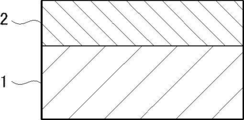
- the step X1 is a step of forming the resist film 2 on the substrate 1 by using the specific resist composition.
- the method of forming a resist film on a substrate using the specific resist composition include a method of applying the specific resist composition on the substrate.
- the specific resist composition can be applied onto a substrate (eg, silicon, silicon dioxide coating) such as that used in the manufacture of integrated circuit elements by an appropriate coating method such as a spinner or a coater.
- the coating method is preferably spin coating using a spinner.
- the rotation speed at the time of spin coating using a spinner is preferably 1000 to 3000 rpm.
- the resist film 2 is formed by forming an association structure. This association structure exhibits low solubility or insolubility in an organic solvent-based developer. The composition of the specific resist composition will be described later.
- the substrate After applying the specific resist composition, the substrate may be heated to form a resist film. If necessary, various undercoat films (inorganic film, organic film, antireflection film) may be formed under the resist film.
- various undercoat films inorganic film, organic film, antireflection film
- the heating can be carried out by means provided in a normal exposure machine and / or a developing machine, and may be carried out by using a hot plate or the like.
- the heating temperature is preferably 80 to 150 ° C, more preferably 80 to 140 ° C, and even more preferably 80 to 130 ° C.
- the heating time is preferably 30 to 1000 seconds, more preferably 30 to 800 seconds, and even more preferably 40 to 600 seconds. The heating may be performed in a plurality of times.
- the film thickness of the resist film is not particularly limited, but is preferably 10 to 90 nm, more preferably 10 to 65 nm, and even more preferably 15 to 50 nm from the viewpoint of being able to form a finer pattern with higher accuracy.
- a top coat may be formed on the upper layer of the resist film by using the top coat composition. It is preferable that the topcoat composition is not mixed with the resist film and can be uniformly applied to the upper layer of the resist film.
- the topcoat composition contains, for example, a resin, an additive and a solvent.
- the top coat is not particularly limited, and a conventionally known top coat can be formed by a conventionally known method. For example, a top coat may be formed based on the description in paragraphs [0072] to [0082] of JP-A-2014-059543. Can be formed. For example, it is preferable to form a top coat containing a basic compound as described in JP2013-061648 on the resist film.
- the topcoat also preferably contains a compound containing at least one group or bond selected from the group consisting of ether bonds, thioether bonds, hydroxyl groups, thiol groups, carbonyl bonds, and ester bonds.
- Step X2 Exposure step
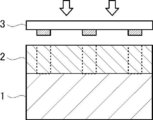
- the step X2 is a step of exposing the resist film 2 obtained through the step X1 in a pattern through a predetermined mask 3.
- the specific photodegradable ionic compound in the resist film 2 is decomposed in the exposed portion (the opening region of the mask, which corresponds to the region indicated by the arrow in FIG. 2) to obtain the specific resin.
- the association structure with the specific photodegradable ionic compound is released.
- the solubility in the organic solvent-based developer is improved in the exposed portion.
- the unexposed portion the non-opened region of the mask, which corresponds to the region without the arrow in FIG.
- the wavelength of the light source used in the exposure process is not limited, and examples thereof include infrared light, visible light, ultraviolet light, far ultraviolet light, polar ultraviolet light (EUV), X-ray, and electron beam.
- far-ultraviolet light is preferable, and the wavelength thereof is preferably 250 nm or less, more preferably 220 nm or less, further preferably 1 to 200 nm.
- the exposure method in the exposure step of the step X2 may be immersion exposure. Further, the exposure process may be divided into a plurality of times to perform the exposure. The amount of exposure may be such that the specific photodegradable ionic compound present in the exposed portion 2a can be decomposed by light absorption.
- a heating (PEB: Post Exposure Bake (also referred to as “post-exposure bake”)) step may be performed.
- the heating temperature is preferably 80 to 150 ° C, more preferably 80 to 140 ° C, and even more preferably 80 to 130 ° C.
- the heating time is preferably 10 to 1000 seconds, more preferably 10 to 180 seconds, and even more preferably 30 to 120 seconds.
- the heating can be carried out by means provided in a normal exposure machine and / or a developing machine, and may be carried out by using a hot plate or the like. Further, the heating may be carried out in a plurality of times.
- Step X3 is a step of developing the exposed resist film using an organic solvent-based developer to form a pattern.
- the exposed portion 2a is dissolved and removed in the organic solvent-based developer, and the unexposed portion 2b remains as a film to form a positive resist pattern. That is, the step X3 corresponds to the positive development step.
- the organic solvent-based developer represents a developer containing an organic solvent.
- the vapor pressure of the organic solvent contained in the organic solvent-based developer is preferably 5 kPa or less, more preferably 3 kPa or less, and further preferably 2 kPa or less at 20 ° C.
- the organic solvent-based developing solution contains at least one organic solvent selected from the group consisting of a ketone solvent, an ester solvent, an alcohol solvent, an amide solvent, an ether solvent, and a hydrocarbon solvent. It is preferably a liquid.
- ketone solvent examples include 1-octanone, 2-octanone, 1-nonanone, 2-nonanone, acetone, 2-heptanone (methylamyl ketone), 4-heptanone, 1-hexanone, 2-hexanone, and diisobutyl ketone.
- Cyclohexanone, methylcyclohexanone, phenylacetone, methylethylketone, methylisobutylketone, acetylacetone, acetonylacetone, ionone, diacetonyl alcohol, acetylcarbinol, acetophenone, methylnaphthylketone, isophorone, propylene carbonate and the like can be mentioned.
- ester solvent examples include butyl acetate, isobutyl acetate, methyl acetate, ethyl acetate, isopropyl acetate, pentyl acetate, isopentyl acetate, amyl acetate, propylene glycol monomethyl ether acetate, ethylene glycol monoethyl ether acetate, diethylene glycol monobutyl ether acetate, and the like.
- the solvents disclosed in paragraphs [0715] to [0718] of US Patent Application Publication No. 2016/0070167A1 can be used.
- the number of carbon atoms is 6 or more (7) in that the swelling of the resist film can be further suppressed as the organic solvent contained in the organic solvent-based developer.
- the above is preferable, 14 or less is preferable, 12 or less is more preferable, and 10 or less is further preferable), and it is preferable to use an ester solvent having a heteroatom number of 2 or less.
- the hetero atom of the ester-based solvent is an atom other than a carbon atom and a hydrogen atom, and examples thereof include an oxygen atom, a nitrogen atom, and a sulfur atom.
- the number of heteroatoms is preferably 2 or less.
- Ester-based solvents having 6 or more carbon atoms and 2 or less heteroatomic atoms include butyl acetate, isobutyl acetate, amyl acetate, isoamyl acetate, 2-methylbutyl acetate, 1-methylbutyl acetate, hexyl acetate, pentyl propionate, and propion. Hexyl acid acid, butyl propionate, isobutyl isobutyrate, heptyl propionate, or butyl butanoate are preferred.
- the organic solvent contained in the organic solvent-based developing solution is a mixture of an ester solvent and a hydrocarbon solvent in that swelling of the resist film can be further suppressed. It is also preferable that it is a solvent or a mixed solvent of a ketone solvent and a hydrocarbon solvent.
- the ester solvent When a mixed solvent of an ester solvent and a hydrocarbon solvent is used as the organic solvent contained in the organic solvent-based developing solution, the ester solvent has the above-mentioned carbon atom number of 6 or more and heteroatomic number of 2 or less. Ester-based solvents can be mentioned, and isoamyl acetate is preferable. Further, as the hydrocarbon solvent, a saturated hydrocarbon solvent (for example, octane, nonane, decane, dodecane, undecane, hexadecane, etc.) is preferable from the viewpoint of adjusting the solubility of the resist film.
- a saturated hydrocarbon solvent for example, octane, nonane, decane, dodecane, undecane, hexadecane, etc.
- the above-mentioned ketone solvent can be mentioned as the ketone solvent, and 2-heptanone is preferable.
- a saturated hydrocarbon solvent for example, octane, nonane, decane, dodecane, undecane, hexadecane, etc.
- the content of the hydrocarbon solvent depends on the solvent solubility of the resist film and is not particularly limited, and the required amount may be appropriately prepared and determined.
- the organic solvent-based developer a plurality of organic solvents may be mixed, or may be mixed with an organic solvent or water other than the above.
- the water content of the organic solvent-based developer as a whole is less than 10% by mass, and it is more preferable that the organic solvent-based developer contains substantially no water.
- the concentration of the organic solvent (total in the case of a plurality of mixture) in the organic solvent-based developer is preferably 50% by mass or more, more preferably 60% by mass or more, further preferably 85% by mass or more, and particularly preferably 90% by mass or more. , 95% by mass or more is most preferable.
- the upper limit value is, for example, 100% by mass or less.
- the organic solvent-based developer may contain an appropriate amount of a known surfactant, if necessary.
- the content of the surfactant is usually 0.001 to 5% by mass, preferably 0.005 to 2% by mass, more preferably 0.01 to 0.5% by mass, based on the total amount of the organic solvent-based developer. preferable.
- Examples of the developing method include a method of immersing the substrate in a tank filled with an organic solvent-based developer for a certain period of time (dip method), a method of raising the organic solvent-based developer on the surface of the substrate by surface tension and allowing it to stand still for a certain period of time.
- a method of developing paddle method
- a method of spraying an organic solvent-based developer on the substrate surface spray method
- an organic solvent-based method while scanning a developer discharge nozzle on a substrate rotating at a constant speed.
- a method of continuously discharging the developing solution can be mentioned. Further, after the step of performing the development, a step of stopping the development may be carried out while substituting with another solvent.
- the development time is not particularly limited as long as the resin in the unexposed portion is sufficiently dissolved, and is preferably 10 to 300 seconds, more preferably 20 to 120 seconds.
- the temperature of the developing solution is preferably 0 to 50 ° C, more preferably 15 to 35 ° C.
- the pattern forming method of the present invention is not limited to the first embodiment described above, and may be, for example, an embodiment having other steps in addition to the steps X1 to X3 described above. Hereinafter, other steps that the pattern forming method of the present invention may have will be described.
- the pattern forming method preferably includes a step of washing with a rinsing liquid after the step X3.
- the rinsing solution is not particularly limited as long as it does not dissolve the pattern, and a solution containing a general organic solvent can be used.
- the rinsing solution preferably contains at least one organic solvent selected from the group consisting of a hydrocarbon solvent, a ketone solvent, an ester solvent, an alcohol solvent, an amide solvent, and an ether solvent.
- the method of the rinsing process is not particularly limited, for example, a method of continuously discharging the rinsing liquid onto a substrate rotating at a constant speed (rotary coating method), or immersing the substrate in a tank filled with the rinsing liquid for a certain period of time.
- Examples thereof include a method (dip method) and a method of spraying a rinse liquid on the surface of a substrate (spray method).
- the pattern forming method may include a heating step (Post Bake) after the rinsing step. By this step, the organic solvent-based developer and the rinse liquid remaining between the patterns and inside the patterns are removed. In addition, this step has the effect of smoothing the resist pattern and improving the surface roughness of the pattern.
- the heating temperature in the heating step after the rinsing step is preferably 40 to 250 ° C, more preferably 80 to 200 ° C.
- the heating time is preferably 10 seconds to 3 minutes, more preferably 30 to 120 seconds.
- the substrate may be etched using the formed pattern as a mask. Any known method can be used for etching, and various conditions and the like are appropriately determined according to the type and application of the substrate. For example, the Bulletin of the International Society of Optical Engineering (Proc. Of SPIE) Vol. Etching can be performed according to 6924, 692420 (2008), Japanese Patent Application Laid-Open No. 2009-267112, and the like. It is also possible to follow the method described in "Chapter 4 Etching" of "Semiconductor Process Textbook 4th Edition 2007 Published Publisher: SEMI Japan”.
- the pattern forming method includes a specific resist composition used in the pattern forming method, and various materials other than the specific resist composition (for example, a developing solution, a rinsing solution, an antireflection film forming composition, a top coat forming composition, and the like. ) May have a step of purifying.
- the content of impurities contained in the specific resist composition and various materials other than the specific resist composition is preferably 1 mass ppm or less, more preferably 10 mass ppt or less, further preferably 100 mass ppt or less, and 10 mass ppt or less. It is particularly preferable, and 1 mass ppt or less is most preferable.
- examples of the metal impurities include Na, K, Ca, Fe, Cu, Mg, Al, Li, Cr, Ni, Sn, Ag, As, Au, Ba, Cd, Co, Pb, Ti, V, and the like. W, Zn and the like can be mentioned.
- Examples of the method for removing impurities such as metals from various materials include filtration using a filter.
- the filter pore size is preferably less than 100 nm, more preferably 10 nm or less, and even more preferably 5 nm or less.
- the filter is preferably made of polytetrafluoroethylene, polyethylene, or nylon.
- the filter may be composed of a composite material in which the above filter material and an ion exchange medium are combined.
- a filter that has been previously washed with an organic solvent may be used.
- Filter In the filtration step, a plurality of types of filters may be connected in series or in parallel. When using a plurality of types of filters, filters having different pore diameters and / or materials may be used in combination.
- various materials may be filtered a plurality of times, and the step of filtering the various materials a plurality of times may be a circulation filtration step.
- the specific resist composition for example, it is preferable to dissolve each component such as a specific resin and a specific photodegradable ionic compound in a solvent, and then perform circulation filtration using a plurality of filters made of different materials.
- the apparatus for producing the specific resist composition is preferably gas-replaced with an inert gas such as nitrogen. This makes it possible to suppress the dissolution of an active gas such as oxygen in the specific resist composition.
- the specific resist composition is filtered through a filter and then filled in a clean container.
- the specific resist composition filled in the container is preferably stored in a refrigerator. As a result, performance deterioration over time is suppressed.
- the shorter the time from the completion of filling the composition into the container to the start of refrigerated storage is preferably, generally within 24 hours, preferably within 16 hours, more preferably within 12 hours, and 10 Within hours is even more preferred.
- the storage temperature is preferably 0 to 15 ° C, more preferably 0 to 10 ° C, and even more preferably 0 to 5 ° C.
- a method of reducing impurities such as metals contained in various materials for example, a method of selecting a raw material having a low metal content as a raw material constituting various materials, and a filter filtration of the raw materials constituting various materials are performed. Examples thereof include a method of performing the distillation and a method of performing distillation under conditions in which contamination is suppressed as much as possible by lining the inside of the apparatus with Teflon (registered trademark).
- impurities may be removed by an adsorbent, or filter filtration and an adsorbent may be used in combination.
- a known adsorbent can be used, and for example, an inorganic adsorbent such as silica gel and zeolite, and an organic adsorbent such as activated carbon can be used.
- an inorganic adsorbent such as silica gel and zeolite
- an organic adsorbent such as activated carbon
- Conductive compounds may be added.
- the conductive compound is not particularly limited, and examples thereof include methanol.
- the amount to be added is not particularly limited, but is preferably 10% by mass or less, more preferably 5% by mass or less, in terms of maintaining preferable development characteristics or rinsing characteristics.
- various piping coated with SUS stainless steel
- antistatic polyethylene, polypropylene, or fluororesin polytetrafluoroethylene, perflooloalkoxy resin, etc.
- filter and the O-ring antistatic treated polyethylene, polypropylene, or fluororesin (polytetrafluoroethylene, perflooloalkoxy resin, etc.) can be used.
- actinic cheilitis or radiation-sensitive resin composition [Actinic cheilitis or radiation-sensitive resin composition]
- actinic light-sensitive or radiation-sensitive resin composition used in step X1 will be described.
- the specific resist composition contains two or more ion pairs that are decomposed by irradiation with active light or radiation, and contains a compound having a molecular weight of 5,000 or less (specific photodegradable ionic compound).
- the ion pair is composed of a cation moiety, which is a positively charged atomic group having a total valence of W, and an anion moiety, which is a negatively charged atomic group having a total valence of W. Will be done. That is, the ion pair is composed of a cation moiety and an anion moiety having the same absolute valence.
- the ion pair may have a salt structure or a structure in which a cation site and an anion site are covalently linked (so-called betaine structure).
- the cation moiety preferably represents a positively charged atomic group having a valence of 1
- the anionic moiety preferably represents a negatively charged atomic group having a valence of 1.
- the specific photodegradable ion compound is, for example, a compound having an ion pair consisting of a cation moiety having absorption to active light or radiation and an anion moiety capable of forming a proton addition structure upon irradiation with active light or radiation. It is preferable that the compound has an ion pair consisting of, for example, a sulfonium cation moiety or an iodonium cation moiety and a non-nucleophilic anion moiety.
- the number of the above-mentioned ion pairs contained in the specific photodegradable ionic compound is not particularly limited as long as it is two or more.
- the upper limit value thereof is preferably 20 or less, more preferably 10 or less, further preferably 6 or less, and particularly preferably 5 or less. Preferably, 4 or less are most preferable.
- the molecular weight of the specific photodegradable ionic compound (when the specific photodegradable ionic compound is a polymer compound and its molecular weight has a distribution, the weight average molecular weight is intended) is 5,000 or less. There are no particular restrictions.
- the lower limit is preferably 250 or more, more preferably 500 or more, still more preferably 600 or more, in that the resolution and / or LER performance of the formed pattern is more excellent.
- the upper limit is preferably 3,000 or less, more preferably 2,000 or less.
- Examples of the specific photodegradable ionic compound include compounds represented by the following general formulas (EX1) to (EX3). Hereinafter, the compound represented by the general formula (EX1) will be described. (Compound represented by the general formula (EX1))
- X E1 represents a single bond or a linking group of m E1 valence.
- LE1 represents a single bond or a divalent linking group.
- m E1 represents an integer of 2 to 4.
- a E1 - represents an anion site.
- ME1 + represents a cation site.
- L E1, A E1 presence of a plurality of -, and M E1 + may each independently selected from the same.
- a E1 - and M E1 + and constitute an ion pair (salt structure).
- X E1 represents a single bond
- m E1 represents 2. That is, when X E1 represents a single bond, the above general formula (EX1) is represented by the following formula.
- the linking group having the m E1 valence represented by the above X E1 is not particularly limited, and examples thereof include linking groups represented by the following (EX1-a1) to (EX1-a3). .. In the following (EX1-a1) to (EX1-a3), * represents the bonding position with LE1 specified in the above general formula (EX1).
- X E11 , X E12 , and X E13 each independently represent an organic group.
- the organic group represented by X E11 constitutes a divalent linking group.
- the organic group represented by X E11 have the general formula (EX1) bonding position to L E1 in the (*) to two chromatic.
- the organic group represented by X E12 constitutes a trivalent linking group
- the organic group represented by X E13 constitutes a tetravalent linking group.
- organic group represented by X E11 , X E12 , and X E13 include a hetero atom (for example, a hetero atom includes a nitrogen atom, an oxygen atom, and a sulfur atom, and a hetero atom. May be included, for example, in the form of -O-, -S-, -SO 2- , -NR 1- , -CO-, or a linking group in which two or more of these are combined).
- examples thereof include hydrocarbon groups formed from possible hydrocarbons, which include linear or branched aliphatic hydrocarbon groups, alicyclic groups, aromatic hydrocarbon groups, heterocyclic groups, or a combination thereof. Linking groups are preferred.
- the hydrocarbon group which may contain a heteroatom as an organic group represented by X E11 is formed by removing two hydrogen atoms from the above-mentioned hydrocarbon which may contain a heteroatom.
- the hydrocarbon group which means a divalent group and may contain a heteroatom as an organic group represented by the above-mentioned X E12 is 3 hydrogen atoms from the above-mentioned hydrocarbon which may contain a heteroatom.
- the above-mentioned hydrocarbon group which means a trivalent group formed by removing the above and may contain a heteroatom as an organic group represented by the above-mentioned XE13 is a carbide which may contain the above-mentioned heteroatom. It means a tetravalent group formed by removing four hydrogen atoms from hydrogen.
- R 1 represents a hydrogen atom or a substituent.
- the substituent is not particularly limited, but for example, an alkyl group (preferably having 1 to 6 carbon atoms, which may be linear or branched) is preferable.
- the number of carbon atoms of the linear or branched aliphatic hydrocarbon group is not particularly limited, but is preferably 1 to 10, more preferably 1 to 6, further preferably 1 to 4, and particularly preferably 1 to 3. ..
- the number of carbon atoms of the alicyclic group is not particularly limited, but is preferably 3 to 30, more preferably 6 to 20, further preferably 6 to 15, and particularly preferably 6 to 12.
- the alicyclic group may be either a monocyclic group or a polycyclic group, or may be a spiro ring. Examples of the alicyclics constituting the monocyclic alicyclic group include monocyclic cycloalkanes such as cyclopentane, cyclohexane, and cyclooctane.
- Examples of the alicyclics constituting the polycyclic alicyclic group include polycyclic cycloalkanes such as norbornane, tricyclodecane, tetracyclodecane, tetracyclododecane, and adamantane.
- the number of carbon atoms of the aromatic hydrocarbon ring constituting the aromatic hydrocarbon group is not particularly limited, but is preferably 6 to 30, more preferably 6 to 20, further preferably 6 to 15, and particularly preferably 6 to 12. ..
- the aromatic hydrocarbon group may be a monocyclic type or a polycyclic type. Examples of the aromatic hydrocarbon ring include a benzene ring and a naphthalene ring.
- the number of carbon atoms of the heterocycle constituting the heterocyclic group is not particularly limited, but is preferably 3 to 25, more preferably 3 to 20, further preferably 6 to 20, particularly preferably 6 to 15, and 6 to 10. Most preferred.
- the heterocycle may be either a monocyclic type or a polycyclic type, and may be any of an aromatic heterocycle and an aliphatic heterocycle.
- the heterocycle may be a spiro ring.
- the aromatic heterocycle include a furan ring, a thiophene ring, a benzofuran ring, a benzothiophene ring, a dibenzofuran ring, a dibenzothiophene ring, and a pyridine ring.
- the aliphatic heterocycle include a tetrahydropyran ring, a lactone ring, a sultone ring, a decahydroisoquinoline ring and the like.
- the linear or branched aliphatic hydrocarbon group, alicyclic group, aromatic hydrocarbon group, and heterocyclic group described above may further have a substituent.
- substituents include an alkyl group, a cycloalkyl group, an aryl group, a hydroxyl group, an alkoxy group, an ester group, an amide group, a urethane group, a ureido group, a thioether group, a sulfonamide group, and a sulfonic acid ester group. ..
- the X E11 has a linear or branched aliphatic hydrocarbon group which may have a substituent, an alicyclic group which may have a substituent, or a substituent.
- An aliphatic heterocyclic group which may be present is preferable.
- Examples of X E12 and X E13 include a linear or branched aliphatic hydrocarbon group which may have a substituent, an alicyclic group which may have a substituent, or a substituent.
- An aliphatic heterocyclic group which may have an aliphatic heterocyclic group is preferable.
- EX1 is not particularly restricted but includes divalent linking group represented by L E1, an alkylene group, an arylene group, -CO -, - CONR N - , - consisting of O-, and -S- It is preferably a divalent linking group selected from one or more or a combination of two or more selected from the group, and one selected from the group consisting of an alkylene group, an arylene group, -CO-, O-, and -S-.
- a divalent linking group consisting of the above or a combination of two or more is more preferable, and a divalent linking of one or more or a combination of two or more selected from the group consisting of an alkylene group, an arylene group, and -COO- It is more preferably a group.
- the alkylene group may be linear, branched or cyclic.
- the alkylene group preferably has 1 to 10 carbon atoms, and more preferably 1 to 4 carbon atoms.
- the arylene group preferably has 6 to 10 carbon atoms, and more preferably a benzene ring group.
- the alkylene group and the arylene group may further have a substituent.
- the substituent is not particularly limited, and examples thereof include a fluorine atom.
- the alkylene group contains a fluorine atom as a substituent, it may be a perfluoroalkylene group.
- R N represents a hydrogen atom or a substituent.
- the substituent is not particularly limited, but for example, an alkyl group (preferably having 1 to 6 carbon atoms, which may be linear or branched) is preferable.
- a E1 - represents an anion site.
- a E1 - is not particularly limited as anion moiety represented by, for example, anionic functional group represented by the following general formula (EX1-b1) ⁇ (EX1 -b10).
- * represents a bonding position. It is also preferable that * in the general formula (EX1-b9) is a bond position with respect to a group that is neither -CO- nor -SO 2-.
- Formula (EX1-b3) ⁇ (EX1 -b7), (EX1-b9) in, R A1 represents an organic group.
- R A1 an alkyl group (which may be linear or branched, preferably having 1 to 15 carbon atoms) and a cycloalkyl group (which may be monocyclic or polycyclic, preferably having 3 to 20 carbon atoms). ), Or an aryl group (either monocyclic or polycyclic, preferably 6 to 20 carbon atoms) is preferable.
- the alkyl group represented by R A1, cycloalkyl group and aryl group may further have a substituent.
- the general formula (EX1-b7) in R A1, N - directly bonded to atoms the carbon atoms in -CO-, and -SO 2 - is also preferred not one of sulfur atoms in the.
- Examples of the cycloalkyl group include a norbornyl group and an adamantyl group.
- an alkyl group (which may be linear or branched, preferably 1 to 5 carbon atoms) is preferable.
- one or more of the carbon atoms which are ring member atoms may be replaced with carbonyl carbon atoms.
- the alkyl group preferably has 1 to 10 carbon atoms, and more preferably 1 to 5 carbon atoms.
- substituent that the alkyl group may have, a cycloalkyl group, a fluorine atom, or a cyano group is preferable.
- the cycloalkyl group of the substituents R A1 and the like as well cycloalkyl groups described in the case of a cycloalkyl group.
- the alkyl group may be a perfluoroalkyl group.
- one or more -CH 2- may be substituted with a carbonyl group.
- aryl group a benzene ring group is preferable.
- substituent that the aryl group may have, an alkyl group, a fluorine atom, or a cyano group is preferable.
- alkyl group as the substituent include the alkyl groups described in the case where RA1 is a cycloalkyl group, and a perfluoroalkyl group is preferable, and a perfluoromethyl group is more preferable.
- R A1 of the general formula (EX1-b5) in the represent a perfluoroalkyl group is preferred.
- the perfluoroalkyl group preferably has 1 to 15 carbon atoms, more preferably 1 to 10 carbon atoms, and even more preferably 1 to 6 carbon atoms.
- R A2 in the general formula (EX1-b8) represents a hydrogen atom or a substituent.
- the substituent is not particularly limited, but for example, an alkyl group (preferably having 1 to 6 carbon atoms, which may be linear or branched) is preferable.
- ME1 + represents a cation site.
- an organic cation represented by the general formula (ZaII) (cation (ZaII)) is preferable.
- R 201 , R 202 , and R 203 each independently represent an organic group.
- the carbon number of the organic group as R 201 , R 202 , and R 203 is usually 1 to 30, preferably 1 to 20.
- two of R 201 to R 203 may be bonded to form a ring structure, and the ring may contain an oxygen atom, a sulfur atom, an ester group, an amide group, or a carbonyl group.
- the two of the group formed by bonding of the R 201 ⁇ R 203 for example, an alkylene group (e.g., butylene and pentylene), and -CH 2 -CH 2 -O-CH 2 -CH 2 - is Can be mentioned.
- the organic cation represented by the cation (ZaI-1), the cation (ZaI-2), and the general formula (ZaI-3b) (cation (ZaI-)) described later will be described.
- Examples thereof include 3b)) and an organic cation (cation (ZaI-4b)) represented by the general formula (ZaI-4b).
- the cation (ZaI-1) is an aryl sulfonium cation in which at least one of R 201 to R 203 of the above general formula (ZaI) is an aryl group.
- the aryl sulfonium cation all of R 201 to R 203 may be an aryl group, or a part of R 201 to R 203 may be an aryl group and the rest may be an alkyl group or a cycloalkyl group.
- R 201 to R 203 may be an aryl group, and the remaining two of R 201 to R 203 may be bonded to form a ring structure, and an oxygen atom, a sulfur atom, and the like may be formed in the ring. It may contain an ester group, an amide group, or a carbonyl group.
- a group formed by bonding two of R 201 to R 203 for example, one or more methylene groups are substituted with an oxygen atom, a sulfur atom, an ester group, an amide group, and / or a carbonyl group.
- alkylene group e.g., butylene group, pentylene group, or -CH 2 -CH 2 -O-CH 2 -CH 2 -
- aryl sulfonium cation examples include a triaryl sulfonium cation, a diarylalkyl sulfonium cation, an aryl dialkyl sulfonium cation, a diarylcycloalkyl sulfonium cation, and an aryl dicycloalkyl sulfonium cation.
- aryl group contained in the arylsulfonium cation a phenyl group or a naphthyl group is preferable, and a phenyl group is more preferable.
- the aryl group may be an aryl group having a heterocyclic structure having an oxygen atom, a nitrogen atom, a sulfur atom or the like. Examples of the heterocyclic structure include pyrrole residues, furan residues, thiophene residues, indole residues, benzofuran residues, benzothiophene residues and the like.
- the aryl sulfonium cation has two or more aryl groups, the two or more aryl groups may be the same or different.
- the alkyl group or cycloalkyl group that the arylsulfonium cation has as needed is a linear alkyl group having 1 to 15 carbon atoms, a branched alkyl group having 3 to 15 carbon atoms, or a branched alkyl group having 3 to 15 carbon atoms.
- Cycloalkyl group is preferable, and examples thereof include a methyl group, an ethyl group, a propyl group, an n-butyl group, a sec-butyl group, a t-butyl group, a cyclopropyl group, a cyclobutyl group, and a cyclohexyl group.
- the substituents that the aryl group, alkyl group, and cycloalkyl group of R 201 to R 203 may have are independently an alkyl group (for example, 1 to 15 carbon atoms) and a cycloalkyl group (for example, carbon number of carbon atoms). 3 to 15), aryl groups (for example, 6 to 14 carbon atoms), alkoxy groups (for example, 1 to 15 carbon atoms), cycloalkyl alkoxy groups (for example, 1 to 15 carbon atoms), halogen atoms, hydroxyl groups, and phenylthio groups. Be done.
- the substituent may further have a substituent when possible.
- the alkyl group may have a halogen atom as a substituent and may be an alkyl halide group such as a trifluoromethyl group. ..
- the cation (ZaI-2) is a cation in which R 201 to R 203 in the formula (ZaI) independently represent an organic group having no aromatic ring.
- the aromatic ring also includes an aromatic ring containing a hetero atom.
- the organic group having no aromatic ring as R 201 to R 203 generally has 1 to 30 carbon atoms, and preferably 1 to 20 carbon atoms.
- R 201 to R 203 are each independently preferably an alkyl group, a cycloalkyl group, an allyl group, or a vinyl group, and are linear or branched 2-oxoalkyl groups, 2-oxocycloalkyl groups, or alkoxy groups.
- a carbonyl methyl group is more preferred, and a linear or branched 2-oxoalkyl group is even more preferred.
- Examples of the alkyl group and cycloalkyl group of R 201 to R 203 include a linear alkyl group having 1 to 10 carbon atoms or a branched chain alkyl group having 3 to 10 carbon atoms (for example, a methyl group, an ethyl group, and a propyl group). Groups, butyl groups, and pentyl groups), and cycloalkyl groups having 3 to 10 carbon atoms (eg, cyclopentyl groups, cyclohexyl groups, and norbornyl groups).
- R 201 to R 203 may be further substituted with a halogen atom, an alkoxy group (for example, 1 to 5 carbon atoms), a hydroxyl group, a cyano group, or a nitro group.
- the cation (ZaI-3b) is a cation represented by the following general formula (ZaI-3b).
- R 1c to R 5c independently represent a hydrogen atom, an alkyl group, a cycloalkyl group, an aryl group, an alkoxy group, an aryloxy group, an alkoxycarbonyl group, an alkylcarbonyloxy group, a cycloalkylcarbonyloxy group, a halogen atom, and a hydroxyl group.
- R 6c and R 7c independently represent a hydrogen atom, an alkyl group (t-butyl group, etc.), a cycloalkyl group, a halogen atom, a cyano group, or an aryl group.
- R x and R y independently represent an alkyl group, a cycloalkyl group, a 2-oxoalkyl group, a 2-oxocycloalkyl group, an alkoxycarbonylalkyl group, an allyl group, or a vinyl group, respectively.
- R 1c to R 5c , R 5c and R 6c , R 6c and R 7c , R 5c and R x , and R x and R y may be combined to form a ring, respectively.
- This ring may independently contain an oxygen atom, a sulfur atom, a ketone group, an ester bond, or an amide bond.
- the ring include an aromatic or non-aromatic hydrocarbon ring, an aromatic or non-aromatic heterocycle, and a polycyclic fused ring formed by combining two or more of these rings.
- the ring include a 3- to 10-membered ring, preferably a 4- to 8-membered ring, and more preferably a 5- or 6-membered ring.
- Examples of the group formed by combining any two or more of R 1c to R 5c , R 6c and R 7c , and R x and R y include an alkylene group such as a butylene group and a pentylene group.
- the methylene group in the alkylene group may be substituted with a hetero atom such as an oxygen atom.
- a single bond or an alkylene group is preferable.
- Examples of the alkylene group include a methylene group and an ethylene group.
- the cation (ZaI-4b) is a cation represented by the following general formula (ZaI-4b).
- l represents an integer of 0 to 2.
- r represents an integer from 0 to 8.
- R 13 is a group having a hydrogen atom, a fluorine atom, a hydroxyl group, an alkyl group, an alkoxy group, an alkoxycarbonyl group, or a cycloalkyl group (the cycloalkyl group itself may be a group containing a cycloalkyl group as a part). May be present.) These groups may have substituents.
- R 14 is a hydroxyl group, an alkyl group, an alkoxy group, an alkoxycarbonyl group, an alkylcarbonyl group, an alkylsulfonyl group, a cycloalkylsulfonyl group, or a group having a cycloalkyl group (the cycloalkyl group itself may be a cycloalkyl group). It may be a group containing a part of). These groups may have substituents. When a plurality of R 14 are present, each independently represents the above group such as a hydroxyl group.
- R 15 independently represents an alkyl group, a cycloalkyl group, or a naphthyl group. These groups may have substituents.
- Bonded to two R 15 each other may form a ring.
- the ring skeleton may contain a hetero atom such as an oxygen atom, or a nitrogen atom.
- two R 15 is an alkylene group, preferably bonded together to form a ring structure.
- the alkyl groups of R 13 , R 14 , and R 15 are linear or branched.
- the alkyl group preferably has 1 to 10 carbon atoms.
- a methyl group, an ethyl group, an n-butyl group, a t-butyl group and the like are more preferable.
- R 204 and R 205 each independently represent an aryl group, an alkyl group, or a cycloalkyl group.
- aryl group of R 204 and R 205 a phenyl group or a naphthyl group is preferable, and a phenyl group is more preferable.
- the aryl group of R 204 and R 205 may be an aryl group having a heterocycle having an oxygen atom, a nitrogen atom, a sulfur atom or the like.
- Examples of the skeleton of the aryl group having a heterocycle include pyrrole, furan, thiophene, indole, benzofuran, and benzothiophene.
- Examples of the alkyl group and cycloalkyl group of R 204 and R 205 include a linear alkyl group having 1 to 10 carbon atoms or a branched chain alkyl group having 3 to 10 carbon atoms (for example, methyl group, ethyl group, propyl group, etc.).
- a butyl group or a pentyl group) or a cycloalkyl group having 3 to 10 carbon atoms is preferable.
- the aryl group, alkyl group, and cycloalkyl group of R 204 and R 205 may each independently have a substituent.
- the aryl group, alkyl group, and cycloalkyl group of R 204 and R 205 may have, for example, an alkyl group (for example, 1 to 15 carbon atoms) and a cycloalkyl group (for example, 3 to 15 carbon atoms). 15), aryl groups (for example, 6 to 15 carbon atoms), alkoxy groups (for example, 1 to 15 carbon atoms), halogen atoms, hydroxyl groups, phenylthio groups and the like can be mentioned.
- X E2 represents a single bond or an m E2 valent linking group.
- LE2 represents a single bond or a divalent linking group.
- m E2 represents an integer of 2-4.
- ME2 + represents a cation site.
- a E2 - represents an anion site. More existing L E2, M E2 +, and A E2 - may each independently selected from the same.
- M E2 + and A E2 - and constitute an ion pair (salt structure).
- X E2 represents a single bond
- m E2 represents 2.
- R 51 represents a monovalent organic group.
- Specific examples of the monovalent organic group represented by R 51 include heteroatoms (heteroatoms include, for example, nitrogen atoms, oxygen atoms, and sulfur atoms. Heteroatoms include, for example, examples of heteroatoms. It may be contained in the form of -O-, -S-, -SO 2- , -NR A- , -CO-, or a linking group in which two or more of these are combined). Examples thereof include a hydrocarbon group formed by removing one hydrogen atom from hydrogen, and a linear or branched aliphatic hydrocarbon group, an alicyclic group, an aromatic hydrocarbon group, or a heterocyclic group is preferable.
- the above RA represents a hydrogen atom or a substituent.
- the substituent is not particularly limited, but for example, an alkyl group (preferably having 1 to 6 carbon atoms, which may be linear or branched) is preferable. Further, the above-mentioned linear or branched aliphatic hydrocarbon group, alicyclic group, aromatic hydrocarbon group, and heterocyclic group may further have a substituent. Specific examples of the above-mentioned linear or branched aliphatic hydrocarbon group, alicyclic group, aromatic hydrocarbon group, and heterocyclic group, and the substituent which these may have are described above.
- Linear or branched chains shown as an example of a hydrocarbon group which may contain heteroatoms represented by X E11 , X E12 , and X E13 in the general formulas (EX1-a1) to (EX1-a3). It is the same as the aliphatic hydrocarbon group, the alicyclic group, the aromatic hydrocarbon group, and the heterocyclic group, and the substituents that they may have.
- the linear or branched aliphatic hydrocarbon group represented by R 51 may be any of an alkyl group, an alkenyl group and an alkynyl group, but an alkyl group is preferable.
- the alkyl group preferably has 1 to 10 carbon atoms, more preferably 1 to 6 carbon atoms, and even more preferably 1 to 4 carbon atoms.
- the aromatic hydrocarbon group represented by R 51 a phenyl group or a naphthyl group is preferable.
- Z 2c is a monovalent hydrocarbon group having 1 to 30 carbon atoms which may contain a hetero atom (however, the carbon atom adjacent to S is not substituted with a fluorine atom).
- Heteroatoms include, for example, nitrogen, oxygen, and sulfur atoms. Further, the hetero atom may be contained in the form of, for example, -O-, -S-, -SO 2- , -NR A- , -CO-, or a linking group in which two or more of these are combined.
- the above RA represents a hydrogen atom or a substituent.
- the substituent is not particularly limited, but for example, an alkyl group (preferably having 1 to 6 carbon atoms, which may be linear or branched) is preferable.
- hydrocarbon group a linear or branched aliphatic hydrocarbon group, an alicyclic group, an aromatic hydrocarbon group, or a heterocyclic group is preferable.
- the linear or branched aliphatic hydrocarbon group, alicyclic group, aromatic hydrocarbon group, and heterocyclic group described above may further have a substituent. Specific examples of the above-mentioned linear or branched aliphatic hydrocarbon group, alicyclic group, aromatic hydrocarbon group, and heterocyclic group, and the substituent which these may have are described above.
- the monovalent hydrocarbon group having 1 to 30 carbon atoms which may contain a hetero atom represented by Z 2c for example, a group having a norbornyl group which may have a substituent is preferable.
- the carbon atom forming the norbornyl group may be a carbonyl carbon.
- R 52 represents a monovalent organic group.
- Examples of the monovalent organic group represented by R 52 include those similar to the monovalent organic group represented by R 51 described above.
- Y 3 represents a linear or branched alkylene group, cycloalkylene group, arylene group, or a carbonyl group.
- the substituent include a fluorine atom, a fluorinated alkyl group having 1 to 5 carbon atoms substituted with a fluorine atom, and the like.
- Rf represents a hydrocarbon group containing a fluorine atom.
- a fluorinated alkyl group is preferable.
- R 53 represents a monovalent substituent.
- the substituent is not particularly limited, and examples thereof include an alkyl group, an alkoxy group, and a fluorine atom.
- p represents an integer from 0 to 5. As p, 0 to 3 is preferable, and 0 is more preferable.
- ME2 + in the general formula (EX2) represents a cation site.
- the cation site represented by ME2 + is a cation site represented by the general formula (EX2-b1) or a general formula (EX2-b1) in that the sensitivity, the resolution of the formed pattern, and / or the LER are more excellent.
- the cation site represented by EX2-b2) is preferable.
- R 301 and R 302 each independently represent an organic group.
- the number of carbon atoms of the organic group as R 301 and R 302 is usually 1 to 30, preferably 1 to 20.
- R 301 and R 302 may be bonded to form a ring structure, and the ring may contain an oxygen atom, a sulfur atom, an ester group, an amide group, or a carbonyl group.
- Examples of the group R 301 and R 302 is formed by bonding, for example, an alkylene group (e.g., butylene and pentylene), and -CH 2 -CH 2 -O-CH 2 -CH 2 - and the like.
- L E2 which is manifested in the general formula (EX2) represents a divalent linking group
- R 301 and R 302 are each independently, to form a ring structure bonded to each other with the L E2 May be good.
- divalent linking group represented by L E2 as the preferred form of a combination of a cation moiety represented by general formula as in M E2 + (EX2-b1) , 2 divalent represented by L E2
- the linking site with the cation site represented by the general formula (EX2-b1) in the linking group (hereinafter, also referred to as “specific linking site”) is an arylene group, and R 301 and R 302 are also aryl groups.
- R 301 and R 302 are preferably an aryl group, more preferably a phenyl group or a naphthyl group, and even more preferably a phenyl group.
- the aryl group represented by R 301 and R 302 may further have a substituent.
- the substituents include an alkyl group (for example, 1 to 15 carbon atoms), a cycloalkyl group (for example, 3 to 15 carbon atoms), an aryl group (for example, 6 to 14 carbon atoms), and an alkoxy group (for example, carbon number of carbon atoms). 1 to 15), cycloalkyl alkoxy groups (for example, 1 to 15 carbon atoms), halogen atoms, hydroxyl groups, and phenylthio groups. If possible, the substituent may further have a substituent.
- the alkyl group has a halogen atom as a substituent and is an alkyl halide group such as a trifluoromethyl group. May be good.
- R 303 represents an aryl group, an alkyl group, or a cycloalkyl group.
- a phenyl group or a naphthyl group is preferable, and a phenyl group is more preferable.
- the aryl group of R 303 may be an aryl group having a heterocycle having an oxygen atom, a nitrogen atom, a sulfur atom or the like. Examples of the skeleton of the aryl group having a heterocycle include pyrrole, furan, thiophene, indole, benzofuran, and benzothiophene.
- Examples of the alkyl group and cycloalkyl group represented by R 303 include a linear alkyl group having 1 to 10 carbon atoms or a branched chain alkyl group having 3 to 10 carbon atoms (for example, a methyl group, an ethyl group, a propyl group, etc.).
- a butyl group or a pentyl group) or a cycloalkyl group having 3 to 10 carbon atoms for example, a cyclopentyl group, a cyclohexyl group, or a norbornyl group is preferable.
- the aryl group, alkyl group, and cycloalkyl group represented by R 303 may have a substituent.
- substituents that the aryl group, alkyl group, and cycloalkyl group of R 303 may have include an alkyl group (for example, 1 to 15 carbon atoms), a cycloalkyl group (for example, 3 to 15 carbon atoms), and the like.
- Aryl groups for example, 6 to 15 carbon atoms
- alkoxy groups for example, 1 to 15 carbon atoms
- halogen atoms hydroxyl groups, phenylthio groups and the like
- L E22 in the general formula (EX2-A) represents an arylene group which may have a substituent.
- the arylene group represented by L E22 preferably phenylene or naphthylene, phenylene group is more preferable.
- Examples of the substituent that the arylene group have represented by L E22 each independently, an alkyl group (for example, 1 to 15 carbon atoms), a cycloalkyl group (e.g., carbon atoms 3-15), an aryl group ( For example, 6 to 14 carbon atoms), an alkoxy group (for example, 1 to 15 carbon atoms), a cycloalkyl alkoxy group (for example, 1 to 15 carbon atoms), a halogen atom, a hydroxyl group, and a phenylthio group can be mentioned.
- the substituent may further have a substituent.
- the alkyl group has a halogen atom as a substituent and is an alkyl halide group such
- X E3 represents a single bond or a linking group of m E3 valence.
- LE3 represents a single bond or a divalent linking group.
- m E3 represents an integer of 2-4.
- Q E1 represents an organic group containing an anion moiety and a cation moiety, and the anion moiety and the cation moiety form an ion pair having a non-salt structure.
- Q E1 represents an organic group formed by covalently linking a cation moiety and an anion moiety.
- the plurality of LE3 and QE1 that exist may be the same or different from each other. Further, similarly to X E1 in the general formula (EX1) described above, when X E3 represents a single bond, m E3 represents 2.
- Examples of the organic group represented by Q E1 in the general formula (EX3) include the following general formula (EX3-1) and the following general formula (EX3-2).
- L E4 represents a single bond or a divalent linking group.
- a E3 - represents an anion site.
- ME3 + represents a cation site. * Represents the connection position with LE3 specified in the general formula (EX3).
- L E5 represents a single bond or a divalent linking group.
- a E4 - represents an anion site.
- ME4 + represents a cation site. * Represents the connection position with LE3 specified in the general formula (EX3).
- L E4 and L E5 of the general formula (EX3-1) and the general formula (EX3-2) in the general formula (EX1) in are mentioned those same with L E1 of, also preferred embodiments are also the same.
- M E3 + in the general formula (EX3-1), the general formula (EX2) in are mentioned those of M E2 + and same, also preferred embodiments are also the same.
- L E4 which is manifested in the general formula (EX3-1) represents a divalent linking group
- M E3 + is represented by the general formula (EX2-b1), as M E3 + R 301 and R 302 in cation moiety represented by general formula (EX2-b1) of, each independently, may form a cyclic structure bonded to each other with the L E2.
- divalent linking group represented by L E4 also preferred embodiment of the combination of R 301 and R 302 in cation moiety represented by general formula as the M E3 + (EX2-b1) , the above-described in the general formula (EX2), a preferred combination of the divalent linking group represented by L E2, and R 301 and R 302 in cation moiety represented by general formula as M E2 + (EX2-b1) Similar to form.
- a E3 - represents an anion site.
- a E3 - is not particularly limited as anion moiety represented by, for example, anionic functional group represented by the following general formula (EX3-a1) ⁇ (EX3 -a19).
- M E4 + represents a cation site.
- the cation site represented by ME4 + the cation site represented by the general formula (EX3-b1) or the general formula (EX3-b1) is excellent in terms of sensitivity, resolution of the pattern to be formed, and / or LER.
- the cation site represented by EX3-b2) is preferable.
- R 401 represents an organic group.
- the number of carbon atoms of the organic group as R 401 is usually 1 to 30, preferably 1 to 20.
- R 401 include an alkyl group, a cycloalkyl group, and an aryl group, and an aryl group is preferable, a phenyl group or a naphthyl group is more preferable, and a phenyl group is further preferable.
- the aryl group represented by R 401 may further have a substituent.
- the substituents include an alkyl group (for example, 1 to 15 carbon atoms), a cycloalkyl group (for example, 3 to 15 carbon atoms), an aryl group (for example, 6 to 14 carbon atoms), and an alkoxy group (for example, carbon number of carbon atoms). 1 to 15), cycloalkyl alkoxy groups (for example, 1 to 15 carbon atoms), halogen atoms, hydroxyl groups, and phenylthio groups. If possible, the substituent may further have a substituent.
- the alkyl group has a halogen atom as a substituent and is an alkyl halide group such as a trifluoromethyl group. May be good.
- X E3 , L E31, and the m E3 is a general formula (EX3) X E3, L E3 in, and the m E3 synonymous.
- L E52 and A E4 - as represented by the general formula (EX3-2) in the L E5 and A E4 - is synonymous.
- ME4 + represents a cation site represented by the above-mentioned general formula (EX3-b1).
- L E32 and L E51 in the general formula (EX3-A) represents an arylene group which may have a substituent.
- the general formula (EX3-A) L E32 and arylene groups and substituents may be the arylene group have represented by L E51 in, represented by L E22 of the general formula (EX2-A) in It is the same as the arylene group and the substituent which the allylene group may have, and the preferred embodiment is also the same.
- the specific photodegradable ionic compound may be a polymer compound as long as the weight average molecular weight is 5,000 or less.
- the polymer-type specific photodegradable ionic compound include a resin containing a repeating unit having an ion pair decomposed by irradiation with active light or radiation in the side chain. The definition of the ion pair decomposed by irradiation with active light or radiation is as described above.
- the polymer-type specific photodegradable ion compound the resolution and / or LER performance of the formed pattern is more excellent, and among them, the repeating unit X1 which can be possessed by the resin having a polar group described later.
- a repeating unit containing an ion pair decomposed by irradiation with active light or radiation in the side chain, and a resin containing the same are preferable.
- the content of the repeating unit containing an ion pair decomposed by irradiation with active light or radiation in the side chain is 1 to 30 mol% with respect to all the repeating units. Is preferable, and 1 to 20 mol% is more preferable.
- the dispersity (molecular weight distribution) is usually 1 to 5, preferably 1 to 3, more preferably 1.2 to 3.0, and even more preferably 1.2 to 2.0.
- the specific photodegradable ionic compound a non-polymeric specific photodegradable ionic compound is preferable in that the resolution and / or LER performance of the formed pattern is more excellent, and the above-mentioned specific photodegradable ionic compound is preferable. More preferably, the compounds are represented by the general formulas (EX1) to (EX3).
- the content of the specific photodegradable ionic compound in the specific resist composition is preferably 0.1 to 40.0% by mass with respect to the total solid content of the composition. , 0.1 to 30.0% by mass, more preferably 2.0 to 30.0% by mass, and particularly preferably 5.0 to 30.0% by mass.
- the solid content is intended to be a component of the composition excluding the solvent, and any component other than the solvent is regarded as a solid content even if it is a liquid component.
- the specific photodegradable ionic compound may be used alone or in combination of two or more.
- the specific resist composition contains a resin having a polar group (specific resin).
- the polar group is preferably an acid group having a pKa of 13 or less.
- the polar group for example, a phenolic hydroxyl group, a carboxy group, a fluorinated alcohol group (preferably a hexafluoroisopropanol group), a sulfonic acid group, a sulfonamide group, or an isopropanol group is preferable.
- one or more (preferably one or two) fluorine atoms may be substituted with a group other than the fluorine atom (alkoxycarbonyl group or the like).
- -C (CF 3 ) (OH) -CF 2- thus formed is also preferable as an acid group.
- one or more of the fluorine atoms may be substituted with a group other than the fluorine atom to form a ring containing ⁇ C (CF 3 ) (OH) ⁇ CF 2-.
- the specific resin preferably contains a repeating unit X1 having a polar group (hereinafter, also referred to as “repeating unit X1”) in that the resolution and / or LER performance of the formed pattern is more excellent.
- the polar groups contained in the repeating unit X1 are as described above.
- the repeating unit X1 may have a fluorine atom or an iodine atom.
- repeating unit X1 the repeating unit represented by the formula (B) is preferable.
- R 3 represents a hydrogen atom or a monovalent organic group which may have a fluorine atom or an iodine atom.
- the fluorine atom or an organic group may monovalent optionally having iodine atom, a group represented by -L 4 -R 8 are preferred.
- L 4 represents a single bond or an ester group.
- R 8 is an alkyl group which may have a fluorine atom or an iodine atom, a cycloalkyl group which may have a fluorine atom or an iodine atom, an aryl group which may have a fluorine atom or an iodine atom, and the like. Alternatively, a group combining these can be mentioned.
- R 4 and R 5 each independently represent a hydrogen atom, a fluorine atom, an iodine atom, or an alkyl group which may have a fluorine atom or an iodine atom.
- L 2 represents a single bond or an ester group.
- L 3 represents a (n + m + 1) -valent aromatic hydrocarbon ring group or a (n + m + 1) -valent alicyclic hydrocarbon ring group.
- the aromatic hydrocarbon ring group include a benzene ring group and a naphthalene ring group.
- the alicyclic hydrocarbon ring group may be monocyclic or polycyclic, and examples thereof include cycloalkyl ring groups.
- R 6 represents a hydroxyl group, a carboxy group, and a fluorinated alcohol group (preferably a hexafluoroisopropanol group).
- L 3 is preferably an aromatic hydrocarbon ring group having a (n + m + 1) valence.
- R 6 is preferably a hydroxyl group or a carboxy group, more preferably a hydroxyl group, further R 6 being a hydroxyl group and L 3 being a (n + m + 1) -valent aromatic hydrocarbon ring group.
- R 7 represents a halogen atom. Examples of the halogen atom include a fluorine atom, a chlorine atom, a bromine atom, and an iodine atom.
- m represents an integer of 1 or more. For m, an integer of 1 to 3 is preferable, and an integer of 1 to 2 is preferable.
- n represents an integer of 0 or 1 or more. n is preferably an integer of 1 to 4.
- (n + m + 1) is preferably an integer of 1 to 5.
- repeating unit X1 a repeating unit represented by the following general formula (I) is also preferable.
- R 41 , R 42 and R 43 independently represent a hydrogen atom, an alkyl group, a cycloalkyl group, a halogen atom, a cyano group, or an alkoxycarbonyl group.
- R 42 may be bonded to Ar 4 to form a ring, in which case R 42 represents a single bond or an alkylene group.
- X 4 represents a single bond, -COO-, or -CONR 64-
- R 64 represents a hydrogen atom or an alkyl group.
- L 4 represents a single bond or an alkylene group.
- Ar 4 represents an (n + 1) -valent aromatic ring group, and represents an (n + 2) -valent aromatic ring group when combined with R 42 to form a ring.
- n represents an integer from 1 to 5.
- the alkyl groups of R 41 , R 42 , and R 43 in the general formula (I) include methyl group, ethyl group, propyl group, isopropyl group, n-butyl group, sec-butyl group, hexyl group, and 2-ethylhexyl group.
- An alkyl group having 20 or less carbon atoms such as an octyl group and a dodecyl group is preferable, an alkyl group having 8 or less carbon atoms is more preferable, and an alkyl group having 3 or less carbon atoms is further preferable.
- the cycloalkyl groups of R 41 , R 42 , and R 43 in the general formula (I) may be monocyclic or polycyclic. Of these, a monocyclic cycloalkyl group having 3 to 8 carbon atoms such as a cyclopropyl group, a cyclopentyl group, and a cyclohexyl group is preferable.
- Examples of the halogen atoms of R 41 , R 42 , and R 43 in the general formula (I) include a fluorine atom, a chlorine atom, a bromine atom, and an iodine atom, and a fluorine atom is preferable.
- the alkyl group contained in the alkoxycarbonyl group of R 41 , R 42 , and R 43 in the general formula (I) is preferably the same as the alkyl group in R 41 , R 42 , and R 43.
- Preferred substituents in each of the above groups include, for example, an alkyl group, a cycloalkyl group, an aryl group, an amino group, an amide group, a ureido group, a urethane group, a hydroxyl group, a carboxy group, a halogen atom, an alkoxy group, a thioether group and an acyl group. , Achilloxy group, alkoxycarbonyl group, cyano group, and nitro group.
- the substituent preferably has 8 or less carbon atoms.
- Ar 4 represents an (n + 1) -valent aromatic ring group.
- the divalent aromatic ring group when n is 1, for example, an arylene group having 6 to 18 carbon atoms such as a phenylene group, a tolylen group, a naphthylene group, and an anthracenylene group, or a thiophene ring, a furan ring, a pyrrole ring, and the like.
- a divalent aromatic ring group containing a heterocycle such as a benzothiophene ring, a benzofuran ring, a benzopyrol ring, a triazine ring, an imidazole ring, a benzimidazole ring, a triazole ring, a thiazazole ring, and a thiazole ring is preferable.
- the aromatic ring group may have a substituent.
- (n + 1) -valent aromatic ring group when n is an integer of 2 or more, (n-1) arbitrary hydrogen atoms are removed from the above-mentioned specific example of the divalent aromatic ring group. There is a group that is made up of.
- the (n + 1) -valent aromatic ring group may further have a substituent.
- Examples of the substituents that the above-mentioned alkyl group, cycloalkyl group, alkoxycarbonyl group, alkylene group, and (n + 1) -valent aromatic ring group can have include R 41 , R 42 , and R in the general formula (I). Examples thereof include an alkoxy group such as an alkyl group, a methoxy group, an ethoxy group, a hydroxyethoxy group, a propoxy group, a hydroxypropoxy group, and a butoxy group described in 43; an aryl group such as a phenyl group; and the like.
- R 64 represents a hydrogen atom or an alkyl group
- the alkyl group for R 64 in, a methyl group, an ethyl group, a propyl group, an isopropyl group, n- butyl group, sec Examples thereof include alkyl groups having 20 or less carbon atoms such as a butyl group, a hexyl group, a 2-ethylhexyl group, an octyl group, and a dodecyl group, and an alkyl group having 8 or less carbon atoms is preferable.
- X 4 a single bond, -COO-, or -CONH- is preferable, and a single bond or -COO- is more preferable.
- the alkylene group for L 4, a methylene group, an ethylene group, a propylene group, a butylene group, an alkylene group having 1 to 8 carbon atoms such as hexylene, and octylene group.
- Ar 4 an aromatic ring group having 6 to 18 carbon atoms is preferable, and a benzene ring group, a naphthalene ring group, and a biphenylene ring group are more preferable.
- the repeating unit represented by the general formula (I) preferably has a hydroxystyrene structure. That is, Ar 4 is preferably a benzene ring group.
- the repeating unit represented by the general formula (I) the repeating unit represented by the following general formula (1) is preferable.
- A represents a hydrogen atom, an alkyl group, a cycloalkyl group, a halogen atom, or a cyano group.
- R represents a halogen atom, an alkyl group, a cycloalkyl group, an aryl group, an alkenyl group, an aralkyl group, an alkoxy group, an alkylcarbonyloxy group, an alkylsulfonyloxy group, an alkyloxycarbonyl group, or an aryloxycarbonyl group. In some cases they may be the same or different. When having a plurality of Rs, they may form a ring jointly with each other.
- a hydrogen atom is preferable as R.
- a represents an integer of 1 to 3.
- b represents an integer from 0 to (5-a).
- R represents a hydrogen atom or a substituent (the substituent is preferably an alkyl group, a halogen atom, or a cyano group which may be substituted with a halogen atom), and a represents 1 or 2. ..
- R represents a hydrogen atom or a methyl group
- a represents 2 or 3.
- the content of the repeating unit X1 (when a plurality of types are contained, the total content thereof) is, for example, 40 to 100 mol%, preferably 50 to 100 mol%, and 60 to 60 to all the repeating units in the specific resin. 100 mol% is more preferable, 70 to 100 mol% is further preferable, 80 to 100 mol% is particularly preferable, and 90 to 100 mol% is most preferable.
- the specific resin may contain other repeating units other than the repeating unit X1 described above. Other repeating units will be described below.
- Repeat unit X2 whose solubility in organic solvent-based developers decreases due to the action of acid
- the specific resin may contain a repeating unit X2 (hereinafter, also referred to as “repeating unit X2”) whose solubility in an organic solvent-based developer is reduced by the action of an acid.
- the repeating unit X2 preferably contains a group (hereinafter, also referred to as “acid-decomposable group”) which is decomposed by the action of an acid to form a polar group.
- the acid-degradable group preferably has a structure in which the polar group is protected by a leaving group that is eliminated by the action of an acid. Due to the above configuration, the repeating unit X2 has an increased polarity due to the action of an acid, an increased solubility in an alkaline developer, and a decreased solubility in an organic solvent.
- the polar group is preferably an alkali-soluble group, for example, a carboxyl group, a phenolic hydroxyl group, a fluorinated alcohol group, a sulfonic acid group, a phosphoric acid group, a sulfonamide group, a sulfonylimide group, (alkylsulfonyl) (alkylcarbonyl).
- a carboxyl group a phenolic hydroxyl group, a fluorinated alcohol group (preferably a hexafluoroisopropanol group), or a sulfonic acid group is preferable.
- Rx 1 to Rx 3 are independently an alkyl group (linear or branched chain), a cycloalkyl group (monocyclic or polycyclic), and an alkenyl group (straight chain). Represents an aryl group (monocyclic or polycyclic).
- Rx 1 to Rx 3 are alkyl groups (linear or branched chain)
- Rx 1 to Rx 3 preferably each independently represent a linear or branched alkyl group
- Rx 1 to Rx 3 each independently represent a linear alkyl group. Is more preferable.
- Rx 1 to Rx 3 may be combined to form a monocyclic ring or a polycyclic ring.
- an alkyl group of Rx 1 to Rx 3 an alkyl group having 1 to 5 carbon atoms such as a methyl group, an ethyl group, an n-propyl group, an isopropyl group, an n-butyl group, an isobutyl group, and a t-butyl group is preferable. ..
- Examples of the cycloalkyl group of Rx 1 to Rx 3 include a monocyclic cycloalkyl group such as a cyclopentyl group and a cyclohexyl group, and a polycyclic ring such as a norbornyl group, a tetracyclodecanyl group, a tetracyclododecanyl group, and an adamantyl group. Cycloalkyl group is preferred.
- the aryl group of Rx 1 to Rx 3 is preferably an aryl group having 6 to 10 carbon atoms, and examples thereof include a phenyl group, a naphthyl group, and an anthryl group.
- a vinyl group is preferable.
- a cycloalkyl group is preferable as the ring formed by bonding two of Rx 1 to Rx 3.
- the cycloalkyl group formed by combining two of Rx 1 to Rx 3 is a cyclopentyl group, a monocyclic cycloalkyl group such as a cyclohexyl group, or a norbornyl group, a tetracyclodecanyl group, or a tetracyclododecanyl.
- a polycyclic cycloalkyl group such as a group or an adamantyl group is preferable, and a monocyclic cycloalkyl group having 5 to 6 carbon atoms is more preferable.
- the cycloalkyl group formed by combining two of Rx 1 to Rx 3 is, for example, a group in which one of the methylene groups constituting the ring has a hetero atom such as an oxygen atom, a hetero atom such as a carbonyl group, or vinylidene. It may be replaced by a group. Further, in these cycloalkyl groups, one or more of the ethylene groups constituting the cycloalkane ring may be replaced with a vinylene group.
- the group represented by the formula (Y1) or the formula (Y2) is, for example, an embodiment in which Rx 1 is a methyl group or an ethyl group, and Rx 2 and Rx 3 are bonded to form the above-mentioned cycloalkyl group. Is preferable.
- R 36 to R 38 each independently represent a hydrogen atom or a monovalent organic group.
- R 37 and R 38 may be combined with each other to form a ring.
- the monovalent organic group include an alkyl group, a cycloalkyl group, an aryl group, an aralkyl group, an alkenyl group and the like. It is also preferable that R 36 is a hydrogen atom.
- the alkyl group, cycloalkyl group, aryl group, and aralkyl group may contain a heteroatom such as an oxygen atom and / or a group having a heteroatom such as a carbonyl group.
- cycloalkyl group, aryl group, and aralkyl group for example, one or more methylene groups are replaced with a group having a hetero atom such as an oxygen atom and / or a hetero atom such as a carbonyl group. May be good.
- R 38 may be bonded to each other with another substituent contained in the main chain of the repeating unit to form a ring.
- the group formed by bonding R 38 and another substituent of the main chain of the repeating unit to each other is preferably an alkylene group such as a methylene group.
- L 1 and L 2 independently represent a hydrogen atom, an alkyl group, a cycloalkyl group, an aryl group, or a group in which these are combined (for example, a group in which an alkyl group and an aryl group are combined).
- M represents a single bond or a divalent linking group.
- Q is an alkyl group that may contain a hetero atom, a cycloalkyl group that may contain a hetero atom, an aryl group that may contain a hetero atom, an amino group, an ammonium group, a mercapto group, a cyano group, and an aldehyde.
- the alkyl group and the cycloalkyl group for example, one of the methylene groups may be replaced with a hetero atom such as an oxygen atom or a group having a hetero atom such as a carbonyl group.
- one of L 1 and L 2 is a hydrogen atom and the other is an alkyl group, a cycloalkyl group, an aryl group, or a group in which an alkylene group and an aryl group are combined.
- L 2 is preferably a secondary or tertiary alkyl group, and more preferably a tertiary alkyl group.
- the secondary alkyl group include an isopropyl group, a cyclohexyl group and a norbornyl group
- examples of the tertiary alkyl group include a tert-butyl group and an adamantan group.
- Tg glass transition temperature
- activation energy are high, so that in addition to ensuring the film strength, fog can be suppressed.
- Ar represents an aromatic ring group.
- Rn represents an alkyl group, a cycloalkyl group, or an aryl group.
- Rn and Ar may be combined with each other to form a non-aromatic ring.
- Ar is more preferably an aryl group.
- the non-aromatic ring in the non-aromatic ring in the non-aromatic ring, from the viewpoint of excellent acid decomposition property of the repeating unit, it is also preferable that the ring member atom adjacent to the ring member atom directly bonded to the polar group (or its residue) does not have a halogen atom such as a fluorine atom as a substituent.
- a 2-cyclopentenyl group having a substituent such as a 3-methyl-2-cyclopentenyl group, and 1,1,4, It may be a cyclohexyl group having a substituent (alkyl group or the like) such as 4-tetramethylcyclohexyl group.
- repeating unit having an acid-decomposable group As the repeating unit having an acid-decomposable group, the repeating unit represented by the formula (A) is also preferable.
- L 1 represents a divalent linking group which may have a fluorine atom or an iodine atom
- R 1 is an alkyl group which may have a hydrogen atom, a fluorine atom, an iodine atom, a fluorine atom or an iodine atom.
- R 2 represents a desorbing group which is eliminated by the action of an acid and may have a fluorine atom or an iodine atom.
- at least one of L 1 , R 1 , and R 2 has a fluorine atom or an iodine atom.
- L 1 represents a divalent linking group which may have a fluorine atom or an iodine atom.
- the fluorine atom or a linking group may divalent have a iodine atom, -CO -, - O -, - S -, - SO -, - SO 2 -, have a fluorine atom or an iodine atom Examples thereof include a hydrocarbon group (for example, an alkylene group, a cycloalkylene group, an alkaneylene group, an arylene group, etc.), a linking group in which a plurality of these groups are linked, and the like.
- the L 1, -CO-, or - arylene - fluorine atom or an alkylene group having iodine atom - are preferred.
- the arylene group a phenylene group is preferable.
- the alkylene group may be linear or branched.
- the number of carbon atoms of the alkylene group is not particularly limited, but 1 to 10 is preferable, and 1 to 3 is more preferable.
- the total number of fluorine atoms and iodine atoms contained in the alkylene group having a fluorine atom or an iodine atom is not particularly limited, but is preferably 2 or more, more preferably 2 to 10, and even more preferably 3 to 6.
- R 1 represents an alkyl group which may have a hydrogen atom, a fluorine atom, an iodine atom, a fluorine atom or an iodine atom, or an aryl group which may have a fluorine atom or an iodine atom.
- the alkyl group may be linear or branched.
- the number of carbon atoms of the alkyl group is not particularly limited, but 1 to 10 is preferable, and 1 to 3 is more preferable.
- the total number of fluorine atoms and iodine atoms contained in the alkyl group having a fluorine atom or an iodine atom is not particularly limited, but 1 or more is preferable, 1 to 5 is more preferable, and 1 to 3 is further preferable.
- the alkyl group may contain a hetero atom such as an oxygen atom other than the halogen atom.
- R 2 represents a leaving group that is eliminated by the action of an acid and may have a fluorine atom or an iodine atom.
- Rx 11 to Rx 13 are alkyl groups (linear or branched), fluorine atoms or iodine atoms which may independently have a fluorine atom or an iodine atom, respectively. It has a cycloalkyl group (monocyclic or polycyclic) that may have a fluorine atom or an alkenyl group that may have a fluorine atom or an iodine atom (linear or branched chain), or a fluorine atom or an iodine atom. Represents an aryl group (monocyclic or polycyclic) which may be used.
- Rx 11 to Rx 13 are alkyl groups (linear or branched chain), it is preferable that at least two of Rx 11 to Rx 13 are methyl groups.
- Rx 11 to Rx 13 are the same as Rx 1 to Rx 3 in (Y1) and (Y2) described above, except that they may have a fluorine atom or an iodine atom, and are an alkyl group or a cycloalkyl group.
- Alkyl group, and aryl group are the same as the definition and preferred range.
- R 136 to R 138 each independently represent a hydrogen atom or a monovalent organic group which may have a fluorine atom or an iodine atom.
- R 137 and R 138 may be combined with each other to form a ring.
- the monovalent organic group which may have a fluorine atom or an iodine atom includes an alkyl group which may have a fluorine atom or an iodine atom, and a cycloalkyl group which may have a fluorine atom or an iodine atom.
- the alkyl group, cycloalkyl group, aryl group, and aralkyl group may contain a hetero atom such as an oxygen atom in addition to the fluorine atom and the iodine atom.
- the alkyl group, cycloalkyl group, aryl group, and aralkyl group may be replaced with, for example, one of the methylene groups being replaced with a hetero atom such as an oxygen atom or a group having a hetero atom such as a carbonyl group.
- R 138 may be bonded to each other with another substituent contained in the main chain of the repeating unit to form a ring.
- the group formed by bonding R 138 and another substituent of the main chain of the repeating unit to each other is preferably an alkylene group such as a methylene group.
- L 11 and L 12 independently have an alkyl group selected from the group consisting of a hydrogen atom; a fluorine atom, an iodine atom and an oxygen atom; a fluorine atom, an iodine atom and an alkyl group.
- a cycloalkyl group which may have a hetero atom selected from the group consisting of oxygen atoms; an aryl group which may have a hetero atom selected from the group consisting of a fluorine atom, an iodine atom and an oxygen atom; or It represents a group in which these are combined (for example, a group in which an alkyl group and a cycloalkyl group are combined, which may have a hetero atom selected from the group consisting of a fluorine atom, an iodine atom and an oxygen atom).
- M 1 represents a single bond or a divalent linking group.
- Q 1 represents a fluorine atom, an alkyl group which may have a hetero atom selected from the group consisting of iodine atoms and an oxygen atom; Yes fluorine atom, a hetero atom selected from the group consisting of iodine atoms and an oxygen atom May be cycloalkyl group; aryl group selected from the group consisting of fluorine atom, iodine atom and oxygen atom; amino group; ammonium group; mercapto group; cyano group; aldehyde group; or a group combining these (for example).
- Ar 1 represents an aromatic ring group which may have a fluorine atom or an iodine atom.
- Rn 1 is an alkyl group which may have a fluorine atom or an iodine atom, a cycloalkyl group which may have a fluorine atom or an iodine atom, or an aryl group which may have a fluorine atom or an iodine atom.
- Rn 1 and Ar 1 may be combined with each other to form a non-aromatic ring.
- repeating unit X2 a repeating unit represented by the general formula (AI) is also preferable.
- Xa 1 represents a hydrogen atom or an alkyl group which may have a substituent.
- T represents a single bond or a divalent linking group.
- Rx 1 to Rx 3 are independently alkyl groups (linear or branched), cycloalkyl groups (monocyclic or polycyclic), alkenyl groups (linear or branched), or aryl (linear or branched). Represents a monocyclic or polycyclic) group. However, when all of Rx 1 to Rx 3 are alkyl groups (linear or branched chain), it is preferable that at least two of Rx 1 to Rx 3 are methyl groups. Two of Rx 1 to Rx 3 may be bonded to form a monocyclic or polycyclic (monocyclic or polycyclic cycloalkyl group, etc.).
- xa 1 Represented by xa 1, as the alkyl group which may have a substituent group, include groups represented by methyl group or -CH 2 -R 11.
- R 11 represents a halogen atom (fluorine atom, etc.), a hydroxyl group, or a monovalent organic group.
- the halogen atom may be substituted, an alkyl group having 5 or less carbon atoms, or a halogen atom may be substituted.
- Examples thereof include an acyl group having 5 or less carbon atoms and an alkoxy group having 5 or less carbon atoms which may be substituted with a halogen atom, and an alkyl group having 3 or less carbon atoms is preferable, and a methyl group is more preferable.
- Xa 1 a hydrogen atom, a methyl group, a trifluoromethyl group, or a hydroxymethyl group is preferable.
- Examples of the divalent linking group of T include an alkylene group, an aromatic ring group, an -COO-Rt- group, an -O-Rt- group and the like.
- Rt represents an alkylene group or a cycloalkylene group.
- T is preferably a single bond or a -COO-Rt- group.
- Rt is preferably an alkylene group having 1 to 5 carbon atoms, and is preferably a -CH 2- group,- (CH 2 ) 2- group, or- (CH 2 ) 3- group. Is more preferable.
- an alkyl group having 1 to 4 carbon atoms such as a methyl group, an ethyl group, an n-propyl group, an isopropyl group, an n-butyl group, an isobutyl group, and a t-butyl group is preferable. ..
- Examples of the cycloalkyl group of Rx 1 to Rx 3 include a monocyclic cycloalkyl group such as a cyclopentyl group and a cyclohexyl group, or a polycyclic ring such as a norbornyl group, a tetracyclodecanyl group, a tetracyclododecanyl group, and an adamantyl group. Cycloalkyl group is preferred.
- the aryl group of Rx 1 to Rx 3 is preferably an aryl group having 6 to 10 carbon atoms, and examples thereof include a phenyl group, a naphthyl group, and an anthryl group.
- alkenyl group of Rx 1 to Rx 3 a vinyl group is preferable.
- cycloalkyl group formed by bonding two of Rx 1 to Rx 3 a monocyclic cycloalkyl group such as a cyclopentyl group and a cyclohexyl group is preferable, and in addition, a norbornyl group, a tetracyclodecanyl group, and the like.
- Polycyclic cycloalkyl groups such as a tetracyclododecanyl group and an adamantyl group are preferable. Of these, a monocyclic cycloalkyl group having 5 to 6 carbon atoms is preferable.
- the cycloalkyl group formed by combining two of Rx 1 to Rx 3 is, for example, a group in which one of the methylene groups constituting the ring has a hetero atom such as an oxygen atom, a hetero atom such as a carbonyl group, or vinylidene. It may be replaced by a group. Further, in these cycloalkyl groups, one or more of the ethylene groups constituting the cycloalkane ring may be replaced with a vinylene group.
- Rx 1 is a methyl group or an ethyl group
- Rx 2 and Rx 3 are bonded to form the above-mentioned cycloalkyl group.
- the substituents include, for example, an alkyl group (1 to 4 carbon atoms), a halogen atom, a hydroxyl group, an alkoxy group (1 to 4 carbon atoms), a carboxyl group, and an alkoxycarbonyl group (1 to 4 carbon atoms). Examples thereof include carbon numbers 2 to 6). The number of carbon atoms in the substituent is preferably 8 or less.
- the repeating unit represented by the general formula (AI) is preferably an acid-decomposable (meth) acrylic acid tertiary alkyl ester-based repeating unit (Xa 1 represents a hydrogen atom or a methyl group, and T is a single bond. It is a repeating unit that represents.
- the specific resin preferably does not contain the repeating unit X2 in that the resolution and / or LER performance of the formed pattern is more excellent.
- the content of the repeating unit X2 is 20 mol% or less with respect to all the repeating units of the resin in that the resolution and / or LER performance of the formed pattern is more excellent. It is preferably 10 mol% or less, and more preferably 10 mol% or less. The lower limit is more than 0 mol%.
- repeating unit X2 is not limited thereto.
- Xa 1 represents any of H, F, CH 3 , CF 3 , and CH 2 OH
- Rxa and Rxb represent linear or branched alkyl groups having 1 to 5 carbon atoms, respectively.
- Repeating unit with lactone group, sultone group, or carbonate group The specific resin is also referred to as a repeating unit having at least one selected from the group consisting of a lactone group, a sultone group, and a carbonate group (hereinafter, collectively referred to as a "repeating unit having a lactone group, a sultone group, or a carbonate group”. .) May have. It is also preferable that the repeating unit having a lactone group, a sultone group, or a carbonate group does not have an acid group such as a hexafluoropropanol group.
- the lactone group or sultone group may have a lactone structure or a sultone structure.
- the lactone structure or sultone structure is preferably a 5- to 7-membered ring lactone structure or a 5- to 7-membered ring sultone structure.
- a 5- to 7-membered ring lactone structure in which another ring structure is fused to form a bicyclo structure or a spiro structure or a 5- to 7-membered ring sultone in the form of a bicyclo structure or a spiro structure.
- a structure in which another ring structure is fused is more preferable.
- the specific resin has a lactone structure represented by any of the following general formulas (LC1-1) to (LC1-21), or a specific resin represented by any of the following general formulas (SL1-1) to (SL1-3). It is preferable to have a repeating unit having a lactone group or a sultone group obtained by extracting one or more hydrogen atoms from a ring member atom having a sultone structure. Further, a lactone group or a sultone group may be directly bonded to the main chain. For example, a ring-membered atom of a lactone group or a sultone group may form the main chain of a specific resin.
- the lactone structure or sultone structure portion may have a substituent (Rb 2 ).
- Preferred substituents (Rb 2 ) include an alkyl group having 1 to 8 carbon atoms, a cycloalkyl group having 4 to 7 carbon atoms, an alkoxy group having 1 to 8 carbon atoms, an alkoxycarbonyl group having 1 to 8 carbon atoms, and a carboxyl group. , Halogen atom, hydroxyl group, cyano group, acid-degradable group and the like.
- n2 represents an integer of 0 to 4. When n2 is 2 or more, Rb 2 existing in plural numbers may be different or may be bonded to form a ring Rb 2 between the plurality of.
- It has a group having a lactone structure represented by any of the general formulas (LC1-1) to (LC1-21) or a sultone structure represented by any of the general formulas (SL1-1) to (SL1-3).
- Examples of the repeating unit include a repeating unit represented by the following general formula (AI).
- Rb 0 represents a hydrogen atom, a halogen atom, or an alkyl group having 1 to 4 carbon atoms. Preferred substituents that the alkyl group of Rb 0 may have include a hydroxyl group and a halogen atom. Examples of the halogen atom of Rb 0 include a fluorine atom, a chlorine atom, a bromine atom, and an iodine atom. Rb 0 is preferably a hydrogen atom or a methyl group.
- Ab is a divalent linking group having a single bond, an alkylene group, a monocyclic or polycyclic alicyclic hydrocarbon structure, an ether group, an ester group, a carbonyl group, a carboxyl group, or a divalent group combining these. show. Among them, a single bond, or a -Ab 1 -CO 2 - linking group represented by are preferred.
- Ab 1 is a linear or branched alkylene group, or a monocyclic or polycyclic cycloalkylene group, and a methylene group, an ethylene group, a cyclohexylene group, an adamantylene group, or a norbornene group is preferable.
- V is a group formed by extracting one hydrogen atom from a ring member atom having a lactone structure represented by any of the general formulas (LC1-1) to (LC1-21), or general formulas (SL1-1) to (SL1-1). It represents a group formed by extracting one hydrogen atom from a ring member atom having a sultone structure represented by any of SL1-3).
- any optical isomer may be used. Further, one kind of optical isomer may be used alone, or a plurality of optical isomers may be mixed and used. When one kind of optical isomer is mainly used, its optical purity (ee) is preferably 90 or more, more preferably 95 or more.
- a cyclic carbonate group is preferable.
- a repeating unit having a cyclic carbonate group a repeating unit represented by the following general formula (A-1) is preferable.
- RA 1 represents a hydrogen atom, a halogen atom, or a monovalent organic group (preferably a methyl group).
- n represents an integer greater than or equal to 0.
- RA 2 represents a substituent. when n is 2 or more, R A 2 existing in plural, may each be the same or different.
- A represents a single bond or a divalent linking group.
- the divalent linking group includes an alkylene group, a divalent linking group having a monocyclic or polycyclic alicyclic hydrocarbon structure, an ether group, an ester group, a carbonyl group, a carboxyl group, or a divalent combination thereof. Is preferred.
- Z represents an atomic group forming a monocyclic or polycyclic ring with a group represented by —O—CO—O— in the formula.
- the repeating unit having a lactone group, a sultone group, or a carbonate group is illustrated below.
- the content of the repeating unit having a lactone group, a sultone group, or a carbonate group is 1 to 1 to all the repeating units in the specific resin. 60 mol% is preferable, 1 to 40 mol% is more preferable, and 5 to 30 mol% is further preferable.
- R 5 represents a hydrocarbon group having at least one cyclic structure and having neither a hydroxyl group nor a cyano group.
- Ra represents a hydrogen atom, an alkyl group, or -CH 2 -O-Ra 2 group.
- Ra 2 represents a hydrogen atom, an alkyl group, or an acyl group.
- the cyclic structure of R 5 includes a monocyclic hydrocarbon group and a polycyclic hydrocarbon group.
- the monocyclic hydrocarbon group include a cycloalkyl group having 3 to 12 carbon atoms (more preferably 3 to 7 carbon atoms) and a cycloalkenyl group having 3 to 12 carbon atoms.
- Examples of the polycyclic hydrocarbon group include a ring-aggregated hydrocarbon group and a crosslinked cyclic hydrocarbon group.
- Examples of the crosslinked cyclic hydrocarbon ring include a bicyclic hydrocarbon ring, a tricyclic hydrocarbon ring, and a tetracyclic hydrocarbon ring.
- the crosslinked cyclic hydrocarbon ring also includes a fused ring in which a plurality of 5- to 8-membered cycloalkane rings are condensed.
- crosslinked cyclic hydrocarbon group a norbornyl group, an adamantyl group, a bicyclooctanyl group, or a tricyclo [5, 2, 1, 0 2,6] decanyl group is preferable, and a norbonyl group or an adamantyl group is more preferable.
- the alicyclic hydrocarbon group may have a substituent, and examples of the substituent include a halogen atom, an alkyl group, a hydroxyl group protected by a protecting group, and an amino group protected by a protecting group.
- a halogen atom a bromine atom, a chlorine atom, or a fluorine atom is preferable.
- alkyl group a methyl group, an ethyl group, a butyl group, or a t-butyl group is preferable.
- the alkyl group may further have a substituent, and examples of the substituent include a halogen atom, an alkyl group, a hydroxyl group protected by a protecting group, and an amino group protected by a protecting group.
- Examples of the protecting group include an alkyl group, a cycloalkyl group, an aralkyl group, a substituted methyl group, a substituted ethyl group, an alkoxycarbonyl group, and an aralkyloxycarbonyl group.
- the alkyl group an alkyl group having 1 to 4 carbon atoms is preferable.
- the substituted methyl group a methoxymethyl group, a methoxythiomethyl group, a benzyloxymethyl group, a t-butoxymethyl group, or a 2-methoxyethoxymethyl group is preferable.
- a 1-ethoxyethyl group or a 1-methyl-1-methoxyethyl group is preferable.
- the acyl group an aliphatic acyl group having 1 to 6 carbon atoms such as a formyl group, an acetyl group, a propionyl group, a butyryl group, an isobutyryl group, a valeryl group, and a pivaloyl group is preferable.
- an alkoxycarbonyl group an alkoxycarbonyl group having 1 to 4 carbon atoms is preferable.
- the content of the repeating unit represented by the general formula (III) is 1 to 40 mol% with respect to all the repeating units in the specific resin. Preferably, 1 to 20 mol% is more preferable.
- Specific examples of the repeating unit represented by the general formula (III) are given below, but the present invention is not limited thereto.
- Ra represents H, CH 3 , CH 2 OH, or CF 3 .
- the specific resin may have a repeating unit other than the repeating unit described above.
- Other repeating units include various repeating units for the purpose of adjusting dry etching resistance, standard developer suitability, substrate adhesion, resist profile, resolution, heat resistance, sensitivity and the like.
- the specific resin preferably has a structure that does not substantially contain a repeating unit containing an ion pair, in that the resolution and / or LER performance of the formed pattern is more excellent.
- the term "substantially” as used herein means that the content of the repeating unit containing an ion pair is 5 mol% or less with respect to all the repeating units of the specific resin, preferably 3 mol% or less, and 1 mol% or less. Is more preferable, and 0 mol% is further preferable.
- the repeating unit described in paragraphs [0088] to [093] of International Publication No. 2017/002737 is also preferable.
- Specific examples of the specific resin include those described in paragraphs [0998] to [0101] of International Publication No. 2017/002737, but are not limited thereto.
- the specific resin can be synthesized according to a conventional method (for example, radical polymerization).
- the weight average molecular weight of the specific resin is preferably 1,000 to 200,000, more preferably 3,000 to 20,000, and even more preferably 5,000 to 15,000.
- the weight average molecular weight of the specific resin is preferably 1,000 to 200,000, more preferably 3,000 to 20,000, and even more preferably 5,000 to 15,000.
- the dispersity (molecular weight distribution) of the specific resin is usually 1.0 to 5.0, preferably 1.0 to 3.0, more preferably 1.2 to 3.0, and 1.2 to 2.0. Is more preferable.
- the content of the specific resin (the total amount when a plurality of types are contained) is preferably 50.0 to 99.9% by mass, preferably 60.0 to 99.9% by mass, based on the total solid content of the composition. 99.0% by mass is more preferable, 60.0 to 95.0% by mass is further preferable, and 70.0 to 95.0% by mass is particularly preferable. Further, the specific resin may be used alone or in combination of two or more.
- the specific resist composition contains a solvent.
- the solvent comprises (M1) propylene glycol monoalkyl ether carboxylate and (M2) propylene glycol monoalkyl ether, lactic acid ester, acetate ester, alkoxypropionic acid ester, chain ketone, cyclic ketone, lactone, and alkylene carbonate. It preferably contains at least one selected from the group.
- the solvent may further contain components other than the components (M1) and (M2).
- the present inventors have found that when such a solvent is used in combination with the above-mentioned resin, the coatability of the composition is improved and a pattern having a small number of development defects can be formed. The reason is not always clear, but since these solvents have a good balance of solubility, boiling point and viscosity of the above-mentioned resin, uneven film thickness of the composition film and generation of precipitates in spin coating can be suppressed. The present inventors believe that this is due to.
- the component (M1) is preferably at least one selected from the group consisting of propylene glycol monomethyl ether acetate (PGMEA: propylene glycol monomethyl ether acetate), propylene glycol monomethyl ether propionate, and propylene glycol monoethyl ether acetate, preferably propylene glycol monomethyl.
- PMEA propylene glycol monomethyl ether acetate
- PMEA propylene glycol monomethyl ether acetate
- propylene glycol monomethyl ether propionate propylene glycol monoethyl ether acetate
- propylene glycol monoethyl ether acetate preferably propylene glycol monomethyl.
- Ether acetate (PGMEA) is more preferred.
- the component (M2) is preferably the following solvent.
- propylene glycol monoalkyl ether propylene glycol monomethyl ether (PGME) and propylene glycol monoethyl ether (PGEE) are preferable.
- the lactate ester is preferably ethyl lactate, butyl lactate, or propyl lactate.
- the acetic acid ester is preferably methyl acetate, ethyl acetate, butyl acetate, isobutyl acetate, propyl acetate, isoamyl acetate, methyl formate, ethyl formate, butyl formate, propyl formate, or 3-methoxybutyl acetate.
- alkoxypropionate ester is preferably methyl 3-methoxypropionate (MMP) or ethyl 3-ethoxypropionate (EEP).
- Chain ketones are 1-octanone, 2-octanone, 1-nonanone, 2-nonanone, acetone, 2-heptanone, 4-heptanone, 1-hexanone, 2-hexanone, diisobutyl ketone, phenylacetone, methyl ethyl ketone, methyl isobutyl ketone.
- Acetone, acetonylacetone, ionone, diacetonyl alcohol, acetylcarbinol, acetophenone, methylnaphthyl ketone, or methyl amyl ketone is preferred.
- the cyclic ketone is preferably methylcyclohexanone, isophorone, cyclopentanone, or cyclohexanone.
- the lactone is preferably ⁇ -butyrolactone.
- the alkylene carbonate is preferably propylene carbonate.
- the component (M2) is more preferably propylene glycol monomethyl ether (PGME), ethyl lactate, ethyl 3-ethoxypropionate, methyl amyl ketone, cyclohexanone, butyl acetate, pentyl acetate, ⁇ -butyrolactone, or propylene carbonate.
- PGME propylene glycol monomethyl ether
- ethyl lactate ethyl 3-ethoxypropionate
- methyl amyl ketone cyclohexanone
- butyl acetate pentyl acetate
- ⁇ -butyrolactone propylene carbonate
- an ester solvent having 7 or more carbon atoms (preferably 7 to 14, more preferably 7 to 12 and even more preferably 7 to 10) and having a heteroatom number of 2 or less. ..
- ester solvent having 7 or more carbon atoms and 2 or less heteroatomic atoms examples include amyl acetate, 2-methylbutyl acetate, 1-methylbutyl acetate, hexyl acetate, pentyl propionate, hexyl propionate, butyl propionate, and iso.
- examples thereof include isobutyl butyrate, heptyl propionate, butyl butanoate and the like, with isoamyl acetate being preferred.
- the component (M2) is preferably a solvent having a flash point (hereinafter, also referred to as fp) of 37 ° C. or higher.
- Such components (M2) include propylene glycol monomethyl ether (fp: 47 ° C.), ethyl lactate (fp: 53 ° C.), ethyl 3-ethoxypropionate (fp: 49 ° C.), and methylamyl ketone (fp: 42 ° C.).
- the solvent preferably contains the component (M1). It is more preferable that the solvent is substantially composed of only the component (M1) or is a mixed solvent of the component (M1) and other components. In the latter case, the solvent more preferably contains both the component (M1) and the component (M2).
- the mass ratio (M1 / M2) of the component (M1) to the component (M2) is preferably "100/0" to "0/10", more preferably “100/0” to "15/85", and ""100/0" to “40/60” are more preferable, and "100/0" to "60/40” are particularly preferable. That is, when the solvent contains both the component (M1) and the component (M2), the mass ratio of the component (M1) to the component (M2) is preferably 15/85 or more, more preferably 40/60 or more. 60/40 or more is more preferable. By adopting such a configuration, the number of development defects can be further reduced.
- the mass ratio of the component (M1) to the component (M2) is, for example, 99/1 or less.
- the solvent may further contain components other than the components (M1) and (M2).
- the content of the components other than the components (M1) and (M2) is preferably 5 to 30% by mass with respect to the total amount of the solvent.
- the content of the solvent in the specific resist composition is preferably set so that the solid content concentration is 0.5 to 20.0% by mass, and is preferably set to 0.5 to 10.0% by mass. It is more preferable, and it is further preferable to set it to be 0.5 to 5.0% by mass. By doing so, the coatability of the specific resist composition can be further improved.
- the solid content means all components other than the solvent.
- the specific resist composition may contain a specific resin, a specific photodegradable ionic compound, and other additives other than the solvent.
- the specific resist composition may further contain an acid diffusion control agent.
- the acid diffusion control agent acts as a quencher for trapping acidic decomposition products that can be produced by decomposition of the specific photodegradable ionic compound by exposure, and plays a role of controlling the diffusion phenomenon of the acidic decomposition products in the resist film.
- the acid diffusion control agent may be, for example, a basic compound.
- the basic compound is preferably a compound having a structure represented by the following general formulas (A) to (E).
- R 200 , R 201 and R 202 may be the same or different, and may be the same or different, and may be a hydrogen atom, an alkyl group (preferably 1 to 20 carbon atoms), or a cycloalkyl group (preferably 1 to 20 carbon atoms). Represents an aryl group (preferably 6 to 20 carbon atoms), wherein R 201 and R 202 may be bonded to each other to form a ring.
- the alkyl group having a substituent is preferably an aminoalkyl group having 1 to 20 carbon atoms, a hydroxyalkyl group having 1 to 20 carbon atoms, or a cyanoalkyl group having 1 to 20 carbon atoms.
- R 203 , R 204 , R 205 and R 206 may be the same or different and represent an alkyl group having 1 to 20 carbon atoms. It is more preferable that the alkyl groups in the general formula (A) and the general formula (E) are unsubstituted.
- guanidine As basic compounds, guanidine, aminopyrrolidin, pyrazole, pyrazoline, piperazine, aminomorpholine, aminoalkylmorpholin (alkyl group portion may be linear or branched chain, partly replaced with ether group and / or ester group.
- the total number of all atoms other than the hydrogen atom of the alkyl group moiety is preferably 1 to 17), or piperidine is preferable.
- a compound having an imidazole structure, a diazabicyclo structure, an onium hydroxide structure, an onium carboxylate structure, a trialkylamine structure, an aniline structure, or a pyridine structure, an alkylamine derivative having a hydroxyl group and / or an ether bond, or a hydroxyl group and / or Aniline derivatives having an ether bond and the like are more preferable.
- Examples of the compound having an imidazole structure include imidazole, 2,4,5-triphenylimidazole, and benzimidazole.
- Compounds having a diazabicyclo structure include, for example, 1,4-diazabicyclo [2,2,2] octane, 1,5-diazabicyclo [4,3,0] nona-5-ene, and 1,8-diazabicyclo [5]. , 4,0] Undeca-7-en and the like.
- Examples of the compound having an onium hydroxide structure include triarylsulfonium hydroxide, phenacylsulfonium hydroxide, and sulfonium hydroxide having a 2-oxoalkyl group.
- triphenylsulfonium hydroxide tris (t-butylphenyl) sulfonium hydroxide, bis (t-butylphenyl) iodonium hydroxide, phenacylthiophenium hydroxide, and 2-oxopropylthiophenium hydroxide.
- Examples of the compound having an onium carboxylate structure include those in which the anion portion of the compound having an onium hydroxide structure is carboxylated, and examples thereof include acetate, adamantane-1-carboxylate, and perfluoroalkyl carboxylate. Be done.
- Examples of the compound having a trialkylamine structure include tri (n-butyl) amine and tri (n-octyl) amine.
- Examples of the aniline compound include 2,6-diisopropylaniline, N, N-dimethylaniline, N, N-dibutylaniline, N, N-dihexylaniline and the like.
- Examples of alkylamine derivatives having a hydroxyl group and / or an ether bond include ethanolamine, diethanolamine, triethanolamine, tris (methoxyethoxyethyl) amine, and "(HO-C 2 H 4- OC 2 H 4 ). 2 N (-C 3 H 6 -O-CH 3 ) "and the like.
- Examples of the aniline derivative having a hydroxyl group and / or an ether bond include N, N-bis (hydroxyethyl) aniline and the like.
- Preferred examples of the basic compound include an amine compound having a phenoxy group and an ammonium salt compound having a phenoxy group.
- amine compound for example, primary, secondary, and tertiary amine compounds can be used, and an amine compound in which at least one alkyl group is bonded to a nitrogen atom is preferable.
- the amine compound is more preferably a tertiary amine compound.
- the amine compound has a cycloalkyl group (preferably 3 to 20 carbon atoms) or an aryl group (preferably 3 to 20 carbon atoms) in addition to the alkyl group as long as at least one alkyl group (preferably 1 to 20 carbon atoms) is bonded to the nitrogen atom.
- the amine compound preferably has an oxyalkylene group.
- the number of oxyalkylene groups is preferably 1 or more in the molecule, more preferably 3 to 9, and even more preferably 4 to 6.
- an oxyethylene group (-CH 2 CH 2 O-) or an oxypropylene group (-CH (CH 3 ) CH 2 O- or CH 2 CH 2 CH 2 O-) is preferable, and an oxyethylene group is preferable. More preferred.
- ammonium salt compound examples include primary, secondary, tertiary and quaternary ammonium salt compounds, and ammonium salt compounds in which at least one alkyl group is bonded to a nitrogen atom are preferable.
- the ammonium salt compound has a cycloalkyl group (preferably 3 to 20 carbon atoms) or an aryl group in addition to the alkyl group as long as at least one alkyl group (preferably 1 to 20 carbon atoms) is bonded to the nitrogen atom. (Preferably 6 to 12 carbon atoms) may be bonded to the nitrogen atom.
- the ammonium salt compound preferably has an oxyalkylene group.
- the number of oxyalkylene groups is preferably 1 or more, more preferably 3 to 9, and even more preferably 4 to 6 in the molecule.
- an oxyethylene group (-CH 2 CH 2 O-) or an oxypropylene group (-CH (CH 3 ) CH 2 O- or -CH 2 CH 2 CH 2 O-) is preferable, and oxyethylene.
- Groups are more preferred.
- the anion of the ammonium salt compound include a halogen atom, a sulfonate, a borate, and a phosphate, and among them, a halogen atom or a sulfonate is preferable.
- the halogen atom is preferably a chlorine atom, a bromine atom, or an iodine atom.
- the sulfonate is preferably an organic sulfonate having 1 to 20 carbon atoms.
- Examples of the organic sulfonate include an alkyl sulfonate having 1 to 20 carbon atoms and an aryl sulfonate.
- the alkyl group of the alkyl sulfonate may have a substituent, and examples of the substituent include a fluorine atom, a chlorine atom, a bromine atom, an alkoxy group, an acyl group, an aromatic ring group and the like.
- alkyl sulphonate examples include methane sulphonate, ethane sulphonate, butane sulphonate, hexane sulphonate, octane sulphonate, benzyl sulphonate, trifluoromethane sulphonate, pentafluoroethane sulphonate, and nonafluorobutane sulphonate.
- aryl group of the aryl sulfonate examples include a benzene ring group, a naphthalene ring group, and an anthracene ring group.
- the substituent that the benzene ring group, the naphthalene ring group, and the anthracene ring group can have is preferably a linear or branched alkyl group having 1 to 6 carbon atoms or a cycloalkyl group having 3 to 6 carbon atoms.
- Examples of the linear or branched alkyl group and cycloalkyl group include methyl group, ethyl group, n-propyl group, isopropyl group, n-butyl group, i-butyl group, t-butyl group and n. -Hexyl group, cyclohexyl group and the like can be mentioned.
- substituents include an alkoxy group having 1 to 6 carbon atoms, a halogen atom, a cyano group, a nitro group, an acyl group, an acyloxy group and the like.
- the amine compound having a phenoxy group and the ammonium salt compound having a phenoxy group are those having a phenoxy group at the terminal opposite to the nitrogen atom of the alkyl group of the amine compound or the ammonium salt compound.
- the substituent of the phenoxy group include an alkyl group, an alkoxy group, a halogen atom, and the like. Examples thereof include a cyano group, a nitro group, a carboxylic acid group, a carboxylic acid ester group, a sulfonic acid ester group, an aryl group, an aralkyl group, an acyloxy group, and an aryloxy group.
- the substituent of the substituent may be any of 2 to 6 positions.
- the number of substituents may be any of 1 to 5.
- oxyalkylene group between the phenoxy group and the nitrogen atom.
- the number of oxyalkylene groups is preferably 1 or more, more preferably 3 to 9, and even more preferably 4 to 6 in the molecule.
- an oxyethylene group (-CH 2 CH 2 O-) or an oxypropylene group (-CH (CH 3 ) CH 2 O- or -CH 2 CH 2 CH 2 O-) is preferable, and an oxyethylene group. Is more preferable.
- the amine compound having a phenoxy group is prepared by heating a primary or secondary amine having a phenoxy group and a haloalkyl ether to react, and then adding a strong base (for example, sodium hydroxide, potassium hydroxide, tetraalkylammonium, etc.) to the reaction system. ) Is added, and the reaction product is further extracted with an organic solvent (for example, ethyl acetate, chloroform, etc.). Alternatively, it is obtained by heating and reacting a primary or secondary amine with a haloalkyl ether having a phenoxy group at the terminal, adding an aqueous solution of a strong base to the reaction system, and further extracting the reaction product with an organic solvent.
- a strong base for example, sodium hydroxide, potassium hydroxide, tetraalkylammonium, etc.
- the specific resist composition has a proton-accepting functional group as an acid diffusion control agent, and is decomposed by irradiation with active light or radiation to reduce or eliminate the proton accepting property, or is acidic from the proton accepting property. It may contain a compound (hereinafter, also referred to as compound (PA)) that generates a compound changed to.
- PA compound
- a proton-accepting functional group is a group capable of electrostatically interacting with a proton or a functional group having an electron, for example, a functional group having a macrocyclic structure such as a cyclic polyether, or a ⁇ -conjugated group. It means a functional group having a nitrogen atom having an unshared electron pair that does not contribute to.
- the nitrogen atom having an unshared electron pair that does not contribute to ⁇ conjugation is, for example, a nitrogen atom having a partial structure shown in the following general formula.
- Preferred partial structures of the proton acceptor functional group include, for example, a crown ether structure, an aza-crown ether structure, a primary to tertiary amine structure, a pyridine structure, an imidazole structure, a pyrazine structure and the like.
- Compound (PA) is decomposed by irradiation with active light or radiation to generate a compound whose proton acceptor property is reduced or eliminated, or whose proton acceptor property is changed to acidic.
- the decrease or disappearance of the proton acceptor property, or the change from the proton acceptor property to the acidity is a change in the proton acceptor property due to the addition of a proton to the proton acceptor property functional group.
- it means that when a proton adduct is formed from a compound (PA) having a proton-accepting functional group and a proton, the equilibrium constant in its chemical equilibrium decreases.
- Small molecule compounds having a nitrogen atom and having a group desorbed by the action of an acid can also be used as an acid diffusion control agent.
- the small molecule compound is preferably an amine derivative having a group on the nitrogen atom that is eliminated by the action of an acid.
- the group desorbed by the action of the acid is preferably an acetal group, a carbonate group, a carbamate group, a tertiary ester group, a tertiary hydroxyl group, or a hemiaminol ether group, and more preferably a carbamate group or a hemiaminol ether group.
- the molecular weight of the small molecule compound is preferably 100 to 1000, more preferably 100 to 700, and even more preferably 100 to 500.
- the small molecule compound may have a carbamate group having a protecting group on the nitrogen atom.
- Onium salts represented by the following general formulas (d1-1) to (d1-4) can also be used.
- R 51 represents a hydrocarbon group (for example, an aryl group such as a phenyl group) which may have a substituent (for example, a hydroxyl group).
- Z 2c represents a hydrocarbon group having 1 to 30 carbon atoms which may have a substituent (however, the carbon atom adjacent to S is not substituted with a fluorine atom).
- the hydrocarbon group in Z 2c may be linear or branched, and may have a cyclic structure.
- the carbon atom in the hydrocarbon group (preferably a carbon atom which is a ring member atom when the hydrocarbon group has a cyclic structure) may be a carbonyl carbon (—CO ⁇ ).
- hydrocarbon group examples include a group having a norbornyl group which may have a substituent.
- the carbon atom forming the norbornyl group may be a carbonyl carbon.
- R 52 represents an organic group (preferably a hydrocarbon group having a fluorine atom)
- Y 3 is a linear, branched or cyclic alkylene group, arylene group, or carbonyl. Represents a group and Rf represents a hydrocarbon group.
- Rg represents a hydrocarbon group
- Y 4 represents a linear, branched, or cyclic alkylene group, an arylene group, or a carbonyl group
- R 53 is an organic Represents a group (preferably a hydrocarbon group having a fluorine atom).
- M + represents an organic cation containing an ammonium cation, a sulfonium cation, or an iodonium cation.
- the M + specifically, cations shown as M E1 + in general formula (EX1) (ZaI) and cation (ZaII) and the like.
- the acid diffusion control agent for example, the contents described in paragraphs [0123] to [0159] of JP-A-2018-155788 can also be incorporated.
- the acid diffusion control agent for example, the compounds described in paragraphs [0140] to [0144] of JP2013-11833A (amine compounds, amide group-containing compounds, urea compounds, nitrogen-containing heterocyclic compounds, etc.) are also used. Can be mentioned.
- the content of the acid diffusion control agent is preferably 0.001 to 15% by mass, preferably 0.01 to 8.0% by mass, based on the total solid content of the composition. % Is more preferable.
- the acid diffusion control agent may be used alone or in combination of two or more.
- the specific resist composition may contain a surfactant.
- a surfactant When a surfactant is included, a pattern having better adhesion and fewer development defects can be formed.
- the surfactant is preferably a fluorine-based and / or silicon-based surfactant. Examples of fluorine-based and / or silicon-based surfactants include the surfactants described in paragraph [0276] of US Patent Application Publication No. 2008/0248425.
- Ftop EF301 or EF303 (manufactured by Shin-Akita Kasei Co., Ltd.); Florard FC430, 431, and 4430 (manufactured by Sumitomo 3M Co., Ltd.); Megafuck F171, F173, F176, F189, F113, F110, F177, F120 and R08 (manufactured by DIC Co., Ltd.); Surflon S-382, SC101, 102, 103, 104, 105 or 106 (manufactured by Asahi Glass Co., Ltd.); Troysol S-366 (manufactured by Troy Chemical Co., Ltd.); GF -300 or GF-150 (manufactured by Toa Synthetic Chemical Co., Ltd.), Surflon S-393 (manufactured by Seimi Chemical Co., Ltd.); Or EF601 (manufactured by Gemco Co., Ltd.); PF636, PF656, PF6320, and PF
- the surfactant is a fluoroaliphatic compound produced by a telomerization method (also referred to as a telomer method) or an oligomerization method (also referred to as an oligomer method). May be synthesized using. Specifically, a polymer having a fluoroaliphatic group derived from this fluoroaliphatic compound may be used as a surfactant. This fluoroaliphatic compound can be synthesized, for example, by the method described in JP-A-2002-090991. In addition, surfactants other than the fluorine-based and / or silicon-based surfactants described in paragraph [0280] of US Patent Application Publication No. 2008/0248425 may be used.
- surfactants may be used alone or in combination of two or more.
- the content of the surfactant is preferably 0.0001 to 2% by mass, more preferably 0.0005 to 1% by mass, based on the total solid content of the composition. ..
- the specific resist composition may be a dissolution inhibitory compound, a dye, a plasticizer, a photosensitizer, a light absorber, and / or a compound that promotes solubility in a developing solution (for example, a phenol compound having a molecular weight of 1000 or less, or a carboxylic acid group. (Alicyclic or aliphatic compound) containing the above may be further contained.
- the specific resist composition may further contain a dissolution inhibitory compound.
- the "dissolution-inhibiting compound” is a compound having a molecular weight of 3000 or less, which is decomposed by the action of an acid to reduce its solubility in an organic developer.
- the present invention also relates to a method for manufacturing an electronic device, including the above-mentioned pattern forming method.
- the electronic device manufactured by the method for manufacturing an electronic device of the present invention is suitably mounted on an electric electronic device (for example, a home appliance, an OA (Office Automation) related device, a media related device, an optical device, a communication device, etc.). Will be done.
- an electric electronic device for example, a home appliance, an OA (Office Automation) related device, a media related device, an optical device, a communication device, etc.
- the present invention also relates to a sensitive light-sensitive or radiation-sensitive resin composition.
- the actinic light-sensitive or radiation-sensitive resin composition of the present invention is the same as the specific resist composition used in the above-mentioned pattern forming method, and the preferred embodiment is also the same.
- the resist film formed by using the sensitive light-sensitive or radiation-sensitive resin composition of the present invention is irradiated with active light or radiation to increase its solubility in an organic solvent-based developer.
- W-1 Megafuck F176 (manufactured by DIC Corporation; fluorine-based)
- E-1 Butyl acetate
- E-2 2-Heptanone
- E-3 Isobutyl acetate
- E-4 4-Methyl-2-pentanol (MIBC)
- UL-1 The underlayer membranes (UL-1, UL-2) shown in Table 2 are shown below.
- UL-1 AL412 (manufactured by Brewer Science)
- UL-2 SHB-A940 (manufactured by Shin-Etsu Chemical Co., Ltd.)
- Table 2 is shown below. In the "PEB / development conditions” column of Table 2, “-" in the “PEB” column indicates that PEB was not performed. Further, “-” in the “rinse solution” column indicates that the rinsing treatment was not performed.
- Substrate 2 Resist film 3
- Mask 2a Highly soluble region in organic solvent-based developer (exposed area)
- 2b Area of low solubility or insolubility in organic solvent-based developer (unexposed area)
Landscapes
- Physics & Mathematics (AREA)
- General Physics & Mathematics (AREA)
- Spectroscopy & Molecular Physics (AREA)
- Materials For Photolithography (AREA)
- Photosensitive Polymer And Photoresist Processing (AREA)
- Exposure And Positioning Against Photoresist Photosensitive Materials (AREA)
- Addition Polymer Or Copolymer, Post-Treatments, Or Chemical Modifications (AREA)
Abstract
Priority Applications (3)
| Application Number | Priority Date | Filing Date | Title |
|---|---|---|---|
| KR1020227030660A KR102689228B1 (ko) | 2020-03-06 | 2021-03-02 | 패턴 형성 방법, 전자 디바이스의 제조 방법, 감활성광선성 또는 감방사선성 수지 조성물, 레지스트막 |
| JP2022504391A JP7343688B2 (ja) | 2020-03-06 | 2021-03-02 | パターン形成方法、電子デバイスの製造方法、感活性光線性又は感放射線性樹脂組成物、レジスト膜 |
| US17/901,433 US20230045441A1 (en) | 2020-03-06 | 2022-09-01 | Pattern forming method, method for manufacturing electronic device, actinic ray-sensitive or radiation-sensitive resin composition, and resist film |
Applications Claiming Priority (2)
| Application Number | Priority Date | Filing Date | Title |
|---|---|---|---|
| JP2020039096 | 2020-03-06 | ||
| JP2020-039096 | 2020-03-06 |
Related Child Applications (1)
| Application Number | Title | Priority Date | Filing Date |
|---|---|---|---|
| US17/901,433 Continuation US20230045441A1 (en) | 2020-03-06 | 2022-09-01 | Pattern forming method, method for manufacturing electronic device, actinic ray-sensitive or radiation-sensitive resin composition, and resist film |
Publications (1)
| Publication Number | Publication Date |
|---|---|
| WO2021177294A1 true WO2021177294A1 (fr) | 2021-09-10 |
Family
ID=77613398
Family Applications (1)
| Application Number | Title | Priority Date | Filing Date |
|---|---|---|---|
| PCT/JP2021/007927 Ceased WO2021177294A1 (fr) | 2020-03-06 | 2021-03-02 | Procédé de formation de motif, procédé de fabrication de dispositif électronique, composition de résine sensible à la lumière active ou sensible au rayonnement et film de réserve |
Country Status (5)
| Country | Link |
|---|---|
| US (1) | US20230045441A1 (fr) |
| JP (1) | JP7343688B2 (fr) |
| KR (1) | KR102689228B1 (fr) |
| TW (1) | TWI859425B (fr) |
| WO (1) | WO2021177294A1 (fr) |
Citations (3)
| Publication number | Priority date | Publication date | Assignee | Title |
|---|---|---|---|---|
| JP2013127526A (ja) * | 2011-12-16 | 2013-06-27 | Tokyo Ohka Kogyo Co Ltd | レジストパターン形成方法及びレジスト組成物 |
| JP2013127525A (ja) * | 2011-12-16 | 2013-06-27 | Tokyo Ohka Kogyo Co Ltd | レジストパターン形成方法及びレジスト組成物 |
| WO2017002737A1 (fr) * | 2015-07-01 | 2017-01-05 | 富士フイルム株式会社 | Procédé de formation de motif et procédé de fabrication d'un dispositif électronique |
Family Cites Families (6)
| Publication number | Priority date | Publication date | Assignee | Title |
|---|---|---|---|---|
| JP4474256B2 (ja) * | 2004-09-30 | 2010-06-02 | 富士フイルム株式会社 | レジスト組成物及びそれを用いたパターン形成方法 |
| WO2012173235A1 (fr) * | 2011-06-17 | 2012-12-20 | 東京応化工業株式会社 | Composé, initiateur de polymérisation radicalaire, procédé pour produire le composé, polymère, composition de réserve, et procédé pour former un motif de réserve |
| JP6031369B2 (ja) * | 2013-01-31 | 2016-11-24 | 富士フイルム株式会社 | パターン形成方法、及び電子デバイスの製造方法 |
| TWI610925B (zh) * | 2013-10-24 | 2018-01-11 | 住友化學股份有限公司 | 鹽及含有該鹽之光阻組成物 |
| JP6902831B2 (ja) * | 2016-06-21 | 2021-07-14 | 東京応化工業株式会社 | レジスト組成物、レジストパターン形成方法及び化合物 |
| JP6846127B2 (ja) * | 2016-06-28 | 2021-03-24 | 東京応化工業株式会社 | レジスト組成物及びレジストパターン形成方法 |
-
2021
- 2021-03-02 JP JP2022504391A patent/JP7343688B2/ja active Active
- 2021-03-02 KR KR1020227030660A patent/KR102689228B1/ko active Active
- 2021-03-02 WO PCT/JP2021/007927 patent/WO2021177294A1/fr not_active Ceased
- 2021-03-05 TW TW110108001A patent/TWI859425B/zh active
-
2022
- 2022-09-01 US US17/901,433 patent/US20230045441A1/en not_active Abandoned
Patent Citations (3)
| Publication number | Priority date | Publication date | Assignee | Title |
|---|---|---|---|---|
| JP2013127526A (ja) * | 2011-12-16 | 2013-06-27 | Tokyo Ohka Kogyo Co Ltd | レジストパターン形成方法及びレジスト組成物 |
| JP2013127525A (ja) * | 2011-12-16 | 2013-06-27 | Tokyo Ohka Kogyo Co Ltd | レジストパターン形成方法及びレジスト組成物 |
| WO2017002737A1 (fr) * | 2015-07-01 | 2017-01-05 | 富士フイルム株式会社 | Procédé de formation de motif et procédé de fabrication d'un dispositif électronique |
Also Published As
| Publication number | Publication date |
|---|---|
| JP7343688B2 (ja) | 2023-09-12 |
| KR102689228B1 (ko) | 2024-07-30 |
| TWI859425B (zh) | 2024-10-21 |
| TW202141189A (zh) | 2021-11-01 |
| KR20220137947A (ko) | 2022-10-12 |
| JPWO2021177294A1 (fr) | 2021-09-10 |
| US20230045441A1 (en) | 2023-02-09 |
Similar Documents
| Publication | Publication Date | Title |
|---|---|---|
| JP7221308B2 (ja) | 感活性光線性又は感放射線性樹脂組成物、レジスト膜、パターン形成方法、電子デバイスの製造方法 | |
| JP7367185B2 (ja) | 感活性光線性又は感放射線性樹脂組成物、パターン形成方法、レジスト膜、電子デバイスの製造方法 | |
| JP7200267B2 (ja) | 感活性光線性又は感放射線性樹脂組成物、レジスト膜、パターン形成方法、電子デバイスの製造方法 | |
| JP7176010B2 (ja) | 感活性光線性又は感放射線性樹脂組成物、レジスト膜、パターン形成方法、電子デバイスの製造方法 | |
| JP7232847B2 (ja) | 感活性光線性又は感放射線性樹脂組成物、レジスト膜、パターン形成方法、電子デバイスの製造方法 | |
| JP2022001960A (ja) | Euv光用感光性組成物、パターン形成方法、電子デバイスの製造方法 | |
| JP6861284B2 (ja) | 感活性光線性又は感放射線性樹脂組成物、レジスト膜、パターン形成方法、電子デバイスの製造方法 | |
| JP7254917B2 (ja) | 感活性光線性又は感放射線性樹脂組成物、パターン形成方法、電子デバイスの製造方法 | |
| JP7622177B2 (ja) | 感活性光線性又は感放射線性樹脂組成物、パターン形成方法、レジスト膜、電子デバイスの製造方法 | |
| JPWO2019203140A1 (ja) | Euv光用感光性組成物、パターン形成方法、電子デバイスの製造方法 | |
| WO2020158467A1 (fr) | Composition de résine sensible aux rayons actifs ou au rayonnement, film de réserve, procédé de formation de motif et procédé de fabrication de dispositif électronique | |
| JP7379536B2 (ja) | 感活性光線性又は感放射線性樹脂組成物、感活性光線性又は感放射線性膜、パターン形成方法、及び電子デバイスの製造方法 | |
| JP7266093B2 (ja) | 感活性光線性又は感放射線性樹脂組成物の製造方法、パターン形成方法、電子デバイスの製造方法 | |
| JP7495404B2 (ja) | 感活性光線性又は感放射線性樹脂組成物、レジスト膜、パターン形成方法、電子デバイスの製造方法、組成物収容体 | |
| JP7260643B2 (ja) | 活性光線又は放射線の照射によって酸を発生する化合物の精製方法、感活性光線性又は感放射線性樹脂組成物の製造方法、パターン形成方法、電子デバイスの製造方法 | |
| JP7343688B2 (ja) | パターン形成方法、電子デバイスの製造方法、感活性光線性又は感放射線性樹脂組成物、レジスト膜 | |
| JP7453343B2 (ja) | パターン形成方法、電子デバイスの製造方法 | |
| WO2021065549A1 (fr) | Composition de résine sensible aux rayons actiniques ou sensible au rayonnement, film sensible aux rayons actiniques ou sensible au rayonnement, procédé de formation de motif, et procédé de production de dispositif électronique | |
| KR102635086B1 (ko) | Euv광용 감광성 조성물, 패턴 형성 방법, 전자 디바이스의 제조 방법 | |
| WO2021065548A1 (fr) | Composition de résine sensible aux rayons actiniques ou à un rayonnement, film sensible aux rayons actiniques ou à un rayonnement, procédé de formation de motif, et procédé de fabrication de dispositif électronique |
Legal Events
| Date | Code | Title | Description |
|---|---|---|---|
| 121 | Ep: the epo has been informed by wipo that ep was designated in this application |
Ref document number: 21764606 Country of ref document: EP Kind code of ref document: A1 |
|
| ENP | Entry into the national phase |
Ref document number: 2022504391 Country of ref document: JP Kind code of ref document: A |
|
| ENP | Entry into the national phase |
Ref document number: 20227030660 Country of ref document: KR Kind code of ref document: A |
|
| NENP | Non-entry into the national phase |
Ref country code: DE |
|
| 122 | Ep: pct application non-entry in european phase |
Ref document number: 21764606 Country of ref document: EP Kind code of ref document: A1 |