WO2021193733A1 - Dispositif de génération de données d'apprentissage, dispositif d'inspection et programme - Google Patents
Dispositif de génération de données d'apprentissage, dispositif d'inspection et programme Download PDFInfo
- Publication number
- WO2021193733A1 WO2021193733A1 PCT/JP2021/012284 JP2021012284W WO2021193733A1 WO 2021193733 A1 WO2021193733 A1 WO 2021193733A1 JP 2021012284 W JP2021012284 W JP 2021012284W WO 2021193733 A1 WO2021193733 A1 WO 2021193733A1
- Authority
- WO
- WIPO (PCT)
- Prior art keywords
- image
- inspection
- teacher data
- learning
- display
- Prior art date
- Legal status (The legal status is an assumption and is not a legal conclusion. Google has not performed a legal analysis and makes no representation as to the accuracy of the status listed.)
- Ceased
Links
Images



Classifications
-
- G—PHYSICS
- G06—COMPUTING OR CALCULATING; COUNTING
- G06T—IMAGE DATA PROCESSING OR GENERATION, IN GENERAL
- G06T7/00—Image analysis
- G06T7/0002—Inspection of images, e.g. flaw detection
- G06T7/0004—Industrial image inspection
-
- G—PHYSICS
- G01—MEASURING; TESTING
- G01N—INVESTIGATING OR ANALYSING MATERIALS BY DETERMINING THEIR CHEMICAL OR PHYSICAL PROPERTIES
- G01N23/00—Investigating or analysing materials by the use of wave or particle radiation, e.g. X-rays or neutrons, not covered by groups G01N3/00 – G01N17/00, G01N21/00 or G01N22/00
- G01N23/02—Investigating or analysing materials by the use of wave or particle radiation, e.g. X-rays or neutrons, not covered by groups G01N3/00 – G01N17/00, G01N21/00 or G01N22/00 by transmitting the radiation through the material
- G01N23/04—Investigating or analysing materials by the use of wave or particle radiation, e.g. X-rays or neutrons, not covered by groups G01N3/00 – G01N17/00, G01N21/00 or G01N22/00 by transmitting the radiation through the material and forming images of the material
-
- G—PHYSICS
- G06—COMPUTING OR CALCULATING; COUNTING
- G06N—COMPUTING ARRANGEMENTS BASED ON SPECIFIC COMPUTATIONAL MODELS
- G06N20/00—Machine learning
-
- G—PHYSICS
- G06—COMPUTING OR CALCULATING; COUNTING
- G06T—IMAGE DATA PROCESSING OR GENERATION, IN GENERAL
- G06T7/00—Image analysis
- G06T7/0002—Inspection of images, e.g. flaw detection
- G06T7/0004—Industrial image inspection
- G06T7/001—Industrial image inspection using an image reference approach
-
- G—PHYSICS
- G01—MEASURING; TESTING
- G01N—INVESTIGATING OR ANALYSING MATERIALS BY DETERMINING THEIR CHEMICAL OR PHYSICAL PROPERTIES
- G01N2223/00—Investigating materials by wave or particle radiation
- G01N2223/40—Imaging
- G01N2223/401—Imaging image processing
-
- G—PHYSICS
- G01—MEASURING; TESTING
- G01N—INVESTIGATING OR ANALYSING MATERIALS BY DETERMINING THEIR CHEMICAL OR PHYSICAL PROPERTIES
- G01N2223/00—Investigating materials by wave or particle radiation
- G01N2223/60—Specific applications or type of materials
- G01N2223/643—Specific applications or type of materials object on conveyor
-
- G—PHYSICS
- G06—COMPUTING OR CALCULATING; COUNTING
- G06T—IMAGE DATA PROCESSING OR GENERATION, IN GENERAL
- G06T2207/00—Indexing scheme for image analysis or image enhancement
- G06T2207/10—Image acquisition modality
- G06T2207/10116—X-ray image
-
- G—PHYSICS
- G06—COMPUTING OR CALCULATING; COUNTING
- G06T—IMAGE DATA PROCESSING OR GENERATION, IN GENERAL
- G06T2207/00—Indexing scheme for image analysis or image enhancement
- G06T2207/20—Special algorithmic details
- G06T2207/20021—Dividing image into blocks, subimages or windows
-
- G—PHYSICS
- G06—COMPUTING OR CALCULATING; COUNTING
- G06T—IMAGE DATA PROCESSING OR GENERATION, IN GENERAL
- G06T2207/00—Indexing scheme for image analysis or image enhancement
- G06T2207/20—Special algorithmic details
- G06T2207/20081—Training; Learning
-
- G—PHYSICS
- G06—COMPUTING OR CALCULATING; COUNTING
- G06T—IMAGE DATA PROCESSING OR GENERATION, IN GENERAL
- G06T2207/00—Indexing scheme for image analysis or image enhancement
- G06T2207/20—Special algorithmic details
- G06T2207/20084—Artificial neural networks [ANN]
Definitions
- the present invention generates and inspects teacher data for machine learning to generate a trained model for determining the quality of an inspected object in an inspection device that inspects the inspected object based on an image obtained by photographing the inspected object.
- teacher data generators inspection devices and programs for executing.
- the X-ray generator and the X-ray detector are opposed to each other, and the object to be inspected is sequentially conveyed by a transfer device such as a conveyor so as to pass between them, and the object to be inspected is the X-ray generator.
- An X-ray transmission image of the object to be inspected is generated using the X-ray transmission data obtained when passing between the X-ray detection unit, and the X-ray transmission image is used to inspect the object to be inspected non-destructively. It is a device to do.
- Applications include, for example, foreign matter contamination inspection to inspect whether foreign matter is mixed in the contents of the packaged product, number inspection to inspect whether the contents have a predetermined number, cracks in the contents, etc.
- defect inspection that inspects whether or not a defect has occurred. These inspections are performed on various articles such as foods, pharmaceuticals and industrial parts. In addition to the X-ray inspection device, an inspection device that inspects the inspected object based on a photographed image of the inspected object has been put into practical use.
- the inspected item is classified into a non-defective item and a defective item based on a predetermined judgment standard.
- this criterion was defined in advance, but with the recent development of machine learning technology, a trained model generated by inputting learning data (teacher data) into a learning program is used as a criterion. Those to be used have been proposed (see, for example, Patent Document 1).
- the trained model As a judgment criterion when judging the quality of the seal part of the packaging bag at the time of inspection such as biting, but learning to input to the learning program to generate the trained model.
- An efficient method for collecting data for use has not yet been established.
- the present invention has been made in view of the above problems, and it is possible to efficiently generate teacher data for generating a trained model used for quality judgment at the time of inspection such as biting and execute the inspection. It is an object of the present invention to provide a teacher data generation device, an inspection device and a program.
- the teacher data generator of the present invention generates teacher data used for machine learning.
- the trained model generated by machine learning using the teacher data generated by the teacher data generator inputs the judgment target image cut out from the image showing the inspection target into the trained model, and outputs the judgment result. It is used in an inspection device that inspects whether or not the inspection object is normal based on the above.
- the teacher data generation device accepts the input of an image showing the inspection object, specifies the inspection range of the inspection target in the image by a predetermined method, and cuts out the specified inspection range from the image, and the cutting means.
- the sorting processing means for associating the learning target image with the sorting result, and the learning target image It is provided with a teacher data storage unit that stores teacher data associated with the distribution result.
- the inspection range may be specified based on the input position information of one or more reference points and the information indicating the distance from the reference point.
- the inspection range may be specified based on the blob detected from the binarized image by binarizing the image based on a predetermined threshold value of the lightness and darkness of the image.
- the teacher data generation device of the present invention further includes an extraction means for extracting a smaller partial image from the image of the inspection range cut out by the cutting means, and the sorting processing means is at least normal with the partial image as the image to be learned.
- the partial image and the result of the distribution may be associated with each other based on the distribution operation of the distribution to either the normal or the abnormal.
- the extraction means may extract a plurality of partial images so as to partially overlap the adjacent partial images.
- the teacher data generation device of the present invention further includes a display and a display control means for controlling the display by the display, and the display control means displays a plurality of learning target images side by side in the first area of the display and displays the display.
- the image of the inspection target may be displayed on the second region while superimposing a display indicating the region corresponding to the learning target image.
- the display control means displays the inspection object displayed in the second area of the display.
- the display may indicate the area corresponding to the selected image to be learned in the image of.
- the inspection device of the present invention is arranged at a position facing the electromagnetic wave irradiation unit with the transport unit sandwiched between the transport unit that transports the inspection object and passes it through the inspection region, the electromagnetic wave irradiation unit that irradiates the inspection region with electromagnetic waves.
- the image forming means that configures the distribution of the intensity of the electromagnetic wave detected by the electromagnetic wave detecting unit as a two-dimensional image, and the image forming means.
- the inspection range of the inspection object is specified by a predetermined method, and the cutout means for cutting out the specified inspection range from the image and the image of the inspection range cut out by the cutting means are determined. It is provided with a determination means for inputting the trained model as an object image and inspecting whether or not the inspection object is normal based on the output determination result.
- the inspection range may be specified based on the input position information of one or more reference points and the information indicating the distance from the reference point.
- the inspection range may be specified based on the blob detected from the binarized image by binarizing the image based on a predetermined threshold value of the lightness and darkness of the image.
- the inspection apparatus of the present invention further includes an extraction means for extracting a smaller partial image from the image of the inspection range cut out by the cutting means, and the determination means inputs the partial image as the determination target image into the trained model.
- the inspection object may be inspected.
- the extraction means may extract a plurality of partial images so as to partially overlap the adjacent partial images.
- the determination result output by the trained model is a score indicating the normality of the input determination target image, and the determination means determines whether or not the inspection object is normal based on the score. May be inspected.
- the inspection device of the present invention there are a plurality of judgment target images, the judgment means inputs each judgment target image into the trained model, and the inspection target is normal based on the score output for each judgment target image. You may inspect whether or not it is.
- Each means constituting the teacher data generation device and the inspection device of the present invention may be realized by causing a computer to execute a program in which the functions of the means are described.
- the teacher data generation device the inspection device, and the program of the present invention, it is possible to efficiently generate the teacher data for generating the trained model used for the quality judgment at the time of inspection such as biting and execute the inspection. It will be possible.
- FIG. 1 is a block diagram showing a configuration of an inspection device 1 for inspecting whether or not an inspection object is normal.
- the inspection device 1 includes an inspection unit 10, a control unit 11, a display 14, and an operation interface 15.
- the inspection range is, for example, the seal portion.
- the inspection range is abnormal means a sealed state in which the airtightness in the package and the quality of the product may be impaired, such as the contents being caught, wrinkled, or broken in the seal portion. Normal means that there is no such problem.
- the inspection device 1 has an inspection mode and a learning mode.
- the inspection mode the judgment target image is cut out from the image of the inspection target image taken by the inspection unit 10, and this is input to the trained model generated by the machine learning execution unit 13 or the like to input the contents in the inspection target.
- the presence or absence of biting of objects and wrinkles and breaks in the seal is inspected by image analysis.
- the teacher data generation unit 12 generates teacher data based on the image of the inspection object taken by the inspection unit 10 or the like, and the teacher data is input to the machine learning execution unit 13. Train the trained model.
- the inspection unit 10 takes an image of the inspection object to be inspected.
- An example of the inspection unit 10 is an X-ray inspection device that captures an X-ray transmission image of an inspection object, but the inspection device is not limited to this as long as it is an inspection device that inspects based on the image of the inspection object.
- the inspection unit 10 cuts out an image or a partial image of the inspection range from the image of the photographed inspection object, inputs it into the trained model generated in advance by the machine learning execution unit 13, and inspects the inspection object. I do.
- the inspection unit 10 provides an image of the photographed inspection object as an input image to the teacher data generation unit 12 in the learning mode.
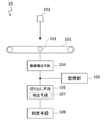
- FIG. 2 shows an example of the configuration of the inspection unit 10.
- an X-ray transmission image obtained by irradiating an inspection object with X-rays as an electromagnetic wave is acquired as an image to be subjected to inspection.
- the inspection unit 10 includes a transport unit 101, an electromagnetic wave irradiation unit 102, an electromagnetic wave detection unit 103, an image forming unit 104, a storage unit 105, a cutting unit 106, and a determination unit 108.
- the transport unit 101 is composed of one or a plurality of belt conveyors, transports the inspection object to the inspection area where the image is taken, and discharges the inspection object from the inspection area after taking the picture.
- the electromagnetic wave irradiation unit 102 irradiates the inspection area with electromagnetic waves (for example, X-rays, ultraviolet rays, visible light, infrared rays, etc.) necessary for taking an image.
- the electromagnetic wave irradiation unit 102 is arranged so as to irradiate the electromagnetic wave vertically on the transport surface on which the inspection object is placed, for example, in the transport unit 101.
- the inspection area is covered with a shielding cover, if necessary, in order to prevent the electromagnetic waves emitted from the electromagnetic wave irradiation unit 102 from leaking to the outside.
- the electromagnetic wave detection unit 103 is arranged at a position facing the electromagnetic wave irradiation unit 102 with the transport unit 101 in between.
- the electromagnetic wave detection unit 103 includes a plurality of detection elements capable of detecting the electromagnetic wave irradiated by the electromagnetic wave irradiation unit 102, and detects the distribution of the intensity of the electromagnetic wave that passes through the inspection region and reaches the electromagnetic wave detection unit 103.
- the electromagnetic wave detection unit 103 may be, for example, a line sensor, an area sensor, a TDI (Time Delay Integration) sensor, or the like.
- the electromagnetic wave emitted from the electromagnetic wave irradiation unit 102 is attenuated according to the transmittance of the electromagnetic wave at each position of the inspection object. It reaches the electromagnetic wave detection unit 103, and the internal state of the inspection object is observed as the distribution of the intensity of the electromagnetic wave detected by the electromagnetic wave detection unit 103.
- the image forming means 104 configures the distribution of the intensity of the electromagnetic wave transmitted through the inspection object detected by the electromagnetic wave detecting unit 103 as a two-dimensional image.
- the storage unit 105 stores the data of the image in which the inspection target object configured by the image forming means 104 is captured.
- the storage unit 105 is composed of a storage device such as a RAM and a hard disk.
- the cutting means 106 reads out an image of the inspection object configured by the image forming means 104 from the storage unit 105, specifies the inspection range of the inspection object in the image by a predetermined method, and sets the specified inspection range. It is cut out from the image and output to the determination means 108 as a determination target image. Further, the extraction means 107 that extracts a smaller partial image from the image of the inspection range cut out from the image of the inspection target by the cutting means 106 and outputs the smaller partial image to the determination means 108 as the determination target image may be further provided. good.
- the size and shape of the determination target image cut out by the cutting means 106 or extracted by the extraction means 107 shall be the same size and shape as the learning target image used for generating the learned model adopted in the determination by the determination means 108.
- the specific method of specifying the inspection range of the inspection object in the cutting means 106 and the specific method of extracting a smaller partial image in the extracting means 107 are the cutting means 121 of the teacher data generation unit 12 described later. Since it is the same as the specific method and the extraction method in the extraction means 122, the description here is omitted.
- the determination means 108 inputs the determination target image output from the cutting means 106 into the trained model generated in advance by the machine learning execution unit 13, and based on the output determination result, whether or not the inspection object is normal. (Determining whether or not the object is to be removed).
- a specific inspection method in the determination means 108 will be illustrated in the description of the operation of the inspection mode of the inspection device 1 described later.
- the image forming means 104, the cutting means 106, the extracting means 107, and the determining means 108 may be configured as a part of the control unit 11 described later.
- the display 14 is a display device such as a liquid crystal display, and displays an operation screen of the inspection device 1 and various images.
- the operation interface 15 is an input means such as a switch, a mouse, and a keyboard, and receives an operation input of the inspection device 1 by a user.
- the control unit 11 controls each component of the inspection device 1.
- the control unit 11 is composed of, for example, a computer composed of a CPU, a storage element, and the like.
- the control unit 11 includes a teacher data generation unit 12 and a machine learning execution unit 13.
- the teacher data generation unit 12 corresponds to the teacher data generation device of the present invention.
- the teacher data generation unit 12 generates teacher data used for machine learning performed by the machine learning execution unit 13 in the learning mode of the inspection device 1.
- FIG. 3 is a block diagram showing the configuration of the teacher data generation unit 12. As shown in FIG. 3, the teacher data generation unit 12 includes a cutting unit 121, a display control unit 123, a distribution processing unit 124, and a teacher data storage unit 125.
- the cutting means 121 accepts the input of an image showing the inspection target, specifies the inspection range of the inspection target in the image by a predetermined method, and cuts out the specified inspection range from the image.
- the method of specifying the inspection range of the inspection target in the image showing the inspection target is arbitrary, and examples thereof include a identification method based on a reference point and a identification method by blob analysis.
- the inspection range is specified based on the position information of one or more reference points input by the operator and the information indicating the distance from the reference point.
- the method of inputting the position information of the reference point is arbitrary.
- the operator may input the position to be set from the operation interface 15 while looking at the image of the inspection object displayed on the display 14.
- the number of reference points to be set is arbitrary, but by setting each corner of the inspection range, the inspection range can be reliably specified even if the posture of the inspection object 2 is different for each image.
- the inspection range can be reliably specified by setting four reference points.
- the inspection unit 10 takes an image of a plurality of inspection objects 2, the inspection object 2 is sequentially placed on the conveying unit 101 in a substantially the same posture set in advance, and is conveyed and photographed. Therefore, for example, with respect to the inspection object 2 including the storage portion 2p shown in FIG. 4A and the seal portions 2s (rectangles having a length w on one side and a length d on the other side) provided above and below the storage portion 2p, the transport direction.
- the inspection object 2 is placed on the transport unit 101 so that the longitudinal direction of the seal portion 2s of the inspection object 2 is the X direction and the lateral direction is the Y direction orthogonal to the X direction.
- the inspection range is defined as a rectangular range in which one side is extended in the X direction by a length a (> w) and the other side is extended in the Y direction by a length b (> d) starting from the reference point. ..
- the lengths a and b may be set in advance as fixed values, or may be arbitrarily set by input from the operator from the operation interface 15.
- the inspection range A can be specified as shown in FIG. 4B by setting the reference point B near the upper left corner of the seal portion 2s. ..
- the image is binarized based on the brightness and darkness of the image, and the existence position and shape of the inspection object can be detected as a blob.
- the surrounding area becomes much brighter than the existing part of the inspection object.
- the shape and the like can be detected as a blob. Since it is known in advance which part of the inspection target is to be inspected, it is possible to specify the inspection range of the inspection target in the image in which the inspection target is captured by collating the two.
- one or both of the upper and lower seal portions 2s are set as the inspection range.
- the image in which the inspection object 2 is captured which is generated by irradiating the inspection object 2 with an electromagnetic wave, is binarized with the darkness of the image corresponding to the existing portion of the inspection object 2 as a threshold value.
- the existing position and shape of the inspection object 2 can be detected as the blob C as shown in FIG. 5 (b).
- the existence position of the seal portion 2s to be inspected is known in advance as shown in FIG.
- the existing position of the seal portion 2s (for example, a range of predetermined distances from each of the upper end and the lower end) in the image in which the inspection object 2 is captured can be specified as the inspection range A as shown in FIG. 5 (c). ..
- the upper and lower seal portions 2s The existing position may be specified as the inspection range A as shown in FIG. 6 (c).
- the image showing the inspection object 2 is binarized with the darkness of the image corresponding to the existence portion of the foreign matter in the seal portion 2s as a threshold value, and the presence of the foreign matter is present.
- a blob F indicating a portion may be detected as shown in FIG. 7 (a), and a predetermined range including the blob F may be specified as an inspection range A as shown in FIG. 7 (b).
- FIG. 7 (a) a predetermined range including the blob F
- FIG. 7 (b) a predetermined range including the blob F
- inspection ranges A it is possible to specify a plurality of inspection ranges A at the same time as described above. In this case, all of them may be specified as inspection ranges A, or any part of them may be specified. May be specified as the inspection range A.
- the cutting means 121 cuts out an image of the inspection range specified as described above from the image of the inspection target 2, and outputs the image to the sorting processing means 124 as a learning target image.
- the cutting means 121 may further include an extraction means 122 that extracts a smaller partial image from the cut out image of the inspection range A.
- FIG. 8B shows an example in which the images of the respective portions A1, A2, A3 and A4 obtained by dividing the inspection range A specified as shown in FIG. 8A into four are extracted. ..
- the number of divisions may be set in advance as a fixed value, or may be arbitrarily set by input from the operator from the operation interface 15.
- the extraction means 122 outputs the partial image thus extracted to the distribution processing means 124 as a learning target image.
- the extraction means 122 may extract so as to partially overlap the adjacent partial image.
- FIG. 8 (c) is an example in which the extraction width is the same as in the case of FIG. 8 (b) and the image is extracted so as to overlap the adjacent partial image by a quarter.
- Partial images can be extracted for each of A3, A4 and A5.
- the degree of duplication may be set in advance as a fixed value, or may be arbitrarily set by input from the operator from the operation interface 15.
- the cutting means 121 cuts out the image to be learned when performing additional learning on the trained model generated based on the image of the inspection range, the image of the inspection range of the size and shape used to generate the trained model.
- the cutting condition in the cutting means 121 is set so as to cut out.
- the extraction means 122 cuts out the learning target image when performing additional learning on the trained model generated based on the partial image, the partial image of the size and shape used for generating the trained model based on the partial image.
- the extraction condition in the extraction means 122 is set so as to perform the extraction.
- the display control means 123 controls the display on the display.
- the display control means 123 causes the display 14 to selectively display the learning target image cut out by the cutting means 121 or extracted by the extracting means 122.
- FIG. 9 shows a display example of the learning target display screen when displaying the learning target image on the display 14.
- the learning target display screen includes an input image display area R2, a learning target image display area R1, and an information display area R3.
- the learning target image display area R1 is an area in which the learning target images are displayed side by side.
- a user interface for sorting pass / fail for each learning target image and the like are displayed.
- the input image display area R2 is an area in which an image of the inspection object is displayed.
- the information display area R3 is an area in which information related to the selected learning target image (for example, the name of the image file, the storage location, etc.) is displayed.
- the display indicating the area corresponding to the extracted learning target image may be superimposed and displayed.
- the display indicating the area corresponding to the learning target image may be configured so that the user can select display / non-display.
- the learning target is sorted in the order of the numerical values (scores) indicating the judgment results when each learning target image is judged by the existing trained model.
- An image may be displayed.
- the information indicating the determination result may be visually displayed for each learning target image displayed side by side in the learning target image display area R1. Specifically, a score, a determination result (normal / abnormal, etc.) may be displayed at a position superimposed on or adjacent to each learning target image. Further, for each learning target image, a display effect indicating a determination result may be produced. For example, it may be surrounded by frames of different colors depending on whether it is normal or abnormal.
- the learning target image By clicking one of the learning target images displayed in the learning target image display area R1, the learning target image can be selected.
- the selected learning target image is displayed surrounded by a frame in the learning target image display area R1, and the selected learning target is displayed in the input image display area R2.
- the inspection area or subregion corresponding to the image is displayed so that it can be distinguished from the others (eg, surrounded by a double frame).
- the learning target image corresponding to the inspection range or partial area is selected. be able to.
- the input image display area R2 is clicked in this way, the learning target image corresponding to the selected inspection range or partial area is displayed in the learning target image display area R1 surrounded by a frame, and in the input image display area R2. Is displayed so that the selected inspection range or subregion can be distinguished from others (eg, surrounded by a double frame).
- the portion corresponding to the selected learning target image may be enlarged and displayed in the input image display area R2. In this way, the part corresponding to the learning target image of interest can be easily confirmed in detail. Further, for the selected learning target image, a score, a determination result (normal / abnormal, etc.) and the like may be displayed in the information display area R3.
- the sorting processing means 124 visually sorts the extracted learning target image into any predetermined classification such as whether it is normal or abnormal.
- the sorting processing means 124 sorts the learning target image into one of the classifications according to the operation and sorts the learning target image from the learning target image. It is stored in the teacher data storage unit 125 as teacher data associated with the classification.
- the operation of allocating the learning target image to any of the predetermined classifications is, for example, in the case of allocating whether the learning target image is normal or abnormal, the user operates the operation interface 15 while looking at the display 14 to sort the learning target image.
- the user visually determines whether the selected image to be learned is normal or abnormal, clicks the OK button if it is normal, and clicks the NG button if it is abnormal. It is an operation such as clicking.
- the operation may be configured to sequentially sort the plurality of learning target images according to the order automatically determined by the sorting processing means 124.
- the method of classifying the images to be learned is simply divided into two classifications of normal or abnormal for any one of the judgment items such as biting of the contents, wrinkles of the seal, and breakage of the seal.
- the user visually determines whether or not each of a plurality of judgment items such as biting of the contents, wrinkles of the seal, and breakage of the seal is normal, and each of the judgment results of the plurality of judgment items is determined.
- a method of dividing into a plurality of classifications consisting of combinations may be adopted. For example, if there are three determination items, there are two types of normal and abnormal for each item, so the items are classified into one of eight categories, which is 2 to the 3rd power.
- each learning target image the user visually judges whether or not each of a plurality of judgment items is normal, and adopts a method of classifying each judgment item into two categories, normal or abnormal. You may. That is, instead of allocating one learning target image to any one classification, it is classified into either normal or abnormal for each determination item. By classifying in this way, it can be used for generation of trained models capable of judging normality / non-normality for each judgment item individually and for additional learning of them.
- the classification method is that the trained model generated by the machine learning execution unit 13 based on the learning target image receives the input of the determination target image. Since it is reflected in the judgment result (classification result) output, it depends on what judgment result is required. Further, when additional learning is performed on the already generated trained model, it depends on what classification the trained model is generated to output the determination result.
- the image to be learned is stored as teacher data in association with the classification sorted by the sorting processing means 124.
- the teacher data storage unit 125 may store teacher data generated by an external device.
- the teacher data storage unit 125 is composed of a storage device such as a RAM and a hard disk.
- the teacher data storage unit 125 may also serve as the storage unit 105 in the inspection unit 10. Further, the inspection device 1 may be used in a form of sharing a storage medium provided for storing various information.
- each learning target image is normal or abnormal. Any method may be used as long as it is identifiable and memorable which classification is assigned, such as which combination of the judgment results of the plurality of judgment items.
- each learning target image may be stored in a folder prepared for each sorted classification.
- the information indicating the sorted classification may be embedded in the file as the file name or additional information of the image to be learned.
- the teacher data storage unit 125 may further record the cutting conditions and the extraction conditions of the learning target image constituting the teacher data in the cutting means 121 and the extracting means 122 in association with the teacher data.
- the machine learning execution unit 13 uses the teacher data read from the teacher data storage unit 125, that is, the learning target image to which the classification information is attached, with respect to the existing trained model. Additional machine learning is applied to generate a new trained model. Alternatively, machine learning is newly performed using the teacher data read from the teacher data storage unit 125, and a new trained model is generated. When a new trained model is generated, machine learning may be performed on an initial (unlearned) model prepared in advance.
- Machine learning here means that an initial model or a model that has already been trained to a certain extent is repeatedly processed by inputting predetermined data to bring it closer to the target trained model. Specifically, for example, by inputting teacher data into the neural network model, parameters such as weights and biases are adjusted so that the correct answer is output.
- the learned model referred to in the present invention is a predetermined determination result, for example, a score (numerical value, etc.) indicating normality, more specifically, for example, by inputting an image or a partial image of an inspection range of an inspection object. It is a model trained to output a score indicating the possibility of being abnormal.
- the specific method of machine learning in the machine learning execution unit 13 is arbitrary, and for example, a deep learning method using a convolutional neural network model may be adopted.
- FIG. 10 is a flowchart showing the operation procedure of the inspection device 1 in the learning mode.
- the learning mode is started by selecting the learning mode on the operation interface 15 of the inspection device 1.
- the operation screen for the learning mode is displayed on the display 14.
- the user can generate teacher data and perform machine learning on the trained model by operating the operation screen for this learning mode according to the following procedure.
- the teacher data generation unit 12 accepts an operation of selecting an input image by the user (step S100).
- the input image may be an image of the inspection object actually taken by the inspection unit 10 or an image of the inspection object separately prepared for learning.
- the teacher data generation unit 12 accepts an operation of selecting the trained model by the user (step S110).
- the trained model selected here is the target for additional learning in the subsequent machine learning.
- step S110 may be omitted.
- the teacher data generation unit 12 sets a reference point on the image of the inspection object in the cutting means 121, and accepts and accepts the input of the length of each side that specifies the inspection range starting from the reference point.
- the image of the inspection range specified based on the cutting conditions is cut out (step S120). Further, when the image of the cut-out inspection range is divided and the partial image is extracted, the extraction means 122 accepts the input of the number of divisions and the degree of duplication, and extracts each partial image based on the accepted extraction conditions. (Step S121).
- the cutout condition and the extraction condition are set by inputting a desired value in the item displayed on the operation screen.
- the cutting means 121 and the extracting means 122 carry out the cutting of the image of the inspection range and the extraction process of the partial image according to the setting contents.
- the inspection range image or partial image which is the learning target image obtained as a result of the processing, is stored in the learning target image folder in which the classification is not sorted.
- the teacher data generation unit 12 accepts an operation in the sorting processing means 124 to select which classification the learning target image should be sorted into, and associates the learning target image with the determination result based on the selection.
- the teacher data is stored in the teacher data storage unit 125 as teacher data (step S130).
- the machine learning execution unit 13 receives an instruction to execute machine learning based on the teacher data generated in step S130, executes a learning program in response to the instruction, and performs machine learning on the trained model. It is carried out (step S140). At this time, the machine learning execution unit 13 displays an interface on the operation screen that allows the user to select whether to additionally perform machine learning on the existing trained model or to generate a newly trained model. When performing additional machine learning on an existing trained model, it is advisable to present a menu that allows the user to select the trained model. It should be noted that the selection of the trained model at this stage may be omitted, and machine learning may be performed on the trained model selected in step S110. Then, when the machine learning in step S140 is completed, a series of processes in the learning mode is completed.
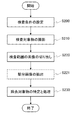
- FIG. 11 is a flowchart showing the operation procedure of the inspection device 1 in the inspection mode.
- the inspection mode is started by selecting the inspection mode on the operation interface 15 of the inspection device 1.
- the operation screen for the inspection mode is displayed on the display 14. The user can inspect the inspection object by operating the operation screen for this inspection mode according to the following procedure.
- the inspection device 1 accepts an operation of setting inspection conditions by the user (step S200).
- the inspection conditions include the selection of a learned model to be used for determining the object to be removed, in addition to the conditions of a general inspection device such as the irradiation intensity of X-rays and visible light at the time of image capture, the exposure time, and the transport speed. Is done.
- the inspection unit 10 starts the inspection of the inspection target according to the predetermined operation by the user.
- the inspection unit 10 first conveys the inspection object to the imaging position and performs imaging (step S210).
- the inspection unit 10 cuts out an image of the inspection range from the image of the inspection object photographed by the cutting means 106 (step S220), or further cuts out an image of the inspection range cut out by the cutting means 106 in the extraction means 107.
- a partial image is extracted (step S221) to generate a determination target image.
- the number of images in the inspection range to be cut out as the judgment target image and the number of partial images to be extracted are arbitrary. Further, the size and shape of the judgment target image to be cut out or extracted shall be the same size and shape as the training target image used to generate the trained model used for the judgment.
- the inspection unit 10 inputs the judgment target image output from the cutting means 106 or the extraction means 107 into the trained model in the judgment means 108, and whether or not the inspection target is normal based on the output judgment result. (Determining whether or not the object is to be removed) is performed (step S230).
- the image to be determined is input to the trained model, and the trained model outputs, for example, a score (numerical value or the like) indicating normality as the determination result.
- a score number or the like
- the setting of the range of the numerical value to be output is arbitrary, and for example, the numerical value in the range of 0 to 1 is output.
- the step of the numerical value in the numerical range is arbitrary.
- the numerical value such as 0.12 or 0.81 is output.
- the output numerical value may be displayed on the display 14, or may be output to any output means such as a printer or a storage medium.
- the trained model When the trained model is trained with two classifications, for example, normal or abnormally classified training target images, the trained model may have, for example, 0 as normal and abnormal. The higher the value, the closer to 1 is output.
- the trained model is trained with the training target images classified into three or more classifications, for example, normal and a plurality of abnormal cases
- the trained model is, for example, the total of all classifications.
- the numerical value is set to 1, and the numerical value of each classification is output so that the value of the ratio to 1 becomes larger as the possibility of classification becomes larger. For example, if classification 1 is 0.2, classification 2 is 0.4, classification 3 is 0.3, and classification 4 is 0.1, the possibility of classification 2 is the highest.
- the determination means 108 determines whether or not the inspection target is the removal target based on the numerical value output from the trained model. The determination may be performed using only one determination target image, or may be performed using a plurality of determination target images.
- 0 is set to normal for the input of the image to be judged, and when a numerical value closer to 1 is output as the possibility of being abnormal is higher, an arbitrary value between 0 and 1 is set.
- a threshold value when it is equal to or higher than the threshold value, it is judged to be an abnormal object to be removed.
- classifications for example, for the input of the image to be judged, the total value of all classifications is set to 1, and the higher the possibility of classification, the larger the value of the ratio to 1 is.
- a plurality of determination methods can be considered, but any determination method may be adopted.
- the numerical value of classification 1 is 0.2
- the numerical value of classification 2 is 0.4
- the numerical value of classification 3 is 0.3
- the numerical value of classification 4 is 0.1
- the numerical value of classification 2 is normal.
- Others are classifications indicating non-normality, and classification 2 indicating normality is most likely when viewed individually, so it is determined that this is a non-removal target.
- the numerical value of the classification 2 indicating normality is 0.4, while the total value of the other classifications indicating abnormality is 0.6. Therefore, from this point of view, there is a high possibility that it is abnormal, and it is determined that this is the object to be removed.
- a comparison with a predetermined number may be performed, or the number of abnormal determination target images is counted and when the predetermined number is reached. It may be determined that the object is to be removed.
- a prompt decision threshold value which is another threshold value closer to 1 than the threshold value for determining normality or abnormality, is set, and if there is even one image to be determined that exceeds the prompt decision threshold value, it is determined that the image is to be removed at that time. You may.
- the normality / non-normality of each judgment target image is determined by the judgment method of non-normality (removal target object) when the judgment target image illustrated above is one and the classification is three or more.
- the removal target object can be determined by the method for determining the removal target object when there are a plurality of determination target images and the classification is two as exemplified above.
- the method of selecting a plurality of determination target images is arbitrary.
- two images of the inspection range A specified for each of the upper seal portion 2s and the lower seal portion 2s are cut out, and these two images are cut out.
- An image may be used as a determination target image.
- a total of 2n partial images obtained by further dividing the upper and lower inspection ranges A into n may be used as the determination target image.
- the upper and lower partial images may be extracted one by one from the upper and lower n-divided partial images, two partial images may be extracted, and the two partial images may be used as the determination target image.
- the determination means 108 performs necessary processing on the inspection target object determined to be the removal target object by the above determination process.
- the necessary processing includes, for example, a process of displaying a figure (for example, a frame) indicating the object to be removed together with the captured image on the display 14, a process of removing the object to be removed, and a process of sorting the object to be removed and a normal product. Processing etc. This completes the inspection of one unit of the inspection object.
- the inspection device 1 continuously inspects the inspection target by repeating the above series of steps.
- the inspection device 1 can quickly generate a large amount of teacher data to be input to the learning program in the learning mode, and generates a trained model by machine learning using the generated teacher data as input. can do. Then, in the inspection mode, it is possible to perform a highly accurate inspection using the trained model generated in the learning mode.
- the present invention is not limited to these examples.
- the teacher data generation unit 12 and the machine learning execution unit 13 are built in the inspection device 1, but the teacher data generation unit 12 and the machine learning execution unit 13 are not built in the inspection device 1. It may be provided as an individual teacher data generator or a trained model generator.
- the teacher data generation unit 12 and the machine learning execution unit 13 may be realized by causing the computer to execute a computer program that functions as the teacher data generation unit 12 and the machine learning execution unit 13.
Landscapes
- Engineering & Computer Science (AREA)
- Physics & Mathematics (AREA)
- General Physics & Mathematics (AREA)
- Theoretical Computer Science (AREA)
- Computer Vision & Pattern Recognition (AREA)
- Quality & Reliability (AREA)
- General Health & Medical Sciences (AREA)
- Biochemistry (AREA)
- Immunology (AREA)
- Pathology (AREA)
- Analytical Chemistry (AREA)
- Chemical & Material Sciences (AREA)
- Life Sciences & Earth Sciences (AREA)
- Health & Medical Sciences (AREA)
- Software Systems (AREA)
- Data Mining & Analysis (AREA)
- Evolutionary Computation (AREA)
- Medical Informatics (AREA)
- Artificial Intelligence (AREA)
- Computing Systems (AREA)
- General Engineering & Computer Science (AREA)
- Mathematical Physics (AREA)
- Image Analysis (AREA)
- Analysing Materials By The Use Of Radiation (AREA)
Abstract
La présente invention génère efficacement des données d'apprentissage afin d'obtenir un modèle entraîné à utiliser dans la détermination de qualité lors d'inspections pour des contenus piégés, ou similaires, et effectue des inspections. Un dispositif de génération de données d'apprentissage selon la présente invention comprend : un moyen d'isolement qui reçoit l'entrée d'une image dans laquelle apparaît une cible d'inspection, utilise un procédé prescrit pour spécifier, dans l'image, une plage d'inspection pour la cible d'inspection, et isole la plage d'inspection spécifiée de l'image; un moyen de traitement de tri qui, sur la base d'une opération de tri dans laquelle l'image de la plage d'inspection, qui a été isolée par le moyen d'isolement, est traitée en tant qu'image à apprendre et est triée au moins en tant que normale ou anormale, associe l'image devant être soumise à apprentissage et le résultat de tri; et une unité de stockage de données d'apprentissage qui stocke des données d'apprentissage dans lesquelles l'image devant être soumise à apprentissage et le résultat de tri sont associés.
Priority Applications (3)
| Application Number | Priority Date | Filing Date | Title |
|---|---|---|---|
| CN202180004905.4A CN114303157A (zh) | 2020-03-24 | 2021-03-24 | 训练数据生成装置、检查装置和程序 |
| EP21776862.1A EP4130723A4 (fr) | 2020-03-24 | 2021-03-24 | Dispositif de génération de données d'apprentissage, dispositif d'inspection et programme |
| US17/631,423 US12430739B2 (en) | 2020-03-24 | 2021-03-24 | Training data generation device, inspection device and program |
Applications Claiming Priority (2)
| Application Number | Priority Date | Filing Date | Title |
|---|---|---|---|
| JP2020-053241 | 2020-03-24 | ||
| JP2020053241A JP6917083B1 (ja) | 2020-03-24 | 2020-03-24 | 教師データ生成装置、検査装置及びプログラム |
Publications (1)
| Publication Number | Publication Date |
|---|---|
| WO2021193733A1 true WO2021193733A1 (fr) | 2021-09-30 |
Family
ID=77172679
Family Applications (1)
| Application Number | Title | Priority Date | Filing Date |
|---|---|---|---|
| PCT/JP2021/012284 Ceased WO2021193733A1 (fr) | 2020-03-24 | 2021-03-24 | Dispositif de génération de données d'apprentissage, dispositif d'inspection et programme |
Country Status (5)
| Country | Link |
|---|---|
| US (1) | US12430739B2 (fr) |
| EP (1) | EP4130723A4 (fr) |
| JP (1) | JP6917083B1 (fr) |
| CN (1) | CN114303157A (fr) |
| WO (1) | WO2021193733A1 (fr) |
Families Citing this family (7)
| Publication number | Priority date | Publication date | Assignee | Title |
|---|---|---|---|---|
| JP7636141B2 (ja) * | 2020-06-09 | 2025-02-26 | 株式会社ディスコ | 研削装置 |
| US20240005473A1 (en) * | 2020-11-30 | 2024-01-04 | Konica Minolta, Inc. | Analysis apparatus, inspection system, and learning apparatus |
| JP7747319B2 (ja) * | 2021-09-27 | 2025-10-01 | 株式会社 システムスクエア | 検査装置及びプログラム |
| EP4443146A4 (fr) * | 2021-11-29 | 2025-03-05 | FUJIFILM Corporation | Dispositif et procédé générateur de données d'instruction, programme et dispositif d'inspection de défauts |
| WO2023162142A1 (fr) * | 2022-02-25 | 2023-08-31 | 株式会社Fuji | Dispositif de confirmation d'image et procédé de confirmation d'image |
| US12390837B1 (en) | 2023-02-10 | 2025-08-19 | Aaron Thomas Bacon | Machine-assisted inspection of sealable bags |
| JP2025015289A (ja) * | 2023-07-20 | 2025-01-30 | 株式会社日立製作所 | 分析装置、分析方法、および分析プログラム |
Citations (3)
| Publication number | Priority date | Publication date | Assignee | Title |
|---|---|---|---|---|
| JP2005024453A (ja) * | 2003-07-04 | 2005-01-27 | Anritsu Sanki System Co Ltd | X線検査装置 |
| JP2011089920A (ja) | 2009-10-23 | 2011-05-06 | Shimadzu Corp | X線検査方法、及び該x線検査方法を用いたx線検査装置 |
| JP2017075835A (ja) * | 2015-10-14 | 2017-04-20 | 株式会社 システムスクエア | 包装体の検査装置 |
Family Cites Families (19)
| Publication number | Priority date | Publication date | Assignee | Title |
|---|---|---|---|---|
| JP2001156135A (ja) * | 1999-11-29 | 2001-06-08 | Hitachi Ltd | 欠陥画像の分類方法及びその装置並びにそれを用いた半導体デバイスの製造方法 |
| US7236619B2 (en) * | 2002-10-31 | 2007-06-26 | University Of Chicago | System and method for computer-aided detection and characterization of diffuse lung disease |
| US8483475B2 (en) * | 2007-09-26 | 2013-07-09 | Ishida Co., Ltd. | Inspection apparatus |
| JP5635903B2 (ja) * | 2010-12-27 | 2014-12-03 | アンリツ産機システム株式会社 | X線検査装置 |
| JP5453350B2 (ja) * | 2011-06-23 | 2014-03-26 | 株式会社 システムスクエア | 包装体の検査装置 |
| JP6061713B2 (ja) * | 2013-02-08 | 2017-01-18 | 本田技研工業株式会社 | 検査装置、検査方法及びプログラム |
| JP6224434B2 (ja) * | 2013-09-26 | 2017-11-01 | 株式会社イシダ | X線検査装置 |
| CN107407647A (zh) * | 2015-03-20 | 2017-11-28 | 株式会社石田 | 检查装置 |
| JP6623449B2 (ja) * | 2015-07-08 | 2019-12-25 | 株式会社 システムスクエア | 包装体の検査装置 |
| JP2018005640A (ja) * | 2016-07-04 | 2018-01-11 | タカノ株式会社 | 分類器生成装置、画像検査装置、及び、プログラム |
| JP2018005639A (ja) * | 2016-07-04 | 2018-01-11 | タカノ株式会社 | 画像分類装置、画像検査装置、及び、プログラム |
| US11580398B2 (en) * | 2016-10-14 | 2023-02-14 | KLA-Tenor Corp. | Diagnostic systems and methods for deep learning models configured for semiconductor applications |
| JP6705777B2 (ja) * | 2017-07-10 | 2020-06-03 | ファナック株式会社 | 機械学習装置、検査装置及び機械学習方法 |
| US10769788B2 (en) * | 2017-09-12 | 2020-09-08 | Nantomics, Llc | Few-shot learning based image recognition of whole slide image at tissue level |
| CN111108368B (zh) * | 2017-09-19 | 2022-06-28 | 富士胶片株式会社 | 教学数据制作方法及装置以及缺陷检查方法及装置 |
| JP7015001B2 (ja) * | 2018-03-14 | 2022-02-02 | オムロン株式会社 | 欠陥検査装置、欠陥検査方法、及びそのプログラム |
| JP7033480B2 (ja) * | 2018-04-02 | 2022-03-10 | 株式会社明治 | 異物混入検証システム |
| US10824935B2 (en) * | 2018-10-17 | 2020-11-03 | Mitsubishi Electric Research Laboratories, Inc. | System and method for detecting anomalies in video using a similarity function trained by machine learning |
| WO2021126531A1 (fr) * | 2019-12-19 | 2021-06-24 | Qeexo, Co. | Détection automatisée de défauts basée sur la vision industrielle |
-
2020
- 2020-03-24 JP JP2020053241A patent/JP6917083B1/ja active Active
-
2021
- 2021-03-24 CN CN202180004905.4A patent/CN114303157A/zh active Pending
- 2021-03-24 EP EP21776862.1A patent/EP4130723A4/fr active Pending
- 2021-03-24 WO PCT/JP2021/012284 patent/WO2021193733A1/fr not_active Ceased
- 2021-03-24 US US17/631,423 patent/US12430739B2/en active Active
Patent Citations (3)
| Publication number | Priority date | Publication date | Assignee | Title |
|---|---|---|---|---|
| JP2005024453A (ja) * | 2003-07-04 | 2005-01-27 | Anritsu Sanki System Co Ltd | X線検査装置 |
| JP2011089920A (ja) | 2009-10-23 | 2011-05-06 | Shimadzu Corp | X線検査方法、及び該x線検査方法を用いたx線検査装置 |
| JP2017075835A (ja) * | 2015-10-14 | 2017-04-20 | 株式会社 システムスクエア | 包装体の検査装置 |
Non-Patent Citations (1)
| Title |
|---|
| See also references of EP4130723A4 |
Also Published As
| Publication number | Publication date |
|---|---|
| JP2021152489A (ja) | 2021-09-30 |
| EP4130723A4 (fr) | 2024-08-14 |
| JP6917083B1 (ja) | 2021-08-11 |
| EP4130723A1 (fr) | 2023-02-08 |
| CN114303157A (zh) | 2022-04-08 |
| US12430739B2 (en) | 2025-09-30 |
| US20220318985A1 (en) | 2022-10-06 |
Similar Documents
| Publication | Publication Date | Title |
|---|---|---|
| JP6917083B1 (ja) | 教師データ生成装置、検査装置及びプログラム | |
| JP6754155B1 (ja) | 教師データ生成装置、検査装置およびコンピュータプログラム | |
| CN111630519B (zh) | 检查装置 | |
| JP6537008B1 (ja) | 検査装置 | |
| JP2019211288A (ja) | 食品検査システムおよびプログラム | |
| JP7248316B2 (ja) | 豆腐類検査装置、豆腐類製造システム、豆腐類の検査方法、およびプログラム | |
| JPWO2019235022A1 (ja) | 検査装置 | |
| JP5864404B2 (ja) | X線検査装置 | |
| WO2023017611A1 (fr) | Procédé générateur de modèles d'apprentissage, modèle d'apprentissage, dispositif et procédé d'inspection et programme informatique | |
| JP7630406B2 (ja) | 物品検査装置 | |
| JP4536548B2 (ja) | X線検査装置および蓄積情報抽出システム | |
| CN118901080A (zh) | 自动化检验系统 | |
| CN119365898A (zh) | 用于在以连续循环生产物体的设备中执行物体的质量控制的方法和系统 | |
| JP7240780B1 (ja) | 検査装置 | |
| JP7250301B2 (ja) | 検査装置、検査システム、検査方法、検査プログラム及び記録媒体 | |
| JP7445621B2 (ja) | X線検査装置およびx線検査方法 | |
| JP2022052167A (ja) | X線検査装置およびx線検査方法 | |
| JP2008175691A (ja) | X線検査装置および検査方法 | |
| JP2025138158A (ja) | 物品検査装置 | |
| CN121633134A (zh) | 物品检查装置 | |
| JP2025127788A (ja) | 物品検査装置、学習済モデルの作成方法、および物品検査方法 | |
| JP2025138157A (ja) | 物品検査装置 | |
| JP2022156999A (ja) | 検査方法、検査装置 |
Legal Events
| Date | Code | Title | Description |
|---|---|---|---|
| 121 | Ep: the epo has been informed by wipo that ep was designated in this application |
Ref document number: 21776862 Country of ref document: EP Kind code of ref document: A1 |
|
| NENP | Non-entry into the national phase |
Ref country code: DE |
|
| ENP | Entry into the national phase |
Ref document number: 2021776862 Country of ref document: EP Effective date: 20221024 |
|
| WWG | Wipo information: grant in national office |
Ref document number: 17631423 Country of ref document: US |