WO2021200396A1 - 非水電解質二次電池 - Google Patents
非水電解質二次電池 Download PDFInfo
- Publication number
- WO2021200396A1 WO2021200396A1 PCT/JP2021/011953 JP2021011953W WO2021200396A1 WO 2021200396 A1 WO2021200396 A1 WO 2021200396A1 JP 2021011953 W JP2021011953 W JP 2021011953W WO 2021200396 A1 WO2021200396 A1 WO 2021200396A1
- Authority
- WO
- WIPO (PCT)
- Prior art keywords
- aqueous electrolyte
- composite oxide
- positive electrode
- negative electrode
- secondary battery
- Prior art date
- Legal status (The legal status is an assumption and is not a legal conclusion. Google has not performed a legal analysis and makes no representation as to the accuracy of the status listed.)
- Ceased
Links
Images
Classifications
-
- H—ELECTRICITY
- H01—ELECTRIC ELEMENTS
- H01M—PROCESSES OR MEANS, e.g. BATTERIES, FOR THE DIRECT CONVERSION OF CHEMICAL ENERGY INTO ELECTRICAL ENERGY
- H01M4/00—Electrodes
- H01M4/02—Electrodes composed of, or comprising, active material
- H01M4/62—Selection of inactive substances as ingredients for active masses, e.g. binders, fillers
- H01M4/628—Inhibitors, e.g. gassing inhibitors, corrosion inhibitors
-
- H—ELECTRICITY
- H01—ELECTRIC ELEMENTS
- H01M—PROCESSES OR MEANS, e.g. BATTERIES, FOR THE DIRECT CONVERSION OF CHEMICAL ENERGY INTO ELECTRICAL ENERGY
- H01M4/00—Electrodes
- H01M4/02—Electrodes composed of, or comprising, active material
- H01M4/13—Electrodes for accumulators with non-aqueous electrolyte, e.g. for lithium-accumulators; Processes of manufacture thereof
- H01M4/131—Electrodes based on mixed oxides or hydroxides, or on mixtures of oxides or hydroxides, e.g. LiCoOx
-
- H—ELECTRICITY
- H01—ELECTRIC ELEMENTS
- H01M—PROCESSES OR MEANS, e.g. BATTERIES, FOR THE DIRECT CONVERSION OF CHEMICAL ENERGY INTO ELECTRICAL ENERGY
- H01M10/00—Secondary cells; Manufacture thereof
- H01M10/05—Accumulators with non-aqueous electrolyte
- H01M10/052—Li-accumulators
- H01M10/0525—Rocking-chair batteries, i.e. batteries with lithium insertion or intercalation in both electrodes; Lithium-ion batteries
-
- H—ELECTRICITY
- H01—ELECTRIC ELEMENTS
- H01M—PROCESSES OR MEANS, e.g. BATTERIES, FOR THE DIRECT CONVERSION OF CHEMICAL ENERGY INTO ELECTRICAL ENERGY
- H01M10/00—Secondary cells; Manufacture thereof
- H01M10/05—Accumulators with non-aqueous electrolyte
- H01M10/056—Accumulators with non-aqueous electrolyte characterised by the materials used as electrolytes, e.g. mixed inorganic/organic electrolytes
- H01M10/0564—Accumulators with non-aqueous electrolyte characterised by the materials used as electrolytes, e.g. mixed inorganic/organic electrolytes the electrolyte being constituted of organic materials only
- H01M10/0566—Liquid materials
- H01M10/0568—Liquid materials characterised by the solutes
-
- H—ELECTRICITY
- H01—ELECTRIC ELEMENTS
- H01M—PROCESSES OR MEANS, e.g. BATTERIES, FOR THE DIRECT CONVERSION OF CHEMICAL ENERGY INTO ELECTRICAL ENERGY
- H01M4/00—Electrodes
- H01M4/02—Electrodes composed of, or comprising, active material
- H01M4/36—Selection of substances as active materials, active masses, active liquids
- H01M4/362—Composites
- H01M4/366—Composites as layered products
-
- H—ELECTRICITY
- H01—ELECTRIC ELEMENTS
- H01M—PROCESSES OR MEANS, e.g. BATTERIES, FOR THE DIRECT CONVERSION OF CHEMICAL ENERGY INTO ELECTRICAL ENERGY
- H01M4/00—Electrodes
- H01M4/02—Electrodes composed of, or comprising, active material
- H01M4/36—Selection of substances as active materials, active masses, active liquids
- H01M4/48—Selection of substances as active materials, active masses, active liquids of inorganic oxides or hydroxides
- H01M4/50—Selection of substances as active materials, active masses, active liquids of inorganic oxides or hydroxides of manganese
- H01M4/505—Selection of substances as active materials, active masses, active liquids of inorganic oxides or hydroxides of manganese of mixed oxides or hydroxides containing manganese for inserting or intercalating light metals, e.g. LiMn2O4 or LiMn2OxFy
-
- H—ELECTRICITY
- H01—ELECTRIC ELEMENTS
- H01M—PROCESSES OR MEANS, e.g. BATTERIES, FOR THE DIRECT CONVERSION OF CHEMICAL ENERGY INTO ELECTRICAL ENERGY
- H01M4/00—Electrodes
- H01M4/02—Electrodes composed of, or comprising, active material
- H01M4/36—Selection of substances as active materials, active masses, active liquids
- H01M4/48—Selection of substances as active materials, active masses, active liquids of inorganic oxides or hydroxides
- H01M4/52—Selection of substances as active materials, active masses, active liquids of inorganic oxides or hydroxides of nickel, cobalt or iron
- H01M4/525—Selection of substances as active materials, active masses, active liquids of inorganic oxides or hydroxides of nickel, cobalt or iron of mixed oxides or hydroxides containing iron, cobalt or nickel for inserting or intercalating light metals, e.g. LiNiO2, LiCoO2 or LiCoOxFy
-
- H—ELECTRICITY
- H01—ELECTRIC ELEMENTS
- H01M—PROCESSES OR MEANS, e.g. BATTERIES, FOR THE DIRECT CONVERSION OF CHEMICAL ENERGY INTO ELECTRICAL ENERGY
- H01M4/00—Electrodes
- H01M4/02—Electrodes composed of, or comprising, active material
- H01M2004/026—Electrodes composed of, or comprising, active material characterised by the polarity
- H01M2004/028—Positive electrodes
-
- H—ELECTRICITY
- H01—ELECTRIC ELEMENTS
- H01M—PROCESSES OR MEANS, e.g. BATTERIES, FOR THE DIRECT CONVERSION OF CHEMICAL ENERGY INTO ELECTRICAL ENERGY
- H01M2300/00—Electrolytes
- H01M2300/0017—Non-aqueous electrolytes
- H01M2300/0025—Organic electrolyte
-
- Y—GENERAL TAGGING OF NEW TECHNOLOGICAL DEVELOPMENTS; GENERAL TAGGING OF CROSS-SECTIONAL TECHNOLOGIES SPANNING OVER SEVERAL SECTIONS OF THE IPC; TECHNICAL SUBJECTS COVERED BY FORMER USPC CROSS-REFERENCE ART COLLECTIONS [XRACs] AND DIGESTS
- Y02—TECHNOLOGIES OR APPLICATIONS FOR MITIGATION OR ADAPTATION AGAINST CLIMATE CHANGE
- Y02E—REDUCTION OF GREENHOUSE GAS [GHG] EMISSIONS, RELATED TO ENERGY GENERATION, TRANSMISSION OR DISTRIBUTION
- Y02E60/00—Enabling technologies; Technologies with a potential or indirect contribution to GHG emissions mitigation
- Y02E60/10—Energy storage using batteries
Definitions
- This disclosure relates to a non-aqueous electrolyte secondary battery.
- Non-aqueous electrolyte secondary batteries represented by lithium ion secondary batteries have high energy density and high output, and have high energy density and high output, power sources for mobile devices such as smartphones, power sources for vehicles such as electric vehicles, and natural energy such as sunlight. It is promising as a storage device for the energy.
- a composite oxide containing lithium and a transition metal is used as the positive electrode active material of the non-aqueous electrolyte secondary battery.
- Patent Document 1 proposes forming a coating layer containing a phosphorus compound on the surface of a composite oxide containing lithium and manganese, which is a positive electrode active material of a non-aqueous electrolyte secondary battery.
- the above phosphorus compounds, Li 3 PO 4, Li 4 P 2 O 7 and LiPO 3 at least one selected from the group consisting of (hereinafter referred to as Li 3 PO 4 and the like.) Is used.
- the coating layer contains a phosphorus compound as well as an oxide or fluoride containing at least one element selected from the group consisting of Mg, Al and Cu.
- Patent Document 2 proposes to attach an organic phosphoric acid compound to the particle surface of a composite oxide having a spinel structure containing lithium, manganese and nickel, which is a positive electrode active material of a non-aqueous electrolyte secondary battery.
- the above-mentioned organic phosphoric acid compound is a phosphoric acid triester represented by PO (OR) 3 (R is an organic group such as an alkyl group and an aryl group).
- Li 3 PO 4, etc. described in Patent Document 1 may aggregate and be distributed in an island shape during coating by the liquid phase method. This is due to the difference in density (baking) between the raw material and the final product when the density of the final product is higher than that of the raw material in the coating process (heat drying process), and the effect of gas generation due to the reaction of the raw material. according to.
- raw material with (NH 4) 2 HPO 4 and Li 2 CO 3, (NH 4 ) When generating a 2 Li 3 PO 4 density greater than HPO 4, (NH 4) 2 HPO 4 and Li Since the density difference of 3 PO 4 is large and NH 3 and CO 2 gas may be generated during the reaction, Li 3 PO 4 is likely to aggregate. Further, the organic phosphoric acid compound described in Patent Document 2 easily flows out into the non-aqueous electrolyte.
- Li 3 PO 4 and the like are distributed in an island shape, and the organic phosphoric acid compound flows out into the non-aqueous electrolyte, so that the coating of the composite oxide becomes insufficient and the contact with the composite oxide of the non-aqueous electrolyte becomes insufficient.
- the cycle characteristics may deteriorate due to decomposition due to the above.
- the non-aqueous electrolyte may contain a lithium salt having an oxalate complex such as LiBF 2 (C 2 O 4) as an anion.
- a lithium salt having an oxalate complex such as LiBF 2 (C 2 O 4) as an anion.
- the oxalate complex comes into contact with the composite oxide on the positive electrode side of the high potential, and a side reaction is likely to occur. As the side reaction occurs, the composite oxide deteriorates and the cycle characteristics deteriorate.
- one aspect of the present disclosure comprises a positive electrode, a negative electrode, and a non-aqueous electrolyte, wherein the positive electrode is a composite oxide containing lithium and a transition metal, and at least one of the surfaces of the composite oxide.
- the additive comprises a cyclic inorganic phosphate compound, the non-aqueous electrolyte comprises a lithium ion and an anion, and the anion comprises an anion of an oxalate complex.
- non-aqueous electrolyte secondary batteries Regarding non-aqueous electrolyte secondary batteries.
- the cycle characteristics of the non-aqueous electrolyte secondary battery can be enhanced.
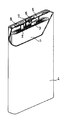
- FIG. 1 is a schematic perspective view in which a part of the non-aqueous electrolyte secondary battery according to the embodiment of the present disclosure is cut out.
- the positive electrode for a non-aqueous electrolyte secondary battery includes a positive electrode, a negative electrode, and a non-aqueous electrolyte, and the positive electrode is a composite oxide (positive electrode active material) containing lithium and a transition metal. And an additive that covers at least a part of the surface of the composite oxide, the additive contains a cyclic inorganic phosphoric acid compound (hereinafter, also referred to as compound A), and the non-aqueous electrolyte is lithium ion. , And the anion comprises an anion of an oxalate complex.
- a high-quality film (SEI: Solid Electrolyte Interphase) derived from the oxalate complex is formed on the surface of the negative electrode active material. Further, when the lithium metal is deposited on the surface of the negative electrode during charging, the precipitation of the lithium metal in a dendrite shape is suppressed. The interaction between the anion of the oxalate complex and lithium facilitates the uniform precipitation of lithium metal in the form of fine particles. Therefore, it becomes easy to suppress the local precipitation of the lithium metal.
- SEI Solid Electrolyte Interphase
- the present disclosure by coating the surface of the composite oxide with an additive containing compound A, the contact between the oxalate complex and the composite oxide is suppressed, and the deterioration of the composite oxide due to the contact is suppressed. And the resulting deterioration of cycle characteristics is suppressed.
- the additive contains compound A, the surface of the composite oxide is sufficiently and stably covered with the additive.
- Compound A has excellent oxidation resistance and is stably present in a high-potential positive electrode. By suppressing the deterioration of the composite oxide in the high potential positive electrode, it is easy to increase the output of the battery.
- Compound A is unlikely to aggregate during the coating process by the liquid phase method.
- a raw material having a small density difference from the final product and less likely to generate gas during the reaction can be used.
- the compound A may have a ring structure containing a plurality of P atoms, and a plurality of oxygen atoms bonded to the plurality of P atoms by anionization may become O ⁇ .
- the anion of compound A easily interacts with and binds to P of other surrounding inorganic phosphoric acid compounds. Therefore, when the additive contains compound A, the surface of the composite oxide can be widely covered with the additive in layers.
- Compound A is easily anionized and bonded to the transition metal of the composite oxide, and is unlikely to flow out into the non-aqueous electrolyte. Therefore, when the additive contains compound A, the surface of the composite oxide can be stably covered with the additive. Compound A has excellent lithium ion conductivity, and the transfer of lithium ions between the composite oxide and the non-aqueous electrolyte is smoothly carried out through the coating layer containing compound A.
- Cyclic inorganic phosphoric acid compounds are less likely to become dense, have a lower density, and are less likely to aggregate from the viewpoint of molecular structure, as compared with chain-like inorganic phosphoric acid compounds (for example, chain polyphosphoric acid).
- chain-like inorganic phosphoric acid compounds for example, chain polyphosphoric acid.
- the additive contains at least compound A and may contain an inorganic phosphoric acid compound other than compound A.
- Compound inorganic phosphate compound other than A may include Li 3 PO 4, Li 4 P 2 O 7 and LiPO 3, etc., may contain a chain polyphosphate such tetrapolyphosphate.
- the content of phosphorus (P) derived from compound A is, for example, 0.01% by mass or more, 0.01% by mass or more, and 0.5% by mass or less with respect to the total of the composite oxide and the additive. It may be 0.1 mass% or more and 0.5 mass% or less.
- the additive is substantially free of organophosphate compounds that tend to flow out into the non-aqueous electrolyte.
- the additive does not contain an organic phosphoric acid compound.
- the amount of phosphorus derived from the organic phosphoric acid compound adhering to 100 parts by mass of the composite oxide is, for example, 0.001 part by mass or less. Therefore, it is avoided that the coating of the composite oxide with the additive is insufficient due to the outflow of the organic phosphoric acid compound into the non-aqueous electrolyte.
- the amount of the organic phosphoric acid compound contained in the additive in the battery flowing out into the non-aqueous electrolyte is determined by the organic phosphoric acid in the non-aqueous electrolyte at the time of preparing the non-aqueous electrolyte (before injecting the non-aqueous electrolyte into the battery). When no compound is contained, it can be estimated by determining the content of the organic phosphoric acid compound in the non-aqueous electrolyte. The content of the organic phosphoric acid compound in the non-aqueous electrolyte is determined by gas chromatography-mass spectrometry (GC / MS) or the like.
- GC / MS gas chromatography-mass spectrometry
- Compound A preferably contains at least one selected from the group consisting of cyclic polyphosphoric acid and salts thereof.
- Cyclic polyphosphoric acid salts include, for example, alkali metal salts such as lithium salts.
- the cyclic polyphosphate anion has a plurality of O ⁇ bonded to P, and easily bonds to a transition metal or the like in the composite oxide.
- Cyclic polyphosphoric acid can have, for example, a composition represented by the general formula: (HPO 3 ) n. n is, for example, 3 or more and 6 or less.
- Compound A is anionized to form a transition metal in the composite oxide, Li + or H + in the non-aqueous electrolyte, and P in the surrounding inorganic phosphoric acid compound (hereinafter referred to as transition metal in the composite oxide, etc.). And can easily interact and combine.
- transition metal in the composite oxide a transition metal in the composite oxide
- the anion of the compound A is bonded to the surrounding inorganic phosphoric acid compound P
- the surface of the composite oxide is easily covered with the additive in a wide layer.
- the anion of compound A By binding the anion of compound A to the transition metal in the composite oxide, the surface of the composite oxide is stably covered with the additive. Since the anion of compound A easily binds to Li + in the non-aqueous electrolyte, the movement of lithium ions between the composite oxide and the non-aqueous electrolyte is smoothly performed.
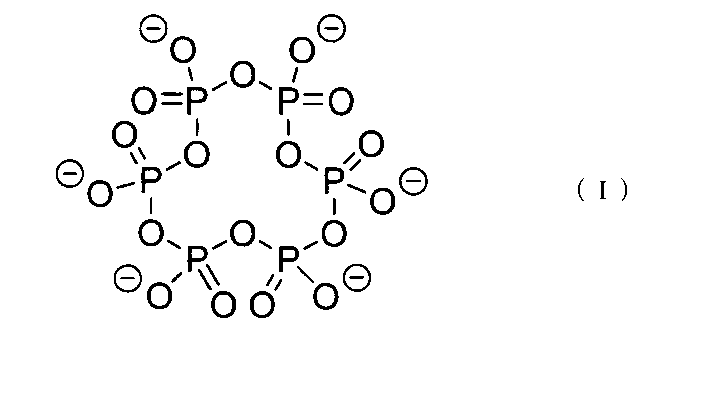
- the hexametaphosphate anion has a structure represented by the following formula (I).
- O ⁇ bonded to P in the formula (I) can be bonded to a transition metal or the like in the composite oxide.
- O that binds to P - has a lot of easily forming a large number of bonds between the transition metal and the like in the composite oxide.
- the component (compound A) of the additive covering the surface of the composite oxide can be obtained, for example, by the following method.
- the positive electrode is washed with a non-aqueous solvent to remove the non-aqueous electrolyte adhering to the positive electrode, and the non-aqueous solvent is removed by drying.
- a positive electrode mixture layer is collected from the positive electrode, appropriately pulverized, and dispersed in water.
- the dispersion liquid of the positive electrode mixture is filtered to obtain a filtrate as a sample solution.
- the dispersion liquid of the positive electrode material may be filtered to obtain a filtrate as a sample solution.
- the components contained in the sample solution obtained above are analyzed by the X-ray diffraction (XRD) method.
- the additive coating the surface of the composite oxide contains compound A
- compound A is dissolved in the sample solution (water), and a peak based on compound A is observed in the XRD pattern.
- the above sample solution may be analyzed by nuclear magnetic resonance (NMR) spectroscopy.
- the coating material on the surface of the composite oxide may be analyzed based on the XRD pattern obtained by the XRD method of the positive electrode material and the electron diffraction pattern obtained by the transmission electron microscope (TEM).
- the content of phosphorus (P) in the positive electrode may be 0.1% by mass or more and 0.75% by mass or less with respect to the total of the composite oxide and the additive. , 0.2% by mass or more and 0.55% by mass or less.
- the content of P is 0.1% by mass or more with respect to the total of the composite oxide and the additive, the composite oxide is sufficiently coated with the additive, and the cycle characteristics are likely to be improved.
- the content of P is 0.75% by mass or less with respect to the total of the composite oxide and the additive, the composite oxide is sufficiently secured in the positive electrode, and the capacity of the battery can be easily increased.
- the content of P in the positive electrode (mass ratio to the total of composite oxides and additives) can be determined by the following method.
- the positive electrode Disassemble the battery and take out the positive electrode.
- the positive electrode is washed with a non-aqueous solvent to remove the non-aqueous electrolyte adhering to the positive electrode, and the non-aqueous solvent is removed by drying.
- the positive electrode mixture is collected from the positive electrode, and the mass W1 of the positive electrode mixture is measured.
- the positive electrode mixture is solubilized with a predetermined acid, and the residue of the carbon material (acetylene black) and the resin material (polyvinylidene fluoride) is filtered off by filtration to obtain a sample solution.
- the mass W2 of the residue after drying is measured. (W1-W2) is determined as the total mass of the composite oxide and the additive.
- the mass W3 of P in the sample solution is determined by inductively coupled plasma (ICP) emission spectroscopy.
- ICP inductively coupled plasma
- the positive electrode material is solubilized with a predetermined acid to obtain a sample solution, which is contained in the sample solution by ICP emission spectroscopic analysis.
- the mass WB of P may be determined, and WB / WA ⁇ 100 may be determined as the content of P described above.
- the positive electrode may include a positive electrode material comprising composite oxide particles and an additive containing compound A while covering the surface of the composite oxide particles.
- the positive electrode includes a positive electrode current collector and a positive electrode mixture layer supported on the positive electrode current collector, and the positive electrode mixture layer may contain the above-mentioned positive electrode material.
- the state of distribution of P in the positive electrode material is determined by element analysis (element mapping) of the positive electrode mixture layer or the cross section of the positive electrode material using an electron probe microanalyzer (EPMA) or an energy dispersive X-ray (EDX) analyzer. It can be confirmed by doing.
- element analysis element mapping
- EPMA electron probe microanalyzer
- EDX energy dispersive X-ray
- the method for producing the positive electrode material includes, for example, a first step of adhering the raw material solution to the surface of the composite oxide particles and a second step of heating and drying the composite oxide particles having the raw material solution adhered to the surface.
- the composite oxide was synthesized by using a coprecipitation method or the like, and was obtained by mixing, for example, a lithium compound and a compound containing a metal Me (transition metal) other than lithium obtained by the coprecipitation method or the like. It is obtained by firing the mixture under predetermined conditions.
- the composite oxide usually forms secondary particles in which a plurality of primary particles are aggregated.
- the average particle size (D50) of the composite oxide particles is, for example, 3 ⁇ m or more and 25 ⁇ m or less.
- the average particle size (D50) of the composite oxide particles means a particle size (volume average particle size) at which the volume integrated value is 50% in the volume-based particle size distribution measured by the laser diffraction scattering method. ..
- the first step may also serve as a step of cleaning the synthesized composite oxide particles. In this case, it is advantageous in terms of improving productivity.
- the composite oxide particles are added to the raw material solution and stirred to disperse the composite oxide particles in the raw material solution.
- the raw material solution is, for example, an aqueous solution containing H 3 PO 4 and LiOH, and can be obtained by adding an appropriate amount of an aqueous solution of LiOH to the aqueous solution of H 3 PO 4.
- the raw material solution contains an acid component such as H 3 PO 4
- a part of the acid component is neutralized by adding an alkaline component such as LiOH, and the influence of the acid component on the composite oxide can be reduced.
- the amount of the composite oxide particles input is, for example, 500 g or more and 2000 g or less per 1 L of the raw material solution.
- z When the raw material composition in the raw material solution (aqueous solution of H 3 PO 4 and LiOH) is represented by Li z H (3-z) PO 4 , z may be 1.0 or more and 1.8 or less. It may be 2 or more and 1.8 or less. In this case, it is easy to adjust the pH of the raw material solution to a range of about 6 or more and less than 8. The influence of the composite oxide due to the acid component is avoided, and the composite oxide can sufficiently play a role as a positive electrode active material. The raw material solution can be easily prepared, and compound A can be efficiently obtained.
- the z value tends to increase slightly due to the influence of the alkaline component. Shift to. For example, when a raw material solution having a z value of 1 in the raw material composition adheres to the composite oxide in which the alkaline component remains, the z value becomes larger than 1.
- the second step is a step of removing the dispersion medium adhering to the surface of the composite oxide particles by heating and drying, and reacting the raw materials adhering to the surface of the composite oxide particles to form compound A. Also serves as a generation process.
- the heating temperature is, for example, 180 ° C. or higher and 450 ° C. or lower. In this case, the surface of the composite oxide particles is dried and the compound A is produced on the surface efficiently.
- the produced compound A can be bonded to the metal Me (transition metal or the like) of the composite oxide particles as an anion.
- the water in the raw material solution (aqueous solution containing H 3 PO 4 and LiOH) adhering to the surface of the composite oxide particles by heating is reduced, and Li 3 PO 4 and Li H 2 PO 4 are released. Generate and precipitate.
- Li 3 PO 4 and Li H 2 PO 4 react to produce hexametaphosphate.
- the water produced during the reaction also evaporates by heating.
- a small amount of cyclic polyphosphoric acid other than hexametaphosphoric acid such as tetrametaphosphoric acid and chain polyphosphoric acid such as tetrapolyphosphoric acid can be produced.
- a small amount of unreacted components such as Li 3 PO 4 may remain.
- Hexametholic acid has a lower density than Li 3 PO 4 and Li H 2 PO 4, so it is less likely to aggregate.
- the positive electrode active material contains a composite oxide containing lithium and a metal Me other than lithium.
- the metal Me contains at least a transition metal. Transition metals are nickel (Ni), cobalt (Co), manganese (Mn), iron (Fe), copper (Cu), chromium (Cr), titanium (Ti), niobium (Nb), zirconium (Zr), vanadium. It may contain at least one element selected from the group consisting of (V), tantalum (Ta) and molybdenum (Mo).
- the metal Me may contain a metal other than the transition metal.
- the metal other than the transition metal may contain at least one selected from the group consisting of aluminum (Al), magnesium (Mg), calcium (Ca), strontium (Sr), zinc (Zn) and silicon (Si). ..
- the composite oxide may further contain boron (B) and the like in addition to the metal.
- the transition metal preferably contains at least Ni.
- the metal Me may contain Ni and at least one selected from the group consisting of Co, Mn, Al, Ti and Fe.
- the metal Me preferably contains Ni and at least one selected from the group consisting of Co, Mn and Al, and Ni, Co and Mn. And / or Al is more preferred.
- the metal Me contains Co, the phase transition of the composite oxide containing Li and Ni is suppressed during charging and discharging, the stability of the crystal structure is improved, and the cycle characteristics are likely to be improved.
- the metal Me contains Mn and / or Al, the thermal stability is improved.
- the atomic ratio of Ni to the metal Me: Ni / Me is preferably 0.3 or more and less than 1, and more preferably 0.5 or more and less than 1. More preferably, it is 0.75 or more and less than 1.
- the positive electrode active material may contain a composite oxide containing Ni and / or Co, which has a layered rock salt type crystal structure, and has a spinel type crystal structure. It may contain a composite oxide containing Mn. Among them, from the viewpoint of increasing the capacity, a composite oxide having a layered rock salt type crystal structure, containing Ni, and having an atomic ratio of Ni to metal Me: Ni / Me of 0.3 or more (hereinafter, nickel-based composite). Also referred to as an oxide) is preferable.
- the additive containing compound A which covers the surface of the composite oxide, has excellent lithium ion conductivity, and the composite oxide smoothly occludes and releases lithium ions. Further, in the coating of the additive containing the compound A, the deterioration of the composite oxide due to the acid component in the raw material solution is suppressed by including the alkaline component in the raw material solution. Therefore, when the surface of the nickel-based composite oxide is coated with an additive containing the compound A, the high capacity of the positive electrode containing the nickel-based composite oxide can be sufficiently drawn out.
- the crystal structure of the nickel-based composite oxide is relatively unstable, and it is easily deteriorated by elution of Ni due to contact with a non-aqueous electrolyte (oxalate borate complex) at a high-potential positive electrode, and has cycle characteristics. Is easy to decrease. Therefore, in the case of the nickel-based composite oxide, the effect of improving the cycle characteristics by coating the surface of the composite oxide with the additive containing the compound A can be remarkably obtained.
- the Ni-based composite oxide may become alkaline due to the residual alkaline component used for its synthesis, and the composite oxide due to the acid component in the raw material solution used when coating the composite oxide surface with an additive. Deterioration is likely to be suppressed.
- the composite oxide has a layered rock salt type crystal structure and satisfies the general formula (1): LiNi ⁇ M 1- ⁇ O 2 (0.3 ⁇ ⁇ ⁇ 1, where M is Co, Mn, Al. , Ti and Fe. It is at least one element selected from the group.).
- ⁇ is in the above range, the effect of Ni and the effect of element M can be obtained in a well-balanced manner.
- the composite oxide has a crystal structure of the layered rock-salt, and the general formula (2): LiNi x Co y M 1-x-y O It may have a composition represented by 2.
- M is at least selected from the group consisting of Al and Mn. It is one kind of element. In this case, the effect of Ni, the effect of Co, and the effect of element M can be obtained in a well-balanced manner.
- the high capacity of the composite oxide can be sufficiently brought out.
- Al is preferable as M in the general formula (2).
- the x value may be in the range of 0.5 ⁇ x ⁇ 1.
- the y value may be in the range of 0 ⁇ y ⁇ 0.35.
- the composite oxide has a spinel-type crystal structure and has a general formula (3): LiMn ⁇ Ni 2- ⁇ O 4 (0.1 ⁇ ⁇ ⁇ 2). ) May have a composition represented by. Further, in the general formula (3), ⁇ may be 0.5 or more and less than 2.
- the positive electrode includes, for example, a positive electrode current collector and a positive electrode mixture layer supported on the surface of the positive electrode current collector.
- the positive electrode mixture layer can be formed by applying a positive electrode slurry in which a positive electrode mixture is dispersed in a dispersion medium to the surface of a positive electrode current collector and drying it. The dried coating film may be rolled if necessary.
- the positive electrode mixture layer may be formed on one surface of the positive electrode current collector, or may be formed on both surfaces.
- the positive electrode mixture contains the above positive electrode material as an essential component.
- the positive electrode mixture may contain a binder, a conductive agent, or the like as an optional component.
- NMP N-methyl-2-pyrrolidone
- binder examples include resin materials such as fluororesin, polyolefin resin, polyamide resin, polyimide resin, acrylic resin, and vinyl resin.
- fluororesin examples include polytetrafluoroethylene (PTFE) and polyvinylidene fluoride (PVDF).
- PTFE polytetrafluoroethylene
- PVDF polyvinylidene fluoride
- the conductive agent examples include carbon blacks such as acetylene black; conductive fibers such as carbon fibers and metal fibers; and carbon fluoride.
- carbon blacks such as acetylene black
- conductive fibers such as carbon fibers and metal fibers
- carbon fluoride examples of the conductive agent.
- one type may be used alone, or two or more types may be used in combination.
- the positive electrode current collector for example, a metal foil can be used.
- the metal constituting the positive electrode current collector include aluminum (Al), titanium (Ti), an alloy containing these metal elements, and stainless steel.
- the thickness of the positive electrode current collector is not particularly limited, but is, for example, 3 to 50 ⁇ m.
- the negative electrode may be a type of negative electrode that includes at least a negative electrode current collector, in which lithium metal is deposited on the negative electrode during charging, and the lithium metal is dissolved in a non-aqueous electrolyte during discharge.
- the negative electrode may include a negative electrode mixture layer supported on the surface of the negative electrode current collector or the negative electrode current collector, and lithium metal may be deposited on the surface of the negative electrode current collector or the negative electrode mixture layer.
- the negative electrode current collector for example, a metal foil can be used.
- the metal constituting the negative electrode current collector is preferably a metal that does not react with lithium metal, and examples thereof include copper (Cu), nickel (Ni), iron (Fe), and alloys containing these metal elements.
- the thickness of the negative electrode current collector is not particularly limited, and is, for example, 5 ⁇ m or more and 300 ⁇ m or less.
- the negative electrode may include a negative electrode current collector and a negative electrode mixture layer supported on the surface of the negative electrode current collector.
- the thickness of the negative electrode mixture layer may be set sufficiently thin so that lithium metal can be deposited on the negative electrode during charging.
- the design capacity Cn of the negative electrode active material in the negative electrode mixture layer with respect to the design capacity Cp of the positive electrode may satisfy Cn / Cp ⁇ 1 and Cn / Cp ⁇ 0.8.
- the lithium metal is deposited on the surface of the negative electrode mixture layer during charging, and the lithium metal precipitated on the surface of the negative electrode mixture layer is dissolved in the non-aqueous electrolyte during discharging.
- the negative electrode mixture layer can be formed, for example, by applying a negative electrode slurry in which the negative electrode mixture is dispersed in a dispersion medium to the surface of the negative electrode current collector and drying it. The dried coating film may be rolled if necessary.
- the negative electrode mixture layer may be formed on one surface of the negative electrode current collector, or may be formed on both surfaces.
- the dispersion medium for example, water or NMP is used.
- the negative electrode mixture contains a negative electrode active material as an essential component, and may contain a binder, a conductive agent, a thickener, and the like as optional components.
- a binder a rubber material such as styrene-butadiene rubber (SBR) may be used.
- SBR styrene-butadiene rubber
- the thickener include carboxymethyl cellulose (CMC) and a modified product thereof (Na salt, etc.).
- the negative electrode active material may contain a carbon material that occludes and releases lithium ions.
- Examples of the carbon material that occludes and releases lithium ions include graphite (natural graphite, artificial graphite), easily graphitized carbon (soft carbon), and non-graphitized carbon (hard carbon). Of these, graphite is preferable because it has excellent charge / discharge stability and has a small irreversible capacity.
- the negative electrode active material may contain an alloy-based material.
- the alloy-based material is a material containing at least one kind of metal capable of forming an alloy with lithium, and examples thereof include silicon, tin, silicon alloys, tin alloys, and silicon compounds.
- As the alloy-based material a composite material having a lithium ion conductive phase and silicon particles dispersed in the phase may be used.
- As the lithium ion conductive phase a silicate phase, a silicon oxide phase in which 95% by mass or more is silicon dioxide, a carbon phase, or the like may be used.
- An alloy material and a carbon material may be used in combination as the negative electrode active material.
- the mass ratio of the carbon material to the total of the alloy-based material and the carbon material is, for example, preferably 80% by mass or more, and more preferably 90% by mass or more.
- the non-aqueous electrolyte contains lithium ions and anions and has lithium ion conductivity.
- the non-aqueous electrolyte may be liquid.
- the liquid non-aqueous electrolyte contains, for example, lithium ions, anions and a non-aqueous solvent.
- the liquid non-aqueous electrolyte is prepared by dissolving the lithium salt in a non-aqueous solvent. The dissolution of the lithium salt in a non-aqueous solvent produces lithium ions and anions.
- the non-aqueous electrolyte may be in the form of a gel.
- the gel-like non-aqueous electrolyte contains, for example, lithium ions, anions, and a matrix polymer, and may further contain a non-aqueous solvent.
- the matrix polymer for example, a polymer material that absorbs a non-aqueous solvent and gels is used. Examples of the polymer material include fluororesin, acrylic resin, and polyether resin.
- the anions include at least the anions of the oxalate complex.
- the anion of the oxalate complex may contain boron and / or phosphorus. Examples of the anion of the oxalate complex, B (C 2 O 4) 2 -, difluoro (oxalato) borate anion: BF 2 (C 2 O 4 ) -, PF 4 (C 2 O 4) -, PF 2 (C 2 O 4 ) 2 - etc.
- the anion of the oxalate complex one type may be used alone, or two or more types may be used in combination.
- Anions of the oxalate complex may be combined with other anions.
- Other anions e.g., BF 4 -, ClO 4 - , PF 6 -, CF 3 SO 3 -, CF 3 CO 2 -, anion of imides and the like.
- Other anions, PF 6 - may be an anion and / or imides. As the other anions, one type may be used alone, or two or more types may be used in combination.
- the concentration of anions in the non-aqueous electrolyte may be 0.5 mol / L or more and 3.5 mol / L or less. Further, the concentration of the anion of the oxalate complex in the non-aqueous electrolyte may be 0.05 mol / L or more and 1 mol / L or less.
- non-aqueous solvent examples include esters, ethers, nitriles, amides, and halogen substituents thereof.
- the non-aqueous solvent one type may be used alone, or two or more types may be used in combination.
- the halogen substituent include fluoride and the like.
- Examples of the ester include cyclic carbonate ester, chain carbonate ester, cyclic carboxylic acid ester, and chain carboxylic acid ester.
- Examples of the cyclic carbonate include ethylene carbonate (EC) and propylene carbonate (PC).
- Examples of the chain carbonic acid ester include dimethyl carbonate (DMC), ethyl methyl carbonate (EMC), diethyl carbonate (DEC) and the like.
- Examples of the cyclic carboxylic acid ester include ⁇ -butyrolactone (GBL) and ⁇ -valerolactone (GVL).
- Examples of the chain carboxylic acid ester include ethyl acetate, propyl acetate, methyl propionate (PM) and the like.
- ether examples include cyclic ether and chain ether.
- examples of the cyclic ether include 1,3-dioxolane, 4-methyl-1,3-dioxolane, tetrahydrofuran, 2-methyltetrahydrofuran and the like.
- Examples of the chain ether include 1,2-dimethoxyethane, diethyl ether, ethyl vinyl ether, 1,2-diethoxyethane and the like.
- the cyclic carbonate may contain a fluorinated cyclic carbonate such as fluoroethylene carbonate (FEC), and a cyclic carbonate having a carbon-carbon unsaturated bond such as vinylene carbonate (VC) or vinylethylene carbonate may be used. It may be included.
- FEC fluoroethylene carbonate
- VC vinylene carbonate
- VC vinylethylene carbonate
- a good quality film is formed on the surface of the negative electrode active material.
- a high-quality film is formed on the surface of the negative electrode (negative electrode current collector or negative electrode mixture layer), and the formation of lithium metal dendrites is suppressed.
- Separator usually, it is desirable to interpose a separator between the positive electrode and the negative electrode.
- the separator has high ion permeability and has appropriate mechanical strength and insulation.
- a microporous thin film, a woven fabric, a non-woven fabric or the like can be used.
- polyolefins such as polypropylene and polyethylene are preferable.
- Non-aqueous electrolyte secondary battery is a structure in which an electrode group in which a positive electrode and a negative electrode are wound via a separator and a non-aqueous electrolyte are housed in an exterior body.
- an electrode group in which a positive electrode and a negative electrode are wound via a separator and a non-aqueous electrolyte are housed in an exterior body.
- another form of electrode group such as a laminated type electrode group in which a positive electrode and a negative electrode are laminated via a separator may be applied.
- the non-aqueous electrolyte secondary battery may be in any form such as a cylindrical type, a square type, a coin type, a button type, and a laminated type.
- FIG. 1 is a schematic perspective view in which a part of the non-aqueous electrolyte secondary battery according to the embodiment of the present disclosure is cut out.
- the battery includes a bottomed square battery case 4, an electrode group 1 housed in the battery case 4, and a non-aqueous electrolyte (not shown).
- the electrode group 1 has a long strip-shaped negative electrode, a long strip-shaped positive electrode, and a separator that is interposed between them and prevents direct contact.
- the electrode group 1 is formed by winding a negative electrode, a positive electrode, and a separator around a flat plate-shaped winding core and pulling out the winding core.
- the peripheral edge of the sealing plate 5 is fitted to the open end portion of the battery case 4, and the fitting portion is laser welded. In this way, the opening of the battery case 4 is sealed with the sealing plate 5.
- the non-aqueous electrolyte injection hole provided in the sealing plate 5 is closed by the sealing 8.
- Example 1 [Preparation of positive electrode material]
- a layered rock salt type composite oxide particles having a composition of LiNi 0.9 Co 0.05 Al 0.05 (NCA) (average particle size (D50) 11.1 ⁇ m) are subjected to the liquid phase method.
- the surface was coated with an additive containing compound A.
- a LiOH aqueous solution (concentration 1 mol / L) was added to an H 3 PO 4 aqueous solution (concentration 1 mol / L) to obtain a raw material solution (an aqueous solution containing H 3 PO 4 and LiOH).
- z is such that the values shown in Table 1, was adjusted amount of LiOH aqueous solution to be introduced into the aqueous H 3 PO 4.
- the amount of the LiOH aqueous solution added was such that the pH of the raw material solution was less than 8.
- Composite oxide particles were added to the raw material solution.
- the amount of the composite oxide particles input at this time was 1250 g per 1 L of the raw material solution.
- the raw material solution containing the composite oxide particles was stirred for 15 minutes to disperse the composite oxide particles in the raw material solution.
- the composite oxide particles in the dispersion liquid were filtered off by filtration, and the composite oxide particles having the raw material solution adhered to the surface were heated at 450 ° C. for 3 hours and dried. In this way, a positive electrode material in which the surface of the composite oxide particles was coated with an additive was obtained.
- the content of P in the positive electrode material determined by the method described above was 0.21% by mass.
- the compounds A hexametaphosphoric acid (Li 6 P 6 O 18 ) and lithium orthophosphate (Li 3 PO 4 ) were examined. And lithium pyrophosphate (Li 4 P 2 O 7 ) were confirmed to be contained.
- NMP N-Methyl-2-pyrrolidone
- AB acetylene black
- PVDF polyvinylidene fluoride
- a positive electrode slurry is applied to the surface of an aluminum foil which is a positive electrode current collector, the coating film is dried, and then rolled to obtain a positive electrode mixture layer (thickness 40 ⁇ m, density 3.6 g / cm 3 ) on one side of the aluminum foil. Was formed to prepare a positive electrode.
- a non-aqueous electrolyte was prepared by dissolving a lithium salt in a non-aqueous solvent.
- a non-aqueous solvent a mixed solvent containing fluoroethylene carbonate (FEC) and dimethyl carbonate (DMC) in a volume ratio of 2: 8 was used.
- FEC fluoroethylene carbonate
- DMC dimethyl carbonate
- LiPF 6 and LiBF 2 (C 2 O 4 ) (LiFOB) were used as the lithium salt.
- the concentration of LiPF 6 in the non-aqueous electrolyte was 1 mol / L.
- the concentration of LiFOB in the non-aqueous electrolyte was 0.5 mol / L.
- the positive electrode to which the Al lead was attached, the counter electrode (Li electrode) to which the Ni lead was attached, and the non-aqueous electrolyte were used to form an evaluation cell for the positive electrode.
- the counter electrode one in which a lithium metal foil was attached to one side of the electrolytic copper foil was used.
- the positive electrode and the counter electrode were laminated via a polyethylene separator so that the positive electrode mixture layer and the lithium metal foil faced each other to obtain an electrode group.
- the electrode is housed in a bag-shaped exterior body formed of an Al laminate film, a non-aqueous electrolyte is injected, the positive electrode mixture layer is impregnated with the non-aqueous electrolyte, and then the opening of the exterior body is sealed by heat. bottom.
- Some of the Al reeds and Ni reeds were exposed to the outside from the exterior body.
- the evaluation cell was prepared in a dry air atmosphere with a dew point of ⁇ 60 ° C. or lower. The evaluation cell was pressure-fixed at 3.2 MPa.
- Comparative Example 1 In the preparation of the positive electrode, the evaluation cell B1 of Comparative Example 1 was prepared by the same method as in Example 1 except that the surface of the composite oxide particles was not coated with the additive containing compound A.
- Comparative Example 2 In the preparation of the non-aqueous electrolyte, the evaluation cell B2 of Comparative Example 2 was prepared by the same method as in Example 1 except that only LiPF 6 was used as the lithium salt and the concentration of LiPF 6 in the non-aqueous electrolyte was 1 mol / L. Made.
- Comparative Example 3 In the preparation of the positive electrode, the surface of the composite oxide particles was not coated with an additive containing compound A. In the preparation of the non-aqueous electrolyte, only LiPF 6 was used as the lithium salt, and the concentration of LiPF 6 in the non-aqueous electrolyte was set to 1 mol / L. Except for the above, the evaluation cell B3 of Comparative Example 3 was prepared by the same method as in Example 1.
- the evaluation cells A1 and B1 to B3 obtained above were evaluated as follows.
- the evaluation results are shown in Table 1.
- the improvement rate of the capacity retention rate of the cell A1 in Table 1 is the rate of increase of the capacity retention rate of the cell A1 with respect to the cell B1, and when the capacity retention rates of the battery A1 and the battery B1 are a1 and b1, respectively. , (A1-b1) / b1 ⁇ 100.
- the improvement rate of the capacity retention rate of the cell B2 is the rate of increase of the capacity retention rate of the cell B2 with respect to the cell B3, and when the capacity retention rates of the cells B2 and B3 are b2 and b3, respectively, (b2- It is a value obtained by b3) / b3 ⁇ 100.
- the improvement rate of the capacity retention rate of cell A1 with respect to cell B1 was 1.2%, which was significantly higher than the improvement rate of the capacity retention rate of cell B2 with respect to cell B3 of 0.1%.
- the cycle characteristics were significantly improved by covering the surface of the composite oxide with an additive containing compound A.
- the non-aqueous electrolyte secondary battery according to the present disclosure is suitably used, for example, as a power source for mobile devices such as smartphones, a power source for vehicles such as electric vehicles, and a storage device for natural energy such as sunlight.
- Electrode group 2 Positive electrode lead 3 Negative electrode lead 4 Battery case 5 Seal plate 6 Negative terminal 7 Gasket 8 Seal
Landscapes
- Chemical & Material Sciences (AREA)
- General Chemical & Material Sciences (AREA)
- Chemical Kinetics & Catalysis (AREA)
- Electrochemistry (AREA)
- Inorganic Chemistry (AREA)
- Engineering & Computer Science (AREA)
- Manufacturing & Machinery (AREA)
- Physics & Mathematics (AREA)
- Condensed Matter Physics & Semiconductors (AREA)
- General Physics & Mathematics (AREA)
- Materials Engineering (AREA)
- Composite Materials (AREA)
- Secondary Cells (AREA)
- Battery Electrode And Active Subsutance (AREA)
Abstract
Description
本開示の一実施形態に係る非水電解質二次電池用正極は、正極と、負極と、非水電解質とを備え、正極は、リチウムと遷移金属とを含有する複合酸化物(正極活物質)と、複合酸化物の表面の少なくとも一部を覆う添加剤と、を備え、添加剤は、環状の無機リン酸化合物(以下、化合物Aとも称する。)を含み、非水電解質は、リチウムイオンと、アニオンとを含み、アニオンは、オキサレート錯体のアニオンを含む。
正極は、例えば、正極集電体と、正極集電体の表面に担持された正極合剤層と、を備える。正極合剤層は、正極合剤を分散媒に分散させた正極スラリーを、正極集電体の表面に塗布し、乾燥させることにより形成できる。乾燥後の塗膜を、必要により圧延してもよい。正極合剤層は、正極集電体の一方の表面に形成してもよく、両方の表面に形成してもよい。正極合剤は、必須成分として上記の正極材料を含む。正極合剤は、任意成分として、結着剤、導電剤等を含んでもよい。分散媒としては、N-メチル-2-ピロリドン(NMP)等が用いられる。
負極は、少なくとも負極集電体を備え、充電時に負極にリチウム金属が析出し、放電時にリチウム金属が非水電解質中に溶解するタイプの負極であってもよい。例えば、負極が負極集電体または負極集電体の表面に担持された負極合剤層を備え、負極集電体または負極合剤層の表面にリチウム金属を析出させてもよい。
非水電解質は、リチウムイオンとアニオンとを含み、リチウムイオン伝導性を有する。非水電解質は液状でもよい。液状の非水電解質は、例えば、リチウムイオンとアニオンと非水溶媒とを含む。液状の非水電解質は、リチウム塩を非水溶媒中に溶解させることにより調製される。リチウム塩が非水溶媒中に溶解することにより、リチウムイオンおよびアニオンが生成する。
通常、正極と負極との間には、セパレータを介在させることが望ましい。セパレータは、イオン透過度が高く、適度な機械的強度および絶縁性を備えている。セパレータとしては、微多孔薄膜、織布、不織布等を用いることができる。セパレータの材質としては、ポリプロピレン、ポリエチレン等のポリオレフィンが好ましい。
[正極材料の作製]
以下の手順で、液相法により、層状岩塩型の、LiNi0.9Co0.05Al0.05(NCA)の組成を有する複合酸化物粒子(平均粒径(D50)11.1μm)の表面を、化合物Aを含む添加剤で被覆した。
正極合剤にN-メチル-2-ピロリドン(NMP)を加えて攪拌し、正極スラリーを調製した。正極合剤には、上記で得られた正極材料と、アセチレンブラック(AB)と、ポリフッ化ビニリデン(PVDF)との混合物を用いた。正極合剤において、正極材料と、ABと、PVDFとの質量比は、100:2:2とした。
非水溶媒に、リチウム塩を溶解し、非水電解質を調製した。非水溶媒には、フルオロエチレンカーボネート(FEC)と、ジメチルカーボネート(DMC)とを、2:8の体積比で含む混合溶媒を用いた。リチウム塩には、LiPF6およびLiBF2(C2O4)(LiFOB)を用いた。非水電解質中のLiPF6の濃度は、1mol/Lとした。非水電解質中のLiFOBの濃度は、0.5mol/Lとした。
Al製リードを取り付けた上記の正極と、Ni製リードを取り付けた対極(Li極)と、上記の非水電解質とを用いて、正極の評価用セルを構成した。具体的には、対極には、電解銅箔の片面にリチウム金属箔を貼り付けたものを用いた。正極合剤層とリチウム金属箔とが対向するように、正極と対極とをポリエチレン製セパレータを介して積層し、電極群を得た。Alラミネートフィルムで形成される袋状の外装体に電極を収容し、非水電解質を注液し、正極合剤層に非水電解質を含ませた後、外装体の開口部を熱により封止した。Al製リードおよびNi製リードの一部は外装体から外部に露出させた。なお、評価用セルの作製は、露点-60℃以下のドライエア雰囲気で行った。評価用セルは3.2MPaで加圧固定した。
正極の作製において、複合酸化物粒子の表面を化合物Aを含む添加剤で被覆しなかった以外、実施例1と同様の方法により比較例1の評価用セルB1を作製した。
非水電解質の調製において、リチウム塩にLiPF6のみを用い、非水電解質中のLiPF6の濃度を1mol/Lとした以外、実施例1と同様の方法により比較例2の評価用セルB2を作製した。
正極の作製において、複合酸化物粒子の表面を化合物Aを含む添加剤で被覆しなかった。非水電解質の調製において、リチウム塩にLiPF6のみを用い、非水電解質中のLiPF6の濃度を1mol/Lとした。上記以外、実施例1と同様の方法により比較例3の評価用セルB3を作製した。
0.2Cの電流でセル電圧が4.3Vになるまで定電流充電を行い、その後、4.3Vのセル電圧で電流が0.05Cになるまで定電圧充電を行った。その後、0.2Cの電流でセル電圧が2.5Vになるまで定電流放電を行った。充電と放電との間の休止時間は10分とした。充放電は25℃の環境下で行った。

2 正極リード
3 負極リード
4 電池ケース
5 封口板
6 負極端子
7 ガスケット
8 封栓
Claims (7)
- 正極と、負極と、非水電解質とを備え、
前記正極は、リチウムと遷移金属とを含有する複合酸化物と、前記複合酸化物の表面の少なくとも一部を覆う添加剤と、を備え、
前記添加剤は、環状の無機リン酸化合物を含み、
前記非水電解質は、リチウムイオンと、アニオンとを含み、
前記アニオンは、オキサレート錯体のアニオンを含む、非水電解質二次電池。 - 前記オキサレート錯体のアニオンは、ジフルオロオキサレートボレートアニオンを含む、請求項1に記載の非水電解質二次電池。
- 前記リン酸化合物は、環状ポリリン酸およびその塩からなる群より選択される少なくとも1種を含む、請求項1または2に記載の非水電解質二次電池。
- 前記環状ポリリン酸は、ヘキサメタリン酸を含む、請求項3に記載の非水電解質二次電池。
- 前記正極中のリンの含有量が、前記複合酸化物および前記添加剤の合計に対して、0.1質量%以上、0.75質量%以下である、請求項1~4のいずれか1項に記載の非水電解質二次電池。
- 前記複合酸化物は、層状岩塩型の結晶構造を有し、かつ、
一般式:LiNixCoyM1-x-yO2で表わされる組成を有し、前記一般式中、0.3≦x<1、0<y≦0.5および0<1-x-y≦0.35を満たし、MはAlおよびMnからなる群より選択される少なくとも1種である、請求項1~5のいずれか1項に記載の非水電解質二次電池。 - 前記負極は、少なくとも負極集電体を備え、
充電時に前記負極にリチウム金属が析出し、放電時に前記リチウム金属が前記非水電解質中に溶解する、請求項1~6のいずれか1項に記載の非水電解質二次電池。
Priority Applications (4)
| Application Number | Priority Date | Filing Date | Title |
|---|---|---|---|
| US17/914,869 US20230145387A1 (en) | 2020-03-31 | 2021-03-23 | Non-aqueous electrolyte secondary battery |
| EP21779510.3A EP4131470A4 (en) | 2020-03-31 | 2021-03-23 | NON-AQUEOUS ELECTROLYTE RECHARGEABLE BATTERY |
| JP2022511984A JP7692154B2 (ja) | 2020-03-31 | 2021-03-23 | 非水電解質二次電池 |
| CN202180025943.8A CN115398697A (zh) | 2020-03-31 | 2021-03-23 | 非水电解质二次电池 |
Applications Claiming Priority (2)
| Application Number | Priority Date | Filing Date | Title |
|---|---|---|---|
| JP2020-065067 | 2020-03-31 | ||
| JP2020065067 | 2020-03-31 |
Publications (1)
| Publication Number | Publication Date |
|---|---|
| WO2021200396A1 true WO2021200396A1 (ja) | 2021-10-07 |
Family
ID=77927763
Family Applications (1)
| Application Number | Title | Priority Date | Filing Date |
|---|---|---|---|
| PCT/JP2021/011953 Ceased WO2021200396A1 (ja) | 2020-03-31 | 2021-03-23 | 非水電解質二次電池 |
Country Status (5)
| Country | Link |
|---|---|
| US (1) | US20230145387A1 (ja) |
| EP (1) | EP4131470A4 (ja) |
| JP (1) | JP7692154B2 (ja) |
| CN (1) | CN115398697A (ja) |
| WO (1) | WO2021200396A1 (ja) |
Families Citing this family (1)
| Publication number | Priority date | Publication date | Assignee | Title |
|---|---|---|---|---|
| CN119786768A (zh) * | 2024-11-28 | 2025-04-08 | 比亚迪股份有限公司 | 一种添加剂、电极极片、隔膜、电池、用电设备 |
Citations (4)
| Publication number | Priority date | Publication date | Assignee | Title |
|---|---|---|---|---|
| JP2005259592A (ja) * | 2004-03-12 | 2005-09-22 | Sanyo Electric Co Ltd | 二次電池用非水電解液及び非水電解液二次電池 |
| JP2008034334A (ja) * | 2006-06-28 | 2008-02-14 | Sony Corp | 電池 |
| JP2011187193A (ja) | 2010-03-05 | 2011-09-22 | Hitachi Ltd | リチウム二次電池用正極材料、リチウム二次電池及びそれを用いた二次電池モジュール |
| JP2016024853A (ja) * | 2014-07-16 | 2016-02-08 | トヨタ自動車株式会社 | 非水電解液二次電池とその製造方法および非水電解液 |
Family Cites Families (8)
| Publication number | Priority date | Publication date | Assignee | Title |
|---|---|---|---|---|
| CA2106066C (en) * | 1991-09-13 | 1997-08-12 | Akira Yoshino | Secondary battery |
| JP5094027B2 (ja) * | 2006-03-15 | 2012-12-12 | 三洋電機株式会社 | 非水電解質二次電池の製造方法 |
| JP5082308B2 (ja) * | 2006-07-03 | 2012-11-28 | ソニー株式会社 | 正極活物質およびその製造方法、並びに非水電解質二次電池 |
| JP5862956B2 (ja) * | 2012-08-01 | 2016-02-16 | トヨタ自動車株式会社 | 正極活物質およびその利用 |
| EP3226329B1 (en) * | 2014-11-28 | 2020-12-30 | Sumitomo Metal Mining Co., Ltd. | Positive electrode active material for nonaqueous electrolyte secondary cell, method for manufacturing same, and nonaqueous electrolyte secondary cell |
| US9887434B2 (en) * | 2015-06-22 | 2018-02-06 | Wildcat Discovery Technologies, Inc | Electrolyte formulations for lithium ion batteries |
| US10833369B2 (en) * | 2015-12-02 | 2020-11-10 | Nec Corporation | Positive electrode active substance for lithium secondary battery, positive electrode for lithium secondary battery and lithium secondary battery, and methods for producing these |
| US20220181619A1 (en) * | 2019-04-12 | 2022-06-09 | Semiconductor Energy Laboratory Co., Ltd. | Method for manufacturing positive electrode active material |
-
2021
- 2021-03-23 EP EP21779510.3A patent/EP4131470A4/en active Pending
- 2021-03-23 JP JP2022511984A patent/JP7692154B2/ja active Active
- 2021-03-23 CN CN202180025943.8A patent/CN115398697A/zh active Pending
- 2021-03-23 US US17/914,869 patent/US20230145387A1/en active Pending
- 2021-03-23 WO PCT/JP2021/011953 patent/WO2021200396A1/ja not_active Ceased
Patent Citations (4)
| Publication number | Priority date | Publication date | Assignee | Title |
|---|---|---|---|---|
| JP2005259592A (ja) * | 2004-03-12 | 2005-09-22 | Sanyo Electric Co Ltd | 二次電池用非水電解液及び非水電解液二次電池 |
| JP2008034334A (ja) * | 2006-06-28 | 2008-02-14 | Sony Corp | 電池 |
| JP2011187193A (ja) | 2010-03-05 | 2011-09-22 | Hitachi Ltd | リチウム二次電池用正極材料、リチウム二次電池及びそれを用いた二次電池モジュール |
| JP2016024853A (ja) * | 2014-07-16 | 2016-02-08 | トヨタ自動車株式会社 | 非水電解液二次電池とその製造方法および非水電解液 |
Non-Patent Citations (1)
| Title |
|---|
| See also references of EP4131470A4 |
Also Published As
| Publication number | Publication date |
|---|---|
| JPWO2021200396A1 (ja) | 2021-10-07 |
| US20230145387A1 (en) | 2023-05-11 |
| JP7692154B2 (ja) | 2025-06-13 |
| CN115398697A (zh) | 2022-11-25 |
| EP4131470A1 (en) | 2023-02-08 |
| EP4131470A4 (en) | 2024-11-27 |
Similar Documents
| Publication | Publication Date | Title |
|---|---|---|
| JP5884967B2 (ja) | 非水電解液二次電池及びその製造方法 | |
| JP7390597B2 (ja) | 二次電池および電解液 | |
| JPWO2017150020A1 (ja) | 非水電解質二次電池 | |
| JP7678525B2 (ja) | 非水電解質二次電池 | |
| JP7499443B2 (ja) | 非水電解質二次電池 | |
| WO2020026486A1 (ja) | 正極材料および二次電池 | |
| EP4489131A1 (en) | Secondary battery | |
| WO2020003595A1 (ja) | 非水電解質二次電池 | |
| JP2024520714A (ja) | リチウム二次電池用正極活物質の製造方法およびこれにより製造された正極活物質 | |
| JP7024386B2 (ja) | 負極活物質、負極、非水電解質蓄電素子、及び非水電解質蓄電素子の製造方法 | |
| JP7769946B2 (ja) | 非水電解質二次電池用正極および非水電解質二次電池 | |
| JP7493164B2 (ja) | 非水電解質二次電池 | |
| JP7692154B2 (ja) | 非水電解質二次電池 | |
| JP7814002B2 (ja) | 非水電解質二次電池 | |
| JP7801685B2 (ja) | 非水電解質二次電池 | |
| JP2012248283A (ja) | リチウム二次電池用正極材料,リチウム二次電池用正極、及びリチウム二次電池 | |
| US20230369582A1 (en) | Nonaqueous electrolyte secondary battery | |
| JP6998176B2 (ja) | 正極活物質、正極及びリチウム二次電池 | |
| WO2014041926A1 (ja) | リチウムイオン二次電池用正極活物質、リチウムイオン二次電池用正極、およびそれを用いたリチウムイオン二次電池 |
Legal Events
| Date | Code | Title | Description |
|---|---|---|---|
| 121 | Ep: the epo has been informed by wipo that ep was designated in this application |
Ref document number: 21779510 Country of ref document: EP Kind code of ref document: A1 |
|
| ENP | Entry into the national phase |
Ref document number: 2022511984 Country of ref document: JP Kind code of ref document: A |
|
| NENP | Non-entry into the national phase |
Ref country code: DE |
|
| ENP | Entry into the national phase |
Ref document number: 2021779510 Country of ref document: EP Effective date: 20221031 |
|
| WWG | Wipo information: grant in national office |
Ref document number: 202247059695 Country of ref document: IN |