WO2021201085A1 - 難燃剤組成物、難燃性合成樹脂組成物および成形体 - Google Patents
難燃剤組成物、難燃性合成樹脂組成物および成形体 Download PDFInfo
- Publication number
- WO2021201085A1 WO2021201085A1 PCT/JP2021/013788 JP2021013788W WO2021201085A1 WO 2021201085 A1 WO2021201085 A1 WO 2021201085A1 JP 2021013788 W JP2021013788 W JP 2021013788W WO 2021201085 A1 WO2021201085 A1 WO 2021201085A1
- Authority
- WO
- WIPO (PCT)
- Prior art keywords
- flame retardant
- flame
- synthetic resin
- component
- mass
- Prior art date
- Legal status (The legal status is an assumption and is not a legal conclusion. Google has not performed a legal analysis and makes no representation as to the accuracy of the status listed.)
- Ceased
Links
Classifications
-
- C—CHEMISTRY; METALLURGY
- C09—DYES; PAINTS; POLISHES; NATURAL RESINS; ADHESIVES; COMPOSITIONS NOT OTHERWISE PROVIDED FOR; APPLICATIONS OF MATERIALS NOT OTHERWISE PROVIDED FOR
- C09K—MATERIALS FOR MISCELLANEOUS APPLICATIONS, NOT PROVIDED FOR ELSEWHERE
- C09K21/00—Fireproofing materials
- C09K21/06—Organic materials
- C09K21/12—Organic materials containing phosphorus
-
- C—CHEMISTRY; METALLURGY
- C08—ORGANIC MACROMOLECULAR COMPOUNDS; THEIR PREPARATION OR CHEMICAL WORKING-UP; COMPOSITIONS BASED THEREON
- C08K—Use of inorganic or non-macromolecular organic substances as compounding ingredients
- C08K5/00—Use of organic ingredients
- C08K5/16—Nitrogen-containing compounds
- C08K5/34—Heterocyclic compounds having nitrogen in the ring
- C08K5/3467—Heterocyclic compounds having nitrogen in the ring having more than two nitrogen atoms in the ring
- C08K5/3477—Six-membered rings
- C08K5/3492—Triazines
- C08K5/34928—Salts
-
- C—CHEMISTRY; METALLURGY
- C08—ORGANIC MACROMOLECULAR COMPOUNDS; THEIR PREPARATION OR CHEMICAL WORKING-UP; COMPOSITIONS BASED THEREON
- C08K—Use of inorganic or non-macromolecular organic substances as compounding ingredients
- C08K5/00—Use of organic ingredients
- C08K5/49—Phosphorus-containing compounds
- C08K5/51—Phosphorus bound to oxygen
- C08K5/52—Phosphorus bound to oxygen only
- C08K5/527—Cyclic esters
-
- C—CHEMISTRY; METALLURGY
- C08—ORGANIC MACROMOLECULAR COMPOUNDS; THEIR PREPARATION OR CHEMICAL WORKING-UP; COMPOSITIONS BASED THEREON
- C08K—Use of inorganic or non-macromolecular organic substances as compounding ingredients
- C08K5/00—Use of organic ingredients
- C08K5/49—Phosphorus-containing compounds
- C08K5/51—Phosphorus bound to oxygen
- C08K5/52—Phosphorus bound to oxygen only
- C08K5/529—Esters containing heterocyclic rings not representing cyclic esters of phosphoric or phosphorous acids
-
- C—CHEMISTRY; METALLURGY
- C08—ORGANIC MACROMOLECULAR COMPOUNDS; THEIR PREPARATION OR CHEMICAL WORKING-UP; COMPOSITIONS BASED THEREON
- C08K—Use of inorganic or non-macromolecular organic substances as compounding ingredients
- C08K5/00—Use of organic ingredients
- C08K5/56—Organo-metallic compounds, i.e. organic compounds containing a metal-to-carbon bond
-
- C—CHEMISTRY; METALLURGY
- C08—ORGANIC MACROMOLECULAR COMPOUNDS; THEIR PREPARATION OR CHEMICAL WORKING-UP; COMPOSITIONS BASED THEREON
- C08L—COMPOSITIONS OF MACROMOLECULAR COMPOUNDS
- C08L101/00—Compositions of unspecified macromolecular compounds
-
- C—CHEMISTRY; METALLURGY
- C08—ORGANIC MACROMOLECULAR COMPOUNDS; THEIR PREPARATION OR CHEMICAL WORKING-UP; COMPOSITIONS BASED THEREON
- C08K—Use of inorganic or non-macromolecular organic substances as compounding ingredients
- C08K3/00—Use of inorganic substances as compounding ingredients
- C08K3/01—Use of inorganic substances as compounding ingredients characterized by their specific function
- C08K3/013—Fillers, pigments or reinforcing additives
-
- C—CHEMISTRY; METALLURGY
- C08—ORGANIC MACROMOLECULAR COMPOUNDS; THEIR PREPARATION OR CHEMICAL WORKING-UP; COMPOSITIONS BASED THEREON
- C08K—Use of inorganic or non-macromolecular organic substances as compounding ingredients
- C08K3/00—Use of inorganic substances as compounding ingredients
- C08K3/34—Silicon-containing compounds
- C08K3/346—Clay
-
- C—CHEMISTRY; METALLURGY
- C08—ORGANIC MACROMOLECULAR COMPOUNDS; THEIR PREPARATION OR CHEMICAL WORKING-UP; COMPOSITIONS BASED THEREON
- C08K—Use of inorganic or non-macromolecular organic substances as compounding ingredients
- C08K5/00—Use of organic ingredients
- C08K5/0008—Organic ingredients according to more than one of the "one dot" groups of C08K5/01 - C08K5/59
- C08K5/005—Stabilisers against oxidation, heat, light, ozone
-
- C—CHEMISTRY; METALLURGY
- C08—ORGANIC MACROMOLECULAR COMPOUNDS; THEIR PREPARATION OR CHEMICAL WORKING-UP; COMPOSITIONS BASED THEREON
- C08K—Use of inorganic or non-macromolecular organic substances as compounding ingredients
- C08K5/00—Use of organic ingredients
- C08K5/0008—Organic ingredients according to more than one of the "one dot" groups of C08K5/01 - C08K5/59
- C08K5/0066—Flame-proofing or flame-retarding additives
-
- C—CHEMISTRY; METALLURGY
- C08—ORGANIC MACROMOLECULAR COMPOUNDS; THEIR PREPARATION OR CHEMICAL WORKING-UP; COMPOSITIONS BASED THEREON
- C08K—Use of inorganic or non-macromolecular organic substances as compounding ingredients
- C08K5/00—Use of organic ingredients
- C08K5/04—Oxygen-containing compounds
- C08K5/09—Carboxylic acids; Metal salts thereof; Anhydrides thereof
- C08K5/098—Metal salts of carboxylic acids
-
- C—CHEMISTRY; METALLURGY
- C08—ORGANIC MACROMOLECULAR COMPOUNDS; THEIR PREPARATION OR CHEMICAL WORKING-UP; COMPOSITIONS BASED THEREON
- C08L—COMPOSITIONS OF MACROMOLECULAR COMPOUNDS
- C08L2201/00—Properties
- C08L2201/02—Flame or fire retardant/resistant
Definitions
- the present invention is a flame retardant composition capable of obtaining a flame retardant synthetic resin composition (hereinafter, also simply referred to as “resin composition”) having excellent flame retardancy and excellent shrinkage balance during molding.
- resin composition a flame retardant synthetic resin composition
- the present invention relates to a product, a flame-retardant synthetic resin composition using the same, and a molded product thereof.
- Synthetic resins have the advantages of excellent molding processability, heat resistance, mechanical properties, etc., as well as low specific density and light weight, so they have traditionally been used as building materials, automobile parts, packaging materials, and agricultural materials. , Has been widely used for housing materials for home appliances, toys, etc.
- flame retardants for synthetic resins are known, but in particular, an intomescent flame retardant whose main component is a salt of polyphosphoric acid or pyrophosphate and a nitrogen-containing compound has a surface during combustion. It is known as an excellent flame retardant that makes a synthetic resin flame-retardant by forming an expansion layer (Intumescent) and suppressing diffusion and heat transfer of decomposition products.
- Such flame retardants are described, for example, in Patent Document 1.
- the volume of the molten resin filled inside the mold shrinks when it is cooled and solidified.
- the size of the cavity of the mold is made one size larger by the amount of shrinkage, so that a molded product having a desired size is generally obtained.
- the molding shrinkage in the MD direction (flow direction of the resin in the mold) becomes the molding shrinkage in the TD direction (direction orthogonal to the MD direction).
- the molded product containing the flame retardant has a different vertical-horizontal balance of the molding shrinkage rate as compared with the molded product not containing the flame retardant, and the molded product having the shape originally designed by the mold can be obtained. It was difficult to get.
- the present invention provides a flame retardant composition capable of obtaining a flame retardant synthetic resin composition having an excellent vertical-horizontal balance of flame retardancy and molding shrinkage, and difficulty in using the flame retardant composition.
- An object of the present invention is to provide a flammable synthetic resin composition and a molded product thereof.
- the present inventors have completed the present invention as a result of diligent studies to solve the above problems.
- the flame retardant composition of the present invention is characterized by containing the following component (B) in an amount of 0.005 to 5 parts by mass with respect to 100 parts by mass of the following component (A).
- Ingredient Phosphate-based flame retardant.
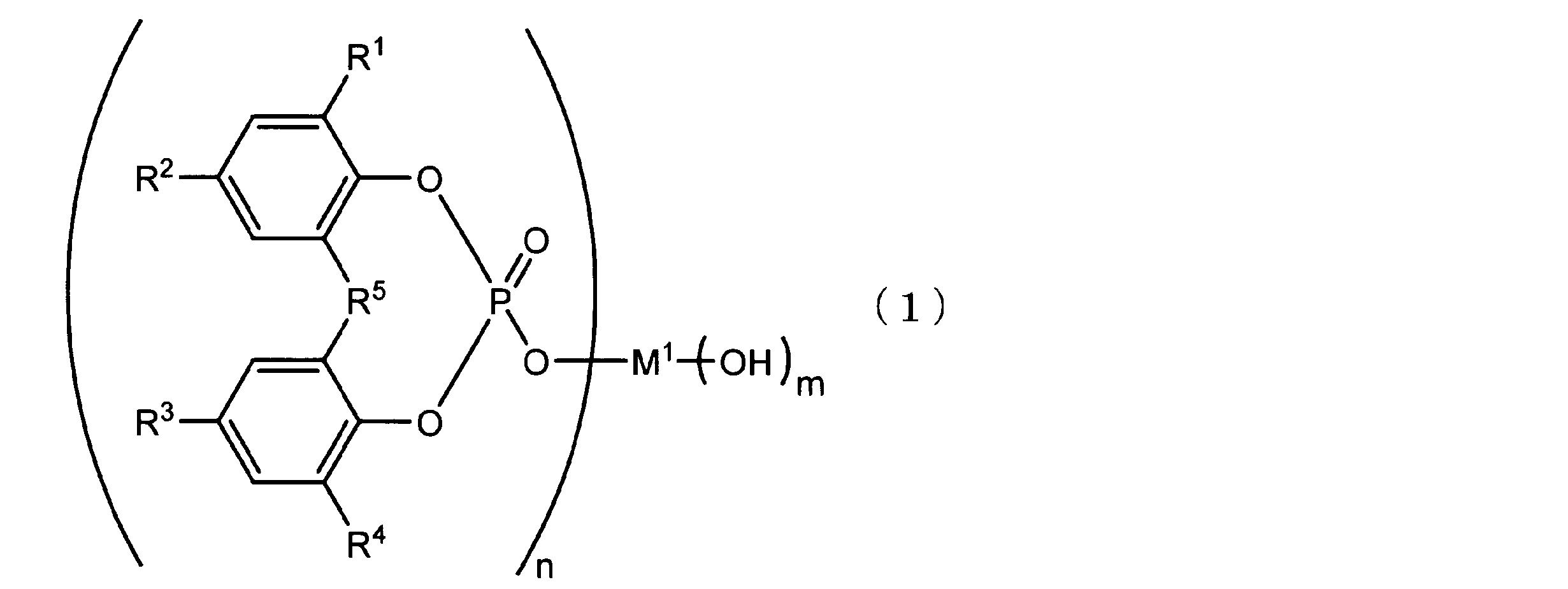
- R 1 , R 2 , R 3 and R 4 independently represent a hydrogen atom or an alkyl group having 1 to 8 carbon atoms, respectively, and R 5 is a direct bond or 1 carbon atom number.
- M 1 represents any of alkali metals, alkaline earth metals, zinc, aluminum and hydrogen atoms, and when M 1 is an alkali metal or hydrogen atom, n is 1 and m is 0, if M 1 is an alkaline earth metal or zinc, n is 2 and m is 0, if M 1 is aluminum, n is 1, 2 or 3, and m is 3. It is an integer represented by -n.
- the component (A) contains at least one of the following components (A-1), (A-2) and (A-3). Is preferable.
- A-1) Ingredient: A melamine salt selected from the group consisting of melamine orthophosphate, melamine pyrophosphate and melamine polyphosphate.
- A-2) Ingredient: A piperazine salt selected from the group consisting of piperazine orthophosphate, piperazine pyrophosphate and piperazine polyphosphate.
- A-3) Ingredient: An ammonium salt selected from the group consisting of ammonium orthophosphate, ammonium pyrophosphate and ammonium polyphosphate.
- the flame retardant composition of the present invention preferably further contains at least one selected from fillers, fatty acid metal salts and hydrotalcites as the component (C).
- the fatty acid metal salt is a compound having a structure represented by the following general formula (2).
- R 4 represents a group introduced from an aliphatic organic acid having 8 to 30 carbon atoms having a straight chain or a branch
- M 2 is a metal atom or Al (OH) 3-. It represents p, and p represents an integer of 1 to 3.
- the component (E) at least one selected from the group consisting of silicone oil, epoxy-based coupling agent and lubricant is further added to 100 parts by mass of the component (A). It is preferably contained in an amount of 0.01 to 5 parts by mass.
- the flame-retardant synthetic resin composition of the present invention is a flame-retardant synthetic resin composition containing a synthetic resin and the above-mentioned flame retardant composition. It is characterized by satisfying the relationships represented by the following equations (i) and (ii).
- ⁇ MD is the shrinkage rate of the molded product obtained by injection molding the flame-retardant synthetic resin composition in the MD direction, which is the flow direction of the resin in the mold cavity during injection molding
- ⁇ TD is the shrinkage ratio of the molded product obtained by injection molding the flame-retardant synthetic resin composition in the TD direction, which is the direction orthogonal to the MD direction
- ⁇ MD B is the flame-retardant synthetic resin composition.
- the molded product of the present invention is characterized in that the above-mentioned flame-retardant synthetic resin composition is molded.
- a flame retardant composition capable of obtaining a flame retardant synthetic resin composition excellent in flame retardancy and shrinkage balance during molding, a flame retardant synthetic resin composition using the same, and a flame retardant synthetic resin composition thereof.
- a molded body can be provided.
- the present invention relates to a flame retardant composition, a flame retardant synthetic resin composition and a molded product.
- the present invention will be described based on its preferred embodiment.
- the flame retardant composition of the present invention requires a phosphate-based flame retardant as a component (A) and one or more compounds having a structure represented by the general formula (1) as a component (B). It is an ingredient.
- the phosphate-based flame retardant used as the component (A) in the flame retardant composition of the present invention contains phosphoric acids.
- the phosphoric acids used in the above-mentioned phosphate-based flame retardant are not particularly limited, and examples thereof include various phosphoric acids such as orthophosphoric acid, pyrophosphoric acid, and polyphosphoric acid.
- the polyphosphoric acid is a so-called condensed phosphoric acid, and examples thereof include chain polyphosphoric acid and cyclic polymethaphosphoric acid.
- the degree of condensation of polyphosphate is 3 or more.
- the phosphate-based flame retardant is, for example, at least one metal or compound selected from the above-mentioned various phosphoric acids, metals of Groups 1 to 14 of the Periodic Table, ammonia, aliphatic amines and aromatic amines. Phosphate consisting of the salt of and can be mentioned.
- Examples of the metals of Groups 1 to 14 of the Periodic Table of the Periodic Table include lithium, sodium, calcium, barium, iron (II), iron (III), aluminum, zinc and the like.
- aliphatic amine examples include methylamine, ethylamine, diethylamine, triethylamine, ethylenediamine, piperazine and the like.
- aromatic amine examples include pyridine, pyrazine, pyridazine, pyrimidine, triazine, melamine, melam, and melem.
- the above-mentioned phosphate-based flame retardant may be treated with a silane coupling agent or a known water resistance improving treatment such as coating with a melamine resin, and known melamine, melamine cyanurate, pentaerythritol and the like may be added. Foaming aid may be added.
- phosphate-based flame retardant examples include orthophosphate, pyrophosphate, polyphosphate and the like.
- the orthophosphate is not particularly limited, but for example, ammonium salts such as ammonium phosphate, ammonium dihydrogen phosphate, and diammonium hydrogen phosphate, monosodium phosphate, disodium phosphate, trisodium phosphate, and sub-phosphate.
- ammonium salts such as ammonium phosphate, ammonium dihydrogen phosphate, and diammonium hydrogen phosphate, monosodium phosphate, disodium phosphate, trisodium phosphate, and sub-phosphate.
- Sodium phosphates such as monosodium phosphate, disodium phosphite, sodium hypophosphite, monopotassium phosphate, dipotassium phosphate, tripotassium phosphate, monopotassium phosphite, dipotassium phosphite, hypophalus Potassium salts such as potassium phosphate, monolithium phosphate, dilithium phosphate, trilithium phosphate, monolithium phosphite, dilithium phosphite, lithium salts such as lithium hypophosphite, barium dihydrogen phosphate , Barium hydrogen phosphate, tribarium phosphate, barium hypophosphite and other barium salts, magnesium monohydrogen phosphate, magnesium hydrogen phosphate, trimagnesium phosphate, magnesium hypophosphite and other magnesium salts, diphosphate Calcium hydrogen, calcium hydrogen phosphate, tricalcium phosphate, calcium salts such as calcium hypophosphit
- the pyrophosphate is not particularly limited, and examples thereof include ammonium pyrophosphate, piperazine pyrophosphate, melamine pyrophosphate, and aluminum pyrophosphate.
- polyphosphate is not particularly limited, and examples thereof include ammonium polyphosphate, piperazine polyphosphate, melamine polyphosphate, and aluminum polyphosphate.
- the above phosphate-based flame retardant can be used alone or in combination of two or more.
- the phosphate-based flame retardant of the component (A) is at least one of the following components (A-1), (A-2) and (A-3) from the viewpoint of flame retardancy and heat resistance. It is preferable to contain any one.
- A-1) Ingredient: A melamine salt selected from the group consisting of melamine orthophosphate, melamine pyrophosphate and melamine polyphosphate.
- A-2) Ingredient: A piperazine salt selected from the group consisting of piperazine orthophosphate, piperazine pyrophosphate and piperazine polyphosphate.
- A-3) Ingredient: An ammonium salt selected from the group consisting of ammonium orthophosphate, ammonium pyrophosphate and ammonium polyphosphate.
- the melamine salt used as the component (A-1) is selected from the group consisting of melamine orthophosphate, melamine pyrophosphate and melamine polyphosphate, and these are used alone or as a mixture. May be good.
- melamine pyrophosphate or melamine polyphosphate is preferable, and melamine pyrophosphate is particularly preferable, from the viewpoint of flame retardancy, handleability, and storage stability.
- the higher the content ratio of melamine pyrophosphate the more preferable.
- salts of phosphoric acids and melamine can also be obtained by reacting the corresponding salts of phosphoric acids or phosphoric acids with melamine, respectively, but the melamine salt used as the component (A-1) according to the present invention.
- melamine salt used as the component (A-1) Is preferably melamine pyrophosphate or melamine polyphosphate obtained by heat-condensing melamine orthophosphate, and melamine pyrophosphate is particularly preferable.
- the piperazine salt used as the component (A-2) is selected from the group consisting of piperazine orthophosphate, piperazine pyrophosphate and piperazine polyphosphate, and these are used alone or as a mixture. May be good.
- piperazine pyrophosphate is preferable from the viewpoint of flame retardancy, handleability and storage stability, and when used as a mixture, the higher the content ratio of piperazine pyrophosphate is, the more preferable.
- the salts of these phosphoric acids and piperazine can also be obtained by reacting the corresponding salts of phosphoric acids or phosphoric acids with piperazine, but the piperazine salt used as the component (A-2) according to the present invention is , Piperazine pyrophosphate or piperazine polyphosphate obtained by heat-condensing piperazine diphosphate is preferable, and piperazine pyrophosphate is particularly preferable.
- the ammonium salt used as the component (A-3) is selected from the group consisting of ammonium orthophosphate, ammonium pyrophosphate and ammonium polyphosphate, and these are used alone or in a mixture. May be good.
- the ammonium salt particles are coated with a thermosetting resin or microencapsulated, or with a melamine monomer or other nitrogen-containing organic compound.
- a silicon compound such as a surfactant, a silane coupling agent, or silicone oil, or those which have been made sparingly soluble by adding melamine or the like in the process of producing the above ammonium salt, etc. Can also be used.
- the component (A) according to the present invention is particularly preferably one containing the component (A-1) and the component (A-2) from the viewpoint of flame retardancy.
- the content ratio of the component (A-1) and the component (A-2) is flame-retardant.
- the mass ratio of the component (A-1) to the component (A-2) is preferably 20:80 to 50:50, and more preferably 30:70 to 45:55.
- Component (B) The component (B) in the flame retardant composition of the present invention is a compound having a structure represented by the following general formula (1).
- R 1 , R 2 , R 3 and R 4 independently represent a hydrogen atom or an alkyl group having 1 to 8 carbon atoms, respectively, and R 5 is a direct bond or 1 carbon atom number.
- M 1 represents any of alkali metals, alkaline earth metals, zinc, aluminum and hydrogen atoms, and when M 1 is an alkali metal or hydrogen atom, n is 1 and m is 0, if M 1 is an alkaline earth metal or zinc, n is 2 and m is 0, if M 1 is aluminum, n is 1, 2 or 3, and m is 3. It is an integer represented by -n.
- the alkyl group of R 1, R 2, R 3 and R 4 having 1 to 8 carbon atoms represented by, for example, a methyl group, an ethyl group, a propyl group, an isopropyl group, a butyl Groups, sec-butyl group, tert-butyl group, pentyl group, tert-pentyl group, hexyl group, heptyl group, octyl group, 2-ethylhexyl group, tert-octyl group and the like can be mentioned.
- an alkyl group having 1 to 5 carbon atoms is preferable, and a tert-butyl group is particularly preferable.
- the alkanediyl group having 1 to 4 carbon atoms represented by R 5 for example, methylene bridge, ethane-1,1-diyl group, propane-1,1-diyl group, Examples thereof include a propane-2,2-diyl group, a butane-1,1-diyl group, and a butane-2,2-diyl group. Of these, a methanediyl group or an ethane-1,1-diyl group is preferable from the viewpoint of the effect of the present invention.
- M 1 represents any one of alkali metal, alkaline earth metal, zinc, aluminum and hydrogen atom
- examples of the alkali metal include sodium, potassium and lithium, and alkaline earth.
- examples of the metal include magnesium, calcium, strontium, barium and the like.
- sodium, lithium, magnesium, calcium or aluminum is preferable, and sodium, lithium or aluminum is particularly preferable, from the viewpoint of the effect of the present invention.
- component (B) according to the present invention one type can be used alone or two or more types can be used in combination.
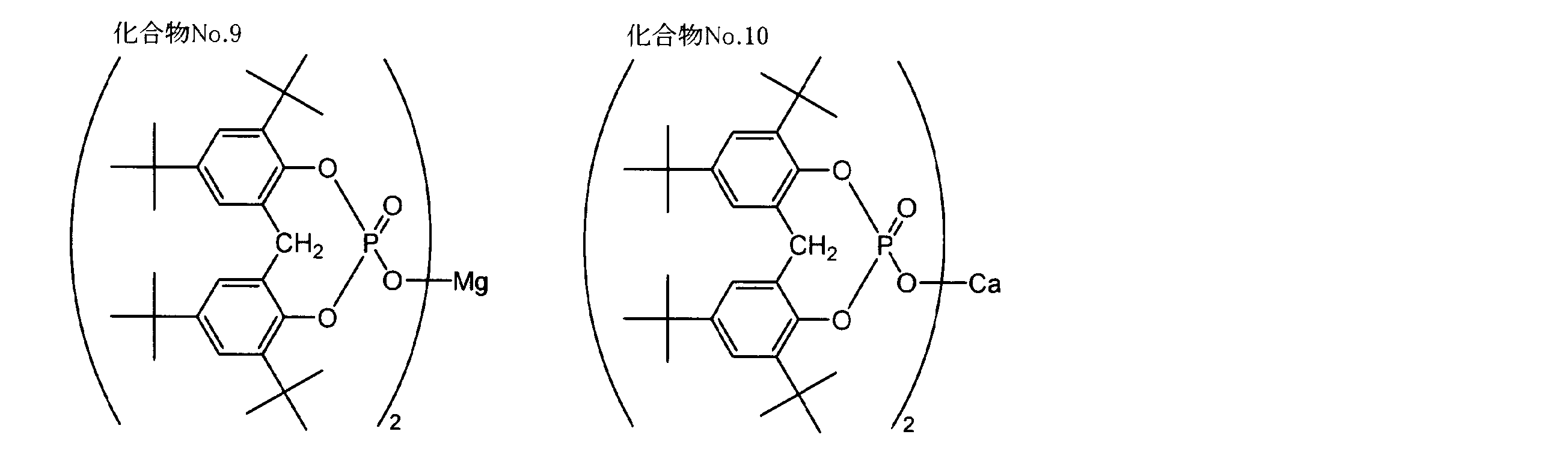
- component (B) according to the present invention in the case where M 1 in the general formula (1) is an alkali metal include the following compound No. 1 to No. 8 is mentioned. However, the component (B) according to the present invention is not limited to these compounds.
- M 1 in the above general formula (1) is an alkaline earth metal
- the following compound No. 9-No. 12 can be mentioned.
- the component (B) according to the present invention is not limited to these compounds.
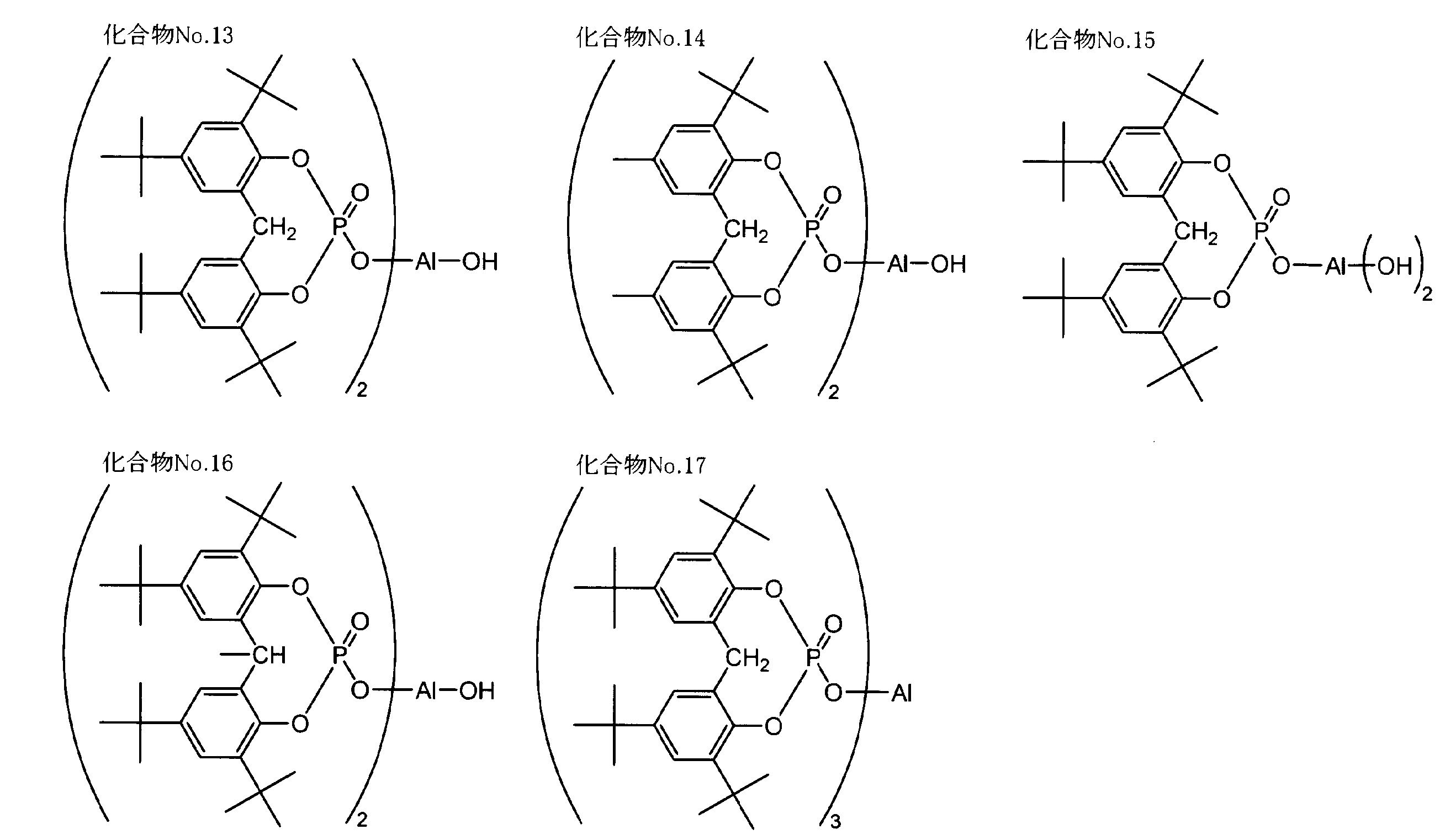
- M 1 in the general formula (1) is aluminum
- the following compound No. 13-No. 17 is mentioned.
- the component (B) according to the present invention is not limited to these compounds.
- M 1 in the above general formula (1) is a hydrogen atom
- the following compound No. 18-No. 20 is mentioned.
- the component (B) of the present invention is not limited to these compounds.
- the component (B) according to the present invention has a ratio of the aspect balance of the molding shrinkage ratio between the flow direction (MD direction) of the resin and the direction orthogonal to the flow direction (TD direction) at the time of injection molding of the resin composition to 1. It has the effect of suppressing warpage and deformation of the molded product by bringing it closer.
- the content of the component (B) in the flame retardant composition of the present invention is 0.005 to 5 parts by mass with respect to 100 parts by mass of the component (A) from the viewpoint of flame retardancy and shrinkage balance during molding. It is preferably 0.01 to 3 parts by mass, and even more preferably 0.05 to 1 part by mass.
- the flame retardant composition of the present invention further contains at least one selected from fillers, fatty acid metal salts and hydrotalcites as the component (C). Is preferable.
- the filler examples include talc, mica, calcium carbonate, calcium oxide, calcium hydroxide, magnesium carbonate, magnesium hydroxide, magnesium oxide, magnesium sulfate, aluminum hydroxide, barium sulfate, glass powder, glass fiber, clay, and the like.
- examples thereof include dolomite, silica, alumina, potassium titanate whiskers, wallastenite, fibrous magnesium oxysulfate and hydrotalcite, and in the case of particle size and fibrous form, the fiber diameter, fiber length and aspect ratio are appropriately selected.
- the blending amount is adjusted so as to be preferably 1 to 80 parts by mass, more preferably 3 to 50 parts by mass, and further preferably 5 to 40 parts by mass with respect to 100 parts by mass of the synthetic resin. can do.
- Examples of the fatty acid metal salt include compounds having a structure represented by the following general formula (2).
- R 4 represents a group introduced from an aliphatic organic acid having 8 to 30 carbon atoms having a straight chain or a branch
- M 2 is a metal atom or Al (OH) 3-. It represents p, and p represents an integer of 1 to 3.
- fatty acid metal salt examples include capric acid, 2-ethylhexanoic acid, pelargonic acid, capric acid, undesic acid, lauric acid, tridecyl acid, myristic acid, pentadecic acid, palmitic acid, margaric acid, and stearic acid.
- Palmitreic acid ⁇ -linolenic acid, linoleic acid, ⁇ -linolenic acid, stearidonic acid, petroseric acid, oleic acid, elaidic acid, vacene acid, eicosapentaenoic acid, docosapentaenoic acid, docosahexaenoic acid and other linear unsaturated fatty acids
- Examples include metal salts of aromatic fatty acids such as trimesic acid and metal salts of aromatic fatty acids.
- the fatty acid metal salt is preferably a hydrocarbon group represented by R 4 is a carbon atom number of 9 to 21 in particular, lauric acid, myristic acid, stearic acid, palmitic
- a metal salt of a saturated fatty acid such as an acid or 12-hydroxystearic acid is preferable because the effect of the composition of the present invention becomes remarkable.
- examples of the metal atom represented by M 2 include an alkali metal atom, an alkaline earth metal atom, a transition metal atom, and a base metal atom.
- alkali metal atoms such as sodium, lithium and potassium are preferable because the effect of the present invention becomes remarkable.
- the blending amount so as to be 0.0005 to 5 parts by mass, particularly 0.001 to 3 parts by mass with respect to 100 parts by mass of the synthetic resin.
- the hydrotalcites are composite salt compounds composed of magnesium, aluminum, hydroxyl groups, carbonic acid groups and arbitrary crystalline water known as natural products or synthetic products, and a part of magnesium or aluminum is made of alkali metal, zinc or the like. Examples thereof include those substituted with other metals and those substituted with hydroxyl groups and carbonic acid groups with other anionic groups.
- Specific examples of the hydrotalcites include those in which the metal of hydrotalcite having a structure represented by the following general formula (3) is replaced with an alkali metal.
- a compound having a structure represented by the following general formula (4) can also be used as the Al—Li-based hydrotalcites.
- x1 and x2 are the following formulas, respectively. 0 ⁇ x2 / x1 ⁇ 10, 2 ⁇ x1 + x2 ⁇ 20 Represents a number satisfying the condition represented by, and q represents 0 or a positive number.
- Ar ⁇ represents an r-valent anion
- q represents 0 or a positive number
- carbonate anion in these hydrotalcites may be partially replaced with another anion.
- the hydrotalcites may be obtained by dehydrating crystalline water, and may be a higher fatty acid such as stearic acid, a higher fatty acid metal salt such as oleic acid alkali metal salt, or an organic sulfonic acid such as dodecylbenzene sulfonic acid alkali metal salt. It may be coated with a metal salt, a higher fatty acid amide, a higher fatty acid ester, a wax or the like.
- hydrotalcites may be natural products or synthetic products.
- Examples of the method for synthesizing hydrotalcites include Japanese Patent Publication No. 46-2280, Japanese Patent Publication No. 50-30039, Japanese Patent Publication No. 51-29129, Japanese Square Root Extraction 3-36839, and Japanese Patent Application Laid-Open No. 61-174270. , Known methods described in JP-A-5-179502, etc. can be mentioned. Further, hydrotalcites can be used without being limited by their crystal structure, crystal particles and the like. One of these may be used alone, or two or more thereof may be used in combination.
- the blending amount is preferably adjusted to 0.001 to 5 parts by mass, particularly 0.01 to 3 parts by mass with respect to 100 parts by mass of the synthetic resin.
- Component (D) The flame retardant composition of the present invention preferably further contains zinc oxide as the component (D).
- the zinc oxide functions as a flame retardant aid.
- Zinc oxide may be surface treated.
- Commercially available products can be used as the zinc oxide, for example, zinc oxide type 1 (manufactured by Mitsui Metal Mining Co., Ltd.), partially coated zinc oxide (manufactured by Mitsui Metal Mining Co., Ltd.), Nanofine 50 (average).
- the content of zinc oxide, which is the component (D) is preferably 0.01 to 30 parts by mass with respect to 100 parts by mass of the component (A) from the viewpoint of flame retardancy. , More preferably 0.5 to 10 parts by mass, and even more preferably 1 to 5 parts by mass.
- the zinc oxide content is preferably 0.01 to 30 parts by mass with respect to 100 parts by mass of the component (A) from the viewpoint of flame retardancy.
- the flame retardant composition of the present invention further contains at least one selected from the group consisting of silicone oil, epoxy-based coupling agent and lubricant as the component (E).
- the flame retardant composition of the present invention By containing the above component (E) in the flame retardant composition of the present invention, it is possible to suppress the aggregation of the flame retardant powder, improve the storage stability, improve the dispersibility in the synthetic resin, and improve the flame retardancy. Can be expected.
- silicone oil examples include dimethyl silicone oil in which the side chains and ends of polysiloxane are all methyl groups, and methyl in which the side chains and ends of polysiloxane are methyl groups and a part of the side chains is phenyl groups.
- Examples thereof include phenylsilicone oil, methylhydrogen silicone oil in which the side chains and terminals of polysiloxane are methyl groups and a part of the side chains is hydrogen, and copolymers thereof, and these side chains and / or Amin-modified, epoxy-modified, alicyclic epoxy-modified, carboxyl-modified, carbinol-modified, mercapto-modified, polyether-modified, long-chain alkyl-modified, fluoroalkyl-modified, higher fatty acid ester-modified with an organic group introduced at a part of the terminal.
- Higher fatty acid amide-modified, silanol-modified, diol-modified, phenol-modified and / or aralkyl-modified modified silicone oils can be used.
- silicone oil examples include KF-96 (manufactured by Shin-Etsu Chemical Co., Ltd.), KF-965 (manufactured by Shin-Etsu Chemical Co., Ltd.), and KF-968 (manufactured by Shin-Etsu Chemical Co., Ltd.) as dimethyl silicone oil.
- KF-99 manufactured by Shin-Etsu Chemical Co., Ltd.
- KF-9901 manufactured by Shin-Etsu Chemical Co., Ltd.
- HMS-151 manufactured by Gelest
- HMS-071 manufactured by Gelest
- HMS-301 (manufactured by Gelest), DMS-H21 (manufactured by Gelest), etc.
- methylphenyl silicone oil examples include KF-50 (manufactured by Shin-Etsu Chemical Co., Ltd.), KF-53 (manufactured by Shin-Etsu Chemical Co., Ltd.). Examples thereof include Shin-Etsu Chemical Co., Ltd.), KF-54 (Shin-Etsu Chemical Co., Ltd.), KF-56 (Shin-Etsu Chemical Co., Ltd.), and the like.
- methyl hydrogen silicone oil is preferable because it can prevent the flame retardant powder from agglutinating and improve storage stability and dispersibility in synthetic resin.
- the epoxy-based coupling agent has a function of suppressing aggregation of flame retardant powder, improving storage stability, and imparting water resistance and heat resistance.
- Examples of the epoxy-based coupling agent include compounds represented by the general formula A- (CH 2 ) k- Si (OR) 3 and having an epoxy group.
- A is an epoxy group
- k represents an integer of 1 to 3
- R represents a methyl group or an ethyl group.
- Examples of the epoxy group referred to here include a glycidoxy group and a 3,4-epoxycyclohexyl group.
- epoxy-based coupling agent examples include 2- (3,4-epoxycyclohexyl) ethyltrimethoxysilane, 3-glycidoxypropylmethyldimethoxysilane, and 3 as a silane coupling agent having an epoxy group.
- -Glysidoxypropyltrimethoxysilane, 3-glycidoxypropylmethyldiethoxysilane, 3-glycidoxypropyltriethoxysilane, glycidoxyoctyltrimethoxysilane and the like can be mentioned.
- lubricant examples include pure hydrocarbon-based lubricants such as liquid paraffin, natural paraffin, microwax, synthetic paraffin, low molecular weight polyethylene, and polyethylene wax; halogenated hydrocarbon-based lubricants; fatty acid-based lubricants such as higher fatty acids and oxyfatty acids; fatty acids.
- Fatty acid amide-based lubricants such as amide and bis fatty acid amide; ester-based lubricants such as lower alcohol ester of fatty acid, polyhydric alcohol ester of fatty acid such as glyceride, polyglycol ester of fatty acid, fatty alcohol ester of fatty acid (ester wax); metal Examples thereof include soap, fatty alcohol, polyhydric alcohol, polyglycol, polyglycerol, fatty acid and polyhydric alcohol partial ester, fatty acid and polyglycol, polyglycerol partial ester-based lubricant, silicone oil, and mineral oil.
- One type of lubricant can be used alone, and two or more types can be used in combination.
- the component (E) is contained in the flame retardant composition of the present invention from the viewpoint of effectively exerting the effect of containing the component (E).
- the amount is preferably 0.01 to 5 parts by mass, and more preferably 0.01 to 3 parts by mass with respect to 100 parts by mass of the component (A).
- the content of the silicone oil when the flame retardant composition of the present invention contains the silicone oil is based on 100 parts by mass of the component (A) from the viewpoint of enhancing the above-mentioned effect by containing the silicone oil. , 0.01 to 3 parts by mass, more preferably 0.1 to 1 part by mass.
- the flame retardant composition of the present invention contains an epoxy-based coupling agent
- the content of the epoxy-based coupling agent is described above from the viewpoint of enhancing the above-mentioned effect by containing the epoxy-based coupling agent.
- the content of the lubricant when the flame-retardant composition of the present invention contains the lubricant is preferable with respect to 100 parts by mass of the component (A) from the viewpoint of enhancing the above-mentioned effect by containing the lubricant. It is 0.01 to 3 parts by mass, more preferably 0.1 to 0.5 parts by mass.
- the flame retardant composition of the present invention may optionally contain a known resin additive as long as the effects of the present invention are not significantly impaired.
- resin additives include phenol-based antioxidants, phosphorus-based antioxidants, thioether-based antioxidants, other antioxidants, hindered amine-based light stabilizers, ultraviolet absorbers, plasticizers, and crystal nuclei.
- One or more selected from agents, flame retardants other than the component (A) according to the present invention, flame retardants, drip inhibitors, acrylic processing aids, antistatic agents, pigments, and dyes are used.
- These resin additives may be added in advance to the flame retardant composition of the present invention, or may be added when preparing the flame retardant synthetic resin composition described later.
- phenolic antioxidant examples include 2,6-di-tert-butyl-p-cresol, 2,6-diphenyl-4-octadecyloxyphenol, and stearyl (3,5-di-tert-butyl-).
- the content of the phenolic antioxidant in the flame retardant composition of the present invention can be within a range that does not impair the effects of the present invention, but the synthesis contained in the resin composition containing the flame retardant composition of the present invention.
- the amount is preferably 0.01 to 1 part by mass, more preferably 0.03 to 0.8 parts by mass with respect to 100 parts by mass of the resin.
- Examples of the phosphorus-based antioxidant include triphenylphosphite, diisooctylphosphite, heptakis (dipropylene glycol) triphosphite, triisodecylphosphite, diphenylisooctylphosphite, diisooctylphenylphosphite, and the like.
- the content of the phosphorus-based antioxidant in the flame retardant composition of the present invention can be within a range that does not impair the effects of the present invention, but the synthesis contained in the resin composition containing the flame retardant composition of the present invention.
- the amount is preferably 0.01 to 1 part by mass, more preferably 0.03 to 0.8 parts by mass with respect to 100 parts by mass of the resin.
- thioether-based antioxidant examples include tetrakis [methylene-3- (laurylthio) propionate] methane and bis (methyl-4- [3-n-alkyl (C12 / C14) thiopropionyloxy] 5-tert-butyl.
- Phenyl) sulfide bis (tridecyl) -3,3'-thiodipropionate, dilauryl-3,3'-thiodipropionate, dimyristyl-3,3'-thiodipropionate, distearyl-3,3' -Thiodipropionate, lauryl / stearylthiodipropionate, 4,4'-thiobis (6-tert-butyl-m-cresol), 2,2'-thiobis (6-tert-butyl-p-cresol), Distearyl-disulfide can be mentioned.
- These thioether-based antioxidants may be used alone or in combination of two or more.
- the content of the thioether-based antioxidant in the flame retardant composition of the present invention can be within a range that does not impair the effects of the present invention, but the synthesis contained in the resin composition containing the flame retardant composition of the present invention.
- the amount is preferably 0.001 to 10 parts by mass, and more preferably 0.005 to 5 parts by mass with respect to 100 parts by mass of the resin.
- hindered amine-based light stabilizer examples include 2,2,6,6-tetramethyl-4-piperidyl stearate, 1,2,2,6,6-pentamethyl-4-piperidyl stearate, 2,2. 6,6-Tetramethyl-4-piperidylbenzoate, bis (2,2,6,6-tetramethyl-4-piperidyl) sebacate, tetrakis (2,2,6,6-tetramethyl-4-piperidyl) -1 , 2,3,4-butanetetracarboxylate, tetrakis (1,2,2,6,6-pentamethyl-4-piperidyl) -1,2,3,4-butanetetracarboxylate, bis (2,2,4-butanetetracarboxylate) 6,6-Tetramethyl-4-piperidyl) bis (tridecyl) -1,2,3,4-butanetetracarboxylate, bis (1,2,2,6,6-pentamethyl-4-piperidyl) di (Tride
- the content of these hindered amine-based light stabilizers can be within a range that does not impair the effects of the present invention, but with respect to 100 parts by mass of the synthetic resin contained in the resin composition containing the flame retardant composition of the present invention. , 0.001 to 10 parts by mass is preferable, and 0.005 to 1 part by mass is more preferable.
- UV absorber examples include 2-hydroxybenzophenones such as 2,4-dihydroxybenzophenylone and 5,5'-methylenebis (2-hydroxy-4-methoxybenzophenone); 2- (2-hydroxy-5-methyl).
- Phenyl) benzotriazole 2- (2-hydroxy-5-tert-octylphenyl) benzotriazole, 2- (2-hydroxy-3,5-di-tert-butylphenyl) -5-chlorobenzotriazole, 2-( 2-Hydroxy-3-tert-butyl-5-methylphenyl) -5-chlorobenzotriazole, 2- (2-hydroxy-3,5-dicumylphenyl) benzotriazole, 2,2'-methylenebis (4-tert) -Octyl-6-benzotriazolylphenol), 2- (2-hydroxy-3-tert-butyl-5-carboxyphenyl) benzotriazole polyethylene glycol ester, 2- [2-hydroxy-3- (2-acryloyl
- the content of the ultraviolet absorber in the flame retardant composition of the present invention can be within a range that does not impair the effects of the present invention, but the synthetic resin 100 contained in the resin composition containing the flame retardant composition of the present invention.
- the amount is preferably 0.001 to 10 parts by mass, and more preferably 0.005 to 1 part by mass with respect to the parts by mass.
- plasticizer examples include dibutyl phthalate, butyl benzyl phthalate, butyl hexyl phthalate, diheptyl phthalate, dioctyl phthalate, bis (2-ethylhexyl) phthalate, diisooctyl phthalate, diisononyl phthalate, diisodecyl phthalate, dilauryl phthalate, and dicyclohexyl.
- Phthrate-based plasticizers such as phthalate, dioctyl terephthalate, and bis (2-ethylhexyl) terephthalate; adipic acid-based plastics such as dioctyl adipate, bis (2-ethylhexyl) adipate, diisononyl adipate, diisodecyl adipate, and bis (butyl diglycol) adipate.
- Phosphates such as triphenyl phosphate, tricresyl phosphate, trixylenyl phosphate, tris (isopropylphenyl) phosphate, triethyl phosphate, tributyl phosphate, trioctyl phosphate, tris (butoxyethyl) phosphate, octyldiphenyl phosphate; Ethylene glycol, diethylene glycol, triethylene glycol, 1,2-propanediol, 1,3-propanediol, 2-methyl-1,3-propanediol, 1,3-butanediol, 1,4-butanediol, 1, Polyhydric alcohols such as 5-pentanediol, 1,6-hexanediol, neopentyl glycol, trimethylolpropane, and oxalic acid, malonic acid, succinic acid, glutaric acid, a
- Polyester-based plasticizer used epoxidized soybean oil, epoxidized flaxseed oil, epoxidized tung oil, epoxidized fish oil, epoxidized beef oil, epoxidized castor oil, epoxidized saflower oil, epoxidized methyl stearate, epoxidized stearer Butyl acid, epoxidized stearic acid (2-ethylhexyl), epoxidized stearic acid stearyl ester, epoxidized polybutadiene, tris (epoxide propyl) isocyanurate, epoxidized toll oil fatty acid ester, epoxidized flaxseed oil fatty acid ester, bisphenol A diglycidyl Ether, vinylcyclo epoxide, dicyclohexene epoxide, Epoxy plasticizers such as 3,4-epoxycyclohexylmethyl and epoxycyclohexanecar
- Plasticizers stearic acid plasticizers, citric acid plasticizers, trimellitic acid plasticizers, pyromellitic acid plasticizers, biphenylene polycarboxylic acid plasticizers, trimethylpropan tribenzoate, diethylene glycol dibenzoate, dipropylene glycol
- aromatic acid ester-based plasticizers such as dibenzoate, (2-ethylhexyl) benzoate, and isodecylbenzoate.
- Preferred examples thereof include polyester-based plasticizers, phthalic acid-based plasticizers, trimellitic acid-based plasticizers, adipic acid-based plasticizers, sebacic acid-based plasticizers, and epoxy-based plasticizers.
- One of these plasticizers may be used alone, or two or more thereof may be used in combination.
- the content of the plasticizer in the flame retardant composition of the present invention can be within a range that does not impair the effects of the present invention, but 100 mass of synthetic resin contained in the resin composition containing the flame retardant composition of the present invention.
- the amount is preferably 1 to 90 parts by mass, and more preferably 10 to 80 parts by mass.
- crystal nucleating agent examples include carboxylic acids such as sodium benzoate, 4-tert-butyl benzoate aluminum salt, sodium adipate, and 2-sodium bicyclo [2.2.1] heptane-2,3-dicarboxylate.
- Metal salts such as sodium bis (4-tert-butylphenyl) phosphate, dibenzylene sorbitol, bis (methylbenzylene) sorbitol, bis (p-ethylbenzylene) sorbitol, bis (dimethylbenzylene) sorbitol, 1 , 2,3-Trideoxy-4,6: 5,7-O-bis (4-propylbenzylene) nonitol and other polyvalent alcohol derivatives, N, N', N "-tris [2-methylcyclohexyl] -1, 2,3-Propanetricarboxamide (RIKACLEAR PC1), N, N', N "-tricyclohexyl-1,3,5-benzenetricarboxamide, N, N'-dicyclohexyl-naphthalenedicarboxamide, 1,3,5- Examples thereof include amide compounds such as tris (dimethylisopropoilamino) benzene. One of these crystal
- the content of the crystal nucleating agent in the flame retardant composition of the present invention can be within a range that does not impair the effects of the present invention, but the synthetic resin 100 contained in the resin composition containing the flame retardant composition of the present invention.
- the amount is preferably 0.001 to 10 parts by mass, and more preferably 0.01 to 5 parts by mass with respect to the parts by mass.
- Examples of the flame retardant other than the component (A) according to the present invention include triphenyl phosphate, tricresyl phosphate, trixylenyl phosphate, cresyldiphenyl phosphate, cresyl-2,6-dixylenyl phosphate, and resorcinolbis.
- Adecastab FP-600 "Adecastab FP-800”, “Adecastab FP-900L” and other aromatic phosphoric acid esters, phenylphosphonate divinyl, phenylphosphonate diallyl, phenylphosphonic acid (1-butenyl) and the like.
- Phosphonates phenyl diphenylphosphinates, methyl diphenylphosphinates, phosphinates such as 9,10-dihydro-9-oxa-10-phosphaphenanthrene-10-oxide derivatives, bis (2-allylphenoxy) phosphazene, dicre Phenylphosene compounds such as zirphosphazene, phosphorus-based flame retardants such as red phosphorus, metal hydroxides such as magnesium hydroxide and aluminum hydroxide, brominated bisphenol A type epoxy resin, brominated phenol novolac type epoxy resin, hexabromobenzene, Pentabromotoluene, ethylenebis (pentabromophenyl), ethylenebistetrabromophthalimide, 1,2-dibromo-4- (1,2-dibromoethyl) cyclohexane, tetrabromocyclooctane, hexabromocyclod
- the content of the flame retardant other than the component (A) according to the present invention in the flame retardant composition of the present invention can be within a range that does not impair the effect of the present invention, but contains the flame retardant composition of the present invention.
- the amount is preferably 1 to 90 parts by mass, more preferably 3 to 80 parts by mass, based on 100 parts by mass of the synthetic resin contained in the resin composition.
- Examples of the flame-retardant aid include inorganic compounds such as titanium oxide, aluminum oxide, magnesium oxide, hydrotalcite, talc, and montmorillonite, and surface-treated products thereof.
- inorganic compounds such as titanium oxide, aluminum oxide, magnesium oxide, hydrotalcite, talc, and montmorillonite, and surface-treated products thereof.
- TIPAQUE R-680 titanium oxide: manufactured by Ishihara Sangyo Co., Ltd.
- Kyowamag 150 magnesium oxide: manufactured by Kyowa Chemical Industry Co., Ltd.
- DHT-4A hydrotal site: manufactured by Kyowa Chemical Industry Co., Ltd.
- Examples thereof include inorganic flame retardant aids such as Alchemizer 4 (zinc-modified hydrotalcite: manufactured by Kyowa Chemical Industry Co., Ltd.).
- organic flame retardant aids include pentaerythritol, dipentaerythritol, tripentaerythritol, polypentaerythritol, neopentyl glycol, trimethylolpropane, ditrimethylolpropane, 1,3,5-tris (2-hydroxyethyl).
- Polyhydric alcohols such as isocyanurate (THEIC), polyethylene glycol, glycerin, diglycerin, mannitol, martitol, lactitol, sorbitol, erythritol, xylitol, xylose, sucrose, trehalose, inositol, fructose, maltose, lactose, etc. Examples include compounds.
- polyhydric alcohol compounds one or more selected from the group of condensates of pentaerythritol and pentaerythritol such as pentaerythritol, dipentaerythritol, tripentaerythritol and polypentaerythritol are preferable, and dipentaerythritol and pentaerythritol are preferable. Condensations are particularly preferred, and dipentaerythritol is most preferred. Further, THEIC and sorbitol can also be preferably used. One of these flame retardant aids may be used alone, or two or more thereof may be used in combination.
- the content of the flame retardant aid in the flame retardant composition of the present invention can be within a range that does not impair the effects of the present invention, but the synthetic resin contained in the resin composition containing the flame retardant composition of the present invention.
- the amount is preferably 0.01 to 20 parts by mass, and more preferably 0.1 to 10 parts by mass with respect to 100 parts by mass.
- Examples of the above-mentioned drip preventive agent include a fluorine-based drip preventive agent, silicone rubbers, layered silicate and the like.
- Fluorine-based drip inhibitors include fluororesins such as polytetrafluoroethylene, polyvinylidene fluoride, and polyhexafluoropropylene, sodium perfluoromethanesulfonic acid salt, potassium perfluoro-n-butanesulfonic acid salt, and perfluoro-t.
- -Perfluoroalcan sulfonic acid alkali metal salt compounds such as potassium butane sulfonic acid salt, perfluorooctane sulfonic acid sodium salt, perfluoro-2-ethylhexanesulfonic acid calcium salt, or perfluoroalcan sulfonic acid alkaline earth metal salt, etc.
- the layered silicate include smectite clay minerals such as montmorillonite, saponite, hectorite, biderite, stephensite and nontronite, vermiculite, halloysite, swelling mica, talc and the like.
- Organic cations, quaternary ammonium cations, and phosphonium cations may be intercalated.
- One of these anti-drip agents may be used alone, or two or more thereof may be used in combination.
- a fluorine-based drip inhibitor is particularly preferable, and polytetrafluoroethylene is most preferable, from the viewpoint of drip inhibitory property.
- the content of the drip inhibitor in the flame retardant composition of the present invention can be within a range that does not impair the effect of the present invention, but is 0.005 to 0.005 to 100 parts by mass of the component (A) according to the present invention.
- the amount is preferably 5 parts by mass, more preferably 0.01 to 5 parts by mass, still more preferably 0.05 to 3 parts by mass, and even more preferably 0.1 to 1 part by mass.
- the amount is 0.005 parts by mass or more, a sufficient drip prevention effect can be obtained, and when the amount is 5 parts by mass or less, the characteristics of the resin are not deteriorated.
- acrylic processing aid one obtained by polymerizing one kind of (meth) acrylic acid ester or copolymerizing two or more kinds of (meth) acrylic acid ester can be used.
- polymerized or copolymerized (meth) acrylic acid esters are methyl acrylate, methyl methacrylate, ethyl acrylate, ethyl methacrylate, n-propyl acrylate, isopropyl acrylate, n-propyl methacrylate, isopropyl methacrylate, n-butyl acrylate, isobutyl.
- Examples thereof include (meth) acrylic acid esters such as acrylate, t-butyl methacrylate, n-hexyl acrylate, n-hexyl methacrylate, 2-ethylhexyl acrylate, 2-ethylhexyl methacrylate, dodecyl methacrylate and tridecyl methacrylate.
- (meth) acrylic acid and (meth) acrylic acid ester containing a hydroxy group can also be mentioned.
- the content of the acrylic processing aid in the flame retardant composition of the present invention can be within a range that does not impair the effects of the present invention, but the synthesis contained in the resin composition containing the flame retardant composition of the present invention.
- the amount is preferably 0.01 to 10 parts by mass, more preferably 0.03 to 1 part by mass with respect to 100 parts by mass of the resin.
- antistatic agent examples include cationic antistatic agents such as quaternary ammonium ion salt of fatty acid and quaternary polyamine salt; higher alcohol phosphate ester salt, higher alcohol EO adduct, polyethylene glycol fatty acid ester, and anionic type.
- Anionic antistatic agents such as alkyl sulfonates, higher alcohol sulfate esters, higher alcohol ethylene oxide adduct sulfates, higher alcohol ethylene oxide adduct phosphates; polyhydric alcohol fatty acid esters, polyglycol phosphates, poly Nonionic antistatic agents such as oxyethylene alkyl allyl ethers; amphoteric alkyl betaines such as alkyldimethylaminoacetic acid betaine, and amphoteric antistatic agents such as imidazoline amphoteric activators.
- One of these antistatic agents may be used alone, or two or more of them may be used in combination.
- the content of the antistatic agent in the flame retardant composition of the present invention can be within a range that does not impair the effects of the present invention, but the synthetic resin 100 contained in the resin composition containing the flame retardant composition of the present invention.
- the amount is preferably 0.01 to 20 parts by mass, and more preferably 0.03 to 10 parts by mass with respect to the parts by mass.
- pigment a commercially available pigment can also be used.
- the content of the pigment in the flame retardant composition of the present invention can be within a range that does not impair the effects of the present invention, but 100 parts by mass of the synthetic resin contained in the resin composition containing the flame retardant composition of the present invention. On the other hand, the amount of 0.001 to 5 parts by mass is preferable, and the amount of 0.003 to 3 parts by mass is more preferable.
- Examples of the above dyes include azo dyes, anthraquinone dyes, indigoid dyes, triarylmethane dyes, xanthene dyes, alizarin dyes, acrydin dyes, stillben dyes, thiazole dyes, naphthol dyes, quinoline dyes, nitro dyes, indamine dyes, and oxazine dyes. , Phthalocyanine dye, cyanine dye and the like. One of these dyes may be used alone, or two or more of these dyes may be used in combination.
- the content of the dye in the flame retardant composition of the present invention can be within a range that does not impair the effects of the present invention, but 100 parts by mass of the synthetic resin contained in the resin composition containing the flame retardant composition of the present invention. On the other hand, the amount of 0.001 to 5 parts by mass is preferable, and the amount of 0.003 to 3 parts by mass is more preferable.
- the flame retardant composition of the present invention includes, if necessary, additives usually used for synthetic resins, such as a cross-linking agent, an anti-fog agent, a plate-out inhibitor, a surface treatment agent, a fluorescent agent, and an anti-inflammatory agent.
- additives usually used for synthetic resins such as a cross-linking agent, an anti-fog agent, a plate-out inhibitor, a surface treatment agent, a fluorescent agent, and an anti-inflammatory agent.
- Processing aids other than molds, fungicides, foaming agents, metal deactivators, mold release agents, and acrylic processing aids can be blended within a range that does not significantly impair the effects of the present invention.
- These components may be added in advance to the flame retardant composition of the present invention, or may be added when preparing the flame retardant synthetic resin composition described later.
- the components (A) and (B) may be mixed with other optional components as needed, and various mixers can be used for mixing. .. At the time of mixing, it may be heated.
- mixers that can be used include tumbler mixers, henschel mixers, ribbon blenders, V-type mixers, W-type mixers, super mixers, nouter mixers and the like.
- the flame retardant composition of the present invention can be blended with a synthetic resin, particularly preferably a thermoplastic resin, and used as a flame retardant synthetic resin composition.
- the flame retardant synthetic resin composition of the present invention contains at least one kind of synthetic resin and at least one kind of flame retardant composition of the present invention.
- the synthetic resin examples include polypropylene, high-density polyethylene, low-density polyethylene, linear low-density polyethylene, crosslinked polyethylene, ultrahigh-molecular-weight polyethylene, polybutene-1, poly-3-methylpentene, and poly-4-methylpentene.
- the synthetic resins include isoprene rubber, butadiene rubber, acrylonitrile-butadiene copolymer rubber, styrene-butadiene copolymer rubber, fluororubber, silicone rubber, polyolefin-based thermoplastic elastomer, styrene-based thermoplastic elastomer, and polyester-based thermoplastic elastomer. It may be an elastomer such as a nitrile-based thermoplastic elastomer, a nylon-based thermoplastic elastomer, a vinyl chloride-based thermoplastic elastomer, a polyamide-based thermoplastic elastomer, or a polyurethane-based thermoplastic elastomer. In the present invention, these synthetic resins may be used alone or in combination of two or more. Moreover, the synthetic resin may be alloyed.
- These synthetic resins have molecular weight, degree of polymerization, density, softening point, ratio of insoluble matter in solvent, degree of stereoregularity, presence or absence of catalyst residue, type and compounding ratio of monomer as raw material, type of polymerization catalyst (for example, it can be used regardless of (Ziegler catalyst, metallocene catalyst, etc.) and the like.
- synthetic resins one or more selected from the group consisting of polyolefin resins, polystyrene resins and copolymers thereof is preferable from the viewpoint of imparting excellent flame retardancy, and they are used in combination with a thermoplastic elastomer. It is also preferable to do so.
- the synthetic resin may optionally contain a known resin additive as long as the effects of the present invention are not significantly impaired.
- resin additives include phenol-based antioxidants, phosphorus-based antioxidants, thioether-based antioxidants, other antioxidants, hindered amine-based light stabilizers, ultraviolet absorbers, plasticizers, and crystal nuclei.
- One or more selected from the group consisting of agents, flame retardants other than the component (A) according to the present invention, flame retardants, drip inhibitors, acrylic processing aids, antistatic agents, pigments and dyes are used. Specific examples thereof include the same resin additives that can be contained in the above-mentioned flame retardant composition.
- These resin additives may be blended in advance with the synthetic resin, or may be blended at the time of preparing the flame-retardant synthetic resin composition.
- a known neutralization is performed in order to further neutralize the residue catalyst in the polyolefin-based resin, if necessary, as long as the effects of the present invention are not impaired. It is preferable to add an agent.
- the neutralizing agent include fatty acid metal salts such as calcium stearate, lithium stearate, and sodium stearate, and fatty acid amides such as ethylene bis (stearic acid amide), ethylene bis (12-hydroxystearic acid amide), and stearic acid amide. Examples thereof include compounds and inorganic compounds such as hydrotalcite, and these neutralizing agents may be mixed and used.
- the amount of these neutralizing agents used is preferably 0.001 to 3% by mass, preferably 0.01 to 1% by mass, in the flame-retardant synthetic resin composition when blended with the synthetic resin. Is more preferable.
- the content of the flame retardant composition in the flame retardant synthetic resin composition of the present invention is preferably 10 to 400 parts by mass, more preferably 10 to 300 parts by mass, still more preferably 10 parts by mass with respect to 100 parts by mass of the synthetic resin.
- the amount is 10 to 150 parts by mass, particularly preferably 20 to 120 parts by mass.
- the method of blending the flame retardant composition of the present invention into the synthetic resin is not particularly limited, and a known method can be adopted.
- Specific examples of the blending method include a method of mixing with a normal blender, a mixer or the like, a method of melt-kneading with an extruder or the like, a method of mixing with a solvent and spreading the solution.
- the flame-retardant synthetic resin composition of the present invention satisfies the relationships represented by the following formulas (i) and (ii). (I) 0.935 ⁇ ⁇ TD / ⁇ TD B ⁇ 1.065 (Ii) 0.860 ⁇ ( ⁇ TD / ⁇ MD) / ( ⁇ TD B / ⁇ MD B ) ⁇ 1.140
- ⁇ MD is the shrinkage rate (%) in the MD direction of the molded product obtained by injection molding the flame-retardant synthetic resin composition
- ⁇ TD is the injection molding of the flame-retardant synthetic resin composition. It is the shrinkage rate (%) in the TD direction of the molded article.
- the MD direction is the flow direction of the resin in the mold cavity at the time of injection molding
- the TD direction is a direction orthogonal to the MD direction.
- ⁇ MD B is the shrinkage rate in the MD direction of the molded body obtained by injection molding the base resin
- ⁇ TD B is the shrinkage rate in the TD direction of the molded body obtained by injection molding the base resin.
- ⁇ MD (%) [(MD 0- MD 1 ) / MD 0 ] ⁇ 100
- ⁇ TD (%) [(TD 0- TD 1 ) / TD 0 ] ⁇ 100
- MD 0 is the dimension of the mold cavity used for injection molding in the MD direction
- TD 0 is the dimension of the mold cavity used for injection molding in the TD direction
- MD 1 is the dimension of the mold cavity in the TD direction. It is the dimension in the MD direction of the molded body injection-molded by using
- TD 1 is the dimension in the TD direction of the molded body injection-molded by using the above-mentioned mold.
- ⁇ TD / ⁇ MD represents the vertical and horizontal balance of the molding shrinkage of the flame-retardant synthetic resin composition
- ⁇ TD B / ⁇ MD B represents the vertical and horizontal balance of the molding shrinkage of the base resin.
- Satisfying the above formula (ii) means that the ⁇ TD / ⁇ MD of the flame-retardant synthetic resin composition is closer to ⁇ TD B / ⁇ MD B, and the closer these ratios are to 1, the more the flame-retardant synthetic resin is satisfied. It shows that the aspect balance between the composition and the base resin in the molding shrinkage is close, and it is easy to obtain a molded product having an aspect ratio as intended at the time of mold design.
- satisfying the above formula (i) means that the ⁇ TD of the flame-retardant synthetic resin composition is closer to ⁇ TD B, and the closer these ratios are to 1, the more the flame-retardant synthetic resin composition and the flame-retardant synthetic resin composition are satisfied. It means that the molding shrinkage ratio is close to that of the base resin, and it is easy to obtain a molded body having the dimensions intended at the time of mold design.
- satisfying the above formulas (i) and (ii) at the same time means that even when the flame-retardant synthetic resin composition of the present invention is molded using a mold designed for molding the base resin, the base is used. This means that a molded product having a shape similar to that of a molded product made of resin can be obtained.
- the lower limit of ⁇ TD / ⁇ TD B in the above formula (i) needs to be 0.935, preferably 0.940, and more preferably 0.945. ..
- the upper limit of ⁇ TD / ⁇ TD B in the above formula (i) needs to be 1.065, preferably 1.060, and more preferably 1.055.
- the lower limit of ( ⁇ TD / ⁇ MD) / ( ⁇ TD B / ⁇ MD B ) in the above formula (ii) needs to be 0.860, which is 0.865. Is preferable, and 0.870 is more preferable.
- the upper limit of ( ⁇ TD / ⁇ MD) / ( ⁇ TD B / ⁇ MD B ) in the above formula (ii) needs to be 1.140, preferably 1.135, and more preferably 1.130. ..
- the dimensions of the molded body and mold cavity can be measured using measuring equipment such as calipers, rulers, digital length measuring machines, and image measuring machines.
- the dimensions of the molded body and the mold cavity are preferably measured at room temperature (20 to 25 ° C.).
- the shape of the mold cavity used for injection molding of the flame-retardant synthetic resin composition is not particularly limited, and examples thereof include a square shape, a circular shape, an elliptical shape, a polygonal shape, a columnar shape, a conical shape, and an irregular shape. And from the viewpoint of accurately measuring the length in the TD direction, a symmetrical shape is preferable.
- the base resin is molded. Even when the flame-retardant synthetic resin composition of the present invention is molded using the mold designed in the above, it is possible to obtain a molded product having a shape close to that of the molded product made of the base resin.
- the molded product of the present invention can be obtained by molding the flame-retardant synthetic resin composition of the present invention, preferably a flame-retardant synthetic resin composition using a thermoplastic resin.
- the molding method and molding conditions are not particularly limited, and known molding methods and molding conditions can be used. Specific molding methods include extrusion processing, calendar processing, injection molding, roll, vacuum molding, pressure molding, compression molding, blow molding, rotary molding, and the like. From the viewpoint of the effect of the present invention, molding is performed by injection molding. It is preferable to do so.
- Examples of the shape of the molded product of the present invention include various shapes such as a resin plate, a sheet, a film, a bottle, a fiber, and a deformed product.
- the flame-retardant synthetic resin composition of the present invention and its molded product include electric / electronic / communication, agriculture, forestry and fisheries, mining, construction, food, textiles, clothing, medical care, coal, oil, rubber, leather, automobiles, precision equipment, etc. It can be used in a wide range of industrial fields such as wood, building materials, civil engineering, furniture, printing, and musical instruments. More specifically, printers, personal computers, word processors, keyboards, PDAs (small information terminals), telephones, copying machines, facsimiles, ECRs (electronic money registration machines), calculators, electronic notebooks, cards, holders, stationery, etc.
- the flame-retardant synthetic resin composition of the present invention and a molded product thereof are used for seats (filling, outer material, etc.), belts, ceiling coverings, compatible tops, armrests, door trims, rear package trays, carpets, mats, sun visors, foils.
- Covers mattress covers, airbags, insulation, hanging hands, hanging straps, wire coverings, electrical insulation, paints, coatings, upholstery, flooring, corner walls, carpets, wallpaper, wall coverings, exteriors Materials, interior materials, roofing materials, deck materials, wall materials, pillar materials, floorboards, wall materials, skeletons and plywood, window and door profiles, moss boards, siding, terraces, balconies, soundproof boards, insulation boards, Window materials, automobiles, hybrid cars, electric vehicles, vehicles, ships, aircraft, buildings, housing and building materials, civil engineering materials, clothing, curtains, sheets, plywood, synthetic fiber boards, carpets, entrance mats, sheets, buckets. , Hose, container, glasses, bag, case, goggles, ski board, racket, tent, daily necessities such as musical instruments, sports goods, etc.
- the present invention will be described in detail by way of examples. However, the present invention is not limited to the following examples. In the following examples, unless otherwise specified, the blending amount of the components is based on parts by mass.
- Preventive agent tetrakis [3- (3,5-di-tert-butyl-4-hydroxyphenyl) propionyloxymethyl] methane, trade name "Adecastab AO-60” manufactured by ADEKA Co., Ltd.
- 0.1 part by mass, phosphorus 0.1 parts by mass of antioxidant tris (2,4-di-tert-butylphenyl) phosphite, trade name "ADEKASTAB 2112” manufactured by ADEKA Co., Ltd.
- neutralizer calcium stearate
- the second flame contact was performed for 10 seconds, and the time for extinguishing the ignited fire was measured in the same manner as the first time. At the same time, it was evaluated whether or not the cotton under the test piece was ignited by the falling fire.
- the combustion rank was assigned according to the UL-94V standard based on the combustion time after the first and second flame contact, the presence or absence of cotton ignition, and so on.
- the combustion rank is highest at V-0, and the flame retardancy decreases as it becomes V-1 and V-2. Those that do not correspond to any of the ranks of V-0 to V-2 are judged as NR (No Rating).
- test piece is allowed to stand in an incubator at 23 ° C. and 50% humidity for 48 hours, and then the dimensions in the MD direction and the TD direction are measured at three points each, and the average value is the dimension in the MD direction of the test piece. (MD 1 ) and dimensions in the TD direction (TD 1 ).
- An image measuring machine "Quick Vision ELF" manufactured by Mitutoyo Co., Ltd. was used for the length measurement.
- the mold cavity used for molding was square, and the dimension in the MD direction (MD 0 ) was 60.02 mm, the dimension in the TD direction (TD 0 ) was 60.03 mm, and the thickness was 2.0 mm.
- a caliper was used to measure the length of the mold cavity in the MD direction and the TD direction.
- ⁇ MD (%) [(MD 0- MD 1 ) / MD 0 ] ⁇ 100
- ⁇ TD (%) [(TD 0- TD 1 ) / TD 0 ] ⁇ 100
- ⁇ TD was standardized with the measured value ⁇ TD B of the base resin (Comparative Example 1) containing no flame retardant composition of the present invention as 1. This standardized numerical value is expressed as ⁇ TD / ⁇ TD B.
- the obtained shrinkage isotropic value ⁇ TD / ⁇ MD was standardized with the shrinkage isotropic value ⁇ TD B / ⁇ MD B of the base resin (Comparative Example 1) containing no flame retardant composition of the present invention as 1. This standardized numerical value is expressed as ( ⁇ TD / ⁇ MD) / ( ⁇ TD B / ⁇ MD B).
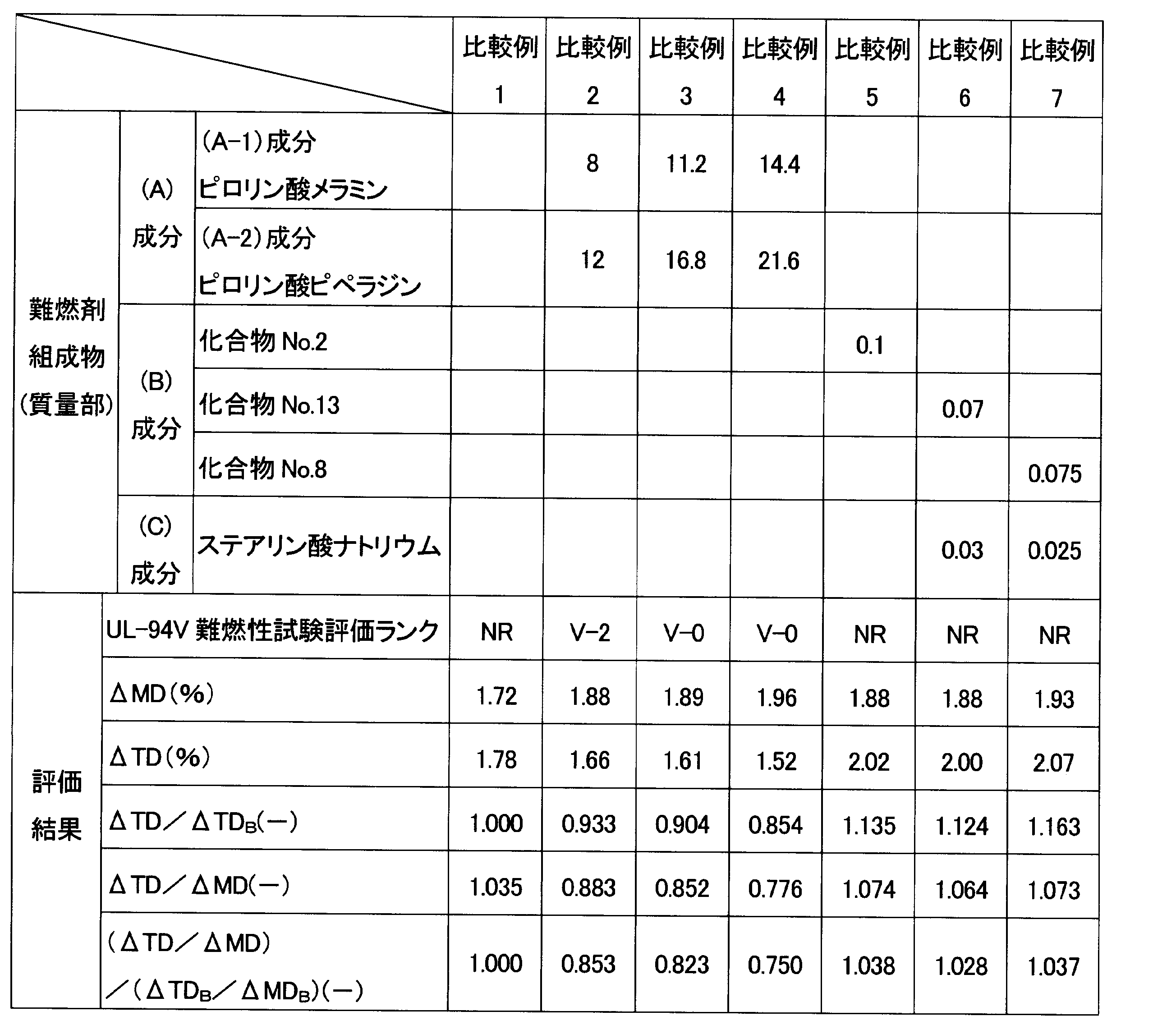
- the shrinkage rate is maintained while maintaining the flame retardancy evaluation rank as compared with the composition containing no component (B) (Comparative Examples 2 to 4).
- the ratio of ⁇ TD to the base resin ( ⁇ TD / ⁇ TD B ) and the ratio of ⁇ TD / ⁇ MD to the base resin (( ⁇ TD / ⁇ MD) / ( ⁇ TD B / ⁇ MD B )) are close to 1. , The vertical-horizontal balance of the molding shrinkage ratio at the time of injection molding was good.
- the evaluation rank of the flame retardancy test is NR judgment, and the result that the flame retardancy is impaired as compared with each composition of Examples. It became.
- the flame retardant composition of the present invention an excellent flame retardant can be imparted to the synthetic resin, and a molded product using the flame retardant resin composition using the same can be obtained. It was confirmed that the flame retardant composition of the present invention can be suitably used as a flame retardant for a resin because the vertical and horizontal balance of the molding shrinkage ratio is good as compared with the molded product made of a base resin.
Landscapes
- Chemical & Material Sciences (AREA)
- Organic Chemistry (AREA)
- Health & Medical Sciences (AREA)
- Chemical Kinetics & Catalysis (AREA)
- Medicinal Chemistry (AREA)
- Polymers & Plastics (AREA)
- Engineering & Computer Science (AREA)
- Materials Engineering (AREA)
- Compositions Of Macromolecular Compounds (AREA)
Abstract
Description
(A)成分:リン酸塩系難燃剤。
(B)成分:下記一般式(1)で表される構造を有する化合物の1種以上。

(A-1)成分:オルトリン酸メラミン、ピロリン酸メラミンおよびポリリン酸メラミンからなる群から1種以上選択されるメラミン塩。
(A-2)成分:オルトリン酸ピペラジン、ピロリン酸ピペラジンおよびポリリン酸ピペラジンからなる群から1種以上選択されるピペラジン塩。
(A-3)成分:オルトリン酸アンモニウム、ピロリン酸アンモニウムおよびポリリン酸アンモニウムからなる群から1種以上選択されるアンモニウム塩。

下記式(i)および式(ii)で表される関係を満足することを特徴とするものである。
(i)0.935≦ΔTD/ΔTDB≦1.065
(ii)0.860≦(ΔTD/ΔMD)/(ΔTDB/ΔMDB)≦1.140
上記式中、ΔMDは、前記難燃性合成樹脂組成物を射出成形してなる成形体の、射出成形時の金型キャビティ内における樹脂の流動方向であるMD方向における収縮率であり、ΔTDは、該難燃性合成樹脂組成物を射出成形してなる成形体の、該MD方向に直交する方向であるTD方向における収縮率であり、ΔMDBは、該難燃性合成樹脂組成物から前記難燃剤組成物を除いた組成からなる合成樹脂組成物を射出成形してなる成形体の該MD方向における収縮率であり、ΔTDBは、該合成樹脂組成物を射出成形してなる成形体の該TD方向における収縮率である。
本発明の難燃剤組成物は、(A)成分としてのリン酸塩系難燃剤と、(B)成分としての一般式(1)で表される構造を有する化合物の1種以上と、を必須成分とする。
本発明の難燃剤組成物で(A)成分として用いられるリン酸塩系難燃剤は、リン酸類を含むものである。
(A-1)成分:オルトリン酸メラミン、ピロリン酸メラミンおよびポリリン酸メラミンからなる群から1種以上選択されるメラミン塩。
(A-2)成分:オルトリン酸ピペラジン、ピロリン酸ピペラジンおよびポリリン酸ピペラジンからなる群から1種以上選択されるピペラジン塩。
(A-3)成分:オルトリン酸アンモニウム、ピロリン酸アンモニウムおよびポリリン酸アンモニウムからなる群から1種以上選択されるアンモニウム塩。
本発明の難燃剤組成物における(B)成分は、下記一般式(1)で表される構造を有する化合物である。



本発明の難燃剤組成物は、本発明の効果をより向上する観点から、さらに、(C)成分として、充填剤、脂肪酸金属塩およびハイドロタルサイト類から選択される少なくとも1種を含有することが好ましい。


0≦x2/x1<10、2≦x1+x2≦20
で表される条件を満たす数を表し、qは0または正の数を表す。

本発明の難燃剤組成物には、さらに、(D)成分として、酸化亜鉛を含有させることが好ましい。
本発明の難燃剤組成物には、さらに、(E)成分として、シリコーンオイル、エポキシ系カップリング剤および滑剤からなる群から選ばれる少なくとも1種を含有させることが好ましい。
本発明の難燃性合成樹脂組成物は、合成樹脂の少なくとも1種以上と、本発明の難燃剤組成物の少なくとも1種以上と、を含有する。
(i)0.935≦ΔTD/ΔTDB≦1.065
(ii)0.860≦(ΔTD/ΔMD)/(ΔTDB/ΔMDB)≦1.140
ΔMD(%)=[(MD0-MD1)/MD0]×100
ΔTD(%)=[(TD0-TD1)/TD0]×100
本発明の効果を良好に得る観点から、上記式(ii)中の(ΔTD/ΔMD)/(ΔTDB/ΔMDB)の下限値は、0.860とすることが必要であり、0.865が好ましく、0.870がより好ましい。また、上記式(ii)中の(ΔTD/ΔMD)/(ΔTDB/ΔMDB)の上限値は、1.140とすることが必要であり、1.135が好ましく、1.130がより好ましい。
本発明の成形体は、本発明の難燃性合成樹脂組成物、好ましくは熱可塑性樹脂を使用した難燃性合成樹脂組成物を成形することにより得られる。その成形方法および成形条件については特に制限はなく、公知の成形方法および成形条件を用いることができる。具体的な成形方法としては、押出加工やカレンダー加工、射出成形、ロール、真空成形、圧空成形、圧縮成形、ブロー成形、回転成形等が挙げられ、本発明の効果の観点から、射出成形により成形することが好ましい。本発明の成形体の形状としては、樹脂板やシート、フィルム、ボトル、繊維、異形品等の種々の形状が挙げられる。
以下の方法で、本発明の難燃剤組成物を含む樹脂組成物(実施例1~8)および比較用の樹脂組成物(比較例1~7)を製造した。
樹脂組成物全体の合計量が100質量部となるように調整された量のインパクトコポリマーポリプロピレン樹脂(プライムポリプロJ-754HP、プライムポリマー社製、メルトフローレート14g/10分)に対し、フェノール系酸化防止剤(テトラキス[3-(3,5-ジ-tert-ブチル-4-ヒドロキシフェニル)プロピオニルオキシメチル]メタン、株式会社ADEKA製の商品名「アデカスタブAO-60」)0.1質量部、リン系酸化防止剤(トリス(2,4-ジ-tert-ブチルフェニル)ホスファイト、株式会社ADEKA製の商品名「アデカスタブ2112」)0.1質量部、中和剤(ステアリン酸カルシウム)0.1質量部、および、下記の表中に記載の配合量で各化合物を添加・混合して、二軸押出機(装置:株式会社日本製鋼所製、TEX25αIII、押出温度:220℃、スクリュー回転速度:150rpm)で溶融混練し、ペレットを作製した。得られたペレットは、60℃で8時間乾燥させた後、以下に記載した試験方法に従い、難燃性および収縮等方性を評価した。これらの結果について、下記の表中にそれぞれ示す。
上記の手順で得られたペレットを用いて、射出成形機(EC60NII-1.5A;東芝機械株式会社製)により、樹脂温度220℃、金型温度50℃の条件で射出成形し、長さ127mm、幅12.7mm、厚さ1.6mmの試験片を作製した。この試験片を垂直に固定し、下端にバーナーの火を10秒間接炎させた後で炎を取り除き、試験片に着火した火が消える時間を測定した。次に、火が消えると同時に2回目の接炎を10秒間行い、1回目と同様にして着火した火が消える時間を測定した。また、落下する火種により試験片の下の綿が着火するか否かについても同時に評価した。
上記の手順で得られたペレットを用い、射出成形機(EC60NII-1.5A;東芝機械株式会社製)により、以下の条件で射出成形し、試験片を作製した。
樹脂温度:220℃。
金型温度:50℃。
射出時間:15秒。
冷却時間:25秒。
充填速度:25mm/s。
保圧 :20MPa。
ΔMD(%)=[(MD0-MD1)/MD0]×100
ΔTD(%)=[(TD0-TD1)/TD0]×100
収縮等方性=ΔTD/ΔMD

Claims (7)
- 下記(A)成分100質量部に対して、下記(B)成分を0.005~5質量部で含有することを特徴とする難燃剤組成物。
(A)成分:リン酸塩系難燃剤。
(B)成分:下記一般式(1)で表される構造を有する化合物の1種以上。
上記一般式(1)中、R1、R2、R3およびR4は、それぞれ独立に水素原子または炭素原子数1~8のアルキル基を表し、R5は、直接結合または炭素原子数1~4のアルカンジイル基を表し、M1は、アルカリ金属、アルカリ土類金属、亜鉛、アルミニウムおよび水素原子のうちのいずれかを表し、M1がアルカリ金属または水素原子の場合、nは1かつmは0であり、M1がアルカリ土類金属または亜鉛の場合、nは2かつmは0であり、M1がアルミニウムの場合、nは1、2または3であり、かつ、mは3-nで表される整数である。
- 前記(A)成分が、下記(A-1)成分、(A-2)成分および(A-3)成分のうちの少なくともいずれか一つを含有する請求項1記載の難燃剤組成物。
(A-1)成分:オルトリン酸メラミン、ピロリン酸メラミンおよびポリリン酸メラミンからなる群から1種以上選択されるメラミン塩。
(A-2)成分:オルトリン酸ピペラジン、ピロリン酸ピペラジンおよびポリリン酸ピペラジンからなる群から1種以上選択されるピペラジン塩。
(A-3)成分:オルトリン酸アンモニウム、ピロリン酸アンモニウムおよびポリリン酸アンモニウムからなる群から1種以上選択されるアンモニウム塩。 - さらに、(C)成分として、充填剤、脂肪酸金属塩およびハイドロタルサイト類から選択される少なくとも1種を含有する請求項1記載の難燃剤組成物。
- 前記脂肪酸金属塩が、下記一般式(2)で表される構造を有する化合物である請求項3記載の難燃剤組成物。
上記一般式(2)中、R4は、直鎖または分岐を有する炭素原子数8~30の脂肪族有機酸から導入される基を表し、M2は、金属原子またはAl(OH)3-pを表し、pは1~3の整数を表す。
- さらに、(E)成分として、シリコーンオイル、エポキシ系カップリング剤および滑剤からなる群から選ばれる少なくとも1種を、前記(A)成分100質量部に対して0.01~5質量部で含有する請求項1記載の難燃剤組成物。
- 合成樹脂と、請求項1記載の難燃剤組成物と、を含有する難燃性合成樹脂組成物であって、
下記式(i)および式(ii)で表される関係を満足することを特徴とする難燃性合成樹脂組成物。
(i)0.935≦ΔTD/ΔTDB≦1.065
(ii)0.860≦(ΔTD/ΔMD)/(ΔTDB/ΔMDB)≦1.140
上記式中、ΔMDは、前記難燃性合成樹脂組成物を射出成形してなる成形体の、射出成形時の金型キャビティ内における樹脂の流動方向であるMD方向における収縮率であり、ΔTDは、該難燃性合成樹脂組成物を射出成形してなる成形体の、該MD方向に直交する方向であるTD方向における収縮率であり、ΔMDBは、該難燃性合成樹脂組成物から前記難燃剤組成物を除いた組成からなる合成樹脂組成物を射出成形してなる成形体の該MD方向における収縮率であり、ΔTDBは、該合成樹脂組成物を射出成形してなる成形体の該TD方向における収縮率である。 - 請求項6記載の難燃性合成樹脂組成物を成形してなることを特徴とする成形体。
Priority Applications (5)
| Application Number | Priority Date | Filing Date | Title |
|---|---|---|---|
| EP21779179.7A EP4130197B1 (en) | 2020-03-31 | 2021-03-31 | Flame retardant composition, flame-resistant synthetic resin composition, and molded body |
| JP2022512609A JP7671277B2 (ja) | 2020-03-31 | 2021-03-31 | 難燃剤組成物、難燃性合成樹脂組成物および成形体 |
| CN202180016383.XA CN115175965A (zh) | 2020-03-31 | 2021-03-31 | 阻燃剂组合物、阻燃性合成树脂组合物和成型体 |
| KR1020227028606A KR102872132B1 (ko) | 2020-03-31 | 2021-03-31 | 난연제조성물, 난연성 합성 수지 조성물 및 성형체 |
| US17/798,847 US20230092624A1 (en) | 2020-03-31 | 2021-03-31 | Flame retardant composition, flame-resistant synthetic resin composition, and molded body |
Applications Claiming Priority (2)
| Application Number | Priority Date | Filing Date | Title |
|---|---|---|---|
| JP2020-063979 | 2020-03-31 | ||
| JP2020063979 | 2020-03-31 |
Publications (1)
| Publication Number | Publication Date |
|---|---|
| WO2021201085A1 true WO2021201085A1 (ja) | 2021-10-07 |
Family
ID=77930119
Family Applications (1)
| Application Number | Title | Priority Date | Filing Date |
|---|---|---|---|
| PCT/JP2021/013788 Ceased WO2021201085A1 (ja) | 2020-03-31 | 2021-03-31 | 難燃剤組成物、難燃性合成樹脂組成物および成形体 |
Country Status (6)
| Country | Link |
|---|---|
| US (1) | US20230092624A1 (ja) |
| EP (1) | EP4130197B1 (ja) |
| JP (1) | JP7671277B2 (ja) |
| KR (1) | KR102872132B1 (ja) |
| CN (1) | CN115175965A (ja) |
| WO (1) | WO2021201085A1 (ja) |
Families Citing this family (1)
| Publication number | Priority date | Publication date | Assignee | Title |
|---|---|---|---|---|
| CN118085412B (zh) * | 2024-03-14 | 2025-02-18 | 山东科技大学 | 低成本膨胀型阻燃剂组合物及阻燃聚烯烃树脂组合物 |
Citations (12)
| Publication number | Priority date | Publication date | Assignee | Title |
|---|---|---|---|---|
| JPS462280B1 (ja) | 1966-07-25 | 1971-01-20 | ||
| JPS5030039B1 (ja) | 1967-07-17 | 1975-09-27 | ||
| JPS5129129B1 (ja) | 1970-12-31 | 1976-08-24 | ||
| JPS61174270A (ja) | 1985-01-29 | 1986-08-05 | Kyowa Chem Ind Co Ltd | 耐発錆性ないし耐着色性賦与剤 |
| JPH0336839B2 (ja) | 1984-11-09 | 1991-06-03 | Mizusawa Industrial Chem | |
| JPH05179052A (ja) | 1991-12-27 | 1993-07-20 | Mizusawa Ind Chem Ltd | 樹脂用安定剤 |
| US20030088000A1 (en) | 2001-07-17 | 2003-05-08 | Asahi Denka Kogyo Kabushiki Kaisha | Flame-retardant resin composition |
| US20050256234A1 (en) | 2002-06-24 | 2005-11-17 | Asahi Denka Co., Ltd | Flame retardant composition and flame retardant resin composition containing the composition |
| US20070176154A1 (en) | 2004-02-24 | 2007-08-02 | Akeka Corporation | Flame retardant composition with improved fluidity, flame retardant resin composition and molded products |
| JP2008208269A (ja) | 2007-02-27 | 2008-09-11 | Adeka Corp | 難燃性樹脂組成物 |
| WO2017150662A1 (ja) * | 2016-03-02 | 2017-09-08 | 株式会社Adeka | 樹脂添加剤組成物、熱可塑性樹脂組成物、およびその成形体 |
| WO2019045013A1 (ja) * | 2017-08-31 | 2019-03-07 | 株式会社Adeka | 組成物、これを用いた熱可塑性樹脂組成物、およびその成形体 |
Family Cites Families (4)
| Publication number | Priority date | Publication date | Assignee | Title |
|---|---|---|---|---|
| JPH11349740A (ja) * | 1998-06-11 | 1999-12-21 | Asahi Denka Kogyo Kk | 射出成形用着色合成樹脂組成物 |
| KR100566105B1 (ko) | 2003-09-30 | 2006-03-30 | 민용기 | 물리치료 수단이 구비된 차량용 안전벨트 |
| KR101272744B1 (ko) * | 2005-09-30 | 2013-06-10 | 가부시키가이샤 아데카 | 결정핵제 조성물의 제조방법 및 결정성 고분자 조성물 |
| FR3062390B1 (fr) * | 2017-01-27 | 2020-11-06 | Arkema France | Compositions thermoplastiques souples a haute tenue thermomecanique et ignifugees a vieillissement thermique ameliore |
-
2021
- 2021-03-31 KR KR1020227028606A patent/KR102872132B1/ko active Active
- 2021-03-31 US US17/798,847 patent/US20230092624A1/en active Pending
- 2021-03-31 EP EP21779179.7A patent/EP4130197B1/en active Active
- 2021-03-31 CN CN202180016383.XA patent/CN115175965A/zh active Pending
- 2021-03-31 JP JP2022512609A patent/JP7671277B2/ja active Active
- 2021-03-31 WO PCT/JP2021/013788 patent/WO2021201085A1/ja not_active Ceased
Patent Citations (12)
| Publication number | Priority date | Publication date | Assignee | Title |
|---|---|---|---|---|
| JPS462280B1 (ja) | 1966-07-25 | 1971-01-20 | ||
| JPS5030039B1 (ja) | 1967-07-17 | 1975-09-27 | ||
| JPS5129129B1 (ja) | 1970-12-31 | 1976-08-24 | ||
| JPH0336839B2 (ja) | 1984-11-09 | 1991-06-03 | Mizusawa Industrial Chem | |
| JPS61174270A (ja) | 1985-01-29 | 1986-08-05 | Kyowa Chem Ind Co Ltd | 耐発錆性ないし耐着色性賦与剤 |
| JPH05179052A (ja) | 1991-12-27 | 1993-07-20 | Mizusawa Ind Chem Ltd | 樹脂用安定剤 |
| US20030088000A1 (en) | 2001-07-17 | 2003-05-08 | Asahi Denka Kogyo Kabushiki Kaisha | Flame-retardant resin composition |
| US20050256234A1 (en) | 2002-06-24 | 2005-11-17 | Asahi Denka Co., Ltd | Flame retardant composition and flame retardant resin composition containing the composition |
| US20070176154A1 (en) | 2004-02-24 | 2007-08-02 | Akeka Corporation | Flame retardant composition with improved fluidity, flame retardant resin composition and molded products |
| JP2008208269A (ja) | 2007-02-27 | 2008-09-11 | Adeka Corp | 難燃性樹脂組成物 |
| WO2017150662A1 (ja) * | 2016-03-02 | 2017-09-08 | 株式会社Adeka | 樹脂添加剤組成物、熱可塑性樹脂組成物、およびその成形体 |
| WO2019045013A1 (ja) * | 2017-08-31 | 2019-03-07 | 株式会社Adeka | 組成物、これを用いた熱可塑性樹脂組成物、およびその成形体 |
Non-Patent Citations (1)
| Title |
|---|
| See also references of EP4130197A4 |
Also Published As
| Publication number | Publication date |
|---|---|
| CN115175965A (zh) | 2022-10-11 |
| EP4130197A1 (en) | 2023-02-08 |
| KR102872132B1 (ko) | 2025-10-15 |
| EP4130197A4 (en) | 2024-04-10 |
| KR20220156525A (ko) | 2022-11-25 |
| US20230092624A1 (en) | 2023-03-23 |
| JP7671277B2 (ja) | 2025-05-01 |
| EP4130197B1 (en) | 2025-10-01 |
| JPWO2021201085A1 (ja) | 2021-10-07 |
Similar Documents
| Publication | Publication Date | Title |
|---|---|---|
| CN111278950B (zh) | 组合物及阻燃性树脂组合物 | |
| WO2021149732A1 (ja) | 難燃剤組成物、難燃性樹脂組成物および成形体 | |
| JP7158384B2 (ja) | 組成物及び難燃性樹脂組成物 | |
| EP3680310B1 (en) | Composition and flame-retardant resin composition | |
| US20210246373A1 (en) | Polyphosphate amine salt composition, flame retardant polyphosphate amine salt composition, flame retardant synthetic resin composition containing same, and molded body thereof | |
| EP3683288B1 (en) | Composition and flame retardant resin composition | |
| CN120265730A (zh) | 阻燃剂组合物、阻燃性树脂组合物和成型品 | |
| JP7671277B2 (ja) | 難燃剤組成物、難燃性合成樹脂組成物および成形体 | |
| WO2021187493A1 (ja) | 難燃剤組成物、難燃性樹脂組成物、成形品及び成形品の製造方法 | |
| CN111433326B (zh) | 组合物及阻燃性树脂组合物 | |
| WO2022224809A1 (ja) | 難燃剤組成物、難燃性樹脂組成物、およびその成形品 | |
| WO2022215660A1 (ja) | 機械物性付与剤組成物、樹脂組成物および成形品 | |
| EP4509581A1 (en) | Flame retardant composition, flame-retardant resin composition and molded article | |
| KR20220160530A (ko) | 발포 성형용 염화비닐계 수지의 안정제 조성물, 이를 포함하는 발포 성형용 염화비닐계 수지 조성물, 및 그의 발포 성형체 |
Legal Events
| Date | Code | Title | Description |
|---|---|---|---|
| 121 | Ep: the epo has been informed by wipo that ep was designated in this application |
Ref document number: 21779179 Country of ref document: EP Kind code of ref document: A1 |
|
| ENP | Entry into the national phase |
Ref document number: 2022512609 Country of ref document: JP Kind code of ref document: A |
|
| NENP | Non-entry into the national phase |
Ref country code: DE |
|
| ENP | Entry into the national phase |
Ref document number: 2021779179 Country of ref document: EP Effective date: 20221031 |
|
| WWG | Wipo information: grant in national office |
Ref document number: 2021779179 Country of ref document: EP |