WO2021205836A1 - 鉱物原料の改質方法 - Google Patents
鉱物原料の改質方法 Download PDFInfo
- Publication number
- WO2021205836A1 WO2021205836A1 PCT/JP2021/011022 JP2021011022W WO2021205836A1 WO 2021205836 A1 WO2021205836 A1 WO 2021205836A1 JP 2021011022 W JP2021011022 W JP 2021011022W WO 2021205836 A1 WO2021205836 A1 WO 2021205836A1
- Authority
- WO
- WIPO (PCT)
- Prior art keywords
- raw material
- mineral raw
- modifier
- water
- amount
- Prior art date
- Legal status (The legal status is an assumption and is not a legal conclusion. Google has not performed a legal analysis and makes no representation as to the accuracy of the status listed.)
- Ceased
Links
Images

Classifications
-
- C—CHEMISTRY; METALLURGY
- C10—PETROLEUM, GAS OR COKE INDUSTRIES; TECHNICAL GASES CONTAINING CARBON MONOXIDE; FUELS; LUBRICANTS; PEAT
- C10B—DESTRUCTIVE DISTILLATION OF CARBONACEOUS MATERIALS FOR PRODUCTION OF GAS, COKE, TAR, OR SIMILAR MATERIALS
- C10B57/00—Other carbonising or coking processes; Features of destructive distillation processes in general
- C10B57/04—Other carbonising or coking processes; Features of destructive distillation processes in general using charges of special composition
- C10B57/06—Other carbonising or coking processes; Features of destructive distillation processes in general using charges of special composition containing additives
-
- B—PERFORMING OPERATIONS; TRANSPORTING
- B65—CONVEYING; PACKING; STORING; HANDLING THIN OR FILAMENTARY MATERIAL
- B65G—TRANSPORT OR STORAGE DEVICES, e.g. CONVEYORS FOR LOADING OR TIPPING, SHOP CONVEYOR SYSTEMS OR PNEUMATIC TUBE CONVEYORS
- B65G53/00—Conveying materials in bulk through troughs, pipes or tubes by floating the materials or by flow of gas, liquid or foam
- B65G53/34—Details
- B65G53/52—Adaptations of pipes or tubes
- B65G53/526—Adaptations of pipes or tubes with means for special treatment to facilitate transport
-
- B—PERFORMING OPERATIONS; TRANSPORTING
- B65—CONVEYING; PACKING; STORING; HANDLING THIN OR FILAMENTARY MATERIAL
- B65G—TRANSPORT OR STORAGE DEVICES, e.g. CONVEYORS FOR LOADING OR TIPPING, SHOP CONVEYOR SYSTEMS OR PNEUMATIC TUBE CONVEYORS
- B65G69/00—Auxiliary measures taken, or devices used, in connection with loading or unloading
- B65G69/20—Auxiliary treatments, e.g. aerating, heating, humidifying, deaerating, cooling, de-watering or drying, during loading or unloading; Loading or unloading in a fluid medium other than air
-
- C—CHEMISTRY; METALLURGY
- C10—PETROLEUM, GAS OR COKE INDUSTRIES; TECHNICAL GASES CONTAINING CARBON MONOXIDE; FUELS; LUBRICANTS; PEAT
- C10B—DESTRUCTIVE DISTILLATION OF CARBONACEOUS MATERIALS FOR PRODUCTION OF GAS, COKE, TAR, OR SIMILAR MATERIALS
- C10B57/00—Other carbonising or coking processes; Features of destructive distillation processes in general
- C10B57/08—Non-mechanical pretreatment of the charge, e.g. desulfurization
-
- B—PERFORMING OPERATIONS; TRANSPORTING
- B65—CONVEYING; PACKING; STORING; HANDLING THIN OR FILAMENTARY MATERIAL
- B65G—TRANSPORT OR STORAGE DEVICES, e.g. CONVEYORS FOR LOADING OR TIPPING, SHOP CONVEYOR SYSTEMS OR PNEUMATIC TUBE CONVEYORS
- B65G43/00—Control devices, e.g. for safety, warning or fault-correcting
- B65G43/08—Control devices operated by article or material being fed, conveyed or discharged
-
- B—PERFORMING OPERATIONS; TRANSPORTING
- B65—CONVEYING; PACKING; STORING; HANDLING THIN OR FILAMENTARY MATERIAL
- B65G—TRANSPORT OR STORAGE DEVICES, e.g. CONVEYORS FOR LOADING OR TIPPING, SHOP CONVEYOR SYSTEMS OR PNEUMATIC TUBE CONVEYORS
- B65G53/00—Conveying materials in bulk through troughs, pipes or tubes by floating the materials or by flow of gas, liquid or foam
- B65G53/34—Details
- B65G53/60—Devices for separating the materials from propellant gas
- B65G53/62—Devices for separating the materials from propellant gas using liquid
-
- B—PERFORMING OPERATIONS; TRANSPORTING
- B65—CONVEYING; PACKING; STORING; HANDLING THIN OR FILAMENTARY MATERIAL
- B65G—TRANSPORT OR STORAGE DEVICES, e.g. CONVEYORS FOR LOADING OR TIPPING, SHOP CONVEYOR SYSTEMS OR PNEUMATIC TUBE CONVEYORS
- B65G53/00—Conveying materials in bulk through troughs, pipes or tubes by floating the materials or by flow of gas, liquid or foam
- B65G53/34—Details
- B65G53/66—Use of indicator or control devices, e.g. for controlling gas pressure, for controlling proportions of material and gas, for indicating or preventing jamming of material
-
- C—CHEMISTRY; METALLURGY
- C22—METALLURGY; FERROUS OR NON-FERROUS ALLOYS; TREATMENT OF ALLOYS OR NON-FERROUS METALS
- C22B—PRODUCTION AND REFINING OF METALS; PRETREATMENT OF RAW MATERIALS
- C22B1/00—Preliminary treatment of ores or scrap
Definitions
- the present invention relates to a method for modifying a mineral raw material, particularly a mineral raw material in a wet state.
- mineral raw materials are usually stocked in the raw material yard.
- Mineral raw materials that are piled up in the raw material yard may contain water or rainwater that is sprinkled as a dustproof measure, and the moisture content tends to be high.
- Mineral raw materials that are piled up in the raw material yard are transported from the raw material yard to storage equipment and equipment that uses mineral raw materials by connecting belt conveyors.
- the coal when supplying coal to a boiler of a thermal power plant, the coal is generally transported to the boiler by a series of lines passing through a coal crusher and a bucket type conveyor after transferring to a belt conveyor. Since the belt conveyor equipment as well as the raw material yard is outdoors, the coal becomes even more moist when exposed to rain.
- Such coal easily adheres to the contact surface of a pipe (coal supply pipe) for supplying coal to a boiler, a belt conveyor, a chute, a hopper, or the like, and may further stick to the contact surface of the processing equipment, and the pipe or the like may be clogged.
- Patent Document 1 proposes a method for preventing adhesion and clogging of the mineral raw material in a transport facility by bringing a highly water-absorbent resin into contact with the wet mineral raw material as a modifier. ..
- Patent Document 3 in the transportation line of coal charged into a coke oven, the coal crushed so that the grain size of 3 mm or less is 75% or more is modified.
- a method for improving the bulk density of coal for coke production which is characterized by adding a bulk density improving agent as a pledge agent.
- the amount of modifier added was determined based on the moisture content of only one point measured at any point of the piled up mineral raw materials.
- the wet mineral raw materials in the raw material yard and storage equipment have different moisture contents in the surface layer and the inside, and in the upper layer and the lower layer. For this reason, the amount of the modifier added may be insufficient, adhesion and clogging of the mineral raw material in the processing equipment may not be sufficiently improved, and the mineral raw material may be ejected into the processing equipment and out of the processing equipment. In some cases.
- the present invention adheres the mineral raw material to the processing equipment, clogs the processing equipment, and inside the processing equipment and outside the processing equipment. It is an object of the present invention to provide a method for modifying a mineral raw material, which prevents at least one of the ejection to and the decrease in bulk density.
- the present invention has found that, as a method for modifying a mineral raw material, the mineral raw material can be suitably modified by adjusting the amount of a modifier added based on the continuously measured water content of the mineral raw material. It is based on.
- the present invention provides the following [1] to [9].
- [1] A method of modifying a mineral raw material by adding a modifier to the mineral raw material.
- the addition of the modifier prevents at least one of the adhesion of the mineral raw material to the treatment equipment, clogging in the treatment equipment, ejection into and out of the treatment equipment, and reduction in bulk density.
- Remodeling method of mineral raw materials A method of modifying a mineral raw material by adding a modifier to the mineral raw material.
- the addition of the modifier prevents at least one of the adhesion of the mineral raw material to the treatment equipment, clogging in the treatment equipment, ejection into and out of the treatment equipment, and reduction in bulk density.
- Remodeling method of mineral raw materials [3] The method for modifying a mineral raw material according to the above [1] or [2], wherein the processing equipment is at least one of a pipe, a belt conveyor, a conveyor chain, a chute, a hopper, a silo, and a coke oven.
- [4] Modification of the mineral raw material according to any one of [1] to [3] above, wherein the modifier contains a highly water-absorbent resin defined by JIS K7223 (1996) and JIS K7224 (1996).
- Method. [5] The method for modifying a mineral raw material according to the above [4], wherein the highly water-absorbent resin is sodium polyacrylate.
- the modifier contains a surfactant.
- the method for modifying a mineral raw material of the present invention it is effective to adhere the mineral raw material to the processing equipment, clog the processing equipment, eject the mineral raw material into the processing equipment and outside the processing equipment, and reduce the bulk density. Can be prevented. Therefore, by using the method of the present invention, it is possible to provide a method for modifying a mineral raw material that can efficiently transport the mineral raw material and contribute to improving the productivity of an industrial product using the mineral raw material.
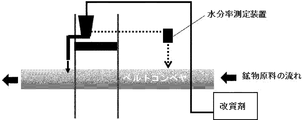
- FIG. 1 is a schematic diagram for explaining a method for modifying a mineral raw material of the present invention.
- FIG. 2 is a schematic diagram for explaining a method for modifying a mineral raw material of the present invention.
- prevention of adhesion of mineral raw materials to processing equipment in the present invention means that adhesion is sufficient to the extent that the transportation of mineral raw materials is not hindered not only when it does not adhere at all but also when it partially adheres. It shall be used in the sense that it includes the case where it is suppressed by.
- the method for modifying a mineral raw material of the present invention is a method for modifying the mineral raw material by adding a modifier to the mineral raw material, and the moisture content of the transported mineral raw material. Is included, a step of calculating the addition amount of the modifier based on the water content, and a step of adding the modifier of the addition amount to the mineral raw material.
- the method for modifying a mineral raw material of the present invention is based on a step of continuously measuring the water content and the transported amount of the mineral raw material to be transported, and the water content and the transported amount. , The step of calculating the addition amount of the modifier and the step of adding the modifier of the addition amount to the mineral raw material.
- the type of mineral raw material is not particularly limited, and examples thereof include coal, iron ore, metal ore other than iron ore, dust, slag, sludge, coke, sinter, and limestone. These may be one kind alone or a mixture of two or more kinds.
- the shape, size, etc. of the mineral raw material are not particularly limited, but from the viewpoint of preventing clogging, those having a form that is easily clogged, for example, particles having a particle size of 0.1 ⁇ m to 10 mm. , Powder, etc. are preferably applied.
- the "mineral raw material" to which the modifier is added is a wet mineral raw material containing water.
- the "wet mineral raw material” is a mineral raw material that is moist and moist and can be conveyed by a belt conveyor.
- the moisture content of the wet mineral raw material cannot be unconditionally determined depending on the type and properties of the mineral raw material, but for example, in the case of coal having a particle size of 0.1 ⁇ m to 10 mm, it exceeds 10% by mass, preferably 12% by mass. % Or more. Further, for example, in the case of iron ore having a particle size of 0.1 ⁇ m to 10 mm, it is more than 9% by mass, preferably 11% by mass or more.
- the origin of the water content in the mineral raw material is not particularly limited, and may be derived from the mineral raw material itself, or water such as water sprinkled to prevent rain or dust that comes into contact during transportation or storage. good.
- the modifier is not particularly limited, and is, for example, an organic substance such as a highly water-absorbent resin, a water-soluble polymer compound, a surfactant, dust, slag, coal, iron ore, diatomaceous earth, and ceramic generated in a steel mill. Inorganic substances such as. These may be used alone, may be used alone, or may be used as a mixture of two or more. From the viewpoint of preventing the adhesion of the mineral raw material to the treatment equipment, clogging in the treatment equipment, and ejection of the mineral raw material into the treatment equipment and outside the treatment equipment, the modifier is a highly water-absorbent resin and a water-soluble polymer compound. It is preferable to contain, and it is more preferable to contain a highly water-absorbent resin. Further, from the viewpoint of improving the bulk density of the mineral raw material, the modifier preferably contains a surfactant.
- the highly water-absorbent resin in the present invention is defined by JIS K7223 (1996) and JIS K7224 (1996) as "a resin that highly absorbs and swells water, and is a hydrophilic substance having a crosslinked structure and comes into contact with water. It has the characteristic that it absorbs water by doing so, and once it absorbs water, it does not easily separate even when pressure is applied. " That is, it is a resin having a large amount of water absorption and excellent water retention.
- the highly water-absorbent resin is added and mixed with the wet mineral raw material, the water-soluble polymer compound absorbs at least a part of the water content in the mineral raw material.
- the moisture content on the surface of the mineral raw material is reduced, the slipperiness of the mineral raw material is improved on the contact surface of the treatment equipment, and it becomes difficult for the mineral raw material to adhere to the treatment equipment, clogging in the treatment equipment, and the like. It is possible to prevent the ejection of water into the processing equipment and outside the processing equipment. It is sufficient that the adhesion to the contact surface of the treatment equipment is suppressed, and the total amount of water in the mineral raw material does not need to be absorbed by the highly water-absorbent resin.
- the type of the highly water-absorbent resin may be either a synthetic resin type or a natural product-derived type, and is not particularly limited.
- Acrylic acid ester, poly (meth) acrylamide, polyalkyleneimine, polyoxyalkylene, polymaleic acid, and a copolymer containing any of the monomers constituting these may be mentioned.
- “(meth) acrylic” means acrylic or methacryl.
- Examples of the monomer constituting the poly (meth) acrylate include sodium (meth) acrylate, potassium (meth) acrylate, ammonium (meth) acrylate and the like.
- Examples of the monomer constituting the poly (meth) acrylic acid ester include methyl (meth) acrylate, ethyl (meth) acrylate, n-propyl (meth) acrylate, n-butyl (meth) acrylate, and (meth). ) Isobutyl acrylate, hydroxyethyl (meth) acrylate, -2-ethylhexyl (meth) acrylate and the like.
- Examples of the monomer constituting the polyalkyleneimine include ethyleneimine and methylethyleneimine.
- Examples of the monomer constituting the polyoxyalkylene include ethylene oxide and propylene oxide.
- Examples of other monomers constituting the copolymer include vinyl sulfonic acid, styrene sulfonic acid, N-ethyl (meth) acrylamide, vinyl pyridine and the like.
- the highly water-absorbent resin may be used alone or in combination of two or more. From the viewpoint of availability, high water absorption, and the like, polyacrylic acid or sodium polyacrylate is preferably used, and sodium polyacrylate is particularly preferable. Further, the highly water-absorbent resin may be used in combination with another water-absorbing agent. Examples of other water absorbing agents include silica gel, zeolite, activated carbon and the like.
- the properties of the highly water-absorbent resin are preferably granular or powdery having a particle size equal to or smaller than that of the mineral raw material from the viewpoint of uniform mixing with the mineral raw material and ease of handling.
- a highly water-absorbent resin having a particle size of preferably 10 to 1000 ⁇ m, more preferably 50 to 600 ⁇ m is used.
- a liquid high water-absorbent resin dispersed in an organic solvent may be used, or a liquid high water-absorbent resin may be used.
- the organic solvent is not particularly limited, but it is preferable to use a high boiling point solvent such as an aromatic organic solvent.
- the content of the highly water-absorbent resin in the active ingredient of the modifier is preferably 5 to 100% by mass, more preferably 50 to 100% by mass, from the viewpoint of efficiently transporting the mineral raw material. , 90 to 100% by mass is more preferable.
- the water-soluble polymer compound in the present invention has a property of having a large amount of water absorption and excellent water retention.
- water-soluble means that 0.01 g or more is dissolved in 100 g of water at 25 ° C.
- the water-soluble polymer compound absorbs at least a part of water in the mineral raw material.
- the moisture content on the surface of the mineral raw material is reduced, the slipperiness of the mineral raw material is improved on the contact surface of the treatment equipment, and it becomes difficult for the mineral raw material to adhere to the treatment equipment, clogging in the treatment equipment, and the like.
- the water-soluble polymer compound may be an artificially produced synthetic polymer compound or a naturally occurring natural polymer compound, for example, a synthetic water-soluble polymer compound, a semi-synthetic water-soluble polymer compound, or a highly naturally water-soluble polymer compound. Molecular compounds and the like can be mentioned.
- Synthetic water-soluble polymer compounds include polyvinyl alcohol, polyvinylpyrrolidone or a salt thereof, polyethylene oxide, polyvinyl methyl ether; (meth) acrylic acid, (meth) acrylamide, maleic anhydride, maleic acid, maleic acid amide, and maleic acid imide. , Itaconic acid, crotonic acid, fumaric acid and other copolymers or salts thereof. Examples of this salt include alkali metal salts such as sodium and potassium.
- Semi-synthetic water-soluble polymer compounds include cellulose derivatives such as biscous, methyl cellulose, cationized cellulose, ethyl cellulose, carboxymethyl cellulose and hydroxypropyl cellulose; pregelatinized starch, carboxyl starch, dialdehyde rostarch, cationized starch, dextrin and British. Starch derivatives such as rubber; cationized guar gum, anionic guar gum, methyl glycol chitosan and the like can be mentioned.
- Examples of the natural water-soluble polymer compound include starch, mannan, guar gum, xanthan gum, sodium alginate, locust bean gum, pectin, dextran, gelatin, lambzan gum, gellan gum and the like.
- the water-soluble polymer compound may be anionic, cationic, nonionic, or amphoteric. Of these, anionic and nonionic ones, which are less toxic to fish, are preferable, and anionic ones are more preferable.
- the water-soluble polymer compound is preferably a synthetic water-soluble polymer compound.
- the synthetic water-soluble polymer compound a homopolymer or a copolymer containing one or more of an anionic monomer and a nonionic monomer as constituents is preferable.
- the anionic group include carboxylic acids (monomeres) such as acrylic acid, methacrylic acid, maleic acid, fumaric acid, and itaconic acid; styrene sulfonic acid, vinyl sulfonic acid, and 3-allyloxy-2-.
- examples thereof include sulfonic acids (monomonics) such as hydroxypropanesulfonic acid.
- nonionic group examples include acrylamide (monomer) and methacrylamide (monomer).
- acrylic acid-based and / or acrylamide-based polymers are more preferable.
- acrylic acid-based and / or acrylamide-based polymers include acrylic acid homopolymers, acrylamide homopolymers, acrylic acid / acrylamide copolymers, partial hydrolysates of polyacrylamide, and acrylic acid / acrylamide / 2-acrylamide-. Examples thereof include 2-methylpropanesulfonic acid, acrylic acid / maleic acid copolymer or a salt thereof, and these may be used alone or in combination of two or more.
- acrylic acid / acrylamide copolymers, acrylamide homopolymers, and partial hydrolysates of polyacrylamide all have high molecular weights and are suitably used for the purposes of the present invention.
- the average molecular weight of the acrylamide-based or acrylic acid-based polymer is preferably 1,000,000 to 10,000,000, more preferably 5,000,000 to 9,000,000 (intrinsic viscosity method). Suitable.
- the content of the acrylic acid unit in producing the acrylic acid-based and / or acrylamide-based polymer is based on the total amount of the monomers used (100 mol%). It is preferably 5 mol% or more, more preferably 20 to 100 mol%.
- the state when the water-soluble polymer compound is used is not particularly limited, and it is preferable to use it in the form of powder, liquid or emulsion. In particular, it is preferably used in the form of powder or emulsion that can be used without increasing the water content of the object to be treated.
- the W / O type emulsion-like water-soluble polymer compound can be produced by a known method (for example, Japanese Patent Application Laid-Open No. 52-039417, Japanese Patent Application Laid-Open No. 51-41090).
- the water-soluble polymer compound may be used alone or in combination of two or more.
- Acrylic acid / acrylamide copolymers, acrylamide homopolymers, and partial hydrolysates of polyacrylamide all have high molecular weights and are preferably used from the viewpoint of efficiently transporting mineral raw materials.
- the content of the water-soluble polymer compound in the active ingredient of the modifier is preferably 5 to 80% by mass, more preferably 20 to 60% by mass, from the viewpoint of efficiently transporting the mineral raw material. It is preferably 30 to 50% by mass, more preferably 30 to 50% by mass.
- the surfactant for example, dialkylsulfosuccinic acid (preferably having 8 to 16 carbon atoms in the alkyl group) or a salt thereof (for example, sodium salt, ammonium salt, potassium salt, triethanolamine salt), polyoxy.
- Anionic surfactants such as ethylene alkyl ether sulfate and sodium alkanesulfonate, and nonionic surfactants such as polyoxyethylene (POE) -added polymers or salts thereof can be used.
- POE polyoxyethylene
- the surfactant may be used alone or in combination of two or more. From the viewpoint of improving the bulk density of the mineral raw material, an anionic surfactant is preferable, and sodium alkanesulfonate is more preferable.
- the content of the surfactant in the active ingredient of the modifier is preferably 5 to 100% by mass, more preferably 10 to 50% by mass, and 20 to 30% by mass from the viewpoint of improving the bulk density. It is more preferably%.
- the processing equipment in the present invention refers to processing equipment in a transport line for feeding mineral raw materials on a predetermined line from a storage place for mineral raw materials such as a raw material yard to equipment using the mineral raw materials, such as a chute, a hopper, and a hopper. It also includes those having a function of temporarily storing such as silos. It is distinguished from transportation by ship or truck, transportation by bucket, etc.
- a transport line for feeding mineral raw materials on a predetermined line from a storage place for mineral raw materials such as a raw material yard to equipment using the mineral raw materials, such as a chute, a hopper, and a hopper. It also includes those having a function of temporarily storing such as silos. It is distinguished from transportation by ship or truck, transportation by bucket, etc.
- in the processing equipment where inconveniences are likely to occur due to adhesion and clogging specifically, adhesion and clogging of mineral raw materials in piping, belt conveyors, conveyor chains, chutes, hoppers, silos, coke ovens,
- the measuring step in the present invention is a step of continuously measuring the water content of the transported mineral raw material.
- the measuring step in the present invention is a step of continuously measuring the water content and the transported amount of the transported mineral raw material.
- continuous measurement means not only one measurement but continuous measurement.
- the moisture content or the amount of the transported mineral raw material is measured a plurality of times at specific intervals.
- the interval for measuring the water content is not particularly limited, and varies depending on the type, properties, transport amount, etc. of the mineral raw material. However, when coal is used as the mineral raw material and the transport amount is 1 to 20 t / min, 0.
- the interval for measuring the transport amount is not particularly limited, and varies depending on the type, properties, transport speed, etc. of the mineral raw material, but when coal is used as the mineral raw material and the water content of the coal is 5 to 25% by mass, It is preferable to measure every 1 second to 1 minute.
- a non-contact type moisture meter As a method for measuring the water content of a mineral raw material, measurement by a non-contact type moisture meter is preferable from the viewpoint of continuous measurement, and examples thereof include an infrared type, a microwave type, a neutron type, an electric resistance type, and an electric capacity type. Be done. Among these, from the viewpoint of easy installation and easy use, infrared measurement by irradiating the raw material with infrared rays and measuring the reflected light intensity is preferable. For example, CM710e manufactured by NDC Technologies can be adopted.
- the time required to measure the water content of the mineral raw material is preferably 0.1 to 60 seconds from the viewpoints of productivity, addition of a modifier in an appropriate amount corresponding to the water content of the mineral raw material, and the like. More preferably, it is 1 to 10 seconds.
- Examples of the method for measuring the transported amount of the mineral raw material include a load measuring device such as a load cell type and a merrick type, a distance measuring device such as an optical type, a millimeter wave type, and an ultrasonic type.
- the amount of transportation is calculated from the mass value of the mineral raw material on the belt conveyor and the moving speed of the belt conveyor.
- a distance sensor is installed on the upper part of the belt conveyor, and the amount of transportation is calculated from the difference between the distance between the distance sensor and the bottom of the belt conveyor and the distance between the distance sensor and the mineral raw material on the belt conveyor.
- the time required to measure the transported amount of the mineral raw material is preferably 0.1 to 60 seconds from the viewpoint of productivity, addition of the modifier at an appropriate addition amount corresponding to the water content of the mineral raw material, and the like. More preferably, it is 1 to 10 seconds.
- the position for measuring the moisture content and the transported amount of the mineral raw material to be transported is the position where the modifier is used in the transport line shown in FIG. 1 in which only the moisture content is measured and FIG. 2 in which both the moisture content and the transported amount are measured.
- the water content and transport amount measuring device is installed near the transport facility such as a belt conveyor that transports the mineral raw material to be measured, which is on the upstream side from the addition position.
- the water content when measuring the water content and the transported amount, the water content may be measured before the measured water content, or the transported amount may be measured before the water content is measured. Often, the water content and the amount of transport may be measured at the same time.
- the mineral raw material is not transported, it is not necessary to measure the water content. Therefore, it is preferable to measure the transported amount before measuring the water content.
- the calculation step in the present invention is a step of calculating the addition amount of the modifier based on the measurement result of the water content of the transferred mineral raw material.
- the amount of the modifier added varies depending on the type and properties of the mineral raw material. For example, when the mineral raw material is coal and the water content of the coal is less than about 7% by mass, it adheres to the processing equipment. The amount of the modifier added is calculated to be 0 because clogging in the treatment equipment, ejection into the treatment equipment and out of the treatment equipment are unlikely to occur, and the bulk density is relatively high. That is, excessive addition of the modifier is suppressed.
- the water content of coal is about 7% by mass or more, it is necessary to add a modifier.
- the amount of the modifier added is calculated based on the measurement result of the water content of. The amount of the modifier added increases as the water content of the coal increases.
- the calculation step in the present invention is a step of calculating the addition amount of the modifier based on the measurement results of the water content and the transport amount of the mineral raw material to be transported.
- the amount of the modifier added varies depending on the type and properties of the mineral raw material, and for example, when the mineral raw material is coal, the water content of the coal is less than about 7% by mass, which is one aspect of the present invention described above.
- the amount of the modifier added is calculated to be 0 regardless of the amount of the mineral raw material transported. That is, excessive addition of the modifier is suppressed.
- the water content of coal is about 7% by mass or more, it is necessary to add a modifier.
- the amount of the modifier added is calculated based on the measurement result of the water content of. The amount of the modifier added increases as the water content of the coal increases and as the amount transported increases.
- the amount of the modifier added is calculated based on the measurement result of the water content of the mineral raw material or the measurement result of the water content and the transported amount of the mineral raw material. By adding the above, it is possible to prevent the modifier from becoming insufficient and the modifying effect from becoming insufficient. Further, in the present invention, since the addition amount of the modifier is calculated based on the measurement result of the water content of the mineral raw material or the measurement result of the water content and the transport amount of the mineral raw material, the addition of the modifier is performed. It is possible to prevent the excess, and it is possible to reduce the cost of the modifier.
- the calculation step is a step performed after the measurement step, and is a step performed before the addition step described later.
- the step of adding in the present invention is a step of adding the modifier of the addition amount calculated in the calculation step to the mineral raw material. That is, it is a step of continuously adding the modifier to the mineral raw material while changing the addition amount according to the calculated addition amount of the modifier.
- the amount of the modifier added varies depending on the type and properties of the mineral raw material, and is calculated based on the water content of the mineral raw material, or the water content and the amount transported, but the mineral raw material has a particle size of 0.1 ⁇ m to 2 mm.
- the concentration in the coal is 0.001 to 50% by mass. It is more preferable to add it so as to be 0.005 to 5% by mass, and further preferably to add it so as to be 0.05 to 0.5% by mass.
- the mineral raw material is coal having a particle size of 0.1 ⁇ m to 2 mm and a water content of 7% by mass or more and the modifier contains a water-soluble polymer compound, the concentration of the water-soluble polymer compound in the coal is 0.
- the mineral raw material is coal having a particle size of 0.1 ⁇ m to 2 mm and a water content of 7% by mass or more and the modifier contains a surfactant
- the concentration of the surfactant in the coal is 0.001 to 50% by mass. It is preferable to add it so as to be, more preferably 0.005 to 5% by mass, and further preferably 0.05 to 0.5% by mass.
- the concentration of the highly water-absorbent resin in the iron ore is 0.001 to It is preferably added so as to be 50% by mass, more preferably 0.005 to 5% by mass, and further preferably 0.05 to 0.5% by mass. ..
- the mineral raw material is an iron ore having a particle size of 0.1 ⁇ m to 2 mm and a water content of 10% by mass or more and the modifier contains a water-soluble polymer compound
- the concentration of the water-soluble polymer compound in the iron ore is high.
- the mineral raw material is an iron ore having a particle size of 0.1 ⁇ m to 2 mm and a water content of 10% by mass or more and the modifier contains a surfactant, the concentration of the surfactant in the iron ore is 0.001 to.
- addition amount By setting the addition amount in the above range, it is possible to prevent a decrease in bulk density of the mineral raw material.
- the position where the modifier is added to the mineral raw material is not particularly limited as long as it can be added after the measurement of the water content and the amount of the mineral raw material, and the mineral raw material is not particularly limited as long as it is being conveyed by a belt conveyor or the like. It may be after transportation. From the viewpoint of adding the modifier in an appropriate addition amount, the addition position is preferably near the measurement position of the water content and the transport amount. Further, since the added modifier and the mineral raw material have a mixing action at the connecting portion of the belt conveyor, it is preferable to add the modifier at a position upstream from the connecting portion of the belt conveyor.
- the method of adding the modifier to the mineral raw material is not particularly limited, but it is preferable to spray the modifier from above the mineral raw material on the mineral raw material conveyed by a belt conveyor or the like. Further, the modifier may be added at one place or at two or more places. When two or more kinds of components are used as the modifier, each component may be added individually, or a pre-prepared mixture may be added. Further, after adding one kind alone, two or more kinds may be added in advance prepared and mixed, or two or more kinds may be added in advance prepared and mixed, and then one kind alone may be added. good.
- the timing of adding the modifier to the mineral raw material is preferably within 10 minutes, more preferably within 5 minutes after measuring the moisture content of the mineral raw material because the moisture content may change during the transportation of the mineral raw material. More preferably, the modifier is added within 1 minute. Further, it is preferable that a modifier can be added according to the fluctuation of the transport speed of the mineral raw material.
- the modifier it is preferable to add the modifier to the mineral raw material and then mix the mineral raw material and the modifier.
- the mixing method is not particularly limited, but it is preferable that the mineral raw material and the modifier are uniformly mixed to obtain a state in which they are in contact with each other. Examples of the mixing method include mixing at a connecting portion of a belt conveyor, mixing with a kneader or a heavy machine, and the like. It is also possible to mix by adding the modifier to a predetermined container containing the mineral raw material and stirring and mixing.
- the bulk density of the mineral raw material to which the modifier is added varies depending on the type and properties of the mineral raw material, but is preferably 700 kg / m 3 from the viewpoint of contributing to the improvement of the productivity of industrial products using the mineral raw material. It is super, more preferably more than 750 kg / m 3 .
- Adhesion evaluation test Adhesion is evaluated by using a simulated hopper (input port: 180 mm x 140 mm, discharge port: 30 mm x 60 mm) on the upper part of the electric fluid "ANF-30" (manufactured by Nikko Kagaku Co., Ltd.) instead of the fluid.
- the sample adjusted in each Example and Comparative Example is put into a simulated hopper of a vibration test device equipped with a trapezoidal outer shape (made of steel), dropped onto a saucer at the bottom of the vibration test device, and the discharge time is measured. The presence or absence of sample adhesion in the simulated hopper was visually observed.
- the discharge time from the start of sample loading to the end of dropping into the saucer at the bottom of the vibration test device is 10.0 seconds or less, the sample does not adhere to the simulated hopper after the test, and a modifier is added. Since the discharge time was shortened as compared with the case where the sample was not used, it was judged that the adhesion and clogging of the sample were prevented. However, even if the discharge time is 10 seconds or less, the obtained sample is sufficiently modified if the sample has a large amount of water, is muddy and has high fluidity, and adheres to the upper part of the simulated hopper. I decided not to.
- Example 1 Coal (moisture content 10.2% by mass, particle size 10 mm or less) is used as a mineral raw material, and a highly water-absorbent resin "Kuriline S-200" (manufactured by Kurita Water Industries, Ltd .; sodium polyacrylate) is contained as a modifier.
- the sample was prepared by adding the mixture so that the amount was 0.05% by mass and uniformly stirring and mixing. Subsequently, an adhesion evaluation test of the sample was conducted.
- Examples 2 to 5 Comparative Examples 1 to 3, Reference Examples 1 to 3
- the water content of the coal and the content of the modifier were changed as shown in Table 1 below, and the samples were prepared in the same manner as in Example 1 except for that, and the adhesion evaluation test was conducted.
- Table 1 summarizes the results of the adhesion evaluation tests of Examples 1 to 5, Comparative Examples 1 to 3, and Reference Examples 1 to 3. Regarding the presence or absence of sample adhesion, B was assigned to those with sample adhesion on the simulated hopper after the test, and A was assigned to those without sample adhesion.
- Examples 6 to 11, Comparative Examples 4 to 9 Iron ore (moisture content: 11.0% by mass, particle size: 10 mm or less) was used instead of coal, and the amount of the highly water-absorbent resin added was changed as shown in Table 2 below, in the same manner as in Example 1. The sample was prepared and an adhesion evaluation test was conducted.
- Table 2 summarizes the results of the adhesion evaluation tests of Examples 6 to 11 and Comparative Examples 4 to 9. Regarding the presence or absence of sample adhesion, B was assigned to those with sample adhesion on the simulated hopper after the test, and A was assigned to those without sample adhesion.
- Coal moisture content 10.5% by mass, particle size 10 mm or less
- a coal bulk density improver "sodium alkanesulfonate" manufactured by Kurita Water Industries, Ltd.
- the content is 0. It was added so as to be 1% by mass, and the mixture was uniformly stirred and mixed to prepare a sample, and then the bulk density was calculated.
- Example 13 Comparative Examples 10 to 13, Reference Examples 4 to 6
- the bulk density was calculated in the same manner as in Example 12 except that the water content of the coal and the content of the modifier were changed as shown in Table 3 below.
- Table 2 summarizes the results of the adhesion evaluation tests of Examples 12 and 13, Comparative Examples 10 to 13, and Reference Examples 4 to 6.
Landscapes
- Chemical & Material Sciences (AREA)
- Engineering & Computer Science (AREA)
- Organic Chemistry (AREA)
- Materials Engineering (AREA)
- Oil, Petroleum & Natural Gas (AREA)
- Mechanical Engineering (AREA)
- Metallurgy (AREA)
- Manufacturing & Machinery (AREA)
- Geology (AREA)
- Geochemistry & Mineralogy (AREA)
- Life Sciences & Earth Sciences (AREA)
- General Life Sciences & Earth Sciences (AREA)
- Environmental & Geological Engineering (AREA)
- Manufacture And Refinement Of Metals (AREA)
- Coke Industry (AREA)
- Solid-Sorbent Or Filter-Aiding Compositions (AREA)
- Coloring Foods And Improving Nutritive Qualities (AREA)
- Organic Low-Molecular-Weight Compounds And Preparation Thereof (AREA)
- Steroid Compounds (AREA)
- Solid Fuels And Fuel-Associated Substances (AREA)
- Processing Of Solid Wastes (AREA)
Abstract
Description
原料ヤードだけでなくベルトコンベヤ設備も屋外にあるため、雨に曝されて、石炭はさらに湿潤な状態となる。このような石炭は、ボイラーに石炭を供給する配管(給炭管)やベルトコンベヤ、シュート、ホッパー等の処理設備の接触面に付着しやすく、さらに固着し、配管等が詰まる場合がある。
このような問題に対して、特許文献1では、湿潤な鉱物原料に改質剤として高吸水性樹脂を接触させることにより、前記鉱物原料の搬送設備での付着及び詰まり防止方法を提案している。
このような問題に対して、特許文献2では、湿潤な鉱物原料を貯留設備で貯留する際に、湿潤な鉱物原料に、改質剤として高吸収性樹脂及び/又は水溶性高分子化合物を接触させることにより、前記湿潤な鉱物原料が貯留設備から漏出することを防止する方法、及び/又は水が漏出することを防止する方法を提案している。
このような問題に対して、特許文献3では、コークス炉に装入される石炭の輸送ラインにおいて、粒径3mm以下の粒分が75%以上となるように粉砕された石炭に対して、改質剤として嵩密度向上剤を添加することを特徴とするコークス製造用石炭の嵩密度向上方法を提案している。
[1]鉱物原料に改質剤を添加して、該鉱物原料を改質する方法であって、
搬送される前記鉱物原料の水分率を連続的に測定する工程と、
前記水分率に基づいて、前記改質剤の添加量を算出する工程と、
前記添加量の前記改質剤を前記鉱物原料に添加する工程とを含み、
前記改質剤の添加により、前記鉱物原料の、処理設備への付着、該処理設備内における詰まり、該処理設備内及び該処理設備外への噴出、並びに嵩密度低下の少なくともいずれかを防止する、鉱物原料の改質方法。
[2]鉱物原料に改質剤を添加して、該鉱物原料を改質する方法であって、
搬送される前記鉱物原料の水分率及び搬送量を連続的に測定する工程と、
前記水分率及び前記搬送量に基づいて、前記改質剤の添加量を算出する工程と、
前記添加量の前記改質剤を前記鉱物原料に添加する工程とを含み、
前記改質剤の添加により、前記鉱物原料の、処理設備への付着、該処理設備内における詰まり、該処理設備内及び該処理設備外への噴出、並びに嵩密度低下の少なくともいずれかを防止する、鉱物原料の改質方法。
[3]前記処理設備が、配管、ベルトコンベア、コンベアチェーン、シュート、ホッパー、サイロ、及びコークス炉の少なくともいずれかである、上記[1]又は[2]に記載の鉱物原料の改質方法。
[4]前記改質剤が、JIS K7223(1996)及びJIS K7224(1996)で定義される高吸水性樹脂を含む、上記[1]~[3]のいずれかに記載の鉱物原料の改質方法。
[5]前記高吸水性樹脂が、ポリアクリル酸ナトリウムである、上記[4]に記載の鉱物原料の改質方法。
[6]前記改質剤が、界面活性剤を含む、上記[1]~[3]のいずれかに記載の鉱物原料の改質方法。
[7]前記界面活性剤が、アニオン系界面活性剤である、上記[6]に記載の鉱物原料の改質方法。
[8]前記改質剤が、水溶性高分子化合物を含む、上記[1]~[3]のいずれかに記載の鉱物原料の改質方法。
[9]前記水溶性高分子化合物が、アニオン系エマルションポリマーである、上記[8]に記載の鉱物原料の改質方法。
したがって、本発明の方法を用いれば、鉱物原料を効率的に搬送することができ、鉱物原料を用いた工業製品の生産性向上に寄与できる鉱物原料の改質方法を提供することができる。
なお、本発明における「鉱物原料の処理設備への付着防止」とは、まったく付着しない場合のみならず、一部付着する場合であっても、鉱物原料の搬送が妨げられない程度に付着が十分に抑制される場合も含む意味で用いるものとする。
本発明の他の態様において、本発明の鉱物原料の改質方法は、搬送される前記鉱物原料の水分率及び搬送量を連続的に測定する工程と、前記水分率及び前記搬送量に基づいて、前記改質剤の添加量を算出する工程と、前記添加量の前記改質剤を前記鉱物原料に添加する工程とを含む。
上記工程を有することにより、前記鉱物原料の、処理設備への付着、該処理設備内における詰まり、該処理設備内及び該処理設備外への噴出、並びに嵩密度低下の少なくともいずれかを防止することができる。
鉱物原料の種類は、特に限定されるものではなく、例えば、石炭、鉄鉱石、鉄鉱石以外の金属鉱石、ダスト、スラグ、スラッジ、コークス、焼結鉱、石灰石等が挙げられる。これらは、1種単独であっても、2種以上の混合物であってもよい。
また、鉱物原料の形状、大きさ等は、特に限定されるものではないが、詰まりを防止する観点から、詰まりやすい形態のもの、例えば、粒子1個の粒子径が0.1μm~10mmの粒状、粉末状等のものが好適に適用される。
鉱物原料中の水分は、その由来は特に限定されるものではなく、鉱物原料自体に由来するものでもよく、あるいはまた、搬送や保管中に接触した雨や粉塵防止のための散水等の水でもよい。
改質剤は、特に限定されるものではなく、例えば、高吸水性樹脂、水溶性高分子化合物、界面活性剤等の有機物、製鉄所内で発生するダスト、スラグ、石炭、鉄鉱石、珪藻土、セラミック等の無機物等が挙げられる。これらは、1種単独で用いても、2種以上をそれぞれ単独で用いても、2種以上の混合物として用いてもよい。
鉱物原料の、処理設備への付着、該処理設備内における詰まり、該処理設備内及び該処理設備外への噴出を防止する観点から、改質剤は、高吸水性樹脂及び水溶性高分子化合物を含むことが好ましく、高吸水性樹脂を含むことがより好ましい。
また、鉱物原料の嵩密度向上の観点から、改質剤は界面活性剤を含むことが好ましい。
本発明における高吸水性樹脂とは、JIS K7223(1996)及びJIS K7224(1996)で定義される、「水を高度に吸収して、膨潤する樹脂で、架橋構造の親水性物質で水と接触することにより吸水し、一度吸水すると圧力をかけても離水しにくい特徴を持っている」ものである。すなわち、吸水量が多く、保水性に優れた樹脂である。
湿潤な鉱物原料に前記高吸水性樹脂を添加混合した場合、水溶性高分子化合物は鉱物原料中の水分の少なくとも一部を吸収する。これにより、鉱物原料の表面の水分率が低減して、処理設備の接触面において、鉱物原料の滑り性が向上し、付着しにくくなり、処理設備への付着、該処理設備内における詰まり、該処理設備内、該処理設備外への噴出等を防止することができる。なお、処理設備の接触面に対する付着性が抑制されればよく、鉱物原料中の水分の全量が、高吸水性樹脂に吸収される必要はない。
ポリ(メタ)アクリル酸エステルを構成する単量体としては、(メタ)アクリル酸メチル、(メタ)アクリル酸エチル、(メタ)アクリル酸n-プロピル、(メタ)アクリル酸n-ブチル、(メタ)アクリル酸イソブチル、(メタ)アクリル酸ヒドロキシエチル、(メタ)アクリル酸-2-エチルヘキシル等が挙げられる。
ポリアルキレンイミンを構成する単量体としては、エチレンイミン、メチルエチレンイミン等が挙げられる。
ポリオキシアルキレンを構成する単量体としては、エチレンオキシド、プロピレンオキシド等が挙げられる。
前記共重合体を構成する他の単量体としては、ビニルスルホン酸、スチレンスルホン酸、N-エチル(メタ)アクリルアミド、ビニルピリジン等が挙げられる。
また、高吸水性樹脂は、他の吸水剤と併用してもよい。他の吸水剤としては、シリカゲル、ゼオライト、活性炭等が挙げられる。
高吸水性樹脂の性状は、鉱物原料に均一に混合させること、また、取り扱い容易性等の観点から、鉱物原料と同等以下の粒径の粒状又は粉末状であることが好ましい。例えば、粒径0.1μm~2mmの石炭の場合、粒径が好ましくは10~1000μm、より好ましくは50~600μmである高吸水性樹脂を用いる。また、有機溶剤に液体状の高吸水性樹脂を分散させたものを用いてもよく、液体状の高吸水性樹脂を用いてもよい。有機溶剤は特に限定されないが、芳香族系有機溶剤などの高沸点溶剤を用いることが好ましい。
本発明における水溶性高分子化合物とは、吸水量が多く保水性に優れる特性を備えるものである。本発明において水溶性とは、25℃の水100gに対して、0.01g以上溶解することをいう。
湿潤な鉱物原料に水溶性高分子化合物を添加混合した場合、水溶性高分子化合物は鉱物原料中の水分の少なくとも一部を吸収する。これにより、鉱物原料の表面の水分率が低減して、処理設備の接触面において、鉱物原料の滑り性が向上し、付着しにくくなり、処理設備への付着、該処理設備内における詰まり、該処理設備内、該処理設備外への噴出等を防止することができる。なお、処理設備の接触面に対する付着性が抑制されればよく、鉱物原料中の水分の全量が、水溶性高分子化合物に吸収される必要はない。
水溶性高分子化合物は、人工的につくられる合成高分子化合物でも、天然に存在する天然高分子化合物でもよく、例えば、合成水溶性高分子化合物、半合成水溶性高分子化合物、天然水溶性高分子化合物等が挙げられる。
前記アクリルアミド系又はアクリル酸系ポリマーの平均分子量は、好ましくは1,000,000~10,000,000、より好ましくは5,000,000~9,000,000(固有粘度法)とするのが好適である。
また、アニオン性高分子の場合、前記アクリル酸系及び/又はアクリルアミド系ポリマーを生成する際のアクリル酸単位の含有量は、使用する単量体の全合計量(100モル%)に対して、好ましくは5モル%以上、より好ましくは20~100モル%とするのが好適である。
前記水溶性高分子化合物を使用するときの状態としては、特に限定されず、粉末状、液体状又はエマルジョン状で使用するのが好適である。特に処理対象の水分を増加させずに使用できる粉末状とエマルジョン状で使用するのが好適である。W/O型エマルジョン状の水溶性高分子化合物は、公知の手法(例えば、特公昭52-039417号公報、特開昭51-41090号公報)にて製造することができる。
界面活性剤としては、例えば、ジアルキルスルホコハク酸(アルキル基の炭素数は8~16が好適である。)又はその塩(例えば、ナトリウム塩、アンモニウム塩、カリウム塩、トリエタノールアミン塩)、ポリオキシエチレンアルキルエーテル硫酸塩、アルカンスルホン酸ナトリウム等のアニオン系界面活性剤や、ポリオキシエチレン(POE)付加重合物又はその塩等のノニオン系界面活性剤等を用いることができる。
湿潤な鉱物原料に前記界面活性剤を添加混合した場合、鉱物原料の滑り性が向上し、鉱物原料の嵩密度が向上する。嵩密度が向上することにより、鉱物原料を用いた工業製品の生産性向上に寄与できる。
界面活性剤は、1種単独で用いてもよく、あるいはまた、2種以上を併用してもよい。鉱物原料の嵩密度向上の観点から、アニオン性界面活性剤が好ましく、アルカンスルホン酸ナトリウムがより好ましい。
本発明における処理設備とは、例えば、原料ヤード等の鉱物原料の保管場所から、鉱物原料を使用する設備まで、所定のラインで鉱物原料を送り込む搬送ライン内の処理設備を指し、シュート、ホッパー、サイロ等の一時的に貯蔵する機能を有するものも含む。船やトラック等による輸送や、バケツによる搬送等とは区別されるものである。
本発明においては、処理設備の中でも付着及び詰まりによる不都合が生じやすい箇所、具体的には、配管、ベルトコンベヤ、コンベヤチェーン、シュート、ホッパー、サイロ、コークス炉等において、鉱物原料の付着、詰まり、該処理設備内及び該処理設備外への噴出等の防止効果が得られる。
湿潤な鉱物原料は、これらの処理設備において付着や詰まり、噴出等の問題が生じやすく、問題が生じた場合は、ラインの運転を停止した上で問題を解消する必要があり、手間を要していた。
これに対して、本発明においては、後述の方法により、改質剤の添加量を算出し、鉱物原料に前記添加量で添加した場合、処理設備の接触面において、鉱物原料の滑り性が向上し、付着や詰まり、噴出が防止されることにより、ラインの運転を停止させることなく、鉱物原料を効率的に搬送することが可能となる。
本発明の一態様において、本発明における測定する工程とは、搬送される鉱物原料の水分率を連続的に測定する工程である。
本発明の他の態様において、本発明における測定する工程とは、搬送される鉱物原料の水分率及び搬送量を連続的に測定する工程である。
本発明において連続的に測定するとは、1回のみの測定ではなく、測定を続けて行うことを意味し、例えば、搬送される鉱物原料の水分率又は搬送量を、特定の間隔で複数回行うことを言う。
水分率を測定する間隔は、特に限定されるものではなく、鉱物原料の種類、性状、搬送量等により異なるが、鉱物原料として石炭を用い、搬送量が1~20t/分の場合、0.01~60秒毎に測定することが好ましい。
搬送量を測定する間隔は、特に限定されるものではなく、鉱物原料の種類、性状、搬送速度等により異なるが、鉱物原料として石炭を用い、石炭の水分率が5~25質量%の場合、1秒~1分毎に測定することが好ましい。
これらの中でも、設置が容易であり、容易に使用できる観点から、原料に対して赤外線を照射し、反射光強度を測定する赤外線式による測定が好ましい。例えばNDC Technologies社製CM710e等を採用することができる。
鉱物原料の水分率の測定に要する時間は、生産性、鉱物原料の水分率に対応した適切な添加量で改質剤を添加する等の観点から、0.1~60秒であることが好ましく、1~10秒であることがより好ましい。
荷重測定装置では、ベルトコンベア上の鉱物原料の質量値とベルトコンベアの移動速度から搬送量を算出する。また、距離測定装置では、ベルトコンベア上部に距離センサーを設置し、距離センサーとベルトコンベア底部までの距離と、距離センサーとベルトコンベア上の鉱物原料までの距離の差から、搬送量を算出する。
鉱物原料の搬送量の測定に要する時間は、生産性、鉱物原料の水分率に対応した適切な添加量で改質剤を添加する等の観点から、0.1~60秒であることが好ましく、1~10秒であることがより好ましい。
本発明の一態様において、水分率と搬送量とを測定する場合、水分率の測定を搬送量の測定より先に行ってもよく、搬送量の測定を水分率の測定より先に行ってもよく、水分率と搬送量の測定を同時に行ってもよい。鉱物原料が搬送されていない時は、水分率を測定する必要がないことから、搬送量の測定を水分率の測定より先に行うことが好ましい。
本発明の一態様において、本発明における算出する工程とは、搬送される前記鉱物原料の水分率の測定結果に基づいて、改質剤の添加量を算出する工程である。
改質剤の添加量は、鉱物原料の種類、性状等により異なるが、例えば、鉱物原料が石炭である場合、石炭の水分率が約7質量%未満であると、処理設備への付着、該処理設備内における詰まり、該処理設備内及び該処理設備外への噴出は生じ難く、嵩密度も比較的高いため、改質剤の添加量は0と算出される。つまり、改質剤の過剰な添加が抑制される。 石炭の水分率が約7質量%以上である場合、改質剤の添加が必要となり、予めシミュレーションや検量線等により求めた、鉱物原料の水分率に対する適切な添加量である基準値と、石炭の水分率の測定結果に基づいて、改質剤の添加量が算出される。改質剤の添加量は、石炭の水分率が高いほど増加する。
改質剤の添加量は、鉱物原料の種類及び性状等により異なるが、例えば、鉱物原料が石炭である場合、石炭の水分率が約7質量%未満であると、上述の本発明の一態様と同様の理由により、鉱物原料の搬送量に関係なく、改質剤の添加量は0と算出される。つまり、改質剤の過剰な添加が抑制される。
石炭の水分率が約7質量%以上である場合、改質剤の添加が必要となり、予めシミュレーションや検量線等により求めた、鉱物原料の水分率に対する適切な添加量である基準値と、石炭の水分率の測定結果に基づいて、改質剤の添加量が算出される。改質剤の添加量は、石炭の水分率が高いほど、また、搬送量が多いほど増加する。
また、本発明においては、鉱物原料の水分率の測定結果、または鉱物原料の水分率と搬送量の測定結果に基づいて、改質剤の添加量を算出することから、改質剤の添加が過剰となることを防止することもでき、改質剤コストを低減することが可能となる。また、予めシミュレーションや検量線等により求めた、鉱物原料の水分率に対する適切な添加量である基準値と、水分率の測定結果とが大幅に異なる場合は、原料がベルトコンベアに存在しないと判断し、改質剤の添加を停止することが可能となる。
なお、算出する工程は、測定する工程の後に行う工程であり、後述の添加する工程の前に行う工程である。
本発明における添加する工程とは、算出する工程で算出された添加量の改質剤を、鉱物原料に添加する工程である。すなわち、算出した改質剤の添加量に応じて、添加量を変化させながら連続的に鉱物原料に改質剤を添加する工程である。
改質剤の添加量は、鉱物原料の種類及び性質により異なり、かつ鉱物原料の水分率、または水分率と搬送量により算出されるものであるが、鉱物原料が粒径0.1μm~2mm、水分率7質量%以上の石炭であり、改質剤が高吸水性樹脂を含む場合、高吸水性樹脂の石炭中の濃度が0.001~50質量%となるように添加することが好ましく、0.005~5質量%となるように添加することがより好ましく、0.05~0.5質量%となるように添加することがさらに好ましい。また、鉱物原料が粒径0.1μm~2mm、水分率7質量%以上の石炭であり、改質剤が水溶性高分子化合物を含む場合、水溶性高分子化合物の石炭中の濃度が0.001~50質量%となるように添加することが好ましく、0.005~5質量%となるように添加することがより好ましく、0.05~0.5質量%となるように添加することがさらに好ましい。上記範囲の添加量とすることで、鉱物原料の、処理設備への付着、該処理設備内における詰まり、並びに該処理設備内及び該処理設備外への噴出の少なくともいずれかを防止することが可能となる。
鉱物原料が粒径0.1μm~2mm、水分率7質量%以上の石炭であり、改質剤が界面活性剤を含む場合、界面活性剤の石炭中の濃度が0.001~50質量%となるように添加することが好ましく、0.005~5質量%となるように添加することがより好ましく、0.05~0.5質量%となるように添加することがさらに好ましい。上記範囲の添加量とすることで、鉱物原料の嵩密度低下を防止することが可能となる。
また、鉱物原料が粒径0.1μm~2mm、水分率10質量%以上の鉄鉱石であり、改質剤が界面活性剤を含む場合、界面活性剤の鉄鉱石中の濃度が0.001~50質量%となるように添加することが好ましく、0.005~5質量%となるように添加することがより好ましく、0.05~0.5質量%となるように添加することがさらに好ましい。上記範囲の添加量とすることで、鉱物原料の嵩密度低下を防止することが可能となる。
改質剤を鉱物原料に添加する方法は、特に限定されるものではないが、ベルトコンベヤ等により搬送されている鉱物原料に対して、改質剤を鉱物原料の上方から散布することが好ましい。
また、改質剤は、1カ所で添加してもよく、2カ所以上で添加してもよい。
改質剤として2種以上の成分を用いる場合、各成分がそれぞれ添加されてもよく、予め調製混合されたものを添加してもよい。また、1種単独で添加した後、2種以上を予め調製混合されたものを添加してもよく、2種以上を予め調製混合されたものを添加した後、1種単独で添加してもよい。
混合方法は、特に限定されるものではないが、鉱物原料と改質剤とが均一に混合されて、相互に接している状態のものが得られることが好ましい。混合方法としては、例えば、ベルトコンベアの乗り継ぎ部における混合、混練機又は重機による混合等が挙げられる。
また、改質剤を、鉱物原料を収容した所定の容器内に添加して撹拌混合することにより、混合することもできる。
鉱物原料の水分率は、約20gの鉱物原料について、質量(A)を測定し、これを105℃の乾燥器で2時間乾燥した後の質量(B)を測定し、その減量(A-B)を水分量とみなして、下記式から算出した。
水分率[質量%]=(A-B)/A×100
付着性の評価は、電動フルイ「ANF-30」(日陶科学株式会社製)の上部に、フルイに代えて、模擬ホッパー(投入口:180mm×140mm、排出口:30mm×60mmの逆四角錘台状外形;鋼製)を取り付けた振動試験装置の模擬ホッパーに、それぞれの実施例及び比較例で調整した試料を投入し、振動試験装置下部の受け皿に落下させ、排出時間を測定するとともに、模擬ホッパーにおける試料の付着の有無を目視で観察した。
なお、試料投入開始から、振動試験装置下部の受け皿に落下し終わるまでの排出時間が10.0秒以下である場合、試験後の模擬ホッパーには試料の付着がなく、改質剤を添加していない時に比べ排出時間が短縮されることから、試料の付着、及び詰まりを防止していると判断した。
ただし、排出時間が10秒以下であっても、試料の水分が多く、泥状で流動性が高く、模擬ホッパー上部に付着がみられるものについては、得られた試料は十分に改質されていないと判断した。
円筒状の1Lメスシリンダー(ガラス製)の上端部から、実施例及び比較例で調整した試料500gを万遍なく均一に落下充填させた後、体積を測定し、その体積と質量(500g)から嵩密度を計算した。
なお、嵩密度は下記式から算出した。
嵩密度(kg/m3)=(試料質量/1Lメスシリンダー充填後の試料体積)
試料の嵩密度の値が695kg/m3超の場合、十分な嵩密度を有していると判断した。
鉱物原料として石炭(水分率10.2質量%、粒径10mm以下)を用い、改質剤として高吸水性樹脂「クリラインS-200」(栗田工業株式会社製;ポリアクリル酸ナトリウム)を、含有量が0.05質量%となるように添加して、均一に撹拌混合し、試料を調製した。続いて、その試料の付着性評価試験を行った。
石炭の水分率及び改質剤の含有量を下記表1に示すように変更し、それ以外は実施例1と同様にして、試料を調整し、付着性評価試験を行った。

また、参考例1~3から分かるとおり、石炭の水分率が約7質量%であると、改質剤の添加の有無に関わらず付着性は低く、改質剤を添加する必要がないと言える。
このように、石炭の水分率が7質量%超である場合、水分率に応じて適切な量の高吸水性樹脂を添加することにより、石炭の設備の接触面に対する付着が抑制され、滑り性が向上し、処理設備への付着、該処理設備内における詰まり、並びに処理設備内及び該処理設備外への噴出を防止することが可能となると言える。
石炭の代わりに鉄鉱石(水分率11.0質量%、粒径10mm以下)を用い、高吸水性樹脂の添加量を下記表2に示すように変更した以外は実施例1と同様にして、試料を調整し、付着性評価試験を行った。
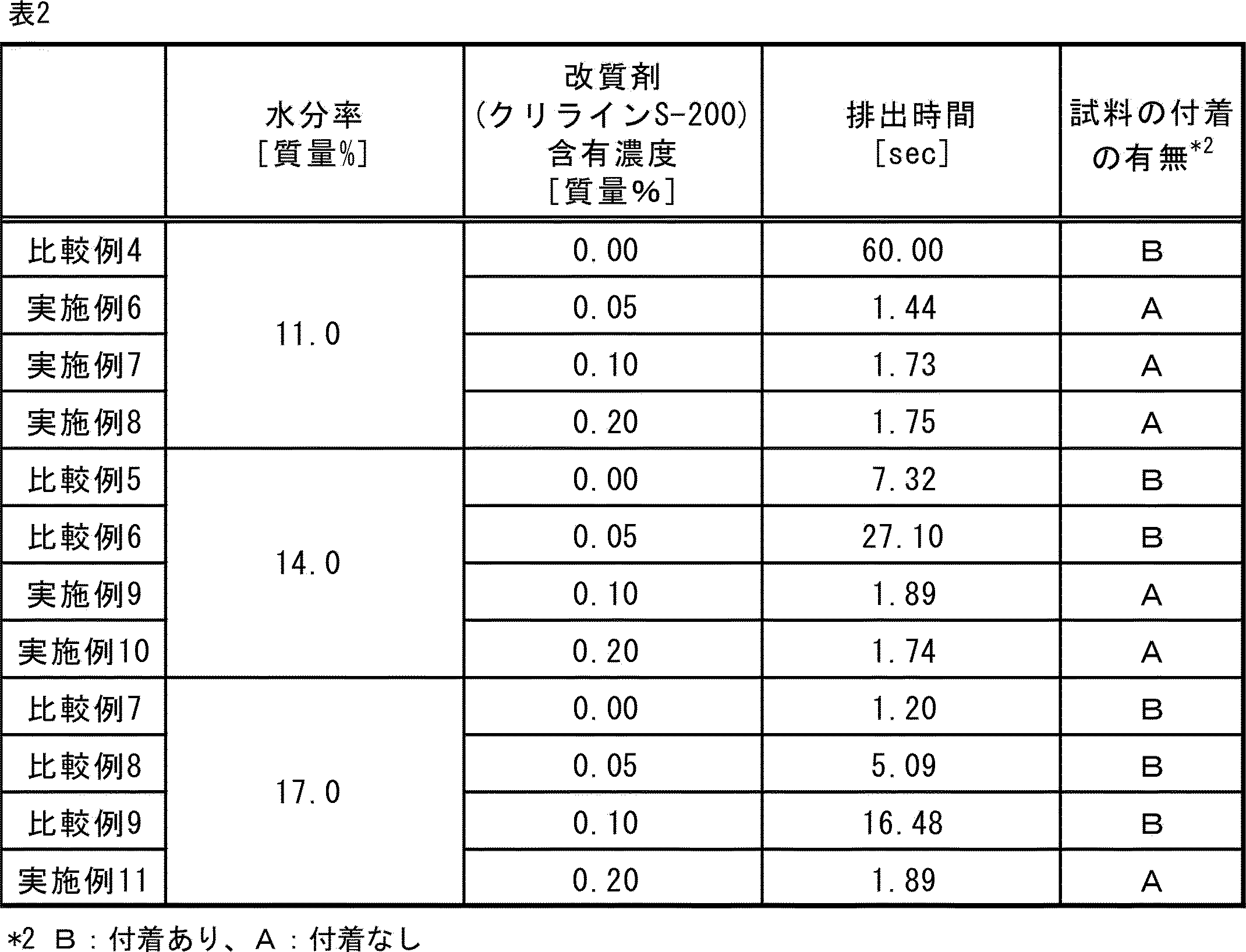
また、比較例5、7及び8では、排出時間が10秒以下ではあるものの、試料の水分が多く、泥状で流動性が高く、模擬ホッパー上部に付着がみられた。
このように、鉄鉱石の水分率が約11質量%以上である場合、水分率に応じて適切な量の高吸水性樹脂を添加することにより、鉄鉱石の設備の接触面に対する付着が抑制され、滑り性が向上し、処理設備への付着、該処理設備内における詰まり、並びに処理設備内及び該処理設備外への噴出を防止することが可能となると言える。
鉱物原料として石炭(水分率10.5質量%、粒径10mm以下)を用い、改質剤として石炭嵩密度向上剤「アルカンスルホン酸ナトリウム」(栗田工業株式会社製)を、含有量が0.1質量%となるように添加して、均一に撹拌混合し、試料を調製した後、嵩密度を算出した。
石炭の水分率及び改質剤の含有量を下記表3に示すように変更し、それ以外は実施例12と同様にして、嵩密度を算出した。
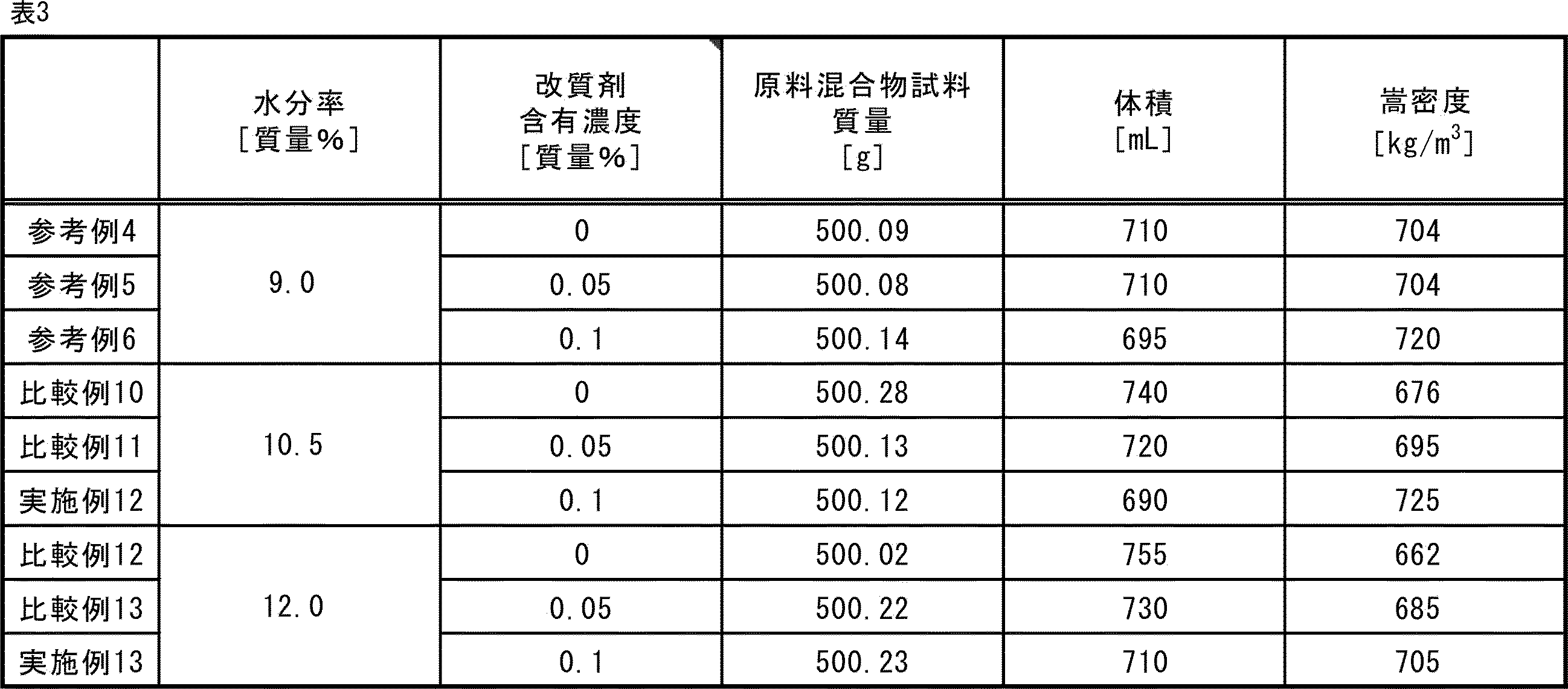
なお、参考例4~6から分かるとおり、石炭の水分率が約9質量%であると、界面活性剤を添加していなくても嵩密度は高い値となる。
Claims (9)
- 鉱物原料に改質剤を添加して、該鉱物原料を改質する方法であって、
搬送される前記鉱物原料の水分率を連続的に測定する工程と、
前記水分率に基づいて、前記改質剤の添加量を算出する工程と、
前記添加量の前記改質剤を前記鉱物原料に添加する工程とを含み、
前記改質剤の添加により、前記鉱物原料の、処理設備への付着、該処理設備内における詰まり、該処理設備内及び該処理設備外への噴出、並びに嵩密度低下の少なくともいずれかを防止する、鉱物原料の改質方法。 - 鉱物原料に改質剤を添加して、該鉱物原料を改質する方法であって、
搬送される前記鉱物原料の水分率及び搬送量を連続的に測定する工程と、
前記水分率及び前記搬送量に基づいて、前記改質剤の添加量を算出する工程と、
前記添加量の前記改質剤を前記鉱物原料に添加する工程とを含み、
前記改質剤の添加により、前記鉱物原料の、処理設備への付着、該処理設備内における詰まり、該処理設備内及び該処理設備外への噴出、並びに嵩密度低下の少なくともいずれかを防止する、鉱物原料の改質方法。 - 前記処理設備が、配管、ベルトコンベア、コンベアチェーン、シュート、ホッパー、サイロ、及びコークス炉の少なくともいずれかである、請求項1又は2に記載の鉱物原料の改質方法。
- 前記改質剤が、JIS K7223(1996)及びJIS K7224(1996)で定義される高吸水性樹脂を含む、請求項1~3のいずれかに記載の鉱物原料の改質方法。
- 前記高吸水性樹脂が、ポリアクリル酸ナトリウムである、請求項4に記載の鉱物原料の改質方法。
- 前記改質剤が、界面活性剤を含む、請求項1~3のいずれかに記載の鉱物原料の改質方法。
- 前記界面活性剤が、アニオン系界面活性剤である、請求項6に記載の鉱物原料の改質方法。
- 前記改質剤が、水溶性高分子化合物を含む、請求項1~3のいずれかに記載の鉱物原料の改質方法。
- 前記水溶性高分子化合物が、アニオン系エマルションポリマーである、請求項8に記載の鉱物原料の改質方法。
Priority Applications (5)
| Application Number | Priority Date | Filing Date | Title |
|---|---|---|---|
| AU2021252278A AU2021252278B2 (en) | 2020-04-09 | 2021-03-18 | Method for modifying mineral raw material |
| CN202180027136.XA CN115427590A (zh) | 2020-04-09 | 2021-03-18 | 矿物原料的改质方法 |
| EP21785622.8A EP4134411B1 (en) | 2020-04-09 | 2021-03-18 | Method for modifying mineral raw material |
| KR1020227034815A KR102738664B1 (ko) | 2020-04-09 | 2021-03-18 | 광물원료의 개질방법 |
| BR112022020090A BR112022020090A2 (pt) | 2020-04-09 | 2021-03-18 | Método para modificar matéria-prima mineral |
Applications Claiming Priority (2)
| Application Number | Priority Date | Filing Date | Title |
|---|---|---|---|
| JP2020-070604 | 2020-04-09 | ||
| JP2020070604A JP6969629B2 (ja) | 2020-04-09 | 2020-04-09 | 鉱物原料の改質方法 |
Publications (1)
| Publication Number | Publication Date |
|---|---|
| WO2021205836A1 true WO2021205836A1 (ja) | 2021-10-14 |
Family
ID=78023348
Family Applications (1)
| Application Number | Title | Priority Date | Filing Date |
|---|---|---|---|
| PCT/JP2021/011022 Ceased WO2021205836A1 (ja) | 2020-04-09 | 2021-03-18 | 鉱物原料の改質方法 |
Country Status (8)
| Country | Link |
|---|---|
| EP (1) | EP4134411B1 (ja) |
| JP (1) | JP6969629B2 (ja) |
| KR (1) | KR102738664B1 (ja) |
| CN (1) | CN115427590A (ja) |
| AU (1) | AU2021252278B2 (ja) |
| BR (1) | BR112022020090A2 (ja) |
| TW (1) | TWI897935B (ja) |
| WO (1) | WO2021205836A1 (ja) |
Cited By (1)
| Publication number | Priority date | Publication date | Assignee | Title |
|---|---|---|---|---|
| EP4549346A4 (en) * | 2022-06-30 | 2026-04-01 | Jfe Steel Corp | PROCESS FOR MODIFYING THE PROPERTIES OF POWDER, PROCESS FOR PRODUCING WATER-CONTAINING BULK MATERIAL, WATER-CONTAINING BULK MATERIAL, AND GRANULATION PROCESS FOR SINTERING RAW MATERIAL |
Families Citing this family (5)
| Publication number | Priority date | Publication date | Assignee | Title |
|---|---|---|---|---|
| JP2023057762A (ja) * | 2021-10-12 | 2023-04-24 | 株式会社三共 | 遊技機 |
| JP7726186B2 (ja) * | 2022-11-04 | 2025-08-20 | Jfeスチール株式会社 | 焼結鉱の製造方法 |
| JP2024178756A (ja) * | 2023-06-13 | 2024-12-25 | 栗田工業株式会社 | 原料の改質方法及び改質装置 |
| JP7688862B1 (ja) * | 2024-05-14 | 2025-06-05 | 株式会社ソルベックス | 製鉄原料の流動性改善方法および製鉄方法 |
| JP2026025425A (ja) * | 2024-08-02 | 2026-02-16 | 栗田工業株式会社 | 鉱物原料の付着及び詰まり防止方法 |
Citations (7)
| Publication number | Priority date | Publication date | Assignee | Title |
|---|---|---|---|---|
| JPS5141090A (ja) | 1974-08-07 | 1976-04-06 | American Cyanamid Co | |
| JPS5239417B1 (ja) | 1971-07-12 | 1977-10-05 | ||
| JPH0953128A (ja) * | 1995-08-18 | 1997-02-25 | Mitsubishi Materials Corp | 乾燥調合鉱の供給方法および供給装置 |
| JP2013245382A (ja) * | 2012-05-28 | 2013-12-09 | Jfe Steel Corp | 塊鉱石付着粉の除去方法 |
| JP2018058017A (ja) * | 2016-10-04 | 2018-04-12 | 栗田工業株式会社 | 鉱物原料の付着及び詰まり防止方法 |
| JP2018127709A (ja) * | 2017-02-10 | 2018-08-16 | 栗田工業株式会社 | 水及び/又は鉱物原料の漏出防止方法 |
| JP2019137909A (ja) * | 2018-02-06 | 2019-08-22 | 株式会社片山化学工業研究所 | 固体燃料及び/又は鉄鋼原料の改質方法 |
Family Cites Families (14)
| Publication number | Priority date | Publication date | Assignee | Title |
|---|---|---|---|---|
| JP3205210B2 (ja) * | 1995-04-06 | 2001-09-04 | 新日本製鐵株式会社 | 石炭調湿設備の水分制御方法 |
| JP2000065334A (ja) * | 1998-08-24 | 2000-03-03 | Hitachi Zosen Corp | 灰溶融炉用灰加湿供給装置 |
| JP2001133402A (ja) * | 1999-11-08 | 2001-05-18 | Kawasaki Steel Corp | 石炭水分値の測定方法 |
| CN2496021Y (zh) * | 2001-09-26 | 2002-06-19 | 刘玉林 | 输送物料含水量测量探头及其变送器 |
| KR100925600B1 (ko) * | 2002-09-09 | 2009-11-06 | 주식회사 포스코 | 원료의 수분의 측정 및 교정 장치 |
| JP2004191323A (ja) * | 2002-12-13 | 2004-07-08 | Kansai Coke & Chem Co Ltd | 石炭の水分測定方法および装置 |
| JP4804887B2 (ja) * | 2005-11-17 | 2011-11-02 | 新日本製鐵株式会社 | 焼結原料の事前処理方法及び事前処理装置 |
| JP5412781B2 (ja) | 2008-09-29 | 2014-02-12 | Jfeスチール株式会社 | コ−クス製造用石炭の嵩密度向上方法 |
| CN201429789Y (zh) * | 2009-06-24 | 2010-03-24 | 北京宇宏泰测控技术有限公司 | 混合料红外水分测量控制系统 |
| US20110247233A1 (en) * | 2009-10-01 | 2011-10-13 | Bland Richard W | Coal drying method and system |
| US9004284B2 (en) * | 2009-10-01 | 2015-04-14 | Vitrinite Services, Llc | Mineral slurry drying method and system |
| JP5927807B2 (ja) * | 2011-03-25 | 2016-06-01 | 栗田工業株式会社 | 石炭及び/又は鉄鉱石スラリーの改質方法 |
| JP6303308B2 (ja) * | 2013-07-12 | 2018-04-04 | 栗田工業株式会社 | 石炭搬送方法 |
| JP2021139037A (ja) * | 2020-03-02 | 2021-09-16 | 株式会社日向製錬所 | フェロニッケルの製錬方法 |
-
2020
- 2020-04-09 JP JP2020070604A patent/JP6969629B2/ja active Active
-
2021
- 2021-03-18 TW TW110109816A patent/TWI897935B/zh active
- 2021-03-18 AU AU2021252278A patent/AU2021252278B2/en active Active
- 2021-03-18 EP EP21785622.8A patent/EP4134411B1/en active Active
- 2021-03-18 CN CN202180027136.XA patent/CN115427590A/zh active Pending
- 2021-03-18 WO PCT/JP2021/011022 patent/WO2021205836A1/ja not_active Ceased
- 2021-03-18 KR KR1020227034815A patent/KR102738664B1/ko active Active
- 2021-03-18 BR BR112022020090A patent/BR112022020090A2/pt unknown
Patent Citations (7)
| Publication number | Priority date | Publication date | Assignee | Title |
|---|---|---|---|---|
| JPS5239417B1 (ja) | 1971-07-12 | 1977-10-05 | ||
| JPS5141090A (ja) | 1974-08-07 | 1976-04-06 | American Cyanamid Co | |
| JPH0953128A (ja) * | 1995-08-18 | 1997-02-25 | Mitsubishi Materials Corp | 乾燥調合鉱の供給方法および供給装置 |
| JP2013245382A (ja) * | 2012-05-28 | 2013-12-09 | Jfe Steel Corp | 塊鉱石付着粉の除去方法 |
| JP2018058017A (ja) * | 2016-10-04 | 2018-04-12 | 栗田工業株式会社 | 鉱物原料の付着及び詰まり防止方法 |
| JP2018127709A (ja) * | 2017-02-10 | 2018-08-16 | 栗田工業株式会社 | 水及び/又は鉱物原料の漏出防止方法 |
| JP2019137909A (ja) * | 2018-02-06 | 2019-08-22 | 株式会社片山化学工業研究所 | 固体燃料及び/又は鉄鋼原料の改質方法 |
Non-Patent Citations (1)
| Title |
|---|
| See also references of EP4134411A4 |
Cited By (1)
| Publication number | Priority date | Publication date | Assignee | Title |
|---|---|---|---|---|
| EP4549346A4 (en) * | 2022-06-30 | 2026-04-01 | Jfe Steel Corp | PROCESS FOR MODIFYING THE PROPERTIES OF POWDER, PROCESS FOR PRODUCING WATER-CONTAINING BULK MATERIAL, WATER-CONTAINING BULK MATERIAL, AND GRANULATION PROCESS FOR SINTERING RAW MATERIAL |
Also Published As
| Publication number | Publication date |
|---|---|
| JP6969629B2 (ja) | 2021-11-24 |
| TWI897935B (zh) | 2025-09-21 |
| EP4134411B1 (en) | 2026-02-11 |
| TW202138571A (zh) | 2021-10-16 |
| BR112022020090A2 (pt) | 2022-11-29 |
| KR20220164719A (ko) | 2022-12-13 |
| JP2021167442A (ja) | 2021-10-21 |
| AU2021252278B2 (en) | 2025-12-04 |
| EP4134411A1 (en) | 2023-02-15 |
| EP4134411C0 (en) | 2026-02-11 |
| EP4134411A4 (en) | 2024-04-17 |
| AU2021252278A1 (en) | 2022-11-03 |
| KR102738664B1 (ko) | 2024-12-04 |
| CN115427590A (zh) | 2022-12-02 |
Similar Documents
| Publication | Publication Date | Title |
|---|---|---|
| JP6969629B2 (ja) | 鉱物原料の改質方法 | |
| WO2018066333A1 (ja) | 鉱物原料の付着及び詰まり防止方法 | |
| US20110110730A1 (en) | Transport method for absorbend resin powder | |
| JP6825738B1 (ja) | 鉱物原料の付着及び詰まり防止方法 | |
| CN203372858U (zh) | 用于卸船机的大块高粘性散货给料破碎装置 | |
| TWI591185B (zh) | 製鐵原料的搬送方法 | |
| WO2012132521A1 (ja) | 石炭及び/又は鉄鉱石スラリーの改質方法 | |
| JP6780526B2 (ja) | 水及び/又は鉱物原料の漏出防止方法 | |
| JP6287091B2 (ja) | 摩擦低下被膜の形成方法、形成剤および含水粒/泥状物の処理方法 | |
| JP2024178756A (ja) | 原料の改質方法及び改質装置 | |
| CN102777920A (zh) | 一种干化污泥焚烧上料系统 | |
| CN207861166U (zh) | 一种具有物料分散功能的输料机 | |
| CN221496604U (zh) | 一种干混砂浆站骨料送料装置 | |
| Ma et al. | Introduction to Port Continuous Conveying Machinery | |
| JP2026025425A (ja) | 鉱物原料の付着及び詰まり防止方法 | |
| JP7718635B2 (ja) | 鉱物原料に起因する設備障害の抑制方法 | |
| CN103421947A (zh) | 制铁原料的搬送方法及制铁原料固化体的制造方法 | |
| JPS6388092A (ja) | 貯留搬送装置 |
Legal Events
| Date | Code | Title | Description |
|---|---|---|---|
| 121 | Ep: the epo has been informed by wipo that ep was designated in this application |
Ref document number: 21785622 Country of ref document: EP Kind code of ref document: A1 |
|
| REG | Reference to national code |
Ref country code: BR Ref legal event code: B01A Ref document number: 112022020090 Country of ref document: BR |
|
| ENP | Entry into the national phase |
Ref document number: 2021252278 Country of ref document: AU Date of ref document: 20210318 Kind code of ref document: A |
|
| NENP | Non-entry into the national phase |
Ref country code: DE |
|
| ENP | Entry into the national phase |
Ref document number: 2021785622 Country of ref document: EP Effective date: 20221109 |
|
| ENP | Entry into the national phase |
Ref document number: 112022020090 Country of ref document: BR Kind code of ref document: A2 Effective date: 20221004 |
|
| WWG | Wipo information: grant in national office |
Ref document number: 2021785622 Country of ref document: EP |