WO2021234976A1 - Joint de fixation pour un masque et masque comprenant un joint de fixation pour un masque - Google Patents
Joint de fixation pour un masque et masque comprenant un joint de fixation pour un masque Download PDFInfo
- Publication number
- WO2021234976A1 WO2021234976A1 PCT/JP2020/025423 JP2020025423W WO2021234976A1 WO 2021234976 A1 WO2021234976 A1 WO 2021234976A1 JP 2020025423 W JP2020025423 W JP 2020025423W WO 2021234976 A1 WO2021234976 A1 WO 2021234976A1
- Authority
- WO
- WIPO (PCT)
- Prior art keywords
- mask
- adhesive
- fixed
- tape
- seal
- Prior art date
- Legal status (The legal status is an assumption and is not a legal conclusion. Google has not performed a legal analysis and makes no representation as to the accuracy of the status listed.)
- Ceased
Links
Images



Classifications
-
- A—HUMAN NECESSITIES
- A41—WEARING APPAREL
- A41D—OUTERWEAR; PROTECTIVE GARMENTS; ACCESSORIES
- A41D13/00—Professional, industrial or sporting protective garments, e.g. surgeons' gowns or garments protecting against blows or punches
- A41D13/05—Professional, industrial or sporting protective garments, e.g. surgeons' gowns or garments protecting against blows or punches protecting only a particular body part
- A41D13/11—Protective face masks, e.g. for surgical use, or for use in foul atmospheres
Definitions
- the present invention relates to a mask fixing seal and a mask provided with a mask fixing seal. More specifically, the mask can be easily attached and detached, and the mask can be prevented from being displaced during attachment.
- the present invention relates to a mask having a fixed seal for a mask and a mask having a fixed seal for a mask, which can be used repeatedly for various types of masks such as non-woven fabrics and cloths and can surely prevent misuse.
- a health mask that relieves breathlessness while wearing the mask is disclosed, for example, in Patent Document 1 as a nostril dilation mask.
- This nostril dilation mask comprises a mask body having a facing surface facing the wearer's face, an elastically deformable nostril dilating tape fixed near the upper edge of the facing surface and extending laterally, and a central portion of the facing surface.
- the nasal strip Arranged across and with elastically deformable wires, the nasal strip has adhesive surfaces that adhere to both sides of the wearer's nasal column, with both ends wider than the rest. ing.
- the nostril dilation tape provided near the upper edge of the facing surface is positioned so as to straddle the wearer's nasal column laterally.
- the nasal strip is bent along the shape of the wearer's nose, and the adhesive surface is adhered to the wearer's nasal column.
- the wearer's nostrils are dilated as the nostril dilation tape tries to elastically return to its original shape.
- both ends of the nostril dilation tape in the lateral direction have a wide shape, a wide adhesive area between the nose and the nostril dilation tape is secured at both ends.
- the force to expand the nostril acts more on both ends of the nostril dilation tape, but since the area on which the above force acts is large, the adhesive surface of the nostril dilation tape is less likely to come off from the nose, and the nostril is efficiently opened. Can be expanded. Further, since the wires are arranged across the central portion of the facing surface, both ends are located on both cheeks. Since the wire maintains the shape of the mask body, a space is formed around the wearer's nose and mouth. As a result, the mask body does not block the wearer's nostrils, and the wearer's suffocation can be further alleviated.
- the nostril dilation mask provided with the above nostril dilation tape and the nostril dilation tape has the following technical problems.
- slip prevention is not done while wearing the mask. More specifically, in general, by moving the mouth during conversation while wearing the mask, the mask gradually shifts, and in some cases the nose becomes exposed, and the original function of the mask's face cover function is impaired. This shift is especially the vertical shift of the face.
- the nasal dilation tape extends to the cheeks so as to straddle the nasal column and is worn horizontally with respect to the face. , It is attached to the cheeks where movement occurs with the movement of the mouth.
- the nostril dilation tape is intended to elastically restore the original shape for the purpose of dilating the nostril, and is vulnerable to slippage during wearing of the mask. ..
- infection prevention measures are inadequate as an antibacterial mask. More specifically, in relation to the first point, in order to correct the deviation during wearing in the mask, touch the outer surface of the mask where there is a risk of adherence of bacteria, etc. , Direct contact with the mouth, etc. increases the chance of infection. Furthermore, the nostril dilation tape is intended to elastically restore the original shape for the purpose of dilating the nostril in the first place, and a gap is likely to be formed between the mask and the face of the face. , There is a risk of bacteria invading through the gap. Thirdly, it is difficult to repeatedly use the nasal dilation tape, and there is a high possibility of misuse when the mask with the nasal dilation tape is repeatedly used.
- the nostril dilation tape is adhesively fixed to the inner surface of the mask in the first place, and it is difficult to use it repeatedly.
- Such a mask repeats the nostril dilation mask where multiple sets are usually sold.
- it becomes difficult to distinguish it from other users' nasal dilation masks, and misuse can result in, for example, bacterial infections within the family.
- the new coronavirus has spread all over the world and has affected the existing social order, economic system, and lifestyle to the extent that it is not to mention the basic measures to prevent the infection of this coronavirus. It is disinfectant, hand-washing and wearing a mask. In this sense, it is easy to put on and take off the mask, and it is possible to prevent the mask from slipping during wearing. On the other hand, there is a demand for a mask that can be used repeatedly but can surely prevent misuse.
- an object of the present invention is to provide a mask fixing sticker capable of preventing displacement during mask wearing and a mask provided with the mask fixing seal.
- an object of the present invention is to provide a mask fixing seal having sufficient infection prevention measures as an antibacterial mask and a mask provided with the mask fixing seal.
- an object of the present invention is to provide a mask fixing seal and a mask fixing seal which can be repeatedly used as a mask fixing seal and which reduces the possibility of misuse when repeatedly used. Is to provide a mask.
- the mask fixing seal of the present invention is used.
- a fixed sticker that is affixed along the upper edge across the vertical centerline of the inner surface of the mask.
- the fixing seal is provided with a male part of a hook-and-loop fastener that can be fixed to the inner surface of the mask on one surface.
- a face adhesive portion that can be fixed to a part of the face straddling the nasal column is provided.
- An identification tag is attached to the end of the fixed seal.
- the mask fixing seal of the present invention is used.
- a fixed sticker that is affixed along the upper edge of the inner surface of the mask.
- the fixed sticker is oblong so that it can be attached across the nasal column.
- the fixing seal is provided with a male part of a hook-and-loop fastener that can be fixed to the inner surface of the mask on one surface.
- the other surface is provided with adhesive tape that can be attached to the surface of the nose and cheeks.
- An identification tag is attached to the end of the fixed sticker.
- the mask fixing seal of the present invention is used.
- a fixed sticker that is affixed along the upper edge of the inner surface of the mask.
- the fixed sticker is oblong so that it can be attached across the nasal column.
- the fixing seal is provided with a male part of a hook-and-loop fastener that can be fixed to the inner surface of the mask on one surface.
- the other surface is provided with adhesive tape that can be attached to the surface of the nose and cheeks.
- the adhesive strength of the male part of the hook-and-loop fastener to the inner surface of the mask is set stronger than the adhesive strength of the adhesive tape on the surface of the nose.
- An identification tag is attached to the end of the fixed sticker.
- the hook-and-loop fastener has a substrate having shape retention, and a hook portion that can be entangled with the inner surface of the mask is provided on one surface of the substrate.
- the adhesive tape is a single-sided tape and is a substrate. An adhesive portion that can be adhered to one surface of the adhesive tape is provided on the other surface, and the identification tag is sandwiched between the other surface of the substrate and one surface of the adhesive tape and laminated. It is good to have a structure.
- the hook-and-loop fastener has a substrate having shape retention, and a hook portion that can be entangled with the inner surface of the mask is provided on one surface of the substrate, and the adhesive tape is a double-sided tape and has a nose.
- the hook-and-loop fastener has a substrate having shape retention, a hook portion that can be entangled with the inner surface of the mask is provided on one surface of the substrate, and the surface of the nose is provided on the other surface of the substrate.
- a stickable adhesive may be applied to the identification tag and the identification tag may be fixed to the other surface of the substrate.
- the identification tag is made of resin, and it is preferable that the identification tag has a strength that enables attachment / detachment of the mask fixing seal from the inner surface of the mask by picking and pulling the identification tag. Further, the area of adhesion of the adhesive tape or the adhesive to the surfaces of the nose and cheeks may be part of the other surface of the substrate. Furthermore, the end portion of the one surface of the substrate has a region in which the male portion is not provided, and it is preferable to utilize the region as the identification tag. In addition, the identification tag may be provided at each end of the substrate.
- the new adhesive tape as a new face adhesive portion by attaching a new adhesive tape to the face adhesive portion according to the deterioration of the adhesive strength of the face adhesive portion. ..
- the mask fixing seal mask according to any one of claims 1 to 11 is fixed to the inner surface. Further, the mask is a flat mask, and the mask is a flat mask.
- a fixing seal for the second mask is attached along each of the upper and lower edges of the inner surface of the mask.
- the second mask fixing seal has a double-sided tape, a medical skin tape, and a sponge layer interposed between the double-sided tape and the medical skin tape.
- the double-sided tape is adhesively fixed to the inner surface of the mask by the first adhesive portion on one surface. In the double-sided tape, the second adhesive portion on the other surface is adhesively fixed to one surface of the sponge layer having a predetermined thickness.
- the other surface of the sponge layer was adhesively secured to medical skin tape.
- the medical skin tape should be adhesively fixed to the cheeks of the mask user's face. Further, it is preferable that an identification tag is attached to one or both ends of the double-sided tape. Furthermore, it is preferable that the adhesive fixing force of the first adhesive portion is set to be larger than the adhesive fixing force of the medical skin tape.
- the second mask fixing seal may be provided with a protrusion protruding outward from the corresponding upper and lower edges.
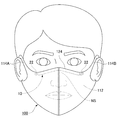
- the mask 100 is, for example, a disposable pleated mask 100, specifically, a mask main body 112 that covers the nose, mouth, chin (target portion), etc. of the wearer's face.
- a pair of left and right ear hooks 114 for locking the mask body 112 to the wearer's ear, and a mask fixing seal 100 provided at the nose-corresponding portion of the mask body 112 are provided.
- a known material used as a general health mask is used for the mask main body 112.
- gauze made of cotton material that has been subjected to antibacterial / deodorant processing by any method is used.
- antibacterial / deodorant processing there is a method of adsorbing nano-sized silver ions on gauze.
- the mask main body 112 is formed by stacking a pair of left and right nonwoven fabric sheets having a substantially symmetrical shape, and forming the pair of nonwoven fabric sheets in a substantially arc shape at the substantially center of the mask main body 112 in the left-right direction by a joint edge 122 in the vertical direction. It is joined together.
- the mask main body 112 has a size that covers the chin, the mouth, the nose, and the cheeks on both the left and right sides thereof, but at least the middle part of the nasal bridge in the vertical direction from the mouth and the cheeks on the left and right sides. Anything that can be covered will do.
- the joint edge 122 is formed by heat welding or the like.
- the non-woven fabric sheet is a non-woven fabric sheet made of synthetic resin fiber having appropriate air permeability and heat retention, for example, a non-woven fabric sheet that blocks the passage of pollen, which is a causative substance of allergic rhinitis and hay fever, and has appropriate air permeability and heat retention. Is used. From the viewpoint of not damaging the wearer's face or the like with the joint edge 122, it is preferable to join the non-woven fabric sheet with the joint edge 122 so that non-joint portions are formed at the upper and lower ends of the mask main body portion 112.
- thermoplastic synthetic resin fiber non-woven fabric examples include a non-woven fabric made of a single fiber such as an olefin resin fiber, a polyethylene resin fiber, a polyester resin fiber, and a polypropylene resin fiber, a non-woven fabric made of a composite core sheath fiber, or a non-woven fabric. Laminated composite non-woven fabric or the like can be used.
- the composite core-sheath fiber polyester-polyethylene core-sheath fiber, polypropylene-polyethylene core-sheath fiber, or the like can be applied.
- laminated composite non-woven fabric a laminated non-woven fabric of cotton and polyethylene, a laminated non-woven fabric of rayon and polyethylene, a laminated non-woven fabric of cotton and polypropylene, and the like can be applied.
- the mask main body 112 is formed by joining a flat non-woven fabric sheet having no three-dimensional shape at a substantially arcuate joint edge 122, and then cutting the peripheral edge integrally, and the non-woven fabric sheet is left and right when worn.
- the joint edge 122 When unfolded, the joint edge 122 exhibits a three-dimensional shape that projects forward in an arc shape, and on the joint edge 122 and its left and right sides, between the inner corner of the eye and the middle part in the vertical direction excluding the jaw, between the face and the face. A predetermined gap is created.
- the ear hook portion 114 has an upper side portion and a lower side portion above and below the ear through hole, and the base portion is joined by heat welding or the like at a joint portion in the vertical direction opposite to the joint edge 122 of each non-woven fabric sheet.
- the upper side portion and the lower side portion are configured so that the tension of the upper side portion becomes larger than the tension of the lower side portion when the mask main body portion 112 is applied to the face and the ear hook portion 114 is applied to the ear portion.
- a non-woven fabric sheet made of a synthetic resin fiber having thermoplasticity is used for the ear hook portion 114.
- the adhesive portion 30 is made of, for example, a hot melt pressure sensitive adhesive.
- the hot melt pressure sensitive adhesive is composed of a solvent-free and water-free adhesive mixture based on a thermoplastic polymer.
- other adhesives may be used for the adhesive portion 30.
- the front and back sheets are made of breathable thermoplastic fiber non-woven fabric, and the peripheral edges thereof are sealed by heat welding or the like.
- a thermoplastic film or the like may be used for the back sheet. Further, as the front sheet, a film having a large number of micropores may be used.
- the mask fixing sticker 10 will be described as a fixing sticker 10 attached along the upper edge portion 124 across the vertical center line of the inner surface 110 of the mask 100.
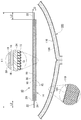
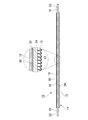
- the fixed seal 10 has a horizontally long shape so as to be attached laterally across the nose column, and the fixed seal 10 has a male portion of a surface fastener 14 that can be fixed to the inner surface 110 of the mask 100 on one surface 12. 15 is provided, and the other surface 16 is provided with an adhesive tape 18 that can be adhered to the surface NS of the nose and the cheek, and the adhesive strength of the mask 100 to the inner surface 110 by the male portion 15 of the surface fastener 14 is determined.
- the adhesive strength is set stronger than the adhesive strength on the surface NS of the nose by the adhesive tape 18, and the identification tag 22 is attached to the end portion 20 of the fixed seal 10. This can be adjusted, for example, by selecting the tip shape of the hook portion constituting the male portion 15, the density of the hook portion, and the like, which will be described later.
- the outer shape of the mask fixing seal 10 is, for example, a width W of about 15 mm, a length L1 of about 15 cm (for adults), a thickness D of several mm or less, and a protruding length L2 of the identification tag 22.
- the identification tag 22 may be picked up with a finger, pinched, and set so that the mask fixing seal 10 can be conveniently peeled off from the inner surface 110 of the mask 100, for example, about 1 cm.
- the hook-and-loop fastener 14 has a substrate 24 having shape-retaining properties, and the substrate 24 is made of, for example, resin, and is formed on one surface 12 of the substrate 24 and on the inner surface 110 of the mask 100.
- An entangleable hook portion is provided, the other surface 16 of the substrate 24 is provided with an adhesive portion that can be adhered to one surface of the adhesive tape 18, and the identification tag 22 is adhered to the other surface 16 of the substrate 24. It is sandwiched between one surface of the tape 18 to form a laminated structure.
- the adhesive tape 18 is a single-sided tape, and the other surface of the adhesive tape 18 is provided with an adhesive portion 30 that can be fixed to the surface NS of the nose and the cheek portion, and is covered with the release film 19.
- the identification tag 22 is made of resin and has a strength that allows the identification tag 22 to be detached from the inner surface 110 of the mask 100 of the mask fixing seal 10 by pinching and pulling the identification tag 22. That is, in a state where the end of the other surface of the identification tag 22 is in contact with the surface of the adhesive tape 18, the end of one surface of the identification tag 22 is adhered to the other surface of the substrate 24 and is also adhered to.
- the material of the identification tag 22 has a strength that does not tear when the identification tag 22 is picked and pulled.
- the adhesive tape 18 may be a double-sided tape, and is fixed to the surface NS of the nose instead of the adhesive portion that is provided on the other surface 16 of the substrate 24 and can be adhered to one surface of the adhesive tape 18. It has a possible first adhesive surface and a second adhesive surface that can be adhered to the other surface 16 of the substrate 24, and the identification tag 22 is sandwiched between the first adhesive surface and the second adhesive surface and laminated. It may be a structure.
- the adhesive tape 18 and the identification tag 22 which are separate element parts may be omitted.
- the male portion 15 of the hook-and-loop fastener 14 has a substrate 24 having shape-retaining properties, and one surface 12 of the substrate 24 is provided with a hook portion capable of being entangled with the inner surface 110 of the mask 100.
- the adhesive 32 is applied to the other surface 16 of the substrate 24 as the adhesive portion 30 provided on the other surface of the adhesive tape 18 and which can be fixed to the surface NS of the nose and the cheek.
- the adhesive tape 18 is omitted, a region where the male portion 15 is not provided is provided at the end of one surface 12 of the substrate 24, and the region is used as the identification tag 22.
- the adhesive tape 18 may be omitted.
- a pressure-sensitive acrylic acid adhesive having low allergenicity and having a sufficiently small effect on the human body is used in consideration of the presence or absence of odor and volatile components. Since it is pressure-sensitive, it does not easily harden due to a chemical reaction, maintains its adhesiveness for a long period of time, and can be peeled off from the surface of the nose even after application, and can be used repeatedly. Since it is acrylic acid-based, it can maintain high adhesiveness even on the epidermis to which sebum is attached.
- the area of adhesion to the face by the adhesive tape 18 or the adhesive may be part of the other surface 16 of the substrate 24 as long as it is effective in preventing slippage during wearing of the mask, minimizing the area of adhesion. This makes it possible to minimize the adverse effects on the skin.
- the mask fixing sticker 10 is provided with identification tags 22 having different colors, and it is preferable that a plurality of mask fixing stickers 10 that can be distinguished from each other are collectively stored in, for example, a transparent resin casing.
- a female portion for example, a loop portion of a surface fastener
- the plurality of mask fixing seals 10 fall from the inside of the casing even if the transparent casing is opened. It is possible to prevent misuse of the mask fixing sticker 10 without fear.
- the mask fixing seal 10 can be completed by simply combining the existing element products such as the hook-and-loop fastener 14, the identification tag 22, and the adhesive tape 18. Since the substrate 24 of the hook-and-loop fastener 14 has shape-retaining properties, if only the adhesive tape 18 having no shape-retaining properties is used, there is a high possibility that the adhesive portions 30 will stick to each other when reused.
- the fixed seal 10 can be used repeatedly, and can be provided as an inexpensive product.
- the hook-and-loop fastener 14 the product name mechanical fastener (hook NC-2141) manufactured by 3M Co., Ltd., the model number TMSD-25W manufactured by Trusco Nakayama Co., Ltd., and as the identification tag 22, the product name Post-it manufactured by 3M Co., Ltd., or As the color cellophane and the adhesive tape 18, the trade name Micropore manufactured by 3M Co., Ltd. and the trade name Surgical Tape manufactured by Nichiban Co., Ltd. may be used.
- the product name mechanical fastener (hook NC-2141) manufactured by 3M Co., Ltd.
- the model number TMSD-25W manufactured by Trusco Nakayama Co., Ltd. the product name Post-it manufactured by 3M Co., Ltd.
- the trade name Micropore manufactured by 3M Co., Ltd. and the trade name Surgical Tape manufactured by Nichiban Co., Ltd. may be used.
- the fixed seal 10 for the mask by attaching the nasal seal laterally across the nasal column, it is possible to prevent the mask 100 from slipping while wearing the mask 100, and it is possible to prevent the nose and the cheek from slipping. It is possible to effectively prevent the formation of gaps between the masks, effectively prevent the invasion of bacteria and the like into the mask 100, and in the case of a user who wears glasses and wears the mask, the glasses are snorted. It is also effective in preventing anti-fog.
- the release film 19 of the selected mask fixing sticker 10 is peeled off, and the adhesive surface of the mask fixing sticker 10 is pressed laterally across the user's nose column around the nose to press the mask fixing seal 10. Put 10 on your face.
- both ear hooks of the mask 100 are hung on the corresponding ears of the user, and the mask 100 is worn in the usual manner.
- the hook portion 28 (male portion 15) of the hook-and-loop fastener 14 of the mask fixing seal 10 becomes the loop portion (female portion) of the inner surface 110 of the mask 100.
- the mask fixing seal 10 is fixed to the inner surface 110 of the mask 100.
- the mask fixing seal 10 does not show through from the mask 100 outer surface 111, and the mask is fixed. Since the thickness of the seal 10 itself is thin, the presence of the mask fixing seal 10 is not recognized from the outside while the mask 100 is attached. On the contrary, from the viewpoint of design, the color of the facing surface of the mask inner surface 110 of the nose seal of the mask fixing sticker 10 is intentionally made conspicuous so that it can be seen through the outer surface 111 of the mask 100 depending on the number of layers of the mask 100. You may.
- the mask fixing seal 10 is attached laterally along the upper edge portion 124 of the mask 10 across the nasal column, a gap is formed between the mask 10 and the face, and the gap is formed through the gap. It is possible to prevent the invasion of bacteria more effectively, and this is because the flat type mask tends to form a gap between the nose and the cheek as compared with the three-dimensional type. Therefore, it is more effective, and in the case of a user who wears glasses and wears a mask, it is also effective in preventing the spectacles from fogging due to nasal breathing.
- the adhesive tape 18 of the mask fixing sticker 10 it is possible to fix the mask 100 to the cosmetic skin and the sweating skin of a woman to the extent that the mask 100 can be prevented from being displaced.
- a medical adhesive tape 18 may be used.
- the selected mask fixing sticker 10 is fixed to the inner surface 110 of the mask 100, the release film 19 is peeled off, and the mask fixing sticker 10 straddles the nose column. It may be fixed.
- the fixing position of the inner surface 110 of the mask 100 of the mask fixing seal 10 is lateral along the upper edge portion 124 of the inner surface 110 of the mask 100, a mark is particularly placed on the inner surface 110 of the mask 100. It is not necessary and can be fixed to the inner surface 110 of the mask 100 at an appropriate position.
- the mask 100 when there is a fold portion 118 for enlargement in the horizontal direction and the vertical direction in the center of the mask 100, the mask 100 is attached after the mask fixing seal 10 is attached around the nose. Then, after expanding the fold portion 118 in the vertical direction, it is preferable to press the upper edge portion 124 of the outer surface 111 of the mask 100 toward the face.
- identification tags 22 are attached to both ends of the mask fixing sticker 10, and it is preferable to pinch one of them with a finger and peel it off along the extending direction of the mask fixing sticker 10.
- the identification tag 22 is attached to the end portion 20 of the mask fixing seal 10, that is, the end of the substrate 24 of the hook-and-loop fastener 14, as long as the mask fixing seal 10 is not exposed to the outside of the mask 100 when the mask fixing seal 10 is attached to the mask 100. It is better to provide it in the part 20.
- the mask fixing seal 10 peeled off from the mask 100 is preferably fixedly stored in the casing via a loop portion (female portion 120) provided in the casing, and can be identified even if stored in the same casing.
- the tag 22 makes it possible to prevent misuse in the family, for example, and contributes to the prevention of infection in the family.
- the mask 100 may be stored with the mask fixing sticker 10 attached to the inner surface 110 of the mask 100. In this case, it is possible to prevent misuse of the mask 100 itself by the identification tag 22 of the mask fixing sticker 10 attached to the inner surface 110 of the mask 100.
- the length of the fixed seal 10 for the child mask is small size and large size. It can be clearly distinguished from the length of the fixed sticker 10 for an adult mask, and even if the identification tag 22 of the same color is attached, there is no risk of misuse.
- the used mask fixing seals 10 should be collectively discarded together with the casing.
- the mask fixing sticker 10 for oneself is selected according to the color of the identification tag 22.
- Attaching the mask fixing sticker 10 to the mask 100 As described above, the sticker may be attached to the inner surface 110 of the new mask 100.
- the mask 100 when used repeatedly, it is possible to prevent misuse of the mask fixing sticker 10 within the family, and it is possible to reduce the chance of infection between the family members through the mask fixing seal 10.
- FIG. 5 when the mask 100 is detached and folded to be folded in half or in four and stored in a pocket or a bag, the mask 100 is folded along the vertical center line and the fixed seal for the mask is folded.
- the face adhesive portion of one portion of 10 and the face adhesive portion of the other portion By adhesively fixing the face adhesive portion of one portion of 10 and the face adhesive portion of the other portion, it is possible to prevent bacteria and the like from adhering to the facial adhesive portion and prevent the inner surface 110 of the mask 100 from being exposed.
- the face adhesive part of one part and the face adhesive part of the other part can be peeled off and can be used repeatedly, as a whole. , The usefulness as an antibacterial mask can be improved.
- the mask fixing sticker 10 when washing the mask 100, the mask fixing sticker 10 may be detached from the inner surface 110 of the mask 100 and then washed, but as an adhesive tape, "water-resistant adhesive" (there are several companies) is used. By using it, it is not necessary to heat-activate by ironing, and even if the adhesive strength is reduced, it is possible to suppress the reduction range to the extent that slippage can be prevented while wearing the mask, and the mask fixing seal 10
- the mask fixing sticker 10 is repeatedly used even if the mask is washed until the mask is attached to the inner surface 110 of the mask 100. Further, when the mask fixing sticker 10 is attached to the mask 100 and used repeatedly, the adhesive performance of the mask fixing seal 10 to the face is lowered to the extent that it is not possible to prevent the mask from slipping while wearing the mask.
- a commercially available medical skin tape (generally 17 cm wide x 1.5 cm long) to the same size as the outer shape of the mask fixing sticker 10, and attach it from above until the mask 100 is thrown away. It has the advantage that it can be used many times to prevent slippage.
- the material of the mask is polypropylene, polyethylene, or the like, and it is difficult to fix the mask fixing seal 10 to the mask 100 because the hook portion of the surface fastener 14 is entangled with the inner surface 110 of the mask 100.
- a commercially available double-sided adhesive for example, a trade name “water-resistant ultra-strong double-sided tape” manufactured by KAWAGUCHI) may be used.
- the mask fixing seal 10 can be used repeatedly at least 5 to 10 times. The same applies when the mask fixing sticker 10 is repeatedly used on the same mask 100 in use. For attachment by the surface fastener 14, the mask fixing sticker 10 is peeled off from the inner surface 110 of the mask 100, and the mask is again used. Even when the fixed seal 10 is used repeatedly, the mask 100 is displaced from the mask 100 by the movement of the mouth or the like with respect to the inner surface 110 of the mask 100 without damaging the inner surface 110 of the mask 100. It can be fixed to the extent that it can be prevented.
- a feature of the second embodiment of the present invention is that the mask 100 is a flat type, and accordingly, a fixing seal 45 for the second mask is provided along the upper and lower edge portions 52 of the mask 100.
- the flat mask has a flat inner surface 110. Therefore, while wearing the mask, for example, by moving the mouth such as talking, sneezing, and sneezing, the mask can be applied to the cheeks of the face.
- the mask is a flat mask
- the second mask fixing seal 45 has a double-sided tape 50, a medical skin tape 61, and a sponge layer 55 interposed between the double-sided tape 50 and the medical skin tape 61. .. More specifically, a second mask fixing seal 45 is attached along each of the upper and lower edge portions 52 of the inner surface 110 of the mask. It should be noted that the side edges of the second mask fixing seal 45 do not have to coincide with both the upper and lower edge portions 52, and from the viewpoint of ensuring the adhesion between the inner surface 110 of the mask and the cheek portion, in the vicinity of both the upper and lower edge portions 52. It may be provided, and it is not always necessary to provide the second mask fixing seal 45 in parallel with both the upper and lower edge portions 52.
- the mask when the detached mask is stored in a pocket, bag, etc., the mask is folded in half with the central portion in the longitudinal direction as a crease, and the adhesive of the medical skin tape 61 of the second mask fixing sticker 45 is adhered.
- the positions of the fixed seals 45 for both second masks with respect to the inner surface 100 may be determined so that the inner surfaces 110 of the masks are not exposed due to the portions overlapping and being in close contact with each other.
- the length and / or width of the double-sided tape 50 determines the adhesion between the inner surface 110 of the mask and the cheek portion and the influence of the second adhesive portion on the skin of the cheek portion (for example, rough skin).
- the decision may be made in consideration of the product name, for example, the product name "OTOKU magic double-sided tape".
- the double-sided tape 50 is provided with a protruding portion 25 extending laterally from the corresponding upper and lower edge portions 52 and projecting outward.
- the length of the protrusion 25 is the same as that of the first embodiment when the mask is stored in, for example, a pocket or a bag, and the mask is folded in two with the central portion in the longitudinal direction as a crease.
- the face adhesive portion of one part of the mask fixing sticker 10 to be folded and the face adhesive portion of the other portion are adhesively fixed, and the second mask fixing seal 45 is brought into close contact with each other and folded again.
- the double-sided tape 50 is adhesively fixed to the inner surface 110 of the mask by the first adhesive portion of one surface 54, and the second adhesive portion of the other surface 56 adheres to one surface 57 of the sponge layer 55 having a predetermined thickness.
- the other surface 59 of the sponge layer 55 is fixed and adhesively fixed to the medical skin tape 61, and the medical skin tape 61 is adhesively fixed to the cheek of the mask user's face.
- the material of the sponge layer 55 may be a normal material as long as it has elasticity that can follow the recess formed in the cheek by moving the mouth when wearing the mask.
- the thickness of the sponge layer 55 may be determined from the viewpoint of preventing the formation of gaps by ensuring the adhesion between the inner surface 110 of the mask and the cheek portion, and as shown in FIG. 7, the cheek dented by moving the mouth. It is formed in a mountain shape so that the part of the part, that is, the central part of the sponge layer 55 is the apex, and in particular, by making the material made of highly elastic urethane, regardless of the surface shape of the cheek part, It is possible to maintain the adhesion between the inner surface 110 of the mouth mask and the cheeks.
- the mask fixing seal 10 is effective in forming gaps on both sides, which is a drawback of the flat mask, while preventing displacement by the mask fixing seal 10. Can be prevented. More specifically, it prevents the mask 100 from shifting in the vertical direction, particularly downward, and exposing the nose portion even if the mouth is moved during conversation or the like while the mask 100 is worn, thereby impairing the cover function of the mask 100. In addition to this, gaps are formed on both sides of the mask, and it is possible to effectively suppress the risk of viruses and bacteria entering and exiting from there.
- the second mask fixing sticker 45 maintains the adhesion between the inner surface 110 of the mask and the cheek portion according to its adhesive fixing force, and also contributes to the displacement of the mask 100. Therefore, the second mask fixing seal 45 is second. By providing the mask fixing seal 45, the length of the mask fixing seal 10 may be shortened.
- the mask is attached in the same manner as in the first embodiment, but the identification tag 22 may be attached to both or one of the ends of the double-sided tape 50. This makes it possible to prevent misuse of the mask 100 within the family when it is used repeatedly, and for example, it is possible to reduce the chance of infection between the family members.
- the identification tag 22 at the upper end of the double-sided tape 50, it is possible to use the identification tag 22 as a mark and attach the mask in the vertical direction without misunderstanding.
- An identification mark of the same color as the identification tag 22 may be attached to the back surface of the tip end portion of the protrusion 150. This makes it possible to prevent the front and back of the mask from being misidentified.
- a release film (not shown) is attached to the medical skin tape 61, and when the mask 100 is used, the release film can be peeled off and adhesively fixed to the cheek. good.
- the adhesive fixing force of the first adhesive portion is set to be larger than the adhesive fixing force of the medical skin tape 61. This makes it possible to prevent the mask from being detached when the second mask fixing seal 45 remains on the cheek when the mask is attached or detached outside.
- the attachment / detachment of the mask 100 is the same as that of the first embodiment, but in particular, the protrusion 150 provided at the center of the upper edge of the mask 100 is pressed with a finger, and the ear hook portion 114 is removed from the ear and attached / detached.
- the mask 100 can be attached and detached without touching the outer surface of the mask 100 with a finger.
- the size and shape of the protrusion 150 may be determined from the viewpoint that the protrusion 150 can be easily pressed by a finger.
- the second mask fixing sticker 45 may be used. More specifically, when the mask 100 is folded in two with the central portion in the longitudinal direction as a crease, the adhesive portions of the medical skin tape 61 between the second mask fixing seals 45 are brought into close contact with each other, thereby causing the mask 100 to adhere to each other.
- the double-sided tape 50 may be washed together with the mask in a state where the double-sided tape 50 is adhesively fixed to the inner surface 110 of the mask. It is possible to maintain the adhesively fixed state, and it is also possible to maintain the adhesive strength of the second adhesive portion to such an extent that it can be used repeatedly. In particular, according to the product name "OTOKU magic double-sided tape", the adhesiveness can be restored by washing with water and touching with water. Further, when the adhesive strength of the medical skin tape 61 is reduced after several washings, a new medical skin tape 61 is adhered to the medical skin tape 61, and the medical skin tape 61 is overlapped with the medical skin tape 61. It may be provided.
- the mask to which the mask fixing seal 10 is attached has been described as a health mask, but the mask is not limited thereto, and is used for preventing colds as long as it contributes to the suppression of slippage during wearing the mask.
- the adhesive tape has been described as being provided on the entire back surface of the substrate of the mask fixing seal 10, but the present invention is limited thereto.
- the adhesive portion 30 does not have to cover the entire substrate 24 as long as it contributes to the suppression of displacement during mask wearing.
- the hook-and-loop fastener, the adhesive tape, and the identification tag are described as those of separate element parts, but the identification tag 22 is not limited thereto and as long as it contributes to the prevention of misuse of the mask. May be integrated with a hook-and-loop fastener or adhesive tape.
- FIG. 2 shows the modification of the mask 100 which concerns on 1st Embodiment of this invention.
- FIG. 2 shows the modification of the mask 100 which concerns on 1st Embodiment of this invention.
- FIG. 2 shows the modification of the mask 100 which concerns on 1st Embodiment of this invention.
- FIG. 2 shows the state which the mask 100 which concerns on 1st Embodiment of this invention is attached to a face.
- FIG. 3 shows the state which the mask with the fixed seal 10 for a mask which concerns on 1st Embodiment of this invention is folded.
Landscapes
- Health & Medical Sciences (AREA)
- General Health & Medical Sciences (AREA)
- Physical Education & Sports Medicine (AREA)
- Engineering & Computer Science (AREA)
- Textile Engineering (AREA)
- Respiratory Apparatuses And Protective Means (AREA)
Abstract
Le problème à résoudre dans le cadre de la présente invention consiste à fournir un joint de fixation pour un masque, et un masque comprenant le joint de fixation pour un masque, avec lequel le port et le retrait du masque sont simples, il est possible d'empêcher le déplacement du masque pendant son port, et il est possible d'empêcher efficacement un mauvais usage tout en pouvant utiliser de façon répétée des masques de divers types tels qu'un tissu non tissé ou une gaze. La solution selon l'invention porte sur un joint de fixation pour un masque fixé le long d'un bord supérieur (124) s'étendant sur une ligne centrale verticale sur la surface interne du masque, le joint de fixation pour un masque étant caractérisé en ce qu'il comprend, sur une surface, une partie mâle d'un élément de fixation de surface qui peut être fixée à la surface interne du masque, et sur l'autre surface, une partie d'adhérence au visage qui peut être fixée à une surface partielle du visage recouvrant l'arête du nez, une étiquette d'identification qui est fixée à l'extrémité du joint de fixation de telle sorte que, lorsque le masque est plié le long de la ligne centrale verticale, la partie d'adhérence au visage sur une partie du joint de fixation plié et la partie d'adhérence au visage sur l'autre partie, soient fixées à l'aide d'un adhésif, grâce à quoi une exposition de la surface interne du masque peut être empêchée, et de telle sorte que, lorsque le masque plié est ouvert, la partie d'adhérence au visage de la première partie et la partie d'adhérence au visage de l'autre partie puissent être séparées l'une de l'autre.
Applications Claiming Priority (2)
| Application Number | Priority Date | Filing Date | Title |
|---|---|---|---|
| JP2020-089247 | 2020-05-21 | ||
| JP2020089247 | 2020-05-21 |
Publications (1)
| Publication Number | Publication Date |
|---|---|
| WO2021234976A1 true WO2021234976A1 (fr) | 2021-11-25 |
Family
ID=78708351
Family Applications (1)
| Application Number | Title | Priority Date | Filing Date |
|---|---|---|---|
| PCT/JP2020/025423 Ceased WO2021234976A1 (fr) | 2020-05-21 | 2020-06-27 | Joint de fixation pour un masque et masque comprenant un joint de fixation pour un masque |
Country Status (1)
| Country | Link |
|---|---|
| WO (1) | WO2021234976A1 (fr) |
Citations (6)
| Publication number | Priority date | Publication date | Assignee | Title |
|---|---|---|---|---|
| JPH10248948A (ja) * | 1997-03-11 | 1998-09-22 | Minoru Hosoda | 粘着付きマスク |
| JPH10512162A (ja) * | 1995-01-14 | 1998-11-24 | ミネソタ マイニング アンド マニュファクチャリング カンパニー | 複合積層クロージャーテープ系 |
| JPH11513262A (ja) * | 1995-09-07 | 1999-11-16 | ミネソタ・マイニング・アンド・マニュファクチャリング・カンパニー | 接着ストリップ |
| JP2000051378A (ja) * | 1998-08-14 | 2000-02-22 | Sachiko Kosaka | 乾燥空気吸入防止マスク |
| JP2011045661A (ja) * | 2009-08-28 | 2011-03-10 | Atsuo Nozaki | マスク |
| WO2017131210A1 (fr) * | 2016-01-28 | 2017-08-03 | 株式会社日本化学研究所 | Masque et son procédé de fabrication |
-
2020
- 2020-06-27 WO PCT/JP2020/025423 patent/WO2021234976A1/fr not_active Ceased
Patent Citations (6)
| Publication number | Priority date | Publication date | Assignee | Title |
|---|---|---|---|---|
| JPH10512162A (ja) * | 1995-01-14 | 1998-11-24 | ミネソタ マイニング アンド マニュファクチャリング カンパニー | 複合積層クロージャーテープ系 |
| JPH11513262A (ja) * | 1995-09-07 | 1999-11-16 | ミネソタ・マイニング・アンド・マニュファクチャリング・カンパニー | 接着ストリップ |
| JPH10248948A (ja) * | 1997-03-11 | 1998-09-22 | Minoru Hosoda | 粘着付きマスク |
| JP2000051378A (ja) * | 1998-08-14 | 2000-02-22 | Sachiko Kosaka | 乾燥空気吸入防止マスク |
| JP2011045661A (ja) * | 2009-08-28 | 2011-03-10 | Atsuo Nozaki | マスク |
| WO2017131210A1 (fr) * | 2016-01-28 | 2017-08-03 | 株式会社日本化学研究所 | Masque et son procédé de fabrication |
Similar Documents
| Publication | Publication Date | Title |
|---|---|---|
| DK2081650T3 (en) | Breathing Nasal Filter | |
| CN104114239B (zh) | 口罩 | |
| TWI893279B (zh) | 口罩用耳掛構件、及口罩 | |
| JP4574437B2 (ja) | 簡易マスク包装体 | |
| CN210630686U (zh) | 三片式无挂耳口罩 | |
| WO2021234976A1 (fr) | Joint de fixation pour un masque et masque comprenant un joint de fixation pour un masque | |
| WO2021234975A1 (fr) | Autocollant de fixation pour des masques et masque ayant un autocollant de fixation pour des masques | |
| JP2002336286A (ja) | マウステープ | |
| JP6541386B2 (ja) | マスク | |
| EP4159072B1 (fr) | Masque | |
| JP2011030884A (ja) | 透明部付きマスク | |
| CN213074559U (zh) | 一种防眼镜起雾的口罩 | |
| KR200439156Y1 (ko) | 일회용 의료밴드 | |
| CN212488599U (zh) | 一种防雾化口罩 | |
| CN211794472U (zh) | 舒适型一次性医用口罩 | |
| JP2022151608A (ja) | 目スク | |
| JP6572409B1 (ja) | 微細粉塵吸着具 | |
| JP3231806U (ja) | 衛生用マスクに貼付するノーズフィッター | |
| WO2023030546A1 (fr) | Masque facial qui peut être facilement reconnu par une personne aveugle | |
| JP3231506U (ja) | 衛生用マスクを顔面に貼り付けるための両面粘着テープ | |
| JP2022031588A (ja) | マスク | |
| JP2023013883A (ja) | 顔面接着フェースシールド | |
| JP2022020145A (ja) | マスク | |
| JP7583454B2 (ja) | 紐なしマスク | |
| CN222236782U (zh) | 一种多效防污染口罩 |
Legal Events
| Date | Code | Title | Description |
|---|---|---|---|
| 121 | Ep: the epo has been informed by wipo that ep was designated in this application |
Ref document number: 20936092 Country of ref document: EP Kind code of ref document: A1 |
|
| NENP | Non-entry into the national phase |
Ref country code: DE |
|
| 122 | Ep: pct application non-entry in european phase |
Ref document number: 20936092 Country of ref document: EP Kind code of ref document: A1 |
|
| NENP | Non-entry into the national phase |
Ref country code: JP |