WO2022004405A1 - 造形物及びその製造方法 - Google Patents
造形物及びその製造方法 Download PDFInfo
- Publication number
- WO2022004405A1 WO2022004405A1 PCT/JP2021/023007 JP2021023007W WO2022004405A1 WO 2022004405 A1 WO2022004405 A1 WO 2022004405A1 JP 2021023007 W JP2021023007 W JP 2021023007W WO 2022004405 A1 WO2022004405 A1 WO 2022004405A1
- Authority
- WO
- WIPO (PCT)
- Prior art keywords
- resin
- modeling
- less
- resin composition
- modeled object
- Prior art date
- Legal status (The legal status is an assumption and is not a legal conclusion. Google has not performed a legal analysis and makes no representation as to the accuracy of the status listed.)
- Ceased
Links
Images


Classifications
-
- B—PERFORMING OPERATIONS; TRANSPORTING
- B29—WORKING OF PLASTICS; WORKING OF SUBSTANCES IN A PLASTIC STATE IN GENERAL
- B29C—SHAPING OR JOINING OF PLASTICS; SHAPING OF MATERIAL IN A PLASTIC STATE, NOT OTHERWISE PROVIDED FOR; AFTER-TREATMENT OF THE SHAPED PRODUCTS, e.g. REPAIRING
- B29C64/00—Additive manufacturing, i.e. manufacturing of three-dimensional [3D] objects by additive deposition, additive agglomeration or additive layering, e.g. by 3D printing, stereolithography or selective laser sintering
- B29C64/10—Processes of additive manufacturing
- B29C64/106—Processes of additive manufacturing using only liquids or viscous materials, e.g. depositing a continuous bead of viscous material
- B29C64/118—Processes of additive manufacturing using only liquids or viscous materials, e.g. depositing a continuous bead of viscous material using filamentary material being melted, e.g. fused deposition modelling [FDM]
-
- C—CHEMISTRY; METALLURGY
- C08—ORGANIC MACROMOLECULAR COMPOUNDS; THEIR PREPARATION OR CHEMICAL WORKING-UP; COMPOSITIONS BASED THEREON
- C08L—COMPOSITIONS OF MACROMOLECULAR COMPOUNDS
- C08L77/00—Compositions of polyamides obtained by reactions forming a carboxylic amide link in the main chain; Compositions of derivatives of such polymers
- C08L77/06—Polyamides derived from polyamines and polycarboxylic acids
-
- B—PERFORMING OPERATIONS; TRANSPORTING
- B33—ADDITIVE MANUFACTURING TECHNOLOGY
- B33Y—ADDITIVE MANUFACTURING, i.e. MANUFACTURING OF THREE-DIMENSIONAL [3D] OBJECTS BY ADDITIVE DEPOSITION, ADDITIVE AGGLOMERATION OR ADDITIVE LAYERING, e.g. BY 3D PRINTING, STEREOLITHOGRAPHY OR SELECTIVE LASER SINTERING
- B33Y10/00—Processes of additive manufacturing
-
- B—PERFORMING OPERATIONS; TRANSPORTING
- B33—ADDITIVE MANUFACTURING TECHNOLOGY
- B33Y—ADDITIVE MANUFACTURING, i.e. MANUFACTURING OF THREE-DIMENSIONAL [3D] OBJECTS BY ADDITIVE DEPOSITION, ADDITIVE AGGLOMERATION OR ADDITIVE LAYERING, e.g. BY 3D PRINTING, STEREOLITHOGRAPHY OR SELECTIVE LASER SINTERING
- B33Y70/00—Materials specially adapted for additive manufacturing
- B33Y70/10—Composites of different types of material, e.g. mixtures of ceramics and polymers or mixtures of metals and biomaterials
-
- B—PERFORMING OPERATIONS; TRANSPORTING
- B33—ADDITIVE MANUFACTURING TECHNOLOGY
- B33Y—ADDITIVE MANUFACTURING, i.e. MANUFACTURING OF THREE-DIMENSIONAL [3D] OBJECTS BY ADDITIVE DEPOSITION, ADDITIVE AGGLOMERATION OR ADDITIVE LAYERING, e.g. BY 3D PRINTING, STEREOLITHOGRAPHY OR SELECTIVE LASER SINTERING
- B33Y80/00—Products made by additive manufacturing
-
- C—CHEMISTRY; METALLURGY
- C08—ORGANIC MACROMOLECULAR COMPOUNDS; THEIR PREPARATION OR CHEMICAL WORKING-UP; COMPOSITIONS BASED THEREON
- C08K—Use of inorganic or non-macromolecular organic substances as compounding ingredients
- C08K7/00—Use of ingredients characterised by shape
- C08K7/02—Fibres or whiskers
- C08K7/04—Fibres or whiskers inorganic
- C08K7/08—Oxygen-containing compounds
-
- C—CHEMISTRY; METALLURGY
- C08—ORGANIC MACROMOLECULAR COMPOUNDS; THEIR PREPARATION OR CHEMICAL WORKING-UP; COMPOSITIONS BASED THEREON
- C08L—COMPOSITIONS OF MACROMOLECULAR COMPOUNDS
- C08L71/00—Compositions of polyethers obtained by reactions forming an ether link in the main chain; Compositions of derivatives of such polymers
-
- C—CHEMISTRY; METALLURGY
- C08—ORGANIC MACROMOLECULAR COMPOUNDS; THEIR PREPARATION OR CHEMICAL WORKING-UP; COMPOSITIONS BASED THEREON
- C08L—COMPOSITIONS OF MACROMOLECULAR COMPOUNDS
- C08L81/00—Compositions of macromolecular compounds obtained by reactions forming in the main chain of the macromolecule a linkage containing sulfur with or without nitrogen, oxygen or carbon only; Compositions of polysulfones; Compositions of derivatives of such polymers
- C08L81/02—Polythioethers; Polythioether-ethers
-
- B—PERFORMING OPERATIONS; TRANSPORTING
- B29—WORKING OF PLASTICS; WORKING OF SUBSTANCES IN A PLASTIC STATE IN GENERAL
- B29K—INDEXING SCHEME ASSOCIATED WITH SUBCLASSES B29B, B29C OR B29D, RELATING TO MOULDING MATERIALS OR TO MATERIALS FOR MOULDS, REINFORCEMENTS, FILLERS OR PREFORMED PARTS, e.g. INSERTS
- B29K2071/00—Use of polyethers, e.g. PEEK, i.e. polyether-etherketone or PEK, i.e. polyetherketone or derivatives thereof, as moulding material
- B29K2071/12—PPO, i.e. polyphenylene oxide; PPE, i.e. polyphenylene ether
-
- B—PERFORMING OPERATIONS; TRANSPORTING
- B29—WORKING OF PLASTICS; WORKING OF SUBSTANCES IN A PLASTIC STATE IN GENERAL
- B29K—INDEXING SCHEME ASSOCIATED WITH SUBCLASSES B29B, B29C OR B29D, RELATING TO MOULDING MATERIALS OR TO MATERIALS FOR MOULDS, REINFORCEMENTS, FILLERS OR PREFORMED PARTS, e.g. INSERTS
- B29K2077/00—Use of PA, i.e. polyamides, e.g. polyesteramides or derivatives thereof, as moulding material
-
- B—PERFORMING OPERATIONS; TRANSPORTING
- B29—WORKING OF PLASTICS; WORKING OF SUBSTANCES IN A PLASTIC STATE IN GENERAL
- B29K—INDEXING SCHEME ASSOCIATED WITH SUBCLASSES B29B, B29C OR B29D, RELATING TO MOULDING MATERIALS OR TO MATERIALS FOR MOULDS, REINFORCEMENTS, FILLERS OR PREFORMED PARTS, e.g. INSERTS
- B29K2081/00—Use of polymers having sulfur, with or without nitrogen, oxygen or carbon only, in the main chain, as moulding material
- B29K2081/04—Polysulfides, e.g. PPS, i.e. polyphenylene sulfide or derivatives thereof
-
- B—PERFORMING OPERATIONS; TRANSPORTING
- B29—WORKING OF PLASTICS; WORKING OF SUBSTANCES IN A PLASTIC STATE IN GENERAL
- B29K—INDEXING SCHEME ASSOCIATED WITH SUBCLASSES B29B, B29C OR B29D, RELATING TO MOULDING MATERIALS OR TO MATERIALS FOR MOULDS, REINFORCEMENTS, FILLERS OR PREFORMED PARTS, e.g. INSERTS
- B29K2105/00—Condition, form or state of moulded material or of the material to be shaped
- B29K2105/06—Condition, form or state of moulded material or of the material to be shaped containing reinforcements, fillers or inserts
- B29K2105/12—Condition, form or state of moulded material or of the material to be shaped containing reinforcements, fillers or inserts of short lengths, e.g. chopped filaments, staple fibres or bristles
-
- C—CHEMISTRY; METALLURGY
- C08—ORGANIC MACROMOLECULAR COMPOUNDS; THEIR PREPARATION OR CHEMICAL WORKING-UP; COMPOSITIONS BASED THEREON
- C08G—MACROMOLECULAR COMPOUNDS OBTAINED OTHERWISE THAN BY REACTIONS ONLY INVOLVING UNSATURATED CARBON-TO-CARBON BONDS
- C08G2650/00—Macromolecular compounds obtained by reactions forming an ether link in the main chain of the macromolecule
- C08G2650/28—Macromolecular compounds obtained by reactions forming an ether link in the main chain of the macromolecule characterised by the polymer type
- C08G2650/38—Macromolecular compounds obtained by reactions forming an ether link in the main chain of the macromolecule characterised by the polymer type containing oxygen in addition to the ether group
- C08G2650/40—Macromolecular compounds obtained by reactions forming an ether link in the main chain of the macromolecule characterised by the polymer type containing oxygen in addition to the ether group containing ketone groups, e.g. polyarylethylketones, PEEK or PEK
-
- C—CHEMISTRY; METALLURGY
- C08—ORGANIC MACROMOLECULAR COMPOUNDS; THEIR PREPARATION OR CHEMICAL WORKING-UP; COMPOSITIONS BASED THEREON
- C08K—Use of inorganic or non-macromolecular organic substances as compounding ingredients
- C08K2201/00—Specific properties of additives
- C08K2201/002—Physical properties
- C08K2201/004—Additives being defined by their length
-
- C—CHEMISTRY; METALLURGY
- C08—ORGANIC MACROMOLECULAR COMPOUNDS; THEIR PREPARATION OR CHEMICAL WORKING-UP; COMPOSITIONS BASED THEREON
- C08K—Use of inorganic or non-macromolecular organic substances as compounding ingredients
- C08K2201/00—Specific properties of additives
- C08K2201/009—Additives being defined by their hardness
-
- C—CHEMISTRY; METALLURGY
- C08—ORGANIC MACROMOLECULAR COMPOUNDS; THEIR PREPARATION OR CHEMICAL WORKING-UP; COMPOSITIONS BASED THEREON
- C08K—Use of inorganic or non-macromolecular organic substances as compounding ingredients
- C08K2201/00—Specific properties of additives
- C08K2201/016—Additives defined by their aspect ratio
Definitions
- the present invention relates to a modeled product using an inorganic fiber and a resin composition containing a thermoplastic resin, and a method for producing the same.
- 3D printers have been attracting attention as a high-mix low-volume production technology because they do not require a mold used in injection molding and can form complex three-dimensional structures that cannot be molded by injection molding.
- a 3D printer is a technology that calculates the shape of a thin cross section from 3D data input by CAD or the like, and based on this calculation result, stacks multiple layers of materials to form a three-dimensional object. It is also called manufacturing technology (Adaptive Manufacturing Technology).
- Adaptive Manufacturing Technology manufacturing technology
- injection molding it is difficult to improve the fiber orientation because the flow form of the resin differs depending on the location in the mold cavity.
- the low fiber orientation means that it is difficult to obtain the reinforcing effect of the fibrous filler and it is difficult to improve the mechanical properties.
- thermoplastic resin having a thread-like shape called a filament is extruded and flows by a heating means inside the head.
- a material extrusion method also called Fused Deposition Modeling
- the material is ejected from a nozzle onto the platform and then cooled and solidified while being laminated little by little according to the cross-sectional shape of the target model. Due to its advantages, it has become widely used.
- thermoplastic resin in a fused deposition modeling 3D printer, modeling using a thermoplastic resin (so-called neat resin) that does not contain additives causes problems such as delamination of the modeled object and warpage of the modeled object. Further, if a thermoplastic resin composition containing a fibrous filler such as glass fiber or carbon fiber is used in a fused deposition modeling 3D printer, modeling is difficult due to clogging of the extrusion head, wear of the extrusion head, and the like. There's a problem. Further, it is said that when an inorganic filler is blended, fusion between layers in the modeled object is hindered, the peel strength between the layers is lowered, and the mechanical properties of the modeled object are deteriorated.
- Patent Document 1 production is easy by using a resin composition containing an inorganic fiber having an average fiber length of 1 ⁇ m to 300 ⁇ m and an average aspect ratio of 3 to 200 and a thermoplastic resin.
- a resin composition containing an inorganic fiber having an average fiber length of 1 ⁇ m to 300 ⁇ m and an average aspect ratio of 3 to 200 and a thermoplastic resin it is described that in modeling using a three-dimensional printer, delamination of the modeled object and warpage / shrinkage of the modeled object can be improved.
- An object of the present invention is to provide a modeled object and a method for producing the same, which are easy to manufacture and can effectively enhance mechanical properties in modeling using a three-dimensional printer.
- the present invention provides the following modeled objects and methods for manufacturing the same.
- Item 1 A step of preparing a resin composition containing an inorganic fiber having an average fiber length of 1 ⁇ m to 300 ⁇ m and an average aspect ratio of 3 to 200 and a thermoplastic resin, and a fused deposition modeling method using the resin composition. It comprises a step of manufacturing a modeled object by modeling with a three-dimensional printer, the lamination pitch at the time of modeling with the Fused Deposition Modeling 3D printer is less than 0.20 mm, and the modeling line width is 0. A method for manufacturing a modeled object, which is less than 20 mm.
- Item 2 When the MFR value of the thermoplastic resin is MFR1 and the MFR value of the resin composition is MFR2, the ratio of MFR represented by MFR2 / MFR1 is 0.10 or more and 0.90 or less. , Item 1. The method for manufacturing a model according to Item 1.
- Item 3 The method for producing a model according to Item 1 or 2, wherein the content of the inorganic fiber is 1% by mass or more and 45% by mass or less in the total amount of 100% by mass of the resin composition.
- Item 4 The method for manufacturing a modeled object according to any one of Items 1 to 3, wherein the modeling speed is 20 mm / sec or more and 200 mm / sec or less.
- Item 5 The method for producing a model according to any one of Items 1 to 4, wherein the inorganic fiber has a Mohs hardness of 5 or less.
- Item 6 The method for producing a model according to any one of Items 1 to 5, wherein the inorganic fiber is at least one of potassium titanate and wallastnite.
- the thermoplastic resin is a polyolefin resin, a polystyrene resin, a polyester resin, a polyacetal resin, a polycarbonate resin, an aliphatic polyamide resin, a semi-aromatic polyamide resin, a polyphenylene sulfide resin, a polyetherimide resin, and a polyether ether ketone.
- Item 6 The method for producing a modeled product according to any one of Items 1 to 6, which is at least one selected from the group consisting of resins.
- Item 8 A modeled object obtained by the method for manufacturing a modeled object according to any one of Items 1 to 7.
- Item 9 A fused deposition modeling three-dimensional printed product composed of a resin composition containing an inorganic fiber having an average fiber length of 1 ⁇ m to 300 ⁇ m and an average aspect ratio of 3 to 200 and a thermoplastic resin.
- a modeled object having a laminated pitch of less than 0.20 mm and a modeling line width of less than 0.20 mm.
- Item 10 When the MFR value of the thermoplastic resin is MFR1 and the MFR value of the resin composition is MFR2, the ratio of MFR represented by MFR2 / MFR1 is 0.10 or more and 0.90 or less.
- Item 9 The model according to Item 9.
- Item 11 The model according to Item 9 or 10, wherein the content of the inorganic fiber is 1% by mass or more and 45% by mass or less in the total amount of 100% by mass of the resin composition.
- FIG. 1 is a schematic plan view showing the shape of a bending test piece.
- FIG. 2 is a schematic plan view showing the shape of the tensile test piece.
- the method for producing a model according to the present invention includes a step (step I) of preparing a resin composition containing an inorganic fiber having an average fiber length of 1 ⁇ m to 300 ⁇ m and an average aspect ratio of 3 to 200, and a thermoplastic resin.
- the present invention comprises a step (step II) of manufacturing a modeled product by molding the resin composition with a fused deposition modeling three-dimensional printer.
- the stacking pitch when modeling with a fused deposition modeling three-dimensional printer is less than 0.20 mm, and the modeling line width is less than 0.20 mm.
- a resin composition containing inorganic fibers having an average fiber length of 1 ⁇ m to 300 ⁇ m and an average aspect ratio of 3 to 200 is used. It is possible to improve delamination, warpage of the modeled object, and the like.
- the lamination pitch when modeling with the Fused Deposition Modeling 3D printer is less than 0.20 mm and the modeling line width is less than 0.20 mm, it is easy to manufacture and the mechanical properties are more excellent for the modeled object. Can be given.
- the present inventors paid attention to the stacking pitch and the modeling line width when modeling with the Fused Deposition Modeling 3D printer, and set the stacking pitch and the modeling line width to less than a specific value. It has been found that even better mechanical properties can be imparted to the modeled object.
- the present inventors are expected to be stable at the time of melting even when a resin composition having a high filling of inorganic fibers is used. It was found that modeling with a three-dimensional printer is possible. Since the resin is discharged stably, it is considered that the laminated resins are easily adhered to each other and the mechanical strength is improved.
- the method for manufacturing a modeled object according to the present invention it is easy to manufacture, and in modeling using a three-dimensional printer, delamination of the modeled object, warpage of the modeled object, etc. can be improved, and the machine. The characteristics can be effectively enhanced.
- the "modeled object” also includes a “modeled body”, a “molded body”, and a "molded object”.
- step I the inorganic fiber (A) having an average fiber length of 1 ⁇ m to 300 ⁇ m and an average aspect ratio of 3 to 200 and the thermoplastic resin (B) are contained, and if necessary, other additives (C) are contained. To prepare a resin composition further containing.
- the inorganic fiber used in the present invention is a powder composed of fibrous particles, having an average fiber length of 1 ⁇ m to 300 ⁇ m and an average aspect ratio of 3 to 200.
- the average fiber length is preferably 1 ⁇ m to 200 ⁇ m, more preferably 3 ⁇ m to 100 ⁇ m, and even more preferably 5 ⁇ m to 50 ⁇ m.
- the average aspect ratio is preferably 3 to 100, more preferably 5 to 50, and even more preferably 8 to 40.
- the inorganic fiber used in the present invention preferably has a Mohs hardness of 5 or less, more preferably 1 to 5, and even more preferably 2 to 5 from the viewpoint of wear of the extrusion head.
- the inorganic fiber include potassium titanate, wallastonite, aluminum borate, magnesium borate, zonotrite, zinc oxide, basic magnesium sulfate and the like.
- at least one selected from potassium titanate and wallastnite is preferable from the viewpoint of mechanical properties.
- the Mohs hardness is an index showing the hardness of a substance, and a substance with a smaller hardness is damaged by rubbing minerals against each other.
- the potassium titanate conventionally known ones can be widely used, and examples thereof include potassium 4 titanate, potassium 6 titanate, and potassium 8 titanate.
- the dimensions of potassium titanate are not particularly limited as long as they are within the dimensions of the above-mentioned inorganic fibers, but usually, the average fiber diameter is 0.01 ⁇ m to 1 ⁇ m, preferably 0.05 ⁇ m to 0.8 ⁇ m, and more preferably 0.
- the average fiber length is 1 ⁇ m to 0.7 ⁇ m, the average fiber length is 1 ⁇ m to 50 ⁇ m, preferably 3 ⁇ m to 30 ⁇ m, more preferably 10 ⁇ m to 20 ⁇ m, and the average aspect ratio is 10 or more, preferably 10 to 100, and more preferably 15 to 35.
- TISMO D average fiber length 15 ⁇ m, average fiber diameter 0.5 ⁇ m
- TISMO N average fiber length 15 ⁇ m, average fiber diameter 0.5 ⁇ m
- Wallastnite is an inorganic fiber made of calcium metasilicate.
- the dimensions of the wallastnite are not particularly limited as long as they are within the dimensions of the above-mentioned inorganic fibers, but usually the average fiber diameter is 0.1 ⁇ m to 15 ⁇ m, preferably 1 ⁇ m to 10 ⁇ m, more preferably 2 ⁇ m to 7 ⁇ m, and the average fiber.
- the length is 3 ⁇ m to 180 ⁇ m, preferably 10 ⁇ m to 100 ⁇ m, more preferably 20 ⁇ m to 40 ⁇ m, and the average aspect ratio is 3 or more, preferably 3 to 30, more preferably 5 to 15.
- a commercially available product can also be used, and for example, "Vistal W" (average fiber length 25 ⁇ m, average fiber diameter 3 ⁇ m) manufactured by Otsuka Chemical Co., Ltd. can be used.
- the above-mentioned average fiber length and average fiber diameter can be measured by observation with a scanning electron microscope (SEM), and the average aspect ratio (average fiber length / average fiber diameter) is calculated from the average fiber length and average fiber diameter. Can be done. For example, a plurality of inorganic fibers are photographed with a scanning electron microscope (SEM), 300 inorganic fibers are arbitrarily selected from the observation image, their fiber length and fiber diameter are measured, and all of the fiber diameters are integrated. The average fiber length can be obtained by dividing by the number of fibers, and the average fiber diameter can be obtained by integrating all of the fiber diameters and dividing by the number of fibers.
- SEM scanning electron microscope
- the fibrous particle is a rectangular parallelepiped having the smallest volume among the rectangular parallelepipeds circumscribing the particle, the longest side is the major axis L, the next longest side is the minor axis B, and the shortest side is the thickness.
- T T
- both L / B and L / T refer to particles having 3 or more
- the major axis L corresponds to the fiber length
- the minor axis B corresponds to the fiber diameter.
- the plate-shaped particles are particles having an L / B smaller than 3 and an L / T of 3 or more.
- the inorganic fiber has a treatment layer made of a surface treatment agent on the surface of the inorganic fiber used in the present invention in order to improve the wettability with the thermoplastic resin and further improve the physical properties such as the mechanical properties of the obtained resin composition. May be formed.
- the surface treatment agent include a silane coupling agent and a titanium coupling agent.
- a silane coupling agent is preferable, and an amino-based silane coupling agent, an epoxy-based silane coupling agent, a vinyl-based silane coupling agent, and an alkyl-based silane coupling agent are further preferable. These may be used alone or in combination of two or more.
- amino-based silane coupling agent examples include N-2- (aminoethyl) -3-aminopropylmethyldimethoxysilane, N-2- (aminoethyl) -3-aminopropyltrimethoxysilane, and 3-aminopropyltri.
- Methoxysilane, 3-aminopropyltriethoxysilane, 3-ethoxysilyl-N- (1,3-dimethylbutylidene) propylamine, N-phenyl-3-aminopropyltrimethoxysilane, N- (vinylbenzyl) -2 -Aminoethyl-3-aminopropyltrimethoxysilane and the like can be mentioned.
- epoxy-based silane coupling agent examples include 3-glycidyloxypropyl (dimethoxy) methylsilane, 3-glycidyloxypropyltrimethoxysilane, diethoxy (3-glycidyloxypropyl) methylsilane, and triethoxy (3-glycidyloxypropyl) silane.
- 2- (3,4-Epoxycyclohexyl) ethyltrimethoxysilane and the like can be mentioned.
- vinyl-based silane coupling agent examples include vinyltrimethoxysilane, 3-methacryloxypropylmethyldimethoxysilane, 3-methacryloxypropyltrimethoxysilane, 3-methacryloxypropylmethyldiethoxysilane, and 3-methacryloxypropyltri. Ethoxysilane and the like can be mentioned.
- alkyl-based silane coupling agent examples include methyltrimethoxysilane, dimethyldimethoxysilane, trimethylmethoxysilane, methyltriethoxysilane, ethyltrimethoxysilane, n-propyltrimethoxysilane, isobutyltrimethoxysilane, and isobutyltriethoxysilane. , N-hexyltrimethoxysilane, n-hexyltriethoxysilane, cyclohexylmethyldimethoxysilane, n-octyltriethoxysilane, n-decyltrimethoxysilane and the like.
- a known surface treatment method can be used, and for example, a solvent that promotes hydrolysis (for example, water, alcohol, or a mixed solvent thereof) can be used. ) Is dissolved in a surface treatment agent to form a solution, and the solution is sprayed onto the inorganic fibers, or an integral blend method in which the inorganic fibers and the surface treatment agent are mixed in a resin composition.
- a solvent that promotes hydrolysis for example, water, alcohol, or a mixed solvent thereof
- the amount of the surface treatment agent when treating the surface of the inorganic fiber of the present invention is not particularly limited, but in the case of the wet method, the surface treatment agent is preferably 0.1 with respect to 100 parts by mass of the inorganic fiber.
- the solution of the surface treatment agent may be sprayed so as to be 5 parts by mass to 5 parts by mass, more preferably 0.3 parts by mass to 2 parts by mass.
- the surface treatment agent may be added to the resin composition so that the amount of the surface treatment agent is 0.1 part by mass to 20 parts by mass with respect to 100 parts by mass of the inorganic fiber.
- thermoplastic resin (B) The thermoplastic resin used in the resin composition can be used in a fused deposition modeling three-dimensional printer, and has flow characteristics at the time of melting that can be stably discharged without reducing the head feed speed, which will be described later. Both crystalline resin and non-crystalline resin can be used, and crystalline resin is preferable from the viewpoint of fluidity.
- a crystalline resin is a thermoplastic resin in which crystals in which molecular chains are regularly arranged are present and have a definite melting point. The melting point can be specified by differential scanning calorimetry (DSC).
- thermoplastic resin examples include polyolefin resins such as polypropylene (PP) resin, polyethylene (PE) resin, cyclic polyolefin (COP) resin, and cyclic olefin copolymer (COC) resin; polystyrene (PS).
- Polyamide-based resins such as resins, syndiotactic polystyrene (SPS) resins, impact-resistant polystyrene (HIPS) resins, acrylonitrile-butylene-styrene copolymer (ABS) resins; polylactic acid (PLA) resins, polyethylene terephthalates (PET).
- Polyamide resin such as resin, polybutylene terephthalate (PBT) resin; polyacetal (POM) resin; polycarbonate (PC) resin; polyamide 6 resin, polyamide 66 resin, polyamide 11 resin, polyamide 12 resin, polyamide 46 resin, polyamide 6 resin
- An aliphatic polyamide (PA) resin such as a copolymer of polyamide 66 resin (polyamide 6/66 resin) and a copolymer of polyamide 6 resin and polyamide 12 resin (polyamide 6/12 resin); polyamide MXD6 resin, polyamide MXD10.
- PA resin consisting of a structural unit having an aromatic ring and a structural unit having no aromatic ring, such as a resin, a polyamide 6T resin, a polyamide 9T resin, and a polyamide 10T resin; polyphenylene sulfide (PPS) resin; polyether. Sulfone (PES) resin; LCD polyester (LCP) resin; polyether ketone (PEK) resin, polyether ether ketone (PEEK) resin, polyether ketone ketone (PEKK) resin, polyether ether ketone ketone (PEEK) resin, etc.
- Polyether aromatic ketone resin; polyetherimide (PEI) resin; polyamideimide (PAI) resin; thermoplastic polyimide (TPI) resin and the like can be exemplified.
- thermoplastic resins polyolefin resin, polystyrene resin, polyester resin, polyacetal resin, polycarbonate resin, aliphatic polyamide resin, semi-aromatic polyamide resin, polyphenylene sulfide resin, polyetherimide resin, and polyether ether ketone resin are included.
- an aliphatic polyamide resin, a semi-aromatic polyamide resin, a polyphenylene sulfide resin, and a polyether ether ketone resin are more preferable.
- thermoplastic resins selected from the above thermoplastic resins, that is, a polymer alloy or the like can also be used.
- the resin composition used in the present invention may contain other additives as long as the preferable physical properties are not impaired.
- Other additives include impact resistance improvers; aramid fiber, polyphenylene benzoxazole (PBO) fiber, glass fiber, carbon fiber, alumina fiber, boron fiber, silicon carbide fiber, calsim carbonate, barium sulfate, mica, mica, seri.
- Examples of the impact resistance improver include (ethylene and / or propylene) / ⁇ -olefin-based copolymers, (ethylene and / or propylene) / ( ⁇ , ⁇ -unsaturated carboxylic acids and / or unsaturated carboxylic acid esters).
- olefin-based polymers such as ionoma-polymers; styrene-based elastomers, urethane-based elastomers, fluoroelastomers, vinyl chloride-based elastomers, polyester-based elastomers, polyamide-based elastomers and other elastomers; , Acrylic rubber, silicone rubber, polyether rubber, epichlorohydrin rubber and other synthetic rubbers; natural rubbers and the like can be mentioned, and olefin-based polymers are preferable from the viewpoint of heat resistance. These can be contained alone or in combination of two or more.
- the above (ethylene and / or propylene) - ⁇ -olefin-based copolymer is a polymer obtained by copolymerizing ethylene and / or propylene with an ⁇ -olefin having 3 or more carbon atoms, and is used as an ⁇ -olefin having 3 or more carbon atoms.
- the above (ethylene and / or propylene) and ( ⁇ , ⁇ -unsaturated carboxylic acid and / or unsaturated carboxylic acid ester) -based copolymers are ethylene and / or propylene and ⁇ , ⁇ -unsaturated carboxylic acid and / or. It is a polymer obtained by copolymerizing an unsaturated carboxylic acid ester monomer, and examples of the ⁇ , ⁇ -unsaturated carboxylic acid monomer include acrylic acid and methacrylic acid, and the ⁇ , ⁇ -unsaturated carboxylic acid ester simple substance.
- weight examples include methyl esters, ethyl esters, propyl esters, butyl esters, pentyl esters, hexyl esters, heptyl esters, octyl esters, nonyl esters, decyl esters and the like, or mixtures thereof.
- At least a part of the carboxyl groups of the olefin and the ⁇ , ⁇ -unsaturated carboxylic acid copolymer is ionized by neutralization of metal ions.
- Ethylene is preferably used as the olefin, and acrylic acid and methacrylic acid are preferably used as the ⁇ , ⁇ -unsaturated carboxylic acid, but the olefin is not limited to those exemplified here, and an unsaturated carboxylic acid ester is used alone.
- the body may be copolymerized.
- the metal ions include alkali metals such as Li, Na, K, Mg, Ca, Sr, and Ba, alkaline earth metals, Al, Sn, Sb, Ti, Mn, Fe, Ni, Cu, Zn, and Cd. Can be mentioned.
- a polymer modified with a carboxylic acid and / or a derivative thereof can also be used.
- a functional group having an affinity for a polyamide resin can be introduced into the molecule.
- the functional group having an affinity for the polyamide resin include a carboxylic acid group, a carboxylic acid anhydride group, a carboxylic acid ester group, a carboxylic acid metal base, a carboxylic acid amide group, and an epoxy group.
- the resin composition is produced by mixing and heating (particularly, melt-kneading) the components of the inorganic fiber (A), the thermoplastic resin (B), and, if necessary, the other additive (C). Can be done.
- melt-kneading for example, a known melt-kneading device such as a twin-screw extruder can be used. Specifically, (1) a method of premixing each component with a mixer (tumbler, Henschel mixer, etc.), melt-kneading with a melt-kneading device, and pelletizing with a pelletizing means (pelletizer, etc.); (2). A method of preparing a masterbatch of desired components, mixing other components as necessary, and melt-kneading with a melt-kneading device to pelletize; (3) A method of supplying each component to a melt-kneading device to pelletize, etc. Can be manufactured by
- the processing temperature in melt-kneading is not particularly limited as long as the thermoplastic resin (B) can be melted. Normally, the cylinder temperature of the melt kneading device used for melt kneading is adjusted within this range.
- the ratio of MFR represented by MFR2 / MFR1 is preferable when the MFR value of the thermoplastic resin (B) is MFR1 and the MFR value of the resin composition is MFR2. It is 0.10 or more, more preferably 0.20 or more, still more preferably 0.40 or more, and particularly preferably 0.60 or more.
- the ratio of the MFR values is preferably 0.90 or less, more preferably 0.80 or less, still more preferably 0.75 or less, and particularly preferably 0.70 or less. When the ratio of MFR is within the above range, more excellent mechanical properties can be imparted to the modeled object.
- the MFR (melt flow rate) value defined in the present invention is an index indicating the viscosity (fluidity) of the resin at the time of melting, and is measured by an MFR measuring device under a load of 5 kg in accordance with JIS K7210. .
- the set temperature of the MFR measuring device is appropriately selected according to the nozzle temperature of the three-dimensional printer. For example, when the thermoplastic resin (B) is a crystalline resin, it is set to a temperature about 50 ° C. higher than the melting point. To. When the thermoplastic resin (B) is a non-crystalline resin having no melting point and having a glass transition temperature, the temperature is set to be about 100 ° C. higher than the glass transition temperature.
- the content of the inorganic fiber (A) in the resin composition is preferably 1% by mass or more, more preferably 15% by mass or more, still more preferably more than 25% by mass, and preferably more than 25% by mass in the total amount of 100% by mass of the resin composition. Is 50% by mass or less, more preferably 45% by mass or less, still more preferably 40% by mass or less.
- the content of the inorganic fiber (A) is at least the above lower limit value, more excellent mechanical properties can be imparted to the modeled object. Further, when the content of the inorganic fiber (A) is not more than the above upper limit value, the productivity can be further improved.
- the content of the thermoplastic resin (B) in the resin composition is preferably 40% by mass or more, more preferably 45% by mass or more, still more preferably 50% by mass or more in the total amount of 100% by mass of the resin composition. It is preferably 99% by mass or less, more preferably 97% by mass or less, and further preferably 93% by mass or less.
- the productivity can be further improved.
- the content of the thermoplastic resin (B) is not more than the above upper limit value, more excellent mechanical properties can be imparted to the modeled object.
- the content of the other additive (C), which is an additive other than the above essential components that may be used in the present invention, is not particularly limited as long as it does not impair the preferable physical properties of the resin composition of the present invention. Usually, it is less than 10% by mass, preferably less than 5% by mass, preferably 0.1% by mass or more, and more preferably 1% by mass or more in the total amount of 100% by mass of the resin composition.
- each component of the resin composition By adjusting each component of the resin composition within the above range, it is possible to improve delamination of the modeled object, warpage of the modeled object, etc. in modeling using a three-dimensional printer. In addition, the mechanical properties of the modeled object can be improved.
- step II the resin composition prepared in step I is used and molded by a fused deposition modeling three-dimensional printer (also referred to as an additional manufacturing apparatus) to manufacture a modeled object.
- a fused deposition modeling three-dimensional printer also referred to as an additional manufacturing apparatus
- thermoplastic resin having a shape such as a pellet or a filament is fluidized by a heating means inside the extrusion head, and then discharged from a nozzle onto a platform and cooled while being laminated little by little. It is a method of solidifying to form a desired shaped object.
- a fused deposition modeling method is performed without clogging of the extrusion head and wear of the extrusion head as in the resin composition containing fibrous fillers such as glass fiber and carbon fiber. It is possible to model using a three-dimensional printer.
- the inorganic fiber (A) not only improves the warp of the modeled object but also improves the interfacial strength between the laminated layers to suppress the delamination of the modeled object.
- the method for producing the filament is not particularly limited, but the resin composition produced by the above method is extruded as a molten strand from the die hole of the molding machine and guided to a cooling water tank to obtain a strand, and the strand is heated and stretched.
- a method having a drawing step of obtaining a filament and a step of winding the stretched filament can be mentioned.
- the shape of the filament is not particularly limited.
- a non-circular shape having a cross-sectional shape such as a circular shape, a square shape, a flat shape, an elliptical shape, a cocoon shape, a trefoil shape, or a similar shape is exemplified. From the viewpoint of handling, a circular shape is preferable.
- the length of the filament is not limited, and can be set to an arbitrary value according to industrial manufacturing conditions or within a range that does not interfere with the use as a fused deposition modeling 3D printer.
- the diameter of the filament is not particularly limited, and 0.5 mm to 3 mm, particularly 1 mm to 2 mm is exemplified.
- the diameter of the filament refers to the longest diameter measured in the cross section in the direction perpendicular to the longitudinal direction of the filament.
- the filament may be a composite filament by using a resin component other than the resin composition in combination.
- a resin component other than the resin composition in combination examples include a radial arrangement type, a side-by-side type, a sea-island type, and a core-sheath type.
- a filament made of the above resin composition can be supplied to a fused deposition modeling 3D printer to model the modeled object.
- the filament is supplied to a fused deposition modeling 3D printer, fluidized by a heating means inside the extrusion head, and then discharged from a nozzle onto the platform, and slightly according to the cross-sectional shape of the target model. It is possible to manufacture a model by cooling and solidifying while laminating one by one.
- the stacking pitch when modeling with a fused deposition modeling 3D printer is less than 0.20 mm, and the modeling line width is less than 0.20 mm.
- the stacking pitch is preferably 0.15 mm or less, more preferably less than 0.10 mm, and further preferably 0.08 mm or less.
- the modeling line width is preferably 0.18 mm or less, and more preferably 0.16 mm or less.
- the lower limit of the stacking pitch when modeling with a fused deposition modeling 3D printer is not particularly limited, but from the viewpoint of manufacturing, it can be, for example, 0.04 mm. Further, the lower limit of the modeling line width is not particularly limited, but can be, for example, 0.07 mm from the viewpoint of manufacturing.
- the printing speed (head feed speed) of the Fused Deposition Modeling 3D printer is preferably 20 mm / sec or more, more preferably 40 mm / sec, from the viewpoint of shortening the manufacturing time of the modeled object and the orientation of the inorganic fibers. More than a second. However, if the printing speed is too fast, the formability deteriorates, so that the upper limit of the printing speed is usually 200 mm / sec or less.
- the diameter of the extrusion head is preferably smaller than 0.5 mm, more preferably 0.4 mm or less, further preferably 0.3 mm or less, and 0.1 mm or more. Is preferable.
- the stacking pitch is preferably 20% to 50% of the extrusion head diameter, and the modeling line width is preferably 60% to 80% of the extrusion head diameter.
- the temperature (discharge temperature) of the molten resin discharged from the extrusion head can be appropriately selected depending on the thermoplastic resin to be used so that the head feed rate can be obtained.
- the strand-shaped resin is laminated in a certain direction while the inorganic fibers in the molten resin are oriented in the discharge direction. It is considered that the orientation of the inorganic fibers in the modeled product is further enhanced. Further, since the modeled product is manufactured by laminating the strand-shaped resin discharged from the extrusion head in a certain direction, the orientation of the inorganic fibers is less likely to vary depending on the portion of the modeled product. It is considered that this makes it possible to impart more excellent mechanical properties to the modeled object.
- the model of the present invention is a fused deposition modeling three-dimensional print model composed of a resin composition containing an inorganic fiber having an average fiber length of 1 ⁇ m to 300 ⁇ m and an average aspect ratio of 3 to 200 and a thermoplastic resin. It is a thing. By being composed of a resin composition containing inorganic fibers having an average fiber length of 1 ⁇ m to 300 ⁇ m and an average aspect ratio of 3 to 200, it is easy to manufacture, and in modeling using a three-dimensional printer, the layers of the modeled object are layered. It is possible to improve peeling, warpage of the modeled object, and the like.
- the modeled object of the present invention can be produced, for example, by the above-mentioned method for producing a modeled object. Therefore, as the resin composition, the resin composition described in the above-mentioned production method column can be used.
- the modeled object of the present invention has a stacking pitch (thickness per layer) of less than 0.20 mm and a modeled line width of less than 0.20 mm.
- the stacking pitch is preferably 0.15 mm or less, more preferably less than 0.10 mm, and further preferably 0.08 mm or less.
- the modeling line width is preferably 0.18 mm or less, and more preferably 0.16 mm or less.
- the modeled product of the present invention is represented by the melt viscosity characteristic value of the resin composition as MFR2 / MFR1 when the MFR value of the thermoplastic resin (B) is MFR1 and the MFR value of the resin composition is MFR2.
- the ratio of MFR is preferably 0.10 or more, more preferably 0.20 or more, still more preferably 0.40 or more, and particularly preferably 0.60 or more.
- the ratio of the MFR values is preferably 0.90 or less, more preferably 0.80 or less, still more preferably 0.75 or less, and particularly preferably 0.70 or less. When the ratio of MFR is within the above range, more excellent mechanical properties can be imparted to the modeled object.
- the molded product of the present invention has a maximum thickness of preferably 1 mm or more, more preferably 2 mm or more, further preferably 4 mm or more, and a minimum thickness of preferably 1 mm or more, more preferably 2 mm or more, still more preferably 4 mm or more in the molding stacking direction. It is possible to obtain an excellent effect that cannot be obtained by injection molding in a modeled object.
- the orientation angle of the inorganic fibers is preferably 24 ° or less.
- the orientation angle of the inorganic fiber is not more than the above upper limit value, the reinforcing effect of the matrix resin by the inorganic fiber can be maximized, and more excellent mechanical properties can be imparted to the modeled object.
- the orientation angle of the inorganic fiber indicates the orientation state of the inorganic fiber in the modeled object.
- the direction parallel to the modeling traveling direction at the time of modeling the modeled object is 0 °, and the modeling traveling direction.
- the direction perpendicular to the direction is 90 °, it means the angle formed by the long axis direction of the inorganic fiber with respect to the modeling traveling direction.
- the temperature is 0 ° when the inorganic fiber is completely oriented in the direction of progress of modeling, 45 ° when it is not oriented, and 90 ° when it is oriented perpendicular to the direction of progress of modeling.
- the modeling traveling direction means the flow direction of the resin.
- the modeled object of the present invention has excellent mechanical properties. Therefore, it can be suitably used for structural members that require mechanical characteristics, such as gear members, bearing retainers, and production jigs.
- the present invention will be specifically described below based on Examples and Comparative Examples, but the present invention is not limited thereto.
- the raw materials used in this example and the comparative example are as follows.
- the average fiber length, average fiber diameter, and average aspect ratio of the inorganic fibers were measured using a field emission scanning electron microscope (SEM, Hitachi High-Technologies Corporation, S-4800).
- Polyamide MXD10 resin (trade name: LEXTER8000, manufactured by Mitsubishi Gas Chemical Company, melting point 188 ° C)
- Polyphenylene sulfide (PPS) resin (trade name: Trerina PPS L2120-60, manufactured by Toray Industries, Inc., melting point 280 ° C)
- PEEK resin (trade name: PEEK 381G, manufactured by Biltrex, melting point 343 ° C)
- a differential scanning calorimeter (DSC) was used to heat the measurement sample to a temperature higher than the expected melting point at a heating rate of 10 ° C./min. Then, the measurement sample was cooled to 0 ° C. at a temperature lowering rate of 10 ° C./min and left as it was for 1 minute. Then, the melting peak when the temperature was raised again at a heating rate of 10 ° C./min was measured, and this was taken as the melting point.
- DSC differential scanning calorimeter
- Pellets were produced by melt-kneading using a twin-screw extruder at the blending ratios shown in Table 1.
- the cylinder temperature of the twin-screw extruder is 190 ° C to 220 ° C when the polyamide MXD10 resin is used, 280 ° C to 300 ° C when the PPS resin is used, and 330 ° C to 380 ° C when the PEEK resin is used. And said.
- the obtained pellets were put into a filament extruder to obtain a filament having a filament diameter of 1.75 mm.
- Example 1 to 8 and Comparative Examples 1 to 2 the filaments obtained above are subjected to a fused deposition modeling 3D printer, and bending test pieces (ISO 178 compliant) having the shape shown in FIG. 1 are shown in Table 2. It was manufactured under the printing conditions.
- a Fused Deposition Modeling 3D printer manufactured by Raise Co., Ltd., trade name: Raise 3D N2 was used.
- Examples 7 to 8 as a fused deposition modeling 3D printer, S-Lab's trade name: MotherMath S3DP222 is used, in particular, adjusted so that the temperature of the upper limit of the nozzle head is 450 ° C. board.
- the model was concentrically oriented outward from the center.
- the stacking direction was set to be the thickness direction of the bending test piece.
- the line and the line did not come into close contact with each other and peeled off like a millefeuille, it was not possible to model.
- Comparative Examples 3 to 4 using pellets which are the raw materials of the filaments shown in Table 1, a gate is provided so that the flow direction of the resin is the same as the modeling progress direction of the three-dimensional printer, and injection molding is performed.
- a bending test piece (ISO 178 compliant) having the shape shown in 1 was prepared.
- Example 1 to 7 and Comparative Examples 1 to 2 the filaments obtained above were subjected to a tensile test piece (ASTM D638 Type I) having the shape shown in FIG. 2 by a fused deposition modeling 3D printer in Table 3. It was produced under the printing conditions shown in.
- a Fused Deposition Modeling 3D printer manufactured by Raise Co., Ltd., trade name: Raise 3D N2 was used.
- a product name: MothMath S3DP222 manufactured by S-Lab was used, in particular, adjusted so that the temperature of the upper limit of the nozzle head was 450 ° C.
- the model was concentrically oriented outward from the center.
- the stacking direction was set to be the thickness direction of the tensile test piece.
- the line and the line did not come into close contact with each other and peeled off like a millefeuille, it was not possible to model.
- MFR ratio Based on JIS K 7210, thermoplastic resin and resin composition under the conditions of measurement temperature (polyamide MXD10 resin: 240 ° C., PPS resin: 330 ° C., PEEK resin: 400 ° C.) and measurement load of 5 kg.
- the MFR value of the resin composition was set to MFR1 and the MFR value of the resin composition was set to MFR2.
- the ratio of MFR (MFR2 / MFR1) was calculated from the obtained MFR value. The results are shown in Table 1 above.
- the lamination pitch when modeling with the Fused Deposition Modeling 3D Printer is less than 0.20 mm, and the modeling line width is less than 0.20 mm. It can be seen that the characteristics are enhanced. Further, even when PPS resin or PEEK resin is used as the thermoplastic resin as in Examples 5 to 8, the lamination pitch when modeling with the Fused Deposition Modeling 3D Printer is set to less than 0.20 mm and modeling is performed. It has been confirmed that by setting the line width to less than 0.20 mm, the mechanical properties are enhanced as compared with the case where at least one of the stacking pitch and the shaped line width is 0.20 mm or more.
Landscapes
- Chemical & Material Sciences (AREA)
- Engineering & Computer Science (AREA)
- Materials Engineering (AREA)
- Manufacturing & Machinery (AREA)
- Organic Chemistry (AREA)
- Health & Medical Sciences (AREA)
- Chemical Kinetics & Catalysis (AREA)
- Medicinal Chemistry (AREA)
- Polymers & Plastics (AREA)
- Structural Engineering (AREA)
- Composite Materials (AREA)
- Civil Engineering (AREA)
- Ceramic Engineering (AREA)
- Physics & Mathematics (AREA)
- Mechanical Engineering (AREA)
- Optics & Photonics (AREA)
- Compositions Of Macromolecular Compounds (AREA)
Abstract
製造が容易で、かつ3次元プリンタを用いた造形において、機械特性を効果的に高め得る、造形物の製造方法を提供する。 平均繊維長1μm~300μm、かつ平均アスペクト比3~200である無機繊維と、熱可塑性樹脂とを含有する樹脂組成物を準備する工程と、前記樹脂組成物を用いて、熱溶解積層方式3次元プリンタで造形することにより、造形物を製造する工程と、を備え、前記熱溶解積層方式3次元プリンタで造形する際の積層ピッチが0.20mm未満であり、かつ造形線幅が0.20mm未満である、造形物の製造方法。
Description
本発明は、無機繊維と、熱可塑性樹脂を含有する樹脂組成物を用いた造形物及びその製造方法に関する。
3次元プリンタは、射出成形で用いられる金型を必要とせず、射出成形では成形できない複雑な立体構造を造形できることから、近年、多品種少量生産技術として注目されている。3次元プリンタは、CAD等により入力された3次元データから薄い断面の形状を計算し、この計算結果をもとに材料を何層にも積層することで立体物を造形する技術であり、付加製造技術(Additive Manufacturing Technology)とも呼ばれている。一方、射出成形は、金型キャビティ内の場所によって樹脂の流動形態に違いがあることから、繊維配向を高めることが難しい。繊維配向が低いということは、繊維状フィラーによる補強効果が得られにくく、機械特性が向上しにくいことを意味する。
3次元プリンタ用材料(付加製造材料ともいう)には、種々の方式が知られているが、そのなかでフィラメントと呼ばれる糸状などの形状を有する熱可塑性樹脂を押出しヘッド内部の加熱手段にて流動化したのち、ノズルからプラットフォーム上に吐出し、目的とする造形物の断面形状に従って、少しずつ積層しながら冷却固化することで造形する材料押出方式(熱溶解積層方式とも呼ばれる)が、コスト面で有利であることから、広く用いられるようになってきている。
熱溶解積層方式3次元プリンタにおいて、添加剤が配合されていない熱可塑性樹脂(いわゆるニート樹脂)を用いて造形すると、造形物の層間剥離、造形物の反り等の問題がある。また、熱溶解積層方式3次元プリンタに、ガラス繊維、炭素繊維等の繊維状フィラーを配合した熱可塑性樹脂組成物を用いると、押出しヘッドの詰まり、押出しヘッドの摩耗等により造形が困難であるという問題がある。さらに、無機フィラーを配合すると、造形物における層間の融着を阻害し、層間の剥離強度が低下して造形物の機械特性が低下するとも言われている。
これに対して、下記の特許文献1では、平均繊維長1μm~300μm、かつ平均アスペクト比3~200である無機繊維と、熱可塑性樹脂とを含有する樹脂組成物を用いることにより、製造が容易で、かつ3次元プリンタを用いた造形において、造形物の層間剥離、造形物の反り・収縮を改善することができることが記載されている。
近年、繊維状フィラーで強化した造形物は、自動車部材や電子機器部材などの多種多様な用途に用いることが検討されており、その機械特性について、より一層向上させることが求められている。
しかしながら、特許文献1の造形物においても、機械特性をなお十分に向上させることが難しいという問題がある。また、機械特性を高めるためには、無機繊維の添加量を多くすることが考えられるが、無機繊維を高充填すると溶融流動性が低下することが知られている。そのため、無機繊維が高充填されている樹脂組成物の3次元プリンタによる造形は難しいという問題がある。
本発明の目的は、製造が容易で、かつ3次元プリンタを用いた造形において、機械特性を効果的に高め得る、造形物及びその製造方法を提供することにある。
本発明は、以下の造形物及びその製造方法を提供する。
項1 平均繊維長1μm~300μm、かつ平均アスペクト比3~200である無機繊維と、熱可塑性樹脂とを含有する樹脂組成物を準備する工程と、前記樹脂組成物を用いて、熱溶解積層方式3次元プリンタで造形することにより、造形物を製造する工程と、を備え、前記熱溶解積層方式3次元プリンタで造形する際の積層ピッチが0.20mm未満であり、かつ造形線幅が0.20mm未満である、造形物の製造方法。
項2 前記熱可塑性樹脂のMFR値をMFR1とし、前記樹脂組成物のMFR値をMFR2としたときに、MFR2/MFR1で表されるMFRの比が、0.10以上、0.90以下である、項1に記載の造形物の製造方法。
項3 前記無機繊維の含有量が、前記樹脂組成物の合計量100質量%中において、1質量%以上、45質量%以下である、項1又は2に記載の造形物の製造方法。
項4 造形速度が、20mm/秒以上、200mm/秒以下である、項1~3のいずれか一項に記載の造形物の製造方法。
項5 前記無機繊維のモース硬度が5以下である、項1~4のいずれか一項に記載の造形物の製造方法。
項6 前記無機繊維が、チタン酸カリウム及びワラストナイトのうち少なくとも一方である、項1~5のいずれか一項に記載の造形物の製造方法。
項7 前記熱可塑性樹脂が、ポリオレフィン樹脂、ポリスチレン系樹脂、ポリエステル系樹脂、ポリアセタール樹脂、ポリカーボネート樹脂、脂肪族ポリアミド樹脂、半芳香族ポリアミド樹脂、ポリフェニレンサルファイド樹脂、ポリエーテルイミド樹脂、及びポリエーテルエーテルケトン樹脂からなる群から選ばれる少なくとも1種である、項1~6のいずれか一項に記載の造形物の製造方法。
項8 項1~7のいずれか一項に記載の造形物の製造方法により得られた、造形物。
項9 平均繊維長1μm~300μm、かつ平均アスペクト比3~200である無機繊維と、熱可塑性樹脂とを含有する樹脂組成物により構成される、熱溶解積層方式3次元プリント造形物であって、前記造形物の積層ピッチが0.20mm未満であり、かつ造形線幅が0.20mm未満である、造形物。
項10 前記熱塑性樹脂のMFR値をMFR1とし、前記樹脂組成物のMFR値をMFR2としたときに、MFR2/MFR1で表されるMFRの比が、0.10以上、0.90以下である、項9に記載の造形物。
項11 前記無機繊維の含有量が、前記樹脂組成物の合計量100質量%中において、1質量%以上、45質量%以下である、項9又は10記載の造形物。
本発明によれば、製造が容易で、かつ3次元プリンタを用いた造形において、機械特性を効果的に高め得る、造形物及びその製造方法を提供することができる。
以下、本発明を実施した好ましい形態の一例について説明する。ただし、以下の実施形態は単なる例示である。本発明は、以下の実施形態に何ら限定されない。
[造形物の製造方法]
本発明に係る造形物の製造方法は、平均繊維長1μm~300μm、かつ平均アスペクト比3~200である無機繊維と、熱可塑性樹脂とを含有する樹脂組成物を準備する工程(工程I)と、樹脂組成物を用いて、熱溶解積層方式3次元プリンタで造形することにより、造形物を製造する工程(工程II)とを備える。本発明において、熱溶解積層方式3次元プリンタで造形する際の積層ピッチは0.20mm未満であり、かつ造形線幅は0.20mm未満である。
本発明に係る造形物の製造方法は、平均繊維長1μm~300μm、かつ平均アスペクト比3~200である無機繊維と、熱可塑性樹脂とを含有する樹脂組成物を準備する工程(工程I)と、樹脂組成物を用いて、熱溶解積層方式3次元プリンタで造形することにより、造形物を製造する工程(工程II)とを備える。本発明において、熱溶解積層方式3次元プリンタで造形する際の積層ピッチは0.20mm未満であり、かつ造形線幅は0.20mm未満である。
本発明に係る造形物の製造方法では、平均繊維長1μm~300μm、かつ平均アスペクト比3~200である無機繊維を含有する樹脂組成物を用いるので、3次元プリンタを用いた造形において、造形物の層間剥離、造形物の反り等を改善することができる。
また、熱溶解積層方式3次元プリンタで造形する際の積層ピッチが0.20mm未満であり、かつ造形線幅が0.20mm未満であるため、製造が容易で、造形物により一層優れた機械特性を付与することができる。
なお、従来、3次元プリンタを用いた造形により得られた造形物においては、機械特性をなお十分に向上させることが難しいという問題があった。また、機械特性を高めるためには、無機繊維の添加量を多くする方法が考えられるが、無機繊維を高充填すると溶融流動性が低下する傾向にあった。そのため、無機繊維が高充填されている樹脂組成物の3次元プリンタによる造形は難しいという問題があった。
これに対して、本発明者らは、熱溶解積層方式3次元プリンタで造形する際の積層ピッチ及び造形線幅について着目し、上記積層ピッチ及び造形線幅を特定の値未満とすることによって、造形物により一層優れた機械特性を付与できることを見出した。
また、本発明者らは、上記積層ピッチ及び造形線幅を上記特定の値未満とすると、予想に反して無機繊維が高充填されている樹脂組成物を用いた場合においても、溶融時に安定して流動し、3次元プリンタによる造形が可能となることを見出した。安定して樹脂が吐出されることから、積層された樹脂同士が密着しやすく機械的強度が向上するものと考えられる。
従って、本発明に係る造形物の製造方法によれば、製造が容易で、かつ3次元プリンタを用いた造形において、造形物の層間剥離、造形物の反り等を改善することができ、しかも機械特性を効果的に高めることができる。
なお、本発明において、「造形物」には、「造形体」、「成形体」、「成形物」も含むのとする。
本発明に係る造形物の製造方法の各工程を以下に説明する。
<工程I>
工程Iでは、平均繊維長1μm~300μm、かつ平均アスペクト比3~200である無機繊維(A)と、熱可塑性樹脂(B)とを含有し、必要に応じて、その他の添加剤(C)をさらに含有する、樹脂組成物を準備する。
工程Iでは、平均繊維長1μm~300μm、かつ平均アスペクト比3~200である無機繊維(A)と、熱可塑性樹脂(B)とを含有し、必要に応じて、その他の添加剤(C)をさらに含有する、樹脂組成物を準備する。
(無機繊維(A))
本発明で使用する無機繊維は、繊維状粒子から構成される粉末であり、平均繊維長1μm~300μm、かつ平均アスペクト比3~200である。平均繊維長は、好ましくは1μm~200μmであり、より好ましくは3μm~100μmであり、さらに好ましくは5μm~50μmである。平均アスペクト比は、好ましくは3~100であり、より好ましくは5~50であり、さらに好ましくは8~40である。上記平均繊維長及び平均アスペクト比を有する無機繊維を用いることにより、3次元プリンタを用いた造形において、造形物の層間剥離、造形物の反り等をより一層改善することができる。造形物の剥離強度が向上することで、造形物の機械特性をさらに一層向上させることができる。
本発明で使用する無機繊維は、繊維状粒子から構成される粉末であり、平均繊維長1μm~300μm、かつ平均アスペクト比3~200である。平均繊維長は、好ましくは1μm~200μmであり、より好ましくは3μm~100μmであり、さらに好ましくは5μm~50μmである。平均アスペクト比は、好ましくは3~100であり、より好ましくは5~50であり、さらに好ましくは8~40である。上記平均繊維長及び平均アスペクト比を有する無機繊維を用いることにより、3次元プリンタを用いた造形において、造形物の層間剥離、造形物の反り等をより一層改善することができる。造形物の剥離強度が向上することで、造形物の機械特性をさらに一層向上させることができる。
本発明で使用する無機繊維は、押出しヘッドの摩耗の観点から、モース硬度が5以下であることが好ましく、1~5であることがより好ましく、2~5であることが更に好ましい。無機繊維としては、例えば、チタン酸カリウム、ワラストナイト、ホウ酸アルミニウム、ホウ酸マグネシウム、ゾノトライト、酸化亜鉛、塩基性硫酸マグネシウム等が挙げられる。上記各種の無機繊維の中でも、機械特性の観点から、チタン酸カリウム及びワラストナイトから選ばれる少なくとも一方であることが好ましい。モース硬度とは、物質の硬さを表す指標であり、鉱物同士を擦り付けて傷ついたほうが硬度の小さい物質となる。
チタン酸カリウムとしては、従来公知のものを広く使用でき、4チタン酸カリウム、6チタン酸カリウム、8チタン酸カリウム等が挙げられる。チタン酸カリウムの寸法は、上述の無機繊維の寸法の範囲であれば特に制限はないが、通常、平均繊維径が0.01μm~1μm、好ましくは0.05μm~0.8μm、より好ましくは0.1μm~0.7μm、平均繊維長が1μm~50μm、好ましくは3μm~30μm、より好ましくは10μm~20μm、平均アスペクト比が10以上、好ましくは10~100、より好ましくは15~35である。本発明では市販品でも使用でき、例えば、大塚化学社製の「TISMO D」(平均繊維長15μm、平均繊維径0.5μm)、「TISMO N」(平均繊維長15μm、平均繊維径0.5μm)等を使用することができる。
ワラストナイトは、メタ珪酸カルシウムからなる無機繊維である。ワラストナイトの寸法は上述の無機繊維の寸法の範囲であれば特に制限はないが、通常、平均繊維径が0.1μm~15μm、好ましくは1μm~10μm、より好ましくは2μm~7μm、平均繊維長が3μm~180μm、好ましくは10μm~100μm、より好ましくは20μm~40μm、平均アスペクト比が3以上、好ましくは3~30、より好ましくは5~15である。本発明では市販品でも使用でき、例えば、大塚化学社製の「バイスタルW」(平均繊維長25μm、平均繊維径3μm)等を使用することができる。
上述の平均繊維長及び平均繊維径は、走査型電子顕微鏡(SEM)の観察により測定することができ、平均アスペクト比(平均繊維長/平均繊維径)は平均繊維長及び平均繊維径より算出することできる。例えば、走査型電子顕微鏡(SEM)により、複数の無機繊維を撮影し、その観察像から無機繊維を任意に300個選択し、それらの繊維長および繊維径を測定し、繊維径の全てを積算して個数で除したものを平均繊維長、繊維径の全てを積算して個数で除したものを平均繊維径とすることができる。
本発明において繊維状の粒子とは、粒子に外接する直方体のうち最小の体積をもつ直方体(外接直方体)の最も長い辺を長径L、次に長い辺を短径B、最も短い辺を厚さT(B>T)と定義したときに、L/BおよびL/Tがいずれも3以上の粒子のことをいい、長径Lが繊維長、短径Bが繊維径に相当する。板状の粒子とは、L/Bが3より小さく、L/Tが3以上の粒子である。
無機繊維は、熱可塑性樹脂との濡れ性を高め、得られる樹脂組成物の機械特性等の物性をより一層向上させるために、本発明で使用する無機繊維の表面に表面処理剤からなる処理層が形成されていてもよい。表面処理剤としては、シランカップリング剤、チタンカップリング剤等が挙げられる。これらの中でもシランカップリング剤が好ましく、アミノ系シランカップリング剤、エポキシ系シランカップリング剤、ビニル系シランカップリング剤、アルキル系シランカップリング剤が更に好ましい。これらを1種単独で用いてもよく、2種以上を混合して用いてもよい。
アミノ系シランカップリング剤としては、例えば、N-2-(アミノエチル)-3-アミノプロピルメチルジメトキシシラン、N-2-(アミノエチル)-3-アミノプロピルトリメトキシシラン、3-アミノプロピルトリメトキシシラン、3-アミノプロピルトリエトキシシラン、3-エトキシシリル-N-(1,3-ジメチルブチリデン)プロピルアミン、N-フェニル-3-アミノプロピルトリメトキシシラン、N-(ビニルベンジル)-2-アミノエチル-3-アミノプロピルトリメトキシシラン等を挙げることができる。
エポキシ系シランカップリング剤としては、例えば、3-グリシジルオキシプロピル(ジメトキシ)メチルシラン、3-グリシジルオキシプロピルトリメトキシシラン、ジエトキシ(3-グリシジルオキシプロピル)メチルシラン、トリエトキシ(3-グリシジルオキシプロピル)シラン、2-(3,4-エポキシシクロヘキシル)エチルトリメトキシシラン等を挙げることができる。
ビニル系シランカップリング剤としては、例えば、ビニルトリメトキシシラン、3-メタクリロキシプロピルメチルジメトキシシラン、3-メタクリロキシプロピルトリメトキシシラン、3-メタクリロキシプロピルメチルジエトキシシラン、3-メタクリロキシプロピルトリエトキシシラン等を挙げることができる。
アルキル系シランカップリング剤としては、例えば、メチルトリメトキシシラン、ジメチルジメトキシシラン、トリメチルメトキシシラン、メチルトリエトキシシラン、エチルトリメトキシシラン、n-プロピルトリメトキシシラン、イソブチルトリメトキシシラン、イソブチルトリエトキシシラン、n-ヘキシルトリメトキシシラン、n-ヘキシルトリエトキシシラン、シクロヘキシルメチルジメトキシシラン、n-オクチルトリエトキシシラン、n-デシルトリメトキシシラン等を挙げることができる。
無機繊維の表面に表面処理剤からなる処理層を形成する方法としては、公知の表面処理方法を使用することができ、例えば、加水分解を促進する溶媒(例えば、水、アルコール又はこれらの混合溶媒)に表面処理剤を溶解して溶液として、その溶液を無機繊維に噴霧する湿式法、樹脂組成物に無機繊維と表面処理剤とを配合するインテグラルブレンド法等でなされる。
表面処理剤を本発明の無機繊維の表面へ処理する際の該表面処理剤の量は特に限定されないが、湿式法の場合、無機繊維100質量部に対して表面処理剤が好ましくは0.1質量部~5質量部、より好ましくは0.3質量部~2質量部となるように表面処理剤の溶液を噴霧すればよい。また、インテグラルブレンド法の場合は、無機繊維100質量部に対して表面処理剤が0.1質量部~20質量部になるように表面処理剤を樹脂組成物に配合すればよい。表面処理剤の量を上記範囲内にすることで、熱可塑性樹脂との密着性がより一層向上し、無機繊維の分散性をより一層向上することができる。
(熱可塑性樹脂(B))
樹脂組成物に用いる熱可塑性樹脂としては、熱溶解積層方式3次元プリンタで使用できるものであり、後述するヘッド送り速度を落とすことなく安定的に吐出できる溶融時の流動特性を有していれば結晶性樹脂、非結晶性樹脂のどちらも用いることができ、流動性の観点から結晶性樹脂が好ましい。結晶性樹脂とは、分子鎖が規則正しく並んだ結晶が存在し、明確な融点を有する熱可塑性樹脂である。なお、融点は、示差走査熱量測定(DSC)により特定できる。
樹脂組成物に用いる熱可塑性樹脂としては、熱溶解積層方式3次元プリンタで使用できるものであり、後述するヘッド送り速度を落とすことなく安定的に吐出できる溶融時の流動特性を有していれば結晶性樹脂、非結晶性樹脂のどちらも用いることができ、流動性の観点から結晶性樹脂が好ましい。結晶性樹脂とは、分子鎖が規則正しく並んだ結晶が存在し、明確な融点を有する熱可塑性樹脂である。なお、融点は、示差走査熱量測定(DSC)により特定できる。
より具体的には、熱可塑性樹脂としては、例えば、ポリプロピレン(PP)樹脂、ポリエチレン(PE)樹脂、環状ポリオレフィン(COP)樹脂、環状オレフィン・コポリマー(COC)樹脂等のポリオレフィン樹脂;ポリスチレン(PS)樹脂、シンジオタクチックポリスチレン(SPS)樹脂、耐衝撃性ポリスチレン(HIPS)樹脂、アクリロニトリル-ブチレン-スチレン共重合体(ABS)樹脂等のポリスチレン系樹脂;ポリ乳酸(PLA)樹脂、ポリエチレンテレフタレート(PET)樹脂、ポリブチレンテレフタレート(PBT)樹脂等のポリエステル系樹脂;ポリアセタール(POM)樹脂;ポリカーボネート(PC)樹脂;ポリアミド6樹脂、ポリアミド66樹脂、ポリアミド11樹脂、ポリアミド12樹脂、ポリアミド46樹脂、ポリアミド6樹脂とポリアミド66樹脂の共重合体(ポリアミド6/66樹脂)、ポリアミド6樹脂とポリアミド12樹脂の共重合体(ポリアミド6/12樹脂)等の脂肪族ポリアミド(PA)樹脂;ポリアミドMXD6樹脂、ポリアミドMXD10樹脂、ポリアミド6T樹脂、ポリアミド9T樹脂、ポリアミド10T樹脂等の芳香環を有する構造単位と芳香環を有さない構造単位からなる半芳香族ポリアミド(PA)樹脂;ポリフェニレンサルファイド(PPS)樹脂;ポリエーテルサルフォン(PES)樹脂;液晶ポリエステル(LCP)樹脂;ポリエーテルケトン(PEK)樹脂、ポリエーテルエーテルケトン(PEEK)樹脂、ポリエーテルケトンケトン(PEKK)樹脂、ポリエーテルエーテルケトンケトン(PEEKK)樹脂等のポリエーテル芳香族ケトン樹脂;ポリエーテルイミド(PEI)樹脂;ポリアミドイミド(PAI)樹脂;熱可塑性ポリイミド(TPI)樹脂等を例示することができる。
上記熱可塑性樹脂のなかでもポリオレフィン樹脂、ポリスチレン系樹脂、ポリエステル系樹脂、ポリアセタール樹脂、ポリカーボネート樹脂、脂肪族ポリアミド樹脂、半芳香族ポリアミド樹脂、ポリフェニレンサルファイド樹脂、ポリエーテルイミド樹脂、ポリエーテルエーテルケトン樹脂が好ましく、脂肪族ポリアミド樹脂、半芳香族ポリアミド樹脂、ポリフェニレンサルファイド樹脂、ポリエーテルエーテルケトン樹脂がより好ましい。
上記熱可塑性樹脂から選ばれる相溶性のある2種以上の熱可塑性樹脂同士の混合物、すなわちポリマーアロイ等も使用できる。
(その他の添加剤(C))
本発明で使用する樹脂組成物は、その好ましい物性を損なわない範囲において、その他の添加剤を含有することができる。その他の添加剤としては、耐衝撃改良剤;アラミド繊維、ポリフェニレンベンズオキサゾール(PBO)繊維、ガラス繊維、炭素繊維、アルミナ繊維、ボロン繊維、炭化ケイ素繊維、炭酸カルシム、硫酸バリウム、雲母、マイカ、セリサイト、イライト、タルク、カオリナイト、モンモリナイト、ベーマイト、スメクタイト、バーミキュライト、二酸化チタン、シリカ、チタン酸カリウム、チタン酸ナトリウム、チタン酸マグネシウムカリウム、チタン酸リチウムカリウム、ベーマイト、ガラスビーズ、アルミナ等の上述の無機繊維(A)以外の無機充填材;ポリテトラフルオロエチレン(PTFE)、低密度ポリエチレン、直鎖状低密度ポリエチレン、中密度ポリエチレン、高密度ポリエチレン、超高分子量ポリエチレン等のポリオレフィン樹脂、グラファイト、二硫化モリブテン、二硫化タングステン、窒化ホウ素等の固体潤滑剤;銅化合物等の熱安定剤;ヒンダードフェノール系光安定剤等の光安定剤;核形成剤;アニオン性帯電防止剤、カチオン性帯電防止剤、非イオン系帯電防止剤等の帯電防止剤;老化防止剤(酸化防止剤);耐候剤;金属不活性剤;ベンゾフェノン系紫外線吸収剤、ベンゾトリアゾール系紫外線吸収剤、トリアジン系紫外線吸収剤、サイリシレート系紫外線吸収剤等の紫外線吸収剤;防菌・防黴剤;防臭剤;炭素系導電剤、金属系導電剤、金属酸化物系導電剤、界面活性剤等の導電性付与剤;分散剤;ポリエステル系可塑剤、グリセリン系可塑剤、多価カルボン酸エステル系可塑剤、リン酸エステル系可塑剤、ポリアルキレングリコール系可塑剤、エポキシ系可塑剤等の軟化剤(可塑剤);カーボンブラック、酸化チタン等の顔料、染料等の着色剤;ホスファゼン系化合物、リン酸エステル、縮合リン酸エステル、無機リン系難燃剤、ハロゲン系難燃剤、シリコーン系難燃剤、金属酸化物系難燃剤、金属水酸化物系難燃剤、有機金属塩系難燃剤、窒素系難燃剤、ホウ素化合物系難燃剤等の難燃剤;ドリッピング防止剤;制振剤;中和剤;ブロッキング防止剤;流動性改良剤;脂肪酸、脂肪酸金属塩等の離型剤;滑剤等が挙げられ、これらを1種又は2種以上含有することができる。
本発明で使用する樹脂組成物は、その好ましい物性を損なわない範囲において、その他の添加剤を含有することができる。その他の添加剤としては、耐衝撃改良剤;アラミド繊維、ポリフェニレンベンズオキサゾール(PBO)繊維、ガラス繊維、炭素繊維、アルミナ繊維、ボロン繊維、炭化ケイ素繊維、炭酸カルシム、硫酸バリウム、雲母、マイカ、セリサイト、イライト、タルク、カオリナイト、モンモリナイト、ベーマイト、スメクタイト、バーミキュライト、二酸化チタン、シリカ、チタン酸カリウム、チタン酸ナトリウム、チタン酸マグネシウムカリウム、チタン酸リチウムカリウム、ベーマイト、ガラスビーズ、アルミナ等の上述の無機繊維(A)以外の無機充填材;ポリテトラフルオロエチレン(PTFE)、低密度ポリエチレン、直鎖状低密度ポリエチレン、中密度ポリエチレン、高密度ポリエチレン、超高分子量ポリエチレン等のポリオレフィン樹脂、グラファイト、二硫化モリブテン、二硫化タングステン、窒化ホウ素等の固体潤滑剤;銅化合物等の熱安定剤;ヒンダードフェノール系光安定剤等の光安定剤;核形成剤;アニオン性帯電防止剤、カチオン性帯電防止剤、非イオン系帯電防止剤等の帯電防止剤;老化防止剤(酸化防止剤);耐候剤;金属不活性剤;ベンゾフェノン系紫外線吸収剤、ベンゾトリアゾール系紫外線吸収剤、トリアジン系紫外線吸収剤、サイリシレート系紫外線吸収剤等の紫外線吸収剤;防菌・防黴剤;防臭剤;炭素系導電剤、金属系導電剤、金属酸化物系導電剤、界面活性剤等の導電性付与剤;分散剤;ポリエステル系可塑剤、グリセリン系可塑剤、多価カルボン酸エステル系可塑剤、リン酸エステル系可塑剤、ポリアルキレングリコール系可塑剤、エポキシ系可塑剤等の軟化剤(可塑剤);カーボンブラック、酸化チタン等の顔料、染料等の着色剤;ホスファゼン系化合物、リン酸エステル、縮合リン酸エステル、無機リン系難燃剤、ハロゲン系難燃剤、シリコーン系難燃剤、金属酸化物系難燃剤、金属水酸化物系難燃剤、有機金属塩系難燃剤、窒素系難燃剤、ホウ素化合物系難燃剤等の難燃剤;ドリッピング防止剤;制振剤;中和剤;ブロッキング防止剤;流動性改良剤;脂肪酸、脂肪酸金属塩等の離型剤;滑剤等が挙げられ、これらを1種又は2種以上含有することができる。
耐衝撃改良剤としては、例えば、(エチレンおよび/またはプロピレン)・α-オレフィン系共重合体、(エチレンおよび/またはプロピレン)・(α,β-不飽和カルボン酸および/または不飽和カルボン酸エステル)系共重合体、アイオノマ-重合体等のオレフィン系重合体;スチレン系エラストマー、ウレタン系エラストマー、フッ素系エラストマー、塩化ビニル系エラストマー、ポリエステル系エラストマー、ポリアミド系エラストマー等のエラストマー;チオコールゴム、多硫化ゴム、アクリルゴム、シリコーンゴム、ポリエーテルゴム、エピクロルヒドリンゴム等の合成ゴム;天然ゴム等を挙げることができ、耐熱性の観点からオレフィン系共重合体が好ましい。これらを1種又は2種以上含有することができる。
上記(エチレンおよび/またはプロピレン)・α-オレフィン系共重合体は、エチレンおよび/またはプロピレンと炭素数3以上のα-オレフィンを共重合した重合体であり、炭素数3以上のα-オレフィンとしては、プロピレン、1-ブテン、1-ペンテン、1-ヘキセン、1-ヘプテン、1-オクテン、1-ノネン、1-デセン、1-ウンデセン、1-ドデセン、1-トリデセン、1-テトラデセン、1-ペンタデセン、1-ヘキサデセン、1-ヘプタデセン、1-オクタデセン、1-ノナデセン、1-エイコセン、3-メチル-1-ブテン、4-メチル-1-ブテン、3-メチル-1-ペンテン、3-エチル-1-ペンテン、4-メチル-1-ペンテン、4-メチル-1-ヘキセン、4,4-ジメチル-1-ヘキセン、4,4-ジメチル-1-ペンテン、4-エチル-1-ヘキセン、3-エチル-1-ヘキセン、9-メチル-1-デセン、11-メチル-1-ドデセン、12-エチル-1-テトラデセンおよびこれらの組み合わせが挙げられる。また、1,4-ペンタジエン、1,4-ヘキサジエン、1,5-ヘキサジエン、1,4-オクタジエン、1,5-オクタジエン、1,6-オクタジエン、1,7-オクタジエン、2-メチル-1,5-ヘキサジエン、6-メチル-1,5-ヘプタジエン、7-メチル-1,6-オクタジエン、4-エチリデン-8-メチル-1,7-ノナジエン、4,8-ジメチル-1,4,8-デカトリエン(DMDT)、ジシクロペンタジエン、シクロヘキサジエン、ジシクロオクタジエン、メチレンノルボルネン、5-ビニルノルボルネン、5-エチリデン-2-ノルボルネン、5-メチレン-2-ノルボルネン、5-イソプロピリデン-2-ノルボルネン、6-クロロメチル-5-イソプロペンル-2-ノルボルネン、2,3-ジイソプロピリデン-5-ノルボルネン、2-エチリデン-3-イソプロピリデン-5-ノルボルネン、2-プロペニル-2,2-ノルボルナジエンなどの非共役ジエンのポリエンを共重合してもよい。
上記(エチレンおよび/またはプロピレン)・(α,β-不飽和カルボン酸および/または不飽和カルボン酸エステル)系共重合体は、エチレンおよび/またはプロピレンとα,β-不飽和カルボン酸および/または不飽和カルボン酸エステル単量体を共重合した重合体であり、α,β-不飽和カルボン酸単量体としては、アクリル酸、メタクリル酸が挙げられ、α,β-不飽和カルボン酸エステル単量体としては、これら不飽和カルボン酸のメチルエステル、エチルエステル、プロピルエステル、ブチルエステル、ペンチルエステル、ヘキシルエステル、ヘプチルエステル、オクチルエステル、ノニルエステル、デシルエステル等、あるいはこれらの混合物が挙げられる。
上記アイオノマ-重合体は、オレフィンとα,β-不飽和カルボン酸共重合体のカルボキシル基の少なくとも一部が金属イオンの中和によりイオン化されたものである。オレフィンとしてはエチレンが好ましく用いられ、α,β-不飽和カルボン酸としてはアクリル酸、メタクリル酸が好ましく用いられるが、ここに例示したものに限定されるものではなく、不飽和カルボン酸エステル単量体が共重合されていても構わない。また、金属イオンはLi、Na、K、Mg、Ca、Sr、Baなどのアルカリ金属、アルカリ土類金属の他、Al、Sn、Sb、Ti、Mn、Fe、Ni、Cu、Zn、Cd等を挙げることができる。
上記耐衝撃改良剤は、カルボン酸および/またはその誘導体で変性された重合体も用いることができる。このような成分により変性することにより、例えば、ポリアミド樹脂に対して親和性を有する官能基をその分子中に導入することができる。ポリアミド樹脂に対して親和性を有する官能基としては、カルボン酸基、カルボン酸無水物基、カルボン酸エステル基、カルボン酸金属塩基、カルボン酸アミド基、エポキシ基等が挙げられる。
(樹脂組成物の製造方法)
樹脂組成物は、無機繊維(A)及び熱可塑性樹脂(B)、必要に応じて、更にその他の添加剤(C)の成分を、混合及び加熱(特に、溶融混練)することによって製造することができる。
樹脂組成物は、無機繊維(A)及び熱可塑性樹脂(B)、必要に応じて、更にその他の添加剤(C)の成分を、混合及び加熱(特に、溶融混練)することによって製造することができる。
溶融混練には、例えば、二軸押出機等の公知の溶融混練装置を使用することができる。具体的には、(1)混合機(タンブラー、ヘンシェルミキサー等)で各成分を予備混合して、溶融混練装置で溶融混練し、ペレット化手段(ペレタイザー等)でペレット化する方法;(2)所望する成分のマスターバッチを調整し、必要により他の成分を混合し、溶融混練装置で溶融混練してペレット化する方法;(3)各成分を溶融混練装置に供給してペレット化する方法等により製造することができる。
溶融混練における加工温度は、熱可塑性樹脂(B)が溶融し得る温度であれば特に限定はない。通常、溶融混練に用いる溶融混練装置のシリンダ温度をこの範囲に調整する。
樹脂組成物の溶融粘度特性値は、熱可塑性樹脂(B)のMFR値をMFR1とし、樹脂組成物のMFR値をMFR2としたときに、MFR2/MFR1で表されるMFRの比が、好ましくは0.10以上であり、より好ましくは0.20以上であり、更に好ましくは0.40以上であり、特に好ましくは0.60以上である。また、MFR値の比が、好ましくは0.90以下であり、より好ましくは0.80以下であり、更に好ましくは0.75以下であり、特に好ましくは0.70以下である。MFRの比が上記範囲内にある場合、造形物により一層優れた機械特性を付与することができる。
本発明で定義されるMFR(メルトフローレート)値は、樹脂の溶融時の粘度(流動性)を示す指標であり、MFR測定装置にて荷重5kg条件下で、JIS K7210に準拠して測定する。MFR値が大きいと溶融時の粘度が低く(流動しやすい)、小さいと溶融時の粘度が高い(流動しにくい)ことを示す。MFR測定装置の設定温度は、3次元プリンタのノズル温度に合わせて適宜選択されるが、例えば、熱可塑性樹脂(B)が結晶性樹脂である場合は、融点より50℃程度高い温度に設定される。熱可塑性樹脂(B)が融点を有さずガラス転移温度を有する非結晶性樹脂である場合は、ガラス転移温度より100℃程度高い温度に設定される。
樹脂組成物における無機繊維(A)の含有量は、樹脂組成物の合計量100質量%中に好ましくは1質量%以上、より好ましくは15質量%以上、さらに好ましくは25質量%を超え、好ましくは50質量%以下、より好ましくは45質量%以下、さらに好ましくは40質量%以下である。無機繊維(A)の含有量が上記下限値以上である場合、造形物により一層優れた機械特性を付与することができる。また、無機繊維(A)の含有量が上記上限値以下である場合、生産性をより一層向上させることができる。
樹脂組成物における熱可塑性樹脂(B)の含有量は、樹脂組成物の合計量100質量%中に好ましくは40質量%以上、より好ましくは45質量%以上、更に好ましくは50質量%以上であり、好ましくは99質量%以下、より好ましくは97質量%以下、更に好ましくは93質量%以下である。熱可塑性樹脂(B)の含有量が上記下限値以上である場合、生産性をより一層向上させることができる。また、熱可塑性樹脂(B)の含有量が上記上限値以下である場合、造形物により一層優れた機械特性を付与することができる。
本発明で使用してもよい上記必須成分以外の添加剤であるその他の添加剤(C)の含有量は、本発明の樹脂組成物の好ましい物性を損なわない範囲であれば特に制限はない。通常は、樹脂組成物の合計量100質量%中に10質量%未満、好ましくは5質量%未満、好ましくは0.1質量%以上、より好ましくは1質量%以上である。
樹脂組成物の各成分を上記の範囲に調整することで、3次元プリンタを用いた造形において造形物の層間剥離、造形物の反り等を改善することができる。また、造形物の機械特性を向上することができる。
かくして、所望の効果を発揮する本発明の造形物を構成する樹脂組成物が製造される。
<工程II>
工程IIでは、工程Iで準備した樹脂組成物を用いて、熱溶解積層方式3次元プリンタ(付加製造装置ともいう)で造形することにより、造形物を製造する。
工程IIでは、工程Iで準備した樹脂組成物を用いて、熱溶解積層方式3次元プリンタ(付加製造装置ともいう)で造形することにより、造形物を製造する。
熱溶解積層方式とは、ペレット状、フィラメントと呼ばれる糸状などの形状を有する熱可塑性樹脂を押出ヘッド内部の加熱手段にて流動化したのち、ノズルからプラットフォーム上に吐出し、少しずつ積層しながら冷却固化して所望の造形物を造形する方法である。上記樹脂組成物を造形材料とすることで、ガラス繊維、炭素繊維等の繊維状フィラーを配合した樹脂組成物のような押出しヘッドの詰まり、押出しヘッドの摩耗が発生することなく、熱溶解積層方式3次元プリンタを用いた造形をすることが可能であり、例えばヘッド径が0.5mm以下のような細いノズルであっても押出しヘッドの詰まり、押出しヘッドの摩耗が発生することなく造形することが可能である。さらに、理由は定かではないが、無機繊維(A)により造形物の反りを改善するだけでなく、積層した層間の界面強度が向上することで造形物の層間剥離を抑制できるものと考えられる。
フィラメントを製造する方法は特に限定されないが、上述の方法で製造された上記樹脂組成物を、成形機のダイス孔より溶融ストランドとして押出し、冷却水槽に導いてストランドを得る押出し工程、ストランドを加熱延伸してフィラメントを得る延伸工程、延伸したフィラメントを巻き取る工程を有する方法を挙げることができる。
上記フィラメントの形状は特に限定されない。例えば、断面形状が、円形、方形、扁平、楕円状、繭状、三つ葉状、及びこれに類する形状の非円形形状が例示される。取扱いの観点からは、円形が好ましい。フィラメントの長さは限定されず、工業上の製造条件に応じて、あるいは熱溶解積層方式3次元プリンタとしての利用を妨げない範囲で任意の値に設定することができる。また、フィラメントの径も特に限定されず、0.5mm~3mm、特には1mm~2mmが例示される。なお、フィラメントの径は、フィラメントの長手方向に対して垂直方向の断面について測定した径のうち、最も長径のものを指す。
上記フィラメントは、上記樹脂組成物以外の樹脂成分を併用して複合フィラメントとしてもよい。複合フィラメントの断面構成としては、放射状配列型、サイドバイサイド型、海島型、又は芯鞘型である構成が例示される。
本発明の造形物の製造方法では、例えば、上記樹脂組成物からなるフィラメントを、熱溶解積層方式3次元プリンタに供給して造形物を造形することができる。具体的には、フィラメントを熱溶解積層方式3次元プリンタに供給し、押出しヘッド内部の加熱手段にて流動化したのち、ノズルからプラットフォーム上に吐出し、目的とする造形物の断面形状に従って、少しずつ積層しながら冷却固化して造形物を製造することができる。
本発明の製造方法では、熱溶解積層方式3次元プリンタで造形する際の積層ピッチが0.20mm未満であり、かつ造形線幅が0.20mm未満である。積層ピッチは、好ましくは0.15mm以下であり、より好ましくは0.10mm未満であり、さらに好ましくは0.08mm以下である。造形線幅は、好ましくは0.18mm以下であり、より好ましくは0.16mm以下である。積層ピッチ及び造形線幅を上記上限値未満又は以下とすることにより、造形物により一層優れた機械特性を付与することができる。本明細書において、積層ピッチはとは3次元プリンタによる造形において形成される一層の樹脂層の厚さを指し、造形線幅とはノズルから吐出される樹脂組成物の径を指す。
なお、熱溶解積層方式3次元プリンタで造形する際の積層ピッチの下限値は、特に限定されないが、製造上の観点から、例えば、0.04mmとすることができる。また、造形線幅の下限値も特に限定されないが、製造上の観点から、例えば、0.07mmとすることができる。
熱溶解積層方式3次元プリンタのプリント速度(ヘッド送り速度)は、造形物の製造時間の短縮の観点、無機繊維の配向の観点から、20mm/秒以上であることが好ましく、より好ましくは40mm/秒以上である。ただし、プリント速度が速すぎると、造形性が悪くなることから、通常、プリント速度の上限値は200mm/秒以下である。
押出ヘッドの径は、ヘッド送り速度の観点から、0.5mmより小さいことが好ましく、0.4mm以下であることがより好ましく、0.3mm以下であることが更に好ましく、0.1mm以上であることが好ましい。また、積層ピッチは、押出ヘッド径の20%~50%にすることが好ましく、造形線幅は、押出ヘッド径の60%~80%にすることが好ましい。
押出ヘッドから吐出される溶融樹脂の温度(吐出温度)は、上記ヘッド送り速度が得られるように、使用する熱可塑性樹脂により適宜選択することができる。
熱溶解積層方式3次元プリンタにおいて、ヘッド送り速度が上記範囲に制御される場合、溶融樹脂中の無機繊維が吐出方向に配向しながら、ストランド状の樹脂を一定方向に積層していくことから、造形物における無機繊維の配向がより一層高まるものと考えられる。また、押出ヘッドから吐出したストランド状の樹脂を一定方向に積層しながら造形物を製造することから、造形物の部位による無機繊維の配向のバラつきがより一層生じにくい。これにより、造形物により一層優れた機械特性を付与することができるものと考えられる。
[造形物]
本発明の造形物は、平均繊維長1μm~300μm、かつ平均アスペクト比3~200である無機繊維と、熱可塑性樹脂とを含有する樹脂組成物により構成される、熱溶解積層方式3次元プリント造形物である。平均繊維長1μm~300μm、かつ平均アスペクト比3~200である無機繊維を含有する樹脂組成物により構成されることにより、製造が容易で、かつ3次元プリンタを用いた造形において、造形物の層間剥離、造形物の反り等を改善することができる。なお、本発明の造形物は、例えば、上述した造形物の製造方法により製造することができる。従って、樹脂組成物は、上述した製造方法の欄で説明した樹脂組成物を用いることができる。
本発明の造形物は、平均繊維長1μm~300μm、かつ平均アスペクト比3~200である無機繊維と、熱可塑性樹脂とを含有する樹脂組成物により構成される、熱溶解積層方式3次元プリント造形物である。平均繊維長1μm~300μm、かつ平均アスペクト比3~200である無機繊維を含有する樹脂組成物により構成されることにより、製造が容易で、かつ3次元プリンタを用いた造形において、造形物の層間剥離、造形物の反り等を改善することができる。なお、本発明の造形物は、例えば、上述した造形物の製造方法により製造することができる。従って、樹脂組成物は、上述した製造方法の欄で説明した樹脂組成物を用いることができる。
本発明の造形物は、積層ピッチ(一層当たりの厚み)が0.20mm未満であり、かつ造形線幅が0.20mm未満である。積層ピッチは、好ましくは0.15mm以下であり、より好ましくは0.10mm未満であり、さらに好ましくは0.08mm以下である。造形線幅は、好ましくは0.18mm以下であり、より好ましくは0.16mm以下である。積層ピッチ及び造形線幅を上記上限値未満又は以下とすることにより、造形物により一層優れた機械特性を付与することができる。
本発明の造形物は、樹脂組成物の溶融粘度特性値が、熱可塑性樹脂(B)のMFR値をMFR1とし、樹脂組成物のMFR値をMFR2としたときに、MFR2/MFR1で表されるMFRの比が、好ましくは0.10以上であり、より好ましくは0.20以上であり、更に好ましくは0.40以上であり、特に好ましくは0.60以上である。また、上記MFR値の比が、好ましくは0.90以下であり、より好ましくは0.80以下であり、更に好ましくは0.75以下であり、特に好ましくは0.70以下である。MFRの比が上記範囲内にある場合、造形物により一層優れた機械特性を付与することができる。
本発明の造形物は、造形積層方向の最大厚みが好ましくは1mm以上、より好ましくは2mm以上、さらに好ましくは4mm以上、最小厚みが好ましくは1mm以上、より好ましくは2mm以上、さらに好ましくは4mm以上である造形物において、射出成形では得られない優れた効果を得ることが可能となる。
本発明の造形物は、無機繊維の配向角度が好ましくは24°以下である。無機繊維の配向角度が上記上限値以下である場合、無機繊維によるマトリックス樹脂の補強効果を最大限に引き出すことができ、造形物により一層優れた機械特性を付与することができる。
なお、無機繊維の配向角度とは、造形物内における無機繊維の配向状態を示すものであり、本発明においては造形物の造形時の造形進行方向に対し平行な方向を0°、造形進行方向に対し垂直な方向を90°としたときに、造形進行方向に対する無機繊維の長軸方向のなす角度のことをいう。無機繊維が造形進行方向に完全に配向した場合に0°、無配向である場合に45°、造形進行方向に垂直に配向した場合に90°とする。なお、造形物が射出成形より造形された部材である場合は、造形進行方向は樹脂の流動方向を意味する。
本発明の造形物は、機械特性が優れたものである。このことから機械特性が必要とされる構造部材、例えば、ギア部材、ベアリングリテーナー、生産治具に好適に用いることができる。
以下に実施例及び比較例に基づいて具体的に説明するが、本発明は何らこれに限定されるものではない。なお、本実施例及び比較例で使用した原材料は具体的には以下の通りである。また、無機繊維の平均繊維長、平均繊維径、及び平均アスペクト比は、電界放出型走査電子顕微鏡(SEM、日立ハイテクノロジーズ社製、S-4800)を用いて測定した。
(無機繊維)
チタン酸カリウム(商品名:TISMO D102、大塚化学社製、平均繊維長:15μm、平均繊維径:0.5μm、平均アスペクト比:30)
チタン酸カリウム(商品名:TISMO D102、大塚化学社製、平均繊維長:15μm、平均繊維径:0.5μm、平均アスペクト比:30)
(熱可塑性樹脂)
ポリアミドMXD10樹脂(商品名:LEXTER8000、三菱瓦斯化学社製、融点188℃)
ポリアミドMXD10樹脂(商品名:LEXTER8000、三菱瓦斯化学社製、融点188℃)
ポリフェニレンサルファイド(PPS)樹脂(商品名:トレリナ PPS L2120-60、東レ社製、融点280℃)
ポリエーテルエーテルケトン(PEEK)樹脂(商品名:PEEK 381G、ビルトレックス社製、融点343℃)
なお、融点の測定に際しては、示差走査熱量計(DSC)を用いて、昇温速度10℃/minで、測定試料を予想される融点以上の温度まで加熱した。次いで、降温速度10℃/minで、測定試料を0℃まで冷却し、そのまま1分間放置した。その後、再び昇温速度10℃/minで加熱昇温したときの融解ピークを測定し、これを融点とした。
<樹脂組成物及びフィラメントの製造>
表1に示す配合割合で、二軸押出機を用いて溶融混練し、それぞれペレットを製造した。なお、二軸押出機のシリンダ温度は、ポリアミドMXD10樹脂を使用した場合は190℃~220℃、PPS樹脂を使用した場合は280℃~300℃、PEEK樹脂を使用した場合は330℃~380℃とした。
表1に示す配合割合で、二軸押出機を用いて溶融混練し、それぞれペレットを製造した。なお、二軸押出機のシリンダ温度は、ポリアミドMXD10樹脂を使用した場合は190℃~220℃、PPS樹脂を使用した場合は280℃~300℃、PEEK樹脂を使用した場合は330℃~380℃とした。
得られたペレットをフィラメント押出機に投入し、フィラメント径1.75mmのフィラメントを得た。

<造形物の製造>
(実施例1~8、比較例1~4)
実施例1~8及び比較例1~2では、上記で得られたフィラメントを、熱溶解積層方式3次元プリンタによって、図1に示す形状の曲げ試験片(ISO 178準拠)を、表2に示したプリント条件にて作製した。なお、実施例1~6及び比較例1~2では、熱溶解積層方式3次元プリンタとして、Raise社製、商品名:Raise 3D N2を用いた。また、実施例7~8では、熱溶解積層方式3次元プリンタとして、S-Lab社製、商品名:MothMath S3DP222を、特にノズルヘッドの上限値の温度が450℃となるように調整して用いた。
(実施例1~8、比較例1~4)
実施例1~8及び比較例1~2では、上記で得られたフィラメントを、熱溶解積層方式3次元プリンタによって、図1に示す形状の曲げ試験片(ISO 178準拠)を、表2に示したプリント条件にて作製した。なお、実施例1~6及び比較例1~2では、熱溶解積層方式3次元プリンタとして、Raise社製、商品名:Raise 3D N2を用いた。また、実施例7~8では、熱溶解積層方式3次元プリンタとして、S-Lab社製、商品名:MothMath S3DP222を、特にノズルヘッドの上限値の温度が450℃となるように調整して用いた。
造形に際しては、図1に矢印Xで示す方向に沿って、中心より同心円状に外側に向けて造形した。積層方向は、曲げ試験片の厚み方向となるようにした。なお、線と線とが密着せずにミルフィーユ状に剥がれたものは造形不可とした。
また、比較例3~4では、表1に示すフィラメントの原料であるペレットを用いて、樹脂の流動方向が3次元プリンタの造形進行方向と同じになるようにゲートを設けて射出成形し、図1に示す形状の曲げ試験片(ISO 178準拠)を作製した。
また、実施例1~7及び比較例1~2では、上記で得られたフィラメントを、熱溶解積層方式3次元プリンタによって、図2に示す形状の引張試験片(ASTM D638 TypeI)を、表3に示したプリント条件にて作製した。なお、実施例1~6及び比較例1~2では、熱溶解積層方式3次元プリンタとして、Raise社製、商品名:Raise 3D N2を用いた。また、実施例7では、熱溶解積層方式3次元プリンタとして、S-Lab社製、商品名:MothMath S3DP222を、特にノズルヘッドの上限値の温度が450℃となるように調整して用いた。
造形に際しては、図2に矢印Xで示す方向に沿って、中心より同心円状に外側に向けて造形した。積層方向は、引張試験片の厚み方向となるようにした。なお、線と線とが密着せずにミルフィーユ状に剥がれたものは造形不可とした。
また、比較例3~4では、表3に示すフィラメントの原料であるペレットを用いて、樹脂の流動方向が3次元プリンタの造形進行方向と同じになるようにゲートを設けて射出成形し、図2に示す形状の引張試験片(ASTM D638 TypeI)を作製した。
<評価>
(1)曲げ強度及び曲げ弾性率
表2の条件で作製した曲げ試験片についてオートグラフAG-5000(島津製作所社製)にてISO 178に準拠し、3点曲げ試験により曲げ強度及び曲げ弾性率を測定し、結果を表2に示した。
(1)曲げ強度及び曲げ弾性率
表2の条件で作製した曲げ試験片についてオートグラフAG-5000(島津製作所社製)にてISO 178に準拠し、3点曲げ試験により曲げ強度及び曲げ弾性率を測定し、結果を表2に示した。
(2)引張強度及び引張弾性率
表3の条件にて作製した引張試験片について、オートグラフAG-1(島津製作所社製)にてISO 0527-1に準拠し、引張強度及び引張弾性率を測定し、結果を表3に示した。
表3の条件にて作製した引張試験片について、オートグラフAG-1(島津製作所社製)にてISO 0527-1に準拠し、引張強度及び引張弾性率を測定し、結果を表3に示した。
(3)MFR比
JIS K 7210に準拠し、測定温度(ポリアミドMXD10樹脂:240℃、PPS樹脂:330℃、PEEK樹脂:400℃)、測定荷重5kgの条件にて、熱可塑性樹脂および樹脂組成物のMFR値を測定し、熱可塑性樹脂のMFR値をMFR1とし、樹脂組成物のMFR値をMFR2とした。得られたMFR値からMFRの比(MFR2/MFR1)を算出した。結果を上記表1に示した。
JIS K 7210に準拠し、測定温度(ポリアミドMXD10樹脂:240℃、PPS樹脂:330℃、PEEK樹脂:400℃)、測定荷重5kgの条件にて、熱可塑性樹脂および樹脂組成物のMFR値を測定し、熱可塑性樹脂のMFR値をMFR1とし、樹脂組成物のMFR値をMFR2とした。得られたMFR値からMFRの比(MFR2/MFR1)を算出した。結果を上記表1に示した。
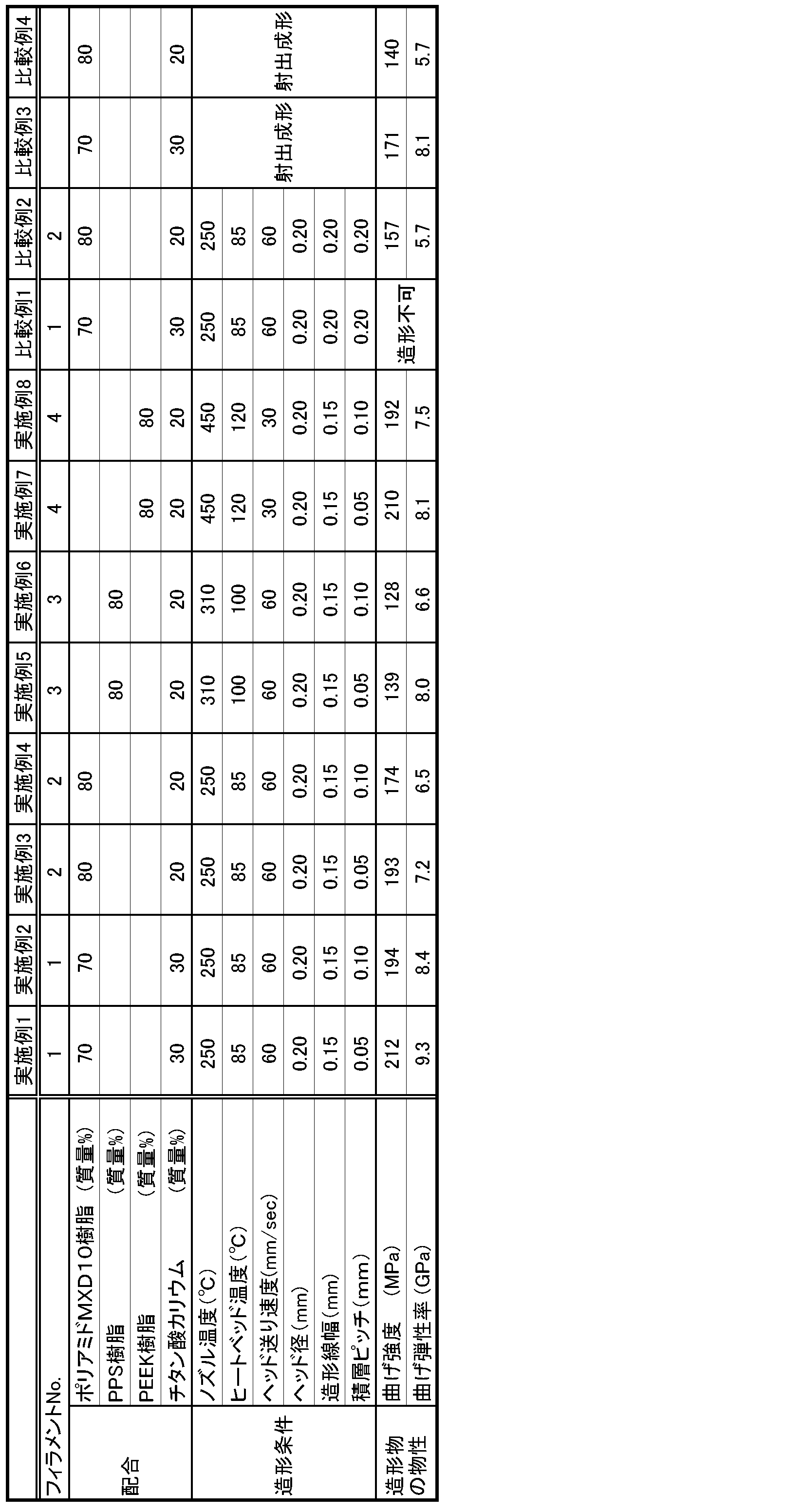

表2及び表3より、実施例1~4では、熱溶解積層方式3次元プリンタで造形する際の積層ピッチを0.20mm未満とし、かつ造形線幅を0.20mm未満とすることにより、機械特性が高められていることがわかる。また、実施例5~8のように、熱可塑性樹脂としてPPS樹脂やPEEK樹脂を用いた場合においても、熱溶解積層方式3次元プリンタで造形する際の積層ピッチを0.20mm未満とし、かつ造形線幅を0.20mm未満とすることにより、積層ピッチ及び造形線幅のうち少なくとも一方が0.20mm以上である場合と比較して、機械特性が高められることが確認されている。
なお、比較例1と比較例2との対比から明らかなように、通常、無機繊維を高充填すると、樹脂組成物の3次元プリンタによる造形は難しい。これに対して、実施例1~8のように、積層ピッチを0.20mm未満とし、かつ造形線幅を0.20mm未満とすると、3次元プリンタによる造形が可能となり、優れた機械特性を付与することができるという予期せぬ効果が奏されることがわかる。
Claims (11)
- 平均繊維長1μm~300μm、かつ平均アスペクト比3~200である無機繊維と、熱可塑性樹脂とを含有する樹脂組成物を準備する工程と、
前記樹脂組成物を用いて、熱溶解積層方式3次元プリンタで造形することにより、造形物を製造する工程と、
を備え、
前記熱溶解積層方式3次元プリンタで造形する際の積層ピッチが0.20mm未満であり、かつ造形線幅が0.20mm未満である、造形物の製造方法。 - 前記熱可塑性樹脂のMFR値をMFR1とし、前記樹脂組成物のMFR値をMFR2としたときに、MFR2/MFR1で表されるMFRの比が、0.10以上、0.90以下である、請求項1に記載の造形物の製造方法。
- 前記無機繊維の含有量が、前記樹脂組成物の合計量100質量%中において、1質量%以上、45質量%以下である、請求項1又は2に記載の造形物の製造方法。
- 造形速度が、20mm/秒以上、200mm/秒以下である、請求項1~3のいずれか一項に記載の造形物の製造方法。
- 前記無機繊維のモース硬度が5以下である、請求項1~4のいずれか一項に記載の造形物の製造方法。
- 前記無機繊維が、チタン酸カリウム及びワラストナイトのうち少なくとも一方である、請求項1~5のいずれか一項に記載の造形物の製造方法。
- 前記熱可塑性樹脂が、ポリオレフィン樹脂、ポリスチレン系樹脂、ポリエステル系樹脂、ポリアセタール樹脂、ポリカーボネート樹脂、脂肪族ポリアミド樹脂、半芳香族ポリアミド樹脂、ポリフェニレンサルファイド樹脂、ポリエーテルイミド樹脂、及びポリエーテルエーテルケトン樹脂からなる群から選ばれる少なくとも1種である、請求項1~6のいずれか一項に記載の造形物の製造方法。
- 請求項1~7のいずれか一項に記載の造形物の製造方法により得られた、造形物。
- 平均繊維長1μm~300μm、かつ平均アスペクト比3~200である無機繊維と、熱可塑性樹脂とを含有する樹脂組成物により構成される、熱溶解積層方式3次元プリント造形物であって、
前記造形物の積層ピッチが0.20mm未満であり、かつ造形線幅が0.20mm未満である、造形物。 - 前記熱可塑性樹脂のMFR値をMFR1とし、前記樹脂組成物のMFR値をMFR2としたときに、MFR2/MFR1で表されるMFRの比が、0.10以上、0.90以下である、請求項9に記載の造形物。
- 前記無機繊維の含有量が、前記樹脂組成物の合計量100質量%中において、1質量%以上、45質量%以下である、請求項9又は10に記載の造形物。
Priority Applications (4)
| Application Number | Priority Date | Filing Date | Title |
|---|---|---|---|
| US17/924,232 US20230173745A1 (en) | 2020-06-29 | 2021-06-17 | Modeled object and method for producing same |
| CN202180033173.1A CN115515774B (zh) | 2020-06-29 | 2021-06-17 | 造型物及其制造方法 |
| JP2021568961A JP7004880B1 (ja) | 2020-06-29 | 2021-06-17 | 造形物及びその製造方法 |
| EP21833876.2A EP4174128A4 (en) | 2020-06-29 | 2021-06-17 | Modeled object and method for producing same |
Applications Claiming Priority (2)
| Application Number | Priority Date | Filing Date | Title |
|---|---|---|---|
| JP2020-111636 | 2020-06-29 | ||
| JP2020111636 | 2020-06-29 |
Publications (1)
| Publication Number | Publication Date |
|---|---|
| WO2022004405A1 true WO2022004405A1 (ja) | 2022-01-06 |
Family
ID=79316079
Family Applications (1)
| Application Number | Title | Priority Date | Filing Date |
|---|---|---|---|
| PCT/JP2021/023007 Ceased WO2022004405A1 (ja) | 2020-06-29 | 2021-06-17 | 造形物及びその製造方法 |
Country Status (6)
| Country | Link |
|---|---|
| US (1) | US20230173745A1 (ja) |
| EP (1) | EP4174128A4 (ja) |
| JP (1) | JP7004880B1 (ja) |
| CN (1) | CN115515774B (ja) |
| TW (1) | TWI881142B (ja) |
| WO (1) | WO2022004405A1 (ja) |
Cited By (2)
| Publication number | Priority date | Publication date | Assignee | Title |
|---|---|---|---|---|
| WO2023139865A1 (ja) * | 2022-01-24 | 2023-07-27 | 株式会社日立製作所 | 樹脂材料、積層造形物の製造方法、及び再生樹脂のアップサイクル方法 |
| WO2024048380A1 (ja) * | 2022-08-29 | 2024-03-07 | 株式会社Adeka | 難燃性積層造形物の製造方法および難燃性積層造形物 |
Citations (3)
| Publication number | Priority date | Publication date | Assignee | Title |
|---|---|---|---|---|
| WO2018043231A1 (ja) | 2016-08-30 | 2018-03-08 | 大塚化学株式会社 | 樹脂組成物、3次元プリンタ用フィラメント及び樹脂粉末、並びに造形物及びその製造方法 |
| US20190062523A1 (en) * | 2017-08-31 | 2019-02-28 | Intel Corporation | Carbon / nanotube graphene conductive elastomeric polymer compound |
| WO2019044864A1 (ja) * | 2017-09-04 | 2019-03-07 | 大塚化学株式会社 | 造形物及びその製造方法 |
Family Cites Families (10)
| Publication number | Priority date | Publication date | Assignee | Title |
|---|---|---|---|---|
| JPS61215011A (ja) * | 1985-03-20 | 1986-09-24 | Tokai Carbon Co Ltd | 配向性ウイスカ−強化樹脂シ−トの製造方法 |
| JPS63134219A (ja) * | 1986-11-25 | 1988-06-06 | Inax Corp | 繊維強化成形体の製造法およびその装置 |
| US7910041B1 (en) * | 2006-11-27 | 2011-03-22 | Stratasys, Inc. | Build materials containing nanofibers for use with extrusion-based layered depositions systems |
| US20190344496A1 (en) * | 2016-12-20 | 2019-11-14 | 3M Innovative Properties Company | Composition including fluoropolymer and inorganic filler and method of making a three-dimensional article |
| JP7010243B2 (ja) * | 2017-01-12 | 2022-01-26 | コニカミノルタ株式会社 | 樹脂組成物、およびこれを用いた立体造形物の製造方法 |
| JP6811637B2 (ja) * | 2017-02-14 | 2021-01-13 | 東京インキ株式会社 | 立体造形装置用樹脂成形材料および立体造形装置用フィラメント |
| EP3645244B1 (en) * | 2017-06-29 | 2022-01-19 | Signify Holding B.V. | Fdm printed luminaires with surface texture |
| US11608427B2 (en) * | 2017-10-31 | 2023-03-21 | Unitika Ltd. | Resin composition for shaping material of fused deposition modeling method-3D printer and filamentary molded body thereof |
| EP3616915A1 (en) * | 2018-08-29 | 2020-03-04 | 3M Innovative Properties Company | 3d printed component part comprising a composite material of a thermoplastically workable material and boron nitride, method for making a 3d printed component part and use of a 3d printed component part |
| EP3860826B1 (en) * | 2018-10-01 | 2026-05-20 | Signify Holding Bv | METHOD FOR PRINTING OBJECTS HAVING INCLINATION ANGLES OF LESS THAN 45° WITH RESPECT TO A BUILDING PLATE |
-
2021
- 2021-06-17 CN CN202180033173.1A patent/CN115515774B/zh active Active
- 2021-06-17 JP JP2021568961A patent/JP7004880B1/ja active Active
- 2021-06-17 EP EP21833876.2A patent/EP4174128A4/en active Pending
- 2021-06-17 WO PCT/JP2021/023007 patent/WO2022004405A1/ja not_active Ceased
- 2021-06-17 US US17/924,232 patent/US20230173745A1/en active Pending
- 2021-06-21 TW TW110122549A patent/TWI881142B/zh active
Patent Citations (3)
| Publication number | Priority date | Publication date | Assignee | Title |
|---|---|---|---|---|
| WO2018043231A1 (ja) | 2016-08-30 | 2018-03-08 | 大塚化学株式会社 | 樹脂組成物、3次元プリンタ用フィラメント及び樹脂粉末、並びに造形物及びその製造方法 |
| US20190062523A1 (en) * | 2017-08-31 | 2019-02-28 | Intel Corporation | Carbon / nanotube graphene conductive elastomeric polymer compound |
| WO2019044864A1 (ja) * | 2017-09-04 | 2019-03-07 | 大塚化学株式会社 | 造形物及びその製造方法 |
Non-Patent Citations (1)
| Title |
|---|
| See also references of EP4174128A4 |
Cited By (2)
| Publication number | Priority date | Publication date | Assignee | Title |
|---|---|---|---|---|
| WO2023139865A1 (ja) * | 2022-01-24 | 2023-07-27 | 株式会社日立製作所 | 樹脂材料、積層造形物の製造方法、及び再生樹脂のアップサイクル方法 |
| WO2024048380A1 (ja) * | 2022-08-29 | 2024-03-07 | 株式会社Adeka | 難燃性積層造形物の製造方法および難燃性積層造形物 |
Also Published As
| Publication number | Publication date |
|---|---|
| TW202212108A (zh) | 2022-04-01 |
| JP7004880B1 (ja) | 2022-01-21 |
| TWI881142B (zh) | 2025-04-21 |
| CN115515774B (zh) | 2026-02-27 |
| US20230173745A1 (en) | 2023-06-08 |
| CN115515774A (zh) | 2022-12-23 |
| EP4174128A1 (en) | 2023-05-03 |
| EP4174128A4 (en) | 2024-07-31 |
| JPWO2022004405A1 (ja) | 2022-01-06 |
Similar Documents
| Publication | Publication Date | Title |
|---|---|---|
| KR102518995B1 (ko) | 조형물 및 그의 제조 방법 | |
| US11718732B2 (en) | Resin composition, filament and resin powder for three-dimensional printer, and shaped object and production process therefor | |
| JP7004880B1 (ja) | 造形物及びその製造方法 | |
| US20100207071A1 (en) | Method of selectively controlling surface properties of thermoplastic polymer articles | |
| JP6937385B2 (ja) | 複合積層体及びその製造方法 | |
| JP2021062495A (ja) | 複合積層体及びその製造方法 | |
| JP6759491B1 (ja) | 複合積層体及びその製造方法 | |
| WO2020235343A1 (ja) | 複合積層体及びその製造方法 | |
| JP2022117614A (ja) | 複合積層体及びその製造方法 | |
| JP2025100035A (ja) | 複合積層体及びその製造方法 | |
| WO2024204368A1 (ja) | 3次元造形用材料、成形体及びその製造方法 |
Legal Events
| Date | Code | Title | Description |
|---|---|---|---|
| ENP | Entry into the national phase |
Ref document number: 2021568961 Country of ref document: JP Kind code of ref document: A |
|
| 121 | Ep: the epo has been informed by wipo that ep was designated in this application |
Ref document number: 21833876 Country of ref document: EP Kind code of ref document: A1 |
|
| NENP | Non-entry into the national phase |
Ref country code: DE |
|
| ENP | Entry into the national phase |
Ref document number: 2021833876 Country of ref document: EP Effective date: 20230130 |