WO2022009985A1 - 2-クロロ-1,1-ジフルオロエタン(hcfc-142)、1,1,2-トリフルオロエタン(hfc-143)、及び(e)-1,2-ジフルオロエチレン(hfo-1132(e))及び/又は(z)-1,2-ジフルオロエチレン(hfo-1132(z))の製造方法 - Google Patents
2-クロロ-1,1-ジフルオロエタン(hcfc-142)、1,1,2-トリフルオロエタン(hfc-143)、及び(e)-1,2-ジフルオロエチレン(hfo-1132(e))及び/又は(z)-1,2-ジフルオロエチレン(hfo-1132(z))の製造方法 Download PDFInfo
- Publication number
- WO2022009985A1 WO2022009985A1 PCT/JP2021/025945 JP2021025945W WO2022009985A1 WO 2022009985 A1 WO2022009985 A1 WO 2022009985A1 JP 2021025945 W JP2021025945 W JP 2021025945W WO 2022009985 A1 WO2022009985 A1 WO 2022009985A1
- Authority
- WO
- WIPO (PCT)
- Prior art keywords
- hcfc
- reaction
- hydrogen fluoride
- chlorine
- stabilizer
- Prior art date
- Legal status (The legal status is an assumption and is not a legal conclusion. Google has not performed a legal analysis and makes no representation as to the accuracy of the status listed.)
- Ceased
Links
Classifications
-
- C—CHEMISTRY; METALLURGY
- C07—ORGANIC CHEMISTRY
- C07C—ACYCLIC OR CARBOCYCLIC COMPOUNDS
- C07C17/00—Preparation of halogenated hydrocarbons
- C07C17/07—Preparation of halogenated hydrocarbons by addition of hydrogen halides
- C07C17/087—Preparation of halogenated hydrocarbons by addition of hydrogen halides to unsaturated halogenated hydrocarbons
-
- C—CHEMISTRY; METALLURGY
- C07—ORGANIC CHEMISTRY
- C07C—ACYCLIC OR CARBOCYCLIC COMPOUNDS
- C07C17/00—Preparation of halogenated hydrocarbons
- C07C17/093—Preparation of halogenated hydrocarbons by replacement by halogens
- C07C17/20—Preparation of halogenated hydrocarbons by replacement by halogens of halogen atoms by other halogen atoms
- C07C17/202—Preparation of halogenated hydrocarbons by replacement by halogens of halogen atoms by other halogen atoms two or more compounds being involved in the reaction
- C07C17/206—Preparation of halogenated hydrocarbons by replacement by halogens of halogen atoms by other halogen atoms two or more compounds being involved in the reaction the other compound being HX
-
- C—CHEMISTRY; METALLURGY
- C07—ORGANIC CHEMISTRY
- C07C—ACYCLIC OR CARBOCYCLIC COMPOUNDS
- C07C17/00—Preparation of halogenated hydrocarbons
- C07C17/25—Preparation of halogenated hydrocarbons by splitting-off hydrogen halides from halogenated hydrocarbons
Definitions
- the present disclosure discloses 2-chloro-1,1-difluoroethane (HCFC-142), 1,1,2-trifluoroethane (HFC-143), and (E) -1,2-difluoroethylene (HFO-1132). E)) and / or a method for producing (Z) -1,2-difluoroethylene (HFO-1132 (Z)).
- Patent Document 1 discloses a method for producing HCFC-142 from 1,1,2-trichloroethane (HCC-140) and / or 1,2-dichloroethylene (HCO-1130).
- Patent Document 2 discloses iodine carbon and a heat transfer composition containing a diene-based compound for stabilizing iodine carbon against decomposition.
- the object of the present disclosure is to provide a method for suppressing the decomposition of raw materials such as HCC-140 and HCO-1130 and producing the target product HCFC-142 in high yield and efficiently.
- the stabilizer is at least one stabilizer selected from the group consisting of hydroquinone-based stabilizers, unsaturated alcohol-based stabilizers, nitro-based stabilizers, amine-based stabilizers, phenol-based stabilizers, and epoxy-based stabilizers.
- Item 3 The production method according to Item 1 or 2, wherein the molar ratio of hydrogen fluoride to the chlorine-containing compound in the fluorination reaction is 1 or more.
- Item 4 The production method according to any one of claims 1 to 3, wherein the fluorination reaction is carried out in the presence of a catalyst.
- Item 5 The production method according to Item 4, wherein the catalyst is a catalyst containing at least a part of chromium.
- Item 6. The production method according to any one of Items 1 to 5, wherein the fluorination reaction is carried out under a pressure condition of 0 MPaG to 2 MPaG.
- Item 7. The production method according to Item 6, wherein the fluorination reaction is carried out under temperature conditions of 150 ° C to 600 ° C.
- the fluorination reaction is carried out in the gas phase, and the contact time W / Fo between the chlorine-containing compound and the hydrogen fluoride is 0.1 g ⁇ sec / cc to 100 g ⁇ sec / cc.
- the manufacturing method according to any one.
- HFC-143 A method for producing 1,1,2-trifluoroethane (HFC-143).
- HFC-143 which comprises a step of carrying out a fluorination reaction by further contacting HCFC-142 contained in the reaction gas obtained by the production method according to any one of Items 1 to 8 with hydrogen fluoride.
- Item 10 A method for producing (E) -1,2-difluoroethylene (HFO-1132 (E)) and / or (Z) -1,2-difluoroethylene (HFO-1132 (Z)).
- the pressure shall be gauge pressure unless otherwise noted.
- HCFC-142 According to the method for producing HCFC-142 disclosed in the present disclosure, it is possible to suppress the decomposition of raw materials such as HCC-140 and HCO-1130, and to produce HCFC-142 in good yield and efficiently.
- HCC-140 CH 2 ClCHCl 2
- HCO-1130 E / Z
- CHCl CHCl
- HCC-140 HCO-1130 (E / Z), etc. affects the conversion rate and selectivity in the production of HCFC-142.
- the method for producing 2-chloro-1,1-difluoroethane (HCFC-142) of the present disclosure is 1,1,2-trichloroethene (HCC-140), (E) -1,2-dichloroethylene (HCO-1130 (E). )), (Z) -1,2-dichloroethylene (HCO-1130 (Z)), 1,2-dichloro-1-fluoroethane (HCFC-141), (E) -1-chloro-2-fluoroethylene (E) At least one chlorine-containing compound selected from the group consisting of HCFO-1131 (E)) and (Z) -1-chloro-2-fluoroethylene (HCFO-1131 (Z)) was added in the presence of a stabilizer. It comprises a step of carrying out one or more fluorination reactions by contacting with hydrogen fluoride, and is characterized by obtaining a reaction gas containing HCFC-142, hydrogen chloride, and hydrogen fluoride.
- HCFC-142 According to the method for producing HCFC-142 of the present disclosure having the above-mentioned characteristics, decomposition of raw materials such as HCC-140 and HCO-1130 is prevented, the catalyst life is extended when a catalyst is used, and the formation of by-products is prevented. HCFC-142 can be produced efficiently with good yield.
- the raw material compound is at least selected from the group consisting of HCC-140, HCO-1130 (E / Z), HCFC-141, and HCFO-1131 (E / Z).
- a kind of chlorine-containing compound is used.
- (E / Z) means to include an E body (trans body) and / or a Z body (cis body).
- chlorine-containing compounds from the viewpoint of raw material cost, it is preferably at least one of HCC-140 and HCO-1130 (E / Z), and more preferably HCO-1130 (E / Z).
- the chlorine-containing compound is brought into contact with hydrogen fluoride in the presence of a stabilizer.
- a stabilizer decomposition of chlorine-containing compounds such as HCC-140 and HCO-1130 (E / Z), which are raw materials, is prevented, and when a catalyst is used, the catalyst life is extended and the production of by-products is suppressed.
- HCFC-142 can be produced efficiently with good yield.
- the stabilizer is preferably at least one selected from the group consisting of hydroquinone-based stabilizers, unsaturated alcohol-based stabilizers, nitro-based stabilizers, amine-based stabilizers, phenol-based stabilizers, epoxy-based stabilizers, and others. Use seed stabilizers.
- hydroquinone-based stabilizer preferably, at least one hydroquinone-based stabilizer selected from the group consisting of hydroquinone monomethyl ether (MEHQ), methoxyhydroquinone, and methylhydroquinone is used.
- MEHQ hydroquinone monomethyl ether
- methoxyhydroquinone methoxyhydroquinone
- methylhydroquinone is used.
- 3-butene-2-ol, 2-butene-1-ol, 4-propen-1-ol, 1-propen-3-ol, 2-methyl-3-butene are preferable.
- -2-ol, 3-methyl-3-butene-2-ol, 3-methyl-2-butene-1-ol, 2-hexen-1-ol, 2,4-hexadiene-1-ol, and oleyl alcohol At least one unsaturated alcohol-based stabilizer selected from the group consisting of is used.
- the nitro-based stabilizer is preferably an aliphatic nitro compound such as nitromethane, nitroethane, 1-nitropropane, 2-nitropropane; nitrobenzene, o-, m- or p-dinitrobenzene, o-, m- or p-. At least selected from the group consisting of aromatic nitro compounds such as nitrotoluene, dimethylnitrobenzene, m-nitroacetophenone, o-, m- or p-nitrophenol, o-nitroanisole, m-nitroanisole, and p-nitroanisole. Use one nitro-based stabilizer.
- amine-based stabilizer preferably pentylamine, hexylamine, diisopropylamine, diisobutylamine, di-n-propylamine, diallylamine, N-methylaniline, pyridine, morpholine, N-methylmorpholine, triallylamine, allylamine, ⁇ -Methylbenzylamine, dimethylamine, trimethylamine, ethylamine, diethylamine, triethylamine, propylamine, isopropylamine, dipropylamine, tripropylamine, butylamine, isobutylamine, dibutylamine, tributylamine, diventylamine, triventylamine, 2 -Select from the group consisting of ethylhexylamine, aniline, N, N-dimethylaniline, N, N-diethylaniline, ethylenediamine, propylenediamine, diethylenetriamine, t
- Phenol-based stabilizers are preferably from 2,6-diterminate butyl-4-methylphenol, 3-cresol, phenol, 1,2-benzenediol, 2-isopropyl-5-methylphenol, and 2-methoxyphenol. At least one phenolic stabilizer selected from the group is used.
- the epoxy stabilizer is preferably a group consisting of butylene oxide, 1,2-propylene oxide, 1,2-butylene oxide, butyl glycidyl ether, diethylene glycol diglycidyl ether, and 1,2-epoxy-3-phenoxypropane.
- At least one stabilizer selected from the group consisting of butylhydroxytoluene, butylhydroxyanisole, 2-propanol, and ⁇ -pinene is used.
- the stabilizer is preferably at least one selected from the group consisting of hydroquinone-based stabilizers, unsaturated alcohol-based stabilizers, nitro-based stabilizers, amine-based stabilizers, phenol-based stabilizers, and epoxy-based stabilizers. It is a stabilizer, more preferably at least one hydroquinone-based stabilizer selected from the group consisting of hydroquinone monomethyl ether (MEHQ), methoxyhydroquinone, and methylhydroquinone, and even more preferably hydroquinone monomethyl ether (MEHQ). Is.
- the amount (content) of the stabilizer used is preferably about 10 ppm to 50,000 ppm, more preferably about 20 ppm to 1,000 ppm, as the weight ratio of the stabilizer to the chlorine-containing compound (raw material compound). It is more preferably about 30 ppm to 500 ppm, and particularly preferably about 80 ppm to 115 ppm.
- HCC-140 and HCO-1130 E / Z
- HCFC-142 can be produced efficiently with good yield and prevention.
- the production method of the present disclosure includes a step of carrying out one or more fluorination reactions by contacting the above chlorine-containing compound with hydrogen fluoride, and includes HCFC-142, hydrogen chloride, and fluoride. It is characterized by obtaining a reaction gas containing hydrogen.
- the fluorination reaction with hydrogen fluoride may be a gas phase reaction or a liquid phase reaction. Further, the fluorination reaction required to obtain HCFC-142 may be one or two or more depending on the chlorine-containing compound used.
- the pressure shall be gauge pressure unless otherwise noted.
- the chlorine-containing compound and hydrogen fluoride can come into contact with each other in a gaseous state in the reaction temperature region described later, and the chlorine-containing compound may be in a liquid state when the chlorine-containing compound is supplied.
- the chlorine-containing compound when the chlorine-containing compound is liquid at room temperature and normal pressure, the chlorine-containing compound is vaporized using a vaporizer, passed through a preheating region, and supplied to a mixed region in contact with hydrogen fluoride. Allows the reaction to take place in the gas phase. Further, the chlorine-containing compound may be supplied to the reactor in a liquid state and vaporized to react when it reaches the reaction region with hydrogen fluoride.
- anhydrous hydrogen fluoride is preferably used because it can suppress corrosion of the reactor and deterioration of the catalyst.
- the method for vaporizing the chlorine-containing compound in the reaction region is not particularly limited, and a known method can be widely adopted.
- a material having good thermal conductivity such as nickel beads and hasteloy pieces, having no catalytic activity in a fluorination reaction, and being stable against hydrogen fluoride is filled in the reaction tube to change the temperature distribution in the reaction tube. It may be made uniform, heated to a temperature higher than the vaporization temperature of the chlorine-containing compound, and the chlorine-containing compound in a liquid state may be supplied to vaporize the compound to bring it into a vapor phase state.
- the method of supplying hydrogen fluoride to the reactor is not particularly limited, and examples thereof include a method of supplying hydrogen fluoride to the reactor in a vapor phase state together with a chlorine-containing compound.
- the molar ratio of hydrogen fluoride to the chlorine-containing compound is preferably hydrogen fluoride to the chlorine-containing compound (1 mol).
- the molar ratio of fluorine is 1 or more, more preferably 5 or more, still more preferably 10 or more.
- the upper limit of the molar ratio is not limited, but is preferably about 60 from the viewpoint of energy cost and productivity.
- the conversion rate of the chlorine-containing compound and / or the selectivity of HCFC-142 can be maintained within a more efficient (good) range than the conventional method.
- the chlorine-containing compound as a raw material compound may be supplied to the reactor as it is, or may be diluted with an inert gas such as nitrogen, helium or argon and supplied.
- the fluorination reaction is preferably carried out in the presence of a catalyst.
- a known gas phase fluorination catalyst can be widely adopted, and there is no particular limitation.
- examples include oxides of chromium, aluminum, cobalt, manganese, nickel and iron, hydroxides, halides, halogen oxides, inorganic salts and mixtures thereof.
- the catalyst is preferably CrO 2 , Cr 2 O 3 , FeCl 3 / C, Cr 2 O 3 / Al 2 O 3 , Cr 2 O 3 / in order to improve the conversion rate of the chlorine-containing compound.
- Chromium-based catalysts such as AlF 3 , Cr 2 O 3 / C, and CoCl 2 / Cr 2 O 3 are used.
- Chromium oxide / aluminum oxide catalysts are those described in US Pat. No. 5,150,082, that is, chromium oxide / aluminum oxide catalysts (eg, Cr 2 O 3 / Al 2 O 3 ) and cobalt.
- chromium oxide / aluminum oxide catalysts eg, Cr 2 O 3 / Al 2 O 3
- a composite of a halide of nickel, manganese, rhodium, and ruthenium can be preferably used.
- a catalyst that is partially or wholly crystallized may be used, or an amorphous catalyst may be used, and the crystallinity can be appropriately selected.
- chromium oxide is commercially available in various particle sizes. Further, in order to control the particle size and crystallinity, it may be prepared by precipitating chromium hydroxide from chromium nitrate and ammonia and then firing the mixture.
- the above catalyst may be used alone or a mixture thereof.
- a catalyst in which a catalyst having a different preparation method or composition is mixed with a catalyst such as a purchased product or a preparation may be used.
- activated carbons magnesium oxide, zirconia oxide, alumina and the like can be used as the carrier.
- the chromium-based catalyst when the above-mentioned chromium-based catalyst is used, the chromium-based catalyst may be subjected to a fluorination treatment using anhydrous hydrofluoric acid, a fluorine-containing compound, or the like before being used in the fluorination reaction, and in particular, fluorine may be used with anhydrous hydrofluoric acid. It is preferable to carry out a chemical treatment.
- the reaction temperature in the vapor phase fluorination reaction is preferably about 150 ° C. to 600 ° C., more preferably 200 ° C. as the temperature in the reactor. It is about 500 ° C., more preferably about 230 ° C. to 400 ° C.
- the reaction temperature is set to about 150 ° C. or higher, the selectivity of the target product can be improved.
- the reaction temperature is set to about 600 ° C. or lower, there is a risk that carbides are generated by the reaction and the carbides adhere to and / or deposit on the reaction tube wall and the filler to gradually block the reactor. Can be reduced.
- the carbides remaining in the reaction tube should be burned off by entraining oxygen in the reaction system or by temporarily stopping the reaction and allowing oxygen or air to flow. Can be done.
- the oxygen concentration in the fluorination reaction is preferably about 0.1 mol% to 30 mol%, preferably about 0.1 mol% to 30 mol%, based on the chlorine-containing compound of the raw material compound. It is about 0.5 mol% to 20 mol%, more preferably about 1 mol% to 15 mol%.
- the reaction pressure in the gas phase fluorination reaction is not particularly limited as long as the chlorine-containing compound and hydrogen fluoride can exist in the gas phase state, and is applied under normal pressure. It may be under reduced pressure or reduced pressure. For example, it can be carried out under reduced pressure or atmospheric pressure (0 MPaG), and can also be carried out under pressure to the extent that the raw material does not become liquid.
- the pressure condition is preferably in the range of about 0 MPaG to 2 MPaG, and more preferably in the range of about 0.2 MPaG to 1 MPaG.
- the reaction time in the gas phase fluorination reaction is not particularly limited, but usually, the total flow rate of the raw material gas flowing through the reaction system Fo (0 ° C., 0 MPaG).
- the contact time expressed by W / Fo is preferably about 0.1 g ⁇ sec / cc to 100 g ⁇ sec / cc, more preferably. Is about 5 g ⁇ sec / cc to 50 g ⁇ sec / cc.
- the total flow rate of the raw material gas is the total flow rate of the chlorine-containing compound and hydrogen fluoride used as the raw material, plus these flow rates when an inert gas, oxygen, etc. is used. be.
- (3-2) Liquid phase reaction in the production method of the present disclosure, when the fluorination reaction is carried out in the liquid phase in the presence of a catalyst, a known liquid phase fluorination catalyst can be adopted, and there is no particular limitation. .. Specifically, one or more selected from the group consisting of Lewis acid, transition metal halides, transition metal oxides, metal halides of the genus IVb, and metal halides of the genus Vb can be used.
- the catalyst is preferably antimony halide, tin halide, tantalum halide, titanium halide, niobium halide, molybdenum halide, iron halide, chromium fluoride halide, and chromium fluoride.
- antimony halide tin halide, tantalum halide, titanium halide, niobium halide, molybdenum halide, iron halide, chromium fluoride halide, and chromium fluoride.
- the catalyst is more preferably prepared from SbCl 5 , SbCl 3 , SbF 5 , SnCl 4 , TaCl 5 , TiCl 4 , NbCl 5 , MoCl 6 , FeCl 3 , and chloride salts and hydrogen fluoride.
- one type may be used alone, or a plurality of types may be mixed and used.
- it preferably contains an antimony catalyst, and more preferably contains antimony trichloride.
- these catalysts When these catalysts become inactive, they can be easily regenerated by a known method.
- a method for regenerating the catalyst a method of bringing chlorine into contact with the catalyst can be adopted. For example, about 0.15 g / hr to 25 g / hr of chlorine can be added to the liquid phase reaction per 100 g of the liquid phase fluorination catalyst.
- the reaction temperature in the liquid phase fluorination reaction is preferably about 50 ° C. to 200 ° C., more preferably 80 ° C. as the temperature in the reaction system. It is about ⁇ 150 ° C. By setting the reaction temperature to 50 ° C. or higher, the selectivity and productivity of the target product can be improved.
- the pressure in the liquid phase fluorination reaction is preferably in the range of about 0 MPaG to 2 MPaG, more preferably in the range of 0 MPaG to 2 MPaG, as in the case of the gas phase reaction. It is in the range of 0.2 MPaG to 1 MPaG.
- the form of the reactor to be used is not particularly limited, and a known reactor can be widely used.
- a tube-type flow reactor filled with a catalyst can be used.
- an adiabatic reactor in an empty tower or a porous or non-porous metal for improving the gas phase mixed state of hydrogen fluoride and a starting material for example, an adiabatic reactor filled with a medium or the like may be used.
- the relationship between the flow rate of a chlorine-containing compound and the inner diameter of the reaction tube has a large linear velocity and transfer. It is preferable to increase the heat area.
- the reactor is preferably made of a material resistant to the corrosive action of hydrogen fluoride, such as Hastelloy, INCONEL, MONEL, and INCOLLOY. Use.
- HCFC-142 can be obtained by various known separation methods. Hydrogen fluoride can also be recycled for the fluorination reaction.
- the above-mentioned HCC-140, HCO-1130 (E / Z), HCFC-141, and HCFO-1131 After the step of carrying out one or more fluorination reactions by contacting at least one chlorine-containing compound (raw material compound) selected from the group consisting of E / Z) with hydrogen fluoride in the presence of a stabilizer, the above-mentioned The chlorine-containing compound (raw material compound) can be recovered and recycled in the reaction.
- HCl hydrogen chloride
- the separated stream which may contain a stabilizer
- a stabilizer containing the chlorine-containing compound (raw material compound) as a main component
- HF hydrogen fluoride
- the method of producing HCFC-142 of the present disclosure uses HCO-1130 (E) (chlorine-containing compound) in the presence of a stabilizer.
- a step of carrying out one or more fluorination reactions by contacting with hydrogen fluoride to obtain a reaction gas containing HCFC-142, hydrogen chloride, and hydrogen fluoride.
- a stream containing hydrogen chloride (HCl) as a main component generated after the reaction is first separated from the reaction gas, and then HCO-1130 (HCO-1130) ( E) Separate the stream containing (the chlorine-containing compound of the raw material compound) as the main component (which may contain a stabilizer), and then separate the stream containing HCFC-142 (the target compound) as the main component.
- HCO-1130 HCO-1130
- the method for producing HCFC-142 of the present disclosure preferably comprises at least a part of a stream (which may contain a stabilizer) containing HCO-1130 (E) (a chlorine-containing compound as a raw material compound) as a main component. It includes the steps of recycling into a reaction and performing one or more fluorination reactions by contacting with hydrogen fluoride again in the presence of a stabilizer (adding a stabilizer if necessary), HCFC-142, chloride. Includes obtaining reaction gases containing hydrogen and hydrogen fluoride.
- HCO-1130 a chlorine-containing compound as a raw material compound
- the method for producing HCFC-142 of the present disclosure includes a step of carrying out one or more fluorination reactions by contacting the above chlorine-containing compound with hydrogen fluoride in the presence of a stabilizer, and HCFC-. Obtain a reaction gas containing 142, hydrogen chloride, and hydrogen fluoride. The obtained HCFC-142 can be used for various purposes after being purified, if necessary.
- the method for producing HCFC-142 of the present disclosure prevents decomposition of chlorine-containing compounds such as HCC-140 and HCO-1130, which are raw materials, by using a stabilizer, prolongs the catalyst life when a catalyst is used, and is a by-product.
- HCFC-142 can be produced efficiently with good yield by suppressing the production of HCFC.
- HCFC-142 can be preferably used as a raw material for producing various refrigerants. Further, HCFC-142 can be preferably used as a raw material for, for example, HFC-143 and HFO-1132 (E / Z).
- the present disclosure further includes the following methods for producing HFC-143 and HFO-1132 (E) and / or HFO-1132 (Z) (HFO-1132 (E / Z)).
- the method for producing HFC-143 of the present disclosure includes a step of subjecting HCFC-142 contained in the reaction gas obtained by the above-mentioned production method to hydrogen fluoride to carry out a fluorination reaction. It is characterized by obtaining a reaction gas containing -143, hydrogen chloride, and hydrogen fluoride.
- the manufacturing method of HFC-143 is not particularly limited, and a known method can be widely adopted.
- the method for producing HFO-1132 (E) and / or HFO-1132 (Z) (HFO-1132 (E / Z)) of the present disclosure is to use HFC-143 contained in the reaction gas obtained by the above production method. It comprises a step of subjecting to a defluorination hydrogen reaction, and is characterized by obtaining HFO-1132 (E / Z).
- the manufacturing method of the HFO-1132 (E / Z) is not particularly limited, and a known method can be widely adopted.
- chromium oxide represented by CrxOy was prepared according to the method described in JP-A-5-146680. Specifically, 10% aqueous ammonia is added to 765 g of a 5.7% chromium nitrate aqueous solution, and the precipitate formed by this is collected by filtration and washed, and then dried in air at 120 ° C. for 12 hours to obtain chromium hydroxide. Obtained.
- This chromium hydroxide was formed into pellets having a diameter of 3.0 mm and a height of 3.0 mm. The pellet was calcined at 400 ° C. for 2 hours in a nitrogen stream to obtain chromium oxide.
- the specific surface area of the obtained chromium oxide (according to the BET method) was about 200 m 2 / g.
- this chromium oxide was subjected to a fluorination treatment to obtain a chromium oxide fluoride catalyst.
- a gas containing hydrogen fluoride is circulated through chromium oxide, heated while gradually raising the temperature from 200 ° C to 360 ° C, and after reaching 360 ° C, it is fluorinated with hydrogen fluoride for 2 hours.
- a chromium oxide fluoride catalyst (Cr 2 O 3 ) was obtained.
- the above reactor was maintained at 280 ° C. under a pressure of 0.6 MPaG (gauge pressure), and anhydrous hydrogen fluoride (HF) gas was reacted at a flow rate of 9.3 mL / min (flow rate at 0 ° C., 0.6 MPaG). It was supplied to the vessel and maintained for 1 hour.
- HF hydrogen fluoride
- MEHQ Hydroquinone Monomethyl Ether
- the molar ratio of HF: HCO-1130 (E) was set to 10: 1.
- the oxygen (O 2 ) concentration was set to a gas containing 10 mol% of the raw material compound (chlorine-containing compound) HCO-1130 (E).
- the contact time was W / Fo 10 g ⁇ sec / cc (g ⁇ sec ⁇ mL -1 ).
- Example 2 Stabilizer Diethylamine is present. Diethylamine is used as the stabilizer, and the reaction conditions are such that the raw material compound (chlorine-containing compound) contains 10 ppm of diethylamine as the weight ratio to HCO-1130 (E). The gas phase fluorination reaction was carried out under the same conditions as in Example 1.
- Example 3 Stabilizer: With 2-propanol In the reactor filled with the above catalyst, the stabilizer 2-propanol is then contained at 200 ppm (weight ratio of the raw material compound (chlorine-containing compound) to HCC-140). CHCl 2- CH 2 Cl (HCC-140)) was supplied at a flow rate of 0.92 mL / min (gas flow rate at 0 ° C. and 0.6 MPaG).
- the molar ratio of HF: HCC-140 was 10: 1.
- the oxygen (O 2 ) concentration was set to a gas containing 10 mol% of the raw material compound (chlorine-containing compound) HCC-140.
- the contact time was W / Fo 10 g ⁇ sec / cc (g ⁇ sec ⁇ mL -1 ).
- the conversion rate of HCC-140 was 95%
- the selectivity of HCFC-142 was 22%
- the selectivity of HFC-143 was 0.2%.
- Example 4 Stabilizer: With 1,2-butylene oxide 1,2-butylene oxide is used as a stabilizer, and 1,2-butylene oxide is used as the weight ratio of the raw material compound (chlorine-containing compound) to HCC-140.
- the vapor phase fluorination reaction was carried out under the same conditions as in Example 3 above, except that the reaction conditions included 500 ppm.
- the amount of HCl in the reaction system can be reduced by preventing the decomposition of HCO-1130 (E) or HCC-140. It can be evaluated that the amount is reduced and the selectivity of HCFC-142 (target compound) and HFC-143 (next target compound) is improved.
- the equilibrium of the reaction is biased towards the fluorination side, that is, from HCO-1130 (E) or HCC-140, or the intermediate product HCFC-141 to HCFC-142. It can be evaluated that the selectivity of HCFC-142, which is the target compound, is improved because it becomes easier to proceed in the direction of formation.
Landscapes
- Chemical & Material Sciences (AREA)
- Organic Chemistry (AREA)
- Chemical Kinetics & Catalysis (AREA)
- Organic Low-Molecular-Weight Compounds And Preparation Thereof (AREA)
- Low-Molecular Organic Synthesis Reactions Using Catalysts (AREA)
Abstract
原料であるHCC-140、HCO-1130等の分解を防ぎ、目的生成物であるHCFC-142を収 率良く、効率的に製造する方法を提供する。 HCFC-142の製造方法であって、含塩素化合物を、安定剤の存在下、フッ化水素と接触させることにより1以上のフッ素化反応を行う工程を含み、HCFC-142、塩化水素 、及びフッ化水素を含む反応ガスを得る、HCFC-142の製造方法。
Description
本開示は、2-クロロ-1,1-ジフルオロエタン(HCFC-142)、1,1,2-トリフルオロエタン(HFC-143)、及び(E)-1,2-ジフルオロエチレン(HFO-1132(E))及び/又は(Z)-1,2-ジフルオロエチレン(HFO-1132(Z))の製造方法に関する。
HCFC-142等のフルオロエタンの製造方法としては、従来種々の方法が提案されている。
特許文献1には、1,1,2-トリクロロエタン(HCC-140)及び/又は1,2-ジクロロエチレン(HCO-1130)からHCFC-142を製造する方法が開示されている。
また、特許文献2には、ヨードカーボン、及びヨードカーボンを分解に対して安定化する為のジエンベース化合物を含む熱伝達組成物が開示されている。
本開示は、原料であるHCC-140、HCO-1130等の分解を抑制し、目的生成物であるHCFC-142を収率良く、効率的に製造する方法を提供することを目的とする。
本開示は、以下の項に記載の発明を包含する。
項1.
2-クロロ-1,1-ジフルオロエタン(HCFC-142)の製造方法であって、
1,1,2-トリクロロエタン(HCC-140)、(E)-1,2-ジクロロエチレン(HCO-1130(E))、(Z)-1,2-ジクロロエチレン(HCO-1130(Z))、1,2-ジクロロ-1-フルオロエタン(HCFC-141)、(E)-1-クロロ-2-フルオロエチレン(HCFO-1131(E))、及び(Z)-1-クロロ-2-フルオロエチレン(HCFO-1131(Z))からなる群から選択される少なくとも一種の含塩素化合物を、安定剤の存在下、フッ化水素と接触させることにより1以上のフッ素化反応を行う工程を含み、HCFC-142、塩化水素、及びフッ化水素を含む反応ガスを得る、
HCFC-142の製造方法。
2-クロロ-1,1-ジフルオロエタン(HCFC-142)の製造方法であって、
1,1,2-トリクロロエタン(HCC-140)、(E)-1,2-ジクロロエチレン(HCO-1130(E))、(Z)-1,2-ジクロロエチレン(HCO-1130(Z))、1,2-ジクロロ-1-フルオロエタン(HCFC-141)、(E)-1-クロロ-2-フルオロエチレン(HCFO-1131(E))、及び(Z)-1-クロロ-2-フルオロエチレン(HCFO-1131(Z))からなる群から選択される少なくとも一種の含塩素化合物を、安定剤の存在下、フッ化水素と接触させることにより1以上のフッ素化反応を行う工程を含み、HCFC-142、塩化水素、及びフッ化水素を含む反応ガスを得る、
HCFC-142の製造方法。
項2.
前記安定剤は、ヒドロキノン系安定剤、不飽和アルコール系安定剤、ニトロ系安定剤、アミン系安定剤、フェノール系安定剤、及びエポキシ系安定剤からなる群から選択される少なくとも1種の安定剤である、前記項1に記載の製造方法。
前記安定剤は、ヒドロキノン系安定剤、不飽和アルコール系安定剤、ニトロ系安定剤、アミン系安定剤、フェノール系安定剤、及びエポキシ系安定剤からなる群から選択される少なくとも1種の安定剤である、前記項1に記載の製造方法。
項3.
前記フッ素化反応における前記含塩素化合物に対する前記フッ化水素のモル比は、1以上である、前記項1又は2に記載の製造方法。
前記フッ素化反応における前記含塩素化合物に対する前記フッ化水素のモル比は、1以上である、前記項1又は2に記載の製造方法。
項4.
前記フッ素化反応は、触媒存在下で行う、請求項1~3のいずれかに記載の製造方法。
前記フッ素化反応は、触媒存在下で行う、請求項1~3のいずれかに記載の製造方法。
項5.
前記触媒は、少なくとも一部がクロムを含む触媒である、前記項4に記載の製造方法。
前記触媒は、少なくとも一部がクロムを含む触媒である、前記項4に記載の製造方法。
項6.
前記フッ素化反応は、0 MPaG~2 MPaGの圧力条件で行う、前記項1~5のいずれかに記載の製造方法。
前記フッ素化反応は、0 MPaG~2 MPaGの圧力条件で行う、前記項1~5のいずれかに記載の製造方法。
項7.
前記フッ素化反応は、150℃~600℃の温度条件で行う、前記項6に記載の製造方法。
前記フッ素化反応は、150℃~600℃の温度条件で行う、前記項6に記載の製造方法。
項8.
前記フッ素化反応は、気相で行い、前記含塩素化合物と前記フッ化水素との接触時間W/Foは、0.1g・sec/cc~100g・sec/ccである、前記項1~7のいずれかに記載の製造方法。
前記フッ素化反応は、気相で行い、前記含塩素化合物と前記フッ化水素との接触時間W/Foは、0.1g・sec/cc~100g・sec/ccである、前記項1~7のいずれかに記載の製造方法。
項9.
1,1,2-トリフルオロエタン(HFC-143)の製造方法であって、
前記項1~8のいずれかに記載の製造方法により得た前記反応ガスに含まれるHCFC-142を、更に、フッ化水素と接触させることによりフッ素化反応を行う工程を含み、HFC-143、
塩化水素、及びフッ化水素を含む反応ガスを得る、
HFC-143の製造方法。
1,1,2-トリフルオロエタン(HFC-143)の製造方法であって、
前記項1~8のいずれかに記載の製造方法により得た前記反応ガスに含まれるHCFC-142を、更に、フッ化水素と接触させることによりフッ素化反応を行う工程を含み、HFC-143、
塩化水素、及びフッ化水素を含む反応ガスを得る、
HFC-143の製造方法。
項10.
(E)-1,2-ジフルオロエチレン(HFO-1132(E))及び/又は(Z)-1,2-ジフルオロエチレン(HFO-1132(Z))の製造方法であって、
前記項9に記載の製造方法により得た前記反応ガスに含まれるHFC-143を、脱フッ化水素反応に供する工程を含む、HFO-1132(E)及び/又はHFO-1132(Z)の製造方法。
(E)-1,2-ジフルオロエチレン(HFO-1132(E))及び/又は(Z)-1,2-ジフルオロエチレン(HFO-1132(Z))の製造方法であって、
前記項9に記載の製造方法により得た前記反応ガスに含まれるHFC-143を、脱フッ化水素反応に供する工程を含む、HFO-1132(E)及び/又はHFO-1132(Z)の製造方法。
本明細書では、次の通り記す。
1,1,2-トリクロロエタン:HCC-140
(E)及び/又は(Z)-1,2-ジクロロエチレン:HCO-1130(E/Z)
(E)-1,2-ジクロロエチレン:HCO-1130(E)
(Z)-1,2-ジクロロエチレン:HCO-1130(Z)
1,2-ジクロロ-1-フルオロエタン:HCFC-141
(E)及び/又は(Z)-1-クロロ-2-フルオロエチレン:HCFO-1131(E/Z)
(E)-1-クロロ-2-フルオロエチレン:HCFO-1131(E)
(Z)-1-クロロ-2-フルオロエチレン:HCFO-1131(Z)
2-クロロ-1,1-ジフルオロエタン:HCFC-142
1,1,2-トリフルオロエタン:HFC-143
(E)及び/又は(Z)-1,2-ジフルオロエチレン:HFO-1132(E/Z)
(E)-1,2-ジフルオロエチレン(HFO-1132(E))
(Z)-1,2-ジフルオロエチレン(HFO-1132(Z))
前記「(E/Z)」は、E体(トランス体)及び/又はZ体(シス体)を含むことを意味する。
(E)及び/又は(Z)-1,2-ジクロロエチレン:HCO-1130(E/Z)
(E)-1,2-ジクロロエチレン:HCO-1130(E)
(Z)-1,2-ジクロロエチレン:HCO-1130(Z)
1,2-ジクロロ-1-フルオロエタン:HCFC-141
(E)及び/又は(Z)-1-クロロ-2-フルオロエチレン:HCFO-1131(E/Z)
(E)-1-クロロ-2-フルオロエチレン:HCFO-1131(E)
(Z)-1-クロロ-2-フルオロエチレン:HCFO-1131(Z)
2-クロロ-1,1-ジフルオロエタン:HCFC-142
1,1,2-トリフルオロエタン:HFC-143
(E)及び/又は(Z)-1,2-ジフルオロエチレン:HFO-1132(E/Z)
(E)-1,2-ジフルオロエチレン(HFO-1132(E))
(Z)-1,2-ジフルオロエチレン(HFO-1132(Z))
前記「(E/Z)」は、E体(トランス体)及び/又はZ体(シス体)を含むことを意味する。
本開示では、断りが無ければ、圧力はゲージ圧とする。
本開示のHCFC-142の製造方法によれば、原料であるHCC-140、HCO-1130等の分解を抑制し、収率良く、効率的にHCFC-142を製造することができる。
従来、HCFC-142を製造する為の原料となる、HCC-140(CH2ClCHCl2)や、HCO-1130(E/Z)(CHCl=CHCl)は、分解を起こし易く、分解によって、塩化水素(HCl)が発生することが知られている。この為、HCC-140やHCO-1130(E/Z)の原料の取り扱いには注意が必要で有った。
本発明者等は、その様なHCC-140、HCO-1130(E/Z)等の分解が、HCFC-142を製造する際の転化率や選択率に影響するという課題を見出した。
本開示の2-クロロ-1,1-ジフルオロエタン(HCFC-142)の製造方法は、1,1,2-トリクロロエタン(HCC-140)、(E)-1,2-ジクロロエチレン(HCO-1130(E))、(Z)-1,2-ジクロロエチレン(HCO-1130(Z))、1,2-ジクロロ-1-フルオロエタン(HCFC-141)、(E)-1-クロロ-2-フルオロエチレン(HCFO-1131(E))、及び(Z)-1-クロロ-2-フルオロエチレン(HCFO-1131(Z))からなる群から選択される少なくとも一種の含塩素化合物を、安定剤の存在下、フッ化水素と接触させることにより1以上のフッ素化反応を行う工程を含み、HCFC-142、塩化水素、及びフッ化水素を含む反応ガスを得る、ことを特徴とする。
上記特徴を有する本開示のHCFC-142の製造方法によれば、原料であるHCC-140、HCO-1130等の分解を防ぎ、触媒を使用する時は触媒寿命を延ばし、副産物の生成を防ぎ、収率良く、効率的にHCFC-142を製造することができる。
(1)原料化合物
本開示の製造方法では、原料化合物として、HCC-140、HCO-1130(E/Z)、HCFC-141、及びHCFO-1131(E/Z)からなる群から選択される少なくとも一種の含塩素化合物を用いる。
本開示の製造方法では、原料化合物として、HCC-140、HCO-1130(E/Z)、HCFC-141、及びHCFO-1131(E/Z)からなる群から選択される少なくとも一種の含塩素化合物を用いる。
前記「(E/Z)」は、E体(トランス体)及び/又はZ体(シス体)を含むことを意味する。
これらの含塩素化合物は、いずれも安価に入手可能である為、HCFC-142の製造方法を低コスト化できる。
これらの含塩素化合物の中でも、原料コストの観点から、好ましくは、HCC-140及びHCO-1130(E/Z)の少なくとも一種であり、より好ましくは、HCO-1130(E/Z)である。
(2)安定剤
本開示の製造方法では、上記含塩素化合物を、安定剤の存在下、フッ化水素と接触させる。安定剤を用いることで、原料であるHCC-140、HCO-1130(E/Z)等の含塩素化合物の分解を防ぎ、触媒を使用する時は触媒寿命を延ばし、副産物の生成を抑制し、収率良く、効率的にHCFC-142を製造することができる。
本開示の製造方法では、上記含塩素化合物を、安定剤の存在下、フッ化水素と接触させる。安定剤を用いることで、原料であるHCC-140、HCO-1130(E/Z)等の含塩素化合物の分解を防ぎ、触媒を使用する時は触媒寿命を延ばし、副産物の生成を抑制し、収率良く、効率的にHCFC-142を製造することができる。
前記安定剤は、好ましくは、ヒドロキノン系安定剤、不飽和アルコール系安定剤、ニトロ系安定剤、アミン系安定剤、フェノール系安定剤、エポキシ系安定剤、及びその他からなる群より選ばれる少なくとも1種の安定剤を用いる。
ヒドロキノン系安定剤として、好ましくは、ヒドロキノンモノメチルエーテル(MEHQ)、メトキシヒドロキノン、及びメチルヒドロキノンからなる群から選択される少なくとも1種のヒドロキノン系安定剤を用いる。
不飽和アルコール系安定剤として、好ましくは、3-ブテン-2-オール、2-ブテン-1-オール、4-プロペン-1-オール、1-プロペン-3-オール、2-メチル-3-ブテン-2-オール、3-メチル-3-ブテン-2-オール、3-メチル-2-ブテン-1-オール、2-ヘキセン-1-オール、2,4-ヘキサジエン-1-オール、及びオレイルアルコールからなる群から選択される少なくとも1種の不飽和アルコール系安定剤を用いる。
ニトロ系安定剤として、好ましくは、ニトロメタン、ニトロエタン、1-ニトロプロパン、2-ニトロプロパン等の脂肪族ニトロ化合物;ニトロベンゼン、o-、m-又はp-ジニトロベンゼン、o-、m-又はp-ニトロトルエン、ジメチルニトロベンゼン、m-ニトロアセトフェノン、o-、m-又はp-ニトロフェノール、o-ニトロアニソール、m-ニトロアニソール、及びp-ニトロアニソール等の芳香族ニトロ化合物からなる群から選択される少なくとも1種のニトロ系安定剤を用いる。
アミン系安定剤として、好ましくは、ペンチルアミン、ヘキシルアミン、ジイソプロピルアミン、ジイソブチルアミン、ジ-n-プロピルアミン、ジアリルアミン、N-メチルアニリン、ピリジン、モルホリン、N-メチルモルホリン、トリアリルアミン、アリルアミン、α-メチルベンジルアミン、ジメチルアミン、トリメチルアミン、エチルアミン、ジエチルアミン、トリエチルアミン、プロピルアミン、イソプロピルアミン、ジプロピルアミン、トリプロピルアミン、ブチルアミン、イソブチルアミン、ジブチルアミン、トリブチルアミン、ジベンチルアミン、トリベンチルアミン、2-エチルヘキシルアミン、アニリン、N,N-ジメチルアニリン、N,N-ジエチルアニリン、エチレンジアミン、プロピレンジアミン、ジエチレントリアミン、テトラエチレンペンタミン、ベンジルアミン、ジベンジルアミン、ジフェニルアミン、及びジエチルヒドロキシルアミンからなる群から選択される少なくとも1種のアミン系安定剤を用いる。
フェノール系安定剤として、好ましくは、2,6-ジターシャリーブチル-4-メチルフェノール、3-クレゾール、フェノール、1,2-ベンゼンジオール、2-イソプロピル-5-メチルフェノール、及び2-メトキシフェノールからなる群から選択される少なくとも1種のフェノール系安定剤を用いる。
エポキシ系安定剤としては、好ましくは、ブチレンオキシド、1,2-プロピレンオキシド、1,2-ブチレンオキシド、ブチルグリシジルエーテル、ジエチレングリコールジグリシジルエーテル、及び1,2-エポキシ-3-フェノキシプロパンからなる群から選択される少なくとも1種のエポキシ系安定剤を用いる。
その他の安定剤として、好ましくは、ブチルヒドロキシトルエン、ブチルヒドロキシアニソール、2-プロパノール、及びα-ピネンからなる群から選択される少なくとも1種の安定剤を用いる。
前記安定剤は、好ましくは、ヒドロキノン系安定剤、不飽和アルコール系安定剤、ニトロ系安定剤、アミン系安定剤、フェノール系安定剤、及びエポキシ系安定剤からなる群より選ばれる少なくとも1種の安定剤であり、より好ましくは、ヒドロキノンモノメチルエーテル(MEHQ)、メトキシヒドロキノン、及びメチルヒドロキノンからなる群から選択される少なくとも1種のヒドロキノン系安定剤であり、更に好ましくは、ヒドロキノンモノメチルエーテル(MEHQ)である。
前記安定剤の使用量(含有量)は、上記含塩素化合物(原料化合物)に対する安定剤の重量比として、好ましくは、10 ppm~50,000 ppm程度であり、より好ましくは、20 ppm~1,000 ppm程度であり、更に好ましくは、30 ppm~500 ppm程度であり、特に好ましくは、80 ppm~115 ppm程度で使用する。
安定剤を前記範囲で用いることで、原料であるHCC-140、HCO-1130(E/Z)等の含塩素化合物の分解を防ぎ、触媒を使用する時は触媒寿命を延ばし、副産物の生成を防ぎ、収率良く、効率的にHCFC-142を製造することができる。
(3)フッ素化反応
本開示の製造方法は、上記含塩素化合物を、フッ化水素と接触させることにより、1以上のフッ素化反応を行う工程を含み、HCFC-142、塩化水素、及びフッ化水素を含む反応ガスを得る、ことを特徴とする。
本開示の製造方法は、上記含塩素化合物を、フッ化水素と接触させることにより、1以上のフッ素化反応を行う工程を含み、HCFC-142、塩化水素、及びフッ化水素を含む反応ガスを得る、ことを特徴とする。
フッ化水素によるフッ素化反応は、気相反応であっても良いし、液相反応であっても良い。また、HCFC-142を得るまでに要するフッ素化反応は、使用する含塩素化合物に応じて1つであっても良いし、2つ以上であってもよい。
本開示では、断りが無ければ、圧力はゲージ圧とする。
(3-1)気相反応
本開示の製造方法では、前記フッ素化反応は、好ましくは、気相で行う。
本開示の製造方法では、前記フッ素化反応は、好ましくは、気相で行う。
気相反応の場合、後述する反応温度領域において、含塩素化合物とフッ化水素とが気体状態で接触できれば良く、含塩素化合物の供給時には、含塩素化合物が液体状態であってもよい。
例えば、含塩素化合物が常温、常圧で液状である場合には、含塩素化合物を、気化器を用いて気化させてから予熱領域を通過させ、フッ化水素と接触させる混合領域に供給することによって、気相状態で反応を行うことができる。また、含塩素化合物を液体状態で反応装置に供給し、フッ化水素との反応領域に達した時に気化させて反応させても良い。
また、フッ化水素としては、反応器の腐食や触媒の劣化を抑制できるという理由から、好ましくは、無水フッ化水素を使用する。
含塩素化合物を反応領域で気化させる方法については特に限定はなく、公知の方法を広く採用することが可能である。例えば、ニッケルビーズ、ハステロイ片等の熱伝導性が良好で、フッ素化反応における触媒活性が無く、且つ、フッ化水素に対して安定な材料を反応管内に充填して、反応管内の温度分布を均一にし、含塩素化合物の気化温度以上に加熱し、ここに液体状態の含塩素化合物を供給して気化させ、気相状態としても良い。
フッ化水素を反応器に供給する方法としては特に限定はなく、例えば、含塩素化合物と共に、気相状態で反応器に供給する方法を挙げることができる。
含塩素化合物に対するフッ化水素のモル比
本開示の製造方法では、前記フッ素化反応における前記含塩素化合物に対する前記フッ化水素のモル比は、好ましくは、含塩素化合物(1モル)に対するフッ化水素のモル比が1以上であり、より好ましくは、5以上であり、更に好ましくは、10以上である。当該モル比の上限は限定的ではないが、エネルギーコストや生産性の観点から、好ましくは、60程度とする。
本開示の製造方法では、前記フッ素化反応における前記含塩素化合物に対する前記フッ化水素のモル比は、好ましくは、含塩素化合物(1モル)に対するフッ化水素のモル比が1以上であり、より好ましくは、5以上であり、更に好ましくは、10以上である。当該モル比の上限は限定的ではないが、エネルギーコストや生産性の観点から、好ましくは、60程度とする。
上記モル比に設定することにより、含塩素化合物の転化率、及び/又はHCFC-142の選択率を、従来法よりも効率的な(良好な)範囲内に維持することができる。
本明細書において、「転化率」とは、反応器に供給される含塩素化合物(原料化合物)のモル量に対する、反応器出口からの流出ガス(=反応ガス)に含まれる、前記(含塩素化合物(原料化合物))以外の化合物の合計モル量の割合(モル%)を意味する。
本明細書において、「選択率」とは、反応器出口からの流出ガス(=反応ガス)に含まれる、前記(含塩素化合物(原料化合物))以外の化合物の合計モル量に対する当該流出ガスに含まれる目的化合物(HCFC-142)のモル量の割合(モル%)を意味する。
気相フッ素化反応では原料化合物としての含塩素化合物は反応器にそのまま供給してもよく、又は窒素、ヘリウム、アルゴン等の不活性ガスで希釈して供給してもよい。
触媒
本開示の製造方法では、前記フッ素化反応は、好ましくは、触媒存在下で行う。
本開示の製造方法では、前記フッ素化反応は、好ましくは、触媒存在下で行う。
フッ素化反応を触媒存在下、気相で行う場合には、公知の気相フッ素化触媒を、広く採用することができ、特に限定はない。例えば、クロム、アルミニウム、コバルト、マンガン、ニッケル、及び鉄の酸化物、水酸化物、ハロゲン化物、ハロゲン酸化物、無機塩及びこれらの混合物が挙げられる。
触媒は、これらの中でも、好ましくは、含塩素化合物の転化率を向上させる為に、CrO2、Cr2O3、FeCl3/C、Cr2O3/Al2O3、Cr2O3/AlF3、Cr2O3/C、CoCl2/Cr2O3等のクロム系触媒を使用する。
酸化クロム/酸化アルミニウム系触媒は、米国特許第5155082号明細書に記載されているもの、つまり、酸化クロム/酸化アルミニウム触媒(例えば、Cr2O3/Al2O3)や、これにコバルト、ニッケル、マンガン、ロジウム、及びルテニウムのハロゲン化物を複合したもの等を好適に使用できる。
触媒は、一部又は全てが結晶化したものを用いても良く、非晶質を用いても良く、結晶性は適宜選択することができる。例えば、酸化クロムは、様々な粒子径のものを商業的に入手可能である。また、粒子径や結晶性を制御する為、硝酸クロムとアンモニアから水酸化クロムの沈降させた後、焼成させることで調製しても良い。
上記触媒は単独で使用しても良く、その混合物を用いても良い。混合品として、例えば、購入品、調製品等の触媒に、調製方法や組成が異なる触媒を混合したものを使用しても良い。
また、担体として、種々の活性炭、酸化マグネシウム、酸化ジルコニア、アルミナ等を使用できる。
例えば、上記クロム系触媒を使用する時は、クロム系触媒を、フッ素化反応に使用する前に無水フッ酸、含フッ素化合物等を用いてフッ素化処理に供して良く、特に無水フッ酸でフッ素化処理することが好ましい。
気相フッ素化反応の反応温度
本開示の製造方法では、気相フッ素化反応における反応温度は、反応器中の温度として、好ましくは、150℃~600℃程度であり、より好ましくは、200℃~500℃程度であり、更に好ましくは、230℃~400℃程度である。反応温度を150℃程度以上に設定することにより、目的物の選択率を向上させることができる。また、反応温度を600℃程度以下とすることにより、反応により炭化物が生成し、該炭化物が反応管壁や充填剤に付着及び/又は堆積することにより反応器を徐々に閉塞してしまうリスクを低減することができる。
本開示の製造方法では、気相フッ素化反応における反応温度は、反応器中の温度として、好ましくは、150℃~600℃程度であり、より好ましくは、200℃~500℃程度であり、更に好ましくは、230℃~400℃程度である。反応温度を150℃程度以上に設定することにより、目的物の選択率を向上させることができる。また、反応温度を600℃程度以下とすることにより、反応により炭化物が生成し、該炭化物が反応管壁や充填剤に付着及び/又は堆積することにより反応器を徐々に閉塞してしまうリスクを低減することができる。
なお、かかるリスクが想定される場合には、反応系中に酸素を同伴するか、あるいは一旦、反応を停止して酸素あるいは空気を流通させることにより、反応管内に残存する炭化物を燃焼除去することができる。
気相フッ素化反応の酸素濃度
本開示の製造方法では、フッ素化反応における酸素濃度は、前記原料化合物の含塩素化合物に対して、好ましくは、0.1mol%~30mol%程度であり、好ましくは、0.5mol%~20mol%程度であり、更に好ましくは、1mol%~15mol%程度である。
本開示の製造方法では、フッ素化反応における酸素濃度は、前記原料化合物の含塩素化合物に対して、好ましくは、0.1mol%~30mol%程度であり、好ましくは、0.5mol%~20mol%程度であり、更に好ましくは、1mol%~15mol%程度である。
気相フッ素化反応の反応圧力
気相フッ素化反応における反応圧力については、含塩素化合物とフッ化水素とが気相状態で存在できる圧力であれば特に限定されるものではなく、常圧下、加圧下、減圧下のいずれでも良い。例えば、減圧下又は大気圧(0MPaG)下で実施することができ、原料が液体状態にならない程度の加圧下で実施することもできる。通常、圧力条件として、好ましくは、0 MPaG~2 MPaG程度の範囲であり、より好ましくは、0.2 MPaG~1 MPaG程度の範囲である。
気相フッ素化反応における反応圧力については、含塩素化合物とフッ化水素とが気相状態で存在できる圧力であれば特に限定されるものではなく、常圧下、加圧下、減圧下のいずれでも良い。例えば、減圧下又は大気圧(0MPaG)下で実施することができ、原料が液体状態にならない程度の加圧下で実施することもできる。通常、圧力条件として、好ましくは、0 MPaG~2 MPaG程度の範囲であり、より好ましくは、0.2 MPaG~1 MPaG程度の範囲である。
気相フッ素化反応の反応時間
本開示の製造方法では、気相フッ素化反応における反応時間は、特に限定的ではないが、通常、反応系に流す原料ガスの全流量Fo(0℃、0 MPaGでの流量:cc/sec)に対する触媒充填量W(g)の比率:W/Foで表される接触時間を、好ましくは、0.1 g・sec/cc~100 g・sec/cc程度、より好ましくは、5 g・sec/cc~50 g・sec/cc程度とする。
本開示の製造方法では、気相フッ素化反応における反応時間は、特に限定的ではないが、通常、反応系に流す原料ガスの全流量Fo(0℃、0 MPaGでの流量:cc/sec)に対する触媒充填量W(g)の比率:W/Foで表される接触時間を、好ましくは、0.1 g・sec/cc~100 g・sec/cc程度、より好ましくは、5 g・sec/cc~50 g・sec/cc程度とする。
なお、この場合の原料ガスの全流量とは、原料とする含塩素化合物とフッ化水素との合計流量に、更に不活性ガス、酸素等を用いる場合には、これらの流量を加えた量である。
(3-2)液相反応
本開示の製造方法では、フッ素化反応を触媒存在下、液相で行う場合には、公知の液相フッ素化触媒を、採用することができ、特に限定はない。具体的には、ルイス酸、遷移金属ハロゲン化物、遷移金属酸化物、IVb属の金属ハロゲン化物、及びVb属の金属ハロゲン化物からなる群より選択される1種以上を使用することができる。
本開示の製造方法では、フッ素化反応を触媒存在下、液相で行う場合には、公知の液相フッ素化触媒を、採用することができ、特に限定はない。具体的には、ルイス酸、遷移金属ハロゲン化物、遷移金属酸化物、IVb属の金属ハロゲン化物、及びVb属の金属ハロゲン化物からなる群より選択される1種以上を使用することができる。
液相で行う場合、触媒は、好ましくは、ハロゲン化アンチモン、ハロゲン化錫、ハロゲン化タンタル、ハロゲン化チタン、ハロゲン化ニオブ、ハロゲン化モリブデン、ハロゲン化鉄、フッ化クロムハロゲン化物、及びフッ化クロム酸化物からなる群より選択される1種以上を使用する。
液相で行う場合、触媒は、より好ましくは、SbCl5、SbCl3、SbF5、SnCl4、TaCl5、TiCl4、NbCl5、MoCl6、FeCl3、及び塩化物塩とフッ化水素から調製されたSbCl(5-y)Fy、SbCl(3-y)Fy、SnCl(4-y)Fy、TaCl(5-y)Fy、TiCl(4-y)Fy、NbCl(5-y)Fy、MoCl(6-y)Fy、FeCl(3-y)Fy(ここで、yは、下限として0.1以上、上限としては、夫々の元素の価数以下である。)等の触媒である。
これらの触媒は、1種を単独で使用しても良いし、複数種を混合して使用しても良い。
これらの中でも、好ましくは、アンチモン系触媒を含み、より好ましくは、五塩化アンチモンを含む。
これらの触媒は、不活性になった場合には、公知の手法によって容易に再生可能である。触媒を再生する方法としては、塩素を触媒と接触させる方法が採用できる。例えば、液相フッ素化触媒100g当たり、約0.15 g/hr~25 g/hrの塩素を液相反応に加えることができる。
液相フッ素化反応の反応温度
本開示の製造方法では、液相フッ素化反応における反応温度は、反応系中の温度として、好ましくは、50℃~200℃程度であり、より好ましくは、80℃~150℃程度である。反応温度を50℃以上に設定することにより、目的物の選択率及び生産性を向上させることができる。
本開示の製造方法では、液相フッ素化反応における反応温度は、反応系中の温度として、好ましくは、50℃~200℃程度であり、より好ましくは、80℃~150℃程度である。反応温度を50℃以上に設定することにより、目的物の選択率及び生産性を向上させることができる。
液相フッ素化反応の圧力
本開示の製造方法では、液相フッ素化反応における圧力は、気相反応の場合と同様に、好ましくは、0 MPaG~2 MPaG程度の範囲であり、より好ましくは、0.2 MPaG~1 MPaG程度の範囲である。
本開示の製造方法では、液相フッ素化反応における圧力は、気相反応の場合と同様に、好ましくは、0 MPaG~2 MPaG程度の範囲であり、より好ましくは、0.2 MPaG~1 MPaG程度の範囲である。
(3-3)反応器
本開示の製造方法では、使用する反応器の形態は、特に限定されるものではなく、公知の反応器を広く使用することが可能である。例えば、触媒を充填した管型の流通型反応器を用いることができる。また、触媒の不存在下に反応を行う場合には、例えば、空塔の断熱反応器や、フッ化水素と出発物質との気相混合状態を向上させる為の多孔質又は非多孔質の金属や媒体を充填した断熱反応器等を用いても良い。それ以外にも、熱媒体を用いて除熱及び/又は反応器内の温度分布を均一化した多管型反応器等を用いることも好ましい。
本開示の製造方法では、使用する反応器の形態は、特に限定されるものではなく、公知の反応器を広く使用することが可能である。例えば、触媒を充填した管型の流通型反応器を用いることができる。また、触媒の不存在下に反応を行う場合には、例えば、空塔の断熱反応器や、フッ化水素と出発物質との気相混合状態を向上させる為の多孔質又は非多孔質の金属や媒体を充填した断熱反応器等を用いても良い。それ以外にも、熱媒体を用いて除熱及び/又は反応器内の温度分布を均一化した多管型反応器等を用いることも好ましい。
空塔の反応器を使用する場合、内径の小さい反応管を用いて伝熱効率を良くする方法では、例えば、含塩素化合物の流量と、反応管の内径の関係は、線速度が大きく、且つ伝熱面積が大きくなるようにすることが好ましい。
気相でのフッ素化反応及び液相でのフッ素化反応共に、反応器として、公知のものを広く使用することが可能であり、特に限定はない。反応器として、好ましくは、具体的に、ハステロイ(HASTALLOY)、インコネル(INCONEL)、モネル(MONEL)、インコロイ(INCOLLOY)等のフッ化水素の腐食作用に抵抗性がある材料によって構成されるものを用いる。
(4)リサイクルする工程
本開示の製造方法によりHCFC-142、塩化水素及びフッ化水素を含む反応ガスを得た後は公知の各種の分離方法によりHCFC-142を得ることができる。フッ化水素は、フッ素化反応にリサイクルすることもできる。
本開示の製造方法によりHCFC-142、塩化水素及びフッ化水素を含む反応ガスを得た後は公知の各種の分離方法によりHCFC-142を得ることができる。フッ化水素は、フッ素化反応にリサイクルすることもできる。
本開示では、HCFC-142(目的化合物)の含有割合がより高められた組成物を回収する為に、前記HCC-140、HCO-1130(E/Z)、HCFC-141、及びHCFO-1131(E/Z)からなる群から選択される少なくとも一種の含塩素化合物(原料化合物)を、安定剤の存在下、フッ化水素と接触させることにより1以上のフッ素化反応を行う工程の後、前記含塩素化合物(原料化合物)を回収し、前記反応にリサイクルすることができる。
本開示では、前記含塩素化合物(原料化合物)を、安定剤の存在下、フッ化水素(HF)と接触させる工程の後、好ましくは、反応ガスから、先ず、反応後に生じた塩化水素(HCl)を主成分とするストリームを分離し、次に、前記含塩素化合物(原料化合物)を主成分(安定剤を含むことが有る)とするストリームを分離し、次に、HCFC-142(目的化合物)を主成分とするストリームを分離して、HCFC-142を回収する工程を含む。
本開示では、好ましくは、次に、分離された前記含塩素化合物(原料化合物)を主成分とするストリーム(安定剤を含むことが有る)の少なくとも一部を、前記反応にリサイクルして、再び、安定剤の存在下(必要に応じて安定剤を添加することもできる)、フッ化水素(HF)と接触させる工程を含む。本開示では、好ましくは、繰り返し、HCFC-142(目的化合物)を回収することで、目的化合物の含有割合がより高められた組成物を得ることができる。
HCO-1130(E)からHCFC-142を製造する方法でリサイクルする工程を含む方法
本開示のHCFC-142の製造方法は、HCO-1130(E)(含塩素化合物)を、安定剤の存在下、フッ化水素と接触させることにより1以上のフッ素化反応を行う工程を含み、HCFC-142、塩化水素、及びフッ化水素を含む反応ガスを得る。
本開示のHCFC-142の製造方法は、HCO-1130(E)(含塩素化合物)を、安定剤の存在下、フッ化水素と接触させることにより1以上のフッ素化反応を行う工程を含み、HCFC-142、塩化水素、及びフッ化水素を含む反応ガスを得る。
本開示のHCFC-142の製造方法は、好ましくは、前記反応後、反応ガスから、先ず、反応後に生じた塩化水素(HCl)を主成分とするストリームを分離し、次に、HCO-1130(E)(原料化合物の含塩素化合物)を主成分(安定剤を含むことが有る)とするストリームを分離し、次に、HCFC-142(目的化合物)を主成分とするストリームを分離して、HCFC-142を回収する工程を含む。
本開示のHCFC-142の製造方法は、好ましくは、HCO-1130(E)(原料化合物の含塩素化合物)を主成分として含むストリーム(安定剤を含むことが有る)の少なくとも一部を、前記反応にリサイクルして、再び、安定剤の存在下(必要に応じて安定剤を添加する)、フッ化水素と接触させることにより1以上のフッ素化反応を行う工程を含み、HCFC-142、塩化水素、及びフッ化水素を含む反応ガスを得ることを含む。
(5)目的化合物
本開示のHCFC-142の製造方法は、上記含塩素化合物を、安定剤の存在下、フッ化水素と接触させることにより1以上のフッ素化反応を行う工程を含み、HCFC-142、塩化水素、及びフッ化水素を含む反応ガスを得る。得られたHCFC-142は、必要に応じて、精製処理を施した後に各種用途に用いることができる。
本開示のHCFC-142の製造方法は、上記含塩素化合物を、安定剤の存在下、フッ化水素と接触させることにより1以上のフッ素化反応を行う工程を含み、HCFC-142、塩化水素、及びフッ化水素を含む反応ガスを得る。得られたHCFC-142は、必要に応じて、精製処理を施した後に各種用途に用いることができる。
本開示のHCFC-142の製造方法は、安定剤を用いることで、原料であるHCC-140、HCO-1130等の含塩素化合物の分解を防ぎ、触媒を使用する時は触媒寿命を延ばし、副産物の生成を抑制し、収率良く、効率的にHCFC-142を製造することができる。
HCFC-142は、各種冷媒を製造する為の原料として、好ましく使用することができる。また、HCFC-142は、例えば、HFC-143やHFO-1132(E/Z)の原料として、好ましく使用することができる。
本開示は、更に、以下のHFC-143の製造方法及びHFO-1132(E)及び/又はHFO-1132(Z)(HFO-1132(E/Z))の製造方法を包含する。
本開示のHFC-143の製造方法は、上記記載の製造方法により得た前記反応ガスに含まれるHCFC-142を、更に、フッ化水素と接触させることによりフッ素化反応を行う工程を含み、HFC-143、塩化水素、及びフッ化水素を含む反応ガスを得る、ことを特徴とする。
前記HFC-143の製造方法については、特に限定はなく、公知の方法を広く採用することが可能である。
本開示のHFO-1132(E)及び/又はHFO-1132(Z)(HFO-1132(E/Z))の製造方法は、上記製造方法により得た前記反応ガスに含まれるHFC-143を、脱フッ化水素反応に供する工程を含み、HFO-1132(E/Z)を得る、ことを特徴とする。
前記HFO-1132(E/Z)の製造方法については、特に限定はなく、公知の方法を広く採用することが可能である。
本開示の各種製造方法は、安定剤を用いることで、原料であるHCC-140、HCO-1130等の含塩素化合物の分解を防ぎ、触媒を使用する時は触媒寿命を延ばし、副産物の生成を防ぎ、収率良く、効率的にHCFC-142を製造することができ、更には、収率良く、効率的にHFC-143、HFO-1132(E/Z)を製造することに繋がる。
以上、本開示の実施形態について説明したが、本開示はこれらの例に何ら限定されるものではなく、本開示の要旨を逸脱しない範囲において、種々なる形態で実施し得ることは勿論である。
以下、実施例に基づき、本開示の実施形態をより具体的に説明する。但し、本開示は実施例の範囲に限定されるものではない。
(1)酸化フッ化クロム触媒の調製
酸化フッ化クロム触媒を、下記手順により調製した。
酸化フッ化クロム触媒を、下記手順により調製した。
先ず、特開平5-146680号公報に記載されている方法に沿って、CrxOyで示される酸化クロムを調製した。詳細には、5.7%硝酸クロム水溶液765gに、10%アンモニア水を加え、これにより生じた沈殿を、ろ過により回収して洗浄した後、空気中で120℃、12時間乾燥させて水酸化クロムを得た。この水酸化クロムを、直径3.0mm、高さ3.0mmのペレット状に成形した。このペレットを、窒素気流中、400℃で2時間焼成して、酸化クロムを得た。得られた酸化クロムの比表面積(BET法による)は約200m2/gであった。
次に、この酸化クロムにフッ素化処理を施して酸化フッ化クロム触媒を得た。
詳細には、酸化クロムに、フッ化水素を含むガスを流通させて、200℃~360℃まで段階的に温度を上げながら加熱し、360℃に到達した後、フッ化水素により2時間フッ素化して酸化フッ化クロム触媒(Cr2O3)を得た。
得られた酸化フッ化クロム触媒(Cr2O3)12gを、内径15mm、長さ1mの管状ハステロイ製反応器に充填した。
上記反応器を、圧力0.6MPaG(ゲージ圧)下で、280℃に維持し、無水フッ化水素(HF)ガスを、9.3mL/min(0℃、0.6MPaGでの流量)の流速で、反応器に供給して、1時間維持した。
(2)HCO-1130(E)からHCFC-142の製造
<気相フッ素化反応>
原料化合物:(E)-1,2-ジクロロエチレン(HCO-1130(E))
目的化合物:2-クロロ-1,1-ジフルオロエタン(HCFC-142)
<気相フッ素化反応>
原料化合物:(E)-1,2-ジクロロエチレン(HCO-1130(E))
目的化合物:2-クロロ-1,1-ジフルオロエタン(HCFC-142)
(実施例1)安定剤:MEHQ有り
上記触媒を充填した反応器において、その後、安定剤のヒドロキノンモノメチルエーテル(MEHQ:Hydroquinone Monomethyl Ether)を80ppm(原料化合物(含塩素化合物)のHCO-1130(E)に対する重量比)を含む、CHCl=CHCl(HCO-1130(E))を0.92mL/min(0℃、0.6MPaGでのガス流量)の流速で供給した。
上記触媒を充填した反応器において、その後、安定剤のヒドロキノンモノメチルエーテル(MEHQ:Hydroquinone Monomethyl Ether)を80ppm(原料化合物(含塩素化合物)のHCO-1130(E)に対する重量比)を含む、CHCl=CHCl(HCO-1130(E))を0.92mL/min(0℃、0.6MPaGでのガス流量)の流速で供給した。
供給時、HF:HCO-1130(E)のモル比を10:1とした。また、酸素(O2)濃度は、原料化合物(含塩素化合物)のHCO-1130(E)に対して、10mol%含むガスとした。
接触時間をW/Fo 10g・sec/cc(g・sec・mL-1)とした。
反応開始から50時間後、HCO-1130(E)の転化率は16%であり、HCFC-142の選択率は83%であり、HFC-143の選択率は5.8%であった。
反応開始から100時間後、HCO-1130(E)の転化率は13%であり、HCFC-142の選択率は82%であり、HFC-143の選択率は4.3%であった。
表1に、その他の成分の結果も合わせて表す。
(実施例2)安定剤:ジエチルアミン有り
安定剤としてジエチルアミンを用い、原料化合物(含塩素化合物)のHCO-1130(E)に対する重量比として、ジエチルアミンを10ppm含む反応条件としたこと以外は、上記実施例1と同じ条件で気相フッ素化反応を行った。
安定剤としてジエチルアミンを用い、原料化合物(含塩素化合物)のHCO-1130(E)に対する重量比として、ジエチルアミンを10ppm含む反応条件としたこと以外は、上記実施例1と同じ条件で気相フッ素化反応を行った。
反応開始から50時間後、HCO-1130(E)の転化率は16%であり、HCFC-142の選択率は81%であり、HFC-143の選択率は5.5%であった。
反応開始から100時間後、HCO-1130(E)の転化率は12%であり、HCFC-142の選択率は80%であり、HFC-143の選択率は3.9%であった。
表1には、その他の成分の結果も合わせて表す。
(比較例1)安定剤無し
安定剤を用いない反応条件としたこと以外は、上記実施例1と同じ条件で気相フッ素化反応を行った。
安定剤を用いない反応条件としたこと以外は、上記実施例1と同じ条件で気相フッ素化反応を行った。
反応開始から50時間後、HCO-1130(E)の転化率は15%であり、HCFC-142の選択率は71%であり、HFC-143の選択率は1.3%であった。
反応開始から100時間後、HCO-1130(E)の転化率は9%であり、HCFC-142の選択率は60%であり、HFC-143の選択率は0.7%であった。
表1には、その他の成分の結果も合わせて表す。

(3)HCC-140からHCFC-142の製造
<気相フッ素化反応>
原料化合物:1,1,2-トリクロロエタン(HCC-140)
目的化合物:2-クロロ-1,1-ジフルオロエタン(HCFC-142)
<気相フッ素化反応>
原料化合物:1,1,2-トリクロロエタン(HCC-140)
目的化合物:2-クロロ-1,1-ジフルオロエタン(HCFC-142)
(実施例3)安定剤:2-プロパノール有り
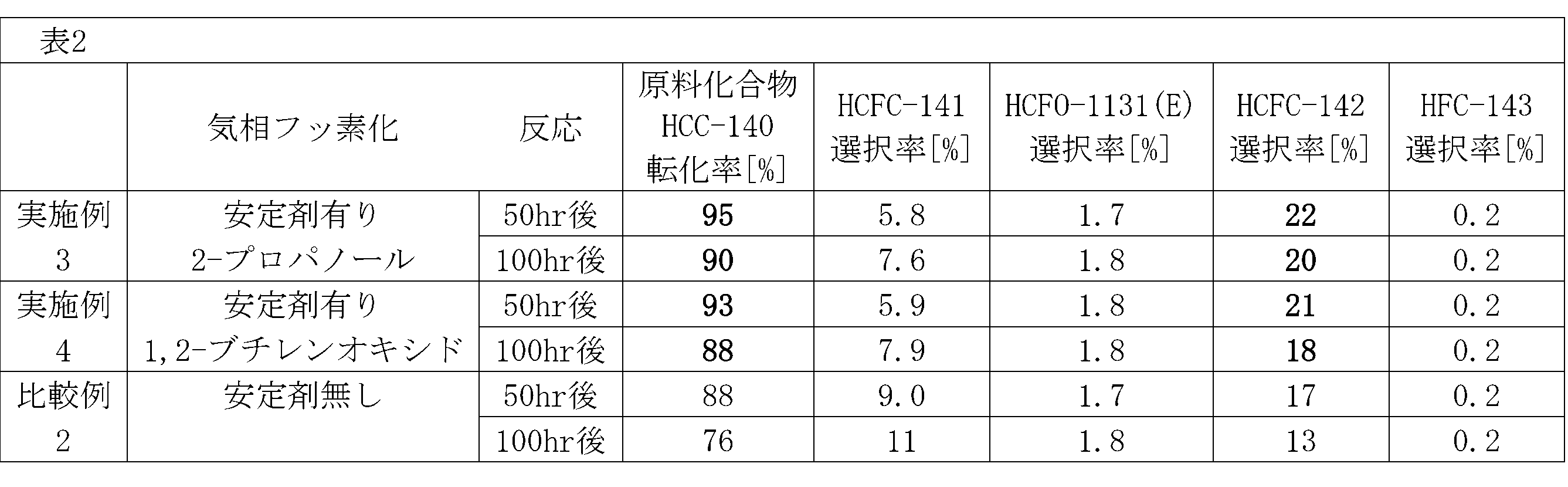
上記触媒を充填した反応器において、その後、安定剤の2-プロパノールを200ppm(原料化合物(含塩素化合物)のHCC-140に対する重量比)を含む、CHCl2-CH2Cl(HCC-140))を0.92mL/min(0℃、0.6MPaGでのガス流量)の流速で供給した。
上記触媒を充填した反応器において、その後、安定剤の2-プロパノールを200ppm(原料化合物(含塩素化合物)のHCC-140に対する重量比)を含む、CHCl2-CH2Cl(HCC-140))を0.92mL/min(0℃、0.6MPaGでのガス流量)の流速で供給した。
供給時、HF:HCC-140のモル比を10:1とした。また、酸素(O2)濃度は、原料化合物(含塩素化合物)のHCC-140に対して、10mol%含むガスとした。
接触時間をW/Fo 10g・sec/cc(g・sec・mL-1)とした。
反応開始から50時間後、HCC-140の転化率は95%であり、HCFC-142の選択率は22%であり、HFC-143の選択率は0.2%であった。
反応開始から100時間後、HCC-140の転化率は90%であり、HCFC-142の選択率は20%であり、HFC-143の選択率は0.2%であった。
表2に、その他の成分の結果も合わせて表す。
(実施例4)安定剤:1,2-ブチレンオキシド有り
安定剤として1,2-ブチレンオキシドを用い、原料化合物(含塩素化合物)のHCC-140に対する重量比として、1,2-ブチレンオキシドを500ppm含む反応条件としたこと以外は、上記実施例3と同じ条件で気相フッ素化反応を行った。
安定剤として1,2-ブチレンオキシドを用い、原料化合物(含塩素化合物)のHCC-140に対する重量比として、1,2-ブチレンオキシドを500ppm含む反応条件としたこと以外は、上記実施例3と同じ条件で気相フッ素化反応を行った。
反応開始から50時間後、HCC-140の転化率は93%であり、HCFC-142の選択率は21%であり、HFC-143の選択率は0.2%であった。
反応開始から100時間後、HCC-140の転化率は88%であり、HCFC-142の選択率は18%であり、HFC-143の選択率は0.2%であった。
表2には、その他の成分の結果も合わせて表す。
(比較例2)安定剤無し
安定剤を用いない反応条件としたこと以外は、上記実施例3と同じ条件で気相フッ素化反応を行った。
安定剤を用いない反応条件としたこと以外は、上記実施例3と同じ条件で気相フッ素化反応を行った。
反応開始から50時間後、HCC-140の転化率は88%であり、HCFC-142の選択率は17%であり、HFC-143の選択率は0.2%であった。
反応開始から100時間後、HCC-140の転化率は76%であり、HCFC-142の選択率は13%であり、HFC-143の選択率は0.2%であった。
表2には、その他の成分の結果も合わせて表す。
(4)結果の考察
実施例の結果と比較例の結果とを比較すると、原料化合物のHCO-1130(E)又はHCC-140に、安定剤を添加して、フッ素化反応を行うことで、HCO-1130(E)又はHCC-140の転化率は向上し、HCFC-142及びHFC-143の選択率(収率)も向上すると評価できる。
実施例の結果と比較例の結果とを比較すると、原料化合物のHCO-1130(E)又はHCC-140に、安定剤を添加して、フッ素化反応を行うことで、HCO-1130(E)又はHCC-140の転化率は向上し、HCFC-142及びHFC-143の選択率(収率)も向上すると評価できる。
この結果から、HCO-1130(E)又はHCC-140に、安定剤を添加することで、触媒の劣化を抑えられ、触媒活性の低下を抑えることができると評価できる。
また、HCO-1130(E)又はHCC-140(原料化合物)に、安定剤を添加することで、HCO-1130(E)又はHCC-140の分解を防ぐことにより、反応系中のHCl量を減らし、HCFC-142(目的化合物)及びHFC-143(次の目的化合物)の選択率が向上すると評価できる。
更に、反応系中のHCl量を減らすことにより、反応の平衡がフッ素化側に偏り、つまり、HCO-1130(E)又はHCC-140、或は途中生成物のHCFC-141から、HCFC-142が生成する方向に進み易くなるので、目的化合物であるHCFC-142の選択率が向上すると評価できる。
Claims (10)
- 2-クロロ-1,1-ジフルオロエタン(HCFC-142)の製造方法であって、
1,1,2-トリクロロエタン(HCC-140)、(E)-1,2-ジクロロエチレン(HCO-1130(E))、(Z)-1,2-ジクロロエチレン(HCO-1130(Z))、1,2-ジクロロ-1-フルオロエタン(HCFC-141)、(E)-1-クロロ-2-フルオロエチレン(HCFO-1131(E))、及び(Z)-1-クロロ-2-フルオロエチレン(HCFO-1131(Z))からなる群から選択される少なくとも一種の含塩素化合物を、安定剤の存在下、フッ化水素と接触させることにより1以上のフッ素化反応を行う工程を含み、HCFC-142、塩化水素、及びフッ化水素を含む反応ガスを得る、
HCFC-142の製造方法。 - 前記安定剤は、ヒドロキノン系安定剤、不飽和アルコール系安定剤、ニトロ系安定剤、アミン系安定剤、フェノール系安定剤、及びエポキシ系安定剤からなる群から選択される少なくとも1種の安定剤である、請求項1に記載の製造方法。
- 前記フッ素化反応における前記含塩素化合物に対する前記フッ化水素のモル比は、1以上である、請求項1又は2に記載の製造方法。
- 前記フッ素化反応は、触媒存在下で行う、請求項1~3のいずれかに記載の製造方法。
- 前記触媒は、少なくとも一部がクロムを含む触媒である、請求項4に記載の製造方法。
- 前記フッ素化反応は、0 MPaG~2 MPaGの圧力条件で行う、請求項1~5のいずれかに記載の製造方法。
- 前記フッ素化反応は、150℃~600℃の温度条件で行う、請求項6に記載の製造方法。
- 前記フッ素化反応は、気相で行い、前記含塩素化合物と前記フッ化水素との接触時間W/Foは、0.1g・sec/cc~100g・sec/ccである、請求項1~7のいずれかに記載の製造方法。
- 1,1,2-トリフルオロエタン(HFC-143)の製造方法であって、
請求項1~8のいずれかに記載の製造方法により得た前記反応ガスに含まれるHCFC-142を、更に、フッ化水素と接触させることによりフッ素化反応を行う工程を含み、HFC-143、
塩化水素、及びフッ化水素を含む反応ガスを得る、
HFC-143の製造方法。 - (E)-1,2-ジフルオロエチレン(HFO-1132(E))及び/又は(Z)-1,2-ジフルオロエチレン(HFO-1132(Z))の製造方法であって、
請求項9に記載の製造方法により得た前記反応ガスに含まれるHFC-143を、脱フッ化水素反応に供する工程を含む、HFO-1132(E)及び/又はHFO-1132(Z)の製造方法。
Priority Applications (3)
| Application Number | Priority Date | Filing Date | Title |
|---|---|---|---|
| EP21838009.5A EP4180409A4 (en) | 2020-07-10 | 2021-07-09 | PROCESS FOR PRODUCING 2-CHLORO-1,1-DIFLUOROETHANE (HCFC-142, 1,1,2-TRIFLUOROETHANE (HFC-143) AND (E)-1,2-DIFLUOROETHYLENE (HFO-1132 (E)) AND/OR (Z)-1,2-DIFLUOROETHYLENE (HFO-1132 (Z) |
| CN202180049361.3A CN115836043A (zh) | 2020-07-10 | 2021-07-09 | 2-氯-1,1-二氟乙烷(hcfc-142)、1,1,2-三氟乙烷(hfc-143)和(e)-1,2-二氟乙烯(hfo-1132(e))和/或(z)-1,2-二氟乙烯(hfo-1132(z))的制造方法 |
| US18/089,024 US12570590B2 (en) | 2020-07-10 | 2022-12-27 | Method for manufacturing 2-Chloro-1, 1-difluoroethane (HCFC-142), 1,1,2-trifluoroethane (HFC-143), and (E)-1,2-difluoroethylene (HFO-1132(E)) and/or (Z)-1,2-difluoroethylene (HFO-1132(Z)) |
Applications Claiming Priority (2)
| Application Number | Priority Date | Filing Date | Title |
|---|---|---|---|
| JP2020119061A JP7444719B2 (ja) | 2020-07-10 | 2020-07-10 | 2-クロロ-1,1-ジフルオロエタン(hcfc-142)、1,1,2-トリフルオロエタン(hfc-143)、及び(e)-1,2-ジフルオロエチレン(hfo-1132(e))及び/又は(z)-1,2-ジフルオロエチレン(hfo-1132(z))の製造方法 |
| JP2020-119061 | 2020-07-10 |
Related Child Applications (1)
| Application Number | Title | Priority Date | Filing Date |
|---|---|---|---|
| US18/089,024 Continuation US12570590B2 (en) | 2020-07-10 | 2022-12-27 | Method for manufacturing 2-Chloro-1, 1-difluoroethane (HCFC-142), 1,1,2-trifluoroethane (HFC-143), and (E)-1,2-difluoroethylene (HFO-1132(E)) and/or (Z)-1,2-difluoroethylene (HFO-1132(Z)) |
Publications (1)
| Publication Number | Publication Date |
|---|---|
| WO2022009985A1 true WO2022009985A1 (ja) | 2022-01-13 |
Family
ID=79552551
Family Applications (1)
| Application Number | Title | Priority Date | Filing Date |
|---|---|---|---|
| PCT/JP2021/025945 Ceased WO2022009985A1 (ja) | 2020-07-10 | 2021-07-09 | 2-クロロ-1,1-ジフルオロエタン(hcfc-142)、1,1,2-トリフルオロエタン(hfc-143)、及び(e)-1,2-ジフルオロエチレン(hfo-1132(e))及び/又は(z)-1,2-ジフルオロエチレン(hfo-1132(z))の製造方法 |
Country Status (5)
| Country | Link |
|---|---|
| US (1) | US12570590B2 (ja) |
| EP (1) | EP4180409A4 (ja) |
| JP (2) | JP7444719B2 (ja) |
| CN (1) | CN115836043A (ja) |
| WO (1) | WO2022009985A1 (ja) |
Cited By (1)
| Publication number | Priority date | Publication date | Assignee | Title |
|---|---|---|---|---|
| WO2024204829A1 (ja) * | 2023-03-31 | 2024-10-03 | ダイキン工業株式会社 | 精製された1,1,2-トリフルオロエタン(hfc-143)の製造方法、及びhfc-143を含有する組成物 |
Families Citing this family (3)
| Publication number | Priority date | Publication date | Assignee | Title |
|---|---|---|---|---|
| JP6908060B2 (ja) * | 2019-01-16 | 2021-07-21 | ダイキン工業株式会社 | 1−クロロ−1,2−ジフルオロエタンを含む共沸又は共沸様組成物 |
| JP7598043B2 (ja) * | 2023-01-23 | 2024-12-11 | ダイキン工業株式会社 | 精製されたトランス-1,2-ジフルオロエチレン(hfo-1132(e))の製造方法、及びhfo-1132(e)を含有する組成物 |
| WO2025095121A1 (ja) * | 2023-11-02 | 2025-05-08 | セントラル硝子株式会社 | 1,1,2-トリクロロエタン(hcc-140)から1-クロロ-2,2-ジフルオロエタン(hcfc-142)を製造するための方法 |
Citations (7)
| Publication number | Priority date | Publication date | Assignee | Title |
|---|---|---|---|---|
| US5155082A (en) | 1991-04-12 | 1992-10-13 | Allied-Signal Inc. | Catalyst for the manufacture of chlorofluorocarbons, hydrochlorofluorocarbons and hydrofluorocarbons |
| US5569794A (en) * | 1994-05-24 | 1996-10-29 | Alliedsignal Inc. | Vapor phase process for producing hydroflourocarbons from perchloroethylene having a phenolic inhibitor |
| US20020183569A1 (en) * | 1998-12-08 | 2002-12-05 | Bolmer Michael S. | Preparation of 142 |
| WO2009078234A1 (ja) * | 2007-12-14 | 2009-06-25 | Daikin Industries, Ltd. | ペンタフルオロエタンの製造方法 |
| JP2010534680A (ja) * | 2007-07-25 | 2010-11-11 | ハネウェル・インターナショナル・インコーポレーテッド | 2−クロロ−3,3,3−トリフルオロプロペン(HCFC−1233xf)を製造するための改良された方法 |
| JP2014534899A (ja) * | 2011-10-12 | 2014-12-25 | バイエル・インテレクチユアル・プロパテイー・ゲー・エム・ベー・ハー | 1−クロロ−2,2−ジフルオロエタンを製造するための1,1,2−トリクロロエタン及び/又は1,2−ジクロロエテンの触媒的気相フッ素化 |
| JP2019196312A (ja) * | 2018-05-07 | 2019-11-14 | ダイキン工業株式会社 | 1,2−ジフルオロエチレン及び/又は1,1,2−トリフルオロエタンの製造方法 |
Family Cites Families (11)
| Publication number | Priority date | Publication date | Assignee | Title |
|---|---|---|---|---|
| US3432562A (en) * | 1965-09-24 | 1969-03-11 | Phillips Petroleum Co | Dehydrofluorination process and products |
| JPH01128945A (ja) | 1987-11-13 | 1989-05-22 | Asahi Glass Co Ltd | 水素含有フロンを安定化する方法 |
| JPH01132539A (ja) | 1987-11-18 | 1989-05-25 | Asahi Glass Co Ltd | 共沸組成物の安定化方法 |
| JPH01265042A (ja) | 1988-04-15 | 1989-10-23 | Asahi Glass Co Ltd | 水素含有フロンを安定化する方法 |
| US4804493A (en) | 1988-05-24 | 1989-02-14 | E. I. Du Pont De Nemours And Company | Stabilized azeotrope or azeotrope-like composition of 1,1,2-trichloro-1,2,2-trifluoroethane and trans-1,2-dichloroethylene |
| US5714651A (en) * | 1995-12-28 | 1998-02-03 | Elf Atochem North America, Inc. | Use of polymerization inhibitor to prolong the life of a Lewis acid catalyst |
| US6534688B2 (en) | 2001-06-11 | 2003-03-18 | Vulcan Chemicals | Dehydrochlorination stabilization of polychlorinated alkanes |
| EP2258789A3 (en) | 2004-12-21 | 2012-10-24 | Honeywell International Inc. | Stabilized iodocarbon compositions |
| US7745673B2 (en) * | 2007-09-04 | 2010-06-29 | International Isotopes Inc. | Processes for producing hydrohalocarbon and halocarbon compounds using silicon tetrafluoride |
| FR2948678B1 (fr) | 2009-07-28 | 2011-10-14 | Arkema France | Procede de transfert de chaleur |
| FR3014099B1 (fr) | 2013-12-04 | 2017-01-13 | Arkema France | Procede de fabrication du 1-chloro-2,2,-difluoroethane |
-
2020
- 2020-07-10 JP JP2020119061A patent/JP7444719B2/ja active Active
-
2021
- 2021-07-09 EP EP21838009.5A patent/EP4180409A4/en active Pending
- 2021-07-09 WO PCT/JP2021/025945 patent/WO2022009985A1/ja not_active Ceased
- 2021-07-09 CN CN202180049361.3A patent/CN115836043A/zh active Pending
-
2022
- 2022-06-28 JP JP2022103575A patent/JP2022121555A/ja not_active Withdrawn
- 2022-12-27 US US18/089,024 patent/US12570590B2/en active Active
Patent Citations (7)
| Publication number | Priority date | Publication date | Assignee | Title |
|---|---|---|---|---|
| US5155082A (en) | 1991-04-12 | 1992-10-13 | Allied-Signal Inc. | Catalyst for the manufacture of chlorofluorocarbons, hydrochlorofluorocarbons and hydrofluorocarbons |
| US5569794A (en) * | 1994-05-24 | 1996-10-29 | Alliedsignal Inc. | Vapor phase process for producing hydroflourocarbons from perchloroethylene having a phenolic inhibitor |
| US20020183569A1 (en) * | 1998-12-08 | 2002-12-05 | Bolmer Michael S. | Preparation of 142 |
| JP2010534680A (ja) * | 2007-07-25 | 2010-11-11 | ハネウェル・インターナショナル・インコーポレーテッド | 2−クロロ−3,3,3−トリフルオロプロペン(HCFC−1233xf)を製造するための改良された方法 |
| WO2009078234A1 (ja) * | 2007-12-14 | 2009-06-25 | Daikin Industries, Ltd. | ペンタフルオロエタンの製造方法 |
| JP2014534899A (ja) * | 2011-10-12 | 2014-12-25 | バイエル・インテレクチユアル・プロパテイー・ゲー・エム・ベー・ハー | 1−クロロ−2,2−ジフルオロエタンを製造するための1,1,2−トリクロロエタン及び/又は1,2−ジクロロエテンの触媒的気相フッ素化 |
| JP2019196312A (ja) * | 2018-05-07 | 2019-11-14 | ダイキン工業株式会社 | 1,2−ジフルオロエチレン及び/又は1,1,2−トリフルオロエタンの製造方法 |
Non-Patent Citations (1)
| Title |
|---|
| See also references of EP4180409A4 |
Cited By (3)
| Publication number | Priority date | Publication date | Assignee | Title |
|---|---|---|---|---|
| WO2024204829A1 (ja) * | 2023-03-31 | 2024-10-03 | ダイキン工業株式会社 | 精製された1,1,2-トリフルオロエタン(hfc-143)の製造方法、及びhfc-143を含有する組成物 |
| JP2024146926A (ja) * | 2023-03-31 | 2024-10-15 | ダイキン工業株式会社 | 精製された1,1,2-トリフルオロエタン(hfc-143)の製造方法、及びhfc-143を含有する組成物 |
| JP7730055B2 (ja) | 2023-03-31 | 2025-08-27 | ダイキン工業株式会社 | 精製された1,1,2-トリフルオロエタン(hfc-143)の製造方法、及びhfc-143を含有する組成物 |
Also Published As
| Publication number | Publication date |
|---|---|
| EP4180409A1 (en) | 2023-05-17 |
| JP7444719B2 (ja) | 2024-03-06 |
| JP2022121555A (ja) | 2022-08-19 |
| JP2022022888A (ja) | 2022-02-07 |
| EP4180409A4 (en) | 2024-08-07 |
| US20230138340A1 (en) | 2023-05-04 |
| CN115836043A (zh) | 2023-03-21 |
| US12570590B2 (en) | 2026-03-10 |
Similar Documents
| Publication | Publication Date | Title |
|---|---|---|
| EP3792236B1 (en) | Method for preparing 1,2-difluoroethylene and/or 1,1,2-trifluoroethane | |
| JP6574284B2 (ja) | HFC−245faからHFO trans−1234zeを生産するための方法 | |
| WO2022009985A1 (ja) | 2-クロロ-1,1-ジフルオロエタン(hcfc-142)、1,1,2-トリフルオロエタン(hfc-143)、及び(e)-1,2-ジフルオロエチレン(hfo-1132(e))及び/又は(z)-1,2-ジフルオロエチレン(hfo-1132(z))の製造方法 | |
| JP5571903B2 (ja) | 2,3,3,3−テトラフルオロプロペンを生成するための総合プロセス | |
| EP2585423B1 (en) | Method for prolonging a catalyst's life during hydrofluorination | |
| US9040760B2 (en) | Process for producing 2,3,3,3-tetrafluoropropene | |
| CN101293809A (zh) | Hfc反式-1234ze的整联制造方法 | |
| CN107922295A (zh) | 由1,2‑二氯‑3,3,3‑三氟丙烯制备2‑氯‑3,3,3‑三氟丙烯的新方法 | |
| CN113498407B (zh) | 1,1,2-三氟乙烷(hfc-143)的制造方法 | |
| JP5805812B2 (ja) | 統合hfcトランス−1234ze製造方法 | |
| JP6806174B2 (ja) | 1,1,2−トリフルオロエタン(hfc−143)の製造方法 | |
| CN1310858C (zh) | 由氟化氢和六氟丙烯生产1,1,1,2,3,3,3-七氟丙烷的气相方法 |
Legal Events
| Date | Code | Title | Description |
|---|---|---|---|
| 121 | Ep: the epo has been informed by wipo that ep was designated in this application |
Ref document number: 21838009 Country of ref document: EP Kind code of ref document: A1 |
|
| ENP | Entry into the national phase |
Ref document number: 2021838009 Country of ref document: EP Effective date: 20230210 |
|
| NENP | Non-entry into the national phase |
Ref country code: DE |