WO2022014103A1 - Dispositif de traitement d'informations, système de traitement d'informations et procédé de traitement d'informations - Google Patents
Dispositif de traitement d'informations, système de traitement d'informations et procédé de traitement d'informations Download PDFInfo
- Publication number
- WO2022014103A1 WO2022014103A1 PCT/JP2021/013236 JP2021013236W WO2022014103A1 WO 2022014103 A1 WO2022014103 A1 WO 2022014103A1 JP 2021013236 W JP2021013236 W JP 2021013236W WO 2022014103 A1 WO2022014103 A1 WO 2022014103A1
- Authority
- WO
- WIPO (PCT)
- Prior art keywords
- information
- user
- congestion
- facility
- privilege
- Prior art date
- Legal status (The legal status is an assumption and is not a legal conclusion. Google has not performed a legal analysis and makes no representation as to the accuracy of the status listed.)
- Ceased
Links
Images



Classifications
-
- G—PHYSICS
- G01—MEASURING; TESTING
- G01C—MEASURING DISTANCES, LEVELS OR BEARINGS; SURVEYING; NAVIGATION; GYROSCOPIC INSTRUMENTS; PHOTOGRAMMETRY OR VIDEOGRAMMETRY
- G01C21/00—Navigation; Navigational instruments not provided for in groups G01C1/00 - G01C19/00
- G01C21/26—Navigation; Navigational instruments not provided for in groups G01C1/00 - G01C19/00 specially adapted for navigation in a road network
- G01C21/34—Route searching; Route guidance
- G01C21/3407—Route searching; Route guidance specially adapted for specific applications
- G01C21/3415—Dynamic re-routing, e.g. recalculating the route when the user deviates from calculated route or after detecting real-time traffic data or accidents
-
- G—PHYSICS
- G01—MEASURING; TESTING
- G01C—MEASURING DISTANCES, LEVELS OR BEARINGS; SURVEYING; NAVIGATION; GYROSCOPIC INSTRUMENTS; PHOTOGRAMMETRY OR VIDEOGRAMMETRY
- G01C21/00—Navigation; Navigational instruments not provided for in groups G01C1/00 - G01C19/00
- G01C21/26—Navigation; Navigational instruments not provided for in groups G01C1/00 - G01C19/00 specially adapted for navigation in a road network
- G01C21/34—Route searching; Route guidance
- G01C21/36—Input/output arrangements for on-board computers
- G01C21/3691—Retrieval, searching and output of information related to real-time traffic, weather, or environmental conditions
-
- G—PHYSICS
- G08—SIGNALLING
- G08G—TRAFFIC CONTROL SYSTEMS
- G08G1/00—Traffic control systems for road vehicles
- G08G1/005—Traffic control systems for road vehicles including pedestrian guidance indicator
-
- G—PHYSICS
- G08—SIGNALLING
- G08G—TRAFFIC CONTROL SYSTEMS
- G08G1/00—Traffic control systems for road vehicles
- G08G1/01—Detecting movement of traffic to be counted or controlled
Definitions
- the present invention relates to an information processing device, an information processing system, and an information processing method.
- the present invention has been made in view of the above, and an object of the present invention is to provide an information processing device, an information processing system, and an information processing method capable of efficiently alleviating congestion of a movement route.
- the present invention includes an acquisition unit, a selection unit, and an addition unit in the information processing apparatus.
- the acquisition unit acquires congestion information including a congestion status in a movement route from an event facility to a predetermined point, and user position information indicating a user's position.
- the selection unit selects a target user from a plurality of users based on the congestion information acquired by the acquisition unit and the user position information.
- the granting unit grants the target user selected by the selection unit a privilege according to the user position information of the target user.
- the congestion of the movement route can be efficiently alleviated.
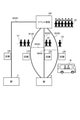
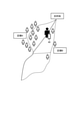
- FIG. 1 is a diagram showing an outline of an information processing method according to the first embodiment.
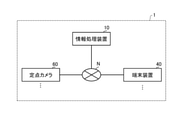
- FIG. 2 is a block diagram showing a configuration example of an information processing system.
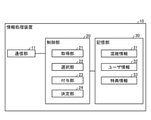
- FIG. 3 is a block diagram showing a configuration example of the information processing device.
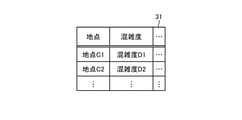
- FIG. 4 is a diagram showing an example of congestion information.
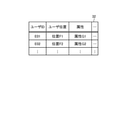
- FIG. 5 is a diagram showing an example of user information.
- FIG. 6 is a diagram showing an example of privilege information.
- FIG. 7 is a diagram illustrating processing performed by the selection unit or the like.
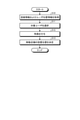
- FIG. 8 is a flowchart showing a processing procedure executed by the information processing apparatus.
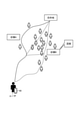
- FIG. 9 is a diagram showing an outline of the information processing method according to the second embodiment.
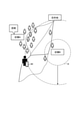
- FIG. 10 is a diagram showing an outline of the information processing method according to the second embodiment.
- FIG. 9 is a diagram showing an outline of the information processing method according to the second embodiment.
- FIG. 11 is a diagram showing an outline of the information processing method according to the second embodiment.
- FIG. 12 is a block diagram showing a configuration example of the information processing apparatus according to the second embodiment.
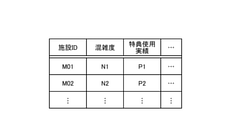
- FIG. 13 is a diagram showing an example of facility information.
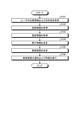
- FIG. 14 is a flowchart showing a processing procedure of processing executed by the information processing apparatus according to the second embodiment.
- FIG. 1 is a diagram showing an outline of an information processing method according to an embodiment.
- the information processing method according to the first embodiment is executed by, for example, the information processing apparatus 10 included in the information processing system 1.
- the information processing device 10 is a server capable of executing various processes such as processing of information about the event facility 100 and processing of information about the vicinity of the event facility 100.
- the event facility 100 is a sports facility where an event such as a sports match is held, and a facility (venue) where an event such as a concert or a play is held.
- the event facility 100 (hereinafter sometimes referred to as "facility 100"), for example, when the event ends, users who used the facility 100, that is, spectators, come out all at once. Therefore, for example, the vicinity of the facility 100 and the movement route B from the facility 100 to the nearest station A are congested.
- the information processing apparatus 10 is configured so as to be able to efficiently alleviate the congestion of the movement route B from the facility 100.
- the information processing apparatus 10 acquires congestion information including the congestion status in the movement path B from the facility 100 (step S1).
- FIG. 1 shows an example in which the movement route B is a movement route from the facility 100 to the station A.
- Station A is an example of a predetermined point.
- the station A is the nearest station from the facility 100, but is not limited to this, and may be any station around the facility 100.
- the movement route B is assumed to be the movement route from the facility 100 to the station A, but the movement route is not limited to this, and is not limited to this, for example, the movement route to the platform of other transportation means such as a bus platform and a taxi platform, and the facility. It may be a movement route to another facility (for example, a commercial facility) different from 100.
- FIG. 1 shows an example in which there are a plurality of (for example, three) movement paths B, but the present invention is not limited to this, and may be two or less or four or more.
- the three movement routes B may be described as "first movement route B1", “second movement route B2", and “third movement route B3", but these may be described without particular distinction. Is described as "movement route B”.
- the information on the degree of congestion of the movement route B can be used.
- the degree of congestion is an index value indicating the degree of congestion in the travel route B, and is a value indicated in several levels according to, for example, the number of people in the travel route B.
- the congestion information is not limited to the above-mentioned congestion degree, and is, for example, information on the flow of people on the movement route B such as the movement speed of people, information on the number of people on the movement route B, and the like. You may. Further, the congestion information may include the congestion status around the facility 100.
- the information processing device 10 uses the above-mentioned congestion information as, for example, the position information of the terminal device 40 (see FIG. 2) possessed by a person (hereinafter referred to as “user U”) in the vicinity of the movement route B or the facility 100, or movement. It is acquired based on the camera image of the fixed point camera 60 (see FIG. 2) installed around the route B and the facility 100, which will be described later.
- the information processing apparatus 10 acquires user position information indicating the position of the user U (step S2). Specifically, the information processing apparatus 10 acquires user position information indicating the position of the user U with respect to the event facility 100.
- the above-mentioned "position of the user U with respect to the event facility 100" is, for example, a positional relationship with the event facility 100 of the user U when the event facility 100 is used as a reference, and in other words, from the event facility 100 of the user U. It's also a distance.
- the user position information includes "information indicating that the position of the user U has not reached the movement path B around the event facility 100" and "the position of the user U has reached the movement path B and the event. "Information indicating that the distance from the facility 100 is relatively short”, “information indicating that the position of the user U reaches the movement path B and the distance from the event facility 100 is relatively long” and the like are included.
- the information processing apparatus 10 acquires the absolute position of the user U such as latitude / longitude information, and based on the acquired absolute position and the position information of the event facility 100 stored in advance, the information processing device 10 with respect to the event facility 100 of the user U. Information indicating the position may be obtained.
- the information processing apparatus 10 selects a target user from a plurality of users U based on the congestion information and the user position information (step S3).
- the target user means a user to whom the privilege described later is to be granted.
- the degree of congestion of the first movement route B1 is higher than the degree of congestion of the other second and third movement routes B2 and B3 will be described as an example.
- the degree of congestion of the first movement route B1 is high, for example, when the user U0 around the facility 100 moves to the first movement route B1, the first movement route B1 is further congested.
- the information processing apparatus 10 is based on the congestion information and the user position information, and the position of the user U is not the first movement path B1 among the plurality of users U, and the movement path B is set around the event facility 100.
- the user U0 that has not been reached is selected as the target user.
- the information processing apparatus 10 gives the user U0, who is the target user, a privilege according to the user position information of the user U0 (step S4).
- the information processing apparatus 10 is on the movement path B (here, the second and third movement paths B2 and B3) different from the first movement path B1 because the position of the user U0 has not reached the movement path B.
- Benefits for example, coupons, etc. related to the stores 120 and 130 of the store are given.
- the user U0 is given a privilege based on the congestion information and the user position information, so that the user U0 is not congested and the second and third movement routes B2 and B3 are not congested.
- Guide to the above stores 120 and 130 That is, by encouraging the user U0 in the vicinity of the facility 100 to move to the second and third movement paths B2 and B3, it is possible to suppress the first movement path B1 from being further congested, and as a result, the movement path B Congestion can be alleviated efficiently.
- the selection of the target user and the content of the privilege given to the target user are not limited to the above. That is, for example, the information processing apparatus 10 uses the user U1 whose position of the user U reaches the first movement path B1 and is relatively close to the event facility 100 as the target user among the plurality of users U. select.
- the information processing apparatus 10 gives the user U1 who is the target user a privilege according to the user position information of the user U1. For example, since the information processing apparatus 10 is the first movement route B1 in which the position of the user U1 is congested and is close to the facility 100, the information processing apparatus 10 imparts a privilege regarding the store 110 on the first movement route B1.
- the user U1 is guided to the store 110 on the first movement route B1 by giving the user U1 a privilege based on the congestion information and the user position information.
- the number of people traveling on the first movement route B1 can be reduced, and the congestion of the first movement route B1 can be efficiently alleviated. be able to.
- the number of people flowing from the first movement route B1 to the station A can be dispersed in time, and the congestion of the movement route B including the station A can be alleviated more efficiently. Can be done.
- a user U2 moving on the second movement path B2 and a user U3 moving on the third movement path B3 can also be selected as the target user, which will be described later.
- FIG. 2 is a block diagram showing a configuration example of the information processing system 1.
- the information processing system 1 includes the above-mentioned information processing device 10, a terminal device 40, and a fixed-point camera 60, which are communicably connected via a communication network N such as an Internet network.
- a communication network N such as an Internet network.
- one terminal device 40 and one fixed point camera 60 are shown, but the number may be plural.
- the terminal device 40 is a device possessed and used by the user U.
- the terminal device 40 for example, a smartphone, a tablet terminal, or the like can be used, but the terminal device 40 is not limited thereto.
- the terminal device 40 includes, for example, a GPS receiver that detects position information indicating the position of the user U (to be exact, the position of the terminal device 40) based on a signal from a GPS (Global Positioning System) satellite.
- the terminal device 40 can transmit the detected position information to the information processing device 10.
- the fixed point camera 60 is installed in the movement route, in the facility, around the facility, and around the destination. Further, a plurality of fixed point cameras 60 may be installed on the movement path B. As an example, the fixed point camera 60 has a point B1a (see FIG. 1) that is relatively close to the event facility 100 in the first movement path B1, a point B1b (see FIG. 1) near the middle, and a distance from the event facility 100. May be installed at a plurality of points such as a relatively distant point B1c (see FIG. 1).
- the fixed point camera 60 can image the movement route, the inside of the facility, the vicinity of the facility, and the vicinity of the destination, and transmit the captured camera image to the information processing apparatus 10.
- the camera image of the fixed point camera 60 is moving image data, but is not limited to this, and may be still image data or the like. Such a camera image is acquired as congestion information in the information processing apparatus 10, which will be described later.
- the fixed point camera 60 may be a human body detection sensor that detects a moving route, a person in the facility, around the facility, or around the destination.
- a human body detection sensor for example, a pyroelectric sensor using an infrared signal or the like can be adopted.
- the information processing device 10 acquires the congestion information based on the position information of the terminal device 40, in other words, when the camera image of the fixed point camera 60 is not used as the congestion information, the fixed point camera 60 is used. It may be removed.
- FIG. 3 is a block diagram showing a configuration example of the information processing apparatus 10.
- the components necessary for explaining the features of the present embodiment are represented by functional blocks, and the description of general components is omitted.
- each component shown in the block diagram of FIG. 3 is a functional concept and does not necessarily have to be physically configured as shown in the figure.
- the specific form of distribution / integration of each functional block is not limited to the one shown in the figure, and all or part of it is functionally or physically distributed in any unit according to various loads and usage conditions. -It is possible to integrate and configure.
- the information processing apparatus 10 includes a communication unit 11, a control unit 20, and a storage unit 30.
- the communication unit 11 is a communication interface that connects to the communication network N so that bidirectional communication is possible, and transmits / receives information to / from the terminal device 40, the fixed point camera 60, and the like.
- the control unit 20 includes an acquisition unit 21, a selection unit 22, a grant unit 23, and a determination unit 24, and includes, for example, a CPU (Central Processing Unit), a ROM (Read Only Memory), and a RAM (Random Access Memory). Includes computers with hard disk drives, input / output ports, and various circuits.
- a CPU Central Processing Unit
- ROM Read Only Memory
- RAM Random Access Memory
- the CPU of the computer functions as the acquisition unit 21, the selection unit 22, the grant unit 23, and the determination unit 24 of the control unit 20, for example, by reading and executing the program stored in the ROM.
- the acquisition unit 21, the selection unit 22, the grant unit 23, and the determination unit 24 of the control unit 20 are made of hardware such as ASIC (Application Specific Integrated Circuit) and FPGA (Field Programmable Gate Array). It can also be configured.
- ASIC Application Specific Integrated Circuit
- FPGA Field Programmable Gate Array
- the storage unit 30 is a storage unit composed of storage devices such as a non-volatile memory, a data flash, and a hard disk drive. Congestion information 31, user information 32, privilege information 33, various programs, and the like are stored in the storage unit 30.
- the congestion information 31 is information indicating the congestion status in the movement route B and the congestion status around the facility 100.
- the congestion information 31 will be described with reference to FIG.
- FIG. 4 is a diagram showing an example of congestion information 31.
- the congestion information 31 includes items such as "point” and “congestion degree”, and each item is associated with each other.
- the "point” is information indicating the movement route B and the points around the facility 100. Specifically, the "point” is the name of the movement route such as the first movement route B1 or the second movement route B2, the name of the point on the movement route B such as the point B1a (see FIG. 1), and the facility 100 such as the east exit and the west exit. Information indicating the name of the doorway.
- the "point” is described as an abstract description such as “point C1", but specific information is stored in the "point C1".
- other information may be described in an abstract manner.
- the "congestion degree” is information indicating the degree of congestion of the movement route B or the like, and as an example, it is information indicated at a level according to the number of people existing in a predetermined area including the corresponding point.
- the congestion information 31 includes information on the flow of people on the movement route B, such as the movement speed of people on the movement route B described above, and the number of people on the movement route B. Information and the like may be included.
- the degree of congestion is "degree of congestion D1" at "point C1".
- the user information 32 is information about the user.
- the user information 32 will be described with reference to FIG.
- FIG. 5 is a diagram showing an example of user information 32.
- the user information 32 includes items such as "user ID”, “user position”, and “attribute”, and each item is associated with each other.
- the "user ID” is identification information that identifies the user U.
- the "user position” indicates the position of the user U, and more specifically, the user position information indicating the position of the user U with respect to the facility 100.
- Attribute is attribute information indicating the attribute of user U.
- the “attribute” includes information such as the age, gender, address, hobbies, and preferences of the user U, but these are merely examples and are not limited.
- the user data identified by the user ID "E01" indicates that the user position is “position F1" and the attribute is "attribute G1".
- the privilege information 33 is information related to the privilege such as a coupon.
- the privilege information 33 will be described with reference to FIG. FIG. 6 is a diagram showing an example of privilege information 33.
- the privilege information 33 includes items such as "privilege ID”, “grant target”, and “privilege”, and each item is associated with each other.
- the "privilege ID” is identification information that identifies the privilege.
- the "grant target” is information indicating the target to which the privilege is granted.
- the "grant target” includes information about a target user selected based on the above-mentioned congestion information and user position information.
- the privilege is given to an appropriate target person according to the congestion situation.
- a favorable congestion alleviation effect can be expected. For example, by setting conditions such as the position of the target person, the congestion point and its congestion status, the congestion status of the privilege target facility, the time zone, the weather, and the congestion status of transportation, it is possible to provide detailed benefits according to the situation. It will be.
- the "privilege” is information indicating the content of the privilege given to the target user.
- the above-mentioned “grant target” and “privi privilege” are set based on, for example, congestion information and user location information, which will be described later.
- the privilege data identified by the privilege ID "J01" indicates that the grant target is “target K1" and the privilege is "privilege L1".
- the "privilege” may include issuance information indicating the issuance content of the privilege to be given to the target user. That is, the “privilege” may include information such as the content of the privilege, the maximum number of issuances, the issuance range, and the usable time. This "privilege” is set based on, for example, congestion information and facility information, which will be described later in the second embodiment.
- the acquisition unit 21 of the control unit 20 acquires various information via the communication unit 11.
- the acquisition unit 21 acquires congestion information including the congestion status in the movement route B and the congestion status around the facility 100.
- the acquisition unit 21 measures the number of people in the movement route B or around the facility 100 based on the position information of the terminal device 40, and determines the degree of congestion according to the measured number of people in the congestion information 31 of the storage unit 30. It can be registered in (see Fig. 4).
- the acquisition unit 21 may acquire congestion information based on a camera image of the fixed point camera 60 (see FIG. 2). For example, the acquisition unit 21 analyzes the camera image transmitted from the fixed point camera 60, measures the number of people in the movement route B and around the facility 100, and converts the degree of congestion according to the measured number of people into the congestion information 31. You may register.
- the acquisition unit 21 acquires the user position information. For example, the acquisition unit 21 acquires the position information from the terminal device 40 and detects the position of the user U with respect to the facility 100 based on the position information of the terminal device 40. Then, the acquisition unit 21 registers the detected position of the user U with respect to the facility 100 as the user position information of the user information 32 of the storage unit 30.
- the user U of the above-mentioned user position information is a user whose subsequent (future) movement route B may include a congestion occurrence point (in other words, a relatively high possibility).
- This "user whose subsequent movement route B may include a congestion occurrence point” specifically exists in the vicinity of the facility 100, and more specifically, exists at a position closer to the facility 100 than the congestion occurrence point. It can be said that it is a user.
- the acquisition unit 21 may acquire the attribute information from the terminal device 40 and register it as the attribute information of the user information 32 of the storage unit 30.
- the selection unit 22 selects a target user from a plurality of users U based on the congestion information 31, the user information 32, and the privilege information 33 of the storage unit 30. Further, the granting unit 23 grants the target user a privilege according to the user position information of the target user based on the congestion information 31, the user information 32, and the privilege information 33 of the storage unit 30. Thereby, the congestion of the movement route B can be efficiently alleviated.
- FIG. 7 is a diagram illustrating processing performed by the selection unit 22 and the like.
- the degree of congestion of the first movement route B1 is higher than the degree of congestion of the other second and third movement routes B2 and B3. Further, it is assumed that the degree of congestion of the second movement path B2 is higher than the degree of congestion of the third movement path B3. Further, as the movement route B from the facility 100, in addition to the first to third movement routes B1 to B3, there is a movement route B4 (hereinafter referred to as "fourth movement route B4") to the station X different from the station A. And.
- the selection unit 22 has the position indicated by the user position information as the facility. User U0 around 100 is selected as the target user.
- the granting unit 23 is a store on a movement route B different from the first movement route B1 among the plurality of movement routes B, that is, on the second, third movement routes B2 and B3, according to the user position information of the target user.
- the benefits of 120 and 130 are given to the target users.
- the user U0 is guided to the stores 120 and 130 on the second and third movement routes B2 and B3, which are less crowded than the first movement route B1. That is, the user U0 in the vicinity of the facility 100 is urged to move to the second and third movement routes B2 and B3 to disperse the user U. As a result, it is possible to prevent the user U0 from moving to the first movement path B1 which is relatively congested and further congesting the first movement path B1, and as a result, the congestion of the movement path B can be efficiently alleviated. ..
- coupons that can be used at stores are not limited to these, and other types of benefits such as points that can be used at stores may be used. .. Further, the above-mentioned benefits such as coupons and points can be used for payment at stores, for example, but the present invention is not limited to this, and may be used for services and the like.
- the benefits of the stores 120 and 130 on the second and third movement routes B2 and B3 are given, but at this time, the granting unit 23 has different contents between the benefits of the store 120 and the benefits of the store 130. You may let it. That is, for example, the granting unit 23 may make the content of the privilege different based on the congestion information. Specifically, in the granting unit 23, the content of the privilege of the store 130 on the third movement route B3, which is less crowded than that of the second movement route B2, is the content of the privilege of the store 120 on the second movement route B2. Benefits may be granted in a way that makes it better.
- the user U0 in the vicinity of the facility 100 can be more urged to move to the vacant third movement route B3 as compared with the first and second movement routes B1 and B2. Therefore, it is possible to equalize the congestion of the first to third movement paths B1 to B3, and thus the congestion of the movement route B can be efficiently alleviated.
- the granting unit 23 may grant the privilege of the store 140 on the fourth movement route B4 to the user U0. That is, the granting unit 23 may grant the privilege of the store 140 on the fourth movement route B4 to the station X (second predetermined point) different from the station A based on the congestion information. Specifically, when the congestion information includes information indicating that there is a highly congested movement route B (here, the first movement route B1), the granting unit 23 benefits the store 140 on the fourth movement route B4. May be given.
- the user U0 in the vicinity of the facility 100 can be urged to move to the fourth movement route B4, and the congestion of the first to third movement routes B1 to B3 can be alleviated.
- the selection unit 22 may select the user U1 as the target user from the plurality of users U. That is, when the congestion information includes a congestion situation in which congestion has occurred in the first movement path B1 among the plurality of movement paths B, the position indicated by the user position information is the first movement path B1 in the selection unit 22. Select a certain user U1 as a target user.
- the granting unit 23 grants the privilege of the store 110 on the first movement route B1 to the target user according to the user position information of the target user.
- the user U1 is guided to the store 110 on the first movement route B1 and is urged to enter and stay at the store 110.
- the number of people traveling on the first movement route B1 can be reduced, and the congestion of the first movement route B1 can be efficiently alleviated.
- the user U1 since the user U1 temporarily stays at the store 110, the number of people flowing from the first movement route B1 to the station A can be dispersed in time, and the congestion of the movement route B including the station A can be further reduced. It can be relaxed efficiently.
- the granting unit 23 grants the privilege of the store 110 on the first movement route B1 to the user U1 who is the target user, but the present invention is not limited to this, and the second and third movement routes B2 and B3 are not limited to this.
- the benefits of the above stores 120 and 130 may be granted.
- a fifth movement route (communication route) B5 connecting the first movement route B1 and the second movement route B2 and a second movement route B2 and a third movement route B2 are connected.
- the granting unit 23 refers to the store 120 on the second and third movement routes B2 and B3 with respect to the user U1 who is the target user.
- 130 benefits may be granted. That is, the granting unit 23 grants the privilege of the stores 120 and 130 on the second and third movement routes B2 and B3 to the user U1 in order to avoid the movement of the first movement route B1 which is relatively congested. You may.
- the user U1 may be guided to the stores 120 and 130 on the second and third movement routes B2 and B3 to reduce the number of people traveling on the first movement route B1. Thereby, the congestion of the first movement path B1 can be efficiently alleviated.
- the selection unit 22 may select users U2 and U3 as target users from a plurality of users U. That is, when the congestion information includes a congestion situation in which congestion occurs in the first movement path B1 among the plurality of movement paths B, the position indicated by the user position information is the first movement path B1 in the selection unit 22. Selects different movement routes B, that is, users U2 and U3, which are the second and third movement routes B2 and B3, as target users.
- the granting unit 23 targets the benefits of the stores 120 and 130 on the movement route B different from the first movement route B1, that is, the second and third movement routes B2 and B3, according to the user position information of the target user. It is given to the user (users U2 and U3).
- the users U2 and U3 are guided to the stores 120 and 130 on the second and third movement routes B2 and B3, and the users are urged to enter and stay at the stores 120 and 130.
- the users U2 and U3 temporarily stay at the stores 120 and 130, so that the number of people flowing from the second and third movement routes B2 and B3 to the station A is temporally dispersed, and the first movement route B1 People who flow from to station A can be given priority.
- the congestion of the movement route B including the station A can be alleviated more efficiently.
- the number of people traveling on the second and third movement routes B2 and B3 can be reduced, and the congestion of the second and third movement routes B2 and B3 can be efficiently alleviated.
- the granting unit 23 may grant benefits according to the type of each store such as stores 110, 120, 130.
- the store type and the store usage method differ from store to store.
- Examples of store types include stores that enter and stay (types that eat and drink in the store) and stores that simply attract people (restaurants that sell over-the-counter, souvenir shops, etc.).
- the above-mentioned type of store that stays in the store tends to have a relatively long stay time, while the type of store that attracts people has a relatively short stay time. It is easy to become. Therefore, in the privilege information 33 (see FIG.
- the granting unit 23 grants the privilege to the target user based on the privilege information 33 and the like.
- the granting unit 23 may grant the privilege of a store that stays in the store and stays for a relatively long time.
- the user U of the movement route B can be guided to enter the store and stay in the store for a relatively long time, and as a result, the congestion of the movement route B can be efficiently alleviated.
- the granting unit 23 may grant the privilege of a store that attracts people and has a relatively short stay time. As a result, the user U of the movement route B can be guided to enter the store and stay in the store for a relatively short time, and as a result, the congestion of the movement route B can be efficiently alleviated.
- the granting unit 23 may read the attribute information of the user information 32 of the storage unit 30 and grant the privilege according to the attribute information to the target user.
- the granting unit 23 may grant the target user a privilege according to the attributes of the user U (for example, age, gender, hobby, etc.).
- the attributes of the user U for example, age, gender, hobby, etc.
- the information of the movement route B can be obtained from the user position information, but the present invention is not limited to this. That is, for example, the information processing device 10 may be configured to predict (estimate) the movement path B based on the information stored in the terminal device 40.
- the terminal device 40 stores information on the user's outbound route (for example, information on the route taken when the user goes to the facility 100), home information including the location information of the user's home, and the like as attribute information. It is assumed that it is.
- the acquisition unit 21 acquires such attribute information from the terminal device 40 and registers it as the attribute information of the user information 32 (see FIG. 5).
- the acquisition unit 21 may predict the movement route B, which is the return route of the user, by back-calculating the information of the user's outward route included in the attribute information, for example. Further, the acquisition unit 21 may predict a part or all of the road from the facility 100 to the home position as the movement route B, for example, based on the home information included in the attribute information. Then, the selection unit 22 may select a target user from a plurality of users U based on the predicted movement route B and the like. This makes it possible to select an appropriate target user according to the user's attribute information (user's outbound information, home information, etc.).
- the determination unit 24 determines the installation position of the mobile store M based on the congestion information.
- the mobile store M is a mobile store.
- a stall, a kitchen car, or the like can be used, but the present invention is not limited to this, and the point is that it may be a mobile store.
- the determination unit 24 may use the determination unit 24 as a plurality of movement routes.
- the movement route B different from the first movement route B1, that is, on the second and third movement routes B2 and B3 is determined as the installation position of the movement store M.
- the decision unit 24 notifies the mobile store M (or the manager of the mobile store M) of the information regarding the determined installation position. As a result, the mobile store M is moved to the installation position and installed. Note that FIG. 7 shows an example in which the determination unit 24 determines the location on the third movement path B3 as the installation position of the mobile store M.
- the granting unit 23 can grant the privilege of the mobile store M whose installation position is determined by the determining unit 24 to the target user.
- the user U is guided to the third travel route B3, which is less congested than the first travel route B1. That is, the user U is urged to move to the third movement path B3 to disperse the user U.
- the congestion of the first to third movement paths B1 to B3 can be equalized, and thus the congestion of the movement route B can be alleviated more efficiently.
- the user U3 who moves on the third movement route B3 can easily stay temporarily by installing the mobile store M. Therefore, the number of people flowing from the third movement route B3 to the station A can be dispersed in time, and the people flowing from the first movement route B1 to the station A can be prioritized. As a result, the congestion of the movement route B including the station A can be alleviated more efficiently. In addition, the number of people traveling on the third movement route B3 can be reduced, and the congestion of the third movement route B3 can be efficiently alleviated.
- the granting unit 23 may grant a privilege such as a coupon for the mobile store M.
- the user U selected as the target user by the selection unit 22 is a user U0 in the vicinity of the facility 100 and a user U3 moving on the third movement path B3, but the user U1 and the user U2 are not limited to this. May be.
- FIG. 8 is a flowchart showing a processing procedure executed by the information processing apparatus 10.
- the control unit 20 of the information processing apparatus 10 acquires the congestion information including the congestion status in the movement path B and the user position information indicating the position of the user U with respect to the facility 100 (step S10). Next, the control unit 20 selects a target user from the plurality of users U based on the congestion information and the user position information (step S11).
- control unit 20 grants the selected target user a privilege according to the user position information of the target user (step S12).
- the control unit 20 determines the installation position of the mobile store M based on the congestion information (step S13).
- step S13 is executed last, but the present invention is not limited to this. That is, the process of step S13 may be executed before steps S11 and S12, or may be executed in parallel with steps S11 and S12.
- the information processing apparatus 10 includes an acquisition unit 21, a selection unit 22, and an addition unit 23.
- the acquisition unit 21 acquires the congestion information including the congestion status in the movement route B from the event facility 100 to the predetermined point (station A) and the user position information indicating the position of the user U.
- the selection unit 22 selects a target user from a plurality of users U based on the congestion information and the user position information acquired by the acquisition unit 21.
- the granting unit 23 grants a privilege according to the user position information of the target user to the target user selected by the selection unit 22.
- FIG. 2 is a diagram showing an outline of the information processing method according to the second embodiment.
- the information processing method according to the second embodiment is executed by the information processing apparatus 10 (see FIG. 2).
- the information processing device 10 is configured as, for example, a server device capable of communicating with the terminal device 40 owned by the user.
- the congestion information on the travel route to the user's destination and the status of the facilities (stores A and B) where the benefits such as coupons can be used are grasped in real time, and the user.
- the benefits issued to the facility and guiding the user to the facility congestion relief will be realized.
- the destination is, for example, a facility having a predetermined purpose such as a transportation platform such as a station, a bus stop, or a taxi stand, or an event facility (sports facility, concert venue, etc.) where a predetermined event is held. Not limited to this, it may be a mere position such as on a road or an intersection.
- a transportation platform such as a station, a bus stop, or a taxi stand
- an event facility sports facility, concert venue, etc.
- the facilities where the benefits can be used are, for example, restaurants and shopping malls, but may be, for example, transportation platforms such as train stations, bus stops, and taxi stands.
- the benefits are, for example, coupons such as discount coupons, points equivalent to cash vouchers, predetermined services that can be received at the facility, and the like.
- the congestion information indicating the congestion status in the movement route and the facility information indicating the status of the facilities are acquired.
- the congestion information includes information indicating the degree of congestion of the travel route.
- the facility information includes information such as the degree of congestion in the facility and the privilege usage record used in the facility. The details of congestion information and facility information will be described later.
- the movement route (solid line) passing through the store A is relatively empty, and the movement route (broken line) other than the movement route passing through the store A is congested. It is assumed that the congestion information indicating that is acquired. Further, in the situation shown in FIG. 9, it is assumed that the store A is not congested and the facility information indicating that the store B is congested is acquired.
- a relatively vacant movement route (solid line) is presented to the user as a recommended route based on the congestion information. Further, at this time, in order to guide the user to the recommended route, the privilege of the store A located on the travel route is issued to the user. As a result, the user can be guided to follow an empty movement route (solid line) while avoiding the crowded movement route (broken line).
- the content of the privilege that can be used in the uncrowded store A is higher than that in the crowded store B (higher discount rate). That is, in the information processing method according to the embodiment, issuance regarding the issuance content (for example, discount rate, etc.) of the privilege of the store A so as to guide the user to the non-congested travel route and the store A based on the congestion information and the facility information. Determine the information.
- the issuance information includes the content of the privilege such as the discount rate, the issue range R of the privilege (see FIG. 10), the usable time of the privilege, and the like.
- the store A may be guided to the less crowded store A.
- the facility information indicating that the store A is congested and the movement route passing through the store A are congested. It is assumed that the congestion information indicating that the terminal is used is acquired. In such a case, in the information processing method, based on the acquired facility information and congestion information, the content of issuing the privilege is changed so as to avoid the store A and guide the user to the store B.
- the issuance information is changed so as to expand the issuance range R of the privilege of the store B.
- the contents of the privilege of the store B may be aligned with the privilege of the store A.
- the privilege of the store B is newly issued to the terminal device 40 of the user, and it becomes easy for such a user or another user to change the movement route and be guided to the store B. It is possible to alleviate the congestion of the movement route passing through the store A.
- the information processing method determines that the user is unlikely to use the privilege of the store B, and newly issues the privilege to the terminal device 40 of another user (for example, a user near the store A). do.
- FIG. 12 is a block diagram showing a configuration example of the information processing apparatus 10.
- FIG. 12 only the components necessary for explaining the features of the present embodiment are represented by functional blocks, and the description of general components is omitted. It was
- each component shown in the block diagram of FIG. 12 is a functional concept and does not necessarily have to be physically configured as shown in the figure.
- the specific form of distribution / integration of each functional block is not limited to the one shown in the figure, and all or part of it is functionally or physically distributed in any unit according to various loads and usage conditions. -It is possible to integrate and configure. It was
- the information processing apparatus 10 includes a communication unit 11, a control unit 20, and a storage unit 30. It was
- the communication unit 11 is a communication interface that connects to the communication network N so that bidirectional communication is possible, and transmits / receives information to / from the terminal device 40, the fixed point camera 60, and the like. It was
- the control unit 20 includes an acquisition unit 25, a determination unit 26, and a human flow control unit 27.
- a CPU Central Processing Unit
- ROM Read Only Memory
- RAM Random Access Memory
- the CPU of the computer functions as the acquisition unit 25, the determination unit 26, and the human flow control unit 27 of the control unit 20, for example, by reading and executing the program stored in the ROM. It was
- At least a part or all of the acquisition unit 25, the determination unit 26, and the human flow control unit 27 of the control unit 20 shall be configured with hardware such as ASIC (Application Specific Integrated Circuit) and FPGA (Field Programmable Gate Array). You can also. It was
- the storage unit 30 is a storage unit composed of storage devices such as a non-volatile memory, a data flash, and a hard disk drive.
- the storage unit 30 stores congestion information 31, user information 32, privilege information 33, facility information 34, various programs, and the like. It was
- the congestion information 31, the user information 32, and the privilege information 33 are the same as those in the first embodiment, the description thereof will be omitted.
- Facility information 34 is information regarding the status of facilities where benefits can be used. Here, the facility information 34 will be described with reference to FIG. FIG. 13 is a diagram showing an example of facility information 34.
- the facility information 34 includes items such as "facility ID”, “congestion degree”, and “privilege usage record”, and each item is associated with each other. It was noted that
- “Facility ID” is identification information that identifies the facility.
- the "congestion degree” is information indicating the degree of congestion in and around the facility, and as an example, it is information indicated at a level according to the number of people existing in a predetermined area including the location of the facility and the facility. ..
- the “privilege usage record” is information indicating the usage record of the privilege in a certain period, and can be expressed as, for example, the number of usage of the privilege with respect to the total number of issuance of the privilege.
- the “privilege usage record” can be expressed in units of hours, days, weeks, and months. It was
- control unit 20 acquisition unit 25, determination unit 26, and human flow control unit 27
- the acquisition unit 25 acquires various information via the communication unit 11. For example, the acquisition unit 25 acquires congestion information indicating a congestion status in the movement route. For example, the acquisition unit 25 measures the number of people in the vicinity of the movement route based on the position information of the terminal device 40, and determines the degree of congestion according to the measured number of people in the congestion information 31 of the storage unit 30 (see FIG. 4). ) Can be registered. It was
- the acquisition unit 25 may acquire congestion information based on a camera image of the fixed point camera 60 (see FIG. 2). For example, the acquisition unit 25 may analyze the camera image transmitted from the fixed point camera 60 to measure the number of people in the vicinity of the movement path, and register the degree of congestion according to the measured number of people in the congestion information 31. good.
- the congestion information acquired by the acquisition unit 25 is not limited to the current congestion status, but may be the congestion status after a predetermined time.
- the acquisition unit 25 predicts the congestion situation after a predetermined time from the above-mentioned traffic information of the user and the current congestion status (for example, from the current congestion status on the upstream side of the traffic flow, the traffic speed, and the distance difference).
- the congestion situation on the downstream side after a predetermined time is predicted), and the predicted congestion situation may be registered in the congestion information 31.
- the acquisition unit 25 acquires facility information indicating the status of the facility. For example, the acquisition unit 25 measures the number of people in the facility based on the position information of the terminal device 40, and determines the degree of congestion according to the measured number of people in the facility information 34 of the storage unit 30 (see FIG. 12). You can register with. It was
- the acquisition unit 25 may acquire facility information indicating the degree of congestion in the facility based on a camera image of the fixed point camera 60 (see FIG. 2). For example, the acquisition unit 25 analyzes the camera image transmitted from the fixed point camera 60 installed in the facility, measures the number of people in the facility, and determines the degree of congestion according to the measured number of people in the facility information 34. You may register with.
- the congestion status of the facility acquired by the acquisition unit 25 is not limited to the current congestion status, but may be the congestion status after a predetermined time.
- the acquisition unit 25 may predict the congestion status of the facility after a predetermined time from the above-mentioned traffic information of the user and the current congestion status of the facility, and may register the predicted congestion status in the facility information 34.
- the acquisition unit 25 acquires information on the usage record of the privilege as the situation of the facility. For example, when the acquisition unit 25 receives the information indicating that the privilege transmitted to the terminal device 40 has been used, the acquisition unit 25 can register the information in the facility information 34. Alternatively, the acquisition unit 25 may receive information indicating that the privilege has been used from a terminal device (not shown) installed in the facility and register it in the facility information 34.
- the acquisition unit 25 acquires the user's location information. For example, the acquisition unit 25 acquires the position information from the terminal device 40 and detects the user's position based on the position information of the terminal device 40. Then, the acquisition unit 25 registers the position of the detected user in the user information 32 of the storage unit 30.
- the user's position may be represented by the distance to the facility where the privilege can be used or the distance to the destination.
- the decision unit 26 determines the issue information regarding the issue contents of the benefits that can be used at the facility, based on the congestion information acquired by the acquisition unit 25 and the facility information. For example, the determination unit 26 determines (changes) at least one of the content of the privilege, the maximum number of issuances, the issuance range of the privilege, and the usable time of the privilege.
- the decision unit 26 changes the issuance content in the privilege of the facility based on the congestion status of the facility. For example, the determination unit 26 changes the available time if the facility is currently congested. Specifically, the determination unit 26 predicts the time when the congestion will be resolved, and changes the time from the predicted time to the time when the congestion can be used.
- the determination unit 26 determines the usable time as a time zone excluding the time zone after the predetermined time. In this way, by changing the usable time excluding the time when the facility is congested, the congestion situation of the facility can be alleviated.
- the determination unit 26 may change the length of the usable time. For example, the determination unit 26 shortens the length of the usable time when the facility is congested, and lengthens the length of the usable time when the facility is not congested.
- the decision unit 26 may reduce the maximum number of benefits issued or narrow the range of issuance when the facility is crowded.
- the determination unit 26 may change the issuance information of the non-congested facility when the facility is congested.
- the decision unit 26 may enhance the content of the privilege of the facility that is not crowded, increase the maximum number of issuances, or expand the issuance range.
- the congestion status of the facility may include information on the number of products in stock and the number of services that can be provided related to the benefits. That is, when the number of products in stock or the number of services that can be provided is insufficient for the number of unused benefits, the determination unit 26 considers that the facility is congested and changes the above-mentioned issuance information. You may.
- the decision unit 26 changes the issuance content of the privilege of the facility when the usage record of the privilege at the facility does not meet the predetermined conditions. For example, when the facility does not meet the expected (set) usage record, the decision unit 26 changes the issuance content so that the usage record increases.
- the decision unit 26 improves the content of the benefits of facilities whose usage records do not meet the predetermined conditions (higher discount rate), increases the maximum number of issues, and expands the issue range.
- the determination unit 26 relaxes the content of the privilege (lowers the discount rate) or issues the maximum. The number may be reduced or the range of issuance may be narrowed so that the usage record does not exceed the expectations of the facility.
- the determination unit 26 may adjust the benefits at each facility according to the congestion status and usage record of each facility. For example, the determination unit 26 may enable the privilege of a congested facility to be used even in a non-congested facility among a plurality of facilities of the same series (branch office, etc.).
- the determination unit 26 can guide the user to the facility with high accuracy by changing the content of the privilege, the maximum number of issuances, the issuance range, and the available time as the issuance information. Congestion can be alleviated efficiently.
- the person flow control unit 27 performs the person flow control to alleviate the congestion situation by issuing a privilege based on the issuance information determined by the determination unit 26 to the user. Specifically, the human flow control unit 27 first determines a recommended route to be presented to the user prior to issuing the privilege. Specifically, the human flow control unit 27 determines a non-congested movement route as a recommended route based on the congestion information acquired by the acquisition unit 25.
- the human flow control unit 27 determines the privilege to be issued to the user based on the determined recommended route and issuance information. Specifically, when the recommended route passes through the issuance range in the issuance information, the human flow control unit 27 issues the corresponding privilege with the content of the privilege based on the issuance information. If the predicted transit time of the facility and the usable time are separated from each other by a predetermined time or more, the person flow control unit 27 may prohibit the issuance of the privilege because it is unlikely that the privilege will be used.
- the human flow control unit 27 may issue a privilege to a user located within the issuing range regardless of the recommended route.
- the person flow control unit 27 is a user who is close to the facility, a user who is planning to go on a congested travel route, and an expected value (expected use) of using the privilege. Priority is given to users with a predetermined value or more.
- the expected value can be calculated by, for example, a model learned by machine learning.
- the expected value is a model generated by machine learning with the expected value as the objective variable, with the user's past use / absence of benefits, frequency of use, type of benefits used, user attribute information, etc. as explanatory variables. It can be calculated using.
- the person flow control unit 27 may issue the privilege to the maximum number or more. As a result, it is possible to avoid a decrease in the usage record of the privilege with high accuracy.
- the human flow control unit 27 determines whether or not there is an intention to use the issued privilege based on the user's behavior, and if there is no intention, issues the privilege issued to the user to another user. You may.
- the person flow control unit 27 tells another user that he / she has no intention of using the privilege when the user is traveling on a movement route that does not pass through a facility where the privilege can be used, based on the user's location information. Issue benefits.
- the person flow control unit 27 may determine that it does not intend to use the benefits of facilities of the same genre (for example, a restaurant). As a result, users who are unlikely to use the benefits can be excluded, and benefits can be efficiently issued to users who are likely to use the benefits (assumed to be), so that the facility's benefit usage record will be low. Can be suppressed.
- FIG. 14 is a flowchart showing a processing procedure of processing executed by the information processing apparatus 10 according to the second embodiment.
- the acquisition unit 25 acquires the user's position information and destination information (step S101). Subsequently, the acquisition unit 25 acquires congestion information indicating the congestion status from the user's position to the destination (step S102).
- the acquisition unit 25 acquires facility information indicating the status of the facility existing between the user's position and the destination (step S103).
- the determination unit 26 determines the issuance information regarding the issuance content of the privilege that can be used at the facility based on the congestion information and the facility information (step S104).
- the determination unit 26 determines a recommended travel route based on the congestion information, that is, a non-congested travel route as the recommended route (step S105). Subsequently, the human flow control unit 27 notifies the determined recommended route, issues a privilege based on the issuance information (step S106), and ends the process.
- the information processing apparatus 10 includes an acquisition unit 25, a determination unit 26, and a human flow control unit 27.
- the acquisition unit 25 acquires congestion information indicating the congestion status in the travel route to the user's destination and facility information indicating the status of a predetermined facility.
- the determination unit 26 determines the issuance information regarding the issuance content of the privilege that can be used in the predetermined facility based on the congestion information and the facility information acquired by the acquisition unit 25.
- the person flow control unit 27 performs the person flow control to alleviate the congestion situation by issuing the privilege to the user based on the issuance information determined by the determination unit 26. As a result, congestion in the movement route can be efficiently alleviated.
- Information processing system 10 Information processing device 11 Communication unit 20 Control unit 21, 25 Acquisition unit 22 Selection unit 23 Grant unit 24, 26 Decision unit 27 Person flow control unit 30 Storage unit 31 Congestion information 32 User information 33 Bonus information 34 Facility information 40 Terminal device 60 Fixed point camera
Landscapes
- Engineering & Computer Science (AREA)
- Radar, Positioning & Navigation (AREA)
- Remote Sensing (AREA)
- General Physics & Mathematics (AREA)
- Physics & Mathematics (AREA)
- Automation & Control Theory (AREA)
- Biodiversity & Conservation Biology (AREA)
- Environmental Sciences (AREA)
- Environmental & Geological Engineering (AREA)
- Ecology (AREA)
- Life Sciences & Earth Sciences (AREA)
- Atmospheric Sciences (AREA)
- Navigation (AREA)
Abstract
La présente invention concerne un dispositif de traitement d'informations comprend une unité d'acquisition, une unité de sélection et une unité d'octroi. L'unité d'acquisition obtient : des informations de congestion comprenant l'état de congestion sur un trajet de déplacement d'une installation d'événement à un emplacement prescrit ; et des informations de position d'utilisateur indiquant la position de l'utilisateur. L'unité de sélection sélectionne un utilisateur cible parmi une pluralité d'utilisateurs, sur la base des informations de congestion et des informations de position d'utilisateur qui ont été obtenues par l'unité d'acquisition. L'unité d'octroi accorde des avantages correspondant aux informations de position d'utilisateur pour l'utilisateur cible, à l'utilisateur cible sélectionné par l'unité de sélection.
Priority Applications (1)
| Application Number | Priority Date | Filing Date | Title |
|---|---|---|---|
| US17/923,090 US20230160702A1 (en) | 2020-07-17 | 2021-03-29 | Information processing apparatus, information processing system, and information processing method |
Applications Claiming Priority (4)
| Application Number | Priority Date | Filing Date | Title |
|---|---|---|---|
| JP2020123086A JP2022019316A (ja) | 2020-07-17 | 2020-07-17 | 情報処理装置および情報処理方法 |
| JP2020-123086 | 2020-07-17 | ||
| JP2020183036A JP7592463B2 (ja) | 2020-10-30 | 2020-10-30 | 情報処理装置、情報処理システムおよび情報処理方法 |
| JP2020-183036 | 2020-10-30 |
Publications (1)
| Publication Number | Publication Date |
|---|---|
| WO2022014103A1 true WO2022014103A1 (fr) | 2022-01-20 |
Family
ID=79554688
Family Applications (1)
| Application Number | Title | Priority Date | Filing Date |
|---|---|---|---|
| PCT/JP2021/013236 Ceased WO2022014103A1 (fr) | 2020-07-17 | 2021-03-29 | Dispositif de traitement d'informations, système de traitement d'informations et procédé de traitement d'informations |
Country Status (2)
| Country | Link |
|---|---|
| US (1) | US20230160702A1 (fr) |
| WO (1) | WO2022014103A1 (fr) |
Families Citing this family (1)
| Publication number | Priority date | Publication date | Assignee | Title |
|---|---|---|---|---|
| WO2021024478A1 (fr) * | 2019-08-08 | 2021-02-11 | 日本電信電話株式会社 | Dispositif de présentation d'informations, système de présentation d'informations, procédé de présentation d'informations et programme de présentation d'informations |
Citations (4)
| Publication number | Priority date | Publication date | Assignee | Title |
|---|---|---|---|---|
| JP2017126159A (ja) * | 2016-01-13 | 2017-07-20 | 住友電気工業株式会社 | 交通流制御装置、端末装置および制御プログラム |
| JP2019053432A (ja) * | 2017-09-13 | 2019-04-04 | 株式会社日立製作所 | 渋滞回避支援システムおよび渋滞回避支援方法 |
| JP2021012445A (ja) * | 2019-07-04 | 2021-02-04 | 株式会社MaaS Tech Japan | プログラム及び情報処理装置 |
| JP2021012673A (ja) * | 2019-07-04 | 2021-02-04 | 株式会社MaaS Tech Japan | プログラム |
Family Cites Families (2)
| Publication number | Priority date | Publication date | Assignee | Title |
|---|---|---|---|---|
| US10713675B2 (en) * | 2012-09-28 | 2020-07-14 | Intel Corporation | Systems and methods for generation of incentive offers for on-road users |
| US10097947B2 (en) * | 2015-11-25 | 2018-10-09 | International Business Machines Corporation | Generating personalized routes incentivized for one or more users |
-
2021
- 2021-03-29 WO PCT/JP2021/013236 patent/WO2022014103A1/fr not_active Ceased
- 2021-03-29 US US17/923,090 patent/US20230160702A1/en not_active Abandoned
Patent Citations (4)
| Publication number | Priority date | Publication date | Assignee | Title |
|---|---|---|---|---|
| JP2017126159A (ja) * | 2016-01-13 | 2017-07-20 | 住友電気工業株式会社 | 交通流制御装置、端末装置および制御プログラム |
| JP2019053432A (ja) * | 2017-09-13 | 2019-04-04 | 株式会社日立製作所 | 渋滞回避支援システムおよび渋滞回避支援方法 |
| JP2021012445A (ja) * | 2019-07-04 | 2021-02-04 | 株式会社MaaS Tech Japan | プログラム及び情報処理装置 |
| JP2021012673A (ja) * | 2019-07-04 | 2021-02-04 | 株式会社MaaS Tech Japan | プログラム |
Also Published As
| Publication number | Publication date |
|---|---|
| US20230160702A1 (en) | 2023-05-25 |
Similar Documents
| Publication | Publication Date | Title |
|---|---|---|
| Yang et al. | Implementing transit signal priority in a connected vehicle environment with and without bus stops | |
| CN105283912B (zh) | 停车场引导装置、停车场引导方法 | |
| US20200178037A1 (en) | Systems and methods for automatic path management | |
| US11580615B2 (en) | Routing a mobile vehicle based on rider characteristics | |
| US20180136005A1 (en) | Systems and methods for trip planning | |
| JP2021511568A (ja) | 多区間輸送のためのネットワークシステム | |
| JP6850249B2 (ja) | 自動バレーパーキングシミュレーション装置、自動バレーパーキングシミュレーション方法、プログラム | |
| US10725455B2 (en) | Adaptive gateline configuration | |
| US10972882B2 (en) | Information processing apparatus, information processing method, and non-transitory computer readable storage medium | |
| Liu et al. | Total-delay-based max pressure: A max pressure algorithm considering delay equity | |
| Liang et al. | Two-stage transit signal priority control method to improve reliability of bus operation considering stochastic process | |
| Bayrak et al. | Determining optimum transit signal priority implementation locations on a network | |
| US9372086B2 (en) | Control system for indicating if people can reach locations that satisfy a predetermined set of conditions and requirements | |
| JPWO2019186801A1 (ja) | 経路決定装置、経路決定方法、及び記憶媒体 | |
| Trozzi et al. | Effects of countdown displays in public transport route choice under severe overcrowding | |
| Stueger et al. | Minimizing the effects of urban mobility-on-demand pick-up and drop-off stops: a microscopic simulation approach | |
| Xu et al. | Opposing hysteresis patterns in flow and outflow macroscopic fundamental diagrams and their implications | |
| WO2022014103A1 (fr) | Dispositif de traitement d'informations, système de traitement d'informations et procédé de traitement d'informations | |
| Jaiswal et al. | Modelling relationships between passenger demand and bus delays at busway stations | |
| Qu et al. | Capacity and delay estimation for roundabouts using conflict theory | |
| JP7592463B2 (ja) | 情報処理装置、情報処理システムおよび情報処理方法 | |
| US20190156588A1 (en) | Information processing apparatus, information processing method, and non-transitory computer readable storage medium | |
| US20180101859A1 (en) | Method and system for determining optimal incentives for customers to reduce queueing wait time with wait-time-dependent incentive choice probabilities | |
| JP2022019316A (ja) | 情報処理装置および情報処理方法 | |
| Cats et al. | Strategic planning and prospects of rail-bound demand responsive transit |
Legal Events
| Date | Code | Title | Description |
|---|---|---|---|
| 121 | Ep: the epo has been informed by wipo that ep was designated in this application |
Ref document number: 21841949 Country of ref document: EP Kind code of ref document: A1 |
|
| NENP | Non-entry into the national phase |
Ref country code: DE |
|
| 122 | Ep: pct application non-entry in european phase |
Ref document number: 21841949 Country of ref document: EP Kind code of ref document: A1 |