WO2022014242A1 - Catalyseur d'électrode pour cellules d'électrolyse de l'eau, cellule d'électrolyse de l'eau et dispositif d'électrolyse de l'eau - Google Patents
Catalyseur d'électrode pour cellules d'électrolyse de l'eau, cellule d'électrolyse de l'eau et dispositif d'électrolyse de l'eau Download PDFInfo
- Publication number
- WO2022014242A1 WO2022014242A1 PCT/JP2021/022952 JP2021022952W WO2022014242A1 WO 2022014242 A1 WO2022014242 A1 WO 2022014242A1 JP 2021022952 W JP2021022952 W JP 2021022952W WO 2022014242 A1 WO2022014242 A1 WO 2022014242A1
- Authority
- WO
- WIPO (PCT)
- Prior art keywords
- water electrolysis
- catalyst
- electrolysis cell
- electrode catalyst
- anode
- Prior art date
- Legal status (The legal status is an assumption and is not a legal conclusion. Google has not performed a legal analysis and makes no representation as to the accuracy of the status listed.)
- Ceased
Links
Images

Classifications
-
- B—PERFORMING OPERATIONS; TRANSPORTING
- B01—PHYSICAL OR CHEMICAL PROCESSES OR APPARATUS IN GENERAL
- B01J—CHEMICAL OR PHYSICAL PROCESSES, e.g. CATALYSIS OR COLLOID CHEMISTRY; THEIR RELEVANT APPARATUS
- B01J23/00—Catalysts comprising metals or metal oxides or hydroxides, not provided for in group B01J21/00
- B01J23/70—Catalysts comprising metals or metal oxides or hydroxides, not provided for in group B01J21/00 of the iron group metals or copper
- B01J23/74—Iron group metals
- B01J23/755—Nickel
-
- B—PERFORMING OPERATIONS; TRANSPORTING
- B01—PHYSICAL OR CHEMICAL PROCESSES OR APPARATUS IN GENERAL
- B01J—CHEMICAL OR PHYSICAL PROCESSES, e.g. CATALYSIS OR COLLOID CHEMISTRY; THEIR RELEVANT APPARATUS
- B01J23/00—Catalysts comprising metals or metal oxides or hydroxides, not provided for in group B01J21/00
- B01J23/007—Mixed salts
-
- B—PERFORMING OPERATIONS; TRANSPORTING
- B01—PHYSICAL OR CHEMICAL PROCESSES OR APPARATUS IN GENERAL
- B01J—CHEMICAL OR PHYSICAL PROCESSES, e.g. CATALYSIS OR COLLOID CHEMISTRY; THEIR RELEVANT APPARATUS
- B01J37/00—Processes, in general, for preparing catalysts; Processes, in general, for activation of catalysts
- B01J37/02—Impregnation, coating or precipitation
- B01J37/03—Precipitation; Co-precipitation
- B01J37/031—Precipitation
-
- C—CHEMISTRY; METALLURGY
- C25—ELECTROLYTIC OR ELECTROPHORETIC PROCESSES; APPARATUS THEREFOR
- C25B—ELECTROLYTIC OR ELECTROPHORETIC PROCESSES FOR THE PRODUCTION OF COMPOUNDS OR NON-METALS; APPARATUS THEREFOR
- C25B1/00—Electrolytic production of inorganic compounds or non-metals
- C25B1/01—Products
- C25B1/02—Hydrogen or oxygen
- C25B1/04—Hydrogen or oxygen by electrolysis of water
-
- C—CHEMISTRY; METALLURGY
- C25—ELECTROLYTIC OR ELECTROPHORETIC PROCESSES; APPARATUS THEREFOR
- C25B—ELECTROLYTIC OR ELECTROPHORETIC PROCESSES FOR THE PRODUCTION OF COMPOUNDS OR NON-METALS; APPARATUS THEREFOR
- C25B11/00—Electrodes; Manufacture thereof not otherwise provided for
- C25B11/04—Electrodes; Manufacture thereof not otherwise provided for characterised by the material
- C25B11/051—Electrodes formed of electrocatalysts on a substrate or carrier
- C25B11/054—Electrodes comprising electrocatalysts supported on a carrier
-
- C—CHEMISTRY; METALLURGY
- C25—ELECTROLYTIC OR ELECTROPHORETIC PROCESSES; APPARATUS THEREFOR
- C25B—ELECTROLYTIC OR ELECTROPHORETIC PROCESSES FOR THE PRODUCTION OF COMPOUNDS OR NON-METALS; APPARATUS THEREFOR
- C25B11/00—Electrodes; Manufacture thereof not otherwise provided for
- C25B11/04—Electrodes; Manufacture thereof not otherwise provided for characterised by the material
- C25B11/051—Electrodes formed of electrocatalysts on a substrate or carrier
- C25B11/055—Electrodes formed of electrocatalysts on a substrate or carrier characterised by the substrate or carrier material
- C25B11/057—Electrodes formed of electrocatalysts on a substrate or carrier characterised by the substrate or carrier material consisting of a single element or compound
- C25B11/061—Metal or alloy
-
- C—CHEMISTRY; METALLURGY
- C25—ELECTROLYTIC OR ELECTROPHORETIC PROCESSES; APPARATUS THEREFOR
- C25B—ELECTROLYTIC OR ELECTROPHORETIC PROCESSES FOR THE PRODUCTION OF COMPOUNDS OR NON-METALS; APPARATUS THEREFOR
- C25B11/00—Electrodes; Manufacture thereof not otherwise provided for
- C25B11/04—Electrodes; Manufacture thereof not otherwise provided for characterised by the material
- C25B11/051—Electrodes formed of electrocatalysts on a substrate or carrier
- C25B11/073—Electrodes formed of electrocatalysts on a substrate or carrier characterised by the electrocatalyst material
- C25B11/075—Electrodes formed of electrocatalysts on a substrate or carrier characterised by the electrocatalyst material consisting of a single catalytic element or catalytic compound
-
- C—CHEMISTRY; METALLURGY
- C25—ELECTROLYTIC OR ELECTROPHORETIC PROCESSES; APPARATUS THEREFOR
- C25B—ELECTROLYTIC OR ELECTROPHORETIC PROCESSES FOR THE PRODUCTION OF COMPOUNDS OR NON-METALS; APPARATUS THEREFOR
- C25B13/00—Diaphragms; Spacing elements
-
- C—CHEMISTRY; METALLURGY
- C25—ELECTROLYTIC OR ELECTROPHORETIC PROCESSES; APPARATUS THEREFOR
- C25B—ELECTROLYTIC OR ELECTROPHORETIC PROCESSES FOR THE PRODUCTION OF COMPOUNDS OR NON-METALS; APPARATUS THEREFOR
- C25B9/00—Cells or assemblies of cells; Constructional parts of cells; Assemblies of constructional parts, e.g. electrode-diaphragm assemblies; Process-related cell features
- C25B9/17—Cells comprising dimensionally-stable non-movable electrodes; Assemblies of constructional parts thereof
- C25B9/19—Cells comprising dimensionally-stable non-movable electrodes; Assemblies of constructional parts thereof with diaphragms
-
- C—CHEMISTRY; METALLURGY
- C25—ELECTROLYTIC OR ELECTROPHORETIC PROCESSES; APPARATUS THEREFOR
- C25B—ELECTROLYTIC OR ELECTROPHORETIC PROCESSES FOR THE PRODUCTION OF COMPOUNDS OR NON-METALS; APPARATUS THEREFOR
- C25B9/00—Cells or assemblies of cells; Constructional parts of cells; Assemblies of constructional parts, e.g. electrode-diaphragm assemblies; Process-related cell features
- C25B9/17—Cells comprising dimensionally-stable non-movable electrodes; Assemblies of constructional parts thereof
- C25B9/19—Cells comprising dimensionally-stable non-movable electrodes; Assemblies of constructional parts thereof with diaphragms
- C25B9/23—Cells comprising dimensionally-stable non-movable electrodes; Assemblies of constructional parts thereof with diaphragms comprising ion-exchange membranes in or on which electrode material is embedded
-
- B—PERFORMING OPERATIONS; TRANSPORTING
- B01—PHYSICAL OR CHEMICAL PROCESSES OR APPARATUS IN GENERAL
- B01J—CHEMICAL OR PHYSICAL PROCESSES, e.g. CATALYSIS OR COLLOID CHEMISTRY; THEIR RELEVANT APPARATUS
- B01J23/00—Catalysts comprising metals or metal oxides or hydroxides, not provided for in group B01J21/00
- B01J23/70—Catalysts comprising metals or metal oxides or hydroxides, not provided for in group B01J21/00 of the iron group metals or copper
- B01J23/74—Iron group metals
- B01J23/745—Iron
-
- Y—GENERAL TAGGING OF NEW TECHNOLOGICAL DEVELOPMENTS; GENERAL TAGGING OF CROSS-SECTIONAL TECHNOLOGIES SPANNING OVER SEVERAL SECTIONS OF THE IPC; TECHNICAL SUBJECTS COVERED BY FORMER USPC CROSS-REFERENCE ART COLLECTIONS [XRACs] AND DIGESTS
- Y02—TECHNOLOGIES OR APPLICATIONS FOR MITIGATION OR ADAPTATION AGAINST CLIMATE CHANGE
- Y02E—REDUCTION OF GREENHOUSE GAS [GHG] EMISSIONS, RELATED TO ENERGY GENERATION, TRANSMISSION OR DISTRIBUTION
- Y02E60/00—Enabling technologies; Technologies with a potential or indirect contribution to GHG emissions mitigation
- Y02E60/30—Hydrogen technology
- Y02E60/36—Hydrogen production from non-carbon containing sources, e.g. by water electrolysis
-
- Y—GENERAL TAGGING OF NEW TECHNOLOGICAL DEVELOPMENTS; GENERAL TAGGING OF CROSS-SECTIONAL TECHNOLOGIES SPANNING OVER SEVERAL SECTIONS OF THE IPC; TECHNICAL SUBJECTS COVERED BY FORMER USPC CROSS-REFERENCE ART COLLECTIONS [XRACs] AND DIGESTS
- Y02—TECHNOLOGIES OR APPLICATIONS FOR MITIGATION OR ADAPTATION AGAINST CLIMATE CHANGE
- Y02P—CLIMATE CHANGE MITIGATION TECHNOLOGIES IN THE PRODUCTION OR PROCESSING OF GOODS
- Y02P20/00—Technologies relating to chemical industry
- Y02P20/10—Process efficiency
- Y02P20/133—Renewable energy sources, e.g. sunlight
Definitions
- the present disclosure relates to an electrode catalyst of a water electrolysis cell, a water electrolysis cell, and a water electrolysis device.
- Non-Patent Document 1 discloses Ni-Fe layered double hydride (Ni-Fe LDH).
- Non-Patent Document 2 discloses a complex of FeOOH nanoparticles and Ni-Fe LDH.
- the present disclosure provides an electrode catalyst for a water electrolytic cell having high durability.
- a catalyst that is a layered double hydroxide containing a chelating agent, Carriers containing transition metals and With an organic compound having an anionic functional group, Provided is an electrode catalyst for a water electrolysis cell.
- an electrode catalyst of a water electrolytic cell having high durability can be provided.
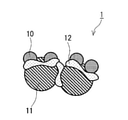
- FIG. 1 is a diagram schematically showing an electrode catalyst of the water electrolysis cell according to the first embodiment.
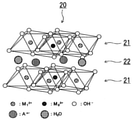
- FIG. 2 is a diagram schematically showing an example of a partial crystal structure of LDH.
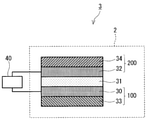
- FIG. 3 is a cross-sectional view schematically showing an example of the water electrolysis cell according to the second embodiment.
- FIG. 4 is a cross-sectional view schematically showing an example of the water electrolyzer according to the third embodiment.
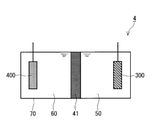
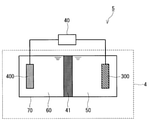
- FIG. 5 is a cross-sectional view schematically showing another example of the water electrolysis cell according to the fourth embodiment.
- FIG. 6 is a cross-sectional view schematically showing another example of the water electrolyzer according to the fifth embodiment.
- electrolysis of water can be used as a method for producing hydrogen from surplus electricity.
- the electrolysis of water is also called water electrolysis.
- a major component of a water electrolyzer includes a membrane electrode assembly (MEA) consisting of a gas diffusion layer, a catalyst, and an electrolyte membrane.
- MEA membrane electrode assembly
- Non-Patent Document 1 there is a problem that the catalyst performance is deteriorated and the overvoltage is increased by applying a voltage to the catalyst. It is considered that this is because the shape of Ni-Fe LDH changes due to the application of voltage, whereby Ni-Fe LDH is separated from the carrier. In order for Ni-Fe LDH to have high durability, it is important to suppress the separation of Ni-Fe LDH from the carrier.
- LDH Layered double hydroxides
- the catalytic activity is enhanced by using LDH containing a chelating agent as a catalyst.
- the performance of the catalyst may deteriorate due to separation from the carrier. Therefore, the present inventors have made extensive studies in order to develop a technique capable of suppressing the separation of the LDH catalyst containing a chelating agent from the carrier. As a result, we have newly discovered that the use of specific organic compounds is advantageous. Based on such findings, the present inventors have found an electrode catalyst for the water electrolysis cell of the present disclosure.
- the electrode catalyst of the water electrolysis cell according to the first aspect of the present disclosure is A catalyst that is a layered double hydroxide containing a chelating agent, Carriers containing transition metals and It comprises an organic compound having an anionic functional group.
- an electrode catalyst of a water electrolytic cell having high durability can be provided.
- the anionic functional group may contain a sulfonic acid ion group.
- the anionic functional group may contain a carboxylic acid ion group.
- the organic compound can generate a desired attractive force between LDH and the carrier.
- the organic compound may contain a perfluorocarbon polymer having a sulfonic acid ion group. According to such a configuration, the withstand voltage resistance of the electrode catalyst can be further improved.
- the layered double hydroxide may contain Ni and Fe. With such a configuration, LDH may have higher catalytic activity.
- the transition metal may contain Ni. According to such a configuration, the electrode catalyst can have high durability against alkali.
- the water electrolysis cell according to the seventh aspect of the present disclosure is With the anode, With the cathode An electrolyte membrane arranged between the anode and the cathode, Equipped with At least one selected from the group consisting of the anode and the cathode comprises an electrode catalyst according to any one of the first to sixth aspects.
- the water electrolysis cell can have high durability.
- the electrolyte membrane may include a proton exchange membrane.
- the electrolyte membrane may include an anion exchange membrane.
- the water electrolysis cell according to the tenth aspect of the present disclosure is The diaphragm that separates the first space and the second space, With the anode provided in the first space, With the cathode provided in the second space, Equipped with At least one selected from the group consisting of the anode and the cathode comprises an electrode catalyst according to any one of the first to sixth aspects.
- the water electrolysis cell can have high durability.
- the water electrolyzer according to the eleventh aspect of the present disclosure is A water electrolysis cell according to any one of the seventh to tenth aspects, and A voltage applyer connected to the anode and the cathode and applying a voltage between the anode and the cathode. To prepare for.
- the water electrolyzer can have high durability.
- FIG. 1 is a diagram schematically showing an electrode catalyst of a water electrolysis cell according to the present embodiment.
- the electrode catalyst 1 according to the present embodiment includes a catalyst 10 which is LDH containing a chelating agent, a carrier 11 containing a transition metal, and an organic compound 12.
- the organic compound 12 has, for example, an anionic functional group and is present on the surface of the catalyst 10 supported on the carrier 11. According to such a configuration, the electrode catalyst 1 having high durability can be provided.
- the catalyst 10 contains, for example, two or more transition metals and a chelating agent.
- the transition metal comprises, for example, at least two selected from the group consisting of V, Cr, Mn, Fe, Co, Ni, Cu, W, and Ru.
- the catalyst 10 is, for example, LDH in which a chelating agent is coordinated to the composition represented by the following composition formula (1).
- a chelating agent is coordinated to the composition represented by the following composition formula (1).
- M 1 2+ is a divalent transition metal ion.
- M 2 3+ is a trivalent transition metal ion.
- An - is an anion between layers.
- x is a rational number satisfying the condition of 0 ⁇ x ⁇ 1.
- y is a number corresponding to the required amount of charge balance.
- n is an integer.
- m is an appropriate rational number.
- LDH may contain Ni and Fe.
- M 1 may be Ni and M 2 may be Fe. That is, the transition metal elements contained in the catalyst 10 may be Ni and Fe. According to such a configuration, the electrode catalyst 1 may have higher catalytic activity than, for example, Co-Fe LDH.
- the catalyst 10 is LDH containing a chelating agent. Thereby, the dispersion stability of the catalyst 10 can be further improved. Further, since the catalyst 10 contains a chelating agent, the catalyst 10 having a small particle size can be synthesized. As a result, the surface area of the catalyst 10 can be improved, so that the catalytic activity can be improved.
- the average particle size of the catalyst 10 may be 100 nm or less, 50 nm or less, or 10 nm or less.
- SAXS small-angle X-ray scattering method
- the distribution means a numerical value proportional to the total volume occupied by the number of particles of the particle size.
- the area of the two-dimensional distribution map is, for example, the product of the particle size and the number of particles corresponding to the particle size.
- the chelating agent is not limited to a specific chelating agent.
- the chelating agent is, for example, an organic compound coordinated to a transition metal in LDH.
- the chelating agent may be at least one selected from the bidentate organic ligand and the tridentate organic ligand.
- Examples of chelating agents are ⁇ -diketone, ⁇ -ketoester, and hydroxycarboxylic acids.
- Examples of ⁇ -diketones are acetylacetone (ACAC), trifluoroacetylacetone, hexafluoroacetylacetone, benzoylacetone, thenoyltrifluoroacetone, dipyrrobic methane, dibenzoylmethane, and ascorbic acid.
- ⁇ -ketoesters are methyl acetoacetic acid, ethyl acetoacetate, allyl acetoacetic acid, benzyl acetoacetic acid, acetoacetic acid-n-propyl, acetoacetic acid-iso-propyl, acetoacetic acid-n-butyl, acetoacetic acid-iso-butyl. , Acetoacetic acid-tert-butyl, acetoacetic acid-2-methoxyethyl, and methyl 3-oxopentanoate.
- hydroxycarboxylic acids and salts thereof are tartrate acid, citric acid, malic acid, gluconic acid, ferulic acid, lactic acid, glucuronic acid, and salts thereof.
- the chelating agent may contain at least one selected from the group consisting of acetylacetone and trisodium citrate.
- the chelating agent may be at least one selected from acetylacetone and trisodium citrate.
- An- is an interlayer ion.
- An- is an inorganic ion or an organic ion. Examples of inorganic ion, CO 3 2-, NO 3 - , Cl -, SO 4 2-, Br -, OH -, F -, I -, Si 2 O 5 2-, B 4 O 5 (OH) 4 2- and PO 4 3- . Examples of the organic ions, CH 3 (CH 2) n SO 4-, CH 3 (CH 2) n COO -, CH 3 (CH 2) n PO 4-, and CH 3 (CH 2) n NO 3- in be.
- An - is an anion inserted between layers of metal hydroxide with water molecules. The An - charge and ion magnitude are not limited to any particular value.
- the catalyst 10 may contain one kind of An- or a plurality of kinds of An- .
- FIG. 2 is a diagram schematically showing an example of a partial crystal structure of LDH represented by the composition formula (1).
- the crystal structure 20 has OH- ions at each vertex of an octahedron centered on M 1 2+ or M 2 3+.
- Metal hydroxides are represented by [M 1 2 + 1-x M 2 3+ x (OH) 2 ] x + .
- the metal hydroxide has a layered structure in which hydroxide octahedrons share a ridge and are connected in two dimensions. Anions and water molecules are located between the layers of metal hydroxide.
- the layer of metal hydroxide functions as a host layer 21, and anions and water molecules are inserted as a guest layer 22.
- the crystal structure 20 has a sheet-like structure in which a host layer 21 of a metal hydroxide and a guest layer 22 of anions and water molecules are alternately laminated.
- the crystal structure 20 has a structure in which a part of M 1 2+ contained in the layer of the metal hydroxide is replaced with M 2 3+. Therefore, the surface of the crystal structure 20 is usually positively charged.
- the organic compound 12 having an anionic functional group is, for example, an organic material that can be present on the surface of the catalyst 10 supported on the carrier 11. Further, the organic compound 12 is, for example, an organic material that can exist between the catalyst 10 and the carriers 11 and between the carriers 11.
- the organic compound 12 can be an organic binder.
- the anionic functional group may be contained in the main chain or the side chain.
- the attractive force generated between the organic compound 12 and the catalyst 10 and the carrier 11 is, for example, a Coulomb force.
- a Coulomb force can be generated between the catalyst 10 and the organic compound 12 and between the carrier 11 and the organic compound 12.
- the Coulomb force can suppress the separation of the catalyst 10 and the carrier 11.
- the Coulomb force ⁇ E is expressed by the following equation.
- ⁇ 0 indicates the permittivity of the vacuum.
- q + and q - indicates the charge amount of the charged particles.
- r indicates the distance between charged particles.
- the electrode catalyst 1 Due to the Coulomb force, an attractive force acts between the carrier 11 and the organic compound 12, and between the catalyst 10 and the organic compound 12. As a result, even if a voltage is applied to the electrode catalyst 1, the catalyst 10 and the carrier 11 are difficult to separate. As a result, the electrode catalyst 1 may have higher durability.
- the anionic functional group is not limited to a specific type. Examples of anionic functional groups are sulfonic acid ion groups, carboxylate ion groups, acetate ion groups, citric acid ion groups, lactate ion groups, glycolic acid ion groups, phosphate ion groups, nitrate ion groups, and alkylsulfonic acid ions. It is the basis.
- the anionic functional group may contain at least one selected from the group consisting of a sulfonic acid ion group and a carboxylic acid ion group.
- the anionic functional group may contain a sulfonic acid ion group.
- the anionic functional group may be a sulfonic acid ion group.
- the anionic functional group may contain a carboxylic acid ion group.
- the anionic functional group may be a carboxylic acid ion group.
- the organic compound 12 may be an organic compound containing fluorine.
- the organic compound 12 may be an organic polymer having a fluorine and a sulfonic acid ion group.
- the organic compound 12 may contain a perfluorocarbon polymer having a sulfonic acid ion group.
- the organic compound 12 may be a perfluorocarbon polymer having a sulfonic acid ion group. Since fluorine has an organic effect, the thermal stability and electrochemical stability of the organic compound 12 can be improved by containing fluorine in the organic compound. Further, since the organic compound contains fluorine, the withstand voltage resistance of the electrode catalyst 1 can be further improved.
- the perfluorocarbon polymer having a sulfonic acid ion group is, for example, Nafion®. Nafion has the following chemical formula.
- y / x satisfies 1 ⁇ y / x ⁇ 9.
- n is an integer of 0 or more and 2 or less.
- the carrier 11 is typically conductive.
- the carrier 11 is not limited to a specific material as long as it contains a transition metal.
- the carrier 11 can carry the catalyst 10.
- the organic compound 12 has, for example, bonded the carrier 11 and the catalyst 10 by Coulomb force.
- the carrier 11 may contain at least one selected from the group consisting of V, Cr, Mn, Fe, Co, Ni, Cu, W, and Ru.
- the carrier 11 may be at least one selected from the group consisting of V, Cr, Mn, Fe, Co, Ni, Cu, W, and Ru.
- the surface of the carrier 11 is positively charged, for example, under neutral conditions. Therefore, the carrier 11 and the organic compound 12 can be bonded by a Coulomb force.
- the catalyst 10 and the organic compound 12 can be bonded by Coulomb force. As a result, even when a voltage is applied, the carrier 11 and the catalyst 10 are difficult to separate, so that deterioration of the catalyst performance can be further suppressed.
- the carrier 11 may contain Ni.
- the carrier 11 may be Ni. According to such a configuration, the electrode catalyst 1 can have high durability against alkali.
- the shape of the carrier 11 is not limited to a specific shape.
- the shape of the carrier 11 may be in the form of foam or in the form of particles.
- the particle size of the carrier 11 is not limited to a specific value.
- the particle size of the carrier 11 may be 100 nm or less, or may be 50 nm or less.
- TEM transmission electron microscope
- the electrode catalyst 1 according to the present embodiment is used, for example, in a proton exchange membrane type water electrolyzer, an anion exchange membrane type water electrolyzer, or an alkaline diaphragm type water electrolyzer.
- the electrode catalyst 1 can be used for at least one selected from an anode and a cathode in the above-mentioned water electrolyzer.
- FIG. 3 is a cross-sectional view schematically showing an example of the water electrolysis cell according to the present embodiment.
- the water electrolysis cell 2 includes an electrolyte membrane 31, an anode 100, and a cathode 200.
- the electrolyte membrane 31 is arranged, for example, between the anode 100 and the cathode 200. At least one selected from the anode 100 and the cathode 200 includes the electrode catalyst 1 described in the first embodiment.
- the electrolyte membrane 31 may be an electrolyte membrane having ionic conductivity.
- the electrolyte membrane 31 is not limited to a specific type.
- the electrolyte membrane 31 may include a proton exchange membrane.
- the electrolyte membrane 31 may be a proton exchange membrane.
- the electrolyte membrane 31 may include an anion exchange membrane.
- the electrolyte membrane 31 may be an anion exchange membrane.
- the electrolyte membrane 31 is configured so that the oxygen gas generated at the anode 100 and the hydrogen gas generated at the cathode 200 are difficult to mix.
- the anode 100 includes, for example, the catalyst layer 30.
- the catalyst layer 30 may be provided on one main surface of the electrolyte membrane 31.
- the "main surface” means the surface having the largest area of the electrolyte membrane 31.
- the electrode catalyst contained in the catalyst layer 30 may be the electrode catalyst 1 of the first embodiment.
- the anode 100 may be further provided with a porous and conductive gas diffusion layer 33 on the catalyst layer 30.
- the cathode 200 includes, for example, a catalyst layer 32.
- the catalyst layer 32 may be provided on the other main surface of the electrolyte membrane 31. That is, the catalyst layer 32 may be provided on the main surface of the electrolyte membrane 31 on the side opposite to the main surface on which the catalyst layer 30 is provided.
- the electrode catalyst that can be used for the catalyst layer 32 is not limited to a specific type.
- the electrode catalyst may be platinum or the electrode catalyst 1.
- the cathode 200 may be further provided with a porous and conductive gas diffusion layer 34 on top of the catalyst layer 32.
- the water electrolysis cell 2 can have high durability.
- FIG. 4 is a cross-sectional view schematically showing an example of the water electrolyzer according to the present embodiment.
- the water electrolyzer 3 includes a water electrolyzer cell 2 and a voltage adapter 40. Since the water electrolysis cell 2 is the same as the water electrolysis cell 2 of the second embodiment, the description thereof will be omitted.
- the voltage applyer 40 is connected to the anode 100 and the cathode 200 of the water electrolysis cell 2.
- the voltage applyer 40 is a device that applies a voltage to the anode 100 and the cathode 200 of the water electrolysis cell 2.
- the voltage applyer 40 increases the potential at the anode 100 and decreases the potential at the cathode 200.
- the voltage applyer 40 is not limited to a specific type as long as a voltage can be applied between the anode 100 and the cathode 200.
- the voltage applyer 40 may be a device that adjusts the voltage applied between the anode 100 and the cathode 200. Specifically, when the voltage applyer 40 is connected to a DC power source such as a battery, a solar cell, or a fuel cell, the voltage applyer 40 includes a DC / DC converter. When the voltage applyer 40 is connected to an AC power source such as a commercial power source, the voltage applyer 40 includes an AC / DC converter.
- the voltage adapter 40 adjusts the voltage applied between the anode 100 and the cathode 200 and the current flowing between the anode 100 and the cathode 200 so that the electric power supplied to the water electrolyzer 3 becomes a predetermined set value. It may be a power supply type power supply.
- the water electrolyzer 3 can have high durability.
- FIG. 5 is a cross-sectional view schematically showing another example of the water electrolysis cell according to the present embodiment.
- the water electrolysis cell according to the present embodiment is, for example, an alkaline water electrolysis cell 4 using an alkaline aqueous solution.
- an alkaline aqueous solution is used.
- the alkaline aqueous solution are a potassium hydroxide aqueous solution and a sodium hydroxide aqueous solution.
- the alkaline water electrolysis cell 4 includes an anode 300 and a cathode 400.
- the alkaline water electrolysis cell 4 further includes an electrolytic cell 70, a first space 50, and a second space 60.
- the anode 300 is provided in the first space 50.
- the cathode 400 is provided in the second space 60.
- the alkaline water electrolysis cell 4 has a diaphragm 41.
- the diaphragm 41 is provided inside the electrolytic cell 70, and separates the first space 50 and the second space 60.
- At least one selected from the anode 300 and the cathode 400 includes an electrode catalyst 1.
- the anode 300 may contain the electrode catalyst 1.
- the anode 300 may include, for example, a catalyst layer, and the catalyst layer may contain the electrode catalyst 1.
- the cathode 400 may contain the electrode catalyst 1.
- the cathode 400 may include, for example, a catalyst layer, and the catalyst layer may contain the electrode catalyst 1.
- the diaphragm 41 is, for example, a diaphragm for alkaline water electrolysis.
- the anode 300 may be arranged in contact with the diaphragm 41, or may have a gap between the anode 300 and the diaphragm 41.
- the cathode 400 may be arranged in contact with the diaphragm 41, or may have a gap between the cathode 400 and the diaphragm 41.
- the alkaline water electrolysis cell 4 electrolyzes an alkaline aqueous solution to produce hydrogen and oxygen.
- An aqueous solution containing a hydroxide of an alkali metal or an alkaline earth metal can be supplied to the first space 50 of the alkaline water electrolysis cell 4.
- An alkaline aqueous solution can be supplied to the second space 60 of the alkaline water electrolysis cell 4. Hydrogen and oxygen are produced by electrolyzing while discharging an alkaline aqueous solution having a predetermined concentration from the first space 50 and the second space 60.
- the alkaline water electrolysis cell 4 can have high durability.
- FIG. 6 is a cross-sectional view schematically showing another example of the water electrolyzer according to the present embodiment.
- the water electrolyzer according to the present embodiment is, for example, an alkaline water electrolyzer 5 using an alkaline aqueous solution.
- the alkaline water electrolyzer 5 includes an alkaline water electrolyzer cell 4 and a voltage adapter 40. Since the alkaline water electrolysis cell 4 is the same as the alkaline water electrolysis cell 4 of the fourth embodiment, the description thereof will be omitted.
- the voltage applyer 40 is connected to the anode 300 and the cathode 400 of the alkaline water electrolysis cell 4.
- the voltage applyer 40 is a device that applies a voltage to the anode 300 and the cathode 400 of the alkaline water electrolysis cell 4.
- the alkaline water electrolyzer 5 can have high durability.
- Example 1 (Making Ni-Fe LDH) A mixture containing Ni—Fe LDH and Ni particles was prepared as follows. First, a mixed solvent of water and ethanol (manufactured by Fujifilm Wako Pure Chemical Industries, Ltd., special grade reagent) was prepared. The volume ratio of water and ethanol was 2: 3. Nickel chloride hexahydrate (manufactured by Fuji Film Wako Junyaku Co., Ltd.) and iron chloride hexahydrate (manufactured by Fuji Film Wako Junyaku Co., Ltd.) are added to this mixed solvent, and the total concentration of Ni ions and Fe ions is 1.0 M.
- the solvent was dissolved so that the ratio of the amount of substance of Fe ion to the total amount of substance of Ni ion and Fe ion was 0.33.
- M means mol / dm 3 .
- acetylacetone (ACAC) was added as a chelating agent so as to have a substance amount of one-third of the total substance amount of Ni ion and Fe ion. The resulting solution was stirred for 30 minutes.
- Ni particles manufactured by US Research Nanomaterials, Inc., particle size: 40 nm
- Ni-Fe LDH generated when all Ni and Fe contained in this solution react ideally are used.
- propylene oxide (POX) as a pH raising agent was added to the solution containing Ni-Fe LDH and Ni particles so as to be twice the amount of the substance of chloride ions in the solution.
- the resulting solution was stirred for 1 minute.
- POX gradually captures hydrogen ions in the solution, so that the pH of the solution gradually rises. Therefore, after allowing the obtained solution to stand for about 3 days, a mixture of Ni-Fe LDH and Ni particles of the target sample was recovered.
- Nafion® was used as the organic binder.
- Nafion (5 wt% dispersion manufactured by Aldrich) was added to the mixture of Ni-Fe LDH and Ni particles so that the mass ratio of Ni-Fe LDH and Nafion was 5: 1 and the total mass was 21 mg.
- Mixed To the obtained mixture, add 1.03 mL of a mixed solvent of N, N-dimethylformamide (manufactured by Fuji Film Wako Pure Chemical Industries, Ltd., reagent special grade) and ethanol (manufactured by Fuji Film Wako Pure Chemical Industries, Ltd., reagent special grade) to add 1.03 mL for catalyst ink.
- the liquid was prepared.
- the volume ratio of N, N-dimethylformamide and ethanol was 3: 1.
- the catalyst ink according to Sample 1 was prepared by finely treating the catalyst ink liquid with an ultrasonic homogenizer for 30 minutes.
- a sample for evaluating the catalytic activity of Sample 1 was obtained by dropping 10 ⁇ L of the catalyst ink of Sample 1 onto the rotating disk electrode and drying at room temperature.
- Example 2 Sample 1 except that FAA-3® manufactured by Fumatech was used as the organic binder instead of Nafion, and 1.05 mL of a mixed solvent of N, N-dimethylformamide and ethanol was added. In the same manner as above, a sample for evaluating the catalytic activity of Sample 2 was obtained. The volume ratio of N, N-dimethylformamide and ethanol was 3: 1.
- FAA-3 is an organic binder having a cationic functional group.
- Example 3 As the organic binder, Sustainion (registered trademark) manufactured by Dioxide Materials Co., Ltd. was used instead of Nafion, and 1.05 mL of a mixed solvent of N, N-dimethylformamide and ethanol was added, except that the sample 1 and the sample 1 were used. Similarly, a sample for evaluation of the catalytic activity according to Sample 3 was obtained. The volume ratio of N, N-dimethylformamide and ethanol was 3: 1. Sustainion is an organic binder having a cationic functional group.
- Example 4 As the carrier, Ketjen Black EC600JD manufactured by Lion Specialty Chemicals Co., Ltd. was used instead of Ni particles, and Ni-Fe LDH and Ketjen Black had a mass ratio of 2: 1 and a total mass of 7.5 mg.
- a sample for evaluating the catalytic activity of Sample 4 was obtained in the same manner as in Sample 1 except that the mixture was mixed as described above and 1.03 mL of a mixed solvent of N, N-dimethylformamide and ethanol was added. The volume ratio of N, N-dimethylformamide and ethanol was 3: 1.
- Ketjen black (KB) is conductive and its surface is negatively charged.
- Sample 5 The catalytic activity of Sample 5 was similar to that of Sample 4, except that FAA-3 manufactured by Fumatech was used as the organic binder and 1.05 mL of a mixed solvent of N, N-dimethylformamide and ethanol was added. A sample for evaluation was obtained. The volume ratio of N, N-dimethylformamide and ethanol was 3: 1.
- Table 1 shows the measurement results of the overvoltage of the sample for evaluation of the catalytic activity according to Samples 1 to 5.
- the difference in overvoltage was 3 mV in the redox cycle. As a result, the increase in overvoltage was suppressed. In the catalyst ink according to sample 1, deterioration of catalyst performance was suppressed. That is, the catalyst ink according to Sample 1 had high durability.
- the electrode catalyst of the water electrolysis cell provided with Ni-Fe LDH containing a chelating agent, a carrier containing a transition metal, and an organic compound having an anionic functional group has high durability against application of a voltage.
- the electrode catalyst of the water electrolysis cell according to the present disclosure can be used in a water electrolysis device.
- Electrolyte catalyst Water electrolysis cell 3 Water electrolysis device 4 Alkaline water electrolysis cell 5 Alkaline water electrolysis device 10 Catalyst 11 Carrier 12 Organic compound 20 Crystal structure 21 Host layer 22 Guest layer 30, 32 Catalyst layer 31 Electrolyte film 33, 34 Gas diffusion Layer 40 Voltage applyer 41 Diaphragm 50 First space 60 Second space 70 Electrolyte tank 100,300 Electrolyte 200,400 Cathode
Landscapes
- Chemical & Material Sciences (AREA)
- Engineering & Computer Science (AREA)
- Chemical Kinetics & Catalysis (AREA)
- Materials Engineering (AREA)
- Organic Chemistry (AREA)
- Electrochemistry (AREA)
- Metallurgy (AREA)
- Inorganic Chemistry (AREA)
- Electrolytic Production Of Non-Metals, Compounds, Apparatuses Therefor (AREA)
- Electrodes For Compound Or Non-Metal Manufacture (AREA)
- Catalysts (AREA)
Abstract
Ce catalyseur d'électrode pour des cellules d'électrolyse de l'eau comprend : un catalyseur qui est un hydroxyde double en couches contenant un agent chélatant ; un support qui contient un métal de transition ; et un composé organique. Le composé organique a un groupe fonctionnel anionique.
Priority Applications (4)
| Application Number | Priority Date | Filing Date | Title |
|---|---|---|---|
| EP21842918.1A EP4183901A4 (fr) | 2020-07-17 | 2021-06-16 | Catalyseur d'électrode pour cellules d'électrolyse de l'eau, cellule d'électrolyse de l'eau et dispositif d'électrolyse de l'eau |
| CN202180060947.XA CN116133746A (zh) | 2020-07-17 | 2021-06-16 | 水电解小室的电极催化剂、水电解小室及水电解装置 |
| JP2021549704A JP7018569B1 (ja) | 2020-07-17 | 2021-06-16 | 水電解セルの電極触媒、水電解セル、及び水電解装置 |
| US18/150,674 US20230143685A1 (en) | 2020-07-17 | 2023-01-05 | Electrode catalyst for water electrolysis cell, water electrolysis cells, and water electrolysis devices |
Applications Claiming Priority (2)
| Application Number | Priority Date | Filing Date | Title |
|---|---|---|---|
| JP2020-122906 | 2020-07-17 | ||
| JP2020122906 | 2020-07-17 |
Related Child Applications (1)
| Application Number | Title | Priority Date | Filing Date |
|---|---|---|---|
| US18/150,674 Continuation US20230143685A1 (en) | 2020-07-17 | 2023-01-05 | Electrode catalyst for water electrolysis cell, water electrolysis cells, and water electrolysis devices |
Publications (1)
| Publication Number | Publication Date |
|---|---|
| WO2022014242A1 true WO2022014242A1 (fr) | 2022-01-20 |
Family
ID=79555505
Family Applications (1)
| Application Number | Title | Priority Date | Filing Date |
|---|---|---|---|
| PCT/JP2021/022952 Ceased WO2022014242A1 (fr) | 2020-07-17 | 2021-06-16 | Catalyseur d'électrode pour cellules d'électrolyse de l'eau, cellule d'électrolyse de l'eau et dispositif d'électrolyse de l'eau |
Country Status (5)
| Country | Link |
|---|---|
| US (1) | US20230143685A1 (fr) |
| EP (1) | EP4183901A4 (fr) |
| JP (1) | JP7018569B1 (fr) |
| CN (1) | CN116133746A (fr) |
| WO (1) | WO2022014242A1 (fr) |
Cited By (6)
| Publication number | Priority date | Publication date | Assignee | Title |
|---|---|---|---|---|
| CN114808001A (zh) * | 2022-03-29 | 2022-07-29 | 宁波大学 | 一种Co掺杂NiCr-LDHs泡沫镍纳米片的制备方法及用途 |
| WO2022239757A1 (fr) * | 2021-05-12 | 2022-11-17 | パナソニックIpマネジメント株式会社 | Appareil d'électrolyse de l'eau et son procédé de commande |
| WO2022239756A1 (fr) * | 2021-05-12 | 2022-11-17 | パナソニックIpマネジメント株式会社 | Dispositif d'électrolyse de l'eau et son procédé de commande |
| JPWO2023276281A1 (fr) * | 2021-07-02 | 2023-01-05 | ||
| WO2024237079A1 (fr) * | 2023-05-12 | 2024-11-21 | パナソニックホールディングス株式会社 | Encre de catalyseur d'électrode pour électrolyse de l'eau, catalyseur d'électrode, cellule d'électrolyse de l'eau et dispositif d'électrolyse de l'eau |
| WO2025154462A1 (fr) * | 2024-01-18 | 2025-07-24 | パナソニックIpマネジメント株式会社 | Procédé de recyclage d'électrodes d'électrolyse de l'eau et appareil de recyclage d'électrodes d'électrolyse de l'eau |
Families Citing this family (1)
| Publication number | Priority date | Publication date | Assignee | Title |
|---|---|---|---|---|
| WO2022071127A1 (fr) * | 2020-10-02 | 2022-04-07 | パナソニックIpマネジメント株式会社 | Encre de catalyseur d'électrode, catalyseur d'électrode, cellule d'électrolyse de l'eau et dispositif d'électrolyse de l'eau |
Citations (4)
| Publication number | Priority date | Publication date | Assignee | Title |
|---|---|---|---|---|
| JP2008018414A (ja) * | 2005-08-11 | 2008-01-31 | Toda Kogyo Corp | 炭化水素を分解する触媒、該触媒を用いた炭化水素の分解方法及び水素の製造方法、並びに発電システム |
| CN103399064A (zh) * | 2013-08-14 | 2013-11-20 | 衡阳师范学院 | 一种氧化石墨烯/水滑石/Nafion复合薄膜修饰电极及其制备方法 |
| CN108940329A (zh) * | 2018-07-25 | 2018-12-07 | 南京大学 | 一种高活性NiFe-LDHs催化剂的制备方法 |
| WO2020250590A1 (fr) * | 2019-06-10 | 2020-12-17 | パナソニックIpマネジメント株式会社 | Hydroxyde double feuilleté, catalyseur pour cellules d'électrolyse de l'eau, cellule d'électrolyse de l'eau, dispositif d'électrolyse de l'eau et procédé de production d'hydroxyde double feuilleté |
Family Cites Families (17)
| Publication number | Priority date | Publication date | Assignee | Title |
|---|---|---|---|---|
| DE102007025207A1 (de) * | 2007-05-30 | 2008-12-04 | Volkswagen Ag | Gasdiffusionselektrode und diese enthaltende Membran-Elektroden-Einheit für eine Brennstoffzelle |
| KR100798429B1 (ko) * | 2007-08-09 | 2008-01-28 | 공주대학교 산학협력단 | 고비표면적의 다공성 전극의 제조 방법 |
| JP4518203B2 (ja) * | 2008-10-24 | 2010-08-04 | トヨタ自動車株式会社 | 燃料電池用電極触媒の製造方法、及び燃料電池用電極触媒 |
| JP4947243B2 (ja) * | 2010-03-16 | 2012-06-06 | 凸版印刷株式会社 | 燃料電池用カソード触媒層の製造方法、カソード触媒層および固体高分子形燃料電池用膜電極接合体 |
| JP5221626B2 (ja) * | 2010-10-29 | 2013-06-26 | 国立大学法人京都大学 | 金属空気二次電池用空気極、並びに当該空気極を備える金属空気二次電池用膜・空気極接合体及び金属空気二次電池 |
| EP2871154A4 (fr) * | 2012-07-06 | 2015-12-23 | Panasonic Ip Man Co Ltd | Matériau à base de carbone, catalyseur d'électrode, électrode, électrode de diffusion gazeuse, dispositif électrochimique, batterie à combustible et procédé de production d'un matériau à base de carbone |
| JP2015167892A (ja) * | 2014-03-05 | 2015-09-28 | 日本碍子株式会社 | 層状複水酸化物を備えた触媒構造体及びその製造方法 |
| JP6441900B2 (ja) * | 2014-03-28 | 2018-12-19 | 日本碍子株式会社 | 金属空気電池用空気極 |
| CN104857960B (zh) * | 2015-04-22 | 2017-10-10 | 北京化工大学 | 石墨烯导向多级结构复合氧化物催化剂及其制备方法 |
| KR101854184B1 (ko) * | 2016-06-24 | 2018-05-04 | 이화여자대학교 산학협력단 | 다공성 복합체 및 이를 포함하는 산소 발생 반응용 촉매 |
| CN108193227A (zh) * | 2016-12-08 | 2018-06-22 | 中国科学院大连化学物理研究所 | 镍铁水滑石基电催化析氧电极及其制备及应用 |
| JP6831099B2 (ja) * | 2016-12-26 | 2021-02-17 | 国立研究開発法人物質・材料研究機構 | 燃料電池および水電解装置 |
| CN109994715B (zh) * | 2018-01-03 | 2021-08-24 | 国家纳米科学中心 | 一种自支撑电极及其制备方法和用途 |
| CN110586083A (zh) * | 2019-09-12 | 2019-12-20 | 中国原子能科学研究院 | 一种用于催化电解水反应的催化剂及其制备方法 |
| CN110965076A (zh) * | 2019-12-06 | 2020-04-07 | 吉林大学 | 一种双功能三维分层核壳结构电解水电极的制备方法 |
| CN115151512B (zh) * | 2020-03-02 | 2024-02-06 | 日本碍子株式会社 | 层状双氢氧化物及其制造方法、以及采用了该层状双氢氧化物的空气极及金属空气二次电池 |
| JP6963648B2 (ja) * | 2020-03-30 | 2021-11-10 | 日本碍子株式会社 | 電気化学セル用触媒層の製造方法、及び触媒層 |
-
2021
- 2021-06-16 EP EP21842918.1A patent/EP4183901A4/fr active Pending
- 2021-06-16 WO PCT/JP2021/022952 patent/WO2022014242A1/fr not_active Ceased
- 2021-06-16 CN CN202180060947.XA patent/CN116133746A/zh active Pending
- 2021-06-16 JP JP2021549704A patent/JP7018569B1/ja active Active
-
2023
- 2023-01-05 US US18/150,674 patent/US20230143685A1/en active Pending
Patent Citations (4)
| Publication number | Priority date | Publication date | Assignee | Title |
|---|---|---|---|---|
| JP2008018414A (ja) * | 2005-08-11 | 2008-01-31 | Toda Kogyo Corp | 炭化水素を分解する触媒、該触媒を用いた炭化水素の分解方法及び水素の製造方法、並びに発電システム |
| CN103399064A (zh) * | 2013-08-14 | 2013-11-20 | 衡阳师范学院 | 一种氧化石墨烯/水滑石/Nafion复合薄膜修饰电极及其制备方法 |
| CN108940329A (zh) * | 2018-07-25 | 2018-12-07 | 南京大学 | 一种高活性NiFe-LDHs催化剂的制备方法 |
| WO2020250590A1 (fr) * | 2019-06-10 | 2020-12-17 | パナソニックIpマネジメント株式会社 | Hydroxyde double feuilleté, catalyseur pour cellules d'électrolyse de l'eau, cellule d'électrolyse de l'eau, dispositif d'électrolyse de l'eau et procédé de production d'hydroxyde double feuilleté |
Non-Patent Citations (3)
| Title |
|---|
| JIANDE CHEN ET AL.: "Interfacial Interaction between FeOOH and Ni-Fe LDH to Modulate the Local Electronic Structure for Enhanced OER Electrocatalysis", ACS CATALYSIS, vol. 8, 2018, pages 11342 - 11351 |
| See also references of EP4183901A4 |
| SEYEONG LEE ET AL.: "Operational durability of three-dimensional Ni-Fe layered double hydroxide electrocatalyst for water oxidation", ELECTROCHIMICA ACTA, vol. 315, 2019, pages 94 - 101 |
Cited By (9)
| Publication number | Priority date | Publication date | Assignee | Title |
|---|---|---|---|---|
| WO2022239757A1 (fr) * | 2021-05-12 | 2022-11-17 | パナソニックIpマネジメント株式会社 | Appareil d'électrolyse de l'eau et son procédé de commande |
| WO2022239756A1 (fr) * | 2021-05-12 | 2022-11-17 | パナソニックIpマネジメント株式会社 | Dispositif d'électrolyse de l'eau et son procédé de commande |
| JPWO2023276281A1 (fr) * | 2021-07-02 | 2023-01-05 | ||
| WO2023276281A1 (fr) * | 2021-07-02 | 2023-01-05 | 日本碍子株式会社 | Hydroxyde double stratifié, procédé de production d'un hydroxyde double stratifié, électrode à air et batterie rechargeable métal-air |
| JP7661490B2 (ja) | 2021-07-02 | 2025-04-14 | 日本碍子株式会社 | 層状複水酸化物、層状複水酸化物の製造方法、空気極および金属空気二次電池 |
| CN114808001A (zh) * | 2022-03-29 | 2022-07-29 | 宁波大学 | 一种Co掺杂NiCr-LDHs泡沫镍纳米片的制备方法及用途 |
| CN114808001B (zh) * | 2022-03-29 | 2023-04-18 | 宁波大学 | 一种Co掺杂NiCr-LDHs泡沫镍纳米片的制备方法及用途 |
| WO2024237079A1 (fr) * | 2023-05-12 | 2024-11-21 | パナソニックホールディングス株式会社 | Encre de catalyseur d'électrode pour électrolyse de l'eau, catalyseur d'électrode, cellule d'électrolyse de l'eau et dispositif d'électrolyse de l'eau |
| WO2025154462A1 (fr) * | 2024-01-18 | 2025-07-24 | パナソニックIpマネジメント株式会社 | Procédé de recyclage d'électrodes d'électrolyse de l'eau et appareil de recyclage d'électrodes d'électrolyse de l'eau |
Also Published As
| Publication number | Publication date |
|---|---|
| EP4183901A1 (fr) | 2023-05-24 |
| EP4183901A4 (fr) | 2024-11-06 |
| JP7018569B1 (ja) | 2022-02-14 |
| CN116133746A (zh) | 2023-05-16 |
| JPWO2022014242A1 (fr) | 2022-01-20 |
| US20230143685A1 (en) | 2023-05-11 |
Similar Documents
| Publication | Publication Date | Title |
|---|---|---|
| JP7018569B1 (ja) | 水電解セルの電極触媒、水電解セル、及び水電解装置 | |
| JP7029687B1 (ja) | アノード触媒、水電解セル用触媒、水電解セル、水電解装置、およびアノード触媒の製造方法 | |
| Wang et al. | Iridium‐based catalysts for solid polymer electrolyte electrocatalytic water splitting | |
| Cruz et al. | Nanosized Pt/IrO2 electrocatalyst prepared by modified polyol method for application as dual function oxygen electrode in unitized regenerative fuel cells | |
| Fu et al. | Ni–Fe nanocubes embedded with Pt nanoparticles for hydrogen and oxygen evolution reactions | |
| JP7065335B1 (ja) | 電極触媒インク、電極触媒、水電解セル、及び水電解装置 | |
| Barakat et al. | Ethanol electro-oxidation using cadmium-doped cobalt/carbon nanoparticles as novel non precious electrocatalyst | |
| Li et al. | Novel configuration of bifunctional air electrodes for rechargeable zinc–air batteries | |
| Sasikala et al. | Bifunctional electrocatalyst for oxygen/air electrodes | |
| Hernández-Rodríguez et al. | Carbon supported Ag and Ag–Co catalysts tolerant to methanol and ethanol for the oxygen reduction reaction in alkaline media | |
| Han et al. | Atomically-dispersed Fe-Nx and C–S–C ordered mesoporous carbons as efficient catalysts for the oxygen reduction reaction in a microbial fuel cell | |
| CN113302341A (zh) | 层状复氢氧化物、水电解单元用催化剂、水电解单元、水电解装置以及层状复氢氧化物的制造方法 | |
| US20230160082A1 (en) | Electrode catalyst for water electrolysis cell, water electrolysis cells, and water electrolysis devices | |
| Yin et al. | Synthesis of phosphorus-iridium nanocrystals and their superior electrocatalytic activity for oxygen evolution reaction | |
| Stoyanova et al. | Oxygen evolution on Ebonex-supported Pt-based binary compounds in PEM water electrolysis | |
| Huang et al. | Constructing abundant active interfaces in ultrafine Ru nanoparticles doped nickel–iron layered double hydroxide to promote electrocatalytic oxygen evolution | |
| Kim et al. | Synthesis and electrochemical properties of nano-composite IrO2/TiO2 anode catalyst for SPE electrolysis cell | |
| Wang et al. | Titanium dioxide supported low-loading platinum as efficient and durable electrocatalyst for acidic hydrogen evolution reaction | |
| JP7620858B2 (ja) | 水電解用電極、水電解セル、水電解装置、及び水電解用電極の製造方法 | |
| Pai et al. | Platinum/vivianite bifunction catalysts for DMFC | |
| EP4339333A1 (fr) | Dispositif d'électrolyse de l'eau et son procédé de commande | |
| JP7033741B1 (ja) | 水電解セルの電極触媒、水電解セル、及び水電解装置 | |
| EP4339332A1 (fr) | Appareil d'électrolyse de l'eau et son procédé de commande | |
| WO2022014243A1 (fr) | Catalyseur d'électrode pour des cellules d'électrolyse de l'eau, cellule d'électrolyse de l'eau et dispositif d'électrolyse de l'eau | |
| Coertzen et al. | Reactive Sputtered Ir1− yNiyOx Electrocatalysts For The Oxygen Evolution Reaction in Alkaline Media |
Legal Events
| Date | Code | Title | Description |
|---|---|---|---|
| ENP | Entry into the national phase |
Ref document number: 2021549704 Country of ref document: JP Kind code of ref document: A |
|
| 121 | Ep: the epo has been informed by wipo that ep was designated in this application |
Ref document number: 21842918 Country of ref document: EP Kind code of ref document: A1 |
|
| NENP | Non-entry into the national phase |
Ref country code: DE |
|
| ENP | Entry into the national phase |
Ref document number: 2021842918 Country of ref document: EP Effective date: 20230217 |