WO2022019021A1 - オキサホスホリン環含有構造を有する環状ホスファゼン化合物 - Google Patents
オキサホスホリン環含有構造を有する環状ホスファゼン化合物 Download PDFInfo
- Publication number
- WO2022019021A1 WO2022019021A1 PCT/JP2021/023280 JP2021023280W WO2022019021A1 WO 2022019021 A1 WO2022019021 A1 WO 2022019021A1 JP 2021023280 W JP2021023280 W JP 2021023280W WO 2022019021 A1 WO2022019021 A1 WO 2022019021A1
- Authority
- WO
- WIPO (PCT)
- Prior art keywords
- resin
- group
- containing structure
- cyclic phosphazene
- phosphazene compound
- Prior art date
- Legal status (The legal status is an assumption and is not a legal conclusion. Google has not performed a legal analysis and makes no representation as to the accuracy of the status listed.)
- Ceased
Links
- XDDGDVRVIOQZPG-UHFFFAOYSA-N CC(C(C)OP(C1C)(Cl)=O)C1[IH]C Chemical compound CC(C(C)OP(C1C)(Cl)=O)C1[IH]C XDDGDVRVIOQZPG-UHFFFAOYSA-N 0.000 description 1
- FUNCDQTWZYORFO-UHFFFAOYSA-N ClP1Oc2c3-c4c1cccc4Cc3ccc2 Chemical compound ClP1Oc2c3-c4c1cccc4Cc3ccc2 FUNCDQTWZYORFO-UHFFFAOYSA-N 0.000 description 1
- SYMRUKVCPBPVNC-UHFFFAOYSA-N O=C(C(C1=C23)=CC=C[C]1O1)C2=CC=CC3=P1Cl Chemical compound O=C(C(C1=C23)=CC=C[C]1O1)C2=CC=CC3=P1Cl SYMRUKVCPBPVNC-UHFFFAOYSA-N 0.000 description 1
Classifications
-
- C—CHEMISTRY; METALLURGY
- C07—ORGANIC CHEMISTRY
- C07F—ACYCLIC, CARBOCYCLIC OR HETEROCYCLIC COMPOUNDS CONTAINING ELEMENTS OTHER THAN CARBON, HYDROGEN, HALOGEN, OXYGEN, NITROGEN, SULFUR, SELENIUM OR TELLURIUM
- C07F9/00—Compounds containing elements of Groups 5 or 15 of the Periodic Table
- C07F9/02—Phosphorus compounds
- C07F9/547—Heterocyclic compounds, e.g. containing phosphorus as a ring hetero atom
- C07F9/6564—Heterocyclic compounds, e.g. containing phosphorus as a ring hetero atom having phosphorus atoms, with or without nitrogen, oxygen, sulfur, selenium or tellurium atoms, as ring hetero atoms
- C07F9/6581—Heterocyclic compounds, e.g. containing phosphorus as a ring hetero atom having phosphorus atoms, with or without nitrogen, oxygen, sulfur, selenium or tellurium atoms, as ring hetero atoms having phosphorus and nitrogen atoms with or without oxygen or sulfur atoms, as ring hetero atoms
- C07F9/6584—Heterocyclic compounds, e.g. containing phosphorus as a ring hetero atom having phosphorus atoms, with or without nitrogen, oxygen, sulfur, selenium or tellurium atoms, as ring hetero atoms having phosphorus and nitrogen atoms with or without oxygen or sulfur atoms, as ring hetero atoms having one phosphorus atom as ring hetero atom
-
- C—CHEMISTRY; METALLURGY
- C07—ORGANIC CHEMISTRY
- C07F—ACYCLIC, CARBOCYCLIC OR HETEROCYCLIC COMPOUNDS CONTAINING ELEMENTS OTHER THAN CARBON, HYDROGEN, HALOGEN, OXYGEN, NITROGEN, SULFUR, SELENIUM OR TELLURIUM
- C07F9/00—Compounds containing elements of Groups 5 or 15 of the Periodic Table
- C07F9/02—Phosphorus compounds
- C07F9/547—Heterocyclic compounds, e.g. containing phosphorus as a ring hetero atom
- C07F9/6564—Heterocyclic compounds, e.g. containing phosphorus as a ring hetero atom having phosphorus atoms, with or without nitrogen, oxygen, sulfur, selenium or tellurium atoms, as ring hetero atoms
- C07F9/6581—Heterocyclic compounds, e.g. containing phosphorus as a ring hetero atom having phosphorus atoms, with or without nitrogen, oxygen, sulfur, selenium or tellurium atoms, as ring hetero atoms having phosphorus and nitrogen atoms with or without oxygen or sulfur atoms, as ring hetero atoms
- C07F9/65812—Cyclic phosphazenes [P=N-]n, n>=3
- C07F9/65815—Cyclic phosphazenes [P=N-]n, n>=3 n = 3
-
- C—CHEMISTRY; METALLURGY
- C08—ORGANIC MACROMOLECULAR COMPOUNDS; THEIR PREPARATION OR CHEMICAL WORKING-UP; COMPOSITIONS BASED THEREON
- C08G—MACROMOLECULAR COMPOUNDS OBTAINED OTHERWISE THAN BY REACTIONS ONLY INVOLVING UNSATURATED CARBON-TO-CARBON BONDS
- C08G79/00—Macromolecular compounds obtained by reactions forming a linkage containing atoms other than silicon, sulfur, nitrogen, oxygen, and carbon with or without the latter elements in the main chain of the macromolecule
- C08G79/02—Macromolecular compounds obtained by reactions forming a linkage containing atoms other than silicon, sulfur, nitrogen, oxygen, and carbon with or without the latter elements in the main chain of the macromolecule a linkage containing phosphorus
- C08G79/025—Polyphosphazenes
-
- C—CHEMISTRY; METALLURGY
- C08—ORGANIC MACROMOLECULAR COMPOUNDS; THEIR PREPARATION OR CHEMICAL WORKING-UP; COMPOSITIONS BASED THEREON
- C08K—Use of inorganic or non-macromolecular organic substances as compounding ingredients
- C08K5/00—Use of organic ingredients
- C08K5/49—Phosphorus-containing compounds
- C08K5/5399—Phosphorus bound to nitrogen
-
- C—CHEMISTRY; METALLURGY
- C08—ORGANIC MACROMOLECULAR COMPOUNDS; THEIR PREPARATION OR CHEMICAL WORKING-UP; COMPOSITIONS BASED THEREON
- C08L—COMPOSITIONS OF MACROMOLECULAR COMPOUNDS
- C08L85/00—Compositions of macromolecular compounds obtained by reactions forming a linkage in the main chain of the macromolecule containing atoms other than silicon, sulfur, nitrogen, oxygen and carbon; Compositions of derivatives of such polymers
- C08L85/02—Compositions of macromolecular compounds obtained by reactions forming a linkage in the main chain of the macromolecule containing atoms other than silicon, sulfur, nitrogen, oxygen and carbon; Compositions of derivatives of such polymers containing phosphorus
-
- C—CHEMISTRY; METALLURGY
- C09—DYES; PAINTS; POLISHES; NATURAL RESINS; ADHESIVES; COMPOSITIONS NOT OTHERWISE PROVIDED FOR; APPLICATIONS OF MATERIALS NOT OTHERWISE PROVIDED FOR
- C09K—MATERIALS FOR MISCELLANEOUS APPLICATIONS, NOT PROVIDED FOR ELSEWHERE
- C09K21/00—Fireproofing materials
- C09K21/06—Organic materials
- C09K21/12—Organic materials containing phosphorus
Definitions
- the present invention relates to a cyclic phosphazene compound having an oxaphosphorin ring-containing structure, particularly a cyclic phosphazene compound having a specific oxaphosphorin ring-containing structure.
- Materials used in 5th generation high-speed mobile communication systems (5G) and large-capacity, high-speed communication equipment that will be responsible for the next-generation high-speed mobile communication systems have a low dielectric constant (dielectric property) that can reduce signal propagation delay. It is required to simultaneously satisfy Dk) and a low dielectric loss tangent (Df) capable of reducing signal attenuation (so-called Low Dk / Df).
- Dk dielectric constant
- Df dielectric loss tangent
- Low Dk / Df low dielectric loss tangent
- Various resin materials have been proposed as materials that can achieve Low Dk / Df, but since resin materials are generally flammable, flame retardancy is usually required by adding a flame retardant.
- Patent Documents 1 to 3 describe phosphine oxide as a flame retardant that is incompatible with the resin, and it is interpreted that this phosphine oxide can achieve Low Dk / Df of the resin material.
- phosphine oxide has a low content of phosphorus atoms involved in the flame retardancy mechanism of the resin material, it is necessary to increase the amount added to the resin material in order to achieve the required flame retardancy.
- chloride ions since it is unavoidable that a small amount of chloride ions are mixed in due to the manufacturing method, there is a possibility that the chloride ions deteriorate the electrical properties of the resin material when the amount added to the resin material is increased.
- Patent Documents 4 to 7 describe trioxybiphenylcyclotriphosphazenes as flame retardants, and it is interpreted that this phosphazene compound has a high melting point and can achieve Low Dk / Df.
- this phosphazene compound is synthesized using chlorocyclotriphosphazene as a starting material, there is a possibility that unsubstituted chlorine may remain in the phosphazene ring.
- trioxybiphenylcyclotriphosphazene chlorine remaining in the phosphazene ring is converted into a P-OH group by hydrolysis, so that the stability over time in the resin material is lowered and the electrical properties of the resin material can be deteriorated. There is sex.
- the present invention is a novel cyclic phosphazene compound useful as a flame retardant for a resin material, in particular, a novel cyclic phosphazene compound capable of improving flame retardancy while suppressing deterioration of physical properties of a resin material and achieving Low Dk / Df. Is an attempt to realize.
- the cyclic phosphazene compound of the present invention is a cyclic phosphazene compound having an oxaphosphorin ring-containing structure and is represented by the following formula (1).
- R 1 and R 2 may each have (i) independently substituted with at least one group selected from a nitro group, an alkyl group having 1 to 6 carbon atoms and an aryl group, each having 1 to 8 carbon atoms.
- the alkyl group or alkoxy group of the above, and at least one group selected from the alkyl group and the aryl group having 1 to 6 carbon atoms may be substituted.
- a saturated or unsaturated cyclic structure which may be substituted with an alkyl group or a carbonyl group having 1 to 6 carbon atoms is formed between each other.
- a and b are independently integers of 0 to 4.
- the type of oxaphosphorin ring-containing structure of each repeating unit is independent.
- One form of the cyclic phosphazene compound of the present invention is one in which n in the formula (1) is 3 or 4.
- cyclic phosphazene compound of the present invention is that in formula (1), n is 3 and a and b are 0.
- An example of the cyclic phosphazene compound of the present invention according to this embodiment is a mixture of diastereomers.
- another example of the cyclic phosphazene compound of the present invention relating to this embodiment has a cis-cis-cis type configuration of adjacent oxaphosphorin ring-containing structures.
- Yet another example of the cyclic phosphazene compound of the present invention according to this embodiment is a trans-cis-trans type configuration of adjacent oxaphosphorin ring-containing structures.
- the present invention according to another aspect relates to a cyclic phosphazene compound mixture having an oxaphosphorin ring-containing structure, and this mixture contains two or more kinds of cyclic phosphazene compounds having an oxaphosphorin ring-containing structure according to the present invention. ..
- novel cyclic phosphazene compound having an oxaphosphorin ring-containing structure and the mixture of the cyclic phosphazene compound according to the present invention are useful as flame retardants for resin materials.
- the present invention according to still another aspect relates to a method for producing a cyclic phosphazene compound having an oxaphosphorin ring-containing structure according to the present invention.
- This production method involves the step 1 of inducing a chlorodibenzooxaphosphorin-based compound represented by the following formula (2) into an azidation intermediate using an azidizing agent, and the azidization intermediate obtained in the previous step. It includes step 2 of cyclizing the body.
- R 1 and R 2 may be independently substituted with at least one group selected from a nitro group, an alkyl group having 1 to 6 carbon atoms and an aryl group, respectively. At least one group selected from an alkyl group or an alkoxy group having 1 to 8 carbon atoms and an alkyl group or an aryl group having 1 to 6 carbon atoms may be substituted with an aryl group or an aryl group having 6 to 20 carbon atoms. Any of the aryloxy groups, or (ii) a saturated or unsaturated cyclic structure may be substituted with an alkyl group or a carbonyl group having 1 to 6 carbon atoms is formed between the two. Further, a and b are independently integers of 0 to 4.
- the azidation intermediate used in step 2 is a mixture of two or more kinds of the azidation intermediates.
- the mixture of the azide intermediates is obtained by using two or more kinds of the chlorodibenzooxaphosphorin-based compounds in step 1.
- a novel cyclic phosphazene compound having an oxaphosphorin ring-containing structure according to the present invention can be produced.
- the present invention according to still another aspect relates to a resin composition, which comprises one or more cyclic phosphazene compounds having a resin component and an oxaphosphorin ring-containing structure according to the present invention. including.
- the resin component is, for example, an epoxy resin, a phenol resin, an unsaturated polyester resin, a diallyl phthalate resin, a maleimide resin, a polyimide resin, a benzoxazine resin, a benzocyclobutene resin, a polyolefin resin, or a styrene-based resin. It is at least one selected from the group consisting of resins, polyester resins, aliphatic polyamide resins, semi-aromatic polyamide resins, polycarbonate resins, polyphenylene ether-based resins, polyarylate resins and modified resins thereof.
- the resin composition according to the present invention contains one or more of the novel cyclic phosphazene compounds according to the present invention, flame retardancy can be enhanced while suppressing deterioration of the physical properties of the resin material, and Low Dk. / Df can be achieved.
- the present invention according to still another viewpoint relates to a resin molded body, and this resin molded body comprises the resin composition of the present invention.
- the resin molded body according to the present invention is made of the resin composition of the present invention, flame retardancy is enhanced while suppressing deterioration of the physical properties of the resin material, and Low Dk / Df can be achieved.
- the present invention according to still another viewpoint relates to an electric / electronic component, and the electric / electronic component includes the resin molded body of the present invention.
- the electric / electronic parts according to the present invention include the resin molded body of the present invention, flame retardancy can be improved while suppressing deterioration of the physical properties of the resin material, and Low Dk / Df can be achieved.
- the cyclic phosphazene compound of the present invention has an oxaphosphorin ring-containing structure and is represented by the following formula (1).
- n represents an integer from 3 to 8. Therefore, the cyclic phosphazene compound having an oxaphosphorin ring-containing structure represented by the formula (1) is a cyclic phosphazene compound (trimer) having an oxaphosphorin ring-containing structure in which n is 3, and n is 4. Cyclic phosphazene compound (tetramer) having an oxaphosphorin ring-containing structure, cyclic phosphazene compound (pentameric) having an oxaphosphorin ring-containing structure in which n is 5, and an oxaphosphorin ring-containing structure in which n is 6.
- Cyclic phosphazene compound (hexameric), cyclic phosphazene compound (7-mer) having an oxaphosphorin ring-containing structure in which n is 7, or cyclic phosphazene compound having an oxaphosphorin ring-containing structure in which n is 8. It is an octamer).
- the cyclic phosphazene compound of the present invention when used, for example, as a component of a resin composition for producing a resin molded body for electric / electronic parts, a resin molded body having a smaller n realizes a resin molded body having better dielectric properties. It's easy to do. Therefore, when the cyclic phosphazene compound of the present invention is used as a material for producing a resin molded body for electric / electronic parts, the compound in which n in the formula (1) is an integer of 3 to 4 is preferable, and the compound in which n is 3 is preferable. Especially preferable.
- the cyclic phosphazene compound of the present invention is a mixture of two or more kinds having different n, the smaller n but the larger the content, the easier it is to realize a resin molded product having excellent dielectric properties. Therefore, when the cyclic phosphazene compound of the present invention is a mixture of compounds having different n and is used as a material for producing a resin molded body for electric / electronic parts, the cyclic phosphazene compound having n of 3 to 4 is contained in an amount of 95% or more in mass ratio. A mixture is preferable, and a mixture containing 95% or more by mass of n of 3 is particularly preferable.
- R 1 and R 2 in the formula (1) are independent of each other and represent a nitro group, the following R-1 or the following R-2, or the following R-3. Further, in the equation (1), a and b representing the number of substituents R 1 and R 2 each are independently an integer of 0-4.
- R-1 An alkyl group or an alkoxy group having 1 to 8 carbon atoms, wherein at least one group selected from an alkyl group having 1 to 6 carbon atoms and an aryl group may be substituted.
- Examples of applicable alkyl groups are methyl group, ethyl group, n-propyl group, isopropyl group, n-butyl group, isobutyl group, sec-butyl group, tert-butyl group, n-pentyl group and n-hexyl group. , N-Heptyl group, n-octyl group, n-nonyl group, 2-ethylhexyl group, benzyl group and 2-phenylethyl group.
- Examples of the applicable alkoxy group include methoxy group, ethoxy group, n-propoxy group, isopropoxy group, n-butoxy group, isobutoxy group, sec-butoxy group, tert-butoxy group, n-pentoxy group and n.
- -Hexyloxy group, n-heptyloxy group, n-octyloxy group, n-nonyloxy group, 2-ethylhexyloxy group, benzyloxy group and 2-phenylethyloxy group can be mentioned.
- R-1 is preferably a methyl group, an ethyl group, an n-propyl group, a benzyl group or a methoxy group, preferably a methyl group.
- an ethyl group is particularly preferable.
- R-2 An aryl group or an aryloxy group having 6 to 20 carbon atoms, wherein at least one group selected from an alkyl group having 1 to 6 carbon atoms and an aryl group may be substituted.
- aryl groups include phenyl group, methylphenyl group, dimethylphenyl group, ethylphenyl group, ethylmethylphenyl group, diethylphenyl group, n-propylphenyl group, isopropylphenyl group, isopropylmethylphenyl group and isopropylethyl.
- Phenyl group diisopropylphenyl group, n-butylphenyl group, sec-butylphenyl group, tert-butylphenyl group, n-pentylphenyl group, n-hexylphenyl group, phenylphenyl group, naphthyl group, anthryl group and phenanthryl group.
- Examples of applicable aryloxy groups include phenyloxy group, methylphenyloxy group, dimethylphenyloxy group, ethylphenyloxy group, ethylmethylphenyloxy group, diethylphenyloxy group, n-propylphenyloxy group and isopropyl.
- Phenyloxy group isopropylmethylphenyloxy group, isopropylethylphenyloxy group, diisopropylphenyloxy group, n-butylphenyloxy group, sec-butylphenyloxy group, tert-butylphenyloxy group, n-pentylphenyloxy group, n -Hexylphenyloxy group, phenylphenyloxy group, naphthyloxy group, anthryloxy group and phenanthryloxy group can be mentioned.
- R-2 has a phenyl group, a methylphenyl group, a dimethylphenyl group, a diethylphenyl group, a phenylphenyl group, and a naphthyl group.
- a phenyloxy group is preferable, and a phenyl group or a methylphenyl group is particularly preferable.
- R-3 It is a saturated or unsaturated cyclic structure formed between R 1 and R 2, and this cyclic structure may be substituted with an alkyl group or a carbonyl group having 1 to 6 carbon atoms.
- the cyclic phosphazene compound of the present invention has an independent type of oxaphosphorin ring-containing structure for each repeating unit. Therefore, the cyclic phosphazene compound of the present invention may have all the same oxaphosphorin ring-containing structures, or may have two or more types of oxaphosphorin ring-containing structures.
- a cyclotriphosphazene compound having an oxaphosphorin ring-containing structure in which n of the formula (1) is 3, and n of the formula (1) are A cyclotetraphosphazene compound having an oxaphosphorin ring-containing structure of 4, a cyclopentaphosphazene compound having an oxaphosphorin ring-containing structure of formula (1) n of 5, and an oxa having an n of formula (1) of 6.
- a cyclohexaphosphazene compound having a phosphorin ring-containing structure a cycloheptaphosphazene compound having an oxaphosphorin ring-containing structure in formula (1) n of 7, or an oxaphosphorin ring containing n in formula (1) of 8.
- Examples of the cyclooctaphosphazene compound having a structure include a combination of a, b, R 1 and R 2 in Table 1 below.
- the cyclotriphosphazene compound of the present invention is used as a material for producing a resin molded body for electric / electronic parts, among the above examples, the cyclotriphosphazene compound in which n in formula (1) is 3 or n in formula (1).
- the cyclotetraphosphazene compound having a value of 4 and combination example 1, 2 or 3 is preferable, and the cyclotriphosphazene compound having n of formula (1) of 3 and combination example 1 or 2 is particularly preferable. preferable.
- the cyclotriphosphazene compound in which n in the formula (1) is 3 and the combination example 1 has a structure represented by the following formula (6).
- the cyclic phosphazene compound having an oxaphosphorin ring-containing structure represented by the formula (6) is usually obtained as a mixture of diastereomers when produced by the production method described later. That is, in the configuration of the adjacent oxaphosphorin ring-containing structure, the cis-cis-cis type represented by the following formula (7) (hereinafter referred to as "cis type”) and the following formula are used. It is obtained as a mixture with the trans-cis-trans type represented by (8) (hereinafter, referred to as "trans type").
- Such a mixture of diastereomers can be used as a mixture as it is, but a cis type and a trans type can be isolated and used as a single product of each type.
- isolation method for example, a method by a combination of separation using solubility in a solvent such as toluene and filtration, solvent extraction, recrystallization, separation by column chromatography and the like can be adopted.
- the cyclic phosphazene compound mixture of the present invention contains two or more kinds of cyclic phosphazene compounds having an oxaphosphorin ring-containing structure according to the present invention. Examples of this mixture include any mixture of those mentioned as specific examples of the cyclic phosphazene compound having an oxaphosphorin ring-containing structure according to the present invention.
- the cyclotriphosphazene compound having n of formula (1) of 3 and the cyclo having n of formula (2) of 4 are used.
- the tetraphosphazene compound is preferably a mixture of any combination selected from the groups of Combination Examples 1, 2 and 3.
- the cyclic phosphazene compound mixture according to the present invention may be a mixture of isomers such as the above-mentioned mixture of diastereomers for the cyclotriphosphazene compound.
- the cyclic phosphazene compound according to the present invention having n of the formula (1) of 4 or more is usually obtained as a mixture of three-dimensional structural isomers having many diastereomers and enantiomers when produced by the production method described later.
- the cyclic phosphazene compound having an oxaphosphorin ring-containing structure is, for example, the following production in which a chlorodibenzooxaphosphorin-based compound is used as a starting material and an intermediate derived from the starting material is cyclized between molecules. It can be produced by any one of methods 1 to 4.
- Manufacturing method 1 for example, a method for producing a cyclic phosphazene compound as described in Non-Patent Document 1 or 2 below, that is, a step 1 for aziding a chlorodibenzoxaphosphorin-based compound and a step 1 for obtaining the cyclic phosphazene compound. It is produced according to a production method including step 2 for cyclizing the obtained azide intermediate.
- Non-Patent Document 1 G. Tesi, C.I. P. Haver, C.I. M. Douglas, Proc. Chem. Soc. , London, 1960, p. 219.
- Non-Patent Document 2 R. H. Kratzer, K.K. L. Pacific, Inorg. Chem. , 1965, Vol. 4, p. 1767.
- Chlorodibenzooxaphosphorin compounds In this production method, first, a chlorodibenzooxaphosphorin-based compound represented by the following formula (2) to be used as a raw material is prepared.
- R 1 and R 2 in the formula (2) are independent of each other and represent a nitro group or the following R-1, R-2 or R-3. Further, in the equation (2), a and b representing the number of substituents R 1 and R 2 each are independently an integer of 0-4.
- R-1 It is the same as R-1 of the formula (1).
- R-2 It is the same as R-2 of the formula (1).
- R-3 It is a saturated or unsaturated cyclic structure formed between R 1 and R 2, and this cyclic structure may be substituted with an alkyl group or a carbonyl group having 1 to 6 carbon atoms.
- chlorodibenzooxaphosphorin-based compound represented by the formula (2) having an oxaphosphorin ring-containing structure having a corresponding saturated cyclic structure it is represented by the following formulas (9) and (10). I can mention things.
- the chlorodibenzooxaphosphorin-based compound as a raw material is a, b, R of the formula (2). Select the ones in which 1 and R 2 correspond to the combinations in Table 1 above.
- the chlorodibenzooxaphosphorin-based compound represented by the formula (2) is cyclized by reacting the phenols represented by the following formula (12) with phosphorus trichloride and then adding a catalyst such as zinc chloride. It can be produced by reacting.
- Patent Document 8 US Pat. No. 3,702,878
- Patent Document 9 US Pat. No. 5,391,798
- Non-Patent Document 3 Stephen D. Pastor, John D. Spivack, Leander P. et al. Steinhubel, Phosphorus and Sulfur, 1987, Vol. 31, p. 71.
- Non-Patent Document 4 Asfia Qureshi, Allan S.A. Hay, J.M. Chem. Res (M), 1998, p.1601.
- the phenol compound represented by the formula (12), having R 1 and R 2 and a and b correspond to R 1 and R 2 and a and b of the cyclic phosphazene compound having an oxaphosphorin ring-containing structure of interest Things are used.
- the applicable phenols include 2-phenylphenol, 2-methyl-6-phenylphenol, 3-methyl-6-phenylphenol, 3-methyl-2-phenylphenol, 4-methyl-2-phenylphenol, and the like.
- the cyclic phosphazene compound having the desired oxaphosphorin ring-containing structure has one kind of oxaphosphorin ring-containing structure, if one kind of phenol corresponding to the desired oxaphosphorin ring-containing structure is used as the above-mentioned phenols.
- the cyclic phosphazene compound having the target oxaphosphorin ring-containing structure has two or more types of oxaphosphorin ring-containing structure, two or more types corresponding to the target oxaphosphorin ring-containing structure as the above-mentioned phenols. Can be mixed and used.
- dibenzooxaphosphorin oxide is prepared with phosphorus trichloride as described in Non-Patent Document 5. It can also be manufactured by chlorination.
- Non-Patent Document 5 P. Abranyi-Ballogha, G.M. Keglevic, Synthetic Communications, 2011, vol. 41, p. 1421.
- Step 1 The chlorodibenzooxaphosphorin-based compound represented by the formula (2) to be azinated in this step may be one or two depending on the type of the oxaphosphorin ring-containing structure of the target cyclic phosphazene compound. A mixture of the above is used.
- the mixture of two or more kinds may be a mixture prepared by mixing two or more kinds of chlorodibenzooxaphosphorin compounds represented by the formula (2) prepared individually, or may be a mixture of the formula ( It may be a mixture obtained by mixing and using two or more kinds of phenols at the time of preparing the chlorodibenzooxaphosphorin-based compound represented by 2).
- azidizing agents can be used in the azidation of chlorodibenzooxaphosphorin-based compounds.
- available azide agents include metal azides such as lithium azide, sodium azide and potassium azide, organic azides such as trimethylsilyl azide, p-toluenesulfonyl azide and tosyl azide (TsN3), and as well.
- Azide phosphoryl compounds such as diphenylphosphoryl azide (DPPA) can be mentioned.
- DPPA diphenylphosphoryl azide
- azizing agents it is preferable to use sodium azide, trimethylsilyl azide or DPPA from the viewpoint of versatility, and it is particularly preferable to use sodium azide.
- the azidizing agent can also be used in combination by mixing two or more kinds.
- the amount of the azidizing agent used is preferably set to about 1 to 2 equivalents with respect to the chlorodibenzooxaphosphorin-based compound represented by the formula (2) from the viewpoint of sufficiently advancing the azidating reaction. It is more preferable to set the amount to about 1 to 1.3 equivalents.
- a chlorodibenzooxaphosphorin-based compound represented by the formula (2) and an azizing agent are added to the solvent to proceed with the azidation reaction.
- it may be heated to about 40 to 250 ° C.
- the solvent used here is not particularly limited in type, but an aprotic polar solvent is preferable.
- aprotic polar solvents include organic solvents such as acetone, acetonitrile, N, N-dimethylformamide and dimethyl sulfoxide.
- aprotic polar solvents it is preferable to use N, N-dimethylformamide or dimethyl sulfoxide, which has a particularly high relative permittivity and can be obtained at low cost.
- the solvent may be used in combination by mixing two or more kinds of solvents.
- the chlorodibenzooxaphosphorin-based compound represented by the formula (2) is induced in the azidation intermediate.
- Step 2 The azide intermediate obtained in step 1 is subjected to a cyclization reaction to induce a cyclic phosphazene compound having a desired oxaphosphorin ring.
- the azide intermediate to be the target of the cyclization reaction in this step one kind or a mixture of two or more kinds is used depending on the kind of the oxaphosphorin ring-containing structure of the target cyclic phosphazene compound.
- the mixture of two or more kinds may be a mixture prepared by mixing two or more kinds of azide intermediates individually prepared in step 1, or may be represented by the formula (2) in step 1. It may be a mixture obtained by using a mixture of two or more kinds of chlorodibenzooxaphosphorin compounds.
- the cyclization reaction can basically proceed by stirring or allowing the reaction solution obtained in step 1 to stir or stand.
- the reaction system may be heated.
- the heating temperature of the reaction system is usually preferably set to 40 to 100 ° C.
- the progress of the cyclization reaction is determined by selecting the type of solvent that can be used in this step and adjusting the reaction temperature. It can be controlled within a certain range.
- the cyclization reaction may be carried out in the absence of a solvent or in a solvent.
- the type of solvent that can be used is not particularly limited as long as it does not adversely affect the cyclization reaction, but an aprotic polar solvent is usually preferable.
- aprotic polar solvent examples include organic solvents such as acetone, acetonitrile, N, N-dimethylformamide and dimethyl sulfoxide, which have a particularly high relative permittivity and are inexpensively available N, N-. Dimethylformamide or dimethyl sulfoxide is preferred.
- the solvent may be used in combination by mixing two or more kinds of solvents. When a solvent is used, the heating temperature for the cyclization reaction is controlled within a range not exceeding the boiling point of the solvent.
- the cyclic phosphazene compound having the desired oxaphosphorin ring-containing structure obtained in this step is usually obtained as a mixture of a plurality of types having different numbers of repeating units of the formula (1). Further, when one kind of azide intermediate is used in this step, the oxaphosphorin ring-containing structure of each repeating unit of the formula (1) becomes the same in the target cyclic phosphazene compound, and two kinds in this step. When the above azide intermediate is used, the target cyclic phosphazene compound has two or more types of oxaphosphorin ring-containing structures of each repeating unit of the formula (1).
- the cyclic phosphazene compound having the desired oxaphosphorin ring-containing structure obtained in this step is usually isolated and purified from the reaction system by a usual method such as filtration, solvent extraction, separation by column chromatography or recrystallization. Can be done.
- the chlorodibenzoxaphosphorin-based compound is chlorinated and induced into a trichloro-dibenzoxyphosphorane-based compound, and the trichloro-dibenzooxyphosphoran-based compound obtained in step 1 is derived.
- a cyclic phosphazene compound having a desired oxaphosphorin ring-containing structure is produced according to a step including step 2 of cyclization.
- Step 1 The chlorodibenzooxaphosphorin-based compound used in this step is represented by the formula (2) used in the production method 1, and is one type depending on the type of the oxaphosphorin ring-containing structure contained in the target cyclic phosphazene compound.
- One or a mixture of two or more kinds is used.
- the mixture of two or more kinds may be a mixture prepared by mixing two or more kinds of chlorodibenzooxaphosphorin compounds prepared individually, or at the time of preparation of the chlorodibenzooxaphosphorin compound. It may be a mixture obtained by mixing and using two or more kinds of phenols.
- a chlorodibenzoxaphosphorin compound is reacted with a chlorinating agent to chlorinate it, and the compound is induced to be a trichloro-dibenzoxyphosphorane compound. ..
- Non-Patent Document 6 J. Gloede, U.S.A. Piepera, B.I. Costisella, RP. Kruger, Z.M. Anorg. Allg. Chem. 2003, Vol. 629, p. 998.
- chlorinating agents can be used for chlorination in this step.
- An example of a preferred chlorinating agent is chlorine gas.
- the amount of the chlorinating agent used is set to 1 to 1.1 equivalents with respect to the chlorodibenzooxaphosphorin-based compound from the viewpoint of suppressing the excessive progress of chlorination while sufficiently advancing the chlorination reaction. It is preferable to set the amount to 1.01 to 1.05 equivalent, and it is more preferable to set the amount to 1.01 to 1.05 equivalent.
- a chlorinating agent is usually added to the chlorodibenzooxaphosphorin-based compound in the absence of a solvent or in a solvent to proceed with the chlorination reaction. At this time, it may be heated to about 40 to 150 ° C.
- a solvent the type of solvent that can be used is not particularly limited, but an aprotic solvent is preferable.
- aprotic solvents include organic solvents such as chlorbenzene, dichlorobenzene, toluene, xylene and mesitylene.
- chlorbenzene or dichlorobenzene it is preferable to use chlorbenzene or dichlorobenzene because the solvent itself is not easily chlorinated. Two or more kinds of solvents may be used in combination by mixing or the like.
- the trichloro-dibenzooxyphosphoran compound derived by chlorinating the chlorodibenzooxaphosphorin compound in this step is represented by the following formula (13).
- R 1 and R 2 and a and b in the formula (13) is similar to equation (2).
- Step 2 In this step, the trichloro-dibenzooxyphosphoran compound obtained in step 1 is subjected to a cyclization reaction to induce a cyclic phosphazene compound having a target oxaphosphorin ring.
- the trichloro-dibenzooxyphosphoran compound used in this step one kind or a mixture of two or more kinds is used depending on the kind of the oxaphosphorin ring-containing structure of the target cyclic phosphazene compound.
- the mixture of two or more kinds may be a mixture prepared by mixing two or more kinds of trichloro-dibenzooxyphosphoran compounds individually prepared in step 1, or two or more kinds in step 1. It may be a mixture obtained by using a mixture of chlorodibenzooxaphosphorin-based compounds.
- the trichloro-dibenzooxyphosphoran compound obtained in step 1 is cyclized by reacting with ammonia or ammonium chloride, for example, in light of the following Patent Document 10 or Non-Patent Document 7 or 8.
- Patent Document 10 US Pat. No. 2,835,517
- Non-Patent Document 7 C. P. Haver, D. L. Herring, E. et al. A. Lawton, J. et al. Am. Chem. Sci. , 1958, Vol. 80, p. 2116.
- Non-Patent Document 8 M. Taylor, F. Plenat, C.I. Chamalet-Combes, V.I. Victory, H. et al. J. Christau, Phosphorus Res. Bull. , 1999, Vol. 10, p. 696.
- the cyclization reaction of the trichloro-dibenzooxyphosphoran compound using ammonia or ammonium chloride may be carried out in a solvent-free environment or in a solvent.
- a solvent the type of solvent that can be used is not particularly limited as long as it does not adversely affect the cyclization reaction, but an aprotic solvent is usually preferable.
- preferred aprotic solvents include organic solvents such as chlorbenzene, dichlorobenzene, toluene, xylene and mesitylene, but inexpensively available chlorbenzene or toluene is preferred.
- the solvent may be used in combination by mixing two or more kinds of solvents.
- the reaction system may be heated.
- the heating temperature of the reaction system is usually preferably set to 40 to 170 ° C., but when a solvent is used, the heating temperature is controlled within a range not exceeding the boiling point of the solvent.
- the progress of the cyclization reaction that is, the degree of n-merization such as trimerization and tetramerization of trichloro-dibenzooxyphosphoran compounds, depends on the selection of the type of solvent used in this step and the reaction temperature. It can be controlled within a certain range by adjustment.
- the cyclic phosphazene compound having the desired oxaphosphorin ring-containing structure obtained in this step is usually obtained as a mixture of a plurality of types having different numbers of repeating units of the formula (1). Further, when one kind of trichloro-dibenzooxyphosphoran compound is used in this step, the oxaphosphorin ring-containing structure of each repeating unit of the formula (1) becomes the same in the target cyclic phosphazene compound, and this When two or more kinds of trichloro-dibenzooxyphosphoran compounds are used in the step, the target cyclic phosphazene compound has two or more kinds of oxaphosphorin ring-containing structures of each repeating unit of the formula (1).
- Non-Patent Document 9 I. T. Gilson, H. et al. H. Sisler, Inorg. Chem. , 1965, Vol. 4, p. 273.
- the chlorodibenzooxaphosphorin-based compound used in this production method is represented by the formula (2) used in production method 1, and is one type depending on the type of the oxaphosphorin ring-containing structure contained in the target cyclic phosphazene compound.
- One or a mixture of two or more kinds is used.
- the mixture of two or more kinds may be a mixture prepared by mixing two or more kinds of chlorodibenzooxaphosphorin compounds prepared individually, or at the time of preparation of the chlorodibenzooxaphosphorin compound. It may be a mixture obtained by mixing and using two or more kinds of phenols.
- the amount of chloroamine used is higher than that of the chlorodibenzooxaphosphorin compound from the viewpoint of sufficiently advancing the chloroaminoization reaction of the chlorodibenzooxaphosphorin compound while suppressing the excessive progress of the chloroaminoization reaction. It is preferable to set it to about 1 to 1.1 equivalents, and more preferably to set it to about 1.01 to 1.05 equivalents.
- the reaction between the chlorodibenzooxaphosphorin-based compound and chloroamine may be allowed to proceed in a solvent-free environment or in a solvent.
- a solvent the type of solvent that can be used is not particularly limited as long as it does not adversely affect the cyclization reaction, but an aprotic solvent is preferable.
- preferred aprotic solvents include organic solvents such as chlorbenzene, dichlorobenzene, toluene, xylene and mesitylene, but inexpensively available chlorbenzene or toluene is preferred.
- the solvent may be used in combination by mixing two or more kinds of solvents.
- the reaction system may be heated.
- the heating temperature of the reaction system is usually preferably set to 40 to 170 ° C., but when a solvent is used, the heating temperature is controlled within a range not exceeding the boiling point of the solvent.
- chloroamine is added to the chlorodibenzooxaphosphorin-based compound.
- the addition product that is, the intermediate product
- the dehydrochloration process to proceed with the cyclization reaction, and a cyclic phosphazene compound having a desired oxaphosphorin ring-containing structure is obtained.
- the progress of the cyclization reaction that is, the degree of n-merization such as trimerization and tetramerization of chlorodibenzooxaphosphorin-based compounds, depends on the selection of the type of solvent to be used and the adjustment of the reaction temperature to some extent. It can be controlled in a range.
- the cyclic phosphazene compound having the desired oxaphosphorin ring-containing structure obtained by this production method is usually obtained as a mixture of a plurality of types having different numbers of repeating units of the formula (1).
- the oxaphosphorin ring-containing structure of each repeating unit of the formula (1) is the same in the target cyclic phosphazene compound, and two or more kinds of chlorodibenzooxa
- the target cyclic phosphazene compound has two or more types of oxaphosphorin ring-containing structures of each repeating unit of the formula (1).
- step 1 for preparing a phosphonamidate-based compound represented by the following formula (14) from a chlorodibenzooxaphosphorin-based compound, and step 1 for preparing the phosphonamidate-based compound obtained in step 1 are used.
- a cyclic phosphazene compound having a desired oxaphosphorin ring-containing structure is produced according to a step including step 2 for inducing the cyclic phosphazene compound.
- Step 1 In this step, step 1A for inducing the chlorodibenzooxaphosphorin-based compound to the dibenzooxaphosphan-oxide-based compound represented by the following formula (15) and the dibenzooxaphosphan-oxide-based compound obtained in step 1A are used. Step 1B for inducing the compound to the chloro-dibenzooxaphosphan-oxide compound represented by the formula (16) described below, and the phosphonamie for the chloro-dibenzooxaphosphan-oxide compound obtained in step 1B. The step 1C for inducing a date compound is included.
- the chlorodibenzooxaphosphorin-based compound used in this step is represented by the formula (2) used in the production method 1, and is one type depending on the type of the oxaphosphorin ring-containing structure contained in the target cyclic phosphazene compound.
- One or a mixture of two or more kinds is used.
- the mixture of two or more kinds may be a mixture prepared by mixing two or more kinds of chlorodibenzooxaphosphorin-based compounds prepared individually, or at the time of preparation of the chlorodibenzooxaphosphorin-based compound. It may be a mixture obtained by mixing and using two or more kinds of phenols in the above.
- the chlorodibenzoxaphosphorin-based compound is hydrolyzed in light of the description in Patent Document 11 or 12 below to induce a dibenzoxaphosphan-oxide-based compound represented by the following formula (15). ..
- Patent Document 11 U.S. Pat. No. 5,481017
- Patent Document 12 U.S. Pat. No. 5,821,376
- hydrolyzing agents can be used in the hydrolysis of chlorodibenzooxaphosphorin-based compounds.
- hydrolysable agents examples include water, ice and water vapor.
- the amount of the hydrolyzing agent used is set to 1 to 100 equivalents with respect to the chlorodibenzooxaphosphorin-based compound from the viewpoint of suppressing the excessive progress of hydrolysis while sufficiently advancing the hydrolysis reaction. Is preferable, and it is more preferable to set the amount to 10 to 50 equivalents.
- a hydrolyzing agent is usually added to the chlorodibenzooxaphosphorin-based compound in the absence of a solvent or in a solvent to promote the hydrolysis reaction.
- the reaction system may be heated to about 40 to 150 ° C.
- a solvent the solvent that can be used is not particularly limited as long as it does not easily inhibit the hydrolysis reaction, but an aprotic solvent is preferable.
- aprotic solvents include organic solvents such as chlorbenzene, dichlorobenzene, toluene, xylene, mesitylene, acetone, tetrahydrofuran and acetonitrile.
- chlorbenzene or toluene is preferably used because it is easily separated from the hydrolyzer. Two or more kinds of solvents may be used in combination by mixing or the like.
- Process 1B for example, the dibenzooxaphosphan-oxide compound obtained in step 1A is chlorinated in light of the description of Non-Patent Document 10 below, and the chloro-dibenzooxaphosphan represented by the following formula (16) is chlorinated. -Induce to oxide compounds.
- Non-Patent Document 10 A. Salmeia, G.M. Baumgartner, M. et al. Jovi ⁇ , A. Gossi, W. Riedl, T. et al. Zich, S.M. Gann, Org. Process Res. Dev. , 2018, Vol. 22, p. 1570-1577.
- R 1 and R 2 and a and b of formula (16) is similar to equation (2).
- the dibenzooxaphosphan-oxide compounds obtained in step 1A is used.
- the mixture of two or more kinds may be a mixture prepared by mixing two or more kinds of dibenzooxaphosphan-oxide compounds individually prepared in step 1A, or two or more kinds in step 1A. It may be a mixture obtained by using a mixture of chlorodibenzooxaphosphorin-based compounds of.
- the dibenzooxaphosphan-oxide compound obtained in step 1A is chlorinated by reacting with a chlorinating agent.
- a chlorinating agent Various known chlorinating agents can be used.
- carbon tetrachloride, chlorine gas, sulfonyl chloride, trichloroisocyanuric acid (TCCA) or N-chlorosuccinimide (NCS) described in Non-Patent Document 10 can be used.
- the chlorination reaction may be carried out in the absence of a solvent or in a solvent.
- the solvent that can be used is not particularly limited as long as it does not easily inhibit the chlorination reaction, but an aprotic solvent is preferable.
- aprotic solvents include organic solvents such as chlorbenzene, dichlorobenzene, toluene, xylene and mesitylene. Among such aprotic solvents, inexpensively available chlorbenzene or toluene is preferable. Two or more kinds of solvents may be used in combination by mixing or the like.
- the reaction system may be heated.
- the heating temperature is usually preferably set to 40 to 100 ° C., but the heating temperature when a solvent is used is controlled within a range not exceeding the boiling point of the solvent.
- the progress of the chlorination reaction that is, the degree of chlorination of the dibenzooxaphosphan-oxide compound can be controlled to some extent by selecting the type of solvent and adjusting the reaction temperature.
- chloro-dibenzooxaphosphan-oxide represented by the formula (16) corresponding to the mixture of dibenzooxaphosphan-oxide compound is used in this step.
- a mixture of the compounds is obtained.
- Process 1C In this step, for example, in light of the description of Non-Patent Document 11 below, the chloro-dibenzooxaphosphan-oxide compound obtained in Step 1B is reacted with an aminating agent to induce a desired phosphonamidate compound. ..
- Non-Patent Document 11 N. Kreutzkamp, H. et al. Schindler, Arch. Pharm. (Weinheim), 1960, Vol. 293, p. 296-305.
- the chloro-dibenzooxaphosphan-oxide compound obtained in Step 1B is used.
- the mixture of two or more kinds may be a mixture prepared by mixing two or more kinds of chloro-dibenzooxaphosphan-oxide compounds individually prepared in step 1B, or two in step 1B. It may be a mixture obtained by using a mixture of more than one kind of dibenzooxaphosphan-oxide compound.
- step 1B basically, the chloro-dibenzooxaphosphan-oxide compound obtained in step 1B is reacted with an aminating agent to be aminated.
- an aminating agent Various known aminating agents can be used.
- the ammonia water or ammonia gas described in Non-Patent Document 11 can be used.
- the amination reaction may be carried out in the absence of a solvent or in a solvent.
- the solvent that can be used is not particularly limited as long as it does not easily inhibit the amination reaction, but an aprotic solvent is preferable.
- aprotic solvents include organic solvents such as chlorbenzene, dichlorobenzene, toluene, xylene and mesitylene. Among such aprotic solvents, inexpensively available chlorbenzene or toluene is preferable. Two or more kinds of solvents may be used in combination by mixing or the like.
- the reaction system may be heated.
- the heating temperature is usually preferably set to 40 to 100 ° C., but the heating temperature when a solvent is used is controlled within a range not exceeding the boiling point of the solvent.
- the progress of the amination reaction that is, the degree of amination of the chloro-dibenzooxaphosphan-oxide compound can be controlled to some extent by selecting the type of solvent and adjusting the reaction temperature.
- Step 2 In this step, for example, in light of the description in Non-Patent Document 12, the phosphonamidate compound obtained in Step 1 is cyclized by an Appel reaction to induce a cyclic phosphazene compound having a desired oxaphosphorin ring-containing structure.
- Non-Patent Document 12 Rolf Appel, Heinz Eing, Chem. Ber. 1975, Vol. 108, p. 914.
- one kind of phosphonamidate compound obtained in step 1 or a mixture of two or more kinds is used.
- the mixture of two or more kinds may be a mixture prepared by mixing two or more kinds of phosphonamidate compounds individually prepared in step 1, or chloro-dibenzo in step 1C of step 1. It may be a mixture obtained by using a mixture of two or more kinds of oxaphosphan-oxide compounds.
- the phosphonamidate compound obtained in step 1 is subjected to Appel reaction with phosphine such as triarylphosphine or trialkylphosphine, carbon tetrachloride and tertiary amine such as triethylamine or diisopropylethylamine. It is cyclized by making it cyclize.
- phosphine such as triarylphosphine or trialkylphosphine
- carbon tetrachloride and tertiary amine such as triethylamine or diisopropylethylamine.
- the cyclization reaction in this step may be carried out in the absence of a solvent or in a solvent.
- the solvent that can be used is not particularly limited as long as it does not easily inhibit the cyclization reaction, but an aprotic solvent is preferable.
- aprotic solvents include organic solvents such as chlorbenzene, dichlorobenzene, toluene, xylene and mesitylene. Among such aprotic solvents, inexpensively available chlorbenzene or toluene is preferable. Two or more kinds of solvents may be used in combination by mixing or the like.
- the reaction system may be heated.
- the heating temperature is usually preferably set to 40 to 170 ° C., but the heating temperature when a solvent is used is controlled within a range not exceeding the boiling point of the solvent.
- the progress of the cyclization reaction that is, the degree of n-merization such as trimerization and tetramerization of phosphonamidate compounds, is controlled within a certain range by selecting the type of solvent and adjusting the reaction temperature. be able to.
- the cyclic phosphazene compound having the desired oxaphosphorin ring-containing structure obtained in this step is usually obtained as a mixture of a plurality of types having different numbers of repeating units of the formula (1). Further, when one kind of phosphonamidate compound is used in this step, the oxaphosphorin ring-containing structure of each repeating unit of the formula (1) becomes the same in the target cyclic phosphazene compound, and two in this step. When more than one kind of phosphonamidate compound is used, the target cyclic phosphazene compound has two or more kinds of oxaphosphorin ring-containing structures of each repeating unit of the formula (1).
- the cyclic phosphazene compound having the desired oxaphosphorin ring-containing structure obtained in this step is usually isolated and purified from the reaction system by a usual method such as filtration, solvent extraction, separation by column chromatography or recrystallization. Can be done.
- the resin composition of the present invention contains a cyclic phosphazene compound having an oxaphosphorin ring-containing structure according to the present invention and a resin component.
- a cyclic phosphazene compound having the oxaphosphorin ring-containing structure of the present invention two or more kinds may be used in combination.
- the resin component is not particularly limited, and various thermoplastic resins or thermosetting resins can be used.
- the thermosetting resin and the thermoplastic resin may be used in combination.
- the resin component may be a natural one or a synthetic one.
- the category of resin components also includes rubber and elastomer.
- thermosetting resins examples include epoxy resins, phenolic resins, melamine resins, urea resins, silicone resins, polyurethane resins, unsaturated polyester resins, diallyl phthalate resins, thermosetting acrylic resins, polyimide resins, polycarbodiimides.
- thermosetting resin resin, maleimide resin, maleimide-cyanic acid ester resin, cyanate ester resin, benzoxazine resin, polybenzimidazole resin, benzocyclobutene resin, natural rubber, isoprene rubber, styrene butadiene rubber, butadiene rubber, butyl rubber, ethylene propylene diene rubber , Acrylonitrile butadiene rubber, styrene isoprene butadiene rubber and chloroprene rubber. Two or more types of thermosetting resins may be used in combination.
- the polyimide-based resin such as the polyimide resin, the polycarbodiimide resin, the maleimide resin, or the maleimide-cyanic acid ester resin has thermoplasticity and solvent solubility from the viewpoint of improving the handleability and adhesiveness. It can also be used in combination with each of the resins it has.
- thermosetting resin various compounds can be used as long as they are compounds having two or more epoxy groups in one molecule.
- specific examples include phenols such as phenol novolak type epoxy resin, brominated phenol novolak type epoxy resin, orthocresol novolak type epoxy resin, biphenyl novolak type epoxy resin, bisphenol-A novolak type epoxy resin and naphthol novolak type epoxy resin.
- Novorak type epoxy resin bisphenol-A type epoxy resin, brominated bisphenol-A type epoxy resin, bisphenol-F type epoxy resin, bisphenol-AD type epoxy resin, bisphenol-S type epoxy resin, obtained by reaction with aldehydes, Biphenol type epoxy resin, naphthalene type epoxy resin, cyclopentagen type epoxy resin, alkyl substituted biphenol type epoxy resin, polyfunctional phenol type epoxy resin, phenols obtained by reaction of phenols such as tris (hydroxyphenyl) methane with epichlorohydrin.
- alcohols such as type epoxy resin, trimethylolpropane, oligopropylene glycol and hydrogenated bisphenol-A, hexahydrophthalic acid, tetrahydrophthalic acid or phthalic acid and epichlorohydrin or 2- Glycidyl ester-based epoxy resin obtained by reaction
- Examples thereof include a cyclic epoxy resin, a phosphazene compound having a glycidyl group, an epoxy-modified phosphazene resin, an isocyanate-modified epoxy resin, a cyclic aliphatic epoxy resin, and a urethane-modified epoxy resin.
- the resin composition of the present invention is used as a material for manufacturing electric / electronic parts, among the above-mentioned epoxy resins, phenol novolac type epoxy resin, orthocresol novolac type epoxy resin, bisphenol-A type epoxy resin, biphenol type epoxy resin, It is particularly preferable to use a biphenylnovolak type epoxy resin, a naphthalene type epoxy resin, a polyfunctional phenol type epoxy resin, or a phenol type epoxy resin obtained by reacting tris (hydroxyphenyl) methane with epichlorohydrin. Two or more types of epoxy resins may be used in combination.
- thermoplastic resins examples include polyolefin resins (eg, polyethylene resins, polypropylene resins, polyisoprene resins, polybutylene resins, cyclic polyolefin (COP) resins and cyclic olefin copolymers (COC) resins, etc.), chlorination.
- Polyamide resin eg, polyvinyl chloride resin, polyvinylidene chloride resin, etc.
- styrene resin eg, polystyrene resin, impact resistant polystyrene (HIPS) resin, syndiotactic polystyrene (SPS) resin, acrylonitrile-butadiene-styrene.
- ABS resin acrylonitrile-styrene copolymer
- AS resin acrylonitrile-styrene copolymer
- MVS resin methyl methacrylate-butadiene-styrene copolymer
- MABS resin methyl methacrylate-acrylonitrile-butadiene-styrene copolymer
- AS resin acrylonitrile -Acrylic rubber-styrene copolymer
- PMA polymethyl acrylate
- PMMA polymethyl methacrylate
- polyvinyl alcohol polyester resin (for example, polyethylene terephthalate resin, polypropylene terephthalate resin, polytrimethylene terephthalate).
- Resin polybutylene terephthalate resin, polymethylene terephthalate resin, polyethylene naphthalate resin, polycyclohexylene dimethylene terephthalate resin, polylactic acid resin, etc.), aliphatic polyamide resin (for example, polyamide 6 resin, polyamide 66 resin, polyamide 11).
- Semi-aromatic polyamide resin for example, a resin composed of a structural unit having an aromatic ring such as a polyamide MXD6 resin, a polyamide 6T resin, a polyamide 9T resin and a polyamide 10T resin, and a structural unit having no aromatic ring).
- Polyacetal (POM) resin polycarbonate resin, phenoxy resin, polyphenylene ether resin, polysulfone resin, polyether sulfone resin, polyphenylene sulfide resin, polyether nitrile resin, polythioether sulfone resin, polyallylate resin, polyamideimide resin, poly Aetherimide resin, polyether aromatic ketone resin (for example, copolymer) Lucetone resin, polyetherketoneketone resin, polyetheretherketoneketone resin, polyetheretherketone resin, etc.
- POM Polyacetal
- thermoplastic polyimide (TPI) resin Thermoplastic polyimide (TPI) resin, liquid crystal polymer (LCP) resin (liquid crystal polyester resin, etc.), polyamide-based thermoplastic elastomer, polyester-based thermoplastic elastomer, polybenzimidazole resin, and the like. Two or more kinds of thermoplastic resins may be used in combination.
- a modified polyphenylene ether-based resin can also be used.
- the modified polyphenylene ether-based resin may be, for example, a part or all of the polyphenylene ether-based resin, such as an acryloyloxy group, a methacryloyloxy group, a styryl group, a vinyl group, a carboxyl group, an epoxy group, an amino group, a hydroxyl group and an anhydrous dicarboxyl group.
- One or more of the reactive functional groups of the above are introduced by graft reaction, copolymerization or other methods, but are terminal-modified with a substituent having a carbon-carbon unsaturated double bond.
- Substituents having a carbon-carbon unsaturated double bond for terminal modification include at least one substituent selected from a vinylphenyl group, a vinylbenzyl group, an acryloyl group and a metaacryloyl group.
- the modified polyphenylene ether-based resin terminally modified by a substituent having a carbon-carbon unsaturated double bond can also be used by adding another compound having a carbon-carbon unsaturated double bond in the molecule.
- the resin composition of the present invention can be used as a material for manufacturing electrical and electronic parts, particularly as a sealing material for various IC elements, a substrate material for wiring boards, an insulating material such as an interlayer insulating material and an insulating adhesive material, and a Si substrate or a SiC substrate.
- epoxy resin as a thermosetting resin or thermoplastic resin that can be used for them, Phenolic resin, unsaturated polyester resin, diallyl phthalate resin, maleimide resin, polyimide resin, benzoxazine resin, benzocyclobutene resin, polyolefin resin, styrene resin, polyester resin, aliphatic polyamide resin, semi-aromatic polyamide resin, polycarbonate resin , Polyphenylene ether-based resin, polyallylate resin, or modified resins thereof are preferably used. If necessary, two or more kinds of these resin components may be used in combination.
- the amount of the cyclic phosphazene compound having an oxaphosphorin ring-containing structure can be appropriately set in light of various conditions such as the type of resin component and the use of the resin composition, but it is usually set. It is preferably set to 0.1 to 200 parts by mass, more preferably 0.5 to 100 parts by mass, and set to 1 to 50 parts by mass with respect to 100 parts by mass of the resin component in terms of solid content. It is particularly preferable to do so.
- the amount of the cyclic phosphazene compound having an oxaphosphorin ring-containing structure used is less than 0.1 parts by mass, the resin molded product made of the resin composition may not exhibit sufficient flame retardancy. On the contrary, if it exceeds 200 parts by mass, the original characteristics of the resin component may be impaired, and a resin molded product expected to have the characteristics may not be obtained.
- various additives can be blended according to the type of resin component, the use of the resin composition, etc., as long as the desired physical properties are not impaired.
- Examples of available additives are natural silica, fired silica, synthetic silica, amorphous silica, white carbon, alumina, aluminum hydroxide, magnesium hydroxide, calcium silicate, calcium carbonate, zinc borate, zinc phosphate, oxidation.
- UV absorbers such as benzotriazole
- antioxidants such as hindered phenols and stylated phenols
- photopolymerization initiators such as thioxanthone
- fluorescent whitening agents such as stylben derivatives
- epoxy resins phenolic resins.
- thermosetting resin when used as a resin component, a curing agent or a curing accelerator is generally used in combination.
- the types of curing agents and curing accelerators that can be used are not particularly limited as long as they are generally used for thermosetting resins, and typical examples include aromatic polyamines, polyamide polyamines, and fats.
- Polyamine compounds such as group polyamines, phenolic compounds such as phenol novolac and cresol novolac, acid anhydrides such as hexahydrophthalic anhydride and methyltetrahydrophthalic anhydride, phosphazenic compounds having hydroxyl groups, Lewis acids such as boron trifluoride and theirs. Salts, imidazoles, dicyandiamides and organic metal salts. It is also possible to use two or more of these as an appropriate mixture.
- epoxy resin composition When the resin composition of the present invention is used as a manufacturing material for electrical and electronic parts, an epoxy resin is used as a typical resin component.
- the amount of the curing agent contained in the resin composition containing the epoxy resin as a resin component (hereinafter referred to as "epoxy resin composition") is usually 0.5 to 1.5 with respect to one equivalent of the epoxy group of the epoxy resin. It is preferable to set the equivalent amount, and more preferably 0.6 to 1.2 equivalent amount.
- the epoxy resin composition is usually preferably one containing a curing accelerator in addition to the above-mentioned curing agent and additive.
- a curing accelerator various known substances can be used, and the curing accelerator is not particularly limited, and is, for example, an imidazole compound such as 2-methylimidazole or 2-ethylimidazole, 2- (dimethylaminomethyl).
- a tertiary amine compound such as phenol or a triphenylphosphine compound can be used.
- the amount of the curing accelerator used is usually preferably set to 0.01 to 15 parts by mass, and more preferably 0.1 to 10 parts by mass with respect to 100 parts by mass of the epoxy resin.
- the epoxy resin composition may contain a known reactive diluent, if necessary.
- a known reactive diluent can be used and are not particularly limited, and examples thereof include aliphatic alkyl glycidyls such as butyl glycidyl ether, 2-ethylhexyl glycidyl ether and allyl glycidyl ether.
- Alkyl glycidyl esters such as ethers, glycidyl methacrylates and tertiary carboxylic acid glycidyl esters, aromatic alkyl glycidyl ethers such as styrene oxide and phenyl glycidyl ethers, cresyl glycidyl ethers, ps-butylphenyl glycidyl ethers and nonylphenyl glycidyl ethers, etc. Can be mentioned. Two or more of these reactive diluents may be used in combination.
- the resin composition of the present invention such as an epoxy resin composition, is prepared by uniformly mixing each component.
- a sufficient curing reaction proceeds to form a cured product.
- an epoxy resin composition is usually left at a temperature of 150 to 250 ° C. for 2 to 15 hours, a sufficient curing reaction proceeds to form a cured product.
- the cyclic phosphazene compound having the oxaphosphorin ring-containing structure of the present invention has a high melting point and low solubility, it is flame-retardant without impairing the mechanical properties (particularly, glass transition temperature) of the cured product of the resin composition. It is possible to improve the properties and achieve good dielectric properties, especially Low Dk / Df. Therefore, the resin composition of the present invention can be widely used as a material for manufacturing various resin molded products, for paints, for adhesives, and for other uses.
- the resin composition of the present invention is a material for manufacturing electric / electronic parts, for example, for semiconductor encapsulation or a circuit board (particularly, a metal-clad laminate, a printed wiring board, an adhesive for a printed wiring board, a printed circuit board).
- a material for forming adhesive sheets for wiring boards insulating circuit protective films for printed wiring boards, conductive pastes for printed wiring boards, sealants for multilayer printed wiring boards, circuit protective agents, coverlay films and cover inks. Suitable.
- the phosphazene compounds obtained in Examples and Synthesis Examples are 1 H-NMR spectrum and 31 P-NMR spectrum measurement, CHN elemental analysis, and chlorine element (residual chlorine) by a potential differential drop method using silver nitrate after alkali melting.
- ICP-AES ICP emission spectroscopy
- HRMS high-resolution mass spectrometer
- ESI electrospray ionization
- Phosphorus flame retardant Y Phosphoric acid ester (trade name "CR-741” of Daihachi Chemical Industry Co., Ltd.)
- Phosphorus flame retardant Z Phosphine oxide (trade name "PQ-60” manufactured by Shinichi Kako Co., Ltd., Taiwan)
- the obtained compound has a melting point of 81-83 ° C., and the measurement results of 1 H-NMR spectrum and 31 P-NMR spectrum show that the desired 6-chloro-6H-dibenzo [c, e] [1]. , 2] It was confirmed that it was oxaphosphorin (yield: 85%).
- the obtained compound has a melting point of 101-103 ° C., and the measurement results of 1 H-NMR spectrum and 31 P-NMR spectrum show that the desired 6-chloro-4-phenyl-6H-dibenzo [c, e] [1,2] It was confirmed that it was oxaphosphorin (yield: 81%).
- Example 1 (Production of cyclic phosphazene compound having an oxaphosphorin ring-containing structure by Production Method 1)] 6-Chloro-6H-dibenzo [c, e] [1,2] oxaphospho synthesized in Synthesis Example 1 under a nitrogen stream in a 5,000 mL four-necked flask equipped with a thermometer, agitator and a condenser. 234.6 g (1.0 mol) of phosphorus, 115.2 g (1.0 mol) of trimethylsilyl azide and 2,000 mL of toluene were charged and stirred at 50 ° C. for 24 hours.
- the reaction mixture was cooled to room temperature, 1,000 mL of ion-exchanged water was added, and the mixture was stirred at room temperature for 1 hour.
- the slurry liquid thus obtained was filtered, the obtained filtrate was washed with toluene and ion-exchanged water, and the obtained wet crystals were dried to obtain 177.8 g of white powder (yield: 83). .4%).
- the analysis results of this white powder were as follows.
- the white powders obtained were N 3 P 3 (OC 6 H 4 -C 6 H 4 ) 3 , N 4 P 4 (OC 6 H 4- C 6 H 4 ) 4 and N 5 P. 5 (OC 6 H 4- C 6 H 4 )
- a cyclic phosphazene having an oxaphosphorin ring-containing structure of [NP (OC 6 H 4- C 6 H 4 )] 3.6 which is a mixture of 5 and has an average composition thereof. It was confirmed that it was a compound.
- Example 2 Isolation of trimer-cis type isomer from the cyclic phosphazene compound obtained in Example 1)
- a thermometer 150.0 g of the white powder obtained in Example 1 and 1,500 mL of toluene were charged, and the mixture was stirred at reflux for 3 hours and then brought to room temperature. It was cooled and stirred for another 2 hours.
- the filtrate obtained by filtering the slurry liquid thus obtained was washed with toluene, and the obtained crystals were dried to obtain 36.6 g of colorless crystals.
- the analysis results of this colorless crystal were as follows.
- Example 3 isolation of trimer-trans-type isomers and tetramers from the cyclic phosphazene compound obtained in Example 1.
- the obtained white powder is a cyclic phosphazene compound cis type, ⁇ -trans type, which has an oxaphosphorin ring-containing structure of N 4 P 4 (OC 6 H 4- C 6 H 4 ) 4. It was confirmed that it was a mixture of five kinds of isomers including ⁇ -trans type, ⁇ -trans type and enantiomer.
- the nomenclature in Non-Patent Document 6 below was referred to.
- Non-Patent Document 13 Bernard Grushkin, Alvin J. et al. Berlin, James L. McClanaham, Rip G. Rice, Inorg. Chem. , 1966, Vol. 5, p. 172.
- Example 4 (Production of cyclic phosphazene compound having an oxaphosphorin ring-containing structure by Production Method 1)] 6-Chloro-6H-dibenzo [c, e] [1,2] oxaphosphorin synthesized in Synthesis Example 1 was replaced with 6-chloro-4-phenyl-6H-dibenzo [c, e] synthesized in Synthesis Example 2. ] [1,2] The same procedure as in Example 1 was carried out except that 310.7 g (1.0 mol) of oxaphosphorin was used to obtain 274.2 g of white powder (yield: 94.8%). .. The analysis results of this white powder were as follows.
- the obtained white powder was N 3 P 3 [OC 6 H 3 (C 6 H 5 ) -C 6 H 4 ] 3 , N 4 P 4 [OC 6 H 3 (C 6 H 5). ) -C 6 H 4 ] 4 and N 5 P 5 [OC 6 H 3 (C 6 H 5 ) -C 6 H 4 ] 5 with an average composition of ⁇ NP [OC 6 H 3 (C 6) It was confirmed that it was a cyclic phosphazene compound having an oxaphosphorin ring-containing structure of H 5 ) -C 6 H 4 ] ⁇ 3.5.
- Examples 5 to 10 and Comparative Examples 1 to 2 (manufacturing of resin molded product)] Produced in Examples 1 to 4 of a polyphenylene ether oligomer having a vinyl-terminated terminal (trade name "SA-9000" of SABIC), a styrene-butadiene copolymer (trade name "RICON184" of CRAY VALLEY).
- a phosphazene compound, a phosphorus-based flame retardant Y or Z, a polymerization initiator (reagent "t-Butyl Peroxide” of Tokyo Kasei Co., Ltd.) and methyl ethyl ketone (MEK) were mixed and stirred at the ratios shown in Table 1 to prepare a varnish.
- This varnish was applied onto a polyethylene terephthalate resin film, left at room temperature for 1 hour, and then further dried at 90 ° C. for 30 minutes. After drying, the coating film is peeled off and placed in a spacer made of polytetrafluoroethylene resin, and heated and pressurized stepwise under vacuum in the order of 120 ° C. for 30 minutes, 150 ° C. for 30 minutes, and 180 ° C. for 100 minutes. By curing the product, a molded product having a size suitable for the evaluation described later was obtained.
- Table 3 shows the phosphazene compounds and phosphorus-based flame retardants Y or Z prepared in Examples 1 to 4 with respect to a mixture of 303 parts, 361 parts of aluminum hydroxide and 0.9 parts of 2-ethyl-4-methylimidazole.
- Epoxy resin varnishes having a resin solid content of 65% were prepared by adding propylene glycol monomethyl ether (PGM) as a solvent.
- the prepared epoxy resin varnish was applied to a 180 ⁇ m glass woven fabric, impregnated, and dried at a temperature of 160 ° C. to produce a prepreg.
- Eight prepregs were laminated, and the laminate was heated and pressurized at a temperature of 170 ° C. and a pressure of 4 MPa for 100 minutes to obtain a resin molded product having a size suitable for the evaluation described later.
- Examples 16 to 21 and Comparative Examples 5 to 6 (manufacturing of resin molded product)] Table shows a thermoplastic resin (polyphthalamide: trade name "Amodel AE-1133" manufactured by SOLVAY), a phosphazene compound produced in Examples 1 to 4, and a phosphorus-based flame retardant Y or Z, which have been previously dried at 100 ° C. for 8 hours. It was supplied to a twin-screw kneading extruder (manufactured by Toyo Seiki Co., Ltd.) at the ratio shown in 4, and kneaded at 310 ° C. to obtain resin pellets.
- a twin-screw kneading extruder manufactured by Toyo Seiki Co., Ltd.
- the obtained resin pellets were molded under the conditions of a resin temperature of 300 ° C. and a mold temperature of 120 ° C. to obtain a resin molded product having a size suitable for the evaluation described later. ..
- V- Combustibility A resin molded product having a length of 125 mm, a width of 12.5 mm and a thickness of 1.5 mm was used as a test piece, and the flammability of this test piece was evaluated.
- V- Combustibility was determined in four stages of 0, V-1, V-2 and non-standard. The evaluation of each stage is as follows. The flame retardancy level is highest at V-0, and decreases in the order of V-1, V-2, and non-standard.
- V-0 All of the following conditions are satisfied.
- A The total flame extinguishing time after contacting the flame 10 times, 2 times for each of 5 test pieces, is within 50 seconds.
- B Five test pieces are contacted twice for each, and the extinguishing time after each flame contact is within 5 seconds.
- C In all the test pieces, there is no ignition of absorbent cotton under 300 mm due to the drip.
- D For all test pieces, the glowing after the second flame contact is within 30 seconds.
- E Do not frame to the clamp on all test pieces.
- V-1 All of the following conditions are satisfied.
- A The total flame extinguishing time after contacting the flame 10 times, 2 times for each of 5 test pieces, is within 250 seconds.
- B Five test pieces are contacted twice for each, and the extinguishing time after each flame contact is within 30 seconds.
- C In all the test pieces, there is no ignition of absorbent cotton under 300 mm due to the drip.
- D For all test pieces, the glowing after the second flame contact is within 60 seconds.
- E Do not frame to the clamp on all test pieces.
- V-2 All of the following conditions are satisfied.
- A The total flame extinguishing time after contacting the flame 10 times, 2 times for each of 5 test pieces, is within 250 seconds.
- B Five test pieces are contacted twice for each, and the extinguishing time after each flame contact is within 30 seconds.
- C At least one of the five test pieces has ignition of cotton wool 300 mm below by the dropping material.
- D For all test pieces, the glowing after the second flame contact is within 60 seconds.
- E Do not frame to the clamp on all test pieces.
- Relative permittivity and dielectric loss tangent> A resin molded body having a length of 80 mm, a width of 3 mm and a thickness of 1.0 mm is used as a test piece, and the relative permittivity (Dk) and the dielectric loss tangent (Df) of this test piece are set to JIS R1641 "microwave dielectric characteristics of a fine ceramic substrate. The measurement was carried out under the conditions of a temperature of 25 ° C. and a frequency of 10 GHz according to the “Measuring method”.
- ⁇ Glass transition temperature (Tg)> The dynamic viscoelasticity (DMA) of the resin molded body was measured, and the maximum value of tan ⁇ (loss elastic modulus / storage elastic modulus) was defined as the glass transition temperature (Tg).
- a dynamic viscoelasticity measuring device (trade name “DMA8000” manufactured by PerkinElmer Japan Co., Ltd.) was used, and measurement was performed with a tension module under a temperature rising condition of 5 ° C./min.
- Test condition 1 The resin molded body was heated at 160 ° C. for 100 hours, and the bleed-out state (bleed-out state from the inside of the resin molded body) on the surface of the resin molded body was visually observed and evaluated.
- the evaluation criteria are as follows. The less bleed-out is seen, the higher the heat resistance of the resin molded product. AA: No bleed out is seen. A: Almost no bleed out is seen. B: Some bleed out is seen. C: Significant bleed out is seen.
- Test condition 2 After treating the resin molded product at 290 ° C. for 20 minutes, the presence or absence of a change in appearance due to bleed-out was observed. When there was no change in appearance, it was evaluated as having heat resistance, and when there was a change in appearance, it was evaluated as having no heat resistance.
- the resin molded bodies of Examples 5 to 10 have higher flame retardancy than the resin molded bodies of Comparative Examples 1 and 2, and have a low relative permittivity Dk and a low dielectric loss tangent Df. Therefore, Low Dk / Df. In addition, it has excellent dielectric properties, and since bleed-out of the cyclic phosphazene compound evaluated for heat resistance is not substantially observed, it is highly reliable at high temperatures.
- the resin molded products of Examples 11 to 15 have higher flame retardancy and higher glass transition temperature than the resin molded products of Comparative Examples 3 and 4, and therefore have good mechanical properties. Since the bleed-out of the cyclic phosphazene compound evaluated for heat resistance is substantially not observed, the reliability at high temperature is high.
- the resin molded bodies of Examples 16 to 21 have higher flame retardancy than the resin molded bodies of Comparative Examples 5 and 6, and have a low relative permittivity Dk and a low dielectric loss tangent Df. Therefore, Low Dk / Df. In addition, it has excellent dielectric properties, and since bleed-out of the cyclic phosphazene compound evaluated for heat resistance is not substantially observed, it is highly reliable at high temperatures.
- Example 22 (Production of cyclic phosphazene compound having an oxaphosphorin ring-containing structure by Production Method 2)]
- a toluene solution of 6-chloro-6H-dibenzo [c, e] [1,2] oxaphosphorin obtained in Synthesis Example 1 was prepared, and chlorine gas was introduced into the toluene solution to cause a reaction.
- 6-Trichloro-6H-dibenzo [c, e] [1,2] oxaphosphorane was synthesized.
- a slurry solution was prepared by charging 58.8 g (1.1 mol) of ammonium chloride and 1,500 mL of toluene into a 3,000 mL four-necked flask equipped with a thermometer, a stirrer and a cooling tube under a nitrogen stream. The slurry solution was heated. Then, the reaction solution obtained in the above step, that is, the toluene solution 799 of 6,6,6-trichloro-6H-dibenzo [c, e] [1,2] oxaphosphorane, where the slurry solution is refluxing. 8.8 g (1.0 mol) was added dropwise over 18 hours.
- Example 23 (Production of cyclic phosphazene compound having an oxaphosphorin ring-containing structure by Production Method 3)]
- the 6-chloro-6H-dibenzo [c, e] [1,2] oxa obtained in Synthesis Example 1 was placed in a 3,000 mL four-necked flask equipped with a thermometer, a stirrer and a cooling tube under a nitrogen stream. 234.6 g (1.0 mol) of phosphorin and 1,500 mL of diethyl ether were charged.
- Example 24 (Production of cyclic phosphazene compound having an oxaphosphorin ring-containing structure by Production Method 4)]
- the 6-chloro-6H-dibenzo [c, e] [1,2] oxaphosphorin obtained in Synthesis Example 1 was hydrolyzed with reference to the descriptions in Patent Documents 11 and 12, and 6H-dibenzo [c, e] was obtained.
- [1,2] Oxaphosphoran-6-oxide was prepared. Then, the obtained 6H-dibenzo [c, e] [1,2] oxaphosphoran-6-oxide was chlorinated according to the description of Non-Patent Document 10.
- the obtained 6-chloro-6H-dibenzo [c, e] [1,2] oxaphosphoran-2-oxide was aminated with aqueous ammonia. ..
- the product thus obtained is a phosphonamidate compound 6-amino-6H-dibenzo [c, e] [1,2] oxa from the measurement results of 1 H-NMR spectrum and 31 P-NMR spectrum. It was confirmed to be phosphoran-2-oxide (yield 89%).
- This white powder has a dibenzoxaphosphorin ring-containing cyclic phosphazene compound represented by the formula (1) (however, a and b are 0) from the analysis results of 1 H-NMR and 31 P-NMR spectra. Moreover, it was confirmed that n was a mixture of those having an integer of 3 to 8).
- Example 25 (Production of cyclic phosphazene compound having an oxaphosphorin ring-containing structure by Production Method 4)] 73.9 g (0.2 mol) of tetrabutylammonium iodide was added to the four-necked flask prepared in Example 24, and 99.0 g (1.0 mol) of 1,2-dichloroethane instead of carbon tetrachloride. The procedure was the same as in Example 24 except that 128.3 g of white powder was obtained (yield: 60.2%).
- This white powder has a dibenzoxaphosphorin ring-containing cyclic phosphazene compound represented by the formula (1) (however, a and b are 0) from the analysis results of 1 H-NMR and 31 P-NMR spectra. Moreover, it was confirmed that n was a mixture of those having an integer of 3 to 8).
Landscapes
- Chemical & Material Sciences (AREA)
- Organic Chemistry (AREA)
- Health & Medical Sciences (AREA)
- Chemical Kinetics & Catalysis (AREA)
- Medicinal Chemistry (AREA)
- Polymers & Plastics (AREA)
- Biochemistry (AREA)
- Life Sciences & Earth Sciences (AREA)
- General Health & Medical Sciences (AREA)
- Molecular Biology (AREA)
- Materials Engineering (AREA)
- Engineering & Computer Science (AREA)
- Compositions Of Macromolecular Compounds (AREA)
- Polymers With Sulfur, Phosphorus Or Metals In The Main Chain (AREA)
- Fireproofing Substances (AREA)
Abstract
式(1)で表される、樹脂材料の難燃剤として有用で新規な環状ホスファゼン化合物は、樹脂材料について物性劣化を抑えながら難燃性を高めることができるとともに良好な誘電特性を達成可能である。式(1)中、nは3から8の整数である。R1およびR2は、(i)それぞれ独立して、ニトロ基、炭素数1~6のアルキル基やアリール基が置換されていてもよい、炭素数が1~8のアルキル基若しくはアルコキシ基、若しくは、炭素数1~6のアルキル基やアリール基が置換されていてもよい、炭素数6~20のアリール基若しくはアリールオキシ基、または、(ii)炭素数が1~6のアルキル基若しくはカルボニル基により置換されていてもよい飽和の若しくは不飽和の環状構造を相互間で形成している。aおよびbは、それぞれ独立して0~4の整数である。各繰り返し単位のオキサホスホリン環含有構造の種類は独立している。
Description
本発明は、オキサホスホリン環含有構造を有する環状ホスファゼン化合物、特に、特定のオキサホスホリン環含有構造を有する環状ホスファゼン化合物に関する。
第五世代高速移動通信システム(5G)やその次世代の高速移動通信システムを担う大容量・高速通信機器において用いられる材料は、誘電特性として、信号の伝播の遅延を低減可能な低い誘電率(Dk)と信号の減衰を低減可能な低い誘電正接(Df)とを同時に充足すること(いわゆる、Low Dk/Dfであること。)が求められる。Low Dk/Dfを達成可能な材料として種々の樹脂材料が提案されているが、樹脂材料は一般に燃え易いことから、通常、難燃剤の添加による難燃化が求められる。
しかし、難燃剤は、樹脂材料の難燃性を高めることができる一方で、樹脂材料の物性を変化させ、機械的特性、電気特性または誘電特性を劣化させる可能性がある。例えば、特許文献1~3には、樹脂に非相溶な難燃剤としてホスフィンオキシドが記載されており、このホスフィンオキシドは樹脂材料のLow Dk/Dfを達成可能なものと解釈される。しかし、ホスフィンオキシドは、樹脂材料の難燃化機構に関わるリン原子の含有率が低いことから、必要な難燃性を達成するために樹脂材料に対する添加量を増やす必要がある。また、その製法上、微量の塩化物イオンの混入が避けられないことから、樹脂材料への添加量を増やしたときにこの塩化物イオンによって樹脂材料の電気物性を劣化させる可能性がある。
また、特許文献4~7には、難燃剤としてトリオキシビフェニルシクロトリホスファゼン類が記載されており、このホスファゼン化合物は高融点であってLow Dk/Dfを達成可能なものと解釈される。しかし、このホスファゼン化合物は、クロロシクロトリホスファゼンを出発原料として合成されるものであることから、ホスファゼン環に未置換の塩素が残留する可能性がある。トリオキシビフェニルシクロトリホスファゼンは、ホスファゼン環に残留した塩素が加水分解によりP-OH基に変換されることから、樹脂材料中での経時安定性が低下し、樹脂材料の電気物性を劣化させる可能性がある。
本発明は、樹脂材料の難燃剤として有用で新規な環状ホスファゼン化合物、特に、樹脂材料の物性劣化を抑えながら難燃性を高めることができるとともにLow Dk/Dfを達成可能で新規な環状ホスファゼン化合物を実現しようとするものである。
本発明の環状ホスファゼン化合物は、オキサホスホリン環含有構造を有する環状ホスファゼン化合物であり、下記の式(1)で表される。
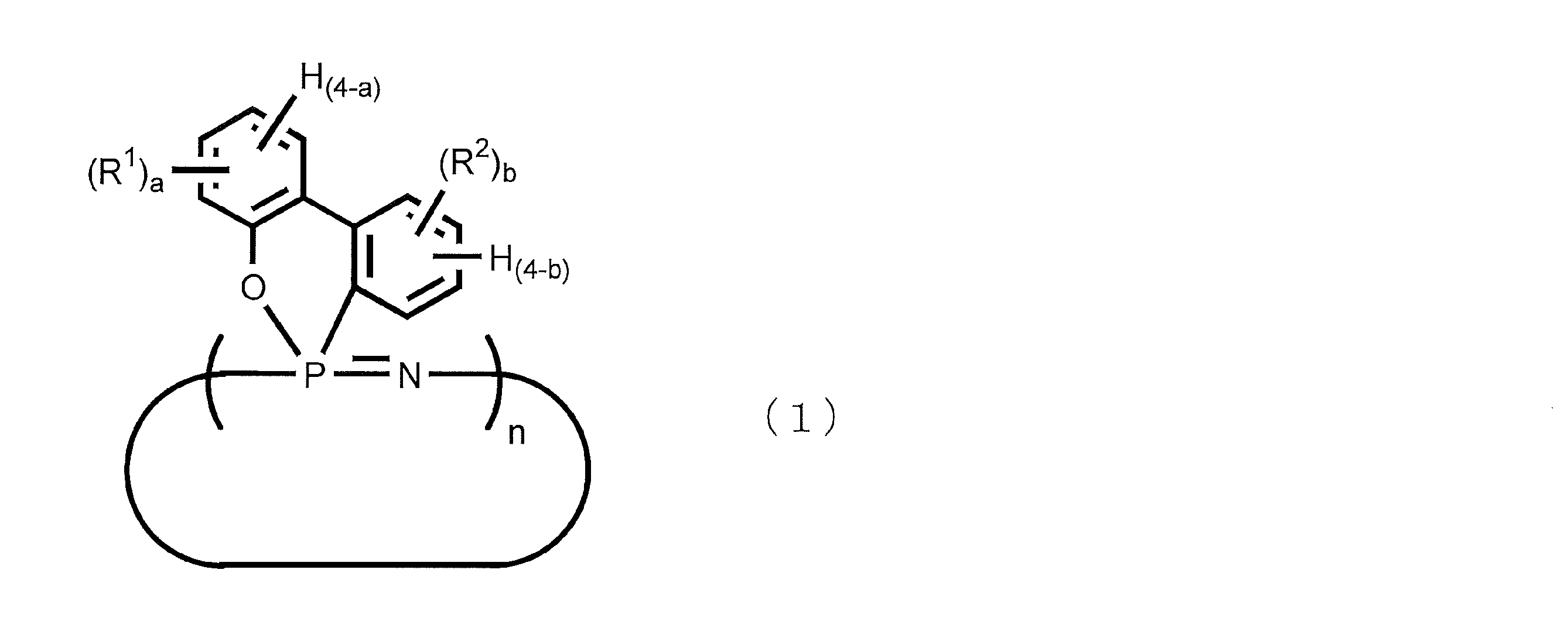
式(1)中、nは3から8の整数である。R1およびR2は、(i)それぞれ独立して、ニトロ基、炭素数1~6のアルキル基およびアリール基から選ばれる少なくとも一種の基が置換されていてもよい、炭素数が1~8のアルキル基若しくはアルコキシ基、および、炭素数1~6のアルキル基およびアリール基から選ばれる少なくとも一種の基が置換されていてもよい、炭素数6~20のアリール基若しくはアリールオキシ基のうちのいずれか、または、(ii)炭素数が1~6のアルキル基若しくはカルボニル基により置換されていてもよい飽和の若しくは不飽和の環状構造を相互間で形成している。aおよびbは、それぞれ独立して0~4の整数である。なお、各繰り返し単位のオキサホスホリン環含有構造の種類は独立している。
本発明の環状ホスファゼン化合物の一形態は、式(1)のnが3または4のものである。
本発明の環状ホスファゼン化合物の他の一形態は、式(1)において、nが3であり、かつ、aおよびbが0のものである。この形態に係る本発明の環状ホスファゼン化合物の一例は、ジアステレオマーの混合物である。また、この形態に係る本発明の環状ホスファゼン化合物の他の例は、隣接し合うオキサホスホリン環含有構造の立体配置がcis-cis-cis型である。この形態に係る本発明の環状ホスファゼン化合物のさらに他の例は、隣接し合うオキサホスホリン環含有構造の立体配置がtrans-cis-trans型である。
他の観点に係る本発明は、オキサホスホリン環含有構造を有する環状ホスファゼン化合物混合物に関するものであり、この混合物は、本発明に係るオキサホスホリン環含有構造を有する環状ホスファゼン化合物を二種類以上含む。
本発明に係るオキサホスホリン環含有構造を有する新規な環状ホスファゼン化合物および当該環状ホスファゼン化合物の混合物は、樹脂材料の難燃剤として有用である。
さらに他の観点に係る本発明は、本発明に係るオキサホスホリン環含有構造を有する環状ホスファゼン化合物の製造方法に関するものである。この製造方法は、アジド化剤を用いて下記の式(2)で表されるクロロジベンゾオキサホスホリン系化合物をアジド化中間体に誘導する工程1と、先の工程で得られたアジド化中間体を環化反応させる工程2とを含む。
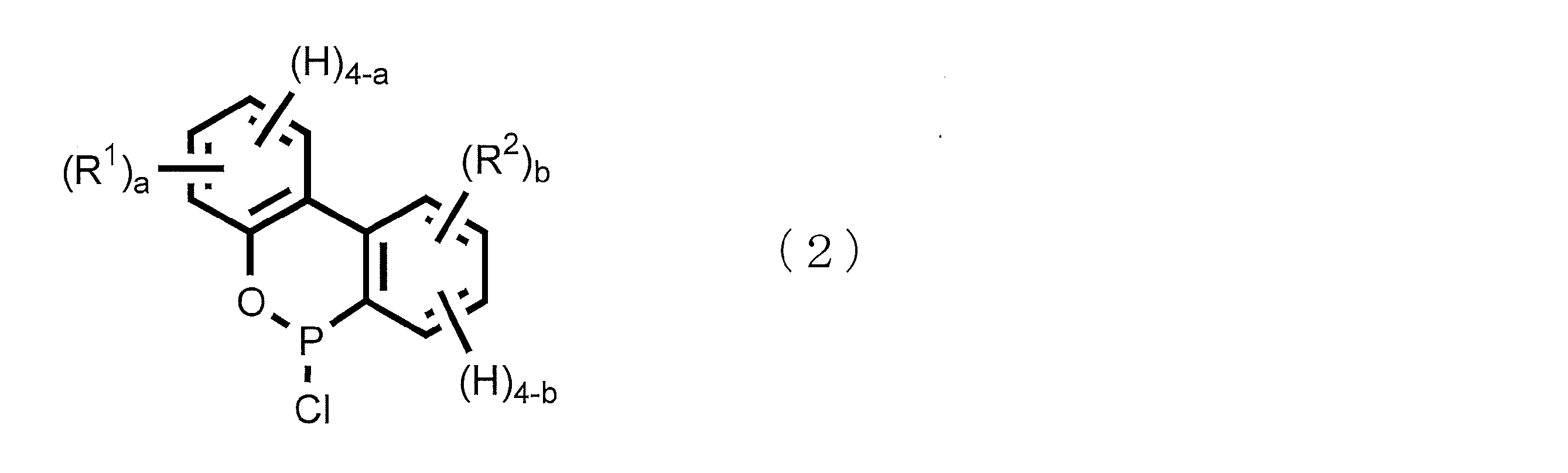
式(2)中、R1およびR2は、(i)それぞれ独立して、ニトロ基、炭素数1~6のアルキル基およびアリール基から選ばれる少なくとも一種の基が置換されていてもよい、炭素数が1~8のアルキル基若しくはアルコキシ基、および、炭素数1~6のアルキル基およびアリール基から選ばれる少なくとも一種の基が置換されていてもよい、炭素数6~20のアリール基若しくはアリールオキシ基のうちのいずれか、または、(ii)炭素数が1~6のアルキル基若しくはカルボニル基により置換されていてもよい飽和の若しくは不飽和の環状構造を相互間で形成している。また、aおよびbは、それぞれ独立して0~4の整数である。
この製造方法の一形態では、工程2において用いる上記アジド化中間体が二種類以上の上記アジド化中間体の混合物である。この形態において、上記アジド化中間体の上記混合物が工程1において二種類以上の上記クロロジベンゾオキサホスホリン系化合物を用いることで得られたものである。
本発明に係る製造方法によれば、本発明に係るオキサホスホリン環含有構造を有する新規な環状ホスファゼン化合物を製造することができる。
さらに他の観点に係る本発明は樹脂組成物に関するものであり、この樹脂組成物は、樹脂成分と、本発明に係るオキサホスホリン環含有構造を有する環状ホスファゼン化合物の一種類または二種類以上とを含む。
本発明に係る樹脂組成物において、樹脂成分は、例えば、エポキシ樹脂、フェノール樹脂、不飽和ポリエステル樹脂、ジアリルフタレート樹脂、マレイミド樹脂、ポリイミド樹脂、ベンゾオキサジン樹脂、ベンゾシクロブテン樹脂、ポリオレフィン樹脂、スチレン系樹脂、ポリエステル樹脂、脂肪族ポリアミド樹脂、半芳香族ポリアミド樹脂、ポリカーボネート樹脂、ポリフェニレンエーテル系樹脂、ポリアリレート樹脂およびこれらの変性樹脂からなる群から選ばれた少なくとも一つである。
本発明に係る樹脂組成物は、本発明に係る新規な環状ホスファゼン化合物の一種類または二種類以上を含むものであることから、樹脂材料の物性劣化を抑えながら難燃性を高めることができるとともにLow Dk/Dfを達成可能である。
さらに他の観点に係る本発明は、樹脂成形体に関するものであり、この樹脂成形体は、本発明の樹脂組成物からなる。
本発明に係る樹脂成形体は、本発明の樹脂組成物からなるため、樹脂材料の物性劣化を抑えながら難燃性が高められるとともにLow Dk/Dfを達成可能である。
さらに他の観点に係る本発明は、電気・電子部品に関するものであり、この電気・電子部品は、本発明の樹脂成形体を含む。
本発明に係る電気・電子部品は、本発明の樹脂成形体を含むものであることから、樹脂材料の物性劣化を抑えながら難燃性が高められるとともにLow Dk/Dfを達成可能である。
<オキサホスホリン環含有構造を有する環状ホスファゼン化合物>
本発明の環状ホスファゼン化合物は、オキサホスホリン環含有構造を有するものであり、下記の式(1)で表される。
本発明の環状ホスファゼン化合物は、オキサホスホリン環含有構造を有するものであり、下記の式(1)で表される。

式(1)において、nは、3から8の整数を示す。したがって、式(1)で表されるオキサホスホリン環含有構造を有する環状ホスファゼン化合物は、nが3であるオキサホスホリン環含有構造を有する環状ホスファゼン化合物(3量体)、nが4であるオキサホスホリン環含有構造を有する環状ホスファゼン化合物(4量体)、nが5であるオキサホスホリン環含有構造を有する環状ホスファゼン化合物(5量体)、nが6であるオキサホスホリン環含有構造を有する環状ホスファゼン化合物(6量体)、nが7であるオキサホスホリン環含有構造を有する環状ホスファゼン化合物(7量体)またはnが8であるオキサホスホリン環含有構造を有する環状ホスファゼン化合物(8量体)である。
本発明の環状ホスファゼン化合物は、例えば電気・電子部品用の樹脂成形体を製造するための樹脂組成物の成分として用いられた場合、nが小さいものの方が誘電特性に優れた樹脂成形体を実現しやすい。したがって、本発明の環状ホスファゼン化合物は、電気・電子部品用の樹脂成形体の製造用材料として用いる場合、式(1)のnが3から4の整数のものが好ましく、nが3のものが特に好ましい。また、本発明の環状ホスファゼン化合物は、nが異なる二種以上のものの混合物である場合、nが小さいものの含有量が多いものほど誘電特性に優れた樹脂成形体を実現しやすい。したがって、本発明の環状ホスファゼン化合物は、nが異なるものの混合物であって電気・電子部品用の樹脂成形体の製造用材料として用いる場合、nが3から4のものを質量比率で95%以上含む混合物が好ましく、nが3のものを質量比率で95%以上含む混合物が特に好ましい。
式(1)中のR1およびR2は、それぞれ独立しており、ニトロ基、下記のR-1若しくは下記のR-2、または、下記のR-3を示している。また、式(1)において、置換基R1およびR2の数を示すaおよびbは、それぞれ独立しており、0~4の整数である。
R-1:
炭素数1~6のアルキル基およびアリール基から選ばれる少なくとも一種の基が置換されていても良い、炭素数が1~8のアルキル基若しくはアルコキシ基。
炭素数1~6のアルキル基およびアリール基から選ばれる少なくとも一種の基が置換されていても良い、炭素数が1~8のアルキル基若しくはアルコキシ基。
該当するアルキル基の例としては、メチル基、エチル基、n-プロピル基、イソプロピル基、n-ブチル基、イソブチル基、sec-ブチル基、tert-ブチル基、n-ペンチル基、n-ヘキシル基、n-ヘプチル基、n-オクチル基、n-ノニル基、2-エチルへキシル基、ベンジル基および2-フェニルエチル基を挙げることができる。また、該当するアルコキシ基の例としては、メトキシ基、エトキシ基、n-プロポキシ基、イソプロポキシ基、n-ブトキシ基、イソブトキシ基、sec-ブトキシ基、tert-ブトキシ基、n-ペントキシ基、n-ヘキシルオキシ基、n-ヘプチルオキシ基、n-オクチルオキシ基、n-ノニルオキシ基、2-エチルへキシルオキシ基、ベンジルオキシ基および2-フェニルエチルオキシ基を挙げることができる。
本発明の環状ホスファゼン化合物を電気・電子部品用の樹脂成形体の製造用材料として用いる場合、R-1は、メチル基、エチル基、n-プロピル基、ベンジル基またはメトキシ基が好ましく、メチル基またはエチル基が特に好ましい。
R-2:
炭素数1~6のアルキル基およびアリール基から選ばれる少なくとも一種の基が置換されていても良い、炭素数6~20のアリール基若しくはアリールオキシ基。
炭素数1~6のアルキル基およびアリール基から選ばれる少なくとも一種の基が置換されていても良い、炭素数6~20のアリール基若しくはアリールオキシ基。
該当するアリール基の例としては、フェニル基、メチルフェニル基、ジメチルフェニル基、エチルフェニル基、エチルメチルフェニル基、ジエチルフェニル基、n-プロピルフェニル基、イソプロピルフェニル基、イソプロピルメチルフェニル基、イソプロピルエチルフェニル基、ジイソプロピルフェニル基、n-ブチルフェニル基、sec-ブチルフェニル基、tert-ブチルフェニル基、n-ペンチルフェニル基、n-ヘキシルフェニル基、フェニルフェニル基、ナフチル基、アントリル基およびフェナントリル基を挙げることができる。また、該当するアリールオキシ基の例としては、フェニルオキシ基、メチルフェニルオキシ基、ジメチルフェニルオキシ基、エチルフェニルオキシ基、エチルメチルフェニルオキシ基、ジエチルフェニルオキシ基、n-プロピルフェニルオキシ基、イソプロピルフェニルオキシ基、イソプロピルメチルフェニルオキシ基、イソプロピルエチルフェニルオキシ基、ジイソプロピルフェニルオキシ基、n-ブチルフェニルオキシ基、sec-ブチルフェニルオキシ基、tert-ブチルフェニルオキシ基、n-ペンチルフェニルオキシ基、n-ヘキシルフェニルオキシ基、フェニルフェニルオキシ基、ナフチルオキシ基、アントリルオキシ基およびフェナントリルオキシ基を挙げることができる。
本発明の環状ホスファゼン化合物を電気・電子部品用の樹脂成形体の製造用材料として用いる場合、R-2は、フェニル基、メチルフェニル基、ジメチルフェニル基、ジエチルフェニル基、フェニルフェニル基、ナフチル基またはフェニルオキシ基が好ましく、フェニル基またはメチルフェニル基が特に好ましい。
R-3:
R1とR2との相互間で形成された飽和の若しくは不飽和の環状構造であり、この環状構造は炭素数が1~6のアルキル基またはカルボニル基により置換されていても良い。
R1とR2との相互間で形成された飽和の若しくは不飽和の環状構造であり、この環状構造は炭素数が1~6のアルキル基またはカルボニル基により置換されていても良い。
該当する飽和の環状構造を有するオキサホスホリン環含有構造を備えた式(1)の繰り返し単位の例として、次の式(3)および(4)で表されるものを挙げることができる。

また、該当する不飽和の環状構造を有するオキサホスホリン環含有構造を備えた式(1)の繰り返し単位の例として、次の式(5)で表されるものを挙げることができる。
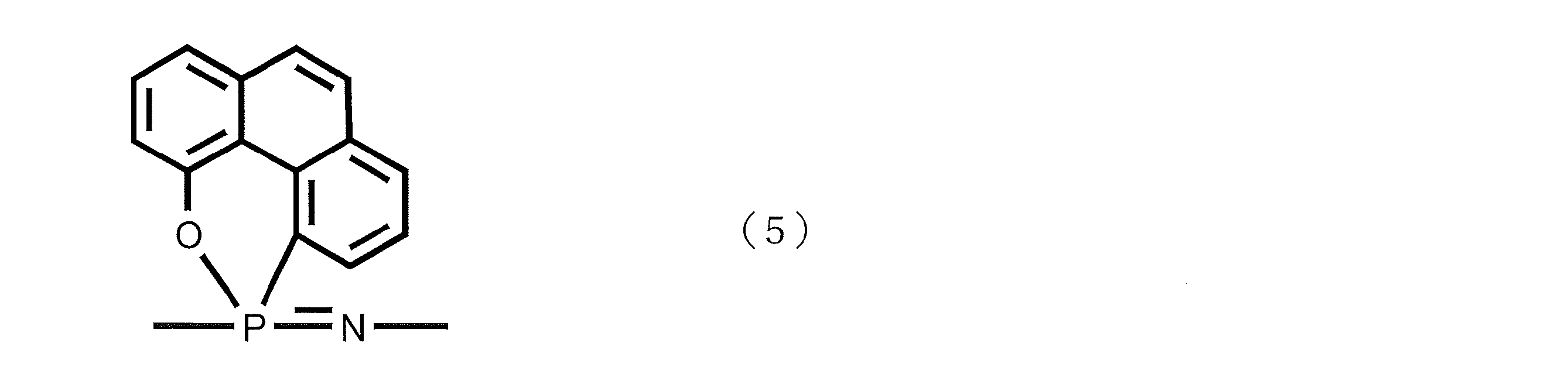
本発明の環状ホスファゼン化合物は、各繰り返し単位のオキサホスホリン環含有構造の種類が独立している。したがって、本発明の環状ホスファゼン化合物は、全てのオキサホスホリン環含有構造が同じものであってもよいし、二種類以上のオキサホスホリン環含有構造を有するものであってもよい。
式(1)で表される本発明の環状ホスファゼン化合物の具体例としては、式(1)のnが3であるオキサホスホリン環含有構造を有するシクロトリホスファゼン化合物、式(1)のnが4であるオキサホスホリン環含有構造を有するシクロテトラホスファゼン化合物、式(1)のnが5であるオキサホスホリン環含有構造を有するシクロペンタホスファゼン化合物、式(1)のnが6であるオキサホスホリン環含有構造を有するシクロヘキサホスファゼン化合物、式(1)のnが7であるオキサホスホリン環含有構造を有するシクロヘプタホスファゼン化合物または式(1)のnが8であるオキサホスホリン環含有構造を有するシクロオクタホスファゼン化合物のいずれかであって、a、b、R1およびR2が下記の表1の組合せのものが挙げられる。
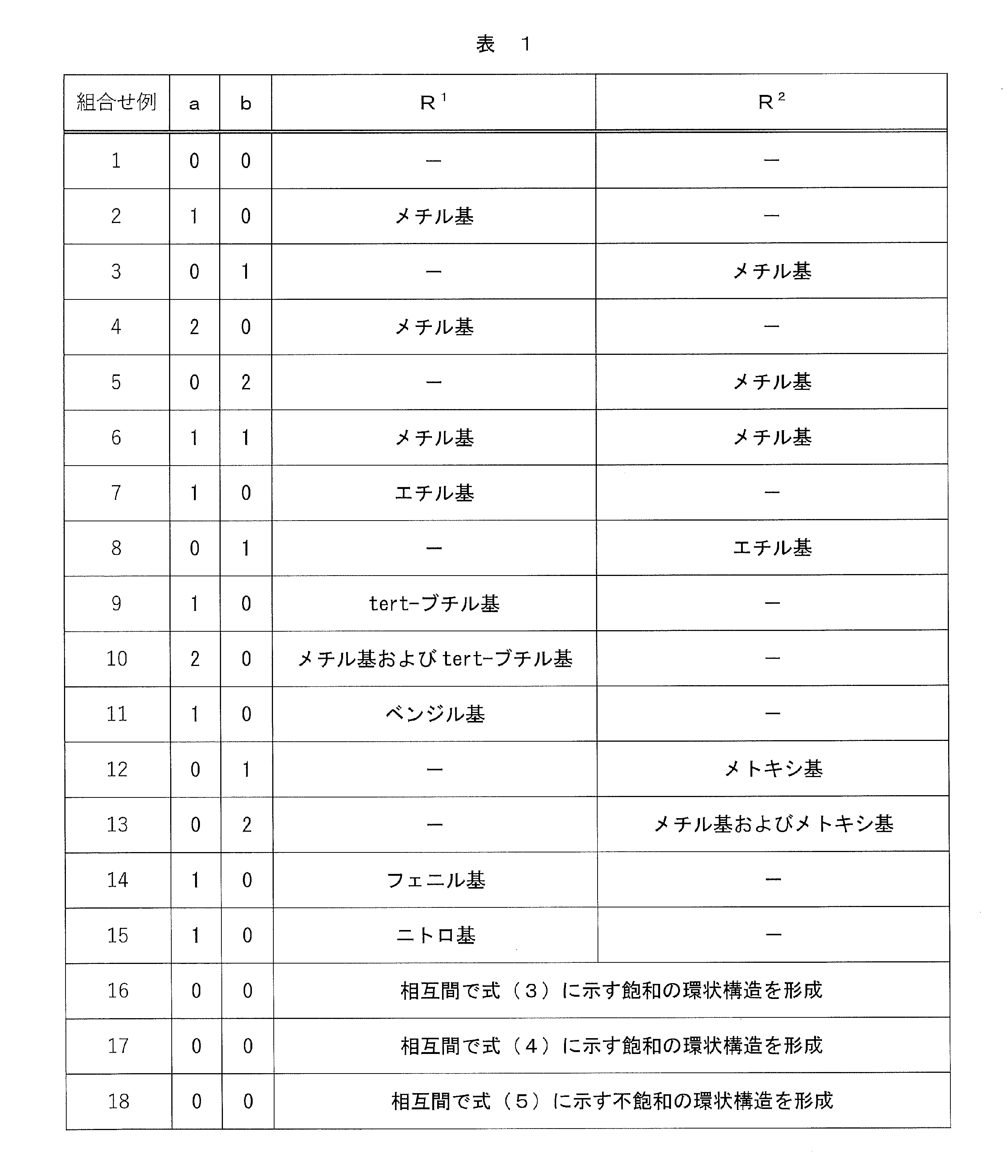
本発明の環状ホスファゼン化合物を電気・電子部品用の樹脂成形体の製造用材料として用いる場合、上記例のうち、式(1)のnが3であるシクロトリホスファゼン化合物または式(1)のnが4であるシクロテトラホスファゼン化合物であって、組合せ例1、2または3のものが好ましく、式(1)のnが3であるシクロトリホスファゼン化合物であって組合せ例1または2のものが特に好ましい。
上記例のうち、式(1)のnが3であるシクロトリホスファゼン化合物であって組合せ例1のものは、下記の式(6)で表される構造となる。
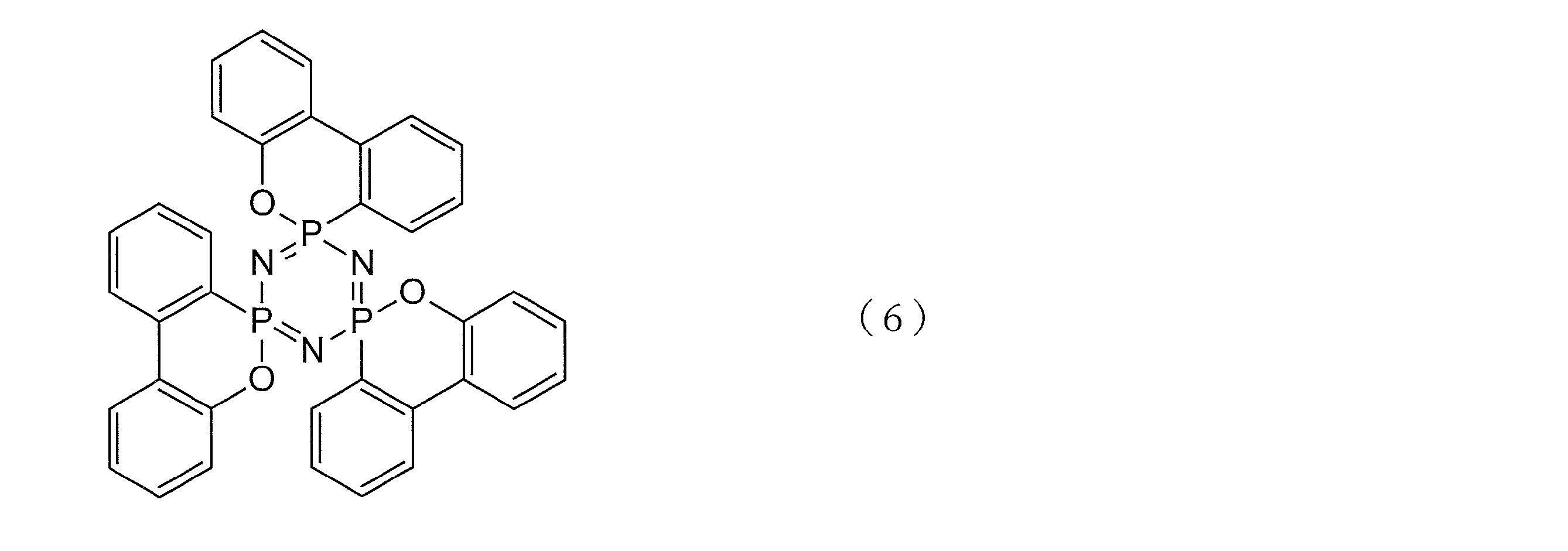
式(6)で表されるオキサホスホリン環含有構造を有する環状ホスファゼン化合物は、通常、後記する製造方法により製造するとジアステレオマーの混合物として得られる。すなわち、隣接し合う前記オキサホスホリン環含有構造の立体配置において、下記の式(7)で表されるcis-cis-cis型のもの(以下、「cis型」と称する。)と下記の式(8)で表されるtrans-cis-trans型のもの(以下、「trans型」と称する。)との混合物として得られる。


このようなジアステレオマーの混合物は、そのまま混合物として用いることができるが、cis型のものとtrans型のものとをそれぞれ単離し、それぞれの型のものの単一物として用いることもできる。単離方法としては、例えば、トルエン等の溶媒への溶解度を利用した分離と濾過との組合せによる方法、溶媒抽出、再結晶またはカラムクロマトグラフィーによる分離等を採用することができる。
<オキサホスホリン環含有構造を有する環状ホスファゼン化合物混合物>
本発明の環状ホスファゼン化合物混合物は、本発明に係るオキサホスホリン環含有構造を有する環状ホスファゼン化合物を二種類以上含むものである。この混合物の例としては、本発明に係るオキサホスホリン環含有構造を有する環状ホスファゼン化合物の具体例として挙げたものの任意の混合物が挙げられる。本発明の環状ホスファゼン化合物を電気・電子部品用の樹脂成形体の製造用材料として用いる場合、式 (1)のnが3であるシクロトリホスファゼン化合物および式(2)のnが4であるシクロテトラホスファゼン化合物であって、組合せ例1、2および3の群から選択した任意の組合せの混合物が好ましい。
本発明の環状ホスファゼン化合物混合物は、本発明に係るオキサホスホリン環含有構造を有する環状ホスファゼン化合物を二種類以上含むものである。この混合物の例としては、本発明に係るオキサホスホリン環含有構造を有する環状ホスファゼン化合物の具体例として挙げたものの任意の混合物が挙げられる。本発明の環状ホスファゼン化合物を電気・電子部品用の樹脂成形体の製造用材料として用いる場合、式 (1)のnが3であるシクロトリホスファゼン化合物および式(2)のnが4であるシクロテトラホスファゼン化合物であって、組合せ例1、2および3の群から選択した任意の組合せの混合物が好ましい。
なお、本発明に係る環状ホスファゼン化合物混合物は、上述のシクロトリホスファゼン化合物についてのジアステレオマーの混合物のような異性体の混合物であってもよい。式 (1)のnが4以上の本発明に係る環状ホスファゼン化合物は、通常、後記する製造方法により製造すると、多くのジアステレオマーおよびエナンチオマーを有する立体構造異性体の混合物として得られる。
<オキサホスホリン環含有構造を有する環状ホスファゼン化合物の製造方法>
本発明に係るオキサホスホリン環含有構造を有する環状ホスファゼン化合物は、例えば、クロロジベンゾオキサホスホリン系化合物を出発原料とし、当該出発原料から誘導される中間体を分子間で環化する次の製造方法1~4のいずれかにより製造することができる。
本発明に係るオキサホスホリン環含有構造を有する環状ホスファゼン化合物は、例えば、クロロジベンゾオキサホスホリン系化合物を出発原料とし、当該出発原料から誘導される中間体を分子間で環化する次の製造方法1~4のいずれかにより製造することができる。
製造方法1
この製造方法では、例えば、下記の非特許文献1または2に記載されているような環状ホスファゼン化合物の製造方法、すなわち、クロロジベンゾオキサホスホリン系化合物をアジド化する工程1と、工程1で得られたアジド化中間体を環化する工程2とを含む製造方法に従って製造する。
この製造方法では、例えば、下記の非特許文献1または2に記載されているような環状ホスファゼン化合物の製造方法、すなわち、クロロジベンゾオキサホスホリン系化合物をアジド化する工程1と、工程1で得られたアジド化中間体を環化する工程2とを含む製造方法に従って製造する。
[非特許文献1]
G.Tesi,C.P.Haber,C.M.Douglas,Proc.Chem.Soc.,London,1960,p.219.
[非特許文献2]
R.H.Kratzer,K.L.Paciorek,Inorg.Chem.,1965,Vol.4,p.1767.
G.Tesi,C.P.Haber,C.M.Douglas,Proc.Chem.Soc.,London,1960,p.219.
[非特許文献2]
R.H.Kratzer,K.L.Paciorek,Inorg.Chem.,1965,Vol.4,p.1767.
クロロジベンゾオキサホスホリン系化合物:
この製造方法においては、先ず、原料として使用する、下記の式(2)で表されるクロロジベンゾオキサホスホリン系化合物を用意する。
この製造方法においては、先ず、原料として使用する、下記の式(2)で表されるクロロジベンゾオキサホスホリン系化合物を用意する。

式(2)中のR1およびR2は、それぞれ独立しており、ニトロ基、または、下記のR-1、R-2若しくはR-3を示している。また、式(2)において、置換基R1およびR2の数を示すaおよびbは、それぞれ独立しており、0~4の整数である。
R-1:
式(1)のR-1と同様である。
式(1)のR-1と同様である。
R-2:
式(1)のR-2と同様である。
式(1)のR-2と同様である。
R-3:
R1とR2との相互間で形成された飽和の若しくは不飽和の環状構造であり、この環状構造は炭素数が1~6のアルキル基またはカルボニル基により置換されていても良い。
R1とR2との相互間で形成された飽和の若しくは不飽和の環状構造であり、この環状構造は炭素数が1~6のアルキル基またはカルボニル基により置換されていても良い。
該当する飽和の環状構造を有するオキサホスホリン環含有構造を備えた式(2)で表されるクロロジベンゾオキサホスホリン系化合物の例として、次の式(9)および(10)で表されるものを挙げることができる。
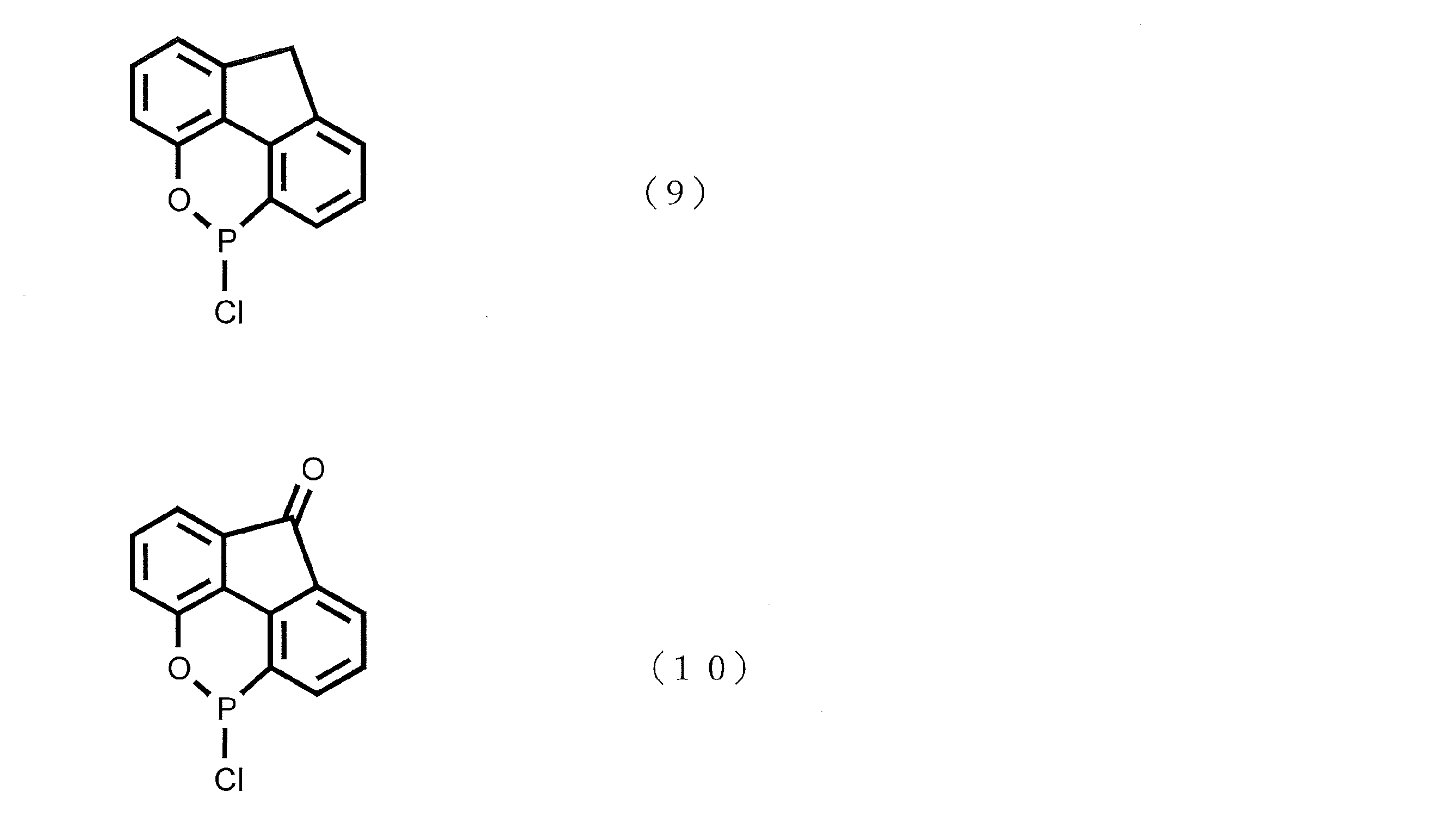
また、該当する不飽和の環状構造を有するオキサホスホリン環含有構造を備えた式(2)で表されるクロロジベンゾオキサホスホリン系化合物の例として、次の式(11)で表されるものを挙げることができる。

本発明に係るオキサホスホリン環含有構造を有する環状ホスファゼン化合物として既述の具体例に係るものを製造する場合、原料となるクロロジベンゾオキサホスホリン系化合物として式(2)のa、b、R1およびR2が先の表1の組合せに対応するものを選択する。
式(2)で表されるクロロジベンゾオキサホスホリン系化合物は、下記の式(12)で表されるフェノール類と三塩化リンを反応させた後、塩化亜鉛等の触媒を添加して環化反応させることで製造することができる。

式(12)中のR1およびR2並びにaおよびbは、式(2)と同様である。
このようなクロロジベンゾオキサホスホリン系化合物の製造方法は、下記の特許文献8、9や非特許文献3、4をはじめとする文献に記載されている。
[特許文献8]
米国特許第3702878号
[特許文献9]
米国特許第5391798号
[非特許文献3]
Stephen D.Pastor,John D.Spivack,Leander P.Steinhuebel,Phosphorus and Sulfur,1987,Vol.31,p.71.
[非特許文献4]
Asfia Qureshi,Allan S.Hay,J.Chem.Res(M),1998,p.1601.
米国特許第3702878号
[特許文献9]
米国特許第5391798号
[非特許文献3]
Stephen D.Pastor,John D.Spivack,Leander P.Steinhuebel,Phosphorus and Sulfur,1987,Vol.31,p.71.
[非特許文献4]
Asfia Qureshi,Allan S.Hay,J.Chem.Res(M),1998,p.1601.
式(12)で表されるフェノール類としては、目的のオキサホスホリン環含有構造を有する環状ホスファゼン化合物のR1およびR2並びにaおよびbに対応するR1およびR2並びにaおよびbを有するものが用いられる。該当するフェノール類としては、例えば、2-フェニルフェノール、2-メチル-6-フェニルフェノール、3-メチル-6-フェニルフェノール、3-メチル-2-フェニルフェノール、4-メチル-2-フェニルフェノール、2-(2-メチルフェニル)フェノール、2-(3-メチルフェニル)フェノール、2-(4-メチルフェニル)フェノール、2,3-ジメチル-6-フェニルフェノール、2,5-ジメチル-6-フェニルフェノール、3,5-ジメチル-2-フェニルフェノール、4,5-ジメチル-2-フェニルフェノール、2-(2,3-ジメチルフェニル)フェノール、2-(2,4-ジメチルフェニル)フェノール、2-(2,5-ジメチルフェニル)フェノール、2-(3,5-ジメチルフェニル)フェノール、2’-ヒドロキシ-2,3’-ジメチル-ビフェニル、2’-ヒドロキシ-2,5’-ジメチル-ビフェニル、2’-ヒドロキシ-3,5’-ジメチル-ビフェニル、2’-ヒドロキシ-4,5’-ジメチル-ビフェニル、2’-ヒドロキシ-3,3’-ジメチル-ビフェニル、2-エチル-6-フェニルフェノール、4-エチル-2-フェニルフェノール、2-(2-エチルフェニル)フェノール、2-(4-エチルフェニル)フェノール、2-tert-ブチル-6-フェニルフェノール、4-tert-ブチル-2-フェニルフェノール、2-tert-ブチル-4-メチル-6-フェニルフェノール、5-ベンジル-2-フェニルフェノール、2-(2-メトキシフェニル)フェノール、2-(3-メトキシフェニル)フェノール、2-(4-メトキシフェニル)フェノール、2-(2-メトキシ-5-メチルフェニル)フェノール、2-(4-メトキシ-2-メチルフェニル)フェノール、2-(4-メトキシ-3-メチルフェニル)フェノール、2-(4-エトキシ-2-メチルフェニル)フェノール、2,3-ジフェニルフェノール、2,6-ジフェニルフェノール、4-ニトロ-2-フェニルフェノール、4-ヒドロキシフルオレン、4-ヒドロキシフルオレノンおよび4-フェナントロール等が挙げられる。
目的のオキサホスホリン環含有構造を有する環状ホスファゼン化合物が一種類のオキサホスホリン環含有構造を有する場合、上述のフェノール類として目的のオキサホスホリン環含有構造に対応する一種類のものを用いればよいが、目的のオキサホスホリン環含有構造を有する環状ホスファゼン化合物が二種類以上のオキサホスホリン環含有構造を有する場合、上述のフェノール類として目的のオキサホスホリン環含有構造に対応する二種類以上のものを混合して用いることができる。
式(2)で表されるクロロジベンゾオキサホスホリン系化合物は、上述のフェノール類を用いる方法の他に、非特許文献5に記載されているように、三塩化リンでジベンゾオキサホスホリンオキシドを塩素化することで製造することもできる。
[非特許文献5]
P.Abranyi-Balogha,G.Keglevich,Synthetic Communications,2011,vol.41,p.1421.
P.Abranyi-Balogha,G.Keglevich,Synthetic Communications,2011,vol.41,p.1421.
工程1:
本工程においてアジド化の対象となる式(2)で表されるクロロジベンゾオキサホスホリン系化合物は、目的の環状ホスファゼン化合物が有するオキサホスホリン環含有構造の種類により、一種類のものまたは二種類以上のものの混合物が用いられる。二種類以上のものの混合物は、個別に用意された式(2)で表される二種類以上のクロロジベンゾオキサホスホリン系化合物を混合することで調製された混合物であってもよいし、式(2)で表されるクロロジベンゾオキサホスホリン系化合物の調製時において二種類以上のフェノール類を混合使用することで得られる混合物であってもよい。
本工程においてアジド化の対象となる式(2)で表されるクロロジベンゾオキサホスホリン系化合物は、目的の環状ホスファゼン化合物が有するオキサホスホリン環含有構造の種類により、一種類のものまたは二種類以上のものの混合物が用いられる。二種類以上のものの混合物は、個別に用意された式(2)で表される二種類以上のクロロジベンゾオキサホスホリン系化合物を混合することで調製された混合物であってもよいし、式(2)で表されるクロロジベンゾオキサホスホリン系化合物の調製時において二種類以上のフェノール類を混合使用することで得られる混合物であってもよい。
クロロジベンゾオキサホスホリン系化合物のアジド化においては、公知の様々なアジド化剤を使用することができる。使用可能なアジ化剤の例としては、アジ化リチウム、アジ化ナトリウムおよびアジ化カリウムのような金属アジ化物、トリメチルシリルアジド、p-トルエンスルホニルアジドおよびトシルアジド(TsN3)のような有機アジ化合物、並びに、アジ化ジフェニルホスホリル(DPPA)のようなアジ化ホスホリル化合物を挙げることができる。このようなアジ化剤のうち、汎用性の点においてアジ化ナトリウム、トリメチルシリルアジドまたはDPPAを用いるのが好ましく、アジ化ナトリウムを用いるのが特に好ましい。アジド化剤は2種類以上のものを混合等することで併用することもできる。
アジド化剤の使用量は、アジド化反応を十分に進行させる観点から、式(2)で表されるクロロジベンゾオキサホスホリン系化合物に対して1~2当量程度に設定するのが好ましく、1.1~1.3当量程度に設定するのがより好ましい。
本工程では、通常、式(2)で表されるクロロジベンゾオキサホスホリン系化合物とアジ化剤とを溶媒中に添加し、アジド化反応を進行させる。この際、40~250℃程度に加熱してもよい。ここで使用する溶媒は、特に種類が限定されるものではないが、非プロトン性極性溶媒が好ましい。非プロトン性極性溶媒の例としては、アセトン、アセトニトリル、N,N-ジメチルホルムアミドおよびジメチルスルホキシドのような有機溶媒を挙げることができる。このような非プロトン性極性溶媒のうち、特に比誘電率が高く、安価に入手可能なN,N-ジメチルホルムアミドまたはジメチルスルホキシドを用いるのが好ましい。溶媒は、2種類以上のものが混合等することで併用されてもよい。
本工程のアジド化反応により、式(2)で表されるクロロジベンゾオキサホスホリン系化合物は、アジド化中間体に誘導される。
本工程において式(2)で表されるクロロジベンゾオキサホスホリン系化合物の混合物を用いた場合、本工程では式(2)で表されるクロロジベンゾオキサホスホリン系化合物の混合物に対応したアジド化中間体の混合物が得られる。
工程2:
工程1において得られたアジド化中間体を環化反応させ、目的のオキサホスホリン環を有する環状ホスファゼン化合物に誘導する。本工程において環化反応の対象となるアジド化中間体は、目的の環状ホスファゼン化合物が有するオキサホスホリン環含有構造の種類により、一種類のものまたは二種類以上のものの混合物が用いられる。二種類以上のものの混合物は、工程1において個別に調製された二種類以上のアジド化中間体を混合することで調製された混合物であってもよいし、工程1において式(2)で表されるクロロジベンゾオキサホスホリン系化合物の二種類以上のものの混合物を用いることで得られる混合物であってもよい。
工程1において得られたアジド化中間体を環化反応させ、目的のオキサホスホリン環を有する環状ホスファゼン化合物に誘導する。本工程において環化反応の対象となるアジド化中間体は、目的の環状ホスファゼン化合物が有するオキサホスホリン環含有構造の種類により、一種類のものまたは二種類以上のものの混合物が用いられる。二種類以上のものの混合物は、工程1において個別に調製された二種類以上のアジド化中間体を混合することで調製された混合物であってもよいし、工程1において式(2)で表されるクロロジベンゾオキサホスホリン系化合物の二種類以上のものの混合物を用いることで得られる混合物であってもよい。
本工程では、基本的には工程1において得られた反応液を撹拌または静置することで環化反応を進行させることができる。この際、反応系を加熱してもよい。反応系の加熱温度は、通常、40~100℃に設定するのが好ましい。環化反応の進行、すなわち、アジド化中間体の三量体化、四量体化等、n量体化の程度は、本工程で利用可能な後記の溶媒の種類の選択や反応温度の調整によりある程度の範囲で制御することができる。
環化反応は、無溶媒下で進行させてもよいし、溶媒中において進行させてもよい。使用可能な溶媒の種類は、環化反応に悪影響を及ぼさないものであれば特に限定されるものではないが、通常は非プロトン性極性溶媒が好ましい。好ましい非プロトン性極性溶媒の例としては、アセトン、アセトニトリル、N,N-ジメチルホルムアミドおよびジメチルスルホキシドのような有機溶媒が挙げられるが、特に比誘電率が高く、安価に入手可能なN,N-ジメチルホルムアミドまたはジメチルスルホキシドが好ましい。溶媒は、2種類以上のものを混合等することで併用してもよい。溶媒を用いる場合、環化反応のための加熱温度は溶媒の沸点を超えない範囲に制御する。
本工程において得られる目的のオキサホスホリン環含有構造を有する環状ホスファゼン化合物は、通常、式(1)の繰り返し単位数が異なる複数の種類のものの混合物として得られる。また、本工程において一種類のアジド化中間体を用いた場合は目的の環状ホスファゼン化合物において式(1)の各繰り返し単位のオキサホスホリン環含有構造が同じものとなり、また、本工程において二種類以上のアジド化中間体を用いた場合は目的の環状ホスファゼン化合物において式(1)の各繰り返し単位のオキサホスホリン環含有構造が二種類以上のものとなる。
本工程において得られる目的のオキサホスホリン環含有構造を有する環状ホスファゼン化合物は、通常、濾過、溶媒抽出、カラムクロマトグラフィーによる分離または再結晶等の通常の方法により、反応系から単離精製することができる。
製造方法2
この製造方法では、クロロジベンゾオキサホスホリン系化合物を塩素化し、トリクロロ-ジベンゾオキシホスホラン(Trichloro-dibenzoxyphosphorane)系化合物に誘導する工程1と、工程1で得られたトリクロロ-ジベンゾオキシホスホラン系化合物を環化する工程2とを含む工程に従って目的のオキサホスホリン環含有構造を有する環状ホスファゼン化合物を製造する。
この製造方法では、クロロジベンゾオキサホスホリン系化合物を塩素化し、トリクロロ-ジベンゾオキシホスホラン(Trichloro-dibenzoxyphosphorane)系化合物に誘導する工程1と、工程1で得られたトリクロロ-ジベンゾオキシホスホラン系化合物を環化する工程2とを含む工程に従って目的のオキサホスホリン環含有構造を有する環状ホスファゼン化合物を製造する。
工程1:
本工程において用いるクロロジベンゾオキサホスホリン系化合物は、製造方法1において用いる式(2)で表されるものであり、目的の環状ホスファゼン化合物が有するオキサホスホリン環含有構造の種類により、一種類のものまたは二種類以上のものの混合物が用いられる。二種類以上のものの混合物は、個別に用意された二種類以上のクロロジベンゾオキサホスホリン系化合物を混合することで調製した混合物であってもよいし、クロロジベンゾオキサホスホリン系化合物の調製時において二種類以上のフェノール類を混合使用することで得られる混合物であってもよい。
本工程において用いるクロロジベンゾオキサホスホリン系化合物は、製造方法1において用いる式(2)で表されるものであり、目的の環状ホスファゼン化合物が有するオキサホスホリン環含有構造の種類により、一種類のものまたは二種類以上のものの混合物が用いられる。二種類以上のものの混合物は、個別に用意された二種類以上のクロロジベンゾオキサホスホリン系化合物を混合することで調製した混合物であってもよいし、クロロジベンゾオキサホスホリン系化合物の調製時において二種類以上のフェノール類を混合使用することで得られる混合物であってもよい。
本工程では、例えば下記の非特許文献6の記載に照らしてクロロジベンゾオキサホスホリン系化合物を塩素化剤と反応させて塩素化し、トリクロロ-ジベンゾオキシホスホラン(Trichloro-dibenzoxyphosphorane)系化合物に誘導する。
[非特許文献6]
J.Gloede,U.Piepera,B.Costisella,R-P.Kruger,Z.Anorg.Allg.Chem.2003,Vol.629,p.998.
J.Gloede,U.Piepera,B.Costisella,R-P.Kruger,Z.Anorg.Allg.Chem.2003,Vol.629,p.998.
本工程における塩素化では、公知の様々な塩素化剤を使用することができる。好ましい塩素化剤の例は塩素ガスである。塩素化剤の使用量は、塩素化反応を十分に進行させることができる一方で塩素化の過剰な進行を抑える観点から、クロロジベンゾオキサホスホリン系化合物に対して1~1.1当量に設定するのが好ましく、1.01~1.05当量に設定するのがより好ましい。
本工程では、通常、無溶媒下または溶媒中においてクロロジベンゾオキサホスホリン系化合物に対して塩素化剤を添加し、塩素化反応を進行させる。この際、40~150℃程度に加熱してもよい。溶媒を用いる場合、使用可能な溶媒は特に種類が限定されるものではないが、非プロトン性溶媒が好ましい。非プロトン性溶媒の例としては、クロルベンゼン、ジクロルベンゼン、トルエン、キシレンおよびメシチレンなどの有機溶媒を挙げることができる。このような非プロトン性溶媒のうち、溶媒自身が塩素化されにくいことからクロルベンゼンまたはジクロルベンゼンを用いるのが好ましい。溶媒は、二種類以上のものが混合等により併用されてもよい。
本工程においてクロロジベンゾオキサホスホリン系化合物を塩素化することで誘導されるトリクロロ-ジベンゾオキシホスホラン系化合物は、下記の式(13)で表される。式(13)中のR1およびR2並びにaおよびbは、式(2)と同様である。
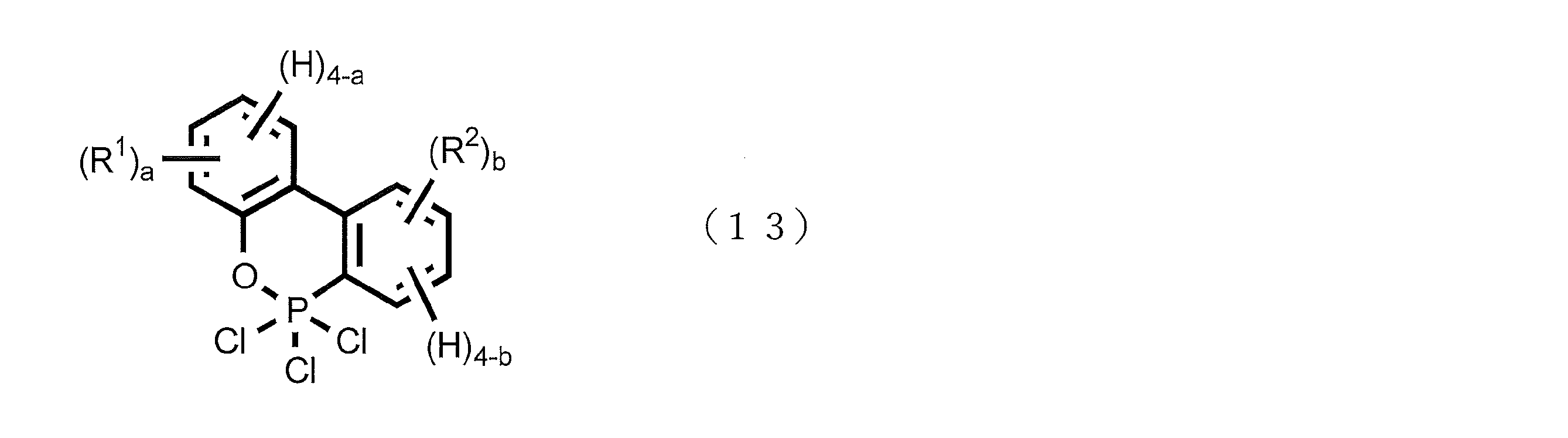
本工程においてクロロジベンゾオキサホスホリン系化合物の混合物を用いた場合、本工程ではクロロジベンゾオキサホスホリン系化合物の混合物に対応した式(13)で表されるトリクロロ-ジベンゾオキシホスホラン系化合物の混合物が得られる。
工程2:
本工程では、工程1において得られたトリクロロ-ジベンゾオキシホスホラン系化合物を環化反応させ、目的のオキサホスホリン環を有する環状ホスファゼン化合物に誘導する。本工程において用いられるトリクロロ-ジベンゾオキシホスホラン系化合物は、目的の環状ホスファゼン化合物が有するオキサホスホリン環含有構造の種類により、一種類のものまたは二種類以上のものの混合物が用いられる。二種類以上のものの混合物は、工程1において個別に調製された二種類以上のトリクロロ-ジベンゾオキシホスホラン系化合物を混合することで調製した混合物であってもよいし、工程1において二種類以上のクロロジベンゾオキサホスホリン系化合物の混合物を用いることで得られる混合物であってもよい。
本工程では、工程1において得られたトリクロロ-ジベンゾオキシホスホラン系化合物を環化反応させ、目的のオキサホスホリン環を有する環状ホスファゼン化合物に誘導する。本工程において用いられるトリクロロ-ジベンゾオキシホスホラン系化合物は、目的の環状ホスファゼン化合物が有するオキサホスホリン環含有構造の種類により、一種類のものまたは二種類以上のものの混合物が用いられる。二種類以上のものの混合物は、工程1において個別に調製された二種類以上のトリクロロ-ジベンゾオキシホスホラン系化合物を混合することで調製した混合物であってもよいし、工程1において二種類以上のクロロジベンゾオキサホスホリン系化合物の混合物を用いることで得られる混合物であってもよい。
工程1において得られたトリクロロ-ジベンゾオキシホスホラン系化合物は、例えば下記の特許文献10または非特許文献7若しくは8の記載に照らしてアンモニア若しくは塩化アンモニウムと反応させて環化する。
[特許文献10]
米国特許第2853517号
[非特許文献7]
C.P.Haber,D.L.Herring,E.A.Lawton,J.Am.Chem.Sci.,1958,Vol.80,p.2116.
[非特許文献8]
M.Taillefer,F.Plenat,C.Chamalet-Combes,V.Vicente,H.J.Cristau,Phosphorus Res.Bull.,1999,Vol.10,p.696.
米国特許第2853517号
[非特許文献7]
C.P.Haber,D.L.Herring,E.A.Lawton,J.Am.Chem.Sci.,1958,Vol.80,p.2116.
[非特許文献8]
M.Taillefer,F.Plenat,C.Chamalet-Combes,V.Vicente,H.J.Cristau,Phosphorus Res.Bull.,1999,Vol.10,p.696.
アンモニア若しくは塩化アンモニウムを用いたトリクロロ-ジベンゾオキシホスホラン系化合物の環化反応は、無溶媒下で進行させてもよいし、溶媒中において進行させてもよい。溶媒を使用する場合、使用可能な溶媒の種類は、環化反応に悪影響を及ぼさないものであれば特に限定されるものではないが、通常は非プロトン性溶媒が好ましい。好ましい非プロトン性溶媒の例としては、クロルベンゼン、ジクロルベンゼン、トルエン、キシレンおよびメシチレンのような有機溶媒を挙げることができるが、安価に入手可能なクロルベンゼンまたはトルエンが好ましい。溶媒は、二種類以上のものを混合等することで併用してもよい。
また、環化反応においては、反応系を加熱してもよい。反応系の加熱温度は、通常、40~170℃に設定するのが好ましいが、溶媒を用いる場合は溶媒の沸点を超えない範囲に加熱温度を制御する。
環化反応の進行、すなわち、トリクロロ-ジベンゾオキシホスホラン系化合物の三量体化、四量体化等、n量体化の程度は、本工程で利用する溶媒の種類の選択や反応温度の調整によりある程度の範囲で制御することができる。
本工程において得られる目的のオキサホスホリン環含有構造を有する環状ホスファゼン化合物は、通常、式(1)の繰り返し単位数が異なる複数の種類のものの混合物として得られる。また、本工程において一種類のトリクロロ-ジベンゾオキシホスホラン系化合物を用いた場合は目的の環状ホスファゼン化合物において式(1)の各繰り返し単位のオキサホスホリン環含有構造が同じものとなり、また、本工程において二種類以上のトリクロロ-ジベンゾオキシホスホラン系化合物を用いた場合は目的の環状ホスファゼン化合物において式(1)の各繰り返し単位のオキサホスホリン環含有構造が二種類以上のものとなる。
製造方法3
この製造方法では、下記の非特許文献9の記載に照らしてクロロジベンゾオキサホスホリン系化合物にクロロアミンを反応させ、その中間生成物を環化することで目的のオキサホスホリン環含有構造を有する環状ホスファゼン化合物を製造する。
この製造方法では、下記の非特許文献9の記載に照らしてクロロジベンゾオキサホスホリン系化合物にクロロアミンを反応させ、その中間生成物を環化することで目的のオキサホスホリン環含有構造を有する環状ホスファゼン化合物を製造する。
[非特許文献9]
I.T.Gilson,H.H.Sisler,Inorg.Chem.,1965,Vol.4,p.273.
I.T.Gilson,H.H.Sisler,Inorg.Chem.,1965,Vol.4,p.273.
この製造方法において用いるクロロジベンゾオキサホスホリン系化合物は、製造方法1において用いる式(2)で表されるものであり、目的の環状ホスファゼン化合物が有するオキサホスホリン環含有構造の種類により、一種類のものまたは二種類以上のものの混合物が用いられる。二種類以上のものの混合物は、個別に用意された二種類以上のクロロジベンゾオキサホスホリン系化合物を混合することで調製した混合物であってもよいし、クロロジベンゾオキサホスホリン系化合物の調製時において二種類以上のフェノール類を混合使用することで得られる混合物であってもよい。
クロロアミンの使用量は、クロロジベンゾオキサホスホリン系化合物のクロロアミノ化反応を十分に進行させることができる一方でクロロアミノ化反応の過剰な進行を抑える観点から、クロロジベンゾオキサホスホリン系化合物に対して1~1.1当量程度に設定するのが好ましく、1.01~1.05当量程度に設定するのがより好ましい。
クロロジベンゾオキサホスホリン系化合物とクロロアミンとの反応は、無溶媒下で進行させてもよいし、溶媒中において進行させてもよい。溶媒を使用する場合、使用可能な溶媒の種類は環化反応に悪影響を及ぼさないものであれば特に限定されるものではないが、非プロトン性溶媒が好ましい。好ましい非プロトン性溶媒の例としては、クロルベンゼン、ジクロルベンゼン、トルエン、キシレンおよびメシチレンのような有機溶媒を挙げることができるが、安価に入手可能なクロルベンゼンまたはトルエンが好ましい。溶媒は、二種類以上のものを混合等することで併用してもよい。
クロロジベンゾオキサホスホリン系化合物とクロロアミンとの反応では、反応系を加熱してもよい。反応系の加熱温度は、通常、40~170℃に設定するのが好ましいが、溶媒を用いる場合は溶媒の沸点を超えない範囲に加熱温度を制御する。
クロロジベンゾオキサホスホリン系化合物とクロロアミンとの反応では、クロロジベンゾオキサホスホリン系化合物に対してクロロアミンが付加する。そして、この付加生成物(すなわち、中間生成物)が脱塩酸過程により縮合することで環化反応が進行し、目的のオキサホスホリン環含有構造を有する環状ホスファゼン化合物が得られる。
環化反応の進行、すなわち、クロロジベンゾオキサホスホリン系化合物の三量体化、四量体化等、n量体化の程度は、利用する溶媒の種類の選択や反応温度の調整によりある程度の範囲で制御することができる。
この製造方法において得られる目的のオキサホスホリン環含有構造を有する環状ホスファゼン化合物は、通常、式(1)の繰り返し単位数が異なる複数の種類のものの混合物として得られる。また、一種類のクロロジベンゾオキサホスホリン系化合物を用いた場合は目的の環状ホスファゼン化合物において式(1)の各繰り返し単位のオキサホスホリン環含有構造が同じものとなり、二種類以上のクロロジベンゾオキサホスホリン系化合物を用いた場合は目的の環状ホスファゼン化合物において式(1)の各繰り返し単位のオキサホスホリン環含有構造が二種類以上のものとなる。
製造方法4
この製造方法では、クロロジベンゾオキサホスホリン系化合物から下記の式(14)で表されるホスホンアミデート(Phosphonamidate)系化合物を調製する工程1と、工程1で得られたホスホンアミデート系化合物を環状ホスファゼン化合物に誘導する工程2とを含む工程に従って目的のオキサホスホリン環含有構造を有する環状ホスファゼン化合物を製造する。
この製造方法では、クロロジベンゾオキサホスホリン系化合物から下記の式(14)で表されるホスホンアミデート(Phosphonamidate)系化合物を調製する工程1と、工程1で得られたホスホンアミデート系化合物を環状ホスファゼン化合物に誘導する工程2とを含む工程に従って目的のオキサホスホリン環含有構造を有する環状ホスファゼン化合物を製造する。
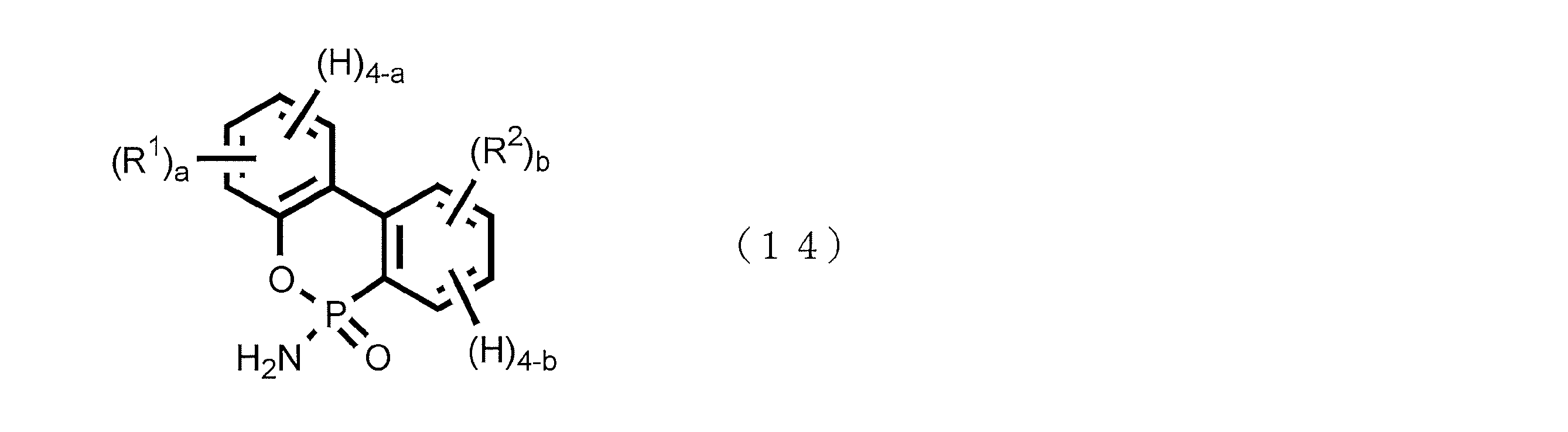
式(14)中のR1およびR2並びにaおよびbは、式(2)と同様である。
工程1:
本工程は、クロロジベンゾオキサホスホリン系化合物を後記の式(15)で表されるジベンゾオキサホスファン-オキシド系化合物に誘導する工程1Aと、工程1Aにおいて得られたジベンゾオキサホスファン-オキシド系化合物を後記の式(16)で表されるクロロ-ジベンゾオキサホスファン-オキシド系化合物に誘導する工程1Bと、工程1Bにおいて得られたクロロ-ジベンゾオキサホスファン-オキシド系化合物を目的のホスホンアミデート系化合物に誘導する工程1Cとを含む。
本工程は、クロロジベンゾオキサホスホリン系化合物を後記の式(15)で表されるジベンゾオキサホスファン-オキシド系化合物に誘導する工程1Aと、工程1Aにおいて得られたジベンゾオキサホスファン-オキシド系化合物を後記の式(16)で表されるクロロ-ジベンゾオキサホスファン-オキシド系化合物に誘導する工程1Bと、工程1Bにおいて得られたクロロ-ジベンゾオキサホスファン-オキシド系化合物を目的のホスホンアミデート系化合物に誘導する工程1Cとを含む。
工程1A
本工程において用いるクロロジベンゾオキサホスホリン系化合物は、製造方法1において用いる式(2)で表されるものであり、目的の環状ホスファゼン化合物が有するオキサホスホリン環含有構造の種類により、一種類のものまたは二種類以上のものの混合物が用いられる。二種類以上のものの混合物は、個別に用意された二種類以上のクロロジベンゾオキサホスホリン系化合物を混合することで調製された混合物であってもよいし、クロロジベンゾオキサホスホリン系化合物の調製時において二種類以上のフェノール類を混合使用することで得られる混合物であってもよい。
本工程において用いるクロロジベンゾオキサホスホリン系化合物は、製造方法1において用いる式(2)で表されるものであり、目的の環状ホスファゼン化合物が有するオキサホスホリン環含有構造の種類により、一種類のものまたは二種類以上のものの混合物が用いられる。二種類以上のものの混合物は、個別に用意された二種類以上のクロロジベンゾオキサホスホリン系化合物を混合することで調製された混合物であってもよいし、クロロジベンゾオキサホスホリン系化合物の調製時において二種類以上のフェノール類を混合使用することで得られる混合物であってもよい。
本工程では、例えば下記の特許文献11または12の記載に照らしてクロロジベンゾオキサホスホリン系化合物を加水分解し、下記の式(15)で表されるジベンゾオキサホスファン-オキシド系化合物に誘導する。
[特許文献11]
米国特許第5481017号
[特許文献12]
米国特許第5821376号
米国特許第5481017号
[特許文献12]
米国特許第5821376号

式(15)のR1およびR2並びにaおよびbは、式(2)と同様である。
クロロジベンゾオキサホスホリン系化合物の加水分解においては、公知の様々な加水分解剤を使用することができる。使用可能な加水分解剤の例としては、水、氷および水蒸気を挙げることができる。
加水分解剤の使用量は、加水分解反応を十分に進行させることができる一方で加水分解の過剰な進行を抑える観点から、クロロジベンゾオキサホスホリン系化合物に対して1~100当量に設定するのが好ましく、10~50当量に設定するのがより好ましい。
本工程では、通常、無溶媒下または溶媒中においてクロロジベンゾオキサホスホリン系化合物に対して加水分解剤を添加し、加水分解反応を進行させる。この際、反応系を40~150℃程度に加熱してもよい。溶媒を用いる場合、使用可能な溶媒は加水分解反応を阻害しにくいものであれば特に限定されるものではないが、非プロトン性溶媒が好ましい。非プロトン性溶媒の例としては、クロルベンゼン、ジクロルベンゼン、トルエン、キシレン、メシチレン、アセトン、テトラヒドロフランおよびアセトニトリルのような有機溶媒を挙げることができる。このような非プロトン性溶媒のうち、加水分解剤と分離しやすいことからクロルベンゼンまたはトルエンを用いるのが好ましい。溶媒は、二種類以上のものが混合等により併用されてもよい。
本工程においてクロロジベンゾオキサホスホリン系化合物の混合物を用いた場合、本工程ではクロロジベンゾオキサホスホリン系化合物の混合物に対応した式(15)で表されるジベンゾオキサホスファン-オキシド系化合物の混合物が得られる。
工程1B
本工程では、例えば下記の非特許文献10の記載に照らして工程1Aにおいて得られたジベンゾオキサホスファン-オキシド系化合物を塩素化し、下記の式(16)で表されるクロロ-ジベンゾオキサホスファン-オキシド系化合物に誘導する。
本工程では、例えば下記の非特許文献10の記載に照らして工程1Aにおいて得られたジベンゾオキサホスファン-オキシド系化合物を塩素化し、下記の式(16)で表されるクロロ-ジベンゾオキサホスファン-オキシド系化合物に誘導する。
[非特許文献10]
A.Salmeia,G.Baumgartner,M.Jovic,A.Gossi,W.Riedl,T.Zich,S.Gann,Org. Process Res.Dev.,2018, Vol.22,p.1570-1577.
A.Salmeia,G.Baumgartner,M.Jovic,A.Gossi,W.Riedl,T.Zich,S.Gann,Org. Process Res.Dev.,2018, Vol.22,p.1570-1577.

式(16)のR1およびR2並びにaおよびbは、式(2)と同様である。
本工程では、目的とするクロロ-ジベンゾオキサホスファン-オキシド系化合物の種類により、工程1Aにおいて得られたジベンゾオキサホスファン-オキシド系化合物の一種類のものまたは二種類以上のものの混合物が用いられる。二種類以上のものの混合物は、工程1Aにおいて個別に調製された二種類以上のジベンゾオキサホスファン-オキシド系化合物を混合することで調製された混合物であってもよいし、工程1Aにおいて二種類以上のクロロジベンゾオキサホスホリン系化合物の混合物を用いることで得られる混合物であってもよい。
本工程では、基本的には工程1Aにおいて得られたジベンゾオキサホスファン-オキシド系化合物を塩素化剤と反応させることで塩素化する。塩素化剤としては公知の様々なものを用いることができる。例えば、非特許文献10に記載された四塩化炭素、塩素ガス、塩化スルホニル、トリクロロイソシアヌル酸(TCCA)またはN-クロロスクシンイミド(NCS)を用いることができる。
塩素化反応は、無溶媒下で進行させてもよいし、溶媒中において進行させてもよい。溶媒を用いる場合、使用可能な溶媒は塩素化反応を阻害しにくいものであれば特に限定されるものではないが、非プロトン性溶媒が好ましい。非プロトン性溶媒の例としては、クロルベンゼン、ジクロルベンゼン、トルエン、キシレンおよびメシチレンのような有機溶媒を挙げることができる。このような非プロトン性溶媒のうち、安価に入手可能なクロルベンゼンまたはトルエンが好ましい。溶媒は、二種類以上のものが混合等により併用されてもよい。
塩素化反応では反応系を加熱してもよい。この場合、加熱温度は、通常、40~100℃に設定するのが好ましいが、溶媒を用いる場合の加熱温度は溶媒の沸点を超えない範囲に制御する。塩素化反応の進行、すなわち、ジベンゾオキサホスファン-オキシド系化合物の塩素化の程度は、溶媒の種類の選択や反応温度の調整によりある程度の範囲で制御することができる。
本工程においてジベンゾオキサホスファン-オキシド系化合物の混合物を用いた場合、本工程ではジベンゾオキサホスファン-オキシド系化合物の混合物に対応した式(16)で表されるクロロ-ジベンゾオキサホスファン-オキシド系化合物の混合物が得られる。
工程1C
本工程では、例えば下記の非特許文献11の記載に照らして工程1Bにおいて得られたクロロ-ジベンゾオキサホスファン-オキシド系化合物をアミノ化剤と反応させ、目的のホスホンアミデート系化合物に誘導する。
本工程では、例えば下記の非特許文献11の記載に照らして工程1Bにおいて得られたクロロ-ジベンゾオキサホスファン-オキシド系化合物をアミノ化剤と反応させ、目的のホスホンアミデート系化合物に誘導する。
[非特許文献11]
N.Kreutzkamp,H.Schindler,Arch.Pharm.(Weiheim),1960,Vol.293,p.296-305.
N.Kreutzkamp,H.Schindler,Arch.Pharm.(Weiheim),1960,Vol.293,p.296-305.
本工程では、目的とするホスホンアミデート系化合物の種類により、工程1Bにおいて得られたクロロ-ジベンゾオキサホスファン-オキシド系化合物の一種類のものまたは二種類以上のものの混合物が用いられる。二種類以上のものの混合物は、工程1Bにおいて個別に調製された二種類以上のクロロ-ジベンゾオキサホスファン-オキシド系化合物を混合することで調製された混合物であってもよいし、工程1Bにおいて二種類以上のジベンゾオキサホスファン-オキシド系化合物の混合物を用いることで得られる混合物であってもよい。
本工程では、基本的には工程1Bにおいて得られたクロロ-ジベンゾオキサホスファン-オキシド系化合物をアミノ化剤と反応させてアミノ化する。アミノ化剤として公知の様々なものを用いることができる。例えば、非特許文献11に記載されたアンモニア水またはアンモニアガスを使用することができる。
アミノ化反応は、無溶媒下で進行させてもよいし、溶媒中において進行させてもよい。溶媒を用いる場合、使用可能な溶媒はアミノ化反応を阻害しにくいものであれば特に限定されるものではないが、非プロトン性溶媒が好ましい。非プロトン性溶媒の例としては、クロルベンゼン、ジクロルベンゼン、トルエン、キシレンおよびメシチレンのような有機溶媒を挙げることができる。このような非プロトン性溶媒のうち、安価に入手可能なクロルベンゼンまたはトルエンが好ましい。溶媒は、二種類以上のものが混合等により併用されてもよい。
アミノ化反応では反応系を加熱してもよい。この場合、加熱温度は、通常、40~100℃に設定するのが好ましいが、溶媒を用いる場合の加熱温度は溶媒の沸点を超えない範囲に制御する。アミノ化反応の進行、すなわち、クロロ-ジベンゾオキサホスファン-オキシド系化合物のアミノ化の程度は、溶媒の種類の選択や反応温度の調整によりある程度の範囲で制御することができる。
本工程においてクロロ-ジベンゾオキサホスファン-オキシド系化合物の混合物を用いた場合、本工程ではクロロ-ジベンゾオキサホスファン-オキシド系化合物の混合物に対応した式(14)で表されるホスホンアミデート系化合物の混合物が得られる。
工程2:
本工程では、例えば非特許文献12の記載に照らして工程1で得られたホスホンアミデート系化合物をAppel反応により環化させ、目的のオキサホスホリン環含有構造を有する環状ホスファゼン化合物に誘導する。
本工程では、例えば非特許文献12の記載に照らして工程1で得られたホスホンアミデート系化合物をAppel反応により環化させ、目的のオキサホスホリン環含有構造を有する環状ホスファゼン化合物に誘導する。
[非特許文献12]
Rolf Appel,Heinz Einig,Chem.Ber.1975,Vol.108,p.914.
Rolf Appel,Heinz Einig,Chem.Ber.1975,Vol.108,p.914.
本工程では、目的とする環状ホスファゼン化合物が有するオキサホスホリン環含有構造の種類により、工程1において得られたホスホンアミデート系化合物の一種類のものまたは二種類以上のものの混合物が用いられる。二種類以上のものの混合物は、工程1において個別に調製された二種類以上のホスホンアミデート系化合物を混合することで調製された混合物であってもよいし、工程1の工程1Cにおいてクロロ-ジベンゾオキサホスファン-オキシド系化合物の二種類以上のものの混合物を用いることで得られる混合物であってもよい。
本工程では、基本的には工程1において得られたホスホンアミデート系化合物をトリアリールホスフィン若しくはトリアルキルホスフィンのようなホスフィン、四塩化炭素およびトリエチルアミン若しくはジイソプロピルエチルアミンのような第三級アミンとAppel反応させることにより環化させる。
本工程での環化反応は、無溶媒下で進行させてもよいし、溶媒中において進行させてもよい。溶媒を用いる場合、使用可能な溶媒は環化反応を阻害しにくいものであれば特に限定されるものではないが、非プロトン性溶媒が好ましい。非プロトン性溶媒の例としては、クロルベンゼン、ジクロルベンゼン、トルエン、キシレンおよびメシチレンのような有機溶媒を挙げることができる。このような非プロトン性溶媒のうち、安価に入手可能なクロルベンゼンまたはトルエンが好ましい。溶媒は、二種類以上のものが混合等により併用されてもよい。
環化反応では反応系を加熱してもよい。この場合、加熱温度は、通常、40~170℃に設定するのが好ましいが、溶媒を用いる場合の加熱温度は溶媒の沸点を超えない範囲に制御する。環化反応の進行、すなわち、ホスホンアミデート系化合物の三量体化、四量体化等、n量体化の程度は、溶媒の種類の選択や反応温度の調整によりある程度の範囲で制御することができる。
本工程において得られる目的のオキサホスホリン環含有構造を有する環状ホスファゼン化合物は、通常、式(1)の繰り返し単位数が異なる複数の種類のものの混合物として得られる。また、本工程において一種類のホスホンアミデート系化合物を用いた場合は目的の環状ホスファゼン化合物において式(1)の各繰り返し単位のオキサホスホリン環含有構造が同じものとなり、また、本工程において二種類以上のホスホンアミデート系化合物を用いた場合は目的の環状ホスファゼン化合物において式(1)の各繰り返し単位のオキサホスホリン環含有構造が二種類以上のものとなる。
本工程において得られる目的のオキサホスホリン環含有構造を有する環状ホスファゼン化合物は、通常、濾過、溶媒抽出、カラムクロマトグラフィーによる分離または再結晶等の通常の方法により、反応系から単離精製することができる。
<樹脂組成物>
本発明の樹脂組成物は、本発明に係るオキサホスホリン環含有構造を有する環状ホスファゼン化合物と樹脂成分とを含むものである。本発明のオキサホスホリン環含有構造を有する環状ホスファゼン化合物は、二種類以上のものが併用されてもよい。
本発明の樹脂組成物は、本発明に係るオキサホスホリン環含有構造を有する環状ホスファゼン化合物と樹脂成分とを含むものである。本発明のオキサホスホリン環含有構造を有する環状ホスファゼン化合物は、二種類以上のものが併用されてもよい。
樹脂成分は、特に限定されるものではなく、各種の熱可塑性樹脂または熱硬化性樹脂を用いることができる。熱硬化性樹脂と熱可塑性樹脂とは併用されてもよい。また、樹脂成分は、天然のものであっても良いし、合成のものであっても良い。なお、樹脂成分の範疇にはゴムおよびエラストマーも含まれるものとする。
利用可能な熱硬化性樹脂の例としては、エポキシ樹脂、フェノール樹脂、メラミン樹脂、尿素樹脂、シリコーン樹脂、ポリウレタン樹脂、不飽和ポリエステル樹脂、ジアリルフタレート樹脂、熱硬化性アクリル樹脂、ポリイミド樹脂、ポリカルボジイミド樹脂、マレイミド樹脂、マレイミド-シアン酸エステル樹脂、シアン酸エステル樹脂、ベンゾオキサジン樹脂、ポリベンズイミダゾール樹脂、ベンゾシクロブテン樹脂、天然ゴム、イソプレンゴム、スチレンブタジエンゴム、ブタジエンゴム、ブチルゴム、エチレンプロピレンジエンゴム、アクリロニトリルブタジエンゴム、スチレンイソプレンブタジエンゴムおよびクロロプレンゴムが挙げられる。熱硬化性樹脂は、二種類以上のものが併用されてもよい。また、上記の例示のうち、ポリイミド樹脂、ポリカルボジイミド樹脂、マレイミド樹脂またはマレイミドーシアン酸エステル樹脂等のポリイミド系樹脂は、その取り扱い加工性および接着性の向上の観点から、熱可塑性や溶媒可溶性を有するそれぞれの樹脂との併用も可能である。
熱硬化性樹脂の例に挙げたエポキシ樹脂としては、1分子中に2個以上のエポキシ基を有する化合物であれば、種々のものを用いることができる。具体例としては、フェノールノボラック型エポキシ樹脂、臭素化フェノールノボラック型エポキシ樹脂、オルソクレゾールノボラック型エポキシ樹脂、ビフェニルノボラック型エポキシ樹脂、ビスフェノール-Aノボラック型エポキシ樹脂およびナフトールノボラック型エポキシ樹脂等のフェノール類とアルデヒド類との反応により得られるノボラック型エポキシ樹脂、ビスフェノール-A型エポキシ樹脂、臭素化ビスフェノール-A型エポキシ樹脂、ビスフェノール-F型エポキシ樹脂、ビスフェノール-AD型エポキシ樹脂、ビスフェノール-S型エポキシ樹脂、ビフェノール型エポキシ樹脂、ナフタレン型エポキシ樹脂、シクロペンタジェン型エポキシ樹脂、アルキル置換ビフェノール型エポキシ樹脂、多官能フェノール型エポキシ樹脂、トリス(ヒドロキシフェニル)メタン等のフェノール類とエピクロルヒドリンとの反応により得られるフェノール型エポキシ樹脂、トリメチロールプロパン、オリゴプロピレングリコールおよび水添ビスフェノール-A等のアルコール類とエピクロルヒドリンとの反応により得られる脂肪族エポキシ樹脂、ヘキサヒドロフタル酸、テトラヒドロフタル酸若しくはフタル酸とエピクロルヒドリン若しくは2-メチルエピクロルヒドリンとの反応により得られるグリシジルエステル系エポキシ樹脂、ジアミノジフェニルメタンやアミノフェノール等のアミンとエピクロルヒドリンとの反応により得られるグリシジルアミン系エポキシ樹脂、イソシアヌル酸等のポリアミンとエピクロルヒドリンとの反応により得られる複素環式エポキシ樹脂、グリシジル基を有するホスファゼン化合物、エポキシ変性ホスファゼン樹脂、イソシアネート変性エポキシ樹脂、環状脂肪族エポキシ樹脂並びにウレタン変性エポキシ樹脂等が挙げられる。本発明の樹脂組成物を電気・電子部品の製造材料とする場合、上記したエポキシ樹脂の中でも、フェノールノボラック型エポキシ樹脂、オルソクレゾールノボラック型エポキシ樹脂、ビスフェノール-A型エポキシ樹脂、ビフェノール型エポキシ樹脂、ビフェニルノボラック型エポキシ樹脂、ナフタレン型エポキシ樹脂、多官能フェノール型エポキシ樹脂またはトリス(ヒドロキシフェニル)メタンとエピクロルヒドリンとの反応により得られるフェノール型エポキシ樹脂を用いるのが特に好ましい。エポキシ樹脂は、二種類以上のものが併用されてもよい。
利用可能な熱可塑性樹脂の例としては、ポリオレフィン樹脂(例えば、ポリエチレン樹脂、ポリプロピレン樹脂、ポリイソプレン樹脂、ポリブチレン樹脂、環状ポリオレフィン(COP)樹脂および環状オレフィン・コポリマー(COC)樹脂等。)、塩素化ポリオレフィン樹脂(例えば、ポリ塩化ビニル樹脂およびポリ塩化ビニリデン樹脂等。)、スチレン系樹脂(例えば、ポリスチレン樹脂、耐衝撃性ポリスチレン(HIPS)樹脂、シンジオタクチックポリスチレン(SPS)樹脂、アクリロニトリル-ブタジエン-スチレン共重合体(ABS樹脂)、アクリロニトリル-スチレン共重合体(AS樹脂)、メチルメタクリレート-ブタジエン-スチレン共重合体(MBS樹脂)、メチルメタクリレート-アクリロニトリル-ブタジエン-スチレン共重合体(MABS樹脂)およびアクリロニトリル-アクリルゴム-スチレン共重合体(AAS樹脂)等。)、ポリメチルアクリレート(PMA)、ポリメチルメタクリレート(PMMA)、ポリビニルアルコール、ポリエステル樹脂(例えば、ポリエチレンテレフタレート樹脂、ポリプロピレンテレフタレート樹脂、ポリトリメチレンテレフタレート樹脂、ポリブチレンテレフタレート樹脂、ポリメチレンテレフタレート樹脂、ポリエチレンナフタレート樹脂、ポリシクロヘキシレン・ジメチレン・テレフタレート樹脂およびポリ乳酸樹脂等。)、脂肪族ポリアミド樹脂(例えば、ポリアミド6樹脂、ポリアミド66樹脂、ポリアミド11樹脂、ポリアミド12樹脂、ポリアミド46樹脂、ポリアミド6樹脂とポリアミド66樹脂との共重合体(ポリアミド6/66樹脂)およびポリアミド6樹脂とポリアミド12樹脂との共重合体(ポリアミド6/12樹脂)等。)、半芳香族ポリアミド樹脂(例えば、ポリアミドMXD6樹脂、ポリアミド6T樹脂、ポリアミド9T樹脂およびポリアミド10T樹脂等の芳香環を有する構造単位と芳香環を有さない構造単位とからなる樹脂等。)、ポリアセタール(POM)樹脂、ポリカーボネート樹脂、フェノキシ樹脂、ポリフェニレンエーテル系樹脂、ポリスルホン系樹脂、ポリエーテルスルホン樹脂、ポリフェニレンスルフィド樹脂、ポリエーテルニトリル樹脂、ポリチオエーテルスルホン樹脂、ポリアリレート樹脂、ポリアミドイミド樹脂、ポリエーテルイミド樹脂、ポリエーテル芳香族ケトン樹脂(例えば、ポリエーテルケトン樹脂、ポリエーテルケトンケトン樹脂、ポリエーテルエーテルケトンケトン樹脂およびポリエーテルエーテルケトン樹脂等。)、熱可塑性ポリイミド(TPI)樹脂、液晶ポリマー(LCP)樹脂(液晶ポリエステル樹脂等)、ポリアミド系熱可塑性エラストマー、ポリエステル系熱可塑性エラストマーおよびポリベンズイミダゾール樹脂等が挙げられる。熱可塑性樹脂は、二種類以上のものが併用されてもよい。
熱可塑性樹脂の例に挙げたポリフェニレンエーテル系樹脂としては、変性ポリフェニレンエーテル系樹脂を用いることもできる。変性ポリフェニレンエーテル系樹脂は、例えば、ポリフェニレンエーテル系樹脂の一部または全部に、アクリロイルオキシ基、メタクリロイルオキシ基、スチリル基、ビニル基、カルボキシル基、エポキシ基、アミノ基、水酸基および無水ジカルボキシル基などの反応性官能基の一種類または複数種類をグラフト反応、共重合またはその他の方法により導入したものであるが、炭素-炭素不飽和二重結合を有する置換基によって末端変性されたものであってもよい。末端変性のための炭素-炭素不飽和二重結合を有する置換基としては、ビニルフェニル基、ビニルベンジル基、アクリロイル基およびメタアクリロイル基から選ばれる少なくとも1種の置換基が挙げられる。炭素-炭素不飽和二重結合を有する置換基によって末端変性された変性ポリフェニレンエーテル系樹脂は、炭素-炭素不飽和二重結合を分子中に有する他の化合物を添加して使用することもできる。
本発明の樹脂組成物を電気・電子部品の製造材料、特に、各種IC素子の封止材、配線板の基板材料、層間絶縁材料や絶縁性接着材料等の絶縁材料、Si基板やSiC基板の絶縁材料、導電材料若しくは表面保護材料またはOA機器、AV機器、通信機器若しくは家電製品の筐体や部品の用途に用いる場合、それらに利用可能な熱硬化性樹脂または熱可塑性樹脂として、エポキシ樹脂、フェノール樹脂、不飽和ポリエステル樹脂、ジアリルフタレート樹脂、マレイミド樹脂、ポリイミド樹脂、ベンゾオキサジン樹脂、ベンゾシクロブテン樹脂、ポリオレフィン樹脂、スチレン系樹脂、ポリエステル樹脂、脂肪族ポリアミド樹脂、半芳香族ポリアミド樹脂、ポリカーボネート樹脂、ポリフェニレンエーテル系樹脂、ポリアリレート樹脂またはこれらの変性樹脂を用いるのが好ましい。これらの樹脂成分は、必要により二種類以上のものが併用されてもよい。
本発明の樹脂組成物において、オキサホスホリン環含有構造を有する環状ホスファゼン化合物の使用量は、樹脂成分の種類や樹脂組成物の用途等の各種条件に照らして適宜設定することができるが、通常、固形分換算での樹脂成分100質量部に対して0.1~200質量部に設定するのが好ましく、0.5~100質量部に設定するのがより好ましく、1~50質量部に設定するのが特に好ましい。オキサホスホリン環含有構造を有する環状ホスファゼン化合物の使用量が0.1質量部未満の場合は、当該樹脂組成物からなる樹脂成形体が十分な難燃性を示さない可能性がある。逆に、200質量部を超えると、樹脂成分本来の特性を損ない、当該特性を期待した樹脂成形体が得られなくなる可能性がある。
また、本発明の樹脂組成物は、樹脂成分の種類や樹脂組成物の用途等に応じ、その目的とする物性を損なわない範囲で各種の添加剤を配合することができる。利用可能な添加剤の例としては、天然シリカ、焼成シリカ、合成シリカ、アモルファスシリカ、ホワイトカーボン、アルミナ、水酸化アルミニウム、水酸化マグネシウム、珪酸カルシウム、炭酸カルシウム、ホウ酸亜鉛、錫酸亜鉛、酸化チタン、酸化亜鉛、酸化モリブデン、モリブデン酸亜鉛、天然マイカ、合成マイカ、アエロジル、カオリン、クレー、タルク、焼成カオリン、焼成クレー、焼成タルク、ウオラストナイト、ガラス短繊維、ガラス微粉末、中空ガラスおよびチタン酸カリウム繊維等の無機充填剤、シランカップリング剤などの充填材用の表面処理剤、ワックス類、脂肪酸およびその金属塩、酸アミド類およびパラフィン等の離型剤、リン酸エステル、縮合リン酸エステル、リン酸アミド、リン酸アミドエステル、ホスフィンオキサイド、ビス(ジフェニルホスフィン)オキサイド、ホスファゼン、ホスフィネート、ホスフィネート塩、リン酸アンモニウムおよび赤リン等のリン系難燃剤、メラミン、メラミンシアヌレート、メラム、メレム、メロンおよびサクシノグアナミン等の窒素系難燃剤、塩素化パラフィン、シリコーン系難燃剤および臭素系難燃剤等の難燃剤、三酸化アンチモン等の難燃助剤、ポリテトラフルオロエチレン(PTFE)等のドリッピング防止剤、ベンゾトリアゾールなどの紫外線吸収剤、ヒンダートフェノールおよびスチレン化フェノールなどの酸化防止剤、チオキサントン系などの光重合開始剤、スチルベン誘導体などの蛍光増白剤、エポキシ樹脂、フェノール樹脂、硬化剤、染料、顔料、着色剤、光安定剤、光増感剤、増粘剤、滑剤、消泡剤、レベリング剤、光沢剤、重合禁止剤、チクソ性付与剤可塑剤並びに帯電防止剤を挙げることができる。添加剤は、必要により二種類以上のものが併用されてもよい。
本発明の樹脂組成物は、樹脂成分として熱硬化性樹脂を用いる場合、硬化剤や硬化促進剤を併用するのが一般的である。使用可能な硬化剤や硬化促進剤は、熱硬化性樹脂に対して一般に使用されるものであれば種類が特に限定されるものではなく、代表的な例として、芳香族ポリアミン、ポリアミドポリアミンおよび脂肪族ポリアミン等のポリアミン化合物、フェノールノボラックおよびクレゾールノボラック等のフェノール化合物、無水ヘキサヒドロフタル酸および無水メチルテトラヒドロフタル酸等の酸無水物、水酸基を有するホスファゼン化合物、三フッ化ホウ素等のルイス酸およびそれらの塩類、イミダゾール類、ジシアンジアミド類および有機金属塩が挙げられる。これらは2種類以上を適宜混合して使用することも可能である。
本発明の樹脂組成物を電気・電子部品の製造材料として用いる場合、エポキシ樹脂が典型的な樹脂成分として用いられる。エポキシ樹脂を樹脂成分として含む樹脂組成物(以下、「エポキシ樹脂組成物」という。)に含まれる硬化剤の量は、通常、エポキシ樹脂のエポキシ基1当量に対して0.5~1.5当量になるよう設定するのが好ましく、0.6~1.2当量になるよう設定するのがより好ましい。
エポキシ樹脂組成物は、通常、既述の硬化剤や添加剤に加えて硬化促進剤を含むものが好ましい。硬化促進剤としては、公知の種々のものを利用することができ、特に限定されるものではないが、例えば、2-メチルイミダゾール若しくは2-エチルイミダゾール等のイミダゾール系化合物、2-(ジメチルアミノメチル)フェノール等の第3アミン系化合物またはトリフェニルホスフィン化合物を用いることができる。硬化促進剤の使用量は、通常、エポキシ樹脂100質量部に対して0.01~15質量部に設定するのが好ましく、0.1~10質量部に設定するのがより好ましい。
エポキシ樹脂組成物は、必要に応じて公知の反応性希釈剤が配合されていてもよい。反応性希釈剤としては、公知の種々のものを利用することができ、特に限定されるものではないが、例として、ブチルグリシジルエーテル、2-エチルヘキシルグリシジルエーテルおよびアリルグリシジルエーテル等の脂肪族アルキルグリシジルエーテル、グリシジルメタクリレートおよび3級カルボン酸グリシジルエステル等のアルキルグリシジルエステル、スチレンオキサイドおよびフェニルグリシジルエーテル、クレジルグリシジルエーテル、p-s-ブチルフェニルグリシジルエーテルおよびノニルフェニルグリシジルエーテル等の芳香族アルキルグリシジルエーテル等を挙げることができる。これらの反応性希釈剤は、二種類以上が併用されてもよい。
エポキシ樹脂組成物等の本発明の樹脂組成物は、各成分を均一に混合することで調製される。熱硬化性樹脂を含む樹脂組成物は、樹脂成分に応じて100~250℃程度の温度範囲で1~36時間放置すると、充分な硬化反応が進行し、硬化物を形成する。例えば、エポキシ樹脂組成物は、通常、150~250℃の温度で2~15時間放置すると、充分な硬化反応が進行し、硬化物を形成する。本発明のオキサホスホリン環含有構造を有する環状ホスファゼン化合物は、融点が高く、溶解性が低いことから、樹脂組成物による硬化物の機械的特性(特に、ガラス転移温度)を損なわずに難燃性を高めることができ、良好な誘電特性、特に、Low Dk/Dfを達成可能である。このため、本発明の樹脂組成物は、各種の樹脂成形体の製造用、塗料用、接着剤用およびその他の用途用の材料として、広く用いることができる。特に、本発明の樹脂組成物は、電気・電子部品の製造用材料、例えば、半導体封止用や回路基板(特に、金属張り積層板、プリント配線板用基板、プリント配線板用接着剤、プリント配線板用接着剤シート、プリント配線板用絶縁性回路保護膜、プリント配線板用導電ペースト、多層プリント配線板用封止剤、回路保護剤、カバーレイフィルムおよびカバーインク。)形成用の材料として好適である。
以下に実施例や比較例等を挙げ、本発明を具体的に説明するが、本発明はこれらにより何ら限定されるものではない。また、以下において、特に断りがない限り、「%」および「部」とあるのは、それぞれ「質量%」および「質量部」を意味する。
実施例や合成例等で得られたホスファゼン化合物は、1H-NMRスペクトルおよび31P-NMRスペクトルの測定、CHN元素分析、アルカリ溶融後の硝酸銀を用いた電位差滴定法による塩素元素(残留塩素)の分析、マイクロウエーブ湿式分解後のICP発光分光分析法(ICP-AES)によるリン元素の分析並びにエレクトロスプレーイオン化(ESI)による高分解能質量分析計(HRMS)を用いた分析等の結果に基づいて同定した。
また、実施例および比較例において用いたリン系難燃剤は次のとおりである。
リン系難燃剤Y:リン酸エステル(大八化学工業株式会社の商品名「CR-741」)
リン系難燃剤Z:ホスフィンオキシド(台湾晋一化工社製の商品名「PQ-60」)
リン系難燃剤Y:リン酸エステル(大八化学工業株式会社の商品名「CR-741」)
リン系難燃剤Z:ホスフィンオキシド(台湾晋一化工社製の商品名「PQ-60」)
[合成例1(6-クロロ-6H-ジベンゾ[c,e][1,2]オキサホスホリンの合成)]
Stephen D.Pastor,John D.Spivack,Leander P.Steinhuebel,Phosphorus and Sulfur,1987,Vol.31,p.71.(先に掲げた非特許文献3)に記載されている方法に従い、6-クロロ-6H-ジベンゾ[c,e][1,2]オキサホスホリンの合成を試みた。得られた化合物は、融点が81-83℃であること、並びに、1H-NMRスペクトルおよび31P-NMRスペクトルの測定結果から、目的の6-クロロ-6H-ジベンゾ[c,e][1,2]オキサホスホリンであることを確認した(収率:85%)。
Stephen D.Pastor,John D.Spivack,Leander P.Steinhuebel,Phosphorus and Sulfur,1987,Vol.31,p.71.(先に掲げた非特許文献3)に記載されている方法に従い、6-クロロ-6H-ジベンゾ[c,e][1,2]オキサホスホリンの合成を試みた。得られた化合物は、融点が81-83℃であること、並びに、1H-NMRスペクトルおよび31P-NMRスペクトルの測定結果から、目的の6-クロロ-6H-ジベンゾ[c,e][1,2]オキサホスホリンであることを確認した(収率:85%)。
[合成例2(6-クロロ-4-フェニル-6H-ジベンゾ[c,e][1,2]オキサホスホリンの合成)]
Asfia Qureshi,Allan S.Hay,J.Chem.Res(M),1998,p.1601.(先に掲げた非特許文献4)に記載されている方法に従い、6-クロロ-4-フェニル-6H-ジベンゾ[c,e][1,2]オキサホスホリンの合成を試みた。得られた化合物は、融点が101-103℃であること、並びに、1H-NMRスペクトルおよび31P-NMRスペクトルの測定結果から、目的の6-クロロ-4-フェニル-6H-ジベンゾ[c,e][1,2]オキサホスホリンであることを確認した(収率:81%)。
Asfia Qureshi,Allan S.Hay,J.Chem.Res(M),1998,p.1601.(先に掲げた非特許文献4)に記載されている方法に従い、6-クロロ-4-フェニル-6H-ジベンゾ[c,e][1,2]オキサホスホリンの合成を試みた。得られた化合物は、融点が101-103℃であること、並びに、1H-NMRスペクトルおよび31P-NMRスペクトルの測定結果から、目的の6-クロロ-4-フェニル-6H-ジベンゾ[c,e][1,2]オキサホスホリンであることを確認した(収率:81%)。
[実施例1(製造方法1によるオキサホスホリン環含有構造を有する環状ホスファゼン化合物の製造)]
温度計、撹拌機および冷却管を備え付けた5,000mLの四つ口フラスコに、窒素気流下で合成例1で合成した6-クロロ-6H-ジベンゾ[c,e][1,2]オキサホスホリン234.6g(1.0mol)、トリメチルシリルアジド115.2g(1.0mol)およびトルエン2,000mLを仕込み、50℃で24時間撹拌した。この反応混合物を室温に冷却後、1,000mLのイオン交換水を加え、室温で1時間撹拌した。これにより得られたスラリー液を濾過して得られた濾物をトルエンおよびイオン交換水で洗浄し、得られた湿結晶を乾燥することで177.8gの白色粉末を得た(収率:83.4%)。この白色粉末の分析結果は以下の通りであった。
温度計、撹拌機および冷却管を備え付けた5,000mLの四つ口フラスコに、窒素気流下で合成例1で合成した6-クロロ-6H-ジベンゾ[c,e][1,2]オキサホスホリン234.6g(1.0mol)、トリメチルシリルアジド115.2g(1.0mol)およびトルエン2,000mLを仕込み、50℃で24時間撹拌した。この反応混合物を室温に冷却後、1,000mLのイオン交換水を加え、室温で1時間撹拌した。これにより得られたスラリー液を濾過して得られた濾物をトルエンおよびイオン交換水で洗浄し、得られた湿結晶を乾燥することで177.8gの白色粉末を得た(収率:83.4%)。この白色粉末の分析結果は以下の通りであった。
1H-NMRスペクトル(重クロロホルム中、δ、ppm):
6.0~8.3(m)
31P-NMRスペクトル(重クロロホルム中、δ、ppm):
-10~0(m),1.8~3.5(m),15.8(d),17.5(s),17.9(dd)
CHNP元素分析:
理論値 C:67.61%,H:3.78%,N:6.57%,P:14.53%
実測値 C:67.49%,H:3.79%,N:6.55%,P:14.49%
残留塩素分析:
<0.01%
HRMS(ESI,m/z):
理論値 三量体:[C36H24N3O3P3+H]+:640.1109,四量体:[C48H32N4O4P4+H]+:853.1452,五量体:[C60H40N5O5P5+H]+:1066.1796
実測値 640.1097,853.1444,1066.1797
6.0~8.3(m)
31P-NMRスペクトル(重クロロホルム中、δ、ppm):
-10~0(m),1.8~3.5(m),15.8(d),17.5(s),17.9(dd)
CHNP元素分析:
理論値 C:67.61%,H:3.78%,N:6.57%,P:14.53%
実測値 C:67.49%,H:3.79%,N:6.55%,P:14.49%
残留塩素分析:
<0.01%
HRMS(ESI,m/z):
理論値 三量体:[C36H24N3O3P3+H]+:640.1109,四量体:[C48H32N4O4P4+H]+:853.1452,五量体:[C60H40N5O5P5+H]+:1066.1796
実測値 640.1097,853.1444,1066.1797
以上の分析結果から、得られた白色粉末は、N3P3(OC6H4-C6H4)3、N4P4(OC6H4-C6H4)4およびN5P5(OC6H4-C6H4)5の混合物であり、その平均組成が[NP(OC6H4-C6H4)]3.6のオキサホスホリン環含有構造を有する環状ホスファゼン化合物であることを確認した。
[実施例2(実施例1で得られた環状ホスファゼン化合物から三量体-cis型異性体の単離)]
温度計、撹拌機および冷却管を備え付けた2,000mLの四つ口フラスコに、実施例1で得られた白色粉末150.0gとトルエン1,500mLとを仕込み、3時間還流撹拌した後に室温に冷却し、さらに2時間撹拌した。これにより得られたスラリー液を濾過することで得られた濾物をトルエンで洗浄し、得られた結晶を乾燥することで36.6gの無色結晶を得た。この無色結晶の分析結果は以下の通りであった。
温度計、撹拌機および冷却管を備え付けた2,000mLの四つ口フラスコに、実施例1で得られた白色粉末150.0gとトルエン1,500mLとを仕込み、3時間還流撹拌した後に室温に冷却し、さらに2時間撹拌した。これにより得られたスラリー液を濾過することで得られた濾物をトルエンで洗浄し、得られた結晶を乾燥することで36.6gの無色結晶を得た。この無色結晶の分析結果は以下の通りであった。
1H-NMRスペクトル(重クロロホルム中、δ、ppm):
7.17(3H,td),7.35(3H,td),7.40(3H,dd),7.47(3H,t),7.61(3H,td),7.85(3H,dd),7.89(3H,m)
31P-NMRスペクトル(重クロロホルム中、δ、ppm):
17.5(s)
CHNP元素分析:
理論値 C:67.61%,H:3.78%,N:6.57%,P:14.53%
実測値 C:67.59%,H:3.80%,N:6.61%,P:14.55%
残留塩素分析:
<0.01%
HRMS(ESI,m/z):
理論値 三量体:[C36H24N3O3P3+H]+:640.1109
実測値 640.1097
7.17(3H,td),7.35(3H,td),7.40(3H,dd),7.47(3H,t),7.61(3H,td),7.85(3H,dd),7.89(3H,m)
31P-NMRスペクトル(重クロロホルム中、δ、ppm):
17.5(s)
CHNP元素分析:
理論値 C:67.61%,H:3.78%,N:6.57%,P:14.53%
実測値 C:67.59%,H:3.80%,N:6.61%,P:14.55%
残留塩素分析:
<0.01%
HRMS(ESI,m/z):
理論値 三量体:[C36H24N3O3P3+H]+:640.1109
実測値 640.1097
以上の分析結果から、得られた無色結晶は、cis型N3P3(OC6H4-C6H4)3のオキサホスホリン環含有構造を有する環状ホスファゼン化合物であることを確認した。
[実施例3(実施例1で得られた環状ホスファゼン化合物から三量体-trans型異性体および四量体の単離)]
実施例2においてスラリーを濾過することで得られた濾過母液をエバポレーターで濃縮し、得られた固体をシリカゲルカラムクロマトグラフィー(展開溶媒:トルエン/酢酸エチル=9/1)で分離精製し、実施例1で得られた環状ホスファゼン化合物に含まれる三量体-trans型異性体および四量体のそれぞれのフラクションを得た。それぞれのフラクションを減圧濃縮後にメタノールを加えて濾過し、濾物をメタノールで洗浄することで得られた結晶を乾燥した。これにより、三量体-trans型異性体の無色結晶を86.7g、四量体の白色粉末を15.9gそれぞれ得た。これらの分析結果は以下の通りであった。
実施例2においてスラリーを濾過することで得られた濾過母液をエバポレーターで濃縮し、得られた固体をシリカゲルカラムクロマトグラフィー(展開溶媒:トルエン/酢酸エチル=9/1)で分離精製し、実施例1で得られた環状ホスファゼン化合物に含まれる三量体-trans型異性体および四量体のそれぞれのフラクションを得た。それぞれのフラクションを減圧濃縮後にメタノールを加えて濾過し、濾物をメタノールで洗浄することで得られた結晶を乾燥した。これにより、三量体-trans型異性体の無色結晶を86.7g、四量体の白色粉末を15.9gそれぞれ得た。これらの分析結果は以下の通りであった。
三量体-trans型異性体の無色結晶:
1H-NMRスペクトル(重クロロホルム中、δ、ppm):
7.18(3H,m),7.33(3H,m),7.52(2H,m),7.63(4H,m),7.88(6H,m),8.03(2H,m),8.25(1H,ddd)
31P-NMRスペクトル(重クロロホルム中、δ、ppm):
15.8(d),17.9(dd)
CHNP元素分析:
理論値 C:67.61%,H:3.78%,N:6.57%,P:14.53%
実測値 C:67.51%,H:3.81%,N:6.54%,P:14.48%
残留塩素分析:
<0.01%
HRMS(ESI,m/z):
理論値 三量体:[C36H24N3O3P3+H]+:640.1109
実測値 640.1097
1H-NMRスペクトル(重クロロホルム中、δ、ppm):
7.18(3H,m),7.33(3H,m),7.52(2H,m),7.63(4H,m),7.88(6H,m),8.03(2H,m),8.25(1H,ddd)
31P-NMRスペクトル(重クロロホルム中、δ、ppm):
15.8(d),17.9(dd)
CHNP元素分析:
理論値 C:67.61%,H:3.78%,N:6.57%,P:14.53%
実測値 C:67.51%,H:3.81%,N:6.54%,P:14.48%
残留塩素分析:
<0.01%
HRMS(ESI,m/z):
理論値 三量体:[C36H24N3O3P3+H]+:640.1109
実測値 640.1097
以上の分析結果から、得られた無色結晶は、trans型N3P3(OC6H4-C6H4)3のオキサホスホリン環含有構造を有する環状ホスファゼン化合物であることを確認した。
四量体の白色粉末
1H-NMRスペクトル(重クロロホルム中、δ、ppm):
6.5~7.8(m)
31P-NMRスペクトル(重クロロホルム中、δ、ppm):
1.8~3.5(m)
CHNP元素分析:
理論値 C:67.61%,H:3.78%,N:6.57%,P:14.53%
実測値 C:67.52%,H:3.83%,N:6.52%,P:14.51%
残留塩素分析:
<0.01%
HRMS(ESI,m/z):
理論値 四量体:[C48H32N4O4P4+H]+:853.1452
実測値 853.1444
1H-NMRスペクトル(重クロロホルム中、δ、ppm):
6.5~7.8(m)
31P-NMRスペクトル(重クロロホルム中、δ、ppm):
1.8~3.5(m)
CHNP元素分析:
理論値 C:67.61%,H:3.78%,N:6.57%,P:14.53%
実測値 C:67.52%,H:3.83%,N:6.52%,P:14.51%
残留塩素分析:
<0.01%
HRMS(ESI,m/z):
理論値 四量体:[C48H32N4O4P4+H]+:853.1452
実測値 853.1444
以上の分析結果から、得られた白色粉末は、N4P4(OC6H4-C6H4)4のオキサホスホリン環含有構造を有する環状ホスファゼン化合物のcis型、α-trans型、β-trans型およびγ-trans型並びにエナンチオマーを含む五種類の異性体の混合物であることを確認した。なお、四量体の立体構造異性体の名称は、下記の非特許文献6における命名法を参考にした。
[非特許文献13]
Bernard Grushkin,Alvin J. Berlin,James L.McClanaham, Rip G.Rice,Inorg.Chem.,1966,Vol.5,p.172.
Bernard Grushkin,Alvin J. Berlin,James L.McClanaham, Rip G.Rice,Inorg.Chem.,1966,Vol.5,p.172.
[実施例4(製造方法1によるオキサホスホリン環含有構造を有する環状ホスファゼン化合物の製造)]
合成例1で合成した6-クロロ-6H-ジベンゾ[c,e][1,2]オキサホスホリンに代えて合成例2で合成した6-クロロ-4-フェニル-6H-ジベンゾ[c,e][1,2]オキサホスホリン310.7g(1.0mol)を用いた点以外は実施例1と同様に操作し、274.2gの白色粉末を得た(収率:94.8%)。この白色粉末の分析結果は以下の通りであった。
合成例1で合成した6-クロロ-6H-ジベンゾ[c,e][1,2]オキサホスホリンに代えて合成例2で合成した6-クロロ-4-フェニル-6H-ジベンゾ[c,e][1,2]オキサホスホリン310.7g(1.0mol)を用いた点以外は実施例1と同様に操作し、274.2gの白色粉末を得た(収率:94.8%)。この白色粉末の分析結果は以下の通りであった。
1H-NMRスペクトル(重クロロホルム中、δ、ppm):
6.0~8.3(m)
31P-NMRスペクトル(重クロロホルム中、δ、ppm):
-10~0(m),1.5~3.2(m),15.5(d),17.1(s),17.8(dd)
CHNP元素分析:
理論値 C:74.74%,H:4.18%,N:4.84%,P:10.71%
実測値 C:74.70%,H:4.19%,N:4.72%,P:10.66%
残留塩素分析:
<0.01%
HRMS(ESI,m/z):
理論値 三量体:[C54H36N3O3P3+H]+:868.2048,四量体:[C72H48N4O4P4+H]+:1157.2704,五量体:[C90H60N5O5P5+H]+:1446.3361
実測値 868.2039,1157.2712,1146.3372
6.0~8.3(m)
31P-NMRスペクトル(重クロロホルム中、δ、ppm):
-10~0(m),1.5~3.2(m),15.5(d),17.1(s),17.8(dd)
CHNP元素分析:
理論値 C:74.74%,H:4.18%,N:4.84%,P:10.71%
実測値 C:74.70%,H:4.19%,N:4.72%,P:10.66%
残留塩素分析:
<0.01%
HRMS(ESI,m/z):
理論値 三量体:[C54H36N3O3P3+H]+:868.2048,四量体:[C72H48N4O4P4+H]+:1157.2704,五量体:[C90H60N5O5P5+H]+:1446.3361
実測値 868.2039,1157.2712,1146.3372
以上の分析結果から、得られた白色粉末は、N3P3[OC6H3(C6H5)-C6H4]3、N4P4[OC6H3(C6H5)-C6H4]4およびN5P5[OC6H3(C6H5)-C6H4]5の混合物であり、その平均組成が{NP[OC6H3(C6H5)-C6H4]}3.5のオキサホスホリン環含有構造を有する環状ホスファゼン化合物であることを確認した。
[実施例5~10および比較例1~2(樹脂成形体の製造)]
末端がビニル基で変性されたポリフェニレンエーテルオリゴマー(SABIC社の商品名「SA-9000」)、スチレン-ブタジエン共重合体(CRAY VALLEY社の商品名「RICON184」)、実施例1~4で製造したホスファゼン化合物、リン系難燃剤Y若しくはZ、重合開始剤(東京化成株式会社の試薬「t-Butyl Peroxide」)およびメチルエチルケトン(MEK)を表1に示す割合で配合して撹拌し、ワニスを調製した。このワニスをポリエチレンテレフタレート樹脂フィルム上に塗布して室温で1時間放置した後、90℃で30分さらに乾燥処理した。乾燥後の塗膜を剥離してポリテトラフルオロエチレン樹脂製のスペーサー内に入れ、真空下、120℃で30分、150℃で30分および180℃で100分の順に段階的に加熱、加圧して硬化させることで後記の評価に適した大きさの成形体を得た。
末端がビニル基で変性されたポリフェニレンエーテルオリゴマー(SABIC社の商品名「SA-9000」)、スチレン-ブタジエン共重合体(CRAY VALLEY社の商品名「RICON184」)、実施例1~4で製造したホスファゼン化合物、リン系難燃剤Y若しくはZ、重合開始剤(東京化成株式会社の試薬「t-Butyl Peroxide」)およびメチルエチルケトン(MEK)を表1に示す割合で配合して撹拌し、ワニスを調製した。このワニスをポリエチレンテレフタレート樹脂フィルム上に塗布して室温で1時間放置した後、90℃で30分さらに乾燥処理した。乾燥後の塗膜を剥離してポリテトラフルオロエチレン樹脂製のスペーサー内に入れ、真空下、120℃で30分、150℃で30分および180℃で100分の順に段階的に加熱、加圧して硬化させることで後記の評価に適した大きさの成形体を得た。
[実施例11~15および比較例3~4(樹脂成形体の製造)]
ビスフェノールA型エポキシ樹脂(ジャパン・エポキシ・レジン社の商品名「エピコート1001」/エポキシ当量456g/eq.、樹脂固形分70%)651部、クレゾールノボラックエポキシ樹脂(東都化成株式会社の商品名「YDCN-704P」/エポキシ当量210g/eq.、樹脂固形分70%)300部、ノボラック型フェノール樹脂(昭和高分子株式会社の商品名「BRG-558」/水酸基当量106g/eq.、樹脂固形分70%)303部、水酸化アルミニウム361部および2-エチル-4-メチルイミダゾール0.9部の混合物に対し、実施例1~4で製造したホスファゼン化合物およびリン系難燃剤Y若しくはZを表3に示す割合で添加し、溶媒としてプロピレングリコールモノメチルエーテル(PGM)をさらに加えて樹脂固形分65%のエポキシ樹脂ワニスを調製した。
ビスフェノールA型エポキシ樹脂(ジャパン・エポキシ・レジン社の商品名「エピコート1001」/エポキシ当量456g/eq.、樹脂固形分70%)651部、クレゾールノボラックエポキシ樹脂(東都化成株式会社の商品名「YDCN-704P」/エポキシ当量210g/eq.、樹脂固形分70%)300部、ノボラック型フェノール樹脂(昭和高分子株式会社の商品名「BRG-558」/水酸基当量106g/eq.、樹脂固形分70%)303部、水酸化アルミニウム361部および2-エチル-4-メチルイミダゾール0.9部の混合物に対し、実施例1~4で製造したホスファゼン化合物およびリン系難燃剤Y若しくはZを表3に示す割合で添加し、溶媒としてプロピレングリコールモノメチルエーテル(PGM)をさらに加えて樹脂固形分65%のエポキシ樹脂ワニスを調製した。
次に、調製したエポキシ樹脂ワニスを180μmガラス織布に塗布して含浸させ、160℃の温度で乾燥してプリプレグを製造した。このプリプレグを8枚積層し、この積層体を温度170℃、圧力4MPaで100分間加熱・加圧し、後記の評価に適した大きさの樹脂成形体を得た。
[実施例16~21および比較例5~6(樹脂成形体の製造)]
予め100℃で8時間乾燥処理した熱可塑性樹脂(ポリフタルアミド:SOLVAY社の商品名「アモデルAE-1133」)と実施例1~4で製造したホスファゼン化合物およびリン系難燃剤Y若しくはZを表4に示す割合で二軸混練押出装置(東洋精機株式会社製)に対して供給し、310℃で混練して樹脂ペレットを得た。射出成形機(デジタルファクトリー株式会社製)を用い、得られた樹脂ペレットを樹脂温度300℃、金型温度120℃の条件で成形し、後記の評価に適した大きさの樹脂成形体を得た。
予め100℃で8時間乾燥処理した熱可塑性樹脂(ポリフタルアミド:SOLVAY社の商品名「アモデルAE-1133」)と実施例1~4で製造したホスファゼン化合物およびリン系難燃剤Y若しくはZを表4に示す割合で二軸混練押出装置(東洋精機株式会社製)に対して供給し、310℃で混練して樹脂ペレットを得た。射出成形機(デジタルファクトリー株式会社製)を用い、得られた樹脂ペレットを樹脂温度300℃、金型温度120℃の条件で成形し、後記の評価に適した大きさの樹脂成形体を得た。
[評価]
実施例5~21および比較例1~6で得られた樹脂成形体について、難燃性、誘電特性および耐熱性を評価した。評価方法は次のとおりである。結果を表2~4に示す。
実施例5~21および比較例1~6で得られた樹脂成形体について、難燃性、誘電特性および耐熱性を評価した。評価方法は次のとおりである。結果を表2~4に示す。
<燃焼性>
長さ125mm、幅12.5mmおよび厚み1.5mmの樹脂成形体を試験片とし、この試験片の燃焼性を評価した。ここでは、アンダーライターズラボラトリーズ(Underwriter’s Laboratories Inc.)のUL-94規格垂直燃焼試験に基づき、10回接炎時の合計燃焼時間と燃焼時の滴下物による綿着火の有無により、V-0、V-1、V-2および規格外の四段階で燃焼性を判定した。各段階の評価は以下のとおりである。難燃性のレベルはV-0が最も高く、V-1、V-2、規格外の順に低下する。
長さ125mm、幅12.5mmおよび厚み1.5mmの樹脂成形体を試験片とし、この試験片の燃焼性を評価した。ここでは、アンダーライターズラボラトリーズ(Underwriter’s Laboratories Inc.)のUL-94規格垂直燃焼試験に基づき、10回接炎時の合計燃焼時間と燃焼時の滴下物による綿着火の有無により、V-0、V-1、V-2および規格外の四段階で燃焼性を判定した。各段階の評価は以下のとおりである。難燃性のレベルはV-0が最も高く、V-1、V-2、規格外の順に低下する。
V-0:下記の条件を全て満たす。
(A)試験片5本を1本につき二回ずつ、合計10回の接炎後からの消炎時間の合計が50秒以内。
(B)試験片5本を1本につき二回ずつ接炎を行い、それぞれの接炎後からの消炎時間が5秒以内。
(C)すべての試験片で滴下物による、300mm下の脱脂綿への着火がない。
(D)すべての試験片で、二回目の接炎後のグローイングは30秒以内。
(E)すべての試験片で、クランプまでフレーミングしない。
(A)試験片5本を1本につき二回ずつ、合計10回の接炎後からの消炎時間の合計が50秒以内。
(B)試験片5本を1本につき二回ずつ接炎を行い、それぞれの接炎後からの消炎時間が5秒以内。
(C)すべての試験片で滴下物による、300mm下の脱脂綿への着火がない。
(D)すべての試験片で、二回目の接炎後のグローイングは30秒以内。
(E)すべての試験片で、クランプまでフレーミングしない。
V-1:下記の条件を全て満たす。
(A)試験片5本を1本につき二回ずつ、合計10回の接炎後からの消炎時間の合計が250秒以内。
(B)試験片5本を1本につき二回ずつ接炎を行い、それぞれの接炎後からの消炎時間が30秒以内。
(C)すべての試験片で滴下物による、300mm下の脱脂綿への着火がない。
(D)すべての試験片で、二回目の接炎後のグローイングは60秒以内。
(E)すべての試験片で、クランプまでフレーミングしない。
(A)試験片5本を1本につき二回ずつ、合計10回の接炎後からの消炎時間の合計が250秒以内。
(B)試験片5本を1本につき二回ずつ接炎を行い、それぞれの接炎後からの消炎時間が30秒以内。
(C)すべての試験片で滴下物による、300mm下の脱脂綿への着火がない。
(D)すべての試験片で、二回目の接炎後のグローイングは60秒以内。
(E)すべての試験片で、クランプまでフレーミングしない。
V-2:下記の条件を全て満たす。
(A)試験片5本を1本につき二回ずつ、合計10回の接炎後からの消炎時間の合計が250秒以内。
(B)試験片5本を1本につき二回ずつ接炎を行い、それぞれの接炎後からの消炎時間が30秒以内。
(C)試験片5本のうち、少なくとも1本は、滴下物による、300mm下の脱脂綿への着火がある。
(D)すべての試験片で、二回目の接炎後のグローイングは60秒以内。
(E)すべての試験片で、クランプまでフレーミングしない。
(A)試験片5本を1本につき二回ずつ、合計10回の接炎後からの消炎時間の合計が250秒以内。
(B)試験片5本を1本につき二回ずつ接炎を行い、それぞれの接炎後からの消炎時間が30秒以内。
(C)試験片5本のうち、少なくとも1本は、滴下物による、300mm下の脱脂綿への着火がある。
(D)すべての試験片で、二回目の接炎後のグローイングは60秒以内。
(E)すべての試験片で、クランプまでフレーミングしない。
<誘電特性:比誘電率および誘電正接>
長さ80mm、幅3mmおよび厚さ1.0mmの樹脂成形体を試験片とし、この試験片の比誘電率(Dk)および誘電正接(Df)をJIS R1641「ファインセラミックス基板のマイクロ波誘電特性の測定方法」に従って温度25℃、周波数10GHzの条件で測定した。
長さ80mm、幅3mmおよび厚さ1.0mmの樹脂成形体を試験片とし、この試験片の比誘電率(Dk)および誘電正接(Df)をJIS R1641「ファインセラミックス基板のマイクロ波誘電特性の測定方法」に従って温度25℃、周波数10GHzの条件で測定した。
<ガラス転移温度(Tg)>
樹脂成形体の動的粘弾性(DMA)を測定し、tanδ(損失弾性率/貯蔵弾性率)の最大値をガラス転移温度(Tg)とした。ここでは、動的粘弾性測定装置(パーキンエルマージャパン社の商品名「DMA8000」)を用い、引張モジュールで5℃/分の昇温条件で測定した。
樹脂成形体の動的粘弾性(DMA)を測定し、tanδ(損失弾性率/貯蔵弾性率)の最大値をガラス転移温度(Tg)とした。ここでは、動的粘弾性測定装置(パーキンエルマージャパン社の商品名「DMA8000」)を用い、引張モジュールで5℃/分の昇温条件で測定した。
<耐熱性>
試験条件1:
樹脂成形体を160℃で100時間加熱し、樹脂成形体表面でのブリードアウト状態(樹脂成形体内部からのブリードアウト状態)を目視により観察して評価した。評価の基準は次の通りである。ブリードアウトが見られにくいほど樹脂成形体の耐熱性が高いことを示している。
AA:ブリードアウトが全く見られない。
A :ブリードアウトがほとんど見られない。
B :若干のブリードアウトが見られる。
C :著しいブリードアウトが見られる。
試験条件1:
樹脂成形体を160℃で100時間加熱し、樹脂成形体表面でのブリードアウト状態(樹脂成形体内部からのブリードアウト状態)を目視により観察して評価した。評価の基準は次の通りである。ブリードアウトが見られにくいほど樹脂成形体の耐熱性が高いことを示している。
AA:ブリードアウトが全く見られない。
A :ブリードアウトがほとんど見られない。
B :若干のブリードアウトが見られる。
C :著しいブリードアウトが見られる。
試験条件2:
樹脂成形体を290℃で20分間処理した後、ブリードアウトによる外観変化の有無を観察した。外観変化が無い場合は耐熱性が有るものと評価し、外観変化が有る場合は耐熱性が無いものと評価した。
樹脂成形体を290℃で20分間処理した後、ブリードアウトによる外観変化の有無を観察した。外観変化が無い場合は耐熱性が有るものと評価し、外観変化が有る場合は耐熱性が無いものと評価した。

表2によると、実施例5~10の樹脂成形体は、比較例1、2の樹脂成形体に比べ、難燃性が高く、比誘電率Dkおよび誘電正接Dfが低いことからLow Dk/Dfであって誘電特性に優れており、しかも、耐熱性に関して評価した環状ホスファゼン化合物のブリードアウトが実質的に見られないことから高温下での信頼性が高い。
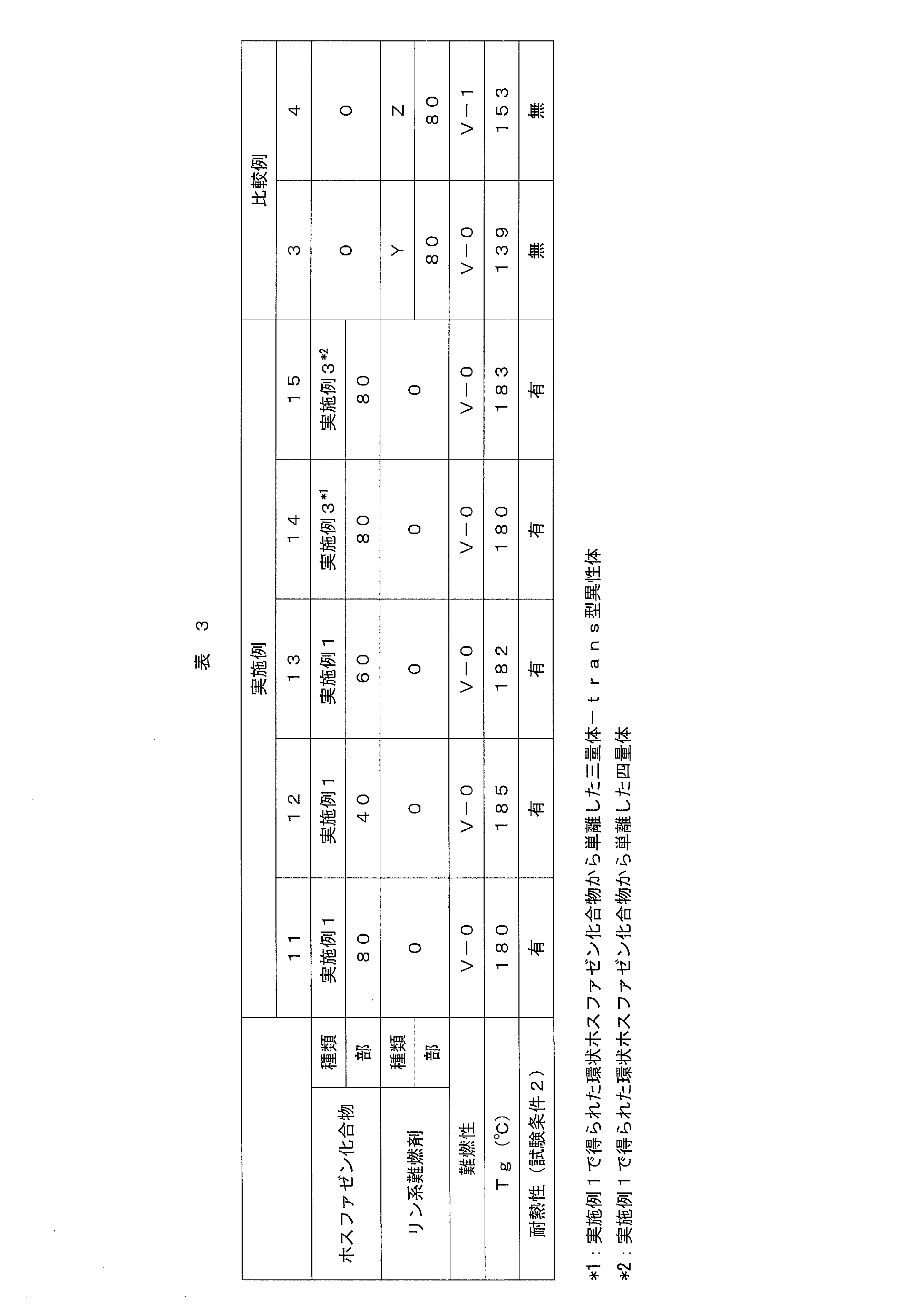
表3によると、実施例11~15の樹脂成形体は、比較例3、4の樹脂成形体に比べ、難燃性が高く、ガラス転移温度が高いことから機械特性も良好であり、さらに、耐熱性に関して評価した環状ホスファゼン化合物のブリードアウトが実質的に見られないことから高温下での信頼性が高い。

表4によると、実施例16~21の樹脂成形体は、比較例5、6の樹脂成形体に比べ、難燃性が高く、比誘電率Dkおよび誘電正接Dfが低いことからLow Dk/Dfであって誘電特性に優れており、しかも、耐熱性に関して評価した環状ホスファゼン化合物のブリードアウトが実質的に見られないことから高温下での信頼性が高い。
[実施例22(製造方法2によるオキサホスホリン環含有構造を有する環状ホスファゼン化合物の製造)]
合成例1において得られた6-クロロ-6H-ジベンゾ[c,e][1,2]オキサホスホリンのトルエン溶液を調製し、これに塩素ガスを導入して反応させることで6,6,6-トリクロロ-6H-ジベンゾ[c,e][1,2]オキサホスホランを合成した。ここでは、合成時の反応液についての31P-NMRスペクトルの下記の測定結果から、6-クロロ-6H-ジベンゾ[c,e][1,2]オキサホスホリンが目的の6,6,6-トリクロロ-6H-ジベンゾ[c,e][1,2]オキサホスホランに誘導されていることを確認した。この反応液をそのまま次の反応に用いた。硝酸銀滴定法により求めた塩化物イオン含有量から、この反応液における6,6,6-トリクロロ-6H-ジベンゾ[c,e][1,2]オキサホスホラン含有量は、硝酸銀滴定法により求めた塩化物イオン含有量に基づき、38.2%であることを確認した。
合成例1において得られた6-クロロ-6H-ジベンゾ[c,e][1,2]オキサホスホリンのトルエン溶液を調製し、これに塩素ガスを導入して反応させることで6,6,6-トリクロロ-6H-ジベンゾ[c,e][1,2]オキサホスホランを合成した。ここでは、合成時の反応液についての31P-NMRスペクトルの下記の測定結果から、6-クロロ-6H-ジベンゾ[c,e][1,2]オキサホスホリンが目的の6,6,6-トリクロロ-6H-ジベンゾ[c,e][1,2]オキサホスホランに誘導されていることを確認した。この反応液をそのまま次の反応に用いた。硝酸銀滴定法により求めた塩化物イオン含有量から、この反応液における6,6,6-トリクロロ-6H-ジベンゾ[c,e][1,2]オキサホスホラン含有量は、硝酸銀滴定法により求めた塩化物イオン含有量に基づき、38.2%であることを確認した。
31P-NMRスペクトル(重クロロホルム中、δ、ppm):
-25.3(s)
-25.3(s)
温度計、撹拌機および冷却管を備え付けた3,000mLの四つ口フラスコに、窒素気流下において塩化アンモニウム58.8g(1.1mol)およびトルエン1,500mLを仕込むことでスラリー溶液を調製し、このスラリー溶液を加熱した。そして、スラリー溶液が還流しているところに上記工程において得られた反応液、すなわち、6,6,6-トリクロロ-6H-ジベンゾ[c,e][1,2]オキサホスホランのトルエン溶液799.8g(1.0mol)を18時間かけて滴下した。その後、トルエンを留去して最終的に反応液の温度が160℃になるまで濃縮し、同温度で15時間撹拌した。続いて、この反応液に500mLのイオン交換水を加え、室温で1時間撹拌した。これにより得られたスラリー液を濾過することで分離した結晶をイオン交換水で洗浄後に乾燥し、184.0gの白色粉末を得た(収率:86.3%)。この白色粉末は、下記の分析結果を示すことから、式(1)で表されるジベンゾオキサホスホリン環含有環状ホスファゼン化合物(但し、aおよびbが0であり、かつ、nが3から8の整数であるものの混合物。)であることを確認した。
1H-NMRスペクトル(重クロロホルム中、δ、ppm):
6.0~8.3(m)
31P-NMRスペクトル(重クロロホルム中、δ、ppm):
-10~0(m),1.8~3.5(m),15.8(d),17.5(s),17.9(dd)
CHNP元素分析:
理論値 C:67.61%,H:3.78%,N:6.57%,P:14.53%
実測値 C:67.55%,H:3.81%,N:6.53%,P:14.48%
残存塩素分析:
<0.01%
HRMSスペクトル(ESI,m/z):
理論値 三量体:[C36H24N3O3P3+H]+:640.1109,四量体:[C48H32N4O4P4+H]+:853.1452,五量体:[C60H40N5O5P5+H]+:1066.1796
実測値 640.1097,853.1444,1066.1797
6.0~8.3(m)
31P-NMRスペクトル(重クロロホルム中、δ、ppm):
-10~0(m),1.8~3.5(m),15.8(d),17.5(s),17.9(dd)
CHNP元素分析:
理論値 C:67.61%,H:3.78%,N:6.57%,P:14.53%
実測値 C:67.55%,H:3.81%,N:6.53%,P:14.48%
残存塩素分析:
<0.01%
HRMSスペクトル(ESI,m/z):
理論値 三量体:[C36H24N3O3P3+H]+:640.1109,四量体:[C48H32N4O4P4+H]+:853.1452,五量体:[C60H40N5O5P5+H]+:1066.1796
実測値 640.1097,853.1444,1066.1797
[実施例23(製造方法3によるオキサホスホリン環含有構造を有する環状ホスファゼン化合物の製造)]
温度計、撹拌機および冷却管を備え付けた3,000mLの四つ口フラスコに、窒素気流下において合成例1で得られた6-クロロ-6H-ジベンゾ[c,e][1,2]オキサホスホリン234.6g(1.0mol)とジエチルエーテル1,500mLとを仕込んだ。これに対し、予め調製しておいたクロロアミンの6Mジエチルエーテル溶液183mL(クロロアミン量:1.1mol)を反応液の温度が0℃を超えないように冷却しながら滴下した。そして、この反応液を加熱することでジエチルエーテルを留去するとともに反応液の温度が最終的に160℃になるまで濃縮し、同温度で19時間撹拌した。この反応液に500mLのイオン交換水を加えて室温で1時間撹拌し、これにより得られたスラリー液を濾過することで結晶を分離した。そして、分離した結晶をイオン交換水で洗浄後に乾燥し、158.8gの淡褐色粉末を得た(収率:74.5%)。この淡褐色粉末は、1H-NMR、31P-NMRおよびHRMSの各スペクトルの分析結果が実施例22で得られた白色粉末の分析結果と一致したことから、式(1)で表されるジベンゾオキサホスホリン環含有環状ホスファゼン化合物(但し、aおよびbが0であり、かつ、nが3から8の整数であるものの混合物。)であることを確認した。
温度計、撹拌機および冷却管を備え付けた3,000mLの四つ口フラスコに、窒素気流下において合成例1で得られた6-クロロ-6H-ジベンゾ[c,e][1,2]オキサホスホリン234.6g(1.0mol)とジエチルエーテル1,500mLとを仕込んだ。これに対し、予め調製しておいたクロロアミンの6Mジエチルエーテル溶液183mL(クロロアミン量:1.1mol)を反応液の温度が0℃を超えないように冷却しながら滴下した。そして、この反応液を加熱することでジエチルエーテルを留去するとともに反応液の温度が最終的に160℃になるまで濃縮し、同温度で19時間撹拌した。この反応液に500mLのイオン交換水を加えて室温で1時間撹拌し、これにより得られたスラリー液を濾過することで結晶を分離した。そして、分離した結晶をイオン交換水で洗浄後に乾燥し、158.8gの淡褐色粉末を得た(収率:74.5%)。この淡褐色粉末は、1H-NMR、31P-NMRおよびHRMSの各スペクトルの分析結果が実施例22で得られた白色粉末の分析結果と一致したことから、式(1)で表されるジベンゾオキサホスホリン環含有環状ホスファゼン化合物(但し、aおよびbが0であり、かつ、nが3から8の整数であるものの混合物。)であることを確認した。
[実施例24(製造方法4によるオキサホスホリン環含有構造を有する環状ホスファゼン化合物の製造)]
合成例1で得られた6-クロロ-6H-ジベンゾ[c,e][1,2]オキサホスホリンを特許文献11および12の記載を参照して加水分解し、6H-ジベンゾ[c,e][1,2]オキサホスホラン-6-オキシドを調製した。そして、得られた6H-ジベンゾ[c,e][1,2]オキサホスホラン-6-オキシドを非特許文献10の記載に従って塩素化した。これにより得られた生成物は、1H-NMRスペクトルおよび31P-NMRスペクトルの測定結果から、6-クロロ-6H-ジベンゾ[c,e][1,2]オキサホスホラン-2-オキシドであることを確認した(収率94%)。
合成例1で得られた6-クロロ-6H-ジベンゾ[c,e][1,2]オキサホスホリンを特許文献11および12の記載を参照して加水分解し、6H-ジベンゾ[c,e][1,2]オキサホスホラン-6-オキシドを調製した。そして、得られた6H-ジベンゾ[c,e][1,2]オキサホスホラン-6-オキシドを非特許文献10の記載に従って塩素化した。これにより得られた生成物は、1H-NMRスペクトルおよび31P-NMRスペクトルの測定結果から、6-クロロ-6H-ジベンゾ[c,e][1,2]オキサホスホラン-2-オキシドであることを確認した(収率94%)。
次に、非特許文献11に記載された方法に従い、得られた6-クロロ-6H-ジベンゾ[c,e][1,2]オキサホスホラン-2-オキシドをアンモニア水を用いてアミノ化した。これにより得られた生成物は、1H-NMRスペクトルおよび31P-NMRスペクトルの測定結果から、ホスホンアミデート系化合物である6-アミノ-6H-ジベンゾ[c,e][1,2]オキサホスホラン-2-オキシドであることを確認した(収率89%)。
温度計、撹拌機および冷却管を備え付けた10,000mLの四つ口フラスコを用意し、これに得られた6-アミノ-6H-ジベンゾ[c,e][1,2]オキサホスホラン-2-オキシド231.2g(1.0mol)、トリフェニルホスフィン629.5g(2.4mol)、N,N-ジイソプロピルエチルアミン129.2(1.0mol)およびキシレン4,500mLを窒素気流下において仕込んで加熱した。フラスコ内の溶液が還流しているところに四塩化炭素153.8g(1.0mol)を2時間かけて滴下し、続けて4時間撹拌した。この反応液から減圧下で溶媒を留去し、その残渣にメタノール9,000mLを添加して撹拌することで得られたスラリー液を濾過することで結晶を分離した。そして、分離した結晶をメタノールで洗浄した後に乾燥し、115.1gの白色粉末を得た(収率:54.0%)。この白色粉末は、1H-NMRおよび31P-NMRの各スペクトルの分析結果から、式(1)で表されるジベンゾオキサホスホリン環含有環状ホスファゼン化合物(但し、aおよびbが0であり、かつ、nが3から8の整数であるものの混合物。)であることを確認した。
[実施例25(製造方法4によるオキサホスホリン環含有構造を有する環状ホスファゼン化合物の製造)]
実施例24において用意した四つ口フラスコにテトラブチルアンモニウムヨージド73.9g(0.2mol)を添加した点、および、四塩化炭素の代わりに1,2-ジクロロエタン99.0g(1.0mol)を用いた点以外は実施例24と同様に操作し、128.3gの白色粉末を得た(収率:60.2%)。この白色粉末は、1H-NMRおよび31P-NMRの各スペクトルの分析結果から、式(1)で表されるジベンゾオキサホスホリン環含有環状ホスファゼン化合物(但し、aおよびbが0であり、かつ、nが3から8の整数であるものの混合物。)であることを確認した。
実施例24において用意した四つ口フラスコにテトラブチルアンモニウムヨージド73.9g(0.2mol)を添加した点、および、四塩化炭素の代わりに1,2-ジクロロエタン99.0g(1.0mol)を用いた点以外は実施例24と同様に操作し、128.3gの白色粉末を得た(収率:60.2%)。この白色粉末は、1H-NMRおよび31P-NMRの各スペクトルの分析結果から、式(1)で表されるジベンゾオキサホスホリン環含有環状ホスファゼン化合物(但し、aおよびbが0であり、かつ、nが3から8の整数であるものの混合物。)であることを確認した。
Claims (14)
- 下記の式(1)で表される、オキサホスホリン環含有構造を有する環状ホスファゼン化合物。

nは3から8の整数であり、
R1およびR2は、(i)それぞれ独立して、ニトロ基、炭素数1~6のアルキル基およびアリール基から選ばれる少なくとも一種の基が置換されていてもよい、炭素数が1~8のアルキル基若しくはアルコキシ基、および、炭素数1~6のアルキル基およびアリール基から選ばれる少なくとも一種の基が置換されていてもよい、炭素数6~20のアリール基若しくはアリールオキシ基のうちのいずれか、または、(ii)炭素数が1~6のアルキル基若しくはカルボニル基により置換されていてもよい飽和の若しくは不飽和の環状構造を相互間で形成しており、
aおよびbは、それぞれ独立して0~4の整数であり、
各繰り返し単位のオキサホスホリン環含有構造の種類は独立している。) - 式(1)のnが3または4である、請求項1に記載のオキサホスホリン環含有構造を有する環状ホスファゼン化合物。
- 式(1)において、nが3であり、かつ、aおよびbが0である、請求項1に記載のオキサホスホリン環含有構造を有する環状ホスファゼン化合物。
- ジアステレオマーの混合物である請求項3に記載のオキサホスホリン環含有構造を有する環状ホスファゼン化合物。
- 隣接し合う前記オキサホスホリン環含有構造の立体配置がcis-cis-cis型である、請求項3に記載のオキサホスホリン環含有構造を有する環状ホスファゼン化合物。
- 隣接し合う前記オキサホスホリン環含有構造の立体配置がtrans-cis-trans型である、請求項3に記載のオキサホスホリン環含有構造を有する環状ホスファゼン化合物。
- 請求項1から6のいずれかに記載のオキサホスホリン環含有構造を有する環状ホスファゼン化合物を二種類以上含む、オキサホスホリン環含有構造を有する環状ホスファゼン化合物混合物。
- アジド化剤を用いて下記の式(2)で表されるクロロジベンゾオキサホスホリン系化合物をアジド化中間体に誘導する工程1と、
前記アジド化中間体を環化反応させる工程2と、
を含むオキサホスホリン環含有構造を有する環状ホスファゼン化合物の製造方法。

R1およびR2は、(i)それぞれ独立して、ニトロ基、炭素数1~6のアルキル基およびアリール基から選ばれる少なくとも一種の基が置換されていてもよい、炭素数が1~8のアルキル基若しくはアルコキシ基、および、炭素数1~6のアルキル基およびアリール基から選ばれる少なくとも一種の基が置換されていてもよい、炭素数6~20のアリール基若しくはアリールオキシ基のうちのいずれか、または、(ii)炭素数が1~6のアルキル基若しくはカルボニル基により置換されていてもよい飽和の若しくは不飽和の環状構造を相互間で形成しており、
aおよびbは、それぞれ独立して0~4の整数である。) - 工程2において用いる前記アジド化中間体が二種類以上の前記アジド化中間体の混合物である、請求項8に記載のオキサホスホリン環含有構造を有する環状ホスファゼン化合物の製造方法。
- 前記アジド化中間体の前記混合物が工程1において二種類以上の前記クロロジベンゾオキサホスホリン系化合物を用いることで得られたものである、請求項9に記載のオキサホスホリン環含有構造を有する環状ホスファゼン化合物の製造方法。
- 樹脂成分と、
請求項1から6のいずれかに記載のオキサホスホリン環含有構造を有する環状ホスファゼン化合物の一種類または二種類以上と、
を含む樹脂組成物。 - 前記樹脂成分が、エポキシ樹脂、フェノール樹脂、不飽和ポリエステル樹脂、ジアリルフタレート樹脂、マレイミド樹脂、ポリイミド樹脂、ベンゾオキサジン樹脂、ベンゾシクロブテン樹脂、ポリオレフィン樹脂、スチレン系樹脂、ポリエステル樹脂、脂肪族ポリアミド樹脂、半芳香族ポリアミド樹脂、ポリカーボネート樹脂、ポリフェニレンエーテル系樹脂、ポリアリレート樹脂およびこれらの変性樹脂からなる群から選ばれた少なくとも一つである、請求項11に記載の樹脂組成物。
- 請求項11に記載の樹脂組成物からなる樹脂成形体。
- 請求項13に記載の樹脂成形体を含む電気・電子部品。
Priority Applications (3)
| Application Number | Priority Date | Filing Date | Title |
|---|---|---|---|
| US18/016,756 US12503480B2 (en) | 2020-07-22 | 2021-06-19 | Cyclic phosphazene compound having oxaphosphorin ring-containing structure |
| EP21845539.2A EP4202013A4 (en) | 2020-07-22 | 2021-06-19 | Cyclic phosphazene compound having oxaphosphorin ring-containing structure |
| CN202180050087.1A CN116194552B (zh) | 2020-07-22 | 2021-06-19 | 具有含氧杂磷杂菲环结构的环状磷腈化合物 |
Applications Claiming Priority (2)
| Application Number | Priority Date | Filing Date | Title |
|---|---|---|---|
| JP2020-125556 | 2020-07-22 | ||
| JP2020125556A JP6830586B1 (ja) | 2020-07-22 | 2020-07-22 | オキサホスホリン環含有構造を有する環状ホスファゼン化合物 |
Publications (1)
| Publication Number | Publication Date |
|---|---|
| WO2022019021A1 true WO2022019021A1 (ja) | 2022-01-27 |
Family
ID=74562430
Family Applications (1)
| Application Number | Title | Priority Date | Filing Date |
|---|---|---|---|
| PCT/JP2021/023280 Ceased WO2022019021A1 (ja) | 2020-07-22 | 2021-06-19 | オキサホスホリン環含有構造を有する環状ホスファゼン化合物 |
Country Status (6)
| Country | Link |
|---|---|
| US (1) | US12503480B2 (ja) |
| EP (1) | EP4202013A4 (ja) |
| JP (1) | JP6830586B1 (ja) |
| CN (1) | CN116194552B (ja) |
| TW (1) | TW202208392A (ja) |
| WO (1) | WO2022019021A1 (ja) |
Cited By (2)
| Publication number | Priority date | Publication date | Assignee | Title |
|---|---|---|---|---|
| WO2026058167A1 (en) | 2024-09-10 | 2026-03-19 | Shpp Global Technologies B.V. | Polyetherimide compositions |
| WO2026058555A1 (ja) * | 2024-09-10 | 2026-03-19 | ナミックス株式会社 | 樹脂組成物、接着フィルム、高周波基板、ミリ波レーダー基板、プリント配線基板および半導体装置 |
Families Citing this family (5)
| Publication number | Priority date | Publication date | Assignee | Title |
|---|---|---|---|---|
| CN121628293A (zh) | 2024-09-10 | 2026-03-10 | 味之素株式会社 | 树脂组合物 |
| CN121628366A (zh) | 2024-09-10 | 2026-03-10 | 味之素株式会社 | 树脂组合物 |
| CN121628292A (zh) | 2024-09-10 | 2026-03-10 | 味之素株式会社 | 树脂组合物 |
| TWI895222B (zh) * | 2025-02-12 | 2025-08-21 | 和新化學工業股份有限公司 | 可固化含磷化合物及其製備方法 |
| CN120737561B (zh) * | 2025-09-02 | 2025-11-07 | 南方电网新能设计研究院(广东)有限公司 | 基于环保绝缘复合材料的电缆支架及其制备方法和应用 |
Citations (18)
| Publication number | Priority date | Publication date | Assignee | Title |
|---|---|---|---|---|
| US2853517A (en) | 1956-03-07 | 1958-09-23 | Cornelius G Fitzgerald | Preparation of substituted phosphinic nitrides |
| US3702878A (en) | 1969-12-31 | 1972-11-14 | Sanko Chemical Co Ltd | Cyclic organophosphorus compounds and process for making same |
| US3865783A (en) * | 1972-05-18 | 1975-02-11 | Akzona Inc | Flame-retardant polyester |
| US5391798A (en) | 1992-08-11 | 1995-02-21 | Hoechst Aktiengesellschaft | Process for preparing 6-chloro-(6H)-dibenz [C,-E][1,2]- oxaphosphorin |
| US5481017A (en) | 1993-07-03 | 1996-01-02 | Hoechst Aktiengesellschaft | Method for preparing 6H-dibenzo[c,e][1,2]oxaphosphorin-6-one |
| JPH08225714A (ja) * | 1994-10-07 | 1996-09-03 | Minnesota Mining & Mfg Co <3M> | 難燃性熱硬化性樹脂組成物 |
| GB2304716A (en) * | 1995-09-04 | 1997-03-26 | Minnesota Mining & Mfg | Flame-retarded epoxy systems; spirocyclic phosphazenes |
| US5821376A (en) | 1995-06-23 | 1998-10-13 | Schill & Seilacher Gmbh & Co. | Process for the preparation of a dop-containing mixture |
| JP2012116842A (ja) * | 2012-01-07 | 2012-06-21 | Fushimi Pharm Co Ltd | 環状ホスファゼン化合物 |
| JP2014189489A (ja) * | 2013-03-26 | 2014-10-06 | Fushimi Pharm Co Ltd | 環状ホスファゼン化合物およびその製造方法 |
| TW201542575A (zh) | 2014-05-07 | 2015-11-16 | Chin Yee Chemical Industres Co Ltd | 磷化合物及其組成物、環氧樹脂組成物、接著劑組成物、其用途 |
| JP2019023263A (ja) | 2017-07-25 | 2019-02-14 | パナソニックIpマネジメント株式会社 | 樹脂組成物、プリプレグ、樹脂付きフィルム、樹脂付き金属箔、金属張積層板、及び配線板 |
| JP2019044031A (ja) | 2017-08-31 | 2019-03-22 | パナソニックIpマネジメント株式会社 | ポリフェニレンエーテル樹脂組成物、並びに、それを用いたプリプレグ、金属張積層板及び配線基板 |
| CN110204862A (zh) | 2019-05-31 | 2019-09-06 | 广东生益科技股份有限公司 | 树脂组合物、预浸料、层压板、覆金属箔层压板以及印刷线路板 |
| WO2019198766A1 (ja) | 2018-04-13 | 2019-10-17 | 大塚化学株式会社 | エポキシ樹脂組成物及びその成型体 |
| JP2019531262A (ja) * | 2016-12-28 | 2019-10-31 | 廣東生益科技股▲ふん▼有限公司Shengyi Technologyco.,Ltd. | リン含有活性エステル、そのノンハロゲン組成物及び銅張積層板 |
| US20190367727A1 (en) | 2018-06-04 | 2019-12-05 | Taiwan Union Technology Corporation | Resin composition, pre-preg, metal-clad laminate, and printed circuit board using the same |
| US20200071477A1 (en) | 2018-08-28 | 2020-03-05 | Taiwan Union Technology Corporation | Halogen-free low dielectric resin composition, and pre-preg, metal-clad laminate, and printed circuit board using the same |
Family Cites Families (5)
| Publication number | Priority date | Publication date | Assignee | Title |
|---|---|---|---|---|
| JP5881147B2 (ja) * | 2011-09-29 | 2016-03-09 | 株式会社伏見製薬所 | エテニルフェノキシ基含有環状ホスファゼン化合物の製造方法 |
| CN106946937A (zh) * | 2016-01-07 | 2017-07-14 | 广东广山新材料股份有限公司 | 一种含氰基的磷腈化合物、制备方法和用途 |
| CN107353306B (zh) * | 2017-07-12 | 2019-08-13 | 信阳师范学院 | 一种含磷腈环结构的阻燃剂及制备方法和超级电容器电解液 |
| WO2020004440A1 (ja) * | 2018-06-27 | 2020-01-02 | 大塚化学株式会社 | ポリイミド樹脂組成物及びその成形体 |
| US20210395488A1 (en) | 2018-10-09 | 2021-12-23 | Otsuka Chemical Co., Ltd. | Cyclic phosphazene compound, flame retardant for resin, resin composition including same, and molding of said resin composition |
-
2020
- 2020-07-22 JP JP2020125556A patent/JP6830586B1/ja active Active
-
2021
- 2021-06-19 EP EP21845539.2A patent/EP4202013A4/en active Pending
- 2021-06-19 WO PCT/JP2021/023280 patent/WO2022019021A1/ja not_active Ceased
- 2021-06-19 CN CN202180050087.1A patent/CN116194552B/zh active Active
- 2021-06-19 US US18/016,756 patent/US12503480B2/en active Active
- 2021-06-28 TW TW110123596A patent/TW202208392A/zh unknown
Patent Citations (18)
| Publication number | Priority date | Publication date | Assignee | Title |
|---|---|---|---|---|
| US2853517A (en) | 1956-03-07 | 1958-09-23 | Cornelius G Fitzgerald | Preparation of substituted phosphinic nitrides |
| US3702878A (en) | 1969-12-31 | 1972-11-14 | Sanko Chemical Co Ltd | Cyclic organophosphorus compounds and process for making same |
| US3865783A (en) * | 1972-05-18 | 1975-02-11 | Akzona Inc | Flame-retardant polyester |
| US5391798A (en) | 1992-08-11 | 1995-02-21 | Hoechst Aktiengesellschaft | Process for preparing 6-chloro-(6H)-dibenz [C,-E][1,2]- oxaphosphorin |
| US5481017A (en) | 1993-07-03 | 1996-01-02 | Hoechst Aktiengesellschaft | Method for preparing 6H-dibenzo[c,e][1,2]oxaphosphorin-6-one |
| JPH08225714A (ja) * | 1994-10-07 | 1996-09-03 | Minnesota Mining & Mfg Co <3M> | 難燃性熱硬化性樹脂組成物 |
| US5821376A (en) | 1995-06-23 | 1998-10-13 | Schill & Seilacher Gmbh & Co. | Process for the preparation of a dop-containing mixture |
| GB2304716A (en) * | 1995-09-04 | 1997-03-26 | Minnesota Mining & Mfg | Flame-retarded epoxy systems; spirocyclic phosphazenes |
| JP2012116842A (ja) * | 2012-01-07 | 2012-06-21 | Fushimi Pharm Co Ltd | 環状ホスファゼン化合物 |
| JP2014189489A (ja) * | 2013-03-26 | 2014-10-06 | Fushimi Pharm Co Ltd | 環状ホスファゼン化合物およびその製造方法 |
| TW201542575A (zh) | 2014-05-07 | 2015-11-16 | Chin Yee Chemical Industres Co Ltd | 磷化合物及其組成物、環氧樹脂組成物、接著劑組成物、其用途 |
| JP2019531262A (ja) * | 2016-12-28 | 2019-10-31 | 廣東生益科技股▲ふん▼有限公司Shengyi Technologyco.,Ltd. | リン含有活性エステル、そのノンハロゲン組成物及び銅張積層板 |
| JP2019023263A (ja) | 2017-07-25 | 2019-02-14 | パナソニックIpマネジメント株式会社 | 樹脂組成物、プリプレグ、樹脂付きフィルム、樹脂付き金属箔、金属張積層板、及び配線板 |
| JP2019044031A (ja) | 2017-08-31 | 2019-03-22 | パナソニックIpマネジメント株式会社 | ポリフェニレンエーテル樹脂組成物、並びに、それを用いたプリプレグ、金属張積層板及び配線基板 |
| WO2019198766A1 (ja) | 2018-04-13 | 2019-10-17 | 大塚化学株式会社 | エポキシ樹脂組成物及びその成型体 |
| US20190367727A1 (en) | 2018-06-04 | 2019-12-05 | Taiwan Union Technology Corporation | Resin composition, pre-preg, metal-clad laminate, and printed circuit board using the same |
| US20200071477A1 (en) | 2018-08-28 | 2020-03-05 | Taiwan Union Technology Corporation | Halogen-free low dielectric resin composition, and pre-preg, metal-clad laminate, and printed circuit board using the same |
| CN110204862A (zh) | 2019-05-31 | 2019-09-06 | 广东生益科技股份有限公司 | 树脂组合物、预浸料、层压板、覆金属箔层压板以及印刷线路板 |
Non-Patent Citations (15)
| Title |
|---|
| A. SALMEIAG. BAUMGARTNERM. JOVICA. GOSSIW. RIEDLT. ZICHS. GANN, ORG. PROCESS RES. DEV., vol. 22, 2018, pages 1570 - 1577 |
| ASFIA QURESHIALLAN S. HAY, J. CHEM. RES (M, 1998, pages 1,601 |
| ASFIA QURESHIALLAN S. HAY, J. CHEM. RES(M, 1998, pages 1601 |
| BERNARD GRUSHKINALVIN J. BERLINJAMES L. MCCLANAHAMRIP G. RICE, INORG. CHEM., vol. 5, 1966, pages 172 |
| C. P. HABERD. L. HERRINGE. A. LAWTON, J. AM. CHEM. SCI., vol. 80, 1958, pages 2116 |
| G. TESIC. P. HABERC. M. DOUGLAS, PROC. CHEM. SOC., 1960, pages 219 |
| J. GLOEDEU. PIEPERAB. COSTISELLAR-P. KRUGERZ. ANORG, ALLG. CHEM., vol. 629, 2003, pages 998 |
| M. TAILLEFERF. PLENATC. CHAMALET-COMBESV. VICENTEH. J. CRISTAU, PHOSPHORUS RES. BULL., vol. 10, 1999, pages 696 |
| N. KREUTZKAMPH. SCHINDLER, ARCH. PHARM. (WEIHEIM, vol. 293, 1960, pages 296 - 305 |
| P. ABRANYI-BALOGHAG. KEGLEVICH, SYNTHETIC COMMUNICATIONS, vol. 41, 2011, pages 1421 |
| R. H. KRATZERK. L. PACIOREK, INORG. CHEM., vol. 4, 1965, pages 1767 |
| ROLF APPELHEINZ EINIG, CHEM. BER., vol. 108, 1975, pages 914 |
| See also references of EP4202013A4 |
| STEPHEN D. PASTORJOHN D. SPIVACKLEANDER P. STEINHUEBEL, PHOSPHORUS AND SULFUR, vol. 31, 1987, pages 71 |
| TADA YUJI, SUNADA ATSUSHI, WATANABE RIKI, KANAZAWA MAKOTO, UTSUMI KEIICHIRO: "Synthesis of Trispirocyclotriphosphazenes with Oxaphosphorine Rings and Their Crystal and Molecular Structures", INORGANIC CHEMISTRY, AMERICAN CHEMICAL SOCIETY, EASTON , US, vol. 60, no. 7, 18 March 2021 (2021-03-18), Easton , US , pages 5014 - 5020, XP055901286, ISSN: 0020-1669, DOI: 10.1021/acs.inorgchem.1c00054 * |
Cited By (2)
| Publication number | Priority date | Publication date | Assignee | Title |
|---|---|---|---|---|
| WO2026058167A1 (en) | 2024-09-10 | 2026-03-19 | Shpp Global Technologies B.V. | Polyetherimide compositions |
| WO2026058555A1 (ja) * | 2024-09-10 | 2026-03-19 | ナミックス株式会社 | 樹脂組成物、接着フィルム、高周波基板、ミリ波レーダー基板、プリント配線基板および半導体装置 |
Also Published As
| Publication number | Publication date |
|---|---|
| CN116194552B (zh) | 2025-08-08 |
| JP6830586B1 (ja) | 2021-02-17 |
| EP4202013A4 (en) | 2024-11-13 |
| CN116194552A (zh) | 2023-05-30 |
| EP4202013A1 (en) | 2023-06-28 |
| US20230339994A1 (en) | 2023-10-26 |
| TW202208392A (zh) | 2022-03-01 |
| US12503480B2 (en) | 2025-12-23 |
| JP2022021767A (ja) | 2022-02-03 |
Similar Documents
| Publication | Publication Date | Title |
|---|---|---|
| JP6830586B1 (ja) | オキサホスホリン環含有構造を有する環状ホスファゼン化合物 | |
| CN100344697C (zh) | 阻燃剂组合物 | |
| JP5916160B2 (ja) | エポキシ化合物組成物の製造方法 | |
| CN1308418C (zh) | 磷腈组合物 | |
| WO2007080998A1 (ja) | シアナト基含有環状ホスファゼン化合物およびその製造方法 | |
| JP2013075836A (ja) | 難燃性樹脂組成物 | |
| JP5177730B2 (ja) | ヒドロキシル基含有環状ホスファゼン化合物およびその製造方法 | |
| JP5170510B2 (ja) | 反応性基含有環状ホスファゼン化合物およびその製造方法 | |
| JP5376388B2 (ja) | 反応性基含有環状ホスファゼン化合物およびその製造方法 | |
| JP6124176B2 (ja) | 樹脂成形体用組成物 | |
| JP5610252B2 (ja) | グリシジルオキシ基含有環状ホスファゼン化合物およびその製造方法 | |
| JP5376387B2 (ja) | シアナト基含有環状ホスファゼン化合物およびその製造方法 | |
| JP5510626B2 (ja) | ヒドロキシ基含有環状ホスファゼン化合物およびその製造方法 | |
| JP5550095B2 (ja) | オリゴ(フェニレンオキシ)基含有環状ホスファゼン化合物およびその製造方法 | |
| JP5013401B2 (ja) | 反応性基含有環状ホスファゼン化合物からなる難燃剤およびその製造方法 | |
| JP5240758B2 (ja) | 難燃性樹脂組成物 | |
| JP5137105B2 (ja) | シアナト基含有環状ホスファゼン化合物およびその製造方法 | |
| EP3466921B1 (en) | Methods for producing polycyclic aromatic aminophenol compound and resin composition | |
| JP5553245B2 (ja) | 環状ホスファゼン化合物 | |
| JP5177731B2 (ja) | エポキシ基含有環状ホスファゼン化合物およびその製造方法 | |
| KR100842205B1 (ko) | 인계 고리형 화합물, 그 제조방법 및 이를 이용한 난연성열가소성 수지 조성물 | |
| JP6095150B2 (ja) | 樹脂組成物 | |
| JP2012233067A (ja) | グリシジル基で変性したオリゴ(フェニレンオキシ)基含有環状ホスファゼン化合物およびその製造方法 | |
| JP5656142B2 (ja) | ジヒドロベンゾオキサジンオキシ基含有環状ホスファゼン化合物およびその製造方法 | |
| TW202509052A (zh) | 含有不飽和基之磷酸酯、包含其之熱硬化性樹脂組合物、及樹脂材料 |
Legal Events
| Date | Code | Title | Description |
|---|---|---|---|
| 121 | Ep: the epo has been informed by wipo that ep was designated in this application |
Ref document number: 21845539 Country of ref document: EP Kind code of ref document: A1 |
|
| NENP | Non-entry into the national phase |
Ref country code: DE |
|
| ENP | Entry into the national phase |
Ref document number: 2021845539 Country of ref document: EP Effective date: 20230222 |
|
| WWG | Wipo information: grant in national office |
Ref document number: 202180050087.1 Country of ref document: CN |