WO2022024799A1 - Élément de conversion photoélectrique et dispositif imageur - Google Patents
Élément de conversion photoélectrique et dispositif imageur Download PDFInfo
- Publication number
- WO2022024799A1 WO2022024799A1 PCT/JP2021/026730 JP2021026730W WO2022024799A1 WO 2022024799 A1 WO2022024799 A1 WO 2022024799A1 JP 2021026730 W JP2021026730 W JP 2021026730W WO 2022024799 A1 WO2022024799 A1 WO 2022024799A1
- Authority
- WO
- WIPO (PCT)
- Prior art keywords
- photoelectric conversion
- organic semiconductor
- semiconductor material
- electrode
- organic
- Prior art date
- Legal status (The legal status is an assumption and is not a legal conclusion. Google has not performed a legal analysis and makes no representation as to the accuracy of the status listed.)
- Ceased
Links
Images





Classifications
-
- H—ELECTRICITY
- H10—SEMICONDUCTOR DEVICES; ELECTRIC SOLID-STATE DEVICES NOT OTHERWISE PROVIDED FOR
- H10K—ORGANIC ELECTRIC SOLID-STATE DEVICES
- H10K30/00—Organic devices sensitive to infrared radiation, light, electromagnetic radiation of shorter wavelength or corpuscular radiation
- H10K30/30—Organic devices sensitive to infrared radiation, light, electromagnetic radiation of shorter wavelength or corpuscular radiation comprising bulk heterojunctions, e.g. interpenetrating networks of donor and acceptor material domains
-
- H—ELECTRICITY
- H10—SEMICONDUCTOR DEVICES; ELECTRIC SOLID-STATE DEVICES NOT OTHERWISE PROVIDED FOR
- H10F—INORGANIC SEMICONDUCTOR DEVICES SENSITIVE TO INFRARED RADIATION, LIGHT, ELECTROMAGNETIC RADIATION OF SHORTER WAVELENGTH OR CORPUSCULAR RADIATION
- H10F39/00—Integrated devices, or assemblies of multiple devices, comprising at least one element covered by group H10F30/00, e.g. radiation detectors comprising photodiode arrays
- H10F39/10—Integrated devices
- H10F39/12—Image sensors
- H10F39/18—Complementary metal-oxide-semiconductor [CMOS] image sensors; Photodiode array image sensors
- H10F39/182—Colour image sensors
- H10F39/1825—Multicolour image sensors having stacked structure, e.g. NPN, NPNPN or multiple quantum well [MQW] structures
-
- H—ELECTRICITY
- H10—SEMICONDUCTOR DEVICES; ELECTRIC SOLID-STATE DEVICES NOT OTHERWISE PROVIDED FOR
- H10F—INORGANIC SEMICONDUCTOR DEVICES SENSITIVE TO INFRARED RADIATION, LIGHT, ELECTROMAGNETIC RADIATION OF SHORTER WAVELENGTH OR CORPUSCULAR RADIATION
- H10F39/00—Integrated devices, or assemblies of multiple devices, comprising at least one element covered by group H10F30/00, e.g. radiation detectors comprising photodiode arrays
- H10F39/10—Integrated devices
- H10F39/12—Image sensors
- H10F39/191—Photoconductor image sensors
- H10F39/192—Colour image sensors
-
- H—ELECTRICITY
- H10—SEMICONDUCTOR DEVICES; ELECTRIC SOLID-STATE DEVICES NOT OTHERWISE PROVIDED FOR
- H10F—INORGANIC SEMICONDUCTOR DEVICES SENSITIVE TO INFRARED RADIATION, LIGHT, ELECTROMAGNETIC RADIATION OF SHORTER WAVELENGTH OR CORPUSCULAR RADIATION
- H10F39/00—Integrated devices, or assemblies of multiple devices, comprising at least one element covered by group H10F30/00, e.g. radiation detectors comprising photodiode arrays
- H10F39/80—Constructional details of image sensors
- H10F39/802—Geometry or disposition of elements in pixels, e.g. address-lines or gate electrodes
-
- H—ELECTRICITY
- H10—SEMICONDUCTOR DEVICES; ELECTRIC SOLID-STATE DEVICES NOT OTHERWISE PROVIDED FOR
- H10F—INORGANIC SEMICONDUCTOR DEVICES SENSITIVE TO INFRARED RADIATION, LIGHT, ELECTROMAGNETIC RADIATION OF SHORTER WAVELENGTH OR CORPUSCULAR RADIATION
- H10F39/00—Integrated devices, or assemblies of multiple devices, comprising at least one element covered by group H10F30/00, e.g. radiation detectors comprising photodiode arrays
- H10F39/80—Constructional details of image sensors
- H10F39/803—Pixels having integrated switching, control, storage or amplification elements
- H10F39/8037—Pixels having integrated switching, control, storage or amplification elements the integrated elements comprising a transistor
-
- H—ELECTRICITY
- H10—SEMICONDUCTOR DEVICES; ELECTRIC SOLID-STATE DEVICES NOT OTHERWISE PROVIDED FOR
- H10K—ORGANIC ELECTRIC SOLID-STATE DEVICES
- H10K30/00—Organic devices sensitive to infrared radiation, light, electromagnetic radiation of shorter wavelength or corpuscular radiation
-
- H—ELECTRICITY
- H10—SEMICONDUCTOR DEVICES; ELECTRIC SOLID-STATE DEVICES NOT OTHERWISE PROVIDED FOR
- H10K—ORGANIC ELECTRIC SOLID-STATE DEVICES
- H10K30/00—Organic devices sensitive to infrared radiation, light, electromagnetic radiation of shorter wavelength or corpuscular radiation
- H10K30/20—Organic devices sensitive to infrared radiation, light, electromagnetic radiation of shorter wavelength or corpuscular radiation comprising organic-organic junctions, e.g. donor-acceptor junctions
- H10K30/211—Organic devices sensitive to infrared radiation, light, electromagnetic radiation of shorter wavelength or corpuscular radiation comprising organic-organic junctions, e.g. donor-acceptor junctions comprising multiple junctions, e.g. double heterojunctions
-
- H—ELECTRICITY
- H10—SEMICONDUCTOR DEVICES; ELECTRIC SOLID-STATE DEVICES NOT OTHERWISE PROVIDED FOR
- H10K—ORGANIC ELECTRIC SOLID-STATE DEVICES
- H10K30/00—Organic devices sensitive to infrared radiation, light, electromagnetic radiation of shorter wavelength or corpuscular radiation
- H10K30/60—Organic devices sensitive to infrared radiation, light, electromagnetic radiation of shorter wavelength or corpuscular radiation in which radiation controls flow of current through the devices, e.g. photoresistors
-
- H—ELECTRICITY
- H10—SEMICONDUCTOR DEVICES; ELECTRIC SOLID-STATE DEVICES NOT OTHERWISE PROVIDED FOR
- H10K—ORGANIC ELECTRIC SOLID-STATE DEVICES
- H10K30/00—Organic devices sensitive to infrared radiation, light, electromagnetic radiation of shorter wavelength or corpuscular radiation
- H10K30/80—Constructional details
- H10K30/84—Layers having high charge carrier mobility
- H10K30/85—Layers having high electron mobility, e.g. electron-transporting layers or hole-blocking layers
-
- H—ELECTRICITY
- H10—SEMICONDUCTOR DEVICES; ELECTRIC SOLID-STATE DEVICES NOT OTHERWISE PROVIDED FOR
- H10K—ORGANIC ELECTRIC SOLID-STATE DEVICES
- H10K30/00—Organic devices sensitive to infrared radiation, light, electromagnetic radiation of shorter wavelength or corpuscular radiation
- H10K30/80—Constructional details
- H10K30/84—Layers having high charge carrier mobility
- H10K30/86—Layers having high hole mobility, e.g. hole-transporting layers or electron-blocking layers
-
- H—ELECTRICITY
- H10—SEMICONDUCTOR DEVICES; ELECTRIC SOLID-STATE DEVICES NOT OTHERWISE PROVIDED FOR
- H10K—ORGANIC ELECTRIC SOLID-STATE DEVICES
- H10K39/00—Integrated devices, or assemblies of multiple devices, comprising at least one organic radiation-sensitive element covered by group H10K30/00
-
- H—ELECTRICITY
- H10—SEMICONDUCTOR DEVICES; ELECTRIC SOLID-STATE DEVICES NOT OTHERWISE PROVIDED FOR
- H10K—ORGANIC ELECTRIC SOLID-STATE DEVICES
- H10K39/00—Integrated devices, or assemblies of multiple devices, comprising at least one organic radiation-sensitive element covered by group H10K30/00
- H10K39/30—Devices controlled by radiation
- H10K39/32—Organic image sensors
-
- H—ELECTRICITY
- H10—SEMICONDUCTOR DEVICES; ELECTRIC SOLID-STATE DEVICES NOT OTHERWISE PROVIDED FOR
- H10K—ORGANIC ELECTRIC SOLID-STATE DEVICES
- H10K39/00—Integrated devices, or assemblies of multiple devices, comprising at least one organic radiation-sensitive element covered by group H10K30/00
- H10K39/30—Devices controlled by radiation
- H10K39/38—Interconnections, e.g. terminals
-
- H—ELECTRICITY
- H10—SEMICONDUCTOR DEVICES; ELECTRIC SOLID-STATE DEVICES NOT OTHERWISE PROVIDED FOR
- H10K—ORGANIC ELECTRIC SOLID-STATE DEVICES
- H10K39/00—Integrated devices, or assemblies of multiple devices, comprising at least one organic radiation-sensitive element covered by group H10K30/00
- H10K39/601—Assemblies of multiple devices comprising at least one organic radiation-sensitive element
-
- H—ELECTRICITY
- H10—SEMICONDUCTOR DEVICES; ELECTRIC SOLID-STATE DEVICES NOT OTHERWISE PROVIDED FOR
- H10K—ORGANIC ELECTRIC SOLID-STATE DEVICES
- H10K50/00—Organic light-emitting devices
- H10K50/80—Constructional details
- H10K50/805—Electrodes
- H10K50/81—Anodes
-
- H—ELECTRICITY
- H10—SEMICONDUCTOR DEVICES; ELECTRIC SOLID-STATE DEVICES NOT OTHERWISE PROVIDED FOR
- H10K—ORGANIC ELECTRIC SOLID-STATE DEVICES
- H10K50/00—Organic light-emitting devices
- H10K50/80—Constructional details
- H10K50/805—Electrodes
- H10K50/82—Cathodes
-
- H—ELECTRICITY
- H10—SEMICONDUCTOR DEVICES; ELECTRIC SOLID-STATE DEVICES NOT OTHERWISE PROVIDED FOR
- H10K—ORGANIC ELECTRIC SOLID-STATE DEVICES
- H10K85/00—Organic materials used in the body or electrodes of devices covered by this subclass
- H10K85/20—Carbon compounds, e.g. carbon nanotubes or fullerenes
- H10K85/211—Fullerenes, e.g. C60
-
- H—ELECTRICITY
- H04—ELECTRIC COMMUNICATION TECHNIQUE
- H04N—PICTORIAL COMMUNICATION, e.g. TELEVISION
- H04N25/00—Circuitry of solid-state image sensors [SSIS]; Control thereof
- H04N25/10—Circuitry of solid-state image sensors [SSIS]; Control thereof for transforming different wavelengths into image signals
- H04N25/11—Arrangement of colour filter arrays [CFA]; Filter mosaics
- H04N25/13—Arrangement of colour filter arrays [CFA]; Filter mosaics characterised by the spectral characteristics of the filter elements
- H04N25/134—Arrangement of colour filter arrays [CFA]; Filter mosaics characterised by the spectral characteristics of the filter elements based on three different wavelength filter elements
-
- H—ELECTRICITY
- H10—SEMICONDUCTOR DEVICES; ELECTRIC SOLID-STATE DEVICES NOT OTHERWISE PROVIDED FOR
- H10K—ORGANIC ELECTRIC SOLID-STATE DEVICES
- H10K2101/00—Properties of the organic materials covered by group H10K85/00
- H10K2101/30—Highest occupied molecular orbital [HOMO], lowest unoccupied molecular orbital [LUMO] or Fermi energy values
-
- H—ELECTRICITY
- H10—SEMICONDUCTOR DEVICES; ELECTRIC SOLID-STATE DEVICES NOT OTHERWISE PROVIDED FOR
- H10K—ORGANIC ELECTRIC SOLID-STATE DEVICES
- H10K2101/00—Properties of the organic materials covered by group H10K85/00
- H10K2101/40—Interrelation of parameters between multiple constituent active layers or sublayers, e.g. HOMO values in adjacent layers
-
- Y—GENERAL TAGGING OF NEW TECHNOLOGICAL DEVELOPMENTS; GENERAL TAGGING OF CROSS-SECTIONAL TECHNOLOGIES SPANNING OVER SEVERAL SECTIONS OF THE IPC; TECHNICAL SUBJECTS COVERED BY FORMER USPC CROSS-REFERENCE ART COLLECTIONS [XRACs] AND DIGESTS
- Y02—TECHNOLOGIES OR APPLICATIONS FOR MITIGATION OR ADAPTATION AGAINST CLIMATE CHANGE
- Y02E—REDUCTION OF GREENHOUSE GAS [GHG] EMISSIONS, RELATED TO ENERGY GENERATION, TRANSMISSION OR DISTRIBUTION
- Y02E10/00—Energy generation through renewable energy sources
- Y02E10/50—Photovoltaic [PV] energy
- Y02E10/549—Organic PV cells
Definitions
- the present disclosure relates to, for example, a photoelectric conversion element using an organic material and an image pickup apparatus provided with the photoelectric conversion element.
- Patent Document 1 a fullerene or a derivative thereof is used as a first organic semiconductor material, a subphthalocyanine or a derivative thereof is used as a second organic semiconductor material, and a quinacridone derivative or a triarylamine is used as a third organic semiconductor material between a pair of facing electrodes.
- the photoelectric conversion element is required to have improved spectral characteristics, electrical characteristics and heat resistance.
- the photoelectric conversion element of one embodiment of the present disclosure is provided between the first electrode, the second electrode arranged to face the first electrode, and the first electrode and the second electrode, and is a first organic semiconductor material.
- Highest Occupied Molecular Orbital which is deeper than the Lowest Unoccupied Molecular Orbital (LUMO) level of the first organic semiconductor material and the difference from the LUMO level of the first organic semiconductor material is 1.0 eV or more and 2.0 eV or less.
- the image pickup apparatus is provided with one or a plurality of photoelectric conversion elements according to the embodiment of the present disclosure for each of a plurality of pixels.
- the photoelectric conversion element of one embodiment and the image pickup apparatus of one embodiment of the present disclosure there are three organic semiconductor materials, a first organic semiconductor material, a second organic semiconductor material, and a third organic semiconductor material, between the first electrode and the second electrode.
- a photoelectric conversion layer containing various kinds of organic materials was provided.
- the second organic semiconductor material is deeper than the LUMO level of the first organic semiconductor material, and the difference from the HOMO level of the first organic semiconductor material is 1.0 eV or more and 2.0 eV. It is as follows. This reduces absorption on the long wavelength side.
- the third organic semiconductor material has crystallinity, a line absorption coefficient in the visible light region of 10000 cm -1 or less, and a light absorption end wavelength of 550 nm or less. As a result, the heat resistance is improved, and the generation of dark current and the absorption of the third organic semiconductor material other than the selected wavelength are reduced.
- FIG. 1 It is sectional drawing which shows an example of the structure of the photoelectric conversion element which concerns on 1st Embodiment of this disclosure. It is a figure which shows an example of the energy level of the organic material contained in the photoelectric conversion layer shown in FIG. 1. It is a plane schematic diagram which shows the structure of the unit pixel of the image sensor shown in FIG. 1. It is sectional drawing for demonstrating the manufacturing method of the image pickup element shown in FIG. It is sectional drawing which shows the process following FIG. It is sectional drawing which shows an example of the structure of the photoelectric conversion element which concerns on 2nd Embodiment of this disclosure. It is sectional drawing which shows an example of the structure of the photoelectric conversion element which concerns on 3rd Embodiment of this disclosure.
- FIG. 12 is a schematic plan view showing an example of the pixel configuration of the image pickup apparatus having the photoelectric conversion element shown in FIG. 12A.
- FIG. 3 is a functional block diagram showing an example of an electronic device using the image pickup apparatus shown in FIG. 13. It is a figure which shows an example of the schematic structure of an endoscopic surgery system. It is a block diagram which shows an example of the functional structure of a camera head and a CCU. It is a block diagram which shows an example of the schematic structure of a vehicle control system. It is explanatory drawing which shows an example of the installation position of the vehicle outside information detection unit and the image pickup unit.
- Second Embodiment (Example of a photoelectric conversion element in which two organic photoelectric conversion units are laminated) 3. 3.
- Third Embodiment (Example of a photoelectric conversion element in which three organic photoelectric conversion units are laminated) 4.
- Fourth Embodiment (Example of a photoelectric conversion element having a lower electrode composed of a plurality of electrodes) 5.
- Fifth Embodiment (Example of a photoelectric conversion element that performs spectroscopy of an inorganic photoelectric conversion unit using a color filter) 6.
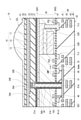
- FIG. 1 schematically shows an example of a cross-sectional configuration of a photoelectric conversion element (photoelectric conversion element 1A) according to the first embodiment of the present disclosure.
- the photoelectric conversion element 1A is, for example, one pixel (unit) in an image pickup device (imaging device 100, for example, see FIG. 13) such as a CMOS (Complementary Metal Oxide Semiconductor) image sensor used in electronic devices such as digital still cameras and video cameras. It constitutes pixel P).
- the photoelectric conversion element 1A has, for example, an organic photoelectric conversion unit 10 in which a lower electrode 11, a photoelectric conversion layer 12, and an upper electrode 13 are laminated in this order, and the photoelectric conversion layer 12 uses three types of organic materials. Is formed.
- the three types of organic materials are the first organic semiconductor material, the LUMO level of the first organic semiconductor material deeper than the LUMO level of the first organic semiconductor material, and the LUMO level of the first organic semiconductor material.
- a third organic semiconductor material having a diameter of 550 nm or less is used.
- one organic photoelectric conversion unit 10 and two inorganic photoelectric conversion units 32B and 32R are vertically laminated for each unit pixel P.
- the organic photoelectric conversion unit 10 is provided on the back surface (first surface 30A) side of the semiconductor substrate 30.
- the inorganic photoelectric conversion units 32B and 32R are embedded and formed in the semiconductor substrate 30, and are laminated in the thickness direction of the semiconductor substrate 30.
- the organic photoelectric conversion unit 10 and the inorganic photoelectric conversion units 32B and 32R selectively detect light in different wavelength bands and perform photoelectric conversion. For example, the organic photoelectric conversion unit 10 acquires a green (G) color signal.
- the inorganic photoelectric conversion units 32B and 32R acquire blue (B) and red (R) color signals, respectively, depending on the difference in absorption coefficient.
- the photoelectric conversion element 1A can acquire a plurality of types of color signals in one pixel without using a color filter.
- the semiconductor substrate 30 is composed of, for example, an n-type silicon (Si) substrate and has a p-well 31 in a predetermined region.
- various floating diffusion (floating diffusion layer) FDs for example, FD1, FD2, FD3
- various transistors Tr for example, vertical transistors (for example) A transfer transistor) Tr2, a transfer transistor Tr3, an amplifier transistor (modulator) AMP, a reset transistor RST, and a selection transistor SEL), and a multilayer wiring layer 40 are provided.
- the multilayer wiring layer 40 has, for example, a configuration in which wiring layers 41, 42, and 43 are laminated in an insulating layer 44.
- a peripheral circuit (not shown) including a logic circuit or the like is provided in the peripheral portion of the semiconductor substrate 30.
- the first surface 30A side of the semiconductor substrate 30 is represented as the light incident side S1
- the second surface 30B side is represented as the wiring layer side S2.
- the organic photoelectric conversion unit 10 has a structure in which the lower electrode 11, the photoelectric conversion layer 12 and the upper electrode 13 are laminated in this order, and the photoelectric conversion layer 12 has a bulk heterojunction structure in the layer.
- the bulk heterojunction structure is a p / n junction surface formed by mixing p-type semiconductors and n-type semiconductors.
- the inorganic photoelectric conversion units 32B and 32R are composed of, for example, PIN (Positive Intrinsic Negative) type photodiodes, and each has a pn junction in a predetermined region of the semiconductor substrate 30.
- the inorganic photoelectric conversion units 32B and 32R make it possible to disperse light in the vertical direction by utilizing the fact that the wavelength band absorbed by the silicon substrate differs depending on the incident depth of light.
- the inorganic photoelectric conversion unit 32B selectively detects blue light and accumulates a signal charge corresponding to blue light, and is installed at a depth at which blue light can be efficiently photoelectrically converted.
- the inorganic photoelectric conversion unit 32R selectively detects red light and accumulates a signal charge corresponding to red, and is installed at a depth at which red light can be efficiently photoelectrically converted.
- Blue (B) is a color corresponding to, for example, a wavelength band of 380 nm or more and less than 500 nm
- red (R) is a color corresponding to, for example, a wavelength band of 620 nm or more and less than 750 nm.
- the inorganic photoelectric conversion units 32B and 32R may be capable of detecting light in a part or all of the wavelength bands of each wavelength band, respectively.
- the inorganic photoelectric conversion unit 32B and the inorganic photoelectric conversion unit 32R each have, for example, a p + region serving as a hole storage layer and an n region serving as an electron storage layer, respectively. (Has a laminated structure of p-n-p).
- the n region of the inorganic photoelectric conversion unit 32B is connected to the vertical transistor Tr2.
- the p + region of the inorganic photoelectric conversion unit 32B is bent along the vertical transistor Tr2 and is connected to the p + region of the inorganic photoelectric conversion unit 32R.
- the vertical transistor Tr2 is a transfer transistor that transfers the signal charge corresponding to the blue color generated and accumulated in the inorganic photoelectric conversion unit 32B to the floating diffusion FD2. Since the inorganic photoelectric conversion unit 32B is formed at a position deep from the second surface 30B of the semiconductor substrate 30, it is preferable that the transfer transistor of the inorganic photoelectric conversion unit 32B is composed of the vertical transistor Tr2.
- the transfer transistor Tr3 transfers the signal charge corresponding to the accumulated red color generated in the inorganic photoelectric conversion unit 32R to the floating diffusion FD3, and is composed of, for example, a MOS transistor.
- the amplifier transistor AMP is a modulation element that modulates the amount of electric charge generated by the organic photoelectric conversion unit 10 into a voltage, and is composed of, for example, a MOS transistor.
- the reset transistor RST resets the electric charge transferred from the organic photoelectric conversion unit 10 to the floating diffusion FD1, and is composed of, for example, a MOS transistor.
- the insulating layers 21 and 22 and the interlayer insulating layer 23 are laminated in this order from the semiconductor substrate 30 side between the first surface 30A of the semiconductor substrate 30 and the lower electrode 11.
- a protective layer 51 is provided on the upper electrode 13.
- an on-chip lens 52L is configured, and an on-chip lens layer 52 that also serves as a flattening layer is disposed.
- a through electrode 34 is provided between the first surface 30A and the second surface 30B of the semiconductor substrate 30.
- the organic photoelectric conversion unit 10 is connected to the gate Gamp of the amplifier transistor AMP and the floating diffusion FD1 via the through electrode 34.
- the photoelectric conversion element 1A the electric charge (hole) generated in the organic photoelectric conversion unit 10 on the first surface 30A side of the semiconductor substrate 30 is used as a signal charge, and the second surface of the semiconductor substrate 30 is passed through the through electrode 34. It is possible to transfer to the 30B side satisfactorily and improve the characteristics.
- the through silicon via 34 is provided for each unit pixel P, for example.
- the through silicon via 34 has a function as a connector between the organic photoelectric conversion unit 10 and the gate Gamp and the floating diffusion FD1 of the amplifier transistor AMP, and also serves as a transmission path for the electric charge generated in the organic photoelectric conversion unit 10.
- the lower end of the through electrode 34 is connected to, for example, the connection portion 41A in the wiring layer 41, and the connection portion 41A and the gate Gamp of the amplifier transistor AMP are connected via the lower first contact 45.
- the connecting portion 41A and the floating diffusion FD1 are connected to the lower electrode 11 via the lower second contact 46.
- the through electrode 34 is shown as a cylindrical shape in FIG. 1, the shape is not limited to this, and may be, for example, a tapered shape.
- the reset gate Grst of the reset transistor RST is arranged next to the floating diffusion FD1. As a result, the electric charge accumulated in the floating diffusion FD1 can be reset by the reset transistor RST.
- the light incident on the photoelectric conversion element 1A from the light incident side S1 is absorbed by the photoelectric conversion layer 12.
- the excitons generated by this move to the interface between the electron donor and the electron acceptor constituting the photoelectric conversion layer 12, and exciton separation, that is, dissociation into electrons and holes.
- the charges (electrons and holes) generated here are due to diffusion due to the difference in carrier concentration and the internal electric field due to the difference in work function between the anode (here, the lower electrode 11) and the cathode (here, the upper electrode 13). , Each is carried to a different electrode and detected as a photocurrent. Further, by applying a potential between the lower electrode 11 and the upper electrode 13, the transport direction of electrons and holes can be controlled.
- the organic photoelectric conversion unit 10 absorbs light corresponding to a part or all of the wavelength of the selective wavelength band (visible light region of 480 nm or more and less than 620 nm) to generate excitons (electron hole pairs). be.
- the image pickup apparatus 100 described later among the electron-hole pairs generated by photoelectric conversion, for example, holes are read out from the lower electrode 11 side as signal charges.
- the photoelectric conversion element 1A the lower electrode 11 is separated and formed for each unit pixel P, for example.
- the photoelectric conversion layer 12 and the upper electrode 13 are provided as a continuous layer common to a plurality of unit pixels P (for example, the pixel portion 100A shown in FIG. 13).
- the lower electrode 11 is made of, for example, a conductive film having light transmission.
- the constituent material of the lower electrode 11 include indium tin oxide (ITO), In 2 O 3 added with tin (Sn) as a dopant, and indium tin oxide containing crystalline ITO and amorphous ITO.
- ITO indium tin oxide
- SnO 2 tin oxide
- zinc oxide-based material to which a dopant is added may be used as the constituent material of the lower electrode 11.
- the zinc oxide-based material examples include aluminum zinc oxide (AZO) to which aluminum (Al) is added as a dopant, gallium zinc oxide (GZO) to which gallium (Ga) is added, and boron zinc to which boron (B) is added.
- examples thereof include indium zinc oxide (IZO) to which an oxide and indium (In) are added.
- IZO indium zinc oxide
- the constituent material of the lower electrode 11 CuI, InSbO 4 , ZnMgO, CuInO 2 , MgIN 2O 4 , CdO, ZnSnO 3 or TiO 2 may be used.
- a spinel-type oxide or an oxide having a YbFe 2 O4 structure may be used.
- the lower electrode 11 formed by using the above-mentioned material generally has a high work function and functions as an anode electrode.
- the photoelectric conversion layer 12 converts light energy into electrical energy.
- the photoelectric conversion layer 12 absorbs light having a part or all wavelengths in the visible light region of 480 nm or more and less than 620 nm, for example.
- the photoelectric conversion layer 12 includes at least a p-type semiconductor and an n-type semiconductor, and a junction surface (p / n junction surface) between the p-type semiconductor and the n-type semiconductor is formed in the layer.
- the n-type semiconductor is an electron transport material that relatively functions as an electron acceptor (acceptor), and the p-type semiconductor is a hole transport material that relatively functions as an electron donor (donor).
- the photoelectric conversion layer 12 provides a field where excitons (electron-hole pairs) generated when light is absorbed are separated into electrons and holes. Specifically, electron-hole pairs and electron donations are provided. At the interface between the body and the electron acceptor (p / n junction surface), electrons and holes are separated.
- the photoelectric conversion layer 12 of the present embodiment is configured to include three types of organic materials, a first organic semiconductor material, a second organic semiconductor material, and a third organic semiconductor material.
- the first organic semiconductor material is, for example, an organic material that functions as an n-type semiconductor.
- the second organic semiconductor material is an organic material, a so-called dye material, that photoelectrically converts light in a predetermined wavelength band while transmitting light in another wavelength band.
- the third organic semiconductor material is, for example, an organic material that functions as a p-type semiconductor.
- the first organic semiconductor material, the second organic semiconductor material, and the third organic semiconductor material are low molecular weight compounds having a molecular weight of 2000 or less, respectively, and specific examples thereof include the following organic materials.
- Examples of the first organic semiconductor material include C60 fullerene, C70 fullerene and derivatives thereof.
- the second organic semiconductor material is deeper than the LUMO level of the first organic semiconductor material and has a difference ( ⁇ E 12 ) from the LUMO level of the first organic semiconductor material. It has a HOMO level of 1.0 eV or more and 2.0 eV or less. Specifically, for example, it is a donor acceptor type dye material having maximum absorption in a wavelength band of 380 nm or more and 750 nm or less. More specifically, examples of the second organic semiconductor material include so-called D ⁇ A compounds having a donor site, a ⁇ -electron conjugation site, and an acceptor site in the molecule.
- Examples of the third organic semiconductor material include organic materials having crystallinity, a line absorption coefficient in the visible light region of 10,000 cm -1 or less, and a light absorption edge wavelength of 550 nm or less.
- the thickness of the photoelectric conversion layer 12 is, for example, 25 nm or more and 400 nm or less, preferably 50 nm or more and 350 nm or less. More preferably, it is 150 nm or more and 300 nm or less.
- the photoelectric conversion layer 12 may contain an organic material other than the above materials.
- the upper electrode 13 is made of a conductive film having light transmission like the lower electrode 11.
- the upper electrode 13 may be separated for each pixel, or may be formed as a common electrode for each pixel. good.
- the thickness of the upper electrode 13 is, for example, 10 nm to 200 nm.
- another layer may be further provided between the photoelectric conversion layer 12 and the lower electrode 11, and between the photoelectric conversion layer 12 and the upper electrode 13.
- an undercoat layer, a hole transport layer, an electron blocking layer, or the like may be provided between the lower electrode 11 and the photoelectric conversion layer 12.
- a hole blocking layer, a work function adjusting layer, an electron transporting layer, or the like may be provided between the photoelectric conversion layer 12 and the upper electrode 13.
- the insulating layer 21 may be a film having a positive fixed charge or a film having a negative fixed charge.
- Materials for films with a negative fixed charge include hafnium oxide (HfO 2 ), aluminum oxide (Al 2 O 3 ), zirconium oxide (ZrO 2 ), tantalum oxide (Ta 2 O 5 ), and titanium oxide (TIO 2 ). And so on.
- Materials other than the above include lanthanum oxide, praseodymium oxide, cerium oxide, neodymium oxide, promethium oxide, samarium oxide, europium oxide, gadolinium oxide, terbium oxide, dysprosium oxide, formium oxide, thulium oxide, itterbium oxide, lutetium oxide, and oxidation.
- Yttrium, an aluminum nitride film, a hafnium oxynitride film, an aluminum oxynitride film, or the like may be used.
- the insulating layer 21 may have a structure in which two or more types of films are further laminated. Thereby, for example, in the case of a film having a negative fixed charge, it is possible to further enhance the function as a hole storage layer.
- the material of the insulating layer 22 is not particularly limited, but is formed of, for example, silicon oxide (SiO x ), TEOS, silicon nitride (SiN x ), silicon oxynitride (SiO x N y ), or the like.
- the interlayer insulating layer 23 is, for example, a single-layer film made of one of silicon oxide (SiO x ), silicon nitride (SiN x ), silicon oxynitride (SiO x N y ), or two of them. It is composed of a laminated film composed of seeds or more.
- the lower first contact 45, the lower second contact 46, the upper first contact 24A, the pad portion 35A, the upper second contact 24B and the pad portion 35B are, for example, a doped silicon material such as PDAS (Phosphorus Doped Amorphous Silicon).
- PDAS Phosphorus Doped Amorphous Silicon
- it is composed of a metal material such as aluminum (Al), tungsten (W), titanium (Ti), cobalt (Co), hafnium (Hf), and tantalum (Ta).
- the protective layer 51 is made of a light-transmitting material, and is, for example, a single layer made of any one of silicon oxide (SiO x ), silicon nitride (SiN x ), silicon oxynitride (SiO x N y ), and the like. It is composed of a membrane or a laminated membrane composed of two or more of them.
- the thickness of the protective layer 51 is, for example, 100 nm to 30,000 nm.
- An on-chip lens layer 52 is formed on the protective layer 51 so as to cover the entire surface.
- a plurality of on-chip lenses 52L are provided on the surface of the on-chip lens layer 52.
- the on-chip lens 52L collects the light incident from above on the light receiving surfaces of the organic photoelectric conversion unit 10 and the inorganic photoelectric conversion units 32B and 32R.
- the multilayer wiring layer 40 is formed on the second surface 30B side of the semiconductor substrate 30, the light receiving surfaces of the organic photoelectric conversion unit 10 and the inorganic photoelectric conversion units 32B and 32R are arranged close to each other. It is possible to reduce the variation in sensitivity between colors that occurs depending on the F value of the on-chip lens 52L.
- FIG. 3 shows a configuration example of a photoelectric conversion element 1A in which a plurality of photoelectric conversion units (for example, the organic photoelectric conversion unit 10 and the inorganic photoelectric conversion units 32B and 32R) to which the technique according to the present disclosure can be applied are laminated. It is a plan view. That is, FIG. 3 shows an example of the planar configuration of the unit pixel P constituting the pixel portion 100A shown in FIG. 13, for example.
- the unit pixel P is a red photoelectric conversion unit (inorganic photoelectric conversion unit 32R in FIG. 1) and a blue photoelectric conversion unit (FIG. 1) that photoelectrically convert light of each wavelength of R (Red), G (Green), and B (Blue).
- the inorganic photoelectric conversion unit 32B) and the green photoelectric conversion unit (organic photoelectric conversion unit 10 in FIG. 1) (neither of which is shown in FIG. 3) in No. 1 are, for example, the light receiving surface side (light incident side S1 in FIG. 1). It has a photoelectric conversion region 1100 laminated in three layers in the order of a green photoelectric conversion unit, a blue photoelectric conversion unit, and a red photoelectric conversion unit.
- the unit pixel P has Tr group 1110, Tr group 1120 and Tr as charge reading units for reading charges corresponding to light of each wavelength of RGB from the red photoelectric conversion unit, the green photoelectric conversion unit and the blue photoelectric conversion unit. It has a group of 1130.
- Tr group 1110, Tr group 1120 and Tr as charge reading units for reading charges corresponding to light of each wavelength of RGB from the red photoelectric conversion unit, the green photoelectric conversion unit and the blue photoelectric conversion unit. It has a group of 1130.
- the organic photoelectric conversion unit 10 in one unit pixel P, in the vertical spectroscopy, that is, each layer as the red photoelectric conversion unit, the green photoelectric conversion unit, and the blue photoelectric conversion unit laminated on the photoelectric conversion region 1100 is RGB. The spectroscopy of each light is performed.
- Tr group 1110, Tr group 1120 and Tr group 1130 are formed around the photoelectric conversion region 1100.
- the Tr group 1110 outputs the signal charge corresponding to the R light generated and accumulated by the red photoelectric conversion unit as a pixel signal.
- the Tr group 1110 is composed of a transfer Tr (MOSFET) 1111, a reset Tr 1112, an amplification Tr 1113, and a selection Tr 1114.
- the Tr group 1120 outputs the signal charge corresponding to the light of B generated and accumulated by the blue photoelectric conversion unit as a pixel signal.
- the Tr group 1120 is composed of a transfer Tr 1121, a reset Tr 1122, an amplification Tr 1123, and a selection Tr 1124.
- the Tr group 1130 outputs the signal charge corresponding to the G light generated and accumulated by the green photoelectric conversion unit as a pixel signal.
- the Tr group 1130 is composed of a transfer Tr1131, a reset Tr1132, an amplification Tr1133, and a selection Tr1134.
- the transfer Tr1111 is composed of a gate G, a source / drain region S / D, and an FD (floating diffusion) 1115 (source / drain region).
- the transfer Tr1121 is composed of a gate G, a source / drain region S / D, and an FD1125.
- the transfer Tr1131 is composed of a gate G, a green photoelectric conversion unit (source / drain region S / D connected to the photoelectric conversion region 1100), and an FD1135.
- the source / drain region of the transfer Tr1111 is connected to the red photoelectric conversion section of the photoelectric conversion region 1100, and the source / drain region S / D of the transfer Tr1121 is connected to the blue photoelectric conversion section of the photoelectric conversion region 1100. It is connected.
- the reset Tr 1112, 1122 and 1132, the amplification Tr 1113, 1123 and 1133 and the selection Tr 1114, 1124 and 1134 all have a gate G and a pair of source / drain regions S / D arranged so as to sandwich the gate G. It is composed of.
- the FDs 1115, 1125 and 1135 are connected to the source / drain regions S / D that are the sources of the reset Trs 1112, 1122 and 1132, respectively, and are connected to the gates G of the amplification Trs 1113, 1123 and 1133, respectively.
- a power supply Vdd is connected to the source / drain region S / D common to each of the reset Tr1112 and the amplification Tr1113, the reset Tr1132 and the amplification Tr1133, and the reset Tr1122 and the amplification Tr1123.
- a VSL (vertical signal line) is connected to the source / drain region S / D that is the source of the selection Tr1114, 1124, and 1134.
- the photoelectric conversion element 1A shown in FIG. 1 can be manufactured, for example, as follows.
- a p-well 31 is formed as a first conductive type well in the semiconductor substrate 30, and a second conductive type (for example, n-type) inorganic substance is formed in the p-well 31.
- the photoelectric conversion units 32B and 32R are formed.
- a p + region is formed in the vicinity of the first surface 30A of the semiconductor substrate 30.
- the second surface 30B of the semiconductor substrate 30 is formed with an n + region to be the floating diffusion FD1 to FD3, and then the gate insulating layer 33, the vertical transistor Tr2, the transfer transistor Tr3, and the amplifier. It forms a gate wiring layer 47 including each gate of the transistor AMP and the reset transistor RST. As a result, the vertical transistor Tr2, the transfer transistor Tr3, the amplifier transistor AMP, and the reset transistor RST are formed. Further, on the second surface 30B of the semiconductor substrate 30, a multilayer wiring layer 40 composed of wiring layers 41, 43, 43 including a lower first contact 45, a lower second contact 46, a connection portion 41A, and an insulating layer 44 is formed. ..
- an SOI (Silicon on Insulator) substrate in which a semiconductor substrate 30, an embedded oxide film (not shown), and a holding substrate (not shown) are laminated is used.
- the embedded oxide film and the holding substrate are bonded to the first surface 30A of the semiconductor substrate 30.
- a support substrate (not shown) or another semiconductor substrate is bonded to the second surface 30B side (multilayer wiring layer 40 side) of the semiconductor substrate 30, and the semiconductor substrate 30 is turned upside down.
- the semiconductor substrate 30 is separated from the embedded oxide film and the holding substrate of the SOI substrate to expose the first surface 30A of the semiconductor substrate 30.
- CMOS processes such as ion implantation and CVD (Chemical Vapor Deposition).
- the semiconductor substrate 30 is processed from the first surface 30A side by, for example, dry etching to form an annular through hole 30H.
- the depth of the through hole 30H penetrates from the first surface 30A to the second surface 30B of the semiconductor substrate 30 and reaches, for example, the connection portion 41A.
- an insulating layer 21 is formed on the side surfaces of the first surface 30A and the through hole 30H of the semiconductor substrate 30.
- Two or more types of films may be laminated as the insulating layer 21. Thereby, it becomes possible to further enhance the function as a hole storage layer.
- the insulating layer 22 is formed.
- a conductor is embedded in the through hole 30H to form the through electrode 34.
- the conductor for example, in addition to a doped silicon material such as PDAS (Phosphorus Doped Amorphous Silicon), aluminum (Al), tungsten (W), titanium (Ti), cobalt (Co), hafnium (Hf) and tantalum.
- PDAS Phosphorus Doped Amorphous Silicon
- Al aluminum
- Ti tungsten
- Co titanium
- Hf hafnium
- tantalum tantalum
- a metal material such as (Ta) can be used.
- the upper first contact 24A, the pad portion 35A, the upper second contact 24B, and the pad portion 35B that electrically connect the lower electrode 11 and the through electrode 34 are formed on the through electrode 34.
- the interlayer insulating layer 23 provided above is formed.
- the lower electrode 11, the photoelectric conversion layer 12, the upper electrode 13, and the protective layer 51 are formed on the interlayer insulating layer 23 in this order.
- the photoelectric conversion layer 12 can be formed into a film by using, for example, a vacuum vapor deposition method.
- an on-chip lens layer 52 having a plurality of on-chip lenses 52L is arranged on the surface. As a result, the photoelectric conversion element 1A shown in FIG. 1 is completed.
- the film forming method of the photoelectric conversion layer 12 is not necessarily limited to the method using the vacuum vapor deposition method, and other methods such as spin coating technology and printing technology may be used.
- the photoelectric conversion element 1A when light is incident on the organic photoelectric conversion unit 10 via the on-chip lens 52L, the light passes through the organic photoelectric conversion unit 10 and the inorganic photoelectric conversion units 32B and 32R in this order, and the passing process thereof. In, the color light of green (G), blue (B), and red (R) is photoelectrically converted.
- G green
- B blue
- R red
- the organic photoelectric conversion unit 10 is connected to the gate Gamp of the amplifier transistor AMP and the floating diffusion FD1 via the through electrode 34. Therefore, the holes of the electron hole pairs generated by the organic photoelectric conversion unit 10 are taken out from the lower electrode 11 side and transferred to the second surface 30B side of the semiconductor substrate 30 via the through electrode 34, and the floating diffusion FD1 Accumulate in. At the same time, the amount of electric charge generated in the organic photoelectric conversion unit 10 is modulated into a voltage by the amplifier transistor AMP.
- the reset gate Grst of the reset transistor RST is arranged next to the floating diffusion FD1. As a result, the electric charge accumulated in the floating diffusion FD1 is reset by the reset transistor RST.
- the organic photoelectric conversion unit 10 is connected not only to the amplifier transistor AMP but also to the floating diffusion FD1 via the through electrode 34, the electric charge accumulated in the floating diffusion FD1 is easily reset by the reset transistor RST. It becomes possible to do.
- the inorganic photoelectric conversion unit 32R electrons corresponding to the incident red light are accumulated in the n region of the inorganic photoelectric conversion unit 32R, and the accumulated electrons are transferred to the floating diffusion FD3 by the transfer transistor Tr3.
- the difference between the first organic semiconductor material and the LUMO level of the first organic semiconductor material is deeper than the LUMO level of the first organic semiconductor material and is 1.0 eV or more.
- the photoelectric conversion layer 12 is provided by using an organic semiconductor material. This reduces absorption and generation of dark currents other than the selected wavelength. In addition, heat resistance is improved. This will be described below.
- CCD Charge Coupled Device
- CMOS image sensors etc.
- image sensors using an organic photoelectric conversion film have been developed.
- an organic film laminated type image sensor in which an organic film that absorbs only specific wavelengths corresponding to the three primary colors (RGB) of light is laminated as a photoelectric conversion layer has been reported.
- photoelectric conversion including three types of organic materials, a first organic semiconductor material, a second organic semiconductor material, and a third organic semiconductor material, between the lower electrode 11 and the upper electrode 13.
- the layer 12 is provided.
- the second organic semiconductor material is deeper than the LUMO level of the first organic semiconductor material, and the difference from the LUMO level of the first organic semiconductor material is 1.0 eV or more and 2.0 eV. It has the following HOMO levels. This widens the gap between the donor and the acceptor and reduces absorption in the long wavelength band.
- the third organic semiconductor material has crystallinity. As a result, structural changes due to heat are less likely to occur, and heat resistance is improved.
- the contact area between each of the first organic semiconductor material and the second organic semiconductor material and the third organic semiconductor material becomes smaller, so that the generation of dark current is reduced.
- the third organic semiconductor material has a line absorption coefficient of 10,000 cm -1 or less in the visible light region and a light absorption end wavelength of 550 nm or less. As a result, absorption of the third organic semiconductor material other than the selected wavelength is reduced.
- the photoelectric conversion element 1A of the present embodiment can improve the spectral characteristics, the electrical characteristics, and the heat resistance.
- FIG. 6 schematically shows an example of the cross-sectional configuration of the photoelectric conversion element (photoelectric conversion element 1B) according to the second embodiment of the present disclosure.
- photoelectric conversion element 1B of the present embodiment two organic photoelectric conversion units 10, an organic photoelectric conversion unit 60, and one inorganic photoelectric conversion unit 32 are vertically laminated in the first embodiment. It is different from the form of.
- the organic photoelectric conversion units 10 and 60 and the inorganic photoelectric conversion unit 32 selectively detect light in different wavelength bands and perform photoelectric conversion. Specifically, for example, the organic photoelectric conversion unit 10 acquires a green (G) color signal as in the first embodiment.
- the organic photoelectric conversion unit 60 acquires, for example, a blue (B) color signal.
- the inorganic photoelectric conversion unit 32 acquires, for example, a red (R) color signal.
- the photoelectric conversion element 1B can acquire a plurality of types of color signals in one pixel without using a color filter.
- the organic photoelectric conversion unit 60 is laminated on the organic photoelectric conversion unit 10, for example, and similarly to the organic photoelectric conversion unit 10, the lower electrode 61, the photoelectric conversion layer 62, and the upper electrode 63 are formed on the first surface 30A of the semiconductor substrate 30. It has a structure in which they are laminated in this order from the side of.
- the photoelectric conversion layer 62 converts light energy into electrical energy, and like the photoelectric conversion layer 12, there are three types of organic materials, the first organic semiconductor material, the second organic semiconductor material, and the third organic semiconductor material described above. It is composed of materials.
- Two through electrodes 34X and 34Y are provided between the first surface 30A and the second surface 30B of the semiconductor substrate 30.
- the through electrode 34X is electrically connected to the lower electrode 11 of the organic photoelectric conversion unit 10 as in the through electrode 34 of the first embodiment. Specifically, the upper end of the through electrode 34X is connected to the lower electrode 11 via, for example, the upper first contact 24A, the pad portion 35A, the upper second contact 24B, and the pad portion 35B.
- the lower end of the through electrode 34X is a reset transistor in the wiring layer 41, for example, via the connection portion 41A1, the lower first contact 45A, and the lower second contact 46A, which also serves as the gate Gamp1 of the amplifier transistor AMP1 and the floating diffusion FD1, respectively. It is connected to one source / drain region of RST1 (reset transistor Tr1rst).
- the through electrode 34Y is electrically connected to the lower electrode 61 of the organic photoelectric conversion unit 60, and the organic photoelectric conversion unit 60 also serves as the gate Gamp2 of the amplifier transistor AMP2 and the floating diffusion FD2 via the through electrode 34Y. It is connected to one source / drain region of the reset transistor RST2 (reset transistor Tr2rst).
- the upper end of the through electrode 34Y is connected to the lower electrode 61 via, for example, the upper third contact 24C, the pad portion 35C, the upper fourth contact 25, the pad portion 37A, the upper fifth contact 26, and the pad portion 37B.
- the photoelectric conversion element 1B of the present embodiment two organic photoelectric conversion units 10 and 60 and one inorganic photoelectric conversion unit 32 are laminated. Even in such a configuration, the same effect as that of the first embodiment can be obtained.
- FIG. 7 schematically shows an example of the cross-sectional configuration of the photoelectric conversion element (photoelectric conversion element 1C) according to the third embodiment of the present disclosure.
- the photoelectric conversion element 1C for example, similarly to the photoelectric conversion element 1A, for example, one unit pixel P in an image pickup device 100 such as a CMOS image sensor capable of capturing an image obtained from visible light without using a color filter. It constitutes.
- the photoelectric conversion element 1C of the present embodiment has a configuration in which a red photoelectric conversion unit 70R, a green photoelectric conversion unit 70G, and a blue photoelectric conversion unit 70B are laminated in this order on a semiconductor substrate 30 via an insulating layer 74.
- the red photoelectric conversion unit 70R, the green photoelectric conversion unit 70G, and the blue photoelectric conversion unit 70B are respectively between a pair of electrodes, specifically, between the lower electrode 71R and the upper electrode 73R, and the lower electrode 71G and the upper electrode 73G. Between the lower electrode 71B and the upper electrode 73B, the organic photoelectric conversion layers 72R, 72G, and 72B are provided, respectively.
- An on-chip lens layer 52 having an on-chip lens 52L is provided on the blue photoelectric conversion unit 70B via a protective layer 51.
- a red storage layer 310R, a green storage layer 310G, and a blue storage layer 310B are provided in the semiconductor substrate 30.
- the light incident on the on-chip lens 52L is photoelectrically converted by the red photoelectric conversion unit 70R, the green photoelectric conversion unit 70G and the blue photoelectric conversion unit 70B, and is photoelectrically converted from the red photoelectric conversion unit 70R to the red storage layer 310R and from the green photoelectric conversion unit 70G.
- Signal charges are sent to the green storage layer 310G from the blue photoelectric conversion unit 70B to the blue storage layer 310B, respectively.
- the signal charge may be either an electron or a hole generated by photoelectric conversion, but the case where the electron is read out as a signal charge will be described below as an example.
- the semiconductor substrate 30 is composed of, for example, a p-type silicon substrate.
- the red storage layer 310R, the green storage layer 310G, and the blue storage layer 310B provided on the semiconductor substrate 30 each include an n-type semiconductor region, and the red photoelectric conversion unit 70R and the green photoelectric conversion unit are included in the n-type semiconductor region.
- the signal charges (electrons) supplied from the 70G and the blue photoelectric conversion unit 70B are accumulated.
- the n-type semiconductor region of the red storage layer 310R, the green storage layer 310G, and the blue storage layer 310B is formed, for example, by doping the semiconductor substrate 30 with an n-type impurity such as phosphorus (P) or arsenic (As). ..
- the semiconductor substrate 30 may be provided on a support substrate (not shown) made of glass or the like.
- the semiconductor substrate 30 is further provided with a pixel transistor for reading electrons from each of the red storage layer 310R, the green storage layer 310G, and the blue storage layer 310B and transferring them to, for example, a vertical signal line (vertical signal line Lsig in FIG. 13). ing.
- a floating diffusion of the pixel transistor is provided in the semiconductor substrate 30, and the floating diffusion is connected to the red storage layer 310R, the green storage layer 310G, and the blue storage layer 310B.
- the floating diffusion is composed of an n-type semiconductor region.
- the insulating layer 74 is composed of, for example, silicon oxide (SiO x ), silicon nitride (SiN x ), silicon oxynitride (SiON), hafnium oxide (HfO x ), and the like.
- the insulating layer 74 may be formed by laminating a plurality of types of insulating films.
- the insulating layer 74 may be composed of an organic insulating material.
- the insulating layer 74 is provided with plugs and electrodes for connecting the red storage layer 310R and the red photoelectric conversion unit 70R, the green storage layer 310G and the green photoelectric conversion unit 70G, and the blue storage layer 310B and the blue photoelectric conversion unit 70B, respectively. Has been done.
- the red photoelectric conversion unit 70R has a lower electrode 71R, an organic photoelectric conversion layer 72R, and an upper electrode 73R in this order from a position close to the semiconductor substrate 30.
- the green photoelectric conversion unit 70G has a lower electrode 71G, an organic photoelectric conversion layer 72G, and an upper electrode 73G in this order from a position close to the red photoelectric conversion unit 70R.
- the blue photoelectric conversion unit 70B has a lower electrode 71B, an organic photoelectric conversion layer 72B, and an upper electrode 73B in this order from a position close to the green photoelectric conversion unit 70G.
- the red photoelectric conversion unit 70R has red light (for example, wavelength 620 nm or more and less than 750 nm)
- the green photoelectric conversion unit 70G has green light (for example, wavelength 480 nm or more and less than 620 nm)
- the blue photoelectric conversion unit 70B has blue light (for example, for example).
- Light having a wavelength of 380 nm or more and less than 480 nm) is selectively absorbed to generate electron-hole pairs.
- the lower electrode 71R extracts the signal charge generated by the organic photoelectric conversion layer 72R
- the lower electrode 71G extracts the signal charge generated by the organic photoelectric conversion layer 72G
- the lower electrode 71B extracts the signal charge generated by the organic photoelectric conversion layer 72B.
- the lower electrodes 71R, 71G, and 71B are provided for each pixel, for example. These lower electrodes 71R, 71G, 71B are made of, for example, a light-transmitting conductive material, specifically ITO.
- the lower electrodes 71R, 71G, 71B may be made of, for example, a tin oxide-based material or a zinc oxide-based material.
- the tin oxide-based material is tin oxide with a dopant added
- the zinc oxide-based material is, for example, aluminum zinc oxide in which aluminum is added as a dopant to zinc oxide, and gallium zinc in which gallium is added as a dopant to zinc oxide.
- Indium zinc oxide or the like which is obtained by adding indium as a dopant to oxide and zinc oxide.
- IGZO, CuI, InSbO 4 , ZnMgO, CuInO 2 , MgIn 2O 4 , CdO, ZnSnO 3 , and the like can also be used.
- an electron transport layer or the like is provided between the lower electrode 71R and the organic photoelectric conversion layer 72R, between the lower electrode 71G and the organic photoelectric conversion layer 72G, and between the lower electrode 71B and the organic photoelectric conversion layer 72B, respectively. It may be provided.
- the electron transport layer is for promoting the supply of electrons generated in the organic photoelectric conversion layers 72R, 72G, 72B to the lower electrodes 71R, 71G, 71B, and is composed of, for example, titanium oxide or zinc oxide. There is. Titanium oxide and zinc oxide may be laminated to form an electron transport layer.
- the organic photoelectric conversion layers 72R, 72G, and 72B each absorb light in a selective wavelength range, perform photoelectric conversion, and transmit light in another wavelength range.
- the light in the selective wavelength range is, for example, light in a wavelength range of 620 nm or more and less than 750 nm in the organic photoelectric conversion layer 72R, and light in a wavelength range of 480 nm or more and less than 620 nm in the organic photoelectric conversion layer 72G.
- the organic photoelectric conversion layer 72B for example, the light has a wavelength range of 380 nm or more and less than 480 nm.
- the organic photoelectric conversion layers 72R, 72G, and 72B have the same configuration as the photoelectric conversion layer 12 in the above embodiment.
- the organic photoelectric conversion layers 72R, 72G, and 72B are configured to include, for example, three types of organic materials, and like the photoelectric conversion layer 12, the first organic semiconductor material and the second organic semiconductor material described above, respectively. It is composed of three types of organic materials, which are the third organic semiconductor material and the third organic semiconductor material.
- the hole transport layer is for promoting the supply of holes generated in the organic photoelectric conversion layers 72R, 72G, 72B to the upper electrodes 73R, 73G, 73B, and is, for example, molybdenum oxide, nickel oxide, vanadium oxide, or the like. It is composed of.
- the hole transport layer is also formed by using organic materials such as PEDOT (Poly (3,4-ethylenedioxythiophene)) and TPD (N, N'-Bis (3-methylphenyl) -N, N'-diphenylbenzidine). You may try to do it.
- PEDOT Poly (3,4-ethylenedioxythiophene)
- TPD N, N'-Bis (3-methylphenyl) -N, N'-diphenylbenzidine
- the upper electrode 73R extracts holes generated in the organic photoelectric conversion layer 72R
- the upper electrode 73G extracts holes generated in the organic photoelectric conversion layer 72G
- the upper electrode 73B extracts holes generated in the organic photoelectric conversion layer 72G. belongs to. Holes taken out from the upper electrodes 73R, 73G, and 73B are discharged to, for example, a p-type semiconductor region (not shown) in the semiconductor substrate 30 via each transmission path (not shown). There is.
- the upper electrodes 73R, 73G, and 73B are made of a conductive material such as gold (Au), silver (Ag), copper (Cu), and aluminum (Al).
- the upper electrodes 73R, 73G, 73B may be configured by the transparent conductive material.
- the photoelectric conversion element 1C holes taken out from the upper electrodes 73R, 73G, 73B are discharged. Therefore, for example, when arranging a plurality of photoelectric conversion elements 1C in the image pickup apparatus 100 described later, the upper electrodes 73R, 73G and 73B may be provided in common to each unit pixel P.
- the insulating layer 75 is for insulating the upper electrode 73R and the lower electrode 71G
- the insulating layer 76 is for insulating the upper electrode 73G and the lower electrode 71B.
- the insulating layers 75 and 76 are made of, for example, a metal oxide, a metal sulfide or an organic substance.
- the metal oxide include silicon oxide (SiO x ), aluminum oxide (AlO x ), zirconium oxide (ZrO x ), titanium oxide (TIO x ), zinc oxide (ZnO x ), tungsten oxide (WO x ), and the like.
- the band gap of the constituent materials of the insulating layers 75 and 76 is preferably 3.0 eV or more, for example.
- the red photoelectric conversion unit 70R, the green photoelectric conversion unit 70G, and the blue photoelectric conversion unit 70B are laminated in this order. In such a configuration, the same effect as that of the first embodiment can be obtained.
- FIG. 8 shows an example of the cross-sectional configuration of the photoelectric conversion element (photoelectric conversion element 1D) according to the fourth embodiment of the present disclosure.
- FIG. 9 is an equivalent circuit diagram of the photoelectric conversion element 1D shown in FIG.
- FIG. 10 schematically shows the arrangement of the lower electrode 11 of the photoelectric conversion element 1D shown in FIG. 8 and the transistors constituting the control unit.
- the lower electrode 11 is composed of a plurality of electrodes (for example, a readout electrode 11A and a storage electrode 11B) independent of each other, and a semiconductor layer is formed between the lower electrode 11 and the photoelectric conversion layer 12.
- the point that 14 is further provided is different from the above-mentioned first embodiment.
- the organic photoelectric conversion unit 10 and the inorganic photoelectric conversion units 32B and 32R selectively detect wavelengths (light) in different wavelength bands and perform photoelectric conversion, as in the first embodiment. be.
- the lower electrode 11, the semiconductor layer 14, the photoelectric conversion layer 12, and the upper electrode 13 are laminated in this order from the side of the first surface 30A of the semiconductor substrate 30. Further, an insulating layer 15 is provided between the lower electrode 11 and the semiconductor layer 14.
- the lower electrode 11 is composed of, for example, a readout electrode 11A and a storage electrode 11B which are separated and formed for each photoelectric conversion element 1D and whose insulating layer 15 is separated from each other.
- the readout electrode 11A is electrically connected to the semiconductor layer 14 via an opening 15H provided in the insulating layer 15.
- the readout electrode 11A is for transferring the electric charge generated in the photoelectric conversion layer 12 to the floating diffusion FD1, and for example, the upper second contact 24B, the pad portion 35A, the upper first contact 24A, the through electrode 34, and the connection. It is connected to the floating diffusion FD1 via the portion 41A and the lower second contact 46.
- the storage electrode 11B is for storing electrons as signal charges in the semiconductor layer 14 among the charges generated in the photoelectric conversion layer 12.
- the storage electrode 11B is provided in a region that faces the light receiving surfaces of the inorganic photoelectric conversion units 32B and 32R formed in the semiconductor substrate 30 and covers these light receiving surfaces.
- the storage electrode 11B is preferably larger than the readout electrode 11A, which allows a large amount of charge to be stored.
- a voltage application circuit is connected to the storage electrode 11B via wiring, and a voltage (for example, VOA ) is independently applied.
- the semiconductor layer 14, the photoelectric conversion layer 12, and the upper electrode 13 are provided as continuous layers common to a plurality of photoelectric conversion elements 1D.
- the semiconductor layer 14, the photoelectric conversion layer 12 and the upper electrode 13 are separated and formed for each photoelectric conversion element 1D. It may have been done.
- the semiconductor layer 14 is provided under the photoelectric conversion layer 12, specifically between the insulating layer 15 and the photoelectric conversion layer 12, and is for accumulating the signal charges generated in the photoelectric conversion layer 12. It is preferable that the semiconductor layer 14 is formed by using a material having a higher charge mobility than the photoelectric conversion layer 12 and a large band gap.
- the band gap of the constituent material of the semiconductor layer 14 is preferably 3.0 eV or more.
- oxide semiconductor materials such as IGZO
- organic semiconductor material include transition metal dichalcogenides, silicon carbide, diamond, graphene, carbon nanotubes, condensed polycyclic hydrocarbon compounds, condensed heterocyclic compounds and the like.
- the semiconductor layer 14 prevents the electric charge accumulated in the semiconductor layer 14 from being trapped at the interface with the insulating layer 15, and efficiently to the readout electrode 11A, for example, as in the photoelectric conversion element 1E described later.
- the insulating layer 15 is for electrically separating the storage electrode 11B and the semiconductor layer 14.
- the insulating layer 15 is provided on, for example, the interlayer insulating layer 23 so as to cover the lower electrode 11.
- the insulating layer 15 is provided with an opening 15H on the readout electrode 11A, and the readout electrode 11A and the semiconductor layer 14 are electrically connected via the opening 15H.
- the insulating layer 15 is, for example, a single-layer film made of one of silicon oxide (SiO x ), silicon nitride (SiN x ), silicon oxynitride (SiON), etc., or two or more of them. It is composed of a laminated film.
- the second surface 30B of the semiconductor substrate 30 is provided with a readout circuit constituting a control unit in the organic photoelectric conversion unit 10 and the inorganic photoelectric conversion units 32B and 32R, respectively.
- the reset transistor TR1rst, the amplifier transistor TR1amp and the selection transistor TR1sel constituting the readout circuit of the organic photoelectric conversion unit 10 the transfer transistor TR2trs (TR2) constituting the readout circuit of the inorganic photoelectric conversion unit 32B, and the reset transistor TR2rst, an amplifier transistor TR2amp and a selection transistor TR2sel, and a transfer transistor TR3trs (TR3), a reset transistor TR3rst, an amplifier transistor TR3amp and a selection transistor TR3sel constituting the read circuit of the inorganic photoelectric conversion unit 32R are provided, respectively.
- a protective layer 51 is provided above the upper electrode 13, and a light-shielding film 53 is provided in the protective layer 51, for example, at a position corresponding to the readout electrode 11A.
- the light-shielding film 53 may be provided so as not to cover at least the storage electrode 11B and at least to cover the region of the readout electrode 11A which is in direct contact with the semiconductor layer 14.
- FIG. 11 shows an operation example of the photoelectric conversion element 1D.
- A shows the potential at the storage electrode 11B
- B shows the potential at the floating diffusion FD1 (reading electrode 11A)
- C shows the potential at the gate (Gsel) of the reset transistor TR1rst. Is.
- a voltage is individually applied to the readout electrode 11A and the storage electrode 11B.
- the potential V1 is applied to the readout electrode 11A from the drive circuit and the potential V2 is applied to the storage electrode 11B during the storage period.
- the potentials V1 and V2 are set to V2> V1.
- the electric charge (signal charge; electron) generated by the photoelectric conversion is attracted to the storage electrode 11B and is stored in the region of the semiconductor layer 14 facing the storage electrode 11B (storage period).
- the potential in the region of the semiconductor layer 14 facing the storage electrode 11B becomes a more negative value with the passage of time of photoelectric conversion.
- the holes are sent from the upper electrode 13 to the drive circuit.
- the reset operation is performed at the latter stage of the accumulation period. Specifically, at timing t1, the scanning unit changes the voltage of the reset signal RST from a low level to a high level. As a result, in the unit pixel P, the reset transistor TR1rst is turned on, and as a result, the voltage of the floating diffusion FD1 is set to the power supply voltage, and the voltage of the floating diffusion FD1 is reset (reset period).
- the charge is read out. Specifically, at the timing t2, the potential V3 is applied to the reading electrode 11A from the drive circuit, and the potential V4 is applied to the storage electrode 11B. Here, the potentials V3 and V4 are set to V3 ⁇ V4. As a result, the electric charge accumulated in the region corresponding to the storage electrode 11B is read out from the read electrode 11A to the floating diffusion FD1. That is, the electric charge accumulated in the semiconductor layer 14 is read out to the control unit (transfer period).
- the potential V1 is applied to the read electrode 11A from the drive circuit again, and the potential V2 is applied to the storage electrode 11B.
- the electric charge generated by the photoelectric conversion is attracted to the storage electrode 11B and accumulated in the region of the photoelectric conversion layer 12 facing the storage electrode 11B (accumulation period).
- photoelectric conversion element 1D photoelectric conversion element 1D in which the lower electrode 11 is composed of a plurality of electrodes (reading electrode 11A and storage electrode 11B).
- FIG. 12A schematically shows an example of the cross-sectional configuration of the photoelectric conversion element (photoelectric conversion element 1E) according to the fifth embodiment of the present disclosure.
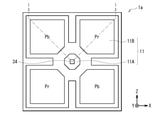
- FIG. 12B schematically shows an example of the planar configuration of the photoelectric conversion element 1E shown in FIG. 12A
- FIG. 12A shows a cross section taken along the line I-I shown in FIG. 12B.
- the photoelectric conversion element 1E is, for example, a laminated type image pickup element in which an inorganic photoelectric conversion unit 32 and an organic photoelectric conversion unit 10 are laminated.
- a pixel unit 1a composed of four pixels arranged in 2 rows ⁇ 2 columns is a repeating unit, and is repeatedly arranged in an array consisting of a row direction and a column direction.
- the organic photoelectric conversion unit 10 is composed of, for example, a lower electrode 11, an insulating layer 15, a semiconductor layer 14, a photoelectric conversion layer 12, and an upper electrode 13, and includes a lower electrode 11, an insulating layer 15, a semiconductor layer 14, a photoelectric conversion layer 12, and an upper portion.
- Each of the electrodes 13 has the same configuration as the organic photoelectric conversion unit 10 in the fourth embodiment.
- the inorganic photoelectric conversion unit 32 detects light in a wavelength range different from that of the organic photoelectric conversion unit 10.
- the photoelectric conversion element 1E of the present embodiment is a color filter (color filter 81R) that selectively transmits at least red light (R) between the inorganic photoelectric conversion unit 32 and the organic photoelectric conversion unit 10, and at least blue light.
- a color filter (color filter 81B) that selectively transmits (B) is arranged diagonally to each other.
- the organic photoelectric conversion unit 10 (photoelectric conversion layer 12) is configured to selectively absorb, for example, a wavelength corresponding to green light.
- the inorganic photoelectric conversion units 32 inorganic photoelectric conversion units 32G and 32R) arranged below the organic photoelectric conversion units 10 and the color filters 81R and 81B correspond to blue light (B) or red light (R), respectively. It becomes possible to acquire a signal.
- the area of each of the photoelectric conversion units of RGB can be expanded as compared with the photoelectric conversion element having a general Bayer arrangement, so that the S / N ratio can be improved. Become.
- FIG. 13 shows an example of the overall configuration of an image pickup device (imaging device 100) including the photoelectric conversion element (for example, the photoelectric conversion element 1A) shown in FIG. 1 and the like.
- the image pickup device 100 is, for example, a CMOS image sensor, which captures incident light (image light) from a subject via an optical lens system (not shown) and measures the amount of incident light imaged on the image pickup surface. It is converted into an electric signal in pixel units and output as a pixel signal.
- the image pickup apparatus 100 has a pixel portion 100A as an image pickup area on the semiconductor substrate 30, and in a peripheral region of the pixel portion 100A, for example, a vertical drive circuit 111, a column signal processing circuit 112, a horizontal drive circuit 113, and an output. It has a circuit 114, a control circuit 115, and an input / output terminal 116.
- the pixel unit 100A has, for example, a plurality of unit pixels P arranged two-dimensionally in a matrix.
- a pixel drive line Lread (specifically, a row selection line and a reset control line) is wired for each pixel row, and a vertical signal line Lsig is wired for each pixel column.
- the pixel drive line Lead transmits a drive signal for reading a signal from the pixel.
- One end of the pixel drive line Lead is connected to the output end corresponding to each line of the vertical drive circuit 111.
- the vertical drive circuit 111 is configured by a shift register, an address decoder, or the like, and is a pixel drive unit that drives each unit pixel P of the pixel unit 100A, for example, in row units.
- the signal output from each unit pixel P of the pixel row selectively scanned by the vertical drive circuit 111 is supplied to the column signal processing circuit 112 through each of the vertical signal lines Lsig.
- the column signal processing circuit 112 is composed of an amplifier, a horizontal selection switch, and the like provided for each vertical signal line Lsig.
- the horizontal drive circuit 113 is composed of a shift register, an address decoder, etc., and drives each horizontal selection switch of the column signal processing circuit 112 in order while scanning. By the selective scanning by the horizontal drive circuit 113, the signals of each pixel transmitted through each of the vertical signal lines Lsig are sequentially output to the horizontal signal line 121 and transmitted to the outside of the semiconductor substrate 30 through the horizontal signal line 121. ..
- the output circuit 114 processes signals and outputs the signals sequentially supplied from each of the column signal processing circuits 112 via the horizontal signal line 121.
- the output circuit 114 may, for example, perform only buffering, or may perform black level adjustment, column variation correction, various digital signal processing, and the like.
- the circuit portion including the vertical drive circuit 111, the column signal processing circuit 112, the horizontal drive circuit 113, the horizontal signal line 121, and the output circuit 114 may be formed directly on the semiconductor substrate 30, or may be used as an external control IC. It may be arranged. Further, those circuit portions may be formed on another substrate connected by a cable or the like.
- the control circuit 115 receives a clock given from the outside of the semiconductor substrate 30, data instructing an operation mode, and the like, and outputs data such as internal information of the image pickup apparatus 100.
- the control circuit 115 further has a timing generator that generates various timing signals, and the vertical drive circuit 111, the column signal processing circuit 112, the horizontal drive circuit 113, and the like based on the various timing signals generated by the timing generator. It controls the drive of peripheral circuits.
- the input / output terminal 116 exchanges signals with the outside.
- the image pickup device 100 can be applied to all types of electronic devices having an image pickup function, such as a camera system such as a digital still camera or a video camera, and a mobile phone having an image pickup function.
- FIG. 14 shows a schematic configuration of the electronic device 1000.
- the electronic device 1000 includes an optical system 1001, a shutter device 1002, an image pickup device 100, a DSP (Digital Signal Processor) circuit 1003, a frame memory 1004, a display unit 1005, a recording unit 1006, an operation unit 1007, and the like. It has a power supply unit 1008 and is connected to each other via a bus line 1009.
- an optical system 1001 a shutter device 1002, an image pickup device 100, a DSP (Digital Signal Processor) circuit 1003, a frame memory 1004, a display unit 1005, a recording unit 1006, an operation unit 1007, and the like. It has a power supply unit 1008 and is connected to each other via a bus line 1009.
- a DSP Digital Signal Processor
- the optical system 1001 is configured to have one or a plurality of lenses, and guides light (incident light) from a subject to an image pickup device 100 to form an image on a light receiving surface of the image pickup device 100.
- the shutter device 1002 is arranged between the optical system 1001 and the image pickup device 100, and controls the light irradiation period and the light blocking period to the image pickup device 100 according to the control of the drive circuit.
- the DSP circuit 1003 is a signal processing circuit that processes a signal supplied from the image pickup apparatus 100.
- the DSP circuit 1003 outputs image data obtained by processing a signal from the image pickup apparatus 100.
- the frame memory 1004 temporarily holds the image data processed by the DSP circuit 1003 in many frames.
- the display unit 1005 is composed of a panel-type display device such as a liquid crystal panel or an organic EL (Electroluminescence) panel, and records image data of a moving image or a still image captured by the image pickup device 100 on a recording medium such as a semiconductor memory or a hard disk. Record in.
- a panel-type display device such as a liquid crystal panel or an organic EL (Electroluminescence) panel
- a recording medium such as a semiconductor memory or a hard disk. Record in.
- the operation unit 1007 outputs operation signals for various functions owned by the electronic device 1000 according to the operation by the user.
- the power supply unit 1008 appropriately supplies various power sources that serve as operating power sources for the DSP circuit 1003, the frame memory 1004, the display unit 1005, the recording unit 1006, and the operation unit 1007.
- FIG. 15 is a diagram showing an example of a schematic configuration of an endoscopic surgery system to which the technique according to the present disclosure (the present technique) can be applied.
- FIG. 15 illustrates how the surgeon (doctor) 11131 is performing surgery on patient 11132 on patient bed 11133 using the endoscopic surgery system 11000.
- the endoscopic surgery system 11000 includes an endoscope 11100, other surgical tools 11110 such as an abdominal tube 11111 and an energy treatment tool 11112, and a support arm device 11120 that supports the endoscope 11100.
- a cart 11200 equipped with various devices for endoscopic surgery.
- the endoscope 11100 is composed of a lens barrel 11101 in which a region having a predetermined length from the tip is inserted into the body cavity of the patient 11132, and a camera head 11102 connected to the base end of the lens barrel 11101.
- the endoscope 11100 configured as a so-called rigid mirror having a rigid barrel 11101 is illustrated, but the endoscope 11100 may be configured as a so-called flexible mirror having a flexible barrel. good.
- An opening in which an objective lens is fitted is provided at the tip of the lens barrel 11101.
- a light source device 11203 is connected to the endoscope 11100, and the light generated by the light source device 11203 is guided to the tip of the lens barrel by a light guide extending inside the lens barrel 11101, and is an objective. It is irradiated toward the observation target in the body cavity of the patient 11132 through the lens.
- the endoscope 11100 may be a direct endoscope, a perspective mirror, or a side endoscope.
- An optical system and an image pickup element are provided inside the camera head 11102, and the reflected light (observation light) from the observation target is focused on the image pickup element by the optical system.
- the observation light is photoelectrically converted by the image pickup device, and an electric signal corresponding to the observation light, that is, an image signal corresponding to the observation image is generated.
- the image signal is transmitted to the camera control unit (CCU: Camera Control Unit) 11201 as RAW data.
- the CCU11201 is composed of a CPU (Central Processing Unit), a GPU (Graphics Processing Unit), etc., and comprehensively controls the operations of the endoscope 11100 and the display device 11202. Further, the CCU11201 receives an image signal from the camera head 11102, and performs various image processing on the image signal for displaying an image based on the image signal, such as development processing (demosaic processing).
- a CPU Central Processing Unit
- GPU Graphics Processing Unit
- the display device 11202 displays an image based on the image signal processed by the CCU 11201 under the control of the CCU 11201.
- the light source device 11203 is composed of, for example, a light source such as an LED (light emission diode), and supplies the irradiation light for photographing the surgical site or the like to the endoscope 11100.
- a light source such as an LED (light emission diode)
- the input device 11204 is an input interface for the endoscopic surgery system 11000.
- the user can input various information and input instructions to the endoscopic surgery system 11000 via the input device 11204.
- the user inputs an instruction to change the imaging conditions (type of irradiation light, magnification, focal length, etc.) by the endoscope 11100.
- the treatment tool control device 11205 controls the drive of the energy treatment tool 11112 for cauterizing, incising, sealing a blood vessel, or the like.
- the pneumoperitoneum device 11206 uses a gas in the pneumoperitoneum tube 11111 to inflate the body cavity of the patient 11132 for the purpose of securing the field of view by the endoscope 11100 and securing the work space of the operator. Is sent.
- the recorder 11207 is a device capable of recording various information related to surgery.
- the printer 11208 is a device capable of printing various information related to surgery in various formats such as text, images, and graphs.
- the light source device 11203 that supplies the irradiation light to the endoscope 11100 when photographing the surgical site can be composed of, for example, an LED, a laser light source, or a white light source composed of a combination thereof.
- a white light source is configured by a combination of RGB laser light sources, the output intensity and output timing of each color (each wavelength) can be controlled with high accuracy. Therefore, the light source device 11203 adjusts the white balance of the captured image. It can be carried out.
- the laser light from each of the RGB laser light sources is irradiated to the observation target in a time-division manner, and the drive of the image sensor of the camera head 11102 is controlled in synchronization with the irradiation timing to correspond to each of RGB. It is also possible to capture the image in a time-division manner. According to this method, a color image can be obtained without providing a color filter in the image pickup device.
- the drive of the light source device 11203 may be controlled so as to change the intensity of the output light at predetermined time intervals.
- the drive of the image sensor of the camera head 11102 in synchronization with the timing of the change of the light intensity to acquire an image in time division and synthesizing the image, so-called high dynamic without blackout and overexposure. Range images can be generated.
- the light source device 11203 may be configured to be able to supply light in a predetermined wavelength band corresponding to special light observation.
- special light observation for example, by utilizing the wavelength dependence of light absorption in body tissue, the surface layer of the mucous membrane is irradiated with light in a narrower band than the irradiation light (that is, white light) during normal observation.
- narrow band imaging in which a predetermined tissue such as a blood vessel is photographed with high contrast, is performed.
- fluorescence observation may be performed in which an image is obtained by fluorescence generated by irradiating with excitation light.
- the body tissue is irradiated with excitation light to observe the fluorescence from the body tissue (autofluorescence observation), or a reagent such as indocyanine green (ICG) is locally injected into the body tissue and the body tissue is injected. It is possible to obtain a fluorescence image by irradiating the excitation light corresponding to the fluorescence wavelength of the reagent.
- the light source device 11203 may be configured to be capable of supplying narrowband light and / or excitation light corresponding to such special light observation.
- FIG. 16 is a block diagram showing an example of the functional configuration of the camera head 11102 and CCU11201 shown in FIG.
- the camera head 11102 includes a lens unit 11401, an image pickup unit 11402, a drive unit 11403, a communication unit 11404, and a camera head control unit 11405.
- CCU11201 has a communication unit 11411, an image processing unit 11412, and a control unit 11413.
- the camera head 11102 and CCU11201 are communicably connected to each other by a transmission cable 11400.
- the lens unit 11401 is an optical system provided at a connection portion with the lens barrel 11101.
- the observation light taken in from the tip of the lens barrel 11101 is guided to the camera head 11102 and incident on the lens unit 11401.
- the lens unit 11401 is configured by combining a plurality of lenses including a zoom lens and a focus lens.
- the image pickup element constituting the image pickup unit 11402 may be one (so-called single plate type) or a plurality (so-called multi-plate type).
- each image pickup element may generate an image signal corresponding to each of RGB, and a color image may be obtained by synthesizing them.
- the image pickup unit 11402 may be configured to have a pair of image pickup elements for acquiring image signals for the right eye and the left eye corresponding to the 3D (dimensional) display, respectively.
- the 3D display enables the operator 11131 to more accurately grasp the depth of the living tissue in the surgical site.
- a plurality of lens units 11401 may be provided corresponding to each image pickup element.
- the image pickup unit 11402 does not necessarily have to be provided on the camera head 11102.
- the image pickup unit 11402 may be provided inside the lens barrel 11101 immediately after the objective lens.
- the drive unit 11403 is composed of an actuator, and the zoom lens and focus lens of the lens unit 11401 are moved by a predetermined distance along the optical axis under the control of the camera head control unit 11405. As a result, the magnification and focus of the image captured by the image pickup unit 11402 can be adjusted as appropriate.
- the communication unit 11404 is configured by a communication device for transmitting and receiving various information to and from the CCU11201.
- the communication unit 11404 transmits the image signal obtained from the image pickup unit 11402 as RAW data to the CCU 11201 via the transmission cable 11400.
- the communication unit 11404 receives a control signal for controlling the drive of the camera head 11102 from the CCU 11201 and supplies the control signal to the camera head control unit 11405.
- the control signal includes, for example, information to specify the frame rate of the captured image, information to specify the exposure value at the time of imaging, and / or information to specify the magnification and focus of the captured image. Contains information about the condition.
- the image pickup conditions such as the frame rate, exposure value, magnification, and focus may be appropriately specified by the user, or may be automatically set by the control unit 11413 of CCU11201 based on the acquired image signal. good.
- the endoscope 11100 is equipped with a so-called AE (Auto Exposure) function, AF (Auto Focus) function, and AWB (Auto White Balance) function.
- the camera head control unit 11405 controls the drive of the camera head 11102 based on the control signal from the CCU 11201 received via the communication unit 11404.
- the communication unit 11411 is configured by a communication device for transmitting and receiving various information to and from the camera head 11102.
- the communication unit 11411 receives an image signal transmitted from the camera head 11102 via the transmission cable 11400.
- the communication unit 11411 transmits a control signal for controlling the drive of the camera head 11102 to the camera head 11102.
- Image signals and control signals can be transmitted by telecommunications, optical communication, or the like.
- the image processing unit 11412 performs various image processing on the image signal which is the RAW data transmitted from the camera head 11102.
- the control unit 11413 performs various controls related to the imaging of the surgical site and the like by the endoscope 11100 and the display of the captured image obtained by the imaging of the surgical site and the like. For example, the control unit 11413 generates a control signal for controlling the drive of the camera head 11102.
- control unit 11413 causes the display device 11202 to display an image captured by the surgical unit or the like based on the image signal processed by the image processing unit 11412.
- the control unit 11413 may recognize various objects in the captured image by using various image recognition techniques.
- the control unit 11413 detects a surgical tool such as forceps, a specific biological part, bleeding, mist when using the energy treatment tool 11112, etc. by detecting the shape, color, etc. of the edge of the object included in the captured image. Can be recognized.
- the control unit 11413 may superimpose and display various surgical support information on the image of the surgical unit by using the recognition result. By superimposing and displaying the surgical support information and presenting it to the surgeon 11131, the burden on the surgeon 11131 can be reduced and the surgeon 11131 can surely proceed with the surgery.
- the transmission cable 11400 connecting the camera head 11102 and CCU11201 is an electric signal cable corresponding to electric signal communication, an optical fiber corresponding to optical communication, or a composite cable thereof.
- the communication is performed by wire using the transmission cable 11400, but the communication between the camera head 11102 and the CCU11201 may be performed wirelessly.
- the above is an example of an endoscopic surgery system to which the technology according to the present disclosure can be applied.
- the technique according to the present disclosure can be applied to the image pickup unit 11402 among the configurations described above. By applying the technique according to the present disclosure to the image pickup unit 11402, the detection accuracy is improved.
- the technique according to the present disclosure may be applied to other, for example, a microscopic surgery system.
- the technology according to the present disclosure can be applied to various products.
- the technology according to the present disclosure is any kind of movement such as an automobile, an electric vehicle, a hybrid electric vehicle, a motorcycle, a bicycle, a personal mobility, an airplane, a drone, a ship, a robot, a construction machine, and an agricultural machine (tractor). It may be realized as a device mounted on the body.
- FIG. 17 is a block diagram showing a schematic configuration example of a vehicle control system, which is an example of a mobile control system to which the technique according to the present disclosure can be applied.
- the vehicle control system 12000 includes a plurality of electronic control units connected via the communication network 12001.
- the vehicle control system 12000 includes a drive system control unit 12010, a body system control unit 12020, an outside information detection unit 12030, an in-vehicle information detection unit 12040, and an integrated control unit 12050.
- a microcomputer 12051, an audio image output unit 12052, and an in-vehicle network I / F (interface) 12053 are shown as a functional configuration of the integrated control unit 12050.
- the drive system control unit 12010 controls the operation of the device related to the drive system of the vehicle according to various programs.
- the drive system control unit 12010 has a driving force generator for generating the driving force of the vehicle such as an internal combustion engine or a driving motor, a driving force transmission mechanism for transmitting the driving force to the wheels, and a steering angle of the vehicle. It functions as a control device such as a steering mechanism for adjusting and a braking device for generating braking force of the vehicle.
- the body system control unit 12020 controls the operation of various devices mounted on the vehicle body according to various programs.
- the body system control unit 12020 functions as a keyless entry system, a smart key system, a power window device, or a control device for various lamps such as headlamps, back lamps, brake lamps, turn signals or fog lamps.
- the body system control unit 12020 may be input with radio waves transmitted from a portable device that substitutes for the key or signals of various switches.
- the body system control unit 12020 receives inputs of these radio waves or signals and controls a vehicle door lock device, a power window device, a lamp, and the like.
- the vehicle outside information detection unit 12030 detects information outside the vehicle equipped with the vehicle control system 12000.
- the image pickup unit 12031 is connected to the vehicle outside information detection unit 12030.
- the vehicle outside information detection unit 12030 causes the image pickup unit 12031 to capture an image of the outside of the vehicle and receives the captured image.
- the out-of-vehicle information detection unit 12030 may perform object detection processing or distance detection processing such as a person, a vehicle, an obstacle, a sign, or a character on the road surface based on the received image.
- the image pickup unit 12031 is an optical sensor that receives light and outputs an electric signal according to the amount of the light received.
- the image pickup unit 12031 can output an electric signal as an image or can output it as distance measurement information. Further, the light received by the image pickup unit 12031 may be visible light or invisible light such as infrared light.
- the in-vehicle information detection unit 12040 detects the in-vehicle information.
- a driver state detection unit 12041 that detects the driver's state is connected to the in-vehicle information detection unit 12040.
- the driver state detection unit 12041 includes, for example, a camera that images the driver, and the in-vehicle information detection unit 12040 determines the degree of fatigue or concentration of the driver based on the detection information input from the driver state detection unit 12041. It may be calculated, or it may be determined whether or not the driver has fallen asleep.
- the microcomputer 12051 calculates the control target value of the driving force generator, the steering mechanism, or the braking device based on the information inside and outside the vehicle acquired by the vehicle exterior information detection unit 12030 or the vehicle interior information detection unit 12040, and the drive system control unit.
- a control command can be output to 12010.
- the microcomputer 12051 realizes ADAS (Advanced Driver Assistance System) functions including vehicle collision avoidance or impact mitigation, follow-up driving based on inter-vehicle distance, vehicle speed maintenance driving, vehicle collision warning, vehicle lane deviation warning, and the like. It is possible to perform cooperative control for the purpose of.
- ADAS Advanced Driver Assistance System
- the microcomputer 12051 controls the driving force generating device, the steering mechanism, the braking device, and the like based on the information around the vehicle acquired by the vehicle exterior information detection unit 12030 or the vehicle interior information detection unit 12040. It is possible to perform coordinated control for the purpose of automatic driving that runs autonomously without depending on the operation.
- the microcomputer 12051 can output a control command to the body system control unit 12020 based on the information outside the vehicle acquired by the vehicle outside information detection unit 12030.
- the microcomputer 12051 controls the headlamps according to the position of the preceding vehicle or the oncoming vehicle detected by the outside information detection unit 12030, and performs cooperative control for the purpose of anti-glare such as switching the high beam to the low beam. It can be carried out.
- the audio image output unit 12052 transmits an output signal of at least one of audio and image to an output device capable of visually or audibly notifying information to the passenger or the outside of the vehicle.
- an audio speaker 12061, a display unit 12062, and an instrument panel 12063 are exemplified as output devices.
- the display unit 12062 may include, for example, at least one of an onboard display and a head-up display.
- FIG. 18 is a diagram showing an example of the installation position of the image pickup unit 12031.
- the image pickup unit 12031 As the image pickup unit 12031, the image pickup unit 12101, 12102, 12103, 12104, 12105 is provided.
- the image pickup units 12101, 12102, 12103, 12104, 12105 are provided, for example, at positions such as the front nose, side mirrors, rear bumpers, back doors, and the upper part of the windshield in the vehicle interior of the vehicle 12100.
- the image pickup unit 12101 provided in the front nose and the image pickup section 12105 provided in the upper part of the windshield in the vehicle interior mainly acquire an image in front of the vehicle 12100.
- the image pickup units 12102 and 12103 provided in the side mirror mainly acquire images of the side of the vehicle 12100.
- the image pickup unit 12104 provided in the rear bumper or the back door mainly acquires an image of the rear of the vehicle 12100.
- the image pickup unit 12105 provided on the upper part of the windshield in the vehicle interior is mainly used for detecting a preceding vehicle, a pedestrian, an obstacle, a traffic light, a traffic sign, a lane, or the like.
- FIG. 18 shows an example of the shooting range of the imaging units 12101 to 12104.
- the imaging range 12111 indicates the imaging range of the imaging unit 12101 provided on the front nose
- the imaging ranges 12112 and 12113 indicate the imaging range of the imaging units 12102 and 12103 provided on the side mirrors, respectively
- the imaging range 12114 indicates the imaging range.
- the imaging range of the imaging unit 12104 provided on the rear bumper or the back door is shown. For example, by superimposing the image data captured by the image pickup units 12101 to 12104, a bird's-eye view image of the vehicle 12100 can be obtained.
- At least one of the image pickup units 12101 to 12104 may have a function of acquiring distance information.
- at least one of the image pickup units 12101 to 12104 may be a stereo camera including a plurality of image pickup elements, or may be an image pickup element having pixels for phase difference detection.
- the microcomputer 12051 has a distance to each three-dimensional object within the image pickup range 12111 to 12114 based on the distance information obtained from the image pickup unit 12101 to 12104, and a temporal change of this distance (relative speed with respect to the vehicle 12100). By obtaining can. Further, the microcomputer 12051 can set an inter-vehicle distance to be secured in advance in front of the preceding vehicle, and can perform automatic brake control (including follow-up stop control), automatic acceleration control (including follow-up start control), and the like. In this way, it is possible to perform coordinated control for the purpose of automatic driving or the like in which the vehicle travels autonomously without depending on the operation of the driver.
- automatic brake control including follow-up stop control
- automatic acceleration control including follow-up start control
- the microcomputer 12051 converts three-dimensional object data related to a three-dimensional object into two-wheeled vehicles, ordinary vehicles, large vehicles, pedestrians, electric poles, and other three-dimensional objects based on the distance information obtained from the image pickup units 12101 to 12104. It can be classified and extracted and used for automatic avoidance of obstacles. For example, the microcomputer 12051 distinguishes obstacles around the vehicle 12100 into obstacles that are visible to the driver of the vehicle 12100 and obstacles that are difficult to see. Then, the microcomputer 12051 determines the collision risk indicating the risk of collision with each obstacle, and when the collision risk is equal to or higher than the set value and there is a possibility of collision, the microcomputer 12051 via the audio speaker 12061 or the display unit 12062. By outputting an alarm to the driver and performing forced deceleration and avoidance steering via the drive system control unit 12010, driving support for collision avoidance can be provided.
- At least one of the image pickup units 12101 to 12104 may be an infrared camera that detects infrared rays.
- the microcomputer 12051 can recognize a pedestrian by determining whether or not a pedestrian is present in the captured image of the imaging unit 12101 to 12104.
- pedestrian recognition is, for example, a procedure for extracting feature points in an image captured by an image pickup unit 12101 to 12104 as an infrared camera, and pattern matching processing is performed on a series of feature points indicating the outline of an object to determine whether or not the pedestrian is a pedestrian. It is done by the procedure to determine.
- the audio image output unit 12052 determines the square contour line for emphasizing the recognized pedestrian.
- the display unit 12062 is controlled so as to superimpose and display. Further, the audio image output unit 12052 may control the display unit 12062 so as to display an icon or the like indicating a pedestrian at a desired position.
- Example> Next, examples of the present disclosure will be described.
- the above-mentioned single layer films of the first organic semiconductor material, the second organic semiconductor material and the third organic semiconductor material, the first organic semiconductor material, the second organic semiconductor material and the third organic semiconductor material are mixed.
- a mixed film and a photoelectric conversion element (device sample) using the mixed film as a photoelectric conversion layer were prepared, and their characteristics were evaluated.
- Example 1 (Preparation of single membrane sample) As Experimental Example 1, a single-layer film made of C60 fullerene (first organic semiconductor material, formula ( 1-1)) was formed into a film by the following method. First, the quartz substrate is washed by UV / ozone treatment, then the quartz substrate is transferred to a vacuum vapor deposition machine, and the substrate holder is rotated while the pressure is reduced to 1 ⁇ 10 -5 Pa or less, and the C60 is placed on the quartz substrate. Fullerene (formula (1-1)) was deposited.
- Experimental Examples 2 to 18 were prepared using the same method as in Experimental Example 1.
- the second organic semiconductor materials represented by the formulas (2-1) to (2-8) were used.
- the third organic semiconductor materials represented by the formulas (3-1) to (3-4) were used.
- the second organic semiconductor materials represented by the formulas (4-1) to (4-3) were used.
- the third organic semiconductor material represented by the formulas (5-1) and (5-2) was used. Table 1 summarizes the organic materials used in each of Experimental Examples 1 to 18.
- the HOMO level, LUMO level, and energy gap ⁇ E 12 were evaluated using the monomembrane samples prepared as Experimental Examples 1 to 18.
- ultraviolet photoelectron spectroscopy UPS
- UPS ultraviolet photoelectron spectroscopy
- the LUMO level was calculated by adding the energy value of the light absorption edge obtained by the spectral characterization to the HOMO level.
- Example 2 (Preparation of mixed membrane sample)
- the compound (second organic semiconductor material) represented by the formula (2-1), and the formula (3-1) are used.
- a mixed film containing the indicated compound (third organic semiconductor material) was formed into a film by the following method. First, after cleaning the quartz substrate by UV / ozone treatment, the quartz substrate is transferred to a vacuum vapor deposition machine, and the following formula is placed on the quartz substrate while rotating the substrate holder in a state where the pressure is reduced to 1 ⁇ 10 -5 Pa or less. An electron blocking layer having a film thickness of 10 nm was formed using the PC-IC represented by (6).
- the C 60 fullerene represented by the formula (1-1), the D ⁇ A compound represented by the formula (2-3), and the BP-rBDT represented by the above formula (3-3). was formed at a film formation rate of 0.25 ⁇ / sec, 0.50 ⁇ / sec, 0.50 ⁇ / sec, and 230 nm, respectively.
- a hole blocking layer having a film thickness of 10 nm was formed using NDI-35 represented by the following formula (7) at a substrate temperature of 0 ° C., and this was used as a mixed film sample for crystallinity evaluation. ..
- Experimental Examples 20 to 43 were prepared using the same method as in Experimental Example 19. Table 3 summarizes the organic materials used in each of Experimental Examples 20 to 43.
- the diffraction peak positions and crystallinity of the mixed film samples prepared as Experimental Examples 19 to 43 were evaluated by the X-ray diffraction method.
- the peaks in the Bragg angle (2 ⁇ ) 18 to 21 °, 22 to 24 °, and 26 to 30 ° regions were set as the first, second, and third peaks in order.
- the first, second, and third peak positions were obtained by fitting each peak from the X-ray diffraction spectrum after background subtraction using the Pearson VII function. The crystallinity was judged from the presence or absence of the first, second and third peaks.
- Example 3 (Preparation of device sample) First, an ITO film having a thickness of 100 nm was formed on a quartz substrate using a sputtering device, and then the ITO film was patterned by photolithography and etching to form an ITO electrode (lower electrode). This quartz substrate was washed by UV / ozone treatment. Subsequently, the quartz substrate is transferred to a vacuum vapor deposition machine, and while rotating the substrate holder in a state where the pressure is reduced to 1 ⁇ 10 -5 Pa or less, an electron blocking layer having the same configuration as the above mixed membrane sample (Experimental Example 19) is used. , The photoelectric conversion layer and the hole blocking layer were formed in this order.
- an ITO electrode (upper electrode) having a film thickness of 50 nm was formed on the hole blocking layer. From the above, a device sample having a photoelectric conversion region of 1 mm ⁇ 1 mm was prepared. This device sample was annealed at 150 ° C. for 210 minutes in a nitrogen (N 2 ) atmosphere. This was designated as Experimental Example 44.
- Experimental Examples 45 to 68 were prepared using the same method as in Experimental Example 44.
- the composition of the photoelectric conversion layer formed in Experimental Examples 34 to 68 is the same as that of Experimental Examples 20 to 43 produced in Experiment 2, respectively.
- the device samples prepared as Experimental Examples 44 to 68 were evaluated for EQE and dark current characteristics using a semiconductor parameter analyzer.
- the EQE and dark current characteristics are the current when the amount of light emitted from the light source to the photoelectric conversion element through the filter is 1.62 ⁇ W / cm 2 and the bias voltage applied between the electrodes is -2.6 V.
- the value (bright current value) and the current value (dark current value) when the amount of light was 0 ⁇ W / cm 2 were measured, and each was calculated from these values.
- the heat resistance of Experimental Example 44 to Experimental Example 68 was evaluated based on the dark current characteristics.
- the device sample is annealed at 150 ° C. for 210 minutes in a nitrogen (N 2 ) atmosphere, cooled to room temperature, and then the dark current characteristics are evaluated by the above method. , The relative value of the dark current characteristic after heating to the dark current characteristic before heating was obtained.
- Table 4 shows the LUMO level of the first organic semiconductor material, the HOMO level of the second organic semiconductor material, the first organic semiconductor material and the second organic used in Experimental Examples 44 to 68 (Experimental Examples 19 to 43).
- the energy gap ⁇ E 12 with the semiconductor material and the first, second, and third peak positions are summarized.
- Table 5 summarizes the evaluation results of wavelength selectivity, heat resistance of absorption rate, EQE and dark current characteristics of Experimental Examples 44 to 68 (Experimental Examples 19 to 43).
- the numerical values shown in Table 5 are relative values to the evaluation results of the device sample as a reference according to the target absorption wavelength region in each device sample.
- Experimental Examples 4 to 49 for the purpose of absorbing blue light relative values are described with reference to Experimental Example 44, and Experimental Examples 51 to 57 for the purpose of absorbing green light are described.
- Experimental Examples 62 to 68 describe relative values based on Experimental Example 50, and Experimental Examples 59 to 61 for the purpose of absorbing red light are relative based on the results of Experimental Example 58. The values are listed.
- the contents of the present disclosure are not limited to the above-described embodiments and the like, and various modifications are possible.
- the number and ratio of the organic photoelectric conversion unit and the inorganic photoelectric conversion unit are not limited, and the structure is not limited to the structure in which the organic photoelectric conversion unit and the inorganic photoelectric conversion unit are laminated in the vertical direction, for example, along the substrate surface. May be paralleled.
- the configuration of the back-illuminated solid-state image sensor is illustrated, but the contents of the present disclosure can also be applied to the front-illuminated solid-state image sensor.
- the photoelectric conversion element of the present disclosure does not have to include all the constituent elements described in the above-described embodiment, and may conversely include other layers.
- the photoelectric conversion element 1A or the like is used as the image pickup element constituting the image pickup apparatus 100
- the photoelectric conversion element 1A or the like of the present disclosure is applied to a solar cell. May be good.
- the present disclosure may also have the following structure.
- the HOMO level of the first organic semiconductor material is deeper than the LUMO level of the first organic semiconductor material and the first organic semiconductor material between the first electrode and the second electrode. It has a second organic semiconductor material with a difference from the position of 1.0 eV or more and 2.0 eV or less and crystallinity, and has a line absorption coefficient of 10000 cm -1 or less in the visible light region and a light absorption edge wavelength of 550 nm or less.
- a photoelectric conversion layer containing three kinds of materials of the third organic semiconductor material is provided. This makes it possible to improve the spectral characteristics, electrical characteristics and heat resistance.
- the second electrode arranged to face the first electrode and It is provided between the first electrode and the second electrode, and is deeper than the lowest unoccupied Molecular Orbital (LUMO) level of the first organic semiconductor material and the first organic semiconductor material, and is the first organic semiconductor.
- a second organic semiconductor material having a Highest Occupied Molecular Orbital (HOMO) level whose difference from the LUMO level of the material is 1.0 eV or more and 2.0 eV or less, and a second organic semiconductor material having crystallinity and a line absorption coefficient in the visible light region.
- a photoelectric conversion element including an organic photoelectric conversion layer containing a third organic semiconductor material having a size of 10000 cm -1 or less and a light absorption edge wavelength of 550 nm or less.
- the first organic semiconductor material is an electron transport material
- the second organic semiconductor material is a dye material
- the third organic semiconductor material is a hole transport material, according to the above (1) or (2).
- Photoelectric conversion element. (4) The photoelectric conversion element according to any one of (1) to (3) above, wherein the first organic semiconductor material is fullerene or a derivative thereof.
- the photoelectric conversion element is With the first electrode
- the second electrode arranged to face the first electrode and It is provided between the first electrode and the second electrode, and is deeper than the lowest unoccupied Molecular Orbital (LUMO) level of the first organic semiconductor material and the first organic semiconductor material, and is the first organic semiconductor.
- HOMO Highest Occupied Molecular Orbital
- An image pickup apparatus having an organic photoelectric conversion layer including a third organic semiconductor material having a size of 10000 cm -1 or less and a light absorption edge wavelength of 550 nm or less.
- one or a plurality of organic photoelectric conversion units and one or a plurality of inorganic photoelectric conversion units that perform photoelectric conversion in a wavelength range different from that of the organic photoelectric conversion unit are laminated on each pixel.
- the inorganic photoelectric conversion unit is embedded and formed in a semiconductor substrate, and is formed.
Landscapes
- Physics & Mathematics (AREA)
- Electromagnetism (AREA)
- Chemical & Material Sciences (AREA)
- Engineering & Computer Science (AREA)
- Materials Engineering (AREA)
- Optics & Photonics (AREA)
- Nanotechnology (AREA)
- Solid State Image Pick-Up Elements (AREA)
- Light Receiving Elements (AREA)
Abstract
Un mode de réalisation selon la présente invention concerne un élément de conversion photoélectrique qui comporte : une première électrode ; une deuxième électrode disposée en face de la première électrode ; et une couche de conversion photoélectrique organique installée entre la première électrode et la deuxième électrode, et contenant un premier matériau semi-conducteur organique, un deuxième matériau semi-conducteur organique dont le niveau de plus haute orbitale moléculaire occupée (HOMO) est plus profond que le niveau de plus basse orbitale moléculaire occupée (LUMO) du premier matériau semi-conducteur organique et dont la différence avec le niveau de LUMO du premier matériau semi-conducteur organique est comprise entre 1,0 et 2,0 eV, et un troisième matériau semi-conducteur organique qui est cristallin et dont le coefficient d'absorption linéaire est de 10 000 cm−1 dans la plage de lumière visible et dont la longueur d'onde de bord de photoabsorption est inférieure ou égale à 550 nm.
Priority Applications (3)
| Application Number | Priority Date | Filing Date | Title |
|---|---|---|---|
| DE112021004003.0T DE112021004003T5 (de) | 2020-07-31 | 2021-07-16 | Fotoelektrisches umwandlungselement und bildgebungsvorrichtung |
| KR1020237001940A KR20230042456A (ko) | 2020-07-31 | 2021-07-16 | 광전 변환 소자 및 촬상 장치 |
| US18/006,569 US20230276641A1 (en) | 2020-07-31 | 2021-07-16 | Photoelectric conversion element and imaging device |
Applications Claiming Priority (2)
| Application Number | Priority Date | Filing Date | Title |
|---|---|---|---|
| JP2020-131137 | 2020-07-31 | ||
| JP2020131137 | 2020-07-31 |
Publications (1)
| Publication Number | Publication Date |
|---|---|
| WO2022024799A1 true WO2022024799A1 (fr) | 2022-02-03 |
Family
ID=80036438
Family Applications (1)
| Application Number | Title | Priority Date | Filing Date |
|---|---|---|---|
| PCT/JP2021/026730 Ceased WO2022024799A1 (fr) | 2020-07-31 | 2021-07-16 | Élément de conversion photoélectrique et dispositif imageur |
Country Status (4)
| Country | Link |
|---|---|
| US (1) | US20230276641A1 (fr) |
| KR (1) | KR20230042456A (fr) |
| DE (1) | DE112021004003T5 (fr) |
| WO (1) | WO2022024799A1 (fr) |
Cited By (3)
| Publication number | Priority date | Publication date | Assignee | Title |
|---|---|---|---|---|
| CN116478126A (zh) * | 2023-03-23 | 2023-07-25 | 桂林理工大学 | 一类强a-d-a型有机小分子光敏剂的制备及其应用 |
| WO2023176852A1 (fr) * | 2022-03-17 | 2023-09-21 | ソニーセミコンダクタソリューションズ株式会社 | Élément de conversion photoélectrique, appareil de photodétection et système de photodétection |
| WO2024106013A1 (fr) * | 2022-11-16 | 2024-05-23 | ソニーセミコンダクタソリューションズ株式会社 | Dispositif d'imagerie à semi-conducteurs |
Citations (4)
| Publication number | Priority date | Publication date | Assignee | Title |
|---|---|---|---|---|
| WO2017191468A1 (fr) * | 2016-05-06 | 2017-11-09 | Imperial Innovations Limited | Accepteurs d'électrons sans fullerène |
| JP2018093191A (ja) * | 2016-11-30 | 2018-06-14 | ソニー株式会社 | 光電変換素子および固体撮像装置 |
| WO2019049946A1 (fr) * | 2017-09-11 | 2019-03-14 | 富士フイルム株式会社 | Élément de conversion photoélectrique, photodétecteur, élément d'imagerie et composé |
| JP2019047294A (ja) * | 2017-08-31 | 2019-03-22 | ソニーセミコンダクタソリューションズ株式会社 | 固体撮像装置および固体撮像装置の制御方法 |
Family Cites Families (5)
| Publication number | Priority date | Publication date | Assignee | Title |
|---|---|---|---|---|
| US10147890B2 (en) * | 2014-05-23 | 2018-12-04 | Sony Corporation | Photoelectric conversion element, solid-state imaging device, organic light-absorbing material, and organic light-absorbing material intermediate |
| KR102903774B1 (ko) | 2015-05-29 | 2025-12-24 | 소니 세미컨덕터 솔루션즈 가부시키가이샤 | 광전변환 소자 및 고체 촬상 장치 |
| JP2018046039A (ja) * | 2016-09-12 | 2018-03-22 | ソニーセミコンダクタソリューションズ株式会社 | 固体撮像素子および固体撮像装置 |
| JP7086573B2 (ja) * | 2017-11-17 | 2022-06-20 | キヤノン株式会社 | 光電変換素子、及びこれを用いた光エリアセンサ、撮像素子、撮像装置 |
| JP6948355B2 (ja) | 2019-02-21 | 2021-10-13 | 東レエンジニアリング株式会社 | インクジェット塗布装置及びインクジェットヘッドの温度調節方法 |
-
2021
- 2021-07-16 KR KR1020237001940A patent/KR20230042456A/ko active Pending
- 2021-07-16 WO PCT/JP2021/026730 patent/WO2022024799A1/fr not_active Ceased
- 2021-07-16 DE DE112021004003.0T patent/DE112021004003T5/de active Pending
- 2021-07-16 US US18/006,569 patent/US20230276641A1/en active Pending
Patent Citations (4)
| Publication number | Priority date | Publication date | Assignee | Title |
|---|---|---|---|---|
| WO2017191468A1 (fr) * | 2016-05-06 | 2017-11-09 | Imperial Innovations Limited | Accepteurs d'électrons sans fullerène |
| JP2018093191A (ja) * | 2016-11-30 | 2018-06-14 | ソニー株式会社 | 光電変換素子および固体撮像装置 |
| JP2019047294A (ja) * | 2017-08-31 | 2019-03-22 | ソニーセミコンダクタソリューションズ株式会社 | 固体撮像装置および固体撮像装置の制御方法 |
| WO2019049946A1 (fr) * | 2017-09-11 | 2019-03-14 | 富士フイルム株式会社 | Élément de conversion photoélectrique, photodétecteur, élément d'imagerie et composé |
Cited By (3)
| Publication number | Priority date | Publication date | Assignee | Title |
|---|---|---|---|---|
| WO2023176852A1 (fr) * | 2022-03-17 | 2023-09-21 | ソニーセミコンダクタソリューションズ株式会社 | Élément de conversion photoélectrique, appareil de photodétection et système de photodétection |
| WO2024106013A1 (fr) * | 2022-11-16 | 2024-05-23 | ソニーセミコンダクタソリューションズ株式会社 | Dispositif d'imagerie à semi-conducteurs |
| CN116478126A (zh) * | 2023-03-23 | 2023-07-25 | 桂林理工大学 | 一类强a-d-a型有机小分子光敏剂的制备及其应用 |
Also Published As
| Publication number | Publication date |
|---|---|
| US20230276641A1 (en) | 2023-08-31 |
| DE112021004003T5 (de) | 2023-06-01 |
| KR20230042456A (ko) | 2023-03-28 |
Similar Documents
| Publication | Publication Date | Title |
|---|---|---|
| TWI891386B (zh) | 固體攝像元件 | |
| US12108614B2 (en) | Photoelectric conversion element and solid-state imaging device | |
| KR102776688B1 (ko) | 촬상 소자 및 촬상 장치 | |
| JP7753193B2 (ja) | 撮像素子および撮像装置 | |
| WO2022024799A1 (fr) | Élément de conversion photoélectrique et dispositif imageur | |
| JP7835743B2 (ja) | 光電変換素子および撮像装置 | |
| US12376446B2 (en) | Photoelectric conversion element and imaging device | |
| JP7658283B2 (ja) | 撮像素子および撮像装置 | |
| US12396359B2 (en) | Solid-state imaging element, method for manufacturing solid-state imaging element, photoelectric conversion element, imaging device, and electronic apparatus | |
| WO2024171854A1 (fr) | Élément de conversion photoélectrique, dispositif photodétecteur et appareil électronique | |
| JP7603454B2 (ja) | 光電変換素子および撮像素子 | |
| JP7603587B2 (ja) | 撮像素子および撮像装置 | |
| US20230207598A1 (en) | Photoelectric converter and imaging device | |
| WO2022107654A1 (fr) | Élément de conversion photoélectrique et dispositif d'imagerie à semi-conducteurs | |
| WO2026074912A1 (fr) | Dispositif de détection de lumière et équipement électronique | |
| WO2025121007A1 (fr) | Dispositif de détection de lumière | |
| WO2023223801A1 (fr) | Élément de conversion photoélectrique, dispositif photodétecteur et appareil électronique | |
| WO2025100109A1 (fr) | Élément de détection de lumière et dispositif de détection de lumière | |
| WO2023085188A1 (fr) | Film semi-conducteur organique, élément de conversion photoélectrique et dispositif d'imagerie | |
| WO2023162982A1 (fr) | Élément de conversion photoélectrique, photodétecteur et dispositif électronique | |
| WO2023127603A1 (fr) | Élément de conversion photoélectrique, dispositif d'imagerie et appareil électronique | |
| WO2021157468A1 (fr) | Élément de conversion photoélectrique et élément de capture d'image | |
| WO2023176852A1 (fr) | Élément de conversion photoélectrique, appareil de photodétection et système de photodétection | |
| WO2022059415A1 (fr) | Élément de conversion photoélectrique et dispositif d'imagerie | |
| WO2021256385A1 (fr) | Élément de conversion photoélectrique et dispositif d'imagerie |
Legal Events
| Date | Code | Title | Description |
|---|---|---|---|
| 121 | Ep: the epo has been informed by wipo that ep was designated in this application |
Ref document number: 21849835 Country of ref document: EP Kind code of ref document: A1 |
|
| 122 | Ep: pct application non-entry in european phase |
Ref document number: 21849835 Country of ref document: EP Kind code of ref document: A1 |
|
| NENP | Non-entry into the national phase |
Ref country code: JP |