WO2022039072A1 - 化学強化ガラスおよび結晶化ガラス並びにそれらの製造方法 - Google Patents
化学強化ガラスおよび結晶化ガラス並びにそれらの製造方法 Download PDFInfo
- Publication number
- WO2022039072A1 WO2022039072A1 PCT/JP2021/029569 JP2021029569W WO2022039072A1 WO 2022039072 A1 WO2022039072 A1 WO 2022039072A1 JP 2021029569 W JP2021029569 W JP 2021029569W WO 2022039072 A1 WO2022039072 A1 WO 2022039072A1
- Authority
- WO
- WIPO (PCT)
- Prior art keywords
- glass
- sio
- less
- glass plate
- chemically strengthened
- Prior art date
- Legal status (The legal status is an assumption and is not a legal conclusion. Google has not performed a legal analysis and makes no representation as to the accuracy of the status listed.)
- Ceased
Links
Images


Classifications
-
- C—CHEMISTRY; METALLURGY
- C03—GLASS; MINERAL OR SLAG WOOL
- C03C—CHEMICAL COMPOSITION OF GLASSES, GLAZES OR VITREOUS ENAMELS; SURFACE TREATMENT OF GLASS; SURFACE TREATMENT OF FIBRES OR FILAMENTS MADE FROM GLASS, MINERALS OR SLAGS; JOINING GLASS TO GLASS OR OTHER MATERIALS
- C03C10/00—Devitrified glass ceramics, i.e. glass ceramics having a crystalline phase dispersed in a glassy phase and constituting at least 50% by weight of the total composition
- C03C10/0009—Devitrified glass ceramics, i.e. glass ceramics having a crystalline phase dispersed in a glassy phase and constituting at least 50% by weight of the total composition containing silica as main constituent
-
- C—CHEMISTRY; METALLURGY
- C03—GLASS; MINERAL OR SLAG WOOL
- C03C—CHEMICAL COMPOSITION OF GLASSES, GLAZES OR VITREOUS ENAMELS; SURFACE TREATMENT OF GLASS; SURFACE TREATMENT OF FIBRES OR FILAMENTS MADE FROM GLASS, MINERALS OR SLAGS; JOINING GLASS TO GLASS OR OTHER MATERIALS
- C03C21/00—Treatment of glass, not in the form of fibres or filaments, by diffusing ions or metals in the surface
- C03C21/001—Treatment of glass, not in the form of fibres or filaments, by diffusing ions or metals in the surface in liquid phase, e.g. molten salts, solutions
- C03C21/002—Treatment of glass, not in the form of fibres or filaments, by diffusing ions or metals in the surface in liquid phase, e.g. molten salts, solutions to perform ion-exchange between alkali ions
-
- C—CHEMISTRY; METALLURGY
- C03—GLASS; MINERAL OR SLAG WOOL
- C03C—CHEMICAL COMPOSITION OF GLASSES, GLAZES OR VITREOUS ENAMELS; SURFACE TREATMENT OF GLASS; SURFACE TREATMENT OF FIBRES OR FILAMENTS MADE FROM GLASS, MINERALS OR SLAGS; JOINING GLASS TO GLASS OR OTHER MATERIALS
- C03C10/00—Devitrified glass ceramics, i.e. glass ceramics having a crystalline phase dispersed in a glassy phase and constituting at least 50% by weight of the total composition
- C03C10/0036—Devitrified glass ceramics, i.e. glass ceramics having a crystalline phase dispersed in a glassy phase and constituting at least 50% by weight of the total composition containing SiO2, Al2O3 and a divalent metal oxide as main constituents
- C03C10/0045—Devitrified glass ceramics, i.e. glass ceramics having a crystalline phase dispersed in a glassy phase and constituting at least 50% by weight of the total composition containing SiO2, Al2O3 and a divalent metal oxide as main constituents containing SiO2, Al2O3 and MgO as main constituents
-
- C—CHEMISTRY; METALLURGY
- C03—GLASS; MINERAL OR SLAG WOOL
- C03B—MANUFACTURE, SHAPING, OR SUPPLEMENTARY PROCESSES
- C03B32/00—Thermal after-treatment of glass products not provided for in groups C03B19/00, C03B25/00 - C03B31/00 or C03B37/00, e.g. crystallisation, eliminating gas inclusions or other impurities; Hot-pressing vitrified, non-porous, shaped glass products
- C03B32/02—Thermal crystallisation, e.g. for crystallising glass bodies into glass-ceramic articles
-
- C—CHEMISTRY; METALLURGY
- C03—GLASS; MINERAL OR SLAG WOOL
- C03C—CHEMICAL COMPOSITION OF GLASSES, GLAZES OR VITREOUS ENAMELS; SURFACE TREATMENT OF GLASS; SURFACE TREATMENT OF FIBRES OR FILAMENTS MADE FROM GLASS, MINERALS OR SLAGS; JOINING GLASS TO GLASS OR OTHER MATERIALS
- C03C10/00—Devitrified glass ceramics, i.e. glass ceramics having a crystalline phase dispersed in a glassy phase and constituting at least 50% by weight of the total composition
- C03C10/0018—Devitrified glass ceramics, i.e. glass ceramics having a crystalline phase dispersed in a glassy phase and constituting at least 50% by weight of the total composition containing SiO2, Al2O3 and monovalent metal oxide as main constituents
-
- C—CHEMISTRY; METALLURGY
- C03—GLASS; MINERAL OR SLAG WOOL
- C03C—CHEMICAL COMPOSITION OF GLASSES, GLAZES OR VITREOUS ENAMELS; SURFACE TREATMENT OF GLASS; SURFACE TREATMENT OF FIBRES OR FILAMENTS MADE FROM GLASS, MINERALS OR SLAGS; JOINING GLASS TO GLASS OR OTHER MATERIALS
- C03C10/00—Devitrified glass ceramics, i.e. glass ceramics having a crystalline phase dispersed in a glassy phase and constituting at least 50% by weight of the total composition
- C03C10/0018—Devitrified glass ceramics, i.e. glass ceramics having a crystalline phase dispersed in a glassy phase and constituting at least 50% by weight of the total composition containing SiO2, Al2O3 and monovalent metal oxide as main constituents
- C03C10/0027—Devitrified glass ceramics, i.e. glass ceramics having a crystalline phase dispersed in a glassy phase and constituting at least 50% by weight of the total composition containing SiO2, Al2O3 and monovalent metal oxide as main constituents containing SiO2, Al2O3, Li2O as main constituents
-
- C—CHEMISTRY; METALLURGY
- C03—GLASS; MINERAL OR SLAG WOOL
- C03C—CHEMICAL COMPOSITION OF GLASSES, GLAZES OR VITREOUS ENAMELS; SURFACE TREATMENT OF GLASS; SURFACE TREATMENT OF FIBRES OR FILAMENTS MADE FROM GLASS, MINERALS OR SLAGS; JOINING GLASS TO GLASS OR OTHER MATERIALS
- C03C10/00—Devitrified glass ceramics, i.e. glass ceramics having a crystalline phase dispersed in a glassy phase and constituting at least 50% by weight of the total composition
- C03C10/0054—Devitrified glass ceramics, i.e. glass ceramics having a crystalline phase dispersed in a glassy phase and constituting at least 50% by weight of the total composition containing PbO, SnO2, B2O3
-
- C—CHEMISTRY; METALLURGY
- C03—GLASS; MINERAL OR SLAG WOOL
- C03C—CHEMICAL COMPOSITION OF GLASSES, GLAZES OR VITREOUS ENAMELS; SURFACE TREATMENT OF GLASS; SURFACE TREATMENT OF FIBRES OR FILAMENTS MADE FROM GLASS, MINERALS OR SLAGS; JOINING GLASS TO GLASS OR OTHER MATERIALS
- C03C21/00—Treatment of glass, not in the form of fibres or filaments, by diffusing ions or metals in the surface
-
- C—CHEMISTRY; METALLURGY
- C03—GLASS; MINERAL OR SLAG WOOL
- C03C—CHEMICAL COMPOSITION OF GLASSES, GLAZES OR VITREOUS ENAMELS; SURFACE TREATMENT OF GLASS; SURFACE TREATMENT OF FIBRES OR FILAMENTS MADE FROM GLASS, MINERALS OR SLAGS; JOINING GLASS TO GLASS OR OTHER MATERIALS
- C03C3/00—Glass compositions
- C03C3/04—Glass compositions containing silica
- C03C3/076—Glass compositions containing silica with 40% to 90% silica, by weight
- C03C3/095—Glass compositions containing silica with 40% to 90% silica, by weight containing rare earths
-
- C—CHEMISTRY; METALLURGY
- C03—GLASS; MINERAL OR SLAG WOOL
- C03C—CHEMICAL COMPOSITION OF GLASSES, GLAZES OR VITREOUS ENAMELS; SURFACE TREATMENT OF GLASS; SURFACE TREATMENT OF FIBRES OR FILAMENTS MADE FROM GLASS, MINERALS OR SLAGS; JOINING GLASS TO GLASS OR OTHER MATERIALS
- C03C3/00—Glass compositions
- C03C3/04—Glass compositions containing silica
- C03C3/076—Glass compositions containing silica with 40% to 90% silica, by weight
- C03C3/097—Glass compositions containing silica with 40% to 90% silica, by weight containing phosphorus, niobium or tantalum
-
- H—ELECTRICITY
- H10—SEMICONDUCTOR DEVICES; ELECTRIC SOLID-STATE DEVICES NOT OTHERWISE PROVIDED FOR
- H10W—GENERIC PACKAGES, INTERCONNECTIONS, CONNECTORS OR OTHER CONSTRUCTIONAL DETAILS OF DEVICES COVERED BY CLASS H10
- H10W70/00—Package substrates; Interposers; Redistribution layers [RDL]
- H10W70/60—Insulating or insulated package substrates; Interposers; Redistribution layers
- H10W70/67—Insulating or insulated package substrates; Interposers; Redistribution layers characterised by their insulating layers or insulating parts
- H10W70/69—Insulating materials thereof
- H10W70/692—Ceramics or glasses
-
- Y—GENERAL TAGGING OF NEW TECHNOLOGICAL DEVELOPMENTS; GENERAL TAGGING OF CROSS-SECTIONAL TECHNOLOGIES SPANNING OVER SEVERAL SECTIONS OF THE IPC; TECHNICAL SUBJECTS COVERED BY FORMER USPC CROSS-REFERENCE ART COLLECTIONS [XRACs] AND DIGESTS
- Y02—TECHNOLOGIES OR APPLICATIONS FOR MITIGATION OR ADAPTATION AGAINST CLIMATE CHANGE
- Y02E—REDUCTION OF GREENHOUSE GAS [GHG] EMISSIONS, RELATED TO ENERGY GENERATION, TRANSMISSION OR DISTRIBUTION
- Y02E60/00—Enabling technologies; Technologies with a potential or indirect contribution to GHG emissions mitigation
- Y02E60/10—Energy storage using batteries
Definitions
- the present invention relates to crystallized glass, chemically strengthened glass, and a method for producing them.
- Chemically tempered glass is used for the cover glass of mobile terminals.
- glass is brought into contact with a molten salt containing alkali metal ions to cause ion exchange between the alkali metal ions in the glass and the alkali metal ions in the molten salt, resulting in compressive stress on the glass surface. It is a layer.
- Crystallized glass is made by precipitating crystals in glass, and is harder and less likely to be scratched than amorphous glass that does not contain crystals. Further, since the chemically strengthenable crystallized glass has a large so-called CT limit as compared with the amorphous glass, it can be made high in strength while preventing crushing. However, conventional crystallized glass often has insufficient transparency as compared with amorphous glass.
- CT tensile stress
- Patent Document 1 describes an example in which crystallized glass is chemically strengthened by ion exchange treatment.
- the crystallized glass described in Patent Document 1 is excellent in transparency and chemical strengthening properties, but may have insufficient transparency.
- the heat treatment temperature required for melting and crystallization of the glass raw material is high, there is a concern in terms of productivity.
- the present invention relates to amorphous glass having excellent transparency and strength and having a large coefficient of thermal expansion, crystallized glass having excellent transparency and chemically strengthening properties, having a large coefficient of thermal expansion and being able to be produced at a relatively low temperature, and glass.
- a chemically strengthened glass having excellent transparency and strength and a large coefficient of thermal expansion.
- the haze value in terms of thickness 0.7 mm is 0.5% or less
- the surface compressive stress value is 400 MPa or more
- the compressive stress layer depth is 70 ⁇ m or more
- the ST limit required by the following test method is 18,000 to 30,000 MPa ⁇ ⁇ m and contains at least one of the Li 3 PO 4 crystal and the Li 4 SiO 4 crystal, or a solid solution crystal of either Li 3 PO 4 and Li 4 SiO 4 or a crystal containing both solid solutions.
- chemically strengthened glass which is a crystallized glass.
- Test glass plate As the test glass plate, a glass plate having a 15 mm square shape and a thickness of 0.7 mm and having a mirror-finished surface is chemically strengthened under various conditions, and a plurality of test glasses having different tensile stress integral values ST values are applied. Prepare the board. Using a Vickers tester, a diamond indenter with a tip angle of 90 ° is driven into the central portion of the test glass plate to break the glass plate, and the number of fragments is defined as the number of crushed pieces.
- the test is started from 1 kgf for the driving load of the diamond indenter, and if the glass plate is not broken, the driving load is increased by 1 kgf, the test is repeated until the glass plate is broken, and the number of fragments when the glass plate is first broken is counted.
- the number of crushed pieces is plotted against the ST value of the test glass plate, and the ST value at which the number of crushed pieces is 10 is read and used as the ST limit.
- the present invention is a crystallized glass containing at least one of a Li 3 PO 4 crystal and a Li 4 SiO 4 crystal, or a solid solution crystal of either Li 3 PO 4 or Li 4 SiO 4 or both.
- the present invention relates to crystallized glass having a haze value converted to a thickness of 0.7 mm of 0.5% or less and a tensile stress integrated value ST limit of 18,000 MPa ⁇ ⁇ m or more.
- the present invention is expressed in mol% based on oxides. 40-70% of SiO 2 Li 2 O 10-35%, Al 2 O 3 1 to 15%, P 2 O 5 0.5-5%, ZrO 2 0.5-5%, B 2 O 3 0-10%, Na 2 O 0-3%, K 2 O 0 to 1%, Contains 0-4% of SnO 2
- the total amount of SiO 2 , Al 2 O 3 , P 2 O 5 and B 2 O 3 is 60 to 80%.
- the ratio of the total amount of Li 2 O, Na 2 O and K 2 O to the total amount of SiO 2 , Al 2 O 3 , P 2 O 5 and B 2 O 3 is 0.20 to 0.60, and Li 3 PO. 4 or Li 4 It relates to a crystallized glass having SiO 4 as a main crystal.
- the present invention is expressed in mol% based on oxides. 40-70% of SiO 2 Li 2 O 10-35%, Al 2 O 3 1 to 15%, P 2 O 5 0.5-5%, ZrO 2 0.5-5%, B 2 O 3 0-10%, Na 2 O 0-3%, K 2 O 0 to 1%, Contains 0-4% of SnO 2
- the total amount of SiO 2 , Al 2 O 3 , P 2 O 5 and B 2 O 3 is 60 to 80%.
- a glass having a ratio of the total amount of Li 2 O, Na 2 O and K 2 O to the total amount of SiO 2 , Al 2 O 3 , P 2 O 5 and B 2 O 3 is 0.20 to 0.60 at 450 ° C.
- the present invention relates to a method for producing crystallized glass, which is subjected to a heat treatment for maintaining the temperature at 800 ° C. or lower.
- the present invention provides a semiconductor support substrate made of the above-mentioned amorphous glass, crystallized glass or chemically strengthened glass.
- the present invention provides amorphous glass having excellent transparency and strength and a larger coefficient of thermal expansion. Further, the present invention provides a crystallized glass having excellent transparency and chemical strengthening properties and a large coefficient of thermal expansion. Further, the present invention provides chemically strengthened glass having excellent transparency and strength and a large coefficient of thermal expansion.
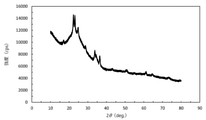
- FIG. 1 is a diagram showing the results of X-ray diffraction of crystallized glass.
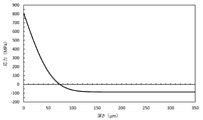
- FIG. 2 is a diagram showing a stress profile of chemically strengthened glass.
- FIG. 3 is a diagram showing a cross-sectional FE-SEM image of the crystallized glass. In the figure, white arrows indicate examples of precipitated crystals.
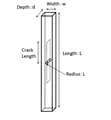
- FIG. 4 is an explanatory diagram of a sample used for measuring the fracture toughness value K1c by the DCDC method.
- FIG. 5 is a K1-v curve showing the relationship between the stress intensity factor K1 (unit: MPa ⁇ m1 / 2) and the crack growth rate v (unit: m / s) used for measuring the fracture toughness value K1c by the DCDC method. It is a figure which shows.
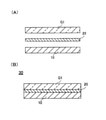
- FIG. 6 (A) and 6 (B) show the supporting glass of one aspect of the present invention to be bonded to the semiconductor substrate
- FIG. 6 (A) is a cross-sectional view before bonding
- FIG. 6 (B) is a cross-sectional view after bonding. The cross-sectional view of is shown.
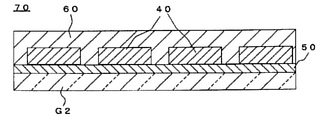
- FIG. 7 shows a cross-sectional view of a laminated substrate according to an aspect of the present invention.
- amorphous glass refers to glass in which no diffraction peak indicating crystals is observed by the powder X-ray diffraction method described later.
- the “crystallized glass” is obtained by heat-treating "amorphous glass” to precipitate crystals, and contains crystals.
- amorphous glass and “crystallized glass” may be collectively referred to as “glass”.
- Amorphous glass that becomes crystallized glass by heat treatment may be referred to as "parent glass of crystallized glass”.
- the powder X-ray diffraction measurement measures the range of 2 ⁇ of 10 ° to 80 ° using, for example, CuK ⁇ ray, and when a diffraction peak appears, the precipitated crystal is identified by the Hanawalt method. Further, among the crystals identified by this method, the crystal identified from the peak group including the peak having the highest integrated intensity is used as the main crystal.
- the measuring device for example, a SmartLab manufactured by Rigaku Corporation can be used.
- chemically strengthened glass refers to glass after being chemically strengthened
- chemically strengthened glass refers to glass before being chemically strengthened
- the glass composition is expressed in mol% based on oxides unless otherwise specified, and mol% is simply expressed as "%".
- substantially not contained means that it is below the level of impurities contained in raw materials and the like, that is, it is not intentionally added. Specifically, for example, it is less than 0.1%.
- the stress profile refers to a compressive stress value expressed with the depth from the glass surface as a variable.
- tensile stress is expressed as negative compressive stress.
- the "compressive stress value (CS)" can be measured by flaking the cross section of the glass and analyzing the flaked sample with a birefringence imaging system.
- the birefringence imaging system The birefringence stress meter is a device that measures the magnitude of the retardation generated by stress using a polarizing microscope and a liquid crystal compensator.
- it can be measured by using scattered photoelasticity.
- light is incident from the surface of glass, and the polarization of the scattered light can be analyzed to measure CS.
- a stress measuring instrument using scattered photoelasticity for example, there is a scattered light photoelastic stress meter SLP-2000 manufactured by Orihara Seisakusho.
- the "compressive stress layer depth (DOL)” is the depth at which the compressive stress value becomes zero.
- the surface compressive stress value may be referred to as CS 0
- the compressive stress value at a depth of 50 ⁇ m may be referred to as CS 50 .
- CT internal tensile stress
- the "tensile stress integral value (ST value)” is the area integral of the tensile stress (negative compressive stress) with respect to the sample depth from the DOL to the depth of 1/2 of the plate thickness t.
- ST value tensile stress integral value
- the threshold is called "ST limit”.
- the "ST limit" is measured by the following method. (Measuring method of ST limit)
- a glass plate having a size of 15 mm square and a thickness of 0.7 mm and having a mirror-finished surface is chemically strengthened under various conditions to prepare a plurality of test glass plates having different ST values. ..
- a Vickers tester Using a Vickers tester, a diamond indenter with a tip angle of 90 ° is driven into the central portion of the test glass plate to break the glass plate, and the number of fragments is defined as the number of crushed pieces.
- the test is started from 1 kgf for the driving load of the diamond indenter, and if the glass plate is not broken, the driving load is increased by 1 kgf, the test is repeated until the glass plate is broken, and the number of fragments when the glass plate is first broken is counted.
- the number of crushed pieces is plotted against the ST value of the test glass plate, and the ST value at which the number of crushed pieces is 10 is read and used as the ST limit.
- light transmittance means the average transmittance in light having a wavelength of 380 nm to 780 nm.
- the "haze value” is measured according to JIS K7136: 2000 using a halogen lamp C light source.
- the "fracture toughness value Kc" is a value according to the IF method specified in JIS R1607: 2015.
- the "fracture toughness value K1c” is measured by the DCDC method [reference: MY He, MR Turner and AG Evans, Acta Metall. Mater. 43 (1995) 3453.]. Specifically, using the sample having the shape shown in FIG. 4 and the SHIMADZU autograph AGS-X5KN, the stress intensity factor K1 (unit: MPa ⁇ m 1/2 ) and the crack growth rate as shown in FIG. 5 are used. The K1-v curve showing the relationship with v (unit: m / s) is measured, the obtained Region III data is returned and extrapolated by a linear equation, and the stress intensity factor K1 of 0.1 m / s is set to the fracture toughness value. Let it be K1c.
- semiconductor may refer not only to a semiconductor wafer such as silicon or a semiconductor chip, but also to a composite including a chip, a wiring layer, and a mold resin.
- the crack generation load has a crack generation rate of 50% when an indentation is formed on a mirror-finished surface having a thickness of 0.7 mm or more by using a Vickers indenter having a tip angle of 136 °.
- the pushing load of the Vickers indenter. CIL measurement method
- the measurement is performed on 10 pieces of glass according to the pushing load of the Vickers indenter of 10 gf, 25 gf, 50 gf, 100 gf, 200 gf, 300 gf, and 500 gf, and the average value of the number of cracks generated is calculated for each load.
- the relationship between the load and the number of cracks is regressed using the sigmoid function, and the load with two cracks is defined as CIL (gf).
- the atmospheric conditions for measurement are a temperature of 25 ° C. and a dew point of ⁇ 40 ° C.
- the chemically strengthened glass of the present invention (hereinafter, also abbreviated as the present tempered glass) is typically a plate-shaped glass article, and may be flat or curved. In addition, there may be portions having different thicknesses. Further, it is a crystallized glass containing at least one of a Li 3 PO 4 crystal and a Li 4 SiO 4 crystal, or a solid solution crystal of either Li 3 PO 4 or Li 4 SiO 4 , or a solid solution of both. Crystallized glass containing at least one of Li 3 PO 4 crystals and Li 4 SiO 4 crystals, or a solid solution crystal of either Li 3 PO 4 and Li 4 SiO 4 , or both, will be described below.
- the thickness (t) is preferably 3 mm or less, more preferably 2 mm or less, 1.6 mm or less, 1.1 mm or less, 0.9 mm or less, 0 in a stepwise manner. It is 0.8 mm or less and 0.7 mm or less. Further, the thickness (t) is preferably 0.3 mm or more, more preferably 0.4 mm or more, still more preferably 0.5 mm or more in order to obtain sufficient strength by the chemical strengthening treatment. be.
- the haze value of the tempered glass in terms of thickness of 0.7 mm is preferably 0.5% or less. Since the haze value and light transmittance of this chemically strengthened glass are basically the same as those of the crystallized glass before the chemically strengthened glass, they will be described in the section of crystallized glass.
- CS 0 When the surface compressive stress value (CS 0 ) is 400 MPa or more, the tempered glass is not easily broken due to deformation such as bending, which is preferable.
- CS 0 is more preferably 500 MPa or more, further preferably 600 MPa or more. The larger the CS 0 , the higher the strength, but if it is too large, severe crushing may occur when cracked, so 1200 MPa or less is preferable, and 1000 MPa or less is more preferable.
- the DOL of this tempered glass is 70 ⁇ m or more because it is difficult to break even if the surface is scratched.
- the DOL is more preferably 80 ⁇ m or more, still more preferably 90 ⁇ m or more, and particularly preferably 100 ⁇ m or more.
- the DOL is preferably t / 4 or less, and more preferably t / 5 or less when the thickness is t.
- the DOL is preferably 200 ⁇ m or less, more preferably 180 ⁇ m or less in order to shorten the time required for chemical strengthening.
- the CT of the tempered glass is 110 MPa or less because the scattering of debris is suppressed when the chemically strengthened glass is broken.
- the CT is more preferably 100 MPa or less, still more preferably 90 MPa or less.
- the CT is preferably 50 MPa or more, more preferably 55 MPa or more, and even more preferably 60 MPa or more.
- the ST value of the tempered glass is preferably 18,000 MPa ⁇ ⁇ m or more, more preferably 20000 MPa ⁇ ⁇ m or more, further preferably 22000 MPa ⁇ ⁇ m or more, and most preferably 24000 MPa ⁇ ⁇ m or more in order to increase the drop resistance.
- the ST value is too large, the glass pieces scatter during crushing, so that it is preferably 30,000 MPa ⁇ ⁇ m or less, more preferably 29000 MPa ⁇ ⁇ m or less, further preferably 28,000 MPa ⁇ ⁇ m or less, and most preferably 27,000 MPa ⁇ ⁇ m or less.
- This tempered glass has a mother composition of oxide-based mol% display. 40-70% of SiO 2 Li 2 O 10-35%, Those containing 1 to 15% of Al 2 O 3 are preferable.
- SiO 2 is 40 to 70%, Li 2 O 10-35%, Al 2 O 3 1 to 15%, P 2 O 5 0.5-5%, ZrO 2 0.5-5%, B 2 O 3 0-10%, Na 2 O 0-3%, K 2 O 0 to 1%, Contains 0-4% of SnO 2 It is more preferable that the total amount of SiO 2 , Al 2 O 3 , P 2 O 5 and B 2 O 3 is 60 to 80%.
- SiO 2 is 50 to 70%, Li 2 O 15-30%, Al 2 O 3 1-10%, P 2 O 5 0.5-5%, ZrO 2 0.5-8%, MgO 0.1-10%, Y 2 O 3 0-5% B 2 O 3 0-10%, Na 2 O 0-3%, K 2 O 0 to 1%, It is more preferable to contain SnO 2 in an amount of 0 to 2%.
- the "matrix composition of chemically strengthened glass” refers to the composition of crystallized glass before being chemically strengthened. This composition will be described later.
- the composition of the present tempered glass has a composition similar to that of the crystallized glass before tempering as a whole, except when an extreme ion exchange treatment is performed.
- the composition of the deepest part from the glass surface is the same as the composition of the crystallized glass before strengthening, except when an extreme ion exchange treatment is performed.
- This tempered glass is useful as a cover glass used for electronic devices such as mobile devices such as mobile phones and smartphones, in addition to the semiconductor support substrate described later. Further, it is also useful for cover glass of electronic devices such as televisions, personal computers and touch panels, wall surfaces of elevators, and wall surfaces (full-scale displays) of buildings such as houses and buildings, which are not intended to be carried. It is also useful as building materials such as windowpanes, table tops, interiors of automobiles and airplanes, cover glasses thereof, and housings having a curved surface shape. Further, for the semiconductor support substrate, crystallized glass before strengthening and amorphous glass before crystallization are also useful.
- This semiconductor support substrate is a substrate used in the field of semiconductor packaging.
- technologies such as wafer level packages (WLP) or panel level packages (PLP) are attracting attention in manufacturing (see Asahi Glass Research Report 67 (2017)).
- WLP wafer level packages
- PLP panel level packages
- This technique is, for example, a technique of placing a silicon chip on a glass substrate and molding it with a sealing resin to seal the silicon chip.
- the support substrate may be peeled off and used in the middle of the manufacturing process.
- a glass substrate is widely used. Since the glass substrate is transparent, it can be peeled off by irradiating it with laser light.
- the glass substrate used as a support substrate is required to reduce warpage by thermal expansion matching with a semiconductor. Further, it is required that the package is not easily damaged in the packaging process and that the debris does not scatter when the package is damaged.
- the crystallized glass preferably contains at least one of a Li 3 PO 4 crystal and a Li 4 SiO 4 crystal. By using these crystals as the main crystals, the light transmittance becomes high and the haze becomes small.
- the crystallized glass may contain both Li 3 PO 4 crystals and Li 4 SiO 4 crystals. Either one may be contained as the main crystal. Solid solution crystals of Li 3 PO 4 and Li 4 SiO 4 may be used as the main crystals. Further, any solid solution crystal of Li 3 PO 4 or Li 4 SiO 4 may be used as the main crystal.
- Li 2 SiO 3 crystals do not have excellent chemical resistance, it is preferable not to contain them.
- the crystallization rate of the present crystallized glass is preferably 5% or more, more preferably 10% or more, further preferably 15% or more, and particularly preferably 20% or more in order to increase the mechanical strength. In order to increase the transparency, 70% or less is preferable, 60% or less is more preferable, and 50% or less is further preferable.
- the low crystallization rate is also excellent in that it can be easily bent and molded by heating.
- the average particle size of the precipitated crystals of the present crystallized glass is preferably 5 nm or more, and particularly preferably 10 nm or more in order to increase the strength. In order to enhance transparency, 80 nm or less is preferable, 60 nm or less is more preferable, 50 nm or less is further preferable, 40 nm or less is particularly preferable, and 30 nm or less is most preferable.
- the average particle size of the precipitated crystals can be determined from a transmission electron microscope (TEM) image or an FE-SEM image.
- the thickness (t) is preferably 3 mm or less, more preferably 2 mm or less, 1.6 mm or less, 1.1 mm or less, 0.9 mm or less, 0 in a stepwise manner. It is 8.8 mm or less and 0.7 mm or less. Further, the thickness (t) is preferably 0.3 mm or more, more preferably 0.4 mm or more, still more preferably 0.5 mm or more in order to obtain sufficient strength by the chemical strengthening treatment. be.
- the light transmittance of this crystallized glass is 85% or more when the thickness is 0.7 mm, the screen of the display is easy to see when used as the cover glass of a portable display.
- the light transmittance is preferably 88% or more, more preferably 90% or more. The higher the light transmittance, the more preferable, but usually it is 91% or less.
- the thickness is 0.7 mm, the light transmittance of 90% is equivalent to that of ordinary amorphous glass.
- the light transmittance at 0.7 mm can be calculated from the Lambert-Beer law based on the measured value.
- the plate thickness t is larger than 0.7 mm, the plate thickness may be adjusted to 0.7 mm by polishing, etching, or the like for measurement.
- the haze value is 0.5% or less, preferably 0.3% or less, more preferably 0.2% or less, further preferably 0.15% or less, and 0. .1% or less is particularly preferable, 0.08% is most preferable, and 0.05% or less is extremely preferable.
- the haze value of 0.02% is equivalent to that of ordinary amorphous glass.
- the plate thickness t is larger than 0.7 mm, the plate thickness may be adjusted to 0.7 mm by polishing or etching for measurement.
- the ST limit of this crystallized glass is preferably 18,000 MPa ⁇ ⁇ m or more.
- the ST limit is more preferably 19000 MPa ⁇ ⁇ m or more, further preferably 20000 MPa ⁇ ⁇ m or more, because the drop resistance can be increased by chemical strengthening. Since this crystallized glass has a large ST limit, it is difficult to crush even if it has high strength due to chemical strengthening.
- the larger the ST limit the more preferable, but usually it is 30,000 MPa ⁇ ⁇ m or less.
- This crystallized glass is obtained by heat-treating amorphous glass, which will be described later, to crystallize it.
- This crystallized glass is displayed in mol% based on oxides. 40-70% of SiO 2 Li 2 O 10-35%, Al 2 O 3 1 to 15%, P 2 O 5 0.5-5%, ZrO 2 0.5-5%, B 2 O 3 0-10%, Na 2 O 0-3%, K 2 O 0 to 1%, It is preferable to contain SnO 2 in an amount of 0 to 4%.
- the crystallized glass having such a composition is also referred to as "the present crystallized glass A".
- the oxide-based mol% display SiO 2 50-70%, Li 2 O 15-30%, Al 2 O 3 1-10%, P 2 O 5 0.5-5%, ZrO 2 0.5-8%, MgO 0.1-10%, Y 2 O 3 0-5% B 2 O 3 0-10%, Na 2 O 0-3%, K 2 O 0 to 1%, It is preferable to contain SnO 2 in an amount of 0 to 2%.
- the crystallized glass having such a composition is also referred to as "the present crystallized glass B".
- the total amount of SiO 2 , Al 2 O 3 , P 2 O 5 and B 2 O 3 is 60 to 80% in the present crystallized glass in terms of oxide-based mol%.
- SiO 2 , Al 2 O 3 , P 2 O 5 and B 2 O 3 are network-forming components of glass (hereinafter, also abbreviated as NWF).
- NWF network-forming components of glass
- the fracture toughness value of the crystallized glass is increased, so that the total amount of NWF is preferably 60% or more, more preferably 63% or more, and particularly preferably 65% or more.
- glass having too much NWF is preferably 80% or less, more preferably 75%, and even more preferably 70% or less because it becomes difficult to manufacture because the melting temperature becomes high.
- the ratio of the total amount of Li 2 O, Na 2 O and K 2 O to the total amount of NWF is 0.20 to 0. It is preferably .60.
- the resin component Young's modulus can be increased and warpage during the packaging process can be reduced while maintaining a coefficient of thermal expansion suitable for a support substrate for many semiconductor packages.
- the lower limit is preferably 0.0031 or more, more preferably 0.0032 or more, and the upper limit is preferably 0.0064 or less, more preferably 0.0051 or less.
- Al 2 O 3 is the most effective component for increasing Young's modulus, but other examples include MgO, ZrO 2 , Y 2 O 3 , Ga 2 O 3 , BeO, TiO 2 , and Ta 2 O 5 .
- Li 2 O, Na 2 O and K 2 O are network modifying components, and lowering the ratio to NWF increases the gaps in the network and thus improves impact resistance. Therefore, the ratio of the total amount of Li 2 O, Na 2 O and K 2 O to the total amount of NWF, that is, SiO 2 , Al 2 O 3 , P 2 O 5 and B 2 O 3 is preferably 0.60 or less, and 0. 55 or less is more preferable, and 0.50 or less is particularly preferable.
- the ratio of O 5 and B 2 O 3 to the total amount is preferably 0.20 or more, more preferably 0.25 or more, and particularly preferably 0.30 or more.
- this glass composition will be described.
- SiO 2 is a component that forms a network structure of glass. Further, it is a component that enhances chemical durability, and the content of SiO 2 is preferably 40% or more.
- the content of SiO 2 is more preferably 45% or more, further preferably 50% or more, particularly preferably 52% or more, and extremely preferably 54% or more.
- the content of SiO 2 is preferably 70% or less, more preferably 68% or less, still more preferably 66% or less, and particularly preferably 64% or less.
- Al 2 O 3 is a component that increases the surface compressive stress due to chemical strengthening and is indispensable.
- the content of Al 2 O 3 is preferably 1% or more, more preferably 2% or more, still more preferably 3% or more, 5% or more, 5.5% or more, 6% or more, particularly preferably 6 in the following order. It is 5.5% or more, most preferably 7% or more.
- the content of Al 2 O 3 is preferably 15% or less, more preferably 12% or less, further preferably 10% or less, and particularly preferably 9% or less so that the devitrification temperature of the glass does not become too high. 8% or less is the most preferable.
- Li 2 O is a component that forms surface compressive stress by ion exchange, and is essential because it is a component of the main crystal.
- the content of Li 2 O is preferably 10% or more, more preferably 14% or more, more preferably 15% or more, still more preferably 18% or more, particularly preferably 20% or more, and most preferably 22% or more. ..
- the Li 2 O content is preferably 35% or less, more preferably 32% or less, still more preferably 30% or less, particularly preferably 28% or less, and most preferably 26% or less. Is.
- Na 2 O is a component that improves the meltability of glass.
- Na 2 O is not essential, but when it is contained, it is preferably 0.5% or more, more preferably 1% or more, and particularly preferably 2% or more. If the amount of Na 2 O is too large, crystals are difficult to precipitate or the chemical strengthening property is deteriorated. Therefore, the content of Na 2 O is preferably 3% or less, more preferably 2.5% or less, and further 2% or less. It is preferably 1.5% or less, and particularly preferably 1.5% or less.
- K 2 O is a component that lowers the melting temperature of glass and may be contained.
- the content is preferably 0.5% or more, more preferably 0.8% or more, still more preferably 1% or more. If the amount of K 2 O is too large, the chemical strengthening property is deteriorated or the chemical durability is lowered, so that it is preferably 1% or less, more preferably 0.8% or less, still more preferably 0.6% or less, and particularly preferably. Is 0.5% or less, most preferably 0.4% or less.
- the total content of Na 2 O and K 2 O Na 2 O + K 2 O is preferably 1% or more, more preferably 2% or more in order to improve the meltability of the glass raw material.
- K 2 O / R 2 O is chemical. It is preferable because it can increase the strengthening property and the chemical durability. K 2 O / R 2 O is more preferably 0.15 or less, and even more preferably 0.10 or less.
- the R2O is preferably 10% or more, more preferably 15% or more, still more preferably 20% or more. Further, R2O is preferably 29% or less, more preferably 26% or less.
- P 2 O 5 is a constituent of the Li 3 PO 4 crystal and is essential.
- the content of P 2 O 5 is preferably 0.5% or more, more preferably 1% or more, still more preferably 1.5% or more, particularly preferably 2% or more, and extremely preferably, in order to promote crystallization. Is 2.5% or more.
- the P 2 O 5 content is preferably 5% or less, more preferably 4. It is 8% or less, more preferably 4.5% or less, and particularly preferably 4.2% or less.
- ZrO 2 is a component that enhances mechanical strength and chemical durability, and is preferably contained because it significantly improves CS.
- the content of ZrO 2 is preferably 0.5% or more, more preferably 1% or more, further preferably 1.5% or more, particularly preferably 2% or more, and most preferably 2.5% or more. Is.
- ZrO 2 is preferably 8% or less, more preferably 7.5% or less, further preferably 7% or less, and particularly preferably 6% or less. If the content of ZrO 2 is too large, the viscosity decreases due to the increase in devitrification temperature.
- the content of ZrO 2 is preferably 5% or less, more preferably 4.5% or less, and 3.5% or less. More preferred.
- ZrO 2 / R 2 O is preferably 0.02 or more, more preferably 0.03 or more, further preferably 0.04 or more, and particularly 0.1 or more, in order to increase the chemical durability. It is preferably 0.15 or more, and most preferably 0.15 or more. In order to increase the transparency after crystallization, ZrO 2 / R 2 O is preferably 0.6 or less, more preferably 0.5 or less, further preferably 0.4 or less, and particularly preferably 0.3 or less. preferable.
- MgO is a component that stabilizes glass and is also a component that enhances mechanical strength and chemical resistance, it is preferable to contain MgO when the Al 2 O 3 content is relatively low or the like.
- the content of MgO is preferably 1% or more, more preferably 2% or more, still more preferably 3% or more, and particularly preferably 4% or more.
- the MgO content is preferably 10% or less, more preferably 9% or less, still more preferably 8% or less. Particularly preferably, it is 7% or less.
- TiO 2 is a component that can promote crystallization and may be contained. TiO 2 is not essential, but when it is contained, it is preferably 0.2% or more, and more preferably 0.5% or more. On the other hand, in order to suppress devitrification during melting, the content of TiO 2 is preferably 4% or less, more preferably 2% or less, still more preferably 1% or less.
- SnO 2 has an action of promoting the formation of crystal nuclei and may be contained.
- SnO 2 is not essential, but when it is contained, it is preferably 0.5% or more, more preferably 1% or more, still more preferably 1.5% or more, and particularly preferably 2% or more.
- the SnO 2 content is preferably 4% or less, more preferably 3.5% or less, further preferably 3% or less, and particularly preferably 2.5% or less.
- Y 2 O 3 is a component having an effect of making it difficult for debris to scatter when the chemically strengthened glass is broken, and may be contained.
- the content of Y2O3 is preferably 1 % or more, more preferably 1.5% or more, still more preferably 2% or more, particularly preferably 2.5% or more, and extremely preferably 3 % or more.
- the content of Y2O3 is preferably 5 % or less, more preferably 4% or less.
- B 2 O 3 is a component that improves the chipping resistance of the chemically strengthened glass or the chemically strengthened glass and also improves the meltability, and may be contained.
- the content is preferably 0.5% or more, more preferably 1% or more, still more preferably 2% or more in order to improve the meltability.
- the content of B 2 O 3 is more preferably 8% or less, further preferably 6% or less, and particularly preferably 4% or less.
- BaO, SrO, MgO, CaO and ZnO are all components that improve the meltability of glass and may be contained.
- the total content of BaO, SrO, MgO, CaO and ZnO (hereinafter, BaO + SrO + MgO + CaO + ZnO) is preferably 0.5% or more, more preferably 1% or more, still more preferably 1.5%. As mentioned above, it is particularly preferably 2% or more.
- BaO + SrO + MgO + CaO + ZnO is preferably 8% or less, more preferably 6% or less, further preferably 5% or less, and particularly preferably 4% or less.
- BaO, SrO, and ZnO may be contained in order to improve the light transmittance of the crystallized glass and lower the haze value by improving the refractive index of the residual glass and bringing it closer to the precipitated crystal phase.
- the total content of BaO, SrO and ZnO (hereinafter, BaO + SrO + ZnO) is preferably 0.3% or more, more preferably 0.5% or more, further preferably 0.7% or more, and particularly preferably 1% or more. preferable.
- these components may reduce the ion exchange rate.
- BaO + SrO + ZnO is preferably 2.5% or less, more preferably 2% or less, further preferably 1.7% or less, and particularly preferably 1.5% or less.
- La 2 O 3 , Nb 2 O 5 and Ta 2 O 5 are all components that make it difficult for debris to scatter when the chemically strengthened glass is broken, and may be contained in order to increase the refractive index.
- the total content of La 2 O 3 , Nb 2 O 5 and Ta 2 O 5 (hereinafter, La 2 O 3 + Nb 2 O 5 + Ta 2 O 5 ) is preferably 0.5% or more. Yes, more preferably 1% or more, still more preferably 1.5% or more, and particularly preferably 2% or more.
- La 2 O 3 + Nb 2 O 5 + Ta 2 O 5 is preferably 4% or less, more preferably 3% or less, still more preferably 2% or less, and particularly preferably 2% or less, because the glass is less likely to be devitrified at the time of melting. It is preferably 1% or less.
- CeO 2 may suppress coloration by oxidizing the glass.
- the content is preferably 0.03% or more, more preferably 0.05% or more, still more preferably 0.07% or more.
- the content of CeO 2 is preferably 1.5% or less, more preferably 1.0% or less in order to increase the transparency.
- a coloring component may be added within a range that does not hinder the achievement of the desired chemically strengthened properties.
- the coloring component include Co 3 O 4 , MnO 2 , Fe 2 O 3 , NiO, CuO, Cr 2 O 3 , V 2 O 5 , Bi 2 O 3 , SeO 2 , Er 2 O 3 , and Nd 2 O. 3 is mentioned.
- the content of coloring components is preferably in the range of 1% or less in total. If it is desired to increase the visible light transmittance of the glass, it is preferable that these components are not substantially contained.
- HfO 2 , Nb 2 O 5 , and Ti 2 O 3 may be added in order to increase the weather resistance to irradiation with ultraviolet light.
- the total content of HfO 2 , Nb 2 O 5 and Ti 2 O 3 is preferably 1% or less in order to suppress the influence on other properties. 0.5% or less is more preferable, and 0.1% or less is more preferable.
- SO 3 , chloride and fluoride may be appropriately contained as a clarifying agent or the like when melting the glass.
- the total content of the components that function as a clarifying agent is preferably 2% or less, more preferably 1% or less in terms of mass% based on the oxide, because excessive addition affects the strengthening properties and crystallization behavior. It is more preferably 0.5% or less.
- the lower limit is not particularly limited, but typically, it is preferably 0.05% or more in total in terms of mass% on an oxide basis.
- the content of SO 3 is not effective if it is too small. Therefore, in terms of mass% based on oxides, 0.01% or more is preferable, and more preferably 0.05%. The above is more preferably 0.1% or more.
- the content of SO 3 is preferably 1% or less, more preferably 0.8% or less, still more preferably 0.6, in terms of mass% based on the oxide. % Or less.
- the content of Cl is preferably 1% or less, preferably 0.8% or less in terms of mass% based on oxides, because excessive addition affects physical properties such as strengthening properties. More preferably, 0.6% or less is further preferable. Further, when Cl is used as a clarifying agent, the effect is not seen if it is too small, so that it is preferably 0.05% or more, more preferably 0.1% in terms of mass% based on the oxide. The above is more, and more preferably 0.2% or more.
- SnO 2 When SnO 2 is used as a clarifying agent, the content of SnO 2 affects the crystallization behavior if it is added too much. Therefore, it is preferably 1% or less, preferably 0.5% or less in terms of mass% based on the oxide. More preferably, 0.3% or less is further preferable. Further, when SnO 2 is used as the clarifying agent, the effect is not seen if the content of SnO 2 is too small. Therefore, 0.02% or more is preferable, and more preferably 0. It is 05% or more, more preferably 0.1% or more.
- As 2 O 3 is not contained.
- Sb 2 O 3 is contained, it is preferably 0.3% or less, more preferably 0.1% or less, and most preferably not contained.
- This crystallized glass has a high fracture toughness value, and even if a large compressive stress is formed by chemical strengthening, severe fracture is unlikely to occur.
- the fracture toughness value of the present crystallized glass is preferably 0.81 MPa ⁇ m 1/2 or more, more preferably 0.83 MPa ⁇ m 1/2 or more, still more preferably 0.85 MPa ⁇ m 1/2 or more.
- High impact resistant glass can be obtained.
- the upper limit of the fracture toughness value of the present crystallized glass is not particularly limited, but is typically 1.5 MPa ⁇ m 1/2 or less.
- the Young's modulus of the present crystallized glass is preferably 80 GPa or more, more preferably 85 GPa or more, still more preferably 90 GPa or more, and particularly preferably 95 GPa or more, because warpage can be suppressed during the chemical strengthening treatment.
- This crystallized glass may be polished and used.
- Young's modulus is preferably 130 GPa or less, more preferably 120 GPa or less, still more preferably 110 GPa or less.
- the Young's modulus of the amorphous glass is 80 GPa or more, warpage can be suppressed even in the state of the amorphous glass, so that it is suitable for a support substrate for semiconductors. It is preferably 85 GPa or more, more preferably 90 GPa or more, and further preferably 95 GPa or more.
- Young's modulus is preferably 130 GPa or less, more preferably 120 GPa or less, still more preferably 110 GPa or less.
- the indentation load value (CIL) in which the number of cracks in the crystallized glass is two is preferably 50 gf or more, more preferably 100 gf or more, still more preferably 150 gf or more, most preferably, from the viewpoint of suppressing the occurrence of cracks at the time of dropping. Is 200 gf or more.
- the present crystallized glass can be obtained by heat-treating the amorphous glass (amorphous glass according to the present invention) described below.
- the composition of the amorphous glass according to the present invention is the same as the composition of the present crystallized glass described above.
- the amorphous glass according to the present invention (hereinafter, also abbreviated as the present amorphous glass) has 40 to 70% SiO 2 , 10 to 35% Li 2 O, and Al 2 O 3 in terms of oxide-based mol%. Is preferably contained in an amount of 1 to 15%.
- the preferable composition of the present amorphous glass is, for example, 40 to 70% of SiO 2 , 10 to 35% of Li 2 O, 1 to 15% of Al 2 O 3 , and P in the molar% representation based on the oxide.
- 2 O 5 is 0.5 to 5%
- ZrO 2 is 0.5 to 5%
- B 2 O 3 is 0 to 10%
- Na 2 O is 0 to 3%
- K 2 O is 0 to 1%
- SnO examples thereof include a composition containing 0 to 4% of 2 .
- SiO 2 is 50 to 70%
- Li 2 O is 15 to 30%
- Al 2 O 3 is 1 to 10% in mol% display based on oxide.
- P 2 O 5 is 0.5 to 5%
- ZrO 2 is 0.5 to 8%
- MgO is 0.1 to 10%
- Y 2 O 3 is 0 to 5%
- B 2 O 3 is 0 to 10. %, Na 2 O 0 to 3%, K 2 O 0 to 1%, SnO 2 0 to 2%, and the like.
- the amorphous glass preferably has a total amount of SiO 2 , Al 2 O 3 , P 2 O 5 and B 2 O 3 of 60 to 80%. Further, the ratio of the total amount of Li 2 O, Na 2 O and K 2 O to the total amount of SiO 2 , Al 2 O 3 , P 2 O 5 and B 2 O 3 is 0.20 to 0.60. preferable.
- the glass transition point Tg of the present amorphous glass is preferably 400 ° C. or higher, more preferably 450 ° C. or higher, still more preferably 500 ° C. or higher because structural relaxation does not occur during chemical strengthening. Further, 650 ° C. or lower is preferable, and 600 ° C. or lower is more preferable.
- the difference (Tx—Tg) is preferably 50 ° C. or higher, more preferably 60 ° C. or higher, further preferably 70 ° C. or higher, and particularly preferably 80 ° C. or higher.
- (Tx-Tg) is large, the crystallized glass is easily reheated and bent.
- the average coefficient of thermal expansion of the amorphous glass from 50 ° C. to 350 ° C. is preferably 70 ⁇ 10 -7 ° C. or higher, more preferably 75 ⁇ 10 -7 ° C. or higher, and most preferably 80 ⁇ 10 -7 ° C. or higher.
- the coefficient of thermal expansion is too large, cracks may occur due to the difference in thermal expansion in the process of chemical strengthening. It is 100 ⁇ 10 -7 ° C or lower.
- such a coefficient of thermal expansion is suitable as a support substrate for a semiconductor package having a large amount of resin components.
- the chemically strengthened glass of the present invention is produced by chemically strengthening crystallized glass.
- the crystallized glass is produced by a method of heat-treating the above-mentioned amorphous glass to crystallize it.
- Amorphous glass can be produced, for example, by the following method.
- the manufacturing method described below is an example of manufacturing a plate-shaped chemically strengthened glass.
- the glass raw material is prepared so that a glass having a preferable composition can be obtained, and the glass is melted by heating in a glass melting kiln. Then, the molten glass is homogenized by bubbling, stirring, addition of a clarifying agent, etc., molded into a glass plate having a predetermined thickness by a known molding method, and slowly cooled. Alternatively, the molten glass may be formed into a block shape, slowly cooled, and then cut into a plate shape.
- Crystallized glass can be obtained by heat-treating the amorphous glass obtained by the above procedure (for example, preferably 450 ° C. or higher and 800 ° C. or lower).
- the heat treatment may be carried out by a two-step heat treatment in which the temperature is raised from room temperature to the first treatment temperature and held for a certain period of time, and then the temperature is held at a second treatment temperature higher than the first treatment temperature for a certain period of time.
- a one-step heat treatment may be performed in which the temperature is maintained at a specific treatment temperature and then cooled to room temperature.
- the first treatment temperature is preferably a temperature range in which the crystal nucleation rate is high in the glass composition
- the second treatment temperature is a temperature range in which the crystal growth rate is high in the glass composition. Is preferable.
- the holding time at the first treatment temperature is long so that a sufficient number of crystal nuclei are generated. By generating a large number of crystal nuclei, the size of each crystal becomes smaller, and highly transparent crystallized glass can be obtained.
- a two-step treatment it is held at a first treatment temperature of, for example, 450 ° C. to 700 ° C. for 1 hour to 6 hours, and then held at a second treatment temperature of 600 ° C. to 800 ° C. for 1 hour to 6 hours.
- a first treatment temperature for example, 450 ° C. to 700 ° C. for 1 hour to 6 hours
- a second treatment temperature 600 ° C. to 800 ° C. for 1 hour to 6 hours.
- 500 ° C. to 800 ° C. for 1 hour to 6 hours can be mentioned.
- the molten glass may be homogenized and formed into a glass plate having a predetermined thickness, or the molten glass may be formed into a block shape and subsequently subjected to continuous crystallization treatment.
- examples of the setter plate include a silicon carbide plate, a silicon nitride plate, a SiN plate, an alumina plate, a mullite cordylite plate, a mullite plate, and a crystallized glass plate. Further, a material having a large thermal conductivity is preferable in order to reduce temperature unevenness during heat treatment.
- the thermal conductivity of the setter plate is preferably 2 W / (m ⁇ K) or more, more preferably 20 W / (m ⁇ K) or more, and further preferably 40 W / (m ⁇ K) or more.
- a mold release agent can be used to prevent the glass from sticking to the setter plate.
- the mold release agent include alumina cloth and glass cloth. Further, for example, powdery boron nitride, alumina, minerals and the like can be mentioned.
- the powder release agent may be mixed with a solvent and applied by spraying or the like. When particulate matter is used, the average particle size is preferably 80 ⁇ m or less, more preferably 50 ⁇ m or less, still more preferably 30 ⁇ m or less.
- the glass When the glass is heat-treated, it may be laminated to improve work efficiency. In the case of laminating, it is preferable to use a mold release agent between the glasses. Further, a setter plate may be placed between the glasses.
- the crystallized glass obtained by the above procedure is ground and polished as necessary to form a crystallized glass plate.
- the end face is also compressed by the subsequent chemical strengthening treatment. It is preferable because a layer is formed.
- the chemical strengthening treatment involves contacting the glass with the metal salt, such as by immersing it in a melt of a metal salt (eg, potassium nitrate) containing metal ions (typically Na or K ions) with a large ion radius.
- a metal salt eg, potassium nitrate
- metal ions typically Na or K ions
- the metal ion with a small ion radius (typically Na ion or Li ion) in the glass is a metal ion with a large ion radius (typically Na ion or K ion for Li ion).
- Na ion is replaced with K ion).
- Li-Na exchange Li ions in the glass are exchanged with Na ions.
- Na-K exchange Na ions in the glass are exchanged with K ions.
- Examples of the molten salt for performing the chemical strengthening treatment include nitrates, sulfates, carbonates, chlorides and the like.
- examples of the nitrate include lithium nitrate, sodium nitrate, potassium nitrate, cesium nitrate, silver nitrate and the like.
- examples of the sulfate include lithium sulfate, sodium sulfate, potassium sulfate, cesium sulfate, silver sulfate and the like.
- Examples of the carbonate include lithium carbonate, sodium carbonate, potassium carbonate and the like.
- examples of the chloride include lithium chloride, sodium chloride, potassium chloride, cesium chloride, silver chloride and the like.
- the treatment conditions for the chemical strengthening treatment can be selected from time and temperature in consideration of the glass composition and the type of molten salt.
- the present crystallized glass is preferably chemically strengthened at 450 ° C. or lower, preferably for 1 hour or less.
- a molten salt containing 0.3% by mass of Li and 99.7% by mass of Na at 450 ° C. is preferably used for 0.5 hours. Examples include the treatment of soaking to some extent.
- the chemical strengthening treatment may be performed by, for example, two-step ion exchange as follows.
- the present crystallized glass is preferably immersed in a metal salt containing Na ions (for example, sodium nitrate) at about 350 to 500 ° C. for about 0.1 to 10 hours. This causes ion exchange between Li ions in the crystallized glass and Na ions in the metal salt, and a relatively deep compressive stress layer can be formed.
- Na ions for example, sodium nitrate
- a metal salt containing K ions for example, potassium nitrate
- K ions for example, potassium nitrate
- a large compressive stress is generated in a portion of the compressive stress layer formed in the previous treatment, for example, within a depth of about 10 ⁇ m.
- the semiconductor support substrate of the present invention (hereinafter, may be referred to as support glass) will be described.
- the semiconductor support substrate of the present invention comprises the amorphous glass and the crystallized glass of the present invention. In order to increase the strength, it is more preferable to use the tempered glass of the present invention.
- This amorphous glass, crystallized glass or this tempered glass has a large coefficient of thermal expansion, so it is suitable as a support substrate for fan-out type packages.
- packages with various average thermal expansion rates are formed depending on the ratio of the semiconductor chip and the resin component, but in recent years, the fluidity of the mold resin has been increased and filling defects have been reduced. Since it may be required, a package having a large amount of resin component and a high average thermal expansion rate is often used.
- 6 (A) and 6 (B) are examples of cross-sectional views of the support glass to be bonded to the semiconductor substrate.
- the support glass G1 shown in FIG. 6A is bonded to the semiconductor substrate 10 via the release layer 20 (which may function as a bonding layer) at a temperature of, for example, 200 ° C to 400 ° C, and is shown in FIG.
- the laminated substrate 30 represented by 6 (B) is obtained.
- the semiconductor substrate 10 for example, a semiconductor wafer of the actual size, a semiconductor chip, a substrate in which the semiconductor chip is molded in a resin, a wafer on which an element is formed, or the like is used.
- the release layer 20 is, for example, a resin that can withstand a temperature of 200 to 400 ° C.
- This support substrate is used by bonding it to a semiconductor substrate.
- a support glass for a fan-out type wafer level package a support glass for image sensors such as MEMS, CMOS and CIS for which element miniaturization by the wafer level package is effective, and a support glass having a through hole (glass interposer; GIP).
- GIP glass interposer
- This support glass is particularly suitable as a support glass for fan-out type wafer level and panel level packages.
- FIG. 7 is an example of a cross-sectional view of a laminated substrate using the support glass as a support substrate for a fan-out type wafer level package.
- the support glass G2 and the semiconductor substrate 40 are laminated via a release layer 50 (which may function as a bonding layer) such as a resin at a temperature of 200 ° C to 400 ° C. ..
- the laminated substrate 70 can be obtained by embedding the semiconductor substrate 40 with the resin 60. Then, for example, by irradiating the release layer 50 with a laser through the support glass G2, for example, the support glass G2 and the semiconductor substrate 40 embedded in the resin 60 are separated.
- the support glass G2 is reusable.
- the single conductor substrate 40 embedded in the resin 60 is wired with a copper wire or the like. Further, wiring such as a copper wire may be performed in advance on the release layer.
- a substrate in which a semiconductor chip is embedded in the resin 60 may be used as a semiconductor substrate.
- this support substrate has high light transmittance, a visible light laser or an ultraviolet light laser with high energy can be effectively used as a laser used for peeling.
- the obtained molten glass was poured into a mold, held at the temperature of the glass transition point for 1 hour, and then cooled to room temperature at a rate of 0.5 ° C./min to obtain glass blocks.
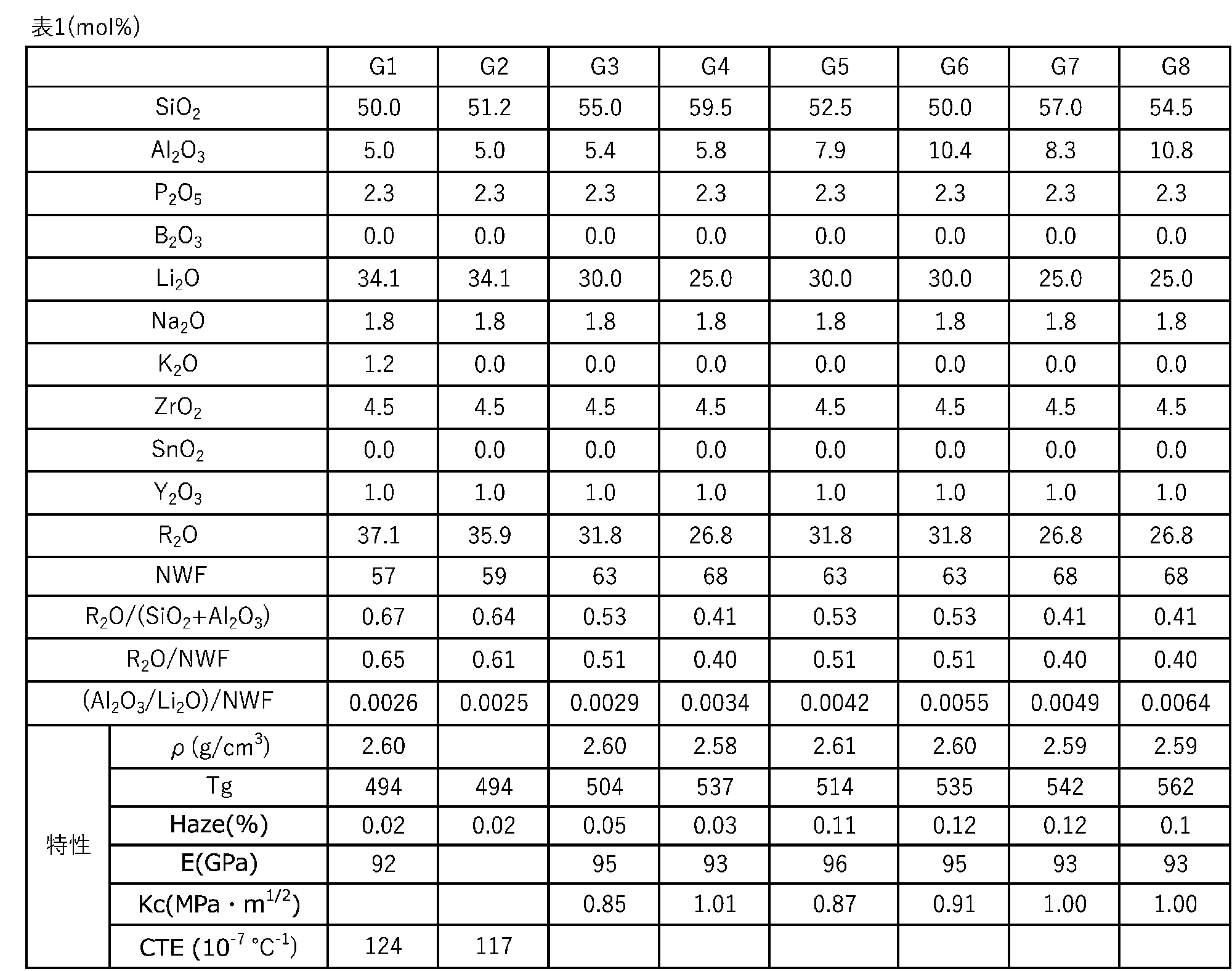
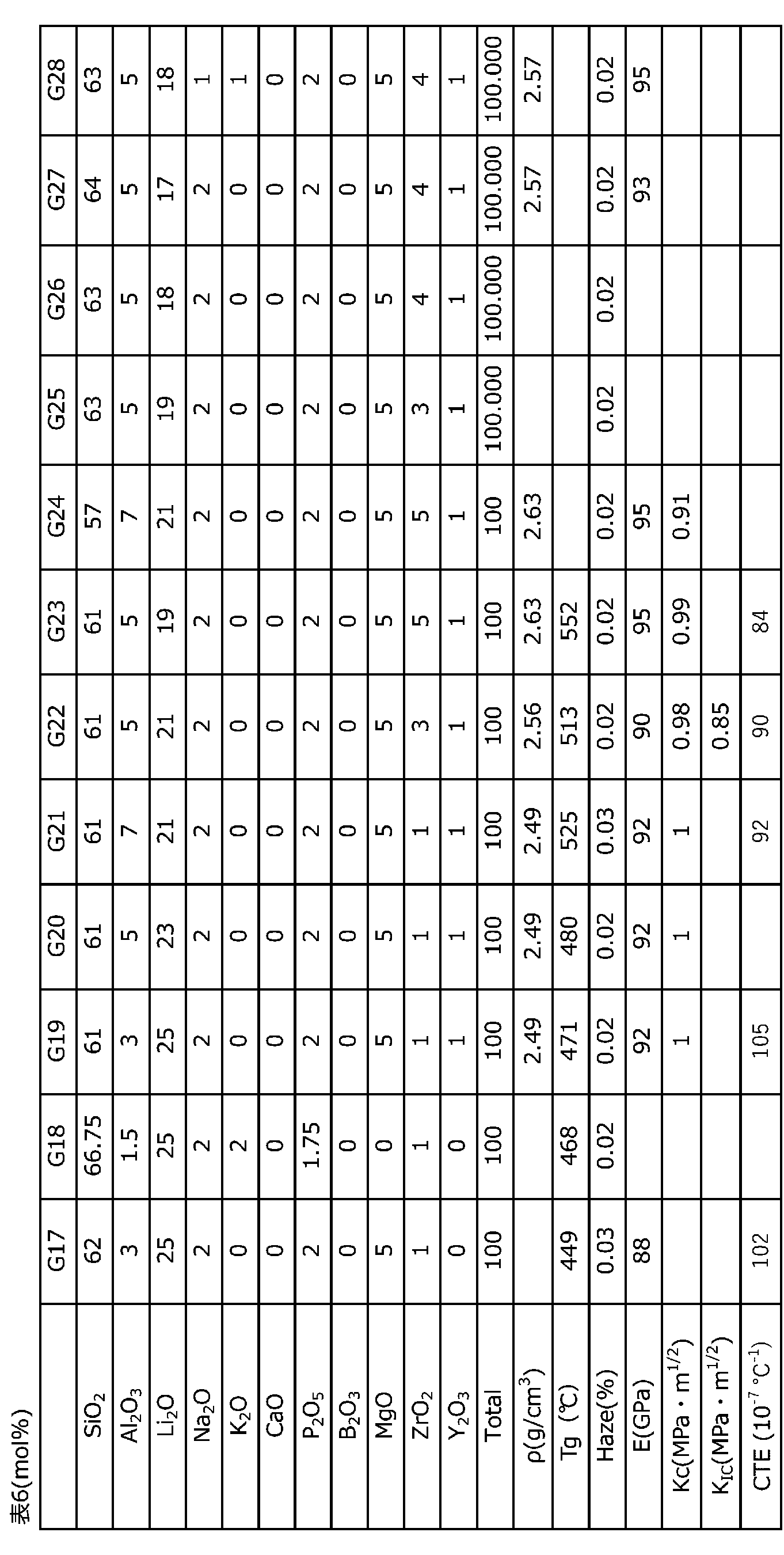
- Tables 1 and 2 show the results of evaluating the glass transition point, specific gravity, Young's modulus, fracture toughness value, and coefficient of thermal expansion of amorphous glass using a part of the obtained blocks.
- Blanks in the table indicate unevaluated.
- R 2 O represents the total content of Li 2 O, Na 2 O and K 2 O
- NWF represents the total content of SiO 2 , Al 2 O 3 , P 2 O 5 and B 2 O 3 , respectively. ..
- G3 to G8, G11, G13, and G14 are examples of amorphous glass according to the present invention, and G1, G2, G9, G10, G12, G15, and G16 are comparative examples.
- Glass transition point Tg Glass is crushed using an agate mortar, about 80 mg of powder is placed in a platinum cell, and the temperature is raised from room temperature to 1100 ° C. at a heating rate of 10 / min while using a differential scanning calorimeter (Bruker; DSC3300SA). The DSC curve was measured using the glass transition point Tg.
- a thermal expansion curve manufactured by Bruker AXS Co., Ltd .; TD5000SA was used to obtain a thermal expansion curve at a heating rate of 10 ° C./min, and the obtained thermal expansion curve was used.
- the glass transition point Tg [unit: ° C.] and the coefficient of thermal expansion [unit: 1 / K] were determined.
- the effect of the mold release agent was confirmed in the crystallization treatment.
- the glass of G13 was heat-treated on the setter plate of the alumina plate without using a mold release agent, the glass adhered to the setter plate.
- boron nitride was used as the mold release agent, the glass and the setter plate did not stick to each other, and crystallized glass was obtained.
- alumina cloth, alumina sheet, alumina particles, glass cloth, and talc were used as the mold release agent, crystallized glass was obtained without adhesion between the glass and the setter plate.
- Examples 4, 5, 7, 9, 12 to 14 are examples, and examples 1 to 3, 6, 8, 10, 11 are comparative examples.
- the obtained crystallized glass was processed and mirror-polished to obtain a crystallized glass plate having a thickness t of 0.7 mm.
- a rod-shaped sample for measuring the coefficient of thermal expansion was prepared.
- a part of the remaining crystallized glass was pulverized and used for analysis of precipitated crystals.
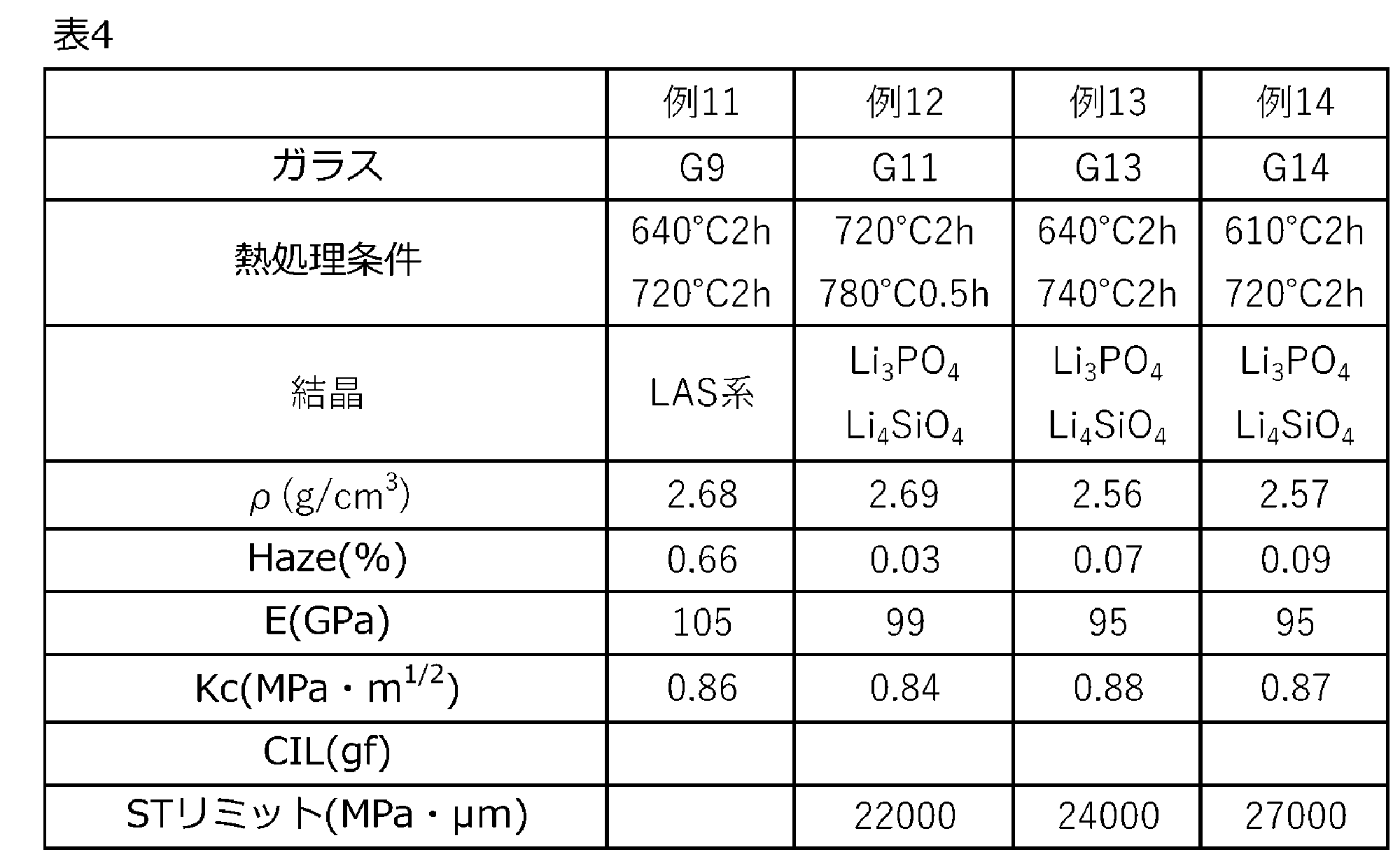
- the evaluation results of the crystallized glass are shown in Tables 3-4. Blanks indicate unevaluated.
- FIG. 1 shows the results of measuring the crystallized glass of Example 4 by X-ray diffraction.
- CIL CIL
- a plate-shaped glass having a thickness of 0.7 mm was prepared by mirror-polishing both sides. With a Vickers hardness tester, the Vickers indenter (the angle of the tip was 136 °) was pushed in for 15 seconds, then the Vickers indenter was removed, and 15 seconds later, the vicinity of the indentation was observed. In the observation, we investigated how many cracks were generated from the corners of the indentations. The measurement was performed on 10 pieces of glass according to the pushing load of the Vickers indenter of 10 gf, 25 gf, 50 gf, 100 gf, 200 gf, 300 gf and 500 gf. The average value of the number of cracks that occurred was calculated for each load.
- the relationship between the load and the number of cracks was regression calculated using the sigmoid function. From the regression calculation result, the load having two cracks was defined as the indentation load value (gf).
- the atmospheric conditions for measurement are a temperature of 25 ° C. and a dew point of ⁇ 40 ° C.
- test glass plates those having a 15 mm square shape and a thickness of 0.7 mm and having a mirror-finished surface were chemically strengthened under various conditions to prepare a plurality of test glass plates having different ST values.
- a Vickers tester Using a Vickers tester, a diamond indenter with a tip angle of 90 ° was driven into the central portion of the test glass plate to break the glass plate, and the number of fragments was taken as the number of crushed pieces.
- the test was started from 1 kgf for the driving load of the diamond indenter, and if the glass plate did not crack, the driving load was increased by 1 kgf, the test was repeated until the glass plate cracked, and the number of crushes at the time of the first crack was counted. ..
- the number of crushed pieces was plotted against the ST value of the test glass plate, and the ST value at which the number of crushed pieces was 10 was read and used as the ST limit.
- Examples 5 and 6 shown in Tables 3 and 4 have different heat treatment conditions for G5, and Examples 7 and 8 have different heat treatment conditions for G6. From the comparison between Example 5 and Example 6 and the comparison between Example 7 and Example 8, it can be seen that the crystallized glass of the present invention shows different haze due to changes in the crystals that precipitate by changing the heat treatment temperature even if the composition is the same. .. It is shown that the crystallized glass of the present invention has excellent transparency by precipitating Li 3 PO 4 or Li 4 SiO 4 to reduce the haze.
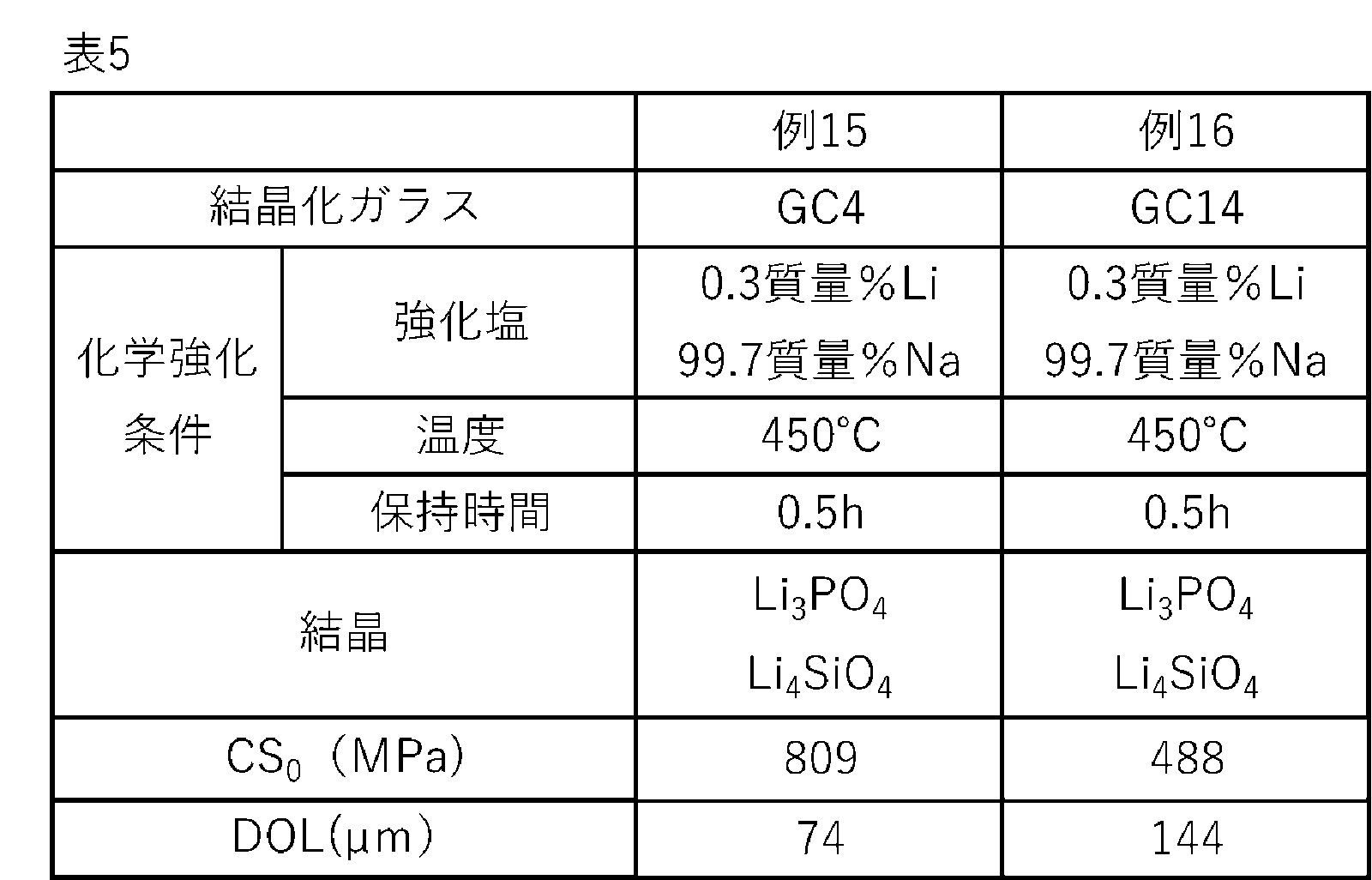
- Example 15 and 16 are examples.
- a molten salt containing 0.3% by mass of lithium nitrate and 99.7% by mass of sodium nitrate was used as a reinforcing salt, and the mixture was held at 450 ° C. for 30 minutes for ion exchange treatment to obtain chemically strengthened glass.
- the stress profile of the obtained chemically strengthened glass was measured using a scattered photoelastic stress meter SLP-2000 manufactured by Orihara Seisakusho. The results are shown in Table 5.
- FIG. 2 shows the stress profile of the chemically strengthened glass S1 obtained by chemically strengthening the crystallized glass of Example 4.
- the chemically strengthened glass of the present invention is excellent in transparency and strength.
- the fracture toughness value K1c (unit: MPa ⁇ m 1/2 ) was measured by the DCDC method. Using the sample of the shape shown in FIG. 4 and the SHIMADZU autograph AGS-X5KN by the DCDC method with reference to the method described in MY He, MR Turner and AG Evans, Acta Metall. Mater. 43 (1995) 3453. , Obtained by measuring the K1-v curve showing the relationship between the stress intensity factor K1 (unit: MPa ⁇ m 1/2 ) and the crack growth rate v (unit: m / s) as shown in FIG. The data of Region III was returned and extrapolated by a linear equation, and the stress intensity factor K1 of 0.1 m / s was used as the fracture toughness value K1c.
- Crystallized glass was obtained in the same manner as in Experimental Example 1, and its characteristics were evaluated. However, X-ray diffraction was evaluated under the following conditions.
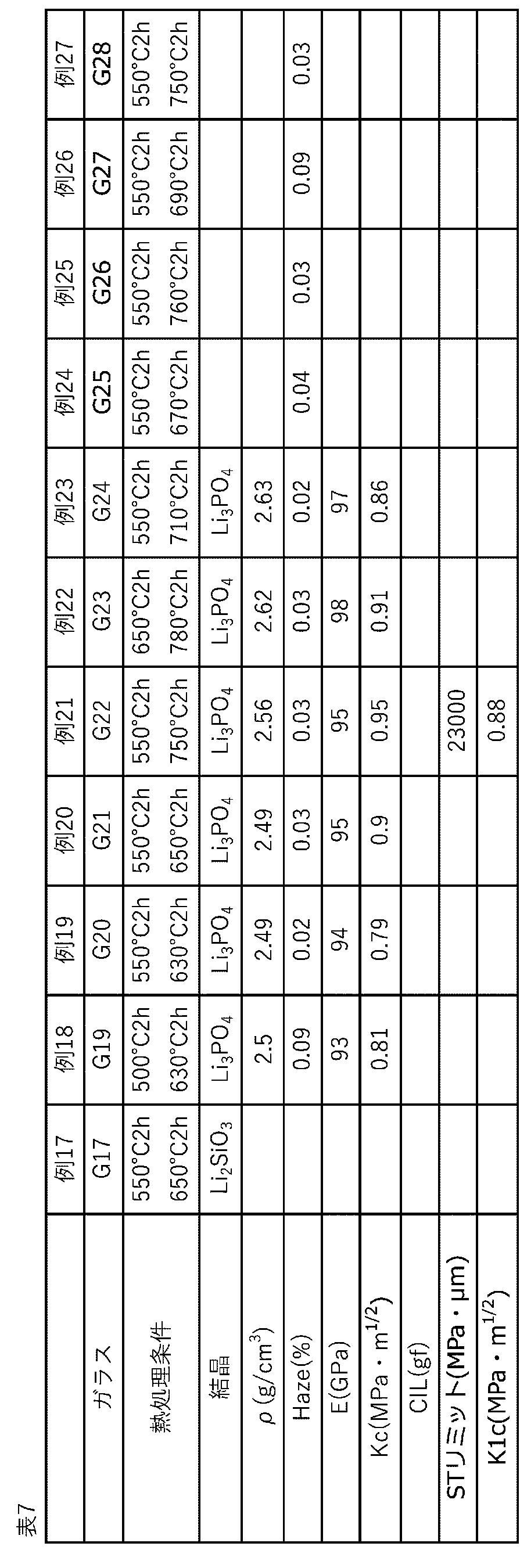
- Example 18 to 27 are Examples
- Example 17 is a Comparative Example.
- the glass of the present invention had a small haze value and had excellent transparency. It was
- Example 21 in Table 7 The chemical resistance of Example 2 in Table 3 and Example 21 in Table 7 was evaluated. After immersing in HCl at pH 1 at room temperature for 1 minute, it was immersed in NaOH at pH 12.5 at 65 ° C. for 6 minutes. After that, when the Haze and the transmittance were measured, in Example 2, the Haze increased to 0.73% and the transmittance at 550 nm decreased by 4.8%. On the other hand, in Example 21, it was found that Haze hardly changed to 0.03%, and the transmittance at 550 nm also decreased by only 0.7%. It can be seen that Example 21 in which Li 3 PO 4 crystals are precipitated is superior in chemical resistance to Example 2 in which Li 2 SiO 3 crystals are precipitated.
- Example 3 ⁇ Manufacturing and evaluation of amorphous glass>
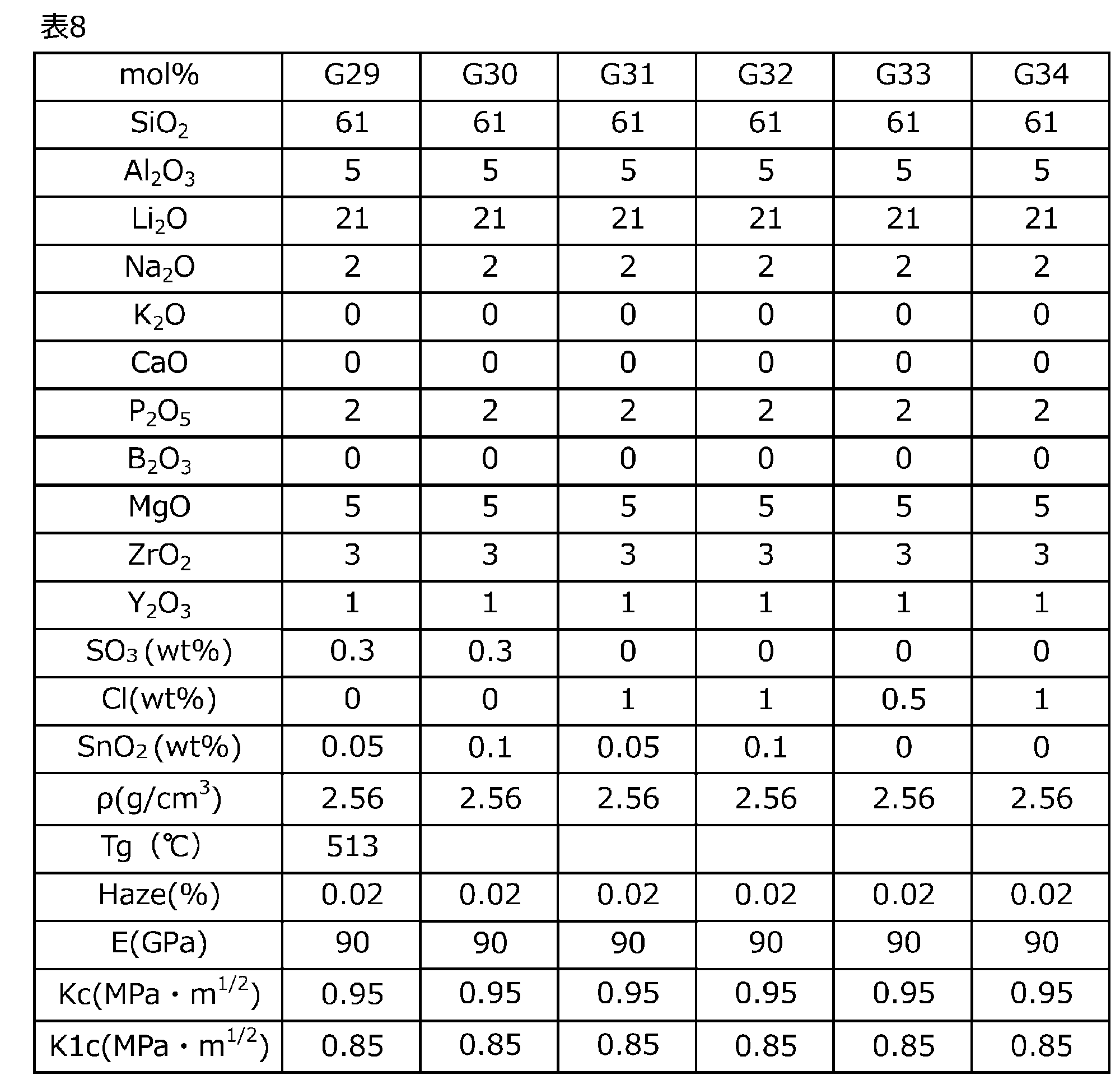
- amorphous glass having a glass composition shown in Table 8 in terms of molar% based on oxide was prepared, and its characteristics were evaluated.
- SO 3 , Cl, and SnO 2 added as a clarifying agent are indicated by mass%. The results are shown in Table 8.
- Crystallized glass was obtained in the same manner as in Example 1 and its characteristics were evaluated. The results are shown in Table 9. In Table 9, Examples 28 to 33 are all examples.
- the glass of the present invention does not affect the optical properties and mechanical properties even if the clarifying agents SO 3 , Cl and SnO 2 are added alone or in combination.
- Table 10 shows the polishing rates of amorphous glass and the glass of the invention.
- Example 34 is a comparative example, and Examples 4 and 21 are Examples.
- the glass of the present invention has a higher polishing rate after crystallization than general amorphous glass and is excellent in processability.
- FIG. 3 is a cross-sectional FE-SEM image of Example 21.
- an example of a precipitated crystal is shown by a white arrow.
- the size of the precipitated crystal it was found to be 20-50 nm. Since the crystal size is small, it is not easily affected by scattering and has excellent optical characteristics.
- Device Measured with JSM-7800F Prime manufactured by JEOL. Measurement condition: Vacc: 5kV, Coating: W, UED image
Landscapes
- Chemical & Material Sciences (AREA)
- Engineering & Computer Science (AREA)
- Organic Chemistry (AREA)
- Materials Engineering (AREA)
- Life Sciences & Earth Sciences (AREA)
- Chemical Kinetics & Catalysis (AREA)
- General Chemical & Material Sciences (AREA)
- Geochemistry & Mineralogy (AREA)
- Ceramic Engineering (AREA)
- Crystallography & Structural Chemistry (AREA)
- Dispersion Chemistry (AREA)
- Physics & Mathematics (AREA)
- Thermal Sciences (AREA)
- Glass Compositions (AREA)
- Surface Treatment Of Glass (AREA)
- Re-Forming, After-Treatment, Cutting And Transporting Of Glass Products (AREA)
Abstract
Description
(試験方法)
試験用ガラス板としては、15mm角で厚さが0.7mmであり、かつ表面を鏡面仕上げとしたものを種々の条件で化学強化処理し、引張応力積分値ST値の異なる複数の試験用ガラス板を準備する。
ビッカース試験機を用いて、試験用ガラス板の中央部分に、先端の角度が90°のダイヤモンド圧子を打ち込んでガラス板を破壊させ、破片の個数を破砕数とする。ダイヤモンド圧子の打ち込み荷重は1kgfから試験を開始し、ガラス板が割れなかった場合は、打ち込み荷重を1kgfずつ増やして、ガラス板が割れるまで試験を繰り返し、最初に割れた時の破片数を数える。
試験用ガラス板のST値に対して、破砕数をプロットし、破砕数が10となるST値を読み取ってSTリミットとする。
SiO2を40~70%、
Li2Oを10~35%、
Al2O3を1~15%、
P2O5を0.5~5%、
ZrO2を0.5~5%、
B2O3を0~10%、
Na2Oを0~3%、
K2Oを0~1%、
SnO2を0~4%、含有し、
SiO2、Al2O3、P2O5およびB2O3の総量が60~80%であり、
Li2O、Na2OおよびK2Oの総量の、SiO2、Al2O3、P2O5およびB2O3の総量に対する比が0.20~0.60であり、Li3PO4又はLi4SiO4を主結晶とする結晶化ガラスに関する。
SiO2を40~70%、
Li2Oを10~35%、
Al2O3を1~15%、
P2O5を0.5~5%、
ZrO2を0.5~5%、
B2O3を0~10%、
Na2Oを0~3%、
K2Oを0~1%、
SnO2を0~4%、含有し、
SiO2、Al2O3、P2O5およびB2O3の総量が60~80%であり、
Li2O、Na2OおよびK2Oの総量の、SiO2、Al2O3、P2O5およびB2O3の総量に対する比が0.20~0.60であるガラスを450℃以上800℃以下の温度に保持する熱処理を行う、結晶化ガラスの製造方法に関する。
(STリミットの測定方法)
試験用ガラス板としては、15mm角で厚さが0.7mmであり、かつ表面を鏡面仕上げとしたものを種々の条件で化学強化処理し、ST値の異なる複数の試験用ガラス板を準備する。
ビッカース試験機を用いて、試験用ガラス板の中央部分に、先端の角度が90°のダイヤモンド圧子を打ち込んでガラス板を破壊させ、破片の個数を破砕数とする。ダイヤモンド圧子の打ち込み荷重は1kgfから試験を開始し、ガラス板が割れなかった場合は、打ち込み荷重を1kgfずつ増やして、ガラス板が割れるまで試験を繰り返し、最初に割れた時の破片数を数える。
試験用ガラス板のST値に対して、破砕数をプロットし、破砕数が10となるST値を読み取ってSTリミットとする。
両面を鏡面研磨した、厚さ0.7mmの板状のガラスを用意する。ビッカース硬度試験機にて、ビッカース圧子を15秒間押し込んだ後にビッカース圧子をはずし、15秒後に圧痕のコーナーからクラックが何本発生しているかを観測する。測定は、10gf、25gf、50gf、100gf、200gf、300gf、500gfのビッカース圧子の押し込み荷重別に、10枚のガラスに対して行い、発生したクラック本数の平均値を荷重ごとに算出する。荷重とクラック本数との関係を、シグモイド関数を用いて回帰計算し、クラック本数が2本となる荷重をCIL(gf)とする。なお、測定の雰囲気条件は、気温25℃、露点-40℃とする。
本発明の化学強化ガラス(以下、本強化ガラスとも略す。)は、典型的には板状のガラス物品であり、平板状でもよく曲面状でもよい。また、厚さの異なる部分があってもよい。また、Li3PO4結晶およびLi4SiO4結晶の少なくとも一方を含有する、又はLi3PO4およびLi4SiO4のいずれかの固溶体結晶もしくは両方の固溶体を含有する結晶化ガラスである。Li3PO4結晶およびLi4SiO4結晶の少なくとも一方を含有する、又はLi3PO4およびLi4SiO4のいずれかの固溶体結晶もしくは両方の固溶体を含有する結晶化ガラスについては、後述する。
本強化ガラスの厚さ0.7mm換算のヘーズ値は0.5%以下が好ましい。本化学強化ガラスのヘーズ値や光透過率は、化学強化前の結晶化ガラスと基本的に同じなので、結晶化ガラスの項で説明する。
SiO2を40~70%、
Li2Oを10~35%、
Al2O3を1~15%、含有するものが好ましい。
Li2Oを10~35%、
Al2O3を1~15%、
P2O5を0.5~5%、
ZrO2を0.5~5%、
B2O3を0~10%、
Na2Oを0~3%、
K2Oを0~1%、
SnO2を0~4%、含有し、
SiO2、Al2O3、P2O5およびB2O3の総量が60~80%であることがより好ましい。
Li2Oを15~30%、
Al2O3を1~10%、
P2O5を0.5~5%、
ZrO2を0.5~8%、
MgOを0.1~10%、
Y2O3を0~5%
B2O3を0~10%、
Na2Oを0~3%、
K2Oを0~1%、
SnO2を0~2%、含有することがより好ましい。
本結晶化ガラスは、Li3PO4結晶およびLi4SiO4結晶の少なくとも一方を含有することが好ましい。これらの結晶を主結晶とすることで、光透過率が高くなり、ヘーズが小さくなる。
すなわち、ヘーズ値は、板厚が増すごとに内部直線透過率に比例した分増えると考えることができるので、0.7mmの場合のヘーズ値H0.7は、以下の式で求められる。

SiO2を40~70%、
Li2Oを10~35%、
Al2O3を1~15%、
P2O5を0.5~5%、
ZrO2を0.5~5%、
B2O3を0~10%、
Na2Oを0~3%、
K2Oを0~1%、
SnO2を0~4%、含有することが好ましい。本明細書において、かかる組成の結晶化ガラスを「本結晶化ガラスA」ともいう。
SiO2を50~70%、
Li2Oを15~30%、
Al2O3を1~10%、
P2O5を0.5~5%、
ZrO2を0.5~8%、
MgOを0.1~10%、
Y2O3を0~5%
B2O3を0~10%、
Na2Oを0~3%、
K2Oを0~1%、
SnO2を0~2%、含有することが好ましい。本明細書において、かかる組成の結晶化ガラスを「本結晶化ガラスB」ともいう。
以下、このガラス組成を説明する。
本結晶化ガラスは以下に説明する非晶質ガラス(本発明にかかる非晶質ガラス)を加熱処理することで得られる。本発明にかかる非晶質ガラスの組成は、上記した本結晶化ガラスの組成と同様である。
本発明の化学強化ガラスは、結晶化ガラスを化学強化処理して製造する。該結晶化ガラスは、前述の非晶質ガラスを加熱処理して結晶化する方法で製造する。
非晶質ガラスは、例えば、以下の方法で製造できる。なお、以下に記す製造方法は、板状の化学強化ガラスを製造する場合の例である。
上記の手順で得られた非晶質ガラスを加熱処理(例えば、好ましくは450℃以上800℃以下)することで結晶化ガラスが得られる。
化学強化処理は、大きなイオン半径の金属イオン(典型的には、NaイオンまたはKイオン)を含む金属塩(例えば、硝酸カリウム)の融液に浸漬する等の方法で、ガラスを金属塩に接触させることにより、ガラス中の小さなイオン半径の金属イオン(典型的には、NaイオンまたはLiイオン)が大きなイオン半径の金属イオン(典型的には、Liイオンに対してはNaイオンまたはKイオンであり、Naイオンに対してはKイオン)と置換させる処理である。
本発明の半導体支持基板(以下、支持ガラスと記すこともある)について説明する。本発明の半導体支持基板は、本発明の非晶質ガラス、結晶化ガラスからなる。強度を高くするためには、本発明の強化ガラスからなることがより好ましい。
<非晶質ガラスの作製と評価>
表1~2に酸化物基準のモル%表示で示したガラス組成となるようにガラス原料を調合し、800gのガラスが得られるように秤量した。ついで、混合したガラス原料を白金るつぼに入れ、1600℃の電気炉に投入して5時間程度溶融し、脱泡し、均質化した。
アルキメデス法で測定した。
メノウ乳鉢を用いてガラスを粉砕し、約80mgの粉末を白金セルに入れて昇温速度を10/分として室温から1100℃まで昇温しながら、示差走査熱量計(ブルカー社製;DSC3300SA)を用いてDSC曲線を測定し、ガラス転移点Tgを求めた。
または、JIS R1618:2002に基づき、熱膨張計(ブルカー・エイエックスエス社製;TD5000SA)を用いて、昇温速度を10℃/分として熱膨張曲線を得て、得られた熱膨張曲線からガラス転移点Tg[単位:℃]と熱膨張係数[単位:1/K]を求めた。
ヘーズメーター(スガ試験機製;HZ-V3)を用いて、ハロゲンランプC光源でのヘーズ値[単位:%]測定した。
超音波パルス法(JIS R1602)で測定した。
JIS R1607:2015に準拠してIF法で測定した。

得られたガラスブロックを50mm×50mm×1.5mmに加工してから、表3~4に記載した条件で熱処理して結晶化ガラスを得た。表の結晶化条件欄は、上段が核生成処理条件、下段が結晶成長処理条件であり、たとえば上段に550℃2h、下段に730℃2hと記載した場合は、550℃で2時間保持した後、730℃に2時間保持したことを意味する。
以下の条件で粉末X線回折を測定し、析出結晶を同定した。
測定装置:リガク社製 Smart Lab
使用X線:CuKα線
測定範囲:2θ=10°~80°
スピード:1°/分
ステップ:0.01°
ヘーズメーター(スガ試験機製;HZ-V3)を用いて、ハロゲンランプC光源でのヘーズ値[単位:%]測定した。
両面を鏡面研磨した、厚さ0.7mmの板状のガラスを用意した。ビッカース硬度試験機にて、ビッカース圧子(先端部の角度は136°)を15秒押し込んだ後にビッカース圧子をはずし、15秒後に圧痕付近を観測した。観測では、圧痕のコーナーからクラックが何本発生しているかを調査した。測定は、10gf、25gf、50gf、100gf、200gf、300gf、500gfのビッカース圧子の押し込み荷重別に、10枚のガラスに対して行った。発生したクラック本数の平均値を荷重ごとに算出した。荷重とクラック本数との関係を、シグモイド関数を用いて回帰計算した。回帰計算結果から、クラック本数が2本となる荷重を前記押し込み荷重値(gf)とした。なお、測定の雰囲気条件は、気温25℃、露点-40℃である。
試験用ガラス板として、15mm角で厚さが0.7mmであり、かつ表面を鏡面仕上げとしたものを種々の条件で化学強化処理し、ST値の異なる複数の試験用ガラス板を準備した。
ビッカース試験機を用いて、試験用ガラス板の中央部分に、先端の角度が90°のダイヤモンド圧子を打ち込んでガラス板を破壊させ、破片の個数を破砕数とした。ダイヤモンド圧子の打ち込み荷重は1kgfから試験を開始し、ガラス板が割れなかった場合は、打ち込み荷重を1kgfずつ増やして、ガラス板が割れるまで試験を繰り返し、最初に割れた時の破砕数を数えた。
試験用ガラス板のST値に対して、破砕数をプロットし、破砕数が10となるST値を読み取ってSTリミットとした。

例4および例14の結晶化ガラスについて以下の方法で化学強化し、それぞれ例15及び例16とした。例15及び例16は実施例である。強化塩として硝酸リチウム0.3質量%、硝酸ナトリウム99.7質量%を含有する溶融塩を用い、450℃にて30分間保持してイオン交換処理を行い、化学強化ガラスを得た。得られた化学強化ガラスについて、折原製作所製散乱光光弾性応力計SLP-2000を用いて応力プロファイルを測定した。結果を表5に示す。表5において、ガラスG4の結晶化ガラスをGC4、ガラスG14の結晶化ガラスをGC14として示す。また、図2に、例4の結晶化ガラスを化学強化した化学強化ガラスS1の応力プロファイルを示す。
<非晶質ガラスの作製と評価>
実験例1と同様にして、表6に酸化物基準のモル%表示で示すガラス組成の非晶質ガラスを作製し、その特性を評価した。破壊靱性値K1cは下記の方法により評価した。結果を表6に示す。
DCDC法によって破壊靱性値K1c(単位:MPa・m1/2)を測定した。M.Y. He, M.R. Turner and A.G. Evans, Acta Metall. Mater. 43 (1995) 3453.に記載の方法を参考に、DCDC法により、図4に示される形状のサンプルおよびSHIMADZUオートグラフAGS-X5KNを用いて、図5に示されるような、応力拡大係数K1(単位:MPa・m1/2)とクラック進展速度v(単位:m/s)との関係を示すK1-v曲線を測定し、得られたRegionIIIのデータを一次式で回帰、外挿し、0.1m/sの応力拡大係数K1を破壊靭性値K1cとした。
実験例1と同様にして結晶化ガラスを得た、その特性を評価した。ただし、X線回折については、下記条件により評価した。
以下の条件で粉末X線回折を測定し、析出結晶を同定した。
測定装置:リガク社製 Smart Lab
使用X線:CuKα線
測定範囲:2θ=10°~80°
スピード:10°/分
ステップ:0.02°
〈非晶質ガラスの作製と評価〉
実施例1と同様にして、表8に酸化物基準のモル%表示で示すガラス組成の非晶質ガラスを作製し、その特性を評価した。ただし、清澄剤として添加しているSO3、Cl、SnO2は質量%で表示する。結果を表8に示す。
実施例1同様にして結晶化ガラスを得て、その特性を評価した。結果を表9に示す。表9において、例28~例33はすべて実施例である。


装置:JEOL製JSM-7800F Primeで測定した。
測定条件:
Vacc:5kV、Coating:W、UED像
Claims (14)
- 厚さ0.7mm換算のヘーズ値が0.5%以下であり、
表面圧縮応力値が400MPa以上、
圧縮応力層深さが70μm以上、かつ
以下の試験方法で求められるSTリミットが18000~30000MPa・μmであり、
Li3PO4結晶およびLi4SiO4結晶の少なくとも一方を含有する、又はLi3PO4およびLi4SiO4のいずれかの固溶体結晶もしくは両方の固溶体を含有する結晶化ガラスである化学強化ガラス。
(試験方法)
試験用ガラス板としては、15mm角で厚さが0.7mmであり、かつ表面を鏡面仕上げとしたものを種々の条件で化学強化処理し、引張応力積分値であるST値の異なる複数の試験用ガラス板を準備する。
ビッカース試験機を用いて、試験用ガラス板の中央部分に、先端の角度が90°のダイヤモンド圧子を打ち込んでガラス板を破壊させ、破片の個数を破砕数とする。ダイヤモンド圧子の打ち込み荷重は1kgfから試験を開始し、ガラス板が割れなかった場合は、打ち込み荷重を1kgfずつ増やして、ガラス板が割れるまで試験を繰り返し、最初に割れた時の破砕数を数える。
試験用ガラス板のST値に対して、破砕数をプロットし、破砕数が10となるST値を読み取ってSTリミットとする。 - 化学強化ガラスの母組成が、酸化物基準のモル%表示で、
SiO2を40~70%、
Li2Oを10~35%、
Al2O3を1~15%、
P2O5を0.5~5%、
ZrO2を0.5~5%、
B2O3を0~10%、
Na2Oを0~3%、
K2Oを0~1%、
SnO2を0~4%、含有し、
SiO2、Al2O3、P2O5およびB2O3の総量が60~80%である請求項1に記載の化学強化ガラス。 - Al2O3が5%以上かつZrO2が2%以上である請求項2に記載の化学強化ガラス。
- SiO2を50~70%、
Li2Oを15~30%、
Al2O3を1~10%、
P2O5を0.5~5%、
ZrO2を0.5~8%、
MgOを0.1~10%、
Y2O3を0~5%
B2O3を0~10%、
Na2Oを0~3%、
K2Oを0~1%、
SnO2を0~2%、含有する請求項1に記載の化学強化ガラス。 - 50℃~350℃における平均熱膨張係数が80~100×10-7/℃である請求項1~4のいずれか一項に記載の化学強化ガラス。
- 請求項1~5のいずれか一項に記載の化学強化ガラスからなる半導体支持基板。
- Li3PO4結晶およびLi4SiO4結晶の少なくとも一方を含有する、又はLi3PO4およびLi4SiO4のいずれかの固溶体結晶もしくは両方の固溶体を含有する結晶化ガラスであり、
厚さ0.7mm換算のヘーズ値が0.5%以下であり、
以下の試験方法で求められるSTリミットが18000MPa・μm以上である結晶化ガラス。
(試験方法)
試験用ガラス板としては、15mm角で厚さが0.7mmであり、かつ表面を鏡面仕上げとしたものを種々の条件で化学強化処理し、引張応力積分値であるST値の異なる複数の試験用ガラス板を準備する。
ビッカース試験機を用いて、試験用ガラス板の中央部分に、先端の角度が90°のダイヤモンド圧子を打ち込んでガラス板を破壊させ、破片の個数を破砕数とする。ダイヤモンド圧子の打ち込み荷重は1kgfから試験を開始し、ガラス板が割れなかった場合は、打ち込み荷重を1kgfずつ増やして、ガラス板が割れるまで試験を繰り返し、最初に割れた時の破砕数を数える。
試験用ガラス板のST値に対して、破砕数をプロットし、破砕数が10となるST値を読み取ってSTリミットとする。 - 酸化物基準のモル%表示で、
SiO2を40~70%、
Li2Oを10~35%、
Al2O3を1~15%、
P2O5を0.5~5%、
ZrO2を0.5~5%、
B2O3を0~10%、
Na2Oを0~3%、
K2Oを0~1%、
SnO2を0~4%、含有し、
SiO2、Al2O3、P2O5およびB2O3の総量が60~80%であり、
Li2O、Na2OおよびK2Oの総量の、SiO2、Al2O3、P2O5およびB2O3の総量に対する比が0.20~0.60であり、Li3PO4又はLi4SiO4を主結晶とする結晶化ガラス。 - Al2O3が5%以上かつZrO2が2%以上である請求項8に記載の結晶化ガラス。
- SiO2を50~70%、
Li2Oを15~30%、
Al2O3を1~10%、
P2O5を0.5~5%、
ZrO2を0.5~8%、
MgOを0.1~10%、
Y2O3を0~5%
B2O3を0~10%、
Na2Oを0~3%、
K2Oを0~1%、
SnO2を0~2%、含有する請求項7に記載の結晶化ガラス。 - 酸化物基準のモル%表示で、
SiO2を40~70%、
Li2Oを10~35%、
Al2O3を1~15%、
P2O5を0.5~5%、
ZrO2を0.5~5%、
B2O3を0~10%、
Na2Oを0~3%、
K2Oを0~1%、
SnO2を0~4%、含有し、
SiO2、Al2O3、P2O5およびB2O3の総量が60~80%であり、
Li2O、Na2OおよびK2Oの総量の、SiO2、Al2O3、P2O5およびB2O3の総量に対する比が0.20~0.60であるガラスを450℃以上800℃以下の温度に保持する熱処理を行う、結晶化ガラスの製造方法。 - 請求項7~10のいずれか一項に記載の結晶化ガラスからなる物品を化学強化する、化学強化ガラス物品の製造方法。
- 50℃~350℃における平均熱膨張係数が80~100×10-7/℃である請求項7~10のいずれか一項に記載の結晶化ガラス。
- 請求項7~10のいずれか一項に記載の結晶化ガラスからなる半導体支持基板。
Priority Applications (12)
| Application Number | Priority Date | Filing Date | Title |
|---|---|---|---|
| EP21858219.5A EP4201902A4 (en) | 2020-08-21 | 2021-08-10 | CHEMICALLY STRENGTHENED GLASS AND CRYSTALLIZED GLASS AND MANUFACTURING METHODS THEREOF |
| CN202180006588.XA CN114728838B (zh) | 2020-08-21 | 2021-08-10 | 化学强化玻璃和微晶玻璃以及它们的制造方法 |
| CN202310401962.7A CN116444161B (zh) | 2020-08-21 | 2021-08-10 | 化学强化玻璃和微晶玻璃以及它们的制造方法 |
| JP2021573597A JP7074269B1 (ja) | 2020-08-21 | 2021-08-10 | 化学強化ガラスおよび結晶化ガラス並びにそれらの製造方法 |
| KR1020237003040A KR20230054660A (ko) | 2020-08-21 | 2021-08-10 | 화학 강화 유리 및 결정화 유리 그리고 그들의 제조 방법 |
| CN202310409309.5A CN116444162A (zh) | 2020-08-21 | 2021-08-10 | 化学强化玻璃和微晶玻璃以及它们的制造方法 |
| CN202310397738.5A CN116444160B (zh) | 2020-08-21 | 2021-08-10 | 化学强化玻璃和微晶玻璃以及它们的制造方法 |
| KR1020257016479A KR20250076679A (ko) | 2020-08-21 | 2021-08-10 | 화학 강화 유리 및 결정화 유리 그리고 그들의 제조 방법 |
| JP2022074881A JP7327570B2 (ja) | 2020-08-21 | 2022-04-28 | 化学強化ガラスおよび結晶化ガラス並びにそれらの製造方法 |
| US18/108,535 US20230192540A1 (en) | 2020-08-21 | 2023-02-10 | Chemically strengthened glass and crystallized glass, and manufacturing methods therefor |
| JP2023124433A JP7605259B2 (ja) | 2020-08-21 | 2023-07-31 | 化学強化ガラスおよび結晶化ガラス並びにそれらの製造方法 |
| US19/318,935 US20260001807A1 (en) | 2020-08-21 | 2025-09-04 | Chemically strengthened glass and crystallized glass, and manufacturing methods therefor |
Applications Claiming Priority (4)
| Application Number | Priority Date | Filing Date | Title |
|---|---|---|---|
| JP2020-140347 | 2020-08-21 | ||
| JP2020140347 | 2020-08-21 | ||
| JP2021090475 | 2021-05-28 | ||
| JP2021-090475 | 2021-05-28 |
Related Child Applications (1)
| Application Number | Title | Priority Date | Filing Date |
|---|---|---|---|
| US18/108,535 Continuation US20230192540A1 (en) | 2020-08-21 | 2023-02-10 | Chemically strengthened glass and crystallized glass, and manufacturing methods therefor |
Publications (1)
| Publication Number | Publication Date |
|---|---|
| WO2022039072A1 true WO2022039072A1 (ja) | 2022-02-24 |
Family
ID=80322797
Family Applications (1)
| Application Number | Title | Priority Date | Filing Date |
|---|---|---|---|
| PCT/JP2021/029569 Ceased WO2022039072A1 (ja) | 2020-08-21 | 2021-08-10 | 化学強化ガラスおよび結晶化ガラス並びにそれらの製造方法 |
Country Status (7)
| Country | Link |
|---|---|
| US (2) | US20230192540A1 (ja) |
| EP (1) | EP4201902A4 (ja) |
| JP (3) | JP7074269B1 (ja) |
| KR (2) | KR20250076679A (ja) |
| CN (4) | CN116444162A (ja) |
| TW (2) | TW202532359A (ja) |
| WO (1) | WO2022039072A1 (ja) |
Cited By (6)
| Publication number | Priority date | Publication date | Assignee | Title |
|---|---|---|---|---|
| WO2024014305A1 (ja) * | 2022-07-13 | 2024-01-18 | 日本電気硝子株式会社 | 化学強化ガラス |
| JP2024063162A (ja) * | 2020-12-31 | 2024-05-10 | 成都光明光▲電▼股▲分▼有限公司 | 微結晶ガラス、微結晶ガラス製品及びその製造方法 |
| WO2024252896A1 (ja) * | 2023-06-09 | 2024-12-12 | Agc株式会社 | 焼結体の製造方法、グリーンシート及び焼結体 |
| WO2025254107A1 (ja) * | 2024-06-07 | 2025-12-11 | Agc株式会社 | ガラス、化学強化ガラス、ガラスの製造方法および化学強化ガラスの製造方法 |
| WO2025254115A1 (ja) * | 2024-06-07 | 2025-12-11 | Agc株式会社 | 結晶化ガラス |
| WO2025254110A1 (ja) * | 2024-06-07 | 2025-12-11 | Agc株式会社 | ガラス、化学強化ガラス、ガラスの製造方法および化学強化ガラスの製造方法 |
Families Citing this family (4)
| Publication number | Priority date | Publication date | Assignee | Title |
|---|---|---|---|---|
| CN116102258A (zh) * | 2022-12-23 | 2023-05-12 | 中建材玻璃新材料研究院集团有限公司 | 一种具有高弹性模量的柔性玻璃 |
| CN118812159B (zh) * | 2023-04-19 | 2025-11-07 | 华为技术有限公司 | 基础玻璃、微晶玻璃及其制备方法、玻璃制品和终端设备 |
| JP2024167587A (ja) | 2023-05-22 | 2024-12-04 | Agc株式会社 | 物理量評価装置、物理量評価方法 |
| WO2026018728A1 (ja) * | 2024-07-17 | 2026-01-22 | Agc株式会社 | 結晶化ガラスの製造方法 |
Citations (6)
| Publication number | Priority date | Publication date | Assignee | Title |
|---|---|---|---|---|
| JPH10226532A (ja) * | 1995-12-28 | 1998-08-25 | Yamamura Glass Co Ltd | 磁気ディスク基板用ガラス組成物及び磁気ディスク基板 |
| JP2018526317A (ja) * | 2015-08-25 | 2018-09-13 | イフォクレール ヴィヴァデント アクチェンゲゼルシャフトIvoclar Vivadent AG | ケイ酸リチウム低温型石英ガラスセラミック |
| WO2019022035A1 (ja) | 2017-07-26 | 2019-01-31 | Agc株式会社 | 化学強化ガラスおよびその製造方法 |
| WO2020161949A1 (ja) * | 2019-02-08 | 2020-08-13 | Agc株式会社 | 結晶化ガラス、化学強化ガラスおよび半導体支持基板 |
| JP2020140347A (ja) | 2019-02-27 | 2020-09-03 | 株式会社日立製作所 | 作物管理システム及び作物管理方法 |
| JP2021090475A (ja) | 2019-12-06 | 2021-06-17 | 三菱電機株式会社 | 電気機器、及び食器洗い機 |
Family Cites Families (36)
| Publication number | Priority date | Publication date | Assignee | Title |
|---|---|---|---|---|
| JP3440214B2 (ja) | 1998-03-23 | 2003-08-25 | 株式会社オハラ | 情報記憶媒体用ガラスセラミックス基板 |
| JP4849702B2 (ja) | 1999-07-06 | 2012-01-11 | コニカミノルタオプト株式会社 | 結晶化ガラス |
| JP2004288228A (ja) | 2003-01-31 | 2004-10-14 | Hoya Corp | 情報記録媒体用基板、情報記録媒体およびその製造方法 |
| JP4813767B2 (ja) * | 2004-02-12 | 2011-11-09 | 出光興産株式会社 | リチウムイオン伝導性硫化物系結晶化ガラス及びその製造方法 |
| JP5053948B2 (ja) | 2007-12-21 | 2012-10-24 | 株式会社オハラ | 結晶化ガラス |
| CN103043910A (zh) * | 2012-12-26 | 2013-04-17 | 中国人民解放军第四军医大学 | 一种用于制作牙科修复体的玻璃陶瓷及其制备方法 |
| EP2765119B1 (de) * | 2013-02-12 | 2021-07-28 | Ivoclar Vivadent AG | Rohling für dentale Zwecke |
| KR101524482B1 (ko) * | 2013-10-14 | 2015-06-02 | 주식회사 하스 | 지르코니아 상단에 안착되는 리튬 실리케이트 유리 또는 리튬 실리케이트 결정화 유리 및 이의 제조방법 |
| JP2015086080A (ja) | 2013-10-28 | 2015-05-07 | 旭硝子株式会社 | 物理強化ガラスおよび物理強化ガラスの製造方法 |
| JP2017081761A (ja) * | 2014-03-13 | 2017-05-18 | 旭硝子株式会社 | 化学強化用ガラスおよび化学強化ガラス |
| CN103896572B (zh) * | 2014-04-12 | 2015-07-22 | 桂林理工大学 | 可低温烧结的温度稳定型微波介电陶瓷Li3PO4及其制备方法 |
| US9359243B2 (en) * | 2014-05-13 | 2016-06-07 | Corning Incorporated | Transparent glass-ceramic articles, glass-ceramic precursor glasses and methods for forming the same |
| US10377661B2 (en) * | 2014-05-16 | 2019-08-13 | Ivoclar Vivadent Ag | Glass ceramic with SiO2 as the main crystalline phase |
| JP2015223810A (ja) * | 2014-05-29 | 2015-12-14 | 旭硝子株式会社 | 樹脂層付き支持基板およびガラス積層体 |
| TWI861872B (zh) | 2014-10-08 | 2024-11-11 | 美商康寧公司 | 具有葉長石及矽酸鋰結構的高強度玻璃陶瓷 |
| JP6910299B2 (ja) * | 2015-01-14 | 2021-07-28 | コーニング インコーポレイテッド | ガラス基板およびそれを備えたディスプレイ装置 |
| DE102015101691B4 (de) * | 2015-02-05 | 2019-10-17 | Dentsply Sirona Inc. | Verfahren zur Herstellung eines aus Lithiumsilikat-Glaskeramik bestehenden Formkörpers sowie Formkörper |
| CN104926135A (zh) | 2015-06-10 | 2015-09-23 | 成都光明光电有限责任公司 | 微晶玻璃以及多层无机膜滤波器 |
| CN115650601B (zh) * | 2016-01-21 | 2024-07-12 | Agc株式会社 | 化学强化玻璃以及化学强化用玻璃 |
| WO2017223551A1 (en) | 2016-06-24 | 2017-12-28 | Corning Incorporated | Zirconia-toughened glass ceramics |
| DE102016119108A1 (de) * | 2016-10-07 | 2018-04-12 | Degudent Gmbh | Lithiumsilikat-Glaskeramik |
| JP6922276B2 (ja) * | 2017-03-13 | 2021-08-18 | 日本電気硝子株式会社 | 支持結晶化ガラス基板及びこれを用いた積層体 |
| CN115385571B (zh) * | 2017-04-28 | 2024-05-03 | Agc株式会社 | 化学强化玻璃以及化学强化用玻璃 |
| JP7004234B2 (ja) * | 2017-05-30 | 2022-01-21 | 日本電気硝子株式会社 | 支持結晶化ガラス基板の製造方法 |
| KR102826738B1 (ko) * | 2017-06-05 | 2025-06-27 | 에이지씨 가부시키가이샤 | 강화 유리 |
| WO2019022033A1 (ja) * | 2017-07-26 | 2019-01-31 | Agc株式会社 | 化学強化用ガラス、化学強化ガラスおよび電子機器筐体 |
| WO2019021911A1 (ja) * | 2017-07-26 | 2019-01-31 | Agc株式会社 | 半導体パッケージ用支持ガラス |
| CN110997586A (zh) * | 2017-07-26 | 2020-04-10 | Agc株式会社 | 晶化玻璃和化学强化玻璃 |
| CN111417602A (zh) * | 2018-07-16 | 2020-07-14 | 康宁股份有限公司 | 具有增加的抗破碎性的玻璃陶瓷制品及其制造方法 |
| EP3823935A1 (en) * | 2018-07-16 | 2021-05-26 | Corning Incorporated | Glass ceramic articles having improved properties and methods for making the same |
| JP2020033202A (ja) * | 2018-08-27 | 2020-03-05 | Agc株式会社 | 結晶化ガラス基体、化学強化ガラス板、及びこれらの製造方法 |
| CN112608032B (zh) * | 2018-10-26 | 2022-04-22 | 成都光明光电股份有限公司 | 微晶玻璃、微晶玻璃制品及其制造方法 |
| JP7269252B2 (ja) * | 2018-11-13 | 2023-05-08 | コーニング インコーポレイテッド | 化学的に強化された二ケイ酸リチウム-葉長石ガラスセラミック |
| US11390558B2 (en) * | 2019-05-29 | 2022-07-19 | Corning Incorporated | Colored glass-ceramics having petalite and lithium silicate structures |
| CN110627365B (zh) | 2019-09-25 | 2022-12-27 | 重庆鑫景特种玻璃有限公司 | 一种透明的强化玻璃陶瓷及其制备方法 |
| CN110845153B (zh) * | 2019-12-03 | 2022-02-18 | 重庆鑫景特种玻璃有限公司 | 一种具有高压应力层深度的强化微晶玻璃及其制备方法 |
-
2021
- 2021-08-10 CN CN202310409309.5A patent/CN116444162A/zh not_active Withdrawn
- 2021-08-10 EP EP21858219.5A patent/EP4201902A4/en not_active Withdrawn
- 2021-08-10 CN CN202310401962.7A patent/CN116444161B/zh active Active
- 2021-08-10 JP JP2021573597A patent/JP7074269B1/ja active Active
- 2021-08-10 KR KR1020257016479A patent/KR20250076679A/ko active Pending
- 2021-08-10 WO PCT/JP2021/029569 patent/WO2022039072A1/ja not_active Ceased
- 2021-08-10 CN CN202310397738.5A patent/CN116444160B/zh active Active
- 2021-08-10 CN CN202180006588.XA patent/CN114728838B/zh active Active
- 2021-08-10 KR KR1020237003040A patent/KR20230054660A/ko active Pending
- 2021-08-16 TW TW114112149A patent/TW202532359A/zh unknown
- 2021-08-16 TW TW110130106A patent/TW202214534A/zh unknown
-
2022
- 2022-04-28 JP JP2022074881A patent/JP7327570B2/ja active Active
-
2023
- 2023-02-10 US US18/108,535 patent/US20230192540A1/en active Pending
- 2023-07-31 JP JP2023124433A patent/JP7605259B2/ja active Active
-
2025
- 2025-09-04 US US19/318,935 patent/US20260001807A1/en active Pending
Patent Citations (6)
| Publication number | Priority date | Publication date | Assignee | Title |
|---|---|---|---|---|
| JPH10226532A (ja) * | 1995-12-28 | 1998-08-25 | Yamamura Glass Co Ltd | 磁気ディスク基板用ガラス組成物及び磁気ディスク基板 |
| JP2018526317A (ja) * | 2015-08-25 | 2018-09-13 | イフォクレール ヴィヴァデント アクチェンゲゼルシャフトIvoclar Vivadent AG | ケイ酸リチウム低温型石英ガラスセラミック |
| WO2019022035A1 (ja) | 2017-07-26 | 2019-01-31 | Agc株式会社 | 化学強化ガラスおよびその製造方法 |
| WO2020161949A1 (ja) * | 2019-02-08 | 2020-08-13 | Agc株式会社 | 結晶化ガラス、化学強化ガラスおよび半導体支持基板 |
| JP2020140347A (ja) | 2019-02-27 | 2020-09-03 | 株式会社日立製作所 | 作物管理システム及び作物管理方法 |
| JP2021090475A (ja) | 2019-12-06 | 2021-06-17 | 三菱電機株式会社 | 電気機器、及び食器洗い機 |
Non-Patent Citations (3)
| Title |
|---|
| ASAHI GLASS RESEARCH REPORT, vol. 67, 2017 |
| M.Y. HEM.R. TURNERA.G. EVANS, ACTA METALL. MATER, vol. 43, 1995, pages 3453 |
| See also references of EP4201902A4 |
Cited By (7)
| Publication number | Priority date | Publication date | Assignee | Title |
|---|---|---|---|---|
| JP2024063162A (ja) * | 2020-12-31 | 2024-05-10 | 成都光明光▲電▼股▲分▼有限公司 | 微結晶ガラス、微結晶ガラス製品及びその製造方法 |
| JP7836843B2 (ja) | 2020-12-31 | 2026-03-27 | 成都光明光▲電▼股▲分▼有限公司 | 微結晶ガラス、微結晶ガラス製品、マトリックスガラス、ガラス蓋板、ガラス素子、表示装置、及び電子機器 |
| WO2024014305A1 (ja) * | 2022-07-13 | 2024-01-18 | 日本電気硝子株式会社 | 化学強化ガラス |
| WO2024252896A1 (ja) * | 2023-06-09 | 2024-12-12 | Agc株式会社 | 焼結体の製造方法、グリーンシート及び焼結体 |
| WO2025254107A1 (ja) * | 2024-06-07 | 2025-12-11 | Agc株式会社 | ガラス、化学強化ガラス、ガラスの製造方法および化学強化ガラスの製造方法 |
| WO2025254115A1 (ja) * | 2024-06-07 | 2025-12-11 | Agc株式会社 | 結晶化ガラス |
| WO2025254110A1 (ja) * | 2024-06-07 | 2025-12-11 | Agc株式会社 | ガラス、化学強化ガラス、ガラスの製造方法および化学強化ガラスの製造方法 |
Also Published As
| Publication number | Publication date |
|---|---|
| JP7605259B2 (ja) | 2024-12-24 |
| EP4201902A1 (en) | 2023-06-28 |
| CN116444160A (zh) | 2023-07-18 |
| JP2023138610A (ja) | 2023-10-02 |
| KR20230054660A (ko) | 2023-04-25 |
| JP2022103233A (ja) | 2022-07-07 |
| CN114728838B (zh) | 2023-05-09 |
| US20260001807A1 (en) | 2026-01-01 |
| JPWO2022039072A1 (ja) | 2022-02-24 |
| JP7074269B1 (ja) | 2022-05-24 |
| JP7327570B2 (ja) | 2023-08-16 |
| TW202532359A (zh) | 2025-08-16 |
| CN114728838A (zh) | 2022-07-08 |
| CN116444161B (zh) | 2025-09-12 |
| KR20250076679A (ko) | 2025-05-29 |
| CN116444161A (zh) | 2023-07-18 |
| US20230192540A1 (en) | 2023-06-22 |
| CN116444162A (zh) | 2023-07-18 |
| CN116444160B (zh) | 2025-05-09 |
| EP4201902A4 (en) | 2024-10-30 |
| TW202214534A (zh) | 2022-04-16 |
Similar Documents
| Publication | Publication Date | Title |
|---|---|---|
| JP7074269B1 (ja) | 化学強化ガラスおよび結晶化ガラス並びにそれらの製造方法 | |
| JP7067665B2 (ja) | 結晶化ガラス、化学強化ガラスおよび半導体支持基板 | |
| JP7115479B2 (ja) | 結晶化ガラスおよび化学強化ガラス | |
| KR102121414B1 (ko) | 화학 강화 유리 및 화학 강화용 유리 | |
| JP2024164238A (ja) | 化学強化ガラスの製造方法および化学強化ガラス | |
| WO2017126605A1 (ja) | 化学強化ガラス及び化学強化ガラスの製造方法 | |
| WO2022215717A1 (ja) | 化学強化ガラス及びその製造方法 | |
| US20230406763A1 (en) | Chemically-strengthened glass containing glass ceramic, and method for manufacturing same | |
| JP2023124633A (ja) | 化学強化ガラス及びその製造方法 | |
| JP2025103785A (ja) | 化学強化ガラス、化学強化ガラスの製造方法およびカバーガラス |
Legal Events
| Date | Code | Title | Description |
|---|---|---|---|
| ENP | Entry into the national phase |
Ref document number: 2021573597 Country of ref document: JP Kind code of ref document: A |
|
| 121 | Ep: the epo has been informed by wipo that ep was designated in this application |
Ref document number: 21858219 Country of ref document: EP Kind code of ref document: A1 |
|
| NENP | Non-entry into the national phase |
Ref country code: DE |
|
| ENP | Entry into the national phase |
Ref document number: 2021858219 Country of ref document: EP Effective date: 20230321 |
|
| WWW | Wipo information: withdrawn in national office |
Ref document number: 2021858219 Country of ref document: EP |