WO2022044483A1 - ポリアリーレンスルフィド樹脂組成物、成形品およびそれらの製造方法 - Google Patents
ポリアリーレンスルフィド樹脂組成物、成形品およびそれらの製造方法 Download PDFInfo
- Publication number
- WO2022044483A1 WO2022044483A1 PCT/JP2021/022023 JP2021022023W WO2022044483A1 WO 2022044483 A1 WO2022044483 A1 WO 2022044483A1 JP 2021022023 W JP2021022023 W JP 2021022023W WO 2022044483 A1 WO2022044483 A1 WO 2022044483A1
- Authority
- WO
- WIPO (PCT)
- Prior art keywords
- mass
- parts
- resin composition
- polyarylene sulfide
- sulfide resin
- Prior art date
- Legal status (The legal status is an assumption and is not a legal conclusion. Google has not performed a legal analysis and makes no representation as to the accuracy of the status listed.)
- Ceased
Links
Classifications
-
- C—CHEMISTRY; METALLURGY
- C08—ORGANIC MACROMOLECULAR COMPOUNDS; THEIR PREPARATION OR CHEMICAL WORKING-UP; COMPOSITIONS BASED THEREON
- C08K—Use of inorganic or non-macromolecular organic substances as compounding ingredients
- C08K7/00—Use of ingredients characterised by shape
- C08K7/02—Fibres or whiskers
- C08K7/04—Fibres or whiskers inorganic
- C08K7/14—Glass
-
- C—CHEMISTRY; METALLURGY
- C03—GLASS; MINERAL OR SLAG WOOL
- C03C—CHEMICAL COMPOSITION OF GLASSES, GLAZES OR VITREOUS ENAMELS; SURFACE TREATMENT OF GLASS; SURFACE TREATMENT OF FIBRES OR FILAMENTS MADE FROM GLASS, MINERALS OR SLAGS; JOINING GLASS TO GLASS OR OTHER MATERIALS
- C03C25/00—Surface treatment of fibres or filaments made from glass, minerals or slags
- C03C25/10—Coating
- C03C25/24—Coatings containing organic materials
- C03C25/26—Macromolecular compounds or prepolymers
-
- B—PERFORMING OPERATIONS; TRANSPORTING
- B29—WORKING OF PLASTICS; WORKING OF SUBSTANCES IN A PLASTIC STATE IN GENERAL
- B29C—SHAPING OR JOINING OF PLASTICS; SHAPING OF MATERIAL IN A PLASTIC STATE, NOT OTHERWISE PROVIDED FOR; AFTER-TREATMENT OF THE SHAPED PRODUCTS, e.g. REPAIRING
- B29C48/00—Extrusion moulding, i.e. expressing the moulding material through a die or nozzle which imparts the desired form; Apparatus therefor
- B29C48/022—Extrusion moulding, i.e. expressing the moulding material through a die or nozzle which imparts the desired form; Apparatus therefor characterised by the choice of material
-
- B—PERFORMING OPERATIONS; TRANSPORTING
- B29—WORKING OF PLASTICS; WORKING OF SUBSTANCES IN A PLASTIC STATE IN GENERAL
- B29C—SHAPING OR JOINING OF PLASTICS; SHAPING OF MATERIAL IN A PLASTIC STATE, NOT OTHERWISE PROVIDED FOR; AFTER-TREATMENT OF THE SHAPED PRODUCTS, e.g. REPAIRING
- B29C48/00—Extrusion moulding, i.e. expressing the moulding material through a die or nozzle which imparts the desired form; Apparatus therefor
- B29C48/25—Component parts, details or accessories; Auxiliary operations
- B29C48/78—Thermal treatment of the extrusion moulding material or of preformed parts or layers, e.g. by heating or cooling
- B29C48/86—Thermal treatment of the extrusion moulding material or of preformed parts or layers, e.g. by heating or cooling at the nozzle zone
- B29C48/865—Heating
-
- C—CHEMISTRY; METALLURGY
- C03—GLASS; MINERAL OR SLAG WOOL
- C03C—CHEMICAL COMPOSITION OF GLASSES, GLAZES OR VITREOUS ENAMELS; SURFACE TREATMENT OF GLASS; SURFACE TREATMENT OF FIBRES OR FILAMENTS MADE FROM GLASS, MINERALS OR SLAGS; JOINING GLASS TO GLASS OR OTHER MATERIALS
- C03C13/00—Fibre or filament compositions
-
- C—CHEMISTRY; METALLURGY
- C03—GLASS; MINERAL OR SLAG WOOL
- C03C—CHEMICAL COMPOSITION OF GLASSES, GLAZES OR VITREOUS ENAMELS; SURFACE TREATMENT OF GLASS; SURFACE TREATMENT OF FIBRES OR FILAMENTS MADE FROM GLASS, MINERALS OR SLAGS; JOINING GLASS TO GLASS OR OTHER MATERIALS
- C03C25/00—Surface treatment of fibres or filaments made from glass, minerals or slags
- C03C25/10—Coating
- C03C25/1095—Coating to obtain coated fabrics
-
- C—CHEMISTRY; METALLURGY
- C08—ORGANIC MACROMOLECULAR COMPOUNDS; THEIR PREPARATION OR CHEMICAL WORKING-UP; COMPOSITIONS BASED THEREON
- C08G—MACROMOLECULAR COMPOUNDS OBTAINED OTHERWISE THAN BY REACTIONS ONLY INVOLVING UNSATURATED CARBON-TO-CARBON BONDS
- C08G75/00—Macromolecular compounds obtained by reactions forming a linkage containing sulfur with or without nitrogen, oxygen, or carbon in the main chain of the macromolecule
- C08G75/02—Polythioethers
-
- C—CHEMISTRY; METALLURGY
- C08—ORGANIC MACROMOLECULAR COMPOUNDS; THEIR PREPARATION OR CHEMICAL WORKING-UP; COMPOSITIONS BASED THEREON
- C08G—MACROMOLECULAR COMPOUNDS OBTAINED OTHERWISE THAN BY REACTIONS ONLY INVOLVING UNSATURATED CARBON-TO-CARBON BONDS
- C08G75/00—Macromolecular compounds obtained by reactions forming a linkage containing sulfur with or without nitrogen, oxygen, or carbon in the main chain of the macromolecule
- C08G75/02—Polythioethers
- C08G75/0204—Polyarylenethioethers
- C08G75/025—Preparatory processes
- C08G75/0259—Preparatory processes metal hydrogensulfides
-
- C—CHEMISTRY; METALLURGY
- C08—ORGANIC MACROMOLECULAR COMPOUNDS; THEIR PREPARATION OR CHEMICAL WORKING-UP; COMPOSITIONS BASED THEREON
- C08J—WORKING-UP; GENERAL PROCESSES OF COMPOUNDING; AFTER-TREATMENT NOT COVERED BY SUBCLASSES C08B, C08C, C08F, C08G or C08H
- C08J5/00—Manufacture of articles or shaped materials containing macromolecular substances
- C08J5/04—Reinforcing macromolecular compounds with loose or coherent fibrous material
- C08J5/0405—Reinforcing macromolecular compounds with loose or coherent fibrous material with inorganic fibres
- C08J5/043—Reinforcing macromolecular compounds with loose or coherent fibrous material with inorganic fibres with glass fibres
-
- C—CHEMISTRY; METALLURGY
- C08—ORGANIC MACROMOLECULAR COMPOUNDS; THEIR PREPARATION OR CHEMICAL WORKING-UP; COMPOSITIONS BASED THEREON
- C08K—Use of inorganic or non-macromolecular organic substances as compounding ingredients
- C08K5/00—Use of organic ingredients
- C08K5/54—Silicon-containing compounds
- C08K5/541—Silicon-containing compounds containing oxygen
-
- C—CHEMISTRY; METALLURGY
- C08—ORGANIC MACROMOLECULAR COMPOUNDS; THEIR PREPARATION OR CHEMICAL WORKING-UP; COMPOSITIONS BASED THEREON
- C08K—Use of inorganic or non-macromolecular organic substances as compounding ingredients
- C08K5/00—Use of organic ingredients
- C08K5/54—Silicon-containing compounds
- C08K5/541—Silicon-containing compounds containing oxygen
- C08K5/5415—Silicon-containing compounds containing oxygen containing at least one Si—O bond
-
- C—CHEMISTRY; METALLURGY
- C08—ORGANIC MACROMOLECULAR COMPOUNDS; THEIR PREPARATION OR CHEMICAL WORKING-UP; COMPOSITIONS BASED THEREON
- C08L—COMPOSITIONS OF MACROMOLECULAR COMPOUNDS
- C08L81/00—Compositions of macromolecular compounds obtained by reactions forming in the main chain of the macromolecule a linkage containing sulfur with or without nitrogen, oxygen or carbon only; Compositions of polysulfones; Compositions of derivatives of such polymers
- C08L81/02—Polythioethers; Polythioether-ethers
-
- B—PERFORMING OPERATIONS; TRANSPORTING
- B29—WORKING OF PLASTICS; WORKING OF SUBSTANCES IN A PLASTIC STATE IN GENERAL
- B29K—INDEXING SCHEME ASSOCIATED WITH SUBCLASSES B29B, B29C OR B29D, RELATING TO MOULDING MATERIALS OR TO MATERIALS FOR MOULDS, REINFORCEMENTS, FILLERS OR PREFORMED PARTS, e.g. INSERTS
- B29K2081/00—Use of polymers having sulfur, with or without nitrogen, oxygen or carbon only, in the main chain, as moulding material
- B29K2081/04—Polysulfides, e.g. PPS, i.e. polyphenylene sulfide or derivatives thereof
-
- B—PERFORMING OPERATIONS; TRANSPORTING
- B29—WORKING OF PLASTICS; WORKING OF SUBSTANCES IN A PLASTIC STATE IN GENERAL
- B29K—INDEXING SCHEME ASSOCIATED WITH SUBCLASSES B29B, B29C OR B29D, RELATING TO MOULDING MATERIALS OR TO MATERIALS FOR MOULDS, REINFORCEMENTS, FILLERS OR PREFORMED PARTS, e.g. INSERTS
- B29K2101/00—Use of unspecified macromolecular compounds as moulding material
- B29K2101/12—Thermoplastic materials
-
- B—PERFORMING OPERATIONS; TRANSPORTING
- B29—WORKING OF PLASTICS; WORKING OF SUBSTANCES IN A PLASTIC STATE IN GENERAL
- B29K—INDEXING SCHEME ASSOCIATED WITH SUBCLASSES B29B, B29C OR B29D, RELATING TO MOULDING MATERIALS OR TO MATERIALS FOR MOULDS, REINFORCEMENTS, FILLERS OR PREFORMED PARTS, e.g. INSERTS
- B29K2105/00—Condition, form or state of moulded material or of the material to be shaped
- B29K2105/06—Condition, form or state of moulded material or of the material to be shaped containing reinforcements, fillers or inserts
- B29K2105/08—Condition, form or state of moulded material or of the material to be shaped containing reinforcements, fillers or inserts of continuous length, e.g. cords, rovings, mats, fabrics, strands or yarns
-
- C—CHEMISTRY; METALLURGY
- C08—ORGANIC MACROMOLECULAR COMPOUNDS; THEIR PREPARATION OR CHEMICAL WORKING-UP; COMPOSITIONS BASED THEREON
- C08J—WORKING-UP; GENERAL PROCESSES OF COMPOUNDING; AFTER-TREATMENT NOT COVERED BY SUBCLASSES C08B, C08C, C08F, C08G or C08H
- C08J2381/00—Characterised by the use of macromolecular compounds obtained by reactions forming in the main chain of the macromolecule a linkage containing sulfur with or without nitrogen, oxygen, or carbon only; Polysulfones; Derivatives of such polymers
- C08J2381/02—Polythioethers; Polythioether-ethers
-
- C—CHEMISTRY; METALLURGY
- C08—ORGANIC MACROMOLECULAR COMPOUNDS; THEIR PREPARATION OR CHEMICAL WORKING-UP; COMPOSITIONS BASED THEREON
- C08L—COMPOSITIONS OF MACROMOLECULAR COMPOUNDS
- C08L2207/00—Properties characterising the ingredient of the composition
- C08L2207/04—Thermoplastic elastomer
Definitions
- the present invention relates to a polyarylene sulfide resin composition, a polyarylene sulfide resin molded product, and a method for producing them.
- Polyphenylene sulfide resin represented by polyphenylene sulfide resin (hereinafter, “PPS resin”) has excellent heat resistance, chemical resistance, etc., and is used for automobile parts, electrical and electronic parts, and water heater parts. It is widely used for such purposes. In these applications, mechanical strength to replace metal is often required, and it is used as a resin composition reinforced with glass fiber.
- PPS resin itself exhibits excellent heat resistance and chemical resistance, its use as a resin composition is significantly reduced in applications where it comes into contact with hot water, acidic or alkaline chemicals, and its use is limited.
- Patent Document 1 a PPS resin composition containing glass fiber containing 5 to 40% by weight of ZrO 2 as a glass having excellent acid resistance and alkali resistance, and B 2 O 3 to enhance water resistance are contained.
- a PPS resin composition containing a glass fiber having an amount of 1% by weight or less is provided (see Patent Document 2).
- Patent Document 3 it is known that by further adding a polysiloxane compound to a PPS resin composition containing a PPS resin and glass fiber, acid resistance and alkali resistance are improved without impairing water resistance (see Patent Document 3).
- the problem to be solved by the present invention is a molded product containing PAS resin and glass fiber, which can suppress a decrease in mechanical strength even in a hot water atmosphere and under acidic conditions, and a PAS resin capable of providing the molded product. It is an object of the present invention to provide a composition and a method for producing them.
- the present invention is a polyarylene sulfide resin composition
- a polyarylene sulfide resin composition comprising a polyarylene sulfide resin (A), a glass fiber (B) and a silane coupling agent (C) as essential components.
- the glass fiber (B) is a glass fiber containing 16% by mass or more of ZrO 2 content, 5 to 10% by mass or less of TiO 2 content, and 0.1 to 5% by mass of CaO content in the glass fiber.
- the glass fiber (B) is in the range of 10 to 100 parts by mass and the silane coupling agent (C) is in the range of 0.01 to 10 parts by mass with respect to 100 parts by mass of the polyarylene sulfide resin (A).
- the present invention relates to a polyarylene sulfide resin composition.
- the present invention also relates to a molded product obtained by molding the polyarylene sulfide resin composition described above.
- the polyarylene sulfide resin (A), the glass fiber (B) and the silane coupling agent (C) are blended as essential components and melt-mixed in a temperature range equal to or higher than the melting point of the polyarylene sulfide resin (A).
- the glass fiber (B) is a glass fiber containing 16% by mass or more of ZrO 2 content, 5 to 10% by mass or less of TiO 2 content, and 0.1 to 5% by mass of CaO content in the glass fiber.
- the glass fiber (B) is in the range of 10 to 100 parts by mass and the silane coupling agent (C) is in the range of 0.01 to 10 parts by mass with respect to 100 parts by mass of the polyarylene sulfide resin (A).
- the present invention relates to a method for producing a polyarylene sulfide resin composition.
- the present invention also relates to a method for producing a molded product, which comprises a step of producing a polyarylene sulfide resin composition by the production method described above and a step of melt molding the obtained polyarylene sulfide resin composition.
- a method can be provided.
- the PAS resin composition of the present invention is a polyarylene sulfide resin composition comprising a polyarylene sulfide resin (A), a glass fiber (B) and a silane coupling agent (C) as essential components.
- the glass fiber (B) is a glass fiber containing 16% by mass or more of ZrO 2 content, 5 to 10% by mass or less of TiO 2 content, and 0.1 to 5% by mass of CaO content in the glass fiber.
- the glass fiber (B) is in the range of 10 to 100 parts by mass and the silane coupling agent (C) is in the range of 0.01 to 10 parts by mass with respect to 100 parts by mass of the polyarylene sulfide resin (A). It is characterized by that. This will be described below.
- the PAS resin composition of the present invention contains PAS resin (A) as an essential ingredient.
- the PAS resin (A) has a resin structure having a structure in which an aromatic ring and a sulfur atom are bonded as a repeating unit, and specifically, the following general formula (1).
- R 1 and R 2 independently represent a hydrogen atom, an alkyl group in the range of 1 to 4 carbon atoms, a nitro group, an amino group, a phenyl group, a methoxy group, and an ethoxy group).
- the trifunctional structural site represented by the formula (2) is preferably in the range of 0.001 to 3 mol%, particularly in the range of 0.01 to 1 mol% with respect to the total number of moles with the other structural sites. Is preferable.
- R 1 and R 2 in the formula are hydrogen atoms from the viewpoint of the mechanical strength of the PAS resin, in which case.
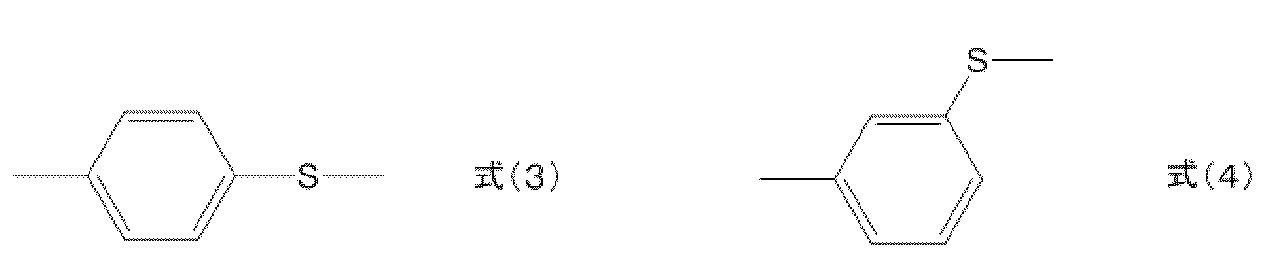
- R 1 and R 2 in the formula include those bonded at the para position represented by the following formula (3) and those bonded at the meta position represented by the following formula (4).
- the bond of the sulfur atom to the aromatic ring in the repeating unit has a structure in which the sulfur atom is bonded at the para position represented by the general formula (3) in terms of heat resistance and crystallinity of the PAS resin. preferable.
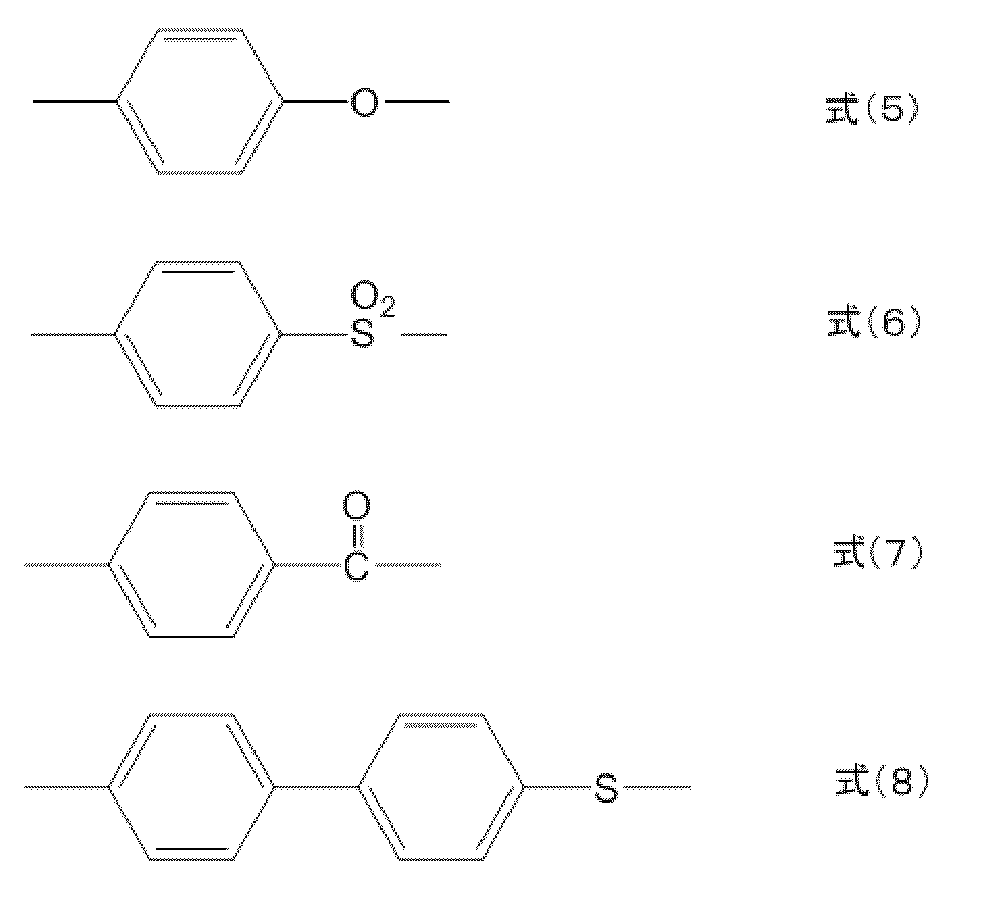
- PAS resin (A) has not only the structural parts represented by the general formulas (1) and (2) but also the following structural formulas (5) to (8).
- the structural portion represented by the above may be contained in an amount of 30 mol% or less of the total of the structural portions represented by the general formula (1) and the general formula (2).
- the structural portion represented by the general formulas (5) to (8) is preferably 10 mol% or less from the viewpoint of heat resistance and mechanical strength of the PAS resin (A).
- the bonding mode thereof is either a random copolymer or a block copolymer. May be good.
- the PAS resin (A) may have a naphthyl sulfide bond or the like in its molecular structure, but is preferably 3 mol% or less, particularly preferably 3 mol% or less, based on the total number of moles with other structural sites. It is preferably 1 mol% or less.
- the physical characteristics of the PAS resin (A) are not particularly limited as long as the effects of the present invention are not impaired, but are as follows.
- the melt viscosity of the PAS resin (A) used in the present invention is not particularly limited, but the melt viscosity (V6) measured at 300 ° C. is preferably 2 Pa ⁇ s because the balance between fluidity and mechanical strength is good. It is the above range, and is preferably a range of 1000 Pa ⁇ s or less, more preferably a range of 500 Pa ⁇ s or less, and further preferably a range of 200 Pa ⁇ s or less.
- the non-Newtonian index of the PAS resin (A) used in the present invention is not particularly limited, but is preferably in the range of 0.90 or more and 2.00 or less.
- the non-Newtonian index is preferably in the range of 0.90 or more, more preferably in the range of 0.95 or more, preferably in the range of 1.50 or less, more preferably 1.20.
- the range is as follows.
- Such PAS resin (A) is excellent in mechanical properties, fluidity, and abrasion resistance.
- SR shear rate
- L orifice length
- D orifice diameter
- SS shear stress
- SR indicates the shear rate (sec -1 )
- SS indicates the shear stress (dyne / cm 2 )
- K indicates a constant.
- the method for producing the PAS resin (A) is not particularly limited, but for example, (Production Method 1) a dihalogeno aromatic compound in the presence of sulfur and sodium carbonate, and if necessary, a polyhalogeno aromatic compound or other copolymerization component.
- a method of polymerizing (Production Method 2) a method of adding a dihalogeno aromatic compound in the presence of a sulfide agent or the like in a polar solvent, and if necessary, a polyhalogeno aromatic compound or other copolymerization component to polymerize.
- (Production method 3) A method of self-condensing p-chlorthiophenol by adding other copolymerization components if necessary, (Production method 4) Diiodo aromatic compound and simple sulfur, carboxy group, amino group, etc. Examples thereof include a method of melt-polymerizing while reducing the pressure in the presence of a polymerization inhibitor which may have the functional group of. Among these methods, the method (manufacturing method 2) is general-purpose and preferable. At the time of the reaction, an alkali metal salt of a carboxylic acid or a sulfonic acid or an alkali hydroxide may be added to adjust the degree of polymerization.
- a hydrous sulfide agent is introduced into a mixture containing a heated organic polar solvent and a dihalogeno aromatic compound at a rate at which water can be removed from the reaction mixture, and the dihalogeno is introduced in the organic polar solvent.
- the aromatic compound and the sulfidizing agent are added to the polyhalogeno aromatic compound as needed and reacted, and the amount of water in the reaction system is 0.02 to 0.5 mol with respect to 1 mol of the organic polar solvent.
- a method for producing PAS resin (A) by controlling the above range see JP-A-07-228699, and dihalogeno aromatic compounds in the presence of solid alkali metal sulfides and aprotonic polar organic solvents. If necessary, add a polyhalogeno aromatic compound or other copolymerization component, and add an alkali metal hydrosulfide and an organic acid alkali metal salt to an organic acid in the range of 0.01 to 0.9 mol with respect to 1 mol of the sulfur source.
- dihalogeno aromatic compound examples include p-dihalobenzene, m-dihalobenzene, o-dihalobenzene, 2,5-dihalotoluene, 1,4-dihalonaphthalene, 1-methoxy-2,5-dihalobenzene, 4, 4'-dihalobiphenyl, 3,5-dihalobenzoic acid, 2,4-dihalobenzoic acid, 2,5-dihalonitrobenzene, 2,4-dihalonitrobenzene, 2,4-dihaloanisole, p, p '-Dihalodiphenyl ether, 4,4'-dihalobenzophenone, 4,4'-dihalodiphenyl sulfone, 4,4'-dihalodiphenyl sulfoxide, 4,4'-dihalodiphenyl sulfide, and each of the above compounds.
- Examples of the aromatic ring of the above include compounds having an alkyl group having an alkyl group in the range of 1 to 18 carbon atoms
- examples of the polyhalogeno aromatic compound include 1,2,3-trihalobenzene, 1,2,4-trihalobenzene, 1,3. Examples thereof include 5-trihalobenzene, 1,2,3,5-tetrahalobenzene, 1,2,4,5-tetrahalobenzene and 1,4,6-trihalonaphthalene.
- the halogen atom contained in each of the above compounds is a chlorine atom or a bromine atom.
- the method for post-treating the reaction mixture containing the PAS resin (A) obtained in the polymerization step is not particularly limited, but for example, after the completion of (post-treatment 1) polymerization reaction, the reaction mixture is first used as it is or After adding the acid or base, the solvent is distilled off under reduced pressure or normal pressure, and then the solid substance after the solvent is distilled off is water, a reaction solvent (or an organic solvent having equivalent solubility to a low molecular weight polymer), A method of washing once or twice or more with a solvent such as acetone, methyl ethyl ketone, alcohols, and further neutralizing, washing with water, filtering and drying, or (post-treatment 2) after completion of the polymerization reaction, water, acetone, etc.
- a solvent such as acetone, methyl ethyl ketone, alcohols
- Solvents such as methyl ethyl ketone, alcohols, ethers, halogenated hydrocarbons, aromatic hydrocarbons, aliphatic hydrocarbons (solvents that are soluble in the polymerization solvent used and at least poor for PAS)
- a method of precipitating solid products such as PAS and inorganic salts by adding them as a precipitating agent and filtering, washing and drying them, or (post-treatment 3) after completion of the polymerization reaction, a reaction solvent (reaction solvent) in the reaction mixture.
- reaction solvent an organic solvent having the same solubility as that of the low molecular weight polymer is added and stirred, and then filtered to remove the low molecular weight polymer.
- a method of washing more than once and then neutralizing, washing with water, filtering and drying After completion of the polymerization reaction, add water to the reaction mixture and wash with water, filter, and if necessary, add acid during washing with water.
- a method of acid treatment and drying (5) a method of filtering the reaction mixture after completion of the polymerization reaction, washing with a reaction solvent once or twice or more as necessary, and further washing with water, filtering and drying. , Etc. can be mentioned.
- the PAS resin (A) may be dried in a vacuum, or inactive in the air or as nitrogen. It may be performed in a gas atmosphere.
- the PAS resin composition of the present invention contains glass fiber (B) as an essential component, and the glass fiber (B) has a ZrO 2 content of 16% by mass or more and a TiO 2 content of 5 to 5 or more in the glass fiber. It is a glass fiber containing 10% by mass or less and a CaO content of 0.1 to 5% by mass.
- the ZrO 2 content in the glass fiber is 16% by mass or more, more preferably 18% by mass or more, and the upper limit is not specified, but preferably 25% by mass or less, still more preferably 24% by mass or less. Is.
- the TiO 2 content in the glass fiber may be more than 0% by mass, but is preferably 0.1% by mass or more, more preferably 5% by mass or more, and 10% by mass or less. , Preferably in the range of 9% by mass or less.
- the CaO content in the glass fiber is 0.1% by mass or more, preferably 1% by mass or more, and 5% by mass or less, preferably 4% by mass or less.
- the glass fiber may optionally contain R 2 O (where R 2 O is a general term for LiO 2 , Na 2 O and K 2 O), and the content of R 2 O in the glass fiber. (However, it represents the total content of LiO 2 , Na 2 O and K 2 O) is not particularly limited because it is arbitrary, but it may be preferably 10% by mass or more, and preferably 30% by mass or less. May be. Acid resistance is further improved by setting it within this range.
- alumina (Al 2 O 3 ) may be arbitrarily contained in the glass fiber, and the alumina content in the glass fiber is not particularly limited because it is arbitrary, but is preferably 5% by mass or less, more preferably 2% by mass. It may be less than or equal to, and the lower limit value is not limited and may be absent, preferably 0% by mass or more, and more preferably more than 0% by mass.
- the balance contains silicon oxide (SiO 2 ).
- the silicon oxide (SiO 2 ) content is not particularly limited as long as it is the balance of the above components, but is preferably 70% by mass or less, more preferably 65% by mass or less, and preferably 50 in the glass fiber. It is in the range of mass% or more, more preferably 54% by mass or more.
- the blending amount of the glass fiber (B) is preferably in the range of 10 parts by mass or more, more preferably 15 parts by mass or more, and further preferably 30 parts by mass or more with respect to 100 parts by mass of the PAS resin (A).
- the range is preferably 100 parts by mass or less, more preferably 80 parts by mass or less, and further preferably 60 parts by mass or less.
- the PAS resin composition of the present invention contains a silane coupling agent (C) as an essential ingredient.
- the silane coupling agent (C) used in the present invention is not particularly limited as long as it does not impair the effects of the present invention, but is a silane having a functional group that reacts with a carboxy group, for example, an epoxy group, an isocyanato group, an amino group or a hydroxyl group. Coupling agents are preferred.
- silane coupling agent examples include epoxy groups such as ⁇ -glycidoxypropyltrimethoxysilane, ⁇ -glycidoxypropyltriethoxysilane, and ⁇ - (3,4-epoxycyclohexyl) ethyltrimethoxysilane.
- alkoxysilane compound Containing alkoxysilane compound, ⁇ -isocyanatopropyltrimethoxysilane, ⁇ -isocyanatopropyltriethoxysilane, ⁇ -isocyanatopropylmethyldimethoxysilane, ⁇ -isocyanatopropylmethyldiethoxysilane, ⁇ -isocyanatopropylethyldimethoxysilane , ⁇ -Isocyanatopropylethyldiethoxysilane, ⁇ -isocyanatopropyltrichlorosilane and other isocyanato group-containing alkoxysilane compounds, ⁇ - (2-aminoethyl) aminopropylmethyldimethoxysilane, ⁇ - (2-aminoethyl) amino Examples thereof include amino group-containing alkoxysilane compounds such as propyltrimethoxysilane and ⁇ -aminopropyltri
- the silane coupling agent (C) is not an essential component, but when it is blended, the blending amount thereof is not particularly limited as long as the effect of the present invention is not impaired, but the addition amount thereof is not particularly limited, but the PAS resin (A) is 100% by mass. It is preferably in the range of 0.01 parts by mass or more, more preferably 0.1 parts by mass or more, preferably 10 parts by mass or less, and more preferably 5 parts by mass or less. In such a range, a molded product having excellent moisture and heat resistance, acid resistance, alkali resistance and mechanical strength can be obtained.
- the PAS resin composition of the present invention can contain the thermoplastic elastomer (D) as an optional component.
- the thermoplastic elastomer include polyolefin-based elastomers, fluoroelastomers, and silicone-based elastomers, and among them, polyolefin-based elastomers are preferable.
- the blending amount of these thermoplastic elastomers (D) is preferably 1 part by mass or more, more preferably 2 parts by mass or more, and preferably 20 parts by mass or less, more preferably, with respect to 100 parts by mass of the PAS resin (A). Is in the range of 15 parts by mass or less. In such a range, a molded product having excellent moisture and heat resistance, acid resistance, alkali resistance and mechanical strength, particularly impact resistance, can be obtained.
- the polyolefin-based elastomer is a homopolymer of an ⁇ -olefin or a copolymer of two or more ⁇ -olefins, or a common weight of one or two or more ⁇ -olefins and a vinyl polymerizable compound having a functional group. Coalescence is mentioned.
- examples of the ⁇ -olefin include ⁇ -olefins having a carbon atom number of 2 or more and 8 or less, such as ethylene, propylene, and 1-butene.
- Examples of the vinyl polymerizable compound having the functional group include vinyl acetate; ⁇ , ⁇ -unsaturated carboxylic acid such as (meth) acrylic acid; ⁇ , ⁇ - such as methyl acrylate, ethyl acrylate and butyl acrylate.
- Alkyl ester of unsaturated carboxylic acid ⁇ , ⁇ -unsaturated carboxylic acid metal salt such as ionomer (alkali metal such as sodium as metal, alkaline earth metal such as calcium, zinc etc.); ⁇ such as glycidyl methacrylate Glycidyl esters of ⁇ -unsaturated carboxylic acids, etc .; ⁇ , ⁇ -unsaturated dicarboxylic acids such as maleic acid, fumaric acid, and itaconic acid; derivatives of the ⁇ , ⁇ -unsaturated dicarboxylic acids (monoesters, diesters, acid anhydrides). ), Etc., or two or more.
- the above-mentioned thermoplastic elastomer may be used alone or in combination of two or more.
- a fibrous filler other than the glass fiber (B) which is the above-mentioned essential component can be blended as an optional component.
- other fiber fillers include glass fibers other than the above glass fiber (B), carbon fibers, silane glass fibers, ceramic fibers, aramid fibers, metal fibers, and the like, and one or more of them. Can be blended.
- the blending amount of the fibrous filler is an arbitrary component, but when blended, it is preferably 1 part by mass or more, more preferably 5 parts by mass or more, still more preferably 5 parts by mass, based on 100 parts by mass of the PAS resin (A). Is in the range of 15 parts by mass or more, preferably 300 parts by mass or less, more preferably 200 parts by mass or less, still more preferably 150 parts by mass or less. When the blending amount of the fibrous filler is in these ranges, a better effect can be obtained in terms of maintaining the mechanical strength of the molded product.
- the fibrous filler one processed with a surface treatment agent or a sizing agent can also be used. This is preferable because the adhesive force with the PAS resin (A) can be improved.
- the surface treatment agent or sizing agent is selected from the group consisting of, for example, a silane compound having a functional group such as an amino group, an epoxy group, an isocyanate group, and a vinyl group, a titanate compound, an acrylic resin, a urethane resin, and an epoxy resin. At least one polymer and the like can be mentioned.
- the PAS resin composition of the present invention is, if necessary, a filler other than the above-mentioned glass fiber (B) which is an essential component and other fibrous fillers which are optional components (hereinafter, “other fillers”). ”) Can be further added as an optional ingredient.
- other fillers known and commonly used materials can be used as long as they do not impair the effects of the present invention, and examples thereof include fillers having various shapes such as granular and plate-like fillers.
- non-glass beads glass flakes, barium sulfate, clay, pyrophyllite, bentonite, sericite, mica, mica, talc, attapulsite, ferrite, calcium silicate, calcium carbonate, glass beads, zeolite, milled fiber, calcium sulfate, etc.
- Fibrous fillers can also be used.
- the blending amount of the other filler is, for example, preferably 1 part by mass or more, more preferably 10 parts by mass or more, preferably 600 parts by mass or less, and more preferably more preferably 1 part by mass or more with respect to 100 parts by mass of the PAS resin (A).
- the range is 200 parts by mass or less. In such a range, the resin composition is preferable because it exhibits good mechanical strength and moldability.
- the PAS resin composition of the present invention further comprises a polyester resin, a polyamide resin, a polyimide resin, a polyetherimide resin, a polycarbonate resin, a polyphenylene ether resin, and a polysulphon resin, as appropriate, depending on the intended use.
- a synthetic resin such as a resin or a liquid crystal polymer (hereinafter, simply referred to as a synthetic resin) can be blended as an optional component.
- the synthetic resin is not an essential component in the present invention, when it is blended, the blending ratio is not particularly limited as long as the effect of the present invention is not impaired, and it varies depending on the respective purposes and is unconditionally.
- the ratio of the synthetic resin to be blended in the resin composition according to the present invention is, for example, in the range of 5 parts by mass or more and 15 parts by mass or less with respect to 100 parts by mass of PAS resin (A).
- the degree of In other words, the ratio of the PAS resin (A) to the total of the PAS resin (A) and the synthetic resin is based on the mass, preferably in the range of (100/115) or more, and more preferably (100/105). ) The above range.
- the PAS resin composition of the present invention also contains a colorant, an antistatic agent, an antioxidant, a heat-resistant stabilizer, an ultraviolet stabilizer, an ultraviolet absorber, a foaming agent, a flame retardant, a flame retardant aid, and a rust preventive agent.
- a colorant an antistatic agent, an antioxidant, a heat-resistant stabilizer, an ultraviolet stabilizer, an ultraviolet absorber, a foaming agent, a flame retardant, a flame retardant aid, and a rust preventive agent.
- known and commonly used additives such as mold release agents (metal salts of fatty acids having 18 to 30 carbon atoms including stearic acid and montanic acid, esters, polyolefin waxes such as polyethylene), etc. are blended as optional components as necessary. You may.
- additives are not essential components and are, for example, preferably in the range of 0.01 parts by mass or more, preferably 1000 parts by mass or less, and more preferably 100 parts by mass with respect to 100 parts by mass of the PAS resin (A). It may be appropriately adjusted and used in the range of 10 parts by mass or less, more preferably 10 parts by mass or less, according to the purpose and application so as not to impair the effect of the present invention.
- a polyarylene sulfide resin (A), a glass fiber (B) and a silane coupling agent (C) are blended as essential components to prepare a polyarylene sulfide resin (A).
- a method for producing a polyarylene sulfide resin composition which comprises a step of melt-kneading in a temperature range above the melting point.
- the glass fiber (B) is a glass fiber containing 16% by mass or more of ZrO 2 content, 5 to 10% by mass or less of TiO 2 content, and 0.1 to 5% by mass of CaO content in the glass fiber.
- the glass fiber (B) is in the range of 10 to 100 parts by mass and the silane coupling agent (C) is in the range of 0.01 to 10 parts by mass with respect to 100 parts by mass of the polyarylene sulfide resin (A). It is characterized by that. The details will be described below.
- the method for producing a PAS resin composition of the present invention includes a step of blending the above essential components and melt-kneading in a temperature range equal to or higher than the melting point of the PAS resin (A). More specifically, the PAS resin composition of the present invention comprises each essential component and, if necessary, other optional components.
- the method for producing the resin composition used in the present invention is not particularly limited, but is a method in which essential components and optional components are blended and melt-kneaded, and more specifically, a tumbler or Henschel as necessary. Examples thereof include a method of uniformly drying and kneading with a mixer or the like, and then charging the mixture into a twin-screw extruder to melt and knead.
- a twin-screw kneading extruder is preferable from the viewpoint of dispersibility and productivity.
- a resin component discharge amount in the range of 5 to 500 (kg / hr) and a screw rotation speed of 50 to 500 (rpm) are preferable. It is preferable to melt-knead while appropriately adjusting the range of, and melt-knead under the condition that the ratio (discharge amount / screw rotation speed) is in the range of 0.02 to 5 (kg / hr / rpm). Is even more preferable. Further, each component may be added to and mixed with the melt kneader at the same time, or may be divided.
- glass fiber (B) which is an essential component of the above components, or another fibrous filler is added as needed, it may be charged into the extruder from the side feeder of the twin-screw kneading extruder. It is preferable from the viewpoint of dispersibility.
- the position of the side feeder is preferably such that the ratio of the distance from the extruder resin input portion (top feeder) to the side feeder to the total screw length of the twin-screw kneading extruder is 0.1 or more, and is 0. It is more preferable that the value is 3 or more. Further, such a ratio is preferably 0.9 or less, and more preferably 0.7 or less.
- the PAS resin composition according to the present invention obtained by melt-kneading in this way is a melt mixture containing the above-mentioned essential components, optional components added as necessary, and components derived from them. Therefore, the PAS resin composition of the present invention has a morphology in which the PAS resin (A) forms a continuous phase and other essential components and arbitrary components are dispersed.
- the PAS resin composition according to the present invention is subjected to a known method, for example, a melted resin composition is extruded into a strand shape after melt-kneading, and then processed into pellets, chips, granules, powders and the like. Therefore, it is preferable to perform pre-drying in a temperature range of 100 to 150 ° C., if necessary.
- the molded product of the present invention is made by melt molding a PAS resin composition. Further, the method for producing a molded product of the present invention includes a step of melt molding the PAS resin composition. Therefore, the molded product of the present invention has a morphology in which the PAS resin (A) forms a continuous phase and other essential components and arbitrary components other than the PAS resin (A) are dispersed. When the PAS resin composition has such morphology, a molded product having excellent moisture and heat resistance, acid resistance, alkali resistance and mechanical strength can be obtained.
- the PAS resin composition of the present invention can be used for various moldings such as injection molding, compression molding, extrusion molding of composites, sheets, pipes, drawing molding, blow molding, transfer molding, etc. It is also excellent and suitable for injection molding applications.
- various molding conditions are not particularly limited, and molding can usually be performed by a general method.
- the resin temperature is in a temperature range equal to or higher than the melting point of the PAS resin (A), preferably in a temperature range of the melting point + 10 ° C. or higher, more preferably in a temperature range of + 10 ° C. to + 100 ° C., more preferably.
- the PAS resin composition After undergoing the step of melting the PAS resin composition in a temperature range of melting point + 20 ° C.
- the PAS resin composition may be injected into a mold from a resin discharge port for molding.
- the mold temperature may be set to a known temperature range, for example, room temperature (23 ° C.) to 300 ° C., preferably 120 to 180 ° C.
- Products of molded products of the PAS resin composition of the present invention include, for example, pipes, lining pipes, cap nuts, pipe joints, (elbows, headers, cheeses, reducers, joints, couplers, etc.), various valves, and flow meters.
- Gaskets (seals, packings) and other pipes for transporting fluids and various parts attached to the pipes can be mentioned.
- parts such as fuel-related / exhaust system / intake system pipes, air intake nozzle snorkel, intake manifold, fuel pump, engine cooling water joint, and water outlet attached to an internal combustion engine such as an automobile part can be mentioned.
- parts such as fuel-related / exhaust system / intake system pipes, air intake nozzle snorkel, intake manifold, fuel pump, engine cooling water joint, and water outlet attached to an internal combustion engine such as an automobile part can be mentioned.
- other various uses are possible to be mentioned.
- a heat dissipation member for an automobile engine control unit or a motor a heat dissipation member for an LED substrate, a heat sink for various electric / electronic device substrates, and the like are exemplified.
- the molded product of the present invention can be not only a heat radiating member but also a normal resin molded product as described below.
- Oscillators various terminal boards, transformers, plugs, printed boards, tuners, speakers, microphones, headphones, small motors, magnetic head bases, power modules, terminal blocks, semiconductors, liquid crystal, FDD carriages, FDD chassis, motor brush holders, Electrical and electronic parts such as parabolic antennas and computer-related parts; VTR parts, TV parts, irons, hair dryers, rice cooker parts, microwave parts, acoustic parts, audio / laser discs / compact discs / DVD discs / Blu-ray Home and office electricity represented by audio / video equipment parts such as disks, lighting parts, refrigerator parts, air conditioner parts, typewriter parts, word processor parts, or water supply equipment parts such as water heaters, bath water volume, and temperature sensors.
- audio / video equipment parts such as disks, lighting parts, refrigerator parts, air conditioner parts, typewriter parts, word processor parts, or water supply equipment parts such as water heaters, bath water volume, and temperature sensors.
- Examples 1 to 5 and Comparative Examples 1 to 3 According to the composition components and blending amounts shown in Table 1, each material was blended with 0.8 parts by mass of a polyolefin wax (high-density polyethylene wax "Luwax AH-6" manufactured by BASF). After that, these compounding materials were put into a twin-screw extruder "TEX-30 ⁇ (product name)" with a vent manufactured by Japan Steel Works, Ltd., and the resin component discharge amount was 30 kg / hr and the screw rotation speed was 200 rpm. Pellets of the resin composition were obtained by melt-kneading at a set resin temperature of 320 ° C.
- TEX-30 ⁇ product name
- the glass fiber was charged from the side feeder, and the other materials were uniformly mixed in advance with a tumbler and charged from the top feeder.
- the pellets of the obtained resin composition were dried in a 140 ° C. gear oven for 2 hours, and then injection molded to prepare various test pieces, and the following tests were performed.
- the obtained pellets were supplied to an injection molding machine (SE-75D-HP) manufactured by Sumitomo Heavy Industries, which was set to a cylinder temperature of 310 ° C., and an ISO Type-A dumbbell piece molding die whose temperature was adjusted to a mold temperature of 140 ° C. was used. And injection molding was performed to obtain an ISO Type-A dumbbell piece. It should be noted that the test piece was manufactured by injecting resin from the one-point gate of the ISO D2 sheet so that the test piece did not include the weld portion. The tensile strength of the obtained dumbbell piece was measured by a measuring method according to ISO 527-1 and 2.
- the central part of the dumbbell shape test piece for tensile test is cut out into a rod shape with a length of 80 mm, a width of 10 mm, and a thickness of 4 mm, and the notched piece is used as an impact resistance test piece. An impact test was performed and the impact strength (kJ / mm 2 ) was measured.
- the central part of the dumbbell shape test piece for tensile test is cut into a rectangular parallelepiped with a length of 10 mm, a width of 10 mm, and a thickness of 4 mm, and used as a linear thermal expansion coefficient test piece.
- the coefficient of linear thermal expansion parallel to the flow direction between 50 and 50 ° C. was measured.
- Method B The tensile strength was measured after being immersed in the undiluted solution of Saint Paul (manufactured by Dainihon Jochugiku Co., Ltd., 9.5% hydrochloric acid, containing a surfactant (alkyltrimethylammonium)) at room temperature for 500 hours. Further, the retention rate was calculated by dividing by the tensile strength with respect to the one before immersion. The results are shown in Tables 1 and 2.
- ⁇ Moisture resistance test> The pressure cooker test was carried out for 100 hours under the conditions of Method D 95 ° C., humidity 95% and 2 atm, and the tensile strength was measured. Furthermore, the retention rate (%) was calculated by dividing by the tensile strength with respect to the one before the test. The results are shown in Tables 1 and 2.
- the compounding ratios of the compounding components in Tables 1 and 2 represent parts by mass, and the following are used.
- Polyphenylene sulfide resin A1 Melt viscosity 56 Pa ⁇ s, non-Newtonian index 1.07
- A2 Melt viscosity 180 Pa ⁇ s, non-Newtonian index 1.07
- A3 Melt viscosity 7 Pa ⁇ s, non-Newtonian index 1.07
- A4 Melt viscosity 700 Pa ⁇ s, non-Newtonian index 1.60
- SMAB sodium salt of (methylamino) butyric acid
- the amount of SMAB in the autoclave was 0.147 mol parts per mol of sulfur atoms present in the autoclave. Since the theoretical dehydration amount when the total amount of charged NaSH and NaOH is changed to anhydrous Na 2S is 27.921 parts by mass, the residual water amount in the autoclave is 0.878 parts by mass (48.8 mol parts).
- Step 2 After the completion of the dehydration step, the internal temperature was cooled to 160 ° C., NMP 46.343 parts by mass (467.5 mol parts) was charged, and the temperature was raised to 185 ° C. The amount of water in the autoclave was 0.025 mol per 1 mol of NMP charged in step 2. When the gauge pressure reached 0.00 MPa, the valve connected to the rectification column was opened, and the temperature was raised to an internal temperature of 200 ° C. over 1 hour. At this time, cooling and valve opening were controlled so that the rectification tower outlet temperature was 110 ° C. or lower.
- the distilled p-DCB and the mixed steam of water were condensed by a condenser, separated by a decanter, and the p-DCB was returned to the autoclave.
- the amount of distillate was 0.228 parts by mass (12.7 mol parts).
- Step 3 The water content in the autoclave at the start of step 3 was 0.041 parts by mass (2.3 mol parts), 0.005 mol per 1 mol of NMP charged in step 2, and 0. It was 010 mol.
- the amount of SMAB in the autoclave was 0.147 mol per mol of sulfur atoms present in the autoclave, as in step 1.
- the temperature was raised from 200 ° C. to 230 ° C. over 3 hours, and the mixture was stirred at 230 ° C. for 1 hour, then raised to 250 ° C. and stirred for 1 hour.
- the gauge pressure at an internal temperature of 200 ° C. was 0.03 MPa, and the final gauge pressure was 0.40 MPa.
- the p-DCB distilled by azeotrope during dehydration was separated by a decanter and returned to the autoclave at any time.
- the anhydrous sodium sulfide composition in the form of fine particles was dispersed in p-DCB. Since the NMP content in this composition was 0.079 parts by mass (0.8 mol parts), 98 mol% (33.7 mol parts) of the charged NMP was added to the ring-opened SMAB of NMP. It was shown to be disassembled.
- the amount of SMAB in the autoclave was 0.147 mol parts per mol of sulfur atoms present in the autoclave.
- the residual water amount in the autoclave is 0.878 parts by mass (48.8 mol parts). 0.609 parts by mass (33.8 parts by mass) was consumed in the hydrolysis reaction between NMP and NaOH and did not exist as water in the autoclave, and the remaining 0.269 parts by mass (14.9 parts by mass) was It was shown to remain in the autoclave in the form of water or water of crystallization. The amount of water in the autoclave was 0.065 mol per mol of sulfur atoms present in the autoclave.
- Step 2 After the completion of the dehydration step, the internal temperature was cooled to 160 ° C., NMP 46.343 parts by mass (467.5 mol parts) was charged, and the temperature was raised to 185 ° C. The amount of water in the autoclave was 0.025 mol per 1 mol of NMP charged in step 2. When the gauge pressure reached 0.00 MPa, the valve connected to the rectification column was opened, and the temperature was raised to an internal temperature of 200 ° C. over 1 hour. At this time, cooling and valve opening were controlled so that the rectification tower outlet temperature was 110 ° C. or lower.
- the distilled p-DCB and the mixed steam of water were condensed by a condenser, separated by a decanter, and the p-DCB was returned to the autoclave.
- the amount of distillate was 0.228 parts by mass (12.7 mol parts).
- Step 3 The water content in the autoclave at the start of step 3 was 0.041 parts by mass (2.3 mol parts), 0.005 mol per 1 mol of NMP charged in step 2, and 0. It was 010 mol.
- the amount of SMAB in the autoclave was 0.147 mol per mol of sulfur atoms present in the autoclave, as in step 1.
- the temperature was raised from 200 ° C. to 230 ° C. over 3 hours, and the mixture was stirred at 230 ° C. for 3 hours, then raised to 250 ° C. and stirred for 1 hour.
- the gauge pressure at an internal temperature of 200 ° C. was 0.03 MPa, and the final gauge pressure was 0.40 MPa.
- the p-DCB distilled by azeotrope during dehydration was separated by a decanter and returned to the autoclave at any time.
- the anhydrous sodium sulfide composition in the form of fine particles was dispersed in p-DCB. Since the NMP content in this composition was 0.079 parts by mass (0.8 mol parts), 98 mol% (33.7 mol parts) of the charged NMP was added to the ring-opened SMAB of NMP. It was shown to be disassembled.
- the amount of SMAB in the autoclave was 0.147 mol parts per mol of sulfur atoms present in the autoclave.
- the residual water amount in the autoclave is 0.878 parts by mass (48.8 mol parts). 0.609 parts by mass (33.8 parts by mass) was consumed in the hydrolysis reaction between NMP and NaOH and did not exist as water in the autoclave, and the remaining 0.269 parts by mass (14.9 parts by mass) was It was shown to remain in the autoclave in the form of water or water of crystallization. The amount of water in the autoclave was 0.065 mol per mol of sulfur atoms present in the autoclave.
- Step 2 After the completion of the dehydration step, the internal temperature was cooled to 160 ° C., NMP 46.343 parts by mass (467.5 mol parts) was charged, and the temperature was raised to 185 ° C. The amount of water in the autoclave was 0.025 mol per 1 mol of NMP charged in step 2. When the gauge pressure reached 0.00 MPa, the valve connected to the rectification column was opened, and the temperature was raised to an internal temperature of 200 ° C. over 1 hour. At this time, cooling and valve opening were controlled so that the rectification tower outlet temperature was 110 ° C. or lower.
- the distilled p-DCB and the mixed steam of water were condensed by a condenser, separated by a decanter, and the p-DCB was returned to the autoclave.
- the amount of distillate was 0.228 parts by mass (12.7 mol parts).
- Step 3 The water content in the autoclave at the start of step 3 was 0.041 parts by mass (2.3 mol parts), 0.005 mol per 1 mol of NMP charged in step 2, and 0. It was 010 mol.
- the amount of SMAB in the autoclave was 0.147 mol per mol of sulfur atoms present in the autoclave, as in step 1.
- the temperature was raised from 200 ° C. to 230 ° C. over 3 hours, and the mixture was stirred at 230 ° C. for 1 hour, then raised to 250 ° C. and stirred for 1 hour.
- the gauge pressure at an internal temperature of 200 ° C. was 0.03 MPa, and the final gauge pressure was 0.40 MPa.
- the reaction was carried out while stirring at a liquid temperature of 260 ° C. for 3 hours, and the upper part of the autoclave was cooled by sprinkling water. Next, the temperature was lowered and the cooling of the upper part of the autoclave was stopped. While cooling the upper part of the autoclave, the liquid temperature was kept constant so as not to drop. The maximum pressure during the reaction was 0.85 MPa.
- -Glass fiber B1 Glass fiber manufactured by Nippon Denki Glass Co., Ltd. (ZrO 2 content 17% by mass, TiO 2 content 10% by mass, CaO content 1% by mass, R2O content 17% by mass, SiO 2 balance ) , Average fiber length 3 mm, average fiber diameter 13 ⁇ m
- B2 E-glass "T-717H" manufactured by Nippon Electric Glass Co., Ltd. (MgO content 2.5 wt%, CaO content 20.5 wt%, R2 O content 1.5 wt% or less, Al 2 O 3 content 14 wt %, SiO 2 balance), average fiber length 3 mm, average fiber diameter 10 ⁇ m
- B3 Glass fiber manufactured by Nippon Denki Glass Co., Ltd. (ZrO 2 content 20% by mass, TiO 2 content 2 % by mass, CaO content 1% by mass, R2O content 17% by mass, SiO 2 balance), average fiber Length 3 mm, average fiber diameter 13 ⁇ m
- Silane coupling agent C1 "SH-6040" manufactured by Dow Corning Co., Ltd. 3-glycidoxypropyltrimethoxysilane
- Thermoplastic Elastomer D1 "Bond First 7M” manufactured by Sumitomo Chemical Co., Ltd., containing 67% by mass of ethylene, 6% by mass of methacrylic acid glycidyl ester, and 27% by mass of methyl acrylate as copolymerization components.
Landscapes
- Chemical & Material Sciences (AREA)
- Chemical Kinetics & Catalysis (AREA)
- Organic Chemistry (AREA)
- Health & Medical Sciences (AREA)
- Medicinal Chemistry (AREA)
- Polymers & Plastics (AREA)
- Engineering & Computer Science (AREA)
- Materials Engineering (AREA)
- Life Sciences & Earth Sciences (AREA)
- General Chemical & Material Sciences (AREA)
- Geochemistry & Mineralogy (AREA)
- Mechanical Engineering (AREA)
- Inorganic Chemistry (AREA)
- Manufacturing & Machinery (AREA)
- General Life Sciences & Earth Sciences (AREA)
- Thermal Sciences (AREA)
- Physics & Mathematics (AREA)
- Compositions Of Macromolecular Compounds (AREA)
- Glass Compositions (AREA)
Abstract
Description
ガラス繊維(B)が、ガラス繊維中にZrO2含有量16質量%以上、TiO2含有量5~10質量%以下、かつCaO含有率0.1~5質量%の割合で含むガラス繊維であり、
ポリアリーレンスルフィド樹脂(A)100質量部に対して、ガラス繊維(B)が10~100質量部の範囲であり、シランカップリング剤(C)が0.01~10質量部の範囲である、ことを特徴とするポリアリーレンスルフィド樹脂組成物に関する。
ガラス繊維(B)が、ガラス繊維中にZrO2含有量16質量%以上、TiO2含有量5~10質量%以下、かつCaO含有率0.1~5質量%の割合で含むガラス繊維であり、
ポリアリーレンスルフィド樹脂(A)100質量部に対して、ガラス繊維(B)が10~100質量部の範囲であり、シランカップリング剤(C)が0.01~10質量部の範囲である、ことを特徴とするポリアリーレンスルフィド樹脂組成物の製造方法に関する。
ガラス繊維(B)が、ガラス繊維中にZrO2含有量16質量%以上、TiO2含有量5~10質量%以下、かつCaO含有率0.1~5質量%の割合で含むガラス繊維であり、
ポリアリーレンスルフィド樹脂(A)100質量部に対して、ガラス繊維(B)が10~100質量部の範囲であり、シランカップリング剤(C)が0.01~10質量部の範囲である、ことを特徴とする。以下、説明する。


本発明に用いるPAS樹脂(A)の溶融粘度は特に限定されないが、流動性および機械的強度のバランスが良好となることから、300℃で測定した溶融粘度(V6)が、好ましくは2Pa・s以上の範囲であり、そして、好ましくは1000Pa・s以下の範囲、より好ましくは500Pa・s以下の範囲であり、さらに好ましくは200Pa・s以下の範囲である。ただし、溶融粘度(V6)の測定は、PAS樹脂(A)を島津製作所製フローテスター、CFT-500Dを用いて行い、300℃、荷重:1.96×10⁶Pa、L/D=10(mm)/1(mm)にて、6分間保持した後に測定した溶融粘度の測定値とする。
本発明に用いるPAS樹脂(A)の非ニュートン指数は特に限定されないが、0.90以上から、2.00以下の範囲であることが好ましい。リニア型PAS樹脂を用いる場合には、非ニュートン指数が、好ましくは0.90以上の範囲、より好ましくは0.95以上の範囲から、好ましくは1.50以下の範囲、より好ましくは1.20以下の範囲である。このようなPAS樹脂(A)は機械的物性、流動性、耐磨耗性に優れる。ただし、本発明において非ニュートン指数(N値)は、キャピログラフを用いて融点+20℃、オリフィス長(L)とオリフィス径(D)の比、L/D=40の条件下で、剪断速度(SR)及び剪断応力(SS)を測定し、下記式を用いて算出した値である。非ニュートン指数(N値)が1に近いほど線状に近い構造であり、非ニュートン指数(N値)が高いほど分岐が進んだ構造であることを示す。

前記PAS樹脂(A)の製造方法としては特に限定されないが、例えば(製造法1)硫黄と炭酸ソーダの存在下でジハロゲノ芳香族化合物を、必要ならばポリハロゲノ芳香族化合物ないしその他の共重合成分を加えて、重合させる方法、(製造法2)極性溶媒中でスルフィド化剤等の存在下にジハロゲノ芳香族化合物を、必要ならばポリハロゲノ芳香族化合物ないしその他の共重合成分を加えて、重合させる方法、(製造法3)p-クロルチオフェノールを、必要ならばその他の共重合成分を加えて、自己縮合させる方法、(製造法4)ジヨード芳香族化合物と単体硫黄を、カルボキシ基やアミノ基等の官能基を有していてもよい重合禁止剤の存在下、減圧させながら溶融重合させる方法、等が挙げられる。これらの方法のなかでも、(製造法2)の方法が汎用的であり好ましい。反応の際に、重合度を調節するためにカルボン酸やスルホン酸のアルカリ金属塩や、水酸化アルカリを添加しても良い。上記(製造法2)方法のなかでも、加熱した有機極性溶媒とジハロゲノ芳香族化合物とを含む混合物に含水スルフィド化剤を水が反応混合物から除去され得る速度で導入し、有機極性溶媒中でジハロゲノ芳香族化合物とスルフィド化剤とを、必要に応じてポリハロゲノ芳香族化合物と加え、反応させること、及び反応系内の水分量を該有機極性溶媒1モルに対して0.02~0.5モルの範囲にコントロールすることによりPAS樹脂(A)を製造する方法(特開平07-228699号公報参照。)や、固形のアルカリ金属硫化物及び非プロトン性極性有機溶媒の存在下でジハロゲノ芳香族化合物と必要ならばポリハロゲノ芳香族化合物ないしその他の共重合成分を加え、アルカリ金属水硫化物及び有機酸アルカリ金属塩を、硫黄源1モルに対して0.01~0.9モルの範囲の有機酸アルカリ金属塩および反応系内の水分量を非プロトン性極性有機溶媒1モルに対して0.02モル以下の範囲にコントロールしながら反応させる方法(WO2010/058713号パンフレット参照。)で得られるものが特に好ましい。ジハロゲノ芳香族化合物の具体的な例としては、p-ジハロベンゼン、m-ジハロベンゼン、o-ジハロベンゼン、2,5-ジハロトルエン、1,4-ジハロナフタレン、1-メトキシ-2,5-ジハロベンゼン、4,4’-ジハロビフェニル、3,5-ジハロ安息香酸、2,4-ジハロ安息香酸、2,5-ジハロニトロベンゼン、2,4-ジハロニトロベンゼン、2,4-ジハロアニソール、p,p’-ジハロジフェニルエーテル、4,4’-ジハロベンゾフェノン、4,4’-ジハロジフェニルスルホン、4,4’-ジハロジフェニルスルホキシド、4,4’-ジハロジフェニルスルフィド、及び、上記各化合物の芳香環に炭素原子数1~18の範囲のアルキル基を有する化合物が挙げられ、ポリハロゲノ芳香族化合物としては1,2,3-トリハロベンゼン、1,2,4-トリハロベンゼン、1,3,5-トリハロベンゼン、1,2,3,5-テトラハロベンゼン、1,2,4,5-テトラハロベンゼン、1,4,6-トリハロナフタレンなどが挙げられる。また、上記各化合物中に含まれるハロゲン原子は、塩素原子、臭素原子であることが望ましい。
ガラス繊維(B)が、ガラス繊維中にZrO2含有量16質量%以上、TiO2含有量5~10質量%以下、かつCaO含有率0.1~5質量%の割合で含むガラス繊維であり、
ポリアリーレンスルフィド樹脂(A)100質量部に対して、ガラス繊維(B)が10~100質量部の範囲であり、シランカップリング剤(C)が0.01~10質量部の範囲である、ことを特徴とする。以下、詳述する。
表1記載する組成成分および配合量にしたがい、各材料をポリオレフィン系ワックス(BASF社製 高密度ポリエチレンワックス「ルワックスAH-6」)0.8質量部と伴に配合した。その後、株式会社日本製鋼所製ベント付2軸押出機「TEX-30α(製品名)」にこれら配合材料を投入し、樹脂成分吐出量30kg/hr、スクリュー回転数200rpm。設定樹脂温度320℃で溶融混練して樹脂組成物のペレットを得た。ガラス繊維はサイドフィーダーから投入し、それ以外の材料はタンブラーで予め均一に混合しトップフィーダーから投入した。得られた樹脂組成物のペレットを140℃ギヤオーブンで2時間乾燥した後、射出成形することで各種試験片を作製し、下記の試験を行った。
得られたペレットをシリンダー温度310℃に設定した住友重機製射出成形機(SE-75D-HP)に供給し、金型温度140℃に温調したISO Type-Aダンベル片成形用金型を用いて射出成形を行い、ISO Type-Aダンベル片を得た。なお、ウェルド部を含まない試験片となるようISO D2シートの1点ゲートから樹脂を射出して作製したものとした。得られたダンベル片をISO 527-1および2に準拠した測定方法で引張強度を測定した。
上記ISO TYPE-Aダンベル片をISO 178に準拠した測定方法で曲げ強さ、曲げ弾性率を測定した。
引張試験用ダンベル形状試験片の中央部分を長さ80mm、幅10mm、厚さ4mmの棒状に切り出し、ノッチ加工したものを耐衝撃性試験片とし、ISO 179-1/1eAに準拠して、シャルピー衝撃試験を行い衝撃強度(kJ/mm2)の測定を行った。
引張試験用ダンベル形状試験片の中央部分を長さ10mm、幅10mm、厚さ4mmの直方体に切り出したものを線熱膨張係数試験片とし、ISO 11359-2に準拠して測定し測定温度範囲-50~50℃間での流動方向に平行の線熱膨張係数を測定した。
A法 46%フッ酸(富士フイルム和光純薬株式会社製試薬特級)に室温で100時間浸漬してから引張強度を測定した。さらに、浸漬前のものに対する引張強度で除して保持率を算出した。結果を表1、2に示した。
C法 ドメスト除菌クリーナー原液(ユニリーバ・ジャパン株式会社製、次亜塩素酸ナトリウム約3.8%、水酸化ナトリウム約1.4%及び界面活性剤(主成分アルキルアミンオキシド)を含有するアルカリ性洗剤)に室温で500時間浸漬してから引張強度を測定した。さらに、浸漬前のものに対する引張強度で除して保持率を算出した。結果を表1、2に示した。
D法 95℃、湿度95%、2気圧条件下でプレッシャークッカーテストを100時間行い、引張強度を測定した。さらにテスト前のものに対する引張強度で除して保持率(%)を算出した。結果を表1、2に示した。


ポリフェニレンスルフィド樹脂
A1: 溶融粘度 56Pa・s、非ニュートン指数1.07
A2: 溶融粘度180Pa・s、非ニュートン指数1.07
A3: 溶融粘度 7Pa・s、非ニュートン指数1.07
A4: 溶融粘度700Pa・s、非ニュートン指数1.60
[工程1]
圧力計、温度計、コンデンサ、デカンタ、精留塔を連結した撹拌翼付き150リットルオートクレーブにp-ジクロロベンゼン(以下、「p-DCB」と略記する。)33.075質量部(225モル部)、NMP3.420質量部(34.5モル部)、47.23質量%NaSH水溶液27.300質量部(NaSHとして230モル部)、及び49.21質量%NaOH水溶液18.533質量部(NaOHとして228モル部)を仕込み、撹拌しながら窒素雰囲気下で173℃まで5時間掛けて昇温して、水27.300質量部を留出させた後、オートクレーブを密閉した。脱水時に共沸により留出したp-DCBはデカンタで分離して、随時オートクレーブ内に戻した。脱水終了後のオートクレーブ内は微粒子状の無水硫化ナトリウム組成物がp-DCB中に分散した状態であった。この組成物中のNMP含有量は0.079質量部(0.8モル部)であったことから、仕込んだNMPの98モル%(33.7モル部)がNMPの開環体(4-(メチルアミノ)酪酸)のナトリウム塩(以下、「SMAB」と略記する。)に加水分解されていることが示された。オートクレーブ内のSMAB量は、オートクレーブ中に存在する硫黄原子1モル当たり0.147モル部であった。仕込んだNaSHとNaOHが全量、無水Na2Sに変わる場合の理論脱水量は27.921質量部であることから、オートクレーブ内の残水量0.878質量部(48.8モル部)の内、0.609質量部(33.8モル部)はNMPとNaOHとの加水分解反応に消費されて、水としてオートクレーブ内に存在せず、残りの0.269質量部(14.9モル部)は水、あるいは結晶水の形でオートクレーブ内に残留していることを示していた。オートクレーブ内の水分量はオートクレーブ中に存在する硫黄原子1モル当たり0.065モルであった。
上記脱水工程終了後に、内温を160℃に冷却し、NMP46.343質量部(467.5モル部)を仕込み、185℃まで昇温した。オートクレーブ内の水分量は、工程2で仕込んだNMP1モル当たり0.025モルであった。ゲージ圧が0.00MPaに到達した時点で、精留塔を連結したバルブを開放し、内温200℃まで1時間掛けて昇温した。この際、精留塔出口温度が110℃以下になる様に冷却とバルブ開度で制御した。留出したp-DCBと水の混合蒸気はコンデンサーで凝縮し、デカンタで分離して、p-DCBはオートクレーブへ戻した。留出水量は0.228質量部(12.7モル部)であった。
工程3開始時のオートクレーブ内水分量は0.041質量部(2.3モル部)で、工程2で仕込んだNMP1モル当たり0.005モルで、オートクレーブ中に存在する硫黄原子1モル当たり0.010モルであった。オートクレーブ内のSMAB量は工程1と同じく、オートクレーブ中に存在する硫黄原子1モル当たり0.147モルであった。次いで、内温200℃から230℃まで3時間掛けて昇温し、230℃で1時間撹拌した後、250℃まで昇温し、1時間撹拌した。内温200℃時点のゲージ圧は0.03MPaで、最終ゲージ圧は0.40MPaであった。冷却後、得られたスラリーの内、0.650質量部を3質量部(3リットル部)の水に注いで80℃で1時間撹拌した後、濾過した。このケーキを再び3質量部(3リットル部)の温水で1時間撹拌し、洗浄した後、濾過した。この操作を4回繰り返した。このケーキを再び3質量部(3リットル部)の温水と、酢酸を加え、pH4.0に調整した後、1時間撹拌し、洗浄した後、濾過した。このケーキを再び3質量部(3リットル部)の温水で1時間撹拌し、洗浄した後、濾過した。この操作を2回繰り返した。熱風乾燥機を用いて120℃で一晩乾燥して白色の粉末状のPPS樹脂(A1)を得た。このポリマーの300℃における溶融粘度は56Pa・sであった。非ニュートン指数は1.07であった。
[工程1]
圧力計、温度計、コンデンサ、デカンタ、精留塔を連結した撹拌翼付き150リットルオートクレーブにp-DCB33.222質量部(226モル部)、NMP3.420質量部(34.5モル部)、47.23質量%NaSH水溶液27.300質量部(NaSHとして230モル部)、及び49.21質量%NaOH水溶液18.533質量部(NaOHとして228モル部)を仕込み、撹拌しながら窒素雰囲気下で173℃まで5時間掛けて昇温して、水27.300質量部を留出させた後、オートクレーブを密閉した。脱水時に共沸により留出したp-DCBはデカンタで分離して、随時オートクレーブ内に戻した。脱水終了後のオートクレーブ内は微粒子状の無水硫化ナトリウム組成物がp-DCB中に分散した状態であった。この組成物中のNMP含有量は0.079質量部(0.8モル部)であったことから、仕込んだNMPの98モル%(33.7モル部)がNMPの開環体SMABに加水分解されていることが示された。オートクレーブ内のSMAB量は、オートクレーブ中に存在する硫黄原子1モル当たり0.147モル部であった。仕込んだNaSHとNaOHが全量、無水Na2Sに変わる場合の理論脱水量は27.921質量部であることから、オートクレーブ内の残水量0.878質量部(48.8モル部)の内、0.609質量部(33.8モル部)はNMPとNaOHとの加水分解反応に消費されて、水としてオートクレーブ内に存在せず、残りの0.269質量部(14.9モル部)は水、あるいは結晶水の形でオートクレーブ内に残留していることを示していた。オートクレーブ内の水分量はオートクレーブ中に存在する硫黄原子1モル当たり0.065モルであった。
上記脱水工程終了後に、内温を160℃に冷却し、NMP46.343質量部(467.5モル部)を仕込み、185℃まで昇温した。オートクレーブ内の水分量は、工程2で仕込んだNMP1モル当たり0.025モルであった。ゲージ圧が0.00MPaに到達した時点で、精留塔を連結したバルブを開放し、内温200℃まで1時間掛けて昇温した。この際、精留塔出口温度が110℃以下になる様に冷却とバルブ開度で制御した。留出したp-DCBと水の混合蒸気はコンデンサーで凝縮し、デカンタで分離して、p-DCBはオートクレーブへ戻した。留出水量は0.228質量部(12.7モル部)であった。
工程3開始時のオートクレーブ内水分量は0.041質量部(2.3モル部)で、工程2で仕込んだNMP1モル当たり0.005モルで、オートクレーブ中に存在する硫黄原子1モル当たり0.010モルであった。オートクレーブ内のSMAB量は工程1と同じく、オートクレーブ中に存在する硫黄原子1モル当たり0.147モルであった。次いで、内温200℃から230℃まで3時間掛けて昇温し、230℃で3時間撹拌した後、250℃まで昇温し、1時間撹拌した。内温200℃時点のゲージ圧は0.03MPaで、最終ゲージ圧は0.40MPaであった。冷却後、得られたスラリーの内、0.650質量部を3質量部(3リットル部)の水に注いで80℃で1時間撹拌した後、濾過した。このケーキを再び3質量部(3リットル部)の温水で1時間撹拌し、洗浄した後、濾過した。この操作を4回繰り返した。このケーキを再び3質量部(3リットル部)の温水と、酢酸を加え、pH4.0に調整した後、1時間撹拌し、洗浄した後、濾過した。このケーキを再び3質量部(3リットル部)の温水で1時間撹拌し、洗浄した後、濾過した。この操作を2回繰り返した。熱風乾燥機を用いて120℃で一晩乾燥して白色の粉末状のPPS樹脂(A2)を得た。このポリマーの300℃における溶融粘度は180Pa・sであった。非ニュートン指数は1.07であった。
[工程1]
圧力計、温度計、コンデンサ、デカンタ、精留塔を連結した撹拌翼付き150リットルオートクレーブにp-DCB35.868質量部(244モル部)、NMP3.420質量部(34.5モル部)、47.23質量%NaSH水溶液27.300質量部(NaSHとして230モル部)、及び49.21質量%NaOH水溶液18.533質量部(NaOHとして228モル部)を仕込み、撹拌しながら窒素雰囲気下で173℃まで5時間掛けて昇温して、水27.300質量部を留出させた後、オートクレーブを密閉した。脱水時に共沸により留出したp-DCBはデカンタで分離して、随時オートクレーブ内に戻した。脱水終了後のオートクレーブ内は微粒子状の無水硫化ナトリウム組成物がp-DCB中に分散した状態であった。この組成物中のNMP含有量は0.079質量部(0.8モル部)であったことから、仕込んだNMPの98モル%(33.7モル部)がNMPの開環体SMABに加水分解されていることが示された。オートクレーブ内のSMAB量は、オートクレーブ中に存在する硫黄原子1モル当たり0.147モル部であった。仕込んだNaSHとNaOHが全量、無水Na2Sに変わる場合の理論脱水量は27.921質量部であることから、オートクレーブ内の残水量0.878質量部(48.8モル部)の内、0.609質量部(33.8モル部)はNMPとNaOHとの加水分解反応に消費されて、水としてオートクレーブ内に存在せず、残りの0.269質量部(14.9モル部)は水、あるいは結晶水の形でオートクレーブ内に残留していることを示していた。オートクレーブ内の水分量はオートクレーブ中に存在する硫黄原子1モル当たり0.065モルであった。
上記脱水工程終了後に、内温を160℃に冷却し、NMP46.343質量部(467.5モル部)を仕込み、185℃まで昇温した。オートクレーブ内の水分量は、工程2で仕込んだNMP1モル当たり0.025モルであった。ゲージ圧が0.00MPaに到達した時点で、精留塔を連結したバルブを開放し、内温200℃まで1時間掛けて昇温した。この際、精留塔出口温度が110℃以下になる様に冷却とバルブ開度で制御した。留出したp-DCBと水の混合蒸気はコンデンサーで凝縮し、デカンタで分離して、p-DCBはオートクレーブへ戻した。留出水量は0.228質量部(12.7モル部)であった。
工程3開始時のオートクレーブ内水分量は0.041質量部(2.3モル部)で、工程2で仕込んだNMP1モル当たり0.005モルで、オートクレーブ中に存在する硫黄原子1モル当たり0.010モルであった。オートクレーブ内のSMAB量は工程1と同じく、オートクレーブ中に存在する硫黄原子1モル当たり0.147モルであった。次いで、内温200℃から230℃まで3時間掛けて昇温し、230℃で1時間撹拌した後、250℃まで昇温し、1時間撹拌した。内温200℃時点のゲージ圧は0.03MPaで、最終ゲージ圧は0.40MPaであった。冷却後、得られたスラリーの内、0.650質量部を3質量部(3リットル部)の水に注いで80℃で1時間撹拌した後、濾過した。このケーキを再び3質量部(3リットル部)の温水で1時間撹拌し、洗浄した後、濾過した。この操作を4回繰り返した。このケーキを再び3質量部(3リットル部)の温水と、酢酸を加え、pH4.0に調整した後、1時間撹拌し、洗浄した後、濾過した。このケーキを再び3質量部(3リットル部)の温水で1時間撹拌し、洗浄した後、濾過した。この操作を2回繰り返した。熱風乾燥機を用いて120℃で一晩乾燥して白色の粉末状のPPS樹脂(A3)を得た。このポリマーの300℃における溶融粘度は7Pa・sであった。非ニュートン指数は1.07であった。
圧力計、温度計、コンデンサを連結した撹拌翼および底弁付き150リットルオートクレーブに、フレーク状硫化ソーダ(60.3質量%Na2S)19.413質量部と、NMP45.000質量部を仕込んだ。窒素気流下攪拌しながら209℃まで昇温して、水4.644質量部を留出させた(残存する水分量は硫化ソーダ1モル当り1.13モル)。その後、オートクレーブを密閉して180℃まで冷却し、p-DCB22.05質量部及びNMP18.000質量部を仕込んだ。液温150℃で窒素ガスを用いてゲージ圧で0.1MPaに加圧して昇温を開始した。液温260℃で3時間攪拌しつつ反応を進め、オートクレーブ上部を散水することにより冷却した。次に降温させると共にオートクレーブ上部の冷却を止めた。オートクレーブ上部を冷却中、液温が下がらないように一定に保持した。反応中の最高圧力は、0.85MPaであった。
その後、熱風乾燥機で250℃、3時間熱処理し、PPS樹脂(A4)を得た。得られたポリマーの溶融粘度は700Pa・s、非ニュートン指数が1.60であった。
B1:日本電気硝子株式会社製 ガラス繊維(ZrO2含有量17質量%、TiO2含有量10質量%、CaO含有率1質量%、R2O含有率17質量%、SiO2残部)、平均繊維長3mm、平均繊維径13μm
B2:日本電気硝子株式会社製 Eガラス「T-717H」(MgO含有率2.5wt%、CaO含有率20.5wt%、R2O含有率1.5wt%以下、Al2O3含有率14wt%、SiO2残部)、平均繊維長3mm、平均繊維径10μm
B3:日本電気硝子株式会社製 ガラス繊維(ZrO2含有量20質量%、TiO2含有量2質量%、CaO含有率1質量%、R2O含有率17質量%、SiO2残部)、平均繊維長3mm、平均繊維径13μm
C1:ダウ・コーニング株式会社製 「SH-6040」3-グリシドキシプロピルトリメトキシシラン
D1:住友化学株式会社製「ボンドファースト7M」、共重合成分として、エチレンを67質量%、メタクリル酸グリシジルエステルを6質量%、及びアクリル酸メチルを27質量%含む。
Claims (7)
- ポリアリーレンスルフィド樹脂(A)、ガラス繊維(B)およびシランカップリング剤(C)を必須成分として配合してなるポリアリーレンスルフィド樹脂組成物であって、
ガラス繊維(B)が、ガラス繊維中にZrO2含有量16質量%以上、TiO2含有量5~10質量%以下、かつCaO含有率0.1~5質量%の割合で含むガラス繊維であり、
ポリアリーレンスルフィド樹脂(A)100質量部に対して、ガラス繊維(B)が10~100質量部の範囲であり、シランカップリング剤(C)が0.01~10質量部の範囲である、ことを特徴とするポリアリーレンスルフィド樹脂組成物。 - ポリアリーレンスルフィド樹脂(A)、ガラス繊維(B)及びシランカップリング剤(C)に、さらに熱可塑性エラストマー(D)を必須成分として配合してなり、ポリアリーレンスルフィド樹脂(A)100質量部に対して、熱可塑性エラストマー(D)が1~20質量部の範囲である、請求項1記載のポリアリーレンスルフィド樹脂組成物。
- 溶融混練物である請求項1又は2記載のポリアリーレンスルフィド樹脂組成物。
- 請求項1~3の何れか一項記載のポリアリーレンスルフィド樹脂組成物を成形してなる成形品。
- ポリアリーレンスルフィド樹脂(A)、ガラス繊維(B)およびシランカップリング剤(C)を必須成分として配合し、ポリアリーレンスルフィド樹脂(A)の融点以上の温度範囲で溶融混錬する工程を有するポリアリーレンスルフィド樹脂組成物の製造方法であって、
ガラス繊維(B)が、ガラス繊維中にZrO2含有量16質量%以上、TiO2含有量5~10質量%以下、かつCaO含有率0.1~5質量%の割合で含むガラス繊維であり、
ポリアリーレンスルフィド樹脂(A)100質量部に対して、ガラス繊維(B)が10~100質量部の範囲であり、シランカップリング剤(C)が0.01~10質量部の範囲である、ことを特徴とするポリアリーレンスルフィド樹脂組成物の製造方法。 - ポリアリーレンスルフィド樹脂(A)、ガラス繊維(B)及びシランカップリング剤(C)に、さらに熱可塑性エラストマー(D)を必須成分として配合してなり、ポリアリーレンスルフィド樹脂(A)100質量部に対して、熱可塑性エラストマー(D)が1~20質量部の範囲である、請求項5記載のポリアリーレンスルフィド樹脂組成物の製造方法。
- 請求項4記載の製造方法でポリアリーレンスルフィド樹脂組成物を製造する工程、得られたポリアリーレンスルフィド樹脂組成物を溶融成形する工程を有する成形品の製造方法。
Priority Applications (5)
| Application Number | Priority Date | Filing Date | Title |
|---|---|---|---|
| CN202180052333.7A CN115989202B (zh) | 2020-08-25 | 2021-06-10 | 聚芳硫醚树脂组合物、成型品及它们的制造方法 |
| KR1020237001880A KR102848731B1 (ko) | 2020-08-25 | 2021-06-10 | 폴리아릴렌 설파이드 수지 조성물, 성형품 및 그들의 제조 방법 |
| US18/015,385 US20230287214A1 (en) | 2020-08-25 | 2021-06-10 | Polyarylene sulfide resin composition, molded article, and methods for producing said polyarylene sulfide resin composition and molded article |
| JP2021568924A JP7024932B1 (ja) | 2020-08-25 | 2021-06-10 | ポリアリーレンスルフィド樹脂組成物、成形品およびそれらの製造方法 |
| EP21860914.7A EP4206155B1 (en) | 2020-08-25 | 2021-06-10 | Polyarylene sulfide resin composition, molded article, and methods for producing said polyarylene sulfide resin composition and molded article |
Applications Claiming Priority (2)
| Application Number | Priority Date | Filing Date | Title |
|---|---|---|---|
| JP2020-141671 | 2020-08-25 | ||
| JP2020141671 | 2020-08-25 |
Publications (1)
| Publication Number | Publication Date |
|---|---|
| WO2022044483A1 true WO2022044483A1 (ja) | 2022-03-03 |
Family
ID=80353042
Family Applications (1)
| Application Number | Title | Priority Date | Filing Date |
|---|---|---|---|
| PCT/JP2021/022023 Ceased WO2022044483A1 (ja) | 2020-08-25 | 2021-06-10 | ポリアリーレンスルフィド樹脂組成物、成形品およびそれらの製造方法 |
Country Status (6)
| Country | Link |
|---|---|
| US (1) | US20230287214A1 (ja) |
| EP (1) | EP4206155B1 (ja) |
| JP (1) | JP7024932B1 (ja) |
| KR (1) | KR102848731B1 (ja) |
| CN (1) | CN115989202B (ja) |
| WO (1) | WO2022044483A1 (ja) |
Cited By (1)
| Publication number | Priority date | Publication date | Assignee | Title |
|---|---|---|---|---|
| EP4379002A4 (en) * | 2021-07-28 | 2025-07-09 | Tosoh Corp | POLYARYLENE SULFIDE COMPOSITION |
Families Citing this family (1)
| Publication number | Priority date | Publication date | Assignee | Title |
|---|---|---|---|---|
| EP4299675A4 (en) * | 2021-02-26 | 2025-01-22 | Dic Corporation | Polyarylene sulfide resin composition, polyarylene sulfide resin composition manufacturing method, molded article, and molded article manufacturing method |
Citations (5)
| Publication number | Priority date | Publication date | Assignee | Title |
|---|---|---|---|---|
| JPH107907A (ja) * | 1996-06-25 | 1998-01-13 | Polyplastics Co | 強化ポリアリーレンサルファイド樹脂組成物並びに成形品 |
| JPH10279800A (ja) * | 1997-03-31 | 1998-10-20 | Toray Ind Inc | ポリフェニレンスルフィド樹脂組成物 |
| JP2000186787A (ja) * | 1998-10-13 | 2000-07-04 | Nippon Electric Glass Co Ltd | 繊維強化樹脂管 |
| WO2010058713A1 (ja) | 2008-11-21 | 2010-05-27 | Dic株式会社 | ポリアリ-レンスルフィド樹脂の製造方法 |
| JP2014182055A (ja) * | 2013-03-21 | 2014-09-29 | Nippon Electric Glass Co Ltd | 有機無機複合体 |
Family Cites Families (15)
| Publication number | Priority date | Publication date | Assignee | Title |
|---|---|---|---|---|
| JP2747038B2 (ja) * | 1989-07-10 | 1998-05-06 | 東ソー株式会社 | ポリフェニレンスルフィド樹脂組成物 |
| JP3868011B2 (ja) * | 1993-12-22 | 2007-01-17 | 大日本インキ化学工業株式会社 | ポリアリーレンスルフィドポリマーの製造方法 |
| US6030220A (en) * | 1997-09-24 | 2000-02-29 | Jeneric/Pentron Incorporated | Heat treated fibers for reinforced dental restorations and method of manufacture thereof |
| JP2001115020A (ja) | 1999-10-22 | 2001-04-24 | Dainippon Ink & Chem Inc | 水廻り部品用樹脂組成物 |
| KR101274816B1 (ko) * | 2008-02-14 | 2013-06-13 | 주식회사 엘지화학 | 내열도, 반사율 및 열전도도가 우수한 수지 조성물 및 제조방법 |
| JP6194662B2 (ja) * | 2013-07-05 | 2017-09-13 | 東ソー株式会社 | ポリアリーレンスルフィド樹脂組成物 |
| US20150166731A1 (en) * | 2013-12-16 | 2015-06-18 | Chevron Phillips Chemical Company Lp | Reinforced Poly(Arylene Sulfide) Polymer Compositions |
| JP6428103B2 (ja) * | 2014-09-29 | 2018-11-28 | 東ソー株式会社 | ポリアリーレンスルフィド樹脂組成物 |
| KR102338700B1 (ko) * | 2015-03-26 | 2021-12-14 | 디아이씨 가부시끼가이샤 | 장섬유 강화 폴리아릴렌설피드 수지 성형품 및 그 제조 방법 |
| DE112015006837T5 (de) * | 2015-08-25 | 2018-05-24 | Dic Corporation | Poly(arylensulfid)harz-zusammensetzung und formkörper davon |
| CN108473766A (zh) * | 2015-11-23 | 2018-08-31 | Sk化学株式会社 | 聚亚芳基硫醚树脂组合物和模制物品 |
| EP3604448B1 (en) * | 2017-03-30 | 2023-08-23 | Toray Industries, Inc. | Poly(phenylene sulfide) resin composition and production method therefor |
| WO2019009234A1 (ja) * | 2017-07-03 | 2019-01-10 | Dic株式会社 | 無機充填剤、ポリアリーレンスルフィド樹脂組成物、成形品およびそれらの製造方法 |
| JP7032227B2 (ja) * | 2018-05-08 | 2022-03-08 | 東レ株式会社 | ポリフェニレンスルフィド樹脂組成物からなる成形品 |
| JP2020125575A (ja) * | 2019-02-05 | 2020-08-20 | 旭化成株式会社 | 樹脂強化用ガラス繊維および熱可塑性樹脂組成物 |
-
2021
- 2021-06-10 WO PCT/JP2021/022023 patent/WO2022044483A1/ja not_active Ceased
- 2021-06-10 JP JP2021568924A patent/JP7024932B1/ja active Active
- 2021-06-10 EP EP21860914.7A patent/EP4206155B1/en active Active
- 2021-06-10 KR KR1020237001880A patent/KR102848731B1/ko active Active
- 2021-06-10 CN CN202180052333.7A patent/CN115989202B/zh active Active
- 2021-06-10 US US18/015,385 patent/US20230287214A1/en active Pending
Patent Citations (5)
| Publication number | Priority date | Publication date | Assignee | Title |
|---|---|---|---|---|
| JPH107907A (ja) * | 1996-06-25 | 1998-01-13 | Polyplastics Co | 強化ポリアリーレンサルファイド樹脂組成物並びに成形品 |
| JPH10279800A (ja) * | 1997-03-31 | 1998-10-20 | Toray Ind Inc | ポリフェニレンスルフィド樹脂組成物 |
| JP2000186787A (ja) * | 1998-10-13 | 2000-07-04 | Nippon Electric Glass Co Ltd | 繊維強化樹脂管 |
| WO2010058713A1 (ja) | 2008-11-21 | 2010-05-27 | Dic株式会社 | ポリアリ-レンスルフィド樹脂の製造方法 |
| JP2014182055A (ja) * | 2013-03-21 | 2014-09-29 | Nippon Electric Glass Co Ltd | 有機無機複合体 |
Non-Patent Citations (1)
| Title |
|---|
| See also references of EP4206155A4 |
Cited By (1)
| Publication number | Priority date | Publication date | Assignee | Title |
|---|---|---|---|---|
| EP4379002A4 (en) * | 2021-07-28 | 2025-07-09 | Tosoh Corp | POLYARYLENE SULFIDE COMPOSITION |
Also Published As
| Publication number | Publication date |
|---|---|
| EP4206155B1 (en) | 2025-06-25 |
| KR102848731B1 (ko) | 2025-08-22 |
| US20230287214A1 (en) | 2023-09-14 |
| KR20230028762A (ko) | 2023-03-02 |
| JPWO2022044483A1 (ja) | 2022-03-03 |
| EP4206155A4 (en) | 2024-08-14 |
| JP7024932B1 (ja) | 2022-02-24 |
| EP4206155A1 (en) | 2023-07-05 |
| CN115989202A (zh) | 2023-04-18 |
| CN115989202B (zh) | 2025-05-27 |
Similar Documents
| Publication | Publication Date | Title |
|---|---|---|
| US9475940B2 (en) | Polyarylene sulfide resin composition and molded body | |
| JP6809083B2 (ja) | ポリアリーレンスルフィド樹脂組成物、成形品およびそれらの製造方法 | |
| JP7024932B1 (ja) | ポリアリーレンスルフィド樹脂組成物、成形品およびそれらの製造方法 | |
| JP7070811B1 (ja) | ポリアリーレンスルフィド樹脂組成物、成形品およびそれらの製造方法 | |
| JP7047248B2 (ja) | ポリアリーレンスルフィド樹脂組成物、成形品及び製造方法 | |
| JP6828414B2 (ja) | ポリアリーレンスルフィド樹脂組成物、成形品及び製造方法 | |
| JP6797360B2 (ja) | ポリアリーレンスルフィド樹脂組成物、成形品及び製造方法 | |
| JP7586377B1 (ja) | ポリアリーレンスルフィド樹脂組成物、成形品およびそれらの製造方法 | |
| JP6769582B2 (ja) | ポリアリーレンスルフィド樹脂組成物、成形品、複合成形品及びそれらの製造方法 | |
| JP6876261B2 (ja) | 樹脂組成物およびその成形体 | |
| JP7136372B2 (ja) | ポリアリーレンスルフィド樹脂組成物、成形品およびそれらの製造方法 | |
| WO2022180999A1 (ja) | ポリアリーレンスルフィド樹脂組成物、ポリアリーレンスルフィド樹脂組成物の製造方法、成形品、成形品の製造方法 | |
| JP7180814B2 (ja) | ポリアリーレンスルフィド樹脂組成物、成形品およびそれらの製造方法 | |
| JP7139571B2 (ja) | ポリアリーレンスルフィド樹脂組成物および成形品 | |
| JP7453635B1 (ja) | ポリアリーレンスルフィド樹脂組成物、成形品およびそれらの製造方法 | |
| WO2020080289A1 (ja) | 樹脂組成物およびその成形体 | |
| JP2024140276A (ja) | ポリアリーレンスルフィド樹脂組成物、成形品及びそれらの製造方法 | |
| JP6919178B2 (ja) | ポリアリーレンスルフィド樹脂組成物および成形品 | |
| WO2023218850A1 (ja) | ポリアリーレンスルフィド樹脂組成物、成形品およびそれらの製造方法 | |
| JP6866609B2 (ja) | ポリアリーレンスルフィド樹脂組成物、成形品およびそれらの製造方法 | |
| WO2025197579A1 (ja) | ポリアリーレンスルフィド樹脂組成物及び成形品並びにそれらの製造方法 |
Legal Events
| Date | Code | Title | Description |
|---|---|---|---|
| ENP | Entry into the national phase |
Ref document number: 2021568924 Country of ref document: JP Kind code of ref document: A |
|
| 121 | Ep: the epo has been informed by wipo that ep was designated in this application |
Ref document number: 21860914 Country of ref document: EP Kind code of ref document: A1 |
|
| ENP | Entry into the national phase |
Ref document number: 20237001880 Country of ref document: KR Kind code of ref document: A |
|
| NENP | Non-entry into the national phase |
Ref country code: DE |
|
| ENP | Entry into the national phase |
Ref document number: 2021860914 Country of ref document: EP Effective date: 20230327 |
|
| WWG | Wipo information: grant in national office |
Ref document number: 202180052333.7 Country of ref document: CN |
|
| WWG | Wipo information: grant in national office |
Ref document number: 2021860914 Country of ref document: EP |
|
| WWG | Wipo information: grant in national office |
Ref document number: 1020237001880 Country of ref document: KR |