WO2022045032A1 - カフェイン含有飲料、カフェイン含有飲料の製造方法及びカフェイン含有飲料の苦味を低減する方法 - Google Patents
カフェイン含有飲料、カフェイン含有飲料の製造方法及びカフェイン含有飲料の苦味を低減する方法 Download PDFInfo
- Publication number
- WO2022045032A1 WO2022045032A1 PCT/JP2021/030704 JP2021030704W WO2022045032A1 WO 2022045032 A1 WO2022045032 A1 WO 2022045032A1 JP 2021030704 W JP2021030704 W JP 2021030704W WO 2022045032 A1 WO2022045032 A1 WO 2022045032A1
- Authority
- WO
- WIPO (PCT)
- Prior art keywords
- caffeine
- ppm
- ethyl
- concentration
- containing beverage
- Prior art date
- Legal status (The legal status is an assumption and is not a legal conclusion. Google has not performed a legal analysis and makes no representation as to the accuracy of the status listed.)
- Ceased
Links
Classifications
-
- A—HUMAN NECESSITIES
- A23—FOODS OR FOODSTUFFS; TREATMENT THEREOF, NOT COVERED BY OTHER CLASSES
- A23L—FOODS, FOODSTUFFS OR NON-ALCOHOLIC BEVERAGES, NOT OTHERWISE PROVIDED FOR; PREPARATION OR TREATMENT THEREOF
- A23L2/00—Non-alcoholic beverages; Dry compositions or concentrates therefor; Preparation or treatment thereof
- A23L2/52—Adding ingredients
- A23L2/56—Flavouring or bittering agents
-
- A—HUMAN NECESSITIES
- A23—FOODS OR FOODSTUFFS; TREATMENT THEREOF, NOT COVERED BY OTHER CLASSES
- A23L—FOODS, FOODSTUFFS OR NON-ALCOHOLIC BEVERAGES, NOT OTHERWISE PROVIDED FOR; PREPARATION OR TREATMENT THEREOF
- A23L27/00—Spices; Flavouring agents or condiments; Artificial sweetening agents; Table salts; Dietetic salt substitutes; Preparation or treatment thereof
- A23L27/86—Addition of bitterness inhibitors
-
- A—HUMAN NECESSITIES
- A23—FOODS OR FOODSTUFFS; TREATMENT THEREOF, NOT COVERED BY OTHER CLASSES
- A23F—COFFEE; TEA; THEIR SUBSTITUTES; MANUFACTURE, PREPARATION, OR INFUSION THEREOF
- A23F5/00—Coffee; Coffee substitutes; Preparations thereof
- A23F5/24—Extraction of coffee; Coffee extracts; Making instant coffee
-
- A—HUMAN NECESSITIES
- A23—FOODS OR FOODSTUFFS; TREATMENT THEREOF, NOT COVERED BY OTHER CLASSES
- A23L—FOODS, FOODSTUFFS OR NON-ALCOHOLIC BEVERAGES, NOT OTHERWISE PROVIDED FOR; PREPARATION OR TREATMENT THEREOF
- A23L2/00—Non-alcoholic beverages; Dry compositions or concentrates therefor; Preparation or treatment thereof
- A23L2/52—Adding ingredients
-
- A—HUMAN NECESSITIES
- A23—FOODS OR FOODSTUFFS; TREATMENT THEREOF, NOT COVERED BY OTHER CLASSES
- A23F—COFFEE; TEA; THEIR SUBSTITUTES; MANUFACTURE, PREPARATION, OR INFUSION THEREOF
- A23F3/00—Tea; Tea substitutes; Preparations thereof
- A23F3/16—Tea extraction; Tea extracts; Treating tea extract; Making instant tea
Definitions
- the present invention relates to a caffeine-containing beverage and a method for producing the same.
- the present invention also relates to a method for reducing the bitterness of a caffeine-containing beverage.
- Patent Document 1 discloses that the bitterness of caffeine is suppressed by blending at least one of the group consisting of gati gum, pullulan, gum arabic and soybean polysaccharide.
- Patent Document 1 It is conceivable to use the technique described in Patent Document 1 to suppress the bitterness of tea beverages and coffee beverages, which are typical beverages containing caffeine, but the gati gum described in Patent Document 1 Etc. are materials that can be used as a thickener. Therefore, when a beverage in which the bitterness of caffeine is reduced is produced by using gati gum or the like, the viscosity of the beverage becomes high, and a feeling of strangeness may be felt when drinking.
- An object of the present invention is to provide a caffeine-containing beverage having a reduced bitterness and a method for producing the same. Another object of the present invention is to provide a method for reducing the bitterness of a caffeine-containing beverage.
- a beverage containing caffeine has a bitter taste by containing ethyl glycoside at a predetermined concentration or higher and at a predetermined ratio with respect to caffeine. It was found that can be reduced.
- the present invention relates to the following beverages and the like.
- a caffeine-containing beverage having a value of 50 to 20000 ppm.
- a method for producing a caffeine-containing beverage which comprises a step of blending ethyl glycoside so that the weight ratio of ethyl glycoside to inn (ethylglycoside / caffeine) is 0.05 to 50.
- a method for reducing the bitterness of a caffeine-containing beverage which comprises a step of blending ethyl glycoside so that the concentration of ethyl glycoside is .05 to 50 and the concentration of ethyl glycoside is 50 to 20000 ppm.
- the present invention it is possible to provide a caffeine-containing beverage having a reduced bitterness and a method for producing the same. Further, it is possible to provide a method for reducing the bitterness of a caffeine-containing beverage.
- the caffeine-containing beverage of the present invention contains caffeine and ethyl glycoside.
- the caffeine used in the present invention is not particularly limited, but includes commercially available reagents, pure products (refined products with a caffeine content of 98% or more), crude products (caffeine content of 50 to 98%), and caffeine. It may be in the form of an extract of the contained plant (coffee beans, tea leaves, cola nuts, etc.) or a concentrate thereof.
- the raw materials to be extracted include tea leaves belonging to Camellia sinensis such as green tea, black tea, oolong tea, and puer tea;
- the coffee beans to which it belongs can be used.
- a beverage containing a tea leaf extract as a main component is referred to as a tea beverage
- a beverage containing a coffee bean extract as a main component is referred to as a coffee beverage.
- caffeinated beverages examples include coffee beverages, cola, tea beverages (green tea, black tea, puer tea, oolong tea, etc.), cocoa, energy drinks, energy drinks, and the like. Further, it may be a concentrated solution (potion) of these beverages. Further, it may be a powder that becomes these beverages by diluting with water or hot water.
- the caffeine-containing beverage of the present invention is preferably a tea beverage and a coffee beverage.
- Ethyl glycoside is a compound having a structure in which the hydroxy group of the carbon at the 1-position of the reducing sugar is replaced with an ethoxy group.
- a monosaccharide is preferable, and examples thereof include glucose, fructose, galactose, mannose, xylose and the like.
- the reducing sugar may be any of D-form, L-form and DL-form. It is preferably a D body.
- Examples of the ethyl glycoside include ethyl glucoside, ethyl fructoside, ethyl galactoside, ethyl mannoside, and ethyl xyloside.
- the ethyl glycoside may be one of these or a mixture of two or more. Of these, ethyl glucoside is preferable as the ethyl glycoside.
- the ethyl glucoside may be any of ethyl- ⁇ -glucoside and ethyl- ⁇ -glucoside, and may be a mixture of ethyl- ⁇ -glucoside and ethyl- ⁇ -glucoside.
- the ethyl glycoside is preferably ethyl- ⁇ -glucoside, more preferably ethyl- ⁇ -D-glucoside.
- the method for producing ethyl glycoside is not particularly limited.
- an ethyl glycoside can be obtained by reacting a reducing sugar with ethanol.
- ethyl glucoside can be obtained by reacting glucose with ethanol.
- the weight ratio of ethyl glycoside to caffeine (ethyl glycoside / caffeine) in the caffeine-containing beverage of the present invention is 0.05 to 50.
- the weight ratio of ethyl glycoside to caffeine is in the above range, the bitterness caused by caffeine can be sufficiently reduced by adding ethyl glycoside.
- the weight ratio is 1-40.
- the concentration of caffeine in the caffeine-containing beverage of the present invention is 80 to 1500 ppm. Since a beverage having a caffeine concentration of 80 ppm or more has a bitter taste, it is effective to reduce the bitterness by adding an ethyl glycoside.
- the caffeine concentration is preferably 200 to 1000 ppm.
- ppm means ppm of weight / volume (w / v).
- the concentration of ethyl glycoside in the caffeine-containing beverage of the present invention is 50 to 20000 ppm. Adding 50 ppm or more of ethyl glycoside is effective in reducing the bitterness caused by caffeine. In addition, since ethyl glycoside does not have a thickening effect, even if ethyl glycoside is added, no discomfort is felt when drinking. When the concentration of ethyl glycoside is high, the addition of ethyl glucoside may cause an unpleasant taste. Therefore, the concentration of ethyl glycoside in the caffeine-containing beverage of the present invention is 20000 ppm or less. The concentration of the ethyl glycoside is preferably 50 to 10000 ppm. More preferably, it is 50 to 5000 ppm. The concentrations of caffeine and ethyl glycosides in caffeine-containing beverages can be measured by high performance liquid chromatography (HPLC).
- HPLC high performance liquid chromatography
- the following ranges are mentioned as preferable ranges of the concentration of caffeine and the concentration of ethyl glycoside.
- the ethyl glycoside concentration is 50 to 100 ppm.
- the ethyl glycoside concentration is 50 to 5000 ppm (preferably 100 to 5000 ppm).
- the ethyl glycoside concentration is 50 to 10000 ppm.
- the ethyl glycoside concentration is 50 to 20000 ppm (preferably 500 to 10000 ppm).
- the above range is preferable because the effect of reducing the bitterness by adding the ethyl glycoside is particularly large as compared with the case where the ethyl glycoside is not contained.
- the caffeine-containing beverage of the present invention described so far has a flavor, a vitamin, a pigment, an antioxidant, an acidulant, an emulsifier, a preservative, a seasoning, an extract, and a pH adjuster as long as the effect of the present invention is not impaired.
- One or more additives such as a quality stabilizer may be contained.
- the caffeine-containing beverage of the present invention described so far can be packaged.
- the caffeine-containing beverage of the present invention is preferably a packaged beverage.
- the form of the container is not particularly limited, and examples thereof include sealed containers such as bottles, cans, PET bottles, paper packs, aluminum pouches, and vinyl pouches. These sealed containers can be filled with the caffeine-containing beverage of the present invention to prepare a packaged beverage or the like.
- the method for producing a caffeine-containing beverage of the present invention is a method for producing a caffeine-containing beverage containing caffeine and ethyl glycoside and having a caffeine concentration of 80 to 1500 ppm, wherein the ethyl glycoside in the caffeine-containing beverage is produced.
- the step of blending the ethyl glycoside so that the concentration is 50 to 20000 ppm and the weight ratio of the ethyl glycoside to caffeine (ethyl glycoside / caffeine) is 0.05 to 50 is included.
- the method and order of blending the ethyl glycoside is not particularly limited, and the caffeine-containing beverage having a caffeine concentration of 80 to 1500 ppm has a caffeine-containing beverage having an ethyl glycoside concentration of 50 to 20000 ppm and caffeine in the caffeine-containing beverage.
- the ethyl glycoside may be blended so that the weight ratio of ethyl glycoside to caffeine (ethyl glycoside / caffeine) is 0.05 to 50. If the caffeine-containing beverage of the present invention is a nutritional drink, an energy drink, or the like that is not in the form of a caffeine-containing plant extract or a concentrate thereof, caffeine is added and then ethyl glycoside is added.
- caffeine and ethyl glycoside may be blended at the same time, or caffeine may be blended after blending ethyl glycoside.
- Ethyl glycosides, caffeine, their contents and preferred embodiments thereof are the same as those of the above-mentioned caffeine-containing beverages.
- the method of reducing the bitterness of a caffeine-containing beverage of the present invention is a method of reducing the bitterness of a caffeine-containing beverage having a caffeine concentration of 80 to 1500 ppm, and is an ethyl glycoside with respect to caffeine in the caffeine-containing beverage. Including the step of blending the ethyl glycoside so that the weight ratio (ethyl glycoside / caffeine) is 0.05 to 50 and the concentration of the ethyl glycoside is 50 to 20000 ppm.
- the bitterness caused by caffeine is caused by blending the ethyl glycoside so that the concentration of the ethyl glycoside and the weight ratio of the ethyl glycoside to the caffeine (ethyl glycoside / caffeine) are within a predetermined range. Can be sufficiently reduced.
- Ethyl glycosides, caffeine, their contents and preferred embodiments thereof are the same as those of the above-mentioned caffeine-containing beverages.
- ethyl- ⁇ -D-glucoside (hereinafter referred to as EG) was used as the ethyl glycoside.
- Example 1 A sample was prepared in which the concentration of caffeine was changed in 5 steps of 80 ppm, 100 ppm, 200 ppm, 500 ppm and 1000 ppm, and the concentration of EG was changed in 8 steps of 0 ppm, 50 ppm, 100 ppm, 500 ppm, 1000 ppm, 5000 ppm, 10000 ppm and 20000 ppm. did.
- the sample was prepared by dissolving caffeine (food grade, manufactured by Shiratori Pharmaceutical Co., Ltd.) in commercially available mineral water (soft water: hardness 0 to 100 mg / L) and then blending EG.
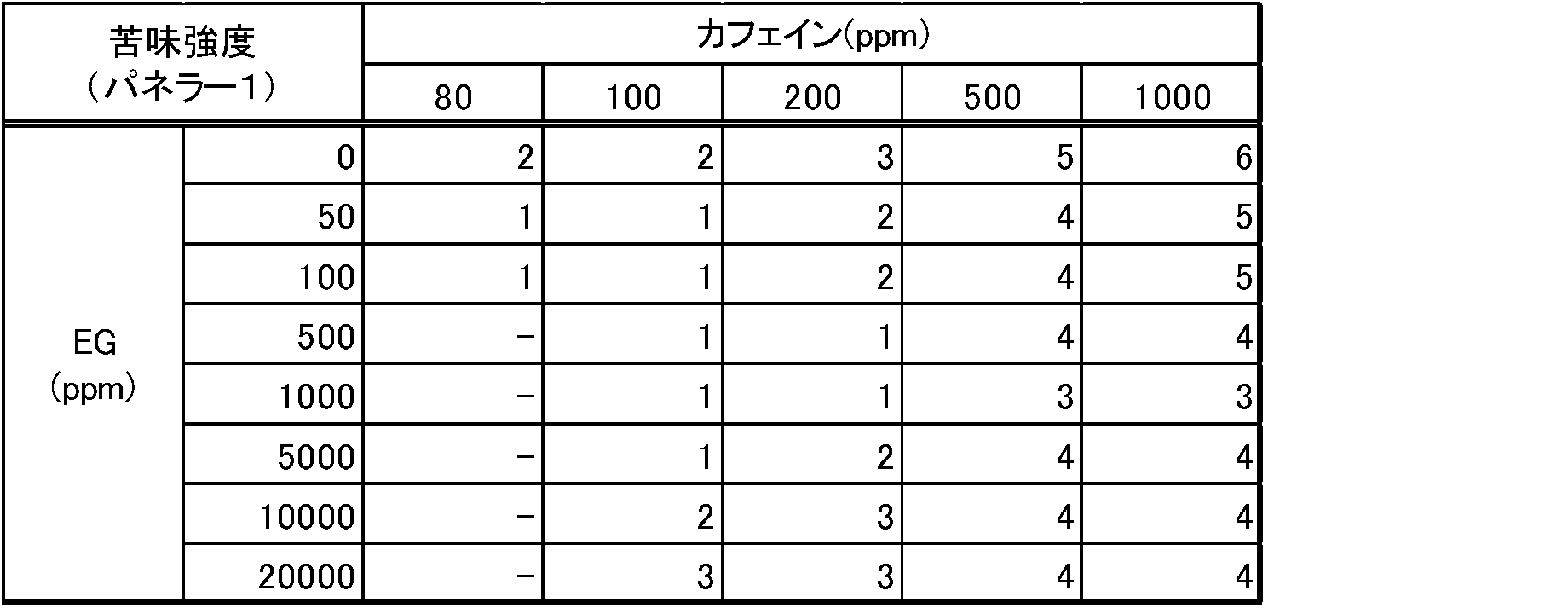
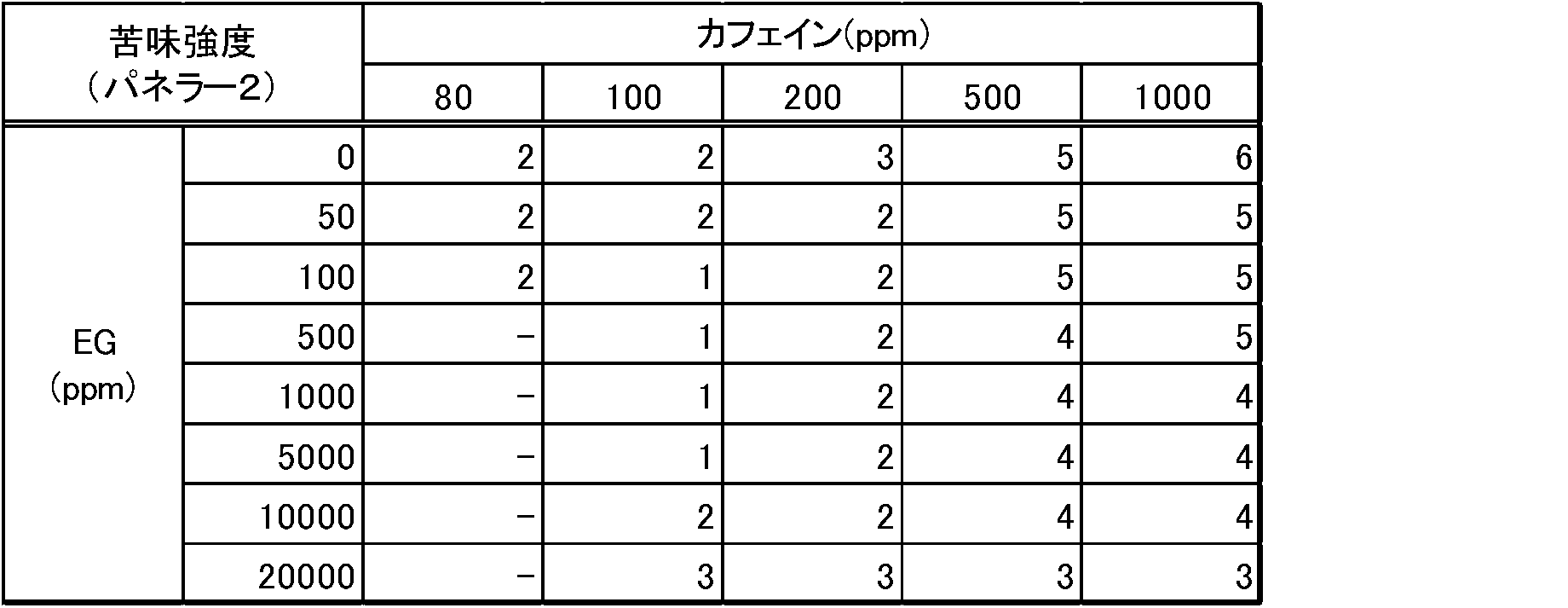
- Two panelists panelers 1 and 2) who were skilled in sensory evaluation performed sensory evaluation on the bitterness of each sample.
- the bitterness intensity of caffeine- and EG-free mineral water was scored “1"
- the bitterness intensity of the sample with EG 0 ppm (without EG added) at 80 ppm caffeine was scored “2”
- the bitterness intensity of the sample with EG 0 ppm at 200 ppm caffeine was scored “3”
- the bitterness intensity of the sample of caffeine 500 ppm and EG 0 ppm was set as a score of "5"
- the bitterness intensity of the sample of caffeine 1000 ppm and EG 0 ppm was set as a score of "6”.
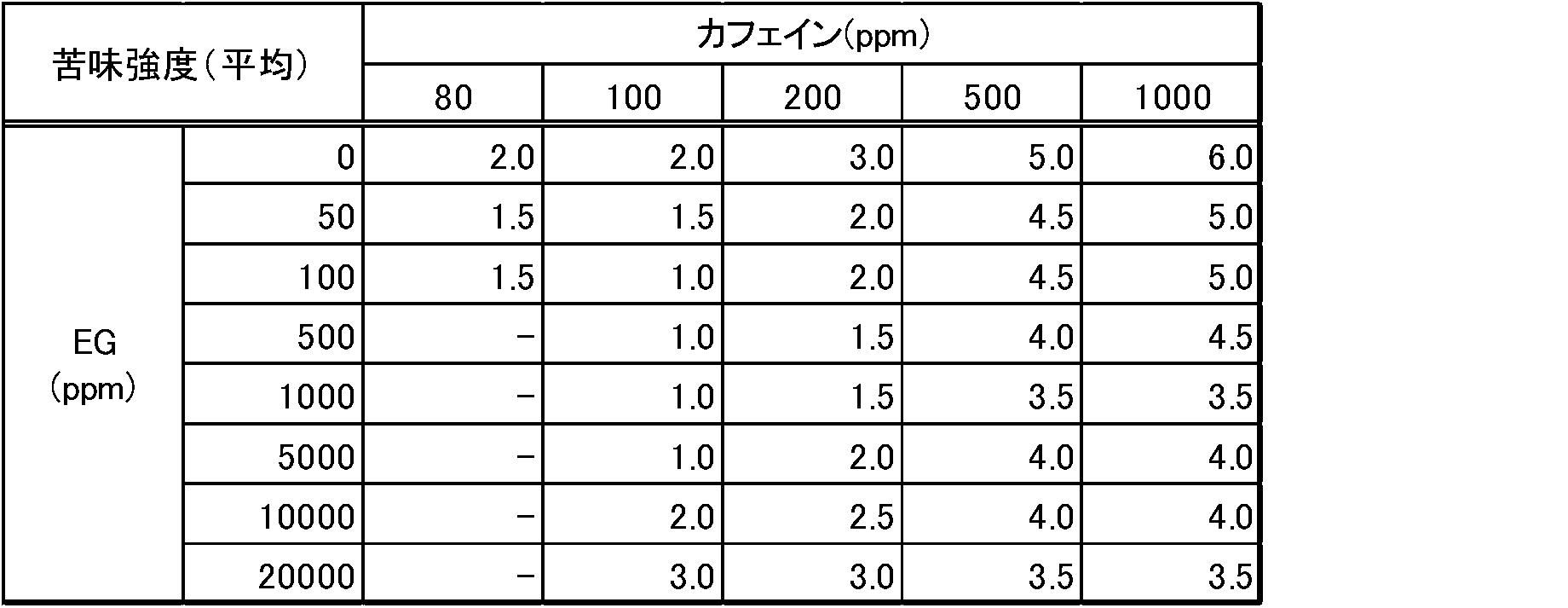
- each panelist evaluated the bitterness intensity on a 6-point scale with the following evaluation criteria of 1 to 6 for each sample, and then the average value of the panelist's scores was obtained.
- Table 1 shows the weight ratio (EG / caffeine) of ethyl glycoside (EG) to caffeine in each sample.
- Table 2 shows the results of sensory evaluation (score of bitterness intensity) of paneler 1 of each sample.
- Table 3 shows the results of the sensory evaluation (score of bitterness intensity) of the panelists 2 of each sample.
- Table 4 shows the average of the paneler sensory evaluation results (scores of bitterness intensity) of each sample.
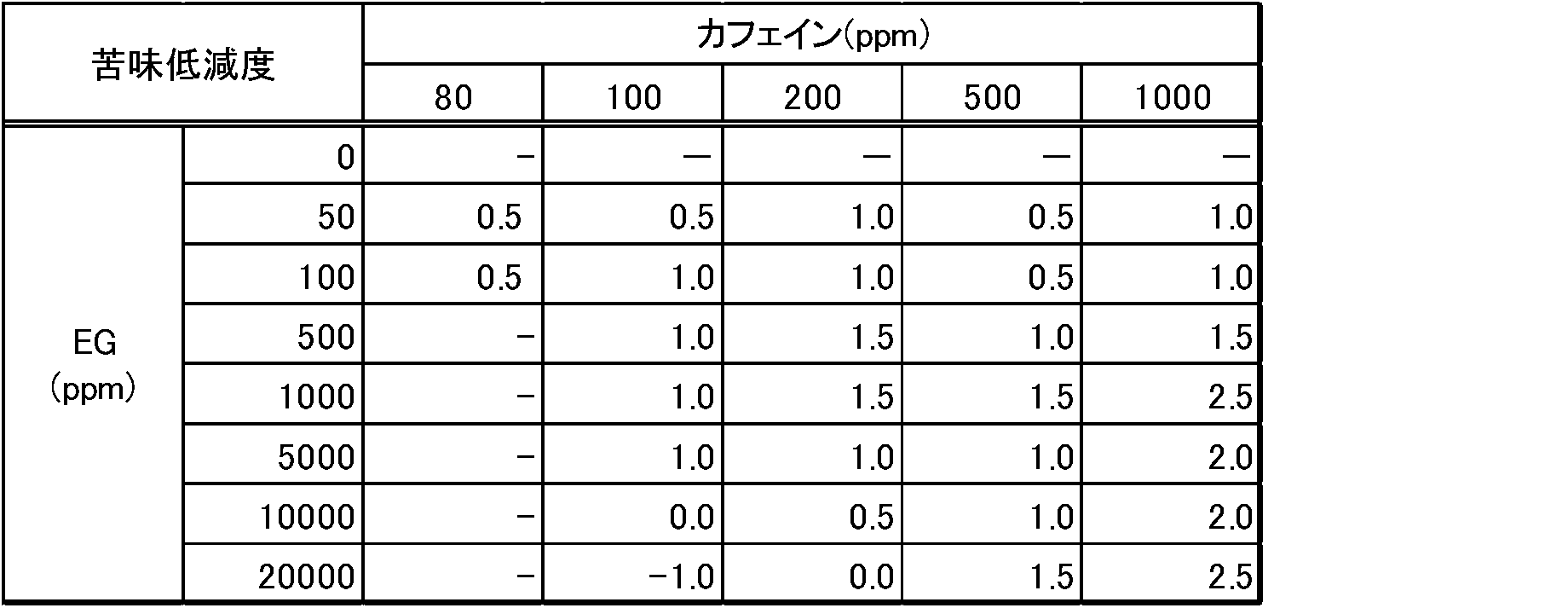
- Table 5 shows the degree of bitterness reduction by adding EG calculated from the results shown in Table 4. The degree of bitterness reduction shown in Table 5 is the value obtained by subtracting the score (Y) of the sample having the same caffeine concentration and containing EG from the score (X) of the sample having the same caffeine concentration and not containing EG as shown in Table 4. (XY).
- the degree of bitterness reduction is 0.5 or more, the bitterness is reduced as compared with the sample containing no EG.
- the degree of bitterness reduction is 0.0, there is no difference in bitterness as compared with the sample containing no EG.
- the degree of bitterness reduction is ⁇ 0.5 or less, the bitterness is increased as compared with the sample containing no EG.
- Example 1 A sample was prepared in the same manner as in Example 1 except that the concentration of EG was 10 ppm, and sensory evaluation was performed.
- Table 6 shows the weight ratio (EG / caffeine) of ethyl glycoside (EG) to caffeine in each sample.
- Table 7 shows the average of the results of sensory evaluation (scoring of bitterness intensity) of each sample.
- Example 2 A sample was prepared by adding EG to a commercially available coffee beverage containing 400 ppm of caffeine so as to have a concentration of 5000 ppm.
- the weight ratio of ethyl glycoside (EG) to caffeine (EG / caffeine) is 12.5.
- a coffee beverage having a caffeine concentration of 900 ppm was prepared by further adding caffeine to a commercially available coffee beverage containing 400 ppm of caffeine, and a sample was prepared by adding EG to the coffee beverage so as to have a concentration of 5000 ppm. ..
- the weight ratio of ethyl glycoside (EG) to caffeine (EG / caffeine) is 5.6.
- the bitterness intensity was evaluated for each sample in the same manner as in Example 1. Table 8 shows the average score of the bitterness intensity.
- the ethyl glycoside concentration in the beverage is 50 to 20000 ppm, and the weight ratio of ethyl glycoside to caffeine (ethyl glycoside / caffeine) is high. It can be seen that the bitterness of caffeine contained in coffee beverages can be reduced by adding ethyl glycoside so as to be 0.05 to 50.
Landscapes
- Life Sciences & Earth Sciences (AREA)
- Chemical & Material Sciences (AREA)
- Engineering & Computer Science (AREA)
- Food Science & Technology (AREA)
- Polymers & Plastics (AREA)
- Health & Medical Sciences (AREA)
- Nutrition Science (AREA)
- Non-Alcoholic Beverages (AREA)
- Tea And Coffee (AREA)
Abstract
Description
そのため、ガティガム等を使用してカフェインの苦味を低減させた飲料を作製すると、飲料の粘度が高くなり、飲用した際に違和感を感じることがあった。
〔1〕カフェインとエチルグリコシドを含み、カフェインに対するエチルグリコシドの重量割合(エチルグリコシド/カフェイン)が0.05~50であり、カフェインの濃度が80~1500ppmであり、エチルグリコシドの濃度が50~20000ppmであるカフェイン含有飲料。
〔2〕カフェインの濃度が200~1000ppmである上記〔1〕に記載のカフェイン含有飲料。
〔3〕エチルグリコシドの濃度が50~10000ppmである上記〔1〕又は〔2〕に記載のカフェイン含有飲料。
〔4〕エチルグリコシドがエチルグルコシドである上記〔1〕~〔3〕のいずれか1つに記載のカフェイン含有飲料。
〔5〕茶飲料又はコーヒー飲料である上記〔1〕~〔4〕のいずれか1つに記載のカフェイン含有飲料。
〔6〕カフェインとエチルグリコシドを含み、カフェインの濃度が80~1500ppmであるカフェイン含有飲料の製造方法であって、カフェイン含有飲料中のエチルグリコシドの濃度が50~20000ppm、かつ、カフェインに対するエチルグリコシドの重量割合(エチルグリコシド/カフェイン)が0.05~50となるようにエチルグリコシドを配合する工程を含む、カフェイン含有飲料の製造方法。
〔7〕カフェインの濃度が80~1500ppmであるカフェイン含有飲料の苦味を低減する方法であって、カフェイン含有飲料中のカフェインに対するエチルグリコシドの重量割合(エチルグリコシド/カフェイン)が0.05~50であり、かつエチルグリコシドの濃度が50~20000ppmとなるようにエチルグリコシドを配合する工程を含む、カフェイン含有飲料の苦味を低減する方法。
本発明のカフェイン含有飲料は、カフェインとエチルグリコシドを含む。
本発明に用いられるカフェインは、特に制限されないが、市販の試薬、純品(カフェイン含量98%以上の精製品)、粗精製品(カフェイン含量50~98%)の他、カフェインを含有する植物(コーヒー豆、茶葉、コーラの実等)の抽出物又はその濃縮物の形態でもよい。
また、これらの飲料の濃縮液(ポーション)であってもよい。
また、水又は湯で希釈することによりこれらの飲料となる粉末であってもよい。
本発明のカフェイン含有飲料は、これらの飲料の中では、茶飲料及びコーヒー飲料であることが好ましい。
エチルグリコシドとして、例えば、エチルグルコシド、エチルフルクトシド、エチルガラクトシド、エチルマンノシド、エチルキシロシドが挙げられる。エチルグリコシドは、これらの1種であってもよく、2種以上の混合物であってもよい。中でも、エチルグリコシドとして、エチルグルコシドが好ましい。エチルグルコシドとしては、エチル-α-グルコシド、エチル-β-グルコシドのいずれであってもよく、エチル-α-グルコシド及びエチル-β-グルコシドの混合物であってもよい。一態様において、エチルグリコシドとして、エチル-α-グルコシドが好ましく、エチル-α-D-グルコシドがより好ましい。
カフェインに対するエチルグリコシドの重量割合が上記範囲であると、カフェインに起因する苦味をエチルグリコシドの添加によって充分に低減させることができる。好ましくは、上記重量割合は1~40である。
カフェインの濃度が80ppm以上である飲料は苦味を有するため、エチルグリコシドの添加による苦味低減が有効である。上記カフェイン濃度は、好ましくは200~1000ppmである。
本明細書中、ppmは、重量/容量(w/v)のppmを意味する。
エチルグリコシドの濃度が高くなるとエチルグルコシドの添加による雑味が生じることがあるので、本発明のカフェイン含有飲料におけるエチルグリコシドの濃度は、20000ppm以下である。上記エチルグリコシドの濃度は、50~10000ppmが好ましい。より好ましくは、50~5000ppmである。
カフェイン含有飲料におけるカフェイン及びエチルグリコシドの濃度は、高速液体クロマトグラフィー(HPLC)により測定することができる。
カフェイン濃度80ppm以上、100ppm未満の場合に、エチルグリコシド濃度50~100ppm
カフェイン濃度100ppm以上、200ppm未満の場合に、エチルグリコシド濃度50~5000ppm(好ましくは100~5000ppm)
カフェイン濃度200ppm以上、500ppm未満の場合に、エチルグリコシド濃度50~10000ppm
カフェイン濃度500ppm以上(好ましくは500~1000ppm)の場合に、エチルグリコシド濃度50~20000ppm(好ましくは500~10000ppm)
上記のような範囲であると、エチルグリコシドを含まない場合に比べてエチルグリコシドを添加することによる苦味低減の効果が特に大きいため好ましい。
本発明のカフェイン含有飲料の製造方法は、カフェインとエチルグリコシドを含み、カフェインの濃度が80~1500ppmであるカフェイン含有飲料の製造方法であって、カフェイン含有飲料中のエチルグリコシドの濃度が50~20000ppm、かつ、カフェインに対するエチルグリコシドの重量割合(エチルグリコシド/カフェイン)が0.05~50となるようにエチルグリコシドを配合する工程を含む。
エチルグリコシド、カフェイン、これらの含有量及びその好ましい態様は、上記のカフェイン含有飲料と同じである。
本発明のカフェイン含有飲料の苦味を低減する方法は、カフェインの濃度が80~1500ppmであるカフェイン含有飲料の苦味を低減する方法であって、カフェイン含有飲料中のカフェインに対するエチルグリコシドの重量割合(エチルグリコシド/カフェイン)が0.05~50であり、かつエチルグリコシドの濃度が50~20000ppmとなるようにエチルグリコシドを配合する工程を含む。
カフェイン含有飲料において、エチルグリコシドの濃度、及び、カフェインに対するエチルグリコシドの重量割合(エチルグリコシド/カフェイン)が所定の範囲となるようにエチルグリコシドを配合することによって、カフェインに起因する苦味を充分に低減させることができる。
エチルグリコシド、カフェイン、これらの含有量及びその好ましい態様は、上記のカフェイン含有飲料と同じである。
カフェインの濃度を80ppm、100ppm、200ppm、500ppm、1000ppmの5段階で変化させ、EGの濃度を0ppm、50ppm、100ppm、500ppm、1000ppm、5000ppm、10000ppm、20000ppmの8段階で変化させた試料を作製した。試料はカフェイン(食添グレード、白鳥製薬社製)を市販のミネラルウォーター(軟水:硬度0~100mg/L)に溶解し、次いでEGを配合して作製した。
各試料の苦味について、官能評価に熟練したパネラー2名(パネラー1及び2)が官能評価を行った。官能評価では、試料10mLを口に含み5秒間味わった後、吐き出し、苦味強度を評価した。異なる試料を評価する際には、口の中の味がなくなるまで口を水でゆすいだ。官能評価を実施するにあたり、事前にパネラーの間で討議を行い、苦味強度についてすり合わせを行った。各パネラーが評価基準を下記とすることの共通認識を持ったうえで官能評価を実施した。
EGを含まない試料の苦味の強度で苦味の基準点を設定した。カフェイン及びEGを含まないミネラルウォーターの苦味強度を評点「1」、カフェイン80ppmでEG0ppm(EGを添加していない)の試料の苦味強度を評点「2」、カフェイン200ppmでEG0ppmの試料の苦味強度を評点「3」、カフェイン500ppm、EG0ppmの試料の苦味強度を評点「5」、カフェイン1000ppm、EG0ppmの試料の苦味の強度を評点「6」と設定した。具体的には、各パネラーが各試料について下記の評価基準1~6点で、6段階で苦味強度を評価し、その後パネラーの評点の平均値を求めた。
2:苦味を弱く感じる
3:苦味をやや弱く感じる
4:苦味を感じる
5:苦味をやや強く感じる
6:苦味を強く感じる
表2には、各試料のパネラー1の官能評価の結果(苦味強度の評点)を示した。
表3には、各試料のパネラー2の官能評価の結果(苦味強度の評点)を示した。
表4には、各試料のパネラー官能評価の結果(苦味強度の評点)の平均を示した。
表5に、表4に示す結果から算出したEG添加による苦味低減度を示した。表5に示す苦味低減度は、表4に示すカフェイン濃度が同じでEGを含まない試料の評点(X)から、カフェイン濃度が同じでEGを含む試料の評点(Y)を引いた値(X-Y)である。苦味低減度が0.5以上の場合、EGを含まない試料と比べて苦味が低減されている。苦味低減度が0.0の場合、EGを含まない試料と比べて苦味に違いがない。苦味低減度が-0.5以下の場合、EGを含まない試料と比べて苦味が増している。

EGの濃度を10ppmとする以外は実施例1と同様に試料を作製し、官能評価を行った。表6には各試料中のカフェインに対するエチルグリコシド(EG)の重量割合(EG/カフェイン)を示した。
表7には、各試料の官能評価の結果(苦味強度の評点)の平均を示した。


カフェインを400ppm含む市販のコーヒー飲料にEGを濃度5000ppmとなるように添加した試料を作製した。カフェインに対するエチルグリコシド(EG)の重量割合(EG/カフェイン)は12.5である。
また、カフェインを400ppm含む市販のコーヒー飲料にさらにカフェインを加えてカフェイン濃度が900ppmとなるようにしたコーヒー飲料を調製し、これにEGを濃度5000ppmとなるように添加した試料を作製した。カフェインに対するエチルグリコシド(EG)の重量割合(EG/カフェイン)は5.6である。
実施例1と同様に各試料について苦味強度を評価した。
表8にはその苦味強度の評点の平均を示した。

Claims (7)
- カフェインとエチルグリコシドを含み、
カフェインに対するエチルグリコシドの重量割合(エチルグリコシド/カフェイン)が0.05~50であり、
カフェインの濃度が80~1500ppmであり、
エチルグリコシドの濃度が50~20000ppmであるカフェイン含有飲料。 - カフェインの濃度が200~1000ppmである請求項1に記載のカフェイン含有飲料。
- エチルグリコシドの濃度が50~10000ppmである請求項1又は2に記載のカフェイン含有飲料。
- エチルグリコシドがエチルグルコシドである請求項1~3のいずれか一項に記載のカフェイン含有飲料。
- 茶飲料又はコーヒー飲料である請求項1~4のいずれか一項に記載のカフェイン含有飲料。
- カフェインとエチルグリコシドを含み、カフェインの濃度が80~1500ppmであるカフェイン含有飲料の製造方法であって、カフェイン含有飲料中のエチルグリコシドの濃度が50~20000ppm、かつ、カフェインに対するエチルグリコシドの重量割合(エチルグリコシド/カフェイン)が0.05~50となるようにエチルグリコシドを配合する工程を含む、カフェイン含有飲料の製造方法。
- カフェインの濃度が80~1500ppmであるカフェイン含有飲料の苦味を低減する方法であって、カフェイン含有飲料中のカフェインに対するエチルグリコシドの重量割合(エチルグリコシド/カフェイン)が0.05~50であり、かつエチルグリコシドの濃度が50~20000ppmとなるようにエチルグリコシドを配合する工程を含む、カフェイン含有飲料の苦味を低減する方法。
Priority Applications (5)
| Application Number | Priority Date | Filing Date | Title |
|---|---|---|---|
| CN202180050727.9A CN115884684A (zh) | 2020-08-24 | 2021-08-23 | 含咖啡因的饮料、含咖啡因的饮料的制造方法及降低含咖啡因的饮料的苦味的方法 |
| US18/020,487 US20230337708A1 (en) | 2020-08-24 | 2021-08-23 | Caffeine-containing beverage, method for producing caffeine-containing beverage, and method for reducing bitterness of caffeine-containing beverage |
| JP2022544566A JP7655923B2 (ja) | 2020-08-24 | 2021-08-23 | カフェイン含有飲料、カフェイン含有飲料の製造方法及びカフェイン含有飲料の苦味を低減する方法 |
| AU2021330921A AU2021330921A1 (en) | 2020-08-24 | 2021-08-23 | Caffeine-containing beverage, method for producing caffeine-containing beverage, and method for reducing bitterness of caffeine-containing beverage |
| EP21861458.4A EP4201217A4 (en) | 2020-08-24 | 2021-08-23 | CAFFEINATED BEVERAGE, METHOD FOR PRODUCING A CAFFEINATED BEVERAGE AND METHOD FOR REDUCING THE BITTERNESS OF A CAFFEINATED BEVERAGE |
Applications Claiming Priority (2)
| Application Number | Priority Date | Filing Date | Title |
|---|---|---|---|
| JP2020140929 | 2020-08-24 | ||
| JP2020-140929 | 2020-08-24 |
Publications (1)
| Publication Number | Publication Date |
|---|---|
| WO2022045032A1 true WO2022045032A1 (ja) | 2022-03-03 |
Family
ID=80353231
Family Applications (1)
| Application Number | Title | Priority Date | Filing Date |
|---|---|---|---|
| PCT/JP2021/030704 Ceased WO2022045032A1 (ja) | 2020-08-24 | 2021-08-23 | カフェイン含有飲料、カフェイン含有飲料の製造方法及びカフェイン含有飲料の苦味を低減する方法 |
Country Status (7)
| Country | Link |
|---|---|
| US (1) | US20230337708A1 (ja) |
| EP (1) | EP4201217A4 (ja) |
| JP (1) | JP7655923B2 (ja) |
| CN (1) | CN115884684A (ja) |
| AU (1) | AU2021330921A1 (ja) |
| TW (1) | TW202218550A (ja) |
| WO (1) | WO2022045032A1 (ja) |
Citations (6)
| Publication number | Priority date | Publication date | Assignee | Title |
|---|---|---|---|---|
| JPH07250644A (ja) * | 1995-01-10 | 1995-10-03 | Kanebo Ltd | 飲食品の香味増強・改善剤及び飲食品の香味増強もしくは改善方法 |
| JPH08140641A (ja) * | 1994-11-22 | 1996-06-04 | House Foods Corp | カフェイン強化飲料 |
| JP2005185169A (ja) * | 2003-12-25 | 2005-07-14 | Ozeki Corp | エチル−α−グルコシドを含有するみりん、リキュール類または雑酒およびその製造方法 |
| JP2011078363A (ja) | 2009-10-08 | 2011-04-21 | Sanei Gen Ffi Inc | カフェインの苦味抑制方法 |
| JP2018191555A (ja) * | 2017-05-16 | 2018-12-06 | サントリーホールディングス株式会社 | カフェイン含有飲料 |
| WO2020203655A1 (ja) * | 2019-03-29 | 2020-10-08 | サントリーホールディングス株式会社 | カテキン類含有飲料、その製造方法及びカテキン類含有飲料の苦味を低減する方法 |
Family Cites Families (2)
| Publication number | Priority date | Publication date | Assignee | Title |
|---|---|---|---|---|
| US9844224B2 (en) * | 2008-05-23 | 2017-12-19 | Givaudan Sa | Bitter alkaloid containing consumables comprising bitter blockers |
| CN113163789A (zh) * | 2018-12-07 | 2021-07-23 | 三得利控股株式会社 | 糖及甜味剂所呈现的味质得到改善的咖啡饮料 |
-
2021
- 2021-08-23 US US18/020,487 patent/US20230337708A1/en not_active Abandoned
- 2021-08-23 CN CN202180050727.9A patent/CN115884684A/zh active Pending
- 2021-08-23 TW TW110131096A patent/TW202218550A/zh unknown
- 2021-08-23 AU AU2021330921A patent/AU2021330921A1/en not_active Abandoned
- 2021-08-23 JP JP2022544566A patent/JP7655923B2/ja active Active
- 2021-08-23 WO PCT/JP2021/030704 patent/WO2022045032A1/ja not_active Ceased
- 2021-08-23 EP EP21861458.4A patent/EP4201217A4/en not_active Withdrawn
Patent Citations (6)
| Publication number | Priority date | Publication date | Assignee | Title |
|---|---|---|---|---|
| JPH08140641A (ja) * | 1994-11-22 | 1996-06-04 | House Foods Corp | カフェイン強化飲料 |
| JPH07250644A (ja) * | 1995-01-10 | 1995-10-03 | Kanebo Ltd | 飲食品の香味増強・改善剤及び飲食品の香味増強もしくは改善方法 |
| JP2005185169A (ja) * | 2003-12-25 | 2005-07-14 | Ozeki Corp | エチル−α−グルコシドを含有するみりん、リキュール類または雑酒およびその製造方法 |
| JP2011078363A (ja) | 2009-10-08 | 2011-04-21 | Sanei Gen Ffi Inc | カフェインの苦味抑制方法 |
| JP2018191555A (ja) * | 2017-05-16 | 2018-12-06 | サントリーホールディングス株式会社 | カフェイン含有飲料 |
| WO2020203655A1 (ja) * | 2019-03-29 | 2020-10-08 | サントリーホールディングス株式会社 | カテキン類含有飲料、その製造方法及びカテキン類含有飲料の苦味を低減する方法 |
Non-Patent Citations (4)
| Title |
|---|
| "Food composition table 2016; 7th ed.", 1 April 2016, WOMEN'S NUTRITION UNIVERSITY PRESS , JP , ISBN: 978-4-7895-1016-5, article KAGAWA, YOSHIKO: "Passage; Coffee and cocoa", pages: 210 - 213, XP009528697 * |
| ANONYMOUS: "You Can Cut Sake with Milk?! The Best 20 Dilution Methods Preferred by Sake Aficionados", SAKE DROPS, 12 May 2020 (2020-05-12), XP055904222, Retrieved from the Internet <URL:https://sakenoshizuku.com/sake-cocktail> * |
| OKA SATORU, SHIN SATO: "Contribution of Ethyl α-D-Glucoside to Flavor Construction in Sakè", BULLETIN OF THE AGRICULTURAL CHEMICAL SOCIETY OF JAPAN, vol. 50, no. 10, 1 January 1976 (1976-01-01), pages 455 - 461, XP055904225, DOI: 10.1271/nogeikagaku1924.50.10_455 * |
| See also references of EP4201217A4 |
Also Published As
| Publication number | Publication date |
|---|---|
| JPWO2022045032A1 (ja) | 2022-03-03 |
| TW202218550A (zh) | 2022-05-16 |
| JP7655923B2 (ja) | 2025-04-02 |
| CN115884684A (zh) | 2023-03-31 |
| EP4201217A1 (en) | 2023-06-28 |
| US20230337708A1 (en) | 2023-10-26 |
| AU2021330921A1 (en) | 2023-05-04 |
| AU2021330921A9 (en) | 2024-10-24 |
| EP4201217A4 (en) | 2024-09-25 |
Similar Documents
| Publication | Publication Date | Title |
|---|---|---|
| CN102036569B (zh) | 呈味改善剂及含有该呈味改善剂的茶饮料 | |
| JP6641175B2 (ja) | メトキシフラボンを含有するカフェイン含有飲料 | |
| JP2017184660A (ja) | 飲料 | |
| JP6187572B2 (ja) | 炭酸飲料 | |
| WO2022045032A1 (ja) | カフェイン含有飲料、カフェイン含有飲料の製造方法及びカフェイン含有飲料の苦味を低減する方法 | |
| JP2018191555A (ja) | カフェイン含有飲料 | |
| JP6258642B2 (ja) | カフェインレス嗜好性飲料、カフェイン風味付与剤、及びカフェインレス嗜好性飲料にカフェイン風味を付与する方法 | |
| WO2021186816A1 (ja) | カフェイン及び甘味成分を含有する飲料 | |
| JP2023089168A (ja) | カフェイン由来の苦味が軽減された飲料 | |
| HK40089160A (zh) | 含咖啡因的饮料、含咖啡因的饮料的制造方法及降低含咖啡因的饮料的苦味的方法 | |
| TW202114538A (zh) | 含異黃腐酚之組成物及含黃腐酚之組成物、該等之製造方法以及降低苦味的方法 | |
| JP7134899B2 (ja) | カフェイン由来の苦味が軽減された飲料 | |
| JP7539462B2 (ja) | レバウディオサイドa含有飲料、その製造方法及びレバウディオサイドaの苦味を低減する方法 | |
| WO2020203655A1 (ja) | カテキン類含有飲料、その製造方法及びカテキン類含有飲料の苦味を低減する方法 | |
| JP7211847B2 (ja) | カフェイン由来の苦味が軽減された飲料 | |
| JP2020162511A (ja) | カフェイン及びアブシンチンを含有する飲料 | |
| EP4026430A1 (en) | Heat-sterilized containerized beverage containing high concentration of medium-chain fatty acid triglyceride | |
| JP6528362B2 (ja) | 飲料 | |
| HK40085750A (en) | Beverage containing rebaudioside a, method for producing same, and method for reducing bitterness of rebaudioside a | |
| WO2021132442A1 (ja) | 苦味が強化された緑茶飲料 | |
| JP2014207896A (ja) | 飲料 | |
| JP2020054352A (ja) | チューハイ飲料 | |
| JP2020130116A (ja) | フラネオール由来のオフフレーバーが軽減された飲料 |
Legal Events
| Date | Code | Title | Description |
|---|---|---|---|
| 121 | Ep: the epo has been informed by wipo that ep was designated in this application |
Ref document number: 21861458 Country of ref document: EP Kind code of ref document: A1 |
|
| ENP | Entry into the national phase |
Ref document number: 2022544566 Country of ref document: JP Kind code of ref document: A |
|
| WWE | Wipo information: entry into national phase |
Ref document number: AU2021330921 Country of ref document: AU |
|
| NENP | Non-entry into the national phase |
Ref country code: DE |
|
| ENP | Entry into the national phase |
Ref document number: 2021861458 Country of ref document: EP Effective date: 20230324 |
|
| ENP | Entry into the national phase |
Ref document number: 2021330921 Country of ref document: AU Date of ref document: 20210823 Kind code of ref document: A |
|
| WWW | Wipo information: withdrawn in national office |
Ref document number: 2021861458 Country of ref document: EP |
|
| WWW | Wipo information: withdrawn in national office |
Ref document number: 798233 Country of ref document: NZ |