WO2022054851A1 - 塗料用組成物 - Google Patents
塗料用組成物 Download PDFInfo
- Publication number
- WO2022054851A1 WO2022054851A1 PCT/JP2021/033069 JP2021033069W WO2022054851A1 WO 2022054851 A1 WO2022054851 A1 WO 2022054851A1 JP 2021033069 W JP2021033069 W JP 2021033069W WO 2022054851 A1 WO2022054851 A1 WO 2022054851A1
- Authority
- WO
- WIPO (PCT)
- Prior art keywords
- group
- block
- containing polymer
- molecular weight
- siloxane
- Prior art date
- Legal status (The legal status is an assumption and is not a legal conclusion. Google has not performed a legal analysis and makes no representation as to the accuracy of the status listed.)
- Ceased
Links
Images

Classifications
-
- C—CHEMISTRY; METALLURGY
- C09—DYES; PAINTS; POLISHES; NATURAL RESINS; ADHESIVES; COMPOSITIONS NOT OTHERWISE PROVIDED FOR; APPLICATIONS OF MATERIALS NOT OTHERWISE PROVIDED FOR
- C09D—COATING COMPOSITIONS, e.g. PAINTS, VARNISHES OR LACQUERS; FILLING PASTES; CHEMICAL PAINT OR INK REMOVERS; INKS; CORRECTING FLUIDS; WOODSTAINS; PASTES OR SOLIDS FOR COLOURING OR PRINTING; USE OF MATERIALS THEREFOR
- C09D175/00—Coating compositions based on polyureas or polyurethanes; Coating compositions based on derivatives of such polymers
- C09D175/04—Polyurethanes
-
- C—CHEMISTRY; METALLURGY
- C09—DYES; PAINTS; POLISHES; NATURAL RESINS; ADHESIVES; COMPOSITIONS NOT OTHERWISE PROVIDED FOR; APPLICATIONS OF MATERIALS NOT OTHERWISE PROVIDED FOR
- C09D—COATING COMPOSITIONS, e.g. PAINTS, VARNISHES OR LACQUERS; FILLING PASTES; CHEMICAL PAINT OR INK REMOVERS; INKS; CORRECTING FLUIDS; WOODSTAINS; PASTES OR SOLIDS FOR COLOURING OR PRINTING; USE OF MATERIALS THEREFOR
- C09D153/00—Coating compositions based on block copolymers containing at least one sequence of a polymer obtained by reactions only involving carbon-to-carbon unsaturated bonds; Coating compositions based on derivatives of such polymers
-
- C—CHEMISTRY; METALLURGY
- C08—ORGANIC MACROMOLECULAR COMPOUNDS; THEIR PREPARATION OR CHEMICAL WORKING-UP; COMPOSITIONS BASED THEREON
- C08F—MACROMOLECULAR COMPOUNDS OBTAINED BY REACTIONS ONLY INVOLVING CARBON-TO-CARBON UNSATURATED BONDS
- C08F293/00—Macromolecular compounds obtained by polymerisation on to a macromolecule having groups capable of inducing the formation of new polymer chains bound exclusively at one or both ends of the starting macromolecule
- C08F293/005—Macromolecular compounds obtained by polymerisation on to a macromolecule having groups capable of inducing the formation of new polymer chains bound exclusively at one or both ends of the starting macromolecule using free radical "living" or "controlled" polymerisation, e.g. using a complexing agent
-
- C—CHEMISTRY; METALLURGY
- C08—ORGANIC MACROMOLECULAR COMPOUNDS; THEIR PREPARATION OR CHEMICAL WORKING-UP; COMPOSITIONS BASED THEREON
- C08G—MACROMOLECULAR COMPOUNDS OBTAINED OTHERWISE THAN BY REACTIONS ONLY INVOLVING UNSATURATED CARBON-TO-CARBON BONDS
- C08G18/00—Polymeric products of isocyanates or isothiocyanates
- C08G18/06—Polymeric products of isocyanates or isothiocyanates with compounds having active hydrogen
- C08G18/28—Polymeric products of isocyanates or isothiocyanates with compounds having active hydrogen characterised by the compounds used containing active hydrogen
- C08G18/40—High-molecular-weight compounds
- C08G18/4009—Two or more macromolecular compounds not provided for in one single group of groups C08G18/42 - C08G18/64
-
- C—CHEMISTRY; METALLURGY
- C08—ORGANIC MACROMOLECULAR COMPOUNDS; THEIR PREPARATION OR CHEMICAL WORKING-UP; COMPOSITIONS BASED THEREON
- C08G—MACROMOLECULAR COMPOUNDS OBTAINED OTHERWISE THAN BY REACTIONS ONLY INVOLVING UNSATURATED CARBON-TO-CARBON BONDS
- C08G18/00—Polymeric products of isocyanates or isothiocyanates
- C08G18/06—Polymeric products of isocyanates or isothiocyanates with compounds having active hydrogen
- C08G18/28—Polymeric products of isocyanates or isothiocyanates with compounds having active hydrogen characterised by the compounds used containing active hydrogen
- C08G18/40—High-molecular-weight compounds
- C08G18/61—Polysiloxanes
-
- C—CHEMISTRY; METALLURGY
- C08—ORGANIC MACROMOLECULAR COMPOUNDS; THEIR PREPARATION OR CHEMICAL WORKING-UP; COMPOSITIONS BASED THEREON
- C08G—MACROMOLECULAR COMPOUNDS OBTAINED OTHERWISE THAN BY REACTIONS ONLY INVOLVING UNSATURATED CARBON-TO-CARBON BONDS
- C08G18/00—Polymeric products of isocyanates or isothiocyanates
- C08G18/06—Polymeric products of isocyanates or isothiocyanates with compounds having active hydrogen
- C08G18/28—Polymeric products of isocyanates or isothiocyanates with compounds having active hydrogen characterised by the compounds used containing active hydrogen
- C08G18/40—High-molecular-weight compounds
- C08G18/62—Polymers of compounds having carbon-to-carbon double bonds
- C08G18/6216—Polymers of alpha-beta ethylenically unsaturated carboxylic acids or of derivatives thereof
- C08G18/625—Polymers of alpha-beta ethylenically unsaturated carboxylic acids; hydrolyzed polymers of esters of these acids
- C08G18/6254—Polymers of alpha-beta ethylenically unsaturated carboxylic acids and of esters of these acids containing hydroxy groups
-
- C—CHEMISTRY; METALLURGY
- C08—ORGANIC MACROMOLECULAR COMPOUNDS; THEIR PREPARATION OR CHEMICAL WORKING-UP; COMPOSITIONS BASED THEREON
- C08G—MACROMOLECULAR COMPOUNDS OBTAINED OTHERWISE THAN BY REACTIONS ONLY INVOLVING UNSATURATED CARBON-TO-CARBON BONDS
- C08G18/00—Polymeric products of isocyanates or isothiocyanates
- C08G18/06—Polymeric products of isocyanates or isothiocyanates with compounds having active hydrogen
- C08G18/28—Polymeric products of isocyanates or isothiocyanates with compounds having active hydrogen characterised by the compounds used containing active hydrogen
- C08G18/40—High-molecular-weight compounds
- C08G18/64—Macromolecular compounds not provided for by groups C08G18/42 - C08G18/63
- C08G18/6469—Macromolecular compounds not provided for by groups C08G18/42 - C08G18/63 having silicon
-
- C—CHEMISTRY; METALLURGY
- C08—ORGANIC MACROMOLECULAR COMPOUNDS; THEIR PREPARATION OR CHEMICAL WORKING-UP; COMPOSITIONS BASED THEREON
- C08G—MACROMOLECULAR COMPOUNDS OBTAINED OTHERWISE THAN BY REACTIONS ONLY INVOLVING UNSATURATED CARBON-TO-CARBON BONDS
- C08G18/00—Polymeric products of isocyanates or isothiocyanates
- C08G18/06—Polymeric products of isocyanates or isothiocyanates with compounds having active hydrogen
- C08G18/70—Polymeric products of isocyanates or isothiocyanates with compounds having active hydrogen characterised by the isocyanates or isothiocyanates used
- C08G18/72—Polyisocyanates or polyisothiocyanates
- C08G18/77—Polyisocyanates or polyisothiocyanates having heteroatoms in addition to the isocyanate or isothiocyanate nitrogen and oxygen or sulfur
- C08G18/78—Nitrogen
- C08G18/79—Nitrogen characterised by the polyisocyanates used, these having groups formed by oligomerisation of isocyanates or isothiocyanates
- C08G18/791—Nitrogen characterised by the polyisocyanates used, these having groups formed by oligomerisation of isocyanates or isothiocyanates containing isocyanurate groups
- C08G18/792—Nitrogen characterised by the polyisocyanates used, these having groups formed by oligomerisation of isocyanates or isothiocyanates containing isocyanurate groups formed by oligomerisation of aliphatic and/or cycloaliphatic isocyanates or isothiocyanates
-
- C—CHEMISTRY; METALLURGY
- C08—ORGANIC MACROMOLECULAR COMPOUNDS; THEIR PREPARATION OR CHEMICAL WORKING-UP; COMPOSITIONS BASED THEREON
- C08G—MACROMOLECULAR COMPOUNDS OBTAINED OTHERWISE THAN BY REACTIONS ONLY INVOLVING UNSATURATED CARBON-TO-CARBON BONDS
- C08G77/00—Macromolecular compounds obtained by reactions forming a linkage containing silicon with or without sulfur, nitrogen, oxygen or carbon in the main chain of the macromolecule
- C08G77/42—Block-or graft-polymers containing polysiloxane sequences
- C08G77/442—Block-or graft-polymers containing polysiloxane sequences containing vinyl polymer sequences
-
- C—CHEMISTRY; METALLURGY
- C08—ORGANIC MACROMOLECULAR COMPOUNDS; THEIR PREPARATION OR CHEMICAL WORKING-UP; COMPOSITIONS BASED THEREON
- C08G—MACROMOLECULAR COMPOUNDS OBTAINED OTHERWISE THAN BY REACTIONS ONLY INVOLVING UNSATURATED CARBON-TO-CARBON BONDS
- C08G81/00—Macromolecular compounds obtained by interreacting polymers in the absence of monomers, e.g. block polymers
- C08G81/02—Macromolecular compounds obtained by interreacting polymers in the absence of monomers, e.g. block polymers at least one of the polymers being obtained by reactions involving only carbon-to-carbon unsaturated bonds
- C08G81/024—Block or graft polymers containing sequences of polymers of C08C or C08F and of polymers of C08G
-
- C—CHEMISTRY; METALLURGY
- C09—DYES; PAINTS; POLISHES; NATURAL RESINS; ADHESIVES; COMPOSITIONS NOT OTHERWISE PROVIDED FOR; APPLICATIONS OF MATERIALS NOT OTHERWISE PROVIDED FOR
- C09D—COATING COMPOSITIONS, e.g. PAINTS, VARNISHES OR LACQUERS; FILLING PASTES; CHEMICAL PAINT OR INK REMOVERS; INKS; CORRECTING FLUIDS; WOODSTAINS; PASTES OR SOLIDS FOR COLOURING OR PRINTING; USE OF MATERIALS THEREFOR
- C09D187/00—Coating compositions based on unspecified macromolecular compounds, obtained otherwise than by polymerisation reactions only involving unsaturated carbon-to-carbon bonds
- C09D187/005—Block or graft polymers not provided for in groups C09D101/00 - C09D185/04
-
- C—CHEMISTRY; METALLURGY
- C09—DYES; PAINTS; POLISHES; NATURAL RESINS; ADHESIVES; COMPOSITIONS NOT OTHERWISE PROVIDED FOR; APPLICATIONS OF MATERIALS NOT OTHERWISE PROVIDED FOR
- C09D—COATING COMPOSITIONS, e.g. PAINTS, VARNISHES OR LACQUERS; FILLING PASTES; CHEMICAL PAINT OR INK REMOVERS; INKS; CORRECTING FLUIDS; WOODSTAINS; PASTES OR SOLIDS FOR COLOURING OR PRINTING; USE OF MATERIALS THEREFOR
- C09D7/00—Features of coating compositions, not provided for in group C09D5/00; Processes for incorporating ingredients in coating compositions
- C09D7/40—Additives
- C09D7/60—Additives non-macromolecular
- C09D7/63—Additives non-macromolecular organic
-
- C—CHEMISTRY; METALLURGY
- C09—DYES; PAINTS; POLISHES; NATURAL RESINS; ADHESIVES; COMPOSITIONS NOT OTHERWISE PROVIDED FOR; APPLICATIONS OF MATERIALS NOT OTHERWISE PROVIDED FOR
- C09D—COATING COMPOSITIONS, e.g. PAINTS, VARNISHES OR LACQUERS; FILLING PASTES; CHEMICAL PAINT OR INK REMOVERS; INKS; CORRECTING FLUIDS; WOODSTAINS; PASTES OR SOLIDS FOR COLOURING OR PRINTING; USE OF MATERIALS THEREFOR
- C09D7/00—Features of coating compositions, not provided for in group C09D5/00; Processes for incorporating ingredients in coating compositions
- C09D7/40—Additives
- C09D7/65—Additives macromolecular
-
- C—CHEMISTRY; METALLURGY
- C08—ORGANIC MACROMOLECULAR COMPOUNDS; THEIR PREPARATION OR CHEMICAL WORKING-UP; COMPOSITIONS BASED THEREON
- C08F—MACROMOLECULAR COMPOUNDS OBTAINED BY REACTIONS ONLY INVOLVING CARBON-TO-CARBON UNSATURATED BONDS
- C08F2438/00—Living radical polymerisation
Definitions
- the present invention relates to a coating composition, particularly a coating composition that provides a water-repellent coating film.
- car wash-free in which dirt is washed away with rainwater and kept clean without washing the car.
- a fluorine-based material and a silicone-based material are often used as the water-repellent material.
- Fluorine-based materials have high water repellency and are effective, but at present they are expensive and difficult to use for general-purpose paints, and there are problems such as environmental pollution, so they are not used. It's not easy.
- Silicone-based materials have the advantage of being easy to use for general purposes, so development is ahead.
- Patent Document 1 Japanese Patent Application Laid-Open No. 11-293184 (Patent Document 1) and the like propose a polymer composition using a siloxane macromonomer having unsaturated bonds at both ends.
- the silicone-based material has a lower water-repellent ability than the fluorine-based material, the amount of the material used inevitably increases, and problems arise in compatibility with other materials to be blended and adhesion with the undercoat film. .. Further, it is said that the silicone-based material has problems in tensile strength and tear strength, and further, it is necessary to improve the wear resistance.
- the present invention provides a composition for a water-repellent coating material capable of easily removing stains, and the composition for a coating material having a good appearance because the water-repellent component is highly compatible with other materials.
- the purpose is to do.
- the siloxane group-containing polymer (A) is a block copolymer containing an A block and a B block, the A block contains at least a structural unit derived from the siloxane group-containing vinyl monomer (a), and the B block contains a hydroxyl group. It contains structural units derived from the vinyl monomer (b) and, if necessary, structural units derived from other vinyl monomers (c) copolymerizable with the vinyl monomers (a) and (b).
- the molecular weight distribution (Mw / Mn) is 2.0 or less, and the copolymer is polymerized by living radical polymerization.
- a coating composition is provided.
- the present invention also provides the following aspects:
- R4 represents an aryl group, a substituted aryl group, an aromatic heterocyclic group, an acyl group, an oxycarbonyl group or a cyano group.
- the blending ratio of the siloxane group-containing polymer (A) and the hydroxyl group-containing polymer (C) is 15:85 to 80:20 in terms of the weight ratio of the siloxane group-containing polymer (A): the hydroxyl group-containing polymer (C).
- Mn number average molecular weight
- the cross-linking agent (B) is an isocyanate-based cross-linking agent.
- water repellency can be imparted to the coating film by blending a siloxane group-containing polymer. Since the siloxane group-containing polymer is firmly incorporated into the coating film by the cross-linking reaction of the coating film, it does not separate or bleed, and the water repellency can be stably maintained for a long period of time. Further, when the siloxane group-containing polymer is a block copolymer, the portion that contributes to the crosslinking reaction of the coating film and the siloxane portion that imparts water repellency are separated in the polymer molecule, so that each portion works.
- the water repellency can be stably maintained for a long period of time, so that rainwater or the like becomes water droplets (ball-shaped water droplets) and travels. Sometimes it scatters. Therefore, dirt such as dust existing on the coating film disappears from the coating film when it rains, because the rainwater contains them and scatters during traveling. Since the siloxane portion also has oil repellency, the adhesion of oily substances is reduced and oil stains are also reduced.
- the siloxane group-containing polymer (A) of the present invention when used, the siloxane group portion does not separate and bleed, and is firmly present in the coating film, so that its performance can be exhibited stably and for a long period of time. However, these performances are also kept high as they are maintained without adversely affecting other performances of the coating, such as tensile strength, tear strength or abrasion resistance.
- the coating composition of the present invention contains a siloxane group-containing polymer (A) and a cross-linking agent (B), and may contain another hydroxyl group-containing polymer (C), if necessary. Each component will be described.
- the siloxane group-containing polymer (A) is a block copolymer containing an A block and a B block, the A block contains at least a structural unit derived from the siloxane group-containing vinyl monomer (a), and the B block contains a hydroxyl group. It contains a vinyl monomer (b) and, if necessary, structural units derived from other vinyl monomers (c) copolymerizable with the vinyl monomers (a) and (b). Moreover, the molecular weight distribution (Mw / Mn) is 2.0 or less, and the copolymer is polymerized by living radical polymerization.
- vinyl monomer refers to a monomer having a radically polymerizable carbon-carbon double bond in the molecule.
- structural unit derived from a vinyl monomer means a structural unit obtained by polymerizing a radically polymerizable carbon-carbon double bond of a vinyl monomer into a carbon-carbon single bond.
- the siloxane group-containing vinyl monomer (a) is not particularly limited as long as it is a vinyl monomer having a siloxane group (more specifically, a polysiloxane group). More specifically, the siloxane group-containing vinyl monomer has the following formula I. [In the formula, Me indicates a methyl group, R 11 indicates a hydrogen source or a methyl group, R 12 indicates a hydrogen atom or an alkyl group having 1 to 4 carbon atoms, and R 13 may be mediated by an oxygen atom. It represents an alkyl group having 1 to 6 carbon atoms, and n represents 0 or an integer of 1 or more. ] It is represented by.
- the siloxane group-containing vinyl monomer (a) of the above formula (I) is the following formula II:
- a reaction product of the alcohol group at the end of the polysiloxane represented by (meth) and (meth) acrylic acid is suitable.
- R 11 is a group derived from (meth) acrylic acid and represents a hydrogen atom or a methyl group.
- R 12 is a hydrogen atom or an alkyl group having 1 to 4 carbon atoms, and Me is a methyl group.
- R 13 is an alkyl group having 1 to 6 carbon atoms.
- n is 0 or an integer of 1 or more, and n is preferably 6 to 300.
- "(meth) acrylic” or "(meth) acrylate” means either acrylic, methacrylic, or both, acrylate or methacrylate, or both.
- siloxane group-containing vinyl monomer (a) having the above formula (I) is commercially available from Shin-Etsu Chemical Industry Co., Ltd. (modified silicone oil series) and JNC Co., Ltd. (Cyraplane (registered trademark)). , X-22-2404 manufactured by Shin-Etsu Chemical Co., Ltd.
- the siloxane group-containing vinyl monomer is monofunctional, the functional group equivalent [g / mol] can be regarded as the number average molecular weight of the siloxane group-containing vinyl monomer (a) with respect to 1 mol of the siloxane.
- the functional group equivalent of the siloxane group-containing vinyl monomer (a) is preferably 500 to 50,000, more preferably 600 to 3,000, and particularly preferably 700 to 1,200 from the viewpoint of polymerizable property. In particular, it shows excellent compatibility at 700 to 1,200.
- the functional group is a vinyl group, and the siloxane group-containing vinyl monomer (a) is preferably monofunctional from the viewpoint of polymerizability.
- the number average molecular weight (Mn) of the siloxane group-containing vinyl monomer (a) is preferably 500 to 50,000, more preferably 600 to 3,000, and particularly preferably 700 to 1,200 because of the effect of releasability. In particular, it shows excellent compatibility at 700 to 1,200.
- the hydroxyl group-containing vinyl monomer (b) is a vinyl monomer having a hydroxyl group in the molecule, and more specifically, a reaction product of an alkyl polyol and (meth) acrylic acid is suitable.
- Examples of the hydroxyl group-containing vinyl monomer (b) include 2-hydroxyethyl (meth) acrylate, 3-hydroxypropyl (meth) acrylate, 4-hydroxybutyl (meth) acrylate, 5-hydroxypentyl (meth) acrylate, and the like.
- the other copolymerizable vinyl monomer (c) may be any vinyl monomer copolymerizable with the vinyl monomers (a) and (b), for example, methyl acrylate, ethyl acrylate, propyl acrylate, butyl acrylate.
- Alicyclic-containing monomers Phosphate ester of polyethylene glycol mono (meth) acrylate, phosphoric acid ester of polypropylene glycol mono (meth) acrylate such as (mono (propylene glycol monomethacrylate) phosphate, methylene phosphate (meth) acrylate, trimethylene (meth) acrylate , Phosphoric acid group-containing (meth) acrylates such as alkylene (meth) acrylates such as propylene (meth) acrylate and tetramethylene (meth) acrylate.
- Olefin sulfonic acid such as ethylene sulfonic acid, allyl sulfonic acid, methallyl sulfonic acid, 2-acrylamide-2-methylpropane sulfonic acid, styrene sulfonic acid, sulfonic acid group-containing monomers or salts thereof; Alkoxyalkyls such as methoxymethyl (meth) acrylamide, ethoxymethyl (meth) acrylamide, propoxymethyl (meth) acrylamide, isopropoxymethyl (meth) acrylamide, n-butoxymethyl (meth) acrylamide, and isobutoxymethyl (meth) acrylamide.
- (Meta) acrylamide-based monomers (meth) acryloyl morpholine, dimethyl (meth) acrylamide, diethyl (meth) acrylamide, (meth) acrylamide N-methylol (meth) acrylamide and other (meth) acrylamide-based monomers; Glycyzyl acrylate, flufuryl acrylate, tetrahydrofuruffle acrylate, glycidyl methacrylate, flufuryl methacrylate, tetrahydrofuruffle methacrylate, methyl vinyl ketone, styrene, ⁇ -methylstyrene, N-vinylcaprolactam, vinyl acetate, etc.; In particular, isobornyl (meth) acrylate and dicyclopentanyl (meth) acrylate are preferable from the viewpoint of the balance of physical characteristics of the coating film.
- the siloxane group-containing polymer (A) has a structural unit derived from the polysiloxane group-containing vinyl monomer (a) of 5 to 35% by weight, and a structural unit derived from the hydroxyl group-containing vinyl monomer (b) of 5 to 35% by weight. Further, it is preferable that the structural unit derived from the other vinyl monomers (c) copolymerizable with the vinyl monomers (a) and (b) is in the quantitative range of 30 to 90% by weight.
- the amount of the siloxane group-containing vinyl monomer (a) is large to some extent, water repellency is imparted to the coating film, but when the amount of the structural unit derived from the siloxane group-containing vinyl monomer (a) is too large, the coating film is coated. It is not preferable because it adversely affects. It is preferable that the amount of the structural unit derived from the hydroxyl group-containing vinyl monomer (b) is large, because it is copolymerized at a large number of reaction points.
- the amount of the structural unit derived from the hydroxyl group-containing vinyl monomer (b) can be controlled by the hydroxyl value of the siloxane group-containing polymer (A), and the hydroxyl value of the siloxane group-containing polymer (A) is 30 to 250 mgKOH / g. Preferably, 70 to 170 mgKOH / g is particularly preferable. If the hydroxyl value is less than 30 mgKOH / g, it may not sufficiently react with isocyanate and the coating film may have a low crosslink density, and if the hydroxyl value is larger than 250 mgKOH / g, the water resistance of the coating film may deteriorate.
- the siloxane group-containing polymer (A) is a block copolymer containing an A block and a B block, and the A block contains a structural unit derived from the polysiloxane group-containing vinyl monomer (a) and is a B block. Contains structural units derived from the hydroxyl group-containing vinyl monomer (b).
- the B block preferably further contains structural units derived from the vinyl monomers (a) and other vinyl monomers (c) copolymerizable with (b).
- the block copolymer is preferably an AB type diblock copolymer or an ABA type triblock copolymer.
- the A block in the block copolymer contains a structural unit derived from the polysiloxane group-containing vinyl monomer (a), and can impart water and oil repellency to the coating film.
- the B block of the block copolymer contains a structural unit derived from the hydroxyl group-containing vinyl monomer (b), and can be crosslinked with the cross-linking agent (B) to form a three-dimensional network structure, and is durable. Can be improved. That is, since the hydroxyl group-containing vinyl monomer (b) having reactivity with the cross-linking agent is not introduced into the A block but concentrated in the B block, the functions of each polymer block of the A block and the B block are clarified. It is possible to divide into.
- a microphase separation structure is formed in the coating film.
- the coating film has a micro-phase separation structure
- the functions of the A block and the B block polymer blocks are most clearly separated, so that the excellent functions are exhibited. It is confirmed by thinly slicing the coating film and performing a transmission micrograph (TEM photograph) that the microphase-separated structure has a sea-island (spherical) structure, a columnar (linear) structure, and a lamellar structure microscopically.
- the polymer in which the copolymer is randomly copolymerized instead of the block polymer is derived from the hydroxyl group-containing vinyl monomer (b) having a reactivity between the structural unit derived from the polysiloxane group-containing vinyl monomer (a) and the cross-linking agent. Since the structural units are mixed, it may be difficult to exert the function or the compatibility may be deteriorated depending on the composition.
- the A block may be produced first, and the B block monomer may be polymerized on the A block; the B block may be first.
- the monomer of A block may be polymerized on the B block; or the A block and the B block may be separately manufactured and then the A block and the B block may be coupled.
- it is obtained by sequentially polymerizing vinyl monomers constituting a block by a radical polymerization method. Specifically, a step of polymerizing a vinyl monomer constituting one of the A block and the B block to polymerize one block, and a step of polymerizing one block and then the other of the A block and the B block.
- a manufacturing method including a step of polymerizing a vinyl monomer constituting one block and polymerizing the other block can be mentioned.
- the effect of the present invention is difficult to obtain when an acrylic polymer obtained by conventional radical polymerization (free radical polymerization: FRP) is used.
- free radical polymerization radical species are continuously generated during the reaction and added to the vinyl monomer, and the polymerization proceeds. Therefore, in free radical polymerization, a polymer in which the growing terminal radical is inactivated during the reaction or a polymer grown by a radical species newly generated during the reaction is produced. Therefore, when an acrylic polymer containing a crosslinkable functional group is produced by free radical polymerization, a polymer containing no structural unit derived from a relatively low molecular weight crosslinkable functional group-containing vinyl monomer is produced.
- the composition of the polymer is non-uniform and contains a polymer that does not contain a relatively low molecular weight crosslinkable functional group-containing vinyl monomer, so that the polymer chain cannot participate in crosslinking. Exists. Further, the composition is non-uniform, and for example, a homopolymer obtained by polymerizing only a siloxane-containing vinyl monomer is produced, which causes deterioration of the compatibility of the resin and may cause coating film defects such as cloudiness and repellent.
- the living radical polymerization method includes a method using a transition metal catalyst (ATRP method), a method using a sulfur-based reversible chain transfer agent (RAFT method), and an organotellurium compound, depending on the method for stabilizing the polymerization growth end. There is a method to be used (TERP method) and the like.
- the ATRP method uses an amine-based complex, it may not be usable unless the acidic group of the vinyl monomer having an acidic group is protected.
- the RAFT method when various monomers are used, it is difficult to have a low molecular weight distribution, and there may be problems such as sulfur odor and coloring.
- the TERP method is a method of polymerizing a radically polymerizable compound (vinyl monomer) using an organic tellurium compound as a chain transfer agent.
- a method of polymerizing using an organic tellurium compound represented by the following formula (1) is preferable, and an organic tellurium compound represented by the following formula (1) and an organic diterlide represented by the following formula (2) are preferable.
- a method of polymerizing using a mixture with a compound is more preferable.
- R4 represents an aryl group, a substituted aryl group, an aromatic heterocyclic group, an acyl group, an oxycarbonyl group or a cyano group.
- the organic tellurium compound represented by the formula (1) is ethyl-2-methyl-2-n-butylteranyl-propionate, ethyl-2-n-butylteranyl-propionate, (2-hydroxyethyl) -2-.
- examples thereof include the organic tellurium compounds described in International Publication No. 2004/14848, International Publication No. 2004/14962, International Publication No. 2004/072126, and International Publication No. 2004/096870, such as methyl-methylteranyl-propionate.
- Specific examples of the organic diterlide compound represented by the formula (2) include dimethyl diterlide and dibutyl diterlide.
- the polymerization step is a container substituted with an inert gas, and has a vinyl monomer, an organic tellurium compound of the general formula (1), and a formula (for the purpose of promoting a reaction depending on the type of the vinyl monomer, controlling the molecular weight and the molecular weight distribution, etc.).
- the organic diterlide compound of 2) is mixed.
- examples of the inert gas include nitrogen, argon, and helium. Argon and nitrogen are preferable.
- the amount of the vinyl monomer used may be appropriately adjusted according to the physical characteristics of the target copolymer.
- Polymerization is usually carried out without a solvent, but an organic solvent generally used in radical polymerization may be used.
- the solvent that can be used include benzene, toluene, N, N-dimethylformamide (DMF), dimethyl sulfoxide (DMSO), acetone, chloroform, carbon tetrachloride, tetrahydrofuran (THF), ethyl acetate, trifluoromethylbenzene and the like.
- DMF N, N-dimethylformamide
- DMSO dimethyl sulfoxide
- THF tetrahydrofuran
- ethyl acetate trifluoromethylbenzene and the like.
- Aqueous solvents can also be used, and examples thereof include water, methanol, ethanol, isopropanol, n-butanol, ethyl cellosolve, butyl cellosolve, 1-methoxy-2-propanol and the like.
- the amount of the solvent used may be appropriately adjusted, but for example, 0.01 to 100 ml of the solvent is preferable with respect to 1 g of the vinyl monomer.
- the reaction temperature and reaction time may be appropriately adjusted depending on the molecular weight or molecular weight distribution of the obtained copolymer, but usually, the mixture is stirred at 0 ° C to 150 ° C for 1 minute to 100 hours. After the completion of the polymerization reaction, the solvent used, the residual vinyl monomer, and the like can be removed from the obtained reaction mixture by ordinary separation and purification means to separate the desired copolymer.
- Living radical polymerization is a polymerization in which the molecular chain grows without being hindered by a side reaction such as a termination reaction or a chain transfer reaction.
- a side reaction such as a termination reaction or a chain transfer reaction.
- all the polymer chains are polymerized while uniformly reacting with the monomer, and the composition of all the polymers approaches uniform.
- crosslinkable acrylic polymer is crosslinked using a crosslinking agent, almost all polymers can participate in crosslinking between polymer chains.
- the siloxane group-containing polymer (A) is obtained by copolymerizing a polysiloxane group-containing vinyl monomer (a), a hydroxyl group-containing vinyl monomer (b), and another unsaturated monomer (c) copolymerizable with these.
- the obtained number average molecular weight (Mn) is preferably 3,000 to 100,000, and the siloxane group-containing polymer (A) preferably has a molecular weight distribution (Mw / Mn) of 2.0 or less.
- the weight average molecular weight (Mw) of the siloxane group-containing polymer (A) is preferably 5,000 to 100,000.
- the lower limit of Mw is more preferably 8,000.
- the upper limit of Mw is more preferably 80,000, further preferably 30,000, and most preferably 20,000.
- the molecular weight distribution (Mw / Mn) of the siloxane group-containing polymer is 2.0 or less, the molecular weight distribution is sharp, compatibility with the coating film is good, and a uniform and transparent coating film is obtained.
- the Mw / Mn of the block copolymer is preferably 1.8 or less, more preferably 1.5 or less, and further preferably 1.3 or less.
- the molecular weight distribution is determined by (weight average molecular weight of block copolymer (Mw)) / (number average molecular weight of block copolymer (Mn)), and the smaller Mw / Mn is, the smaller the molecular weight distribution is.
- the width of the molecular weight distribution is narrow.
- the copolymer has a uniform molecular weight, and when the value is 1.0, the width of the molecular weight distribution is the narrowest. On the contrary, the larger the Mw / Mn, the smaller the molecular weight and the larger the molecular weight of the designed polymer are included, which may deteriorate the compatibility. If the molecular weight is too small, the coating film will dissolve but bleed out, and if the molecular weight is too large, the solubility in other polymer resins will be poor and the coating film will become cloudy.
- the cross-linking agent to be blended in the coating composition of the present invention is not particularly limited, but is a cross-linking reaction with a hydroxyl group existing in the siloxane group-containing polymer (A), and is an isocyanate-based cross-linking agent or an epoxy-based cross-linking agent. Agents, aminoplast resins, glyoxal and the like can be mentioned. These cross-linking agents may be used alone or in combination of two or more.
- the isocyanate-based cross-linking agent refers to a compound having two or more isocyanate groups in one molecule.
- examples of the isocyanate-based cross-linking agent include aliphatic polyisocyanates, alicyclic polyisocyanates, aromatic aliphatic polyisocyanates, aromatic polyisocyanates, and derivatives of these polyisocyanates.
- the isocyanate-based cross-linking agent may be used alone or in combination of two or more.
- Examples of the aliphatic polyisocyanate used in the cross-linking agent (B) include trimethylene diisocyanate, tetramethylene diisocyanate, hexamethylene diisocyanate, pentamethylene diisocyanate, 1,2-propylene diisocyanate, 1,2-butylenediocyanate, and 2,3.
- An aliphatic diisocyanate such as -butyrene diisocyanate, 1,3-butyrene diisocyanate, 2,4,4- or 2,2,4-trimethylhexamethylene diisocyanate, 2,6-diisocyanatomethylcaproate; for example, lysine ester triisocyanate.
- Isocyanate 1,4,8-triisocyanatooctane, 1,6,11-triisocyanatoundecane, 1,8-diisocyanato-4-isocyanatomethyloctane, 1,3,6-triisocyanatohexane, 2, Examples thereof include aliphatic triisocyanates such as 5,7-trimethyl-1,8-diisocyanato-5-isocyanatomethyloctane.
- alicyclic polyisocyanate examples include 1,3-cyclopentenediisocyanate, 1,4-cyclohexanediisocyanate, 1,3-cyclohexanediisocyanate, and 3-isocyanatomethyl-3,5,5-trimethylcyclohexylisocyanate (common name:: Isophoron diisocyanate), 4,4'-methylenebis (cyclohexylisocyanate), methyl-2,4-cyclohexanediisocyanate, methyl-2,6-cyclohexanediisocyanate, 1,3- or 1,4-bis (isocyanatomethyl) cyclohexane ( Common name: hydrogenated xylylene diisocyanate) or a mixture thereof, alicyclic diisocyanate such as norbornan diisocyanate; for example, 1,3,5-triisocyanatocyclohexane, 1,3,5-trimethylisocyanatocycl
- aromatic aliphatic polyisocyanate examples include 1,3- or 1,4-xylylene diisocyanate or a mixture thereof, ⁇ , ⁇ '-diisocyanato-1,4-diethylbenzene, 1,3- or 1,4-bis (1,3- or 1,4-bis).
- Arophilic aliphatic diisocyanate such as 1-isocyanato-1-methylethyl) benzene (common name: tetramethylxylylene diisocyanate) or a mixture thereof; for example, aromatic aliphatic triisocyanate such as 1,3,5-triisocyanatomethylbenzene. And so on.
- aromatic polyisocyanate examples include m-phenylenedi isocyanate, p-phenylenedi isocyanate, 4,4'-diphenyldiisocyanate, 1,5-naphthalenediisocyanate, 2,4'-or 4,4'-diphenylmethane diisocyanate or a mixture thereof.
- aromatic diisocyanates such as 4,4'-toluidine diisocyanate, 4,4'-diphenyl ether diisocyanate; for example, triphenylmethane-4,4', 4
- Aromatic triisocyanates such as'''-triisocyanate, 1,3,5-triisocyanatobenzene, 2,4,6-triisocyanatotoluene; for example, 4,4'-diphenylmethane-2,2', 5 , 5'-Aromatic tetraisocyanate such as tetraisocyanate can be mentioned.
- the above aromatic polyisocyanate may turn yellow due to ultraviolet rays, which is not preferable from the viewpoint of weather resistance.
- Aliphatic polyisocyanates are preferable from the viewpoint of weather resistance and the like, and alicyclic polyisocyanates may be used in combination as needed.
- polyisocyanate derivative examples include the above-mentioned polyisocyanate curing agents such as dimer, trimmer, biuret, allophanate, carbodiimide, uretdione, uretoimine, isocyanurate, oxadiazine trione, and polymethylene polyphenyl polyisocyanate (crude MDI, Polymeric MDI) and crude TDI can be mentioned.
- polyisocyanate curing agents such as dimer, trimmer, biuret, allophanate, carbodiimide, uretdione, uretoimine, isocyanurate, oxadiazine trione, and polymethylene polyphenyl polyisocyanate (crude MDI, Polymeric MDI) and crude TDI can be mentioned.
- biuret, allophanate, and isocyanate are preferable, and isocyanate is most preferable from the viewpoint of the balance of physical properties of the coating film.
- the above isocyanate-based cross-linking agent is usually used by blocking the isocyanate group with a blocking agent.
- the blocking agent is stable at room temperature, but can regenerate free isocyanate groups when heated above the dissociation temperature.
- the blocking agent include compounds having an active hydrogen group (for example, alcohols, oximes, etc.).
- blocking agents are monohydric alkyl (or aromatic) alcohols such as n-butanol, n-hexyl alcohol, 2-ethylhexanol, lauryl alcohol, phenolcarbinol, methylphenylcarbinol; ethylene glycol monohexyl.
- Cellosolves such as ether, ethylene glycol mono2-ethylhexyl ether; polyether-type double-ended diols such as polyethylene glycol, polypropylene glycol, polytetramethylene ether glycol phenol; ethylene glycol, propylene glycol, 1,4-butanediol, etc.
- Polyester-type double-ended polyols obtained from diols and dicarboxylic acids such as oxalic acid, succinic acid, adipic acid, suberic acid, and sebacic acid; phenols such as para-t-butylphenol and cresol; dimethylketooxym and methylethylketooxym , Oxims such as methylisobutylketooxime, methylamylketooxime, cyclohexanone oxime; and lactams typified by ⁇ -caprolactam and ⁇ -butyrolactam are preferably used.
- a blocked isocyanate compound in which hexamethylene diisocyanate or a nurate form thereof is blocked with a blocking agent is more preferably used.
- the mixing ratio of the siloxane group-containing polymer (A) and the polyisocyanate curing agent is the isocyanate group of the isocyanate-based cross-linking agent from the viewpoint of the curability of the coating film and the stability of the composition.
- the ratio of the equivalent amount / the hydroxyl group equivalent of the siloxane group-containing polymer (A) is preferably 0.5 to 2.5, more preferably 0.9 to 1.5.
- the ratio of the isocyanate group equivalent of the polyisocyanate curing agent to the hydroxyl group equivalent of the siloxane group-containing polymer (A) is smaller than 0.5, the crosslinkability becomes insufficient, and if it is larger than 2.5, yellowing due to heat is likely to occur. ..
- the epoxy-based cross-linking agent used in the cross-linking agent (B) refers to a compound having two or more epoxy groups in one molecule as a reactive group.
- the epoxy-based cross-linking agent may be used alone or in combination of two or more.
- epoxy-based cross-linking agent examples include an epoxy-based resin composed of bisphenol A and epichlorohydrin, ethylene glycidyl ether, N, N, N', N'-tetraglycidyl-m-xylene diamine, diglycidyl aniline, diamine glycidyl amine, 1 , 3-Bis (N, N-diglycidylaminomethyl) cyclohexane, 1,6-hexanediol diglycidyl ether, neopentyl glycol diglycidyl ether, ethylene glycol diglycidyl ether, propylene glycol diglycidyl ether, polyethylene glycol diglycidyl ether , Polyethylene glycol diglycidyl ether and the like.
- an epoxy-based resin composed of bisphenol A and epichlorohydrin
- ethylene glycidyl ether N, N, N', N'-tetraglycidyl-m-xy
- the mixing ratio of the siloxane group-containing polymer (A) and the epoxy-based cross-linking agent is the epoxy equivalent of the epoxy-based cross-linking agent from the viewpoint of the curability of the coating film and the stability of the composition.
- the ratio of the hydroxyl group equivalents of the / siloxane group-containing polymer (A) is preferably 0.5 to 2.5, more preferably 0.9 to 1.5. If the ratio of the epoxy equivalent of the epoxy-based cross-linking agent to the hydroxyl group equivalent of the siloxane group-containing polymer (A) is less than 0.5, the cross-linking property becomes insufficient, and if it is larger than 2.5, yellowing due to heat is likely to occur.
- the aminoplast resin is a condensation product of an aldehyde such as formaldehyde, acetaldehyde, crotonaldehyde, and benzaldehyde with an amino-containing or amide group-containing substance such as urea, melamine, and benzoguanamine, and is a benzoguanamine-formaldehyde resin, melamine-.
- aldehyde such as formaldehyde, acetaldehyde, crotonaldehyde, and benzaldehyde
- an amino-containing or amide group-containing substance such as urea, melamine, and benzoguanamine
- benzoguanamine-formaldehyde resin melamine-.
- Examples include formaldehyde resin, esterified melamine-formaldehyde, urea-formaldehyde resin and the like.
- a hydroxyl group-containing polymer (C) can be added to the coating composition of the present invention, if necessary.
- the hydroxyl group-containing polymer (C) include acrylic resin, silicone acrylic resin, polyester resin, alkyd resin, silicone polyester resin, epoxy resin, epoxy ester resin, fluorine resin, and the like. Among these, acrylic resin. , Polyester resin, alkyd resin, epoxy resin, epoxy ester resin can be preferably used.
- an acrylic resin containing a hydroxyl group hereinafter, also referred to as “acrylic polyol resin” is preferable from the viewpoint of controlling functional groups and easiness of production.
- Acrylic polyol resins can be prepared using one or more unsaturated monomers commonly used in the preparation of acrylic resins, such as (meth) acrylic monomers, hydroxyl group-containing acrylic monomers, and other copolymerizable monomers. can.
- the (meth) acrylic monomer is not particularly limited, and is, for example, methyl (meth) acrylate, ethyl (meth) acrylate, propyl (meth) acrylate, n, i or t-butyl (meth) acrylate, 2-ethylhexyl (meth). ) Alkyl esters such as acrylates and lauryl (meth) acrylates; amides such as (meth) acrylamide; nitriles such as (meth) acrylonitrile.
- the hydroxyl group-containing acrylic monomer the one used for the hydroxyl group-containing vinyl monomer (b) used in the synthesis of the above-mentioned siloxane group-containing polymer (A) is preferably used.
- the copolymerizable monomer is a monomer copolymerizable with an acrylic monomer, and includes, for example, styrenes such as styrene and ⁇ -methylstyrene; and vinyl compounds such as vinyl acetate.
- the method for producing the acrylic polyol resin is not particularly limited, and for example, it can be carried out by solution polymerization such as ordinary radical polymerization.
- the acrylic polyol resin preferably has a weight average molecular weight (Mw) of 1,000 to 20,000.
- Mw weight average molecular weight
- the balance of the physical properties of the coating film such as the viscosity of the coating composition and the weather resistance of the obtained coating film can be maintained in a good range.
- the quantitative ratio of the siloxane group-containing polymer (A) to the hydroxyl group-containing polymer (C) is the weight ratio of the siloxane group-containing polymer (A): the hydroxyl group-containing polymer (C) in a weight ratio of 15:85 to 80:20. It is preferable to have.
- microphase separation can be controlled by blending the hydroxyl group-containing polymer (C) with the siloxane group-containing polymer (A) forming the microphase separation structure, and the polysiloxane group-containing vinyl monomer of the polymer block of the A chain can be controlled.
- the structural unit derived from (a) makes it possible to efficiently impart antifouling functions such as water repellency and oil repellency to the coating film.
- the weight ratio of the siloxane group-containing polymer (A): the hydroxyl group-containing polymer (C) is preferably 20:80 to 75:25, and more preferably 30:70 to 60:40.
- the coating composition of the present invention can be prepared by mixing each component constituting the above-mentioned coating composition by a commonly used means.
- the above-mentioned paint compositions include pigments, surface conditioners (antifoaming agents, leveling agents, etc.), pigment dispersants, plasticizers, film-forming aids, ultraviolet absorbers, antioxidants, flame retardants, as necessary.
- Antistatic agent, antistatic aid, heat stabilizer, light stabilizer, solvent (water, organic solvent) and other additives may be contained.
- the coating composition of the present invention is applied onto an object to be coated and then cured at preferably 70 to 170 ° C, more preferably 70 to 160 ° C, and even more preferably 70 to 150 ° C.
- metals such as iron, steel, stainless steel, aluminum, copper, zinc and tin and steel plates such as alloys thereof; polyethylene resin, EVA resin and polyolefin resin (polyethylene resin).
- ABS acrylonitrile butadiene styrene
- AS acrylonitrile styrene
- Resins polyamide resins, acetal resins, phenolic resins, fluororesins, melamine resins, urethane resins, epoxy resins, resins such as polyphenylene oxide (PPO);
- composition for paint of the present invention particularly includes easily charged materials such as polyethylene resin, polyolefin resin (polyethylene resin, polypropylene resin, etc.), styrol resin, polyester resin (including PET resin, PBT resin, etc.), polycarbonate resin, and the like. It is effective when it is an unsaturated polyester resin used for FRP and CFRP.
- the coating and coating of the coating composition of the present invention is not particularly limited, and can be coated or coated by a commonly used coating or coating method.
- a coating method that combines air electrostatic spray coating with a rotary atomization type electrostatic coating machine commonly known as " ⁇ (micro micro) bell", “ ⁇ (micro) bell” or “meta bell” is used. be able to.
- a roll coat, a kiss roll coat, a gravure coat, a bar coat, a knife coat, a curtain coat, a lip coat, an extrusion coat method using a die coater or the like can be used.
- hand coating or brush coating using fibers impregnated with the coating composition of the present invention is also possible.
- a dry sponge, a waste cloth or the like is impregnated with an appropriate amount of fibers, and this is used as a base material by hand.
- a method of spreading it thinly on the surface and forming a coating film by natural drying or forced drying using a dryer or the like can be used.
- the film thickness of the coating film formed from the coating composition of the present invention is preferably, for example, 0.5 ⁇ m to 50 ⁇ m as a dry film thickness, and more preferably 1 ⁇ m to 30 ⁇ m.
- Acrylic monomer containing a siloxane group previously substituted with argon in the above reaction solution (manufactured by Shin-Etsu Chemical Co., Ltd .: X-22-174ASX [functional group equivalent (g / mol)]: 900 [number average molecular weight: 900]: "PDMSA" in Table 1.
- a mixed solution (second monomer composition) of 60.0 g, AIBN 0.33 g, and butyl acetate 60 g was added and reacted at 60 ° C. for 36 hours to polymerize the A block.
- Table 1 shows the physical characteristics of the obtained siloxane group-containing polymer (A-1) of the AB block.
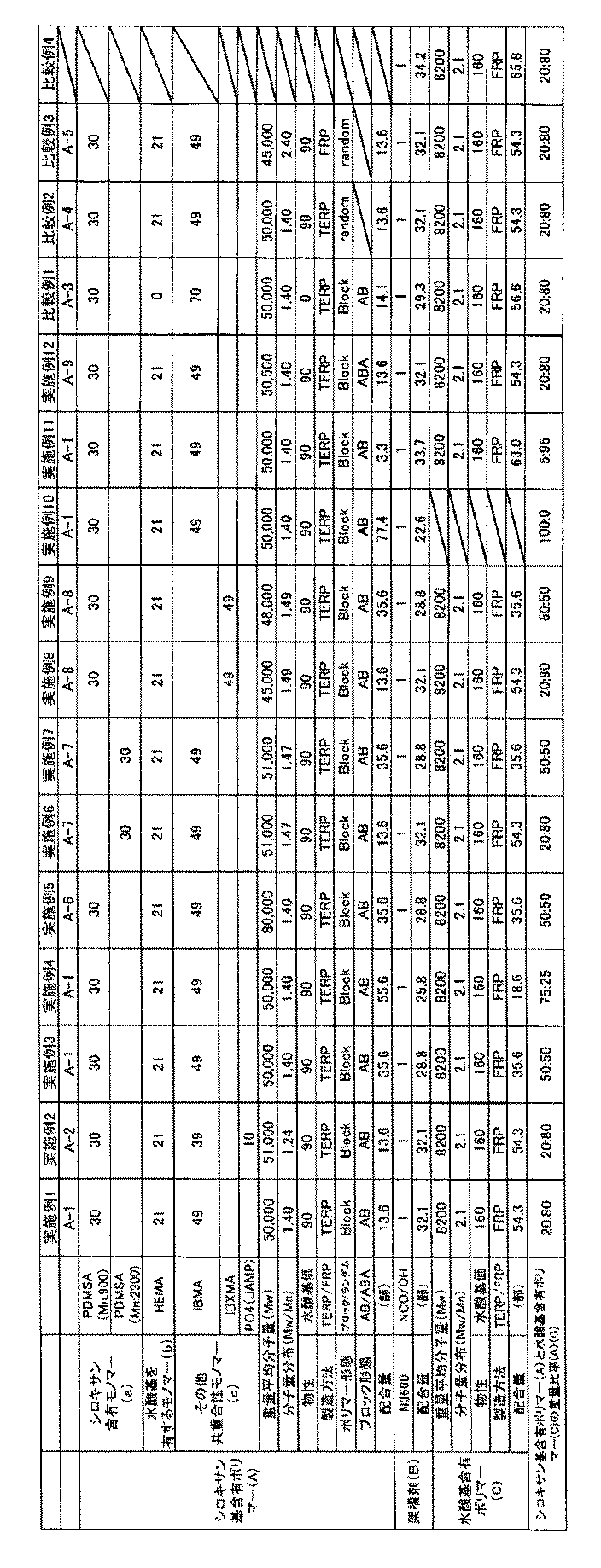
- Table 1 shows the amount of the monomer of the siloxane group-containing polymer (A-1), the weight average molecular weight (Mw), the molecular weight distribution (Mw / Mn), the hydroxyl value, and the production method (method using an organic tellurium compound (TERP)). / Free radical polymerization method (FRP)), polymer form (block polymer / random polymer) and block form (AB / ABA distinction) are described.
- FRP Free radical polymerization method
- siloxane Group-Containing Polymer (A-3) A siloxane group-containing polymer (A-3) was obtained in the same manner except that 42 g of HEMA and 98 g of iBMA in Production Example 1 were changed to 140 g of iBMA.
- Block morphology (AB / ABA distinction) and monomer formulations are shown in Table 1.
- the A block was polymerized by reacting at 60 ° C. for 36 hours.
- Table 1 shows the physical characteristics of the obtained siloxane group-containing polymer (A-6) of the AB block.
- Table 1 shows the amount of the monomer of the siloxane group-containing polymer (A-1), the weight average molecular weight (Mw), the molecular weight distribution (Mw / Mn), the hydroxyl value, the production method (TERP / FRP), and the polymer form (block). Polymer / random polymer) and block morphology (AB / ABA distinction) are described.
- Acrylic monomer containing a siloxane group previously substituted with argon in the above reaction solution (manufactured by Shin-Etsu Chemical Co., Ltd .: X-22-174BX [functional group equivalent (g / mol)]: 2300 [number average molecular weight: 2300]: "PDMSA" in Table 1.
- a mixed solution (second monomer composition) of 60.0 g, AIBN 0.33 g, and butyl acetate 60 g was added and reacted at 60 ° C. for 36 hours to polymerize the A block.
- Table 1 shows the physical characteristics of the obtained siloxane group-containing polymer (A-1) of the AB block.
- Table 1 shows the amount of the monomer of the siloxane group-containing polymer (A-7), the weight average molecular weight (Mw), the molecular weight distribution (Mw / Mn), the hydroxyl value, the production method (TERP / FRP), and the polymer form (block). Polymer / random polymer) and block morphology (AB / ABA distinction) are described.
- Production Example 8 Production of siloxane Group-Containing Polymer (A-8) In a flask equipped with an argon gas introduction tube and a stirring blade, BTEE 1.49 g, DBDT 0.92 g, HEMA 42 g, isobornyl methacrylate (IBXMA) 98 g, AIBN 0. .33 g and 140 g of butyl acetate were charged (first monomer composition) and reacted at 60 ° C. for 36 hours to polymerize the B block.
- BTEE 1.49 g, DBDT 0.92 g, HEMA 42 g, isobornyl methacrylate (IBXMA) 98 g, AIBN 0. .33 g and 140 g of butyl acetate were charged (first monomer composition) and reacted at 60 ° C. for 36 hours to polymerize the B block.
- the A block was polymerized by reacting at 60 ° C. for 36 hours.
- Table 1 shows the physical characteristics of the obtained siloxane group-containing polymer (A-8) of the AB block.
- Table 1 shows the amount of the monomer of the siloxane group-containing polymer (A-8), the weight average molecular weight (Mw), the molecular weight distribution (Mw / Mn), the hydroxyl value, the production method (TERP / FRP), and the polymer form (block). Polymer / random polymer) and block morphology (AB / ABA distinction) are described.
- Production Example 9 Production of siloxane Group-Containing Polymer (A-9)
- a siloxane group-containing acrylic monomer manufactured by Shin-Etsu Chemical Co., Ltd .: X-22-174ASX 60.
- a mixed solution (first monomer composition) of 0 g, AIBN 0.33 g, and butyl acetate 60 g was added and reacted at 60 ° C. for 36 hours to polymerize the A block.
- the A block was polymerized by reacting at 60 ° C. for 36 hours.
- Table 1 shows the physical characteristics of the obtained siloxane group-containing polymer (A-9) of ABA triblock.
- Table 1 shows the amount of the monomer of the siloxane group-containing polymer (A-9), the weight average molecular weight (Mw), the molecular weight distribution (Mw / Mn), the hydroxyl value, the production method (TERP / FRP), and the polymer form (block). Polymer / random polymer) and block morphology (AB / ABA distinction) are described.
- the number average molecular weight (Mn), weight average molecular weight (Mw) and molecular weight distribution (Mw / Mn) were measured by the following methods. [Measurement of number average molecular weight (Mn), weight average molecular weight (Mw) and molecular weight distribution (Mw / Mn)]
- GPC gel permeation chromatography
- the column is TSKgel SuperMultipore HZ-H ( ⁇ 4.6 x 150) x 2 (manufactured by Tosoh Corporation), tetrahydrofuran as the mobile phase, and polystyrene (manufactured by Tosoh Corporation) as the standard material.
- TSK Standard was used to prepare a calibration curve, and the weight average molecular weight (Mw) and the number average molecular weight (Mn) were measured.
- the molecular weight distribution (Mw / Mn) was calculated from these measured values.
- a mixed solution of 204 g of butyl acetate and 20.4 g of kayaester O was added dropwise over 30 minutes as a post-initiator, and the reaction was continued for another 1 hour to reach a solid content of 60%.
- the mixture was diluted with butyl acetate to obtain a hydroxyl group-containing polymer (C).
- Table 1 shows the weight average molecular weight (Mw), molecular weight distribution (Mw / Mn), hydroxyl value, and production method (TERP / FRP) of the hydroxyl group-containing polymer (C).
- B cross-linking agent
- Comparative Example 4 is an example in which the siloxane group-containing polymer is not blended.
- Table 1 also shows the weight ratio of the siloxane group-containing polymer (A) to the hydroxyl group-containing polymer (C) (siloxane group-containing polymer (A): hydroxyl group-containing polymer (C)).
- Table 1 shows the formulation, various physical characteristics, and evaluation results of the obtained coating film.
- High-pressure water injection conditions injection nozzle (1/4 PMEG-2506), water flow (11 L / min), water temperature (50 ° C), cleaning time (1 minute), water injection distance (10 cm) ⁇ ... Dirt is blown off at the same time as water injection, and there is no black stain on the paint film where it was blown off ⁇ ... Dirt is not blown off cleanly. Black stains remain on the painted surface.
- This test is a test method for evaluating the degree of adhesion of oil-based organic contaminants and the ease of removal, and is a substitute test for the removal of oil-based contaminants from the viewpoint of ease of removing stains.
- Comparative Example 1 is an example in which the hydroxyl group-containing vinyl monomer is not blended with the siloxane group-containing vinyl polymer, and the compatibility is poor and the transparency of the coating film is not good.
- Comparative Example 2 is an example of random polymerization rather than block polymerization, and the transparency of the coating film is also inferior.
- Comparative Example 3 is an example of random polymerization and a case where the molecular weight distribution (Mw / Mn) is high, and the transparency of the coating film is also inferior.
- Comparative Example 4 is an example in which the siloxane group-containing polymer is not blended, and the evaluation of water repellency is inferior.
Landscapes
- Chemical & Material Sciences (AREA)
- Organic Chemistry (AREA)
- Chemical Kinetics & Catalysis (AREA)
- Health & Medical Sciences (AREA)
- Medicinal Chemistry (AREA)
- Polymers & Plastics (AREA)
- Life Sciences & Earth Sciences (AREA)
- Engineering & Computer Science (AREA)
- Materials Engineering (AREA)
- Wood Science & Technology (AREA)
- Paints Or Removers (AREA)
- Graft Or Block Polymers (AREA)
Abstract
Description
[1]シロキサン基含有ポリマー(A)および架橋剤(B)を含む塗料用組成物であり、
前記シロキサン基含有ポリマー(A)が、AブロックとBブロックとを含むブロック共重合体であり、Aブロックに少なくともシロキサン基含有ビニルモノマー(a)に由来する構造単位を含み、Bブロックに水酸基含有ビニルモノマー(b)に由来する構造単位ならびに必要に応じて、前記ビニルモノマー(a)および(b)と共重合可能な他のビニルモノマー(c)に由来する構造単位を含み、
かつ、分子量分布(Mw/Mn)が2.0以下であり、リビングラジカル重合により重合された共重合体である、
塗料用組成物を提供する。また、本発明は、更に以下の態様を提供する:
[3]前記シロキサン基含有ポリマー(A)の重量平均分子量(Mw)が、5,000~100,000である、[1]または[2]の塗料用組成物。
[4]前記リビングラジカル重合が下記式(1):
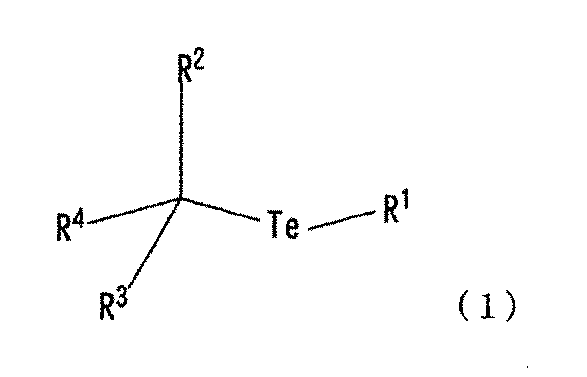
で表される有機テルル化合物を用いて重合する方法である、[1]~[3]のいずれかに記載の塗料用組成物。
[5]更に、水酸基含有ポリマー(C)を含む、[1]~[4]のいずれかに記載の塗料用組成物。
[6]前記シロキサン基含有ポリマー(A)と前記水酸基含有ポリマー(C)との配合割合が、シロキサン基含有ポリマー(A):水酸基含有ポリマー(C)の重量比で15:85~80:20の割合である[1]~[5]のいずれかに記載の塗料用組成物。
[7]前記シロキサン基含有ビニルモノマー(a)の数平均分子量(Mn)が、500~50,000である、[1]~[6]のいずれかに記載の塗料用組成物。
[8]前記架橋剤(B)が、イソシアネート系架橋剤である、[1]~[7]のいずれかに記載の塗料用組成物。
上記シロキサン基含有ポリマー(A)は、AブロックとBブロックとを含むブロック共重合体であり、Aブロックに少なくともシロキサン基含有ビニルモノマー(a)に由来する構造単位を含み、Bブロックに水酸基含有ビニルモノマー(b)ならびに必要に応じて、前記ビニルモノマー(a)および(b)と共重合可能な他のビニルモノマー(c)に由来する構造単位を含み、
かつ、分子量分布(Mw/Mn)が2.0以下であり、リビングラジカル重合により重合された共重合体である。
本明細書中で「ビニルモノマー」とは分子中にラジカル重合可能な炭素−炭素二重結合を有するモノマーのことをいう。「ビニルモノマーに由来する構造単位」とは、ビニルモノマーのラジカル重合可能な炭素−炭素二重結合が、重合して炭素−炭素単結合になった構造単位をいう。

で表されるものである。上記式(I)のシロキサン基含有ビニルモノマー(a)は下記式II:

(メタ)アクリル酸、β−カルボキシエチルアクリレートなどのアクリル酸のダイマー酸等のカルボキシル基含有モノマー類;
シクロヘキシル(メタ)アクリレート、シクロヘキシルオキシアルキル(メタ)クリレート、t−ブチルシクロヘキシルオキシエチル(メタ)アクリレート、イソボルニル(メタ)アクリレート、ジシクロペンタニル(メタ)アクリレート、ジシクロペンタニル(メタ)アクリレート等の脂環含有モノマー類;
ポリエチレングリコールモノ(メタ)アクリレートのリン酸エステル、(モノ(プロピレングリコールモノメタクリレート)ホスフェート等のポリプロピレングリコールモノ(メタ)アクリレートのリン酸エステル、リン酸メチレン(メタ)アクリレート、リン酸トリメチレン(メタ)アクリレート、リン酸プロピレン(メタ)アクリレート、リン酸テトラメチレン(メタ)アクリレート等のリン酸アルキレン(メタ)アクリレート等のリン酸基含有(メタ)アクリレート類;
エチレンスルホン酸、アリルスルホン酸、メタアリルスルホン酸等のオレフィンスルホン酸、2−アクリルアミド−2−メチルプロパンスルホン酸、スチレンスルホン酸、スルホン酸基含有モノマー類あるいはその塩;
メトキシメチル(メタ)アクリルアミド、エトキシメチル(メタ)アクリルアミド、プロポキシメチル(メタ)アクリルアミド、イソプロポキシメチル(メタ)アクリルアミド、n−ブトキシメチル(メタ)アクリルアミド、イソブトキシメチル(メタ)アクリルアミドなどのアルコキシアルキル(メタ)アクリルアミド系モノマー、(メタ)アクリロイル
モルホリン、ジメチル(メタ)アクリルアミド、ジエチル(メタ)アクリルアミド、(メタ)アクリルアミドN−メチロール(メタ)アクリルアミド等の(メタ)アクリルアミド系モノマー類;
グリシジルアクリレート、フルフリルアクリレート、テトラヒドロフルフリルアクリレート、グリシジルメタクリレート、フルフリルメタクリレート、テトラヒドロフルフリルメタクリレート、メチルビニルケトン、スチレン、α−メチルスチレン、N−ビニルカプロラクタム、酢酸ビニル等;
が挙げられ、特にイソボルニル(メタ)アクリレート、ジシクロペンタニル(メタ)アクリレートは塗膜物性バランスの観点から好ましい。
下記式(1):
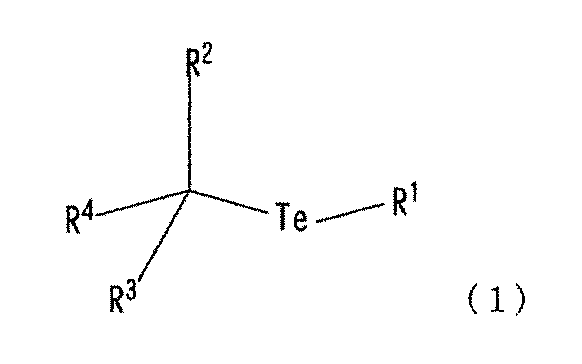
式(2):
(R1Te)2 (2)
〔式中、R1は、上記と同じ。〕
本発明の塗料用組成物に配合する架橋剤は、特に限定されるものではないが、シロキサン基含有ポリマー(A)に存在する水酸基と架橋反応するものであり、イソシアネート系架橋剤、エポキシ系架橋剤、アミノプラスト樹脂、グリオキサール等が挙げられる。これら架橋剤は、単独で使用してもよいし、2種以上を併用してもよい。
本発明の塗料用組成物には、必要に応じて水酸基含有ポリマー(C)を配合することができる。水酸基含有ポリマー(C)としては、例えば、アクリル樹脂、シリコーンアクリル樹脂、ポリエステル樹脂、アルキド樹脂、シリコーンポリエステル樹脂、エポキシ樹脂、エポキシエステル樹脂、フッソ樹脂等を挙げることができるが、これらのうちアクリル樹脂、ポリエステル樹脂、アルキド樹脂、エポキシ樹脂、エポキシエステル樹脂が好適に使用できる。水酸基含有ポリマー(C)は、官能基の制御や製造の容易性から、水酸基を含有するアクリル樹脂(以下、「アクリルポリオール樹脂」と呼ぶこともある。)が好ましい。
本発明の塗料用組成物は、上記塗料用組成物を構成する各成分を、通常用いられる手段によって混合することによって、調製することができる。上記塗料用組成物には、必要に応じて、顔料、表面調整剤(消泡剤、レベリング剤等)、顔料分散剤、可塑剤、造膜助剤、紫外線吸収剤、酸化防止剤、難燃剤、帯電防止剤、静電助剤、熱安定剤、光安定剤、溶剤(水、有機溶剤)その他の添加剤を含有してもよい。
本発明の塗料用組成物が塗布される被塗物として、鉄、鋼、ステンレス、アルミニウム、銅、亜鉛、スズなどの金属およびこれらの合金などの鋼板;ポリエチレン樹脂、EVA樹脂、ポリオレフィン樹脂(ポリエチレン樹脂、ポリプロピレン樹脂など)、塩化ビニル樹脂、スチロール樹脂、ポリエステル樹脂(PET樹脂、PBT樹脂などを含む)、不飽和ポリエステル樹脂、ポリカーボネート樹脂、アクリル樹脂、アクリロニトリルブタジエンスチレン(ABS)樹脂、アクリロニトリルスチレン(AS)樹脂、ポリアミド樹脂、アセタール樹脂、フェノール樹脂、フッ素樹脂、メラミン樹脂、ウレタン樹脂、エポキシ樹脂、ポリフェニレンオキサイド(PPO)などの樹脂;および、有機−無機ハイブリッド材などが挙げられる。これらは成形された状態であってもよい。本発明の塗料用組成物は、特にポリエチレン樹脂、ポリオレフィン樹脂(ポリエチレン樹脂、ポリプロピレン樹脂など)、スチロール樹脂、ポリエステル樹脂(PET樹脂、PBT樹脂などを含む)、ポリカーボネート樹脂などの帯電しやすい材料や、FRP、CFRPに用いる不飽和ポリエステル樹脂の時に効果を発揮する。
製造例1 シロキサン基含有ポリマー(A−1)の製造
アルゴンガス導入管、撹拌翼を供えたフラスコに、エチル−2−メチル−2−n−ブチルテラニル−プロピオネート(BTEE)1.49g、ジブチルジテルリド(DBDT)0.92g、メタクリル酸2−ヒドロキシエチル(HEMA)42g、メタクリル酸イソブチル(iBMA)98g、2,2’−アゾビス(イソブチロニトリル)(AIBN)0.33g、酢酸ブチル140gを仕込み(第1モノマー組成物)、60℃で36時間反応させBブロックを重合した。
アルゴンガス導入管、撹拌翼を供えたフラスコに、BTEE 1.49g、DBDT 0.92g、HEMA 42g、iBMA 78g、AIBN 0.33g、酢酸ブチル120gを仕込み(第1モノマー組成物)、60℃で36時間反応させBブロックを重合した。
製造例1のHEMA 42g、iBMA 98gをiBMA 140gに変更したこと以外は同様にし、シロキサン基含有ポリマー(A−3)を得た。得られたシロキサン基含有ポリマー(A−3)の物性、重量平均分子量(Mw)、分子量分布(Mw/Mn)、水酸基価、製造方法(TERP/FRP)、ポリマー形態(ブロックポリマー/ランダムポリマー)、ブロック形態(AB/ABAの区別)およびモノマーの配合を表1に示す。
アルゴンガス導入管、撹拌翼を供えたフラスコに、BTEE 1.49g、DBDT 0.92g、HEMA 42g、iBMA 98g、X−22−174ASX 60g、AIBN 0.33g、酢酸ブチル400gを仕込み(第1モノマー組成物)、60℃で36時間反応させランダム構造のシロキサン基含有ポリマー(A−4)を得た。得られたランダム構造のシロキサン基含有ポリマー(A−4)の物性、重量平均分子量(Mw)、分子量分布(Mw/Mn)、水酸基価、製造方法(TERP/FRP)、ポリマー形態(ブロックポリマー/ランダムポリマー)、ブロック形態(AB/ABAの区別)およびモノマーの配合を表1に示す。
温度調節器、攪拌翼、還流管、窒素導入口を備えた0.2Lのセパラブルフラスコに、酢酸ブチル30gを仕込み、フラスコ内部を窒素雰囲気下にした後、温度を120℃に昇温して一定に保った。一方、HEMA 20.88g、iBMA 49.12g、X−22−174ASX 30gおよびカヤエステルO 0.88gの混合液を滴下ロートに入れて、3時間かけて滴下した。
アルゴンガス導入管、撹拌翼を供えたフラスコに、BTEE 1.49g、DBDT 0.92g、HEMA 42g、iBMA 98g、AIBN 0.33g、酢酸ブチル140gを仕込み(第1モノマー組成物)、60℃で36時間反応させBブロックを重合した。
アルゴンガス導入管、撹拌翼を供えたフラスコに、BTEE 1.49g、DBDT 0.92g、HEMA 42g、iBMA 98g、AIBN 0.33g、酢酸ブチル140gを仕込み(第1モノマー組成物)、60℃で36時間反応させBブロックを重合した。
アルゴンガス導入管、撹拌翼を供えたフラスコに、BTEE 1.49g、DBDT 0.92g、HEMA 42g、メタクリル酸イソボルニル(IBXMA)98g、AIBN 0.33g、酢酸ブチル140gを仕込み(第1モノマー組成物)、60℃で36時間反応させBブロックを重合した。
アルゴンガス導入管、撹拌翼を供えたフラスコに、予めアルゴン置換したシロキサン基含有アクリルモノマー(信越化学社製:X−22−174ASX)60.0g、AIBN 0.33g、酢酸ブチル60gの混合溶液(第1モノマー組成物)を加え、60℃で36時間反応させAブロックを重合した。
[数平均分子量(Mn)、重量平均分子量(Mw)及び分子量分布(Mw/Mn)の測定]
ゲルパーミエーションクロマトグラフィー(GPC)にて、カラムはTSKgel SuperMultipore HZ−H(Φ4.6×150)×2(東ソー(株)製)、移動相としてテトラヒドロフラン、標準物質としてポリスチレン(東ソー(株)製、TSK Standard)を使用して検量線を作成し、重量平均分子量(Mw)、数平均分子量(Mn)を測定した。これらの測定値から分子量分布(Mw/Mn)を算出した。
温度調節器、攪拌翼、還流管、窒素導入口を備えた2Lのセパラブルフラスコに、酢酸ブチル444.27gを仕込み、フラスコ内部を窒素雰囲気下にした後、温度を130℃に昇温して一定に保った。一方、スチレン(ST)255g、メタクリル酸(MAA)8.5g、HEMA 394.4g、アクリル酸2−エチルヘキシル(EHA)117.47g、iBMA 74.72g、およびカヤエステルO 102gの混合液を滴下ロートに入れて、3時間かけて滴下した。
塗料用組成物および塗膜の作成
シロキサン基含有ポリマー(A)(A−1~A−9)、架橋剤(B)としてのN3600(コベストロ社製、NCO%=23)、水酸基含有ポリマー(C)を表1に記載した配合量で配合し、酢酸ブチルを用いて樹脂分を50重量%に希釈した塗料用組成物を、アプリケーターを用いて、乾燥膜厚が30μmになるように、ブリキ板上に塗装し、試験片は、温度20±5℃、相対湿度78%以下の塗装環境下で7分間放置した。尚、比較例4はシロキサン基含有ポリマーを配合していない例である。尚、表1には、シロキサン基含有ポリマー(A)と水酸基含有ポリマー(C)の重量比率(シロキサン基含有ポリマー(A):水酸基含有ポリマー(C))も記載した。
塗膜の表面を目視観察し、下記の基準で評価した。
○:塗膜は透明であり全く異常が認められない
△:塗膜がうっすらと乳白色である。
×:塗膜に白濁が認められる
カーボンブラック(Furnace black(KREMER pigmente)に、松脂、テルピネオール、リモネンを入れ、ディスパーで攪拌させ、黒色のタール状液体を得た。これを油系有機汚染物とした。アプリケーターを用いて、乾燥膜厚が約20μmになるように、実施例で得られた塗膜の上にこれを塗工し、熱風乾燥機を用いて80℃下で、30分間乾燥させたものを下記条件で評価した。
高圧水噴射条件:噴射ノズル(1/4PMEG−2506)、水流(11L/min),水温(50℃)、洗浄時間(1分)、水噴射距離(10cm)
○…水噴射と同時に汚れが吹き飛び、吹き飛んだところの塗膜に黒色の汚れがない
×…汚れがきれいに吹き飛ばない。塗面に黒い汚れが残っている。
実施例で得られた塗膜の上に、エビアン(商品名)を、アトマイザーを用いて噴霧させ、塗膜の上に水滴をのせた。これを熱風乾燥機で60℃下、10分間乾燥させ、水垢を塗膜に固着させた。塗膜を水道水に流しながらスポンジを用い10往復洗浄した後の塗膜に残った水垢を目視により評価した。
◎…水垢が固着していない
○…水垢がほとんどとれている。小さな点状で残っている。
×…水垢がコーヒーリングのように環になって固着している。(外観が悪い)
協和界面科学社製のDMo−701型接触角計を用い、25℃、55%RHの雰囲気下で、約1μLの蒸留水を塗膜表面に着滴させ、10秒後の液滴と塗膜表面とのなす角をθ/2法にて算出した。
◎…接触角が95度以上、
○…接触角が85度以上、
×…接触角が85度未満。
洗車を想定して、コンパウンド剤(#7500番)を電動ポリッシャーで10秒間、ポリッシングし、中性洗剤を用いイオン交換水で塗膜を水洗した後、常温乾燥させたものを測定塗膜とした。
協和界面科学社製のDMo−701型接触角計を用い、25℃、55%RHの雰囲気下で、約1μLの蒸留水を塗膜表面に着滴させ、10秒後の液滴と塗膜表面とのなす角をθ/2法にて算出した。
◎…接触角が95度以上、
○…接触角が85度以上、
×…接触角が85度未満。
得られた塗膜の上にトルエンを2μl滴下し、5分間静置した。5分後にドライウエスでふき取った後の外観を以下の基準で評価した。
○…塗膜外観に異常がみられない。
△…うっすらと液滴のあとが残る。

Claims (8)
- シロキサン基含有ポリマー(A)および架橋剤(B)を含む塗料用組成物であり、
前記シロキサン基含有ポリマー(A)が、AブロックとBブロックとを含むブロック共重合体であり、Aブロックに少なくともシロキサン基含有ビニルモノマー(a)に由来する構造単位を含み、Bブロックに水酸基含有ビニルモノマー(b)に由来する構造単位ならびに必要に応じて、前記ビニルモノマー(a)および(b)と共重合可能な他のビニルモノマー(c)に由来する構造単位を含み、
かつ、分子量分布(Mw/Mn)が2.0以下であり、リビングラジカル重合により重合された共重合体である、
塗料用組成物。 - 前記シロキサン基含有ポリマー(A)が、AB型ジブロック共重合体またはABA型トリブロック共重合体である、請求項1記載の塗料用組成物。
- 前記シロキサン基含有ポリマー(A)の重量平均分子量(Mw)が、5,000~100,000である、請求項1または請求項2に記載の塗料用組成物。
- 前記リビングラジカル重合が、下記式(1):

で表される有機テルル化合物を用いて重合する方法である、請求項1~3のいずれか一項に記載の塗料用組成物。 - 更に、水酸基含有ポリマー(C)を含む、請求項1~4のいずれか一項に記載の塗料用組成物。
- 前記シロキサン基含有ポリマー(A)と前記水酸基含有ポリマー(C)との配合割合が、シロキサン基含有ポリマー(A):水酸基含有ポリマー(C)の重量比で15:85~80:20の割合である請求項1~5のいずれか一項に記載の塗料用組成物。
- 前記シロキサン基含有ビニルモノマー(a)の数平均分子量(Mn)が、500~50,000である、請求項1~6のいずれか一項に記載の塗料用組成物。
- 前記架橋剤(B)が、イソシアネート系架橋剤である、請求項1~7のいずれか一項に記載の塗料用組成物。
Priority Applications (5)
| Application Number | Priority Date | Filing Date | Title |
|---|---|---|---|
| EP21866809.3A EP4212598B1 (en) | 2020-09-09 | 2021-09-02 | Composition for coating materials |
| CN202180055038.7A CN116096770B (zh) | 2020-09-09 | 2021-09-02 | 涂料用组合物 |
| JP2022505638A JP7061241B1 (ja) | 2020-09-09 | 2021-09-02 | 塗料用組成物 |
| US18/024,813 US20230312974A1 (en) | 2020-09-09 | 2021-09-02 | Composition for coating materials |
| JP2022030873A JP7772617B2 (ja) | 2020-09-09 | 2022-03-01 | 塗料用組成物 |
Applications Claiming Priority (2)
| Application Number | Priority Date | Filing Date | Title |
|---|---|---|---|
| JP2020-151233 | 2020-09-09 | ||
| JP2020151233 | 2020-09-09 |
Publications (1)
| Publication Number | Publication Date |
|---|---|
| WO2022054851A1 true WO2022054851A1 (ja) | 2022-03-17 |
Family
ID=80631882
Family Applications (1)
| Application Number | Title | Priority Date | Filing Date |
|---|---|---|---|
| PCT/JP2021/033069 Ceased WO2022054851A1 (ja) | 2020-09-09 | 2021-09-02 | 塗料用組成物 |
Country Status (5)
| Country | Link |
|---|---|
| US (1) | US20230312974A1 (ja) |
| EP (1) | EP4212598B1 (ja) |
| JP (2) | JP7061241B1 (ja) |
| CN (1) | CN116096770B (ja) |
| WO (1) | WO2022054851A1 (ja) |
Families Citing this family (2)
| Publication number | Priority date | Publication date | Assignee | Title |
|---|---|---|---|---|
| JP2023117014A (ja) * | 2022-02-10 | 2023-08-23 | 日本ペイント・オートモーティブコーティングス株式会社 | 塗料用組成物 |
| EP4491687A4 (en) * | 2022-06-28 | 2025-05-14 | Nippon Paint Marine Coatings Co., Ltd. | COATING MATERIAL COMPOSITION, AND COATING FILM |
Citations (8)
| Publication number | Priority date | Publication date | Assignee | Title |
|---|---|---|---|---|
| JPH11293184A (ja) | 1998-04-14 | 1999-10-26 | Kansai Paint Co Ltd | 滑水性表面を形成し得るポリマー組成物 |
| WO2004014848A1 (ja) | 2002-08-06 | 2004-02-19 | Otsuka Chemical Co., Ltd. | 有機テルル化合物、その製造方法、リビングラジカル重合開始剤、それを用いるポリマーの製造方法及びポリマー |
| WO2004014962A1 (ja) | 2002-08-08 | 2004-02-19 | Otsuka Chemical Co., Ltd. | リビングラジカルポリマーの製造方法及びポリマー |
| WO2004072126A1 (ja) | 2003-02-17 | 2004-08-26 | Otsuka Chemical Co., Ltd. | リビングラジカルポリマーの製造方法及びポリマー |
| WO2004096870A1 (ja) | 2003-04-25 | 2004-11-11 | Otsuka Chemical Co., Ltd. | リビングラジカルポリマーの製造方法及びポリマー |
| CN101875707A (zh) * | 2009-04-30 | 2010-11-03 | 比亚迪股份有限公司 | 一种含氟poss丙烯酸酯共聚物及其制备方法与一种涂料 |
| US20110071251A1 (en) * | 2008-05-12 | 2011-03-24 | Bogdan Hariton Dana | Siliconated polyesters and polyacrylates having a low voc |
| WO2021131726A1 (ja) * | 2019-12-25 | 2021-07-01 | Dic株式会社 | 重合体及び当該重合体を含むコーティング組成物 |
Family Cites Families (14)
| Publication number | Priority date | Publication date | Assignee | Title |
|---|---|---|---|---|
| CN1073137C (zh) * | 1995-11-28 | 2001-10-17 | 大日本油墨化学工业株式会社 | 水基涂料用固化性树脂组合物 |
| JP2002114941A (ja) * | 2000-07-31 | 2002-04-16 | Nippon Paint Co Ltd | 撥水性塗料用硬化性樹脂組成物及び塗装物 |
| JP4684465B2 (ja) * | 2001-05-02 | 2011-05-18 | 中国塗料株式会社 | オルガノポリシロキサンチオブロックビニル共重合体および該共重合体を含む防汚塗料組成物 |
| JP5315681B2 (ja) * | 2007-12-12 | 2013-10-16 | Tdk株式会社 | ハードコート用組成物、ハードコート層を有する物体およびその製造方法 |
| KR101217749B1 (ko) * | 2008-12-11 | 2013-01-02 | 디아이씨 가부시끼가이샤 | 경화성 수지 조성물 및 도료, 그것을 적층하여 이루어지는 플라스틱 성형체 |
| EP2514776B1 (en) * | 2009-12-18 | 2014-12-10 | Chugoku Marine Paints, Ltd. | Metal-crosslinked organopolysiloxane-thio block vinyl copolymer, and antifouling coating composition containing the copolymer |
| EP2581405A1 (en) * | 2011-10-12 | 2013-04-17 | Vrije Universiteit Brussel | Copolymer nanocomposite |
| US10073192B2 (en) * | 2012-05-25 | 2018-09-11 | Johnson & Johnson Vision Care, Inc. | Polymers and nanogel materials and methods for making and using the same |
| JP2014065864A (ja) * | 2012-09-27 | 2014-04-17 | Dic Corp | ポリシロキサン樹脂組成物、表示装置及び半導体デバイス |
| US10676575B2 (en) * | 2016-10-06 | 2020-06-09 | Johnson & Johnson Vision Care, Inc. | Tri-block prepolymers and their use in silicone hydrogels |
| CN108504261A (zh) * | 2017-03-13 | 2018-09-07 | 博九通科技股份有限公司 | 电活性聚合物溶液或涂层、形成其的组合物及方法、包含其的物件,以及电容器及其制法 |
| JP7295694B2 (ja) * | 2018-05-10 | 2023-06-21 | 中国塗料株式会社 | 防汚塗料組成物 |
| JP6826095B2 (ja) * | 2018-12-21 | 2021-02-03 | 日本ペイント・オートモーティブコーティングス株式会社 | 複層塗膜形成方法 |
| CN109852272B (zh) * | 2018-12-27 | 2021-10-08 | 昆山乐凯锦富光电科技有限公司 | 一种汽车漆面保护膜 |
-
2021
- 2021-09-02 WO PCT/JP2021/033069 patent/WO2022054851A1/ja not_active Ceased
- 2021-09-02 CN CN202180055038.7A patent/CN116096770B/zh active Active
- 2021-09-02 JP JP2022505638A patent/JP7061241B1/ja active Active
- 2021-09-02 EP EP21866809.3A patent/EP4212598B1/en active Active
- 2021-09-02 US US18/024,813 patent/US20230312974A1/en active Pending
-
2022
- 2022-03-01 JP JP2022030873A patent/JP7772617B2/ja active Active
Patent Citations (8)
| Publication number | Priority date | Publication date | Assignee | Title |
|---|---|---|---|---|
| JPH11293184A (ja) | 1998-04-14 | 1999-10-26 | Kansai Paint Co Ltd | 滑水性表面を形成し得るポリマー組成物 |
| WO2004014848A1 (ja) | 2002-08-06 | 2004-02-19 | Otsuka Chemical Co., Ltd. | 有機テルル化合物、その製造方法、リビングラジカル重合開始剤、それを用いるポリマーの製造方法及びポリマー |
| WO2004014962A1 (ja) | 2002-08-08 | 2004-02-19 | Otsuka Chemical Co., Ltd. | リビングラジカルポリマーの製造方法及びポリマー |
| WO2004072126A1 (ja) | 2003-02-17 | 2004-08-26 | Otsuka Chemical Co., Ltd. | リビングラジカルポリマーの製造方法及びポリマー |
| WO2004096870A1 (ja) | 2003-04-25 | 2004-11-11 | Otsuka Chemical Co., Ltd. | リビングラジカルポリマーの製造方法及びポリマー |
| US20110071251A1 (en) * | 2008-05-12 | 2011-03-24 | Bogdan Hariton Dana | Siliconated polyesters and polyacrylates having a low voc |
| CN101875707A (zh) * | 2009-04-30 | 2010-11-03 | 比亚迪股份有限公司 | 一种含氟poss丙烯酸酯共聚物及其制备方法与一种涂料 |
| WO2021131726A1 (ja) * | 2019-12-25 | 2021-07-01 | Dic株式会社 | 重合体及び当該重合体を含むコーティング組成物 |
Non-Patent Citations (3)
| Title |
|---|
| BO LI, ET AL.: "Synthesis of POSS-containing fluorosilicone block copolymers via RAFT polymerization for application as non-wetting coating materials", PROGRESS IN ORGANIC COATINGS, ELSEVIER BV, NL, vol. 78, 1 January 2015 (2015-01-01), NL , pages 188 - 199, XP055564089, ISSN: 0300-9440, DOI: 10.1016/j.porgcoat.2014.09.004 * |
| See also references of EP4212598A4 |
| ZHENG XUMIN, ZHENGCHUN CAI, ZHENGWEI LYU, YONGKANG CHEN, YONGXIN JI: "Synthesis of Si-containing macro-RAFT agent for the water-borne polyacrylate polyurethane with anti-graffiti coating applications", MATERIALS TODAY COMMUNICATIONS, vol. 25, 31 August 2020 (2020-08-31), XP055911024, DOI: 10.1016/j.mtcomm.2020.101590 * |
Also Published As
| Publication number | Publication date |
|---|---|
| JPWO2022054851A1 (ja) | 2022-03-17 |
| EP4212598A1 (en) | 2023-07-19 |
| CN116096770B (zh) | 2024-09-13 |
| JP7061241B1 (ja) | 2022-04-27 |
| EP4212598A4 (en) | 2024-10-02 |
| EP4212598B1 (en) | 2025-10-22 |
| JP2022075709A (ja) | 2022-05-18 |
| CN116096770A (zh) | 2023-05-09 |
| JP7772617B2 (ja) | 2025-11-18 |
| US20230312974A1 (en) | 2023-10-05 |
Similar Documents
| Publication | Publication Date | Title |
|---|---|---|
| JP7306793B2 (ja) | 多成分型の水性下塗塗料組成物及び塗装方法 | |
| JP6866007B2 (ja) | 水性2液型クリヤ塗料組成物及びこれを用いた塗装体の補修塗装方法。 | |
| JP2023067964A (ja) | 多成分型の水性下塗塗料組成物及び塗装方法 | |
| CN110157311B (zh) | 水性双剂型聚氨酯涂料组合物 | |
| WO2023153189A1 (ja) | 塗料用組成物 | |
| KR20160098458A (ko) | 다층 래커 피니시의 생산 방법 | |
| JP7061241B1 (ja) | 塗料用組成物 | |
| JP2020111723A (ja) | 水性多液型ポリウレタン塗料組成物 | |
| JP5208378B2 (ja) | 塗料組成物とこれを用いた複層塗膜形成方法および塗装物品 | |
| JP4983935B2 (ja) | 硬化性樹脂組成物 | |
| JP7467794B2 (ja) | 塗料組成物及び塗膜形成方法 | |
| JP7467793B2 (ja) | 塗料組成物及び塗膜形成方法 | |
| JP5324726B2 (ja) | クリヤー塗料組成物及びそれを用いた複層塗膜の形成方法 | |
| WO2023203867A1 (ja) | 水性多液型ポリウレタン塗料組成物 | |
| JP5279984B2 (ja) | 塗料組成物及び塗装物品 | |
| JP2000160097A (ja) | 水性塗料及びこれを用いた塗装仕上げ工法 | |
| JP5309273B1 (ja) | クリヤー塗料組成物及びそれを用いた複層塗膜の形成方法 | |
| JP4744871B2 (ja) | 自動車用クリヤー塗料組成物及びそれを用いた複層塗膜の形成方法 | |
| CN113874447A (zh) | 水性涂料组合物及使用所述组合物形成多层涂膜的方法 | |
| JP7353542B1 (ja) | 水性多液型ポリウレタン塗料組成物 | |
| IE913723A1 (en) | Curable composition | |
| JPH09221630A (ja) | 塗料組成物及びそれを用いて得られる塗膜 | |
| JP2024146708A (ja) | 水系塗料組成物及び複層塗膜形成方法 | |
| WO2023189304A1 (ja) | 水性多液型ポリウレタン塗料組成物 | |
| JP2022040000A (ja) | 帯電防止コーティング組成物 |
Legal Events
| Date | Code | Title | Description |
|---|---|---|---|
| ENP | Entry into the national phase |
Ref document number: 2022505638 Country of ref document: JP Kind code of ref document: A |
|
| 121 | Ep: the epo has been informed by wipo that ep was designated in this application |
Ref document number: 21866809 Country of ref document: EP Kind code of ref document: A1 |
|
| NENP | Non-entry into the national phase |
Ref country code: DE |
|
| ENP | Entry into the national phase |
Ref document number: 2021866809 Country of ref document: EP Effective date: 20230411 |
|
| WWG | Wipo information: grant in national office |
Ref document number: 2021866809 Country of ref document: EP |