WO2022075307A1 - 熱伝導性樹脂組成物及び電子機器 - Google Patents
熱伝導性樹脂組成物及び電子機器 Download PDFInfo
- Publication number
- WO2022075307A1 WO2022075307A1 PCT/JP2021/036778 JP2021036778W WO2022075307A1 WO 2022075307 A1 WO2022075307 A1 WO 2022075307A1 JP 2021036778 W JP2021036778 W JP 2021036778W WO 2022075307 A1 WO2022075307 A1 WO 2022075307A1
- Authority
- WO
- WIPO (PCT)
- Prior art keywords
- meth
- acrylic monomer
- monomer unit
- resin composition
- silicone resin
- Prior art date
- Legal status (The legal status is an assumption and is not a legal conclusion. Google has not performed a legal analysis and makes no representation as to the accuracy of the status listed.)
- Ceased
Links
Images

Classifications
-
- C—CHEMISTRY; METALLURGY
- C08—ORGANIC MACROMOLECULAR COMPOUNDS; THEIR PREPARATION OR CHEMICAL WORKING-UP; COMPOSITIONS BASED THEREON
- C08L—COMPOSITIONS OF MACROMOLECULAR COMPOUNDS
- C08L51/00—Compositions of graft polymers in which the grafted component is obtained by reactions only involving carbon-to-carbon unsaturated bonds; Compositions of derivatives of such polymers
- C08L51/08—Compositions of graft polymers in which the grafted component is obtained by reactions only involving carbon-to-carbon unsaturated bonds; Compositions of derivatives of such polymers grafted on to macromolecular compounds obtained otherwise than by reactions only involving unsaturated carbon-to-carbon bonds
- C08L51/085—Compositions of graft polymers in which the grafted component is obtained by reactions only involving carbon-to-carbon unsaturated bonds; Compositions of derivatives of such polymers grafted on to macromolecular compounds obtained otherwise than by reactions only involving unsaturated carbon-to-carbon bonds on to polysiloxanes
-
- C—CHEMISTRY; METALLURGY
- C08—ORGANIC MACROMOLECULAR COMPOUNDS; THEIR PREPARATION OR CHEMICAL WORKING-UP; COMPOSITIONS BASED THEREON
- C08F—MACROMOLECULAR COMPOUNDS OBTAINED BY REACTIONS ONLY INVOLVING CARBON-TO-CARBON UNSATURATED BONDS
- C08F220/00—Copolymers of compounds having one or more unsaturated aliphatic radicals, each having only one carbon-to-carbon double bond, and only one being terminated by only one carboxyl radical or a salt, anhydride ester, amide, imide or nitrile thereof
- C08F220/02—Monocarboxylic acids having less than ten carbon atoms; Derivatives thereof
- C08F220/04—Acids; Metal salts or ammonium salts thereof
- C08F220/06—Acrylic acid; Methacrylic acid; Metal salts or ammonium salts thereof
-
- C—CHEMISTRY; METALLURGY
- C08—ORGANIC MACROMOLECULAR COMPOUNDS; THEIR PREPARATION OR CHEMICAL WORKING-UP; COMPOSITIONS BASED THEREON
- C08F—MACROMOLECULAR COMPOUNDS OBTAINED BY REACTIONS ONLY INVOLVING CARBON-TO-CARBON UNSATURATED BONDS
- C08F220/00—Copolymers of compounds having one or more unsaturated aliphatic radicals, each having only one carbon-to-carbon double bond, and only one being terminated by only one carboxyl radical or a salt, anhydride ester, amide, imide or nitrile thereof
- C08F220/02—Monocarboxylic acids having less than ten carbon atoms; Derivatives thereof
- C08F220/10—Esters
- C08F220/26—Esters containing oxygen in addition to the carboxy oxygen
- C08F220/30—Esters containing oxygen in addition to the carboxy oxygen containing aromatic rings in the alcohol moiety
- C08F220/301—Esters containing oxygen in addition to the carboxy oxygen containing aromatic rings in the alcohol moiety and one oxygen in the alcohol moiety
-
- C—CHEMISTRY; METALLURGY
- C08—ORGANIC MACROMOLECULAR COMPOUNDS; THEIR PREPARATION OR CHEMICAL WORKING-UP; COMPOSITIONS BASED THEREON
- C08F—MACROMOLECULAR COMPOUNDS OBTAINED BY REACTIONS ONLY INVOLVING CARBON-TO-CARBON UNSATURATED BONDS
- C08F220/00—Copolymers of compounds having one or more unsaturated aliphatic radicals, each having only one carbon-to-carbon double bond, and only one being terminated by only one carboxyl radical or a salt, anhydride ester, amide, imide or nitrile thereof
- C08F220/02—Monocarboxylic acids having less than ten carbon atoms; Derivatives thereof
- C08F220/10—Esters
- C08F220/34—Esters containing nitrogen, e.g. N,N-dimethylaminoethyl (meth)acrylate
-
- C—CHEMISTRY; METALLURGY
- C08—ORGANIC MACROMOLECULAR COMPOUNDS; THEIR PREPARATION OR CHEMICAL WORKING-UP; COMPOSITIONS BASED THEREON
- C08F—MACROMOLECULAR COMPOUNDS OBTAINED BY REACTIONS ONLY INVOLVING CARBON-TO-CARBON UNSATURATED BONDS
- C08F220/00—Copolymers of compounds having one or more unsaturated aliphatic radicals, each having only one carbon-to-carbon double bond, and only one being terminated by only one carboxyl radical or a salt, anhydride ester, amide, imide or nitrile thereof
- C08F220/02—Monocarboxylic acids having less than ten carbon atoms; Derivatives thereof
- C08F220/52—Amides or imides
- C08F220/54—Amides, e.g. N,N-dimethylacrylamide or N-isopropylacrylamide
- C08F220/58—Amides, e.g. N,N-dimethylacrylamide or N-isopropylacrylamide containing oxygen in addition to the carbonamido oxygen, e.g. N-methylolacrylamide, N-(meth)acryloylmorpholine
- C08F220/585—Amides, e.g. N,N-dimethylacrylamide or N-isopropylacrylamide containing oxygen in addition to the carbonamido oxygen, e.g. N-methylolacrylamide, N-(meth)acryloylmorpholine and containing other heteroatoms, e.g. 2-acrylamido-2-methylpropane sulfonic acid [AMPS]
-
- C—CHEMISTRY; METALLURGY
- C08—ORGANIC MACROMOLECULAR COMPOUNDS; THEIR PREPARATION OR CHEMICAL WORKING-UP; COMPOSITIONS BASED THEREON
- C08F—MACROMOLECULAR COMPOUNDS OBTAINED BY REACTIONS ONLY INVOLVING CARBON-TO-CARBON UNSATURATED BONDS
- C08F230/00—Copolymers of compounds having one or more unsaturated aliphatic radicals, each having only one carbon-to-carbon double bond, and containing phosphorus, selenium, tellurium or a metal
- C08F230/02—Copolymers of compounds having one or more unsaturated aliphatic radicals, each having only one carbon-to-carbon double bond, and containing phosphorus, selenium, tellurium or a metal containing phosphorus
-
- C—CHEMISTRY; METALLURGY
- C08—ORGANIC MACROMOLECULAR COMPOUNDS; THEIR PREPARATION OR CHEMICAL WORKING-UP; COMPOSITIONS BASED THEREON
- C08F—MACROMOLECULAR COMPOUNDS OBTAINED BY REACTIONS ONLY INVOLVING CARBON-TO-CARBON UNSATURATED BONDS
- C08F230/00—Copolymers of compounds having one or more unsaturated aliphatic radicals, each having only one carbon-to-carbon double bond, and containing phosphorus, selenium, tellurium or a metal
- C08F230/04—Copolymers of compounds having one or more unsaturated aliphatic radicals, each having only one carbon-to-carbon double bond, and containing phosphorus, selenium, tellurium or a metal containing a metal
- C08F230/08—Copolymers of compounds having one or more unsaturated aliphatic radicals, each having only one carbon-to-carbon double bond, and containing phosphorus, selenium, tellurium or a metal containing a metal containing silicon
-
- C—CHEMISTRY; METALLURGY
- C08—ORGANIC MACROMOLECULAR COMPOUNDS; THEIR PREPARATION OR CHEMICAL WORKING-UP; COMPOSITIONS BASED THEREON
- C08F—MACROMOLECULAR COMPOUNDS OBTAINED BY REACTIONS ONLY INVOLVING CARBON-TO-CARBON UNSATURATED BONDS
- C08F290/00—Macromolecular compounds obtained by polymerising monomers on to polymers modified by introduction of aliphatic unsaturated end or side groups
- C08F290/02—Macromolecular compounds obtained by polymerising monomers on to polymers modified by introduction of aliphatic unsaturated end or side groups on to polymers modified by introduction of unsaturated end groups
- C08F290/06—Polymers provided for in subclass C08G
- C08F290/068—Polysiloxanes
-
- C—CHEMISTRY; METALLURGY
- C08—ORGANIC MACROMOLECULAR COMPOUNDS; THEIR PREPARATION OR CHEMICAL WORKING-UP; COMPOSITIONS BASED THEREON
- C08K—Use of inorganic or non-macromolecular organic substances as compounding ingredients
- C08K3/00—Use of inorganic substances as compounding ingredients
- C08K3/01—Use of inorganic substances as compounding ingredients characterized by their specific function
- C08K3/013—Fillers, pigments or reinforcing additives
-
- C—CHEMISTRY; METALLURGY
- C08—ORGANIC MACROMOLECULAR COMPOUNDS; THEIR PREPARATION OR CHEMICAL WORKING-UP; COMPOSITIONS BASED THEREON
- C08K—Use of inorganic or non-macromolecular organic substances as compounding ingredients
- C08K9/00—Use of pretreated ingredients
- C08K9/04—Ingredients treated with organic substances
- C08K9/06—Ingredients treated with organic substances with silicon-containing compounds
-
- C—CHEMISTRY; METALLURGY
- C08—ORGANIC MACROMOLECULAR COMPOUNDS; THEIR PREPARATION OR CHEMICAL WORKING-UP; COMPOSITIONS BASED THEREON
- C08L—COMPOSITIONS OF MACROMOLECULAR COMPOUNDS
- C08L55/00—Compositions of homopolymers or copolymers, obtained by polymerisation reactions only involving carbon-to-carbon unsaturated bonds, not provided for in groups C08L23/00 - C08L53/00
-
- C—CHEMISTRY; METALLURGY
- C08—ORGANIC MACROMOLECULAR COMPOUNDS; THEIR PREPARATION OR CHEMICAL WORKING-UP; COMPOSITIONS BASED THEREON
- C08L—COMPOSITIONS OF MACROMOLECULAR COMPOUNDS
- C08L83/00—Compositions of macromolecular compounds obtained by reactions forming in the main chain of the macromolecule a linkage containing silicon with or without sulfur, nitrogen, oxygen or carbon only; Compositions of derivatives of such polymers
- C08L83/04—Polysiloxanes
-
- C—CHEMISTRY; METALLURGY
- C08—ORGANIC MACROMOLECULAR COMPOUNDS; THEIR PREPARATION OR CHEMICAL WORKING-UP; COMPOSITIONS BASED THEREON
- C08L—COMPOSITIONS OF MACROMOLECULAR COMPOUNDS
- C08L83/00—Compositions of macromolecular compounds obtained by reactions forming in the main chain of the macromolecule a linkage containing silicon with or without sulfur, nitrogen, oxygen or carbon only; Compositions of derivatives of such polymers
- C08L83/10—Block- or graft-copolymers containing polysiloxane sequences
-
- C—CHEMISTRY; METALLURGY
- C09—DYES; PAINTS; POLISHES; NATURAL RESINS; ADHESIVES; COMPOSITIONS NOT OTHERWISE PROVIDED FOR; APPLICATIONS OF MATERIALS NOT OTHERWISE PROVIDED FOR
- C09K—MATERIALS FOR MISCELLANEOUS APPLICATIONS, NOT PROVIDED FOR ELSEWHERE
- C09K5/00—Heat-transfer, heat-exchange or heat-storage materials, e.g. refrigerants; Materials for the production of heat or cold by chemical reactions other than by combustion
- C09K5/08—Materials not undergoing a change of physical state when used
- C09K5/14—Solid materials, e.g. powdery or granular
-
- H—ELECTRICITY
- H05—ELECTRIC TECHNIQUES NOT OTHERWISE PROVIDED FOR
- H05K—PRINTED CIRCUITS; CASINGS OR CONSTRUCTIONAL DETAILS OF ELECTRIC APPARATUS; MANUFACTURE OF ASSEMBLAGES OF ELECTRICAL COMPONENTS
- H05K7/00—Constructional details common to different types of electric apparatus
- H05K7/20—Modifications to facilitate cooling, ventilating, or heating
- H05K7/2039—Modifications to facilitate cooling, ventilating, or heating characterised by the heat transfer by conduction from the heat generating element to a dissipating body
- H05K7/20436—Inner thermal coupling elements in heat dissipating housings, e.g. protrusions or depressions integrally formed in the housing
- H05K7/20445—Inner thermal coupling elements in heat dissipating housings, e.g. protrusions or depressions integrally formed in the housing the coupling element being an additional piece, e.g. thermal standoff
- H05K7/20463—Filling compound, e.g. potted resin
-
- C—CHEMISTRY; METALLURGY
- C08—ORGANIC MACROMOLECULAR COMPOUNDS; THEIR PREPARATION OR CHEMICAL WORKING-UP; COMPOSITIONS BASED THEREON
- C08G—MACROMOLECULAR COMPOUNDS OBTAINED OTHERWISE THAN BY REACTIONS ONLY INVOLVING UNSATURATED CARBON-TO-CARBON BONDS
- C08G77/00—Macromolecular compounds obtained by reactions forming a linkage containing silicon with or without sulfur, nitrogen, oxygen or carbon in the main chain of the macromolecule
- C08G77/04—Polysiloxanes
-
- C—CHEMISTRY; METALLURGY
- C08—ORGANIC MACROMOLECULAR COMPOUNDS; THEIR PREPARATION OR CHEMICAL WORKING-UP; COMPOSITIONS BASED THEREON
- C08G—MACROMOLECULAR COMPOUNDS OBTAINED OTHERWISE THAN BY REACTIONS ONLY INVOLVING UNSATURATED CARBON-TO-CARBON BONDS
- C08G77/00—Macromolecular compounds obtained by reactions forming a linkage containing silicon with or without sulfur, nitrogen, oxygen or carbon in the main chain of the macromolecule
- C08G77/42—Block-or graft-polymers containing polysiloxane sequences
- C08G77/442—Block-or graft-polymers containing polysiloxane sequences containing vinyl polymer sequences
-
- C—CHEMISTRY; METALLURGY
- C08—ORGANIC MACROMOLECULAR COMPOUNDS; THEIR PREPARATION OR CHEMICAL WORKING-UP; COMPOSITIONS BASED THEREON
- C08K—Use of inorganic or non-macromolecular organic substances as compounding ingredients
- C08K2201/00—Specific properties of additives
- C08K2201/001—Conductive additives
-
- C—CHEMISTRY; METALLURGY
- C08—ORGANIC MACROMOLECULAR COMPOUNDS; THEIR PREPARATION OR CHEMICAL WORKING-UP; COMPOSITIONS BASED THEREON
- C08K—Use of inorganic or non-macromolecular organic substances as compounding ingredients
- C08K2201/00—Specific properties of additives
- C08K2201/002—Physical properties
- C08K2201/005—Additives being defined by their particle size in general
-
- C—CHEMISTRY; METALLURGY
- C08—ORGANIC MACROMOLECULAR COMPOUNDS; THEIR PREPARATION OR CHEMICAL WORKING-UP; COMPOSITIONS BASED THEREON
- C08L—COMPOSITIONS OF MACROMOLECULAR COMPOUNDS
- C08L2312/00—Crosslinking
Definitions
- the present invention relates to a thermally conductive resin composition and an electronic device using the same.
- Metal heat sinks and housings are used for cooling, and heat conductive materials are used to efficiently transfer heat from heat-generating electronic components to cooling parts such as heat sinks and housings.
- heat conductive materials are used to efficiently transfer heat from heat-generating electronic components to cooling parts such as heat sinks and housings.
- the heat curable resin is filled with the heat conductive filler, and the heat conductive pad or the heat conductive sheet formed into a sheet, and the fluid resin are filled with the heat conductive filler.
- heat conductive greases that can be applied and thinned, and phase change type heat conductive materials that soften or fluidize at the operating temperature of heat-generating electronic components.
- the sheet-shaped heat-dissipating material is easy to handle and has excellent long-term shape retention, but it has a large contact thermal resistance and is inferior to the grease-like material in terms of automatic mounting. Therefore, in recent years, the use of thermal paste with a thickness of 0.3 mm or more, which is mainly used for sheets, is increasing. Along with this, it is often used in a vertical position, and there is a demand for a thermally conductive grease having both coatability and slip resistance.
- Such thermal paste generally contains an inorganic filler in which the surface is treated with a silane coupling agent or the like in the resin.
- a surface treatment agent other than the silane coupling agent for example, a copolymer containing a polybutadiene structural unit, a structural unit having a hydrolyzable silyl group, and a structural unit having a polysiloxane skeleton is known (). For example, see Patent Document 1).
- Patent Document 1 proposes the use of a high molecular weight surface treatment agent.
- Patent Document 2 an organopolysiloxane containing a thermally conductive filler is crosslinked with an organic peroxide to improve the slip resistance. Further, in Patent Document 3, the iron oxide filler is mixed, and in Patent Document 4, the aluminum hydroxide filler is mixed in a specific ratio to improve the slip resistance.
- Patent Document 2 is configured such that the half-life of an organic peroxide is 10 hours under a predetermined temperature, and there still remains a problem in long-term slip resistance. Further, in Patent Documents 3 and 4, since the heat conductive filler that can be used is limited, the degree of freedom in designing the heat radiating grease is lost, and it is difficult to exhibit sufficient heat radiating characteristics.
- the present invention has been made in view of the above problems, and has good fluidity without being restricted by the type of the heat conductive filler, and is maintained in a high temperature state for a long time.
- the heat conductive resin composition which can maintain the dispersibility of the heat conductive filler, suppress the occurrence of voids and cracks, suppress bleed-out, and has excellent slip resistance.
- the purpose is to provide an electronic device using the same.
- the present invention has been made in view of the above problems, and it has been found that the above problems can be solved by using a copolymer containing a predetermined monomer unit and a crosslinked silicone resin.
- the invention was completed.
- the total content of the copolymer (a) and the silicone resin (b) is 100 parts by weight.
- the silicone resin (b) contains a crosslinked silicone resin (b-1).
- the content of the crosslinked silicone resin (b-1) is 5 to 100% by mass with respect to the total amount of the silicone resin (b).
- Thermally conductive resin composition [2]
- the silicone resin (b) further contains a non-crosslinked silicone resin (b-2).
- the content of the crosslinked silicone resin (b-1) is 5 to 99% by mass with respect to the total amount of the silicone resin (b).
- the content of the non-crosslinked silicone resin (b-2) is 95 to 1% by mass with respect to the total amount of the silicone resin (b).
- the non-crosslinked silicone resin (b-2) is a linear polyorganosiloxane.
- the viscosity of the non-crosslinked silicone resin (b-2) is 1 to 10,000 mPa ⁇ s as a value measured at a shear rate of 10 sec -1 at 25 ° C.
- the thermally conductive resin composition according to [2] or [3].
- the crosslinked silicone resin (b-1) contains a polyorganosiloxane (b-1-1) having two or more alkenyl groups in the molecule and a polyorganosiloxane having two or more SiH groups in the molecule. (B-1-2) reacts with (b-1-2).
- the thermally conductive resin composition according to any one of [1] to [4].
- the anionic group comprises one or more selected from the group consisting of a carboxy group, a phosphoric acid group, and a phenolic hydroxy group.
- the (meth) acrylic monomer unit A further has an electron-withdrawing group bonded to the anionic group.
- the cationic group comprises one or more selected from the group consisting of a primary amino group, a secondary amino group, a tertiary amino group, and a quaternary ammonium salt.
- the (meth) acrylic monomer unit B further has an electron donating group bonded to the cationic group.
- the thermally conductive resin composition according to any one of [1] to [8].
- the weight average molecular weight of the copolymer (a) is 5,000 to 500,000.
- the total content of the (meth) acrylic monomer unit A and the (meth) acrylic monomer unit B is the (meth) acrylic monomer unit A and the (meth) acrylic monomer unit.
- the amount is 0.05 to 90 mol% with respect to a total of 100 mol% of the unit B and the silicone (meth) acrylic monomer unit C.
- the thermally conductive resin composition according to any one of [1] to [10].
- the content of the (meth) acrylic monomer unit A is the (meth) acrylic monomer unit A, the (meth) acrylic monomer unit B, and the silicone (meth) acrylic monomer unit. 0.03 to 85 mol% with respect to the total 100 mol% of the body unit C.
- the content of the (meth) acrylic monomer unit B is the (meth) acrylic monomer unit A, the (meth) acrylic monomer unit B, and the silicone (meth) acrylic monomer unit. 0.1 to 10 mol% with respect to the total 100 mol% of the body unit C.
- the thermally conductive resin composition according to any one of [1] to [12].
- the content of the silicone (meth) acrylic monomer unit C is the (meth) acrylic monomer unit A, the (meth) acrylic monomer unit B, and the silicone (meth) acrylic monomer unit. It is 10 to 99.5 mol% with respect to the total 100 mol% of the dimer unit C.
- the thermally conductive resin composition according to any one of [1] to [13].
- the molar ratio of the (meth) acrylic monomer unit A to the (meth) acrylic monomer unit B is 0.01 to 50.
- the thermally conductive resin composition according to any one of [1] to [14].
- the surface treatment agent (d) is contained in an amount of 0.01 to 5 parts by weight with respect to 100 parts by weight of the heat conductive filler (c).
- the heat conductive filler (c) is at least one selected from aluminum, aluminum hydroxide, aluminum oxide, aluminum nitride, boron nitride, zinc oxide, magnesium oxide, and diamond.
- It has a heating element, a heat sink, and the thermally conductive resin composition according to any one of [1] to [17] or a cured product thereof.
- the heat conductive resin composition or the cured product is arranged between the heating element and the heat sink. Electronics.
- the present invention has good fluidity without being restricted by the type of the heat conductive filler, and the dispersibility of the heat conductive filler even when it is held at a high temperature for a long time.
- a thermally conductive resin composition capable of maintaining the above-mentioned properties, suppressing the occurrence of voids and cracks, suppressing bleed-out, and having excellent slip resistance, and an electronic device using the same. be able to.
- the present embodiment will be described in detail, but the present invention is not limited thereto, and various modifications can be made without departing from the gist thereof. Is.
- the thermally conductive resin composition of the present embodiment has a (meth) acrylic monomer unit A having an anionic group, a (meth) acrylic monomer unit B having a cationic group, and a silicone (meth). 5 to 95 parts by weight of the copolymer (a) having the acrylic monomer unit C, 95 to 5 parts by weight of the silicone resin (b), and a heat conductive filler (c) 500 of 10 W / mK or more.
- the total content of the copolymer (a) and the silicone resin (b) is 100 parts by weight, and the silicone resin (b) contains a crosslinked silicone resin (b-1).
- the content of the crosslinked silicone resin (b-1) is 5 to 100% by mass with respect to the total amount of the silicone resin (b).
- the heat conductivity is high.
- the dispersibility of the filler (c) can be maintained.
- the copolymer (a) it is possible to use various thermally conductive fillers, and it is possible to suppress the occurrence of voids and cracks even when the copolymer is held at a high temperature for a long time. It becomes.
- the thermally conductive resin composition of the present embodiment by using the crosslinked silicone resin (b-1), the bleed-out of the silicone resin (b) can be suppressed and the slip resistance is improved. Is possible.
- the copolymer (a) has a (meth) acrylic monomer unit A having an anionic group, a (meth) acrylic monomer unit B having a cationic group, and a silicone (meth) acrylic single amount. It has a body unit C.
- the copolymer (a) of the present embodiment can maintain the dispersibility of the heat conductive filler (c) even when it is held at a high temperature for a long time. ..
- the reasons are considered as follows, but are not limited to the following.
- a predetermined potential difference is generated at the interface where two different substances are in contact, such as the surface of a dispersoid dispersed in a dispersion medium, attracting counterions, and an electric double layer consisting of a stationary phase and a diffusion double layer is formed.
- the spread of counterions on the surface of the dispersoid is also called the thickness of the electric double layer.
- the copolymer (a) of the present embodiment has an effect of increasing the thickness of the electric double layer by having both anionic and cationic groups in the molecule.
- one of the anionic group and the cationic group of the copolymer (a) is arranged near the surface of the dispersoid as a counterion.
- the other group (co-ion), which does not function as a counterion, is then located farther than the surface of the dispersoid, where it can further form a co-ion layer.
- the "monomer” refers to a monomer having a polymerizable unsaturated bond before polymerization, and the “monomer unit” constitutes a part of the copolymer (a) after polymerization.
- a repeating unit which is a unit derived from a predetermined monomer.
- the (meth) acrylic contains acrylic and methacrylic, and the (meth) acrylic monomer contains (meth) acrylate and (meth) acrylamide.
- “(meth) acrylic monomer unit A” and the like are also simply referred to as “unit A” and the like.
- the (meth) acrylic monomer unit A is a repeating unit having an anionic group.
- the anionic group is not particularly limited, and examples thereof include a carboxy group, a phosphoric acid group, a phenolic hydroxy group, and a sulfonic acid group. Among these, it is preferably one or more selected from the group consisting of a carboxy group, a phosphoric acid group, and a phenolic hydroxy group. By having such a group, the dispersibility of the dispersoid tends to be further improved.
- the unit A further has an electron-withdrawing group bonded to an anionic group.
- the electron-withdrawing group is not particularly limited as long as it has an action of stabilizing the anion of the anionic group.
- an acrylic monomer containing an electron-withdrawing substituent such as a halogen element in the carbon atom at the ⁇ -position of the carboxy group may be used. By having such a group, the dispersibility of the dispersoid tends to be further improved.
- the unit A preferably does not have an electron donating group bonded to an anionic group or has a group having a low electron donating property.
- the electron-donating group is not particularly limited as long as it has an action of destabilizing the anion of the anionic group.
- an acrylic monomer that does not contain a substituent of an electron donating group such as a methyl group in the carbon atom at the ⁇ -position of the carboxy group may be used. With such a structure, the dispersibility of the dispersoid tends to be further improved.
- the (meth) acrylic monomer is not particularly limited, and is, for example, acrylic acid, methacrylic acid, acid phosfoxpropyl methacrylate, acid phosphooxypolyoxyethylene glycol monomethacrylate, and acid phosphooxypoly.
- Oxypropylene glycol monomethacrylate, phosphate-modified epoxy acrylate, 2-acryloyloxyethyl acid phosphate, 2-methacryloyloxyethyl acid phosphate, 4-hydroxyphenylacrylate, 4-hydroxyphenylmecrylate, 2-methacryloyloxyethyl succinic acid, 2 -Acrylamide-2-methylpropanesulfonic acid and the like can be mentioned.
- acrylic acid 2-methacryloyloxyethyl phosphate, 4-hydroxyphenylmecrilate, and 2-acrylamide-2-methylpropanesulfonic acid are preferable, and acrylic acid is more preferable.
- acrylic acid is more preferable.
- the unit A may be used alone or in combination of two or more.
- the (meth) acrylic monomer unit B is a repeating unit having a cationic group.
- the cationic group is not particularly limited, but is preferably at least one selected from the group consisting of, for example, a primary amino group, a secondary amino group, a tertiary amino group, and a quaternary ammonium salt. .. Of these, the tertiary amino group is more preferable. By having such a group, the dispersibility of the dispersoid tends to be further improved.
- the unit B further has an electron donating group bonded to a cationic group.
- the electron-donating group is not particularly limited as long as it has an action of stabilizing the cation of the cationic group.
- an acrylic monomer containing an electron-donating substituent such as a methyl group at the carbon atom at the ⁇ -position of the amino group may be used. By having such a group, the dispersibility of the dispersoid tends to be further improved.
- the unit B preferably does not have an electron-withdrawing group bonded to a cationic group, or has a group with low electron-withdrawing property.
- the electron-withdrawing group is not particularly limited as long as it has an action of destabilizing the cation of the cationic group.
- an acrylic monomer that does not contain a substituent of an electron-withdrawing group such as a carboxy group in the carbon atom at the ⁇ -position of the amino group may be used. With such a structure, the dispersibility of the dispersoid tends to be further improved.
- the (meth) acrylic monomer is not particularly limited, and for example, 1-aminoethyl acrylate, 1-aminopropyl acrylate, 1-aminoethyl methacrylate, 1-aminopropyl methacrylate, dimethylaminoethyl methacrylate, and the like.
- 1,2,2,6,6-pentamethyl-4-piperidyl methacrylate and 2,2,6,6-tetramethyl-4-piperidyl methacrylate are preferable, and 1,2,2,6,6- Pentamethyl-4-piperidylmethacrylate is more preferred.
- the unit B may be used alone or in combination of two or more.
- the (meth) acrylic monomer unit C is a silicone (meth) acrylic monomer unit, which does not contain a cationic group or an anionic group in the molecule and has a silicone group (meth) acrylic monomer unit.
- the body is a silicone (meth) acrylic monomer unit, which does not contain a cationic group or an anionic group in the molecule and has a silicone group (meth) acrylic monomer unit.
- the (meth) acrylic monomer C has an affinity with the resin used in the resin composition. It is preferable to have a skeleton having high sex or compatibility.
- the (meth) acrylic monomer C has a silicone skeleton such as dimethylsiloxane, methylphenylsiloxane, or diphenylsiloxane as such a skeleton.
- the (meth) acrylic monomer is not particularly limited, but is, for example, a (meth) acrylic single amount having a siloxane skeleton such as ⁇ -butyl- ⁇ - (3-methacryloxypropyl) polydimethylsiloxane.
- the body etc. can be mentioned.
- the unit C may be used alone or in combination of two or more.
- the number average molecular weight of the (meth) acrylic monomer C is preferably 300 to 20000, more preferably 1000 to 15000, and further preferably 3000 to 12500.
- the number average molecular weight of the (meth) acrylic monomer C is 300 or more, the affinity for the dispersion medium is further improved, and the dispersibility of the dispersoid tends to be further improved.
- the number average molecular weight of the (meth) acrylic monomer C is 20000 or less, the viscosity of the composition obtained when the copolymer (a) is mixed with other resins or other components becomes higher. It tends to decrease and the handleability is further improved.
- the total content of the unit A and the unit B is preferably 0.05 to 90 mol%, more preferably 0.2 to 80 mol% with respect to the total 100 mol% of the unit A, the unit B, and the unit C. %, More preferably 0.5 to 75 mol%.
- the total content of the unit A and the unit B is 0.05 mol% or more, the affinity for the dispersion medium is further improved, and the dispersibility of the dispersoid tends to be further improved.
- the total content of the unit A and the unit B is 90 mol% or less, the viscosity of the composition obtained when the copolymer (a) is mixed with another resin or another component is further lowered. , Handleability tends to be improved.
- the content of the unit A is preferably 0.03 to 85 mol%, more preferably 0.05 to 80 mol%, based on 100 mol% of the total of the unit A, the unit B, and the unit C. More preferably, it is 0.10 to 75 mol%.
- the content of the unit A is 0.03 mol% or more, the affinity for the dispersion medium is further improved, and the dispersibility of the dispersoid tends to be further improved.
- the content of the unit A is 85 mol% or less, the viscosity of the composition obtained when the copolymer (a) is mixed with other resins or other components is further lowered, and the handleability is improved. It tends to improve.
- the molar ratio of unit A to unit B is preferably 0.01 to 50, more preferably 1.0 to 45, and even more preferably 5.0 to 40.
- the affinity for the dispersion medium is further improved, and the dispersibility of the dispersoid tends to be further improved.
- the content of the unit B is preferably 0.1 to 10 mol%, more preferably 1.0 to 7.5 mol%, based on 100 mol% of the total of the unit A, the unit B, and the unit C. Yes, more preferably 1.0 to 5.0 mol%.
- the content of the unit B is 0.1 mol% or more, the affinity for the filler tends to be further improved.
- the handleability derived from the viscosity of the copolymer (a) tends to be further improved.
- the content of the unit C is preferably 10 to 99.5 mol%, more preferably 20 to 95 mol%, still more preferably, based on 100 mol% of the total of the unit A, the unit B, and the unit C. Is 25-90 mol%.
- the content of the unit C is 10 mol% or more, the handleability derived from the viscosity of the copolymer (a) tends to be further improved.
- the affinity for the filler tends to be further improved.
- the weight average molecular weight of the copolymer (a) is preferably 5,000 to 500,000, more preferably 7,000 to 150,000, and even more preferably 10,000 to 100,000.
- the weight average molecular weight of the copolymer (a) is 5,000 or more, the dispersibility can be maintained even when the copolymer (a) is held at a high temperature for a long time, and the increase in hardness of the composition is suppressed. be able to.
- the weight average molecular weight of the copolymer (a) is 5,000 or more, the shape retention of the composition when blended with the heat conductive filler (c) or the resin is improved, and the slope or vertical is improved. When applied to a surface, the composition has better resistance to slippage and sagging.
- the weight average molecular weight of the copolymer (a) is 500,000 or less, the viscosity of the composition obtained when the copolymer (a) is mixed with other resins or other components is further lowered. However, the handleability tends to be improved.
- the weight average molecular weight can be determined by GPC (gel permeation chromatography).
- the content of the copolymer (a) is 5 to 95 parts by weight, preferably 5 to 70 parts by weight, based on 100 parts by weight of the total of the copolymer (a) and the silicone resin (b). More preferably, it is 5 to 50 parts by weight.
- the content of the copolymer (a) is within the above range, the fluidity and the dispersibility of the heat conductive filler are further improved, and the occurrence of voids and cracks is further suppressed.
- the method for producing the copolymer (a) of the present embodiment is not particularly limited, and a known polymerization method of the (meth) acrylic monomer can be used.
- the polymerization method include radical polymerization and anionic polymerization. Of these, radical polymerization is preferable.
- the thermal polymerization initiator used for radical polymerization is not particularly limited, but is, for example, an azo compound such as azobisisobutyronitrile; organic peroxide such as benzoyl peroxide, tert-butyl hydroperoxide and di-tert-butyl peroxide. Things can be mentioned.
- the photopolymerization initiator used for radical polymerization is not particularly limited, and examples thereof include benzoin derivatives.
- known polymerization initiators such as ATRP and RAFT used for living radical polymerization can also be used.
- the polymerization conditions are not particularly limited and can be appropriately adjusted depending on the initiator used, the boiling point of the solvent, and the type of the monomer.
- the order of adding the monomers is not particularly limited, but for example, the monomers may be mixed and the polymerization may be started from the viewpoint of synthesizing a random copolymer, or simply from the viewpoint of synthesizing a block copolymer.
- the weights may be added sequentially to the polymerization system.
- the silicone resin (b) contains a crosslinked silicone resin (b-1), and may further contain a non-crosslinked silicone resin (b-2), if necessary.
- crosslinked type refers to a three-dimensionally crosslinked silicone resin
- non-crosslinked type refers to a linear or annular silicone resin having no three-dimensionally crosslinked.
- the silicone resin (b) may be used alone or in combination of two or more.
- the crosslinked silicone resin (b-1) is not particularly limited as long as it is three-dimensionally crosslinked, and examples thereof include non-curable silicone resins and curable silicone resins. Among these, the non-curable silicone resin is preferable as the crosslinked silicone resin (b-1). By using such a crosslinked silicone resin (b-1), bleed-out is suppressed and the slip resistance tends to be further improved.
- the crosslinked silicone resin (b-1) is a polyorganosiloxane (b-1-1) having two or more alkenyl groups in the molecule and a polyorganosiloxane (b-1) containing two or more SiH groups in the molecule. It is preferable that b-1-2) and are reacted with each other. Examples of such polyorganosiloxane (b-1-1) and polyorganosiloxane (b-1-2) include addition-curable silicone resins described later.
- the crosslinked silicone resin (b-1) preferably has a trifunctional unit (RSiO 3/2 ) or a tetrafunctional unit (SiO 4/2 ) as a crosslink point.
- silicone resins are monofunctional units (R 1 SiO 1/2 ), bifunctional units (R 2 SiO 2/2 ), trifunctional units (R 3 SiO 3/2 ), and tetrafunctional units (SiO 4 / ). It can be represented by 2 ).
- a linear silicone resin can be expressed as having a monofunctional unit (R 1 SiO 1/2 ) constituting the terminal and a bifunctional unit (R 2 SiO 2/2 ) constituting the main chain ().
- n3, n4 0)
- the three-dimensionally crosslinked silicone resin has a trifunctional unit (R 3 SiO 3/2 ) and / or a tetrafunctional unit (SiO 4/2 ) constituting the branch point, and further constitutes the end of the branched chain. It can be expressed as having one functional unit (R 1 SiO 1/2 ) and a bifunctional unit (R 2 SiO 2/2 ) constituting a branched chain.
- n1 to n4 indicate the composition ratio of each unit, and can be expressed at a ratio such that the total of n1 to n4 is 1. Whether or not these units are included can be measured by a known method such as Si-NMR. (R 1 SiO 1/2 ) n1 (R 2 SiO 2/2 ) n2 (R 3 SiO 3/2 ) n3 (SiO 4/2 ) n4
- R 1 to R 4 can independently represent arbitrary groups.
- an addition-curable silicone can represent a hydrogen atom or an alkenyl group. If R 1 is a hydrogen atom or an alkenyl group, a functional group that contributes to addition hardening is present at the end of the chain, and if R 2 is a hydrogen atom or an alkenyl group, a functional group that contributes to addition hardening is present at the end of the chain. Show that you do.
- R 1 to R 4 may indicate an alkoxy group having 1 to 10 carbon atoms, an alkyl group having 1 to 10 carbon atoms, and an aryl group having 6 to 10 carbon atoms that do not contribute to the reaction. good. It should be noted that these functional groups are examples for explaining the formula, and the functional groups are not particularly limited and conventionally known ones can be used.
- the crosslinked silicone resin (b-1) when the crosslinked silicone resin (b-1) has a trifunctional unit (RSiO 3/2 ) or a tetrafunctional unit (SiO 4/2 ) as a crosslink point, R is independently a hydrogen atom.
- R is independently a hydrogen atom.
- the crosslinked silicone resin (b-1) has a monofunctional unit (R 1 SiO 1/2 ) constituting the terminal of the branched chain and a bifunctional unit (R 2 SiO 2/2 ) constituting the branched chain.
- These monofunctional units and / or bifunctional units may have reactive functional groups such as hydrogen atoms, alkenyl groups, alkoxy groups, and hydroxyl groups.
- the content of the crosslinked silicone resin (b-1) is 5 to 99% by mass, preferably 5 to 90% by mass, and more preferably 10 to 60% by mass with respect to 100% by mass of the silicone resin (b). It is by mass, more preferably 10 to 40% by mass.
- the content of the crosslinked silicone resin (b-1) is within the above range, the fluidity and the dispersibility of the heat conductive filler are further improved, and the occurrence of voids and cracks is further suppressed. As a result, bleed-out is suppressed and the slip resistance tends to be further improved.
- Non-crosslinked silicone resin (b-2) examples include linear polyorganosiloxane and cyclic polyorganosiloxane. Of these, linear polyorganosiloxane is preferable, and silicone oil, which is a linear polyorganosiloxane, is more preferable.
- non-crosslinked silicone resin (b-2) examples include a non-curable silicone resin and a curable silicone resin. Of these, non-curable silicone resin is preferable. By using such a non-crosslinked silicone resin (b-2), bleed-out is suppressed and the slip resistance tends to be further improved.
- the content of the non-crosslinked silicone resin (b-2) is preferably 1 to 95% by mass, more preferably 10 to 95% by mass, still more preferably, based on 100 parts by mass of the silicone resin (b). Is 40 to 90% by mass.
- the content of the non-crosslinked silicone resin (b-2) is within the above range, the fluidity and the dispersibility of the thermally conductive filler are further improved, and the occurrence of voids and cracks tends to be further suppressed. be.
- the viscosity of the silicone resin (b) is preferably 1 to 10000 mPa ⁇ s, more preferably 10 to 5000 mPa ⁇ s, still more preferably 50 to 2000 mPa ⁇ s as a value measured at a shear rate of 10 sec -1 at 25 ° C. ⁇ S.
- the viscosity of the silicone resin (b) is within the above range, the fluidity and the dispersibility of the heat conductive filler are further improved, and the occurrence of voids and cracks tends to be further suppressed.
- the viscosity is the viscosity of the entire silicone resin (b) after mixing.
- the content of the silicone resin (b) is preferably 95 to 5 parts by weight, more preferably 95 to 30 parts by weight, based on 100 parts by weight of the total of the copolymer (a) and the silicone resin (b). Yes, more preferably 95 to 50 parts by weight.
- the content of the silicone resin (b) is within the above range, the fluidity and the dispersibility of the heat conductive filler are further improved, and the occurrence of voids and cracks is further suppressed.
- the viscosity of the non-crosslinked silicone resin (b-2) is preferably 1 to 10000 mPa ⁇ s, more preferably 50 to 5000 mPa ⁇ s, as a value measured at a shear rate of 10 sec -1 at 25 ° C. , More preferably 100 to 2000 mPa ⁇ s.
- the viscosity of the non-crosslinked silicone resin (b-2) is within the above range, the fluidity and the dispersibility of the thermally conductive filler are further improved, and the occurrence of voids and cracks is further suppressed. As a result, bleed-out is suppressed and the slip resistance tends to be further improved.
- Non-curable silicone resin and curable silicone resin are not particularly limited as long as it does not have a functional group that contributes to curing of the curable silicone resin described later or is not used in combination with a catalyst.
- the curable silicone resin is not particularly limited, and conventionally known ones can be used, but the curable forms thereof include an addition curable silicone resin, a condensation curable silicone resin, and a peroxide curable silicone resin. Can be mentioned. Further, the curable silicone resin can be classified into a one-component type containing all the curing components and a two-component type that cures by mixing two kinds of agents.
- the silicone resin (b) may be a combination of a non-curable silicone resin and a curable silicone resin.
- Such combinations include a combination of a non-curable silicone resin and an addition-curing silicone resin, a combination of a non-curing silicone resin and a condensation-curing silicone resin, a non-curing silicone resin, an addition-curing silicone resin, and a condensation-curing type.
- a combination of silicone resins can be mentioned. Among these, a combination of a non-curable silicone resin and an additive-curable silicone resin is preferable.
- non-curable silicone resin examples include polyorganosiloxane having no addition-reactive functional group and condensation-reactive functional group.
- Such polyorganosiloxane is not particularly limited, and examples thereof include polydimethylsiloxane, polymethylphenylsiloxane, polydiphenylsiloxane, and copolymers or modified products thereof.
- the modified product include those in which a part of the methyl group and the phenyl group are alkyl-modified, aralkyl-modified, fluoroalkyl-modified, polyether-modified, amino-modified, acrylic-modified, epoxy-modified and the like.
- the thermally conductive resin composition does not need to undergo a curing reaction, so that the influence of the curing reaction can be eliminated.
- the effects of the curing reaction include, for example, the effect on the composition due to the addition of the catalyst component for the curing reaction, the effect on the composition of the by-products of the curing reaction, the effect of curing inhibition, the effect of shrinkage due to the curing reaction, and the composition.
- the effect of handling for controlling the curing reaction to prevent or prevent the curing reaction can be mentioned. Therefore, by using the uncured polyorganosiloxane, it is possible to obtain a thermally conductive resin composition having better handleability.
- the addition-curable silicone resin includes polyorganosiloxane having a polyorganosiloxane having two or more alkenyl groups in the molecule and polyorganosiloxane having a polyorganosiloxane containing two or more SiH groups in the molecule. Examples include those containing.
- this silicone resin (b) the alkenyl group and the SiH group of the polyorganosiloxane undergo an addition reaction in the presence of a platinum-based catalyst or the like, and curing proceeds. Since such an addition reaction type silicone resin (b) does not generate a by-product during curing, the influence of the by-product on the cured product can be eliminated.
- the two or more alkenyl groups contained in the polyorganosiloxane are not particularly limited, and examples thereof include a vinyl group bonded to a silicon atom.
- the addition-curable polyorganosiloxane is not particularly limited, and is, for example, a methyl group or a phenyl group of polydimethylsiloxane, polymethylphenylsiloxane, polydiphenylsiloxane, or a polyorganosiloxane such as a copolymer or a modified product thereof.
- examples thereof include those having a structure in which two or more of the above are substituted with an alkenyl group such as a vinyl group or a SiH group.
- the bonding positions of the alkenyl group and the SiH group in the molecule of the addition-cured polyorganosiloxane are not particularly limited, and when the polyorganosiloxane is linear, the alkenyl group is bonded to the side chain thereof. It may be attached to the end, attached to the side chain, or attached to the end.
- condensation-curable silicone resin examples include polyorganosiloxane having two or more hydroxyl groups and / or alkoxy groups in the molecule.
- the hydroxyl groups and / or alkoxy groups of these polyorganosiloxanes undergo a condensation reaction, and curing proceeds.
- Such an addition reaction type silicone resin (b) tends to be less susceptible to curing inhibition than the addition curing type.
- the thermal conductivity of the heat conductive filler (c) is 10 W / mK or more, preferably 15 to 3000 W / mK, and more preferably 30 to 2000 W / mK.
- the thermal conductivity of the heat conductive filler (c) is 10 W / mK or more, the heat conductivity of the heat conductive resin composition tends to be further improved.
- the heat conductive filler (c) is not particularly limited, and is, for example, aluminum, aluminum hydroxide, aluminum oxide, aluminum nitride, silica, boron nitride, zinc oxide, magnesium oxide, diamond, carbon, indium, gallium, and copper. , Silver, iron, nickel, gold, tin, metallic silicon. Among these, one or more selected from aluminum, aluminum hydroxide, aluminum oxide, aluminum nitride, silica, boron nitride, zinc oxide, magnesium oxide, and diamond is preferable. By using such a heat conductive filler (c), the heat conductivity tends to be further improved.
- the volume-based average particle size of the heat conductive filler (c) is preferably 0.1 to 150 ⁇ m, more preferably 0.1 to 120 ⁇ m.
- the average particle size of the heat conductive filler (c) is within the above range, the fluidity and the dispersibility of the heat conductive filler are further improved, and the occurrence of voids and cracks tends to be further suppressed. ..
- the average particle size of each of the heat conductive fillers (c) satisfies the above range.
- the average particle size of each heat conductive filler (c) is taken into consideration, and the particle size is large to small so that the filling becomes dense.
- the fluidity and the dispersibility of the heat conductive filler can be improved even if the filling amount is high.
- the content of the heat conductive filler (c) is 500 to 3000 parts by weight, preferably 750 to 2800 parts by weight, based on 100 parts by weight of the total of the copolymer (a) and the silicone resin (b). Yes, more preferably 1000 to 2600 parts by weight, still more preferably 1500 to 2600 parts by weight.
- the content of the heat conductive filler (c) is within the above range, the fluidity and the dispersibility of the heat conductive filler are further improved, and the occurrence of voids and cracks is further suppressed.
- the thermally conductive resin composition of the present embodiment may further contain a surface treating agent (d) for surface-treating the thermally conductive filler (c).
- a surface treatment agent (d) for surface-treating the thermally conductive filler (c).
- the surface treatment agent (d) is not particularly limited, and is, for example, an epoxysilane such as ⁇ -glycidoxypropyltrimethoxysilane or ⁇ - (3,4-epoxycyclohexyl) ethyltrimethoxysilane; aminopropyltriethoxysilane.
- an epoxysilane such as ⁇ -glycidoxypropyltrimethoxysilane or ⁇ - (3,4-epoxycyclohexyl) ethyltrimethoxysilane
- aminopropyltriethoxysilane aminopropyltriethoxysilane.
- Aminosilanes such as ureidopropyltriethoxysilane, N-phenylaminopropyltrimethoxysilane; silane cups such as hydrophobic silane compounds such as phenyltrimethoxysilane, methyltrimethoxysilane, octadecyltrimethoxysilane, n-decyltrimethoxysilane Ring agent can be mentioned.
- the method for surface-treating the heat conductive filler (c) with the surface-treating agent (d) is not particularly limited, but for example, a known wet treatment method or dry-type treatment method can be used.
- the content of the surface treatment agent (d) is 0.01 to 5 parts by weight, more preferably 0.02 to 2 parts by weight, and more preferably 0.02 to 2 parts by weight with respect to 100 parts by weight of the heat conductive filler (c). It is preferably 0.05 to 1 part by weight. When the content of the surface treatment agent (d) is within the above range, the dispersibility of the thermally conductive filler (c) tends to be further improved.
- the electronic device of the present embodiment has a heating element, a heat sink, the heat conductive resin composition or a cured product thereof, and a heat conductive resin composition or a cured product between the heating element and the heat sink. Is arranged. In this electronic device, the heating element and the heat sink are thermally coupled via the thermally conductive resin composition.
- the heating element is not particularly limited, and examples thereof include motors, battery packs, circuit boards used in in-vehicle power supply systems, power transistors, electronic components that generate heat such as microprocessors, and the like. Among these, electronic components used in an in-vehicle power supply system for in-vehicle use are preferable.
- the heat sink is not particularly limited as long as it is a component configured for the purpose of heat dissipation or heat absorption.
- the method of bonding the heating element and the heat sink via the heat conductive resin composition is not particularly limited.
- an electronic device may be obtained by binding a heating element and a heat sink using a thermally conductive resin composition that has been cured or semi-cured by heating in advance, or heat may be generated by using the thermally conductive resin composition. After joining the body and the heat sink, it may be heated to bond the heating element and the heat sink to form an electronic device.
- the heating conditions are not particularly limited, and examples thereof include conditions of 25 ° C. to 200 ° C. for 0.5 hours to 24 hours.
- ⁇ Polymer for copolymer (a) preparation> The following raw materials were used for the polymerization of the copolymer of the example.
- ((Meta) acrylic monomer A having an anionic group) (A-1) Acrylic acid, manufactured by Toagosei Co., Ltd. (A-2) 4-Hydroxyphenyl mecrilate, manufactured by Seiko Kagaku Co., Ltd. (A-3) 2-methacryloyloxyethyl acid phosphate, manufactured by Kyoeisha Kagaku Co., Ltd. "Light Ester P-" 1M " (A-4) 2-acrylamide-2-methylpropanesulfonic acid, manufactured by Tokyo Kasei Co., Ltd.
- copolymer 1 ⁇ Preparation of copolymer (a)> (Copolymer 1)
- the copolymer was prepared by the following method. First, in an autoclave with a stirrer, acrylic acid: 15 mol%, methacrylic acid-1,2,2,6,6-pentamethyl-4-piperidyl: 2.0 mol%, ⁇ -butyl- ⁇ - (3-) Methacrylic acidpropyl) Polydimethylsiloxane: 100 parts by weight of a (meth) acrylic monomer consisting of 83 mol% was added.
- azobisisobutyronitrile manufactured by Tokyo Kasei Co., Ltd.
- the autoclave was heated in an oil bath at 65 ° C. for 20 hours to carry out radical polymerization.
- the copolymer was degassed at 120 ° C. for 1 hour under reduced pressure to obtain the copolymer 1.
- the polymerization rate with respect to 100% of the charged amount of the monomer was 98% or more as analyzed by gas chromatography analysis. From this, it was estimated that the ratio of each monomer unit contained in the copolymer was about the same as the charging ratio of the monomers.
- the weight average molecular weight of the obtained copolymer 1 was determined as a standard polystyrene-equivalent weight average molecular weight using a GPC (gel permeation chromatography) method.
- the measurement conditions are as follows.
- High-speed GPC device "HLC-8020" manufactured by Tosoh Corporation
- Developing solvent Tetrahydrofuran detector: RI (differential refractometer)
- composition of the monomers shown in Tables 1 to 4 is described in molar ratio (%).
- the molar ratio was calculated from the addition amount and molecular weight of each monomer.
- the molar ratio of ⁇ -butyl- ⁇ - (3-methacryloxypropyl) polydimethylsiloxane was calculated based on its weight average molecular weight.
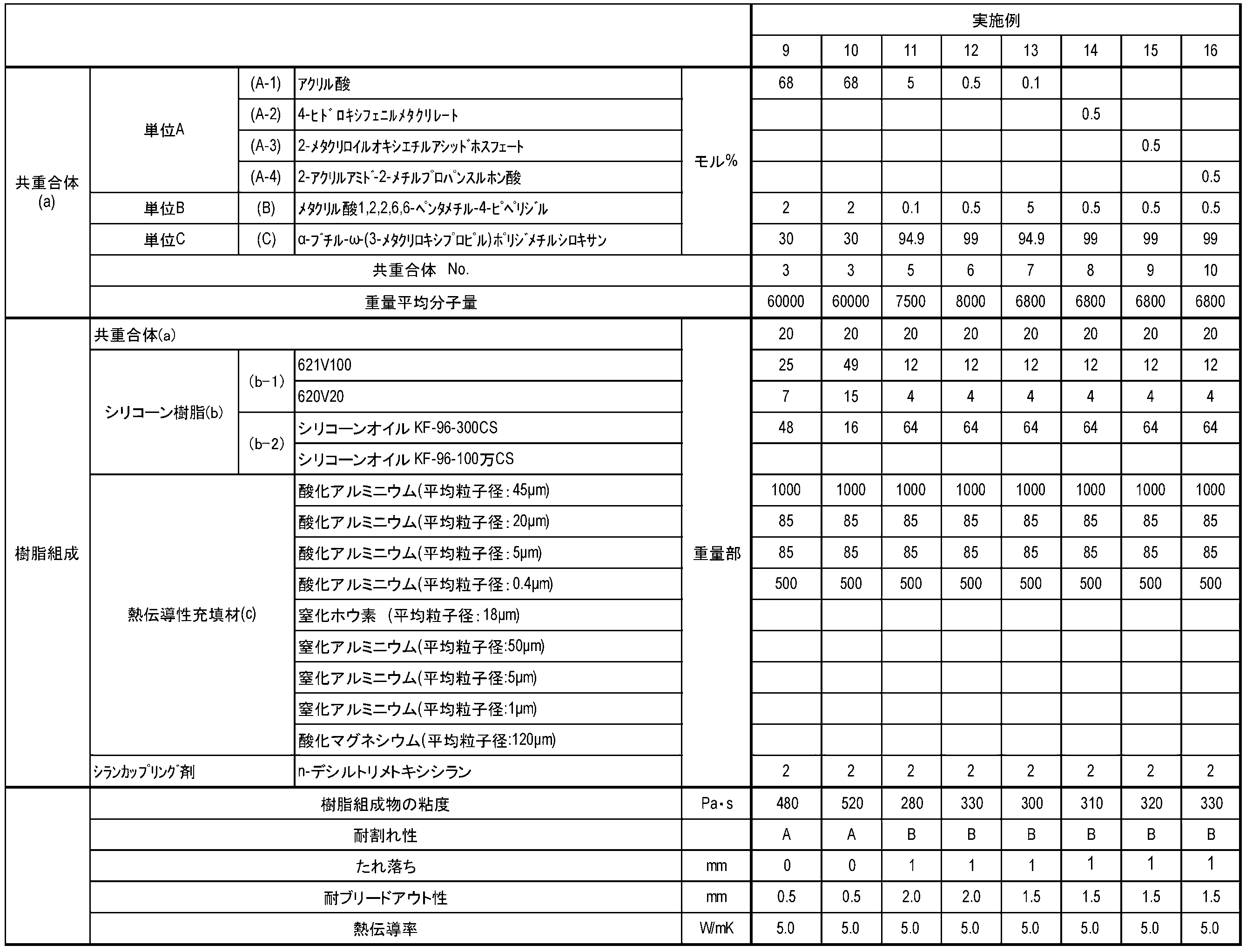
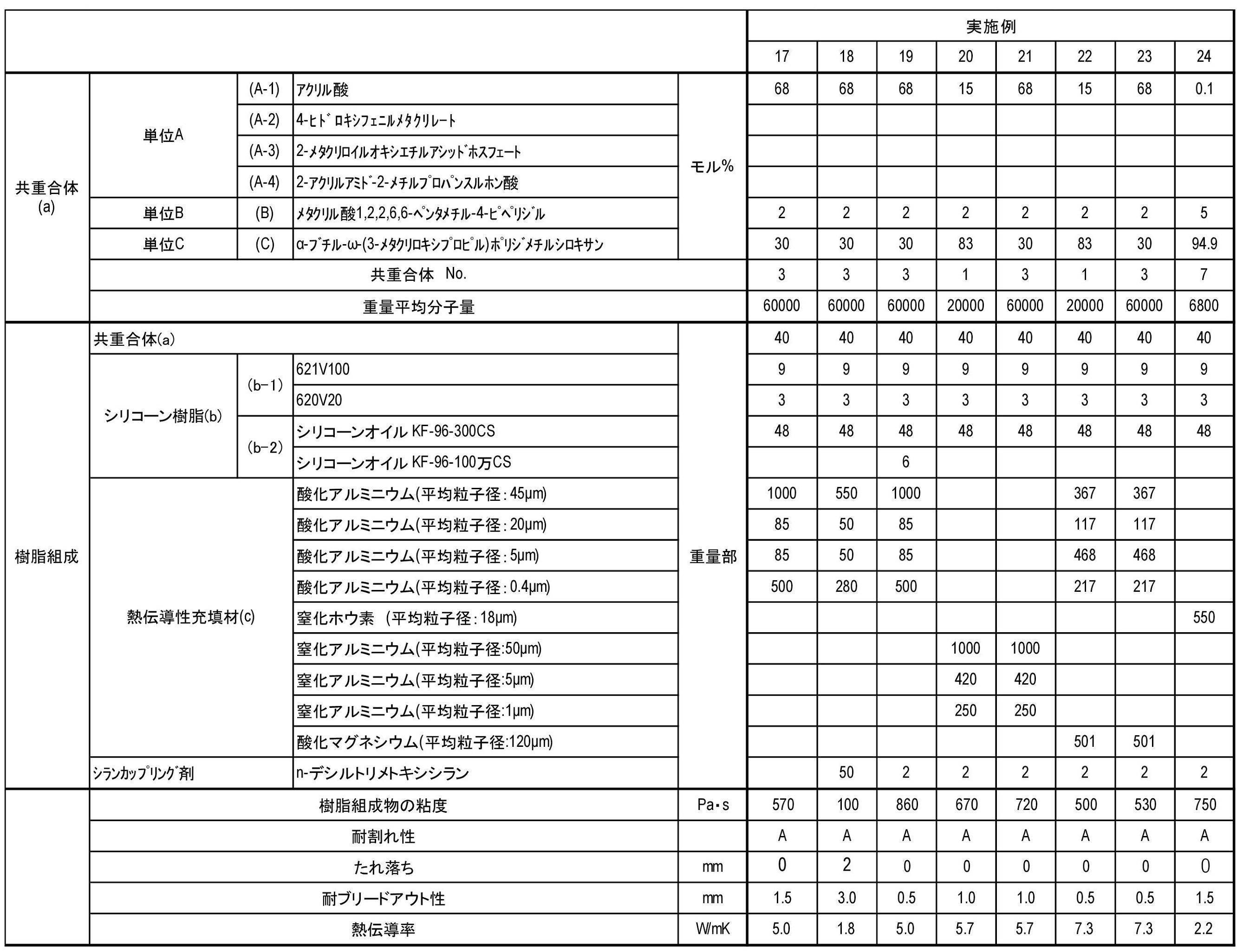
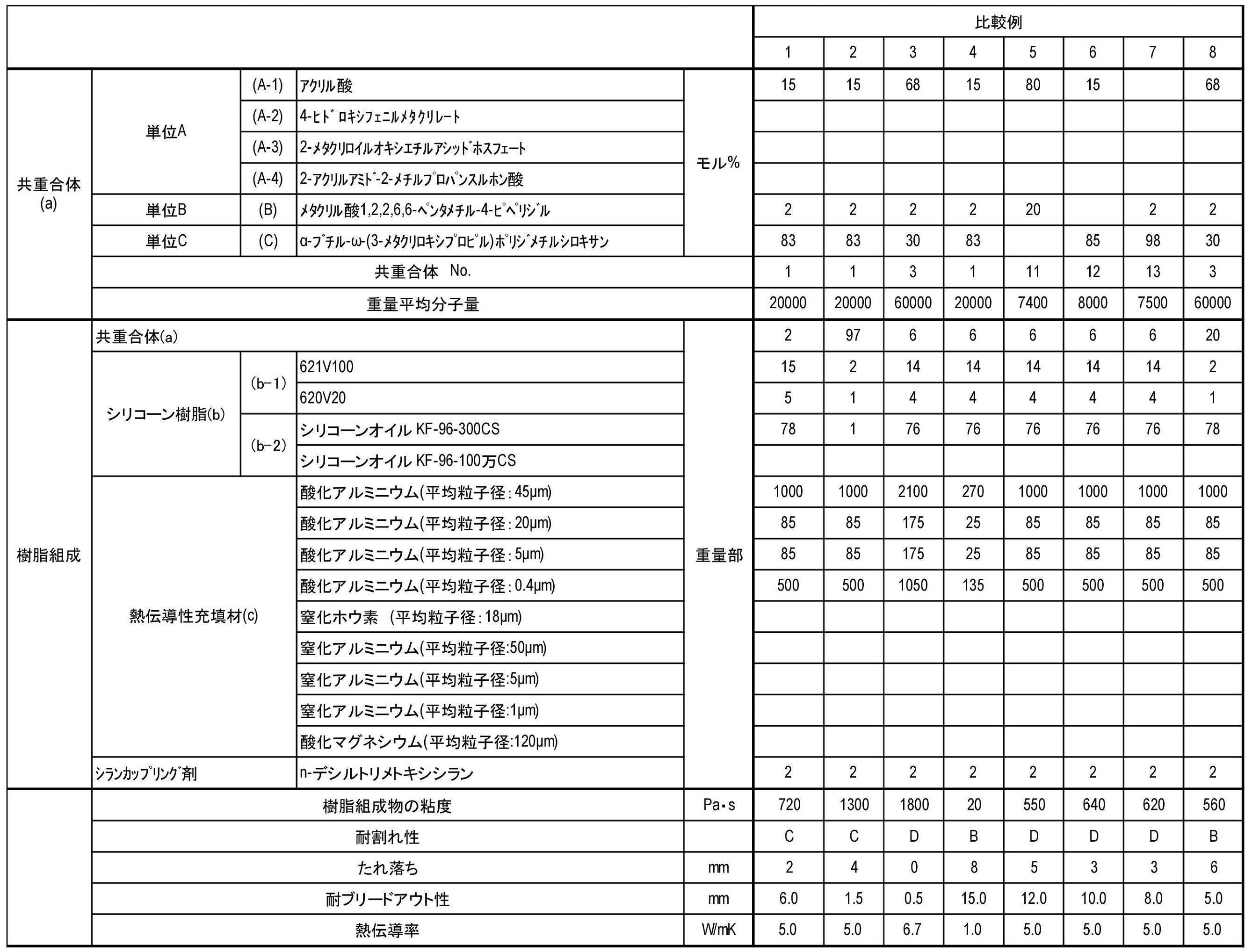
- compositions and weight average molecular weights of the copolymers 1 to 13 synthesized as described above are shown in Tables 1 to 4 below.
- the average particle size of the heat conductive filler (c) was measured using a "laser diffraction type particle size distribution measuring device SALD-20" manufactured by Shimadzu Corporation.
- SALD-20 laser diffraction type particle size distribution measuring device manufactured by Shimadzu Corporation.
- 50 ml of pure water and 5 g of a heat conductive filler to be measured were added to a glass beaker, the mixture was stirred with a spatula, and then dispersed with an ultrasonic cleaner for 10 minutes.
- the dispersion liquid of the heat conductive filler that had been subjected to the dispersion treatment was added drop by drop to the sampler part of the apparatus using a dropper, and the measurement was performed when the absorbance became stable.
- D50 medium diameter
- Examples 1 to 24 and Comparative Examples 1 to 8 A resin composition was prepared by mixing the copolymer (a), the silicone resin (b), the thermally conductive filler (c), and the silane coupling agent with the compositions shown in Tables 1 to 4. The following evaluations were performed using each of the obtained resin compositions. The results are shown in Tables 1 to 4.
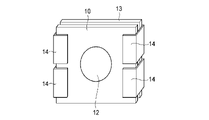
- the dripping property of the thermally conductive cured product was evaluated by the test method shown in FIGS. 1 and 2.
- shims 11 having a thickness of 2 mm were placed at the four corners of a glass plate 10 of 80 mm ⁇ 80 mm, and the first agent and the second agent were mixed at a volume ratio of 1: 1.
- the mixture 12 was applied in a circular shape to the substantially central portion of the glass plate 10 and sandwiched between the glass plates 13 having a size of 80 mm ⁇ 80 mm.
- the amount of the mixture 12 applied was such that the size of the circular shape of the mixture formed when sandwiched between the glass plates 10 and 13 was 25 mm ⁇ .
- the glass plates 10 and 13 were fixed by the clip 14 and allowed to stand vertically, and after standing at 25 ° C. for 24 hours, the heat conductive cured product was displaced from the initial position.
- the dripping property was evaluated by observing.
- [Bleed-out resistance] 0.65 g of the resin composition was applied in a substantially circular shape on a 76 mm square frosted glass, allowed to stand in an oven at 150 ° C. for 24 hours, and then taken out from the oven. When bleed-out is observed, the liquid component seeps out and a gray circle is formed around the substantially circular resin composition. The size of this circle was used as an index of the bleed-out amount, and the maximum length of the distance from the end of the white resin composition end to the end of the gray circle was evaluated as the bleed-out amount.
- the thermally conductive resin composition of the present invention has industrial applicability as a thermal paste or the like for thermally connecting a heating element and a heat sink in an electronic device.
Landscapes
- Chemical & Material Sciences (AREA)
- Chemical Kinetics & Catalysis (AREA)
- Organic Chemistry (AREA)
- Medicinal Chemistry (AREA)
- Polymers & Plastics (AREA)
- Health & Medical Sciences (AREA)
- Engineering & Computer Science (AREA)
- Physics & Mathematics (AREA)
- Thermal Sciences (AREA)
- Combustion & Propulsion (AREA)
- Materials Engineering (AREA)
- Microelectronics & Electronic Packaging (AREA)
- Compositions Of Macromolecular Compounds (AREA)
Abstract
Description
〔1〕
アニオン性基を有する(メタ)アクリル系単量体単位Aと、カチオン性基を有する(メタ)アクリル系単量体単位Bと、シリコーン(メタ)アクリル系単量体単位Cと、を有する共重合体(a)5~95重量部と、
シリコーン樹脂(b)95~5重量部と、
10W/mK以上の熱伝導性充填材(c)500~3000重量部と、を含み、
前記共重合体(a)と前記シリコーン樹脂(b)の合計含有量が100重量部であり、
前記シリコーン樹脂(b)が、架橋型シリコーン樹脂(b-1)を含み、
該架橋型シリコーン樹脂(b-1)の含有量が、前記シリコーン樹脂(b)の総量に対して、5~100質量%である、
熱伝導性樹脂組成物。
〔2〕
前記シリコーン樹脂(b)が、非架橋型シリコーン樹脂(b-2)をさらに含み、
前記架橋型シリコーン樹脂(b-1)の含有量が、前記シリコーン樹脂(b)の総量に対して、5~99質量%である、
前記非架橋型シリコーン樹脂(b-2)の含有量が、前記シリコーン樹脂(b)の総量に対して、95~1質量%である、
〔1〕に記載の熱伝導性樹脂組成物。
〔3〕
前記非架橋型シリコーン樹脂(b-2)が、直鎖状ポリオルガノシロキサンである、
〔2〕に記載の熱伝導性樹脂組成物。
〔4〕
前記非架橋型シリコーン樹脂(b-2)の粘度が、25℃においてせん断速度10sec-1で測定した値として、1~10,000mPa・sである、
〔2〕又は〔3〕に記載の熱伝導性樹脂組成物。
〔5〕
前記架橋型シリコーン樹脂(b-1)が、分子中に2個以上のアルケニル基を有するポリオルガノシロキサン(b-1-1)と、分子中に2個以上のSiH基を含有するポリオルガノシロキサン(b-1-2)と、が反応してなるものである、
〔1〕~〔4〕のいずれか一項に記載の熱伝導性樹脂組成物。
〔6〕
前記アニオン性基が、カルボキシ基、リン酸基、及びフェノール性ヒドロキシ基からなる群より選ばれる一種以上を含む、
〔1〕~〔5〕のいずれか一項に記載の熱伝導性樹脂組成物。
〔7〕
前記(メタ)アクリル系単量体単位Aが、前記アニオン性基に結合した電子吸引性基をさらに有する、
〔1〕~〔6〕のいずれか一項に記載の熱伝導性樹脂組成物。
〔8〕
前記カチオン性基が、第一級アミノ基、第二級アミノ基、第三級アミノ基、及び第四級アンモニウム塩からなる群より選ばれる一種以上を含む、
〔1〕~〔7〕のいずれか一項に記載の熱伝導性樹脂組成物。
〔9〕
前記(メタ)アクリル系単量体単位Bが、前記カチオン性基に結合した電子供与性基をさらに有する、
〔1〕~〔8〕のいずれか一項に記載の熱伝導性樹脂組成物。
〔10〕
前記共重合体(a)の重量平均分子量が、5,000~500,000である、
〔1〕~〔9〕のいずれか一項に記載の熱伝導性樹脂組成物。
〔11〕
前記(メタ)アクリル系単量体単位A及び前記(メタ)アクリル系単量体単位Bの総含有量が、前記(メタ)アクリル系単量体単位A、前記(メタ)アクリル系単量体単位B、及び前記シリコーン(メタ)アクリル系単量体単位Cの合計100モル%に対して、0.05~90モル%である、
〔1〕~〔10〕のいずれか一項に記載の熱伝導性樹脂組成物。
〔12〕
前記(メタ)アクリル系単量体単位Aの含有量が、前記(メタ)アクリル系単量体単位A、前記(メタ)アクリル系単量体単位B、及び前記シリコーン(メタ)アクリル系単量体単位Cの合計100モル%に対して、0.03~85モル%である、
〔1〕~〔11〕のいずれか一項に記載の熱伝導性樹脂組成物。
〔13〕
前記(メタ)アクリル系単量体単位Bの含有量が、前記(メタ)アクリル系単量体単位A、前記(メタ)アクリル系単量体単位B、及び前記シリコーン(メタ)アクリル系単量体単位Cの合計100モル%に対して、0.1~10モル%である、
〔1〕~〔12〕のいずれか一項に記載の熱伝導性樹脂組成物。
〔14〕
前記シリコーン(メタ)アクリル系単量体単位Cの含有量が、前記(メタ)アクリル系単量体単位A、前記(メタ)アクリル系単量体単位B、及び前記シリコーン(メタ)アクリル系単量体単位Cの合計100モル%に対して、10~99.5モル%である、
〔1〕~〔13〕のいずれか一項に記載の熱伝導性樹脂組成物。
〔15〕
前記(メタ)アクリル系単量体単位Bに対する前記(メタ)アクリル系単量体単位Aのモル比が、0.01~50である、
〔1〕~〔14〕のいずれか一項に記載の熱伝導性樹脂組成物。
〔16〕
表面処理剤(d)を、前記熱伝導性充填材(c)100重量部に対して、0.01~5重量部含む、
〔1〕~〔15〕いずれか一項に記載の熱伝導性樹脂組成物。
〔17〕
前記熱伝導性充填材(c)が、アルミニウム、水酸化アルミニウム、酸化アルミニウム、窒化アルミニウム、窒化ホウ素、酸化亜鉛、酸化マグネシウム、ダイヤモンドの中から選択される1種以上である、
〔1〕~〔16〕のいずれか一項に記載の熱伝導性樹脂組成物。
〔18〕
発熱体と、ヒートシンクと、〔1〕~〔17〕のいずれか一項に記載の熱伝導性樹脂組成物又はその硬化物と、を有し、
前記発熱体と前記ヒートシンクとの間に、前記熱伝導性樹脂組成物又は前記硬化物が配された、
電子機器。
本実施形態の熱伝導性樹脂組成物は、アニオン性基を有する(メタ)アクリル系単量体単位Aと、カチオン性基を有する(メタ)アクリル系単量体単位Bと、シリコーン(メタ)アクリル系単量体単位Cと、を有する共重合体(a)5~95重量部と、シリコーン樹脂(b)95~5重量部と、10W/mK以上の熱伝導性充填材(c)500~3000重量部と、を含み、共重合体(a)とシリコーン樹脂(b)の合計含有量が100重量部であり、シリコーン樹脂(b)が、架橋型シリコーン樹脂(b-1)を含み、該架橋型シリコーン樹脂(b-1)の含有量が、前記シリコーン樹脂(b)の総量に対して、5~100質量%である。
共重合体(a)は、アニオン性基を有する(メタ)アクリル系単量体単位Aと、カチオン性基を有する(メタ)アクリル系単量体単位Bと、シリコーン(メタ)アクリル系単量体単位Cを有する。本実施形態の共重合体(a)は、上記構成を有することにより、高温の状態で長時間保持した場合であっても、熱伝導性充填材(c)の分散性を維持することができる。その理由は、以下のように考えられるが、以下に限定されるものではない。
(メタ)アクリル系単量体単位Aは、アニオン性基を有する繰り返し単位である。アニオン性基としては、特に制限されないが、例えば、カルボキシ基、リン酸基、フェノール性ヒドロキシ基、スルホン酸基が挙げられる。このなかでも、カルボキシ基、リン酸基、及びフェノール性ヒドロキシ基からなる群より選ばれる一種以上であることが好ましい。このような基を有することにより、分散質の分散性がより向上する傾向にある。
(メタ)アクリル系単量体単位Bは、カチオン性基を有する繰り返し単位である。カチオン性基としては、特に制限されないが、例えば、第一級アミノ基、第二級アミノ基、第三級アミノ基、及び第四級アンモニウム塩からなる群より選ばれる一種以上であることが好ましい。このなかでも、第三級アミノ基がより好ましい。このような基を有することにより、分散質の分散性がより向上する傾向にある。
(メタ)アクリル系単量体単位Cは、シリコーン(メタ)アクリル系単量体単位であり、分子中にカチオン性基およびアニオン性基を含まず、シリコーン基を有する(メタ)アクリル系単量体である。
本実施形態の共重合体(a)の製造方法は、特に制限されず、(メタ)アクリル系単量体の公知の重合方法を用いることができる。重合方法としては、ラジカル重合、アニオン重合などが挙げられる。この中でも、ラジカル重合が好ましい。
シリコーン樹脂(b)は、架橋型シリコーン樹脂(b-1)を含み、必要に応じて、非架橋型シリコーン樹脂(b-2)をさらに含んでもよい。ここで、「架橋型」とは、三次元架橋したシリコーン樹脂をいい、「非架橋型」とは、三次元架橋を有しない直鎖状又は環状のシリコーン樹脂をいう。シリコーン樹脂(b)は、一種単独で用いても、二種以上を併用してもよい。
架橋型シリコーン樹脂(b-1)としては、三次元架橋したものであれば特に制限されないが、例えば、非硬化型シリコーン樹脂及び硬化型シリコーン樹脂が挙げられる。このなかでも、架橋型シリコーン樹脂(b-1)としては、非硬化型シリコーン樹脂が好ましい。このような架橋型シリコーン樹脂(b-1)を用いることにより、ブリードアウトが抑制され、耐ズレ性がより向上する傾向にある。
(R1SiO1/2)n1(R2SiO2/2)n2(R3SiO3/2)n3(SiO4/2)n4
非架橋型シリコーン樹脂(b-2)としては、直鎖状ポリオルガノシロキサン又は環状型ポリオルガノシロキサンが挙げられる。このなかでも、直鎖状ポリオルガノシロキサンが好ましく、直鎖状ポリオルガノシロキサンであるシリコーンオイルがより好ましい。このような非架橋型シリコーン樹脂を用いることにより、流動性及び熱伝導性充填材の分散性がより向上し、ボイドや割れの発生がより抑制される傾向にある。
非硬化型シリコーン樹脂としては、後述する硬化型シリコーン樹脂が有する硬化に寄与する官能基を有しないもの又は触媒と併用しないものであれば特に制限されない。
熱伝導性充填材(c)の熱伝導率は、10W/mK以上であり、好ましくは15~3000W/mKであり、より好ましくは30~2000W/mKである。熱伝導性充填材(c)の熱伝導率が10W/mK以上であることにより、熱伝導性樹脂組成物の熱伝導率がより向上する傾向にある。
本実施形態の熱伝導性樹脂組成物は、熱伝導性充填材(c)を表面処理する表面処理剤(d)をさらに含んでいてもよい。このような表面処理剤(d)を含むことにより、流動性及び熱伝導性充填材の分散性がより向上し、ボイドや割れの発生がより抑制される傾向にある。
本実施形態の電子機器は、発熱体と、ヒートシンクと、上記熱伝導性樹脂組成物又はその硬化物と、を有し、発熱体とヒートシンクとの間に、熱伝導性樹脂組成物又は硬化物が配されたものである。この電子機器においては、発熱体とヒートシンクとが、熱伝導性樹脂組成物を介して、熱的に結合される。
実施例の共重合体の重合には以下の原料を用いた。
(アニオン性基を有する(メタ)アクリル系単量体A)
(A-1)アクリル酸、東亞合成社製
(A-2)4-ヒドロキシフェニルメクリレート、精工化学社製
(A-3)2-メタクリロイルオキシエチルアシッドホスフェート、共栄社化学社製「ライトエステルP-1M」
(A-4)2-アクリルアミド-2-メチルプロパンスルホン酸、東京化成社製
(カチオン性基を有する(メタ)アクリル系単量体B)
(B)メタクリル酸-1,2,2,6,6-ペンタメチル-4-ピペリジル、ADEKA株式会社製「アデカスタブLA-82」
((メタ)アクリル系単量体C)
(C)α-ブチル-ω-(3-メタクリロキシプロピル)ポリジメチルシロキサン)、JNC社製「サイラプレーンFM-0721」数平均分子量5000
(共重合体1)
共重合体の調製は次の方法で行った。まず、撹拌機付のオートクレーブ内にアクリル酸:15モル%、メタクリル酸-1,2,2,6,6-ペンタメチル-4-ピペリジル:2.0モル%、α-ブチル-ω-(3-メタクリロキシプロピル)ポリジメチルシロキサン:83モル%からなる(メタ)アクリル系単量体100重量部を添加した。次いで、開始剤としてアゾビスイソブチロニトリル(東京化成社製)を、(メタ)アクリル系単量体の総和100重量部に対して0.05重量部、溶媒としてトルエン(試薬特級)、および2-プロパノール(試薬特級)の体積比=7:3の混合溶液を1000重量部加え、オートクレーブ内を窒素により置換した。その後、オートクレーブをオイルバス中で65℃にて20時間加熱し、ラジカル重合を行った。重合終了後、減圧下に120℃で1時間脱気し、共重合体1を得た。
高速GPC装置:東ソー社製「HLC-8020」
カラム :東ソー社製「TSK guardcolumn MP(×L)」6.0mmID×4.0cm1本、及び東ソー社製「TSK-GELMULTIPOREHXL-M」7.8mmID×30.0cm(理論段数16,000段)2本、計3本(全体として理論段数32,000段)
展開溶媒 :テトラヒドロフラン
ディテクター :RI(示差屈折率計)
表1~4に記載の組成の単量体を用いたこと以外は、共重合体1と同様の方法により、ラジカル重合を行い、共重合体2~13を得た。得られた共重合体2~13における重合率はいずれも98%以上であり、共重合体が有する各単量体単位の比率は、単量体の仕込み比と同程度と推定された。また、重量平均分子量についても上記と同様に求めた。
(シリコーン樹脂(b))
(架橋型シリコーン樹脂(b-1))
・ビニル変性シリコーンオイル:エルケムジャパン株式会社製、「621V100」
・SiH変性シリコーンオイル :エルケムジャパン株式会社製、「620V20」
(非架橋型シリコーン樹脂(b-2))
・シリコーンオイル:信越シリコーン社製「KF-96-300CS」、ジメチルシリコーンオイル、粘度300mPa・s
・シリコーンオイル:信越シリコーン社製「KF-96-100万CS」、ジメチルシリコーンオイル、粘度1000000mPa・s
(熱伝導性充填材(c))
・酸化アルミニウム:デンカ株式会社製、「DAW45」、平均粒子径:45μm、熱伝導率35W/mK
・酸化アルミニウム:デンカ株式会社製、「DAW20」、平均粒子径:20μm、熱伝導率35W/mK
・酸化アルミニウム:デンカ株式会社製、「DAW05」、平均粒子径:5μm、熱伝導率35W/mK
・酸化アルミニウム:デンカ株式会社製、「ASFP40」、平均粒子径:0.4μm、熱伝導率35W/mK
・窒化ホウ素 :デンカ株式会社製、「SGP」、平均粒子径:18μm、熱伝導率80W/mK
・窒化アルミニウム:株式会社MARUWA社製、「S―50」、平均粒子径:50μm、熱伝導率170W/mK
・窒化アルミニウム:株式会社MARUWA社製、「A―05-F」、平均粒子径:5μm、熱伝導率170W/mK
・窒化アルミニウム:株式会社MARUWA社製、「A―01-F」、平均粒子径:1μm、熱伝導率170W/mK
・酸化マグネシウム:デンカ株式会社製、「DMG120」、平均粒子径:120μm、熱伝導率60W/mK
(シランカップリング剤)
・n-デシルトリメトキシシラン:ダウ・東レ株式会社製、「DOWSIL Z-6210 Silane」
(実施例1~24及び比較例1~8)
表1~4に示す組成で、共重合体(a)と、シリコーン樹脂(b)と、熱伝導性充填材(c)と、シランカップリング剤を、混合し、樹脂組成物を調製した。得られた各樹脂組成物を用いて以下の評価を行った。その結果を表1~4に示す。
Thermo Scientific社製回転式レオメータMARS IIIにて、上部治具として35mmΦのパラレルプレートを用い、ペルチェ素子にて温度制御が可能な35mmΦ下部プレートの上に、樹脂組成物を載せ、上部治具で厚み1mmまで圧縮し、はみ出した部分はかきとり、25℃にて測定を行った。せん断速度1~10sー1の粘度を測定した。
76mm角の無アルカリガラス板を2枚用意し、一方のガラス板の中心部に直径20mm、厚さ1mmとなるよう樹脂組成物を塗布し、もう一方のガラス板ではさみ込んだ試料を150℃の環境下に保持し、耐熱性試験を実施した。24時間保持後、目視にて割れの有無を確認した。
A:割れ率が0%以上1%未満
B:割れ率1%以上5%未満
C:割れ率5%以上15%未満
D:割れ率15%以上
図1及び図2で示される試験方法により、熱伝導性硬化物のたれ落ち性を評価した。まず、図1に示すように、80mm×80mmのガラス板10の四隅に厚さ2mmのシム11を設置し、第一剤及び第二剤を1:1の体積比で混合して得られた混合物12をガラス板10の略中央部に円形に塗布し、80mm×80mmのガラス板13で挟み込んだ。なお、混合物12の塗布量は、ガラス板10及び13で挟み込んだときに形成される混合物の円形形状の大きさが25mmφとなる量とした。続いて、図2に示すように、クリップ14によりガラス板10及び13を固定して縦置きに静置し、25℃で24時間静置した後に、熱伝導性硬化物の初期位置からのずれを観察することで、たれ落ち性を評価した。
76mm角のすりガラス上に樹脂組成物0.65gを略円形状に塗布し、150℃のオーブン中にて24時間静置してオーブンより取り出した。ブリードアウトが認められる場合には、略円形状の樹脂組成物の周囲には、液状成分がしみだし灰色の円が形成される。この円の大きさをブリードアウト量の指標とし、白色の樹脂組成物端部の端から灰色の円の端までの距離の最大長をブリードアウト量として評価した。
ヒーターの埋め込まれた直方体の銅製治具で先端が100mm2(10mm×10mm)と、冷却フィンを取り付けた直方体の銅製治具で先端が100mm2(10mm×10mm)との間に、樹脂組成物を挟んで、隙間の厚みを0.05mm~0.30mmの範囲で熱抵抗を測定し、熱抵抗と厚みの勾配から熱伝導率を算出して評価した。熱抵抗は、ヒーターに電力10Wをかけて30分間保持し、銅製治具同士の温度差(℃)を測定し、下記式にて算出した。
熱抵抗(℃/W)={温度差(℃)/ 電力(W)}

Claims (18)
- アニオン性基を有する(メタ)アクリル系単量体単位Aと、カチオン性基を有する(メタ)アクリル系単量体単位Bと、シリコーン(メタ)アクリル系単量体単位Cと、を有する共重合体(a)5~95重量部と、
シリコーン樹脂(b)95~5重量部と、
10W/mK以上の熱伝導性充填材(c)500~3000重量部と、を含み、
前記共重合体(a)と前記シリコーン樹脂(b)の合計含有量が100重量部であり、
前記シリコーン樹脂(b)が、架橋型シリコーン樹脂(b-1)を含み、
該架橋型シリコーン樹脂(b-1)の含有量が、前記シリコーン樹脂(b)の総量に対して、5~100質量%である、
熱伝導性樹脂組成物。 - 前記シリコーン樹脂(b)が、非架橋型シリコーン樹脂(b-2)をさらに含み、
前記架橋型シリコーン樹脂(b-1)の含有量が、前記シリコーン樹脂(b)の総量に対して、5~99質量%である、
前記非架橋型シリコーン樹脂(b-2)の含有量が、前記シリコーン樹脂(b)の総量に対して、95~1質量%である、
請求項1に記載の熱伝導性樹脂組成物。 - 前記非架橋型シリコーン樹脂(b-2)が、直鎖状ポリオルガノシロキサンである、
請求項2に記載の熱伝導性樹脂組成物。 - 前記非架橋型シリコーン樹脂(b-2)の粘度が、25℃においてせん断速度10sec-1で測定した値として、1~10,000mPa・sである、
請求項2又は3に記載の熱伝導性樹脂組成物。 - 前記架橋型シリコーン樹脂(b-1)が、分子中に2個以上のアルケニル基を有するポリオルガノシロキサン(b-1-1)と、分子中に2個以上のSiH基を含有するポリオルガノシロキサン(b-1-2)と、が反応してなるものである、
請求項1~4のいずれか一項に記載の熱伝導性樹脂組成物。 - 前記アニオン性基が、カルボキシ基、リン酸基、及びフェノール性ヒドロキシ基からなる群より選ばれる一種以上を含む、
請求項1~5のいずれか一項に記載の熱伝導性樹脂組成物。 - 前記(メタ)アクリル系単量体単位Aが、前記アニオン性基に結合した電子吸引性基をさらに有する、
請求項1~6のいずれか一項に記載の熱伝導性樹脂組成物。 - 前記カチオン性基が、第一級アミノ基、第二級アミノ基、第三級アミノ基、及び第四級アンモニウム塩からなる群より選ばれる一種以上を含む、
請求項1~7のいずれか一項に記載の熱伝導性樹脂組成物。 - 前記(メタ)アクリル系単量体単位Bが、前記カチオン性基に結合した電子供与性基をさらに有する、
請求項1~8のいずれか一項に記載の熱伝導性樹脂組成物。 - 前記共重合体(a)の重量平均分子量が、5,000~500,000である、
請求項1~9のいずれか一項に記載の熱伝導性樹脂組成物。 - 前記(メタ)アクリル系単量体単位A及び前記(メタ)アクリル系単量体単位Bの総含有量が、前記(メタ)アクリル系単量体単位A、前記(メタ)アクリル系単量体単位B、及び前記シリコーン(メタ)アクリル系単量体単位Cの合計100モル%に対して、0.05~90モル%である、
請求項1~10のいずれか一項に記載の熱伝導性樹脂組成物。 - 前記(メタ)アクリル系単量体単位Aの含有量が、前記(メタ)アクリル系単量体単位A、前記(メタ)アクリル系単量体単位B、及び前記シリコーン(メタ)アクリル系単量体単位Cの合計100モル%に対して、0.03~85モル%である、
請求項1~11のいずれか一項に記載の熱伝導性樹脂組成物。 - 前記(メタ)アクリル系単量体単位Bの含有量が、前記(メタ)アクリル系単量体単位A、前記(メタ)アクリル系単量体単位B、及び前記シリコーン(メタ)アクリル系単量体単位Cの合計100モル%に対して、0.1~10モル%である、
請求項1~12のいずれか一項に記載の熱伝導性樹脂組成物。 - 前記シリコーン(メタ)アクリル系単量体単位Cの含有量が、前記(メタ)アクリル系単量体単位A、前記(メタ)アクリル系単量体単位B、及び前記シリコーン(メタ)アクリル系単量体単位Cの合計100モル%に対して、10~99.5モル%である、
請求項1~13のいずれか一項に記載の熱伝導性樹脂組成物。 - 前記(メタ)アクリル系単量体単位Bに対する前記(メタ)アクリル系単量体単位Aのモル比が、0.01~50である、
請求項1~14のいずれか一項に記載の熱伝導性樹脂組成物。 - 表面処理剤(d)を、前記熱伝導性充填材(c)100重量部に対して、0.01~5重量部含む、
請求項1~15いずれか一項に記載の熱伝導性樹脂組成物。 - 前記熱伝導性充填材(c)が、アルミニウム、水酸化アルミニウム、酸化アルミニウム、窒化アルミニウム、窒化ホウ素、酸化亜鉛、酸化マグネシウム、ダイヤモンドの中から選択される1種以上である、
請求項1~16のいずれか一項に記載の熱伝導性樹脂組成物。 - 発熱体と、ヒートシンクと、請求項1~17のいずれか一項に記載の熱伝導性樹脂組成物又はその硬化物と、を有し、
前記発熱体と前記ヒートシンクとの間に、前記熱伝導性樹脂組成物又は前記硬化物が配された、
電子機器。
Priority Applications (5)
| Application Number | Priority Date | Filing Date | Title |
|---|---|---|---|
| KR1020237012399A KR20230080430A (ko) | 2020-10-05 | 2021-10-05 | 열전도성 수지 조성물 및 전자 기기 |
| CN202180054329.4A CN116057092A (zh) | 2020-10-05 | 2021-10-05 | 导热性树脂组合物及电子设备 |
| EP21877606.0A EP4227336A4 (en) | 2020-10-05 | 2021-10-05 | Heat-conductive resin composition and electronic apparatus |
| US18/030,253 US20230374189A1 (en) | 2020-10-05 | 2021-10-05 | Thermally conductive resin composition and electronic device |
| JP2022517263A JP7144644B2 (ja) | 2020-10-05 | 2021-10-05 | 熱伝導性樹脂組成物及び電子機器 |
Applications Claiming Priority (2)
| Application Number | Priority Date | Filing Date | Title |
|---|---|---|---|
| JP2020-168732 | 2020-10-05 | ||
| JP2020168732 | 2020-10-05 |
Publications (1)
| Publication Number | Publication Date |
|---|---|
| WO2022075307A1 true WO2022075307A1 (ja) | 2022-04-14 |
Family
ID=81126955
Family Applications (1)
| Application Number | Title | Priority Date | Filing Date |
|---|---|---|---|
| PCT/JP2021/036778 Ceased WO2022075307A1 (ja) | 2020-10-05 | 2021-10-05 | 熱伝導性樹脂組成物及び電子機器 |
Country Status (6)
| Country | Link |
|---|---|
| US (1) | US20230374189A1 (ja) |
| EP (1) | EP4227336A4 (ja) |
| JP (1) | JP7144644B2 (ja) |
| KR (1) | KR20230080430A (ja) |
| CN (1) | CN116057092A (ja) |
| WO (1) | WO2022075307A1 (ja) |
Cited By (2)
| Publication number | Priority date | Publication date | Assignee | Title |
|---|---|---|---|---|
| JP2023095001A (ja) * | 2021-12-24 | 2023-07-06 | デンカ株式会社 | 組成物及び放熱シート |
| WO2024096000A1 (ja) * | 2022-11-02 | 2024-05-10 | 信越化学工業株式会社 | 熱伝導性シリコーン組成物 |
Families Citing this family (2)
| Publication number | Priority date | Publication date | Assignee | Title |
|---|---|---|---|---|
| US20230374363A1 (en) * | 2020-10-05 | 2023-11-23 | Denka Company Limited | Thermally conductive resin composition and electronic device |
| EP4219621A4 (en) * | 2020-10-06 | 2024-03-06 | Denka Company Limited | COMPOSITION, HARDENED BODY, AND METAL BASE SUBSTRATE |
Citations (11)
| Publication number | Priority date | Publication date | Assignee | Title |
|---|---|---|---|---|
| JPS60179417A (ja) * | 1984-02-27 | 1985-09-13 | Shin Etsu Chem Co Ltd | 液状シリコ−ンゴム組成物 |
| JPH0330825A (ja) * | 1989-06-27 | 1991-02-08 | Dainippon Ink & Chem Inc | 低起泡性フッ素系界面活性剤 |
| JP2004109179A (ja) * | 2002-09-13 | 2004-04-08 | Dainippon Ink & Chem Inc | カラーレジスト組成物 |
| JP5300408B2 (ja) | 2008-10-21 | 2013-09-25 | 信越化学工業株式会社 | 熱伝導性シリコーングリース組成物 |
| JP2015140395A (ja) | 2014-01-29 | 2015-08-03 | 信越化学工業株式会社 | 熱伝導性シリコーングリース組成物 |
| JP2016121350A (ja) * | 2014-12-24 | 2016-07-07 | 東洋インキScホールディングス株式会社 | シリカ分散体、および、活性エネルギー線硬化性樹脂組成物 |
| JP2017031231A (ja) * | 2015-07-28 | 2017-02-09 | 信越化学工業株式会社 | 縮合硬化型シリコーン組成物 |
| CN107325782A (zh) * | 2017-05-19 | 2017-11-07 | 天永诚高分子材料(常州)有限公司 | 一种双组分灌封胶及其制备方法 |
| JP2017226724A (ja) | 2016-06-20 | 2017-12-28 | 信越化学工業株式会社 | 熱伝導性シリコーンパテ組成物 |
| JP2018062552A (ja) | 2016-10-12 | 2018-04-19 | 信越化学工業株式会社 | 熱伝導性ポリマー組成物 |
| WO2018131486A1 (ja) * | 2017-01-13 | 2018-07-19 | デンカ株式会社 | 熱伝導性樹脂組成物、放熱シート、放熱部材及びその製造方法 |
Family Cites Families (8)
| Publication number | Priority date | Publication date | Assignee | Title |
|---|---|---|---|---|
| JPS53408U (ja) | 1976-06-23 | 1978-01-06 | ||
| JP2002146155A (ja) * | 2000-11-16 | 2002-05-22 | Daicel Chem Ind Ltd | 水性樹脂分散液及びそれを含む水性塗料 |
| DE102008041940A1 (de) * | 2008-09-10 | 2010-03-11 | Wacker Chemie Ag | Siliconelastomere mit verbesserter Einreissfestigkeit |
| JP4788837B2 (ja) * | 2010-01-26 | 2011-10-05 | 横浜ゴム株式会社 | シリコーン樹脂組成物およびその使用方法、シリコーン樹脂、シリコーン樹脂含有構造体、ならびに光半導体素子封止体 |
| JP2011225733A (ja) * | 2010-04-20 | 2011-11-10 | Kaneka Corp | 硬化性組成物及び硬化物 |
| JP2011252070A (ja) * | 2010-06-01 | 2011-12-15 | Kaneka Corp | 反応性官能基を有する化合物中に含まれる揮発分の脱揮方法および光学材料用硬化性組成物 |
| KR20140074289A (ko) * | 2011-09-08 | 2014-06-17 | 히타치가세이가부시끼가이샤 | 수지 조성물, 수지 시트, 수지 시트 경화물, 수지 부착 금속박 및 방열 부재 |
| JP6510315B2 (ja) * | 2015-05-14 | 2019-05-08 | デンカ株式会社 | 熱伝導性グリース用組成物、熱伝導性グリースおよび放熱部材 |
-
2021
- 2021-10-05 CN CN202180054329.4A patent/CN116057092A/zh active Pending
- 2021-10-05 US US18/030,253 patent/US20230374189A1/en not_active Abandoned
- 2021-10-05 EP EP21877606.0A patent/EP4227336A4/en not_active Withdrawn
- 2021-10-05 KR KR1020237012399A patent/KR20230080430A/ko not_active Withdrawn
- 2021-10-05 WO PCT/JP2021/036778 patent/WO2022075307A1/ja not_active Ceased
- 2021-10-05 JP JP2022517263A patent/JP7144644B2/ja active Active
Patent Citations (11)
| Publication number | Priority date | Publication date | Assignee | Title |
|---|---|---|---|---|
| JPS60179417A (ja) * | 1984-02-27 | 1985-09-13 | Shin Etsu Chem Co Ltd | 液状シリコ−ンゴム組成物 |
| JPH0330825A (ja) * | 1989-06-27 | 1991-02-08 | Dainippon Ink & Chem Inc | 低起泡性フッ素系界面活性剤 |
| JP2004109179A (ja) * | 2002-09-13 | 2004-04-08 | Dainippon Ink & Chem Inc | カラーレジスト組成物 |
| JP5300408B2 (ja) | 2008-10-21 | 2013-09-25 | 信越化学工業株式会社 | 熱伝導性シリコーングリース組成物 |
| JP2015140395A (ja) | 2014-01-29 | 2015-08-03 | 信越化学工業株式会社 | 熱伝導性シリコーングリース組成物 |
| JP2016121350A (ja) * | 2014-12-24 | 2016-07-07 | 東洋インキScホールディングス株式会社 | シリカ分散体、および、活性エネルギー線硬化性樹脂組成物 |
| JP2017031231A (ja) * | 2015-07-28 | 2017-02-09 | 信越化学工業株式会社 | 縮合硬化型シリコーン組成物 |
| JP2017226724A (ja) | 2016-06-20 | 2017-12-28 | 信越化学工業株式会社 | 熱伝導性シリコーンパテ組成物 |
| JP2018062552A (ja) | 2016-10-12 | 2018-04-19 | 信越化学工業株式会社 | 熱伝導性ポリマー組成物 |
| WO2018131486A1 (ja) * | 2017-01-13 | 2018-07-19 | デンカ株式会社 | 熱伝導性樹脂組成物、放熱シート、放熱部材及びその製造方法 |
| CN107325782A (zh) * | 2017-05-19 | 2017-11-07 | 天永诚高分子材料(常州)有限公司 | 一种双组分灌封胶及其制备方法 |
Non-Patent Citations (1)
| Title |
|---|
| See also references of EP4227336A4 |
Cited By (2)
| Publication number | Priority date | Publication date | Assignee | Title |
|---|---|---|---|---|
| JP2023095001A (ja) * | 2021-12-24 | 2023-07-06 | デンカ株式会社 | 組成物及び放熱シート |
| WO2024096000A1 (ja) * | 2022-11-02 | 2024-05-10 | 信越化学工業株式会社 | 熱伝導性シリコーン組成物 |
Also Published As
| Publication number | Publication date |
|---|---|
| JP7144644B2 (ja) | 2022-09-29 |
| KR20230080430A (ko) | 2023-06-07 |
| EP4227336A4 (en) | 2024-04-17 |
| JPWO2022075307A1 (ja) | 2022-04-14 |
| US20230374189A1 (en) | 2023-11-23 |
| CN116057092A (zh) | 2023-05-02 |
| EP4227336A1 (en) | 2023-08-16 |
Similar Documents
| Publication | Publication Date | Title |
|---|---|---|
| WO2022075307A1 (ja) | 熱伝導性樹脂組成物及び電子機器 | |
| JP4993135B2 (ja) | 熱伝導性シリコーン組成物 | |
| WO2020209263A1 (ja) | 共重合体、分散剤、及び樹脂組成物 | |
| WO2020137086A1 (ja) | 熱伝導組成物及びこれを用いた熱伝導性シート | |
| TWI687486B (zh) | 熱軟化性熱傳導性矽氧潤滑脂組成物、熱傳導性被膜之形成方法、放熱構造以及電力模組裝置 | |
| KR102132243B1 (ko) | 열전도성 실리콘 조성물 및 경화물, 및 복합 시트 | |
| WO2016017495A1 (ja) | 熱伝導性シリコーン組成物及び熱伝導性シリコーン成型物 | |
| JP7055255B1 (ja) | 熱伝導性シリコーン組成物の製造方法 | |
| CN114437546A (zh) | 一种高导热有机硅凝胶及其制备方法 | |
| JP7082959B2 (ja) | 熱伝導性組成物及びその製造方法 | |
| WO2021079714A1 (ja) | 熱伝導性シリコーン組成物及びその製造方法 | |
| JP2015212318A (ja) | 熱伝導性シリコーン組成物 | |
| JP7144645B2 (ja) | 熱伝導性樹脂組成物及び電子機器 | |
| JP7577126B2 (ja) | 二液硬化型組成物セット、熱伝導性硬化物及び電子機器 | |
| WO2024242157A1 (ja) | 放熱グリース | |
| WO2024042955A1 (ja) | 放熱グリース | |
| WO2024042956A1 (ja) | 放熱グリース | |
| TW202000762A (zh) | 導熱性矽氧低比重薄片 | |
| JP2025002504A (ja) | 界面活性剤、及び界面活性剤の製造方法 | |
| WO2025164574A1 (ja) | 熱軟化性熱伝導性組成物 | |
| JP2025146817A (ja) | 熱伝導性樹脂組成物 | |
| WO2025205291A1 (ja) | 熱伝導性スペーサー及び熱伝導性組成物 | |
| WO2024247845A1 (ja) | 熱伝導性放熱組成物及び電子機器 | |
| JP2023064208A (ja) | 二液硬化型組成物セット、熱伝導性硬化物及び電子機器 | |
| JP2023095001A (ja) | 組成物及び放熱シート |
Legal Events
| Date | Code | Title | Description |
|---|---|---|---|
| ENP | Entry into the national phase |
Ref document number: 2022517263 Country of ref document: JP Kind code of ref document: A |
|
| 121 | Ep: the epo has been informed by wipo that ep was designated in this application |
Ref document number: 21877606 Country of ref document: EP Kind code of ref document: A1 |
|
| ENP | Entry into the national phase |
Ref document number: 20237012399 Country of ref document: KR Kind code of ref document: A |
|
| NENP | Non-entry into the national phase |
Ref country code: DE |
|
| ENP | Entry into the national phase |
Ref document number: 2021877606 Country of ref document: EP Effective date: 20230508 |
|
| WWW | Wipo information: withdrawn in national office |
Ref document number: 2021877606 Country of ref document: EP |
|
| WWW | Wipo information: withdrawn in national office |
Ref document number: 1020237012399 Country of ref document: KR |