WO2022085509A1 - 着色液、着色液セット、記録メディア、及び着色方法 - Google Patents
着色液、着色液セット、記録メディア、及び着色方法 Download PDFInfo
- Publication number
- WO2022085509A1 WO2022085509A1 PCT/JP2021/037655 JP2021037655W WO2022085509A1 WO 2022085509 A1 WO2022085509 A1 WO 2022085509A1 JP 2021037655 W JP2021037655 W JP 2021037655W WO 2022085509 A1 WO2022085509 A1 WO 2022085509A1
- Authority
- WO
- WIPO (PCT)
- Prior art keywords
- molecule
- group
- compound
- dye
- coloring liquid
- Prior art date
- Legal status (The legal status is an assumption and is not a legal conclusion. Google has not performed a legal analysis and makes no representation as to the accuracy of the status listed.)
- Ceased
Links
Classifications
-
- C—CHEMISTRY; METALLURGY
- C09—DYES; PAINTS; POLISHES; NATURAL RESINS; ADHESIVES; COMPOSITIONS NOT OTHERWISE PROVIDED FOR; APPLICATIONS OF MATERIALS NOT OTHERWISE PROVIDED FOR
- C09D—COATING COMPOSITIONS, e.g. PAINTS, VARNISHES OR LACQUERS; FILLING PASTES; CHEMICAL PAINT OR INK REMOVERS; INKS; CORRECTING FLUIDS; WOODSTAINS; PASTES OR SOLIDS FOR COLOURING OR PRINTING; USE OF MATERIALS THEREFOR
- C09D11/00—Inks
- C09D11/30—Inkjet printing inks
- C09D11/32—Inkjet printing inks characterised by colouring agents
- C09D11/328—Inkjet printing inks characterised by colouring agents characterised by dyes
-
- C—CHEMISTRY; METALLURGY
- C09—DYES; PAINTS; POLISHES; NATURAL RESINS; ADHESIVES; COMPOSITIONS NOT OTHERWISE PROVIDED FOR; APPLICATIONS OF MATERIALS NOT OTHERWISE PROVIDED FOR
- C09B—ORGANIC DYES OR CLOSELY-RELATED COMPOUNDS FOR PRODUCING DYES, e.g. PIGMENTS; MORDANTS; LAKES
- C09B67/00—Influencing the physical, e.g. the dyeing or printing properties of dyestuffs without chemical reactions, e.g. by treating with solvents grinding or grinding assistants, coating of pigments or dyes; Process features in the making of dyestuff preparations; Dyestuff preparations of a special physical nature, e.g. tablets, films
- C09B67/0033—Blends of pigments; Mixtured crystals; Solid solutions
-
- C—CHEMISTRY; METALLURGY
- C09—DYES; PAINTS; POLISHES; NATURAL RESINS; ADHESIVES; COMPOSITIONS NOT OTHERWISE PROVIDED FOR; APPLICATIONS OF MATERIALS NOT OTHERWISE PROVIDED FOR
- C09B—ORGANIC DYES OR CLOSELY-RELATED COMPOUNDS FOR PRODUCING DYES, e.g. PIGMENTS; MORDANTS; LAKES
- C09B67/00—Influencing the physical, e.g. the dyeing or printing properties of dyestuffs without chemical reactions, e.g. by treating with solvents grinding or grinding assistants, coating of pigments or dyes; Process features in the making of dyestuff preparations; Dyestuff preparations of a special physical nature, e.g. tablets, films
- C09B67/0033—Blends of pigments; Mixtured crystals; Solid solutions
- C09B67/0041—Blends of pigments; Mixtured crystals; Solid solutions mixtures containing one azo dye
-
- C—CHEMISTRY; METALLURGY
- C09—DYES; PAINTS; POLISHES; NATURAL RESINS; ADHESIVES; COMPOSITIONS NOT OTHERWISE PROVIDED FOR; APPLICATIONS OF MATERIALS NOT OTHERWISE PROVIDED FOR
- C09B—ORGANIC DYES OR CLOSELY-RELATED COMPOUNDS FOR PRODUCING DYES, e.g. PIGMENTS; MORDANTS; LAKES
- C09B67/00—Influencing the physical, e.g. the dyeing or printing properties of dyestuffs without chemical reactions, e.g. by treating with solvents grinding or grinding assistants, coating of pigments or dyes; Process features in the making of dyestuff preparations; Dyestuff preparations of a special physical nature, e.g. tablets, films
- C09B67/006—Preparation of organic pigments
- C09B67/0066—Aqueous dispersions of pigments containing only dispersing agents
-
- C—CHEMISTRY; METALLURGY
- C09—DYES; PAINTS; POLISHES; NATURAL RESINS; ADHESIVES; COMPOSITIONS NOT OTHERWISE PROVIDED FOR; APPLICATIONS OF MATERIALS NOT OTHERWISE PROVIDED FOR
- C09B—ORGANIC DYES OR CLOSELY-RELATED COMPOUNDS FOR PRODUCING DYES, e.g. PIGMENTS; MORDANTS; LAKES
- C09B67/00—Influencing the physical, e.g. the dyeing or printing properties of dyestuffs without chemical reactions, e.g. by treating with solvents grinding or grinding assistants, coating of pigments or dyes; Process features in the making of dyestuff preparations; Dyestuff preparations of a special physical nature, e.g. tablets, films
- C09B67/0071—Process features in the making of dyestuff preparations; Dehydrating agents; Dispersing agents; Dustfree compositions
- C09B67/0083—Solutions of dyes
-
- C—CHEMISTRY; METALLURGY
- C09—DYES; PAINTS; POLISHES; NATURAL RESINS; ADHESIVES; COMPOSITIONS NOT OTHERWISE PROVIDED FOR; APPLICATIONS OF MATERIALS NOT OTHERWISE PROVIDED FOR
- C09D—COATING COMPOSITIONS, e.g. PAINTS, VARNISHES OR LACQUERS; FILLING PASTES; CHEMICAL PAINT OR INK REMOVERS; INKS; CORRECTING FLUIDS; WOODSTAINS; PASTES OR SOLIDS FOR COLOURING OR PRINTING; USE OF MATERIALS THEREFOR
- C09D11/00—Inks
- C09D11/30—Inkjet printing inks
- C09D11/40—Ink-sets specially adapted for multi-colour inkjet printing
-
- D—TEXTILES; PAPER
- D06—TREATMENT OF TEXTILES OR THE LIKE; LAUNDERING; FLEXIBLE MATERIALS NOT OTHERWISE PROVIDED FOR
- D06P—DYEING OR PRINTING TEXTILES; DYEING LEATHER, FURS OR SOLID MACROMOLECULAR SUBSTANCES IN ANY FORM
- D06P1/00—General processes of dyeing or printing textiles, or general processes of dyeing leather, furs, or solid macromolecular substances in any form, classified according to the dyes, pigments, or auxiliary substances employed
- D06P1/02—General processes of dyeing or printing textiles, or general processes of dyeing leather, furs, or solid macromolecular substances in any form, classified according to the dyes, pigments, or auxiliary substances employed using azo dyes
- D06P1/04—General processes of dyeing or printing textiles, or general processes of dyeing leather, furs, or solid macromolecular substances in any form, classified according to the dyes, pigments, or auxiliary substances employed using azo dyes not containing metal
- D06P1/06—General processes of dyeing or printing textiles, or general processes of dyeing leather, furs, or solid macromolecular substances in any form, classified according to the dyes, pigments, or auxiliary substances employed using azo dyes not containing metal containing acid groups
-
- D—TEXTILES; PAPER
- D06—TREATMENT OF TEXTILES OR THE LIKE; LAUNDERING; FLEXIBLE MATERIALS NOT OTHERWISE PROVIDED FOR
- D06P—DYEING OR PRINTING TEXTILES; DYEING LEATHER, FURS OR SOLID MACROMOLECULAR SUBSTANCES IN ANY FORM
- D06P1/00—General processes of dyeing or printing textiles, or general processes of dyeing leather, furs, or solid macromolecular substances in any form, classified according to the dyes, pigments, or auxiliary substances employed
- D06P1/44—General processes of dyeing or printing textiles, or general processes of dyeing leather, furs, or solid macromolecular substances in any form, classified according to the dyes, pigments, or auxiliary substances employed using insoluble pigments or auxiliary substances, e.g. binders
- D06P1/64—General processes of dyeing or printing textiles, or general processes of dyeing leather, furs, or solid macromolecular substances in any form, classified according to the dyes, pigments, or auxiliary substances employed using insoluble pigments or auxiliary substances, e.g. binders using compositions containing low-molecular-weight organic compounds without sulfate or sulfonate groups
- D06P1/642—Compounds containing nitrogen
- D06P1/6426—Heterocyclic compounds
-
- D—TEXTILES; PAPER
- D06—TREATMENT OF TEXTILES OR THE LIKE; LAUNDERING; FLEXIBLE MATERIALS NOT OTHERWISE PROVIDED FOR
- D06P—DYEING OR PRINTING TEXTILES; DYEING LEATHER, FURS OR SOLID MACROMOLECULAR SUBSTANCES IN ANY FORM
- D06P1/00—General processes of dyeing or printing textiles, or general processes of dyeing leather, furs, or solid macromolecular substances in any form, classified according to the dyes, pigments, or auxiliary substances employed
- D06P1/44—General processes of dyeing or printing textiles, or general processes of dyeing leather, furs, or solid macromolecular substances in any form, classified according to the dyes, pigments, or auxiliary substances employed using insoluble pigments or auxiliary substances, e.g. binders
- D06P1/64—General processes of dyeing or printing textiles, or general processes of dyeing leather, furs, or solid macromolecular substances in any form, classified according to the dyes, pigments, or auxiliary substances employed using insoluble pigments or auxiliary substances, e.g. binders using compositions containing low-molecular-weight organic compounds without sulfate or sulfonate groups
- D06P1/651—Compounds without nitrogen
- D06P1/65106—Oxygen-containing compounds
- D06P1/65118—Compounds containing hydroxyl groups
-
- D—TEXTILES; PAPER
- D06—TREATMENT OF TEXTILES OR THE LIKE; LAUNDERING; FLEXIBLE MATERIALS NOT OTHERWISE PROVIDED FOR
- D06P—DYEING OR PRINTING TEXTILES; DYEING LEATHER, FURS OR SOLID MACROMOLECULAR SUBSTANCES IN ANY FORM
- D06P5/00—Other features in dyeing or printing textiles, or dyeing leather, furs, or solid macromolecular substances in any form
- D06P5/30—Ink jet printing
Definitions
- the present invention relates to a coloring liquid, a coloring liquid set including the coloring liquid, a recording medium to which each coloring liquid provided by the coloring liquid or the coloring liquid set is attached, and a coloring method using the coloring liquid or the coloring liquid set.
- the present invention includes a coloring liquid capable of obtaining a colored product having excellent resolubility and excellent fastness when dried, a coloring liquid set including the coloring liquid, and each of the coloring liquid or the coloring liquid set.
- An object of the present invention is to provide a recording medium to which a coloring liquid is attached, and a coloring method using the coloring liquid or a coloring liquid set.
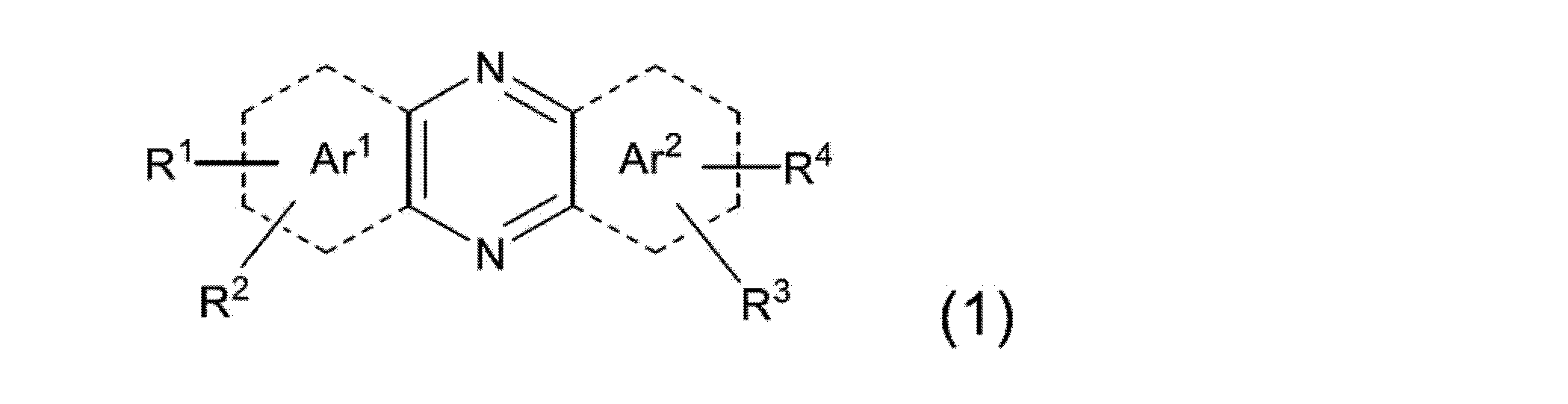
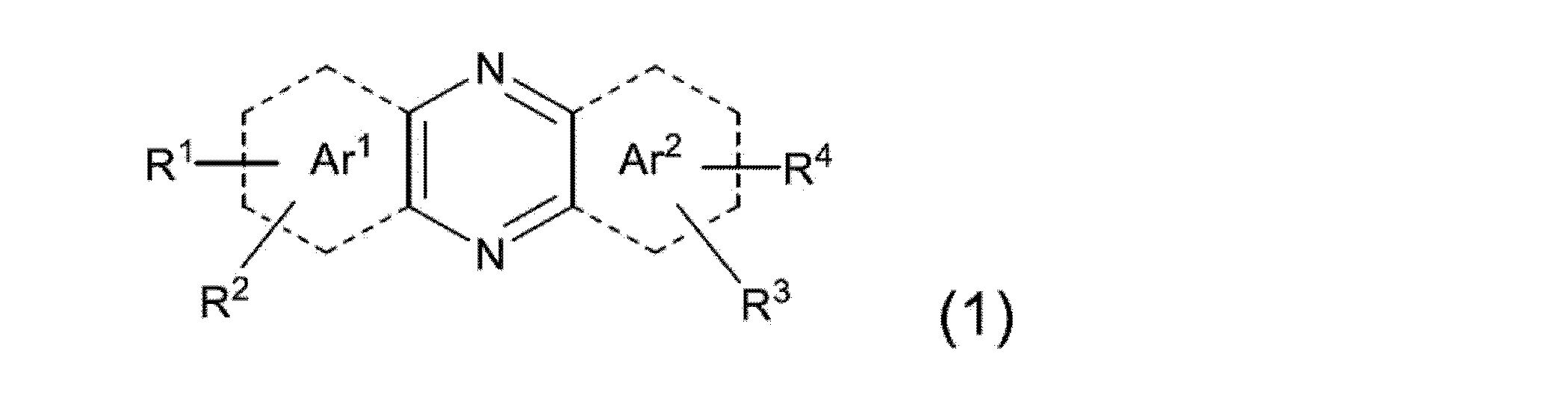
- the coloring liquid according to any one of 1) to 4), wherein the compound having a pyrazine skeleton in the molecule is a compound represented by the following formula (1).
- the ring Ar 1 and the ring Ar 2 represented by the broken line each independently represent a benzene ring or a naphthalene ring.
- R 1 and R 2 indicate a substituent of the ring Ar 1
- R 3 and R 4 indicates a substituent of ring Ar 2.
- R 1 , R 2 , R 3 and R 4 are independent hydrogen atoms, hydroxyl groups, carboxy groups, halogeno groups, alkyl groups, phenyl groups, phenoxy groups, respectively.
- the coloring solution according to 8), wherein the azo metal complex dye is an azo metal complex dye containing a metal selected from the group consisting of chromium, copper, iron, and cobalt.
- the content of the dye having a naphthalene skeleton in the molecule is 100 parts by mass, the content of the compound having two or more naphthalene skeletons in the molecule is less than 1.8 parts by mass 1) -9).
- the coloring liquid according to any one of the above items.
- the dye having a naphthalene skeleton in the molecule is C.I. I. Acid Brown 298; C.I. I. Acid Blue 193; and C.I. I. At least one dye selected from the group consisting of Acid Black 52, 52: 1, 172, 194;
- the compound having two or more naphthalene skeletons in the molecule is 1,1'-binaphthalene-2,2'-diol.
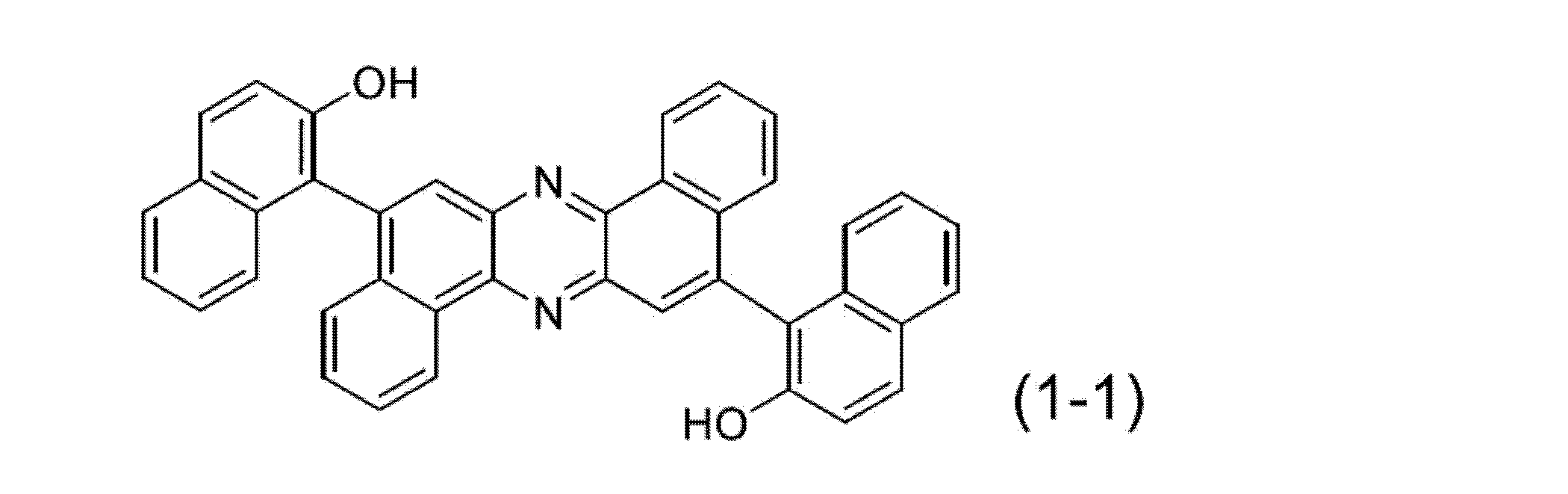
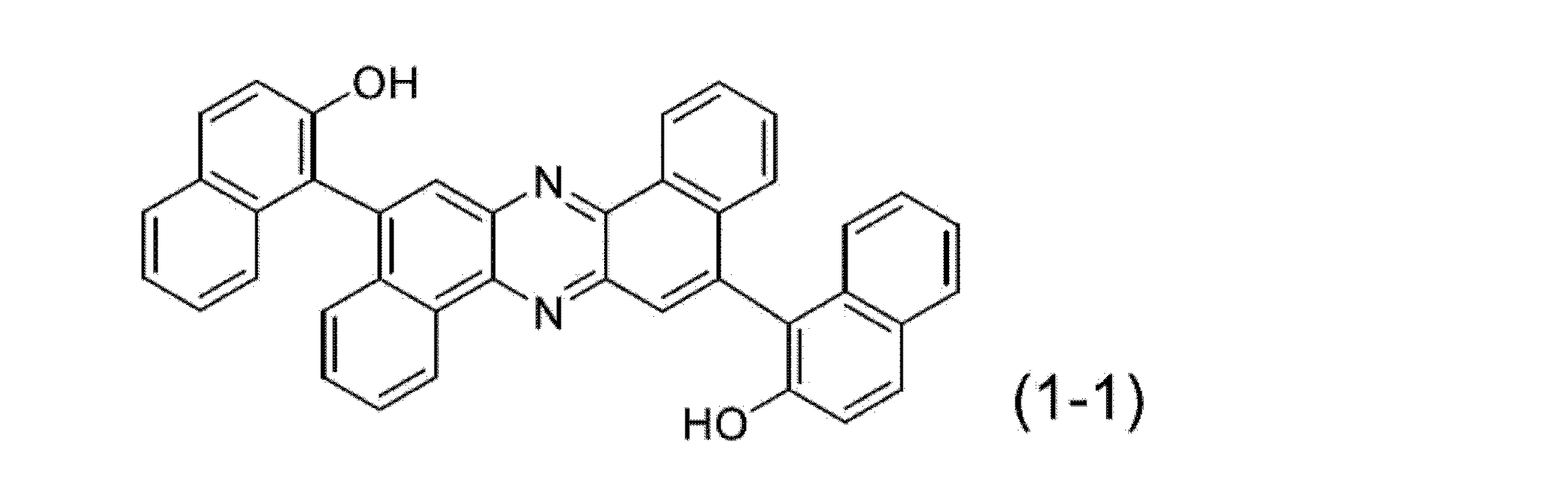
- the coloring liquid according to any one of 1) to 11), wherein the compound having a pyrazine skeleton in the molecule is a compound represented by the following formula (1-1).
- a coloring liquid set comprising the coloring liquid according to any one of 1) to 14) and at least one coloring liquid having a hue different from that of the coloring liquid.
- a coloring method for coloring by adhering each coloring liquid provided in the coloring liquid according to any one of 1) to 14) or the coloring liquid set according to 15) to a recording medium.
- a coloring liquid capable of obtaining a colored product having excellent resolubility and excellent fastness when dried a coloring liquid set including the coloring liquid, and the coloring liquid or the coloring liquid set thereof are provided. It is possible to provide a recording medium to which each coloring liquid is provided, and a coloring method using the coloring liquid or a coloring liquid set.
- CI is an abbreviation for Color Index.
- the coloring liquid according to the present embodiment has a dye having a naphthalene skeleton in the molecule and a compound having two or more naphthalene skeletons in the molecule (however, the dye having the naphthalene skeleton in the molecule and the pyrazine skeleton in the molecule. It contains at least one of a compound having a pyrazine skeleton in the molecule (excluding a dye having a naphthalene skeleton in the molecule) and water.
- the performance of the coloring liquid can be improved by containing a compound having two or more naphthalene skeletons in the molecule and / or a compound having a pyrazine skeleton in the molecule.
- the performance of the colored recording medium tends to be improved. The reason is not always clear, but the present inventors speculate as follows.
- the compound having two or more naphthalene skeletons in the molecule and the compound having a pyrazine skeleton in the molecule contribute to the solubility and dissolution stability of the dye having the naphthalene skeleton in the molecule, and as a result, the filterability of the coloring liquid. It is considered that the results are improved, clogging of the filter is suppressed, and unintentional precipitation of the dye due to factors such as drying is suppressed. Further, for the above reason, it is considered that it becomes easy to redissolve the dried coloring liquid. It is considered that these performance improvements can effectively suppress clogging of the head filter and nozzles when the coloring liquid is used as ink for an inkjet printer, and improve the ink ejection stability. ..
- the dye having a naphthalene skeleton in the molecule may be a dye or a pigment.
- the dye include direct dyes, acidic dyes, reactive dyes, disperse dyes (sublimation dyes, solvent dyes, etc.), cationic dyes, azoic dyes, sulfide dyes, medium dyes and the like.
- disperse dyes, cationic dyes, direct dyes, acid dyes, and reactive dyes are preferable.
- naphthalene skeleton-containing dye examples include an azo dye having an azo bond in the molecule, an azine dye, an azomethine dye, an aminoketone dye, a xanthene dye, a quinoline dye, a nitro dye, a methine dye, and a methine dye.
- examples thereof include dyes, styryl dyes, naphthalocyanine dyes, oxazole dyes, formazan dyes, anthraquinone dyes, phthalocyanine dyes, coumarin dyes, and triphenylmethane dyes.
- azo dyes are preferable.
- the naphthalene skeleton-containing dye is an azo dye
- it may be an azo metal complex dye by including a metal in the molecule.
- the metal in the azo metal complex-based dye is not particularly limited as long as it is a metal capable of forming a complex with the azo-based dye, but a metal selected from the group consisting of chromium, copper, iron, and cobalt is preferable.
- Examples of the azo dye or the azo metal complex dye include C.I. I. Acid Yellow 33, 100; C.I. I. Acid Orange 7, 8, 9, 12, 16, 17, 19, 20, 23, 27, 30, 31, 41, 51, 55, 56, 127, 137, 159, 160; C.I. I.
- the content of the naphthalene skeleton-containing dye is usually 0.5 to 25% by mass, preferably 1 to 20% by mass, and more preferably 1 to 17% by mass with respect to the total mass of the coloring liquid. preferable.
- the coloring liquid according to the present embodiment is used as a light-colored coloring liquid or ink (so-called light ink) in which the content of the naphthalene skeleton-containing dye is set low
- the content of the naphthalene skeleton-containing dye is the total mass of the coloring liquid.
- it is usually 0.025 to 5% by mass, preferably 0.05 to 2.5% by mass, and more preferably 0.05 to 2% by mass.
- naphthalene-based compound The compound having two or more naphthalene skeletons in the molecule (hereinafter, also referred to as “naphthalene-based compound”) does not contain the above-mentioned naphthalene skeleton-containing dye and the compound having a pyrazine skeleton in the molecule, and naphthalene in the molecule.
- the compound is not particularly limited as long as it has two or more skeletons.
- naphthalene compounds a compound having a hydroxyl group in the molecule and a compound having a binaphthalene skeleton in the molecule are preferable, a compound having a binaphthalene skeleton substituted in the molecule is more preferable, and both a hydroxyl group and a binaphthalene skeleton in the molecule are preferable.
- Compounds having the above are more preferable, and 1,1'-vinaphthalene-2,2'-diol is particularly preferable.
- the 1,1'-vinaphthalene-2,2'-diol may be racemic, R-form, or S-form.
- the content of the naphthalene-based compound is preferably less than 1.8 parts by mass, preferably 0.0001 parts by mass or more and less than 1.8 parts by mass, when the content of the naphthalene skeleton-containing dye is 100 parts by mass. It is more preferably 0.0002 parts by mass or more and less than 1.5 parts by mass, particularly preferably 0.0005 to 1.0 parts by mass, and 0.001 to 1.0 parts by mass. It is extremely preferable that it is a part.
- the compound having a pyrazine skeleton in the molecule (hereinafter, also referred to as “pyrazine-based compound”) is not particularly limited as long as it does not contain the above-mentioned naphthalene skeleton-containing dye and has a pyrazine skeleton in the molecule.
- the compound represented by the following formula (1) is preferable.
- the ring Ar 1 and the ring Ar 2 represented by the broken line each independently represent a benzene ring or a naphthalene ring.
- R 1 and R 2 indicate a substituent of the ring Ar 1
- R 3 and R 4 indicate a substituent of the ring Ar 2 .
- R 1 , R 2 , R 3 and R 4 are independent hydrogen atoms, hydroxyl groups, carboxy groups, halogeno groups, alkyl groups, phenyl groups, phenoxy groups, naphthyl groups, hydroxynaphthyl groups, naphthoxy groups, amino groups, respectively.
- An amino group, a hydroxyethylamino group, a hydroxypropylamino group, an N-acetyl-N-methylamino group, or an acetoxyethoxyethylamino group is shown.
- halogeno group examples include a fluorine group, a chlorine group, a bromine group, an iodine group and the like.
- alkyl group examples include a linear or branched alkyl group having 1 to 20 carbon atoms. Specific examples of the alkyl group include, but are not limited to, a methyl group, an ethyl group, an n-propyl group, an isopropyl group, an n-butyl group, an isobutyl group, a t-butyl group and the like.
- the naphthalene ring can arbitrarily select its ring-bonding position with respect to the pyrazine ring.
- the ring Ar 1 and the ring Ar 2 can have structures represented by the following formulas (A) to (D).
- a particularly preferable compound is a compound represented by the following formula (1-1).
- the compound represented by the above formula (1) is C.I. I. It is a kind of azine dye well known as acid black 2 etc., and has been widely used for dyeing fibers and the like.
- azine dyes such as those having a phenazine ring and a naphthazine ring, and for example, a non-patent document [Hiroshi Horiguchi (1969). It can be obtained based on the review article Synthetic Dye Sankyo Publishing].
- the compound represented by the above formula (1-1) for example, a commercially available compound represented by the above formula (D) is brominated, and then the boronized 2-naphthol is used in a Suzuki-Miyaura cross cup. It can be obtained by reacting by a ring reaction.
- the content of the pyrazine-based compound is preferably less than 1.2 parts by mass, preferably 0.0001 parts by mass or more and less than 1.2 parts by mass, when the content of the naphthalene skeleton-containing dye is 100. Is more preferably 0.0002 to 1.0 part by mass, particularly preferably 0.0005 to 0.5 part by mass, and extremely preferably 0.001 to 0.5 part by mass. preferable.
- the coloring liquid according to the present embodiment preferably contains both a naphthalene-based compound and a pyrazine-based compound, and is represented by the above formula (1-1) as 1,1'-vinaphthalene-2,2'-diol. It is more preferable to contain both of the compound represented.
- water water having few impurities such as ion-exchanged water and distilled water is preferable.
- the water content is preferably 1 to 99% by mass, more preferably 5 to 95% by mass, based on the total mass of the coloring liquid.
- the coloring liquid according to the present embodiment may further contain a water-soluble organic solvent.
- the water-soluble organic solvent include alcohols, pyrrolidones, polyoxyalkylene diglyceryl ether and the like.
- alcohols include glycerin, 1,3-propanediol, 1,2-butanediol, 1,3-butanediol, 1,4-butanediol, 1,3-pentanediol, 1,5-pentanediol, and 1 , 2-hexanediol, 1,6-hexanediol, 2,4-diethyl-1,5-pentanediol, 3-methyl-1,3-butanediol, 3-methyl-1,5-pentanediol, etc.
- C2-C6 alcohol having 2 to 3 groups polyglyceryl ether such as diglycerin and polyglycerin; polyoxyC2-C3 alkylene polyglyceryl ether such as polyoxyethylene polyglyceryl ether and polyoxypropylene polyglyceryl ether; ethylene glycol, diethylene glycol and triethylene Mono, di, or tri-C2-C3 alkylene glycols such as glycols, propylene glycols, dipropylene glycols, and polyethylene glycols; poly-C2-C3 alkylenes such as polyethylene glycols and polypropylene glycols having 4 or more repeating units and a molecular weight of about 20000 or less.
- Glycol (preferably liquid); ethylene glycol monomethyl ether, ethylene glycol monoethyl ether, diethylene glycol monomethyl ether, diethylene glycol monoethyl ether, diethylene glycol monobutyl ether (butyl carbitol), triethylene glycol monomethyl ether, triethylene glycol monoethyl ether , Triethylene glycol monobutyl ether (butyltriglycol), propylene glycol monomethyl ether, propylene glycol monoethyl ether (1-ethoxy-2-propanol), dipropylene glycol monopropyl ether (1- (1-methyl-2-propoxyethoxy)) ) -2-propanol), dipropylene glycol monobutyl ether (1- (2-butoxy-1-methylethoxy) propan-2-ol), diethylene glycol monoethyl ether, diethylene glycol monohexyl ether (hexylcarbitol), etc.
- C1-C6 monoalkyl ether of alcohol C1-C6 dialkyl ether of polyvalent alcohol such as diethylene glycol diethyl ether (diethyl carbitol); glycol mono such as 3-methoxy-1-butanol and 3-methoxy-3-methylbutanol.
- Ethers glycol phenyl ethers such as propylene glycol (mono) phenyl ether (1-phenoxy-2-propanol); and the like.
- Examples of pyrrolidones include 2-pyrrolidone, N-methyl-2-pyrrolidone, 1- (2-hydroxyethyl) -2-pyrrolidone and the like.
- polyoxyalkylene diglyceryl ether polyoxypropylene diglyceryl ethers having trade names SC-P400, SC-P750, SC-P1000, SC-P1200, SC-P1600, etc. manufactured by Sakamoto Pharmaceutical Co., Ltd .; SC -Polyoxyethylene diglyceryl ethers such as E450, SC-E750, SC-E1000, SC-E1500, SC-E2000; and the like.
- SC-Polyoxyethylene diglyceryl ethers such as E450, SC-E750, SC-E1000, SC-E1500, SC-E2000; and the like.
- the content of the water-soluble organic solvent is usually 0 to 50% by mass, preferably 1 to 50% by mass, and more preferably 5 to 40% by mass with respect to the total mass of the coloring liquid.
- the coloring liquid according to this embodiment may further contain other additives.
- the additive include a surfactant, a pH adjuster, an antiseptic and antifungal agent, a dye dissolving agent, a hydrotropy agent, a moisturizing agent and the like.
- the total content of the additives is usually 0 to 10% by mass, preferably about 0.05 to 5% by mass, based on the total mass of the coloring liquid.
- surfactant examples include anionic, cation, amphoteric, and nonionic surfactants. Of these, nonionic surfactants are preferred.
- anionic surfactant examples include an alkyl sulfocarboxylate, an ⁇ -olefin sulfonate, a polyoxyethylene alkyl ether acetate, an N-acyl amino acid or a salt thereof, an N-acylmethyl taurine salt, and an alkyl sulfate polyoxy.
- Examples of the cationic surfactant include 2-vinylpyridine derivatives, poly4-vinylpyridine derivatives and the like.
- amphoteric tenside examples include lauryldimethylaminoacetic acid betaine, 2-alkyl-N-carboxymethyl-N-hydroxyethylimidazolinium betaine, coconut oil fatty acid amide propyldimethylaminoacetic acid betaine, polyoctylpolyaminoethylglycine, and imidazoline. Examples include derivatives.
- nonionic surfactant examples include ethers such as polyoxyethylene nonylphenyl ether, polyoxyethylene octylphenyl ether, polyoxyethylene dodecylphenyl ether, polyoxyethylene oleyl ether, polyoxyethylene lauryl ether, and polyoxyethylene alkyl ether.
- Ethers such as polyoxyethylene oleic acid ester, polyoxyethylene distearate, sorbitan laurate, sorbitan monostearate, sorbitan monooleate, sorbitan sesquioleate, polyoxyethylene monooleate, polyoxyethylene stearate, etc.
- the coloring liquid according to the present embodiment contains a surfactant
- the content thereof is usually 0.001 to 2% by mass and 0.01 to 1.5% by mass with respect to the total mass of the coloring liquid. Is preferable.
- any substance can be used as long as the pH of the coloring liquid can be controlled in the range of 6.0 to 11.0.
- the pH adjuster include alkanolamines such as diethanolamine, dimethylethanolamine and diethylethanolamine triethanolamine; hydroxides of alkali metals such as lithium hydroxide, sodium hydroxide and potassium hydroxide; ammonium hydroxide (ammonia). Water); alkali metal carbonates such as lithium carbonate, sodium carbonate, potassium carbonate; tris (hydroxymethyl) aminomethane; and the like. Of these, triethanolamine is preferred.
- the coloring liquid according to the present embodiment contains a pH adjuster
- the content thereof is usually 0.01 to 2% by mass and 0.05 to 1% by mass with respect to the total mass of the coloring liquid. Is preferable.
- antiseptic and antifungal agents examples include sodium dehydroacetate, sodium benzoate, sodium pyridinethion-1-oxide, zincpyridinethion-1-oxide, 1,2-benzisothiazolin-3-one, and 1-benzisothiazolin-. 3-one amine salt; BIox P520LP manufactured by LANXESS, Presentol BIT 20N; ROCIMA 640 manufactured by Dow Chemical Co., Ltd .; Mergal K-20 manufactured by TROY; Proxel GXL, Proxel XL2 manufactured by Ronza, etc. .. Among these, Proxel GXL and Proxel XL2 are preferable.
- the coloring liquid according to the present embodiment contains an antiseptic and antifungal agent
- the content thereof is usually 0.001 to 2% by mass and 0.01 to 1% by mass with respect to the total mass of the coloring liquid. It is preferable to have.
- Examples of the dye dissolving agent include urea, ⁇ -caprolactam, ethylene carbonate and the like.
- hydrotropy agent examples include urea, thiourea, cyanoguanidine, guanidine phosphate, guanidine sulfamate and the like.
- moisturizer examples include urea, glycerin and the like.
- the coloring liquid according to the present embodiment can be obtained by dissolving a naphthalene skeleton-containing dye, a naphthalene-based compound, a pyrazine-based compound, and if necessary, other additives in a solvent such as water.
- the naphthalene skeleton-containing dye, the naphthalene-based compound, and the pyrazine-based compound may be purchased as commercial products or may be synthesized.
- the naphthalene-based compound and the pyrazine-based compound can also be obtained, for example, by separating and purifying those produced as by-products during the synthesis of the naphthalene skeleton-containing dye.
- a generally known method for purifying a dye or a method for purifying a chemical substance can be adopted.
- the separation and purification method include a recrystallization method, a sublimation method, a dialysis method, and a salt described in a non-patent document [Journal of the Society of Synthetic Organic Chemistry, 1955, Vol. 13, No. 4, p. 106].
- ion exchange resin method column chromatography method, thin layer chromatography method, and paper chromatography method, a method using an adsorbent, an ultrafiltration method, a back-penetration membrane method, a distillation method, and the like can be mentioned.
- the ion exchange resin examples include a cation exchange resin and an anion exchange resin.
- the adsorbent include activated carbon, zeolite, diatomaceous earth, cellulose fiber, chelate fiber, synthetic adsorbent and the like.
- the ion exchange resin method or the adsorbent method the ion exchange resin or the adsorbent may be mixed with a dye solution prepared by dissolving or dispersing the dye in water or an appropriate organic solvent, stirred, and then filtered.
- a dye solution prepared by dissolving or dispersing the dye in water or a suitable organic solvent may be passed through a column packed with an ion exchange resin or an adsorbent.
- a general analytical method for measuring organic compounds can be adopted.
- Specific analysis methods include, for example, nuclear magnetic resonance analysis method, high performance liquid chromatography method, high performance liquid chromatography / mass analysis method, paper chromatography method, thin layer chromatography method, gas chromatography method, gas chromatography.
- Mass analysis method gel permeation chromatography method, elemental analysis method, infrared spectroscopic analysis method, infrared / visible spectroscopic analysis method and the like can be mentioned.
- the coloring liquid according to this embodiment can be used for various recording applications such as printing, copying, marking, writing, drafting, stamping, etc., and is particularly suitable for inkjet recording.
- the coloring liquid according to the present embodiment may be used as the ink for inkjet recording, or other additives may be further contained if necessary.
- the coloring liquid according to this embodiment is used as an ink for inkjet recording, it is preferable to perform microfiltration using a membrane filter or the like.
- the pore size of the membrane filter is usually 0.1 to 1 ⁇ m, preferably 0.1 to 0.5 ⁇ m.
- the viscosity of the coloring liquid at 25 ° C. is preferably 3 to 20 mPa ⁇ s as measured by an E-type viscometer. Further, the surface tension of the coloring liquid at 25 ° C. is preferably 20 to 45 mN / m when measured by the plate method.
- the viscosity and surface tension of the coloring liquid are preferably adjusted to appropriate values within the above ranges in consideration of the ejection amount of the inkjet printer, the response speed, the flight characteristics of the droplets, the characteristics of the inkjet head, and the like.
- the coloring liquid set according to the present embodiment includes the coloring liquid according to the present embodiment and at least one kind of coloring liquid having a hue different from that of the coloring liquid.
- Examples of the coloring liquid that the coloring liquid set according to the present embodiment may include include magenta coloring liquid, cyan coloring liquid, yellow coloring liquid, blue coloring liquid, green coloring liquid, orange coloring liquid, gray coloring liquid, and black. Coloring liquid and the like can be mentioned.
- the recording medium according to the present embodiment is the one to which the coloring liquid according to the present embodiment or each coloring liquid provided in the coloring liquid set according to the present embodiment is attached. Further, the coloring method according to the present embodiment is to attach the coloring liquid according to the present embodiment or each coloring liquid provided in the coloring liquid set according to the present embodiment to a recording medium for coloring.
- Recording media include information transmission sheets such as plain paper, resin-coated paper, inkjet paper, glossy paper, glossy film, and electrophotographic paper; fibers (cotton, linen, nylon, wool, silk, etc.), fabrics; glass. Examples include; metal; ceramics; leather; base material for color filters; and the like.
- a sheet-like medium is preferably used, but a medium having a three-dimensional shape such as a spherical shape or a rectangular parallelepiped shape other than the sheet-like shape may be used.
- the method of adhering the coloring liquid to the recording medium is not particularly limited, and for example, an inkjet recording method is preferable.
- Preferred recording media used for inkjet recording include, for example, those provided with an ink receiving layer on a substrate such as paper, synthetic paper, or film.
- the ink receiving layer is a method of impregnating or coating the above-mentioned substrate with a cationic polymer; inorganic fine particles capable of absorbing dyes in a coloring liquid such as porous silica, alumina sol, and special ceramics are made of polyvinyl alcohol, polyvinylpyrrolidone, and the like. It is provided by a method of coating on the surface of a substrate together with a hydrophilic polymer; etc.
- Recording media provided with such an ink receiving layer are usually referred to as inkjet paper (film), glossy paper (film), or the like.
- inorganic fine particles that can absorb dyes in coloring liquids such as porous silica, alumina sol, and special ceramics are said to be easily affected by gases that have an oxidizing action in the air such as ozone gas.
- This is a type of inkjet paper that is coated on the surface of the base material.
- special paper that can be obtained as a commercial product are Canon Co., Ltd., product name: Photo Paper / Glossy Pro "Platinum Grade", Photo Paper / Glossy Gold; Seiko Epson Co., Ltd., Product Name: Photo Paper.
- a fiber is mentioned as a preferable recording medium used for inkjet recording.
- a polyamide fiber, a blended fiber containing a polyamide fiber, a cellulosic fiber, a blended fiber containing a cellulosic fiber and the like are preferably used.
- the polyamide fiber include silk, hair, nylon and the like.
- the cellulosic fiber include cotton, linen, rayon, polynosic and the like.
- the blended fiber include a polyamide fiber or a blend of a cellulosic fiber and another fiber.
- the fiber also includes a fiber structure (fabric, etc.).
- the fiber dyeing method according to the present embodiment includes using the coloring liquid according to the present embodiment as ink and sequentially performing at least the following steps.
- Step A A process of adhering ink to fibers by methods such as inkjet method, screen printing, dyeing, and continuous dyeing.
- Step B The process of fixing the ink pigment attached to the fiber to the fiber.
- Process C The process of cleaning the unfixed pigment remaining on the fiber.
- Examples of the inkjet printer that can be used in step A include those using a piezo method using mechanical vibration; a bubble jet (registered trademark) method using bubbles generated by heating; and the like.
- step B the fiber to which the ink is attached is left at room temperature to 130 ° C. for about 0.5 to 30 minutes to be pre-dried, and then a steaming treatment is performed to fix the dye to the fiber under moist heat conditions.
- a steaming treatment it is preferable to leave it in an environment with a relative humidity of 80 to 100% and a temperature of 95 to 105 ° C. for 5 to 30 minutes.
- step C it is preferable to wash the fibers after the dye is fixed with water. At the time of this washing, it may be washed with water containing a surfactant. After performing step C, the washed fibers are usually dried at 40 to 120 ° C. for 5 to 30 minutes to obtain a dried dyed product.
- Pretreatment process A step of pretreating the fiber for the purpose of preventing dye bleeding can be further included before the step A.
- a pretreatment step When printing a polyamide fiber or a cellulose fiber, it is preferable to include a pretreatment step.
- Examples of the pretreatment step include a step of using an aqueous solution containing a glue material and a pH adjuster as a fiber pretreatment liquid and applying it to the fibers before performing step A.
- the pretreatment liquid preferably further contains a hydrotropy agent.
- Examples of the adhesive contained in the pretreatment liquid include natural gums such as guar and locust beans; starches; seaweeds such as sodium alginate and furi; plant skins such as pectinic acid; methylfibers and ethyl fibers. Fiber element derivatives such as element, hydroxyethyl cellulose, carboxymethyl cellulose; processed starch such as carboxymethyl starch; processed natural gums such as shiratsu gum and roast bean gum; synthetic glues such as polyvinyl alcohol and polyacrylic acid ester; Be done.
- natural gums such as guar and locust beans; processed natural gums such as shiratsu gum and roast bean gum; are preferable.
- Examples of the pH adjuster contained in the pretreatment liquid include alkaline sodium salts such as sodium carbonate and sodium hydrogen carbonate; acidic ammonium salts such as ammonium sulfate, ammonium tartrate, and ammonium acetate; and the like.
- hydrotropy agent contained in the pretreatment liquid examples include urea, dimethylurea, thiourea, monomethylthiourea, dimethylthiourea and the like. Of these, urea is preferred.
- the content of the adhesive is 0.5 to 5% by mass
- the content of the pH adjuster is 0.5 to 5% by mass
- the rest is water with respect to the total mass of the pretreatment liquid.
- the pretreatment liquid further contains a hydrotropy agent
- the content of the hydrotropy agent is preferably 1 to 20% by mass with respect to the total mass of the pretreatment liquid.
- the pretreatment liquid is preferably acidic, and the pH range is usually pH 7 or less, preferably pH 5 to 7.
- a padding method can be mentioned.
- the squeezing ratio of the padding is preferably about 40 to 90%, more preferably about 60 to 80%.
- the dyed product may be treated with a fixing agent, an ultraviolet absorber, an antioxidant, or the like as a post-treatment for the purpose of improving light fastness, wet fastness, and chlorine fastness. ..
- Examples of the fixing agent used for the post-treatment include polyamine-based, polycation-based, tannin-based, and synthetic tannin-based fixing agents.
- Examples of the ultraviolet absorber used for the post-treatment include benzophenone compounds, benzotriazole compounds, cinnamic acid compounds, triazine compounds, stilbene compounds and the like. Further, a compound that absorbs ultraviolet rays and emits fluorescence, such as a benzoxazole-based compound, a so-called fluorescent whitening agent and the like can also be used.
- antioxidant used for the post-treatment examples include L-ascorbic acid (also known as vitamin C), erythorbic acid, ⁇ -tocopherol (also known as vitamin E) and the like.
- the combination of preferable ones is more preferable, and the combination of more preferable ones is further preferable.
- the inks in each embodiment are included in the coloring liquid.
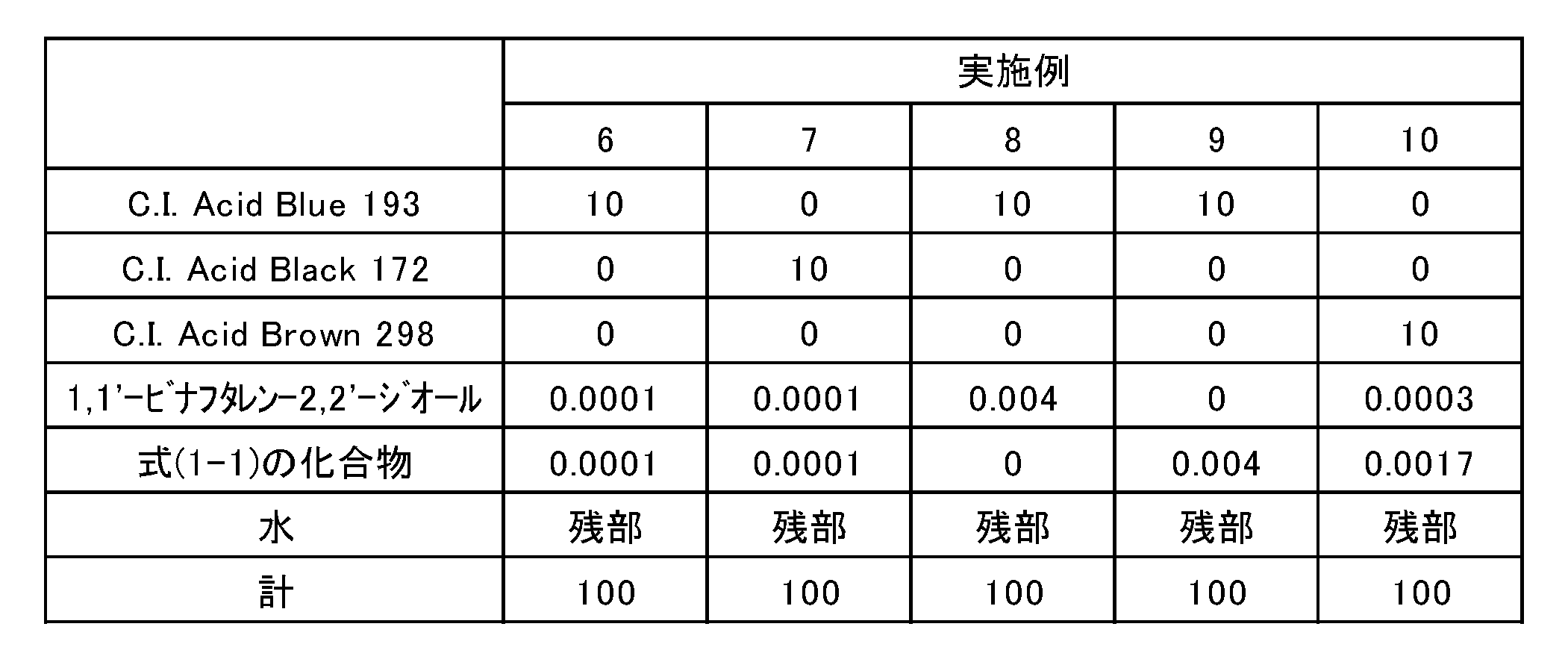
- Examples 1 to 10 and Comparative Examples 1 to 3 Preparation of coloring liquid> Commercially available C.I. I. Acid Blue 193, C.I. I. Acid Black 172, and C.I. I. Acid Brown 298 was purified by activated carbon filtration, microfiltration, and ultrafiltration. Purified C.I. I. Acid Blue 193, C.I. I. Acid Black 172, or C.I. I. Acid Brown 298, 1,1'-vinaphthalene-2,2'-diol (naphthalene compound), the compound represented by the above formula (1-1) (pyrazine compound), and water are shown in Table 1 below. Mixing was performed so as to have a composition as shown in 3 to 3 to obtain colored liquids of Examples 1 to 10 and Comparative Examples 1 to 3. In Tables 1 to 3, the numerical values of each component represent parts by mass.
- resolubility means a phenomenon in which the dissolved component or the dispersed component becomes unstable due to an increase in the solid content concentration due to evaporation of the volatile component in the ink, and the nozzle or the like is clogged due to aggregation or precipitation. At times, it is considered to be a guideline for recovering the function of the nozzle by redissolving or redistributing by supplying new ink (Journal of the Imaging Society of Japan, Vol. 41, No. 2 (2002), p. 182). See). Such inks are not practical because the inability to redissolve when the ink dries means that the function of the nozzle is not restored.
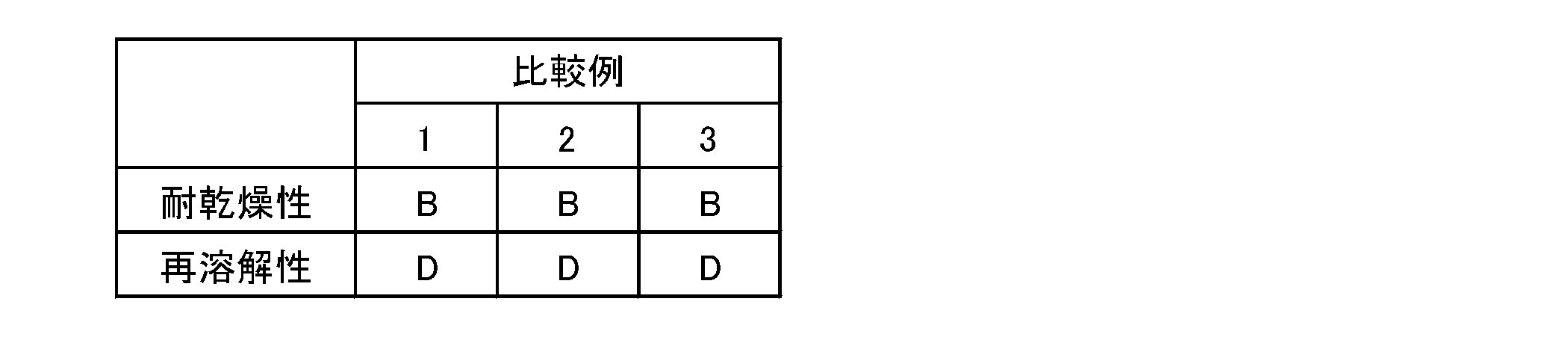
- the coloring liquids of Examples 1 to 10 containing the naphthalene-based compound and / or the pyrazine-based compound all had practical drought resistance and resolubility.
- the colored liquids of Examples 1 to 10 had good filterability.
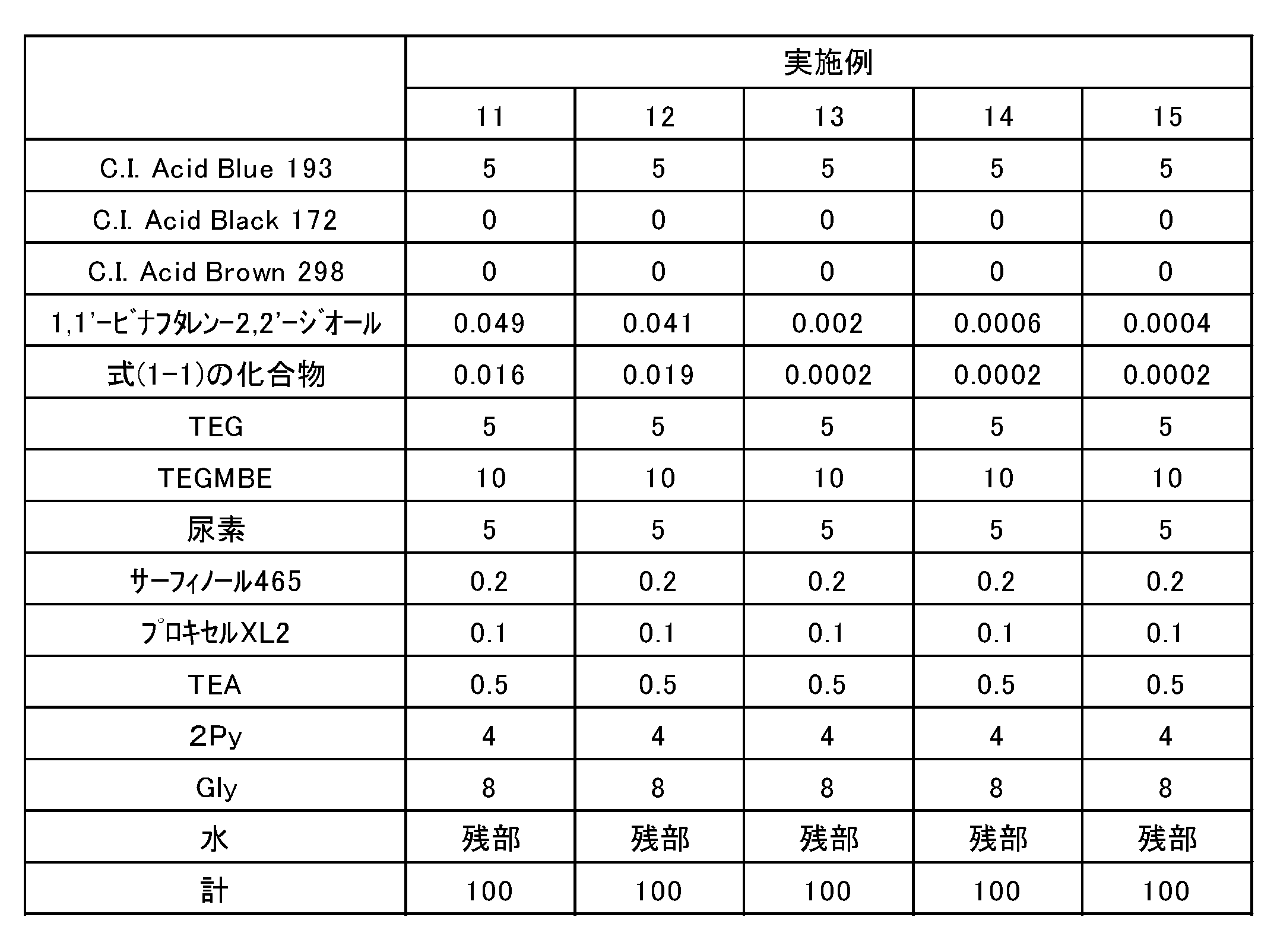
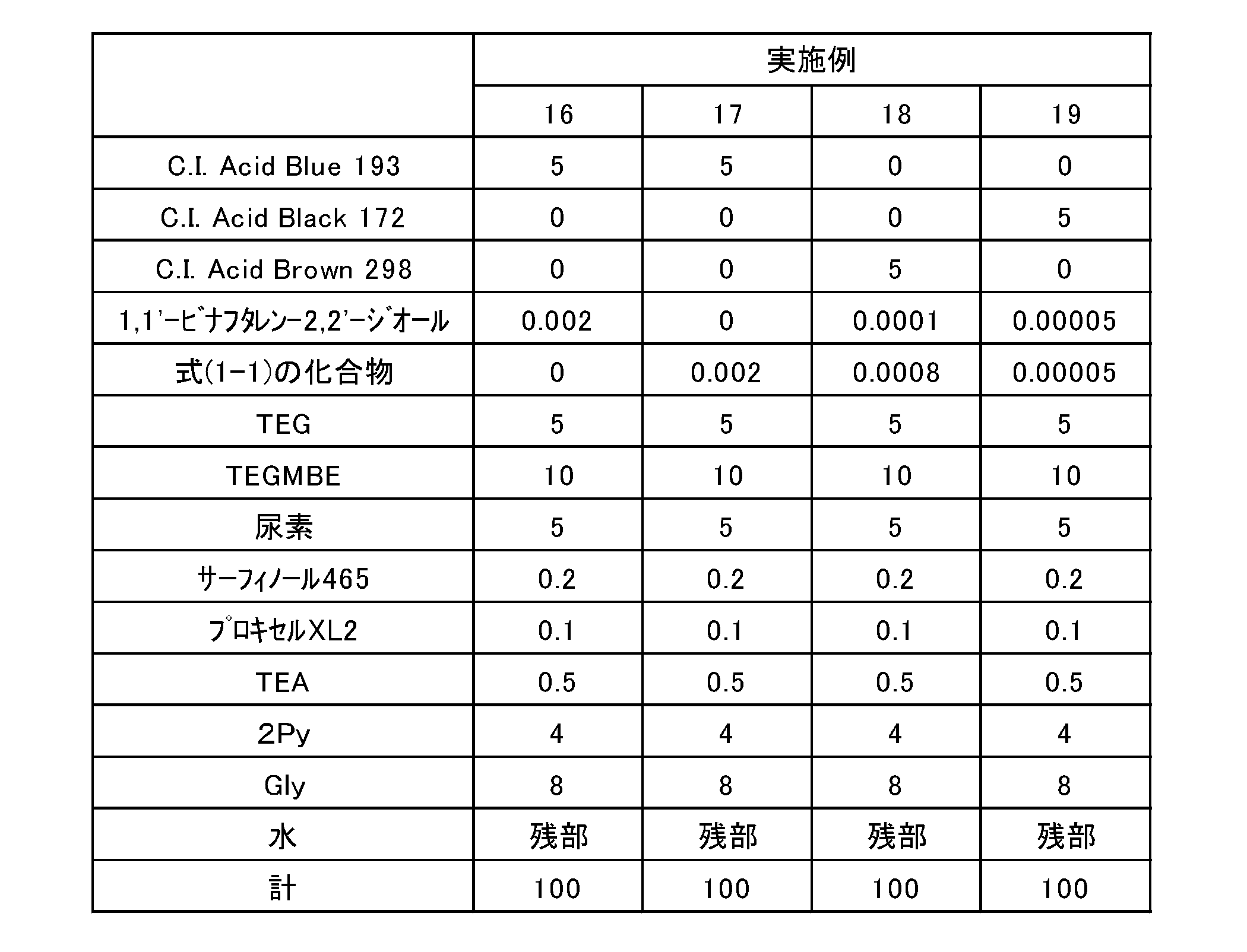
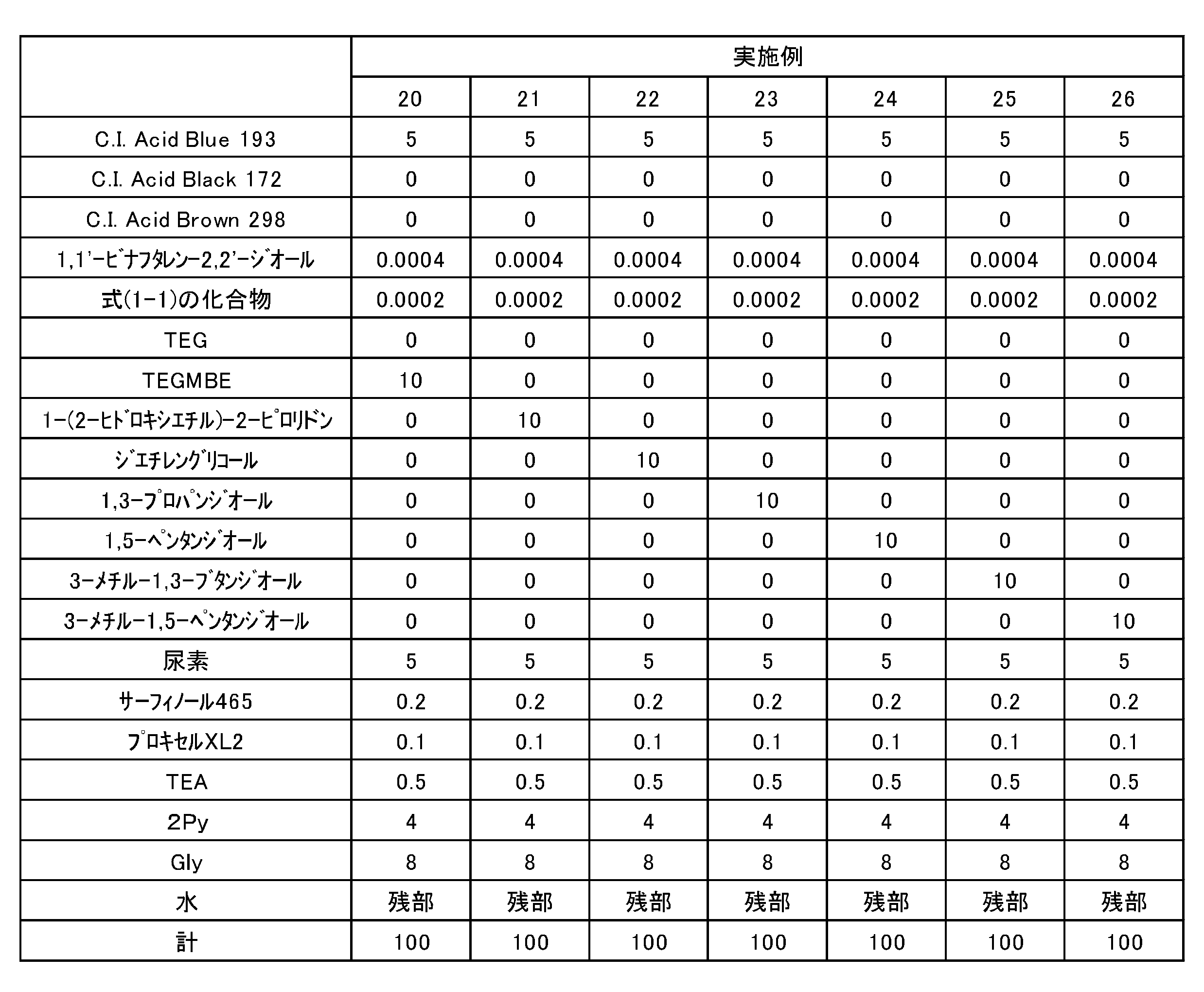
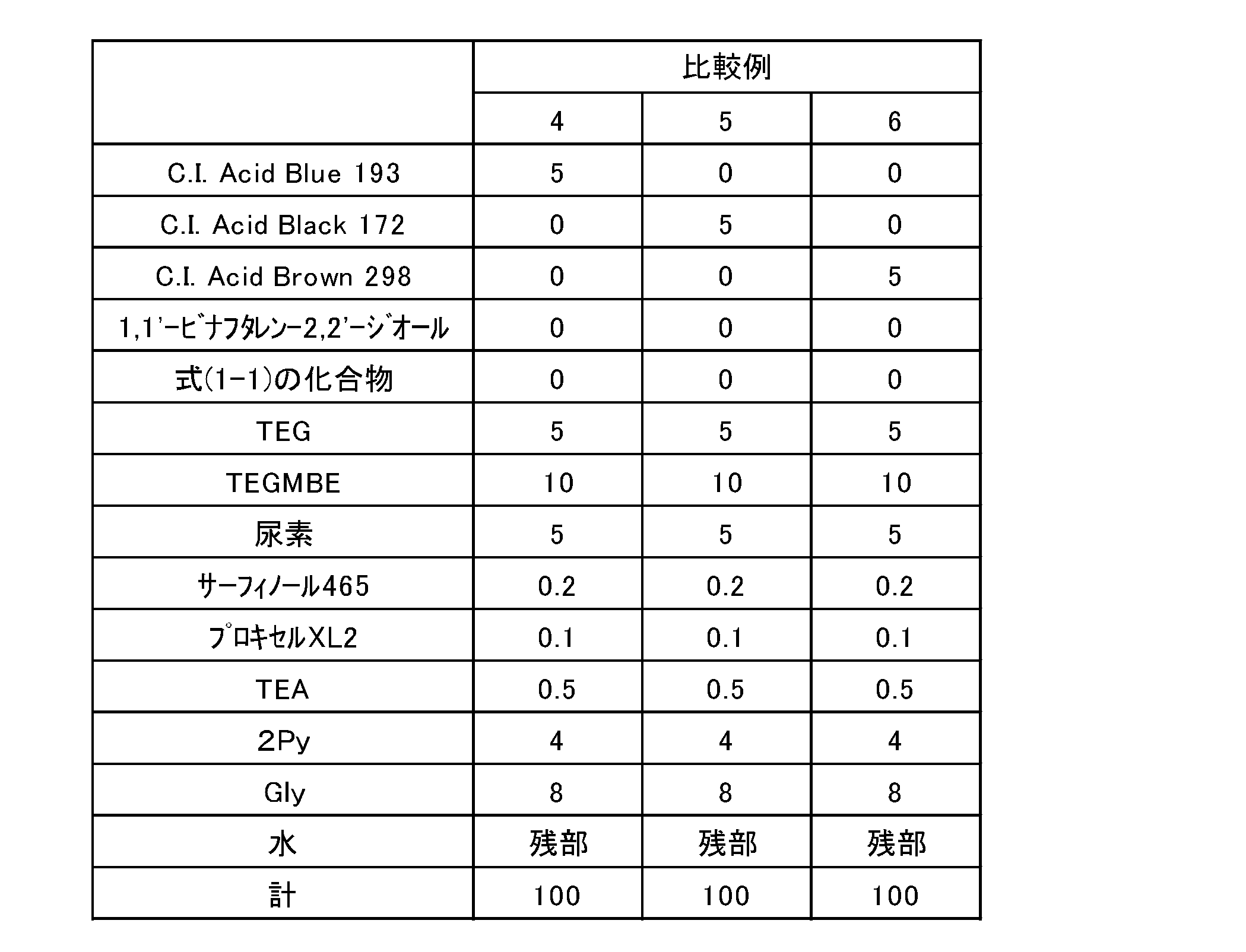
- Examples 11 to 26 and Comparative Examples 4 to 6 Ink preparation> By mixing each component shown in Tables 6 to 9 below, the inks of Examples 11 to 26 and Comparative Examples 4 to 6 were obtained. In Tables 6 to 9, the numerical values of each component represent parts by mass. Further, in Tables 6 to 9, each abbreviation represents the following.
- TEG Triethylene glycol (manufactured by Mitsubishi Chemical Corporation)
- TEGMBE Triethylene glycol monobutyl ether (manufactured by Kanto Chemical Co., Inc.)
- Surfinol 465 Surfactant (manufactured by Nissin Chemical Industry Co., Ltd.)
- Proxel XL2 Antiseptic and antifungal agent (manufactured by Lonza)
- TEA Triethanolamine (manufactured by Mitsui Chemicals, Inc.)
- 2Py 2-Pyrrolidone (manufactured by Mitsubishi Chemical Corporation)
- Gly Glycerin (manufactured by Junsei Chemical Co., Ltd.)
- each evaluation test of drought resistance and resolubility was carried out in the same manner as in Example 1 and the like. Furthermore, each of the following evaluation tests was performed using each ink. The results are shown in Tables 10-12 below.
- all of the inks of Examples 11 to 26 have good filterability when the entire amount is filtered using a mixed cellulose filter (manufactured by Advantech) having a diameter of 47 mm and a pore diameter of 0.2 ⁇ m, and foreign matter or foreign matter is contained in the filter. It was difficult for the coloring to remain. Further, all of the inks of Examples 11 to 26 are less likely to be chipped when nozzle check pattern printing is performed with the inkjet printer PX-205 (manufactured by Seiko Epson Corporation), and good printed matter can be obtained. Was made.
- each stamp was pre-dried at 60 to 80 ° C., and then steamed for 30 minutes under the conditions of a relative humidity of 90% or more and 100 to 103 ° C. Each of the obtained stamps was washed with cold water for 5 minutes and then dried to obtain each test dyed cloth.
- Each test dyed fabric obtained as described above was subjected to a light resistance test according to the JIS L0843A method. That is, each test dyed cloth was irradiated with light for 39.4 hours using a xenon weather meter SUGA NX75 (manufactured by Suga Test Instruments Co., Ltd.).
- the light irradiation conditions are black panel temperature: 63 ° C, tank temperature: 38 ° C, relative humidity: 50%, irradiance: 50 W / m 2 (wavelength 300 to 400 nm), inner filter: quartz, outer filter: soda lime glass. It was the condition of.
- a xenon weatherometer XL75 manufactured by Suga Test Instruments Co., Ltd.
- the light irradiation conditions were a tank temperature of 24 ° C., a relative humidity of 60%, and an irradiance of 0.36 W / m 2 .
- the reflection density before and after the test was measured using a colorimeter (SectorEye, manufactured by GretagMacbeth) with a reflection density (Dc or Dk) in the range of 0.70 to 0.85, and the dye was measured according to the following formula (2).
- the survival rate was calculated.
- Dye residual rate (reflection concentration after test / reflection concentration before test) x 100 (%) ... (2) Then, from the calculated dye residual ratio value, the light resistance was evaluated according to the following criteria. -Evaluation criteria- A: Dye residual rate is 90% or more B: Dye residual rate is 80% or more and less than 90% C: Dye residual rate is 70% or more and less than 80% D: Dye residual rate is less than 70%
- ozone resistance test an ozone weather meter OMS-H (manufactured by Suga Test Instruments Co., Ltd.) was used, and each test piece was left for 16 hours under the conditions of ozone concentration of 1 ppm, tank temperature of 23 ° C, and relative humidity of 50%. bottom. Then, the residual dye in each test piece was visually confirmed, and the ozone resistance was evaluated according to the following criteria. -Evaluation criteria- a: The original pigment clearly remains. b: A little original pigment remains. c: The original pigment cannot be confirmed.
- the inks of Examples 11 to 26 containing the naphthalene-based compound and / or the pyrazine-based compound all have practical drought resistance and re-dissolution resistance, and are nozzles of the printer head. It is considered to be excellent in prevention and recovery of clogging.
- the inks of Examples 11 to 26 had good filterability and ink ejection property.
- the recording media (silk cloth, photographic paper) colored with the inks of Examples 11 to 26 have improved light resistance and ozone resistance. Even when 6,6-nylon was dyed instead of silk cloth (silk habutae), the obtained dyed cloth had good light resistance.
Landscapes
- Chemical & Material Sciences (AREA)
- Organic Chemistry (AREA)
- Engineering & Computer Science (AREA)
- Chemical Kinetics & Catalysis (AREA)
- Textile Engineering (AREA)
- Life Sciences & Earth Sciences (AREA)
- Materials Engineering (AREA)
- Wood Science & Technology (AREA)
- Dispersion Chemistry (AREA)
- Inks, Pencil-Leads, Or Crayons (AREA)
- Ink Jet Recording Methods And Recording Media Thereof (AREA)
Abstract
Description
1)
分子内にナフタレン骨格を有する色素と、分子内にナフタレン骨格を2つ以上有する化合物(但し、前記分子内にナフタレン骨格を有する色素及び分子内にピラジン骨格を有する化合物を除く。)及び分子内にピラジン骨格を有する化合物(但し、前記分子内にナフタレン骨格を有する色素を除く。)の少なくとも一方の化合物と、水とを含有する着色液。
前記分子内にナフタレン骨格を2つ以上有する化合物が、分子内に水酸基を有する化合物である、1)に記載の着色液。
前記分子内にナフタレン骨格を2つ以上有する化合物が、置換基を有するビナフタレン骨格を有する化合物である、1)又は2)に記載の着色液。
前記分子内にナフタレン骨格を2つ以上有する化合物が、1,1’-ビナフタレン-2,2’-ジオールである、1)~3)のいずれか1項に記載の着色液。
前記分子内にピラジン骨格を有する化合物が、下記式(1)で表される化合物である、1)~4)のいずれか1項に記載の着色液。
前記分子内にピラジン骨格を有する化合物が、下記式(1-1)で表される化合物である、1)~5)のいずれか1項に記載の着色液。
前記分子内にナフタレン骨格を有する色素が、分子内にアゾ結合を有するアゾ系色素である、1)~6)のいずれか1項に記載の着色液。
前記分子内にナフタレン骨格を有する色素が、アゾ金属錯体系色素である、1)~7)のいずれか1項に記載の着色液。
前記アゾ金属錯体系色素が、クロム、銅、鉄、及びコバルトからなる群より選択される金属を含むアゾ金属錯体系色素である、8)に記載の着色液。
前記分子内にナフタレン骨格を有する色素の含有量を100質量部としたとき、前記分子内にナフタレン骨格を2つ以上有する化合物の含有量が1.8質量部未満である、1)~9)のいずれか1項に記載の着色液。
前記分子内にナフタレン骨格を有する色素の含有量を100質量部としたとき、前記分子内にピラジン骨格を有する化合物の含有量が1.2質量部未満である、1)~10)のいずれか1項に記載の着色液。
前記分子内にナフタレン骨格を有する色素が、C.I.アシッドブラウン 298;C.I.アシッドブルー 193;及びC.I.アシッドブラック 52、52:1、172、194;からなる群より選択される少なくとも1種の色素であり、
前記分子内にナフタレン骨格を2つ以上有する化合物が、1,1’-ビナフタレン-2,2’-ジオールであり、
前記分子内にピラジン骨格を有する化合物が、下記式(1-1)で表される化合物である、1)~11)のいずれか1項に記載の着色液。

前記分子内にナフタレン骨格を2つ以上有する化合物と、前記分子内にピラジン骨格を有する化合物との両者を含有する、1)~12)のいずれか1項に記載の着色液。
さらに水溶性有機溶剤を含有する、1)~13)のいずれか1項に記載の着色液。
1)~14)のいずれか1項に記載の着色液と、該着色液と色相が異なる少なくとも1種の着色液とを備える着色液セット。
1)~14)のいずれか1項に記載の着色液、又は15)に記載の着色液セットが備える各着色液が付着した記録メディア。
前記記録メディアが繊維である、16)に記載の記録メディア。
1)~14)のいずれか1項に記載の着色液、又は15)に記載の着色液セットが備える各着色液を記録メディアに付着させて着色を行う着色方法。
本実施形態に係る着色液は、分子内にナフタレン骨格を有する色素と、分子内にナフタレン骨格を2つ以上有する化合物(但し、上記分子内にナフタレン骨格を有する色素及び分子内にピラジン骨格を有する化合物を除く。)及び分子内にピラジン骨格を有する化合物(但し、上記分子内にナフタレン骨格を有する色素を除く。)の少なくとも一方の化合物と、水とを含有する。
分子内にナフタレン骨格を有する色素(以下、「ナフタレン骨格含有色素」ともいう。)は、染料であっても顔料であってもよい。染料としては、例えば、直接染料、酸性染料、反応染料、分散染料(昇華染料、ソルベント染料等)、カチオン染料、アゾイック染料、硫化染料、媒染染料等が挙げられる。これらの染料の中でも、分散染料、カチオン染料、直接染料、酸性染料、及び反応染料が好ましい。
分子内にナフタレン骨格を2つ以上有する化合物(以下、「ナフタレン系化合物」ともいう。)としては、上記ナフタレン骨格含有色素及び分子内にピラジン骨格を有する化合物を含まず、かつ、分子内にナフタレン骨格を2つ以上有する化合物であれば特に制限されない。
分子内にピラジン骨格を有する化合物(以下、「ピラジン系化合物」ともいう。)としては、上記ナフタレン骨格含有色素を含まず、かつ、分子内にピラジン骨格を有する化合物であれば特に制限されない。


水としては、イオン交換水、蒸留水等の不純物が少ないものが好ましい。
本実施形態に係る着色液は、水溶性有機溶剤をさらに含有していてもよい。水溶性有機溶剤としては、例えば、アルコール類、ピロリドン類、ポリオキシアルキレンジグリセリルエーテル等が挙げられる。アルコール類としては、グリセリン、1,3-プロパンジオール、1,2-ブタンジオール、1,3-ブタンジオール、1,4-ブタンジオール、1,3-ペンタンジオール、1,5-ペンタンジオール、1,2-ヘキサンジオール、1,6-ヘキサンジオール、2,4-ジエチル-1,5-ペンタンジオール、3-メチル-1,3-ブタンジオール、3-メチル-1,5-ペンタンジオール等のヒドロキシ基を2~3個有するC2-C6アルコール;ジグリセリン、ポリグリセリン等のポリグリセリルエーテル;ポリオキシエチレンポリグリセリルエーテル、ポリオキシプロピレンポリグリセリルエーテル等のポリオキシC2-C3アルキレンポリグリセリルエーテル;エチレングリコール、ジエチレングリコール、トリエチレングリコール、プロピレングリコール、ジプロピレングリコール、ポリエチレングリコール等のモノ、ジ、又はトリC2-C3アルキレングリコール;ポリエチレングリコール、ポリプロピレングリコール等の繰り返し単位数が4以上で分子量が20000以下程度のポリC2-C3アルキレングリコール(好ましくは液状のもの);エチレングリコールモノメチルエーテル、エチレングリコールモノエチルエーテル、ジエチレングリコールモノメチルエーテル、ジエチレングリコールモノエチルエーテル、ジエチレングリコールモノブチルエーテル(ブチルカルビトール)、トリエチレングリコールモノメチルエーテル、トリエチレングリコールモノエチルエーテル、トリエチレングリコールモノブチルエーテル(ブチルトリグリコール)、プロピレングリコールモノメチルエーテル、プロピレングリコールモノエチルエーテル(1-エトキシ-2-プロパノール)、ジプロピレングリコールモノプロピルエーテル(1-(1-メチル-2-プロポキシエトキシ)-2-プロパノール)、ジプロピレングリコールモノブチルエーテル(1-(2-ブトキシ-1-メチルエトキシ)プロパン-2-オール)、ジエチレングリコールモノエチルエーテル、ジエチレングリコールモノヘキシルエーテル(ヘキシルカルビトール)等の多価アルコールのC1-C6モノアルキルエーテル;ジエチレングリコールジエチルエーテル(ジエチルカルビトール)等の多価アルコールのC1-C6ジアルキルエーテル;3-メトキシ-1-ブタノール、3-メトキシ-3-メチルブタノール等のグリコールモノエーテル;プロピレングリコール(モノ)フェニルエーテル(1-フェノキシ-2-プロパノール)等のグリコールフェニルエーテル;などが挙げられる。ピロリドン類としては、2-ピロリドン、N-メチル-2-ピロリドン、1-(2-ヒドロキシエチル)-2-ピロリドン等が挙げられる。ポリオキシアルキレンジグリセリルエーテルとしては、いずれも阪本薬品工業(株)製の商品名SC-P400、SC-P750、SC-P1000、SC-P1200、SC-P1600等のポリオキシプロピレンジグリセリルエーテル;SC-E450、SC-E750、SC-E1000、SC-E1500、SC-E2000等のポリオキシエチレンジグリセリルエーテル;などが挙げられる。これらの中でも、グリセリン、ジグリセリン、1,3-プロパンジオール、1,5ーペンタンジオール、3-メチル-1,3-ブタンジオール、3-メチル-1,5-ペンタンジオール、2,4ージエチルー1,5ーペンタンジオール、1,2-ヘキサンジオール、エチレングリコール、プロピレングリコール、ジエチレングリコール、ジプロピレングリコール、ジエチレングリコールモノブチルエーテル、1,3-ブタンジオール、1,6-ヘキサンジオール、トリエチレングリコール、トリエチレングリコールモノブチルエーテル、1-(2-ヒドロキシエチル)-2-ピロリドン、及び2-ピロリドンが好ましい。
本実施形態に係る着色液は、その他の添加剤をさらに含有していてもよい。添加剤としては、例えば、界面活性剤、pH調整剤、防腐防黴剤、染料溶解剤、ヒドロトロピー剤、保湿剤等が挙げられる。
本実施形態に係る着色液は、ナフタレン骨格含有色素、ナフタレン系化合物、ピラジン系化合物、及び必要に応じてその他の添加剤を水等の溶媒に溶解させることにより得ることができる。
本実施形態に係る着色液は、印捺、複写、マーキング、筆記、製図、スタンピング等の各種の記録用途に使用できるが、特にインクジェット記録に適する。本実施形態に係る着色液をインクジェット記録用インクとして用いる場合、本実施形態に係る着色液をそのまま用いてもよく、必要に応じてその他の添加剤をさらに含有させてもよい。
本実施形態に係る着色液セットは、本実施形態に係る着色液と、該着色液と色相が異なる少なくとも1種の着色液とを備えるものである。本実施形態に係る着色液セットが備えていてもよい着色液としては、例えば、マゼンタ着色液、シアン着色液、イエロー着色液、ブルー着色液、グリーン着色液、オレンジ着色液、グレー着色液、ブラック着色液等が挙げられる。
本実施形態に係る記録メディアは、本実施形態に係る着色液、又は本実施形態に係る着色液セットが備える各着色液が付着したものである。また、本実施形態に係る着色方法は、本実施形態に係る着色液、又は本実施形態に係る着色液セットが備える各着色液を記録メディアに付着させて着色を行うものである。
本実施形態に係る繊維の染色方法は、本実施形態に係る着色液をインクとして用い、少なくとも以下の工程を順次行うことを含むものである。
インクを、インクジェット方式、スクリーン捺染、浸染、連続染色等の方法で繊維に付着させる工程。
[工程B]
繊維に付着させたインクの色素を、繊維に固着させる工程。
[工程C]
繊維に残存する未固着の色素を洗浄する工程。
色素の滲み防止等を目的とし、繊維に対して前処理を施す工程を上記工程Aの前にさらに含むことができる。ポリアミド繊維又はセルロース繊維の捺染を行う場合、前処理工程を含む方が好ましい。
必要に応じ、染色物に対して後処理として、耐光堅牢度、湿潤堅牢度、塩素堅牢度を向上させる目的で、フィックス剤、紫外線吸収剤、酸化防止剤等を用いて処理を行うこともできる。
市販のC.I.アシッドブルー 193、C.I.アシッドブラック 172、及びC.I.アシッドブラウン 298を活性炭濾過、精密濾過、及び限外濾過により精製した。精製したC.I.アシッドブルー 193、C.I.アシッドブラック 172、又はC.I.アシッドブラウン 298と、1,1’-ビナフタレン-2,2’-ジオール(ナフタレン系化合物)と、上記式(1-1)で表される化合物(ピラジン系化合物)と、水とを下記表1~3に示すような組成となるように混合し、実施例1~10及び比較例1~3の着色液を得た。表1~3中、各成分の数値は質量部を表す。

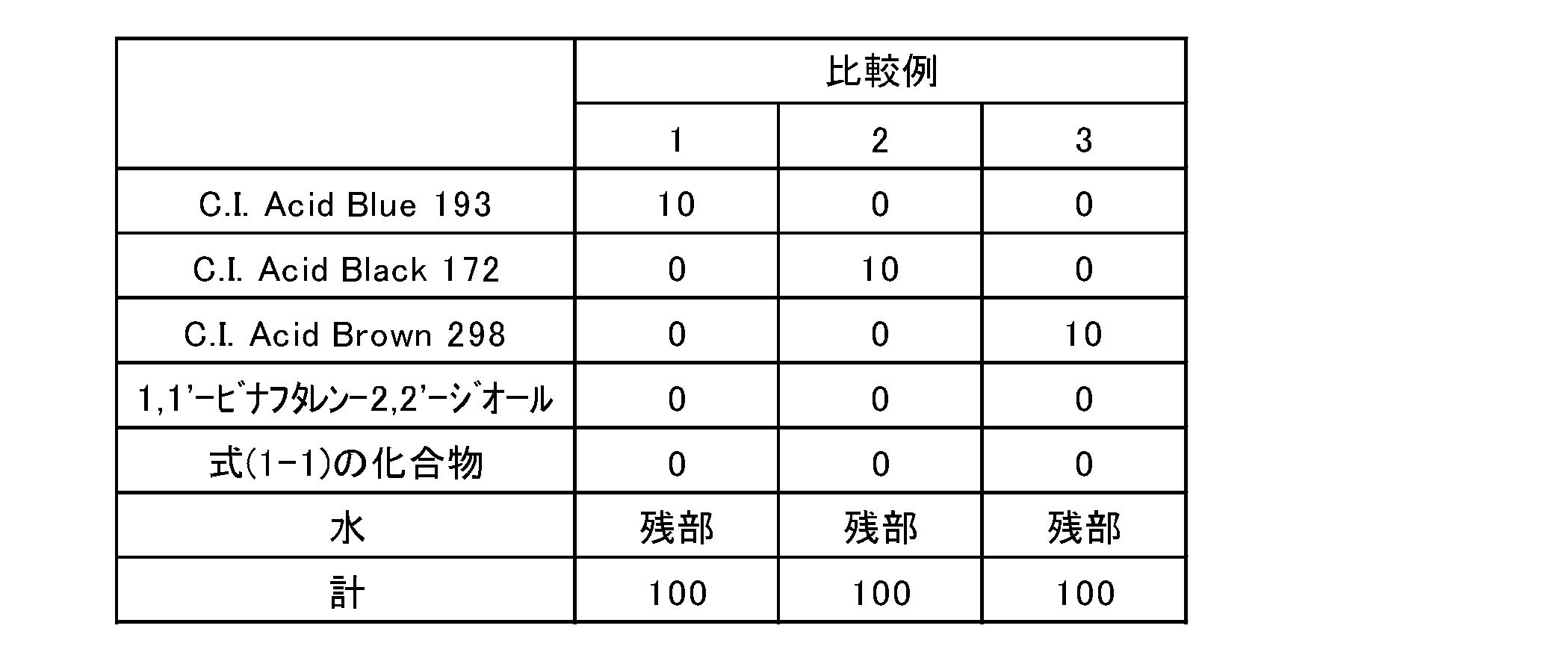
上記のようにして調製した各着色液を用いて、以下の各評価試験を行った。結果を下記表4、5に示す。なお、実施例1~10の着色液はいずれも、φ47mm、孔径0.2μmのミックスセルロースフィルター(アドバンテック社製)を用いて全量を濾過した際の濾過性が良好であり、かつ、フィルターに異物や着色が残りにくいものであった。
各着色液1質量部を外径32mmのガラスシャーレ(東京硝子器械(株)製、FINEシャーレ)上に滴下した後、30℃の乾燥機に静置し、一定時間経過ごとに観察を行い、以下の基準で耐乾燥性を評価した。耐乾燥性の評価が「D」である場合、実用性に欠ける。
-評価基準-
A:6時間後にシャーレ上の着色液が乾いていない(流動性がある)。
B:4時間後にシャーレ上の着色液が乾いていない(流動性がある)。
C:2時間後にシャーレ上の着色液が乾いていない(流動性がある)。
D:1時間後にシャーレ上の着色液が乾いていない(流動性がある)。
各着色液0.5質量部を外径32mmのガラスシャーレ(東京硝子器械(株)製、FINEシャーレ)上に滴下し、自然乾燥させた後、水0.5部を滴下し、以下の基準で再溶解性を評価した。再溶解性の評価が「D」である場合、実用性に欠ける。
-評価基準-
A:5分以内に再溶解する。
B:5分を超え、かつ、10分以内に再溶解する。
C:10分を超え、かつ、30分以内に再溶解する。
D:30分経っても溶け残り、再溶解できない。

下記表6~9に記載の各成分を混合することにより、実施例11~26及び比較例4~6のインクを得た。表6~9中、各成分の数値は質量部を表す。また、表6~9中、各略語はそれぞれ以下を表す。
TEG:トリエチレングリコール(三菱ケミカル(株)製)
TEGMBE:トリエチレングリコールモノブチルエーテル(関東化学(株)製)
サーフィノール465:界面活性剤(日信化学工業(株)製)
プロキセルXL2:防腐防黴剤(ロンザ社製)
TEA:トリエタノールアミン(三井化学(株)製)
2Py:2-ピロリドン(三菱ケミカル(株)製)
Gly:グリセリン(純正化学(株)製)
上記のようにして調製した各インクを用いて、実施例1等と同様にして耐乾燥性及び再溶解性の各評価試験を行った。さらに、各インクを用いて、以下の各評価試験を行った。結果を下記表10~12に示す。なお、実施例11~26のインクはいずれも、φ47mm、孔径0.2μmのミックスセルロースフィルター(アドバンテック社製)を用いて全量を濾過した際の濾過性が良好であり、かつ、フィルターに異物や着色が残りにくいものであった。また、実施例11~26のインクはいずれも、インクジェットプリンタPX-205(セイコーエプソン(株)製)でノズルチェックパターン印刷を行った際に、印刷が欠けることが少なく、良好な印刷物を得ることができた。
グアー(2質量部)、硫酸アンモニウム(2質量部)、尿素(5質量部)、及び水(91質量部)を含有する前処理液を調製し、パッド法によりシルク布(絹羽二重)に前処理を行った。具体的には、シルク布を前処理液に浸漬し、ゴムローラーにて余分な液を絞り落とした後、60℃にて乾燥した。各インクを充填した容器をインクジェットプリンタPX-205(セイコーエプソン(株)製)に装填し、前処理後のシルク布に対してベタ柄を100%の階調でインクジェット捺染し、各印捺物を得た。次いで、各印捺物を60~80℃で予備乾燥した後、相対湿度90%以上、100~103℃の条件で30分間スチーミング処理を施した。得られた各印捺物を冷水で5分間洗浄した後、乾燥することにより、各試験染布を得た。
ΔE=[(ΔL*)2+(Δa*)2+(Δb*)2]1/2・・・(1)
そして、算出した色差(ΔE)の値から、以下の基準で耐光性を評価した。
-評価基準-
A:ΔEが1.2未満
B:ΔEが1.2以上1.6未満
C:ΔEが1.6以上1.9未満
D:ΔEが1.9以上
各インクを充填した容器をインクジェットプリンタPX-205(セイコーエプソン(株)製)に装填し、写真用紙(セイコーエプソン(株)製)にベタ印刷を行い、記録物を得た。得られた記録物を試験片として用い、耐光性試験及び耐オゾン性試験を行った。
色素残存率=(試験後の反射濃度/試験前の反射濃度)×100(%)・・・(2)
そして、算出した色素残存率の値から、以下の基準で耐光性を評価した。
―評価基準―
A:色素残存率が90%以上
B:色素残存率が80%以上90%未満
C:色素残存率が70%以上80%未満
D:色素残存率が70%未満
-評価基準-
a:元の色素がはっきりと残存している。
b:元の色素が少し残存している。
c:元の色素が確認できない。


Claims (18)
- 分子内にナフタレン骨格を有する色素と、分子内にナフタレン骨格を2つ以上有する化合物(但し、前記分子内にナフタレン骨格を有する色素及び分子内にピラジン骨格を有する化合物を除く。)及び分子内にピラジン骨格を有する化合物(但し、前記分子内にナフタレン骨格を有する色素を除く。)の少なくとも一方の化合物と、水とを含有する着色液。
- 前記分子内にナフタレン骨格を2つ以上有する化合物が、分子内に水酸基を有する化合物である、請求項1に記載の着色液。
- 前記分子内にナフタレン骨格を2つ以上有する化合物が、置換基を有するビナフタレン骨格を有する化合物である、請求項1又は2に記載の着色液。
- 前記分子内にナフタレン骨格を2つ以上有する化合物が、1,1’-ビナフタレン-2,2’-ジオールである、請求項1~3のいずれか1項に記載の着色液。
- 前記分子内にピラジン骨格を有する化合物が、下記式(1)で表される化合物である、請求項1~4のいずれか1項に記載の着色液。

- 前記分子内にピラジン骨格を有する化合物が、下記式(1-1)で表される化合物である、請求項1~5のいずれか1項に記載の着色液。
- 前記分子内にナフタレン骨格を有する色素が、分子内にアゾ結合を有するアゾ系色素である、請求項1~6のいずれか1項に記載の着色液。
- 前記分子内にナフタレン骨格を有する色素が、アゾ金属錯体系色素である、請求項1~7のいずれか1項に記載の着色液。
- 前記アゾ金属錯体系色素が、クロム、銅、鉄、及びコバルトからなる群より選択される金属を含むアゾ金属錯体系色素である、請求項8に記載の着色液。
- 前記分子内にナフタレン骨格を有する色素の含有量を100質量部としたとき、前記分子内にナフタレン骨格を2つ以上有する化合物の含有量が1.8質量部未満である、請求項1~9のいずれか1項に記載の着色液。
- 前記分子内にナフタレン骨格を有する色素の含有量を100質量部としたとき、前記分子内にピラジン骨格を有する化合物の含有量が1.2質量部未満である、請求項1~10のいずれか1項に記載の着色液。
- 前記分子内にナフタレン骨格を有する色素が、C.I.アシッドブラウン 298;C.I.アシッドブルー 193;及びC.I.アシッドブラック 52、52:1、172、194;からなる群より選択される少なくとも1種の色素であり、
前記分子内にナフタレン骨格を2つ以上有する化合物が、1,1’-ビナフタレン-2,2’-ジオールであり、
前記分子内にピラジン骨格を有する化合物が、下記式(1-1)で表される化合物である、請求項1~11のいずれか1項に記載の着色液。

- 前記分子内にナフタレン骨格を2つ以上有する化合物と、前記分子内にピラジン骨格を有する化合物との両者を含有する、請求項1~12のいずれか1項に記載の着色液。
- さらに水溶性有機溶剤を含有する、請求項1~13のいずれか1項に記載の着色液。
- 請求項1~14のいずれか1項に記載の着色液と、該着色液と色相が異なる少なくとも1種の着色液とを備える着色液セット。
- 請求項1~14のいずれか1項に記載の着色液、又は請求項15に記載の着色液セットが備える各着色液が付着した記録メディア。
- 前記記録メディアが繊維である、請求項16に記載の記録メディア。
- 請求項1~14のいずれか1項に記載の着色液、又は請求項15に記載の着色液セットが備える各着色液を記録メディアに付着させて着色を行う着色方法。
Priority Applications (3)
| Application Number | Priority Date | Filing Date | Title |
|---|---|---|---|
| EP21882650.1A EP4234635A4 (en) | 2020-10-23 | 2021-10-12 | STAINED LIQUID, STAINED LIQUID SET, RECORDING MEDIUM AND STAINING PROCESS |
| CN202180071056.4A CN116323808B (zh) | 2020-10-23 | 2021-10-12 | 着色液、着色液套装、记录介质及着色方法 |
| JP2022556985A JP7814316B2 (ja) | 2020-10-23 | 2021-10-12 | 着色液、着色液セット、記録メディア、及び着色方法 |
Applications Claiming Priority (4)
| Application Number | Priority Date | Filing Date | Title |
|---|---|---|---|
| JP2020-177913 | 2020-10-23 | ||
| JP2020177913 | 2020-10-23 | ||
| JP2021146491 | 2021-09-08 | ||
| JP2021-146491 | 2021-09-08 |
Publications (1)
| Publication Number | Publication Date |
|---|---|
| WO2022085509A1 true WO2022085509A1 (ja) | 2022-04-28 |
Family
ID=81290480
Family Applications (1)
| Application Number | Title | Priority Date | Filing Date |
|---|---|---|---|
| PCT/JP2021/037655 Ceased WO2022085509A1 (ja) | 2020-10-23 | 2021-10-12 | 着色液、着色液セット、記録メディア、及び着色方法 |
Country Status (5)
| Country | Link |
|---|---|
| EP (1) | EP4234635A4 (ja) |
| JP (1) | JP7814316B2 (ja) |
| CN (1) | CN116323808B (ja) |
| TW (1) | TW202227566A (ja) |
| WO (1) | WO2022085509A1 (ja) |
Citations (7)
| Publication number | Priority date | Publication date | Assignee | Title |
|---|---|---|---|---|
| FR759210A (fr) * | 1932-06-25 | 1934-01-31 | Ig Farbenindustrie Ag | 4.8.dihydroxy-1.2.5.6-dibenzophénazines, colorants azoïques obtenus à partir de ces composés ainsi que leurs procédés de préparation |
| JPS62169862A (ja) * | 1986-01-21 | 1987-07-27 | Sumitomo Chem Co Ltd | アゾ系顔料の製法 |
| JPS63152670A (ja) * | 1986-08-04 | 1988-06-25 | Ueno Seiyaku Oyo Kenkyusho:Kk | アゾ顔料の製造法 |
| WO1998042787A1 (en) * | 1997-03-25 | 1998-10-01 | Seiko Epson Corporation | Inks for ink-jet recording |
| JP2012052030A (ja) * | 2010-09-01 | 2012-03-15 | Sumika Color Kk | 有機顔料組成物 |
| JP2014185201A (ja) | 2013-03-22 | 2014-10-02 | Nippon Kayaku Co Ltd | インクジェット捺染に用いるインク及びそれを用いた繊維の捺染方法 |
| CN105732404A (zh) * | 2016-03-30 | 2016-07-06 | 杭州百合科莱恩颜料有限公司 | 联萘二酚类化合物及其用途 |
Family Cites Families (3)
| Publication number | Priority date | Publication date | Assignee | Title |
|---|---|---|---|---|
| KR20080000343A (ko) * | 2006-06-27 | 2008-01-02 | 삼성전자주식회사 | 블랙 잉크 조성물, 이를 포함한 잉크 카트리지 및 잉크젯기록 장치 |
| JP2010007019A (ja) * | 2008-06-30 | 2010-01-14 | Nippon Kayaku Co Ltd | 黒色インク組成物、インクジェット記録方法及び着色体 |
| JP2015124325A (ja) * | 2013-12-27 | 2015-07-06 | 日本化薬株式会社 | インク組成物、これを用いるインクジェット記録方法、及び着色体 |
-
2021
- 2021-10-12 JP JP2022556985A patent/JP7814316B2/ja active Active
- 2021-10-12 EP EP21882650.1A patent/EP4234635A4/en active Pending
- 2021-10-12 CN CN202180071056.4A patent/CN116323808B/zh active Active
- 2021-10-12 WO PCT/JP2021/037655 patent/WO2022085509A1/ja not_active Ceased
- 2021-10-19 TW TW110138691A patent/TW202227566A/zh unknown
Patent Citations (7)
| Publication number | Priority date | Publication date | Assignee | Title |
|---|---|---|---|---|
| FR759210A (fr) * | 1932-06-25 | 1934-01-31 | Ig Farbenindustrie Ag | 4.8.dihydroxy-1.2.5.6-dibenzophénazines, colorants azoïques obtenus à partir de ces composés ainsi que leurs procédés de préparation |
| JPS62169862A (ja) * | 1986-01-21 | 1987-07-27 | Sumitomo Chem Co Ltd | アゾ系顔料の製法 |
| JPS63152670A (ja) * | 1986-08-04 | 1988-06-25 | Ueno Seiyaku Oyo Kenkyusho:Kk | アゾ顔料の製造法 |
| WO1998042787A1 (en) * | 1997-03-25 | 1998-10-01 | Seiko Epson Corporation | Inks for ink-jet recording |
| JP2012052030A (ja) * | 2010-09-01 | 2012-03-15 | Sumika Color Kk | 有機顔料組成物 |
| JP2014185201A (ja) | 2013-03-22 | 2014-10-02 | Nippon Kayaku Co Ltd | インクジェット捺染に用いるインク及びそれを用いた繊維の捺染方法 |
| CN105732404A (zh) * | 2016-03-30 | 2016-07-06 | 杭州百合科莱恩颜料有限公司 | 联萘二酚类化合物及其用途 |
Non-Patent Citations (4)
| Title |
|---|
| HIROSHI HORIGUCHI: "Synthetic Dye Overview", 1969, SANKYO PUBLISHING CO. |
| JOURNAL OF SYNTHETIC ORGANIC CHEMISTRY, JAPAN, vol. 13, no. 4, 1955, pages 106 |
| JOURNAL OF THE IMAGING SOCIETY OF JAPAN, vol. 41, no. 2, 2002, pages 182 |
| See also references of EP4234635A4 |
Also Published As
| Publication number | Publication date |
|---|---|
| JP7814316B2 (ja) | 2026-02-16 |
| EP4234635A4 (en) | 2025-05-07 |
| CN116323808B (zh) | 2025-07-08 |
| CN116323808A (zh) | 2023-06-23 |
| TW202227566A (zh) | 2022-07-16 |
| EP4234635A1 (en) | 2023-08-30 |
| JPWO2022085509A1 (ja) | 2022-04-28 |
Similar Documents
| Publication | Publication Date | Title |
|---|---|---|
| JP5580824B2 (ja) | インク組成物及びそれを用いた繊維の捺染方法 | |
| JP5979727B2 (ja) | インクジェット捺染用グレーインク組成物及びそれを用いた繊維の捺染方法 | |
| JP4214734B2 (ja) | インクジェット捺染用インク、それを用いた捺染方法及び印捺物 | |
| JP2018044026A (ja) | インク及びインクジェット記録方法 | |
| JP5943568B2 (ja) | インクジェット捺染用ブラックインク組成物及びそれを用いた繊維の捺染方法 | |
| JP7814316B2 (ja) | 着色液、着色液セット、記録メディア、及び着色方法 | |
| WO2018135419A1 (ja) | インクジェット捺染用インク組成物及びそれを用いた繊維の捺染方法 | |
| JPWO2018097061A1 (ja) | インク、インクセット、及び繊維の捺染方法 | |
| JP2024042783A (ja) | 着色液 | |
| JP2013035951A (ja) | インクジェット捺染用ゴールデンイエローインク組成物及びそれを用いた繊維の捺染方法 | |
| CN105452396B (zh) | 水性油墨组合物、喷墨记录方法及着色体 | |
| JP2010047714A (ja) | インクジェット捺染用インク組成物および捺染方法 | |
| JP2017125080A (ja) | インク組成物及びそれを用いた繊維の捺染方法 | |
| JP2022176503A (ja) | アンスラピリドン化合物を含有する着色液 | |
| JP6262142B2 (ja) | インクジェット捺染用インクセット及びそれを用いた繊維の捺染方法 | |
| JP2010229249A (ja) | インクジェット捺染用インク組成物および捺染方法 | |
| JP2020097734A (ja) | 着色分散液、インクジェット捺染用インク、インクセット、捺染した疎水性繊維、および疎水性繊維の捺染方法。 | |
| JP2018044027A (ja) | インク及びインクジェット記録方法 | |
| JP2010229251A (ja) | インクジェット捺染用インク組成物および捺染方法 | |
| JP2017125082A (ja) | インク組成物及びそれを用いた繊維の捺染方法 | |
| JP2012036257A (ja) | インク組成物及び着色体 | |
| JP2017125081A (ja) | インク組成物及びそれを用いた繊維の捺染方法 | |
| JP2010215711A (ja) | インクジェット捺染用インク組成物 | |
| JP2019002108A (ja) | 水溶性アゾ化合物又はその塩を含む捺染用インクを用いた繊維の染色方法 | |
| JP2019002107A (ja) | 水溶性アゾ化合物又はその塩を含む捺染用インクを用いた繊維の染色方法 |
Legal Events
| Date | Code | Title | Description |
|---|---|---|---|
| 121 | Ep: the epo has been informed by wipo that ep was designated in this application |
Ref document number: 21882650 Country of ref document: EP Kind code of ref document: A1 |
|
| NENP | Non-entry into the national phase |
Ref country code: DE |
|
| ENP | Entry into the national phase |
Ref document number: 2021882650 Country of ref document: EP Effective date: 20230523 |
|
| ENP | Entry into the national phase |
Ref document number: 2022556985 Country of ref document: JP Kind code of ref document: A |
|
| WWG | Wipo information: grant in national office |
Ref document number: 202180071056.4 Country of ref document: CN |