WO2022085554A1 - Dispositif pour générer un projet de document et procédé associé - Google Patents
Dispositif pour générer un projet de document et procédé associé Download PDFInfo
- Publication number
- WO2022085554A1 WO2022085554A1 PCT/JP2021/038027 JP2021038027W WO2022085554A1 WO 2022085554 A1 WO2022085554 A1 WO 2022085554A1 JP 2021038027 W JP2021038027 W JP 2021038027W WO 2022085554 A1 WO2022085554 A1 WO 2022085554A1
- Authority
- WO
- WIPO (PCT)
- Prior art keywords
- case
- components
- user
- cases
- component
- Prior art date
- Legal status (The legal status is an assumption and is not a legal conclusion. Google has not performed a legal analysis and makes no representation as to the accuracy of the status listed.)
- Ceased
Links
Images








Classifications
-
- G—PHYSICS
- G06—COMPUTING OR CALCULATING; COUNTING
- G06F—ELECTRIC DIGITAL DATA PROCESSING
- G06F40/00—Handling natural language data
- G06F40/10—Text processing
- G06F40/166—Editing, e.g. inserting or deleting
-
- G—PHYSICS
- G06—COMPUTING OR CALCULATING; COUNTING
- G06F—ELECTRIC DIGITAL DATA PROCESSING
- G06F16/00—Information retrieval; Database structures therefor; File system structures therefor
- G06F16/90—Details of database functions independent of the retrieved data types
- G06F16/93—Document management systems
-
- G—PHYSICS
- G06—COMPUTING OR CALCULATING; COUNTING
- G06F—ELECTRIC DIGITAL DATA PROCESSING
- G06F40/00—Handling natural language data
- G06F40/10—Text processing
- G06F40/12—Use of codes for handling textual entities
- G06F40/131—Fragmentation of text files, e.g. creating reusable text-blocks; Linking to fragments, e.g. using XInclude; Namespaces
-
- G—PHYSICS
- G06—COMPUTING OR CALCULATING; COUNTING
- G06F—ELECTRIC DIGITAL DATA PROCESSING
- G06F40/00—Handling natural language data
- G06F40/10—Text processing
- G06F40/166—Editing, e.g. inserting or deleting
- G06F40/174—Form filling; Merging
-
- G—PHYSICS
- G06—COMPUTING OR CALCULATING; COUNTING
- G06Q—INFORMATION AND COMMUNICATION TECHNOLOGY [ICT] SPECIALLY ADAPTED FOR ADMINISTRATIVE, COMMERCIAL, FINANCIAL, MANAGERIAL OR SUPERVISORY PURPOSES; SYSTEMS OR METHODS SPECIALLY ADAPTED FOR ADMINISTRATIVE, COMMERCIAL, FINANCIAL, MANAGERIAL OR SUPERVISORY PURPOSES, NOT OTHERWISE PROVIDED FOR
- G06Q10/00—Administration; Management
- G06Q10/10—Office automation; Time management
Definitions
- the present invention relates to a technique for assisting a user in writing a document.
- Patent Document 1 discloses a method of recommending a format to be used based on a question and answer. With this method, the user can identify the document template simply by answering the questions presented by the system. Further, Patent Document 2 discloses a technique for facilitating the preparation of answer data for a question by searching the question sentence by a conceptual keyword. This method allows you to conceptually search for templates.
- the method of the above-mentioned conventional technique cannot be expected to have the effect of selecting a particularly important component from the above-mentioned plurality of components.
- the present invention has been made in consideration of such a situation, and when the user remembers the information of the case having a plurality of components, what is described and what is omitted in the process of incorporating it into a document. It becomes easy to consider.
- One aspect of the present invention is a device for generating a draft document for a user, including one or more processors and one or more storage devices.
- the one or more storage devices store a case database that stores a plurality of cases including each of the one or more components.
- the one or more processors repeats asking the user questions about one or more components selected from the case database.
- the question processing the user is presented with the one or more components selected from the case database by an output device, and the user is asked whether the one or more components correspond to the contents of the draft document. Is presented by the output device, the user's answer to the question is obtained via the input device, and the answer is included in the answer history stored in the one or more storage devices.
- the one or more processors perform the question processing from one or more components in which the question processing in the plurality of cases has not been processed, based on statistics of at least a part of the components of the plurality of cases.
- the above-mentioned components are selected, and the draft document is generated based on the components indicating that the response history corresponds to the contents of the draft document of the user.
- a configuration example of the first embodiment is shown.
- An example of hardware implementation of Example 1 is shown.
- An example of the processing flow of the first embodiment is shown.
- An example of the initial screen of the first embodiment is shown.
- An example of the login information of the first embodiment is shown.
- An example of the user data table of the first embodiment is shown.
- An example of the case selection screen of Example 1 is shown.
- An example of the user case table of Example 1 is shown.
- An example of the case selection record table of Example 1 is shown.
- An example of the selection type question screen of Example 1 is shown.
- An example of the case table of Example 1 is shown.
- An example of the non-information of Example 1 is shown.
- An example of the descriptive question screen of the first embodiment is shown.
- An example of the document draft display of Example 1 is shown.
- An example of the statistic calculation process of Example 1 is shown.
- An example of the data structure of the user case component of the first embodiment is shown.
- An example of the component table of the first embodiment is shown.
- the schematic diagram of the process using the user component of Example 1 is shown.
- An example after extraction of unanswered components of Example 1 is shown.
- a configuration example of the second embodiment is shown.
- An example of the processing flow of the second embodiment is shown.
- An example of the user data table of the second embodiment is shown.
- An example of the external information management table of the second embodiment is shown.
- An example of the case selection screen of the second embodiment is shown.
- An example of the selection type question screen of Example 2 is shown.
- An example of the descriptive question screen of the second embodiment is shown.
- An example of the statistic calculation process of Example 2 is shown.
- An example of the document draft display of the second embodiment is shown.
- a sentence represents a group of contents and is a list of symbols including words. Sentences may consist of words only, for example, and may contain symbols that differ from words, such as mathematical formulas and chemical formulas.
- a sentence consists of one or more sentences.
- a document is a document in which information to be conveyed to a person is described by some form such as a character or an image, and can be composed of, for example, a sentence, and can also include an image.
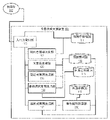
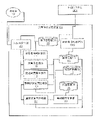
- FIG. 1 shows an example of the logical configuration of the device that supports the examination of claims related to the chemical formula.
- the user can easily create a claim for the chemical formula.
- a claim is a sentence and can constitute a document.
- the document creation support device 101 of this embodiment has an input / output reception unit 110, a user information determination unit 112, a case selection question generation unit 114, a case statistical calculation unit 116, a selection type question generation unit 117, and a descriptive question generation unit 118.
- the document draft generation unit 120 is included.
- the document creation support device 101 further includes a user information database (DB) 111, a user case DB 113, a common case DB 115, and a response history DB 119.
- DB user information database
- the input / output reception unit 110 receives the input of the user 102.
- the user information DB 111 stores user information.
- the user information determination unit 112 authenticates the user and identifies the user.
- the user case DB 113 stores candidate cases that can be documented for each user.
- the case selection question generation unit 114 causes the user to select one from the cases stored in the user case DB 113 when using the present device.
- the common case DB 115 stores information on cases common to all users.
- the case statistical calculation unit 116 calculates statistical information based on the information of the common case DB 115.
- the selective question generation unit 117 generates a selective question based on the result of the case statistical calculation unit 116.
- the descriptive question generation unit 118 generates a descriptive question for the information to be confirmed by the descriptive question to the user 102.
- the answer history DB 119 stores the answers of the user 102 to the multiple-choice question and the descriptive question.
- the document draft generation unit 120 generates a document draft based on the response history.
- FIG. 2 shows an example of the configuration of the physical implementation of the document creation support device 101.
- the document creation support device 101 can be implemented using, for example, a general computer.
- the document creation support device 101 can be implemented using, for example, a general computer.
- the document creation support device 101 includes a processor 211 having structural calculation performance, and a DRAM 212 which is a main storage device that provides a volatile temporary storage area for storing programs and data executed by the processor 211. That is, the document creation support device 101 further has an auxiliary storage device 213 that provides a permanent information storage area using an HDD (Hard Disk Drive), a flash memory, or the like, and a serial port for performing data communication with other devices. Etc. 216 can be included. Further, the document creation support device 101 includes an input device 214 such as a mouse and a keyboard for performing an operation, and a monitor 215 (an example of an output device) that presents an output result in each process to the user.
- an input device 214 such as a mouse and a keyboard for performing an operation
- a monitor 215 an example of an output device
- the program executed by the processor 211 and the data to be processed are loaded from the auxiliary storage device 213 into the DRAM 212.
- the plurality of functions of the document creation support device 101 may be distributed to a plurality of computers. As described above, the document creation support device 101 includes one or more storage devices and one or more processors.
- the input / output reception unit 110, the user information determination unit 112, the case selection question generation unit 114, the case statistics calculation unit 116, the selection type question generation unit 117, the descriptive question generation unit 118, and the document draft generation unit 120 are auxiliary storage. This can be realized by the processor 201 executing the program recorded in the device 213.
- the user information DB 111, the user case DB 113, the common case DB 115, and the response history DB 119 can be implemented by the processor 201 executing a program for accumulating data in the auxiliary storage device 213.
- the document creation support device 101 may be a physical computer system (one or more physical computers) as described above, or may be constructed on a computer resource group (plural computer resources) such as a cloud platform. good.
- a computer system or group of computational resources includes one or more interface devices (including, for example, communication interface devices and input / output devices), one or more storage devices (including, for example, memory (main storage) and auxiliary storage devices), and one. Including the above processors.
- the function When the function is realized by executing the program by the processor, the specified processing is appropriately performed by using the storage device and / or the interface device, so that the function may be at least a part of the processor. good.
- the process described with the function as the subject may be a process performed by a processor or a system having the processor.
- the program may be installed from the program source.
- the program source may be, for example, a program distribution computer or a computer-readable storage medium (eg, a computer-readable non-transient storage medium).
- the description of each function is an example, and a plurality of functions may be combined into one function, or one function may be divided into a plurality of functions.
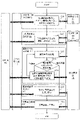
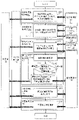
- FIG. 3 shows the operation procedure of the document creation support device 101 according to the first embodiment.
- the user information determination unit 112 When the document creation support device 101 is activated, the user information determination unit 112 generates an initial screen, presents it through the input / output reception unit 110, and waits for the access of the user 102.
- FIG. 4 shows an example 308 of this initial screen displayed on the monitor 205.
- FIG. 5 is a diagram illustrating a configuration example of the login information 309.
- the items of login information 309 include user ID 501 and password 502.
- the contents of the text box 401 are stored in the user ID 501, and the contents of the text box 402 are stored in the password 502.
- the login information 309 is sent to the user information determination unit 112.
- the user information determination unit 112 collates the input information with the user data table of the user information DB 111, and authenticates the user 102 (S301).
- FIG. 6 shows an example of the user data table 600.
- FIG. 6 is a diagram illustrating a configuration example of the user data table 600.
- the items in the user data table 600 include a user ID 601, a user name 602, and a password 603.
- the value of the user ID 501 of the login information 309 and the value of the user ID 601 of the user data table 600 are compared, and further, the value of the password 502 of the login information 309 and the value of the password 603 of the user data table 600 are compared.
- Authenticate by comparing with a method using a typical ID and password is used as the method used for authentication of the user 102, but any method may be used as long as the method can appropriately identify the user 102.
- the case selection question generation unit 114 acquires a case related to the current user 102 from the user case DB 113.
- the case selection question generation unit 114 displays the case selection screen 310 through the input / output reception unit 110 in order to allow the user 102 to select one case from them (S302).
- FIG. 7 shows an example of the case selection screen 310.
- an image (chemical structural formula) 701 based on the information of the user case DB 113 is displayed.
- the user 102 can select a case by clicking the control 702 in the case selection screen 310 and determine the selected case by pressing the button 703, for example.
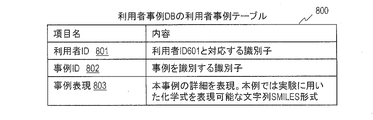
- FIG. 8 shows an example of the user case table 800 in the user case DB 113 used to generate the case selection screen 310.
- FIG. 8 is a diagram illustrating a configuration example of the user case table 800.
- the user case table 800 stores user-specific cases for each user. Common cases are referenced for all users, and user cases are referenced only for that user.
- the items in the user case table 800 include user ID 801 and case ID 802 and case expression 803.
- the case expression 803 stores an expression of the case content.
- the user ID 801 corresponds to the user ID 601 of the user data table 600.
- the case selection question generation unit 114 can select only the record corresponding to the current user 102 by referring to the user ID 801.
- the case selection question generation unit 114 can display the image 701 of the case selection screen 310 by acquiring and drawing the SMILES character string expression of the chemical formula stored as the case expression 803.
- the case expression 803 of this example is a SMILES character string expression, and an appropriate type of the case expression 803 is selected according to the type of the generated sentence. This point is the same for the common case database.
- Any expression may be used as long as it indicates the case, for example, the image information may be stored as it is. Further, by displaying the user name 602, it may be possible to confirm whether or not the user is using incorrect login information.
- a plurality of user cases may be selectable, or the selection of user cases may be omitted. The selection of user cases facilitates the selection of common cases for specifying the scope of claims.
- FIG. 9 is a diagram illustrating a configuration example of the case selection record table 900.
- the items in the case selection record table 900 include case ID 902, answer 903, and case ID 904.
- the value of the user ID 601 is stored in the user ID 901.
- the value of the case selected in the case ID 802 is stored in the case ID 902.
- Answer 903 always stores a sign meaning YES in this embodiment.
- case ID 902 stores all user cases, including non-selected cases, and the response 903 is explicitly not subject to consideration of the code indicating the selected case and the claim.
- the indicated code may be stored.
- the matter ID 904 stores an identifier (matter ID) assigned to a series of processes performed starting from the case selection.
- the selective question generation unit 117 repeats the question processing (S303-S305).
- the selection-type question generation unit 117 selects a common case for which the question processing is performed next from the common cases for which the question processing has not been processed, based on the statistics of at least a part of the components of the common case DB 115.
- the selective question generation unit 117 executes the statistic calculation process (S303).
- This statistic calculation process calculates the statistic of the component recorded in the response history DB 119.
- the statistic calculation process calculates the component identification score and the case importance score based on the information recorded in the response history DB 119.
- the component identification score indicates how much the claims range can be identified from the response history so far.
- the case importance score indicates how much it is meaningful to ask about each case stored in the common case DB 115. Details of this process will be described later.
- the selective question generation unit 117 executes the threshold value processing for the component specific score (S304). That is, the selective question generation unit 117 determines whether or not subsequent questions are necessary (whether or not the question processing is stopped) by evaluating whether or not the question is smaller than a predetermined threshold value. If continuation is necessary (S304: continuation required), the selective question generation unit 117 asks the selective question about the case having the highest case importance score among the unprocessed (unquestioned) cases of the common case DB 115. A screen is displayed to ask whether or not the case falls under the scope (contents) of the claim (invention) currently under consideration by the user 102 this time (S305). The case is composed of one or more components, and this question asks whether the one or more components constituting the case correspond to the content of the claim as a draft document as a combination of the components.
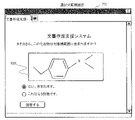
- FIG. 10 shows an example of this selection-type question screen 312.
- the chemical formula of the case having the highest case importance score is drawn.
- FIG. 11 is a diagram illustrating a configuration example of the case table 1100 of the common case DB 115 required for this drawing.
- the items in the case table 1100 include case ID 1101 and case expression 1102.
- the case ID 1101 stores an identifier (ID) of a common case.
- the case expression 1102 stores the SMILES character string corresponding to the expression of the case identified by the case ID 1101.
- the information of the case expression 1102 is the object to be drawn in the drawing area 1001.
- FIG. 12 is a diagram illustrating a configuration example of the non-information 313.
- the non-information 313 items include case ID 1201, the non-flag 1202, user ID 1203, and case ID 1204.
- the case ID 1201 stores the value of the case ID 1101 in the case table 1100.
- the non-flag 1202 indicates YES / NO information. YES indicates that the case is a applicable case that includes the currently assumed target range, and NO indicates that the case is a non-applicable case that does not include the target range.
- the user ID 1203 stores the value of the user ID 501 of the login information 309 in order to identify the current user 102.
- the matter ID 1204 stores the value of the matter ID 904 in the case selection record table 900.
- the non-information 313 is returned from the input / output reception unit 110 to the selective question generation unit 117, and is stored in the answer history table of the answer history DB 119. The non-information 313 is stored in this table as it is.
- the statistic calculation process S303 is executed again, and then the threshold value process S304 for the component specific score is executed. This is repeated until it is determined in the threshold value processing S304 for the component specific score that continuation is unnecessary.
- the descriptive question generation unit 118 presents the descriptive question screen 314 via the input / output reception unit 110, and answers the descriptive question.
- Obtain (S306).
- FIG. 13 shows an example of the descriptive question screen 314 displayed on the monitor 205. An image of the specified component is displayed in the area 1301 in the center of the screen. Field 1302 allows description for the image in region 1301.
- Section 1303 also allows the user 102 to add components. For example, an expression of a component that is not included in the target range assumed by the user 102 at the time of selecting the corresponding magnetism, or an expression of a component that is not included in the shared case DB 115 can be input. After inputting these, when the user 102 presses the answer button 1304, the input information is passed from the input / output receiving unit 110 to the document draft generation unit 120, and the final document draft display is generated. In the descriptive question screen 314, the user 102 may be able to delete some of the components from the presented components.
- FIG. 14 shows an example of the document draft display 315 of the first embodiment.
- a document draft 1401 based on the components is displayed in the center of the screen.
- Button 1402 may be provided so that the document file of this draft document can be downloaded. The generation of this draft document is described later because it is related to the statistic calculation process S303.
- FIG. 15 shows the details of the statistic calculation process S303 of the first embodiment.
- the case statistics calculation unit 116 acquires a list of user case components corresponding to the records in the case selection record table 900 from the user case DB 118 (S1501).
- the case selection record table 900 stores information on user cases selected by the user 102 as the object of claim examination.
- FIG. 16 is a diagram illustrating a configuration example of the user case component table 1600 that stores the user case component.
- the user case component table 1600 is stored in the user case DB 113.
- the items in the user case component table 1600 include the user ID 1601, the case ID 1602, the component ID 1603, and the presence / absence flag 1604.
- User ID 1601 indicates each user ID
- case ID 1602 indicates each user case ID.
- the combination of the value of the user ID 1601 and the value of the case ID 1602 is an identifier that can identify each record in the case selection record table 900.
- Component ID 1603 indicates the ID of each of the preset components.
- the presence / absence flag 1604 indicates whether each of the components indicated by the component ID 1603 is included in this case.
- the user case DB 113 stores the component master data 1610.
- the items of the component master data 1610 include the component ID 1611 and the component representation 1612.
- the component ID 1611 indicates a plurality of preset component IDs common to all user cases in the user case DB 113.
- the component representation 1612 shows the component representation of each of the components indicated by the component ID 1611.
- the value of the component ID 1603 of the user case component table 1600 matches the value indicated by the component ID 1611 of the component master data 1610, and the component representation corresponding to those values can be obtained from the component expression 1612.
- the case statistics calculation unit 116 sets the case (unanswered (unquestioned /) case) that is not recorded in the answer history table (list of the non-information 313) of the answer history DB 119 from the common case DB 115 and the answer history table.
- the recorded cases (answered (questioned) cases) are divided and the components are acquired (S1502).
- FIG. 17 is a diagram illustrating an example of the component table 1700 of the common case DB 115.
- the items in the component table 1700 include case ID 1701, component ID 1702, and presence / absence flag 1703.
- the case ID 1701 stores a value that can identify each record of the case table 1100, and matches the value of the case ID 1101 of the case table 1100.
- the component ID 1702 stores the ID of each of the predefined components.
- the presence / absence flag 1703 indicates whether each of the components indicated by the component ID 1702 is included in this case.
- the common case DB 115 further stores the same component master data as the component master data 1610 in the user case DB 113.
- the value of the component ID 1702 matches the value of the component ID of the component master data, and the component representation corresponding to those values can be obtained from the component representation of the component master data.
- the case statistical calculation unit 116 selects a component whose indispensability is undetermined (S1503).
- This procedure will be described with reference to FIG. FIG. 18 shows a table 1801 in which the results of acquisition (S1501) of a list of user case components are arranged, and a table 1802 in which the components table 1701 of the common case DB 115 and the answer history table are arranged. ing.
- the record in table 1801 shows information on the components of the selected user case.
- Each record in Table 1802 shows information about the components of each of the answered common cases.
- the numbers 1 to 8 in the uppermost row of the component content information are component IDs, and the lower row is a flag indicating whether or not each component is included. If the flag is 1, it means that the component is included in the case.
- the component whose presence / absence flag is 0 is not an essential component in this example.
- a component with a flag of 1 may or may not be required, and its necessity is uncertain.
- the record in which Y is stored in the non-column is a common case to be the target in this example, and the necessity of the component which is the presence / absence flag 1 in common in those records is undecided. Yes (not sure if it is mandatory or not).
- the case statistics calculation unit 116 calculates the case importance score for each of the unanswered common cases (S1504).
- FIG. 19 shows a schematic diagram of 1901 as a result of extracting only unanswered common cases. How much information each unanswered case gives to a component whose necessity is undetermined determined in the previous step S1503 depends on whether or not the presence / absence flag of each undetermined component is 0. It can be judged.
- the record in the third row stores 1 for the first component 1902 in FIG. Therefore, even if a common case of this is presented to the user 102 and asked whether it is the target of this time and the answer is YES, it cannot be determined whether the first component 1902 is indispensable.
- the information obtained when the answer NO is obtained is that "all essential components are not 1" in that case. Therefore, in the case where there are many 0 presence / absence flags for the components, almost no information is given.
- the case statistics calculation unit 116 can calculate the case importance score of each unanswered common case, and determine the common case to be asked the next question according to the value.
- the case importance score is calculated based on the distribution of undetermined components of non-applicable cases in the response history.
- the calculation method further selects, among them, the case with the smallest number of components whose presence or absence is different from the current unanswered case with respect to the component whose indispensability is undetermined.
- the calculation method uses the sum of the products of the number of components with different presence / absence between the selected case and the current unanswered case and the number of 0 presence / absence flags in the current unanswered case as the case importance score. calculate. Instead of the number of 0 presence / absence flags in the entire current unanswered case, the number of 0 presence / absence flags of the component whose indispensability is undetermined may be used.
- Another calculation method is to calculate the case importance score based on the distribution of the components of the applicable case and the non-applicable case included in the response history. For example, one method is to collect the answered cases stored in the answer history table of the common case DB 115 regardless of YES / NO of the non-flag, and set the ratio of the presence / absence flag to 0 for each component. Calculate the ratio of 1. Further, in the calculation method, for each unanswered case, a ratio of 0 is selected when the presence / absence flag of the component is 1, and a ratio of 1 is selected when the presence / absence flag of the component is 0, and they are integrated ( (Sum) is used as the case importance score. As a result, the unanswered case to be asked next can be selected in consideration of the characteristics of the answered cases in which the non-answer is YES.
- the weight used in the sum of products can be determined based on the distribution (statistics) of the components of the unanswered (unprocessed) cases. Specifically, even in the case of unanswered cases, the ratio of 0 and 1 of the presence / absence flag is calculated for each component. A value such that the value increases as these ratios approach 50% is defined as a weight for each component. For example, a value based on information entropy (ratio of log0 + proportion of log1) can be used.
- the component such as "the non-flag is 1 in all the unanswered cases of the common case DB 115" can reflect the importance of the statistics of the unanswered cases of the common case DB 115, such as a low amount of information.
- the sum of the information entropy of the components of the above unanswered cases may be calculated as the case importance score of each unanswered case.
- the case statistical calculation unit 116 obtains a component specific score by calculating and adding up the certainty levels for undetermined components (S1505). As described above, this calculation is related to the fact that the component whose presence / absence flag is 1 in all the cases where the non-flag indicates YES in the response history table is at least not unnecessary. That is, a quantity indicating the degree to which such a component is presumed to be essential is calculated, and this is treated as a certainty.
- the certainty of the undetermined component can be determined based on the distribution of the undetermined component in the response history DB 119. For example, confidence can be calculated based on statistics on the components of non-applicable cases. As an example, the case statistical calculation unit 116 can determine whether or not this component is essential based on the number of cases where the component flag is 0 in the case where the non-flag is NO (outside the target range). The greater the number of cases where the component flag is 0, the higher the possibility that the component is essential.
- the case statistical calculation unit 116 calculates the ratio of the presence / absence flag of 1 in the entire case of the common case DB 115 for each undetermined component, and the statistical bias of the case where the non-flag of the response history table is YES.
- the significance of is evaluated and the index can be treated as the certainty of the essentiality of each component. For example, when the same number of samples as the case where the non-flag is YES are randomly obtained from the common case DB 115, the probability that the presence / absence flags of the components are all 1 is used as the certainty of the necessity of the components. Can be handled.
- the case statistics calculation unit 116 can evaluate the validity of the judgment that all of the current "components whose indispensability is undetermined" are necessary by adding up by taking the sum of these certainty degrees. , Use this as a component specific score.
- Each of the essential components estimated by this procedure is associated with the component representation by referring to the component master data in the common case DB 115. Thereby, it can be utilized for generating the example 1301 in the descriptive question screen 314 of FIG. 13 and the document draft display 1401 in the document draft display 315 of FIG.
- the user can embody the essential components for a case consisting of a plurality of components simply by answering the yes or no multiple-choice question.
- a list of partial structures which are draft claims (documents) related to chemical formulas, can be created.
- business workers can write a draft examination document on patentability without wasting time, and can prevent the loss of empirical knowledge.
- FIG. 20 shows an example of the system configuration of the second embodiment.
- Example 2 supports the selection of elements to be written when writing a report on a case such as a meeting attended by the user 102.
- One of the differences between the second embodiment and the first embodiment is that the information of the user 102 is acquired from the external system 2001 or the like and used. Therefore, the user information acquisition unit 2002 is included in the document creation support device 101.
- the external system 2001 another system that manages user information can be used, for example, a master data of employee information, a management system of work information, or another document writing support system may be used. Further, the information of a plurality of external systems may be used at the same time.
- FIG. 21 shows the operation flow of the second embodiment.
- the user information acquisition unit 2002 acquires the information of the user information DB 111 and the information about the user from the external system 2001, and the answer obtained in advance in the answer history DB 119. It is a point (S2101) to be stored as one of the above. Further, the statistic calculation process S2102 is also included in the main difference from the first embodiment.
- FIG. 22 is a diagram illustrating a configuration example of the user data table 2201 which is information acquired from the user information DB 111 by the user information acquisition unit 2002.
- the user data table 2201 is different from the first embodiment in that the user attribute 2202 is stored in association with the user.
- This user attribute is information that affects the type of document written by the user, such as the user's duties and work history, and by treating this as an answer to one question, the number of required questions can be reduced. ..
- the user attribute is included in the essential components in step S2701 described later.
- FIG. 23 is a diagram illustrating a configuration example of the external information management table 2301 of the response history DB 119, to which the information acquired by the user information acquisition unit 2002 is written.
- the external information management table 2301 includes an external information type 2304 and an external information content 2305 corresponding to the user ID 2302 and the matter ID 2303, which can identify the user and the matter.
- External information type 2304 stores a code value indicating the origin of external information. For example, a code value indicating the data acquired from the user data table 2201 is used. For the information of the external system 2001, an identifier that identifies the external system 2001 is used.
- FIG. 24 shows an example of the case selection screen 310 of the user case in the second embodiment.
- each case presents information about the conference rather than the chemical formula.
- the case selection screen 310 shows a list 2401 of a plurality of meetings.
- Each record shows information about one meeting, specifically date and time, name and participants.
- the case selection screen 310 can be generated by the same method as in the first embodiment. That is, the case expression 803 stored in the user case table 800 of FIG. 8 may store information about the conference. The user selects one meeting from the list 2401.
- Example 1 a case included in the common case DB 115 was presented, and the user was asked about the content of his / her thoughts. Unlike this, in the second embodiment, the component is directly used as the multiple-choice question, not the case.
- the document creation support device 101 asks whether the presented component corresponds to the content of the plan currently being considered by the user.
- FIG. 25 shows an example of the selection type question screen 312 according to the second embodiment.
- the component of the case is, for example, the keyword of the report document.
- the keyword 2501 is presented to the user and asked whether it is related to the user's thoughts.
- the component table 1700 of FIG. 17 looks up past report examples according to a dictionary created in advance, and identifies the components of the past report examples based on the result of checking whether or not each keyword appears. It can be constructed using the data obtained.
- the user case component table 1600 of FIG. 16 is constructed so that the presence / absence flag 1604 is always 0.
- the component expression 1612 of the component master data 1610 stores an expression as a keyword and an expression used when creating a document draft. This can be changed according to the type of document draft to be created.
- the component representation 1612 indicates what figure or character is inserted in which position of the slide of what design.
- the content of the component expression 1612 can correspond to any form.
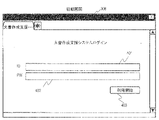
- FIG. 26 shows an example of the descriptive question screen 314 of the second embodiment.
- the generated document draft (document draft) takes the form of a report. Therefore, the descriptive question generation unit 118 requests further concreteness in the descriptive question for each of the keywords (components) specified in the selective question.
- each component 2601 and a text box 2602 in which the user 102 describes the details thereof are listed. The user can change the order of the descriptions using the controls on the left.
- the descriptive question generation unit 118 is a component for which no explicit answer has been obtained from the user, and the certainty of the indispensability of the component calculated by the statistic calculation process S2102 is predetermined. Select components that exceed the threshold and are sufficiently high, and include them in the descriptive question screen 314. The upper limit of the number of selected components may be set in advance. In the example of FIG. 26, this component is displayed with an underline in a form that can be distinguished from the component selected by the user. If the estimation is incorrect and the component is unnecessary, the user 102 can be erased by pressing the button marked with x. By showing the user 102 a component having a high degree of certainty that it is not selected, a more appropriate document can be created.
- FIG. 27 shows a flowchart of an example of the statistic calculation process S2102 in the second embodiment.
- One of the differences between the statistical calculation process S2102 of the second embodiment and the statistical calculation process of the first embodiment is as follows.
- Example 1 a case importance score is calculated for each case for question selection.
- Example 2 the component importance score, which is the score for each component, is calculated (S2702).
- step S1501 is the same as the statistical calculation process of the first embodiment shown in FIG.
- the list of user case components generated in step S1501 indicates the presence / absence flag of 0 for all the components. Step S1501 may be omitted.
- the case statistical calculation unit 116 includes a case (target case) including a component determined to be essential last time from the common case DB 115 based on the information of the response history DB 119, and a case not including the component (non-target). Case) is taken out separately (S2701). In the first loop, all cases are selected. Next, the case statistical calculation unit 116 selects a component whose indispensability is undetermined, that is, a component that has not been answered in the above target case (S1503).
- the case statistics calculation unit 116 calculates the component importance score of the selected unanswered component.
- This component importance score can be calculated based on the distribution of unquestioned components. For example, an information entropy obtained from the ratio of 0 and 1 of each component in the above target case, for example, "ratio of log0 + ratio of log1" can be used. This allows you to determine the components for which it is effective to ask a question.
- step S305 in FIG. 21 the case statistical calculation unit 116 asks the user 102 in order from the unanswered component having the highest component importance score whether it is the target of the draft document.
- the component selected as the target of the draft document is the component determined to be essential last time in step S2701.
- step S1505 in FIG. 27 the case statistical calculation unit 116 calculates the certainty of undetermined components and calculates the component identification score from those values.
- the undetermined component is an unanswered, that is, unquestioned component in the common case DB 115.
- the certainty of undetermined components can be calculated based on the statistics of undetermined components in common cases.
- the case statistical calculation unit 116 selects all cases including any of the components determined to be essential. As described in Example 1, the probability of becoming 1 of the unanswered components in these cases is compared with the probability of becoming 1 of the unanswered components in the common case DB 115, and the conviction of each of the unanswered components is compared. You can determine the degree.
- the case statistical calculation unit 116 forms a group of cases including each component determined to be essential. Each case of a group contains at least one essential component corresponding to that group.
- the case statistical calculation unit 116 compares the maximum value of the probability of becoming 1 of the unanswered component in each group with the probability of becoming 1 of the unanswered component in the common case DB 115.
- the case statistical calculation unit 116 can determine the certainty of each unanswered component based on the comparison result.
- Example 2 a document draft of a report like the document draft example shown in FIG. 28 can be created. There are some blanks and lack of description in this draft document, but the user can obtain it as a document file that can be edited with known software by pressing the download button, and complete the report by editing it. Can be done. Compared to writing a document from scratch in a blank slate, it is relatively easy to fill in a blank document, so you can finish the document in a shorter time.
- the present invention is not limited to the above-described embodiment, but includes various modifications.
- the above-described embodiment has been described in detail in order to explain the present invention in an easy-to-understand manner, and is not necessarily limited to the one including all the configurations described.
- it is possible to replace a part of the configuration of one embodiment with the configuration of another embodiment and it is also possible to add the configuration of another embodiment to the configuration of one embodiment.
- each of the above configurations, functions, processing units, etc. may be realized by hardware, for example, by designing a part or all of them with an integrated circuit. Further, each of the above configurations, functions, and the like may be realized by software by the processor interpreting and executing a program that realizes each function. Information such as programs, tables, and files that realize each function can be placed in a memory, a hard disk, a recording device such as an SSD (Solid State Drive), or a recording medium such as an IC card or an SD card. It was
- control lines and information lines indicate what is considered necessary for explanation, and not all control lines and information lines are necessarily shown in the product. In practice, it can be considered that almost all configurations are interconnected.
Landscapes
- Engineering & Computer Science (AREA)
- Theoretical Computer Science (AREA)
- Physics & Mathematics (AREA)
- General Physics & Mathematics (AREA)
- General Engineering & Computer Science (AREA)
- Health & Medical Sciences (AREA)
- Artificial Intelligence (AREA)
- Audiology, Speech & Language Pathology (AREA)
- Computational Linguistics (AREA)
- General Health & Medical Sciences (AREA)
- Business, Economics & Management (AREA)
- Databases & Information Systems (AREA)
- General Business, Economics & Management (AREA)
- Data Mining & Analysis (AREA)
- Entrepreneurship & Innovation (AREA)
- Human Resources & Organizations (AREA)
- Strategic Management (AREA)
- Marketing (AREA)
- Economics (AREA)
- Operations Research (AREA)
- Quality & Reliability (AREA)
- Tourism & Hospitality (AREA)
- Management, Administration, Business Operations System, And Electronic Commerce (AREA)
- Information Retrieval, Db Structures And Fs Structures Therefor (AREA)
- Document Processing Apparatus (AREA)
Abstract
La présente invention concerne un procédé de génération de projet de document qui consiste à répéter un processus de question sur un utilisateur, concernant au moins un élément constitutionnel sélectionné à partir d'une base de données de dossiers. Dans le processus de question, au moins un élément constitutionnel sélectionné à partir de la base de données de dossiers est présenté à l'utilisateur par un dispositif de sortie, une question concernant le point de savoir si l'au moins un élément constitutionnel correspond ou non à des détails d'un projet de document est présentée à l'utilisateur par le dispositif de sortie, une réponse de l'utilisateur à la question est acquise par l'intermédiaire d'un dispositif d'entrée, et la réponse est incluse dans un historique de réponses. Le procédé de génération de projet de document consiste également à : sélectionner au moins un élément constitutionnel devant être ensuite soumis au processus de question, parmi au moins un élément constitutionnel non traité dans une pluralité de dossiers sur la base d'au moins une partie de statistiques d'éléments constitutionnels de la pluralité de dossiers ; et générer le projet de document sur la base d'un élément constitutionnel indiquant que l'historique de réponses correspond à des détails du projet de document.
Priority Applications (2)
| Application Number | Priority Date | Filing Date | Title |
|---|---|---|---|
| EP21882695.6A EP4235543A4 (fr) | 2020-10-20 | 2021-10-14 | Dispositif pour générer un projet de document et procédé associé |
| US18/032,283 US12147756B2 (en) | 2020-10-20 | 2021-10-14 | Apparatus for generating draft document and method therefor |
Applications Claiming Priority (2)
| Application Number | Priority Date | Filing Date | Title |
|---|---|---|---|
| JP2020175911A JP7755377B2 (ja) | 2020-10-20 | 2020-10-20 | 文書作成支援装置 |
| JP2020-175911 | 2020-10-20 |
Publications (1)
| Publication Number | Publication Date |
|---|---|
| WO2022085554A1 true WO2022085554A1 (fr) | 2022-04-28 |
Family
ID=81290826
Family Applications (1)
| Application Number | Title | Priority Date | Filing Date |
|---|---|---|---|
| PCT/JP2021/038027 Ceased WO2022085554A1 (fr) | 2020-10-20 | 2021-10-14 | Dispositif pour générer un projet de document et procédé associé |
Country Status (4)
| Country | Link |
|---|---|
| US (1) | US12147756B2 (fr) |
| EP (1) | EP4235543A4 (fr) |
| JP (1) | JP7755377B2 (fr) |
| WO (1) | WO2022085554A1 (fr) |
Families Citing this family (1)
| Publication number | Priority date | Publication date | Assignee | Title |
|---|---|---|---|---|
| JP7617537B2 (ja) * | 2023-05-29 | 2025-01-20 | 株式会社Toreru | 発明ヒアリングシステム、発明ヒアリング装置、発明ヒアリング方法及び発明ヒアリングプログラム |
Citations (4)
| Publication number | Priority date | Publication date | Assignee | Title |
|---|---|---|---|---|
| JP2001134559A (ja) * | 1999-11-02 | 2001-05-18 | Namco Ltd | 対話式日記作成装置 |
| JP2012141832A (ja) * | 2010-12-28 | 2012-07-26 | Asano Hirotake | 文章生成装置及び文章生成方法 |
| JP2020140369A (ja) * | 2019-02-27 | 2020-09-03 | 株式会社日立製作所 | 文書作成支援システム、文書作成支援方法およびコンピュータプログラム |
| JP2020175911A (ja) | 2019-04-17 | 2020-10-29 | 株式会社サタケ | 自然流下式の貯留倉庫 |
Family Cites Families (9)
| Publication number | Priority date | Publication date | Assignee | Title |
|---|---|---|---|---|
| US6182095B1 (en) * | 1998-04-30 | 2001-01-30 | General Electric Capital Corporation | Document generator |
| GB2361341A (en) * | 2000-03-03 | 2001-10-17 | Knowhow Systems Ltd | Document creation and delivery |
| JP2004213156A (ja) | 2002-12-27 | 2004-07-29 | Japan Research Institute Ltd | 電子文書作成装置、電子文書作成方法およびその方法をコンピュータに実行させるプログラム |
| US20060287966A1 (en) * | 2004-12-21 | 2006-12-21 | Oracle International Corporation | Methods and systems for authoring customized contracts using contract templates that include user-configured rules and questions |
| US8200676B2 (en) * | 2005-06-28 | 2012-06-12 | Nokia Corporation | User interface for geographic search |
| US20070292833A1 (en) * | 2006-06-02 | 2007-12-20 | International Business Machines Corporation | System and Method for Creating, Executing and Searching through a form of Active Web-Based Content |
| WO2015089076A2 (fr) * | 2013-12-09 | 2015-06-18 | Constant Therapy, Inc. | Systèmes et techniques d'évaluation et/ou d'apprentissage personnalisé |
| US20180329874A1 (en) * | 2014-06-05 | 2018-11-15 | Zena Peden | Computer system and method for automatedly writing a user's autobiography |
| JP6535974B1 (ja) * | 2018-08-29 | 2019-07-03 | Gva Tech株式会社 | 法律文書作成支援システム、法律文書作成支援方法及びプログラム |
-
2020
- 2020-10-20 JP JP2020175911A patent/JP7755377B2/ja active Active
-
2021
- 2021-10-14 EP EP21882695.6A patent/EP4235543A4/fr active Pending
- 2021-10-14 US US18/032,283 patent/US12147756B2/en active Active
- 2021-10-14 WO PCT/JP2021/038027 patent/WO2022085554A1/fr not_active Ceased
Patent Citations (4)
| Publication number | Priority date | Publication date | Assignee | Title |
|---|---|---|---|---|
| JP2001134559A (ja) * | 1999-11-02 | 2001-05-18 | Namco Ltd | 対話式日記作成装置 |
| JP2012141832A (ja) * | 2010-12-28 | 2012-07-26 | Asano Hirotake | 文章生成装置及び文章生成方法 |
| JP2020140369A (ja) * | 2019-02-27 | 2020-09-03 | 株式会社日立製作所 | 文書作成支援システム、文書作成支援方法およびコンピュータプログラム |
| JP2020175911A (ja) | 2019-04-17 | 2020-10-29 | 株式会社サタケ | 自然流下式の貯留倉庫 |
Non-Patent Citations (1)
| Title |
|---|
| See also references of EP4235543A4 |
Also Published As
| Publication number | Publication date |
|---|---|
| EP4235543A4 (fr) | 2024-10-02 |
| JP7755377B2 (ja) | 2025-10-16 |
| JP2022067281A (ja) | 2022-05-06 |
| US20230394227A1 (en) | 2023-12-07 |
| US12147756B2 (en) | 2024-11-19 |
| EP4235543A1 (fr) | 2023-08-30 |
Similar Documents
| Publication | Publication Date | Title |
|---|---|---|
| Shaw et al. | Laboratories of oligarchy? How the iron law extends to peer production | |
| US7797315B2 (en) | Retrieval system and method of displaying retrieved results in the system | |
| US10089287B2 (en) | Redaction with classification and archiving for format independence | |
| US10853570B2 (en) | Redaction engine for electronic documents with multiple types, formats and/or categories | |
| US8645915B2 (en) | Dynamic data restructuring | |
| US8689098B2 (en) | System and method for organizing recorded events using character tags | |
| JP6515468B2 (ja) | 情報処理装置及び情報処理プログラム | |
| US8676792B1 (en) | Method and system for an invitation triggered automated search | |
| US11157153B2 (en) | Profile information layout customization in computer systems | |
| WO2022085554A1 (fr) | Dispositif pour générer un projet de document et procédé associé | |
| Nasir et al. | An exploratory study about non-functional requirements documentation practices in agile teams | |
| US11275887B2 (en) | Non-transitory computer-readable recording medium, evaluation method, and information processing device | |
| JPWO2002063520A1 (ja) | 採用処理システム、プログラム及び記録媒体 | |
| CN111401831A (zh) | 任务进度展示方法、装置、设备及可读存储介质 | |
| US9953021B2 (en) | Completeness in dependency networks | |
| US20160371627A1 (en) | Method and system for identification of business collaborators | |
| Cohoon et al. | Adapting to Challenges in Qualitative Fieldwork through Theoretical Sampling | |
| CN112862336A (zh) | 一种企业资产防护方法和装置 | |
| Klein et al. | Emerging technologies and corporate culture at Microsoft: A methodological note | |
| JP2020144674A (ja) | 文書出力システム、文書出力方法及び文書出力プログラム | |
| JP2003263527A (ja) | アンケート実施装置及び方法及び媒体 | |
| Jalil et al. | Requirement elicitation for bespoke software development: A review paper | |
| JP7064766B2 (ja) | 情報処理装置、情報処理方法、およびプログラム | |
| US20220358445A1 (en) | Training assignment tool | |
| WO2025144047A1 (fr) | Système et procédé de gestion de fichiers |
Legal Events
| Date | Code | Title | Description |
|---|---|---|---|
| 121 | Ep: the epo has been informed by wipo that ep was designated in this application |
Ref document number: 21882695 Country of ref document: EP Kind code of ref document: A1 |
|
| NENP | Non-entry into the national phase |
Ref country code: DE |
|
| ENP | Entry into the national phase |
Ref document number: 2021882695 Country of ref document: EP Effective date: 20230522 |