WO2022092067A1 - 細胞凍結保存用の中空糸膜 - Google Patents
細胞凍結保存用の中空糸膜 Download PDFInfo
- Publication number
- WO2022092067A1 WO2022092067A1 PCT/JP2021/039439 JP2021039439W WO2022092067A1 WO 2022092067 A1 WO2022092067 A1 WO 2022092067A1 JP 2021039439 W JP2021039439 W JP 2021039439W WO 2022092067 A1 WO2022092067 A1 WO 2022092067A1
- Authority
- WO
- WIPO (PCT)
- Prior art keywords
- hollow fiber
- fiber membrane
- solution
- cells
- solvent
- Prior art date
- Legal status (The legal status is an assumption and is not a legal conclusion. Google has not performed a legal analysis and makes no representation as to the accuracy of the status listed.)
- Ceased
Links
Images




Classifications
-
- C—CHEMISTRY; METALLURGY
- C12—BIOCHEMISTRY; BEER; SPIRITS; WINE; VINEGAR; MICROBIOLOGY; ENZYMOLOGY; MUTATION OR GENETIC ENGINEERING
- C12M—APPARATUS FOR ENZYMOLOGY OR MICROBIOLOGY; APPARATUS FOR CULTURING MICROORGANISMS FOR PRODUCING BIOMASS, FOR GROWING CELLS OR FOR OBTAINING FERMENTATION OR METABOLIC PRODUCTS, i.e. BIOREACTORS OR FERMENTERS
- C12M25/00—Means for supporting, enclosing or fixing the microorganisms, e.g. immunocoatings
- C12M25/10—Hollow fibers or tubes
-
- A—HUMAN NECESSITIES
- A01—AGRICULTURE; FORESTRY; ANIMAL HUSBANDRY; HUNTING; TRAPPING; FISHING
- A01N—PRESERVATION OF BODIES OF HUMANS OR ANIMALS OR PLANTS OR PARTS THEREOF; BIOCIDES, e.g. AS DISINFECTANTS, AS PESTICIDES OR AS HERBICIDES; PEST REPELLANTS OR ATTRACTANTS; PLANT GROWTH REGULATORS
- A01N1/00—Preservation of bodies of humans or animals, or parts thereof
- A01N1/10—Preservation of living parts
- A01N1/12—Chemical aspects of preservation
- A01N1/128—Chemically defined matrices for immobilising, holding or storing living parts, e.g. alginate gels; Chemically altering living parts, e.g. by cross-linking
-
- A—HUMAN NECESSITIES
- A01—AGRICULTURE; FORESTRY; ANIMAL HUSBANDRY; HUNTING; TRAPPING; FISHING
- A01N—PRESERVATION OF BODIES OF HUMANS OR ANIMALS OR PLANTS OR PARTS THEREOF; BIOCIDES, e.g. AS DISINFECTANTS, AS PESTICIDES OR AS HERBICIDES; PEST REPELLANTS OR ATTRACTANTS; PLANT GROWTH REGULATORS
- A01N1/00—Preservation of bodies of humans or animals, or parts thereof
- A01N1/10—Preservation of living parts
- A01N1/14—Mechanical aspects of preservation; Apparatus or containers therefor
- A01N1/146—Non-refrigerated containers specially adapted for transporting or storing living parts whilst preserving
- A01N1/147—Carriers for immersion in cryogenic fluid for slow freezing or vitrification
-
- A—HUMAN NECESSITIES
- A01—AGRICULTURE; FORESTRY; ANIMAL HUSBANDRY; HUNTING; TRAPPING; FISHING
- A01N—PRESERVATION OF BODIES OF HUMANS OR ANIMALS OR PLANTS OR PARTS THEREOF; BIOCIDES, e.g. AS DISINFECTANTS, AS PESTICIDES OR AS HERBICIDES; PEST REPELLANTS OR ATTRACTANTS; PLANT GROWTH REGULATORS
- A01N1/00—Preservation of bodies of humans or animals, or parts thereof
- A01N1/10—Preservation of living parts
- A01N1/16—Physical preservation processes
- A01N1/162—Temperature processes, e.g. following predefined temperature changes over time
-
- C—CHEMISTRY; METALLURGY
- C12—BIOCHEMISTRY; BEER; SPIRITS; WINE; VINEGAR; MICROBIOLOGY; ENZYMOLOGY; MUTATION OR GENETIC ENGINEERING
- C12N—MICROORGANISMS OR ENZYMES; COMPOSITIONS THEREOF; PROPAGATING, PRESERVING, OR MAINTAINING MICROORGANISMS; MUTATION OR GENETIC ENGINEERING; CULTURE MEDIA
- C12N5/00—Undifferentiated human, animal or plant cells, e.g. cell lines; Tissues; Cultivation or maintenance thereof; Culture media therefor
- C12N5/0012—Cell encapsulation
-
- C—CHEMISTRY; METALLURGY
- C12—BIOCHEMISTRY; BEER; SPIRITS; WINE; VINEGAR; MICROBIOLOGY; ENZYMOLOGY; MUTATION OR GENETIC ENGINEERING
- C12N—MICROORGANISMS OR ENZYMES; COMPOSITIONS THEREOF; PROPAGATING, PRESERVING, OR MAINTAINING MICROORGANISMS; MUTATION OR GENETIC ENGINEERING; CULTURE MEDIA
- C12N5/00—Undifferentiated human, animal or plant cells, e.g. cell lines; Tissues; Cultivation or maintenance thereof; Culture media therefor
- C12N5/0068—General culture methods using substrates
-
- D—TEXTILES; PAPER
- D01—NATURAL OR MAN-MADE THREADS OR FIBRES; SPINNING
- D01D—MECHANICAL METHODS OR APPARATUS IN THE MANUFACTURE OF ARTIFICIAL FILAMENTS, THREADS, FIBRES, BRISTLES OR RIBBONS
- D01D5/00—Formation of filaments, threads, or the like
- D01D5/24—Formation of filaments, threads, or the like with a hollow structure; Spinnerette packs therefor
-
- D—TEXTILES; PAPER
- D01—NATURAL OR MAN-MADE THREADS OR FIBRES; SPINNING
- D01F—CHEMICAL FEATURES IN THE MANUFACTURE OF ARTIFICIAL FILAMENTS, THREADS, FIBRES, BRISTLES OR RIBBONS; APPARATUS SPECIALLY ADAPTED FOR THE MANUFACTURE OF CARBON FILAMENTS
- D01F2/00—Monocomponent artificial filaments or the like of cellulose or cellulose derivatives; Manufacture thereof
- D01F2/24—Monocomponent artificial filaments or the like of cellulose or cellulose derivatives; Manufacture thereof from cellulose derivatives
- D01F2/28—Monocomponent artificial filaments or the like of cellulose or cellulose derivatives; Manufacture thereof from cellulose derivatives from organic cellulose esters or ethers, e.g. cellulose acetate
-
- C—CHEMISTRY; METALLURGY
- C12—BIOCHEMISTRY; BEER; SPIRITS; WINE; VINEGAR; MICROBIOLOGY; ENZYMOLOGY; MUTATION OR GENETIC ENGINEERING
- C12N—MICROORGANISMS OR ENZYMES; COMPOSITIONS THEREOF; PROPAGATING, PRESERVING, OR MAINTAINING MICROORGANISMS; MUTATION OR GENETIC ENGINEERING; CULTURE MEDIA
- C12N2533/00—Supports or coatings for cell culture, characterised by material
- C12N2533/70—Polysaccharides
- C12N2533/78—Cellulose
Definitions
- the present invention relates to a hollow fiber membrane for cryopreserving cells.
- the vitrification freezing method is known as a method for cryopreserving cells such as egg cells and germ cells.
- an instrument called Cryotop (registered trademark) is used.
- the cryotop is a special device with a very thin strip-shaped sheet attached to the tip of the handle.
- the cells are cryopreserved in liquid nitrogen or the like in a state of being placed on a sheet at the tip of the cryotop together with a freezing liquid such as a vitrifying liquid.
- a method using a hollow fiber membrane has also been studied for cryopreservation of such cells.
- the hollow fiber cryopreservation method cells are frozen and stored in a state of being contained inside a hollow fiber membrane composed of cellulose acetate. This method is expected to improve the survival rate of cells after freezing.
- Patent Document 1 Patent No. 5252556
- Patent Document 2 Patent No. 5051716
- Patent Document 3 Patent No. 6667903
- a support device for hollow fibers for this purpose is disclosed.
- the conventional hollow fiber membrane is used, for example, for hemodialysis, hemodialysis filtration, etc. as disclosed in Patent Document 4 (Patent No. 5440332) and Patent Document 5 (Patent No. 5212837). Hollow fiber membranes made of cellulose acetate are known.
- Japanese Patent No. 5252556 Japanese Patent No. 5051716 Japanese Patent No. 6667903 Japanese Patent No. 5440332 Japanese Patent No. 5212837
- hollow fiber membranes made of cellulose esters such as cellulose acetate are strong due to exposure to extremely low temperatures such as those used for cryopreservation of cells, and volume changes during freezing and subsequent thawing. There was a risk of damage due to the decrease.
- an object of the present invention is to suppress a decrease in strength of a hollow fiber membrane made of cellulose ester for cell cryopreservation when it is used for cell cryopreservation.
- a hollow fiber membrane containing cellulose ester for cell cryopreservation A hollow fiber membrane in which the breaking strength when thawed after being frozen by the vitrification freezing method is 80% or more of the breaking strength when wet before freezing.
- a hollow fiber membrane made of cellulose ester for cell cryopreservation it is possible to suppress a decrease in strength when used for cell cryopreservation.
- a to B means the upper and lower limits of the range (that is, A or more and B or less), and there is no description of the unit in A and the unit is described only in B.
- the unit of A is the same as the unit of B.
- the hollow fiber membrane of the present embodiment can be suitably used for cryopreservation of cells.
- the target cells include egg cells (fertilized eggs, etc.), embryonic cells, pluripotent stem cells including iPS cells, ES cells, etc., and artificial tissues (cell clumps) such as organoids derived from pluripotent stem cells. Be done.
- the cell clump may be composed of a plurality of cell types.
- the cells are cryopreserved in a state of being arranged inside the hollow fiber membrane. Cell suspensions containing disjointed cells may be cryopreserved inside the hollow fiber membrane.
- the hollow fiber membrane of this embodiment contains a cellulose ester.
- the ratio of the cellulose ester in the material constituting the hollow fiber membrane is preferably 90% by mass or more, more preferably 95% by mass or more, and further preferably 98% by mass or more.
- the hollow fiber membrane may be composed only of cellulose ester.
- the hollow fiber membrane is preferably transparent enough to allow the cells contained therein to be visible. Since the cellulose ester is a highly transparent material, it is preferable that the ratio of the cellulose ester in the material constituting the hollow fiber membrane is high. Further, it is preferable that the hollow fiber membrane does not dissolve in the vitrification liquid and the resin component does not elute into the vitrification liquid. From this viewpoint as well, it is preferable that the ratio of the cellulose ester in the material constituting the hollow fiber membrane is high.
- cellulose ester examples include cellulose acetate, cellulose phthalate, and cellulose succinate.
- the cellulose ester is preferably cellulose acetate.
- Cellulose acetate is resistant to chlorine, which is a bactericidal agent, and can be sterilized with chlorine.
- cellulose acetate examples include cellulose triacetate, cellulose monoacetate, cellulose diacetate, cellulose acetate butyrate, and cellulose acetate propionate. From the viewpoint of durability and the like, cellulose acetate is preferably cellulose triacetate.
- cellulose acetate for example, various cellulose acetates having different degrees of vinegarization, degree of polymerization, etc. (L-20, 30, 40, 50, 70, LT-35, 55, 105, etc.) are commercially available from Daicel Chemical Industry Co., Ltd. ing. It is preferable to use cellulose acetate (a polymer having a relatively low viscosity) having a 6% viscosity of more than 140 mPa ⁇ s and less than 200 mPa ⁇ s.
- the degree of vinegarization of cellulose acetate is preferably 53 to 62%, more preferably 55 to 61.5%, and even more preferably 58 to 61.5%.
- the degree of vinegarization represents the degree of acetic acid group substitution of the hydroxyl group in cellulose.
- the theoretical upper limit of the degree of vinegarization is 62.5%, but if the degree of vinegarization is too high, the solubility and moldability may decrease.
- the hollow fiber membrane of the present embodiment has a breaking strength when thawed after being frozen by the vitrification freezing method, which is 80% or more, preferably 90% or more, more preferably 90% or more, which is the breaking strength when wet before freezing. It is 95% or more.
- the hollow fiber membrane of the present embodiment has a breaking elongation when thawed after being frozen by the vitrification freezing method, preferably 80% or more, more preferably than the breaking elongation at the time of wetting before freezing. Is 90% or more, more preferably 95% or more.
- the yield strength when thawed after being frozen by the vitrification freezing method is preferably 80% or more, more preferably 90% or more, with respect to the yield strength at the time of wetting before freezing. % Or more, more preferably 95% or more.
- the hollow fiber membrane containing the cellulose ester of the present embodiment suppresses the decrease in strength when used for cryopreservation of cells.
- breaking strength, breaking elongation and yield strength are measured by the method for measuring the strength elongation (breaking strength, breaking elongation and yield strength) in the examples described later.
- the vitrification freezing method prevents the crystallization of water, which is said to occur easily at -60 ° C to -15 ° C, by rapidly lowering the temperature by immersing the cells in liquid nitrogen, and in an amorphous glass state.
- a method of freezing cells This method is superior to the slow freezing method in that it does not cause cell damage due to the formation of ice crystals, the processing time is short, no special equipment is required, and the long-term storage of cells is good.
- Many specific methods for vitrification and freezing of cells have been developed. As an example, cells are immersed in a freezing-resistant storage solution in liquid nitrogen or in an ultra-low temperature freezer at -80 ° C or lower, more preferably -190 ° C or lower. There is a method of rapidly freezing in.
- the conditions of the vitrification freezing method for comparing the above-mentioned strong elongations (breaking strength, breaking elongation and yield strength) before and after freezing and thawing are as follows.
- the inner diameter of the hollow fiber membrane is preferably 30 ⁇ m or more and 300 ⁇ m or less, and more preferably 35 ⁇ m or more and 260 ⁇ m or less.
- the thickness of the hollow fiber membrane is preferably 20 to 200 ⁇ m, more preferably 30 to 150 ⁇ m. The film thickness can be calculated from "(outer diameter-inner diameter) / 2".
- the hollow fiber membrane (hollow fiber type membrane) is preferably composed of a semipermeable membrane.
- the cells are not allowed to pass through the cells housed in the hollow fiber membrane and cryopreserved, but the culture solution, the cryopreservation solution, the frost damage protective substance contained in the preservation solution, etc. are allowed to pass through, so that the inside of the hollow fiber membrane is allowed to pass through. It is possible to maintain the state in which cells are contained in the space. That is, there is an advantage that the culture solution or intracellular fluid in the internal space of the hollow fiber membrane can be easily replaced with the cryopreservation solution.
- the hollow fiber membrane has a hollow ratio of preferably 10 to 65%, more preferably 12 to 55%.
- the hollow ratio is a ratio of the area of the hollow portion in the cross section of the hollow fiber membrane, and is expressed as "hollow section cross section / (membrane cross section + hollow section cross section) x 100 (%)".
- the average pore diameter of the hollow fiber membrane (average pore diameter of the fine pores of the entire membrane) is preferably 10 ⁇ m or less.
- Examples of the method for measuring the average pore size include a bubble point method and a mercury intrusion method.
- the hollow fiber membrane of the present embodiment is preferably a membrane having a non-uniform structure (asymmetric structure) in the thickness direction.
- asymmetric structure a non-uniform structure
- it is considered to be highly effective in suppressing a decrease in the strength of the hollow fiber membrane due to an extremely low temperature used for cryopreservation of cells, a volume change during freezing and subsequent thawing, and the like. ..
- the reason is not clear, but one reason is that the non-uniform structure has a higher buffering capacity of the polymer chain than the uniform structure and is less susceptible to changes in the volume of the hollow fiber membrane. ..
- hollow fiber membrane having an asymmetric structure examples include hollow fiber membranes having different densities (vacancy ratio, cross-sectional aperture ratio) in the thickness direction.
- one surface side has a dense layer, and this dense layer is a separation active layer that substantially defines the pore size of the hollow fiber membrane, and the other surface side has a dense layer.
- films having a lower density than the dense layer examples include films having a lower density than the dense layer.
- the opening ratio of one surface and the opening ratio of the other surface are different.
- the opening ratio of one surface having a larger opening ratio is preferably 1.1 times or more, more preferably 1.3 times or more the opening ratio of the other surface.
- the image is binarized into white / black using image analysis software (for example, WinROOF2013), and the inner and outer surfaces of the hollow fiber membrane are quantified. Obtain the opening rate. This is carried out in 10 visual fields, the average is calculated, and the surface aperture ratio is used.
- image analysis software for example, WinROOF2013
- the area ratio of the hollow fiber membrane is the area ratio of the real part (the part where the membrane exists) other than the pores in the thickness direction cross section (cross section) of the hollow fiber membrane.
- the area ratio is determined by analyzing an image of the cross section of the hollow fiber membrane taken by SEM. Specifically, the cross section of the film is divided into three equal parts in the film thickness direction and divided into three regions, and the area ratio is measured for each region.
- the three regions are a region A including the outer surface, a region B including the inner surface, and a region (central region C) between the regions A and B.
- the magnification of the SEM may be any magnification as long as the pores and the actual portion can be recognized, and for the measurement of the hollow fiber membrane of the present invention, for example, 5000 to 20000 times is appropriate.
- the area ratio is calculated by a method using image analysis. Specifically, image analysis software (for example, WinROOF2013) is used to perform binarization processing of the pore portion and the real portion (polymer portion). After the binarization treatment, the area ratio is calculated from the ratio of the total area of the pores to the total area of the polymer.
- the hollow fiber membrane has the above-mentioned asymmetric structure, but has a feature that the variation in bulk density (area ratio in the cross section in the thickness direction) is small (preferably almost constant) in the thickness direction of the film.
- the structural characteristics can withstand a sudden temperature change and a volume change of the vitrified liquid. Therefore, it is considered that embrittlement and breakage of the hollow fiber membrane structure due to freezing and thawing can be suppressed, and the membrane strength can be maintained.
- the small variation in the area ratio in the thickness direction cross section means, for example, that, in the thickness direction cross section, the region A including the outer surface, the region B including the inner surface, and the central region C (between the region A and the region B). It means that the difference in area ratio (%) is small for the area). Specifically, when the area ratios of regions A, B and C are measured, they are selected from a (area ratio of region A), b (area ratio of region B) and c (area ratio of region C). In all combinations of the two area ratios, the absolute value of the difference between the two area ratios is preferably less than 5%, more preferably less than 3% (see the formula below).
- the region A is a region from the outer surface to a depth of 30% of the film thickness
- the region B is a region from the inner surface to a depth of 30% of the film thickness.
- ⁇ 5% More preferably
- the average area ratio of the cross section in the thickness direction is preferably 40% or more and 70% or less (see the following formula). 40% ⁇ (a + b + c) / 3 ⁇ 70%
- the hollow fiber membrane has high inner surface smoothness. Due to the high smoothness of the inner surface, even if an egg cell or a germ cell comes into contact with the inner surface of the hollow fiber membrane, the risk of damaging the cell surface can be minimized.
- high smoothness means that the arithmetic average roughness Ra value is 20 nm or less. The higher the smoothness, the smaller the damage to the cells. Therefore, the Ra value is more preferably 10 nm or less, and further preferably 1 nm or more and less than 8 nm.
- the arithmetic mean roughness Ra value can be measured using an atomic force microscope (AFM).
- the present invention also relates to a method for producing a hollow fiber membrane containing the above-mentioned cellulose ester.
- the method for producing the hollow fiber membrane of the present embodiment is, for example, the following method.
- the above method for manufacturing a hollow fiber membrane The undiluted spinning solution and the internal solution are discharged from a double tubular nozzle into the coagulating solution via an aerial traveling portion, the undiluted spinning solution is coagulated in the coagulating solution, and the coagulated product of the undiluted spinning solution is pulled from the coagulating solution.
- the spinning stock solution contains a resin raw material containing a cellulose ester, a solvent and a non-solvent, and contains.
- the internal liquid contains water and contains water.
- the temperature of the undiluted spinning solution at the nozzle is 70 to 110 ° C, and the temperature of the internal solution is 40 to 70 ° C.
- the ratio of the amount of the solvent to the non-solvent in the coagulant is 60/40 to 80/20.
- the concentration of the cellulose ester in the spinning stock solution is preferably 10 to 30% by mass.
- the ratio of the amount of the solvent to the total amount of the solvent and the non-solvent is preferably 60 to 80% by mass.
- the solvent is preferably an aprotic polar solvent.
- the non-solvent is preferably a glycol ester.
- the linear distance of the aerial traveling portion is preferably 10 to 50 mm.
- the spinning dope 10a and the inner liquid 10b are discharged from the double tubular nozzle 11 into the coagulating liquid 21 via the aerial traveling portion (air gap) 20 to spin.
- the hollow fiber membrane 16 is obtained by coagulating the undiluted solution in the coagulating solution 21 and pulling out the coagulated product of the spinning undiluted solution from the coagulating solution 21.
- the hollow fiber membrane is pulled out by, for example, the submersible guide 12 and the rollers 13, 14, 15.
- the nozzle 11 has a double tubular shape and includes an outer tube and an inner tube provided inside the outer tube.
- the undiluted spinning solution is discharged from the gap (slit) between the outer tube and the inner tube, and the inner solution is discharged from the inside of the inner tube.
- the ratio of the diameter of the inner diameter (inner diameter of the slit) to the diameter of the outer pipe (outer diameter of the slit) is preferably 110 to 300%, more preferably 110 to 200%.
- the diameter of the outer tube is preferably 220 to 400 ⁇ m, more preferably 220 to 330 ⁇ m.
- the diameter of the inner tube is preferably 150 to 330 ⁇ m, more preferably 150 to 270 ⁇ m.
- the diameter of the inner tube is preferably about the same as the diameter of the hollow fiber membrane.
- the ratio of the cross-sectional area of the inner pipe to the cross-sectional area of the slit is preferably 80 to 120%.
- the discharge line speed of the membrane-forming stock solution is the slit cross-sectional area [ ⁇ (a / 2) 2 - ⁇ (b) obtained from the nozzle slit outer diameter (a) and the nozzle slit inner diameter (b) for the discharge amount of the membrane-forming stock solution. / 2) Obtained by dividing by 2 ] (see the formula below).
- Discharge line speed of the film-forming stock solution [m / min] Discharge amount of the film-forming stock solution / Slit cross-sectional area
- the take-up speed is the rotation speed (surface speed) of the roller 13 provided at the outlet of the coagulation bath (FIG. 6). reference).
- the nozzle draft ratio which is the ratio of the discharge line speed to the take-up speed (take-up speed / discharge line speed), is 0.4 to 0.9, preferably 0.5 to 0.9.
- the linear distance of the aerial traveling portion 20 (distance between the tip of the nozzle 11 and the liquid level of the coagulating liquid 21) is preferably 10 to 50 mm, more preferably 10 to 40 mm.
- the hollow fiber membrane obtained by the spinning step may be further subjected to a washing step (water washing step) with pure water.
- a washing step water washing step
- the flow of water is preferably a flow in the direction opposite to the moving direction of the hollow fiber membrane (counterflow), but even if the flow is in the same direction as the moving direction of the hollow fiber membrane (parallel flow). good.
- the spinning stock solution 10a contains a resin raw material containing the above-mentioned cellulose ester, a solvent and a non-solvent.
- the temperature (set temperature) of the undiluted spinning solution at the nozzle 11 is 70 to 110 ° C, preferably 70 to 100 ° C.
- the concentration of the cellulose ester in the spinning stock solution is preferably 10 to 30% by mass, more preferably 10 to 25% by mass. If the concentration of cellulose ester is too low, the strength of the hollow fiber membrane will be low. On the other hand, if the concentration of the cellulose ester is too high, the viscosity of the undiluted spinning solution becomes too high, which may make spinning difficult.
- the solvent is a liquid that can dissolve cellulose ester.
- the solvent is preferably a polar solvent and is preferably soluble in water.
- the polar solvent is preferably an aprotic polar solvent.
- Examples of the aprotonic polar solvent include N-methylpyrrolidone (NMP), dimethylformamide (DMF), dimethylacetamide (DMA), dimethyl sulfoxide (DMSO), acetonitrile and the like.
- the non-solvent is a liquid (excluding water) that does not dissolve the cellulose ester.
- the non-solvent include glycol esters, glycerin, alcohols and the like, and glycol esters are preferable.
- the glycol ester include ethylene glycol, triethylene glycol (TEG), polyethylene glycol (polyethylene glycol 200, polyethylene glycol 400, etc.), propylene glycol and the like.
- the ratio (S / NS ratio) of the amount of the solvent (S) to the non-solvent (NS) is 60/40 to 80/20, more preferably 65/35 to 75/25. If the S / NS ratio in the undiluted spinning solution is too small, the dissolution of the cellulose ester becomes unstable, so that the spinning stability may be lowered or an asymmetric structure suitable for the application of the present invention may not be obtained. When the S / NS ratio becomes large, a hollow fiber membrane having an asymmetric structure may not be obtained, or spinning stability may decrease.
- the undiluted spinning solution may further contain water in addition to the solvent and the non-solvent.
- the order of addition and the mixing method of the resin raw material containing the cellulose ester which is the constituent material of the hollow fiber membrane, the solvent and the non-solvent are not particularly limited.
- the internal liquid contains water.
- the content of water in the internal liquid is 95 to 100% by mass, preferably 98 to 100% by mass.
- the inner surface of the hollow fiber membrane is preferably highly smooth. This is because the damage caused by contact with the cells to be cryopreserved can be reduced.
- the inner surface should be quickly solidified (fixed) before being affected by disturbance to prevent excessive phase separation. preferable. Further, it is preferable not to apply an external force such as stretching to the inner surface during and after solidification, and to suppress fluctuations in the inner diameter after the hollow fiber membrane structure is fixed as much as possible.
- an inner liquid 10b having a high coagulability with respect to the spinning stock solution 10a In order to quickly coagulate the inner surface, it is preferable to use an inner liquid 10b having a high coagulability with respect to the spinning stock solution 10a, or to adopt a spinning stock solution composition and temperature conditions that facilitate coagulation. Therefore, in the production method of the present embodiment, an internal liquid containing water having high coagulation property with respect to the spinning stock solution containing cellulose ester is used.
- ethylene glycol, triethylene glycol, polyethylene glycol 200 or 400, glycerin, propylene glycol and the like, which are generally used as non-solvents for cellulose esters, can also be used alone or in combination.
- the upper limit is 5% by weight of N-methylpyrrolidone, dimethylacetamide, dimethylformamide, dimethyl sulfoxide, etc., which are the solvents of the non-solvent and the cellulose triacetate polymer, as components other than water. Can be added as.
- the temperature (set temperature) of the internal liquid in the nozzle 11 is 40 to 70 ° C, preferably 45 to 65 ° C. As described above, the temperature (set temperature) of the undiluted spinning solution at the nozzle 11 is 70 to 110 ° C., but the internal solution is preferably set to a temperature lower than this.
- the temperature of the internal liquid in the nozzle 11 is preferably 10 ° C. or higher, more preferably 20 ° C. or higher, and even more preferably 30 ° C. or higher, as compared with the temperature of the undiluted spinning solution in the nozzle 11.
- a temperature difference is provided between the undiluted spinning solution and the internal solution to provide coagulation (coagulation) on the inner surface of the undiluted spinning solution (hollow fiber membrane). It is preferable to increase the speed). By increasing the solidification rate of the inner surface, a hollow fiber membrane having an asymmetric structure (a structure non-uniform in the thickness direction) can be obtained.
- adjusting the composition of the coagulating liquid to be described later to a specific range or adjusting the nozzle draft enhances the smoothness of the inner surface of the hollow fiber membrane.
- a nozzle having a structure capable of controlling the temperature of the undiluted spinning solution and the internal solution separately until just before discharge.
- the coagulant preferably contains a solvent and a non-solvent (excluding water).
- the coagulating liquid may further contain water in addition to the solvent and the non-solvent.
- the ratio of the total amount of the solvent and the non-solvent in the coagulating liquid is 60 to 90% by mass, preferably 65 to 90% by mass.
- the temperature of the coagulating liquid is preferably 20 to 60 ° C, more preferably 30 to 50 ° C.
- Example 1 The hollow fiber membrane of Example 1 was manufactured under the following conditions by the method for producing a hollow fiber membrane described in the embodiment.
- composition of coagulant Solvent (S): NMP Non-solvent (NS): TEG Concentration of water coagulant [(mass of S + mass of NS) / mass of coagulant]: 78 mass% The S / NS ratio is the same as the undiluted spinning solution.
- Discharge temperature of undiluted spinning solution (set temperature): 93 ° C
- Distance of the aerial traveling part (air gap length): 25 mm, Dwelling time of aerial traveling part: 0.025 seconds
- Coagulant temperature 43 ° C Pulling speed: 60m / min Nozzle draft ratio: 0.78
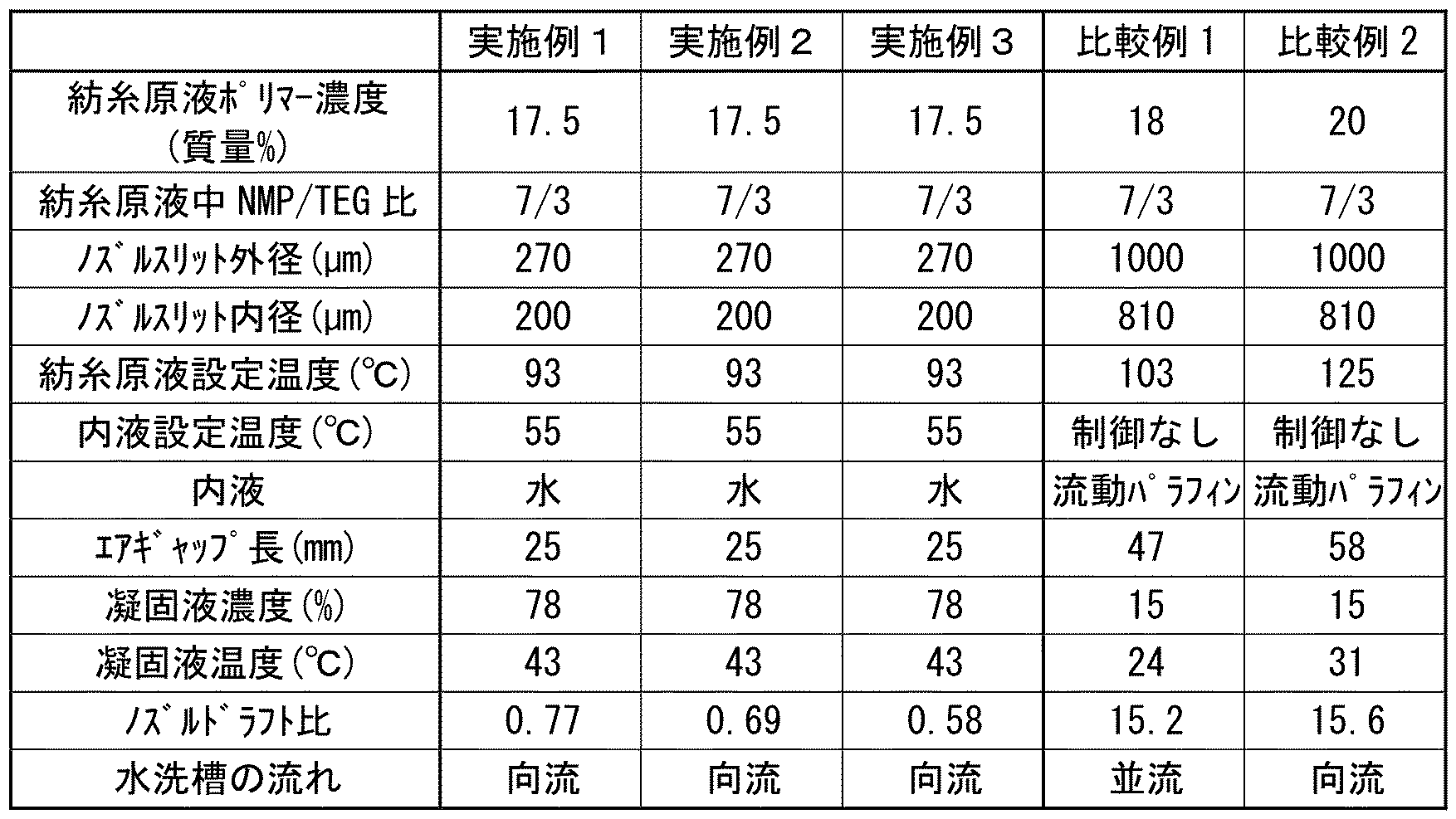
- Examples 2 and 3 As shown in Table 1, the nozzle draft ratio was changed.
- the hollow fiber membranes of Examples 2 and 3 were manufactured in the same manner as in Example 1 except for the above points.
- Table 2 shows the results of measuring the arithmetic mean roughness and the area ratio of the inner surface of the obtained hollow fiber membrane.
- Comparative Examples 1 and 2 As shown in Table 1, the composition of each of the undiluted spinning solution, the internal solution and the coagulating solution, and each production condition were changed. Liquid paraffin is used as the internal liquid, and the set temperature of the internal liquid is not particularly controlled and is about the same as the temperature of the undiluted spinning solution.
- the hollow fiber membranes of Comparative Example 1 and Comparative Example 2 were manufactured in the same manner as in Example 1 except for the above points.
- a sample having a smooth cross section was obtained by immersing the wet hollow fiber membrane in liquid nitrogen, freezing it, taking it out of liquid nitrogen, and immediately bending and cutting it.
- the sample was fixed on the sample table so that the cross section could be observed, and carbon vapor deposition was performed on the cross section of the sample.
- the cross section of the sample after vapor deposition was imaged using a scanning electron microscope (S-2500 manufactured by Hitachi) at an acceleration voltage of 5 kV and a magnification of 10000 times.
- S-2500 manufactured by Hitachi
- the pores and the polymer were binarized using the image analysis software WinROOF2013.
- the area ratio was calculated from the ratio of the pore portion and the polymer portion.
- the region A is a region from the outer surface to a depth of 30% of the film thickness
- the region B is a region from the inner surface to a depth of 30% of the film thickness.
- the structure may become unclear due to part of the cross section being melted by cutting or electron beam. In that case, measure using the part where the structure is clear, or change the sample and take a picture. I took it again. Table 2 shows the measurement results of the area ratio.
- ⁇ Croze storage test> The hollow fiber membranes of Examples 1 to 3 and Comparative Examples 1 and 2 were subjected to a cryopreservation test using a vitrification freezing method.
- the conditions of the vitrification freezing method are the same as the conditions for measuring the above-mentioned breaking strength (breaking strength when thawed after being frozen by the vitrification freezing method).
- the initial dry state (“dry state”) the wet state with water (“wet state”), and the equilibrium liquid infiltrate.
- the inner and outer diameters of the hollow thread film are measured using a projector (Nikon PROFILE PROJECTOR V-12). Specifically, the dimensions of the outer surface of the hollow fiber membrane in the XX and YY directions (two orthogonal directions on the cross section) are measured for each hollow fiber membrane cross section, and the arithmetic average value of these values is calculated. The outer diameter was set to one hollow fiber membrane cross section.
- the dimensions of the hollow fiber in the XX and YY directions were measured for each hollow fiber membrane cross section, and the arithmetic mean value was taken as the inner diameter of one hollow fiber membrane cross section. ..
- the 10 cross sections were measured in the same manner, and the average values were taken as the inner diameter and the outer diameter.
- the film thickness (average value) is calculated by the formula "(outer diameter-inner diameter) / 2" based on the measurement results (average value) of the inner diameter and the inner diameter of the hollow fiber membrane.
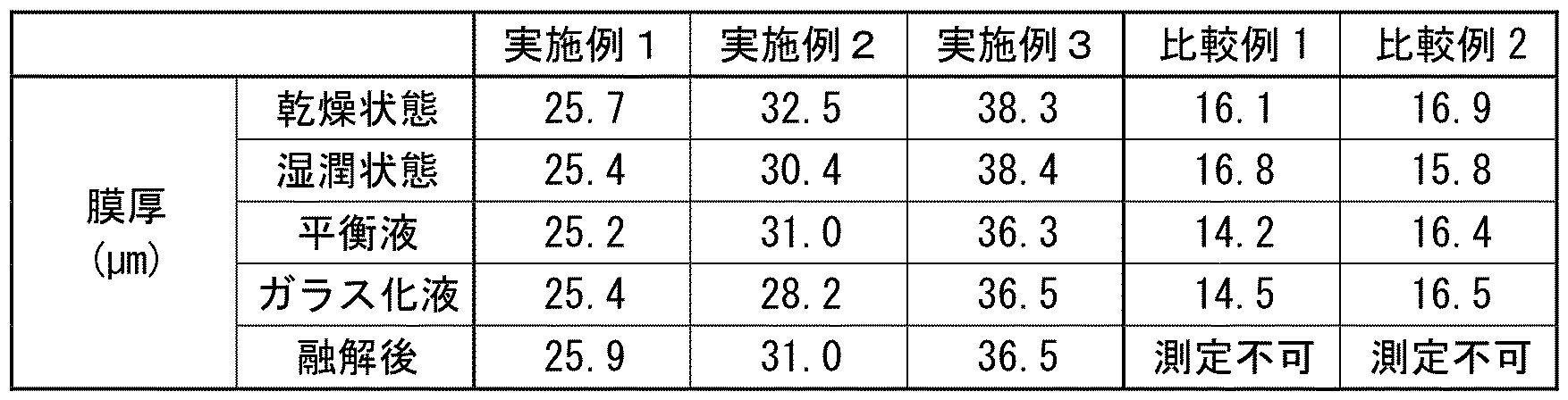
- the measurement result (average value) of the inner diameter of the hollow fiber membrane is shown in Table 3 (FIG. 1), and the measurement result (average value) of the film thickness is shown in Table 4 (FIG. 2).
- the inner diameter and the film thickness could not be measured because the strength of the hollow fiber membrane was low after melting and a cross-sectional sample of the hollow fiber membrane could not be prepared.
- a tensile tester (UTMII manufactured by Toyo Baldwin) to cut one hollow fiber membrane to a length of about 15 cm so that there is no slack between the chucks (distance about 10 cm).
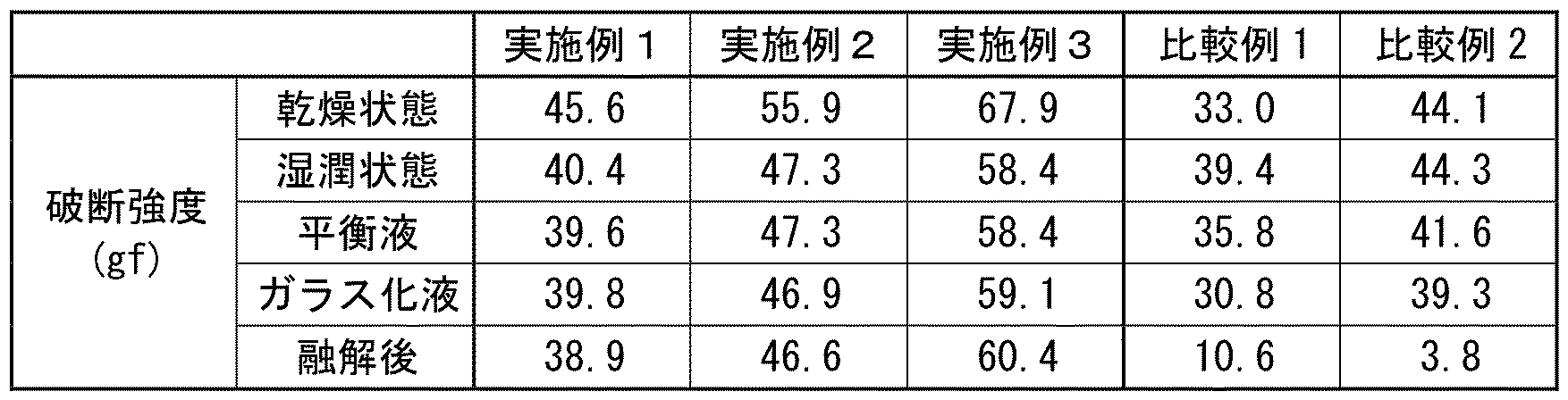
- the hollow fiber membrane was pulled at a crosshead speed of 10 cm / min under a temperature and humidity environment of 20 ⁇ 5 ° C. and 60 ⁇ 10% Rh, and measurement was performed. From the obtained SS curve, the load per single yarn (breaking strength), elongation (breaking elongation) at the breaking point of the hollow fiber membrane, and the load (yield strength), elongation (yield strength) per single yarn at the yield point. Yield elongation) was read.
- the load and the elongation were obtained by using the method shown in [0061] of JP-A-2011-212638.
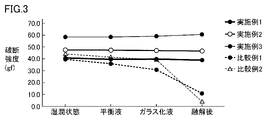
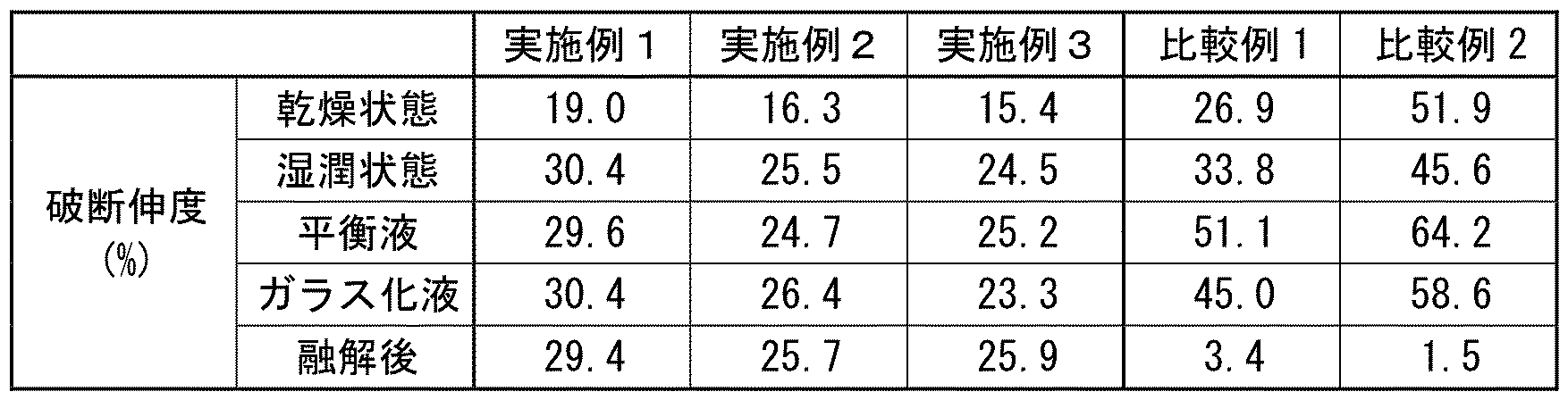
- the measurement results of the breaking strength, the breaking elongation and the yield strength are shown in Tables 5 to 7 (FIGS. 3 to 5).
- each of the Example and the Comparative Example was measured 5 times, and the average value thereof is shown as a measured value.
- the breaking strength in the hollow fiber membrane of the comparative example is 95% or more of the breaking strength in the wet state (“wet state”) before freezing.
- the breaking elongation or yield strength in the thawed state after freezing by the vitrification freezing method is the breaking elongation or yield strength in the wet state before freezing (“wet state”). It is 95% or more.
- the hollow fiber membrane of the example can suppress the decrease in strength when used for cryopreservation of cells.
- cells are frozen and thawed by the vitrification freezing method (cryotop method) using Cryotop (registered trademark, manufactured by Kitasato Corporation), which is a commercially available cell cryopreservation device, and then survived. The number of cells was measured and the survival rate was calculated.
- the evaluation results of the above survival rate are shown in Table 8 together with the number of test cells (the number of cells subjected to the test) and the number of surviving cells.
- the conditions of the vitrification freezing method are the same as those for measuring the above-mentioned strong elongation.
- the cells are cryopreserved in a state of being contained inside the hollow fiber membrane. gone.
- the ratio (survival rate) of the viable cells after thawing was higher than that of the commercially available product or the comparative example. .. From this result, it can be seen that the hollow fiber membranes of Examples 1 to 3 can be suitably used for cell cryopreservation.
Landscapes
- Life Sciences & Earth Sciences (AREA)
- Engineering & Computer Science (AREA)
- Health & Medical Sciences (AREA)
- Wood Science & Technology (AREA)
- Zoology (AREA)
- General Health & Medical Sciences (AREA)
- Chemical & Material Sciences (AREA)
- Bioinformatics & Cheminformatics (AREA)
- Organic Chemistry (AREA)
- Genetics & Genomics (AREA)
- Dentistry (AREA)
- Biotechnology (AREA)
- Biomedical Technology (AREA)
- Environmental Sciences (AREA)
- Microbiology (AREA)
- Biochemistry (AREA)
- General Engineering & Computer Science (AREA)
- Cell Biology (AREA)
- Textile Engineering (AREA)
- Chemical Kinetics & Catalysis (AREA)
- Mechanical Engineering (AREA)
- General Chemical & Material Sciences (AREA)
- Immunology (AREA)
- Sustainable Development (AREA)
- Artificial Filaments (AREA)
- Separation Using Semi-Permeable Membranes (AREA)
- Micro-Organisms Or Cultivation Processes Thereof (AREA)
- Apparatus Associated With Microorganisms And Enzymes (AREA)
- Dispersion Chemistry (AREA)
- External Artificial Organs (AREA)
Abstract
Description
ガラス化凍結法によって凍結された後に融解されたときの破断強度が、凍結前の湿潤時の破断強度の80%以上である、中空糸膜。
本実施形態の中空糸膜は、細胞の凍結保存に好適に用いることができる。
対象となる細胞としては、卵細胞(受精卵等)、胚細胞、iPS細胞およびES細胞等を含む多能性幹細胞、多能性幹細胞由来のオルガノイド等の人工的組織(細胞集塊)などが挙げられる。細胞集塊は、複数の細胞種から構成されていてもよい。なお、細胞は、中空糸膜の内部に配置された状態で凍結保存される。バラバラの細胞を含む細胞懸濁液が中空糸膜の内部で凍結保存されてもよい。
本実施形態の中空糸膜は、セルロースエステルを含む。中空糸膜を構成する材料中のセルロースエステルの比率は好ましくは90質量%以上であり、より好ましくは95質量%以上、さらに好ましくは98質量%以上である。中空糸膜は、セルロースエステルのみから構成されていてもよい。
中空糸膜は、その内部に収容された細胞が見える程度の透明性を有することが好ましい。セルロースエステルは透明性が高い材料であるため、中空糸膜を構成する材料中のセルロースエステルの比率が高いことが好ましい。
また、中空糸膜はガラス化液に溶解せず、ガラス化液中に樹脂成分が溶出しないことが好ましい。この観点からも、中空糸膜を構成する材料中のセルロースエステルの比率が高いことが好ましい。
本実施形態の中空糸膜は、ガラス化凍結法によって凍結された後に融解されたときの破断強度が凍結前の湿潤時の破断強度の80%以上であり、好ましくは90%以上、より好ましくは95%以上である。
(平衡液)
組成:エチレングリコール(7.5質量%)、ジメチルスルホキシド(7.5質量%)および水
浸漬時間:4分
(ガラス化液)
組成:エチレングリコール(15質量%)、ジメチルスルホキシド(15質量%)、ショ糖(ガラス化液中0.5M)および水
浸漬時間:30秒
(凍結保存条件)
凍結方法:液体窒素(LN2)中への浸漬
保存方法:液体窒素(LN2)中への浸漬したままで1週間保存
(融解方法)
融解液(1Mショ糖水溶液)に1分間浸漬
希釈液(0.5Mショ糖水溶液)に3分間浸漬
洗浄液(市販のTCM199培地(GIBCO社))に5分間浸漬し、さらに同じ組成の別の洗浄液に5分間浸漬
中空糸膜の内径は、好ましくは30μm以上300μm以下であり、より好ましくは35μm以上260μm以下である。
中空糸膜の厚みは、好ましくは20~200μmであり、より好ましくは30~150μmである。なお、膜厚は「(外径-内径)/2」より算出できる。
なお、膜表面の開孔率の測定においては、まず、中空糸膜を10,000倍の走査型電子顕微鏡(SEM)を用いて撮像する。得られた画像より、縦762pixel×横620pixelの領域を切り出した後、画像解析ソフト(例えば、WinROOF2013)を使用し、白/黒に画像を二値化し、中空糸膜の内表面および外表面の開孔率を求める。これを10視野実施してその平均を求め、表面開孔率とする。
なお、厚み方向断面における面積率の変動が小さいとは、例えば、厚み方向断面のうち、外表面を含む領域A、内表面を含む領域B、および、中心領域C(領域Aと領域Bの間の領域)について面積率(%)の差が小さいことを意味する。具体的には、領域A、BおよびCの面積率を測定したときに、a(領域Aの面積率)、b(領域Bの面積率)およびc(領域Cの面積率)から選択される2つの面積率の組み合わせの全てにおいて、2つの面積率の差の絶対値が5%未満であることが好ましく、3%未満であることがより好ましい(下記式参照)。なお、例えば、領域Aは、外表面から膜厚の30%の深さまでの領域であり、領域Bは、内表面から膜厚の30%の深さまでの領域である。
好ましくは、
|a-b|<5%、かつ、|b-c|<5%、かつ、|c-a|<5%
より好ましくは、
|a-b|<3%、かつ、|b-c|<3%、かつ、|c-a|<3%
40%≦(a+b+c)/3≦70%
本発明は、上記のセルロースエステルを含む中空糸膜の製造方法にも関する。
上記の中空糸膜の製造方法であって、
紡糸原液および内液を二重管状のノズルから空中走行部を経て凝固液中に吐出して、前記紡糸原液を前記凝固液中で凝固させ、前記紡糸原液の凝固物を前記凝固液中から曳き出すことにより、中空糸膜を得る、紡糸工程を含み、
前記紡糸原液は、セルロースエステルを含む樹脂原料、溶剤および非溶剤を含み、
前記内液は水を含み、
前記ノズルでの紡糸原液の温度が70~110℃であり、内液の温度が40~70℃であり、
前記凝固液中の前記非溶剤に対する前記溶剤の量の比率が60/40~80/20であり、
ノズルドラフト比が0.4~0.9である、製造方法。
前記紡糸原液において、前記溶剤および前記非溶剤の総量に対する前記溶剤の量の比率は、60~80質量%であることが好ましい。
前記溶剤は、非プロトン性極性溶剤であることが好ましい。
前記非溶剤は、グリコールエステルであることが好ましい。
前記空中走行部の直線距離は、10~50mmであることが好ましい。
図6を参照して、紡糸工程では、紡糸原液(spinning dope)10aおよび内液10bを二重管状のノズル11から空中走行部(エアギャップ)20を経て凝固液21中に吐出して、紡糸原液を凝固液21中で凝固させ、紡糸原液の凝固物を凝固液21中から曳き出すことにより、中空糸膜16が得られる。中空糸膜の曳き出し等は、例えば、液中ガイド12およびローラー13,14,15により行われる。
スリットの断面積に対する内管の断面積の比率は、80~120%であることが好ましい。このようなノズルを採用することによって、製膜原液の吐出線速度と引取り速度を同程度にできるため、吐出された製膜原液と内液との界面摩擦を低減することが可能となり、中空糸膜内面の荒れを防ぐことが可能となる。
なお、製膜原液の吐出線速度は、製膜原液の吐出量をノズルスリット外径(a)とノズルスリット内径(b)から求められるスリット断面積〔π(a/2)2-π(b/2)2〕で除して求められる(下記式参照)。
製膜原液の吐出線速度[m/分]=製膜原液の吐出量/スリット断面積
引取り速度は、凝固浴の出口に設けられたローラー13の回転速度(表面速度)である(図6参照)。
引き取り速度に対する吐出線速度の比率(引取り速度/吐出線速度)であるノズルドラフト比は、0.4~0.9であり、好ましくは0.5~0.9である。このように、製膜原液の引き取り速度に対して吐出線速度を早くすることにより、本発明の中空糸の特徴的な膜構造を得ることができる。
紡糸原液10aは、上記セルロースエステルを含む樹脂原料、溶剤および非溶剤を含む。
なお、紡糸原液は、溶剤と非溶剤に加えて、さらに水を含んでいてもよい。
内液は、水を含む。内液中の水の含有率は、95~100質量%であり、好ましくは98~100質量%である。
中空糸膜の内表面は平滑性が高いことが好ましい。凍結保存する細胞との接触によるダメージを少なく出来るからである。
中空糸膜の内表面の平滑性を高めるためには、紡糸原液をノズルより吐出した後、外乱の影響を受ける前に内表面を素早く凝固(固定)させ、過剰に相分離を進行させないことが好ましい。また、凝固中および凝固した後の内表面に延伸を掛けるなどの外力を与えず、中空糸膜構造が固定した後の内径変動などを極力抑制することが好ましい。
このため、本実施形態の製造方法では、セルロースエステルを含む紡糸原液に対して凝固性の高い水を含む内液が用いられる。
水のほか、一般的にセルロースエステルの非溶剤として用いられるエチレングリコールやトリエチレングリコール、ポリエチレングリコール200または400、グリセリン、プロピレングリコールなどもそれぞれ単独または混合して用いることができる。水を主体とした内液を用いる場合は、水以外の成分として、前記非溶剤やセルローストリアセテート系ポリマーの溶剤であるN-メチルピロリドンやジメチルアセトアミド、ジメチルホルムアミド、ジメチルスルホキシドなどを5重量%を上限として添加することができる。
紡糸原液10aと内液10bを二重管状のノズル11より吐出する際、紡糸原液と内液との間に温度差を設けることが、紡糸原液(中空糸膜)の内表面の凝固性(凝固速度)を高めるうえで好ましい。内表面の凝固速度を高めることで、非対称構造(厚み方向に不均一な構造)を有する中空糸膜を得ることができる。また、内液の温度を特定の範囲に設定したうえで、後述する凝固液の組成を特定の範囲に調整したり、ノズルドラフトを調整することが、中空糸膜内表面の平滑性を高め、非対称構造でありながら膜断面において膜の厚み方向におけるかさ密度(面積率)の変化を少なくすることができる一因となっている。なお、紡糸原液と内液との間に温度差を設けるために、吐出直前まで紡糸原液と内液とを別々に温度コントロールできる構造を有するノズルを用いることが好ましい。
凝固液は、好ましくは溶剤と非溶剤(水を除く)とを含む。なお、この場合、凝固液は、溶剤と非溶剤に加えて、さらに水を含んでいてもよい。
凝固液中の溶剤および非溶剤の総量の比率(凝固液の濃度)は、60~90質量%であり、好ましくは65~90質量%である。これにより、本発明の中空糸膜の特徴的な構造を得ることできる。
実施形態で説明した中空糸膜の製造方法により、以下の条件で実施例1の中空糸膜が製造された。
原料樹脂(セルロースエステル):三酢酸セルロース(CTA)(LT75、ダイセル化学工業製)
原料樹脂濃度(ポリマー濃度):17.5質量%(紡糸原液中)
溶剤:N-メチルピロリドン(NMP)
非溶剤:トリエチレングリコール(TEG)
〔溶剤/非溶剤(S/NS)比=7/3〕
内液:水
上記の原料樹脂の粉末を他の材料と共に混合することで、紡糸工程で用いる紡糸原液を調製した。
溶剤(S):NMP
非溶剤(NS):TEG
水
凝固液の濃度〔(Sの質量+NSの質量)/凝固液の質量〕:78質量%
S/NS比は、紡糸原液と同じ。
紡糸原液の吐出温度(設定温度):93℃
内液(水)の吐出温度(設定温度):55℃
ノズル:二重管状ノズル(外管の直径:270μm、内管の直径:200μm)
空中走行部の距離(エアギャップ長):25mm、
空中走行部の滞留時間:0.025秒
凝固液の温度:43℃
曳き出し速度:60m/分
ノズルドラフト比:0.78
水洗槽の流れ:向流
温度 98℃
表1に示されるように、ノズルドラフト比が変更された。それ以外の点は実施例1と同様にして、実施例2および実施例3の中空糸膜が製造された。得られた中空糸膜の内表面の算術平均粗さ、面積率を測定した結果を表2に示した。
表1に示されるように、紡糸原液、内液および凝固液の各々の組成、並びに各製造条件が変更された。なお、内液として流動パラフィンを用い、内液の設定温度は、特に制御されず、紡糸原液温度と同程度である。それ以外の点は実施例1と同様にして、比較例1および比較例2の中空糸膜が製造された。
湿潤状態の中空糸膜を液体窒素中に浸漬して凍結させた後、液体窒素から取り出し、直ぐに折り曲げて割断することにより、平滑な断面(厚み方向断面)を有するサンプルを得た。断面を観察できるようにサンプルを試料台に固定し、サンプルの断面に対しカーボン蒸着を行った。蒸着後のサンプルの断面を走査型電子顕微鏡(日立製S-2500)を用いて加速電圧5kV、倍率10000倍にて撮像した。得られた画像のうち上述の領域A~C(外表面を含む領域A、内表面を含む領域B、および、領域Aと領域Bの間の中心領域C)の各々に相当する領域の中心部付近について、画像解析ソフトWinROOF2013を用いて空孔部とポリマー部の二値化処理を行った。二値化処理の後、空孔部とポリマー部の比率から面積率を算出した。ここで、領域Aは、外表面から膜厚の30%の深さまでの領域であり、領域Bは、内表面から膜厚の30%の深さまでの領域である。
なお、割断や電子線により断面の一部が溶解するなどして構造が不鮮明になることがあるので、その場合は構造が鮮明な部分を用いて測定を行うか、サンプルを変更して写真を撮り直した。
面積率の測定結果を表2に示す。
中空糸膜の内表面を観察できるように開腹した(中空糸膜の長手方向に斜めにカットした)中空糸膜を試料として準備した。原子間力顕微鏡E-Sweep(日立ハイテクノロジーズ社)を用いてDFMモードで大気中で観察を行った。カンチレバーとしてはSi-DF3、スキャナとしては20μmスキャナを用いた。観測視野を2μm四方とし、256×256pixelで中空糸膜の内表面の算術平均粗さ(Ra)を測定した。算術平均粗さ(Ra)の測定結果を表2に示す。

実施例1~3および比較例1,2の中空糸膜について、ガラス化凍結法を用いた凍結保存試験を行った。ガラス化凍結法の条件は、上述の破断強度(ガラス化凍結法によって凍結された後に融解されたときの破断強度)を測定する際の条件と同様である。
凍結保存試験における実施例1~3および比較例1,2の各々の中空糸膜について、最初の乾燥状態(「乾燥状態」)、水により湿潤した状態(「湿潤状態」)、平衡液が浸潤した状態(「平衡液」)、ガラス化液が浸潤した状態(「ガラス化液」)、および、凍結後に融解された状態(「融解後」)において、以下の測定を実施した。
内径、外径および膜厚を以下の方法で測定した。
具体的には、中空糸膜断面1個につき中空糸膜外表面のX-X方向とY-Y方向(断面上の直交する2方向)の寸法を測定し、それらの値の算術平均値を中空糸膜断面1個の外径とした。また、中空糸膜断面1個につき中空部のX-X方向とY-Y方向(断面上の直交する2方向)の寸法を測定し、算術平均値を中空糸膜断面1個の内径とした。なお、10断面について同様に測定を行い、平均値を内径および外径とした。
膜厚(平均値)は、中空糸膜の内径および内径の測定結果(平均値)に基づいて、「(外径-内径)/2」の式により算出される。

実施例1~3および比較例1,2の中空糸膜について、以下の方法で強伸度(破断強度、破断伸度および降伏強度)を測定した。
得られたS-Sカーブから、中空糸膜の破断点の単糸あたりの荷重(破断強度)、伸度(破断伸度)および降伏点の単糸あたりの荷重(降伏強度)、伸度(降伏伸度)を読み取った。具体的には、特開2011-212638号公報の[0061]に示される方法を用いて荷重および伸度を得た。
破断強度、破断伸度および降伏強度の各々の測定結果が表5~表7(図3~図5)に示される。なお、実施例および比較例の各々について、5回ずつ測定を実施し、その平均値が測定値として示される。

実施例1~3および比較例1の中空糸膜を用いて、ガラス化凍結法(中空糸凍結保存法)により、細胞(ブタ由来胚細胞)を凍結し、融解した後に、生存細胞数を測定し、生存率(供試細胞数に対する生存細胞数の比率)を算出した。

Claims (6)
- セルロースエステルを含む細胞凍結保存用の中空糸膜であって、
ガラス化凍結法によって凍結された後に融解されたときの破断強度が、凍結前の湿潤時の破断強度の80%以上である、中空糸膜。 - 厚み方向に不均一な構造を有する、請求項1に記載の中空糸膜。
- 前記中空糸膜の外表面の平均孔径は、内表面の平均孔径の1.1倍以上である、請求項1または2に記載の中空糸膜。
- 厚み方向断面の平均面積率が40%以上70%以下である、請求項1~3のいずれか1項に記載の中空糸膜。
- 厚み方向断面の面積率の厚み方向における変動が5%未満である、請求項1~4のいずれか1項に記載の中空糸膜。
- 前記中空糸膜の内表面を原子間力顕微鏡により測定したときの算術平均粗さが20nm以下である、請求項1~3のいずれか1項に記載の中空糸膜。
Priority Applications (4)
| Application Number | Priority Date | Filing Date | Title |
|---|---|---|---|
| CN202180073831.XA CN116367719B (zh) | 2020-10-30 | 2021-10-26 | 细胞冷冻保存用的中空纤维膜 |
| US18/033,973 US20230397602A1 (en) | 2020-10-30 | 2021-10-26 | Cell cryopreservation hollow fiber membrane |
| EP21886185.4A EP4239050A4 (en) | 2020-10-30 | 2021-10-26 | HOLLOW FIBER MEMBRANE FOR CELLULAR CRYOPRESERVATION |
| JP2022559146A JP7582322B2 (ja) | 2020-10-30 | 2021-10-26 | 中空糸膜の製造方法 |
Applications Claiming Priority (2)
| Application Number | Priority Date | Filing Date | Title |
|---|---|---|---|
| JP2020182627 | 2020-10-30 | ||
| JP2020-182627 | 2020-10-30 |
Publications (1)
| Publication Number | Publication Date |
|---|---|
| WO2022092067A1 true WO2022092067A1 (ja) | 2022-05-05 |
Family
ID=81382512
Family Applications (1)
| Application Number | Title | Priority Date | Filing Date |
|---|---|---|---|
| PCT/JP2021/039439 Ceased WO2022092067A1 (ja) | 2020-10-30 | 2021-10-26 | 細胞凍結保存用の中空糸膜 |
Country Status (6)
| Country | Link |
|---|---|
| US (1) | US20230397602A1 (ja) |
| EP (1) | EP4239050A4 (ja) |
| JP (1) | JP7582322B2 (ja) |
| CN (1) | CN116367719B (ja) |
| TW (1) | TWI811826B (ja) |
| WO (1) | WO2022092067A1 (ja) |
Citations (7)
| Publication number | Priority date | Publication date | Assignee | Title |
|---|---|---|---|---|
| JPH0367903B2 (ja) | 1982-02-11 | 1991-10-24 | Dunlop Ltd | |
| JP2002306937A (ja) * | 2001-04-11 | 2002-10-22 | Daicel Chem Ind Ltd | セルロース誘導体中空糸膜 |
| JP2008178814A (ja) * | 2007-01-25 | 2008-08-07 | Toyobo Co Ltd | セルロースアセテート系非対称中空糸膜 |
| JP2011212638A (ja) | 2010-04-02 | 2011-10-27 | Toyobo Co Ltd | 中空糸膜 |
| JP5051716B2 (ja) | 2007-12-21 | 2012-10-17 | 学校法人明治大学 | 生殖細胞用デバイス及び生殖細胞凍結保存方法 |
| JP5212837B2 (ja) | 2009-10-08 | 2013-06-19 | 東洋紡株式会社 | 選択透過性中空糸膜 |
| JP5252556B2 (ja) | 2008-12-24 | 2013-07-31 | 学校法人明治大学 | 生殖細胞凍結保存用デバイス |
Family Cites Families (10)
| Publication number | Priority date | Publication date | Assignee | Title |
|---|---|---|---|---|
| AU519458B2 (en) * | 1977-07-05 | 1981-12-03 | Cordis Dow Corporation | Cellulose acetate hollow fibres |
| CA1141114A (en) * | 1978-11-24 | 1983-02-15 | Masamichi Ishida | Regenerated cellulose hollow fiber and process for manufacturing same |
| US4744932A (en) * | 1985-05-31 | 1988-05-17 | Celanese Corporation | Process for forming a skinless hollow fiber of a cellulose ester |
| JPH10263375A (ja) * | 1997-03-26 | 1998-10-06 | Teijin Ltd | 選択透過性中空糸膜 |
| WO2000009247A1 (en) * | 1998-08-11 | 2000-02-24 | Daicel Chemical Industries, Ltd. | Cellulose acetate semipermeable membrane and method for producing the same |
| DE10203644A1 (de) * | 2002-01-30 | 2003-08-07 | Fraunhofer Ges Forschung | Kryokonservierung an textilen Geweben |
| US10006842B2 (en) * | 2012-08-30 | 2018-06-26 | Kaneka Corporation | Method for producing cell concentrate |
| WO2017004592A1 (en) * | 2015-07-02 | 2017-01-05 | Terumo Bct, Inc. | Cell growth with mechanical stimuli |
| KR102407778B1 (ko) * | 2017-02-28 | 2022-06-10 | 도레이 카부시키가이샤 | 복합 중공사막 및 그 제조 방법 |
| WO2018182028A1 (ja) * | 2017-03-30 | 2018-10-04 | 東レ株式会社 | 分離膜及びその製造方法 |
-
2021
- 2021-10-26 JP JP2022559146A patent/JP7582322B2/ja active Active
- 2021-10-26 WO PCT/JP2021/039439 patent/WO2022092067A1/ja not_active Ceased
- 2021-10-26 US US18/033,973 patent/US20230397602A1/en active Pending
- 2021-10-26 CN CN202180073831.XA patent/CN116367719B/zh active Active
- 2021-10-26 EP EP21886185.4A patent/EP4239050A4/en active Pending
- 2021-10-29 TW TW110140185A patent/TWI811826B/zh active
Patent Citations (8)
| Publication number | Priority date | Publication date | Assignee | Title |
|---|---|---|---|---|
| JPH0367903B2 (ja) | 1982-02-11 | 1991-10-24 | Dunlop Ltd | |
| JP2002306937A (ja) * | 2001-04-11 | 2002-10-22 | Daicel Chem Ind Ltd | セルロース誘導体中空糸膜 |
| JP2008178814A (ja) * | 2007-01-25 | 2008-08-07 | Toyobo Co Ltd | セルロースアセテート系非対称中空糸膜 |
| JP5051716B2 (ja) | 2007-12-21 | 2012-10-17 | 学校法人明治大学 | 生殖細胞用デバイス及び生殖細胞凍結保存方法 |
| JP5252556B2 (ja) | 2008-12-24 | 2013-07-31 | 学校法人明治大学 | 生殖細胞凍結保存用デバイス |
| JP5212837B2 (ja) | 2009-10-08 | 2013-06-19 | 東洋紡株式会社 | 選択透過性中空糸膜 |
| JP2011212638A (ja) | 2010-04-02 | 2011-10-27 | Toyobo Co Ltd | 中空糸膜 |
| JP5440332B2 (ja) | 2010-04-02 | 2014-03-12 | 東洋紡株式会社 | 中空糸膜 |
Non-Patent Citations (4)
| Title |
|---|
| AYUKO UCHIKURA, HITOMI MATSUNARI, YUKINA MATSUMURA, KAZUAKI NAKANO, YOSHINORI ASANO, MIKI MAEHARA, SAYAKA WAKAYAMA, TERUHIKO WAKAY: "OR2-26 Study on practical application of hollow fiber vitrification method-1: Effect of melting rate on embryo viability", PROCEEDINGS OF THE 106TH ANNUAL MEETING OF THE JAPANESE SOCIETY OF ANIMAL REPRODUCTION; SEPTEMBER 12TH TO 14TH, 2013 , 1 January 2013 (2013-01-01) - 14 September 2013 (2013-09-14), JP, pages 1 - 1, XP009536212, DOI: 10.14882/jrds.106.0.OR2-26.0 * |
| E. V. KORNIENKO, A. B. ROMANOVA, M. A. IKONOPISTSEVA, G. P. MALENKO: "32 Vitrification of in vitro-matured bovine oocytes in triacetate cellulose hollow fibres", REPRODUCTION, FERTILITY AND DEVELOPMENT, vol. 31, no. 1, 1 January 2018 (2018-01-01), AU , pages 142, XP009536476, ISSN: 1031-3613, DOI: 10.1071/RDv31n1Ab32 * |
| KORNIENKO EKATERINA V.; ROMANOVA ANASTASIA B.; IKONOPISTSEVA MARIA V.; MALENKO GALINA P.: "Optimization of triacetate cellulose hollow fiber vitrification (HFV) method for cryopreservation of in vitro matured bovine oocytes", CRYOBIOLOGY, ACADEMIC PRESS INC, US, vol. 97, 7 October 2020 (2020-10-07), US , pages 66 - 70, XP086427184, ISSN: 0011-2240, DOI: 10.1016/j.cryobiol.2020.10.007 * |
| See also references of EP4239050A4 |
Also Published As
| Publication number | Publication date |
|---|---|
| JP7582322B2 (ja) | 2024-11-13 |
| JPWO2022092067A1 (ja) | 2022-05-05 |
| TW202231868A (zh) | 2022-08-16 |
| CN116367719B (zh) | 2025-10-17 |
| EP4239050A1 (en) | 2023-09-06 |
| TWI811826B (zh) | 2023-08-11 |
| CN116367719A (zh) | 2023-06-30 |
| US20230397602A1 (en) | 2023-12-14 |
| EP4239050A4 (en) | 2024-10-09 |
Similar Documents
| Publication | Publication Date | Title |
|---|---|---|
| Wang et al. | Preparation and characterization of polyvinylidene fluoride (PVDF) hollow fiber membranes | |
| Alsalhy et al. | Poly (ether sulfone)(PES) hollow-fiber membranes prepared from various spinning parameters | |
| JP3783239B2 (ja) | ポリ(テトラフルオロエチレン)および関連ポリマー類の分散紡糸方法 | |
| CH652042A5 (fr) | Procede de preparation d'une membrane de separation sous forme de fibres creuses et microporeuses. | |
| US7682539B1 (en) | Regeneration of silk and silk-like fibers from ionic liquid spin dopes | |
| KR20130001293A (ko) | 다공질막의 제조 방법 | |
| JP2002535116A (ja) | エチレン−ビニルアルコール中空繊維膜 | |
| Barlow et al. | Freeze substitution for preservation of ciliated surfaces for scanning electron microscopy | |
| EP3357563A1 (en) | Separation film, cellulose-based resin composition, and method for manufacturing separation film | |
| JP7582322B2 (ja) | 中空糸膜の製造方法 | |
| Lang et al. | Evolution of the precipitation kinetics, morphologies, permeation performances, and crystallization behaviors of polyvinylidenefluoride (PVDF) hollow fiber membrane by adding different molecular weight polyvinylpyrrolidone (PVP) | |
| US5192440A (en) | Hollow cellulose dialysis fibers | |
| JP6062945B2 (ja) | 気体分離および液体分離用のpbi中空繊維非対称膜を製作するプロセス | |
| CH632536A5 (fr) | Fibre creuse d'acetate de cellulose et procede pour sa fabrication. | |
| KR100321459B1 (ko) | 폴리아크릴로니트릴계 중공사상 여과막 | |
| CN115835918A (zh) | 半结晶聚合物膜 | |
| JPS5825371B2 (ja) | 異方性膜及びその製法 | |
| JP5109263B2 (ja) | フッ素樹脂系高分子分離膜およびその製造方法 | |
| JPWO1998058728A1 (ja) | ポリアクリロニトリル系中空糸状濾過膜 | |
| WO2016021777A1 (ko) | 고분자 수지 조성물을 이용한 중공사막의 제조 방법 및 중공사막 | |
| JP7396464B2 (ja) | 中空糸膜の製造方法 | |
| Rubio et al. | Effect of the air coflow temperature and spinneret position on the solution blow spinning technique | |
| JP7378248B2 (ja) | 中空糸膜 | |
| JP2004174408A (ja) | 中空糸膜の製造方法および製造装置 | |
| JP2008207153A (ja) | 中空糸膜および中空糸膜モジュール |
Legal Events
| Date | Code | Title | Description |
|---|---|---|---|
| 121 | Ep: the epo has been informed by wipo that ep was designated in this application |
Ref document number: 21886185 Country of ref document: EP Kind code of ref document: A1 |
|
| ENP | Entry into the national phase |
Ref document number: 2022559146 Country of ref document: JP Kind code of ref document: A |
|
| NENP | Non-entry into the national phase |
Ref country code: DE |
|
| ENP | Entry into the national phase |
Ref document number: 2021886185 Country of ref document: EP Effective date: 20230530 |
|
| WWG | Wipo information: grant in national office |
Ref document number: 202180073831.X Country of ref document: CN |