WO2022097514A1 - ソレノイドバルブ - Google Patents
ソレノイドバルブ Download PDFInfo
- Publication number
- WO2022097514A1 WO2022097514A1 PCT/JP2021/039229 JP2021039229W WO2022097514A1 WO 2022097514 A1 WO2022097514 A1 WO 2022097514A1 JP 2021039229 W JP2021039229 W JP 2021039229W WO 2022097514 A1 WO2022097514 A1 WO 2022097514A1
- Authority
- WO
- WIPO (PCT)
- Prior art keywords
- solenoid
- magnetic
- iron core
- coil
- magnetic material
- Prior art date
- Legal status (The legal status is an assumption and is not a legal conclusion. Google has not performed a legal analysis and makes no representation as to the accuracy of the status listed.)
- Ceased
Links
Images



Classifications
-
- F—MECHANICAL ENGINEERING; LIGHTING; HEATING; WEAPONS; BLASTING
- F16—ENGINEERING ELEMENTS AND UNITS; GENERAL MEASURES FOR PRODUCING AND MAINTAINING EFFECTIVE FUNCTIONING OF MACHINES OR INSTALLATIONS; THERMAL INSULATION IN GENERAL
- F16K—VALVES; TAPS; COCKS; ACTUATING-FLOATS; DEVICES FOR VENTING OR AERATING
- F16K31/00—Actuating devices; Operating means; Releasing devices
- F16K31/02—Actuating devices; Operating means; Releasing devices electric; magnetic
- F16K31/06—Actuating devices; Operating means; Releasing devices electric; magnetic using a magnet, e.g. diaphragm valves, cutting off by means of a liquid
- F16K31/0675—Electromagnet aspects, e.g. electric supply therefor
-
- H—ELECTRICITY
- H01—ELECTRIC ELEMENTS
- H01F—MAGNETS; INDUCTANCES; TRANSFORMERS; SELECTION OF MATERIALS FOR THEIR MAGNETIC PROPERTIES
- H01F7/00—Magnets
- H01F7/06—Electromagnets; Actuators including electromagnets
- H01F7/08—Electromagnets; Actuators including electromagnets with armatures
- H01F7/081—Magnetic constructions
-
- H—ELECTRICITY
- H01—ELECTRIC ELEMENTS
- H01F—MAGNETS; INDUCTANCES; TRANSFORMERS; SELECTION OF MATERIALS FOR THEIR MAGNETIC PROPERTIES
- H01F7/00—Magnets
- H01F7/06—Electromagnets; Actuators including electromagnets
- H01F7/08—Electromagnets; Actuators including electromagnets with armatures
- H01F7/081—Magnetic constructions
- H01F2007/083—External yoke surrounding the coil bobbin, e.g. made of bent magnetic sheet
Definitions
- the present invention relates to, for example, a solenoid valve used for hydraulic control of a hydraulic circuit.
- the solenoid valve for hydraulic pressure control includes a solenoid molded body having a coil, a fixed iron core which is a cylindrical stator, and a movable iron core which is a cylindrical plunger.
- the solenoid molded body is housed inside a solenoid case which is a yoke made of a magnetic material.
- the fixed iron core is arranged inside the solenoid molded body.
- the movable iron core is housed inside the stator.
- a solenoid valve is known in which a magnetic path is formed by a yoke, a stator, and a plunger by energizing a coil, a magnetic force is generated between the stator and the plunger, and the plunger is moved in the axial direction inside the stator. (See, for example, Patent Document 1).
- the solenoid case of such a solenoid valve is generally formed into a bottomed cylinder by pressing a metal plate in the manufacturing process.
- a magnetic path can be formed along a magnetic field forming a closed curved surface with respect to the tubular portion of the coil. Therefore, the stator and the plunger can be effectively magnetized with the minimum loss.
- the coil of such a solenoid valve has a magnetic flux density proportional to the current value to be energized, and by adjusting the current value to energize the coil, the thrust for moving with the stroke required for the plunger. You can get it.
- the saturation magnetic flux density of the magnetic path is determined by the cross-sectional area, and in a solenoid valve as in Patent Document 1, the bottom of the axial end of the coil on the plunger side of the solenoid case is formed in a thin plate shape. Further, the bottom portion has a shape in which the diameter becomes smaller and the cross-sectional area gradually decreases toward the inner diameter direction. From these, the saturation magnetic flux density gradually decreases toward the inner diameter of the bottom. From this, especially when a large thrust is required for the plunger, when a high current is applied to the coil, the magnetic flux generated by the coil exceeds the saturation magnetic flux density of the magnetic path, and the applied current value is not proportional to the thrust of the plunger. was there.
- the present invention has been made by paying attention to such a problem, and an object of the present invention is to provide a solenoid valve capable of obtaining the thrust of a movable iron core in proportion to the current value applied to the coil.
- the solenoid valve of the present invention is used.
- a movable iron core that can move in the axial direction,
- a solenoid molded body arranged on the outer diameter side of the movable iron core and having a coil
- a solenoid case for accommodating the movable iron core and the solenoid molded body
- a fixed core which is arranged on the inner diameter side of the solenoid molded body and generates a magnetic force with the movable core by energizing the coil
- a valve unit that opens and closes the flow path by moving the movable iron core, It is a solenoid valve with A magnetic material separate from the solenoid case is disposed at the axial end of the coil outside the solenoid case.
- the saturation magnetic flux density gradually decreases toward the inner diameter, for example, by arranging the magnetic material at the axial end on the movable iron core side of the coil, for example, outside the solenoid case having a bottomed structure.
- the cross-sectional area of the magnetic path at the relevant location can be expanded. Since more magnetic flux is induced from the magnetic material to the movable iron core side, and the magnetic flux that increases according to the current value applied to the coil can be effectively used to magnetize the fixed iron core and the movable iron core, it is proportional to the current value.
- the thrust of the movable iron core can be obtained.
- the magnetic material is changed according to the maximum value of the current applied to the coil, and the magnetic flux is not changed without changing the shape of the solenoid case. The density can be adjusted.
- An annular step portion recessed in the inner diameter direction may be formed at the axial end portion of the coil outside the solenoid case, and the magnetic material may be disposed in the annular step portion. According to this, the cross-sectional area of the magnetic path can be expanded while maintaining the compactness of the solenoid case without forming an unnecessary magnetic path.
- the magnetic material may be disposed at a position where it always overlaps with the movable iron core in the radial direction. According to this, the magnetic flux can be effectively guided from one side to the other between the magnetic material and the movable iron core, the magnetic force loss can be suppressed, and the cross-sectional area of the magnetic path can be expanded.
- the magnetic material may form a ring-shaped magnetic material. According to this, it is possible to form a magnetic path having a uniform magnetic flux density in the circumferential direction.
- the magnetic material may form a plurality of ring-shaped magnetic materials. According to this, the cross-sectional area of the magnetic path to be expanded can be adjusted by the number of magnetic materials.
- the magnetic material may be fitted onto the side plate constituting the annular step portion of the solenoid case. According to this, the magnetic material can be aligned with the solenoid case and the movable iron core inside, and a magnetic path having uniform magnetic field strength in the circumferential direction can be formed.
- the magnetic material may abut on the end plate constituting the annular step portion of the solenoid case. According to this, the magnetic material can be positioned in the axial direction of the solenoid case, and the magnetic material can be arranged at a position suitable for guiding more magnetic flux from the magnetic material to the movable iron core side.
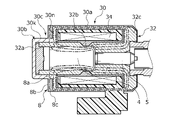
- FIG. 1 It is a perspective view of the solenoid valve in Example 1 of this invention. It is a partial notch sectional view which shows the solenoid valve structure in Example 1.
- FIG. It is a partial notch sectional view which shows the caulking fixing method of a stator and a solenoid case using a caulking jig.
- the solenoid valve according to the first embodiment will be described with reference to FIGS. 1 to 7.
- the left side of the paper surface of FIG. 2 will be described as the upper side of the solenoid valve
- the right side of the paper surface of FIG. 1 will be described as the lower side of the solenoid valve.
- the solenoid valve 1 is a spool type solenoid valve, which is used for a device controlled by hydraulic pressure, for example, an automatic transmission of a vehicle.
- the solenoid valve 1 is horizontally mounted on a member to be mounted such as a valve housing (not shown).
- the solenoid valve 1 is configured such that a valve portion 2 for adjusting the flow rate of a fluid as a valve is integrally attached to a solenoid portion 3 as an electromagnetic drive unit.
- the solenoid valve 1 adjusts the opening degree of the flow path on the discharge side. Note that FIG. 2 shows a fully opened state of the opening degree of the flow path of the solenoid valve 1 energized in the coil 34 of the solenoid molded body 31.
- the valve portion 2 is composed of a sleeve 21, a spool 22, a coiled spring (not shown), and a retainer 23.
- the sleeve 21 is provided with openings such as an input port and an output port (not shown) connected to a flow path provided in a valve housing (not shown) on the outer periphery thereof.
- the spool 22 is liquid-tightly housed in the through hole 21a of the sleeve 21 and has a plurality of lands (not shown).
- the spring urges the spool 22 to the left in the axial direction.
- the retainer 23 is attached to the right side of the sleeve 21 in the axial direction to hold the spring. Since this configuration is well known as a spool valve, detailed description thereof will be omitted.
- the sleeve 21, spool 22, and retainer 23 are made of materials such as aluminum, iron, stainless steel, and resin.
- the solenoid unit 3 is mainly composed of a solenoid case 30, a solenoid molded body 31, and a stator 32 as a fixed iron core.
- the solenoid case 30 is made of a magnetic metal material such as iron.
- the solenoid molded body 31 is housed in the solenoid case 30.
- the stator 32 is arranged inside the solenoid molded body 31.
- the solenoid case 30 is formed by pressing a metal plate into a bottomed tubular shape, and is mainly composed of a cylindrical portion 30a and a bottomed cylindrical convex portion 30b.
- the cylindrical portion 30a covers the outer circumference of the solenoid molded body 31.
- the convex portion 30b protrudes to the left in the axial direction on the left side in the axial direction (that is, the other end side in the axial direction) of the cylindrical portion 30a, and is formed to have a smaller diameter than the cylindrical portion 30a.
- the central axis of the cylindrical portion 30a and the central axis of the convex portion 30b are arranged to substantially coincide with each other.
- the convex portion 30b is composed of a disk-shaped bottom plate 30m and a cylindrical side plate 30k.
- the side plates 30k are orthogonal to the bottom plate 30m and extend in the axial direction.
- an annular step portion recessed in the radial direction by a side plate 30k and an annular end plate 30n orthogonal to the cylindrical portion 30a extending in the outer diameter direction orthogonal to the side plate 30k.
- 30c is formed.
- the end plate 30n of the annular step portion 30c functions as a step portion that receives a load in the axial direction.
- the inside of the solenoid case 30 is composed of a first accommodating cylinder portion 30d and a second accommodating cylinder portion 30e.
- the first accommodating cylinder portion 30d is formed by the inner surface of the cylindrical portion 30a and accommodates the solenoid molded body 31.
- the second accommodating cylinder portion 30e is formed by the inner surface of the convex portion 30b on the axial left side of the first accommodating cylinder portion 30d, and the axial left end portion of the cylindrical portion 32a of the stator 32 is inserted. ..
- the above-mentioned end plate 30n is formed in the radial direction on the left side in the axial direction of the first accommodating cylinder portion 30d.
- the end plate 30n of the annular step portion 30c of the solenoid case 30 is formed on the outer diameter side and the left side in the axial direction with respect to the cylindrical portion 32a of the stator 32 and the thin-walled portion 32b described later.
- a claw portion 30 g is formed at one end in the axial direction.
- the claw portion 30g is configured to have a thin wall in a predetermined range from the opening end 30p (see FIG. 3) on the right side in the axial direction of the cylindrical portion 30a to the left in the axial direction.
- an annular surface portion 30h extending in the radial direction toward the inner diameter side is formed on the left side of the claw portion 30g in the axial direction.
- the annular surface portion 30h is orthogonal to the inner surface of the first accommodating cylinder portion 30d on the inner diameter side thereof.
- the stator 32 is configured in a flanged cylindrical shape composed of a cylindrical portion 32a and a flange portion 32c.
- the flange portion 32c extends radially at the axially right end of the cylindrical portion 32a.
- a through hole 32d capable of accommodating the plunger 4 and the rod 5 as a movable iron core is formed at the radial center of the cylindrical portion 32a.
- a holder 36 made of resin or the like is attached to the opening end on the left side in the axial direction of the cylindrical portion 32a.
- the end face on the left side in the axial direction of the holder 36 attached to the open end on the left side in the axial direction of the cylindrical portion 32a is provided slightly separated from the bottom plate 30 m of the convex portion 30b of the solenoid case 30 and has a gap in the axial direction. Is formed.
- the cylindrical portion 32a of the stator 32 is provided with a thin-walled portion 32b.
- the thin-walled portion 32b is formed to have a thin plate thickness because the substantially center of the outer peripheral surface in the axial direction is recessed toward the inner diameter side in the shape of an isosceles trapezoid in a cross-sectional view.
- the flange portion 32c of the stator 32 is provided with a recess 32e.
- the recess 32e is recessed to the left in the axial direction at the center in the radial direction of the end face on the right side in the axial direction.
- the mounting portion 21b of the sleeve 21 is mounted and fixed in the recess 32e in a state of being inserted.
- the outer peripheral edge of the end face on the right side in the axial direction of the flange portion 32c is chamfered.
- the flange portion 32c of the stator 32 is fixed to the solenoid case 30.
- the flange described above is in a state where the outer peripheral edge portion of the axially left end surface of the flange portion 32c is in contact with the annular surface portion 30h formed on the inner diameter side of the axially right end portion of the cylindrical portion 30a of the solenoid case 30.
- the solenoid case 30 is fixed to the flange portion 32c by caulking the claw portion 30g along the chamfered portion 32f (see FIG. 3) formed on the outer peripheral edge of the end surface on the right side in the axial direction of the portion 32c. The method of fixing the caulking between the stator 32 and the solenoid case 30 will be described in detail later.
- the solenoid molded body 31 is mainly composed of a bobbin 33 and a coil 34.
- the bobbin 33 is provided on the outer diameter side of the cylindrical portion 32a of the stator 32.
- the coil 34 is wound around the outer diameter side of the bobbin 33.
- the solenoid molded body 31 is formed by molding the bobbin 33 and the coil 34 with the resin 35. Further, the coil 34 is supplied with a control current from the connector of the connector portion 35a extending outward from the opening 30j provided on the lower side in the radial direction of the solenoid case 30.
- the bobbin 33 is made of an insulator such as a highly rigid resin or ceramics, and is integrally molded with the stator 32.
- the caulking fixing between the stator 32 and the solenoid case 30 is performed by inserting the convex portion 30b of the solenoid case 30 into the concave portion 60 provided in the striking table 6 from above, and the claw portion of the solenoid case 30.
- 30 g is driven by the hammering rod 7 along the chamfered portion 32f formed on the outer peripheral edge of the end face on the upper side in the axial direction of the flange portion 32c of the stator 32.
- the concave portion 60 of the striking table 6 is configured to have substantially the same diameter as the convex portion 30b of the solenoid case 30, and the depth in the axial direction is configured to be larger than the protruding amount of the convex portion 30b of the solenoid case 30.
- the plate thickness of the thin-walled portion 32b of the stator 32 extremely thin, the magnetic resistance in the thin-walled portion 32b of the stator 32 when a magnetic path is formed by energizing the coil 34 in the ON state of the solenoid valve 1. Becomes larger. Therefore, the magnetic flux around the thin portion 32b can be biased toward the plunger 4 to increase the magnetic force acting on the plunger 4.
- the left end portion of the cylindrical portion 32a of the stator 32 By internally fitting the left end portion of the cylindrical portion 32a of the stator 32 into the tubular portion 30e in the axial direction, the left end portion of the cylindrical portion 32a of the stator 32 in the axial direction comes into contact with the side plate 30k of the convex portion 30b of the solenoid case 30 in the radial direction. It can be placed adjacent to each other in a state. Therefore, the magnetic force acting on the plunger 4 is further enhanced by securing a magnetic flux with a reduced magnetic resistance between the annular step portion 30c of the solenoid case 30 and the axial left end portion of the cylindrical portion 32a of the stator 32.
- the cylindrical portion 32a of the stator 32 is configured to be long enough to accommodate the left end portion of the cylindrical portion 32a of the stator 32 in the second accommodating cylinder portion 30e formed inside the convex portion 30b of the solenoid case 30. By doing so, the circle of magnetic flux on the outer circumference of the coil 34 can be increased. Therefore, a high magnetic force can be exerted on the plunger 4.
- the magnetic body 8 attached to the solenoid case 30 will be described.
- the magnetic material 8 is formed in a ring shape having a uniform thickness and having a through hole 8a in the center.
- the magnetic body 8 is formed of a metal or alloy mainly composed of a magnetic material such as iron.
- the magnetic body 8 is formed so that the inner diameter of the through hole 8a is slightly smaller than the outer diameter of the cylindrical side plate 30k constituting the convex portion 30b of the solenoid case 30, and is press-fitted and fixed to the cylindrical side plate 30k.
- the magnetic body 8 is press-fitted until either the front or back surface 8b comes into contact with the outer surface of the annular end plate 30n (that is, the large diameter surface at the base of the convex portion 30b). This makes it easier to induce magnetic flux from the end plate 30n to the magnetic material 8.
- the outer diameter dimension of the outer peripheral surface 8c is substantially the same as the outer diameter dimension of the cylindrical portion 30a of the solenoid case 30.
- the magnetic material 8 is arranged so as to fit in the annular step portion 30c. As a result, the solenoid valve 1 can be compactly configured.
- the magnetic body 8 is arranged at the axial end portion of the coil 34.
- the axial end portion of the coil 34 includes the vicinity of the axial end portion of the coil 34.
- the magnetic body 8 is arranged at a position where the plunger 4 always overlaps with the plunger 4 in the radial direction regardless of whether the plunger 4 is energized or not.
- the magnetic flux generated by the coil 34 is the valve portion 2 side of the cylindrical portion 32a of the stator 32, the flange portion 32c, the cylindrical portion 30a of the solenoid case 30, the end plate 30n, the magnetic material 8, and a part of the cylindrical side plate 30k. It passes through the plunger 4 on the opposite side of the cylindrical portion 32a of the stator 32 from the valve portion 2. Since the thin-walled portion 32b of the stator 32 has an extremely small cross-sectional area, magnetic flux hardly passes through it. As a result, a counter electrode magnetic pole is generated at the opposite portion between the plunger 4 and the valve portion 2 side of the stator 32, and the thrust of the plunger 4 is generated by these magnetic adsorption, and the plunger 4 moves to the valve portion 2 side. It has become.
- the end plate 30n of the solenoid case 30 has a thin plate shape, and is formed by a continuous portion of the end plate 30n and the cylindrical side plate 30k, that is, by press working.
- the cross-sectional area constituting the magnetic path decreases from the bent portion toward the inner diameter, and the saturation magnetic flux density gradually decreases. That is, if a high current is applied to the coil 34, particularly in an environment where a large thrust is required for the plunger 4, a sufficient magnetic flux cannot be secured at that location.
- the thrust to move to is smaller than the applied current value. That is, the applied current value and the thrust of the plunger 4 are not proportional to each other, and the thrust required for the movement of the plunger 4 for accurately adjusting the flow rate controlled by the valve portion 2 may not be secured.
- the magnetic body 8 is mounted in the annular step portion 30c.
- a protective coating film (not shown here) is formed on the outer surfaces of the solenoid case 30 and the magnetic body 8, and the materials of the ferromagnetic materials constituting each other are in direct contact with each other.
- FIG. 5 shows the moment when a high current is applied to the coil 34 and the plunger 4 moves to the valve portion 2 side most, and the magnetic field lines (that is, magnetic flux) of the magnetic field generated in the coil 34 to which the current is applied in that state are shown. It is shown schematically.
- the magnetic flux generated by the coil 34 is the valve portion 2 side of the cylindrical portion 32a of the stator 32, the flange portion 32c, the cylindrical portion 30a of the solenoid case 30, the end plate 30n, the magnetic body 8, and the cylinder. It passes through a magnetic path composed of a part of the side plate 30k, the side opposite to the valve portion 2 of the cylindrical portion 32a of the stator 32, and the plunger 4.
- the continuous portion between the end plate 30n of the solenoid case 30 and the end plate 30n and the cylindrical side plate 30k, that is, the bent portion formed by press working, is polymerized on the end plate 30n and has a cylindrical side plate 30k.
- the magnetic body 8 is arranged in contact with the magnetic body 8.
- the cross-sectional area constituting the magnetic path at the location is expanded and the saturation magnetic flux density is high as compared with the case where the magnetic body 8 is not mounted. That is, it is generated by the coil 34 even when a high current value is applied to the coil 34, particularly in an environment where a large thrust is required to move the plunger 4 to the valve portion 2 side of the stator 32.
- a sufficient magnetic flux proportional to the current value can be secured at the relevant location, and a thrust for moving the plunger 4 satisfying with the applied current can be obtained.
- the magnetic field strength is increased according to the current value by arranging the magnetic body 8 to increase the saturation magnetic flux density of the magnetic path and obtain the magnetic field strength proportional to the high current value. It can be finely adjusted. That is, it is possible to secure the thrust required for the movement of the plunger 4 for accurately adjusting the flow rate controlled by the valve portion 2.
- the magnetic field generated in the coil 34 by energization forms a closed curved surface with respect to the cylindrical coil 34.
- a magnetic body 8 having a ferromagnet is arranged in the vicinity of the axial end portion on the side opposite to the valve portion 2 side of the coil 34, and the magnetic field generated in the coil 34 together with the solenoid case 30, the plunger 4, and the stator 32. It is designed to form a magnetic path along the closed curved surface of. According to this, the cross-sectional integration and the saturation magnetic flux density of the magnetic body 8 are enhanced in the end plate 30n and the side plate 30k on the bottom side of the solenoid case 30, which is particularly thin.
- the magnetic body 8 is formed in a ring shape, it is possible to form a magnetic path having a uniform magnetic flux density in the circumferential direction.
- the magnetic body 8 is arranged in the annular step portion 30c formed on the opposite side of the valve portion 2 of the solenoid case 30, and is located inside the outer diameter dimension of the solenoid case 30 and inside the axial dimension. Therefore, the cross-sectional area of the magnetic path can be expanded while maintaining the compactness of the solenoid case 30 without forming an unnecessary magnetic path.
- the plunger 4 is located closest to the valve portion 2 (that is, the bottom side of the solenoid case 30) as shown in FIG.
- the magnetic body 8 is arranged at a position where it always overlaps the radial outer side of the plunger 4 in the stroke range up to the position. According to this, the magnetic flux can be effectively induced from one side to the other between the magnetic body 8 and the plunger 4, the magnetic force loss can be suppressed, and the magnetic flux density of the magnetic path can be secured.
- the magnetic body 8 is fitted on the outer peripheral surface of the cylindrical side plate 30k constituting the annular step portion 30c of the solenoid case 30. According to this, the magnetic body 8, the solenoid case 30, and the internal plunger 4 can be aligned with each other, and a magnetic path having uniform magnetic field strength in the circumferential direction can be formed.
- the magnetic body 8 is positioned in the axial direction of the solenoid case 30.
- the magnetic material 8 can be reliably arranged at a position suitable for obtaining the required magnetic field strength.
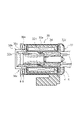
- two magnetic bodies 8 are mounted in the annular step portion 30c.
- the cross-sectional area of the magnetic path at the location is expanded by the magnetic bodies 8 and 8 with the thickness of two sheets. Ru. Therefore, even when a higher current value is applied, more magnetic flux can be induced from the magnetic bodies 8 and 8 to the plunger 4 side, and the thrust of the plunger 4 proportional to the applied current value can be obtained. That is, by adjusting the number of magnetic bodies 8 mounted in the annular step portion 30c according to the maximum value of the applied current value, the thrust of the plunger 4 proportional to the current value can be obtained.
- the solenoid case 30 is changed by changing the magnetic material according to the maximum value of the current value applied to the coil 34.
- the magnetic flux density can be adjusted without changing the shape of the solenoid.
- a plurality of magnetic materials having different thicknesses can be prepared and the magnetic flux density can be adjusted by replacing them.
- the flange portion 32c, the cylindrical portion 32a, and the outer diameter side of the plunger 4 are continuously connected to the valve portion 2 side and the valve portion 2 opposite side via the thin wall portion 32b.
- the configuration is not limited to this, and for example, the stator, which is a fixed iron core, may be configured to be located only on the valve portion 2 side in the axial direction of the plunger.
- the magnetic body 8 may be configured not to be fitted on the cylindrical side plate 30k constituting the annular step portion 30c but to be fixed in the annular step portion 30c with an adhesive or the like. Similarly, the magnetic body 8 may be fixed in the annular step portion 30c with an adhesive or the like in a state of being separated from the end plate 30n constituting the annular step portion 30c.
- the magnetic body 8 may be configured not to be fitted on the cylindrical side plate 30k constituting the annular step portion 30c but to be fixed in the annular step portion 30c with an adhesive or the like. Similarly, the magnetic body 8 may be configured so as not to come into contact with the end plate 30n constituting the annular step portion 30c and to be fixed in the annular step portion 30c with an adhesive or the like.
- outer diameter of the outer peripheral surface 8c of the magnetic body 8 may be smaller than the outer diameter of the cylindrical portion 30a of the solenoid case 30.
- the cross-sectional shape of the magnetic body 8 is not limited to the rectangular shape as in the above embodiment, and a shape in which the cross-sectional area through which the magnetic flux passes toward the inner diameter does not decrease is preferable. Further, a triangle or trapezoid having a right-angled cross section in which the surface facing the end plate 30n is orthogonal to the axial direction is preferable because there is no magnetic loss.
- the solenoid case 30 has a bottomed shape in which the bottom plate 30 m has a disk shape, but the bottom plate may have a bottomed shape having a through hole in the axial direction.
- the magnetic material 8 is formed into a ring shape, but the present invention is not limited to this configuration.
- the annular step portion of the solenoid case 30 is molded into a ring shape with a resin containing a magnetic material. It may be press-fitted into 30c.
- the solenoid valve of the spool type using a spool for the valve body has been described, but the present invention is not limited to this, and a solenoid valve using a globe valve, a gate valve, or the like may be used.
- Solenoid valve 2 Valve part 3
- Solenoid part 4 Plunger (movable iron core) 5
- Rod 8 Magnetic material (magnetic material) 8a Through hole 8b
- Surface 8c Peripheral surface 21
- Sleeve 22 Spool 23
- Retainer 30
- Circular step part (step part) 30d 1st accommodating cylinder 30e 2nd accommodating cylinder 30f Circular surface 30k Side plate 30n End plate
- Solenoid molded body 32
- Stator (fixed iron core) 32a Cylindrical part
- 32b Thin-walled part 32c
Landscapes
- Engineering & Computer Science (AREA)
- Physics & Mathematics (AREA)
- Electromagnetism (AREA)
- General Engineering & Computer Science (AREA)
- Mechanical Engineering (AREA)
- Power Engineering (AREA)
- Magnetically Actuated Valves (AREA)
Abstract
Description
軸方向に移動可能な可動鉄心と、
前記可動鉄心の外径側に配置され、コイルを有するソレノイド成形体と、
前記可動鉄心および前記ソレノイド成形体を収容するソレノイドケースと、
前記ソレノイド成形体の内径側に配置され、前記コイルへの通電により前記可動鉄心との間で磁力を発生させる固定鉄心と、
前記可動鉄心の移動により、流路の開閉を行うバルブ部と、
を有するソレノイドバルブであって、
前記ソレノイドケース外部の前記コイルの軸方向端部に、該ソレノイドケースと別体の磁性材が配設されている。
これによれば、内径方向に向かうにつれて飽和磁束密度が漸次低下する例えば有底構造のソレノイドケースの外部であって、コイルの可動鉄心側の軸方向端部に磁性材を配設したことで、当該箇所における磁路の断面積を拡充できる。磁性材からより多くの磁束を可動鉄心側に誘導し、コイルに印加する電流値に応じて増大する磁束を固定鉄心と可動鉄心とを磁化させることに有効に利用できるため、電流値に比例した可動鉄心の推力を得ることができる。また、ソレノイドケース外部に別体の磁性材を配設する構成とすることで、コイルに印加する電流の最大値に応じて磁性材を変更することでソレノイドケースの形状を変更することなく、磁束密度を調整することができる。
これによれば、不要な磁路を形成せずソレノイドケースのコンパクト性を保ったまま、磁路の断面積を拡充できる。
これによれば、磁性材と可動鉄心との間で、一方から他方へ磁束を有効に誘導でき、磁力損失を抑えて磁路の断面積を拡充できる。
これによれば、周方向に均等な磁束密度を有する磁路を形成できる。
これによれば、磁性体の枚数により拡充する磁路の断面積を調整できる。
これによれば、磁性体をソレノイドケース及び内部の可動鉄心に軸合わせでき、周方向に均等な磁界強度を有する磁路を形成できる。
これによれば、磁性体をソレノイドケースの軸方向において位置決めすることができ、磁性材からより多くの磁束を可動鉄心側に誘導するのに好適な位置に磁性体を配置できる。
2 バルブ部
3 ソレノイド部
4 プランジャ(可動鉄心)
5 ロッド
8 磁性体(磁性材)
8a 貫通孔
8b 面
8c 外周面
21 スリーブ
22 スプール
23 リテーナ
30 ソレノイドケース
30a 円筒部
30b 凸部
30c 環状段部(段部)
30d 第1収容筒部
30e 第2収容筒部
30f 環状面部
30k 側板
30n 端板
31 ソレノイド成形体
32 ステータ(固定鉄心)
32a 円筒部
32b 薄肉部
32c フランジ部
33 ボビン
34 コイル
Claims (7)
- 軸方向に移動可能な可動鉄心と、
前記可動鉄心の外径側に配置され、コイルを有するソレノイド成形体と、
前記可動鉄心および前記ソレノイド成形体を収容するソレノイドケースと、
前記ソレノイド成形体の内径側に配置され、前記コイルへの通電により前記可動鉄心との間で磁力を発生させる固定鉄心と、
前記可動鉄心の移動により、流路の開閉を行うバルブ部と、
を有するソレノイドバルブであって、
前記ソレノイドケース外部の前記コイルの軸方向端部に、該ソレノイドケースと別体の磁性材が配設されているソレノイドバルブ。 - 前記ソレノイドケース外部の前記コイルの軸方向端部には、内径方向に凹む環状段部が形成され、前記磁性材は前記環状段部内に配設されている請求項1に記載のソレノイドバルブ。
- 前記磁性材は、前記可動鉄心と径方向に常に重なる位置に配設されている請求項2に記載のソレノイドバルブ
- 前記磁性材は、リング状の磁性体を形成している請求項2または3に記載のソレノイドバルブ。
- 前記磁性材は、複数枚のリング状の磁性体を形成している請求項2または3に記載のソレノイドバルブ。
- 前記磁性体は、前記ソレノイドケースの前記環状段部を構成する側板に外嵌している請求項4または5に記載のソレノイドバルブ。
- 前記磁性体は、前記ソレノイドケースの前記環状段部を構成する端板に当接している請求項4ないし6のいずれかに記載のソレノイドバルブ。
Priority Applications (4)
| Application Number | Priority Date | Filing Date | Title |
|---|---|---|---|
| EP21889067.1A EP4242503A4 (en) | 2020-11-05 | 2021-10-25 | Solenoid valve |
| US18/034,662 US12264753B2 (en) | 2020-11-05 | 2021-10-25 | Solenoid valve |
| CN202180074945.6A CN116438613A (zh) | 2020-11-05 | 2021-10-25 | 电磁阀 |
| JP2022560719A JP7650608B2 (ja) | 2020-11-05 | 2021-10-25 | ソレノイドバルブ |
Applications Claiming Priority (2)
| Application Number | Priority Date | Filing Date | Title |
|---|---|---|---|
| JP2020185376 | 2020-11-05 | ||
| JP2020-185376 | 2020-11-05 |
Publications (1)
| Publication Number | Publication Date |
|---|---|
| WO2022097514A1 true WO2022097514A1 (ja) | 2022-05-12 |
Family
ID=81457822
Family Applications (1)
| Application Number | Title | Priority Date | Filing Date |
|---|---|---|---|
| PCT/JP2021/039229 Ceased WO2022097514A1 (ja) | 2020-11-05 | 2021-10-25 | ソレノイドバルブ |
Country Status (5)
| Country | Link |
|---|---|
| US (1) | US12264753B2 (ja) |
| EP (1) | EP4242503A4 (ja) |
| JP (1) | JP7650608B2 (ja) |
| CN (1) | CN116438613A (ja) |
| WO (1) | WO2022097514A1 (ja) |
Cited By (1)
| Publication number | Priority date | Publication date | Assignee | Title |
|---|---|---|---|---|
| WO2023238543A1 (ja) * | 2022-06-10 | 2023-12-14 | 日立Astemo株式会社 | ソレノイド、減衰力調整機構および減衰力調整式緩衝器 |
Citations (5)
| Publication number | Priority date | Publication date | Assignee | Title |
|---|---|---|---|---|
| JPS5565407A (en) * | 1978-11-10 | 1980-05-16 | Minolta Camera Co Ltd | Electromagnetic mechanism |
| JPH0292907U (ja) * | 1989-01-11 | 1990-07-24 | ||
| JP2013144999A (ja) * | 2012-01-13 | 2013-07-25 | Denso Corp | 電磁弁 |
| JP2015137757A (ja) | 2014-01-24 | 2015-07-30 | 株式会社ケーヒン | ソレノイドバルブ |
| WO2019102908A1 (ja) * | 2017-11-22 | 2019-05-31 | イーグル工業株式会社 | ソレノイドバルブ |
Family Cites Families (63)
| Publication number | Priority date | Publication date | Assignee | Title |
|---|---|---|---|---|
| US1049845A (en) | 1910-09-15 | 1913-01-07 | Geissinger Regulator Company | Electromagnetic valve. |
| US2654393A (en) | 1948-07-24 | 1953-10-06 | United Aircraft Prod | Two phase electromagnetic device |
| US2700397A (en) | 1949-08-24 | 1955-01-25 | Borg Warner | Unloading valve |
| US2650617A (en) | 1950-09-07 | 1953-09-01 | Missouri Automatic Contr Corp | Electromagnetic valve |
| US2999192A (en) | 1958-06-16 | 1961-09-05 | White Rodgers Company | Solenoid actuator and control means therefor |
| US3462116A (en) | 1964-02-06 | 1969-08-19 | Wright Components Inc | Solenoid valve and method for making the same |
| US3446473A (en) | 1964-11-23 | 1969-05-27 | Monsanto Co | Pulsed solenoid control valves |
| BE793385A (fr) | 1971-12-29 | 1973-04-16 | Lucifer Sa | Valve pour fluide, a commande electromagnetique |
| US3926405A (en) | 1974-08-21 | 1975-12-16 | Valcor Eng Corp | Solenoid operated proportional valve |
| US4305566A (en) | 1979-10-31 | 1981-12-15 | Fluid Controls, Inc. | Fluid control valve |
| US4790345A (en) * | 1987-03-17 | 1988-12-13 | Parker-Hannifin Corporation | Proportional valve |
| JPH0292907A (ja) | 1988-09-30 | 1990-04-03 | Sekisui Chem Co Ltd | 塩化ビニル系共重合樹脂 |
| JPH02129476A (ja) | 1988-11-09 | 1990-05-17 | Aisin Aw Co Ltd | 圧力調整弁 |
| DE3938136A1 (de) | 1989-11-16 | 1991-05-23 | Bosch Gmbh Robert | Elektromagnetisch betaetigbares ventil |
| JP3016056B2 (ja) | 1993-07-13 | 2000-03-06 | 日信工業株式会社 | 常閉型電磁弁におけるエアギャップ調整方法並びに常開型電磁弁におけるエアギャップ及びバルブストローク調整方法 |
| US5413308A (en) | 1993-09-03 | 1995-05-09 | The Horton Company | Fail-open solenoid actuated valve |
| DE19510646C2 (de) | 1995-03-23 | 1997-09-18 | Bosch Gmbh Robert | Elektromagnetisch betätigbares Druckschaltventil |
| JP3601554B2 (ja) * | 1995-08-11 | 2004-12-15 | アイシン・エィ・ダブリュ株式会社 | 電磁式圧力調整弁 |
| JPH09250650A (ja) | 1996-03-18 | 1997-09-22 | Aichi Electric Co Ltd | 防湿型電磁弁 |
| JP3423581B2 (ja) * | 1997-07-22 | 2003-07-07 | リンナイ株式会社 | ラッチ式電磁弁 |
| DE19757475C2 (de) | 1997-12-23 | 1999-10-14 | Danfoss As | Servogesteuertes Magnetventil |
| JPH11248023A (ja) * | 1998-03-05 | 1999-09-14 | Jidosha Kiki Co Ltd | 電磁ソレノイド |
| JPH11343820A (ja) * | 1998-06-03 | 1999-12-14 | Unisia Jecs Corp | 内燃機関のバルブタイミング制御装置 |
| DE19904901A1 (de) | 1999-02-06 | 2000-08-10 | Zahnradfabrik Friedrichshafen | Proportional-Druckregelventil |
| DE19934846A1 (de) | 1999-07-24 | 2001-01-25 | Hydraulik Ring Gmbh | Elektromagnet und hydraulisches Ventil mit einem Elektromagneten |
| DE19956160A1 (de) | 1999-11-23 | 2001-05-31 | Schaeffler Waelzlager Ohg | Magnetventil, insbesondere hydraulisches Proportionalventil |
| JP2002027723A (ja) | 2000-07-11 | 2002-01-25 | Denso Corp | 電磁駆動装置の製造方法 |
| JP2002181222A (ja) * | 2000-10-04 | 2002-06-26 | Denso Corp | 電磁弁装置およびその製造方法 |
| IT1319147B1 (it) * | 2000-11-29 | 2003-09-23 | Luciano Migliori | Microvalvola a solenoide, perfezionata |
| JP2002188747A (ja) | 2000-12-22 | 2002-07-05 | Bosch Braking Systems Co Ltd | 電磁弁およびその製造方法 |
| WO2002061314A1 (en) * | 2001-01-31 | 2002-08-08 | Nok Corporation | Solenoid valve |
| JP2004360748A (ja) | 2003-06-03 | 2004-12-24 | Nissin Kogyo Co Ltd | 常開型電磁弁 |
| JP4569371B2 (ja) | 2005-04-28 | 2010-10-27 | 株式会社デンソー | リニアソレノイド |
| FR2887005B1 (fr) | 2005-06-14 | 2009-04-24 | Bontaz Ct Soc Par Actions Simp | Electrovanne a epaulement rapporte |
| JP2007211857A (ja) | 2006-02-08 | 2007-08-23 | Denso Corp | 電磁スプール弁 |
| JP2010106899A (ja) | 2008-10-29 | 2010-05-13 | Hitachi Automotive Systems Ltd | ソレノイドバルブ |
| JP2010223279A (ja) | 2009-03-20 | 2010-10-07 | Denso Corp | 電磁弁 |
| JP5316263B2 (ja) | 2009-06-30 | 2013-10-16 | 株式会社ジェイテクト | 電磁弁 |
| JP5077331B2 (ja) | 2009-11-16 | 2012-11-21 | 株式会社デンソー | リニアソレノイド |
| JP4844672B2 (ja) * | 2009-12-01 | 2011-12-28 | 株式会社デンソー | リニアソレノイド |
| JP5387492B2 (ja) | 2010-04-22 | 2014-01-15 | 株式会社デンソー | リニアソレノイド |
| DE102010031334A1 (de) | 2010-07-14 | 2012-01-19 | Robert Bosch Gmbh | Magnetventil sowie Fahrerassistenzeinrichtung |
| JP5293792B2 (ja) | 2010-11-19 | 2013-09-18 | 株式会社デンソー | 油圧調整弁 |
| DE102012207584A1 (de) | 2012-05-08 | 2013-11-14 | Robert Bosch Gmbh | Magnetventil |
| DE102012104285A1 (de) | 2012-05-16 | 2013-11-21 | Svm Schultz Verwaltungs-Gmbh & Co. Kg | Ventil |
| JP2014105758A (ja) * | 2012-11-27 | 2014-06-09 | Denso Corp | 高圧流体用電磁弁装置 |
| JP2014110372A (ja) | 2012-12-04 | 2014-06-12 | Keihin Corp | リニアソレノイド及びリニアソレノイドバルブ,並びにリニアソレノイドの製造方法 |
| DE202013100643U1 (de) | 2013-02-13 | 2013-02-21 | Bürkert Werke GmbH | Magnetventil |
| JP6245632B2 (ja) | 2013-05-28 | 2017-12-13 | 株式会社ケーヒン | リニアソレノイドバルブ |
| JP6115434B2 (ja) | 2013-10-09 | 2017-04-19 | 株式会社デンソー | 電磁弁 |
| CN105917423B (zh) | 2014-01-29 | 2017-06-13 | 爱信艾达株式会社 | 电磁驱动装置以及电磁驱动装置的制造方法 |
| JP6265009B2 (ja) | 2014-03-31 | 2018-01-24 | アイシン・エィ・ダブリュ株式会社 | 電磁駆動装置および電磁弁 |
| JP2016089883A (ja) | 2014-10-31 | 2016-05-23 | ニッタ株式会社 | エア配管におけるバルブと継手の接続機構 |
| JP2016211657A (ja) | 2015-05-08 | 2016-12-15 | 株式会社日本自動車部品総合研究所 | スプールバルブ |
| CN205190900U (zh) | 2015-11-07 | 2016-04-27 | 余姚市三顺净水科技有限公司 | 一种先导式进水电磁阀 |
| JP2017157791A (ja) | 2016-03-04 | 2017-09-07 | アイシン・エィ・ダブリュ株式会社 | 電磁弁用コアの製造方法及び電磁弁用コア |
| KR101918532B1 (ko) | 2016-12-28 | 2018-11-15 | 주식회사 유니크 | 솔레노이드 밸브 |
| DE102017207208A1 (de) | 2017-04-28 | 2018-10-31 | Robert Bosch Gmbh | Ventil zum Einstellen eines Fluidstroms |
| JP6563441B2 (ja) | 2017-06-26 | 2019-08-21 | 株式会社不二工機 | パイロット式電磁弁 |
| WO2019017271A1 (ja) | 2017-07-18 | 2019-01-24 | イーグル工業株式会社 | ソレノイドバルブ |
| CN111448407B (zh) * | 2017-11-22 | 2022-07-01 | 伊格尓工业股份有限公司 | 电磁阀 |
| US10619755B2 (en) * | 2018-01-17 | 2020-04-14 | Nextern, Inc. | Solenoid operated valve with flux density concentration ring and molded-in valve seat |
| JP2020088143A (ja) * | 2018-11-26 | 2020-06-04 | 株式会社デンソー | ソレノイド |
-
2021
- 2021-10-25 WO PCT/JP2021/039229 patent/WO2022097514A1/ja not_active Ceased
- 2021-10-25 US US18/034,662 patent/US12264753B2/en active Active
- 2021-10-25 EP EP21889067.1A patent/EP4242503A4/en active Pending
- 2021-10-25 CN CN202180074945.6A patent/CN116438613A/zh active Pending
- 2021-10-25 JP JP2022560719A patent/JP7650608B2/ja active Active
Patent Citations (5)
| Publication number | Priority date | Publication date | Assignee | Title |
|---|---|---|---|---|
| JPS5565407A (en) * | 1978-11-10 | 1980-05-16 | Minolta Camera Co Ltd | Electromagnetic mechanism |
| JPH0292907U (ja) * | 1989-01-11 | 1990-07-24 | ||
| JP2013144999A (ja) * | 2012-01-13 | 2013-07-25 | Denso Corp | 電磁弁 |
| JP2015137757A (ja) | 2014-01-24 | 2015-07-30 | 株式会社ケーヒン | ソレノイドバルブ |
| WO2019102908A1 (ja) * | 2017-11-22 | 2019-05-31 | イーグル工業株式会社 | ソレノイドバルブ |
Non-Patent Citations (1)
| Title |
|---|
| See also references of EP4242503A4 |
Cited By (3)
| Publication number | Priority date | Publication date | Assignee | Title |
|---|---|---|---|---|
| WO2023238543A1 (ja) * | 2022-06-10 | 2023-12-14 | 日立Astemo株式会社 | ソレノイド、減衰力調整機構および減衰力調整式緩衝器 |
| JPWO2023238543A1 (ja) * | 2022-06-10 | 2023-12-14 | ||
| JP7767607B2 (ja) | 2022-06-10 | 2025-11-11 | Astemo株式会社 | ソレノイド、減衰力調整機構および減衰力調整式緩衝器 |
Also Published As
| Publication number | Publication date |
|---|---|
| US12264753B2 (en) | 2025-04-01 |
| EP4242503A1 (en) | 2023-09-13 |
| EP4242503A4 (en) | 2024-09-04 |
| JP7650608B2 (ja) | 2025-03-25 |
| JPWO2022097514A1 (ja) | 2022-05-12 |
| US20230400117A1 (en) | 2023-12-14 |
| CN116438613A (zh) | 2023-07-14 |
Similar Documents
| Publication | Publication Date | Title |
|---|---|---|
| JP7463104B2 (ja) | ソレノイドバルブ | |
| CN101952909B (zh) | 操纵磁体 | |
| CN206723550U (zh) | 电磁阀装置 | |
| KR20170009983A (ko) | 폴 피스와 플럭스 슬리브의 정렬불량에 강한 솔레노이드 | |
| CN108138983B (zh) | 线性电磁阀以及线性电磁阀的制造方法 | |
| WO2022097514A1 (ja) | ソレノイドバルブ | |
| JP3975941B2 (ja) | 電磁駆動装置 | |
| US4694270A (en) | Electromagnetic proportional actuator | |
| WO2020226101A1 (ja) | ソレノイドバルブ | |
| KR102344692B1 (ko) | 솔레노이드 | |
| JP7595419B2 (ja) | ソレノイド | |
| JP2009174623A (ja) | 電磁弁 | |
| US11908620B2 (en) | Solenoid | |
| JP4237114B2 (ja) | 電磁弁 | |
| US11948737B2 (en) | Solenoid | |
| CN106409468B (zh) | 线性螺线管 | |
| JP6919639B2 (ja) | ソレノイド | |
| US20210343461A1 (en) | Electromagnetic actuator | |
| JP2012021611A (ja) | リニアソレノイド弁 | |
| US20230013945A1 (en) | Solenoid valve | |
| JP2024159215A (ja) | ソレノイドおよびその組立方法 | |
| JP2023122868A (ja) | ソレノイド | |
| JP4458282B2 (ja) | 電磁弁 | |
| JP2009168100A (ja) | 電磁弁 | |
| JP2003166663A (ja) | 電磁弁 |
Legal Events
| Date | Code | Title | Description |
|---|---|---|---|
| 121 | Ep: the epo has been informed by wipo that ep was designated in this application |
Ref document number: 21889067 Country of ref document: EP Kind code of ref document: A1 |
|
| ENP | Entry into the national phase |
Ref document number: 2022560719 Country of ref document: JP Kind code of ref document: A |
|
| NENP | Non-entry into the national phase |
Ref country code: DE |
|
| ENP | Entry into the national phase |
Ref document number: 2021889067 Country of ref document: EP Effective date: 20230605 |
|
| WWG | Wipo information: grant in national office |
Ref document number: 18034662 Country of ref document: US |