WO2022102703A1 - ナノセルロース含有組成物の製造方法 - Google Patents
ナノセルロース含有組成物の製造方法 Download PDFInfo
- Publication number
- WO2022102703A1 WO2022102703A1 PCT/JP2021/041521 JP2021041521W WO2022102703A1 WO 2022102703 A1 WO2022102703 A1 WO 2022102703A1 JP 2021041521 W JP2021041521 W JP 2021041521W WO 2022102703 A1 WO2022102703 A1 WO 2022102703A1
- Authority
- WO
- WIPO (PCT)
- Prior art keywords
- nanocellulose
- cellulose
- oxidized cellulose
- oxide
- mass
- Prior art date
- Legal status (The legal status is an assumption and is not a legal conclusion. Google has not performed a legal analysis and makes no representation as to the accuracy of the status listed.)
- Ceased
Links
Classifications
-
- C—CHEMISTRY; METALLURGY
- C08—ORGANIC MACROMOLECULAR COMPOUNDS; THEIR PREPARATION OR CHEMICAL WORKING-UP; COMPOSITIONS BASED THEREON
- C08B—POLYSACCHARIDES; DERIVATIVES THEREOF
- C08B15/00—Preparation of other cellulose derivatives or modified cellulose, e.g. complexes
- C08B15/02—Oxycellulose; Hydrocellulose; Cellulosehydrate, e.g. microcrystalline cellulose
- C08B15/04—Carboxycellulose, e.g. prepared by oxidation with nitrogen dioxide
-
- C—CHEMISTRY; METALLURGY
- C08—ORGANIC MACROMOLECULAR COMPOUNDS; THEIR PREPARATION OR CHEMICAL WORKING-UP; COMPOSITIONS BASED THEREON
- C08K—Use of inorganic or non-macromolecular organic substances as compounding ingredients
- C08K3/00—Use of inorganic substances as compounding ingredients
- C08K3/02—Elements
- C08K3/08—Metals
-
- C—CHEMISTRY; METALLURGY
- C08—ORGANIC MACROMOLECULAR COMPOUNDS; THEIR PREPARATION OR CHEMICAL WORKING-UP; COMPOSITIONS BASED THEREON
- C08K—Use of inorganic or non-macromolecular organic substances as compounding ingredients
- C08K3/00—Use of inorganic substances as compounding ingredients
- C08K3/18—Oxygen-containing compounds, e.g. metal carbonyls
- C08K3/20—Oxides; Hydroxides
- C08K3/22—Oxides; Hydroxides of metals
-
- C—CHEMISTRY; METALLURGY
- C08—ORGANIC MACROMOLECULAR COMPOUNDS; THEIR PREPARATION OR CHEMICAL WORKING-UP; COMPOSITIONS BASED THEREON
- C08L—COMPOSITIONS OF MACROMOLECULAR COMPOUNDS
- C08L1/00—Compositions of cellulose, modified cellulose or cellulose derivatives
- C08L1/02—Cellulose; Modified cellulose
- C08L1/04—Oxycellulose; Hydrocellulose, e.g. microcrystalline cellulose
-
- D—TEXTILES; PAPER
- D21—PAPER-MAKING; PRODUCTION OF CELLULOSE
- D21C—PRODUCTION OF CELLULOSE BY REMOVING NON-CELLULOSE SUBSTANCES FROM CELLULOSE-CONTAINING MATERIALS; REGENERATION OF PULPING LIQUORS; APPARATUS THEREFOR
- D21C9/00—After-treatment of cellulose pulp, e.g. of wood pulp, or cotton linters ; Treatment of dilute or dewatered pulp or process improvement taking place after obtaining the raw cellulosic material and not provided for elsewhere
- D21C9/001—Modification of pulp properties
- D21C9/007—Modification of pulp properties by mechanical or physical means
-
- D—TEXTILES; PAPER
- D21—PAPER-MAKING; PRODUCTION OF CELLULOSE
- D21H—PULP COMPOSITIONS; PREPARATION THEREOF NOT COVERED BY SUBCLASSES D21C OR D21D; IMPREGNATING OR COATING OF PAPER; TREATMENT OF FINISHED PAPER NOT COVERED BY CLASS B31 OR SUBCLASS D21G; PAPER NOT OTHERWISE PROVIDED FOR
- D21H11/00—Pulp or paper, comprising cellulose or lignocellulose fibres of natural origin only
- D21H11/16—Pulp or paper, comprising cellulose or lignocellulose fibres of natural origin only modified by a particular after-treatment
- D21H11/18—Highly hydrated, swollen or fibrillatable fibres
-
- D—TEXTILES; PAPER
- D21—PAPER-MAKING; PRODUCTION OF CELLULOSE
- D21H—PULP COMPOSITIONS; PREPARATION THEREOF NOT COVERED BY SUBCLASSES D21C OR D21D; IMPREGNATING OR COATING OF PAPER; TREATMENT OF FINISHED PAPER NOT COVERED BY CLASS B31 OR SUBCLASS D21G; PAPER NOT OTHERWISE PROVIDED FOR
- D21H11/00—Pulp or paper, comprising cellulose or lignocellulose fibres of natural origin only
- D21H11/16—Pulp or paper, comprising cellulose or lignocellulose fibres of natural origin only modified by a particular after-treatment
- D21H11/20—Chemically or biochemically modified fibres
-
- C—CHEMISTRY; METALLURGY
- C08—ORGANIC MACROMOLECULAR COMPOUNDS; THEIR PREPARATION OR CHEMICAL WORKING-UP; COMPOSITIONS BASED THEREON
- C08K—Use of inorganic or non-macromolecular organic substances as compounding ingredients
- C08K3/00—Use of inorganic substances as compounding ingredients
- C08K3/02—Elements
- C08K3/08—Metals
- C08K2003/0893—Zinc
-
- C—CHEMISTRY; METALLURGY
- C08—ORGANIC MACROMOLECULAR COMPOUNDS; THEIR PREPARATION OR CHEMICAL WORKING-UP; COMPOSITIONS BASED THEREON
- C08K—Use of inorganic or non-macromolecular organic substances as compounding ingredients
- C08K3/00—Use of inorganic substances as compounding ingredients
- C08K3/18—Oxygen-containing compounds, e.g. metal carbonyls
- C08K3/20—Oxides; Hydroxides
- C08K3/22—Oxides; Hydroxides of metals
- C08K2003/2296—Oxides; Hydroxides of metals of zinc
Definitions
- the present invention relates to a method for producing a nanocellulose-containing composition.
- CNF cellulose nanofibers
- Patent Document 1 hypochlorous acid or a salt thereof is used as an oxidizing agent, and a cellulose-based raw material is oxidized to obtain oxidized cellulose under a high concentration condition in which the effective chlorine concentration in the reaction system is 14 to 43% by mass. , It is disclosed that CNF is obtained by finely treating the oxidized cellulose. Further, in Patent Document 2, hypochlorous acid or a salt thereof is used as an oxidizing agent, the effective chlorine concentration in the reaction system is 6 to 14% by mass, and the pH is adjusted to 5.0 to 14.0 for cellulose. It is disclosed that after oxidizing a system raw material to obtain cellulose oxide, the cellulose oxide is micronized to obtain CNF.
- the N-oxyl compound is used because the oxidation treatment is performed without using an N-oxyl compound such as 2,2,6,6-tetramethyl-1-piperidin-N-oxyradic (TEMPO) as a catalyst. Since it does not remain in the cellulose fiber, it is possible to produce the nano-cellulose material while reducing the influence on the environment and the like.
- TEMPO 2,2,6,6-tetramethyl-1-piperidin-N-oxyradic
- Patent Document 3 describes a production method including a step of defibrating pulp having a degree of polymerization of cellulose of 100 to 500 in a defibrated resin to obtain a cellulose nanofiber and a resin composition containing the defibrated resin. ing. Further, in Patent Document 4, an acetylated cellulose fiber and a resin for a masterbatch are mixed and kneaded at a heating temperature in a twin-screw kneader to obtain an acetylated cellulose nanofiber derived from the acetylated cellulose fiber and a masterbatch resin. A method for producing a masterbatch containing a resin is described.
- Patent Documents 1 and 2 as a specific example of producing a nanocellulose material by refining cellulose oxide, a nanocellulose material (simply nanocellulose) is subjected to mechanical defibration treatment by mechanical treatment using an ultrasonic homogenizer.
- An example of obtaining (also referred to as) is disclosed.
- the nanocellulose thus obtained is compounded with other materials according to various uses.
- the nanocellulose obtained as described above causes an increase in production cost and a decrease in production efficiency due to the inclusion of mechanical defibration treatment. Therefore, there are problems of efficiency such as cost increase and productivity even in the production of a compound compounded with other materials.
- Patent Documents 3 and 4 describe a method of defibrating pulp or acetylated cellulose fibers in a resin to form cellulose nanofibers.
- the cellulose fibers used in this method are pulp itself or modified cellulose fibers, and defibration requires an energy load, so that a resin composition containing nanocellulose cannot be efficiently obtained.
- the present invention has been made in view of the above circumstances, and an object of the present invention is to provide a method for efficiently obtaining a nanocellulose-containing composition.
- the present inventors have found that by using a predetermined cellulose oxide, a nanocellulose-containing composition can be efficiently obtained by omitting the step of mechanical defibration treatment for refining the oxidized cellulose. , The present invention has been completed. According to the present invention, the following means are provided.
- a method for producing a composition containing nanocellulose A step of defibrating the oxidized cellulose into the nanocellulose by stirring a mixture containing the oxidized cellulose and components other than the nanocellulose constituting the composition is included.
- the oxidized cellulose contains an oxide of a cellulosic raw material due to hypochlorous acid or a salt thereof.
- Production method [2] The production method according to [1], wherein the mixture further contains a dispersion medium.
- a method for producing a composition containing nanocellulose A step of defibrating the oxidized cellulose into the nanocellulose by stirring the oxidized cellulose and continuously adding components other than the nanocellulose constituting the composition is included.
- the oxidized cellulose contains an oxide of a cellulosic raw material due to hypochlorous acid or a salt thereof.
- Production method [4] The production method according to [3], wherein the stirring of the oxidized cellulose and the addition of the components are performed in one pot. [5] The production method according to [3] or [4], wherein the oxidized cellulose is dispersed in a dispersion medium. [6] The production method according to any one of [1] to [5], wherein the oxidized cellulose does not substantially contain an N-oxyl compound. [7] The production method according to any one of [1] to [6], wherein the degree of polymerization of the oxidized cellulose is 600 or less.
- a nanocellulose-containing composition containing nanocellulose and a compound can be efficiently obtained.
- the production method of the present invention is a method for producing a nanocellulose-containing composition containing nanocellulose and at least one compound.
- One aspect of the production method of the present invention is It comprises a step of defibrating cellulose oxide into nanocellulose by stirring a mixture containing cellulose oxide and components other than nanocellulose (also referred to as “combination”) constituting the composition.
- the component that is agitated together with the oxidized cellulose may be a part or all of the components (excluding nanocellulose) constituting the composition.
- the remaining components may be added after stirring.
- one aspect of the manufacturing method of this invention is The process of preparing cellulose oxide, A step of obtaining a mixture of the oxidized cellulose and at least one compound, and The step of stirring the mixture to obtain a nanocellulose-containing composition is included.
- the above-mentioned embodiment in which oxidized cellulose is defibrated in the presence of other components is also referred to as a production method I. It is preferable that the composition in the production method I does not consist only of nanocellulose and a dispersion medium.
- One aspect of the production method of the present invention is A step of defibrating the oxidized cellulose into nanocellulose by stirring the oxidized cellulose and continuously mixing components other than the nanocellulose constituting the composition is included.
- one aspect of the manufacturing method of this invention is The process of preparing cellulose oxide, The step of stirring the oxidized cellulose and continuously adding at least one compound to obtain a nanocellulose-containing composition is included.
- the above-mentioned embodiment in which the oxidized cellulose is defibrated and continuously mixed with other components is also referred to as a production method II.
- the cellulose oxide in the present invention contains an oxide of a cellulosic raw material due to hypochlorous acid or a salt thereof.
- the mechanical defibration treatment is finally performed.
- the present inventors have found that the oxidized cellulose obtained by oxidizing a cellulosic raw material with hypochlorous acid or a salt thereof is excellent in defibration. Further, the present inventors have found that the above-mentioned oxidized cellulose can be induced to nanocellulose even with a slight stirring without using a mechanical defibration treatment device used for obtaining conventional nanocellulose.
- nanocellulose has been used when mixing or compounding nanocellulose with other materials, but according to the production method of the present invention, oxidized cellulose is added when the other materials are dispersed or emulsified.
- the above-mentioned oxidized cellulose becomes nanocellulose even with slight stirring, and as a result, other materials and nanocellulose can be mixed or complexed.
- the nanocellulose-containing composition can be obtained by omitting the step of mechanically defibrating, and is excellent in efficiency.
- the oxidized cellulose can be defibrated and made fine by stirring.
- a nanocellulose-containing composition containing nanocellulose and at least one formulation is obtained.
- the stirring in the present invention is not particularly limited as long as it can micronize at least a part of the oxidized cellulose, and may be normal stirring. Further, the stirring in the present invention is not particularly limited as long as it is an operation for dispersing the components constituting the nanocellulose-containing composition.
- the cellulose oxide may be finely divided to such an extent that the function of nanocellulose can be obtained, and some of the oxidized cellulose may remain without being finely divided. Therefore, the nanocellulose-containing composition obtained by the production method of the present invention may contain a part of oxidized cellulose.
- the order and method of adding these are not particularly limited.
- the oxidized cellulose is stirred and at least one compound is continuously added. More specifically, one aspect of the production method II of the present invention is a production method in which the oxidized cellulose is stirred to make at least a part finer, and then at least one compound is continuously added.
- “continuously” means that at least a part of the oxidized cellulose is refined by stirring and the compound is added in a series.
- Specific embodiments in which stirring and addition of a compound are performed in a series include, for example, a mode in which the stirring of cellulose oxide to be finely divided and the addition of at least one compound are operated in one pot; cellulose oxide. A mode in which at least one compound is added at the same time while stirring the above; and the like, but the present invention is not limited thereto. In this way, the user of cellulose oxide can obtain nanocellulose by micronizing the cellulose oxide by himself and use it.
- the stirring in the present invention is not particularly limited as long as it is an operation for dispersing the components constituting the nanocellulose-containing composition, and for example, a velocity field and a velocity fluctuation of arbitrary intensity; to inclusions and obstacles. Collision; ultrasonic; pressure load; etc. can be utilized.
- a liquid disperser can be preferably used for such a dispersion operation. Therefore, one aspect of the production method of the present invention is a production method in which stirring is performed by a liquid disperser.
- the liquid disperser is not particularly limited, and for example, a homomixer, a magnetic stirrer, a stirring rod, a stirrer with a stirring blade, a disper type mixer, a homogenizer, an external circulation stirrer, a rotating revolution stirrer, a vibration type stirrer, and the like.
- a method using an ultrasonic disperser or the like can be mentioned.
- the liquid disperser in addition to the above-mentioned apparatus, a rotary shear type agitator, a colloidal mill, a roll mill, a pressure homogenizer, a container-driven mill, a medium agitation mill and the like can be mentioned. Further, a kneader can be used as the liquid disperser.
- the rotary shear type stirrer is a device that disperses by passing an object to be agitated through the gap between the rotary blade and the outer cylinder, and disperses by the shear flow in the gap and the strong velocity fluctuation before and after.
- the peripheral speed of the tip of the rotary blade is not particularly limited, but is usually 100 m / s or less.
- the peripheral speed is preferably 50 m / s or less, more preferably 30 m / s or less, and further preferably 15 m / s or less from the viewpoint of cost and production efficiency.
- the lower limit of the peripheral speed is not particularly limited, but usually may exceed 0 m / s.
- a colloid mill is a device that disperses by shear flow in the gap between a rotating disk and a fixed disk.
- a roll mill is a device that disperses by shearing force and compressive force utilizing the gap between a plurality of rotating rolls.
- the pressure homogenizer is used as a disperser that discharges slurry or the like from pores at high pressure, and is also called a pressure injection disperser.
- a high pressure homogenizer is preferable.
- the high-pressure homogenizer refers to a homogenizer having an ability to discharge a slurry at a pressure of, for example, 10 MPa or more, preferably 100 MPa or more.
- the upper limit of the pressure of the high-pressure homogenizer is not particularly limited, but may be 400 MPa or less.
- the upper limit of the pressure of the high-pressure homogenizer is preferably 200 MPa or less, more preferably 100 MPa or less, still more preferably 50 MPa or less, still more preferably 30 MPa or less, from the viewpoint of cost and production efficiency.
- the high-pressure homogenizer include a counter-collision type high-pressure homogenizer such as a microfluidizer and a wet jet mill.
- the container-driven mill is a device that disperses due to collision and friction of a medium such as a ball in the container, and specifically, there are a rotary mill, a vibration mill, a planetary mill, and the like.
- the medium stirring mill is a device that uses a medium such as a ball or a bead and disperses by the impact force and the shearing force of the medium, and specifically, there are an attritor and a bead mill (sand mill).
- a kneader is a device that wets powder or the like with a liquid (also called kneading or kneading). Specifically, it is a double-armed kneader (biaxial in two semi-cylindrical containers). (It is a device that disperses by the mixing blades of
- These devices may be used alone or in combination of two or more.
- the miniaturization of oxidized cellulose can be promoted by stirring using such an apparatus, stirring may be performed until the constituent components of the nanocellulose-containing composition are homogenized or emulsified. Thereby, the nanocellulose is uniformly dispersed in the nanocellulose-containing composition, and the nanocellulose-containing composition can be obtained as an emulsion.
- Stirring is preferably carried out in a state where cellulose oxide is mixed with the dispersion medium. Therefore, it is preferable that the mixture containing the oxidized cellulose and at least one compound in the production method I further contains a dispersion medium. Further, it is preferable that the cellulose oxide in the production method II is dispersed in a dispersion medium.
- the dispersion medium is not particularly limited and may be appropriately selected depending on the intended purpose. Specific examples of the dispersion medium include water, alcohols, ethers, ketones, N, N-dimethylformamide, N, N-dimethylacetamide, dimethylsulfoxide and the like. As the solvent, one of these may be used alone, or two or more of them may be used in combination.
- alcohols include methanol, ethanol, isopropanol, isobutanol, sec-butyl alcohol, tert-butyl alcohol, methyl cellosolve, ethylene glycol, glycerin and the like.
- ethers include ethylene glycol dimethyl ether, 1,4-dioxane and tetrahydrofuran.
- ketone include acetone, methyl ethyl ketone and the like.
- the concentration of cellulose oxide at the time of stirring may be appropriately adjusted according to the stirring device and the type of the mixture, but the object to be stirred (in the production method I, at least 1 with the oxidized cellulose).
- a mixture containing a mixture of seeds and a dispersion medium and in Production Method II, refers to a dispersion liquid containing cellulose oxide and a dispersion medium.
- the rotation speed may be usually in the range of 100 rpm to 1,000 ⁇ 10 3 rpm. From the viewpoint of promoting miniaturization more efficiently, the rotation speed is preferably in the range of 1,000 rpm to 100,000 rpm.
- the stirring time is not particularly limited, but is preferably in the range of 1 minute to 1 hour from the viewpoint of productivity.
- the concentration of cellulose oxide is preferably in the range of 0.1 to 30% by mass with respect to the total amount of the object to be stirred.
- the concentration of the oxidized cellulose is in the range of 0.1 to 30% by mass, the miniaturization tends to proceed more easily, and the nanocellulose-containing composition tends to be obtained more efficiently.
- the concentration of cellulose oxide is more preferably 1.0% by mass or more and 30% by mass or less, still more preferably 1.5% by mass or more and 20% by mass or less, still more preferably 1.5% by mass. It is by mass% or more and 15% by mass or less.
- the rotation / revolution stirrer is a device that mixes the materials in the container by rotating and revolving the container into which the material is charged. According to the planetary rotation mixer, stirring is performed without using a stirring blade.
- the revolution speed and the rotation speed at the time of stirring by the rotation revolution stirrer can be appropriately set.
- the revolution speed can be set to 400 to 3000 rpm and the rotation speed can be set to 200 to 1500 rpm.
- the revolution speed is more preferably 1500 to 2300 rpm, and the rotation speed is more preferably 700 to 950 rpm.
- the concentration of cellulose oxide is, for example, 0.01 to 1.0% by mass, preferably 0.1 to 0.5% by mass.
- the vibration type agitator examples include a vortex mixer (touch mixer).
- a vortex mixer stirring is performed by forming a vortex in the liquid material in the container.
- agitation is performed without using a stirring blade, so that milder agitation can be realized.
- mild agitation can be realized by simple equipment, which is excellent in terms of production equipment and production cost.
- the rotation speed of the vortex mixer is, for example, 600 to 3000 rpm, and it is preferable to perform the vortex mixer under the condition of stirring for 3 to 15 minutes.
- the concentration of the aqueous dispersion of cellulose oxide as a material is, for example, 0.01 to 1.0% by mass, preferably 0.1 to 0.5% by mass.
- the step of preparing the oxidized cellulose in the present invention is not particularly limited, and the oxidized cellulose may be obtained and used as a ready-made product such as a commercially available product, and is oxidized from a cellulosic raw material using hypochlorous acid or a salt thereof. May be prepared.
- the form of the oxidized cellulose may be, for example, a solid (dry) form, a slurry form, or the like. Although not particularly limited, it is preferably in the form of a slurry. That is, it is preferable that the oxidized cellulose is prepared as a slurry.
- the slurry referred to here is a suspension containing cellulose oxide.
- the slurry may contain the solvent used in preparing the oxidized cellulose. Further, the above-mentioned dispersion medium may be appropriately added to form a slurry. Since the cellulose oxide is a slurry, it is easy to handle and miniaturization tends to proceed easily.
- the amount of cellulose oxide is usually in the range of 0.1% by mass or more and 95% by mass or less, preferably 1% by mass or more, when the total amount of the slurry is 100% by mass. It is 50% by mass or less, more preferably 1% by mass or more and 30% by mass or less.
- the oxidized cellulose in the present invention contains fibrous cellulose obtained by oxidizing a cellulosic raw material with hypochlorous acid or a salt thereof.
- Oxidized cellulose is an oxide of a cellulosic raw material and means one before defibration treatment (miniaturization treatment).
- the cellulose oxide in the present invention is also referred to as a cellulose oxide fiber. That is, the oxidized cellulose in the present invention contains an oxide of a cellulosic raw material by hypochlorous acid or a salt thereof.
- the main component of the plant is cellulose, and a bundle of cellulose molecules is called a cellulose microfibril. Cellulose in cellulosic raw materials is also contained in the form of cellulosic microfibrils.
- the degree of polymerization of cellulose oxide may be 600 or less.
- the degree of polymerization of cellulose oxide is 600 or less, a large amount of energy tends to be unnecessary for defibration, and sufficient defibration tends to be exhibited.
- the composition can be refined under mild conditions and can be refined by ordinary stirring or kneading, and there is a tendency to efficiently obtain a nanocellulose-containing composition.
- the lower limit of the degree of polymerization of the present oxidized cellulose is not particularly set.
- the degree of polymerization of cellulose oxide is 30 or more, the proportion of particulate cellulose rather than fibrous is small, the quality of the slurry containing the oxidized cellulose becomes uniform, the viscosity becomes stable, and the nanocellulose It becomes easier to obtain the viscosity property, which is one of the features.
- the degree of polymerization of cellulose oxide is preferably 30 to 600.
- the degree of polymerization is more preferably 580 or less, still more preferably 560 or less, even more preferably 550 or less, still more preferably 500 or less, even more preferably 450 or less, and even more preferably. It is 400 or less.
- the lower limit of the degree of polymerization is more preferably 50 or more, further preferably 60 or more, still more preferably 70 or more, still more preferably 80 or more, from the viewpoint of improving the viscosity stability of the slurry. It is even more preferably 90 or more, even more preferably 100 or more, particularly preferably 110 or more, and most preferably 120 or more.
- the preferable range of the degree of polymerization can be determined by appropriately combining the above-mentioned upper limit and lower limit.
- the degree of polymerization of cellulose oxide is more preferably 50 to 600, still more preferably 60 to 600, still more preferably 80 to 600, still more preferably 80 to 550, and even more preferably 80 to 80. It is 500, more preferably 80 to 450, and particularly preferably 80 to 400.
- the degree of polymerization of cellulose oxide can be adjusted by changing the reaction time, reaction temperature, pH, and the effective chlorine concentration of hypochlorous acid or a salt thereof during the oxidation reaction. Specifically, since the degree of polymerization tends to decrease as the degree of oxidation increases, for example, a method of increasing the reaction time and / or the reaction temperature of oxidation can be mentioned in order to reduce the degree of polymerization. As another method, the degree of polymerization of cellulose oxide can be adjusted by the stirring conditions of the reaction system at the time of the oxidation reaction. For example, under conditions in which the reaction system is sufficiently homogenized using a stirring blade or the like, the oxidation reaction proceeds smoothly and the degree of polymerization tends to decrease.
- the degree of polymerization of cellulose oxide tends to vary depending on the selection of the cellulosic raw material. Therefore, the degree of polymerization of oxidized cellulose can be adjusted by selecting a cellulosic raw material.
- the degree of polymerization of cellulose oxide is the average degree of polymerization (viscosity average degree of polymerization) measured by the viscosity method. For details, follow the method described in Examples described later.
- the amount of carboxy group of cellulose oxide is preferably 0.30 to 2.0 mmol / g.
- the amount of the carboxy group is 0.30 mmol / g or more, sufficient defibability can be imparted to the oxidized cellulose. As a result, it can be miniaturized under mild conditions, and tends to be miniaturized by ordinary stirring or kneading.
- the amount of carboxy group is 2.0 mmol / g or less, it is possible to suppress excessive decomposition of oxidized cellulose when blended with other components, the ratio of particulate cellulose is small, and the quality of nanocellulose is uniform. Can be obtained.
- the amount of carboxy group of cellulose oxide is more preferably 0.35 mmol / g or more, further preferably 0.40 mmol / g or more, still more preferably 0.42 mmol / g or more, and further. It is more preferably 0.50 mmol / g or more, still more preferably 0.50 mmol / g or more, even more preferably 0.55 mmol / g or more, and even more preferably 0.60 mmol / g.
- the upper limit of the amount of carboxy group is more preferably 1.5 mmol / g or less, still more preferably 1.2 mmol / g, still more preferably 1.0 mmol / g or less, and even more preferably 0.
- the preferable range of the amount of carboxy group can be determined by appropriately combining the above-mentioned upper limit and lower limit.
- the amount of the carboxy group of the present oxidized cellulose is more preferably 0.35 to 2.0 mmol / g, further preferably 0.35 to 1.5 mmol / g, still more preferably 0.40 to 1.5 mmol. / G, even more preferably 0.50 to 1.2 mmol / g, even more preferably over 0.50 to 1.2 mmol / g, and even more preferably 0.55 to 1.0 mmol / g. It is even more preferably 0.60 to 0.80 mmol / g.
- the amount of carboxy group (mmol / g) in cellulose oxide is adjusted to pH 2.5 by adding 0.1 M (hereinafter, also referred to as mol / L) aqueous hydrochloric acid solution to an aqueous solution of cellulose oxide mixed with water.
- a 0.05 N aqueous solution of sodium hydroxide was added dropwise, the electric conductivity was measured until the pH reached 11.0, and the amount of sodium hydroxide consumed in the neutralization step of the weak acid with a gentle change in the electric conductivity ( It is a value calculated from a) using the following formula.
- the amount of carboxy group can be measured according to the method described in Examples described later.
- one aspect of the cellulose oxide used in the present invention is to solve the water dispersion having a concentration of 0.1% by mass of the cellulose oxide under the conditions of a rotation speed of 2000 rpm and a rotation speed of 800 rpm for 10 minutes using a rotation revolution stirrer.
- the light transmittance of the nanocellulose aqueous dispersion obtained by the fiber treatment shows a value of 60% or more.
- the light transmittance of this nanocellulose aqueous dispersion is more preferably 70% or more, further preferably 75% or more, still more preferably 80% or more.
- the light transmittance is a value measured by a spectrophotometer at a wavelength of 660 nm. Specifically, the light transmittance can be measured according to the method described in Examples described later.
- the cellulose oxide used in the present invention is nanocellulose aqueous dispersion obtained by defibrating a water dispersion having a concentration of 0.1% by mass of the oxidized cellulose with a vortex mixer at a rotation speed of 3000 rpm for 10 minutes. It is preferable that the light transmittance of the liquid shows a value of 60% or more.
- the light transmittance of this nanocellulose aqueous dispersion is more preferably 70% or more, further preferably 75% or more, still more preferably 80% or more.
- the oxidized cellulose in the present invention is obtained by oxidation using hypochlorous acid or a salt thereof, and the oxidized cellulose thus obtained preferably contains at least two of the hydroxyl groups of the glucopyranose ring constituting the cellulose. It has an oxidized structure, and more specifically, it has a structure in which the hydroxyl groups at the 2- and 3-positions of the glucopyranose ring are oxidized and a carboxy group is introduced. Further, it is preferable that the hydroxyl group at the 6-position of the glucopyranose ring in the nanocellulose or oxidized cellulose is not oxidized and remains as a hydroxyl group.
- the position of the carboxy group in the glucopyranose ring of cellulose oxide can be analyzed by comparing the solution NMR spectrum using rayon oxide as a model molecule and the solid 13 C-NMR spectrum of cellulose oxide.
- Rayon has the same chemical structure as cellulose, and its oxide (rayon oxide) is water-soluble.
- rayon oxide By dissolving rayon oxide in heavy water and performing one-dimensional 13 C-NMR measurement of the solution, a peak of carbon attributed to the carboxy group is observed at 165 to 185 ppm.
- oxidized cellulose or nanocellulose obtained by oxidizing a cellulosic raw material with hypochlorous acid or a salt thereof used in the present invention, two signals appear in this chemical shift range. Further, by solution two-dimensional NMR measurement, it can be determined that the carboxy group is introduced at the 2-position and the 3-position.
- two peak area values obtained by vertically dividing the area value at the peak top after drawing a baseline on the peak in the range of 165 ppm to 185 ppm in the solid 13 C-NMR spectrum to obtain the total area value.
- a ratio large area value / small area value
- the ratio of the peak area values is 1.2 or more, it can be said that the peak is broad.
- the presence or absence of the broad peak can be determined by the ratio of the baseline length L in the range of 165 ppm to 185 ppm and the perpendicular length L'from the peak top to the baseline. That is, if the ratio L'/ L is 0.1 or more, it can be determined that a broad peak exists.
- the ratio L'/ L may be 0.2 or more, 0.3 or more, 0.4 or more, or 0.5 or more.
- the upper limit of the ratio L'/ L is not particularly limited, but usually it may be 3.0 or less, 2.0 or less, or 1.0 or less.
- the structure of the glucopyranose ring can also be determined by analysis according to the method described in Sustainable Chem. Eng. 2020, 8, 48, 17800-17806.
- the nanocellulose or oxidized cellulose used in the present invention contains a carboxy group, it includes a salt type, a proton type, and a modified type by a modifying group.
- the modifying group is not particularly limited as long as it is a compound capable of forming an ionic bond or a covalent bond with the carboxy group or hydroxyl group of nanocellulose or oxidized cellulose.
- the physical characteristics of nanocellulose or oxidized cellulose can be adjusted by adjusting the aspect of the carboxy group.
- Examples of the compound having a modifying group capable of forming an ionic bond include a primary amine, a secondary amine, a tertiary amine, a quaternary ammonium compound, and a phosphonium compound.
- Compounds having a modifying group capable of forming a covalent bond include, for example, alcohols, isocyanate compounds, and epoxy compounds.
- the cellulose oxide in the present invention is prepared without the need to use an N-oxyl compound such as TEMPO.
- N-oxyl compound such as TEMPO.
- the oxidized cellulose and the nanocellulose in the present invention do not substantially contain the N-oxyl compound.
- substantially free of N-oxyl compound means that the N-oxyl compound is not used at the time of oxidation, or the oxidized cellulose or nanocellulose is used.
- the content of nitrogen derived from the N-oxyl compound in the compound is 2.0% by mass or less, preferably 1.0% by mass or less as an increase from the cellulose-based raw material.
- N-oxyl compound is substantially contained. It means "not included”.
- the residual nitrogen component can be measured by using a trace total nitrogen analyzer, and more specifically, by the method described in Examples.
- Oxidized cellulose can be produced by a method including a step of oxidizing a cellulosic raw material with hypochlorous acid or a salt thereof.
- the cellulosic raw material is not particularly limited as long as it is a material mainly composed of cellulose, and examples thereof include pulp, natural cellulose, regenerated cellulose, and fine cellulose depolymerized by mechanically treating cellulose.
- cellulose-based raw material a commercially available product such as crystalline cellulose made from pulp can be used as it is.
- unused biomass containing a large amount of cellulose components such as okara and soybean skin may be used as a raw material.
- the cellulosic raw material may be treated with an alkali having an appropriate concentration in advance.
- fine cellulose obtained by mechanically or chemically treating cellulose as a cellulose-based raw material.
- powdered pulp can be preferably mentioned.
- the particle size of the powdered pulp is usually in the range of 1 to 1000 ⁇ m, preferably in the range of 1 to 500 ⁇ m, and more preferably in the range of 1 to 100 ⁇ m.
- the particle size referred to here is an average particle size, and means a value when the volume accumulation distribution is 50% when the laser scattering method is used as a measurement principle and the particle size distribution is expressed as a volume accumulation distribution. ..
- hypochlorous acid or a salt thereof used for oxidation of cellulose-based raw materials examples include hypochlorous acid water, sodium hypochlorite, potassium hypochlorite, calcium hypochlorite, and ammonium hypochlorite. Can be mentioned. Of these, sodium hypochlorite is preferable from the viewpoint of ease of handling.
- Examples of the method for producing oxidized cellulose by oxidizing a cellulosic raw material include a method of mixing a cellulosic raw material with a reaction solution containing hypochlorous acid or a salt thereof.
- the solvent contained in the reaction solution is preferably water because it is easy to handle and side reactions are unlikely to occur.
- hypochlorous acid or a salt thereof having an effective chlorine concentration of 6% by mass or more and 43% by mass or less.
- hypochlorous acid or a salt thereof having an effective chlorine concentration of 6% by mass or more and 43% by mass or less By using hypochlorous acid or a salt thereof having an effective chlorine concentration of 6% by mass or more and 43% by mass or less, the amount of carboxy groups in the oxidized cellulose can be sufficiently increased, the miniaturization proceeds sufficiently, and after the oxidation reaction.
- the mechanical defibration process can be omitted.
- the effective chlorine concentration of hypochlorous acid or a salt thereof in the reaction solution (reaction system)
- the effective chlorine concentration is more preferably 7% by mass or more, further preferably 10% by mass or more, still more preferably 14% by mass or more, still more preferably 15% by mass. % Or more, more preferably 18% by mass or more, still more preferably 20% by mass or more. Further, from the viewpoint of suppressing excessive decomposition of cellulose, the effective chlorine concentration of the reaction solution is more preferably 40% by mass or less, still more preferably 38% by mass or less.
- the range of the effective chlorine concentration of the reaction solution can be appropriately combined with the above-mentioned lower limit and upper limit.
- the range of the effective chlorine concentration is more preferably 7 to 43% by mass, still more preferably 14 to 43% by mass.
- hypochlorous acid is a weak acid that exists as an aqueous solution
- hypochlorite is a compound in which hydrogen of hypochlorous acid is replaced with another cation.
- sodium hypochlorite which is a hypochlorite
- the concentration is measured not as the concentration of sodium hypochlorite but as the amount of effective chlorine in the solution. ..
- sodium hypochlorite since the oxidizing power of the divalent oxygen atom generated by the decomposition of sodium hypochlorite corresponds to the diatomic equivalent of monovalent chlorine, sodium hypochlorite is used.
- the sample is precisely weighed, water, potassium iodide and acetic acid are added and left to stand, and the free iodine solution is titrated with a sodium thiosulfate solution using an aqueous starch solution as an indicator to measure the effective chlorine concentration. do.
- the oxidation reaction of the cellulosic raw material with hypochlorous acid or a salt thereof should be carried out while adjusting the pH to the range of 5.0 or more. Within this range, the oxidation reaction of the cellulosic raw material can be sufficiently advanced, the amount of carboxy groups in the oxidized cellulose is sufficiently large, and the miniaturization by stirring tends to proceed easily.
- the pH of the reaction system is more preferably 7.0 or higher, still more preferably 8.0 or higher.
- the upper limit of the pH of the reaction system is not particularly limited, and is preferably 14.5 or less, more preferably 14.0 or less, still more preferably 13.0 or less.
- the pH range of the reaction system is more preferably 7.0 to 14.0, still more preferably 8.0 to 13.5.
- hypochlorite sodium hypochlorite is used as hypochlorous acid or a salt thereof.
- the reaction solution is preferably an aqueous solution of sodium hypochlorite.
- a method of adjusting the effective chlorine concentration of the aqueous sodium hypochlorite solution to the target concentration for example, target concentration: 6% by mass to 43% by mass
- sodium hypochlorite having a lower effective chlorine concentration than the target concentration is used.
- a method for concentrating an aqueous solution, a method for diluting an aqueous solution of sodium hypochlorite having an effective chlorine concentration higher than the target concentration, and a method using crystals of sodium hypochlorite (for example, sodium hypochlorite pentahydrate) as a solvent for example, sodium hypochlorite pentahydrate
- Examples thereof include a method of dissolving.
- adjusting the concentration of effective chlorine as an oxidant by a method of diluting an aqueous solution of sodium hypochlorite or a method of dissolving crystals of sodium hypochlorite in a solvent has less self-decomposition (that is, that is). There is little decrease in the effective chlorine concentration), and it is preferable because it is easy to adjust the effective chlorine concentration.
- the method of mixing the cellulosic raw material and the sodium hypochlorite aqueous solution is not particularly limited, but from the viewpoint of ease of operation, it is preferable to add the cellulosic raw material to the sodium hypochlorite aqueous solution and mix them.
- the stirring method include a magnetic stirrer, a stirring rod, a stirring machine with a stirring blade (three-one motor), a homomixer, a dispenser type mixer, a homogenizer, and external circulation stirring.
- shear stirrers such as homomixers and homogenizers, stirrers with stirring blades, and stirrers with stirring blades are available because the oxidation reaction of the cellulosic raw material proceeds smoothly and the degree of polymerization of the oxidized cellulose can be easily adjusted to a predetermined value or less.
- a method using one or more of the disper type mixers is preferable, and a method using a stirrer with a stirring blade is particularly preferable.
- a stirrer with a stirrer blade a device equipped with a known stirrer blade such as a propeller blade, a paddle blade, and a turbine blade can be used as the stirrer.
- a stirrer with a stirring blade it is preferable to perform stirring at a rotation speed of 50 to 300 rpm.
- the reaction temperature in the oxidation reaction is preferably 15 ° C to 100 ° C, more preferably 20 ° C to 90 ° C.
- an alkaline agent for example, sodium hydroxide or the like
- an acid for example, hydrochloric acid or the like
- the reaction time of the oxidation reaction can be set according to the degree of progress of oxidation, but is preferably about 15 minutes to 50 hours.
- the pH of the reaction system is 10 or more, it is preferable to set the reaction temperature to 30 ° C. or higher and / or the reaction time to 30 minutes or longer.
- the concentration of the cellulose-based raw material during the oxidation reaction is preferably 30 with respect to the total amount of the reaction mixture during the oxidation reaction from the viewpoint of improving workability such as facilitating stirring during the oxidation reaction and from the viewpoint of advancing miniaturization. It is mass% or less, more preferably 20% by mass or less, still more preferably 10% by mass or less.
- the lower limit of the concentration of the cellulosic raw material in the oxidation reaction is usually 0.1% by mass or more, and from the viewpoint of productivity, it is preferably 1% by mass or more, more preferably 2% by mass or more, still more preferably. 3% by mass or more.
- the concentration of the cellulosic raw material in the oxidation reaction is preferably in the range of 0.1% by mass or more and 30% by mass or less, more preferably in the range of 1% by mass or more and 20% by mass or less, and further preferably 1% by mass. It is in the range of% or more and 10% by mass or less.
- a treatment for stopping the oxidation reaction may be performed.
- the treatment for stopping the oxidation reaction is not particularly limited, and examples thereof include a method of adding an acid or a metal catalyst. Further, a method of reducing hypochlorous acid or a salt thereof is preferably mentioned. Specific examples of the treatment for stopping the oxidation reaction include a method of adding a reducing agent such as sodium sulfite. The amount of the reducing agent added may be appropriately adjusted according to the amount of hypochlorous acid or a salt thereof (effective chlorine concentration).
- a known isolation treatment such as centrifugation or filtration is performed, and further purification is performed as necessary to obtain a cellulosic raw material using hypochlorous acid or a salt thereof.
- Oxidized cellulose can be obtained as an oxide of. Further, the solution containing the oxidized cellulose obtained by the above reaction may be directly applied to the next step.
- the nanocellulose-containing composition of the present invention contains at least one compound other than nanocellulose.
- the formulation in the present invention refers to any material to be mixed or complexed with nanocellulose.
- the formulation is any material and may be organic or inorganic, solid or liquid. The formulation may be appropriately selected depending on the intended use of the nanocellulose-containing composition.
- Nanocellulose is used in, for example, resins, fibers, rubber, foods, cosmetics, medical products, paints, inks, sheet films, molded products, inorganic materials, etc., but its use is not limited to these. Therefore, the nanocellulose-containing composition may be used in, for example, resins, fibers, rubbers, foods, cosmetics, medical products, paints, inks, sheet films, molded products, inorganic materials, etc., or manufactured in these applications. It can be an intermediate aspect on the way.
- the usage mode of the nanocellulose-containing composition for example, a resin containing the nanocellulose-containing composition, fibers, rubber, food, cosmetics, medical products, paints, inks, sheet films, molded products or inorganic materials, or Examples thereof include nanocellulose-containing compositions for forming resins, fibers, rubbers, foods, cosmetics, medical products, paints, inks, sheet films, molded products or inorganic materials.
- the formulation may be any component that can be included in these uses or in the form of intermediates of these uses.
- Nanocellulose may be used to improve functionality such as strength by containing it in resin or rubber, for example. Therefore, the production method of the present invention can be applied to, for example, the production of resin or rubber.
- the nanocellulose-containing composition is, for example, a composition for use in a resin or rubber
- the formulation may be the resin or rubber itself, or may be a raw material monomer before polymerization of these resins or rubber.
- the resin to which the production method of the present invention can be applied is not particularly limited, and examples thereof include a polymer of an ethylenically unsaturated monomer.
- a polymer of an ethylenically unsaturated monomer may be used, or an ethylenically unsaturated monomer may be used.
- Specific examples of the ethylenically unsaturated monomer include (meth) acrylic acid, alkyl (meth) acrylate, alkylene glycol (meth) acrylate, (meth) acrylonitrile, vinyl halide, maleic acidimide, phenylmaleimide, and (meth).
- alkyl (meth) acrylate examples include those having an alkyl moiety having 1 to 10 carbon atoms.
- the alkyl moiety may be linear, branched or cyclic, and may be unsubstituted or having a substituent.
- the ethylenically unsaturated monomer may have a functional group such as a carboxy group, a hydroxyl group, an epoxy group, an amino group, an amide group and a cyano group. Having these functional groups enhances the affinity for nanocellulose.
- the ratio of the ethylenically unsaturated monomer having these functional groups is 5 mol of the whole ethylenically unsaturated monomer. % Or less, more preferably 3 mol% or less, and even more preferably 1 mol% or less.
- the weight average molecular weight of the polymer of the ethylenically unsaturated monomer is not particularly limited. For example, it may be 50 to 3 million.
- the weight average molecular weight of the particle polymer is 5000 or more, the decrease in the strength of the resin is suppressed, and when the weight average molecular weight of the particles is 3 million or less, the particles tend to melt easily in the resin and a sufficient modification effect can be obtained. It is in.
- the weight average molecular weight (Mw) of the polymer of the ethylenically unsaturated monomer can be measured by the following method.
- the weight average molecular weight of the polymer of the ethylenically unsaturated monomer is measured using GPC (gel permeation chromatography, for example, HLC-8220, manufactured by Tosoh). Specifically, an appropriate solvent is added to a resin modifier containing nanocellulose and a polymer of an ethylene unsaturated monomer to dissolve the polymer. Then, the mixture is filtered using a 0.45 ⁇ m filter, and the obtained liquid is measured in terms of polystyrene.
- GPC gel permeation chromatography
- the nanocellulose in the present invention has a carboxy group. At least a part of the carbokil groups in the nanocellulose contained in the nanocellulose-containing composition may be modified. Therefore, the formulation may be a compound that modifies the carboxy group. Examples of the compound include amines and quaternary ammoniums.
- the nanocellulose-containing composition is a resin embodiment, the amine or quaternary ammonium salt compound reacts with the carboxy group on the surface of the nanocellulose to modify the nanocellulose, improve the hydrophobicity of the nanocellulose, and make the monomer or It is considered that the affinity for the resin is improved.
- the amine that modifies nanocellulose is not particularly limited and may be primary, secondary, or tertiary.
- the number of carbon atoms of the hydrocarbon group or aromatic group bonded to the nitrogen atom of the amine or quaternary ammonium salt compound (if two or more hydrocarbon groups or aromatic groups are bonded to the nitrogen atom, the total carbon thereof) The number) is not particularly limited and may be selected from 1 to 100 carbon atoms.
- an amine having a polyalkylene oxide structure such as an ethylene oxide / propylene oxide (EO / PO) copolymer may be used. From the viewpoint of imparting sufficient hydrophobicity to nanocellulose, the number of carbon atoms is preferably 3 or more, and more preferably 5 or more.
- the quaternary ammonium salt compound that modifies nanocellulose is not particularly limited.
- the quaternary ammonium salt compound includes a quaternary ammonium hydroxide such as tetrabutylammonium hydroxide, a quaternary ammonium chloride such as tetrabutylammonium chloride, and a quaternary ammonium bromide such as tetrabutylammonium bromide.
- a quaternary ammonium iodide such as tetrabutylammonium iodide can be considered.
- Amine or quaternary ammonium may be a compound, but the timing of addition in the production method of the present invention is not particularly limited.
- it may be contained in a mixture of cellulose oxide and at least one compound (that is, an embodiment in which the compound is an amine or a quaternary ammonium), or the mixture may be added after stirring. ..
- cellulose oxide may be stirred and amine or quaternary ammonium may be continuously added as at least one formulation.
- Nanocellulose may be used, for example, to disperse components that may be included in the applications described above.
- Inorganic particles can be preferably mentioned as such a component.
- the inorganic particles may be inorganic fine particles.
- Inorganic particles can be used in combination with nanocellulose, not limited to the above-mentioned uses.
- the inorganic particles that can be used in combination with nanocellulose are not particularly limited, and are, for example, simple metals such as copper, silver, nickel, palladium, carbon, silicon, aluminum, zinc, and platinum, and such. Examples thereof include metal compounds containing at least one kind of metal.
- the metal compounds include oxides, chlorides, halides (odorants, fluorides, etc.), inorganic acid salts (nitrates, sulfates, hydrochlorides, phosphates, phosphites, etc.), and organic acid salts (geicic acid). It may be a carboxylate such as a salt or an acetate, an oxycarboxylate such as a lactate or an malate).
- Examples of the metal compound include alumina, zirconia, titanium oxide, barium titanate, alumina nitride, silicon nitride, boron nitride, silicate glass, lead glass, inorganic glass, ruthenium oxide, yttrium oxide, cerium oxide and aluminum silicate.
- the carbon-containing compounds also include carbon black and carbon nanotubes.
- examples of the inorganic particles include copper oxide (CuO), iron oxide (Fe 2 O 3 ), cobalt oxide (Co 2 O 3 ), zinc oxide (ZnO), cerium oxide (CeO 2 ), and lithium oxide (Li 2 ).
- the size of the inorganic particles is not particularly limited, and the inorganic particles preferably include particles having a particle size of 1 nm or more and 1000 ⁇ m or less.
- the median diameter of the inorganic particles is preferably 0.01 ⁇ m or more and 100 ⁇ m or less, more preferably 0.05 ⁇ m or more and 50 ⁇ m or less, and further preferably 0.1 ⁇ m or more and 20 ⁇ m or less.
- the BET specific surface area of the inorganic particles is preferably 10 m 2 / g or more and 2000 m 2 / g or less, more preferably 10 m 2 / g or more and 1000 m 2 / g or less, and 50 m 2 / g or more and 1000 m 2 / g.
- the median diameter and the BET specific surface area are in the above ranges, the sedimentation of inorganic particles in the nanocellulose-containing composition tends to be further suppressed.
- the median diameter can be measured by a laser diffraction type particle size distribution measuring device.
- the BET specific surface area can be measured by a specific surface area pore distribution measuring device.
- the content of the compound in the production method of the present invention is not particularly limited and is arbitrary.
- the total amount of oxidized cellulose and nanocellulose contained in the nanocellulose-containing composition is not particularly limited, but is the total of the components constituting the nanocellulose-containing composition (however, excluding these when a solvent and a dispersion medium are contained). Based on the mass, for example, 0.1 to 90% by mass, 0.1 to 80% by mass, 0.1 to 70% by mass, 0.1 to 60% by mass, 0.1 to 50% by mass, 0.1.
- Nanocellulose in the present invention is derived from oxidized cellulose obtained by oxidizing a cellulosic raw material with hypochlorous acid or a salt thereof, and the oxidized cellulose is deflated and refined. Nanocellulose contains fine cellulose fibers.
- the average fiber length of nanocellulose in the present invention is not particularly limited, but is preferably 50 nm or more and 800 nm or less.
- the average fiber length is 50 nm or more, the quality of nanocellulose tends to be uniform.
- the lower limit of the average fiber length is more preferably 100 nm or more, still more preferably 150 nm or more.
- the average fiber length is 800 nm or less, the proportion of coarse cellulose fibers is suppressed, and the generation of nanocellulose precipitation tends to be suppressed.
- the upper limit of the average fiber length is more preferably 700 nm or less, further preferably 600 nm or less, still more preferably 500 nm or less, still more preferably 400 nm or less, still more preferably 300 nm or less. ..
- the average fiber length is more preferably 50 nm or more and 700 nm or less, further preferably 100 nm or more and 700 nm or less, still more preferably 100 nm or more and 600 nm or less, still more preferably 100 nm or more and 500 nm or less, and more. It is more preferably 100 nm or more and 400 nm or less, and further preferably 100 nm or more and 300 nm or less.
- the average fiber width of nanocellulose in the present invention is preferably 1 nm or more and 100 nm or less.
- the average fiber width is 1 nm or more, the quality of nanocellulose tends to be uniform.
- the lower limit of the average fiber width is more preferably 2 nm or more, still more preferably 3 nm or more.
- the average fiber width is 100 nm or less, the proportion of coarse nanocellulose is suppressed, and the generation of nanocellulose precipitation tends to be suppressed.
- the average fiber width is more preferably 50 nm or less, still more preferably 30 nm or less, still more preferably 20 nm or less, still more preferably 10 nm or less. From the viewpoint of further improving the quality of nanocellulose, the average fiber width is more preferably 2 nm or more and 50 nm or less, further preferably 3 nm or more and 30 nm or less, still more preferably 3 nm or more and 20 nm or less, still more preferably 3 nm or more and 10 nm or less. ..
- the aspect ratio (average fiber length / average fiber width) represented by the ratio of the average fiber width to the average fiber length is preferably 20 or more and 200 or less.
- the aspect ratio is more preferably 190 or less, still more preferably 180 or less.
- the aspect ratio is more preferably 30 or more, still more preferably 40 or more.
- the average fiber width and average fiber length are such that nanocellulose and water are mixed so that the concentration of nanocellulose is approximately 1 to 10 ppm, and a sufficiently diluted cellulose aqueous dispersion is naturally dried on a mica substrate.
- the range of the difference between the values depending on the conditions is preferably within the range of ⁇ 100 nm for the average fiber length.
- the range of the difference in values depending on the conditions is preferably within the range of ⁇ 10 nm for the average fiber width.
- the nanocellulose-containing composition When measuring various physical properties of nanocellulose in the present invention, the nanocellulose-containing composition may be used as a measurement sample, and nanocellulose after separation of nanocellulose and other components (combination) from the nanocellulose-containing composition. May be used as a measurement sample. Further, in the production method II, the sample at the time when the stirring of the oxidized cellulose is completed (before the addition of at least one compound) may be used as the measurement sample.
- the average fiber width, average fiber length, and aspect ratio can be suitably controlled by performing oxidation using hypochlorous acid or a salt thereof.
- the nanocellulose in the present invention can be characterized by an average fiber width, an average fiber length, or an aspect ratio, but in another embodiment, it has a predetermined zeta potential and light transmittance. May be.
- the nanocellulose in the present invention preferably has a zeta potential of ⁇ 30 mV or less.
- the zeta potential is -30 mV or less (that is, the absolute value is 30 mV or more)
- repulsion between microfibrils is sufficiently obtained, and nanocellulose having a high surface charge density is likely to be generated.
- the dispersion stability of nanocellulose is improved, and the viscosity stability and handleability of the slurry can be improved.
- the lower limit of the zeta potential is not particularly limited.
- the zeta potential when the zeta potential is -100 mV or more (that is, the absolute value is 100 mV or less), oxidative cleavage in the fiber direction with the progress of oxidation tends to be suppressed, so that nanocellulose having a uniform size can be obtained. Tend to be able to.
- the zeta potential for example, one or more of the reaction time, the reaction temperature, and the stirring condition of the oxidation should be set (for example, the reaction time should be lengthened) on the side where the oxidation is further promoted (that is, the side where the degree of oxidation is increased). Tends to be higher.
- the zeta potential can be suitably controlled by performing oxidation using hypochlorous acid or a salt thereof.
- the zeta potential of the nanocellulose in the present invention is more preferably ⁇ 35 mV or less, further preferably ⁇ 40 mV or less, still more preferably ⁇ 50 mV or less.
- the lower limit of the zeta potential is preferably ⁇ 90 mV or higher, more preferably ⁇ 85 mV or higher, still more preferably ⁇ 80 mV or higher, and even more preferably ⁇ 77 mV or higher.
- the range of the zeta potential can be appropriately combined with the above-mentioned lower limit and upper limit.
- the zeta potential is preferably ⁇ 90 mV or more and ⁇ 35 mV or less, more preferably ⁇ 85 mV or more and ⁇ 40 mV or less, and further preferably ⁇ 80 mV or more and ⁇ 50 mV or less.
- the zeta potential is measured under the conditions of pH 8.0 and 20 ° C. for a cellulose aqueous dispersion in which nanocellulose and water in the present invention are mixed and the concentration of nanocellulose is 0.1% by mass. It is the value that was set.
- the zeta potential can be measured in detail according to the following method. Pure water is added to the nanocellulose and diluted so that the concentration of the nanocellulose becomes about 0.1%. To the diluted nanocellulose aqueous dispersion, add 0.05 mol / L sodium hydroxide aqueous solution to adjust the pH to about 8.0, and use a zeta potential meter (ELSZ-1000) manufactured by Otsuka Electronics Co., Ltd., for example. The potential is measured at 20 ° C.
- the nanocellulose dispersion in which nanocellulose is dispersed in a dispersion medium in the present invention can exhibit high light transmittance with less light scattering of cellulose fibers.
- the nanocellulose in the present invention has a light transmittance of 95% or more in a mixed solution having a solid content concentration of 0.1% by mass by mixing with water.
- the light transmittance is more preferably 96% or more, further preferably 97% or more, still more preferably 99% or more.
- the light transmittance is a value measured by a spectrophotometer at a wavelength of 660 nm.
- the light transmittance can be measured, for example, by placing an aqueous dispersion of nanocellulose in a quartz cell having a thickness of 10 mm and using a spectrophotometer (JASCO V-550).
- Nanocellulose in the present invention is an aggregate of fibers in units of one.
- a carboxy group is introduced into the nanocellulose in the present invention, it suffices to contain at least one carboxylated nanocellulose (also referred to as carboxylated CNF), and the carboxylated nanocellulose is the main component.
- carboxylated CNF carboxylated nanocellulose
- the main component of the carboxylated CNF is that the ratio of the carboxylated CNF to the total amount of fine cellulose is more than 50% by mass, preferably more than 70% by mass, and more preferably more than 80% by mass. Refers to something.
- the upper limit of the above ratio is 100% by mass, but it may be 98% by mass or 95% by mass.
- nanocellulose in the nanocellulose-containing composition in the present invention can be one index of the physical properties of the nanocellulose-containing composition. That is, it can be determined from the fact that the composition has a function generated by nanocellulose, for example, the nanocellulose-containing composition has a slurry state and a viscosity. Specifically, when compared with the composition containing no nanocellulose, the composition obtained by the production method of the present invention was in the form of a slurry, thickening occurred, and the precipitate of the formulation. It can be judged that nanocellulose is contained because the above does not occur. Further, for example, when compared with a composition containing nanocellulose produced according to International Publication No. 2018/230354, the composition obtained by the production method of the present invention is in the form of a slurry equivalent to the above composition. It can be judged that it contains nanocellulose because it has a viscosity and viscosity.
- nanocellulose-containing composition obtained by the production method of the present invention contains nanocellulose is observed by observing the transmission phase difference with an optical microscope, and whether the used cellulose oxide remains coarse (the original cellulose oxide is maintained). Whether or not it can be determined.
- the nanocellulose-containing composition obtained by the production method of the present invention can be applied to various uses. Specifically, for example, it may be used as various materials (for example, resin, fiber, rubber, etc.), or may be used in various uses (for example, food, cosmetics, medical products, paints, inks, etc.). .. Further, the nanocellulose-containing composition can be formed into a film and used as various sheets or films.
- the field to which the nanocellulose-containing composition is applied is not particularly limited, and is used in the manufacture of products in various fields such as automobile parts, mechanical parts, electrical appliances, electronic devices, cosmetics, medical products, building materials, daily necessities, stationery and the like. can do.
- the flow time of the blank solution and the flow time of the cellulose solution were measured at 25 ° C. with a capillary viscometer. From the flow time (t0) of the blank solution, the flow time (t) of the cellulose solution, and the concentration of oxidized cellulose (c [g / ml]), the relative viscosity ( ⁇ r ) and the specific viscosity ( ⁇ sp ) are as shown in the following equations. The intrinsic viscosity ([ ⁇ ]) was sequentially obtained, and the degree of polymerization (DP) of cellulose oxide was calculated from the viscosity measurement formula.
- VP-1 powdered pulp manufactured by TDI
- the pH during the reaction was adjusted to 11 while keeping the temperature at 30 ° C. in the same constant temperature water bath while adding 48% by mass sodium hydroxide, and the mixture was stirred with a stirrer under the same conditions for 2 hours.
- the oxidized cellulose was recovered by repeating centrifugation (1000 G, 10 minutes), decantation, and addition of pure water in an amount corresponding to the removed liquid.
- the nitrogen component derived from the N-oxyl compound in the oxidized cellulose was measured as the amount of nitrogen using a trace total nitrogen analyzer (manufactured by Mitsubishi Chemical Analytech Co., Ltd., device name: TN-2100H), and increased from the raw material pulp. As a result of calculating the minute, it was 1.0 mass ppm or less. Further, using the obtained cellulose oxide, an aqueous dispersion of cellulose oxide having a concentration of cellulose oxide of 0.1% was prepared.
- the effective chlorine concentration in the sodium hypochlorite aqueous solution was measured by the following method. (Measurement of effective chlorine concentration in sodium hypochlorite aqueous solution) Precisely weigh 0.582 g of an aqueous solution of sodium hypochlorite pentahydrate crystals in pure water, add 50 mL of pure water, add 2 g of potassium iodide and 10 mL of acetic acid, immediately seal and place in the dark for 15 minutes. I left it.
- KC Flock W-100GK manufactured by Nippon Paper Industries, Ltd. was used as a raw material, and oxidized cellulose was obtained in the same manner as in Production Example 1 except that the reaction time was set to 4 hours.
- Oxidized cellulose was obtained in the same manner as in Production Example 4 except that the reaction time was set to 3 hours.
- Oxidized cellulose was obtained in the same manner as in Production Example 4 except that the reaction time was set to 1 hour.
- the fact that the cellulose oxides obtained in Production Examples 1 to 6 have a structure in which the hydroxyl groups at the 2- and 3-positions of the glucopyranose ring are oxidized and a carboxy group is introduced is a model molecule of the oxidized cellulose.
- the hydroxyl group at the 6th position was not oxidized. , It was judged that the hydroxyl group remained as a hydroxyl group in the oxidized cellulose.
- Table 1 shows the degree of polymerization, acid value (carboxy group amount), and light transmittance of the oxidized cellulose obtained in Production Examples 1 to 6.
- Example 1 Production of nanocellulose-containing composition
- Zinc oxide (10% by mass) is added to a mixture of zinc oxide (manufactured by Fujifilm Wako Pure Chemical Industries, Ltd., average particle size 20 nm) and cellulose oxide of Production Example 1. Pure water was added to adjust the concentration to 5% by mass of cellulose oxide to obtain a mixture.
- the obtained mixture was dispersed by stirring with a homomixer at 10,000 rpm for 10 minutes.
- CNF having an average fiber length of 196 nm and an average fiber width of 3.7 nm was confirmed. That is, it was confirmed that the nanocellulose-containing composition was obtained.
- particles (average height 10 nm to 30 nm) were also found instead of fibers, but they were presumed to be zinc oxide nanoparticles or their crushed matter or aggregates based on their shape. Excluded from CNF shape measurement.
- the dispersion-treated mixture was thickened, and no precipitation of zinc oxide was observed even when the mixture was allowed to stand at 23 ° C. for 2 days. It was confirmed that the thickening occurred and no precipitation was observed because the function of nanocellulose was expressed, and the nanocellulose-containing composition was obtained.
- Example 2 to 6 A nanocellulose-containing composition was obtained in the same manner as in Example 1 except that the oxidized cellulose of Production Examples 2 to 6 was used.
- Example 7 Production of nanocellulose-containing composition
- the oxidized cellulose of Production Example 1 was defibrated with a homomixer at 10,000 rpm for 10 minutes under the conditions of dispersion treatment, and an aqueous dispersion of nanocellulose (concentration: 1.0). Mass%) was obtained.
- the aqueous dispersion it was nanocellulose having an average fiber length of 165 nm and an average fiber width of 4.2 nm.
- the obtained CNF aqueous dispersion was appropriately concentrated by an evaporator, and then pure water was added so as to have zinc oxide (average particle diameter 20 nm) 10% by mass and nanocellulose 5% by mass, and the mixture was prepared.
- Got The mixture was thickened and no precipitation was seen.
- Example 8 to 12 A nanocellulose-containing composition was obtained in the same manner as in Example 7 except that the oxidized cellulose of Production Examples 2 to 6 was used.
- Example 1 A mixture was obtained in the same manner as in Example 1 except that the dispersion treatment by stirring with a homomixer was not performed. When this mixture was allowed to stand at 23 ° C. for 2 days, no thickening was observed and zinc oxide precipitates were observed. No thickening was observed and precipitation was observed, indicating that miniaturization did not proceed. That is, the nanocellulose-containing composition could not be obtained. When the transmission phase difference was observed with an optical microscope (manufactured by Nikon Corporation, product number: LV100ND), the cellulose oxide did not become fine and remained coarse. In addition, since the above mixture could not be analyzed by [method for measuring fiber length and fiber width], nanocellulose could not be observed, and the average fiber length and average fiber width were not calculated.
- 0.1 M sodium hydroxide was added and stirred to prepare an aqueous solution having a pH of 10.0.
- 129 g of an aqueous solution of sodium hypochlorite having an effective chlorine concentration of 13.2% by mass was added, and the pH during the reaction was adjusted to 10 while adding 0.1 M sodium hydroxide while keeping the temperature at 25 ° C. in the same constant temperature water bath.
- the pH was adjusted to 0.0 and stirring was performed for 2 hours.
- the oxidized cellulose was recovered by repeating centrifugation (1000 G, 10 minutes) and decantation.
- the present invention has industrial applicability in the field of using nanocellulose. Specifically, the present invention has industrial applicability in the fields of resins, fibers, rubbers, foods, cosmetics, medical products, paints, inks, sheets, films and the like.
Landscapes
- Chemical & Material Sciences (AREA)
- Organic Chemistry (AREA)
- Health & Medical Sciences (AREA)
- Chemical Kinetics & Catalysis (AREA)
- Medicinal Chemistry (AREA)
- Polymers & Plastics (AREA)
- Engineering & Computer Science (AREA)
- Life Sciences & Earth Sciences (AREA)
- Biochemistry (AREA)
- Materials Engineering (AREA)
- Mechanical Engineering (AREA)
- Wood Science & Technology (AREA)
- Polysaccharides And Polysaccharide Derivatives (AREA)
- Processes Of Treating Macromolecular Substances (AREA)
Abstract
Description
本発明によれば、以下の手段が提供される。
ナノセルロースを含有する組成物の製造方法であって、
酸化セルロースと、前記組成物を構成する前記ナノセルロース以外の成分と、を含む混合物を撹拌することにより、前記酸化セルロースを前記ナノセルロースに解繊する工程を含み、
前記酸化セルロースが、次亜塩素酸又はその塩によるセルロース系原料の酸化物を含む、
製造方法。
[2]
前記混合物が、さらに分散媒を含む、[1]に記載の製造方法。
[3]
ナノセルロースを含有する組成物の製造方法であって、
酸化セルロースを撹拌することにより、前記酸化セルロースを前記ナノセルロースに解繊し、連続して、前記組成物を構成する前記ナノセルロース以外の成分を添加する工程を含み、
前記酸化セルロースが、次亜塩素酸又はその塩によるセルロース系原料の酸化物を含む、
製造方法。
[4]
前記酸化セルロースの撹拌と前記成分の添加とがワンポットで行われる、[3]に記載の製造方法。
[5]
前記酸化セルロースが分散媒に分散されている、[3]又は[4]に記載の製造方法。
[6]
前記酸化セルロースが、N-オキシル化合物を実質的に含まない、[1]~[5]のいずれかに記載の製造方法。
[7]
前記酸化セルロースの重合度が、600以下である、[1]~[6]のいずれかに記載の製造方法。
[8]
前記酸化セルロースの濃度0.1質量%水分散液を自転公転撹拌機にて公転速度2000rpm、且つ、自転速度800rpmで10分間の条件にて解繊処理することにより得られるナノセルロース水分散液の光透過率が60%以上である、[1]~[7]のいずれかに記載の製造方法。
[9]
前記撹拌が、液中分散機により行われる、[1]~[8]のいずれかに記載の製造方法。
[10]
前記成分が、無機粒子を含む、[1]~[9]のいずれかに記載の製造方法。
[11]
前記成分が、樹脂若しくはゴム、又はそれらの原料モノマーを含む、[1]~[9]のいずれかに記載の製造方法。
[12]
前記組成物に含まれる前記酸化セルロース及び前記ナノセルロースの合計量が、前記組成物を構成する成分(ただし、溶媒及び分散媒を除く)の合計質量を基準として、0.1~90質量%である、[1]~[11]のいずれかに記載の製造方法。
酸化セルロースと、組成物を構成するナノセルロース以外の成分(「配合物」ともいう。)と、を含む混合物を撹拌することにより、酸化セルロースをナノセルロースに解繊する工程を含む。なお、酸化セルロースと一緒に撹拌される成分は、組成物を構成する成分(ナノセルロースは除く。)の一部であってもよいし、全部であってもよい。一部の成分を酸化セルロースと一緒に撹拌する場合には、撹拌後に残りの成分を加えてもよい。
また、本発明の製造方法の一態様は、
酸化セルロースを準備する工程、
前記酸化セルロースと少なくとも1種の配合物との混合物を得る工程、及び、
前記混合物を撹拌し、ナノセルロース含有組成物を得る工程を含む。
本明細書において、酸化セルロースを他の成分の存在下で解繊する上記態様を、製造方法Iともいう。製造方法Iにおける組成物は、ナノセルロース及び分散媒のみからなるものではないことが好ましい。
酸化セルロースを撹拌することにより、酸化セルロースをナノセルロースに解繊し、連続して、組成物を構成するナノセルロース以外の成分を混合する工程を含む。
また、本発明の製造方法の一態様は、
酸化セルロースを準備する工程、
前記酸化セルロースを撹拌し、連続して少なくとも1種の配合物を添加し、ナノセルロース含有組成物を得る工程を含む。
本明細書において、酸化セルロースを解繊し、連続して、他の成分と混合する上記態様を、製造方法IIともいう。
本発明者らは、次亜塩素酸又はその塩を用いてセルロース系原料を酸化することにより得られる酸化セルロースは、解繊性に優れることを見出した。また、本発明者らは、上記酸化セルロースは、従来のナノセルロースを得るために使用する機械解繊処理装置を用いずとも、軽微な撹拌であってもナノセルロースに誘導できることを見出した。これまで、ナノセルロースをその他の材料と混合や複合化する場合ではナノセルロースを用いているが、本発明の製造方法によれば、その他の材料を分散や乳化をさせる際に酸化セルロースを加え、軽微な撹拌をすることによっても上記酸化セルロースはナノセルロースとなり、結果としてその他の材料とナノセルロースとを混合や複合化することができる。以上のとおり、本発明の製造方法では、機械解繊を行う工程を省略してナノセルロース含有組成物を得ることができ、効率性に優れる。
当該分散媒としては特に制限はなく、目的に応じて適宜選択することができる。分散媒の具体例としては、水、アルコール類、エーテル類、ケトン類、N,N-ジメチルホルムアミド、N,N-ジメチルアセトアミド、及びジメチルスルホキサイド等が挙げられる。溶媒としては、これらのうちの1種を単独で使用してもよく、2種類以上を併用してもよい。
本発明における酸化セルロースを準備する工程は、特に制限されず、酸化セルロースは、市販品等の既製品を入手し用いてもよく、セルロース系原料から次亜塩素酸又はその塩を用いて酸化して調製してもよい。酸化セルロースの形態としては、例えば、固体(乾燥)形態、スラリー形態等があり得る。特に限定するものではないが、スラリーの形態であることが好ましい。すなわち、酸化セルロースはスラリーとして準備されることが好ましい。ここでいうスラリーとは、酸化セルロースを含む懸濁液である。上記スラリーは、酸化セルロースを調製する際に用いた溶媒を含んでいてもよい。また、上述した分散媒を適宜添加してスラリーの形態としてもよい。酸化セルロースがスラリーであることにより、取り扱いがしやすく、また、微細化が進行しやすい傾向にある。
本発明における酸化セルロースがスラリーである場合、スラリーの全量を100質量%としたとき、酸化セルロースの量は、通常0.1質量%以上95質量%以下の範囲であり、好ましくは1質量%以上50質量%以下であり、より好ましくは1質量%以上30質量%以下である。
本開示の実施の一形態において、酸化セルロースの重合度は600以下であってもよい。酸化セルロースの重合度が600以下であると、解繊に大きなエネルギーが不要になる傾向にあり、十分な易解繊性を発現することができる傾向がある。これにより、温和な条件によって微細化され、通常の撹拌や混練りによって微細化でき、効率的にナノセルロース含有組成物を得られる傾向にある。易解繊性の観点からは、本酸化セルロースの重合度の下限は特に設定されない。また、酸化セルロースの重合度が30以上であると、繊維状というより粒子状のセルロースの割合が小さくなり、酸化セルロースを含むスラリーの品質が均一になり粘度が安定になる上に、ナノセルロースの特徴の一つであるチクソ性が得られやすくなる。上記の観点から、酸化セルロースの重合度は、30~600であることが好ましい。
酸化セルロースのカルボキシ基量は、0.30~2.0mmol/gであることが好ましい。当該カルボキシ基量が0.30mmol/g以上であると、酸化セルロースに十分な易解繊性を付与することができる。これにより、温和な条件によって微細化でき、通常の撹拌や混練りによって微細化できる傾向にある。一方、カルボキシ基量が2.0mmol/g以下であると、酸化セルロースが他の成分と配合した際に過度に分解することを抑制でき、粒子状のセルロースの比率が少なく品質が均一なナノセルロースを得ることができる。こうした観点から、酸化セルロースのカルボキシ基量は、より好ましくは0.35mmol/g以上であり、さらに好ましくは0.40mmol/g以上であり、よりさらに好ましくは0.42mmol/g以上であり、さらにより好ましくは0.50mmol/g以上であり、一層好ましくは0.50mmol/g超過であり、より一層好ましくは0.55mmol/g以上であり、さらに一層好ましくは0.60mmol/gである。カルボキシ基量の上限については、より好ましくは1.5mmol/g以下であり、さらに好ましくは1.2mmol/gであり、よりさらに好ましくは1.0mmol/g以下であり、さらにより好ましくは0.9mmol/gであり、一層好ましくは0.80mmol/g以下である。カルボキシ基量の好ましい範囲は、既述の上限及び下限を適宜組み合わせることにより定めることができる。本酸化セルロースのカルボキシ基量は、より好ましくは0.35~2.0mmol/gであり、更に好ましくは0.35~1.5mmol/gであり、より更に好ましくは0.40~1.5mmol/gであり、更により好ましくは0.50~1.2mmol/gであり、一層好ましくは0.50超過~1.2mmol/gであり、より一層好ましくは0.55~1.0mmol/gであり、さらに一層好ましくは0.60~0.80mmol/gである。
カルボキシ基量=a(ml)×0.05/酸化セルロース質量(g)
また、上記ブロードなピークの有無は、165ppm~185ppmの範囲のベースラインの長さLと、上記ピークトップからベースラインへの垂線の長さL’との比によって判断することができる。すなわち、比L’/Lが0.1以上であれば、ブロードなピークが存在すると判断できる。上記比L’/Lは、0.2以上であってもよく、0.3以上であってもよく、0.4以上であってもよく、0.5以上であってもよい。比L’/Lの上限値は特に制限されないが、通常3.0以下あればよく、2.0以下であってもよく、1.0以下であってもよい。
残留窒素成分は、微量全窒素分析装置を用いることにより測定することができ、より詳細には実施例に記載の方法により測定することができる。
次に、酸化セルロースの製造方法について説明する。酸化セルロースは、セルロース系原料を次亜塩素酸又はその塩で酸化する工程を含む方法により製造することができる。
酸化においては、有効塩素濃度が6質量%以上43質量%以下の次亜塩素酸又はその塩を用いることが好ましい。有効塩素濃度が6質量%以上43質量%以下の次亜塩素酸又はその塩を用いることにより、酸化セルロース中のカルボキシ基量を十分に多くでき、十分に微細化が進行し、酸化反応の後の機械解繊処理を省略できる。
また、反応液(反応系)における次亜塩素酸又はその塩の有効塩素濃度も、6~43質量%の範囲であることが好ましい。
本発明のナノセルロース含有組成物は、ナノセルロース以外の少なくとも1種の配合物を含む。本発明における配合物とは、ナノセルロースと混合又は複合化する対象の任意の材料を指す。配合物は、任意の材料であって、有機物であっても無機物であってもよく、固体であっても液体であってもよい。配合物は、ナノセルロース含有組成物の用途に応じて適宜選択すればよい。
エチレン性不飽和単量体として具体的には、(メタ)アクリル酸、アルキル(メタ)アクリレート、アルキレングリコール(メタ)アクリレート、(メタ)アクリロニトリル、ハロゲン化ビニル、マレイン酸イミド、フェニルマレイミド、(メタ)アクリルアミド、スチレン、α-メチルスチレン、酢酸ビニル等が挙げられる。アルキル(メタ)アクリレートとしては、アルキル部分の炭素数が1~10のものが挙げられる。アルキル部分は直鎖状、分岐状、環状のいずれであってもよく、無置換であっても置換基を有していてもよい。
エチレン性不飽和単量体はカルボキシ基、水酸基、エポキシ基、アミノ基、アミド基、シアノ基等の官能基を有していてもよい。これらの官能基を有することでナノセルロースに対する親和性が高められる。一方、乳化や分散が困難になり重合が不安定になるのを避ける観点からは、これらの官能基を有するエチレン性不飽和単量体の割合は、エチレン性不飽和単量体全体の5モル%以下であることが好ましく、3モル%以下であることがより好ましく、1モル%以下であることがさらに好ましい。
エチレン性不飽和単量体の重合体の重量平均分子量(Mw)は、具体的には以下の方法により測定することができる。
エチレン性不飽和単量体の重合体の重量平均分子量は、GPC(ゲルパーミエーションクロマトグラフィー、例えば、HLC-8220、東ソー製)を用いて測定される。具体的には、ナノセルロースとエチレン不飽和単量体の重合体とを含む樹脂改質剤に適切な溶媒を加えて重合体を溶解させる。その後、0.45μmのフィルターを用いてろ過し、得られた液に対しポリスチレン換算により測定を行う。
ナノセルロースと組み合わせて使用することができる無機粒子としては、特に制限されず、例えば、銅、銀、ニッケル、パラジウム、炭素、ケイ素、アルミニウム、亜鉛、白金等の金属の金属単体、及び、このような金属を少なくとも1種含む金属化合物が挙げられる。上記金属化合物は、酸化物、塩化物、ハロゲン化物(臭化物、フッ化物等)、無機酸塩(硝酸塩、硫酸塩、塩酸塩、リン酸塩、亜リン酸塩等)、及び有機酸塩(ギ酸塩や酢酸塩等のカルボン酸塩、乳酸塩やリンゴ酸塩等のオキシカルボン酸塩等)であってもよい。金属化合物としては、例えば、アルミナ、ジルコニア、酸化チタン、チタン酸バリウム、窒化アルミナ、窒化ケイ素、窒化ホウ素、ケイ酸塩ガラス、鉛ガラス、無機ガラス、酸化ルテニウム、酸化イットリウム、酸化セリウム、ケイ酸アルミニウム、酸化亜鉛、及びケイ酸銅等が挙げられる。炭素を含む化合物には、カーボンブラック及びカーボンナノチューブ等も含まれる。
さらに無機粒子としては、例えば、酸化銅(CuO)、酸化鉄(Fe2O3)、酸化コバルト(Co2O3)、酸化亜鉛(ZnO)、酸化セリウム(CeO2)、酸化リチウム(Li2O)、酸化ナトリウム(Na2O)、酸化カリウム(K2O)、酸化マグネシウム(MgO)、酸化カルシウム(CaO)、酸化ストロンチウム(SrO)、酸化バリウム(BaO)、酸化イットリウム(Y2O3)、酸化マンガン(Mn2O3)、酸化インジウム(In2O3)、酸化スズ(SnO2)、アルミナ(Al2O3)、酸化ランタン(La2O3)、酸化プラセオジム(Pr2O3)、酸化ネオジム(Nd2O3)、酸化サマリウム(Sm2O3)、酸化ユウロピウム(Eu2O3)、酸化ガドリニウム(Gd2O3)、酸化テルビウム(Tb2O3)、及び酸化ジスプロシウム(Dy2O3)、炭化ケイ素(SiC)、石灰、リン酸カルシウム、ハイドロキシアパタイト(水酸化リン酸カルシウムともいう)、ケイ酸三カルシウム(3CaO・SiO2)(エーライトともいう)、ケイ酸二カルシウム(2CaO・SiO2)(ビーライトともいう)、カルシウムアルミネート(3CaO・Al2O3)(アルミネートともいう)、カルシウムアルミノフェライト(4CaO・Al2O3・Fe2O3)(フェライトともいう)、硫酸カルシウム等が挙げられる。無機粒子としては、上記のものを単独で使用してもよく、2種類以上を併用してもよい。
本発明におけるナノセルロースとは、次亜塩素酸又はその塩を用いてセルロース系原料を酸化して得られる酸化セルロースに由来し、当該酸化セルロースが解繊され、微細化されたものを指す。ナノセルロースは、微細なセルロース繊維を含む。
ナノセルロースの品質をより高める観点から、平均繊維長は、より好ましくは50nm以700nm以下、さらに好ましくは100nm以上700nm以下、よりさらに好ましくは100nm以上600nm以下、さらにより好ましくは100nm以上500nm以下、よりさらに好ましくは100nm以上400nm以下、一層好ましくは100nm以上300nm以下である。
ナノセルロースの品質をより高める観点から、平均繊維幅は、より好ましくは2nm以上50nm以下、さらに好ましくは3nm以上30nm以下、よりさらに好ましくは3nm以上20nm以下、さらにより好ましくは3nm以上10nm以下である。
アスペクト比が200以下であることにより、ナノセルロースが均一に分散し品質を高められる傾向にある。こうした観点から、アスペクト比は、より好ましくは190以下であり、さらに好ましくは180以下である。
その一方で、アスペクト比が20以上であることにより、ナノセルロースの形状が太い棒状となって偏在により凝集が起こることを回避でき、ナノセルロースの品質が向上する傾向にある。そのため、アスペクト比は、より好ましくは30以上であり、さらに好ましくは40以上である。
本開示の実施の一形態において、本発明におけるナノセルロースは、ゼータ電位が-30mV以下であることが好ましい。ゼータ電位が-30mV以下(すなわち、絶対値が30mV以上)であると、ミクロフィブリル同士の反発が十分に得られ、表面電荷密度が高いナノセルロースが生じやすくなる。これにより、ナノセルロースの分散安定性が向上し、スラリーとしたときの粘度安定性、及びハンドリング性を優れたものとすることができる。分散安定性の観点からは、ゼータ電位の下限は特に制限されない。ただし、ゼータ電位が-100mV以上(すなわち、絶対値が100mV以下)の場合には、酸化の進行に伴う繊維方向の酸化切断が抑制される傾向にあるため、均一なサイズのナノセルロースを得ることができる傾向にある。
ゼータ電位は、例えば、酸化をより進行させる側(すなわち、酸化度合いを高くする側)に酸化の反応時間、反応温度及び撹拌条件の1つ以上を設定する(例えば、反応時間を長くする)ことによって高くなる傾向にある。また、ゼータ電位は、次亜塩素酸又はその塩を用いた酸化を行うことにより好適に制御することができる。
ゼータ電位は、好ましくは-90mV以上-35mV以下であり、より好ましくは-85mV以上-40mV以下であり、さらに好ましくは-80mV以上-50mV以下である。なお、本明細書においてゼータ電位は、本発明におけるナノセルロースと水とを混合してナノセルロースの濃度を0.1質量%としたセルロース水分散体につき、pH8.0、20℃の条件で測定した値である。
ナノセルロースに純水を加えて、ナノセルロースの濃度が約0.1%になるように希釈する。希釈後のナノセルロース水分散体に、0.05mol/Lの水酸化ナトリウム水溶液を加えてpHを約8.0に調整して、例えば、大塚電子社製ゼータ電位計(ELSZ-1000)によりゼータ電位を20℃で測定する。
本発明におけるナノセルロースを分散媒中に分散させたナノセルロース分散体は、セルロース繊維の光散乱等が少なく、高い光透過率を示すことができる。具体的には、好適な実施の一形態において、本発明におけるナノセルロースは、水と混合して固形分濃度0.1質量%とした混合液における光透過率が95%以上である。当該光透過率は、より好ましくは96%以上であり、さらに好ましくは97%以上であり、よりさらに好ましくは99%以上である。なお、光透過率は、分光光度計により測定した波長660nmでの値である。
具体的には、ナノセルロースを含まない組成物と対比したときに、本発明の製造方法により得られた組成物がスラリー状になっていることや、増粘が起きたこと、配合物の沈殿が起きないこと等から、ナノセルロースを含むと判断できる。
また、例えば、国際公開第2018/230354号等に準じて製造したナノセルロースを含む組成物と対比したときに、本発明の製造方法により得られた組成物が、上記組成物と同等のスラリー状や粘度を有することから、ナノセルロースを含むと判断できる。
実施例1~12、比較例1~2にて得られた組成物を用い純水で1000~1000000倍に希釈し、それをマイカ基材上で自然乾燥させ、オックスフォード・アサイラム製走査型ブローブ顕微鏡「MFP-3D infinity」を用いて、ACモードで、CNFの形状観察を行った。
繊維長については、得られた画像を画像処理ソフトウェア「ImageJ」を用いて二値化し解析を行った。繊維100本以上について、繊維長=「周囲長」÷2として平均繊維長を求めた。
繊維幅については、「MFP-3D infinity」に付属されているソフトウェアを用いて、繊維50本以上について、形状像の断面高さ=繊維幅として平均繊維幅を求めた。
pH10に調整した水素化ホウ素ナトリウム水溶液に酸化セルロースを加え、25℃で5時間、還元処理を行った。水素化ホウ素ナトリウム量は、酸化セルロース1gに対して0.1gとした。還元処理後、吸引ろ過にて固液分離、水洗を行い、得られた酸化セルロースを凍結乾燥させた。純水10mlに乾燥させた酸化セルロース0.04gを加えて2分間撹拌した後、1mol/L銅エチレンジアミン溶液10mlを加えて溶解させた。その後、キャピラリー型粘度計にて25℃でブランク溶液の流下時間とセルロース溶液の流下時間測定した。ブランク溶液の流下時間(t0)とセルロース溶液の流下時間(t)、酸化セルロースの濃度(c[g/ml])から次式のように相対粘度(ηr)、比粘度(ηsp)、固有粘度([η])を順次求め、粘度測の式から酸化セルロースの重合度(DP)を計算した。
ηr=η/η0=t/t0
ηsp=ηr-1
[η]=ηsp/(100×c(1+0.28ηsp))
DP=175×[η]
酸化セルロースの濃度を0.5質量%に調整した酸化セルロース水分散体60mlに、0.1mol/L塩酸水溶液を加えてpH2.5にした後、0.05Nの水酸化ナトリウム水溶液を滴下して、pHが11.0になるまで電気伝導度を測定し、電気伝導度の変化が穏やかな弱酸の中和段階において消費された水酸化ナトリウム量(a)から、下記式を用いてカルボキシ基量(mmol/g)を算出した。
カルボキシ基量=a(ml)×0.05/酸化セルロースの質量(g)
ビーカーに、有効塩素濃度が42質量%である次亜塩素酸ナトリウム5水和物結晶を350g入れ、純水を加えて撹拌し、有効塩素濃度を21質量%とした。そこへ、35質量%塩酸を加えて撹拌し、pH11の次亜塩素酸ナトリウム水溶液を得た。
上記次亜塩素酸ナトリウム水溶液を新東科学社製の撹拌機(スリーワンモータ、BL600)にてプロペラ型撹拌羽根を使用して200rpmで撹拌しながら恒温水浴にて30℃に加温した後、セルロース系原料として、ティーディーアイ社の粉末パルプ(VP-1)を50g加えた。
セルロース系原料を供給後、同じ恒温水槽で30℃に保温しながら、48質量%水酸化ナトリウムを添加しながら反応中のpHを11に調整して、2時間、撹拌機にて同条件で撹拌を行った。
反応終了後、遠心分離(1000G、10分間)及びデカンテーション、除いた液に相当する量の純水を追加、を繰り返すことにより、酸化セルロースを回収した。
また、酸化セルロース中のN-オキシル化合物由来の窒素成分を、微量全窒素分析装置(三菱ケミカルアナリテック社製、装置名:TN-2100H)を用いて窒素量として測定し、原料パルプからの増加分を算出した結果、1.0質量ppm以下であった。
また、得られた酸化セルロースを用いて、酸化セルロースの濃度が0.1%の酸化セルロース水分散体を調製した。この酸化セルロース水分散体を撹拌機で処理し、得られたナノセルロース水分散体を10mm厚の石英セルに入れて、分光光度計(JASCO V-550)により波長660nmの光透過率を測定した。撹拌機には、シンキー社製の自転公転ミキサー「あわとり練太郎 ARE-310」を使用し、ミックスモードにて公転速度2000rpm、且つ、自転速度800rpmの条件で10分間処理した。評価判定基準は以下のとおりである。
A:光透過率が80%以上
B:光透過率が70%以上80%未満
C:光透過率が60%以上70%未満
D:光透過率が60%未満
(次亜塩素酸ナトリウム水溶液中の有効塩素濃度の測定)
次亜塩素酸ナトリウム5水和物結晶を純水に加えた水溶液0.582gを精密に量り、純水50mLを加え、ヨウ化カリウム2g及び酢酸10mLを加え、直ちに密栓して暗所に15分間放置した。15分間の放置後、遊離したヨウ素を0.1mol/Lチオ硫酸ナトリウム溶液(溶液ファクター1.000)で滴定した結果(指示薬 デンプン試液)、滴定量は34.55mLであった。別に空試験を行い補正し、0.1mol/Lチオ硫酸ナトリウム溶液1mLが3.545mgClに相当するので、次亜塩素酸ナトリウム水溶液中の有効塩素濃度は21質量%であった。
反応時間を4時間としたこと以外は、製造例1と同様にして酸化セルロースを得た。
反応時間を1.5時間としたこと以外は、製造例1と同様にして酸化セルロースを得た。
原料として日本製紙社製のKCフロックW-100GKを使用し、反応時間を4時間としたこと以外は、製造例1と同様にして酸化セルロースを得た。
反応時間を3時間としたこと以外は、製造例4と同様にして酸化セルロースを得た。
反応時間を1時間としたこと以外は、製造例4と同様にして酸化セルロースを得た。
(1)試料管:ジルコニア製管(4mm径)
(2)磁場強度:9.4T(1H共鳴周波数:400MHz)
(3)MAS回転数:15kHz
(4)パルスシーケンス:CPMAS法
(5)コンタクトタイム:3ms
(6)待ち時間:5秒
(7)積算回数:10000~15000回
(8)測定装置:JNM ECA-400(日本電子社製)
また、第6位に係る、セルロース系原料の固体13C-NMRと、酸化セルロースの固体13C-NMRとのスペクトルデータの変化が見られなかったことから、第6位の水酸基は酸化されず、酸化セルロースにおいて水酸基のままであると判断した。

酸化亜鉛(富士フイルム和光純薬(株)社製、平均粒子径20nm)と、製造例1の酸化セルロースとの混合物に、酸化亜鉛10質量%、酸化セルロース5質量%の濃度となるように純水を加えて調整し、混合物を得た。得られた混合物を、ホモミキサーにて10,000rpm、10分間の条件で撹拌することにより分散処理した。
分散処理した混合物を〔繊維長と繊維幅の測定方法〕にて分析した結果、平均繊維長196nm、平均繊維幅3.7nmのCNFが確認された。すなわち、ナノセルロース含有組成物が得られていることが確認された。なお、今回の分析ではファイバー状ではなく粒子状(平均高さ10nm~30nm)のものも見られたが、それらは形状より酸化亜鉛ナノ粒子又はその破砕物や凝集物であると推測されたため、CNFの形状計測からは除外した。
また、分散処理した混合物は増粘しており、2日間、23℃で静置させても、酸化亜鉛の沈殿は見られなかった。増粘が起こり、かつ、沈殿が見られないことは、ナノセルロースの機能が発現したことによるものであり、ナノセルロース含有組成物が得られていることが確認できた。
製造例2~6の酸化セルロースを用いたこと以外は、実施例1と同様にしてナノセルロース含有組成物を得た。
表中の「増粘」は、混合物に関して、Aは増粘が見られたことを、Bは増粘が見られたが一部に分離が見られたことを、Cは増粘しなかったことを表す。
表中の「沈殿」は、酸化亜鉛に関して、Aは沈殿しなかったことを、Bは大部分は沈殿しなかったが沈殿物がわずかに見られたことを、Cは沈殿したことを表す。
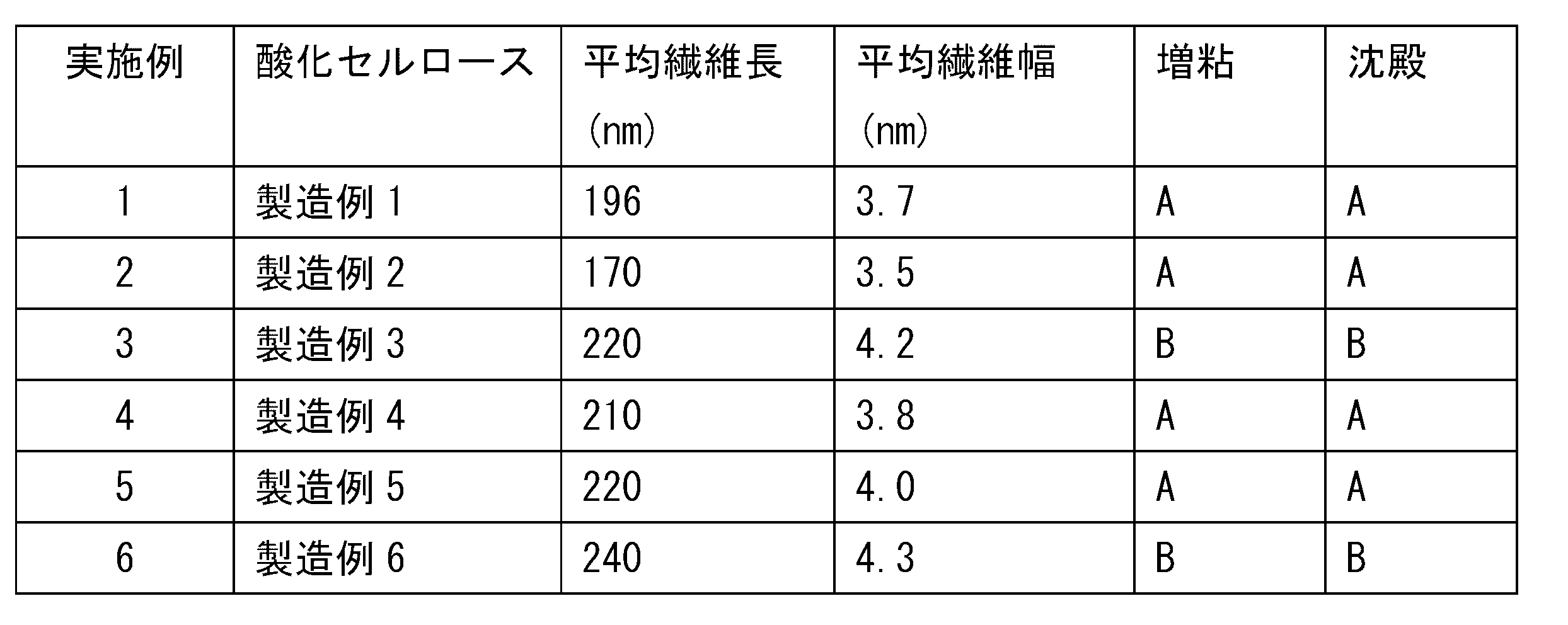
製造例1の酸化セルロースをホモミキサーにて10,000rpm、10分間分散処理の条件により解繊し、ナノセルロースの水分散体(濃度:1.0質量%)を得た。水分散体を分析した結果、平均繊維長165nm、平均繊維幅4.2nmのナノセルロースであった。続いて、得られたCNF水分散体はエバポレーターにて適宜濃縮した後、酸化亜鉛(平均粒子径20nm)10質量%、ナノセルロース5質量%、となるように純水を加えて調整し、混合物を得た。混合物は増粘しており、沈殿は見られなかった。
製造例2~6の酸化セルロースを用いたこと以外は、実施例7と同様にしてナノセルロース含有組成物を得た。
表中の「増粘」及び「沈殿」の評価基準は表2と同様である。
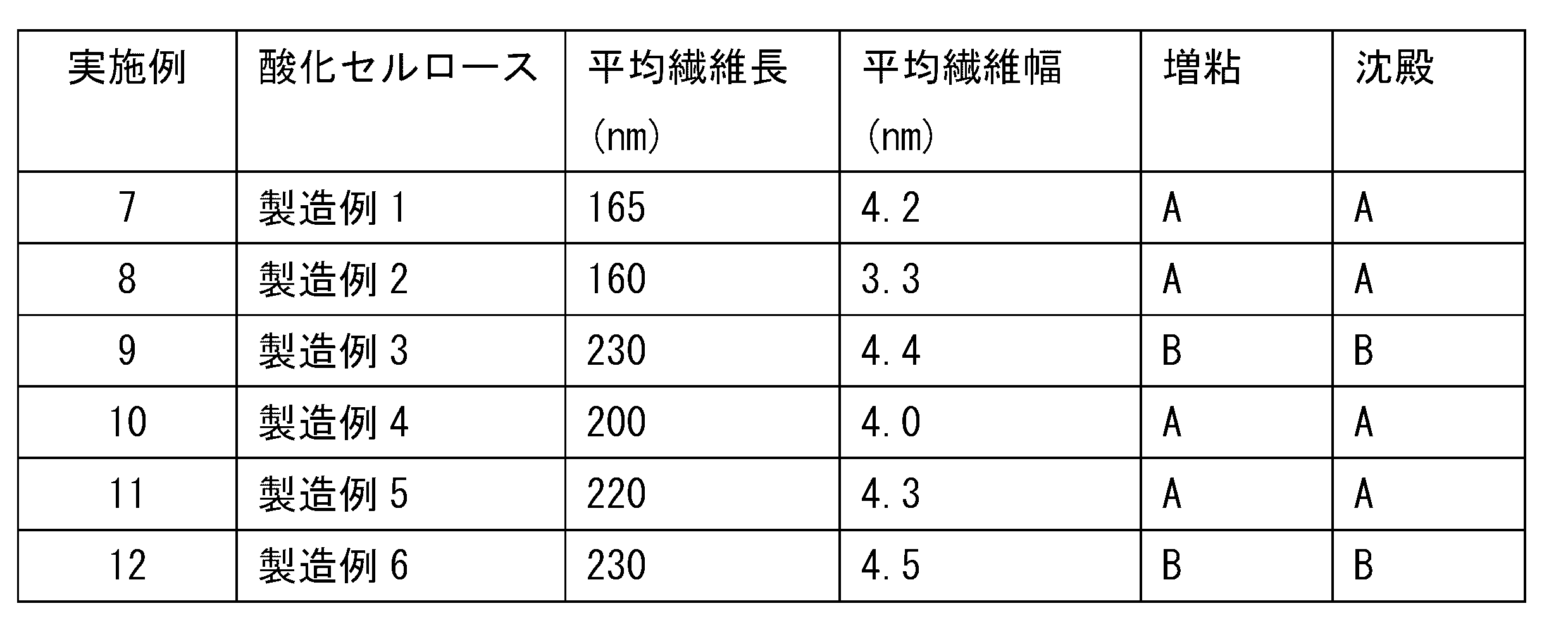
ホモミキサーでの撹拌による分散処理を行わなかったこと以外は、実施例1と同様にして混合物を得た。この混合物を2日間、23℃で静置させたところ、増粘が見られず、酸化亜鉛の沈殿が見られた。増粘が見られず、かつ、沈殿が見られたことから、微細化が進行しなかったことが明らかとなった。すなわち、ナノセルロース含有組成物を得ることができなかった。
光学顕微鏡(ニコン株式会社製、品番:LV100ND)で透過位相差観察したところ、酸化セルロースが微細化せず、粗大なままであった。また、上記混合物を〔繊維長と繊維幅の測定方法〕にて分析できなかったため、ナノセルロースを観察できず、平均繊維長、及び平均繊維幅を算出しなかった。
(酸化セルロースの調製)
TEMPO酸化により、酸化セルロースを調製した。ビーカーに、TEMPOを0.8g及び臭化ナトリウムを5.0g、純水を加えて撹拌して水溶液とした。
上記水溶液を新東科学社製の撹拌機(スリーワンモータ、BL600)にてプロペラ型撹拌羽根を使用して200rpmで撹拌しながら恒温水浴にて25℃に加温した後、セルロース系原料として、ティーディーアイ社の粉末パルプ(VP-1)を50g加えた。
0.1M水酸化ナトリウムを加えて撹拌し、pH10.0の水溶液とした。そこへ、有効塩素濃度13.2質量%の次亜塩素酸ナトリウム水溶液129gを加え、同じ恒温水槽で25℃に保温した状態で、0.1M水酸化ナトリウムを添加しながら反応中のpHを10.0に調整して、2時間撹拌を行った。反応終了後、遠心分離(1000G、10分間)及びデカンテーションを繰り返すことにより、酸化セルロースを回収した。
(CNF配合組成物の調製)
TEMPO酸化により得られた酸化セルロースを用い、酸化亜鉛(平均粒子径20nm)10質量%、TEMPO酸化セルロース5質量%、となるように純水を加えて調整し、それをホモミキサーにて10,000rpm、10分間撹拌した。
光学顕微鏡(ニコン株式会社製、品番:LV100ND)で透過位相差観察したところ、酸化セルロースが微細化せず、粗大なままであった。また、上記混合物を〔繊維長と繊維幅の測定方法〕にて分析した結果できなかったため、ナノセルロースを観察できず、平均繊維長、及び平均繊維幅を算出しなかった。
Claims (12)
- ナノセルロースを含有する組成物の製造方法であって、
酸化セルロースと、前記組成物を構成する前記ナノセルロース以外の成分と、を含む混合物を撹拌することにより、前記酸化セルロースを前記ナノセルロースに解繊する工程を含み、
前記酸化セルロースが、次亜塩素酸又はその塩によるセルロース系原料の酸化物を含む、
製造方法。 - 前記混合物が、さらに分散媒を含む、
請求項1に記載の製造方法。 - ナノセルロースを含有する組成物の製造方法であって、
酸化セルロースを撹拌することにより、前記酸化セルロースを前記ナノセルロースに解繊し、連続して、前記組成物を構成する前記ナノセルロース以外の成分を添加する工程を含み、
前記酸化セルロースが、次亜塩素酸又はその塩によるセルロース系原料の酸化物を含む、
製造方法。 - 前記酸化セルロースの撹拌と前記成分の添加とがワンポットで行われる、
請求項3に記載の製造方法。 - 前記酸化セルロースが分散媒に分散されている、
請求項3又は4に記載の製造方法。 - 前記酸化セルロースが、N-オキシル化合物を実質的に含まない、
請求項1~5のいずれか一項に記載の製造方法。 - 前記酸化セルロースの重合度が、600以下である、
請求項1~6のいずれか一項に記載の製造方法。 - 前記酸化セルロースの濃度0.1質量%水分散液を自転公転撹拌機にて公転速度2000rpm、且つ、自転速度800rpmで10分間の条件にて解繊処理することにより得られるナノセルロース水分散液の光透過率が60%以上である、
請求項1~7のいずれか一項に記載の製造方法。 - 前記撹拌が、液中分散機により行われる、
請求項1~8のいずれか一項に記載の製造方法。 - 前記成分が、無機粒子を含む、
請求項1~9のいずれか一項に記載の製造方法。 - 前記成分が、樹脂若しくはゴム、又はそれらの原料モノマーを含む、
請求項1~10のいずれか一項に記載の製造方法。 - 前記組成物に含まれる前記酸化セルロース及び前記ナノセルロースの合計量が、前記組成物を構成する成分(ただし、溶媒及び分散媒を除く)の合計質量を基準として、0.1~90質量%である、
請求項1~11のいずれか一項に記載の製造方法。
Priority Applications (4)
| Application Number | Priority Date | Filing Date | Title |
|---|---|---|---|
| JP2022561986A JP7778290B2 (ja) | 2020-11-13 | 2021-11-11 | ナノセルロース含有組成物の製造方法 |
| CN202180074888.1A CN116390983A (zh) | 2020-11-13 | 2021-11-11 | 含纳米纤维素的组合物的制造方法 |
| EP21891948.8A EP4245804A4 (en) | 2020-11-13 | 2021-11-11 | Method for manufacturing nanocellulose-containing composition |
| US18/036,467 US20240010756A1 (en) | 2020-11-13 | 2021-11-11 | Production method of nanocellulose-containing composition |
Applications Claiming Priority (2)
| Application Number | Priority Date | Filing Date | Title |
|---|---|---|---|
| JP2020189128 | 2020-11-13 | ||
| JP2020-189128 | 2020-11-13 |
Publications (1)
| Publication Number | Publication Date |
|---|---|
| WO2022102703A1 true WO2022102703A1 (ja) | 2022-05-19 |
Family
ID=81601310
Family Applications (1)
| Application Number | Title | Priority Date | Filing Date |
|---|---|---|---|
| PCT/JP2021/041521 Ceased WO2022102703A1 (ja) | 2020-11-13 | 2021-11-11 | ナノセルロース含有組成物の製造方法 |
Country Status (5)
| Country | Link |
|---|---|
| US (1) | US20240010756A1 (ja) |
| EP (1) | EP4245804A4 (ja) |
| JP (1) | JP7778290B2 (ja) |
| CN (1) | CN116390983A (ja) |
| WO (1) | WO2022102703A1 (ja) |
Cited By (3)
| Publication number | Priority date | Publication date | Assignee | Title |
|---|---|---|---|---|
| WO2023219076A1 (ja) * | 2022-05-10 | 2023-11-16 | 東亞合成株式会社 | ゴム組成物、及びその製造方法 |
| WO2024142811A1 (ja) * | 2022-12-26 | 2024-07-04 | 東亞合成株式会社 | ゴム組成物及びゴム |
| WO2024142813A1 (ja) * | 2022-12-26 | 2024-07-04 | 東亞合成株式会社 | ゴム組成物及びゴム |
Families Citing this family (2)
| Publication number | Priority date | Publication date | Assignee | Title |
|---|---|---|---|---|
| JP7705602B2 (ja) * | 2020-07-09 | 2025-07-10 | 東亞合成株式会社 | ナノセルロース及びその分散液 |
| CN118271710B (zh) * | 2024-04-12 | 2025-09-05 | 成都大学 | 一种纤维素纳米纤维辅助分散羟基磷灰石纳米线的方法和分散液 |
Citations (8)
| Publication number | Priority date | Publication date | Assignee | Title |
|---|---|---|---|---|
| WO2015068818A1 (ja) | 2013-11-08 | 2015-05-14 | Dic株式会社 | セルロースナノファイバーの製造方法、セルロースナノファイバー製造用パルプ、セルロースナノファイバー、樹脂組成物及び成形体 |
| JP2017193814A (ja) * | 2016-04-13 | 2017-10-26 | 関東電化工業株式会社 | セルロースナノファイバーの分散液およびその製造方法 |
| JP2018062657A (ja) * | 2016-10-13 | 2018-04-19 | 日本製紙株式会社 | ゴム組成物及び成形品 |
| WO2018230354A1 (ja) | 2017-06-16 | 2018-12-20 | 東亞合成株式会社 | セルロースナノファイバーの製造方法 |
| WO2019235557A1 (ja) * | 2018-06-08 | 2019-12-12 | 花王株式会社 | 短繊維化アニオン変性セルロース繊維の製造方法 |
| WO2020027307A1 (ja) | 2018-08-03 | 2020-02-06 | 東亞合成株式会社 | 酸化セルロース、酸化セルロースおよびナノセルロースの製造方法ならびにナノセルロース分散液 |
| WO2020080393A1 (ja) * | 2018-10-16 | 2020-04-23 | 王子ホールディングス株式会社 | 繊維状セルロース、繊維状セルロース分散液及び繊維状セルロースの製造方法 |
| JP2020128513A (ja) | 2019-02-12 | 2020-08-27 | 日本製紙株式会社 | 食器用複合体および成形品 |
Family Cites Families (3)
| Publication number | Priority date | Publication date | Assignee | Title |
|---|---|---|---|---|
| JP2012025949A (ja) * | 2010-06-25 | 2012-02-09 | Mitsubishi Chemicals Corp | 微細セルロース繊維分散液およびセルロース繊維複合体並びにその製造方法 |
| PT3445900T (pt) * | 2016-04-22 | 2022-09-19 | Fiberlean Tech Ltd | Fibras compreendendo celulose microfibrilada e métodos de fibras e materiais não tecidos das mesmas |
| WO2020184177A1 (ja) * | 2019-03-12 | 2020-09-17 | 東亞合成株式会社 | 樹脂改質剤の製造方法、樹脂改質剤及び複合材料 |
-
2021
- 2021-11-11 WO PCT/JP2021/041521 patent/WO2022102703A1/ja not_active Ceased
- 2021-11-11 EP EP21891948.8A patent/EP4245804A4/en not_active Withdrawn
- 2021-11-11 JP JP2022561986A patent/JP7778290B2/ja active Active
- 2021-11-11 US US18/036,467 patent/US20240010756A1/en active Pending
- 2021-11-11 CN CN202180074888.1A patent/CN116390983A/zh active Pending
Patent Citations (8)
| Publication number | Priority date | Publication date | Assignee | Title |
|---|---|---|---|---|
| WO2015068818A1 (ja) | 2013-11-08 | 2015-05-14 | Dic株式会社 | セルロースナノファイバーの製造方法、セルロースナノファイバー製造用パルプ、セルロースナノファイバー、樹脂組成物及び成形体 |
| JP2017193814A (ja) * | 2016-04-13 | 2017-10-26 | 関東電化工業株式会社 | セルロースナノファイバーの分散液およびその製造方法 |
| JP2018062657A (ja) * | 2016-10-13 | 2018-04-19 | 日本製紙株式会社 | ゴム組成物及び成形品 |
| WO2018230354A1 (ja) | 2017-06-16 | 2018-12-20 | 東亞合成株式会社 | セルロースナノファイバーの製造方法 |
| WO2019235557A1 (ja) * | 2018-06-08 | 2019-12-12 | 花王株式会社 | 短繊維化アニオン変性セルロース繊維の製造方法 |
| WO2020027307A1 (ja) | 2018-08-03 | 2020-02-06 | 東亞合成株式会社 | 酸化セルロース、酸化セルロースおよびナノセルロースの製造方法ならびにナノセルロース分散液 |
| WO2020080393A1 (ja) * | 2018-10-16 | 2020-04-23 | 王子ホールディングス株式会社 | 繊維状セルロース、繊維状セルロース分散液及び繊維状セルロースの製造方法 |
| JP2020128513A (ja) | 2019-02-12 | 2020-08-27 | 日本製紙株式会社 | 食器用複合体および成形品 |
Non-Patent Citations (2)
| Title |
|---|
| CHEM. ENG., vol. 8, 4 August 2020 (2020-08-04), pages 17800 - 17806 |
| See also references of EP4245804A4 |
Cited By (3)
| Publication number | Priority date | Publication date | Assignee | Title |
|---|---|---|---|---|
| WO2023219076A1 (ja) * | 2022-05-10 | 2023-11-16 | 東亞合成株式会社 | ゴム組成物、及びその製造方法 |
| WO2024142811A1 (ja) * | 2022-12-26 | 2024-07-04 | 東亞合成株式会社 | ゴム組成物及びゴム |
| WO2024142813A1 (ja) * | 2022-12-26 | 2024-07-04 | 東亞合成株式会社 | ゴム組成物及びゴム |
Also Published As
| Publication number | Publication date |
|---|---|
| EP4245804A1 (en) | 2023-09-20 |
| EP4245804A4 (en) | 2024-09-25 |
| JPWO2022102703A1 (ja) | 2022-05-19 |
| US20240010756A1 (en) | 2024-01-11 |
| CN116390983A (zh) | 2023-07-04 |
| JP7778290B2 (ja) | 2025-12-02 |
Similar Documents
| Publication | Publication Date | Title |
|---|---|---|
| JP7778290B2 (ja) | ナノセルロース含有組成物の製造方法 | |
| JP7636723B2 (ja) | 酸化セルロース、ナノセルロース及びそれらの分散液 | |
| CN101772517B (zh) | 轻度氧化的纤维素的纳米粒子 | |
| EP3831856A1 (en) | Oxidized cellulose, method for producing oxidized cellulose and nano-cellulose, and nano-cellulose dispersion | |
| JP7842980B2 (ja) | ナノセルロース及びその分散液 | |
| JP2026021436A (ja) | 酸化セルロース及びナノセルロースの製造方法 | |
| JP2023084702A (ja) | ナノセルロースの乾燥物及びナノセルロース分散液 | |
| WO2022239761A1 (ja) | 繊維材料及び複合材料、並びにそれらの製造方法 | |
| JP7805952B2 (ja) | 塩化ビニル樹脂組成物及びその製造方法、並びに成形体 | |
| JP7746674B2 (ja) | 酸化セルロース及びナノセルロースの製造方法、並びに、酸化剤 | |
| JP2023013727A (ja) | 酸化セルロース、ナノセルロース及びそれらの分散液 | |
| JP7787489B2 (ja) | ナノセルロースの製造方法 | |
| WO2022118888A1 (ja) | 樹脂組成物、樹脂組成物の製造方法、及び樹脂 | |
| JP7649459B2 (ja) | ナノセルロース及びその分散液並びにその製造方法 | |
| JP2023084701A (ja) | 酸化セルロースの乾燥物、酸化セルロースの分散液、及びナノセルロース | |
| WO2024142811A1 (ja) | ゴム組成物及びゴム | |
| WO2022186241A1 (ja) | 不織布用バインダー組成物、及び不織布 |
Legal Events
| Date | Code | Title | Description |
|---|---|---|---|
| 121 | Ep: the epo has been informed by wipo that ep was designated in this application |
Ref document number: 21891948 Country of ref document: EP Kind code of ref document: A1 |
|
| ENP | Entry into the national phase |
Ref document number: 2022561986 Country of ref document: JP Kind code of ref document: A |
|
| WWE | Wipo information: entry into national phase |
Ref document number: 18036467 Country of ref document: US |
|
| NENP | Non-entry into the national phase |
Ref country code: DE |
|
| ENP | Entry into the national phase |
Ref document number: 2021891948 Country of ref document: EP Effective date: 20230613 |
|
| WWW | Wipo information: withdrawn in national office |
Ref document number: 2021891948 Country of ref document: EP |