WO2022107331A1 - Papier d'empâtage pour batteries de stockage au plomb - Google Patents
Papier d'empâtage pour batteries de stockage au plomb Download PDFInfo
- Publication number
- WO2022107331A1 WO2022107331A1 PCT/JP2020/043473 JP2020043473W WO2022107331A1 WO 2022107331 A1 WO2022107331 A1 WO 2022107331A1 JP 2020043473 W JP2020043473 W JP 2020043473W WO 2022107331 A1 WO2022107331 A1 WO 2022107331A1
- Authority
- WO
- WIPO (PCT)
- Prior art keywords
- fiber
- lead
- less
- conductive material
- weight
- Prior art date
- Legal status (The legal status is an assumption and is not a legal conclusion. Google has not performed a legal analysis and makes no representation as to the accuracy of the status listed.)
- Ceased
Links
Images

Classifications
-
- H—ELECTRICITY
- H01—ELECTRIC ELEMENTS
- H01M—PROCESSES OR MEANS, e.g. BATTERIES, FOR THE DIRECT CONVERSION OF CHEMICAL ENERGY INTO ELECTRICAL ENERGY
- H01M50/00—Constructional details or processes of manufacture of the non-active parts of electrochemical cells other than fuel cells, e.g. hybrid cells
- H01M50/40—Separators; Membranes; Diaphragms; Spacing elements inside cells
- H01M50/409—Separators, membranes or diaphragms characterised by the material
- H01M50/44—Fibrous material
-
- H—ELECTRICITY
- H01—ELECTRIC ELEMENTS
- H01M—PROCESSES OR MEANS, e.g. BATTERIES, FOR THE DIRECT CONVERSION OF CHEMICAL ENERGY INTO ELECTRICAL ENERGY
- H01M50/00—Constructional details or processes of manufacture of the non-active parts of electrochemical cells other than fuel cells, e.g. hybrid cells
- H01M50/40—Separators; Membranes; Diaphragms; Spacing elements inside cells
- H01M50/409—Separators, membranes or diaphragms characterised by the material
- H01M50/411—Organic material
- H01M50/429—Natural polymers
- H01M50/4295—Natural cotton, cellulose or wood
-
- H—ELECTRICITY
- H01—ELECTRIC ELEMENTS
- H01M—PROCESSES OR MEANS, e.g. BATTERIES, FOR THE DIRECT CONVERSION OF CHEMICAL ENERGY INTO ELECTRICAL ENERGY
- H01M50/00—Constructional details or processes of manufacture of the non-active parts of electrochemical cells other than fuel cells, e.g. hybrid cells
- H01M50/40—Separators; Membranes; Diaphragms; Spacing elements inside cells
- H01M50/409—Separators, membranes or diaphragms characterised by the material
- H01M50/431—Inorganic material
- H01M50/434—Ceramics
- H01M50/437—Glass
-
- H—ELECTRICITY
- H01—ELECTRIC ELEMENTS
- H01M—PROCESSES OR MEANS, e.g. BATTERIES, FOR THE DIRECT CONVERSION OF CHEMICAL ENERGY INTO ELECTRICAL ENERGY
- H01M50/00—Constructional details or processes of manufacture of the non-active parts of electrochemical cells other than fuel cells, e.g. hybrid cells
- H01M50/40—Separators; Membranes; Diaphragms; Spacing elements inside cells
- H01M50/409—Separators, membranes or diaphragms characterised by the material
- H01M50/446—Composite material consisting of a mixture of organic and inorganic materials
-
- H—ELECTRICITY
- H01—ELECTRIC ELEMENTS
- H01M—PROCESSES OR MEANS, e.g. BATTERIES, FOR THE DIRECT CONVERSION OF CHEMICAL ENERGY INTO ELECTRICAL ENERGY
- H01M50/00—Constructional details or processes of manufacture of the non-active parts of electrochemical cells other than fuel cells, e.g. hybrid cells
- H01M50/40—Separators; Membranes; Diaphragms; Spacing elements inside cells
- H01M50/489—Separators, membranes, diaphragms or spacing elements inside the cells, characterised by their physical properties, e.g. swelling degree, hydrophilicity or shut down properties
- H01M50/497—Ionic conductivity
-
- Y—GENERAL TAGGING OF NEW TECHNOLOGICAL DEVELOPMENTS; GENERAL TAGGING OF CROSS-SECTIONAL TECHNOLOGIES SPANNING OVER SEVERAL SECTIONS OF THE IPC; TECHNICAL SUBJECTS COVERED BY FORMER USPC CROSS-REFERENCE ART COLLECTIONS [XRACs] AND DIGESTS
- Y02—TECHNOLOGIES OR APPLICATIONS FOR MITIGATION OR ADAPTATION AGAINST CLIMATE CHANGE
- Y02E—REDUCTION OF GREENHOUSE GAS [GHG] EMISSIONS, RELATED TO ENERGY GENERATION, TRANSMISSION OR DISTRIBUTION
- Y02E60/00—Enabling technologies; Technologies with a potential or indirect contribution to GHG emissions mitigation
- Y02E60/10—Energy storage using batteries
-
- Y—GENERAL TAGGING OF NEW TECHNOLOGICAL DEVELOPMENTS; GENERAL TAGGING OF CROSS-SECTIONAL TECHNOLOGIES SPANNING OVER SEVERAL SECTIONS OF THE IPC; TECHNICAL SUBJECTS COVERED BY FORMER USPC CROSS-REFERENCE ART COLLECTIONS [XRACs] AND DIGESTS
- Y02—TECHNOLOGIES OR APPLICATIONS FOR MITIGATION OR ADAPTATION AGAINST CLIMATE CHANGE
- Y02P—CLIMATE CHANGE MITIGATION TECHNOLOGIES IN THE PRODUCTION OR PROCESSING OF GOODS
- Y02P70/00—Climate change mitigation technologies in the production process for final industrial or consumer products
- Y02P70/50—Manufacturing or production processes characterised by the final manufactured product
Definitions
- the present invention is the pole of lead-acid batteries for automobiles and communication base stations used mainly in recent idling stop and start (hereinafter referred to as ISS) systems, and long-life lead-acid batteries used for stationary backup. Regarding pasting paper that comes in contact with the board.
- ISS recent idling stop and start
- lead-acid batteries are not only used for conventional engine start, but also for electric power supply to the electrical system when the engine is stopped.
- the charge / discharge cycle is performed more frequently than ever, and the battery is not always in a fully charged state.
- the water in the electrolytic solution is electrolyzed, and the gas generated by the electrolysis of water stirs the electrolytic solution in the battery, causing the electrolytic solution to diffuse.
- the specific gravity (concentration) of the electrolytic solution is kept uniform.
- the pacing paper has a problem in the durability of the pacing paper itself (protection against dropping of the electrode plate active material in the electrode plate kneading process, durability against an electrolytic solution, and shape retention). Further, since the fiber diameter is large, the maximum pore diameter becomes 100 ⁇ m or more, the electrolytic solution cannot be retained, and the stratification of the electrolytic solution cannot be effectively prevented.
- Patent Document 1 since at least 20% of natural fibers that are not resistant to the electrolytic solution (sulfuric acid solution) are blended, at least 20% of the mass disappears when the natural fiber is put into the electrolytic solution, which is a sufficient electrode plate. It cannot contribute to the prevention of falling off of active materials. Further, as the heat-sealable fiber, a thick fiber having a fiber diameter (average fiber diameter) of 1 denier or more is generally used, so that the holding amount of the electrolytic solution is small and the electrolytic solution is stratified. Cannot contribute to prevention.
- Patent Document 2 although 50 wt% or more of glass fiber having electrolytic solution resistance is blended to improve the resistance of the non-woven fabric, the glass fiber used is very large with a diameter of 5 to 8 ⁇ m and a diameter of 11 to 14 ⁇ m. Since a fiber having a large fiber diameter is used for the fiber, it merely serves to hold the electrode plate of the battery and cannot hold the electrolytic solution, so that it cannot contribute to the prevention of stratification of the electrolytic solution.
- Patent Document 3 and Patent Document 4 present a substitute for a glass mat material as a paste paper in contact with a electrode plate, and the fiber used has a fiber diameter (average fiber diameter) of 1. It is described that the battery performance is improved by the effect of suppressing the active material from falling off of the electrode plate because the fiber is cut to a predetermined length from the fiber that is continuously manufactured by denier (about 8 ⁇ m) or more. ing.
- the maximum pore diameter of a non-woven fabric composed of very thick fibers having a fiber diameter (average fiber diameter) of 8 ⁇ m or more cannot be measured by the general bubble point method, and the measurement limit is increased by about 100 ⁇ m. It will have a large pore diameter that exceeds it.
- the nonwoven fabric having a very large maximum pore diameter does not have a function of preventing the stratification of the electrolytic solution in the ISS system in which a lead storage battery is used in recent years. Therefore, in order to suppress the stratification of the electrolytic solution, a non-woven fabric made of fine fibers having a fiber diameter (average fiber diameter) of 2 ⁇ m or less is required, but conventional wool-like fine glass fibers are required. Although the stratification of the electrolytic solution can be suppressed due to its high insulating property, the electric resistance between the electrode plates of the battery increases, so that the characteristics such as high rate discharge characteristics (High-Rate) and charge acceptability deteriorate. (See Japanese Patent No. 2576277).
- the charge / discharge reaction of the battery is frequently performed, so that the improvement of the charge acceptability of the battery is more important than the discharge characteristic of the battery.
- Lead-acid batteries used in recent ISS systems are required to have both suppression of stratification of an electrolytic solution, high-rate discharge characteristics, and charge acceptability.
- the present invention has been made in consideration of such circumstances, and is a pacing paper for a lead storage battery that achieves both suppression of stratification of an electrolytic solution, high rate discharge characteristics, and charge acceptability in a lead storage battery used in an ISS system.
- the purpose is to provide.
- the lead-acid battery pacing paper of the present invention is a lead-acid battery pacing paper having the following characteristics.
- a non-woven fabric composed of insulating fibers and a conductive material, wherein the average fiber diameter in the nonwoven fabric is 2.0 ⁇ m or less, and the conductive material is distributed in the non-woven fabric in a non-uniform state.
- a pacing paper for a lead storage battery in which the variation coefficient of the sheet resistivity of the non-woven fabric is 0.03 or more.
- a pacing paper for a lead-acid battery that has both suppression of stratification of an electrolytic solution, high rate discharge characteristics, and charge acceptability.
- the insulating fiber may be an organic fiber or an inorganic fiber.
- organic fibers include cellulose esters such as cellulose, carboxymethyl cellulose and cellulose acetate, cellulose-based fiber materials such as lignocellulose, neutral mucopolysaccharide-based fiber materials such as chitin and chitosan, and aliphatic nylons.
- Synthetic resin-based fiber materials made of polyamides such as aromatic nylon (aramid), polyolefins such as polyethylene and polypropylene, and resins such as vinylon, polyester, polyimide, polyamideimide, and polyvinylidene fluoride can be mentioned.
- a synthetic resin-based fiber material made of a polyolefin such as polyethylene or polypropylene, a resin such as vinylon, polyester, polyimide, polyamideimide, or polyvinylidene fluoride is more preferable.
- the inorganic fiber include glass fiber, silica alumina fiber (ceramic fiber), rock wool and the like.
- a material having high resistance to an electrolytic solution (sulfuric acid) and insoluble in an electrolytic solution (sulfuric acid) is preferable, and glass fiber having high sulfuric acid resistance and high strength (tensile strength of the produced nonwoven fabric) is more preferable. preferable.
- the average fiber diameter of the insulating fiber is preferably 20 ⁇ m or less, more preferably 10 ⁇ m or less, and 4.0 ⁇ m or less, from the viewpoint of preventing the maximum pore diameter in the produced nonwoven fabric from becoming 100 ⁇ m or more. Is particularly preferred.
- the conductive material may be in the form of particles or fibers, but a fibrous material capable of effectively reducing the sheet resistance is preferable.
- fibrous conductive materials carbon fibers such as polyacrylonitrile-based (PAN-based) carbon fiber, rayon-based carbon fiber, pitch-based carbon fiber, carbon nanotube, vapor phase growth carbon fiber (VGCF), and carbon are used.
- a material having high sulfuric acid resistance and insoluble in an electrolytic solution is preferable
- carbon fiber having high sulfuric acid resistance and high strength (tensile strength of the produced nonwoven fabric) is preferable
- PAN-based carbon fiber is preferable.
- the average fiber diameter of the conductive material is preferably 20 ⁇ m or less, more preferably 10 ⁇ m or less, and 7 ⁇ m or less, from the viewpoint of preventing the maximum pore diameter in the produced nonwoven fabric from becoming 100 ⁇ m or more. Is particularly preferred.
- the average fiber length of the conductive material is preferably 6 mm or less in order to distribute the conductive material in the non-woven fabric in a non-uniform state.
- the conductive material is distributed in a non-uniform state in the nonwoven fabric.
- the reaction between the active material and the electrolytic solution at the time of discharge is caused by the better flow of electricity in the vicinity of the conductive material. It progresses faster than the area around the insulating fiber, resulting in a difference in the size of the crystals of lead sulfate produced.
- the lead sulfate produced becomes small crystals (around the conductive material) when the reaction rate is high (around the conductive material), and large crystals (around the insulating fiber) when the reaction rate is slow (around the insulating fiber).
- the specific surface area is small).
- the small crystals which have a large specific surface area
- the lead sulfate crystals can be restored to the active material without wasting the charging current, and the charge acceptability is improved. Will be able to.
- the entire non-woven fabric is made of a conductive material, the internal resistance of the entire battery is lowered and the discharge characteristics are improved, but the size (specific surface area) of the lead sulfate crystals generated during discharge is uniform. Since there is no difference in the reaction (recovery to the active material) during charging, improvement in charge acceptability cannot be expected.
- the coefficient of variation ( ⁇ / AVE) of the sheet resistivity was evaluated as an index showing the degree to which the conductive material is distributed in the non-woven fabric in a non-uniform state.
- the coefficient of variation ( ⁇ / AVE) of the sheet resistance is the average value (AVE) and standard deviation ( ⁇ ) of the sheet resistance measured at any 10 points where the measurement points are separated by 50 mm or more. was calculated and calculated.
- the coefficient of variation ( ⁇ / AVE) of the sheet resistivity is preferably 0.03 or more.
- the blending amount of the conductive material is preferably 1.0% by weight or more and less than 75% by weight, more preferably 3.0% by weight or more and less than 40% by weight.
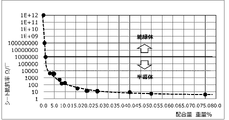
- the graph of FIG. 1 shows that the sheet resistivity is lowered by blending the glass fiber, which is an insulating fiber, with the carbon fiber, which is a material having conductivity. The more the carbon fiber, which is a conductive material, is blended, the more the effect of lowering the resistance value of the entire sheet is exhibited, and the High-Rate characteristic becomes advantageous.
- FIG. 1 shows that the region of an insulator can be removed by setting the blending amount of carbon fiber, which is a conductive material, to 1.0% by weight or more with respect to glass fiber, which is an insulating fiber.
- the sheet resistivity becomes 5000 ⁇ / ⁇ or less, and it can be in the semiconductor region, so that the High-Rate characteristic becomes more advantageous.
- the blending amount of carbon fibers is 75% by weight or more, the average fiber diameter in the nonwoven fabric becomes large, and accordingly, the maximum pore diameter in the nonwoven fabric becomes 100 ⁇ m or more, and the nonwoven fabric retains the electrolytic solution. Since the force of the electrolytic solution is reduced, the sulfuric acid released from the electrode plate cannot be retained during charging, which causes stratification of the electrolytic solution.
- the non-woven fabric used for the lead-acid battery pacing paper of the present invention preferably has a sheet strength (tensile strength) of 0.2 N / mm 2 or more, preferably 0.5 N / mm, in order to prevent breakage in the battery assembly process. It is more preferably mm 2 or more.
- the thickness of the nonwoven fabric is preferably 0.1 to 0.3 mm. When the thickness of the nonwoven fabric is less than 0.1 mm, the total amount of the electrolytic solution that can be held by the nonwoven fabric decreases, so that the function of preventing stratification of the electrolytic solution decreases. If the thickness of the non-woven fabric exceeds 0.3 mm, the distance between the electrode plates of the battery becomes wide and the battery characteristics deteriorate. In this case, it is possible to reduce the film thickness of the separator used together for the purpose of maintaining the spacing between the plates, but this is not preferable because the risk of causing a dendrite short circuit at an early stage increases.
- the maximum pore diameter of the nonwoven fabric is preferably less than 100 ⁇ m, more preferably 40 ⁇ m or less from the viewpoint of preventing stratification of the electrolytic solution.
- the average fiber diameter of the fibers in the nonwoven fabric is preferably 2.0 ⁇ m or less.
- a reinforcing material such as a heat-sealing organic fiber having sulfuric acid resistance and a cellulose fiber is used. May be added.
- the blending amount of these reinforcing materials is preferably 30% by weight or less. If it exceeds 30% by weight, the maximum pore diameter in the nonwoven fabric becomes 100 ⁇ m or more, and the nonwoven fabric has a reduced ability to hold the electrolytic solution, which causes stratification of the electrolytic solution during charging. Further, it is preferable that the total amount of the components dissolved in the sulfuric acid solution of the reinforcing material to be added is 5% by weight or less.
- the mass of at least 5% by weight will be lost when the components are put into the electrolytic solution, and it will not be possible to sufficiently contribute to the prevention of the electrode plate active material from falling off.
- the nonwoven fabrics used for the pacing papers of Examples 1 to 13 and Comparative Examples 1 to 7 were prepared by the following procedure according to the formulations shown in Tables 1 and 2.
- 2.5 g of the raw material was placed in a container of a mixer (National Cooking Mixer MX-915C), 1000 ml of acidic sulfuric acid water having a pH of 3.0 was added, and the mixture was stirred for 1 minute.
- 500 ml of the stirred slurry was placed in an experimental tappy (hand-made sheet preparation device), and 5 to 10 L of acidic sulfuric acid water having a pH of 3.0 was added and stirred.
- dehydration was performed to prepare a wet papermaking sheet.
- a non-woven fabric was prepared by curing in a dryer at 130 ° C. for 1 minute.
- a test piece having a diameter of 30 mm was used as a punched sample from the prepared nonwoven fabric. After thoroughly immersing the sample in ethanol so that no bubbles remained, the sample was set in a measuring instrument so that the upper part of the sample was filled with ethanol. Pressure was gradually applied from the bottom of the sample, air was blown, and the air pressure when bubbles that passed through the sample came out was measured with a manometer. The value of the maximum pore diameter was calculated by the following formula.
- Sheet resistivity ( ⁇ / ⁇ ) To measure the sheet resistivity, use a non-contact resistivity measuring device (SRM-14 type manufactured by NAGY) when the sheet resistivity is 800 ⁇ / ⁇ or less, and when the sheet resistivity exceeds 800 ⁇ / ⁇ , the contact resistivity The measurement was performed using a measuring instrument (EC-80P type manufactured by Napson Corporation). In the measurement, the prepared nonwoven fabric was cut to an arbitrary width, and measurements were taken at any 10 points where the measurement points were separated by 50 mm or more, and the average value was taken as the sheet resistance ( ⁇ / ⁇ ).
- Tables 1 and 2 show the evaluation results of Examples 1 to 13 and Comparative Examples 1 to 7.
- FIG. 2 shows the relationship between the blending amount of carbon fibers and the coefficient of variation ( ⁇ / AVE) of the sheet resistivity obtained from the experimental results of Examples 1 to 13 and Comparative Examples 4 to 7.
- the coefficient of variation of the sheet resistivity increases, and the blending amount is 7.5% by weight at the maximum. It became. After that, the coefficient of variation of the sheet resistivity became small and became almost constant when the blending amount was 50% by weight or more.
- Tables 1 and 2 and FIG. 2 it can be seen that when the carbon fibers used are pitch-based and PAN-based, the sheet resistivity tends to be larger and the coefficient of variation of the sheet resistivity tends to be larger. rice field.
- the conductive material is distributed in a non-uniform state, causing a local variation in the reaction rate between the active material on the electrode surface and the electrolytic solution, which is generated by the reaction. It is considered that there was a difference in the size of lead sulfate.
- Lead sulfate produced by the discharge reaction has the property of forming small crystals with a large specific surface area when the reaction rate is fast, and forming large crystals when the reaction rate is slow. It is probable that the lead sulfate crystals could be recovered to the active material without wasting the charging current, and the charge acceptability could be improved.
- the nonwoven fabric used for the pacing paper of the example has a higher sheet strength (tensile force) than that of the conventional pacing paper. It has been shown to have high high rate discharge characteristics and charge acceptability while maintaining strength), electrolyte stratification inhibitory ability (small maximum pore diameter), and discharge characteristics, and is an excellent pacing paper for lead-acid batteries. Was confirmed to be provided.
Landscapes
- Chemical & Material Sciences (AREA)
- Chemical Kinetics & Catalysis (AREA)
- Electrochemistry (AREA)
- General Chemical & Material Sciences (AREA)
- Engineering & Computer Science (AREA)
- Inorganic Chemistry (AREA)
- Wood Science & Technology (AREA)
- Ceramic Engineering (AREA)
- Life Sciences & Earth Sciences (AREA)
- Composite Materials (AREA)
- Materials Engineering (AREA)
- Cell Separators (AREA)
- Battery Electrode And Active Subsutance (AREA)
Abstract
Le problème décrit par la présente invention est de fournir un papier d'empâtage pour des batteries de stockage au plomb, ledit papier d'empâtage permettant qu'une batterie de stockage au plomb qui est utilisée dans un système ISS obtienne un bon équilibre entre une suppression de stratification d'une solution électrolytique, des caractéristiques de décharge à haut rendement et une acceptabilité de charge. La solution selon l'invention porte sur un papier d'empâtage pour des batteries de stockage au plomb, ledit papier d'empâtage étant un tissu non tissé qui est composé de fibres isolantes et d'un matériau qui présente une conductivité électrique, le diamètre de fibre moyen dans le tissu non tissé étant inférieur ou égal à 2,0 µm ; et le coefficient de variation de la résistivité de feuille du tissu non tissé est supérieur ou égal à 0,03, ledit coefficient de variation indiquant que le matériau présentant une conductivité électrique est réparti dans un état non uniforme dans le tissu non tissé.
Priority Applications (4)
| Application Number | Priority Date | Filing Date | Title |
|---|---|---|---|
| PCT/JP2020/043473 WO2022107331A1 (fr) | 2020-11-20 | 2020-11-20 | Papier d'empâtage pour batteries de stockage au plomb |
| US18/036,356 US20230411787A1 (en) | 2020-11-20 | 2020-11-20 | Pasting paper for lead acid batteries |
| EP20962493.1A EP4250395A4 (fr) | 2020-11-20 | 2020-11-20 | Papier d'empâtage pour batteries de stockage au plomb |
| CN202080106302.0A CN116325214A (zh) | 2020-11-20 | 2020-11-20 | 铅蓄电池用裱糊纸 |
Applications Claiming Priority (1)
| Application Number | Priority Date | Filing Date | Title |
|---|---|---|---|
| PCT/JP2020/043473 WO2022107331A1 (fr) | 2020-11-20 | 2020-11-20 | Papier d'empâtage pour batteries de stockage au plomb |
Publications (1)
| Publication Number | Publication Date |
|---|---|
| WO2022107331A1 true WO2022107331A1 (fr) | 2022-05-27 |
Family
ID=81708661
Family Applications (1)
| Application Number | Title | Priority Date | Filing Date |
|---|---|---|---|
| PCT/JP2020/043473 Ceased WO2022107331A1 (fr) | 2020-11-20 | 2020-11-20 | Papier d'empâtage pour batteries de stockage au plomb |
Country Status (4)
| Country | Link |
|---|---|
| US (1) | US20230411787A1 (fr) |
| EP (1) | EP4250395A4 (fr) |
| CN (1) | CN116325214A (fr) |
| WO (1) | WO2022107331A1 (fr) |
Citations (7)
| Publication number | Priority date | Publication date | Assignee | Title |
|---|---|---|---|---|
| JP2576277B2 (ja) | 1990-08-24 | 1997-01-29 | 日本板硝子株式会社 | 密閉形鉛蓄電池用セパレータ及び密閉形鉛蓄電池 |
| JP2000040507A (ja) * | 1998-07-23 | 2000-02-08 | Japan Storage Battery Co Ltd | 鉛蓄電池用極板の製造法 |
| JP2000040508A (ja) * | 1998-07-23 | 2000-02-08 | Japan Storage Battery Co Ltd | 鉛蓄電池用ペースト式極板の製造法 |
| JP2011238492A (ja) * | 2010-05-11 | 2011-11-24 | Nippon Sheet Glass Co Ltd | 密閉型鉛蓄電池用セパレータ及び密閉型鉛蓄電池 |
| JP6125515B2 (ja) | 2011-10-11 | 2017-05-10 | エキサイド テクノロジーズ エス.エー.ユー.Exide Technologies S.A.U. | ペースティング基板を有する電極を備えたフラデッド型鉛酸蓄電池 |
| JP6147736B2 (ja) | 2011-06-20 | 2017-06-14 | グラットフェルター ゲルンスバッハ ゲーエムベーハー | 鉛酸電池中で使用する多機能ウェブ |
| JP2019067526A (ja) * | 2017-09-28 | 2019-04-25 | 株式会社Gsユアサ | 鉛蓄電池 |
Family Cites Families (3)
| Publication number | Priority date | Publication date | Assignee | Title |
|---|---|---|---|---|
| US9685646B2 (en) * | 2013-10-03 | 2017-06-20 | Johns Manville | Pasting paper made of glass fiber nonwoven comprising carbon graphite |
| US10135051B2 (en) * | 2016-12-15 | 2018-11-20 | Hollingsworth & Vose Company | Battery components comprising fibers |
| US20190181506A1 (en) * | 2017-12-12 | 2019-06-13 | Hollingsworth & Vose Company | Pasting paper for batteries comprising multiple fiber types |
-
2020
- 2020-11-20 US US18/036,356 patent/US20230411787A1/en active Pending
- 2020-11-20 EP EP20962493.1A patent/EP4250395A4/fr active Pending
- 2020-11-20 CN CN202080106302.0A patent/CN116325214A/zh active Pending
- 2020-11-20 WO PCT/JP2020/043473 patent/WO2022107331A1/fr not_active Ceased
Patent Citations (7)
| Publication number | Priority date | Publication date | Assignee | Title |
|---|---|---|---|---|
| JP2576277B2 (ja) | 1990-08-24 | 1997-01-29 | 日本板硝子株式会社 | 密閉形鉛蓄電池用セパレータ及び密閉形鉛蓄電池 |
| JP2000040507A (ja) * | 1998-07-23 | 2000-02-08 | Japan Storage Battery Co Ltd | 鉛蓄電池用極板の製造法 |
| JP2000040508A (ja) * | 1998-07-23 | 2000-02-08 | Japan Storage Battery Co Ltd | 鉛蓄電池用ペースト式極板の製造法 |
| JP2011238492A (ja) * | 2010-05-11 | 2011-11-24 | Nippon Sheet Glass Co Ltd | 密閉型鉛蓄電池用セパレータ及び密閉型鉛蓄電池 |
| JP6147736B2 (ja) | 2011-06-20 | 2017-06-14 | グラットフェルター ゲルンスバッハ ゲーエムベーハー | 鉛酸電池中で使用する多機能ウェブ |
| JP6125515B2 (ja) | 2011-10-11 | 2017-05-10 | エキサイド テクノロジーズ エス.エー.ユー.Exide Technologies S.A.U. | ペースティング基板を有する電極を備えたフラデッド型鉛酸蓄電池 |
| JP2019067526A (ja) * | 2017-09-28 | 2019-04-25 | 株式会社Gsユアサ | 鉛蓄電池 |
Non-Patent Citations (1)
| Title |
|---|
| See also references of EP4250395A4 |
Also Published As
| Publication number | Publication date |
|---|---|
| US20230411787A1 (en) | 2023-12-21 |
| EP4250395A1 (fr) | 2023-09-27 |
| CN116325214A (zh) | 2023-06-23 |
| EP4250395A4 (fr) | 2025-07-02 |
Similar Documents
| Publication | Publication Date | Title |
|---|---|---|
| Raghavan et al. | Ionic conductivity and electrochemical properties of nanocomposite polymer electrolytes based on electrospun poly (vinylidene fluoride-co-hexafluoropropylene) with nano-sized ceramic fillers | |
| Raghavan et al. | Novel electrospun poly (vinylidene fluoride-co-hexafluoropropylene)–in situ SiO2 composite membrane-based polymer electrolyte for lithium batteries | |
| CN108417762A (zh) | 锂离子电池隔膜及其制备方法、锂离子电池 | |
| BR112016029519B1 (pt) | Tapete de fibra não tecida redutor de perda de água, bateria de chumbo ácido que compreende o dito tapete e método para formar o dito tapete de fibra não tecida para o uso em uma bateria de chumbo ácido | |
| CN106711497B (zh) | 一种锂硫电池正极片 | |
| US10230086B2 (en) | Separator | |
| JP7337647B2 (ja) | 鉛蓄電池用ペースティングペーパー | |
| JP2008204824A (ja) | 炭素繊維シート及びその製造方法 | |
| Delaporte et al. | Fabrication of current collectors and binder‐free electrodes on separators used in lithium‐ion batteries | |
| CN108701796A (zh) | 非水电解液二次电池用分隔体和非水电解液二次电池 | |
| WO2022107331A1 (fr) | Papier d'empâtage pour batteries de stockage au plomb | |
| KR102741248B1 (ko) | 경량 부직 섬유 매트 | |
| CN111048723A (zh) | 一种铅炭电池用的改性agm隔膜及其制备方法 | |
| AU536383B2 (en) | Battery separator for lead-acid type batteries | |
| JP4737815B2 (ja) | 密閉型鉛蓄電池 | |
| JP7846550B2 (ja) | 二次電池用支持体、および二次電池 | |
| CN108305974A (zh) | 一种基于静电纺丝法的功能型锂离子电池隔膜及其制备方法 | |
| JPH06257097A (ja) | 密度変化を持つ導電シート及びその製造方法 | |
| JP4298215B2 (ja) | 密閉型鉛蓄電池用セパレータ | |
| CN111081980B (zh) | 一种电动工具用锂离子电池的石墨负极的制备方法 | |
| US20240063507A1 (en) | Support body and lithium ion secondary battery | |
| JP2004079406A (ja) | ガス拡散電極の製造方法及び燃料電池 | |
| Xiao et al. | Preparation and properties of composite separators with asymmetric structures for alkaline batteries | |
| CN115441123A (zh) | 一种高吸液率、高阻燃的电池隔膜及制备方法 | |
| JPWO2022191145A5 (fr) |
Legal Events
| Date | Code | Title | Description |
|---|---|---|---|
| 121 | Ep: the epo has been informed by wipo that ep was designated in this application |
Ref document number: 20962493 Country of ref document: EP Kind code of ref document: A1 |
|
| WWE | Wipo information: entry into national phase |
Ref document number: 202317033984 Country of ref document: IN |
|
| NENP | Non-entry into the national phase |
Ref country code: DE |
|
| ENP | Entry into the national phase |
Ref document number: 2020962493 Country of ref document: EP Effective date: 20230620 |
|
| NENP | Non-entry into the national phase |
Ref country code: JP |