WO2022131065A1 - 電気化学デバイス用電極および非水電解質二次電池 - Google Patents
電気化学デバイス用電極および非水電解質二次電池 Download PDFInfo
- Publication number
- WO2022131065A1 WO2022131065A1 PCT/JP2021/044845 JP2021044845W WO2022131065A1 WO 2022131065 A1 WO2022131065 A1 WO 2022131065A1 JP 2021044845 W JP2021044845 W JP 2021044845W WO 2022131065 A1 WO2022131065 A1 WO 2022131065A1
- Authority
- WO
- WIPO (PCT)
- Prior art keywords
- electrode
- water
- positive electrode
- electrochemical device
- group
- Prior art date
- Legal status (The legal status is an assumption and is not a legal conclusion. Google has not performed a legal analysis and makes no representation as to the accuracy of the status listed.)
- Ceased
Links
Classifications
-
- H—ELECTRICITY
- H01—ELECTRIC ELEMENTS
- H01M—PROCESSES OR MEANS, e.g. BATTERIES, FOR THE DIRECT CONVERSION OF CHEMICAL ENERGY INTO ELECTRICAL ENERGY
- H01M4/00—Electrodes
- H01M4/02—Electrodes composed of, or comprising, active material
- H01M4/62—Selection of inactive substances as ingredients for active masses, e.g. binders, fillers
- H01M4/628—Inhibitors, e.g. gassing inhibitors, corrosion inhibitors
-
- H—ELECTRICITY
- H01—ELECTRIC ELEMENTS
- H01M—PROCESSES OR MEANS, e.g. BATTERIES, FOR THE DIRECT CONVERSION OF CHEMICAL ENERGY INTO ELECTRICAL ENERGY
- H01M4/00—Electrodes
- H01M4/02—Electrodes composed of, or comprising, active material
- H01M4/36—Selection of substances as active materials, active masses, active liquids
- H01M4/48—Selection of substances as active materials, active masses, active liquids of inorganic oxides or hydroxides
- H01M4/52—Selection of substances as active materials, active masses, active liquids of inorganic oxides or hydroxides of nickel, cobalt or iron
- H01M4/525—Selection of substances as active materials, active masses, active liquids of inorganic oxides or hydroxides of nickel, cobalt or iron of mixed oxides or hydroxides containing iron, cobalt or nickel for inserting or intercalating light metals, e.g. LiNiO2, LiCoO2 or LiCoOxFy
-
- H—ELECTRICITY
- H01—ELECTRIC ELEMENTS
- H01G—CAPACITORS; CAPACITORS, RECTIFIERS, DETECTORS, SWITCHING DEVICES, LIGHT-SENSITIVE OR TEMPERATURE-SENSITIVE DEVICES OF THE ELECTROLYTIC TYPE
- H01G11/00—Hybrid capacitors, i.e. capacitors having different positive and negative electrodes; Electric double-layer [EDL] capacitors; Processes for the manufacture thereof or of parts thereof
- H01G11/04—Hybrid capacitors
- H01G11/06—Hybrid capacitors with one of the electrodes allowing ions to be reversibly doped thereinto, e.g. lithium ion capacitors [LIC]
-
- H—ELECTRICITY
- H01—ELECTRIC ELEMENTS
- H01G—CAPACITORS; CAPACITORS, RECTIFIERS, DETECTORS, SWITCHING DEVICES, LIGHT-SENSITIVE OR TEMPERATURE-SENSITIVE DEVICES OF THE ELECTROLYTIC TYPE
- H01G11/00—Hybrid capacitors, i.e. capacitors having different positive and negative electrodes; Electric double-layer [EDL] capacitors; Processes for the manufacture thereof or of parts thereof
- H01G11/22—Electrodes
- H01G11/30—Electrodes characterised by their material
- H01G11/46—Metal oxides
-
- H—ELECTRICITY
- H01—ELECTRIC ELEMENTS
- H01G—CAPACITORS; CAPACITORS, RECTIFIERS, DETECTORS, SWITCHING DEVICES, LIGHT-SENSITIVE OR TEMPERATURE-SENSITIVE DEVICES OF THE ELECTROLYTIC TYPE
- H01G11/00—Hybrid capacitors, i.e. capacitors having different positive and negative electrodes; Electric double-layer [EDL] capacitors; Processes for the manufacture thereof or of parts thereof
- H01G11/22—Electrodes
- H01G11/30—Electrodes characterised by their material
- H01G11/50—Electrodes characterised by their material specially adapted for lithium-ion capacitors, e.g. for lithium-doping or for intercalation
-
- H—ELECTRICITY
- H01—ELECTRIC ELEMENTS
- H01G—CAPACITORS; CAPACITORS, RECTIFIERS, DETECTORS, SWITCHING DEVICES, LIGHT-SENSITIVE OR TEMPERATURE-SENSITIVE DEVICES OF THE ELECTROLYTIC TYPE
- H01G11/00—Hybrid capacitors, i.e. capacitors having different positive and negative electrodes; Electric double-layer [EDL] capacitors; Processes for the manufacture thereof or of parts thereof
- H01G11/84—Processes for the manufacture of hybrid or EDL capacitors, or components thereof
- H01G11/86—Processes for the manufacture of hybrid or EDL capacitors, or components thereof specially adapted for electrodes
-
- H—ELECTRICITY
- H01—ELECTRIC ELEMENTS
- H01M—PROCESSES OR MEANS, e.g. BATTERIES, FOR THE DIRECT CONVERSION OF CHEMICAL ENERGY INTO ELECTRICAL ENERGY
- H01M10/00—Secondary cells; Manufacture thereof
- H01M10/05—Accumulators with non-aqueous electrolyte
- H01M10/052—Li-accumulators
- H01M10/0525—Rocking-chair batteries, i.e. batteries with lithium insertion or intercalation in both electrodes; Lithium-ion batteries
-
- H—ELECTRICITY
- H01—ELECTRIC ELEMENTS
- H01M—PROCESSES OR MEANS, e.g. BATTERIES, FOR THE DIRECT CONVERSION OF CHEMICAL ENERGY INTO ELECTRICAL ENERGY
- H01M10/00—Secondary cells; Manufacture thereof
- H01M10/05—Accumulators with non-aqueous electrolyte
- H01M10/054—Accumulators with insertion or intercalation of metals other than lithium, e.g. with magnesium or aluminium
-
- H—ELECTRICITY
- H01—ELECTRIC ELEMENTS
- H01M—PROCESSES OR MEANS, e.g. BATTERIES, FOR THE DIRECT CONVERSION OF CHEMICAL ENERGY INTO ELECTRICAL ENERGY
- H01M4/00—Electrodes
- H01M4/02—Electrodes composed of, or comprising, active material
- H01M4/04—Processes of manufacture in general
- H01M4/0402—Methods of deposition of the material
- H01M4/0404—Methods of deposition of the material by coating on electrode collectors
-
- H—ELECTRICITY
- H01—ELECTRIC ELEMENTS
- H01M—PROCESSES OR MEANS, e.g. BATTERIES, FOR THE DIRECT CONVERSION OF CHEMICAL ENERGY INTO ELECTRICAL ENERGY
- H01M4/00—Electrodes
- H01M4/02—Electrodes composed of, or comprising, active material
- H01M4/13—Electrodes for accumulators with non-aqueous electrolyte, e.g. for lithium-accumulators; Processes of manufacture thereof
- H01M4/131—Electrodes based on mixed oxides or hydroxides, or on mixtures of oxides or hydroxides, e.g. LiCoOx
-
- H—ELECTRICITY
- H01—ELECTRIC ELEMENTS
- H01M—PROCESSES OR MEANS, e.g. BATTERIES, FOR THE DIRECT CONVERSION OF CHEMICAL ENERGY INTO ELECTRICAL ENERGY
- H01M4/00—Electrodes
- H01M4/02—Electrodes composed of, or comprising, active material
- H01M4/13—Electrodes for accumulators with non-aqueous electrolyte, e.g. for lithium-accumulators; Processes of manufacture thereof
- H01M4/139—Processes of manufacture
- H01M4/1391—Processes of manufacture of electrodes based on mixed oxides or hydroxides, or on mixtures of oxides or hydroxides, e.g. LiCoOx
-
- H—ELECTRICITY
- H01—ELECTRIC ELEMENTS
- H01M—PROCESSES OR MEANS, e.g. BATTERIES, FOR THE DIRECT CONVERSION OF CHEMICAL ENERGY INTO ELECTRICAL ENERGY
- H01M4/00—Electrodes
- H01M4/02—Electrodes composed of, or comprising, active material
- H01M4/36—Selection of substances as active materials, active masses, active liquids
- H01M4/362—Composites
- H01M4/364—Composites as mixtures
-
- H—ELECTRICITY
- H01—ELECTRIC ELEMENTS
- H01M—PROCESSES OR MEANS, e.g. BATTERIES, FOR THE DIRECT CONVERSION OF CHEMICAL ENERGY INTO ELECTRICAL ENERGY
- H01M4/00—Electrodes
- H01M4/02—Electrodes composed of, or comprising, active material
- H01M4/36—Selection of substances as active materials, active masses, active liquids
- H01M4/362—Composites
- H01M4/366—Composites as layered products
-
- H—ELECTRICITY
- H01—ELECTRIC ELEMENTS
- H01M—PROCESSES OR MEANS, e.g. BATTERIES, FOR THE DIRECT CONVERSION OF CHEMICAL ENERGY INTO ELECTRICAL ENERGY
- H01M4/00—Electrodes
- H01M4/02—Electrodes composed of, or comprising, active material
- H01M4/36—Selection of substances as active materials, active masses, active liquids
- H01M4/48—Selection of substances as active materials, active masses, active liquids of inorganic oxides or hydroxides
- H01M4/485—Selection of substances as active materials, active masses, active liquids of inorganic oxides or hydroxides of mixed oxides or hydroxides for inserting or intercalating light metals, e.g. LiTi2O4 or LiTi2OxFy
-
- H—ELECTRICITY
- H01—ELECTRIC ELEMENTS
- H01M—PROCESSES OR MEANS, e.g. BATTERIES, FOR THE DIRECT CONVERSION OF CHEMICAL ENERGY INTO ELECTRICAL ENERGY
- H01M4/00—Electrodes
- H01M4/02—Electrodes composed of, or comprising, active material
- H01M4/36—Selection of substances as active materials, active masses, active liquids
- H01M4/48—Selection of substances as active materials, active masses, active liquids of inorganic oxides or hydroxides
- H01M4/50—Selection of substances as active materials, active masses, active liquids of inorganic oxides or hydroxides of manganese
- H01M4/505—Selection of substances as active materials, active masses, active liquids of inorganic oxides or hydroxides of manganese of mixed oxides or hydroxides containing manganese for inserting or intercalating light metals, e.g. LiMn2O4 or LiMn2OxFy
-
- H—ELECTRICITY
- H01—ELECTRIC ELEMENTS
- H01M—PROCESSES OR MEANS, e.g. BATTERIES, FOR THE DIRECT CONVERSION OF CHEMICAL ENERGY INTO ELECTRICAL ENERGY
- H01M4/00—Electrodes
- H01M4/02—Electrodes composed of, or comprising, active material
- H01M4/36—Selection of substances as active materials, active masses, active liquids
- H01M4/58—Selection of substances as active materials, active masses, active liquids of inorganic compounds other than oxides or hydroxides, e.g. sulfides, selenides, tellurides, halogenides or LiCoFy; of polyanionic structures, e.g. phosphates, silicates or borates
- H01M4/5825—Oxygenated metallic salts or polyanionic structures, e.g. borates, phosphates, silicates, olivines
-
- H—ELECTRICITY
- H01—ELECTRIC ELEMENTS
- H01M—PROCESSES OR MEANS, e.g. BATTERIES, FOR THE DIRECT CONVERSION OF CHEMICAL ENERGY INTO ELECTRICAL ENERGY
- H01M4/00—Electrodes
- H01M4/02—Electrodes composed of, or comprising, active material
- H01M4/36—Selection of substances as active materials, active masses, active liquids
- H01M4/58—Selection of substances as active materials, active masses, active liquids of inorganic compounds other than oxides or hydroxides, e.g. sulfides, selenides, tellurides, halogenides or LiCoFy; of polyanionic structures, e.g. phosphates, silicates or borates
- H01M4/583—Carbonaceous material, e.g. graphite-intercalation compounds or CFx
- H01M4/587—Carbonaceous material, e.g. graphite-intercalation compounds or CFx for inserting or intercalating light metals
-
- H—ELECTRICITY
- H01—ELECTRIC ELEMENTS
- H01M—PROCESSES OR MEANS, e.g. BATTERIES, FOR THE DIRECT CONVERSION OF CHEMICAL ENERGY INTO ELECTRICAL ENERGY
- H01M4/00—Electrodes
- H01M4/02—Electrodes composed of, or comprising, active material
- H01M4/62—Selection of inactive substances as ingredients for active masses, e.g. binders, fillers
-
- H—ELECTRICITY
- H01—ELECTRIC ELEMENTS
- H01M—PROCESSES OR MEANS, e.g. BATTERIES, FOR THE DIRECT CONVERSION OF CHEMICAL ENERGY INTO ELECTRICAL ENERGY
- H01M4/00—Electrodes
- H01M4/02—Electrodes composed of, or comprising, active material
- H01M4/62—Selection of inactive substances as ingredients for active masses, e.g. binders, fillers
- H01M4/621—Binders
- H01M4/622—Binders being polymers
-
- Y—GENERAL TAGGING OF NEW TECHNOLOGICAL DEVELOPMENTS; GENERAL TAGGING OF CROSS-SECTIONAL TECHNOLOGIES SPANNING OVER SEVERAL SECTIONS OF THE IPC; TECHNICAL SUBJECTS COVERED BY FORMER USPC CROSS-REFERENCE ART COLLECTIONS [XRACs] AND DIGESTS
- Y02—TECHNOLOGIES OR APPLICATIONS FOR MITIGATION OR ADAPTATION AGAINST CLIMATE CHANGE
- Y02E—REDUCTION OF GREENHOUSE GAS [GHG] EMISSIONS, RELATED TO ENERGY GENERATION, TRANSMISSION OR DISTRIBUTION
- Y02E60/00—Enabling technologies; Technologies with a potential or indirect contribution to GHG emissions mitigation
- Y02E60/10—Energy storage using batteries
Definitions
- the present invention relates to electrodes for electrochemical devices and non-aqueous electrolyte secondary batteries.
- lithium-ion secondary batteries enable miniaturization and weight reduction of equipment, have good charge / discharge efficiency, and have high energy density. Therefore, for example, portable equipment, notebook PCs, home appliances, etc. Furthermore, it is used as a power source for hybrid vehicles and electric vehicles. In addition, it is attracting new attention as a storage device for storing generated power in combination with natural energy systems such as solar power generation and wind power generation.
- the electrodes that make up the electrochemical device are composed of an electrode active material that is directly involved in the storage of electrical energy, a conductive auxiliary agent that is responsible for the conduction path between the active materials, a binder, a current collector, and the like.
- the characteristics of electrochemical devices are highly dependent on the electrodes, and are greatly affected by the characteristics of each material itself and the way the materials are combined.
- an active material containing a high concentration of nickel (hereinafter, may be referred to as a "high nickel-based active material”) is attracting attention, and the amount used will increase in the future. It is expected.
- the nickel-containing positive electrode material having a higher capacity has higher reactivity with water than the conventional iron-based or manganese-based positive electrode material. Therefore, at present, the electrode slurry containing the high nickel-based active material is produced by using an organic solvent and a fluororesin-based binder.
- the organic solvent used to prepare the slurry is often hydrophilic. Therefore, when the moisture in the air is mixed in the organic solvent, the positive electrode material is hydrolyzed to generate alkali, which causes the fluorine of the fluororesin-based binder to be extracted, which may cause gelation of the slurry. .. Therefore, there is a problem that the product must be manufactured in a special humidity-controlled environment such as in a dry room with a low dew point. Further, the organic solvent is dried and removed at a high temperature at the time of manufacturing the electrode. That is, since the organic solvent is dried and removed in a dry environment that requires careful handling of fire, the manufacturing process is always carried out while strictly monitoring the lower explosive limit concentration.
- a positive electrode is used by using an aqueous dispersant and an aqueous binder.
- a method of manufacturing by an aqueous process is being studied. In the case of manufacturing by a water-based process, it is not necessary to use a dry room with a low dew point and it is easy to manage, so it is expected to lead to cost reduction.
- the positive electrode active material has high reactivity with water, hydrolysis proceeds in the presence of water. Further, regardless of the positive and negative electrodes, the electrode material of the lithium-containing metal oxide is particularly vulnerable to hydrolysis.
- the electrode slurry is strongly alkaline with a pH of 10.5 or higher and becomes gel-like, which tends to be difficult to apply, and because the electrode slurry is strongly alkaline, it corrodes the aluminum foil of the current collector. It has the problem of making it.
- the electrode active material is deteriorated, there arises a problem that the capacity and charge / discharge cycle characteristics of the electrochemical device are deteriorated and the high temperature durability is also lost.
- the present invention has been made in view of the above problems, and an object thereof is electricity that can be obtained by an aqueous process using water as a solvent even when an electrode active material that is very easily hydrolyzed is used.
- an electrode active material that is very easily hydrolyzed is used.
- the electrode for an electrochemical device of the present invention is used.
- the neutralizing dispersant is A water-soluble compound (B') containing a Group 13 element (B) in the periodic table and At least one water-soluble polymer (C) selected from the group consisting of alkali metal salts of alginic acid, methyl cellulose, carboxymethyl cellulose, carboxymethyl starch or caraginan, alkaline earth metal salts or ammonium salts, purulan, guagam and xanthan gum, and Contains,
- the water-soluble polymer (C) film is formed on the surface of the composite oxide (A). It is characterized in that the element (B) of Group 13 of the periodic table is present in the water-soluble polymer (C) film.
- the element (B) of Group 13 of the periodic table contains boron.
- the electrode for an electrochemical device further includes a conductive auxiliary agent and a binder, the neutralizing dispersant, the composite oxide (A), and the conductive auxiliary agent. It is preferable that the electrode mixture is composed of the binder and the electrode mixture, and the content of boron in the electrode mixture is in the range of 0.001% by weight or more and 5% by weight or less.
- the content of the water-soluble compound (B') containing the group 13 element (B) in the periodic table is 100 parts by weight
- 51 parts by weight of the water-soluble compound containing boron is used. It is preferably contained in the range of 100 parts by weight.
- the composite oxide (A) is a composite oxide having a composition represented by Li a Ni b Coc Mn d 1-bc-d O 2 or Li. It is preferably a composite oxide represented by any of 4 + x Ti 5 O 12 and Li 2 + x Ti 3 O 7 .
- M is one or more elements selected from the group consisting of Al, Mg, Ti, Fe, V, Cr, Nb, Mo, W, Cu, Zn, Ga, In, Sn, Zr, Ru and La.
- the non-aqueous electrolyte secondary battery of the present invention includes a positive electrode and a negative electrode, contains an electrolyte between the positive electrode and the negative electrode, and at least one of the positive electrode and the negative electrode is the electrode for an electrochemical device of the present invention. be.
- an electrode slurry capable of suppressing a long-term increase in pH (alkaliization) and suppressing a decrease in viscosity even when an electrode active material such as a lithium-containing metal oxide that is extremely easily hydrolyzed is used. It is possible to provide an electrode for an electrochemical device which can be obtained by an aqueous process and can be suitably used for an electrochemical device by the slurry. By using this electrode for an electrochemical device, it is possible to provide a non-aqueous electrolyte secondary battery having excellent high temperature durability.
- the electrode for an electrochemical device of the present invention contains a neutralizing dispersant and a composite oxide (A) capable of storing and releasing lithium ions.
- the neutralizing dispersant contains a water-soluble compound containing a Group 13 element (B) in the periodic table and a water-soluble polymer (C).
- the water-soluble compound containing the Group 13 element (B) of the periodic table acts as a neutralizing agent, and the water-soluble polymer (C) acts as a dispersant.
- the composite oxide (A) capable of occluding and releasing lithium ions functions as an electrode active material.
- the composite oxide (A) has LiCoO 2 , LiFePO 4 , LiNi 0.5 Mn 1.5 O 4 , LiMnO 4 , and the composition is Li a Ni b Co c Mn d 1-b-c- .
- a material selected from the composite oxide represented by d O 2 can be used. In the above, even if the ratio of the constituent elements deviates slightly from the ratio described in the exemplified chemical formula, it can be used.
- M is one or more elements selected from the group consisting of Al, Mg, Ti, Fe, V, Cr, Nb, Mo, W, Cu, Zn, Ga, In, Sn, Zr, Ru and La.
- M is one or more elements selected from the group consisting of Al, Mg, Ti, Fe, V, Cr, Nb, Mo, W, Cu, Zn, Ga, In, Sn, Zr, Ru and La.
- M is one or more elements selected from the group consisting of Al, Mg, Ti, Fe, V, Cr, Nb, Mo, W, Cu, Zn, Ga, In, Sn, Zr, Ru and La.
- silicon-based inorganic compounds and transition metal oxides such as CuO, Cu 2 O, MnO 2 , MoO 3 , V 2 O 5 , CrO 3 , MoO 3 , Fe 2 O 3 , Ni 2 O 3 , CoO 3 and the like. Can be used.
- the cycle characteristics are good, volume expansion can be alleviated, and micronization can be suppressed.
- z is 1.6 or less, the resistance of the silicon oxide can be suppressed to a low level.
- Such silicon oxides are single-phase type produced without heat, or are disconditioned by heat during production to form an amorphous SiO 2 matrix and microcrystals or non-crystals dispersed in the matrix. Any of the phase-separated types separated into crystalline silicon can be used. Further, there is no problem even if the matrix contains a trace amount of impurity elements.
- the silicon-based inorganic compound preferably has an average particle size (D50) of 0.1 to 20 ⁇ m, and more preferably 1 to 15 ⁇ m.
- D50 average particle size
- the silicon-based inorganic compound may be composited with a carbon material or coated with a carbon material for the purpose of increasing conductivity.
- the composite method includes mechanical alloying method, carbonization treatment, chemical vapor deposition on the surface, and the like.
- Particles of SiO z can be produced by a conventionally known method.
- most of the methods for producing SiO z generally generate SiO z gas in a heating furnace and precipitate it on a precipitation substrate to form a massive SiO z . This is crushed to produce particles.
- a direct predoping method in which a lithium source is directly contacted or an electrochemical method is typical, but other methods may be used.
- the direct predoping method is carried out by contacting a silicon-based inorganic compound with a lithium source.
- the lithium source is preferably in the form of a metal leaf sheet or a liquid.
- the contacting step is arbitrary regardless of whether the electrode is completed or not.
- a preferable example as an embodiment is to apply and dry a slurry composed of a sheet electrode (silicon-based inorganic compound, neutralizing dispersant of the semi-invention, binder, conductive auxiliary agent, etc.) using a silicon-based inorganic compound, and process it into a predetermined shape.
- a method of attaching a metallic lithium foil sheet to a metal lithium foil sheet and heating it below the melting point of metallic lithium a method of heating and mixing a silicon-based inorganic compound powder and a lithium source powder, a sheet electrode using a silicon-based inorganic compound or silicon. Examples thereof include a method in which the inorganic compound powder is immersed in a lithium-containing liquid and brought into contact with the powder.
- the lithium source include lithium metal, organolithium compound, lithium hydride, and lithium aluminum hydride.
- the electrochemical pre-doped method is an electrochemical cell composed of a sheet electrode using a silicon-based inorganic compound and a metal lithium or a substance containing lithium as a counter electrode, and a lithium ion conductive non-aqueous electrolyte is added thereto.
- lithium ions can be electrochemically doped into the silicon oxide by applying electricity.
- a method of pre-doping by combining these methods may be used.
- one of the above materials may be used alone, or two or more of them may be used in combination.
- two or more types are used in combination, at least two types selected from the materials that can be used for the positive electrode are used for the positive electrode, and at least two types selected from the materials that can be used for the negative electrode are used in combination for the negative electrode.
- the mixing ratio of the materials constituting the composite oxide (A) may be arbitrary.
- the device used for mixing a plurality of materials is not particularly limited, but for example, in the case of a rotary mixer: a cylindrical mixer, a twin cylindrical mixer, a double conical mixer, an erect cubic mixer, and the like.
- a stag beetle type mixer and a fixed type mixer a spiral type mixer, a ribbon type mixer, a Muller type mixer, a PhysicalFlight type mixer, a Pugmill type mixer, a fluidization type mixer and the like can be used.
- the composite oxide (A) is preferably in the form of particles, in which case the particle size is preferably about 400 nm to 40 ⁇ m, more preferably in the range of 200 nm to 20 ⁇ m. If the particle size is less than 400 nm, it tends to be difficult to disperse the slurry, and if the particle size exceeds 40 ⁇ m, the electrode plate tends to crack.
- the particle size refers to a primary particle size or a secondary particle size.
- the shape is, for example, a scale. In that case, the particle size is preferably 40 ⁇ m or less, whichever is shorter in length or width.
- the slurry since the reactivity with water is higher than that of the conventional iron-based or manganese-based electrode materials, at present, the slurry must be prepared using an organic solvent and a fluororesin-based binder, which is higher. It is also possible to prepare a slurry in an aqueous system for a ternary positive electrode material having a large capacity and a nickel-containing electrode material containing the high nickel-based active material. Since the amount of these electrode materials used is expected to increase in the future, it has been long-awaited that the electrodes can be manufactured using an aqueous slurry.
- the composite oxide (A) is doped with a small amount of elements such as fluorine, boron, aluminum, chromium, zirconium, molybdenum, and iron, and the particle surface of the composite oxide (A) is coated with carbon, MgO, and the like.
- Surface-treated products such as Al 2 O 3 and SiO 2 can also be used.
- the composite oxide (A) may contain a carbon material in the surface layer portion.
- the average thickness of the carbon material is preferably 3 nm or more and 5 ⁇ m or less. If the average thickness of the carbon material to be coated is 3 nm or more, the effect of improving conductivity is exhibited. When the average thickness of the carbon material to be coated is 5 ⁇ m or less, the decrease in the density of the electrodes can be suppressed, and the decrease in the battery capacity can be suppressed.
- At least one of the positive electrode and the negative electrode is the electrode for the electrochemical device of the present invention.
- a suitable electrode active material used for the electrode is a metal chalcogen product such as TiS 2 , MoS 2 , NbSe 3 ; sulfur, sulfur.
- Conductive polymer compounds such as polyacene, polyparaphenylene, polypyrrole, and polyaniline; examples thereof include silicon, zinc, bismuth, graphite, non-graphitized carbon, activated carbon, and the like.
- Water-soluble compound containing Group 13 element (B) of the periodic table examples include boron, aluminum, gallium, indium, and tallium, and among these, at least one selected from boron and aluminum may be used. preferable.
- a water-soluble compound containing a Group 13 element (B) of the Periodic Table that is, a water-soluble compound containing at least one selected from boron, aluminum, gallium, indium and tallium is referred to as "Element of Group 13 of the Periodic Table". It is referred to as "containing compound (B')" (also referred to as a group 13 element-containing compound (B')).
- Examples of the Group 13 element-containing compound (B') include oxides, sulfides, inorganic acids, and inorganic acid salts. Among these, a compound containing boron and aluminum can be preferably used because of its easy availability, and a boron compound and an aluminate selected from boric acid, borate, or a mixture thereof are more preferable.
- the Group 13 element-containing compound (B') acts as a neutralizing agent.
- the boron compound selected from boric acid, borate, or a mixture thereof is not particularly limited as long as it is industrially available.
- boric acid is H 3 BO 3 (orthoboric acid) and / or HBO 2 (methboric acid)
- the borate is borosand (sodium tetraborate, Na 2 B 4 O 7.10H 2 O).
- Anhydrous boric acid Na 2 B 4 O 7
- its pentahydrate Na 2 B 4 O 7.5H 2 O
- sodium pentaborate Na B 5 O 8
- boric acid H 3 BO 3
- borax sodium pentaborate or a mixture thereof
- the boron compound is a mixture of boric acid and a sodium salt of boric acid
- the molar ratio Na / B of boron (B) and sodium (Na) is preferably more than 0 and 0.3 or less.
- the pH value when made into an aqueous solution can be set to 7 or less, and the neutralization and dispersion function can be exhibited.
- the mixture of boric acid and the sodium salt of boric acid may contain polyboric acid ions. To make it contain polyborate ions, it is obtained by completely dissolving the mixture in hot water. It can also be obtained as a powder by evaporating and drying the completely dissolved aqueous solution.
- the spray-drying method is a method in which a liquid is atomized into a fine mist, sprayed into hot air, and instantly dried to obtain a powder.
- the above-mentioned boron-containing compound is preferable because it exhibits excellent properties for stabilizing the viscosity and pH of the slurry containing the composite oxide when used in combination with the water-soluble polymer (C) described below.
- the mixing ratio of the group 13 element-containing compound (B') and the composite oxide (A) is such that the content of the group 13 element-containing compound (B') is higher than that of the composite oxide (A). It is 0.01% by weight or more, preferably 0.02% by weight or more, and 10% by weight or less, preferably 4% by weight or less. If the content of the Group 13 element-containing compound (B') is too small, the pH and viscosity stability of the slurry will be insufficient. If the content is too high, the resistance of the manufactured electrode becomes high, and the internal resistance of the battery becomes too high. As a result, the battery capacity tends to decrease.
- the content of boron in the electrode mixture is preferably in the range of 0.001% by weight or more and 5% by weight or less, and the content of the Group 13 element-containing compound (B') is 100 parts by weight. When this is done, it is preferable that the water-soluble compound containing boron is contained in the range of 51 parts by weight to 100 parts by weight.
- the water-soluble polymer (C) contained in the neutralizing dispersant is preferably a polymer that is completely soluble in water, but even if it is a water-insoluble polymer, a hydrophilic component is introduced to partially dissolve it. By solubilizing it in water, it can be used with dispersibility in water. That is, the water-soluble polymer (C) acts as a dispersant.
- the water-soluble polymer (C) preferably has a functional group containing an ion-bondable cation or anion, and / or a functional group containing a hydrogen-bonding donor (hydrogen donating atom) or acceptor (hydrogen receiving atom). ..
- the polymer is capable of imparting these functional groups by chemical modification. Specifically, oxygen-containing functional groups such as carboxyl groups, hydroxyl groups, carbonyl groups, ether groups and ester groups, sulfur-containing functional groups such as sulfo groups, sulfonyl groups and sulfinyl groups, amino groups, amide groups and imide groups.
- Examples thereof include a phosphorus-containing functional group such as a nitrogen-containing functional group and a phosphoric acid group, and a substituent containing a halogen having a high degree of electrical negativeness.
- a phosphorus-containing functional group such as a nitrogen-containing functional group and a phosphoric acid group
- a substituent containing a halogen having a high degree of electrical negativeness include those having a carboxyl group, a hydroxyl group, a carbonyl group, an amino group, an amide group, and an imide group.
- Specific examples thereof include water-soluble thickening polysaccharides, acrylic resins, vinyl alcohol resins, and polyethers.
- the water-soluble thickening polysaccharide has appropriate water solubility and thickening, and is preferable because it can exhibit the stability of the slurry for a long period of time. Further, it is preferable because the electrode coated surface has excellent smoothness, can be dried at a relatively low temperature, and can achieve both high capacity of the battery and improvement of cycle characteristics.
- Polysaccharides are compounds in which one or more monosaccharides represented as polyhydroxyaldehydes or polyhydroxyketones are polypolymerized by glycosidic bonds.
- Specific compounds of the water-soluble thickening polysaccharide include alkali metal salts, alkaline earth metal salts or ammonium salts of compounds such as alginic acid, methyl cellulose, carboxymethyl cellulose, carboxymethyl starch and caraginan, and purulan, guagam, xanthan gum, and the like. And so on.
- carboxymethyl cellulose, an alkali metal salt of any of alginic acid and caraginan, an alkaline earth metal salt or an ammonium salt is more preferable from the viewpoint of excellent dispersibility.
- the viscosity of the water-soluble polymer (C) is preferably 250 cP to 78000 cP in the case of a 1% by weight aqueous solution. Within this range, solubility in water can be easily ensured, and viscosity stability of the slurry can be obtained. If the viscosity is too low, it will be difficult to maintain the dispersed state for a long period of time, and sedimentation of the active material will occur in a short time. Further, if the viscosity is too high, a large amount of water is required to increase the fluidity of the slurry, which causes a factor of lowering the solid content concentration of the slurry.
- the degree of etherification of carboxymethyl cellulose is not particularly limited, but 0.4 to 1.6 is preferably used.
- alginic acid the ratio of mannuronic acid to gluronic acid (called M / G ratio) is not particularly limited, but 0.5 to 1.5 is preferably used.
- the mixing ratio of the water-soluble polymer (C) and the composite oxide (A) in the present invention is such that the content of the water-soluble polymer (C) is 0.3% by weight or more with respect to the composite oxide (A). It is preferably 0.5% by weight or more, and is 7% by weight or less, preferably 5% by weight or less. If the proportion of the water-soluble polymer (C) is too large, the battery capacity tends to decrease due to the decrease in the composite oxide as the active material. If the ratio is too small, the dispersibility is lowered, the slurry is settled, and it becomes difficult to obtain long-term storage characteristics.
- the group 13 element-containing compound (B') in the periodic table is 0. It is preferably 2% by weight or more and 1.6% by weight or less, and more preferably 0.5% by weight or more and 1.5% by weight or less.
- the neutralizing dispersant in the present invention is at least the neutralizing agent (auxiliary) and the dispersant (auxiliary).
- the neutralizing agent (auxiliary) include disodium phosphate (NaH 2 PO 4 ), Alg-H and the like.
- the dispersant (auxiliary) include Alg-H, methyl cellulose, carboxymethyl starch, carrageenan, PVP (polyvinylpyrrolidone), PVA (polyvinyl alcohol), PAA (sodium polyacrylate) and the like.
- the neutralizing agent (auxiliary) and / or the dispersant (auxiliary) only one type may be used, or two or more types may be used in combination. It is preferable that the neutralizing agent (auxiliary) is added within a range not exceeding the content of the neutralizing agent, and the dispersant (auxiliary) is added within a range not exceeding the content of the dispersant.
- the binder composition may contain the water-soluble polymer (C) in advance, or may contain the element-containing compound (B') of Group 13 of the periodic table in advance.
- the type and combination of the water-soluble polymer (C) and the element-containing compound (B') of Group 13 of the periodic table at the time of mixing are not particularly limited, but the compatibility is high when these are mixed with the binder composition. Types or combinations are preferred.
- the mixing ratio of the binder composition, the water-soluble polymer (C), and the element-containing compound (B') of Group 13 of the periodic table is the ratio of the water-soluble polymer (C) to the binder composition and the 13th periodic table.
- the total content with the group element-containing compound (B') is 10% by weight or more, preferably 25% by weight or more. Further, it is 800% by weight or less, preferably 500% by weight or less. If the content is too small, the dispersibility becomes insufficient, it becomes difficult to maintain the long-term storage stability of the slurry, and the plate resistance value may increase and the battery characteristics may deteriorate. Further, if the content is too large, the strength of the electrode plate is lowered.
- an emulsion or a polymer aqueous dispersion can be used as the binder composition.
- Emulsions include "polyacrylic acid copolymer resin emulsion", which is a synthetic resin emulsion, "conjugated diene polymer emulsion”, “fluorine-containing copolymer emulsion”, and “fluorine-containing aqueous dispersion”.
- a resin-based product developed for battery applications such as "aqueous dispersion of copolymer” can be preferably used.
- the electrode plate By using a binder composition having such an emulsion or a polymer aqueous dispersion in combination with the above-mentioned water-soluble polymer (C) and the element-containing compound (B') of Group 13 of the periodic table, the electrode plate can be used.
- the strength can be increased.
- the strength of the electrode plate is high, the durability over a long period of use and the durability against expansion and contraction due to charge and discharge are increased, and the life of the device can be extended. Further, it is presumed that the electrode plate having high adhesive strength does not have the problem that the active material layer is peeled off from the current collector when the battery is wound and manufactured.
- the "polyacrylic acid copolymer resin emulsion” is an emulsion of a copolymer resin obtained by emulsion polymerization of an acrylic acid monomer and other reactive monomers in water.
- the other reactive monomer include vinylidene fluoride monomer; styrene monomer; acrylonitrile, methacrylonitrile, ⁇ -chloroacrylonitrile, crotonnitrile, ⁇ -ethylacrylonitrile, ⁇ -cyanoacrylate, vinylidene cyanide, fumaronitrile and the like.
- Ethylene unsaturated monomer containing nitrile group such as ⁇ -unsaturated nitrile monomer; monofunctional monomer such as methacrylic acid and acrylic acid, fumaric acid, maleic acid, itaconic acid, citraconic acid, mesaconic acid, glutaconic acid, 1 , 2,3,6-Tetrahydrophthalic Acid, 3-Methyl-1,2,3,6-Tetrahydrophthalic Acid, 4-Methyl-1,2,3,6-Tetrahydrophthalic Acid, Methyl-3,6-End Eethylene unsaturated monomers containing carboxylic acids such as methylene-1,2,3,6-tetrahydrophthalic acid, exo-3,6-epoxy-1,2,3,6-tetrahydrophthalic acid, hymic acid; Anhydrous of ethylenically unsaturated monomer containing carboxylic acid; Ken's product of the anhydride; Ketone group such as methyl vinyl ketone,
- Ethylene unsaturated monomer organic acid vinyl ester groups such as vinyl acetate, vinyl propionate, vinyl butyrate, trimethylvinyl acetate, vinyl caproate, vinyl caprylate, vinyl laurate, vinyl palmitate, vinyl stearate, etc. It may include ethylenically unsaturated monomers; etc.
- the other reactive monomer one kind may be used, or two or more kinds may be used in combination.
- a modified product capable of reacting with a specific monomer or the like can be obtained.
- the modified product include an epoxy modified product, a carboxy modified product, an isocyanate modified product, a hydrogen modified product and the like.
- an emulsion of styrene-butadiene copolymer rubber can be preferably used.
- the styrene-butadiene copolymer rubber emulsion is a particle of a copolymer of styrene and butadiene, and has a copolymer component derived from styrene and a copolymer component derived from butadiene.
- the content of the copolymerization component derived from styrene is preferably 50 to 80 mol% based on the entire copolymerization component constituting the styrene-butadiene copolymer.
- the content of the copolymerization component derived from butadiene is preferably 20 to 50 mol% based on the entire copolymerization component.
- the styrene-butadiene copolymer may have a reactive monomer other than the styrene-derived copolymer component and the butadiene-derived copolymer component.
- the other reactive monomer for example, those described above can be used as a component of the emulsion of the polyacrylic acid copolymer resin.
- the content of the other reactive monomer shall be 1 to 30 mol% based on the entire copolymer component constituting the styrene-butadiene copolymer. Is preferable.
- the styrene-butadiene copolymer may be any of a random copolymer, a block copolymer, and a graft copolymer. Further, the styrene-butadiene copolymer may be carboxy-modified.
- a styrene-butadiene copolymer rubber emulsion is an emulsion of rubber particles obtained by emulsifying and polymerizing a styrene monomer, a butadiene monomer, and, if necessary, another reactive monomer in water, and is a latex or synthetic. Sometimes referred to as rubber latex.
- BR butadiene rubber
- IR isoprene rubber
- CR chloroprene rubber
- NBR nitrile rubber
- IIR butyl rubber
- EPDM ethylene propylene rubber
- NR natural rubber
- the "fluorine-containing copolymer” is a copolymer containing at least one polymer of a fluorine-containing monomer in the molecule.
- the fluorine-containing copolymer include a copolymer of polyvinylidene fluoride (PVDF) and polyvinyl alcohol (PVA), a tetrafluoroethylene-hexafluoropropylene copolymer (FEP), and a tetrafluoroethylene-perfluoroalkyl vinyl ether.
- Polymer polyvinylidene fluoride-hexafluoropropylene (PVdF-co-HFP), ethylene-tetrafluoroethylene copolymer (ETFE), polychlorotrifluoroethylene (PCTFE), propylene-tetrafluoroethylene co-weight Combined, ethylene-chlorotrifluoroethylene copolymer (ECTFE) and the like can be mentioned.
- the "emulsion of a fluorine-containing copolymer” is a copolymer resin obtained by emulsion-polymerizing one kind of fluorine-containing monomer and another reactive monomer, or two or more kinds of fluorine-containing monomers in water. It is an emulsion.
- the "aqueous dispersion of a fluorine-containing copolymer” is an aqueous solution of a copolymer resin obtained by copolymerizing one kind of fluorine-containing monomer and another reactive monomer, or two or more kinds of fluorine-containing monomers. Alternatively, it is a dispersion liquid in which the copolymer resin is dispersed in water.
- Examples of the other reactive monomer include PVA, hexafluoropropylene, ethylene, propylene and the like.
- Polyacrylic acid copolymer resin styrene in an emulsion of a polyacrylic acid copolymer resin, an emulsion of a styrene butadiene copolymer rubber, an emulsion of a fluorine-containing copolymer, or an aqueous dispersion of a fluorine-containing copolymer.
- the content (solid content concentration) of the butadiene copolymer rubber or the fluorine-containing copolymer is preferably 0.1 to 80% by mass, more preferably 0.5 to 65% by mass.
- the solid content concentration of the binder composition is preferably 0.5 to 95% by mass, more preferably 1.0 to 85% by mass.
- the solid content concentration is the total mass ratio of the polyacrylic acid copolymer resin, the conjugated diene-based polymer, or the fluorine-containing copolymer to the mass in the binder composition.
- the slurry for producing the electrode for the electrochemical device of the present invention contains a binder composition, an electrode active material (composite oxide (A)), water, a group 13 element-containing compound (B'), and water-soluble. It contains a sex polymer (C).
- this slurry suppresses the decomposition of the active substance even in an aqueous system and can suppress the increase in pH.
- This slurry is It is possible to suppress the pH rise for a long period of time, and it is possible to realize long-term stability of viscosity.
- the electrode active material (positive electrode material) used for the positive electrode should be avoided from being put into water, and the manufacturing process using an aqueous slurry has been studied only for materials whose pH does not easily change even when in contact with water. rice field.
- the slurry for producing the electrode is water-based, it can be applied to a positive electrode material that is easily hydrolyzed, for example, a nickel-based material.
- a coated electrode can be manufactured without corroding the current collector. Therefore, no treatment is required to impart corrosion resistance to the current collector.
- it is an aqueous system only water vapor is discharged when the slurry is dried, which is preferable from the viewpoint of safety and environmental impact.
- the equipment can be cleaned only by washing with water, which is convenient.
- the solid content concentration of the slurry is preferably 65% by mass to less than 95% by mass. If it is out of this range, there is a concern about the stability of the coating amount because the amount of water is too much and it takes a long time to dry, or the viscosity is too low and the slurry does not stay on the foil. Even if the solid content is too high, the coating amount is not stable.
- the slurry can be prepared by, for example, the following two methods.
- a water-soluble compound (B') containing a composite oxide (A) and a Group 13 element (B) such as boron and a water-soluble polymer (C) are mixed with a powder, and water is added to knead the mixture. Finally, the binder composition is added and kneaded.
- An aqueous solution containing a predetermined mass% of a water-soluble compound (B') containing a Group 13 element (B) such as boron and a water-soluble polymer (C) is prepared in advance. Then, the composite oxide (A) and the aqueous solution are mixed and kneaded, and then water is added for adjusting the viscosity. Finally, the binder composition is added and kneaded.
- the Group 13 element (B) can be uniformly dispersed in the film of the water-soluble polymer (C). Further, with these methods, the solid content of the slurry can be increased, and the solid content concentration can be 80% or more. A high solid content concentration tends to increase the stability of pH and dispersion, which is preferable. In addition, since the drying time is shortened, the process tact time can be shortened, the amount of heat for drying can be reduced, and as a result, there is an advantage that the manufacturing cost can be reduced.
- the mixing and kneading method for example, a method such as mixing using various crushers, mixers, stirrers, and dispersion by ultrasonic waves can be used.
- These methods can also be used in combination as appropriate.
- the slurry may contain a conductive auxiliary agent to ensure conductivity. Adding a conductive auxiliary agent will reduce the internal resistance of the battery.
- the conductive auxiliary agent is not particularly limited, and examples thereof include metals, carbon materials, conductive polymers, and conductive glass. Of these, carbon materials are preferable, and for example, nanocarbons such as carbon nanotubes, carbon nanofibers, carbon nanohorns, and fullerene; acetylene black, furnace black, thermal black, channel black, Ketjen black (registered trademark), vulcan, graphene, and ki. Examples thereof include phase-growth carbon fiber (VGCF) and graphite. More preferably, it is acetylene black, ketjen black, VGCF, and carbon nanotubes.
- VGCF phase-growth carbon fiber
- the carbon nanotubes may be single-walled, double-walled, or multi-walled carbon nanotubes.
- the conductive auxiliary agent may be used alone or in combination of two or more. Graphite can be used in the case of an active material whose operating potential range does not fall below 0.15 V with respect to lithium.
- the conductive auxiliary agent may be acid-treated or alkaline-treated in order to improve hydrophilicity.
- the median diameter of the conductive auxiliary agent (also referred to as "D50" or “50% particle diameter”) is preferably in the range of 10 nm to 1 ⁇ m. Within this range, the conductive auxiliary agent can be stably and uniformly dispersed in the slurry.
- the median diameter can be calculated by measuring the particle size distribution by a laser diffraction method using a bulk density measuring device MT-3300 (manufactured by Microtrac Co., Ltd.).
- the electrode active material layer may contain a conductive material in order to improve the conductivity of the electrode.
- the conductive agent is not particularly limited as long as it can be mixed with an active material in an appropriate amount to impart conductivity, but usually, carbon powder such as acetylene black, carbon black, and graphite, fibers of various metals, powder, and foil are used. And so on. Further, a non-oxide, lithium-ion battery general active material such as graphite, non-graphitized carbon, easily graphitized carbon, activated carbon may be used in combination.
- the water used for the slurry is not particularly limited, and generally used water can be used.
- water can be used.
- ion-exchanged water, pure water, and ultrapure water are preferable.
- the water may contain an organic solvent (hydrophilic organic solvent) that can be uniformly miscible with water.
- hydrophilic organic solvent include N-methyl-2-pyrrolidone; dimethyl sulfoxide; methanol, ethanol, 2-propanol (IPA), isopropanol, n-butanol, t-butanol and other alcohols; acetone, methyl ethyl ketone (MEK) and the like.
- Ketones such as 1,4-dioxane, tetrahydrofuran (THF); N, N-dimethylformamide (DMF), N, N-dimethylacetamide (DMAc), dimethyl sulfoxide (DMSO), acetonitrile, ethyl acetate, etc.
- THF tetrahydrofuran
- DMF N-dimethylformamide
- DMAc N-dimethylacetamide
- DMSO dimethyl sulfoxide
- acetonitrile ethyl acetate, etc.
- hydrophilic organic solvent one kind may be used, or two or more kinds may be used. However, from the viewpoint of safety, environmental impact, handleability, etc., it is preferable to use only water without using an organic solvent.
- the mixing ratio of water and the organic solvent may be appropriately determined in consideration of the type of the organic solvent, the affinity between the water and the organic solvent, and the like.
- the ratio of each component in the solid content of the slurry is, for example, the total amount of the electrode active material, the binder composition, the water-soluble polymer (C), the Group 13 element-containing compound (B') in the periodic table, and the conductive auxiliary agent. Is 100% by mass, the total amount of the electrode active material is 60 to 99% by mass, the binder composition, the water-soluble polymer (C) and the periodic table Group 13 element-containing compound (B') is 0.1 to It is preferable that the content is 25% by mass and the amount of the conductive auxiliary agent is 0.1 to 10% by mass.
- the electrode active material is 80 to 95% by mass
- the total amount of the binder composition, the water-soluble polymer (C) and the element-containing compound (B') of Group 13 of the periodic table is 0.5 to 15% by mass
- the conductivity is assisted. It is more preferable that the agent is 0.5 to 5% by mass.
- the above slurry can be applied to the surface of an electrode base material (current collector), dried, and press-molded.
- an electrode base material current collector
- the electrode mixture is a portion of the electrode layer in the electrode after drying when the slurry is applied to an electrode substrate such as a foil, and is an electrode active material (composite oxide (A)), a conductive auxiliary agent, a neutralizing dispersant, and a neutralizing dispersant. It is a combination of binders.
- Examples of the coating method include a method using a knife coater, a comma coater, a die coater, and the like.
- the electrode base material current collector
- aluminum foil, copper foil, stainless steel foil, nickel foil and the like can be used.
- carbon-coated ones on these foils can also be used as an electrode base material.
- the amount of the slurry applied to the electrode substrate is set so that, for example, the thickness of the electrode mixture layer after drying is in the range of 0.02 to 0.40 mm, preferably 0.03 to 0.25 mm. Can be done.
- the temperature of the drying step can be appropriately set in the range of, for example, 35 to 150 ° C, preferably 40 to 135 ° C.
- the time of the drying step can be appropriately set within the range of, for example, 10 to 120 seconds, preferably 10 to 80 seconds. It is also preferable to carry out the drying step under reduced pressure.
- the depressurizing condition in this case is preferably a pressure of 10 Pa or less, and a method of drying for several hours can be taken.
- the electrode for an electrochemical device thus obtained may be used as a positive electrode of an electrochemical device or as a negative electrode.
- the obtained electrodes for electrochemical devices have the following characteristics.
- the composite oxide (A) is coated with the water-soluble polymer (C), and a specific amount of boron (in the film of the water-soluble polymer (C)). B) is included.
- the composite oxide (A) of the electrode is protected by the coating of the water-soluble polymer (C) containing boron (B). As will be described later, this protection provides battery characteristics with particularly excellent heat resistance.
- the reason for the improvement in heat resistance is that the attack on the composite oxide (A) is suppressed from hydrofluoric acid, which is a thermal decomposition product of the electrolyte. Further, by protecting the composite oxide (A) by coating the water-soluble polymer (C) containing boron (B), the redox decomposition of the electrolyte is suppressed, and in particular, the effect of suppressing gas generation can be obtained.
- the suppression of gas generation is considered to be due to the increase in the reaction overvoltage of the electrolyte, and this effect is exhibited by the incorporation of boron (B) into the membrane of the water-soluble polymer (C).
- the electrode not containing the water-soluble polymer (C) film containing boron (B) has low heat resistance, gas generation, overvoltage generation, low capacity, and suppression of metal elution. Problems such as not being able to occur may occur.
- the electrode for an electrochemical device preferably has a boron content in the electrode mixture in the range of 0.001% by weight or more and 5% by weight or less. Within this range, good battery characteristics at high temperatures and good cycle characteristics can be obtained.
- a method such as absorbance measurement or analysis by XPS (X-ray photoelectron spectroscopy) can be used. If the boron content is too much above this range, the proportion of the composite oxide (A) as the electrode active material tends to decrease, and the battery capacity tends to decrease.
- the boron content is too low, the dispersibility is lowered, and sedimentation is likely to occur in the slurry composed of the electrode mixture and water, making it difficult to obtain long-term storage characteristics. In addition, it becomes difficult to obtain good battery characteristics at high temperatures.
- aqueous solution was obtained by dispersing 2 mg of the electrode mixture obtained by shaving from the electrode in 10 ml of water, and the aqueous solution (filter solution) obtained by filtering this was further subjected to a spectrophotometer by the azomethine H absorbance method.
- the value of the absorbance in the range of 410 to 425 ⁇ m is measured.
- boron is contained in the electrode mixture in the range of 0.001% by weight or more and 5% by weight or less, the absorbance at that time is larger than 0 and 2.3 or less.
- the absorbance and the boron concentration For the comparison between the absorbance and the boron concentration, prepare a standard solution of the boron concentration (1 ppm, 2 ppm, 3 ppm, 4 ppm concentration, etc.), measure the absorbance with a colorimetric meter, and compare the obtained absorbance and the boron concentration. Plot. Since the absorbance and the boron concentration are in a proportional relationship from the Lambert-beer law, a linear graph is obtained. This is used as a calibration curve and the boron concentration is read from the absorbance.
- the absorbance is preferably measured at 410 to 425 nm, which is the maximum absorption wavelength of the complex formed by the borate ion and the azomethine H reagent (color-developing solution). In the measurement of the blank value, the absorbance is measured by mixing the same amount of azomethine H sample and pure water as in the case of forming a complex in the filtrate.
- the absorbance is a dimensionless quantity indicating the amount of decrease in light intensity obtained when the filtrate of the aqueous solution in which the electrode mixture is dispersed is measured by a spectrophotometer.
- the azomethin H absorptiometry is a method for analyzing boron. This is a method for measuring a compound colored in a specific range of visible light wavelength, which is formed by reacting azomethin H with boron, by spectrophotometric method.
- the filtrate may contain a chelating agent that removes metal ions.
- ⁇ XPS X-ray photoelectron spectroscopy
- the measurement of the electrode sample (electrode mixture) by XPS is performed using an X-ray photoelectron spectrometer (JEOL, JPS9030).
- the electrode sample to be measured is placed flat on the sample table, and the spectra of O1s (530 to 533 eV) and boron (B1s) (189 to 195 eV) are measured using the K ⁇ ray of the source aluminum.
- the background is removed by the Tougaad method, the peak area ( SO ) of the spectrum of O1s and the peak area (SB) of the spectrum of B1s are obtained, and the peak area and the device sensitivity coefficient are obtained by the relative sensitivity coefficient (RSF) method. And calculate the element concentration.
- the surface element amount ratio (B element amount / O element amount) of boron (B) obtained by the following equation is defined as the surface element amount ratio of boron on the electrode surface.
- B element amount / O element amount [Elemental concentration of boron calculated from SB using the relative sensitivity factor method (RSF method)] ⁇ [Similar method from SO Elemental concentration of oxygen calculated in] x 100
- the surface element content ratio of boron (B) at that time is larger than 0 and 15% or less.
- the non-aqueous electrolyte secondary battery of the present invention is an electrochemical device including a positive electrode and a negative electrode and containing an electrolyte between the positive electrode and the negative electrode, and at least one of the positive electrode and the negative electrode is the electricity of the present invention. Electrodes for chemical devices.
- a separator is arranged between the positive electrode and the negative electrode in order to prevent a short circuit between the positive electrode and the negative electrode.
- the positive electrode and the negative electrode are each provided with a current collector, and both current collectors are connected to a power source. Charging and discharging are switched by operating this power supply.
- Examples of the electrochemical device include a non-aqueous electrolyte secondary battery such as a lithium ion secondary battery, an electrochemical capacitor, and the like, and further include a non-lithium ion battery, a lithium ion capacitor, a dye sensitized solar cell, and the like. Will be done.
- the electrochemical device can be used as a high-performance and highly safe power storage device. Therefore, the electrochemical device is a small electronic device such as a mobile phone device, a laptop computer, a mobile information terminal (PDA), a video camera, or a digital camera; a mobile device (vehicle) such as an electric bicycle, an electric vehicle, or a train; Power generation equipment such as power generation, wind power generation, hydroelectric power generation, nuclear power generation, geothermal power generation; may be installed in a natural energy storage system or the like.
- the non-aqueous electrolyte secondary battery of the present invention is more preferably a lithium ion secondary battery.
- a high nickel-based active material is promising as an electrode material for a lithium ion secondary battery because it can increase the electrode capacity, but as described above, it has a problem that it is very easily hydrolyzed.
- the non-aqueous electrolyte secondary battery of the present invention is provided with the electrode for the electrochemical device of the present invention, it is particularly heat resistant as compared with the non-aqueous electrolyte secondary battery having an electrode prepared from a slurry prepared using an organic solvent. Shows excellent charge / discharge characteristics. This has been demonstrated in the examples.
- either the positive electrode or the negative electrode may be the electrode for the electrochemical device of the present invention, and if one of the positive electrode and the negative electrode is the electrode for the electrochemical device of the present invention, the other.
- the electrode (counter electrode) of the above may be manufactured in an aqueous system or a non-aqueous system.
- the form of the non-aqueous electrolyte secondary battery of the present invention is, for example, a strip-shaped electrode and a separator are laminated and wound, and a wound body-shaped cylindrical electrode is laminated by wrapping the electrode with a separator and laminated with aluminum.
- Examples include a laminated laminated type wrapped in a pouch and a coin type in which an electrode pellet and a separator are laminated.
- As the outer case a stainless steel case, an aluminum case, etc. are used.
- Examples of the electrolyte include a non-aqueous electrolyte solution in which a lithium salt is dissolved in a non-aqueous solvent, a gel-like, rubber-like, or solid sheet-like electrolyte produced by mixing a non-aqueous electrolyte solution and an organic polymer compound, and solid lithium.
- a solid electrolyte obtained by solidifying solid compound particles having ionic conductivity (for example, sulfide, oxide, etc.) with a press or the like is used.
- non-aqueous solvent used in the non-aqueous electrolyte solution examples include cyclic carbonates such as propylene carbonate, ethylene carbonate, vinylene carbonate and butylene carbonate; chain carbonates such as diethyl carbonate, dimethyl carbonate and ethylmethyl carbonate; tetrahydrofuran, 2 -Cyclic ethers such as methyl tetrahydrofuran and 3-dioxolane; Chain ethers such as dietoshikietan and dimethoxyethane; Sulfone solvents such as sulfolane, ethylisopropylsulfone, dimethylsulfone and dinormalpropylsulfone; Chain esters such as methyl; cyclic esters such as ⁇ -butyrolactone and ⁇ -valerolactone; acetonitrile and the like can be mentioned.
- cyclic carbonates such as propylene carbonate, ethylene carbonate, vinylene
- non-aqueous solvents may be used alone or in combination of two or more.
- a combination of a cyclic carbonate and a chain carbonate is preferable. Since the cyclic carbonate dissolves the lithium salt in a high concentration and the chain carbonate can reduce the viscosity of the electrolytic solution without lowering the solubility of the lithium salt, a combination of these can reduce the electrolytic solution having high ionic conductivity. Obtainable. Further, these mixed solvents are also preferable in that they have high redox resistance and there is little concern that they are continuously electrolyzed in the operating voltage range of the lithium ion battery.
- the non-aqueous solvent used in the non-aqueous electrolyte solution may be an ionic liquid.
- the ionic liquid is a molten salt formed by combining a cation and an anion, and means a salt that exists in a liquid state in a wide temperature range including room temperature.
- the ionic liquid can be formed by appropriately combining at least one of the following cations and at least one of the following anions.
- the cation of this ionic liquid is not particularly limited as long as it enables the movement of lithium ions in the electrolytic solution and enables charging and discharging of the power storage device.
- imidazolium examples include 1-ethyl-3-methylimidazolium [EMIm + ], 1-butyl-3-methylimidazolium, 1-ethyl-2,3-dimethylimidazolium, and 1-allyl-3-. Examples thereof include methylimidazolium, 1-allyl-3-ethylimidazolium, 1-allyl-3-butylimidazolium and 1,3-diallyl imidazolium.
- pyridinium examples include 1-propylpyridinium, 1-butylpyridinium, 1-allylpyridinium, 1-ethyl-3- (hydroxymethyl) pyridinium, 1-ethyl-3-methylpyridinium and the like.
- Examples of the pyrrolidinium include N-methyl-N-propylpyrrolidinium [MPPyr + ], N-methyl-N-butylpyrrolidinium, N-methyl-N-methoxymethylpyrrolidinium, and N-allyl-N.
- MPPyr + N-methyl-N-propylpyrrolidinium
- N-methyl-N-butylpyrrolidinium N-methyl-N-methoxymethylpyrrolidinium
- N-allyl-N N-allyl-N-propylpyrrolidinium and the like can be mentioned.
- piperidinium examples include N-methyl-N-propylpiperidinium, N-methyl-N-butylpiperidinium, N-methyl-N-methoxymethylpiperidinium, and N-allyl-N-propylpi.
- examples include peridinium.
- tetraalkylammonium examples include N, N, N-trimethyl-N-propylammonium, and methyltrioctylammonium.
- Examples of the pyrazolium include 1-ethyl-2,3,5-trimethylpyrazolium, 1-propyl-2,3,5-trimethylpyrazolium and 1-butyl-2,3,5-trimethylpyrazolium. Examples thereof include 1-allyl-2,3,5-trimethylpyrazolium and the like.
- Examples of the tetraalkylphosphonium include P-butyl-P, P, P-triethylphosphonium, P, P, P-triethyl-P- (2-methoxyethyl) phosphonium and the like.
- the anion that constitutes an ionic liquid in combination with these cations may be any anion that enables the movement of lithium ions in the electrolytic solution and enables charging and discharging of the power storage device.
- BF 4- PF 6- , SbF 6- , NO 3- , CF 3 SO 3- , (FSO 2 ) 2 N- [ bis (fluorosulfonyl) imide anion; FSI- ] , (CF 3 SO 2 ).
- the lithium salt used in the non-aqueous electrolyte solution is not particularly limited, and is, for example, a fluoride-based lithium salt such as LiPF 6 , LiBF 4 , LiAsF 6 ; a halide-based lithium salt such as LiClO 4 , LiCl, LiBr, LiI; Examples thereof include sulfonate-based lithium salts such as LiN (CF 3 SO 2 ) 2 (LiTFSI) and LiN (FSO 2 ) 2 (LiFSI).
- the lithium salt may be used alone or in combination of two or more.
- the concentration of the lithium salt in the non-aqueous electrolyte solution is 0.3 to 2.5 mol / dm 3 .
- the organic polymer compound may be, for example, polyethylene oxide, polypropylene oxide, or polyvinyl.
- Alcohol, polyvinyl butyral, polyvinylpyrrolidone, polyvinylidene carbonate, polyacrylonitrile, PVDF-HFP and the like can be used.
- the non-aqueous electrolyte solution may contain an additive in order to suppress oxidative decomposition at the positive electrode or reductive decomposition at the negative electrode.
- the additive include vinylene carbonate, fluoroethylene carbonate, ethylene sulfide, 1,3-propane sultone, 1,3-propene sultone, lithium bisoxalate borate, lithium difluorooxalate borate and the like.
- the content of the additive is preferably in the range of 10 to 0.5% by weight with respect to the non-aqueous electrolytic solution. If the content is too high, it leads to an increase in resistance of the electrochemical device, which is not preferable.
- These additives have a function of forming a strong film on the electrode to protect the surface of the electrode, and the protective effect alleviates the damage to the electrode in each cycle, which is effective in improving the cycle characteristics.
- the cycle characteristics can be improved even if the additive is not contained.
- the reason is not fixed, but can be considered as follows, for example. Vinylene carbonate or the like has a function of forming a strong film on the electrode and protecting the surface of the electrode, and it is considered that the protective effect alleviates the damage to the electrode in each cycle, which leads to the improvement of the cycle characteristics.
- the additive itself decomposes during charging to form a film on the electrode. At that time, since lithium contained in the electrode is consumed in a small amount, it is preferable that the amount added is small as long as the cycle characteristics are not impaired.
- the neutralizing dispersant obtained by combining a boron compound and a natural polymer (water-soluble polymer) or the like has the property of forming a film coating the electrode active material, and has the same protection as vinylene carbonate or the like. By showing the effect, it is considered that the cycle characteristics were improved. According to the present invention, it is possible to improve the cycle characteristics while suppressing the consumption of lithium.
- a separator is provided between the positive electrode and the negative electrode in order to prevent a short circuit.
- the separator include a porous film containing polyethylene, polypropylene, cellulose, polyvinylidene fluoride (PVdF), polyimide and the like, a cellulose non-woven fabric, a chitosan non-woven fabric, an alginic acid non-woven fabric and the like.
- a coat layer may be provided on one side or both sides of the separator.
- the coat layer is a layer of inorganic fine particles having a particle size of several nm to several ⁇ m made of alumina, zirconia, silica and the like, a layer of organic substances such as pulp, aramid, alginic acid and chitosan, or a layer containing both of them. It is effective for improving heat resistance and preventing short circuits.
- NMC622 LiNi 0.6 CO 0.2 Mn 0.2 O 2
- NMC811 LiNi 0.8 Co 0.1 Mn 0.1 O 2
- NCA nickel-cobalt-lithium aluminate
- Tables 1 to 3 the materials shown in Tables 1 to 3 are used, and in Production Examples A1 to A30 and Production Examples A32 to A34, 2 parts of the neutralizing dispersant are 1.3 parts of the neutralizing agent and 0 parts of the dispersant. .. 7 copies.
- the weight ratio of boric acid oxide to sodium phosphate was 7: 3 for "boron oxide + sodium phosphate".
- boric acid + Na 2 B 4 O 7 (weight ratio 0.7: 1) was used as 1 part, and phosphoric acid 2Na was used as 0.3 part.
- a plurality of types are used as dispersants, and in each, 0.5 part of (alkali metal salt, alkaline earth metal salt or ammonium salt) and 0 of (pullan, guagam, xanthan gum) are used. .2 copies.
- 0.5 part of the dispersant and 0.2 parts of the dispersant (auxiliary) were used.
- the neutralizing agent is a water-soluble compound containing the element (B) of Group 13 of the periodic table
- the dispersant is a water-soluble polymer (C).
- ⁇ Output characteristics> Mix using 95 parts of NMC811 as the positive electrode material (composite oxide (A)), 2 parts of acetylene black as the conductive auxiliary agent, 2 parts of the neutralization dispersant shown in Table 7, and 1 part of the acrylic emulsion as the binder. Then, 25 parts of water was added thereto and kneaded using a planetary mixer (TK Hibismix, Primix Corporation) to prepare a positive electrode mixture slurry.
- TK Hibismix Primix Corporation
- the obtained positive electrode mixture slurry is applied to both sides of a long aluminum foil (positive electrode current collector) having a thickness of 15 ⁇ m in a strip shape by a doctor blade method so that the basis weight per one side is 12 mg / cm 2 . did.
- the basis weight is a value based on the positive electrode active material. That is, the basis weight means that the positive electrode active material is applied so as to be 12 mg / cm 2 per one side.
- the aluminum foil coated with the positive electrode mixture slurry was dried at 100 ° C. for 120 seconds to form a positive electrode mixture layer.
- the positive electrode mixture layer was rolled by a roll press to adjust the positive electrode filling density to 3.0 g / cc to obtain positive electrodes for electrochemical devices of Examples 1 to 4 and Comparative Example 1.
- a lithium ion secondary battery for evaluating output characteristics having the following configuration was produced.
- the positive electrode was cut out to a size of 12 mm ⁇ , and the negative electrode was cut out to a size of 13 mm ⁇ .
- These were assembled in a glove box (dew point -60 ° C., argon atmosphere) using a CR2032 size coin cell container.
- the materials used are as follows.
- the lithium ion secondary batteries for evaluating the output characteristics were charged by a constant current-constant voltage (CC-CV) charging method, respectively.
- CC-CV constant current-constant voltage
- charging was terminated when the current value became 1/10 of the set current value in the CC mode.
- a charge / discharge test was performed at a voltage range of 3.0 to 4.3 V and 25 ° C. at a 10-hour rate (0.1 C rate) to measure the reference capacity, and then 1 /.
- the discharge capacity was measured at a 3-hour rate (3C rate), the capacity ratio of 3C to 0.1C was calculated, and this was used as the capacity retention rate.
- Example 1 As shown in Table 7, in Example 1 in which sodium carboxymethyl cellulose (CMC-Na) was used as the dispersant, and in Example 4 in which CMC-Na and magnesium alginate (Alg-Mg) were mixed and used. Good results were obtained with a capacity retention rate of over 80%.
- Comparative Example 1 in which only PVP mentioned as the above-mentioned dispersant (auxiliary) was used as the dispersant, the capacity retention rate was less than 70%.
- PVP or PVA is used as the dispersant (auxiliary) (Examples 2 and 3)
- the capacity retention rate is higher than that of Comparative Example 1 using only PVP. Improved.
- the dispersant is a water-soluble polymer (C) derived from a natural product such as CMC-Na, Alg-Na, Alg-Mg
- a neutralizing agent is used to improve the battery characteristics. It can be seen that it is contributing. Such effects cannot be obtained with compounds such as PVA and PVP. The reason is not conclusive, but it is possible that the synthetic product has a weaker affinity for substances that are strongly alkaline due to metal oxides and water than natural products. Therefore, it is conceivable that some kind of decomposition reaction occurs due to long-term contact with the electrode active material.
- the water-soluble polymer derived from natural products has characteristics such as a higher pyrolysis temperature than synthetic products and less softening due to heating, so that the battery characteristics at high temperatures are also good. Conceivable.
- NCA nickel-cobalt-lithium aluminate LiNi 0.8 Co 0.15 Al 0.05 O 2
- NMC622 LiNi 0.6 CO 0.2 Mn 0.2 O 2
- NMC811 Three types of LiNi 0.8 Co 0.1 Mn 0.1 O 2 ) were used.
- NCA nickel-cobalt-lithium aluminate LiNi 0.8 Co 0.15 Al 0.05 O 2
- NMC622 LiNi 0.6 CO 0.2 Mn 0.2 O 2
- NMC811 Three types of LiNi 0.8 Co 0.1 Mn 0.1 O 2 ) were used.
- the obtained positive electrode mixture slurry is applied to both sides of a long aluminum foil (positive electrode current collector) having a thickness of 15 ⁇ m in a strip shape by a doctor blade method so that the basis weight per one side is 12 mg / cm 2 . did.
- the basis weight is a value based on the positive electrode active material. That is, the basis weight means that the positive electrode active material is applied so as to be 12 mg / cm 2 per one side.
- the aluminum foil coated with the positive electrode mixture slurry was dried at 100 ° C. for 120 seconds to form a positive electrode mixture layer.
- the positive electrode mixture layer was rolled by a roll press to adjust the positive electrode filling density to 3.0 g / cc to obtain a positive electrode for an electrochemical device.
- a lithium ion secondary battery for positive electrode evaluation
- cycle characteristics having the following configuration
- the positive electrode was cut out to a size of 12 mm ⁇ , and the negative electrode was cut out to a size of 13 mm ⁇ .
- Positive electrode Positive electrode for the electrochemical device
- the lithium ion secondary batteries for evaluating cycle characteristics were charged by a constant current-constant voltage (CC-CV) charging method, respectively.
- CC-CV constant current-constant voltage
- charging was terminated when the current value became 1/10 of the set current value in the CC mode.
- discharge was performed at a constant current of 200 mA at a 1-hour rate (1.0 C rate) when the positive electrode material was NCA, 190 mA when the positive electrode material was NMC622, and 200 mA when the positive electrode material was NMC811.
- the voltage range was 3.0-4.3V. This step was set as one cycle, and 1000 cycles were repeated.
- Capacity retention rate (%) (Discharge capacity value after 1000 cycles) / (Discharge capacity value in the first cycle) x 100 ... (Equation)
- TK Hibismix, Primix a planetary mixer
- the obtained negative electrode mixture slurry was applied to both sides of a long negative electrode current collector having a thickness of 15 ⁇ m in a strip shape by a doctor blade method.
- a copper foil was used as the negative electrode current collector, and the coating was applied so that the basis weight per one side was 3 mg / cm 2 .
- LTO or LNO was used as the negative electrode material
- an aluminum foil was used as the negative electrode current collector and applied so that the basis weight per one side was 10 mg / cm 2 .
- the basis weight is a value based on the negative electrode active material. That is, the basis weight means that the negative electrode active material is applied so as to be 3 mg / cm 2 or 10 mg / cm 2 per one side.
- the copper foil or the aluminum foil coated with the negative electrode mixture slurry was dried at 100 ° C. for 120 seconds to form a negative electrode mixture layer.
- This negative electrode mixture layer was rolled by a roll press to adjust the negative electrode filling density to 1.5 g / cc to obtain a negative electrode for an electrochemical device.
- a lithium ion secondary battery for evaluation of the negative electrode
- cycle characteristic evaluation having the following configuration was produced.
- the negative electrode was cut out to a size of 12 mm ⁇ , and the counter electrode was cut out to a size of 13 mm ⁇ .
- Working electrode Negative electrode for electrochemical device
- Separator Polyethylene porous film
- the lithium ion secondary batteries for evaluating cycle characteristics were charged by a constant current-constant voltage (CC-CV) charging method, respectively.
- CV mode charging was terminated when the current value became 1/10 of the set current value in the CC mode.
- a 1-hour rate (1.0 C rate) is discharged at a constant current of 450 mA when the negative electrode material is SiO, 400 mA when SiOLi is used, 170 mA when LTO is used, and 190 mA when LNO is used.
- the voltage range was 1.5 to 0.01 V for SiO and SiOLi, 2.5 to 1.0 V for LTO, and 2.5 to 1.3 V for LNO. This step was set as one cycle, and 100 cycles were repeated.
- Capacity retention rate (%) (Discharge capacity value after 100 cycles) / (Discharge capacity value in the first cycle) x 100 ... (Equation)
- Example 5 water-based
- Comparative Example 2 solvent-based
- the positive electrode materials used were NMC111 (LiNi 0.33 CO 0.33 Mn 0.33 O 2 ), NMC532 (LiNi 0.5 Co 0.3 Mn 0.2 O 2 ), and NMC622 (LiNi 0.6 CO 0 ).
- negative electrode mixture slurries were prepared in the same manner as in Example 6 (water-based) and Comparative Example 3 (solvent-based) to obtain negative electrodes for electrochemical devices. rice field.
- a polyethylene porous film was used when the negative electrode material was graphite, various types of graphite + SiO, SiO, SiOLi, and a cellulose non-woven fabric was used when the negative electrode material was various types of LTO, LNO, LTO + LNO.
- the lithium ion secondary batteries for evaluating cycle characteristics were charged by a constant current-constant voltage (CC-CV) charging method, respectively.
- CC-CV constant current-constant voltage
- the 1-hour rate is based on various positive electrodes, that is, 200 mA when the positive electrode material is NCA, 150 mA when the NMC 111, 160 mA when the NMC 532, 190 mA when the NMC 622, and NMC 811.
- Discharge was performed at a constant current under the conditions of 200 mA, 170 mA for LFP, 130 mA for LCO, 120 mA for LMO, and 130 mA for LNMO.
- the voltage range is as shown in Table 11 depending on the combination of the positive electrode material and the negative electrode material. This step was set as one cycle, and 1000 cycles were repeated.
- Capacity retention rate (%) (Discharge capacity value after 1000 cycles) / (Discharge capacity value in the first cycle) x 100 ... (Equation)
- the negative electrode mixture slurry prepared in an aqueous system in both room temperature and high temperature (70 ° C.) environments is a solvent-based negative electrode mixture slurry. It can be seen that the cycle characteristics are superior to those produced in.
- NCA nickel-cobalt-lithium aluminate LiNi 0.8 Co 0.15 Al 0.05 O 2
- NMC622 LiNi 0.6 CO 0.2 Mn 0.2 O 2
- NMC811 Three types of LiNi 0.8 Co 0.1 Mn 0.1 O 2
- Sulfuric acid and oxalic acid were used as neutralizing agents.
- a positive electrode for an electrochemical device and a lithium ion secondary battery for evaluating output characteristics were produced in the same manner as above except that the neutralizing agent was changed from boric acid to sulfuric acid (Comparative Example 4) and oxalic acid (Comparative Example 5). ..
- the expression discharge capacity was evaluated using an ion secondary battery.
- the lithium ion secondary batteries for evaluating the output characteristics were charged by a constant current-constant voltage (CC-CV) charging method, respectively.
- CV mode charging was terminated when the current value became 1/10 of the set current value in the CC mode.
- discharge was performed at a constant current of 200 mA at a 1-hour rate (1.0 C rate) when the positive electrode material was NCA, 190 mA when the positive electrode material was NMC622, and 200 mA when the positive electrode material was NMC811.
- the voltage range was 3.0-4.3V.
- the discharge capacity was measured by integrating the time required for the discharge and the current value at that time to calculate the amount of electricity obtained. The results are shown in Table 21.
- the lithium ion secondary battery for output characteristic evaluation using the positive electrode for an electrochemical device manufactured by the process of Example 5 is a conventional solvent-based battery.
- the positive electrode for an electrochemical device by the process is used (Comparative Example 2)
- the expressed discharge capacity is almost the same, and it can be seen that the capacity decrease due to the hydrolysis of the positive electrode active material does not occur.
- another neutralizing agent that does not contain the element (B) of Group 13 of the periodic table is used as the neutralizing agent (Comparative Example 4, Comparative Example 5)
- it is used for an electrochemical device by a conventional solvent-based process. It can be seen that the expressed discharge capacity is significantly reduced as compared with the case where the positive electrode is used (Comparative Example 2).
- the electrode using the conventional solvent-based binder (PVdF) (Comparative Example 2) has poor cycle characteristics unless the electrolytic solution contains 1,3-propanesulton (PS).
- the electrode (Example 5) manufactured by the aqueous process using the neutralizing dispersant according to the present invention good cycle characteristics are obtained even without an additive for suppressing oxidative decomposition at the positive electrode added to the electrolytic solution. It can be seen that it shows.
- VC vinyl carbonate
- PS 1,3-propane sultone
- the neutralizing dispersant obtained by combining a boron compound and a natural polymer forms a film for coating the electrode active material (composite oxide (A)).
- a film of a water-soluble polymer (C) is formed on the surface of the electrode active material, and the presence of boron in the film exhibits the same protective effect as additives such as vinylene carbonate, leading to improved cycle characteristics. It is thought that it was. According to the present invention, it is possible to improve the cycle characteristics while suppressing the consumption of lithium.
- the slurry is made of lithium-containing metal oxide by an aqueous process, it exhibits suppression of pH increase and suppression of viscosity decrease in the long term, and by mounting an electrode made of the slurry, it is possible. It can be seen that the provision of a non-aqueous electrolyte secondary battery having excellent high temperature durability can be expected.
Landscapes
- Chemical & Material Sciences (AREA)
- Engineering & Computer Science (AREA)
- Chemical Kinetics & Catalysis (AREA)
- Electrochemistry (AREA)
- General Chemical & Material Sciences (AREA)
- Materials Engineering (AREA)
- Power Engineering (AREA)
- Inorganic Chemistry (AREA)
- Manufacturing & Machinery (AREA)
- Microelectronics & Electronic Packaging (AREA)
- Composite Materials (AREA)
- Crystallography & Structural Chemistry (AREA)
- Battery Electrode And Active Subsutance (AREA)
Abstract
Description
中和分散剤と、リチウムイオンを吸蔵・放出可能な複合酸化物(A)とを含有する電気化学デバイス用電極であって、
前記中和分散剤は、
周期表第13族元素(B)を含む水溶性化合物(B′)と、
アルギン酸、メチルセルロース、カルボキシメチルセルロース、カルボキシメチルデンプンまたはカラギナンのアルカリ金属塩、アルカリ土類金属塩またはアンモニウム塩、プルラン、グアガムおよびキサンタンガムからなる群より選ばれる少なくとも1種の水溶性高分子(C)と、を含有し、
前記複合酸化物(A)の表面には、前記水溶性高分子(C)膜が形成されており、
前記水溶性高分子(C)膜中に、前記周期表第13族元素(B)が存在することを特徴とする。
0.8≦a≦1.0
0<b≦1.0
0≦c≦0.4
0≦d≦0.35
0<b+c+d≦1.0
0≦x≦3
である。
リチウムイオンを吸蔵・放出可能な複合酸化物(A)(以下、複合酸化物(A)ともいう)は電極活物質として機能する。複合酸化物(A)は、正極の場合、LiCoO2、LiFePO4、LiNi0.5Mn1.5O4、LiMnO4、および組成がLiaNibCocMndM1-b-c-dO2で表される複合酸化物から選ばれる材料を用いることができる。前記においては、構成する元素の比率が、例示した化学式に記載した比率から多少ずれていても、使用することができる。ここで、Mは、Al,Mg,Ti,Fe,V,Cr,Nb,Mo,W,Cu,Zn,Ga,In,Sn,Zr,RuおよびLaからなる群より選ばれる1以上の元素であり、
0.8≦a≦1.0
0<b≦1.0
0≦c≦0.4
0≦d≦0.35
0<b+c+d≦1.0
であることが好ましい。負極の場合、リチウムチタン酸化物であるLi4+xTi5O12およびLi2+xTi3O7で表される化合物から選ばれる材料を用いることができる。ここで、xは0≦x≦3を満たす実数である。また、ケイ素系無機化合物、および、CuO、Cu2O、MnO2、MoO3、V2O5、CrO3、MoO3、Fe2O3、Ni2O3、CoO3等の遷移金属酸化物を用いることができる。
前記中和分散剤に含有される周期表第13族元素(B)としては、ホウ素、アルミニウム、ガリウム、インジウム、タリウムが挙げられ、この中でも、ホウ素およびアルミニウムから選ばれる少なくとも1種であることが好ましい。また、周期表第13族元素(B)を含む水溶性化合物、すなわち、ホウ素、アルミニウム、ガリウム、インジウムおよびタリウムから選ばれる少なくとも1種を含む水溶性化合物を、以下、「周期表第13族元素含有化合物(B′)」(第13族元素含有化合物(B′)ともいう)という。第13族元素含有化合物(B′)としては、酸化物、硫化物、無機酸、および無機酸塩などが挙げられる。これらの中でも、ホウ素、アルミニウムを含む化合物が入手の簡便さから好ましく用いることができ、ホウ酸、ホウ酸塩、またはこれらの混合物から選択されるホウ素化合物、アルミン酸塩がより好ましい。第13族元素含有化合物(B′)は、中和剤として作用する。
水100gを80℃に加熱し、ホウ酸42g、ホウ砂35gを添加、溶解させて、室温に冷却する。溶液のpHは5.8であった。その後140℃の温度環境でスプレードライ法で蒸発乾固させた。スプレードライ法とは、液体を微細な霧状にして、熱風中に噴霧し、瞬間的に乾燥させて粉体を得る方法である。
前記中和分散剤に含有される水溶性高分子(C)は、水に完全に溶解する高分子が好ましいが、非水溶性高分子であっても、親水性成分を導入して一部を水へ可溶化させることにより、水への分散性を付与して用いることができる。すなわち、水溶性高分子(C)は、分散剤として作用する。
本発明の非水電解質二次電池を構成する電極(正極、負極)には、電極用バインダー組成物を使用することが好ましい。バインダー組成物には、水溶性高分子(C)をあらかじめ混合して含んでいてもよいし、周期表第13族元素含有化合物(B′)をあらかじめ混合して含んでいてもよい。混合する際の水溶性高分子(C)および周期表第13族元素含有化合物(B′)の種類や組み合わせとしては特に制限はないが、これらをバインダー組成物と混合したときに相溶性が高い種類、または組み合わせが好ましい。
本発明の電気化学デバイス用電極を作製するためのスラリーは、バインダー組成物と、電極活物質(複合酸化物(A))と、水と、第13族元素含有化合物(B′)と、水溶性高分子(C)と、を含有している。
長期的なpH上昇抑制が可能であり、粘度の長期安定性が実現できる。
[方法1]
複合酸化物(A)とホウ素等の第13族元素(B)を含む水溶性化合物(B′)と水溶性高分子(C)とを粉体で混合し、水を加えて混錬する。最後にバインダー組成物を添加し混錬する。
[方法2]
あらかじめ、ホウ素等の第13族元素(B)を含む水溶性化合物(B′)および水溶性高分子(C)を所定の質量%含んだ水溶液を調整する。ついで、複合酸化物(A)と前記水溶液とを混合、混錬し、その後、粘度調整のために水を加える。最後にバインダー組成物を添加し混錬する。
本発明の電気化学デバイス用電極の製造方法としては、例えば、上述のスラリーを電極基材(集電体)の表面に塗布し、乾燥、プレス成型させることによって製造することができる。これにより、電極基材の表面に電極合剤層が存在する電気化学デバイス用電極を製造することができる。前記電極合剤は、スラリーを箔等の電極基材へ塗布した乾燥後の電極における電極層の部分であり、電極活物質(複合酸化物(A))、導電助剤、中和分散剤およびバインダーを合わせたものである。
得られた電気化学デバイス用電極は、以下のような特性を持つ。周期表第13族元素(B)がホウ素である場合、複合酸化物(A)を水溶性高分子(C)が被覆し、水溶性高分子(C)の膜中には特定量のホウ素(B)を含んでいる。そして、前記電極は、ホウ素(B)を含んだ水溶性高分子(C)の被覆によって、複合酸化物(A)が保護されている。この保護により、後述のとおり、特に耐熱性に優れた電池特性が得られる。
電極から削り出して得た、電極合剤2mgを10mlの水に分散させて水溶液を得て、さらにこれをろ過して得られた水溶液(ろ液)について、アゾメチンH吸光光度法により分光光度計を用いて測定した際、410~425μmの範囲にある吸光度の値を測定する。ホウ素が電極合剤中、0.001重量%以上5重量%以下の範囲内で含有される場合、そのときの吸光度は0より大きく、2.3以下である。
XPS(X線光電子分光法)による電極サンプル(電極合剤)の測定を、X線光電子分光器(日本電子、JPS9030)を用いて行う。測定する電極サンプルは試料台に平坦になるように設置し、線源アルミニウムのKα線を用い、O1s(530~533eV)とホウ素(B1s)(189~195eV)のスペクトルを測定する。Tougaad法によってバックグラウンドを除去し、O1sのスペクトルのピーク面積(SO)とB1sのスペクトルのピーク面積(SB)を求め、さらに、相対感度係数(RSF)法により、ピーク面積と装置感度係数の積を取り、元素濃度を算出する。次式で得られるホウ素(B)の表面元素量比(B元素量/O元素量)を電極表面におけるホウ素の表面元素量比と定義する。
本発明の非水電解質二次電池は、正極および負極を備え、前記正極と前記負極との間に電解質を含む電気化学デバイスであって、前記正極および前記負極の少なくとも一方が、本発明の電気化学デバイス用電極である。
電解質としては、非水系溶媒にリチウム塩を溶解させた非水系電解液、非水系電解液と有機高分子化合物との混合により作製されたゲル状、ゴム状、あるいは固体シート状の電解質、固体リチウムイオン伝導性を持つ固体化合物粒子(例えば硫化物や酸化物等)をプレス等で固めた固体電解質などが用いられる。
本発明における電気化学デバイスでは、正極と負極との短絡を防止するため、これらの間にセパレーターが備えられる。セパレーターとしては、例えば、ポリエチレン、ポリプロピレン、セルロース、ポリフッ化ビニリデン(PVdF)またはポリイミド等を含む多孔質フィルム、セルロース不織布、キトサン不織布、アルギン酸不織布等が挙げられる。セパレーターの片面、もしくは両面には、コート層が設けられていてもよい。前記コート層は、アルミナ、ジルコニア、シリカ等からなる数nm~数μmの粒子径の無機微粒子の層、パルプ、アラミド、アルギン酸、キトサン等の有機物の層、またはこれらの両方を含む層であり、耐熱性向上や、短絡対策に効果的である。
本発明の電気化学デバイス用電極を得るためのスラリーを、水系プロセスにより作製し、得られたスラリーの安定性評価を行った。
正極材(複合酸化物(A))を95部、導電助剤にアセチレンブラックを2部、中和分散剤を2部、バインダーとしてアクリル系エマルジョン1部を使用して混合し、これに水を25部加えてプラネタリミキサー(TKハイビスミックス、プライミクス社)を用いて混錬することで、正極合材スラリーを作製した。正極材としては、NMC622(LiNi0.6CO0.2Mn0.2O2)、NMC811(LiNi0.8Co0.1Mn0.1O2)、NCA(ニッケル-コバルト-アルミニウム酸リチウム LiNi0.8Co0.15Al0.05O2)の3種類を用いた。中和分散剤としては、表1~表3に示す材料を用い、製造例A1~A30および製造例A32~A34では、中和分散剤2部は、中和剤1.3部、分散剤0.7部となるようにした。中和剤について、「酸化ホウ素+リン酸Na」については、酸化ホウ酸とリン酸Naとの重量比は7:3とした。製造例A31および製造例A38については、ホウ酸+Na2B4O7(重量比0.7:1)を1部、リン酸2Naを0.3部とした。製造例A32~A34においては、分散剤として複数種類を用いており、各々において、(アルカリ金属塩、アルカリ土類金属塩あるいはアンモニウム塩)を0.5部、(プルラン、グアガム、キサンタンガム)を0.2部とした。製造例A35~A38においては、分散剤0.5部、分散剤(補助)0.2部とした。ここで、中和剤とは周期表第13族元素(B)を含む水溶性化合物であり、分散剤とは水溶性高分子(C)のことである。
負極材を95部、導電助剤にアセチレンブラックを2部、中和分散剤を2部、バインダーとしてアクリル系エマルジョン1部を使用して混合し、これに水を25部加えたこと以外は、[水系製造工程による正極合材スラリーの製造]と同じ方法で負極合剤スラリーを作製した。負極材としては、表4~表6に示すように、複合酸化物(A)および黒鉛(グラファイト)、SiO、SiOLiから選ばれる材料を用い、複合酸化物(A)としてLi4Ti5O12(LTO)、LiNbO2(LNO)を使用した。中和分散剤としては、表4~表6に示す材料を用い、C1~C70はA1~A70の同じ番号のものに各々対応している。
得られたスラリーの粘度は、ブルックフィールド社製「デジタル粘度計HBDV-II+Pro」のスピンドルCPE-41を用いて測定した。付属のコーンにサンプルを2.5g入れ、25℃、せん断速度40s-1において、30秒間スピンドルを回転させたときの粘度をスラリーの粘度として定義する。スラリー作製直後の粘度に対する、25℃で5日間保存したスラリーの粘度の減少率を算出し、次の基準で判定し、判定Aおよび判定Bを合格とした。結果を表1~表6に示す。
判定A:減少率が10%未満
判定B:減少率が10%以上15%未満
判定C:減少率が15%以上
得られたスラリーを、25℃で3日間保存したpHを測定し、次の基準で判定し、判定Aおよび判定Bを合格とした。結果を表1~表6に示す
判定A:pH10.0未満
判定B:pH10.0以上10.5未満
判定C:pH10.5以上


正極材(複合酸化物(A))としてNMC811を95部、導電助剤にアセチレンブラックを2部、表7に示す中和分散剤を2部、バインダーとしてアクリル系エマルジョン1部を使用して混合し、これに水を25部加えてプラネタリミキサー(TKハイビスミックス、プライミクス社)を用いて混錬することで、正極合材スラリーを作製した。
正極:前記電気化学デバイス用正極
負極:金属リチウム
電解液:エチレンカーボネート(EC)とジメチルカーボネート(DM
C)とを、EC:DMC=1:1(体積比)で含む混合溶媒に、
支持塩としてLiPF6を1.0Mの濃度となるように溶解させた
非水電解液
(以下「1.0MLiPF6+EC/DMC=1:1(体積比)」と記載)
ビニレンカーボネート(VC)を2%添加
セパレーター:ポリエチレン製多孔質フィルム
まず、出力特性評価用リチウムイオン二次電池を、それぞれ定電流-定電圧(CC-CV)充電方式により充電した。なお、CVモードでは、電流値がCCモードでの設定電流値の10分の1になった時点で充電を終了した。次に、各電池について、電圧範囲3.0~4.3V、25℃にて、10時間率(0.1Cレート)で充放電試験を実施して、基準の容量を測定し、その後1/3時間率(3Cレート)で放電容量を測定し、0.1Cに対する3Cの容量比率を算出し、これを容量保持率とした。得られた容量保持率を、次の基準で判定し、判定Aを合格、判定BおよびCを不合格とした。結果を表7に示す。
判定A:容量保持率80%以上
判定B:容量保持率70%以上80%未満
判定C:容量保持率70%未満

[実施例5(水系)の正極合材スラリー]
正極材(複合酸化物(A))を95部、導電助剤にアセチレンブラックを2部、中和分散剤(ホウ酸:カルボキシメチルセルロースナトリウム(CMC-Na)=1.3:0.7)を2部、バインダーとしてアクリル系エマルジョン1部を使用して混合し、これに水を25部加えてプラネタリミキサー(TKハイビスミックス、プライミクス社)を用いて混錬することで、正極合材スラリーを作製した。正極材としては、NCA(ニッケル-コバルト-アルミニウム酸リチウム LiNi0.8Co0.15Al0.05O2)、NMC622(LiNi0.6CO0.2Mn0.2O2)、NMC811(LiNi0.8Co0.1Mn0.1O2)の3種類を用いた。
正極材(複合酸化物(A))を95部、導電助剤にアセチレンブラックを2部、ポリフッ化ビニリデン(EQ-Lib-PVdF、MTI)を3部を混合し、これに非水系溶剤としてN-メチル-2-ピロリドンを25部加えてプラネタリミキサー(TKハイビスミックス、プライミクス社)を用いて混錬することで、正極合材スラリーを作製した。正極材としては、NCA(ニッケル-コバルト-アルミニウム酸リチウム LiNi0.8Co0.15Al0.05O2)、NMC622(LiNi0.6CO0.2Mn0.2O2)、NMC811(LiNi0.8Co0.1Mn0.1O2)の3種類を用いた。
正極:前記電気化学デバイス用正極
負極:金属リチウム
電解液:1.0MLiPF6+EC/DMC=1:1(体積比)
1,3-プロパンスルトン(PS)を2%添加
セパレーター:ポリエチレン製多孔質フィルム
まず、サイクル特性評価用リチウムイオン二次電池を、それぞれ定電流-定電圧(CC-CV)充電方式により充電した。なお、CVモードでは、電流値がCCモードでの設定電流値の10分の1になった時点で充電を終了した。次に、25℃にて、1時間率(1.0Cレート)が、正極材がNCAのときは200mA、NMC622のときは190mA、NMC811のときは200mAの定電流で放電を行った。電圧範囲は3.0~4.3Vであった。この工程を1サイクルとし、1000サイクル繰り返した。
容量保持率(%)=(1000サイクル後における放電容量値)/(初回サイクルにおける放電容量値)×100 … (式)
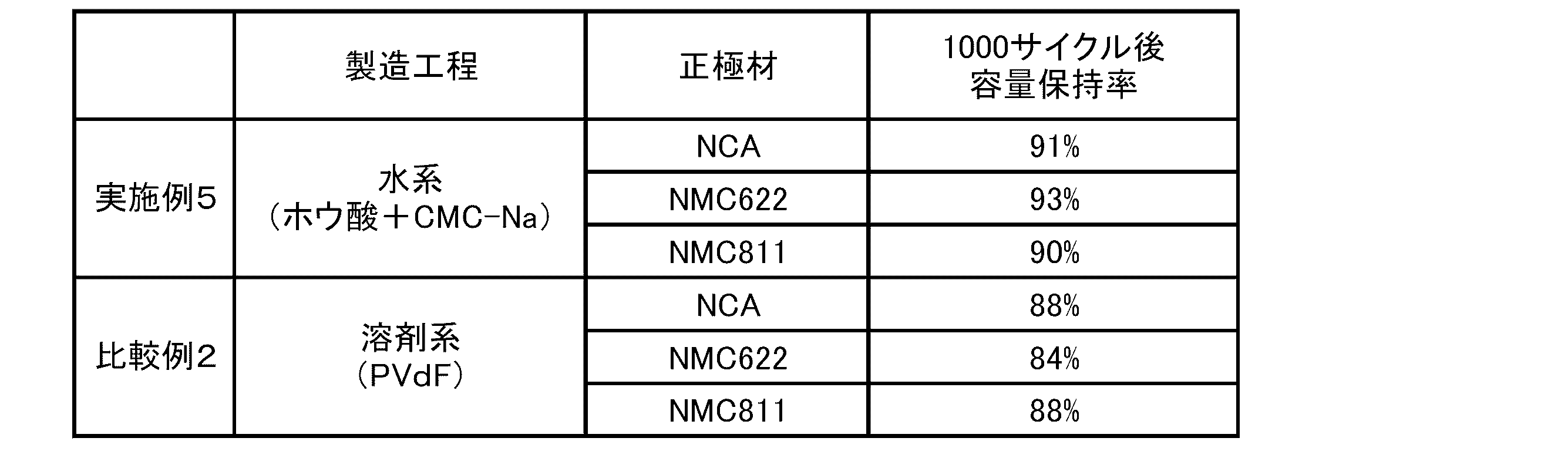
[実施例6(水系)の負極合材スラリー]
負極材(複合酸化物(A))を95部、導電助剤にアセチレンブラックを2部、中和分散剤(ホウ酸:カルボキシメチルセルロースナトリウム(CMC-Na)=1.3:0.7)を2部、バインダーとしてアクリル系エマルジョン1部を使用して混合し、これに水を25部加えてプラネタリミキサー(TKハイビスミックス、プライミクス社)を用いて混錬することで、負極合材スラリーを作製した。負極材としては、SiO、SiOLi、LTO(Li4Ti5O12)、LNO(ニオブ酸リチウム LiNbO2)の4種類を用いた。
負極材(複合酸化物(A))を95部、導電助剤にアセチレンブラックを2部、ポリフッ化ビニリデン(EQ-Lib-PVdF、MTI)を3部を混合し、これに非水系溶剤としてN-メチル-2-ピロリドンを25部加えてプラネタリミキサー(TKハイビスミックス、プライミクス社)を用いて混錬することで、負極合材スラリーを作製した。負極材としては、SiO、SiOLi、LTO、LNOの4種類を用いた。
作用極:前記電気化学デバイス用負極
対極:金属リチウム
電解液:1.0MLiPF6+EC/DMC=1:1(体積比)
ビニレンカーボネート(VC)を2%添加
セパレーター:ポリエチレン製多孔質フィルム
まず、サイクル特性評価用リチウムイオン二次電池を、それぞれ定電流-定電圧(CC-CV)充電方式により充電した。なお、CVモードでは、電流値がCCモードでの設定電流値の10分の1になった時点で充電を終了した。次に、25℃にて、1時間率(1.0Cレート)が、負極材がSiOのときは450mA、SiOLiのときは400mA、LTOのときは170mA、LNOのときは190mAの定電流で放電を行った。電圧範囲はSiO、SiOLiのときは1.5~0.01V、LTOのときは2.5~1.0V、LNOのときは2.5~1.3Vであった。この工程を1サイクルとし、100サイクル繰り返した。
容量保持率(%)=(100サイクル後における放電容量値)/(初回サイクルにおける放電容量値)×100 … (式)

前記室温でのサイクル特性評価で用いたものと同じ電気化学デバイス用正極を用いた出力特性評価用リチウムイオン二次電池を用い、高温でのサイクル特性評価を行った。測定条件は、測定時の温度が70℃である以外は、室温における測定条件と同様である。結果を表10に示す。

表11~表19に示した正極材および中和分散剤を用いて、実施例5と同様にして、水系で正極合材スラリーを作製し、電気化学デバイス用正極を得た。用いた正極材は、NMC111(LiNi0.33CO0.33Mn0.33O2)、NMC532(LiNi0.5Co0.3Mn0.2O2)、NMC622(LiNi0.6CO0.2Mn0.2O2)、NMC811(LiNi0.8Co0.1Mn0.1O2)、NCA(ニッケル-コバルト-アルミニウム酸リチウム LiNi0.8Co0.15Al0.05O2)、LFP(LiFePO4)、LCO(LiCoO2)、LMO(LiMn2O4)、LNMO(LiNi0.5Mn1.5O4)である。また、表11~表19に示した負極材を用いて、実施例6(水系)および比較例3(溶剤系)と同様にして、負極合材スラリーを作製し、電気化学デバイス用負極を得た。これらの正極および負極を用いて、次の構成のサイクル特性評価用リチウムイオン二次電池(フルセル評価用)を作製した。
正極:前記電気化学デバイス用正極
負極:前記電気化学デバイス用負極
電解液:1.0MLiPF6+EC/DMC=1:1(体積比)
1,3-プロパンスルトン(PS)を2%,
ビニレンカーボネート(VC)を0.8%添加
セパレーター:ポリエチレン製多孔質フィルム,
もしくはセルロース不織布
まず、サイクル特性評価用リチウムイオン二次電池を、それぞれ定電流-定電圧(CC-CV)充電方式により充電した。なお、CVモードでは、電流値がCCモードでの設定電流値の10分の1になった時点で充電を終了した。次に、25℃にて、1時間率を各種正極を基準として、すなわち正極材がNCAのときは200mA、NMC111のときは150mA、NMC532のときは160mA、NMC622のときは190mA、NMC811のときは200mA、LFPのときは170mA、LCOのときは130mA、LMOのときは120mA、LNMOのときは130mAの条件で定電流で放電を行った。電圧範囲は、正極材と負極材との組み合わせにより表11のとおりであった。この工程を1サイクルとし、1000サイクル繰り返した。

容量保持率(%)=(1000サイクル後における放電容量値)/(初回サイクルにおける放電容量値)×100 … (式)
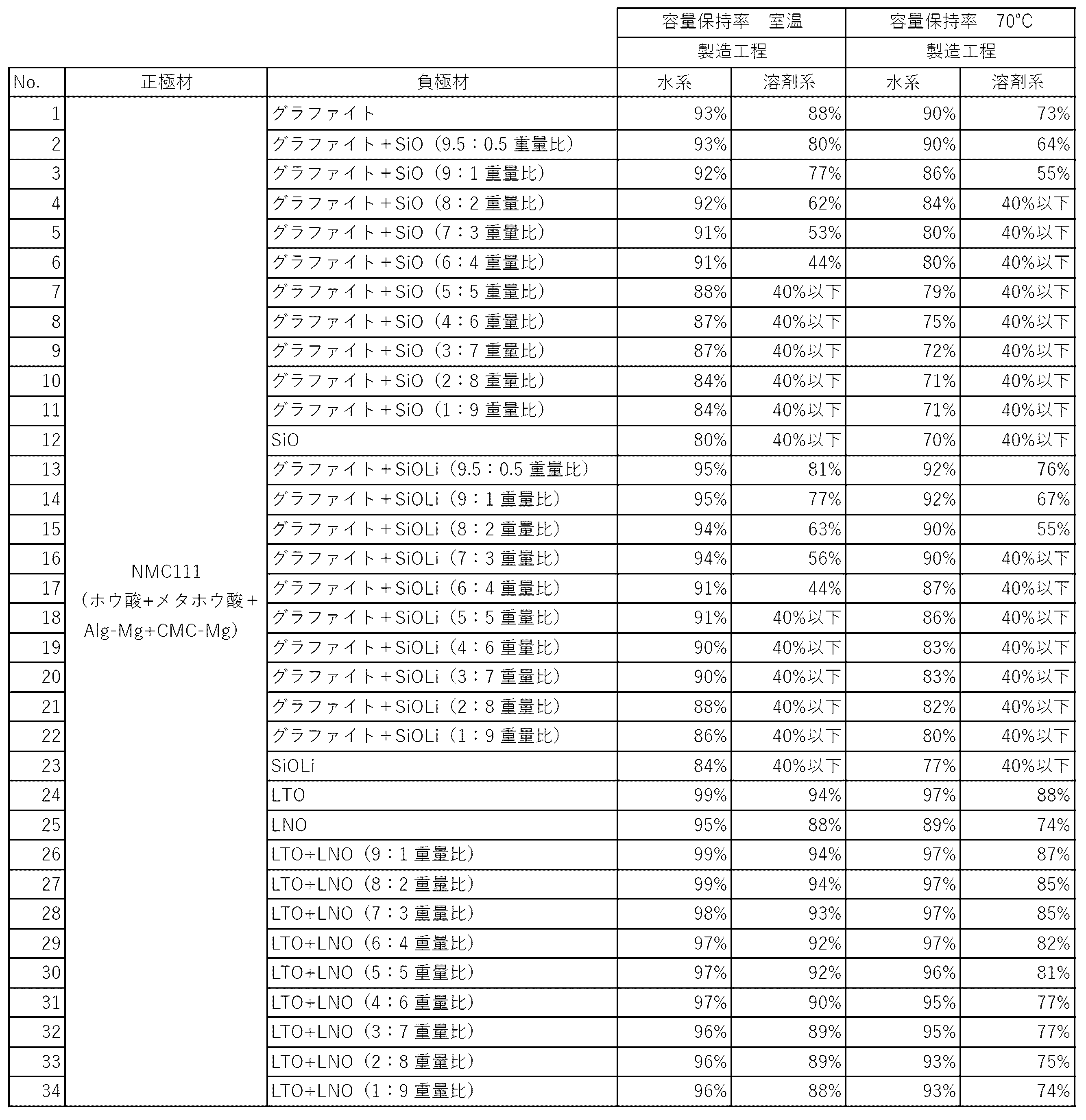


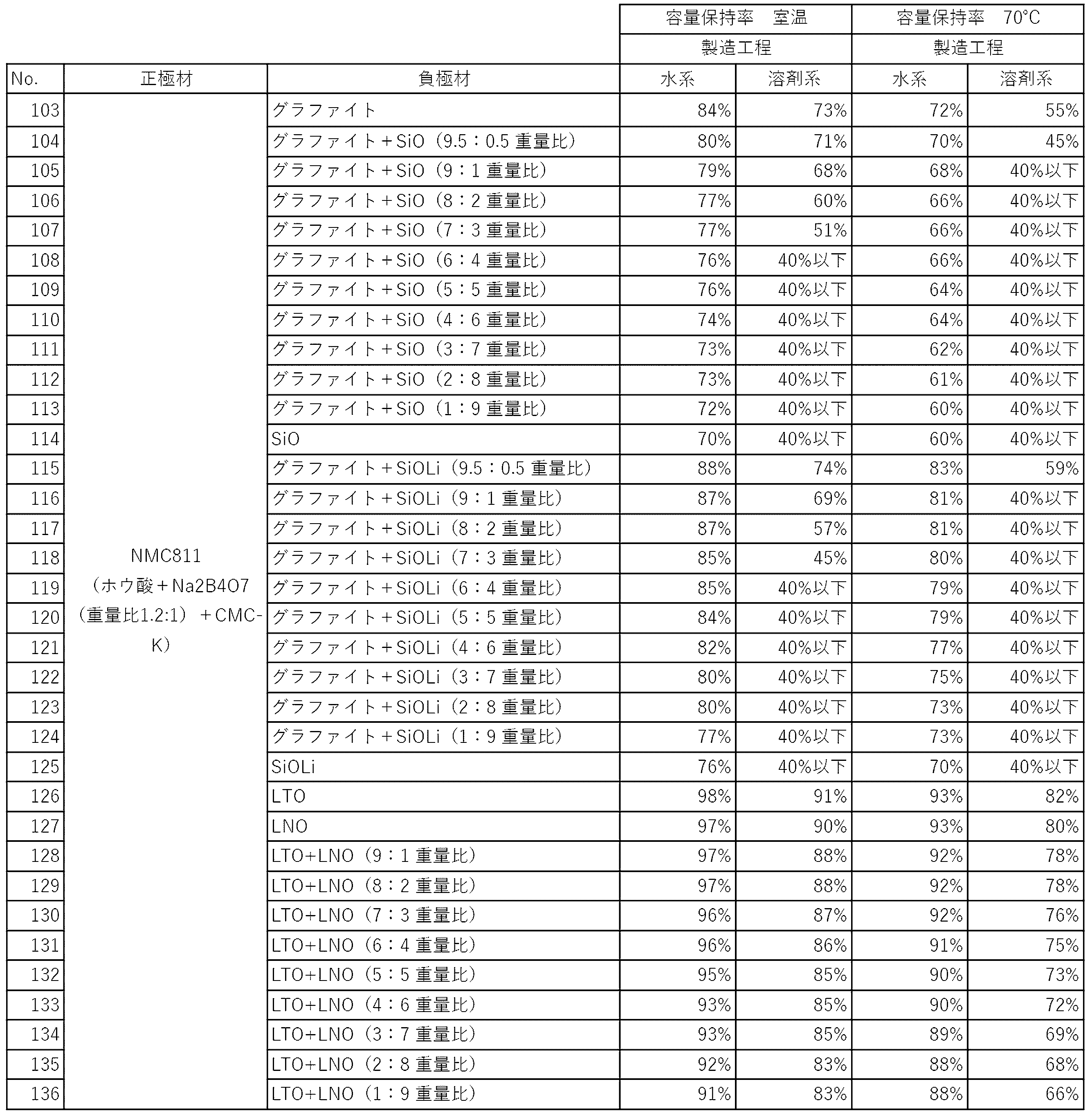

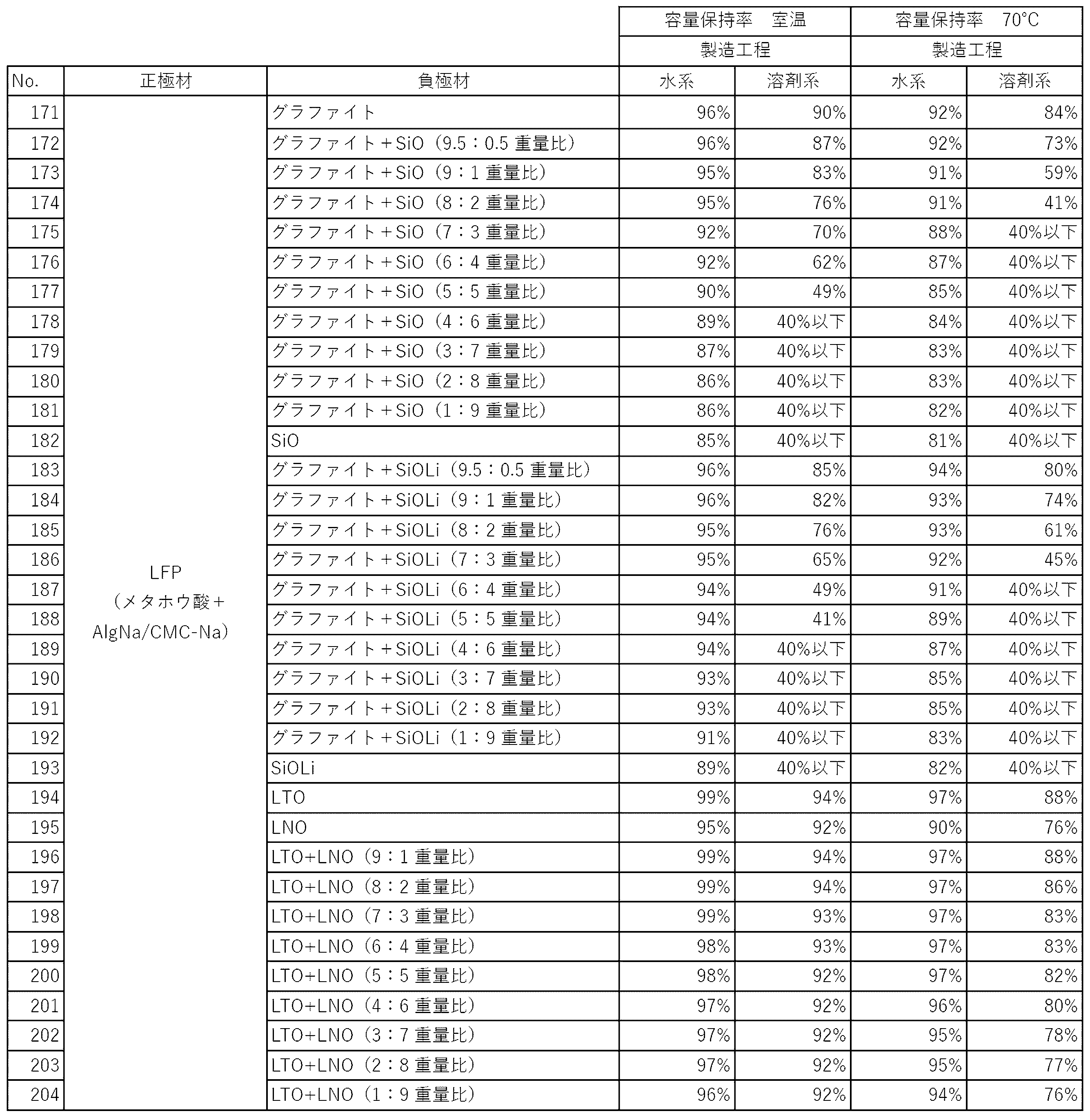
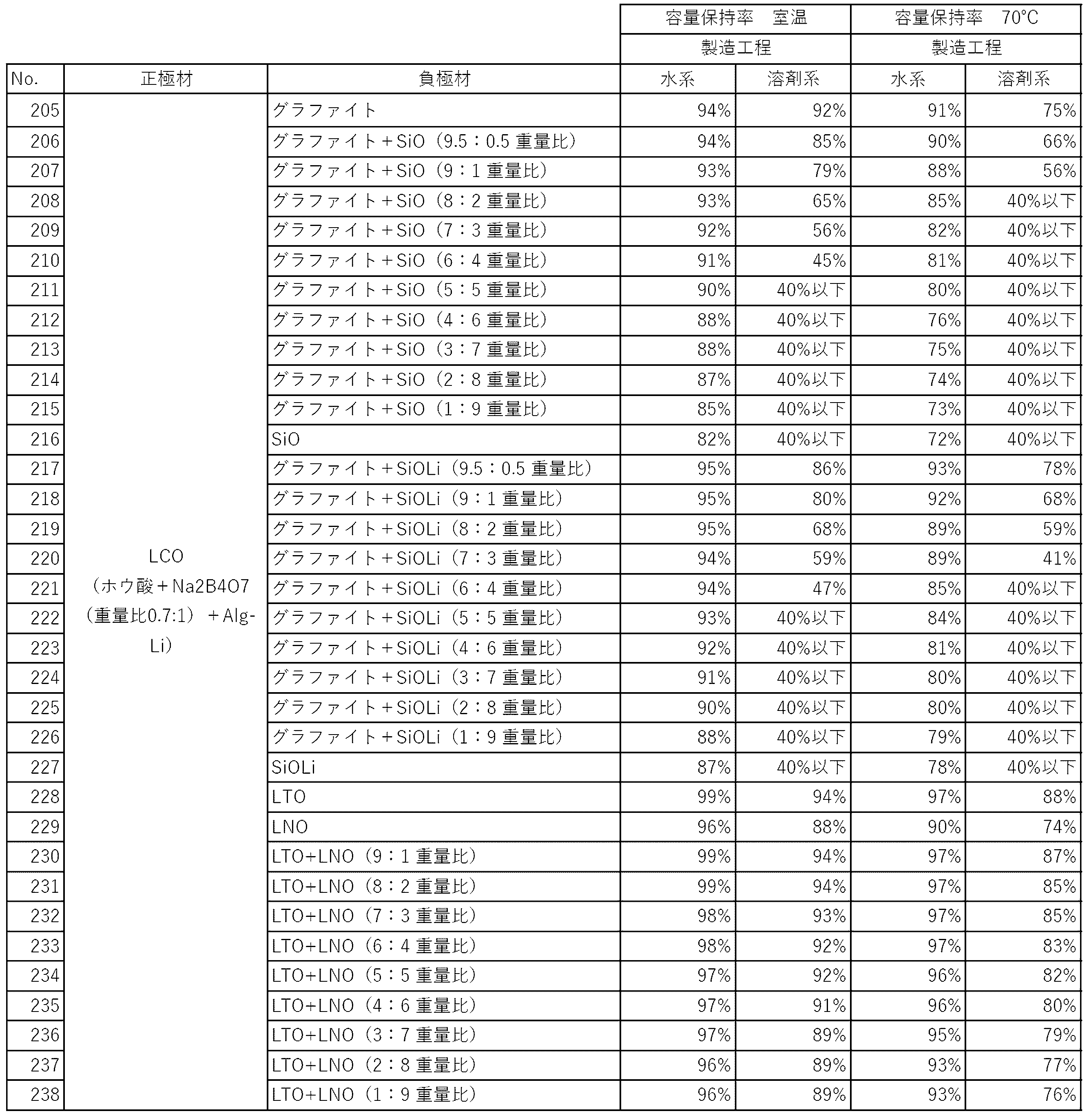
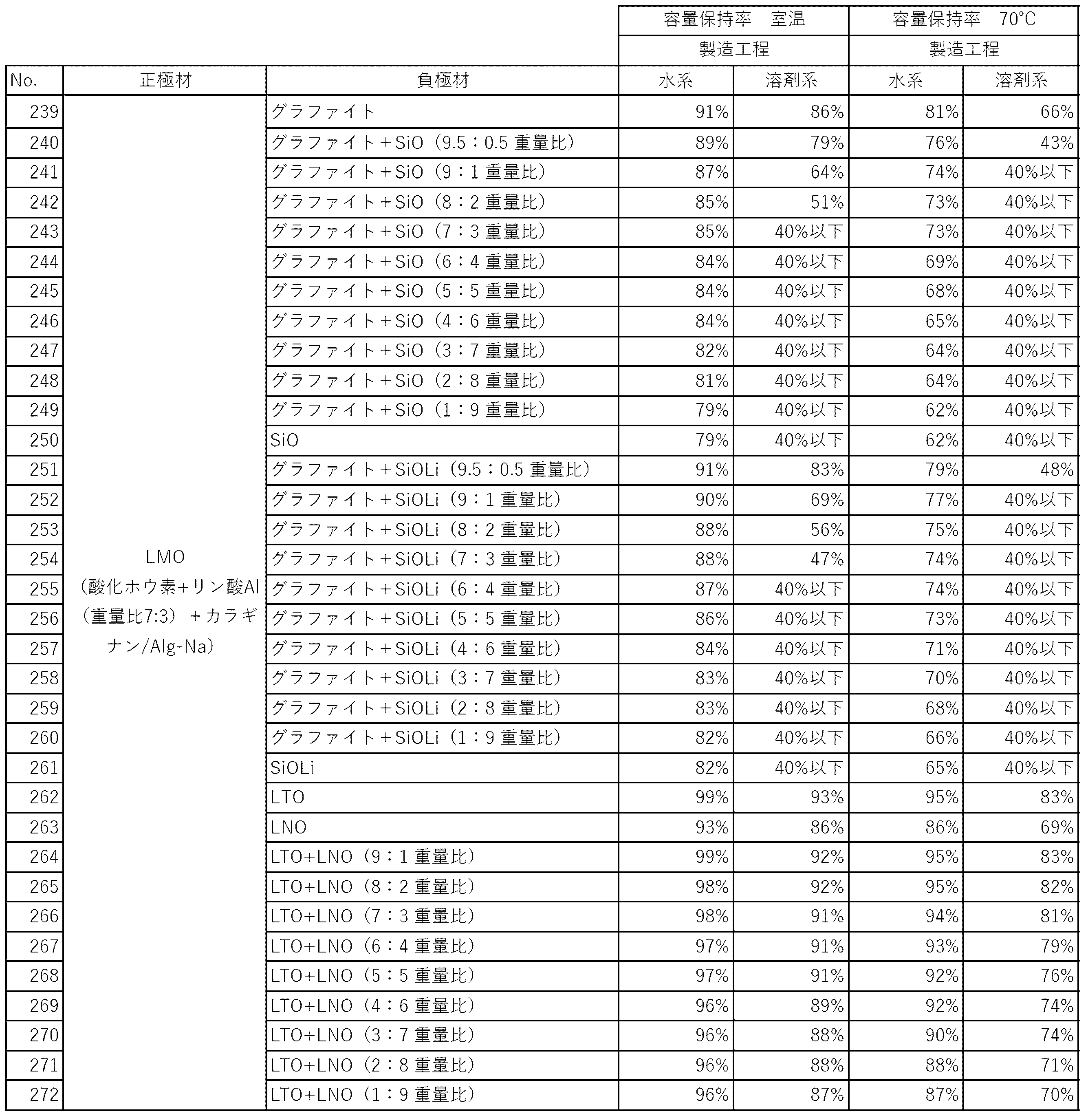
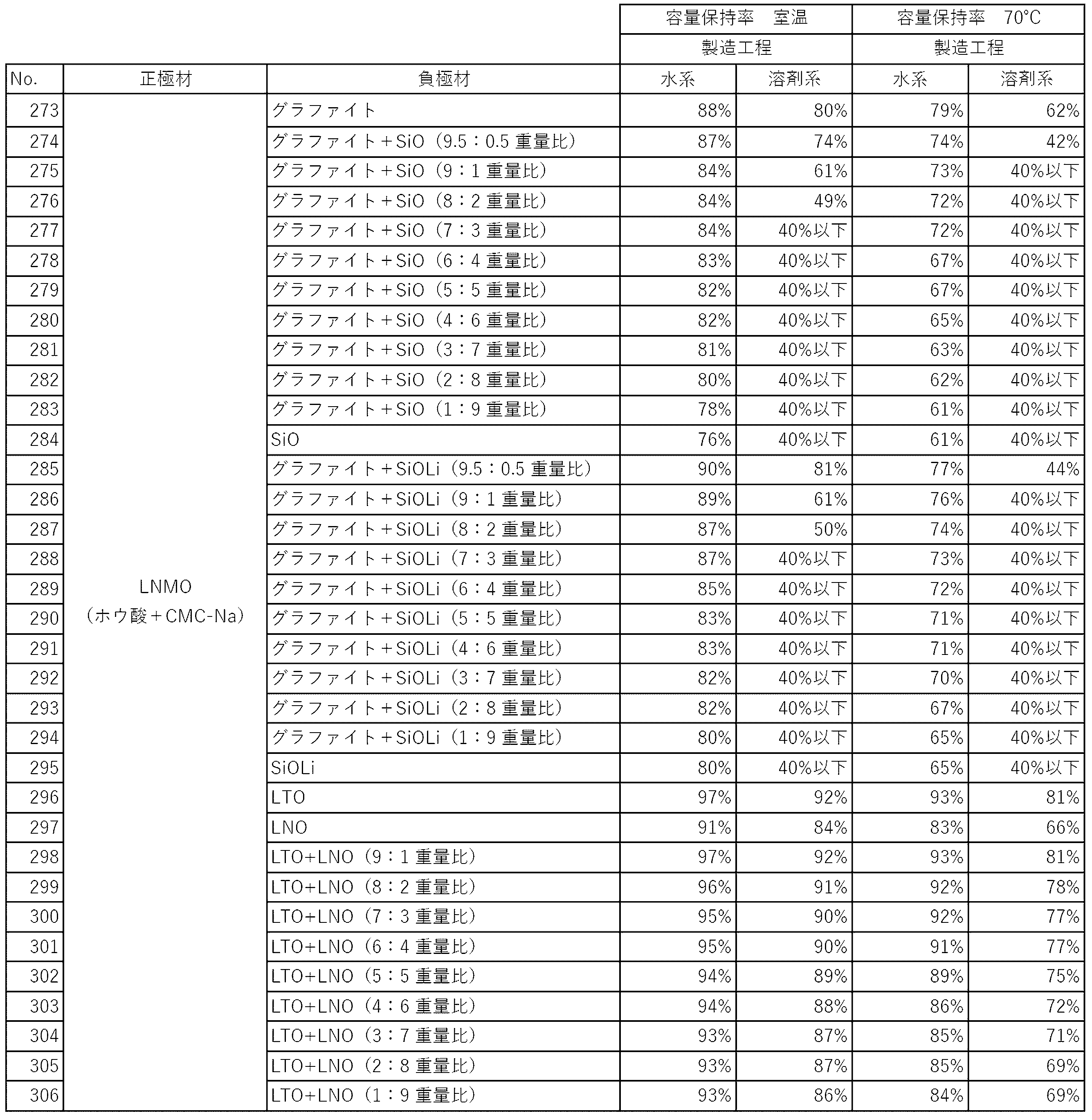
[他の中和剤(比較例)を用いた正極合材スラリー]
正極材(複合酸化物(A))を95部、導電助剤にアセチレンブラックを2部、分散剤としてカルボキシメチルセルロースナトリウム(CMC-Na)「CMCダイセル2200」(ダイセルミライズ株式会社製)を0.7部、中和剤を1.3部、バインダーとしてアクリル系エマルジョン1部を使用して混合し、これに水を25部加えてプラネタリミキサー(TKハイビスミックス、プライミクス社)を用いて混錬することで、正極合材スラリーを作製した。正極材としては、NCA(ニッケル-コバルト-アルミニウム酸リチウム LiNi0.8Co0.15Al0.05O2)、NMC622(LiNi0.6CO0.2Mn0.2O2)、NMC811(LiNi0.8Co0.1Mn0.1O2)の3種類を用いた。中和剤としては、硫酸およびシュウ酸を用いた。中和剤をホウ酸から硫酸(比較例4)およびシュウ酸(比較例5)に変えた以外は、上記と同様に、電気化学デバイス用正極および出力特性評価用リチウムイオン二次電池を作製した。
まず、出力特性評価用リチウムイオン二次電池を、それぞれ定電流-定電圧(CC-CV)充電方式により充電した。なお、CVモードでは、電流値がCCモードでの設定電流値の10分の1になった時点で充電を終了した。次に、25℃にて、1時間率(1.0Cレート)が、正極材がNCAのときは200mA、NMC622のときは190mA、NMC811のときは200mAの定電流で放電を行った。電圧範囲は3.0~4.3Vであった。放電終了後、放電に要した時間とその時の電流値を積分して得られる電気量を算出することで、放電容量を測定した。結果を表21に示す。

「室温でのサイクル特性1」の評価で用いた出力特性評価用リチウムイオン二次電池において、電解液を次のものに変更して、同様の評価を1200サイクルで行った。結果を表22に示す。
電解液:1.0MLiPF6+EC/DMC=1:1(体積比)
1,3-プロパンスルトン(PS)を添加せず
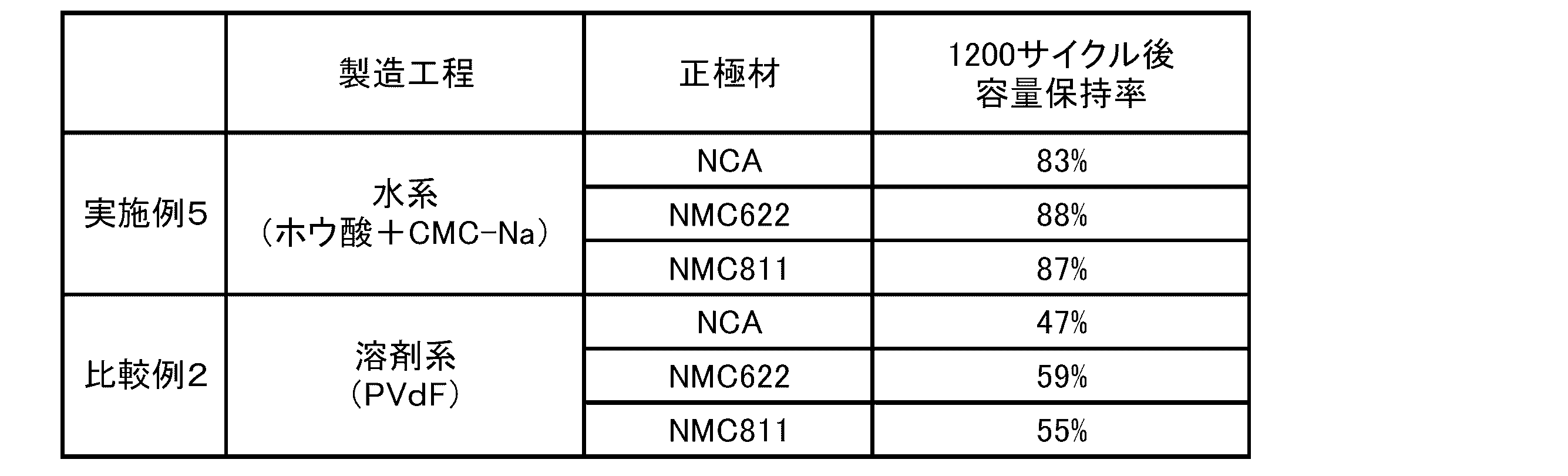
Claims (6)
- 中和分散剤と、リチウムイオンを吸蔵・放出可能な複合酸化物(A)とを含有する電気化学デバイス用電極であって、
前記中和分散剤は、
周期表第13族元素(B)を含む水溶性化合物(B′)と、
アルギン酸、メチルセルロース、カルボキシメチルセルロース、カルボキシメチルデンプンまたはカラギナンのアルカリ金属塩、アルカリ土類金属塩またはアンモニウム塩、プルラン、グアガムおよびキサンタンガムからなる群より選ばれる少なくとも1種の水溶性高分子(C)と、を含有し、
前記複合酸化物(A)の表面には、前記水溶性高分子(C)膜が形成されており、
前記水溶性高分子(C)膜中に、前記周期表第13族元素(B)が存在することを特徴とする電気化学デバイス用電極。 - 前記周期表第13族元素(B)がホウ素を含んでいる、請求項1記載の電気化学デバイス用電極。
- 前記電気化学デバイス用電極は、導電助剤と、バインダーと、をさらに備え、
前記中和分散剤と、前記複合酸化物(A)と、前記導電助剤と、前記バインダーとで電極合剤が構成され、
前記電極合剤中のホウ素の含有量が、0.001重量%以上5重量%以下の範囲内にある、請求項2記載の電気化学デバイス用電極。 - 前記周期表第13族元素(B)を含む水溶性化合物(B′)の含有量を100重量部としたとき、そのうちホウ素を含む水溶性化合物が51重量部から100重量部の範囲で含まれている、請求項2または3に記載の電気化学デバイス用電極。
- 前記複合酸化物(A)が、組成がLiaNibCocMndM1-b-c-dO2で表される複合酸化物、または、Li4+xTi5O12およびLi2+xTi3O7のいずれかで表される複合酸化物である、請求項1から4のいずれか一項に記載の電気化学デバイス用電極:
ただし、Mは、Al,Mg,Ti,Fe,V,Cr,Nb,Mo,W,Cu,Zn,Ga,In,Sn,Zr,RuおよびLaからなる群より選ばれる1以上の元素であり、
0.8≦a≦1.0
0<b≦1.0
0≦c≦0.4
0≦d≦0.35
0<b+c+d≦1.0
0≦x≦3である。 - 正極および負極を備え、前記正極と前記負極との間に電解質を含み、
前記正極および前記負極の少なくとも一方が、請求項1から5のいずれか一項に記載の電気化学デバイス用電極である、非水電解質二次電池。
Priority Applications (5)
| Application Number | Priority Date | Filing Date | Title |
|---|---|---|---|
| EP21906428.4A EP4156332A4 (en) | 2020-12-14 | 2021-12-07 | ELECTRODE FOR ELECTROCHEMICAL DEVICES AND NON-AQUEOUS ELECTROLYTE SECONDARY BATTERY |
| CN202180046747.9A CN115777154A (zh) | 2020-12-14 | 2021-12-07 | 电化学器件用电极及非水电解质二次电池 |
| JP2022569886A JP7770653B2 (ja) | 2020-12-14 | 2021-12-07 | 電気化学デバイス用電極用水系スラリー、電気化学デバイス用電極および非水電解質二次電池 |
| KR1020237020175A KR20230121063A (ko) | 2020-12-14 | 2021-12-07 | 전기 화학 디바이스용 전극 및 비수 전해질 이차전지 |
| US18/011,486 US20230290957A1 (en) | 2020-12-14 | 2021-12-07 | Electrode for electrochemical device and non-aqueous electrolyte secondary battery |
Applications Claiming Priority (2)
| Application Number | Priority Date | Filing Date | Title |
|---|---|---|---|
| JP2020206473 | 2020-12-14 | ||
| JP2020-206473 | 2020-12-14 |
Publications (1)
| Publication Number | Publication Date |
|---|---|
| WO2022131065A1 true WO2022131065A1 (ja) | 2022-06-23 |
Family
ID=82057661
Family Applications (1)
| Application Number | Title | Priority Date | Filing Date |
|---|---|---|---|
| PCT/JP2021/044845 Ceased WO2022131065A1 (ja) | 2020-12-14 | 2021-12-07 | 電気化学デバイス用電極および非水電解質二次電池 |
Country Status (6)
| Country | Link |
|---|---|
| US (1) | US20230290957A1 (ja) |
| EP (1) | EP4156332A4 (ja) |
| JP (1) | JP7770653B2 (ja) |
| KR (1) | KR20230121063A (ja) |
| CN (1) | CN115777154A (ja) |
| WO (1) | WO2022131065A1 (ja) |
Cited By (5)
| Publication number | Priority date | Publication date | Assignee | Title |
|---|---|---|---|---|
| CN115513526A (zh) * | 2022-10-31 | 2022-12-23 | 东莞市创明电池技术有限公司 | 一种电解液和电池 |
| CN116200149A (zh) * | 2022-12-15 | 2023-06-02 | 泉州市凯鹰电源电器有限公司 | 用于铅碳电池负极的功能化石墨烯胶粘剂的制备工艺 |
| JPWO2023166895A1 (ja) * | 2022-03-02 | 2023-09-07 | ||
| SE2251414A1 (en) * | 2022-12-05 | 2024-06-06 | Northvolt Ab | Aqueous slurry composition comprising polyacrylate and alginic acid for cell cathode |
| JP2024140116A (ja) * | 2023-03-28 | 2024-10-10 | トヨタ自動車株式会社 | 正極活物質、全固体電池、および、正極活物質の製造方法 |
Families Citing this family (3)
| Publication number | Priority date | Publication date | Assignee | Title |
|---|---|---|---|---|
| SE547030C2 (en) * | 2023-04-19 | 2025-04-08 | Northvolt Ab | Aqueous cathode slurry composition for cell cathode |
| SE547031C2 (en) * | 2023-04-19 | 2025-04-08 | Northvolt Ab | Aqueous cathode slurry composition for cell cathode |
| CN120072952B (zh) * | 2025-03-04 | 2025-11-18 | 哈尔滨工业大学 | 一种锂金属负极铜基集流体的表面改性方法 |
Citations (5)
| Publication number | Priority date | Publication date | Assignee | Title |
|---|---|---|---|---|
| JP2009064564A (ja) | 2007-09-04 | 2009-03-26 | Sanyo Electric Co Ltd | 非水電解質電池用正極の製造方法、それに用いられるスラリー及び非水電解質電池 |
| JP2012069488A (ja) * | 2010-09-27 | 2012-04-05 | Mitsubishi Chemicals Corp | 非水電解液二次電池 |
| JP2012094498A (ja) * | 2010-09-27 | 2012-05-17 | Mitsubishi Chemicals Corp | 非水系二次電池用負極材及びこれを用いた負極並びに非水系二次電池 |
| JP2013093333A (ja) * | 2002-11-13 | 2013-05-16 | Hydro-Quebec | 水溶性バインダーを含む水溶液から得られた薄膜により被覆された電極、その製造方法及び使用 |
| WO2016052715A1 (ja) | 2014-10-03 | 2016-04-07 | 学校法人 関西大学 | バインダおよびその利用、並びに電極の製造方法 |
Family Cites Families (7)
| Publication number | Priority date | Publication date | Assignee | Title |
|---|---|---|---|---|
| KR100657951B1 (ko) * | 2005-02-18 | 2006-12-14 | 삼성에스디아이 주식회사 | 양극 활물질, 그 제조 방법 및 이를 채용한 양극과 리튬 전지 |
| MX377396B (es) | 2013-09-12 | 2025-03-10 | Janssen Biopharma Inc | Compuestos de azapiridona y usos de los mismos. |
| WO2015146649A1 (ja) * | 2014-03-24 | 2015-10-01 | 昭和電工株式会社 | リチウムイオン二次電池の正極用スラリー、このスラリーを用いて得られる正極及びその製造方法、この正極を用いてなるリチウムイオン二次電池及びその製造方法 |
| JP2016066601A (ja) * | 2014-09-22 | 2016-04-28 | 日本合成化学工業株式会社 | リチウムイオン二次電池電極用バインダー組成物、リチウムイオン二次電池電極、及びリチウムイオン二次電池 |
| KR102253133B1 (ko) * | 2016-11-30 | 2021-05-14 | 주식회사 엘지화학 | 전극용 바인더, 이를 포함하는 애노드 및 상기 애노드를 포함하는 리튬 이차전지 |
| JP6986199B2 (ja) * | 2017-11-08 | 2021-12-22 | トヨタ自動車株式会社 | 負極材料とこれを用いたリチウム二次電池 |
| KR102411934B1 (ko) * | 2019-05-31 | 2022-06-22 | 삼성에스디아이 주식회사 | 리튬 이차전지용 전해액 및 이를 포함하는 리튬 이차전지 |
-
2021
- 2021-12-07 US US18/011,486 patent/US20230290957A1/en active Pending
- 2021-12-07 KR KR1020237020175A patent/KR20230121063A/ko active Pending
- 2021-12-07 WO PCT/JP2021/044845 patent/WO2022131065A1/ja not_active Ceased
- 2021-12-07 EP EP21906428.4A patent/EP4156332A4/en active Pending
- 2021-12-07 JP JP2022569886A patent/JP7770653B2/ja active Active
- 2021-12-07 CN CN202180046747.9A patent/CN115777154A/zh active Pending
Patent Citations (5)
| Publication number | Priority date | Publication date | Assignee | Title |
|---|---|---|---|---|
| JP2013093333A (ja) * | 2002-11-13 | 2013-05-16 | Hydro-Quebec | 水溶性バインダーを含む水溶液から得られた薄膜により被覆された電極、その製造方法及び使用 |
| JP2009064564A (ja) | 2007-09-04 | 2009-03-26 | Sanyo Electric Co Ltd | 非水電解質電池用正極の製造方法、それに用いられるスラリー及び非水電解質電池 |
| JP2012069488A (ja) * | 2010-09-27 | 2012-04-05 | Mitsubishi Chemicals Corp | 非水電解液二次電池 |
| JP2012094498A (ja) * | 2010-09-27 | 2012-05-17 | Mitsubishi Chemicals Corp | 非水系二次電池用負極材及びこれを用いた負極並びに非水系二次電池 |
| WO2016052715A1 (ja) | 2014-10-03 | 2016-04-07 | 学校法人 関西大学 | バインダおよびその利用、並びに電極の製造方法 |
Non-Patent Citations (1)
| Title |
|---|
| See also references of EP4156332A4 |
Cited By (10)
| Publication number | Priority date | Publication date | Assignee | Title |
|---|---|---|---|---|
| JPWO2023166895A1 (ja) * | 2022-03-02 | 2023-09-07 | ||
| WO2023166895A1 (ja) * | 2022-03-02 | 2023-09-07 | パナソニックIpマネジメント株式会社 | 非水電解質二次電池および非水電解質二次電池用の負極合剤の製造方法 |
| JP7724466B2 (ja) | 2022-03-02 | 2025-08-18 | パナソニックIpマネジメント株式会社 | 非水電解質二次電池および非水電解質二次電池用の負極合剤の製造方法 |
| CN115513526A (zh) * | 2022-10-31 | 2022-12-23 | 东莞市创明电池技术有限公司 | 一种电解液和电池 |
| SE2251414A1 (en) * | 2022-12-05 | 2024-06-06 | Northvolt Ab | Aqueous slurry composition comprising polyacrylate and alginic acid for cell cathode |
| SE546429C2 (en) * | 2022-12-05 | 2024-10-29 | Northvolt Ab | Aqueous slurry composition comprising polyacrylate and alginic acid for cell cathode |
| CN116200149A (zh) * | 2022-12-15 | 2023-06-02 | 泉州市凯鹰电源电器有限公司 | 用于铅碳电池负极的功能化石墨烯胶粘剂的制备工艺 |
| CN116200149B (zh) * | 2022-12-15 | 2023-09-08 | 泉州市凯鹰电源电器有限公司 | 用于铅碳电池负极的功能化石墨烯胶粘剂的制备工艺 |
| JP2024140116A (ja) * | 2023-03-28 | 2024-10-10 | トヨタ自動車株式会社 | 正極活物質、全固体電池、および、正極活物質の製造方法 |
| JP7661993B2 (ja) | 2023-03-28 | 2025-04-15 | トヨタ自動車株式会社 | 正極活物質、全固体電池、および、正極活物質の製造方法 |
Also Published As
| Publication number | Publication date |
|---|---|
| US20230290957A1 (en) | 2023-09-14 |
| EP4156332A4 (en) | 2024-07-17 |
| EP4156332A1 (en) | 2023-03-29 |
| JP7770653B2 (ja) | 2025-11-17 |
| JPWO2022131065A1 (ja) | 2022-06-23 |
| KR20230121063A (ko) | 2023-08-17 |
| CN115777154A (zh) | 2023-03-10 |
Similar Documents
| Publication | Publication Date | Title |
|---|---|---|
| JP7770653B2 (ja) | 電気化学デバイス用電極用水系スラリー、電気化学デバイス用電極および非水電解質二次電池 | |
| JP6524158B2 (ja) | 非水電解質二次電池用負極活物質、負極、非水電解質二次電池、電池パック及び車 | |
| US10374222B2 (en) | Electrode material for lithium ion secondary batteries, method for producing electrode material for lithium ion secondary batteries, and lithium ion secondary battery | |
| US10626264B2 (en) | Conductive composition, current collector with base layer for electric storage device, electrode for electric storage device, and electric storage device | |
| KR20170048211A (ko) | 음극 활물질 입자 및 이의 제조방법 | |
| KR20210024217A (ko) | 리튬의 프리도핑 방법, 리튬 프리도핑 전극 및 축전 디바이스 | |
| JPWO2011115247A1 (ja) | リチウムイオン二次電池 | |
| WO2011040022A1 (ja) | 負極活物質、この負極活物質の製造方法、及びこの負極活物質を用いたリチウムイオン二次電池 | |
| JPWO2017057123A1 (ja) | リチウムイオン二次電池用負極及びリチウムイオン二次電池 | |
| JP2014086258A (ja) | 非水電解液二次電池 | |
| WO2018110263A1 (ja) | 複合黒鉛粒子、その製造方法及びその用途 | |
| KR20210071086A (ko) | 바인더 | |
| JP2012079471A (ja) | 非水電解質二次電池の製造方法及び非水電解質二次電池 | |
| US9735428B2 (en) | Negative electrode material for lithium ion secondary batteries, negative electrode for lithium ion secondary batteries, lithium ion secondary battery, method for producing negative electrode material for lithium ion secondary batteries, and method for producing negative electrode for lithium ion secondary batteries | |
| JP2012226937A (ja) | 非水電解質二次電池 | |
| JP6622414B2 (ja) | 固体電電解質、全固体電池 | |
| CN116960280B (zh) | 负极极片、其制备方法、以及包含其的电化学装置及电子装置 | |
| TW202109962A (zh) | 全固體電池之製造方法 | |
| JP2020077620A (ja) | 電気化学素子用バインダー組成物 | |
| US20210184209A1 (en) | Coated lithium ion rechargeable battery active materials | |
| US20210184263A1 (en) | Rechargeable battery with ionic liquid electrolyte and electrode pressure | |
| JP2023180890A (ja) | 電気化学デバイス | |
| JP5944810B2 (ja) | 活物質およびそれを用いた二次電池 | |
| JP2011181387A (ja) | 電気化学素子用電極合材の製造方法 | |
| JP2013073816A (ja) | 負極活物質、この負極活物質の製造方法、及びこの負極活物質を用いたリチウムイオン二次電池 |
Legal Events
| Date | Code | Title | Description |
|---|---|---|---|
| 121 | Ep: the epo has been informed by wipo that ep was designated in this application |
Ref document number: 21906428 Country of ref document: EP Kind code of ref document: A1 |
|
| ENP | Entry into the national phase |
Ref document number: 2021906428 Country of ref document: EP Effective date: 20221219 |
|
| ENP | Entry into the national phase |
Ref document number: 2022569886 Country of ref document: JP Kind code of ref document: A |
|
| WWE | Wipo information: entry into national phase |
Ref document number: 202317046886 Country of ref document: IN |
|
| NENP | Non-entry into the national phase |
Ref country code: DE |