WO2022137635A1 - 紫外線硬化型インクジェットインキセット及び印刷物の製造方法 - Google Patents
紫外線硬化型インクジェットインキセット及び印刷物の製造方法 Download PDFInfo
- Publication number
- WO2022137635A1 WO2022137635A1 PCT/JP2021/029665 JP2021029665W WO2022137635A1 WO 2022137635 A1 WO2022137635 A1 WO 2022137635A1 JP 2021029665 W JP2021029665 W JP 2021029665W WO 2022137635 A1 WO2022137635 A1 WO 2022137635A1
- Authority
- WO
- WIPO (PCT)
- Prior art keywords
- ink
- photopolymerization initiator
- lower layer
- meth
- acrylate
- Prior art date
- Legal status (The legal status is an assumption and is not a legal conclusion. Google has not performed a legal analysis and makes no representation as to the accuracy of the status listed.)
- Ceased
Links
Classifications
-
- C—CHEMISTRY; METALLURGY
- C09—DYES; PAINTS; POLISHES; NATURAL RESINS; ADHESIVES; COMPOSITIONS NOT OTHERWISE PROVIDED FOR; APPLICATIONS OF MATERIALS NOT OTHERWISE PROVIDED FOR
- C09D—COATING COMPOSITIONS, e.g. PAINTS, VARNISHES OR LACQUERS; FILLING PASTES; CHEMICAL PAINT OR INK REMOVERS; INKS; CORRECTING FLUIDS; WOODSTAINS; PASTES OR SOLIDS FOR COLOURING OR PRINTING; USE OF MATERIALS THEREFOR
- C09D11/00—Inks
- C09D11/30—Inkjet printing inks
- C09D11/40—Ink-sets specially adapted for multi-colour inkjet printing
-
- B—PERFORMING OPERATIONS; TRANSPORTING
- B41—PRINTING; LINING MACHINES; TYPEWRITERS; STAMPS
- B41J—TYPEWRITERS; SELECTIVE PRINTING MECHANISMS, i.e. MECHANISMS PRINTING OTHERWISE THAN FROM A FORME; CORRECTION OF TYPOGRAPHICAL ERRORS
- B41J2/00—Typewriters or selective printing mechanisms characterised by the printing or marking process for which they are designed
- B41J2/005—Typewriters or selective printing mechanisms characterised by the printing or marking process for which they are designed characterised by bringing liquid or particles selectively into contact with a printing material
- B41J2/01—Ink jet
-
- B—PERFORMING OPERATIONS; TRANSPORTING
- B41—PRINTING; LINING MACHINES; TYPEWRITERS; STAMPS
- B41J—TYPEWRITERS; SELECTIVE PRINTING MECHANISMS, i.e. MECHANISMS PRINTING OTHERWISE THAN FROM A FORME; CORRECTION OF TYPOGRAPHICAL ERRORS
- B41J2/00—Typewriters or selective printing mechanisms characterised by the printing or marking process for which they are designed
- B41J2/005—Typewriters or selective printing mechanisms characterised by the printing or marking process for which they are designed characterised by bringing liquid or particles selectively into contact with a printing material
- B41J2/01—Ink jet
- B41J2/21—Ink jet for multi-colour printing
-
- B—PERFORMING OPERATIONS; TRANSPORTING
- B41—PRINTING; LINING MACHINES; TYPEWRITERS; STAMPS
- B41M—PRINTING, DUPLICATING, MARKING, OR COPYING PROCESSES; COLOUR PRINTING
- B41M5/00—Duplicating or marking methods; Sheet materials for use therein
- B41M5/0023—Digital printing methods characterised by the inks used
-
- B—PERFORMING OPERATIONS; TRANSPORTING
- B41—PRINTING; LINING MACHINES; TYPEWRITERS; STAMPS
- B41M—PRINTING, DUPLICATING, MARKING, OR COPYING PROCESSES; COLOUR PRINTING
- B41M7/00—After-treatment of prints, e.g. heating, irradiating, setting of the ink, protection of the printed stock
- B41M7/0081—After-treatment of prints, e.g. heating, irradiating, setting of the ink, protection of the printed stock using electromagnetic radiation or waves, e.g. ultraviolet radiation, electron beams
-
- C—CHEMISTRY; METALLURGY
- C09—DYES; PAINTS; POLISHES; NATURAL RESINS; ADHESIVES; COMPOSITIONS NOT OTHERWISE PROVIDED FOR; APPLICATIONS OF MATERIALS NOT OTHERWISE PROVIDED FOR
- C09D—COATING COMPOSITIONS, e.g. PAINTS, VARNISHES OR LACQUERS; FILLING PASTES; CHEMICAL PAINT OR INK REMOVERS; INKS; CORRECTING FLUIDS; WOODSTAINS; PASTES OR SOLIDS FOR COLOURING OR PRINTING; USE OF MATERIALS THEREFOR
- C09D11/00—Inks
- C09D11/02—Printing inks
- C09D11/10—Printing inks based on artificial resins
- C09D11/101—Inks specially adapted for printing processes involving curing by wave energy or particle radiation, e.g. with UV-curing following the printing
-
- C—CHEMISTRY; METALLURGY
- C09—DYES; PAINTS; POLISHES; NATURAL RESINS; ADHESIVES; COMPOSITIONS NOT OTHERWISE PROVIDED FOR; APPLICATIONS OF MATERIALS NOT OTHERWISE PROVIDED FOR
- C09D—COATING COMPOSITIONS, e.g. PAINTS, VARNISHES OR LACQUERS; FILLING PASTES; CHEMICAL PAINT OR INK REMOVERS; INKS; CORRECTING FLUIDS; WOODSTAINS; PASTES OR SOLIDS FOR COLOURING OR PRINTING; USE OF MATERIALS THEREFOR
- C09D11/00—Inks
- C09D11/02—Printing inks
- C09D11/10—Printing inks based on artificial resins
- C09D11/106—Printing inks based on artificial resins containing macromolecular compounds obtained by reactions only involving carbon-to-carbon unsaturated bonds
- C09D11/107—Printing inks based on artificial resins containing macromolecular compounds obtained by reactions only involving carbon-to-carbon unsaturated bonds from unsaturated acids or derivatives thereof
-
- C—CHEMISTRY; METALLURGY
- C09—DYES; PAINTS; POLISHES; NATURAL RESINS; ADHESIVES; COMPOSITIONS NOT OTHERWISE PROVIDED FOR; APPLICATIONS OF MATERIALS NOT OTHERWISE PROVIDED FOR
- C09D—COATING COMPOSITIONS, e.g. PAINTS, VARNISHES OR LACQUERS; FILLING PASTES; CHEMICAL PAINT OR INK REMOVERS; INKS; CORRECTING FLUIDS; WOODSTAINS; PASTES OR SOLIDS FOR COLOURING OR PRINTING; USE OF MATERIALS THEREFOR
- C09D11/00—Inks
- C09D11/30—Inkjet printing inks
- C09D11/38—Inkjet printing inks characterised by non-macromolecular additives other than solvents, pigments or dyes
-
- C—CHEMISTRY; METALLURGY
- C09—DYES; PAINTS; POLISHES; NATURAL RESINS; ADHESIVES; COMPOSITIONS NOT OTHERWISE PROVIDED FOR; APPLICATIONS OF MATERIALS NOT OTHERWISE PROVIDED FOR
- C09D—COATING COMPOSITIONS, e.g. PAINTS, VARNISHES OR LACQUERS; FILLING PASTES; CHEMICAL PAINT OR INK REMOVERS; INKS; CORRECTING FLUIDS; WOODSTAINS; PASTES OR SOLIDS FOR COLOURING OR PRINTING; USE OF MATERIALS THEREFOR
- C09D11/00—Inks
- C09D11/54—Inks based on two liquids, one liquid being the ink, the other liquid being a reaction solution, a fixer or a treatment solution for the ink
Definitions
- the present invention relates to an ultraviolet curable inkjet ink set and a method for manufacturing a printed matter using the inkjet ink set.
- the digital printing method does not require a plate, it is possible to reduce the cost and reduce the size of the printing device.
- the inkjet printing method which is a type of digital printing method, is a recording material in which minute droplets of ink are flown and landed on a recording medium (base material) from an inkjet head to form an image or characters on the recording medium.
- This is a method for obtaining (hereinafter also referred to as "printed matter").
- printed matter hereinafter also referred to as "printed matter"
- inks used in the inkjet printing method such as water type, oil type, solvent type, and ultraviolet curable type, but they are active due to their characteristics such as the speed of drying time and the strength of the cured film that forms the print layer.
- the demand for energy ray-curable inkjet inks is increasing more and more.
- inkjet heads capable of discharging at high frequencies of 30 kHz or higher have also been released. Furthermore, by installing these inkjet heads so that they are longer than the width of the recording medium and completing printing with a single ejection, it is possible to print at a higher speed than before, which is an ultraviolet curable inkjet. Line printers are also on sale.
- the integrated amount of ultraviolet light emitted to the ink that has landed on the recording medium decreases.
- poor curing of the ink may occur.
- a method of arranging a small ultraviolet irradiation means on the downstream side of each of a plurality of inkjet heads mounted on an inkjet line printer may be adopted.
- the ink on the recording medium is partially irradiated with ultraviolet rays from the ultraviolet irradiating means before the next ink lands. Curing (temporary curing). Then, after all the inks have landed on the recording medium, ultraviolet rays are irradiated from another ultraviolet curing means to cure all the inks together (main curing).
- the layer of ink first applied on the recording medium and the layer of ink applied to the recording medium later are applied. Delamination (delamination) may occur between the layers.
- an excessive amount of a photopolymerization initiator may be added in order to promote curing by temporary curing, which may cause a problem that the ink layer turns yellow (yellowing).
- Patent Document 1 evaluation is actually performed using a set of white ink and cyan ink, but the present inventors reproduced the ink set described in Patent Document 1 and 50 m / min. When the evaluation was performed at the printing speed of the above, poor adhesion to the recording medium and curling over time occurred, and it was not possible to obtain a printed matter having excellent quality.
- the present invention has been made to solve the above problems, and an object of the present invention is to have excellent adhesion between a recording medium and an ink layer and between different ink layers even during high-speed printing, and to cure wrinkles and wrinkles. It is an object of the present invention to provide an ultraviolet curable inkjet ink set for a line head printer, which can obtain a good printed matter without causing curling over time. Another object of the present invention is to provide a method for producing a printed matter having the above-mentioned characteristics by using the above-mentioned ultraviolet curable inkjet ink set.
- one embodiment of the present invention is an ultraviolet curable inkjet ink set that includes an ink for a lower layer and an ink for an upper layer and is used in a line-pass type inkjet printer including a temporary curing step.
- the lower layer ink contains a polymerizable monomer (DA), a photopolymerization initiator (DB), and a colorant (DC).
- the polymerizable monomer (DA) contains a compound represented by the following general formula (A)
- the polymerizable monomer (DA) contains a compound represented by the following general formula (A).
- the photopolymerization initiator (DB) is an acylphosphine oxide-based photopolymerization initiator (DB-1), a benzophenone-based photopolymerization initiator (DB-2), and 2-hydroxy-1- ⁇ 1- [4- ( 2-Hydroxy-2-methylpropionyl) phenyl] -1,3,3-trimethylindan-5-yl ⁇ -2-methylpropan-1-one (DB-3), and the like.
- the upper layer ink contains a polymerizable monomer (UA), a photopolymerization initiator (UB), and a colorant (UC).
- the polymerizable monomer (UA) contains a compound represented by the following general formula (A), and the photopolymerization initiator (UB) is an acylphosphine oxide-based photopolymerization initiator (UB-1) and a benzophenone-based agent.
- the present invention relates to an ultraviolet curable inkjet ink set containing a photopolymerization initiator (UB-2).
- General formula (A): CH 2 CH-CO- (O-CH 2 CH 2 ) n -OR (In the general formula (A), R represents an acryloyl group or a vinyl group, and n represents an integer of 2 to 10.
- the compound represented by the general formula (A) in the polymerizable monomer (DA) and the compound represented by the general formula (A) in the polymerizable monomer (UA) are the same but different. May be good. )
- another embodiment of the present invention includes R of the compound represented by the general formula (A) in the polymerizable monomer (DA) and the general formula (A) in the polymerizable monomer (UA).
- the present invention relates to the above-mentioned ultraviolet curable inkjet ink set, wherein R of the compound represented by is a vinyl group.
- Another embodiment of the present invention relates to the above-mentioned ultraviolet curable inkjet ink set, wherein the upper layer ink further contains a photopolymerization initiator (UB-4) having an amino group.
- UB-4 photopolymerization initiator
- Another embodiment of the present invention relates to the above-mentioned ultraviolet curable inkjet ink set, wherein the lower layer ink substantially does not contain a thioxanthone-based photopolymerization initiator and a photopolymerization initiator having an amino group.
- another embodiment of the present invention is a method for manufacturing a printed matter using the above-mentioned ultraviolet curable inkjet ink set.
- Step 1 in which the ink for the lower layer is ejected and applied onto the base material
- Step 2 of irradiating the base material to which the lower layer ink obtained in step 1 is applied with ultraviolet rays from an ultraviolet light emitting diode.
- Step 3 of ejecting and applying the upper layer ink to the base material to which the lower layer ink obtained in step 2 is applied so that at least a part thereof overlaps with the lower layer ink.
- Step 4 of irradiating the substrate to which the lower layer ink and the upper layer ink obtained in step 3 with ultraviolet rays from an ultraviolet lamp.
- the present invention relates to a method for producing printed matter.
- the adhesion between the recording medium and the ink layer and between different ink layers is excellent, and a good printed matter can be obtained without curing wrinkles and curling over time. It is possible to provide an ultraviolet curable ink set for a line head printer. Further, according to the embodiment of the present invention, it is possible to provide a method for producing a printed matter having the above-mentioned characteristics by using the above-mentioned ultraviolet curable inkjet ink set.
- the inkjet ink constituting the active energy ray-curable inkjet ink set generally contains a pigment, a photopolymerization initiator, a polymerizable monomer, and other additives.
- a pigment e.g., a polyethylene glycol dimethacrylate copolymer, a polyethylene glycol dimethacrylate copolymer, a polyethylene glycol dimethacrylate copolymer, ethylene glycol dimethacrylate, polymerizable polymer, and other additives.
- a light emitting diode that irradiates ultraviolet rays having a relatively long wavelength is used.
- Thioxanthons and ⁇ -aminoalkylphenones are known as photopolymerization initiators suitable for such ultraviolet light emitting diodes.
- the ink film is colored yellow, which may impair the appearance of the printed matter.
- the white ink and the black ink are used in a line-pass type inkjet printer, they have characteristics such as adhesion to a recording medium, adhesion between ink layers, hardening wrinkles, curling over time, and yellow coloring. It can be said that satisfying all of them at a practical level is a big challenge for those skilled in the art.
- a polymerizable monomer a compound represented by the following general formula (A) is contained, and as a photopolymerization initiator (DB), an acylphosphine oxide-based light is used.
- DB-1 a benzophenone-based photopolymerization initiator
- 2-hydroxy-1- ⁇ 1- [4- (2-hydroxy-2-methylpropionyl) phenyl] -1 As a lower layer ink containing 3,3-trimethylindan-5-yl ⁇ -2-methylpropan-1-one (DB-3) and a polymerizable monomer (UA), the following general formula (A) is used.
- a temporary curing step was performed, so that the acylphosphine oxide-based photopolymerization initiator (DB-1) having a wide absorption wavelength region was irradiated in the temporary curing step. It absorbs active energy rays and generates radicals. It is considered that the radical is mainly used in the polymerization reaction of the polymerizable monomer in the lower layer ink inside the ink film, and as a result, the adhesion to the recording medium is improved.
- DB-1 acylphosphine oxide-based photopolymerization initiator
- the ink for the lower layer and the ink for the lower layer are used. It is also inferred that the adhesion with the recording medium will be further improved.
- the radicals generated from the acylphosphine oxide-based photopolymerization initiator (DB-1) are the benzophenone-based photopolymerization initiator (DB-2) and 2-hydroxy-1- ⁇ , which are present in the lower layer ink.
- the upper layer ink is printed on the lower layer ink layer that has undergone the temporary curing process.
- the adhesion between the lower layer ink layer and the upper layer ink layer is important.
- the adhesion between the lower layer ink layer and the recording medium if the lower layer ink is completely cured in the temporary curing step, the adhesion between the ink layers may deteriorate.
- the lower layer ink is used in order to improve the adhesion between the lower layer ink layer and the upper layer ink layer.
- the degree of curing with the upper layer ink changes significantly, and after the main curing, there is a risk of curing wrinkles and curling over time. As described above, it is not easy to solve the above-mentioned problems at the same time.
- both the lower layer ink and the upper layer ink include a compound represented by the general formula (A) as a polymerizable monomer. Since the compound represented by the general formula (A) has a plurality of ethylene oxide groups, the movement of the compound molecule in the ink and the progress of the reaction are restricted by the interaction such as hydrogen bonding, and the compound is produced by the polymerization reaction. It may take some time before it is completely consumed. As a result, it becomes possible to apply the upper layer ink before the compound in the lower layer ink is completely consumed, and the lower layer ink is printed afterwards while maintaining sufficient curability during the temporary curing step.
- cross-linking with the upper ink layer can also be realized. Further, since the lower layer ink and the upper layer ink contain the same type of monomer, they have a high affinity. This is also considered to contribute to the suppression of poor adhesion between the ink layers.
- the lower layer ink and the upper layer ink both contain an acylphosphine oxide-based photopolymerization initiator and a benzophenone-based photopolymerization initiator.
- the acylphosphine oxide-based photopolymerization initiator is generally known to be effective for curing the inside of the ink film, but in addition, in the embodiment of the present invention, the benzophenone-based photopolymerization initiator is initiated. It was found that the combined use of the agent further contributed to the suppression of curing wrinkles and the adhesion between the lower layer ink layer and the upper layer ink layer.
- a benzophenone-based photopolymerization initiator generates radicals when used in combination with an amine-based co-initiator, and is effective in curing the surface of an ink film.
- the radical generated from the acylphosphine oxide-based photopolymerization initiator generates hydroxyl radical from the benzophenone-based photopolymerization initiator, and the hydroxyl radical is represented by the general formula (A).
- the lower layer ink layer is completely cured in the curing step after printing the upper layer ink.
- the lower layer ink layer is completely cured in the curing step after printing the upper layer ink.
- the lower layer ink and the upper layer ink in the embodiment of the present invention one is a white ink and the other is a black ink, both of which are difficult for active energy rays to penetrate into the ink film, so that the lower layer is concerned. There is a risk that the ink for ink will not be completely cured.
- the ink for the lower layer is charged with 2-hydroxy-1- ⁇ 1- [4- (2-hydroxy-2-methylpropionyl) phenyl] -1, which is a polyfunctional photopolymerization initiator.
- 2-hydroxy-1- ⁇ 1- [4- (2-hydroxy-2-methylpropionyl) phenyl] -1 which is a polyfunctional photopolymerization initiator.
- DB-3 3,3-trimethylindan-5-yl ⁇ -2-methylpropan-1-one
- the obtained printed matter may curl over time. be. It is considered that this is because the shrinkage stress remains in the ink layer without relaxing the curing shrinkage of the polymerizable monomer that has been polymerized instantaneously.
- the printed matter including the ink layer for the lower layer and the ink layer for the upper layer in the embodiment of the present invention is also excellent in curling over time. The reason for this is considered to be the existence of the compound represented by the general formula (A).
- the compound represented by the general formula (A) takes some time to be completely consumed by the polymerization reaction, and the polymerizable simpler reacted in advance by the reaction at this time difference. It is considered that the shrinkage stress in the ink layer is relieved as a result of the time required to relieve the shrinkage stress due to the polymer.
- the adhesion between the recording medium and the first ink layer (lower layer ink layer), the first ink layer (lower layer ink layer) and the second ink layer (upper layer ink layer) In order to obtain an active energy ray-curable inkjet ink set having all the characteristics such as adhesion between ink jets, whiteness of white ink, no curling wrinkles of laminated portions, and less curling over time, the present invention is used.
- the configuration of the embodiment of is indispensable.
- the polymerizable monomer has a function of causing a polymerization or a cross-linking reaction by an initiator such as a radical generated from a photopolymerization initiator described later and curing a composition containing the polymerizable monomer. Is.
- the ink set of the embodiment of the present invention contains the compound represented by the following general formula (A) as a polymerizable monomer in both the lower layer ink and the upper layer ink.
- R represents an acryloyl group or a vinyl group
- n represents an integer of 2 to 10.
- the compound represented by the general formula (A) in the polymerizable monomer (DA) and the compound represented by the general formula (A) in the polymerizable monomer (UA) are the same but different. May be good.
- Examples of the compound represented by the general formula (A) include diethylene glycol diacrylate, triethylene glycol diacrylate, polyethylene glycol (# 200) diacrylate, polyethylene glycol (# 300) diacrylate, and polyethylene glycol (# 400) diacrylate. Examples thereof include 2- (2-vinyloxyethoxy) ethyl acrylate and 2- [2- (2-vinyloxyethoxy) ethoxy] ethyl acrylate.
- a compound in which R in the general formula (A) is a vinyl group can be preferably used. Since the vinyl group participates in the polymerization reaction with a slight delay as compared with the acryloyl group, it is considered that the effect of delaying the polymerization reaction, which is considered to be caused by the presence of the ethylene oxide group, is further enhanced. Further, when n in the general formula (A) is the same, the viscosity of the compound in which R is a vinyl group is lower than that in the compound in which R is an acryloyl group. Therefore, by using the compound in which the R is a vinyl group, the wettability and spreading property on the recording medium are improved, and the adhesion to the recording medium is also improved.
- the compounds in which R in the general formula (A) is a vinyl group include 2- (2-vinyloxyethoxy) ethyl acrylate and acrylic acid 2.
- 2- (2-Vinyloxyethoxy) ethoxy] ethyl can be mentioned, for example, the polymerizable monomer (DA) and the polymerizable monomer (UA) are both 2- (2-vinyloxyethoxy) acrylic acid. It may be ethyl.
- the compound represented by the general formula (A) is preferably contained in an amount of 15 to 100% by mass, preferably 45 to 100% by mass, based on the total polymerizable monomer in the ink. Is more preferable, and it is particularly preferable that the content is 65 to 100% by mass.
- the compound represented by the general formula (A) includes both a compound in which R in the general formula (A) is a vinyl group and a compound in which R in the general formula (A) is an acryloyl group. You can also do it.
- the amount of the compound in which R is a vinyl group in the general formula (A) is preferably 75 to 100% by mass, preferably 80 to 100% by mass, based on the total amount of the compounds represented by the general formula (A) contained in the ink. It is preferably ⁇ 100% by mass.
- Both the lower layer ink and the upper layer ink constituting the ink set of the embodiment of the present invention are polymerizable monomers other than the compound represented by the above general formula (A) (hereinafter, “other polymerizable monomers””. May be included).
- the other polymerizable monomer is not particularly limited as long as it has the above-mentioned characteristics as the polymerizable monomer, and can be used regardless of the type of monomer, oligomer, or polymer.
- a radically polymerizable polymerizable monomer (radical polymerizable monomer) can be particularly preferably used.
- the "oligomer” and “polymer” are polymers in which a plurality of monomers are bonded, and both are classified according to the degree of polymerization.
- a polymer having a degree of polymerization of 2 to 5 is referred to as an "oligomer”, and a polymer having a degree of polymerization of 6 or more is referred to as a "polymer”.
- the polymerizable group contained in the radically polymerizable monomer examples include (meth) acryloyl group, vinyl ether group, allyl group, vinyl group (excluding vinyl ether group and allyl group), unsaturated carboxylic acid group and the like. Be done.
- the radically polymerizable monomer may be a monofunctional compound or a bifunctional or higher polyfunctional compound. Further, for the purpose of adjusting the reaction rate, the physical properties of the cured film, the physical properties of the ink, etc., only one type of polymerizable monomer may be used, or a plurality of polymerizable monomers may be mixed and used. can.
- the proportion of the monofunctional compound When the proportion of the monofunctional compound is large, the cured film tends to be flexible, and when the proportion of the polyfunctional compound is large, the curability tends to be excellent. Therefore, when a plurality of polymerizable monomers are used, the ratio of the monofunctional compound to the polyfunctional compound is arbitrarily determined according to the intended use.
- (meth) acrylate and “(meth) acryloyl” mean “acrylate and / or methacrylate” and “acryloyl and / or methacryloyl”, respectively.
- the term “monofunctional” refers to a compound having only one polymerizable group in one molecule.
- bifunctional and trifunctional refer to compounds having two or three polymerizable groups in one molecule, respectively, and bifunctional or higher are collectively referred to as "polyfunctional”.
- monofunctional monomers that can be used as polymerizable monomers include, for example, benzyl (meth) acrylate, 2-phenoxyethyl (meth) acrylate, (ethoxy (or propoxy) converted) 2-phenoxyethyl (meth) acrylate, and dicyclo.
- bifunctional monomers that can be used as other polymerizable monomers, for example, 1,6-hexanediol di (meth) acrylate, ethoxy (or propoxy) -ized 1,6-hexanediol di (meth) acrylate, 1, 10-decanediol di (meth) acrylate, neopentyl glycol di (meth) acrylate, 2,4-dimethyl-1,5-pentanediol di (meth) acrylate, 3-methyl-1,5-pentanediol di (meth) ) Acrylate, butylethylpropanediol (meth) acrylate, ethoxylated cyclohexanemethanoldi (meth) acrylate, ethyleneglycoldi (meth) acrylate, 2-ethyl-2-butylbutanediol di (meth) acrylate, neopenty
- trifunctional monomers for example, trimethylolpropane tri (meth) acrylate, trimethylolethanetri (meth) acrylate, and alkylene oxide-modified tri (meth) acrylate of trimethylolpropane (for example).
- tetrafunctional monomers for example, pentaerythritol tetra (meth) acrylate, sorbitol tetra (meth) acrylate, ditrimethylolpropane tetra (meth) acrylate, and dipentaerythritol tetra propionate (meth).
- Compounds having four (meth) acryloyl groups such as acrylate, ethoxylated pentaerythritol tetra (meth) acrylate, and tetramethylolmethanetetra (meth) acrylate can be mentioned. Of these, pentaerythritol tetraacrylate is preferable.
- (meth) acryloyl such as sorbitol penta (meth) acrylate, dipentaerythritol penta (meth) acrylate, and EO-modified dipentaerythritol penta (meth) acrylate.
- examples include compounds having five groups.
- hexafunctional monomers that can be used as polymerizable monomers, for example, dipentaerythritol hexa (meth) acrylate, EO-modified dipentaerythritol hexa (meth) acrylate, sorbitol hexa (meth) acrylate, and phosphazene alkylene oxide-modified.
- examples thereof include compounds having six (meth) acryloyl groups such as hexa (meth) acrylate and ⁇ -captolactone-modified dipentaerythritol hexa (meth) acrylate.
- dipentaerythritol hexaacrylate and EO-modified dipentaerythritol hexa (meth) acrylate are preferable.
- EO refers to "ethylene oxide”
- PO refers to "propylene oxide”.
- a radically polymerizable oligomer When a radically polymerizable oligomer is used as the other polymerizable monomer, one having a (meth) acryloyl group as the polymerizable group can be preferably used.
- the number of polymerizable groups contained in the oligomer is preferably 1 to 15 per molecule, more preferably 2 to 6, and 2 to 4 from the viewpoint of the balance between flexibility and curability. Is more preferable, and 2 is particularly preferable.
- the weight average molecular weight of the oligomer is preferably 400 to 10,000, more preferably 500 to 5,000.
- Examples of the oligomer having a (meth) acryloyl group that can be used as a polymerizable monomer include an aliphatic urethane (meth) acrylate oligomer, a urethane (meth) acrylate oligomer such as an aromatic urethane (meth) acrylate oligomer, and acrylic. Examples thereof include ester (meth) acrylate oligomers, polyester (meth) acrylate oligomers, and epoxy (meth) acrylate oligomers.
- the lower layer ink includes an acylphosphine oxide-based photopolymerization initiator, a benzophenone-based photopolymerization initiator, and 2-hydroxy-1- ⁇ 1- [4- (2-hydroxy-2-methylpropionyl). ) Phenyl] -1,3,3-trimethylindan-5-yl ⁇ -2-methylpropan-1-one.
- the upper layer ink contains an acylphosphine oxide-based photopolymerization initiator and a benzophenone-based photopolymerization initiator as the photopolymerization initiator.
- acylphosphine oxide-based photopolymerization initiator commercially available ones can be used, for example, “Omnirad TPO", “Omnirad 403", “Omnirad 819", “Omnirad TPO-L” manufactured by IGM RESINS. , “OMNIPOL TP” and the like. Further, for example, the acylphosphine oxide-based photopolymerization initiator described in International Publication No. 2017/086242 and International Publication No. 2020/0493978 can also be used.
- the acylphosphine oxide-based photopolymerization initiator is at least bis (2,4,6-) from the viewpoint of improving the curability, suppressing the curing wrinkles, and improving the whiteness when used in white ink. It preferably contains trimethylbenzoyl) -phenylphosphine oxide.
- 2,4,6-trimethylbenzoyl 2,4,6-trimethylbenzoyl
- "Omnirad 819" can be mentioned.
- benzophenone-based photopolymerization initiator commercially available ones can be used, for example, “Omnirad BP”, “Omnirad BMS”, “Ominirad 4PBZ”, “OMNIRAD EMK”, “OMNIRAD EMK” manufactured by IGM RESINS.
- examples include “Esacure 1001M”, “GENOPOL BP-1” and “GENOPOL BP-2” manufactured by Rahn AG.
- 2-hydroxy-1- ⁇ 1- [4- (2-hydroxy-2-methylpropionyl) phenyl] -1,3,3-trimethylindan-5-yl ⁇ -2-methyl used for the lower layer ink.
- propane-1-one a commercially available product can be used, and examples thereof include "SpeedCure XFs01" manufactured by LAMBSON.
- 2-hydroxy-1- ⁇ 1- [4- (2-hydroxy-2-methylpropionyl) phenyl] -1,3,3-trimethylindan-5-yl ⁇ -2- instead of methylpropane-1-one, the structural isomer 2-hydroxy-1- ⁇ 3- [4- (2-hydroxy-2-methylpropionyl) phenyl] -1,1,3-trimethylindan-5 -Il ⁇ -2-methylpropan-1-one may be used.
- the content is preferably 1 to 15% by mass based on the total amount of the ink. If the above blending amount is satisfied, as described above, the curability and adhesion to the recording medium are improved, and when the benzophenone-based photopolymerization initiator and the compound represented by the general formula (A) are used in combination, the mixture is used. In addition, it is possible to suppress curing wrinkles and improve the adhesion between ink layers. Further, by blending the content in an amount of 15% by mass or less, the solubility of the acylphosphine oxide-based photopolymerization initiator becomes sufficient, and it is possible to suppress the precipitation of the initiator in the ink.
- the content of the acylphosphine oxide-based photopolymerization initiator is more preferably 2 to 10% by mass.
- the content of the acylphosphine oxide-based photopolymerization initiator is more preferably 1.5 to 10% by mass, and particularly preferably 2 to 6% by mass.
- the benzophenone-based photopolymerization initiator contained in the ink constituting the ink set The content is preferably 2 to 10% by mass based on the total amount of the ink. If the above blending amount is satisfied, as described above, when used in combination with an acylphosphine oxide-based photopolymerization initiator and a compound represented by the general formula (A), curing wrinkle suppression and adhesion between ink layers are suppressed. Improvement is possible.
- the content of the benzophenone-based photopolymerization initiator is 25 to 125 mass with respect to the content of the acylphosphine oxide-based photopolymerization initiator. %, More preferably 50 to 100% by mass.
- the content of the benzophenone-based photopolymerization initiator is preferably 75 to 200% by mass, preferably 100 to 150% by mass, based on the content of the acylphosphine oxide-based photopolymerization initiator. Is more preferable.
- the content of the acylphosphine oxide-based photopolymerization initiator is 2-hydroxy-1- ⁇ 1- [4- (2-hydroxy-2).
- -Methylpropionyl) phenyl] -1,3,3-trimethylindan-5-yl ⁇ -2-methylpropan-1-one is preferably contained in an amount of 50 to 300% by mass. Further, it is particularly preferably 100 to 200% by mass, and if it is within this range, it is possible to further suppress curling over time.
- the acylphosphine oxide-based light is used in the lower layer ink constituting the ink set regardless of whether it is a white ink or a black ink.
- the content of the acylphosphine oxide-based photopolymerization initiator is preferably 20 to 70% by mass, preferably 25 to 55% by mass, based on the total content of -2-methylpropane-1-one.
- the total amount of the acylphosphine oxide-based photopolymerization initiator and the benzophenone-based photopolymerization initiator is relative to the total amount.
- the content of the acylphosphine oxide-based photopolymerization initiator is preferably 25 to 60% by mass, more preferably 35 to 50% by mass.
- the ink constituting the ink set depends on the type of light source used and the irradiation intensity regardless of whether it is a lower layer ink or an upper layer ink, and whether it is a white ink or a black ink. Therefore, a photopolymerization initiator other than the above-mentioned photopolymerization initiator (hereinafter referred to as “other photopolymerization initiator”) can be arbitrarily used.
- photopolymerization initiators include, for example, thioxanthone-based photopolymerization initiators, hydroxyacetophenone-based photopolymerization initiators, alkylaminoacetophenone-based photopolymerization initiators, oxime ester-based photopolymerization initiators, and the like.
- a material that promotes radical generation of other photopolymerization initiators which is generally called a sensitizer, is also included in the "polymerizable initiator".
- a sensitizer examples include aminobenzoate-based compounds and anthracene-based compounds.
- thioxanthone-based photopolymerization initiators can be used, and examples thereof include “Omnirad ITX” and “Omnirad DETX” manufactured by IGM RESINS.
- hydroxyacetophenone-based initiator commercially available ones can be used, for example, "Omnirad 127", “Omnirad 184", “Ominirad 1173”, “Omnirad 2959”, “Esacure KIP150” manufactured by IGM RESINS. And so on.
- alkylaminoacetophenone-based initiator commercially available ones can be used, and examples thereof include “Omnirad 907", “Omnirad 369", and “Omnirad 379" manufactured by IGM RESINS.
- oxime ester-based initiators can be used, and examples thereof include “IRGACURE OXE01”, “IRGACURE OXE02”, and “IRGACURE OXE04" manufactured by BASF.
- amino benzoate compounds can be used, for example, “Esacure A198" manufactured by IGM RESINS, “Omnipol ASA”, “Omnilad EDB”, “Omnilad EHA”, and “Omnirad EHA” manufactured by Rahn AG.
- examples include “GENOPOL AB-1” and “GENOPOL AB-2”.
- anthracene-based compound a commercially available compound can be used, and examples thereof include "Anthracene UVS-581" manufactured by Kawasaki Kasei Kogyo Co., Ltd.
- the upper layer ink constituting the ink set preferably further contains an amino group-containing photopolymerization initiator as the photopolymerization initiator.
- the upper layer ink contains an amino group as a photopolymerization initiator in addition to an acylphosphine oxide-based photopolymerization initiator (UB-1) and a benzophenone-based photopolymerization initiator (UB-2).
- Examples of the photopolymerization initiator having an amino group include the above-listed alkylaminoacetophenone-based initiators and aminobenzoate-based compounds.
- the lower layer ink constituting the ink set contains an acylphosphine oxide-based photopolymerization initiator, a benzophenone-based photopolymerization initiator, and 2-hydroxy-1- ⁇ 1- [as photopolymerization initiators.
- 4- (2-Hydroxy-2-methylpropionyl) phenyl] -1,3,3-trimethylindan-5-yl ⁇ -2-methylpropan-1-one is contained as an essential component.
- a photopolymerization initiator can be optionally contained, but from the viewpoint of interlayer adhesion between the lower layer ink and the upper layer ink, and when the lower layer ink is a white ink, the white ink From the viewpoint of whiteness, it is preferable that the lower layer ink substantially does not contain a thioxanthone-based photopolymerization initiator and a photopolymerization initiator having an amino group.
- the lower layer ink does not substantially contain the thioxanthone-based photopolymerization initiator and the photopolymerization initiator having an amino group, it is possible to suppress the polymerization reaction from proceeding faster than necessary during the temporary curing, and the upper layer can be prevented from proceeding faster than necessary. It is also possible to suppress the possibility that the adhesion with the ink for use is lowered. Further, since both the thioxanthone-based photopolymerization initiator and the photopolymerization initiator having an amino group have an absorption wavelength in the vicinity of visible light, the ink layer tends to be yellowish. Therefore, by limiting the blending amount of these photopolymerization initiators, it is possible to suppress the deterioration of the whiteness when the lower layer ink is a white ink.
- substantially free in the present specification means that a certain amount of the target compound is not intentionally added, and changes with time and unintentional such as impurities and impurities. It does not eliminate even the most common contamination. More specifically, when the target compound is “substantially free”, the content thereof is preferably 2% by mass or less, more preferably 1% by mass or less, and 0. It is more preferably 5.5% by mass or less, and particularly preferably 0.2% by mass or less.
- the inks that make up the ink set contain colorants.
- Conventionally known dyes and pigments can be used as the colorant, but in the embodiment of the present invention, it is preferable to use the pigment from the viewpoint of improving the density of the printed matter and the storage stability and ejection stability of the ink. Is.
- Examples of the pigment contained in the white ink constituting the ink set include inorganic pigments such as titanium oxide, zinc oxide, zirconium oxide and barium sulfate, and organic pigments such as hollow resin particles. Among these, it is particularly preferable to use titanium oxide.
- the content of these pigments is preferably 10 to 70% by mass, preferably 20 to 60% by mass in the white ink, from the viewpoints of concealment of printed matter, suppression of density and cured wrinkles, and ejection stability from the inkjet head. It is more preferably by mass%.
- examples of the pigment contained in the black ink constituting the ink set include black inorganic pigments such as carbon black, carbon nanotubes and iron oxide, and black organic pigments such as aniline black and azomethine black.
- black inorganic pigments such as carbon black, carbon nanotubes and iron oxide
- black organic pigments such as aniline black and azomethine black.
- a blue pigment, a violet pigment, a red pigment, a green pigment, a brown pigment and the like may be used in combination to give a pseudo black feeling (composite black).
- the content of these pigments is preferably 1 to 10% by mass in the black ink from the viewpoints of jet-blackness, density and suppression of cured wrinkles of the printed matter, ejection stability and viscosity of the black ink, and 2 to 2 to. It is more preferably 7% by mass.
- a pigment dispersion resin can be used for the initial dispersibility and storage stability of the pigment.
- the pigment dispersion resin a commercially available one can be used, or one synthesized by a conventionally known method can be used.
- Ajinomoto Fine Techno Co., Ltd. “Ajispar-PB-821", “Ajispar-PB-822”, Big Chemie Co., Ltd.
- the amount of the pigment dispersion resin added is preferably 20 to 120% by mass, more preferably 30 to 80% by mass, based on the total amount of the pigment.
- the amount of the pigment dispersion resin added is preferably 1 to 100% by mass, more preferably 3 to 50% by mass, based on the total amount of the pigment.
- the inks constituting the ink set are surface-adjusted for the purpose of improving the wettability and spreading property with respect to the recording medium, improving the adhesion, and preventing repellency. It is preferable to add an agent.
- the surface conditioner for example, a silicone-based surface conditioner, a fluorine-based surface conditioner, an acrylic surface conditioner, an acetylene glycol-based surface conditioner, or the like can be used. Among these, it is preferable to use a silicone-based surface adjusting agent and / or an acrylic-based surface adjusting agent from the viewpoint of the ability to reduce surface tension, the improvement of adhesion, and the compatibility with the polymerizable monomer.
- the silicone-based surface conditioner for example, a compound having a dimethylsiloxane structure and / or a modified product thereof can be used.
- a polyether-modified siloxane-based surface conditioner can be particularly preferably used.
- Specific examples of the polyether include polyethylene oxide and polypropylene oxide. Moreover, only one of them may be contained in the molecule, or both may be contained.
- Commercially available products of the polyether-modified siloxane-based surface conditioner include, for example, BYK®-378, 348, 349, BYK-UV3500, UV3510 manufactured by Big Chemie; TEGO® Glide 450, 440 manufactured by Evonik.
- 435, 432, 410, 406, 130, 110, 100; and the like can be preferably used.
- BYK-378, 348, UV3510; TEGO Glide 450, 440, 432, 410 and the like can be particularly preferably used from the viewpoint of improving the adhesion and the image quality of the printed matter.
- a silicone-based surface conditioner When a silicone-based surface conditioner is used, its content is preferably 0.1 to 5.0% by mass in the ink. By setting the content to 0.1% by mass or more, the wettability and spreading property with respect to the recording medium can be easily improved, and the adhesion is also improved. On the other hand, by setting the content to 5.0% by mass or less, it becomes easy to secure the storage stability and ejection stability of the ink.
- an acrylic resin having a dimethylsiloxane structure as the acrylic surface conditioner.
- acrylic resin having a dimethylsiloxane structure a commercially available product may be used, or a synthetic one may be used.
- commercially available products for example, KP541, KP543, KP545 manufactured by Shin-Etsu Chemical Co., Ltd., BYK-3550, BYK-3565, BYK-3566, BYK-SILCLEAN3700 manufactured by Kusumoto Kasei Co., Ltd., LHP-810 manufactured by Kusumoto Kasei Co., Ltd. are preferable. Can be used.
- the content thereof is preferably 0.01 to 2.0% by mass, more preferably 0.05 to 1.0% by mass, and particularly in particular. It is preferably 0.1 to 0.8% by mass. If it is 0.01% by mass or more, the function as a surfactant can be sufficiently exhibited, and if it is 2% by mass or less, the storage stability and ejection stability of the ink should be maintained at an appropriate level. Is possible.
- ⁇ Polymerization inhibitor> In order to improve storage stability over time and suppress curling wrinkles and curling over time, polymerization is prohibited for the inks that make up the ink set, regardless of whether they are lower layer inks or upper layer inks. Agents can be used.
- the polymerization inhibitor hindered phenol-based compounds, phenol-based compounds, hydroquinone-based compounds, phenothiazine-based compounds, phosphorus-based compounds, and nitrosophenylhydroxylamine-based compounds are preferably used.
- the content of the polymerization inhibitor is 0.01 to 2% by mass with respect to the total amount of the ink from the viewpoint of improving the storage stability while maintaining the curability and suppressing the curling wrinkles and curling over time of the printed matter. It is preferably 0.1 to 1% by mass, and more preferably 0.1 to 1% by mass.
- Organic solvents and / or water may be used to improve wettability and adhesion.
- an organic solvent and / or water it is preferably 0.01 to 30% by mass, more preferably 0.05 to 20% by mass, and 0.1 to 10% by mass based on the total weight of the ink. Is even more preferable.
- an organic solvent it is preferable to use one having a boiling point of 140 to 300 ° C. from the viewpoint of dryness, wettability and adhesion to a recording medium.
- organic solvent examples include alkylene glycol monoalkyl ether acetates, alkylene glycol diacetates, alkylene glycol monoalkyl ethers, alkylene glycol dialkyl ethers, alkanediols, lactams, lactones, other nitrogen-containing solvents, and others. Oxygen-containing solvents can be used.
- alkylene glycol monoalkyl ethers alkylene glycol dialkyl ethers, and alkylene glycol monoalkyl ether acetates.
- alkylene glycol monoalkyl ethers alkylene glycol dialkyl ethers
- alkylene glycol monoalkyl ether acetate alkylene glycol monoalkyl ether acetates.
- tripropylene glycol monomethyl ether dipropylene glycol monomethyl ether, propylene glycol monomethyl ether, ethylene glycol monobutyl ether, diethylene glycol monobutyl ether, triethylene glycol monobutyl ether, tetraethylene glycol dialkyl ether, ethylene glycol monobutyl ether acetate, and diethylene glycol diethyl ether
- tetraethylene glycol dialkyl ether ethylene glycol monobutyl ether acetate, and diethylene glycol diethyl ether.
- the ink constituting the ink set can be produced by a conventionally known method.
- the ink can be produced as follows, but the method for producing the ink is not limited to the following. First of all, a pigment, a polymerizable monomer, and if necessary, a pigment dispersion resin, a surface conditioner, a polymerization inhibitor, an organic solvent and / or water, etc. are mixed as a colorant, and then a paint shaker, a sand mill, etc. A pigment dispersion is prepared by performing a dispersion treatment with a roll mill, a medialess disperser, or the like.
- the remainder of the polymerizable monomer, a photopolymerization initiator, and, if necessary, a surface conditioner, a polymerization inhibitor, and an organic solvent are used for the obtained pigment dispersion so as to have desired ink characteristics. And / or add water or the like, mix well, and then filter with a filter or the like to filter out coarse particles to prepare an ink.
- Step 1 in which the ink for the lower layer is ejected and applied onto the base material
- Step 2 of irradiating the base material to which the lower layer ink obtained in step 1 is applied with ultraviolet rays from an ultraviolet light emitting diode.
- Step 3 of ejecting and applying the upper layer ink to the base material to which the lower layer ink obtained in step 2 is applied so that at least a part thereof overlaps with the lower layer ink.
- Step 4 of irradiating the substrate to which the lower layer ink and the upper layer ink obtained in step 3 with ultraviolet rays from an ultraviolet lamp.
- the recording medium As the recording medium (base material), a resin film base material or a paper base material can be preferably used.
- the resin film substrate preferably has a thickness of 10 to 90 ⁇ m and contains a material selected from the group consisting of polypropylene, polyethylene, polyethylene terephthalate, and nylon.
- As the paper base material coated paper, art paper, laminated paper and the like are preferable.
- the ink in the embodiment of the present invention is suitably used for printing a package formed by the recording media listed above.
- the above-mentioned "material containing a material selected from the group consisting of polypropylene, polyethylene, polyethylene terephthalate, and nylon” has a multilayer structure and is composed of the group consisting of polypropylene, polyethylene, polyethylene terephthalate, and nylon. It also includes a resin film substrate (laminated film substrate) having at least one layer made of the selected material. Further, for the purpose of improving the strength of the package, blocking oxygen, etc., even if there is a layer made of AL (aluminum foil), VM film (aluminum-deposited film, transparent vapor-deposited film), etc., among the layers constituting the laminated film. good.
- AL aluminum foil
- VM film aluminum-deposited film, transparent vapor-deposited film
- UV-LED ultraviolet light emitting diode
- UV-LEDs have features such as a narrow ultraviolet wavelength width to be irradiated and easy miniaturization. Therefore, the irradiation wavelength and the method of use of the UV-LED can be arbitrarily adjusted to some extent according to the characteristics of the photopolymerization initiator and the colorant contained in the lower layer ink.
- step 2 from the viewpoint of mainly causing cleavage of the acylphosphine oxide-based photopolymerization initiator among the plurality of photopolymerization initiators contained in the lower layer ink, the effect of the above-described embodiment of the present invention can be obtained.
- the peak wavelength of the UV-LED used is preferably 280 to 420 nm, and particularly preferably 320 to 400 nm.
- a plurality of UV-LEDs can be arranged side by side. Therefore, a plurality of LEDs can be arranged side by side to increase the irradiation intensity of the recording medium.
- the maximum illuminance of ultraviolet rays on the recording medium is preferably 2 to 20 mW / cm 2 , and more preferably 5 to 15 mW / cm 2 .
- a plurality of UV-LEDs having different peak wavelengths may be used side by side.
- UV-LED may be used in combination with an ultraviolet irradiation means other than UV-LED such as an ultraviolet lamp described later.
- an ultraviolet irradiation means other than UV-LED is used in step 2 of the method for manufacturing a printed matter. It is preferable not to do so.
- the ultraviolet irradiation means used in step 4 includes an ultraviolet lamp.
- the ultraviolet lamp include a high-pressure mercury lamp, an ultra-high pressure mercury lamp, a metal halide lamp, an excimer laser lamp, a xenon lamp, and the like, and one of these may be selected and used, or two or more of them may be used. It may be used together. It can also be used in combination with the above-mentioned UV-LED.
- the metal halide lamp is preferably used from the viewpoint that the ultraviolet rays in the UV-A region can be efficiently emitted and the irradiation light can sufficiently reach the inside of the ink film.
- the maximum illuminance of ultraviolet rays on the recording medium is preferably 80 mW / cm 2 or more, and more preferably 120 mW / cm 2 or more.
- the ink set of the embodiment of the present invention is for inkjet. Therefore, an inkjet head is used in both the lower layer ink ejection means in step 1 and the upper layer ink ejection means in step 3.
- the drop volume of the ink ejected from the inkjet head is preferably 2 pl or more and 50 pl or less, and more preferably 3 pl or more and 20 pl or less. Further, the design resolution of the inkjet head is preferably 600 dpi or more. Specific examples of the inkjet head satisfying the above conditions include KJ4A-AA, KJ4A-TA, KJ4A-RH manufactured by Kyocera, Samba G3L manufactured by Fujifilm, S3200, S1600, S800, I3200, I1600 and Konica manufactured by Seiko Epson. Examples thereof include KM1024i and KM1024 manufactured by Minolta, MH5320, MH5340, MH5240 and MH5440 manufactured by Ricoh, all of which are preferably used.
- the ink can be discharged while being heated by a heating device such as a heater provided in the inkjet head so that the ink constituting the ink set has an appropriate viscosity.
- a heating device such as a heater provided in the inkjet head
- the above-mentioned steps 1 to 4 can be continuously carried out in-line using a line printer or the like.
- the printing speed at that time is preferably 20 to 150 m / min, and more preferably 30 to 100 m / min, from the viewpoint of obtaining a print layer having productivity and good quality.
- the present invention relates to the subject matter of Japanese Patent Application No. 2020-216784 filed on December 25, 2020, the entire disclosure of which is incorporated herein by reference.
- a white pigment dispersion Prior to the preparation of the white ink, a white pigment dispersion was prepared. 50 parts of titanium oxide (“Typake PF740” manufactured by Ishihara Sangyo Co., Ltd.) as a pigment, 3.75 parts of a pigment dispersant (“Solsperse 32000” manufactured by Lubrizol Co., Ltd.), and a polymerizable monomer (dispersion medium).
- VEEA 2- (2-vinyloxyethoxy) ethyl acrylate
- DPGDA dipropylene glycol diacrylate
- a polymerizable monomer, a photopolymerization initiator, a surface conditioner, and a polymerization inhibitor are added to the white pigment dispersion WB1 obtained above so that the compounding formulation shown in the column of "W1" in Table 3 described later is obtained.
- the agents were added sequentially with stirring and mixed until the photopolymerization initiator was dissolved.
- filtration was performed using a depth type filter having a pore size of 0.5 ⁇ m, and coarse particles were removed to obtain white ink W1.
- the addition of each material may be in no particular order.
- a black pigment dispersion was prepared prior to the preparation of the black ink.
- acrylic as a polymerizable monomer (dispersion medium).
- VEEA 2- (2-vinyloxyethoxy) ethyl acid
- DPGDA dipropylene glycol diacrylate
- a polymerizable monomer, a photopolymerization initiator, a surface conditioner, and a polymerization inhibitor are added to the black pigment dispersion BB1 obtained above so that the compounding formulation shown in the column of “K1” in Table 4 described later will be obtained.
- the agents were added sequentially with stirring and mixed until the photopolymerization initiator was dissolved.
- filtration was performed using a depth type filter having a pore size of 0.5 ⁇ m, and coarse particles were removed to obtain black ink K1.
- KJ4A-AA Two KJ4A-AA inkjet heads (KJ4A-AA) are mounted, and an ultraviolet light emitting diode for temporarily curing the lower layer ink between the two inkjet heads (Kyocera "G5A", emission wavelength 395 nm, Equipped with an output of 80%), and further downstream of the inkjet head (inkjet head installed downstream with respect to the transport direction of the recording medium) that ejects ink for the upper layer, an ultraviolet lamp (manufactured by GEW).
- an ultraviolet light emitting diode for temporarily curing the lower layer ink between the two inkjet heads
- an ultraviolet lamp manufactured by GEW
- a printed matter was produced by using an inkjet ejection device (“OnePassJET” manufactured by Tritech Co., Ltd.) in which a 240 W / cm metal halide lamp (output 80% setting) was arranged, and all of the above steps 1 to 4 were performed.
- a PET substrate (“PET50 (K2411)” manufactured by Lintec Corporation) was used as a recording medium, and printing was performed on each of the lower layer ink and the upper layer ink with a droplet amount of 14 pl and a printing rate of 100%.
- the area of the ink layer having a printing rate of 100% by the upper layer ink is smaller than the area of the ink layer having a printing rate of 100% by the lower layer ink, it is possible to print in one printed matter for the lower layer. There is a portion where only the ink is printed and a portion where the ink layer made of the upper layer ink is laminated on the ink layer made of the lower layer ink.
- Example 1 The printed matter produced by the above method was evaluated as follows. The evaluation results are as shown in Table 5.
- b value is less than 2.0 4: b value is 2.0 or more and less than 3.0 3: b value is 3.0 or more and less than 4.0 2: b value is 4.0 or more and less than 5.0 Less than 1: b value is 5.0 or more
- the portion where the ink layer made of the upper layer ink is laminated on the ink layer made of the lower layer ink is cut out into a square shape of 10 cm square, and the temperature is set to 60 ° C. and the humidity is set to 20% RH in the oven. Was left to stand for 14 days. After taking it out of the oven, it was allowed to stand for 1 hour in an environment of a temperature of 25 ° C. and a humidity of 50% RH. Then, the cut out printed matter is placed on a flat surface, the lengths of the four vertices floating from the flat surface are measured, and then the floating lengths of the four vertices are added up to obtain the printed matter over time.
- the total floating length of the four vertices is less than 25 mm 4: The total floating length of the four vertices is 25 mm or more and less than 40 mm 3: The total floating length of the four vertices is 40 mm or more and less than 60 mm 2: The total floating length of the four vertices is 60 mm or more and less than 80 mm 1: The total floating length of the four vertices is 80 mm or more, or the printed matter is deformed into a tubular shape and cannot be measured.
- White pigment dispersions WB2 to WB7 were prepared in the same manner as the white pigment dispersion WB1 except that the types and blending amounts of the polymerizable monomers were changed as shown in Table 1. Further, black pigment dispersions BB2 to BB7 were prepared in the same manner as the black pigment dispersion BB1 except that the types and blending amounts of the polymerizable monomers were changed as shown in Table 2.
- white ink and black ink were prepared so as to have the formulation formulations shown in Tables 3 and 4, respectively.
- Examples 2 to 23, Comparative Examples 1 to 10 The obtained white ink and black ink were combined as shown in Table 5 to form an ink set. Then, a printed matter was produced by the above-mentioned method and evaluated. The evaluation results are as shown in Table 5. In Comparative Examples 1 and 3 to 5, the adhesion between the lower layer ink and the base material was very weak, so that the adhesion between the lower layer ink layer and the upper layer ink layer could be evaluated. There wasn't.
- Example 1 and Example 10 when Example 1 and Example 10 are compared, since the upper layer ink contains an aminobenzoate-based compound, the laminated portion while maintaining the adhesion between the lower layer ink layer and the upper layer ink layer. It was confirmed that the hardening wrinkles of the ink were improved.
- the lower layer ink does not contain an acylphosphine oxide-based photopolymerization initiator (Comparative Example 3) and does not contain a benzophenone-based photopolymerization initiator (Comparative Example 4), the lower layer ink and the recording medium are used. Not only the adhesion between the layers, but also the hardening wrinkles of the laminated portion and the curl over time deteriorate, and these qualities cannot be satisfied at the same time.
- the lower layer ink is an acylphosphine oxide-based photopolymerization initiator, a benzophenone-based photopolymerization initiator, 2-hydroxy-1- ⁇ 1- [4- (2-hydroxy). It was confirmed that these problems can be solved by including all of -2-methylpropionyl) phenyl] -1,3,3-trimethylindan-5-yl ⁇ -2-methylpropionyl-1-one. rice field.
- the upper layer ink does not contain the acylphosphine oxide-based photopolymerization initiator and the benzophenone-based photopolymerization initiator as in Comparative Example 9 and Comparative Example 10, between the lower layer ink layer and the upper layer ink layer. It was confirmed that the adhesion and the cured wrinkles did not reach the practical level. From the above, it is clear that in order to solve all the problems of the present invention at the same time, it is essential that the upper layer ink contains an acylphosphine oxide-based photopolymerization initiator and a benzophenone-based photopolymerization initiator.
Landscapes
- Chemical & Material Sciences (AREA)
- Engineering & Computer Science (AREA)
- Materials Engineering (AREA)
- Wood Science & Technology (AREA)
- Organic Chemistry (AREA)
- Life Sciences & Earth Sciences (AREA)
- Chemical Kinetics & Catalysis (AREA)
- Physics & Mathematics (AREA)
- Electromagnetism (AREA)
- General Health & Medical Sciences (AREA)
- Toxicology (AREA)
- Health & Medical Sciences (AREA)
- Ink Jet Recording Methods And Recording Media Thereof (AREA)
- Inks, Pencil-Leads, Or Crayons (AREA)
- Ink Jet (AREA)
Abstract
Description
例えば、最初に記録媒体上に付与されたインキの、仮硬化による硬化状態が不十分であった場合、本硬化を行った後であっても、上記最初に記録媒体上に付与されたインキの硬化が不十分なものとなり、記録媒体との密着性が不十分となるケースがある。また、最初に記録媒体上に付与されたインキと、後から記録媒体に付与されたインキとで、硬化度合いが大きく変わってしまい、2種類のインキの境界部分にしわが発生したり、印刷物がカールしたりするといった不具合が発生する場合もある。
下層用インキ及び上層用インキのうち、一方がホワイトインキであり、他方がブラックインキであり、
下層用インキが、重合性単量体(DA)と、光重合開始剤(DB)と、着色剤(DC)と、を含み、
重合性単量体(DA)が、下記一般式(A)で表される化合物を含有し、
光重合開始剤(DB)が、アシルホスフィンオキサイド系光重合開始剤(DB-1)と、ベンゾフェノン系光重合開始剤(DB-2)と、2-ヒドロキシ-1-{1-[4-(2-ヒドロキシ-2-メチルプロピオニル)フェニル]-1,3,3-トリメチルインダン-5-イル}-2-メチルプロパン-1-オン(DB-3)と、を含み、
上層用インキが、重合性単量体(UA)と、光重合開始剤(UB)と、着色剤(UC)と、を含み、
重合性単量体(UA)が、下記一般式(A)で表される化合物を含有し
光重合開始剤(UB)が、アシルホスフィンオキサイド系光重合開始剤(UB-1)と、ベンゾフェノン系光重合開始剤(UB-2)と、を含む、紫外線硬化型インクジェットインキセットに関する。
一般式(A): CH2=CH-CO-(O-CH2CH2)n-O-R
(一般式(A)中、Rは、アクリロイル基またはビニル基を表し、nは2~10の整数を表す。
また、重合性単量体(DA)における一般式(A)で表される化合物と、重合性単量体(UA)における一般式(A)で表される化合物とは、同一でも異なっていてもよい。)
基材上に下層用インキを吐出し付与する工程1、
工程1で得られた下層用インキを付与した基材に対し、紫外線発光ダイオードから紫外線を照射する工程2、
工程2で得られた下層用インキを付与した基材に対し、上層用インキを、下層用インキと少なくとも一部が重なるように吐出し付与する工程3、
工程3で得られた下層用インキ及び上層用インキを付与した基材に対し、紫外線ランプから紫外線を照射する工程4、
を有する、印刷物の製造方法に関する。
ラインパス型インクジェットプリンターにおいて、最も上流側に配置されるインキ(下層用インキ)は、記録媒体と接触する面積が大きいため、当該記録媒体に対する高い密着性が求められる。また、下層用インキ上に積層されるインキ(上層用インキ)の層との密着性も必要となる。更には、下層用インキと上層用インキとの硬化度合いの差が大きいと、硬化しわが発生したり、経時で積層物(印刷物)がカールしたりする、といった不具合が生じる恐れがある。このようなトラブルを回避するための方法として、下層用インキを吐出後、紫外線発光ダイオード等から活性エネルギー線を照射する、仮硬化工程を行う方法が知られている。
一方で、アシルホスフィンオキサイド系光重合開始剤(DB-1)から発生したラジカルは、当該下層用インキ中に存在する、ベンゾフェノン系光重合開始剤(DB-2)及び2-ヒドロキシ-1-{1-[4-(2-ヒドロキシ-2-メチルプロピオニル)フェニル]-1,3,3-トリメチルインダン-5-イル}-2-メチルプロパン-1-オン(DB-3)の開裂及びラジカルの発生にも利用されると考えられる。特に、上記の光重合開始剤から発生したヒドロキシラジカルは、下層用インキ中に含まれる一般式(A)で表される化合物と有効かつ高速に反応し、重合が進むと考えられる。このように、内部まで活性エネルギー線が透過しにくい、ホワイトインキ及びブラックインキであっても、効果的に重合反応が進行し、硬化するものと思われる。
本発明の実施形態では、下層用インキ、上層用インキ(以下、これらを単に「インキ」ともいう)ともに、重合性単量体として一般式(A)で表される化合物を含む。一般式(A)で表される化合物はエチレンオキサイド基を複数有するため、水素結合などの相互作用によって、インキ中での当該化合物分子の移動及び反応の進行が制限され、重合反応によって当該化合物が完全に消費されるまでに多少の時間がかかると考えられる。その結果、下層用インキ中の当該化合物が完全に消費される前に、上層用インキを付与することが可能となり、下層用インキの仮硬化工程時の硬化性を十分に保ちつつ、その後印刷される上層用インキ層との間の架橋も実現できるものと考えられる。また、下層用インキ及び上層用インキは同種のモノマーを含むため、親和性が高い。このことも、インキ層間での密着不良抑制に寄与していると考えられる。
重合性単量体とは、後述する光重合開始剤などから発生するラジカルなどの開始種により重合または架橋反応を生起し、当該重合性単量体を含有する組成物を硬化させる機能を有するものである。
一般式(A): CH2=CH-CO-(O-CH2CH2)n-O-R
また、重合性単量体(DA)における一般式(A)で表される化合物と、重合性単量体(UA)における一般式(A)で表される化合物とは、同一でも異なっていてもよい。
下層用インキは、光重合開始剤として、アシルホスフィンオキサイド系光重合開始剤と、ベンゾフェノン系光重合開始剤と、2-ヒドロキシ-1-{1-[4-(2-ヒドロキシ-2-メチルプロピオニル)フェニル]-1,3,3-トリメチルインダン-5-イル}-2-メチルプロパン-1-オンを含む。また、上層用インキは、光重合開始剤として、アシルホスフィンオキサイド系光重合開始剤と、ベンゾフェノン系光重合開始剤を含む。
上記の中でも、硬化性の向上、硬化しわの抑制、及び、ホワイトインキに使用した際の白色度の向上の観点から、アシルホスフィンオキサイド系光重合開始剤が、少なくともビス(2,4,6-トリメチルベンゾイル)-フェニルホスフィンオキサイドを含むことが好ましい。なお、上記ビス(2,4,6-トリメチルベンゾイル)-フェニルホスフィンオキサイドの市販品として、例えば、「Omnirad 819」が挙げられる。
インキセットを構成するインキは、着色剤を含む。着色剤として、従来既知の染料及び顔料が使用できるが、本発明の実施形態では、印刷物の濃度、並びに、インキの保存安定性及び吐出安定性が向上する観点から、顔料を使用することが好適である。
ホワイトインキであるかブラックインキであるかによらず、インキセットを構成するインキが顔料を含む場合、当該顔料の初期分散性及び保存安定性のために、顔料分散樹脂を使用することができる。顔料分散樹脂は、市販されているものを使用することもできるし、従来既知の方法で合成したものを使用することもできる。市販品の具体的な例として、味の素ファインテクノ社製「アジスパー-PB-821」、「アジスパー-PB-822」、ビックケミー社製「BYKJET-9150」、「BYKJET-9151」、「BYKJET-9152」、ルーブリゾール社製「ソルスパース32000」、「ソルスパース39000」、「ソルスパースJ180」「ソルスパースJ200」などが挙げられる。また、例えば、アクリル酸、メタクリル酸などの酸基含有重合性単量体、アクリルアミド、ジメチルアミノエチルメタクリレート、ジエチルアミノエチルメタクリレートなどのアミノ基含有重合性単量体、及び、必要に応じてその他重合性単量体の共重合体を、顔料分散樹脂として用いてもよい。
下層用インキであるか上層用インキであるかによらず、インキセットを構成するインキには、記録媒体に対する濡れ広がり性の改善、密着性の向上、及び、ハジキの防止を目的として、表面調整剤を添加することが好ましい。表面調整剤として、例えば、シリコーン系表面調整剤、フッ素系表面調整剤、アクリル系表面調整剤、アセチレングリコール系表面調整剤などが使用できる。これらの中でも、表面張力低下能、密着性の向上、及び、重合性単量体に対する相溶性の観点から、シリコーン系表面調整剤、及び/または、アクリル系表面調整剤を使用することが好ましい。
経時での保存安定性を高め、印刷物の硬化しわ及び経時でのカールを抑制するため、下層用インキであるか上層用インキであるかによらず、インキセットを構成するインキには、重合禁止剤を使用することができる。重合禁止剤として、ヒンダードフェノール系化合物、フェノール系化合物、ハイドロキノン系化合物、フェノチアジン系化合物、リン系化合物、及び、ニトロソフェニルヒドロキシルアミン系化合物が、好適に使用される。具体的には、4-メトキシフェノール、t-ブチルハイドロキノン、2,6-ジ-t-ブチル-4-メチルフェノール、ペンタエリトリトールテトラキス[3-(3,5-ジ-t-ブチル-4-ヒドロキシフェニル)プロピオナート]、ハイドロキノン、メチルハイドロキノン、フェノチアジン、ジクミルフェノチアジン、トリフェニルホスフィン、N-ニトロソフェニルヒドロキシルアミンのアルミニウム塩などが挙げられる。硬化性を維持しながら、保存安定性を高め、かつ、印刷物の硬化しわ及び経時でのカールを抑制できる観点から、重合禁止剤の含有量は、インキ全量に対して0.01~2質量%であることが好ましく、0.1~1質量%であることがより好ましい。
下層用インキであるか上層用インキであるかによらず、また、ホワイトインキであるかブラックインキであるかによらず、インキセットを構成するインキでは、当該インキの低粘度化、記録媒体に対する濡れ広がり性及び密着性を向上させるために、有機溶剤及び/または水を使用してもよい。有機溶剤及び/または水を含む場合、インキ全重中0.01~30質量%であることが好ましく、0.05~20質量%であることがより好ましく、0.1~10質量%であることが更に好ましい。また、乾燥性、並びに、記録媒体に対する濡れ広がり性及び密着性の点から、有機溶剤を使用する場合は、沸点が140~300℃であるものを用いることが好ましい。
インキセットを構成するインキは、従来既知の方法によって製造することができる。例えば、以下のように製造できるが、インキの製造方法は以下に限定されるものではない。まず始めに、着色剤として顔料、重合性単量体、並びに、必要に応じて顔料分散樹脂、表面調整剤、重合禁止剤、有機溶剤及び/または水などを混合した後、ペイントシェーカー、サンドミル、ロールミル、メディアレス分散機などによって分散処理を行い、顔料分散体を調製する。
本発明の他の実施形態は、上述したインキを使用した印刷物の製造方法に関する。具体的には、
基材上に下層用インキを吐出し付与する工程1、
工程1で得られた下層用インキを付与した基材に対し、紫外線発光ダイオードから紫外線を照射する工程2、
工程2で得られた下層用インキを付与した基材に対し、上層用インキを、下層用インキと少なくとも一部が重なるように吐出し付与する工程3、
工程3で得られた下層用インキ及び上層用インキを付与した基材に対し、紫外線ランプから紫外線を照射する工程4、
を有することで、印刷物が製造できる。
記録媒体(基材)として、樹脂フィルム基材または紙基材が好ましく使用できる。樹脂フィルム基材として、厚さが10~90μmであり、かつ、ポリプロピレン、ポリエチレン、ポリエチレンテレフタレート、及びナイロンからなる群から選択される材質を含むものが好ましい。紙基材として、コート紙、アート紙、ラミネート紙等が好ましい。本発明の実施形態におけるインキは、上記列挙した記録媒体によって形成されるパッケージの印刷用に好適に使用される。
(紫外線発光ダイオード)
工程2で使用する紫外線照射手段は、紫外線発光ダイオード(UV-LED)を含む。一般にUV-LEDは、照射される紫外線波長幅が狭い、小型化が容易である、などの特徴を有する。そのため、下層用インキ中に含まれる光重合開始剤及び着色剤の特性に合わせて、UV-LEDの照射波長及び使用方法をある程度任意に調整することができる。工程2においては、下層用インキに含まれる複数の光重合開始剤のうち、アシルホスフィンオキサイド系光重合開始剤の開裂を主として発生させ、上述した本発明の実施形態の効果を得るという観点から、使用するUV-LEDのピーク波長は280~420nmであることが好ましく、320~400nmであることが特に好ましい。
一方、工程4で使用する紫外線照射手段は、紫外線ランプを含む。当該紫外線ランプとして、例えば、高圧水銀ランプ、超高圧水銀ランプ、メタルハライドランプ、エキシマーレーザーランプ、キセノンランプなどが挙げられ、これらのうち1種類を選択して使用してもよいし、2種類以上を併用してもよい。また、上述したUV-LEDと組み合わせて使用することもできる。
上記列挙した中でも、UV-A領域の紫外線を効率的に発光させインキ被膜の内部まで十分に照射光を到達させることができるという観点から、メタルハライドランプが好ましく使用される。また、工程4において、記録媒体上での紫外線の最高照度は80mW/cm2以上であることが好ましく、120mW/cm2以上であることがより好ましい。
本発明の実施形態のインキセットはインクジェット用である。従って、工程1における下層用インキの吐出手段、及び、工程3における上層用インキの吐出手段では、ともに、インクジェットヘッドを用いる。
ホワイトインキ作製に先立ち、ホワイト顔料分散体を作製した。顔料として酸化チタン(石原産業社製「タイペークPF740」)を50部、顔料分散剤(ルーブリゾール社製「ソルスパース32000」)を3.75部、及び、重合性単量体(分散媒)として、アクリル酸2-(2-ビニロキシエトキシ)エチル(日本触媒社製「VEEA」)を21.25部と、ジプロピレングリコールジアクリレート(Miwonスペシャリティケミカル社製「DPGDA」(製品名:M222))25部とをタンクに投入し、ハイスピードミキサーで均一になるまで攪拌した後、横型サンドミルで約5時間分散することでホワイト顔料分散体WB1を得た。
続いて、ブラックインキ作製に先立ち、ブラック顔料分散体を作製した。顔料としてカーボンブラック(Orion Engineered Carbons社製「Special Black350」)を20部、顔料分散剤(ルーブリゾール社製「ソルスパース32000」)を8部、及び、重合性単量体(分散媒)として、アクリル酸2-(2-ビニロキシエトキシ)エチル(日本触媒社製「VEEA」)を32部と、ジプロピレングリコールジアクリレート(Miwonスペシャリティケミカル社製「DPGDA」(製品名:M222))40部とをタンクに投入し、ハイスピードミキサーで均一になるまで攪拌した後、横型サンドミルで約5時間分散することでブラック顔料分散体BB1を得た。
得られたホワイトインキW1とブラックインキK1とを組み合わせてインキセットとした。また、ホワイトインキW1を下層用インキ、ブラックインキK1を上層用インキとし、下記の方法で印刷物を製造し、後述する評価を行った。
なお、記録媒体としてPET基材(リンテック社製「PET50(K2411)」)を用い、下層用インキ及び上層用インキのそれぞれについて、液滴量14pl、印字率100%で印刷を行った。また、上層用インキによる印字率100%のインキ層の面積が、下層用インキによる印字率100%のインキ層の面積よりも小さくなるように印刷を行うことで、1つの印刷物内に、下層用インキのみが印刷された部分と、当該下層用インキによるインキ層の上に上層用インキによるインキ層が積層された部分とが存在するようにした。
上記方法で製造した印刷物について、下記評価を行った。評価結果は表5に示した通りであった。
製造した印刷物のうち、下層用インキのみが印刷されている部分を使って、JIS K 5600-5-6(クロスカット法)に準じ、下層用インキによるインキ層と記録媒体との間の密着性を評価した。そして、下記1~5で評価し、3以上を実用可能領域とした。
5:剥離が全く見られなかった
4:完全に剥離したマス目はなかったが、切込みの端部のみに部分的剥離があった
3:完全に剥離したマス目が10%未満であった
2:完全に剥離したマス目が10%以上50%未満であった
1:完全に剥離したマス目が50%以上であった
製造印刷物のうち、下層用インキによるインキ層の上に上層用インキによるインキ層が積層された部分を使って、JIS K 5600-5-6(クロスカット法)に準じ、下層用インキによるインキ層と上層用インキによるインキ層との間の密着性を評価した。そして、下記1~5で評価し、3以上を実用可能領域とした。
5:剥離が全く見られなかった
4:完全に剥離したマス目はなかったが、切込みの端部のみに部分的剥離があった
3:完全に剥離したマス目が10%未満であった
2:完全に剥離したマス目が10%以上50%未満であった
1:完全に剥離したマス目が50%以上であった
製造した印刷物のうち、ホワイトインキのみが印刷されている部分について、X-Rite社製「X-Rite eXact」を使用し、視野角2°、光源D50、CIE表色系の条件で測定を行った。そして、測定の結果に基づき、下記1~5で評価し、3以上を実用可能領域とした。
5:b値が2.0未満
4:b値が2.0以上、3.0未満
3:b値が3.0以上、4.0未満
2:b値が4.0以上、5.0未満
1:b値が5.0以上
下層用インキ、上層用インキ積層部分の硬化しわの評価を行った。製造した印刷物のうち、下層用インキによるインキ層の上に上層用インキによるインキ層が積層された部分について、ビックケミー社製マイクログロスを使って、測定角60°で光沢度の測定を行った。そして、測定の結果に基づき、下記1~5で評価し、3以上を実用可能領域とした。
5:グロス値が75以上
4:グロス値が60以上、75未満
3:グロス値が50以上、60未満
2:グロス値が40以上、50未満
1:グロス値が40未満
製造した印刷物のうち、下層用インキによるインキ層の上に上層用インキによるインキ層が積層された部分を、10センチ四方の正方形状に切り出し、温度60℃、湿度20%RHに設定したオーブン内に14日間静置した。また、オーブンから取り出した後、更に、温度25℃、湿度50%RHの環境下に1時間静置した。そして、切り出した印刷物を平らな面に置き、四頂点のそれぞれについて、当該平らな面から浮いた長さを測定したのち、四頂点の浮いた長さを合算することで、印刷物の経時でのカールを評価した。この測定の結果に基づき、下記1~5で評価し、3以上を実用可能領域とした。
5:四頂点の浮いた長さの合計が25mm未満
4:四頂点の浮いた長さの合計が25mm以上、40mm未満
3:四頂点の浮いた長さの合計が40mm以上、60mm未満
2:四頂点の浮いた長さの合計が60mm以上、80mm未満
1:四頂点の浮いた長さの合計が80mm以上、もしくは印刷物が筒状に変形し測定不能であった
重合性単量体の種類及び配合量を、表1のように変えた以外は、ホワイト顔料分散体WB1と同様にして、ホワイト顔料分散体WB2~WB7を作製した。また、重合性単量体の種類及び配合量を、表2のように変えた以外は、ブラック顔料分散体BB1と同様にして、ブラック顔料分散体BB2~BB7を作製した。


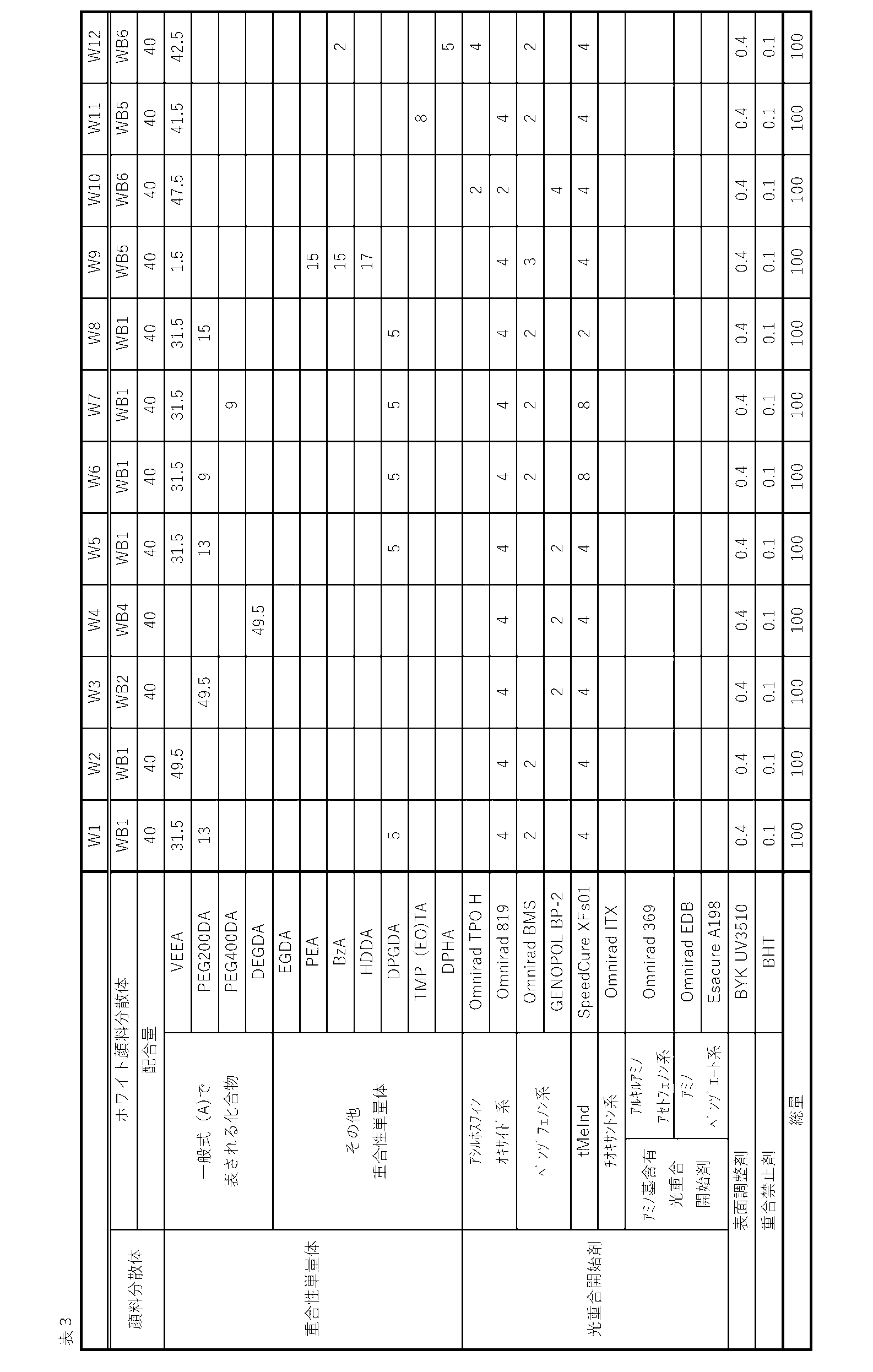
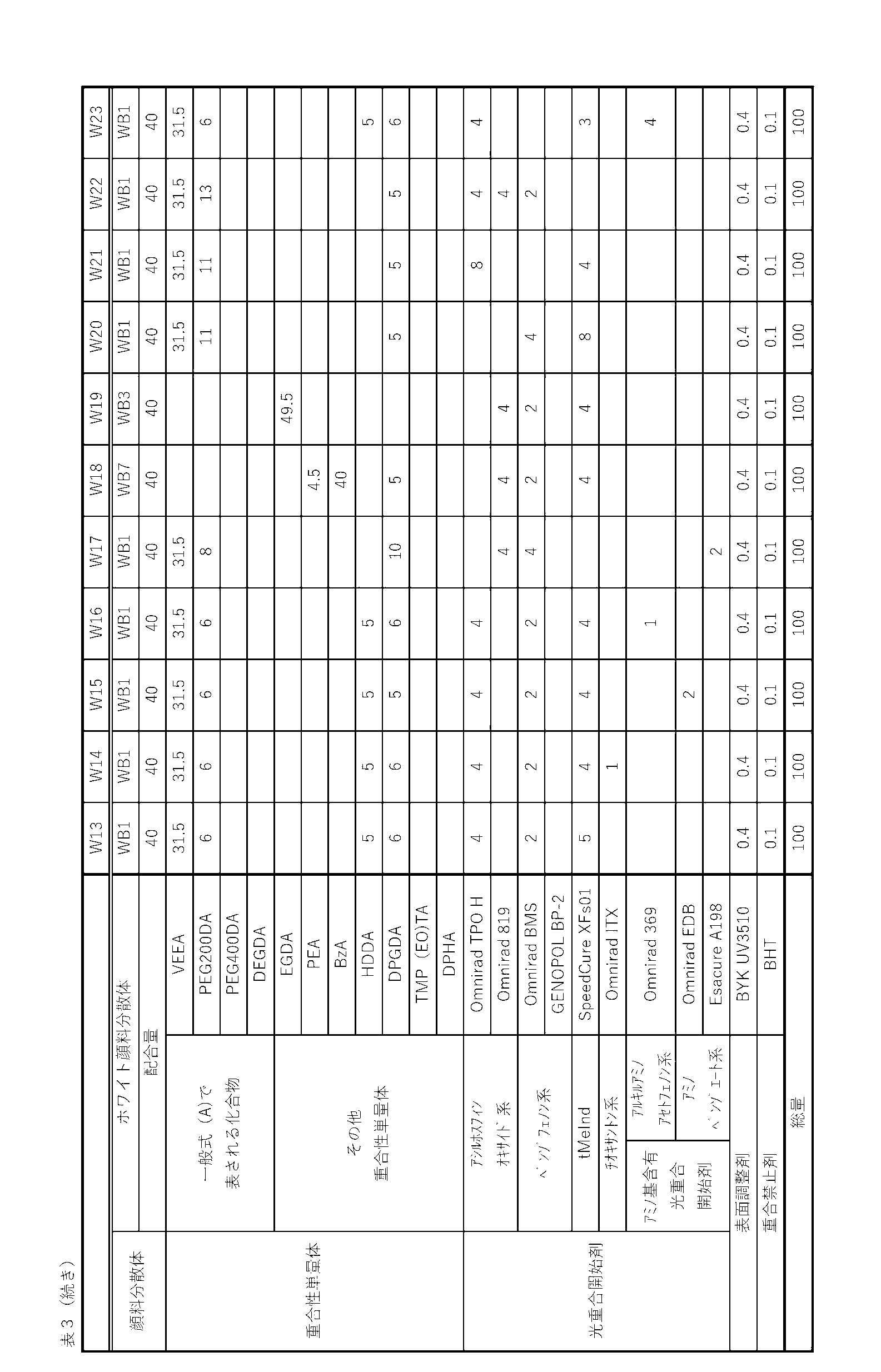


・VEEA:アクリル酸2-(2-ビニロキシエトキシ)エチル(日本触媒社製)
・PEG200DA:ポリエチレングリコール200ジアクリレート(一般式(A)におけるn≒4)
・PEG400DA:ポリエチレングリコール400ジアクリレート(一般式(A)におけるn≒9)
・EGDA:エチレングリコールジアクリレート
・DEGDA:ジエチレングリコールジアクリレート
・PEA:2-フェノキシエチルアクリレート
・BzA:ベンジルアクリレート
・HDDA:1,6-ヘキサンジオールジアクリレート
・DPGDA:ジプロピレングリコールジアクリレート
・TMP(EO)TA:トリメチロールプロパンEO変性トリアクリレート
・DPHA:ジペンタエリスリトールヘキサアクリレート
・Omnirad TPO H:2,4,6-トリメチルベンゾイル-ジフェニルホスフィンオキサイド
・Omnirad 819:ビス(2,4,6-トリメチルベンゾイル)-フェニルホスフィンオキサイド(IGM RESINS社製)
・Omnirad BMS:[4-(メチルフェニルチオ)フェニル]-フェニルメタン(IGM RESINS社製)
・GENOPOL BP-2:ベンゾフェノン系化合物(Rahn AG社製)
・SpeedCure XFs01:2-ヒドロキシ-1-{1-[4-(2-ヒドロキシ-2-メチルプロピオニル)フェニル]-1,3,3-トリメチルインダン-5-イル}-2-メチルプロパン-1-オン(LAMBSON社製)
・Omnirad ITX:2-イソプロピルチオキサントン(IGM RESINS社製)
・Omnirad 369:2-(ジメチルアミノ)-1-(4-モルホリノフェニル)-2-ベンジル-1-ブタノン(IGM RESINS社製)
・Omnirad EDB:エチルp-(ジメチルアミノ)ベンゾエート(IGM RESINS社製) ・Esacure A198:アミノベンゾエート系化合物(IGM RESINS社製)
・GENOPOL AB-2:アミノベンゾエート系化合物(Rahn AG社製)
・BYK UV3510:ビックケミー社製シリコーン系表面張力調整剤
・BHT:2,6-ジ-tert-ブチル-4-メチルフェノール(精工化学社製「BHTスワノックス」)
得られたホワイトインキ及びブラックインキを、表5に記載したように組み合わせてインキセットとした。そして、上述した方法で印刷物を製造し、評価を行った。評価結果は表5に示した通りであった。なお、比較例1、及び比較例3~5に関しては、下層用インキと基材間の密着性が非常に弱かったため、下層用インキ層と上層用インキ層との間の密着性評価が実施できなかった。

Claims (5)
- 下層用インキ及び上層用インキを含み、仮硬化工程を含むラインパス型インクジェットプリンターで使用される紫外線硬化型インクジェットインキセットであって、
前記下層用インキ及び前記上層用インキのうち、一方がホワイトインキであり、他方がブラックインキであり、
前記下層用インキが、第1の重合性単量体と、第1の光重合開始剤と、第1の着色剤と、を含み、
前記第1の重合性単量体が、下記一般式(A)で表される化合物を含有し、
前記第1の光重合開始剤が、第1のアシルホスフィンオキサイド系光重合開始剤と、第1のベンゾフェノン系光重合開始剤と、2-ヒドロキシ-1-{1-[4-(2-ヒドロキシ-2-メチルプロピオニル)フェニル]-1,3,3-トリメチルインダン-5-イル}-2-メチルプロパン-1-オンと、を含み、
前記上層用インキが、第2の重合性単量体と、第2の光重合開始剤と、第2の着色剤と、を含み、
前記第2の重合性単量体が、下記一般式(A)で表される化合物を含有し
前記第2の光重合開始剤が、第2のアシルホスフィンオキサイド系光重合開始剤と、第2のベンゾフェノン系光重合開始剤と、を含む、紫外線硬化型インクジェットインキセット。
一般式(A): CH2=CH-CO-(O-CH2CH2)n-O-R
(一般式(A)中、Rは、アクリロイル基またはビニル基を表し、nは2~10の整数を表す。
また、前記第1の重合性単量体における一般式(A)で表される化合物と、前記第2の重合性単量体における一般式(A)で表される化合物とは、同一でも異なっていてもよい。) - 前記第1の重合性単量体における一般式(A)で表される化合物のR、及び、前記第2の重合性単量体における一般式(A)で表される化合物のRが、いずれもビニル基である、請求項1に記載の紫外線硬化型インクジェットインキセット。
- 前記上層用インキが、更に、アミノ基を有する光重合開始剤を含む、請求項1または2に記載の紫外線硬化型インクジェットインキセット。
- 前記下層用インキが、チオキサントン系光重合開始剤、及び、アミノ基を有する光重合開始剤を実質的に含まない、請求項1~3のいずれかに記載の紫外線硬化型インクジェットインキセット。
- 請求項1~4のいずれかに記載の紫外線硬化型インクジェットインキセットを用いた印刷物の製造方法であって、
基材上に下層用インキを吐出し付与する工程1、
工程1で得られた下層用インキを付与した基材に対し、紫外線発光ダイオードから紫外線を照射する工程2、
工程2で得られた下層用インキを付与した基材に対し、上層用インキを、下層用インキと少なくとも一部が重なるように吐出し付与する工程3、
工程3で得られた下層用インキ及び上層用インキを付与した基材に対し、紫外線ランプから紫外線を照射する工程4、
を有する、印刷物の製造方法。
Priority Applications (3)
| Application Number | Priority Date | Filing Date | Title |
|---|---|---|---|
| CN202180054758.1A CN116133864B (zh) | 2020-12-25 | 2021-08-11 | 紫外线固化型喷墨油墨组及印刷物的制造方法 |
| EP21909795.3A EP4269112B1 (en) | 2020-12-25 | 2021-08-11 | Ultraviolet curable inkjet ink set and production method of printed matter |
| US17/634,358 US11680179B2 (en) | 2020-12-25 | 2021-08-11 | Ultraviolet curable inkjet ink set and production method of printed matter |
Applications Claiming Priority (2)
| Application Number | Priority Date | Filing Date | Title |
|---|---|---|---|
| JP2020216784A JP6932233B1 (ja) | 2020-12-25 | 2020-12-25 | 紫外線硬化型インクジェットインキセット及び印刷物の製造方法 |
| JP2020-216784 | 2020-12-25 |
Publications (1)
| Publication Number | Publication Date |
|---|---|
| WO2022137635A1 true WO2022137635A1 (ja) | 2022-06-30 |
Family
ID=77549977
Family Applications (1)
| Application Number | Title | Priority Date | Filing Date |
|---|---|---|---|
| PCT/JP2021/029665 Ceased WO2022137635A1 (ja) | 2020-12-25 | 2021-08-11 | 紫外線硬化型インクジェットインキセット及び印刷物の製造方法 |
Country Status (5)
| Country | Link |
|---|---|
| US (1) | US11680179B2 (ja) |
| EP (1) | EP4269112B1 (ja) |
| JP (1) | JP6932233B1 (ja) |
| CN (1) | CN116133864B (ja) |
| WO (1) | WO2022137635A1 (ja) |
Families Citing this family (3)
| Publication number | Priority date | Publication date | Assignee | Title |
|---|---|---|---|---|
| JP7615559B2 (ja) * | 2020-08-04 | 2025-01-17 | Dic株式会社 | エネルギー線硬化性インクジェット印刷インク及び印刷物の製造方法 |
| EP4512866A3 (en) * | 2023-07-13 | 2025-06-11 | Corning Incorporated | Photocurable inks and primers for automotive interior applications and glass articles comprising same |
| CN121293806B (zh) * | 2024-12-17 | 2026-04-07 | 江门市健鼎包装有限公司 | 一种uv防水油墨的制备方法 |
Citations (10)
| Publication number | Priority date | Publication date | Assignee | Title |
|---|---|---|---|---|
| JP2011218794A (ja) | 2010-03-23 | 2011-11-04 | Seiko Epson Corp | 記録方法、記録装置、インクセット |
| JP2013177530A (ja) * | 2012-02-29 | 2013-09-09 | Seiko Epson Corp | 光硬化型インクジェットインクセット及びこれを用いたインクジェット記録方法 |
| JP2013240978A (ja) | 2012-04-25 | 2013-12-05 | Seiko Epson Corp | インクジェット記録方法、紫外線硬化型インク、インクジェット記録装置 |
| JP2015063064A (ja) * | 2013-09-25 | 2015-04-09 | 富士フイルム株式会社 | インクジェット記録方法、及び、印刷物 |
| JP2015113434A (ja) * | 2013-12-13 | 2015-06-22 | Dic株式会社 | 活性エネルギー線硬化型インクジェット記録用インク及びインクセット |
| JP2015183148A (ja) * | 2014-03-26 | 2015-10-22 | 東洋インキScホールディングス株式会社 | 活性エネルギー線硬化型インクジェットインキ組成物 |
| JP2015183147A (ja) * | 2014-03-26 | 2015-10-22 | 東洋インキScホールディングス株式会社 | 活性エネルギー線硬化型インクジェットインキ組成物 |
| WO2017086224A1 (ja) | 2015-11-20 | 2017-05-26 | 富士フイルム株式会社 | 光重合開始剤及びその製造方法、重合性組成物、インクジェット記録方法、並びに、アシルホスフィンオキシド化合物 |
| JP2017179006A (ja) * | 2016-03-28 | 2017-10-05 | 東洋インキScホールディングス株式会社 | 活性エネルギー線硬化型インクジェットインキ組成物 |
| WO2020049378A1 (en) | 2018-09-07 | 2020-03-12 | Igm Resins Italia S.R.L. | Multifunctional bisacylphosphine oxide photoinitiators |
Family Cites Families (16)
| Publication number | Priority date | Publication date | Assignee | Title |
|---|---|---|---|---|
| JP2001246767A (ja) * | 2000-03-07 | 2001-09-11 | Sharp Corp | インクジェット画像形成方法及びインクジェット画像形成装置 |
| JP2003072059A (ja) * | 2001-06-21 | 2003-03-12 | Ricoh Co Ltd | インクジェット記録装置及び複写機 |
| US7458673B2 (en) * | 2003-10-29 | 2008-12-02 | Konica Minolta Medical & Graphic Inc. | Ink jet recording apparatus |
| US20060135935A1 (en) * | 2004-12-22 | 2006-06-22 | Kimberly-Clark Worldwide, Inc. | System and method for unfolding and dispensing diapers |
| JP4898618B2 (ja) * | 2007-09-28 | 2012-03-21 | 富士フイルム株式会社 | インクジェット記録方法 |
| ES2400839T3 (es) * | 2007-10-24 | 2013-04-12 | Agfa Graphics Nv | Tinta de inyección blanca mejorada para la estabilidad de la dispersión |
| JP5790234B2 (ja) * | 2010-12-13 | 2015-10-07 | セイコーエプソン株式会社 | 紫外線硬化型インクジェット用インク組成物、これを用いたインクジェット記録装置、これを用いたインクジェット記録方法、及びインクセット |
| CN107379803A (zh) * | 2012-03-28 | 2017-11-24 | 精工爱普生株式会社 | 喷墨记录方法、紫外线固化型油墨、喷墨记录装置 |
| JP5584868B2 (ja) * | 2012-04-09 | 2014-09-10 | 東洋インキScホールディングス株式会社 | 活性エネルギー線硬化型インクジェットインキセット |
| JP2015187270A (ja) * | 2015-04-09 | 2015-10-29 | 東洋インキScホールディングス株式会社 | 活性エネルギー線硬化型インクジェットインキ組成物 |
| EP3222684B1 (en) * | 2016-03-21 | 2020-03-11 | Agfa Nv | Uv curable inkjet inks |
| JP6858507B2 (ja) * | 2016-08-09 | 2021-04-14 | サカタインクス株式会社 | 光硬化型インクジェット印刷用インク組成物、印刷物、及び成形品 |
| CN110709172A (zh) * | 2017-03-07 | 2020-01-17 | 太阳化学公司 | 湿套印方法 |
| JP6702348B2 (ja) * | 2018-03-19 | 2020-06-03 | セイコーエプソン株式会社 | インクジェット記録方法 |
| JP6897844B2 (ja) * | 2018-03-19 | 2021-07-07 | セイコーエプソン株式会社 | 光硬化型インクジェットインクセット及びこれを用いたインクジェット記録方法 |
| KR102194888B1 (ko) * | 2018-10-17 | 2020-12-24 | 한국다이요잉크 주식회사 | 잉크젯용 잉크 조성물 |
-
2020
- 2020-12-25 JP JP2020216784A patent/JP6932233B1/ja active Active
-
2021
- 2021-08-11 CN CN202180054758.1A patent/CN116133864B/zh active Active
- 2021-08-11 US US17/634,358 patent/US11680179B2/en active Active
- 2021-08-11 WO PCT/JP2021/029665 patent/WO2022137635A1/ja not_active Ceased
- 2021-08-11 EP EP21909795.3A patent/EP4269112B1/en active Active
Patent Citations (10)
| Publication number | Priority date | Publication date | Assignee | Title |
|---|---|---|---|---|
| JP2011218794A (ja) | 2010-03-23 | 2011-11-04 | Seiko Epson Corp | 記録方法、記録装置、インクセット |
| JP2013177530A (ja) * | 2012-02-29 | 2013-09-09 | Seiko Epson Corp | 光硬化型インクジェットインクセット及びこれを用いたインクジェット記録方法 |
| JP2013240978A (ja) | 2012-04-25 | 2013-12-05 | Seiko Epson Corp | インクジェット記録方法、紫外線硬化型インク、インクジェット記録装置 |
| JP2015063064A (ja) * | 2013-09-25 | 2015-04-09 | 富士フイルム株式会社 | インクジェット記録方法、及び、印刷物 |
| JP2015113434A (ja) * | 2013-12-13 | 2015-06-22 | Dic株式会社 | 活性エネルギー線硬化型インクジェット記録用インク及びインクセット |
| JP2015183148A (ja) * | 2014-03-26 | 2015-10-22 | 東洋インキScホールディングス株式会社 | 活性エネルギー線硬化型インクジェットインキ組成物 |
| JP2015183147A (ja) * | 2014-03-26 | 2015-10-22 | 東洋インキScホールディングス株式会社 | 活性エネルギー線硬化型インクジェットインキ組成物 |
| WO2017086224A1 (ja) | 2015-11-20 | 2017-05-26 | 富士フイルム株式会社 | 光重合開始剤及びその製造方法、重合性組成物、インクジェット記録方法、並びに、アシルホスフィンオキシド化合物 |
| JP2017179006A (ja) * | 2016-03-28 | 2017-10-05 | 東洋インキScホールディングス株式会社 | 活性エネルギー線硬化型インクジェットインキ組成物 |
| WO2020049378A1 (en) | 2018-09-07 | 2020-03-12 | Igm Resins Italia S.R.L. | Multifunctional bisacylphosphine oxide photoinitiators |
Non-Patent Citations (1)
| Title |
|---|
| See also references of EP4269112A4 |
Also Published As
| Publication number | Publication date |
|---|---|
| US20220372319A1 (en) | 2022-11-24 |
| EP4269112B1 (en) | 2025-10-08 |
| EP4269112A1 (en) | 2023-11-01 |
| EP4269112A4 (en) | 2024-05-29 |
| US11680179B2 (en) | 2023-06-20 |
| CN116133864A (zh) | 2023-05-16 |
| JP2022102193A (ja) | 2022-07-07 |
| JP6932233B1 (ja) | 2021-09-08 |
| CN116133864B (zh) | 2025-05-09 |
Similar Documents
| Publication | Publication Date | Title |
|---|---|---|
| EP3442720B1 (en) | Process for electron beam curable inkjet formulations | |
| JP7064091B1 (ja) | 紫外線硬化型インクジェットインキ | |
| JP6720628B2 (ja) | 印刷物の製造方法 | |
| EP2876142B1 (en) | Photocurable ink composition for inkjet printing and printed material | |
| JP7644888B2 (ja) | 紫外線硬化型インクジェットインキ及び印刷物の製造方法 | |
| JP6932233B1 (ja) | 紫外線硬化型インクジェットインキセット及び印刷物の製造方法 | |
| WO2020110908A1 (ja) | 活性エネルギー線硬化型インクジェットインキ、インクジェット記録物、及び、インクジェット記録物の製造方法 | |
| JP7575628B1 (ja) | 活性エネルギー線硬化型インクジェットブラックインキ及び印刷物 | |
| JP7403229B2 (ja) | 光硬化型インクジェット記録用インク組成物およびインクセット | |
| JP2023014221A (ja) | 光硬化型インクジェット記録用インク組成物およびインクセット | |
| JP6627782B2 (ja) | インクセットおよび画像形成方法 | |
| JP7724933B1 (ja) | 活性エネルギー線硬化型インクジェットインキ及び印刷物 | |
| WO2024165880A1 (ja) | 紫外線硬化型インクジェットインキ及びインクジェット記録方法 | |
| JP2026073966A (ja) | 紫外線硬化型インクジェットインキ及び印刷物 | |
| WO2026014236A1 (ja) | 紫外線硬化型インクジェットインキ及び印刷物 | |
| JP2026073965A (ja) | 活性エネルギー線硬化型インクジェットインキ及び印刷物 | |
| WO2014136549A1 (ja) | インクジェット記録用インク組成物、画像形成方法及び印画物 |
Legal Events
| Date | Code | Title | Description |
|---|---|---|---|
| 121 | Ep: the epo has been informed by wipo that ep was designated in this application |
Ref document number: 21909795 Country of ref document: EP Kind code of ref document: A1 |
|
| NENP | Non-entry into the national phase |
Ref country code: DE |
|
| ENP | Entry into the national phase |
Ref document number: 2021909795 Country of ref document: EP Effective date: 20230725 |
|
| WWG | Wipo information: grant in national office |
Ref document number: 202180054758.1 Country of ref document: CN |
|
| WWG | Wipo information: grant in national office |
Ref document number: 2021909795 Country of ref document: EP |