WO2022137888A1 - クワシンを含有する飲料 - Google Patents
クワシンを含有する飲料 Download PDFInfo
- Publication number
- WO2022137888A1 WO2022137888A1 PCT/JP2021/041980 JP2021041980W WO2022137888A1 WO 2022137888 A1 WO2022137888 A1 WO 2022137888A1 JP 2021041980 W JP2021041980 W JP 2021041980W WO 2022137888 A1 WO2022137888 A1 WO 2022137888A1
- Authority
- WO
- WIPO (PCT)
- Prior art keywords
- beverage
- content
- alcohol
- sample
- ppm
- Prior art date
- Legal status (The legal status is an assumption and is not a legal conclusion. Google has not performed a legal analysis and makes no representation as to the accuracy of the status listed.)
- Ceased
Links
Classifications
-
- A—HUMAN NECESSITIES
- A23—FOODS OR FOODSTUFFS; TREATMENT THEREOF, NOT COVERED BY OTHER CLASSES
- A23L—FOODS, FOODSTUFFS OR NON-ALCOHOLIC BEVERAGES, NOT OTHERWISE PROVIDED FOR; PREPARATION OR TREATMENT THEREOF
- A23L2/00—Non-alcoholic beverages; Dry compositions or concentrates therefor; Preparation or treatment thereof
- A23L2/52—Adding ingredients
-
- A—HUMAN NECESSITIES
- A23—FOODS OR FOODSTUFFS; TREATMENT THEREOF, NOT COVERED BY OTHER CLASSES
- A23L—FOODS, FOODSTUFFS OR NON-ALCOHOLIC BEVERAGES, NOT OTHERWISE PROVIDED FOR; PREPARATION OR TREATMENT THEREOF
- A23L2/00—Non-alcoholic beverages; Dry compositions or concentrates therefor; Preparation or treatment thereof
- A23L2/52—Adding ingredients
- A23L2/56—Flavouring or bittering agents
-
- B—PERFORMING OPERATIONS; TRANSPORTING
- B65—CONVEYING; PACKING; STORING; HANDLING THIN OR FILAMENTARY MATERIAL
- B65D—CONTAINERS FOR STORAGE OR TRANSPORT OF ARTICLES OR MATERIALS, e.g. BAGS, BARRELS, BOTTLES, BOXES, CANS, CARTONS, CRATES, DRUMS, JARS, TANKS, HOPPERS, FORWARDING CONTAINERS; ACCESSORIES, CLOSURES, OR FITTINGS THEREFOR; PACKAGING ELEMENTS; PACKAGES
- B65D85/00—Containers, packaging elements or packages, specially adapted for particular articles or materials
- B65D85/70—Containers, packaging elements or packages, specially adapted for particular articles or materials for materials not otherwise provided for
- B65D85/72—Containers, packaging elements or packages, specially adapted for particular articles or materials for materials not otherwise provided for for edible or potable liquids, semiliquids, or plastic or pasty materials
-
- C—CHEMISTRY; METALLURGY
- C12—BIOCHEMISTRY; BEER; SPIRITS; WINE; VINEGAR; MICROBIOLOGY; ENZYMOLOGY; MUTATION OR GENETIC ENGINEERING
- C12G—WINE; PREPARATION THEREOF; ALCOHOLIC BEVERAGES; PREPARATION OF ALCOHOLIC BEVERAGES NOT PROVIDED FOR IN SUBCLASSES C12C OR C12H
- C12G3/00—Preparation of other alcoholic beverages
- C12G3/04—Preparation of other alcoholic beverages by mixing, e.g. for preparation of liqueurs
-
- A—HUMAN NECESSITIES
- A23—FOODS OR FOODSTUFFS; TREATMENT THEREOF, NOT COVERED BY OTHER CLASSES
- A23V—INDEXING SCHEME RELATING TO FOODS, FOODSTUFFS OR NON-ALCOHOLIC BEVERAGES AND LACTIC OR PROPIONIC ACID BACTERIA USED IN FOODSTUFFS OR FOOD PREPARATION
- A23V2002/00—Food compositions, function of food ingredients or processes for food or foodstuffs
-
- A—HUMAN NECESSITIES
- A23—FOODS OR FOODSTUFFS; TREATMENT THEREOF, NOT COVERED BY OTHER CLASSES
- A23V—INDEXING SCHEME RELATING TO FOODS, FOODSTUFFS OR NON-ALCOHOLIC BEVERAGES AND LACTIC OR PROPIONIC ACID BACTERIA USED IN FOODSTUFFS OR FOOD PREPARATION
- A23V2200/00—Function of food ingredients
-
- A—HUMAN NECESSITIES
- A23—FOODS OR FOODSTUFFS; TREATMENT THEREOF, NOT COVERED BY OTHER CLASSES
- A23V—INDEXING SCHEME RELATING TO FOODS, FOODSTUFFS OR NON-ALCOHOLIC BEVERAGES AND LACTIC OR PROPIONIC ACID BACTERIA USED IN FOODSTUFFS OR FOOD PREPARATION
- A23V2200/00—Function of food ingredients
- A23V2200/15—Flavour affecting agent
-
- A—HUMAN NECESSITIES
- A23—FOODS OR FOODSTUFFS; TREATMENT THEREOF, NOT COVERED BY OTHER CLASSES
- A23V—INDEXING SCHEME RELATING TO FOODS, FOODSTUFFS OR NON-ALCOHOLIC BEVERAGES AND LACTIC OR PROPIONIC ACID BACTERIA USED IN FOODSTUFFS OR FOOD PREPARATION
- A23V2200/00—Function of food ingredients
- A23V2200/16—Taste affecting agent
Definitions
- the present invention relates to a novel beverage, a method for producing the same, and a method for improving the flavor of the beverage.
- Patent Document 1 Various alcoholic beverages and alcoholic taste beverages are distributed in the market. These beverages have been devised in various ways for the purpose of differentiating them from competing products.
- the non-alcoholic beverage has a problem that the thickness of the taste is insufficient and the aftertaste balance is poor.
- an aliphatic aldehyde having 5 carbon atoms composed of 2-methylbutanal and the like, and acetic acid such as isobutyl acetate It is disclosed to provide a non-alcoholic beverage containing a specific amount of ester.
- Patent Document 2 has a problem that the thickness, body feeling, taste, etc.
- the solution is to add a specific amount of citrus to the basic solution).
- Patent Document 3 regarding non-alcoholic beverages, in order to enhance the thickness of taste and ease of drinking, a specific amount of water-soluble dietary fiber is blended, and the content ratio of water-soluble dietary fiber to citric acid is within a specific range. Adjustments are disclosed.
- Patent Document 4 the citric acid acidity is specified in a carbonated beverage containing an acidity-imparting agent (vitamin C, acidulant, etc.) in order to suppress irritating acidity and enhance the body feeling without increasing calories. It is disclosed that catechins are blended in a specific amount with respect to beverages in the range of.
- Japanese Patent No. 6230780 Japanese Patent No. 5498154 Japanese Patent No. 6541751 Japanese Unexamined Patent Publication No. 2011-182683
- An object of the present invention is to provide a beverage having a high degree of satisfaction while suppressing sweetness.
- the inventor of the present application focused on the components constituting the flavor of alcoholic beverages.
- an ingredient that is an indicator of the highly satisfying taste of beverages from a wide variety of ingredients that exist in alcoholic beverages. It was confirmed that a beverage having a high degree of satisfaction and deliciousness can be obtained by appropriately blending such ingredients.
- the present invention has been completed based on such findings.
- the present invention provides: However, the present invention is not limited to this.
- the packaged beverage (2) The packaged beverage of (1) having a quasin content of 0.1 ppm or more.
- the packaged beverage according to any one of (1) to (5) which has a total phenol content of 7 ppm or more.
- the above-mentioned manufacturing method comprising. (10) A step of adjusting the quasin content of a beverage to 0.08 ppm or more and 25 ppm or less, which is a method for improving the highly satisfying taste of a packaged beverage.
- the present invention provides a packaged beverage.
- the form of the container is not limited in any way, and can be provided in the form of a container containing plastic as a main component, a metal can, a laminated paper container laminated with a metal foil or a plastic film, a glass bottle, or the like.
- the beverage may be either an alcoholic beverage or a non-alcoholic beverage.
- the beverage may be either a carbonated beverage or a non-carbonated beverage.
- the upper limit of the alcohol content of the alcoholic beverage is preferably 9.5% (v / v) or less, more preferably 9.0% (v / v) or less, still more preferably 7.0% (v / v) or less. Even more preferably, it is 5.0% (v / v) or less, and most preferably 3.0% (v / v) or less.
- Alcoholic beverages include distilled liquor (whiskey, brandy, wokka, gin, lamb, tequila, shochu, and awamori, etc.), brewed liquor (beer, whiskey, ciddle, white wine, red wine, sake, and sake), and mixed liquor.
- Non-alcoholic beverages are beverages that do not contain or substantially do not contain alcohol. More specifically, it is a beverage having an alcohol content of less than 0.05% (v / v) to 0.00% (v / v).
- Non-alcoholic beverages include distilled liquor (whiskey, brandy, wokka, gin, lamb, tequila, shochu, and awamori, etc.), brewed liquor (beer, whiskey, ciddle, white wine, red wine, Japanese liquor, and sake), and mixed liquor.
- At least one liquor-like flavor (the Beverages (alcoholic-taste beverages) having a flavor reminiscent of alcoholic beverages (those intended to be close to the flavor of alcoholic beverages) can be mentioned, but are not limited thereto.
- the beverage of the present invention can be applied to, but not limited to, low-alcohol beverages, non-alcoholic beverages, zero-alcohol beverages, alcohol-free beverages, or alcohol-taste beverages. Is.
- the beverage of the present invention contains alcohol
- at least a part of the alcohol in the beverage can be derived from the raw material alcoholic beverage.
- 20% (v / v) or more, 50% (v / v) or more, 95% (v / v) or more of alcohol in the beverage, or 100% (v / v) (all) of alcohol is a raw material.
- the term "alcohol” is used to mean “ethanol”, and “alcohol” and "ethanol” can be replaced with each other.
- alcohol, content, content, and frequency are treated as synonymous.
- Alcohol can be measured by a method known to those skilled in the art. For example, it can be measured by a vibration type densitometer.
- the beverage is filtered or ultrasonically treated to remove carbon dioxide from the beverage. This is used as a sample for direct-fire distillation to obtain a distillate.
- the density of the obtained distillate at 15 ° C was measured, and the attached table of the National Tax Agency's prescribed analysis method (National Tax Agency Instruction No. 6 of 2007, revised on June 22, 2007) "Table 2 Alcohol content and density” (15 ° C.) and specific gravity (15/15 ° C.) conversion table ”is used to convert the density measured into alcohol content.
- the beverage of the present invention comprises quacin and total phenol. Quassin and total phenol may be present in certain alcoholic beverages, but their relationship to the flavor of alcoholic beverages was unclear. The inventor of the present application has revealed that quacin and total phenol can be used as index components for the flavor of alcoholic beverages. Therefore, these components have significance as index components of highly satisfying deliciousness with respect to the beverage of the present invention.
- the lower limit of the quasin content of the beverage of the present invention is preferably 0.08 ppm or more, more preferably 0.09 ppm or more, further preferably 0.1 ppm or more, and the upper limit is preferably 25 ppm or less, more preferably 23 ppm or less, still more preferably. It is 20 ppm or less.
- At least a part of the quacin in the beverage can be derived from the raw material liquor. For example, alcoholic beverages made from 20% (w / w) or more, 50% (w / w) or more, 95% (w / w) or more, or 100% (w / w) (all) of quacin in the beverage. Can be derived from.
- Quassin is a substance represented by the molecular formula C22H28O6 and is also called quassin. Quassin is known to be one of the bitter components of the Jamaica excelsa SW. Extract.
- the Jamaican cassia extract also referred to as cassia extract or cassia, is obtained by extracting with water from the trunk branch or bark of the Jamaican quassia of the family Simaroubaceae.
- the total phenol content of the beverage of the present invention is preferably 4.5 ppm or more, more preferably 5 ppm or more, still more preferably 6 ppm or more, still more preferably 7 ppm or more.
- the upper limit of total phenol can be preferably 1000 ppm or less, more preferably 950 ppm or less, still more preferably 900 ppm or less.
- At least a part of the total phenol in the beverage can be derived from the raw material alcoholic beverage. For example, 20% (w / w) or more, 50% (w / w) or more, 95% (w / w) or more, or 100% (w / w) (all) of the total phenol in the beverage is the raw material. It can be derived from alcoholic beverages.
- total phenol means a compound having a hydroxyl group in the benzene nucleus and which can be detected by using a phenol reagent.
- the detection of total phenol can be performed as follows. The sample is mixed with a phenol reagent (containing molybdic acid and tungstic acid), and the phenolic hydroxyl group of the compound in the sample is combined with molybdenum acid and tungstic acid to cause a color development reaction. This color development is measured and the total amount of phenol is derived based on the calibration curve.
- a phenol reagent containing molybdic acid and tungstic acid
- the beverage of the present invention can further have a specific sweetness.
- the degree of sweetness can be used as a further index component of the highly satisfying taste of the beverage of the present invention.
- the sweetness of the beverage is preferably 3.5 or less, more preferably 3.3 or less, still more preferably 3.0 or less.
- the degree of sweetness as used herein means the intensity of sweetness derived from the sweetener added to the carbonated drink. In the present specification, the degree of sweetness is calculated based on the sweetness of sucrose. For example, the sweetness degree 1 corresponds to the sweetness intensity of the 1% (w / v) sucrose aqueous solution, and the sweetness degree 2 corresponds to the sweetness intensity of the 2% (w / v) sucrose aqueous solution.
- the sweetness of each sweetener in the present specification is 100, and the sweetness of acesulfame potassium, sucralose, and high fructose corn syrup is considered to be 20000, 60000, and 75.5, respectively.
- the amount of the added sweetener may be adjusted.
- the degree of sweetness can be adjusted by using any sweetener.
- natural sweeteners, sugar alcohols, artificial sweeteners and the like can be used.
- natural sweeteners include glucose, fructose, mogrol sugar, glycyrrhizic acid sugar, maltose, sucrose, lactose, rare sugar, high fructose syrup, high fructose corn syrup, oligosaccharide, honey, sugar cane juice.
- sugar honey sugar (sucrose, fructose, brown sugar, Japanese bonito, etc.), maple syrup, moraces (sugar honey), water candy, etc., but are not limited to these.
- sugar alcohols include, but are not limited to, erythritol, xylitol, sorbitol, maltitol, and mannitol.
- examples of the artificial sweetener include, but are not limited to, sucralose, acesulfame potassium, aspartame, saccharin, alitame, neotame and the like.
- the beverage of the present invention can further have a specific acidity.
- the acidity can be a further indicator component of the highly satisfying taste of the beverage of the present invention.
- the acidity of the beverage is preferably 0.08 or more, more preferably 0.09 or more, still more preferably 0.1 or more.
- the acidity may be adjusted using any acid. Carbonated with, for example, citric acid, phosphoric acid, tartaric acid, malic acid, oxalic acid, gluconic acid, ascorbic acid, succinic acid, lactic acid, acetic acid, sulfuric acid, hydrochloric acid, fumaric acid, phytic acid, itaconic acid, or other acids.
- the acidity of the beverage can be adjusted, but is not limited to this.
- the acidity may be adjusted by using a fruit juice (which may be either a transparent fruit juice or a turbid fruit juice), an acidulant based on a food additive, or the like.
- the acidity as used herein is a value that is an index of the acid content, and is the alkali (sodium hydroxide, etc.) required to neutralize (pH 7.0) a certain amount of beverage (sample). It can be calculated from the quantity.
- An automatic titrator Metal toledo DL50 or the like
- the value of acidity is a value converted into the amount of citric acid (calculated from the neutralization amount on the assumption that all the acids contained in the beverage are citric acid).
- the beverage of the present invention may further contain components other than the above-mentioned components.
- Such ingredients include, but are not limited to, fragrances, vitamins, pigments, antioxidants, acidulants, emulsifiers, preservatives, seasonings, pH regulators and the like.
- fragrances include, but are not limited to, fragrances, vitamins, pigments, antioxidants, acidulants, emulsifiers, preservatives, seasonings, pH regulators and the like.
- these ingredients can be present in the beverage as long as the beverage has a satisfying taste.
- the beverage of the present invention may contain raw materials derived from alcoholic beverages.
- the alcoholic beverages mentioned here are distilled liquor (whiskey, brandy, wokka, gin, lamb, tequila, shochu, and awamori, etc.), brewed liquor (beer, whiskey, ciddle, white wine, red wine, sake, and sake), and mixed. Examples include, but are not limited to, sake (plum, liqueur, sherry, bellmot, etc.), low-malt beer, and new genres (for low-malt beer and new genres, the above-mentioned definition of HP of the National Tax Agency is followed).
- the raw material may be alcoholic beverages themselves, or may be a residual liquid obtained by distilling alcoholic beverages under reduced pressure.
- alcoholic beverages can be distilled, thereby obtaining a residual liquid, and the residual liquid can be incorporated into the beverage of the present invention.
- Distillation conditions pressure, temperature, time, etc.
- the distillation conditions can be set in consideration of the liquor to be distilled, the amount charged thereof, the capacity of the distillation equipment, the production schedule, and the like.
- the conditions relating to distillation can be set based on the knowledge obtained from preliminary tests or past production results.
- Distillation of alcoholic beverages may be carried out so that the specific component in the residual liquid has the desired content. This can be achieved, for example, by monitoring changes in the content of the indicator components in the residue during distillation. For example, when the change in the alcohol content in the residual liquid is monitored during distillation and the alcohol content in the residual liquid after distillation is mixed with the residual liquid to prepare a beverage, the alcohol in the beverage is the above. It can be adjusted to the desired content.
- the present invention provides a method for producing a beverage.
- the production method comprises a step of adjusting the quacin content, total phenol content, alcohol content, sweetness, and acidity of the beverage so as to be within a specific range.
- the "specific range” here is as described above with respect to each component or property.
- the production method is, if necessary, a raw material derived from liquor and / or other components (for example, flavoring, vitamins, pigments, antioxidants, acidulants, emulsifiers, preservatives, seasonings, and pH. It can further include a step of blending (such as a regulator).
- the production method can further include a step of filling a container with a beverage.
- the raw materials derived from alcoholic beverages, other components, and containers that can be used are as exemplified above.
- the beverage of the present invention has a highly satisfying taste.
- "deliciousness with high satisfaction” means that the overall flavor felt when drinking a beverage is excellent. Satisfaction with the deliciousness of a beverage can be judged by comprehensively evaluating the refreshing feeling when drinking the beverage, the response to drinking, and the sharpness of the aftertaste.
- the refreshing feeling, the response to drinking, and the sharpness of the aftertaste are each evaluated above a certain level, and the total of the evaluations of these three items is above a certain level, the beverage has a highly satisfying taste. I judge that.
- the high degree of satisfaction with the taste, the refreshing feeling when drinking the beverage, the response to drinking, and the sharpness of the aftertaste can be sensually evaluated. Details of the sensory evaluation are provided in the examples shown below.
- the present invention further provides a method for improving at least one selected from the group consisting of the refreshing feeling of a beverage, the response to drinking, the sharpness of the aftertaste, and the satisfaction of the deliciousness.
- the method comprises adjusting the quacin content, total phenol content, alcohol content, sweetness, and acidity of the beverage to a specific range.
- the "specific range" here is as described above with respect to each component or property.
- raw materials and / or other components derived from alcoholic beverages for example, flavorings, vitamins, pigments, antioxidants, acidulants, emulsifiers, preservatives, seasonings, and pH adjustments. It can further include a step of blending (such as an agent).
- the method can further include the step of filling the container with the beverage.
- the raw materials derived from alcoholic beverages, other components, and containers that can be used are as described above.
- Example 1 In order to investigate the effect of the alcohol content of the beverage on the flavor, samples with varying alcohol content were prepared.
- Example 1-1 Lemon flavor (without alcohol (0.00% (v / v)), lemon juice, acidulant (citric acid (anhydrous)), and acesulfam potassium are dissolved in carbonated water to prepare a sample. Prepared (alcohol content 0.00% (v / v)).
- Example 1-2 Brewing alcohol (alcohol content 95% (v / v)), lemon flavor, lemon juice, acidulant, and acesulfame potassium were dissolved in carbonated water as an alcohol source to prepare a sample (alcohol content). 3.00% (v / v)).
- Example 1-3 A sample was prepared by dissolving brewing alcohol (alcohol content 95% (v / v)), lemon flavor, lemon juice, acidulant, and acesulfam potassium as an alcohol source in carbonated water (alcohol content). 7.00% (v / v)).
- Example 1-4 Brewing alcohol (alcohol content 95% (v / v)), lemon flavor, lemon juice, acidulant, and acesulfame potassium were dissolved in carbonated water as an alcohol source to prepare a sample (alcohol content). 9.00% (v / v)).
- Comparative Example 1-1 Brewing alcohol (alcohol content 95% (v / v)), lemon flavor, lemon juice, acidulant, and acesulfame potassium were dissolved in carbonated water as an alcohol source to prepare a sample (alcohol content). 10.00% (v / v)).
- Comparative Example 1-1 with an alcohol content of 10% (v / v), the individual evaluations of refreshing feeling and drinking response were 2 points and 5 points, respectively, but the individual evaluation of the sharpness of the aftertaste was lower than 2 points.
- the total score of the three evaluation items was less than 9 points.
- the alcohol content of the beverage is less than 10% (v / v)
- a refreshing feeling, a response to drinking, and a sharpness of the aftertaste are improved, and a beverage having a highly satisfying taste can be obtained.
- the lower the alcohol content the higher the individual evaluation of the refreshing feeling and the sharpness of the aftertaste, and the higher the satisfaction of the deliciousness.
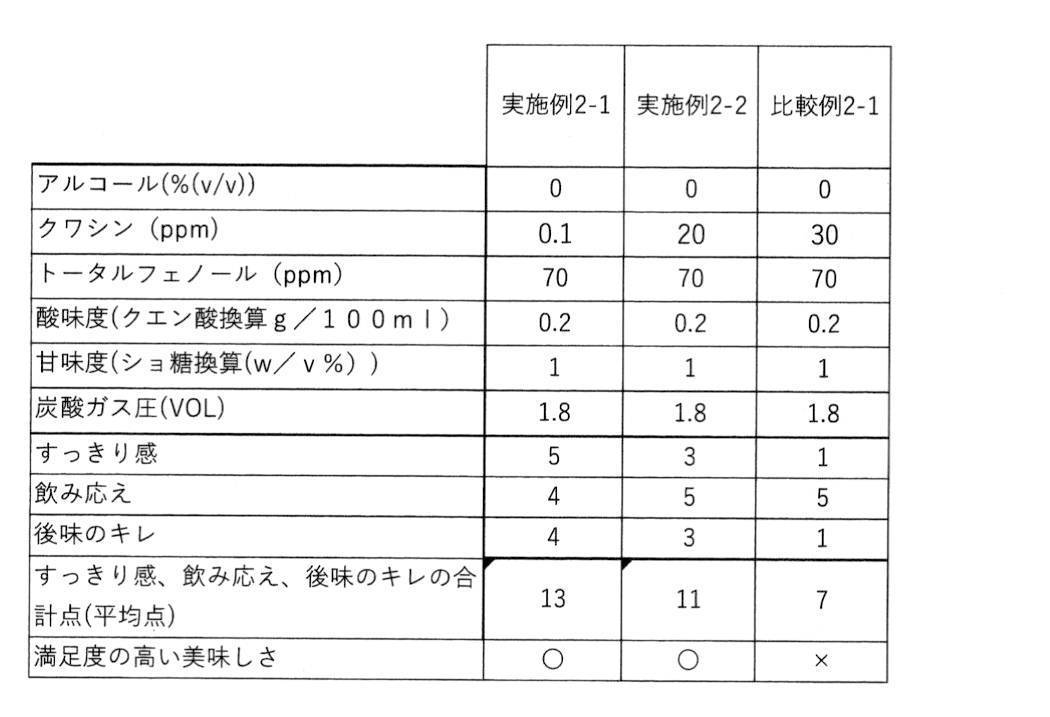
- Example 2 In order to investigate the effect of the quasin content of the beverage on the flavor, samples with varying quasin content were prepared.
- Example 2-1 Lemon flavor (without alcohol (0.00% (v / v)), lemon juice, acidulant, and acesulfame potassium were dissolved in carbonated water to prepare a sample (quasin content 0. 1 ppm).
- Example 2-2 Lemon flavor (without alcohol (0.00% (v / v)), lemon juice, acidulant, and acesulfame potassium were dissolved in carbonated water to prepare a sample (quasin content 20 ppm). ..
- Comparative Example 2-1 Lemon flavor (without alcohol (0.00% (v / v)), lemon juice, acidulant, and acesulfame potassium were dissolved in carbonated water to prepare a sample (quasin content 30 ppm). ..
- Example 1 The above sample was subjected to sensory evaluation according to the method shown in Example 1.
- the quasin content of the beverage is set to 0.1 ppm or more and less than 30 ppm, a refreshing feeling, a response to drinking, and a sharp aftertaste are improved, and a beverage having a highly satisfying taste can be obtained.
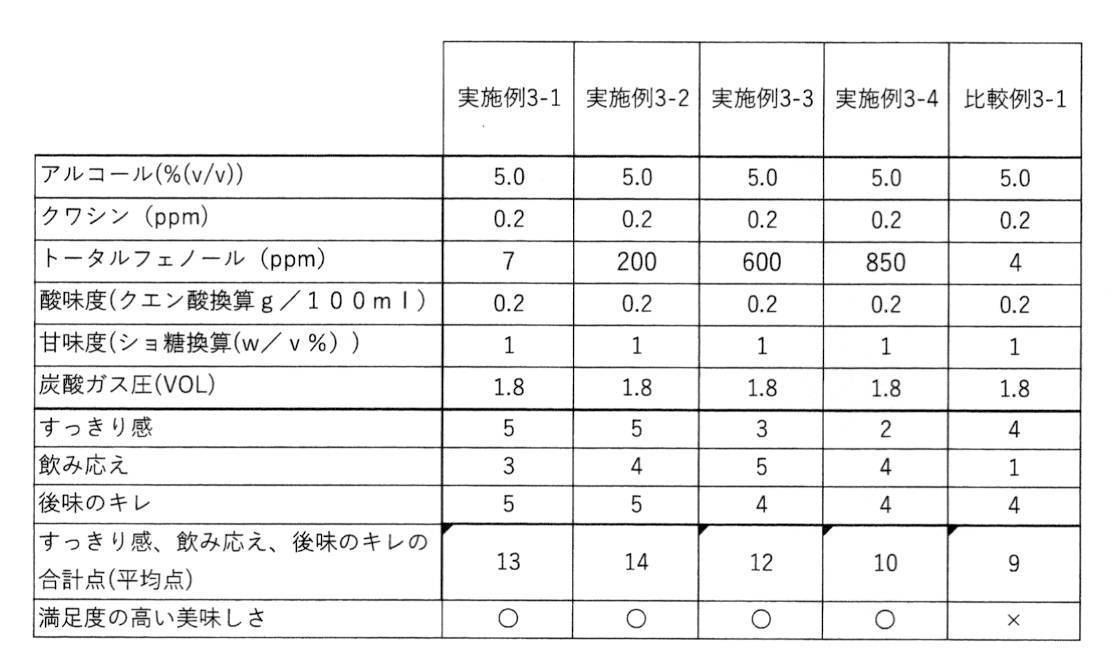
- Example 3 In order to investigate the effect of the total phenol content of the beverage on the flavor, samples with varying total phenol content were prepared.
- Comparative Example 3-1 Brewing alcohol (alcohol content 95% (v / v)), lemon flavor, lemon juice, acidulant, and acesulfame potassium were dissolved in carbonated water as an alcohol source to prepare a sample (total phenol). Content 4 ppm).
- Example 3-1 Brewing alcohol (alcohol content 95% (v / v)), lemon flavor, lemon juice, acidulant, and acesulfame potassium were dissolved in carbonated water as an alcohol source to prepare a sample (total phenol). Content 7 ppm).
- Example 3-2 Brewing alcohol (alcohol content 95% (v / v)), lemon flavor, lemon juice, acidulant, and acesulfame potassium were dissolved in carbonated water as an alcohol source to prepare a sample (total phenol). Content 200 ppm).
- Example 3-3 Brewing alcohol (alcohol content 95% (v / v)), lemon flavor, lemon juice, acidulant, and acesulfame potassium were dissolved in carbonated water as an alcohol source to prepare a sample (total phenol). Content 600 ppm).
- Example 3-4 Brewing alcohol (alcohol content 95% (v / v)), lemon flavor, lemon juice, acidulant, and acesulfame potassium were dissolved in carbonated water as an alcohol source to prepare a sample (total phenol). Content 850 ppm).
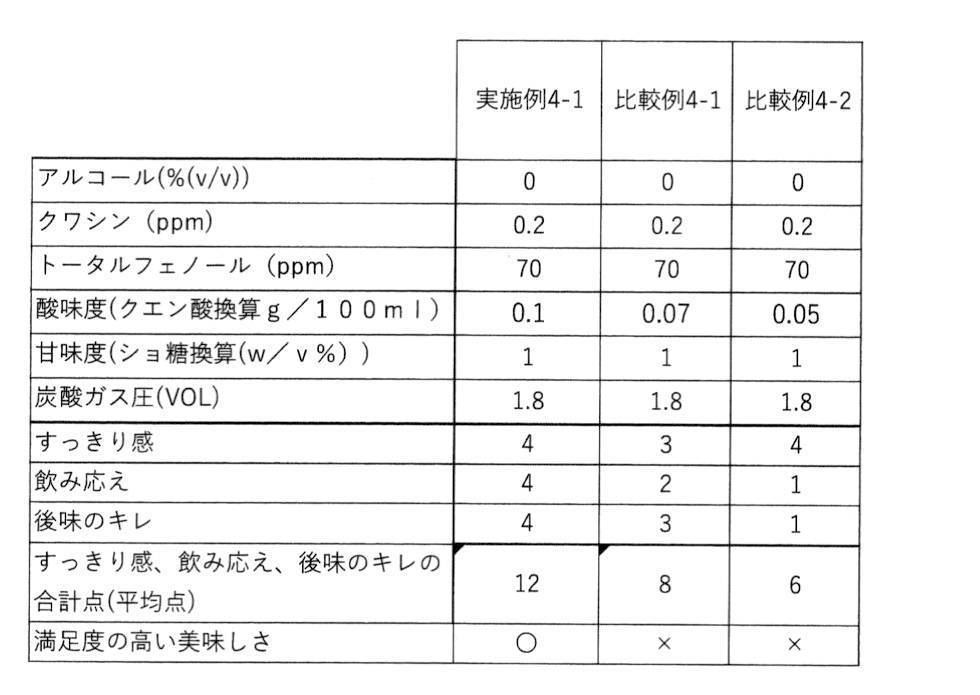
- Example 4 In order to investigate the effect of the acidity of the beverage (citric acid equivalent) on the flavor, samples with varying acidity were prepared.
- Example 4-1 Lemon flavor (without alcohol (0.00% (v / v)), lemon juice, acidulant, and acesulfame potassium were dissolved in carbonated water to prepare a sample (acidity 0. 1).
- Comparative Example 4-1 Lemon flavor (without alcohol (0.00% (v / v)), lemon juice, acidulant, and acesulfame potassium were dissolved in carbonated water to prepare a sample (acidity 0. 07).
- Comparative Example 4-2 A sample was prepared by dissolving lemon flavor (without alcohol (0.00% (v / v)), lemon juice, acidulant, and acesulfame potassium in carbonated water. 05).
- Example 1 The above sample was subjected to sensory evaluation according to the method shown in Example 1.
- Comparative Example 4-2 with an acidity of 0.05, the individual evaluation of the refreshing feeling was 4 points, but the individual evaluation of the drinking response and the sharpness of the aftertaste was less than 2 points, and the evaluation was 3 items (clean feeling, drinking). The total score of the response and the sharpness of the aftertaste) was less than 9 points.
- Example 4-1 with an acidity of 0.1, the individual evaluations of refreshing feeling, drinking response, and sharpness of aftertaste were all 4 points, and the total of 3 evaluation items (clean feeling, drinking response, and sharpness of aftertaste). The score exceeded 9 points.
- Example 5 In order to investigate the effect of the sweetness of the beverage (sucrose equivalent) on the flavor, samples with different sweetness were prepared.
- Example 5-1 Lemon flavor (without alcohol (0.00% (v / v)), lemon juice, acidulant, and acesulfame potassium were dissolved in carbonated water to prepare a sample (sweetness 2). ..
- Example 5-2 A sample was prepared by dissolving lemon flavor (without alcohol (0.00% (v / v)), lemon juice, acidulant, and acesulfame potassium in carbonated water). ..
- Comparative Example 5-1 Lemon flavor (without alcohol (0.00% (v / v)), lemon juice, acidulant, and acesulfame potassium were dissolved in carbonated water to prepare a sample (sweetness 4). ..
- Example 1 The above sample was subjected to sensory evaluation according to the method shown in Example 1.
- Comparative Example 5-1 with a sweetness of 4.0, the individual evaluation of the drinking response was 4 points, but the individual evaluation of the refreshing feeling and the sharpness of the aftertaste was less than 2 points.
- Example 5-1 with a sweetness of 2.0, the individual evaluations of refreshing feeling, drinking response, and sharpness of aftertaste were 4 points, 5 points, and 4 points, respectively, and 3 evaluation items (clean feeling, drinking response). , And the sharpness of the aftertaste) exceeded 9 points.
- Example 5-2 with a sweetness of 3.0, the individual evaluations of refreshing feeling, drinking response, and sharpness of aftertaste were 2 points, 4 points, and 4 points, respectively, and 3 evaluation items (clean feeling, drinking response). , And the sharpness of the aftertaste) exceeded 9 points.
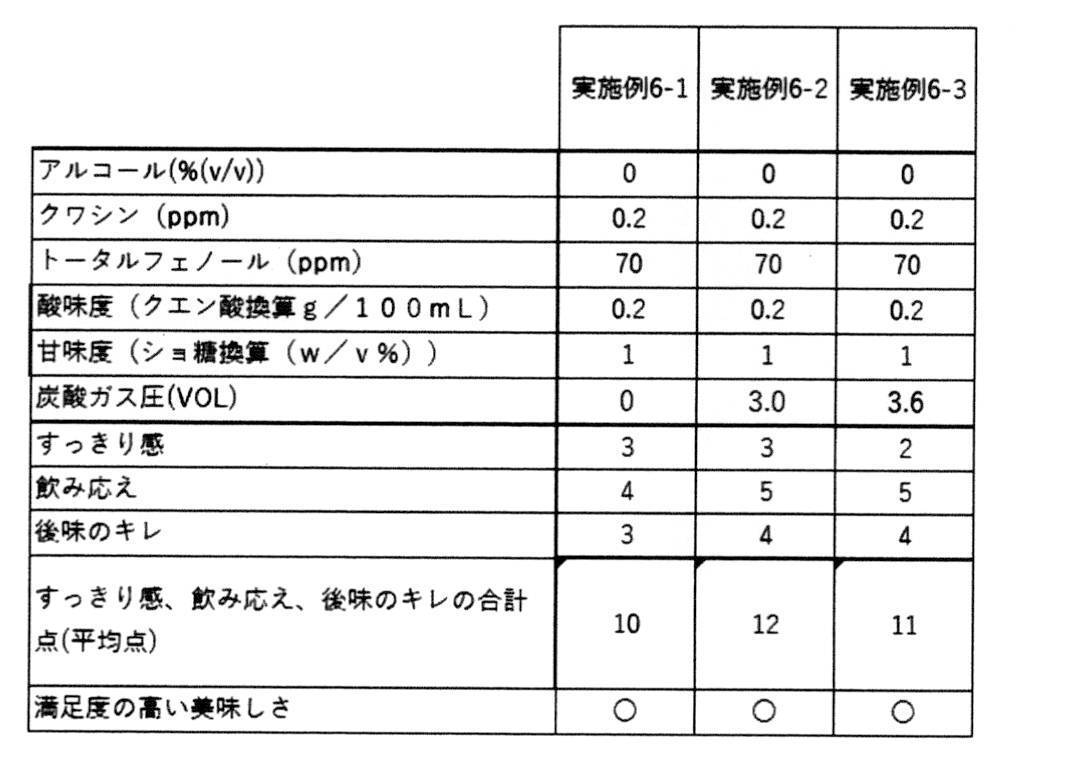
- Example 6 In order to investigate the effect of the carbon dioxide pressure (VOL) of the beverage on the flavor, a sample in which the carbon dioxide pressure was changed was prepared.
- Example 6-1 Lemon flavor (without alcohol (0.00% (v / v)), lemon juice, acidulant, and acesulfame potassium were dissolved in water to prepare a sample (carbon dioxide pressure 0 (carbon dioxide pressure 0)). VOL)).
- Example 6-2 Lemon flavor (without alcohol (0.00% (v / v)), lemon juice, acidulant, and acesulfame potassium were dissolved in water, and carbon dioxide gas was injected to prepare a sample. (Carbon dioxide pressure 3.0 (VOL)).
- Example 6-3 Lemon flavor (without alcohol (0.00% (v / v)), lemon juice, acidulant, and acesulfame potassium were dissolved in water, and carbon dioxide gas was injected to prepare a sample. (Pressure of carbon dioxide gas 3.6 (VOL)).
- Example 1 The above sample was subjected to sensory evaluation according to the method shown in Example 1.
- Example 6-1 where the carbon dioxide pressure was 0 (VOL) (non-carbonated), the individual evaluations of refreshing feeling, drinking response, and sharpness of aftertaste were 3 points, 4 points, and 3 points, respectively, and 3 evaluation items. The total score of (clean feeling, response to drinking, and sharpness of aftertaste) exceeded 9 points.
- Example 6-2 with a carbon dioxide gas pressure of 3.0 (VOL), the individual evaluations of refreshing feeling, drinking response, and sharpness of aftertaste were 3 points, 5 points, and 4 points, respectively, and 3 evaluation items (clean). The total score of (feeling, response to drinking, and sharpness of aftertaste) exceeded 9 points.
- VOL carbon dioxide gas pressure
- Example 6-3 with a carbon dioxide pressure of 3.6 (VOL), the individual evaluations of refreshing feeling, drinking response, and sharpness of aftertaste were 2 points, 5 points, and 4 points, respectively, and 3 evaluation items (clean feeling, The total score of (drinking response and sharpness of aftertaste) exceeded 9 points.
- VOL carbon dioxide pressure
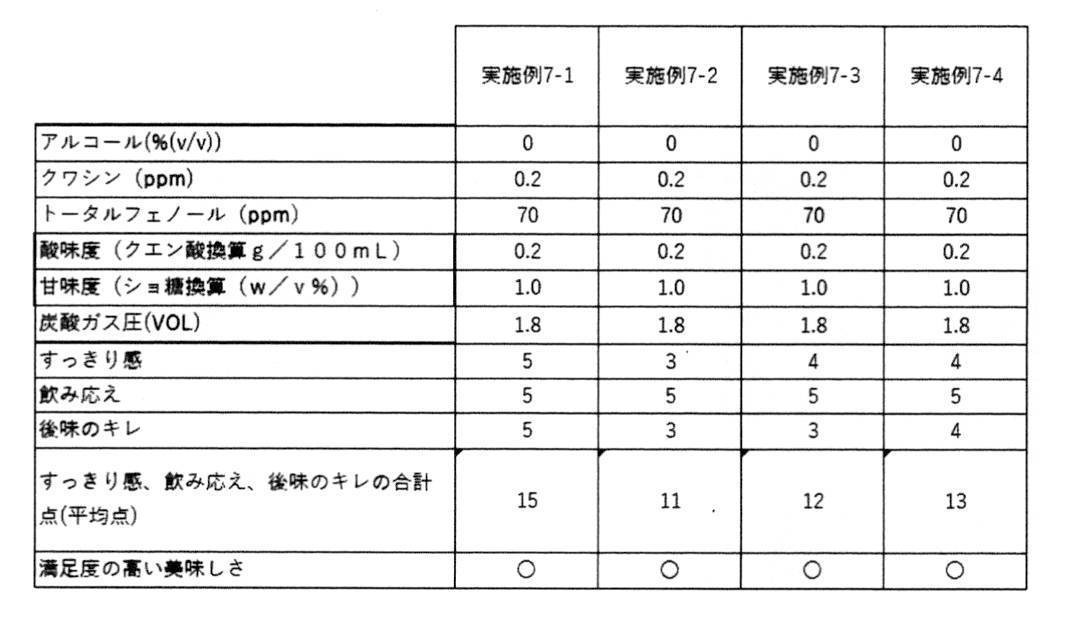
- Example 7 In order to investigate the effect of the sweetener used for adjusting the sweetness of the beverage on the flavor, a sample containing various sweeteners was prepared. A sample (Table 7) in which the alcohol content, quacin content, total phenol content, acidity (citric acid equivalent), sweetness, and carbon dioxide gas pressure were fixed in the sample was prepared as follows. Here, acesulfame potassium, sucralose, high fructose corn syrup, and starch syrup (Tetrap (registered trademark) (Hayashibara Co., Ltd.)) were used to adjust the sweetness.
- Tetrap registered trademark
- Example 7-1 A sample was prepared by dissolving lemon flavor (without alcohol (0.00% (v / v)), lemon juice, acidulant, and acesulfame potassium in carbonated water. Acesulfame potassium was used for this.
- Example 7-2 Lemon flavor (without alcohol (0.00% (v / v)), lemon juice, acidulant, and sucralose were dissolved in carbonated water to prepare a sample. For adjusting the sweetness. Sucralose was used.
- Example 7-3 A sample was prepared by dissolving lemon flavor (without alcohol (0.00% (v / v)), lemon juice, acidulant, and fructose sugar solution in carbonated water. A fructose sugar solution was used for the adjustment.
- Example 7-4 Lemon flavor (without alcohol (0.00% (v / v)), lemon juice, acidulant, and starch syrup were dissolved in carbonated water to prepare a sample. For adjusting the sweetness. I used starch syrup.
- Example 1 The above sample was subjected to sensory evaluation according to the method shown in Example 1.
- Example 8 In order to investigate the effect of the alcohol source used in the beverage on the flavor, a sample containing various alcohol sources was prepared.
- Example 8-1 Beer (The Malts (registered trademark) (Suntory Beer Co., Ltd.)), lemon flavor, lemon juice, acidulant, and Acesulfam potassium were dissolved in carbonated water as alcohol sources to prepare a sample.
- Malts registered trademark
- Acesulfam potassium were dissolved in carbonated water as alcohol sources to prepare a sample.
- Example 8-2 A new genre (Kinmugi (registered trademark), Suntory Holdings Co., Ltd.), lemon flavor, lemon juice, acidulant, and acesulfame potassium were dissolved in carbonated water as alcohol sources to prepare a sample.
- Example 8-3 A sample was prepared by dissolving cider, lemon flavor, lemon juice, acidulant, and acesulfam potassium as alcohol sources in carbonated water.
- Example 8-4 Whiskey, lemon flavor, lemon juice, acidulant, and Acesulfam potassium were dissolved in carbonated water as alcohol sources to prepare a sample.
- Example 8-5 A sample was prepared by dissolving wokka, lemon flavor, lemon juice, acidulant, and acesulfame potassium as alcohol sources in carbonated water.
- Example 8-6 Brandy, lemon flavor, lemon juice, acidulant, and acesulfame potassium were dissolved in carbonated water as an alcohol source to prepare a sample.
- Example 8-7 A sample was prepared by dissolving gin, lemon flavor, lemon juice, acidulant, and acesulfame potassium as alcohol sources in carbonated water.
- Example 8-8 Tequila, lemon flavor, lemon juice, acidulant, and acesulfame potassium were dissolved in carbonated water as alcohol sources to prepare a sample.
- Example 8-9 Lamb, lemon flavor, lemon juice, acidulant, and acesulfame potassium were dissolved in carbonated water as alcohol sources to prepare a sample.
- Example 8-10 Sake, lemon flavor, lemon juice, acidulant, and Acesulfam potassium were dissolved in carbonated water as alcohol sources to prepare a sample.
- Example 8-11 A sample was prepared by dissolving shochu, lemon flavor, lemon juice, acidulant, and acesulfame potassium as alcohol sources in carbonated water.
- Example 8-12 White wine, lemon flavor, lemon juice, acidulant, and Acesulfam potassium were dissolved in carbonated water as alcohol sources to prepare a sample.
- the sweetness is the degree of sweetness based on the sweetness of sucrose, and corresponds to the sucrose concentration (w / v%) in the sucrose aqueous solution. Since the sweetness degree differs depending on the sweetness substance used, it is calculated using the numerical value of each sweetness degree when sucrose is set to sweetness degree 1.
- Alcohol content treated as synonymous with alcohol content
- the sample is filtered or sonicated to remove carbon dioxide from the beverage. Then, the sample is distilled over an open flame, and the density of the obtained distillate at 15 ° C. is measured.
- "Table 2 Alcohol content and density (15 ° C) and specific gravity (15/15 ° C) conversion table” attached to the National Tax Agency's prescribed analysis method (Heisei 19 National Tax Agency Royal Instruction No. 6, revised on June 22, 2007) Use to convert the measured density to alcohol content.
- Reagent A Phenolic reagent (Fuji Film Wako Pure Chemical Industries, Ltd., [clinical] (# 277-08891 or # 279-08895) is used after being diluted 2-fold with distilled water.
- B 10% anhydrous sodium carbonate solution (prepared by dissolving 100 g of anhydrous sodium carbonate (special grade reagent) in 1 L of water)
- C Gallic acid monohydrate (CAS.No: 5995-86-8), grade 1 or higher is used.
- Measurement method A Take 8.3 ml of water in a test tube, add 0.2 ml of sample onto it, and stir to make it uniform.
- B Add 0.5 ml of phenol reagent.
- C Within 5 minutes add 1 ml of 10% anhydrous sodium carbonate solution.
- D Immediately stir to homogenize and then react at 30 ° C. for 30 minutes.
- E After completion of the reaction, the reaction solution is transferred to a cell and the absorbance at 760 nm is measured with a spectrophotometer.
- F. Quantification is performed using a calibration curve obtained in advance.
Landscapes
- Chemical & Material Sciences (AREA)
- Engineering & Computer Science (AREA)
- Health & Medical Sciences (AREA)
- Life Sciences & Earth Sciences (AREA)
- Organic Chemistry (AREA)
- Polymers & Plastics (AREA)
- Food Science & Technology (AREA)
- Nutrition Science (AREA)
- General Health & Medical Sciences (AREA)
- Genetics & Genomics (AREA)
- General Engineering & Computer Science (AREA)
- Wood Science & Technology (AREA)
- Zoology (AREA)
- Bioinformatics & Cheminformatics (AREA)
- Biochemistry (AREA)
- Mechanical Engineering (AREA)
- Non-Alcoholic Beverages (AREA)
- Alcoholic Beverages (AREA)
- Distillation Of Fermentation Liquor, Processing Of Alcohols, Vinegar And Beer (AREA)
Abstract
Description
(1)容器詰め飲料であって、
クワシン含量が0.08ppm以上かつ25ppm以下、
トータルフェノール含量が4.5ppm以上、
アルコール含量が9.5%(v/v)以下、
甘味度が3.5以下、及び
酸味度が0.08以上、
である、前記容器詰め飲料。
(2)クワシン含量が0.1ppm以上である、(1)の容器詰め飲料。
(3)クワシン含量が20ppm以下である、(1)又は(2)の容器詰め飲料。
(4)甘味度が3.0以下である、(1)~(3)のいずれかの容器詰め飲料。
(5)酸味度が0.1以上である、(1)~(4)のいずれかの容器詰め飲料。
(6)トータルフェノール含量が7ppm以上である、(1)~(5)のいずれかの容器詰め飲料。
(7)アルコール含量が3.0%(v/v)以下である、(1)~(6)のいずれかの容器詰め飲料。
(8)ノンアルコール飲料である、(1)~(7)のいずれかの容器詰め飲料。
(9)容器詰め飲料の製造方法であって、飲料の
クワシン含量を0.08ppm以上かつ25ppm以下に調整する工程、
トータルフェノール含量を4.5ppm以上に調整する工程、
アルコール含量を9.5%(v/v)以下に調整する工程、
甘味度を3.5以下に調整する工程、及び
酸味度を0.08以上に調整する工程、
を含んでなる、前記製造方法。
(10)容器詰め飲料の満足度の高い美味しさを改善する方法であって、飲料の
クワシン含量を0.08ppm以上かつ25ppm以下に調整する工程、
トータルフェノール含量を4.5ppm以上に調整する工程、
アルコール含量を9.5%(v/v)以下に調整する工程、
甘味度を3.5以下に調整する工程、及び
酸味度を0.08以上に調整する工程、
を含んでなる、前記方法。
飲料のアルコール含量が風味に及ぼす影響を検討するため、アルコール含量を変化させた試料を調製した。試料中の、クワシン含量、トータルフェノール含量、酸味度(クエン酸換算)、甘味度(ショ糖換算)を固定し、アルコール含量を変化させた試料(表1)を以下のようにして調製した。アルコール含量は原料由来のエタノール量から算出して配合量を決定した。
・5点:強く感じる
・4点:やや強く感じる
・3点:感じる
・2点:やや弱く感じる
・1点:弱く感じる
各パネルの点数から平均点を算出し、該平均点をすっきり感、飲み応え、及び後味のキレそれぞれに対する個別評価とした。
・各試料について、すっきり感、飲み応え、及び後味のキレに対する個別評価が、いずれも平均点で2以上であること
・各試料について、すっきり感、飲み応え、及び後味のキレに対する平均点の合計点が9以上であること

飲料のクワシン含量が風味に及ぼす影響を検討するため、クワシン含量を変化させた試料を調製した。試料中の、アルコール含量、トータルフェノール含量、酸味度(クエン酸換算)、甘味度(ショ糖換算)を固定し、クワシン含量を変化させた試料(表2)を以下のようにして調製した。クワシン含量は、クワシン抽出物を用いて調整した。
飲料のトータルフェノール含量が風味に及ぼす影響を検討するため、トータルフェノール含量を変化させた試料を調製した。試料中の、アルコール含量、クワシン含量、酸味度(クエン酸換算)、甘味度(ショ糖換算)を固定し、トータルフェノール含量を変化させた試料(表3)を以下のようにして調製した。トータルフェノール含量の調整は、原料(果汁やベースアルコール)のトータルフェノール量をあらかじめ測定しておき、その配合量を調節することによって行った。
飲料の酸味度(クエン酸換算)が風味に及ぼす影響を検討するため、酸味度を変化させた試料を調製した。試料中の、アルコール含量、クワシン含量、トータルフェノール含量、甘味度(ショ糖換算)を固定し、酸味度を変化させた試料(表4)を以下のようにして調製した。酸味度の調整には、クエン酸(無水)を用いた。
飲料の甘味度(ショ糖換算)が風味に及ぼす影響を検討するため、甘味度を変化させた試料を調製した。試料中の、アルコール含量、クワシン含量、トータルフェノール含量、酸味度(クエン酸換算)を固定し、甘味度を変化させた試料(表5)を以下のようにして調製した。

飲料の炭酸ガス圧(VOL)が風味に及ぼす影響を検討するため、炭酸ガス圧を変化させた試料を調製した。試料中の、アルコール含量、クワシン含量、トータルフェノール含量、酸味度(クエン酸換算)、甘味度を固定し、炭酸ガス圧を変化させた試料(表6)を以下のようにして調製した。
飲料の甘味度の調整に用いる甘味料が風味に及ぼす影響を検討するため、種々の甘味料を配合した試料を調製した。試料中の、アルコール含量、クワシン含量、トータルフェノール含量、酸味度(クエン酸換算)、甘味度、炭酸ガス圧を固定した試料(表7)を以下のようにして調製した。ここで、甘味度の調整にはアセスルファムカリウム、スクラロース、果糖液糖、及び水飴(テトラップ(登録商標)(株式会社林原))を用いた。
飲料に用いるアルコール源が風味に及ぼす影響を検討するため、種々のアルコール源を配合した試料を調製した。試料中の、アルコール含量、クワシン含量、トータルフェノール含量、酸味度(クエン酸換算)、甘味度、炭酸ガス圧を固定した試料(表8)を以下のようにして調製した。その際、アルコール源として種々のものを用いた。

本実施例において、各試料の成分の分析が必要な場合は、以下の方法で行った。
(1)酸味度
自動滴定装置(Mettler toledo DL50)を用いて、試料に水酸化ナトリム水溶液を添加し、中和(pH7.0)する。中和するために要した水酸化ナトリウムの量から、酸味度を算出する。酸味度はクエン酸量に換算した値(中和量から、飲料に含まれている酸が全てクエン酸であると仮定して計算して求める)である。
甘味度は、ショ糖の甘味を基準とした甘味の度合いで、ショ糖水溶液におけるショ糖濃度(w/v%)に相当する。使用する甘味物質よって甘味度は異なる事からスクロースを甘味度1とした際のそれぞれの甘味度の数値を用いて算出する。
試料を濾過又は超音波で処理し、飲料から炭酸ガスを除去する。その後、試料を直火蒸留し、得られた留液の15℃における密度を測定する。国税庁所定分析法(平19国税庁訓令第6号、平成19年6月22日改訂)の付表である「第2表 アルコール分と密度(15℃)及び比重(15/15℃)換算表」を用いて、測定した密度をアルコール含量に換算する。
使用した器具
A.分光光度計(株式会社島津製作所製 UV-2450)及び10mmガラスセル
B.30±0.1℃で温度が維持できる恒温水槽
A.フェノール試薬(富士フィルム和光純薬株式会社、[臨床用](#277-08891または#279-08895)を蒸留水で2倍希釈して使用する。
B.10%無水炭酸ナトリウム溶液(無水炭酸ナトリウム(試薬特級)100gを水1Lに溶解して調製する。)
C.没食子酸一水和物(CAS.No:5995-86-8)、1級以上のグレードを使用する。
A.試験管に8.3mlの水を採り、この上に試料0.2mlを加え、撹拌して均一にする。
B.フェノール試薬を0.5ml加える。
C.5分以内に10%無水炭酸ナトリウム溶液を1ml加える。
D.すぐに撹拌して均一にした後、30℃で30分間反応させる。
E.反応終後、反応液をセルに移し分光光度計にて760nmにおける吸光度を測定する。
F.予め求めておいた検量線により定量を行う。
A.没食子酸一水和物110.5mgを正確にとり、水に溶かして100mlとする(没食子酸として1000mg/L溶液)。
B.上記希釈液を、ホールピペットを用いて正確に各々0、10、30及び50mlとり、水で更に希釈して100mlとし、標準試料とする(各々0mg/L、100mg/L、300mg/L、500mg/L溶液)。
C.標準試料を上記測定方法に従って測定し、各水準の吸光度を測定する。
D.縦軸に吸光度、横軸に没食子酸濃度(mg/L)を記載し、検量線を作成する。
Claims (10)
- 容器詰め飲料であって、
クワシン含量が0.08ppm以上かつ25ppm以下、
トータルフェノール含量が4.5ppm以上、
アルコール含量が9.5%(v/v)以下、
甘味度が3.5以下、及び
酸味度が0.08以上、
である、前記容器詰め飲料。 - クワシン含量が0.1ppm以上である、請求項1に記載の容器詰め飲料。
- クワシン含量が20ppm以下である、請求項1又は2に記載の容器詰め飲料。
- 甘味度が3.0以下である、請求項1~3のいずれか1項に記載の容器詰め飲料。
- 酸味度が0.1以上である、請求項1~4のいずれか1項に記載の容器詰め飲料。
- トータルフェノール含量が7ppm以上である、請求項1~5のいずれか1項に記載の容器詰め飲料。
- アルコール含量が3.0%(v/v)以下である、請求項1~6のいずれか1項に記載の容器詰め飲料。
- ノンアルコール飲料である、請求項1~7のいずれか1項に記載の容器詰め飲料。
- 容器詰め飲料の製造方法であって、飲料の
クワシン含量を0.08ppm以上かつ25ppm以下に調整する工程、
トータルフェノール含量を4.5ppm以上に調整する工程、
アルコール含量を9.5%(v/v)以下に調整する工程、
甘味度を3.5以下に調整する工程、及び
酸味度を0.08以上に調整する工程、
を含んでなる、前記製造方法。 - 容器詰め飲料の満足度の高い美味しさを改善する方法であって、飲料の
クワシン含量を0.08ppm以上かつ25ppm以下に調整する工程、
トータルフェノール含量を4.5ppm以上に調整する工程、
アルコール含量を9.5%(v/v)以下に調整する工程、
甘味度を3.5以下に調整する工程、及び
酸味度を0.08以上に調整する工程、
を含んでなる、前記方法。
Priority Applications (9)
| Application Number | Priority Date | Filing Date | Title |
|---|---|---|---|
| CA3205074A CA3205074A1 (en) | 2020-12-21 | 2021-11-16 | Beverage containing quassin |
| CN202510136163.0A CN119979287A (zh) | 2020-12-21 | 2021-11-16 | 含苦木素的饮料 |
| EP21910041.9A EP4265710A4 (en) | 2020-12-21 | 2021-11-16 | DRINK CONTAINING QUASSINE |
| US18/268,512 US20240306674A1 (en) | 2020-12-21 | 2021-11-16 | Beverage containing quassin |
| AU2021406412A AU2021406412A1 (en) | 2020-12-21 | 2021-11-16 | Beverage containing quassin |
| JP2022571957A JPWO2022137888A1 (ja) | 2020-12-21 | 2021-11-16 | |
| CN202180086881.1A CN116685668A (zh) | 2020-12-21 | 2021-11-16 | 含苦木素的饮料 |
| KR1020237022362A KR20230123988A (ko) | 2020-12-21 | 2021-11-16 | 쿠와신을 함유하는 음료 |
| JP2025151118A JP2025186353A (ja) | 2020-12-21 | 2025-09-11 | クワシンを含有する飲料 |
Applications Claiming Priority (2)
| Application Number | Priority Date | Filing Date | Title |
|---|---|---|---|
| JP2020-211601 | 2020-12-21 | ||
| JP2020211601 | 2020-12-21 |
Publications (1)
| Publication Number | Publication Date |
|---|---|
| WO2022137888A1 true WO2022137888A1 (ja) | 2022-06-30 |
Family
ID=82159039
Family Applications (1)
| Application Number | Title | Priority Date | Filing Date |
|---|---|---|---|
| PCT/JP2021/041980 Ceased WO2022137888A1 (ja) | 2020-12-21 | 2021-11-16 | クワシンを含有する飲料 |
Country Status (9)
| Country | Link |
|---|---|
| US (1) | US20240306674A1 (ja) |
| EP (1) | EP4265710A4 (ja) |
| JP (2) | JPWO2022137888A1 (ja) |
| KR (1) | KR20230123988A (ja) |
| CN (2) | CN116685668A (ja) |
| AU (1) | AU2021406412A1 (ja) |
| CA (1) | CA3205074A1 (ja) |
| TW (1) | TW202239333A (ja) |
| WO (1) | WO2022137888A1 (ja) |
Cited By (2)
| Publication number | Priority date | Publication date | Assignee | Title |
|---|---|---|---|---|
| WO2023145635A1 (ja) * | 2022-01-25 | 2023-08-03 | サントリーホールディングス株式会社 | ジンを含有する低甘味度アルコール飲料 |
| WO2024162245A1 (ja) * | 2023-02-01 | 2024-08-08 | サントリーホールディングス株式会社 | 噴霧容器に充填された飲料 |
Citations (9)
| Publication number | Priority date | Publication date | Assignee | Title |
|---|---|---|---|---|
| JPH0241751B2 (ja) | 1981-10-30 | 1990-09-19 | ||
| JP2011182683A (ja) | 2010-03-05 | 2011-09-22 | Ito En Ltd | 容器詰炭酸飲料及び容器詰炭酸飲料における刺激性酸味抑制方法 |
| JP2014000055A (ja) * | 2012-06-20 | 2014-01-09 | Suntory Holdings Ltd | 低pH飲料 |
| JP2014000056A (ja) * | 2012-06-20 | 2014-01-09 | Suntory Holdings Ltd | 飲料 |
| JP2014064488A (ja) * | 2012-09-25 | 2014-04-17 | Suntory Holdings Ltd | 低pH飲料 |
| JP5498154B2 (ja) | 2009-12-28 | 2014-05-21 | サントリーホールディングス株式会社 | 呈味の改善されたアルコール飲料ベース |
| JP2015116187A (ja) * | 2013-11-14 | 2015-06-25 | サントリーホールディングス株式会社 | 酒らしい味わいが付与された又は増強された飲料 |
| JP2017006077A (ja) * | 2015-06-24 | 2017-01-12 | キリン株式会社 | ビールらしい苦味や後キレを有するビールテイスト飲料 |
| JP6230780B2 (ja) | 2012-09-28 | 2017-11-15 | サッポロビール株式会社 | 非アルコール飲料及びその製造方法 |
Family Cites Families (11)
| Publication number | Priority date | Publication date | Assignee | Title |
|---|---|---|---|---|
| JPS6230780U (ja) | 1985-08-12 | 1987-02-24 | ||
| JP5249280B2 (ja) * | 2010-04-22 | 2013-07-31 | 麒麟麦酒株式会社 | 高呈味低アルコール飲料及びその製造方法 |
| JP5542745B2 (ja) * | 2010-06-07 | 2014-07-09 | キリンビバレッジ株式会社 | 高甘味度甘味料含有飲料およびその製造方法 |
| JP6342167B2 (ja) * | 2014-01-24 | 2018-06-13 | アサヒビール株式会社 | 低糖質炭酸アルコール飲料 |
| JP6783052B2 (ja) * | 2015-12-09 | 2020-11-11 | キリンビバレッジ株式会社 | 炭酸感が増強された容器詰め低甘味度炭酸飲料 |
| JP6687466B2 (ja) * | 2016-05-31 | 2020-04-22 | サントリーホールディングス株式会社 | 酒らしい味わいが増強された飲料 |
| JP7283855B2 (ja) * | 2016-12-28 | 2023-05-30 | サントリーホールディングス株式会社 | アスパラギン酸を含有する炭酸アルコール飲料 |
| SG11201906916PA (en) * | 2017-01-31 | 2019-08-27 | Suntory Holdings Ltd | Non-alcoholic beer taste beverage packed in container |
| JP6541751B2 (ja) | 2017-11-08 | 2019-07-10 | サッポロビール株式会社 | ノンアルコール飲料の味の厚みと飲みやすさの増強方法 |
| JP7290414B2 (ja) * | 2018-11-28 | 2023-06-13 | アサヒビール株式会社 | 柑橘風味アルコール飲料 |
| JP6744937B2 (ja) * | 2019-02-22 | 2020-08-19 | アサヒビール株式会社 | 容器詰めアルコール飲料 |
-
2021
- 2021-11-16 EP EP21910041.9A patent/EP4265710A4/en active Pending
- 2021-11-16 JP JP2022571957A patent/JPWO2022137888A1/ja active Pending
- 2021-11-16 WO PCT/JP2021/041980 patent/WO2022137888A1/ja not_active Ceased
- 2021-11-16 US US18/268,512 patent/US20240306674A1/en active Pending
- 2021-11-16 CN CN202180086881.1A patent/CN116685668A/zh active Pending
- 2021-11-16 KR KR1020237022362A patent/KR20230123988A/ko active Pending
- 2021-11-16 AU AU2021406412A patent/AU2021406412A1/en active Pending
- 2021-11-16 CN CN202510136163.0A patent/CN119979287A/zh active Pending
- 2021-11-16 CA CA3205074A patent/CA3205074A1/en active Pending
- 2021-12-09 TW TW110146006A patent/TW202239333A/zh unknown
-
2025
- 2025-09-11 JP JP2025151118A patent/JP2025186353A/ja active Pending
Patent Citations (9)
| Publication number | Priority date | Publication date | Assignee | Title |
|---|---|---|---|---|
| JPH0241751B2 (ja) | 1981-10-30 | 1990-09-19 | ||
| JP5498154B2 (ja) | 2009-12-28 | 2014-05-21 | サントリーホールディングス株式会社 | 呈味の改善されたアルコール飲料ベース |
| JP2011182683A (ja) | 2010-03-05 | 2011-09-22 | Ito En Ltd | 容器詰炭酸飲料及び容器詰炭酸飲料における刺激性酸味抑制方法 |
| JP2014000055A (ja) * | 2012-06-20 | 2014-01-09 | Suntory Holdings Ltd | 低pH飲料 |
| JP2014000056A (ja) * | 2012-06-20 | 2014-01-09 | Suntory Holdings Ltd | 飲料 |
| JP2014064488A (ja) * | 2012-09-25 | 2014-04-17 | Suntory Holdings Ltd | 低pH飲料 |
| JP6230780B2 (ja) | 2012-09-28 | 2017-11-15 | サッポロビール株式会社 | 非アルコール飲料及びその製造方法 |
| JP2015116187A (ja) * | 2013-11-14 | 2015-06-25 | サントリーホールディングス株式会社 | 酒らしい味わいが付与された又は増強された飲料 |
| JP2017006077A (ja) * | 2015-06-24 | 2017-01-12 | キリン株式会社 | ビールらしい苦味や後キレを有するビールテイスト飲料 |
Non-Patent Citations (3)
| Title |
|---|
| "Conversion Between Alcohol Content and Density (15°C) or Specific Gravity (15/15°C", ANALYSIS METHODS PRESCRIBED BY THE NATIONAL TAX AGENCY, vol. 6, 22 June 2007 (2007-06-22) |
| See also references of EP4265710A4 |
| VANDERCOOK C. E., STEPHENSON R. G.: "Lemon Juice Composition. Identification of Major Phenolic Compounds and Estimation by Paper Chromatography", JOURNAL OF AGRICULTURAL AND FOOD CHEMISTRY, AMERICAN CHEMICAL SOCIETY, US, vol. 14, no. 5, 1 May 1966 (1966-05-01), US , pages 450 - 454, XP055947052, ISSN: 0021-8561, DOI: 10.1021/jf60147a003 * |
Cited By (2)
| Publication number | Priority date | Publication date | Assignee | Title |
|---|---|---|---|---|
| WO2023145635A1 (ja) * | 2022-01-25 | 2023-08-03 | サントリーホールディングス株式会社 | ジンを含有する低甘味度アルコール飲料 |
| WO2024162245A1 (ja) * | 2023-02-01 | 2024-08-08 | サントリーホールディングス株式会社 | 噴霧容器に充填された飲料 |
Also Published As
| Publication number | Publication date |
|---|---|
| EP4265710A1 (en) | 2023-10-25 |
| JPWO2022137888A1 (ja) | 2022-06-30 |
| CN119979287A (zh) | 2025-05-13 |
| CN116685668A (zh) | 2023-09-01 |
| CA3205074A1 (en) | 2022-06-30 |
| AU2021406412A9 (en) | 2024-09-19 |
| AU2021406412A1 (en) | 2023-06-29 |
| TW202239333A (zh) | 2022-10-16 |
| KR20230123988A (ko) | 2023-08-24 |
| US20240306674A1 (en) | 2024-09-19 |
| EP4265710A4 (en) | 2024-10-16 |
| JP2025186353A (ja) | 2025-12-23 |
Similar Documents
| Publication | Publication Date | Title |
|---|---|---|
| JP6140957B2 (ja) | 低pH飲料 | |
| JP6599224B2 (ja) | 低アルコール飲料 | |
| JP2025186353A (ja) | クワシンを含有する飲料 | |
| EP4112711B1 (en) | Container-packed carbonated alcoholic beverage | |
| EP4461801A1 (en) | Low-brix wine-flavoured beverage | |
| JP2015100294A (ja) | 蒸留酒とプロピレングリコールと果汁とを含有するアルコール飲料 | |
| JP7361463B2 (ja) | アルコール飲料 | |
| JP7324591B2 (ja) | グレープフルーツ風味飲料、及び、風味向上方法 | |
| JP7093646B2 (ja) | 果汁含有低アルコール飲料、果汁含有低アルコール飲料ベース、果汁含有低アルコール飲料の製造方法、及び、果汁含有低アルコール飲料の香味向上方法 | |
| JP6764220B2 (ja) | 容器詰めアルコール飲料 | |
| JP7313531B1 (ja) | 柑橘風味飲料および柑橘風味飲料の香味向上方法 | |
| JP7331235B1 (ja) | 柑橘風味飲料および柑橘風味飲料の製造方法 | |
| JP6931582B2 (ja) | 梅アルコール飲料、梅アルコール飲料ベース、梅アルコール飲料の製造方法、梅アルコール飲料ベースの製造方法、及び、梅アルコール飲料の香味改善方法 | |
| WO2023145381A1 (ja) | 木製容器由来成分を含有する飲料 | |
| JP2024092936A (ja) | 柑橘風味飲料および柑橘風味飲料の製造方法 | |
| JP2024092372A (ja) | 柑橘風味飲料および柑橘風味飲料の製造方法 | |
| WO2026048389A1 (ja) | 柑橘風味アルコールテイスト飲料 | |
| JP2024092917A (ja) | 柑橘風味飲料および柑橘風味飲料の製造方法 | |
| EP4458162A1 (en) | Beverage containing sweetener and gaba | |
| JP2024093015A (ja) | 柑橘風味飲料および柑橘風味飲料の製造方法 | |
| JP2025102078A (ja) | 柑橘風味アルコール飲料 | |
| JP2025102076A (ja) | 柑橘風味アルコール飲料 | |
| JP2024158277A (ja) | 非発酵飲料、非発酵飲料の製造方法、及び、非発酵飲料の香味向上方法 | |
| JP2024083096A (ja) | アルコール飲料、アルコール飲料の製造方法、及び、アルコール飲料の香味向上方法 | |
| JP2020137443A (ja) | レモン風味飲料、及び、風味向上方法 |
Legal Events
| Date | Code | Title | Description |
|---|---|---|---|
| 121 | Ep: the epo has been informed by wipo that ep was designated in this application |
Ref document number: 21910041 Country of ref document: EP Kind code of ref document: A1 |
|
| ENP | Entry into the national phase |
Ref document number: 2022571957 Country of ref document: JP Kind code of ref document: A |
|
| ENP | Entry into the national phase |
Ref document number: 3205074 Country of ref document: CA |
|
| WWE | Wipo information: entry into national phase |
Ref document number: 18268512 Country of ref document: US |
|
| WWE | Wipo information: entry into national phase |
Ref document number: 202180086881.1 Country of ref document: CN |
|
| ENP | Entry into the national phase |
Ref document number: 2021406412 Country of ref document: AU Date of ref document: 20211116 Kind code of ref document: A |
|
| ENP | Entry into the national phase |
Ref document number: 20237022362 Country of ref document: KR Kind code of ref document: A |
|
| WWE | Wipo information: entry into national phase |
Ref document number: 2021910041 Country of ref document: EP |
|
| NENP | Non-entry into the national phase |
Ref country code: DE |
|
| ENP | Entry into the national phase |
Ref document number: 2021910041 Country of ref document: EP Effective date: 20230721 |