WO2022145459A1 - Nrf2活性化化合物 - Google Patents
Nrf2活性化化合物 Download PDFInfo
- Publication number
- WO2022145459A1 WO2022145459A1 PCT/JP2021/048868 JP2021048868W WO2022145459A1 WO 2022145459 A1 WO2022145459 A1 WO 2022145459A1 JP 2021048868 W JP2021048868 W JP 2021048868W WO 2022145459 A1 WO2022145459 A1 WO 2022145459A1
- Authority
- WO
- WIPO (PCT)
- Prior art keywords
- mmol
- group
- methyl
- reference example
- solvent
- Prior art date
- Legal status (The legal status is an assumption and is not a legal conclusion. Google has not performed a legal analysis and makes no representation as to the accuracy of the status listed.)
- Ceased
Links
Images


Classifications
-
- C—CHEMISTRY; METALLURGY
- C07—ORGANIC CHEMISTRY
- C07D—HETEROCYCLIC COMPOUNDS
- C07D419/00—Heterocyclic compounds containing two or more hetero rings, at least one ring having nitrogen, oxygen, and sulfur atoms as the only ring hetero atoms
- C07D419/02—Heterocyclic compounds containing two or more hetero rings, at least one ring having nitrogen, oxygen, and sulfur atoms as the only ring hetero atoms containing two hetero rings
- C07D419/10—Heterocyclic compounds containing two or more hetero rings, at least one ring having nitrogen, oxygen, and sulfur atoms as the only ring hetero atoms containing two hetero rings linked by a carbon chain containing aromatic rings
-
- A—HUMAN NECESSITIES
- A61—MEDICAL OR VETERINARY SCIENCE; HYGIENE
- A61K—PREPARATIONS FOR MEDICAL, DENTAL OR TOILETRY PURPOSES
- A61K31/00—Medicinal preparations containing organic active ingredients
- A61K31/33—Heterocyclic compounds
- A61K31/395—Heterocyclic compounds having nitrogen as a ring hetero atom, e.g. guanethidine or rifamycins
- A61K31/55—Heterocyclic compounds having nitrogen as a ring hetero atom, e.g. guanethidine or rifamycins having seven-membered rings, e.g. azelastine, pentylenetetrazole
- A61K31/554—Heterocyclic compounds having nitrogen as a ring hetero atom, e.g. guanethidine or rifamycins having seven-membered rings, e.g. azelastine, pentylenetetrazole having at least one nitrogen and one sulfur as ring hetero atoms, e.g. clothiapine, diltiazem
-
- A—HUMAN NECESSITIES
- A61—MEDICAL OR VETERINARY SCIENCE; HYGIENE
- A61P—SPECIFIC THERAPEUTIC ACTIVITY OF CHEMICAL COMPOUNDS OR MEDICINAL PREPARATIONS
- A61P11/00—Drugs for disorders of the respiratory system
-
- A—HUMAN NECESSITIES
- A61—MEDICAL OR VETERINARY SCIENCE; HYGIENE
- A61P—SPECIFIC THERAPEUTIC ACTIVITY OF CHEMICAL COMPOUNDS OR MEDICINAL PREPARATIONS
- A61P13/00—Drugs for disorders of the urinary system
- A61P13/12—Drugs for disorders of the urinary system of the kidneys
-
- A—HUMAN NECESSITIES
- A61—MEDICAL OR VETERINARY SCIENCE; HYGIENE
- A61P—SPECIFIC THERAPEUTIC ACTIVITY OF CHEMICAL COMPOUNDS OR MEDICINAL PREPARATIONS
- A61P17/00—Drugs for dermatological disorders
-
- A—HUMAN NECESSITIES
- A61—MEDICAL OR VETERINARY SCIENCE; HYGIENE
- A61P—SPECIFIC THERAPEUTIC ACTIVITY OF CHEMICAL COMPOUNDS OR MEDICINAL PREPARATIONS
- A61P25/00—Drugs for disorders of the nervous system
-
- A—HUMAN NECESSITIES
- A61—MEDICAL OR VETERINARY SCIENCE; HYGIENE
- A61P—SPECIFIC THERAPEUTIC ACTIVITY OF CHEMICAL COMPOUNDS OR MEDICINAL PREPARATIONS
- A61P27/00—Drugs for disorders of the senses
- A61P27/02—Ophthalmic agents
-
- C—CHEMISTRY; METALLURGY
- C07—ORGANIC CHEMISTRY
- C07D—HETEROCYCLIC COMPOUNDS
- C07D515/00—Heterocyclic compounds containing in the condensed system at least one hetero ring having nitrogen, oxygen, and sulfur atoms as the only ring hetero atoms, not provided for in groups C07D463/00, C07D477/00 or C07D499/00 - C07D507/00
- C07D515/02—Heterocyclic compounds containing in the condensed system at least one hetero ring having nitrogen, oxygen, and sulfur atoms as the only ring hetero atoms, not provided for in groups C07D463/00, C07D477/00 or C07D499/00 - C07D507/00 in which the condensed system contains two hetero rings
- C07D515/04—Ortho-condensed systems
Definitions
- the present invention relates to Nrf2 activating compounds and the like.
- Nrf2 (NF-E2-related factor 2) is a transcription factor that promotes the expression of oxidative stress protection genes. Nrf2 is ubiquitinated by interaction with Keap1 (Kelch-like ECH-associated protein 1) and undergoes degradation in the proteasome. Therefore, inhibition of the interaction between Nrf2 and Keap1 promotes the translocation of Nrf2 into the nucleus, and can activate the expression of the oxidative stress defense gene.
- the Nrf2 activator is used for multiple sclerosis, psoriasis, diabetic nephropathy, etc. in the systemic area, and the Nrf2 activator is used for dry eye, diabetic retinopathy, retinitis pigmentosa, glaucoma, etc. in the ophthalmic area. It is expected as a therapeutic drug for various diseases.
- Patent Document 1 discloses an Nrf2 activator mainly for the treatment of COPD (chronic obstructive pulmonary disease).
- An object of the present invention is to provide a compound having an Nrf2 activating action.
- the present inventor defines a compound represented by the general formula (I) described later or a carbon atom represented by * in the formula of the general formula (II) described later as an asymmetric carbon atom. It was found that among the two groups of diastereomers, the compounds of the lower polarity group, their salts, and their solvates have Nrf2 activating activity. As a result of further research based on this finding, the present invention was completed.
- the present invention includes the following aspects.
- R 1 indicates an alkyl group.
- R 2 indicates an optionally substituted thienyl group.
- R 6 indicates an alkyl group that may be substituted.
- a 1 , A 2 , A 3 and A 4 are the same or different and indicate CH or N (provided that N is one or less).
- Z represents a hydrogen atom or a halogen atom.
- R 1a and R 1b represent an alkyl group.
- R 2 indicates an optionally substituted thienyl group.
- R 6 indicates an alkyl group that may be substituted.
- a 1 , A 2 , A 3 and A 4 are the same or different and indicate CH or N (provided that N is one or less).
- Z represents a hydrogen atom or a halogen atom.
- Item 4. The compound according to any one of Items 1 to 3, a salt thereof, or a solvate thereof, wherein the substituent which may be present on the thienyl group contains an electron-withdrawing group.
- Item 5 The compound according to any one of Items 1 to 4, a salt thereof, or a solvate thereof, wherein the substituent that the thienyl group may have includes an acetyl group, a sulfamoyl group, a cyano group, or a cycloalkanecarbonyl. ..
- R 3 represents an acetyl group, a sulfamoyl group, a cyano group or a cycloalkane carbonyl.
- Y represents a hydrogen atom, an alkyl group, a halogen atom or an alkoxy group.
- Item 5 The compound according to any one of Items 1 to 5, a salt thereof, or a solvate thereof, which is a group represented by.
- Item 7 The compound according to Item 6, a salt thereof, or a solvate thereof, wherein R 3 is an acetyl group.
- Item 8. The compound according to Item 6 or 7, a salt thereof, or a solvate thereof, wherein R 4 and R 5 are the same or different and are hydrogen atoms or alkyl groups.
- R 2 is a general formula (R2Aa):
- R 3 indicates an acetyl group.
- Y represents a hydrogen atom, an alkyl group, a halogen atom or an alkoxy group.
- the R 4 is a hydrogen atom
- the R 5 is an alkyl group and is
- the R 6 is an ethyl group that may be substituted, and is an ethyl group.
- the R 7 is a hydroxy group,
- the A 1 , the A 2 , and the A 4 are all CH, the A 3 is CH or N, and the Z is a hydrogen atom.
- Item 2 The compound according to any one of Items 1 to 8, a salt thereof, or a solvate thereof.
- Item 9a Compounds described in any of the following, salts thereof, or solvates thereof: (2R, 3S) -3- (5-Acetylthiophene-2-yl) -3- (3- ⁇ [(R) -4-ethyl-1,1-dioxide-3,4-dihydro-2H-benzo [ b] [1,4,5] Oxathiazepine-2-yl] Methyl ⁇ -4-methylphenyl) -2-methylpropanoic acid (Compound A1), (2R, 3S) -3- (5-Acetylthiophene-2-yl) -3- (3- ⁇ [(R) -4-ethyl-1,1-dioxide-3,4-dihydro-2H-pyrido] 4,3-b] [1,4,5] Oxatiazepine-2-yl] Methyl ⁇ -4-Methylphenyl) -2-Methylpropanoic acid (Compound B1),
- Item 10 A pharmaceutical agent containing at least one selected from the group consisting of the compound according to any one of Items 1 to 9, 9a, and 9b, a salt thereof, and a solvate thereof.
- Item 11 The pharmaceutical agent according to Item 10, which is an Nrf2 (NF-E2-related factor 2) activator.
- Item 12. The pharmaceutical product according to Item 10 or 11, which is a topically administered preparation.
- Item 13 The pharmaceutical product according to any one of Items 10 to 12, which is an ophthalmic preparation.
- Item 14 The pharmaceutical product according to Item 10 or 11, which is a parenteral administration preparation.
- Item 15. The pharmaceutical product according to Item 10, 11, or 14, which is an intravenously administered preparation.
- Item 16 The drug according to any one of Items 10 to 15, which is a drug for preventing or treating brain disease, lung disease, dermatological disease, otolaryngology disease, renal disease or ophthalmic disease.
- Nrf2 is involved, comprising administering to the patient at least one selected from the group consisting of the compounds according to any one of Items 1-9, 9a, and 9b, salts thereof, and solvates thereof. How to prevent or treat the disease.
- Item 17a The preventive or therapeutic method according to Item 17, wherein the patient is a patient having a disease associated with Nrf2.
- Item 17b The preventive or therapeutic method according to Item 17 or Item 17a, wherein the disease is a brain disease, a lung disease, a dermatological disease, an otolaryngological disease, a renal disease or an ophthalmic disease.
- Item 18 At least one substance selected from the group consisting of the compounds according to any one of Items 1 to 9, 9a, and 9b, salts thereof, and solvates thereof for use as pharmaceuticals.
- Item 19 At least one selected from the group consisting of the compounds according to any one of Items 1 to 9, 9a, and 9b, salts thereof, and solvates thereof for use in the prevention or treatment of diseases involving Nrf2. Seed substance.
- Item 19a The substance for use according to Item 19, wherein the disease is a brain disease, a lung disease, a dermatological disease, an otolaryngological disease, a renal disease or an ophthalmic disease.
- Item 20 Use of at least one substance selected from the group consisting of the compounds according to any one of Items 1 to 9, 9a and 9b, salts thereof, and solvates thereof for the production of pharmaceuticals.
- Item 20a Item 2. The use according to Item 20, wherein the drug is an Nrf2 (NF-E2-related factor 2) activator.
- Item 20b Item 20 or Item 20a, wherein the drug is a drug for preventing or treating brain disease, lung disease, dermatological disease, otolaryngology disease, renal disease or ophthalmic disease.
- a compound having an Nrf2 activating action it is possible to provide a compound having an Nrf2 activating action, a salt thereof, and a solvate thereof.
- the ORTEP diagram of the crystal structure of compound A1 is shown.
- the most stable conformation of the anti form of the compound of Example 1 and Reference Example 219 is shown.
- the most stable conformation of the syn type of the compounds of Example 1 and Reference Example 219 is shown.
- the present invention relates to a compound represented by, a salt thereof, or a solvate thereof.
- R 1 , R 1a , R 1b > R 1 indicates an alkyl group.
- the alkyl group represented by R 1 includes both linear and branched (preferably linear) chains.
- the number of carbon atoms of the alkyl group is not particularly limited, but is, for example, 1 to 4, preferably 1 to 3, more preferably 1 to 2, and even more preferably 1.
- Specific examples of the alkyl group include a methyl group, an ethyl group, an n-propyl group, an isopropyl group, an n-butyl group, an isobutyl group, a tert-butyl group, a sec-butyl group and the like.
- R 1a and R 1 b indicate an alkyl group.
- R 1a or R 1b is similar to the alkyl group represented by R 1 .
- R 1a and R 1b are usually the same.
- both R 1a and R 1b are methyl groups.
- Examples of the thienyl group include 2-thienyl group, 3-thienyl group and the like, and preferably 2-thienyl group.
- Substituents that the thienyl group may have include, for example, an acyl group such as an acetyl group and a cycloalkanecarbonyl group, a sulfamoyl group, a cyano group, and -R 21 -NR 22 R 23 (R 21 is a single bond, a carbonyl group).
- an alkylene group; R 22 and R 23 are the same or different, hydrogen atoms, optionally substituted alkyl groups or R 22 and R 23 are bonded to each other to form an alkylene group with adjacent nitrogen atoms. A ring is formed.
- An alkoxy group, a halogen atom, an alkyl group and the like can be mentioned.
- the position of the substituent is not particularly limited, and is, for example, any of the ring-constituting atoms (carbon atom and sulfur atom) on the thiophene ring, preferably a carbon atom on the thiophene ring.
- the number of the substituents is not particularly limited, and is, for example, 0 to 4, preferably 0 to 2, and more preferably 1 to 2.
- the acyl group as a substituent that the thienyl group may have is not particularly limited as long as it is a group in which the hydroxy group is removed from the carboxylic acid, but -CO-R 24 (R 24 is an alkyl group) is preferable. Alternatively, it is a group represented by a cycloalkyl group (preferably an alkyl group).
- the alkyl group represented by R 24 includes both linear and branched (preferably linear) chains.
- the number of carbon atoms of the alkyl group is not particularly limited, but is, for example, 1 to 8, preferably 1 to 6, more preferably 1 to 4, still more preferably 1 to 2, and particularly preferably 1.
- alkyl group examples include methyl group, ethyl group, n-propyl group, isopropyl group, n-butyl group, isobutyl group, tert-butyl group, sec-butyl group, n-pentyl group, neopentyl group and n. -Hexyl group, 3-methylpentyl group and the like can be mentioned.
- the carbon number of the cycloalkyl group represented by R 24 is not particularly limited, but is, for example, 3 to 8, preferably 3 to 6, more preferably 3 to 4, and even more preferably 3.
- the acyl group as the substituent include an acetyl group, a cycloalkanecarbonyl group and the like, and particularly preferably an acetyl group from the viewpoint of Nrf2 activating action.
- R 21 constituting -R 21 -NR 22 R 23 as a substituent that the thienyl group may have indicates a single bond, a carbonyl group or an alkylene group (preferably a carbonyl group).
- the alkylene group represented by R 21 includes both linear and branched (preferably straight chain) groups.
- the number of carbon atoms of the alkylene group is not particularly limited, but is, for example, 1 to 8, preferably 1 to 6, more preferably 1 to 4, still more preferably 1 to 2, and particularly preferably 1.
- Specific examples of the alkylene group include a methylene group, an ethylene group, a propylene group, a butylene group and the like.
- R 22 and R 23 constituting -R 21 -NR 22 R 23 as the above substituents are the same or different, and hydrogen atoms, optionally substituted alkyl groups or R 22 and R 23 are bonded to each other and alkylene.
- Form a group to form a ring with adjacent nitrogen atoms preferably R 22 and R 23 are the same or different, hydrogen or alkyl groups, more preferably one of R 22 and R 23 is a hydrogen atom.
- the other is an alkyl group, more preferably both R 22 and R 23 are hydrogen atoms).
- the alkyl group represented by R 22 or R 23 includes both linear and branched (preferably linear).
- the number of carbon atoms of the alkyl group is not particularly limited, but is, for example, 1 to 8, preferably 1 to 6, more preferably 1 to 4, still more preferably 1 to 2, and particularly preferably 1.
- Specific examples of the alkyl group include methyl group, ethyl group, n-propyl group, isopropyl group, n-butyl group, isobutyl group, tert-butyl group, sec-butyl group, n-pentyl group, neopentyl group and n. -Hexyl group, 3-methylpentyl group and the like can be mentioned.
- substituent that the alkyl group may have include an alkoxy group.
- the alkoxy group includes either linear or branched (preferably linear).
- the number of carbon atoms of the alkoxy group is not particularly limited, but is, for example, 1 to 8, preferably 1 to 6, more preferably 1 to 4, still more preferably 1 to 2, and particularly preferably 1.
- Specific examples of the alkoxy group include a methoxy group, an ethoxy group, an n-propoxy group, an isopropoxy group, an n-butoxy group, an isobutoxy group, a sec-butoxy group, a tert-butoxy group and the like.
- the alkoxy group as a substituent that the thienyl group may have includes either a linear group or a branched chain (preferably linear).
- the number of carbon atoms of the alkoxy group is not particularly limited, but is, for example, 1 to 8, preferably 1 to 6, more preferably 1 to 4, still more preferably 1 to 2, and particularly preferably 1.
- Specific examples of the alkoxy group include a methoxy group, an ethoxy group, an n-propoxy group, an isopropoxy group, an n-butoxy group, an isobutoxy group, a sec-butoxy group, a tert-butoxy group and the like.
- halogen atom as the substituent that the thienyl group may have include a fluorine atom, a chlorine atom, a bromine atom, an iodine atom and the like, preferably a fluorine atom, a chlorine atom and the like, and more preferably. Fluorine atom can be mentioned.
- the alkyl group as a substituent that the thienyl group may have includes either a linear group or a branched chain (preferably linear).
- the number of carbon atoms of the alkyl group is not particularly limited, but is, for example, 1 to 4, preferably 1 to 3, more preferably 1 to 2, and even more preferably 1.
- Specific examples of the alkyl group include a methyl group, an ethyl group, an n-propyl group, an isopropyl group, an n-butyl group, an isobutyl group, a tert-butyl group, a sec-butyl group and the like.
- the substituent that the thienyl group may have comprises an electron-withdrawing group (ie, if there is one substituent, the substituent is an electron-withdrawing group.
- the substituent that the thienyl group may have is an acyl group, a sulfamoyl group, or a cyano group ( More preferably, it contains an acetyl group, a sulfamoyl group, a cyano group, or a cycloalcancarbonyl group, particularly preferably an acetyl group from the viewpoint of Nrf2 activating action (that is, if there is one substituent, the substituents are these.
- the number of substituents of the heterocyclic-derived group is preferably 0 to 2 (preferably 1 to 2), and when the number of the substituents is 2 or more, at least the substituents are present.
- One is an alkyl group, a halogen atom or an alkoxy group (preferably an alkoxy group).
- R 2 is preferably the general formula (R2A) :.
- Y represents a hydrogen atom, an alkyl group, a halogen atom or an alkoxy group.
- R 3 indicates an acyl group, a hydrogen atom, a sulfamoyl group, a cyano group, or -R 21 -NR 22 R 23 .
- Examples thereof include groups represented by, and more preferably the general formula (R2Aa) or (R2Ab) :.
- R 3 examples include an acyl group (preferably ⁇ CO-R 24 (R 24 indicates an alkyl group or a cycloalkyl group)), a sulfamoyl group, a cyano group and the like, and more preferably an acetyl group and a sulfamoyl group. , Cyano group, cycloalkanecarbonyl group and the like, and particularly preferably an acetyl group from the viewpoint of Nrf2 activating action.
- R 24 indicates an alkyl group or a cycloalkyl group
- the alkyl group represented by R 4 or R 5 includes both linear and branched (preferably linear).
- the number of carbon atoms of the alkyl group is not particularly limited, but is, for example, 1 to 4, preferably 1 to 3, more preferably 1 to 2, and even more preferably 1.
- Specific examples of the alkyl group include a methyl group, an ethyl group, an n-propyl group, an isopropyl group, an n-butyl group, an isobutyl group, a tert-butyl group, a sec-butyl group and the like.
- Examples of the substituent that the alkyl group represented by R 4 or R 5 may have include a halogen atom.
- the halogen atom include a fluorine atom, a chlorine atom, a bromine atom, an iodine atom and the like.
- the number of the substituents is not particularly limited, and is, for example, 0 to 3, preferably 0.
- R 4 and R 5 are the same or different and are hydrogen atoms or alkyl groups, more preferably one of R 4 and R 5 is an alkyl group and the other. It is a hydrogen atom, more preferably R 4 is a hydrogen atom and R 5 is an alkyl group.
- R 6 > R 6 indicates an alkyl group that may be substituted.
- the alkyl group represented by R 6 includes both linear and branched (preferably linear) chains.
- the number of carbon atoms of the alkyl group is not particularly limited, but is, for example, 1 to 8, preferably 1 to 6, more preferably 1 to 4, still more preferably 1 to 2, and particularly preferably 2.
- Specific examples of the alkyl group include methyl group, ethyl group, n-propyl group, isopropyl group, n-butyl group, isobutyl group, tert-butyl group, sec-butyl group, n-pentyl group, neopentyl group and n. -Hexyl group, 3-methylpentyl group and the like can be mentioned.
- Substituents that the alkyl group represented by R 6 may have include, for example, hydroxyl groups, alkoxy groups, arylalkoxy groups, aryloxy groups, -NR 61 R 62 (R 61 and R 62 are the same or different, It indicates a hydrogen atom or an alkyl group.) And the like.
- the position of the substituent is not particularly limited, but in one aspect of the present invention, it is preferably the terminal of the alkyl group.
- the number of the above-mentioned substituents is not particularly limited, and is, for example, 0 to 3, preferably 0 to 1.
- the alkoxy group as the substituent includes either a linear group or a branched chain (preferably a linear group).
- the number of carbon atoms of the alkoxy group is not particularly limited, but is, for example, 1 to 8, preferably 1 to 6, more preferably 1 to 4, still more preferably 1 to 2, and particularly preferably 1.
- Specific examples of the alkoxy group include a methoxy group, an ethoxy group, an n-propoxy group, an isopropoxy group, an n-butoxy group, an isobutoxy group, a sec-butoxy group, a tert-butoxy group and the like.
- the arylalkoxy group as the substituent is not particularly limited as long as it is the alkoxy group substituted with the aryl group.
- the number of carbon atoms of the aryl group is not particularly limited, but is, for example, 6 to 14, preferably 6 to 8.
- Specific examples of such an aryl group include, for example, a phenyl group, a naphthyl group, a biphenyl group, a pentarenyl group, an indenyl group, an anthryl group, a tetrasenyl group, a pentasenyl group, a pyrenyl group, a peryleneyl group, a fluorenyl group, a phenanthryl group and the like.
- a phenyl group or the like is particularly preferable.
- the substitution position of the aryl group in the alkoxy group is not particularly limited, but in one aspect of the present invention, it is preferably the terminal of the alkoxy group.
- Examples of the arylalkoxy group include a benzyloxy group and a phenethyloxy group.
- the number of carbon atoms of the aryloxy group as the above-mentioned substituent is not particularly limited, but is, for example, 6 to 14, preferably 6 to 8.
- Specific examples of the aryl group constituting the aryloxy group include a phenyl group, a naphthyl group, a biphenyl group, a pentarenyl group, an indenyl group, an anthranyl group, a tetrasenyl group, a pentasenyl group, a pyrenyl group, a perylenyl group and a fluorenyl group. Examples thereof include a phenanthryl group, and particularly preferably a phenyl group and the like.
- Examples of the aryloxy group include a phenyloxy group and the like.
- R 61 and R 62 constituting -NR 61 R 62 as the above-mentioned substituents are the same or different, and indicate a hydrogen atom or an alkyl group.
- the alkyl group represented by R 61 or R 62 includes both linear and branched (preferably linear).
- the number of carbon atoms of the alkyl group is not particularly limited, but is, for example, 1 to 8, preferably 1 to 6, more preferably 1 to 4, still more preferably 1 to 2, and particularly preferably 2.
- alkyl group examples include methyl group, ethyl group, n-propyl group, isopropyl group, n-butyl group, isobutyl group, tert-butyl group, sec-butyl group, n-pentyl group, neopentyl group and n.
- -Hexyl group, 3-methylpentyl group and the like can be mentioned.
- R 6 is preferably an alkyl group optionally substituted with a hydroxyl group, an alkoxy group or an arylalkoxy group, and more preferably substituted with an arylalkoxy group. It is an alkyl group, more preferably an alkyl group.
- the three-dimensional arrangement of R 6 is not particularly limited, and the three-dimensional arrangement p:
- the configuration of R 6 is configuration p.
- a hydrolyzable group is a group in which an ester bond formed together with a carbonyl group adjacent to R 7 is hydrolyzed (preferably under physiological conditions or hydrolyzed by an enzyme such as esterase) to form a hydroxy group.
- a hydrolyzable group is a group (-O-R x (R x is an arbitrary substituent)) in which an ester bond is formed together with a carbonyl group adjacent to R 7 , and specific examples thereof include an alkoxy group and an aryl.
- Oxy group (aryl group-O-), arylalkoxy group (alkoxy group substituted with aryl group), alkylaryloxy group (aryloxy group substituted with alkyl group), aralkyloxy group (substituted with aryl group) (Ekoxy group substituted with an alkoxy group), an alkoxyalkoxy group (alkoxy group substituted with an alkoxy group), an acyloxy group, an acyloxyalkoxy group (alkoxy group substituted with an acyloxy group) and the like.
- hydrocarbon group in the definition of R 71 and R 72 is not particularly limited, and typically includes an alkyl group, an aryl group and the like.
- R 7 is preferably a hydroxy group.
- a 1 , A 2 , A 3 , A 4 > A 1 , A 2 , A 3 and A 4 are the same or different and indicate CH or N (provided that N is one or less).
- a 1 or A 3 is preferably N, and more preferably A 3 is N.
- a 1 , A 2 and A 4 are all CH and A 3 is CH or N.
- Z> Z represents a hydrogen atom or a halogen atom.
- halogen atom represented by Z examples include a fluorine atom, a chlorine atom, a bromine atom, an iodine atom and the like, preferably a fluorine atom, a chlorine atom and the like, and more preferably a fluorine atom.
- Z When Z is a halogen atom, its bond position may be any of A 1 , A 2 , A 3 and A 4 , for example A 4 .
- Z is preferably a hydrogen atom.
- the compound of the general formula (II) is the compound having the lower polarity among the two diastereomers having the carbon atom represented by * in the formula of the general formula (II) as an asymmetric carbon atom.
- the two diastereomers whose carbon atom represented by * in the formula is an asymmetric carbon atom are, that is, the molecular configuration of R 2 is the molecular configuration a :.
- the diastereomer (diaastereomer a) and the molecular configuration of R 2 are the molecular configurations b:
- diastereomers b There are two diastereomers (diaastereomers b).
- the diastereomer p (the molecular configuration of R 6 is the above-mentioned molecular configuration p) and the diastereomer p in which the other carbon atoms in the general formula (II) are asymmetric carbon atoms are used.
- the diastereomer q (the molecular configuration of R 6 is the above molecular configuration q) is included.
- the diastereomer in which the molecular configuration of R 2 is the molecular configuration a and the molecular configuration of R 6 is the molecular configuration p is referred to as a diastereomer ap, and the others are similarly described.
- the diastereomer a includes the diastereomer ap and the diastereomer aq
- the diastereomer b includes the diastereomer bp and the diastereomer bq.
- the "compound of the two diastereomers with the lower polarity" is when the molecular configuration of R 6 is fixed (that is, when the molecular configuration of R 6 is fixed to the molecular configuration p or the molecular configuration q).
- the one with the lower polarity specifically, the compound with the lower polarity of the diastereomers ap and the diastereomers bp, and the diastereomers aq and the diastereomers. It means the compound with the lower polarity in the mar bq.
- the compound of the general formula (II) is preferably an asymmetric carbon atom represented by * in the formula of the general formula (II), particularly from the viewpoint that the compound has lower cytotoxicity.
- Two diastereomers (two diastereomers ap and diastereomer bp, or two diastereomers aq and diastereomers bq) when the configuration of R 6 as an atom is fixed
- the compound that is first eluted when the isomer mixture containing it is column-separated (column type: CHIRAL ART Cellulose-SC, elution solvent: n-hexane / ethanol / trifluoroacetic acid 40/60 / 0.1 mixed solvent).
- this column separation is performed under the following conditions: flow velocity: 2.35 mL / min, temperature: ambient, detection wavelength: UV at 293 nm, injection volume: 18 mg (13 mg / mL), system. : Prominence (Shimadzu).
- R 1a , R 1b , R 3 , R 4 , R 5 , R 6 and R 7 are the same as above. ] Can be mentioned.
- R 2 is the general formula (R2Aa):
- R 3 indicates an acetyl group.
- Y represents a hydrogen atom, an alkyl group, a halogen atom or an alkoxy group.
- the R 4 is a hydrogen atom
- the R 5 is an alkyl group and is
- the R 6 is an ethyl group that may be substituted, and is an ethyl group.
- the R 7 is a hydroxy group,
- the A 1 , the A 2 , and the A 4 are all CH, the A 3 is CH or N, and the Z is a hydrogen atom. Is preferable.
- the salt of the compound is not particularly limited as long as it is a pharmaceutically acceptable salt.
- an acidic salt or a basic salt can be adopted.
- acidic salts are inorganic acid salts such as hydrochloride, hydrobromide, sulfate, nitrate, phosphate; acetate, propionate, tartrate, fumarate, maleate, malic acid.
- basic salts include organic acid salts such as salts, citrates, methanesulfonates and paratoluenesulfonates; and alkali metal salts such as sodium salts and potassium salts; as well as calcium salts and magnesium.
- Alkaline earth metal salts such as salts; Salts with ammonia; Morphorin, piperidine, pyrrolidine, monoalkylamine, dialkylamine, trialkylamine, mono (hydroxyalkyl) amine, di (hydroxyalkyl) amine, tri (hydroxyalkyl) Examples thereof include salts with organic amines such as amines.
- the solvate of the compound is not particularly limited.
- the solvent constituting the solvent field include water, a pharmaceutically acceptable organic solvent (for example, ethanol, glycerol, acetic acid, etc.) and the like.
- the compound of the present invention can be produced by various methods.
- the compound of the present invention can be produced, for example, by the method shown in Scheme 1 below or a method similar thereto.
- step a the synthetic intermediate 2 and the synthetic intermediate 3 are reacted in the presence of a catalyst and a base to produce the synthetic intermediate 4.
- the synthetic intermediate 3 can be used, for example 1-5 equivalents, preferably 1.2-3 equivalents, and the catalyst can be used, for example 0.05-0.5 equivalents, preferably 0.05-0.2 equivalents, relative to the synthetic intermediate 2.
- the catalyst include rhodium complexes, preferably [RhCl (cod)] 2 and the like.
- the base examples include N, N-dicyclohexylmethylamine, triethylamine, pyridine, N, N-diisopropylethylamine and the like, and triethylamine is preferable.
- the reaction is usually carried out in a solvent.
- the solvent is not particularly limited as long as it does not adversely affect the reaction, and examples thereof include 1,4-dioxane, 1,2-dimethoxyethane, tetrahydrofuran and the like, and 1,4-dioxane is preferable.
- the reaction time varies depending on the reagent or solvent used, but is usually 1 hour to 24 hours, preferably 1 hour to 18 hours.
- the reaction temperature varies depending on the reagent or solvent used, but is usually 0 ° C to 150 ° C, preferably 25 ° C to 100 ° C.
- step b the synthetic intermediate 4 is reacted with iodomethane in the presence of a base to produce the synthetic intermediate 5.
- Lithium diisopropylamide can be used, for example, 1 to 2 equivalents, preferably 1 to 1.8 equivalents, and iodomethane can be used, for example, 1 to 20 equivalents, preferably 1 to 15 equivalents, relative to the synthetic intermediate 4.
- the reaction is usually carried out in a solvent.
- the solvent is not particularly limited as long as it does not adversely affect the reaction, and examples thereof include tetrahydrofuran.
- the reaction time varies depending on the reagent or solvent used, but is usually 1 hour to 24 hours, preferably 1 hour to 5 hours.
- the reaction temperature varies depending on the reagent or solvent used, but is usually ⁇ 78 ° C to 40 ° C, preferably ⁇ 78 ° C to 25 ° C.
- step c the acetal of synthetic intermediate 5 is deprotected.
- the solvent is not particularly limited as long as it does not adversely affect the reaction, and examples thereof include methanol, dichloromethane, tetrahydrofuran, 1,4-dioxane and the like, and methanol or tetrahydrofuran can be preferable.
- the reaction time varies depending on the reagent or solvent used, but is usually 1 hour to 24 hours, preferably 1 hour to 18 hours.
- the reaction temperature varies depending on the reagent or solvent used, but is usually 25 ° C to 150 ° C, preferably 25 ° C to 100 ° C.
- the compound of the present invention is produced by a hydrolysis reaction of Synthetic Intermediate 4 or an ester equivalent thereto.
- 5 to 20 equivalents, preferably 10 to 20 equivalents of the base can be used with respect to the synthetic intermediate 4.
- the base include lithium hydroxide, sodium hydroxide, potassium hydroxide and the like, and preferred examples include sodium hydroxide and lithium hydroxide.
- the reaction is usually carried out in a solvent.
- the solvent is not particularly limited as long as it does not adversely affect the reaction, and examples thereof include methanol, dichloromethane, tetrahydrofuran and the like, and preferred examples include methanol and tetrahydrofuran.
- the reaction time varies depending on the reagent or solvent used, but is usually 1 hour to 24 hours, preferably 1 hour to 18 hours.
- the reaction temperature varies depending on the reagent or solvent used, but is usually 25 ° C to 150 ° C, preferably 25 ° C to 140 ° C.
- the compound of the present invention can also be produced, for example, according to the method shown in Scheme 2 below or a method similar thereto.
- synthetic intermediate 8 is produced from synthetic intermediate 6 and synthetic intermediate 7.
- synthetic intermediate 6 for example, 1 to 1.5 equivalents, preferably 1 to 1.2 equivalents, and n-butyllithium, for example, 1 to 2 equivalents, preferably 1 to 1.5 equivalents can be used with respect to the synthetic intermediate 6.
- the reaction is usually carried out in a solvent.
- the solvent is not particularly limited as long as it does not adversely affect the reaction, and examples thereof include tetrahydrofuran.
- the reaction time varies depending on the reagent or solvent used, but is usually 1 hour to 10 hours, preferably 1 hour to 4 hours.
- the reaction temperature varies depending on the reagent or solvent used, but is usually -80 ° C to 25 ° C, preferably ⁇ 78 ° C to 25 ° C.
- step f synthetic intermediate 9 is produced from synthetic intermediate 8.
- Trichloro acetonitrile can be used, for example, 1 to 3 equivalents, preferably 1 to 2 equivalents, and 1,8-diazabicyclo [5,4,0] -7-undecene, for example 0.01 to 0.1, relative to the synthetic intermediate 8.
- Equivalents, preferably 0.01 to 0.05 equivalents can be used, for example 1 to 3 equivalents, preferably 1 to 2.5 equivalents, and bis (trifluoromethanesulfonyl) imide, for example 0.01 to 0.1.
- Equivalent, preferably 0.05 to 0.1 equivalent can be used.
- the reaction is usually carried out in a solvent.
- the solvent is not particularly limited as long as it does not adversely affect the reaction, and examples thereof include dichloromethane, tetrahydrofuran, acetonitrile and the like, and acetonitrile can be preferable.
- the reaction time varies depending on the reagent or solvent used, but is usually 1 hour to 10 hours, preferably 1 hour to 5 hours.
- the reaction temperature varies depending on the reagent or solvent used, but is usually 0 ° C to 25 ° C, preferably 10 ° C to 25 ° C.
- step g synthetic intermediate 10 is produced from synthetic intermediate 9.
- synthetic intermediate 9 2,3-dichloro-5,6-dicyano-p-benzoquinone can be used, for example, 1 to 3 equivalents, preferably 1 to 2.5 equivalents.
- the reaction is usually carried out in a solvent.
- the solvent is not particularly limited as long as it does not adversely affect the reaction, and examples thereof include a mixed solvent of dichloromethane and water.
- the reaction time varies depending on the reagent or solvent used, but is usually 1 hour to 5 hours, preferably 1 hour to 3 hours.
- the reaction temperature varies depending on the reagent or solvent used, but is usually 0 ° C to 25 ° C, preferably 10 ° C to 25 ° C.
- synthetic intermediate 12 is produced from synthetic intermediate 10 and synthetic intermediate 11.
- the synthetic intermediate 11 can be used, for example, 1 to 2 equivalents, preferably 1 to 1.2 equivalents
- triphenylphosphine can be used, for example, 1 to 2 equivalents, preferably 1 to 1.2 equivalents.
- diethylazodicarboxylate can be used, for example, in an amount of 1 to 1.5 equivalents, preferably 1 to 1.2 equivalents.
- bis (2-methoxyethyl) azodicarboxylate, diisopropylazodicarboxylate, cyanomethylenetributylphosphorane and the like can also be used.
- the reaction is usually carried out in a solvent.
- the solvent is not particularly limited as long as it does not adversely affect the reaction, and examples thereof include dichloromethane, 1,4-dioxane, tetrahydrofuran, toluene, N, N-dimethylformamide and the like, preferably tetrahydrofuran.
- the reaction time varies depending on the reagent or solvent used, but is usually 1 hour to 24 hours, preferably 5 hours to 8 hours.
- the reaction temperature varies depending on the reagent or solvent used, but is usually 0 ° C to 40 ° C, preferably 0 ° C to 25 ° C.
- the synthetic intermediates 2, synthetic intermediates 6, and synthetic intermediates 11 of Shcheme 1-2 are known methods, for example, the methods described in Patent Document 1 (WO2015 / 092713), WO2016 / 202253, or similar methods. For example, it can be manufactured according to Scheme 3 below.
- step i the synthetic intermediate 14 is produced by the amination reaction of the synthetic intermediate 13.
- An excess amount of aqueous ammonia is used for the synthetic intermediate 13.
- the reaction time varies depending on the reagent or solvent used, but is usually 1 hour to 24 hours, preferably 1 hour to 18 hours.
- the reaction temperature varies depending on the reagent or solvent used, but is usually 25 ° C to 150 ° C, preferably 25 ° C to 40 ° C.
- step j the synthetic intermediate 14 and the synthetic intermediate 15 are reacted to produce the synthetic intermediate 11 via the synthetic intermediate 16.
- the synthetic intermediate 14 and the synthetic intermediate 15 are reacted in the presence of a base.
- the base can be used, for example, 1 to 2 equivalents, preferably 1 to 1.5 equivalents
- the synthetic intermediate 15 can be used, for example, 0.8 to 1.5 equivalents, preferably 0.8 to 1.2 equivalents, relative to the synthetic intermediate 14.
- Examples of the base include potassium carbonate, sodium carbonate and the like, and preferably potassium carbonate can be mentioned.
- the reaction is usually carried out in a solvent.
- the solvent is not particularly limited as long as it does not adversely affect the reaction, and examples thereof include a mixed solvent of organic solvent such as tetrahydrofuran and dimethylformamide and water, and preferably a mixed solvent of tetrahydrofuran and water. ..
- the reaction time varies depending on the reagent or solvent used, but is usually 1 hour to 24 hours, preferably 1 hour to 3 hours.
- the reaction temperature varies depending on the reagent or solvent used, but is usually 25 ° C to 150 ° C, preferably 25 ° C to 40 ° C.
- the synthetic intermediate 11 is produced from the synthetic intermediate 16 in the presence of a base.
- a base for example, 1 to 5 equivalents, preferably 2 to 3 equivalents of the base can be used with respect to the synthetic intermediate 16.
- the base include potassium tert-butoxide, potassium carbonate, potassium hydroxide and the like, and preferably potassium tert-butoxide.
- the reaction is usually carried out in a solvent.
- the solvent is not particularly limited as long as it does not adversely affect the reaction, and examples thereof include dimethyl sulfoxide and dimethylformamide, and dimethyl sulfoxide is preferable.
- the reaction time varies depending on the reagent or solvent used, but is usually 1 hour to 24 hours, preferably 1 hour to 3 hours.
- the reaction temperature varies depending on the reagent or solvent used, but is usually 25 ° C to 150 ° C, preferably 60 ° C to 100 ° C.
- the synthetic intermediate 18 is produced by the reduction reaction of the synthetic intermediate 17.
- 1 to 2 equivalents, preferably 1 to 1.5 equivalents of the reducing agent can be used with respect to the synthetic intermediate 17.
- the reducing agent include borane-tetrahydrofuran complex and borane-dimethyl sulfide complex.
- the reaction is usually carried out in a solvent.
- the solvent is not particularly limited as long as it does not adversely affect the reaction, and examples thereof include tetrahydrofuran.
- the reaction time varies depending on the reagent or solvent used, but is usually 1 hour to 40 hours, preferably 1 hour to 24 hours.
- the reaction temperature varies depending on the reagent or solvent used, but is usually 25 ° C to 150 ° C, preferably 25 ° C to 40 ° C.
- step l the synthetic intermediate 19 and bispinacolat diboron are reacted in the presence of a base and a catalyst to produce the synthetic intermediate 2.
- the base can be used, for example 1-3 equivalents, preferably 1-2.5 equivalents
- the catalyst can be used, for example 0.05-0.1 equivalents, preferably 0.05-0.08 equivalents, bispina.
- 1 to 2 equivalents, preferably 1 to 1.5 equivalents of korat diboron can be used.
- the base for example, potassium acetate or the like can be used.
- the catalyst examples include palladium catalysts such as PdCl 2 (dppf) 2 -CH 2 Cl 2 and Pd 2 (dba) 3 , and preferably PdCl 2 (dppf) 2 -CH 2 Cl 2 .
- the reaction is usually carried out in a solvent.
- the solvent is not particularly limited as long as it does not adversely affect the reaction, and examples thereof include 1,4-dioxane, tetrahydrofuran, dimethyl sulfoxide, N, N-dimethylformamide and the like, and 1,4-dioxane is preferable. ..
- the reaction time varies depending on the reagent or solvent used, but is usually 1 hour to 24 hours, preferably 5 hours to 8 hours.
- the reaction temperature varies depending on the reagent or solvent used, but is usually 60 ° C to 120 ° C, preferably 60 ° C to 100 ° C.
- step m synthetic intermediate 20 is manufactured from synthetic intermediate 18.
- Sodium hydride can be used, for example 1-2 equivalents, preferably 1-1.5 equivalents
- p-methoxybenzyl chloride can be used, for example 1-2 equivalents, preferably 1-1.2 equivalents, for the synthetic intermediate 20. be able to.
- the reaction is usually carried out in a solvent.
- the solvent is not particularly limited as long as it does not adversely affect the reaction, and examples thereof include tetrahydrofuran, N, N-dimethylformamide and the like, and preferably N, N-dimethylformamide.
- the reaction time varies depending on the reagent or solvent used, but is usually 1 hour to 24 hours, preferably 5 hours to 15 hours.
- the reaction temperature varies depending on the reagent or solvent used, but is usually 0 ° C to 60 ° C, preferably 0 ° C to 25 ° C.
- step n synthetic intermediate 6 is produced from synthetic intermediate 20.
- 1 to 1.5 equivalents, preferably 1 to 1.2 equivalents of n-butyllithium can be used with respect to the synthetic intermediate 20, and N, N-dimethylformamide can be used, for example, 1 to 2 equivalents, preferably 1 to 1.5 equivalents.
- the reaction is usually carried out in a solvent.
- the solvent is not particularly limited as long as it does not adversely affect the reaction, and examples thereof include tetrahydrofuran.
- the reaction time varies depending on the reagent or solvent used, but is usually 1 hour to 10 hours, preferably 1 hour to 3 hours.
- the reaction temperature varies depending on the reagent or solvent used, but is usually -80 ° C to 25 ° C, preferably ⁇ 78 ° C to 25 ° C.
- Synthetic intermediate 3 can be obtained, for example, by the method shown in Schemes 4 to 7 below or a method similar thereto.
- step o the synthetic intermediate 21 and N, O-dimethylhydroxylamine hydrochloride are reacted in the presence of a base, a condensing agent and an additive to produce the synthetic intermediate 22.
- N, O-dimethylhydroxylamine hydrochloride is usually 1 to 3 equivalents, preferably 1.5 to 2 equivalents, relative to the synthetic intermediate 21.
- the condensing agent can be usually used in an amount of 1 to 3 equivalents, preferably 1 to 2 equivalents
- the additive can be used in an amount of usually 0.1 to 2 equivalents, preferably 1 to 2 equivalents with respect to the synthetic intermediate 21.
- the base can usually be used in an amount of 0.5 to 5 equivalents, preferably 2 to 4 equivalents.
- condensing agent examples include N, N'-dicyclohexylcarbodiimide, 1,1'-carbonyldiimidazole, 1-ethyl-3-[3- (dimethylamino) propyl] carbodiimide hydrochloride, and benzotriazole-1-yloxy.
- Tripyrolidinophosphonium hexafluorophosphate O- (benzotriazole-1-yl) -N, N, N', N'-tetramethyluronium hexafluorophosphate, O- (7-azabenzotriazole-) 1-yl) -N, N, N', N'-tetramethyluronium hexafluorophosphate, diethyl cyanophosphate, diphenylphosphoryl azide, pentafluoroacetate pentafluorophenyl ester, isopropylchloroformate and the like can be mentioned.
- the additive include 1-hydroxybenzotriazole, 1-hydroxy-7-azabenzotriazole, N-hydroxysuccinimide and the like, and 1-hydroxybenzotriazole is preferable.
- Examples of the base include triethylamine, pyridine, N, N-diisopropylethylamine, 4-dimethylaminopyridine and the like, and preferably triethylamine, N, N-diisopropylethylamine or 4-dimethylaminopyridine.
- the reaction is usually carried out in a solvent.
- the solvent is not particularly limited as long as it does not adversely affect the reaction, and examples thereof include dichloromethane, chloroform, tetrahydrofuran, 1,4-dioxane, 1,2-dimethoxyethane, diethyl ether, acetonitrile, N, N-dimethylformamide and the like.
- reaction time varies depending on the reagent or solvent used, but is usually 1 hour to 24 hours, preferably 3 hours to 24 hours.
- reaction temperature varies depending on the reagent or solvent used, but is usually 0 ° C to 100 ° C, preferably 25 ° C to 40 ° C.
- synthetic intermediate 23 or synthetic intermediate 25 is produced from synthetic intermediate 22 or synthetic intermediate 24 by a bromoization reaction.
- N-bromosuccinimide can usually be used in an amount of usually 1-5 equivalents, preferably 2-3 equivalents, and trifluoroacetic acid is usually 1-3 equivalents, preferably 1-to. 2 equivalents can be used.
- trifluoroacetic acid instead of trifluoroacetic acid, concentrated sulfuric acid, concentrated hydrochloric acid, acetic acid and the like can also be used.
- the reaction is usually carried out in a solvent.
- the solvent is not particularly limited as long as it does not adversely affect the reaction, and examples thereof include dichloromethane, chloroform, carbon tetrachloride, 1,2-dimethoxyethane, N, N-dimethylformamide and the like, and N, N-dimethyl is preferable.
- Formamide can be mentioned.
- the reaction time varies depending on the reagent or solvent used, but is usually 1 hour to 24 hours, preferably 3 hours to 24 hours.
- the reaction temperature varies depending on the reagent or solvent used, but is usually 0 ° C to 100 ° C, preferably 25 ° C to 40 ° C.
- the synthetic intermediate 25 is manufactured from the synthetic intermediate 23.
- 1 to 3 equivalents, preferably 1 to 1.5 equivalents of methylmagnesium bromide can be used with respect to the synthetic intermediate 23.
- the reaction is usually carried out in a solvent.
- the solvent is not particularly limited as long as it does not adversely affect the reaction, and examples thereof include dichloromethane, chloroform, tetrahydrofuran, 1,4-dioxane, 1,2-dimethoxyethane, diethyl ether and the like, preferably tetrahydrofuran. can.
- the reaction time varies depending on the reagent or solvent used, but is usually 1 hour to 24 hours, preferably 3 hours to 24 hours.
- the reaction temperature varies depending on the reagent or solvent used, but is usually 0 ° C to 100 ° C, preferably 0 ° C to 40 ° C.
- step r the synthetic intermediate 25 and ethylene glycol are reacted in the presence of an acid catalyst to produce the synthetic intermediate 26.
- the acid catalyst can be used, for example, 0.1 to 5 equivalents, preferably 0.1 to 0.5 equivalents, and ethylene glycol can be used, for example, 5 to 20 equivalents, preferably 10 to 15 equivalents, relative to the synthetic intermediate 25.
- the acid catalyst include p-toluenesulfonic acid monohydrate, hydrochloric acid, trifluoroacetic acid and the like, and p-toluenesulfonic acid monohydrate is preferable.
- the reaction is usually carried out in a solvent.
- the solvent is not particularly limited as long as it does not adversely affect the reaction, and examples thereof include toluene, benzene and the like, and toluene is preferable.
- the reaction time varies depending on the reagent or solvent used, but is usually 1 hour to 24 hours, preferably 3 hours to 24 hours.
- the reaction temperature varies depending on the reagent or solvent used, but is usually 40 ° C to 150 ° C, preferably 100 ° C to 130 ° C.
- the synthetic intermediate 25 or the synthetic intermediate 26 is reacted with methyl acrylate in the presence of a catalyst, a base, and an additive to produce the synthetic intermediate 27.
- the catalyst can be used, for example, 0.05 to 0.2 equivalents, preferably 0.05 to 0.1 equivalents
- the base can be used, for example, 1.5 to 5 equivalents, preferably 1.5 to 3 equivalents.
- the additive can be used, for example, 0.05 to 0.2 equivalents, preferably 0.05 to 0.1 equivalents, and methyl acrylate can be used, for example, 1.5 to 3 equivalents, preferably 1.5 to 2 equivalents.
- Examples of the catalyst include palladium catalysts such as PdCl 2 (dppf) 2 , CHCl 3 , Pd (OAc) 2 , PdCl 2 (PPh 3 ) 2 , Pd (PPh 3 ) 4 , and the like, preferably PdCl 2 (dppf). 2.
- CHCl 3 can be mentioned.
- Examples of the base include N, N-dicyclohexylmethylamine, triethylamine, pyridine, N, N-diisopropylethylamine and the like, and preferably N, N-dicyclohexylmethylamine.
- the additive examples include tetrabutylammonium chloride, tetrabutylammonium iodide and the like, and preferably tetrabutylammonium chloride.
- the reaction is usually carried out in a solvent.
- the solvent is not particularly limited as long as it does not adversely affect the reaction, and examples thereof include dimethylformamide and dimethylacetamide, and dimethylacetamide is preferable.
- the reaction time varies depending on the reagent or solvent used, but is usually 1 hour to 24 hours, preferably 1 hour to 8 hours.
- the reaction temperature varies depending on the reagent or solvent used, but is usually 40 ° C to 150 ° C, preferably 100 ° C to 140 ° C using microwaves.
- Scheme 5 is performed according to steps o and s of Scheme 4, and in step o, the corresponding amine is used instead of N, O-dimethylhydroxylamine hydrochloride.
- step t synthetic intermediate 29 is produced from synthetic intermediate 28.
- 1 to 3 equivalents, preferably 1 to 1.5 equivalents of methylmagnesium bromide can be used with respect to the synthetic intermediate 28.
- the reaction is usually carried out in a solvent.
- the solvent is not particularly limited as long as it does not adversely affect the reaction, and examples thereof include tetrahydrofuran, 1,4-dioxane, 1,2-dimethoxyethane, diethyl ether and the like, with preference given to tetrahydrofuran.
- the reaction time varies depending on the reagent or solvent used, but is usually 1 hour to 24 hours, preferably 3 hours to 24 hours.
- the reaction temperature varies depending on the reagent or solvent used, but is usually 0 ° C to 100 ° C, preferably 0 ° C to 40 ° C.
- the synthetic intermediate 29 is oxidized with the sulfur trioxide / pyridine complex in the presence of a base to produce the synthetic intermediate 30.
- the base can be used, for example, 1 to 5 equivalents, preferably 1 to 3 equivalents
- the sulfur trioxide / pyridine complex can be used, for example, 1 to 3 equivalents, preferably 1 to 2.5 equivalents, relative to the synthetic intermediate 29.
- the base include triethylamine, pyridine, N, N-diisopropylethylamine, 4-dimethylaminopyridine and the like, and preferably triethylamine.
- the reaction is usually carried out in a solvent.
- the solvent is not particularly limited as long as it does not adversely affect the reaction, and dimethyl sulfoxide can be preferably used.
- the reaction time varies depending on the reagent or solvent used, but is usually 1 hour to 24 hours, preferably 3 hours to 24 hours.
- the reaction temperature varies depending on the reagent or solvent used, but is usually 0 ° C to 100 ° C, preferably 0 ° C to 40 ° C.
- the synthetic intermediate 3 can be produced according to a known method, for example, the method described in JP2008 / 273924, or a method similar thereto, for example, Scheme 7 below.
- step v the synthetic intermediate 31 is reacted with tert-butylamine and acetic acid to produce the synthetic intermediate 32.
- tert-butylamine can be used, for example, 1 to 3 equivalents, preferably 1 to 1.5 equivalents
- acetic acid can be used, for example, 1 to 20 equivalents, preferably 2.5 to 5 equivalents.
- the reaction is usually carried out in a solvent.
- the solvent is not particularly limited as long as it does not adversely affect the reaction, and examples thereof include dichloromethane, chloroform, tetrahydrofuran, 1,4-dioxane, toluene and the like, preferably dichloromethane.
- the reaction time varies depending on the reagent or solvent used, but is usually 1 to 5 hours, preferably 2 to 4 hours.
- the reaction temperature varies depending on the reagent or solvent used, but is usually 0 ° C to 40 ° C, preferably 10 to 30 ° C.
- the synthetic intermediate 34 is produced by the deprotection reaction of tert-butylamine of the synthetic intermediate 33.
- a mixed solvent of trifluoroacetic acid and water can be preferably used.
- the reaction time varies depending on the reagent or solvent used, but is usually 1 to 5 hours, preferably 2 to 4 hours.
- the reaction temperature varies depending on the reagent or solvent used, but is usually 0 ° C to 150 ° C, preferably 90 ° C to 110 ° C.
- the compound of the present invention can also be produced in Scheme 2 using synthetic intermediate 38 instead of synthetic intermediate 10.
- the synthetic intermediate 38 can also be produced, for example, according to the method shown in Scheme 8 below or a method similar thereto.
- the compound of the present invention can also be produced in Scheme 1 using synthetic intermediate 47 instead of synthetic intermediate 2.
- the synthetic intermediate 47 can also be produced, for example, according to the method shown in Scheme 9 below or a method similar thereto.
- the synthetic intermediate 40 is manufactured from the synthetic intermediate 39.
- 1 to 2 equivalents, preferably 1 to 1.2 equivalents of bromine can be used with respect to the synthetic intermediate 39.
- the reaction is usually carried out in a solvent.
- the solvent is not particularly limited as long as it does not adversely affect the reaction, and examples thereof include acetic acid and trifluoroacetic acid, and acetic acid is preferably used.
- the reaction time varies depending on the reagent or solvent used, but is usually 0.5 to 3 hours, preferably 1 to 2 hours.
- the reaction temperature varies depending on the reagent or solvent used, but is usually 0 ° C to 40 ° C, preferably 0 ° C to 25 ° C.
- the synthetic intermediate 41 is manufactured from the synthetic intermediate 40.
- 1 to 10 equivalents, preferably 2 to 5 equivalents of tin (II) chloride can be used with respect to the synthetic intermediate 40.
- the reaction is usually carried out in a solvent.
- the solvent is not particularly limited as long as it does not adversely affect the reaction, and examples thereof include methanol, ethanol, propanol and isopropanol, and methanol is preferably used.
- the reaction time varies depending on the reagent or solvent used, but is usually 1 to 6 hours, preferably 1.5 to 4 hours.
- the reaction temperature varies depending on the reagent or solvent used, but is usually 0 ° C to 100 ° C, preferably 60 ° C to 80 ° C.
- step z the synthetic intermediate 42 is manufactured from the synthetic intermediate 41. Excessive amount of formic acid is used for the synthetic intermediate 41.
- the reaction time is usually 0.5 to 5 hours, preferably 1 to 2 hours.
- the reaction temperature is usually 25 ° C to 150 ° C, preferably 90 ° C to 110 ° C.
- the synthetic intermediate 43 is manufactured from the synthetic intermediate 42.
- Trityl chloride can be used, for example, 1 to 3 equivalents, preferably 1.1 to 1.3 equivalents
- the base can be used, for example, 1 to 3 equivalents, preferably 1.1 to 1.7 equivalents, relative to the synthetic intermediate 42.
- the base include triethylamine, N, N-diisopropylethylamine, pyridine, 4-dimethylaminopyridine, N-methylmorpholine and the like, and preferably N-methylmorpholine or triethylamine.
- the reaction is usually carried out in a solvent.
- the solvent is not particularly limited as long as it does not adversely affect the reaction, and examples thereof include dichloromethane, chloroform, tetrahydrofuran, 1,4-dioxane, 1,2-dimethoxyethane, diethyl ether, acetonitrile, N, N-dimethylformamide and the like. And preferably dichloromethane can be mentioned.
- the reaction time varies depending on the reagent or solvent used, but is usually 1 to 12 hours, preferably 1 to 2 hours.
- the reaction temperature varies depending on the reagent or solvent used, but is usually 0 ° C to 100 ° C, preferably 40 ° C to 60 ° C.
- Step a-2 manufactures synthetic intermediate 44 from synthetic intermediate 43.
- 1 to 5 equivalents, preferably 1.5 to 3 equivalents of the reducing agent can be used with respect to the synthetic intermediate 43.
- the reducing agent include lithium borohydride, lithium aluminum hydride, lithium borohydride, borane-tetrahydrofuran complex and the like, and lithium borohydride is preferable.
- the reaction is usually carried out in a solvent.
- the solvent is not particularly limited as long as it does not adversely affect the reaction, and examples thereof include tetrahydrofuran, diethyl ether, 1,2-dimethoxyethane and the like, preferably tetrahydrofuran.
- the reaction time varies depending on the reagent or solvent used, but is usually 0.2 to 3 hours, preferably 0.5 to 1.5 hours.
- the reaction temperature varies depending on the reagent or solvent used, but is usually 0 ° C to 60 ° C, preferably 0 ° C to 30 ° C.
- step a-3 methanesulfonyl chloride and lithium chloride are reacted in the presence of a base to produce synthetic intermediate 45 from synthetic intermediate 44.
- a base for the synthetic intermediate 44, methanesulfonyl chloride can be used, for example, 1-5 equivalents, preferably 1.5-2.5 equivalents, and lithium chloride can be used, for example, 1-10 equivalents, preferably 3-5 equivalents.
- 1 to 10 equivalents, preferably 3 to 8 equivalents of the base can be used.
- Examples of the base include triethylamine, N, N-diisopropylethylamine, pyridine, 4-dimethylaminopyridine, N-methylmorpholine and the like, and N, N-diisopropylethylamine is preferable.
- the reaction is usually carried out in a solvent.
- the solvent is not particularly limited as long as it does not adversely affect the reaction, and examples thereof include dichloromethane, chloroform, tetrahydrofuran, 1,4-dioxane, N, N-dimethylformamide and the like, and dichloromethane is preferable.
- the reaction time varies depending on the reagent or solvent used, but is usually 1 to 24 hours, preferably 1 to 12 hours.
- the reaction temperature varies depending on the reagent or solvent used, but is usually 0 ° C to 40 ° C, preferably 0 ° C to 25 ° C.
- step a-4 the synthetic intermediate 45 is reacted with the synthetic intermediate 11 and tetrabutylammonium iodide in the presence of a base to produce the synthetic intermediate 46.
- Synthetic intermediate 11 can be used, for example, 1 to 3 equivalents, preferably 1 to 1.2 equivalents, and tetrabutylammonium iodide is used, for example, 0.1 to 1 equivalents, preferably 0.1 to 0.2 equivalents, relative to the synthetic intermediate 45.
- the base can be used, for example, 1 to 5 equivalents, preferably 1 to 3 equivalents. Examples of the base include potassium carbonate, sodium carbonate, sodium hydrogencarbonate and the like, and potassium carbonate is preferable.
- the reaction is usually carried out in a solvent.
- the solvent is not particularly limited as long as it does not adversely affect the reaction, and examples thereof include dichloromethane, tetrahydrofuran, 1,4-dioxane, N, N-dimethylformamide, N, N-dimethylacetamide and the like, preferably N, N-. Dimethylformamide can be mentioned.
- the reaction time varies depending on the reagent or solvent used, but is usually 1 to 24 hours, preferably 1 to 18 hours.
- the reaction temperature varies depending on the reagent or solvent used, but is usually 0 ° C to 60 ° C, preferably 25 ° C to 40 ° C.
- the compound of the present invention can also be produced, for example, according to the method shown in Scheme 10 below or a method similar thereto.
- the compound of the present invention can also be produced, for example, according to the method shown in Scheme 11 below or a method similar thereto.
- Processes c and d of Scheme 11 are performed according to Scheme 1, process g is performed according to Scheme 2, and processes a-3 and a-4 are performed according to Scheme 9.
- step a-5 compound 49 is produced from compound 9.
- Tetrabutylammonium fluoride is used in an amount of 2 to 5 equivalents, preferably 2 to 3 equivalents, relative to compound 9.
- the solvent is not particularly limited as long as it does not adversely affect the reaction, and examples thereof include tetrahydrofuran, N, N-dimethylformamide and the like, and tetrahydrofuran is preferably used.
- the reaction time varies depending on the reagent or solvent used, but is usually 1 to 24 hours, preferably 1 to 3 hours.
- the reaction temperature varies depending on the reagent or solvent used, but is usually 0 ° C to 100 ° C, preferably 25 ° C to 40 ° C.
- step a-6 compound 50 is produced from compound 49.
- Manganese dioxide is used in an amount of 10 to 50 equivalents, preferably 25 to 50 equivalents, relative to compound 49.
- the solvent is not particularly limited as long as it does not adversely affect the reaction, and examples thereof include dichloromethane, acetone, benzene, toluene, tetrahydrofuran, 1,4-dioxane and the like, and dichloromethane is preferably used.
- the reaction time varies depending on the reagent or solvent used, but is usually 1 to 24 hours, preferably 2 to 24 hours.
- the reaction temperature varies depending on the reagent or solvent used, but is usually 0 ° C to 100 ° C, preferably 25 ° C to 40 ° C.
- step a-7 compound 52 is produced from compound 51.
- TMS ethanol is used in an amount of 1 to 5 equivalents, preferably 3 to 5 equivalents, relative to compound 51.
- the condensing agent is usually 1 to 3 equivalents, preferably 1.5 to 2 equivalents, and the base is usually 1 to 5 equivalents, preferably 2 to 5 equivalents.
- Examples of the condensing agent include N, N'-dicyclohexylcarbodiimide, 1,1'-carbonyldiimidazole, 1-ethyl-3-[3- (dimethylamino) propyl] carbodiimide hydrochloride, and benzotriazole-1-yloxy.
- Tripyrolidinophosphonium hexafluorophosphate O- (benzotriazole-1-yl) -N, N, N', N'-tetramethyluronium hexafluorophosphate, O- (7-azabenzotriazole-) 1-yl) -N, N, N', N'-tetramethyluronium hexafluorophosphate, diethyl cyanophosphate, diphenylphosphoryl azide, trifluoroacetate pentafluorophenyl ester, isopropylchloroformate and the like can be mentioned.
- O- (benzotriazole-1-yl) -N, N, N', N'-tetramethyluronium hexafluorophosphate or O- (7-azabenzotriazole-1-yl) -N, N, N', N'-tetramethyluronium hexafluorophosphate can be mentioned.
- the base include triethylamine, pyridine, N, N-diisopropylethylamine, 4-dimethylaminopyridine and the like, and preferably triethylamine, N, N-diisopropylethylamine or 4-dimethylaminopyridine.
- the solvent is not particularly limited as long as it does not adversely affect the reaction, and examples thereof include dichloromethane, chloroform, tetrahydrofuran, 1,4-dioxane, 1,2-dimethoxyethane, diethyl ether, acetonitrile, N, N-dimethylformamide and the like. And preferably, dichloromethane or N, N-dimethylformamide can be mentioned.
- the reaction time varies depending on the reagent or solvent used, but is usually 1 hour to 24 hours, preferably 3 hours to 24 hours.
- the reaction temperature varies depending on the reagent or solvent used, but is usually 0 ° C to 100 ° C, preferably 25 ° C to 40 ° C.
- the compound of general formula (I) is, for example, a (S, S and R, R) syn isomer mixture in which the configuration of R 1 and the configuration of R 2 are syn at any stage of each of the above schemes. And the configuration of R 1 and the configuration of R 2 are anti (S, R and R, S) separated into an anti-isomer mixture (separation 1), and then the anti-isomer mixture is used. It can be obtained by carrying out the synthetic reaction described in the scheme and separating (separation 2) the compound of the general formula (I) from the anti-isomer mixture at the final step. Separation 1 can be performed, for example, by silica gel column chromatography.
- the anti-isomer mixture has a longer retention time than, for example, the syn-isomer mixture.
- Separation 2 can be performed, for example, by chromatography using a chiral column. By analyzing the obtained separated product as in Test Example 2 described later, the molecular configuration of the separated product can be identified.
- the produced compound of the present invention can be isolated or purified as a free form or by subjecting it to a salt forming treatment by a conventional method and as a salt thereof.
- the isolation or purification method is not particularly limited, and for example, commonly used methods such as crystallization, recrystallization, distillation, liquid separation, and chromatography can be appropriately selected and combined. If a plurality of isomers are present, purification can give a single isomer or a mixture of the plurality of isomers. When a plurality of single isomers or a plurality of isomer mixtures are obtained by purification, each of them can be used as it is or a mixture thereof can be used as the compound of the present invention.
- the solvate can be obtained according to a method known per se.
- the structure of the product can be identified by elemental analysis, MS (ESI-MS) analysis, IR analysis, 1 H-NMR, 13 C-NMR and the like.
- the compound of the present invention has an Nrf2 activating effect. Therefore, the compound of the present invention (in the present specification, it may be referred to as "the active ingredient of the present invention") can be used, for example, as a medicine, a reagent, or the like. From this point of view, the present invention relates to, in one aspect, a pharmaceutical (sometimes referred to as "the pharmaceutical of the present invention” in the present specification) containing the active ingredient of the present invention.
- the pharmaceutical agent of the present invention can be used as an Nrf2 activator, an oxidative stress protection gene expression activator, etc. based on the action of the active ingredient of the present invention.
- the pharmaceutical agent of the present invention can be used for the prevention or treatment of various diseases.
- the target disease is not particularly limited as long as it can be prevented or treated based on the above-mentioned action of the active ingredient of the present invention.
- the pharmaceuticals of the present invention can be used for the prevention or treatment of diseases or symptoms associated with Nrf2-related diseases or regulation of Nrf2 activity.
- the pharmaceuticals of the present invention can be administered to a patient who requires activation of Nrf2, for example, a patient suffering from a disease involving Nrf2.
- "Treatment” means preventing the deterioration of the condition, delaying the progression, and maintaining, alleviating or eliminating the condition when the disorder or disease develops, and "prevention" means the disorder or disease.
- Target diseases include, for example, dry eye, diabetic retinopathy, retinal pigment degeneration, glaucoma, cataract, age-related luteal degeneration, proliferative vitreous retinopathy, retinal artery occlusion, and retinal vein occlusion.
- Vulgaritis Label's disease, premature infant retinopathy, retinal detachment, retinal pigment epithelial detachment, optic neuropathy caused by these diseases, optic neuropathy caused by glaucoma, ischemic optic neuropathy, postoperative inflammation suppression, pain suppression And so on.
- skin diseases for example, UV-responsive skin damage, epidermal foam disease, etc., psoriasis, atopic dermatitis, strong skin disease, etc.
- otolaryngology diseases for example, noise-induced hearing loss, sensory hearing loss, etc.
- lung diseases such as Alzheimer's disease, Parkinson's disease, Huntington's disease, Batten's disease, dementia, epilepsy, etc., for example, asthma, pulmonary bronchitis, chronic obstructive lung disease, etc.
- renal diseases for example, diabetic kidney.
- IgA nephropathy for example, arteriosclerosis, hypertension, cancer, cardiac arrest, Friedrich ataxia.
- Disease muscular atrophic sclerosis, hepatitis, rheumatoid arthritis, pancreatitis, vasculitis, esophagitis, ulcerative colitis, neutrophilia, cellular immunity, diabetes, mitochondrial myopathy, sickle red anemia
- ophthalmic diseases such as multiple sclerosis, psoriasis, Alzheimer's disease, retinitis pigmentosa, glaucoma, and cataract are preferable.
- the subject of administration of the drug of the present invention is not particularly limited, and examples thereof include mammals (for example, humans, mice, rats, hamsters, rabbits, cats, dogs, cows, sheep, monkeys, etc.).
- the route of administration of the drug of the present invention is not particularly limited.
- intestinal administration such as oral administration, tube feeding, enema administration
- parenteral administration such as intravenous administration, transarterial administration, intramuscular administration, intracardiac administration, subcutaneous administration, intradermal administration, intraperitoneal administration, etc.
- Oral administration for example, instillation, intragranular administration, subconjunctival administration, sub-Tenon administration, etc.), intradermal administration, inhalation administration, enema administration, ear instillation, nasal administration, intravaginal administration, etc.
- topical administration and parenteral administration are preferable.
- the pharmaceutical product of the present invention preferably takes a pharmaceutical form suitable for these preferred administration routes, and from this viewpoint, a topical pharmaceutical product and a parenteral pharmaceutical product are preferable.
- the pharmaceutical product of the present invention can be an orally administered preparation or the like.
- the pharmaceutical product of the present invention can be an ophthalmic preparation, an otolaryngological preparation, a respiratory medicine preparation, a dermatology preparation, or the like.
- “-medical preparation” means the preparation applied to the disease and the like handled in the clinical department.
- the pharmaceutical product of the present invention can be an intravenously-administered preparation, a nasal-administered preparation, a transdermally-administered preparation, or the like.
- the pharmaceutical product of the present invention can take a dosage form suitable for the route of administration.
- a dosage form suitable for the route of administration For example, eye drops, eye ointments, eye wash, injections, patches, lotions, creams, powders, granules, tablets, capsules, syrups, liquids, ointments, gels, liniments, suppositories, sprays. , Inhalants, sprays, nasal drops and the like.
- the active ingredient of the present invention can also be a DDS (drug delivery system) -ized preparation such as an intraocular implant preparation or a microsphere.
- DDS drug delivery system
- the pharmaceutical agent of the present invention may consist of only the active ingredient of the present invention, or may be referred to as a pharmaceutically acceptable additive (in the present specification, simply referred to as "additive"), if necessary. ) Can also be a composition containing.
- the pharmaceutical product of the present invention can be produced by mixing the active ingredient of the present invention with at least one additive or the like and following a method known per se in the technical field of pharmaceutical preparations.
- the additive can be appropriately selected depending on the form of the formulation preferable for administration.
- the content of the active ingredient of the present invention in the medicine varies depending on the dosage form, dosage and the like, and can be appropriately selected. For example, it can be usually 0.01 to 99.9% by mass of the whole drug, preferably 0.1 to 80% by mass.
- Additives include, for example, bases, carriers, solvents, dispersants, emulsifiers, buffers, stabilizers, excipients, binders, disintegrants, lubricants, thickeners, moisturizers, colorants, fragrances, etc. And a chelating agent and the like. These can be appropriately selected depending on the administration route, dosage form and the like.
- water purified or sterile water, distilled water for injection, etc.
- physiological saline physiological saline
- glucose solution glucose solution
- water-soluble organic solvent ethanol, isopropanol, etc.
- Lower fatty alcohols ethylene glycol, diethylene glycol, polyalkylene glycols such as polyethylene glycol, etc.
- animal and vegetable oils jojoba oil, olive oil, palm oil, cottonseed oil, etc.
- animal oils such as squalane, etc.
- Mineral oils liquid paraffin, silicone oil, etc.
- waxes honey wax, carnauba wax, lanolin, paraffin, vaseline, etc.
- long-chain fatty acid esters saturated or unsaturated fatty acid alkyl esters, fatty acids and polyhydric alcohols (poly C2-) 4 Esters with alkylene glycols, glycerin or polyglycerin), hardened oils, higher alcohols (saturated fatty alcohols such as stearyl alcohols, unsaturated fatty alcohols such as oleyl alcohols, etc.), higher fatty acids (stearic acid, olein, etc.) It is also possible to add (such as acid).
- preservatives or preservatives can also be compounded.
- the amount of these additives added varies depending on the type of the additive to be added, the intended use, and the like, but a concentration that can achieve the purpose of the additive may be added.
- examples of the solvent include purified water, ethanol, isopropanol, dipropylene glycol and the like, and one or more of these may be selected.
- animal and vegetable oils and fats such as olive oil, soybean oil, camellia oil, sesame oil, peanut oil, cacao butter, beef fat, and pork fat; Alcohols; fatty acids such as oleic acid, palmitic acid, stearic acid; oily bases such as hydrocarbons such as squalane, white vaseline, liquid paraffin, ceresin, microcrystallin wax, and hydrophilic bases such as gelatin and macrogol. , One or more of these can be selected and used.
- excipients such as light anhydrous silicic acid, crystalline cellulose, and dextrin; solubilizing agents such as diisopropyl adipate, capric acid, crotamiton, and propylene carbonate; propylene glycol alginate, sodium dioctylsulfosuccinate, Suspension agents for soy lecithin, povidone, etc .; polyoxyethylene hydrogenated castor oil, polyoxyethylene sorbitan monolaurate, polyoxyethylene sorbitan monostearate, polyoxyethylene sorbitan monooleate, glycerin monostearate, sucrose fatty acid Surfactants or emulsifiers such as esters; viscous agents such as carboxyvinyl polymers, xanthan gum, carboxymethyl cellulose, hydroxypropyl cellulose, polyvinyl alcohol (partially saponified); plasticizers such as triacetin, isopropyl myri
- ophthalmic preparation containing the active ingredient of the present invention (topically applied ophthalmic agent: eye drops, eye ointment, eye wash, etc.)
- stabilizers for example, sodium hydrogen sulfite, sodium thiosulfate, sodium edetate, etc.
- the pharmaceutical product of the present invention When used as an otolaryngological composition such as an ear drop or a nasal drop, it may be manufactured according to a method usually used in the pharmaceutical field. It can be produced based on the method described in the section of "formulation to be administered to the ear" or the section of "formulation to be applied to the nose".
- the pharmaceutical product of the present invention When used as a dermatological composition such as an external dermatological agent, it may be manufactured according to a method usually used in the pharmaceutical field. It can be manufactured according to the method described in the section of "Formula to be prepared".
- the pharmaceutical product of the present invention When the pharmaceutical product of the present invention is used as an ophthalmic composition such as an eye drop or an ophthalmic ointment, it may be manufactured according to a method usually used in the pharmaceutical field. It can be produced based on the method described in the section of "drugs to be administered" (for example, the section of eye drops and the section of eye ointment).
- the dose of the drug of the present invention varies depending on the target disease and cannot be unequivocally determined, but the concentration of the active ingredient of the present invention in the target tissue exerting the effect is, for example, 0.001 nM to 100 ⁇ M, preferably 0.01 nM. It can be set to ⁇ 100 ⁇ M.
- a drug containing, for example, 0.01 nM to 1000 ⁇ M, preferably 0.1 nM to 1000 ⁇ M of the active ingredient of the present invention is preferably applied 1 to 8 times a day. Should be applied 1 to 5 times.
- the applied amount can be appropriately set according to the concentration and dosage form of the active ingredient of the present invention.
- the medicine of the present invention may contain one or more of any other medicinal ingredients as long as the effects of the present invention are not impaired.
- the temperature was specified in degrees Celsius (° C) unless otherwise specified. Unless otherwise specified, all quantities and percentages are by weight. Reagents were purchased from reagent suppliers such as Sigma-Aldrich Corporation, Tokyo Kasei Kogyo Co., Ltd., Fuji Film Wako Pure Chemical Industries, Ltd., or Nacalai Tesque Co., Ltd., and used without purification unless otherwise stated.
- Reference Examples, Production Examples, and Examples were usually performed in an anhydrous solvent under an argon atmosphere.
- the reaction was analyzed by TLC (Thin Layer Chromatography) and judged by the consumption of the starting material and terminated.
- TLC Thin Layer Chromatography
- silica gel 60F254 Merck was used, developed with an appropriate solvent, displayed at an appropriate position, and a UV detector was used for detection.
- Elution in column chromatography of Reference Examples, Production Examples, and Examples was performed under observation by TLC unless otherwise specified.
- Silica gel for column chromatography includes SI silica gel (particle size 30-50 ⁇ m) or NH silica gel (particle size 60 ⁇ m) manufactured by Fuji Silysia Chemical Ltd., silica gel (particle size 40 ⁇ m) manufactured by Yamazen Co., Ltd., or amino silica gel (particle size 40 ⁇ m). A particle size of 40 ⁇ m) was used. Room temperature usually means a temperature of about 10 ° C to 35 ° C.
- mCPBA Trichloroperbenzoic acid M: Molarity N: Equivalent concentration CDCl 3 : Deuterated chloroform CD 3 OD: Deuterated methanol DMSO-d6: Deuterated dimethyl sulfoxide 1 H NMR: Proton nuclear magnetic resonance DBU: 1,8-Diazabicyclo [5.4.0] -7-Undesen DDQ: 2,3-dichloro-5,6-dicyano-p-benzoquinone DEAD: Didiethyl azodicarboxylate DIPEA: N, N-diisopropylethylamine DMF: N, N-dimethylformamide DMA: N, N-dimethylacetamide DMSO: Dimethyl sulfoxide EDCI: 1-Ethyl-3- (3-dimethylaminopropyl) carbodiimide hydrochloride HOBt: 1-Hydroxybenzotriazole L
- the resulting solution was diluted with water and extracted with ethyl acetate.
- the organic layer was washed with saturated brine, dried over anhydrous sodium sulfate, and the solvent was evaporated under reduced pressure.
- the obtained residue was dissolved in DMSO (130 mL), potassium tert-butoxide (11 g, 98 mmol) was added, and the mixture was stirred at 80 ° C. for 1 hour.
- the obtained solution was adjusted to pH ⁇ 5 with 2N hydrochloric acid and then extracted with ethyl acetate.
- the organic layer was washed with water, dried over anhydrous sodium sulfate, and the solvent was distilled off under reduced pressure. Dichloromethane at 0 ° C.
- the reaction was stopped by adding a saturated aqueous sodium hydrogen carbonate solution to the reaction solution, extracted with dichloromethane, the organic layer was dried over sodium sulfate, and the solvent was removed by distillation under reduced pressure.
- the reaction solution was cooled to room temperature, ethyl acetate was added, the mixture was washed with water and saturated brine, the organic layer was dried over sodium sulfate, and the solvent was removed by distillation under reduced pressure.
- Tin (II) chloride (13.6 g, 72 mmol) was added to a solution of methyl 2-amino-5-bromo-3-nitrobenzoate (3.97 g, 14 mmol) in methanol (100 mL), and the mixture was stirred at 75 ° C. for 1.5 hours. .. The reaction solution was returned to room temperature, the reaction solution was concentrated under reduced pressure, water was added, 1 M aqueous sodium hydroxide solution (100 mL) and solid sodium hydrogen carbonate were added, the pH was adjusted to 9, and the mixture was extracted with ethyl acetate. The obtained organic layer was dried over sodium sulfate, and the solvent was removed by distillation under reduced pressure.
- the obtained residue was dissolved in THF (12 mL), a 2M lithium borohydride THF solution (3.4 mL, 6.8 mmol) was added, and the mixture was stirred at room temperature for 1 hour. Water was added to the reaction solution to stop the reaction, and the mixture was extracted with ethyl acetate. The obtained organic layer was dried over sodium sulfate, and the solvent was removed by distillation under reduced pressure.
- N-Bromosuccinimide (475.2 mg, 2.7 mmol) was added to a DMF (3.0 mL) solution of 1,5,6,7-tetrahydro-4H-indole-4-one (300 mg, 2.2 mmol) at room temperature 14 Stirred for hours.
- a 4N aqueous sodium hydroxide solution was added to the reaction mixture, and the mixture was extracted with ethyl acetate. The organic layer was dried over sodium sulfate, and the solvent was distilled off under reduced pressure.
- N-Bromosuccinimide (1.17 g, 6.6 mmol) and TFA (1.0 mL, 13 mmol) in a DMF (6.0 mL) solution of 3-fluoro-N-methoxy-N-methylthiophene-2-carboxamide (620 mg, 3.3 mmol). ) was added.
- the reaction mixture was stirred at room temperature for 24 hours, 1N aqueous sodium hydroxide solution was added, and the mixture was extracted with ethyl acetate. The organic layer was washed with water, dried over sodium sulfate, and the solvent was distilled off under reduced pressure.
- Methylmagnesium bromide (3M, 2-methyltetrahydrofuran solution) (0.68 mL, 2.0 mmol) in THF (7.0 mL) solution of 2-bromo-N-methoxy-N-methylthiazole-5-carboxamide (507.5 mg, 2.0 mmol) The solution was added, and the mixture was stirred at 25 ° C for 1 hour. Further, methylmagnesium bromide (3 M, 0.15 mL, 0.45 mmol) was added, and the mixture was stirred at room temperature for 5 minutes. A saturated aqueous solution of ammonium chloride was added to the reaction solution, and the mixture was extracted with ethyl acetate.
- Methylmagnesium bromide (3M, 2-methyltetrahydrofuran solution) (0.3 mL, 0.9) in THF (2.0 mL) solution of 2-bromo-N-methoxy-N-4-dimethylthiazole-5-carboxamide (209.0 mg, 0.8 mmol). The mmol) solution was added at 0 ° C. and stirred at room temperature for 10 minutes. The reaction was stopped by adding a saturated aqueous solution of ammonium chloride to the reaction solution, extraction was performed with ethyl acetate, the organic layer was washed with saturated brine, dried over sodium sulfate, and the solvent was removed by distillation under reduced pressure.
- Methylmagnesium bromide (3M, 2-methyltetrahydrofuran solution) (907 ⁇ L, 2.7 mol) was added to a THF (8.0 mL) solution of 5-bromothiophen-3-carbaldehyde (200 ⁇ L, 1.8 mmol) at 0 ° C. to room temperature. Stir for 1.5 hours. A saturated aqueous solution of ammonium chloride was added to this mixture, the reaction was stopped, and the mixture was extracted with ethyl acetate. The organic layer was washed with saturated aqueous ammonium chloride solution, dried over sodium sulfate, and the solvent was distilled off under reduced pressure to give the title compound (503.8 mg, quant.) As a white solid.
- N-[(5-bromofuran-2-yl) methyl] propan-2-amine 600 mg, 2.8 mmol
- tetrabutylammonium chloride 78 mg, 0.28 mmol
- PdCl 2 (dppf) 2 -CH 2 Cl 2 (112 mg, 0.14 mmol)
- DMA 4.5 mL
- methyl acrylate 493 ⁇ L, 5.5 mmol
- N, N-dicyclohexylmethylamine 875 ⁇ L, 4.1 mmol
- the reaction solution was returned to room temperature by further heating at 130 ° C. for 1 hour with microwaves.
- the reaction solution was diluted with ethyl acetate, washed with water and saturated brine, dried over sodium sulfate, and the solvent was removed by distillation under reduced pressure.
- Example 130 The same procedure as in Example 130 was carried out to give the title compound (22.2 mg, 21%) as a white solid.
- TEA 66 ⁇ L, 0.47 mmol
- the reaction solution was returned to room temperature, diluted with ethyl acetate, washed with water, dried over sodium sulfate, and the solvent was distilled off under reduced pressure.
- Example 130 The same procedure as in Example 130 was carried out to give the title compound (25.5 mg, 14%) as a brown oily substance.
- a solution of diisopropylamine (30 ⁇ L, 0.21 mmol) in THF (200 ⁇ L) is cooled to -78 ° C, stirred for 10 minutes, and a 1.6 M n-butyllithium hexane solution (110 ⁇ L, 0.18 mmol) at -78 ° C.
- the temperature was raised to -40 ° C, and then the mixture was stirred for 30 minutes.
- the reaction solution was cooled to room temperature, ethyl acetate was added, the mixture was washed with water and saturated brine, the organic layer was dried over sodium sulfate, and the solvent was distilled off under reduced pressure.
- Reference example 173 3-(3- ⁇ [(R) -4-Ethyl-1,1-dioxide-3,4-dihydro-2H-benzo [b] [1,4,5] oxathiazepine-2-yl] methyl ⁇ -4 -Methylphenyl) -3- [4-Fluoro-5- (1-hydroxyethyl) thiophen-2-yl] -2,2-Preparation of dimethylpropanoic acid
- the reaction solution was adjusted to be basic with saturated aqueous sodium hydrogen carbonate solution, extracted with ethyl acetate, dried over sodium sulfate, and the solvent was removed by distillation under reduced pressure.
- reaction solution was diluted with ethyl acetate, washed with water and saturated brine, dried over sodium sulfate, and the solvent was removed by distillation under reduced pressure to give the title compound (26.7 mg, 92%) as a brown transparent oily substance. ..
Landscapes
- Chemical & Material Sciences (AREA)
- Organic Chemistry (AREA)
- Health & Medical Sciences (AREA)
- Pharmacology & Pharmacy (AREA)
- Veterinary Medicine (AREA)
- Public Health (AREA)
- General Health & Medical Sciences (AREA)
- Animal Behavior & Ethology (AREA)
- Medicinal Chemistry (AREA)
- Life Sciences & Earth Sciences (AREA)
- Chemical Kinetics & Catalysis (AREA)
- Nuclear Medicine, Radiotherapy & Molecular Imaging (AREA)
- General Chemical & Material Sciences (AREA)
- Bioinformatics & Cheminformatics (AREA)
- Engineering & Computer Science (AREA)
- Ophthalmology & Optometry (AREA)
- Dermatology (AREA)
- Urology & Nephrology (AREA)
- Pulmonology (AREA)
- Biomedical Technology (AREA)
- Neurology (AREA)
- Neurosurgery (AREA)
- Epidemiology (AREA)
- Pharmaceuticals Containing Other Organic And Inorganic Compounds (AREA)
- Organic Low-Molecular-Weight Compounds And Preparation Thereof (AREA)
Abstract
Description
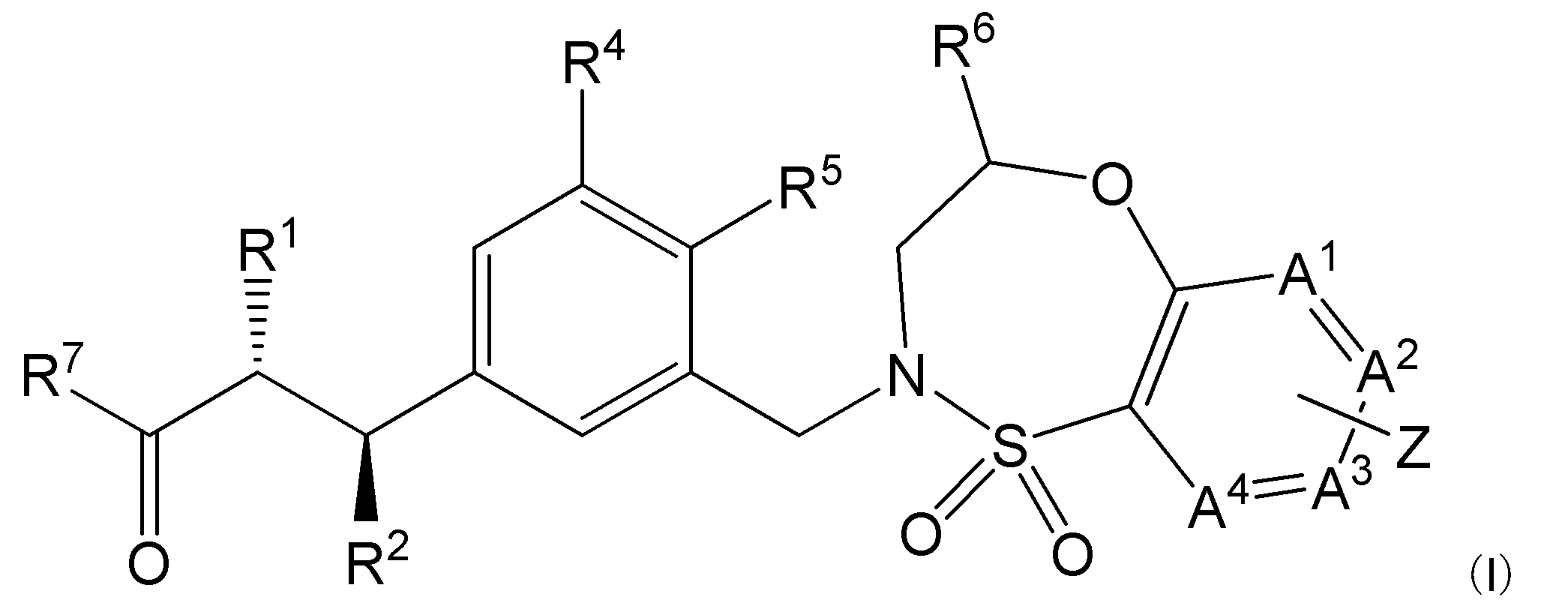
で表される化合物、その塩、又はそれらの溶媒和物。

の式中*で示される炭素原子を不斉炭素原子とする2つのジアステレオマーの内、極性が低い方の化合物、その塩、又はそれらの溶媒和物。
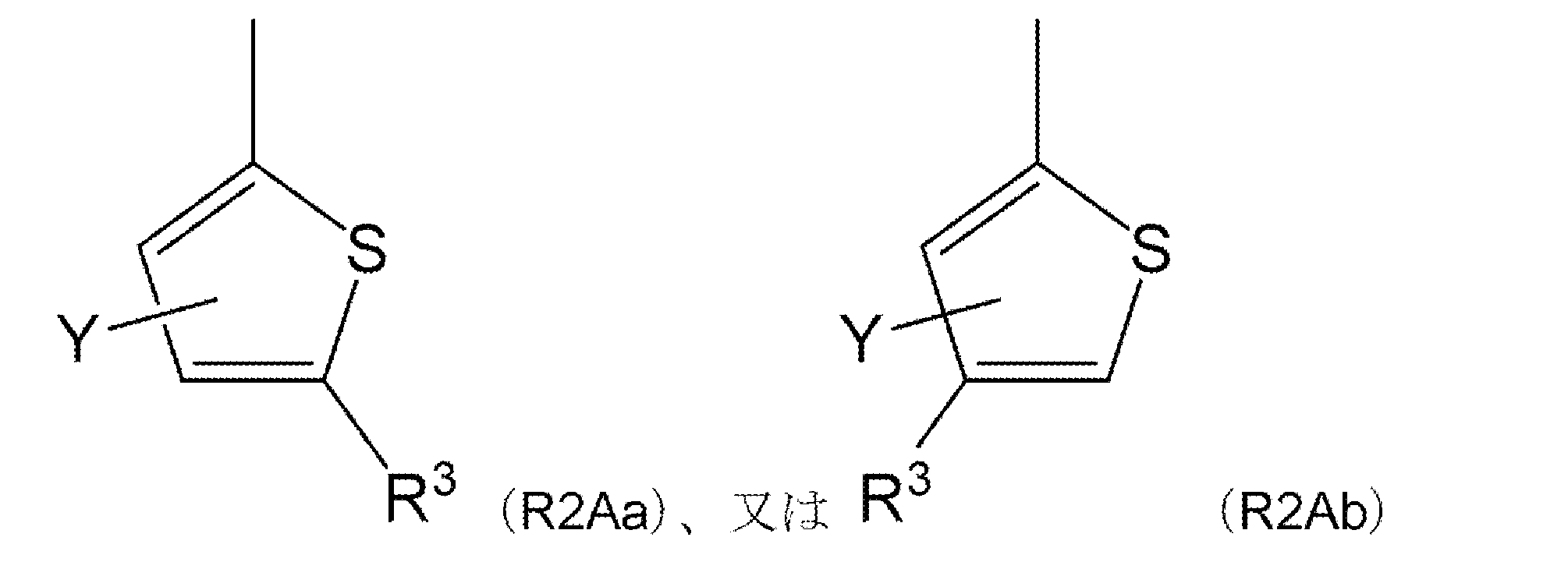
で表される基である、項1~5のいずれかに記載の化合物、その塩、又はそれらの溶媒和物。

であり、
前記R4は水素原子であり、
前記R5はアルキル基であり、
前記R6が置換されていてもよいエチル基であり、
前記R7がヒドロキシ基であり、
前記A1、前記A2、及び前記A4が全てCHであり、前記A3がCH又はNであり、且つ
前記Zが水素原子である、
項1~8のいずれかに記載の化合物、その塩、又はそれらの溶媒和物。
(2R,3S)-3-(5-アセチルチオフェン-2-イル)-3-(3-{[(R)-4-エチル-1,1-ジオキシド-3,4-ジヒドロ-2H-ベンゾ[b][1,4,5]オキサチアゼピン-2-イル]メチル}-4-メチルフェニル)-2-メチルプロパン酸(化合物A1)、
(2R,3S) -3-(5-アセチルチオフェン-2-イル)-3-(3-{[(R)-4-エチル-1,1-ジオキシド-3,4-ジヒドロ-2H-ピリド[4,3-b][1,4,5]オキサチアゼピン-2-イル]メチル}-4-メチルフェニル)-2-メチルプロパン酸(化合物B1)、
(2R,3S) -3-(5-アセチル-4-メトキシチオフェン-2-イル)-3-(3-{[(R)-4-エチル-1,1-ジオキシド-3,4-ジヒドロ-2H-ピリド[4,3-b][1,4,5]オキサチアゼピン-2-イル]メチル}-4-メチルフェニル)-2-メチルプロパン酸(化合物C1)。
項9b.3-(5-アセチルチオフェン-2-イル)-3-(3-{[(R)-4-エチル-1,1-ジオキシド-3,4-ジヒドロ-2H-ピリド[4,3-b][1,4,5]オキサチアゼピン-2-イル]メチル}-4-メチルフェニル)-2,2-ジメチルプロパン酸をカラム分離(カラム種類:CHIRAL ART Cellulose-SC、溶出溶媒:n-ヘキサン/エタノール/トリフルオロ酢酸の40/60/0.1混合溶媒)した場合に、最初に溶出される化合物(化合物D1)、その塩、又はそれらの溶媒和物。
本発明は、その一態様において、一般式(I):


R1はアルキル基を示す。
R2は置換されていてもよいチエニル基を示す。

で表される基が挙げられ、さらに好ましくは一般式(R2Aa)又は(R2Ab):
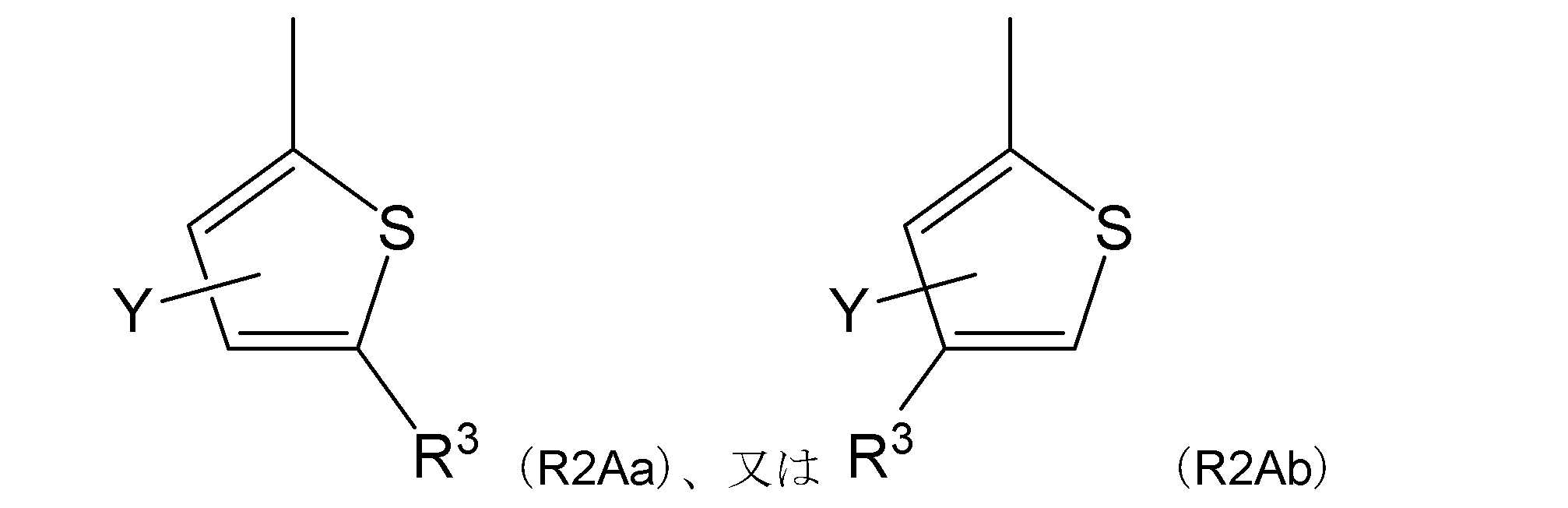
で表される基が挙げられる。
R4及びR5は同一又は異なって、水素原子又は置換されていてもよいアルキル基を示す、或いはR4及びR5は互いに結合して-NH-CH=N-を形成する。


R6は置換されていてもよいアルキル基を示す。


R7はヒドロキシ基、加水分解性基、-NR71R72(R71及びR72は同一又は異なって、水素原子又は-[C(=O)]0-1-炭化水素基を示す。)を示す。
A1、A2、A3及びA4は同一又は異なって、CH又はNを示す(但し、Nは1つ以下である。)。
Zは水素原子又はハロゲン原子を示す。
一般式(II)の化合物は、一般式(II)の式中*で示される炭素原子を不斉炭素原子とする2つのジアステレオマーの内、極性が低い方の化合物である。


本発明の一態様において、一般式(I)の中でも、好ましくは一般式(IA):
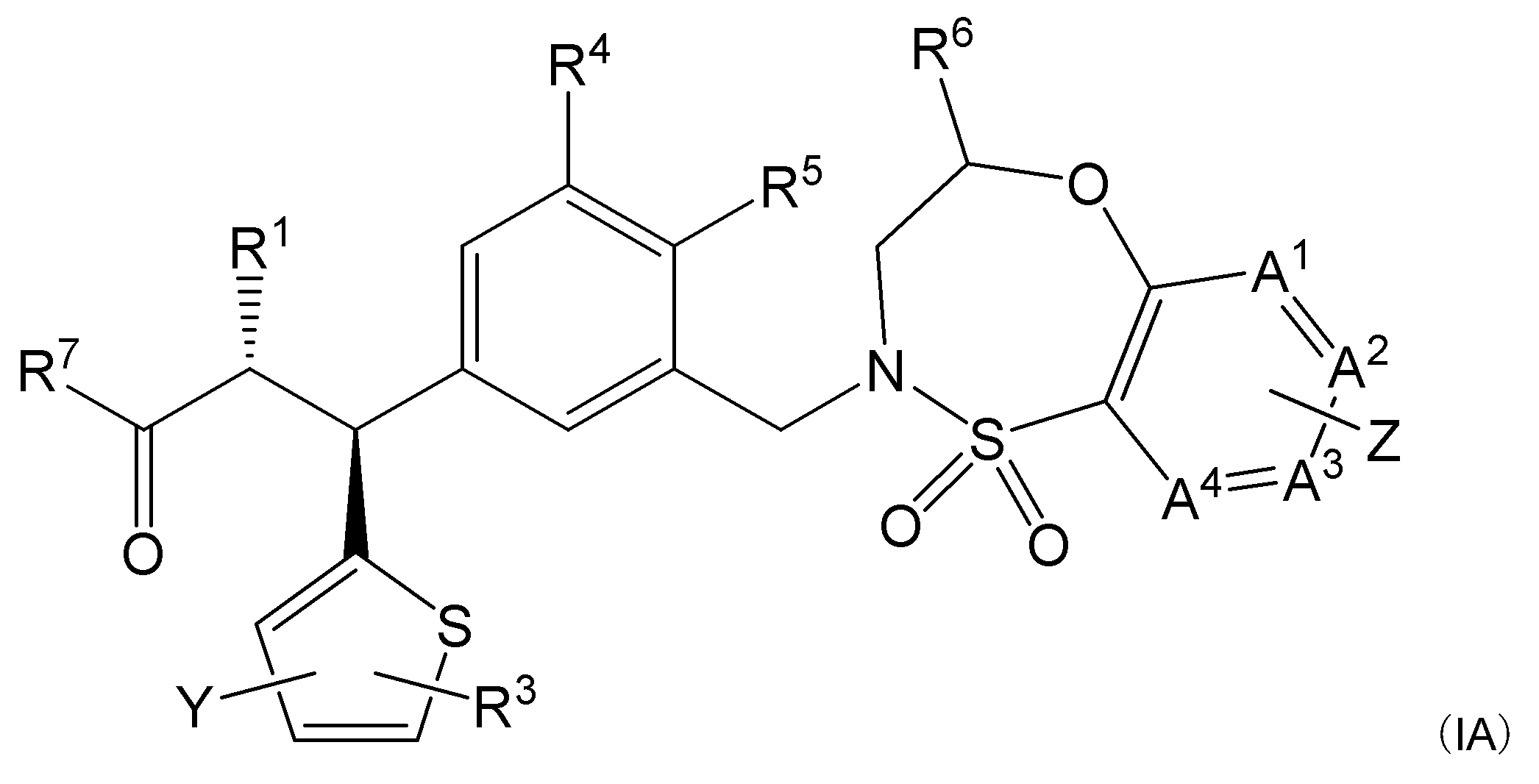
が挙げられ、より好ましくは一般式(IAA):
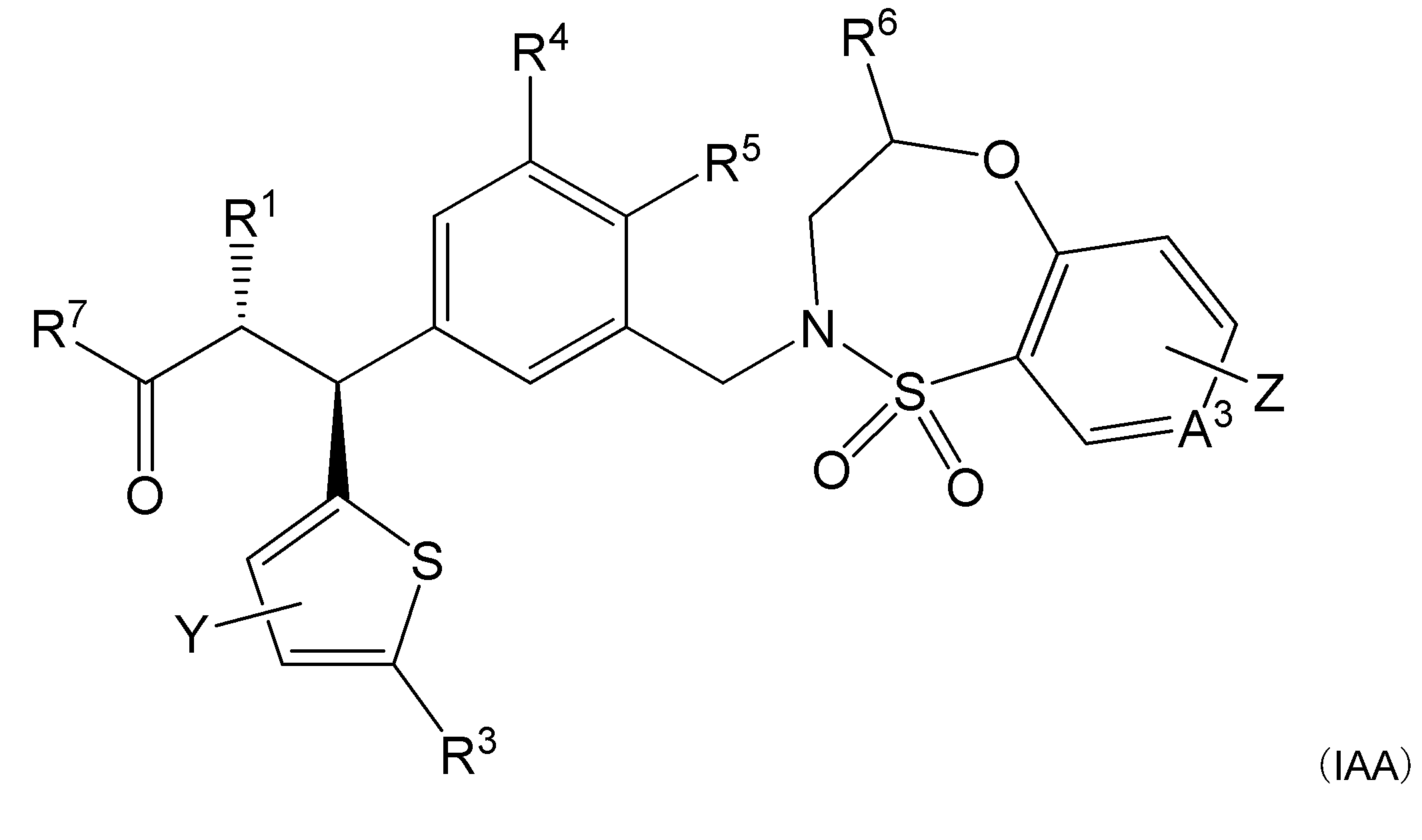
が挙げられ、さらに好ましくは一般式(IAAA):

が挙げられ、よりさらに好ましくは一般式(IAAAA):

が挙げられる。

が挙げられ、より好ましくは一般式(IIAA):
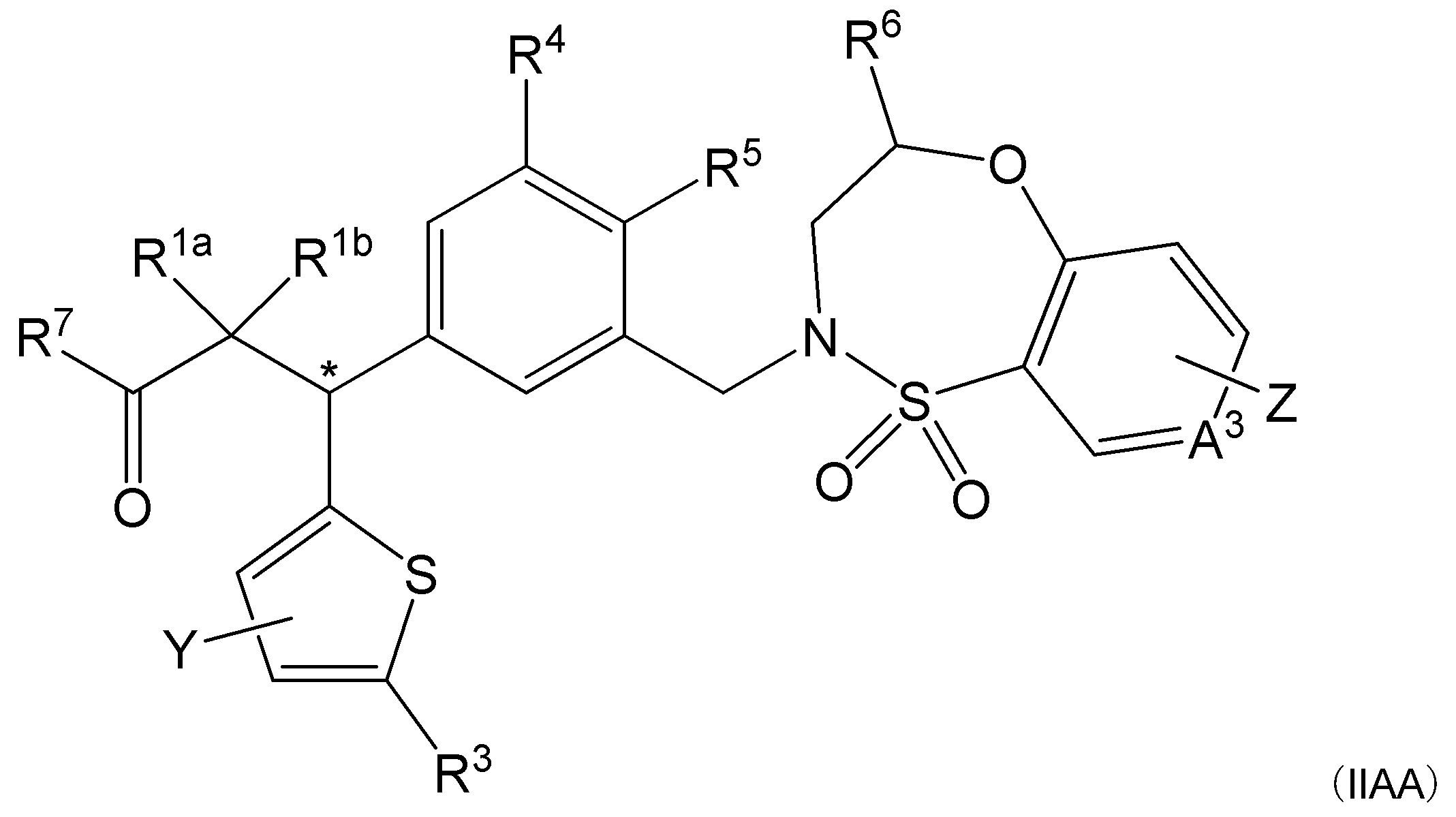
が挙げられ、さらに好ましくは一般式(IIAAA):

が挙げられ、よりさらに好ましくは一般式(IIAAAA):
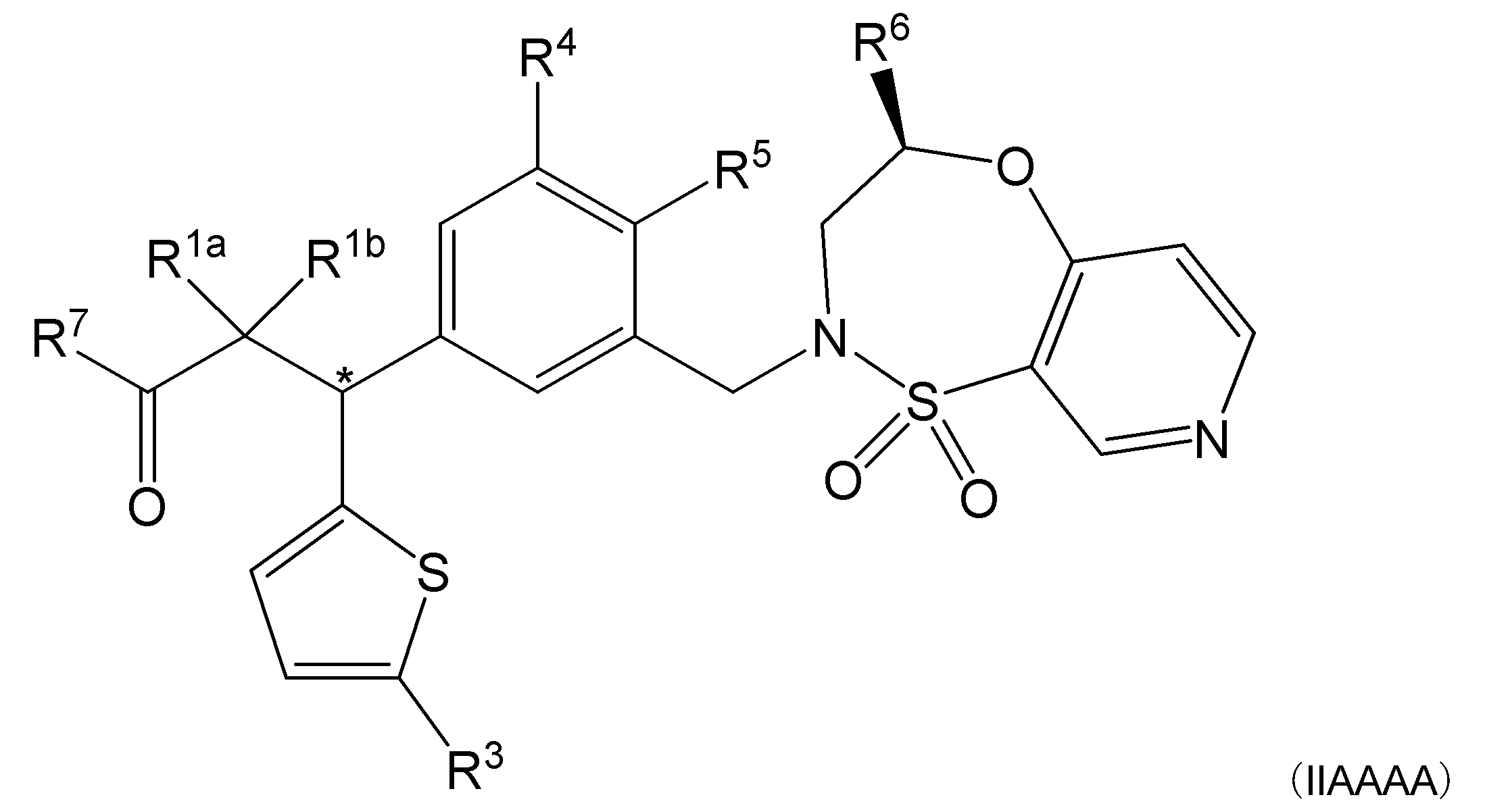
が挙げられる。

であり、
前記R4は水素原子であり、
前記R5はアルキル基であり、
前記R6が置換されていてもよいエチル基であり、
前記R7がヒドロキシ基であり、
前記A1、前記A2、及び前記A4が全てCHであり、前記A3がCH又はNであり、且つ
前記Zが水素原子である、
ことが好ましい。
化合物の塩は、薬学的に許容される塩である限り、特に制限されるものではない。該塩としては、酸性塩、塩基性塩のいずれも採用することができる。酸性塩の例としては、塩酸塩、臭化水素酸塩、硫酸塩、硝酸塩、リン酸塩等の無機酸塩; 酢酸塩、プロピオン酸塩、酒石酸塩、フマル酸塩、マレイン酸塩、リンゴ酸塩、クエン酸塩、メタンスルホン酸塩、パラトルエンスルホン酸塩等の有機酸塩が挙げられ、塩基性塩の例としては、ナトリウム塩、及びカリウム塩等のアルカリ金属塩; 並びにカルシウム塩、マグネシウム塩等のアルカリ土類金属塩; アンモニアとの塩; モルホリン、ピペリジン、ピロリジン、モノアルキルアミン、ジアルキルアミン、トリアルキルアミン、モノ(ヒドロキシアルキル)アミン、ジ(ヒドロキシアルキル)アミン、トリ(ヒドロキシアルキル)アミン等の有機アミンとの塩等が挙げられる。
本発明の化合物は様々な方法で製造することができる。
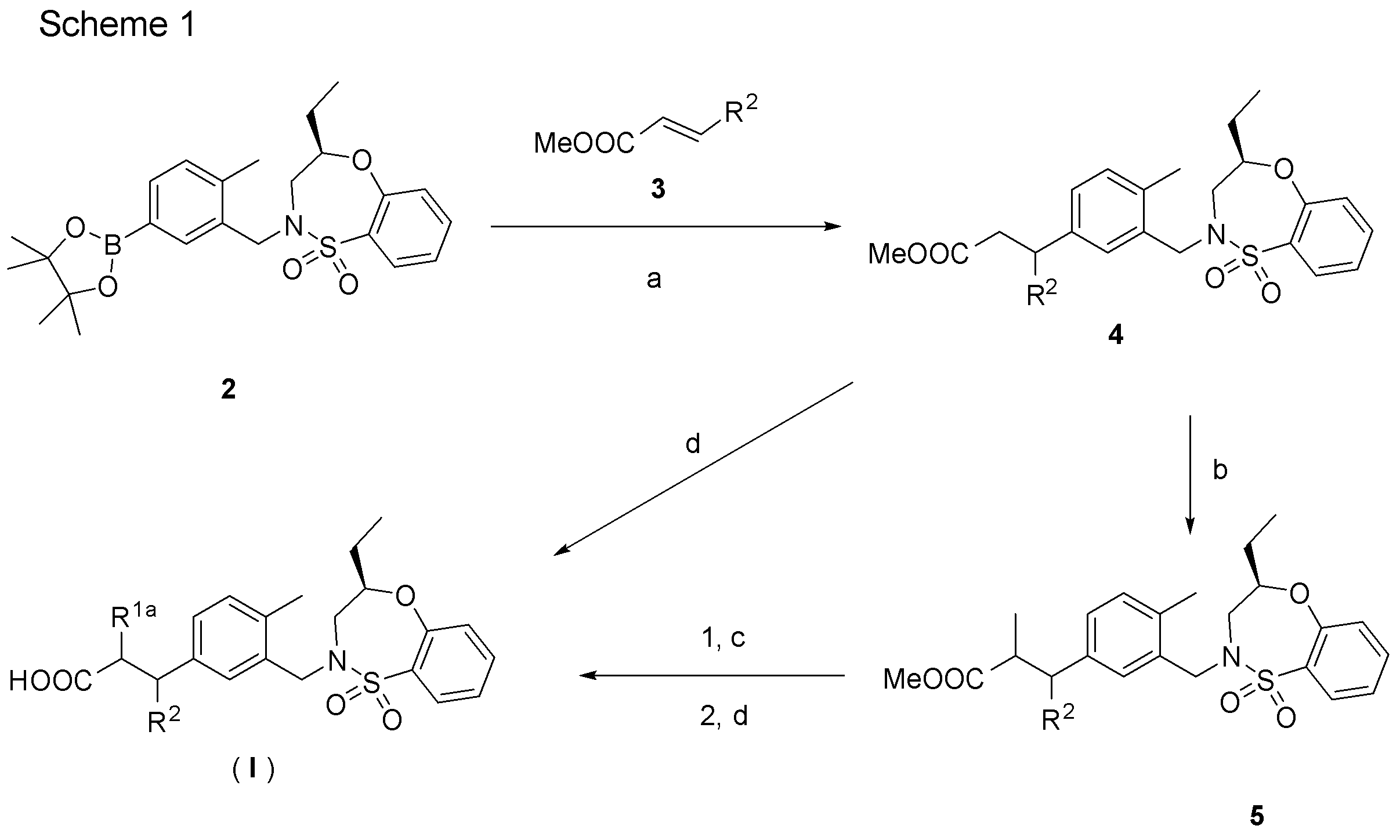


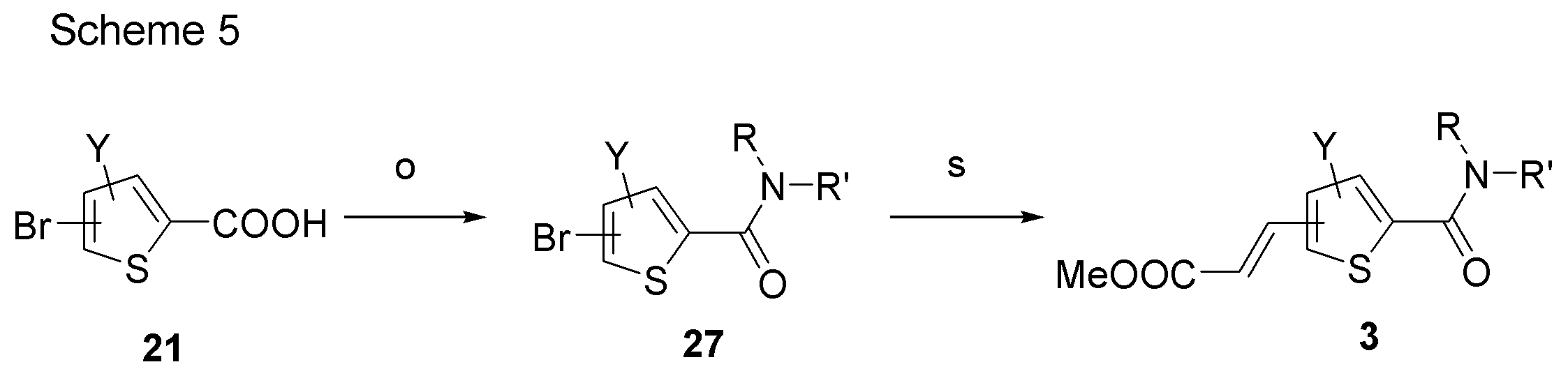


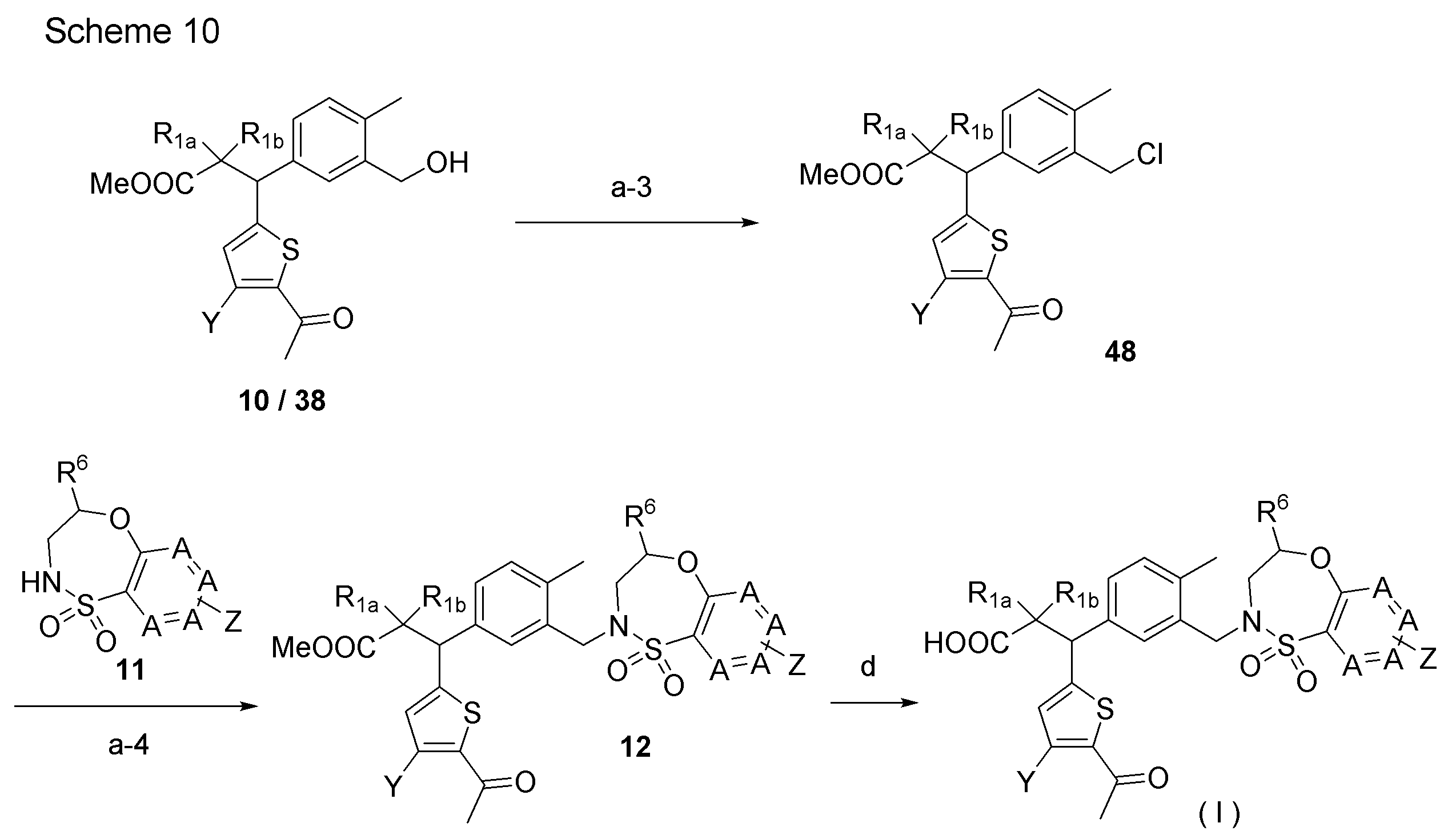

工程a-5では、化合物9から化合物49を製造する。化合物9に対して、テトラブチルアンモニウムフルオリドを2~5当量、好ましくは2~3当量用いる。溶媒は反応に悪影響を及ぼさない限り特に限定されず、テトラヒドロフラン、N,N-ジメチルホルムアミド等が挙げられ、好ましくはテトラヒドロフランを用いる。反応時間は、用いる試薬又は溶媒により異なるが、通常1~24時間、好ましくは1~3時間である。反応温度は用いる試薬又は溶媒により異なるが、通常0℃~100℃、好ましくは25℃~40℃である。
工程a-6では、化合物49から化合物50を製造する。化合物49に対して、二酸化マンガンを10~50当量、好ましくは25~50当量用いる。溶媒は反応に悪影響を及ぼさない限り特に限定されず、ジクロロメタン、アセトン、ベンゼン、トルエン、テトラヒドロフラン、1,4-ジオキサン等が挙げられ、好ましくはジクロロメタンを用いる。反応時間は、用いる試薬又は溶媒により異なるが、通常1~24時間、好ましくは2~24時間である。反応温度は用いる試薬又は溶媒により異なるが、通常0℃~100℃、好ましくは25℃~40℃である。
工程a-7では、化合物51から化合物52を製造する。化合物51に対して、TMSエタノールを1~5当量、好ましくは3~5当量用いる。縮合剤を通常1~3当量、好ましくは1.5~2当量、塩基を通常1~5当量、好ましくは2~5当量用いる。縮合剤としては、例えば、N,N’-ジシクロヘキシルカルボジイミド、1,1’-カルボニルジイミダゾール、1-エチル-3-[3-(ジメチルアミノ)プロピル]カルボジイミド塩酸塩、ベンゾトリアゾール-1-イルオキシトリピロリジノホスホニウム ヘキサフルオロリン酸塩、O-(ベンゾトリアゾール-1-イル)-N,N,N’,N’-テトラメチルウロニウム ヘキサフルオロリン酸塩、O-(7-アザベンゾトリアゾール-1-イル)-N,N,N’,N’-テトラメチルウロニウム ヘキサフルオロリン酸塩、シアノリン酸ジエチル、アジ化ジフェニルホスホリル、トリフルオロ酢酸ペンタフルオロフェニルエステル、イソプロピルクロロホルメート等が挙げられ、好ましくはO-(ベンゾトリアゾール-1-イル)-N,N,N’,N’-テトラメチルウロニウム ヘキサフルオロリン酸塩又はO-(7-アザベンゾトリアゾール-1-イル)-N,N,N’,N’-テトラメチルウロニウム ヘキサフルオロリン酸塩を挙げることができる。塩基としては、例えば、トリエチルアミン、ピリジン、N,N-ジイソプロピルエチルアミン、4-ジメチルアミノピリジン等が挙げられ、好ましくはトリエチルアミン、N,N-ジイソプロピルエチルアミン、又は4-ジメチルアミノピリジンを挙げることができる。溶媒としては反応に悪影響を及ぼさない限り特に限定されず、例えば、ジクロロメタン、クロロホルム、テトラヒドロフラン、1,4-ジオキサン、1,2-ジメトキシエタン、ジエチルエーテル、アセトニトリル、N,N-ジメチルホルムアミド等が挙げられ、好ましくはジクロロメタン又はN,N-ジメチルホルムアミドを挙げることができる。反応時間は、用いる試薬又は溶媒により異なるが、通常1時間~24時間、好ましくは3時間~24時間である。反応温度は、用いる試薬又は溶媒により異なるが、通常0℃~100℃、好ましくは25℃~40℃である。
本発明の化合物は、Nrf2活性化作用を有する。このため、本発明の化合物(本明細書において、「本発明の有効成分」と示すこともある。)は、例えば、医薬、試薬等として利用することができる。この観点から、本発明は、その一態様において、本発明の有効成分を含有する、医薬(本明細書において、「本発明の医薬」と示すこともある。)、に関する。
mCPBA: 三クロロ過安息香酸
M: モル濃度
N: 規定度
CDCl3:重クロロホルム
CD3OD:重メタノール
DMSO-d6: 重ジメチルスルホキシド
1H NMR: プロトン核磁気共鳴
DBU: 1,8-ジアザビシクロ [5.4.0] -7-ウンデセン
DDQ: 2,3-ジクロロ-5,6-ジシアノ-p-ベンゾキノン
DEAD: アゾジカルボン酸ジエチル
DIPEA: N,Nージイソプロピルエチルアミン
DMF: N,Nージメチルホルムアミド
DMA: N,Nージメチルアセトアミド
DMSO: ジメチルスルホキシド
EDCI: 1ーエチルー3-(3ージメチルアミノプロピル)カルボジイミド塩酸塩
HOBt: 1ーヒドロキシベンゾトリアゾール
LDA: リチウム ジイソプロピルアミド
PdCl2(dppf)2-CH2Cl2: [1,1'-ビス(ジフェニルホスフィノ)フェロセン]パラジウム(II)ジクロリド ジクロロメタン付加物
TEA: トリエチルアミン
TFA: トリフルオロ酢酸
THF: テトラヒドロフラン
p-TsOH-H2O: p-トルエンスルホン酸一水和物
[RhCl(cod)]2: クロロ(1,5-シクロオクタジエン)ロジウム(I) (ダイマー)
HATU: O-(7-アザベンゾトリアゾール-1-イル)-N,N,N’,N’-テトラメチルウロニウムヘキサフルオロリン酸塩
HBTU: O-(ベンゾトリアゾール-1-イル)-N,N,N’,N’-テトラメチルウロニウムヘキサフルオロリン酸塩。
参考例1
(R)-4-エチル-3,4-ジヒドロ-2H-ベンゾ[b][1,4,5]オキサチアゼピン 1,1-ジオキシドの製造

1H NMR(400 MHz, CDCl3)δ 7.83 (1H, dd, J = 7.6, 1.6 Hz), 7.47 (1H, td, J = 7.6, 1.6 Hz), 7.19 (1H, td, J = 7.6, 1.2 Hz), 7.17 (1H, dd, J = 7.6, 1.2 Hz), 4.66 (1H, br s), 3.89-3.82 (1H, m), 3.70-3.62 (1H, m), 3.39 (1H, ddd, J =14.8, 5.2, 2.0 Hz), 1.83-1.71 (1H, m), 1.67-1.56 (1H, m), 1.13 (3H, t, J = 7.2 Hz)。
(R)-4-メチル-3,4-ジヒドロ-2H-ベンゾ[b][1,4,5]オキサチアゼピン 1,1-ジオキシドの製造

1H NMR(400 MHz, CDCl3)δ 7.81 (1H, dd, J = 8.0, 1.6 Hz), 7.46 (1H, td, J = 8.0, 1.6 Hz), 7.19 (1H, td, J = 8.0, 1.2 Hz), 7.15 (1H, dd, J = 8.0, 1.2 Hz), 4.75 (1H, br s), 4.19-4.12 (1H, m), 3.67-3.59 (1H, m), 3.41 (1H, ddd, J = 14.8, 5.2, 2.0 Hz), 1.40 (3H, d, J = 6.4 Hz)。
(R)-4-エチル-3,4-ジヒドロ-2H-ピリド[2,3-b][1,4,5]オキサチアゼピン 1,1-ジオキシドの製造

1H NMR(400 MHz, CDCl3)δ 8.40 (1H, dd, J = 4.8, 2.0 Hz), 8.15 (1H, dd, J = 7.6, 2.0 Hz), 7.19 (1H, dd, J = 7.6, 4.8 Hz), 6.34 (1H, br s), 4.26-4.21 (1H, m), 3.66-3.58 (1H, m), 3.50-3.44 (1H, m), 1.84-1.75 (1H, m), 1.71-1.65 (1H, m), 1.12 (3H, t, J = 7.6 Hz)。
(R)-4-エチル-3,4-ジヒドロ-2H-ピリド[4,3-b][1,4,5]オキサチアゼピン 1,1-ジオキシドの製造

1H NMR(400 MHz, CDCl3)δ 8.82 (1H, s), 8.53 (1H, d, J = 5.6 Hz), 7.04 (1H, d, J = 5.6, Hz), 5.98 (1H, br s), 4.29-4.23 (1H, m), 3.56-3.46 (2H, m), 1.81-1.74 (1H, m), 1.72-1.63 (1H, m), 1.10 (3H, t, J = 7.6 Hz)。
(R)-2-フルオロ-N-(2-ヒドロキシブチル)ベンゼンスルホンアミドの製造

1H NMR (400 MHz, CDCl3) δ 7.51 (1H, m), 7.04 (2H, t, J = 8.4 Hz), 3.73-3.67 (1H, m), 3.28 (1H, dd, J = 12.8, 3.2 Hz), 2.96 (1H, d, J = 12.8, 8.0 Hz), 1.55-1.41 (2H, m), 0.94 (3H, t, J =7.6 Hz)。
(R)-4-エチル-9-フルオロ-3,4-ジヒドロ-2H-ベンゾ[b][1,4,5]オキサチアゼピン 1,1-ジオキシドの製造

1H NMR (400 MHz, CDCl3) δ 7.38-7.33 (1H, m), 6.93-6.88 (2H, m), 5.26 (1H, br t, J = 6.0 Hz), 4.34-4.27 (1H, m), 3.54 (1H, ddd, J = 14.0, 6.4, 4.0 Hz), 3.23 (1H, ddd, J = 14.0, 11.2, 6.8 Hz), 1.78-1.58 (2H, m), 1.07 (3H, t, J = 7.6 Hz)。
[(ブタ-3-エン-1-イルオキシ)メチル]ベンゼンの製造

1H NMR (400 MHz, CDCl3) δ 7.38-7.26 (5H, m), 5.91-5.79 (1H, m), 5.15-5.07 (1H, m), 5.08-5.02 (1H, m), 4.53 (2H, s), 3.54 (2H, t, J = 6.8 Hz), 2.43-2.35 (2H, m)。
2-[2-(ベンジロキシ)エチル]オキシランの製造

1H NMR (400 MHz, CDCl3) δ 7.38-7.26 (5H, m), 4.54 (2H, s), 3.68-3.58 (2H, m), 3.12-3.06 (1H, m), 2.79 (1H, dd, J = 5.0, 4.2 Hz), 2.54 (1H, dd, J = 5.0, 3.7 Hz), 1.97-1.86 (1H, m), 1.84-1.73 (1H, m)。
1-アミノ-4-(ベンジルオキシ)ブタン-2-オールの製造

1H NMR (400 MHz, CDCl3) δ 7.37-7.26 (5H, m), 4.52 (2H, s), 3.77-3.63 (3H, m), 2.79 (1H, dd, J = 12.8, 3.6 Hz), 2.61 (1H, dd, J = 12.8, 7.6 Hz), 1.77-1.71 (2H, m)。
4-[2-(ベンジルオキシ)エチル]-3,4-ジヒドロ-2H-ベンゾ[b][1,4,5]オキサチアゼピン 1,1-ジオキシドの製造

1H NMR(400 MHz, CDCl3)δ 7.83 (1H, d, J = 7.6 Hz), 7.42 (1H, td, J = 7.6, 1.6 Hz), 7.33-7.26 (5H, m), 7.20 (1H, t, J = 7.6 Hz), 6.96 (1H, d, J = 7.6 Hz), 4.63 (1H, br s), 4.55 (1H, d, J = 12.0 Hz), 4.49 (1H, d, J = 12.0 Hz), 4.11 (1H, br t, J = 9.6 Hz), 3.85-3.63 (3H, m), 3.39-3.35 (1H, m), 2.00-1.86 (2H, m)。
(5-ブロモ-2-メチルフェニル)メタノールの製造

1H NMR(400 MHz, CDCl3)δ 7.53 (1H, d, J = 2.0 Hz), 7.32 (1H, dd, J = 8.0, 2.0 Hz), 7.03 (1H, d, J = 8.0 Hz), 4.66 (2H, d, J = 5.6 Hz), 2.27 (3H, s), 1.64 (1H, t, J = 5.6 Hz)。
(R)-2-(5-ブロモ-2-メチルベンジル)-4-エチル-3,4-ジヒドロ-2H-ベンゾ[b][1,4,5]オキサチアゼピン 1,1-ジオキシドの製造

1H NMR(400 MHz, CDCl3)δ 7.89 (1H, dd, J = 7.6, 1.6 Hz), 7.52 (1H, td, J = 7.6, 1.6 Hz), 7.39 (1H, d, J = 2.0 Hz), 7.35 (1H, dd, J = 8.0, 2.0 Hz), 7.26 (1H, td, J = 7.6, 1.2 Hz), 7.21 (1H, dd, J = 7.6, 1.2 Hz), 7.06 (1H, d, J = 8.0 Hz), 4.51 (1H, d, J = 14.4 Hz), 4.08-4.02 (1H, m), 3.85 (1H, d, J =14.4 Hz), 3.76 (1H, dd, J = 15.2, 10.8 Hz), 3.06 (1H, dd, J = 15.2, 2.0 Hz), 2.29 (3H, s), 1.79-1.70 (1H, m), 1.56-1.50 (1H, m), 1.11 (3H, t, J = 7.2 Hz)。
(R)-4-エチル-2-[2-メチル-5-(4,4,5,5-テトラメチル-1,3,2-ジオキサボロラン-2-イル)ベンジル]-3,4-ジヒドロ-2H-ベンゾ[b][1,4,5]オキサチアゼピン 1,1-ジオキシドの製造

1H NMR(400 MHz, CDCl3)δ 7.90 (1H, d, J = 7.6 Hz), 7.68 (1H, d, J = 7.6 Hz), 7.54 (1H, s), 7.52 (1H, t, J = 7.6 Hz), 7.25 (1H, t, J = 7.6 Hz), 7.22-7.20 (2H, m), 4.64 (1H, d, J = 13.6 Hz), 4.09-4.04 (1H, m), 3.83 (1H, d, J =13.6 Hz), 3.74 (1H, dd, J = 15.2, 10.8 Hz), 2.97 (1H, dd, J = 15.2, 1.2 Hz), 2.43 (3H, s), 1.77-1.70 (1H, m), 1.51-1.42 (1H, m), 1.32 (12H, s), 1.05 (3H, t, J = 7.2 Hz)。
4-ブロモ-2-{[(4-メトキシベンジル)オキシ]メチル}-1-メチルベンゼンの製造

1H NMR(400 MHz, CDCl3)δ 7.50 (1H, d, J = 2.0 Hz), 7.32-7.28 (3H, m), 7.02 (1H, d, J = 8.0 Hz), 6.90 (2H, d, J = 8.4 Hz), 4.51 (2H, s), 4.46 (2H, s), 3.81 (3H, s), 2.24 (3H, s)。
3-{[(4-メトキシベンジル)オキシ]メチル}-4-メチルベンズアルデヒドの製造

1H NMR(400 MHz, CDCl3)δ 9.97 (1H, s), 7.87 (1H, d, J = 1.6 Hz), 7.72 (1H, dd, J = 8.0, 1.6 Hz), 7.33-7.26 (3H, m), 6.90 (2H, br d, J = 8.8 Hz), 4.56 (2H, s), 4.54 (2H, s), 3.82 (3H, s), 2.39 (3H, s)。
2-(3-{[(4-メトキシベンジル)オキシ]メチル}-4-メチルフェニル)-4,4,5,5-テトラメチル-1,3,2-ジオキサボロランの製造

1H NMR(400 MHz, CDCl3)δ 7.73 (1H, s), 7.65 (1H, dd, J = 7.2, 1.2 Hz), 7.27 (2H, d, J = 8.8 Hz), 7.18 (1H, d, J = 7.2 Hz), 6.88 (2H, br d, J = 8.8 Hz), 4.52 (2H, s), 4.47 (2H, s), 3.81 (3H, s), 2.36 (3H, s), 1.34 (12H, s)。
メチル 3-(3-{[(4-メトキシベンジル)オキシ]メチル}-4-メチルフェニル)-3-[5-(2-メチル-1,3-ジオキソラン-2-イル)チオフェン-2-イル]プロパノエートの製造

1H NMR(400 MHz, CDCl3)δ 7.28-7.24 (3H, m), 7.11-7.10 (2H, m), 6.88 (2H, br d, J = 8.4 Hz), 6.81 (1H, d, J = 3.6 Hz), 6.65 (1H, dd, J = 3.6, 0.8 Hz), 4.67 (1H, t, J = 7.6 Hz), 4.48 (2H, s), 4.46 (2H, s), 4.00-3.95 (2H, m), 3.94-3.89 (2H, m), 3.81 (3H, s), 3.59 (3H, s), 3.08 (1H, dd, J = 15.6, 7.6 Hz), 2.99 (1H, dd, J = 15.6, 7.6 Hz), 2.28 (3H, s), 1.71 (3H, s)。
メチル 3-(3-{[(4-メトキシベンジル)オキシ]メチル}-4-メチルフェニル)-2-メチル-3-[5-(2-メチル-1,3-ジオキソラン-2-イル)チオフェン-2-イル]プロパノエートの製造

Isomer mixture 1: 1H NMR(400 MHz, CDCl3)δ 7.28-7.26 (3H, m), 7.17-7.15 (1H, m), 7.06 (1H, d, J = 8.0 Hz), 6.89 (2H, br d, J = 8.8 Hz), 6.82 (1H, d, J = 3.6 Hz), 6.74 (1H, d, J = 3.6 Hz), 4.47 (2H, s), 4.43 (2H, s), 4.25 (1H, d, J = 10.8 Hz), 4.01-3.97 (2H, m), 3.96-3.90 (2H, m), 3.81 (3H, s), 3.43 (3H, s), 3.24-3.16 (1H, m), 2.25 (3H, s), 1.71 (3H, s), 1.20 (3H, d, J = 6.8 Hz)。
Isomer mixture 2: 1H NMR(400 MHz, CDCl3)δ 7.28-7.23 (3H, m), 7.11-7.10 (2H, m), 6.89 (2H, br d, J = 8.8 Hz), 6.77 (1H, d, J = 3.6 Hz), 6.71 (1H, br d, J = 3.6 Hz), 4.48 (2H, s), 4.47 (2H, s), 4.27 (1H, d, J = 11.2 Hz), 3.99-3.95 (2H, m), 3.93-3.90 (2H, m), 3.82 (3H, s), 3.58 (3H, s), 3.21-3.16 (1H, m), 2.28 (3H, s), 1.69 (3H, s), 1.05 (3H, d, J = 6.8 Hz)。
メチル 3-(5-アセチルチオフェン-2-イル)-3-(3-{[(4-メトキシベンジル)オキシ]メチル}-4-メチルフェニル)-2-メチルプロパノエートの製造

1H NMR(400 MHz, CDCl3)δ 7.46 (1H, d, J = 4.0 Hz), 7.29-7.24 (3H, m), 7.11 (2H, s), 6.92-6.89 (3H, m), 4.49 (2H, s), 4.48 (2H, s), 4.36 (1H, d, J = 11.2 Hz), 3.82 (3H, s), 3.60 (3H, s), 3.25-3.21 (1H, m), 2.46 (3H, s), 2.26 (3H, s), 1.08 (3H, d, J = 6.8 Hz)。
メチル 3-(5-アセチルチオフェン-2-イル)-3-[3-(ヒドロキシメチル)-4-メチルフェニル]-2-メチルプロパノエートの製造

1H NMR(400 MHz, CDCl3)δ 7.46 (1H, d, J = 4.0 Hz), 7.28 (1H, br s), 7.13 (2H, br s), 6.93 (1H, d, J = 4.0 Hz), 4.68 (2H, d, J = 5.6 Hz), 4.37 (1H, d, J = 11.2 Hz), 3.60 (3H, s), 3.27-3.23 (1H, m), 2.46 (3H, s), 2.30 (3H, s), 1.09 (3H, d, J = 6.8 Hz)。
1-(5-ブロモチオフェン-2-イル)エタン-1-オールの製造

1H NMR (400 MHz, CDCl3) δ 6.90 (1H, d, J = 3.6 Hz), 6.72 (1H, d, J = 3.6 Hz), 5.04 (1H, dq, J = 5.6, 6.4 Hz), 1.97 (1H, d, J = 4.8 Hz), 1.57 (3H, d, J = 6.4 Hz)。
[1-(5-ブロモチオフェン-2-イル)エトキシ](tert-ブチル)ジメチルシランの製造

1H NMR (400 MHz, CDCl3), δ 6.86 (1H, d, J = 4.0 Hz), 6.58 (1H, d, J = 4.0 Hz), 5.01 (1H, q, J = 6.4 Hz), 1.47 (3H, d, J = 6.4 Hz), 0.91 (9H, s), 0.09 (3H, s), 0.06 (3H, s)。
(5-{1-[(tert-ブチルジメチルシリル)オキシ]エチル}チオフェン-2-イル)(3-{[(4-メトキシベンジル)オキシ]メチル}-4-メチルフェニル)メタノールの製造

1H NMR (400 MHz, CDCl3) δ 7.41 (1H, s), 7.29-7.26 (3H, m), 7.16 (1H, d, J = 7.6 Hz), 6.88 (1H, d, J = 8.4 Hz), 6.67 (2H, d, J = 4.4 Hz), 5.96 (1H, d, J = 4.0 Hz), 5.17 (1H, q, J = 6.4 Hz), 4.51 (2H, s), 4.48 (2H, s), 3.81 (3H, s), 2.32 (3H, s), 2.29 (1H, d, J = 4.0 Hz), 1.47 (3H, d, J = 6.4 Hz), 0.90 (9H, s), 0.07 (3H, s), 0.03 (3H, br s)。
メチル 3-(5-{1-[(tert-ブチルジメチルシリル)オキシ]エチル}チオフェン-2-イル)-3-(3-{[(4-メトキシベンジル)オキシ]メチル}-4-メチルフェニル)-2,2-ジメチルプロパノエートの製造

1H NMR (400 MHz, CDCl3) δ 7.32 (1H, dd, J = 4.4, 1.2 Hz), 7.29-7.26 (2H, m), 7.21 (1H, td, J = 7.6, 1.6 Hz), 7.08 (1H, d, J = 7.6 Hz), 6.90 (1H, s), 6.88 (1H, s), 6.76-6.74 (1H, m), 6.64-6.63 (1H, m), 5.00 (1H, q, J = 6.4 Hz), 4.63-4.62 (1H, m), 4.49 (2H, s), 4.47 (2H, br s), 3.81 (3H, s), 3.56 (3H, s), 2.27 (3H, s), 1.45 (3H, d, J = 6.4 Hz), 1.29 (3H, s), 1.22 (3H, s), 0.89 (9H, br s), 0.05 (3H, s), 0.002 (3H, s)。
メチル 3-(5-アセチルチオフェン-2-イル)-3-[3-(ヒドロキシメチル)-4-メチルフェニル]-2,2-ジメチルプロパノエートの製造
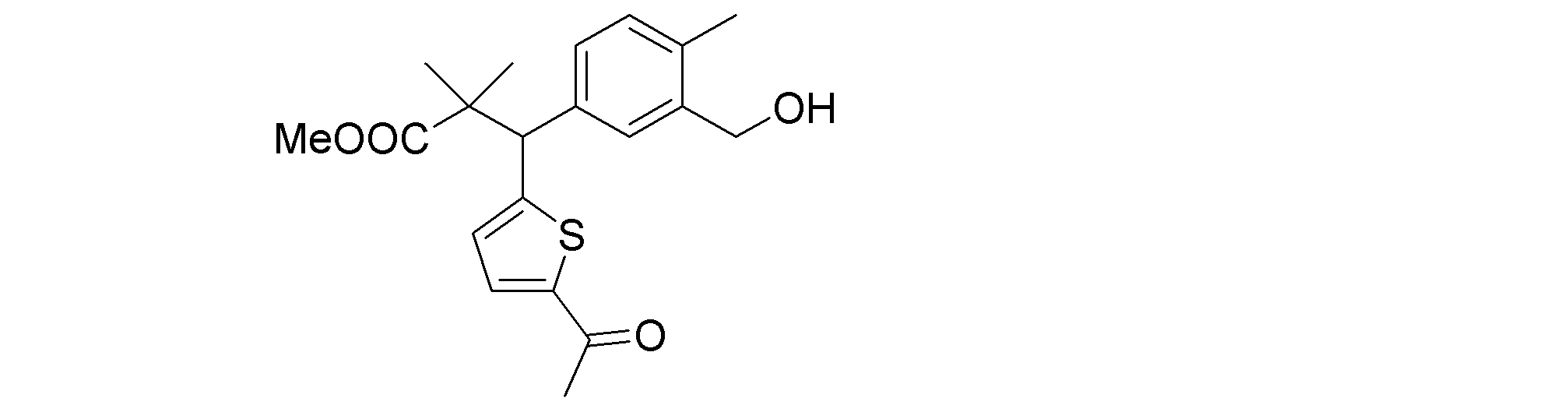
1H NMR (400 MHz, CDCl3) δ 7.50 (1H, d, J = 4.0 Hz), 7.34 (1H, d, J = 1.6 Hz), 7.20 (1H, dd, J = 7.6, 1.6 Hz), 7.11 (1H, d, J = 7.6 Hz), 6.97 (1H, d, J = 4.0 Hz), 4.17 (1H, s), 4.68 (2H, d, J = 5.6 Hz), 3.61 (3H, s), 2.49 (3H, s), 2.31 (3H, s), 1.32 (3H, s), 1.24 (3H, s)。
メチル 3-(5-アセチルチオフェン-2-イル)-3-[3-(クロロメチル)-4-メチルフェニル]-2,2-ジメチルプロパノエートの製造

1H NMR (400 MHz, CDCl3) δ 7.51 (1H, d, J = 4.0 Hz), 7.31-7.24 (2H, m), 7.14 (1H, d, J = 8.0 Hz), 6.87 (1H, d, J = 4.0 Hz), 4.70 (1H, s), 4.57 (2H, s), 3.60 (3H, s), 2.50 (3H, s), 2.38 (3H, s), 1.31 (3H, s), 1.24 (3H, s)。
メチル 3-(5-アセチルチオフェン-2-イル)-3-(3-{[(R)-4-エチル-1,1-ジオキシド-3,4-ジヒドロ-2H-ベンゾ[b][1,4,5]オキサチアゼピン-2-イル]メチル}-4-メチルフェニル)-2,2-ジメチルプロパノエートの製造

1H NMR (400 Mz, CDCl3) δ 7.87 (1H, dt, J = 7.6, 1.2 Hz), 7.55-7.50 (1H, m), 7.49 (1H, d, J = 4.0 Hz), 7.27-7.11 (5H, m), 6.97-6.95 (1H, m), 4.69 (1H, br s), 4.56-4.55 (1H, m), 3.83-3.80 (1H, m), 4.04-3.97 (1H, m), 3.73-3.71 (1H, m), 3.60 (3H, br s), 2.96-2.93 (1H, m), 2.49-2.48 (3H, m), 2.33 (3H, s), 1.81-1.56 (1H, m), 1.51-1.35 (1H, m), 1.29 (3H, br s), 1.23-1.21 (3H, m), 1.10-1.08 (3H, m)。
メチル 2-アミノ-5-ブロモ-3-ニトロベンゾエートの製造

1H NMR (400 MHz, CDCl3) δ 8.51 (1H, d, J = 2.4 Hz), 8.44 (2H, br s), 8.32 (1H, d, J = 2.4 Hz), 3.93 (3H, s)。
メチル 2,3-ジアミノ-5-ブロモベンゾエートの製造

1H NMR (400 MHz, CDCl3) δ 7.58 (1H, d, J = 1.6 Hz), 6.94 (1H d, J = 1.6 Hz), 5.55 (2H, br s), 3.87 (3H, s), 3.39 (2H, br s)。
メチル 6-ブロモ-1H-ベンゾ[d]イミダゾール-4-カルボキシレートの製造

1H NMR (400 MHz, CDCl3) δ 10.5 (1H, br s), 8.18 (1H, d, J = 0.8 Hz), 8.14 (1H, s), 8.07 (1H, d, J = 0.8 Hz), 4.02 (3H, s)。
(6-ブロモ-1-トリチル-1H-ベンゾ[d]イミダゾール-4-イル)メタノールの製造

1H NMR (400 MHz, CDCl3) δ 7.85 (1H, s), 7.36-7.31 (9H, m), 7.21 (1H, s), 7.17-7.14 (6H, m), 6.50 (1H, s), 5.09 (2H, d, J = 6.4 Hz), 3.67 (1H, t, J = 6.4 Hz),
参考例32
(R)-2-[(6-ブロモ-1-トリチル-1H-ベンゾ[d]イミダゾール-4-イル)メチル]-4-エチル-3,4-ジヒドロ-2H-ベンゾ[b][1,4,5]オキサチアゼピン 1,1-ジオキシドの製造

1H NMR (400 MHz, CDCl3) δ 7.89 (1H, dd, J = 7.6, 1.6 Hz), 7.78 (1H, s), 7.49 (1H, td, J = 7.6, 1.6 Hz), 7.46 (1H, s), 7.34-7.30 (9H, m), 7.23 (1H, t, J = 8.0 Hz), 7.17-7.11 (7H, m), 6.50 (1H, d, J = 1.6 Hz), 4.77 (1H, d, J = 16.0 Hz), 4.55 (1H, d, J = 16.0 Hz), 4.05-3.96 (2H, m), 3.30 (1H, dt, J = 13.6, 6.8 Hz), 1.78-1.67 (1H, m), 1.54-1.44 (1H, m), 1.08 (3H, t, J = 7.2 Hz)。
(R)-4-エチル-2-{[6-(4,4,5,5-テトラメチル-1,3,2-ジオキサボロラン-2-イル)-1-トリチル-1H-ベンゾ[d]イミダゾール-4-イル]メチル}-3,4-ジヒドロ-2H-ベンゾ[b][1,4,5]オキサチアゼピン 1,1-ジオキシドの製造

1H NMR (400 MHz, CDCl3) δ 7.92 (1H, d, J = 7.6 Hz), 7.84 (1H, s), 7.71 (1H, s), 7.46 (1H, t, J = 7.6 Hz), 7.32-7.28 (9H, m), 7.21 (1H, t, J = 7.6 Hz), 7.16-7.14 (7H, m). 6.77 (1H, s), 4.81 (1H, d, J = 14.8 Hz), 4.58 (1H, d, J = 14.8 Hz), 4.06-3.94 (2H, m), 3.27 (1H, d, J = 14.0 Hz), 1.72-1.62 (1H, m), 1.49-1.40 (1H, m), 1.20 (12H, s), 1.03 (3H, t, J = 7.2 Hz)。
5-ブロモ-3-メチルチオフェン-2-カルバルデヒドの製造

1H NMR (400 MHz, CDCl3) δ 9.90 (1H, s), 6.96 (1H, s), 2.53 (3H, s)。
5-ブロモ-3-メチルチオフェン-2-カルボン酸の製造

1H NMR (400 MHz, DMSO-d6) δ 7.20 (1H, s), 2.43 (3H, s)。
5-ブロモ-N-メチルフラン-2-カルボキサミドの製造

1H NMR(400 MHz, CDCl3)δ 7.04 (1H, d, J = 3.6 Hz), 6.62 (1H, s), 6.42 (1H, d, J = 3.6 Hz), 2.96 (3H, d, J = 4.8 Hz)。
(5-ブロモフラン-2-イル)(ピロリジン-1-イル)メタノンの製造

1H NMR(400 MHz, CDCl3)δ 7.04 (1H, d, J = 3.6 Hz), 6.43 (1H, d, J = 3.6 Hz), 3.82 (2H, t, J = 6.8 Hz), 3.63 (2H, t, J = 6.8 Hz), 2.01 (2H, quin, J = 6.8 Hz), 1.90 (2H, quin, J = 6.8 Hz)。
5-ブロモ-N-イソプロピルフラン-2-カルボキサミドの製造

1H NMR(400 MHz, CDCl3)δ 7.04 (1H, d, J = 3.2 Hz), 6.43 (1H, d, J = 3.2 Hz), 6.09 (1H, br s), 4.24 (1H, septd, J = 6.4, 1.2 Hz), 1.26 (6H, d, J = 6.4 Hz)。
5-ブロモ-N-メチルチオフェン-2-カルボキサミドの製造

1H NMR(400 MHz, CD3OD)δ 7.40 (1H, d, J = 4.0 Hz), 7.13 (1H, d, J = 4.0 Hz), 2.86 (3H, s)。
5-ブロモ-N-(2-メトキシエチル)フラン-2-カルボキサミドの製造

1H NMR(400 MHz, CDCl3)δ 7.06 (1H, d, J = 3.6 Hz), 6.63 (1H, br s), 6.43 (1H, d, J = 3.6 Hz), 3.63-3.59 (2H, m), 3.55-3.53 (2H, m), 3.40 (3H, s)。
N,3-ジメチルフラン-2-カルボキサミドの製造

1H NMR(400 MHz, CDCl3)δ 6.32 (1H, s), 6.28 (1H, br s), 2.95 (3H, d, J = 5.2 Hz), 2.40 (3H, s)。
4-ブロモ-N-メチルチオフェン-2-カルボキサミドの製造

1H NMR(400 MHz, CDCl3)δ 7.37 (1H, d, J = 1.2 Hz), 7.35 (1H, d, J = 1.2 Hz), 5.93 (1H, br s), 3.00 (3H, d, J = 4.8 Hz)。
N,4-ジメチルチオフェン-2-カルボキサミドの製造

1H NMR(400 MHz, CDCl3)δ 7.45 (1H, d, J = 1.2 Hz), 7.29 (1H, br s), 7.00 (1H, br s), 2.96 (3H, d, J = 4.8 Hz), 2.20 (3H, d, J = 0.8 Hz)。
N-メトキシ-N,4-ジメチルチオフェン-2-カルボキサミドの製造

1H NMR(400 MHz, CDCl3)δ 7.75 (1H, d, J = 1.6 Hz), 7.14 (1H, d, J = 1.6 Hz), 3.76 (3H, s), 3.36 (3H, s), 2.28 (3H, s)。
3-フルオロ-N-メトキシ-N-メチルチオフェン-2-カルボキサミドの製造

1H NMR(400 MHz, CDCl3)δ 7.38 (1H, dd, J = 5.6, 4.0 Hz), 6.84 (1H, d, J = 5.6 Hz), 3.74 (3H, s), 3.33 (3H, s)。
5-ブロモ-N-(2,4-ジメトキシベンジル)チオフェン-2-カルボキサミドの製造

1H NMR(400 MHz, CDCl3)δ 7.21 (1H, d, J = 8.0 Hz), 7.19 (1H, d, J = 4.0 Hz), 6.98 (1H, d, J = 4.0 Hz), 6.48 (1H, br s), 6.46 (1H, d, J = 2.4 Hz), 6.43 (1H, dd, J = 8.0, 2.4 Hz), 4.49 (2H, d, J = 5.6 Hz), 3.84 (3H, s), 3.79 (3H, s)。
5-ブロモ-N-メトキシ-N-3-ジメチルチオフェン-2-カルボキサミドの製造

1H NMR (400 MHz, CDCl3) δ 6.87 (1H, s), 3.70 (3H, s), 3.29 (3H, s), 2.51 (3H, s)。
ブロモ-N-メトキシ-N-メチルチアゾール-5-カルボキサミド

1H NMR (400 MHz, CDCl3) δ 8.32 (1H, s), 3.78 (3H, s), 3.36 (3H, s)。
2-ブロモ-N-メトキシ-N,4-ジメチルチアゾール-5-カルボキサミドの製造

1H NMR (400 MHz, CDCl3) δ 3.66 (3H, s), 3.26 (3H, s), 2.68 (3H, s)。
4-ブロモ-N-メトキシ-N-メチルチオフェン-2-カルボキサミドの製造

1H NMR(400 MHz, CDCl3)δ 7.83 (1H, d, J = 1.6 Hz), 7.44 (1H, d, J = 1.6 Hz), 3.78 (3H, s), 3.37 (3H, s)。
2-ブロモ-N-メトキシ-N-メチルチオフェン-3-カルボキサミドの製造

1H NMR(400 MHz, CDCl3)δ 7.25 (1H, d, J = 6.0 Hz), 7.04 (1H, d, J = 6.0 Hz), 3.60 (3H, s), 3.34 (3H, s)。
5-ブロモ-N-メトキシ-N-メチルフラン-2-カルボキサミドの製造

1H NMR(400 MHz, CDCl3)δ 7.08 (1H, d, J = 3.6 Hz), 6.44 (1H, d, J = 3.6 Hz), 3.77 (3H, s), 3.33 (3H, s)。
N-[(5-ブロモフラン-2-イル)メチル]プロパン-2-アミンの製造

1H NMR(400 MHz, CDCl3)δ 6.21 (1H, d, J = 3.2 Hz), 6.15 (1H, d, J = 3.2 Hz), 3.75 (2H, s), 2.82 (1H, septd, J = 6.4 Hz), 1.38 (1H, br s), 1.06 (6H, d, J = 6.4 Hz)。
5-(tert-ブチル)-4,5-ジヒドロ-6H-チエノ[2,3-c]ピロール-6-オンの製造

1H NMR (400 MHz, CDCl3) δ 7.56 (1H, d, J = 4.8 Hz), 6.99 (1H, d, J = 4.8 Hz), 4.36 (2H, s), 1.54 (9H, s)
参考例55
2-ブロモ-1,5,6,7-テトラヒドロ-4H-インドール-4-オンの製造

1H NMR(400 MHz, CDCl3)δ 8.49 (1H, br s), 6.51 (1H, d, J = 2.4 Hz), 2.79 (2H, t, J = 6.4 Hz), 2.48 (2H, t, J = 6.4 Hz), 2.15 (2H, quin, J = 6.4 Hz)。
5-ブロモ-N,3-ジメチルフラン-2-カルボキサミドの製造

1H NMR(400 MHz, CDCl3)δ 6.28 (1H, br s), 6.27 (1H, s), 2.95 (3H, d, J = 4.8 Hz), 2.37 (3H, s)。
5-ブロモ-N,4-ジメチルチオフェン-2-カルボキサミドの製造

1H NMR(400 MHz, CDCl3)δ 7.19 (1H, s), 6.23 (1H, br s), 2.95 (3H, d, J = 4.8 Hz), 2.18 (3H, s)。
1-(5-ブロモ-2,4-ジメチル-1H-ピロール-3-イル)エタン-1-オンの製造

1H NMR(400 MHz, CDCl3)δ 8.16 (1H, br s), 2.49 (3H, s), 2.42 (3H, s), 2.22 (3H, s)。
1-(5-ブロモ-4-メチルチオフェン-2-イル)エタン-1-オンの製造

1H NMR(400 MHz, CDCl3)δ 7.36 (1H, s), 2.48 (3H, s), 2.22 (3H, s)。
5-ブロモ-3-フルオロ-N-メトキシ-N-メチルチオフェン-2-カルボキサミドの製造

1H NMR(400 MHz, CDCl3)δ 6.89 (1H, s), 3.75 (3H, s), 3.30 (3H, s)。
1-(5-ブロモ-2,4-ジメチル-1H-ピロール-3-イル)エタン-1-オンの製造

1H NMR(400 MHz, CDCl3)δ 8.16 (1H, br s), 2.49 (3H, s), 2.42 (3H, s), 2.22 (3H, s)。
1-(5-ブロモ-1-エチル-1H-ピロール-2イル)エタン-1-オンの製造

1H NMR(400 MHz, CDCl3)δ 6.91 (1H, d, J = 1.6 Hz), 6.85 (1H, d, J = 1.6 Hz), 4.33 (2H, q, J = 7.2 Hz), 2.40 (3H, s), 1.35 (3H, t, J = 7.2 Hz)。
(5-ブロモチオフェン-2-イル)(シクロプロピル)メタノンの製造

1H NMR(400 MHz, CDCl3)δ 7.55 (1H, d, J = 4.0 Hz), 7.12 (1H, d, J = 4.0 Hz), 2.47-2.41 (1H, m), 1.25-1.21 (2H, m), 1.05-1.01 (2H, m)。
2-ブロモ-5-(tert-ブチル)-4,5-ジヒドロ-6H-チエノ[2,3-c]ピロール-6-オンの製造

1H NMR (400 MHz, CDCl3) δ 7.01(1H, s), 4.33 (2H, s), 1.53 (9H, s)。
4-ブロモ-1-メチル-1H-ピロール-2-カルボニトリルの製造

1H NMR(400 MHz, CDCl3)δ 6.81 (1H, d, J = 1.6 Hz), 6.75 (1H, d, J = 1.6 Hz), 3.76 (3H, s)。
2-ブロモ-1-メチル-1,5,6,7-テトラヒドロ-4H-インドール-4-オンの製造

1H NMR(400 MHz, CDCl3)δ 6.52 (1H, s), 3.50 (3H, s), 2.73 (2H, t, J = 6.4 Hz), 2.41 (2H, t, J = 6.4 Hz), 2.14 (2H, quin, J = 6.4 Hz)。
1-(5-ブロモ-1,2,4-トリメチル-1H-ピロール-3-イル)エタン-1-オンの製造

1H NMR(400 MHz, CDCl3)δ 3.50 (3H, s), 2.50 (3H, s), 2.41 (3H, s), 2.24 (3H, s)。
1-(5-ブロモ-3-フルオロチオフェン-2-イル)エタン-1-オンの製造

1H NMR(400 MHz, CDCl3)δ 6.90 (1H, d, J = 0.8 Hz), 2.52 (3H, d, J = 3.2 Hz)。
1-(4-メチルチオフェン-2-イル)エタン-1-オンの製造

1H NMR(400 MHz, CDCl3)δ 7.50 (1H, d, J = 0.8 Hz), 7.22 (1H, br d, J = 0.8 Hz), 2.53 (3H, s), 2.29 (3H, d, J = 0.8 Hz)。
1-(5-ブロモ-3-メチルチオフェン-2-イル)エタン-1-オンの製造

1H NMR(400 MHz, CDCl3)δ 6.93 (1H, s), 2.51 (3H, s), 2.47 (3H, s)。
1-(2-ブロモチアゾール-5-イル)エタン-1-オンの製造

1H NMR (400 MHz, CDCl3) δ 8.05, (1H, s), 2.56 (3H, s)。
1-(2-ブロモ-4-メチルチアゾール-5-イル)エタン-1-オンの製造

1H NMR (400 MHz, CDCl3) δ 2.72 (3H, s), 2.51 (3H, s)。
1-(4-ブロモチオフェン-2-イル)エタン-1-オンの製造

1H NMR(400 MHz, CDCl3)δ 7.58 (1H, d, J = 1.2 Hz), 7.53 (1H, d, J = 1.2 Hz), 2.55 (3H, s)。
1-(2-ブロモチオフェン-3-イル)エタン-1-オンの製造

1H NMR(400 MHz, CDCl3)δ 7.35 (1H, d, J = 5.6 Hz), 7.23 (1H, d, J = 5.6 Hz), 2.62 (3H, s)。
1-(5-ブロモフラン-2-イル)エタン-1-オンの製造

1H NMR(400 MHz, CDCl3)δ 7.12 (1H, d, J = 3.6 Hz), 6.49 (1H, d, J = 3.6 Hz), 2.46 (3H, s)。
2-(5-ブロモチオフェン-2-イル)-2-メチル-1,3-ジオキソランの製造

1H NMR(400 MHz, CDCl3)δ 6.90 (1H, d, J = 4.0 Hz), 6.79 (1H, d, J = 4.0 Hz), 4.06-4.00 (m, 2H), 3.99-3.93 (m, 2H), 1.73(s, 3H)。
2-(5-ブロモ-3-メチルチオフェン-2-イル)-2-メチル-1,3-ジオキソロンの製造

1H NMR (400 MHz, CDCl3) δ 6.74 (1H, s), 4.06-3.99 (2H, m), 3.96-3.90 (2H, m), 2.23 (3H, s), 1.71 (3H, s)。
2-ブロモ-5-(2-メチル-1,3-ジオキソラン-2-イル)チアゾールの製造

1H NMR (400 MHz, CDCl3) δ 7.49 (1H, s), 4.13-4.03 (2H, m), 3.99-3.91 (2H, m), 1.75 (3H, s)。
2-ブロモ-4-メチル-5-(2-メチル-1,3-ジオキソラン-2-イル)チアゾールの製造

1H NMR (400 MHz, CDCl3) δ 4.09-4.01 (2H, m), 3.94-3.88 (2H, m), 2.43 (3H, s), 1.71 (3H, s)。
2-(5-ブロモフラン-2-イル)-2-メチル-1,3-ジオキソランの製造

1H NMR(400 MHz, CDCl3)δ 6.29 (1H, d, J = 3.2 Hz), 6.23 (1H, d, J = 3.2 Hz), 4.07-4.03 (2H, m), 4.01-3.97 (2H, m), 1.71 (3H, s)。
2-(5-ブロモチオフェン-3-イル)-2-メチル-1,3-ジオキソランの製造

1H NMR(400 MHz, CDCl3)δ 7.17 (1H, d, J = 1.6 Hz), 7.02 (1H, d, J = 1.6 Hz), 4.07-3.98 (2H, m), 3.91-3.82 (2H, m), 1.64 (3H, s)。
1-(5-ブロモチオフェン-3-イル)エタン-1-オールの製造

1H NMR(400 MHz, CDCl3)δ 6.97 (1H, d, J = 0.8 Hz), 6.94 (1H, br s), 4.76 (1H, q, J = 6.4 Hz), 2.20 (1H, br s), 1.38 (3H, d, J = 6.4 Hz)。
1-(5-ブロモチオフェン-3-イル)エタン-1-オンの製造

1H NMR(400 MHz, CDCl3)δ 7.91 (1H, d, J = 1.6 Hz), 7.49 (1H, d, J = 1.6 Hz), 2.49 (3H, s)。
5-(2-メチル-1,3-ジオキソラン-2-イル)チアゾール-2-カルバルデヒドの製造

1H NMR (400 MHz, CDCl3) δ 9.93 (1H, s), 8.01 (1H, s), 4.12-4.06 (2H, m), 3.99-3.93 (2H, m), 1.80 (3H, s)。
2-ブロモ-4,5-ジヒドロ-6H-チエノ[2,3-c]ピロール-6-オンの製造

1H NMR (400 MHz, CDCl3) δ 7.08 (1H, s), 6.16 (1H, br s), 4.36 (2H, s)。
1-(5-ブロモ-3-フルオロチオフェン-2-イル)エタン-1-オールの製造

1H NMR(400 MHz, CDCl3)δ 6.75 (1H, br s), 5.22-5.17 (1H, m), 2.00 (1H, d, J = 4.0 Hz), 1.54 (1H, d, J = 6.4 Hz)。
[1-(5-ブロモ-3-フルオロチオフェン-2-イル)エトキシ](tert-ブチル)ジメチルシランの製造

1H NMR(400 MHz, CDCl3)δ 6.70 (1H, br s), 5.13 (1H, qd, J = 6.4, 1.2 Hz), 1.45 (3H, d, J = 6.4 Hz), 0.91 (9H, s), 0.082 (3H, s), 0.036 (3H, s)。
メチル (E)-3-[5-(メチルカルバモイル)フラン-2-イル]アクリレートの製造

1H NMR(400 MHz, CDCl3)δ 7.41 (1H, d, J = 16.0 Hz), 7.13 (1H, d, J = 3.6 Hz), 6.67 (1H, d, J = 3.6 Hz), 6.52 (1H, br s), 6.41 (1H, d, J = 16.0 Hz), 3.80 (3H, s), 3.01 (3H, d, J = 4.8 Hz)。
メチル (E)-3-[5-(ピロリジン-1-カルバモイル)フラン-2-イル]アクリレートの製造

1H NMR(400 MHz, CDCl3)δ 7.44 (1H, d, J = 16.0 Hz), 7.14 (1H, d, J = 3.6 Hz), 6.71 (1H, d, J = 3.6 Hz), 6.37 (1H, d, J = 16.0 Hz), 3.90 (2H, t, J = 6.8 Hz), 3.80 (3H, s), 3.65 (2H, t, J = 6.8 Hz), 2.05 (2H, quin, J = 6.8 Hz), 1.92 (2H, quin, J = 6.8 Hz)。
メチル (E)-3-[5-(イソプロピルカルバモイル)フラン-2-イル]アクリレートの製造

1H NMR(400 MHz, CDCl3)δ 7.43 (1H, d, J = 16.0 Hz), 7.13 (1H, d, J = 3.6 Hz), 6.68 (1H, d, J = 3.6 Hz), 6.43 (1H, d, J = 16.0 Hz), 6.15 (1H, br s), 4.27 (1H, septd, J = 6.4, 1.2 Hz), 3.82 (3H, s), 1.28 (6H, d, J = 6.4 Hz)。
参考例91
メチル (E)-3-[5-(メチルカルバモイル)チオフェン-2-イル]アクリレートの製造

1H NMR(400 MHz, CDCl3)δ 7.72 (1H, d, J = 15.6 Hz), 7.39 (1H, d, J = 3.6 Hz), 7.19 (1H, d, J = 3.6 Hz), 6.31 (1H, d, J = 15.6 Hz), 5.96 (1H, br s), 3.80 (3H, s), 3.01 (3H, d, J = 4.8 Hz)。
メチル (E)-3-{5-[(2-メトキシエチル)カルバモイル]フラン-2-イル}アクリレートの製造

1H NMR(400 MHz, CDCl3)δ 7.42 (1H, d, J = 16.0 Hz), 7.14 (1H, d, J = 3.6 Hz), 6.88 (1H, br s), 6.69 (1H, d, J = 3.6 Hz), 6.46 (1H, d, J = 16.0 Hz), 3.81 (3H, s), 3.66-3.62 (2H, m), 3.58-3.55 (2H, m), 3.41 (3H, s)。
メチル (E)-3-(5-アセチルチオフェン-2-イル)アクリレートの製造

1H NMR(400 MHz, CDCl3)δ 7.73 (1H, d, J = 16.0 Hz), 7.60 (1H, d, J = 4.0 Hz), 7.24 (1H, d, J = 4.0 Hz), 6.39 (1H, d, J = 16.0 Hz), 3.81 (3H, s), 2.56 (3H, s)。
メチル (E)-3-[4-メチル-5-(メチルカルバモイル)フラン-2-イル]アクリレートの製造

1H NMR(400 MHz, CDCl3)δ7.36 (1H, d, J = 15.6 Hz), 6.53 (1H, s), 6.36 (1H, d, J = 15.6 Hz), 6.34 (1H, br s), 3.80 (3H, s), 2.98 (3H, d, J = 5.2 Hz), 2.39 (3H, s)。
メチル (E)-3-(5-スルファモイルチオフェン-2-イル)アクリレートの製造

1H NMR(400 MHz, CD3OD)δ 7.80 (1H, d, J = 16.0 Hz), 7.55 (1H, d, J = 4.0 Hz), 7.37 (1H, d, J = 4.0 Hz), 6.42 (1H, d, J = 16.0 Hz), 3.81 (3H, s)。
メチル (E)-3-(チオフェン-2-イル)アクリレートの製造

1H NMR(400 MHz, CDCl3)δ 7.79 (1H, d, J = 16.0 Hz), 7.37 (1H, d, J = 5.2 Hz), 7.25 (1H, d, J = 3.6 Hz), 7.05 (1H, dd, J = 5.2, 3.6 Hz), 6.24 (1H, d, J = 16.0 Hz), 3.79 (3H, s)。
メチル (E)-3-[5-(メチルカルバモイル)チオフェン-3-イル]アクリレートの製造

1H NMR(400 MHz, CDCl3)δ 7.63 (1H, s), 7.60 (1H, d, J = 16.0 Hz), 7.58 (1H, s), 6.27 (1H, d, J = 16.0 Hz), 6.04 (1H, br s), 3.80 (3H, s), 3.01 (3H, d, J = 4.8 Hz)。
メチル (E)-3{-[5-(イソプロピルアミノ)メチル]フラン-2-イル}アクリレートの製造

1H NMR(400 MHz, CDCl3)δ 7.38 (1H, d, J = 15.6 Hz), 6.54 (1H, d, J = 3.2 Hz), 6.27 (1H, d, J = 15.6 Hz), 6.26 (1H, d, J = 3.2 Hz), 3.81 (2H, s), 3.78 (3H, s), 2.85 (1H, septd, J = 6.4 Hz), 1.09 (6H, d, J = 6.4 Hz)。
メチル (E)-3-[3-メチル-5-(メチルカルバモイル)チオフェン-2-イル]アクリレートの製造

1H NMR(400 MHz, CDCl3)δ 7.76 (1H, d, J = 16.0 Hz), 7.34 (1H, s), 6.94 (1H, br s), 6.20 (1H, d, J = 16.0 Hz), 3.79 (3H, s), 2.98 (3H, d, J = 4.8 Hz), 2.28 (3H, s)。
メチル (E)-3-(1-メチル-4-オキソ-4,5,6,7-テトラヒドロ-1H-インドール-2-イル)アクリレートの製造

1H NMR(400 MHz, CDCl3)δ 7.56 (1H, d, J = 15.6 Hz), 7.00 (1H, s), 6.23 (1H, d, J = 15.6 Hz), 3.78 (3H, s), 3.61 (3H, s), 2.79 (2H, t, J = 6.4 Hz), 2.47 (2H, t, J = 6.4 Hz), 2.17 (2H, quin, J = 6.4 Hz)。
メチル (E)-3-(5-アセチル-1-メチル-1H-ピロール-2-イル)アクリレートの製造

1H NMR(400 MHz, CDCl3)δ 7.64 (1H, d, J = 15.6 Hz), 6.95 (1H, d, J = 4.4 Hz), 6.60 (1H, d, J = 4.4 Hz), 6.37 (1H, d, J = 15.6 Hz), 4.01 (3H, s), 3.81 (3H, s), 2.46 (3H, s)。
メチル (E)-3-(5-アセチル-3-メチルチオフェン-2-イル)アクリレートの製造

1H NMR(400 MHz, CDCl3)δ 7.76 (1H, d, J = 15.6 Hz), 7.43 (1H, s), 6.29 (1H, d, J = 15.6 Hz), 3.80 (3H, s), 2.52 (3H, s), 2.34 (3H, s)。
メチル (E)-3-(5-アセチル-4-フルオロチオフェン-2-イル)アクリレートの製造

1H NMR(400 MHz, CDCl3)δ 7.60 (1H, d, J = 16.0 Hz), 7.00 (1H, s), 6.39 (1H, d, J = 16.0 Hz), 3.81 (3H, s), 2.58 (3H, d, J = 2.8 Hz)。
メチル (E)-3-{5-[(2,4-ジメトキシベンジル)カルバモイル]チオフェン-2-イル}アクリレートの製造
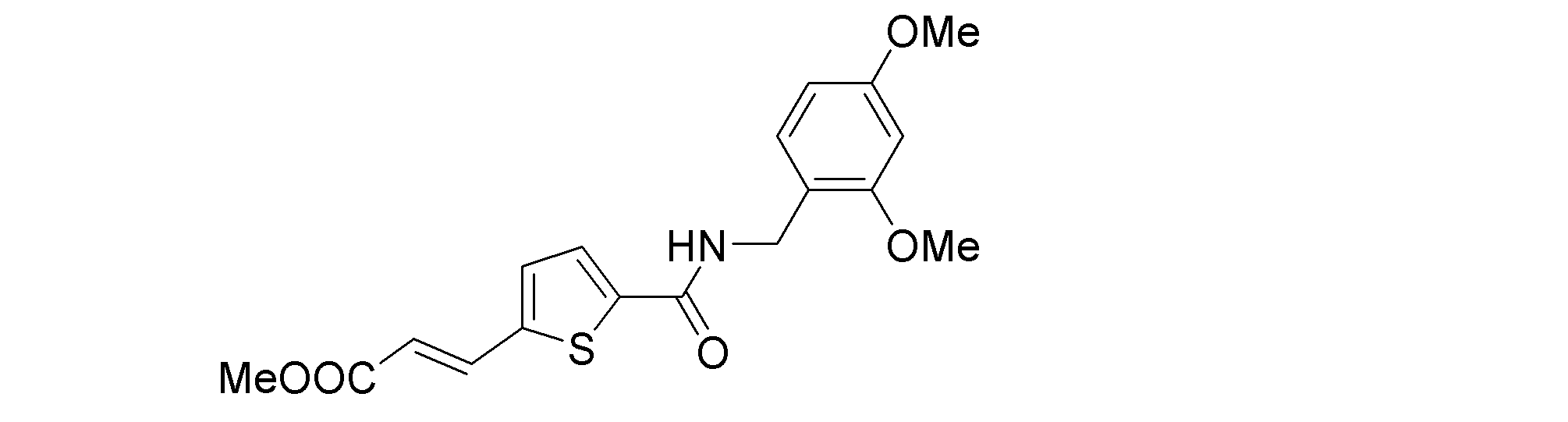
1H NMR(400 MHz, CDCl3)δ 7.67 (1H, d, J = 16.0 Hz), 7.41 (1H, d, J = 4.0 Hz), 7.19 (1H, d, J = 8.4 Hz), 7.13 (1H, d, J = 4.0 Hz), 6.85 (1H, t, J = 5.6 Hz), 6.43 (1H, d, J = 2.4 Hz), 6.41 (1H, dd, J = 8.0, 2.4 Hz), 6.26 (1H, d, J = 16.0 Hz),4.49 (2H, d, J = 5.6 Hz), 3.81 (3H, s), 3.77 (3H, s), 3.76 (3H, s)。
メチル (E)-3-(5-アセチル-4-メチルチオフェン-2-イル)アクリレートの製造

1H NMR(400 MHz, CDCl3)δ 7.66 (1H, d, J = 16.0 Hz), 7.07 (1H, s), 6.35 (1H, d, J = 16.0 Hz), 3.81 (3H, s), 2.53 (3H, s), 2.52 (3H, s)。
メチル (E)-3-(4-アセチル-1,3,5-トリメチル-1H-ピロール-2-イル)アクリレートの製造

1H NMR(400 MHz, CDCl3)δ 7.68 (1H, d, J = 16.0 Hz), 6.03 (1H, d, J = 16.0 Hz), 3.80 (3H, s), 3.59 (3H, s), 2.51 (3H, s), 2.46 (3H, s), 2.40 (3H, s)。
メチル (E)-3-(5-アセチル-1-エチル-1H-ピロール-2-イル)アクリレートの製造

1H NMR(400 MHz, CDCl3)δ 7.54 (1H, d, J = 16.0 Hz), 7.12 (1H, d, J = 1.6 Hz), 7.08 (1H, d, J = 1.6 Hz), 6.16 (1H, d, J = 16.0 Hz), 4.35 (2H, q, J = 7.2 Hz), 3.77 (3H, s), 2.46 (3H, s), 1.37 (3H, t, J = 7.2 Hz)。
メチル (E)-3-[5-(シクロプロパンカルボニル)チオフェン-2-イル]アクリレートの製造

1H NMR(400 MHz, CDCl3)δ 7.74 (1H, d, J = 16.0 Hz), 7.72 (1H, d, J = 4.0 Hz), 7.27 (1H, d, J = 4.0 Hz), 6.39 (1H, d, J = 16.0 Hz), 3.81 (3H, s), 2.51 (1H, tt, J = 8.0, 4.4 Hz), 1.28-1.25 (2H, m), 1.08-1.04 (2H, m)。
メチル (E)-3-[5-(2-メチル-1,3-ジオキソラン-2-イル)チオフェン-2-イル]アクリレートの製造

1H NMR(400 MHz, CDCl3)δ 7.71 (1H, d, J = 15.6 Hz), 7.10 (1H, d, J = 3.6 Hz), 6.97 (1H, d, J = 3.6 Hz), 6.18 (1H, d, J = 15.6 Hz), 4.08-4.02 (m, 2H), 3.98-3.95 (m, 2H)、3.78 (3H, s), 1.76 (s, 3H)。
メチル (E)-3-(5-シアノチオフェン-2-イル)アクリレートの製造

1H NMR(400 MHz, CDCl3)δ 7.71 (1H, d, J = 16.0 Hz), 7.55 (1H, d, J = 4.0 Hz), 7.23 (1H, d, J = 4.0 Hz), 6.36 (1H, d, J = 16.0 Hz), 3.82 (3H, s)。
メチル (E)-3-[4-メチル-5-(2-メチル-1,3-ジオキソラン-2-イル)チオフェン-2-イル]アクリレートの製造

1H NMR (400 MHz, CDCl3) δ 7.61 (1H, d, J = 15.6 Hz), 6.92 (1H, s), 6.11 (1H, d, J = 15.6 Hz), 4.07-3.98 (2H, m), 3.94-3.88 (2H, m), 3.74 (3H, s), 2.23 (3H, s), 1.70 (3H, s)。
メチル (E)-3-(6-オキソ-5,6-ジヒドロ-4H-チエノ[2,3-c]ピロール-2-イル)アクリレートの製造

1H NMR (400 MHz, CDCl3) δ 7.77 (1H, d, J = 15.6 Hz), 7.18 (1H, s), 6.54 (1H, br s), 6.37 (1H, d, J = 15.6 Hz), 4.38 (2H, s), 3.81 (3H, s)。
メチル (E)-3-(5-アセチルフラン-2-イル)アクリレートの製造

1H NMR(400 MHz, CDCl3)δ 7.43 (1H, d, J = 16.0 Hz), 7.17 (1H, d, J = 3.6 Hz), 6.69 (1H, d, J = 3.6 Hz), 6.54 (1H, d, J = 16.0 Hz), 3.79 (1H, s), 2.49 (3H, s)。
メチル (E)-3-(5-アセチルチオフェン-3-イル)アクリレートの製造

1H NMR(400 MHz, CDCl3)δ 7.82 (1H, d, J = 1.2 Hz), 7.74 (1H, d, J = 1.2 Hz), 7.62 (1H, d, J = 16.0 Hz), 6.32 (1H, d, J = 16.0 Hz), 3.81 (3H, s), 2.59 (3H, s)。
メチル (E)-3-(4-アセチルチオフェン-2-イル)アクリレートの製造

1H NMR(400 MHz, CDCl3)δ 8.03 (1H, s), 7.73 (1H, d, J = 16.0 Hz), 7.64 (1H, br s), 6.27 (1H, d, J = 16.0 Hz), 3.80 (3H, s), 2.52 (3H, s)。
メチル (E)-3-(5-シアノ-1-メチル-1H-ピロール-3-イル)アクリレートの製造

1H NMR(400 MHz, CDCl3)δ 7.48 (1H, d, J = 16.0 Hz), 7.01 (1H, d, J = 1.6 Hz), 6.96 (1H, d, J = 1.6 Hz), 6.13 (1H, d, J = 16.0 Hz), 3.80 (3H, s), 3.77 (3H, s)。
メチル (E)-3-(3-アセチルチオフェン-2-イル)アクリレートの製造

1H NMR(400 MHz, CDCl3)δ 8.51 (1H, d, J = 16.0 Hz), 7.40 (1H, d, J = 5.6 Hz), 7.28 (1H, d, J = 5.6 Hz), 6.34 (1H, d, J = 16.0 Hz), 3.78 (3H, s), 2.54 (3H, s)。
メチル (E)-3-[5-(2-メチル-1,3-ジオキソラン-2-イル)フラン-2-イル]アクリレートの製造

1H NMR(400 MHz, CDCl3)δ 7.39 (1H, d, J = 15.6 Hz), 6.52 (1H, d, J = 3.6 Hz), 6.39 (1H, d, J = 3.6 Hz), 6.32 (1H, d, J = 15.6 Hz), 4.09-4.05 (2H, m), 4.04-4.00 (2H, m), 3.78 (3H, s), 1.75 (3H, s)。
メチル (E)-3-[4-(2-メチル-1,3-ジオキソラン-2-イル)チオフェン-2-イル]アクリレートの製造

1H NMR(400 MHz, CDCl3)δ 7.72 (1H, d, J = 15.6 Hz), 7.31 (1H, s), 7.21 (1H, s), 6.22 (1H, d, J = 15.6 Hz), 4.06-4.02 (2H, m), 3.89-3.86 (2H, m), 3.79 (3H, s), 1.66 (3H, s)。
エチル (E)-3-(チアゾール-5-イル)アクリレートの製造

1H NMR(400 MHz, CDCl3)δ 8.80 (1H, s), 8.01 (1H, s), 7.82 (1H, d, J = 15.6 Hz), 6.26 (1H, d, J = 15.6 Hz), 4.26 (2H, q, J = 7.2 Hz), 1.33 (3H, t, J = 7.2 Hz)。
メチル (E)-3-[5-(2-メチル-1,3-ジオキソラン-2-イル)チアゾール-2-イル]アクリレートの製造

1H NMR (400 MHz, CDCl3) δ 7.79 (1H, s), 7.70 (1H, d, J = 15.6 Hz), 6.65 (1H, d, J = 15.6 Hz), 4.14-4.04 (2H, m), 3.99-3.91 (2H, m), 3.82 (3H, s), 1.78 (3H, s)。
メチル (E)-3-[4-メチル-5-(2-メチル-1,3-ジオキソラン-2-イル)チアゾール-2-イル]アクリレートの製造

1H NMR (400 MHz, CDCl3) δ 7.63 (1H, d, J = 15.6 Hz), 6.60 (1H, d, J = 15.6 Hz), 4.08-4.02 (2H, m), 3.94-3.86 (2H, m), 3.80 (3H, s), 2.49 (3H, s), 1.74 (3H, s)。
メチル 3-(3-{[(R)-4-エチル-1,1-ジオキシド-3,4-ジヒドロ-2H-ベンゾ[b][1,4,5]オキサチアゼピン-2-イル]メチル}-4-メチルフェニル)-3-[5-(メチルカルバモイル)フラン-2-イル]プロパノエートの製造
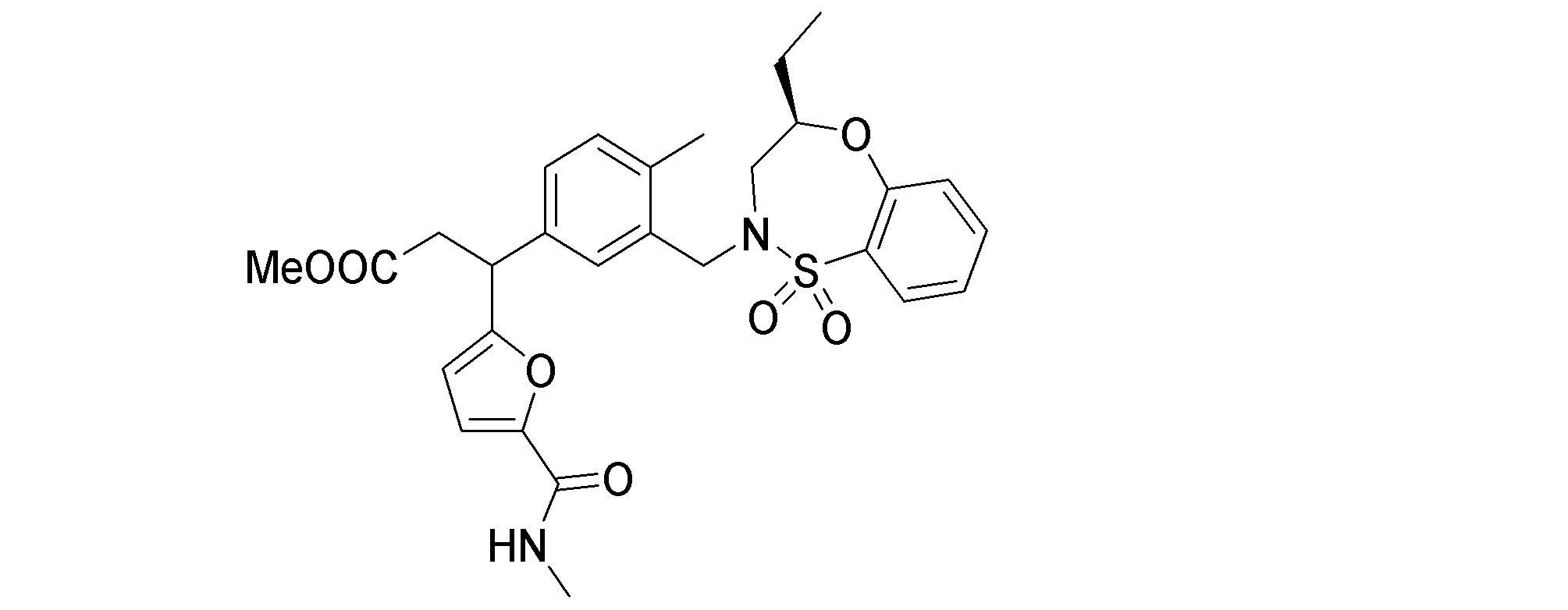
1H NMR(400 MHz, CDCl3)δ 7.88 (1H, d, J = 8.0 Hz), 7.53 (1H, td, J = 8.0, 1.6 Hz), 7.28-7.21 (3H, m), 7.14-7.07 (2H, m), 6.98 (1H, d, J = 3.2 Hz), 6.37 (1H, br s), 6.15 (1H, t, J = 3.2 Hz), 4.55-4.49 (2H, m), 4.04-3.99 (1H, m), 3.87-3.84 (1H, m), 3.80-3.73 (1H, m), 3.62 (3H, br s), 3.12-3.00 (3H, m), 2.95-2.94 (3H, m), 2.30 (3H, br s), 1.76-1.66 (1H, m), 1.53-1.41 (1H, m), 1.09 (3H, t, J = 7.2 Hz)。
メチル 3-(3-{[(R)-4-エチル-1,1-ジオキシド-3,4-ジヒドロ-2H-ベンゾ[b][1,4,5]オキサチアゼピン-2-イル]メチル}-4-メチルフェニル)-3-[5-(ピロリジン-1-カルボニル)フラン-2-イル]プロパノエートの製造
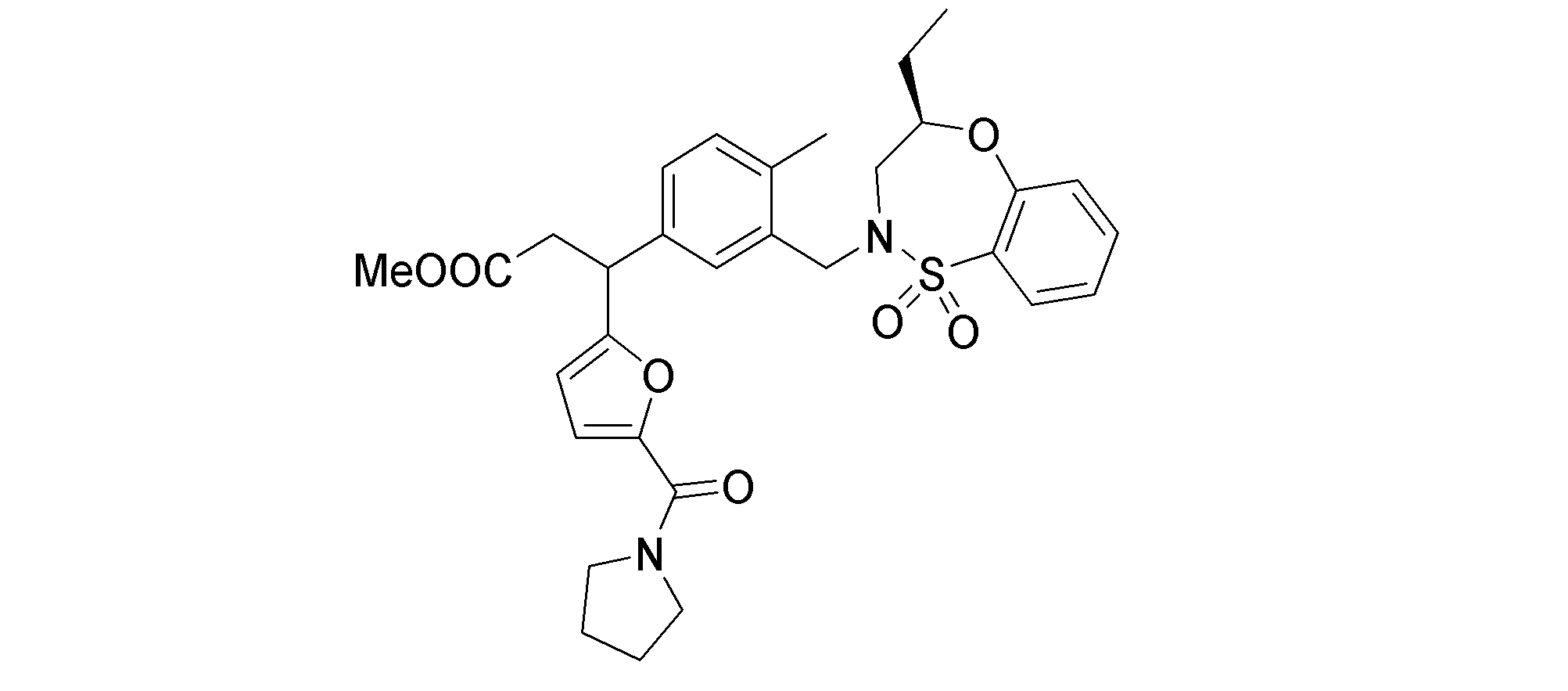
1H NMR(400 MHz, CDCl3)δ 7.88(1H, d, J = 7.6 Hz), 7.52 (1H, t, J = 7.6 Hz), 7.29-7.12 (5H, m), 6.97 (1H, d, J = 3.2 Hz), 6.11 (1H, d, J = 3.2 Hz), 4.57-4.53 (2H, m), 4.03-3.98 (1H, m), 3.81 (1H, d, J = 14.4 Hz), 3.78-3.67 (3H, m), 3.61-3.58 (5H, m), 3.14-3.10 (1H, m), 2.99-2.87 (2H, m), 2.32 (3H, s), 1.99-1.95 (2H, m), 1.88-1.85 (2H, m), 1.74-1.64 (1H, m), 1.50-1.42 (1H, m), 1.08 (3H, t, J = 7.2 Hz)。
メチル 3-(3-{[(R)-4-エチル-1,1-ジオキシド-3,4-ジヒドロ-2H-ベンゾ[b][1,4,5]オキサチアゼピン-2-イル]メチル}-4-メチルフェニル)-3-[5-(イソプロピルカルバモイル)フラン-2-イル]プロパノエートの製造

1H NMR(400 MHz, CDCl3)δ 7.88 (1H, dd, J = 8.0, 1.6 Hz), 7.53 (1H, td, J = 8.0, 1.6 Hz), 7.26 (1H, t, J = 8.0 Hz), 7.21 (1H, d, J = 8.0 Hz), 7.16-7.08 (3H, m), 6.98 (1H, d, J = 3.6 Hz), 6.14-6.10 (1H, m), 6.05 (1H, br s), 4.56-4.51 (2H, m), 4.26-4.19 (1H, m), 4.03-4.00 (1H, m), 3.87-3.74 (2H, m), 3.64 (3H, s), 3.07-2.99 (2H, m), 2.88-2.85 (1H, m), 2.33 (3H, br s), 1.76-1.65 (1H, m), 1.51-1.42 (1H, m), 1.26-1.22 (6H, m), 1.09-1.08 (3H, m)。
メチル 3-(3-{[(R)-4-エチル-1,1-ジオキシド-3,4-ジヒドロ-2H-ベンゾ[b][1,4,5]オキサチアゼピン-2-イル]メチル}-4-メチルフェニル)-3-[5-(メチルカルバモイル)チオフェン-2-イル]プロパノエートの製造
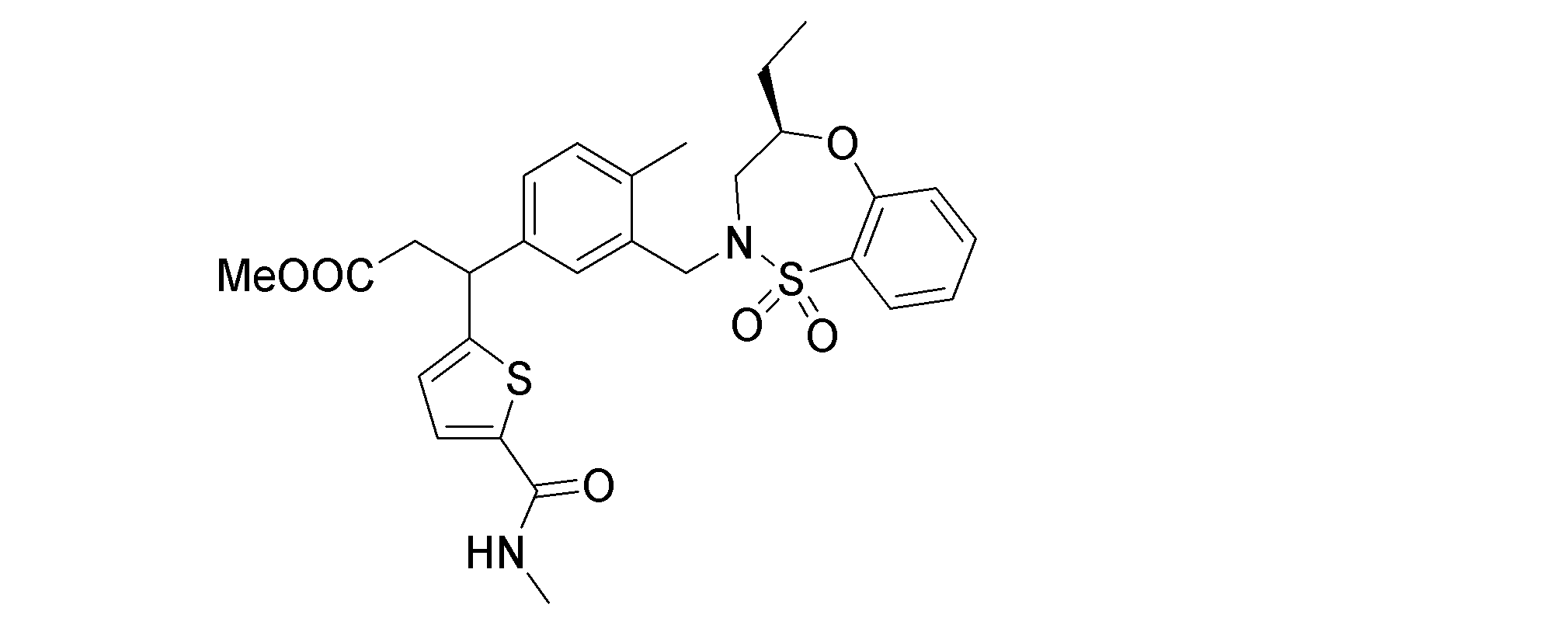
1H NMR(400 MHz, CDCl3)δ 7.88 (1H, dd, J = 8.0, 1.6 Hz), 7.52 (1H, br t, J = 8.0 Hz), 7.29-7.19 (3H, m), 7.14 (2H, br s), 7.07 (1H, d, J = 6.8 Hz), 6.78-6.77 (1H, m), 5.99 (1H, br s), 4.69 (1H, t, J = 7.6 Hz), 4.56 (1H, dd, J = 14.0, 5.2 Hz), 4.02-3.95 (1H, m), 3.82-3.69 (2H, m), 3.60 (3H, s), 3.09 (1H, dd, J = 16.0, 7.6 Hz), 3.01-2.90 (5H, m), 2.34 (3H, br s), 1.69-1.62 (1H, m), 1.46-1.38 (1H, m), 1.06 (3H, t, J = 7.2 Hz)。
メチル 3-(3-{[(R)-4-エチル-1,1-ジオキシド-3,4-ジヒドロ-2H-ベンゾ[b][1,4,5]オキサチアゼピン-2-イル]メチル}-4-メチルフェニル)-3-{5-[(2-メトキシエチル)カルバモイル]フラン-2-イル}プロパノエートの製造

1H NMR(400 MHz, CDCl3)δ 7.88 (1H, dd, J = 8.0, 1.6 Hz), 7.52 (1H, td, J = 8.0, 1.6 Hz), 7.26 (1H, t, J = 8.0 Hz), 7.23 (1H, d, J = 8.0 Hz), 7.16-7.09 (3H, m), 6.99 (1H, d, J = 3.6 Hz), 6.55 (1H, br s), 6.12 (1H, t, J = 3.6 Hz), 4.57-4.51 (2H, m), 4.04-4.00 (1H, m), 3.87-3.71 (2H, m), 3.63 (3H, s), 3.60-3.51 (4H, m), 3.37 (3H, s), 3.11-2.85 (3H, m), 2.33 (3H, br s), 1.78-1.67 (1H, m), 1.51-1.41 (1H, m), 1.08 (3H, t, J = 7.6 Hz)。
メチル 3-(5-アセチルチオフェン-2-イル)-3-(3-{[(R)-4-エチル-1,1-ジオキシド-3,4-ジヒドロ-2H-ベンゾ[b][1,4,5]オキサチアゼピン-2-イル]メチル}-4-メチルフェニル)プロパノエートの製造

1H NMR(400 MHz, CDCl3)δ 7.88 (1H, dd, J = 8.0, 1.6 Hz), 7.52 (1H, td, J = 8.0, 1.6 Hz), 7.50 (1H, d, J = 4.0 Hz), 7.27-7.20 (2H, m), 7.17-7.12 (2H, m), 7.08 (1H, d, J = 8.4 Hz), 6.87 (1H, br t, J = 2.4 Hz), 4.72 (1H, t, J = 7.6 Hz), 4.58-4.56 (1H, m), 4.03-3.96 (1H, m), 3.83-3.69 (2H, m), 3.61 (3H, s), 3.13-2.91 (3H, m), 2.48 (3H, br s), 2.34 (3H, br s), 1.73-1.63 (1H, m), 1.47-1.39 (1H, m), 1.07 (3H, t, J = 7.6 Hz)。
メチル 3-(3-{[(R)-4-エチル-1,1-ジオキシド-3,4-ジヒドロ-2H-ベンゾ[b][1,4,5]オキサチアゼピン-2-イル]メチル}-4-メチルフェニル)-3-[4-メチル-5-(メチルカルバモイル)フラン-2-イル]プロパノエートの製造

1H NMR(400 MHz, CDCl3)δ 7.88 (1H, dd, J = 7.6, 1.6 Hz), 7.53 (1H, td, J = 7.6, 1.6 Hz), 7.27-7.19 (3H, m), 7.13 (1H, d, J = 7.6 Hz), 7.10-7.06 (1H, m), 6.27 (1H, br s), 5.98 (1H, d, J = 3.2 Hz), 4.49-4.44 (2H, m), 4.05-3.98 (1H, m), 3.89-3.72 (2H, m), 3.63 (3H, s), 3.09-2.84 (6H, m), 2.34-2.30 (6H, m), 1.78-1.59 (1H, m), 1.52-1.41 (1H, m), 1.09 (3H, t, J = 7.2 Hz)。
メチル 3-(3-{[(R)-4-エチル-1,1-ジオキシド-3,4-ジヒドロ-2H-ベンゾ[b][1,4,5]オキサチアゼピン-2-イル]メチル}-4-メチルフェニル)-3-(5-スルファモイルチオフェン-2-イル)プロパノエートの製造

1H NMR(400 MHz, CDCl3)δ 7.84 (1H, br d, J = 8.0 Hz), 7.51 (1H, td, J = 8.0, 1.6 Hz), 7.42 (1H, d, J = 4.0 Hz), 7.27-7.19 (2H, m), 7.15-7.11 (3H, m), 6.78 (1H, d, J = 4.0 Hz), 4.71 (1H, t, J = 8.0 Hz), 4.51 (1H, d, J = 14.4 Hz), 4.03-3.97 (1H, m), 3.83-3.82 (1H, m), 3.77-3.69 (1H, m), 3.61 (3H, s), 3.11-2.95 (3H, m), 2.30 (3H, s), 1.74-1.63 (1H, m), 1.51-1.43 (1H, m), 1.08-1.07 (3H, m)。
メチル 3-(3-{[(R)-4-エチル-1,1-ジオキシド-3,4-ジヒドロ-2H-ベンゾ[b][1,4,5]オキサチアゼピン-2-イル]メチル}-4-メチルフェニル)-3-(チオフェン-2-イル)プロパノエートの製造

1H NMR(400 MHz, CDCl3)δ7.88 (1H, dd, J = 8.0, 1.6 Hz), 7.51 (1H, td, J = 8.0, 1.6 Hz), 7.26-7.12 (5H, m), 7.03 (1H, d, J = 14.4 Hz), 6.89 (1H, br t, J = 4.0 Hz), 6.81 (1H, br t, J = 4.0 Hz), 4.71 (1H, t, J = 7.6 Hz), 4.60-4.57 (1H, m), 4.01-3.92 (1H, m), 3.80-3.68 (2H, m), 3.59 (3H, br s), 3.13-3.06 (1H, m), 3.02-2.87 (2H, m), 2.36 (3H, br s), 1.71-1.59 (1H, m), 1.44-1.32 (1H, m), 1.07-1.06 (3H, m)。
メチル 3-(3-{[(R)-4-エチル-1,1-ジオキシド-3,4-ジヒドロ-2H-ベンゾ[b][1,4,5]オキサチアゼピン-2-イル]メチル}-4-メチルフェニル)-3-[5-(メチルカルバモイル)チオフェン-3-イル]プロパノエートの製造

1H NMR(400 MHz, CDCl3)δ 7.85 (1H, dd, J = 8.0, 1.6 Hz), 7.52 (1H, td, J = 8.0, 1.6 Hz), 7.31-7.30 (1H, m), 7.25 (1H, t, J = 8.0 Hz), 7.21 (1H, d, J = 8.0 Hz), 7.11-7.05 (4H, m), 6.37 (1H, br s), 4.51-4.47 (2H, m), 4.02-3.95 (1H, m), 3.84-3.70 (2H, m), 3.58 (3H, s), 3.05-2.92 (3H, m), 2.89 (3H, d, J = 4.8 Hz), 2.28 (3H, s), 1.74-1.61 (1H, m), 1.50-1.39 (1H, m), 1.08-1.07 (3H, m)。
メチル 3-(3-(((R)-4-エチル-1,1-ジオキシド-3,4-ジヒドロ-2H-ベンゾ[b][1,4,5]オキサチアゼピン-2-イル)メチル)-4-メチルフェニル)-3-(3-メチル-5-(メチルカルバモイル)チオフェン-2-イル)プロパノエートの製造

1H NMR(400 MHz, CDCl3)δ 7.87 (1H, br d, J = 8.0 Hz), 7.52 (1H, br t, J = 8.0 Hz), 7.26 (1H, d, J = 8.0 Hz), 7.23-7.19 (1H, m), 7.17 (1H, br s), 7.14-7.11 (2H, m), 7.05 (1H, br d, J = 5.6 Hz), 6.08 (1H, br s), 4.72 (1H, t, J = 8.0 Hz), 4.56-4.55 (1H, m), 4.00-3.95 (1H, m), 3.78-3.68 (2H, m), 3.59 (3H, s), 2.99 (2H, dd, J = 7.6, 7.6 Hz), 2.94-2.90 (4H, m), 2.33 (3H, br s), 2.10 (3H, s), 1.73-1.60 (1H, m), 1.45-1.38 (1H, m), 1.07-1.06 (3H, m)。
エチル 3-(3-{[(R)-4-エチル-1,1-ジオキシド-3,4-ジヒドロ-2H-ベンゾ[b][1,4,5]オキサチアゼピン-2-イル]メチル}-4-メチルフェニル)-3-(チアゾール-5-イル)プロパノエートの製造

1H NMR(400 MHz, CDCl3)δ 8.80 (1H, s), 7.88 (1H, dd, J = 7.6, 1.6 Hz), 7.63 (1H, d, J = 3.6 Hz), 7.52 (1H, td, J = 7.6, 2.0 Hz), 7.25 (1H, td, J = 7.6, 1.2 Hz), 7.20 (1H, dd, J = 8.0, 0.8 Hz), 7.17-7.12 (2H, m), 7.08 (1H, d, J = 7.6 Hz), 4.77 (1H, t, J = 8.0 Hz), 4.57 (1H, dd, J = 14.0, 5.2 Hz), 4.09-3.98 (3H, m), 3.83-3.69 (2H, m), 3.11-2.91 (3H, m), 2.34 (3H, br s), 1.71-1.65 (1H, m), 1.46-1.40 (1H, m), 1.16 (3H, t, J = 7.2 Hz), 1.09-1.05 (3H, m)。
メチル 3-(3-{[(R)-4-エチル-1,1-ジオキシド-3,4-ジヒドロ-2H-ベンゾ[b][1,4,5]オキサチアゼピン-2-イル]メチル}-4-メチルフェニル)-3-(1-メチル-4-オキソ-4,5,6,7-テトラヒドロ-1H-インドール-2-イル)プロパノエートの製造

1H NMR(400 MHz, CDCl3)δ 7.87-7.82 (1H, m), 7.55-7.50 (1H, m), 7.28-7.19 (2H, m), 7.13-7.10 (1H, m), 7.06-7.01 (1H, m), 6.96 (1H, s), 6.48 (1H, d, J = 4.0 Hz), 4.52-4.51 (1H, m), 4.41 (1H, t, J = 8.0 Hz), 4.00-3.95 (1H, m), 3.80-3.72 (2H, m), 3.61 (1H, s), 3.23 (3H, br s), 3.04-2.87 (2H, m), 2.80-2.73 (1H, m), 2.67-2.62 (2H, m), 2.46-2.42 (2H, m), 2.34 (3H, br s), 2.14-2.10 (2H, m), 1.75-1.62 (1H, m), 1.50-1.39 (1H, m), 1.11-1.04 (3H, m)。
メチル 3-(5-アセチル-1-メチル-1H-ピロール-2-イル)-3-(3-{[(R)-4-エチル-1,1-ジオキシド-3,4-ジヒドロ-2H-ベンゾ[b][1,4,5]オキサチアゼピン-2-イル]メチル}-4-メチルフェニル)プロパノエートの製造

1H NMR(400 MHz, CDCl3)δ 7.88 (1H, dd, J = 7.6, 1.6 Hz), 7.52 (1H, t, J = 7.6 Hz), 7.25 (1H, t, J = 7.6 Hz), 7.20 (1H, d, J = 7.6 Hz), 7.12-7.10 (1H, m), 7.02-6.92 (3H, m), 6.13 (1H, d, J = 4.4 Hz), 4.57-4.46 (2H, m), 4.00-3.93 (1H, m), 3.80-3.73 (1H, m), 3.68-3.65 (4H, m), 3.63 (3H, br s), 3.05-2.81 (3H, m), 2.39 (3H, s), 2.34-2.31 (3H, m), 1.74-1.61 (1H, m), 1.47-1.40 (1H, m), 1.09-1.05 (3H, m)。
メチル 3-(5-アセチル-3-メチルチオフェン-2-イル)-3-(3-{[(R)-4-エチル-1,1-ジオキシド-3,4-ジヒドロ-2H-ベンゾ[b][1,4,5]オキサチアゼピン-2-イル]メチル}-4-メチルフェニル)プロパノエートの製造

1H NMR(400 MHz, CDCl3)δ7.87 (1H, dt, J = 8.0, 2.0 Hz), 7.52 (1H, br t, J = 8.0 Hz), 7.38 (1H, s), 7.28-7.20 (2H, m), 7.17-7.12 (2H, m), 7.05 (1H, d, J = 8.0 Hz), 4.74-4.73 (1H, m), 4.58-4.55 (1H, m), 4.03-3.95 (1H, m), 3.80-3.66 (2H, m), 3.60 (3H, br s), 3.07-2.86 (3H, m), 2.46 (3H, br s), 2.35 (3H, br s), 2.16 (3H, s), 1.74-1.60 (1H, m), 1.46-1.36 (1H, m), 1.08-1.07 (3H, m)。
メチル 3-(5-アセチル-4-フルオロチオフェン-2-イル)-3-(3-{[(R)-4-エチル-1,1-ジオキシド-3,4-ジヒドロ-2H-ベンゾ[b][1,4,5]オキサチアゼピン-2-イル]メチル}-4-メチルフェニル)プロパノエートの製造

1H NMR(400 MHz, CDCl3)δ 7.88 (1H, dd, J = 8.0, 1.6 Hz), 7.52 (1H, td, J = 8.0, 1.6 Hz), 7.26 (1H, td, J = 8.0, 1.2 Hz), 7.21 (1H, dd, J = 8.0, 1.2 Hz), 7.18-7.07 (3H, m), 6.64 (1H, s), 4.61-4.53 (2H, m), 4.06-3.98 (1H, m), 3.87-3.69 (2H, m), 3.63 (3H, s), 3.09-2.94 (3H, m), 2.50 (3H, br s), 2.35 (3H, br s), 1.74-1.65 (1H, m), 1.49-1.42 (1H, m), 1.08-1.07 (3H, m)。
メチル 3-{5-[(2,4-ジメトキシベンジル)カルバモイル]チオフェン-2-イル}-3-(3-{[(R)-4-エチル-1,1-ジオキシド-3,4-ジヒドロ-2H-ベンゾ[b][1,4,5]オキサチアゼピン-2-イル]メチル}-4-メチルフェニル)プロパノエートの製造
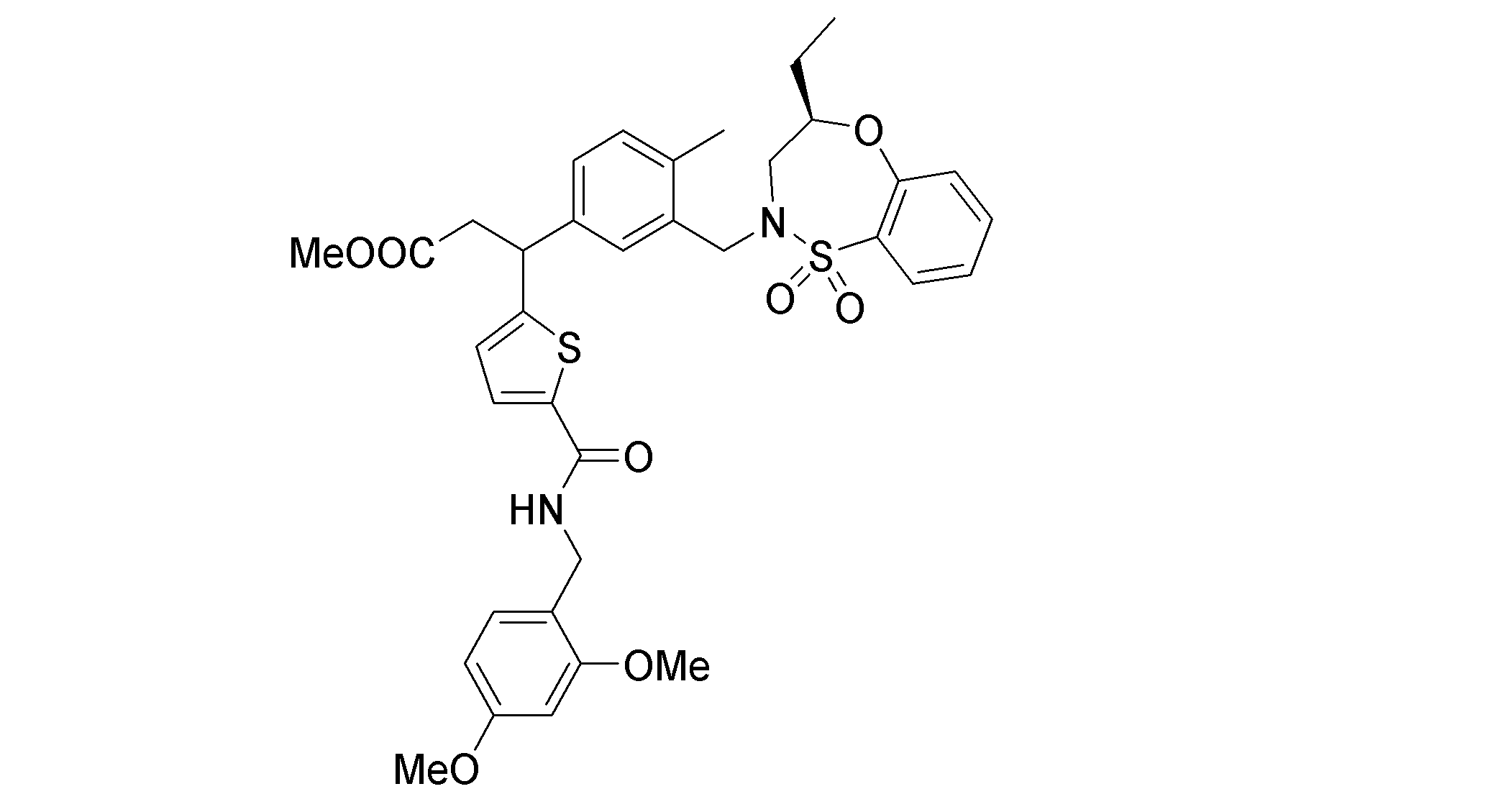
1H NMR(400 MHz, CDCl3)δ 7.86 (1H, dd, J = 8.0, 1.6 Hz), 7.51 (1H, br t, J = 8.0 Hz), 7.27-7.24 (2H, m), 7.22-7.18 (2H, m), 7.13 (2H, br s), 7.04 (1H, br d, J = 8.0 Hz), 6.76 (1H, br t, J = 3.6 Hz), 6.45-6.40 (3H, m), 4.67 (1H, t, J = 7.6 Hz), 4.56-4.55 (1H, m), 4.47 (2H, d, J = 5.6 Hz), 3.99-3.93 (1H, m), 3.84-3.67 (8H, m), 3.59 (3H, s), 3.09-2.88 (3H, m), 2.33 (3H, s), 1.67-1.58 (1H, m), 1.44-1.36 (1H, m), 1.04-1.03 (3H, m)。
メチル 3-(5-アセチル-4-メチルチオフェン-2-イル)-3-(3-{[(R)-4-エチル-1,1-ジオキシド-3,4-ジヒドロ-2H-ベンゾ[b][1,4,5]オキサチアゼピン-2-イル]メチル}-4-メチルフェニル)プロパノエートの製造

1H NMR(400 MHz, CDCl3)δ 7.89-7.86 (1H, m), 7.52 (1H, br t, J = 8.0 Hz), 7.28-7.08 (5H, m), 6.69 (1H, br s), 4.66 (1H, t, J = 7.6 Hz), 4.60-4.48 (1H, m), 4.04-3.97 (1H, m), 3.85-3.70 (2H, m), 3.62-3.60 (3H, m), 3.12-2.87 (3H, m), 2.45-2.42 (3H, m), 2.35-2.31 (3H, m), 1.73-1.63 (1H, m), 1.47-1.39 (1H, m), 1.08-1.05 (3H, m)。
メチル 3-(4-アセチル-1,3,5-トリメチル-1H-ピロール-2-イル)-3-(3-{[(R)-4-エチル-1,1-ジオキシド-3,4-ジヒドロ-2H-ベンゾ[b][1,4,5]オキサチアゼピン-2-イル]メチル}-4-メチルフェニル)プロパノエートの製造

1H NMR(400 MHz, CDCl3)δ 7.89-7.85 (1H, m), 7.52 (1H, td, J = 8.0, 1.6 Hz), 7.25 (1H, t, J = 8.0 Hz), 7.20 (1H, d, J = 8.0 Hz), 7.11 (1H, br d, J = 8.0 Hz), 7.01-6.93 (2H, m), 4.85-4.80 (1H, m), 4.55-4.51 (1H, m), 3.99-3.94 (1H, m), 3.80-3.69 (2H, m), 3.65 (3H, br s), 3.25-3.17 (4H, m), 2.99-2.88 (2H, m), 2.43-2.42 (6H, m), 2.34-2.32 (3H, m), 2.22 (3H, s), 1.75-1.61 (1H, m), 1.48-1.32 (1H, m), 1.07-1.05 (3H, m)。
メチル 3-(5-アセチル-1-エチル-1H-ピロール-2-イル)-3-(3-{[(R)-4-エチル-1,1-ジオキシド-3,4-ジヒドロ-2H-ベンゾ[b][1,4,5]オキサチアゼピン-2-イル]メチル}-4-メチルフェニル)プロパノエートの製造

1H NMR(400 MHz, CDCl3)δ 7.89 (1H, dd, J = 8.0, 1.6 Hz), 7.52 (1H, td, J = 8.0, 1.6 Hz), 7.25 (1H, t, J = 8.0 Hz), 7.20 (1H, d, J = 8.0 Hz), 7.15-7.08 (3H, m), 6.70 (1H, dd, J = 4.8, 2.0 Hz), 6.62 (1H, dd, J = 4.8, 2.0 Hz), 4.55 (1H, d, J = 14.0 Hz), 4.35 (1H, t, J = 8.0 Hz), 4.26 (1H, q, J = 7.2 Hz), 4.03-3.99 (1H, m), 3.84-3.70 (2H, m), 3.60 (3H, s), 3.00-2.93 (2H, m), 2.90-2.82 (1H, m), 2.36 (3H, s), 2.33 (3H, s), 1.73-1.63 (1H, m), 1.47-1.39 (1H, m), 1.30 (3H, t, J = 7.2 Hz), 1.07 (3H, t, J = 7.2 Hz)。
メチル 3-[5-(シクロプロパンカルボニル)チオフェン-2-イル]-3-(3-{[(R)-4-エチル-1,1-ジオキシド-3,4-ジヒドロ-2H-ベンゾ[b][1,4,5]オキサチアゼピン-2-イル]メチル}-4-メチルフェニル)プロパノエートの製造

1H NMR(400 MHz, CDCl3)δ 7.88 (1H, dd, J = 7.6, 1.6 Hz), 7.63 (1H, d, J = 3.6 Hz), 7.52 (1H, td, J = 7.6, 1.6 Hz), 7.25 (1H, dd, J = 7.6, 0.8 Hz), 7.22 (1H, br d, J = 7.6 Hz), 7.15 (2H, br s), 7.06 (1H, d, J = 10.4 Hz), 6.90-6.88 (1H, m), 4.73 (1H, t, J = 7.6 Hz), 4.60-4.54 (1H, m), 4.00-3.97 (1H, m), 3.81-3.77 (1H, m), 3.76-3.71 (1H, m), 3.61 (3H, s), 3.14-2.89 (3H, m), 2.47-2.43 (1H, m), 2.35 (3H, br s), 1.70-1.61 (1H, m), 1.44-1.39 (1H, m), 1.21-1.17 (2H, m), 1.06 (3H, t, J = 7.2 Hz), 1.00-0.96 (2H, m)。
メチル 3-(3-{[(R)-4-エチル-1,1-ジオキシド-3,4-ジヒドロ-2H-ベンゾ[b][1,4,5]オキサチアゼピン-2-イル]メチル}-4-メチルフェニル)-3-[5-(2-メチル-1,3-ジオキソラン-2-イル)チオフェン-2-イル]プロパノエートの製造

1H NMR(400 MHz, CDCl3)δ 7.89 (1H, dd, J = 8.0, 1.6 Hz), 7.52 (1H, td, J = 8.0, 1.6 Hz), 7.26 (1H, br t, J = 8.0 Hz), 7.21 (1H, dd, J = 8.0, 1.6 Hz), 7.14 (2H, br s), 7.06 (1H, s), 6.81 (1H, d, J = 3.6 Hz), 6.62 (1H, d, J = 3.6 Hz), 4.63 (1H, t, J = 8.0 Hz), 4.58 (1H, d, J = 14.0 Hz), 4.03-3.96 (3H, m), 3.93-3.90 (2H, m), 3.81-3.77 (1H, m), 3.73 (1H, dd, J = 15.2, 10.8 Hz), 3.59 (3H, s), 3.10-3.07 (1H, m), 3.00-2.93 (2H, m), 2.35 (3H, s), 1.76-1.61 (1H, m), 1.70 (3H, s), 1.49-1.41 (1H, m), 1.11.06 (3H, m)。
メチル 3-(5-シアノチオフェン-2-イル)-3-(3-{[(R)-4-エチル-1,1-ジオキシド-3,4-ジヒドロ-2H-ベンゾ[b][1,4,5]オキサチアゼピン-2-イル]メチル}-4-メチルフェニル)プロパノエートの製造

1H NMR(400 MHz, CDCl3)δ 7.88 (1H, dd, J = 7.6, 1.6 Hz), 7.53 (1H, td, J = 7.6, 1.6 Hz), 7.44 (1H, dd, J = 4.0, 0.8 Hz), 7.28-7.16 (3H, m), 7.13-7.10 (2H, m), 6.85 (1H, br d, J = 4.0 Hz), 4.73 (1H, t, J = 7.6 Hz), 4.58-4.52 (1H, m), 4.06-3.98 (1H, m), 3.88-3.81 (1H, m), 3.76-3.69 (1H, m), 3.63 (3H, s), 3.13-2.93 (3H, m), 2.34 (3H, br s), 1.77-1.64 (1H, m), 1.50-1.39 (1H, m), 1.12-1.06 (3H, m)。
メチル 3-(3-{[(R)-4-エチル-1,1-ジオキシド-3,4-ジヒドロ-2H-ベンゾ[b][1,4,5]オキサチアゼピン-2-イル]メチル}-4-メチルフェニル)-3-[4-メチル-5-(2-メチル-1,3-ジオキソラン-2-イル)チオフェン-2-イル]プロパノエートの製造

1H NMR (400 MHz, CDCl3) δ 7.89 (1H, dd, J = 8.0, 1.6 Hz), 7.52 (1H, t, J = 7.6 Hz), 7.28-7.24 (1H, m), 7.22 (1H, d, J = 8.0 Hz), 7.14 (2H, s), 7.06 (1H, s), 6.45 (1H, s), 4.60-4.53 (2H, m), 4.06-3.95 (3H, m), 3.92-3.86 (2H, m), 3.79 (1H, br d, J = 14.0 Hz), 3.74-3.72 (1H, m), 3.58 (3H, s), 3.05-3.01 (1H, m), 3.00-2.89 (2H, m), 2.35 (3H, s), 2.18 (3H, s), 1.74-1.64 (1H, m), 1.67 (3H, s), 1.52-1.42 (1H, m), 1.09-1.08 (3H, m)。
メチル 3-(3-{[(R)-4-エチル-1,1-ジオキシド-3,4-ジヒドロ-2H-ベンゾ[b][1,4,5]オキサチアゼピン-2-イル]メチル}-4-メチルフェニル)-3-[5-(2-メチル-1,3-ジオキソラン-2-イル)チアゾール-2-イル]プロパノエートの製造

1H NMR (400 MHz, CDCl3) δ 7.89 (1H, dd, J = 7.6, 1.2 Hz), 7.56 (1H, s), 7.52 (1H, td, J = 8.0, 1.2 Hz), 7.24-7.24 (1H, m), 7.22-7.15 (3H, m), 7.13-7.12 (1H, m), 4.72 (1H, t, J = 7.6 Hz), 4.58-4.57 (1H, d, J = 14.0 Hz), 4.05-3.98 (2H, m), 3.94-3.88 (2H, m), 3.81-3.79 (1H, m), 3.74-3.71 (1H, m), 3.61 (3H, s), 3..42-3.35 (1H, ), 3.01-2.92 (2H, m), 2.36 (3H, s), 1.74-1.63 (1H, m), 1.70 (3H, s), 1.53-1.38 (1H, m), 1.09 (3H, t, J = 7.6 Hz)。
参考例148
メチル 3-(3-{[(R)-4-エチル-1,1-ジオキシド-3,4-ジヒドロ-2H-ベンゾ[b][1,4,5]オキサチアゼピン-2-イル]メチル}-4-メチルフェニル)-3-[4-メチル-5-(2-メチル-1,3-ジオキソラン-2-イル)チアゾール-2-イル]プロパノエートの製造
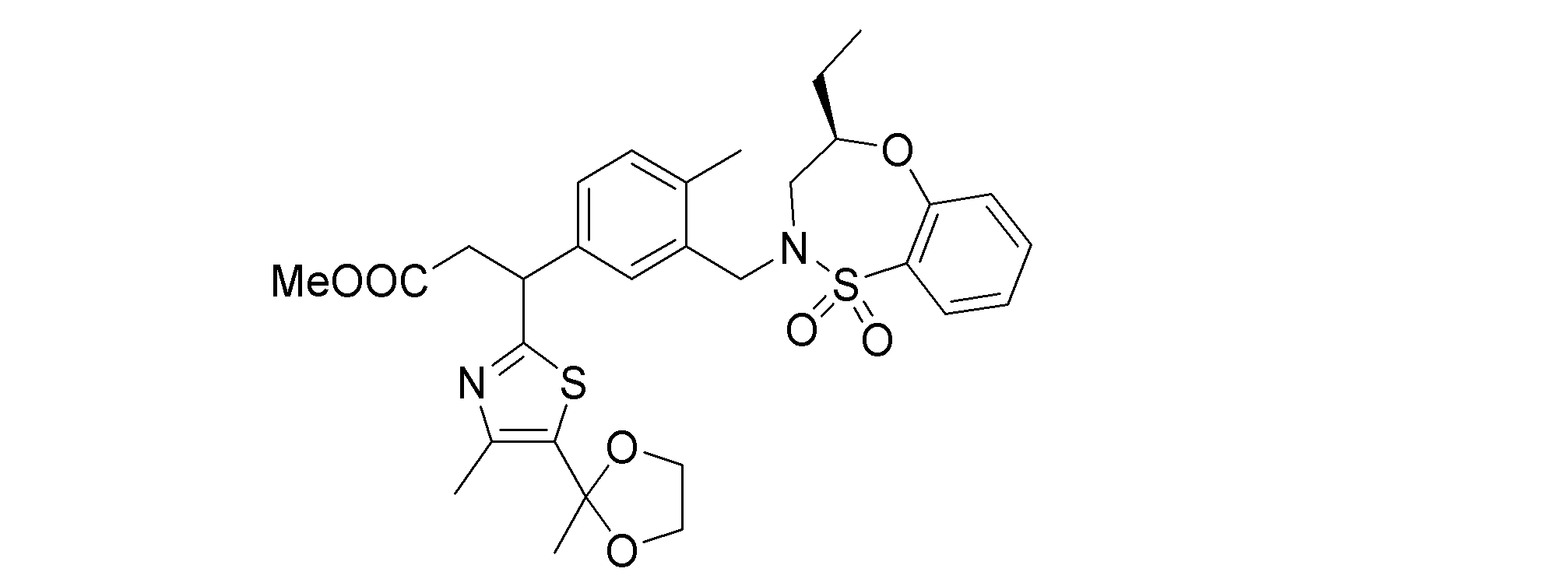
1H NMR (400 MHz, CDCl3) δ 7.90 (1H, d, J = 7.6 Hz), 7.52 (1H t, J = 7.2 Hz), 7.28-7.20 (3H, m), 7.17-7.14 (2H, m), 4.68-4.63 (1H, m), 4.58 (1H, d, J = 14.0 Hz) 4.06-3.94 (3H, m), 3.88-3.79 (3H, m), 3.76-3.70 (1H, m), 3.60 (3H, s), 3.35 (1H, dt, J = 16.0, 6.0 Hz), 3.00-2.93 (2H, m), 2.41 (3H, s), 2.36 (3H, s), 1.74-1.66 (4H, m), 1.51-1.45 (1H, m), 1.09 (3H, t, J = 7.2 Hz)。
メチル 3-(3-{[(R)-4-エチル-1,1-ジオキシド-3,4-ジヒドロ-2H-ベンゾ[b][1,4,5]オキサチアゼピン-2-イル]メチル}-4-メチルフェニル)-3-(6-オキソ-5,6-ジヒドロ-4H-チエノ[2,3-c]ピロール-2-イル)プロパノエートの製造
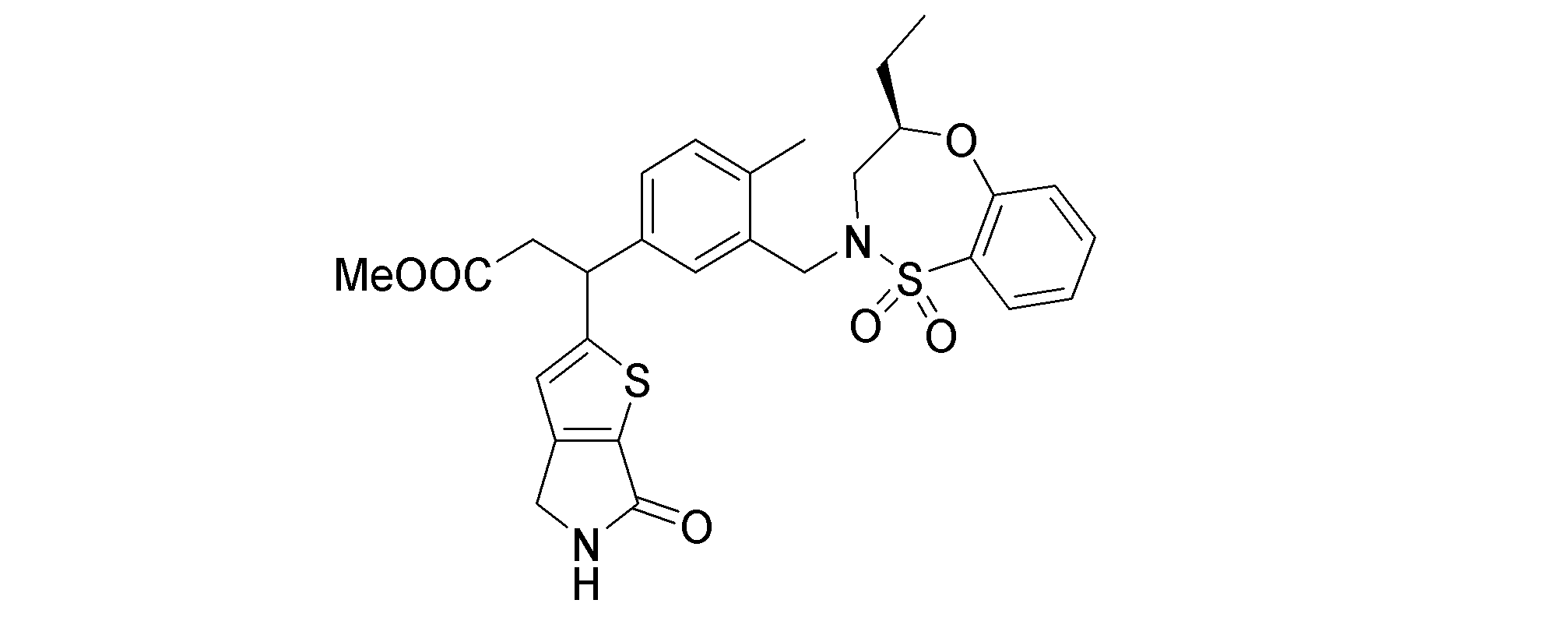
1H NMR (400 MHz, CDCl3) δ 7.88 (1H, d, J = 7.6 Hz), 7.52 (1H, t, J = 7.6 Hz), 7.27-7.18 (2H, m), 7.16 (2H, s), 7.11 (1H, d, J = 3.6 Hz), 6.80 (1H, s), 6.47 (1H, s), 4.75 (1H, t, J = 8.0 Hz), 4.56 (1H, d, J =14.4 Hz), 4.28 (2H, s), 4.04-3.97 (1H, m), 3.83-3.81 (1H, m), 3.75-3.68 (1H, m), 3.62 (3H, s), 3.12 (1H, dd, J = 15.6, 8.0 Hz), 3.03 (1H, dd, J = 15.6, 8.0 Hz), 2.96-2.94 (1H, m), 2.33 (3H, s), 1.73-1.64 (1H, m), 1.47-1.39 (1H, m), 1.07-1.06 (3H, m)。
メチル 3-(5-アセチルフラン-2-イル)-3-(3-{[(R)-4-エチル-1,1-ジオキシド-3,4-ジヒドロ-2H-ベンゾ[b][1,4,5]オキサチアゼピン-2-イル]メチル}-4-メチルフェニル)プロパノエートの製造
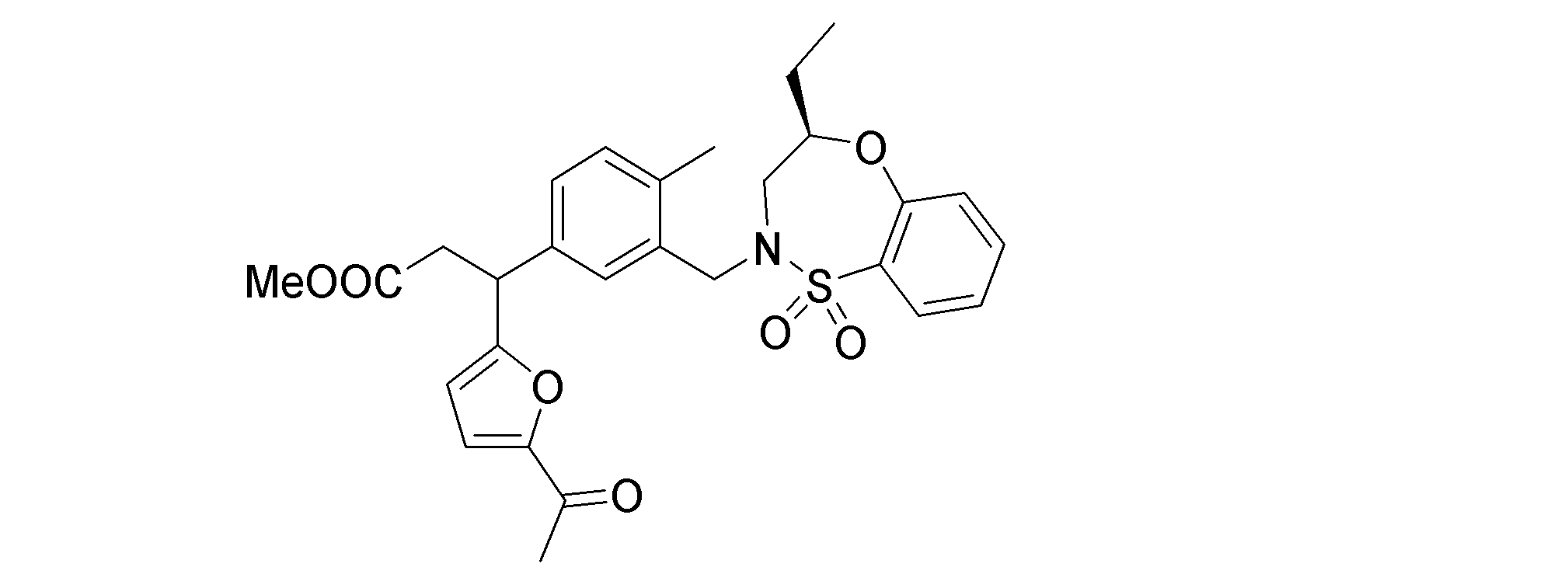
1H NMR(400 MHz, CDCl3)δ 7.88 (1H, dd, J = 7.6, 1.6 Hz), 7.52 (1H, td, J = 7.6, 1.6 Hz), 7.25 (1H, td, J = 7.6, 1.2 Hz), 7.20 (1H, d, J = 8.4 Hz), 7.16-7.11 (3H, m), 7.07 (1H, d, J = 3.6 Hz), 6.16 (1H, t, J = 3.6 Hz), 4.59-4.52 (2H, m), 4.05-3.99 (1H, m), 3.83-3.81 (1H, m), 3.76-3.69 (1H, m), 3.62 (3H, s), 3.17-3.11 (1H, m), 3.00-2.88 (2H, m), 2.40 (3H, s), 2.32 (3H, br s), 1.74-1.66 (1H, m), 1.50-1.41 (1H, m), 1.08-1.07 (3H, m)。
メチル 3-(5-アセチルチオフェン-3-イル)-3-(3-{[(R)-4-エチル-1,1-ジオキシド-3,4-ジヒドロ-2H-ベンゾ[b][1,4,5]オキサチアゼピン-2-イル]メチル}-4-メチルフェニル)プロパノエートの製造

1H NMR(400 MHz, CDCl3)δ 7.87 (1H, dd, J = 8.0, 1.6 Hz), 7.51 (1H, td, J = 8.0, 1.6 Hz), 7.45 (1H, dd, J = 3.2, 1.2 Hz), 7.29 (1H, br s), 7.24 (1H, td, J = 8.0, 1.2 Hz), 7.20 (1H, br d, J = 8.0 Hz), 7.14-7.12 (1H, m), 7.09-7.06 (2H, m), 4.55-4.51 (2H, m), 4.03-3.96 (1H, m), 3.84-3.66 (2H, m), 3.60 (3H, s), 3.06-3.00 (1H, m), 2.98-2.90 (2H, m), 2.48 (3H, s), 2.31 (3H, br s), 1.72-1.62 (1H, m), 1.46-1.37 (1H, m), 1.06 (3H, t, J = 7.2 Hz)。
メチル 3-(4-アセチルチオフェン-2-イル)-3-(3-{[(R)-4-エチル-1,1-ジオキシド-3,4-ジヒドロ-2H-ベンゾ[b][1,4,5]オキサチアゼピン-2-イル]メチル}-4-メチルフェニル)プロパノエートの製造

1H NMR(400 MHz, CDCl3)δ 7.88 (1H, dd, J = 8.0, 1.6 Hz), 7.84 (1H, d, J = 1.6 Hz), 7.52 (1H, br t, J = 8.0 Hz), 7.27-7.19 (3H, m), 7.16-7.11 (2H, m), 7.05 (1H, d, J = 10.4 Hz), 4.66 (1H, t, J = 7.6 Hz), 4.57-4.56 (1H, m), 4.00-3.97 (1H, m), 3.82-3.68 (2H, m), 3.61 (3H, s), 3.10 (1H, dd, J = 15.6, 7.6 Hz), 3.01-2.99 (2H, m), 2.46 (3H, s), 2.35 (3H, br s), 1.72-1.62 (1H, m), 1.48-1.36 (1H, m), 1.06 (3H, t, J = 7.6 Hz)。
メチル 3-(5-シアノ-1-メチル-1H-ピロール-3-イル)-3-(3-{[(R)-4-エチル-1,1-ジオキシド-3,4-ジヒドロ-2H-ベンゾ[b][1,4,5]オキサチアゼピン-2-イル]メチル}-4-メチルフェニル)プロパノエートの製造

1H NMR(400 MHz, CDCl3)δ 7.88 (1H, dd, J = 8.0, 1.6 Hz), 7.52 (1H, td, J = 8.0, 1.6 Hz), 7.25 (1H, td, J = 8.0, 1.2 Hz), 7.21 (1H, d, J = 8.0 Hz), 7.12 (1H, d, J = 8.0 Hz), 7.08-7.04 (2H, m), 6.56-6.53 (2H, m), 4.54-4.53 (1H, m), 4.33 (1H, t, J = 8.0 Hz), 4.05-3.98 (1H, m), 3.86-3.69 (2H, m), 3.68 (3H, s), 3.60 (3H, s), 2.99-2.79 (3H, m), 2.32 (3H, s), 1.75-1.66 (1H, m), 1.51-1.39 (1H, m), 1.09-1.08 (3H, m)。
メチル 3-(3-アセチルチオフェン-2-イル)-3-(3-{[(R)-4-エチル-1,1-ジオキシド-3,4-ジヒドロ-2H-ベンゾ[b][1,4,5]オキサチアゼピン-2-イル]メチル}-4-メチルフェニル)プロパノエートの製造

1H NMR(400 MHz, CDCl3)δ 7.88 (1H, dd, J = 8.0, 1.6 Hz), 7.52 (1H, br t, J = 8.0 Hz), 7.34 (1H, d, J = 5.6 Hz), 7.27-7.20 (3H, m), 7.16-7.10 (3H, m), 5.65 (1H, dd, J = 8.0, 8.0 Hz), 4.61-4.59 (1H, m), 4.04-3.99 (1H, m), 3.80-3.72 (2H, m), 3.56 (3H, s), 3.13-3.07 (1H, m), 3.02-2.90 (2H, m), 2.49 (3H, s), 2.35 (3H, br s), 1.71-1.59 (1H, m), 1.51-1.42 (1H, m), 1.13-1.06 (3H, m)。
メチル 3-(3-{[(R)-4-エチル-1,1-ジオキシド-3,4-ジヒドロ-2H-ベンゾ[b][1,4,5]オキサチアゼピン-2-イル]メチル}-4-メチルフェニル)-3-[5-(2-メチル-1,3-ジオキソラン-2-イル)フラン-2-イル]プロパノエートの製造

1H NMR(400 MHz, CDCl3)δ 7.89 (1H, dd, J = 8.0, 1.6 Hz), 7.52 (1H, t, J = 8.0 Hz), 7.25 (1H, t, J = 8.0 Hz), 7.20 (1H, d, J = 8.0 Hz), 7.13-7.12 (2H, m), 7.06 (1H, s), 6.17 (1H, d, J = 3.2 Hz), 5.85 (1H, d, J = 3.2 Hz), 4.56 (1H, d, J = 14.0 Hz), 4.48 (1H, t, J = 8.0 Hz), 4.04-3.93 (5H, m), 3.81-3.69 (2H, m), 3.60 (3H, s), 3.07 (1H, d, J = 15.2, 7.2 Hz), 2.97 (1H, d, J = 15.2 Hz), 2.88-2.80 (1H, m), 2.34 (3H, s), 1.75-1.65 (4H, m), 1.50-1.43 (1H, m), 1.08 (3H, t, J = 7.2 Hz)。
メチル 3-(3-{[(R)-4-エチル-1,1-ジオキシド-3,4-ジヒドロ-2H-ベンゾ[b][1,4,5]オキサチアゼピン-2-イル]メチル}-4-メチルフェニル)-3-[4-(2-メチル-1,3-ジオキソラン-2-イル)チオフェン-2-イル]プロパノエートの製造
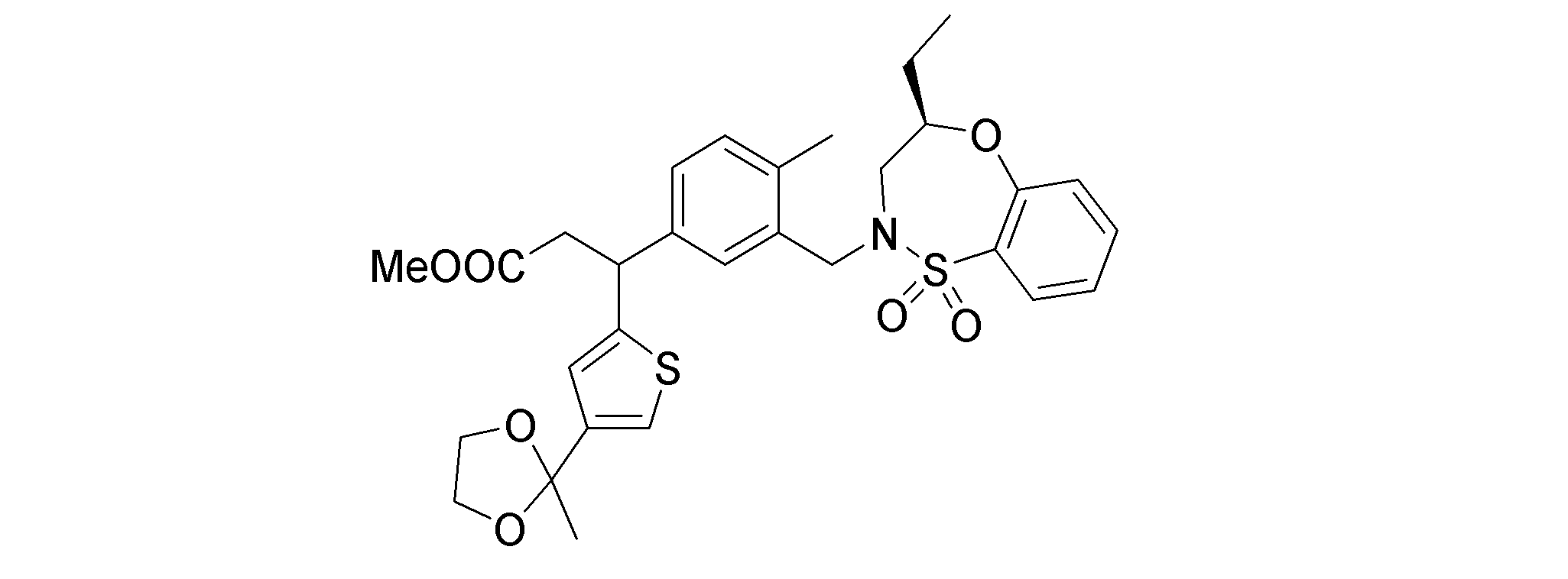
1H NMR(400 MHz, CDCl3)δ 7.89 (1H, dd, J = 8.0, 1.6 Hz), 7.51 (1H, td, J = 8.0, 1.6 Hz), 7.25 (1H, br t, J = 8.0 Hz), 7.20 (1H, br d, J = 8.0 Hz), 7.15-7.14 (2H, m), 7.07 (2H, br s), 6.77 (1H, dt, J = 4.8, 1.2 Hz), 4.64-4.62 (1H, m), 4.58-4.57 (1H, m), 4.03-3.96 (3H, m), 3.89-3.69 (4H, m), 3.59 (3H, s), 3.08 (1H, dd, J = 15.6, 6.8 Hz), 3.00-2.93 (2H, m), 2.35 (3H, br s), 1.73-1.70 (1H, m), 1.62 (3H, s), 1.45-1.41 (1H, m), 1.09-1.07 (3H, m)。
メチル 3-(3-{[(R)-4-エチル-1,1-ジオキシド-3,4-ジヒドロ-2H-ベンゾ[b][1,4,5]オキサチアゼピン-2-イル]メチル}-4-メチルフェニル)-2-メチル-3-[5-(2-メチル-1,3-ジオキソラン-2-イル)チオフェン-2-イル]プロパノエートの製造

Isomer 1: 1H NMR(400 MHz, CDCl3)δ 7.90 (1H, dd, J = 8.0, 1.6 Hz), 7.53 (1H, td, J = 8.0, 1.6 Hz), 7.26 (1H, br t, J = 8.0 Hz), 7.22 (1H, dd, J = 8.0, 1.6 Hz), 7.14 (2H, br s), 7.06 (1H, d, J = 11.2 Hz), 6.77 (1H, dd, J = 3.6, 0.8 Hz), 6.69 (1H, br d, J = 3.6 Hz), 4.60-4.57 (1H, m), 4.28-4.25 (1H, m), 4.02-3.88 (5H, m), 3.86-3.69 (2H, m), 3.59 (3H, s), 3.19-3.13 (1H, m), 2.95 (1H, dd, J = 15.2, 2.0 Hz), 2.36-2.34 (3H, m), 1.73-1.62 (4H, m), 1.46-1.38 (1H, m), 1.11-1.04 (6H, m)。
Isomer 2: 1H NMR(400 MHz, CDCl3)δ 7.89 (1H, dd, J = 8.0, 1.6 Hz), 7.53 (1H, td, J = 8.0, 1.6 Hz), 7.26 (1H, br t, J = 8.0 Hz), 7.22 (1H, dd, J = 8.0, 1.6 Hz), 7.20-7.17 (1H, m), 7.11-7.07 (2H, m), 6.82 (1H, d, J = 3.6 Hz), 6.73 (1H, t, J = 3.6 Hz), 4.57 (1H, d, J = 14.0 Hz), 4.21 (1H, d, J = 11.2 Hz), 4.07-3.89 (5H, m), 3.79-3.68 (2H, m), 3.43 (3H, s), 3.21-3.10 (1H, m), 2.94 (1H, dd, J = 15.2, 8.8 Hz), 2.33 (3H, s), 1.73-1.65 (4H, m), 1.51-1.42 (1H, m), 1.20 (3H, d, J = 6.8 Hz), 1.15-1.07 (3H, m)。
メチル 3-(3-{[(R)-4-エチル-1,1-ジオキシド-3,4-ジヒドロ-2H-ベンゾ[b][1,4,5]オキサチアゼピン-2-イル]メチル}-4-メチルフェニル)-2-メチル-3-[4-メチル-5-(2-メチル-1,3-ジオキソラン-2-イル)チオフェン-2-イル]プロパノエートの製造
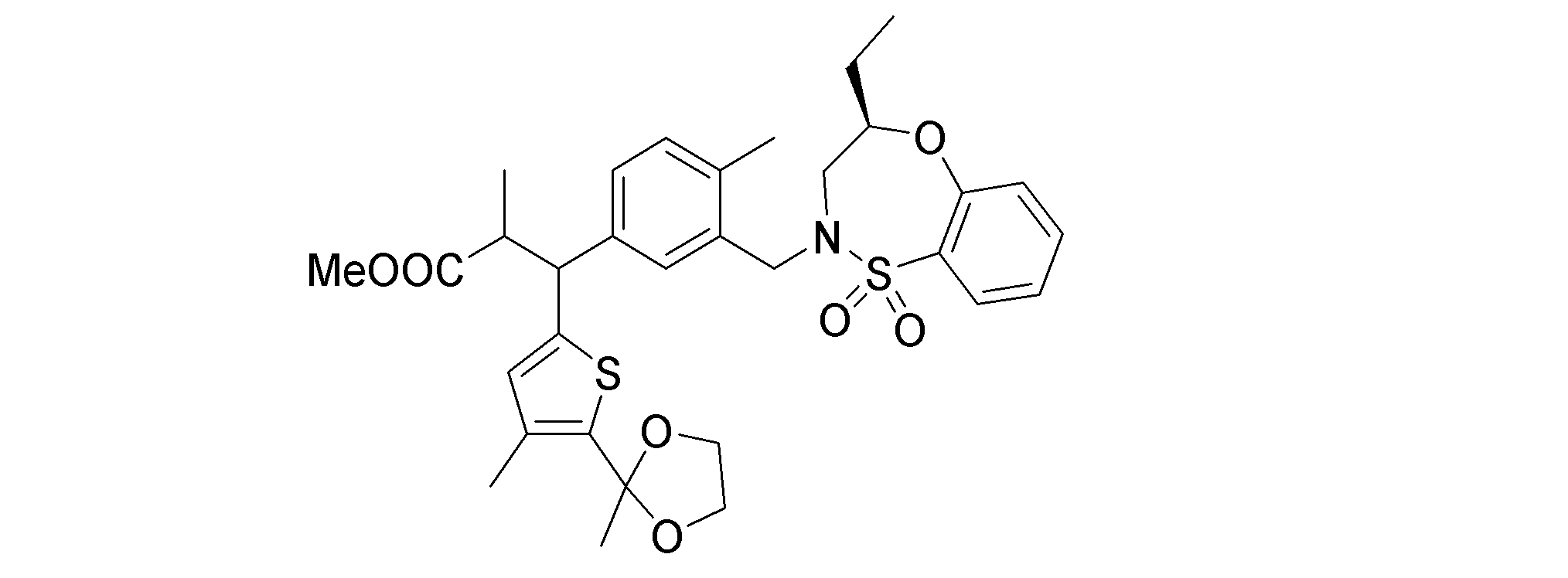
1H NMR (400 MHz, CDCl3) δ 7.89 (1H, d, J = 7.6 Hz), 7.53 (1H, t, J = 7.6 Hz), 7.28-7.21 (2H, m), 7.18-7.04 (3H, m), 6.57-6.51 (1H, m), 4.59-4.57 (1H, m), 4.20-4.19 (1H, m), 4.07-3.94 (3H, m), 3.92-3.82 (3H, m), 3.78-3.69 (1H, m), 3.60-3.42 (3H, m), 3.16-3.08 (1H, m), 3.00-2.92 (1H, m), 2.37-2.33 (3H, m), 2.19-2.16 (3H, m), 1.74-1.62 (1H, m), 1.66-1.65 (3H, m), 1.53-1.37 (1H, m), 1.21-0.99 (6H, m)。
メチル 3-(3-{[(R)-4-エチル-1,1-ジオキシド-3,4-ジヒドロ-2H-ベンゾ[b][1,4,5]オキサチアゼピン-2-イル]メチル}-4-メチルフェニル)-2-メチル-3-[5-(2-メチル-1,3-ジオキソラン-2-イル)フラン-2-イル]プロパノエートの製造

1H NMR(400 MHz, CDCl3)δ 7.89 (1H, br d, J = 8.0 Hz), 7.52 (1H, br t, J = 8.0 Hz), 7.28-7.23 (1H, m), 7.22-7.04 (4H, m), 6.18-6.14 (1H, m), 6.01-5.92 (1H, m), 4.58-4.51 (1H, m), 4.15-4.08 (1H, m), 4.04-3.94 (5H, m), 3.85-3.71 (2H, m), 3.63-3.44 (3H, m), 3.23-3.16 (1H, m), 2.98-2.93 (1H, m), 2.35-2.31 (3H, m), 1.69-1.66 (4H, m), 1.52-1.48 (1H, m), 1.16-0.98 (6H, m)。
メチル 3-(3-{[(R)-4-エチル-1,1-ジオキシド-3,4-ジヒドロ-2H-ベンゾ[b][1,4,5]オキサチアゼピン-2-イル]メチル}-4-メチルフェニル)-2-メチル-3-[4-(2-メチル-1,3-ジオキソラン-2-イル)チオフェン-2-イル]プロパノエートの製造

Isomer 1: 1H NMR(400 MHz, CDCl3)δ 7.89 (1H, dd, J = 7.6, 1.6 Hz), 7.53 (1H, br t, J = 8.0 Hz), 7.28-7.25 (1H, m), 7.24-7.18 (2H, m), 7.11-7.08 (3H, m), 6.86 (1H, dd, J = 6.0, 1.2 Hz), 4.57-4.56 (1H, m), 4.24-4.23 (1H, m), 4.03-3.99 (3H, m), 3.85-3.68 (4H, m), 3.43 (3H, s), 3.19-3.12 (1H, m), 2.96-2.91 (1H, m), 2.32 (3H, s), 1.73-1.69 (1H, m), 1.62 (3H, s), 1.51-1.44 (1H, m), 1.20-1.19 (3H, m), 1.24-1.09 (3H, m)。
Isomer 2: 1H NMR(400 MHz, CDCl3)δ 7.89 (1H, br d, J = 8.0 Hz), 7.53 (1H, td, J = 8.0, 1.6 Hz), 7.28-7.24 (1H, m), 7.22-7.19 (1H, m), 7.16-7.14 (2H, m), 7.09-7.07 (1H, m), 7.03 (1H, br s), 6.83 (1H, br s), 4.60-4.57 (1H, m), 4.28-4.27 (1H, m), 4.04-3.97 (3H, m), 3.87-3.69 (4H, m), 3.58 (3H, br s), 3.19-3.12 (1H, m), 2.97-2.93 (1H, m), 2.36-2.34 (3H, m), 1.71-1.67 (1H, m), 1.62-1.61 (3H, m), 1.46-1.37 (1H, m), 1.11-1.03 (6H, m)。
メチル 3-[5-(ジメチルカルバモイル)フラン-2-イル]-3-(3-{[(R)-4-エチル-1,1-ジオキシド-3,4-ジヒドロ-2H-ベンゾ[b][1,4,5]オキサチアゼピン-2-イル]メチル}-4-メチルフェニル)プロパノエートの製造

1H NMR(400 MHz, CDCl3)δ 7.89 (1H, dd, J = 7.6, 1.6 Hz), 7.52 (1H, t, J = 7.6 Hz), 7.26 (1H, t, J = 7.6 Hz), 7.21 (1H, d, J = 7.6 Hz), 7.15-7.10 (3H, m), 6.90 (1H, d, J = 3.6 Hz), 6.10 (1H, d, J = 3.6 Hz), 4.56-4.52 (2H, m), 4.04-3.99 (1H, m), 3.82 (1H, d, J = 14 Hz), 3.76-3.69 (1H, m), 3.61 (3H, s), 3.13-2.86 (9H, m), 2.32 (3H, s), 1.75-1.65 (1H, m), 1.52-1.42 (1H, m), 1.08 (3H, t, J = 7.2 Hz)。
メチル 3-(5-カルバモイルチオフェン-2-イル)-3-(3-{[(R)-4-エチル-1,1-ジオキシド-3,4-ジヒドロ-2H-ベンゾ[b][1,4,5]オキサチアゼピン-2-イル]メチル}-4-メチルフェニル)プロパノエートの製造

1H NMR(400 MHz, CDCl3)δ 7.87 (1H, dd, J = 8.0, 1.6 Hz), 7.52 (1H, br t, J = 8.0 Hz), 7.35 (1H, d, J = 3.6 Hz), 7.25 (1H, t, J = 8.0 Hz), 7.20 (1H, br d, J = 8.0 Hz), 7.14 (2H, br s), 7.08 (1H, d, J = 8.4 Hz), 6.81-6.79 (1H, m), 6.01 (2H, br s), 4.70 (1H, t, J = 8.0 Hz), 4.57-4.55 (1H, m), 4.02-3.95 (1H, m), 3.82-3.69 (2H, m), 3.60 (3H, s), 3.09 (1H, dd, J = 15.6, 7.6 Hz), 3.02-2.91 (2H, m), 2.33 (3H, s), 1.72-1.62 (1H, m), 1.46-1.38 (1H, m), 1.07-1.06 (3H, m)。
メチル 3-(5-アセチルチオフェン-2-イル)-3-(3-{[(R)-4-エチル-1,1-ジオキシド-3,4-ジヒドロ-2H-ベンゾ[b][1,4,5]オキサチアゼピン-2-イル]メチル}-4-メチルフェニル)-2,2-ジメチルプロパノエートの製造

1H NMR (400 Mz, CDCl3) δ 7.87 (1H, dt, J = 7.6, 1.2 Hz), 7.55-7.50 (1H, m), 7.49 (1H, d, J = 4.0 Hz), 7.27-7.11 (5H, m), 6.97-6.95 (1H, m), 4.69-4.67 (1H, m), 4.56-4.55 (1H, m), 4.04-3.97 (1H, m), 3.83-3.69 (2H, m), 3.60 (3H, brs), 2.97-2.90 (1H, m), 2.49-2.48 (3H, m), 2.33 (3H, s), 1.81-1.56 (1H, m), 1.51-1.35 (1H, m), 1.29 (3H, br s), 1.23/-1.21 (3H, m), 1.10-1.08 (3H, m)。
メチル 3-(5-アセチルチオフェン-2-イル)-3-(3-{[(R)-4-エチル-9-フルオロ-1,1-ジオキシド-3,4-ジヒドロ-2H-ベンゾ[b][1,4,5]オキサチアゼピン-2-イル]メチル}-4-メチルフェニル)-2,2-ジメチルプロパノエートの製造
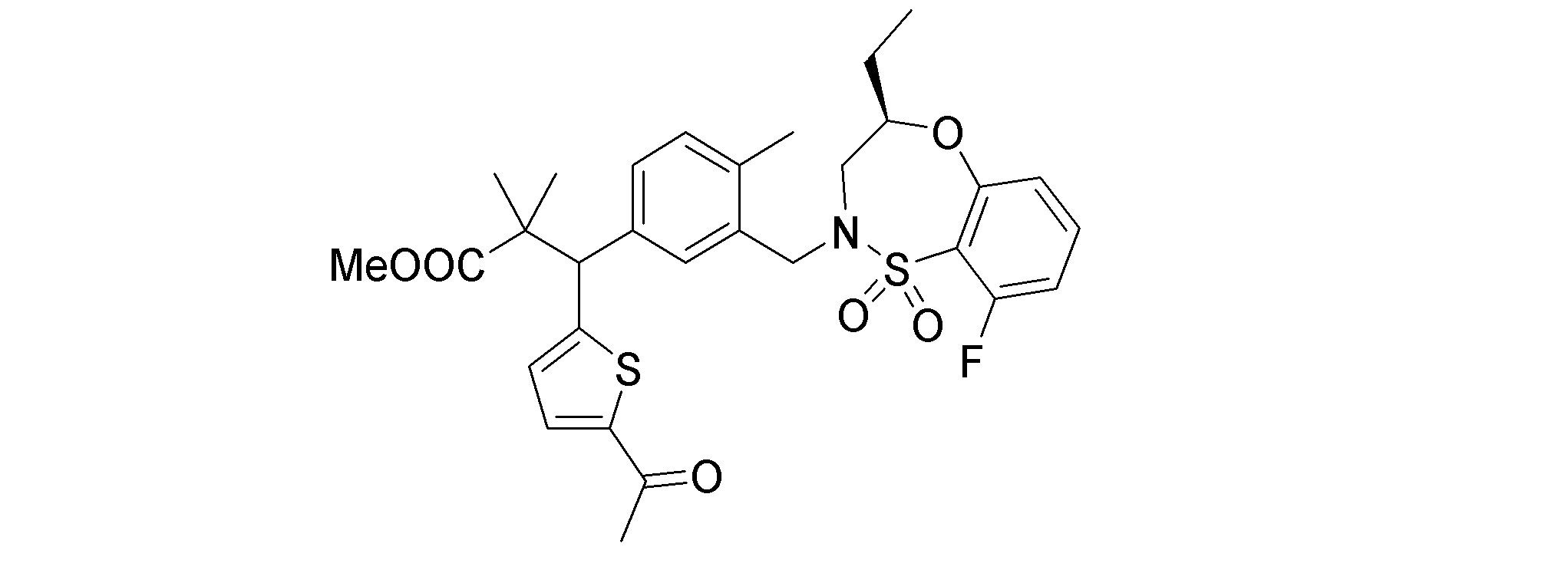
1H NMR (400 MHz, CDCl3) δ 7.51 (1H, dd, J = 4.0, 1.6 Hz), 7.44-7.39 (1H, m), 7.29/7.28 (1H, m), 7.25-7.22 (1H, m), 7.14 (1H, br d, J = 8.0 Hz), 7.00-6.94 (3H, m), 4.72 (1H, s), 4.58-4.55 (1H, m), 4.50-4.43 (1H, m), 4.31-4.28 (1H, m), 3.62 (3H, s), 3.33 (1H, d, J = 14.4, 4.0 Hz), 3.10 (1H, d, J = 14.4, 1.2 Hz), 2.49 (3H, br s), 2.34 (3H, br s), 1.68-1.56 (1H, m), 1.55-1.45 (1H, m), 1.32 (3H, br s), 1.25 (3H, s), 1.02-1.01 (3H, m)。
メチル 3-(5-アセチルチオフェン-2-イル)-3-(3-{[(R)-4-エチル-1,1-ジオキシド-3,4-ジヒドロ-2H-ピリド[2,3-b][1,4,5]オキサチアゼピン-2-イル]メチル}-4-メチルフェニル)-2,2-ジメチルプロパノエートの製造
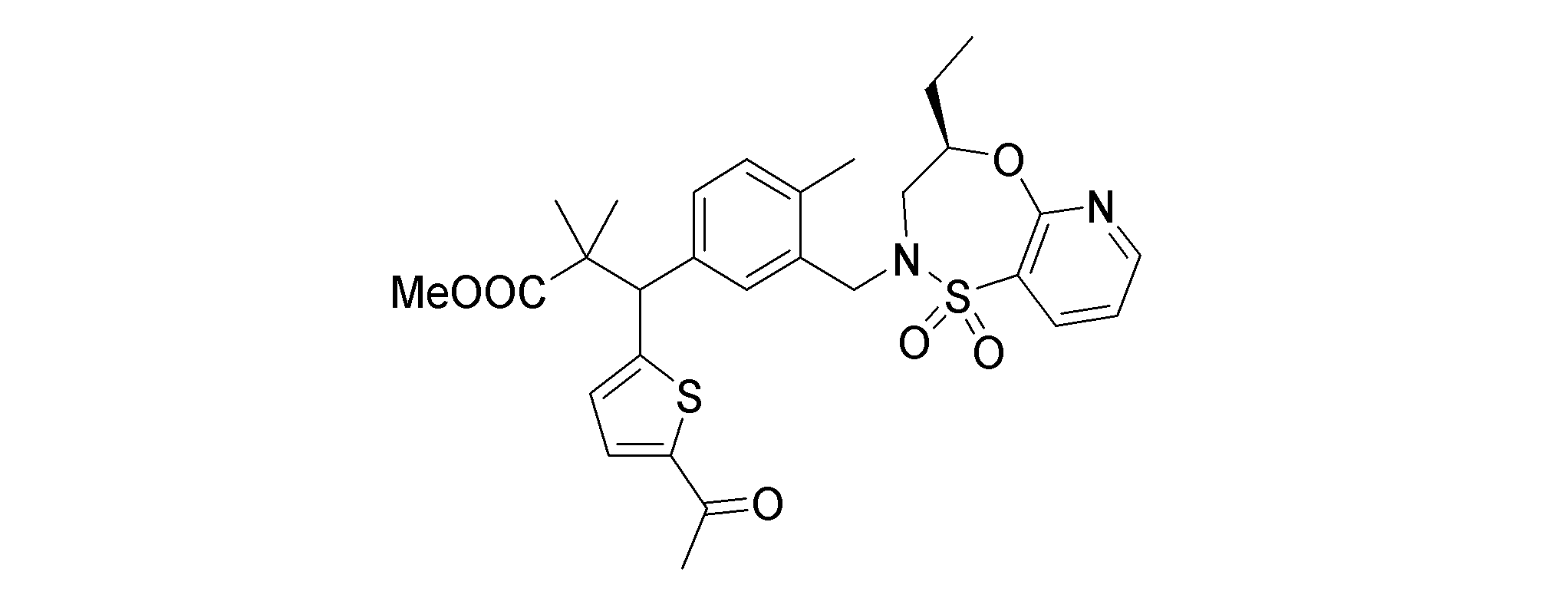
1H NMR(400 MHz, CDCl3)δ 8.51-8.49 (1H, m), 8.26 (1H, br d, J = 8.0 Hz), 7.51 (1H, d, J = 4.0 Hz), 7.30-7.24 (2H, m), 7.21 (1H, s), 7.14 (1H, d, J = 8.0 Hz), 6.98 (1H, t, J = 4.0 Hz), 4.69 (1H, d, J = 5.6 Hz), 4.47-4.42 (2H, m), 4.11-4.05 (1H, m), 3.62-3.59 (4H, m), 3.16 (1H, br d, J = 15.2 Hz), 2.50 (3H, s), 2.33 (3H, br s), 1.81-1.68 (1H, m), 1.60-1.52 (1H, m), 1.30 (3H, s), 1. 24 (3H, s), 1.09 (3H, t, J = 7.2 Hz)。
メチル 3-(5-アセチルチオフェン-2-イル)-3-[3-({4-[2-(ベンジロキシ)エチル]-1,1-ジオキシド-3,4-ジヒドロ-2H-ベンゾ[b][1,4,5]オキサチアゼピン-2-イル}メチル)-4-メチルフェニル]-2-メチルプロパノエートの製造

1H NMR(400 MHz, CDCl3)δ 7.88 (1H, br d, J = 8.0 Hz), 7.49 (1H, br t, J = 8.0 Hz), 7.43 (1H, t, J = 4.0 Hz), 7.35-7.24 (6H, m), 7.14-7.09 (3H, m), 7.00 (1H, br t, J = 8.0 Hz), 6.89 (1H, br t, J = 4.0 Hz), 4.60-4.47 (3H, m), 4.36-4.31 (2H, m), 3.87-3.73 (3H, m), 3.66-3.61 (1H, m), 3.59 (3H, br s), 3.25-3.18 (1H, m), 2.93-2.88 (1H, m), 2.43 (3H, br s), 2.31 (3H, br s), 1.92-1.83 (1H, m), 1.67-1.60 (1H, m), 1.06 (3H, d, J = 7.2 Hz)。
メチル 3-(5-アセチルチオフェン-2-イル)-3-(3-{[(R)-4-エチル-1,1-ジオキシド-3,4-ジヒドロ-2H-ピリド[4,3-b][1,4,5]オキサチアゼピン-2-イル]メチル}-4-メチルフェニル)-2-メチルプロパノエートの製造
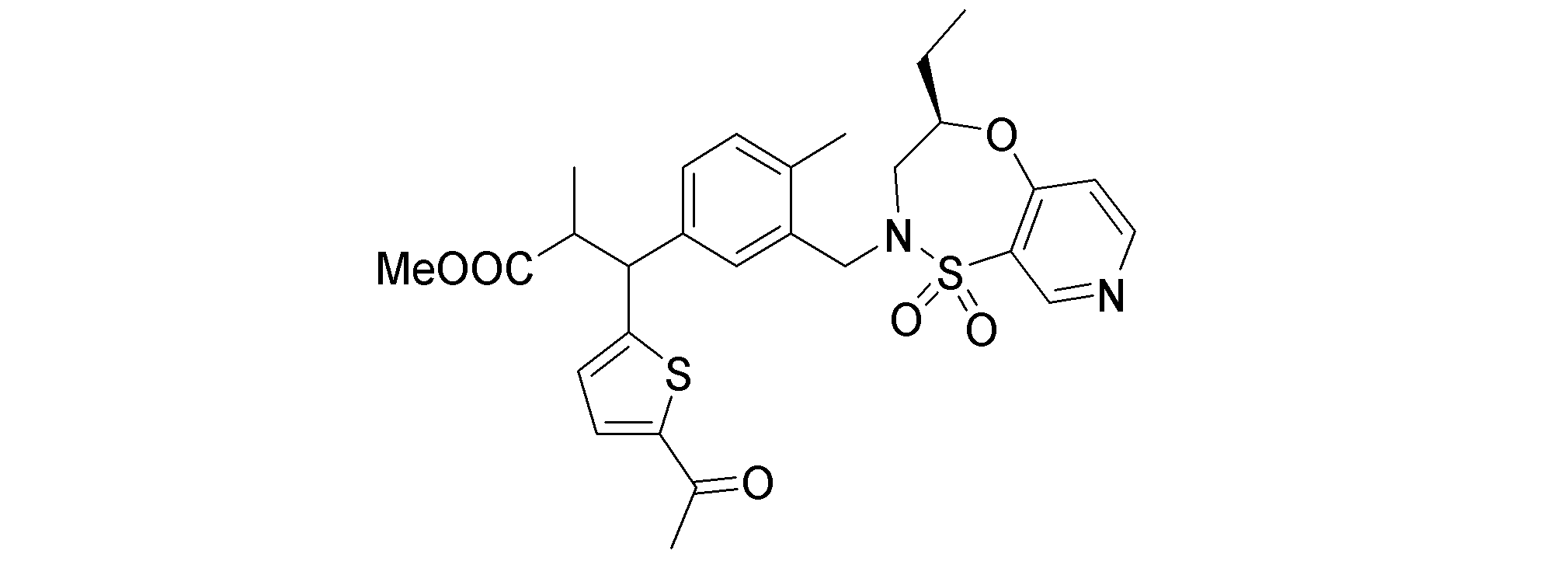
1H NMR(400 MHz, CDCl3)δ 9.03 (1H, s), 8.66 (1H, dd, J = 5.6, 2.0 Hz), 7.47 (1H, dd, J = 4.0, 2.4 Hz), 7.17 (2H, s), 7.12-7.09 (2H, m), 6.93-6.92 (1H, m), 4.47-4.44 (1H, m), 4.38 (2H, d, J = 12.0 Hz), 4.21-4.09 (1H, m), 3.61 (3H, s), 3.51-3.41 (1H, m), 3.23-3.11 (2H, m), 2.47 (3H, br s), 2.33 (3H, s), 1.74-1.63 (1H, m), 1.56-1.47 (1H, m), 1.08-1.02 (6H, m)。
メチル 3-(5-アセチルチオフェン-2-イル)-3-(3-{[4-(2-ヒドロキシエチル)-1,1-ジオキシド-3,4-ジヒドロ-2H-ベンゾ[b][1,4,5]オキサチアゼピン-2-イル]メチル}-4-メチルフェニル)-2-メチルプロパノエートの製造

1H NMR(400 MHz, CDCl3)δ 7.89 (1H, dd, J = 8.0, 1.6 Hz), 7.69-7.44 (3H, m), 7.29-7.22 (1H, m), 7.17-7.10 (3H, m), 6.93 (1H, d, J = 4.0 Hz), 4.77-4.59 (1H, m), 4.44-4.33 (2H, m), 4.02-3.80 (4H, m), 3.60-3.55 (3H, m), 3.31-3.09 (1H, m), 2.92-2.81 (1H, m), 2.49-2.34 (6H, m), 1.96-1.77 (1H, m), 1.62-1.45 (1H, m), 1.07-1.00 (3H, m)。
(5-{1-[(tert-ブチルジメチルシリル)オキシ]エチル}-4-フルオロチオフェン-2-イル)(3-{[(4-メトキシベンジル)オキシ]メチル}-4-メチルフェニル)メタノールの製造

1H NMR(400 MHz, CDCl3)δ 7.31 (1H, br s), 7.22-7.16 (3H, m), 7.10 (1H, d, J = 7.6 Hz), 6.82 (2H, br d, J = 8.8 Hz), 6.40 (1H, d, J = 20.8 Hz), 5.76 (1H, br s), 5.09 (1H, q, J = 6.4 Hz), 4.44-4.43 (4H, m), 3.74 (3H, s), 2.32 (1H, br s), 2.25 (3H, s), 1.39-1.38 (3H, m), 0.82 (9H, br s), 0.01 (3H, br s), -0.05 (3H, br s)。
メチル 3-(5-{1-[(tert-ブチルジメチルシリル)オキシ]エチル}-4-フルオロチオフェン-2-イル)-3-(3-{[(4-メトキシベンジル)オキシ]メチル}-4-メチルフェニル)-2,2-ジメチルプロパノエートの製造

1H NMR(400 MHz, CDCl3)δ 7.25-7.22 (3H, m), 7.13 (1H, br t, J = 8.0 Hz), 7.04 (1H, dd, J = 8.0, 3.2 Hz), 6.84 (2H, br d, J = 8.8 Hz), 6.55 (1H, d, J = 19.6 Hz), 5.07 (1H, q, J = 6.4 Hz), 4.45-4.41 (5H, m), 3.77 (3H, s), 3.54 (3H, s), 2.23 (3H, s), 1.39-1.36 (3H, m), 1.24 (3H, s), 1.15 (3H, s), 0.82 (9H, br s), 0.001 (3H, br s), -0.07 (3H, br s)。
メチル 3-(5-{1-[(tert-ブチルジメチルシリル)オキシ]エチル}-4-フルオロチオフェン-2-イル)-3-[3-(ヒドロキシメチル)-4-メチルフェニル]-2,2-ジメチルプロパノエートの製造

1H NMR(400 MHz, CDCl3)δ7.31 (1H, s), 7.18 (1H, br t, J = 8.0 Hz), 7.10 (1H, dd, J = 8.0, 4.0 Hz), 6.60 (1H, d, J = 19.6 Hz), 5.12 (1H, q, J = 6.4 Hz), 4.67 (2H, br s), 4.50-4.47 (1H, m), 3.60 (3H, s), 2.31 (3H, s), 2.32 (3H, s), 1.59 (1H, br s), 1.43-1.42 (3H, m), 1.29 (3H, s), 1.20 (3H, br s), 0.87 (9H, br s), 0.054-0.051 (3H, m), 0.00--0.015 (3H, m)。
メチル 3-(5-{1-[(tert-ブチルジメチルシリル)オキシ]エチル}-4-フルオロチオフェン-2-イル)-3-(3-{[(R)-4-エチル-1,1-ジオキシド-3,4-ジヒドロ-2H-ベンゾ[b][1,4,5]オキサチアゼピン-2-イル]メチル}-4-メチルフェニル)-2,2-ジメチルプロパノエートの製造
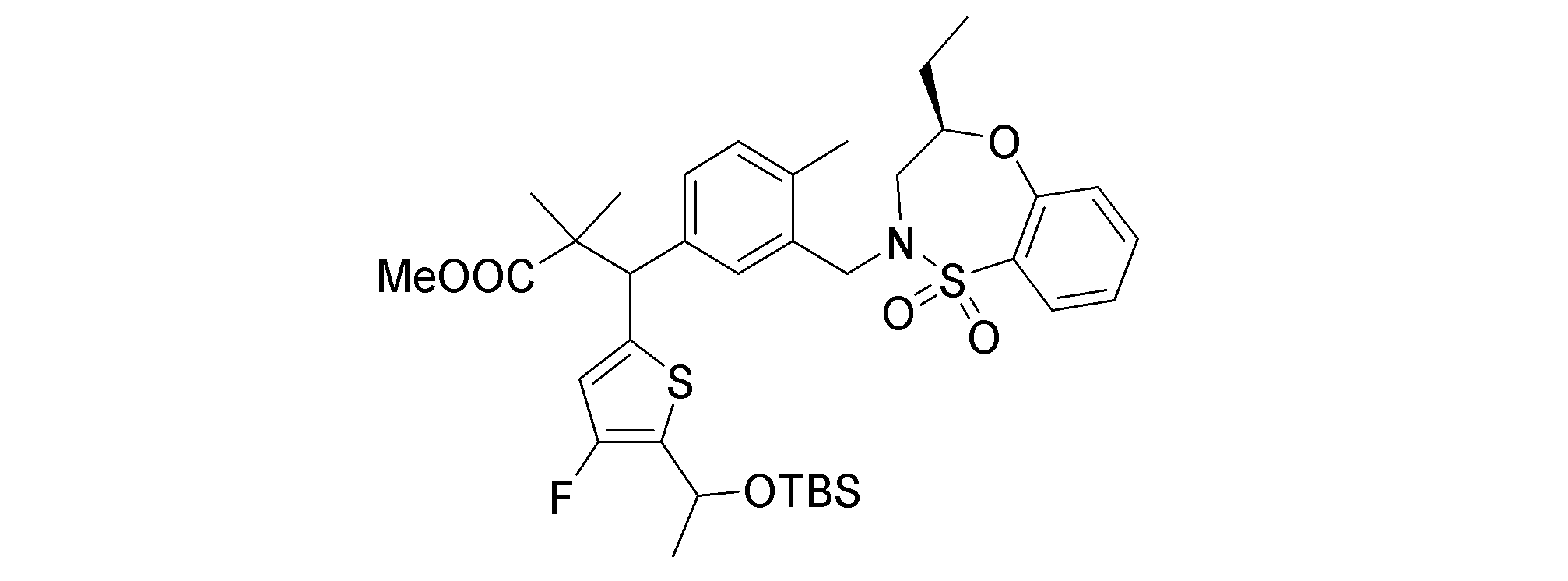
1H NMR(400 MHz, CDCl3)δ 7.84 (1H, d, J = 8.0 Hz), 7.47 (1H, br t, J = 8.0 Hz), 7.23-7.13 (3H, m), 7.11-7.07 (2H, m), 6.57-6.50 (1H, m), 5.09-5.06 (1H, m), 4.52-4.49 (1H, m), 4.42-4.38 (1H, m), 3.99-3.95 (1H, m), 3.80-3.65 (2H, m), 3.55 (3H, br s), 2.95-2.89 (1H, m), 2.29 (3H, br s), 1.69-1.59 (1H, m), 1.39-1.36 (4H, m), 1.22-1.21 (3H, m), 1.14-1.13 (3H, m), 1.06-1.02 (3H, m), 0.82-0.79 (9H, m), 0.004--0.009 (3H, m), -0.052--0.091 (3H, m)。
3-(3-{[(R)-4-エチル-1,1-ジオキシド-3,4-ジヒドロ-2H-ベンゾ[b][1,4,5]オキサチアゼピン-2-イル]メチル}-4-メチルフェニル)-3-[4-フルオロ-5-(1-ヒドロキシエチル)チオフェン-2-イル]-2,2-ジメチルプロパン酸の製造

1H NMR(400 MHz, CDCl3)δ 7.88 (1H, br d, J = 8.0 Hz), 7.52 (1H, br t, J = 8.0 Hz), 7.27-7.20 (4H, m), 7.13-7.11 (1H, m), 6.69-6.64 (1H, m), 5.13 (1H, q, J = 6.4 Hz), 4.58-4.48 (2H, m), 4.02-4.00 (1H, m), 3.86-3.73 (2H, m), 3.01-2.96 (1H, m), 2.32 (3H, s), 1.73-1.60 (1H, m), 1.52-1.48 (3H, m), 1.45-1.41 (1H, m), 1.29 (3H, s), 1.18 (3H, s), 1.10-1.06 (3H, m)。
メチル 3-(3-{[(R)-4-エチル-1,1-ジオキシド-3,4-ジヒドロ-2H-ベンゾ[b][1,4,5]オキサチアゼピン-2-イル]メチル}-4-メチルフェニル)-3-[4-フルオロ-5-(1-ヒドロキシエチル)チオフェン-2-イル]-2,2-ジメチルプロパノエートの製造
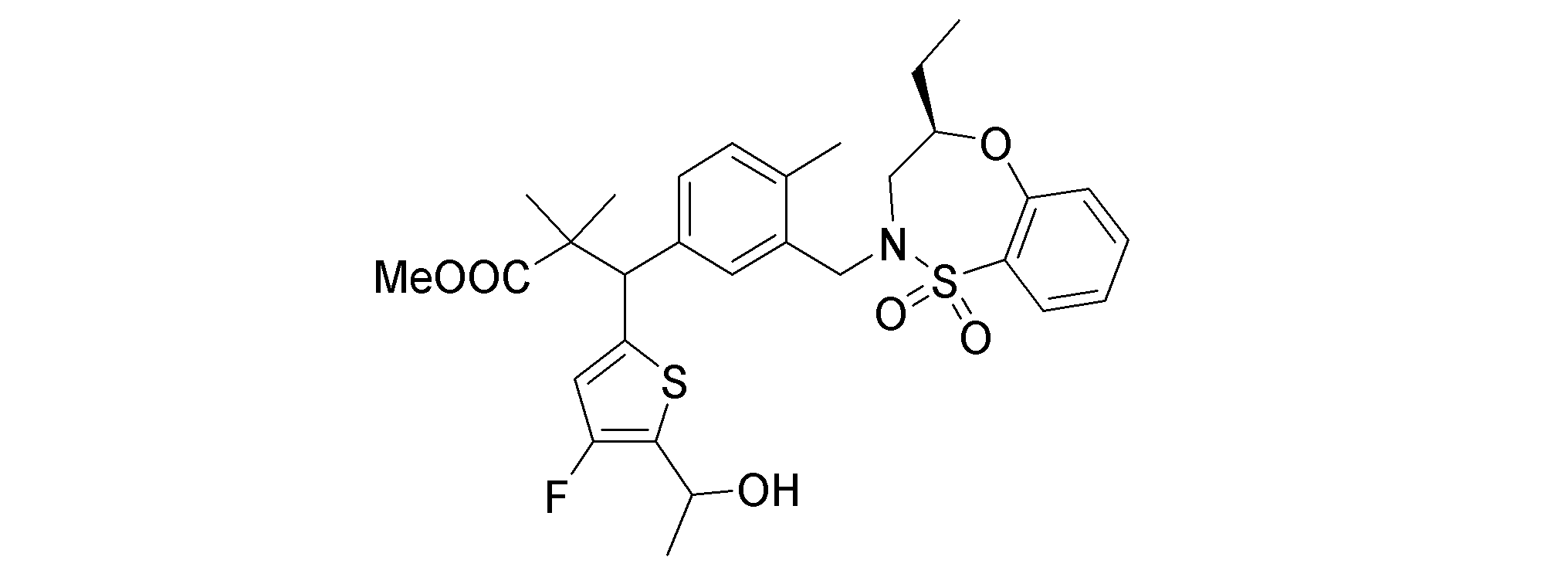
1H NMR(400 MHz, CDCl3)δ 7.88 (1H, dd, J = 8.0, 1.6 Hz), 7.52 (1H, br t, J = 8.0 Hz), 7.27-7.17 (4H, m), 7.12 (1H, d, J = 7.6 Hz), 6.63-6.61 (1H, m), 5.15 (1H, q, J = 6.4 Hz), 4.54-4.50 (1H, m), 4.48 (1H, br s), 4.05-4.01 (1H, m), 3.83 (1H, d, J = 14.0 Hz), 3.76-3.70 (1H, m), 3.62 (3H, br s), 3.39-3.35 (1H, m), 3.00-2.95 (1H, m), 2.33 (3H, s), 1.72-1.66 (1H, m), 1.52-1.50 (3H, m), 1.48-1.42 (1H, m), 1.28 (3H, s), 1.19 (3H, br s), 1.09 (3H, t, J = 7.2 Hz)。
メチル 3-(5-アセチル-4-フルオロチオフェン-2-イル)3-(3-{[(R)-4-エチル-1,1-ジオキシド-3,4-ジヒドロ-2H-ベンゾ[b][1,4,5]オキサチアゼピン-2-イル]メチル}-4-メチルフェニル)-2,2-ジメチルプロパノエートの製造

1H NMR(400 MHz, CDCl3)δ 7.89 (1H, dt, J = 8.0, 1.6 Hz), 7.53 (1H, br t, J = 8.0 Hz), 7.29-7.14 (5H, m), 6.75 (1H, br d, J = 6.8 Hz), 4.57-4.54 (2H, m), 4.06-4.00 (1H, m), 3.85-3.82 (1H, m), 3.77-3.71 (1H, m), 3.64 (3H, br s), 3.00-2.93 (1H, m), 2.51 (3H, br s), 2.34 (3H, s), 1.71-1.65 (1H, m), 1.50-1.38 (1H, m), 1.30 (3H, s), 1.20 (3H, s), 1.09-1.08 (3H, m)。
メチル 3-(4-{[(R)-4-エチル-1,1-ジオキシド-3,4-ジヒドロ-2H-ベンゾ[b][1,4,5]オキサチアゼピン-2-イル]メチル}-1-トリチル-1H-ベンゾ[d]イミダゾール-6-イル)-3-[5-(2-メチル-1,3-ジオキソラン-2-イル)チオフェン-2-イル]プロパノエートの製造

1H NMR (400 MHz, CDCl3) δ 7.88 (1H, d, J = 7.6 Hz), 7.78 (1H, s), 7.47-7.42 (1H, m), 7.31-7.26 (9H, m), 7.22-7.18 (1H, m), 7.15-7.11 (8H, m), 6.70 (1H, d, J = 2.0 Hz), 6.29-6.26 (2H, m), 4.77 (1H, d, J = 15.2 Hz), 4.55-4.54 (1H. m), 4.48 (1H, q, J = 7.2 Hz), 4.03-3.84 (6H, m), 3.53 (3H, s), 3.29-3.23 (1H, m),2.76-2.69 (1H, m), 2.59-2.51 (1H, m), 1.73-1.64 (1H, m), 1.68 (3H, s), 1.45-1.40 (1H, m), 1.03-1.02 (3H, m)。
メチル 3-(5-アセチルチオフェン-2-イル)-3-(4-{[(R)-4-エチル-1,1-ジオキシド-3,4-ジヒドロ-2H-ベンゾ[b][1,4,5]オキサチアゼピン-2-イル]メチル}-1H-ベンゾ[d]イミダゾール-6-イル)プロパノエートの製造
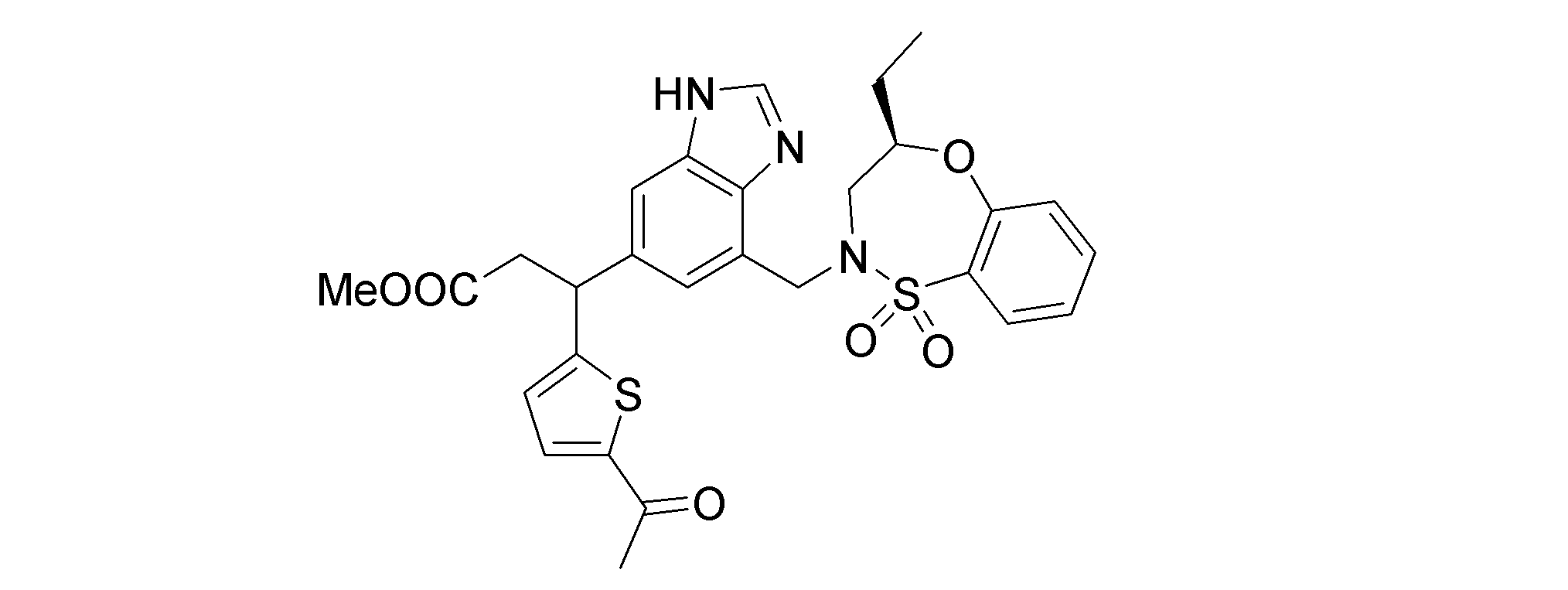
1H NMR (400 MHz, CDCl3) δ 10.6 (1H, s), 8.11 (1H, s), 7.90 (1H, dd, J = 7.6, 1.2 Hz), 7.74 (1H, s), 7.56 (1H, t, J = 7.6 Hz), 7.52-7.48 (1H, m), 7.31-7.24 (2H, m), 6.91 (1H, s), 6.88 (1H, br s), 4.87 (1H, t, J = 7.6 Hz), 4.75-4.72 (1H, m), 4.15-4.07 (1H, m), 3.97-3.93 (1H, m), 3.74-3.71 (1H, m), 3.60 (3H, br s), 3.21-3.07 (3H, m), 2.47 (3H, s), 1.82-1.74 (1H, m), 1.59-1.51 (1H, m), 1.15-1.14 (3H, m)。
メチル 3-(5-アセチル-4-メチルチオフェン-2-イル)-3-(3-{[(R)-4-エチル-1,1-ジオキシド-3,4-ジヒドロ-2H-ベンゾ[b][1,4,5]オキサチアゼピン-2-イル]メチル}-4-メチルフェニル)-2-メチルプロパノエートの製造

1H NMR (400 MHz, CDCl3) δ 7.89 (1H, d, J = 7.6 Hz), 7.53 (1H, t, J = 7.6 Hz), 7.26 (1H, t, J = 7.6 Hz), 7.22 (1H, d, J = 8.0 Hz), 7.17-7.07 (3H, m), 6.77-6.32 (1H, m), 4.60-4.53 (1H, m), 4.30-4.25 (1H, m), 4.06-3.98 (1H, m), 3.89-3.79 (1H, m), 3.75-3.68 (1H, m), 3.62-3.46 (3H, m), 3.24-3.14 (1H, m), 2.99-2.92 (1H, m), 2.47-2.42 (6H, m), 2.34-2.31 (3H, m), 1.73-1.62 (1H, m), 1.49-1.33 (1H, m), 1.11-1.04 (6H, m)。
メチル 3-(5-アセチルチアゾール-2-イル)-3-(3-{[(R)-4-エチル-1,1-ジオキシド-3,4-ジヒドロ-2H-ベンゾ[b][1,4,5]オキサチアゼピン-2-イル]メチル}-4-メチルフェニル)-プロパノエートの製造

1H NMR (400MHz, CDCl3) δ 8.17 (1H, br s), 7.89 (1H, dd, J = 7.6, 1.6 Hz), 7.52 (1H, td, J = 7.6, 1.6 Hz), 7.28-7.24 (1H, m), 7.22-7.14 (4H, m), 4.79 (1H, t, J = 7.6 Hz), 4.57-4.55 (1H, m), 4.07-3.97 (1H, m), 3.84-3.81 (1H, m), 3.76-3.66 (1H, m), 3.63 (3H, s), 3.43-3.42 (1H, m), 3.02-2.96 (2H, m), 2.52 (3H, s), 2.35 (3H, br s), 1.75-1.64 (1H, m), 1.51-1.39 (1H, m), 1.09-1.07 (3H, m)。
メチル 3-(5-アセチル-4-メチルチアゾール-2-イル)-3-(3-{[(R)-4-エチル-1,1-ジオキシド-3,4-ジヒドロ-2H-ベンゾ[b][1,4,5]オキサチアゼピン-2-イル]メチル}-4-メチルフェニル)-プロパノエートの製造

1H NMR (400 MHz, CDCl3) δ 7.89 (1H, d, J = 7.6 Hz), 7.52 (1H, t, J = 7.6 Hz), 7.28-7.24 (1H, m), 7.22-7.15 (4H, m), 4.73 (1H, t, J = 7.6 Hz), 4.58-4.56 (1H, m), 4.07-3.98 (1H, m), 3.85-3.82 (1H, m), 3.76-3.70 (1H, m), 3.62 (3H, s), 3.43-3.42 (1H, m), 3.01-2.94 (2H, m,), 2.68 (3H, s), 2.44 (3H, s), 2.36 (3H, br s), 1.77-1.62 (1H, m), 1.52-1.38 (1H, m), 1.11-1.05 (3H, m)。
メチル 3-(5-アセチルチオフェン-2-イル)-3-(3-{[(R)-4-エチル-1,1-ジオキシド-3,4-ジヒドロ-2H-ピリド[4,3-b][1,4,5]オキサチアゼピン-2-イル]メチル}-4-メチルフェニル)-2,2-ジメチルプロパノエートの製造
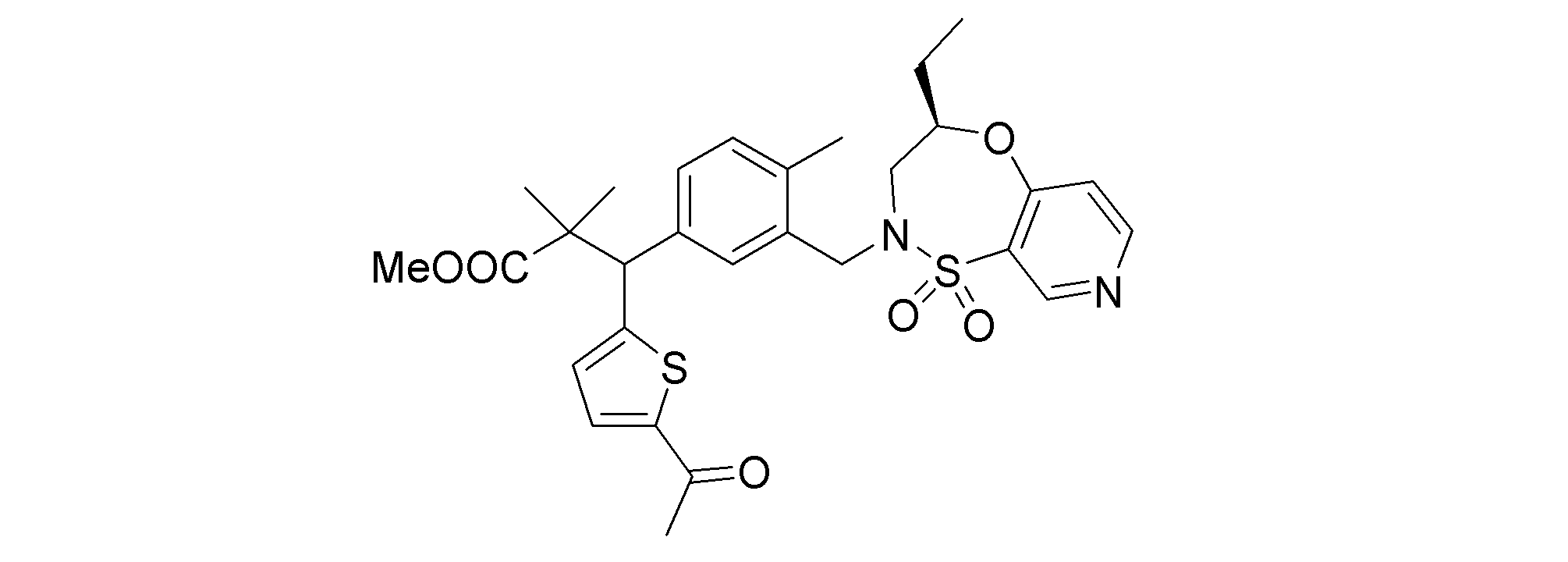
1H NMR (400 Mz, CDCl3) δ 9.03 (1H, s), 8.66 (1H, dd, J = 5.6, 1.6 Hz), 7.51 (1H, dd, J = 4.0, 1.6 Hz), 7.24-7.20 (2H, m), 7.16-7.14 (1H, m), 7.12-7.08 (1H, m), 6.98-6.96 (1H, m), 4.70/4.69 (1H, s), 4.46-4.37 (2H, m), 4.22-4.16 (1H, m), 3.60 (3H, br s), 3.53-3.44 (1H, m), 3.18-3.12 (1H, m), 2.50 (3H, br s), 2.32 (3H, br s), 1.72-1.63 (1H, m), 1.54-1.47 (1H, m), 1.30 (3H, br s), 1.24-1.22 (3H, m), 1.07-1.02 (3H, m)。
メチル 3-(5-アセチルチオフェン-2-イル)-3-(3-{[(4-メトキシベンジル)オキシ]メチル}-4-メチルフェニル)プロパノエートの製造

1H NMR(400 MHz, CDCl3)δ 7.49 (1H, d, J = 4.0 Hz), 7.28-7.24 (3H, m), 7.11 (2H, br s), 6.90-6.86 (3H, m), 4.74 (1H, t, J = 8.0 Hz), 4.48 (2H, s), 4.47 (2H, s), 3.82 (3H, s), 3.62 (3H, s), 3.15-3.00 (2H, m), 2.48 (3H, s), 2.27 (3H, s)。
メチル 3-(5-アセチルチオフェン-2-イル)-3-[3-(ヒドロキシメチル)-4-メチルフェニル]プロパノエートの製造

1H NMR(400 MHz, CDCl3)δ 7.49 (1H, d, J = 4.0 Hz), 7.29 (1H, br s), 7.10 (2H, br s), 6.87 (1H, br d, J = 4.0 Hz), 4.74 (1H, t, J = 8.0 Hz), 4.64 (2H, s), 3.60 (3H, s), 3.15-3.01 (2H, m), 2.46 (3H, s), 2.28 (3H, s)。
メチル 3-(5-アセチルチオフェン-2-イル)-3-[3-(クロロメチル)-4-メチルフェニル]プロパノエートの製造

1H NMR (400 MHz, CDCl3) δ 7.51 (1H, d, J = 4.0 Hz), 7.21 (1H, br s), 7.15 (2H, br s), 6.87 (1H, br d, J = 4.0 Hz), 4.74 (1H, t, J = 8.0 Hz), 4.56 (2H, s), 3.62 (3H, s), 3.15-3.00 (2H, m), 2.48 (3H, s), 2.38 (3H, s)。
メチル 3-(5-アセチルチオフェン-2-イル)-3-(3-{[(R)-4-エチル-1,1-ジオキシド-3,4-ジヒドロ-2H-ピリド[4,3-b][1,4,5]オキサチアゼピン-2-イル]メチル}-4-メチルフェニル)プロパノエートの製造

1H NMR (400 Mz, CDCl3) δ 9.02 (1H, s), 8.65 (1H, d, J = 5.6 Hz), 7.50 (1H, br d, J = 4.0 Hz), 7.17 (2H, br s), 7.11-7.08 (2H, m), 6.88 (1H, br d, J = 4.0 Hz), 4.73 (1H, t, J = 7.6 Hz), 4.45-4.37 (2H, m), 4.16-4.09 (1H, m), 3.62 (3H, s), 3.51-3.43 (1H, m), 3.17-3.09 (2H, m), 3.05-3.00 (1H, m), 2.49 (3H, s), 2.33 (3H, s), 1.74-1.65 (1H, m), 1.56-1.50 (1H, m), 1.04 (3H, br t, J = 7.6 Hz)。
メチル 3-[4-フルオロ-5-(1-ヒドロキシエチル)チオフェン-2-イル]-3-(3-{[(4-メトキシベンジル)オキシ]メチル}-4-メチルフェニル)-2,2-ジメチルプロパノエートの製造

1H NMR(400 MHz, CDCl3)δ 7.29-7.27 (3H, m), 7.16 (1H, d, J = 8.0 Hz), 7.10 (1H, d, J = 8.0 Hz), 6.89 (2H, d, J = 8.4 Hz), 6.64, 6.63 (each 0.5H, s), 5.18-5.12 (1H, m), 4.51-4.48 (5H, m), 3.82 (3H, s), 3.61 (3H, s), 2.28 (3H, s), 1.87 (1H, br s), 1.51, 1.50 (each 1.5H, d, J = 6.4 Hz, thiophene β-CH3 regioisomers), 1.30 (3H, s), 1.20 (3H, s)。
メチル 3-[5-アセチル-4-フルオロチオフェン-2-イル]-3-(3-{[(4-メトキシベンジル)オキシ]メチル}-4-メチルフェニル)-2,2-ジメチルプロパノエートの製造
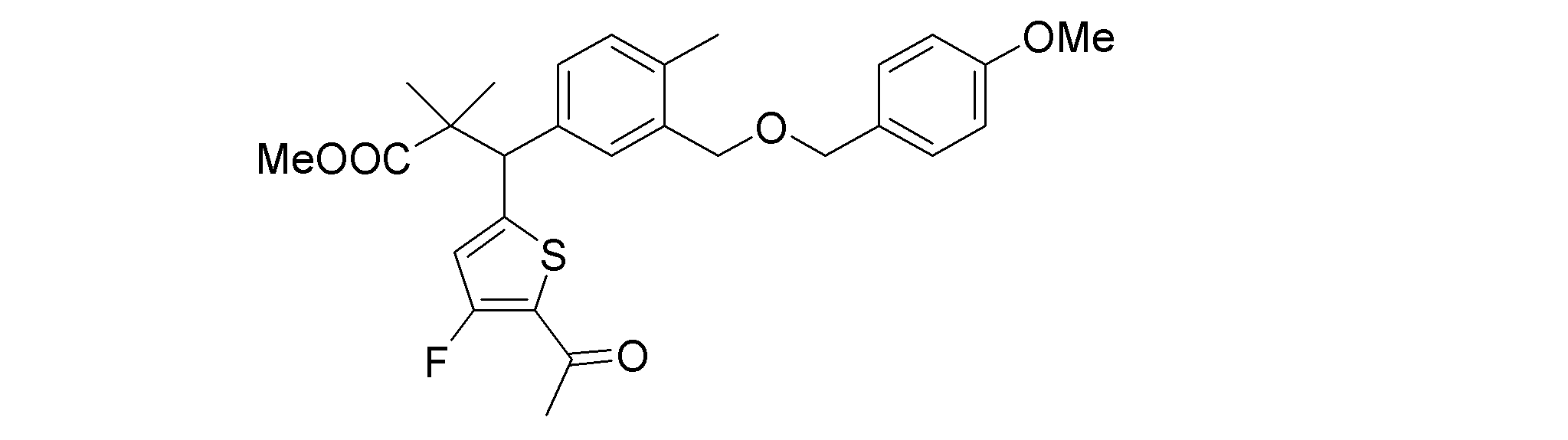
1H NMR(400 MHz, CDCl3)δ 7.29-7.27 (3H, m), 7.15 (1H, dd, J = 7.6, 1.2 Hz), 7.11 (1H, d, J = 7.6 Hz), 6.90 (2H, d, J = 8.4 Hz), 6.75 (1H, s), 4.55 (1H, s), 4.49 (2H, s), 4.48 (2H, s), 3.82 (3H, s), 3.62 (3H, s), 2.51, 2.50 (each 1.5H, s), 2.28 (3H, s), 1.32 (3H, s), 1.21 (3H, s)。
メチル 3-(5-アセチル-4-フルオロチオフェン-2-イル)-3-[3-(ヒドロキシメチル)-4-メチルフェニル]-2,2-ジメチルプロパノエートの製造

1H NMR(400 MHz, CDCl3)δ 7.31 (1H, d, J = 1.6 Hz), 7.15 (1H, dd, J = 8.0, 1.6 Hz), 7.11 (1H, d, J = 8.0 Hz), 6.75 (1H, s), 4.67 (2H, s), 4.55 (1H, s), 3.63 (3H, s), 2.50, 2.49 (each 1.5H, s, acetyl regioisomers), 2.29 (3H, s), 1.32 (3H, s), 1.20 (3H, s)。
メチル 3-(5-アセチル-4-フルオロチオフェン-2-イル)-3-[3-(クロロメチル)-4-メチルフェニル]-2,2-ジメチルプロパノエートの製造

1H NMR (400 MHz, CDCl3) δ 7.23 (1H, d, J = 1.6 Hz), 7.21 (1H, dd, J = 8.0, 1.6 Hz), 7.15 (1H, d, J = 8.0 Hz), 6.76 (1H, s), 4.57 (2H, s), 4.44 (1H, s), 3.64 (3H, s), 2.514, 2.507 (each 1.5H, s), 2.39 (3H, s), 1.32 (3H, s), 1.22 (3H, s)。
メチル 3-(5-アセチル-4-フルオロチオフェン-2-イル)-3-(3-{[(R)-4-エチル-1,1-ジオキシド-3,4-ジヒドロ-2H-ピリド[4,3-b][1,4,5]オキサチアゼピン-2-イル]メチル}-4-メチルフェニル)-2,2-ジメチルプロパノエートの製造

1H NMR (400 Mz, CDCl3) δ 9.02 (1H, s), 8.65 (1H, dd, J = 5.6, 0.4 Hz), 7.21 (1H, dd, J = 7.6, 1.6 Hz), 7.17-7.14 (2H, m), 7.09 (1H, d, J = 5.6, 2.0 Hz), 6.76, 6.75 (each 0.5H, s), 4.55, 4.54 (each 0.5H, s), 4.47-4.36 (2H, m), 4.16, 4.14 (each 0.5H, d, J = 14.4 Hz), 3.640, 3.639 (each 1.5H, s), 3.51-3.43 (1H, m), 3.17 (1H, dt, J = 15.2, 2.8 Hz), 2.51, 2.50 (each 1.5H, s), 2.33, 2.32 (each 1.5H, s), 1.74-1.63 (1H, m), 1.60-1.49 (1H, m), 1.30, 1.29 (each 1.5H, s), 1.20 (3H, s), 1.05 (3H, t, J = 7.2 Hz)。
3-(5-アセチル-4-メトキシチオフェン-2-イル)-3-(3-{[(4-メトキシベンジル)オキシ]メチル}-4-メチルフェニル)-2,2-ジメチルプロパン酸の製造

1H NMR(400 MHz, CDCl3)δ 7.32 (1H, d, J = 2.0 Hz), 7.27 (2H, d, J = 8.8 Hz), 7.21 (1H, dd, J = 8.0, 2.0 Hz), 7.10 (1H, d, J = 8.0 Hz), 6.89 (2H, d, J = 8.8 Hz), 6,73 (1H, s), 4.63 (1H, s), 4.48 (4H, s), 3.87 (3H, s), 3.81 (3H, s), 2.46 (3H, s), 2.27 (3H, s), 1.34 (3H, s), 1.25 (3H s)。
2-(トリメチルシリル)エチル 3-(5-アセチル-4-メトキシチオフェン-2-イル)-3-(3-{[(4-メトキシベンジル)オキシ]メチル}-4-メチルフェニル)-2,2-ジメチルプロパノエートの製造

1H NMR(400 MHz, CDCl3)δ 7.31-7.26 (3H, m), 7.18 (1H, dd, J = 7.6, 1.6 H), 7.10 (1H, d, J = 7.6 Hz), 6.89 (2H, d, J = 8.8 Hz), 6.71 (1H, s), 4.61 (1H, s), 4.48 (4H, s), 4.10-4.05 (2H, m), 3.89 (3H, s), 3.81 (3H, s), 2.46, (3H, s), 2.27 (3H, s), 1.32 (3H, s), 1.21 (3H, s), 0.89-0.86 (2H, m), 0.01 (9H, s)。
2-(トリメチルシリル)エチル 3-(5-アセチル-4-メトキシチオフェン-2-イル)-3-[3-(ヒドロキシメチル)-4-メチルフェニル]-2,2-ジメチルプロパノエートの製造

1H NMR(400 MHz, CDCl3)δ 7.32 (1H, d, J = 2.0 Hz), 7.21 (1H, dd, J = 8.0, 2.0 Hz), 7.11 (1H, d, J = 8.0 Hz), 6.73 (1H, s), 4.67 (2H, d, J = 5.6 Hz), 4.62 (1H, s), 4.10-4.06 (2H, m), 3.91 (3H ,s), 2.46 (3H,s ), 2.31 (3H, s), 1.56 (1H, t, J = 5.6 Hz), 1.32 (3H, s), 1.22 (3H, s), 0.90-0.86 (2H, m), 0.02 (9H, s)。
2-(トリメチルシリル)エチル 3-(5-アセチル-4-メトキシチオフェン-2-イル)-3-[3-(クロロメチル)-4-メチルフェニル]-2,2-ジメチルプロパノエートの製造

1H NMR (400 MHz, CDCl3) δ 7.26-7.23 (2H, m), 7.12 (1H, d, J = 7.6 Hz), 6.72 (1H, s), 4.60 (1H, s), 4.56 (2H, s), 4.09-4.05 (2H, m), 3.91 (3H, s), 2.73 (3H, s), 2.46 (3H, s), 1.31 (3H, s), 1.22 (3H, s), 0.88-0.84 (2H, m), 0.10 (9H, s)。
2-(トリメチルシリル)エチル 3-(5-アセチル-4-メトキシチオフェン-2-イル)-3-(3-{[(R)-4-エチル-1,1-ジオキシド-3,4-ジヒドロ-2H-ピリド[4,3-b][1,4,5]オキサチアゼピン-2-イル]メチル}-4-メチルフェニル)-2,2-ジメチルプロパノエートの製造

1H NMR (400 Mz, CDCl3) δ 9.01 (1H, s), 8.66, 8.65 (each 0.5H, d, J = 5.6 Hz), 7.24-7.22 (2H, m), 7.14 (1H, d, J = 8.0 Hz), 7.10, 7.09 (each 0.5H, d, J = 5.6 Hz), 6.76, 6.75 (each 0.5H, s), 4.60, 4.59 (each 0.5H, s), 4.45-4.36 (2H, m), 4.16-4.05 (3H, m), 3.933, 3.932 (each 1.5H, s), 3.53-3.44 (1H, m), 3.18-3.11 (1H, m), 2.46 (3H, s), 2.32 (3H, s), 1.73-1.61 (1H, m), 1.58-1.46 (1H, m), 1.30 (3H, s), 1.21, 1.20 (each 1.5H, s), 1.05, 1.03 (each 1.5H, t, J = 7.2 Hz), 0.90-0.86 (2H, m), 0.02, 0.01 (each 4.5H, s)。
2-(5-ブロモ-3-フルオロチオフェン-2-イル)-2-メチル-1,3-ジオキソランの製造

1H NMR(400 MHz, CDCl3)δ 6.78 (1H, br s), 4.07-4.03 (2H, m), 4.02-3.97 (2H, m), 1.77 (3H, s)。
メチル (E)-3-[4-フルオロ-5-(2-メチル-1,3-ジオキソラン-2-イル)チオフェン-2-イル]アクリレートの製造

1H NMR(400 MHz, CDCl3)δ 7.58 (1H, d, J = 16.0 Hz), 6.93 (1H, s), 6.20 (1H, d, J = 16.0 Hz), 4.10-4.03 (2H, m), 4.02-3.99 (2H, m), 3.79 (3H, s), 1.80 (3H, s)。
メチル 3-[4フルオロ-5-(2-メチル-1,3-ジオキソラン-2-イル)チオフェン-2-イル]-3-(3-{[(4-メトキシベンジル)オキシ]メチル}-4-メチルフェニル)プロパノエートの製造

1H NMR(400 MHz, CDCl3)δ 7.27 (2H, br d, J = 6.8 Hz), 7.21 (1H, br s), 7.13-7.07 (2H, m), 6.89 (2H, br d, J = 6.8 Hz), 6.52 (1H, br s), 4.55 (1H, t, J = 8.0 Hz), 4.48 (4H, br s), 4.01-3.91 (4H, m), 3.82 (3H, s), 3.61 (3H, s), 3.06-2.92 (2H, m), 2.28 (3H, s), 1.74 (3H, s)。
メチル 3-[4-フルオロ-5-(2-メチル-1,3-ジオキソラン-2-イル)チオフェン-2-イル]-3-(3-{[(4-メトキシベンジル)オキシ]メチル}-4-メチルフェニル)-2-メチルプロパノエートの製造

1H NMR(400 MHz, CDCl3)δ 7.27 (2H, br d, J = 8.8 Hz), 7.24-7.20 (1H, m), 7.13-7.06 (2H, m), 6.90 (2H, br d, J = 8.8 Hz), 6.61-6.52 (1H, m), 4.49 (4H, br s), 4.17-4.14 (1H, m), 3.98-3.89 (4H, m), 3.82 (3H, s), 3.63-3.43 (3H, m), 3.19-2.92 (1H, m), 2.28-2.25 (3H, m), 1.74-1.72 (3H, m), 1.23-1.02 (3H, m)。
メチル 3-(5-アセチル-4-フルオロチオフェン-2-イル)-3-(3-{[(4-メトキシベンジル)オキシ]メチル}-4-メチルフェニル)-2-メチルプロパノエートの製造

1H NMR(400 MHz, CDCl3)δ 7.28 (2H, d, J = 8.4 Hz), 7.24-7.21 (1H, m), 7.14-7.06 (2H, m), 6.90 (2H, d, J = 8.4 Hz), 6.71-6.63 (1H, m), 4.50-4.46 (4H, m), 4.27-4.22 (1H, m), 3.82 (3H, s), 3.65 (3H, s), 3.23-3.14 (1H, m), 2.50-2.48 (3H, m), 2.27-2.25 (3H, m), 1.24-1.06 (3H, m)。
メチル 3-(5-アセチル-4-フルオロチオフェン-2-イル)-3-[3-(ヒドロキシメチル)-4-メチルフェニル]-2-メチルプロパノエートの製造

1H NMR(400 MHz, CDCl3)δ 7.28-7.26 (1H, m), 7.15-7.04 (2H, m), 6.73-6.65 (1H, m), 4.69-4.64 (2H, m), 4.28-4.23 (1H, m), 3.65-3.48 (3H, m), 3.26-2.98 (1H, m), 2.50-2.47 (3H, m), 2.30-2.28 (3H, m), 1.80 (1H, br s), 1.25-1.07 (3H, m)。
メチル3-(5-アセチル-4-フルオロチオフェン-2-イル)-3-[3-(クロロメチル)-4-メチルフェニル]-2-メチルプロパノエートの製造

1H NMR (400 MHz, CDCl3) δ 7.21-7.11 (3H, m), 6.73-6.70 (1H, m), 4.57-4.55 (2H, m), 4.28-4.21 (1H, m), 3.66-3.48 (3H, m), 3.23-3.14 (1H, m), 2.51-2.48 (3H, m), 2.39-2.36 (3H, m), 1.25-1.07 (3H, m)。
メチル3-(5-アセチル-4-フルオロチオフェン-2-イル)-3-(3-{[(R)-4-エチル-1,1-ジオキシド-3,4-ジヒドロ-2H-ピリド[4,3-b][1,4,5]オキサチアゼピン-2-イル]メチル}-4-メチルフェニル)-2-メチルプロパノエートの製造

1H NMR (400 Mz, CDCl3) δ 9.03 (1H, s), 8.66 (1H, br d, J = 5.6 Hz), 7.20-7.08 (4H, m), 6.73-6.70 (1H, m), 4.49-4.40 (2H, m), 4.30-4.13 (2H, m), 3.66-3.40 (4H, m), 3.21-3.13 (2H, m), 2.51-2.48 (3H, m), 2.34-2.32 (3H, m), 1.75-1.65 (1H, m), 1.61-1.50 (1H, m), 1.24-1.03 (6H, m)。
3-(5-アセチル-4-メトキシチオフェン-2-イル)-3-(3-{[(4-メトキシベンジル)オキシ]メチル}-4-メチルフェニル)-2-メチルプロパン酸の製造

1H NMR(400 MHz, CDCl3)δ 7.28-7.06 (5H, m), 6.90-6.87 (2H, m), 6.70-6.68 (1H, m), 4.49-4.44 (4H, m), 4.25-4.21 (1H, m), 3.91-3.80 (3H, m), 3.81 (3H, br s), 3.25-3.15 (1H, m), 2.44-2.42 (3H, m), 2.26-2.23 (3H, m), 1.25-1.07 (3H, m)。
2-(トリメチルシリル)エチル 3-(5-アセチル-4-メトキシチオフェン-2-イル)-3-(3-{[(4-メトキシベンジル)オキシ]メチル}-4-メチルフェニル)-2-メチルプロパノエートの製造

1H NMR(400 MHz, CDCl3)δ 7.26 (2H, br d, J = 8.8 Hz), 7.21 (1H, s), 7.09 (2H, s), 6.88 (2H, br d, J = 8.8 Hz), 6.67 (1H, s), 4.47 (2H, s), 4.43 (2H, s), 4.24 (1H, d, J = 11.2 Hz), 4.10-4.05 (2H, m), 3.86 (3H, s), 3.80 (3H, s), 3.17-3.09 (1H, m), 2.41 (3H, s), 2.24 (3H, s), 1.04 (3H, d, J = 6.8 Hz), 0.89-0.85 (2H, m), -0.00 (9H, s)。
2-(トリメチルシリル)エチル 3-(5-アセチル-4-メトキシチオフェン-2-イル)-3-[3-(ヒドロキシメチル)-4-メチルフェニル]-2-メチルプロパノエートの製造

1H NMR(400 MHz, CDCl3)δ 7.28 (1H, s), 7.12 (2H, br s), 6.70 (1H, s), 4.68-4.67 (2H,m), 4.27 (1H, d, J = 11.2 Hz), 4.15-4.04 (2H, m), 3.90 (3H, s), 3.19-3.12 (1H, m), 2.43 (3H, s), 2.30 (3H, s), 1.74-1.71 (1H, m), 1.06 (3H, d, J = 7.2 Hz), 0.91-0.87 (2H, m), 0.02 (9H, s)。
2-(トリメチルシリル)エチル 3-(5-アセチル-4-メトキシチオフェン-2-イル)-3-[3-(クロロメチル)-4-メチルフェニル]-2-メチルプロパノエートの製造

1H NMR (400 MHz, CDCl3) δ 7.18 (1H, s), 7.13 (2H, br s), 6.68 (1H, s), 4.55 (2H, s), 4.25 (1H, d, J = 11.2 Hz), 4.10-4.05 (2H, m), 3.88 (3H, s), 3.16-3.08 (1H, m), 2.42 (3H, s), 2.36 (3H, s), 1.04 (3H, d, J = 7.2 Hz), 0.89-0.85 (2H, m), -0.00 (9H, s)。
2-(トリメチルシリル)エチル 3-(5-アセチル-4-メトキシチオフェン-2-イル)-3-(3-{[(R)-4-エチル-1,1-ジオキシド-3,4-ジヒドロ-2H-ピリド[4,3-b][1,4,5]オキサチアゼピン-2-イル]メチル}-4-メチルフェニル)-2-メチルプロパノエートの製造

1H NMR (400 Mz, CDCl3) δ 9.02 (1H, s), 8.67-8.65 (1H, m), 7.16-7.09 (4H, m), 6.72 (1H, s), 4.47-4.35 (2H, m), 4.29-4.08 (4H, m), 3.92 (3H, br s), 3.52-3.41 (1H, m), 3.19-3.09 (2H, m), 2.44 (3H, s), 2.33 (3H, s), 1.75-1.64 (1H, m), 1.57-1.49 (1H, m), 1.06-1.02 (6H, m), 0.92-0.87 (2H, m), 0.02 (9H, s)。
3-(3-{[(R)-4-エチル-1,1-ジオキシド-3,4-ジヒドロ-2H-ベンゾ[b][1,4,5]オキサチアゼピン-2-イル]メチル}-4-メチルフェニル)-3-[5-(メチルカルバモイル)フラン-2-イル]プロパン酸(化合物26)の製造
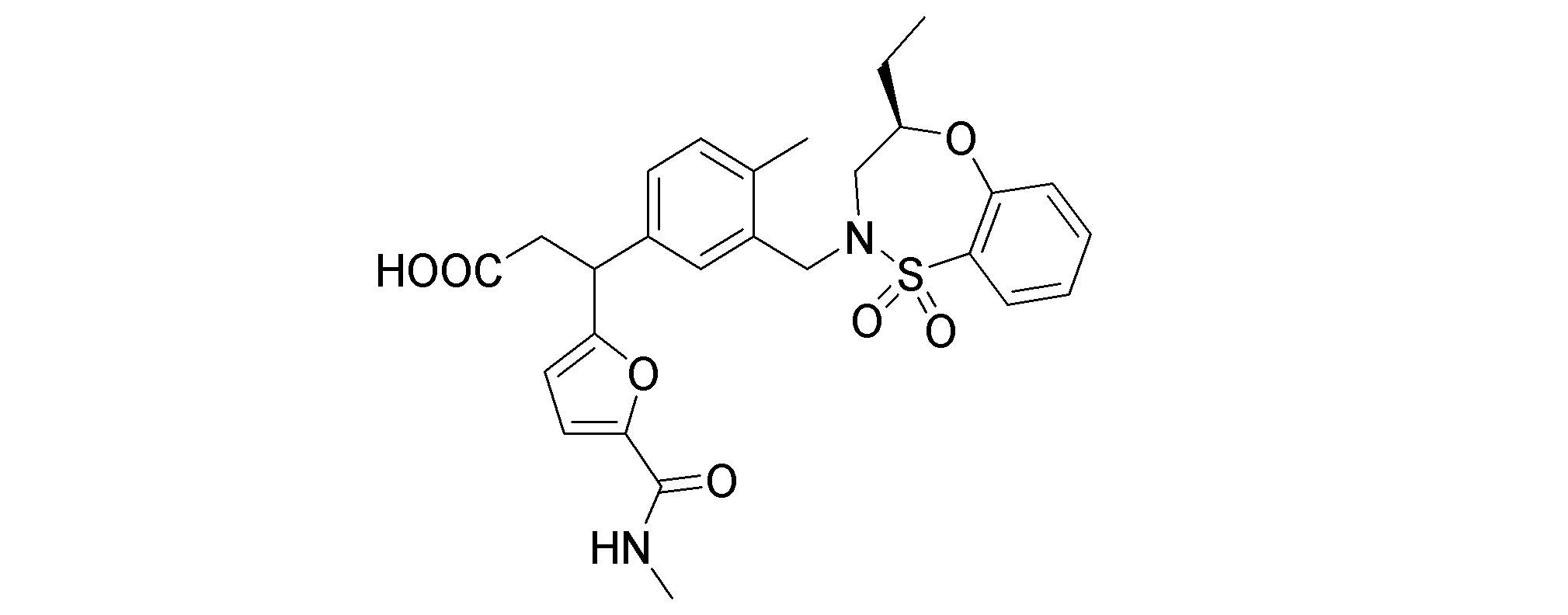
1H NMR(400 MHz, CDCl3)δ 7.85 (1H, d, J = 8.0 Hz), 7.52 (1H, td, J = 8.0, 1.6 Hz), 7.27-7.20 (3H, m), 7.12-7.06 (2H, m), 6.96 (1H, d, J = 3.2 Hz), 6.59 (1H, br s), 6.14-6.21 (1H, m), 4.53-4.47 (2H, m), 4.01-3.97 (1H, m), 3.87-3.73 (2H, m), 3.13-2.87 (6H, m), 2.28 (3H, br s), 1.73-1.63 (1H, m), 1.50-1.40 (1H, m), 1.07-1.06 (3H, m)。
3-(3-{[(R)-4-エチル-1,1-ジオキシド-3,4-ジヒドロ-2H-ベンゾ[b][1,4,5]オキサチアゼピン-2-イル]メチル}-4-メチルフェニル)-3-[5-(ピロリジン-1-カルボニル)フラン-2-イル]プロパン酸(化合物28)の製造

1H NMR(400 MHz, CDCl3)δ 7.87 (1H, dd, J = 7.6, 1.6 Hz), 7.52 (1H, t, J = 7.6 Hz), 7.27-7.19 (2H, m), 7.12-7.10 (3H, m), 6.94 (1H, d, J = 3.6 Hz), 6.09 (1H, br s), 4.55-4.51 (2H, m), 4.02-3.96 (1H, m), 3.77 (1H, d, J = 12.4 Hz), 3.76-3.66 (3H, m), 3.58 (1H, t, J = 6.8 Hz), 3.14 (1H, dd, J = 16.0, 8.0 Hz), 2.96 (1H, d, J = 15.2 Hz), 2.99-2.87 (2H, m), 2.31 (3H, s), 1.96-1.91 (2H, m), 1.88-1.71 (2H, m), 1.69-1.61 (1H, m), 1.48-1.42 (1H, m), 1.06-1.05 (3H, m)。
3-(3-{[(R)-4-エチル-1,1-ジオキシド-3,4-ジヒドロ-2H-ベンゾ[b][1,4,5]オキサチアゼピン-2-イル]メチル}-4-メチルフェニル)-3-[5-(イソプロピルカルバモイル)フラン-2-イル]プロパン酸(化合物29)の製造

1H NMR(400 MHz, CDCl3)δ 7.86(1H, dd, J = 8.0, 1.6 Hz), 7.52 (1H, t, J = 8.0 Hz), 7.27-7.06 (5H, m), 6.95 (1H, d, J = 3.6 Hz), 6.21 (1H, d, J = 8.0 Hz), 6.10-6.09 (1H, m), 4.52-4.48 (2H, m), 4.22-4.14 (1H, m), 4.02-3.95 (1H, m), 3.85-3.71 (2H, m), 3.08-2.82 (3H, m), 2.30 (3H, br s), 1.72-1.62 (1H, m), 1.49-1.38 (1H, m), 1.20-1.18 (6H, m), 1.07-1.06 (3H, m)。
3-(3-{[(R)-4-エチル-1,1-ジオキシド-3,4-ジヒドロ-2H-ベンゾ[b][1,4,5]オキサチアゼピン-2-イル]メチル}-4-メチルフェニル)-3-[5-(メチルカルバモイル)チオフェン-2-イル]プロパン酸(化合物21)の製造

1H NMR(400 MHz, CDCl3)δ 7.86 (1H, dd, J = 8.0, 1.6 Hz), 7.51 (1H, td, J = 8.0, 1.6 Hz), 7.29-7.18 (3H, m), 7.12-7.06 (3H, m), 6.76-6.75 (1H, m), 6.32 (1H, br s), 4.65 (1H, t, J = 8.0 Hz), 4.53-4.52 (1H, m), 3.98-3.93 (1H, m), 3.81-3.67 (2H, m), 3.10-2.90 (3H, m), 2.87 (3H, d, J = 4.8 Hz), 2.30 (3H, s), 1.67-1.56 (1H, m), 1.43-1.32 (1H, m), 1.04 (3H, t, J = 7.2 Hz)。
3-(3-{[(R)-4-エチル-1,1-ジオキシド-3,4-ジヒドロ-2H-ベンゾ[b][1,4,5]オキサチアゼピン-2-イル]メチル}-4-メチルフェニル)-3-{5-[(2-メトキシエチル)カルバモイル]フラン-2-イル}プロパン酸(化合物30)の製造
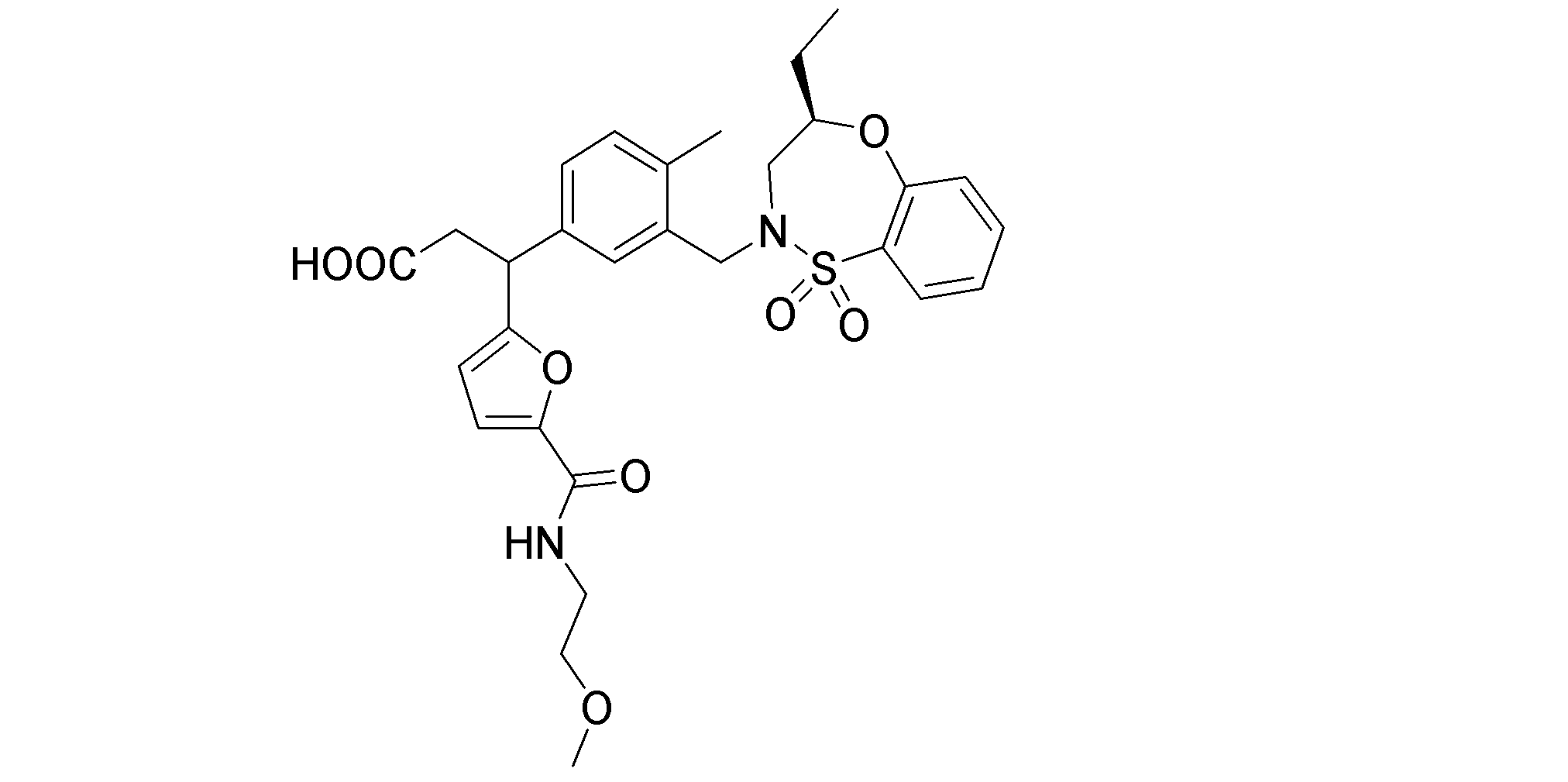
1H NMR(400 MHz, CDCl3)δ 7.87(1H, dd, J = 8.0, 1.6 Hz), 7.52 (1H, td, J = 8.0, 1.6 Hz), 7.25 (1H, t, J = 8.0 Hz), 7.20 (1H, d, J = 8.0 Hz), 7.16-7.11 (3H, m), 6.98 (1H, d, J = 3.6 Hz), 6.77 (1H, br s), 6.10-6.09 (1H, m), 4.55-4.51 (2H, m), 4.01-3.98 (1H, m), 3.86-3.70 (2H, m), 3.58-3.53 (4H, m), 3.36 (3H, s), 3.16-3.09 (1H, m), 3.01-2.89 (2H, m), 2.32 (3H, br s), 1.73-1.63 (1H, m), 1.49-1.38 (1H, m), 1.07-1.06 (3H, m)。
3-[5-(ジメチルカルバモイル)フラン-2-イル]-3-(3-{[(R)-4-エチル-1,1-ジオキシド-3,4-ジヒドロ-2H-ベンゾ[b][1,4,5]オキサチアゼピン-2-イル]メチル}-4-メチルフェニル)プロパン酸(化合物27)の製造

1H NMR(400 MHz, CDCl3)δ 7.87 (1H, dd, J = 8.0, 1.6 Hz), 7.52 (1H, t, J = 8.0 Hz), 7.25 (1H, t, J = 8.0 Hz), 7.20 (1H, d, J = 8.0 Hz), 7.12 (3H, br s), 6.88 (1H, d, J = 3.6 Hz), 6.08 (1H, d, J = 3.6 Hz), 4.55-4.51 (2H, m), 4.03-3.98 (1H, m), 3.82 (1H, d, J = 14.4 Hz), 3.75-3.68 (1H, m), 3.16-2.86 (9H, m), 2.31 (3H, s), 1.72-1.63 (1H, m), 1.49-1.40 (1H, m), 1.07-1.06 (3H, m)。
3-(5-アセチルチオフェン-2-イル)-3-(3-{[(R)-4-エチル-1,1-ジオキシド-3,4-ジヒドロ-2H-ベンゾ[b][1,4,5]オキサチアゼピン-2-イル]メチル}-4-メチルフェニル)プロパン酸(化合物5)の製造

1H NMR(400 MHz, CDCl3)δ 7.87 (1H, br d, J = 8.0 Hz), 7.52 (1H, td, J = 8.0, 1.6 Hz), 7.50 (1H, d, J = 3.6 Hz), 7.25 (1H, t, J = 8.0 Hz), 7.20 (1H, br d, J = 8.0 Hz), 7.16-7.12 (2H, m), 7.08 (1H, d, J = 9.2 Hz), 6.88-6.86 (1H, m), 4.68 (1H, t, J = 7.6 Hz), 4.55-4.54 (1H, m), 4.02-3.95 (1H, m), 3.82-3.79 (1H, m), 3.74-3.67 (1H, m), 3.12 (1H, dd, J = 16.0, 7.6 Hz), 3.03 (1H, dd, J = 16.0, 8.0 Hz), 2.94-2.92 (1H, m), 2.47 (3H, s), 2.33-2.32 (3H,m), 1.70-1.60 (1H, m), 1.45-1.35 (1H, m), 1.05 (3H, t, J = 7.6 Hz)。
3-(3-{[(R)-4-エチル-1,1-ジオキシド-3,4-ジヒドロ-2H-ベンゾ[b][1,4,5]オキサチアゼピン-2-イル]メチル}-4-メチルフェニル)-3-[4-メチル-5-(メチルカルバモイル)フラン-2-イル]プロパン酸(化合物31)の製造

1H NMR(400 MHz, CDCl3)δ 7.86 (1H, dd, J = 8.0, 1.6 Hz), 7.52 (1H, td, J = 8.0, 1.6 Hz), 7.27-7.19 (3H, m), 7.12-7.05 (2H, m), 6.38 (1H, br s), 5.96 (1H, d, J = 3.6 Hz), 4.51-4.42 (2H, m), 4.03-3.96 (1H, m), 3.88-3.71 (2H, m), 3.08-2.97 (2H, m), 2.88-2.86 (4H, m), 2.28 (6H, br s), 1.73-1.64 (1H, m), 1.51-1.38 (1H, m), 1.07-1.06 (3H, m)。
3-(3-{[(R)-4-エチル-1,1-ジオキシド-3,4-ジヒドロ-2H-ベンゾ[b][1,4,5]オキサチアゼピン-2-イル]メチル}-4-メチルフェニル)-3-(5-スルファモイルチオフェン-2-イル)プロパン酸(化合物18)の製造
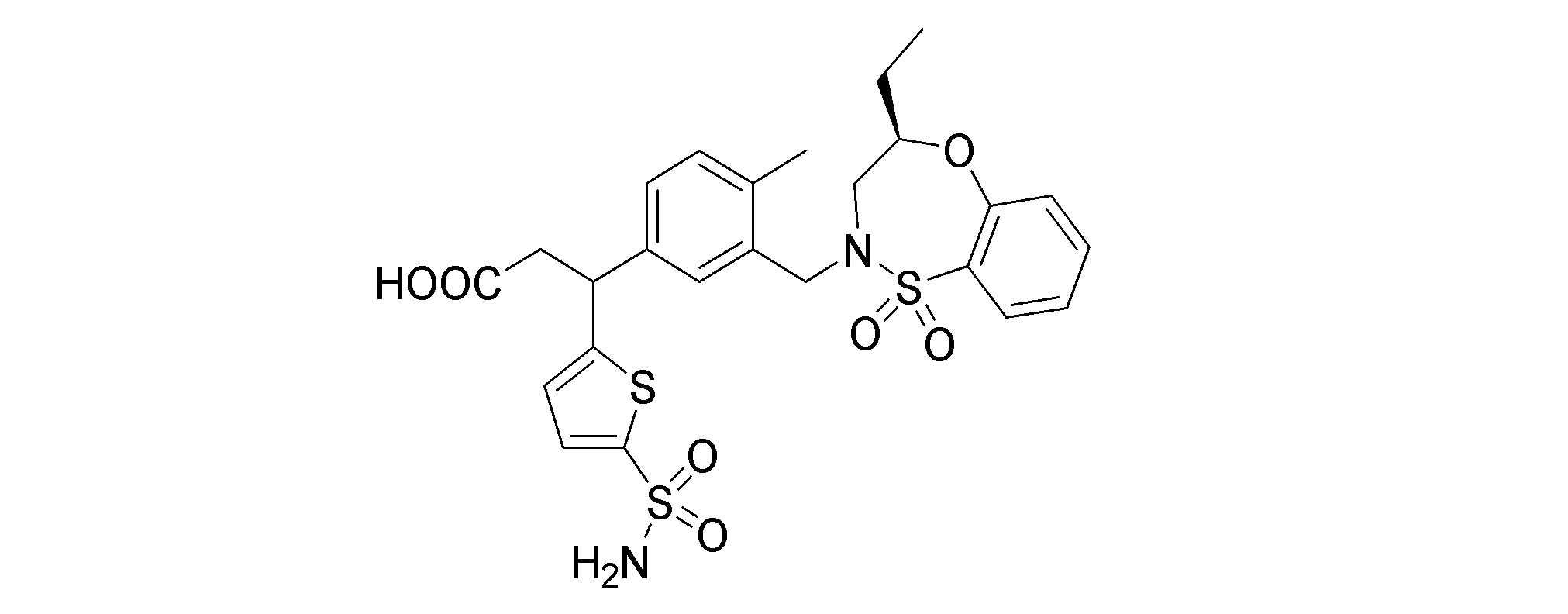
1H NMR(400 MHz, CDCl3)δ 7.82 (1H, dt, J = 8.0, 1.6 Hz), 7.50 (1H, td, J = 8.0, 1.6 Hz), 7.37 (1H, d, J = 4.0 Hz), 7.25-7.09 (5H, m), 6.77 (1H, d, J = 3.6 Hz), 5.40 (2H, br s), 4.67 (1H, t, J = 8.0 Hz), 4.48 (1H, d, J = 14.4 Hz), 4.00-3.95 (1H, m), 3.83-3.82 (1H, m), 3.78-3.68 (1H, m), 3.13-2.94 (3H, m), 2.27 (3H, s), 1.69-1.59 (1H, m), 1.46-1.40 (1H, m), 1.05-1.04 (3H, m)。
3-(3-{[(R)-4-エチル-1,1-ジオキシド-3,4-ジヒドロ-2H-ベンゾ[b][1,4,5]オキサチアゼピン-2-イル]メチル}-4-メチルフェニル)- 3-(チオフェン-2-イル)プロパン酸(化合物17)の製造

1H NMR(400 MHz, CDCl3)δ 7.86 (1H, dd, J = 8.0, 1.6 Hz), 7.50 (1H, td, J = 8.0, 1.6 Hz), 7.25-7.17 (2H, m), 7.13-7.09 (3H, m), 7.04 (1H, d, J = 9.6 Hz), 6.87-6.85 (1H, m), 6.80-6.78 (1H, m), 4.65 (1H, t, J = 7.6 Hz), 4.54 (1H, d, J = 14.0 Hz), 3.99-3.89 (1H, m), 3.79-3.65 (2H, m), 3.09-2.93 (3H, m), 1.65-1.55 (1H, m), 1.42-1.29 (1H, m), 1.04-1.03 (3H, m)。
3-(3-{[(R)-4-エチル-1,1-ジオキシド-3,4-ジヒドロ-2H-ベンゾ[b][1,4,5]オキサチアゼピン-2-イル]メチル}-4-メチルフェニル)- 3-[5-(メチルカルバモイル)チオフェン-3-イル]プロパン酸(化合物22)の製造

1H NMR(400 MHz, CDCl3)δ 7.84 (1H, dt, J = 8.0, 1.6 Hz), 7.52 (1H, td, J = 8.0, 1.6 Hz), 7.32 (1H, dd, J = 6.0, 1.6 Hz), 7.26-7.19 (2H, m), 7.14-7.03 (4H, m), 6.46 (1H, br s), 4.49-4.43 (2H, m), 3.99-3.94 (1H, m), 3.83-3.82 (1H, m), 3.78-3.70 (1H, m), 3.05-2.90 (3H, m), 2.87 (3H, d, J = 4.8 Hz), 2.27 (3H, s), 1.70-1.61 (1H, m), 1.46-1.37 (1H, m), 1.05 (3H, br t, J = 7.2 Hz)。
3-(3-{[(R)-4-エチル-1,1-ジオキシド-3,4-ジヒドロ-2H-ベンゾ[b][1,4,5]オキサチアゼピン-2-イル]メチル}-4-メチルフェニル)- 3-{5-[(イソプロピルアミノ)メチル]フラン-2-イル}プロパン酸(化合物32)の製造

1H NMR(400 MHz, CDCl3)δ 7.86 (1H, dd, J = 7.6, 1.6 Hz), 7.51 (1H, td, J = 7.6, 1.6 Hz), 7.24 (1H, t, J = 7.6 Hz), 7.20 (1H, d, J = 7.6 Hz), 7.13-7.07 (3H, m), 6.67 (1H, br s), 6.23 (1H, d, J = 3.2 Hz), 5.93 (1H, br s), 4.53-4.46 (2H, m), 4.03-3.94 (1H, m), 3.88 (2H, s), 3.84-3.67 (2H, m), 3.12-3.05 (1H, m), 2.99-2.89 (2H, m), 2.69 (1H, d, J = 14.4, 5.6 Hz), 2.29 (3H, s), 1.72-1.63 (1H, m), 1.48-1.38 (1H, m), 1.24-1.21 (6H, m), 1.07-1.06 (3H, m)。
3-(3-{[(R)-4-エチル-1,1-ジオキシド-3,4-ジヒドロ-2H-ベンゾ[b][1,4,5]オキサチアゼピン-2-イル]メチル}-4-メチルフェニル)-3-[3-メチル-5-(メチルカルバモイル)チオフェン-2-イル]プロパン酸(化合物47)の製造

1H NMR(400 MHz, CDCl3)δ 7.84 (1H, br d, J = 7.6 Hz), 7.51 (1H, br t, J = 7.6 Hz), 7.25-7.16 (3H, m), 7.11-7.05 (3H, m), 6.57 (1H, br t, J = 4.8 Hz), 4.67 (1H, t, J = 6.8 Hz), 4.51-4.50 (1H, m), 3.97-3.93 (1H, m), 3.77-3.67 (2H, m), 2.93-2.90 (3H, m), 2.85 (3H, d, J = 4.8 Hz), 2.28 (3H, br s), 2.03 (3H, s), 1.67-1.55 (1H, m), 1.42-1.31 (1H, m), 1.04-1.02 (3H, m)。
3-(3-{[(R)-4-エチル-1,1-ジオキシド-3,4-ジヒドロ-2H-ベンゾ[b][1,4,5]オキサチアゼピン-2-イル]メチル}-4-メチルフェニル)-3-(チアゾール-5-イル)プロパン酸(化合物39)の製造

1H NMR(400 MHz, CDCl3)δ 8.63 (1H, s), 7.85 (1H, dt, J = 8.0, 1.6 Hz), 7.62 (1H, d, J = 3.6 Hz), 7.50 (1H, td, J = 8.0, 1.6 Hz), 7.23 (1H, br t, J = 8.0 Hz), 7.18 (1H, d, J = 8.0 Hz), 7.12-7.07 (3H, m), 4.73 (1H, t, J = 7.6 Hz), 4.50 (1H, d, J = 14.4 Hz), 4.00-3.92 (1H, m), 3.82-3.67 (2H, m), 3.04-2.91 (3H, m), 2.29 (3H, br s), 1.68-1.60 (1H, m), 1.43-1.27 (1H, m), 1.04-1.03 (3H, m)。
3-(3-{[(R)-4-エチル-1,1-ジオキシド-3,4-ジヒドロ-2H-ベンゾ[b][1,4,5]オキサチアゼピン-2-イル]メチル}-4-メチルフェニル)-3-(1-メチル-4-オキソ-4,5,6,7-テトラヒドロ-1H-インドール-2-イル)プロパン酸(化合物37)の製造

1H NMR(400 MHz, CDCl3)δ 7.84 (1H, br t, J = 8.0 Hz), 7.54-7.49 (1H, m), 7.27-7.18 (2H, m), 7.11-7.09 (1H, m), 7.06-7.02 (1H, m), 6.98-6.96 (1H, m), 6.56 (1H, s), 4.52-4.50 (1H, m), 4.42 (1H, t, J = 6.4 Hz), 3.99-3.94 (1H, m), 3.80-3.64 (2H, m), 3.22-3.20 (3H, m), 3.06-2.87 (2H, m), 2.77 (1H, dd, J = 16.0, 6.4 Hz), 2.66-2.59 (2H, m), 2.45-2.41 (2H, m), 2.33-2.31 (3H, m), 2.10-2.09 (2H, m), 1.74-1.58 (1H, m), 1.50-1.33 (1H, m), 1.09-1.02 (3H, m)。
3-(5-アセチル-1-メチル-1H-ピロール-2-イル)-3-(3-{[(R)-4-エチル-1,1-ジオキシド-3,4-ジヒドロ-2H-ベンゾ[b][1,4,5]オキサチアゼピン-2-イル]メチル}-4-メチルフェニル)プロパン酸(化合物33)の製造
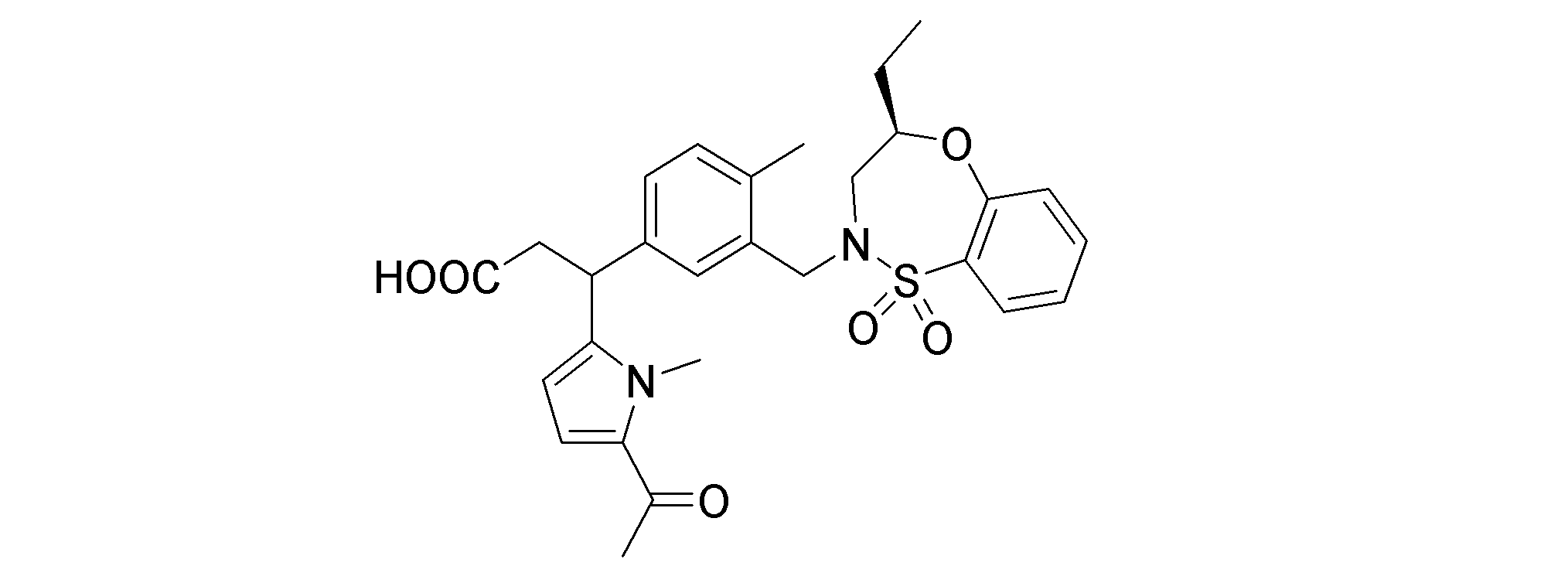
1H NMR(400 MHz, CDCl3)δ 7.86 (1H, d, J = 8.0 Hz), 7.51 (1H, t, J = 8.0 Hz), 7.26-7.18 (2H, m), 7.12-7.08 (1H, m), 7.02-6.93 (3H, m), 6.15 (1H, d, J = 4.0 Hz), 4.55-4.44 (2H, m), 3.99-3.90 (1H, m), 3.81-3.65 (5H, m), 3.05 (1H, dd, J = 16.0, 8.0 Hz), 2.93-2.82 (2H, m), 2.39 (3H, s), 2.32-2.29 (3H, m), 1.71-1.57 (1H, m), 1.45-1.28 (1H, m), 1.07-1.02 (3H, m)。
3-(5-アセチル-3-メチルチオフェン-2-イル)-3-(3-{[(R)-4-エチル-1,1-ジオキシド-3,4-ジヒドロ-2H-ベンゾ[b][1,4,5]オキサチアゼピン-2-イル]メチル}-4-メチルフェニル)プロパン酸(化合物14)の製造
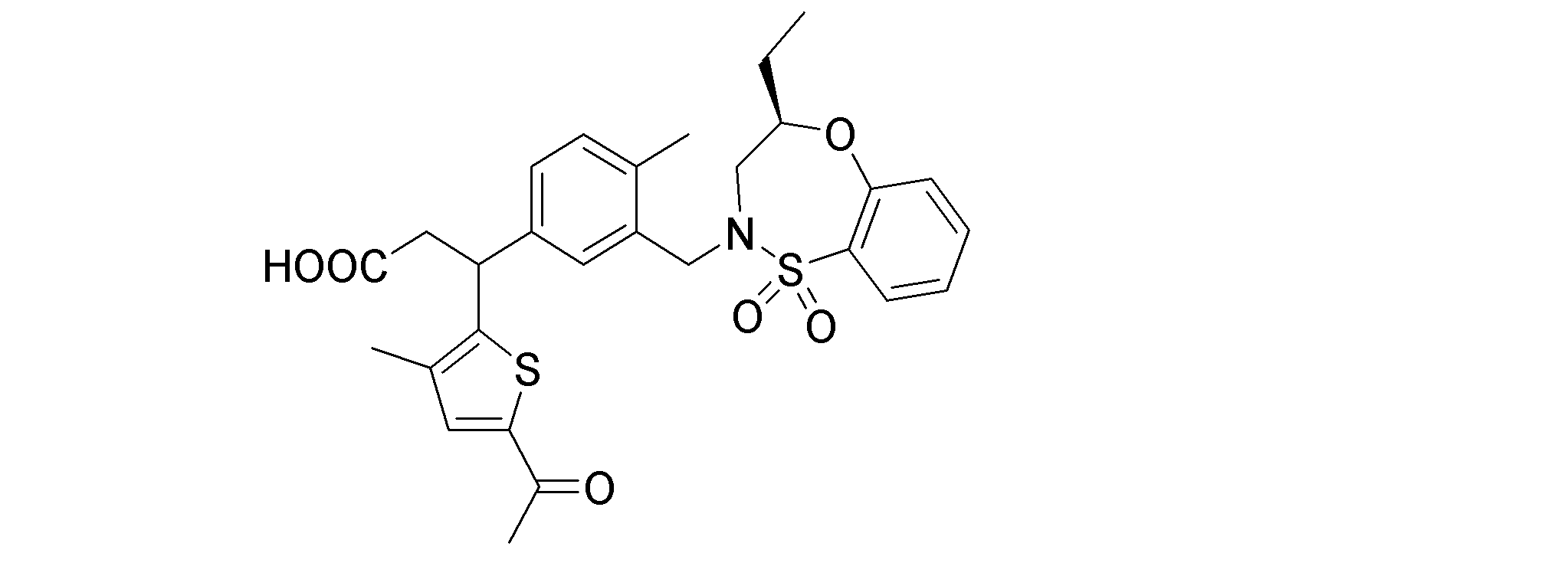
1H NMR(400 MHz, CDCl3)δ 7.85 (1H, dd, J = 8.0, 1.6 Hz), 7.52 (1H, br t, J = 8.0 Hz), 7.37 (1H, s), 7.27-7.18 (2H, m), 7.14-7.06 (3H, m), 4.70-4.69 (1H, m), 4.54-4.52 (1H, m), 4.00-3.93 (1H, m), 3.80-3.65 (2H, m), 3.05-2.86 (3H, m), 2.45 (3H, br s), 2.31 (3H, br s), 2.14 (3H, s), 1.71-1.56 (1H, m), 1.45-1.31 (1H, m), 1.05-1.04 (3H, m)。
3-(5-アセチル-4-フルオロチオフェン-2-イル)-3-(3-{[(R)-4-エチル-1,1-ジオキシド-3,4-ジヒドロ-2H-ベンゾ[b][1,4,5]オキサチアゼピン-2-イル]メチル}-4-メチルフェニル)プロパン酸(化合物8)の製造

1H NMR(400 MHz, CDCl3)δ 7.85 (1H, dd, J = 8.0, 4.0 Hz), 7.51 (1H, td, J = 8.0, 1.6 Hz), 7.25-7.05 (5H, m), 6.62 (1H, br s), 4.56 (1H, t, J = 7.6 Hz), 4.48 (1H, d, J = 14.8 Hz), 4.02-3.94 (1H, m), 3.86-3.69 (2H, m), 3.03-2.88 (3H, m), 2.47 (3H, br s), 2.28 (3H, br s), 1.71-1.62 (1H, m), 1.48-1.40 (1H, m), 1.07-1.06 (3H, m)。
3-(5-カルバモイルチオフェン-2-イル)-3-(3-{[(R)-4-エチル-1,1-ジオキシド-3,4-ジヒドロ-2H-ベンゾ[b][1,4,5]オキサチアゼピン-2-イル]メチル}-4-メチルフェニル)プロパン酸(化合物23)の製造

1H NMR(400 MHz, CDCl3)δ 7.73 (1H, dd, J = 8.0, 1.6 Hz), 7.49 (1H, td, J = 8.0, 1.6 Hz), 7.41-7.40 (1H, m), 7.20 (1H, td, J = 8.0, 1.2 Hz), 7.16-7.06 (3H, m), 7.01 (1H, br d, J = 16.8 Hz), 6.83-6.80 (1H, m),4.59-4.54 (1H, m), 4.49-4.47 (1H, m), 3.92-3.86 (1H, m), 3.71-3.67 (1H, m), 3.60-3.54 (1H, m), 3.02-2.82 (2H, m), 2.78-2.73 (1H, m), 2.25 (3H, br s), 1.53-1.41 (1H, m), 1.34-1.22 (1H, m), 0.95 (3H, t, J = 7.2 Hz)。
3-(5-アセチル-4-メチルチオフェン-2-イル)-3-(3-{[(R)-4-エチル-1,1-ジオキシド-3,4-ジヒドロ-2H-ベンゾ[b][1,4,5]オキサチアゼピン-2-イル]メチル}-4-メチルフェニル)プロパン酸(化合物7)の製造

1H NMR(400 MHz, CDCl3)δ 7.89-7.85 (1H, m), 7.54-7.49 (1H, m), 7.27-6.95 (5H, m), 6.69 (1H, br s), 4.62 (1H, t, J = 7.6 Hz), 4.55 (1H, d, J = 14.0 Hz), 4.03-3.98 (1H, m), 3.84-3.68 (2H, m), 3.11 (1H, dd, J = 16.4, 7.2 Hz), 3.04-2.87 (2H, m), 2.45 (3H, s), 2.42 (3H, s), 2.33 (3H, s), 1.70-1.61 (1H, m), 1.45-1.35 (1H, m), 1.07-1.03 (3H, m)。
3-(4-アセチル-1,3,5-トリメチル-1H-ピロール-2-イル)-3-(3-{[(R)-4-エチル-1,1-ジオキシド-3,4-ジヒドロ-2H-ベンゾ[b][1,4,5]オキサチアゼピン-2-イル]メチル}-4-メチルフェニル)プロパン酸(化合物35)の製造

1H NMR(400 MHz, CDCl3)δ 7.88-7.84 (1H, m), 7.52 (1H, br t, J = 8.0 Hz), 7.25 (1H, br t, J = 8.0 Hz), 7.20 (1H, dd, J = 8.0, 3.2 Hz), 7.14-7.11 (1H, m), 7.02-6.99 (1H, m), 6.96-6.95 (1H, m), 4.81 (1H, t, J = 7.6 Hz), 4.54-4.51 (1H, m), 3.99-3.94 (1H, m), 3.80-3.69 (2H, m), 3.28-3.22 (4H, m), 2.99-2.88 (2H, m), 2.42-2.41 (6H, m), 2.34-2.32 (3H, m), 2.21 (3H, s), 1.73-1.60 (1H, m), 1.46-1.32 (1H, m), 1.06-1.04 (3H, m)。
3-(5-アセチル-1-エチル-1H-ピロール-2-イル)-3-(3-{[(R)-4-エチル-1,1-ジオキシド-3,4-ジヒドロ-2H-ベンゾ[b][1,4,5]オキサチアゼピン-2-イル]メチル}-4-メチルフェニル)プロパン酸(化合物34)の製造
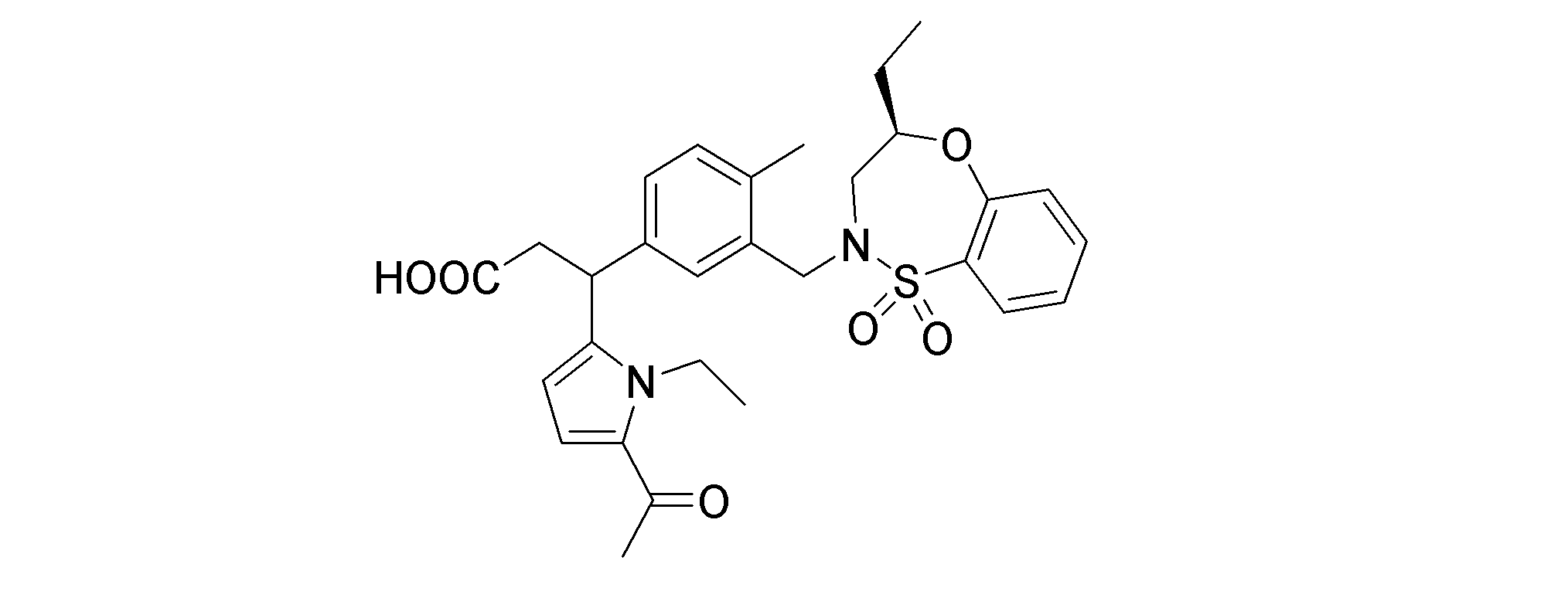
1H NMR(400 MHz, CDCl3)δ 7.88 (1H, dt, J = 8.0, 1.6 Hz), 7.51 (1H, t, J = 8.0 Hz), 7.25 (1H, t, J = 8.0 Hz), 7.20 (1H, d, J = 8.0 Hz), 7.14-7.09 (3H, m), 6.71-6.70 (1H, m), 6.63-6.62 (1H, m), 4.54-4.53 (1H, m), 4.35 (1H, t, J = 7.6 Hz), 4.25 (2H, q, J = 7.2 Hz), 4.03-3.97 (1H, m), 3.82-3.81 (1H, m), 3.75-3.68 (1H, m), 3.01-2.85 (3H, m), 2.35 (3H, s), 2.32 (3H, s), 1.70-1.61 (1H, m), 1.45-1.36 (1H, m), 1.29 (3H, t, J = 7.2 Hz), 1.05-1.04 (3H, m)。
3-[5-(シクロプロパンカルボニル)チオフェン-2-イル]-3-(3-{[(R)-4-エチル-1,1-ジオキシド-3,4-ジヒドロ-2H-ベンゾ[b][1,4,5]オキサチアゼピン-2-イル]メチル}-4-メチルフェニル)プロパン酸(化合物20)の製造

1H NMR(400 MHz, CDCl3)δ 7.87 (1H, dt, J = 8.0, 1.6 Hz), 7.62 (1H, d, J = 3.6 Hz), 7.52 (1H, br t, J = 8.0 Hz), 7.25 (1H, br t, J = 8.0 Hz), 7.20 (1H, br d, J = 8.0 Hz), 7.14 (2H, br s), 7.07 (1H, d, J = 10.4 Hz), 6.90-6.88 (1H, m), 4.69 (1H, t, J = 7.6 Hz), 4.57-4.52 (1H, m), 4.02-3.93 (1H, m), 3.83-3.74 (1H, m), 3.74-3.67 (1H, m), 3.13 (1H, dd, J = 16.0, 7.6 Hz), 3.03 (1H, dd, J = 16.0, 7.6 Hz), 2.93 (1H, dd, J = 15.2, 10.0 Hz), 2.47-2.41 (1H, m), 2.33 (3H, br s), 1.69-1.59 (1H, m), 1.43-1.34 (1H, m), 1.20-1.16 (2H, m), 1.04 (3H, t, J = 7.6 Hz), 1.00-0.95 (2H, m)。
3-(5-アセチルチオフェン-2-イル)-3-(3-{[(R)-4-エチル-1,1-ジオキシド-3,4-ジヒドロ-2H-ベンゾ[b][1,4,5]オキサチアゼピン-2-イル]メチル}-4-メチルフェニル)-2-メチルプロパン酸(化合物1)の製造
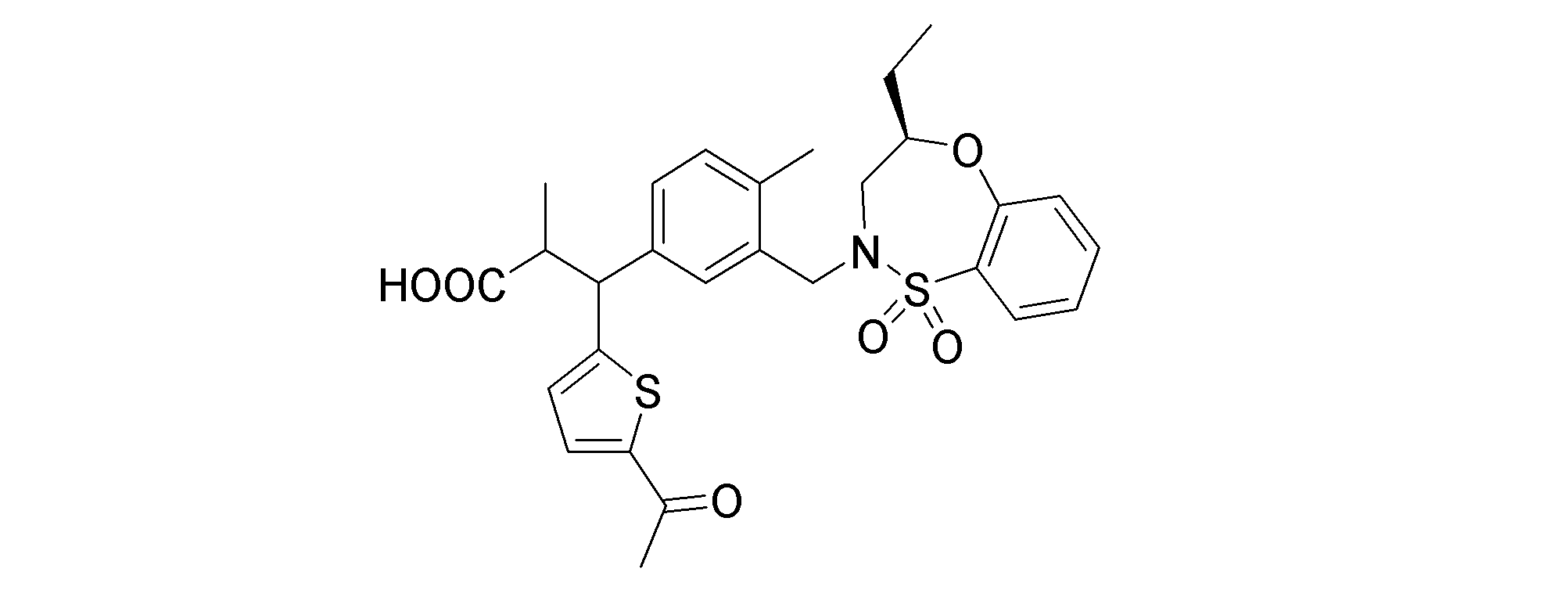
1H NMR(400 MHz, CDCl3)δ 7.88 (1H, dd, J = 7.6, 1.6 Hz), 7.53 (1H, td, J = 7.6, 1.6 Hz), 7.49-7.47 (1H, m), 7.28-7.24 (1H, m), 7.21 (1H, br d, J = 8.0 Hz), 7.17-7.12 (2H, m), 7.11-7.07 (1H, m), 6.96 (1H, d, J = 3.6 Hz), 4.61-4.53 (1H, m), 4.34 (1H, d, J = 11.2 Hz), 4.06-3.95 (1H, m), 3.89-3.78 (1H, m), 3.76-3.68 (1H, m), 3.23-3.15 (1H, m), 2.98-2.89 (1H, m), 2.46 (3H, s), 2.34-2.33 (3H, m), 1.75-1.58 (1H, m), 1.48-1.32 (1H, m), 1.11-1.05 (6H, m)。
3-(5-シアノチオフェン-2-イル)-3-(3-{[(R)-4-エチル-1,1-ジオキシド-3,4-ジヒドロ-2H-ベンゾ[b][1,4,5]オキサチアゼピン-2-イル]メチル}-4-メチルフェニル)プロパン酸(化合物19)の製造
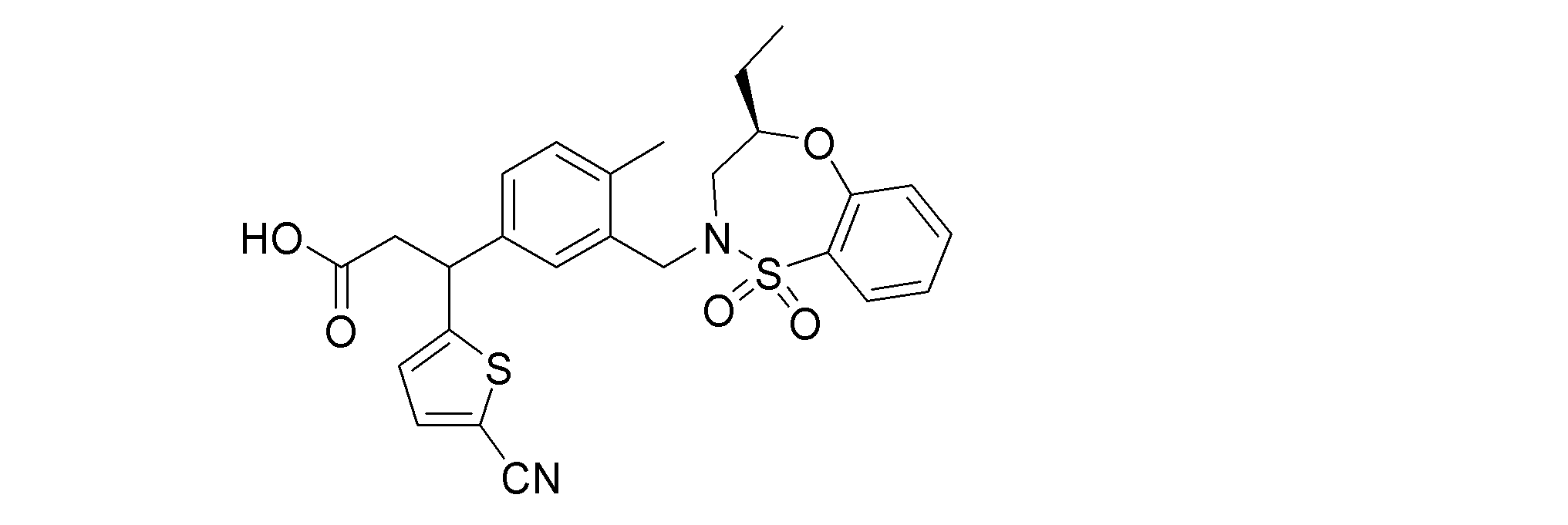
1H NMR(400 MHz, CDCl3)δ 7.87 (1H, dd, J = 7.6, 1.6 Hz), 7.53 (1H, td, J = 7.6, 1.6 Hz), 7.43 (1H, dd, J = 3.6, 0.8 Hz), 7.27-7.20 (2H, m), 7.17-7.10 (3H, m), 6.86 (1H, br d, J = 4.0 Hz), 4.70 (1H, t, J = 7.6 Hz), 4.54-4.49 (1H, m), 4.04-3.97 (1H, m), 3.86-3.82 (1H, m), 3.77-3.68 (1H, m), 3.15-3.01 (2H, m), 2.97 (1H, dd, J = 14.0, 5.2 Hz), 2.31 (3H, s), 1.75-1.63 (1H, m), 1.47-1.37 (1H, m), 1.11-1.05 (3H, m)。
3-(5-アセチルチオフェン-2-イル)-3-(3-{[(R)-4-エチル-1,1-ジオキシド-3,4-ジヒドロ-2H-ベンゾ[b][1,4,5]オキサチアゼピン-2-イル]メチル}-4-メチルフェニル)-2,2-ジメチルプロパン酸(化合物6)の製造

1H NMR (400 MHz, CDCl3) δ 7.88 (1H, dt, J = 7.6, 2.0 Hz), 7.55-7.51 (2H, m), 7.28-7.21 (4H, m), 7.13 (1H, d, J = 7.6 Hz), 7.00 (1H, d, J = 4.0 Hz), 4.72-4.70 (1H, m), 4.55 (1H, d, J = 14.0 Hz), 4.05-3.96 (1H, m), 3.84-3.82 (1H, m), 3.74 (1H, dd, J = 15.2, 10.8 Hz), 2.98-2.97 (1H, m), 2.50 (3H, s), 2.33 (3H, s), 1.75-1.58 (1H, m), 1.50-1.39 (1H, m), 1.32 (3H, s), 1.25 (3H, s), 1.10-1.05 (3H, m)。
3-(5-アセチルチオフェン-2-イル)-3-(3-{[(R)-4-エチル-9-フルオロ-1,1-ジオキシド-3,4-ジヒドロ-2H-ベンゾ[b][1,4,5]オキサチアゼピン-2-イル]メチル}-4-メチルフェニル)-2,2-ジメチルプロパン酸(化合物9)の製造

1H NMR (400 MHz, CDCl3) δ 7.52 (1H, br s), 7,44-7.37 (1H, m), 7.37-7.34 (1H, m), 7.27-7.23 (1H, m), 7.14-7.10 (1H, m), 7.04 (1H, br t, J = 4.0 Hz), 6.99-6.94 (1H, m), 6.77-6.75 (1H, m), 4.78-4.55 (1H, m), 4.75 (1H, s), 4.52-4.42 (1H, m), 4.23-4.18 (1H, m), 3.50-3.32 (1H, m), 3.15-2.84 (1H, m), 2.49 (3H, s), 2.34-2.32 (3H, m), 1.61-1.49 (2H, m), 1.33 (3H, s), 1,26 (3H, s), 1.04-0.96 (3H, m)。
3-(5-アセチルチオフェン-2-イル)-3-(4-{[(R)-4-エチル-1,1-ジオキシド-3,4-ジヒドロ-2H-ベンゾ[b][1,4,5]オキサチアゼピン-2-イル]メチル}-1H-ベンゾ[d]イミダゾール-6-イル)プロパン酸(化合物45)の製造

1H NMR (400 MHz, CDCl3) δ 8.11 (1H, s), 7.87 (1H, s), 7.86 (1H, d, J =7.6 Hz), 7.54 (1H, t, J = 7.6 Hz), 7.51 (1H, br s), 7.28-7.24 (1H, m), 7.22 (1H, d, J = 8.0 Hz), 6.95 (1H, s), 6.89 (1H, br s), 4.97-4.95 (1H, m), 4.69-4.66 (1H, m), 4.08-4.00 (1H, m), 3.97-3.92 (1H, m), 3.70-3.62 (1H, m), 3.24-3.22 (1H, m), 3.14-3.11 (1H, m), 3.04-3.01 (1H, m), 2.47 (3H, s), 1.76-1.67 (1H, m), 1.57-1.47 (1H, m), 1.10-1.08 (3H, m)。
3-(5-アセチル-4-メチルチオフェン-2-イル)-3-(3-{[(R)-4-エチル-1,1-ジオキシド-3,4-ジヒドロ-2H-ベンゾ [b][1,4,5]オキサチアゼピン-2-イル]メチル}-4-メチルフェニル)-2-メチルプロパン酸(化合物2)の製造

1H NMR(400 MHz, CDCl3)δ 7.86 (1H, d, J =7.6 Hz), 7.53 (1H, d, J = 7.6 Hz), 7.26 (1H, t, J = 7.2 Hz), 7.21 (1H, d, J = 8.0 Hz), 7.18-7.07 (3H, m), 6.78 (1H, s), 4.57-4.54 (1H, d, J = 14.0 Hz), 4.29 (1H, d, J = 10.8 Hz), 4.07-3.98 (1H, m), 3.83-3.82 (1H, m), 3.75-3.67 (1H, m), 3.23-3.17 (1H, m), 2.93-2.47 (1H, m), 2.44 (3H, s), 2.42 (3H, s), 2.34 (3H, br s), 1.75-1.60 (1H, m), 1.44-1.33 (1H, m), 1.11-1.04 (6H, m)。
3-(5-アセチルチアゾール-2-イル)-3-(3-{[(R)-4-エチル-1,1-ジオキシド-3,4-ジヒドロ-2H-ベンゾ [b][1,4,5]オキサチアゼピン-2-イル]メチル}-4-メチルフェニル)プロパン酸(化合物40)の製造
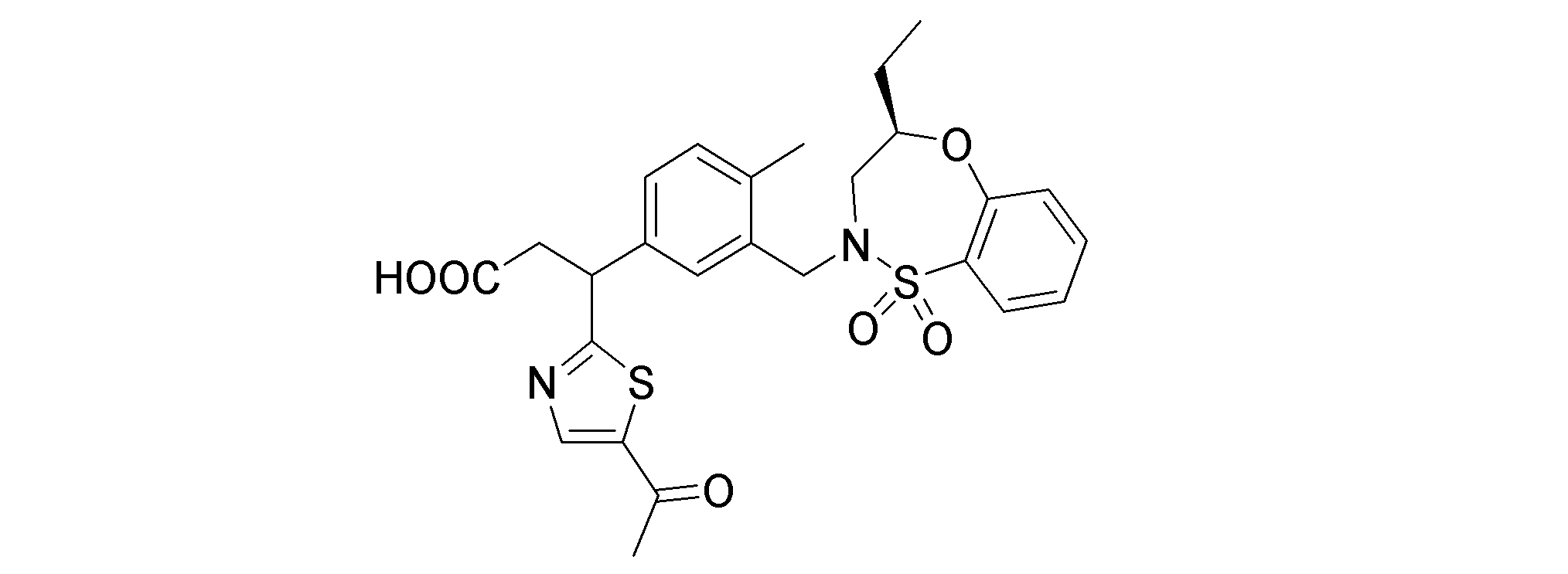
1H NMR (400 MHz, CDCl3) δ 8.17 (1H, s), 7.87 (1H, d, J = 7.6 Hz), 7.52 (1H, t, J = 7.6 Hz), 7.25-7.16 (5H, m), 4.78 (1H, br s), 4.53 (1H, d, J = 14.0 Hz), 4.06-3.96 (1H, m), 3.84 (1H, t, J = 13.2 Hz), 3.76-3.61 (1H, m), 3.47-3.40 (1H, m), 3.04-2.93 (2H, m), 2.50 (3H, s), 2.33 (3H, s), 1.73-1.58 (1H, m), 1.50-1.40 (1H, m), 1.08-1.06 (3H, m)。
3-(5-アセチル-4-メチルチアゾール-2-イル)-3-(3-{[(R)-4-エチル-1,1-ジオキシド-3,4-ジヒドロ-2H-ベンゾ [b][1,4,5]オキサチアゼピン-2-イル]メチル}-4-メチルフェニル)プロパン酸(化合物41)の製造

1H NMR (400 MHz, CDCl3) δ 7.87 (1H, d, J = 7.6 Hz), 7.51 (1H, t, J = 7.6 Hz), 7.25 (1H, t, J = 7.6 Hz), 7.20-7.14 (4H, m), 4.69 (1H, t, J = 7.2 Hz), 4.55 (1H, d, J = 14.0 Hz), 4.05-3.96 (1H, m), 3.84-3.82 (1H, m), 3.75-3.70 (1H, m), 3.44 (1H, dd, J = 16.4, 7.6 Hz), 3.04-2.93 (2H, m), 2.67 (3H, s), 2,43 (3H, s), 2.34 (3H, br s), 1.72-1.62 (1H, m), 1.51-1.36 (1H, m), 1,07-1.04 (3H, m)。
3-(3-{[(R)-4-エチル-1,1-ジオキシド-3,4-ジヒドロ-2H-ベンゾ [b][1,4,5]オキサチアゼピン-2-イル]メチル}-4-メチルフェニル)-3-(6-オキソ-5,6-ジヒドロ-4H-チエノ[2,3-c]ピロール-2-イル)プロパン酸(化合物38)の製造

1H NMR (400 MHz, CDCl3) δ 7.87 (1H, d, J = 7.6 Hz), 7.52 (1H, t, J = 7.6 Hz), 7.26-7.23 (1H, m), 7.20 (1H, d, J = 8.0 Hz), 7.15-7.21 (4H, m), 6.86 (1H, s), 4.75 (1H, t, J = 7.2 Hz), 4.54-4.53 (1H, m), 4.25 (2H, s), 4.03-3.96 (1H, m), 3.84-3.82 (1H, m), 3.73-3.65 (1H, m), 3.12 (1H, dd, J = 16.0, 8.0 Hz), 3.03 (1H, d, J = 16.0, 7.2 Hz), 2.96 (1H, d, J = 14.4 Hz), 2.32 (3H, s), 1.71-1.60 (1H, m), 1.46-1.36 (1H, m), 1.05 (3H, t, J = 7.2 Hz)。
3-(5-アセチルフラン-2-イル) -3-(3-{[(R)-4-エチル-1,1-ジオキシド-3,4-ジヒドロ-2H-ベンゾ[b][1,4,5]オキサチアゼピン-2-イル]メチル}-4-メチルフェニル)プロパン酸(化合物25)の製造
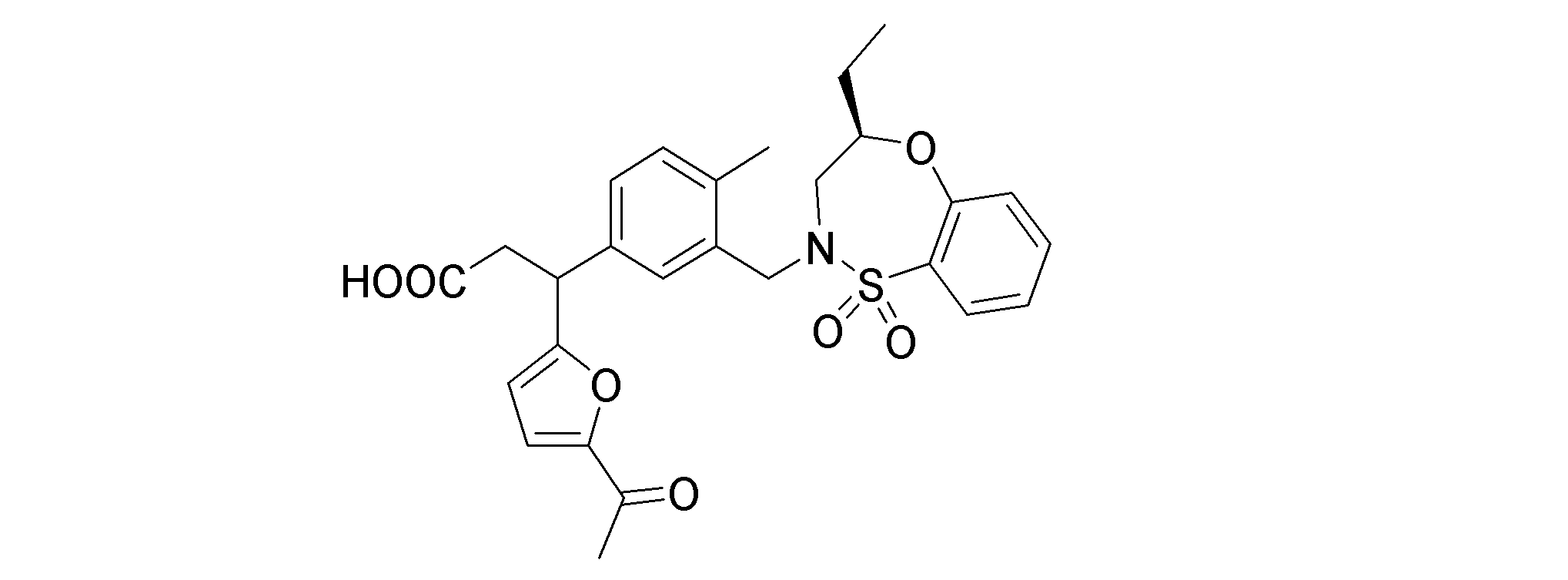
1H NMR(400 MHz, CDCl3)δ 7.87 (1H, dd, J = 8.0, 1.6 Hz), 7.51 (1H, td, J = 8.0, 1.6 Hz), 7.26-7.19 (2H, m), 7.15-7.10 (3H, m), 7.06 (1H, d, J = 3.6 Hz), 6.15-6.13 (1H, m), 4.56-4.50 (2H, m), 4.04-3.96 (1H, m), 3.85-3.80 (1H, m), 3.76-3.68 (1H, m), 3.18-3.12 (1H, m), 3.00-2.89 (2H, m), 2.39 (3H, s), 2.31 (3H, s), 1.70-1.64 (1H, m), 1.49-1.38 (1H, m), 1.08-1.04 (3H, m)。
3-(5-アセチルチオフェン-3-イル)-3-(3-{[(R)-4-エチル-1,1-ジオキシド-3,4-ジヒドロ-2H-ベンゾ[b][1,4,5]オキサチアゼピン-2-イル]メチル}-4-メチルフェニル)プロパン酸(化合物15)の製造
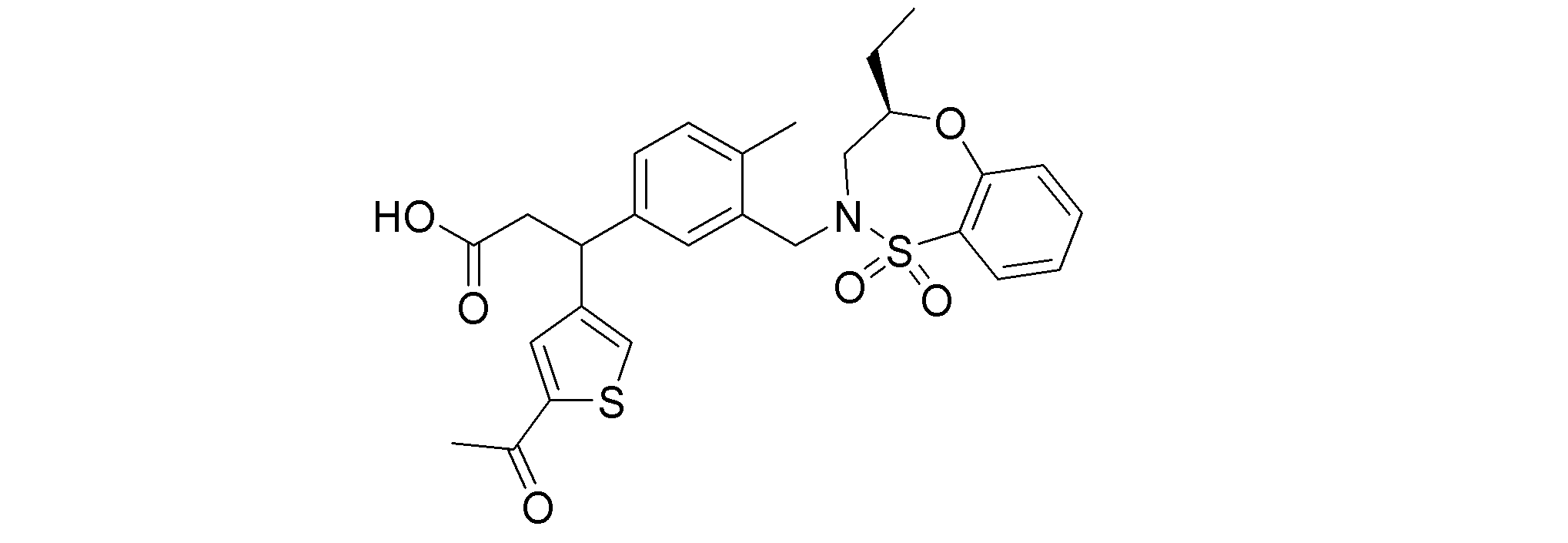
1H NMR(400 MHz, CDCl3)δ 7.86 (1H, d, J = 8.0 Hz), 7.51 (1H, br t, J = 8.0 Hz), 7.45 (1H, dd, J = 4.0, 1.2 Hz), 7.29 (1H, br s), 7.26-7.18 (2H, m), 7.13-7.05 (3H, m), 4.53-4.49 (2H, m), 4.01-3.94 (1H, m), 3.84-3.79 (1H, m), 3.74-3.67 (1H, m), 3.07-2.92 (3H, m), 2.47 (3H, s), 2.29 (3H, s), 1.69-1.60 (1H, m), 1.45-1.33 (1H, m), 1.04 (3H, t, J = 7.2 Hz)。
3-(4-アセチルチオフェン-2-イル)-3-(3-{[(R)-4-エチル-1,1-ジオキシド-3,4-ジヒドロ-2H-ベンゾ[b][1,4,5]オキサチアゼピン-2-イル]メチル}-4-メチルフェニル)プロパン酸(化合物10)の製造

1H NMR(400 MHz, CDCl3)δ 7.88 (1H, br d, J = 8.0 Hz), 7.84 (1H, br s), 7.52 (1H, br t, J = 8.0 Hz), 7.27-7.23 (2H, m), 7.21-7.18 (1H, m), 7.16-7.11 (2H, m), 7.08-7.05 (1H, m), 4.65-4.61 (1H, m), 4.55 (1H, d, J = 14.0 Hz), 4.02-3.94 (1H, m), 3.83-3.68 (2H, m), 3.15-3.12 (1H, m), 3.04-2.90 (2H, m), 2.47 (3H, s), 2.29 (3H, br s), 1.69-1.60 (1H, m), 1.45-1.33 (1H, m), 1.06-1.02 (3H, m)。
3-(5-シアノ-1-メチル-1H-ピロール-3-イル)-3-(3-{[(R)-4-エチル-1,1-ジオキシド-3,4-ジヒドロ-2H-ベンゾ[b][1,4,5]オキサチアゼピン-2-イル]メチル}-4-メチルフェニル)プロパン酸(化合物36)の製造
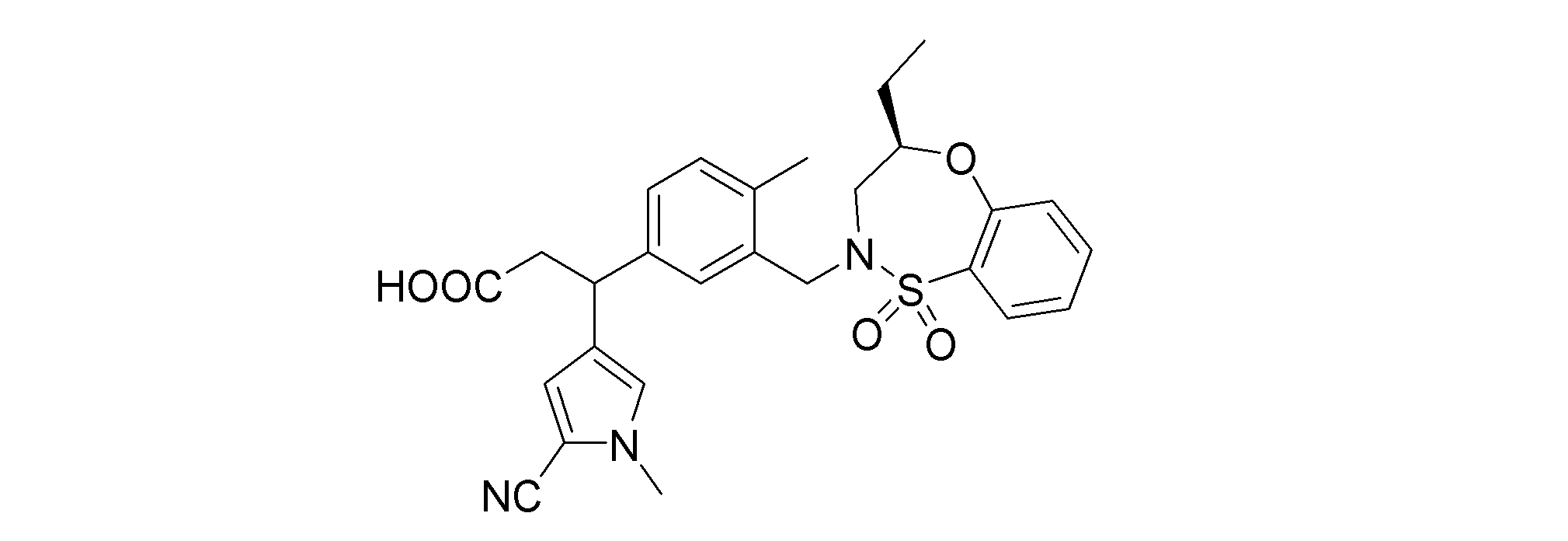
1H NMR(400 MHz, CDCl3)δ 7.88 (1H, dd, J = 8.0, 1.6 Hz), 7.52 (1H, td, J = 8.0, 1.6 Hz), 7.25 (1H, td, J = 8.0, 1.2 Hz), 7.21 (1H, d, J = 8.0 Hz), 7.13-7.11 (1H, m), 7.08-7.06 (2H, m), 6.57-6.54 (2H, m), 4.53 (1H, d, J = 14.4 Hz), 4.33-4.29 (1H, m), 4.04-3.97 (1H, m), 3.85-3.81 (1H, m), 3.75-3.70 (1H, m), 3.68 (3H, s), 2.99-2.82 (3H, m), 2.31 (3H, s), 1.73-1.64 (1H, m), 1.47-1.38 (1H, m), 1.09-1.06 (3H, m)。
3-(3-アセチルチオフェン-2-イル)-3-(3-{[(R)-4-エチル-1,1-ジオキシド-3,4-ジヒドロ-2H-ベンゾ[b][1,4,5]オキサチアゼピン-2-イル]メチル}-4-メチルフェニル)プロパン酸(化合物44)の製造

1H NMR(400 MHz, CDCl3)δ 7.88 (1H, br d, J = 8.0 Hz), 7.51 (1H, br t, J = 8.0 Hz), 7.33 (1H, d, J = 5.6 Hz), 7.27-7.19 (3H, m), 7.14-7.10 (3H, m), 5.62-5.57 (1H, m), 4.61-4.56 (1H, m), 4.02-3.96 (1H, m), 3.78-3.66 (2H, m), 3.14-3.07 (1H, m), 3.02-2.89 (2H, m), 2.48 (3H, br s), 2.35 (3H, br s), 1.69-1.56 (1H, m), 1.45-1.35 (1H, m), 1.10-1.02 (3H, m)。
3-(5-アセチルチオフェン-2-イル)-2,2-ジメチル-3-(4-メチル-3-{[(R)-4-メチル-1,1-ジオキシド-3,4-ジヒドロ-2H-ベンゾ[b][1,4,5]オキサチアゼピン-2-イル]メチル}フェニル)プロパン酸(化合物12)の製造

1H NMR(400 MHz, CDCl3)δ 7.88 (1H, br d, J = 8.0 Hz), 7.55-7.50 (2H, m), 7.28-7.20 (4H, m), 7.15-7.12 (1H, m), 7.01-7.00 (1H, m), 4.71 (1H, d, J = 4.8 Hz), 4.58-4.57 (1H, m), 4.35-4.26 (1H, m), 3.84-3.70 (2H, m), 2.95-2.91 (1H, m), 2.50 (3H, s), 2.34 (3H, br s), 1.34-1.31 (3H, m), 1.28-1.24 (6H, m)。
3-(5-アセチルフラン-2-イル)-3-(3-{[(R)-4-エチル-1,1-ジオキシド-3,4-ジヒドロ-2H-ベンゾ[b][1,4,5]オキサチアゼピン-2-イル]メチル}-4-メチルフェニル)-2-メチルプロパン酸(化合物24)の製造

1H NMR(400 MHz, CDCl3)δ 7.89 (1H, dd, J = 8.0, 1.6 Hz), 7.53 (1H, td, J = 8.0, 1.6 Hz), 7.28-7.24 (1H, m), 7.23-7.20 (1H, m), 7.18-7.11 (3H, m), 7.06 (1H, br d, J = 3.6 Hz), 6.25 (1H, d, J = 3.6 Hz), 4.58-4.52 (1H, m), 4.24 (1H, d, J = 10.8 Hz), 4.07-3.97 (1H, m), 3.89-3.81 (1H, m), 3.76-3.68 (1H, m), 3.22-3.16 (1H, m), 3.00-2.93 (1H, m), 2.39 (3H, s), 2.33 (3H, s), 1.74-1.63 (1H, m), 1.49-1.35 (1H, m), 1.10-1.04 (6H, m)。
3-(5-アセチルチオフェン-2-イル)-3-(3-{[(R)-4-エチル-1,1-ジオキシド-3,4-ジヒドロ-2H-ピリド[2,3-b][1,4,5]オキサチアゼピン-2-イル]メチル}-4-メチルフェニル)-2,2-ジメチルプロパン酸(化合物46)の製造

1H NMR(400 MHz, CDCl3)δ 8.22 (1H, br t, J = 8.0 Hz), 7.69-7.64 (1H, m), 7.51 (1H, t, J = 3.6 Hz), 7.32-7.19 (2H, m), 7.07-7.03 (2H, m), 6.43-6.38 (1H, m), 4.66-4.38 (3H, m), 3.51-3.25 (3H, m), 2.48-2.46 (3H, m), 2.28 (3H, s), 1.33-1.24 (8H, m), 0.81-0.76 (3H, m)。
3-(5-アセチルチオフェン-2-イル)-3-[3-({4-[2-(ベンジロキシ)エチル]-1,1-ジオキシド-3,4-ジヒドロ-2H-ベンゾ[b][1,4,5]オキサチアゼピン-2-イル}メチル)-4-メチルフェニル]-2-メチルプロパン酸(化合物13)の製造

1H NMR(400 MHz, CDCl3)δ 7.88 (1H, dd, J = 7.6, 1.2 Hz), 7.50-7.42 (2H, m), 7.39-7.24 (6H, m), 7.18-7.00 (3H, m), 6.96-6.77 (2H, m), 4.76-4.36 (4H, m), 4.34-4.19 (1H, m), 3.93-3.80 (2H, m), 3.77-3.74 (1H, m), 3.63-3.58 (1H, m), 3.31-3.19 (1H, m), 2.88-2.76 (1H, m), 2.47-2.44 (3H, m), 2.39-2.31 (3H, m), 2.00-1.64 (2H, m), 1.12 (3H, t, J = 6.8 Hz)。
3-(5-アセチルチオフェン-2-イル)-3-(3-{[4-(2-ヒドロキシエチル)-1,1-ジオキシド-3,4-ジヒドロ-2H-ベンゾ[b][1,4,5]オキサチアゼピン-2-イル]メチル}-4-メチルフェニル)-2-メチルプロパン酸(化合物43a, 43b)の製造

43a: 1H NMR(400 MHz, CDCl3)δ 7.90-7.85 (1H, m), 7.55-7.40 (2H, m), 7.31-7.27 (1H, m), 7.24-7.13 (2H, m), 7.10-7.03 (2H, m), 6.92-6.82 (1H, m), 4.74-4.62 (1H, m), 4.41-4.39 (1H, m), 4.31-4.18 (1H, m), 4.04-3.77 (3H, m), 3.72-3.60 (1H, m), 3.12-3.05 (1H, m), 2.87-2.77 (1H, m), 2.49-2.29 (1H, m), 1.89-1.56 (2H, m), 1.12-0.92 (3H, m)。
43b: 1H NMR(400 MHz, CDCl3)δ 7.90-7.85 (1H, m), 7.55-7.47 (1H, m), 7.42-7.32 (1H, m), 7.29-7.24 (1H, m), 7.22-7.13 (2H, m), 7.11-7.03 (2H, m), 6.93-6.84 (1H, m), 4.75-4.61 (1H, m), 4.44-4.18 (2H, m), 4.05-3.79 (3H, m), 3.73-3.60 (1H, m), 3.15-3.09 (1H, m), 2.88-2.77 (1H, m), 2.49-2.30 (6H, m), 1.91-1.77 (1H, m), 1.63-1.53 (1H, m), 1.14-0.96 (3H, m)。
3-(5-アセチル-4-メトキシチオフェン-2-イル)-3-(3-{[(R)-4-エチル-1,1-ジオキシド-3,4-ジヒドロ-2H-ベンゾ[b][1,4,5]オキサチアゼピン-2-イル]メチル}-4-メチルフェニル)-2,2-ジメチルプロパン酸(化合物4)の製造

1H NMR(400 MHz, CDCl3)δ 7.88 (1H, br d, J = 7.6 Hz), 7.53 (1H, br t, J = 7.6 Hz), 7.28-7.20 (5H, m), 7.12 (1H, dd, J = 7.6, 2.4 Hz), 6.82-6.80 (1H, m), 4.60 (1H, d, J = 3.6 Hz), 4.54 (1H, d, J = 14.4 Hz), 4.03-3.99 (1H, m), 3.93 (3H, s), 3.87-3.81 (1H, m), 3.78-3.71 (1H, m), 2.97 (1H, dd, J = 7.6, 1.2 Hz), 2.47 (3H, br s), 2.32 (3H, s), 1.74-1.62 (1H, m), 1.49-1.37 (1H, m), 1.33 (3H, br s), 1.25 (3H, br s), 1.11-1.06 (3H, m)。
3-(4-アセチルチオフェン-2-イル)-3-(3-{[(R)-4-エチル-1,1-ジオキシド-3,4-ジヒドロ-2H-ベンゾ[b][1,4,5]オキサチアゼピン-2-イル]メチル}-4-メチルフェニル)-2-メチルプロパン酸(化合物3)の製造

1H NMR(400 MHz, CDCl3)δ 7.88 (1H, br d, J = 7.6 Hz), 7.83 (1H, dd, J = 10.4, 1.2 Hz), 7.55-7.50 (1H, m), 7.36-7.35 (1H, m), 7.28-7.25 (1H, m), 7.24-7.19 (1H, m), 7.17-7.04 (3H, m), 4.66-4.53 (1H, m), 4.30 (1H, d, J = 10.8 Hz), 4.03-3.64 (3H, m), 3.31-3.02 (1H, m), 2.96-2.88 (1H, m), 2.46-2.44 (3H, m), 2.35-2.33 (3H, m), 1.70-1.60 (1H, m), 1.44-1.32 (1H, m), 1.09-1.03 (6H,m)。
3-(5-アセチルチオフェン-2-イル)-3-(3-{[(R)-4-エチル-1,1-ジオキシド-3,4-ジヒドロ-2H-ピリド[4,3-b][1,4,5]オキサチアゼピン-2-イル]メチル}-4-メチルフェニル)-2-メチルプロパン酸(化合物16)の製造

1H NMR(400 MHz, CDCl3)δ 9.02 (1H, s), 8.67-8.65 (1H, m), 7.49-7.47 (1H, m), 7.17 (2H, s), 7.12-7.10 (2H, m), 6.99-6.97 (1H, m), 4.47-4.36 (3H, m), 4.22-4.10 (1H, m), 3.50-3.40 (1H, m), 3.26-3.12 (2H, m), 2.47 (3H, s), 2.33 (3H, s), 1.74-1.63 (1H, m), 1.56-1.48 (1H, m), 1.12 (3H, d, J = 6.8 Hz), 1.06-1.02 (3H, m)。
3-(5-アセチルチオフェン-2-イル)-3-(3-{[4-(2-メトキシエチル)-1,1-ジオキシド-3,4-ジヒドロ-2H-ベンゾ[b][1,4,5]オキサチアゼピン-2-イル]メチル}-4-メチルフェニル)-2-メチルプロパン酸(化合物42)の製造

1H NMR(400 MHz, CDCl3)δ 7.96-7.89 (1H, m), 7.59-7.54 (1H, m), 7.52-7.46 (1H, m), 7.37-7.27 (2H, m), 7.20-7.10 (3H, m), 6.97-6.88 (1H, m), 4.81-4.73 (1H, m), 4.64-4.43 (1H, m), 4.36-4.21 (1H, m), 3.91-3.72 (3H, m), 3.67-3.54 (1H, m), 3.49-3.41 (3H, m), 3.35-3.16 (1H, m), 2.88-2.69 (1H, m), 2.50-2.35 (6H, m), 1.89-1.74 (1H, m), 1.69-1.66 (1H, m), 1.21-1.12 (3H, m)。
3-(5-アセチル-4-フルオロチオフェン-2-イル)-3-(3-{[(R)-4-エチル-1,1-ジオキシド-3,4-ジヒドロ-2H-ベンゾ[b][1,4,5]オキサチアゼピン-2-イル]メチル}-4-メチルフェニル)-2,2-ジメチルプロパン酸(化合物11)の製造
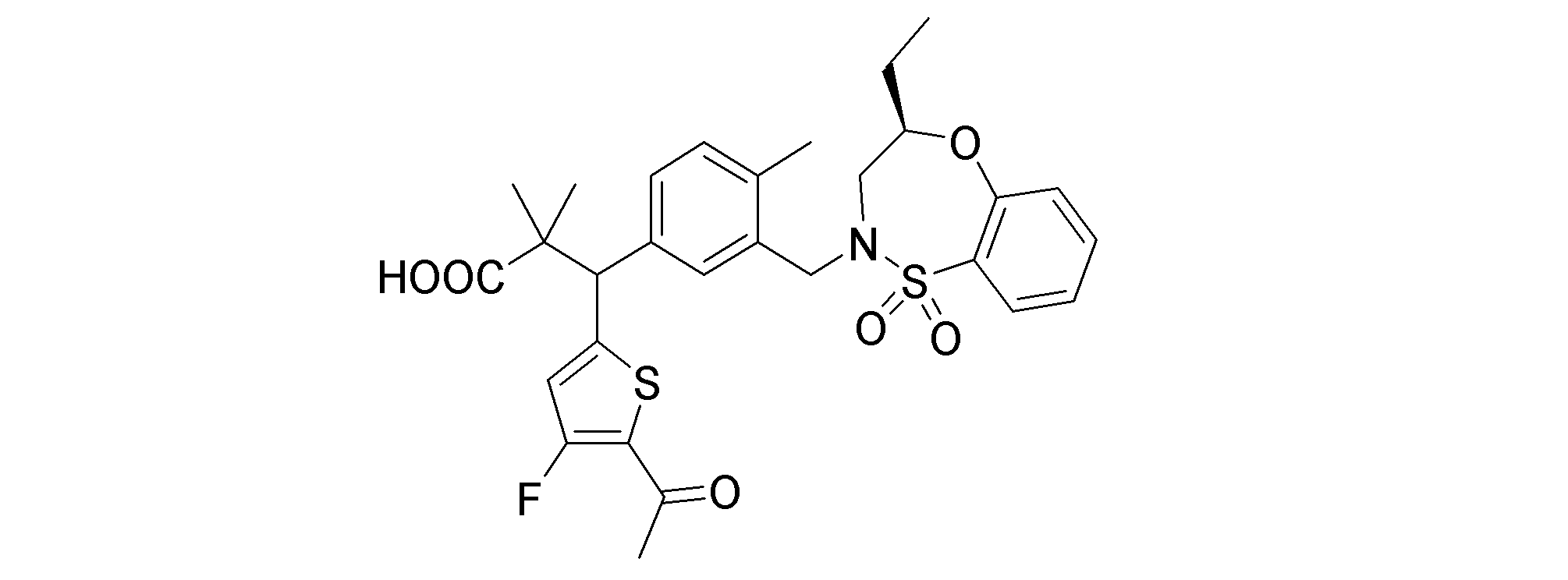
1H NMR(400 MHz, CDCl3)δ 7.88 (1H, dt, J = 8.0, 1.6 Hz), 7.53 (1H, br t, J = 8.0 Hz), 7.28-7.20 (4H, m), 7.16-7.14 (1H, m), 6.79 (1H, d, J = 5.2 Hz), 4.57-4.54 (2H, m), 4.06-4.01 (1H, m), 3.86-3.84 (1H, m), 3.74 (1H, dd, J = 15.2, 10.4 Hz), 2.97 (1H, dd, J = 15.2, 5.6 Hz), 2.51 (3H, br s), 2.34 (3H, s), 1.74-1.61 (1H, m), 1.49-1.41 (1H, m), 1.33 (3H, s), 1.26 (3H, br s), 1.08 (3H, br t, J = 7.2 Hz)。
3-(5-アセチルチオフェン-2-イル)-3-(3-{[(R)-4-エチル-1,1-ジオキシド-3,4-ジヒドロ-2H-ピリド[4,3-b][1,4,5]オキサチアゼピン-2-イル]メチル}-4-メチルフェニル)-2,2-ジメチルプロパン酸(化合物48)の製造

1H NMR (400 MHz, CDCl3) δ 9.00 (1H, br s), 8.66-8.63 (1H, m), 7.54 (1H, d, J = 3.6 Hz), 7.30-7.26 (2H, m), 7.16-7.10 (2H, m), 7.05-7.03 (1H, m), 4.75-4.74 (1H, m), 4.46-4.37 (2H, m), 4.17-4.11 (1H, m), 3.46-3.43 (1H, m), 3.20-3.14 (1H, m), 2.50 (3H, s), 2.32 (3H, s), 1.73-1.63 (1H, m), 1.57-1.47 (1H, m), 1.32 (3H, s), 1.27-1.26 (3H, m), 1.06-1.02 (3H, m)。
3-(5-アセチルチオフェン-2-イル)-3-(3-{[(R)-4-エチル-1,1-ジオキシド-3,4-ジヒドロ-2H-ピリド[4,3-b][1,4,5]オキサチアゼピン-2-イル]メチル}-4-メチルフェニル)プロパン酸(化合物53)の製造
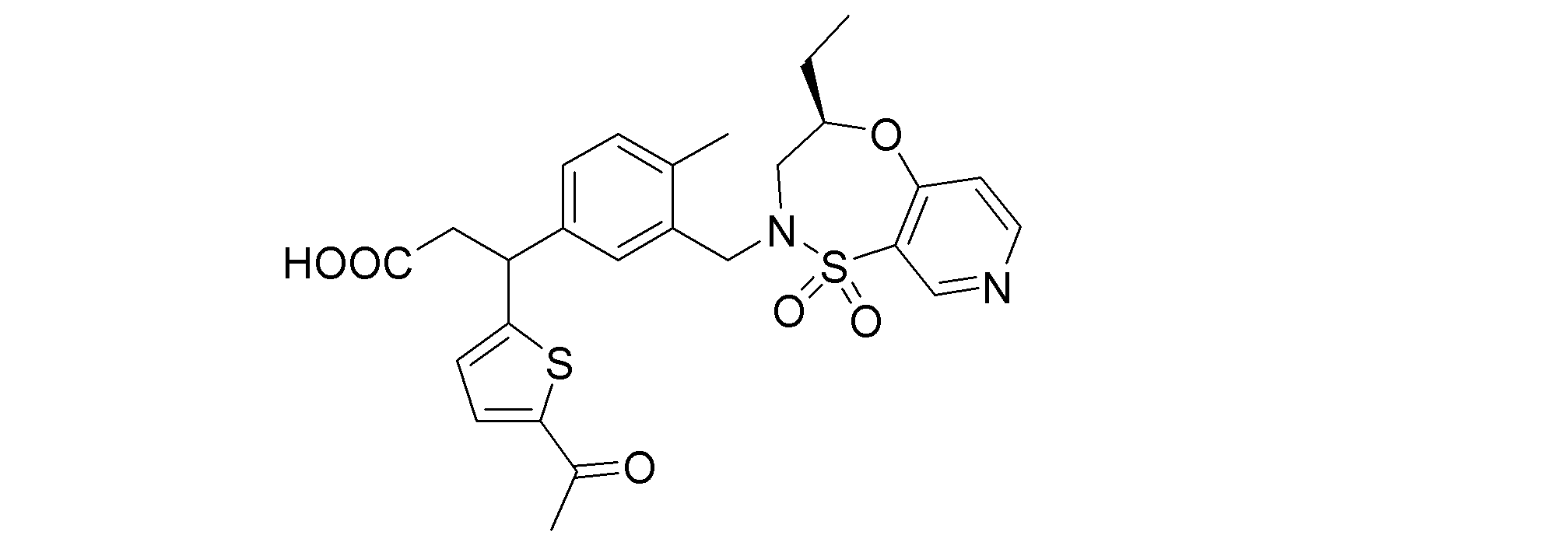
1H NMR(400 MHz, CDCl3)δ 9.00 (1H, s), 8.62 (1H, d, J = 5.6 Hz), 7.49 (1H, br s), 7.16-7.08 (4H, m), 6.88 (1H, br s), 4.71 (1H, t, J = 7.6 Hz) 4.43-4.37 (2H, m), 4.16-4.12 (1H, m), 3.51-3.42 (1H, m), 3.19-3.02 (3H, m), 2.47 (3H, s), 2.32 (3H, s), 1.70-1.61 (1H, m), 1.56-1.48 (1H, m), 1.02 (3H, t, J = 7.6 Hz)。
3-(5-アセチル-4-フルオロチオフェン-2-イル)-3-(3-{[(R)-4-エチル-1,1-ジオキシド-3,4-ジヒドロ-2H-ピリド[4,3-b][1,4,5]オキサチアゼピン-2-イル]メチル}-4-メチルフェニル)-2,2-ジメチルプロパン酸(化合物49)の製造

1H NMR (400 MHz, CDCl3) δ 9.00, 8.99 (each 0.5H, s), 8.65, 8.64 (each 0.5H, d, J = 5.6 Hz), 7.26-7.23 (3H, m), 7.16 (1H, d, J = 7.6 Hz), 7.11, 7.10 (each 0.5H, d, J = 5.4 Hz), 6.84, 6.83 (each 0.5H, s), 4.59, 4.58 (each 0.5H, s), 4.51-4.43 (1H, m), 4.39, 4.38 (each 0.5H, d, J = 14.4 Hz), 4.17 (1H, d, J = 14.4 Hz), 3.50-3.42 (1H, m), 3.21, 3.18 (each 0.5H, dd, J = 14.4, 4.8 Hz), 2.52, 2.51 (each 1.5H, s), 2.33, 2.32 (each 1.5H, s), 1.74-1.63 (1H, m), 1.61-1.50 (1H, m), 1.34, 1.33 (each 1.5H, s), 1.25 (3H, s), 1.04 (3H, t, J = 7.2 Hz)。
3-(5-アセチル-4-メトキシチオフェン-2-イル)-3-(3-{[(R)-4-エチル-1,1-ジオキシド-3,4-ジヒドロ-2H-ピリド[4,3-b][1,4,5]オキサチアゼピン-2-イル]メチル}-4-メチルフェニル)-2,2-ジメチルプロパン酸(化合物50)の製造

1H NMR (400 MHz, CDCl3) δ 9.01, 9.00 (each 0.5H, s), 8.65, 8.64 (each 0.5H, d, J = 5.6 Hz), 7.29-7.26 (2H, m), 7.14 (1H, d, J = 7.6 Hz), 7.11, 7.10 (each 0,5H, d, J = 5.6 Hz), 6.83, 6.82 (each 0.5H, s), 4.64, 4.61 (each 0.5H, s), 4.48-4.42 (1H, m), 4.37 (1H, d, J = 14.4 Hz), 4.17 (1H, d, J = 14.4 Hz), 3.94 (3H, s), 3.50-3.43 (1H, m), 3.22-3.15 (1H, m), 2.47 (3H, s), 2.312, 2.311 (each 1.5H, s), 1.74-1.64 (1H, m), 1.58-1.50 (1H, m), 1.344, 1.341 (each 1.5H, s), 1.28, 1.27 (each 1.5H, s), 1.05, 1.04 (each 1.5H, t, J = 7.2 Hz)。
3-(5-アセチル-4-フルオロチオフェン-2-イル)-3-(3-{[(R)-4-エチル-1,1-ジオキシド-3,4-ジヒドロ-2H-ピリド[4,3-b][1,4,5]オキサチアゼピン-2-イル]メチル}-4-メチルフェニル)-2-メチルプロパン酸(化合物52)の製造

1H NMR (400 MHz, CDCl3) δ 9.02-9.00 (1H, m), 8.67-8.64 (1H, m), 7.20-7.09 (4H, m), 6.76-6.74 (1H, m), 4.46-4.35 (2H, m), 4.30-4.10 (2H, m), 3.51-3.40 (1H, m), 3.22-3.15 (2H, m), 2.51-2.48 (3H, m), 2.33-2.31 (3H, m), 1.75-1.66 (1H, m), 1.58-1.52 (1H, m), 1.11 (3H, br d, J = 7.2 Hz), 1.05 (3H, br t, J = 7.6 Hz)。
3-(5-アセチル-4-メトキシチオフェン-2-イル)-3-(3-{[(R)-4-エチル-1,1-ジオキシド-3,4-ジヒドロ-2H-ピリド[4,3-b][1,4,5]オキサチアゼピン-2-イル]メチル}-4-メチルフェニル)-2-メチルプロパン酸(化合物51)の製造

1H NMR (400 MHz, CDCl3) δ 9.02 (1H, s), 8.65-8.63 (1H, m), 7.14-7.08 (4H, m), 6.73 (1H, s), 4.46-4.35 (2H, m), 4.29-4.26 (1H, m), 4.22-4.10 (1H, m), 3.87-3.86 (3H, m), 3.55-3.44 (1H, m), 3.22-3.08 (2H, m), 2.38 (3H, br s), 2.31 (3H, s), 1.73-1.65 (1H, m), 1.54-1.49 (1H, m), 1.05-1.01 (6H, m)。
<試験例1-1.Nrf2活性化作用の測定1(Binding assay)>
製造例で製造した化合物1~53を被験物質として用いた。

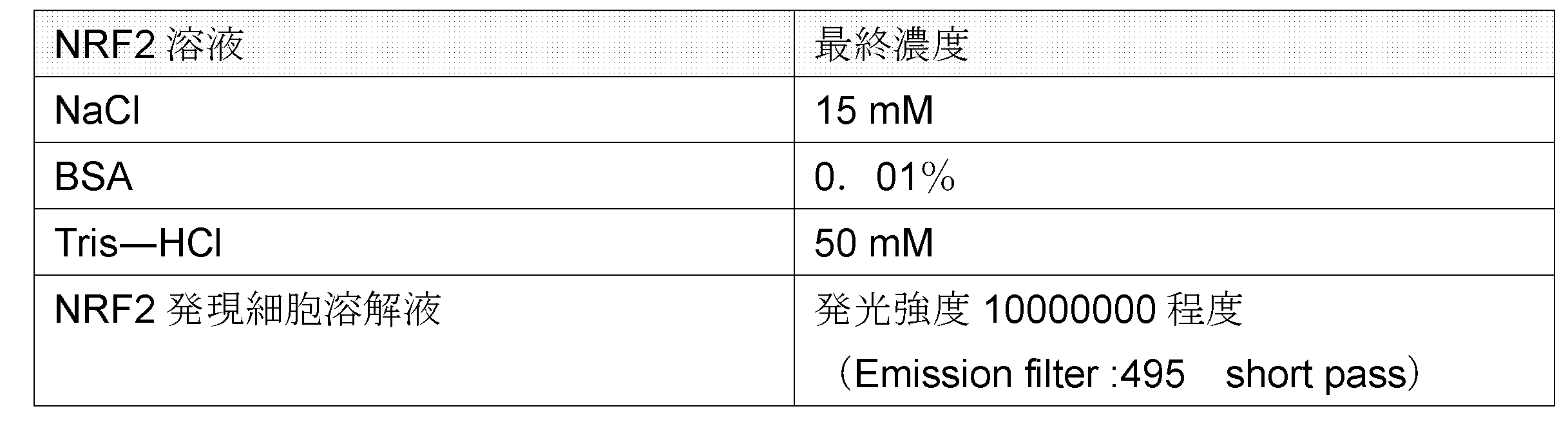
IC50(M)=10^(LOG(A/B)×(50-C)/(D―C)+LOG(B))
A: 阻害率50%を挟む近傍の2濃度うち、高い濃度
B: 阻害率50%を挟む近傍の2濃度うち、低い濃度
C: Bでの阻害率
D: Aでの阻害率
<試験例1-2.Nrf2活性化作用の測定2(Reporter assay)>
化合物の細胞でのNRF2活性可能はレポーター遺伝子アッセイ法を用いて行った。FuGENE HDを用いて、pGL4.37[luc2P/ARE/Hygro](Promega社)をHCE-T細胞に導入し、形質導入の結果、薬剤耐性をもつ細胞を50 μg/mLのHygromycin存在下での培養によって選抜し、クローン株であるHCE-T/ARE-Luc細胞を樹立した。
結果の一部を表3~9に示す。表3~6及び8はIC50(nM, binding assay)の結果を示し、表7及び9はEC50(nM, reporter assay)の結果を示す。表3~9の各化合物の構造は以下の通りである。


で表される化合物がNrf2活性化作用を有することが分かった。また、生理的条件下で加水分解して或いは生体内酵素(例えば生体内のカルボキシエステラーゼ等のエステラーゼ等)により加水分解して一般式(X)で表される化合物を生成するプロドラッグ体(例えば、一般式(X)中の-COOHが、-C(=O)-R7a(R7aは加水分解性基又は-NR71R72(R71及びR72は同一又は異なって、水素原子又は-[C(=O)]0-1-炭化水素基を示す。)を示す。))もまた、一般式(X)で表される化合物のプロドラッグとして有用であると考えられた。
参考例209
メチル 3-(3-{[(4-メトキシベンジル)オキシ]メチル}-4-メチルフェニル)-2-メチル-3-[5-(2-メチル-1,3-ジオキソラン-2-イル)チオフェン-2-イル]プロパノエート アンチ異性体混合物 (isomer mixture 2)の製造

Isomer mixture 1: 1H NMR(400 MHz, CDCl3)δ 7.28-7.26 (3H, m), 7.17-7.15 (1H, m), 7.06 (1H, d, J = 8.0 Hz), 6.89 (2H, br d, J = 8.8 Hz), 6.82 (1H, d, J = 3.6 Hz), 6.74 (1H, d, J = 3.6 Hz), 4.47 (2H, s), 4.43 (2H, s), 4.25 (1H, d, J = 10.8 Hz), 4.01-3.97 (2H, m), 3.96-3.90 (2H, m), 3.81 (3H, s), 3.43 (3H, s), 3.24-3.16 (1H, m), 2.25 (3H, s), 1.71 (3H, s), 1.20 (3H, d, J = 6.8 Hz)。
Isomer mixture 2: 1H NMR(400 MHz, CDCl3)δ 7.28-7.23 (3H, m), 7.11-7.10 (2H, m), 6.89 (2H, br d, J = 8.8 Hz), 6.77 (1H, d, J = 3.6 Hz), 6.71 (1H, br d, J = 3.6 Hz), 4.48 (2H, s), 4.47 (2H, s), 4.27 (1H, d, J = 11.2 Hz), 3.99-3.95 (2H, m), 3.93-3.90 (2H, m), 3.82 (3H, s), 3.58 (3H, s), 3.21-3.16 (1H, m), 2.28 (3H, s), 1.69 (3H, s), 1.05 (3H, d, J = 6.8 Hz)。
メチル 3-(5-アセチルチオフェン-2-イル)-3-(3-{[(4-メトキシベンジル)オキシ]メチル}-4-メチルフェニル)-2-メチルプロパノエート アンチ異性体混合物の製造
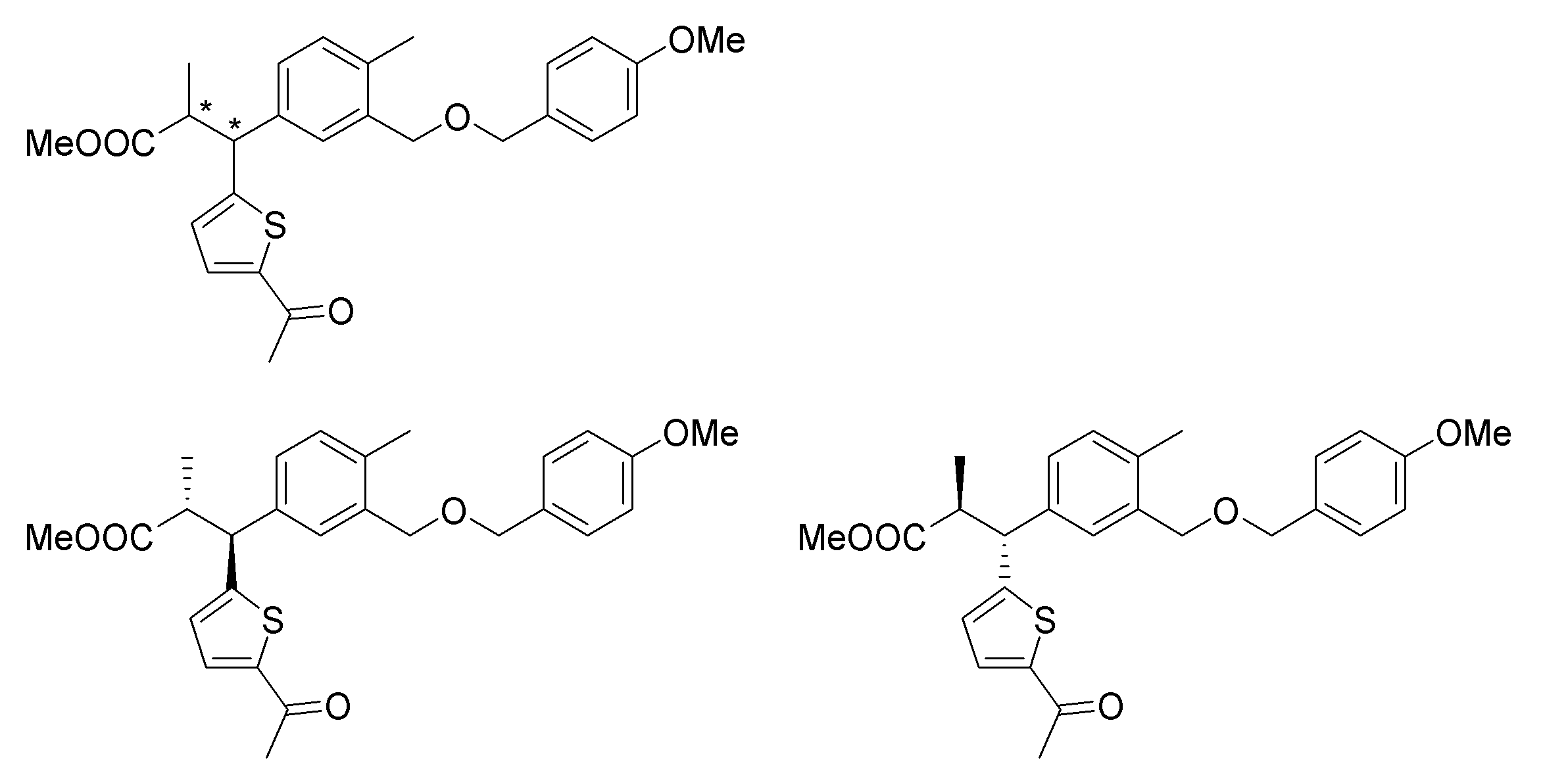
1H NMR(400 MHz, CDCl3)δ 7.46 (1H, d, J = 4.0 Hz), 7.29-7.24 (3H, m), 7.11 (2H, s), 6.92-6.89 (3H, m), 4.49 (2H, s), 4.48 (2H, s), 4.36 (1H, d, J = 11.2 Hz), 3.82 (3H, s), 3.60 (3H, s), 3.25-3.21 (1H, m), 2.46 (3H, s), 2.26 (3H, s), 1.08 (3H, d, J = 6.8 Hz)。
メチル 3-(5-アセチルチオフェン-2-イル)-3-[3-(ヒドロキシメチル)-4-メチルフェニル]-2-メチルプロパノエート アンチ異性体混合物の製造

1H NMR(400 MHz, CDCl3)δ 7.46 (1H, d, J = 4.0 Hz), 7.28 (1H, br s), 7.13 (2H, br s), 6.93 (1H, d, J = 4.0 Hz), 4.68 (2H, d, J = 5.6 Hz), 4.37 (1H, d, J = 11.2 Hz), 3.60 (3H, s), 3.27-3.23 (1H, m), 2.46 (3H, s), 2.30 (3H, s), 1.09 (3H, d, J = 6.8 Hz)。
メチル 3-(5-アセチルチオフェン-2-イル)-3-[3-(クロロメチル)-4-メチルフェニル]-2-メチルプロパノエート アンチ異性体混合物の製造

1H NMR(400 MHz, CDCl3)δ 7.47 (1H, d, J = 3.6 Hz), 7.21 (1H, s), 7.16 (2H, br s), 6.93 (1H, d, J = 3.6 Hz), 4.57 (2H, s), 4.37 (1H, d, J = 11.2 Hz), 3.61 (3H, s), 3.25-3.21 (1H, m), 2.47 (3H, s), 2.38 (3H, s), 1.09 (3H, d, J = 7.2 Hz)。
メチル 3-(5-アセチルチオフェン-2-イル)-3-(3-{[(R)-4-エチル-1,1-ジオキシド-3,4-ジヒドロ-2H-ベンゾ[b][1,4,5]オキサチアゼピン-2-イル]メチル}-4-メチルフェニル)-2-メチルプロパノエート アンチ異性体混合物の製造

1H NMR(400 MHz, CDCl3)δ 7.89 (1H, dd, J = 8.0, 1.6 Hz), 7.53 (1H, td, J = 8.0, 1.6 Hz), 7.47-7.46 (1H, m), 7.28-7.24 (2H, m), 7.22 (1H, d, J = 8.0 Hz), 7.15 (2H, s), 7.10-7.06 (1H, m), 6.91 (1H, d, J = 3.2 Hz), 4.61-4.53 (1H, m), 4.36 (1H, d, J = 11.2 Hz), 4.06-3.97 (1H, m), 3.88-3.78 (1H, m), 3.75-3.67 (1H, m), 3.61-3.60 (3H, m), 3.24-3.15 (1H, m), 2.98-2.89 (1H, m), 2.46 (3H, s), 2.35-2.33 (3H, m), 1.73-1.61 (1H, m), 1.46-1.34 (1H, m), 1.09-1.04 (6H, m)。
メチル 3-(5-アセチルチオフェン-2-イル)-3-(3-{[(R)-4-エチル-1,1-ジオキシド-3,4-ジヒドロ-2H-ピリド[4,3-b][1,4,5]オキサチアゼピン-2-イル]メチル}-4-メチルフェニル)-2-メチルプロパノエート アンチ異性体混合物の製造

1H NMR(400 MHz, CDCl3)δ 9.03 (1H, s), 8.67-8.65 (1H, m), 7.48-7.46 (1H, m), 7.17 (2H, s), 7.12-7.09 (2H, m), 6.93-6.92 (1H, m), 4.47-4.44 (1H, m), 4.38 (2H, d, J = 12.0 Hz), 4.21-4.09 (1H, m), 3.61 (3H, s), 3.51-3.41 (1H, m), 3.23-3.11 (2H, m), 2.47 (3H, br s), 2.33 (3H, s), 1.74-1.63 (1H, m), 1.56-1.47 (1H, m), 1.08-1.02 (6H, m)。
2-(トリメチルシリル)エチル 3-(5-アセチル-4-メトキシチオフェン-2-イル)-3-(3-{[(4-メトキシベンジル)オキシ]メチル}-4-メチルフェニル)-2-メチルプロパノエート アンチ異性体混合物の製造
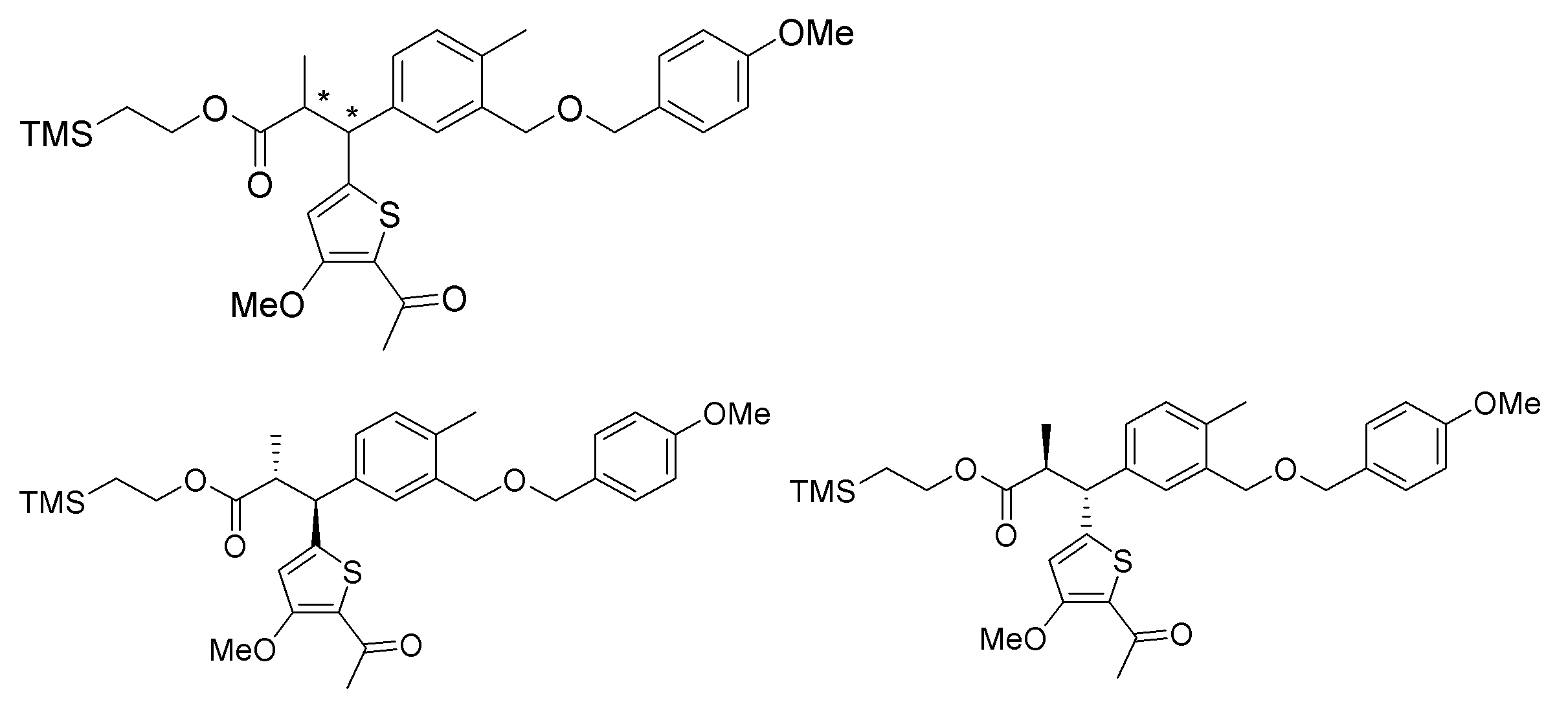
Isomer mixture 1: 1H NMR(400 MHz, CDCl3)δ 7.26 (2H, br d, J = 8.8 Hz), 7.21 (1H, s), 7.09 (2H, s), 6.88 (2H, br d, J = 8.8 Hz), 6.67 (1H, s), 4.47 (2H, s), 4.43 (2H, s), 4.24 (1H, d, J = 11.2 Hz), 4.10-4.05 (2H, m), 3.86 (3H, s), 3.80 (3H, s), 3.17-3.09 (1H, m), 2.41 (3H, s), 2.24 (3H, s), 1.04 (3H, d, J = 6.8 Hz), 0.89-0.85 (2H, m), -0.00 (9H, s),
Isomer mixture 2: 1H NMR(400 MHz, CDCl3)δ 7.34-7.29 (3H, m), 7.23-7.11 (2H, m), 6.95 (2H, br d, J = 8.8 Hz), 6.75 (1H, s), 4.55-4.51 (4H, m), 4.27 (1H, d, J = 11.2 Hz), 4.00-3.94 (5H, m), 3.87 (3H, br s), 3.26-3.21 (1H, m), 2.51 (3H, s), 2.29 (3H, s), 1.28 (3H, d, J = 6.8 Hz), 0.76-0.71 (2H, m), 0.00 (9H, s)。
2-(トリメチルシリル)エチル 3-(5-アセチル-4-メトキシチオフェン-2-イル)-3-[3-(ヒドロキシメチル)-4-メチルフェニル]-2-メチルプロパノエート アンチ異性体混合物の製造
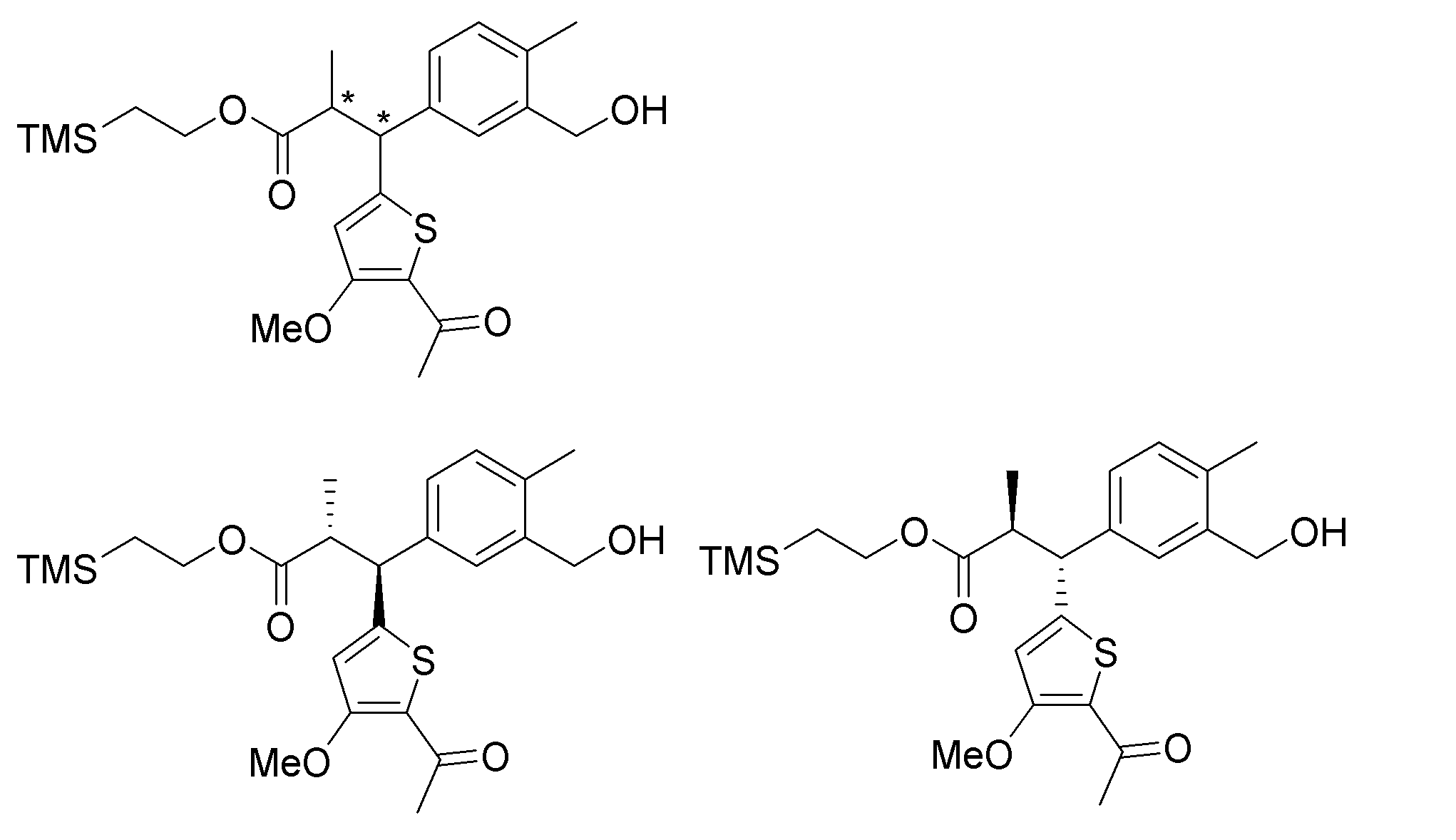
1H NMR(400 MHz, CDCl3)δ 7.28 (1H, s), 7.12 (2H, br s), 6.70 (1H, s), 4.68-4.67 (2H, m), 4.27 (1H, d, J = 11.2 Hz), 4.15-4.04 (2H, m), 3.90 (3H, s), 3.19-3.12 (1H, m), 2.43 (3H, s), 2.30 (3H, s), 1.74-1.71 (1H, m), 1.06 (3H, d, J = 7.2 Hz), 0.91-0.87 (2H, m), 0.02 (9H, s)。
2-(トリメチルシリル)エチル 3-(5-アセチル-4-メトキシチオフェン-2-イル)-3-[3-(クロロメチル)-4-メチルフェニル]-2-メチルプロパノエート アンチ異性体混合物の製造

1H NMR (400 MHz, CDCl3) δ 7.18 (1H, s), 7.13 (2H, br s), 6.68 (1H, s), 4.55 (2H, s), 4.25 (1H, d, J = 11.2 Hz), 4.10-4.05 (2H, m), 3.88 (3H, s), 3.16-3.08 (1H, m), 2.42 (3H, s), 2.36 (3H, s), 1.04 (3H, d, J = 7.2 Hz), 0.89-0.85 (2H, m), -0.00 (9H, s)。
2-(トリメチルシリル)エチル 3-(5-アセチル-4-メトキシチオフェン-2-イル)-3-(3-{[(R)-4-エチル-1,1-ジオキシド-3,4-ジヒドロ-2H-ピリド[4,3-b][1,4,5]オキサチアゼピン-2-イル]メチル}-4-メチルフェニル)-2-メチルプロパノエート アンチ異性体混合物の製造

1H NMR (400 Mz, CDCl3) δ 9.02 (1H, s), 8.67-8.65 (1H, m), 7.16-7.09 (4H, m), 6.72 (1H, s), 4.47-4.35 (2H, m), 4.29-4.08 (4H, m), 3.92 (3H, br s), 3.52-3.41 (1H, m), 3.19-3.09 (2H, m), 2.44 (3H, s), 2.33 (3H, s), 1.75-1.64 (1H, m), 1.57-1.49 (1H, m), 1.06-1.02 (6H, m), 0.92-0.87 (2H, m), 0.02 (9H, s)。
(2R,3S)/(2S,3R)-3-(5-アセチルチオフェン-2-イル)-3-(3-{[(R)-4-エチル-1,1-ジオキシド-3,4-ジヒドロ-2H-ベンゾ[b][1,4,5]オキサチアゼピン-2-イル]メチル}-4-メチルフェニル)-2-メチルプロパン酸(アンチ異性体混合物)の製造
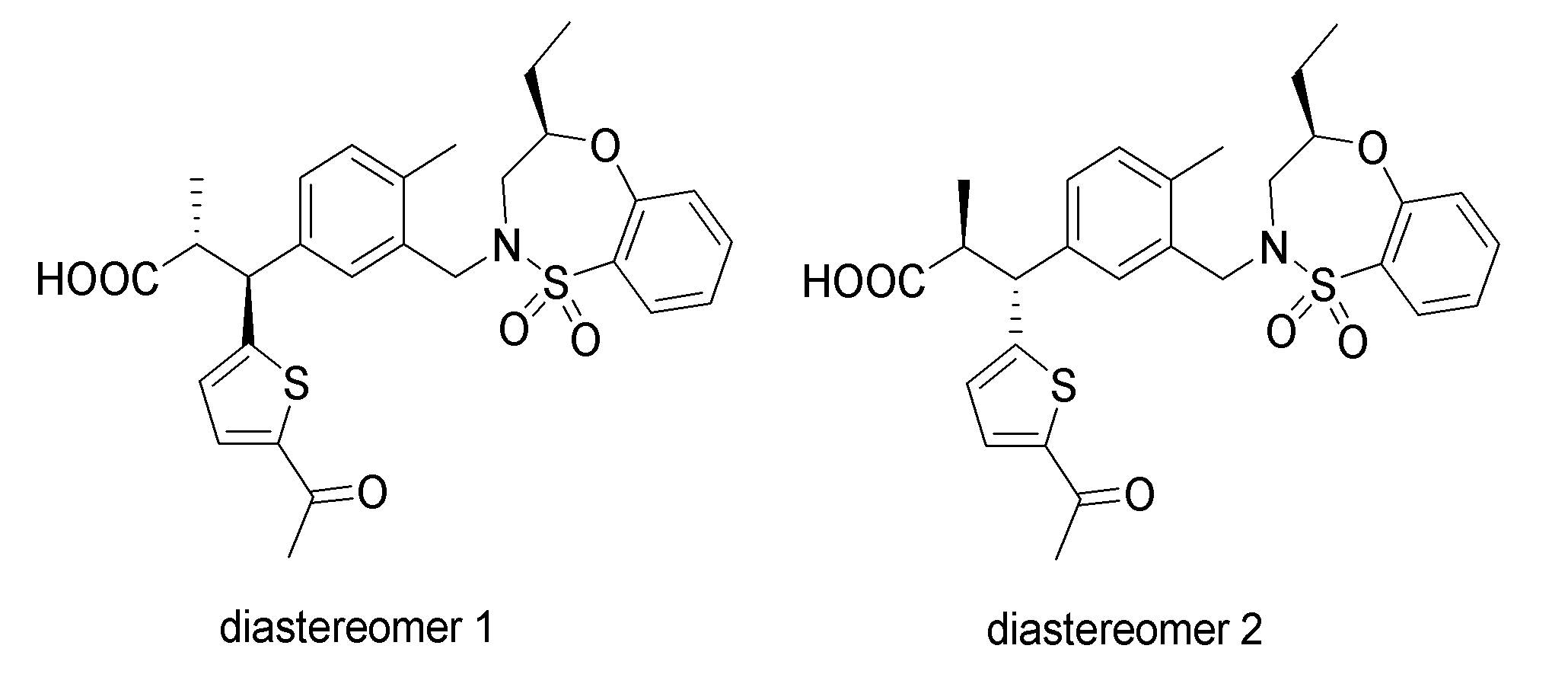
1H NMR(400 MHz, CDCl3)δ 7.88 (1H, dd, J = 7.6, 1.6 Hz), 7.53 (1H, td, J = 7.6, 1.6 Hz), 7.49-7.47 (1H, m), 7.28-7.24 (1H, m), 7.21 (1H, br d, J = 8.0 Hz), 7.17-7.12 (2H, m), 7.11-7.07 (1H, m), 6.96 (1H, d, J = 3.6 Hz), 4.61-4.53 (1H, m), 4.34 (1H, d, J = 11.2 Hz), 4.06-3.95 (1H, m), 3.89-3.78 (1H, m), 3.76-3.68 (1H, m), 3.23-3.15 (1H, m), 2.98-2.89 (1H, m), 2.46 (3H, s), 2.34-2.33 (3H, m), 1.75-1.58 (1H, m), 1.48-1.32 (1H, m), 1.11-1.05 (6H, m)。
(2R,3S)/(2S,3R)-3-(5-アセチルチオフェン-2-イル)-3-(3-{[(R)-4-エチル-1,1-ジオキシド-3,4-ジヒドロ-2H-ベンゾ[b][1,4,5]オキサチアゼピン-2-イル]メチル}-4-メチルフェニル)-2-メチルプロパン酸(アンチ異性体混合物)(9.48 g, 17.5 mmol)をキラルHPLC (high performance liquid chromatography) により下記条件で、ジアステレオマー1(4.16 g, 7.68 mmol, 44%)とジアステレオマー2(4.28 g, 7.90 mmol, 45%)に分割した。標題化合物((2R,3S)-3-(5-アセチルチオフェン-2-イル)-3-(3-{[(R)-4-エチル-1,1-ジオキシド-3,4-ジヒドロ-2H-ベンゾ[b][1,4,5]オキサチアゼピン-2-イル]メチル}-4-メチルフェニル)-2-メチルプロパン酸)(化合物A1)はジアステレオマー1として得た。ジアステレオマー2は化合物A2とした。
使用したカラム:CHIRAL ART Cellulose-SC (10 μm) 250 x 50 mm I.D.
溶離液:n-hexane/2-propanol (50/50)
流速:100 mL/min
温度:ambient
検出波長:UV at 280 nm
注入量:50 mL (5.0 mg/mL)
注入間隔:25 min
システム:K-Prep LAB (YMC)
化合物A1 (Diastereomer 1): 1H NMR(400 MHz, CDCl3)δ 7.89 (1H, dd, J = 8.0, 1.6 Hz), 7.53 (1H, td, J = 8.0, 1.6 Hz), 7.47 (1H, d, J = 4.0 Hz), 7.28-7.24 (1H, m), 7.22 (1H, d, J = 8.0 Hz), 7.18-7.13 (2H, m), 7.07 (1H, s), 6.96 (1H, d, J = 4.0 Hz), 4.58 (1H, d, J = 14.4 Hz), 4.35 (1H, d, J = 10.8 Hz), 4.06-3.97 (1H, m), 3.80 (1H, d, J = 14.4 Hz), 3.72 (1H, dd, J = 14.0, 10.4 Hz), 3.25-3.17 (1H, m), 2.91 (1H, d, J = 14.0 Hz), 2.47 (3H, s), 2.34 (3H, s), 1.71-1.59 (1H, m), 1.42-1.35 (1H, m), 1.11-1.05 (6H, m),
化合物A2 (Diastereomer 2): 1H NMR(400 MHz, CDCl3)δ 7.89 (1H, dd, J = 7.6, 1.6 Hz), 7.53 (1H, td, J = 7.6, 1.6 Hz), 7.48 (1H, d, J = 4.0 Hz), 7.28-7.24 (1H, m), 7.22 (1H, d, J = 7.6 Hz), 7.17-7.12 (2H, m), 7.11 (1H, s), 6.96 (1H, d, J = 4.0 Hz), 4.54 (1H, d, J = 14.4 Hz), 4.35 (1H, d, J = 11.2 Hz), 4.06-4.00 (1H, m), 3.87 (1H, d, J = 14.4 Hz), 3.70 (1H, dd, J = 14.8, 10.8 Hz), 3.26-3.18 (1H, m), 2.96 (1H, d, J = 14.8 Hz), 2.47 (3H, s), 2.33 (3H, s), 1.75-1.64 (1H, m), 1.48-1.38 (1H, m), 1.11 (3H, d, J = 6.8 Hz), 1.07 (3H, t, J = 7.2 Hz)。
(2R,3S)/(2S,3R)-3-(5-アセチルチオフェン-2-イル)-3-(3-{[(R)-4-エチル-1,1-ジオキシド-3,4-ジヒドロ-2H-ピリド[4,3-b][1,4,5]オキサチアゼピン-2-イル]メチル}-4-メチルフェニル)-2-メチルプロパン酸(アンチ異性体混合物)の製造
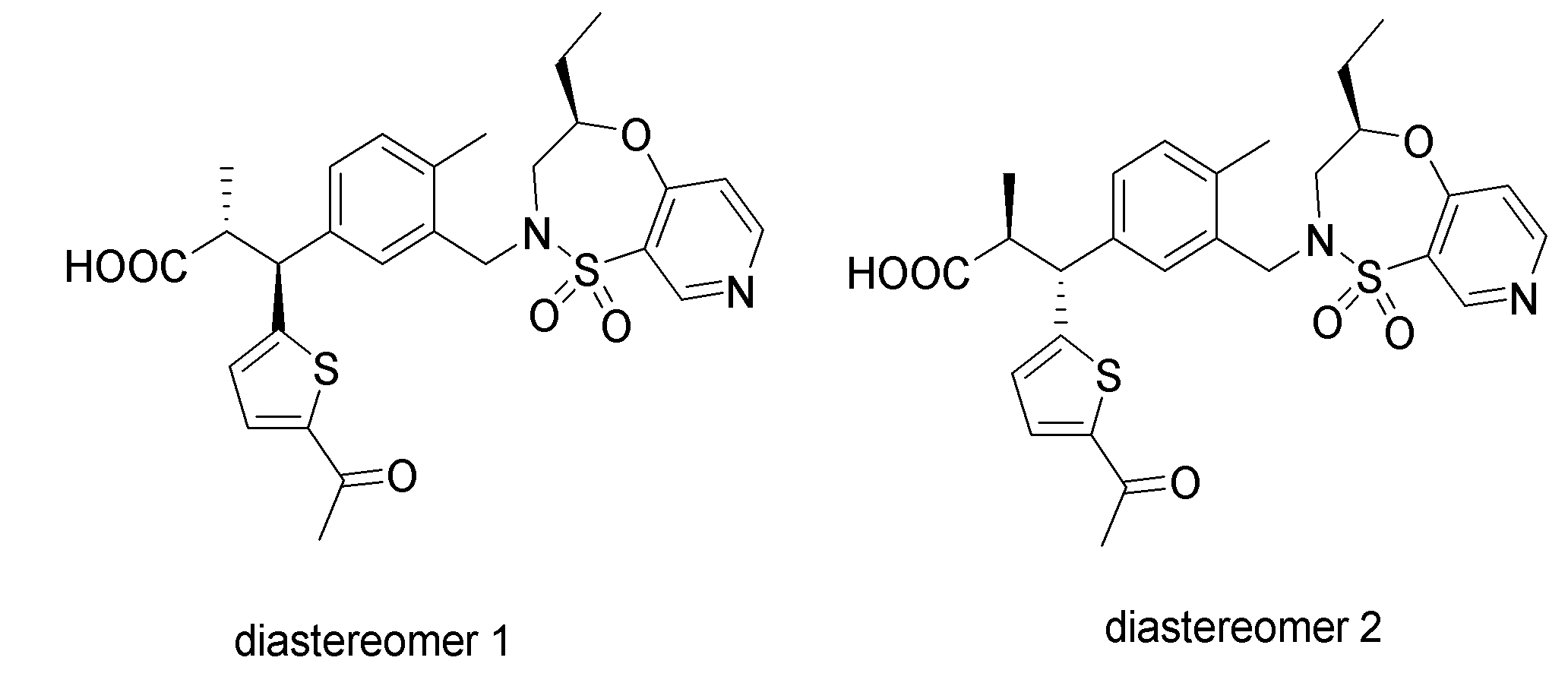
1H NMR(400 MHz, CDCl3)δ 9.02 (1H, s), 8.67-8.65 (1H, m), 7.49-7.47 (1H, m), 7.17 (2H, s), 7.12-7.10 (2H, m), 6.99-6.97 (1H, m), 4.47-4.36 (3H, m), 4.22-4.10 (1H, m), 3.50-3.40 (1H, m), 3.26-3.12 (2H, m), 2.47 (3H, s), 2.33 (3H, s), 1.74-1.63 (1H, m), 1.56-1.48 (1H, m), 1.12 (3H, d, J = 6.8 Hz), 1.06-1.02 (3H, m)。
(2R,3S)/(2S,3R)-3-(5-アセチルチオフェン-2-イル)-3-(3-{[(R)-4-エチル-1,1-ジオキシド-3,4-ジヒドロ-2H-ピリド[4,3-b][1,4,5]オキサチアゼピン-2-イル]メチル}-4-メチルフェニル)-2-メチルプロパン酸(アンチ異性体混合物)(4.9 g, 9.0 mmol)をキラルSFC (supercritical fluid chromatography) により下記条件でジアステレオマー1(1.7 g, 3.1 mmol, 35%)とジアステレオマー2(1.4 g, 2.6 mmol, 29%)に分割した。標題化合物((2R,3S) -3-(5-アセチルチオフェン-2-イル)-3-(3-{[(R)-4-エチル-1,1-ジオキシド-3,4-ジヒドロ-2H-ピリド[4,3-b][1,4,5]オキサチアゼピン-2-イル]メチル}-4-メチルフェニル)-2-メチルプロパン酸)(化合物B1)はジアステレオマー1として得た。ジアステレオマー2は化合物B2とした。
使用したカラム:Cellulose-SC (5 μm) 250 x 30 mm I.D.
溶離液:CO2/methanol (60/40)
流速:120 mL/min
温度:25℃
バックプレッシャー:10 MPa
検出波長:UV at 210 nm
注入量:8.5 mL (10 mg/mL)
注入間隔:6.5 min
システム:分取超臨界CO2 クロマトグラフィーシステム (JASCO)
化合物B1 (Diastereomer 1): 1H NMR(400 MHz, CDCl3)δ 9.02 (1H, s), 8.66 (1H, d, J = 5.6 Hz), 7.48 (1H, d, J = 4.0 Hz), 7.19-7.15 (2H, m), 7.11 (1H, d, J = 5.6 Hz), 7.10 (1H, s), 6.97 (1H, d, J = 4.0 Hz), 4.45 (1H, d, J = 14.0 Hz), 4.43-4.39 (1H, m), 4.38 (1H, d, J = 11.2 Hz), 4.12 (1H, d, J = 14.0 Hz), 3.47 (1H, dd, J = 15.2, 11.2 Hz), 3.27-3.19 (1H, m), 3.14 (1H, br d, J = 15.2 Hz), 2.47 (3H, s), 2.33 (3H, s), 1.71-1.61 (1H, m), 1.55-1.45 (1H, m), 1.11 (3H, d, J = 6.8 Hz), 1.04 (3H, t, J = 7.2 Hz),
化合物B2 (Diastereomer 2): 1H NMR(400 MHz, CDCl3)δ 9.02 (1H, s), 8.65 (1H, d, J = 5.6 Hz), 7.49 (1H, d, J = 3.6 Hz), 7.17 (2H, br s), 7.12 (1H, s), 7.11 (1H, d, J = 5.6 Hz), 6.98 (1H, d, J = 3.6 Hz), 4.48-4.45 (1H, m), 4.37 (2H, d, J = 13.2 Hz), 4.20 (1H, d, J = 14.0 Hz), 3.43 (1H, dd, J = 14.8, 11.2 Hz), 3.24-3.20 (1H, m), 3.17 (1H, br d, J = 14.8 Hz), 2.47 (3H, s), 2.33 (3H, s), 1.75-1.64 (1H, m), 1.58-1.48 (1H, m), 1.11 (3H, d, J = 7.2 Hz), 1.03 (3H, t, J = 7.2 Hz)。
(2R,3S)/(2S,3R)-3-(5-アセチル-4-メトキシチオフェン-2-イル)-3-(3-{[(R)-4-エチル-1,1-ジオキシド-3,4-ジヒドロ-2H-ピリド[4,3-b][1,4,5]オキサチアゼピン-2-イル]メチル}-4-メチルフェニル)-2-メチルプロパン酸(アンチ異性体混合物)の製造
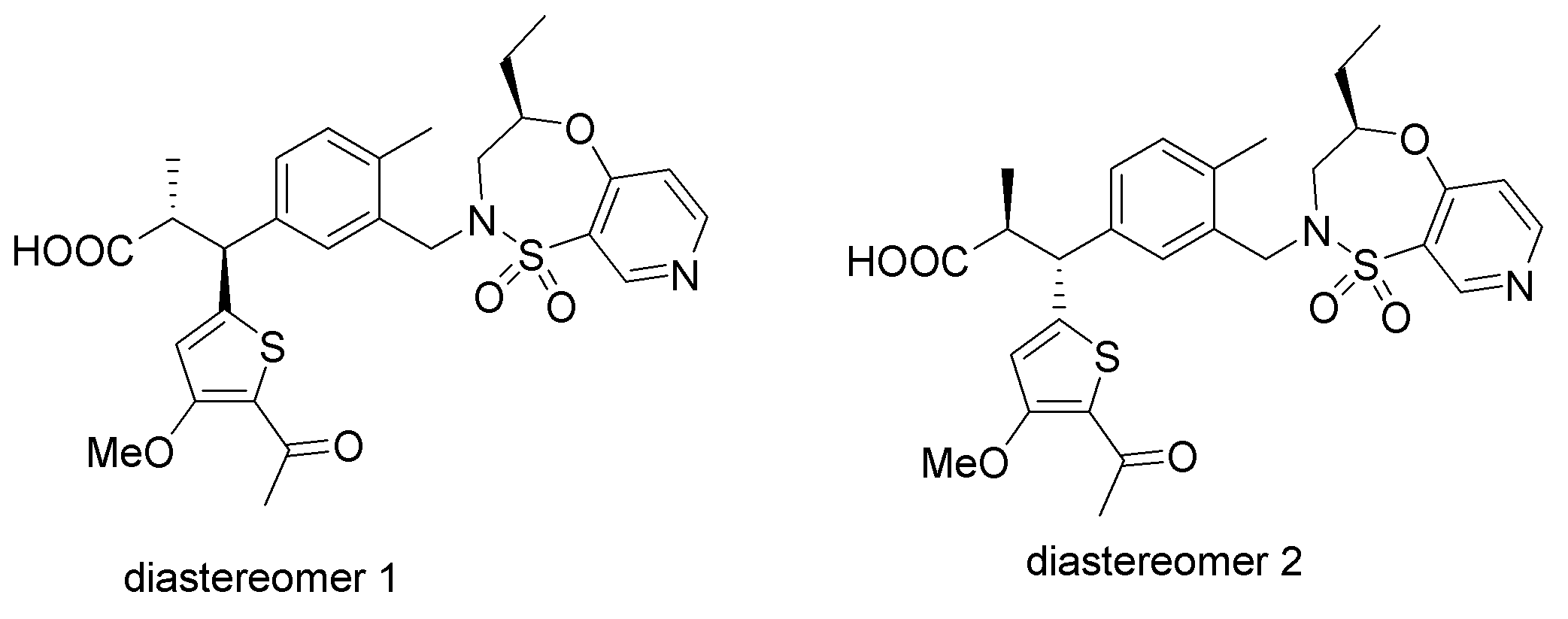
1H NMR (400 MHz, CDCl3) δ 9.02 (1H, s), 8.65-8.63 (1H, m), 7.14-7.08 (4H, m), 6.73 (1H, s), 4.46-4.35 (2H, m), 4.29-4.26 (1H, m), 4.22-4.10 (1H, m), 3.87-3.86 (3H, m), 3.55-3.44 (1H, m), 3.22-3.08 (2H, m), 2.38 (3H, br s), 2.31 (3H, s), 1.73-1.65 (1H, m), 1.54-1.49 (1H, m), 1.05-1.01 (6H, m)。
(2R,3S)/(2S,3R)-3-(5-アセチル-4-メトキシチオフェン-2-イル)-3-(3-{[(R)-4-エチル-1,1-ジオキシド-3,4-ジヒドロ-2H-ピリド[4,3-b][1,4,5]オキサチアゼピン-2-イル]メチル}-4-メチルフェニル)-2-メチルプロパン酸(アンチ異性体混合物)(49 mg, 0.086 mmol)をキラルHPLCにより下記条件でジアステレオマー1(29 mg, 0.051 mmol, 59%, 溶媒含む)とジアステレオマー2(22 mg, 0.038 mmol, 45%, 溶媒含む)に分割した。標題化合物((2R,3S)-3-(5-アセチル-4-メトキシチオフェン-2-イル)-3-(3-{[(R)-4-エチル-1,1-ジオキシド-3,4-ジヒドロ-2H-ピリド[4,3-b][1,4,5]オキサチアゼピン-2-イル]メチル}-4-メチルフェニル)-2-メチルプロパン酸)(化合物C1)をジアステレオマー1として得た。ジアステレオマー2は化合物C2とした。
使用したカラム:CHIRAL ART Cellulose-SC (5 μm) 250 x 30 mm I.D.
溶離液:n-hexane/ethyl acetate/trifluoroacetic acid (60/40/0.1)
流速:42.5 mL/min
温度:ambient
検出波長:UV at 300 nm
注入量: 25 mg (3.2 mg/mL)
システム:LC-Forte/R (YMC)
化合物C1 (Diastereomer 1): 1H NMR(400 MHz, CDCl3)δ 9.02 (1H, s), 8.66 (1H, d, J = 5.6 Hz), 7.17 (2H, s), 7.12 (1H, s), 7.11 (1H, d, J = 5.6 Hz), 6.76 (1H, s), 4.44 (1H, d, J = 14.4 Hz), 4.42-4.38 (1H, m), 4.29 (1H, d, J = 10.4 Hz), 4.12 (1H, d, J = 14.4 Hz), 3.92 (3H, s), 3.48 (1H, dd, J = 14.4, 10.4 Hz), 3.23-3.14 (2H, m), 2.44 (3H, s), 2.32 (3H, s), 1.72-1.64 (1H, m), 1.53-1.51 (1H, m), 1.11 (3H, d, J = 6.8 Hz), 1.04 (3H, t, J = 7.6 Hz),
化合物C2 (Diastereomer 2): 1H NMR(400 MHz, CDCl3)δ 9.02 (1H, s), 8.66 (1H, d, J = 5.6 Hz), 7.17 (2H, s), 7.15 (1H, s), 7.11 (1H, d, J = 5.6 Hz), 6.76 (1H, s), 4.51-4.45 (1H, m), 4.37 (1H, d, J = 14.0 Hz), 4.29 (1H, d, J = 10.8 Hz), 4.20 (1H, d, J = 14.0 Hz), 3.93 (3H, s), 3.44 (1H, dd, J = 14.8, 11.2 Hz), 3.23-3.17 (2H, m), 2.44 (3H, s), 2.32 (3H, s), 1.75-1.66 (1H, m), 1.58-1.51 (1H, m), 1.11 (3H, d, J = 7.2 Hz), 1.04 (3H, t, J = 7.6 Hz)。
3-(5-アセチルチオフェン-2-イル)-3-(3-{[(R)-4-エチル-1,1-ジオキシド-3,4-ジヒドロ-2H-ピリド[4,3-b][1,4,5]オキサチアゼピン-2-イル]メチル}-4-メチルフェニル)-2,2-ジメチルプロパン酸の製造

1H NMR (400 MHz, CDCl3) δ 9.00 (1H, br s), 8.66-8.63 (1H, m), 7.54 (1H, d, J = 3.6 Hz), 7.30-7.26 (2H, m), 7.16-7.10 (2H, m), 7.05-7.03 (1H, m), 4.75-4.74 (1H, m), 4.46-4.37 (2H, m), 4.17-4.11 (1H, m), 3.46-3.43 (1H, m), 3.20-3.14 (1H, m), 2.50 (3H, s), 2.32 (3H, s), 1.73-1.63 (1H, m), 1.57-1.47 (1H, m), 1.32 (3H, s), 1.27-1.26 (3H, m), 1.06-1.02 (3H, m)。
3-(5-アセチルチオフェン-2-イル)-3-(3-{[(R)-4-エチル-1,1-ジオキシド-3,4-ジヒドロ-2H-ピリド[4,3-b][1,4,5]オキサチアゼピン-2-イル]メチル}-4-メチルフェニル)-2,2-ジメチルプロパン酸(49 mg, 0.088 mmol)をキラルHPLC (high performance liquid chromatography) により下記条件でジアステレオマー1(27 mg, 0.049 mmol, 55%, 溶媒含む)とジアステレオマー2(28 mg, 0.050 mmol, 57%, 溶媒含む)に分割した。ジアステレオマー1は、ジアステレオマー2よりも先に溶出された。標題化合物(化合物D1)をジアステレオマー1として得た。ジアステレオマー2は化合物D2とした。
使用したカラム:CHIRAL ART Cellulose-SC (10 μm) 250 x 10 mm I.D.
溶離液:n-hexane/ethanol/trifluoroacetic acid (40/60/0.1)
流速:2.35 mL/min
温度:ambient
検出波長:UV at 293 nm
注入量:18 mg (13 mg/mL)
システム:Prominence (Shimadzu)
化合物D1 (Diastereomer 1): 1H NMR(400 MHz, CDCl3)δ 9.00 (1H, s), 8.65 (1H, d, J = 5.6 Hz), 7.53 (1H, d, J = 4.0 Hz), 7.30-7.26 (2H, m), 7.15 (1H, d, J = 7.6 Hz), 7.11 (1H, d, J = 5.6 Hz), 7.04 (1H, d, J = 4.0 Hz), 4.74 (1H, s), 4.46-4.41 (1H, m), 4.39 (1H, d, J = 14.4 Hz), 4.16 (1H, d, J = 14.4 Hz), 3.46 (1H, dd, J = 14.8, 10.8 Hz), 3.16 (1H, dd, J = 14.8, 2.0 Hz), 2.50 (3H, s), 2.32 (3H, s), 1.71-1.61 (1H, m), 1.56-1.47 (1H, m), 1.33 (3H, s), 1.27 (3H, s), 1.03 (3H, t, J = 7.2 Hz),
化合物D2 (Diastereomer 2): 1H NMR(400 MHz, CDCl3)δ 9.01 (1H, s), 8.65 (1H, d, J = 5.2 Hz), 7.53 (1H, d, J = 3.6 Hz), 7.30-7.26 (2H, m), 7.15 (1H, d, J = 8.0 Hz), 7.11 (1H, d, J = 5.2 Hz), 7.03 (1H, d, J = 3.6 Hz), 4.72 (1H, s), 4.48-4.44 (1H, m), 4.39 (1H, d, J = 14.4 Hz), 4.16 (1H, d, J = 14.4 Hz), 3.45 (1H, dd, J = 14.8, 10.8 Hz), 3.18 (1H, dd, J = 14.8, 2.0 Hz), 2.50 (3H, s), 2.32 (3H, s), 1.73-1.66 (1H, m), 1.57-1.52 (1H, m), 1.33 (3H, s), 1.28 (3H, s), 1.04 (3H, t, J = 7.2 Hz)。
(2S,3S)/(2R,3R)-3-(5-アセチルチオフェン-2-イル)-3-(3-{[(R)-4-エチル-1,1-ジオキシド-3,4-ジヒドロ-2H-ベンゾ[b][1,4,5]オキサチアゼピン-2-イル]メチル}-4-メチルフェニル)-2-メチルプロパン酸(シン異性体混合物)の製造

1H NMR(400 MHz, CDCl3)δ 7.88 (1H, d, J = 7.6 Hz), 7.53 (1H, td, J = 7.6, 1.6 Hz), 7.50-7.49 (1H, m), 7.28-7.17 (3H, m), 7.14-7.09 (2H, m), 6.95-6.92 (1H, m), 4.55-4.50 (1H, m), 4.30 (1H, d, J = 10.8 Hz), 4.05-3.97 (1H, m), 3.81-3.66 (2H, m), 3.26-3.15 (1H, m), 2.90 (1H, br d, J = 15.2 Hz), 2.48 (3H, s), 2.31 (3H, br s), 1.69-1.59 (1H, m), 1.47-1.37 (1H, m), 1.22 (3H, d, J = 6.8 Hz), 1.12-1.05 (3H, m)。
化合物A1の不明な2つの不斉点の絶対構造を確定するため、X線単結晶構造解析を行った。試料は酢酸エチルとヘキサンを用いて結晶化した。得られた結晶学的データおよび結晶構造を表10および図1に示す。図1の結晶の分子構造では、非対称単位中に2分子の目的分子と1分子の溶媒分子が存在していた。溶媒分子はディスオーダーしており、精密化の結果、酢酸エチルが約40%、ヘキサンが約60%存在していた。この結晶構造から、化合物A1の絶対配置は(R,S)であることが明らかになった。立体配置の書き方は、(R, S)のように書く場合、初めの立体配置がカルボン酸α位の立体配置(R)、2番目の立体配置がカルボン酸β位の立体配置(S)を示す。

1)実施例1及び参考例219の化合物のanti型およびsyn型のカルボン酸α位-β位(図の黄色の部分)を軸に回転させ安定コンフォメーションをChem3Dで計算したところ、それぞれ単一の最安定コンフォメーションが得られた。図2に実施例1及び参考例219の化合物のanti型の1つの最安定コンフォメーションを示し、図3に実施例1及び参考例219の化合物のsyn型の1つの最安定コンフォメーションを示す。
化合物A1/A2のNMRチャートを比較した結果、不斉点の周辺でケミカルシフト値の違いが大きかった2つのプロトン(*と**)に着目すると、*のプロトンは、化合物A1では7.07 ppmに観測されるのに対し、化合物A2では7.11 ppmに観測され、化合物A2の方が低磁場シフトしていた。また**のプロトンについて、化合物A1は4.58 ppmと3.80 ppmに観測されるのに対し、化合物A2では4.54 ppmおよび3.87 ppmに観測され、化合物A2では2つのプロトンの間隔が狭まるようにシフトしていた。化合物B1/B2、および化合物C1/C2においても、*のプロトン および **のプロトンのケミカルシフト値について化合物A1/A2と同様の挙動が確認されたため、これらの対応するプロトンの個々の挙動が一致するように、化合物B1/B2、および化合物C1/C2の絶対配置を決定した。


化合物A1/A2、化合物B1/B2、化合物C1/C2、及び化合物D1/D2を被検物質として用いた。試験例1-1及び試験例1-2と同様にしてBinding assay及びReporter assayを行った。また、細胞生存率に影響を与えない濃度を以下のようにして測定した。
各化合物のジアステレオマー(化合物n1と化合物n2と(nは、A、B、C、又はD))のIC50(nM, binding assay)、EC50(nM, reporter assay)及びCytotoxic concentration (μM, 細胞生存率試験)の結果を表12に示す。また、表中の記号の化合物中の位置については、以下の一般式に示す。各々の実験値は平均値として表した。各化合物のジアステレオマー間のIC50の比較において、n1はn2よりも5倍以上高い活性を示した(N=2)。また各化合物のジアステレオマー間のEC50の比較においては、n1はn2の50倍以上高い活性を示した。一方、Cytotoxic concentrationの比較においては、n2はn1と比較して有意に低い濃度から細胞毒性を示した。各化合物のジアステレオマー間(化合物n1と化合物n2)のEC50およびCytotoxic concentrationの比較においてStudentのt-testを用いて統計解析を行い、p値が0.05以下を有意差ありとして、表中に示した(N=3, *0.01 < p < 0.05, **p < 0.01, vs各化合物n1)。
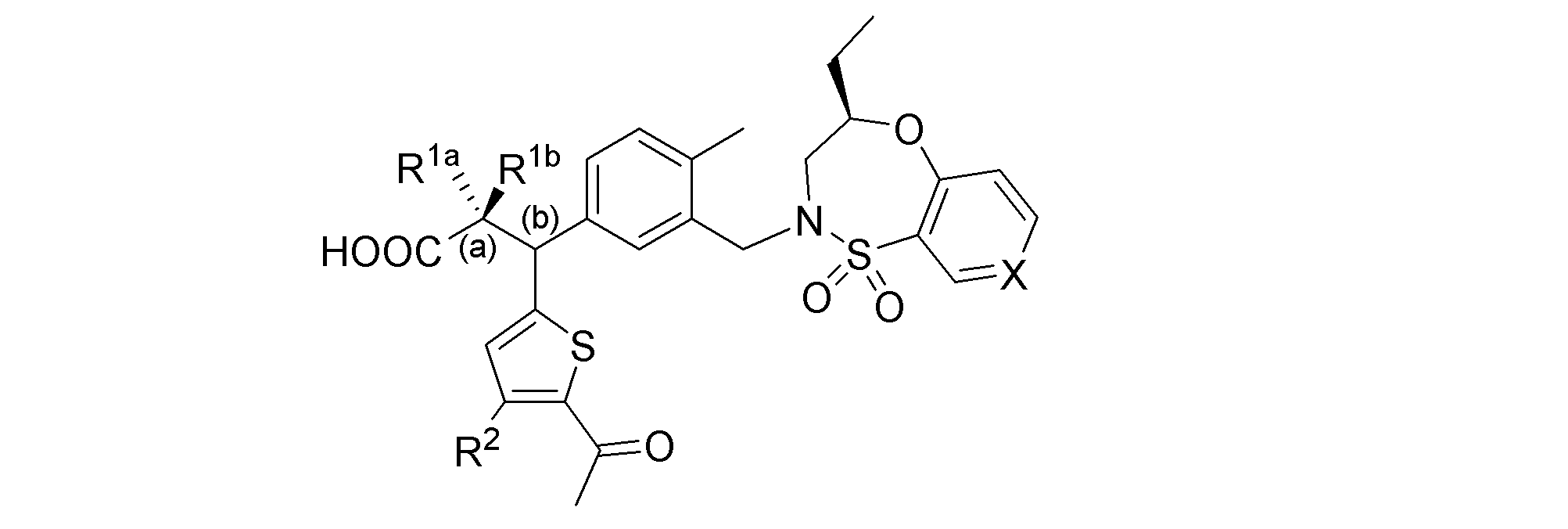
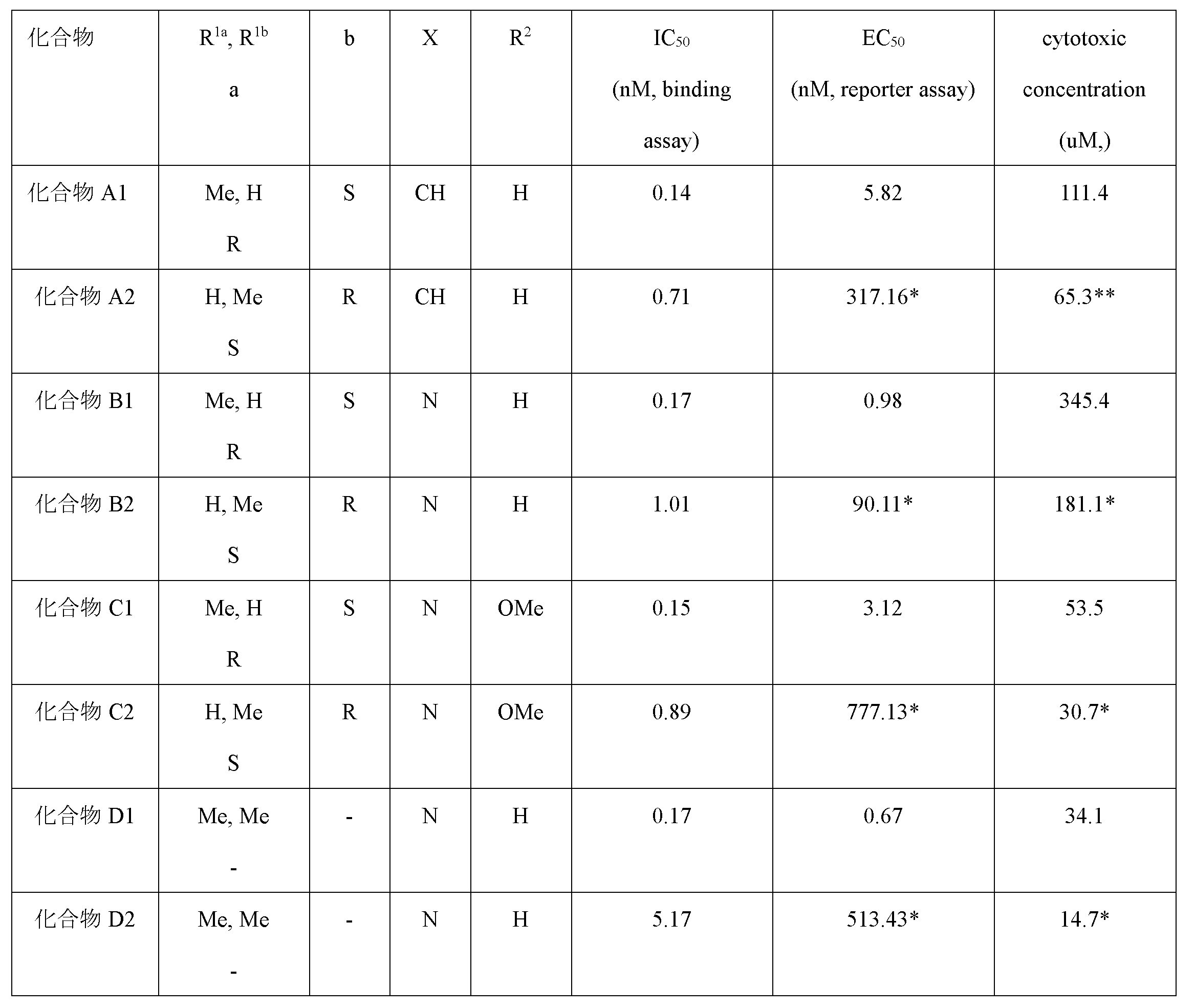

で表される化合物、及び一般式(II):
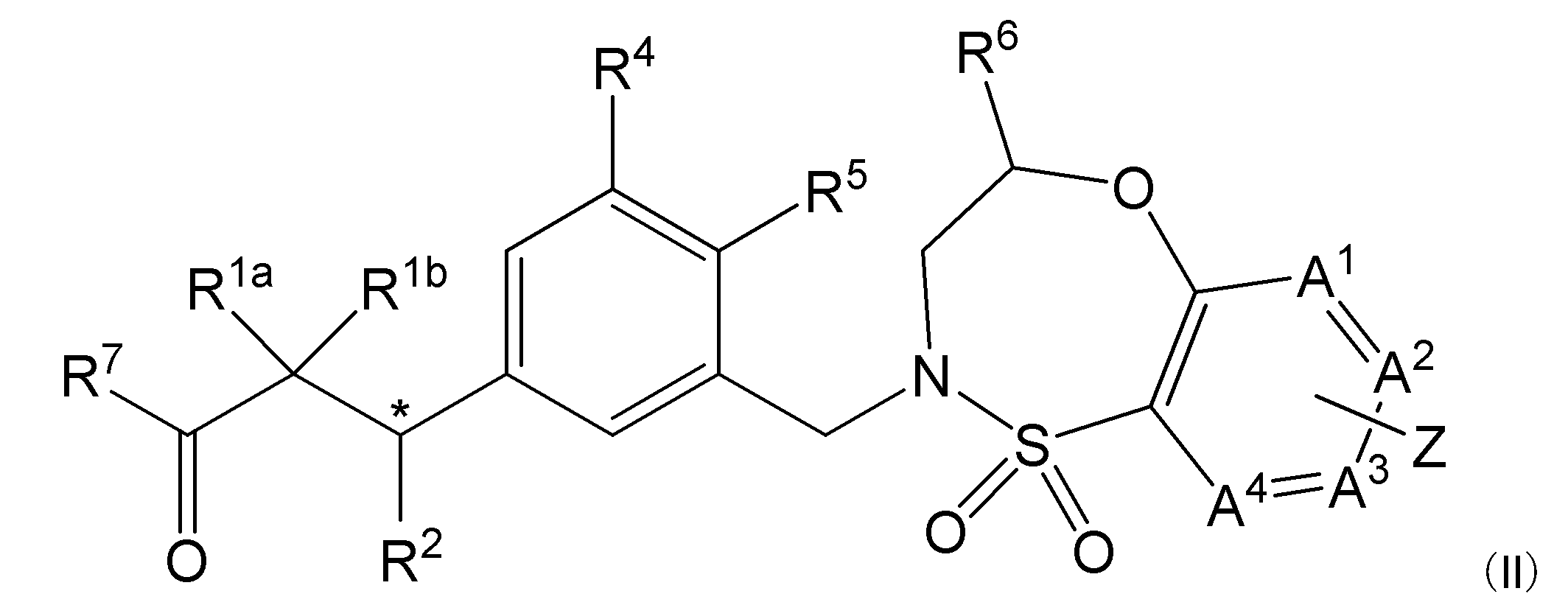
の式中*で示される炭素原子を不斉炭素原子とする2群のジアステレオマーの内、極性が低い方の群の化合物が、より高いNrf2活性化作用を有し、また細胞毒性がより低いことが分かった。
Claims (16)
- 一般式(I):

で表される化合物、その塩、又はそれらの溶媒和物。 - 一般式(II):

の式中*で示される炭素原子を不斉炭素原子とする2つのジアステレオマーの内、極性が低い方の化合物、その塩、又はそれらの溶媒和物。 - 前記化合物が、式中*で示される炭素原子を不斉炭素原子とする前記R6の立体配置を固定したときの2つのジアステレオマーを含む異性体混合物をカラム分離(カラム種類:CHIRAL ART Cellulose-SC、溶出溶媒:n-ヘキサン/エタノール/トリフルオロ酢酸の40/60/0.1混合溶媒)した場合に、最初に溶出される化合物である、請求項2に記載の化合物、その塩、又はそれらの溶媒和物。
- 前記チエニル基上に有していてもよい置換基が電子求引基を含む、請求項1~3のいずれかに記載の化合物、その塩、又はそれらの溶媒和物。
- 前記チエニル基が有していてもよい置換基が、アセチル基、スルファモイル基、シアノ基又はシクロアルカンカルボニルを含む、請求項1~4のいずれかに記載の化合物、その塩、又はそれらの溶媒和物。
- 前記R2が一般式(R2Aa)又は(R2Ab):

で表される基である、請求項1~5のいずれかに記載の化合物、その塩、又はそれらの溶媒和物。 - 前記R3がアセチル基である、請求項6に記載の化合物、その塩、又はそれらの溶媒和物。
- 前記R4及び前記R5が同一又は異なって、水素原子又はアルキル基である、請求項6又は7に記載の化合物、その塩、又はそれらの溶媒和物。
- 前記R2が一般式(R2Aa):

であり、
前記R4は水素原子であり、
前記R5はアルキル基であり、
前記R6が置換されていてもよいエチル基であり、
前記R7がヒドロキシ基であり、
前記A1、前記A2、及び前記A4が全てCHであり、前記A3がCH又はNであり、且つ
前記Zが水素原子である、
請求項1~8のいずれかに記載の化合物、その塩、又はそれらの溶媒和物。 - 請求項1~9のいずれかに記載の化合物、その塩、及びそれらの溶媒和物からなる群より選択される少なくとも1種を含有する、医薬。
- Nrf2(NF-E2-related factor 2)活性化剤である、請求項10に記載の医薬。
- 局所投与製剤である、請求項10又は11に記載の医薬。
- 眼科用製剤である、請求項10~12のいずれかに記載の医薬。
- 非経口投与製剤である、請求項10又は11に記載の医薬。
- 経静脈投与製剤である、請求項10、11、又は14に記載の医薬。
- 脳疾患、肺疾患、皮膚疾患、耳鼻科疾患、腎疾患又は眼科疾患の予防又は治療用医薬である、請求項10~15のいずれかに記載の医薬。
Priority Applications (7)
| Application Number | Priority Date | Filing Date | Title |
|---|---|---|---|
| CN202180088210.9A CN116669744B (zh) | 2020-12-28 | 2021-12-28 | Nrf2活化化合物 |
| JP2022573109A JP7681044B2 (ja) | 2020-12-28 | 2021-12-28 | Nrf2活性化化合物 |
| US18/269,837 US20240132519A1 (en) | 2020-12-28 | 2021-12-28 | Nrf2-activating compound |
| EP21915317.8A EP4273145A4 (en) | 2020-12-28 | 2021-12-28 | Nrf2-activating compound |
| KR1020237025398A KR20230127268A (ko) | 2020-12-28 | 2021-12-28 | Nrf2 활성화 화합물 |
| CA3206893A CA3206893A1 (en) | 2020-12-28 | 2021-12-28 | Nrf2-activating compound |
| AU2021411868A AU2021411868A1 (en) | 2020-12-28 | 2021-12-28 | Nrf2-activating compound |
Applications Claiming Priority (2)
| Application Number | Priority Date | Filing Date | Title |
|---|---|---|---|
| JP2020218261 | 2020-12-28 | ||
| JP2020-218261 | 2020-12-28 |
Publications (1)
| Publication Number | Publication Date |
|---|---|
| WO2022145459A1 true WO2022145459A1 (ja) | 2022-07-07 |
Family
ID=82260792
Family Applications (1)
| Application Number | Title | Priority Date | Filing Date |
|---|---|---|---|
| PCT/JP2021/048868 Ceased WO2022145459A1 (ja) | 2020-12-28 | 2021-12-28 | Nrf2活性化化合物 |
Country Status (8)
| Country | Link |
|---|---|
| US (1) | US20240132519A1 (ja) |
| EP (1) | EP4273145A4 (ja) |
| JP (1) | JP7681044B2 (ja) |
| KR (1) | KR20230127268A (ja) |
| CN (1) | CN116669744B (ja) |
| AU (1) | AU2021411868A1 (ja) |
| CA (1) | CA3206893A1 (ja) |
| WO (1) | WO2022145459A1 (ja) |
Families Citing this family (1)
| Publication number | Priority date | Publication date | Assignee | Title |
|---|---|---|---|---|
| CN114080389B (zh) * | 2019-07-03 | 2024-08-30 | 千寿制药株式会社 | Nrf2活性化化合物 |
Citations (6)
| Publication number | Priority date | Publication date | Assignee | Title |
|---|---|---|---|---|
| JP2008273924A (ja) | 2007-03-30 | 2008-11-13 | Meiji Seika Kaisha Ltd | 2位チエニルカルバペネム誘導体 |
| WO2015092713A1 (en) | 2013-12-18 | 2015-06-25 | Glaxosmithkline Intellectual Property Development Limited | Nrf2 regulators |
| WO2016202253A1 (en) | 2015-06-15 | 2016-12-22 | Glaxosmithkline Intellectual Property Development Limited | Nrf2 regulators |
| JP2020502123A (ja) * | 2016-12-14 | 2020-01-23 | グラクソスミスクライン、インテレクチュアル、プロパティー、ディベロップメント、リミテッドGlaxosmithkline Intellectual Property Development Limited | Nrf2アクチベーターとしてのビスアリール複素環 |
| WO2020041169A2 (en) * | 2018-08-20 | 2020-02-27 | Janssen Pharmaceutica Nv | Inhibitors of keap1-nrf2 protein-protein interaction |
| WO2021002473A1 (ja) * | 2019-07-03 | 2021-01-07 | 千寿製薬株式会社 | Nrf2活性化化合物 |
Family Cites Families (2)
| Publication number | Priority date | Publication date | Assignee | Title |
|---|---|---|---|---|
| JP2020502136A (ja) * | 2016-12-14 | 2020-01-23 | グラクソスミスクライン、インテレクチュアル、プロパティー、ディベロップメント、リミテッドGlaxosmithkline Intellectual Property Development Limited | Nrf2レギュレーターとしてのビスアリールアミド |
| US11059816B2 (en) * | 2016-12-15 | 2021-07-13 | Glaxosmithkline Intellectual Property Development Limited | Ether linked triazoles as NRF2 activators |
-
2021
- 2021-12-28 US US18/269,837 patent/US20240132519A1/en active Pending
- 2021-12-28 WO PCT/JP2021/048868 patent/WO2022145459A1/ja not_active Ceased
- 2021-12-28 EP EP21915317.8A patent/EP4273145A4/en active Pending
- 2021-12-28 CN CN202180088210.9A patent/CN116669744B/zh active Active
- 2021-12-28 KR KR1020237025398A patent/KR20230127268A/ko active Pending
- 2021-12-28 AU AU2021411868A patent/AU2021411868A1/en active Pending
- 2021-12-28 CA CA3206893A patent/CA3206893A1/en active Pending
- 2021-12-28 JP JP2022573109A patent/JP7681044B2/ja active Active
Patent Citations (6)
| Publication number | Priority date | Publication date | Assignee | Title |
|---|---|---|---|---|
| JP2008273924A (ja) | 2007-03-30 | 2008-11-13 | Meiji Seika Kaisha Ltd | 2位チエニルカルバペネム誘導体 |
| WO2015092713A1 (en) | 2013-12-18 | 2015-06-25 | Glaxosmithkline Intellectual Property Development Limited | Nrf2 regulators |
| WO2016202253A1 (en) | 2015-06-15 | 2016-12-22 | Glaxosmithkline Intellectual Property Development Limited | Nrf2 regulators |
| JP2020502123A (ja) * | 2016-12-14 | 2020-01-23 | グラクソスミスクライン、インテレクチュアル、プロパティー、ディベロップメント、リミテッドGlaxosmithkline Intellectual Property Development Limited | Nrf2アクチベーターとしてのビスアリール複素環 |
| WO2020041169A2 (en) * | 2018-08-20 | 2020-02-27 | Janssen Pharmaceutica Nv | Inhibitors of keap1-nrf2 protein-protein interaction |
| WO2021002473A1 (ja) * | 2019-07-03 | 2021-01-07 | 千寿製薬株式会社 | Nrf2活性化化合物 |
Non-Patent Citations (3)
| Title |
|---|
| "Japanese Pharmacopoeia", article "General Rules for Preparations, Preparations for Ophthalmic Application" |
| See also references of EP4273145A4 |
| TOM D. HEIGHTMAN, JAMES F. CALLAHAN, ELISABETTA CHIARPARIN, JOSEPH E. COYLE, CHARLOTTE GRIFFITHS-JONES, AMI S. LAKDAWALA, RACHEL M: "Structure-Activity and Structure-Conformation Relationships of Aryl Propionic Acid Inhibitors of the Kelch-like ECH-Associated Protein 1/Nuclear Factor Erythroid 2-Related Factor 2 (KEAP1/NRF2) Protein-Protein Interaction", JOURNAL OF MEDICINAL CHEMISTRY, vol. 62, no. 9, 9 May 2019 (2019-05-09), US , pages 4683 - 4702, XP055768030, ISSN: 0022-2623, DOI: 10.1021/acs.jmedchem.9b00279 * |
Also Published As
| Publication number | Publication date |
|---|---|
| CN116669744A (zh) | 2023-08-29 |
| JP7681044B2 (ja) | 2025-05-21 |
| CA3206893A1 (en) | 2022-07-07 |
| CN116669744B (zh) | 2026-03-24 |
| US20240132519A1 (en) | 2024-04-25 |
| KR20230127268A (ko) | 2023-08-31 |
| EP4273145A4 (en) | 2025-05-14 |
| AU2021411868A9 (en) | 2024-07-18 |
| JPWO2022145459A1 (ja) | 2022-07-07 |
| EP4273145A1 (en) | 2023-11-08 |
| AU2021411868A1 (en) | 2023-07-20 |
Similar Documents
| Publication | Publication Date | Title |
|---|---|---|
| JP7583718B2 (ja) | Nrf2活性化化合物 | |
| EP3237411B1 (en) | Compounds, compositions, and methods for increasing cftr activity | |
| US10442782B2 (en) | Kynurenine-3-monooxygenase inhibitors, pharmaceutical compositions, and methods of use thereof | |
| CN112479996A (zh) | 吡啶氮氧化合物及其制备方法和用途 | |
| EP3157917B1 (en) | Compounds, compositions and methods of increasing cftr activity | |
| KR102634308B1 (ko) | 피롤로피리미딘 화합물 | |
| CN114685488A (zh) | 作为sos1抑制剂的化合物及其应用 | |
| CN112312904A (zh) | 螺环化合物 | |
| KR20200096261A (ko) | 설폰아마이드 화합물 및 이의 용도 | |
| KR101854879B1 (ko) | 염증성 질환의 치료에 사용하기 위한 n-아실에탄올아민에 특이적인 아미다제의 조절용 조성물 및 조절 방법 | |
| JP2019112307A (ja) | 置換ジヒドロピロロピラゾール化合物および他の乾癬治療薬が組み合わせて投与される医薬組成物 | |
| EP3441389A1 (en) | Pyrazole-oxazolidinone compound for anti-hepatitis b virus | |
| JP7681044B2 (ja) | Nrf2活性化化合物 | |
| JP2022538086A (ja) | Rockプロテインキナーゼ阻害薬としてのイソキノリンの誘導体及びその使用 | |
| CN109422668B (zh) | 一种长效雷沙吉兰前药及其制备方法和用途 | |
| CN116194454B (zh) | 含有嘧啶的含氮双环化合物 | |
| HK40061625B (zh) | 吡啶氮氧化合物及其制备方法和用途 | |
| HK40061625A (en) | Pyridine oxynitride, preparation method therefor and use thereof | |
| WO2024230586A1 (zh) | 含二氮杂亚基磺酰结构的化合物作为pkm2激动剂的新用途 | |
| EA039977B1 (ru) | Дигидропиримидиновые соединения и способ их получения и применения | |
| JPH1087485A (ja) | 神経細胞死抑制剤 | |
| HK1233253A1 (en) | Kynurenine-3-monooxygenase inhibitors, pharmaceutical compositions, and methods of use thereof |
Legal Events
| Date | Code | Title | Description |
|---|---|---|---|
| 121 | Ep: the epo has been informed by wipo that ep was designated in this application |
Ref document number: 21915317 Country of ref document: EP Kind code of ref document: A1 |
|
| ENP | Entry into the national phase |
Ref document number: 2022573109 Country of ref document: JP Kind code of ref document: A |
|
| WWE | Wipo information: entry into national phase |
Ref document number: 18269837 Country of ref document: US |
|
| ENP | Entry into the national phase |
Ref document number: 3206893 Country of ref document: CA |
|
| WWE | Wipo information: entry into national phase |
Ref document number: 202180088210.9 Country of ref document: CN |
|
| ENP | Entry into the national phase |
Ref document number: 2021411868 Country of ref document: AU Date of ref document: 20211228 Kind code of ref document: A |
|
| ENP | Entry into the national phase |
Ref document number: 20237025398 Country of ref document: KR Kind code of ref document: A |
|
| WWE | Wipo information: entry into national phase |
Ref document number: 2021915317 Country of ref document: EP |
|
| NENP | Non-entry into the national phase |
Ref country code: DE |
|
| ENP | Entry into the national phase |
Ref document number: 2021915317 Country of ref document: EP Effective date: 20230728 |