WO2022158140A1 - 特定の香気成分を含有する食品およびその製造方法 - Google Patents
特定の香気成分を含有する食品およびその製造方法 Download PDFInfo
- Publication number
- WO2022158140A1 WO2022158140A1 PCT/JP2021/044530 JP2021044530W WO2022158140A1 WO 2022158140 A1 WO2022158140 A1 WO 2022158140A1 JP 2021044530 W JP2021044530 W JP 2021044530W WO 2022158140 A1 WO2022158140 A1 WO 2022158140A1
- Authority
- WO
- WIPO (PCT)
- Prior art keywords
- food
- mass
- taste
- ppm
- aftertaste
- Prior art date
- Legal status (The legal status is an assumption and is not a legal conclusion. Google has not performed a legal analysis and makes no representation as to the accuracy of the status listed.)
- Ceased
Links
Classifications
-
- A—HUMAN NECESSITIES
- A23—FOODS OR FOODSTUFFS; TREATMENT THEREOF, NOT COVERED BY OTHER CLASSES
- A23L—FOODS, FOODSTUFFS OR NON-ALCOHOLIC BEVERAGES, NOT OTHERWISE PROVIDED FOR; PREPARATION OR TREATMENT THEREOF
- A23L27/00—Spices; Flavouring agents or condiments; Artificial sweetening agents; Table salts; Dietetic salt substitutes; Preparation or treatment thereof
-
- A—HUMAN NECESSITIES
- A23—FOODS OR FOODSTUFFS; TREATMENT THEREOF, NOT COVERED BY OTHER CLASSES
- A23L—FOODS, FOODSTUFFS OR NON-ALCOHOLIC BEVERAGES, NOT OTHERWISE PROVIDED FOR; PREPARATION OR TREATMENT THEREOF
- A23L27/00—Spices; Flavouring agents or condiments; Artificial sweetening agents; Table salts; Dietetic salt substitutes; Preparation or treatment thereof
- A23L27/20—Synthetic spices, flavouring agents or condiments
- A23L27/24—Synthetic spices, flavouring agents or condiments prepared by fermentation
Definitions
- the present invention relates to a food containing specific flavor components and a method for producing the same.
- Patent Documents 1 to 3 disclose a method of enhancing the lingering aftertaste (persistence) in alcoholic beverages by adjusting the content of a specific component within a certain range. is disclosed.
- the lingering aftertaste is an additive effect that accompanies the continuation of the strong stimulation of the oral cavity and pharynx of the alcohol inherent in them, and the aftertaste described in Patent Documents 1 to 3. is peculiar to food and drink containing alcohol at high concentrations.
- Patent Literature 4 discloses a method for improving the aftertaste quality and enhancing drinkability in non-alcoholic beverages.
- Patent Document 5 discloses a method for improving milk flavor in milk-containing food and drink and a milk flavor enhancer.
- Patent Document 6 discloses a salty taste enhancer that compensates for the deterioration of flavor due to salt reduction, exhibits an excellent salty taste enhancing effect, and can maintain the impact of the first taste and the persistence of the aftertaste even if the amount of salt used is reduced, and this salty taste enhancer. Examples of containing foods are disclosed. However, the means described in these documents produce effects different from the effects of sustaining and extending the overall taste of food and the lingering aftertaste of umami.
- Patent Document 7 discloses a technique for providing a seasoning composition having unprecedented umami, richness, and persistence (aftertaste) by using a sodium-based umami component such as monosodium L-glutamate in combination with a mangosteen extract. is disclosed.
- a sodium-based umami component such as monosodium L-glutamate
- the flavor of the mangosteen extract itself makes the original flavor of the food and drink different, and its technical versatility is low.
- Patent Document 8 discloses means for providing a method for improving the unpleasant aftertaste of one or more umami components selected from amino acid-based, nucleic acid-based, and organic acid-based umami components. However, there is no description or suggestion about the effect of sustaining/prolonging the aftertaste, especially the umami aftertaste.
- the preferable aftertaste (entire taste and / or umami) of the food can be sustained and extended (taste extension), and the food can be continued.
- the preferable aftertaste (entire taste and / or umami) of the food can be sustained and extended (taste extension), and the food can be continued.
- the specific fragrance component refers to one or more selected from 2-phenyl-2-butenal, phenethyl alcohol, diacetyl, and acetoin.
- the food of the present invention is a food containing an umami component and a taste component.
- umami components and taste-providing components refer to components that exhibit umami and taste, respectively, when included in foods, and include components that exhibit both umami and taste.
- examples of umami components and taste components include monosaccharides, disaccharides, free amino acids, peptides, organic acids, and the like.
- the provision of umami components and taste-imparting components to the food of the present invention is carried out by adding natural or synthetic materials containing sugars, proteins, etc. as umami components and taste-imparting components, or their separated or refined products, or mixtures thereof, to foods as they are.
- all or part of such materials may be subjected to chemical, biochemical, and/or biological processes, or a combination of these processes (e.g., fermentation processes, etc.). It may be included by producing various umami components and taste components through decomposition/synthesis action.
- the materials used in the food of the present invention are not particularly limited, but for example, general grains such as rice, wheat, corn, barley, and soybeans, plant-derived materials such as beans, seafood, and livestock meat.
- Any material containing carbohydrates and proteins can be used, such as animal-derived materials such as Sake lees, defatted soybeans, fish meal starch, wheat gluten, isolated soybean protein, gelatin, collagen, and the like obtained by processing and refining such materials may also be used.
- animal-derived materials such as Sake lees, defatted soybeans, fish meal starch, wheat gluten, isolated soybean protein, gelatin, collagen, and the like obtained by processing and refining such materials may also be used.
- By combining 1 type or 2 types or more of said raw materials it is also possible to contain carbohydrates, proteins, etc. in a composite manner.
- the above-mentioned material is not particularly limited in its properties such as powder, granules, crushed, etc., its usage mode, dry state, wet state (raw state, state after processing such as steaming), etc.
- these types and combinations may be appropriately selected, and the compounding ratio and the like may be adjusted as appropriate.
- the form of the food of the present invention is, for example, solid, semi-solid, liquid, dried products thereof, powders obtained by pulverizing them, granules obtained by granulating them, and the like. may be, and is not limited to.
- the present invention Preferably, the food product is in semi-solid or liquid form and is subjected to such a process.
- the foods of the present invention include plant extracts, seafood extracts, meat extracts, and general seasonings that use these as part of their raw materials for seasoning foods.
- the food of the present invention may be a brewed product such as a fermented seasoning.
- the "brewed product" in the present invention means that almost all of the constituent components of the raw material, excluding non-utilizable/non-digestible components and indigestible/indigestible components, are various fermentation microorganisms and various types produced by these. It refers to materials that have undergone assimilation and digestion by enzymes or added enzymatic agents, and the raw materials have changed significantly without retaining their original form, and raw materials that have been subjected to microbial fermentation and enzymatic action used for these.
- brewed product is a concept that includes all of "malted rice”, “fermented seasoning”, “processed fermented seasoning”, and “food” including these.
- the food of the present invention is a fermented seasoning prepared through chemical decomposition by acids, alkalis, etc., biochemical decomposition/synthesis by enzymes, microorganisms, etc., especially fermentation (decomposition, metabolism, synthesis, etc.). is preferred.
- the food of the present invention is a yeast fermentation product, and the 2-phenyl -2-Butenal content is preferably regulated via yeast fermentation.
- the food of the present invention is mixed with a different food of the present invention or another food other than the present invention, and a food containing a specific aroma component that exhibits the effect of the present invention. may be prepared.
- other materials may be optionally selected and mixed in order to impart the flavor and texture of the desired food. The types of other materials, the timing of mixing them, and the compounding ratio thereof may be appropriately selected and adjusted within a range that does not affect the conditions for exhibiting the effects of the present invention.
- the food containing the specific aroma component that exhibits the effect of the present invention is adjusted through mixing or addition of the yeast fermentation product, which is the food of the present invention.
- the food of the present invention may contain one or more other optional raw materials depending on its use.
- Such other raw materials include seasonings such as salt, sugar, flavoring agents, thickeners, binders, salts, acids, bases, fragrances, and others listed in the List of Designated Additives (Japan Food Chemistry Research Promotion). Foundation)”, natural materials and their processed products (extracts, extracts, pulverized/crushed/shredded products, etc.) and processed products (seasoning/cooking processed products, decomposition/fermented processed products, etc.) etc.
- the food of the present invention maintains and prolongs the aftertaste of the umami and/or overall taste.
- “umami” is one of the five basic tastes (sweet, sour, salty, bitter, and umami), which are the basic elements that constitute the taste that is received by the gustatory organs and transmitted to the brain via gustatory nerves.
- Umami components include amino acids and peptides such as glutamic acid, aspartic acid, inosinic acid and guanylic acid, organic acids, sugars such as free monosaccharides and disaccharides, and the like.
- “Overall taste” means a taste that is comprehensively felt on the tongue and produced as a whole by the above five basic tastes (sweetness, sourness, saltiness, bitterness, umami) and other tastes (astringency, pungency, flavor, etc.). Point.
- Thickness of taste refers to strength of taste.
- aftertaste is defined as follows, and "starting taste” and “middle taste” are distinguished as follows.
- - Taste The umami and/or overall taste that you feel immediately after putting it in your mouth.
- Contents The umami and/or overall taste when placed in the mouth and started to be chewed or held in the mouth.
- - Aftertaste The aftertaste of umami and/or overall taste just before and after putting in the mouth and swallowing.
- afterglow refers to the umami and/or overall taste that remains in the oral cavity after being put in the mouth and swallowed, among the aftertastes defined above.
- Persistence/extension of lingering aftertaste refers to continuation/extending time of lingering aftertaste. It is sometimes called "taste growth”.
- the effect of sustaining/prolonging the lingering aftertaste of the present invention is not the extension of duration by increasing the strength of the taste, but the aftertaste enhancing effect of the prior art in that the lingering aftertaste itself can be sustained/prolonged. is different.
- the food of the present invention contains 2-phenyl-2-butenal (CAS.No. 4411-89-6, also known as Benzeneacetaldehyde, alpha.-ethylidene-) within a predetermined range.
- 2-phenyl-2-butenal also known as Benzeneacetaldehyde, alpha.-ethylidene-
- the lower limit of the content of 2-phenyl-2-butenal in the food of the present invention is generally 0.00001 ppm by mass or more, and more preferably 0.00005 ppm by mass or more.
- the content in the yeast fermentation product itself described below is more preferably 0.025 ppm by mass or more.
- the upper limit is generally 10 ppm by mass or less, more preferably 1 ppm by mass or less, from the viewpoint of the possibility that the aroma of 2-phenyl-2-butenal itself may affect the flavor of food. If the content of 2-phenyl-2-butenal in the food is within the above range, the effect of sustaining and extending the aftertaste (umami) itself (taste extension) is exhibited.
- the food of the present invention may further contain phenethyl alcohol (CAS.No. 60-12-8, also known as Phenylethyl Alcohol) within a predetermined range.
- phenethyl alcohol CAS.No. 60-12-8, also known as Phenylethyl Alcohol
- the lower limit of the phenethyl alcohol content in the food of the present invention is generally 0.05 ppm by mass or more, and more preferably 0.1 ppm by mass or more.
- the upper limit is preferably 300 ppm by mass or less, and more preferably 200 ppm by mass or less, from the viewpoint of the possibility that the flavor of the phenethyl alcohol itself may affect the flavor of the food.
- the food of the present invention may further contain diacetyl (CAS.No. 431-03-8, alias: 2,3-Butanedione) within a predetermined range.
- diacetyl CAS.No. 431-03-8, alias: 2,3-Butanedione
- the lower limit of the diacetyl content in the food of the present invention is generally 0.001 ppm by mass or more, and more preferably 0.0025 ppm by mass or more.
- the upper limit is generally 25 ppm by mass or less, more preferably 10 ppm by mass or less, from the viewpoint of the possibility that the aroma of diacetyl itself may affect the flavor of the food. Even if diacetyl alone is contained in food, the aftertaste (overall taste and umami) is not sustained or extended.
- the food of the present invention may further contain acetoin (CAS.No. 513-86-0, also known as 3-hydroxy-2-butanone) within a predetermined range.
- acetoin CAS.No. 513-86-0, also known as 3-hydroxy-2-butanone
- the lower limit of the acetoin content in the food of the present invention is generally 0.05 ppm by mass or more, and more preferably 0.1 ppm by mass or more.
- the upper limit is generally 200 ppm by mass or less, more preferably 100 ppm by mass or less, from the viewpoint of the possibility that the aroma of acetoin itself may affect the flavor of food. Even if acetoin is contained alone in this food, the aftertaste (overall taste and umami) is not sustained or extended.
- a small amount (0.5 g) of the sample to be measured is weighed into a 10 mL flat-bottomed vial, sealed, and volatilized by nitrogen gas purging. After a volatile sample is adsorbed by an adsorption resin (Tenax column) suitable for the properties of the component to be analyzed, it can be processed using a thermal desorption system and introduced into a gas chromatography analyzer for analysis. In addition, in order to measure the component content in a sample, the sample and a standard sample diluted to an arbitrary content are analyzed, the confirming ion peak areas of both samples are determined, and the values are compared. can be measured.
- an adsorption resin Tex column
- the mass spectrometer uses a quadrupole 5973 Mass Selective Detector (manufactured by Agilent).
- By specifying the retention time of 2-phenyl-2-butenal and phenethyl alcohol can be specified.
- DHS-GC/MS analysis is performed under the following conditions. Note that this analysis may be referred to as "one-dimensional GC/MS analysis" in contrast to the two-dimensional GC/MS analysis described later.
- one-dimensional GC / MS analysis is performed under the above conditions, and the retention time of the peak that seems to be the target component (for example, 2-phenyl-2-butenal at a retention time of 32 to 35 minutes, and Phenethyl alcohol) is heart-cut and two-dimensional gas chromatography is performed using columns with different properties, so that the content of the component can be quantified more precisely, which is particularly preferred.
- two-dimensional gas chromatography analysis can be performed under the following conditions. Since the retention time in the two-dimensional GC/MS analysis is calculated with the column heating start time as 0 min, the value differs from that in the one-dimensional GC/MS analysis. You can keep track of time.
- FID flames an organic compound in a hydrogen flame made up of air and hydrogen, and by detecting changes in the electrode that occur when the ionized compound is collected in the electrode, dilutes the sample and any content. The content of the component in the sample can be measured by analyzing the standard sample and comparing the values.
- One aspect of the present invention relates to a method for producing the food of the present invention, which method includes allowing the food to contain a specific flavor component within a specific range.
- One aspect of the present invention relates to a method for sustaining/prolonging the aftertaste of the umami and/or overall aftertaste of a food, which method comprises allowing the food to contain a specific aromatic component within a specific range.
- allowing a food to contain a specific aromatic component within a specific range means adjusting the content of 2-phenyl-2-butenal in the food to a range of 0.00001 mass ppm or more and 10 mass ppm or less. including.
- allowing a food to contain a specific aromatic component within a specific range means adjusting the content of 2-phenyl-2-butenal in the food to a range of 0.00001 mass ppm or more and 10 mass ppm or less. and further comprising one or more of (i)-(iii): (i) a step of adjusting the content of phenethyl alcohol in the food to a range of 0.05 ppm by mass or more and 300 ppm by mass or less; (ii) adjusting the content of diacetyl in the food to a range of 0.001 ppm by mass or more and 25 ppm by mass or less; (iii) A step of adjusting the content of acetoin in the food to a range of 0.05 ppm by mass or more and 200 ppm by mass or less.
- 2-Phenyl-2-butenal, phenethyl alcohol, diacetyl, and acetoin can be added to pure products or compositions such as fragrances containing them, to use those present in raw materials, or to react with enzymes in raw materials. It can be contained in foods by various methods such as applying it or producing it by fermentation by microbial action such as yeast fermentation.
- the food of the present invention is prepared by subjecting the raw material to chemical decomposition with acids, alkalis, etc., biochemical decomposition and synthesis by enzymes, microorganisms, etc., especially fermentation (decomposition, metabolism, synthesis, etc.). is preferably contained.
- the flavor is imparted by performing microbial fermentation such as yeast fermentation, particularly aerating and stirring yeast fermentation.
- microbial fermentation such as yeast fermentation, particularly aerating and stirring yeast fermentation.
- it may be contained by chemical decomposition/synthesis with acids, alkalis, etc., or biochemical decomposition/synthesis with enzymes, etc., or may be contained by directly adding various aroma components or fragrance compositions.
- the effect of (1) is sufficiently exhibited and no artificial taste, offensive taste or offensive odor is imparted.
- the ingredient conditions suitable for yeast fermentation e.g., salt concentration and alcohol concentration that do not inhibit its growth
- are adjusted e.g., food dilution, ion exchange membrane treatment, etc. to reduce the concentration of growth-inhibiting ingredients
- the food of the present invention can be obtained by removing alcohol, etc. by distillation, etc.) and culturing under suitable fermentation conditions (for example, temperature, aeration rate, presence or absence of stirring, etc.).
- suitable fermentation conditions for example, temperature, aeration rate, presence or absence of stirring, etc.
- the yeast cells after culture may or may not be lysed by autolysis or the like, but lysing is preferable from the viewpoint of effective use of the cell components.
- the component adjustment of the raw material may be performed without solid-liquid separation, or may be performed with solid-liquid separation. However, from the viewpoint of performing the subsequent fermentation without contamination of bacteria other than the target fermenting bacteria, it is preferable to prepare the food after solid-liquid separation, collecting the filtrate, and sterilizing the filtr
- the type of yeast is preferably one or more selected from Saccharomyces cerevisiae, Zygosaccharomyces rouxii, Candida versatilis, and Candida etchellsii. It should be noted that other fermentation bacteria (for example, lactic acid bacteria, acetic acid bacteria, etc.) can be used for mixed culture as long as they do not interfere with the effect of the present invention.
- the conditions for the raw material components of foods to be fermented with yeast are not limited at all as long as yeast fermentation is not hindered and the production of the above-mentioned aroma components and the effects of the present invention can be achieved.
- the salt concentration is 30% by mass or less, particularly 25% by mass or less.
- the ethanol concentration is preferably 7.5% by volume or less, particularly 5% by volume or less.
- the raw material for yeast fermentation may be used without solid-liquid separation, or may be used after solid-liquid separation.
- solid-liquid separation sterilize the filtrate, inoculate the fermenting bacteria to be used, and subject to fermentation.
- the conditions for the most efficient fermentation may be appropriately adjusted.
- the temperature is preferably 15°C or higher, more preferably 20°C or higher, and particularly preferably 25°C or higher.
- the upper limit is preferably 40°C or lower, more preferably 35°C or lower.
- the mode of fermentation may be stationary fermentation or stirring fermentation, aeration fermentation, or aeration stirring fermentation.
- the amount of aeration and the presence or absence of agitation may be appropriately selected and adjusted depending on the desired finished quality of the food product. It is preferable from the viewpoint of efficient production of each aroma component.
- the ventilation amount is preferably 0.05 vvm or more, particularly 0.1 vvm or more.
- the stirring speed is preferably 20 rpm or higher, particularly 30 rpm or higher.
- the upper limit of the aeration amount and the stirring speed is not particularly limited because it usually reaches a certain level or more, but from the viewpoint of volatilization loss of each aroma component of the present invention produced by fermentation, the upper limit can be appropriately identified and set. Just do it.
- the upper limit of the ventilation amount is preferably 1.0 vvm or less, and particularly preferably 0.75 vvm or less.
- the upper limit of the stirring speed is preferably 200 rpm or less, particularly 150 rpm or less.
- the fermentation time varies greatly depending on the above-described fermentation mode, and may be appropriately adjusted until each aroma component of the present invention falls within a certain range.
- the pressure may be normal pressure, reduced pressure or increased pressure, but normal pressure is preferred from the viewpoint of ease of operation.
- the food of the present invention may be prepared by itself under the condition that the raw material component composition exhibits the effect of the present invention.
- the component composition By adjusting the component composition to the conditions for exhibiting the effects of the present invention, it is also possible to prepare foods exhibiting the effects of the present invention.
- the raw material that produces the effect of the present invention is the above yeast fermentation product, and it is preferably prepared by mixing or adding it to other raw materials from the viewpoint of ease of preparation.
- the food is not particularly limited, but is preferably a seasoning, more preferably a liquid seasoning. Specifically, ponzu soy sauce, soy sauce, and the like may be mentioned, but not limited to these.
- Comparative Examples 4 and 5 in the same manner as in Comparative Example 3, all the raw material materials were koji-made, and then the salt-tolerant commercially available yeast (Zygosaccharomyces rouxii, etc.) and commercially available salt-tolerant lactic acid bacteria (Tetragenococcus halophilus, etc.) ) (each 0.1% by mass), fermentative decomposition and synthesis were performed for 6 months. Salt was added so that the salt content was the same as in Comparative Examples 1-3.
- the sensory test is the desired action and effect of the present invention, (1) presence or absence of persistence and maintenance of the lingering aftertaste of the taste, and the preference of the lingering aftertaste when it is present, and (2) natural and messy
- the sensory test was carried out based on the following evaluation criteria.
- Sensory inspectors who perform each sensory test should be trained to identify the taste, texture, appearance, etc. of food in advance, and should have particularly excellent results, experience in product development, and the taste and texture of food.
- 10 sensory inspectors selected and trained according to the above procedure performed a sensory test for evaluating the quality of the liquid foods of each example and comparative example based on the following evaluation criteria. Specifically, each was evaluated on a scale of 5 out of 5 according to the following criteria. For any of the above evaluation items, the standard samples were evaluated by all the inspectors in advance, and the terminology and scores used in the evaluation criteria were standardized.
- the evaluation items were evaluated by a method in which each inspector selected one of the numbers closest to his/her own evaluation from among five grades of evaluation. The sum of the evaluation results was calculated from the arithmetic mean of the scores of 10 people, and the numbers below the decimal point were rounded off.
- ⁇ Evaluation Criteria 1 Presence or absence of persistence/extension of lingering aftertaste (umami), desirability> 5: The lingering aftertaste (umami) persists and prolongs strongly, and its quality is favorable. 4: The lingering aftertaste (umami) is slightly strong in persistence and extension, and its quality is somewhat favorable. 3: Persistence and extension of aftertaste (umami) can be felt. 2: The persistence/extension of aftertaste (umami) is slightly weak. 1: The persistence/extension of aftertaste (umami) is weak or cannot be felt.
- ⁇ Evaluation Criteria 2 Presence/absence of persistence/extension of aftertaste (whole taste), desirability> 5: The lingering aftertaste (entire taste) is strongly maintained and extended, and the quality is favorable. 4: The lingering aftertaste (entire taste) is somewhat strong in persistence and extension, and its quality is somewhat favorable. 3: Sustained/extended lingering aftertaste (entire taste) can be felt. 2: The persistence/extension of aftertaste (entire taste) is slightly weak. 1: The persistence/extension of the aftertaste (entire taste) is weak or not felt.
- Comparative Examples 1, 2, 4 and 5 contained phenethyl alcohol and acetoin
- Comparative Example 3 contained diacetyl but did not contain 2-phenyl-2-butenal.
- the effect of the present invention for sustaining and prolonging the aftertaste of umami and/or aftertaste is demonstrated when phenethyl alcohol, diacetyl, and/or acetoin is contained but 2-phenyl-2-butenal is not contained. I know it won't.
- Test 2 Preparation and analysis of various foods, comparison of taste 2
- various foods prepared in Test 1 were used as raw materials, and foods were further subjected to the yeast fermentation treatment shown in Table 2, and analyzed and evaluated in the same manner as in Test 1.
- the yeast used was Zygosaccharomyces rouxii, a salt-tolerant yeast.
- Table 2 which serve as substrates for fermentation, were sterilized by heating to 90°C, and cooled to the fermentation temperature.
- Example 1 in the case of the acid decomposition method, although it was within the allowable range, it gave a slightly artificial flavor, so the overall evaluation score was slightly low.
- the food produced by the fermentation decomposition method of Examples 4 and 5 has a longer lasting aftertaste (umami, overall taste).
- Test 3 Preparation and analysis of various foods, comparison of taste 3
- the fermentation conditions for the yeast fermentation, in which the effect of the present invention was confirmed in Test 2 were further examined.
- Yeast fermentation was carried out in the same manner as in Example 4 of Test 2.
- the yeast fermentation conditions were determined by the type of strain used and the fermentation mode of stationary fermentation and aeration stirring fermentation. I did it differently.
- the yeast culture conditions as aerobic stirring fermentation / static fermentation
- the strong aftertaste umami, taste
- the effect of sustaining and extending the aftertaste of the whole taste can be maintained and extended, and the thickness of the overall taste can be adjusted to a preferable quality with a slightly preferable natural flavor and no unpleasant taste or offensive smell.
- Test 4 Verification 1 of the effective ingredients of the present invention
- 2-phenyl-2-butenal, phenethyl alcohol, diacetyl, and acetoin produced/increased by yeast fermentation are effective in sustaining/prolonging the aftertaste (umami and/or overall taste). suggested to have an effect. Therefore, in Test 4, the influence of the concentrations of 2-phenyl-2-butenal, phenethyl alcohol, diacetyl and acetoin without yeast fermentation was examined.
- a mixed aqueous solution exhibiting sweetness, saltiness, sourness, and umami with a concentration of 0.4% by mass of sucrose, 0.13% by mass of salt, 0.01% by mass of tartaric acid, and 0.05% by mass of sodium glutamate was prepared. did.
- 2-phenyl-2-butenal manufactured by Sigma-Aldrich
- phenethyl alcohol manufactured by Tokyo Chemical Industry Co., Ltd.
- diacetyl manufactured by Tokyo Chemical Industry Co., Ltd.
- acetoin manufactured by Tokyo Chemical Industry Co., Ltd.
- a sensory inspector selected according to the same criteria as in Test 1 performed relative evaluation based on the following evaluation criteria. ), the difference in the quality of the effect, and the effective concentration range were investigated.
- the standard samples were evaluated by all the inspectors in advance, and the terminology and scores used in the evaluation criteria were standardized.
- the evaluation items were evaluated by a method in which each inspector selects one of the numbers closest to his/her own evaluation from among six grades of evaluation. The sum of the evaluation results was calculated from the arithmetic mean of the scores of 10 people, and the numbers below the decimal point were rounded off.
- the remarks summarize typical impressions of all the sensory inspectors.
- ⁇ Evaluation Criteria 1 Presence or absence of persistence/extension of lingering aftertaste (umami), desirability> 3: The lingering aftertaste (umami) lasts and extends very strongly, and its quality is particularly favorable. 2: The lingering aftertaste (umami) persists and prolongs strongly, and its quality is favorable. 1: The persistence and extension of aftertaste (umami) is slightly strong, and its quality is somewhat favorable. 0: No difference from the control in the persistence and extension of the lingering aftertaste (umami). -1: The persistence/extension of aftertaste (umami) is slightly weak. -2: The persistence/extension of aftertaste (umami) is weak or cannot be felt.
- ⁇ Evaluation Criteria 2 Presence/absence of persistence/extension of aftertaste (whole taste), desirability> 3: The lingering aftertaste (entire taste) has a very strong persistence and extension, and its quality is particularly favorable. 2: The lingering aftertaste (entire taste) is strongly maintained and extended, and the quality is favorable. 1: The lingering aftertaste (entire taste) has a slightly strong persistence and extension, and its quality is somewhat favorable. 0: There is no difference between the control and the persistence/extension of the aftertaste (entire taste). -1: The persistence/extension of aftertaste (entire taste) is slightly weak. -2: The persistence/extension of aftertaste (entire taste) is weak or cannot be felt.
- ⁇ Evaluation Criteria 3 Intensity and desirability of thickness of overall taste> 3: The thickness of the overall taste is very strong, which is particularly preferable. 2: The thickness of the overall taste is strong, which is preferable. 1: The thickness of the taste as a whole is slightly strong and somewhat preferable. 0: There is no difference in the thickness of the overall taste from that of the control. -1: The thickness of the taste as a whole is slightly weak and somewhat unfavorable. -2: The thickness of the overall taste is weak, which is not preferable.
- Tables 4 to 7 show the results of the single addition of 2-phenyl-2-butenal, phenethyl alcohol, diacetyl and acetoin.
- phenethyl alcohol exerts a strong effect of enhancing the thickness of the overall taste. It was found that the concentration should be 0.05 mass ppm or more, preferably 0.1 mass ppm or more. On the other hand, it was found that the upper limit is usually 300 ppm by mass or less, preferably 200 ppm by mass or less, from the viewpoint of the possibility that the aroma component itself may affect the flavor of the food.
- diacetyl has the effect of slightly enhancing the depth of the overall taste. It was found that the content should be at least mass ppm, preferably at least 0.0025 mass ppm. On the other hand, it has been found that the upper limit is usually 25 ppm by mass or less, preferably 10 ppm by mass or less, from the viewpoint of the possibility that the aroma component itself may affect the flavor of the food.
- acetoin has the effect of slightly enhancing the thickness of the overall taste, and from the viewpoint of the effect of enhancing the thickness of the taste, the lower limit is usually 0.05 ppm by mass or more. It was found that the concentration is preferably 0.1 mass ppm or more. On the other hand, it has been found that the upper limit is usually 200 ppm by mass or less, preferably 100 ppm by mass or less, from the viewpoint of the possibility that the aroma component itself may affect the flavor of the food.
- Test 5 Verification 2 of the effective ingredients of the present invention
- 2-phenyl-2-butenal which was clarified by Test 4
- the ratio of the added amount of 2-phenyl-2-butenal and the added amount of phenethyl alcohol was changed, and the effect in each case was compared and verified by the same method as Test 4.
- Tables 8-17 The results are shown in Tables 8-17.
- 2-phenyl-2-butenal should be contained within a certain range, especially 0.00001 It was found that it is important to contain in the range of mass ppm or more and 10 mass ppm or less. In addition, when phenethyl alcohol and 2-phenyl-2-butenal with a content within the above range are included in a certain range, especially in a range of 0.05 mass ppm or more and 300 mass ppm or less, aftertaste (umami and The effect of sustaining and extending the overall taste) was further enhanced.
- Test 6 Verification 3 of the effective ingredient of the present invention
- Test 4 clarified the effect of adding each aroma component alone
- Test 5 showed that the aftertaste (umami and overall taste) of the present invention persisted and extended when 2-phenyl-2-butenal and phenethyl alcohol coexisted.
- a potentiating effect was found. Therefore, in Test 6, the effect of simultaneously containing a variety of each flavor component was verified.
- Test 4 the effects of adding each aroma component at the content shown in Table 18 were compared and verified. The results are shown in Table 18.
- the food of the present invention has a preferable aftertaste (umami and/or overall taste) that lasts and extends (taste extension), and can be eaten continuously and more satisfactorily. It was demonstrated that the food has a good taste, and that this can be achieved by controlling the specific aroma components contained in the food to be within a certain range.
- Tests 4 5, and 6, it was shown that the addition of various pure aroma components can prepare foods having the desired effects of the present invention. It takes an enormous amount of time and effort, costs a lot of money, and may not be realistic. Therefore, in Test 7, it was demonstrated that a food exhibiting the desired effects of the present invention can be prepared using the food exhibiting the effects of the present invention.
Landscapes
- Life Sciences & Earth Sciences (AREA)
- Engineering & Computer Science (AREA)
- Health & Medical Sciences (AREA)
- Nutrition Science (AREA)
- Chemical & Material Sciences (AREA)
- Food Science & Technology (AREA)
- Polymers & Plastics (AREA)
- Biotechnology (AREA)
- Seasonings (AREA)
Abstract
呈味全体やうま味といった好ましい味について後味の余韻を持続・延長させる食品の提供。 2-フェニル-2-ブテナールを、0.00001質量ppm以上10質量ppm以下の範囲で含有する、食品。
Description
本発明は、特定の香気成分を含有する食品およびその製造方法に関する。
飲食品の後味の余韻の十分な持続(味伸び)は、当該飲食品の摂食行動に対して重要な影響を及ぼす。すなわち、飲食品の好ましい味について後味に十分な余韻の持続があると、摂食者には、再度その飲食品を口にしようとする動機が生じ、当該飲食品をより続けて、より満足感のあるものとして摂食できるようになる。
飲食品の後味の余韻の調整方法としては、特許文献1~3には、アルコール飲料において、特定の成分を一定範囲の含有量に調整することで、後味の余韻(持続性)を増強する方法が開示されている。しかしながら、アルコール飲料において、その後味の余韻は、これらが本来有するアルコールの、口腔、咽頭に対する強い刺激の持続に伴って相加的に奏される効果であり、特許文献1~3に記載の後味の余韻調整効果は、アルコールを高濃度に含有する飲食品特有のものである。
アルコール飲料以外の一般的な飲食品では、後味の余韻が口腔内ですっと速やかに消失するのが通常好ましい。アルコール飲料以外の一般的な飲食品の後味を調整する方法としては例えば以下のものが知られている。特許文献4には、ノンアルコール飲料における後味の質の改善と飲みやすさの増強方法が開示されている。特許文献5に記載には、乳含有飲食品におけるミルク風味の向上方法及びミルク風味増強剤が開示されている。特許文献6には、減塩による風味低下を補って優れた塩味増強効果を奏し、食塩の使用量を減じても、先味のインパクトと後味の持続性を維持できる塩味増強剤、及びこれを含有する食品の例が開示されている。しかしながら、これらの文献に記載の手段は、食品の呈味全体やうま味の後味の余韻を持続・延長する効果とは異なる効果を奏するものである。
また、当業者の技術常識として、飲食品への酵母エキスやペプチド類の添加によるその後味の増強効果が知られている。しかし、酵母エキスやペプチド類の添加による後味の余韻の増強は、味の強さを増強したためその消失を延長させているに過ぎない。すなわち、非特許文献1の図1「コク味の概念」の左図のように味の強さの最大値を高めることによる持続時間の延長(山を高くしたが故のすそ野の広がり)に過ぎない。
特許文献7には、L-グルタミン酸モノナトリウム等のナトリウム系うま味成分とマンゴスチン抽出物とを併用することにより、従来にないうま味、コク、持続性(後味)を有する調味料組成物を提供する技術が開示されている。しかしながら、マンゴスチン抽出物自体の風味が飲食品本来の風味を異質なものにしてしまったりして、その技術的汎用性が低いという課題があった。
特許文献8には、アミノ酸系、核酸系及び有機酸系から選ばれる1種以上のうま味成分の、不快な後味を改善する方法を提供する手段が開示されている。しかしながら、後味の内、特にそのうま味の余韻を持続・延長する効果については何ら記載および示唆されていない。
大豆中のコク味付与成分に関する研究、日本家政学会誌、70 巻 (2019) 12 号p. 849-856
以上の背景の下、呈味全体やうま味といった好ましい味について後味の余韻自体を持続・延長させる飲食品が求められている。
本発明者らは、上記の事情に鑑みて鋭意研究した結果、従来の技術にない、特定の香気成分の効果に着目し、上記課題を容易に解決できることを発見した。そして、本発明者らは上記の発見に基づいてさらに鋭意研究を進めることにより、下記の発明を完成させるに至った。
すなわち、本発明は、例えば以下の[1]~[7]に記載の態様を提供するものである。
[1]2-フェニル-2-ブテナールを0.00001質量ppm以上10質量ppm以下の範囲で含有する食品。
[2]更に下記(a)~(c)のうち1又は2以上を満たす[1]に記載の食品:
(a)フェネチルアルコールを0.05質量ppm以上300質量ppm以下の範囲で含有する;
(b)ジアセチルを0.001質量ppm以上25質量ppm以下の範囲で含有する;
(c)アセトインを0.05質量ppm以上200質量ppm以下の範囲で含有する。
[3]調味料である、[1]又は[2]に記載の食品。
[4]液体調味料である、[3]に記載の食品。
[5][1]~[4]の何れかに記載の食品を製造する方法であって、食品中の2-フェニル-2-ブテナールの含有量を0.00001質量ppm以上10質量ppm以下の範囲に調節することを含む方法。
[6]食品のうま味の後味の余韻を持続・延長する方法であって、食品中の2-フェニル-2-ブテナールの含有量を0.00001質量ppm以上10質量ppm以下の範囲に調節することを含む方法。
[7]更に下記(i)~(iii)のうち1又は2以上を更に含み、前記食品の呈味全体の後味の余韻を持続・延長する、[5]又は[6]に記載の方法:
(i)食品中のフェネチルアルコールの含有量を0.05質量ppm以上300質量ppm以下の範囲に調節する工程;
(ii)前記食品にジアセチルの含有量を0.001質量ppm以上25質量ppm以下の範囲に調節する工程;
(iii)食品中のアセトインの含有量を0.05質量ppm以上200質量ppm以下の範囲に調節する工程。
[1]2-フェニル-2-ブテナールを0.00001質量ppm以上10質量ppm以下の範囲で含有する食品。
[2]更に下記(a)~(c)のうち1又は2以上を満たす[1]に記載の食品:
(a)フェネチルアルコールを0.05質量ppm以上300質量ppm以下の範囲で含有する;
(b)ジアセチルを0.001質量ppm以上25質量ppm以下の範囲で含有する;
(c)アセトインを0.05質量ppm以上200質量ppm以下の範囲で含有する。
[3]調味料である、[1]又は[2]に記載の食品。
[4]液体調味料である、[3]に記載の食品。
[5][1]~[4]の何れかに記載の食品を製造する方法であって、食品中の2-フェニル-2-ブテナールの含有量を0.00001質量ppm以上10質量ppm以下の範囲に調節することを含む方法。
[6]食品のうま味の後味の余韻を持続・延長する方法であって、食品中の2-フェニル-2-ブテナールの含有量を0.00001質量ppm以上10質量ppm以下の範囲に調節することを含む方法。
[7]更に下記(i)~(iii)のうち1又は2以上を更に含み、前記食品の呈味全体の後味の余韻を持続・延長する、[5]又は[6]に記載の方法:
(i)食品中のフェネチルアルコールの含有量を0.05質量ppm以上300質量ppm以下の範囲に調節する工程;
(ii)前記食品にジアセチルの含有量を0.001質量ppm以上25質量ppm以下の範囲に調節する工程;
(iii)食品中のアセトインの含有量を0.05質量ppm以上200質量ppm以下の範囲に調節する工程。
本発明により、食品に特定の香気成分を一定の範囲内で含有させることで、食品の好ましい後味(呈味全体及び/又はうま味)の余韻自体を持続・延長し(味伸び)、より続けて、より満足感のあるものとして摂食できる、特定の香気成分を含有する食品及びその製造方法を提供できる。
以下、本発明を具体的な実施の形態に即して詳細に説明する。但し、本発明は以下の実施の形態に束縛されるものではなく、本発明の趣旨を逸脱しない範囲において、任意の形態で実施することが可能である。
[食品]
本発明の一態様は、特定の香気成分を一定の範囲で含有する食品に関する。本発明において特定の香気成分とは、2-フェニル-2-ブテナール、フェネチルアルコール、ジアセチル、およびアセトインから選択される1つまたは複数を指す。
本発明の一態様は、特定の香気成分を一定の範囲で含有する食品に関する。本発明において特定の香気成分とは、2-フェニル-2-ブテナール、フェネチルアルコール、ジアセチル、およびアセトインから選択される1つまたは複数を指す。
本発明の一側面によれば、本発明の食品は、うま味成分および呈味成分を含有する食品である。本明細書においてうま味成分および呈味成分とは、食品に含めた場合にそれぞれうま味および呈味を呈する成分をいい、うま味および呈味の両方を呈する成分も含まれる。うま味成分および呈味成分の例としては、単糖や二糖類、遊離アミノ酸やペプチドや有機酸等が挙げられる。本発明の食品へのうま味成分および呈味成分の付与は、うま味成分および呈味成分として糖質やタンパク質等を含有する天然もしくは合成素材、又はその分離・精製物、あるいはそれらの混合物をそのまま食品中に含めることにより行ってもよいが、かかる素材等の全部または一部を、化学的、生化学的、および/または生物学的な工程、あるいはこれらが複合した工程(例えば発酵工程等)による分解・合成作用によって、各種うま味成分や呈味成分を生成することにより含めてもよい。
本発明の食品に使用する素材としては、特に制限されるものではないが、例えば一般的な米や小麦、コーン、大麦、大豆等の穀類や豆類等の植物由来の素材や、魚介類、畜肉類等の動物由来の素材等、糖質およびタンパク質を含有する任意の素材を用いることができる。かかる素材に加工・精製等の処理が施された酒かす、脱脂大豆、フィッシュミール澱粉、小麦グルテン、分離大豆タンパク質、ゼラチンやコラーゲン等であってもよい。上記素材を1種又は2種以上を組み合わせることにより、糖質およびタンパク質等を複合的に含有させて用いることもできる。また、上記素材は、粉末状や粒状、割砕状等、その使用態様や、乾燥状態や湿潤状態(生の状態や蒸煮等の加工処理をした状態)等、その性状も特に限定されず、操作性や目的とする食品の調製方法に合わせて、これらの種類や組合せを適宜選択し、配合比等を適宜調整すればよい。
本発明の食品の形態としては、例えば固形状、半固体状、液体状、さらにはこれらを乾燥させた乾燥物、さらにはこれを粉砕した粉末状、さらにこれを顆粒化した顆粒状等であってもよく、制限されない。ただし、上記素材に化学的、生化学的、生物学的工程又は発酵工程といった工程を施す場合、操作の容易性及び糖質やタンパク質等の分解・代謝・合成等の効率の観点から、本発明の食品は半固体状又は液体状の形態で、かかる工程が施されることが好ましい。
本発明の食品の具体例としては、植物エキス、魚介エキスや畜肉エキス類やこれらを原料の一部として使用した食品への調味用途を有する調味料一般が挙げられる。本発明の食品は、発酵調味料等の醸造産物であってもよい。本発明における「醸造産物」とは、その原料中の、非資化・非消化性成分や難資化・難消化性成分を除くほぼ全ての構成成分が、各種発酵微生物やこれらが産生する各種酵素類や添加された酵素剤類等によって資化・消化作用を受け、原料が元の態様を留めず、大きく変化した物、及びこれに使用される微生物発酵や酵素作用を受けた原料を指す。具体的には、糸状菌の発酵作用を受けた麹や、酵母の発酵作用を受けた酒母、及びこれらを原料の一部又は全部として使用する、食酢類、酒類、みりん類、味噌類、しょうゆ類、その他「発酵調味料」と呼ばれる群の調味料類等の液体調味料や半固体状の発酵調味料、さらにはこれらを顆粒化や粉末化させた固体状調味料が挙げられる。即ち、本明細書において「醸造産物」とは、「麹」、「発酵調味料」、「発酵調味料処理物」、更にはこれらを含む「食品」を全て含む概念である。本発明の食品は、酸やアルカリ等による化学的分解や、酵素や微生物等による生化学的分解・合成、特には発酵作用(分解、代謝、合成等)を経て調製された発酵調味料であることが好ましい。これは、本発明の効果である、食品の好ましい後味(呈味全体及び/又はうま味)の質はそのままに、呈味成分及び/又はうま味成分(例えば単糖や二糖類、遊離アミノ酸やペプチドや有機酸等)を、呈味全体の自然なバランスを保ちつつ、多量に含有するからである。但し、酸やアルカリ等による化学的分解・合成や、酵素等による生化学的分解・合成によって調整された食品であっても、人工的な呈味や異味異臭等が付与されないものであれば、これに限ったものではない。また、これら既定の調味料の分類に入らない食品についても、本発明の効果を奏するものであれば、何ら限定されるものではない。尚、この場合、呈味成分及び/又はうま味成分と本発明の効果成分である特定の香気成分を同時に含有する合理性の観点から、本発明の食品が酵母発酵産物であり、前記2-フェニル-2-ブテナールの含有量の調節が酵母発酵を介して実施される態様であることが好ましい。
さらに、本発明の効果が奏される限りにおいては、本発明の食品を異なる本発明の食品又は本発明以外の別の食品と混合し、本発明の効果を奏する特定の香気成分を含有する食品を調製してもよい。また、目的とする食品の風味や食感の付与のために他の素材を随意選択、混合してもよい。他の素材の種類や、これらの混合のタイミングや配合比は、本発明の効果を奏する条件に影響を及ぼさない範囲で適宜選択、調整すればよい。尚、この場合、呈味成分及び/又はうま味成分と本発明の効果成分である特定の香気成分を同時に付与できる合理性の観点から、本発明の効果を奏する特定の香気成分を含有する食品中の、前記2-フェニル-2-ブテナールの含有量の調節が本発明の食品である酵母発酵産物の混合や添加を介して実施される態様であることが好ましい。
また、本発明の食品は、その用途に応じて、その他の1種又は2種以上の任意の原料を含んでいてもよい。斯かるその他の原料の種類としては、食塩、砂糖、等の調味剤、風味剤、増粘剤、結着剤、塩、酸、塩基、香料、その他「指定添加物リスト(日本食品化学研究振興財団)」に挙げられる食品添加物等、天然素材やその処理物(抽出物、エキス、粉砕・破砕・細断処理物等)や加工物(調味・調理加工物、分解・発酵加工物等)等が挙げられる。斯かるその他の原料の使用の有無・種類・組合せ・比率は、本発明の食品の所望の態様及び使用するタンパク質分解物等を考慮し、更に後述の各種香気成分の含有量を充足するように、適宜選択すればよい。
[うま味・呈味等]
一態様では、本発明の食品は、うま味及び/又は呈味全体の後味の余韻が持続・延長する。
一態様では、本発明の食品は、うま味及び/又は呈味全体の後味の余韻が持続・延長する。
本発明において、「うま味」とは、味覚器で受容され味覚神経を介して脳に伝達される味覚を構成する基本要素である5基本味(甘味・酸味・塩味・苦味・うま味)のうちの1つである。うま味成分としては、グルタミン酸、アスパラギン酸、イノシン酸、グアニル酸等のアミノ酸・ペプチド類、有機酸、遊離単糖や二糖類等の糖類、等が挙げられる。「呈味全体」とは、上記5基本味(甘味、酸味、塩味、苦味、うま味)並びにその他の味(渋み、辛味、風味等)が舌で総合的に感じられ全体的に醸し出される味を指す。「味の厚み」とは、非特許文献1に記載のように、味の強さを指す。
本発明において、「後味」とは、以下のように定義され、「先味」及び「中味」とは次のように区別される。
・先味:口に入れて直ぐに感じるうま味及び/又は呈味全体。
・中味:口に入れ、噛み始めるか、口に含んでいる際のうま味及び/又は呈味全体。
・後味:口に入れ、飲み込む直前、及び、その後の余韻のうま味及び/又は呈味全体。
・先味:口に入れて直ぐに感じるうま味及び/又は呈味全体。
・中味:口に入れ、噛み始めるか、口に含んでいる際のうま味及び/又は呈味全体。
・後味:口に入れ、飲み込む直前、及び、その後の余韻のうま味及び/又は呈味全体。
本発明において、「余韻」とは、上記定義による後味のうち、口に入れ飲み込んだ後の口腔内に残るうま味及び/又は呈味全体を指す。後味の余韻の持続・延長とは、後味の余韻が残る時間が持続・延長することを指す。「味伸び」と称されることもある。非特許文献1のように、味の強さ(厚み)を増強させることにより後味をも増強させる、つまり、味の強さを増強させることによりその消失を延長させることは可能である。しかしながら、本発明の後味の余韻を持続・延長する効果は、味の強さの増強による持続時間の延長ではなく、後味の余韻自体を持続・延長できるという点で従来技術による後味の増強効果とは異なる。
「うま味」、「呈味全体」、「余韻」、「後味の余韻の持続・延長」は、各官能検査項目に関して絶対評価を行うことが可能な訓練された官能検査員による官能試験により測定される。
[2-フェニル-2-ブテナール]
本発明の食品は、2-フェニル-2-ブテナール(CAS.No. 4411-89-6、別名:Benzeneacetaldehyde, alpha.-ethylidene-)を、所定の範囲で含有する。具体的に、本発明の食品中の2-フェニル-2-ブテナールの含有量の下限としては、通常0.00001質量ppm以上であればよく、0.00005質量ppm以上であればより好ましい。また、以下に記載する酵母発酵産物自体における含有量としては、0.025質量ppm以上であればより好ましい。上限としては、2-フェニル-2-ブテナール自体が有する香りの、食品の風味への影響の虞の観点から、通常10質量ppm以下であればよく、1質量ppm以下であればより好ましい。食品中の2-フェニル-2-ブテナールの含有量が上記範囲内であれば、その余韻(うま味)自体を持続・延長する(味伸び)効果が奏される。
本発明の食品は、2-フェニル-2-ブテナール(CAS.No. 4411-89-6、別名:Benzeneacetaldehyde, alpha.-ethylidene-)を、所定の範囲で含有する。具体的に、本発明の食品中の2-フェニル-2-ブテナールの含有量の下限としては、通常0.00001質量ppm以上であればよく、0.00005質量ppm以上であればより好ましい。また、以下に記載する酵母発酵産物自体における含有量としては、0.025質量ppm以上であればより好ましい。上限としては、2-フェニル-2-ブテナール自体が有する香りの、食品の風味への影響の虞の観点から、通常10質量ppm以下であればよく、1質量ppm以下であればより好ましい。食品中の2-フェニル-2-ブテナールの含有量が上記範囲内であれば、その余韻(うま味)自体を持続・延長する(味伸び)効果が奏される。
[フェネチルアルコール]
一態様によれば、本発明の食品は更に、フェネチルアルコール(CAS.No. 60-12-8、別名:Phenylethyl Alcohol)を所定の範囲で含有していてもよい。具体的に、本発明の食品中のフェネチルアルコール含有量の下限としては、通常0.05質量ppm以上であればよく、0.1質量ppm以上であればより好ましい。上限としては、フェネチルアルコール自体が有する香りの、食品の風味への影響の虞の観点から、300質量ppm以下であればよく、200質量ppm以下であればより好ましい。食品中にフェネチルアルコールが単独で含有されていても、後味(呈味全体及びうま味)の持続・延長効果は見られない。しかしながら、2-フェニル-2-ブテナールと共存させることにより、2-フェニル-2-ブテナール単独の場合よりも食品の好ましい後味(呈味全体)の余韻自体を持続・延長する(味伸び)効果が奏され、より好ましい。
一態様によれば、本発明の食品は更に、フェネチルアルコール(CAS.No. 60-12-8、別名:Phenylethyl Alcohol)を所定の範囲で含有していてもよい。具体的に、本発明の食品中のフェネチルアルコール含有量の下限としては、通常0.05質量ppm以上であればよく、0.1質量ppm以上であればより好ましい。上限としては、フェネチルアルコール自体が有する香りの、食品の風味への影響の虞の観点から、300質量ppm以下であればよく、200質量ppm以下であればより好ましい。食品中にフェネチルアルコールが単独で含有されていても、後味(呈味全体及びうま味)の持続・延長効果は見られない。しかしながら、2-フェニル-2-ブテナールと共存させることにより、2-フェニル-2-ブテナール単独の場合よりも食品の好ましい後味(呈味全体)の余韻自体を持続・延長する(味伸び)効果が奏され、より好ましい。
[ジアセチル]
一態様によれば、本発明の食品は更に、ジアセチル(CAS.No. 431-03-8、別名:2,3-Butanedione)を所定の範囲で含有していてもよい。具体的に、本発明の食品中のジアセチル含有量の下限としては、通常0.001質量ppm以上であればよく、0.0025質量ppm以上であればより好ましい。上限としては、ジアセチル自体が有する香りの、食品の風味への影響の虞の観点から、通常25質量ppm以下であればよく、10質量ppm以下であればより好ましい。食品中にジアセチルが単独で含有されていても、後味(呈味全体及びうま味)の持続・延長効果は見られない。しかしながら、2-フェニル-2-ブテナールと共存させることにより、2-フェニル-2-ブテナール単独の場合よりも食品の好ましい後味(呈味全体)の余韻自体を持続・延長する(味伸び)効果が奏され、より好ましい。
一態様によれば、本発明の食品は更に、ジアセチル(CAS.No. 431-03-8、別名:2,3-Butanedione)を所定の範囲で含有していてもよい。具体的に、本発明の食品中のジアセチル含有量の下限としては、通常0.001質量ppm以上であればよく、0.0025質量ppm以上であればより好ましい。上限としては、ジアセチル自体が有する香りの、食品の風味への影響の虞の観点から、通常25質量ppm以下であればよく、10質量ppm以下であればより好ましい。食品中にジアセチルが単独で含有されていても、後味(呈味全体及びうま味)の持続・延長効果は見られない。しかしながら、2-フェニル-2-ブテナールと共存させることにより、2-フェニル-2-ブテナール単独の場合よりも食品の好ましい後味(呈味全体)の余韻自体を持続・延長する(味伸び)効果が奏され、より好ましい。
[アセトイン]
一態様によれば、本発明の食品は更に、アセトイン(CAS.No. 513-86-0、別名:3-hydroxy-2-butanone)を所定の範囲で含有していてもよい。具体的に、本発明の食品中のアセトイン含有量の下限としては、通常0.05質量ppm以上であればよく、0.1質量ppm以上であればより好ましい。上限としては、アセトイン自体が有する香りの、食品の風味への影響の虞の観点から、通常200質量ppm以下であればよく、100質量ppm以下であればより好ましい。本食品中にアセトインが単独で含有されていても、後味(呈味全体及びうま味)の持続・延長効果は見られない。しかしながら、2-フェニル-2-ブテナールと共存させることにより、2-フェニル-2-ブテナール単独の場合よりも食品の好ましい後味(呈味全体)の余韻自体を持続・延長する(味伸び)効果が奏され、より好ましい。
一態様によれば、本発明の食品は更に、アセトイン(CAS.No. 513-86-0、別名:3-hydroxy-2-butanone)を所定の範囲で含有していてもよい。具体的に、本発明の食品中のアセトイン含有量の下限としては、通常0.05質量ppm以上であればよく、0.1質量ppm以上であればより好ましい。上限としては、アセトイン自体が有する香りの、食品の風味への影響の虞の観点から、通常200質量ppm以下であればよく、100質量ppm以下であればより好ましい。本食品中にアセトインが単独で含有されていても、後味(呈味全体及びうま味)の持続・延長効果は見られない。しかしながら、2-フェニル-2-ブテナールと共存させることにより、2-フェニル-2-ブテナール単独の場合よりも食品の好ましい後味(呈味全体)の余韻自体を持続・延長する(味伸び)効果が奏され、より好ましい。
[測定方法]
上記各香気成分の分析定量は、DHS法やGC法を用い、具体的には以下に記載の手順で測定する。
上記各香気成分の分析定量は、DHS法やGC法を用い、具体的には以下に記載の手順で測定する。
2-フェニル-2-ブテナール、フェネチルアルコールの分析定量は、試料をDHS法(気相の揮発性成分を不活性ガスで強制的にパージを行い、揮発性成分を吸着剤に捕集する動的な抽出方法)によって揮発させるDHS-GC/MS法により測定する。
測定対象の試料を10mL平底のバイアルに少量(0.5g)計り取った後に密閉し、窒素ガスパージによって揮発させる。揮発試料を分析成分の性質に応じた吸着樹脂(Tenaxカラム)で吸着した後、加熱脱着システムを用いて処理することでガスクロマトグラフィー分析装置に導入し分析を行うことができる。また、試料中の成分含有量を測定するためには、試料と任意含有量に希釈した標準品試料とを分析し、両試料の確認イオンピーク面積を把握し、その値を比較することで試料中の当該成分含有量を測定することができる。
上記分析後、試料の一部を質量分析計にかけてマススペクトルを求め、各成分の関連イオン(2-フェニル-2-ブテナール:m/z=117、146、115、フェネチルアルコール:m/z=91、92、122)で各成分の保持時間の確認を行う。
質量分析計(MS)は、四重極型の5973 Mass Selective Detector(Agilent社製)を用いる。イオン化法、イオン化電圧は、イオン化法:EI+、イオン化電圧:70eVの条件で行い、結果はスキャンモードで取り込み、各成分に特徴的なイオン(2-フェニル-2-ブテナール:m/z=117、146、115、フェネチルアルコール:m/z=91、92、122)を関連イオンとして用いて同定を行うことで質量スペクトル解析を行うことができ、標準品においてこれら関連イオンが全て検出される保持時間を特定することで、2-フェニル―2-ブテナール、フェネチルアルコールの保持時間を特定することができる。
具体的にはDHS-GC/MS分析は以下のような条件で行う。なお、本分析に関して、後述する二次元GC/MS分析との対比で「一次元GC/MS分析」と称する場合がある。
[GC/MS条件(dynamic headspace(DHS)注入法)]
・装置:Agilent製 7890B(GC)、5977B(MS)、Gester製 MultiPurpose Sampler(auto-sampler)
・吸着樹脂:TENAX
・インキュベーション温度:80℃
・窒素ガスパージ量:60mL
・窒素ガスパージ流量:10mL/min
・TDU:[30℃]-[210℃/min]-[240℃(3min)]
・CIS:[10℃]-[12℃/sec]-[240℃](ライナー充填剤:TENAX)
・カラム:GESTEL社製 DB-WAX(30m*250μm*0.25μm)
・カラム温度:[40℃(3min)]-[5℃/min]-[240℃(7min)]
・キャリアガス:He
・トランスファーライン:250℃
・イオン源温度:230℃
・Scan Parameter:m/z=28.7~300
・スプリット:なし
・装置:Agilent製 7890B(GC)、5977B(MS)、Gester製 MultiPurpose Sampler(auto-sampler)
・吸着樹脂:TENAX
・インキュベーション温度:80℃
・窒素ガスパージ量:60mL
・窒素ガスパージ流量:10mL/min
・TDU:[30℃]-[210℃/min]-[240℃(3min)]
・CIS:[10℃]-[12℃/sec]-[240℃](ライナー充填剤:TENAX)
・カラム:GESTEL社製 DB-WAX(30m*250μm*0.25μm)
・カラム温度:[40℃(3min)]-[5℃/min]-[240℃(7min)]
・キャリアガス:He
・トランスファーライン:250℃
・イオン源温度:230℃
・Scan Parameter:m/z=28.7~300
・スプリット:なし
上記の条件にて、含有量既知の2-フェニル―2-ブテナール、フェネチルアルコールの標品を蒸留水で適当な含有量に希釈したものと試料とを分析に供する。質量分析計のマススペクトルパターンに基づく分析によって、測定条件によって多少のずれはあるものの、標準品保持時間との比較によって、ターゲット成分と思しきピークの保持時間付近(例えば、保持時間32~35分付近を2-フェニル―2-ブテナール、保持時間33~36分付近をフェネチルアルコール)における、それらの希釈標品と試料との確認イオン(2-フェニル-2-ブテナール:m/z=117、146、115、フェネチルアルコール:m/z=91、92、122)量のピーク面積積分結果の比較によって、試料中の成分の定量を行うことができる。
更に上記の条件で一次元GC/MS分析を行い、ターゲット成分と思わしきピークの保持時間付近(例えば、保持時間32~35分付近を2-フェニル―2-ブテナール、保持時間33~36分付近をフェネチルアルコール)をハートカットして異なる性質のカラムで二次元ガスクロマトグラフィーを実施することによって、より精緻に当該成分含有量の定量を行うことができるため、特に好ましい。具体的には二次元ガスクロマトグラフィー分析は以下のような条件で行うことができる。なお、当該二次元GC/MS分析における保持時間は、カラム昇温開始時点を0minとして算出するため、一次元GC/MS分析時とは異なる値となるが、標準品との分析結果比較によってその時間を把握することができる。
[二次元GC/MS条件]
・CTS:[-150℃]-[10℃/sec]-[250℃]
・カラム:GESTEL社製 DB-5(10m*180μm*0.4μm)
・カラム温度:[40℃(0min)]-[40℃/min]-[240℃(15min)]
・キャリアガス:He
・CTS:[-150℃]-[10℃/sec]-[250℃]
・カラム:GESTEL社製 DB-5(10m*180μm*0.4μm)
・カラム温度:[40℃(0min)]-[40℃/min]-[240℃(15min)]
・キャリアガス:He
ジアセチル、アセトインの分析定量はGC(FID)法にて分析を実施する。FIDは有機化合物を空気と水素で形成された水素炎中で燃焼させ、イオン化された化合物が電極部に補集された時に発生する電極の変化を検出させることで、試料と任意含有量に希釈した標準品試料とを分析し、その値を比較することで試料中の当該成分含有量を測定することができる。
[測定条件]
装置:Agilent製 7820B(GC System)
カラム:TC-WAX 0.53mm×30m
膜厚:1.0μm GL sciences (ワイドボアキャピラリーカラム)
カラム温度:[40℃(6min)]-[8℃/min]-[130℃(0min)]
流量:5mL/min
注入量:0.5μL
注入口モード:スプリット (スプリット比 5:1 スプリット流量25mL/min )
ポストラン:230℃10(6min)
注入量:0.5μL(スプリット5:1)
検出器:FID
装置:Agilent製 7820B(GC System)
カラム:TC-WAX 0.53mm×30m
膜厚:1.0μm GL sciences (ワイドボアキャピラリーカラム)
カラム温度:[40℃(6min)]-[8℃/min]-[130℃(0min)]
流量:5mL/min
注入量:0.5μL
注入口モード:スプリット (スプリット比 5:1 スプリット流量25mL/min )
ポストラン:230℃10(6min)
注入量:0.5μL(スプリット5:1)
検出器:FID
[食品の製造方法]
本発明の一態様は、本発明の食品の製造方法であって、食品に特定の香気成分を特定の範囲で含有させることを含む方法に関する。本発明の一態様は、食品のうま味及び/又は呈味全体の後味の余韻を持続・延長する方法であって、食品に特定の香気成分を特定の範囲で含有させることを含む方法に関する。
本発明の一態様は、本発明の食品の製造方法であって、食品に特定の香気成分を特定の範囲で含有させることを含む方法に関する。本発明の一態様は、食品のうま味及び/又は呈味全体の後味の余韻を持続・延長する方法であって、食品に特定の香気成分を特定の範囲で含有させることを含む方法に関する。
一態様では、食品に特定の香気成分を特定の範囲で含有させることは、食品中の2-フェニル-2-ブテナールの含有量を0.00001質量ppm以上10質量ppm以下の範囲に調節することを含む。
一態様では、食品に特定の香気成分を特定の範囲で含有させることは、食品中の2-フェニル-2-ブテナールの含有量を0.00001質量ppm以上10質量ppm以下の範囲に調節することに加えて、(i)~(iii)のうち1又は2以上を更に含む:
(i)食品中のフェネチルアルコールの含有量を0.05質量ppm以上300質量ppm以下の範囲に調節する工程;
(ii)前記食品にジアセチルの含有量を0.001質量ppm以上25質量ppm以下の範囲に調節する工程;
(iii)食品中のアセトインの含有量を0.05質量ppm以上200質量ppm以下の範囲に調節する工程。
(i)食品中のフェネチルアルコールの含有量を0.05質量ppm以上300質量ppm以下の範囲に調節する工程;
(ii)前記食品にジアセチルの含有量を0.001質量ppm以上25質量ppm以下の範囲に調節する工程;
(iii)食品中のアセトインの含有量を0.05質量ppm以上200質量ppm以下の範囲に調節する工程。
2-フェニル-2-ブテナール、フェネチルアルコール、ジアセチル、及びアセトインは、その純品やこれを含有する香料等の組成物を添加すること、原料中に存在するものを利用すること、原料に酵素反応を施す又は酵母発酵といった微生物作用等による発酵により生成させるといった各種方法により食品中に含有させることができる。本発明の食品は、原料を酸やアルカリ等による化学的分解や、酵素や微生物等による生化学的分解・合成、特に発酵作用(分解、代謝、合成等)を施すことにより食品に上記香気成分を含有させることが好ましい。これは、呈味及び/又はうま味成分を多量に含有させ、呈味全体の自然なバランスを保ちつつ呈味全体及び/又はうま味の後味の余韻自体を持続・延長する(味伸び)効果を奏することができるからである。さらに、食品中の自然な呈味バランスを維持するという観点において、酵母発酵等の微生物発酵を施して、特には通気攪拌酵母発酵を施して付与されるものであることが好ましい。しかしながら、酸やアルカリ等による化学的分解・合成や、酵素等による生化学的分解・合成によって含有させても、各種香気成分や香料組成物を直接添加することによって含有させてもよく、本発明の効果が十分に奏され、人工的な呈味や異味異臭等が付与されないものであれば限定されない。
具体的には、原料を酵母発酵に適する成分条件(例えばその増殖を阻害しない程度の食塩濃度やアルコール濃度等)に調整(例えば食品の希釈やイオン交換膜処理等による増殖阻害成分濃度の低減や蒸留操作等によるアルコール等の除去等)した上で、適する発酵条件(例えばその温度、通気量、攪拌の有無等)で培養し、本発明の食品を得ることができる。尚、培養後の酵母菌体を自己消化作用等により溶菌させても、させなくてもよいが、菌体成分の有効利用の観点から、溶菌させた方が好ましい。また、上記原料の成分調整は、固液分離しないもので行ってもよく、固液分離したもので行ってもよい。但し、目的とする発酵菌以外の雑菌の混入なく後の発酵を行うという観点においては、固液分離した後、そのろ液を採取し殺菌した後の食品で調製したほうが好ましい。
ここで、酵母の種類としては、Saccharomyces cerevisiae、Zygosaccharomyces rouxii、Candida versatilis及びCandida etchellsiiから選ばれる1種又は2種以上が好ましい。尚、本発明の効果の奏効を妨げることが無い限りにおいて、他の発酵菌(例えば乳酸菌や酢酸菌等)を使用して混合培養することもできる。
また、酵母発酵させる食品の原料成分の条件としては、酵母発酵が妨げられず、本発明の前記各香気成分の生成や本発明の効果が奏されれば何ら限定されるものではない。但し、食塩濃度が30質量%以下、特には25質量%以下であることが好ましい。また、エタノール濃度としては、7.5容量%以下、特には5容量%以下であることが好ましい。さらにこの時、酵母発酵させる原料は、固液分離しないものを用いてもよく、固液分離したものを用いてもよい。但し、目的とする発酵菌以外の雑菌の混入なく発酵を行うという観点においては、固液分離した後、そのろ液を殺菌した後に、使用する発酵菌を植菌し、発酵に供することが好ましい。尚、発酵菌の植菌の量や発酵の期間としては、最も効率よく(本発明の香気成分の生成量と所要時間)発酵が行える条件を適宜調整すればよい。
また、酵母発酵させる発酵条件としては、温度は15℃以上が好ましく、さらには20℃以上が好ましく、特には25℃以上が好ましい。一方で、上限としては40℃以下が好ましく、さらには35℃以下が好ましい。また、発酵の態様としては、静置発酵でも攪拌発酵でもよく、さらには、通気発酵でもよく、通気攪拌発酵でもよい。通気量や攪拌の有無については、所望する食品の出来上がり品質によって適宜選択・調整すればよいが、好ましくは、強制的に酸素を含有する気体による通気を行いながら攪拌発酵することが、本発明の各香気成分の効率的な生成の観点から好ましい。具体的には、通気量としては0.05vvm以上、特には0.1vvm以上が好ましい。攪拌速度としては、20rpm以上、特には30rpm以上が好ましい。尚、通気量や攪拌速度の上限としては、通常一定以上で頭打ちになるため特に限定はないが、発酵により生成した本発明の各香気成分の揮散損失の観点からその上限を適宜見分け、設定すればよい。尚、目安として具体的には、通気量の上限としては1.0vvm以下、特には0.75vvm以下が好ましい。攪拌速度の上限としては、200rpm以下、特には150rpm以下が好ましい。発酵の時間としては、上記発酵の態様によって大きく異なるため、本発明の各香気成分が一定範囲になるまで適宜調整すればよい。圧力としては、常圧でも、減圧下でも加圧下でもよいが、操作の容易性の観点から、常圧であることが好ましい。
また、本発明の食品は、単独で、原料成分組成が本発明の効果を奏する条件に調製されたものであってもよいが、本発明の効果を奏する原料と他の素材とを混合して、その成分組成を本発明の効果を奏する条件に調製することで、本発明の効果を奏する食品も調製できる。その一例として、本発明の効果を奏する原料が、上記酵母発酵産物であって、これを他の素材に混合や添加することによって調製されることが、調製の容易さの観点から好ましく、調製された食品としては、特に限定されるものではないが、好ましくは調味料であり、さらには液体調味料であることが好ましい。具体的には、ぽん酢しょうゆやめんつゆ等が挙げられるが、これらに限られるものではない。
以下、本発明を実施例に則して更に詳細に説明するが、これらの実施例はあくまでも説明のために便宜的に示す例に過ぎず、本発明は如何なる意味でもこれらの実施例に限定されるものではない。
[試験1:各種食品の調製と分析、呈味の比較1]
本試験では、表1に示す糖質及び/又はタンパク質等を含有する各種素材を原料として用い、その配合割合を変化させ、加水した後、表1に示す各種方法によって分解・合成処理を施すことにより、各種呈味成分を含有する各比較例の食品を調製した。
本試験では、表1に示す糖質及び/又はタンパク質等を含有する各種素材を原料として用い、その配合割合を変化させ、加水した後、表1に示す各種方法によって分解・合成処理を施すことにより、各種呈味成分を含有する各比較例の食品を調製した。
比較例1の酸分解では、原料に加水し、最終出来高(50L)の8割程度の仕込み量で濃塩酸を投入し、pHを1.0以下にした後、90℃で18時間の酸分解を行った。その後に冷却し、濃水酸化ナトリウム溶液を添加してpHを5.0になるよう調整し、最後に水を添加し、最終出来高を50Lとした。なお、この時の濃塩酸及び濃水酸化ナトリウムの濃度及び添加量は、食塩生成量が最終出来高の20%になるよう設定した。
比較例2の酵素分解では、原料に加水して出来高を50Lに調整した後、これを市販の液化酵素、糖化酵素を用いて常法に従い液化(90℃、30分)した後、市販のプロテアーゼ製剤及びペプチダーゼ製剤を各0.5質量%添加し、常法に従い、緩く攪拌しながら55℃にて24時間の酵素分解を行った。その後、冷却し、食塩を20質量%添加して防腐処理を施した。
比較例3の麹分解では、原料素材を混合した後、これを121℃で20分間蒸煮し、40℃程度に冷却した後、これに市販の麹の種菌(醸造用黄麹、ニホンコウジカビ:Aspergillus oryzae)をまんべんなく接種し、30℃で48時間製麹した。製麹は、半自動式箱型製麹装置(フジワラテクノアート製)を用いて行った。その後、製麹した原料全部に加水し出来高を50Lとし、常法に従い、緩く攪拌しながら55℃にて24時間の麹分解を行った。その後、冷却し、食塩を20質量%添加して防腐処理を施した。
比較例4、5では、比較例3と同様に、原料素材を全て製麹した後、25℃にて麹分解とともに市販の耐塩性酵母(Zygosaccharomyces rouxii等)及び市販の耐塩性乳酸菌(Tetragenococcus halophilus等)(各0.1質量%)の接種により、6か月間の発酵分解・合成を行った。比較例1~3と同等の塩分量となるよう食塩を添加した。
上記の各比較例の手順で食品を調製した後、常法に従って圧搾濾過及び固液分離を行い、最終的に所望とする各比較例の液状食品を得た。下記表1に各比較例の製造処方及び製造方法を示す。
また、上記調製した各比較例のうま味成分の含有量の指標として、全窒素(表中TN)及び遊離アミノ酸含有量について分析した。上記調製した各比較例における本発明の香気成分についても分析した。これらの各分析方法は前記したとおりである。分析結果を表1に示す。
さらに、上記調製した各比較例の液状食品の官能試験を行った。官能試験は、本発明の所望の作用効果である、(1)呈味の後味の余韻の持続・維持の有無と、有する場合の後味の余韻の好ましさ、及び、(2)自然で雑味や異質な風味のない好ましい呈味を有するか否かを評価する目的で、以下の評価基準に基づいて実施した。
尚、各官能試験を行う官能検査員としては、予め食品の味、食感や外観等の識別訓練を実施した上で、特に成績が優秀で、商品開発経験があり、食品の味、食感や外観等の品質についての知識が豊富で、各官能検査項目に関して絶対評価を行うことが可能な検査員を選抜した。次に、以上の手順で選抜され、訓練された官能検査員10名が、各実施例及び比較例の液状食品について、以下の評価基準に基づき、その品質を評価する官能試験を行った。具体的には、以下の基準に従い、それぞれ5点満点で評価を行った。上記の何れの評価項目でも、事前に検査員全員で標準試料の評価を行い、評価基準の用語やスコアについて標準化を行った上で、10名によって客観性のある官能検査を行った。評価項目の評価は、5段階の評点の中から、各検査員が自らの評価と最も近い数字をどれか一つ選択する方式で評価した。評価結果の集計は、10名のスコアの算術平均値から算出し、小数点以下は四捨五入した。
<評価基準1:後味(うま味)の余韻の持続・延長の有無、好ましさ>
5:後味(うま味)の余韻の持続・延長が強く、その質が好ましい。
4:後味(うま味)の余韻の持続・延長がやや強く、その質がやや好ましい。
3:後味(うま味)の余韻の持続・延長が感じられる。
2:後味(うま味)の余韻の持続・延長がやや弱い。
1:後味(うま味)の余韻の持続・延長が弱いか感じられない。
5:後味(うま味)の余韻の持続・延長が強く、その質が好ましい。
4:後味(うま味)の余韻の持続・延長がやや強く、その質がやや好ましい。
3:後味(うま味)の余韻の持続・延長が感じられる。
2:後味(うま味)の余韻の持続・延長がやや弱い。
1:後味(うま味)の余韻の持続・延長が弱いか感じられない。
<評価基準2:後味(呈味全体)の余韻の持続・延長の有無、好ましさ>
5:後味(呈味全体)の余韻の持続・延長が強く、その質が好ましい。
4:後味(呈味全体)の余韻の持続・延長がやや強く、その質がやや好ましい。
3:後味(呈味全体)の余韻の持続・延長が感じられる。
2:後味(呈味全体)の余韻の持続・延長がやや弱い。
1:後味(呈味全体)の余韻の持続・延長が弱いか感じられない。
5:後味(呈味全体)の余韻の持続・延長が強く、その質が好ましい。
4:後味(呈味全体)の余韻の持続・延長がやや強く、その質がやや好ましい。
3:後味(呈味全体)の余韻の持続・延長が感じられる。
2:後味(呈味全体)の余韻の持続・延長がやや弱い。
1:後味(呈味全体)の余韻の持続・延長が弱いか感じられない。
<評価基準3:呈味全体の味の厚みの強さ、好ましさ>
5:呈味全体の味の厚みがとても強く、特に好ましい。
4:呈味全体の味の厚みが強く、好ましい。
3:呈味全体の味の厚みがやや強く、やや好ましい。
2:呈味全体の味の厚みはやや弱く、やや好ましくない。
1:呈味全体の味の厚みが弱く、好ましくない。
5:呈味全体の味の厚みがとても強く、特に好ましい。
4:呈味全体の味の厚みが強く、好ましい。
3:呈味全体の味の厚みがやや強く、やや好ましい。
2:呈味全体の味の厚みはやや弱く、やや好ましくない。
1:呈味全体の味の厚みが弱く、好ましくない。
<評価基準4:総合評価>
※総合評価は、評価基準1~3の各評価結果を総合的に勘案すると共に、自然で雑味や異質な風味がなく、好ましいかどうかも考慮して評価した。
5:大変好ましい。
4:好ましい。
3:やや好ましい。
2:あまり好ましくない。
1:好ましくない。
※総合評価は、評価基準1~3の各評価結果を総合的に勘案すると共に、自然で雑味や異質な風味がなく、好ましいかどうかも考慮して評価した。
5:大変好ましい。
4:好ましい。
3:やや好ましい。
2:あまり好ましくない。
1:好ましくない。

結果、比較例1~5のいずれについても、後味(うま味、呈味全体共に)の余韻の持続・延長はほとんど認めらなかった。比較例4、5の発酵分解法で製造すると、比較例1~3の方法(酸/酵素/麹分解法)で製造した場合に比へ評価点はやや上昇するものの、それでもなお全体的に評価はあまり高くなかった。うま味成分を含有する食品において、単に原料に含まれる糖質やタンパク質等を分解・発酵するだけでは、本発明のうま味及び/又は呈味の後味の余韻を持続・延長するという効果は奏されないことがわかる。また、比較例1、2,4、5ではフェネチルアルコールおよびアセトインを含有し、比較例3ではさらにジアセチルも含有しているものの、2-フェニル-2-ブテナールを含有していなかった。本発明のうま味及び/又は呈味の後味の余韻を持続・延長する効果は、フェネチルアルコール、ジアセチル、及び/又はアセトインを含有していても2-フェニル-2-ブテナールを含有していないと奏されないことがわかる。
[試験2:各種食品の調製と分析、呈味の比較2]
ここでは、試験1で調製した各種食品を原料に、さらに表2に示す酵母発酵処理を施した食品を調製し、試験1と同様に、分析、評価を実施した。
ここでは、試験1で調製した各種食品を原料に、さらに表2に示す酵母発酵処理を施した食品を調製し、試験1と同様に、分析、評価を実施した。
尚、使用した酵母としては、耐塩性酵母である、Zygosaccharomyces rouxiiを用いた。その植菌前には、発酵の基質となる表2に示す各種食品を90℃達温処理して殺菌を行い、発酵温度まで冷却した。
結果を表2に示す。

結果、試験1で調製した食品のろ液及び諸味(圧搾して固液分離しないもの)を酵母発酵させた場合、先の糖質やタンパク質等を含有する素材の分解・発酵方法の別にかかわらず、すべての場合(実施例1~5)において、後味(うま味、呈味全体共に)の余韻の持続・延長が認められた。但し、酸分解法の場合の実施例1では、許容範囲ではあるものの、やや人工的な風味を感じることから、総合評価の評点はやや低値を示した。実施例1~3の方法(酸/酵素/麹分解法)で製造した場合に比べ実施例4、5の発酵分解法で製造した食品のほうが、後味(うま味、呈味全体)の持続・延長効果および総合評価とも高かった。また、比較例1~5では2-フェニル-2-ブテナールを含有していなかったが、実施例1~5では含有していた。また、比較例1~5に対し実施例1~5ではフェネチルアルコール、ジアセチル、及び/又はアセトインの量も増加していた。よって、2-フェニル-2-ブテナールが酵母発酵処理により生成され、後味(うま味及び/又は呈味全体)の持続・延長効果に良い影響を及ぼしている可能性が考えられる。更にフェネチルアルコール、ジアセチル、及び/又はアセトインも当該酵母発酵処理により生成され当該効果に関与している可能性も示唆される。
[試験3:各種食品の調製と分析、呈味の比較3]
試験3では、試験2で本発明の効果の奏効が認められた酵母発酵について、その発酵条件のさらなる検討を行った。試験2の実施例4と同様にして酵母発酵を行ったが、酵母発酵の条件は、表3に記載の通り、使用する菌株の種類、又、静置発酵、通気攪拌発酵の発酵の態様を異にして行った。
試験3では、試験2で本発明の効果の奏効が認められた酵母発酵について、その発酵条件のさらなる検討を行った。試験2の実施例4と同様にして酵母発酵を行ったが、酵母発酵の条件は、表3に記載の通り、使用する菌株の種類、又、静置発酵、通気攪拌発酵の発酵の態様を異にして行った。
結果を表3に示す。
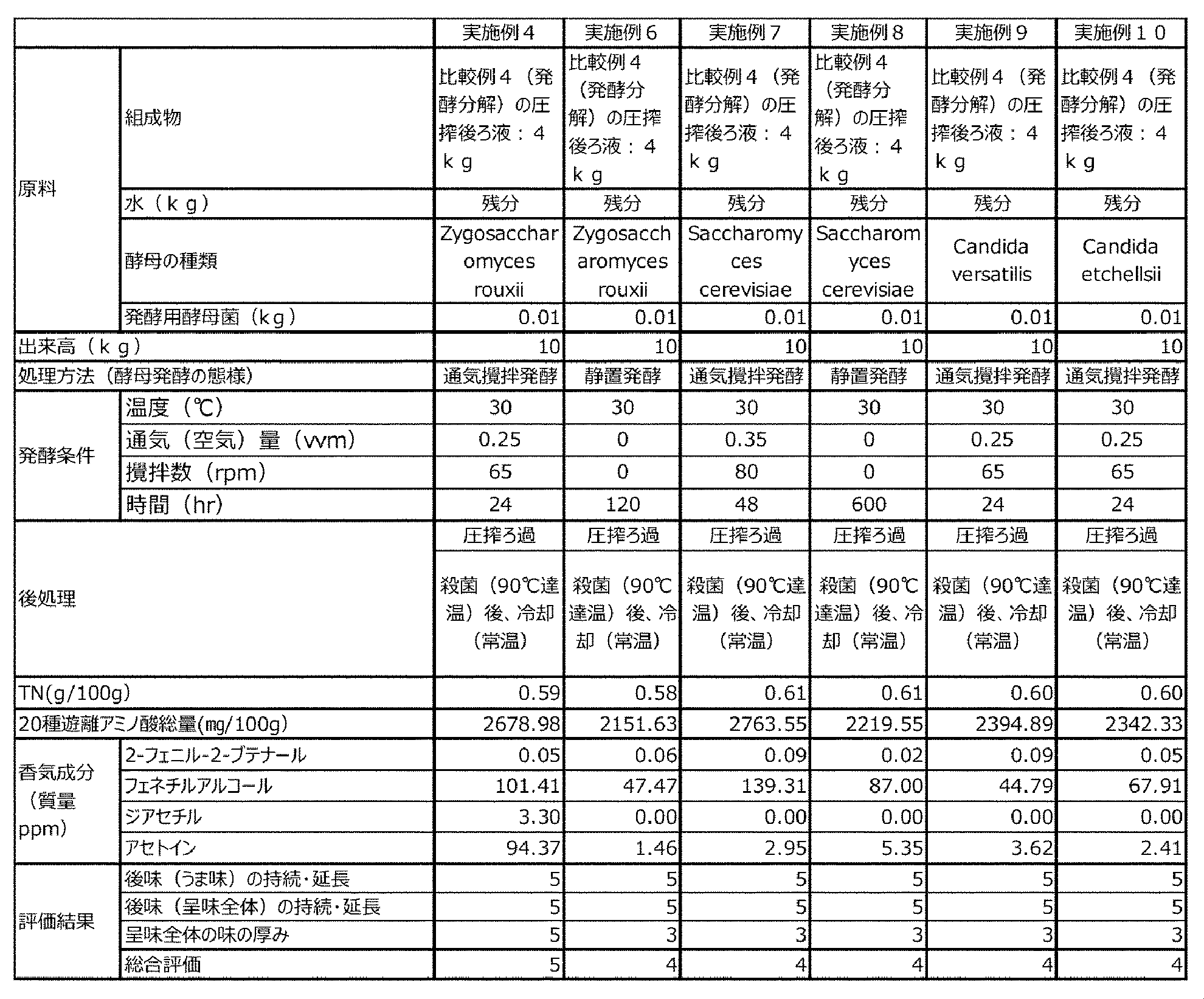
結果、酵母の種類(Zygosaccharomyces rouxii、Saccharomyces cerevisiae、Candida versatilis及びCandida etchellsiiの別)、酵母の培養条件(通気攪拌発酵/静置発酵の別)にかかわらず、本発明の強い後味(うま味、呈味全体共に)の余韻の持続・延長効果を奏し、呈味全体の味の厚みもやや好ましい自然な風味で雑味や異味異臭の無い好ましい品質に調整できることが分かった。
[試験4:本発明の効果成分の検証1]
上述のように、試験1~3より、酵母発酵により生成・増加された2-フェニル-2-ブテナール、フェネチルアルコール、ジアセチル及びアセトインが後味(うま味及び/又は呈味全体)の持続・延長効果に影響することが示唆された。
そこで、試験4では、酵母発酵によらない2-フェニル-2-ブテナール、フェネチルアルコール、ジアセチル及びアセトインの濃度による影響を検討した。具体的には、ショ糖0.4質量%、食塩0.13質量%、酒石酸0.01質量%、グルタミン酸ナトリウム0.05質量%の濃度の甘み、塩味、酸味、うま味を呈する混合水溶液を調製した。この水溶液に、2-フェニル-2-ブテナール(シグマアルドリッチ社製)、フェネチルアルコール(東京化成工業株式会社)、ジアセチル(東京化成工業株式会社製)及びアセトイン(東京化成工業株式会社製)の各純品を下記表の様々な濃度で添加した。これら香気成分の無添加品を対照として、試験1と同じ基準で選択された官能検査員により以下の評価基準に基づいて相対評価を行い、これらの香気成分について、後味(うま味、呈味全体共に)の余韻の持続・延長効果への関与の有無、効果の質の違い、効果を奏する濃度範囲について調べた。何れの評価項目でも、事前に検査員全員で標準試料の評価を行い、評価基準の用語やスコアについて標準化を行った上で、10名によって客観性のある官能検査を行った。評価項目の評価は、6段階の評点の中から、各検査員が自らの評価と最も近い数字をどれか一つ選択する方式で評価した。評価結果の集計は、10名のスコアの算術平均値から算出し、小数点以下は四捨五入した。また、備考は官能検査員全員の感想について、代表的なものをまとめたものである。
上述のように、試験1~3より、酵母発酵により生成・増加された2-フェニル-2-ブテナール、フェネチルアルコール、ジアセチル及びアセトインが後味(うま味及び/又は呈味全体)の持続・延長効果に影響することが示唆された。
そこで、試験4では、酵母発酵によらない2-フェニル-2-ブテナール、フェネチルアルコール、ジアセチル及びアセトインの濃度による影響を検討した。具体的には、ショ糖0.4質量%、食塩0.13質量%、酒石酸0.01質量%、グルタミン酸ナトリウム0.05質量%の濃度の甘み、塩味、酸味、うま味を呈する混合水溶液を調製した。この水溶液に、2-フェニル-2-ブテナール(シグマアルドリッチ社製)、フェネチルアルコール(東京化成工業株式会社)、ジアセチル(東京化成工業株式会社製)及びアセトイン(東京化成工業株式会社製)の各純品を下記表の様々な濃度で添加した。これら香気成分の無添加品を対照として、試験1と同じ基準で選択された官能検査員により以下の評価基準に基づいて相対評価を行い、これらの香気成分について、後味(うま味、呈味全体共に)の余韻の持続・延長効果への関与の有無、効果の質の違い、効果を奏する濃度範囲について調べた。何れの評価項目でも、事前に検査員全員で標準試料の評価を行い、評価基準の用語やスコアについて標準化を行った上で、10名によって客観性のある官能検査を行った。評価項目の評価は、6段階の評点の中から、各検査員が自らの評価と最も近い数字をどれか一つ選択する方式で評価した。評価結果の集計は、10名のスコアの算術平均値から算出し、小数点以下は四捨五入した。また、備考は官能検査員全員の感想について、代表的なものをまとめたものである。
<評価基準1:後味(うま味)の余韻の持続・延長の有無、好ましさ>
3:後味(うま味)の余韻の持続・延長がとても強く、その質が特に好ましい。
2:後味(うま味)の余韻の持続・延長が強く、その質が好ましい。
1:後味(うま味)の余韻の持続・延長がやや強く、その質がやや好ましい。
0:後味(うま味)の余韻の持続・延長が対照と差なし。
-1:後味(うま味)の余韻の持続・延長がやや弱い。
-2:後味(うま味)の余韻の持続・延長が弱いか感じられない。
3:後味(うま味)の余韻の持続・延長がとても強く、その質が特に好ましい。
2:後味(うま味)の余韻の持続・延長が強く、その質が好ましい。
1:後味(うま味)の余韻の持続・延長がやや強く、その質がやや好ましい。
0:後味(うま味)の余韻の持続・延長が対照と差なし。
-1:後味(うま味)の余韻の持続・延長がやや弱い。
-2:後味(うま味)の余韻の持続・延長が弱いか感じられない。
<評価基準2:後味(呈味全体)の余韻の持続・延長の有無、好ましさ>
3:後味(呈味全体)の余韻の持続・延長がとても強く、その質が特に好ましい。
2:後味(呈味全体)の余韻の持続・延長が強く、その質が好ましい。
1:後味(呈味全体)の余韻の持続・延長がやや強く、その質がやや好ましい。
0:後味(呈味全体)の余韻の持続・延長が対照と差なし。
-1:後味(呈味全体)の余韻の持続・延長がやや弱い。
-2:後味(呈味全体)の余韻の持続・延長が弱いか感じられない。
3:後味(呈味全体)の余韻の持続・延長がとても強く、その質が特に好ましい。
2:後味(呈味全体)の余韻の持続・延長が強く、その質が好ましい。
1:後味(呈味全体)の余韻の持続・延長がやや強く、その質がやや好ましい。
0:後味(呈味全体)の余韻の持続・延長が対照と差なし。
-1:後味(呈味全体)の余韻の持続・延長がやや弱い。
-2:後味(呈味全体)の余韻の持続・延長が弱いか感じられない。
<評価基準3:呈味全体の味の厚みの強さ、好ましさ>
3:呈味全体の味の厚みがとても強く、特に好ましい。
2:呈味全体の味の厚みが強く、好ましい。
1:呈味全体の味の厚みがやや強く、やや好ましい。
0:呈味全体の味の厚みが対照と差なし。
-1:呈味全体の味の厚みはやや弱く、やや好ましくない。
-2:呈味全体の味の厚みが弱く、好ましくない。
3:呈味全体の味の厚みがとても強く、特に好ましい。
2:呈味全体の味の厚みが強く、好ましい。
1:呈味全体の味の厚みがやや強く、やや好ましい。
0:呈味全体の味の厚みが対照と差なし。
-1:呈味全体の味の厚みはやや弱く、やや好ましくない。
-2:呈味全体の味の厚みが弱く、好ましくない。
<評価基準4:総合評価(風味全体として)>
3:特に好ましい。
2:好ましい。
1:やや好ましい。
0:対照と差なし。
-1:あまり好ましくない。
-2:好ましくない。
3:特に好ましい。
2:好ましい。
1:やや好ましい。
0:対照と差なし。
-1:あまり好ましくない。
-2:好ましくない。
2-フェニル-2-ブテナール、フェネチルアルコール、ジアセチル及びアセトインそれぞれの単独添加における結果を表4~7に示す。
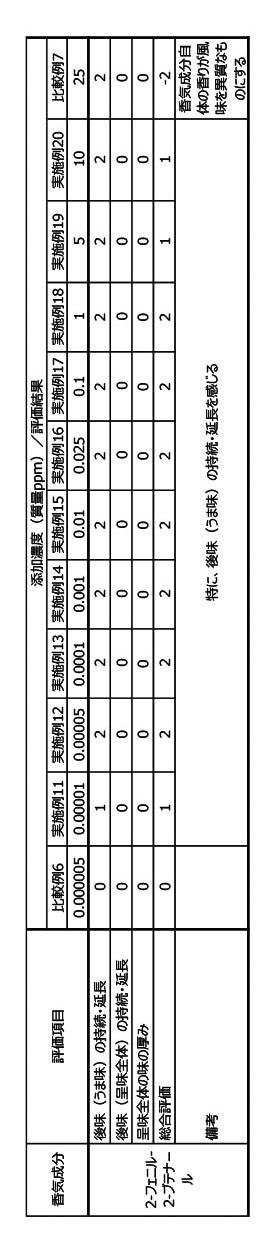
結果、2-フェニル-2-ブテナールを通常0.00001質量ppm以上、より好ましくは0.00005質量ppm以上を加えると対照と比較して後味(特にうま味)を持続・延長させる本発明の効果を強く奏することがわかった。また、通常10質量ppm以下、より好ましくは1質量ppm以下であれば香気成分自体の食品の風味への影響が少ないことが分かった。
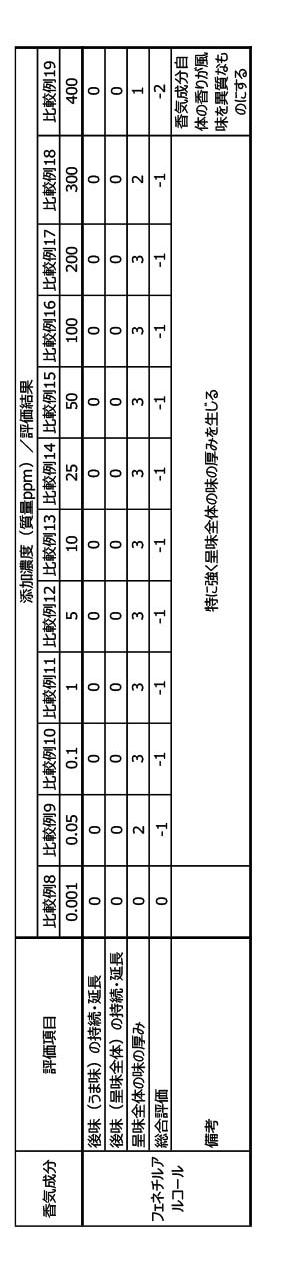
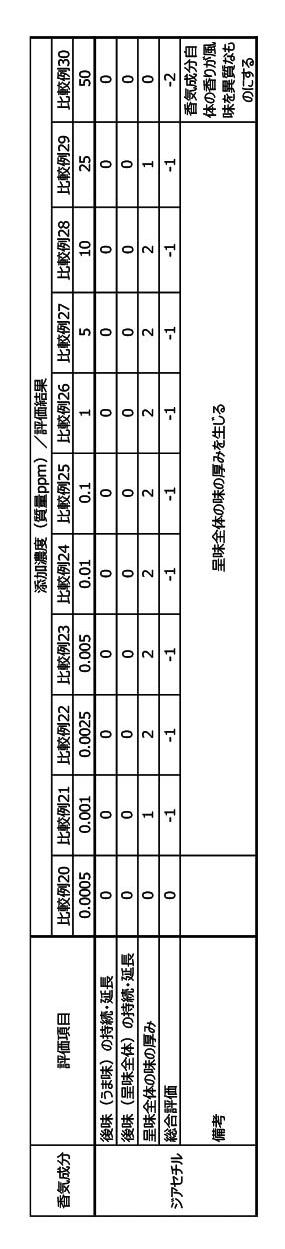
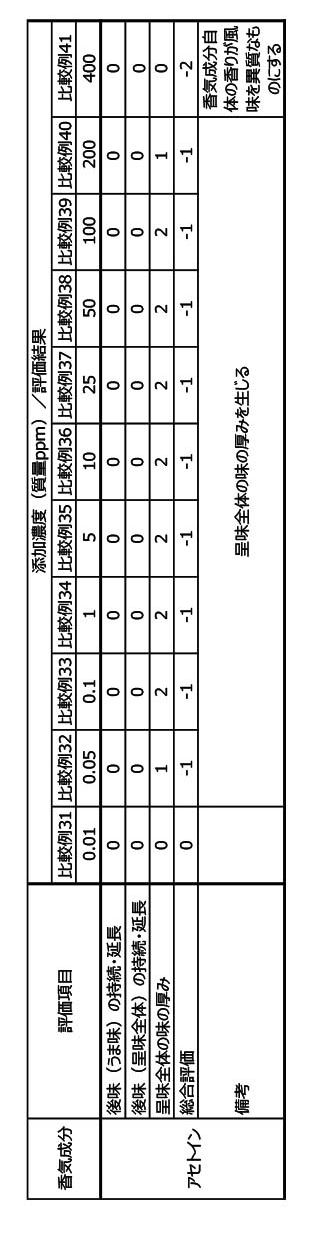
表5~7の結果、フェネチルアルコール、ジアセチル、及びアセトインのそれぞれの単独添加によっては、本発明の後味(うま味及び呈味全体)の持続・延長効果は認められなかった。一方で、これら香気成分(特に好ましくはフェネチルアルコール)の単独添加で呈味全体の味の厚みの向上効果を認めた。この結果から、これら成分による呈味全体の味の厚みの増強効果が、先の2-フェニル-2-ブテナールによる、後味(うま味及び呈味全体)の余韻の持続・延長効果をさらに増強する可能性が示唆された。
詳細には、表5からは、フェネチルアルコールは、呈味全体の味の厚みを増強する効果を強く奏し、味の厚みの増強効果の観点からは、食品中の含有量としては、下限として通常0.05質量ppm以上であればよく、好ましくは0.1質量ppm以上であればよいことが分かった。一方、上限としては、香気成分自体の食品の風味への影響の虞の観点から、通常300質量ppm以下であればよく、好ましくは200質量ppm以下であればよいことが分かった。
表6からは、ジアセチルは、呈味全体の味の厚みをやや増強する効果を奏し、味の厚みの増強効果の奏効の観点からは、食品中の含有量としては、下限として通常0.001質量ppm以上であればよく、好ましくは0.0025質量ppm以上であればよいことが分かった。一方、上限としては、香気成分自体の食品の風味への影響の虞の観点から、通常25質量ppm以下であればよく、好ましくは10質量ppm以下であればよいことが分かった。
表7からは、アセトインは、呈味全体の味の厚みをやや増強する効果を奏し、味の厚みの増強効果の奏効の観点からは、下限として通常0.05質量ppm以上であればよく、好ましくは0.1質量ppm以上であればよいことが分かった。一方、上限としては、香気成分自体の食品の風味への影響の虞の観点から、通常200質量ppm以下であればよく、好ましくは100質量ppm以下であればよいことが分かった。
[試験5:本発明の効果成分の検証2]
試験5では、試験4によって明らかになった2-フェニル-2-ブテナールによる本発明の効果が、フェネチルアルコールの添加によりさらに顕著に奏される可能性について検証した。具体的には、2-フェニル-2-ブテナールの添加量とフェネチルアルコールの添加量の比率を変え、それぞれの場合の効果について、試験4と同様の方法で比較検証した。結果を表8~17に示す。
試験5では、試験4によって明らかになった2-フェニル-2-ブテナールによる本発明の効果が、フェネチルアルコールの添加によりさらに顕著に奏される可能性について検証した。具体的には、2-フェニル-2-ブテナールの添加量とフェネチルアルコールの添加量の比率を変え、それぞれの場合の効果について、試験4と同様の方法で比較検証した。結果を表8~17に示す。
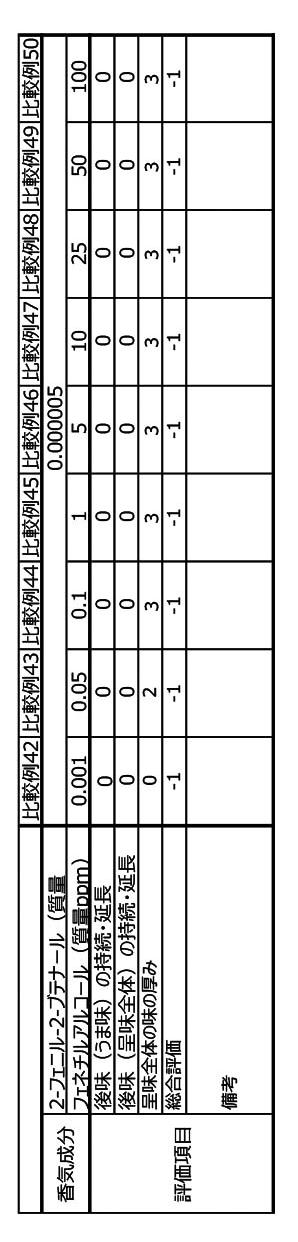

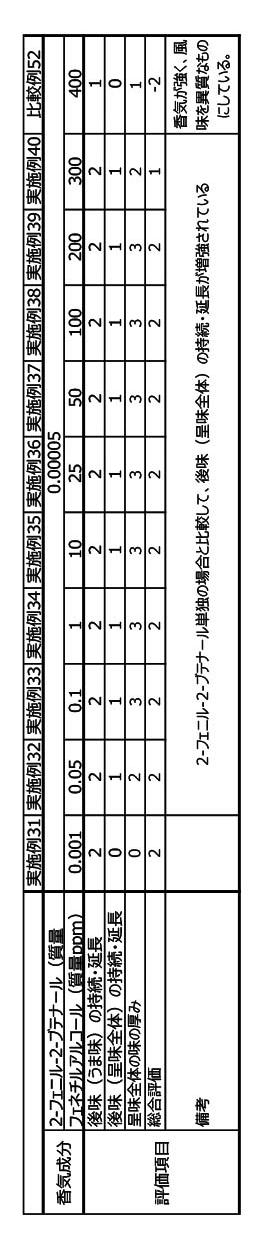

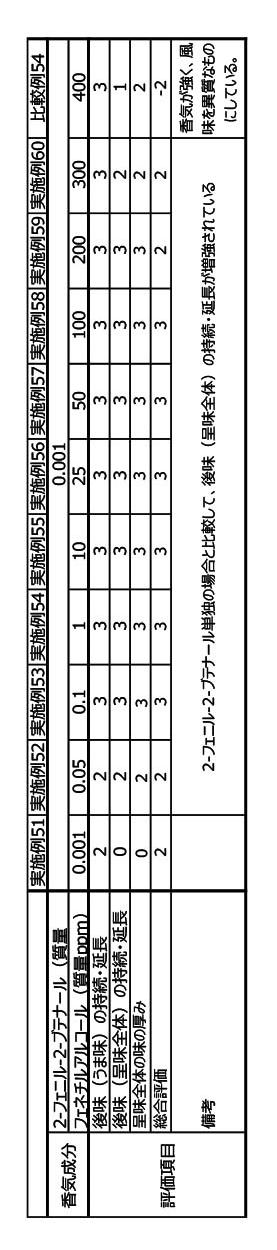
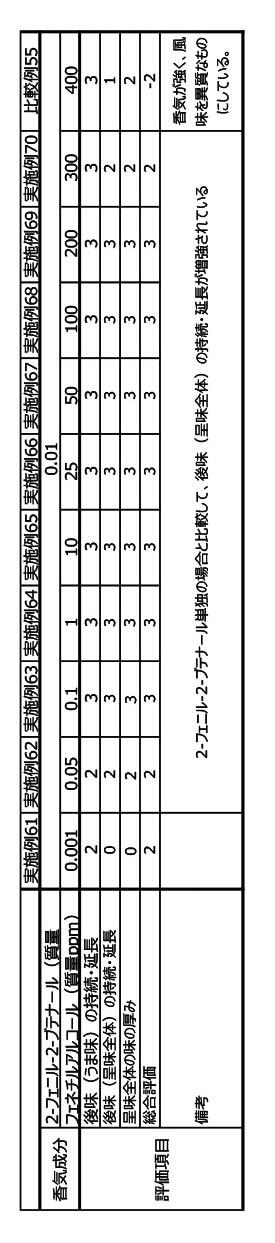


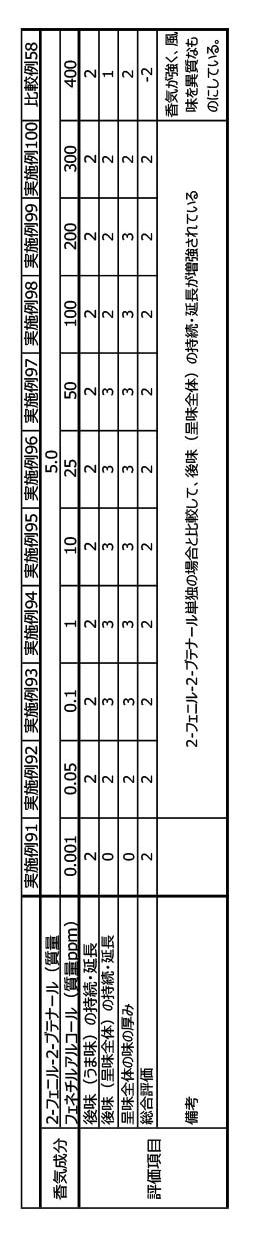

表8~17の結果より、食品の好ましい後味(うま味及び呈味全体)の余韻自体を持続・延長するためには、2-フェニル-2-ブテナールを一定範囲の含有量、とりわけ、0.00001質量ppm以上10質量ppm以下の範囲で含ませることが重要であることが分かった。また、フェネチルアルコールを、上記範囲内の含有量の2-フェニル-2-ブテナールと共に一定範囲の含有量、とりわけ、0.05質量ppm以上300質量ppm以下の範囲で含ませると、後味(うま味及び呈味全体)を持続・延長させる効果が更に増強された。
実験4よりフェネチルアルコールは単独で添加しても呈味全体の味の厚みを増強する効果しかなく、総合評価としては低いものであったが、実験5によってフェネチルアルコールを2-フェニル-2-ブテナールを共存させることにより後味(うま味及び呈味全体)を持続・延長させる効果を増強させ、総合評価も高くなることがわかった。実験4にてフェネチルアルコールと同様の結果を示したジアセチルやアセトインにも、類似の効果があることが予測された。
[試験6:本発明の効果成分の検証3]
試験4により各香気成分単独添加の効果が明らかになり、試験5により2-フェニル-2-ブテナールとフェネチルアルコールが共存した場合の本発明の後味(うま味及び呈味全体)の余韻の持続・延長効果の増強効果が明らかになった。そこで、試験6では、各香気成分が多種同時に含まれる場合の効果について検証した。具体的には、試験4と同様の評価方法で、表18に示す含有量で各香気成分を添加することによる影響を比較検証した。結果を表18に示す。
試験4により各香気成分単独添加の効果が明らかになり、試験5により2-フェニル-2-ブテナールとフェネチルアルコールが共存した場合の本発明の後味(うま味及び呈味全体)の余韻の持続・延長効果の増強効果が明らかになった。そこで、試験6では、各香気成分が多種同時に含まれる場合の効果について検証した。具体的には、試験4と同様の評価方法で、表18に示す含有量で各香気成分を添加することによる影響を比較検証した。結果を表18に示す。
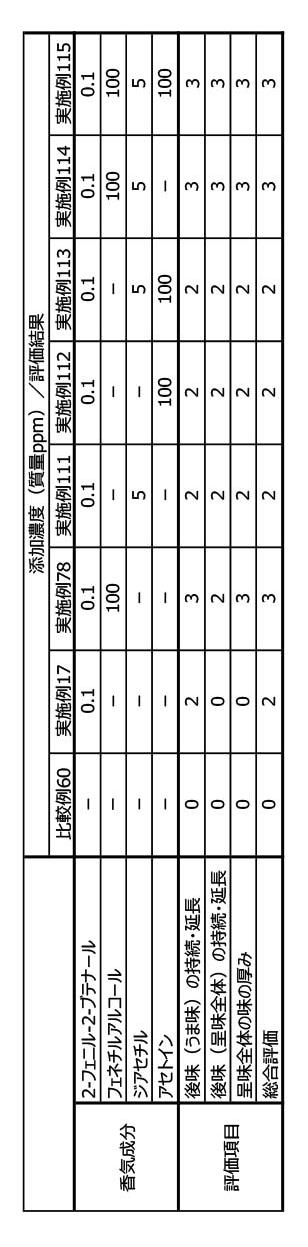
表18より、2-フェニル-2-ブテナールがフェネチルアルコールと共存する場合のみならず、ジアセチルとアセトインの一方又は両方と共存する場合にも、2-フェニル-2-ブテナールと単独の場合と比べてうま味及び/又は呈味全体の後味の余韻が持続・延長される効果が増強することがわかった。
[試験7:本発明の応用による所望の効果の付与に関する検証]
以上の試験から、本発明の食品は、好ましい後味(うま味及び/又は呈味全体)の余韻自体が持続・延長され(味伸び)、より続けて、より満足感のあるものとして摂食できる好ましい呈味を有すること、そのためには、食品に含まれる特定の香気成分が一定範囲になるよう調整するように制御することにより実現できることが実証された。
以上の試験から、本発明の食品は、好ましい後味(うま味及び/又は呈味全体)の余韻自体が持続・延長され(味伸び)、より続けて、より満足感のあるものとして摂食できる好ましい呈味を有すること、そのためには、食品に含まれる特定の香気成分が一定範囲になるよう調整するように制御することにより実現できることが実証された。
試験4、5、6において、各種香気成分の純品の添加により、本発明の所望の効果を有する食品を調製できることを示したが、各種香気成分の純品の添加による品質の調整には、膨大な手間やコストがかかり、現実的でない場合もある。そこで試験7では、本発明の効果を奏する食品を使用して、本発明の所望の効果が奏される食品が調製できることを実証した。
本発明の主要な香気成分である2-フェニル-2-ブテナールを含まない市販の米酢(比較例61)と、試験1で調製した本発明の食品(実施例4)とを、下記表19に示す原料ブレンド処方で混合し、調味料の代表的一例として、酢の物用の合わせ酢を調製した。また、同様にして(下記表20~22の原料ブレンド処方参照)、2種類のぽん酢しょうゆとめんつゆを調製した。これを試験1と同様に、官能試験及び成分分析に供した。結果を下記の表23に示す。


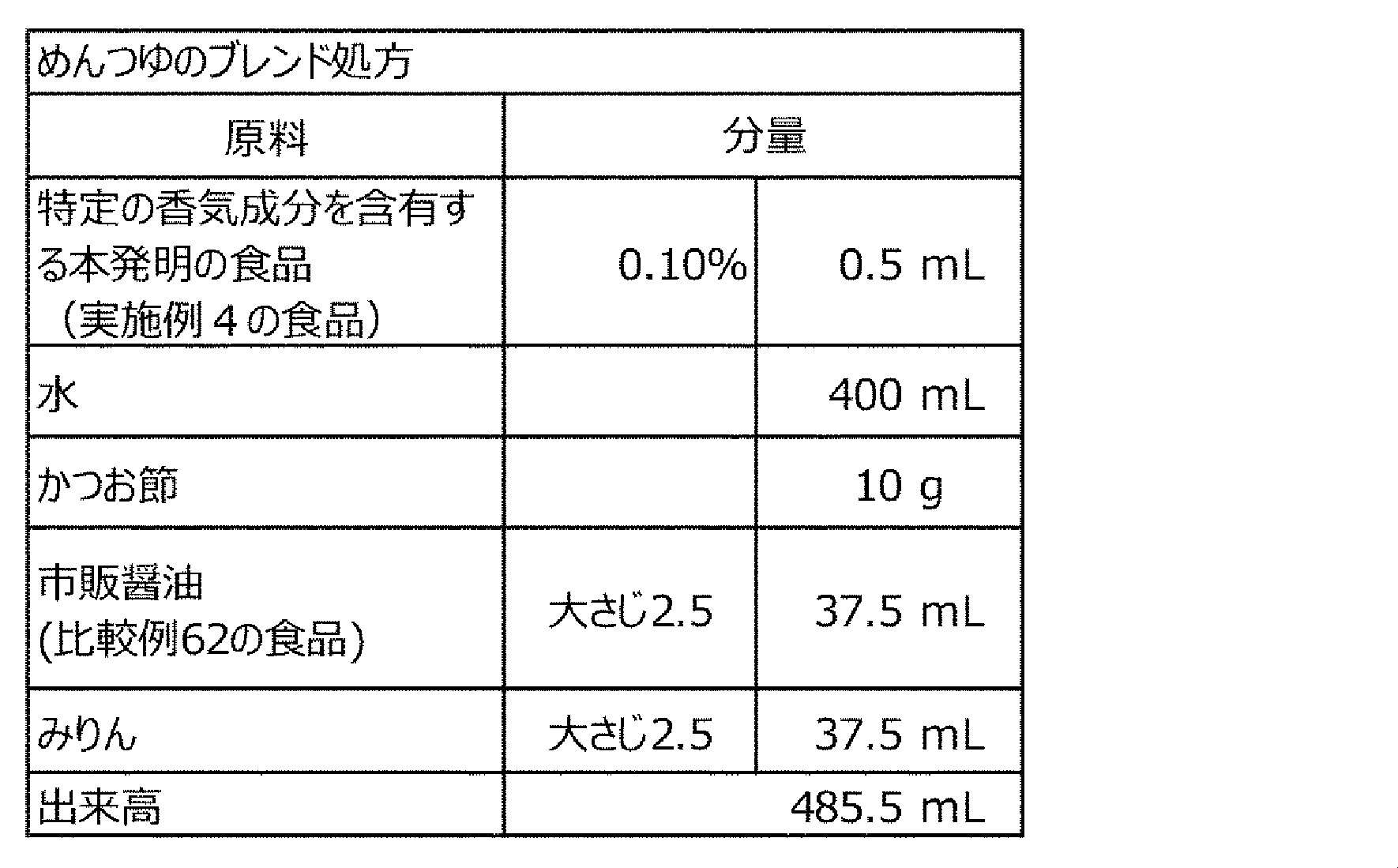
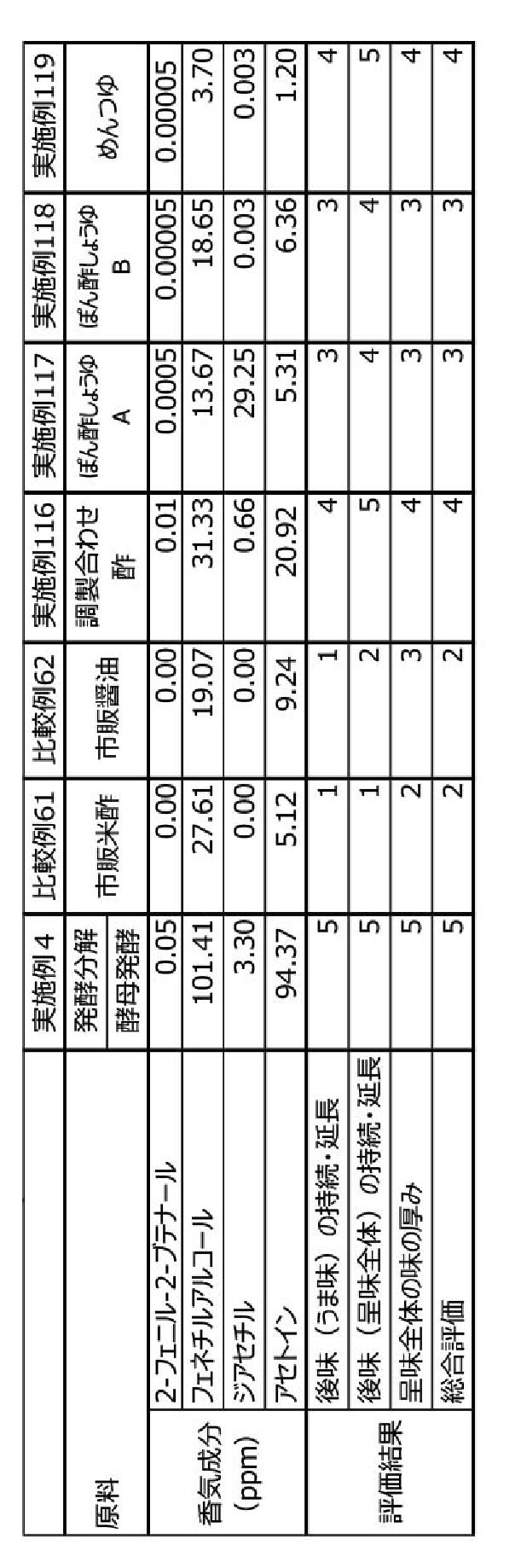
結果、本発明の所望の効果を有する食品を、他の食品と混合することにより、各香気成分の含有量の範囲を前記の所定範囲内に調整することができれば、配合により調製された食品であっても、本発明の所望のうま味及び/又は呈味全体の後味の余韻持続・延長効果を奏しうることが実証された。なお、本発明の所望の効果を奏するためには、2-フェニル-2-ブテナールの含有量を所定範囲内に調整することが必要である。また、2-フェニル-2-ブテナールに加えて、フェネチルアルコール、ジアセチル及び/又はアセトインを所定範囲内に調整することがより好ましい。
Claims (7)
- 2-フェニル-2-ブテナールを0.00001質量ppm以上10質量ppm以下の範囲で含有する食品。
- 更に下記(a)~(c)のうち1又は2以上を満たす請求項1に記載の食品:
(a)フェネチルアルコールを0.05質量ppm以上300質量ppm以下の範囲で含有する;
(b)ジアセチルを0.001質量ppm以上25質量ppm以下の範囲で含有する;
(c)アセトインを0.05質量ppm以上200質量ppm以下の範囲で含有する。 - 調味料である、請求項1又は2に記載の食品。
- 液体調味料である、請求項3に記載の食品。
- 請求項1~4の何れか一項に記載の食品を製造する方法であって、食品中の2-フェニル-2-ブテナールの含有量を0.00001質量ppm以上10質量ppm以下の範囲に調節することを含む方法。
- 食品のうま味の後味の余韻を持続・延長する方法であって、食品中の2-フェニル-2-ブテナールの含有量を0.00001質量ppm以上10質量ppm以下の範囲に調節することを含む方法。
- 更に下記(i)~(iii)のうち1又は2以上を更に含み、前記食品の呈味全体の後味の余韻を持続・延長する、請求項5又は6に記載の方法:
(i)食品中のフェネチルアルコールの含有量を0.05質量ppm以上300質量ppm以下の範囲に調節する工程;
(ii)前記食品にジアセチルの含有量を0.001質量ppm以上25質量ppm以下の範囲に調節する工程;
(iii)食品中のアセトインの含有量を0.05質量ppm以上200質量ppm以下の範囲に調節する工程。
Applications Claiming Priority (2)
| Application Number | Priority Date | Filing Date | Title |
|---|---|---|---|
| JP2021-009537 | 2021-01-25 | ||
| JP2021009537A JP6949339B1 (ja) | 2021-01-25 | 2021-01-25 | 特定の香気成分を含有する食品およびその製造方法 |
Publications (1)
| Publication Number | Publication Date |
|---|---|
| WO2022158140A1 true WO2022158140A1 (ja) | 2022-07-28 |
Family
ID=78001363
Family Applications (1)
| Application Number | Title | Priority Date | Filing Date |
|---|---|---|---|
| PCT/JP2021/044530 Ceased WO2022158140A1 (ja) | 2021-01-25 | 2021-12-03 | 特定の香気成分を含有する食品およびその製造方法 |
Country Status (2)
| Country | Link |
|---|---|
| JP (1) | JP6949339B1 (ja) |
| WO (1) | WO2022158140A1 (ja) |
Families Citing this family (2)
| Publication number | Priority date | Publication date | Assignee | Title |
|---|---|---|---|---|
| JP6949339B1 (ja) * | 2021-01-25 | 2021-10-13 | 株式会社Mizkan Holdings | 特定の香気成分を含有する食品およびその製造方法 |
| KR20250096855A (ko) | 2022-10-31 | 2025-06-27 | 아지노모토 가부시키가이샤 | 풍미 개선 방법 |
Citations (7)
| Publication number | Priority date | Publication date | Assignee | Title |
|---|---|---|---|---|
| JPS5127665B1 (ja) * | 1968-04-26 | 1976-08-13 | ||
| JP2004135522A (ja) * | 2002-10-16 | 2004-05-13 | Kiyomitsu Kawasaki | 魚節フレーバー組成物および該フレーバー組成物を含有する食品類 |
| JP2006020526A (ja) * | 2004-07-06 | 2006-01-26 | Kiyomitsu Kawasaki | コーヒーフレーバー組成物および該フレーバー組成物を含有する飲食品類 |
| JP2006121958A (ja) * | 2004-10-28 | 2006-05-18 | Kiyomitsu Kawasaki | ココア様香料組成物 |
| CN102323385A (zh) * | 2011-06-03 | 2012-01-18 | 上海应用技术学院 | 一种挥发性风味物质嗅觉阈值的测定方法及其应用 |
| JP2015043769A (ja) * | 2013-08-27 | 2015-03-12 | シムライズ アーゲー | 経口組成物 |
| JP6949339B1 (ja) * | 2021-01-25 | 2021-10-13 | 株式会社Mizkan Holdings | 特定の香気成分を含有する食品およびその製造方法 |
Family Cites Families (2)
| Publication number | Priority date | Publication date | Assignee | Title |
|---|---|---|---|---|
| JP5931375B2 (ja) * | 2011-08-31 | 2016-06-08 | 三栄源エフ・エフ・アイ株式会社 | うま味成分の不快な後味改善方法 |
| WO2017108861A1 (en) * | 2015-12-22 | 2017-06-29 | Nestec S.A. | Flavoured milk product |
-
2021
- 2021-01-25 JP JP2021009537A patent/JP6949339B1/ja active Active
- 2021-12-03 WO PCT/JP2021/044530 patent/WO2022158140A1/ja not_active Ceased
Patent Citations (7)
| Publication number | Priority date | Publication date | Assignee | Title |
|---|---|---|---|---|
| JPS5127665B1 (ja) * | 1968-04-26 | 1976-08-13 | ||
| JP2004135522A (ja) * | 2002-10-16 | 2004-05-13 | Kiyomitsu Kawasaki | 魚節フレーバー組成物および該フレーバー組成物を含有する食品類 |
| JP2006020526A (ja) * | 2004-07-06 | 2006-01-26 | Kiyomitsu Kawasaki | コーヒーフレーバー組成物および該フレーバー組成物を含有する飲食品類 |
| JP2006121958A (ja) * | 2004-10-28 | 2006-05-18 | Kiyomitsu Kawasaki | ココア様香料組成物 |
| CN102323385A (zh) * | 2011-06-03 | 2012-01-18 | 上海应用技术学院 | 一种挥发性风味物质嗅觉阈值的测定方法及其应用 |
| JP2015043769A (ja) * | 2013-08-27 | 2015-03-12 | シムライズ アーゲー | 経口組成物 |
| JP6949339B1 (ja) * | 2021-01-25 | 2021-10-13 | 株式会社Mizkan Holdings | 特定の香気成分を含有する食品およびその製造方法 |
Non-Patent Citations (3)
| Title |
|---|
| INOUE YUTAKA; KATO SACHIE; SAIKUSA MIYU; SUZUKI CHIHIRO; OTSUBO YURIKO; TANAKA YUTARO; WATANABE HIROHITO; HAYASE FUMITAKA: "Analysis of the cooked aroma and odorants that contribute to umami aftertaste of soy miso (Japanese soybean paste)", FOOD CHEMISTRY, ELSEVIER LTD., NL, vol. 213, 30 June 2016 (2016-06-30), NL , pages 521 - 528, XP029652009, ISSN: 0308-8146, DOI: 10.1016/j.foodchem.2016.06.106 * |
| TANAKA TAKATA: "Selection and Properties of MY-8 yeast for Miso", BULLETIN OF THE FUKUI AGRICULTURAL EXPERIMENT STATION, vol. 37, 1 March 2000 (2000-03-01), pages 43 - 48, XP055952410, ISSN: 1341-2345 * |
| XIAO ZUOBING, DAI XIN, ZHU JIANCAI, YU HAIYAN: "Classification of Chinese Rice Wine According to Geographic Origin and Wine Age Based on Chemometric Methods and SBSE-TD-GC-MS Analysis of Volatile Compounds", FOOD SCIENCE AND TECHNOLOGY RESEARCH, KARGER, BASEL, CH, vol. 21, no. 3, 1 January 2015 (2015-01-01), CH , pages 371 - 380, XP055952403, ISSN: 1344-6606, DOI: 10.3136/fstr.21.371 * |
Also Published As
| Publication number | Publication date |
|---|---|
| JP2022113354A (ja) | 2022-08-04 |
| JP6949339B1 (ja) | 2021-10-13 |
Similar Documents
| Publication | Publication Date | Title |
|---|---|---|
| Jiang et al. | Comprehensive investigation on volatile and non-volatile metabolites in low-salt doubanjiang with different fermentation methods | |
| JP2006149367A (ja) | 良好な醸造香を有するビールテイスト発酵飲料の製造方法 | |
| Li et al. | Study on the factors affecting the sauce-flavor compounds of soybean paste in fermentation | |
| JP5894376B2 (ja) | チョコレートの味及び風味の改善のための剤 | |
| CN110573021A (zh) | 衍生自大豆乳清的饮料 | |
| US8173185B2 (en) | Fermented soy sauce with less soy sauce flavor and process for producing the same | |
| WO2022158140A1 (ja) | 特定の香気成分を含有する食品およびその製造方法 | |
| Loyda et al. | Physicochemical properties, amino acid composition and volatile components of fermented fish (Pla-ra) accelerated by starter cultures | |
| Qiu et al. | Fermentation with a multi-strain to enhance the flavor of HongJun Tofu, a Chinese fermented okara food | |
| Thongsomboon et al. | Dynamic changes in Thai-style fermented fish: Low-salt, short fermentation with autochthonous starter culture | |
| Battur et al. | Exploring the effects of milk-enriched walnut soy sauce: Insights from GC-IMS and metagenomics approach to flavor and microbial shifts | |
| Asanuma et al. | Development and characterization of Japanese soy sauce-like fermented seasoning with various ingredients | |
| JP2026069606A (ja) | 麹利用食品の製造方法 | |
| Dong et al. | Flavor profile and peptide formation in soy sauce fermented from soybean meal by Aspergillus oryzae and Aspergillus niger | |
| JP2022164766A (ja) | 糖質ゼロのビールテイスト発酵アルコール飲料 | |
| Li et al. | Application effects of NaCl substitute on the fermentation profile of Pixian douban (broad bean paste) | |
| JP7640561B2 (ja) | 米麹を原料とする調味料 | |
| KR20130139041A (ko) | 식품의 향미를 증진시키는 균주 | |
| CN101257803B (zh) | 不精纯样臭降低的酱油的制造方法 | |
| Li et al. | A new two-step rapid fermentation method for shrimp paste based on strain fortification and analysis of flavor quality, Food Sci | |
| Chen et al. | Effect of mixed starter cultures of Bacillus on sensory characteristics of bacterial-douchi: insights from free amino acids, electronic sensory, flavor profiling and quorum sensing | |
| JP7619817B2 (ja) | 食酢 | |
| JP3065694B2 (ja) | 低塩醤油様調味液の製造法 | |
| KR100280270B1 (ko) | 식품의 향미개량법 | |
| Wu et al. | Characterization of the flavor profile and microbial-driven mechanism of characteristic flavor formation in Yuxi Taihe Douchi |
Legal Events
| Date | Code | Title | Description |
|---|---|---|---|
| 121 | Ep: the epo has been informed by wipo that ep was designated in this application |
Ref document number: 21921242 Country of ref document: EP Kind code of ref document: A1 |
|
| NENP | Non-entry into the national phase |
Ref country code: DE |
|
| 122 | Ep: pct application non-entry in european phase |
Ref document number: 21921242 Country of ref document: EP Kind code of ref document: A1 |