WO2022158461A1 - Feuille de flux pour transfert de semi-conducteurs - Google Patents
Feuille de flux pour transfert de semi-conducteurs Download PDFInfo
- Publication number
- WO2022158461A1 WO2022158461A1 PCT/JP2022/001680 JP2022001680W WO2022158461A1 WO 2022158461 A1 WO2022158461 A1 WO 2022158461A1 JP 2022001680 W JP2022001680 W JP 2022001680W WO 2022158461 A1 WO2022158461 A1 WO 2022158461A1
- Authority
- WO
- WIPO (PCT)
- Prior art keywords
- water
- flux
- flux sheet
- sheet
- component
- Prior art date
- Legal status (The legal status is an assumption and is not a legal conclusion. Google has not performed a legal analysis and makes no representation as to the accuracy of the status listed.)
- Ceased
Links
Images

Classifications
-
- B—PERFORMING OPERATIONS; TRANSPORTING
- B23—MACHINE TOOLS; METAL-WORKING NOT OTHERWISE PROVIDED FOR
- B23K—SOLDERING OR UNSOLDERING; WELDING; CLADDING OR PLATING BY SOLDERING OR WELDING; CUTTING BY APPLYING HEAT LOCALLY, e.g. FLAME CUTTING; WORKING BY LASER BEAM
- B23K35/00—Rods, electrodes, materials, or media, for use in soldering, welding, or cutting
- B23K35/22—Rods, electrodes, materials, or media, for use in soldering, welding, or cutting characterised by the composition or nature of the material
- B23K35/36—Selection of non-metallic compositions, e.g. coatings or fluxes; Selection of soldering or welding materials, conjoint with selection of non-metallic compositions, both selections being of interest
- B23K35/3601—Selection of non-metallic compositions, e.g. coatings or fluxes; Selection of soldering or welding materials, conjoint with selection of non-metallic compositions, both selections being of interest with inorganic compounds as principal constituents
-
- H—ELECTRICITY
- H10—SEMICONDUCTOR DEVICES; ELECTRIC SOLID-STATE DEVICES NOT OTHERWISE PROVIDED FOR
- H10H—INORGANIC LIGHT-EMITTING SEMICONDUCTOR DEVICES HAVING POTENTIAL BARRIERS
- H10H20/00—Individual inorganic light-emitting semiconductor devices having potential barriers, e.g. light-emitting diodes [LED]
- H10H20/01—Manufacture or treatment
-
- B—PERFORMING OPERATIONS; TRANSPORTING
- B23—MACHINE TOOLS; METAL-WORKING NOT OTHERWISE PROVIDED FOR
- B23K—SOLDERING OR UNSOLDERING; WELDING; CLADDING OR PLATING BY SOLDERING OR WELDING; CUTTING BY APPLYING HEAT LOCALLY, e.g. FLAME CUTTING; WORKING BY LASER BEAM
- B23K35/00—Rods, electrodes, materials, or media, for use in soldering, welding, or cutting
- B23K35/02—Rods, electrodes, materials, or media, for use in soldering, welding, or cutting characterised by mechanical features, e.g. shape
- B23K35/0222—Rods, electrodes, materials, or media, for use in soldering, welding, or cutting characterised by mechanical features, e.g. shape for use in soldering or brazing
- B23K35/0233—Sheets or foils
-
- B—PERFORMING OPERATIONS; TRANSPORTING
- B23—MACHINE TOOLS; METAL-WORKING NOT OTHERWISE PROVIDED FOR
- B23K—SOLDERING OR UNSOLDERING; WELDING; CLADDING OR PLATING BY SOLDERING OR WELDING; CUTTING BY APPLYING HEAT LOCALLY, e.g. FLAME CUTTING; WORKING BY LASER BEAM
- B23K35/00—Rods, electrodes, materials, or media, for use in soldering, welding, or cutting
- B23K35/22—Rods, electrodes, materials, or media, for use in soldering, welding, or cutting characterised by the composition or nature of the material
- B23K35/36—Selection of non-metallic compositions, e.g. coatings or fluxes; Selection of soldering or welding materials, conjoint with selection of non-metallic compositions, both selections being of interest
- B23K35/3612—Selection of non-metallic compositions, e.g. coatings or fluxes; Selection of soldering or welding materials, conjoint with selection of non-metallic compositions, both selections being of interest with organic compounds as principal constituents
- B23K35/3618—Carboxylic acids or salts
-
- H—ELECTRICITY
- H10—SEMICONDUCTOR DEVICES; ELECTRIC SOLID-STATE DEVICES NOT OTHERWISE PROVIDED FOR
- H10H—INORGANIC LIGHT-EMITTING SEMICONDUCTOR DEVICES HAVING POTENTIAL BARRIERS
- H10H20/00—Individual inorganic light-emitting semiconductor devices having potential barriers, e.g. light-emitting diodes [LED]
- H10H20/80—Constructional details
- H10H20/85—Packages
-
- B—PERFORMING OPERATIONS; TRANSPORTING
- B23—MACHINE TOOLS; METAL-WORKING NOT OTHERWISE PROVIDED FOR
- B23K—SOLDERING OR UNSOLDERING; WELDING; CLADDING OR PLATING BY SOLDERING OR WELDING; CUTTING BY APPLYING HEAT LOCALLY, e.g. FLAME CUTTING; WORKING BY LASER BEAM
- B23K35/00—Rods, electrodes, materials, or media, for use in soldering, welding, or cutting
- B23K35/22—Rods, electrodes, materials, or media, for use in soldering, welding, or cutting characterised by the composition or nature of the material
- B23K35/24—Selection of soldering or welding materials proper
- B23K35/26—Selection of soldering or welding materials proper with the principal constituent melting at less than 400°C
-
- H—ELECTRICITY
- H10—SEMICONDUCTOR DEVICES; ELECTRIC SOLID-STATE DEVICES NOT OTHERWISE PROVIDED FOR
- H10W—GENERIC PACKAGES, INTERCONNECTIONS, CONNECTORS OR OTHER CONSTRUCTIONAL DETAILS OF DEVICES COVERED BY CLASS H10
- H10W90/00—Package configurations
Definitions
- the present invention relates to a flux sheet for semiconductor transfer.
- materials having an adhesive layer are used for the purpose of preventing adhesion of foreign matter or efficiently manufacturing semiconductor chips or image display devices. .
- Patent Literature 1 proposes a method of manufacturing a display device using light emitting diodes (LEDs).
- the manufacturing method describes a method of forming a large number of LED elements as pixels on one wafer, followed by dicing and enlarging transfer using a temporary holding member having an adhesive layer (pressure-sensitive adhesive layer). ing.
- Patent Document 2 proposes a method of separating an LED element from a substrate by using a laser beam when enlarging transfer is performed.
- An object of the present invention is to provide a flux sheet that is excellent in shock absorption and tackiness/adhesiveness, as well as solderability and water washability.
- a flux sheet for semiconductor transfer comprising (A) a water-soluble adhesive and (B) a water-soluble plasticizer (excluding the component (A)), the (B) water-soluble plasticizer
- the agent has a viscosity of 50,000 mPa.s at room temperature (25°C). s or less, and the ratio of the content of the (B) water-soluble plasticizer to the content of the (A) water-soluble adhesive ((B)/(A)) is 0.2 or more.
- a flux sheet for semiconductor transfer is provided. According to the flux sheet for semiconductor transfer of the present invention, 50000 mPa.s at normal temperature (25° C.).
- the impact absorption and adhesiveness of the flux sheet for semiconductor transfer are improved, and during the production of semiconductor elements It is possible to suppress the occurrence of damage or positional displacement of the element.
- the flux sheet for semiconductor transfer of the present invention good solder joints can be achieved, and removal by washing with water after reflow and handling are facilitated.
- a flux sheet for semiconductor transfer comprising (A) a water-soluble adhesive and (B) a water-soluble plasticizer (excluding the component (A)), the (B) water-soluble plasticizer
- the agent is liquid at normal temperature (25 ° C.) and has a molecular weight of 5000 or less, and the ratio of the content of the water-soluble plasticizer (B) to the content of the water-soluble adhesive (A) ((B)
- a flux sheet for semiconductor transfer is provided, wherein /(A)) is 0.2 or more.
- the flux sheet for semiconductor transfer of the present invention since the liquid water-soluble plasticizer having a molecular weight of 5000 or less is contained in a predetermined ratio with respect to the content of the water-soluble adhesive, the flux sheet for semiconductor transfer The impact absorption and adhesion/adhesiveness of the semiconductor element are improved, and it is possible to suppress the occurrence of damage or positional displacement of the element during manufacturing of the semiconductor element. Moreover, according to the flux sheet for semiconductor transfer of the present invention, good solder joints can be achieved, and removal by washing with water after reflow and handling are facilitated.
- the flux sheet for semiconductor transfer preferably contains (C) a fluxing agent (excluding the component (A) and the component (B)). According to the above-described embodiment, it is possible to provide a flux sheet that has excellent impact absorption and adhesion/bonding properties, has flux activity, and is excellent in water washability.
- the (A) water-soluble adhesive is at least selected from the group consisting of vinyl alcohol-based polymers, vinylpyrrolidone-based polymers, acrylic polymers and sugars. It preferably contains one water-soluble adhesive. According to the embodiment described above, it is possible to provide a flux sheet that is excellent in tackiness and adhesiveness, and is also excellent in water washability. If a vinyl alcohol-based polymer is selected, the (A) water-soluble pressure-sensitive adhesive has flux activity, providing a flux sheet that is excellent in tackiness, adhesiveness, and water washability and has flux activity. can do.
- the vinyl alcohol polymer preferably has an oxyalkylene structure. According to the embodiment described above, it is possible to provide a flux sheet that is excellent in water washability due to improved adhesiveness and low-temperature water solubility.
- the (B) water-soluble plasticizer is preferably liquid at room temperature (25° C.).
- the (B) water-soluble plasticizer is liquid at normal temperature (25 ° C.), so compared to the solid (B) water-soluble plasticizer, the (A) water-soluble pressure-sensitive adhesive Mixing is easy, and a flux sheet with excellent manufacturability can be provided.
- the water-soluble plasticizer (B) preferably has a boiling point of 120° C. or higher. According to the above-described embodiment, it is possible to provide a flux sheet whose physical properties are less likely to change during transfer because it is difficult to evaporate during the transfer process.
- the (B) water-soluble plasticizer contains at least one selected from glycerin, diglycerin, polyethylene glycol, ethylene glycol, propylene glycol and polypropylene glycol. is preferred.
- glycerin, diglycerin, polyethylene glycol, ethylene glycol, propylene glycol, and polypropylene glycol all have high boiling points, they are difficult to evaporate during reflow. voids”) can be suppressed.
- the (A) water-soluble adhesive contains sugars
- (B) the water-soluble plasticizer (excluding component (A)) has a boiling point of 200° C. or higher. is preferably According to the embodiment described above, it is possible to provide a flux sheet which is excellent in tackiness and adhesiveness, as well as excellent solder jointability and water washability. In addition, the flux sheet does not evaporate the plasticizer even in the reflow soldering process and exhibits good solderability.
- the (C) fluxing agent is preferably a compound having a carboxyl group. According to the above embodiment, the flux agent (C) is easily dissolved in water, so that a flux sheet having excellent water washability can be provided.
- the semiconductor is preferably a light emitting diode (LED).
- LED light emitting diode
- the impact absorption and adhesion/adhesiveness that can prevent damage due to collision of the LED element with the transfer destination member in the transfer process and failure to mount the LED element at the desired position due to rebounding can be prevented. It is possible to provide a flux sheet which is excellent and has excellent water washability in the washing process.
- a method for manufacturing an electronic component characterized by using the flux sheet for semiconductor transfer described above.
- a flux sheet which is excellent in shock absorption and tackiness/adhesiveness as well as excellent in water washability is used, an effect such as solder joint failure does not occur. can be done.
- the flux sheet itself has flux activity, it is not necessary to separately apply a flux agent to the substrate or the like when manufacturing electronic parts, thereby shortening the manufacturing process.
- the present invention it is possible to provide a flux sheet that is excellent in shock absorption and adhesion/adhesiveness, as well as excellent solder jointability and water washability.
- FIG. 4 is a diagram showing JEDEC recommended conditions in a reflow soldering process for evaluation of flux activity
- the flux sheet for semiconductor transfer of the present invention has a shock absorbing property for receiving semiconductor elements such as LED elements separated from a transfer source substrate by an energy beam (laser, etc.) and the like. It has tackiness and tackiness for temporarily fixing to the substrate and tackiness and adhesion to the substrate.
- the flux sheet for semiconductor transfer of the present invention softens and melts at the reflow temperature in the reflow process, and has flux activity to remove or reduce oxides on the solder surface, thereby preventing poor bonding between the semiconductor element and the circuit. To prevent. Further, in the flux sheet for semiconductor transfer of the present invention, the residue of the flux sheet melted in the reflow process can be dissolved in water and removed in the water washing process.
- the sheet can evenly supply flux to each electrode of the substrate, flux activity is stably exhibited at each electrode to exhibit good solderability.
- the mounting surface of the parts (the upper surface of the sheet and the upper surface of the liquid flux) is flat, so the parts can be stably placed.
- the shape of the flux sheet for semiconductor transfer of the present invention is not particularly limited.
- Examples of the planar shape of the flux sheet for semiconductor transfer of the present invention include polygons (eg, rectangles, rectangles, triangles, etc.), circles, ellipses, irregular shapes, and the like.
- the shape of the flux sheet for semiconductor transfer of the present invention can be a desired shape, such as a shape matching the shape of the substrate to be adhered. Alternatively, it may be processed into a desired shape using a known method such as cutting. Furthermore, after forming into a roll, it can be cut into a required amount and used.
- the thickness of the flux sheet for semiconductor transfer of the present invention is not particularly limited, it is preferably 1 ⁇ m or more, more preferably 3 ⁇ m or more, and even more preferably 5 ⁇ m or more. It is preferable that the thickness of the flux sheet for semiconductor transfer of the present invention is 1 ⁇ m or more because the impact absorption is improved.
- the upper limit of the thickness of the flux sheet for semiconductor transfer of the present invention is preferably 500 ⁇ m or less, more preferably 100 ⁇ m or less, and even more preferably 50 ⁇ m or less.
- the thickness of the flux sheet for semiconductor transfer of the present invention is 500 ⁇ m or less, the softening and melting time of the flux sheet can be shortened, and the amount of flux sheet residue is small, so the time required for the fluxing process and the cleaning process can be shortened, which is preferable. .
- the thickness of the flux sheet for semiconductor transfer of the present invention is appropriately selected according to the relationship with the height of the bumps formed on the semiconductor element.
- the flux sheet is thicker than the height of the bumps, the bottom and side surfaces of the semiconductor element are in contact with the flux sheet, so that the rebound of the semiconductor element can be suppressed.
- the flux sheet for semiconductor transfer of the present invention contains a water-soluble plasticizer (B). Since the sheet has strong liquid characteristics, the upper surface of the flux sheet is wet on the side surfaces of the bumps of the semiconductor element and the side surfaces of the semiconductor element in the initial stage of the rebound after the semiconductor element sinks, and the surface tension and adhesion force due to the wetness. The effect of suppressing rebounding of the semiconductor element and breakage of the semiconductor element is exhibited.
- B water-soluble plasticizer
- the upper surface of the semiconductor element is covered with the flux sheet, and the rebound resistance is further increased.
- the effect of suppressing rebounding of the semiconductor element is that in the initial stage of rebounding, the flux sheet is wet on the bump side of the semiconductor element (wet on the bump of the semiconductor element), and the flux sheet is wet on the side of the semiconductor element. (the bumps of the semiconductor element, the bottom surface of the semiconductor element, and the side surfaces of the semiconductor element are wet)”, and "the top surface of the semiconductor element is covered with a flux sheet (the bumps of the semiconductor element, the bottom surface of the semiconductor element, the side surfaces of the semiconductor element, and the top surface of the semiconductor element wet)”, the rebound suppression effect increases.
- the ratio of the thickness of the flux sheet for semiconductor transfer of the present invention to the height of the bumps of the semiconductor element is 1 from the viewpoint of misalignment in mounting the semiconductor element and breakage of the semiconductor element. .0 or more is preferable, 1.2 or more is more preferable, and 1.5 or more is still more preferable.
- the ratio of the thickness of the flux sheet for semiconductor transfer of the present invention to the height of the bumps is 1.0 or more, the bumps of the semiconductor element are less likely to be displaced from the desired positions of the electrodes of the substrate during the process of mounting the semiconductor element. .
- the semiconductor element sinks (again) due to the softening of the flux sheet, and the bumps of the semiconductor element and the substrate electrodes come into contact with each other. It is necessary for the bumps of the semiconductor element to wet the electrodes. If the thickness of the flux sheet is significantly thicker than the height of the semiconductor element (the shortest distance between the bottom surface of the bump of the semiconductor element and the top surface of the semiconductor element), the distance of the (re)sinking of the semiconductor element is long, and the However, there is a concern that the semiconductor element will shake and the displacement from the substrate electrode will increase. When the positional deviation becomes large, the self-alignment effect in the reflow soldering process makes it impossible to correct the position, resulting in poor bonding.
- the ratio of the thickness of the flux sheet for semiconductor transfer of the present invention to the height of the bumps is From the viewpoint of misalignment due to sinking of the semiconductor element in the reflow soldering process, it is preferably 5.0 or less, more preferably 3.6 or less, and even more preferably 2.3 or less.
- the ratio of the thickness of the flux sheet for semiconductor transfer of the present invention to the height of the bumps of the semiconductor element is 3.0 or less, the semiconductor element is not submerged in the reflow soldering process after being mounted at a desired position. Positional deviation between the bumps of the semiconductor element and the substrate electrodes can be suppressed.
- the height of the bumps formed on the semiconductor element is not particularly limited, but is, for example, 1 ⁇ m or more and 50 ⁇ m or less.
- the lower limit of the bump height is preferably 1 ⁇ m or more, more preferably 2 ⁇ m or more, and even more preferably 3 ⁇ m or more.
- the upper limit of the bump height is preferably 50 ⁇ m or less, more preferably 30 ⁇ m or less, and even more preferably 20 ⁇ m or less.
- the flux sheet for semiconductor transfer of the present invention preferably contains (A) a water-soluble adhesive, (B) a water-soluble plasticizer and, if necessary, (C) a flux agent.
- the content of component (A) is, for example, 10% by mass or more and 75% by mass or less based on the entire flux sheet.
- a component (A) content of 10% by mass or more is preferable for the formability of the sheet. It is preferable that the component (A) is 75% by mass or less because of stickiness and adhesiveness.
- the lower limit of the content of component (A) is preferably 20% by mass or more, more preferably 25% by mass or more, and even more preferably 30% by mass or more, from the viewpoint of improving the formability of the sheet.
- the upper limit of the content of component (A) is preferably 70% by mass or less, more preferably 60% by mass or less, and even more preferably 55% by mass or less, from the viewpoint of tackiness and adhesiveness.
- the content of component (B) is preferably 30% by mass or more, more preferably 40% by mass or more, and even more preferably 50% by mass or more based on component (A).
- the content of component (B) is 30% by mass or more, it is preferable from the viewpoint of adhesive strength, adhesive strength, surface tension, and rheological properties, because it improves the prevention of misalignment in the process of mounting the semiconductor element.
- the properties of the liquid are improved, and the wettability to the semiconductor element is improved. As a result, excellent surface tension can be exhibited to suppress rebounding of the semiconductor element.
- the polymer chains of the water-soluble pressure-sensitive adhesive can move freely, resulting in excellent shock absorption.
- component (B) is preferably 300% by mass or less, more preferably 250% by mass or less, and even more preferably 200% by mass or less based on component (A). It is preferable from the viewpoint of sheet moldability that the component (B) is 300% by mass or less.
- the content ratio of the component (C) fluxing agent can be appropriately selected depending on whether component (A) or component (B) has a fluxing action and the content ratio thereof.
- the lower limit of the content of the component (C) fluxing agent is preferably 1.0% by mass or more based on the entire flux sheet. 2.0% by mass or more is more preferable, and 3.0% by mass or more is even more preferable.
- the lower limit of the content of the component (C) fluxing agent is 1.0% by mass or more, it is preferable for removing the oxide film on the surface of the solder.
- the upper limit of the content of the component (C) fluxing agent is preferably 20.0% by mass or less, more preferably 15.0% by mass or less, and even more preferably 10.0% by mass or less, based on the entire flux sheet.
- the upper limit of the content of the component (C) fluxing agent is 20.0% by mass or less, it is possible to prevent the fluxing agent from remaining in the substrate, thereby preventing metal corrosion and ion migration, which is preferable.
- Each component constituting the flux sheet for semiconductor transfer of the present invention will be described below. Also, the flux sheet for semiconductor transfer is simply referred to as "flux sheet".
- Component (A) water-soluble adhesive is a main component that constitutes the flux sheet, and has a polymer as a main component.
- the component (A) water-soluble adhesive is a component having water solubility, and is a component that develops adhesiveness by itself or by addition of a water-soluble plasticizer.
- water-soluble means that a 1% by mass aqueous solution is dissolved at room temperature (25° C.) without turbidity.
- adhesiveness refers to a sheet prepared by adding component (A) a water-soluble adhesive alone or (B) adding 30 parts by mass or 50 parts by mass of a water-soluble plasticizer.
- the flux sheet for semiconductor transfer of the present invention has tackiness and adhesiveness (pressure-sensitive adhesiveness) to semiconductor elements, adhesiveness and adhesiveness to substrates, decomposition suppression property at reflow temperature, or Improves meltability and water solubility.
- the polymer that constitutes component (A) includes, in addition to the polymer itself having tackiness and adhesiveness, a polymer that expresses tackiness and adhesiveness by forming a gel.
- the flux sheet of the present invention melts in the reflow process to bring the bumps of the semiconductor element into contact with the electrodes of the substrate. Therefore, the polymer constituting component (A) of the flux sheet melts at the temperature of the reflow soldering process.
- the softening point of the polymer constituting component (A) is not particularly limited as long as the flux sheet melts in the reflow soldering process.
- the content of the water-soluble plasticizer (B) relative to the content of the water-soluble adhesive (A) in the flux sheet may be reduced by evaporation of the water-soluble plasticizer (liquid component).
- the softening point of the polymer constituting component (A) is ( A)
- the temperature is preferably 200° C. or lower, more preferably 150° C. or lower, even more preferably 100° C. or lower, and 80° C. or lower.
- the softening point of the polymer constituting component (A) is preferably 40° C. or higher, and preferably 100° C. or higher, from the viewpoint that the sheet can be formed even if a large amount of water-soluble plasticizer (B) is contained. It is more preferably 150° C. or higher, and most preferably 200° C. or higher.
- the solubility of the polymer constituting component (A) is not particularly limited as long as it can be washed with water.
- the solubility in water of the polymer constituting component (A) is preferably 0.05 g/g-H 2 O or more, more preferably 0.10 g/g-H 2 O or more, and 0.05 g/g-H 2 O or more at 90°C. 30 g/g-H 2 O or more is more preferable. If it is 0.05 g/g-H 2 O or more, it is possible to wash in a short period of time even at room temperature, and it is possible to eliminate or extremely reduce washing residue, which is preferable.
- the weight average molecular weight of component (A) exceeds, for example, 5.0 ⁇ 10 5 , it will take a long time to dissolve in water by washing, and washing residue is likely to occur. Therefore, from the viewpoint of shortening the washing time and reducing the washing residue, it is preferable to improve the dissolution rate by decomposing the component (A) to lower the molecular weight.
- the method for reducing the molecular weight there are no particular restrictions on the method for reducing the molecular weight, as long as it is a method that does not damage workpieces such as semiconductor elements and substrates.
- various known hydrolases can be used.
- component (A) contains a polymer of ⁇ -glucose such as starch or pullulan and/or its derivatives
- hydrolases such as amylase, glucoamylase and prunase can be used.
- cellulase can be used in the case of natural polymers containing polymers of ⁇ -glucose such as carboxymethyl cellulose (CMC) and/or derivatives thereof.
- cellulase can be used.
- natural polymers derived from amino acids such as silk, proteases and the like can be mentioned.
- the hydrolase it is preferable to wash in the optimum pH and temperature range where high enzyme activity is expressed, and depending on the enzyme, the enzyme activity can be further enhanced by adding additives such as Ca 2+ . can also
- the weight-average molecular weight Mw of the polymer constituting component (A) is preferably 3.0 ⁇ 10 3 or more, more preferably 1.0 ⁇ 10 4 or more, from the viewpoint of improving sheet moldability. 10 5 or more is more preferable. Since the sheet formability depends greatly on the ratio (B)/(A) of the content of the (B) water-soluble plasticizer to the content of (A) the water-soluble adhesive, for example, (B)/(A ) is 0.5 or more, it is preferably 1.0 ⁇ 10 5 or more in order to prevent deterioration of sheet formability.
- the component (A) when the weight average molecular weight Mw of the polymer constituting the component (A) exceeds, for example, 5.0 ⁇ 10 5 , as described above, from the viewpoint of shortening the cleaning time and reducing the cleaning residue, the component It is preferable to reduce the molecular weight of (A) by hydrolysis or the like to improve the dissolution rate in water.
- the weight average molecular weight Mw of the polymer that constitutes the component (A) is such that the bumps of the semiconductor element are easily brought into contact with the substrate electrode quickly due to the sinking of the semiconductor element into the flux sheet due to the softening of the water-soluble adhesive. And from the viewpoint of excellent washability with water, it is preferably 5.0 ⁇ 10 4 or less, more preferably 4.0 ⁇ 10 4 or less, and even more preferably 3.0 ⁇ 10 4 or less.
- the molecular weight distribution Mw/Mn (where Mn represents the number average molecular weight) of the polymer constituting component (A) is not particularly limited.
- the molecular weight distribution Mw/Mn is preferably 1.5 or more, more preferably 1.8 or more.
- the molecular weight distribution Mw/Mn is preferably 30 or less, more preferably 15 or less, and even more preferably 8 or less.
- GPC method Gel permeation chromatography was used for the weight average molecular weight of the polymer.
- the measurement conditions were a gel permeation chromatography method (GPC method), using tetrahydrofuran (THF) as an eluent and RI as a detector.
- GPC method gel permeation chromatography method
- THF tetrahydrofuran
- RI RI
- the molecular weight of resin (A) is a polystyrene conversion value.
- the polymer constituting component (A) at least one selected from the group consisting of vinyl alcohol-based polymers, vinylpyrrolidone-based polymers, acrylic polymers and saccharides, which are excellent in tackiness and adhesiveness, is preferably used.
- the polymer constituting component (A) has an acidic group (such as a carboxyl group), a basic group (such as an amino group) or an alcoholic hydroxyl group, the polymer itself has flux activity.
- vinyl alcohol polymers are more preferably used as the component (A) because they have flux activity.
- the vinyl alcohol polymer refers to a polymer having a hydroxyethylene repeating unit represented by general formula (1).
- general formula (1) the structure represented by general formula (1) is also referred to as a vinyl alcohol repeating unit.
- the vinyl alcohol-based polymer may have a homopolymer structure in which the repeating units are composed only of vinyl alcohol repeating units, or may have a copolymer structure having other repeating units.
- a vinyl alcohol polymer having a homopolymer structure consisting only of vinyl alcohol repeating units will be referred to simply as a "homopolymer”
- a vinyl alcohol polymer having a copolymer structure having other repeating units will simply be referred to as " Also called a copolymer.
- Vinyl alcohol polymers are generally produced by homopolymerizing or copolymerizing monomers in which the hydroxyl groups of vinyl alcohol are protected (e.g., vinyl acid acetate), and then undergoing modification (e.g., hydrolysis, etc.) to eliminate the protecting groups.
- Modifying groups e.g., hydrolysis, etc.
- repeating units other than vinyl alcohol repeating units include units in which repeating units before modification remain.
- repeating units before modification examples include vinyl formate, vinyl acetate, vinyl propionate, vinyl butyrate, vinyl isobutyrate, vinyl pivalate, vinyl versatate, vinyl caproate, vinyl caprylate, vinyl laurate, vinyl palmitate, Included are repeat units derived from vinyl stearate, vinyl oleate, vinyl trifluoroacetate, vinyl benzoate, butyl vinyl ether and trimethylsilyl vinyl ether.
- a repeating unit in a vinyl alcohol polymer in which the functional group before modification remains without being modified is also referred to as an "unmodified repeating unit". In the vinyl alcohol-based polymer, one or more unmodified repeating units may remain.
- Vinyl alcohol polymers are generally produced by saponification of vinyl acetate polymers. For this reason, a vinyl alcohol-based copolymer obtained by modifying a vinyl acetate polymer in which the repeating unit before modification is derived from vinyl acetate, which is easily available, is preferably used.
- the water solubility and adhesiveness are affected by the degree of saponification and the degree of polymerization.
- the degree of saponification in a vinyl alcohol polymer composed of vinyl alcohol repeating units and unmodified repeating units is the ratio of the number of vinyl alcohol repeating units to the total number of repeating units ([number of vinyl alcohol repeating units]/ ⁇ [vinyl alcohol number of repeating units]+[number of unmodified repeating units] ⁇ ratio).
- a vinyl alcohol polymer composed of vinyl alcohol repeating units and unmodified repeating units has low solubility in water whether the degree of saponification is too high or too low. Moreover, even when the degree of polymerization is high, the solubility in water is lowered. Therefore, in a vinyl alcohol polymer composed of unmodified repeating units, the degree of saponification and the degree of polymerization are selected according to the type of unmodified repeating units.
- the degree of saponification is preferably 30% or higher, more preferably 40% or higher, even more preferably 50% or higher.
- the degree of saponification is preferably 90% or less, more preferably 80% or less, even more preferably 70% or less. If it is within the above range, it can be preferably used because it does not become difficult to dissolve in water due to crystallization and does not become difficult to dissolve in water due to a small amount of hydrophilic groups.
- the vinyl alcohol polymer can contain one or more repeating units other than the vinyl alcohol repeating unit and the unmodified repeating unit.
- Repeating units other than vinyl alcohol repeating units and unmodified repeating units include, for example, ethylene, (meth)acrylic acid, maleic acid, vinylpyrrolidone, aminoalkyl esters of (meth)acrylic acid, represented by general formula (2). and repeating units derived from monomers such as oxyethylene monoallyl ether and ethyl carbitol (meth)acrylate.
- repeating units other than vinyl alcohol repeating units and unmodified repeating units are also referred to as "third repeating units".
- the degree of saponification can be measured by 1 H-NMR when there is a third repeating unit (oxyalkylene structure, etc.), and in accordance with JIS K6726 when there is no third repeating unit. .
- R 1 and R 3 independently represent a hydrogen atom or an organic group
- R 2 is an ether bond, an ester bond, an amide bond, an alkylene having 1 to 6 carbon atoms, a composite group thereof, or a single bond
- A represents an alkylene group having 2 to 22 carbon atoms.n represents an integer of 1 or more.
- R 1 in general formula (2) represents a hydrogen atom or an organic group having 1 to 20 carbon atoms, and the organic group is, of course, one or more of the elements O, N, S, Si and P. may contain Examples of organic groups for R 1 include alkyl groups, acyl groups, acyloxy groups, alkoxycarbonyl groups, alkyl ester groups (acyloxy-substituted hydrocarbyl groups and alkoxycarbonyl-substituted hydrocarbyl groups), alkylamidoalkylene groups, and sulfonate groups. can.
- alkyl groups include methyl, ethyl, n-propyl, i-propyl, butyl, pentyl and hexyl groups.
- Acyl groups include methylcarbonyl, ethylcarbonyl, n-propylcarbonyl, i-propylcarbonyl, butylcarbonyl, pentylcarbonyl and hexylcarbonyl groups.
- Alkyl ester groups include a methyloxycarbonylmethylene group, a methylcarbonyloxymethylene group, an ethyloxycarbonylethylene group and an ethylcarbonyloxyethylene group.
- the alkylamidoalkylene group includes an N,N'-dimethylamidoalkylene group and an N,N'-diethylamidoalkylene group.
- R 1 is preferably a hydrogen atom or an alkyl group, an acyl group, an alkylester group or an alkylamidoalkylene group having 1 to 10 carbon atoms, more preferably a hydrogen atom or a methyl group, still more preferably a hydrogen atom. It is preferable that R 1 is a hydrogen atom because the glass transition temperature of the polymer can be lowered.
- R 2 in general formula (2) is an ether bond (--O--), an ester bond (--COO--, --OCO--), an amide bond (--NHCO--, --OCNH--), an alkylene having 1 to 6 carbon atoms, or These combined groups or single bonds are represented.
- R 3 in general formula (2) represents a hydrogen atom or an organic group having 1 to 20 carbon atoms, and the organic group is, of course, one or more of the elements O, N, S, Si and P. may contain Examples of organic groups for R 3 include alkyl groups, acyl groups, alkoxycarbonyl groups, alkyl ester groups (acyloxy-substituted hydrocarbyl groups and alkoxycarbonyl-substituted hydrocarbyl groups), alkylamide groups, alkylamidoalkylene groups, and sulfonate groups. can be done.
- alkyl groups include methyl, ethyl, n-propyl, i-propyl, butyl, pentyl and hexyl groups.
- Acyl groups include methylcarbonyl, ethylcarbonyl, n-propylcarbonyl, i-propylcarbonyl, butylcarbonyl, pentylcarbonyl and hexylcarbonyl groups.
- Alkyl ester groups include a methyloxycarbonylmethylene group, a methylcarbonyloxymethylene group, an ethyloxycarbonylethylene group and an ethylcarbonyloxyethylene group.
- the alkylamidoalkylene group includes an N,N'-dimethylamidoalkylene group and an N,N'-diethylamidoalkylene group.
- R 3 is preferably a hydrogen atom, an alkyl group, an acyl group, an alkylester group or an alkylamidoalkylene group having 1 to 10 carbon atoms, more preferably a hydrogen atom or a methyl group.
- a in the general formula (2) represents a linear or branched alkylene group having 2 to 22 carbon atoms.
- n is 2 or more
- a plurality of A's may be the same or different.
- the number of carbon atoms in A is preferably 10 or less, more preferably 4 or less, still more preferably 3 or less, and particularly preferably 2.
- Examples of A include dimethylene (ethylene), trimethylene, methylethylene, tetramethylene, 1-methylpropylene, 2-methylpropylene and 1-ethylethylene.
- an oxyalkylene group with a small number of carbon atoms in the alkylene group acting as a hydrophobic group is more hydrophilic than an oxyalkylene group with a large number of carbon atoms. Therefore, in general formula (2), the oxyalkylene structure represented by "AO" is most preferably an oxyethylene structure.
- the repeating number n in the general formula (2) represents the number of oxyalkylene structures represented by the hydrophilic group "AO". Therefore, in general, as the number of n increases, the hydrophilicity of the repeating unit represented by formula (2) improves. Therefore, the repeating number n in general formula (2) is preferably 2 or more, more preferably 5 or more, and even more preferably 6 or more. Further, the repeating number n in the general formula (2) is preferably 300 or less, more preferably 200 or less, still more preferably 65 or less, and particularly preferably 20 or less.
- the content of the third repeating unit is not particularly limited as long as the vinyl alcohol polymer exhibits tackiness and adhesiveness (pressure-sensitive adhesiveness) and is soluble in water. Therefore, depending on the type of the third repeating unit, the ratio of the third repeating unit is selected from the viewpoint of tackiness, adhesiveness (pressure-sensitive adhesiveness), and water solubility.
- the ratio of the third repeating unit in the vinyl alcohol polymer (“third repeating unit” x 100/"vinyl alcohol repeating unit” + “unmodified repeating unit” + “third repeating unit") is 0.5 mol % or more is preferable, 3.0 mol % or more is more preferable, and 5.0 mol % or more is even more preferable.
- the proportion of the third repeating unit in the vinyl alcohol polymer is preferably 20 mol % or less, more preferably 10 mol % or less, and even more preferably 5 mol % or less. If it is 20 mol % or less, it can be preferably used because sheet moldability is good.
- the content ratio of the vinyl alcohol repeating unit in the vinyl alcohol polymer is not particularly limited as long as the vinyl alcohol polymer exhibits adhesiveness (pressure-sensitive adhesiveness) and can be dissolved in water.
- the proportion of vinyl alcohol repeating units in the vinyl alcohol polymer is preferably 20 mol % or more, more preferably 30 mol % or more, and even more preferably 40 mol % or more. If it is 20 mol % or more, it is preferable because the adhesiveness is good.
- the proportion of vinyl alcohol repeating units in the vinyl alcohol polymer is preferably 90 mol % or less, more preferably 80 mol % or less, and even more preferably 60 mol % or less. If it is 90 mol % or less, it is preferable because the adhesiveness is good.
- a vinyl alcohol polymer containing a repeating unit derived from a monomer having a carboxyl group has improved flux activity. Also, the polymer containing repeating units derived from a monomer having a (poly)oxyalkylene structure has improved water solubility. Therefore, as the third repeating unit, a repeating unit derived from a monomer having a carboxyl group or a (poly)oxyalkylene structure is preferred.
- the third repeating unit is water-soluble, the water-solubility of the vinyl alcohol polymer can be improved without relying on the vinyl alcohol repeating unit. Therefore, from the viewpoint of solubility in water, the degree of saponification of the vinyl alcohol polymer can be made lower than that of the vinyl alcohol polymer that does not contain the third repeating unit. Furthermore, as a result of the decrease in the proportion of crystalline vinyl alcohol repeating units, the glass transition temperature of the vinyl alcohol copolymer can be lowered, and the tackiness and adhesiveness can be improved. Therefore, the third repeating unit is more preferably a repeating unit derived from a monomer having a (poly)oxyalkylene structure, and more preferably a repeating unit represented by general formula (2).
- the vinyl alcohol homopolymer or vinyl alcohol copolymer may have a structure represented by general formula (3) at at least one end of the polymer.
- R 4 represents an ether bond, an ester bond, an amide bond, an alkylene having 1 to 6 carbon atoms, a composite group thereof, or a single bond
- R 5 and R 6 are independently a hydrogen atom or a carbon represents an alkyl group having 1 to 10 atoms
- R 7 represents a hydrogen atom or an organic group having 1 to 20 carbon atoms
- m represents an integer of 1 or more.
- R 4 , R 7 and m in general formula (3) are as described for R 3 , R 3 and n in general formula (2), respectively.
- R 5 and R 6 are each independently a hydrogen atom or an alkyl group having 1 to 10 carbon atoms, and when m is 2 or more, multiple R 5 or multiple R 6 may be the same or different. may be Examples of alkyl groups for R 5 and R 6 include methyl group, ethyl group, n-propyl group, i-propyl group, butyl group, pentyl group and hexyl group.
- a hydrogen atom is preferable from the viewpoint of improving the water solubility of the vinyl alcohol polymer.
- the vinyl alcohol-based polymer is a polymer selected from vinyl alcohol homopolymers, vinyl alcohol-based copolymers, and vinyl alcohol-based polymers having a structure represented by general formula (3) at least at one end. may be used, or two or more may be used. In the case of using two or more kinds, two or more kinds selected from vinyl alcohol copolymers or two or more kinds from vinyl alcohol polymers having a structure represented by general formula (3) at at least one end are used. may
- the vinylpyrrolidone-based polymer refers to a polymer having a structure represented by general formula (4) as a main repeating unit.
- the vinylpyrrolidone-based polymer may be a vinylpyrrolidone homopolymer or a copolymer.
- copolymer components include ethylene, (meth)acrylic acid, maleic acid, vinylpyrrolidone, aminoalkyl esters of (meth)acrylic acid, and monomers represented by general formula (2) (eg, oxyethylene monoallyl ether and ethyl carbitol (meth)acrylate) and the like. It is preferable because the flux activity can be imparted to the polymer containing the repeating unit derived from the monomer having a carboxyl group as the other repeating unit.
- the proportion of the copolymer component in the vinylpyrrolidone-based polymer is not particularly limited as long as it does not impair the effects of the present invention.
- the proportion of the copolymer component is preferably 30 mol % or less, more preferably 10 mol % or less, and even more preferably 5 mol % or less. If it is 30 mol % or less, it does not hinder the formation of a strong hydrogen bond with water, which is accompanied by heat generation, and has good solubility in water, which is preferable.
- a vinylpyrrolidone homopolymer is preferred because of its excellent water solubility and adhesiveness.
- An acrylic polymer refers to a polymer having, as a main repeating unit, a structure obtained by addition polymerization of a monomer having a (meth)acryloyloxy structure.
- water-soluble acrylic polymers include hydroxyl groups, carboxyl groups (salts of carboxyl groups, including functional groups such as sodium carboxylate and ammonium carboxylate), oxyalkylene groups (e.g., oxyethylene structure or oxypropylene structure, etc.) or an amino group (including salts of amino groups, for example, functional groups such as ammonium hydrochloride, ammonium sulfate, etc.). It is more preferable that the acrylic polymer has a hydroxyl group, a carboxyl group, or an amino group because it has a fluxing action.
- the acrylic polymer used in the present invention has adhesiveness (pressure-sensitive adhesiveness) by itself or by containing a water-soluble plasticizer (B), so the glass transition temperature is preferably 120 ° C. or less. , 80° C. or less is more preferable, and 50° C. or less is even more preferable.
- the method for measuring the glass transition temperature conforms to JIS K6240 (DSC method).
- acrylic polymers include hydrophilic acrylic monomers (acrylic acid, carboxyethyl acrylate, hydroxyethyl acrylate, 2-(2-ethoxyethoxy)ethyl acrylate, polyoxyethylene acrylate, One or two or more selected from polyoxypropylene acrylate and polyoxyethylene polyoxypropylene acrylate, etc.) and alkyl acrylate (methyl acrylate, ethyl acrylate, propylene acrylate, butyl acrylate, acrylic acid 2-ethylhexyl, etc.), methacrylic acid-based monomers (methacrylic acid, methacrylic acid alkyl esters, methacrylic acid hydroxyalkyl esters, methacrylic acid poly(oxyalkylene), etc.) and one or more selected from acrylonitrile A copolymer is mentioned.
- the proportion of monomers other than hydrophilic acrylic acid-based monomers in the acrylic polymer is not particularly limited as long as it can be dissolved in water and the glass transition temperature is preferably 120°C or lower.
- the glass transition temperature is preferably 120°C or lower.
- 30 mol % or less is preferable, 10 mol % or less is more preferable, and 5 mol % or less is even more preferable.
- acrylic polymers examples include hydrophilic acrylic monomers that induce homopolymers with a low glass transition temperature, and polar groups (carboxyl groups) that improve adhesiveness (pressure-sensitive adhesiveness) to metals. and a hydroxyl group), etc., and copolymers of (meth)acrylic acid alkyl esters in combination.
- sugar refers to a polymer having the properties of the water-soluble adhesive described above.
- pullulan which is a repeating unit represented by general formula (5)
- hydroxyethyl cellulose which is a repeating unit represented by general formula (6)
- carboxymethyl cellulose which is a repeating unit represented by general formula (7) and starch. etc. can be given.
- R8 independently represents a hydrogen atom or a mono- or polyoxyalkylene group having a terminal hydrogen atom.
- R9 independently represents a hydrogen atom, CH2COONa or CH2COONH4 .
- the water-soluble plasticizer acts as a plasticizer for component (A) and has the effect of softening component (A), which is the main component of the flux sheet of the present invention.
- the water-soluble plasticizer is preferably liquid at the temperature used in the transfer step, in order to soften the component (A) more.
- it is preferably liquid at room temperature (25° C.).
- the water-soluble plasticizer in the present invention is other than the component (A).
- the water-soluble plasticizer in the present invention contains water.
- the boiling point of the water-soluble plasticizer is not particularly limited, but is, for example, 120°C or higher, preferably 150°C or higher, and more preferably 180°C or higher.
- the boiling point of the water-soluble plasticizer is 120° C. or higher, it is difficult to evaporate during the transfer process, so that the physical properties of the flux sheet for semiconductor transfer of the present invention are less likely to change during transfer.
- the (B) water-soluble plasticizer is preferably a liquid plasticizer whose vapor pressure is less than the atmospheric pressure at the reflow temperature.
- a plasticizer that is a liquid whose vapor pressure at the reflow temperature is less than the atmospheric pressure it does not evaporate during reflow, so formation of vapor bubbles (so-called "voids") in the flux sheet can be suppressed.
- the upper limit of the boiling point of the water-soluble plasticizer (B) is not particularly limited, it is, for example, 500° C. or less.
- the water-soluble plasticizer is removed by washing with water after the reflow process. Therefore, it can be used without restrictions as long as it dissolves in water.
- the solubility in water of the water-soluble plasticizer is preferably 0.10 g/g-H 2 O or more, more preferably 0.30 g/g-H 2 O at room temperature (25°C), because water washing can be performed efficiently. 0.50 g/g-H 2 O or more is more preferable.
- the water-soluble plasticizer (B) does not inhibit the meltability of the component (A) in the reflow process, and the water-soluble plasticizer not only has excellent water solubility, but also has a low aqueous solution of the water-soluble plasticizer. Viscosity is preferred. Therefore, (B) the water-soluble plasticizer is preferably liquid at room temperature (25°C). Further, its viscosity is 50000 mPa.s at room temperature (25°C). s or less, preferably 40000 mPa.s or less. s or less, preferably 1000 mPa.s or less. s or less, more preferably 600 mPa.s or less. s or less is even more preferable.
- the lower limit of the viscosity is not particularly limited, but 0.8 mPa. s or more, and 1.0 mPa.s or more. s or more is more preferable. Further, since the viscosity of the aqueous solution depends on the molecular weight of the solute, for example, the molecular weight of the compound used for the water-soluble plasticizer is preferably 5000 or less, more preferably 3000 or less, even more preferably 1000 or less, and even more preferably 800 or less. It is preferred, and 600 or less is particularly preferred. In addition, in the description of the present invention, the molecular weight of the water-soluble plasticizer having a molecular weight distribution means the weight average molecular weight.
- a water-soluble plasticizer is selected that does not impair the effects of the present invention due to solvent solubility, meltability, and deterioration of meltability due to reaction or interaction with component (A). For example, when component (A) and component (B) react, not only does flux activity decrease due to disappearance of reactive functional groups, but also when a three-dimensional crosslinked structure is formed, solvent solubility, meltability and Surface tension is compromised.
- Water-soluble plasticizers can include, for example, monohydric or polyhydric alcohols and alkanolamines. More specific water-soluble plasticizers include, for example, glycerin, diglycerin, ethylene glycol, diethylene glycol, propane-1,2-diol, 1,3-propanediol, diethylene glycol monomethyl ether, ethanolamine and trimethanolamine. can be mentioned. Moreover, polyethylene glycol, terminal monoalkoxy polyethylene glycol, terminal dialkoxy polyethylene glycol, polyglycerin, propylene glycol, polypropylene glycol, etc. can be mentioned as a polymeric water-soluble plasticizer.
- the water-soluble plasticizer is preferably glycerin, diglycerin, polyethylene glycol, polypropylene glycol and triethanolamine.
- Glycerin, diglycerin, polyethylene glycol, polypropylene glycol and triethanolamine are highly miscible with water and have high boiling points. Therefore, the flux sheet is excellent in meltability and surface tension in the reflow process and in water washability in the cleaning process. More preferred are glycerin, diglycerin, polyethylene glycol and polypropylene glycol, which are easily available and easy to handle, and more preferred are glycerin and polyethylene glycol.
- the ratio of the content of the water-soluble plasticizer (B) to the content of the water-soluble adhesive (A) is 0.2 or more. If this value is not satisfied, sufficient transferability may not be obtained, resulting in poor process suitability.
- (B)/(A) is preferably 0.23 or more, more preferably 0.25 or more.
- the flux sheet of the present invention may contain a fluxing agent, if desired.
- the flux agent has the effect of reducing or removing oxides on the metal surface and improving solderability. In addition, by reducing or removing the oxide on the metal surface, the wettability is improved, and the self-alignment effect of correcting the positional deviation between the electrodes of the element and the electrodes of the wiring substrate can be exhibited or improved.
- the fluxing agent referred to in the present invention refers to those other than component (A) and component (B).
- “optionally containing a fluxing agent” means that when the component (A) and the component (B) do not have the fluxing activity, the fluxing agent is imparted to the flux sheet, or the component ( Even when A) or component (B) has flux activity, it means that component (C) is included when the flux activity needs to be strongly expressed.
- component (C) is included when the flux activity needs to be strongly expressed.
- a vinylpyrrolidone homopolymer is used as the component (A)
- the vinylpyrrolidone homopolymer has no flux activity. Therefore, if component (B) also has no flux activity, the flux sheet must contain component (C) a fluxing agent.
- the flux sheet of the present invention will contain (C) a fluxing agent.
- Fluxing agents include, for example, acidic compounds, basic compounds, compounds having an alcoholic hydroxyl group, aldehydes, salts of carboxylic acids and salts of amines. Since the flux sheet of the present invention is used as a substrate, the flux agent preferably does not contain a metal element. Therefore, the acidic compound is preferably an organic acid (carboxylic acids, phenols, etc.), and the basic compound is preferably imidazoles and amines.
- carboxylic acids used as fluxing agents include salicylic acid, benzoic acid, m-dihydroxybenzoic acid, pyromellitic acid, sebacic acid, abitienic acid, succinic acid, glutaric acid, adipic acid and maleic acid.
- glutaric acid is particularly preferred.
- Imidazoles used as fluxing agents include, for example, imidazole, 2-methylimidazole, 2-ethyl-4-methylimidazole and 1-benzyl-2-phenylimidazole.
- amino compounds used as fluxing agents include dodecylamine and the like.
- Aldehydes include, for example, aldoses (glutaraldehyde, perylaldehyde, glyceraldehyde, etc.).
- amine salts include (organic) amine hydrohalides such as diphenylguanidine hydrobromide and cyclohexylamine hydrobromide. These are sometimes referred to as activators.
- the component (C) fluxing agent is selected from a fluxing agent that does not interfere with the effects of the present invention by reacting or interacting with the components (A) and (B). Since the flux sheet residue of the present invention is removed by washing with water, the component (C) fluxing agent is preferably water-soluble.
- the flux sheet of the present invention can contain water in an amount of 10% by mass or less based on the flux sheet as long as the effects of the present invention are not impaired.
- the flux sheet of the present invention may contain other components as long as the effects of the present invention are not impaired.
- Other ingredients include lubricants, antioxidants, antistatic agents, surfactants and solder particles. It is preferable that the flux sheet of the present invention does not contain a thermosetting resin. This is because the thermosetting resin hardens in the reflow process and may not be removed by washing with water or the like.
- the flux sheet of the present invention can be manufactured using a known method for manufacturing a pressure-sensitive adhesive flux sheet. For example, it can be produced by first forming a layer on a prepared release sheet using a composition containing components constituting the flux sheet of the present invention.
- the base material of the release sheet is not particularly limited as long as the sheet-forming composition of the present invention can be released therefrom.
- Base materials for the release sheet include, for example, polyesters, polyolefins and polyamides. Examples of polyester include polyethylene terephthalate, polytetramethylene terephthalate, polyethylene naphthalate and polytetramethylene terephthalate.
- Polyolefins include, for example, linear low density polyethylene, low density polyethylene, medium density polyethylene and polypropylene.
- polyamides include polycaprolactam, polyhexamethylene adipamide, polytetramethylene adipamide, polyhexamethylene isophthalamide, polyhexamethylene sebacamide, polyhexamethylene dodecamide, polyhexamethylene terephthalamide, polynona Examples include methylene terephthalamide, polydecamethylene terephthalamide, polyundecanelactam, polydodecanelactam and polymetaxylyleneadipamide.
- At least one side of the release sheet may be subjected to a known release treatment.
- a layer using a composition containing components constituting the flux sheet of the present invention may be formed on one side or both sides of the release sheet.
- the method for providing the layer using the flux sheet composition of the present invention is not particularly limited, and a known method can be used.
- it can be produced by dissolving or dispersing a composition containing all or part of the components constituting the flux sheet in a solvent and coating the release sheet.
- Solvents can include water, organic solvents, and mixtures of water and organic solvents.
- Organic solvents include methanol, ethanol, 1-propanol, 2-propanol, 1-butanol, 2-butanol, 2-methyl-1-propanol, 2-methyl-2-propanol, 1-pentanol, 2-pentanol, 3- Pentanol, 2-methyl 1-butanol, 2-methyl 2-butanol, 3-methyl 1-butanol, 3-methyl 2-butanol, 2,2-dimethyl 1-propanol and the like can be mentioned.
- the coating method is not particularly limited as long as the layer formed using the flux sheet composition of the present invention can form a uniform thickness.
- methods of forming a layer of uniform thickness can include spin coating, blade coating, slit coating and slot die coating.
- the liquid component eg component (B) or component (C)
- the drying temperature is 50-120°C, preferably 60-100°C.
- the flux sheet of the present invention can be used, for example, in the production of electronic components having the following steps.
- the following description of the method of using the flux sheet can be replaced with the description of the method of manufacturing the electronic component of the present invention.
- the flux sheet of the present invention formed on the release sheet is bonded to the wiring substrate.
- the release sheet is peeled off.
- the electrode surface of the wiring board may be cleaned. Washing can be performed using an organic solvent, an acidic aqueous solution, a basic aqueous solution, or the like.
- the substrate for wiring is not particularly limited as long as it is a substrate provided with wiring, and examples thereof include a TFT backplane that is a glass substrate, FR-4 that is a glass epoxy substrate, a ceramic substrate, a silicon wafer, and the like.
- the transfer step the position of the semiconductor element on the wiring board is determined, and the semiconductor element is transferred from the substrate on which the semiconductor element is formed as the transfer source or the substrate that temporarily holds the semiconductor element onto the flux sheet of the present invention as the transfer destination. It is a process of moving.
- a substrate on which a semiconductor element is formed is also referred to as an "element-formed substrate”.
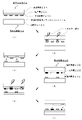
- Non-Contact Transfer Process As one form of the transfer process, the non-contact transfer process will be described as an example with reference to FIG.
- the transfer process using the flux sheet of the present invention is not limited to the illustrated form. Some of the drawings are enlarged or reduced for easier understanding of the description.
- the semiconductor element 21A is separated from the transfer source substrate 2A as shown in FIG. do.
- the source substrate 2B in which the semiconductor element 21B different from the semiconductor element 21A is held by the temporary holding substrate 23B, is placed at a desired position on the destination substrate 1A. Moving. After the movement, the above (ii) is repeated as shown in FIGS. 1(e) and (f).
- the above (ii), (iii), and, if necessary, the above (i) are repeated to transfer and arrange the semiconductor elements at all desired positions on the destination substrate 1A. (not shown)
- the wiring substrate 12A in the destination substrate 1A is a substrate provided with one or more electrodes.
- the electrode surface may have various surface treatments (for example, formation of a UBM layer, surface finish layer, etc.) in order to improve wettability with solder.
- the element temporary holding substrates 23A and 23B in the transfer source substrates 2A and 2B may be, for example, any of sapphire substrate, quartz glass, glass, and plastic.
- the separation between the element temporary holding substrate 23A and the semiconductor element 21A and the separation between the element temporary holding substrate 23B and the semiconductor element 21B are determined by irradiation of the energy beam (laser or the like) 3 so that the components constituting the adhesive layers 22A and 22B are, for example, , decomposition (and foaming) caused by agglomeration or softening/melting. Therefore, in order to allow the adhesive layers 22A and 22B to efficiently absorb the energy of energy rays (laser, etc.), it is preferable that the element temporary holding substrates 23A and 23B transmit the energy rays or have low absorption. .
- the components constituting the adhesive layers 22A and 22B in the transfer source substrates 2A and 2B include adhesive components.
- adhesive components include silicones, acrylic polymers, polyvinyl alcohol polymers and vinylpyrrolidone polymers.
- the components constituting the adhesive layers 22A and 22B may contain a component that foams or a cross-linking component that promotes cohesion by energy rays (laser).
- Energy rays include, for example, lasers.
- Lasers include, for example, excimer lasers and harmonic YAG lasers.
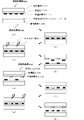
- the semiconductor element 21C of the transfer source substrate 2C is brought into contact with the flux sheet 11B of the transfer destination substrate 1B shown in FIG. 2(b).
- an energy beam (laser beam) is applied to the desired position of one or more semiconductor elements. etc.) 3 is irradiated.
- the semiconductor element 21C is separated from the transfer source substrate 2C as shown in FIG. and transcribe.
- All of the semiconductor elements formed on the element temporary holding substrate in the non-contact transfer process or the contact transfer process may be irradiated with energy rays (laser) to transfer the semiconductor elements at once.
- the transfer destination substrates 1A and 1B are used instead of the element temporary holding substrates (23B and 23D) or together with the element temporary holding substrates (23B or 23D). You can move it.
- an element forming substrate can be used instead of or together with the transfer source substrates (2A, 2B, 2C and 2D) in the above non-contact transfer or contact transfer.
- the device forming substrate may be obtained by forming a laminate having various layers such as a conductive layer on a sapphire substrate, growing a semiconductor crystal on the laminate, and forming a light emitting diode. When the crystal is irradiated with a laser through the sapphire substrate, the light-emitting diode can be separated by decomposing the surface of the layer at the interface with the sapphire substrate.
- the flux sheet of the present invention is softened and melted in a reflow soldering process for electrically joining an element to a wiring substrate.
- the flux sheet of the present invention between the element and the wiring board is softened and melted, the bumps of the element and the electrodes of the wiring board are brought into physical contact and joined together by the melted solder.
- the flux sheet of the present invention contains a component having a flux action, it reduces or removes metal oxides on the terminals, thereby suppressing defective joints due to soldering.
- the maximum temperature of the reflow soldering process is selected depending on the type of solder and the heat resistance of the semiconductor, but is preferably 150° C. or higher, more preferably 160° C.
- the temperature of the reflow soldering process is preferably 260° C. or lower, more preferably 240° C. or lower, and even more preferably 230° C. or lower.
- a temperature of 260° C. or less is preferable because it prevents distortion and the like and provides good solderability.
- the flux sheet of the present invention remains after the reflow process. Therefore, the flux sheet residue is removed by washing.
- water from which ions have been removed (ultrapure water, ion-exchanged water, distilled water, etc.) may be used, or a mixture of a water-soluble organic solvent and water may be used. , only deionized water is preferred from the standpoint of availability.
- water from which ions are removed and a mixture of a water-soluble organic solvent and water are also referred to as "water or the like.”
- An additive that hydrolyzes the water-soluble adhesive may be added to the water or the like.
- hydrolases such as amylase, glucoamylase, prunase, cellulase, protease and the like.
- hydrolases such as amylase, glucoamylase, prunase, cellulase, protease and the like.
- additives such as Ca 2+ may be added to further enhance the enzyme activity.
- water-soluble organic solvents include alcohols and ketones, with alcohols being preferred. When using a water-soluble organic solvent, it may be used alone or in combination of two or more.
- alcohols include methanol, ethanol, n-propanol, n-butanol and the like
- ketones include acetone, methyl ethyl ketone and the like.
- a mixture of water from which ions have been removed and a water-soluble organic solvent may be used, and the mixing ratio is not particularly limited, but from the viewpoint of reducing the environmental load, it is preferable that the ratio of the water-soluble organic solvent is low.
- a commercially available flux cleaning agent may be added to the water or the like.
- the flux cleaning agent is not particularly limited, one that is miscible with the water or the like is preferable.
- the flux cleaning agent may be used as it is without being diluted with water or the like.
- the amount of the fluxing agent to be added to the water or the like is preferably 1% by mass or more, more preferably 5% by mass or more, from the viewpoint of improving cleaning performance.
- it is preferably 30% by mass or less, more preferably 20% by mass or less.
- Pine Alpha ST-231 (manufactured by Arakawa Chemical Co., Ltd.) can be used as a commercially available flux cleaning agent.
- the temperature of water or the like used is selected according to the solubility of component (A) and component (B).
- the temperature of water or the like used in washing is preferably 10°C or higher, more preferably 20°C or higher, and even more preferably 30°C or higher. If it is 10° C. or higher, it is preferable because there is no or little residue after washing.
- the temperature of water or the like used in washing is preferably 80° C. or lower, more preferably 70° C. or lower, and even more preferably 60° C. or lower. A temperature of 80° C. or less is preferable because energy consumption is low and environmental load is low.
- each enzyme has an optimum temperature range in which the activity is high, so it is preferable to wash at that temperature.
- a flux sheet using a vinyl alcohol-based polymer having an oxyalkylene structure as component (A) is excellent in water solubility, so it can be used at a lower temperature than a polymer consisting only of vinyl alcohol repeating units and unmodified repeating units. etc. can be washed.
- the wiring substrate may be dried by a centrifugal dehydration method (spin dryer) or by using a highly evaporable, water-miscible organic solvent (such as isopropanol), washing the substrate with the organic solvent, and then drying. good.
- the drying temperature can be appropriately designed according to the boiling point of the solvent and the like.
- Measurement method (1) Degree of saponification of polyvinyl alcohol polymer Saponification by 1 H-NMR when there is a third repeating unit (oxyalkylene structure, etc.), and by JIS K6726 when there is no repeating unit asked for degrees.
- Oxyalkylene group was determined by the following formula using 1 H NMR.
- Oxyalkylene content (%) [Number of repeating units containing an oxyalkylene group]/[Total number of repeating units] x 100
- the total number of repeating units indicates the total number of repeating units other than the number of repeating units containing an oxyalkylene group, the number of repeating units of vinyl alcohol, and the number of repeating units other than both repeating units.
- the rotation speed is 1 rpm (polyglycerin), 50 rpm (glycerin, PEG600, PPG3000), 100 rpm (diethylene glycol, ethylene glycol, propylene glycol, PEG400, diethylene glycol monomethyl ether).
- a moving image of the drop point was taken with a digital microscope, and the presence or absence of rebound and positional deviation from the drop point were observed.
- the flux sheet of the present invention was adhered to a substrate (glass epoxy substrate) in the same manner as in (1) transfer property evaluation method. Solder balls were mounted on the pads of the substrate through the flux sheet. Reflow was performed in a nitrogen atmosphere under the conditions recommended by JEDEC (shown in FIG. 3). SAC305 with a diameter of 760 ⁇ m was used as the solder ball. A ball shear test was performed five times using a die shear tester (manufactured by Nordson Advanced Technologies, product name: Dage series 4000), and the fracture surface was observed. A: Cohesive failure all 5 times B: Cohesive failure 2 to 4 times, other interfacial failure C: Cohesive failure 1 time, other interfacial failure, or all interfacial failure
- A Evaluation of transferability is A
- evaluation of flux activity is A
- evaluation of detergency is A among deionized water, flux detergent, enzymatic detergent 1, or enzymatic detergent 2.
- the evaluation of transferability is B
- the evaluation of flux activity is A
- in the evaluation of detergency, ion-exchanged water, flux detergent, enzymatic detergent 1, or enzymatic detergent When there is one or more evaluations A in agent 2.
- Evaluation of transferability is A
- evaluation of flux activity is B
- evaluation of detergency among deionized water, flux detergent, enzymatic detergent 1, or enzymatic detergent 2, evaluated When there is one or more A, or the evaluation of transferability is A
- the evaluation of flux activity is A
- the evaluation of detergency, ion-exchanged water, flux detergent, enzymatic detergent 1, or enzyme When there is not one evaluation A and one or more evaluation B in the cleaning agent 2.
- C When it becomes evaluation other than said A and B. Table 1 shows the process suitability evaluation criteria.
- Tables 2 and 3 show the components and proportions of the solutions used to manufacture the flux sheets of Examples and Comparative Examples.
- Tables 4 and 5 show the mass ratio of each component of the flux sheet and the evaluation results.
- Example 1 (Production of polymer) A reactor equipped with a stirrer, reflux condenser, nitrogen inlet, thermometer and pressure gauge was flushed with nitrogen. Methanol and vinyl acetate monomer replaced dissolved oxygen by blowing nitrogen gas. 100 parts by mass of methanol and 100 parts by mass of vinyl acetate monomer (manufactured by Mitsubishi Chemical Corporation, product name: vinyl acetate monomer (VEM)) were placed in a reactor and stirred and heated. When the solution in the reaction vessel reached 60°C, a solution obtained by dissolving 0.10 parts by mass of azobisisobutyronitrile in 50 parts by mass of methanol was added and polymerized at 60°C for 3 hours. The polymerization was cooled and stopped.
- VAM vinyl acetate monomer
- the polymerization solution was put into ion-exchanged water to precipitate polyvinyl acetate.
- Polyvinyl acetate was collected by filtration, purified by washing with deionized water, and dried under vacuum at 50° C. for 24 hours.
- the obtained polyvinyl acetate was 45 parts by mass.
- 100 parts by mass of the obtained polyvinyl acetate was dissolved in 286 parts by mass of methanol, and an alkaline solution prepared by dissolving 1.4 g of sodium hydroxide in 12.6 g of methanol was added to the solution and reacted at 40°C for 30 minutes to saponify. did.
- the saponification reaction was stopped by adding 3.5 g of a 60% by mass aqueous acetic acid solution.
- the precipitated polymer was collected by filtration, purified by washing with methanol, and dried under vacuum at 60° C. for 12 hours. After drying, 55 parts by mass of polyvinyl alcohol was obtained.
- the degree of saponification was 51%, the weight average molecular weight Mw was 11000, and the molecular weight distribution Mw/Mn was 2.1.
- Example 2 (Production of polymer) In Example 1, instead of 100 parts by mass of vinyl acetate monomer, 77 parts by mass of vinyl acetate monomer and polyoxyethylene monoallyl ether (average number of added moles of ethylene oxide: 8, manufactured by NOF Corporation, product name: Uniox PKA-5002 ) was polymerized in the same manner except that 23 parts by mass of the polymer was used. After drying, 55 parts by mass of an oxyalkylene group-containing polyvinyl alcohol copolymer was obtained. The degree of saponification was 42%, the weight average molecular weight Mw was 15000, and the molecular weight distribution Mw/Mn was 2.2. The content of oxyalkylene groups was 3 mol %.
- Example 3 (Production of polymer) In Example 1, instead of 100 parts by mass of vinyl acetate monomer, 44 parts by mass of vinyl acetate monomer and methacrylic acid ester of ethylene oxide monomethyl ether (average number of added moles of ethylene oxide: 23, manufactured by Shin-Nakamura Chemical Co., Ltd., product name: AM-230G ) was carried out in the same manner except that 56 parts by mass of the polymer was used. After drying, it was 45 parts by mass of the oxyalkylene group-containing vinyl alcohol copolymer. The degree of saponification was 35%, the weight average molecular weight Mw was 12000, and the molecular weight distribution Mw/Mn was 2.8. The content of oxyalkylene groups was 5 mol %.
- Example 4 Manufacturing of flux sheet
- polyvinyl alcohol manufactured by Mitsubishi Chemical Corporation, Gosenol (registered trademark) GM-14R, saponification degree 88%) 100 parts by weight, glycerin 200 parts by weight and adipic acid 5 parts by weight
- a flux sheet was obtained in the same manner, except that a polyvinyl alcohol solution dissolved in 200 parts by mass of ion-exchanged water was used.
- Example 5 Manufacturing of flux sheet
- polyvinyl alcohol manufactured by Mitsubishi Chemical Corporation, (registered trademark) GL-03, saponification degree 88%) 100 parts by mass, propylene glycol (propane-1,2-diol) 200 mass 100 parts by mass of diethylene glycol monomethyl ether and 3 parts by mass of maleic acid dissolved in 200 parts by mass of ion-exchanged water to obtain a flux sheet.
- Example 6 Manufacturing of flux sheet
- oxyethylene group-containing vinyl alcohol polymer aqueous solution manufactured by Mitsubishi Chemical Corporation, Gosenol (registered trademark) LW-100, solid content 40% by mass, degree of saponification 40%
- Example 7 (Manufacturing of flux sheet) Instead of the polyvinyl alcohol solution in Example 1, oxyethylene group-containing vinyl alcohol polymer aqueous solution (manufactured by Mitsubishi Chemical Corporation, Gosenol (registered trademark) LW-200, solid content 40% by mass, degree of saponification 50%) 625 mass A flux sheet was obtained in the same manner, except that an oxyethylene group-containing vinyl alcohol polymer solution in which 150 parts by mass of glycerin and 8 parts by mass of salicylic acid were dissolved in 150 parts by mass of ion-exchanged water was used.
- oxyethylene group-containing vinyl alcohol polymer aqueous solution manufactured by Mitsubishi Chemical Corporation, Gosenol (registered trademark) LW-200, solid content 40% by mass, degree of saponification 50%
- Example 8 Manufacturing of flux sheet
- 100 parts by weight of polyvinylpyrrolidone (Daiichi Kogyo Seiyaku Co., Ltd., K-30)
- 50 parts by weight of ethylene glycol and 10 parts by weight of glutaric acid were dissolved in 100 parts by weight of ion-exchanged water.
- a flux sheet was obtained in the same manner as above, except that the polyvinylpyrrolidone solution obtained in this manner was used.
- Example 9 Manufacturing of flux sheet
- carboxymethyl cellulose Daicel Miraise Co., Ltd., product number 1330
- 250 parts by weight of glycerin and 5 parts by weight of adipic acid were dissolved in 1000 parts by weight of ion-exchanged water to obtain a carboxymethyl cellulose solution.
- a flux sheet was obtained in the same manner except that The degree of etherification of the carboxymethylcellulose used was 1.2.
- the degree of etherification represents the average degree of substitution of three hydroxyl groups present in one glucose of cellulose with an etherification agent.
- Example 10 Manufacturing of flux sheet
- 100 parts by weight of hydroxyethyl cellulose Daicel Miraise Co., Ltd., SP500
- 150 parts by weight of polyethylene glycol manufactured by NOF Corporation, PEG#400
- 3 parts by weight of salicylic acid were added to ion-exchanged water.
- a flux sheet was obtained in the same manner except that a carboxymethyl cellulose solution dissolved in 2000 parts by mass was used.
- Example 11 Manufacturing of flux sheet
- a pullulan solution obtained by dissolving 100 parts by weight of pullulan manufactured by Hayashibara Co., Ltd.
- 200 parts by weight of glycerin and 24 parts by weight of glutaric acid in 1000 parts by weight of ion-exchanged water was used.
- a flux sheet was obtained in the same manner.
- Example 12 Manufacturing of flux sheet
- polyvinylpyrrolidone Nippon Shokubai Co., Ltd., K-85N
- polyethylene glycol Fujifilm Wako Pure Chemical Industries, Ltd., PEG#600
- glutaric acid 24 parts by weight
- a flux sheet was obtained in the same manner, except that a polyvinylpyrrolidone solution dissolved in 800 parts by mass of ion-exchanged water was used.
- Example 13 Manufacturing of flux sheet
- oxyethylene group-containing vinyl alcohol polymer aqueous solution manufactured by Mitsubishi Chemical Corporation, Gosenol (registered trademark) LW-100, solid content 40% by mass, degree of saponification 40%
- 625 mass A flux sheet was obtained in the same manner, except that an oxyethylene group-containing vinyl alcohol polymer solution in which 62.5 parts by weight of glycerin and 10 parts by weight of glutaric acid were dissolved in 100 parts by weight of deionized water was used.
- Example 14 (Manufacturing of flux sheet) Instead of the polyvinyl alcohol solution in Example 1, oxyethylene group-containing vinyl alcohol polymer aqueous solution (manufactured by Mitsubishi Chemical Corporation, Gosenol (registered trademark) LW-100, solid content 40% by mass, degree of saponification 40%) 625 mass A flux sheet was obtained in the same manner, except that an oxyethylene group-containing vinyl alcohol polymer solution in which 75 parts by weight of glycerin and 10 parts by weight of glutaric acid were dissolved in 100 parts by weight of deionized water was used.
- oxyethylene group-containing vinyl alcohol polymer aqueous solution manufactured by Mitsubishi Chemical Corporation, Gosenol (registered trademark) LW-100, solid content 40% by mass, degree of saponification 40%
- Example 15 Manufacturing of flux sheet
- polyvinylpyrrolidone Nippon Shokubai Co., Ltd., K-85N
- polypropylene glycol Fuji Film Wako Pure Chemical Industries, Ltd., PPG # 3000
- glutaric acid 24 parts by weight
- a flux sheet was obtained in the same manner, except that a polyvinylpyrrolidone solution of 800 parts by mass of ethanol was used.
- Example 16 (Manufacturing of flux sheet) Instead of the polyvinyl alcohol solution in Example 1, oxyethylene group-containing vinyl alcohol polymer aqueous solution (manufactured by Mitsubishi Chemical Corporation, Gosenol (registered trademark) LW-100, solid content 40% by mass, degree of saponification 40%) 625 mass Part, 200 parts by mass of polyglycerin (PLG 20PW, manufactured by Daicel Corporation) and 10 parts by mass of glutaric acid dissolved in 100 parts by mass of ion-exchanged water were used in the same manner, except that an oxyethylene group-containing vinyl alcohol polymer solution was used. and got a flux sheet.
- oxyethylene group-containing vinyl alcohol polymer aqueous solution manufactured by Mitsubishi Chemical Corporation, Gosenol (registered trademark) LW-100, solid content 40% by mass, degree of saponification 40%
- Example 1 instead of the polyvinyl alcohol solution in Example 1, an oxyethylene group-containing vinyl alcohol polymer (manufactured by Mitsubishi Chemical Corporation, Gosenol (registered trademark) LW-100, saponification degree 40%) 250 parts by mass and adipic acid 8.5 A flux sheet was obtained in the same manner except that an oxyethylene group-containing vinyl alcohol polymer solution dissolved in 375 parts by mass of ion-exchanged water was used.
- oxyethylene group-containing vinyl alcohol polymer manufactured by Mitsubishi Chemical Corporation, Gosenol (registered trademark) LW-100, saponification degree 40%
- PVA vinyl alcohol polymer
- PVP vinylpyrrolidone polymer
- CMC carboxymethyl cellulose
- SP500 hydroxyethyl cellulose
- a flux sheet that is excellent in impact absorption and adhesion/bonding properties, has flux activity, and is excellent in water washability.
Landscapes
- Engineering & Computer Science (AREA)
- Mechanical Engineering (AREA)
- Chemical & Material Sciences (AREA)
- Inorganic Chemistry (AREA)
- Electric Connection Of Electric Components To Printed Circuits (AREA)
- Led Device Packages (AREA)
- Adhesives Or Adhesive Processes (AREA)
- Microelectronics & Electronic Packaging (AREA)
Abstract
Priority Applications (4)
| Application Number | Priority Date | Filing Date | Title |
|---|---|---|---|
| JP2022576698A JP7313584B2 (ja) | 2021-01-19 | 2022-01-18 | 半導体転写用フラックスシート |
| CN202280010601.3A CN116829298A (zh) | 2021-01-19 | 2022-01-18 | 半导体转印用助焊剂片 |
| EP22742583.2A EP4282575A4 (fr) | 2021-01-19 | 2022-01-18 | Feuille de flux pour transfert de semi-conducteurs |
| KR1020237028192A KR20230131932A (ko) | 2021-01-19 | 2022-01-18 | 반도체 전사용 플럭스 시트 |
Applications Claiming Priority (2)
| Application Number | Priority Date | Filing Date | Title |
|---|---|---|---|
| JP2021-006770 | 2021-01-19 | ||
| JP2021006770 | 2021-01-19 |
Publications (1)
| Publication Number | Publication Date |
|---|---|
| WO2022158461A1 true WO2022158461A1 (fr) | 2022-07-28 |
Family
ID=82549459
Family Applications (1)
| Application Number | Title | Priority Date | Filing Date |
|---|---|---|---|
| PCT/JP2022/001680 Ceased WO2022158461A1 (fr) | 2021-01-19 | 2022-01-18 | Feuille de flux pour transfert de semi-conducteurs |
Country Status (5)
| Country | Link |
|---|---|
| EP (1) | EP4282575A4 (fr) |
| JP (1) | JP7313584B2 (fr) |
| KR (1) | KR20230131932A (fr) |
| CN (1) | CN116829298A (fr) |
| WO (1) | WO2022158461A1 (fr) |
Cited By (1)
| Publication number | Priority date | Publication date | Assignee | Title |
|---|---|---|---|---|
| JPWO2023238676A1 (fr) * | 2022-06-10 | 2023-12-14 |
Families Citing this family (2)
| Publication number | Priority date | Publication date | Assignee | Title |
|---|---|---|---|---|
| WO2026009999A1 (fr) * | 2024-07-01 | 2026-01-08 | 엘지전자 주식회사 | Procédé de fabrication de dispositif d'affichage à l'aide d'un élément électroluminescent et dispositif de fabrication associé |
| CN121192006A (zh) * | 2025-11-24 | 2025-12-23 | 渠梁电子有限公司 | 一种提升芯片检测效果的方法 |
Citations (10)
| Publication number | Priority date | Publication date | Assignee | Title |
|---|---|---|---|---|
| JP2002261335A (ja) | 2000-07-18 | 2002-09-13 | Sony Corp | 画像表示装置及び画像表示装置の製造方法 |
| JP2010161221A (ja) | 2009-01-08 | 2010-07-22 | Sony Corp | 実装基板の製造方法、実装基板および発光装置 |
| JP2013110402A (ja) * | 2011-10-26 | 2013-06-06 | Hitachi Chemical Co Ltd | リフローフィルム、はんだバンプ形成方法、はんだ接合の形成方法及び半導体装置 |
| JP2013110405A (ja) * | 2011-10-26 | 2013-06-06 | Hitachi Chemical Co Ltd | リフローフィルム、はんだバンプ形成方法、はんだ接合の形成方法及び半導体装置 |
| JP2013110403A (ja) * | 2011-10-26 | 2013-06-06 | Hitachi Chemical Co Ltd | リフローフィルム、はんだバンプ形成方法、はんだ接合の形成方法及び半導体装置 |
| JP2014168791A (ja) * | 2013-03-01 | 2014-09-18 | Hitachi Chemical Co Ltd | フラックスフィルム、フリップチップ接続方法、及び半導体装置 |
| WO2016043092A1 (fr) * | 2014-09-19 | 2016-03-24 | ソニー株式会社 | Carte montée et son procédé de fabrication |
| CN111055045A (zh) * | 2019-12-29 | 2020-04-24 | 武汉风帆电化科技股份有限公司 | 一种光伏焊带专用助焊剂 |
| WO2020116403A1 (fr) * | 2018-12-03 | 2020-06-11 | ナガセケムテックス株式会社 | Feuille de flux et procédé de liaison de soudure utilisant une feuille de flux |
| JP2021006770A (ja) | 2019-06-28 | 2021-01-21 | 株式会社ゼンリンデータコム | 経路表示装置、経路表示方法、および、コンピュータプログラム |
Family Cites Families (5)
| Publication number | Priority date | Publication date | Assignee | Title |
|---|---|---|---|---|
| JP2005146046A (ja) * | 2003-11-12 | 2005-06-09 | Denki Kagaku Kogyo Kk | マスキングフィルム |
| JP2011200887A (ja) * | 2010-03-24 | 2011-10-13 | Renesas Electronics Corp | はんだ付け用フラックスおよび、はんだ付け用フラックスを用いた半導体装置の製造方法 |
| JP5218686B2 (ja) * | 2011-08-08 | 2013-06-26 | Jsr株式会社 | フラックス組成物、電気的接続構造の形成方法、電気的接続構造および半導体装置 |
| KR101678749B1 (ko) * | 2011-10-26 | 2016-12-06 | 히타치가세이가부시끼가이샤 | 리플로우 필름, 땜납 범프 형성 방법, 땜납 접합의 형성 방법 및 반도체 장치 |
| JP5974162B2 (ja) * | 2013-03-29 | 2016-08-23 | 積水化成品工業株式会社 | 仮止め用仮固定材 |
-
2022
- 2022-01-18 JP JP2022576698A patent/JP7313584B2/ja active Active
- 2022-01-18 CN CN202280010601.3A patent/CN116829298A/zh active Pending
- 2022-01-18 KR KR1020237028192A patent/KR20230131932A/ko active Pending
- 2022-01-18 EP EP22742583.2A patent/EP4282575A4/fr active Pending
- 2022-01-18 WO PCT/JP2022/001680 patent/WO2022158461A1/fr not_active Ceased
Patent Citations (10)
| Publication number | Priority date | Publication date | Assignee | Title |
|---|---|---|---|---|
| JP2002261335A (ja) | 2000-07-18 | 2002-09-13 | Sony Corp | 画像表示装置及び画像表示装置の製造方法 |
| JP2010161221A (ja) | 2009-01-08 | 2010-07-22 | Sony Corp | 実装基板の製造方法、実装基板および発光装置 |
| JP2013110402A (ja) * | 2011-10-26 | 2013-06-06 | Hitachi Chemical Co Ltd | リフローフィルム、はんだバンプ形成方法、はんだ接合の形成方法及び半導体装置 |
| JP2013110405A (ja) * | 2011-10-26 | 2013-06-06 | Hitachi Chemical Co Ltd | リフローフィルム、はんだバンプ形成方法、はんだ接合の形成方法及び半導体装置 |
| JP2013110403A (ja) * | 2011-10-26 | 2013-06-06 | Hitachi Chemical Co Ltd | リフローフィルム、はんだバンプ形成方法、はんだ接合の形成方法及び半導体装置 |
| JP2014168791A (ja) * | 2013-03-01 | 2014-09-18 | Hitachi Chemical Co Ltd | フラックスフィルム、フリップチップ接続方法、及び半導体装置 |
| WO2016043092A1 (fr) * | 2014-09-19 | 2016-03-24 | ソニー株式会社 | Carte montée et son procédé de fabrication |
| WO2020116403A1 (fr) * | 2018-12-03 | 2020-06-11 | ナガセケムテックス株式会社 | Feuille de flux et procédé de liaison de soudure utilisant une feuille de flux |
| JP2021006770A (ja) | 2019-06-28 | 2021-01-21 | 株式会社ゼンリンデータコム | 経路表示装置、経路表示方法、および、コンピュータプログラム |
| CN111055045A (zh) * | 2019-12-29 | 2020-04-24 | 武汉风帆电化科技股份有限公司 | 一种光伏焊带专用助焊剂 |
Non-Patent Citations (1)
| Title |
|---|
| See also references of EP4282575A4 |
Cited By (3)
| Publication number | Priority date | Publication date | Assignee | Title |
|---|---|---|---|---|
| JPWO2023238676A1 (fr) * | 2022-06-10 | 2023-12-14 | ||
| WO2023238676A1 (fr) * | 2022-06-10 | 2023-12-14 | ナガセケムテックス株式会社 | Composition adhésive soluble dans l'eau pour capture de composants, feuille adhésive soluble dans l'eau pour capture de composants, et procédé de production de composant électronique |
| JP7681192B2 (ja) | 2022-06-10 | 2025-05-21 | ナガセケムテックス株式会社 | 部品捕捉用水溶性粘着組成物及び部品捕捉用水溶性粘着シート並びに電子部品の製造方法 |
Also Published As
| Publication number | Publication date |
|---|---|
| TW202248395A (zh) | 2022-12-16 |
| EP4282575A1 (fr) | 2023-11-29 |
| JPWO2022158461A1 (fr) | 2022-07-28 |
| EP4282575A4 (fr) | 2025-01-15 |
| KR20230131932A (ko) | 2023-09-14 |
| CN116829298A (zh) | 2023-09-29 |
| JP7313584B2 (ja) | 2023-07-24 |
Similar Documents
| Publication | Publication Date | Title |
|---|---|---|
| JP7313584B2 (ja) | 半導体転写用フラックスシート | |
| JP6310657B2 (ja) | レーザダイシング用ウエハ保護膜組成物 | |
| TWI473869B (zh) | 用於半導體隱形切割技術的黏著劑組成物、黏著薄膜、及包含該黏著薄膜的半導體裝置 | |
| CN101821841B (zh) | 半导体用粘接片及切割带一体型半导体用粘接片 | |
| JP5218686B2 (ja) | フラックス組成物、電気的接続構造の形成方法、電気的接続構造および半導体装置 | |
| CN113165092B (zh) | 助焊剂片以及使用助焊剂片的焊料接合方法 | |
| JP2022145325A (ja) | 半導体転写用フラックスシート | |
| JP7185086B1 (ja) | 仮保護材 | |
| TWI916491B (zh) | 半導體轉印用助熔片 | |
| JP7681192B2 (ja) | 部品捕捉用水溶性粘着組成物及び部品捕捉用水溶性粘着シート並びに電子部品の製造方法 | |
| TWI673309B (zh) | 高熱穩定性之雷射切割保護膜組成物 | |
| CN1471450A (zh) | 水溶性助熔剂组合物及焊接部件的制造方法 | |
| JP2024010412A (ja) | 保護シート | |
| KR100680089B1 (ko) | 알칼리 가용성 접착제 | |
| KR101539762B1 (ko) | 웨이퍼 다이싱용 보호막 조성물 | |
| KR20090124195A (ko) | 웨이퍼 다이싱용 보호막 조성물 | |
| CN115958327A (zh) | 一种水溶型无铅固晶锡膏及其制备方法 | |
| KR102367433B1 (ko) | 웨이퍼 다이싱 가공용 보호 유기 코팅제 조성물 및 이를 포함하는 보호 코팅제 | |
| CN116606702B (zh) | 一种用于igbt模块的高效清洗液组合物 | |
| JP2023043859A (ja) | 仮保護材 | |
| CN121343140B (zh) | 一种可水洗低温焊锡膏助焊剂及其制备方法和应用 | |
| TW202245959A (zh) | 焊料接合用樹脂組成物 | |
| JP2024135994A (ja) | 樹脂組成物、ウエハ保護膜、ウエハ保護部材及びウエハ保護膜の除去方法 | |
| CN120365809A (zh) | 一种水基型激光切割晶圆保护液及其制备方法 | |
| WO2023042838A1 (fr) | Matériau de protection temporaire |
Legal Events
| Date | Code | Title | Description |
|---|---|---|---|
| 121 | Ep: the epo has been informed by wipo that ep was designated in this application |
Ref document number: 22742583 Country of ref document: EP Kind code of ref document: A1 |
|
| ENP | Entry into the national phase |
Ref document number: 2022576698 Country of ref document: JP Kind code of ref document: A |
|
| WWE | Wipo information: entry into national phase |
Ref document number: 202280010601.3 Country of ref document: CN |
|
| ENP | Entry into the national phase |
Ref document number: 20237028192 Country of ref document: KR Kind code of ref document: A |
|
| WWE | Wipo information: entry into national phase |
Ref document number: 1020237028192 Country of ref document: KR |
|
| NENP | Non-entry into the national phase |
Ref country code: DE |
|
| ENP | Entry into the national phase |
Ref document number: 2022742583 Country of ref document: EP Effective date: 20230821 |