WO2022162973A1 - インソールの製造方法 - Google Patents
インソールの製造方法 Download PDFInfo
- Publication number
- WO2022162973A1 WO2022162973A1 PCT/JP2021/027466 JP2021027466W WO2022162973A1 WO 2022162973 A1 WO2022162973 A1 WO 2022162973A1 JP 2021027466 W JP2021027466 W JP 2021027466W WO 2022162973 A1 WO2022162973 A1 WO 2022162973A1
- Authority
- WO
- WIPO (PCT)
- Prior art keywords
- insole
- foot
- manufacturing
- film
- resin portion
- Prior art date
- Legal status (The legal status is an assumption and is not a legal conclusion. Google has not performed a legal analysis and makes no representation as to the accuracy of the status listed.)
- Ceased
Links
Images


Classifications
-
- A—HUMAN NECESSITIES
- A43—FOOTWEAR
- A43B—CHARACTERISTIC FEATURES OF FOOTWEAR; PARTS OF FOOTWEAR
- A43B17/00—Insoles for insertion, e.g. footbeds or inlays, for attachment to the shoe after the upper has been joined
- A43B17/14—Insoles for insertion, e.g. footbeds or inlays, for attachment to the shoe after the upper has been joined made of sponge, rubber, or plastic materials
-
- A—HUMAN NECESSITIES
- A43—FOOTWEAR
- A43B—CHARACTERISTIC FEATURES OF FOOTWEAR; PARTS OF FOOTWEAR
- A43B7/00—Footwear with health or hygienic arrangements
- A43B7/14—Footwear with health or hygienic arrangements with foot-supporting parts
- A43B7/28—Adapting the inner sole or the side of the upper of the shoe to the sole of the foot
-
- A—HUMAN NECESSITIES
- A43—FOOTWEAR
- A43D—MACHINES, TOOLS, EQUIPMENT OR METHODS FOR MANUFACTURING OR REPAIRING FOOTWEAR
- A43D1/00—Foot or last measuring devices; Measuring devices for shoe parts
- A43D1/02—Foot-measuring devices
- A43D1/022—Foot-measuring devices involving making footprints or permanent moulds of the foot
-
- A—HUMAN NECESSITIES
- A43—FOOTWEAR
- A43D—MACHINES, TOOLS, EQUIPMENT OR METHODS FOR MANUFACTURING OR REPAIRING FOOTWEAR
- A43D3/00—Lasts
- A43D3/02—Lasts for making or repairing shoes
-
- B—PERFORMING OPERATIONS; TRANSPORTING
- B29—WORKING OF PLASTICS; WORKING OF SUBSTANCES IN A PLASTIC STATE IN GENERAL
- B29C—SHAPING OR JOINING OF PLASTICS; SHAPING OF MATERIAL IN A PLASTIC STATE, NOT OTHERWISE PROVIDED FOR; AFTER-TREATMENT OF THE SHAPED PRODUCTS, e.g. REPAIRING
- B29C43/00—Compression moulding, i.e. applying external pressure to flow the moulding material; Apparatus therefor
- B29C43/003—Compression moulding, i.e. applying external pressure to flow the moulding material; Apparatus therefor characterised by the choice of material
-
- B—PERFORMING OPERATIONS; TRANSPORTING
- B29—WORKING OF PLASTICS; WORKING OF SUBSTANCES IN A PLASTIC STATE IN GENERAL
- B29C—SHAPING OR JOINING OF PLASTICS; SHAPING OF MATERIAL IN A PLASTIC STATE, NOT OTHERWISE PROVIDED FOR; AFTER-TREATMENT OF THE SHAPED PRODUCTS, e.g. REPAIRING
- B29C43/00—Compression moulding, i.e. applying external pressure to flow the moulding material; Apparatus therefor
- B29C43/02—Compression moulding, i.e. applying external pressure to flow the moulding material; Apparatus therefor of articles of definite length, i.e. discrete articles
- B29C43/10—Isostatic pressing, i.e. using non-rigid pressure-exerting members against rigid parts or dies
- B29C43/12—Isostatic pressing, i.e. using non-rigid pressure-exerting members against rigid parts or dies using bags surrounding the moulding material or using membranes contacting the moulding material
-
- B—PERFORMING OPERATIONS; TRANSPORTING
- B29—WORKING OF PLASTICS; WORKING OF SUBSTANCES IN A PLASTIC STATE IN GENERAL
- B29C—SHAPING OR JOINING OF PLASTICS; SHAPING OF MATERIAL IN A PLASTIC STATE, NOT OTHERWISE PROVIDED FOR; AFTER-TREATMENT OF THE SHAPED PRODUCTS, e.g. REPAIRING
- B29C43/00—Compression moulding, i.e. applying external pressure to flow the moulding material; Apparatus therefor
- B29C43/02—Compression moulding, i.e. applying external pressure to flow the moulding material; Apparatus therefor of articles of definite length, i.e. discrete articles
- B29C43/14—Compression moulding, i.e. applying external pressure to flow the moulding material; Apparatus therefor of articles of definite length, i.e. discrete articles in several steps
- B29C43/146—Compression moulding, i.e. applying external pressure to flow the moulding material; Apparatus therefor of articles of definite length, i.e. discrete articles in several steps for making multilayered articles
-
- B—PERFORMING OPERATIONS; TRANSPORTING
- B29—WORKING OF PLASTICS; WORKING OF SUBSTANCES IN A PLASTIC STATE IN GENERAL
- B29C—SHAPING OR JOINING OF PLASTICS; SHAPING OF MATERIAL IN A PLASTIC STATE, NOT OTHERWISE PROVIDED FOR; AFTER-TREATMENT OF THE SHAPED PRODUCTS, e.g. REPAIRING
- B29C43/00—Compression moulding, i.e. applying external pressure to flow the moulding material; Apparatus therefor
- B29C43/02—Compression moulding, i.e. applying external pressure to flow the moulding material; Apparatus therefor of articles of definite length, i.e. discrete articles
- B29C43/18—Compression moulding, i.e. applying external pressure to flow the moulding material; Apparatus therefor of articles of definite length, i.e. discrete articles incorporating preformed parts or layers, e.g. compression moulding around inserts or for coating articles
-
- B—PERFORMING OPERATIONS; TRANSPORTING
- B29—WORKING OF PLASTICS; WORKING OF SUBSTANCES IN A PLASTIC STATE IN GENERAL
- B29C—SHAPING OR JOINING OF PLASTICS; SHAPING OF MATERIAL IN A PLASTIC STATE, NOT OTHERWISE PROVIDED FOR; AFTER-TREATMENT OF THE SHAPED PRODUCTS, e.g. REPAIRING
- B29C43/00—Compression moulding, i.e. applying external pressure to flow the moulding material; Apparatus therefor
- B29C43/02—Compression moulding, i.e. applying external pressure to flow the moulding material; Apparatus therefor of articles of definite length, i.e. discrete articles
- B29C43/20—Making multilayered or multicoloured articles
- B29C43/203—Making multilayered articles
-
- B—PERFORMING OPERATIONS; TRANSPORTING
- B29—WORKING OF PLASTICS; WORKING OF SUBSTANCES IN A PLASTIC STATE IN GENERAL
- B29C—SHAPING OR JOINING OF PLASTICS; SHAPING OF MATERIAL IN A PLASTIC STATE, NOT OTHERWISE PROVIDED FOR; AFTER-TREATMENT OF THE SHAPED PRODUCTS, e.g. REPAIRING
- B29C43/00—Compression moulding, i.e. applying external pressure to flow the moulding material; Apparatus therefor
- B29C43/32—Component parts, details or accessories; Auxiliary operations
- B29C43/52—Heating or cooling
-
- B—PERFORMING OPERATIONS; TRANSPORTING
- B29—WORKING OF PLASTICS; WORKING OF SUBSTANCES IN A PLASTIC STATE IN GENERAL
- B29C—SHAPING OR JOINING OF PLASTICS; SHAPING OF MATERIAL IN A PLASTIC STATE, NOT OTHERWISE PROVIDED FOR; AFTER-TREATMENT OF THE SHAPED PRODUCTS, e.g. REPAIRING
- B29C63/00—Lining or sheathing, i.e. applying preformed layers or sheathings of plastics; Apparatus therefor
- B29C63/02—Lining or sheathing, i.e. applying preformed layers or sheathings of plastics; Apparatus therefor using sheet or web-like material
-
- B—PERFORMING OPERATIONS; TRANSPORTING
- B29—WORKING OF PLASTICS; WORKING OF SUBSTANCES IN A PLASTIC STATE IN GENERAL
- B29C—SHAPING OR JOINING OF PLASTICS; SHAPING OF MATERIAL IN A PLASTIC STATE, NOT OTHERWISE PROVIDED FOR; AFTER-TREATMENT OF THE SHAPED PRODUCTS, e.g. REPAIRING
- B29C63/00—Lining or sheathing, i.e. applying preformed layers or sheathings of plastics; Apparatus therefor
- B29C63/22—Lining or sheathing, i.e. applying preformed layers or sheathings of plastics; Apparatus therefor using layers or sheathings having a shape adapted to the shape of the article
-
- B—PERFORMING OPERATIONS; TRANSPORTING
- B29—WORKING OF PLASTICS; WORKING OF SUBSTANCES IN A PLASTIC STATE IN GENERAL
- B29D—PRODUCING PARTICULAR ARTICLES FROM PLASTICS OR FROM SUBSTANCES IN A PLASTIC STATE
- B29D35/00—Producing footwear
- B29D35/0054—Producing footwear by compression moulding, vulcanising or the like; Apparatus therefor
-
- B—PERFORMING OPERATIONS; TRANSPORTING
- B29—WORKING OF PLASTICS; WORKING OF SUBSTANCES IN A PLASTIC STATE IN GENERAL
- B29D—PRODUCING PARTICULAR ARTICLES FROM PLASTICS OR FROM SUBSTANCES IN A PLASTIC STATE
- B29D35/00—Producing footwear
- B29D35/06—Producing footwear having soles or heels formed and joined on to preformed uppers using a moulding technique, e.g. by injection moulding, pressing and vulcanising
- B29D35/08—Producing footwear having soles or heels formed and joined on to preformed uppers using a moulding technique, e.g. by injection moulding, pressing and vulcanising having multilayered parts
- B29D35/085—Producing footwear having soles or heels formed and joined on to preformed uppers using a moulding technique, e.g. by injection moulding, pressing and vulcanising having multilayered parts by compression moulding, vulcanising or the like
-
- B—PERFORMING OPERATIONS; TRANSPORTING
- B29—WORKING OF PLASTICS; WORKING OF SUBSTANCES IN A PLASTIC STATE IN GENERAL
- B29D—PRODUCING PARTICULAR ARTICLES FROM PLASTICS OR FROM SUBSTANCES IN A PLASTIC STATE
- B29D35/00—Producing footwear
- B29D35/12—Producing parts thereof, e.g. soles, heels, uppers, by a moulding technique
- B29D35/14—Multilayered parts
- B29D35/142—Soles
-
- B—PERFORMING OPERATIONS; TRANSPORTING
- B29—WORKING OF PLASTICS; WORKING OF SUBSTANCES IN A PLASTIC STATE IN GENERAL
- B29C—SHAPING OR JOINING OF PLASTICS; SHAPING OF MATERIAL IN A PLASTIC STATE, NOT OTHERWISE PROVIDED FOR; AFTER-TREATMENT OF THE SHAPED PRODUCTS, e.g. REPAIRING
- B29C43/00—Compression moulding, i.e. applying external pressure to flow the moulding material; Apparatus therefor
- B29C43/02—Compression moulding, i.e. applying external pressure to flow the moulding material; Apparatus therefor of articles of definite length, i.e. discrete articles
- B29C43/14—Compression moulding, i.e. applying external pressure to flow the moulding material; Apparatus therefor of articles of definite length, i.e. discrete articles in several steps
- B29C43/146—Compression moulding, i.e. applying external pressure to flow the moulding material; Apparatus therefor of articles of definite length, i.e. discrete articles in several steps for making multilayered articles
- B29C2043/147—Compression moulding, i.e. applying external pressure to flow the moulding material; Apparatus therefor of articles of definite length, i.e. discrete articles in several steps for making multilayered articles by compressing after the laying of further material
-
- B—PERFORMING OPERATIONS; TRANSPORTING
- B29—WORKING OF PLASTICS; WORKING OF SUBSTANCES IN A PLASTIC STATE IN GENERAL
- B29K—INDEXING SCHEME ASSOCIATED WITH SUBCLASSES B29B, B29C OR B29D, RELATING TO MOULDING MATERIALS OR TO MATERIALS FOR MOULDS, REINFORCEMENTS, FILLERS OR PREFORMED PARTS, e.g. INSERTS
- B29K2023/00—Use of polyalkenes or derivatives thereof as moulding material
- B29K2023/04—Polymers of ethylene
- B29K2023/06—PE, i.e. polyethylene
-
- B—PERFORMING OPERATIONS; TRANSPORTING
- B29—WORKING OF PLASTICS; WORKING OF SUBSTANCES IN A PLASTIC STATE IN GENERAL
- B29K—INDEXING SCHEME ASSOCIATED WITH SUBCLASSES B29B, B29C OR B29D, RELATING TO MOULDING MATERIALS OR TO MATERIALS FOR MOULDS, REINFORCEMENTS, FILLERS OR PREFORMED PARTS, e.g. INSERTS
- B29K2067/00—Use of polyesters or derivatives thereof, as moulding material
- B29K2067/04—Polyesters derived from hydroxycarboxylic acids
-
- B—PERFORMING OPERATIONS; TRANSPORTING
- B29—WORKING OF PLASTICS; WORKING OF SUBSTANCES IN A PLASTIC STATE IN GENERAL
- B29K—INDEXING SCHEME ASSOCIATED WITH SUBCLASSES B29B, B29C OR B29D, RELATING TO MOULDING MATERIALS OR TO MATERIALS FOR MOULDS, REINFORCEMENTS, FILLERS OR PREFORMED PARTS, e.g. INSERTS
- B29K2067/00—Use of polyesters or derivatives thereof, as moulding material
- B29K2067/04—Polyesters derived from hydroxycarboxylic acids
- B29K2067/046—PLA, i.e. polylactic acid or polylactide
-
- B—PERFORMING OPERATIONS; TRANSPORTING
- B29—WORKING OF PLASTICS; WORKING OF SUBSTANCES IN A PLASTIC STATE IN GENERAL
- B29K—INDEXING SCHEME ASSOCIATED WITH SUBCLASSES B29B, B29C OR B29D, RELATING TO MOULDING MATERIALS OR TO MATERIALS FOR MOULDS, REINFORCEMENTS, FILLERS OR PREFORMED PARTS, e.g. INSERTS
- B29K2101/00—Use of unspecified macromolecular compounds as moulding material
- B29K2101/12—Thermoplastic materials
-
- B—PERFORMING OPERATIONS; TRANSPORTING
- B29—WORKING OF PLASTICS; WORKING OF SUBSTANCES IN A PLASTIC STATE IN GENERAL
- B29K—INDEXING SCHEME ASSOCIATED WITH SUBCLASSES B29B, B29C OR B29D, RELATING TO MOULDING MATERIALS OR TO MATERIALS FOR MOULDS, REINFORCEMENTS, FILLERS OR PREFORMED PARTS, e.g. INSERTS
- B29K2105/00—Condition, form or state of moulded material or of the material to be shaped
- B29K2105/02—Condition, form or state of moulded material or of the material to be shaped heat shrinkable
-
- B—PERFORMING OPERATIONS; TRANSPORTING
- B29—WORKING OF PLASTICS; WORKING OF SUBSTANCES IN A PLASTIC STATE IN GENERAL
- B29K—INDEXING SCHEME ASSOCIATED WITH SUBCLASSES B29B, B29C OR B29D, RELATING TO MOULDING MATERIALS OR TO MATERIALS FOR MOULDS, REINFORCEMENTS, FILLERS OR PREFORMED PARTS, e.g. INSERTS
- B29K2105/00—Condition, form or state of moulded material or of the material to be shaped
- B29K2105/25—Solid
- B29K2105/253—Preform
- B29K2105/256—Sheets, plates, blanks or films
-
- B—PERFORMING OPERATIONS; TRANSPORTING
- B29—WORKING OF PLASTICS; WORKING OF SUBSTANCES IN A PLASTIC STATE IN GENERAL
- B29L—INDEXING SCHEME ASSOCIATED WITH SUBCLASS B29C, RELATING TO PARTICULAR ARTICLES
- B29L2031/00—Other particular articles
- B29L2031/48—Wearing apparel
- B29L2031/50—Footwear, e.g. shoes or parts thereof
- B29L2031/504—Soles
Definitions
- the present invention relates to an insole manufacturing method.
- insoles which are insoles placed on the insoles of hard shoes, have been developed for the purpose of adjusting size and making it easier to wear, and are used in a wide range of shoes, from sports to daily life. .
- the thickness of the bottom of the formwork is 0.5 mm.
- a mount of about 5 mm is laid, a silicone resin is applied on the mount to a thickness of about 7 mm, and the surface of the silicone resin is covered with a wrap film.
- the shoe is completed by applying force to take a mold of the sole, and after the silicone resin of the insole material has hardened, the insole material having the sole mold formed in accordance with the shape of the shoe is cut off with scissors.
- An insole is disclosed.
- Patent Document 2 instead of focusing on how to accurately take the shape of the current foot as in the conventional example, the current foot is first returned to a normal foot, and then the foot is normalized.
- a manufacturing method of a foot pattern characterized in that it is attached to a bent foot and the mold is taken.
- An object of the present invention is to provide an insole that fits the purchaser's foot more easily.
- a method for manufacturing an insole according to the present invention includes a first step of forming a foot-shaped resin portion having a predetermined thickness using a thermoplastic resin that melts at a predetermined temperature, and covering the foot-shaped resin portion with a film. and a second step of vacuum-packing the foot-shaped resin portion covered with the film with a nylon plastic bag after performing the shrink processing.
- the film is peeled off after the third step and the fourth step, and the surface of the foot-shaped resin portion that contacts the sole of the user's foot is made flexible. It is preferable to include a fifth step of mounting the seat portion.
- thermoplastic resin contains a polycaprolactone resin that melts at 60 to 70°C, and the film contains a polyethylene film.
- the predetermined thickness is set to 2 mm to 3 mm.
- the nylon plastic bag includes at least two layers of nylon and polyethylene.
- FIG. 1 is a diagram showing an insole manufactured by an insole manufacturing method that is an embodiment of the present invention
- FIG. FIG. 4 is a diagram showing how an insole that fits a user is formed by the method of manufacturing an insole that is an embodiment of the present invention.
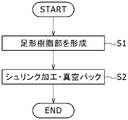
- 1 is a flow chart showing a procedure for manufacturing an insole in a method for manufacturing an insole, which is an embodiment of the present invention.
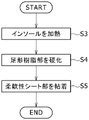
- 1 is a flow chart showing a procedure for forming an insole in a method for manufacturing an insole, which is an embodiment of the present invention.
- FIG. 1 is a diagram showing insoles 10 and 11 manufactured by an insole manufacturing method according to an embodiment of the present invention.
- FIG. 2 is a diagram showing how the insole 10 is used to form the insole 11 that fits the user's foot 3 .
- FIG. 3 is a flow chart showing the procedure for manufacturing the insole 10 in the method for manufacturing an insole, which is an embodiment of the present invention.
- FIG. 4 is a flow chart showing the procedure for forming the insole 11 in the insole manufacturing method of the embodiment according to the present invention.
- the insole 10 is an insole that can fit the shape of the user's foot 3 .
- the insole 10 includes a foot shaped resin portion 12 , a film portion 14 and a vacuum pack portion 15 .
- the footprint resin portion 12 is a footprint-shaped member that uses a thermoplastic resin that melts at a predetermined temperature and has a predetermined thickness.
- a thermoplastic resin it is preferable to use a polycaprolactone resin that melts at 60 to 70° C., but of course other thermoplastic resins may be used.
- the footprint resin portion 12 is preferably configured to contain polycaprolactone resin as described above.
- polycaprolactone resin as described above.
- LDPE low density polyethylene
- PP polypropylene
- PVC polyvinyl chloride
- PS polyvinylidene chloride
- PS polystyrene
- PVAc polyvinyl acetate
- PUR polyurethane
- Teflon registered trademark
- AS resin acrylic resin
- PMMA acrylic resin
- the thickness of the foot shaped resin portion 12 is preferably set to 2 mm to 3 mm, more preferably 2.5 mm.
- the footprint resin portion 12 is formed by injection molding.
- the film portion 14 is formed by shrink processing so as to cover the footprint resin portion 12 with a film.
- the film portion 14 is made of a polyethylene (PE) film, covers the entire surface of the footprint resin portion 12, and seals the footprint resin portion 12 by shrinking while removing air.
- PE polyethylene
- PET polyethylene terephthalate
- PP polypropylene
- PVC polyvinyl chloride
- the vacuum-packed part 15 is formed by vacuum-packing a nylon plastic bag.
- the nylon plastic bag is preferably composed of a material that does not shrink when heated in hot water.
- it is formed of two layers in which nylon (NY) is arranged in the outer layer and polyethylene (PE) is arranged in the inner layer.
- nylon (NY) is arranged in the outer layer
- PE polyethylene
- the vacuum pack part 15 is formed with a notch so that it can be easily opened after being boiled in hot water.
- by covering the footprint resin part 12 with the vacuum pack part 15 it is possible to protect it from dust and the like, and it is convenient for storage.
- polyethylene (PE) is arranged in the inner layer constituting the two-layer nylon plastic bag, but polypropylene (PP) may be used.
- the footprint resin portion 12 is formed (S1). Specifically, after mixing polycaprolactone resin with other materials, etc., a foot-shaped resin portion 12 having a thickness of 2.5 mm is formed by injection molding.
- the footprint resin portion covered with the film is vacuum-packed in a nylon plastic bag (S2). Specifically, shrink processing is performed so that the entire surface of the footprint resin portion 12 is covered with a polyethylene film. By using a film made of polyethylene, it is possible to seal the foot resin portion 12 without sticking. Further, by obtaining the step of S2, the footprint resin part 12 covered with the film is covered with the vacuum pack part 15 made of a nylon plastic bag as shown in FIG. 1(a).
- the user forms the insole 11 using the insole manufacturing method of the embodiment according to the present invention.
- a procedure for forming the insole 11 will be described below.
- the insole 10 is heated (S3). Specifically, the insole 10 is placed in a container or the like containing hot water heated to a temperature of 60 to 70° C. or higher, which is said to melt the foot resin portion 12, and the insole 10 is melted by bathing in hot water. The insole 10 warmed in this manner is placed on the inner sole of the user's shoe 2 as shown in FIG. 2(a). Here, the foot-shaped resin portion 12 of the insole 10 is melted and liquefied, but since the film portion 14 is formed in the shape of the foot, the deformation is small and the shape of the foot can be maintained.
- the notch of the vacuum pack part 15 is used to take out the foot resin part 12 covered with the film.
- the vacuum pack part 15 is made of a nylon plastic bag, is excellent in heat resistance, does not shrink, and can keep the shape of the footprint resin part 12 covered with the film.
- the footprint resin portion 12 is cured (S4). Specifically, after the insole 10 including the melted footprint resin portion 12 is installed in the inner sole of the user's shoe 2, the user puts on the shoe 2 with the user's foot 3 as shown in FIG. 2(b). .
- the user puts on the shoe 2, stands upright, and presses the insole 10 with the weight of the user.
- the footprint resin portion 12 is liquefied, the surface side of the footprint resin portion 12 deforms along the shape of the user's foot 3, and the back surface side of the footprint resin portion 12 conforms to the shape of the insole of the shoe 2. transform along.
- the film portion 14 is formed in the shape of a foot, and its shape changes according to the deformation of the foot-shaped resin portion 12 .
- the foot-shaped resin portion 12 hardens, and the insole 11 that fits the user's foot 3 is completed.
- the shape of the foot resin portion 12 is formed in an upright state, but pressure may be applied according to the posture of the shoe 2 for its purpose of use. If the shoe 2 is not a tight shoe but a loose shoe (for example, a leather shoe), the insole 10 is placed after placing a sponge material or the like for forming the shape of the bottom side of the liquefied insole 10. may be laid and put on with the user's foot 3 to form the surface side into the shape of the foot 3 .
- a sponge sheet 16 which is a flexible sheet portion, is adhered (S5). Specifically, the film portion 14 of the insole 11 removed from the shoe 2 is removed.
- the insole 11 to which the sponge sheet 16 is attached is placed again on the insole of the shoe 2, and the user puts on the shoe 2.
- the insole 11 that perfectly fits the user's foot 3 can be obtained. Therefore, the user can run with good grip when exercising, such as running, so there is an advantage that it is possible to set a better time.
- the surface of the insole 11 is molded along the shape of the user's foot 3, and the back surface of the insole 11 is molded along the shape of the shoe 2. That is, since the insole 11 is molded on both sides, it is possible to mold the insole 11 having the optimum shape for both the user's foot 3 and the shoe 2, which is a remarkable effect.
- the insole 10 manufactured by the method for manufacturing an insole according to the embodiment of the present invention is formed including the foot-shaped resin portion 12 that melts at 60 to 70° C., it can be placed in a general household for several minutes (for example, , 2 to 3 minutes), and can be easily liquefied by boiling in hot water.
- the insole 10 is covered with the film portion 14 that is laminated and sealed to the solidified foot-shaped resin portion 12 as described above, when the foot-shaped resin portion 12 is liquefied, However, it is possible to maintain the shape of the foot.
- the surface of the foot-shaped resin part 12 can be formed into a shape that completely fits the entire foot 3 of the user, and the back surface of the foot-shaped resin part 12 is the inner sole of the shoe 2. It can fit the shape perfectly. In other words, there is an advantage that the user can put on the shoes 2 and put them in an optimal state for exercising.
- the arch portion and the heel portion are formed with an uneven portion in a general shape.
- the insole 11 can be molded into a shape that wraps around the five toes of the foot, so that the insole 11 can be formed in a more optimal shape.
- the film portion 14 that seals the foot resin portion 12 of the insole 10 is a polyethylene film, the insole 10 can be sealed without sticking to the foot resin portion 12. There is an advantage that the film portion 14 of the insole 11 molded and cured can be easily peeled off.
- the sponge sheet 16 having flexibility is adhered to the portion that contacts the sole of the foot 3 after fitting to the shape of the user's foot. There is an effect that it can be improved.
Landscapes
- Engineering & Computer Science (AREA)
- Mechanical Engineering (AREA)
- Manufacturing & Machinery (AREA)
- Health & Medical Sciences (AREA)
- Epidemiology (AREA)
- General Health & Medical Sciences (AREA)
- Public Health (AREA)
- Life Sciences & Earth Sciences (AREA)
- Biophysics (AREA)
- Footwear And Its Accessory, Manufacturing Method And Apparatuses (AREA)
Abstract
Description
Claims (6)
- 所定の温度で融解する熱可塑性樹脂を用い、所定の厚みを有する足形形状の足形樹脂部を形成する第1の工程と、
前記足形樹脂部をフィルムで覆うようにシュリンク加工を行った後に、前記フィルムで覆われた前記足形樹脂部をナイロンポリ袋で真空パックする第2の工程と、
を備えることを特徴とするインソールの製造方法。 - 請求項1に記載のインソールの製造方法において、
前記第1の工程及び前記第2の工程を経て製造されたインソールを所定の温度で加熱する第3の工程と、
前記第3の工程により融解した前記足形樹脂部を有する前記インソールをユーザの靴内部に装着し、前記ユーザが靴を履いた状態で所定の時間経過させることにより前記足形樹脂部を硬化させる第4の工程と、
を備えることを特徴とするインソールの製造方法。 - 請求項2に記載のインソールの製造方法において、
前記第3の工程及び前記第4の工程を経た後に前記フィルムを剥離し、前記足形樹脂部のうち前記ユーザの足裏に接触する面に柔軟性シート部を装着する第5の工程を備えることを特徴とするインソールの製造方法。 - 請求項1から請求項3のいずれか1項に記載のインソールの製造方法において、
前記熱可塑性樹脂は、60~70℃で融解するポリカプロラクトン樹脂を含み、
前記フィルムは、ポリエチレン製フィルムを含むことを特徴とするインソールの製造方法。 - 請求項1から請求項4のいずれか1項に記載のインソールの製造方法において、
前記所定の厚みは、2mm~3mmに設定されていることを特徴とするインソールの製造方法。 - 請求項1から請求項5のいずれか1項に記載のインソールの製造方法において、
前記ナイロンポリ袋は、少なくともナイロンとポリエチレンの2層を含むことを特徴とするインソールの製造方法。
Priority Applications (5)
| Application Number | Priority Date | Filing Date | Title |
|---|---|---|---|
| US18/274,462 US12291001B2 (en) | 2021-01-29 | 2021-07-26 | Insole manufacturing method |
| KR1020237027861A KR20230136145A (ko) | 2021-01-29 | 2021-07-26 | 인솔의 제조 방법 |
| JP2022578022A JP7501939B2 (ja) | 2021-01-29 | 2021-07-26 | インソールの製造方法 |
| EP21922981.2A EP4285773B1 (en) | 2021-01-29 | 2021-07-26 | Insole manufacturing method |
| TW111108727A TWI884363B (zh) | 2021-01-29 | 2022-03-10 | 鞋中底之製造方法 |
Applications Claiming Priority (2)
| Application Number | Priority Date | Filing Date | Title |
|---|---|---|---|
| JP2021012627 | 2021-01-29 | ||
| JP2021-012627 | 2021-01-29 |
Publications (1)
| Publication Number | Publication Date |
|---|---|
| WO2022162973A1 true WO2022162973A1 (ja) | 2022-08-04 |
Family
ID=82653075
Family Applications (1)
| Application Number | Title | Priority Date | Filing Date |
|---|---|---|---|
| PCT/JP2021/027466 Ceased WO2022162973A1 (ja) | 2021-01-29 | 2021-07-26 | インソールの製造方法 |
Country Status (6)
| Country | Link |
|---|---|
| US (1) | US12291001B2 (ja) |
| EP (1) | EP4285773B1 (ja) |
| JP (1) | JP7501939B2 (ja) |
| KR (1) | KR20230136145A (ja) |
| TW (1) | TWI884363B (ja) |
| WO (1) | WO2022162973A1 (ja) |
Cited By (1)
| Publication number | Priority date | Publication date | Assignee | Title |
|---|---|---|---|---|
| WO2025238906A1 (ja) * | 2024-05-16 | 2025-11-20 | 株式会社レーブ | ユーザの足にフィットする靴の製造方法 |
Citations (7)
| Publication number | Priority date | Publication date | Assignee | Title |
|---|---|---|---|---|
| JPS55158902U (ja) * | 1979-05-02 | 1980-11-15 | ||
| JPS6420804A (en) * | 1987-07-16 | 1989-01-24 | Sekisui Chemical Co Ltd | Plate material for insole |
| JP3011472U (ja) * | 1994-11-22 | 1995-05-30 | 秀二 山本 | 成型インソール |
| JP2005198921A (ja) | 2004-01-19 | 2005-07-28 | Takeshi Hasegawa | 靴用中敷き及びその製造方法 |
| JP2013212335A (ja) | 2012-03-30 | 2013-10-17 | Hiroyuki Sakuma | 足裏型の製造方法、足型の製造方法、足裏型、足型、インソールおよび履物 |
| JP2014108567A (ja) * | 2012-12-03 | 2014-06-12 | Yoshiaki Takenami | 履物用中敷の成形方法 |
| JP2015226484A (ja) * | 2014-05-30 | 2015-12-17 | ヱスビー食品株式会社 | レトルト食品用牛肉の製造方法 |
Family Cites Families (5)
| Publication number | Priority date | Publication date | Assignee | Title |
|---|---|---|---|---|
| DE3514754A1 (de) * | 1985-04-24 | 1986-10-30 | Arlt, Hermann, 8501 Dietenhofen | Verfahren zur herstellung von schuheinlegesohlen |
| TW377281B (en) * | 1995-03-15 | 1999-12-21 | Acushnet Co | Conforming shoe construction and gel compositions therefor |
| KR101702804B1 (ko) * | 2016-01-18 | 2017-02-03 | 김세환 | 무늬도안 마스킹 겸용 신발창 랩핑장치 |
| US12389982B2 (en) * | 2017-09-11 | 2025-08-19 | Purple Innovation, Llc | Cushions and shoe insoles comprising elastomeric material and methods of forming same |
| JP7095847B2 (ja) * | 2019-02-28 | 2022-07-05 | 株式会社旭無線 | 靴用インソール |
-
2021
- 2021-07-26 EP EP21922981.2A patent/EP4285773B1/en active Active
- 2021-07-26 KR KR1020237027861A patent/KR20230136145A/ko active Pending
- 2021-07-26 US US18/274,462 patent/US12291001B2/en active Active
- 2021-07-26 WO PCT/JP2021/027466 patent/WO2022162973A1/ja not_active Ceased
- 2021-07-26 JP JP2022578022A patent/JP7501939B2/ja active Active
-
2022
- 2022-03-10 TW TW111108727A patent/TWI884363B/zh active
Patent Citations (7)
| Publication number | Priority date | Publication date | Assignee | Title |
|---|---|---|---|---|
| JPS55158902U (ja) * | 1979-05-02 | 1980-11-15 | ||
| JPS6420804A (en) * | 1987-07-16 | 1989-01-24 | Sekisui Chemical Co Ltd | Plate material for insole |
| JP3011472U (ja) * | 1994-11-22 | 1995-05-30 | 秀二 山本 | 成型インソール |
| JP2005198921A (ja) | 2004-01-19 | 2005-07-28 | Takeshi Hasegawa | 靴用中敷き及びその製造方法 |
| JP2013212335A (ja) | 2012-03-30 | 2013-10-17 | Hiroyuki Sakuma | 足裏型の製造方法、足型の製造方法、足裏型、足型、インソールおよび履物 |
| JP2014108567A (ja) * | 2012-12-03 | 2014-06-12 | Yoshiaki Takenami | 履物用中敷の成形方法 |
| JP2015226484A (ja) * | 2014-05-30 | 2015-12-17 | ヱスビー食品株式会社 | レトルト食品用牛肉の製造方法 |
Non-Patent Citations (1)
| Title |
|---|
| See also references of EP4285773A4 |
Cited By (1)
| Publication number | Priority date | Publication date | Assignee | Title |
|---|---|---|---|---|
| WO2025238906A1 (ja) * | 2024-05-16 | 2025-11-20 | 株式会社レーブ | ユーザの足にフィットする靴の製造方法 |
Also Published As
| Publication number | Publication date |
|---|---|
| KR20230136145A (ko) | 2023-09-26 |
| US12291001B2 (en) | 2025-05-06 |
| EP4285773C0 (en) | 2025-06-11 |
| JP7501939B2 (ja) | 2024-06-18 |
| JPWO2022162973A1 (ja) | 2022-08-04 |
| TWI884363B (zh) | 2025-05-21 |
| TW202304340A (zh) | 2023-02-01 |
| US20240092047A1 (en) | 2024-03-21 |
| EP4285773A1 (en) | 2023-12-06 |
| EP4285773A4 (en) | 2024-07-10 |
| EP4285773B1 (en) | 2025-06-11 |
Similar Documents
| Publication | Publication Date | Title |
|---|---|---|
| KR100736813B1 (ko) | 다중 재질의 결합에 의한 맞춤 인솔 및 그 제조 방법 | |
| CN203828165U (zh) | 注入聚氨酯的靴类部件 | |
| US11324282B2 (en) | Three-dimensionally thermo-molded footwear | |
| JPS60222001A (ja) | 履物およびその製造方法 | |
| EP3415023A1 (en) | Moisture-permeable waterproof shoe having an upper made of jacquard woven fabric | |
| CN112218556A (zh) | 具有热成型的带沟槽鞋底结构的鞋类物品 | |
| US20170325545A1 (en) | Three-dimensional thermo-molding of footwear | |
| US11737904B2 (en) | Custom multi-layered orthotic/orthosis, and method for forming | |
| US2742657A (en) | Molded shoe insert | |
| US7640680B1 (en) | Pedorthic systems | |
| EP1310352B1 (en) | Method for making a shoe | |
| US3852895A (en) | Shoes or boots | |
| US20080083485A1 (en) | Method for making a shoe | |
| JP7501939B2 (ja) | インソールの製造方法 | |
| EP3081108A1 (en) | Insert for the customization of a footwear, customizable footwear and method for the customization of a footwear | |
| CN111372484B (zh) | 制鞋用的共形膜、压力机及利用共形膜制造鞋制品的方法 | |
| US20240373984A1 (en) | Use of heating instrument for shoes | |
| JP2004255078A (ja) | 防水型履物及びその製造方法 | |
| WO2025238906A1 (ja) | ユーザの足にフィットする靴の製造方法 | |
| TWI696547B (zh) | 複合鞋底製程及其成品 | |
| JP3011472U (ja) | 成型インソール | |
| JP2005074085A (ja) | 履物及び履物の製造方法 | |
| KR100446198B1 (ko) | 신발 제조 방법 | |
| JP4779111B2 (ja) | 釣り用履き物 | |
| JP2011041631A (ja) | おおまかに足形をつけた履物およびカップインソール |
Legal Events
| Date | Code | Title | Description |
|---|---|---|---|
| 121 | Ep: the epo has been informed by wipo that ep was designated in this application |
Ref document number: 21922981 Country of ref document: EP Kind code of ref document: A1 |
|
| ENP | Entry into the national phase |
Ref document number: 2022578022 Country of ref document: JP Kind code of ref document: A |
|
| WWE | Wipo information: entry into national phase |
Ref document number: 18274462 Country of ref document: US |
|
| ENP | Entry into the national phase |
Ref document number: 20237027861 Country of ref document: KR Kind code of ref document: A |
|
| WWE | Wipo information: entry into national phase |
Ref document number: 2021922981 Country of ref document: EP |
|
| NENP | Non-entry into the national phase |
Ref country code: DE |
|
| ENP | Entry into the national phase |
Ref document number: 2021922981 Country of ref document: EP Effective date: 20230829 |
|
| WWG | Wipo information: grant in national office |
Ref document number: 18274462 Country of ref document: US |
|
| WWG | Wipo information: grant in national office |
Ref document number: 2021922981 Country of ref document: EP |