WO2022172828A1 - タンパク質加工食品の製造方法、タンパク質加工食品の製造装置、及びタンパク質加工食品 - Google Patents
タンパク質加工食品の製造方法、タンパク質加工食品の製造装置、及びタンパク質加工食品 Download PDFInfo
- Publication number
- WO2022172828A1 WO2022172828A1 PCT/JP2022/004090 JP2022004090W WO2022172828A1 WO 2022172828 A1 WO2022172828 A1 WO 2022172828A1 JP 2022004090 W JP2022004090 W JP 2022004090W WO 2022172828 A1 WO2022172828 A1 WO 2022172828A1
- Authority
- WO
- WIPO (PCT)
- Prior art keywords
- protein
- core material
- outlet
- cylindrical body
- mixture
- Prior art date
- Legal status (The legal status is an assumption and is not a legal conclusion. Google has not performed a legal analysis and makes no representation as to the accuracy of the status listed.)
- Ceased
Links
Images




Classifications
-
- A—HUMAN NECESSITIES
- A23—FOODS OR FOODSTUFFS; TREATMENT THEREOF, NOT COVERED BY OTHER CLASSES
- A23J—PROTEIN COMPOSITIONS FOR FOODSTUFFS; WORKING-UP PROTEINS FOR FOODSTUFFS; PHOSPHATIDE COMPOSITIONS FOR FOODSTUFFS
- A23J3/00—Working-up of proteins for foodstuffs
- A23J3/22—Working-up of proteins for foodstuffs by texturising
- A23J3/28—Working-up of proteins for foodstuffs by texturising using coagulation from or in a bath, e.g. spun fibres
-
- A—HUMAN NECESSITIES
- A23—FOODS OR FOODSTUFFS; TREATMENT THEREOF, NOT COVERED BY OTHER CLASSES
- A23J—PROTEIN COMPOSITIONS FOR FOODSTUFFS; WORKING-UP PROTEINS FOR FOODSTUFFS; PHOSPHATIDE COMPOSITIONS FOR FOODSTUFFS
- A23J3/00—Working-up of proteins for foodstuffs
- A23J3/04—Animal proteins
-
- A—HUMAN NECESSITIES
- A23—FOODS OR FOODSTUFFS; TREATMENT THEREOF, NOT COVERED BY OTHER CLASSES
- A23J—PROTEIN COMPOSITIONS FOR FOODSTUFFS; WORKING-UP PROTEINS FOR FOODSTUFFS; PHOSPHATIDE COMPOSITIONS FOR FOODSTUFFS
- A23J3/00—Working-up of proteins for foodstuffs
- A23J3/14—Vegetable proteins
-
- A—HUMAN NECESSITIES
- A23—FOODS OR FOODSTUFFS; TREATMENT THEREOF, NOT COVERED BY OTHER CLASSES
- A23J—PROTEIN COMPOSITIONS FOR FOODSTUFFS; WORKING-UP PROTEINS FOR FOODSTUFFS; PHOSPHATIDE COMPOSITIONS FOR FOODSTUFFS
- A23J3/00—Working-up of proteins for foodstuffs
- A23J3/14—Vegetable proteins
- A23J3/16—Vegetable proteins from soybean
-
- A—HUMAN NECESSITIES
- A23—FOODS OR FOODSTUFFS; TREATMENT THEREOF, NOT COVERED BY OTHER CLASSES
- A23J—PROTEIN COMPOSITIONS FOR FOODSTUFFS; WORKING-UP PROTEINS FOR FOODSTUFFS; PHOSPHATIDE COMPOSITIONS FOR FOODSTUFFS
- A23J3/00—Working-up of proteins for foodstuffs
- A23J3/22—Working-up of proteins for foodstuffs by texturising
- A23J3/225—Texturised simulated foods with high protein content
- A23J3/227—Meat-like textured foods
-
- A—HUMAN NECESSITIES
- A23—FOODS OR FOODSTUFFS; TREATMENT THEREOF, NOT COVERED BY OTHER CLASSES
- A23J—PROTEIN COMPOSITIONS FOR FOODSTUFFS; WORKING-UP PROTEINS FOR FOODSTUFFS; PHOSPHATIDE COMPOSITIONS FOR FOODSTUFFS
- A23J3/00—Working-up of proteins for foodstuffs
- A23J3/22—Working-up of proteins for foodstuffs by texturising
- A23J3/26—Working-up of proteins for foodstuffs by texturising using extrusion or expansion
-
- A—HUMAN NECESSITIES
- A23—FOODS OR FOODSTUFFS; TREATMENT THEREOF, NOT COVERED BY OTHER CLASSES
- A23L—FOODS, FOODSTUFFS OR NON-ALCOHOLIC BEVERAGES, NOT OTHERWISE PROVIDED FOR; PREPARATION OR TREATMENT THEREOF
- A23L13/00—Meat products; Meat meal; Preparation or treatment thereof
- A23L13/03—Coating with a layer; Stuffing, laminating, binding, or compressing of original meat pieces
-
- A—HUMAN NECESSITIES
- A23—FOODS OR FOODSTUFFS; TREATMENT THEREOF, NOT COVERED BY OTHER CLASSES
- A23L—FOODS, FOODSTUFFS OR NON-ALCOHOLIC BEVERAGES, NOT OTHERWISE PROVIDED FOR; PREPARATION OR TREATMENT THEREOF
- A23L13/00—Meat products; Meat meal; Preparation or treatment thereof
- A23L13/60—Comminuted or emulsified meat products, e.g. sausages; Reformed meat from comminuted meat product
- A23L13/67—Reformed meat products other than sausages
-
- A—HUMAN NECESSITIES
- A23—FOODS OR FOODSTUFFS; TREATMENT THEREOF, NOT COVERED BY OTHER CLASSES
- A23L—FOODS, FOODSTUFFS OR NON-ALCOHOLIC BEVERAGES, NOT OTHERWISE PROVIDED FOR; PREPARATION OR TREATMENT THEREOF
- A23L15/00—Egg products; Preparation or treatment thereof
- A23L15/20—Addition of proteins, e.g. hydrolysates, fats, carbohydrates, natural plant hydrocolloids; Addition of animal or vegetable substances containing proteins, fats, or carbohydrates
-
- A—HUMAN NECESSITIES
- A23—FOODS OR FOODSTUFFS; TREATMENT THEREOF, NOT COVERED BY OTHER CLASSES
- A23L—FOODS, FOODSTUFFS OR NON-ALCOHOLIC BEVERAGES, NOT OTHERWISE PROVIDED FOR; PREPARATION OR TREATMENT THEREOF
- A23L17/00—Food-from-the-sea products; Fish products; Fish meal; Fish-egg substitutes; Preparation or treatment thereof
-
- A—HUMAN NECESSITIES
- A23—FOODS OR FOODSTUFFS; TREATMENT THEREOF, NOT COVERED BY OTHER CLASSES
- A23L—FOODS, FOODSTUFFS OR NON-ALCOHOLIC BEVERAGES, NOT OTHERWISE PROVIDED FOR; PREPARATION OR TREATMENT THEREOF
- A23L17/00—Food-from-the-sea products; Fish products; Fish meal; Fish-egg substitutes; Preparation or treatment thereof
- A23L17/70—Comminuted, e.g. emulsified, fish products; Processed products therefrom such as pastes, reformed or compressed products
-
- A—HUMAN NECESSITIES
- A23—FOODS OR FOODSTUFFS; TREATMENT THEREOF, NOT COVERED BY OTHER CLASSES
- A23P—SHAPING OR WORKING OF FOODSTUFFS, NOT FULLY COVERED BY A SINGLE OTHER SUBCLASS
- A23P30/00—Shaping or working of foodstuffs characterised by the process or apparatus
- A23P30/20—Extruding
-
- A—HUMAN NECESSITIES
- A23—FOODS OR FOODSTUFFS; TREATMENT THEREOF, NOT COVERED BY OTHER CLASSES
- A23P—SHAPING OR WORKING OF FOODSTUFFS, NOT FULLY COVERED BY A SINGLE OTHER SUBCLASS
- A23P30/00—Shaping or working of foodstuffs characterised by the process or apparatus
- A23P30/20—Extruding
- A23P30/25—Co-extrusion of different foodstuffs
Definitions
- the present disclosure uses a method of continuously heating an object to be heated using an internal heating method to produce a heat-molded protein processed food made mainly from proteins such as meat, chicken, marine products, eggs, and plants.
- the present invention relates to a method, a protein-processed food manufacturing apparatus, and a protein-processed food.
- Japanese Patent No. 5113934 discloses a technique for uniformly heating the object to be heated in the cylinder by rotating the heating cylinder itself, through which the object to be heated passes, about the center line in the longitudinal direction of the cylinder. is disclosed. This document discloses the production of a protein-processed food having a shape in which another mixture penetrates through the center.
- Japanese Patent No. 5727412 it is possible to continuously produce foods in which different materials are combined with heat-processed mixtures made mainly of livestock meat or marine product-derived meat.
- a technique is disclosed in which a pattern is drawn on the cross section of the above using different materials.
- the purpose of the present disclosure is to enable continuous production of heat-coagulable protein processed food in a hollow shape.
- the mixture containing thermocoagulable protein, lipid, and water and having fluidity is continuously moved in the cylinder by an internal heating method.
- the cylindrical body has an outlet for the processed protein food at one end, and is arranged inside the cylindrical body to at least the outlet along the axial direction of the cylindrical body.
- the mixture is supplied between the cylinder and the core material and pushed out toward the outlet, and the mixture is mixed on the upstream side of the outlet. is internally heated to solidify, and the solidified hollow protein processed food is discharged from the outlet.
- the steam can be easily diffused, and the increase of the internal pressure inside the cylindrical body can be suppressed. Therefore, continuous ejection of the hollow protein processed food can be stably performed.
- the cylindrical body and the core member disposed inside the cylindrical body and extending along the axial direction of the cylindrical body to at least the outlet can be installed at any inclination from horizontal to vertical. At this time, if the outlet is installed at a higher position in the vertical direction than the inlet, back pressure is generated, and the hollow protein processed food can be stably discharged continuously.
- a second aspect is the method for producing a protein processed food according to the first aspect, in which the cylindrical body and the core material are arranged so that their axial directions are horizontal or vertical.
- the mixture is discharged from the bottom to the top.
- the hollow protein processed food can be stably discharged continuously.
- a third aspect is the method for producing a protein processed food according to the first aspect, wherein the cylindrical body and the core material are arranged so that their respective axial directions are horizontal, and the core material is disposed in the outlet It is rotationally supported on the upstream side of the core material and is not supported at the outlet, and the specific gravity of the core material is set equal to the specific gravity of the mixture.
- the core material When the cylindrical body and the core material are arranged such that their axial directions are horizontal, the core material is rotationally supported upstream of the outlet and not supported at the outlet, thereby processing the hollow protein. Continuous ejection of food becomes possible. However, in this case, since the tip side (outlet side) of the core material in particular bends downward due to its own weight, it is a problem to suppress this.
- the specific gravity of the core material is set to be equal to the specific gravity of the mixture, so that the deflection of the core material is suppressed and the center of the core material at the outlet of the cylindrical body is aligned with a desired position, or can get closer. Therefore, the hollow protein processed food can be produced in a desired shape.
- a fourth aspect is the method for producing a protein processed food according to any one of the first to third aspects, wherein the cylindrical body and the core material are arranged so that their axial directions are horizontal. In the vicinity of the outlet of the cylindrical body, a vertically split portion is provided that rotates and supports the core material and that can divide the protein processed food into vertical splits, and the protein is The processed food is thermoformed, and the processed protein food is vertically divided at the exit.
- the cylindrical body and the core material are arranged so that their respective axial directions are horizontal, and a longitudinally divided part for rotationally supporting the core material is provided in the vicinity of the outlet of the cylindrical body. . Since the front end side (outlet side) of the core material is supported by the vertically split portion, the core material, in particular, the front end side (outlet side) is restrained from bending downward due to its own weight.
- the vertically dividing portion vertically divides the processed protein food discharged from the outlet.
- the protein processed food in which the hollow structure is split into two can be continuously produced.
- a fifth aspect is the method for producing a protein processed food according to any one of the first to fourth aspects, in which the outer surface of the mixture is colored.
- the outer surface of the mixture is colored, so hollow protein-processed food, such as imitation squid, can be produced.
- the protein processed food manufacturing apparatus continuously moves the mixture containing thermocoagulable protein, lipid and water and having fluidity in the cylinder by an internal heating method.
- the cylindrical body has an inlet to which the mixture is supplied and an outlet provided at one end for discharging the protein processed food, and is arranged inside the cylindrical body.
- a core member that extends along the axial direction of the cylindrical body to at least the outlet and rotates around the axial direction; and an internal heating device that is provided upstream of the outlet in the cylindrical body. Then, in the process in which the mixture is supplied from the inlet between the cylindrical body and the core material and pushed out toward the outlet, the mixture is heated by the internal heating device and solidified to form the hollow protein processed food. becomes.
- this protein processed food manufacturing apparatus while the core material is rotated around its axial direction, a mixture containing protein, lipid, and water and having fluidity is supplied between the cylindrical body and the core material, and the outlet is The mixture is internally heated and solidified by an internal heating device on the upstream side of the outlet, and the solidified hollow protein processed food is discharged from the outlet. At this time, the mixture is extruded toward the outlet while the core rotates, and adhesion of the mixture to the core is suppressed, so smooth extrusion is possible. This also creates a gap between the outer surface of the core and the mixture. Furthermore, a gap is also formed between the inner surface of the cylinder and the mixture.
- the cylindrical body and the core member disposed inside the cylindrical body and extending along the axial direction of the cylindrical body to at least the outlet can be installed at any inclination from horizontal to vertical. At this time, if the outlet is installed at a higher position in the vertical direction than the inlet, back pressure is generated, and the hollow protein processed food can be stably discharged continuously.
- a seventh aspect is the protein processed food manufacturing apparatus according to the sixth aspect, wherein the cylindrical body and the core material are arranged so that their axial directions are horizontal or vertical.
- the mixture is discharged from the bottom to the top.
- the hollow protein processed food can be stably discharged continuously.
- An eighth aspect is the protein processed food manufacturing apparatus according to the fifth aspect, wherein the cylindrical body and the core material are arranged so that their axial directions are horizontal, and the core material The core material is rotationally supported on the upstream side and unsupported at the outlet, and the specific gravity of the core material is set equal to the specific gravity of the mixture.
- the core material When the cylindrical body and the core material are arranged such that their axial directions are horizontal, the core material is rotationally supported upstream of the outlet and not supported at the outlet, thereby processing the hollow protein. Continuous ejection of food becomes possible. However, in this case, since the tip side (outlet side) of the core material in particular bends downward due to its own weight, it is a problem to suppress this.
- the specific gravity of the core material is set to be equal to the specific gravity of the mixture, so the core material is suspended in the mixture, and deflection of the core material is suppressed.
- the center of the core material at the outlet of the cylinder matches or approaches the desired position. Therefore, the hollow protein processed food can be produced in a desired shape.
- a ninth aspect is the apparatus for producing a protein processed food according to any one of the sixth to eighth aspects, wherein the core material is rotatably supported near the outlet of the cylindrical body, and the protein processed food is vertically split.
- a vertically split portion is provided that can be divided into two.
- the cylinder and the core material are arranged so that their axial directions are horizontal, and the core material is rotationally supported by the vertically split portion near the outlet of the cylinder. Since the front end side (outlet side) of the core material is supported by the vertically split portion, the core material, in particular, the front end side (outlet side) is restrained from bending downward due to its own weight.
- the vertically dividing portion vertically divides the processed protein food discharged from the outlet.
- the protein processed food in which the hollow structure is split into two can be continuously produced.
- a tenth aspect is the apparatus for producing a protein processed food according to any one of the sixth to ninth aspects, wherein the cylindrical body is supplied with a coloring agent for coloring the outer surface of the mixture. It has an agent supply port.
- the colorant is supplied from the colorant supply port provided in the cylindrical body, and the outer surface of the mixture is colored, so that hollow protein processed food such as imitation of squid is produced. can.
- a mixture containing protein, lipid, and water, having fluidity, and having a gel stiffness of 180 to 370 g/cm is continuously heat-coagulated into a hollow shape.
- the gel stiffness of the mixture is measured according to the following procedure.
- the mixture before heating is filled in a vinylidene chloride tube, heat-treated in a boiling tank at 90°C for 40 minutes, cooled rapidly in ice water, left overnight at 10°C and measured for physical properties.
- Rheotech SD-700 manufactured by Sun Science Co., Ltd. was used to measure gel stiffness (g/cm) as an index of gel physical properties with a spherical plunger of ⁇ 5 mm.
- g) Measure the breaking strain (cm).
- This protein-processed food has a viscoelastic texture and a texture unique to its hollow structure.
- heat-coagulable protein processed food can be continuously produced in a hollow shape.
- FIG. 4 is a perspective view schematically showing a state in which steam is discharged through a gap between the cylinder and the mixture and a gap between the outer surface of the core material and the mixture.
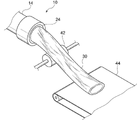
- FIG. 2 is a perspective view showing a state in which imitation squid as a protein processed food is discharged from an outlet.
- FIG. 2 is a cross-sectional view schematically showing a method and an apparatus for producing a protein processed food according to Modification 1; FIG.
- FIG. 10 is a perspective view showing an example in which a vertically split portion is provided in the vicinity of the outlet of the cylinder; It is a perspective view which shows the protein processed food divided into two by the vertical split part.
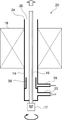
- FIG. 10 is a cross-sectional view schematically showing a method and an apparatus for producing a protein processed food according to Modification 2; It is sectional drawing which shows typically the manufacturing method and apparatus of the protein processed foods which concern on 2nd Embodiment.
- a protein processed food manufacturing apparatus 10 moves a fluid mixture 12 containing thermocoagulable protein, lipid and water in a cylindrical body 14, It is a device that continuously heats and solidifies by internal heating method. This device is capable of continuously heating and shaping foods such as chikuwa and squid.
- the gel stiffness of the mixture 12 is, for example, 180-370 g/cm.
- protein contained in the mixture 12 in addition to heat-coagulable protein such as animal protein such as livestock meat, fish meat, and egg, vegetable protein can be used.
- the protein processed food manufacturing apparatus 10 has a cylindrical body 14, a core material 16, and an internal heating device 18.
- the cylindrical body 14 and the core member 16 are arranged such that their axial directions are horizontal.
- the horizontal direction means a range of ⁇ 10° in the horizontal direction.
- a positive angle means that the outlet 26 , which will be described below, is higher than the inlet 22 .
- a negative angle means that the outlet 26 (described below) is lower than the inlet 22 . It is preferable that the outlet is set at a positive angle relative to the inlet, because the ejection can be stably performed.
- the internal heating device 18 is, for example, a microwave heating device provided at a position upstream of the outlet 26 in the cylindrical body 14 .
- the cylindrical body 14 has an inlet 22 through which the mixture 12 is supplied, and an outlet 26 provided at one end 24 through which the processed protein food 30 is discharged.
- the cylindrical body 14 is formed in a cylindrical shape, for example.
- the inlet 22 is provided near the other end 28 of the cylinder 14, for example.
- the other end 28 is located on the opposite side of the one end 24 in the axial direction of the tubular body 14 and is closed.
- the outlet 26 opens circularly outward in the axial direction at one end 24 of the tubular body 14 .
- a support portion 32 for the core member 16 is provided inside the cylindrical body 14 , for example, in the vicinity of the upstream side of the internal heating device 18 .
- the support portion 32 is configured to allow the mixture 12 to pass through in the axial direction of the cylindrical body 14 .
- the cylindrical body 14 has a coloring agent supply port 36 through which a coloring agent 34 for coloring the outer surface of the mixture 12 is supplied.
- the coloring agent 34 is edible. If the processed protein food 30 is an imitation of squid, a color resembling squid is used as the coloring agent 34 .
- a guide portion 38 is provided in the portion of the cylinder 14 where the colorant supply port 36 is located.
- the guide portion 38 is a tube having an outer diameter smaller than the inner diameter of the cylindrical body 14 and attached coaxially with the cylindrical body 14 .
- the guide portion 38 extends downstream from the colorant supply port 36 within a range that does not reach the support portion 32 .
- a supply path 40 for the coloring agent 34 is formed between the inner surface of the cylinder 14 and the guide portion 38 .
- the downstream end of the supply passage 40 is open in the axial direction of the cylinder 14, but the upstream end is closed.
- the colorant 34 is supplied between the outer surface of the mixture 12 and the cylindrical body 14 on the upstream side of the support portion 32 .
- the supply of the coloring agent 34 increases the slippage between the mixture 12 and the cylindrical body 14, and is expected to prevent the mixture 12 from clogging.
- the core member 16 is a member that is arranged inside the cylinder 14, extends along the axial direction of the cylinder 14 to at least the outlet 26, and rotates about the axial direction.
- the core material 16 is rotationally driven around the axial direction by a drive source 17 such as a motor.
- the core material 16 is solid or hollow.
- the core material 16 penetrates from the other end 28 of the cylindrical body 14 to the one end 24 .
- the core member 16 is rotationally supported by the supporting portion 32 so that the center of the core member 16 coincides with the center of the cylindrical body 14, for example.
- the core member 16 is rotatably supported by, for example, a support portion 32 on the upstream side of the outlet 26 , but is not supported at the outlet 26 . That is, the tip of the core material 16 on the outlet 26 side is a free end. Therefore, depending on the structure of the core material 16, the front end side (outlet 26 side) in particular bends downward due to its own weight, and it is a problem to suppress this.
- weight reduction of the core material 16 is conceivable. If the core material 16 is too light, the core material 16 will float in the mixture 12 due to buoyancy.
- the specific gravity of the mixture 12 varies slightly depending on the formulation, it is generally assumed to be 1.14 g/cm 3 .
- the criteria for selecting the core material 16 include high pressure resistance and lightness as described above. Further, when the internal heating device 18 is a microwave heating device, the criteria for selecting the core material 16 include microwave permeability or microwave impermeability.
- a material having microwave transparency is, for example, polytetrafluoroethylene. Further, the material impermeable to microwaves is, for example, metal.
- a microwave-absorbing material generates heat by itself, so it is not suitable as a material for the core material 16, but it may be used if it is configured to reflect microwaves by plating or the like.
- the slipperiness of the mixture 12 is improved, and the mixture 12 clogs. An inhibitory effect is expected.
- the mixture 12 is supplied from the inlet 22 between the cylindrical body 14 and the core material 16 and pushed out toward the outlet 26, and the mixture 12 is heated by the internal heating device 18 It is configured to be solidified by heating to form a hollow protein processed food 30 .
- a guide roller 42, a belt conveyor 44, or the like for conveying the processed protein food 30 may be installed at the end 24 of the cylindrical body 14. As shown in FIG. 4, a guide roller 42, a belt conveyor 44, or the like for conveying the processed protein food 30 may be installed at the end 24 of the cylindrical body 14. As shown in FIG. 4, a guide roller 42, a belt conveyor 44, or the like for conveying the processed protein food 30 may be installed at the end 24 of the cylindrical body 14. As shown in FIG.
- a vertically split portion 46 is provided near the outlet 26 of the cylindrical body 14. may be provided.
- the vertically split portion 46 is configured to rotationally support the core material 16 and to split the processed protein food 30 vertically.
- the vertically split portion 46 has, for example, an annular bearing 48 and a blade portion 50 .
- the bearing 48 is held inside the cylindrical body 14 by the blade portion 50 and supports the core material 16 for rotation.
- the blade portions 50 are arranged, for example, side by side in the diameter direction at two locations between the bearing 48 and the cylindrical body 14 . Also, the cutting edge of the blade portion 50 is directed toward the upstream side of the cylindrical body 14 .
- the processed protein food 30 can be discharged from the outlet 26 of the cylinder 14 while being vertically divided (FIG. 7).
- the drive source 17 of the core member 16 may be arranged at the end of the cylindrical body 14 on the outlet 26 side, as shown in FIG. Since the processed protein food 30 is vertically divided and discharged from the outlet 26, interference with the drive source 17 can be suppressed.
- a fluid mixture 12 containing proteins, lipids and water is prepared (not shown).
- the mixture 12 is supplied from the inlet 22 between the cylindrical body 14 and the core material 16 while rotating the core material 16 around its axial direction, Push toward outlet 26 .
- the mixture 12 is internally heated and solidified by the microwave MW ( FIG. 3 ) of the internal heating device 18 , and the solidified hollow protein processed food 30 is discharged from the outlet 26 .
- the mixture 12 is extruded toward the outlet 26 while the core 16 rotates, and adhesion of the mixture 12 to the core 16 is suppressed, so smooth extrusion is possible.
- This also creates a gap between the outer surface of the core 16 and the mixture 12 .
- a gap is also formed between the inner surface of the cylinder 14 and the mixture 12 .
- steam is generated when the mixture 12 is internally heated, and the steam is discharged out of the cylindrical body 14 because these gaps serve as passages for the steam. Therefore, as compared with the case of producing a solid protein processed food 30 without the core material 16, the steam can be easily diffused, and the increase of the internal pressure inside the cylindrical body 14 is suppressed. Therefore, the hollow protein processed food 30 can be stably discharged continuously.
- the specific gravity of the core material 16 is set to be the same as the specific gravity of the mixture 12, the core material 16 is in a floating state in the mixture 12, and bending of the core material 16 is suppressed.
- the center of the core material 16 at the outlet 26 of the tubular body 14 will match or approach a desired position. Therefore, the hollow protein processed food 30 can be produced in a desired shape.
- the eccentricity of the hollow portion of the protein processed food 30 can be suppressed.
- the coloring agent 34 is supplied from the coloring agent supply port 36 provided in the cylinder 14, and the outer surface of the mixture 12 is colored, so that a hollow protein processed food 30 such as imitation of squid can be produced.
- the heat-coagulable protein processed food 30 can be continuously produced in a hollow shape.
- the processed protein food 30 can provide a texture with viscoelasticity and a texture unique to the hollow structure.
- the processed protein food 30 ejected from the cylinder 14 is conveyed by guide rollers 42 or a belt conveyor 44, for example.
- the cylindrical body 14 and the core material 16 are arranged so that their axial directions are horizontal, and the core material 16 is positioned near the outlet 26 of the cylindrical body 14. It is rotatably supported by the vertically split portion 46 . Since the front end side (outlet 26 side) of the core material 16 is supported by the vertically split portion 46, the front end side (outlet 26 side) of the core material 16 in particular is prevented from bending downward due to its own weight. Moreover, the floating of the core material 16 in the mixture 12 due to buoyancy is also suppressed. As a result, the center of the core material 16 at the outlet 26 of the tubular body 14 will match or approach a desired position.
- the processed protein food 30 discharged from the outlet 26 is vertically divided by the vertically dividing portion 46 .
- the vertically dividing portion 46 thereby, as shown in FIG. 7, it is possible to continuously produce protein processed food 30 in which the hollow structure is split in two.
- the normal chikuwa manufacturing method is to bake after the sitting process at about 30°C, so the moisture evaporates during the sitting process, and the final yield is about 80%.
- the sitting process is unnecessary, and the chikuwa can be heated and solidified in the cylindrical body 14, so that the evaporation of water can be suppressed, and the yield is about 94%.
- the temperature is raised from the outside of the chikuwa in the firing process, but according to this embodiment, the temperature is uniformly raised by internal heating, and the temperature rise rate is high.
- Chemical bonds such as SS bonds, ionic bonds, hydrogen bonds, hydrophobic bonds and/or physical bonds that are said to be involved in gel formation may be affected by enzymes contained in surimi. Enzymes contained in surimi are known to inhibit gel formation by surimi in a specific temperature range, such as proteolytic enzymes. To avoid this effect, it can be advantageous to have a fast ramp temperature in order to pass through a particular temperature band quickly. Chikuwa produced by external heating differs in gel structure from the processed protein food obtained by this embodiment due to the difference in temperature rise.
- Differences in gel structure can be detected by partial gel strength measurement, microscopic observation, sensory evaluation to evaluate food texture or touch, and other methods. For example, in chikuwa made by external heating, the temperature rise in the inner layer portion is relatively slow compared to the temperature rise in the outer layer portion. Therefore, the texture of the inner layer is softer than that of the outer layer, which may be perceived as something wrong when biting off. According to the present embodiment, when the temperature is uniformly raised by internal heating and the rate of temperature rise is increased, the difference in texture between the outer layer portion and the inner layer portion is less likely to occur, and discomfort can be prevented.
- the cylindrical body 14 and the core material 16 are arranged such that their axial directions are vertical.
- the vertical direction means a range of ⁇ 10° in the vertical direction.
- thermocoagulable protein processed food 30 can be continuously produced in a hollow shape.
- the mixture 12 is prevented from falling in the direction of gravity, and/or the steam generated during the internal heating of the mixture 12 is discharged upward, thereby reducing the hollow space.
- the protein processed food 30 can be stably discharged continuously.
- the mixture 12 containing protein, lipid, and water, and having fluidity is moved through the cylindrical body 14 and continuously heated by the internal heating method.
- the mixture 12 is internally heated and solidified on the side, and the solidified hollow protein processed food 30 is discharged from the outlet 26 .
- the mixture 12 containing protein, lipid and water and having fluidity is placed between the cylindrical body 14 and the core material 16.
- the mixture 12 is internally heated and solidified on the upstream side of the outlet 26 , and the solidified hollow protein processed food 30 is discharged from the outlet 26 .
- adhesion of the mixture 12 to the core material 16 is suppressed, so smooth extrusion becomes possible.
- This also creates a gap between the outer surface of the core 16 and the mixture 12 .
- a gap is also formed between the inner surface of the cylinder 14 and the mixture 12 .
- the cylindrical body 14 and the core member 16 are arranged so that their axial directions are horizontal, and the core member 16 is rotationally supported upstream of the outlet 26 and unsupported at the outlet 26. may be set equal to the specific gravity of the mixture 12 .
- the specific gravity of the core material 16 is set to be equal to the specific gravity of the mixture 12
- the deflection of the core material 16 is suppressed, and the center of the core material 16 at the outlet 26 of the cylindrical body 14 is adjusted to the desired position. It can be matched or approximated in position. Therefore, the hollow protein processed food 30 can be produced in a desired shape.
- the cylindrical body 14 and the core material 16 are arranged so that their axial directions are horizontal, and the core material 16 is rotated near the outlet 26 of the cylindrical body 14.
- a vertically split portion 46 is provided to support and divide the protein processed food 30 into vertical splits, and the protein processed food 30 is thermoformed while the core material 16 is rotationally supported by the longitudinally split portion 46, and the protein processed food 30 is formed at the outlet 26. 30 may be split vertically.
- the outer surface of the mixture 12 may be colored. By coloring the outer surface of the mixture 12, a hollow protein processed food 30, such as an imitation of squid, can be produced.
- the cylindrical body 14 and the core material 16 can be installed at any inclination from horizontal to vertical. At this time, if the outlet 26 is installed at a higher position in the vertical direction than the inlet 22, a back pressure is generated, and the hollow processed protein food 30 can be stably discharged continuously.
- tubular body 14 is assumed to be cylindrical, it is not limited to this, and may be tubular with a polygonal cross section, an elliptical cross section, or the like.
- one core material 16 is used in the cylindrical body 14, it is not limited to this, and a plurality of core materials 16 may be used.
- the cylindrical body 14 may be fixed, or may rotate in the opposite direction to or in the same direction as the core member 16 at a speed different from that of the core member 16 .
- a microwave heating device is mentioned as the internal heating device 18, but Joule heating or high-frequency heating may be used as the heating means.
Landscapes
- Life Sciences & Earth Sciences (AREA)
- Chemical & Material Sciences (AREA)
- Engineering & Computer Science (AREA)
- Health & Medical Sciences (AREA)
- Food Science & Technology (AREA)
- Polymers & Plastics (AREA)
- Nutrition Science (AREA)
- Biochemistry (AREA)
- Zoology (AREA)
- Molecular Biology (AREA)
- Marine Sciences & Fisheries (AREA)
- Botany (AREA)
- Manufacturing & Machinery (AREA)
- Meat, Egg Or Seafood Products (AREA)
Abstract
Description
図1において、本実施形態に係るタンパク質加工食品の製造装置10は、熱凝固性タンパク質と脂質と水分を含有し、かつ、流動性を有する混合物12を、筒体14の中を移動させながら、内部加熱方式により連続的に加熱凝固して成形させる装置である。この装置は、例えば竹輪やイカの様な形状の食品を連続的に加熱成形することが可能となっている。
本実施形態は、上記のように構成されており、以下その作用について説明する。まず、タンパク質と脂質と水分を含有し、かつ、流動性を有する混合物12を調製する(図示せず)。図1において、本実施形態に係るタンパク質加工食品の製造装置10では、芯材16をその軸方向回りに回転させながら、入口22から混合物12を筒体14と芯材16の間に供給し、出口26に向かって押し出す。出口26より上流側において混合物12を内部加熱装置18のマイクロ波MW(図3)により内部加熱して凝固させ、凝固した中空のタンパク質加工食品30を出口26から吐出させる。このとき、芯材16が回転しながら混合物12が出口26に向かって押し出され、芯材16に対する混合物12の付着が抑制されるので、スムーズな押出が可能となる。またこれによって、芯材16の外面と混合物12との間に隙間が形成される。更に、筒体14の内面と混合物12との間にも隙間が形成される。図3に示されるように、混合物12の内部加熱時に蒸気が発生するが、これらの隙間が蒸気の通路となることで、蒸気が筒体14の外へ排出される。したがって、芯材16がなく中実のタンパク質加工食品30を製造する場合と比較して蒸気の放散が容易となり、筒体14の内側での内圧の上昇が抑制される。このため、中空のタンパク質加工食品30の連続吐出を安定して行うことができる。
以上、本開示の実施形態の一例について説明したが、本開示の実施形態は、上記に限定されるものでなく、上記以外にも、その主旨を逸脱しない範囲内において種々変形して実施可能であることは勿論である。
本明細書に記載されたすべての文献、特許出願、および技術規格は、個々の文献、特許出願、および技術規格が参照により取り込まれることが具体的かつ個々に記された場合と同程度に、本明細書中に参照により取り込まれる。
Claims (11)
- 熱凝固性タンパク質と脂質と水分を含有し、かつ、流動性を有する混合物を筒体の中を移動させながら、内部加熱方式により連続的に加熱凝固して成形させるタンパク質加工食品の製造方法において、
一端に前記タンパク質加工食品の出口を有する前記筒体と、前記筒体の内側に配置され前記筒体の軸方向に沿って少なくとも前記出口まで延びる芯材を用い、
前記芯材をその軸方向回りに回転させながら、前記混合物を前記筒体と前記芯材の間に供給し、前記出口に向かって押し出し、前記出口より上流側において前記混合物を内部加熱して凝固させ、凝固した中空の前記タンパク質加工食品を前記出口から吐出させるタンパク質加工食品の製造方法。 - 前記筒体及び前記芯材を、各々の軸方向が水平方向または鉛直方向となるように配置する請求項1に記載のタンパク質加工食品の製造方法。
- 前記筒体及び前記芯材を、各々の軸方向が水平方向となるように配置し、
前記芯材を、前記出口よりも上流側で回転支持すると共に、前記出口で非支持とし、
前記芯材の比重を前記混合物の比重と同等に設定する請求項1に記載のタンパク質加工食品の製造方法。 - 前記筒体の前記出口近傍に、前記芯材を回転支持すると共に前記タンパク質加工食品を縦割りに分割可能な縦割り部を設け、
前記縦割り部により前記芯材を回転支持しながら前記タンパク質加工食品の加熱成形を行い、前記出口で前記タンパク質加工食品を縦割りに分割する請求項1~請求項3の何れか1項に記載のタンパク質加工食品の製造方法。 - 前記混合物の外面に色付けを行う請求項1~請求項4の何れか1項に記載のタンパク質加工食品の製造方法。
- 熱凝固性タンパク質と脂質と水分を含有し、かつ、流動性を有する混合物を筒体の中を移動させながら、内部加熱方式により連続的に加熱凝固して成形させるタンパク質加工食品の製造装置において、
前記混合物が供給される入口、及び一端に設けられ前記タンパク質加工食品が吐出される出口を有する前記筒体と、
前記筒体の内側に配置され、前記筒体の軸方向に沿って少なくとも前記出口まで延び、軸方向回りに回転する芯材と、
前記筒体のうち前記出口より上流側の位置に設けられた内部加熱装置と、
を有し、
前記混合物が前記入口から前記筒体と前記芯材の間に供給され前記出口に向かって押し出される過程で、前記混合物が前記内部加熱装置により加熱されて凝固し、中空の前記タンパク質加工食品となるタンパク質加工食品の製造装置。 - 前記筒体及び前記芯材が、各々の軸方向が水平方向または鉛直方向となるように配置された請求項6に記載のタンパク質加工食品の製造装置。
- 前記筒体及び前記芯材は、各々の軸方向が水平方向となるように配置され、
前記芯材は、前記出口よりも上流側で回転支持されると共に、前記出口で非支持とされ、
前記芯材の比重が、前記混合物の比重と同等に設定される請求項6に記載のタンパク質加工食品の製造装置。 - 前記筒体の前記出口近傍に、前記芯材を回転支持すると共に前記タンパク質加工食品を縦割りに分割可能な縦割り部が設けられた請求項6~請求項8の何れか1項に記載のタンパク質加工食品の製造装置。
- 前記筒体は、前記混合物の外面に色付けを行うための着色剤が供給される着色剤供給口を有する請求項6~請求項9の何れか1項に記載のタンパク質加工食品の製造装置。
- タンパク質と脂質と水分を含有し、流動性を有し、かつゲル剛性が180~370g/cmである混合物が連続的にかつ中空に加熱凝固されたタンパク質加工食品。
Priority Applications (3)
| Application Number | Priority Date | Filing Date | Title |
|---|---|---|---|
| CN202280013857.XA CN116828991A (zh) | 2021-02-10 | 2022-02-02 | 蛋白质加工食品的制造方法和制造装置及蛋白质加工食品 |
| EP22752655.5A EP4292438A4 (en) | 2021-02-10 | 2022-02-02 | PROCESSED PROTEIN FOOD PRODUCTION METHOD, PROCESSED PROTEIN FOOD PRODUCTION DEVICE, AND PROCESSED PROTEIN FOOD |
| US18/276,468 US20240108026A1 (en) | 2021-02-10 | 2022-02-02 | Production method for protein processed food, production device for protein processed food, and protein processed food |
Applications Claiming Priority (2)
| Application Number | Priority Date | Filing Date | Title |
|---|---|---|---|
| JP2021-020080 | 2021-02-10 | ||
| JP2021020080A JP7210622B2 (ja) | 2021-02-10 | 2021-02-10 | タンパク質加工食品の製造方法、及びタンパク質加工食品の製造装置 |
Publications (1)
| Publication Number | Publication Date |
|---|---|
| WO2022172828A1 true WO2022172828A1 (ja) | 2022-08-18 |
Family
ID=82838780
Family Applications (1)
| Application Number | Title | Priority Date | Filing Date |
|---|---|---|---|
| PCT/JP2022/004090 Ceased WO2022172828A1 (ja) | 2021-02-10 | 2022-02-02 | タンパク質加工食品の製造方法、タンパク質加工食品の製造装置、及びタンパク質加工食品 |
Country Status (5)
| Country | Link |
|---|---|
| US (1) | US20240108026A1 (ja) |
| EP (1) | EP4292438A4 (ja) |
| JP (1) | JP7210622B2 (ja) |
| CN (1) | CN116828991A (ja) |
| WO (1) | WO2022172828A1 (ja) |
Citations (9)
| Publication number | Priority date | Publication date | Assignee | Title |
|---|---|---|---|---|
| JPS51110067A (ja) * | 1975-03-20 | 1976-09-29 | Osaki Suisan Kk | |
| JPS5662095U (ja) * | 1979-10-20 | 1981-05-26 | ||
| JPS61132160A (ja) * | 1984-11-30 | 1986-06-19 | Nippon Suisan Kaisha Ltd | 練肉の中空成型方法 |
| JPS6251968A (ja) * | 1985-08-31 | 1987-03-06 | Yoshio Yano | 筒状食品の連続製造法 |
| JPS62153888U (ja) * | 1986-03-24 | 1987-09-30 | ||
| JPH0479862A (ja) * | 1990-07-20 | 1992-03-13 | Kiyotsune Shino | 孔あき練り製品の成形方法及びその装置 |
| JP5113934B1 (ja) | 2010-11-02 | 2013-01-09 | 日本水産株式会社 | 内部加熱による連続加熱方法を用いるタンパク質含有食品の製造方法 |
| JP5727412B2 (ja) | 2012-04-26 | 2015-06-03 | 日本水産株式会社 | 内部加熱による連続加熱成形方法を用いるタンパク質含有食品の製造方法 |
| JP2021020080A (ja) | 2009-09-18 | 2021-02-18 | セント ジュード メディカル コーディネイション センター ベーファウベーアー | 血圧測定および通信システム |
Family Cites Families (2)
| Publication number | Priority date | Publication date | Assignee | Title |
|---|---|---|---|---|
| US4978551A (en) * | 1989-08-08 | 1990-12-18 | Sugiyo Co., Ltd. | Simulated fish meat and method of producing same |
| EP2636314B1 (en) * | 2010-11-02 | 2015-08-12 | Nippon Suisan Kaisha, Ltd. | Process for production of protein-containing food employing continuous heating method by internal heating |
-
2021
- 2021-02-10 JP JP2021020080A patent/JP7210622B2/ja active Active
-
2022
- 2022-02-02 US US18/276,468 patent/US20240108026A1/en active Pending
- 2022-02-02 EP EP22752655.5A patent/EP4292438A4/en active Pending
- 2022-02-02 CN CN202280013857.XA patent/CN116828991A/zh active Pending
- 2022-02-02 WO PCT/JP2022/004090 patent/WO2022172828A1/ja not_active Ceased
Patent Citations (9)
| Publication number | Priority date | Publication date | Assignee | Title |
|---|---|---|---|---|
| JPS51110067A (ja) * | 1975-03-20 | 1976-09-29 | Osaki Suisan Kk | |
| JPS5662095U (ja) * | 1979-10-20 | 1981-05-26 | ||
| JPS61132160A (ja) * | 1984-11-30 | 1986-06-19 | Nippon Suisan Kaisha Ltd | 練肉の中空成型方法 |
| JPS6251968A (ja) * | 1985-08-31 | 1987-03-06 | Yoshio Yano | 筒状食品の連続製造法 |
| JPS62153888U (ja) * | 1986-03-24 | 1987-09-30 | ||
| JPH0479862A (ja) * | 1990-07-20 | 1992-03-13 | Kiyotsune Shino | 孔あき練り製品の成形方法及びその装置 |
| JP2021020080A (ja) | 2009-09-18 | 2021-02-18 | セント ジュード メディカル コーディネイション センター ベーファウベーアー | 血圧測定および通信システム |
| JP5113934B1 (ja) | 2010-11-02 | 2013-01-09 | 日本水産株式会社 | 内部加熱による連続加熱方法を用いるタンパク質含有食品の製造方法 |
| JP5727412B2 (ja) | 2012-04-26 | 2015-06-03 | 日本水産株式会社 | 内部加熱による連続加熱成形方法を用いるタンパク質含有食品の製造方法 |
Also Published As
| Publication number | Publication date |
|---|---|
| EP4292438A4 (en) | 2024-12-04 |
| US20240108026A1 (en) | 2024-04-04 |
| EP4292438A1 (en) | 2023-12-20 |
| JP7210622B2 (ja) | 2023-01-23 |
| JP2022122688A (ja) | 2022-08-23 |
| CN116828991A (zh) | 2023-09-29 |
Similar Documents
| Publication | Publication Date | Title |
|---|---|---|
| US11254041B2 (en) | High specific mechanical energy extrusion screw assembly | |
| EP1060676B1 (fr) | Produit alimentaire à texture fibreuse hétérogène susceptible d'être obtenu à partir de protéines de poisson | |
| CA2501334C (en) | Improved method and apparatus for producing a curly puff extrudate | |
| CA2475087C (en) | Method and apparatus for producing a braided puff extrudate | |
| TW201036558A (en) | Extrusion die assembly for high density products | |
| FR2827123A1 (fr) | Procede et installation de preparation en continu d'un produit alimentaire retexture | |
| RU2662785C2 (ru) | Система экструдера и способ | |
| JPH11507221A (ja) | ペットフード及び飼料産業のための油存在下切断方法 | |
| JP7210622B2 (ja) | タンパク質加工食品の製造方法、及びタンパク質加工食品の製造装置 | |
| FR2572899A1 (fr) | Procede et installation de fabrication d'un produit fourre | |
| FR2932956A1 (fr) | Procede pour la mise en forme d'un produit alimentaire par cryoextrusion mettant en oeuvre une regulation de temperature predictive. | |
| US20220151282A1 (en) | Method and device for 3d-printing of food products | |
| CN110432378A (zh) | 可调压力的高水分蛋白重组挤压装置 | |
| WO2010132060A1 (en) | Low-temperature extrusion process using instant starch to produce puffed/expanded food product | |
| RU2347514C1 (ru) | Способ производства зерновых хлопьев | |
| AU2011322425A1 (en) | Method for obtaining artificial sausage casing for foodstuffs, artificial casing and resulting products obtained | |
| CH672574A5 (ja) | ||
| EP4472445B1 (en) | A new continuous high shear process | |
| CN210869749U (zh) | 可调压力的高水分蛋白重组挤压装置 | |
| JPH05227870A (ja) | 押出機によって製造される予備料理されたパスタ製品 | |
| Guedes et al. | 3D Food Printing: Fundamental Concepts, Crucial Factors, and a Critical Discussion about Acceptance and Sustainable Contribution | |
| FR2875589A1 (fr) | Procede de production en continu d'un produit en poudre a partir du produit a l'etat liquide | |
| JPS62266131A (ja) | 添加物の添加可能なダイ | |
| JPS6317677A (ja) | 食品素材の成形装置 | |
| BE817284A (nl) | Gestructureerde produkten waarvan de vorming van door gassen ontwikkelde cellen in een matrijs heeft plaatsgevonden |
Legal Events
| Date | Code | Title | Description |
|---|---|---|---|
| 121 | Ep: the epo has been informed by wipo that ep was designated in this application |
Ref document number: 22752655 Country of ref document: EP Kind code of ref document: A1 |
|
| WWE | Wipo information: entry into national phase |
Ref document number: 202280013857.X Country of ref document: CN |
|
| WWE | Wipo information: entry into national phase |
Ref document number: 18276468 Country of ref document: US |
|
| WWE | Wipo information: entry into national phase |
Ref document number: 2022752655 Country of ref document: EP |
|
| NENP | Non-entry into the national phase |
Ref country code: DE |
|
| ENP | Entry into the national phase |
Ref document number: 2022752655 Country of ref document: EP Effective date: 20230911 |