WO2022181549A1 - バリアフィルム及び積層体 - Google Patents
バリアフィルム及び積層体 Download PDFInfo
- Publication number
- WO2022181549A1 WO2022181549A1 PCT/JP2022/006986 JP2022006986W WO2022181549A1 WO 2022181549 A1 WO2022181549 A1 WO 2022181549A1 JP 2022006986 W JP2022006986 W JP 2022006986W WO 2022181549 A1 WO2022181549 A1 WO 2022181549A1
- Authority
- WO
- WIPO (PCT)
- Prior art keywords
- film
- laminate
- gas barrier
- layer
- barrier film
- Prior art date
- Legal status (The legal status is an assumption and is not a legal conclusion. Google has not performed a legal analysis and makes no representation as to the accuracy of the status listed.)
- Ceased
Links
Images


Classifications
-
- B—PERFORMING OPERATIONS; TRANSPORTING
- B32—LAYERED PRODUCTS
- B32B—LAYERED PRODUCTS, i.e. PRODUCTS BUILT-UP OF STRATA OF FLAT OR NON-FLAT, e.g. CELLULAR OR HONEYCOMB, FORM
- B32B27/00—Layered products comprising a layer of synthetic resin
- B32B27/06—Layered products comprising a layer of synthetic resin as the main or only constituent of a layer, which is next to another layer of the same or of a different material
- B32B27/08—Layered products comprising a layer of synthetic resin as the main or only constituent of a layer, which is next to another layer of the same or of a different material of synthetic resin
-
- B—PERFORMING OPERATIONS; TRANSPORTING
- B32—LAYERED PRODUCTS
- B32B—LAYERED PRODUCTS, i.e. PRODUCTS BUILT-UP OF STRATA OF FLAT OR NON-FLAT, e.g. CELLULAR OR HONEYCOMB, FORM
- B32B27/00—Layered products comprising a layer of synthetic resin
- B32B27/32—Layered products comprising a layer of synthetic resin comprising polyolefins
-
- B—PERFORMING OPERATIONS; TRANSPORTING
- B32—LAYERED PRODUCTS
- B32B—LAYERED PRODUCTS, i.e. PRODUCTS BUILT-UP OF STRATA OF FLAT OR NON-FLAT, e.g. CELLULAR OR HONEYCOMB, FORM
- B32B7/00—Layered products characterised by the relation between layers; Layered products characterised by the relative orientation of features between layers, or by the relative values of a measurable parameter between layers, i.e. products comprising layers having different physical, chemical or physicochemical properties; Layered products characterised by the interconnection of layers
- B32B7/04—Interconnection of layers
- B32B7/12—Interconnection of layers using interposed adhesives or interposed materials with bonding properties
-
- B—PERFORMING OPERATIONS; TRANSPORTING
- B65—CONVEYING; PACKING; STORING; HANDLING THIN OR FILAMENTARY MATERIAL
- B65D—CONTAINERS FOR STORAGE OR TRANSPORT OF ARTICLES OR MATERIALS, e.g. BAGS, BARRELS, BOTTLES, BOXES, CANS, CARTONS, CRATES, DRUMS, JARS, TANKS, HOPPERS, FORWARDING CONTAINERS; ACCESSORIES, CLOSURES, OR FITTINGS THEREFOR; PACKAGING ELEMENTS; PACKAGES
- B65D65/00—Wrappers or flexible covers; Packaging materials of special type or form
- B65D65/38—Packaging materials of special type or form
- B65D65/40—Applications of laminates for particular packaging purposes
-
- C—CHEMISTRY; METALLURGY
- C08—ORGANIC MACROMOLECULAR COMPOUNDS; THEIR PREPARATION OR CHEMICAL WORKING-UP; COMPOSITIONS BASED THEREON
- C08J—WORKING-UP; GENERAL PROCESSES OF COMPOUNDING; AFTER-TREATMENT NOT COVERED BY SUBCLASSES C08B, C08C, C08F, C08G or C08H
- C08J7/00—Chemical treatment or coating of shaped articles made of macromolecular substances
- C08J7/04—Coating
- C08J7/042—Coating with two or more layers, where at least one layer of a composition contains a polymer binder
-
- C—CHEMISTRY; METALLURGY
- C08—ORGANIC MACROMOLECULAR COMPOUNDS; THEIR PREPARATION OR CHEMICAL WORKING-UP; COMPOSITIONS BASED THEREON
- C08J—WORKING-UP; GENERAL PROCESSES OF COMPOUNDING; AFTER-TREATMENT NOT COVERED BY SUBCLASSES C08B, C08C, C08F, C08G or C08H
- C08J7/00—Chemical treatment or coating of shaped articles made of macromolecular substances
- C08J7/04—Coating
- C08J7/042—Coating with two or more layers, where at least one layer of a composition contains a polymer binder
- C08J7/0423—Coating with two or more layers, where at least one layer of a composition contains a polymer binder with at least one layer of inorganic material and at least one layer of a composition containing a polymer binder
-
- C—CHEMISTRY; METALLURGY
- C08—ORGANIC MACROMOLECULAR COMPOUNDS; THEIR PREPARATION OR CHEMICAL WORKING-UP; COMPOSITIONS BASED THEREON
- C08J—WORKING-UP; GENERAL PROCESSES OF COMPOUNDING; AFTER-TREATMENT NOT COVERED BY SUBCLASSES C08B, C08C, C08F, C08G or C08H
- C08J7/00—Chemical treatment or coating of shaped articles made of macromolecular substances
- C08J7/04—Coating
- C08J7/048—Forming gas barrier coatings
-
- B—PERFORMING OPERATIONS; TRANSPORTING
- B32—LAYERED PRODUCTS
- B32B—LAYERED PRODUCTS, i.e. PRODUCTS BUILT-UP OF STRATA OF FLAT OR NON-FLAT, e.g. CELLULAR OR HONEYCOMB, FORM
- B32B2250/00—Layers arrangement
- B32B2250/24—All layers being polymeric
- B32B2250/242—All polymers belonging to those covered by group B32B27/32
-
- B—PERFORMING OPERATIONS; TRANSPORTING
- B32—LAYERED PRODUCTS
- B32B—LAYERED PRODUCTS, i.e. PRODUCTS BUILT-UP OF STRATA OF FLAT OR NON-FLAT, e.g. CELLULAR OR HONEYCOMB, FORM
- B32B2255/00—Coating on the layer surface
- B32B2255/10—Coating on the layer surface on synthetic resin layer or on natural or synthetic rubber layer
-
- B—PERFORMING OPERATIONS; TRANSPORTING
- B32—LAYERED PRODUCTS
- B32B—LAYERED PRODUCTS, i.e. PRODUCTS BUILT-UP OF STRATA OF FLAT OR NON-FLAT, e.g. CELLULAR OR HONEYCOMB, FORM
- B32B2255/00—Coating on the layer surface
- B32B2255/20—Inorganic coating
-
- B—PERFORMING OPERATIONS; TRANSPORTING
- B32—LAYERED PRODUCTS
- B32B—LAYERED PRODUCTS, i.e. PRODUCTS BUILT-UP OF STRATA OF FLAT OR NON-FLAT, e.g. CELLULAR OR HONEYCOMB, FORM
- B32B2255/00—Coating on the layer surface
- B32B2255/26—Polymeric coating
-
- B—PERFORMING OPERATIONS; TRANSPORTING
- B32—LAYERED PRODUCTS
- B32B—LAYERED PRODUCTS, i.e. PRODUCTS BUILT-UP OF STRATA OF FLAT OR NON-FLAT, e.g. CELLULAR OR HONEYCOMB, FORM
- B32B2255/00—Coating on the layer surface
- B32B2255/28—Multiple coating on one surface
-
- B—PERFORMING OPERATIONS; TRANSPORTING
- B32—LAYERED PRODUCTS
- B32B—LAYERED PRODUCTS, i.e. PRODUCTS BUILT-UP OF STRATA OF FLAT OR NON-FLAT, e.g. CELLULAR OR HONEYCOMB, FORM
- B32B2307/00—Properties of the layers or laminate
- B32B2307/30—Properties of the layers or laminate having particular thermal properties
-
- B—PERFORMING OPERATIONS; TRANSPORTING
- B32—LAYERED PRODUCTS
- B32B—LAYERED PRODUCTS, i.e. PRODUCTS BUILT-UP OF STRATA OF FLAT OR NON-FLAT, e.g. CELLULAR OR HONEYCOMB, FORM
- B32B2307/00—Properties of the layers or laminate
- B32B2307/40—Properties of the layers or laminate having particular optical properties
- B32B2307/402—Coloured
-
- B—PERFORMING OPERATIONS; TRANSPORTING
- B32—LAYERED PRODUCTS
- B32B—LAYERED PRODUCTS, i.e. PRODUCTS BUILT-UP OF STRATA OF FLAT OR NON-FLAT, e.g. CELLULAR OR HONEYCOMB, FORM
- B32B2307/00—Properties of the layers or laminate
- B32B2307/50—Properties of the layers or laminate having particular mechanical properties
- B32B2307/514—Oriented
-
- B—PERFORMING OPERATIONS; TRANSPORTING
- B32—LAYERED PRODUCTS
- B32B—LAYERED PRODUCTS, i.e. PRODUCTS BUILT-UP OF STRATA OF FLAT OR NON-FLAT, e.g. CELLULAR OR HONEYCOMB, FORM
- B32B2307/00—Properties of the layers or laminate
- B32B2307/70—Other properties
- B32B2307/724—Permeability to gases, adsorption
- B32B2307/7242—Non-permeable
- B32B2307/7244—Oxygen barrier
-
- B—PERFORMING OPERATIONS; TRANSPORTING
- B32—LAYERED PRODUCTS
- B32B—LAYERED PRODUCTS, i.e. PRODUCTS BUILT-UP OF STRATA OF FLAT OR NON-FLAT, e.g. CELLULAR OR HONEYCOMB, FORM
- B32B2307/00—Properties of the layers or laminate
- B32B2307/70—Other properties
- B32B2307/732—Dimensional properties
- B32B2307/737—Dimensions, e.g. volume or area
- B32B2307/7375—Linear, e.g. length, distance or width
- B32B2307/7376—Thickness
-
- B—PERFORMING OPERATIONS; TRANSPORTING
- B32—LAYERED PRODUCTS
- B32B—LAYERED PRODUCTS, i.e. PRODUCTS BUILT-UP OF STRATA OF FLAT OR NON-FLAT, e.g. CELLULAR OR HONEYCOMB, FORM
- B32B2307/00—Properties of the layers or laminate
- B32B2307/70—Other properties
- B32B2307/748—Releasability
-
- B—PERFORMING OPERATIONS; TRANSPORTING
- B32—LAYERED PRODUCTS
- B32B—LAYERED PRODUCTS, i.e. PRODUCTS BUILT-UP OF STRATA OF FLAT OR NON-FLAT, e.g. CELLULAR OR HONEYCOMB, FORM
- B32B2553/00—Packaging equipment or accessories not otherwise provided for
-
- C—CHEMISTRY; METALLURGY
- C08—ORGANIC MACROMOLECULAR COMPOUNDS; THEIR PREPARATION OR CHEMICAL WORKING-UP; COMPOSITIONS BASED THEREON
- C08J—WORKING-UP; GENERAL PROCESSES OF COMPOUNDING; AFTER-TREATMENT NOT COVERED BY SUBCLASSES C08B, C08C, C08F, C08G or C08H
- C08J2323/00—Characterised by the use of homopolymers or copolymers of unsaturated aliphatic hydrocarbons having only one carbon-to-carbon double bond; Derivatives of such polymers
- C08J2323/02—Characterised by the use of homopolymers or copolymers of unsaturated aliphatic hydrocarbons having only one carbon-to-carbon double bond; Derivatives of such polymers not modified by chemical after treatment
- C08J2323/10—Homopolymers or copolymers of propene
- C08J2323/12—Polypropene
-
- C—CHEMISTRY; METALLURGY
- C08—ORGANIC MACROMOLECULAR COMPOUNDS; THEIR PREPARATION OR CHEMICAL WORKING-UP; COMPOSITIONS BASED THEREON
- C08J—WORKING-UP; GENERAL PROCESSES OF COMPOUNDING; AFTER-TREATMENT NOT COVERED BY SUBCLASSES C08B, C08C, C08F, C08G or C08H
- C08J2400/00—Characterised by the use of unspecified polymers
- C08J2400/14—Water soluble or water swellable polymers, e.g. aqueous gels
-
- C—CHEMISTRY; METALLURGY
- C08—ORGANIC MACROMOLECULAR COMPOUNDS; THEIR PREPARATION OR CHEMICAL WORKING-UP; COMPOSITIONS BASED THEREON
- C08J—WORKING-UP; GENERAL PROCESSES OF COMPOUNDING; AFTER-TREATMENT NOT COVERED BY SUBCLASSES C08B, C08C, C08F, C08G or C08H
- C08J2475/00—Characterised by the use of polyureas or polyurethanes; Derivatives of such polymers
- C08J2475/04—Polyurethanes
Definitions
- the present disclosure relates to barrier films and laminates, and particularly to barrier films and laminates suitable for recycling.
- an object of the present disclosure is to provide a barrier film and a laminate that are excellent in recyclability and that can suppress coloring during recycling.
- the present disclosure provides a barrier film comprising a base film containing polyolefin, wherein chlorine is detected from both sides when both sides of the barrier film are analyzed with a fluorescent X-ray analyzer. divided by the thickness of the base film (sum of fluorescent X-ray intensities of chlorine/thickness of base film) is 0.015 kcps/ ⁇ m or less. do.
- Olefin-based resins such as polypropylene and polyethylene used for the base film of barrier films are easily oxidized by heat, and oxidative decomposition reactions easily occur when they are melted at high temperatures.
- the oxidative decomposition reaction deteriorates the mechanical properties and physical properties of the resin, and if the reaction progresses further, the resin is carbonized, resulting in discoloration of the appearance to brown or black. It is difficult to use such a resin that has undergone an oxidative decomposition reaction as a recycled product.
- the present inventors have found that the chlorine present in the barrier film serves as a catalyst for the oxidative decomposition reaction of the olefin resin and has the function of promoting the oxidative decomposition reaction, and that the oxidative decomposition is promoted. It has been found that the amount of chlorine present required to be applied varies with the thickness of the film. Then, when both sides of the barrier film are analyzed with a fluorescent X-ray analyzer, the sum of the fluorescent X-ray intensities of chlorine detected from both sides is divided by the thickness of the base film (the value of the fluorescent X-ray intensity of chlorine).
- the barrier film that satisfies the above conditions can suppress coloring during recycling and have excellent recyclability.
- the barrier film may further include a gas barrier layer formed on at least one surface of the base film.
- a gas barrier layer formed on at least one surface of the base film.
- the gas barrier layer may contain a vapor deposition layer containing an inorganic oxide.
- the inorganic oxide may include aluminum oxide, silicon oxide, or mixtures thereof.
- the gas barrier layer may include a gas barrier coating layer.
- the gas barrier coating layer in the gas barrier layer, the gas barrier properties of the barrier film can be further improved.
- the vapor deposition layer can be protected by forming a gas barrier coating layer on the vapor deposition layer.
- the gas barrier coating layer comprises at least one silicon compound represented by the following general formula (1) and a hydrolyzate thereof, and a silicon compound represented by the following general formula (2) and a hydrolyzate thereof. and a water-soluble polymer having a hydroxyl group.
- R 1 and R 3 each independently represent CH 3 , C 2 H 5 or C 2 H 4 OCH 3
- R 2 represents an organic functional group
- n represents an integer of 1 or more.
- the gas barrier coating layer may be a layer formed using a composition for forming a gas barrier coating layer containing a polyurethane resin, a water-soluble polymer having a hydroxyl group, and a curing agent.
- the polyurethane resin may contain a reaction product of an acid group-containing polyurethane resin having an acid group and a polyamine compound having an amino group.
- the gas barrier coating layer is a layer formed using any of the above compositions for forming a gas barrier coating layer, the above value (sum of fluorescent X-ray intensities of chlorine/thickness of base film) is reduced. It is possible to improve recyclability and obtain better gas barrier properties.
- the polyolefin may be polypropylene.
- the heat resistance of the barrier film can be improved.
- the present disclosure also provides a laminate comprising two or more resin films containing polyolefin, wherein each resin film is peeled from the laminate, and both sides of all the resin films are analyzed with a fluorescent X-ray spectrometer. , a value obtained by dividing the sum of the fluorescent X-ray intensities of chlorine detected from all the surfaces of all the resin films by the thickness of the laminate (sum of the fluorescent X-ray intensities of chlorine/thickness of the laminate) Provided is a laminate that is 0.015 kcps/ ⁇ m or less.
- the value obtained by dividing the sum of the fluorescent X-ray intensities of chlorine detected from all surfaces of each resin film by the thickness of the laminate (the fluorescent X-ray intensity of chlorine (sum/thickness of laminate) of 0.015 kcps/ ⁇ m or less, it is possible to suppress oxidative decomposition of polyolefin in the barrier film during recycling, and to suppress coloring. can. Therefore, the laminate that satisfies the above conditions can be inhibited from being colored during recycling, and can have excellent recyclability.
- a barrier film and a laminate that are excellent in recyclability and that can suppress coloring during recycling.
- FIG. 1 is a schematic cross-sectional view showing one embodiment of a barrier film of the present disclosure
- FIG. 1 is a schematic cross-sectional view showing an embodiment of a laminate of the present disclosure
- the barrier film of this embodiment includes a base film containing polyolefin.
- the sum of the fluorescent X-ray intensities of chlorine detected from both sides is divided by the thickness of the base film (the fluorescent X-ray intensity of chlorine (sum of /thickness of substrate film) is 0.015 kcps/ ⁇ m or less.
- the laminate of this embodiment includes two or more resin films containing polyolefin.
- each resin film is peeled off from the laminate and both sides of all the resin films are analyzed with a fluorescent X-ray analyzer, fluorescent X-rays of chlorine detected from all the surfaces of all the resin films
- a value obtained by dividing the sum of intensities by the thickness of the laminate is 0.015 kcps/ ⁇ m or less.
- Chlorine content unit: kcps/ ⁇ m
- the barrier film of the present embodiment includes at least a base film containing polyolefin, and may have layers other than the base film.
- the barrier film may further include a gas barrier layer formed on at least one surface of the base film. This gas barrier layer may have one or both of a deposited layer containing an inorganic oxide and a gas barrier coating layer. Furthermore, the barrier film may have an anchor coat layer between the base film and the gas barrier layer.
- FIG. 1 is a schematic cross-sectional view showing a barrier film according to one embodiment.
- a barrier film 100 shown in FIG. 1 includes a base film 1, an anchor coat layer 2, and a gas barrier layer 10 in this order.
- the gas barrier layer 10 comprises a vapor deposition layer 3 and a gas barrier coating layer 4 . Each layer constituting the barrier film will be described below.
- the base film 1 is a layer that serves as a support and contains polyolefin.
- the base film 1 may be a polyolefin film containing polyolefin as a main component.
- main component refers to a component whose content in the film is 50% by mass or more.
- the content of polyolefin in the base film 1 may be 50% by mass or more, 80% by mass or more, or 100% by mass based on the total amount of the base film 1 . The higher the content of polyolefin in the base film 1, the better the recyclability.
- Polyolefins include polyethylene and polypropylene, but polypropylene is preferable from the viewpoint of heat resistance.
- polypropylene it is preferable to use homopolypropylene, which is a homopolymer of propylene, from the viewpoint of heat resistance.
- copolymers containing ⁇ -olefins or blends of homopolypropylene and other polypropylenes can also be used as long as they do not impair the heat resistance.
- the above copolymer or blend may be placed on the surface layer of the polypropylene film.
- the base film 1 may be stretched or unstretched.
- the polypropylene film used as the base film 1 may be a uniaxially or biaxially oriented film obtained by forming the above polypropylene resin into a sheet and stretching the sheet by ordinary means, or may be an unstretched film.
- the substrate film 1 contains known additives such as antioxidants, stabilizers, lubricants such as calcium stearate, fatty acid amides and erucic acid amides, organic additives such as antistatic agents, silica, zeolite, syloid, hydro Particulate lubricants such as talcite and silicon particles may be added depending on the purpose.
- additives such as antioxidants, stabilizers, lubricants such as calcium stearate, fatty acid amides and erucic acid amides
- organic additives such as antistatic agents, silica, zeolite, syloid, hydro Particulate lubricants such as talcite and silicon particles may be added depending on the purpose.
- a recycled resin may be used, or a resin obtained by polymerizing biomass-derived raw materials such as plants may be used.
- these resins may be used alone or in combination with resins polymerized from ordinary fossil fuels.
- the thickness of the base film 1 is not particularly limited.
- the thickness may be 6 to 200 ⁇ m depending on the application, but may be 9 to 50 ⁇ m or 12 to 38 ⁇ m from the viewpoint of obtaining excellent recyclability and excellent impact resistance.
- An anchor coat layer (undercoat layer) 2 may be provided on the surface of the substrate film 1 on which the vapor deposition layer 3 is laminated.
- the anchor coat layer 2 improves the adhesion performance between the base film 1 and the vapor deposition layer 3, improves the smoothness of the surface of the base film 1, and suppresses cracking of the vapor deposition layer 3 due to elongation of the base film 1. , It is possible to achieve such effects. By improving the smoothness, it becomes easier to form the deposition layer 3 uniformly without defects, and it is easy to develop a high barrier property.
- the anchor coat layer 2 can be formed using a composition for forming an anchor coat layer (anchor coat agent).
- resins used for anchor coating agents include acrylic resins, epoxy resins, acrylic urethane resins, polyester polyurethane resins, and polyether polyurethane resins.
- the anchor coat layer 2 can be formed using these resins or anchor coat agents containing components that react to form these resins.
- the thickness of the anchor coat layer 2 is not particularly limited, it is preferably in the range of 0.01 to 5 ⁇ m, more preferably in the range of 0.03 to 3 ⁇ m, and more preferably in the range of 0.05 to 2 ⁇ m. is particularly preferred. When the thickness of the anchor coat layer 2 is at least the above lower limit, there tends to be a tendency to obtain more sufficient interlaminar adhesive strength.
- a deposition layer 3 containing an inorganic oxide can be laminated on at least one surface of the substrate film 1 to provide barrier properties.
- the deposited layer 3 containing an inorganic oxide is composed of a deposited film of an inorganic oxide such as aluminum oxide, silicon oxide, tin oxide, magnesium oxide, or a mixture thereof, has transparency, and is a gas barrier against oxygen, water vapor, and the like. Any layer having properties may be used. Among these, aluminum oxide and silicon oxide are more preferably used in consideration of various sterilization resistance.
- the material used for the deposited layer 3 of this embodiment is not limited to the inorganic oxides described above, and any material that meets the above conditions can be used.
- the optimum thickness of the deposited layer 3 varies depending on the type and structure of the inorganic oxide used, but it is generally desirable to be within the range of 5 to 300 nm, and the value is selected as appropriate.
- the thickness of the deposited layer 3 may be 5-100 nm. When the film thickness is 5 nm or more, a uniform film can be easily obtained, and since the film thickness is sufficient, there is a tendency that the function as a gas barrier layer can be sufficiently achieved. On the other hand, when the film thickness is 300 nm or less, the thin film tends to retain its flexibility, and cracking of the thin film due to external factors such as bending and pulling after film formation tends to be suppressed. Since these effects can be obtained more easily, the thickness of the deposited layer 3 is more preferably within the range of 10 to 150 nm.
- the vapor deposition layer 3 on the base film 1 there are various methods for forming the vapor deposition layer 3 on the base film 1, and it can be formed by a normal vacuum vapor deposition method. It is also possible to use other thin film formation methods such as sputtering, ion plating, and plasma vapor deposition (CVD). However, considering the productivity, the vacuum deposition method is the best at present. As a heating means for the vacuum evaporation method, it is preferable to use any one of electron beam heating, resistance heating, and induction heating. is more preferable. Further, in order to improve the adhesion between the vapor deposition layer 3 and the base film 1 and the denseness of the vapor deposition layer 3, the vapor deposition can be performed using a plasma assist method or an ion beam assist method. Further, in order to increase the transparency of the vapor deposition film, reactive vapor deposition may be used in which various gases such as oxygen are injected during the vapor deposition.
- the surface of the base film 1 may be subjected to surface treatment such as plasma treatment or corona treatment.
- the above-described anchor coat layer 2 may be provided between .
- a gas barrier coating layer 4 may be provided on the vapor deposition layer 3 for the purpose of protecting the vapor deposition layer 3 and complementing the barrier properties.
- the gas-barrier coating layer 4 is not particularly limited as long as it can achieve the above purpose and is recyclable.
- Examples of the gas barrier coating layer-forming composition for forming the gas barrier coating layer 4 include a solution obtained by mixing one or more silicon compounds or hydrolysates thereof with a water-soluble polymer, a silicon compound, or a hydrolyzate thereof.
- a solution obtained by mixing one or more decomposed products, a water-soluble polymer, an inorganic layered compound and a silane coupling agent, or a solution obtained by mixing a water-based polyurethane resin and a water-soluble polymer can be used.
- the gas-barrier coating layer 4 can be formed by coating the deposition layer 3 with these gas-barrier coating layer-forming compositions, followed by heating and drying.
- Known additives such as isocyanate compounds, silane coupling agents, dispersants, stabilizers, viscosity modifiers, and colorants are required in the gas barrier coating layer-forming composition to the extent that the gas barrier properties are not impaired. It is also possible to add as needed.
- composition for forming a gas barrier coating layer examples include at least one of a silicon compound represented by the following general formula (1) and a hydrolyzate thereof, a silicon compound represented by the following general formula (2) and A composition containing at least one of the hydrolysates thereof and a water-soluble polymer having a hydroxyl group may be mentioned.
- the barrier film and the laminate can have a reduced chlorine content, can be improved in recyclability, and can have excellent gas barrier properties. .
- any compound in which R 1 is represented by CH 3 , C 2 H 5 or C 2 H 4 OCH 3 can be used, Among them, tetraethoxysilane is preferred.
- water-soluble polymers having hydroxyl groups examples include polyvinyl alcohol and modified products thereof, polyacrylic acid, starch, and celluloses. Among them, polyvinyl alcohol and its modified products are preferable from the viewpoint of obtaining more excellent gas barrier properties. By using a water-soluble polymer, flexibility can be imparted to the gas-barrier coating layer, and the occurrence of cracks can be suppressed.
- the organic functional group represented by R 2 preferably contains a hydrophobic functional group such as a vinyl group, an epoxy group, a methacryloxy group, a ureido group, and an isocyanate group. . Inclusion of a hydrophobic functional group in R 2 can further enhance the water resistance of the gas barrier coating layer.
- n in the general formula (2) may be an integer of 1 or more.
- R 4 represents (CH 2 ) m , where m represents an integer of 1 or more). This is a condensate of 3-isocyanatoalkylalkoxysilane.
- the amount of each of the above components is not particularly limited .
- gas-barrier coating layer-forming composition is an acid-group-containing polyurethane containing a polyurethane resin, a water-soluble polymer having a hydroxyl group, and a curing agent, wherein the polyurethane resin contains an acid group.
- a composition comprising a reaction product of a resin and a polyamine compound having an amino group is included.
- the acid group-containing polyurethane resin should be capable of bonding with the amino group of the polyamine compound constituting the polyurethane resin, and examples of the acid group include a carboxy group and a sulfonic acid group.
- the acid group-containing polyurethane resin for example, one having a structural unit containing a cyclic hydrocarbon and a structural unit containing a chain hydrocarbon is used.
- Specific examples of acid group-containing polyurethane resins include carboxylic acid-modified polyurethane resins and sulfonic acid-modified polyurethane resins. These can be used individually or in combination of 2 or more types.
- the amino group of the polyamine compound may be a primary amino group, a secondary amino group, or a tertiary amino group.
- Specific examples of polyamine compounds include alkylenediamines and polyalkylenepolyamines. These can be used individually or in combination of 2 or more types.
- water-soluble polymers having hydroxyl groups examples include polyvinyl alcohol and modified products thereof, polyacrylic acid, starch, and celluloses. Among them, polyvinyl alcohol and its modified products are preferable from the viewpoint of obtaining more excellent gas barrier properties.
- the curing agent is not limited as long as it can cure the composition for forming a gas barrier coating layer.
- the curing agent may be a silane coupling agent.
- silane coupling agents include compounds represented by the following general formula (3).
- R 11 represents an alkyl group such as a methyl group or an ethyl group
- R 12 represents an alkyl group substituted with an alkyl group, an aralkyl group, an aryl group, an alkenyl group, an acryloxy group, a methacryloxy group, or the like.
- R 13 is a monovalent organic functional group
- p is an integer of 1-3.
- Examples of monovalent organic functional groups represented by R 13 include monovalent organic functional groups containing a vinyl group, an epoxy group, a mercapto group, an amino group, or an isocyanate group. Among them, as the monovalent organic functional group, one containing an epoxy group is preferable. In this case, the composition can have better hot water resistance upon curing.
- Silane coupling agents include, for example, silane coupling agents having a vinyl group such as vinyltrimethoxysilane and vinyltriethoxysilane; - Silane coupling agents having epoxy groups such as glycidoxypropylmethyldimethoxysilane and 3-glycidoxypropylethyldiethoxysilane; mercapto groups such as 3-mercaptopropyltrimethoxysilane and 3-mercaptopropylmethyldimethoxysilane; silane coupling agents having an amino group such as 3-aminopropyltrimethoxysilane and 3-aminopropyltriethoxysilane; and silane coupling agents having an isocyanate group such as 3-isocyanatopropyltriethoxysilane. mentioned. These silane coupling agents may be used alone or in combination of two or more.
- the amount of each of the above components is not particularly limited. % by mass or less, the content of the water-soluble polymer is 20% by mass or more and 35% by mass or less, and the content of the curing agent is preferably 5% by mass or more and 20% by mass or less.
- the resulting gas barrier coating layer can have excellent abuse resistance and excellent hot water resistance.
- composition for forming a gas-barrier coating layer may or may not contain an inorganic layered mineral as an inorganic layered compound.
- An inorganic layered mineral refers to an inorganic compound in which unit crystal layers are stacked to form one layered particle.
- inorganic layered minerals include hydrous silicates such as phyllosilicate minerals.
- hydrous silicates include: kaolinite group clay minerals such as halloysite, kaolinite and endellite; antigorite group clay minerals such as antigorite and chrysotile; smectite group clay minerals such as montmorillonite and beidellite.
- vermiculite group clay minerals such as vermiculite; mica such as synthetic mica, muscovite, and phlogopite; These can be used individually or in combination of 2 or more types.
- the content of the inorganic layered mineral is preferably less than 2% by mass based on the total solid content of the composition for forming a gas-barrier coating layer. In this case, the lamination strength of the obtained gas barrier coating layer can be improved as compared with the case where the content of the inorganic layered mineral is 2% by mass or more.
- the content of the inorganic layered mineral may be 0% by mass.
- the thickness of the gas barrier coating layer 4 is preferably 0.05 to 2 ⁇ m, more preferably 0.1 to 1 ⁇ m, even more preferably 0.3 to 0.5 ⁇ m.
- the thickness of the gas barrier coating layer 4 is 2 ⁇ m or less, the chlorine content in the barrier film and laminate tends to be reduced, and coloration tends to be suppressed when the barrier film and laminate are recycled.
- the thickness of the gas barrier coating layer 4 is 0.05 ⁇ m or more, the gas barrier properties of the barrier film and laminate can be enhanced.
- the laminate of the present embodiment comprises two or more resin films containing polyolefin, and may have layers other than the resin films.
- the laminate may further include a gas barrier layer formed on at least one surface of one of the resin films.
- This gas barrier layer may have one or both of a deposited layer containing an inorganic oxide and a gas barrier coating layer.
- the laminate may have an anchor coat layer between the resin film and the gas barrier layer.
- the laminate may be obtained by further laminating a resin film on one surface of the barrier film of the present embodiment described above.
- the base film included in the barrier film is the first resin film
- the resin film further laminated on the barrier film is the second resin film.
- the second resin film may be laminated to the barrier film via an adhesive layer.
- the second resin film may be a sealant layer.
- FIG. 2 is a schematic cross-sectional view showing a laminate according to one embodiment.
- a laminate 200 shown in FIG. 2 has a structure in which a sealant layer 6 as a resin film is laminated via an adhesive layer 5 on the gas barrier coating layer 4 side of the barrier film 100 .
- the laminate 200 includes two layers, a base film 1 and a sealant layer 6, as resin films containing polyolefin.
- Adhesive layer 5 As a material for the adhesive layer 5, for example, polyester-isocyanate resin, urethane resin, polyether resin, or the like can be used. From the viewpoint of enhancing hot water resistance, a two-liquid curing urethane adhesive can be preferably used.
- the sealant layer 6 is a layer that imparts sealing properties to the laminate 200 by heat sealing, and contains polyolefin.
- the sealant layer 6 may be a polyolefin film based on polyolefin.
- main component refers to a component whose content in the film is 50% by mass or more.
- the content of polyolefin in the sealant layer 6 may be 50% by mass or more, 80% by mass or more, or 100% by mass based on the total amount of the sealant layer 6 . The higher the polyolefin content in the sealant layer 6, the better the recyclability.
- Polyolefins include polyethylene and polypropylene, but polypropylene is preferable from the viewpoint of heat resistance.
- polypropylene it is preferable to use a copolymer or a blend of propylene and ⁇ -olefin from the viewpoint of heat sealability.
- the sealant layer 6 and the base film 1 are preferably made of the same type of polyolefin. For example, when homopolypropylene is used for the base film 1, it is preferable to use homopolypropylene for the sealant layer 6 as well. .
- the polyolefin film used for the sealant layer 6 may be either stretched or unstretched. It is preferable that it is an unstretched film from a viewpoint of carrying out.
- the base film 1 is preferably a stretched film.
- the sealant layer 6 contains known additives such as antioxidants, stabilizers, lubricants such as calcium stearate, fatty acid amides, and erucic acid amides, organic additives such as antistatic agents, silica, zeolite, syloid, and hydrotal. Sites, particulate lubricants such as silicon particles, and the like may be added depending on the purpose.
- a recycled resin may be used, or a resin obtained by polymerizing biomass-derived raw materials such as plants may be used. good too. When these resins are used, they may be used alone or in combination with resins polymerized from ordinary fossil fuels.
- the thickness of the sealant layer 6 is not particularly limited.
- the thickness may be 6 to 200 ⁇ m depending on the application, but may be 10 to 150 ⁇ m or 20 to 100 ⁇ m from the viewpoint of obtaining excellent recyclability and excellent impact resistance.
- the thickness of the entire laminate 200 is not particularly limited. Depending on the application, the thickness can be 10-400 ⁇ m, but can be 20-200 ⁇ m, and can be 50-150 ⁇ m.
- the collected barrier film 100 or the laminate 200 is pulverized, the pulverized product is put into an extruder and melted at a temperature equal to or higher than the melting point, and the melt is pelletized. There is a way to reuse In addition, it is also possible to mold the melt as it is and use it for other purposes.
- Olefin resins such as polypropylene and polyethylene are easily oxidized by heat, and oxidative decomposition reactions tend to occur when they are melted at high temperatures.
- the oxidative decomposition reaction deteriorates the mechanical properties and physical properties of the resin, and if the reaction progresses further, the resin is carbonized, resulting in discoloration of the appearance to brown or black.
- a resin that has undergone such an oxidative decomposition reaction cannot be used as a recycled product.
- the recyclable barrier film 100 has chlorine (Cl) detected on both sides when both sides (F11 and F12 in FIG. 1) of the barrier film 100 are analyzed with a fluorescent X-ray analyzer.
- the value obtained by dividing the sum of the fluorescent X-ray intensities by the thickness of the base film 1 (T1 in FIG. 1) (sum of the fluorescent X-ray intensities of chlorine/thickness of the base film 1) is 0.015 kcps/ ⁇ m or less. must be.
- the laminate 200 having recyclability according to the present embodiment is obtained by peeling off the base film 1 and the sealant layer 6 as each resin film from the laminate 200, and removing both sides of the base film 1 and the sealant layer 6 (Fig. When F21 and F22, and F23 and F24) in 2) are analyzed with a fluorescent X-ray analyzer, the sum of the fluorescent X-ray intensities of chlorine detected from all surfaces of the base film 1 and the sealant layer 6 is The value (sum of fluorescent X-ray intensities of chlorine/thickness of laminate 200) divided by the thickness of laminate 200 (T2 in FIG. 2) must be 0.015 kcps/ ⁇ m or less.
- the chlorine content obtained by the above method is 0.015 kcps/ ⁇ m or less, so that the coloring during recycling (melting) described above can be suppressed, and the barrier film 100 is excellent. It will have recyclability. Further, when the chlorine content is 0.015 kcps/ ⁇ m or less, deterioration of the mechanical properties and physical properties of the resin during recycling (melting) can be suppressed.
- a wavelength dispersive X-ray fluorescence spectrometer Supermini manufactured by Rigaku Corporation can be used as an apparatus.
- a PHA adjustment sample manufactured by Rigaku
- the measurement is performed under the conditions shown below.
- Detection spectrum Cl-KA X-ray excitation conditions: target Pb, tube voltage 50 kV, tube current 4.00 mA
- Analysis crystal PET
- Detector PC (proportional counter) Scanning conditions: start angle 62.0 deg, end angle 69.0 deg, step 0.05 deg, time 0.2 sec, speed 15 deg/min. , peak angle 65.44deg
- the net intensity (kcps) of chlorine atoms (Cl) obtained by measuring under the above conditions is defined as the X-ray intensity of the film surface.
- the chlorine content is more preferably 0.012 kcps/ ⁇ m or less.
- the amount of chlorine can be adjusted, for example, by adjusting the respective thicknesses, compositions and production methods of the base film 1, the sealant layer 6 and the gas barrier coating layer 4, and the like.
- the barrier film and laminate of the present embodiment can be used in various applications such as packaging products such as containers and bags, sheet molded products such as decorative sheets and trays, optical films, resin plates, various label materials, lid materials, and laminated tubes. It can be suitably used for packaging products, and in particular, it can be suitably used for packaging products. Packaging products include pillow bags, standing pouches, 3-sided seal bags, 4-sided seal bags, and the like. Moreover, the barrier film and laminate of the present embodiment can also be used for packaged products that are subjected to boiling treatment, retort treatment, and the like.
- Liquid A hydrolyzed solution with a solid content of 5% by mass (in terms of SiO 2 ) obtained by adding 72.1 g of 0.1N hydrochloric acid to 17.9 g of tetraethoxysilane and 10 g of methanol and hydrolyzing the mixture by stirring for 30 minutes.
- liquid water/methanol (mass ratio of water:methanol is 95:5) solution containing 5% by mass of polyvinyl alcohol
- c liquid: 1,3,5-tris(3-trialkoxysilylpropyl)
- a hydrolysis solution prepared by diluting isocyanurate to a solids content of 5% by weight with a mixture of water and isopropyl alcohol (water:isopropyl alcohol at a weight ratio of 1:1).
- Coating liquid B Aqueous dispersion of polyurethane resin (aqueous polyurethane dispersion, trade name “Takelac (registered trademark) WPB-341”, manufactured by Mitsui Chemicals, Inc., solid content concentration: 30% by mass), a 5% by mass polyvinyl alcohol aqueous solution, and 3 - A solution obtained by mixing glycidoxypropyltrimethoxysilane so that the solid content mass ratio is 75:20:5.
- polyurethane resin aqueous polyurethane dispersion, trade name “Takelac (registered trademark) WPB-341”, manufactured by Mitsui Chemicals, Inc., solid content concentration: 30% by mass
- a 5% by mass polyvinyl alcohol aqueous solution a 5% by mass polyvinyl alcohol aqueous solution
- (d) Liquid: A solution obtained by blending polyvinyl alcohol and montmorillonite at a mass ratio of 15/1 and diluting it to a solid content of 6.5% by mass with a mixture of water/isopropyl alcohol 95/5 (mass ratio).
- (e) Liquid: Tetraethoxysilane and 3-glycidoxypropyltrimethoxysilane were blended at a mass ratio of 10 (in terms of SiO 2 )/1, hydrolyzed by adding 0.3N hydrochloric acid, and water/methanol 1. Hydrolyzed solution diluted to a solid content of 11% by mass with a mixture of /1 (mass ratio)
- Examples 1 and 2 and Comparative Examples 1 to 4 ⁇ Preparation of barrier film> A stretched polypropylene film having a thickness of 20 ⁇ m was prepared as a base film. On one side of the base film, tolylene diisocyanate is added to the acrylic polyol so that the NCO group is equal to the OH group of the acrylic polyol, diluted with ethyl acetate so that the total solid content is 5% by mass, A mixed solution of ⁇ -(3,4 epoxycyclohexyl)trimethoxysilane added in an amount of 5% by mass based on the total solid content was applied by gravure coating and dried to form an anchor coat layer having a thickness of 0.1 ⁇ m.
- a silicon oxide thin film having a thickness of 30 nm was vapor-deposited on the anchor coat layer by reactive vapor deposition using radio-frequency excitation ion plating in an oxygen atmosphere under reduced pressure to form a vapor deposition layer. Furthermore, a gas barrier coating layer was formed on the deposited layer.
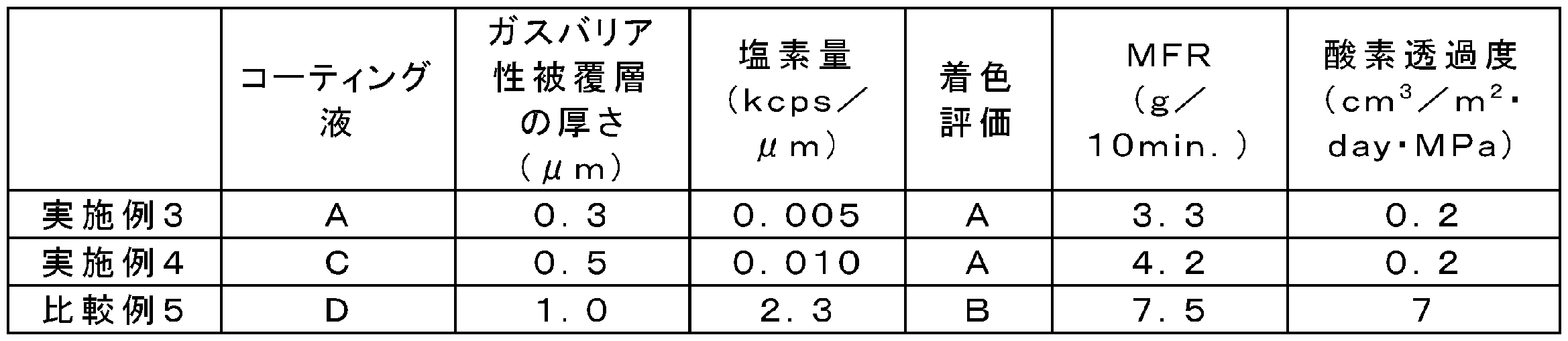
- the gas barrier coating layer was formed by applying any one of coating liquids A to D by gravure coating and then drying at 80° C. for 20 seconds. Table 1 shows the type of coating liquid and the thickness of the gas barrier coating layer.
- Example 3 ⁇ Production of laminate> An unstretched polypropylene film having a thickness of 60 ⁇ m as a sealant layer was laminated on the gas barrier coating layer side surface of the barrier film prepared in Example 1 via a two-liquid curable urethane adhesive by a dry lamination method. A laminate was produced.
- Example 4 ⁇ Production of laminate> A laminate was produced in the same manner as in Example 3 except that the barrier film produced in Comparative Example 1 was used.
- the fluorescent X-ray intensity (kcps) of the chlorine atoms detected from both sides was measured, and the sum of the fluorescent X-ray intensities of the chlorine atoms on both sides was obtained.
- a value obtained by dividing the obtained sum of the fluorescent X-ray intensities of the chlorine atoms by the thickness of the barrier film was defined as the amount of chlorine (kcps/ ⁇ m).
- peel off the base film and the sealant layer from the laminate measure the fluorescent X-ray intensity (kcps) of chlorine atoms detected from both sides of each resin film, and measure the fluorescence of chlorine atoms on all surfaces. The sum of the X-ray intensities was obtained.
- the chlorine content (kcps/ ⁇ m) was obtained by dividing the obtained sum of the fluorescent X-ray intensities of the chlorine atoms by the thickness of the laminate. The results are shown in Tables 1 and 2.
- melt mass flow rate (MFR, unit: g/10 min.) of the molten resin was measured when melt extrusion was performed under the above conditions. MFR measured 5 times and used the average value. MFR is 6.0g/min. In the case of the above values, the oxidative decomposition of the polypropylene has already started, so the suitability for recycling is poor. Tables 1 and 2 show the presence or absence of coloring and the evaluation results of MFR.
- the oxygen permeability of the barrier film and laminate was measured.
- the measurement was performed using an oxygen permeability measuring device (manufactured by Modern Control, trade name "OXTRAN 2/20") under conditions of a temperature of 30°C and a relative humidity of 70%.
- the measurement method conforms to JIS K7126-2 (isobaric method) and ASTM D3985-81, and the measured values are expressed in units [cm 3 (STP)/m 2 ⁇ day ⁇ MPa]. The results are shown in Tables 1 and 2.
- barrier film or laminate of the present disclosure improves recyclability and makes it possible to produce mono-material packaging suitable for material recycling, thus helping to solve environmental problems and waste problems. can be expected.
Landscapes
- Chemical & Material Sciences (AREA)
- Health & Medical Sciences (AREA)
- Chemical Kinetics & Catalysis (AREA)
- Medicinal Chemistry (AREA)
- Polymers & Plastics (AREA)
- Organic Chemistry (AREA)
- Engineering & Computer Science (AREA)
- Mechanical Engineering (AREA)
- Inorganic Chemistry (AREA)
- Laminated Bodies (AREA)
Abstract
Description
Si(OR1)4 …(1)
(R2Si(OR3)3)n …(2)
[一般式(1)及び(2)中、R1及びR3はそれぞれ独立に、CH3、C2H5、又は、C2H4OCH3を示し、R2は有機官能基を示し、nは1以上の整数を示す。]
本実施形態のバリアフィルムは、ポリオレフィンを含有する基材フィルムを少なくとも備えるものであり、基材フィルム以外の他の層を有していてもよい。バリアフィルムは、基材フィルムの少なくとも一方の面上に形成されたガスバリア層を更に備えていてもよい。このガスバリア層は、無機酸化物を含有する蒸着層、及び、ガスバリア性被覆層の一方又は両方を有していてもよい。更に、バリアフィルムは、基材フィルムとガスバリア層との間に、アンカーコート層を備えていてもよい。
基材フィルム1は支持体となる層であり、ポリオレフィンを含有する。基材フィルム1は、ポリオレフィンを主成分とするポリオレフィンフィルムであってよい。ここで、「主成分」とは、フィルム中の含有率が50質量%以上である成分をいう。基材フィルム1中のポリオレフィンの含有量は、基材フィルム1全量を基準として50質量%以上であってよく、80質量%以上であってよく、100質量%であってよい。基材フィルム1中のポリオレフィンの含有量が高いほど、リサイクル性が向上する。
基材フィルム1の蒸着層3を積層する面には、アンカーコート層(下引層)2が設けられてもよい。アンカーコート層2は、基材フィルム1と蒸着層3との密着性能向上、基材フィルム1表面の平滑性向上、及び、基材フィルム1の伸びに起因した蒸着層3の割れの発生の抑制、といった効果を奏することができる。なお、平滑性が向上することで蒸着層3を欠陥なく均一に成膜し易くなり、高いバリア性を発現し易い。アンカーコート層2はアンカーコート層形成用組成物(アンカーコート剤)を用いて形成することができる。
基材フィルム1の少なくとも片方の面に、バリア性を付与するために無機酸化物を含む蒸着層3を積層させることができる。無機酸化物を含む蒸着層3は、酸化アルミニウム、酸化珪素、酸化錫、酸化マグネシウム、或いはそれらの混合物などの無機酸化物の蒸着膜からなり、透明性を有し、且つ酸素、水蒸気等のガスバリア性を有する層であればよい。各種殺菌耐性を配慮すると、これらの中では、特に酸化アルミニウム及び酸化珪素を用いることがより好ましい。但し、本実施形態の蒸着層3に使用する材料は、上述した無機酸化物に限定されず、上記条件に適合する材料であれば用いることが可能である。
蒸着層3上に、蒸着層3を保護し、バリア性を補完する目的で、ガスバリア性被覆層4を設けることもできる。ガスバリア性被覆層4は、上記目的を達成でき、且つ、リサイクル適性が備わっている材質であれば、特に限定されない。ガスバリア性被覆層4を形成するためのガスバリア性被覆層形成用組成物としては、例えば、ケイ素化合物又はその加水分解物を1種類以上と水溶性高分子とを混合した溶液、ケイ素化合物又はその加水分解物を1種類以上と水溶性高分子と無機層状化合物とシランカップリング剤とを混合した溶液、あるいは、水性ポリウレタン樹脂と水溶性高分子とを混合した溶液などを用いることができる。これらのガスバリア性被覆層形成用組成物を蒸着層3上にコーティングした後、加熱乾燥することで、ガスバリア性被覆層4を形成することができる。ガスバリア性被覆層形成用組成物中には、ガスバリア性を損なわない範囲で、イソシアネート化合物、シランカップリング剤、分散剤、安定化剤、粘度調整剤、着色剤などの公知の添加剤を必要に応じて加えることも可能である。
Si(OR1)4 …(1)
(R2Si(OR3)3)n …(2)
[一般式(1)及び(2)中、R1及びR3はそれぞれ独立に、CH3、C2H5、又は、C2H4OCH3を示し、R2は有機官能基を示し、nは1以上の整数を示す。]
Si(OR11)p(R12)3-pR13 …(3)
上記一般式(3)中、R11はメチル基、エチル基等のアルキル基を示し、R12はアルキル基、アラルキル基、アリール基、アルケニル基、アクリロキシ基、メタクリロキシ基で置換されたアルキル基等の1価の有機基を示し、R13は1価の有機官能基を示し、pは1~3の整数を示す。なお、R11又はR12が複数存在する場合、R11同士又はR12同士は同一でも異なっていてもよい。R13で示される1価の有機官能基としては、ビニル基、エポキシ基、メルカプト基、アミノ基、又は、イソシアネート基を含有する1価の有機官能基が挙げられる。中でも、1価の有機官能基としては、エポキシ基を含有するものが好ましい。この場合、組成物が、硬化によって、より優れた熱水耐性を有することが可能となる。
本実施形態の積層体は、ポリオレフィンを含有する樹脂フィルムを2以上備えるものであり、樹脂フィルム以外の他の層を有していてもよい。積層体は、一方の樹脂フィルムの少なくとも一方の面上に形成されたガスバリア層を更に備えていてもよい。このガスバリア層は、無機酸化物を含有する蒸着層、及び、ガスバリア性被覆層の一方又は両方を有していてもよい。更に、積層体は、樹脂フィルムとガスバリア層との間に、アンカーコート層を備えていてもよい。積層体は、上述した本実施形態のバリアフィルムの一方の面上に、樹脂フィルムを更に積層したものであってよい。この場合、バリアフィルムに含まれる基材フィルムが第1の樹脂フィルムであり、バリアフィルムに更に積層される樹脂フィルムが第2の樹脂フィルムである。第2の樹脂フィルムは、接着剤層を介してバリアフィルムに積層してもよい。第2の樹脂フィルムは、シーラント層であってよい。
接着剤層5の材料としては、例えば、ポリエステル-イソシアネート系樹脂、ウレタン樹脂、ポリエーテル系樹脂などを用いることができる。熱水耐性を高める観点からは、2液硬化型のウレタン系接着剤を好ましく用いることができる。
シーラント層6は、積層体200にヒートシールによる封止性を付与する層であり、ポリオレフィンを含有する。シーラント層6は、ポリオレフィンを主成分とするポリオレフィンフィルムであってよい。ここで、「主成分」とは、フィルム中の含有率が50質量%以上である成分をいう。シーラント層6中のポリオレフィンの含有量は、シーラント層6全量を基準として50質量%以上であってよく、80質量%以上であってよく、100質量%であってよい。シーラント層6中のポリオレフィンの含有量が高いほど、リサイクル性が向上する。
検出スペクトル:Cl-KA
X線間励起条件:ターゲットPb、管電圧50kV、管電流4.00mA
分光結晶:PET
検出器:PC(プロポーショナルカウンター)
スキャン条件:開始角度62.0deg、終了角度69.0deg、ステップ0.05deg、時間0.2sec、速度15deg/min.、ピーク角度65.44deg
上記条件にて測定を実施し、求められた塩素原子(Cl)のネット強度(kcps)をフィルム表面のX線強度とする。
実施例及び比較例で用いるガスバリア性被覆層形成用組成物として、以下のコーティング液A~Dを調製した。
以下に示す(a)液、(b)液及び(c)液を、(a)液/(b)液/(c)液=70/20/10(固形分質量比)となるように混合した溶液。
(a)液:テトラエトキシシラン17.9g及びメタノール10gに、0.1N塩酸72.1gを加えて30分間攪拌して加水分解させた、固形分5質量%(SiO2換算)の加水分解溶液
(b)液:ポリビニルアルコールを5質量%含有する、水/メタノール(水:メタノールの質量比は95:5)溶液
(c)液:1,3,5-トリス(3-トリアルコキシシリルプロピル)イソシアヌレートを、水/イソプロピルアルコールの混合液(水:イソプロピルアルコールの質量比は1:1)で固形分5質量%に希釈した加水分解溶液
ポリウレタン樹脂の水性分散体(水性ポリウレタンディスパージョン、商品名「タケラック(登録商標)WPB-341」、三井化学株式会社製、固形分濃度:30質量%)と、5質量%ポリビニルアルコール水溶液と、3-グリシドキシプロピルトリメトキシシランとを、固形分質量比が75:20:5となるように混合した溶液。
下記に示す(d)液、(e)液を、(d)液/(e)液=45/55(固形分質量比)となるように混合した溶液。
(d)液:ポリビニルアルコールとモンモリロナイトとを質量比15/1となるように配合し、水/イソプロピルアルコール=95/5(質量比)の混合液で固形分6.5質量%に希釈した溶液
(e)液:テトラエトキシシランと3-グリシドキシプロピルトリメトキシシランとを質量比10(SiO2換算)/1で配合し、0.3N塩酸を加えて加水分解させ、水/メタノール=1/1(質量比)の混合液で固形分11質量%に希釈した加水分解溶液
ポリ塩化ビニリデン系樹脂(旭化成社製、商品名「サランレジンF216」)をトルエンとメチルエチルケトンとの混合有機溶媒(質量比:トルエン/メチルエチルケトン=1/2)に溶解させた、ポリ塩化ビニリデン系樹脂溶液(固形分5質量%)。
<バリアフィルムの作製>
基材フィルムとして、厚さ20μmの延伸ポリプロピレンフィルムを準備した。基材フィルムの一方の面に、アクリルポリオールにトリレンジイソシアネートをアクリルポリオールのOH基に対しNCO基が等量となるように加え、全固形分が5質量%になるよう酢酸エチルで希釈し、β-(3,4エポキシシクロヘキシル)トリメトキシシランを全固形分に対し、5質量%添加して混合した溶液をグラビアコートにより塗布乾燥し、厚さ0.1μmのアンカーコート層を形成した。次にアンカーコート層上に、減圧下の酸素雰囲気中で高周波励起イオンプレーティングによる反応性蒸着により、厚さ30nmの酸化ケイ素の薄膜を蒸着し、蒸着層を形成した。更に蒸着層上に、ガスバリア性被覆層を形成した。ガスバリア性被覆層としては、コーティング液A~Dのいずれかの溶液を、グラビアコート法により塗布した後、80℃20秒の条件下にて乾燥して形成した。コーティング液の種類及びガスバリア性被覆層の厚さは表1に示す。
<積層体の作製>
実施例1で作製したバリアフィルムのガスバリア性被覆層側の面に、シーラント層としての厚さ60μmの未延伸ポリプロピレンフィルムを、2液硬化型ウレタン系接着剤を介してドライラミネート法により貼り合わせ、積層体を作製した。
<積層体の作製>
比較例1で作製したバリアフィルムを用いたこと以外は実施例3と同様にして、積層体を作製した。
<積層体の作製>
比較例4で作製したバリアフィルムを用いたこと以外は実施例3と同様にして、積層体を作製した。
実施例及び比較例で得られたバリアフィルム及び積層体の塩素量の測定を、蛍光X線分析装置(リガク社製、波長分散型蛍光X線分析装置Supermini)を用いて行った。測定前にPHA調整試料(リガク社製)を使用して、PC検出器の分解能が45%以下であることを確認した。測定は以下に示す条件にて行った。下記条件にて測定を実施し、求められた塩素原子(Cl)のネット強度(kcps)をフィルム表面のX線強度とした。
検出スペクトル:Cl-KA
X線間励起条件:ターゲットPb、管電圧50kV、管電流4.00mA
分光結晶:PET
検出器:PC(プロポーショナルカウンター)
スキャン条件:開始角度62.0deg、終了角度69.0deg、ステップ0.05deg、時間0.2sec、速度15deg/min.、ピーク角度65.44deg
実施例及び比較例で得られたバリアフィルム及び積層体を適度なサイズにカットし、溶融粘度測定装置(東洋精機製作所社製、商品名「メルトインデックサ F-F01」)を使用して、JIS K7210に示される方法に準拠して、温度230℃、2.16kgfの条件にて溶融押出を行った。押し出された溶融樹脂の外観を目視にて観察し、着色の有無及びリサイクル性を下記の通り評価した。
A:着色が確認されず、リサイクル性に優れる
B:着色が確認され、リサイクル性が劣る
C:着色が酷く、リサイクル不可
バリアフィルム及び積層体の酸素透過度の測定を行った。測定は、酸素透過度測定装置(Modern Control社製、商品名「OXTRAN 2/20」)を用いて、温度30℃、相対湿度70%の条件で測定した。測定方法は、JIS K7126-2(等圧法)、及び、ASTM D3985-81に準拠し、測定値は単位[cm3(STP)/m2・day・MPa]で表記した。結果を表1及び表2に示す。

Claims (9)
- ポリオレフィンを含有する基材フィルムを備えるバリアフィルムであって、
前記バリアフィルムの両面を蛍光X線分析装置にて分析した時に、両面から検出される塩素の蛍光X線強度の和を前記基材フィルムの厚さで割った値(塩素の蛍光X線強度の和/基材フィルムの厚さ)が0.015kcps/μm以下である、バリアフィルム。 - 前記基材フィルムの少なくとも一方の面上に形成されたガスバリア層を更に備える、請求項1に記載のバリアフィルム。
- 前記ガスバリア層が、無機酸化物を含有する蒸着層を含む、請求項2に記載のバリアフィルム。
- 前記無機酸化物が、酸化アルミニウム、酸化珪素又はそれらの混合物を含む、請求項3に記載のバリアフィルム。
- 前記ガスバリア層がガスバリア性被覆層を含む、請求項2~4のいずれか一項に記載のバリアフィルム。
- 前記ガスバリア性被覆層が、下記一般式(1)で表されるケイ素化合物及びその加水分解物のうちの少なくとも一種と、下記一般式(2)で表されるケイ素化合物及びその加水分解物のうちの少なくとも一種と、水酸基を有する水溶性高分子と、を含有するガスバリア性被覆層形成用組成物を用いて形成された層である、請求項5に記載のバリアフィルム。
Si(OR1)4 …(1)
(R2Si(OR3)3)n …(2)
[一般式(1)及び(2)中、R1及びR3はそれぞれ独立に、CH3、C2H5、又は、C2H4OCH3を示し、R2は有機官能基を示し、nは1以上の整数を示す。] - 前記ガスバリア性被覆層が、ポリウレタン樹脂と、水酸基を有する水溶性高分子と、硬化剤とを含有するガスバリア性被覆層形成用組成物を用いて形成された層であり、
前記ポリウレタン樹脂が、酸基を含有する酸基含有ポリウレタン樹脂と、アミノ基を有するポリアミン化合物との反応生成物を含む、請求項5に記載のバリアフィルム。 - 前記ポリオレフィンがポリプロピレンである、請求項1~7のいずれか一項に記載のバリアフィルム。
- ポリオレフィンを含有する樹脂フィルムを2以上備える積層体であって、
前記積層体から各樹脂フィルムを剥離し、全ての前記樹脂フィルムの両面を蛍光X線分析装置にて分析した時に、全ての前記樹脂フィルムの全ての面から検出される塩素の蛍光X線強度の和を前記積層体の厚さで割った値(塩素の蛍光X線強度の和/積層体の厚さ)が0.015kcps/μm以下である、積層体。
Priority Applications (5)
| Application Number | Priority Date | Filing Date | Title |
|---|---|---|---|
| EP22759585.7A EP4272953B1 (en) | 2021-02-25 | 2022-02-21 | Barrier film and laminate |
| JP2023502397A JPWO2022181549A1 (ja) | 2021-02-25 | 2022-02-21 | |
| ES22759585T ES3055410T3 (en) | 2021-02-25 | 2022-02-21 | Barrier film and laminate |
| CN202280007709.7A CN116529067A (zh) | 2021-02-25 | 2022-02-21 | 阻隔膜及层叠体 |
| US18/278,124 US20240123715A1 (en) | 2021-02-25 | 2022-02-21 | Barrier film and laminate |
Applications Claiming Priority (2)
| Application Number | Priority Date | Filing Date | Title |
|---|---|---|---|
| JP2021-028367 | 2021-02-25 | ||
| JP2021028367 | 2021-02-25 |
Publications (1)
| Publication Number | Publication Date |
|---|---|
| WO2022181549A1 true WO2022181549A1 (ja) | 2022-09-01 |
Family
ID=83048100
Family Applications (1)
| Application Number | Title | Priority Date | Filing Date |
|---|---|---|---|
| PCT/JP2022/006986 Ceased WO2022181549A1 (ja) | 2021-02-25 | 2022-02-21 | バリアフィルム及び積層体 |
Country Status (6)
| Country | Link |
|---|---|
| US (1) | US20240123715A1 (ja) |
| EP (1) | EP4272953B1 (ja) |
| JP (1) | JPWO2022181549A1 (ja) |
| CN (1) | CN116529067A (ja) |
| ES (1) | ES3055410T3 (ja) |
| WO (1) | WO2022181549A1 (ja) |
Cited By (1)
| Publication number | Priority date | Publication date | Assignee | Title |
|---|---|---|---|---|
| EP4650168A1 (en) | 2023-01-11 | 2025-11-19 | Toppan Holdings Inc. | Gas barrier laminate, packaging container, and packaged product |
Citations (6)
| Publication number | Priority date | Publication date | Assignee | Title |
|---|---|---|---|---|
| JP2000254994A (ja) | 1999-03-04 | 2000-09-19 | Toppan Printing Co Ltd | 蒸着フィルム積層包装材料 |
| JP2014156017A (ja) * | 2013-02-14 | 2014-08-28 | Toppan Printing Co Ltd | ガスバリアフィルム |
| WO2016158794A1 (ja) | 2015-03-27 | 2016-10-06 | 凸版印刷株式会社 | 積層フィルム、及び包装袋 |
| JP2017222151A (ja) * | 2016-06-08 | 2017-12-21 | 凸版印刷株式会社 | ガスバリア性フィルム |
| JP6962437B1 (ja) * | 2020-11-12 | 2021-11-05 | 凸版印刷株式会社 | ガスバリア層形成用組成物、これを用いたガスバリア性フィルム、包装フィルム及び包装袋並びにガスバリア性フィルムの製造方法、包装フィルムの製造方法及び包装袋の製造方法 |
| WO2022044502A1 (ja) * | 2020-08-31 | 2022-03-03 | 凸版印刷株式会社 | ガスバリア積層体、包装材、包装袋及びチューブ容器 |
Family Cites Families (4)
| Publication number | Priority date | Publication date | Assignee | Title |
|---|---|---|---|---|
| JP4524463B2 (ja) * | 1999-07-27 | 2010-08-18 | 三井化学株式会社 | ガスバリア性ポリウレタン樹脂及びこれを含むガスバリア性フィルム |
| JP7088138B2 (ja) * | 2019-07-29 | 2022-06-21 | 凸版印刷株式会社 | 積層体及び包装袋 |
| WO2021029156A1 (ja) * | 2019-08-09 | 2021-02-18 | 凸版印刷株式会社 | バリアフィルム及びバリア性包装材料 |
| CN115427228A (zh) * | 2020-04-28 | 2022-12-02 | 凸版印刷株式会社 | 阻气膜 |
-
2022
- 2022-02-21 EP EP22759585.7A patent/EP4272953B1/en active Active
- 2022-02-21 CN CN202280007709.7A patent/CN116529067A/zh active Pending
- 2022-02-21 WO PCT/JP2022/006986 patent/WO2022181549A1/ja not_active Ceased
- 2022-02-21 ES ES22759585T patent/ES3055410T3/es active Active
- 2022-02-21 JP JP2023502397A patent/JPWO2022181549A1/ja active Pending
- 2022-02-21 US US18/278,124 patent/US20240123715A1/en active Pending
Patent Citations (6)
| Publication number | Priority date | Publication date | Assignee | Title |
|---|---|---|---|---|
| JP2000254994A (ja) | 1999-03-04 | 2000-09-19 | Toppan Printing Co Ltd | 蒸着フィルム積層包装材料 |
| JP2014156017A (ja) * | 2013-02-14 | 2014-08-28 | Toppan Printing Co Ltd | ガスバリアフィルム |
| WO2016158794A1 (ja) | 2015-03-27 | 2016-10-06 | 凸版印刷株式会社 | 積層フィルム、及び包装袋 |
| JP2017222151A (ja) * | 2016-06-08 | 2017-12-21 | 凸版印刷株式会社 | ガスバリア性フィルム |
| WO2022044502A1 (ja) * | 2020-08-31 | 2022-03-03 | 凸版印刷株式会社 | ガスバリア積層体、包装材、包装袋及びチューブ容器 |
| JP6962437B1 (ja) * | 2020-11-12 | 2021-11-05 | 凸版印刷株式会社 | ガスバリア層形成用組成物、これを用いたガスバリア性フィルム、包装フィルム及び包装袋並びにガスバリア性フィルムの製造方法、包装フィルムの製造方法及び包装袋の製造方法 |
Non-Patent Citations (1)
| Title |
|---|
| See also references of EP4272953A4 |
Cited By (1)
| Publication number | Priority date | Publication date | Assignee | Title |
|---|---|---|---|---|
| EP4650168A1 (en) | 2023-01-11 | 2025-11-19 | Toppan Holdings Inc. | Gas barrier laminate, packaging container, and packaged product |
Also Published As
| Publication number | Publication date |
|---|---|
| EP4272953A1 (en) | 2023-11-08 |
| US20240123715A1 (en) | 2024-04-18 |
| JPWO2022181549A1 (ja) | 2022-09-01 |
| CN116529067A (zh) | 2023-08-01 |
| ES3055410T3 (en) | 2026-02-11 |
| EP4272953A4 (en) | 2024-07-03 |
| EP4272953B1 (en) | 2025-10-29 |
Similar Documents
| Publication | Publication Date | Title |
|---|---|---|
| KR101492789B1 (ko) | 재활용성 폴리올레핀계 다기능성 식품포장재 및 이의 제조방법 | |
| CN100488765C (zh) | 阻气层合薄膜 | |
| WO2021020400A1 (ja) | 積層体及び包装袋 | |
| JP5929317B2 (ja) | シーラントフィルム及びそれを用いた包装材 | |
| CN1142211A (zh) | 机械加工性改善了的多层定向热密封膜结构 | |
| CN101528462A (zh) | 金属化多层薄膜,制造方法和由其制得的制品 | |
| JP2020203406A (ja) | 積層体および包装材料 | |
| EP4400308A1 (en) | Laminated layered body | |
| WO2022270490A1 (ja) | ガスバリアフィルム、積層体、および包装材料 | |
| EP4245520A1 (en) | Gas barrier layer forming composition, gas barrier film, packaging film, and packaging bag using same, and, gas barrier film production method, packaging film production method, and packaging bag production method | |
| JP5728874B2 (ja) | ガスバリア性フィルム積層体 | |
| WO2022196211A1 (ja) | 包装材、包装袋及び包装体 | |
| TW202502555A (zh) | 延伸積層聚烯烴系樹脂膜、包裝材料、包裝袋、以及包裝體 | |
| US20240123715A1 (en) | Barrier film and laminate | |
| US20250340050A1 (en) | Gas barrier laminate, packaging container, and packaged product | |
| WO2023127594A1 (ja) | 包装材料 | |
| JP2025159200A (ja) | バリア性を有する易引き裂き性積層体、包装材料および包装袋 | |
| US20240326394A1 (en) | Barrier film, packaging material, packaging container, and packaging product | |
| JP6433758B2 (ja) | ガスバリア性積層体 | |
| JP5739684B2 (ja) | ガスバリア性フィルム、及びその製造方法 | |
| JP2012061651A (ja) | ガスバリア性積層フィルム | |
| JP6454130B2 (ja) | 積層フィルムおよび積層フィルムの製造方法 | |
| JP2022159102A (ja) | ガスバリアフィルム、積層体および包装袋 | |
| JP2006051645A (ja) | 積層フィルムおよびその製造方法 | |
| LU507582B1 (en) | Water-Based Coatings for Retorting Applications |
Legal Events
| Date | Code | Title | Description |
|---|---|---|---|
| 121 | Ep: the epo has been informed by wipo that ep was designated in this application |
Ref document number: 22759585 Country of ref document: EP Kind code of ref document: A1 |
|
| ENP | Entry into the national phase |
Ref document number: 2023502397 Country of ref document: JP Kind code of ref document: A |
|
| WWE | Wipo information: entry into national phase |
Ref document number: 202280007709.7 Country of ref document: CN |
|
| ENP | Entry into the national phase |
Ref document number: 2022759585 Country of ref document: EP Effective date: 20230804 |
|
| WWE | Wipo information: entry into national phase |
Ref document number: 18278124 Country of ref document: US |
|
| WWE | Wipo information: entry into national phase |
Ref document number: 202317057124 Country of ref document: IN |
|
| NENP | Non-entry into the national phase |
Ref country code: DE |
|
| WWG | Wipo information: grant in national office |
Ref document number: 2022759585 Country of ref document: EP |