WO2022190852A1 - 非水電解質二次電池 - Google Patents
非水電解質二次電池 Download PDFInfo
- Publication number
- WO2022190852A1 WO2022190852A1 PCT/JP2022/007153 JP2022007153W WO2022190852A1 WO 2022190852 A1 WO2022190852 A1 WO 2022190852A1 JP 2022007153 W JP2022007153 W JP 2022007153W WO 2022190852 A1 WO2022190852 A1 WO 2022190852A1
- Authority
- WO
- WIPO (PCT)
- Prior art keywords
- positive electrode
- secondary particles
- lithium
- aqueous electrolyte
- active material
- Prior art date
- Legal status (The legal status is an assumption and is not a legal conclusion. Google has not performed a legal analysis and makes no representation as to the accuracy of the status listed.)
- Ceased
Links
Images
Classifications
-
- H—ELECTRICITY
- H01—ELECTRIC ELEMENTS
- H01M—PROCESSES OR MEANS, e.g. BATTERIES, FOR THE DIRECT CONVERSION OF CHEMICAL ENERGY INTO ELECTRICAL ENERGY
- H01M4/00—Electrodes
- H01M4/02—Electrodes composed of, or comprising, active material
- H01M4/36—Selection of substances as active materials, active masses, active liquids
-
- H—ELECTRICITY
- H01—ELECTRIC ELEMENTS
- H01M—PROCESSES OR MEANS, e.g. BATTERIES, FOR THE DIRECT CONVERSION OF CHEMICAL ENERGY INTO ELECTRICAL ENERGY
- H01M4/00—Electrodes
- H01M4/02—Electrodes composed of, or comprising, active material
- H01M4/36—Selection of substances as active materials, active masses, active liquids
- H01M4/48—Selection of substances as active materials, active masses, active liquids of inorganic oxides or hydroxides
- H01M4/52—Selection of substances as active materials, active masses, active liquids of inorganic oxides or hydroxides of nickel, cobalt or iron
- H01M4/525—Selection of substances as active materials, active masses, active liquids of inorganic oxides or hydroxides of nickel, cobalt or iron of mixed oxides or hydroxides containing iron, cobalt or nickel for inserting or intercalating light metals, e.g. LiNiO2, LiCoO2 or LiCoOxFy
-
- H—ELECTRICITY
- H01—ELECTRIC ELEMENTS
- H01M—PROCESSES OR MEANS, e.g. BATTERIES, FOR THE DIRECT CONVERSION OF CHEMICAL ENERGY INTO ELECTRICAL ENERGY
- H01M10/00—Secondary cells; Manufacture thereof
- H01M10/05—Accumulators with non-aqueous electrolyte
-
- H—ELECTRICITY
- H01—ELECTRIC ELEMENTS
- H01M—PROCESSES OR MEANS, e.g. BATTERIES, FOR THE DIRECT CONVERSION OF CHEMICAL ENERGY INTO ELECTRICAL ENERGY
- H01M10/00—Secondary cells; Manufacture thereof
- H01M10/05—Accumulators with non-aqueous electrolyte
- H01M10/052—Li-accumulators
-
- H—ELECTRICITY
- H01—ELECTRIC ELEMENTS
- H01M—PROCESSES OR MEANS, e.g. BATTERIES, FOR THE DIRECT CONVERSION OF CHEMICAL ENERGY INTO ELECTRICAL ENERGY
- H01M10/00—Secondary cells; Manufacture thereof
- H01M10/05—Accumulators with non-aqueous electrolyte
- H01M10/052—Li-accumulators
- H01M10/0525—Rocking-chair batteries, i.e. batteries with lithium insertion or intercalation in both electrodes; Lithium-ion batteries
-
- H—ELECTRICITY
- H01—ELECTRIC ELEMENTS
- H01M—PROCESSES OR MEANS, e.g. BATTERIES, FOR THE DIRECT CONVERSION OF CHEMICAL ENERGY INTO ELECTRICAL ENERGY
- H01M4/00—Electrodes
- H01M4/02—Electrodes composed of, or comprising, active material
- H01M4/13—Electrodes for accumulators with non-aqueous electrolyte, e.g. for lithium-accumulators; Processes of manufacture thereof
- H01M4/131—Electrodes based on mixed oxides or hydroxides, or on mixtures of oxides or hydroxides, e.g. LiCoOx
-
- H—ELECTRICITY
- H01—ELECTRIC ELEMENTS
- H01M—PROCESSES OR MEANS, e.g. BATTERIES, FOR THE DIRECT CONVERSION OF CHEMICAL ENERGY INTO ELECTRICAL ENERGY
- H01M4/00—Electrodes
- H01M4/02—Electrodes composed of, or comprising, active material
- H01M4/36—Selection of substances as active materials, active masses, active liquids
- H01M4/362—Composites
- H01M4/366—Composites as layered products
-
- H—ELECTRICITY
- H01—ELECTRIC ELEMENTS
- H01M—PROCESSES OR MEANS, e.g. BATTERIES, FOR THE DIRECT CONVERSION OF CHEMICAL ENERGY INTO ELECTRICAL ENERGY
- H01M4/00—Electrodes
- H01M4/02—Electrodes composed of, or comprising, active material
- H01M4/36—Selection of substances as active materials, active masses, active liquids
- H01M4/48—Selection of substances as active materials, active masses, active liquids of inorganic oxides or hydroxides
- H01M4/50—Selection of substances as active materials, active masses, active liquids of inorganic oxides or hydroxides of manganese
- H01M4/505—Selection of substances as active materials, active masses, active liquids of inorganic oxides or hydroxides of manganese of mixed oxides or hydroxides containing manganese for inserting or intercalating light metals, e.g. LiMn2O4 or LiMn2OxFy
-
- H—ELECTRICITY
- H01—ELECTRIC ELEMENTS
- H01M—PROCESSES OR MEANS, e.g. BATTERIES, FOR THE DIRECT CONVERSION OF CHEMICAL ENERGY INTO ELECTRICAL ENERGY
- H01M4/00—Electrodes
- H01M4/02—Electrodes composed of, or comprising, active material
- H01M4/62—Selection of inactive substances as ingredients for active masses, e.g. binders, fillers
-
- H—ELECTRICITY
- H01—ELECTRIC ELEMENTS
- H01M—PROCESSES OR MEANS, e.g. BATTERIES, FOR THE DIRECT CONVERSION OF CHEMICAL ENERGY INTO ELECTRICAL ENERGY
- H01M4/00—Electrodes
- H01M4/02—Electrodes composed of, or comprising, active material
- H01M2004/026—Electrodes composed of, or comprising, active material characterised by the polarity
- H01M2004/028—Positive electrodes
-
- Y—GENERAL TAGGING OF NEW TECHNOLOGICAL DEVELOPMENTS; GENERAL TAGGING OF CROSS-SECTIONAL TECHNOLOGIES SPANNING OVER SEVERAL SECTIONS OF THE IPC; TECHNICAL SUBJECTS COVERED BY FORMER USPC CROSS-REFERENCE ART COLLECTIONS [XRACs] AND DIGESTS
- Y02—TECHNOLOGIES OR APPLICATIONS FOR MITIGATION OR ADAPTATION AGAINST CLIMATE CHANGE
- Y02E—REDUCTION OF GREENHOUSE GAS [GHG] EMISSIONS, RELATED TO ENERGY GENERATION, TRANSMISSION OR DISTRIBUTION
- Y02E60/00—Enabling technologies; Technologies with a potential or indirect contribution to GHG emissions mitigation
- Y02E60/10—Energy storage using batteries
Definitions
- the present disclosure relates to non-aqueous electrolyte secondary batteries.
- Patent Literature 1 discloses a technique for suppressing deterioration in charge-discharge cycle characteristics by attaching a compound such as CaO to the surface of a lithium-containing composite oxide.
- Patent Document 1 does not consider the safety of the battery, and there is still room for improvement.
- an object of the present disclosure is to provide a non-aqueous electrolyte secondary battery that achieves both charge-discharge cycle characteristics and safety.
- the composite oxide has secondary particles formed by agglomeration of primary particles, Ca is present on the surface and inside of the secondary particles, and the ratio of Ca present on the surface of the secondary particles is It is characterized by being 12% to 58% of the total amount of Ca present on the surface and inside of the secondary particles.
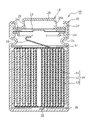
- FIG. 1 is an axial cross-sectional view of a cylindrical secondary battery that is an example of an embodiment
- a cylindrical battery in which a wound electrode body is housed in a cylindrical battery case is exemplified, but the electrode body is not limited to a wound type, and a plurality of positive electrodes and a plurality of negative electrodes are interposed between separators. It may be of a laminated type in which one sheet is alternately laminated on the other.
- the battery case is not limited to a cylindrical shape, and may be, for example, rectangular, coin-shaped, or the like, or may be a pouch-shaped case composed of a laminated sheet including a metal layer and a resin layer.
- FIG. 1 is an axial cross-sectional view of a cylindrical secondary battery 10 that is an example of an embodiment.
- an electrode body 14 and a non-aqueous electrolyte (not shown) are housed in an exterior body 15 .
- the electrode body 14 has a wound structure in which the positive electrode 11 and the negative electrode 12 are wound with the separator 13 interposed therebetween.
- the sealing member 16 side will be referred to as "upper”
- the bottom side of the outer package 15 will be referred to as "lower”.
- the inside of the secondary battery 10 is hermetically sealed by closing the opening end of the exterior body 15 with the sealing body 16 .
- Insulating plates 17 and 18 are provided above and below the electrode body 14, respectively.
- the positive electrode lead 19 extends upward through the through hole of the insulating plate 17 and is welded to the lower surface of the filter 22 which is the bottom plate of the sealing member 16 .
- the cap 26, which is the top plate of the sealing member 16 electrically connected to the filter 22, serves as a positive electrode terminal.
- the negative electrode lead 20 passes through the through hole of the insulating plate 18 , extends to the bottom side of the exterior body 15 , and is welded to the bottom inner surface of the exterior body 15 .
- the exterior body 15 becomes a negative electrode terminal.
- the negative electrode lead 20 passes through the through hole of the insulating plate 18 and extends to the bottom side of the exterior body 15 and is welded to the bottom inner surface of the exterior body 15 .
- the exterior body 15 is, for example, a bottomed cylindrical metal exterior can.
- a gasket 27 is provided between the exterior body 15 and the sealing body 16 to ensure hermetic sealing of the inside of the secondary battery 10 .
- the exterior body 15 has a grooved portion 21 that supports the sealing body 16 and is formed, for example, by pressing the side portion from the outside.
- the grooved portion 21 is preferably annularly formed along the circumferential direction of the exterior body 15 and supports the sealing body 16 via a gasket 27 on its upper surface.
- the sealing body 16 has a filter 22, a lower valve body 23, an insulating member 24, an upper valve body 25, and a cap 26 which are stacked in order from the electrode body 14 side.
- Each member constituting the sealing member 16 has, for example, a disk shape or a ring shape, and each member other than the insulating member 24 is electrically connected to each other.
- the lower valve body 23 and the upper valve body 25 are connected to each other at their central portions, and an insulating member 24 is interposed between their peripheral edge portions.
- the positive electrode 11, the negative electrode 12, the separator 13, and the non-aqueous electrolyte that constitute the secondary battery 10 will be described in detail below, particularly the positive electrode active material contained in the positive electrode mixture layer that constitutes the positive electrode 11.
- the positive electrode has a positive electrode current collector and a positive electrode mixture layer formed on the surface of the positive electrode current collector.
- the positive electrode mixture layers are preferably formed on both sides of the positive electrode current collector.
- As the positive electrode current collector a foil of a metal such as aluminum that is stable in the positive electrode potential range, a film having the metal on the surface layer, or the like can be used.
- the positive electrode mixture layer contains, for example, a positive electrode active material, a binder, a conductive agent, and the like.
- a positive electrode mixture slurry containing a positive electrode active material, a binder, a conductive agent, etc. is applied onto a positive electrode current collector, dried to form a positive electrode mixture layer, and then the positive electrode mixture layer is rolled. It can be produced by
- Examples of the conductive agent contained in the positive electrode mixture layer include carbon-based particles such as carbon black (CB), acetylene black (AB), ketjen black, and graphite. These may be used alone or in combination of two or more.
- binder contained in the positive electrode mixture layer examples include fluorine resins such as polytetrafluoroethylene (PTFE) and polyvinylidene fluoride (PVdF), polyacrylonitrile (PAN), polyimide resins, acrylic resins, and polyolefins. system resins, and the like. These may be used alone or in combination of two or more.
- fluorine resins such as polytetrafluoroethylene (PTFE) and polyvinylidene fluoride (PVdF), polyacrylonitrile (PAN), polyimide resins, acrylic resins, and polyolefins. system resins, and the like. These may be used alone or in combination of two or more.
- the positive electrode active material may contain lithium-containing composite oxides other than those represented by the above general formula, or other compounds within a range that does not impair the purpose of the present disclosure.
- the molar fraction of metal elements contained in the lithium-containing composite oxide is measured by inductively coupled plasma-atomic emission spectrometry (ICP-AES).
- the a which indicates the ratio of Li in the lithium-containing composite oxide, preferably satisfies 0.9 ⁇ a ⁇ 1.2, and more preferably satisfies 0.95 ⁇ a ⁇ 1.05.
- a is less than 0.9
- the battery capacity may be lower than when a satisfies the above range.
- a exceeds 1.2 the charge/discharge cycle characteristics may deteriorate compared to when a satisfies the above range.
- b which indicates the ratio of Ni to the total number of moles of metal elements excluding Li and Ca in the lithium-containing composite oxide, preferably satisfies 0.8 ⁇ b ⁇ 0.96, and 0.88 ⁇ b ⁇ 0. 92 is more preferred.
- b By setting b to 0.8 or more, a high-capacity battery can be obtained. Also, by setting b to 0.96 or less, other elements such as Co and Al can be included, so cation mixing can be suppressed.
- c which indicates the ratio of Co to the total number of moles of metal elements excluding Li and Ca in the lithium-containing composite oxide, preferably satisfies 0 ⁇ c ⁇ 0.10, and 0.04 ⁇ c ⁇ 0.06. It is more preferable to satisfy
- d which indicates the ratio of Al to the total number of moles of metal elements excluding Li and Ca in the lithium-containing composite oxide, preferably satisfies 0 ⁇ d ⁇ 0.10, and 0.04 ⁇ d ⁇ 0.06. It is more preferable to satisfy Since Al does not change its oxidation number during charging and discharging, it is considered that the structure of the transition metal layer is stabilized by being contained in the transition metal layer. If d is more than 0.10, Al impurities may be generated and the battery capacity may decrease.
- M is at least one element selected from Mn, Fe, Ti, Si, Nb, Zr, Mo and Zn
- e which indicates the ratio of M to the total number of moles of metal elements excluding Li and Ca in the lithium-containing composite oxide, satisfies 0 ⁇ e ⁇ 0.1.
- f/(b+c+d+e+f) which indicates the ratio of Ca to the total number of moles of metal elements excluding Li in the lithium-containing composite oxide, preferably satisfies 0.0005 ⁇ f/(b+c+d+e+f) ⁇ 0.01, and 0.005. It is more preferable to satisfy 001 ⁇ f/(b+c+d+e+f) ⁇ 0.005, and it is particularly preferable to satisfy 0.0015 ⁇ f/(b+c+d+e+f) ⁇ 0.0045.
- the lithium-containing composite oxide has secondary particles formed by aggregation of primary particles, and Ca exists on the surface and inside of the secondary particles.
- Ca exists inside the secondary particles means that Ca exists between the primary particles that constitute the secondary particles.
- the secondary particles of the lithium-containing composite oxide are particles having a volume-based median diameter (D50) of preferably 3 ⁇ m to 30 ⁇ m, more preferably 5 ⁇ m to 25 ⁇ m, and particularly preferably 7 ⁇ m to 15 ⁇ m.
- D50 means a particle size at which the cumulative frequency is 50% from the smaller particle size in the volume-based particle size distribution, and is also called median diameter.
- the particle size distribution of the secondary particles of the lithium-containing composite oxide can be measured using a laser diffraction particle size distribution analyzer (eg MT3000II manufactured by Microtrack Bell Co., Ltd.) using water as a dispersion medium.
- the particle size of the primary particles that make up the secondary particles is, for example, 0.05 ⁇ m to 1 ⁇ m.
- the particle size of primary particles is measured as the diameter of the circumscribed circle in a particle image observed by a scanning electron microscope (SEM).
- the ratio of Ca present on the surface of the secondary particles of the lithium-containing composite oxide (hereinafter referred to as Ca surface abundance) is 12% to 58% with respect to the total amount of Ca present on the surface and inside of the secondary particles. , more preferably 12% to 31%, even more preferably 12% to 20%.
- the Ca present on the surface of the secondary particles suppresses the reaction with the electrolytic solution to suppress the increase in the internal resistance of the battery due to repeated charging and discharging, and the Ca present inside the secondary particles thermally decomposes the positive electrode active material. is presumed to suppress
- Ca surface abundance is measured as follows. (1) Measurement of the total amount of Ca present on the surface and inside of the secondary particles After adding 10 mL of aqua regia to 0.2 g of the positive electrode active material powder, 2.5 mL of hydrofluoric acid was added dropwise and heated. An aqueous solution is prepared by completely dissolving the powder. The volume of the aqueous solution was adjusted to 100 mL with ion-exchanged water, and the result of measuring the Ca concentration by ICP-AES was taken as the total amount of Ca present on the surface and inside of the secondary particles.
- the volume of the aqueous solution was adjusted to 100 mL with ion-exchanged water, and the result of measuring the Ca concentration by ICP-AES was taken as the total amount of Ca present on the surface of the secondary particles.
- Ca may exist in the form of a Ca-containing Ca compound on the surface of the secondary particles and in the interior of the secondary particles.
- Ca compounds include CaO, Ca(OH) 2 , CaCO 3 and the like.
- a method for producing a lithium - containing composite oxide includes a composite oxide containing at least Ni , Co , and Al; A step of mixing Ca raw materials and firing to obtain a fired product, a step of washing the fired product with water and dehydration to obtain a cake-like composition having a predetermined moisture content, and a step of heat-treating the cake-like composition. and obtaining a lithium-containing composite oxide.
- a composite oxide containing Ni, Co and Al, a Li raw material such as lithium hydroxide (LiOH) and lithium carbonate, and a Ca raw material such as CaO, Ca(OH) 2 and CaCO 3 are prepared.
- the composite oxide can be obtained, for example, by heat-treating a composite hydroxide such as a nickel-cobalt-aluminum composite hydroxide obtained by coprecipitation.
- the composite oxide, the Li raw material, and the Ca raw material are mixed, and the mixture is fired and then pulverized to obtain particles of the fired product.
- the present inventors' studies have revealed that the Ca surface abundance can be adjusted by the firing conditions. For example, the surface abundance of Ca can be lowered by increasing the firing temperature. It is presumed that the increase in the firing temperature promotes the reaction between Ca and Li or the like inside the secondary particles of the lithium-containing composite oxide.
- ⁇ Cake-like composition preparation step> the baked product is washed with water and dehydrated to obtain a cake-like composition.
- the fired material can be the particulate material obtained in the synthesis process described above.
- washing with water it is possible to remove the unreacted portion of the Li raw material added in the step of synthesizing the baked product and impurities other than the Li raw material.
- 300 g to 5000 g of the baked product can be added to 1 L of water. Washing with water can also be repeated several times. Dehydration after washing with water can be carried out, for example, by a filter press.
- the moisture content of the cake-like composition after washing (hereinafter referred to as cake moisture content) can be adjusted.
- cake moisture content the moisture content of the cake-like composition after washing.
- the present inventors have found that increasing the moisture content of the cake can increase the surface abundance of Ca in the lithium-containing composite oxide.
- the Ca surface abundance can be set to 12% to 58%.
- the moisture content of the cake is obtained by drying 10 g of the cake-like composition in a vacuum at 120°C for 2 hours, and dividing the change in mass of the cake-like composition before and after drying by the mass of the cake-like composition before drying. can be calculated by
- a lithium-containing composite oxide can be obtained by heat-treating the above cake-like composition.
- the heat treatment conditions are not particularly limited, but for example, the heat treatment temperature can be set at 150° C. to 400° C. and the heat treatment time can be set at 0.5 hours to 15 hours.
- the negative electrode has a negative electrode current collector and a negative electrode mixture layer formed on the surface of the negative electrode current collector.
- the negative electrode mixture layers are preferably formed on both sides of the negative electrode current collector.
- As the negative electrode current collector a foil of a metal such as copper that is stable in the potential range of the negative electrode, a film having the metal on the surface layer, or the like can be used.
- the negative electrode mixture layer preferably contains a negative electrode active material, and additionally contains a thickener, a binder, and the like.
- a negative electrode mixture slurry obtained by dispersing a negative electrode active material, a thickener, and a binder in a predetermined mass ratio in water is applied on the negative electrode current collector, and the coating is dried. After that, it can be produced by rolling to form negative electrode mixture layers on both sides of the negative electrode current collector.
- a carbon material capable of intercalating and deintercalating lithium ions can be used, and in addition to graphite, non-graphitizable carbon, graphitizable carbon, fibrous carbon, coke, carbon black, etc. can be used. can be done. Furthermore, as non-carbon materials, silicon, tin, and alloys and oxides based on these can be used.
- a fluorine-based resin or the like can be used as in the case of the positive electrode, but a styrene-butadiene copolymer (SBR) or a modified product thereof may also be used.
- SBR styrene-butadiene copolymer
- CMC Carboxymethyl cellulose
- separator 13 for example, a porous sheet or the like having ion permeability and insulation is used. Specific examples of porous sheets include microporous membranes, woven fabrics, and non-woven fabrics. Suitable materials for the separator include olefin resins such as polyethylene and polypropylene, and cellulose.
- the separator 13 may be a laminate having a cellulose fiber layer and a thermoplastic resin fiber layer such as an olefin resin. Also, a multilayer separator including a polyethylene layer and a polypropylene layer may be used, and a separator 13 having a surface coated with a material such as aramid resin or ceramic may be used.
- the non-aqueous electrolyte contains a non-aqueous solvent and an electrolyte salt dissolved in the non-aqueous solvent.
- the non-aqueous electrolyte is not limited to a liquid electrolyte (electrolytic solution), and may be a solid electrolyte using a gel polymer or the like.
- Examples of non-aqueous solvents that can be used include esters, ethers, nitriles such as acetonitrile, amides such as dimethylformamide, and mixed solvents of two or more thereof.
- the non-aqueous solvent may contain a halogen-substituted product obtained by substituting at least part of the hydrogen atoms of these solvents with halogen atoms such as fluorine.
- esters examples include cyclic carbonates such as ethylene carbonate (EC), propylene carbonate (PC) and butylene carbonate, dimethyl carbonate (DMC), ethyl methyl carbonate (EMC), diethyl carbonate (DEC), methyl propyl carbonate. , Ethyl propyl carbonate, methyl isopropyl carbonate and other chain carbonates, ⁇ -butyrolactone, ⁇ -valerolactone and other cyclic carboxylic acid esters, methyl acetate, ethyl acetate, propyl acetate, methyl propionate (MP), ethyl propionate, etc. and chain carboxylic acid esters of.
- cyclic carbonates such as ethylene carbonate (EC), propylene carbonate (PC) and butylene carbonate, dimethyl carbonate (DMC), ethyl methyl carbonate (EMC), diethyl carbonate (DEC), methyl propyl carbonate.
- ethers examples include 1,3-dioxolane, 4-methyl-1,3-dioxolane, tetrahydrofuran, 2-methyltetrahydrofuran, propylene oxide, 1,2-butylene oxide, 1,3-dioxane, 1,4 -dioxane, 1,3,5-trioxane, furan, 2-methylfuran, 1,8-cineol, cyclic ethers such as crown ether, 1,2-dimethoxyethane, diethyl ether, dipropyl ether, diisopropyl ether, dibutyl ether , dihexyl ether, ethyl vinyl ether, butyl vinyl ether, methyl phenyl ether, ethyl phenyl ether, butyl phenyl ether, pentyl phenyl ether, methoxytoluene, benzyl ethyl ether, diphenyl ether, cycl
- a fluorinated cyclic carbonate such as fluoroethylene carbonate (FEC), a fluorinated chain carbonate, a fluorinated chain carboxylate such as methyl fluoropropionate (FMP), and the like.
- FEC fluoroethylene carbonate
- FMP fluorinated chain carboxylate
- FEC fluoroethylene carbonate
- FMP fluorinated chain carboxylate
- the electrolyte salt is a lithium salt.
- lithium salts include LiBF4 , LiClO4, LiPF6 , LiAsF6 , LiSbF6 , LiAlCl4 , LiSCN , LiCF3SO3 , LiCF3CO2 , Li ( P ( C2O4 ) F4 ), LiPF 6-x (C n F 2n+1 ) x (1 ⁇ x ⁇ 6, n is 1 or 2), LiB 10 Cl 10 , LiCl, LiBr, LiI, lithium chloroborane, lithium lower aliphatic carboxylate, Li 2 B 4O7 , borates such as Li( B ( C2O4 )F2), LiN( SO2CF3 ) 2 , LiN( C1F2l + 1SO2 ) ( CmF2m +1SO2 ) ⁇ l , where m is an integer of 1 or more ⁇ .
- Lithium salts may be used singly or in combination. Of these, it is preferable to use LiPF 6 from the viewpoint of ion conductivity, electrochemical stability, and the like.
- the lithium salt concentration is preferably 0.8 to 1.8 mol per 1 L of solvent.
- Example 1 A composite oxide represented by the general formula Ni 0.91 Co 0.04 Al 0.05 O 2 , Ca(OH) 2 , LiOH, the total amount of Ni, Co, and Al, Ca, and Li were mixed at a molar ratio of 1:0.0028:1.02 and fired to obtain a fired product. Next, the baked product was washed with water and dehydrated by a filter press to obtain a cake-like composition having a predetermined moisture content.
- the cake-like composition was heat-treated from room temperature to 650°C at a temperature elevation rate of 2°C/min under an oxygen stream with an oxygen concentration of 95% (flow rate of 5 L/min per 1 kg of the mixture), and then at a temperature elevation rate of 1°C/min.
- the positive electrode active material of Example 1 was obtained by heat-treating from 650° C. to 800° C. at min.
- the composition was LiNi 0.91 Co 0.04 Al 0.05 Ca 0.0028 O 2 .
- Preparation of positive electrode 100 parts by mass of the positive electrode active material, 1 part by mass of acetylene black (AB) as a conductive agent, and 0.9 parts by mass of polyvinylidene fluoride (PVdF) as a binder are mixed, and further N-methyl-2
- a positive electrode mixture slurry was prepared by adding an appropriate amount of -pyrrolidone (NMP).
- NMP -pyrrolidone
- the positive electrode mixture slurry is applied to both sides of a positive electrode current collector made of aluminum foil, the coating film is dried, the coating film is rolled using a rolling roller, and the positive electrode is cut into a predetermined electrode size.
- a positive electrode having positive electrode mixture layers formed on both sides of the current collector was obtained.
- an exposed portion where the surface of the positive electrode current collector was exposed was provided on a part of the positive electrode.
- a negative electrode active material 94 parts by mass of graphite and 6 parts by mass of SiO were mixed to obtain a negative electrode active material. 95 parts by mass of the negative electrode active material, 3 parts by mass of carboxymethyl cellulose (CMC) as a thickener, and 2 parts by mass of styrene-butadiene rubber (SBR) as a binder are mixed, and an appropriate amount of water is added.
- a negative electrode mixture slurry was prepared by The negative electrode mixture slurry is applied to both sides of a negative electrode current collector made of copper foil, and the coating film is dried. A negative electrode in which negative electrode mixture layers were formed on both surfaces of the electric body was obtained. In addition, an exposed portion where the surface of the negative electrode current collector was exposed was provided on a part of the negative electrode.
- Ethylene carbonate (EC) and ethyl methyl carbonate (EMC) were mixed in a volume ratio of 30:70.
- Lithium hexafluorophosphate (LiPF 6 ) was added to the mixed solvent so as to have a concentration of 1 mol/liter to prepare a non-aqueous electrolyte.
- test cell An aluminum lead was attached to the exposed portion of the positive electrode, and a nickel lead was attached to the exposed portion of the negative electrode. A flat wound electrode body was produced. This electrode assembly was housed in an exterior body, and after the non-aqueous electrolyte was injected, the opening of the exterior body was sealed to obtain a test cell.
- ARC test The test cell is charged at a constant current of 0.3 It until the battery voltage reaches 4.2 V in an environment of 25° C., and then at a constant voltage of 4.2 V until the current reaches 0.05 It. Charged the battery and brought it to the charging state. After that, the test cell in the charged state was set in an adiabatic runaway reaction calorimeter (ARC), and the cell temperature was observed with a thermocouple attached to the test cell. (°C/min) was measured. Specifically, the temperature of the test cell was repeatedly measured while increasing the temperature at 5 ° C./min, and when the self-heating rate reached 1 ° C./min from the Arrhenius plot, the control was switched to adiabatic control and the control was continued until heat generation. Subsequently, the battery temperature (°C) when the self-heating rate of the test cell reached 2°C/min was defined as the thermal runaway temperature.
- Capacity retention rate (discharge capacity at 400th cycle/discharge capacity at 1st cycle) x 100
- Example 2 A test cell was produced and evaluated in the same manner as in Example 1, except that the moisture content of the cake was increased in the preparation of the positive electrode active material.
- Example 3 In the production of the positive electrode active material, the amount of Ca(OH) 2 added was changed so that the molar ratio of the total amount of Ni, Co, and Al to Ca was 1:0.0017. A test cell was produced in the same manner and evaluated.
- Example 4 In the production of the positive electrode active material, the amount of Ca(OH) 2 added was changed so that the molar ratio of the total amount of Ni, Co, and Al to Ca was 1:0.0041. A test cell was produced in the same manner and evaluated.
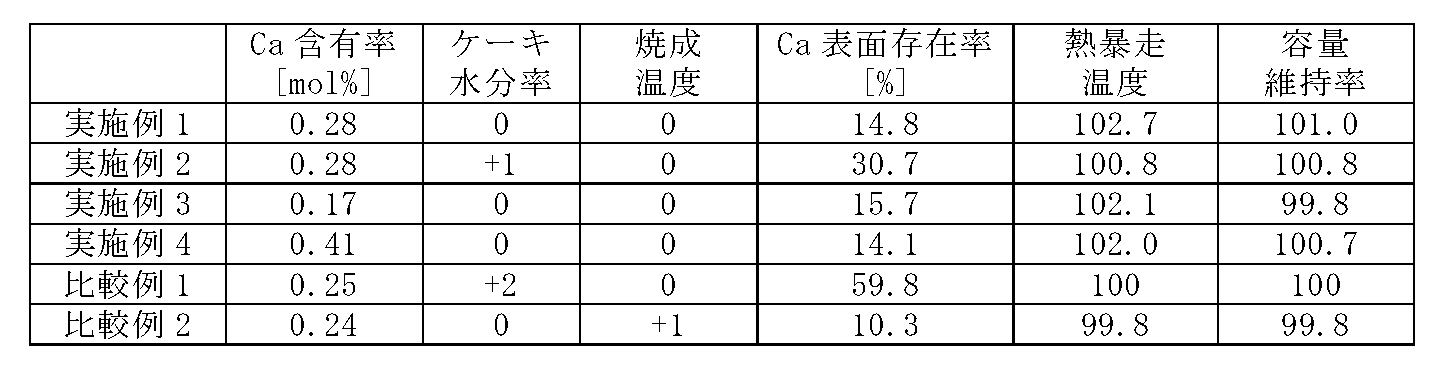
- Table 1 shows the evaluation results of each test cell of Examples and Comparative Examples.
- Table 1 shows the results of Examples and Comparative Examples are shown as relative values when the capacity retention rate (%) and thermal runaway temperature (°C) of the test cell of Comparative Example 1 are set to 100.
- Table 1 also shows the Ca element content (mol%) with respect to the total number of moles of metal elements excluding Li in the cake-like composition, the moisture content of the cake, the baking temperature, and the Ca surface abundance. .
- the moisture content of the cake is represented by relative evaluation of "+2", "+1", and "0 (reference)" in descending order of moisture content, with the moisture content of the cake of Example 1 as "0 (reference)".
- the firing temperature is expressed by relative evaluation, with the condition of Example 1 as "0 (reference)” and the higher temperature as "+1".
- Example 1 to 4 which contain a predetermined proportion of Ca and have a Ca surface abundance within a predetermined range, the thermal runaway temperature is higher than that of Comparative Example 1 while maintaining the same capacity retention rate as Comparative Example 1. It is possible to achieve both charge-discharge cycle characteristics and safety. On the other hand, the thermal runaway temperature of Comparative Example 2 having a Ca surface abundance of less than 12% was lower than that of Comparative Example 1.
Landscapes
- Chemical & Material Sciences (AREA)
- Chemical Kinetics & Catalysis (AREA)
- Electrochemistry (AREA)
- General Chemical & Material Sciences (AREA)
- Engineering & Computer Science (AREA)
- Inorganic Chemistry (AREA)
- Manufacturing & Machinery (AREA)
- Materials Engineering (AREA)
- Composite Materials (AREA)
- Battery Electrode And Active Subsutance (AREA)
- Secondary Cells (AREA)
Abstract
Description
正極は、正極集電体と、正極集電体の表面に形成された正極合剤層とを有する。正極合剤層は、正極集電体の両面に形成されることが好ましい。正極集電体には、アルミニウムなどの正極の電位範囲で安定な金属の箔、当該金属を表層に配置したフィルム等を用いることができる。正極合剤層は、例えば、正極活物質、結着剤、導電剤等を含む。正極は、例えば、正極活物質、結着剤、導電剤等を含む正極合剤スラリーを正極集電体上に塗布、乾燥して正極合剤層を形成した後、この正極合剤層を圧延することにより作製できる。
(1)二次粒子の表面及び内部に存在するCaの総量の測定
正極活物質の粉体0.2gに王水10mLを滴下した後、フッ化水素酸2.5mLを滴下し、加熱して当該粉体を完全に溶解して水溶液を作製する。当該水溶液をイオン交換水で100mLに定容し、ICP-AESでCa濃度を測定した結果を、二次粒子の表面及び内部に存在するCaの総量とする。
(2)二次粒子の表面に存在するCaの量の測定
正極活物質の粉体4gを、40℃で濃度0.01モル/Lの水酸化ナトリウム溶液400mL中で5分間攪拌後、孔径0.45μmのシリンジフィルターで濾過して濾液を得る。当該濾液4mLに王水2.5mLを滴下した後、フッ化水素酸0.6mLを滴下し、加熱して濾液中に残った当該粉体を完全に溶解して水溶液を作製する。当該水溶液をイオン交換水で100mLに定容し、ICP-AESでCa濃度を測定した結果を、二次粒子の表面に存在するCaの総量とする。
(3)Ca表面存在率の算出
上記測定結果を用いて、以下の式により、Ca表面存在率を算出する。
Ca表面存在率=(二次粒子の表面に存在するCaの量)/(二次粒子の表面及び内部に存在するCaの総量)
まず、Ni、Co、Alを含有する複合酸化物と、水酸化リチウム(LiOH)や炭酸リチウム等のLi原料と、CaO、Ca(OH)2、CaCO3等のCa原料とを準備する。上記複合酸化物は、例えば、共沈により得られたニッケルコバルトアルミニウム複合水酸化物等の複合水酸化物を熱処理して得ることができる。次に、複合酸化物と、Li原料と、Ca原料とを混合し、この混合物を焼成した後に粉砕することで焼成物の粒子を得ることができる。本発明者らの検討により、焼成条件によってCa表面存在率を調整することができることが判明した。例えば、焼成温度を上げることで、Ca表面存在率を低くすることができる。焼成温度を上げることで、リチウム含有複合酸化物の二次粒子内部におけるCaとLi等との反応を促進するためと推察される。
次に、焼成物を水洗し、脱水してケーキ状組成物を得る。焼成物は、上記の合成工程で得られた粒子状のものを使用することができる。水洗によって、焼成物の合成工程において加えられたLi原料の未反応分や、Li原料以外の不純物を除去することができる。水洗の際は、例えば、水1Lに対して300g~5000gの焼成物を投入することができる。水洗は複数回繰り返すこともできる。水洗後の脱水は、例えばフィルタープレスにより実施することができる。脱水条件によって、洗浄後のケーキ状組成物の水分率(以下、ケーキ水分率という)を調整することができる。本発明者らの検討により、ケーキ水分率を高くすることにより、リチウム含有複合酸化物のCa表面存在率を高くできることが判明した。ケーキ水分率を所定範囲に調整することで、Ca表面存在率を12%~58%にすることができる。ケーキ水分率は、10gのケーキ状組成物を真空中に120℃で2時間静置して乾燥させ、乾燥前後のケーキ状組成物の質量変化を乾燥前のケーキ状組成物の質量で除して算出することができる。
上記のケーキ状組成物を熱処理することでリチウム含有複合酸化物を得ることができる。熱処理条件は、特に限定されないが、例えば、熱処理温度を150℃~400℃、熱処理時間を0.5時間~15時間とすることができる。
負極は、負極集電体と、負極集電体の表面に形成された負極合剤層とを有する。負極合剤層は、負極集電体の両面に形成されることが好ましい。負極集電体には、銅などの負極の電位範囲で安定な金属の箔、当該金属を表層に配置したフィルム等を用いることができる。負極合剤層は、負極活物質を含み、その他に、増粘剤、結着剤等を含むことが好適である。負極は、例えば、負極活物質と、増粘剤と、結着剤とを所定の質量比で水に分散させた負極合剤スラリーを負極集電体上に塗布し、塗膜を乾燥させた後、圧延して負極合剤層を負極集電体の両面に形成することにより作製できる。
セパレータ13には、例えば、イオン透過性及び絶縁性を有する多孔性シート等が用いられる。多孔性シートの具体例としては、微多孔膜、織布、不織布等が挙げられる。セパレータの材質としては、ポリエチレン、ポリプロピレン等のオレフィン系樹脂、セルロースなどが好適である。セパレータ13は、セルロース繊維層及びオレフィン系樹脂等の熱可塑性樹脂繊維層を有する積層体であってもよい。また、ポリエチレン層及びポリプロピレン層を含む多層セパレータであってもよく、セパレータ13の表面にアラミド系樹脂、セラミック等の材料が塗布されたものを用いてもよい。
非水電解質は、非水溶媒と、非水溶媒に溶解した電解質塩とを含む。非水電解質は、液体電解質(電解液)に限定されず、ゲル状ポリマー等を用いた固体電解質であってもよい。非水溶媒には、例えばエステル類、エーテル類、アセトニトリル等のニトリル類、ジメチルホルムアミド等のアミド類、及びこれらの2種以上の混合溶媒等を用いることができる。非水溶媒は、これら溶媒の水素の少なくとも一部をフッ素等のハロゲン原子で置換したハロゲン置換体を含有していてもよい。
<実施例1>
一般式Ni0.91Co0.04Al0.05O2で表される複合酸化物と、Ca(OH)2と、LiOHとを、Ni、Co、及びAlの総量と、Caと、Liのモル比が1:0.0028:1.02となるように混合し、焼成して焼成物を得た。次に、当該焼成物を水洗しフィルタープレスにより脱水して、所定の水分率を有するケーキ状組成物を得た。さらに、ケーキ状組成物を酸素濃度95%の酸素気流下(混合物1kgあたり5L/minの流量)、昇温速度2℃/minで、室温から650℃まで熱処理した後、昇温速度1℃/minで、650℃から800℃まで熱処理し、実施例1の正極活物質を得た。ICP-AESにより、実施例1の正極活物質を分析した結果、その組成はLiNi0.91Co0.04Al0.05Ca0.0028O2であった。
上記正極活物質100質量部と、導電剤としてのアセチレンブラック(AB)1質量部と、結着剤としてのポリフッ化ビニリデン(PVdF)0.9質量部とを混合し、更にN-メチル-2-ピロリドン(NMP)を適量加えることにより正極合剤スラリーを調製した。次いで、当該正極合剤スラリーをアルミニウム箔からなる正極集電体の両面に塗布し、塗膜を乾燥した後、圧延ローラーを用いて塗膜を圧延し、所定の電極サイズに切断して、正極集電体の両面に正極合剤層が形成された正極を得た。なお、正極の一部に正極集電体の表面が露出した露出部を設けた。
黒鉛が94質量部、SiOが6質量部となるように混合し、これを負極活物質とした。当該負極活物質95質量部と、増粘剤としてのカルボキシメチルセルロース(CMC)3質量部と、結着剤としてのスチレン-ブタジエンゴム(SBR)2質量部とを混合し、更に水を適量加えることにより負極合剤スラリーを調製した。当該負極合剤スラリーを銅箔からなる負極集電体の両面に塗布し、塗膜を乾燥させた後、圧延ローラーを用いて塗膜を圧延し、所定の電極サイズに切断して、負極集電体の両面に負極合剤層が形成された負極を得た。なお、負極の一部に負極集電体の表面が露出した露出部を設けた。
エチレンカーボネート(EC)と、エチルメチルカーボネート(EMC)とを、30:70の体積比で混合した。当該混合溶媒に対して、六フッ化リン酸リチウム(LiPF6)を1モル/リットルの濃度となるように添加して、非水電解質を調製した。
上記正極の露出部にアルミニウムリードを、上記負極の露出部にニッケルリードをそれぞれ取り付け、ポリエチレン製微多孔膜のセパレータを介して正極と負極を渦巻き状に巻回した後、径方向にプレス成形して扁平状の巻回型電極体を作製した。この電極体を外装体内に収容し、上記非水電解質を注入した後、外装体の開口部を封止して試験セルを得た。
上記試験セルを、25℃の環境下で、0.3Itの定電流で電池電圧が4.2Vになるまで充電を行い、その後、4.2Vの定電圧で電流値が0.05Itになるまで充電を行って、充電状態にした。その後、断熱型暴走反応熱量計(ARC)に上記の充電状態の試験セルをセットし、試験セルに取り付けた熱電対によりセル温度を観察することで、断熱環境下での試験セルの自己発熱速度(℃/min)を測定した。具体的には、5℃/minで昇温しつつ試験セルの温度の測定を繰り返し、アレニウスプロットから自己発熱速度が1℃/minに到達した時点で断熱制御に切り替えて発熱に至るまで制御を続け、試験セルの自己発熱速度が2℃/minに到達した際の電池温度(℃)を熱暴走温度と定義した。
上記試験セルを、25℃の環境下で、0.5Itの定電流で電池電圧が4.2Vになるまで充電した後、4.2Vの定電圧で電流値が1/50Itになるまで充電した。その後、0.5Itの定電流で電池電圧が2.5Vになるまで放電した。この充放電を1サイクルとして、400サイクル行った。以下の式により、試験セルの充放電サイクルにおける容量維持率を求めた。
容量維持率=(400サイクル目の放電容量/1サイクル目の放電容量)×100
正極活物質の作製において、ケーキ水分率を高くしたこと以外は、実施例1と同様にして試験セルを作製し、評価を行った。
正極活物質の作製において、Ca(OH)2の添加量を、Ni、Co、及びAlの総量とCaのモル比が1:0.0017になるように変更したこと以外は、実施例1と同様にして試験セルを作製し、評価を行った。
正極活物質の作製において、Ca(OH)2の添加量を、Ni、Co、及びAlの総量とCaのモル比が1:0.0041になるように変更したこと以外は、実施例1と同様にして試験セルを作製し、評価を行った。
正極活物質の作製において、Ca(OH)2の添加量を、Ni、Co、及びAlの総量とCaのモル比が1:0.0025になるように変更し、ケーキ水分率を実施例2よりも高くしたこと以外は、実施例1と同様にして試験セルを作製し、評価を行った。
正極活物質の作製において、Ca(OH)2の添加量を、Ni、Co、及びAlの総量とCaのモル比が1:0.0024になるように変更し、焼成温度を高くしたこと以外は、実施例1と同様にして試験セルを作製し、評価を行った。
Claims (3)
- 正極と、負極と、非水電解質とを備える非水電解質二次電池であって、
前記正極は、正極集電体と、前記正極集電体の表面に形成され、正極活物質を含有する正極合剤層とを有し、
前記正極活物質は、一般式LiaNibCocAldMeCafOg(式中、0.9≦a≦1.2、0.8≦b≦0.95、0<c≦0.1、0<d≦0.1、0≦e≦0.1、b+c+d+e=1、0.0005≦f/(b+c+d+e+f)≦0.01、1.9≦g≦2.1、Mは、Mn、Fe、Ti、Si、Nb、Zr、Mo及びZnから選ばれる少なくとも1種の元素)で表されるリチウム含有複合酸化物を含み、
前記リチウム含有複合酸化物は、一次粒子が凝集して形成された二次粒子を有し、前記二次粒子の表面及び内部にはCaが存在し、且つ、前記二次粒子の表面に存在するCaの割合が、前記二次粒子の表面及び内部に存在するCaの総量に対して、12%~58%である、非水電解質二次電池。 - 前記二次粒子の表面に存在するCaの割合が、前記二次粒子の表面及び内部に存在するCaの総量に対して、12%~31%である、請求項1に記載の非水電解質二次電池。
- 前記二次粒子の表面に存在するCaの割合が、前記二次粒子の表面及び内部に存在するCaの総量に対して、12%~20%である、請求項1に記載の非水電解質二次電池。
Priority Applications (3)
| Application Number | Priority Date | Filing Date | Title |
|---|---|---|---|
| US18/278,277 US20240234712A9 (en) | 2021-03-08 | 2022-02-22 | Non-aqueous electrolyte secondary battery |
| JP2023505268A JP7792947B2 (ja) | 2021-03-08 | 2022-02-22 | 非水電解質二次電池 |
| CN202280017728.8A CN116888765A (zh) | 2021-03-08 | 2022-02-22 | 非水电解质二次电池 |
Applications Claiming Priority (2)
| Application Number | Priority Date | Filing Date | Title |
|---|---|---|---|
| JP2021036442 | 2021-03-08 | ||
| JP2021-036442 | 2021-03-08 |
Publications (1)
| Publication Number | Publication Date |
|---|---|
| WO2022190852A1 true WO2022190852A1 (ja) | 2022-09-15 |
Family
ID=83227684
Family Applications (1)
| Application Number | Title | Priority Date | Filing Date |
|---|---|---|---|
| PCT/JP2022/007153 Ceased WO2022190852A1 (ja) | 2021-03-08 | 2022-02-22 | 非水電解質二次電池 |
Country Status (4)
| Country | Link |
|---|---|
| US (1) | US20240234712A9 (ja) |
| JP (1) | JP7792947B2 (ja) |
| CN (1) | CN116888765A (ja) |
| WO (1) | WO2022190852A1 (ja) |
Cited By (1)
| Publication number | Priority date | Publication date | Assignee | Title |
|---|---|---|---|---|
| EP4550469A3 (en) * | 2023-10-30 | 2025-07-23 | Ecopro Bm Co., Ltd. | Positive electrode active material for secondary battery |
Citations (3)
| Publication number | Priority date | Publication date | Assignee | Title |
|---|---|---|---|---|
| JP2006351378A (ja) * | 2005-06-16 | 2006-12-28 | Matsushita Electric Ind Co Ltd | リチウムイオン二次電池 |
| JP2020155272A (ja) * | 2019-03-19 | 2020-09-24 | 太平洋セメント株式会社 | リチウムイオン二次電池用正極活物質複合体及びその製造方法 |
| WO2021152996A1 (ja) * | 2020-01-31 | 2021-08-05 | パナソニックIpマネジメント株式会社 | 非水電解質二次電池用正極活物質、非水電解質二次電池用正極活物質の製造方法、及び非水電解質二次電池 |
-
2022
- 2022-02-22 CN CN202280017728.8A patent/CN116888765A/zh active Pending
- 2022-02-22 WO PCT/JP2022/007153 patent/WO2022190852A1/ja not_active Ceased
- 2022-02-22 US US18/278,277 patent/US20240234712A9/en active Pending
- 2022-02-22 JP JP2023505268A patent/JP7792947B2/ja active Active
Patent Citations (3)
| Publication number | Priority date | Publication date | Assignee | Title |
|---|---|---|---|---|
| JP2006351378A (ja) * | 2005-06-16 | 2006-12-28 | Matsushita Electric Ind Co Ltd | リチウムイオン二次電池 |
| JP2020155272A (ja) * | 2019-03-19 | 2020-09-24 | 太平洋セメント株式会社 | リチウムイオン二次電池用正極活物質複合体及びその製造方法 |
| WO2021152996A1 (ja) * | 2020-01-31 | 2021-08-05 | パナソニックIpマネジメント株式会社 | 非水電解質二次電池用正極活物質、非水電解質二次電池用正極活物質の製造方法、及び非水電解質二次電池 |
Cited By (1)
| Publication number | Priority date | Publication date | Assignee | Title |
|---|---|---|---|---|
| EP4550469A3 (en) * | 2023-10-30 | 2025-07-23 | Ecopro Bm Co., Ltd. | Positive electrode active material for secondary battery |
Also Published As
| Publication number | Publication date |
|---|---|
| CN116888765A (zh) | 2023-10-13 |
| US20240136517A1 (en) | 2024-04-25 |
| JPWO2022190852A1 (ja) | 2022-09-15 |
| US20240234712A9 (en) | 2024-07-11 |
| JP7792947B2 (ja) | 2025-12-26 |
Similar Documents
| Publication | Publication Date | Title |
|---|---|---|
| JP7182107B2 (ja) | 非水電解質二次電池用正極活物質、非水電解質二次電池用正極活物質の製造方法、及び非水電解質二次電池 | |
| WO2019239652A1 (ja) | 非水電解質二次電池 | |
| JP7672037B2 (ja) | 非水電解質二次電池用正極活物質、及び非水電解質二次電池 | |
| JP7809186B2 (ja) | 非水電解質二次電池用正極活物質、及び非水電解質二次電池 | |
| JP7233013B2 (ja) | 非水電解質二次電池 | |
| JP7712943B2 (ja) | 非水電解質二次電池用正極活物質、及び非水電解質二次電池 | |
| US20230335711A1 (en) | Positive electrode active material for nonaqueous electrolyte secondary batteries, and nonaqueous electrolyte secondary battery | |
| CN111971826B (zh) | 非水电解质二次电池的正极活性物质、非水电解质二次电池用正极及非水电解质二次电池 | |
| JP7584063B2 (ja) | 非水電解質二次電池用正極活物質、非水電解質二次電池、及び非水電解質二次電池用正極活物質の製造方法 | |
| JP7584048B2 (ja) | 非水電解質二次電池用正極活物質、非水電解質二次電池、及び非水電解質二次電池用正極活物質の製造方法 | |
| CN111937194B (zh) | 非水电解质二次电池的正极活性物质、非水电解质二次电池用正极和非水电解质二次电池 | |
| WO2023162698A1 (ja) | 非水電解質二次電池用正極活物質、及び非水電解質二次電池 | |
| JP7843471B2 (ja) | 非水電解質二次電池用正極、及び非水電解質二次電池 | |
| JP7759572B2 (ja) | 非水電解質二次電池用正極活物質、及び非水電解質二次電池 | |
| WO2023053626A1 (ja) | 非水電解質二次電池 | |
| JP7792947B2 (ja) | 非水電解質二次電池 | |
| WO2023176503A1 (ja) | 非水電解質二次電池 | |
| WO2023157746A1 (ja) | 非水電解質二次電池 | |
| CN119654714A (zh) | 非水电解质二次电池用正极活性物质、和非水电解质二次电池 | |
| WO2022158375A1 (ja) | 非水電解質二次電池 | |
| JP7637076B2 (ja) | 非水電解質二次電池用正極活物質、及び非水電解質二次電池 | |
| US20250070152A1 (en) | Positive electrode active material for non-aqueous electrolyte secondary battery, and non-aqueous electrolyte secondary battery | |
| WO2023145507A1 (ja) | 非水電解質二次電池用正極活物質、及び非水電解質二次電池 | |
| WO2025142440A1 (ja) | 非水電解質二次電池用正極活物質、正極活物質の製造方法、および非水電解質二次電池 | |
| WO2025142513A1 (ja) | 非水電解質二次電池 |
Legal Events
| Date | Code | Title | Description |
|---|---|---|---|
| 121 | Ep: the epo has been informed by wipo that ep was designated in this application |
Ref document number: 22766814 Country of ref document: EP Kind code of ref document: A1 |
|
| WWE | Wipo information: entry into national phase |
Ref document number: 2023505268 Country of ref document: JP |
|
| WWE | Wipo information: entry into national phase |
Ref document number: 18278277 Country of ref document: US |
|
| WWE | Wipo information: entry into national phase |
Ref document number: 202280017728.8 Country of ref document: CN |
|
| NENP | Non-entry into the national phase |
Ref country code: DE |
|
| 122 | Ep: pct application non-entry in european phase |
Ref document number: 22766814 Country of ref document: EP Kind code of ref document: A1 |