WO2022209885A1 - 成形体、ダウンホールツール部材およびダウンホールツール - Google Patents
成形体、ダウンホールツール部材およびダウンホールツール Download PDFInfo
- Publication number
- WO2022209885A1 WO2022209885A1 PCT/JP2022/011783 JP2022011783W WO2022209885A1 WO 2022209885 A1 WO2022209885 A1 WO 2022209885A1 JP 2022011783 W JP2022011783 W JP 2022011783W WO 2022209885 A1 WO2022209885 A1 WO 2022209885A1
- Authority
- WO
- WIPO (PCT)
- Prior art keywords
- polymer
- composition
- glycolic acid
- plasticizer
- molded article
- Prior art date
- Legal status (The legal status is an assumption and is not a legal conclusion. Google has not performed a legal analysis and makes no representation as to the accuracy of the status listed.)
- Ceased
Links
Classifications
-
- C—CHEMISTRY; METALLURGY
- C08—ORGANIC MACROMOLECULAR COMPOUNDS; THEIR PREPARATION OR CHEMICAL WORKING-UP; COMPOSITIONS BASED THEREON
- C08K—Use of inorganic or non-macromolecular organic substances as compounding ingredients
- C08K5/00—Use of organic ingredients
- C08K5/04—Oxygen-containing compounds
- C08K5/15—Heterocyclic compounds having oxygen in the ring
- C08K5/156—Heterocyclic compounds having oxygen in the ring having two oxygen atoms in the ring
- C08K5/1575—Six-membered rings
-
- C—CHEMISTRY; METALLURGY
- C08—ORGANIC MACROMOLECULAR COMPOUNDS; THEIR PREPARATION OR CHEMICAL WORKING-UP; COMPOSITIONS BASED THEREON
- C08L—COMPOSITIONS OF MACROMOLECULAR COMPOUNDS
- C08L101/00—Compositions of unspecified macromolecular compounds
- C08L101/16—Compositions of unspecified macromolecular compounds the macromolecular compounds being biodegradable
-
- C—CHEMISTRY; METALLURGY
- C08—ORGANIC MACROMOLECULAR COMPOUNDS; THEIR PREPARATION OR CHEMICAL WORKING-UP; COMPOSITIONS BASED THEREON
- C08G—MACROMOLECULAR COMPOUNDS OBTAINED OTHERWISE THAN BY REACTIONS ONLY INVOLVING UNSATURATED CARBON-TO-CARBON BONDS
- C08G63/00—Macromolecular compounds obtained by reactions forming a carboxylic ester link in the main chain of the macromolecule
- C08G63/02—Polyesters derived from hydroxycarboxylic acids or from polycarboxylic acids and polyhydroxy compounds
- C08G63/06—Polyesters derived from hydroxycarboxylic acids or from polycarboxylic acids and polyhydroxy compounds derived from hydroxycarboxylic acids
-
- C—CHEMISTRY; METALLURGY
- C08—ORGANIC MACROMOLECULAR COMPOUNDS; THEIR PREPARATION OR CHEMICAL WORKING-UP; COMPOSITIONS BASED THEREON
- C08G—MACROMOLECULAR COMPOUNDS OBTAINED OTHERWISE THAN BY REACTIONS ONLY INVOLVING UNSATURATED CARBON-TO-CARBON BONDS
- C08G63/00—Macromolecular compounds obtained by reactions forming a carboxylic ester link in the main chain of the macromolecule
- C08G63/66—Polyesters containing oxygen in the form of ether groups
- C08G63/664—Polyesters containing oxygen in the form of ether groups derived from hydroxy carboxylic acids
-
- C—CHEMISTRY; METALLURGY
- C08—ORGANIC MACROMOLECULAR COMPOUNDS; THEIR PREPARATION OR CHEMICAL WORKING-UP; COMPOSITIONS BASED THEREON
- C08K—Use of inorganic or non-macromolecular organic substances as compounding ingredients
- C08K5/00—Use of organic ingredients
- C08K5/04—Oxygen-containing compounds
- C08K5/09—Carboxylic acids; Metal salts thereof; Anhydrides thereof
- C08K5/092—Polycarboxylic acids
-
- C—CHEMISTRY; METALLURGY
- C08—ORGANIC MACROMOLECULAR COMPOUNDS; THEIR PREPARATION OR CHEMICAL WORKING-UP; COMPOSITIONS BASED THEREON
- C08L—COMPOSITIONS OF MACROMOLECULAR COMPOUNDS
- C08L67/00—Compositions of polyesters obtained by reactions forming a carboxylic ester link in the main chain; Compositions of derivatives of such polymers
- C08L67/04—Polyesters derived from hydroxycarboxylic acids, e.g. lactones
-
- E—FIXED CONSTRUCTIONS
- E21—EARTH OR ROCK DRILLING; MINING
- E21B—EARTH OR ROCK DRILLING; OBTAINING OIL, GAS, WATER, SOLUBLE OR MELTABLE MATERIALS OR A SLURRY OF MINERALS FROM WELLS
- E21B33/00—Sealing or packing boreholes or wells
- E21B33/10—Sealing or packing boreholes or wells in the borehole
- E21B33/12—Packers; Plugs
Definitions
- the present invention relates to a molded article made of a composition containing a glycolic acid polymer, a downhole tool member made of the molded article, and a downhole tool including the downhole tool member.
- Glycolic acid polymer is a degradable resin material that has high strength and is hydrolyzable and degradable. Glycolic acid polymers are used as medical materials such as bone fixation materials and sutures, taking advantage of their properties. Moreover, in recent years, its use has expanded as a member of a downhole tool used for recovering hydrocarbon resources. A higher decomposition rate is required depending on the application, and various research and development efforts are being made to improve the decomposition rate of glycolic acid polymers.
- Patent Document 1 describes a carboxylic acid anhydride as a decomposition accelerator for a glycolic acid polymer resin composition.
- Patent Document 2 describes that by adding a plasticizer to the biodegradable resin material, the decomposition of the polymer by water can be controlled, and the decomposition rate of the biodegradable resin material in the well environment can be accelerated. ing.
- the plasticizer polylactic acid having a repeating number of 2 or more and 10 or less is described.
- An object of one aspect of the present invention is to realize a molded article with an improved decomposition rate.
- the present inventors focused on a composition containing a decomposition accelerator, a plasticizer, and a glycolic acid polymer. Then, they found that a molded article having an improved decomposition rate can be obtained when the difference between the solubility parameter of the plasticizer and the solubility parameter of the glycolic acid polymer in the composition is within a specific range. was completed.
- a molded article according to an aspect of the present invention is made of a composition containing a glycolic acid polymer, a plasticizer, and a decomposition accelerator, and has a Fedors solubility parameter of the plasticizer and a Fedors solubility parameter of the glycolic acid polymer.
- the molded article has an absolute value of difference from the solubility parameter of 6 (J/cm 3 ) 1/2 or less, and a content of the plasticizer in the composition of 10% by mass or more and 50% by mass or less.
- the molded article according to this embodiment is made of a composition containing a glycolic acid polymer, a plasticizer, and a decomposition accelerator.
- glycolic acid polymer indicates a polymer containing repeating units (-(-O-CH 2 -CO-)-) derived from glycolic acid.
- the glycolic acid polymer may be a homopolymer of glycolic acid (polyglycolic acid (PGA)). Further, the glycolic acid polymer may be a copolymer containing repeating units derived from glycolic acid and repeating units derived from other monomers.
- glycolic acid copolymer A copolymer containing a repeating unit derived from glycolic acid and a repeating unit derived from another monomer (hereinafter referred to as "glycolic acid copolymer") will be described below.
- glycolic acid copolymer In the glycolic acid copolymer, two or more linear polymer chains A composed of repeating units derived from glycolic acid are chemically bonded to two or more polymer chains B different from the polymer chain A, in order to improve the decomposition rate. It may be a copolymer consisting of Polymer chain A and polymer chain B will be described later.
- two or more polymer chains A may be chemically bonded to polymer chain B, and the bonding position of polymer chain A in polymer chain B is not particularly limited.
- the copolymer is a triblock copolymer in which polymer chain A is chemically bonded to both ends of the main chain of polymer chain B (“ABA type block copolymer”, where A is the polymer chain A and B are the polymer chains B.), or a graft copolymer in which two or more polymer chains A are graft-bonded to the polymer chain B.
- the copolymer is an ABA type block copolymer (where A is the polymer chain A, B is the polymer chain B.).
- the polymer chain A and the polymer chain B are linked by an ester bond.
- the thickness reduction rate during decomposition is likely to be improved.
- the polymer chain B is a unit that is more hydrophilic or flexible than the polymer chain A
- it is particularly preferred that the polymer chains A and B are linked by an ester bond.
- the polymer chain B is a unit that is more hydrophilic or flexible than the polymer chain A
- water is more likely to permeate the vicinity of the polymer chain B than the vicinity of the polymer chain A.
- the ester bond between chain A and polymer chain B becomes easier to hydrolyze than the ester bond within polymer chain A. That is, the ester bond between polymer chain A and polymer chain B is hydrolyzed and the glycolic acid copolymer is cut between polymer chain A and polymer chain B, resulting in a large molecular weight. It becomes easy to improve the thickness reduction speed.
- the polymer chain A and polymer chain B that constitute the glycolic acid copolymer will be described below.
- polymer chain A examples include linear polymer chains composed of glycolic acid units.
- the number of glycolic acid units constituting one block of the polymer chain A in the glycolic acid copolymer is not particularly limited, and may be appropriately determined within a range in which the glycolic acid copolymer can express the degradability derived from the polymer chain A. can decide.
- Polymer chain B is a polymer chain different from polymer chain A.
- polymer chain B may be a polymer chain derived from a polymer compound having a glass transition temperature (Tg) of less than 45°C.
- the polymer chain B may be a polymer chain derived from a polymer compound having a weight average molecular weight of 1500 or more and 250000 or less.
- the glass transition temperature of the polymer compound from which the polymer chain B is derived (hereinafter, “polymer compound B”) is from the viewpoint of lowering the glass transition temperature of the glycolic acid copolymer than that of the polymer consisting only of the polymer chain A. Therefore, the temperature is preferably 45° C. or lower, more preferably 0° C. or lower.
- the glass transition temperature of the polymer compound from which polymer chain B is derived can be measured by differential scanning calorimetry (DSC).
- the weight-average molecular weight of the polymer compound B is preferably 2500 or more, more preferably 3000 or more, and further preferably 7500 or more, from the viewpoint of further improving the rate of thickness reduction during decomposition of the molded article. preferable. Moreover, from the viewpoint of improving the strength of the molded article, the weight average molecular weight of the polymer compound B is preferably 50,000 or less, more preferably 20,000 or less. The weight-average molecular weight of the polymer compound B being 50,000 or less is also advantageous from the viewpoint of the solubility in glycolide during the polymerization of the glycolic acid copolymer and the control of the copolymerization reactivity. The weight average molecular weight of polymer compound B can be measured using a gel permeation chromatography (GPC) device.
- GPC gel permeation chromatography
- the polymer compound B has functional groups at two or more ends capable of chemically bonding with glycolic acid units constituting the polymer chain A, and has a weight-average molecular weight within the above specific range. and/or is not particularly limited as long as it is a polymer compound other than polyglycolic acid that has a glass transition temperature.
- polymer compound B examples include polyols having the specific weight average molecular weight and glass transition temperature.
- polyols include polyethylene glycol, polypropylene glycol, polytetramethylene ether glycol, polycaprolactone, polydioxanone, polydimethylsiloxane, polyethylene oxalate, and the like.
- the "polyol” may be a homopolymer consisting of only one type of repeating unit, or a copolymer further containing repeating units derived from other monomers.
- the polymer compound B is preferably a hydrophilic polyhydric alcohol-based polymer having a terminal hydroxy group, since it can impart hydrophilicity to the glycolic acid copolymer.
- hydrophilic polyhydric alcohol polymers having terminal hydroxy groups include polyethylene glycol, polypropylene glycol, polyglycerin, polyvinyl alcohol and the like.
- the polymer compound B can be a hydrophilic polyhydric alcohol having a terminal hydroxy group with a weight average molecular weight of 3000 or more and 50000 or less. Since the polymer compound B is a hydrophilic polyhydric alcohol having a terminal hydroxy group with a weight average molecular weight of 3000 or more and 50000 or less, the hydrophilicity of the polymer chain B is expressed in the glycolic acid copolymer, and during decomposition As a result, there is an effect that the rate of thickness reduction in the molded body during decomposition is further improved.
- polymer compound B may be polyethylene glycol or polypropylene glycol having a weight average molecular weight of 3000 or more and 50000 or less.
- Polyethylene glycol and polypropylene glycol have a particularly low glass transition temperature and a particularly high hydrophilicity. Therefore, by using polyethylene glycol or polypropylene glycol as the hydrophilic polyhydric alcohol having a terminal hydroxy group, it is possible to impart flexibility and hydrophilicity to the glycolic acid copolymer.
- polymer compound B may be polyethylene glycol having a weight average molecular weight of 7500 or more and 50000 or less.
- polymer compound B is polyethylene glycol having a weight average molecular weight of 7,500 or more and 50,000 or less, an effect of further improving the rate of thickness reduction during decomposition of the molded article is exhibited.
- the polymer compound B may be a homopolymer consisting only of repeating units derived from a single monomer, or may be a copolymer further containing repeating units derived from other monomers.
- Other monomers include, for example, ethylene oxalate (1,4-dioxane-2,3-dione), lactides, lactones (e.g., ⁇ -propiolactone, ⁇ -butyrolactone, ⁇ -pivalolactone, ⁇ -butyrolactone, ⁇ -valerolactone, ⁇ -methyl- ⁇ -valerolactone, ⁇ -caprolactone, etc.), carbonates (eg, trimethylcarbonate, etc.), ethers (eg, 1,3-dioxane, etc.), ether esters (for example, dioxanone, etc.), cyclic monomers such as amides ( ⁇ -caprolactam, etc.); hydroxycarboxylic acids such as lactic acid, 3-hydroxypropanoic acid, 3-hydroxybutanoic acid, 4-hydroxybutanoic acid, 6-hydroxycaproic acid, or Alkyl esters thereof; substantially aliphatic diols such as ethylene glyco
- a repeating unit derived from another monomer can be employed from the viewpoint of adjusting the physical properties of polymer compound B.
- the content of other repeating units in the polymer compound B can be appropriately determined within a range in which the desired effect of the polymer chain B can be sufficiently obtained.
- the content of repeating units derived from other monomers in polymer compound B may be 50% by mass or less, preferably 30% by mass or less, and more preferably 10% by mass or less.
- Polymer compound B may be linear or may be a graft copolymer in which other polymer compounds are graft-bonded.
- the polymer chain B may have an ester bond in its molecule. Since the polymer chain B has an ester bond in the molecule, cleavage of the ester bond also occurs in the polymer chain B due to hydrolysis, so the rate of thickness reduction can be more easily improved.
- the amount of the polymer chain B in the glycolic acid copolymer is The mass ratio is preferably 0.5 or more, more preferably 1.5 or more, relative to 100 of the total amount of the polymer chain A. Further, from the viewpoint of maintaining the strength of the glycolic acid copolymer, the mass ratio of the polymer chain B in the glycolic acid copolymer is preferably 30 or less with respect to the total amount of the polymer chain A of 100. It is more preferably 20 or less.
- a glycolic acid polymer can be produced by a known method.
- a glycolic acid copolymer can be produced by using a polymer compound B from which the polymer chain B is derived as a polymerization initiator, and glycolide, which is a dimer of glycolic acid, in the presence of a small amount of a catalyst and a solvent substantially It can be suitably produced by ring-opening polymerization under conditions that do not exist physically (that is, bulk polymerization conditions).
- the reaction temperature in the ring-opening polymerization can be appropriately determined within a range in which the ring-opening polymerization of glycolide proceeds appropriately, and is, for example, 140°C.
- catalysts include cationic catalysts such as organic tin carboxylates, tin halides and antimony halides.
- a commercially available product may be used as the glycolic acid polymer.
- the plasticizer refers to an agent (compound) that lowers the glass transition temperature (Tg) of a composition containing a glycolic acid polymer and imparts plasticity to the composition.
- plasticizers include esters and ester derivatives.
- esters or ester derivatives include cyclic esters such as glycolide; fatty acid ester derivatives such as triacetin; aliphatic dibasic acid esters such as adipate; phthalates such as dimethyl phthalate; group carboxylic acid ester;
- a plasticizer may be used individually by 1 type, and may use 2 or more types together.
- the content of the plasticizer in the composition is 10% by mass or more, preferably 12% by mass or more, more preferably 15% by mass or more, more preferably 100% by mass of the composition. It is 20% by mass or more, and more preferably 25% by mass or more. Also, the content is 50% by mass or less, preferably 45% by mass or less, more preferably 40% by mass or less, and even more preferably 35% by mass or less.
- the glass transition temperature (Tg) of the composition can be sufficiently lowered, and sufficient plasticity can be imparted to the composition.
- the content of the plasticizer in the composition is preferably higher than the content of the decomposition accelerator described below.
- the decomposition accelerator refers to an agent (compound) that accelerates the hydrolysis reaction of a composition containing a glycolic acid polymer.
- decomposition accelerators include carboxylic acid anhydrides and phosphorus compounds.
- the decomposition accelerator may be used alone or in combination of two or more.
- the carboxylic acid anhydride in the above composition is not particularly limited.
- Carboxylic acid anhydrides having a ring structure are preferable from the viewpoint of heat resistance that can withstand the temperature during molding of the composition and compatibility with the composition, such as hexanoic anhydride, octanoic anhydride, and decane anhydride.
- Acid lauric anhydride, myristic anhydride, palmitic anhydride, stearic anhydride, benzoic anhydride, succinic anhydride, maleic anhydride, phthalic anhydride, trimellitic anhydride, tetrahydrophthalic anhydride, butanetetracarboxylic dianhydride , 3,3′,4,4′-benzophenonetetracarboxylic dianhydride, diphenylsulfonetetracarboxylic dianhydride, biphenyltetracarboxylic dianhydride, ethylene glycol bis-anhydro trimellitate, and glycerin bis-anhydro Trimellitate monoacetate is more preferred, phthalic anhydride, trimellitic anhydride, benzoic anhydride, 3,3′,4,4′-benzophenonetetracarboxylic dianhydride, benzene-1,2,4,5-tetra Carboxylic anhydride (pyromelli
- the phosphorus compound in the above composition is not particularly limited, but organic phosphorus compounds such as phosphates and phosphites are preferred. Organophosphorus compounds having at least one structure selected from the group consisting of are more preferred.
- Phosphate esters having a long-chain alkyl group of 8 to 24 carbon atoms include mono- or di-stearyl acid phosphate or a mixture thereof, di-2-ethylhexyl acid phosphate, and the like.
- Phosphites having an aromatic ring include tris(nonylphenyl)phosphite and the like.
- Phosphites having a pentaerythritol skeleton include cyclic neopentanetetraylbis(2,6-di-tert-butyl-4-methylphenyl)phosphite, cyclic neopentanetetraylbis(2,4 -di-tert-butylphenyl)phosphite, and cyclic neopentanetetraylbis(octadecyl)phosphite.
- the content of the decomposition accelerator in the composition is preferably 1% by mass, more preferably 3% by mass or more, relative to 100% by mass of the composition. Also, the content is preferably 50% by mass or less, more preferably 40% by mass or less, and even more preferably 30% by mass or less. When the content of the decomposition accelerator is within the above range, the decomposition accelerator is less likely to bleed out from the composition, so that the composition can be easily molded while accelerating the decomposition rate of the composition.
- the absolute value of the difference between the Fedors solubility parameter of the plasticizer and the Fedors solubility parameter of the glycolic acid polymer is 6 (J/cm 3 ) 1/2 or less, preferably It is 5.5 (J/cm 3 ) 1/2 or less, more preferably 5 (J/cm 3 ) 1/2 or less.
- “Fedors solubility parameter” may be abbreviated as "SP value”.
- the absolute value of the difference between the SP value of at least one plasticizer and the SP value of the glycolic acid polymer is 6 (J/cm 3 ) 1/2 It is below.
- the weight-average molecular weight (Mw) of the composition is preferably 150,000 or more, more preferably 160,000 or more, and even more preferably 170,000 or more, in terms of maintaining the strength of the molded article and extrusion molding. Moreover, the Mw of the composition is preferably 500,000 or less, more preferably 450,000 or less, and even more preferably 400,000 or less, in terms of facilitating molding during extrusion molding or injection molding.
- the weight-average molecular weight of the composition can be measured, for example, by the following method: about 10 mg of the composition is dissolved in 0.5 mL of DMSO by heating at 150° C. and cooled to room temperature. The cooled solution is made up to 10 mL with hexafluoroisopropanol (HFIP), and the weight average molecular weight of the composition is measured using a gel permeation chromatography (GPC) device. Polymethyl methacrylate (PMMA) is used as a standard.
- GPC apparatus is shodex GPC-104 (detector: RI, columns: 2 HFIP-606M). Alternatively, HFIP containing 5 mM CF 3 COONa may be used as a solvent.
- the above composition may contain other components as long as the object of the present invention is not compromised.
- compositions may contain various additives such as heat stabilizers, light stabilizers, inorganic fillers, moisture proof agents, waterproof agents, water repellent agents, lubricants, hydrophilic agents, water absorbing agents, nucleating agents, and pore forming agents.
- additives such as heat stabilizers, light stabilizers, inorganic fillers, moisture proof agents, waterproof agents, water repellent agents, lubricants, hydrophilic agents, water absorbing agents, nucleating agents, and pore forming agents.
- the composition may contain a polymerization initiator, a catalyst, and the like used for preparing the polymer.
- the above composition can be prepared by mixing a glycolic acid polymer, a plasticizer, and a decomposition accelerator.
- a plasticizer may be added during the preparation of the glycolic acid polymer.
- residual glycolide may be used as a plasticizer. That is, a composition is prepared by mixing a glycolic acid polymer composition containing glycolide and a glycolic acid polymer obtained by preparing a glycolic acid polymer, a decomposition accelerator, and optionally a plasticizer.
- the molded article according to this embodiment is a polyglycolic acid molded article made of the above composition.
- the decomposition rate of the molded body may be evaluated, for example, by measuring the thickness reduction rate of the molded body, as shown in the Examples.
- the molded article according to this embodiment contains a decomposition accelerator and a plasticizer.
- the decomposition accelerator has the effect of improving the hydrolysis rate of the glycolic acid polymer and accelerating the decomposition of the molded product.
- the plasticizer has the effect of improving the water absorption of the glycolic acid polymer and accelerating the decomposition of the molded product.
- a molded product containing a decomposition accelerator and a plasticizer improves the water absorption and hydrolysis rate of the glycolic acid polymer, synergistically accelerating the decomposition of the molded product.
- the molded article according to the present embodiment has a thickness reduction rate due to the synergistic effect of the decomposition accelerator and the plasticizer. high.
- a molded article according to the present embodiment can be obtained by molding the above composition.
- the molding method is not limited and examples include injection molding, melt extrusion, consolidation extrusion, compression molding (press molding) and centrifugal molding.
- Pellets composed of the composition are supplied to a cylinder extruder set at a temperature higher than the melting point of the composition and lower than 255° C. (usually 200 to 255° C.) and melt-kneaded.
- the melt-kneaded product is extruded from the extrusion die at the tip of the extruder into the flow path of the forming die, cooled to a temperature below the crystallization temperature of the composition in the flow path of the forming die and solidified, and from the tip of the forming die Extrude outside at a speed of 5 to 50 mm/10 minutes.
- This extrudate is pressurized and taken off while applying a back pressure of 1,500 to 8,500 kg in the direction of the forming die to produce a compact, which is a solidified extrudate.
- the molding may be annealed by heat treatment at a temperature of 150-230° C. for 3-24 hours.
- Pellets of the composition are supplied to an injection molding machine equipped with an injection mold.
- the cylinder temperature is set at the melting point of the composition or higher and 255° C. or lower (usually 200-255° C.), and the mold temperature is set at 0° C. or higher and the melting point or lower of the composition (usually 0-190° C.).
- injection molding is performed at an injection pressure of 1 to 104 MPa (preferably 10 to 104 MPa) to produce an injection molded product.
- This molding may be annealed at a temperature above the crystallization temperature and below the melting point of the composition (usually 70 to 220° C.) for 1 minute to 10 hours.
- the thickness or diameter of the compact is preferably 1 mm or more, more preferably 3 mm or more, in terms of machining the downhole tool member.
- the upper limit of the thickness or diameter of the molded body is not particularly limited, it is preferably 500 mm or less, more preferably 400 mm or less.
- a downhole tool member according to the present embodiment is a member used for underground excavation for recovering hydrocarbon resources such as petroleum and gas from underground, and is made of the molded body.
- the molded body may be used as it is as a downhole tool member, or may be subjected to conventionally known machining (secondary processing) to produce a downhole tool member.
- machining is cutting.
- the shape and size of the downhole tool member according to this embodiment are not particularly limited, for example, the thickness or diameter is 5 to 500 mm, preferably 20 to 300 mm, more preferably 30 to 200 mm.
- the shape of the downhole tool member may be various shapes such as a round bar, a flat plate, a hollow article such as a pipe, and an irregularly shaped article.
- a round bar, a hollow product or a flat plate is preferable because it is easy to perform extrusion molding and subsequent densification treatment, and is often suitable for extruded products that are raw materials for machining.
- a round bar is more preferable for forming a downhole tool member for oil drilling, particularly a core bar for a sealing plug.
- a downhole tool includes a downhole tool member.
- a device or a member thereof used for various well treatments such as well drilling, well closure and fracturing and installed in a well is referred to as a downhole tool.
- the shape of the downhole tool is not particularly limited, and can be, for example, a conventionally known shape. Examples of downhole tools include flack plugs, bridge plugs, cement retainers, perforation guns, ball sealers, filler plugs, and packers.
- the molded article according to the present embodiment is made of a composition containing a glycolic acid polymer, a plasticizer, and a decomposition accelerator, and has a Fedors solubility parameter of the plasticizer and a Fedors solubility parameter of the glycolic acid polymer. is 6 (J/cm 3 ) 1/2 or less, and the content of the plasticizer in the composition is 10% by mass or more and 50% by mass or less.
- the glycolic acid polymer has a linear polymer chain A composed of repeating units derived from glycolic acid chemically bonded to a polymer chain B different from the polymer chain A.
- the polymer chain B may be derived from a polymer compound having a glass transition temperature of less than 45°C.
- the glycolic acid polymer may be a block copolymer of the polymer chain A and the polymer chain B.
- the glycolic acid polymer may be a homopolymer of glycolic acid.
- the composition may have a weight average molecular weight of 150,000 or more and 500,000 or less.
- the decomposition accelerator may be a carboxylic acid anhydride.
- the molded body according to this embodiment may have a thickness or diameter of 1 mm or more.
- the downhole tool member according to this embodiment is made of the molded body.
- the downhole tool according to this embodiment includes the downhole tool member.
- composition of glycolic acid polymer obtained by polymerization is referred to as "polymer composition”.
- a composition containing a glycolic acid polymer (or polymer composition), a plasticizer, and a decomposition accelerator is simply referred to as a "composition”.
- % represents % by mass unless otherwise specified.
- Table 1 shows the SP value measurement results and the difference between the SP value of the plasticizer and the SP value of the glycolic acid polymer.
- compositions and molded articles obtained in Examples and Comparative Examples were evaluated as follows.
- the time variation of the reduced thickness of the test piece was obtained. Then, the thickness reduction rate of the 10 mm-thick test piece was calculated from the time change of the reduced thickness of the test piece in the range where linearity was observed in the time change of the reduced thickness of the test piece (unit: mm/h).
- Example 1-1 A polymerization vessel was charged with 0.003 parts by mass of tin dichloride as a catalyst and 0.3 parts by mass of 1-dodecanol as a polymerization initiator with respect to 100 parts by mass of glycolide. The charged contents were kept under a heating condition of 170° C. for 2 hours to obtain a polymer composition 1-1. Polymer composition 1-1 does not contain glycolide.
- Polymer composition 1-1 contains pyromellitic dianhydride (PMDA) as a decomposition accelerator, glycolide as a plasticizer, and a mixture of distearyl acid phosphate and monostearyl acid phosphate as heat stabilizers (manufactured by ADEKA Corporation " Adekastab AX-71”) was blended to obtain a composition.
- PMDA pyromellitic dianhydride
- glycolide glycolide
- Adekastab AX-71 a mixture of distearyl acid phosphate and monostearyl acid phosphate as heat stabilizers
- the composition is melt-kneaded by supplying the composition to the feed section of a twin-screw extruder kneader ("2D25S" manufactured by Toyo Seiki Co., Ltd.) set at a screw temperature of 190 to 240 ° C., and extruded to form pellets of the composition. got Then, the pellets of the composition were supplied to the feed section of an injection molding machine ("EC-100N” manufactured by Toshiba Machine Co., Ltd.) with the cylinder temperature set at 190 to 240° C., and injection molding was performed to obtain a molded body. The mold temperature during injection molding was set to 100°C.
- Example 1-2 A polymer composition 1-2 was obtained in the same manner as in Example 1-1, except that the heating conditions for the contents charged in the polymerization vessel were changed to 150°C. Polymer composition 1-2 contains glycolide remaining from the preparation of the polymer composition.
- Example 1-1 a composition was obtained in the same procedure as in Example 1-1, except that glycolide was not added as a plasticizer. Further, a molded body was obtained in the same procedure as in Example 1-1.
- Example 1-3 A composition was prepared in the same manner as in Example 1-1, except that a masterbatch of a polyglycolic acid polymer containing 48 parts by mass of glycolide was blended in the polymer composition 1-1 instead of glycolide as a plasticizer. Obtained. Further, a molded body was obtained in the same procedure as in Example 1-1.
- Example 1-1 A composition and a molded article were obtained in the same manner as in Example 1-1, except that the polymer composition 1-1 did not contain a plasticizer.
- Example 1-5 A composition and a molded article were obtained in the same manner as in Example 1-1, except that polyethylene glycol (PEG, Mw 20000) was blended in polymer composition 1-1 instead of glycolide as a plasticizer.
- PEG polyethylene glycol
- Example 1-6 A composition was obtained in the same manner as in Example 1-3, except that the amount of the polyglycolic acid polymer masterbatch containing 48 parts by mass of glycolide was increased. The content of glycolide as plasticizer in this composition corresponds to 60% by weight. This composition could not be extruded and no pellets were obtained.
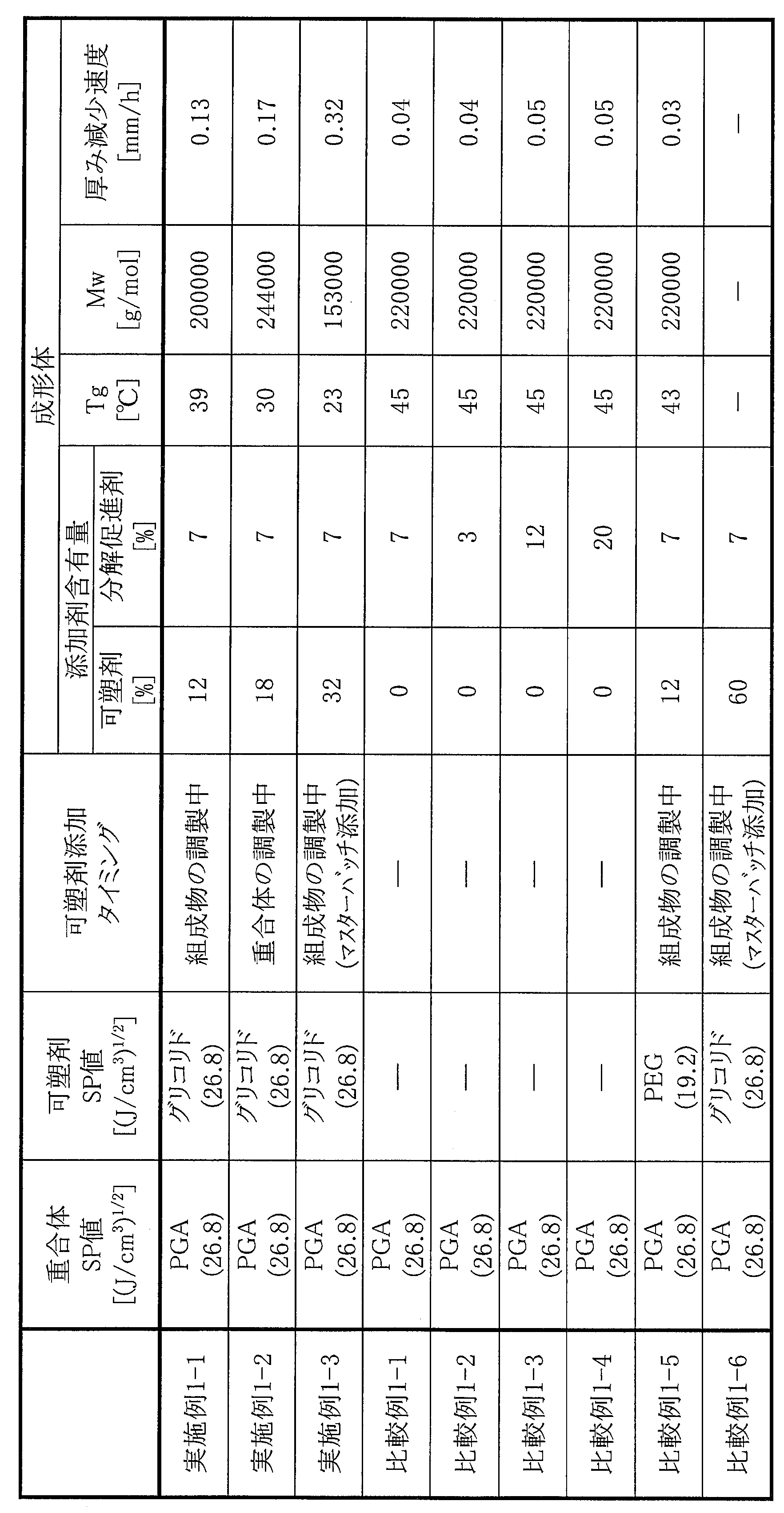
- Table 2 shows the evaluation results of Examples 1-1 to 1-3 and Comparative Examples 1-1 to 1-6.
- the glycolic acid polymers in the compositions of Examples 1-1 to 1-3 and Comparative Examples 1-1 to 1-6 are homopolymers of glycolic acid.
- the molded bodies of Examples 1-1 to 1-3 all had a high thickness reduction rate and an improved decomposition rate. Further, from the results of Examples 1-1 and 1-2, the addition of the plasticizer, even during the preparation of the polymer composition, or even during the preparation of the composition, the thickness reduction rate is high I found out. On the other hand, the molded articles of Comparative Examples 1-1 to 1-4, to which no plasticizer was added, had a slow thickness reduction rate. In addition, the molded article of Comparative Example 1-5, in which the absolute value of the difference between the SP value of the polymer and the SP value of the plasticizer was 7.6, also had a slow thickness reduction rate.
- Example 2-1 Per 100 parts by mass of glycolide, 0.03 parts by mass of tin dichloride as a catalyst and 1 part by mass of pentaerythritol tetrakis [3-(3,5-di-tert-butyl-4-hydroxyphenyl)propionate] as a heat stabilizer , and 2 parts by mass of polyethylene glycol (PEG, Mw 7500) as a polymerization initiator were charged in a polymerization vessel. The charged contents were kept under a heating condition of 140° C. for 6 hours to obtain a polymer composition 2-1. Polymer composition 2-1 contains glycolide remaining from the preparation of the polymer composition.
- PEG polyethylene glycol
- Example 1-1 a composition and a molded body were obtained in the same procedure as in Example 1-1.
- Example 2-2 A polymer composition 2-2 was obtained in the same manner as in Example 2-1, except that the charged content was kept under heating conditions of 140° C. for 3.5 hours. Polymer composition 2-2 contains glycolide remaining from the preparation of the polymer composition. Next, a composition was obtained in the same procedure as in Example 2-1, except that no plasticizer was blended. Further, a molded article was obtained in the same procedure as in Example 2-1.
- Example 2-3 A polymer composition 2-3 was obtained in the same manner as in Example 2-1, except that 0.01 part by mass of tin dichloride was used and the charged contents were kept under heating conditions of 140° C. for 3 hours. Polymer composition 2-3 contains glycolide remaining from the preparation of the polymer composition. Next, a composition was obtained in the same procedure as in Example 2-1, except that no plasticizer was blended. Further, a molded article was obtained in the same procedure as in Example 2-1.
- Example 2-4 A polymer composition was prepared in the same manner as in Example 2-1, except that polycaprolactone (PCL, Mw 4000) was charged instead of PEG as a polymerization initiator, and the charged contents were held under heating conditions of 140 ° C. for 3 hours. I got product 2-4. Polymer Compositions 2-4 contain glycolide remaining from the preparation of the polymer composition. Next, a composition and a molded article were obtained in the same procedure as in Example 2-1.
- PCL polycaprolactone
- Example 2-5 Polymerization was carried out in the same manner as in Example 2-1, except that polycaprolactone (PCL, Mw 4000) was charged instead of PEG as the polymerization initiator, and the charged contents were held under heating conditions of 140 ° C. for 1.5 hours. A combined composition 2-5 was obtained. Polymer Compositions 2-5 contain glycolide remaining from the preparation of the polymer composition. Next, a composition and a molded article were obtained in the same manner as in Example 2-2, except that no plasticizer was blended.
- PCL polycaprolactone
- Example 2-6 instead of PEG as a polymerization initiator, polytetraethylene ether glycol (PTMG, Mw 3000) was charged, and the charged contents were held under heating conditions of 140 ° C. for 3 hours. A polymer composition 2-6 was obtained. Polymer compositions 2-6 contain glycolide remaining from the preparation of the polymer composition. Next, a composition and a molded article were obtained in the same procedure as in Example 2-1.
- PTMG polytetraethylene ether glycol
- Example 2-7 instead of PEG as a polymerization initiator, polytetraethylene ether glycol (PTMG, Mw 3000) was charged, and the charged contents were held under heating conditions of 140 ° C. for 1.5 hours. The procedure provided polymer compositions 2-7. Polymer compositions 2-6 contain glycolide remaining from the preparation of the polymer composition. Next, a composition and a molded article were obtained in the same manner as in Example 2-2, except that no plasticizer was blended.
- PTMG polytetraethylene ether glycol
- Example 2-1 A composition and a molded article were obtained in the same manner as in Example 2-2, except that the decomposition accelerator was not added to the polymer composition 2-2.
- Example 2-2 A composition and a molded article were obtained in the same manner as in Example 2-1, except that the polymer composition 2-1 did not contain a plasticizer.
- Example 2-3 A composition and a molded article were obtained in the same manner as in Example 2-4, except that the polymer composition 2-4 did not contain a plasticizer.
- Example 2-4 A composition and a molded article were obtained in the same manner as in Example 2-6, except that the polymer composition 2-6 did not contain a plasticizer.
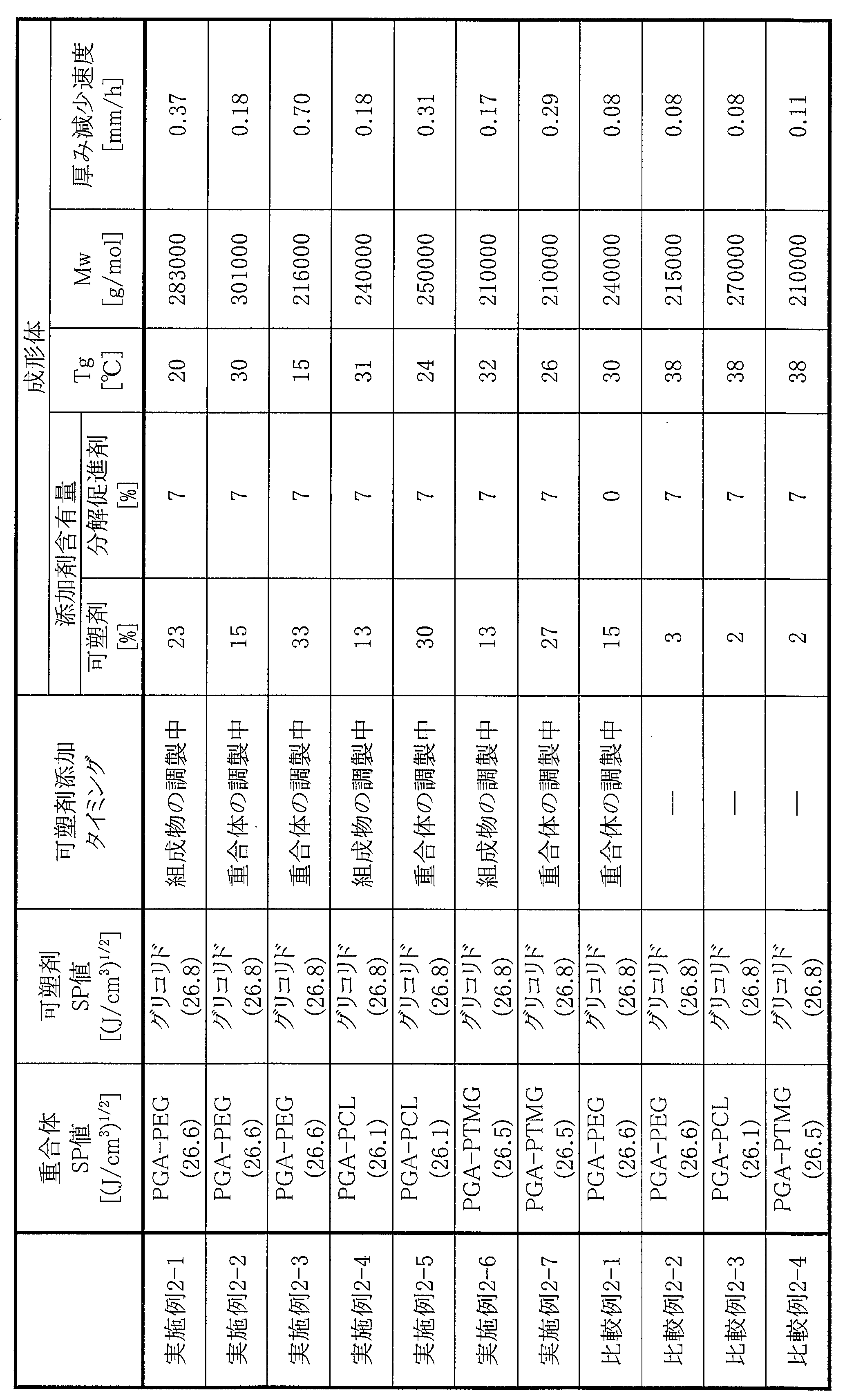
- Table 3 shows the evaluation results of Examples 2-1 to 2-7 and Comparative Examples 2-1 to 2-4.
- the glycolic acid polymer in the compositions of Examples 2-1 to 2-7 and Comparative Examples 2-1 to 2-4 consisted of a glycolic acid polymer chain (polymer chain A) and polyethylene glycol or the like (polymer chain B ) is a block copolymer with
- Examples 2-1 to 2-7 had a high thickness reduction rate and an improved decomposition rate. Further, from the results of Examples 2-1 to 2-3, Examples 2-4 to 2-5, and Examples 2-6 to 2-7, the addition of the plasticizer was during the preparation of the polymer composition. It was found that the rate of thickness reduction was high both during the preparation of the composition and during the preparation of the composition.
- the molded body of Comparative Example 2-1 to which no decomposition accelerator was added, had a slow thickness reduction rate.
- the molded articles of Comparative Examples 2-2 to 2-4 in which the content of the plasticizer (glycolide remaining in the preparation of the polymer composition) was 2 or 3% by mass, also had a slow thickness reduction rate.
- Example 2-2 Comparative Examples 2-1 and 2-2, it was found that a synergistic effect was exhibited by adding both the decomposition accelerator and the plasticizer. rice field.
- Example 3-1 A composition and a molded article were obtained in the same manner as in Example 2-2, except that triacetin (TrA) was added as a plasticizer to the polymer composition 2-2.
- TrA triacetin
- Example 3-2 A composition and a molded article were produced in the same manner as in Example 3-1, except that an adipate ester, DAIFATTY (registered trademark)-101 (manufactured by Daihachi Kogyo Co., Ltd.), was blended instead of TrA as a plasticizer. Obtained.
- Example 3-3 A composition and a molded article were obtained in the same manner as in Example 3-1, except that ethylene carbonate (EC) was added as a plasticizer instead of TrA.
- EC ethylene carbonate
- Example 3-4 A composition and a molded article were obtained in the same manner as in Example 3-1, except that dimethyl phthalate (DMP) was added as a plasticizer instead of TrA.
- DMP dimethyl phthalate
- Example 3-5 A composition and a molded article were obtained in the same manner as in Example 3-1, except that polyethylene glycol (PEG, Mw 20000) was added as a plasticizer instead of TrA.
- PEG polyethylene glycol
- the glycolic acid polymer in the compositions of Examples 3-1 to 3-5 is a block copolymer of a glycolic acid polymer chain (polymer chain A) and polyethylene glycol or the like (polymer chain B).
- the polymer compositions of Examples 3-1 to 3-5 contain glycolide remaining during preparation of the polymer compositions.
- the compact of the present invention has a high decomposition rate and can be used, for example, as a downhole tool for well drilling.
Landscapes
- Chemical & Material Sciences (AREA)
- Organic Chemistry (AREA)
- Polymers & Plastics (AREA)
- Medicinal Chemistry (AREA)
- Chemical Kinetics & Catalysis (AREA)
- Health & Medical Sciences (AREA)
- Life Sciences & Earth Sciences (AREA)
- Engineering & Computer Science (AREA)
- Geology (AREA)
- Mining & Mineral Resources (AREA)
- Fluid Mechanics (AREA)
- Geochemistry & Mineralogy (AREA)
- General Life Sciences & Earth Sciences (AREA)
- Physics & Mathematics (AREA)
- Environmental & Geological Engineering (AREA)
- Compositions Of Macromolecular Compounds (AREA)
- Extrusion Moulding Of Plastics Or The Like (AREA)
- Biological Depolymerization Polymers (AREA)
Abstract
Description
本実施形態に係る成形体は、グリコール酸重合体と、可塑剤と、分解促進剤とを含む組成物からなる。
本明細書において、グリコール酸重合体は、グリコール酸由来の繰り返し単位(-(-O-CH2-CO-)-)を含むポリマーを示す。グリコール酸重合体はグリコール酸の単独重合体(ポリグリコール酸(PGA))であってもよい。また、グリコール酸重合体はグリコール酸由来の繰り返し単位と他の単量体由来の繰り返し単位とを含む共重合体であってもよい。
グリコール酸共重合体は、分解速度向上の点で、グリコール酸由来の繰り返し単位からなる直鎖状の高分子鎖Aが、該高分子鎖Aとは異なる高分子鎖Bに2以上化学結合してなる共重合体であってもよい。高分子鎖Aおよび高分子鎖Bについては後述する。
高分子鎖Aの例として、グリコール酸単位からなる直鎖状の高分子鎖が挙げられる。グリコール酸共重合体中の高分子鎖Aの1ブロックを構成するグリコール酸単位の数は特に限定されず、グリコール酸共重合体が高分子鎖Aに由来する分解性を発現できる範囲において、適宜決定することができる。
高分子鎖Bは、高分子鎖Aとは異なる高分子鎖である。例えば、高分子鎖Bは、ガラス転移温度(Tg)が45℃未満である高分子化合物に由来する高分子鎖であってもよい。また、高分子鎖Bは、重量平均分子量が1500以上250000以下である高分子化合物に由来する高分子鎖であってもよい。
本明細書において、可塑剤とは、グリコール酸重合体を含む組成物のガラス転移温度(Tg)を低下させ、組成物に可塑性を付与する剤(化合物)を示す。可塑剤の例としてエステルまたはエステル誘導体等が挙げられる。エステルまたはエステル誘導体の例として、グリコリド等の環状エステル;トリアセチン等の脂肪酸エステル誘導体;アジピン酸エステル等の脂肪族二塩基酸エステル;フタル酸ジメチル等のフタル酸エステル;エチレンカーボネート等の炭酸エステル;芳香族カルボン酸エステル;等が挙げられる。可塑剤は1種を単独で使用してもよいし、2種以上を併用してもよい。
上記組成物における可塑剤の含有量は、後述する分解促進剤の含有量より多いことが好ましい。
本明細書において、分解促進剤とは、グリコール酸重合体を含む組成物の加水分解反応を促進する剤(化合物)を示す。分解促進剤の例として、カルボン酸無水物およびリン化合物等が挙げられる。分解促進剤は1種を単独で使用してもよいし、2種以上を併用してもよい。
本実施形態に係る組成物において、可塑剤のFedorsの溶解度パラメータと、グリコール酸重合体のFedorsの溶解度パラメータとの差の絶対値は6(J/cm3)1/2以下であり、好ましくは5.5(J/cm3)1/2以下であり、より好ましくは5(J/cm3)1/2以下である。以下、「Fedorsの溶解度パラメータ」を「SP値」と略記する場合がある。可塑剤のSP値とグリコール酸重合体のSP値との差の絶対値が上記範囲であることによって、組成物は十分な可塑性を有する。
δ=(ΣEcoh/ΣV)1/2 ・・・ (1)
式(1)中、ΣEcohは、Ecoh(対象化合物の構成単位の凝集エネルギー密度(cal/cm3))の総和;ΣVは、V(対象化合物の構成単位のモル分子容(cm3))を示す。
上記組成物の重量平均分子量(Mw)は、成形体の強度が維持できる点および押出成形の点等で、15万以上が好ましく、16万以上がより好ましく、17万以上がさらに好ましい。また、押出成形時または射出成形時の成形が容易となる点等で、当該組成物のMwは、50万以下が好ましく、45万以下がより好ましく、40万以下がさらに好ましい。
上記組成物には、グリコール酸重合体、可塑剤および分解促進剤の他に、本発明の目的に反しない範囲で、その他の成分が含まれていてもよい。
本実施形態に係る成形体は、上記組成物を成形することによって得ることができる。成形方法は限定されず、その例には、射出成形、溶融押出成形、固化押出成形、圧縮成形(プレス成形)および遠心成形が含まれる。
本実施形態に係るダウンホールツール部材は、石油およびガス等の炭化水素資源を地中から回収するための地下掘削に用いられる部材であり、上記成形体からなる。成形体をそのままダウンホールツール部材として用いてもよいし、従来公知の機械加工(二次加工)を施してダウンホールツール部材を製造してもよい。機械加工の例として、切削加工が挙げられる。
本実施形態に係るダウンホールツールは、ダウンホールツール部材を含む。本明細書において、坑井の掘削、坑井の閉塞およびフラクチャリング等の各種坑井処理に用いられ、坑井内に設置される装置またはその部材をダウンホールツールと称する。ダウンホールツールの形状は、特に限定されず、例えば従来知られている形状にすることができる。ダウンホールツールの例には、フラックプラグ、ブリッジプラグ、セメントリテイナー、パーフォレーションガン、ボールシーラー、目止めプラグ、およびパッカー、が含まれる。
本実施形態に係る成形体は、グリコール酸重合体と、可塑剤と、分解促進剤とを含む組成物からなり、前記可塑剤のFedorsの溶解度パラメータと、前記グリコール酸重合体のFedorsの溶解度パラメータとの差の絶対値が6(J/cm3)1/2以下であり、前記組成物における前記可塑剤の含有量が10質量%以上50質量%以下である。
山本秀樹著「SP値 基礎・応用と計算方法」((株)情報機構発行(2005年)第66~67頁)を参照してSP値の測定を行った。より具体的には、下記式(1)に従い、対象化合物(グリコール酸重合体または可塑剤)のSP値δ((cal/cm3)1/2)を計算した。
δ=(ΣEcoh/ΣV)1/2 ・・・ (1)
式(1)中、ΣEcohは、Ecoh(対象化合物の構成単位の凝集エネルギー密度(cal/cm3))の総和;ΣVは、V(対象化合物の構成単位のモル分子容(cm3))を示す。

実施例および比較例で得られた組成物および成形体について、以下の評価を行った。
約10mgのサンプルを0.5mLのDMSOで150℃において加熱溶解し、室温まで冷却させた。冷却した溶液をヘキサフルオロイソプロパノール(HFIP)で10mLにメスアップして、GPC装置によって組成物の重量平均分子量の測定を行った。標準物質としてポリメチルメタクリレート(PMMA)を用いた。測定条件を以下に示す。
装置:shodexGPC-104(検出器:RI、カラム:HFIP-606M 2本)
溶媒:5mMのCF3COONaを含むHFIP
約100mgのサンプルに、p-クロロベンゾフェノン含有DMSO(0.4mg/2mL)を加え、150℃において約10分で加熱溶解させた。室温まで冷却した後、溶液をろ過した。得られたろ液のガスクロマトグラフィ(GC)測定を行った。測定条件を以下に示す。
装置:島津製作所GC-2010
カラム:RESTEK Rxi-5ms
カラム温度:150℃にて5分間保持→(20℃/分で昇温)→270℃にて3分間保持
インジェクション温度:180℃
測定用パンに約10mgのサンプルを入れて、ガラス転移温度の測定を、示差走査熱量(DSC)測定によって行った。測定条件は以下に示す。
装置:メトラー・トレドDSC3+
カラム温度:-50℃にて5分間保持→(20℃/分で昇温)→250℃にて3分間保持
ガス:N2
成形体について、一辺が10mmの立方体の試験片を所要数調製した。次いで、温度66℃の1Lのオートクレーブ中に、試験片を入れた。そして、オートクレーブに水(脱イオン水)を満たして浸漬試験を行った。所定時間間隔で浸漬後の試験片を取り出し、切断して断面を露出させた。そして、ドライルーム内で一晩放置して乾燥させた後、試験片の芯部(硬い部分)の厚みを測定した。浸漬前の厚み(当初厚み、具体的には10mmである。)との差から減少厚みを測定した。異なる浸漬時間により測定した試験片の減少厚みの測定値に基づいて、試験片の減少厚みの時間変化を求めた。そして、試験片の減少厚みの時間変化に直線性が認められる範囲における試験片の減少厚みの時間変化から、厚み10mmの試験片の厚み減少速度を算出した(単位:mm/h)。
グリコリド100質量部に対して、触媒として二塩化スズ0.003質量部、重合開始剤として1-ドデカノール0.3質量部を重合容器に仕込んだ。仕込み内容物を170℃の加熱条件下で2時間保持し、重合体組成物1-1を得た。重合体組成物1-1にはグリコリドは含まれていない。
重合容器に仕込んだ仕込み内容物の加熱条件を150℃に変更した以外は、実施例1-1と同様の手順で重合体組成物1-2を得た。重合体組成物1-2には重合体組成物調製時に残存したグリコリドが含まれている。
重合体組成物1-1に、可塑剤としてグリコリドに代えて、グリコリドを48質量部含有したポリグリコール酸重合体のマスターバッチを配合した以外は実施例1-1と同様にして、組成物を得た。また、実施例1-1と同様の手順で、成形体を得た。
重合体組成物1-1に可塑剤を配合しなかった以外は、実施例1-1と同様の手順で組成物および成形体を得た。
分解促進剤の量を変更した以外は、比較例1-1と同様の手順で組成物および成形体を得た。比較例1-2~1-4の分解促進剤の含有量は表2に示す。
重合体組成物1-1に、可塑剤としてグリコリドに代えてポリエチレングリコール(PEG、Mw20000)を配合した以外は、実施例1-1と同様の手順で組成物および成形体を得た。
グリコリドを48質量部含有したポリグリコール酸重合体のマスターバッチの配合量を増やした以外は、実施例1-3と同様にして組成物を得た。この組成物における可塑剤としてのグリコリドの含有量は60質量%に相当する。この組成物は押出成形ができず、ペレットが得られなかった。
グリコリド100質量部に対して、触媒として二塩化スズ0.03質量部、熱安定剤としてペンタエリトリトールテトラキス[3-(3,5-ジ-tert-ブチル-4-ヒドロキシフェニル)プロピオナート]1質量部、重合開始剤としてポリエチレングリコール(PEG、Mw7500)2質量部を重合容器に仕込んだ。仕込み内容物を140℃の加熱条件下で6時間保持し、重合体組成物2-1を得た。重合体組成物2-1には重合体組成物調製時に残存したグリコリドが含まれている。
仕込み内容物を140℃の加熱条件下で3.5時間保持した以外は、実施例2-1と同様の手順で重合体組成物2-2を得た。重合体組成物2-2には重合体組成物調製時に残存したグリコリドが含まれている。次に、可塑剤を配合しなかった以外は、実施例2-1と同様の手順で組成物を得た。また、実施例2-1と同様の手順で、成形体を得た。
二塩化スズ0.01質量部とし、仕込み内容物を140℃の加熱条件下で3時間保持した以外は、実施例2-1と同様の手順で重合体組成物2-3を得た。重合体組成物2-3には重合体組成物調製時に残存したグリコリドが含まれている。次に、可塑剤を配合しなかった以外は、実施例2-1と同様の手順で組成物を得た。また、実施例2-1と同様の手順で、成形体を得た。
重合開始剤としてPEGに代えて、ポリカプロラクトン(PCL、Mw4000)を仕込み、仕込み内容物を140℃の加熱条件下で3時間保持した以外は、実施例2-1と同様の手順で重合体組成物2-4を得た。重合体組成物2-4には重合体組成物調製時に残存したグリコリドが含まれている。次に、実施例2-1と同様の手順で組成物および成形体を得た。
重合開始剤としてPEGに代えて、ポリカプロラクトン(PCL、Mw4000)を仕込み、仕込み内容物を140℃の加熱条件下で1.5時間保持した以外は、実施例2-1と同様の手順で重合体組成物2-5を得た。重合体組成物2-5には重合体組成物調製時に残存したグリコリドが含まれている。次に、可塑剤を配合しなかった以外は、実施例2-2と同様の手順で組成物および成形体を得た。
重合開始剤としてPEGに代えて、ポリテトラエチレンエーテルグリコール(PTMG、Mw3000)を仕込み、仕込み内容物を140℃の加熱条件下で3時間保持した以外は、実施例2-1と同様の手順で重合体組成物2-6を得た。重合体組成物2-6には重合体組成物調製時に残存したグリコリドが含まれている。次に、実施例2-1と同様の手順で組成物および成形体を得た。
重合開始剤としてPEGに代えて、ポリテトラエチレンエーテルグリコール(PTMG、Mw3000)を仕込み、仕込み内容物を140℃の加熱条件下で1.5時間保持した以外は、実施例2-1と同様の手順で重合体組成物2-7を得た。重合体組成物2-6には重合体組成物調製時に残存したグリコリドが含まれている。次に、可塑剤を配合しなかった以外は、実施例2-2と同様の手順で組成物および成形体を得た。
重合体組成物2-2に分解促進剤を配合しなかった以外は、実施例2-2と同様の手順で組成物および成形体を得た。
重合体組成物2-1に可塑剤を配合しなかった以外は、実施例2-1と同様の手順で組成物および成形体を得た。
重合体組成物2-4に可塑剤を配合しなかった以外は、実施例2-4と同様の手順で組成物および成形体を得た。
重合体組成物2-6に可塑剤を配合しなかった以外は、実施例2-6と同様の手順で組成物および成形体を得た。
重合体組成物2-2に、可塑剤としてトリアセチン(TrA)を配合した以外は、実施例2-2と同様の手順で組成物および成形体を得た。
可塑剤としてTrAの代わりに、アジピン酸エステルであるDAIFATTY(登録商標)-101(大八工業株式会社製)を配合した以外は、実施例3-1と同様の手順で組成物および成形体を得た。
可塑剤としてTrAの代わりに、エチレンカーボネート(EC)を配合した以外は、実施例3-1と同様の手順で組成物および成形体を得た。
可塑剤としてTrAの代わりに、フタル酸ジメチル(DMP)を配合した以外は、実施例3-1と同様の手順で組成物および成形体を得た。
可塑剤としてTrAの代わりに、ポリエチレングリコール(PEG、Mw20000)を配合した以外は、実施例3-1と同様の手順で組成物および成形体を得た。

Claims (9)
- グリコール酸重合体と、可塑剤と、分解促進剤とを含む組成物からなり、
前記可塑剤のFedorsの溶解度パラメータと、前記グリコール酸重合体のFedorsの溶解度パラメータとの差の絶対値が6(J/cm3)1/2以下であり、
前記組成物における前記可塑剤の含有量が10質量%以上50質量%以下である、成形体。 - 前記グリコール酸重合体が、グリコール酸由来の繰り返し単位からなる直鎖状の高分子鎖Aが、該高分子鎖Aとは異なる高分子鎖Bに化学結合してなる共重合体であり、
前記高分子鎖Bが、ガラス転移温度が45℃未満である高分子化合物由来である、請求項1に記載の成形体。 - 前記グリコール酸重合体が、上記高分子鎖Aと上記高分子鎖Bとのブロック共重合体である、請求項2に記載の成形体。
- 前記グリコール酸重合体がグリコール酸の単独重合体である、請求項1に記載の成形体。
- 前記組成物の重量平均分子量が15万以上50万以下である、請求項1~4のいずれか1項に記載の成形体。
- 前記分解促進剤がカルボン酸無水物である、請求項1~5のいずれか1項に記載の成形体。
- 厚みまたは直径が1mm以上である、請求項1~6のいずれか1項に記載の成形体。
- 請求項1~7のいずれか1項に記載の成形体からなる、ダウンホールツール部材。
- 請求項8に記載のダウンホールツール部材を含む、ダウンホールツール。
Priority Applications (4)
| Application Number | Priority Date | Filing Date | Title |
|---|---|---|---|
| EP22780105.7A EP4317286A4 (en) | 2021-03-30 | 2022-03-16 | MOULDED BODY, DRILLING TOOL ELEMENT AND DRILLING TOOL |
| US18/552,349 US20240166848A1 (en) | 2021-03-30 | 2022-03-16 | Molded body, downhole tool member, and downhole tool |
| CA3213362A CA3213362C (en) | 2021-03-30 | 2022-03-16 | Molded body, downhole tool member, and downhole tool |
| CN202280017633.6A CN116917411B (zh) | 2021-03-30 | 2022-03-16 | 成型体、井下工具构件以及井下工具 |
Applications Claiming Priority (2)
| Application Number | Priority Date | Filing Date | Title |
|---|---|---|---|
| JP2021058739 | 2021-03-30 | ||
| JP2021-058739 | 2021-03-30 |
Publications (1)
| Publication Number | Publication Date |
|---|---|
| WO2022209885A1 true WO2022209885A1 (ja) | 2022-10-06 |
Family
ID=83459075
Family Applications (1)
| Application Number | Title | Priority Date | Filing Date |
|---|---|---|---|
| PCT/JP2022/011783 Ceased WO2022209885A1 (ja) | 2021-03-30 | 2022-03-16 | 成形体、ダウンホールツール部材およびダウンホールツール |
Country Status (4)
| Country | Link |
|---|---|
| US (1) | US20240166848A1 (ja) |
| EP (1) | EP4317286A4 (ja) |
| CN (1) | CN116917411B (ja) |
| WO (1) | WO2022209885A1 (ja) |
Cited By (2)
| Publication number | Priority date | Publication date | Assignee | Title |
|---|---|---|---|---|
| WO2024204507A1 (ja) * | 2023-03-30 | 2024-10-03 | 株式会社クレハ | ケース、プローブ、および情報取得方法 |
| WO2024203809A1 (ja) * | 2023-03-28 | 2024-10-03 | 株式会社クレハ | 成形体、ダウンホールツール部材およびダウンホールツール |
Citations (6)
| Publication number | Priority date | Publication date | Assignee | Title |
|---|---|---|---|---|
| JPH06500819A (ja) * | 1990-09-11 | 1994-01-27 | イー・アイ・デュポン・ドゥ・ヌムール・アンド・カンパニー | ポリヒドロキシ酸と相溶化剤を含有するフィルム |
| JP2002371173A (ja) * | 2001-06-13 | 2002-12-26 | Mitsui Chemicals Inc | 溶出制御された農薬含有樹脂組成物 |
| US20050205266A1 (en) | 2004-03-18 | 2005-09-22 | Todd Bradley I | Biodegradable downhole tools |
| JP2007217602A (ja) * | 2006-02-17 | 2007-08-30 | Kureha Corp | 低温延伸可能なポリグリコール酸樹脂組成物およびその延伸フィルムの製造方法 |
| JP2019060219A (ja) | 2017-09-22 | 2019-04-18 | 株式会社クレハ | ダウンホールツール部材及びその製造方法 |
| JP2020002189A (ja) * | 2018-06-25 | 2020-01-09 | 株式会社クレハ | ポリグリコール酸樹脂組成物の製造方法 |
Family Cites Families (1)
| Publication number | Priority date | Publication date | Assignee | Title |
|---|---|---|---|---|
| US5502158A (en) * | 1988-08-08 | 1996-03-26 | Ecopol, Llc | Degradable polymer composition |
-
2022
- 2022-03-16 CN CN202280017633.6A patent/CN116917411B/zh active Active
- 2022-03-16 WO PCT/JP2022/011783 patent/WO2022209885A1/ja not_active Ceased
- 2022-03-16 EP EP22780105.7A patent/EP4317286A4/en active Pending
- 2022-03-16 US US18/552,349 patent/US20240166848A1/en active Pending
Patent Citations (6)
| Publication number | Priority date | Publication date | Assignee | Title |
|---|---|---|---|---|
| JPH06500819A (ja) * | 1990-09-11 | 1994-01-27 | イー・アイ・デュポン・ドゥ・ヌムール・アンド・カンパニー | ポリヒドロキシ酸と相溶化剤を含有するフィルム |
| JP2002371173A (ja) * | 2001-06-13 | 2002-12-26 | Mitsui Chemicals Inc | 溶出制御された農薬含有樹脂組成物 |
| US20050205266A1 (en) | 2004-03-18 | 2005-09-22 | Todd Bradley I | Biodegradable downhole tools |
| JP2007217602A (ja) * | 2006-02-17 | 2007-08-30 | Kureha Corp | 低温延伸可能なポリグリコール酸樹脂組成物およびその延伸フィルムの製造方法 |
| JP2019060219A (ja) | 2017-09-22 | 2019-04-18 | 株式会社クレハ | ダウンホールツール部材及びその製造方法 |
| JP2020002189A (ja) * | 2018-06-25 | 2020-01-09 | 株式会社クレハ | ポリグリコール酸樹脂組成物の製造方法 |
Non-Patent Citations (1)
| Title |
|---|
| See also references of EP4317286A4 |
Cited By (2)
| Publication number | Priority date | Publication date | Assignee | Title |
|---|---|---|---|---|
| WO2024203809A1 (ja) * | 2023-03-28 | 2024-10-03 | 株式会社クレハ | 成形体、ダウンホールツール部材およびダウンホールツール |
| WO2024204507A1 (ja) * | 2023-03-30 | 2024-10-03 | 株式会社クレハ | ケース、プローブ、および情報取得方法 |
Also Published As
| Publication number | Publication date |
|---|---|
| US20240166848A1 (en) | 2024-05-23 |
| EP4317286A4 (en) | 2025-03-19 |
| EP4317286A1 (en) | 2024-02-07 |
| CN116917411A (zh) | 2023-10-20 |
| CA3213362A1 (en) | 2022-10-06 |
| CN116917411B (zh) | 2026-02-03 |
Similar Documents
| Publication | Publication Date | Title |
|---|---|---|
| CA2898412C (en) | Well treatment fluid material and well treatment fluid comprising the same | |
| KR101582807B1 (ko) | 혼합 조성물, 유연한 튜브 재료 및 그 혼합물의 제조 방법 | |
| JP7397086B2 (ja) | 縮合ポリマーの制御された分解促進のための添加剤組成物の使用 | |
| CN101484528A (zh) | 脂肪族聚酯组合物及其制造方法 | |
| EP4032954B1 (en) | Biopolymer composition, preparation method for same and bioplastic using same | |
| KR101651319B1 (ko) | 높은 변형성을 갖는 생분해성 중합체 조성물 | |
| WO2022209885A1 (ja) | 成形体、ダウンホールツール部材およびダウンホールツール | |
| JP3882590B2 (ja) | 乳酸系ポリマー組成物及びその成形体 | |
| KR20150123153A (ko) | 수지용 폴리에스테르계 가소제 | |
| JP2009040917A (ja) | ポリグリコール酸樹脂組成物、その製造方法およびその成形物 | |
| JP3860163B2 (ja) | 脂肪族ポリエステル樹脂組成物及びフィルム | |
| CA3213362C (en) | Molded body, downhole tool member, and downhole tool | |
| WO2023228557A1 (ja) | 成形体、ダウンホールツール部材およびダウンホールツール | |
| JP2009242520A (ja) | ポリ乳酸樹脂組成物及びそれを成形してなる成形品 | |
| EP4317285B1 (en) | Glycolic acid copolymer composition and solidification/extrusion-molded article | |
| JP4241242B2 (ja) | 脂肪族ポリエステル組成物及びその成形体 | |
| WO2024203809A1 (ja) | 成形体、ダウンホールツール部材およびダウンホールツール | |
| KR102868075B1 (ko) | 통기성 필름용 생분해성 수지 조성물 및 이를 포함하는 통기성 필름 | |
| KR20260042960A (ko) | 생분해성 수지 조성물, 이의 제조 방법 및 이를 포함하는 생분해성 성형품 | |
| KR20250171112A (ko) | 생분해성 수지 조성물 | |
| KR20260043391A (ko) | 생분해성 수지 조성물, 이의 제조 방법 및 이를 포함하는 생분해성 성형품 | |
| KR20250071167A (ko) | 생분해성 수지 조성물 및 이를 포함하는 생분해성 성형품 | |
| KR20260032815A (ko) | 사출용 생분해성 수지 조성물 및 이를 포함하는 옷걸이 | |
| KR20250020901A (ko) | 생분해성 수지 조성물 및 이를 포함하는 생분해성 성형품 | |
| TW202519583A (zh) | 可生物降解的樹脂組合物和可生物降解的成型製品 |
Legal Events
| Date | Code | Title | Description |
|---|---|---|---|
| 121 | Ep: the epo has been informed by wipo that ep was designated in this application |
Ref document number: 22780105 Country of ref document: EP Kind code of ref document: A1 |
|
| WWE | Wipo information: entry into national phase |
Ref document number: 202280017633.6 Country of ref document: CN |
|
| WWE | Wipo information: entry into national phase |
Ref document number: 18552349 Country of ref document: US Ref document number: 3213362 Country of ref document: CA |
|
| WWE | Wipo information: entry into national phase |
Ref document number: 2022780105 Country of ref document: EP |
|
| NENP | Non-entry into the national phase |
Ref country code: DE |
|
| ENP | Entry into the national phase |
Ref document number: 2022780105 Country of ref document: EP Effective date: 20231030 |
|
| NENP | Non-entry into the national phase |
Ref country code: JP |