WO2022210407A1 - ランダム共重合体およびその製造方法 - Google Patents
ランダム共重合体およびその製造方法 Download PDFInfo
- Publication number
- WO2022210407A1 WO2022210407A1 PCT/JP2022/014608 JP2022014608W WO2022210407A1 WO 2022210407 A1 WO2022210407 A1 WO 2022210407A1 JP 2022014608 W JP2022014608 W JP 2022014608W WO 2022210407 A1 WO2022210407 A1 WO 2022210407A1
- Authority
- WO
- WIPO (PCT)
- Prior art keywords
- group
- atom
- repeating units
- ring
- random copolymer
- Prior art date
- Legal status (The legal status is an assumption and is not a legal conclusion. Google has not performed a legal analysis and makes no representation as to the accuracy of the status listed.)
- Ceased
Links
Classifications
-
- C—CHEMISTRY; METALLURGY
- C08—ORGANIC MACROMOLECULAR COMPOUNDS; THEIR PREPARATION OR CHEMICAL WORKING-UP; COMPOSITIONS BASED THEREON
- C08G—MACROMOLECULAR COMPOUNDS OBTAINED OTHERWISE THAN BY REACTIONS ONLY INVOLVING UNSATURATED CARBON-TO-CARBON BONDS
- C08G61/00—Macromolecular compounds obtained by reactions forming a carbon-to-carbon link in the main chain of the macromolecule
- C08G61/02—Macromolecular compounds containing only carbon atoms in the main chain of the macromolecule, e.g. polyxylylenes
- C08G61/04—Macromolecular compounds containing only carbon atoms in the main chain of the macromolecule, e.g. polyxylylenes only aliphatic carbon atoms
- C08G61/06—Macromolecular compounds containing only carbon atoms in the main chain of the macromolecule, e.g. polyxylylenes only aliphatic carbon atoms prepared by ring-opening of carbocyclic compounds
- C08G61/08—Macromolecular compounds containing only carbon atoms in the main chain of the macromolecule, e.g. polyxylylenes only aliphatic carbon atoms prepared by ring-opening of carbocyclic compounds of carbocyclic compounds containing one or more carbon-to-carbon double bonds in the ring
-
- C—CHEMISTRY; METALLURGY
- C08—ORGANIC MACROMOLECULAR COMPOUNDS; THEIR PREPARATION OR CHEMICAL WORKING-UP; COMPOSITIONS BASED THEREON
- C08L—COMPOSITIONS OF MACROMOLECULAR COMPOUNDS
- C08L65/00—Compositions of macromolecular compounds obtained by reactions forming a carbon-to-carbon link in the main chain; Compositions of derivatives of such polymers
-
- C—CHEMISTRY; METALLURGY
- C09—DYES; PAINTS; POLISHES; NATURAL RESINS; ADHESIVES; COMPOSITIONS NOT OTHERWISE PROVIDED FOR; APPLICATIONS OF MATERIALS NOT OTHERWISE PROVIDED FOR
- C09D—COATING COMPOSITIONS, e.g. PAINTS, VARNISHES OR LACQUERS; FILLING PASTES; CHEMICAL PAINT OR INK REMOVERS; INKS; CORRECTING FLUIDS; WOODSTAINS; PASTES OR SOLIDS FOR COLOURING OR PRINTING; USE OF MATERIALS THEREFOR
- C09D165/00—Coating compositions based on macromolecular compounds obtained by reactions forming a carbon-to-carbon link in the main chain; Coating compositions based on derivatives of such polymers
-
- C—CHEMISTRY; METALLURGY
- C08—ORGANIC MACROMOLECULAR COMPOUNDS; THEIR PREPARATION OR CHEMICAL WORKING-UP; COMPOSITIONS BASED THEREON
- C08G—MACROMOLECULAR COMPOUNDS OBTAINED OTHERWISE THAN BY REACTIONS ONLY INVOLVING UNSATURATED CARBON-TO-CARBON BONDS
- C08G2261/00—Macromolecular compounds obtained by reactions forming a carbon-to-carbon link in the main chain of the macromolecule
- C08G2261/10—Definition of the polymer structure
- C08G2261/12—Copolymers
- C08G2261/122—Copolymers statistical
-
- C—CHEMISTRY; METALLURGY
- C08—ORGANIC MACROMOLECULAR COMPOUNDS; THEIR PREPARATION OR CHEMICAL WORKING-UP; COMPOSITIONS BASED THEREON
- C08G—MACROMOLECULAR COMPOUNDS OBTAINED OTHERWISE THAN BY REACTIONS ONLY INVOLVING UNSATURATED CARBON-TO-CARBON BONDS
- C08G2261/00—Macromolecular compounds obtained by reactions forming a carbon-to-carbon link in the main chain of the macromolecule
- C08G2261/30—Monomer units or repeat units incorporating structural elements in the main chain
- C08G2261/33—Monomer units or repeat units incorporating structural elements in the main chain incorporating non-aromatic structural elements in the main chain
- C08G2261/332—Monomer units or repeat units incorporating structural elements in the main chain incorporating non-aromatic structural elements in the main chain containing only carbon atoms
-
- C—CHEMISTRY; METALLURGY
- C08—ORGANIC MACROMOLECULAR COMPOUNDS; THEIR PREPARATION OR CHEMICAL WORKING-UP; COMPOSITIONS BASED THEREON
- C08G—MACROMOLECULAR COMPOUNDS OBTAINED OTHERWISE THAN BY REACTIONS ONLY INVOLVING UNSATURATED CARBON-TO-CARBON BONDS
- C08G2261/00—Macromolecular compounds obtained by reactions forming a carbon-to-carbon link in the main chain of the macromolecule
- C08G2261/30—Monomer units or repeat units incorporating structural elements in the main chain
- C08G2261/33—Monomer units or repeat units incorporating structural elements in the main chain incorporating non-aromatic structural elements in the main chain
- C08G2261/332—Monomer units or repeat units incorporating structural elements in the main chain incorporating non-aromatic structural elements in the main chain containing only carbon atoms
- C08G2261/3324—Monomer units or repeat units incorporating structural elements in the main chain incorporating non-aromatic structural elements in the main chain containing only carbon atoms derived from norbornene
-
- C—CHEMISTRY; METALLURGY
- C08—ORGANIC MACROMOLECULAR COMPOUNDS; THEIR PREPARATION OR CHEMICAL WORKING-UP; COMPOSITIONS BASED THEREON
- C08G—MACROMOLECULAR COMPOUNDS OBTAINED OTHERWISE THAN BY REACTIONS ONLY INVOLVING UNSATURATED CARBON-TO-CARBON BONDS
- C08G2261/00—Macromolecular compounds obtained by reactions forming a carbon-to-carbon link in the main chain of the macromolecule
- C08G2261/40—Polymerisation processes
- C08G2261/41—Organometallic coupling reactions
- C08G2261/418—Ring opening metathesis polymerisation [ROMP]
-
- C—CHEMISTRY; METALLURGY
- C08—ORGANIC MACROMOLECULAR COMPOUNDS; THEIR PREPARATION OR CHEMICAL WORKING-UP; COMPOSITIONS BASED THEREON
- C08G—MACROMOLECULAR COMPOUNDS OBTAINED OTHERWISE THAN BY REACTIONS ONLY INVOLVING UNSATURATED CARBON-TO-CARBON BONDS
- C08G2261/00—Macromolecular compounds obtained by reactions forming a carbon-to-carbon link in the main chain of the macromolecule
- C08G2261/70—Post-treatment
- C08G2261/72—Derivatisation
- C08G2261/724—Hydrogenation
Definitions
- the present invention relates to random copolymers and methods for producing random copolymers.
- random copolymers suitable for optical materials are obtained by metathesis copolymerizing a monomer mixture containing alkynes such as phenylacetylene and cycloolefins such as dicyclopentadiene in the presence of tungsten hexachloride.
- a metathesis copolymer hydride obtained by hydrogenating the carbon-carbon double bond in the main chain of the metathesis copolymer is known (see, for example, Patent Document 1).
- an object of the present invention is to provide a copolymer capable of forming a film having high water vapor barrier properties, oxygen barrier properties, oil resistance, and adhesion to PVOH films.
- ring-opening polymerization refers to a polymerization reaction that proceeds with ring-opening of at least one type of monomer.
- ring-opening polymerization in the present invention includes, for example, vinyl addition/ring-opening simultaneous copolymerization in which a compound represented by formula (IV) described later is polymerized with a compound represented by formula (III) while ring-opening. shall be included.
- an object of the present invention is to advantageously solve the above problems, and the random copolymer of the present invention has the following formula (I): [In formula (I), R 1 to R 4 each independently represent a hydrogen atom, a halogen atom or an organic group (provided that any one of R 1 to R 4 is a phenyl group and the rest are hydrogen atoms ).
- R 5 to R 8 are each independently selected from the group consisting of a hydrogen atom, a hydrocarbon group having 1 to 20 carbon atoms, or a halogen atom, a silicon atom, an oxygen atom and a nitrogen atom; It represents a group containing at least one selected atom, which may be combined to form a ring, and m is an integer of 0-2.
- R 5 to R 8 are each independently selected from the group consisting of a hydrogen atom, a hydrocarbon group having 1 to 20 carbon atoms, or a halogen atom, a silicon atom, an oxygen atom and a nitrogen atom; It represents a group containing at least one selected atom, which may be combined to form a ring, and m is an integer of 0-2.
- It is characterized by comprising a repeating unit represented by
- the R 1 and R 2 are hydrogen atoms
- the R 3 is a hydrogen atom or a methyl group
- the R 4 is a halogen atom, an oxygen atom and a nitrogen atom. It is preferably a group having 1 or more and 12 or less carbon atoms which may contain at least one atom selected from the group consisting of: Among them, R 4 is more preferably a group having 1 to 12 carbon atoms containing an oxygen atom and/or a nitrogen atom, and a group having 1 to 12 carbon atoms containing a carbonyl group or a nitrile group. is more preferred. If R 1 to R 4 in the repeating unit represented by formula (I) are the above atoms or groups, oil resistance and adhesion to PVOH films can be further enhanced.
- R 5 to R 8 are each independently preferably a hydrogen atom or a hydrocarbon group having 1 to 20 carbon atoms. If R 5 to R 8 in the repeating unit represented by formula (II) are the above atoms or groups, the water vapor barrier properties and oxygen barrier properties can be further enhanced.
- Another object of the present invention is to advantageously solve the above problems, and the method for producing a random copolymer of the present invention comprises the following formula (III): [In formula (III), R 1 to R 4 each independently represent a hydrogen atom, a halogen atom or an organic group (provided that any one of R 1 to R 4 is a phenyl group and the rest are hydrogen atoms ).
- R 5 to R 8 are each independently selected from the group consisting of a hydrogen atom, a hydrocarbon group having 1 to 20 carbon atoms, or a halogen atom, a silicon atom, an oxygen atom and a nitrogen atom; It represents a group containing at least one selected atom, which may be combined to form a ring, and m is an integer of 0-2.
- a step (A) of ring-opening polymerization in the presence of an ether compound represented by and a catalyst and a step (B) of hydrogenating the polymer obtained in the step (A).
- a monomer composition containing a compound represented by formula (III) (excluding styrene) and a compound represented by formula (IV) in the presence of the above ether compound and a catalyst Hydrogenation of the polymer yields a random copolymer capable of forming films with high water vapor barrier properties, oxygen barrier properties, oil resistance, and adhesion to PVOH films.
- the ether compound preferably has two or more ether bonds in the molecule.
- a random copolymer capable of forming a film having high water vapor barrier properties, oxygen barrier properties, oil resistance, and adhesion to PVOH films can be efficiently obtained.
- the ether compound is 1-cyclohexenyl-2-methoxyethene, ethyl-1-propenyl ether, 3,4-dihydropyran, 2-vinyloxytetrahydropyran, 3-ethoxyacrylonitrile, 3,4-dihydro-2-methoxy-2H-pyran or 3,4-dihydro-2-ethoxy-2H-pyran are preferred.
- R 1 and R 2 are hydrogen atoms
- R 3 is a hydrogen atom or a methyl group
- R 4 is a halogen atom, an oxygen atom and a nitrogen atom. It is preferably a group having 1 or more and 12 or less carbon atoms which may contain at least one atom selected from the group consisting of atoms.
- R 4 is more preferably a group having 1 to 12 carbon atoms containing an oxygen atom and/or a nitrogen atom, and a group having 1 to 12 carbon atoms containing a carbonyl group or a nitrile group. is more preferred.
- R 1 to R 4 in the compound represented by the formula (III) are the atoms or groups described above, the random copolymer further enhances water vapor barrier properties, oxygen barrier properties, oil resistance, and adhesion to PVOH films. can be obtained.
- each of R 5 to R 8 is independently a hydrogen atom or a hydrocarbon group having from 1 to 20 carbon atoms. If R 5 to R 8 in the compound represented by the formula (IV) are the above-described atoms or groups, the random copolymer further enhances water vapor barrier properties, oxygen barrier properties, oil resistance, and adhesion to PVOH films. can be obtained.
- the random copolymer of the present invention is not particularly limited, and can be used in various fields, for example, as a resin material for forming various molded articles such as packaging materials.
- the random copolymer of the present invention can be efficiently produced, for example, by using the method for producing a random copolymer of the present invention.
- the random copolymer of the present invention contains repeating units represented by the following formula (I) and repeating units represented by the following formula (II), and optionally may further contain other repeating units.
- a random copolymer having such a structure can, when formed into a film, exhibit high water vapor barrier properties, high oxygen barrier properties, high oil resistance, and high adhesion to PVOH films.
- R 1 to R 4 each independently represent a hydrogen atom, a halogen atom or an organic group.
- the repeating unit represented by formula (I) is not a repeating unit in which any one of R 1 to R 4 is a phenyl group and the rest are hydrogen atoms.
- the halogen atom includes a fluorine atom, a chlorine atom, a bromine atom, an iodine atom, and the like.
- the organic group is not particularly limited, and examples thereof include an organic group having 1 or more and 12 or less carbon atoms.
- the organic group having 1 to 12 carbon atoms may be a hydrocarbon group, but may contain one or more atoms other than carbon atoms and hydrogen atoms.
- Atoms include, for example, halogen atoms (fluorine atom, chlorine atom, bromine atom, iodine atom, etc.), oxygen atoms, nitrogen atoms, and the like. These atoms may be contained singly or in combination of two or more in the organic group.
- hydrocarbon groups having 1 to 12 carbon atoms include methyl group, ethyl group, n-propyl group, isopropyl group, n-butyl group, isobutyl group, sec-butyl group, t-butyl group, Alkyl groups such as n-pentyl group, isopentyl group, neo-pentyl group, n-hexyl group and isohexyl group; aryl groups such as tolyl group, xylyl group and naphthyl group;
- halogen atom-containing group having 1 to 12 carbon atoms examples include halogenated alkyl groups such as a fluoromethyl group, a fluoroethyl group, a chloromethyl group, and a chloroethyl group.
- Examples of the group containing an oxygen atom and having 1 to 12 carbon atoms include a group having a carbonyl group, a group having a hydroxyl group, and a group having an alkoxy group.
- the group having 1 to 12 carbon atoms and having a carbonyl group includes a carboxy group; formyl group, acetyl group, propionyl group, butyryl group, valeryl group (pentanoyl group), hexanoyl group, octanoyl group, decanoyl group, benzoyl Acyl groups such as groups; acetyloxy group, propionyloxy group, butyryloxy group, isobutyryloxy group, valeryloxy group (pentanoyloxy group), hexanoyloxy group, octanoyloxy group, decanoyloxy group, benzoyloxy group Acyloxy groups such as; group, phenoxyethoxycarbonyl group,
- Examples of the group containing a nitrogen atom and having 1 to 12 carbon atoms include a nitrile group and an amino group.
- Examples of the group containing an oxygen atom and a nitrogen atom and having 1 to 12 carbon atoms include an amide group, an N,N-dimethylamide group, and an N,N-diisopropylamide group.
- organic groups having 1 to 12 carbon atoms are is preferably a group having 1 to 12 carbon atoms and containing at least one of an oxygen atom and a nitrogen atom, and more preferably a group having 1 to 12 carbon atoms and containing a carbonyl group or a nitrile group.
- the organic group having 1 to 12 carbon atoms includes a carboxy group, a methoxycarbonyl group, an ethoxycarbonyl group, an isopropoxycarbonyl group, a butoxycarbonyl group, a methoxyethoxycarbonyl group, a phenoxyethoxycarbonyl group, and a methoxybutoxy group.
- the repeating unit represented by formula (I) is R 1 and R 2 are hydrogen atoms, R 3 is a hydrogen atom or a methyl group, and R 4 may contain at least one atom selected from the group consisting of halogen atoms, oxygen atoms and nitrogen atoms.
- a repeating unit having 1 to 12 carbon atoms is preferable.
- R 1 and R 2 are hydrogen atoms, and R 3 is a hydrogen atom or a methyl group.
- R 4 is preferably a group having 1 to 12 carbon atoms containing an oxygen atom and/or a nitrogen atom, and a group having 1 to 12 carbon atoms containing a carbonyl group or a nitrile group. is more preferred, and methoxycarbonyl group, butoxycarbonyl group or nitrile group is even more preferred.
- the ratio of the repeating unit represented by formula (I) to all repeating units is not particularly limited, and is preferably 5% by mass or more, and 10% by mass. % or more, more preferably 20% by mass or more, still more preferably 25% by mass or more, particularly preferably 30% by mass or more, and 95% by mass or less. It is preferably 90% by mass or less, more preferably 80% by mass or less, and particularly preferably 70% by mass or less.
- R 5 to R 8 each independently consist of a hydrogen atom, a hydrocarbon group having 1 to 20 carbon atoms, or a halogen atom, a silicon atom, an oxygen atom and a nitrogen atom. represents a group containing at least one atom selected from the group, m is an integer of 0-2. Two or more of R 5 to R 8 may combine with each other to form a ring.
- the hydrocarbon group having 1 to 20 carbon atoms includes alkyl groups having 1 to 20 carbon atoms such as methyl group, ethyl group and propyl group; vinyl group, propenyl group, isopropenyl group and crotyl group.
- alkenyl groups having 2 to 20 carbon atoms alkynyl groups having 2 to 20 carbon atoms such as ethynyl and propargyl groups; hydrocarbons having aromatic rings having 6 to 20 carbon atoms such as phenyl, benzyl and naphthyl groups group; and the like.
- halogen atoms such as a fluorine atom and a chlorine atom
- halogenated alkyl groups such as a trifluoromethyl group, a 2,2,2-trifluoroethyl group and a pentafluoroethyl group
- Silicon atom-containing groups include silyl groups such as trimethylsilyl group, triethylsilyl group, t-butyldimethylsilyl group and triphenyl group; trimethylsilylmethyl group, alkyl group substituted with silyl group such as 2-trimethylsilylethyl group; etc.
- groups containing an oxygen atom include alkoxyl groups such as methoxy group, ethoxy group, propoxy group and isopropoxy group; alkoxycarbonyl groups such as methoxycarbonyl group, ethoxycarbonyl group and t-butoxycarbonyl group; and the like.
- the group containing a nitrogen atom includes an amino group; a monosubstituted amino group such as a methylamino group; a disubstituted amino group such as a dimethylamino group; an amide group; a monosubstituted amide group such as an N-methylamide group; a di-substituted amide group such as an amide group; and the like.
- the ring formed by combining two or more of R 5 to R 8 may be a hydrocarbon ring or a heterocyclic ring containing oxygen atoms and/or nitrogen atoms.
- R 5 to R 8 are hydrogen atoms or carbon atoms. It is preferably a hydrocarbon group having a number of 1 to 20, all of which are hydrogen atoms, or R 5 and R 8 are hydrogen atoms, and R 6 and R 7 are bonded to each other to form cyclopentane or cyclopentene It is more preferable to form a hydrocarbon ring such as
- m is preferably 0 or 1 from the viewpoint of further improving the water vapor barrier properties, oxygen barrier properties, oil resistance, and adhesion to the PVOH film of the film formed using the random copolymer.
- the proportion of the repeating unit represented by formula (II) in all repeating units is not particularly limited, and is preferably 5% by mass or more, and 10% by mass. % or more, more preferably 20% by mass or more, particularly preferably 30% by mass or more, preferably 95% by mass or less, more preferably 90% by mass or less. It is preferably 80% by mass or less, more preferably 75% by mass or less, and particularly preferably 70% by mass or less.
- repeating units that may optionally be contained in the random copolymer of the present invention are not particularly limited as long as they can form a copolymer with the repeating units described above, and may be repeating units of any structure.
- the ratio of other repeating units to all repeating units is not particularly limited, and is preferably 10% by mass or less, and preferably 5% by mass or less. More preferably, it is zero (ie contains no other repeating units).
- the random copolymer preferably has a weight average molecular weight of 2,000 or more, more preferably 4,000 or more, still more preferably 5,000 or more, and 10,000 or more. is particularly preferred, preferably 1,000,000 or less, and more preferably 500,000 or less.
- the weight average molecular weight of the random copolymer can be adjusted by changing the production method of the random copolymer.
- the method for producing a random copolymer of the present invention comprises a step (A) of ring-opening polymerizing a monomer composition containing a predetermined compound in the presence of a predetermined ether compound and a catalyst; and a step (B) of hydrogenating the polymer (ring-opening polymer) obtained in the above. And according to the method for producing a random copolymer of the present invention, the above-described random copolymer of the present invention can be obtained efficiently.
- step (A) the monomer composition is subjected to ring-opening polymerization in the presence of an ether compound and a catalyst to obtain a ring-opening polymer.
- the ring-opening polymerization may be carried out without a solvent, or may be carried out in the presence of a solvent.
- the monomer composition comprises a compound represented by formula (III) below and a compound represented by formula (IV) below, and optionally a compound represented by formula (III) and formula (IV) It may further contain other compounds copolymerizable with the compound represented by.
- the compound represented by formula (III) forms the repeating unit represented by formula (I) in the random copolymer obtained through steps (A) and (B).
- the compound represented by formula (IV) forms the repeating unit represented by formula (II) in the random copolymer obtained through steps (A) and (B).
- R 1 to R 4 in formula (III) and R 5 to R 8 in formula (IV) R 1 to R 4 in formula (I) and R 5 to R 8 in formula (II) Those similar to those mentioned above can be mentioned.
- the compound represented by the formula (III) includes ethylene such as acrylonitrile and methacrylonitrile. polyunsaturated nitriles; methyl (meth) acrylate, ethyl (meth) acrylate, isopropyl (meth) acrylate, butyl (meth) acrylate, 2-methoxyethyl (meth) acrylate, (meth) acrylic acid -2-phenoxyethyl, 3-methoxybutyl (meth)acrylate, 2-hydroxyethyl (meth)acrylate, 2-hydroxypropyl (meth)acrylate, methoxydiethylene glycol (meth)acrylate, (meth)acrylate Ethoxydiethylene glycol acrylate, phenoxydiethylene glycol (meth)acrylate, methoxytriethylene glycol (meth)acrylate, e
- the compounds represented by formula (IV) include norbornenes in which m is 0, tetracyclododecenes in which m is 1, and hexacycloheptadecenes in which m is 2. These compounds can be used singly or in combination of two or more.
- norbornenes include unsubstituted norbornenes such as norbornene, 5-methylnorbornene, 5-ethylnorbornene, 5-cyclohexylnorbornene, and 5-cyclopentylnorbornene, norbornenes having an alkyl group; 5-methylidenenorbornene, 5-ethylidene Norbornene, 5-vinylnorbornene, 5-cyclohexenylnorbornene, norbornenes having an alkenyl group such as 5-cyclopentenylnorbornene; norbornenes having an aromatic ring such as 5-phenylnorbornene; 5-methoxycarbonylnorbornene, 5-ethoxycarbonyl norbornene, 5-methyl-5-methoxycarbonylnorbornene, norbornenyl-2-methylpropionate, norbornene-5,6-dicarboxylic anhydride, 5-hydroxymethylnorbornene, 5,6-di(hydroxymethyl) nor
- R 6 and R 7 are bonded together to form a five-membered ring, such as deca-3-ene; tetracyclo[6.5.1 2,5 . 0 1, 6 . 0 8,13 ]trideca-3,8,10,12-tetraene (also referred to as 1,4-methano-1,4,4a,9a-tetrahydrofluorene), tetracyclo[6.6.1 2,5 . 0 1, 6 .
- R 5 to R 8 are A compound that is bonded to form an aromatic ring; and the like.
- tetracyclododecenes include unsubstituted or alkyl group-containing tetracyclododecenes such as tetracyclododecene, 8-methyltetracyclododecene, 8-cyclohexyltetracyclododecene; 8-methylidene; tetracyclododecenes having an alkenyl group such as tetracyclododecene, 8-ethylidenetetracyclododecene, 8-vinyltetracyclododecene, 8-cyclohexenyltetracyclododecene; 8-phenyltetracyclododecene and the like; Tetracyclododecenes having an aromatic ring; 8-methoxycarbonyltetracyclododecene, 8-methyl-8-methoxycarbonyltetra
- any of the Diels-Alder adducts of the above tetracyclododecenes and cyclopentadiene can be used.
- the compound represented by formula (IV) is unsubstituted or has an alkyl group.
- Preferred are norbornenes, compounds in which R6 and R7 are bonded together to form a five -membered ring, and tetracyclododecenes that are unsubstituted or have an alkyl group, such as norbornene, dicyclopentadiene and tetracyclododecene. is more preferred.
- the content of the compound represented by formula (III) in the monomer composition is not particularly limited, and is preferably 5% by mass or more, more preferably 10% by mass or more. , More preferably 20% by mass or more, still more preferably 25% by mass or more, particularly preferably 30% by mass or more, preferably 95% by mass or less, and 90% by mass or less is more preferably 80% by mass or less, and particularly preferably 70% by mass or less.
- the proportion of the compound represented by formula (IV) in the monomer composition is not particularly limited, but is preferably 5% by mass or more, more preferably 10% by mass or more, It is more preferably 20% by mass or more, particularly preferably 30% by mass or more, preferably 95% by mass or less, more preferably 90% by mass or less, and 80% by mass or less. is more preferable, 75% by mass or less is even more preferable, and 70% by mass or less is particularly preferable.
- the monomer composition may optionally contain are not particularly limited as long as they can be copolymerized with the compounds described above, and may be compounds of any structure.
- the ratio of other compounds in the monomer composition is not particularly limited, and is preferably 10% by mass or less, more preferably 5% by mass or less, and is zero (i.e., containing no other compounds) is more preferred.
- step (A) it is necessary to use an ether compound represented by the following formula (V) as the ether compound.
- the ether compound is a component that can function as a polymerization initiator in the ring-opening polymerization reaction in step (A).
- R to R''' each independently contain at least one atom selected from the group consisting of halogen atoms, silicon atoms, oxygen atoms and nitrogen atoms. It is a group having 1 or more and 12 or less carbon atoms. R to R''' may be bonded to each other to form a ring.
- At least one of R to R''' is selected from the group consisting of a halogen atom, a silicon atom, an oxygen atom and a nitrogen atom. It is preferably a group having 1 to 12 carbon atoms and containing at least one atom, more preferably a group having 1 to 12 carbon atoms and containing at least one oxygen atom, and at least one is an ether bond. A group containing 1 or more and 12 or less carbon atoms is more preferable.
- R or the ring formed by combining R'' or R''' has the number of carbon atoms containing an oxygen atom is preferably a group of 1 or more and 12 or less, more preferably a group of 1 or more and 12 or less carbon atoms containing an oxygen atom and having no carbon-carbon unsaturated bonds, containing an ether bond and carbon It is more preferably a group having 1 or more and 12 or less carbon atoms that does not have a -carbon unsaturated bond.
- the ether compound represented by formula (V) is not particularly limited, and 1-cyclohexenyl-2-methoxyethene, ethyl-1-propenyl ether, 3,4-dihydropyran, 2 -vinyloxytetrahydropyran, 3-ethoxyacrylonitrile, 3,4-dihydro-2-methoxy-2H-pyran, 3,4-dihydro-2-ethoxy-2H-pyran.
- the ether compound represented by formula (V) is preferably a compound having two or more ether bonds in the molecule, and 3,4-dihydro-2 -Methoxy-2H-pyran, 3,4-dihydro-2-ethoxy-2H-pyran and 2-vinyloxytetrahydropyran are more preferred. These compounds can be used singly or in combination of two or more.
- the catalyst added to the polymerization system in step (A) is not particularly limited, and a photoredox catalyst can be preferably used.
- the photoredox catalyst is a compound capable of generating radical species when irradiated with light in the ultraviolet-visible region, for example, visible light with a wavelength of 425 nm.
- Photoredox catalysts that can be suitably used include, for example, pyrylium salts and acridinium salts as described in WO 2016/036976.
- a pyrylium salt can be suitably used as the photoredox catalyst in step (A).
- Pyrylium salts include pyrylium salts represented by the following formula (VI).
- each R 9 independently represents hydrogen, an alkyl group having 1 to 6 carbon atoms, an alkoxy group having 1 to 6 carbon atoms, or an aryl group, and X - represents a monovalent anion.
- the alkyl group having 1 to 6 carbon atoms, the alkoxy group having 1 to 6 carbon atoms, or the aryl group may have a substituent.
- the plurality of R 9 are all methoxy groups and X - is BF 4 - , that is, the pyrylium salt represented by formula (VI) is 2,4,6-tris(4-methoxyphenyl)pyryl Lithium tetrafluoroborate is preferred.
- the catalyst used in step (A) preferably does not contain metal.
- the ring-opening polymerization is preferably carried out in a solvent, particularly an organic solvent, from the viewpoint of good control of the reaction.
- the organic solvent to be used is not particularly limited as long as it can dissolve or disperse the resulting ring-opened polymer and is inert to the polymerization reaction.
- aliphatic hydrocarbon solvents such as pentane, hexane, and heptane; cyclopentane, cyclohexane, methylcyclohexane, dimethylcyclohexane, trimethylcyclohexane, ethylcyclohexane, diethylcyclohexane, decahydronaphthalene, bicycloheptane, tricyclodecane, Alicyclic hydrocarbon solvents such as hexahydroindenecyclohexane and cyclooctane; Aromatic hydrocarbon solvents such as benzene, toluene and xylene (o-xylene, m-xylene, p-xylene); dichloromethane, chloroform, 1, Halogenated aliphatic hydrocarbon solvents such as 2-dichloroethane and 1,1,2,2-tetrachloroethane; Halogenated aromatic hydrocarbon solvents such as
- the conditions for the ring-opening polymerization are not particularly limited, and can be appropriately set according to the desired physical properties of the random copolymer.
- step (B) the ring-opened polymer obtained in step (A) is hydrogenated to obtain a random copolymer.
- the obtained ring-opening polymer may be recovered from the reaction solution and subjected to the hydrogenation reaction. It is also possible to use the reaction solution containing the hydrogenation reaction as it is.
- step (B) at least part of the carbon-carbon double bonds of the ring-opening polymer are hydrogenated.
- the hydrogenation rate (on a molar basis) in the obtained hydride (random copolymer) is preferably 90% or more, preferably 95% or more. , 99% or more.
- the hydrogenation rate (molar basis) of the ring-opening polymer can be specified by 1 H-NMR measurement.
- step (B) without particular limitation, (a) a hydrogenating agent is added to the system containing the ring-opened polymer obtained in step (A), and then in the ring-opening polymer by heating and reacting (transfer hydrogenation reaction), or (b) adding a hydrogenation catalyst and then adding hydrogen and reacting (catalytic hydrogenation reaction)
- a hydrogenating agent is added to the system containing the ring-opened polymer obtained in step (A), and then in the ring-opening polymer by heating and reacting (transfer hydrogenation reaction), or (b) adding a hydrogenation catalyst and then adding hydrogen and reacting (catalytic hydrogenation reaction)
- the carbon-carbon double bonds present in can be hydrogenated.
- the hydrogenating agent used in the above-described (a) hydrogen transfer hydrogenation reaction is not particularly limited as long as it is capable of hydrogenating the carbon-carbon double bond present in the ring-opening polymer. Any hydrogenating agent can be used without Hydrogenating agents include, for example, hydrazine and p-toluenesulfonyl hydrazide.
- the hydrogenation catalyst used in the catalytic hydrogenation reaction (b) is not particularly limited, and those commonly used in hydrogenation reactions of olefin compounds can be used.
- Examples of hydrogenation catalysts include transition metal compounds such as cobalt acetate and triethylaluminum, nickel acetylacetonate and triisobutylaluminum, titanocene dichloride and n-butyllithium, zirconocene dichloride and sec-butyllithium, tetrabutoxytitanate and dimethylmagnesium.
- a hydrogenation catalyst may be used individually by 1 type, and may be used in combination of 2 or more type.
- a supported heterogeneous catalyst is preferable because the hydrogenation catalyst can be easily removed by filtering the reaction solution after the hydrogenation reaction.
- Specific preferred supported heterogeneous catalysts include combinations of nickel/silica, nickel/diatomaceous earth, nickel/alumina, palladium/carbon, palladium/silica, palladium/diatomaceous earth, and palladium/alumina.
- the conditions of the hydrogenation reaction are not particularly limited. However, it can be appropriately set according to the desired physical properties (for example, hydrogenation rate) of the random copolymer.
- the solvent for hydrogenation in step (B) is not particularly limited, and for example, the solvents listed as the solvents (especially organic solvents) that can be used in step (A) above can be used. can be used.
- a post-treatment step can be performed as necessary.
- the reaction solution containing the random copolymer obtained in the step (B) is subjected to a coagulation drying method or a direct drying method using a thin film dryer or the like to obtain the desired product.
- Random copolymers can be isolated well.
- the random copolymer can usually be obtained as a solid powder or pellets.
- the random copolymer of the present invention can be mixed with known additives as necessary to form a resin composition, and then advantageously used as a material for molded articles such as films.
- the known additives are not particularly limited, and examples include polymers other than the random copolymer of the present invention (thermoplastic elastomers, etc.), fillers, antioxidants, release agents, flame retardants, antibacterial agent, wood flour, coupling agent, plasticizer, colorant, lubricant, silicone oil, foaming agent, surfactant, light stabilizer, dispersion aid, heat stabilizer, ultraviolet absorber, antistatic agent, dispersant, Chlorine scavengers, crystallization nucleating agents, antifogging agents, organic fillers, neutralizing agents, decomposing agents, metal deactivators, and antifouling agents. These additives may be used singly or in combination of two or more.
- the weight average molecular weight of the polymer was measured as a standard polystyrene conversion value by gel permeation chromatography (GPC) using tetrahydrofuran as an eluent.
- GPC gel permeation chromatography
- HLC8320GPC manufactured by Tosoh Corporation was used as a measuring device.
- a sample was prepared by dissolving the measurement sample in tetrahydrofuran at room temperature so that the concentration was 1 mg/mL.
- the measurement was performed using four Super Multipore HZ-H columns (manufactured by Tosoh Corporation) connected in series, under the conditions of a flow rate of 0.35 mL/min, a sample injection amount of 10 ⁇ L, and a column temperature of 40°C.
- ⁇ Composition> Based on 1 H-NMR measurement, the ratio of the number of hydrogen atoms derived from each repeating unit was determined, and the copolymer composition ratio was calculated based on the ratio.
- ⁇ Hydrogenation rate> It was determined based on the results of 1 H-NMR measurement before and after hydrogenation.
- ⁇ Water vapor barrier property> Based on JIS K7129, the water vapor permeability of the produced film was measured using a water vapor permeability tester (L80-5000, manufactured by LYSSY) under conditions of a temperature of 40 ° C. and a relative humidity of 90% RH. A value converted to a thickness of 100 ⁇ m was obtained. The smaller the water vapor transmission rate (g/(m 2 ⁇ 24h)), the better the water vapor barrier properties.
- ⁇ Oxygen barrier property> Based on JIS K7126, the oxygen permeability of the produced film was measured using an oxygen permeability tester (manufactured by LYSSY, OPT-5000 type) under the conditions of a temperature of 23 ° C.
- Example 1 Preparation of ring-opening polymer> A stirred glass reactor was charged with 5 mg of 2,4,6-tris(4-methoxyphenyl)pyrylium tetrafluoroborate and 5 mL of dichloromethane and stirred. Then, a solution prepared by dissolving 0.85 g of norbornene and 0.90 g of methyl methacrylate in 1.75 g of dichloromethane was added and stirred. Next, 13.2 mg of 2-ethoxy-3,4-dihydro-2H-pyran was added, and after stirring, light irradiation from an LED lamp was started to initiate a polymerization reaction.
- the obtained polymer consisted of repeating units of ring-opened norbornene and repeating units of vinyl-addition-polymerized methyl methacrylate. , 60:40 (mass ratio). As described above, a copolymer of ring-opened norbornene and methyl methacrylate was obtained.
- the obtained hydrogenated copolymer had a hydrogenation rate of 99% or more, and according to 1 H-NMR measurement, the obtained hydrogenated copolymer had repeating units in which ring-opened norbornene repeating units were hydrogenated. It consists of units (repeating units derived from norbornene) and repeating units of vinyl addition-polymerized methyl methacrylate (repeating units derived from methyl methacrylate). The ratio of repeating units derived from norbornene to repeating units derived from methyl methacrylate is , 60:40 (mass ratio). The obtained hydrogenated copolymer had a weight average molecular weight of 7,400.
- Example 2 Preparation of ring-opening polymer> A stirred glass reactor was charged with 5 mg of 2,4,6-tris(4-methoxyphenyl)pyrylium tetrafluoroborate and 5 mL of dichloromethane and stirred. Then, a solution prepared by dissolving 0.85 g of norbornene and 0.90 g of methyl methacrylate in 1.75 g of dichloromethane was added and stirred. Next, 3.29 mg of 2-vinyloxytetrahydropyran was added, and after stirring, light irradiation from an LED lamp was started to initiate a polymerization reaction.
- the obtained polymer consisted of repeating units of ring-opened norbornene and repeating units of vinyl-addition-polymerized methyl methacrylate. , 60:40 (mass ratio). Thus, a copolymer of ring-opened norbornene and methyl methacrylate was obtained.
- the hydrogenated copolymer obtained had repeating units in which ring-opened norbornene repeating units were hydrogenated. It consists of units (repeating units derived from norbornene) and repeating units of vinyl addition-polymerized methyl methacrylate (repeating units derived from methyl methacrylate), and the ratio of repeating units derived from norbornene to repeating units derived from norbornene is 60. : 40 (mass ratio).
- the obtained hydrogenated copolymer had a weight average molecular weight of 21,900.
- the obtained polymer consisted of repeating units of ring-opened norbornene and repeating units of vinyl-addition-polymerized methyl methacrylate. , 32:68 (mass ratio). Thus, a copolymer of ring-opened norbornene and methyl methacrylate was obtained.
- the obtained hydrogenated copolymer had a hydrogenation rate of 99% or more, and according to 1 H-NMR measurement, the obtained hydrogenated copolymer had repeating units in which ring-opened norbornene repeating units were hydrogenated. It consists of units (repeating units derived from norbornene) and repeating units of vinyl addition-polymerized methyl methacrylate (repeating units derived from methyl methacrylate). The ratio of repeating units derived from norbornene to repeating units derived from methyl methacrylate is , 32:68 (mass ratio). The obtained hydrogenated copolymer had a weight average molecular weight of 21,000.
- Example 4 ⁇ Preparation of ring-opening polymer> A stirred glass reactor was charged with 5 mg of 2,4,6-tris(4-methoxyphenyl)pyrylium tetrafluoroborate and 5 mL of dichloromethane and stirred. Then, a solution of 0.44 g of norbornene and 1.40 g of methyl methacrylate dissolved in 1.75 g of dichloromethane was added and stirred. Next, 3.29 mg of 2-ethoxy-3,4-dihydro-2H-pyran was added, and after stirring, light irradiation from an LED lamp was started to initiate a polymerization reaction.
- the obtained polymer consisted of repeating units of ring-opened norbornene and repeating units of vinyl-addition-polymerized methyl methacrylate. , 32:68 (mass ratio). Thus, a copolymer of ring-opened norbornene and methyl methacrylate was obtained.
- the obtained hydrogenated copolymer had a hydrogenation rate of 99% or more, and according to 1 H-NMR measurement, the obtained hydrogenated copolymer had repeating units in which ring-opened norbornene repeating units were hydrogenated. It consists of units (repeating units derived from norbornene) and repeating units of vinyl addition-polymerized methyl methacrylate (repeating units derived from methyl methacrylate). The ratio of repeating units derived from norbornene to repeating units derived from methyl methacrylate is , 32:68 (mass ratio). The obtained hydrogenated copolymer had a weight average molecular weight of 60,400.
- the obtained polymer consists of repeating units of ring-opened norbornene and repeating units of vinyl addition-polymerized butyl acrylate. , 60:40 (mass ratio). Thus, a copolymer of ring-opened norbornene and butyl acrylate was obtained.
- the obtained hydrogenated copolymer had a hydrogenation rate of 99% or more, and according to 1 H-NMR measurement, the obtained hydrogenated copolymer had repeating units in which ring-opened norbornene repeating units were hydrogenated. It consists of units (repeating units derived from norbornene) and repeating units of vinyl addition-polymerized butyl acrylate (repeating units derived from butyl acrylate). The ratio of repeating units derived from norbornene to repeating units derived from butyl acrylate is , 60:40 (mass ratio). The obtained hydrogenated copolymer had a weight average molecular weight of 26,900.
- the obtained polymer consists of repeating units of ring-opened norbornene and repeating units of vinyl addition-polymerized butyl acrylate. , 60:40 (mass ratio). Thus, a copolymer of ring-opened norbornene and butyl acrylate was obtained.
- the obtained hydrogenated copolymer had a hydrogenation rate of 99% or more, and according to 1 H-NMR measurement, the obtained hydrogenated copolymer had repeating units in which ring-opened norbornene repeating units were hydrogenated. It consists of units (repeating units derived from norbornene) and repeating units of vinyl addition-polymerized butyl acrylate (repeating units derived from butyl acrylate). The ratio of repeating units derived from norbornene to repeating units derived from butyl acrylate is , 60:40 (mass ratio). The obtained hydrogenated copolymer had a weight average molecular weight of 82,000.
- Example 7 ⁇ Preparation of ring-opening polymer> A stirred glass reactor was charged with 5 mg of 2,4,6-tris(4-methoxyphenyl)pyrylium tetrafluoroborate and 5 mL of dichloromethane and stirred. Then, a solution prepared by dissolving 0.44 g of norbornene and 1.79 g of butyl acrylate in 1.75 g of dichloromethane was added and stirred. Next, 13.2 mg of 2-vinyloxytetrahydropyran was added, and after stirring, light irradiation from an LED lamp was started to initiate a polymerization reaction.
- the obtained polymer consists of repeating units of ring-opened norbornene and repeating units of vinyl addition-polymerized butyl acrylate. , 42:58 (mass ratio). Thus, a copolymer of ring-opened norbornene and butyl acrylate was obtained.
- the obtained hydrogenated copolymer had a hydrogenation rate of 99% or more, and according to 1 H-NMR measurement, the obtained hydrogenated copolymer had repeating units in which ring-opened norbornene repeating units were hydrogenated. It consists of units (repeating units derived from norbornene) and repeating units of vinyl addition-polymerized butyl acrylate (repeating units derived from butyl acrylate). The ratio of repeating units derived from norbornene to repeating units derived from butyl acrylate is , 42:58 (mass ratio). The obtained hydrogenated copolymer had a weight average molecular weight of 54,100.
- the yield of polymer obtained was 0.15 g.
- the weight average molecular weight of the obtained polymer was 8,700.
- the obtained polymer consisted of repeating units of ring-opened norbornene and repeating units of vinyl addition-polymerized acrylonitrile, and the introduction ratio of ring-opened norbornene and acrylonitrile was 55:45. (mass ratio).
- the obtained hydrogenated copolymer had a hydrogenation rate of 99% or more, and according to 1 H-NMR measurement, the obtained hydrogenated copolymer had repeating units in which ring-opened norbornene repeating units were hydrogenated. It consists of units (repeating units derived from norbornene) and repeating units of vinyl addition-polymerized acrylonitrile (repeating units derived from acrylonitrile). ratio).
- the obtained hydrogenated copolymer had a weight average molecular weight of 8,800. ⁇ Film formation>
- the obtained hydrogenated copolymer (random copolymer) was molded by a vacuum hot press so as to have a thickness of 21 to 28 ⁇ m to obtain a monolayer film. Then, various evaluations were performed. Table 1 shows the results.
- the obtained polymer consisted of repeating units of ring-opened norbornene and repeating units of vinyl addition-polymerized acrylonitrile, and the introduction ratio of ring-opened norbornene and acrylonitrile was 55:45. (mass ratio).
- the obtained hydrogenated copolymer had a hydrogenation rate of 99% or more, and according to 1 H-NMR measurement, the obtained hydrogenated copolymer had repeating units in which ring-opened norbornene repeating units were hydrogenated. It consists of units (repeating units derived from norbornene) and repeating units of vinyl addition-polymerized acrylonitrile (repeating units derived from acrylonitrile). ratio).
- the obtained hydrogenated copolymer had a weight average molecular weight of 26,700. ⁇ Film formation>
- the obtained hydrogenated copolymer (random copolymer) was molded by a vacuum hot press so as to have a thickness of 21 to 28 ⁇ m to obtain a monolayer film. Then, various evaluations were performed. Table 1 shows the results.
- the obtained polymer consisted of repeating units of ring-opened norbornene and repeating units of vinyl addition-polymerized acrylonitrile, and the introduction ratio of ring-opened norbornene and acrylonitrile was 39:61. (mass ratio).
- the obtained hydrogenated copolymer had a hydrogenation rate of 99% or more, and according to 1 H-NMR measurement, the obtained hydrogenated copolymer had repeating units in which ring-opened norbornene repeating units were hydrogenated. It consists of units (repeating units derived from norbornene) and repeating units of vinyl addition-polymerized acrylonitrile (repeating units derived from acrylonitrile), and the introduction ratio of repeating units derived from norbornene and repeating units derived from acrylonitrile is 39:61 ( mass ratio).
- the obtained hydrogenated copolymer had a weight average molecular weight of 21,500.
- the obtained polymer consisted of repeating units of ring-opened norbornene and repeating units of vinyl addition-polymerized acrylonitrile, and the introduction ratio of ring-opened norbornene and acrylonitrile was 39:61. (mass ratio).
- the obtained hydrogenated copolymer had a hydrogenation rate of 99% or more, and according to 1 H-NMR measurement, the obtained hydrogenated copolymer had repeating units in which ring-opened norbornene repeating units were hydrogenated. It consists of units (repeating units derived from norbornene) and repeating units of vinyl addition-polymerized acrylonitrile (repeating units derived from acrylonitrile). ratio).
- the obtained hydrogenated copolymer had a weight average molecular weight of 62,100.
- ⁇ Film formation> The obtained hydrogenated copolymer (random copolymer) was molded by a vacuum hot press so as to have a thickness of 21 to 28 ⁇ m to obtain a monolayer film. Then, various evaluations were performed. Table 1 shows the results.
- the obtained polymer consisted of repeating units of dicyclopentadiene in which the norbornene ring was opened and repeating units of vinyl addition-polymerized methyl methacrylate.
- the introduction ratio of methyl methacrylate was 45:55 (mass ratio).
- the obtained hydrogenated copolymer had a hydrogenation rate of 99% or more, and according to 1 H-NMR measurement, the obtained hydrogenated copolymer had hydrogenated ring-opened dicyclopentadiene repeating units. It consists of a repeating unit derived from dicyclopentadiene (a repeating unit derived from dicyclopentadiene) and a repeating unit derived from vinyl addition-polymerized methyl methacrylate (a repeating unit derived from methyl methacrylate). was 45:55 (mass ratio).
- the obtained hydrogenated copolymer had a weight average molecular weight of 5,500.
- the obtained polymer consisted of repeating units of dicyclopentadiene in which the norbornene ring was opened and repeating units of vinyl addition-polymerized methyl methacrylate.
- the introduction ratio of methyl methacrylate was 45:55 (mass ratio).
- the obtained hydrogenated copolymer had a hydrogenation rate of 99% or more, and according to 1 H-NMR measurement, the obtained hydrogenated copolymer had hydrogenated ring-opened dicyclopentadiene repeating units. It consists of a repeating unit derived from dicyclopentadiene (a repeating unit derived from dicyclopentadiene) and a repeating unit derived from vinyl addition-polymerized methyl methacrylate (a repeating unit derived from methyl methacrylate). was 45:55 (mass ratio).
- the obtained hydrogenated copolymer had a weight average molecular weight of 18,400.
- the obtained polymer consisted of repeating units of dicyclopentadiene in which the norbornene ring was opened and repeating units of vinyl addition-polymerized butyl acrylate.
- the introduction ratio of butyl acrylate was 34:66 (mass ratio).
- the obtained hydrogenated copolymer had a hydrogenation rate of 99% or more, and according to 1 H-NMR measurement, the obtained hydrogenated copolymer had hydrogenated ring-opened dicyclopentadiene repeating units. It consists of a repeating unit derived from dicyclopentadiene and a repeating unit derived from vinyl addition polymerized butyl acrylate (a repeating unit derived from butyl acrylate). was 34:66 (mass ratio).
- the obtained hydrogenated copolymer had a weight average molecular weight of 54,200.
- the obtained polymer consists of repeating units of ring-opened norbornene, repeating units of ring-opened dicyclopentadiene, and repeating units of vinyl addition-polymerized methyl methacrylate.
- the introduction ratio of ring-opened norbornene, ring-opened dicyclopentadiene, and methyl methacrylate was 65:6:29 (mass ratio).
- a copolymer of ring-opened norbornene, ring-opened dicyclopentadiene, and methyl methacrylate was obtained.
- 0.1 g of the copolymer obtained above and 0.8 g of paratoluenesulfonylhydrazide were added to a glass reactor equipped with a stirrer. Then, 30 mL of paraxylene was added, and a hydrogenation reaction was carried out at 125° C. for 5 hours.
- the hydrogenated copolymer (random copolymer) produced by pouring this hydrogenation reaction solution into a large amount of methanol was completely precipitated, filtered, washed, and dried under reduced pressure at 40° C. for 24 hours.
- the obtained hydrogenated copolymer had a hydrogenation rate of 99% or more, and according to 1 H-NMR measurement, the obtained hydrogenated copolymer had repeating units in which ring-opened norbornene repeating units were hydrogenated.
- a repeating unit (repeating unit derived from norbornene), a repeating unit obtained by hydrogenating a repeating unit of ring-opened dicyclopentadiene (repeating unit derived from dicyclopentadiene), and a repeating unit of vinyl addition-polymerized methyl methacrylate (methacrylic acid
- the ratio of repeating units derived from norbornene, repeating units derived from dicyclopentadiene, and repeating units derived from methyl methacrylate was 65: 6: 29 (mass ratio).
- the obtained hydrogenated copolymer had a weight average molecular weight of 27,000.
- the obtained polymer was composed of a ring-opened norbornene repeating unit, a norbornene ring-opened tetracyclododecene repeating unit, and a vinyl addition-polymerized butyl acrylate repeating unit.
- the introduction ratio of ring-opened norbornene, ring-opened tetracyclododecene, and butyl acrylate was 61:4:35 (mass ratio).
- a copolymer of ring-opened norbornene, ring-opened tetracyclododecene, and butyl acrylate was obtained.
- the obtained hydrogenated copolymer had a hydrogenation rate of 99% or more, and according to 1 H-NMR measurement, the obtained hydrogenated copolymer had repeating units in which ring-opened norbornene repeating units were hydrogenated.
- a repeating unit (repeating unit derived from norbornene), a repeating unit obtained by hydrogenating a repeating unit of ring-opened tetracyclododecene (repeating unit derived from tetracyclododecene), and a repeating unit of vinyl addition-polymerized butyl acrylate ( butyl acrylate-derived repeating units), and the introduction ratio of norbornene-derived repeating units, tetracyclododecene-derived repeating units, and butyl acrylate-derived repeating units was 61:4:35 (mass ratio )Met.
- the obtained hydrogenated copolymer had a weight average molecular weight of 59,000.
- the obtained hydrogenated copolymer random copolymer was molded by a vacuum hot press so as to have a thickness of 21 to 28 ⁇ m to obtain a monolayer film. Then, various evaluations were performed. Table 1 shows the results.
- the obtained polymer consisted of repeating units of ring-opened norbornene, repeating units of ring-opened dicyclopentadiene, and repeating units of vinyl addition-polymerized acrylonitrile.
- the hydrogenated copolymer (random copolymer) produced by pouring this hydrogenation reaction solution into a large amount of methanol was completely precipitated, filtered, washed, and dried under reduced pressure at 40° C. for 24 hours.
- the obtained hydrogenated copolymer had a hydrogenation rate of 99% or more, and according to 1 H-NMR measurement, the obtained hydrogenated copolymer had repeating units in which ring-opened norbornene repeating units were hydrogenated.
- the obtained polymer consisted of repeating units of ring-opened norbornene and repeating units of vinyl-addition-polymerized methyl methacrylate. , 81:19 (mass ratio). As described above, a copolymer of ring-opened norbornene and methyl methacrylate was obtained.
- the obtained hydrogenated copolymer had a hydrogenation rate of 99% or more, and according to 1 H-NMR measurement, the obtained hydrogenated copolymer had repeating units in which ring-opened norbornene repeating units were hydrogenated. It consists of units (repeating units derived from norbornene) and repeating units of vinyl addition-polymerized methyl methacrylate (repeating units derived from methyl methacrylate). The ratio of repeating units derived from norbornene to repeating units derived from methyl methacrylate is , 82:18 (mass ratio). The obtained hydrogenated copolymer had a weight average molecular weight of 6,400.
- the obtained hydrogenated copolymer had a hydrogenation rate of 99% or more, and according to 1 H-NMR measurement, the obtained hydrogenated copolymer had repeating units in which ring-opened norbornene repeating units were hydrogenated. It consists of units (repeating units derived from norbornene) and repeating units of vinyl addition-polymerized methyl methacrylate (repeating units derived from methyl methacrylate). The ratio of repeating units derived from norbornene to repeating units derived from methyl methacrylate is , 95:5 (mass ratio).
- the obtained hydrogenated copolymer had a weight average molecular weight of 4,600.
- Example 20 ⁇ Preparation of ring-opening polymer> A glass reactor equipped with a stirrer was charged with 5 mg of 2,4,6-tris(4-methoxyphenyl)pyrylium tetrafluoroborate and 5 ml of dichloromethane and stirred. Then, a solution prepared by dissolving 0.65 g of norbornene and 1.10 g of methyl methacrylate in 1.75 g of dichloromethane was added and stirred. Next, 14.1 mg of 1-cyclohexenyl-2-methoxyethene was added, and after stirring, light irradiation from an LED lamp was started to initiate a polymerization reaction.
- the obtained polymer consisted of repeating units of ring-opened norbornene and repeating units of vinyl-addition-polymerized methyl methacrylate. , 89:11 (mass ratio). Thus, a copolymer of ring-opened norbornene and methyl methacrylate was obtained.
- the obtained hydrogenated copolymer had a hydrogenation rate of 99% or more, and according to 1 H-NMR measurement, the obtained hydrogenated copolymer had repeating units in which ring-opened norbornene repeating units were hydrogenated. It consists of units (repeating units derived from norbornene) and repeating units of vinyl addition-polymerized methyl methacrylate (repeating units derived from methyl methacrylate). The ratio of repeating units derived from norbornene to repeating units derived from methyl methacrylate is , 89:11 (mass ratio). The obtained hydrogenated copolymer had a weight average molecular weight of 7,200.
- Example 21 ⁇ Preparation of ring-opening polymer> A glass reactor equipped with a stirrer was charged with 5 mg of 2,4,6-tris(4-methoxyphenyl)pyrylium tetrafluoroborate and 5 ml of dichloromethane and stirred. Then, a solution prepared by dissolving 0.85 g of norbornene and 0.90 g of butyl acrylate in 1.75 g of dichloromethane was added and stirred. Next, 14.1 mg of 1-cyclohexenyl-2-methoxyethene was added, and after stirring, light irradiation from an LED lamp was started to initiate a polymerization reaction.
- the obtained polymer consists of repeating units of ring-opened norbornene and repeating units of vinyl addition-polymerized butyl acrylate. , 66:34 (mass ratio). Thus, a copolymer of ring-opened norbornene and butyl acrylate was obtained.
- the obtained hydrogenated copolymer had a hydrogenation rate of 99% or more, and according to 1 H-NMR measurement, the obtained hydrogenated copolymer had repeating units in which ring-opened norbornene repeating units were hydrogenated. It consists of units (repeating units derived from norbornene) and repeating units of vinyl addition-polymerized butyl acrylate (repeating units derived from butyl acrylate). The ratio of repeating units derived from norbornene to repeating units derived from butyl acrylate is , 66:34 (mass ratio). The obtained hydrogenated copolymer had a weight average molecular weight of 3,400.
- Example 22 ⁇ Preparation of ring-opening polymer> A glass reactor equipped with a stirrer was charged with 5 mg of 2,4,6-tris(4-methoxyphenyl)pyrylium tetrafluoroborate and 5 ml of dichloromethane and stirred. Then, a solution of 1.47 g of norbornene and 0.28 g of butyl acrylate dissolved in 1.75 g of dichloromethane was added and stirred. Next, 8.85 mg of ethyl-1-propenyl ether was added, and after stirring, light irradiation from an LED lamp was started to initiate a polymerization reaction.
- the obtained polymer consists of repeating units of ring-opened norbornene and repeating units of vinyl addition-polymerized butyl acrylate. , 93:7 (mass ratio). Thus, a copolymer of ring-opened norbornene and butyl acrylate was obtained.
- the obtained hydrogenated copolymer had a hydrogenation rate of 99% or more, and according to 1 H-NMR measurement, the obtained hydrogenated copolymer had repeating units in which ring-opened norbornene repeating units were hydrogenated. It consists of units (repeating units derived from norbornene) and repeating units of vinyl addition-polymerized butyl acrylate (repeating units derived from butyl acrylate). The ratio of repeating units derived from norbornene to repeating units derived from butyl acrylate is , 93:7 (mass ratio). The obtained hydrogenated copolymer had a weight average molecular weight of 5,000.
- the filtrate was washed with methanol and dried under reduced pressure at 40° C. for 24 hours.
- the yield of polymer obtained was 1.74 g.
- the weight average molecular weight of the obtained polymer was 95,000.
- the obtained polymer consisted only of repeating units of ring-opened norbornene.
- 0.1 g of the obtained polymer and 0.8 g of paratoluenesulfonylhydrazide were added to a glass reactor equipped with a stirrer. Then, 30 mL of paraxylene was added, and a hydrogenation reaction was carried out at 125° C. for 5 hours.
- This hydrogenation reaction solution was poured into a large amount of methanol to completely precipitate the hydrogenated polymer, which was filtered, washed, and dried under reduced pressure at 40° C. for 24 hours.
- the obtained hydrogenated polymer had a hydrogenation rate of 99% or more, and according to 1 H-NMR measurement, the obtained hydrogenated polymer was a repeating unit ( Norbornene-derived repeating units).
- the weight-average molecular weight of the hydride was not measured due to its solubility, and was assumed to be the same as that of the unhydrogenated product.
- ⁇ Film formation> The obtained polymer hydride was molded by a vacuum heat press so as to have a thickness of 21 to 28 ⁇ m to obtain a monolayer film. Then, various evaluations were performed. Table 3 shows the results.
- the yield of polymer obtained was 1.57 g.
- the weight average molecular weight of the resulting polymer was 61,000.
- the obtained polymer was polymethyl methacrylate (PMMA).
- PMMA polymethyl methacrylate
- ⁇ Film formation> The obtained polymethyl methacrylate was molded by a vacuum heat press so as to have a thickness of 21 to 28 ⁇ m to obtain a monolayer film. Then, various evaluations were performed. Table 3 shows the results.
- the repeating unit derived from phenylacetylene is hydrogenated and has the same structure as the repeating unit of vinyl addition-polymerized styrene.
- ⁇ Film formation> The copolymer hydride thus obtained was molded by a vacuum heat press so as to have a thickness of 21 to 28 ⁇ m to obtain a monolayer film. Then, various evaluations were performed. Table 3 shows the results.
- the filtrate was washed with methanol and dried under reduced pressure at 40° C. for 24 hours.
- the yield of polymer obtained was 1.74 g.
- the weight average molecular weight of the obtained polymer was 30,000.
- the obtained polymer consisted only of repeating units of ring-opened dicyclopentadiene.
- ⁇ Hydrogenation> 0.1 g of the obtained polymer and 0.8 g of paratoluenesulfonylhydrazide were added to a glass reactor equipped with a stirrer. Then, 30 mL of paraxylene was added, and a hydrogenation reaction was carried out at 125° C. for 5 hours.
- This hydrogenation reaction solution was poured into a large amount of methanol to completely precipitate the hydrogenated polymer, which was filtered, washed, and dried under reduced pressure at 40° C. for 24 hours.
- the obtained hydrogenated polymer had a hydrogenation rate of 99% or more.
- the obtained hydrogenated polymer was a repeating unit in which the ring-opened dicyclopentadiene repeating unit was hydrogenated. It consisted only of units (repeating units derived from dicyclopentadiene).
- the weight-average molecular weight of the hydride was not measured due to its solubility, and was assumed to be the same as that of the unhydrogenated product.
- ⁇ Film formation> The obtained polymer hydride was molded by a vacuum heat press so as to have a thickness of 21 to 28 ⁇ m to obtain a monolayer film. Then, various evaluations were performed. Table 3 shows the results.
Landscapes
- Chemical & Material Sciences (AREA)
- Chemical Kinetics & Catalysis (AREA)
- Organic Chemistry (AREA)
- Health & Medical Sciences (AREA)
- Medicinal Chemistry (AREA)
- Polymers & Plastics (AREA)
- Life Sciences & Earth Sciences (AREA)
- Engineering & Computer Science (AREA)
- Materials Engineering (AREA)
- Wood Science & Technology (AREA)
- Addition Polymer Or Copolymer, Post-Treatments, Or Chemical Modifications (AREA)
Abstract
Description
なお、本発明において、「開環重合」とは、少なくとも一種のモノマーの開環を伴って進行する重合反応を指す。従って、本発明において開環重合には、例えば後述する式(IV)で表される化合物が開環しつつ式(III)で表される化合物と重合するビニル付加・開環同時共重合なども含まれるものとする。

で表される繰り返し単位と、下記式(II):
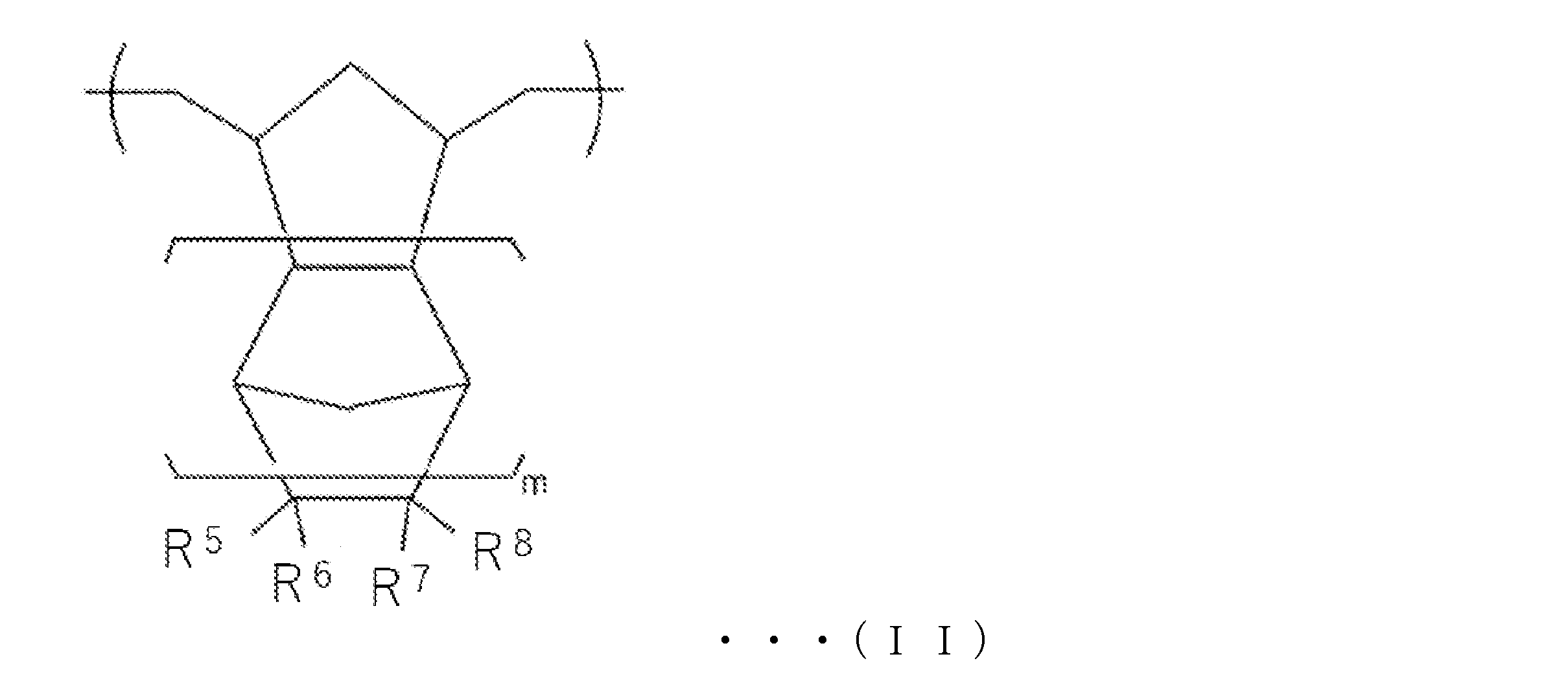
で表される繰り返し単位とを含むことを特徴とする。上述した構造を有するランダム共重合体を用いれば、水蒸気バリア性、酸素バリア性、耐油性およびPVOHフィルムに対する密着性が高いフィルムを形成することができる。

で表される化合物と、下記式(IV):

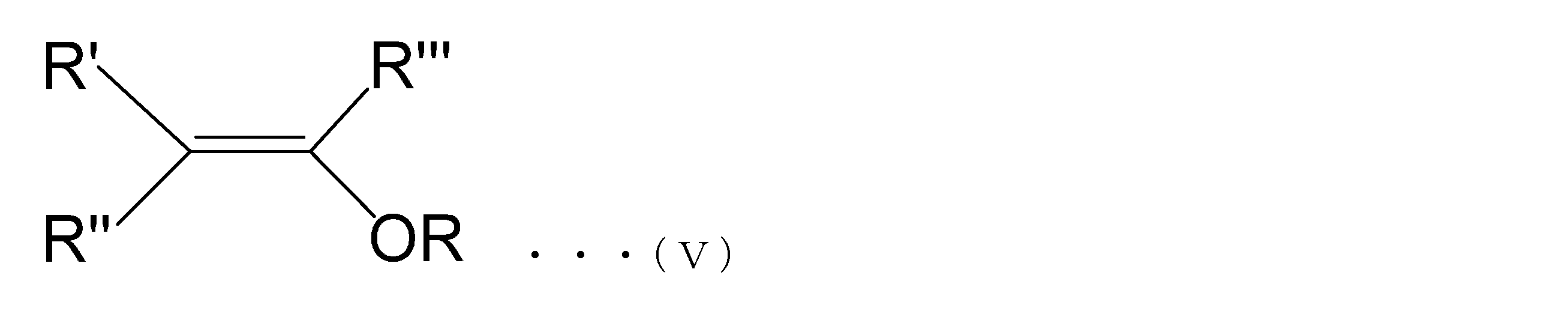
で表されるエーテル化合物および触媒の存在下で開環重合する工程(A)と、前記工程(A)で得られた重合体を水素化する工程(B)とを含むことを特徴とする。式(III)で表される化合物(但し、スチレンを除く)および式(IV)で表される化合物を含む単量体組成物を上記エーテル化合物および触媒の存在下で開環重合して得られる重合体を水素化すれば、水蒸気バリア性、酸素バリア性、耐油性およびPVOHフィルムに対する密着性が高いフィルムを形成可能なランダム共重合体が得られる。
本発明のランダム共重合体は、特に限定されることなく、例えば包装材などの各種成形体を構成する樹脂材料として様々な分野で用いることができる。そして、本発明のランダム共重合体は、例えば本発明のランダム共重合体の製造方法を用いて効率的に製造することができる。
本発明のランダム共重合体は、下記式(I)で表される繰り返し単位および下記式(II)で表される繰り返し単位を含み、任意に、その他の繰り返し単位を更に含有し得る。このような構造を有するランダム共重合体は、フィルムにした際に、高い水蒸気バリア性、高い酸素バリア性、高い耐油性およびPVOHフィルムに対する高い密着性を発揮し得る。
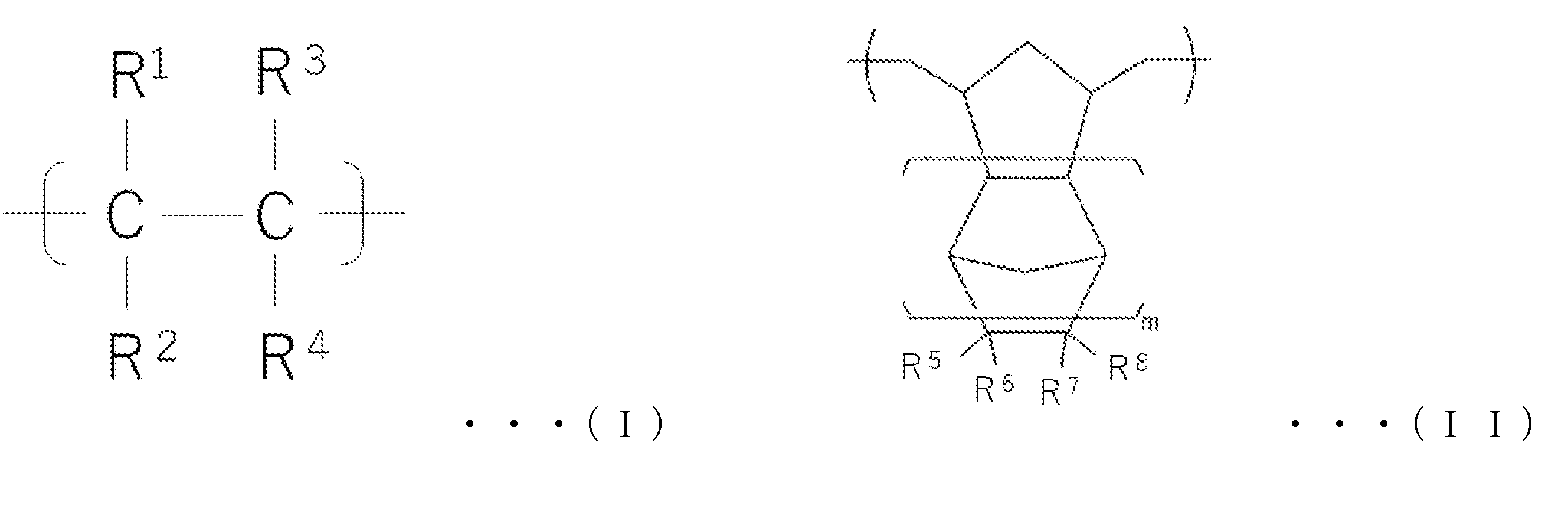
ここで、上記式(I)において、R1~R4は、それぞれ独立して、水素原子、ハロゲン原子または有機基を表す。但し、式(I)で表される繰り返し単位は、R1~R4の何れか一つがフェニル基であり、残りが水素原子である繰り返し単位ではないものとする。
ここで、炭素数が1以上12以下の有機基は、炭化水素基であってもよいが、炭素原子および水素原子以外の原子を1つ以上含んでいてもよく、炭素原子および水素原子以外の原子としては、例えば、ハロゲン原子(フッ素原子、塩素原子、臭素原子、ヨウ素原子等)、酸素原子および窒素原子などが挙げられる。これらの原子は、有機基中に1種単独で、または、2種類以上含まれ得る。
そして、カルボニル基を有する炭素数が1以上12以下の基としては、カルボキシ基;ホルミル基、アセチル基、プロピオニル基、ブチリル基、バレリル基(ペンタノイル基)、ヘキサノイル基、オクタノイル基、デカノイル基、ベンゾイル基等のアシル基;アセチルオキシ基、プロピオニルオキシ基、ブチリルオキシ基、イソブチリルオキシ基、バレリルオキシ基(ペンタノイルオキシ基)、ヘキサノイルオキシ基、オクタノイルオキシ基、デカノイルオキシ基、ベンゾイルオキシ基等のアシルオキシ基;メトキシカルボニル基、エトキシカルボニル基、プロポキシカルボニル基、イソプロポキシカルボニル基、ブトキシカルボニル基、イソブトキシカルボニル基、t-ブトキシカルボニル基、ペンチルオキシカルボニル基等のアルコキシカルボニル基;メトキシエトキシカルボニル基、フェノキシエトキシカルボニル基、メトキシブトキシカルボニル基、ヒドロキシエトキシカルボニル基、ヒドロキシプロポキシカルボニル基、メトキシエトキシエトキシカルボニル基、エトキシエトキシエトキシカルボニル基、フェノキシエトキシエトキシカルボニル基、メトキシエトキシエトキシエトキシカルボニル基、エトキシエトキシエトキシエトキシカルボニル基、メトキシエトキシエトキシエトキシエトキシカルボニル基、エトキシエトキシエトキシエトキシエトキシカルボニル基、グリシジルオキシカルボニル基、フェノキシカルボニル基、クロロフェノキシカルボニル基、ブロモフェノキシカルボニル基、ベンジルオキシカルボニル基、クロロベンジルオキシカルボニル基、ブロモベンジルオキシカルボニル基、クロロエトキシカルボニル基、ブロモエトキシカルボニル基等の置換されたアルコキシカルボニル基;などが挙げられる。
また、ヒドロキシル基を有する炭素数が1以上12以下の基としては、メチロール基、エチロール基、プロピロール基、ブチロール基などのヒドロキシアルキル基が挙げられる。
更に、アルコキシ基を有する炭素数が1以上12以下の基としては、メトキシ基、エトキシ基、プロポキシ基、ブトキシ基などのアルコキシ基が挙げられる。
また、上記式(II)において、R5~R8は、それぞれ独立して、水素原子、炭素数1以上20以下の炭化水素基、または、ハロゲン原子、ケイ素原子、酸素原子および窒素原子からなる群より選択される少なくとも一種の原子を含む基を表し、mは0~2の整数である。なお、R5~R8は、2つ以上が互いに結合して環を形成していてもよい。
本発明のランダム共重合体が任意に含有し得るその他の繰り返し単位は、上述した繰り返し単位と共重合体を形成可能であれば特に限定されず、任意の構造の繰り返し単位であり得る。
なお、本発明のランダム共重合体において、全繰り返し単位中に占めるその他の繰り返し単位の割合は、特に限定されることなく、10質量%以下であることが好ましく、5質量%以下であることがより好ましく、ゼロである(即ち、その他の繰り返し単位を含まない)ことが更に好ましい。
ランダム共重合体は、重量平均分子量が、2,000以上であることが好ましく、4,000以上であることがより好ましく、5,000以上であることが更に好ましく、10,000以上であることが特に好ましく、1,000,000以下であることが好ましく、500,000以下であることがより好ましい。
なお、ランダム共重合体の重量平均分子量は、ランダム共重合体の製造方法を変更することで調整することができる。
本発明のランダム共重合体の製造方法は、所定の化合物を含む単量体組成物を、所定のエーテル化合物と、触媒との存在下で開環重合する工程(A)と、工程(A)で得られた重合体(開環重合体)を水素化する工程(B)とを含む。そして、本発明のランダム共重合体の製造方法によれば、上述した本発明のランダム共重合体を効率的に得ることができる。
工程(A)では、エーテル化合物および触媒の存在下で単量体組成物を開環重合して開環重合体を得る。なお、開環重合は、無溶媒で行ってもよいし、溶媒の存在下で行ってもよい。
単量体組成物は、下記式(III)で表される化合物と、下記式(IV)で表される化合物とを含み、任意に、式(III)で表される化合物および式(IV)で表される化合物と共重合可能なその他の化合物を更に含有し得る。

なお、本発明において、(メタ)アクリル酸とは、アクリル酸および/またはメタクリル酸を意味する。
また、単量体組成物中の式(IV)で表される化合物の割合は、特に限定されることなく、5質量%以上であることが好ましく、10質量%以上であることがより好ましく、20質量%以上であることが更に好ましく、30質量%以上であることが特に好ましく、95質量%以下であることが好ましく、90質量%以下であることがより好ましく、80質量%以下であることが更に好ましく、75質量%以下であることが一層好ましく、70質量%以下であることが特に好ましい。
そして、単量体組成物中のその他の化合物の割合は、特に限定されることなく、10質量%以下であることが好ましく、5質量%以下であることがより好ましく、ゼロである(即ち、その他の化合物を含まない)ことが更に好ましい。
工程(A)では、エーテル化合物として、下記式(V)で表されるエーテル化合物を使用することを必要とする。エーテル化合物は、工程(A)における開環重合反応において、重合開始剤として機能し得る成分である。

これらの化合物は、1種類を単独で、または、2種類以上を混合して用いることができる。
工程(A)において重合系内に添加する触媒としては、特に限定されることなく、光レドックス触媒を好適に用いることができる。ここで、光レドックス触媒とは、紫外可視領域の光、例えば波長425nmの可視光を照射された場合にラジカル種を発生し得る化合物である。好適に用いることができる光レドックス触媒としては、例えば、国際公開第2016/036976号に記載されたような、ピリリウム塩及びアクリジニウム塩を挙げることができる。特に、工程(A)における光レドックス触媒として、ピリリウム塩を好適に用いることができる。ピリリウム塩としては、下式(VI)で表されるピリリウム塩が挙げられる。

中でも、複数のR9がすべてメトキシ基であり、X-がBF4 -である、即ち、式(VI)で表されるピリリウム塩が、2,4,6-トリス(4-メトキシフェニル)ピリリウムテトラフルオロボレートであることが好ましい。
開環重合は、反応を良好に制御することができる観点から、溶媒、特には有機溶媒中で行うことが好ましい。
用いる有機溶媒としては、得られる開環重合体を溶解または分散させることができ、重合反応に不活性なものであれば、特に限定されない。具体的には、ペンタン、ヘキサン、ヘプタン等の脂肪族炭化水素系溶媒;シクロペンタン、シクロヘキサン、メチルシクロヘキサン、ジメチルシクロヘキサン、トリメチルシクロヘキサン、エチルシクロヘキサン、ジエチルシクロヘキサン、デカヒドロナフタレン、ビシクロヘプタン、トリシクロデカン、ヘキサヒドロインデンシクロヘキサン、シクロオクタン等の脂環族炭化水素系溶媒;ベンゼン、トルエン、キシレン(o-キシレン、m-キシレン、p-キシレン)等の芳香族炭化水素系溶媒;ジクロロメタン、クロロホルム、1,2-ジクロロエタン、1,1,2,2-テトラクロロエタン等のハロゲン系脂肪族炭化水素系溶媒;クロロベンゼン、ジクロロベンゼン等のハロゲン系芳香族炭化水素系溶媒;ニトロメタン、ニトロベンゼン、アセトニトリル等の含窒素炭化水素系溶媒;ジエチルエーテル、テトラヒドロフラン等のエーテル系溶媒;アニソール、フェネトール等の芳香族エーテル系溶媒;等が挙げられる。溶媒は、1種単独で用いてもよく、2種以上を組み合わせて用いてもよい。そして、溶媒としては、ハロゲン系脂肪族炭化水素系溶媒が特に好ましい。
なお、開環重合の条件(上述した各成分の使用量、重合時間および重合温度など)は、特に限定されず、所望のランダム共重合体の物性に応じて、適宜設定することができる。
工程(B)では、工程(A)で得られた開環重合体を水素化し、ランダム共重合体を得る。
なお、工程(A)において溶媒を用いて開環重合を行った場合、得られた開環重合体は、反応液中から回収して水素化反応に供してもよいが、開環重合体を含む反応液をそのまま水素化反応に供することもできる。
工程(B)では、開環重合体が有する炭素-炭素二重結合の少なくとも一部を水素化する。なお、工程(B)では、得られる水素化物(ランダム共重合体)における水素化率(モル基準)が90%以上となるようにすることが好ましく、95%以上となるようにすることが好ましく、99%以上となるようにすることが好ましい。ここで、開環重合体の水素化率(モル基準)は、1H-NMR測定により特定することができる。
担持型不均一系触媒としては、具体的には、ニッケル/シリカ、ニッケル/珪藻土、ニッケル/アルミナ、パラジウム/カーボン、パラジウム/シリカ、パラジウム/珪藻土、パラジウム/アルミナ等の組み合わせが好ましく挙げられる。
本発明の製造方法では、上述した工程(A)および工程(B)に後続して、必要に応じて後処理工程を行うことができる。後処理工程では、上記工程(B)で得られた、ランダム共重合体を含む反応液を、凝固乾燥法、或いは、薄膜乾燥機等を用いた直接乾燥法等に処することにより、目的とするランダム共重合体を良好に単離することができる。なお、ランダム共重合体は、通常、パウダー状またはペレット状の固体として得ることができる。
本発明のランダム共重合体は、必要に応じて既知の添加剤と混合して樹脂組成物とした後、例えばフィルムなどの成形体の材料として有利に使用することができる。
実施例および比較例において、重合体の重量平均分子量、組成および水素化率、並びに、重合体よりなるフィルムの水蒸気バリア性、酸素バリア性、耐油性およびPVOHフィルムに対する密着性は、以下の方法を使用して測定および評価した。
重合体の重量平均分子量は、テトラヒドロフランを溶離液とするゲル・パーミエーション・クロマトグラフィー(GPC)による標準ポリスチレン換算値として測定した。なお、測定装置として、HLC8320GPC(東ソー社製)を用いた。また、サンプルは、濃度が1mg/mLになるように室温にて測定試料をテトラヒドロフランに溶解させて調製した。
測定は、カラムにSuper Multipore HZ-H(東ソー社製)を4本直列に繋いで用い、流速0.35mL/分、サンプル注入量10μL、カラム温度40℃の条件で行った。
<組成>
1H-NMR測定に基づき、各繰り返し単位に由来する水素原子の数の比を求め、その比に基づいて共重合組成比を算出した。
<水素化率>
水素化前後の1H-NMR測定の結果に基づいて求めた。
<水蒸気バリア性>
作製したフィルムについて、JIS K7129に基づいて、温度40℃、相対湿度90%RHの条件下の水蒸気透過度を、水蒸気透過度テスター(LYSSY社製、L80-5000型)を用いて測定し、フィルム厚さ100μmに換算した値を求めた。水蒸気透過度(g/(m2・24h))が小さいほど、水蒸気バリア性が良好であることを示す。
<酸素バリア性>
作製したフィルムについて、JIS K7126に基づいて、温度23℃、相対湿度90%RHの条件下の酸素透過度を、酸素透過度テスター(LYSSY社製、OPT-5000型)を用いて測定し、フィルム厚さ100μmに換算した値を求めた。酸素透過度(cm3/(m2・24h・atm))が小さいほど、酸素ガスバリア性が良好であることを示す。
<耐油性>
作製したフィルムにサラダ油(日清オイリオグループ株式会社)を塗布し、40℃に加温されたオーブンに入れ、24時間経過後のフィルムの外観変化を目視観察した。そして、以下の基準で評価した。
○:変化が無い
△:フィルムに変色がある
×:フィルムが破損する
<PVOHフィルムに対する密着性>
作製したフィルムと、ポリ酢酸ビニル(PVAc)部分ケン化物(ケン化度99mol%)のフィルムとを重ね合わせて、真空熱プレスにて成型し、積層体とした。この積層体の厚みを測定したところ、作製したフィルムからなる層部分が20μm、PVAc部分ケン化物からなる層部分が20μmであった。
得られた積層体について、膜密着性を評価した。具体的には、積層体に、1mm×1mmのマス目10個をカッターで刻み、セロハンテープ剥離試験を行なって、以下の評価基準に従って密着性を評価した。
○:剥離された目の数が0のもの
△:剥離された目の数が1~5個のもの
×:剥離された目の数が5個を超えるもの
<開環重合体の調製>
撹拌機付きガラス反応器に、2,4,6-トリス(4-メトキシフェニル)ピリリウムテトラフルオロボレート5mgおよびジクロロメタン5mLを入れ、撹拌した。次いで、ノルボルネン0.85gとメタクリル酸メチル0.90gをジクロロメタン1.75gに溶解した溶液を加え、撹拌した。次に、2-エトキシ-3,4-ジヒドロ-2H-ピラン13.2mgを添加し、撹拌ののち、LEDランプによる光照射を開始して重合反応を開始した。室温で15時間反応させた後、重合反応液に大量のメタノールを注いで沈殿物を凝集させ、凝集物をろ取した。ろ取物をメタノールで洗浄後、40℃で24時間減圧乾燥した。得られた重合体の収量は0.19gであった。得られた重合体の重量平均分子量は7,300であった。1H-NMR測定によると、得られた重合体は、開環したノルボルネンの繰り返し単位と、ビニル付加重合したメタクリル酸メチルの繰り返し単位からなっており、開環ノルボルネンとメタクリル酸メチルの導入比率は、60:40(質量比)であった。以上より、開環したノルボルネンとメタクリル酸メチルとの共重合体を得た。
<水素化>
次に、撹拌機付きガラス反応器に、上記で得られた共重合体0.1gおよびパラトルエンスルホニルヒドラジド0.8gを加えた。そして、パラキシレン30mLを添加し、125℃で5時間水素化反応を行った。この水素化反応液を多量のメタノールに注いで生成した共重合体水素化物(ランダム共重合体)を完全に析出させ、濾別洗浄後、40℃で24時間減圧乾燥した。得られた共重合体水素化物の水素化率は99%以上であり、1H-NMR測定によると、得られた共重合体水素化物は、開環したノルボルネンの繰り返し単位が水素化された繰り返し単位(ノルボルネン由来の繰り返し単位)と、ビニル付加重合したメタクリル酸メチルの繰り返し単位(メタクリル酸メチル由来の繰り返し単位)からなっており、ノルボルネン由来の繰り返し単位とメタクリル酸メチル由来の繰り返し単位の比率は、60:40(質量比)であった。得られた共重合体水素化物の重量平均分子量は7,400であった。
<フィルムの形成>
得られた共重合体水素化物(ランダム共重合体)を真空熱プレスにて厚みが21~28μmとなるように成型し、単層フィルムを得た。
そして、各種評価を行った。結果を表1に示す。
<開環重合体の調製>
撹拌機付きガラス反応器に、2,4,6-トリス(4-メトキシフェニル)ピリリウムテトラフルオロボレート5mgおよびジクロロメタン5mLを入れ、撹拌した。次いで、ノルボルネン0.85gとメタクリル酸メチル0.90gをジクロロメタン1.75gに溶解した溶液を加え、撹拌した。次に、2-ビニルオキシテトラヒドロピラン3.29mgを添加し、撹拌ののち、LEDランプによる光照射を開始して重合反応を開始した。室温で15時間反応させた後、重合反応液に大量のメタノールを注いで沈殿物を凝集させ、凝集物をろ取した。ろ取物をメタノールで洗浄後、40℃で24時間減圧乾燥した。得られた重合体の収量は0.19gであった。得られた重合体の重量平均分子量は21,800であった。1H-NMR測定によると、得られた重合体は、開環したノルボルネンの繰り返し単位と、ビニル付加重合したメタクリル酸メチルの繰り返し単位からなっており、開環ノルボルネンとメタクリル酸メチルの導入比率は、60:40(質量比)であった。以上より、開環したノルボルネンとメタクリル酸メチルの共重合体を得た。
<水素化>
次に、撹拌機付きガラス反応器に、上記で得られた共重合体0.1gおよびパラトルエンスルホニルヒドラジド0.8gを加えた。そして、パラキシレン30mLを添加し、125℃で5時間水素化反応を行った。この水素化反応液を多量のメタノールに注いで生成した共重合体水素化物(ランダム共重合体)を完全に析出させ、濾別洗浄後、40℃で24時間減圧乾燥した。得られた共重合体水素化物の水素化率は99%以上であり、1H-NMR測定によると、得られた共重合体水素化物は、開環したノルボルネンの繰り返し単位が水素化された繰り返し単位(ノルボルネン由来の繰り返し単位)と、ビニル付加重合したメタクリル酸メチルの繰り返し単位(メタクリル酸メチル由来の繰り返し単位)からなっており、ノルボルネン由来の繰り返し単位とノルボルネン由来の繰り返し単位の比率は、60:40(質量比)であった。得られた共重合体水素化物の重量平均分子量は21,900であった。
<フィルムの形成>
得られた共重合体水素化物(ランダム共重合体)を真空熱プレスにて厚みが21~28μmとなるように成型し、単層フィルムを得た。
そして、各種評価を行った。結果を表1に示す。
<開環重合体の調製>
撹拌機付きガラス反応器に、2,4,6-トリス(4-メトキシフェニル)ピリリウムテトラフルオロボレート5mgおよびジクロロメタン5mLを入れ、撹拌した。次いで、ノルボルネン0.44gとメタクリル酸メチル1.40gをジクロロメタン1.75gに溶解した溶液を加え、撹拌した。次に、2-ビニルオキシテトラヒドロピラン13.2mgを添加し、撹拌ののち、LEDランプによる光照射を開始して重合反応を開始した。室温で15時間反応させた後、重合反応液に大量のメタノールを注いで沈殿物を凝集させ、凝集物をろ取した。ろ取物をメタノールで洗浄後、40℃で24時間減圧乾燥した。得られた重合体の収量は0.32gであった。得られた重合体の重量平均分子量は20,900であった。1H-NMR測定によると、得られた重合体は、開環したノルボルネンの繰り返し単位と、ビニル付加重合したメタクリル酸メチルの繰り返し単位からなっており、開環ノルボルネンとメタクリル酸メチルの導入比率は、32:68(質量比)であった。以上より、開環したノルボルネンとメタクリル酸メチルの共重合体を得た。
<水素化>
次に、撹拌機付きガラス反応器に、上記で得られた共重合体0.1gおよびパラトルエンスルホニルヒドラジド0.8gを加えた。そして、パラキシレン30mLを添加し、125℃で5時間水素化反応を行った。この水素化反応液を多量のメタノールに注いで生成した共重合体水素化物(ランダム共重合体)を完全に析出させ、濾別洗浄後、40℃で24時間減圧乾燥した。得られた共重合体水素化物の水素化率は99%以上であり、1H-NMR測定によると、得られた共重合体水素化物は、開環したノルボルネンの繰り返し単位が水素化された繰り返し単位(ノルボルネン由来の繰り返し単位)と、ビニル付加重合したメタクリル酸メチルの繰り返し単位(メタクリル酸メチル由来の繰り返し単位)からなっており、ノルボルネン由来の繰り返し単位とメタクリル酸メチル由来の繰り返し単位の比率は、32:68(質量比)であった。得られた共重合体水素化物の重量平均分子量は21,000であった。
<フィルムの形成>
得られた共重合体水素化物(ランダム共重合体)を真空熱プレスにて厚みが21~28μmとなるように成型し、単層フィルムを得た。
そして、各種評価を行った。結果を表1に示す。
<開環重合体の調製>
撹拌機付きガラス反応器に、2,4,6-トリス(4-メトキシフェニル)ピリリウムテトラフルオロボレート5mgおよびジクロロメタン5mLを入れ、撹拌した。次いで、ノルボルネン0.44gとメタクリル酸メチル1.40gをジクロロメタン1.75gに溶解した溶液を加え、撹拌した。次に、2-エトキシ-3,4-ジヒドロ-2H-ピラン3.29mgを添加し、撹拌ののち、LEDランプによる光照射を開始して重合反応を開始した。室温で15時間反応させた後、重合反応液に大量のメタノールを注いで沈殿物を凝集させ、凝集物をろ取した。ろ取物をメタノールで洗浄後、40℃で24時間減圧乾燥した。得られた重合体の収量は0.32gであった。得られた重合体の重量平均分子量は60,200であった。1H-NMR測定によると、得られた重合体は、開環したノルボルネンの繰り返し単位と、ビニル付加重合したメタクリル酸メチルの繰り返し単位からなっており、開環ノルボルネンとメタクリル酸メチルの導入比率は、32:68(質量比)であった。以上より、開環したノルボルネンとメタクリル酸メチルの共重合体を得た。
<水素化>
次に、撹拌機付きガラス反応器に、上記で得られた共重合体0.1gおよびパラトルエンスルホニルヒドラジド0.8gを加えた。そして、パラキシレン30mLを添加し、125℃で5時間水素化反応を行った。この水素化反応液を多量のメタノールに注いで生成した共重合体水素化物(ランダム共重合体)を完全に析出させ、濾別洗浄後、40℃で24時間減圧乾燥した。得られた共重合体水素化物の水素化率は99%以上であり、1H-NMR測定によると、得られた共重合体水素化物は、開環したノルボルネンの繰り返し単位が水素化された繰り返し単位(ノルボルネン由来の繰り返し単位)と、ビニル付加重合したメタクリル酸メチルの繰り返し単位(メタクリル酸メチル由来の繰り返し単位)からなっており、ノルボルネン由来の繰り返し単位とメタクリル酸メチル由来の繰り返し単位の比率は、32:68(質量比)であった。得られた共重合体水素化物の重量平均分子量は60,400であった。
<フィルムの形成>
得られた共重合体水素化物(ランダム共重合体)を真空熱プレスにて厚みが21~28μmとなるように成型し、単層フィルムを得た。
そして、各種評価を行った。結果を表1に示す。
<開環重合体の調製>
撹拌機付きガラス反応器に、2,4,6-トリス(4-メトキシフェニル)ピリリウムテトラフルオロボレート5mgおよびジクロロメタン5mLを入れ、撹拌した。次いで、ノルボルネン0.74gとアクリル酸ブチル1.01gをジクロロメタン1.75gに溶解した溶液を加え、撹拌した。次に、2-エトキシ-3,4-ジヒドロ-2H-ピラン13.2mgを添加し、撹拌ののち、LEDランプによる光照射を開始して重合反応を開始した。室温で15時間反応させた後、重合反応液に大量のメタノールを注いで沈殿物を凝集させ、凝集物をろ取した。ろ取物をメタノールで洗浄後、40℃で24時間減圧乾燥した。得られた重合体の収量は0.14gであった。得られた重合体の重量平均分子量は26,800であった。1H-NMR測定によると、得られた重合体は、開環したノルボルネンの繰り返し単位と、ビニル付加重合したアクリル酸ブチルの繰り返し単位からなっており、開環ノルボルネンとアクリル酸ブチルの導入比率は、60:40(質量比)であった。以上より、開環したノルボルネンとアクリル酸ブチルの共重合体を得た。
<水素化>
次に、撹拌機付きガラス反応器に、上記で得られた共重合体0.1gおよびパラトルエンスルホニルヒドラジド0.8gを加えた。そして、パラキシレン30mLを添加し、125℃で5時間水素化反応を行った。この水素化反応液を多量のメタノールに注いで生成した共重合体水素化物(ランダム共重合体)を完全に析出させ、濾別洗浄後、40℃で24時間減圧乾燥した。得られた共重合体水素化物の水素化率は99%以上であり、1H-NMR測定によると、得られた共重合体水素化物は、開環したノルボルネンの繰り返し単位が水素化された繰り返し単位(ノルボルネン由来の繰り返し単位)と、ビニル付加重合したアクリル酸ブチルの繰り返し単位(アクリル酸ブチル由来の繰り返し単位)からなっており、ノルボルネン由来の繰り返し単位とアクリル酸ブチル由来の繰り返し単位の比率は、60:40(質量比)であった。得られた共重合体水素化物の重量平均分子量は26,900であった。
<フィルムの形成>
得られた共重合体水素化物(ランダム共重合体)を真空熱プレスにて厚みが21~28μmとなるように成型し、単層フィルムを得た。
そして、各種評価を行った。結果を表1に示す。
<開環重合体の調製>
撹拌機付きガラス反応器に、2,4,6-トリス(4-メトキシフェニル)ピリリウムテトラフルオロボレート5mgおよびジクロロメタン5mLを入れ、撹拌した。次いで、ノルボルネン0.74gとアクリル酸ブチル1.01gをジクロロメタン1.75gに溶解した溶液を加え、撹拌した。次に、2-エトキシ-3,4-ジヒドロ-2H-ピラン3.29mgを添加し、撹拌ののち、LEDランプによる光照射を開始して重合反応を開始した。室温で15時間反応させた後、重合反応液に大量のメタノールを注いで沈殿物を凝集させ、凝集物をろ取した。ろ取物をメタノールで洗浄後、40℃で24時間減圧乾燥した。得られた重合体の収量は0.14gであった。得られた重合体の重量平均分子量は81,800であった。1H-NMR測定によると、得られた重合体は、開環したノルボルネンの繰り返し単位と、ビニル付加重合したアクリル酸ブチルの繰り返し単位からなっており、開環ノルボルネンとアクリル酸ブチルの導入比率は、60:40(質量比)であった。以上より、開環したノルボルネンとアクリル酸ブチルの共重合体を得た。
<水素化>
次に、撹拌機付きガラス反応器に、上記で得られた共重合体0.1gおよびパラトルエンスルホニルヒドラジド0.8gを加えた。そして、パラキシレン30mLを添加し、125℃で5時間水素化反応を行った。この水素化反応液を多量のメタノールに注いで生成した共重合体水素化物(ランダム共重合体)を完全に析出させ、濾別洗浄後、40℃で24時間減圧乾燥した。得られた共重合体水素化物の水素化率は99%以上であり、1H-NMR測定によると、得られた共重合体水素化物は、開環したノルボルネンの繰り返し単位が水素化された繰り返し単位(ノルボルネン由来の繰り返し単位)と、ビニル付加重合したアクリル酸ブチルの繰り返し単位(アクリル酸ブチル由来の繰り返し単位)からなっており、ノルボルネン由来の繰り返し単位とアクリル酸ブチル由来の繰り返し単位の比率は、60:40(質量比)であった。得られた共重合体水素化物の重量平均分子量は82,000であった。
<フィルムの形成>
得られた共重合体水素化物(ランダム共重合体)を真空熱プレスにて厚みが21~28μmとなるように成型し、単層フィルムを得た。
そして、各種評価を行った。結果を表1に示す。
<開環重合体の調製>
撹拌機付きガラス反応器に、2,4,6-トリス(4-メトキシフェニル)ピリリウムテトラフルオロボレート5mgおよびジクロロメタン5mLを入れ、撹拌した。次いで、ノルボルネン0.44gとアクリル酸ブチル1.79gをジクロロメタン1.75gに溶解した溶液を加え、撹拌した。次に、2-ビニルオキシテトラヒドロピラン13.2mgを添加し、撹拌ののち、LEDランプによる光照射を開始して重合反応を開始した。室温で15時間反応させた後、重合反応液に大量のメタノールを注いで沈殿物を凝集させ、凝集物をろ取した。ろ取物をメタノールで洗浄後、40℃で24時間減圧乾燥した。得られた重合体の収量は0.12gであった。得られた重合体の重量平均分子量は54,000であった。1H-NMR測定によると、得られた重合体は、開環したノルボルネンの繰り返し単位と、ビニル付加重合したアクリル酸ブチルの繰り返し単位からなっており、開環ノルボルネンとアクリル酸ブチルの導入比率は、42:58(質量比)であった。以上より、開環したノルボルネンとアクリル酸ブチルの共重合体を得た。
<水素化>
次に、撹拌機付きガラス反応器に、上記で得られた共重合体0.1gおよびパラトルエンスルホニルヒドラジド0.8gを加えた。そして、パラキシレン30mLを添加し、125℃で5時間水素化反応を行った。この水素化反応液を多量のメタノールに注いで生成した共重合体水素化物(ランダム共重合体)を完全に析出させ、濾別洗浄後、40℃で24時間減圧乾燥した。得られた共重合体水素化物の水素化率は99%以上であり、1H-NMR測定によると、得られた共重合体水素化物は、開環したノルボルネンの繰り返し単位が水素化された繰り返し単位(ノルボルネン由来の繰り返し単位)と、ビニル付加重合したアクリル酸ブチルの繰り返し単位(アクリル酸ブチル由来の繰り返し単位)からなっており、ノルボルネン由来の繰り返し単位とアクリル酸ブチル由来の繰り返し単位の比率は、42:58(質量比)であった。得られた共重合体水素化物の重量平均分子量は54,100であった。
<フィルムの形成>
得られた共重合体水素化物(ランダム共重合体)を真空熱プレスにて厚みが21~28μmとなるように成型し、単層フィルムを得た。
そして、各種評価を行った。結果を表1に示す。
<開環重合体の調製>
撹拌機付きガラス反応器に、2,4,6-トリス(4-メトキシフェニル)ピリリウムテトラフルオロボレート5mgおよびジクロロメタン5mLを入れ、撹拌した。次いで、ノルボルネン0.85gとアクリロニトリル0.48gをジクロロメタン1.75gに溶解した溶液を加え、撹拌した。次に、2-ビニルオキシテトラヒドロピラン13.2mgを添加し、撹拌ののち、LEDランプによる光照射を開始して重合反応を開始した。室温で15時間反応させた後、重合反応液に大量のメタノールを注いで沈殿物を凝集させ、凝集物をろ取した。ろ取物をメタノールで洗浄後、40℃で24時間減圧乾燥した。得られた重合体の収量は0.15gであった。得られた重合体の重量平均分子量は8,700であった。1H-NMR測定によると、得られた重合体は、開環したノルボルネンの繰り返し単位と、ビニル付加重合したアクリロニトリルの繰り返し単位からなっており、開環ノルボルネンとアクリロニトリルの導入比率は、55:45(質量比)であった。以上より、開環したノルボルネンとアクリロニトリルの共重合体を得た。
<水素化>
次に、撹拌機付きガラス反応器に、上記で得られた共重合体0.1gおよびパラトルエンスルホニルヒドラジド0.8gを加えた。そして、パラキシレン30mLを添加し、125℃で5時間水素化反応を行った。この水素化反応液を多量のメタノールに注いで生成した共重合体水素化物(ランダム共重合体)を完全に析出させ、濾別洗浄後、40℃で24時間減圧乾燥した。得られた共重合体水素化物の水素化率は99%以上であり、1H-NMR測定によると、得られた共重合体水素化物は、開環したノルボルネンの繰り返し単位が水素化された繰り返し単位(ノルボルネン由来の繰り返し単位)と、ビニル付加重合したアクリロニトリルの繰り返し単位(アクリロニトリル由来の繰り返し単位)からなっており、ノルボルネン由来の繰り返し単位とアクリロニトリル由来の繰り返し単位の比率は、55:45(質量比)であった。得られた共重合体水素化物の重量平均分子量は8,800であった。
<フィルムの形成>
得られた共重合体水素化物(ランダム共重合体)を真空熱プレスにて厚みが21~28μmとなるように成型し、単層フィルムを得た。
そして、各種評価を行った。結果を表1に示す。
<開環重合体の調製>
撹拌機付きガラス反応器に、2,4,6-トリス(4-メトキシフェニル)ピリリウムテトラフルオロボレート5mgおよびジクロロメタン5mLを入れ、撹拌した。次いで、ノルボルネン0.85gとアクリロニトリル0.48gをジクロロメタン1.75gに溶解した溶液を加え、撹拌した。次に、2-ビニルオキシテトラヒドロピラン3.29mgを添加し、撹拌ののち、LEDランプによる光照射を開始して重合反応を開始した。室温で15時間反応させた後、重合反応液に大量のメタノールを注いで沈殿物を凝集させ、凝集物をろ取した。ろ取物をメタノールで洗浄後、40℃で24時間減圧乾燥した。得られた重合体の収量は0.15gであった。得られた重合体の重量平均分子量は26,600であった。1H-NMR測定によると、得られた重合体は、開環したノルボルネンの繰り返し単位と、ビニル付加重合したアクリロニトリルの繰り返し単位からなっており、開環ノルボルネンとアクリロニトリルの導入比率は、55:45(質量比)であった。以上より、開環したノルボルネンとアクリロニトリルの共重合体を得た。
<水素化>
次に、撹拌機付きガラス反応器に、上記で得られた共重合体0.1gおよびパラトルエンスルホニルヒドラジド0.8gを加えた。そして、パラキシレン30mLを添加し、125℃で5時間水素化反応を行った。この水素化反応液を多量のメタノールに注いで生成した共重合体水素化物(ランダム共重合体)を完全に析出させ、濾別洗浄後、40℃で24時間減圧乾燥した。得られた共重合体水素化物の水素化率は99%以上であり、1H-NMR測定によると、得られた共重合体水素化物は、開環したノルボルネンの繰り返し単位が水素化された繰り返し単位(ノルボルネン由来の繰り返し単位)と、ビニル付加重合したアクリロニトリルの繰り返し単位(アクリロニトリル由来の繰り返し単位)からなっており、ノルボルネン由来の繰り返し単位とアクリロニトリル由来の繰り返し単位の比率は、55:45(質量比)であった。得られた共重合体水素化物の重量平均分子量は26,700であった。
<フィルムの形成>
得られた共重合体水素化物(ランダム共重合体)を真空熱プレスにて厚みが21~28μmとなるように成型し、単層フィルムを得た。
そして、各種評価を行った。結果を表1に示す。
<開環重合体の調製>
撹拌機付きガラス反応器に、2,4,6-トリス(4-メトキシフェニル)ピリリウムテトラフルオロボレート5mgおよびジクロロメタン5mLを入れ、撹拌した。次いで、ノルボルネン0.57gとアクリロニトリル0.64gをジクロロメタン1.75gに溶解した溶液を加え、撹拌した。次に、2-ビニルオキシテトラヒドロピラン13.2mgを添加し、撹拌ののち、LEDランプによる光照射を開始して重合反応を開始した。室温で15時間反応させた後、重合反応液に大量のメタノールを注いで沈殿物を凝集させ、凝集物をろ取した。ろ取物をメタノールで洗浄後、40℃で24時間減圧乾燥した。得られた重合体の収量は0.22gであった。得られた重合体の重量平均分子量は21,400であった。1H-NMR測定によると、得られた重合体は、開環したノルボルネンの繰り返し単位と、ビニル付加重合したアクリロニトリルの繰り返し単位からなっており、開環ノルボルネンとアクリロニトリルの導入比率は、39:61(質量比)であった。以上より、開環したノルボルネンとアクリロニトリルの共重合体を得た。
<水素化>
次に、撹拌機付きガラス反応器に、上記で得られた共重合体0.1gおよびパラトルエンスルホニルヒドラジド0.8gを加えた。そして、パラキシレン30mLを添加し、125℃で5時間水素化反応を行った。この水素化反応液を多量のメタノールに注いで生成した共重合体水素化物(ランダム共重合体)を完全に析出させ、濾別洗浄後、40℃で24時間減圧乾燥した。得られた共重合体水素化物の水素化率は99%以上であり、1H-NMR測定によると、得られた共重合体水素化物は、開環したノルボルネンの繰り返し単位が水素化された繰り返し単位(ノルボルネン由来の繰り返し単位)と、ビニル付加重合したアクリロニトリルの繰り返し単位(アクリロニトリル由来の繰り返し単位)からなっており、ノルボルネン由来の繰り返し単位とアクリロニトリル由来の繰り返し単位の導入比率は、39:61(質量比)であった。得られた共重合体水素化物の重量平均分子量は21,500であった。
<フィルムの形成>
得られた共重合体水素化物(ランダム共重合体)を真空熱プレスにて厚みが21~28μmとなるように成型し、単層フィルムを得た。
そして、各種評価を行った。結果を表1に示す。
<開環重合体の調製>
撹拌機付きガラス反応器に、2,4,6-トリス(4-メトキシフェニル)ピリリウムテトラフルオロボレート5mgおよびジクロロメタン5mLを入れ、撹拌した。次いで、ノルボルネン0.57gとアクリロニトリル0.64gをジクロロメタン1.75gに溶解した溶液を加え、撹拌した。次に、2-エトキシ-3,4-ジヒドロ-2H-ピラン3.29mgを添加し、撹拌ののち、LEDランプによる光照射を開始して重合反応を開始した。室温で15時間反応させた後、重合反応液に大量のメタノールを注いで沈殿物を凝集させ、凝集物をろ取した。ろ取物をメタノールで洗浄後、40℃で24時間減圧乾燥した。得られた重合体の収量は0.22gであった。得られた重合体の重量平均分子量は62,000であった。1H-NMR測定によると、得られた重合体は、開環したノルボルネンの繰り返し単位と、ビニル付加重合したアクリロニトリルの繰り返し単位からなっており、開環ノルボルネンとアクリロニトリルの導入比率は、39:61(質量比)であった。以上より、開環したノルボルネンとアクリロニトリルの共重合体を得た。
<水素化>
次に、撹拌機付きガラス反応器に、上記で得られた共重合体0.1gおよびパラトルエンスルホニルヒドラジド0.8gを加えた。そして、パラキシレン30mLを添加し、125℃で5時間水素化反応を行った。この水素化反応液を多量のメタノールに注いで生成した共重合体水素化物(ランダム共重合体)を完全に析出させ、濾別洗浄後、40℃で24時間減圧乾燥した。得られた共重合体水素化物の水素化率は99%以上であり、1H-NMR測定によると、得られた共重合体水素化物は、開環したノルボルネンの繰り返し単位が水素化された繰り返し単位(ノルボルネン由来の繰り返し単位)と、ビニル付加重合したアクリロニトリルの繰り返し単位(アクリロニトリル由来の繰り返し単位)からなっており、ノルボルネン由来の繰り返し単位とアクリロニトリル由来の繰り返し単位の比率は、39:61(質量比)であった。得られた共重合体水素化物の重量平均分子量は62,100であった。
<フィルムの形成>
得られた共重合体水素化物(ランダム共重合体)を真空熱プレスにて厚みが21~28μmとなるように成型し、単層フィルムを得た。
そして、各種評価を行った。結果を表1に示す。
<開環重合体の調製>
撹拌機付きガラス反応器に、2,4,6-トリス(4-メトキシフェニル)ピリリウムテトラフルオロボレート5mgおよびジクロロメタン5mLを入れ、撹拌した。次いで、ジシクロペンタジエン0.85gとメタクリル酸メチル0.90gをジクロロメタン1.75gに溶解した溶液を加え、撹拌した。次に、2-エトキシ-3,4-ジヒドロ-2H-ピラン13.2mgを添加し、撹拌ののち、LEDランプによる光照射を開始して重合反応を開始した。室温で15時間反応させた後、重合反応液に大量のメタノールを注いで沈殿物を凝集させ、凝集物をろ取した。ろ取物をメタノールで洗浄後、40℃で24時間減圧乾燥した。得られた重合体の収量は0.12gであった。得られた重合体の重量平均分子量は5,500であった。1H-NMR測定によると、得られた重合体は、ノルボルネン環が開環したジシクロペンタジエンの繰り返し単位と、ビニル付加重合したメタクリル酸メチルの繰り返し単位からなっており、開環ジシクロペンタジエンとメタクリル酸メチルの導入比率は、45:55(質量比)であった。以上より、開環したジシクロペンタジエンとメタクリル酸メチルの共重合体を得た。
<水素化>
次に、撹拌機付きガラス反応器に、上記で得られた共重合体0.1gおよびパラトルエンスルホニルヒドラジド1.6gを加えた。そして、パラキシレン30mLを添加し、125℃で5時間水素化反応を行った。この水素化反応液を多量のメタノールに注いで生成した共重合体水素化物(ランダム共重合体)を完全に析出させ、濾別洗浄後、40℃で24時間減圧乾燥した。得られた共重合体水素化物の水素化率は99%以上であり、1H-NMR測定によると、得られた共重合体水素化物は、開環したジシクロペンタジエンの繰り返し単位が水素化された繰り返し単位(ジシクロペンタジエン由来の繰り返し単位)と、ビニル付加重合したメタクリル酸メチルの繰り返し単位(メタクリル酸メチル由来の繰り返し単位)からなっており、ジシクロペンタジエン由来の繰り返し単位とメタクリル酸メチル由来の繰り返し単位の比率は、45:55(質量比)であった。得られた共重合体水素化物の重量平均分子量は5,500であった。
<フィルムの形成>
得られた共重合体水素化物(ランダム共重合体)を真空熱プレスにて厚みが21~28μmとなるように成型し、単層フィルムを得た。
そして、各種評価を行った。結果を表1に示す。
<開環重合体の調製>
撹拌機付きガラス反応器に、2,4,6-トリス(4-メトキシフェニル)ピリリウムテトラフルオロボレート5mgおよびジクロロメタン5mLを入れ、撹拌した。次いで、ジシクロペンタジエン0.85gとメタクリル酸メチル0.90gをジクロロメタン1.75gに溶解した溶液を加え、撹拌した。次に、2-エトキシ-3,4-ジヒドロ-2H-ピラン3.29mgを添加し、撹拌ののち、LEDランプによる光照射を開始して重合反応を開始した。室温で15時間反応させた後、重合反応液に大量のメタノールを注いで沈殿物を凝集させ、凝集物をろ取した。ろ取物をメタノールで洗浄後、40℃で24時間減圧乾燥した。得られた重合体の収量は0.12gであった。得られた重合体の重量平均分子量は18,300であった。1H-NMR測定によると、得られた重合体は、ノルボルネン環が開環したジシクロペンタジエンの繰り返し単位と、ビニル付加重合したメタクリル酸メチルの繰り返し単位からなっており、開環ジシクロペンタジエンとメタクリル酸メチルの導入比率は、45:55(質量比)であった。以上より、開環したジシクロペンタジエンとメタクリル酸メチルの共重合体を得た。
<水素化>
次に、撹拌機付きガラス反応器に、上記で得られた共重合体0.1gおよびパラトルエンスルホニルヒドラジド1.6gを加えた。そして、パラキシレン30mLを添加し、125℃で5時間水素化反応を行った。この水素化反応液を多量のメタノールに注いで生成した共重合体水素化物(ランダム共重合体)を完全に析出させ、濾別洗浄後、40℃で24時間減圧乾燥した。得られた共重合体水素化物の水素化率は99%以上であり、1H-NMR測定によると、得られた共重合体水素化物は、開環したジシクロペンタジエンの繰り返し単位が水素化された繰り返し単位(ジシクロペンタジエン由来の繰り返し単位)と、ビニル付加重合したメタクリル酸メチルの繰り返し単位(メタクリル酸メチル由来の繰り返し単位)からなっており、ジシクロペンタジエン由来の繰り返し単位とメタクリル酸メチル由来の繰り返し単位の比率は、45:55(質量比)であった。得られた共重合体水素化物の重量平均分子量は18,400であった。
<フィルムの形成>
得られた共重合体水素化物(ランダム共重合体)を真空熱プレスにて厚みが21~28μmとなるように成型し、単層フィルムを得た。
そして、各種評価を行った。結果を表1に示す。
<開環重合体の調製>
撹拌機付きガラス反応器に、2,4,6-トリス(4-メトキシフェニル)ピリリウムテトラフルオロボレート5mgおよびジクロロメタン5mLを入れ、撹拌した。次いで、ジシクロペンタジエン0.44gとアクリル酸ブチル1.79gをジクロロメタン1.75gに溶解した溶液を加え、撹拌した。次に、2-エトキシ-3,4-ジヒドロ-2H-ピラン3.29mgを添加し、撹拌ののち、LEDランプによる光照射を開始して重合反応を開始した。室温で15時間反応させた後、重合反応液に大量のメタノールを注いで沈殿物を凝集させ、凝集物をろ取した。ろ取物をメタノールで洗浄後、40℃で24時間減圧乾燥した。得られた重合体の収量は0.10gであった。得られた重合体の重量平均分子量は54,000であった。1H-NMR測定によると、得られた重合体は、ノルボルネン環が開環したジシクロペンタジエンの繰り返し単位と、ビニル付加重合したアクリル酸ブチルの繰り返し単位からなっており、開環ジシクロペンタジエンとアクリル酸ブチルの導入比率は、34:66(質量比)であった。以上より、開環したジシクロペンタジエンとアクリル酸ブチルの共重合体を得た。
<水素化>
次に、撹拌機付きガラス反応器に、上記で得られた共重合体0.1gおよびパラトルエンスルホニルヒドラジド0.8gを加えた。そして、パラキシレン30mLを添加し、125℃で5時間水素化反応を行った。この水素化反応液を多量のメタノールに注いで生成した共重合体水素化物(ランダム共重合体)を完全に析出させ、濾別洗浄後、40℃で24時間減圧乾燥した。得られた共重合体水素化物の水素化率は99%以上であり、1H-NMR測定によると、得られた共重合体水素化物は、開環したジシクロペンタジエンの繰り返し単位が水素化された繰り返し単位(ジシクロペンタジエン由来の繰り返し単位)と、ビニル付加重合したアクリル酸ブチルの繰り返し単位(アクリル酸ブチル由来の繰り返し単位)からなっており、ジシクロペンタジエン由来の繰り返し単位とアクリル酸ブチル由来の繰り返し単位の比率は、34:66(質量比)であった。得られた共重合体水素化物の重量平均分子量は54,200であった。
<フィルムの形成>
得られた共重合体水素化物(ランダム共重合体)を真空熱プレスにて厚みが21~28μmとなるように成型し、単層フィルムを得た。
そして、各種評価を行った。結果を表1に示す。
<開環重合体の調製>
撹拌機付きガラス反応器に、2,4,6-トリス(4-メトキシフェニル)ピリリウムテトラフルオロボレート5mgおよびジクロロメタン5mLを入れ、撹拌した。次いで、ノルボルネン0.75gと、ジシクロペンタジエン0.10gと、メタクリル酸メチル0.90gとをジクロロメタン1.75gに溶解した溶液を加え、撹拌した。次に、2-ビニルオキシテトラヒドロピラン3.29mgを添加し、撹拌ののち、LEDランプによる光照射を開始して重合反応を開始した。室温で15時間反応させた後、重合反応液に大量のメタノールを注いで沈殿物を凝集させ、凝集物をろ取した。ろ取物をメタノールで洗浄後、40℃で24時間減圧乾燥した。得られた重合体の収量は0.16gであった。得られた重合体の重量平均分子量は26,500であった。1H-NMR測定によると、得られた重合体は、開環したノルボルネンの繰り返し単位と、開環したジシクロペンタジエンの繰り返し単位と、ビニル付加重合したメタクリル酸メチルの繰り返し単位からなっており、開環ノルボルネンと、開環ジシクロペンタジエンと、メタクリル酸メチルの導入比率は、65:6:29(質量比)であった。以上より、開環したノルボルネンと、開環したジシクロペンタジエンと、メタクリル酸メチルとの共重合体を得た。
<水素化>
次に、撹拌機付きガラス反応器に、上記で得られた共重合体0.1gおよびパラトルエンスルホニルヒドラジド0.8gを加えた。そして、パラキシレン30mLを添加し、125℃で5時間水素化反応を行った。この水素化反応液を多量のメタノールに注いで生成した共重合体水素化物(ランダム共重合体)を完全に析出させ、濾別洗浄後、40℃で24時間減圧乾燥した。得られた共重合体水素化物の水素化率は99%以上であり、1H-NMR測定によると、得られた共重合体水素化物は、開環したノルボルネンの繰り返し単位が水素化された繰り返し単位(ノルボルネン由来の繰り返し単位)と、開環したジシクロペンタジエンの繰り返し単位が水素化された繰り返し単位(ジシクロペンタジエン由来の繰り返し単位)と、ビニル付加重合したメタクリル酸メチルの繰り返し単位(メタクリル酸メチル由来の繰り返し単位)からなっており、ノルボルネン由来の繰り返し単位と、ジシクロペンタジエン由来の繰り返し単位と、メタクリル酸メチル由来の繰り返し単位の比率は、65:6:29(質量比)であった。得られた共重合体水素化物の重量平均分子量は27,000であった。
<フィルムの形成>
得られた共重合体水素化物(ランダム共重合体)を真空熱プレスにて厚みが21~28μmとなるように成型し、単層フィルムを得た。
そして、各種評価を行った。結果を表1に示す。
<開環重合体の調製>
撹拌機付きガラス反応器に、2,4,6-トリス(4-メトキシフェニル)ピリリウムテトラフルオロボレート5mgおよびジクロロメタン5mLを入れ、撹拌した。次いで、ノルボルネン0.70gと、テトラシクロドデセン0.1gと、アクリル酸ブチル1.01gとをジクロロメタン1.75gに溶解した溶液を加え、撹拌した。次に、2-エトキシ-3,4-ジヒドロ-2H-ピラン3.29mgを添加し、撹拌ののち、LEDランプによる光照射を開始して重合反応を開始した。室温で15時間反応させた後、重合反応液に大量のメタノールを注いで沈殿物を凝集させ、凝集物をろ取した。ろ取物をメタノールで洗浄後、40℃で24時間減圧乾燥した。得られた重合体の収量は0.11gであった。得られた重合体の重量平均分子量は58,700であった。1H-NMR測定によると、得られた重合体は、開環したノルボルネンの繰り返し単位と、ノルボルネン環の開環したテトラシクロドデセンの繰り返し単位と、ビニル付加重合したアクリル酸ブチルの繰り返し単位からなっており、開環ノルボルネンと、開環テトラシクロドデセンと、アクリル酸ブチルの導入比率は、61:4:35(質量比)であった。以上より、開環したノルボルネンと、開環したテトラシクロドデセンと、アクリル酸ブチルとの共重合体を得た。
<水素化>
次に、撹拌機付きガラス反応器に、上記で得られた共重合体0.1gおよびパラトルエンスルホニルヒドラジド0.8gを加えた。そして、パラキシレン30mLを添加し、125℃で5時間水素化反応を行った。この水素化反応液を多量のメタノールに注いで生成した共重合体水素化物(ランダム共重合体)を完全に析出させ、濾別洗浄後、40℃で24時間減圧乾燥した。得られた共重合体水素化物の水素化率は99%以上であり、1H-NMR測定によると、得られた共重合体水素化物は、開環したノルボルネンの繰り返し単位が水素化された繰り返し単位(ノルボルネン由来の繰り返し単位)と、開環したテトラシクロドデセンの繰り返し単位が水素化された繰り返し単位(テトラシクロドデセン由来の繰り返し単位)と、ビニル付加重合したアクリル酸ブチルの繰り返し単位(アクリル酸ブチル由来の繰り返し単位)からなっており、ノルボルネン由来の繰り返し単位と、テトラシクロドデセン由来の繰り返し単位と、アクリル酸ブチル由来の繰り返し単位の導入比率は、61:4:35(質量比)であった。得られた共重合体水素化物の重量平均分子量は59,000であった。
<フィルムの形成>
得られた共重合体水素化物(ランダム共重合体)を真空熱プレスにて厚みが21~28μmとなるように成型し、単層フィルムを得た。
そして、各種評価を行った。結果を表1に示す。
<開環重合体の調製>
撹拌機付きガラス反応器に、2,4,6-トリス(4-メトキシフェニル)ピリリウムテトラフルオロボレート5mgおよびジクロロメタン5mLを入れ、撹拌した。次いで、ノルボルネン0.47gと、ジシクロペンタジエン0.10gと、アクリロニトリル0.64gとをジクロロメタン1.75gに溶解した溶液を加え、撹拌した。次に、2-エトキシ-3,4-ジヒドロ-2H-ピラン3.29mgを添加し、撹拌ののち、LEDランプによる光照射を開始して重合反応を開始した。室温で15時間反応させた後、重合反応液に大量のメタノールを注いで沈殿物を凝集させ、凝集物をろ取した。ろ取物をメタノールで洗浄後、40℃で24時間減圧乾燥した。得られた重合体の収量は0.18gであった。得られた重合体の重量平均分子量は38,100であった。1H-NMR測定によると、得られた重合体は、開環したノルボルネンの繰り返し単位と、開環したジシクロペンタジエンの繰り返し単位と、ビニル付加重合したアクリロニトリルの繰り返し単位からなっており、開環ノルボルネンと、開環ジシクロペンタジエンと、アクリロニトリルの導入比率は、37:4:59(質量比)であった。以上より、開環したノルボルネンと、開環したジシクロペンタジエンと、アクリロニトリルとの共重合体を得た。
<水素化>
次に、撹拌機付きガラス反応器に、上記で得られた共重合体0.1gおよびパラトルエンスルホニルヒドラジド0.8gを加えた。そして、パラキシレン30mLを添加し、125℃で5時間水素化反応を行った。この水素化反応液を多量のメタノールに注いで生成した共重合体水素化物(ランダム共重合体)を完全に析出させ、濾別洗浄後、40℃で24時間減圧乾燥した。得られた共重合体水素化物の水素化率は99%以上であり、1H-NMR測定によると、得られた共重合体水素化物は、開環したノルボルネンの繰り返し単位が水素化された繰り返し単位(ノルボルネン由来の繰り返し単位)と、開環したジシクロペンタジエンの繰り返し単位が水素化された繰り返し単位(ジシクロペンタジエン由来の繰り返し単位)と、ビニル付加重合したアクリロニトリルの繰り返し単位(アクリロニトリル由来の繰り返し単位)からなっており、ノルボルネン由来の繰り返し単位と、ジシクロペンタジエン由来の繰り返し単位と、アクリロニトリル由来の繰り返し単位の導入比率は、37:4:59(質量比)であった。得られた共重合体水素化物の重量平均分子量は38,500であった。
<フィルムの形成>
得られた共重合体水素化物(ランダム共重合体)を真空熱プレスにて厚みが21~28μmとなるように成型し、単層フィルムを得た。
そして、各種評価を行った。結果を表1に示す。
<開環重合体の調製>
撹拌機付きガラス反応器に、2,4,6-トリス(4-メトキシフェニル)ピリリウムテトラフルオロボレート5mgおよびジクロロメタン5mLを入れ、撹拌した。次いで、ノルボルネン0.44gとメタクリル酸メチル1.40gをジクロロメタン1.75gに溶解した溶液を加え、撹拌した。次に、エチル-1-プロペニルエーテル8.85mgを添加し、撹拌ののち、LEDランプによる光照射を開始して重合反応を開始した。室温で15時間反応させた後、重合反応液に大量のメタノールを注いで沈殿物を凝集させ、凝集物をろ取した。ろ取物をメタノールで洗浄後、40℃で24時間減圧乾燥した。得られた重合体の収量は0.29gであった。得られた重合体の重量平均分子量は6,400であった。1H-NMR測定によると、得られた重合体は、開環したノルボルネンの繰り返し単位と、ビニル付加重合したメタクリル酸メチルの繰り返し単位からなっており、開環ノルボルネンとメタクリル酸メチルの導入比率は、81:19(質量比)であった。以上より、開環したノルボルネンとメタクリル酸メチルとの共重合体を得た。
<水素化>
次に、撹拌機付きガラス反応器に、上記で得られた共重合体0.1gおよびパラトルエンスルホニルヒドラジド0.8gを加えた。そして、パラキシレン30mLを添加し、125℃で5時間水素化反応を行った。この水素化反応液を多量のメタノールに注いで生成した共重合体水素化物(ランダム共重合体)を完全に析出させ、濾別洗浄後、40℃で24時間減圧乾燥した。得られた共重合体水素化物の水素化率は99%以上であり、1H-NMR測定によると、得られた共重合体水素化物は、開環したノルボルネンの繰り返し単位が水素化された繰り返し単位(ノルボルネン由来の繰り返し単位)と、ビニル付加重合したメタクリル酸メチルの繰り返し単位(メタクリル酸メチル由来の繰り返し単位)からなっており、ノルボルネン由来の繰り返し単位とメタクリル酸メチル由来の繰り返し単位の比率は、82:18(質量比)であった。得られた共重合体水素化物の重量平均分子量は6,400であった。
<フィルムの形成>
得られた共重合体水素化物(ランダム共重合体)を真空熱プレスにて厚みが21~28μmとなるように成型し、単層フィルムを得た。
そして、各種評価を行った。結果を表2に示す。
<開環重合体の調製>
撹拌機付きガラス反応器に、2,4,6-トリス(4-メトキシフェニル)ピリリウムテトラフルオロボレート5mgおよびジクロロメタン5mlを入れ、撹拌した。次いで、ノルボルネン0.85gとメタクリル酸メチル0.90gをジクロロメタン1.75gに溶解した溶液を加え、攪拌した。次に、エチル-1-プロペニルエーテル8.85mgを添加し攪拌ののち、LEDランプによる光照射を開始して重合反応を開始した。室温で15時間反応させた後、重合反応液に大量のメタノールを注いで沈殿物を凝集させ、凝集物をろ取した。ろ取物をメタノールで洗浄後、40℃で24時間減圧乾燥した。得られた重合体の収量は0.49gであった。得られた重合体の重量平均分子量は4,600であった。1H-NMR測定によると、得られた重合体は、開環したノルボルネンの繰り返し単位と、ビニル付加重合したメタクリル酸メチルの繰り返し単位からなっており、開環ノルボルネンとメタクリル酸メチルの導入比率は、95:5(質量比)であった。以上より、開環したノルボルネンとメタクリル酸メチルの共重合体を得た。
<水素化>
次に、撹拌機付きガラス反応器に、上記で得られた共重合体0.1gおよびパラトルエンスルホニルヒドラジド0.8gを加えた。そして、パラキシレン30mLを添加し、125℃で5時間水素化反応を行った。この水素化反応液を多量のメタノールに注いで生成した共重合体水素化物(ランダム共重合体)を完全に析出させ、濾別洗浄後、40℃で24時間減圧乾燥した。得られた共重合体水素化物の水素化率は99%以上であり、1H-NMR測定によると、得られた共重合体水素化物は、開環したノルボルネンの繰り返し単位が水素化された繰り返し単位(ノルボルネン由来の繰り返し単位)と、ビニル付加重合したメタクリル酸メチルの繰り返し単位(メタクリル酸メチル由来の繰り返し単位)からなっており、ノルボルネン由来の繰り返し単位とメタクリル酸メチル由来の繰り返し単位の比率は、95:5(質量比)であった。得られた共重合体水素化物の重量平均分子量は4,600であった。
<フィルムの形成>
得られた共重合体水素化物(ランダム共重合体)を真空熱プレスにて厚みが21~28μmとなるように成型し、単層フィルムを得た。
そして、各種評価を行った。結果を表2に示す。
<開環重合体の調製>
撹拌機付きガラス反応器に、2,4,6-トリス(4-メトキシフェニル)ピリリウムテトラフルオロボレート5mgおよびジクロロメタン5mlを入れ、撹拌した。次いで、ノルボルネン0.65gとメタクリル酸メチル1.10gをジクロロメタン1.75gに溶解した溶液を加え、撹拌した。次に、1-シクロヘキセニル-2-メトキシエテン14.1mgを添加し撹拌ののち、LEDランプによる光照射を開始して重合反応を開始した。室温で15時間反応させた後、重合反応液に大量のメタノールを注いで沈殿物を凝集させ、凝集物をろ取した。ろ取物をメタノールで洗浄後、40℃で24時間減圧乾燥した。得られた重合体の収量は0.37gであった。得られた重合体の重量平均分子量は7,100であった。1H-NMR測定によると、得られた重合体は、開環したノルボルネンの繰り返し単位と、ビニル付加重合したメタクリル酸メチルの繰り返し単位からなっており、開環ノルボルネンとメタクリル酸メチルの導入比率は、89:11(質量比)であった。以上より、開環したノルボルネンとメタクリル酸メチルの共重合体を得た。
<水素化>
次に、撹拌機付きガラス反応器に、上記で得られた共重合体0.1gおよびパラトルエンスルホニルヒドラジド0.8gを加えた。そして、パラキシレン30mLを添加し、125℃で5時間水素化反応を行った。この水素化反応液を多量のメタノールに注いで生成した共重合体水素化物(ランダム共重合体)を完全に析出させ、濾別洗浄後、40℃で24時間減圧乾燥した。得られた共重合体水素化物の水素化率は99%以上であり、1H-NMR測定によると、得られた共重合体水素化物は、開環したノルボルネンの繰り返し単位が水素化された繰り返し単位(ノルボルネン由来の繰り返し単位)と、ビニル付加重合したメタクリル酸メチルの繰り返し単位(メタクリル酸メチル由来の繰り返し単位)からなっており、ノルボルネン由来の繰り返し単位とメタクリル酸メチル由来の繰り返し単位の比率は、89:11(質量比)であった。得られた共重合体水素化物の重量平均分子量は7,200であった。
<フィルムの形成>
得られた共重合体水素化物(ランダム共重合体)を真空熱プレスにて厚みが21~28μmとなるように成型し、単層フィルムを得た。
そして、各種評価を行った。結果を表2に示す。
<開環重合体の調製>
撹拌機付きガラス反応器に、2,4,6-トリス(4-メトキシフェニル)ピリリウムテトラフルオロボレート5mgおよびジクロロメタン5mlを入れ、撹拌した。次いで、ノルボルネン0.85gとアクリル酸ブチル0.90gをジクロロメタン1.75gに溶解した溶液を加え、撹拌した。次に、1-シクロヘキセニル-2-メトキシエテン14.1mgを添加し攪拌ののち、LEDランプによる光照射を開始して重合反応を開始した。室温で15時間反応させた後、重合反応液に大量のメタノールを注いで沈殿物を凝集させ、凝集物をろ取した。ろ取物をメタノールで洗浄後、40℃で24時間減圧乾燥した。得られた重合体の収量は0.26gであった。得られた重合体の重量平均分子量は3,400であった。1H-NMR測定によると、得られた重合体は、開環したノルボルネンの繰り返し単位と、ビニル付加重合したアクリル酸ブチルの繰り返し単位からなっており、開環ノルボルネンとアクリル酸ブチルの導入比率は、66:34(質量比)であった。以上より、開環したノルボルネンとアクリル酸ブチルの共重合体を得た。
<水素化>
次に、撹拌機付きガラス反応器に、上記で得られた共重合体0.1gおよびパラトルエンスルホニルヒドラジド0.8gを加えた。そして、パラキシレン30mLを添加し、125℃で5時間水素化反応を行った。この水素化反応液を多量のメタノールに注いで生成した共重合体水素化物(ランダム共重合体)を完全に析出させ、濾別洗浄後、40℃で24時間減圧乾燥した。得られた共重合体水素化物の水素化率は99%以上であり、1H-NMR測定によると、得られた共重合体水素化物は、開環したノルボルネンの繰り返し単位が水素化された繰り返し単位(ノルボルネン由来の繰り返し単位)と、ビニル付加重合したアクリル酸ブチルの繰り返し単位(アクリル酸ブチル由来の繰り返し単位)からなっており、ノルボルネン由来の繰り返し単位とアクリル酸ブチル由来の繰り返し単位の比率は、66:34(質量比)であった。得られた共重合体水素化物の重量平均分子量は3,400であった。
<フィルムの形成>
得られた共重合体水素化物(ランダム共重合体)を真空熱プレスにて厚みが21~28μmとなるように成型し、単層フィルムを得た。
そして、各種評価を行った。結果を表2に示す。
<開環重合体の調製>
撹拌機付きガラス反応器に、2,4,6-トリス(4-メトキシフェニル)ピリリウムテトラフルオロボレート5mgおよびジクロロメタン5mlを入れ、撹拌した。次いで、ノルボルネン1.47gとアクリル酸ブチル0.28gをジクロロメタン1.75gに溶解した溶液を加え、撹拌した。次に、エチル-1-プロペニルエーテル8.85mgを添加し攪拌ののち、LEDランプによる光照射を開始して重合反応を開始した。室温で15時間反応させた後、重合反応液に大量のメタノールを注いで沈殿物を凝集させ、凝集物をろ取した。ろ取物をメタノールで洗浄後、40℃で24時間減圧乾燥した。得られた重合体の収量は0.41gであった。得られた重合体の重量平均分子量は4,900であった。1H-NMR測定によると、得られた重合体は、開環したノルボルネンの繰り返し単位と、ビニル付加重合したアクリル酸ブチルの繰り返し単位からなっており、開環ノルボルネンとアクリル酸ブチルの導入比率は、93:7(質量比)であった。以上より、開環したノルボルネンとアクリル酸ブチルの共重合体を得た。
<水素化>
次に、撹拌機付きガラス反応器に、上記で得られた共重合体0.1gおよびパラトルエンスルホニルヒドラジド0.8gを加えた。そして、パラキシレン30mLを添加し、125℃で5時間水素化反応を行った。この水素化反応液を多量のメタノールに注いで生成した共重合体水素化物(ランダム共重合体)を完全に析出させ、濾別洗浄後、40℃で24時間減圧乾燥した。得られた共重合体水素化物の水素化率は99%以上であり、1H-NMR測定によると、得られた共重合体水素化物は、開環したノルボルネンの繰り返し単位が水素化された繰り返し単位(ノルボルネン由来の繰り返し単位)と、ビニル付加重合したアクリル酸ブチルの繰り返し単位(アクリル酸ブチル由来の繰り返し単位)からなっており、ノルボルネン由来の繰り返し単位とアクリル酸ブチル由来の繰り返し単位の比率は、93:7(質量比)であった。得られた共重合体水素化物の重量平均分子量は5,000であった。
<フィルムの形成>
得られた共重合体水素化物(ランダム共重合体)を真空熱プレスにて厚みが21~28μmとなるように成型し、単層フィルムを得た。
そして、各種評価を行った。結果を表2に示す。
<開環重合体の調製>
撹拌機付きガラス反応器に、ビストリシクロヘキシルホスフィンベンジリデンルテニウムジクロリド0.31mgおよびトルエン5mLを入れ、撹拌した。次いで、ノルボルネン1.75gと1-ヘキセン0.0016gとをトルエン3.0gに溶解した溶液を加え、撹拌し、重合反応を開始した。室温で3時間反応させた後、重合反応液に大量のメタノールを注いで沈殿物を凝集させ、凝集物をろ取した。ろ取物をメタノールで洗浄後、40℃で24時間減圧乾燥した。得られた重合体の収量は1.74gであった。得られた重合体の重量平均分子量は95000であった。1H-NMR測定によると、得られた重合体は、開環したノルボルネンの繰り返し単位のみからなっていた。
<水素化>
次に、撹拌機付きガラス反応器に、得られた重合体0.1gおよびパラトルエンスルホニルヒドラジド0.8gを加えた。そして、パラキシレン30mLを添加し、125℃で5時間水素化反応を行った。この水素化反応液を多量のメタノールに注いで生成した重合体水素化物を完全に析出させ、濾別洗浄後、40℃で24時間減圧乾燥した。得られた重合体水素化物の水素化率は99%以上であり、1H-NMR測定によると、得られた重合体水素化物は、開環したノルボルネンの繰り返し単位が水素化された繰り返し単位(ノルボルネン由来の繰り返し単位)のみからなっていた。なお、水素化物の重量平均分子量は、溶解性の関係上測定せず、未水添物と同じと見做した。
<フィルムの形成>
得られた重合体水素化物を真空熱プレスにて厚みが21~28μmとなるように成型し、単層フィルムを得た。
そして、各種評価を行った。結果を表3に示す。
<単独重合体の調製>
撹拌機付きガラス反応器に、ジベンジルトリチオカーボネート8.5mg、アゾビスイソブチロニトリル(AIBN)0.23mgおよびトルエン5mLを入れ、撹拌した。次いで、メタクリル酸メチル1.75gをトルエン3mLに溶解した溶液を加え、撹拌し、60℃で重合反応を開始した。3時間反応させた後、重合反応液に大量のメタノールを注いで沈殿物を凝集させ、凝集物をろ取した。ろ取物をメタノールで洗浄後、40℃で24時間減圧乾燥した。得られた重合体の収量は1.57gであった。得られた重合体の重量平均分子量は61,000であった。1H-NMR測定によると、得られた重合体は、ポリメチルメタクリレート(PMMA)であった。
<フィルムの形成>
得られたポリメチルメタクリレートを真空熱プレスにて厚みが21~28μmとなるように成型し、単層フィルムを得た。
そして、各種評価を行った。結果を表3に示す。
<共重合体水素化物の調製>
特開2006-183001号公報の実施例1に記載の手法に従って、ジシクロペンタジエンとフェニルアセチレンから、フェニルアセチレン/ジシクロペンタジエン共重合体水素化物を得た。1H-NMR測定によると、得られた共重合体水素化物における、ジシクロペンタジエン由来の繰り返し単位と、フェニルアセチレン由来の繰り返し単位の比率は、67:33(質量比)であった。得られた共重合体水素化物の重量平均分子量は55,000であった。
なお、フェニルアセチレン由来の繰り返し単位は、水素化されており、ビニル付加重合したスチレンの繰り返し単位と同様の構造を有している。
<フィルムの形成>
得られた共重合体水素化物を真空熱プレスにて厚みが21~28μmとなるように成型し、単層フィルムを得た。
そして、各種評価を行った。結果を表3に示す。
<開環重合体の調製>
撹拌機付きガラス反応器に、ビストリシクロヘキシルホスフィンベンジリデンルテニウムジクロリド0.31mgおよびトルエン5mLを入れ、撹拌した。次いで、ジシクロペンタジエン1.75gと1-ヘキセン0.0032gとをトルエン3.0gに溶解した溶液を加え、撹拌し、重合反応を開始した。室温で3時間反応させた後、重合反応液に大量のメタノールを注いで沈殿物を凝集させ、凝集物をろ取した。ろ取物をメタノールで洗浄後、40℃で24時間減圧乾燥した。得られた重合体の収量は1.74gであった。得られた重合体の重量平均分子量は30,000であった。1H-NMR測定によると、得られた重合体は、開環したジシクロペンタジエンの繰り返し単位のみからなっていた。
<水素化>
次に、撹拌機付きガラス反応器に、得られた重合体0.1gおよびパラトルエンスルホニルヒドラジド0.8gを加えた。そして、パラキシレン30mLを添加し、125℃で5時間水素化反応を行った。この水素化反応液を多量のメタノールに注いで生成した重合体水素化物を完全に析出させ、濾別洗浄後、40℃で24時間減圧乾燥した。得られた重合体水素化物の水素化率は99%以上であり、1H-NMR測定によると、得られた重合体水素化物は、開環したジシクロペンタジエンの繰り返し単位が水素化された繰り返し単位(ジシクロペンタジエン由来の繰り返し単位)のみからなっていた。なお、水素化物の重量平均分子量は、溶解性の関係上測定せず、未水添物と同じと見做した。
<フィルムの形成>
得られた重合体水素化物を真空熱プレスにて厚みが21~28μmとなるように成型し、単層フィルムを得た。
そして、各種評価を行った。結果を表3に示す。



Claims (12)
- 下記式(I):

で表される繰り返し単位と、
下記式(II):
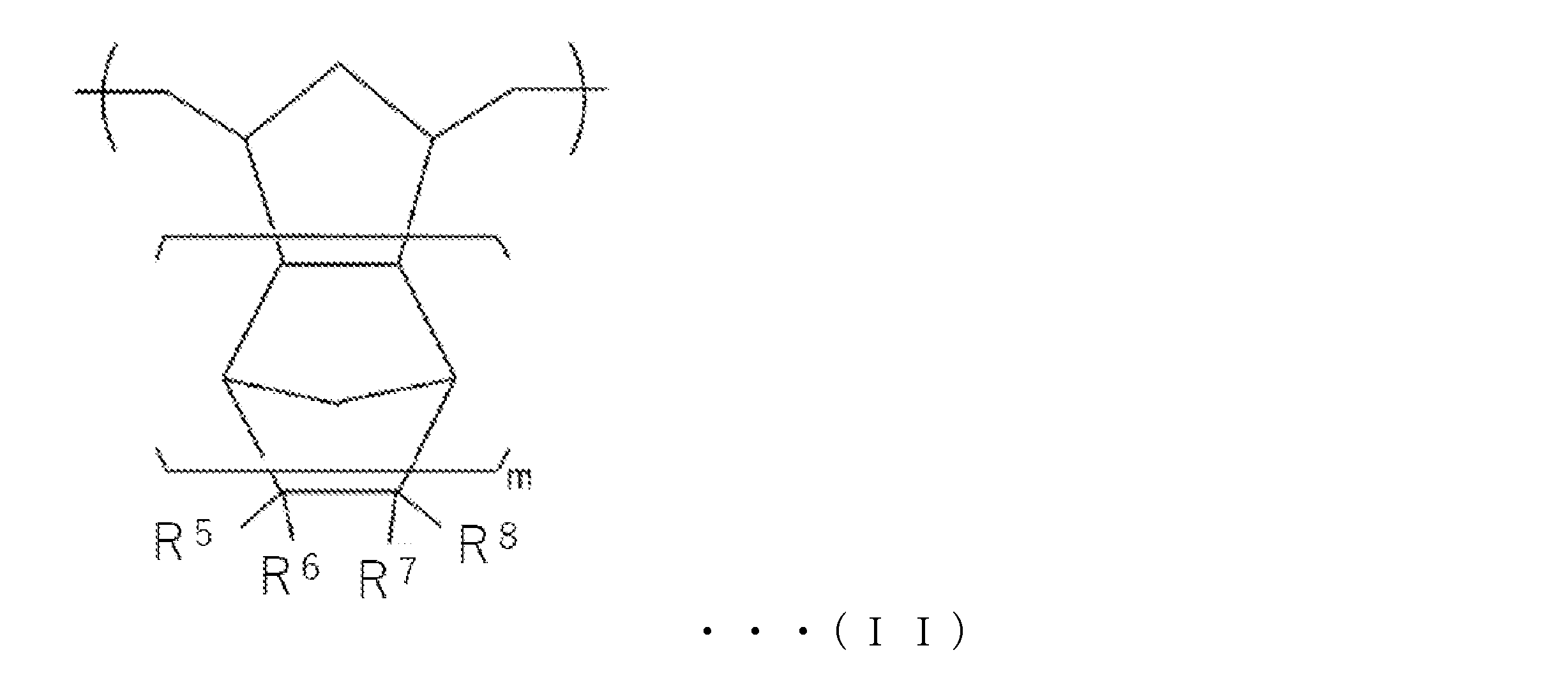
で表される繰り返し単位とを含む、ランダム共重合体。 - 前記R1およびR2が水素原子であり、前記R3が水素原子またはメチル基であり、前記R4が、ハロゲン原子、酸素原子および窒素原子からなる群より選択される少なくとも一種の原子を含んでいてもよい炭素数が1以上12以下の基である、請求項1に記載のランダム共重合体。
- 前記R4が、酸素原子および/または窒素原子を含む炭素数が1以上12以下の基である、請求項2に記載のランダム共重合体。
- 前記R4が、カルボニル基またはニトリル基を含む炭素数が1以上12以下の基である、請求項3に記載のランダム共重合体。
- 前記R5~R8が、それぞれ独立して、水素原子または炭素数1以上20以下の炭化水素基である、請求項1~4の何れかに記載のランダム共重合体。
- 下記式(III):
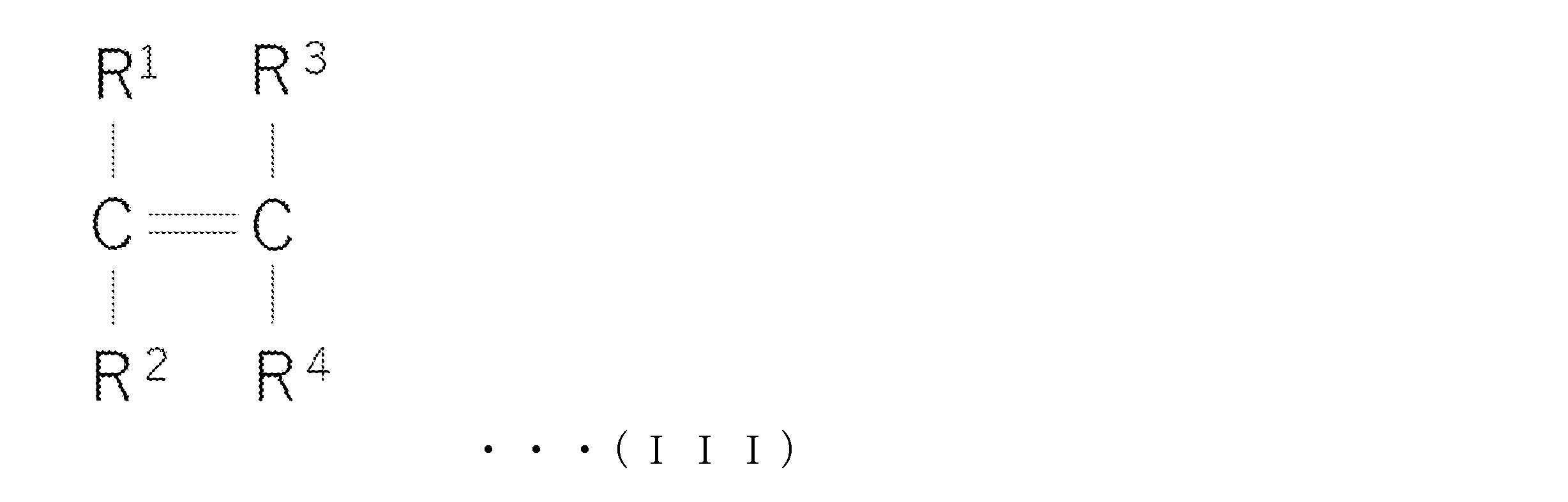
で表される化合物と、
下記式(IV):

で表される化合物とを含む単量体組成物を、下記式(V):

で表されるエーテル化合物および触媒の存在下で開環重合する工程(A)と、
前記工程(A)で得られた重合体を水素化する工程(B)と、
を含むランダム共重合体の製造方法。 - 前記エーテル化合物が分子内にエーテル結合を2つ以上有する、請求項6に記載のランダム共重合体の製造方法。
- 前記エーテル化合物が、1-シクロヘキセニル-2-メトキシエテン、エチル-1-プロペニルエーテル、3,4-ジヒドロピラン、2-ビニルオキシテトラヒドロピラン、3-エトキシアクリロニトリル、3,4-ジヒドロ-2-メトキシ-2H-ピラン、または、3,4-ジヒドロ-2-エトキシ-2H-ピランである、請求項6または7に記載のランダム共重合体の製造方法。
- 前記R1およびR2が水素原子であり、前記R3が水素原子またはメチル基であり、前記R4が、ハロゲン原子、酸素原子および窒素原子からなる群より選択される少なくとも一種の原子を含んでいてもよい炭素数が1以上12以下の基である、請求項6~8の何れかに記載のランダム共重合体の製造方法。
- 前記R4が、酸素原子および/または窒素原子を含む炭素数が1以上12以下の基である、請求項9に記載のランダム共重合体の製造方法。
- 前記R4が、カルボニル基またはニトリル基を含む炭素数が1以上12以下の基である、請求項10に記載のランダム共重合体の製造方法。
- 前記R5~R8が、それぞれ独立して、水素原子または炭素数1以上20以下の炭化水素基である、請求項6~11の何れかに記載のランダム共重合体の製造方法。
Priority Applications (4)
| Application Number | Priority Date | Filing Date | Title |
|---|---|---|---|
| EP22780620.5A EP4317241A4 (en) | 2021-03-31 | 2022-03-25 | STATISTICAL COPOLYMER AND METHOD FOR PRODUCING THE SAME |
| US18/552,437 US20240182631A1 (en) | 2021-03-31 | 2022-03-25 | Random copolymer and method of producing same |
| JP2023511193A JPWO2022210407A1 (ja) | 2021-03-31 | 2022-03-25 | |
| CN202280020200.6A CN116964124A (zh) | 2021-03-31 | 2022-03-25 | 无规共聚物及其制造方法 |
Applications Claiming Priority (2)
| Application Number | Priority Date | Filing Date | Title |
|---|---|---|---|
| JP2021-062076 | 2021-03-31 | ||
| JP2021062076 | 2021-03-31 |
Publications (1)
| Publication Number | Publication Date |
|---|---|
| WO2022210407A1 true WO2022210407A1 (ja) | 2022-10-06 |
Family
ID=83456181
Family Applications (1)
| Application Number | Title | Priority Date | Filing Date |
|---|---|---|---|
| PCT/JP2022/014608 Ceased WO2022210407A1 (ja) | 2021-03-31 | 2022-03-25 | ランダム共重合体およびその製造方法 |
Country Status (5)
| Country | Link |
|---|---|
| US (1) | US20240182631A1 (ja) |
| EP (1) | EP4317241A4 (ja) |
| JP (1) | JPWO2022210407A1 (ja) |
| CN (1) | CN116964124A (ja) |
| WO (1) | WO2022210407A1 (ja) |
Cited By (2)
| Publication number | Priority date | Publication date | Assignee | Title |
|---|---|---|---|---|
| JPWO2022210411A1 (ja) * | 2021-03-31 | 2022-10-06 | ||
| JPWO2022210409A1 (ja) * | 2021-03-31 | 2022-10-06 |
Citations (10)
| Publication number | Priority date | Publication date | Assignee | Title |
|---|---|---|---|---|
| JPH02173118A (ja) * | 1988-11-23 | 1990-07-04 | Shell Internatl Res Maatschappij Bv | 構造上異なるモノマーの重合法 |
| JPH03115428A (ja) * | 1989-09-29 | 1991-05-16 | Teijin Ltd | 重合体成型物の製造方法 |
| JP2001253935A (ja) * | 2000-01-05 | 2001-09-18 | Sekisui Chem Co Ltd | ノルボルネン系ポリマーの製造方法及びノルボルネン系ポリマー |
| JP2006183001A (ja) | 2004-12-28 | 2006-07-13 | Nippon Zeon Co Ltd | ランダム共重合体およびその製造方法 |
| JP2014136350A (ja) * | 2013-01-16 | 2014-07-28 | Nippon Zeon Co Ltd | 積層体及びその製造方法 |
| JP2014136728A (ja) * | 2013-01-16 | 2014-07-28 | Nippon Zeon Co Ltd | 架橋環状オレフィン樹脂フィルム、積層体及びその製造方法 |
| WO2016036976A1 (en) | 2014-09-03 | 2016-03-10 | University Of Washington | Metathesis polymerization methods |
| JP2017048260A (ja) * | 2015-08-31 | 2017-03-09 | 三洋化成工業株式会社 | 感光性組成物 |
| WO2020076920A1 (en) * | 2018-10-09 | 2020-04-16 | The Trustees Of Columbia University In The City Of New York | Compositions and methods for visible-light-controlled ruthenium-catalyzed olefin metathesis |
| WO2021060418A1 (ja) * | 2019-09-25 | 2021-04-01 | 日本ゼオン株式会社 | 環状ポリマー水素化物及びその製造方法、並びに、樹脂組成物 |
Family Cites Families (2)
| Publication number | Priority date | Publication date | Assignee | Title |
|---|---|---|---|---|
| JPWO2022210409A1 (ja) * | 2021-03-31 | 2022-10-06 | ||
| WO2022210411A1 (ja) * | 2021-03-31 | 2022-10-06 | 日本ゼオン株式会社 | ランダム共重合体およびその製造方法 |
-
2022
- 2022-03-25 WO PCT/JP2022/014608 patent/WO2022210407A1/ja not_active Ceased
- 2022-03-25 JP JP2023511193A patent/JPWO2022210407A1/ja active Pending
- 2022-03-25 CN CN202280020200.6A patent/CN116964124A/zh active Pending
- 2022-03-25 EP EP22780620.5A patent/EP4317241A4/en active Pending
- 2022-03-25 US US18/552,437 patent/US20240182631A1/en active Pending
Patent Citations (10)
| Publication number | Priority date | Publication date | Assignee | Title |
|---|---|---|---|---|
| JPH02173118A (ja) * | 1988-11-23 | 1990-07-04 | Shell Internatl Res Maatschappij Bv | 構造上異なるモノマーの重合法 |
| JPH03115428A (ja) * | 1989-09-29 | 1991-05-16 | Teijin Ltd | 重合体成型物の製造方法 |
| JP2001253935A (ja) * | 2000-01-05 | 2001-09-18 | Sekisui Chem Co Ltd | ノルボルネン系ポリマーの製造方法及びノルボルネン系ポリマー |
| JP2006183001A (ja) | 2004-12-28 | 2006-07-13 | Nippon Zeon Co Ltd | ランダム共重合体およびその製造方法 |
| JP2014136350A (ja) * | 2013-01-16 | 2014-07-28 | Nippon Zeon Co Ltd | 積層体及びその製造方法 |
| JP2014136728A (ja) * | 2013-01-16 | 2014-07-28 | Nippon Zeon Co Ltd | 架橋環状オレフィン樹脂フィルム、積層体及びその製造方法 |
| WO2016036976A1 (en) | 2014-09-03 | 2016-03-10 | University Of Washington | Metathesis polymerization methods |
| JP2017048260A (ja) * | 2015-08-31 | 2017-03-09 | 三洋化成工業株式会社 | 感光性組成物 |
| WO2020076920A1 (en) * | 2018-10-09 | 2020-04-16 | The Trustees Of Columbia University In The City Of New York | Compositions and methods for visible-light-controlled ruthenium-catalyzed olefin metathesis |
| WO2021060418A1 (ja) * | 2019-09-25 | 2021-04-01 | 日本ゼオン株式会社 | 環状ポリマー水素化物及びその製造方法、並びに、樹脂組成物 |
Non-Patent Citations (2)
| Title |
|---|
| KRAPPITZ TIM, JOVIC KRISTINA, FEIST FLORIAN, FRISCH HENDRIK, RIGOGLIOSO VINCENT P., BLINCO JAMES P., BOYDSTON ANDREW J., BARNER-KO: "Hybrid Photo-induced Copolymerization of Ring-Strained and Vinyl Monomers Utilizing Metal-Free Ring-Opening Metathesis Polymerization Conditions", JOURNAL OF THE AMERICAN CHEMICAL SOCIETY, AMERICAN CHEMICAL SOCIETY, vol. 141, no. 42, 23 October 2019 (2019-10-23), pages 16605 - 16609, XP055972688, ISSN: 0002-7863, DOI: 10.1021/jacs.9b09025 * |
| See also references of EP4317241A4 |
Cited By (2)
| Publication number | Priority date | Publication date | Assignee | Title |
|---|---|---|---|---|
| JPWO2022210411A1 (ja) * | 2021-03-31 | 2022-10-06 | ||
| JPWO2022210409A1 (ja) * | 2021-03-31 | 2022-10-06 |
Also Published As
| Publication number | Publication date |
|---|---|
| CN116964124A (zh) | 2023-10-27 |
| JPWO2022210407A1 (ja) | 2022-10-06 |
| EP4317241A1 (en) | 2024-02-07 |
| US20240182631A1 (en) | 2024-06-06 |
| EP4317241A4 (en) | 2025-05-21 |
Similar Documents
| Publication | Publication Date | Title |
|---|---|---|
| JP5598326B2 (ja) | 結晶性ノルボルネン系開環重合体水素化物及び成形体 | |
| JPWO2000073366A1 (ja) | 環状オレフィンの開環重合体水素化物の製造方法 | |
| WO2003085025A1 (fr) | Polymere a polymerisation par ouverture de cycle, a base de norbornene, produit de l'hydrogenation de ce polymere, et procedes d'elaboration correspondants | |
| JP4466272B2 (ja) | ノルボルネン系開環重合体水素化物の製造方法およびノルボルネン系開環重合体水素化物 | |
| JP7120764B2 (ja) | シンジオタクチック-ノルボルネン系開環重合体水素化物 | |
| JP5708538B2 (ja) | 開環共重合体水素化物 | |
| WO2001014446A1 (fr) | Polymeres de norbornene par ouverture de cycle, produits de leur hydrogenation et procedes de productions de ces deux types de polymeres | |
| TW200906870A (en) | Norbornene monomers with epoxy group and polymer material thereof | |
| EP3269750B1 (en) | Syndiotactic crystalline dicyclopentadiene ring-opening polymer hydride | |
| JP7661884B2 (ja) | 環状ポリマー水素化物及びその製造方法、並びに、樹脂組成物 | |
| US20240182631A1 (en) | Random copolymer and method of producing same | |
| WO2022210411A1 (ja) | ランダム共重合体およびその製造方法 | |
| JP3833916B2 (ja) | 溶融成形可能な熱可塑性ノルボルネン系樹脂組成物及びそれを用いた成形品又は光学フィルム | |
| JP2000500506A (ja) | 重合性組成物及び重合方法 | |
| JP2002249645A (ja) | 重合体組成物 | |
| JP2002121231A (ja) | インデン系重合体の製造法並びにこの重合体を用いた成形材、フィルム、添加剤及び光学用部品 | |
| WO2022210409A1 (ja) | ランダム共重合体およびその製造方法 | |
| JP2002220440A (ja) | 環状オレフィン系開環重合体及びその製造方法 | |
| JP2007137935A (ja) | テトラシクロドデセン開環重合体水素化物、その製造方法及び光学材料 | |
| JP2002317034A (ja) | 末端に官能基を有するノルボルネン系開環重合体水素化物及びその製造方法 | |
| US20250034290A1 (en) | Functional Cyclic Olefin Polymer, Process for Obtaining the Same and Compositions Containing the Same | |
| JP2011006498A (ja) | 樹脂組成物およびフィルム | |
| JP2006183001A (ja) | ランダム共重合体およびその製造方法 | |
| JP3175293B2 (ja) | 延伸フィルム | |
| JPWO2009022477A1 (ja) | 生理活性物質を結合したノルボルネン系高分子重合体、その製法及び用途 |
Legal Events
| Date | Code | Title | Description |
|---|---|---|---|
| 121 | Ep: the epo has been informed by wipo that ep was designated in this application |
Ref document number: 22780620 Country of ref document: EP Kind code of ref document: A1 |
|
| WWE | Wipo information: entry into national phase |
Ref document number: 2023511193 Country of ref document: JP |
|
| WWE | Wipo information: entry into national phase |
Ref document number: 202280020200.6 Country of ref document: CN |
|
| WWE | Wipo information: entry into national phase |
Ref document number: 18552437 Country of ref document: US |
|
| WWE | Wipo information: entry into national phase |
Ref document number: 2022780620 Country of ref document: EP |
|
| ENP | Entry into the national phase |
Ref document number: 2022780620 Country of ref document: EP Effective date: 20231031 |
|
| NENP | Non-entry into the national phase |
Ref country code: DE |