WO2022210759A1 - 抗血栓性材料 - Google Patents
抗血栓性材料 Download PDFInfo
- Publication number
- WO2022210759A1 WO2022210759A1 PCT/JP2022/015625 JP2022015625W WO2022210759A1 WO 2022210759 A1 WO2022210759 A1 WO 2022210759A1 JP 2022015625 W JP2022015625 W JP 2022015625W WO 2022210759 A1 WO2022210759 A1 WO 2022210759A1
- Authority
- WO
- WIPO (PCT)
- Prior art keywords
- meth
- acrylate
- copolymer
- silicone
- acrylate copolymer
- Prior art date
- Legal status (The legal status is an assumption and is not a legal conclusion. Google has not performed a legal analysis and makes no representation as to the accuracy of the status listed.)
- Ceased
Links
Classifications
-
- A—HUMAN NECESSITIES
- A61—MEDICAL OR VETERINARY SCIENCE; HYGIENE
- A61L—METHODS OR APPARATUS FOR STERILISING MATERIALS OR OBJECTS IN GENERAL; DISINFECTION, STERILISATION OR DEODORISATION OF AIR; CHEMICAL ASPECTS OF BANDAGES, DRESSINGS, ABSORBENT PADS OR SURGICAL ARTICLES; MATERIALS FOR BANDAGES, DRESSINGS, ABSORBENT PADS OR SURGICAL ARTICLES
- A61L33/00—Antithrombogenic treatment of surgical articles, e.g. sutures, catheters, prostheses, or of articles for the manipulation or conditioning of blood; Materials for such treatment
- A61L33/06—Use of macromolecular materials
- A61L33/064—Use of macromolecular materials obtained by reactions only involving carbon-to-carbon unsaturated bonds
-
- A—HUMAN NECESSITIES
- A61—MEDICAL OR VETERINARY SCIENCE; HYGIENE
- A61L—METHODS OR APPARATUS FOR STERILISING MATERIALS OR OBJECTS IN GENERAL; DISINFECTION, STERILISATION OR DEODORISATION OF AIR; CHEMICAL ASPECTS OF BANDAGES, DRESSINGS, ABSORBENT PADS OR SURGICAL ARTICLES; MATERIALS FOR BANDAGES, DRESSINGS, ABSORBENT PADS OR SURGICAL ARTICLES
- A61L33/00—Antithrombogenic treatment of surgical articles, e.g. sutures, catheters, prostheses, or of articles for the manipulation or conditioning of blood; Materials for such treatment
- A61L33/06—Use of macromolecular materials
- A61L33/068—Use of macromolecular materials obtained otherwise than by reactions only involving carbon-to-carbon unsaturated bonds
-
- C—CHEMISTRY; METALLURGY
- C08—ORGANIC MACROMOLECULAR COMPOUNDS; THEIR PREPARATION OR CHEMICAL WORKING-UP; COMPOSITIONS BASED THEREON
- C08F—MACROMOLECULAR COMPOUNDS OBTAINED BY REACTIONS ONLY INVOLVING CARBON-TO-CARBON UNSATURATED BONDS
- C08F220/00—Copolymers of compounds having one or more unsaturated aliphatic radicals, each having only one carbon-to-carbon double bond, and only one being terminated by only one carboxyl radical or a salt, anhydride ester, amide, imide or nitrile thereof
- C08F220/02—Monocarboxylic acids having less than ten carbon atoms; Derivatives thereof
- C08F220/10—Esters
- C08F220/12—Esters of monohydric alcohols or phenols
- C08F220/16—Esters of monohydric alcohols or phenols of phenols or of alcohols containing two or more carbon atoms
- C08F220/18—Esters of monohydric alcohols or phenols of phenols or of alcohols containing two or more carbon atoms with acrylic or methacrylic acids
- C08F220/1808—C8-(meth)acrylate, e.g. isooctyl (meth)acrylate or 2-ethylhexyl (meth)acrylate
-
- C—CHEMISTRY; METALLURGY
- C08—ORGANIC MACROMOLECULAR COMPOUNDS; THEIR PREPARATION OR CHEMICAL WORKING-UP; COMPOSITIONS BASED THEREON
- C08F—MACROMOLECULAR COMPOUNDS OBTAINED BY REACTIONS ONLY INVOLVING CARBON-TO-CARBON UNSATURATED BONDS
- C08F222/00—Copolymers of compounds having one or more unsaturated aliphatic radicals, each having only one carbon-to-carbon double bond, and at least one being terminated by a carboxyl radical and containing at least one other carboxyl radical in the molecule; Salts, anhydrides, esters, amides, imides, or nitriles thereof
- C08F222/10—Esters
-
- C—CHEMISTRY; METALLURGY
- C08—ORGANIC MACROMOLECULAR COMPOUNDS; THEIR PREPARATION OR CHEMICAL WORKING-UP; COMPOSITIONS BASED THEREON
- C08F—MACROMOLECULAR COMPOUNDS OBTAINED BY REACTIONS ONLY INVOLVING CARBON-TO-CARBON UNSATURATED BONDS
- C08F230/00—Copolymers of compounds having one or more unsaturated aliphatic radicals, each having only one carbon-to-carbon double bond, and containing phosphorus, selenium, tellurium or a metal
- C08F230/04—Copolymers of compounds having one or more unsaturated aliphatic radicals, each having only one carbon-to-carbon double bond, and containing phosphorus, selenium, tellurium or a metal containing a metal
- C08F230/08—Copolymers of compounds having one or more unsaturated aliphatic radicals, each having only one carbon-to-carbon double bond, and containing phosphorus, selenium, tellurium or a metal containing a metal containing silicon
-
- A—HUMAN NECESSITIES
- A61—MEDICAL OR VETERINARY SCIENCE; HYGIENE
- A61L—METHODS OR APPARATUS FOR STERILISING MATERIALS OR OBJECTS IN GENERAL; DISINFECTION, STERILISATION OR DEODORISATION OF AIR; CHEMICAL ASPECTS OF BANDAGES, DRESSINGS, ABSORBENT PADS OR SURGICAL ARTICLES; MATERIALS FOR BANDAGES, DRESSINGS, ABSORBENT PADS OR SURGICAL ARTICLES
- A61L2300/00—Biologically active materials used in bandages, wound dressings, absorbent pads or medical devices
- A61L2300/40—Biologically active materials used in bandages, wound dressings, absorbent pads or medical devices characterised by a specific therapeutic activity or mode of action
- A61L2300/42—Anti-thrombotic agents, anticoagulants, anti-platelet agents
Definitions
- the present invention relates to an antithrombotic material that imparts blood compatibility to medical devices. More specifically, a (meth)acrylate copolymer containing a hydrophobic (meth)acrylate and a hydrophilic (meth)acrylate, which is water-insoluble and contains at least a silicone (meth)acrylate as the hydrophobic (meth)acrylate, and an antithrombotic material that is viscous liquid at room temperature.
- the medical device is required to have biocompatibility because the synthetic material, which is foreign to the living body, is used in contact with tissue or blood in the living body.
- Applicants have considered materials suitable for the above uses, consisting of alkyl (meth)acrylates and silicone (meth)acrylates, and methoxypolyethylene glycol (meth)acrylates, having a number average molecular weight of 2,000 to 200,000, water A (meth)acrylate copolymer that is insoluble, viscous liquid at room temperature, soluble in any alcohol having 1 to 6 carbon atoms, and has a viscosity of 0.5 to 10,000 Pa ⁇ s at 37°C. (Patent Document 1).
- An object of the present invention is to provide an anti-thrombotic material that can be used as a material that is in contact with blood for a relatively long time compared to conventional medical materials and that has further enhanced durability against blood contact.
- the present inventors adjusted the residual monomer amount and reduced viscosity to specific ranges.
- the inventors have found that by applying the above copolymer to medical devices, it is possible to impart antithrombotic properties for a longer period of time than ever before, and have completed the present invention. That is, the present invention has the following configurations.
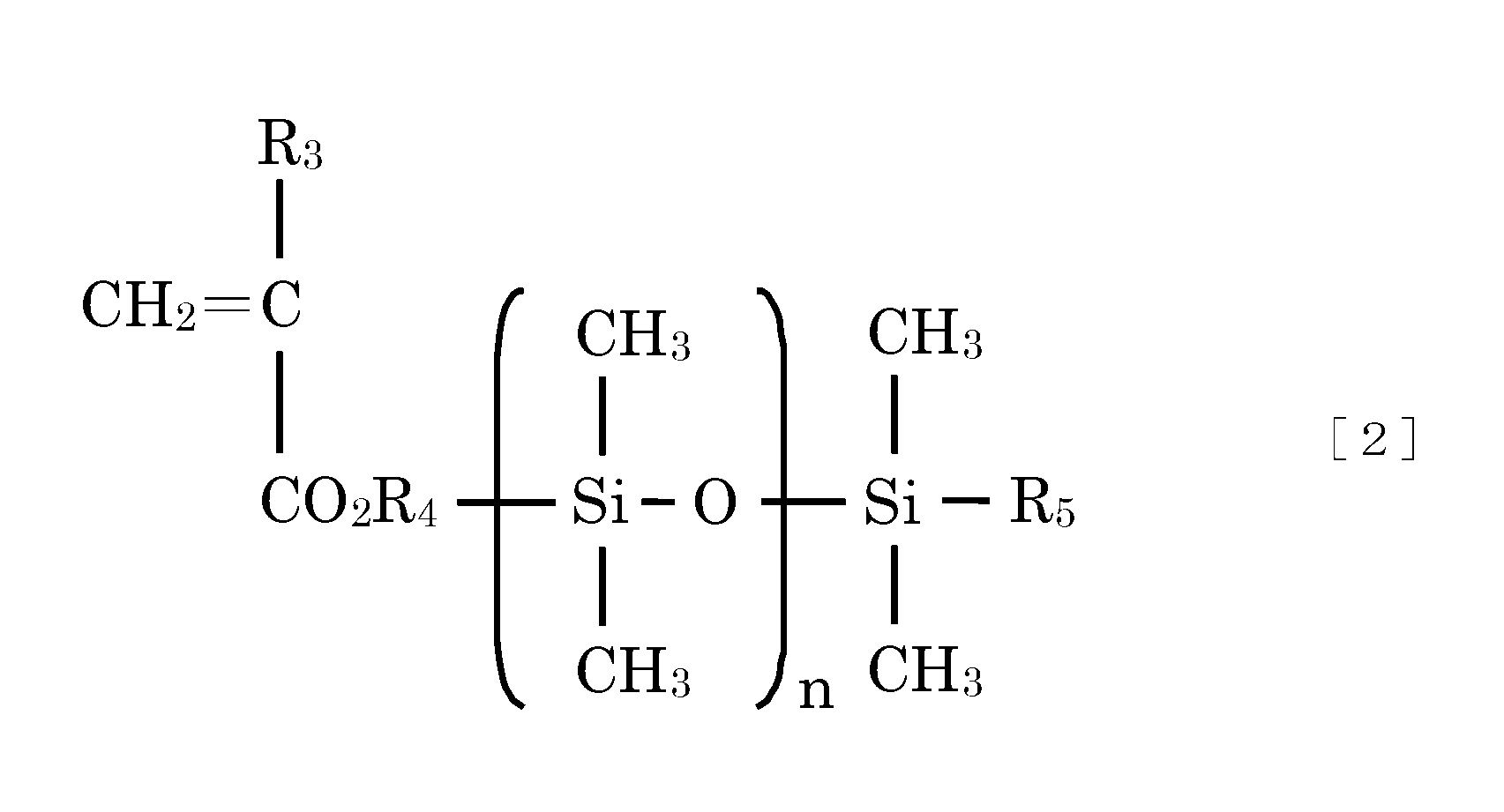
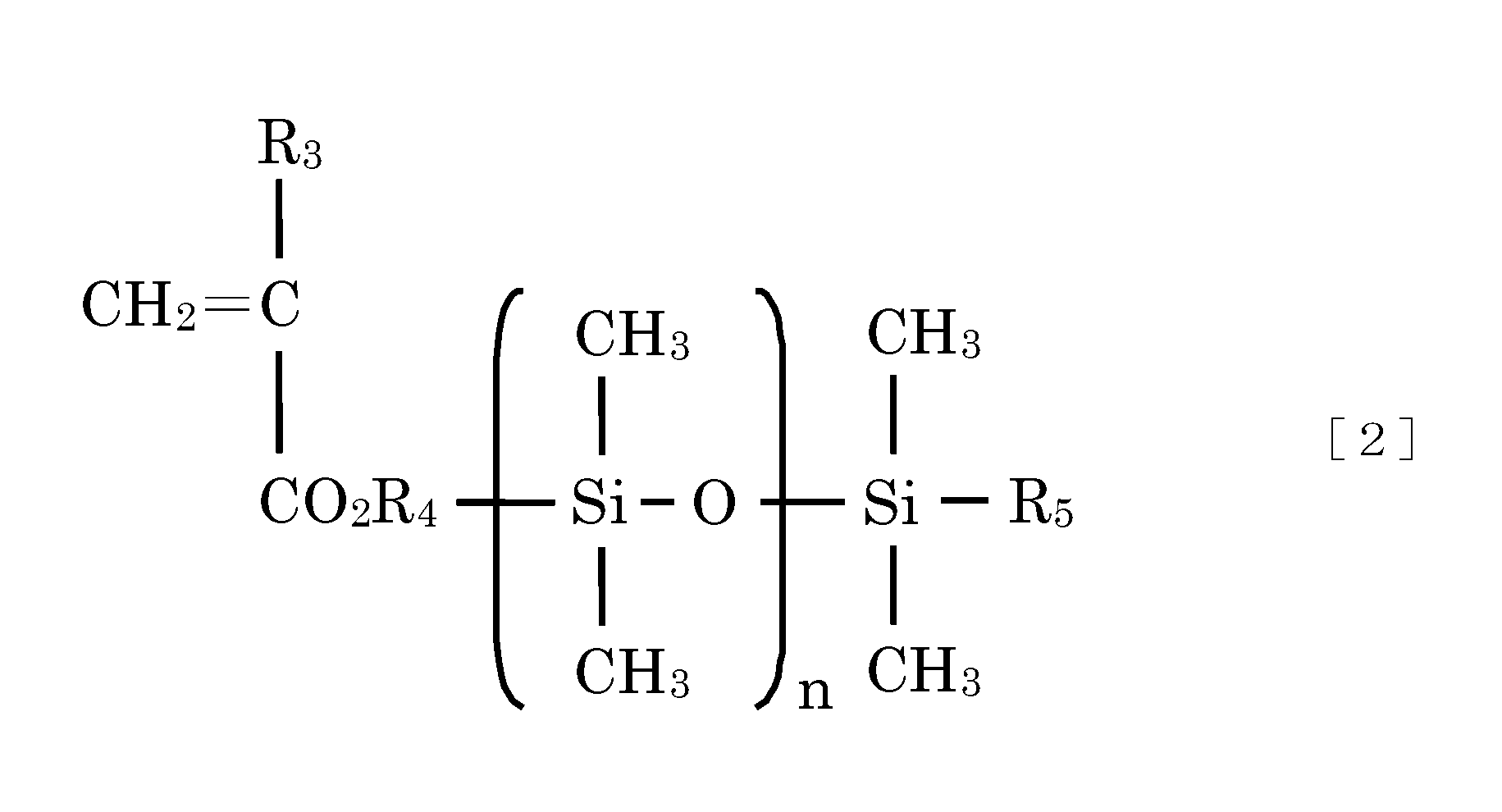
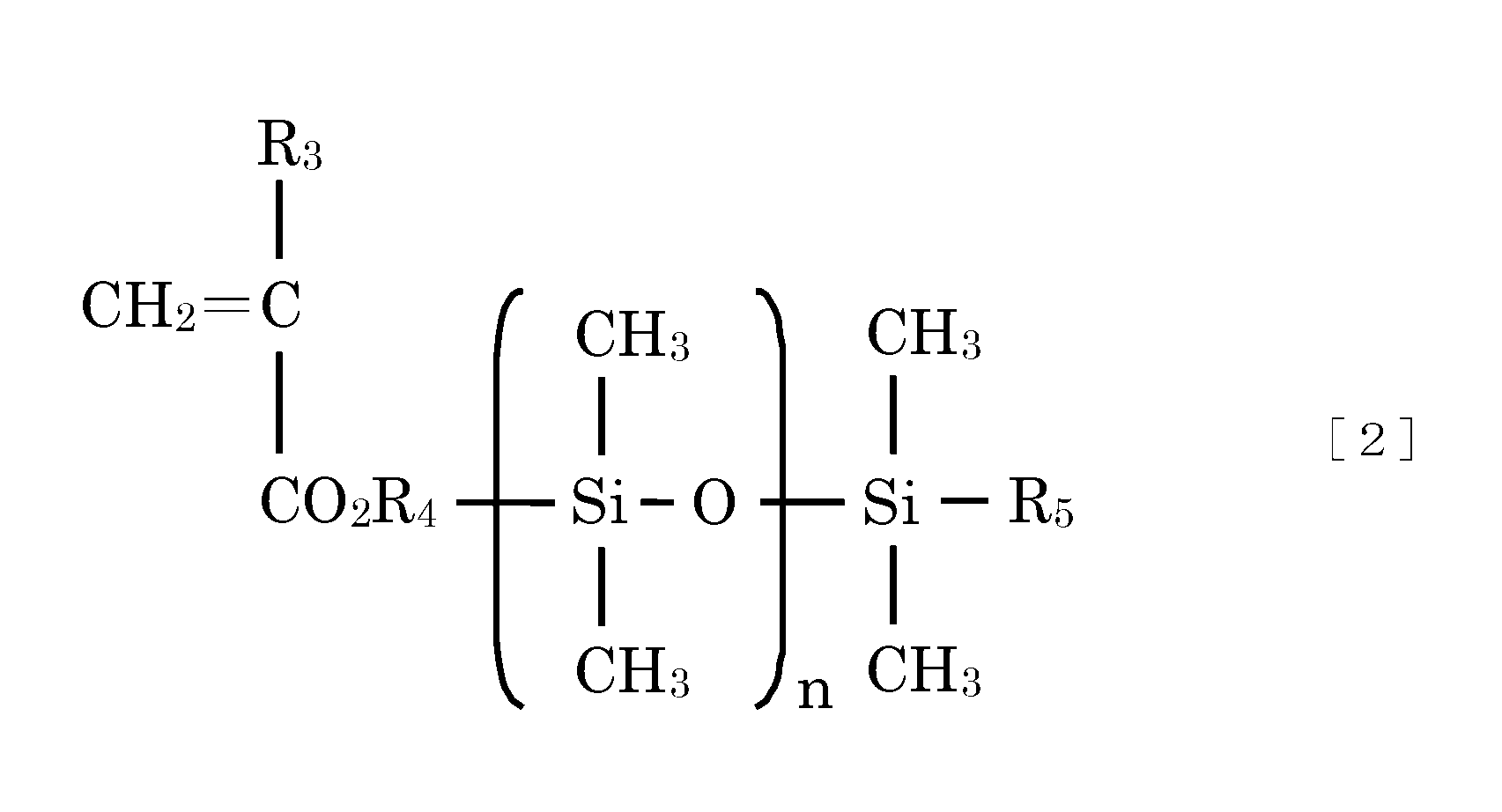
- alkyl (meth)acrylate units represented by the following general formula 1 silicone (meth)acrylate units represented by the following general formula 2, and methoxypolyethylene glycol (meth)acrylate units represented by the following general formula 3;
- the copolymer means that the mass reduction rate of is 1% by mass or less), is viscous liquid at room temperature, is soluble in any alcohol having 1 to 6 carbon atoms, and has a residual monomer amount of 4,000 ppm or less. and a reduced viscosity ( ⁇ sp/c) of 0.18 dl/g or more and 3.00 dl/g or less, comprising a (meth)acrylate copolymer.
- R 1 represents an alkyl group having 8 to 12 carbon atoms
- R 2 represents a hydrogen atom or a methyl group
- R 3 is a hydrogen atom or a methyl group
- R 4 is an alkylene group having 1 to 6 carbon atoms
- R 5 is an alkyl group having 1 to 6 carbon atoms
- n is an integer of 1 to 30.
- R 6 is a hydrogen atom or a methyl group
- n is an integer of 2 to 4
- the antithrombotic material of the present invention is a material that has excellent biocompatibility and high durability against blood contact.
- the physical properties of the material are water-insoluble viscous substances, even if the antithrombotic material carried in the medical device comes into contact with the blood, it will not easily elute into the blood, and the medical device will be able to withstand long-term resistance. Can maintain thrombosis.
- silicone (meth)acrylate is included as a hydrophobic (meth)acrylate, the effect of suppressing hydrolysis and the like of the (meth)acrylate copolymer can be expected due to its water-repellent action.
- the (meth)acrylate copolymer containing a hydrophobic (meth)acrylate and a hydrophilic (meth)acrylate preferably has resistance to contact with blood and is viscous and liquid at room temperature.
- the durability against blood contact means that when the (meth)acrylate copolymer is immersed in an alcohol immersion treatment solution at room temperature for 16 hours, the (meth)acrylate copolymer remains for a certain amount or more and is antithrombotic. It means that you show your sexuality.
- the (meth)acrylate copolymer If a predetermined amount of the (meth)acrylate copolymer remains after being immersed in the alcohol immersion treatment solution at room temperature for 16 hours, it has sufficient antithrombotic properties (maintains) even when it is in contact with blood at 37°C for 30 days. ). In addition, since it is liquid at room temperature but has viscosity, it has the advantage of being able to suppress elution into blood when it is used as a coating on medical equipment or the like.
- the hydrophilic (meth)acrylate preferably contains methoxypolyethylene glycol (meth)acrylate represented by the following general formula 3.
- general formula 3 it is preferable to use one having 2 to 10 ethylene oxide units. More preferably 2-5.
- methoxydiethylene glycol (meth)acrylate methoxytriethyleneglycol (meth)acrylate, methoxytetraethyleneglycol (meth)acrylate, methoxypentaethyleneglycol (meth)acrylate, methoxyhexaethyleneglycol (meth)acrylate, methoxyhepta ethylene glycol (meth)acrylate, methoxyoctaethyleneglycol (meth)acrylate, methoxynonaethyleneglycol (meth)acrylate, methoxydecaethyleneglycol (meth)acrylate and the like.
- methoxytetraethyleneglycol (meth)acrylate having 4 repeating ethylene oxide units and methoxytriethyleneglycol (meth)acrylate having 3 repeating ethylene oxide units are more preferable.
- 3 methoxytriethylene glycol (meth)acrylate is particularly preferred.
- R 6 is a hydrogen atom or a methyl group, and n is an integer of 2 to 4.
- the hydrophobic (meth)acrylate preferably contains a silicone (meth)acrylate represented by Formula 2 below.
- a silicone (meth)acrylate having 1 to 50 dimethylsiloxane repeating units is preferably used as the silicone (meth)acrylate. If the repeating unit is too large, the resulting copolymer may have too high a viscosity and may be difficult to handle. On the other hand, if the repeating unit is too small, the viscosity will be too low, and there is a risk that it will easily disappear from the coated surface of the medical device or the like. Therefore, the number of dimethylsiloxane repeating units is more preferably 1-20.
- R 3 is a hydrogen atom or a methyl group
- R 4 is an alkylene group having 1 to 6 carbon atoms
- R 5 is an alkyl group having 1 to 6 carbon atoms
- n is an integer of 1 to 30.
- hydrophobic (meth)acrylates may include other hydrophobic (meth)acrylates in addition to silicone (meth)acrylates.
- hydrophobic (meth)acrylates are not particularly limited, it is preferable to add a hydrophobic (meth)acrylate represented by the following general formula 1 as an example.
- R 1 preferably has 8 to 20 carbon atoms, more preferably 8 to 12 carbon atoms.
- hydrophobic (meth)acrylates include normal hexyl (meth)acrylate, cyclohexyl (meth)acrylate, phenyl (meth)acrylate, benzyl (meth)acrylate, heptyl (meth)acrylate, and octyl (meth)acrylate.
- R 1 represents an alkyl group having 8 to 12 carbon atoms
- R 2 represents a hydrogen atom or a methyl group.
- Specific representatives of the water-insoluble (meth)acrylate copolymers of the present invention include silicone (meth)acrylate-methoxydiethylene glycol (meth)acrylate copolymer, silicone (meth)acrylate-methoxytri Ethylene glycol (meth)acrylate copolymer, silicone (meth)acrylate-methoxytetraethylene glycol (meth)acrylate copolymer, silicone (meth)acrylate-normal hexyl (meth)acrylate-methoxydiethylene glycol (meth)acrylate copolymer , silicone (meth) acrylate-normal hexyl (meth) acrylate-methoxytriethylene glycol (meth) acrylate copolymer, silicone (meth) acrylate-normal hexyl (meth) acrylate-methoxytetraethylene glycol (meth) acrylate copolymer , silicone (meth) acrylate-cyclohexyl (meth)
- the molar ratio is more preferably 80-50/5-0.01/15-49.99, and the molar ratio is 77-55/5-0.01/18-44.99. More preferably, the molar ratio is even more preferably 73-57/5-0.01/22-42.99.
- weight-average molecular weight and weight-average molecular weight are used as indicators of the molecular weight of the copolymer, but since the weight-average molecular weight affects the stability and adhesion more, the weight-average molecular weight is used as an indicator in the present invention. Selected. If the weight-average molecular weight is too small, not only is there a risk of elution into the blood, but there is also the possibility that the strength and stability of the coating film will be lost. In addition, the greater the weight average molecular weight, the higher the viscosity when preparing a coating solution, which has a secondary effect of improving the adhesiveness to the coating substrate.
- the weight average molecular weight of the (meth)acrylate copolymer is more preferably 60,000 or more. Further, it is preferable that the weight average molecular weight of the (meth)acrylate copolymer is 1,500,000 or less in order to improve the workability when the (meth)acrylate copolymer is coated on a medical device or the like. It is more preferably 1,000,000 or less, still more preferably 500,000 or less.
- the weight-average molecular weight is obtained by dividing the sum of the molecular weights of all molecules by the sum of the molecular weights, and is one of the indicators of polymer properties.
- Methods for measuring the weight average molecular weight include terminal group determination method, osmotic pressure method, vapor pressure osmometry, vapor pressure depression method, freezing point depression method, boiling point elevation method, gel permeation chromatography (GPC) method, and the like. In the present invention, a conventional method of gel permeation chromatography (GPC) is adopted in terms of ease of operation.
- the reduced viscosity ( ⁇ sp/c) of the (meth)acrylate copolymer is preferably 0.18 dl/g or more and 3.00 dl/g or less.
- a copolymer (antithrombotic material) having such a viscosity range, when a medical device such as a heart-lung machine or a catheter is coated, the copolymer and the medical device have excellent adhesiveness, Long-term use enables sustained antithrombotic properties.
- a more preferable range of reduced viscosity is 0.18 dl/g or more and 1.50 dl/g or less, more preferably 0.18 dl/g or more and 0.50 dl/g or less.
- the hydrophobic (meth)acrylate does not necessarily include a silicone (meth)acrylate, but as can be seen from its basic skeleton, silicone has excellent heat resistance and cold resistance, and has a glass transition temperature ( Since Tg) is also low, there is an advantage that stable properties can be exhibited in various temperature ranges. Moreover, since it has a large binding energy, it has the advantages of acid and alkali resistance and high chemical stability. Furthermore, it is excellent in copolymerizability with a (meth)acrylate monomer, and can be preferably used as a raw material for the (meth)acrylate copolymer of the present invention.
- silicone (meth)acrylate has been recognized as a material having high safety against living organisms, such as being used as a material for contact lenses. Therefore, too much silicone (meth)acrylate content in the antithrombotic material is not considered to be a problem, and silicone (meth)acrylate-methoxypolyethylene glycol (meth)acrylate copolymers are acceptable.
- silicone (meth)acrylate is relatively expensive as a raw material, and the use of silicone (meth)acrylate alone as a hydrophobic (meth)acrylate may be disadvantageous in terms of cost effectiveness. Considering performance, quality, cost, etc.
- the upper limit of the amount of silicone (meth)acrylate to be added is 50% by mass or less. It is more preferably 40% by mass or less, still more preferably 35% by mass or less. Moreover, you may mix and use a silicone (meth)acrylate and the other alkyl (meth)acrylate previously mentioned. On the other hand, if the silicone (meth)acrylate content is too low, hydrolysis may proceed during storage and the long-term stability of the antithrombotic material may decrease. ) The acrylate content is more preferably 0.1% by mass or more, more preferably 0.5% by mass or more, and even more preferably 1.0% by mass or more.
- This (meth)acrylate copolymer may be a copolymer in which the monomers of the general formula 2 and the monomers of the general formula 3 are alternately arranged. Alternatively, it may be a copolymer consisting of blocks and segments or blocks of hydrophilic monomers. Segments or blocks made of hydrophobic monomers may have complex structures such as so-called microphase-separated structures or mosaic-like structures, in which segments or blocks made of hydrophilic monomers are fixed. It can be assumed.
- the size of the molecular weight of the copolymer and the type and properties of the hydrophilic monomer will have some effect, but if the amount of the hydrophobic monomer is slightly increased, the segment composed of the hydrophilic monomer of the copolymer will Alternatively, block elution can be suppressed.
- increasing the number of hydrophobic segments is thought to function to increase affinity with hydrophobic medical devices, and it can be assumed that it will play an advantageous role in adhering to medical devices as a film. At present, the presence or absence of segments and their behavior regarding the state of affinity cannot be accurately verified based on technical grounds.
- Methoxypolyethylene glycol (meth)acrylate homopolymers are highly hydrophilic and have excellent blood compatibility. As a result of intensive studies on materials that are not only excellent in blood compatibility but also durable for long-term use, the present inventors found that they have appropriate hydrophobicity to prevent elution into blood, etc., and prevent physical peeling of the coating film. The inventors have found that a copolymer obtained by imparting flexibility and flexibility to allow the above problems to be solved.
- the copolymer contained in the treatment liquid consists of hydrophilic monomers, segments, or blocks having functions such as antithrombogenicity and elution prevention for blood, and affinity for medical devices, such as , is composed of hydrophobic monomers, segments or blocks that have functions such as stickiness, substantially composed of two types of monomer components that perform so-called different two-sided interfacial functions, but on the other hand, It seems that the monomers, segments, or blocks that make up the copolymer complement each other within the molecular structure, and molecules that are stable against elution, dispersion, etc., also bond or form a structure. .
- the (meth)acrylate copolymer is preferably soluble in any alcohol having 1 to 6 carbon atoms. It is more preferable to be soluble in alcohol having 1 to 3 carbon atoms, because it facilitates drying after coating.
- 1 g of the (meth)acrylate copolymer is immersed in 10 ml of the alcohol at 25° C., at least 90% by mass of the (meth)acrylate copolymer dissolves within 16 hours at room temperature. Say things.
- the antithrombotic material made of (meth)acrylate copolymer may contain substances such as antibacterial substances.
- the antibacterial substance is not particularly limited, and examples thereof include ampicillin, nafcillin, amoxicillin, oxacillin, azlocillin, penicillin G, carbenicillin, penicillin V, dicloxacillin, pheneticillin, floxacillin, piperacillin, mecilinum, sulbenicillin, methicillin, ticarcillin, and mezlocillin.
- cefaclor cephalothin, cefadroxil, cefapirin, cefamandole, cefradine, cefatrizine, cefsulodine, cefazolin, ceftazidime, ceforanide, ceftriaxone, cefoxitin, cefuroxime, cefacetril, ratamoxef, cephalexin, amikacin, neomycin, dibekacin, kanamycin, gentamicin, netilmicin, kanamycin, tobramycin, amphotericin B, novobiocin, bacitracin, nystatin, clindamycin, polymyxin, colistin, rovamycin, erythromycin, streptomycin, spectinomycin, lincomycin, vancomycin, chlortetracycline, oxytetracycline, demeclocycline, Antifungal agents such as amphotericin B, ketoconazo
- antibacterial substances may be salt compounds such as sodium salts, potassium salts, magnesium salts, calcium salts, hydrochlorides, sulfates and gluconates.
- the above antibacterial substances can be roughly divided into water-soluble and poorly water-soluble substances, and typical examples of water-soluble antibacterial substances include benzalkonium chloride, povidone iodine, penicillin G potassium, and streptomycin sulfate.
- typical sparingly water-soluble antibacterial substances include silver sulfadiazine and chlorhexidine.
- the water-insolubility and antibacterial properties of the copolymer may be due to the fact that the copolymer is water-insoluble. Although it is unknown whether this is due to the complementary function of the poor water-solubility of the antibacterial substance, the elution of the antibacterial substance is extremely small and sustained, and the long-term antibacterial property can be maintained.
- the copolymer and the water-soluble antibacterial substance are coated, the copolymer is water-insoluble, but since the antibacterial substance is water-soluble, the elution amount is Compared to the case of using a substance, the amount is increased, and although strong antibacterial properties can be exhibited instantaneously, long-term antibacterial properties cannot be maintained.
- intravascular indwelling catheters, infusion tubes, artificial lungs, and the like are medical devices that are used continuously for one to several days, and such uses require long-term persistence of antibacterial properties.
- the water-soluble antibacterial substance exerts strong bactericidal power at the beginning, and then the water-poorly water-soluble antibacterial substance provides a long-term effect. It is also possible to impart multi-stage antibacterial properties such as exhibiting excellent antibacterial properties. If this multi-stage antibacterial property is applied to an intravascular indwelling catheter, the water-soluble antibacterial substance will be eluted at an early stage, and by developing a strong antibacterial property, skin bacteria that are brought into the blood vessel when the catheter is inserted. to reduce the risk of infection during insertion. In addition, during catheter placement, the long-term antibacterial properties of the poorly water-soluble antibacterial substance can prevent the colonization of bacteria on the catheter and the growth of bacteria entering from the insertion site, resulting in infection at the time of catheter placement. can reduce the risk of
- the amount of the antibacterial substance is preferably 0.01% by mass or more and 70% by mass or less, more preferably 0.05% by mass or more and 50% by mass or less, and still more preferably 0.05% by mass or more and 50% by mass or less, based on the mass of the antithrombotic composition. It is 1% by mass or more and 30% by mass or less, and more preferably 0.1% by mass or more and 10% by mass or less. If the content of the antibacterial substance is too low, the antibacterial properties of the antibacterial substance may not be sufficiently exhibited. In addition, if the content of the antibacterial substance is too high, the appearance of the medical device after surface treatment such as coating may be poor, and the elution of the antibacterial substance into the body may increase. may cause inflammation. Therefore, although the antibacterial substance may exist on the entire surface of the medical device, it is preferable that it exists only in the vicinity of the puncture site that penetrates the skin in order to suppress local inflammation.
- the antithrombotic material of the present invention may be any of random copolymers, block copolymers and graft copolymers.
- the copolymerization reaction itself for producing the antithrombotic material of the present invention is not particularly limited, and known methods such as radical polymerization, ionic polymerization, photopolymerization, and polymerization using macromers can be used. .
- a production method by radical polymerization is shown below.
- a monomer, a polymerization solvent, and an initiator are added to a stirrable reactor equipped with a reflux column, and the mixture is purged with nitrogen and then heated to initiate polymerization.
- a chain transfer agent together in this polymerization to control the molecular weight.
- the solvent is removed from the solution after completion of polymerization to obtain a crude (meth)acrylate copolymer.
- the obtained crude (meth)acrylate copolymer is stirred in a poor solvent for purification.
- the purification treatment is repeated one to several times to increase the purity of the (meth)acrylate copolymer.
- the copolymer thus obtained is dried.
- the polymerization solvent used for copolymerization alcohols such as methanol, ethanol, and isopropyl alcohol, organic solvents such as ethyl acetate, toluene, benzene, and methyl ethyl ketone, or water can be used. Ethyl acetate, methanol, ethanol and the like are preferably used in view of the solubility of the resulting copolymer and the ease of availability. Moreover, it is also possible to mix and use a plurality of types of the above solvents.
- the mass ratio of the polymerization solvent and the monomer charged is preferably 20-90/60-10, more preferably 30-90/70-10, and even more preferably 35-85/65-15. If the charging ratio is within the above range, the polymerization reaction rate can be maximized.
- peroxide-based and azo-based radical initiators that are generally used in radical polymerization are used.
- peroxide radical initiators include inorganic peroxides such as potassium persulfate, ammonium persulfate and hydrogen peroxide, and organic peroxides such as benzoyl peroxide, t-butyl hydroperoxide and cumene peroxide.
- examples of azo radical initiators include 2,2'-azobisisobutyronitrile, 2,2'-azobis(2-aminodipropane) dihydrochloride, dimethyl 2,2'-azobisbutyrate, Dimethyl 2,2'-azobis(2-methylpropionate) and the like are used.
- a redox initiator in which a reducing agent is combined with a peroxide initiator can also be used.
- These polymerization initiators and the like are preferably added in an amount of 0.01% by mass or more and 1% by mass or less based on the monomers in the polymerization solution.
- a more preferable addition amount is 0.05% by mass or more and 0.5% by mass or less, more preferably 0.05% by mass or more and 0.3% by mass or less.
- the temperature during polymerization varies depending on the type of solvent and the type of initiator, but it is preferable to use around the 10-hour half-life temperature of the initiator. Specifically, when the initiator is used, the temperature is preferably 20° C. or higher and 90° C. or lower. 30° C. or higher and 90° C. or lower is more preferable, and 40° C. or higher and 90° C. or lower is even more preferable.
- chain transfer agents used to control the molecular weight during polymerization dodecyl mercaptan, thiomalic acid, thioglycolic acid and other high-boiling thiol compounds, isopropyl alcohol, phosphorous acid, hypophosphorous acid, and the like can be used. can.
- the (meth)acrylate copolymer is obtained by copolymerizing hydrophilic and hydrophobic monomers, so it has both hydrophilic and hydrophobic properties. Therefore, in the solution after copolymerization, the hydrophilic monomer (methoxypolyethylene glycol (meth)acrylate) and the hydrophobic monomer (silicone (meth)acrylate, optionally alkyl (meth)acrylate), which are unreacted monomers, and ( A component composed of a meth)acrylate copolymer is mixed.
- the copolymer solution is added dropwise to a solvent that dissolves hydrophilic monomers for purification.
- the copolymer can be purified using a solvent that dissolves the monomers.
- the (meth)acrylate copolymer can be efficiently recovered by using a reprecipitation poor solvent obtained by mixing alcohol and water in a specific ratio.
- a poor solvent to a water-insoluble (meth)acrylate copolymer consisting of a mixture of alcohol and water in a specific ratio in the solution in which the polymerization reaction is completed and stirring at a constant temperature, ( After separating the meth)acrylate copolymer, a purification method may be employed in which the precipitate is recovered by decantation, a washing solution is added, and the same procedure is repeated.
- the poor solvent used for purifying the copolymer it is preferable to use a poor solvent that dissolves both hydrophilic and hydrophobic monomers but does not dissolve the copolymer.
- the alcohol used for the reprecipitation treatment is preferably an alcohol having 1 to 10 carbon atoms, more preferably 1 to 7 carbon atoms, and still more preferably 1 to 4 carbon atoms. of alcohol.
- specific examples of such alcohols include methanol, ethanol, 1-propanol, 2-propanol, 1-butanol, 2-butanol, 2-methoxy-1-propanol, tertiary butanol, etc.
- Methanol, ethanol, 1-propanol, and 2-propanol are more preferred because they can
- the amount of residual monomers (the amount of unreacted monomers in polymerization) is important because it is related to safety.
- the amount of residual monomer is set to a very low level of 4,000 ppm or less.
- the adhesion and retention of the antithrombotic material on the surface of the medical device are enhanced, which is an unexpected effect.
- the ratio of the amount of polymer obtained to the amount of input monomer is expressed as the recovery rate.
- a water-insoluble (meth)acrylate copolymer with an unreacted monomer content of 4,000 ppm or less is recovered at a high rate of 30% by mass or more. It is possible to recover at a rate.
- the content of unreacted monomers, oligomers and polymerization residues contained in the copolymer is large, it is conceivable that these may be eluted into the blood and cause symptoms such as shock symptoms in patients.
- the content is more preferably 3,000 ppm or less, more preferably 2,000 ppm or less, and 1,000 ppm or less. is particularly preferred.
- the volume ratio of the crude (meth)acrylate copolymer of the present invention to the poor solvent is preferably 1:1 to 1:20, more preferably 1:3 to 1:10. If the volume ratio is within the above range, purification efficiency and recovery can be maximized.
- the temperature during purification of the crude (meth)acrylate copolymer of the present invention is preferably 30 to 60°C, more preferably 40 to 60°C. If the temperature during purification is within the above range, the viscosity of the crude (meth)acrylate copolymer is lowered by heating, making it easier to separate from the poor solvent, and the recovery rate of the (meth)acrylate copolymer is reduced. can be maximized.
- the recovery rate of the (meth)acrylate copolymer after the purification treatment exceeds 90% by mass, the recovered product may contain unreacted monomers, and if it is less than 20% by mass, the production efficiency will decrease.
- the recovery rate is preferably 20 to 90% by mass. Restricting the recovery rate to 20 to 90% by mass results in some loss or abandonment of the copolymer, but this is unavoidable from the viewpoint of preventing contamination with unreacted monomers as much as possible. This is because, given the peculiar circumstances of being a copolymer having both hydrophilicity and hydrophobicity to be applied to medical devices, such consideration must be taken as a matter of course.
- the purified copolymer In order to use the purified copolymer to impart antithrombotic properties to medical devices, it is necessary to remove the solvent by drying.
- a drying method for example, it is carried out at 60° C. under reduced pressure of 1 Torr or less, and if sufficient drying is not obtained, drying under reduced pressure may be continued.
- the antithrombotic material of the present invention described above is water-insoluble and can be preferably used as a surface treatment agent for medical devices and the like. As a specific embodiment, it can be obtained by applying a solution obtained by dissolving the obtained antithrombotic material in an organic solvent on the surface of a base material such as a medical device, and then removing the solvent.
- Methods for supporting the antithrombotic material of the present invention on the substrate surface include coating methods, methods utilizing graft polymerization using radiation, electron beams, and ultraviolet rays, methods utilizing chemical reactions with functional groups of substrates, and the like. A well-known method is mentioned. Among them, the coating method is practically preferable because the manufacturing process is easy.
- a coating method is not particularly limited, and a coating method, a spray method, a dipping method, or the like can be used.
- a coating method using a coating method involves immersing a substrate in a coating solution obtained by dissolving the antithrombotic material of the present invention in a suitable organic solvent such as alcohol, chloroform, acetone, tetrahydrofuran, dimethylformamide, etc. It can be carried out by a simple operation such as removing the solid solution and then air-drying. It is also preferable to apply heat to the substrate after coating to dry it. As a result, the adhesiveness between the substrate and the antithrombotic material of the present invention can be further enhanced, and the antithrombogenic material of the present invention can be fixed more firmly.
- organic solvent those that do not damage the base material medical device as much as possible are selected. Specifically, methanol, ethanol, isopropyl alcohol, normal propyl alcohol, acetone, normal hexane, cyclohexane, tetrahydrofuran, 1, 4 -Dioxane, cyclohexanone, N,N-dimethylformamide, N,N-dimethylacetamide, N-methylpyrrolidone, etc. are used, but among these, methanol, ethanol, and isopropyl alcohol, which have a low boiling point and are easy to dry after coating, are used. more preferred.
- the (meth)acrylate copolymer obtained by copolymerizing the alkyl (meth)acrylate and/or silicone (meth)acrylate of the present invention with methoxypolyethylene glycol (meth)acrylate has moderate hydrophilicity and hydrophobicity. Being balanced, it can be suitably used as a hemocompatible material.
- a (meth)acrylate copolymer containing a specific range of silicone (meth)acrylate can suppress the adsorption and adhesion of blood proteins, etc., and is therefore suitable for use as a treatment material for medical devices and artificial organs. can do.
- the (meth)acrylate copolymer of the present invention can be used alone, or two or more kinds can be mixed and used.
- the highly hydrophilic methoxypolyethylene glycol (meth)acrylate protrudes on the surface and exerts antithrombotic properties. It is believed that the acrylate prevents direct contact between the blood and the medical device by staying in the vicinity of the substrate.
- alcohol immersion treatment at room temperature can be mentioned.
- a mixed solvent of methanol and ethanol is preferably used.
- a solvent in which methanol and ethanol are mixed at a mass ratio of 80/20 is slightly stronger than the elution power of blood. Therefore, the durability of antithrombotic property was evaluated by immersing the antithrombotic material in the mixed solvent for 16 hours. can do.
- the (meth)acrylate copolymer has a property of not dissolving in methanol but dissolving in ethanol.
- an alcohol immersion treatment liquid for confirming the durability (durability of antithrombotic properties) after 30 days of contact with blood at 37°C a mixture of methanol and ethanol in a predetermined ratio showed blood contact with blood at 37°C for 30 days even for as short as 16 hours. Durability after days can be confirmed.
- the mass ratio of methanol and ethanol in the alcohol immersion treatment liquid is preferably 90-60:10-40, more preferably 90-70:10-30.
- one of the methods for evaluating the blood compatibility of (meth)acrylates is a blood coagulation test. Specifically, it utilizes a reaction in which fibrin in plasma is gelled by calcium ions to form a fibrin gel.
- the hemocompatibility of the polymer can be confirmed by confirming the presence or absence of clot adhesion after immersion in water in calcium ion-added plasma in contact with the sample. Less clot adhesion means higher blood compatibility.
- it can be determined that the blood compatibility is good if the number of evaluation sheets on which clot adhesion is confirmed is 4 or less out of 10 sheets.
- quantification by NMR is mentioned as a method for calculating the coat amount of the sample. Specifically, it is a method of extracting a base material coated with a sample with ethanol, drying the extract, measuring it by NMR, and calculating the amount of coating from the area of the corresponding peak. Durability can be evaluated by comparing the amount of coating before and after the alcohol immersion treatment. If the residual amount of the (meth)acrylate copolymer after immersing the evaluation sheet in 99.5% by mass ethanol is 3.0 ⁇ g/cm 2 or more, it is judged that the antithrombotic property at the initial stage of contact with blood can be sufficiently exhibited. can.
- a medical device whose surface is at least partially coated with the antithrombotic material of the present invention can exhibit excellent antithrombotic properties.
- Such medical devices include, for example, blood filters, blood storage containers, blood circuits, indwelling needles, catheters, guide wires, stents, oxygenator, dialysis devices, anti-adhesion materials, wound dressings, and adhesives for biological tissue. , and repair materials for regeneration of living tissue.
- a particularly preferred embodiment is a medical device having an extracorporeal circulation circuit and a blood contacting portion therein.
- the base material for medical devices includes all materials that are normally used. That is, polyvinyl chloride, polycarbonate, polyethylene terephthalate, polyethylene, polypropylene, poly-4-methylpentene-1, thermoplastic polyether polyurethane, thermosetting polyurethane, silicone rubber such as polydimethylsiloxane having a crosslinked portion, polymethyl methacrylate , polyvinylidene fluoride, polytetrafluoroethylene, polysulfone, polyethersulfone, polyacetal, polystyrene, ABS resin and mixtures of these resins, and metals such as stainless steel, titanium, and aluminum.
- the antithrombotic material of the present invention has a well-balanced material composition, molecular weight, viscosity, etc., and the coating conditions are optimized. Strong coating is possible.
- the method for supporting the antithrombotic material on the medical device is not particularly limited.
- the solvent may be removed by heating or the like.
- the concentration of the (meth)acrylate copolymer in the treatment liquid is preferably 0.001% by mass or more and 10% by mass or less. If the concentration of the (meth)acrylate copolymer is too low, it may not exhibit sufficient performance when applied to, for example, medical devices. On the other hand, if the concentration is too high, the viscosity of the solution may increase too much, resulting in a decrease in workability.
- the column temperature was 40° C., and tetrahydrofuran for liquid chromatography containing dibutylhydroxytoluene as a stabilizer (Fuji Film Wako Pure Chemical Industries, Ltd.) was used as the mobile phase. Detection was performed at RI, and 20 ⁇ L was injected. Molecular weight calibration was performed with monodisperse polystyrene (Easi Cal PS-1, Agilent Technologies).
- the weighing bottle was placed in an electric furnace set at 105° C. and dried for 30 minutes. Then, it was allowed to cool in a desiccator for 20 minutes, and the mass of the weighing bottle was measured. A 0.5 g sample was weighed into a weighing bottle. Similarly, the weighing bottle was placed in an electric furnace set at 105° C. and dried for 2 hours. Then, it was allowed to cool in a desiccator for 20 minutes, and the mass of the weighing bottle was measured. A mass decrease (%) was calculated from the obtained mass of each weighing bottle. It was judged that the sample was sufficiently dried if the weight loss (%) was 5% or less.
- the number of adhered clots on the surface of the evaluation sheet pulled up from the physiological saline solution was confirmed.
- the blood compatibility was judged to be good when the number of evaluation sheets on which clot adhesion was confirmed was 4 or less out of 10 sheets.
- Coat amount C x 218.023 x B x 1000000/19400/A
- Example 1 Methoxytriethylene glycol acrylate (MTEGA) (Shin-Nakamura Chemical Co., Ltd.) 471.8 g and silicone methacrylate (PDMSMA) (Gelest, product name; MCR-M11) 78.0 g and 2-ethylhexyl acrylate (EHA) (Toagosei Co., Ltd.) Company) 694.5 g, add 1.2325 g of azobisisobutyronitrile (AIBN) (Fujifilm Wako Pure Chemical Industries, Ltd.), and add ethanol (Kishida Chemical Co., Ltd.) 1628.3 g at 85 ° C. for 3 hours. A polymerization reaction was carried out.
- the amounts of added methanol used were 3161.7 g, 3161.4 g and 3163.9 g in order.
- 3162.3 g of methanol and 303.1 g of water were added to 614.4 g of concentrate B and stirred for 30 minutes. After stirring, the mixture was allowed to stand for 1.5 hours, and the supernatant was removed by decantation. Methanol was added to this precipitate, the mixture was stirred for 30 minutes, and after standing for 1.5 hours, the supernatant was removed by decantation.
- the added amounts of methanol used were 3165.5 g, 3167.5 g and 3165.4 g in order.
- the obtained precipitates A and B were put together and dried under reduced pressure at 40° C. for 1.5 hours to obtain copolymer 1.
- Example 2 Methoxytriethylene glycol acrylate (MTEGA) (Shin-Nakamura Chemical Co., Ltd.) 94.25 g and silicone methacrylate (PDMSMA) (Gelest, product name; MCR-M11) 15.59 g and 2-ethylhexyl acrylate (EHA) (Toagosei Co., Ltd.) Company) 138.68 g of azobisisobutyronitrile (AIBN) (FUJIFILM Wako Pure Chemical Industries, Ltd.) 0.2469 g was added, and ethanol (Kishida Chemical Co., Ltd.) was added at 85 ° C. for 3 hours in 165.18 g. A polymerization reaction was carried out.
- the film was dried under normal pressure at 85° C. for 1 hour. After that, it was dried under reduced pressure at 60° C. for 1.5 hours to obtain a concentrate.
- the concentrate was divided into two halves, Concentrate A and Concentrate B.
- 631.97 g of methanol (Kishida Chemical Co., Ltd.) was added to 122.51 g of concentrate A, and the mixture was stirred at 60° C. for 30 minutes. After stirring, the mixture was allowed to stand for 1.5 hours, and the supernatant was removed by decantation. Methanol was added to this precipitate, and the mixture was stirred at 60° C. for 30 minutes, allowed to stand still for 1.5 hours, and then the supernatant was removed by decantation.
- the amounts of added methanol used were 631.98 g, 632.03 g and 632.05 g in order.
- 631.99 g of methanol was added to 122.50 g of concentrate B and stirred at 60° C. for 30 minutes. After stirring, the mixture was allowed to stand for 1.5 hours, and the supernatant was removed by decantation. Methanol was added to this precipitate, and the mixture was stirred at 60° C. for 30 minutes, allowed to stand still for 1.5 hours, and then the supernatant was removed by decantation.
- the amounts of added methanol used were 631.98 g, 632.00 g and 632.01 g in order.
- the precipitates A and B thus obtained were put together, dried under normal pressure at 85° C. for 30 minutes, and then dried under reduced pressure at 40° C. for 1 hour to obtain copolymer 2.
- the film was dried under normal pressure at 85° C. for 1 hour. After that, it was dried under reduced pressure at 60° C. for 1.5 hours to obtain a concentrate. 696.35 g of methanol (Fuji Film Wako Pure Chemical Industries, Ltd.) was added to the concentrate and stirred for 30 minutes. After stirring, the mixture was allowed to stand for 1 hour, and the supernatant was removed by decantation. The precipitate was dried under normal pressure at 85° C. for 30 minutes and then under reduced pressure at 40° C. for 1 hour to obtain Copolymer 3.
- methanol Fruji Film Wako Pure Chemical Industries, Ltd.
- the film was dried under normal pressure at 85° C. for 1 hour. After that, it was dried under reduced pressure at 60° C. for 1.5 hours to obtain a concentrate.
- the concentrate was divided into two halves, Concentrate A and Concentrate B.
- 632.00 g of methanol (Kishida Chemical Co., Ltd.) was added to 122.53 g of concentrate A, and the mixture was stirred at room temperature for 30 minutes. After stirring, the mixture was allowed to stand for 1.5 hours, and the supernatant was removed by decantation. Methanol was added to this precipitate, the mixture was stirred at room temperature for 30 minutes, and after standing for 1.5 hours, the supernatant was removed by decantation.
- the added amounts of methanol used were 632.09 g, 632.09 g and 632.32 g in order.
- the resulting precipitate A was dried under normal pressure conditions at 85° C. for 30 minutes and then under reduced pressure conditions at 40° C. for 1 hour to obtain copolymer 4 .
- the copolymer of the present invention can be used as a material having excellent blood compatibility and high hydrophilicity.
- the material is a viscous substance that is insoluble in water, it is possible to provide a material that can coat the entire blood circuit without impairing the physical properties of medical equipment. Therefore, it is important to contribute to the development of industry.
Landscapes
- Health & Medical Sciences (AREA)
- Chemical & Material Sciences (AREA)
- Chemical Kinetics & Catalysis (AREA)
- Medicinal Chemistry (AREA)
- Polymers & Plastics (AREA)
- Organic Chemistry (AREA)
- Engineering & Computer Science (AREA)
- Materials Engineering (AREA)
- Hematology (AREA)
- Surgery (AREA)
- Epidemiology (AREA)
- Life Sciences & Earth Sciences (AREA)
- Animal Behavior & Ethology (AREA)
- General Health & Medical Sciences (AREA)
- Public Health (AREA)
- Veterinary Medicine (AREA)
- Materials For Medical Uses (AREA)
Abstract
Description


(2) (1)に記載の抗血栓性材料を含む医療機器。


この(メタ)アクリレート共重合体の重量平均分子量を、50,000以上1,500,000以下とすることは、該共重合体の精製、処理液の取り扱い、医療機器への適応性、塗膜の安定性などに関する特定の技術課題を達成する為には、非常に重要な技術要件でもある。
重量平均分子量を測定する方法としては、末端基定量法、浸透圧法、蒸気圧オスモメトリー、蒸気圧降下法、氷点降下法、沸点上昇法、ゲルパーミエーションクロマトグラフィー(GPC)法などがあるが、本発明においては操作の容易さの点でゲルパーミエーションクロマトグラフィー(GPC)法という慣用の手法を採用する。
このように、処理液に含まれる該共重合体は、血液に対する例えば抗血栓性、溶出防止のような機能を有する親水性モノマー、セグメント、又はブロックからなるものと、医療機器に対する、例えば親和性、固着性のような機能を有する疎水性モノマー、セグメント又はブロックから構成されているという、いわゆる異なる二面の界面機能を果たす二種類のモノマー成分から実質的に構成されているが、一方で、該共重合体を構成する、モノマー、セグメント、又はブロック同志がお互いに分子構造内で補完しあって、溶出、分散などに対して安定な分子も結合又は構造を形成しているようにも見える。
例えば、還流塔を装着した攪拌可能な反応装置にモノマーと重合溶媒、開始剤を加え、窒素置換の後加熱することで重合を開始し、一定時間その温度を保つことで重合を進行させる。この重合の際に連鎖移動剤を併用し、分子量をコントロールすることも可能である。重合終了後の溶液より溶媒を除去し、粗(メタ)アクリレート共重合体を得る。引き続き、得られた粗(メタ)アクリレート共重合体を貧溶媒中で攪拌して精製処理を行う。精製処理を1~数回繰り返し(メタ)アクリレート共重合体の純度を上げる。このようにして得られた共重合体を乾燥する。
前記したような精製処理を1回、必要により2~8回行うことにより、未反応モノマー含有量が4,000ppm以下である水不溶性の(メタ)アクリレート共重合体を30質量%以上という高回収率で回収することが可能となる。該共重合体中に含まれる未反応モノマー、オリゴマー、重合残渣の含有量が多い場合には、それが血液中に溶出して、患者のショック症状などの原因物質となることが考えられる。それらの原因物質は精製処理で大部分は除去できるが、患者の安全を考慮すれば、その含有量を3,000ppm以下にするのがより好ましく、2,000ppm以下がさらに好ましく、1,000ppm以下が特に好ましい。
50mLバイアル中に試料1gを加えた後、エタノール99gを加え、十分混和させた。30分後、目視により溶解を確認した。エタノール不溶物が目視できなかった場合は○(良)と判断し、エタノール不溶物が目視できた場合は×(不良)と判断した。
アルコール可溶性○(良)と判断した溶液に水100gを加え混和した。30分間混和を継続しても白濁が解消しなかった場合は○(良)と判断し、30分間混和を継続すると白濁が解消した場合は×(不良)と判断した。
試料15mgをバイアル瓶に秤量し、GPC測定用移動相を3.0mL加えて一夜静置した。この溶解液を0.45μmの親水性PTFEメンブレンフィルターカートリッジ(Millex-LH、日本ミリポア社)でろ過した。GPC測定には515 HPLCポンプ、717plus自動注入装置(日本ウォーターズ社)を用い、カラムは2×PLgel 5μMIXED-D,7.5×300mm(アジレント・テクノロジー社)を用いた。カラム温度は40℃で行い、移動相は安定剤としてジブチルヒドロキシトルエンを含んだ液クロ用テトラヒドロフラン(富士フイルム和光純薬社)を用いた。RIにて検出を行い、20μL注入した。分子量校正は単分散ポリスチレン(Easi Cal PS-1, アジレント・テクノロジー社)で行った。
ガラス瓶に試料1gを測り取り、アセトン(富士フイルム和光純薬社)15mLを加えた。20分に1回手で振り混合させた。1~2時間後、溶解していることを目視で確認し、25mLのメスフラスコに移した。共洗いを行った後、アセトンを加え25mLとなるように調製した。その後、5μm径のフィルター(Merck社)でろ過を行ったものを試験溶液とした。粘度計定数C=0.003426(cSt/s)のウベローデ粘度計を使用し、30℃における試料溶液およびアセトンの落下時間を測定し、以下の式1により還元粘度を算出した。
(A/B-1)/C=(A/B-1)/(S/25×100)=(A/B-1)/(S×4)
A:試料溶液の落下秒数(秒)
B:アセトンの落下秒数(秒)
S:検体重量(g)
C:試料溶液濃度(g/dL)
105℃に設定した電気炉中に秤量瓶を入れて、30分乾燥させた。その後、デシケーター内で20分間放冷し、秤量瓶の質量を測定した。秤量瓶に試料0.5gを測り取った。同様に105℃に設定した電気炉中に秤量瓶を入れて、2時間乾燥させた。その後、デシケーター内で20分間放冷し、秤量瓶の質量を測定した。得られた各秤量瓶の質量から質量減少(%)を算出した。質量減少(%)が5%以下であれば試料が十分乾燥できたと判断した。
試料0.2gをアセトン(富士フイルム和光純薬社)2mLにて溶解後、適宜希釈した後GC測定により残留モノマーを定量した。測定装置はGC-2010Plus(島津社)を使用し、カラムはRtx-5(ジーエルサイエンス社)を使用した。注入口温度は150℃、検出器温度は280℃、オーブン温度は40℃に設定した。残留モノマーが4,000ppm以下であれば十分精製できたと判断した。
試料20mgを1mLの重クロロホルムに溶解し、400MHz超電導フーリエ変換核磁気共鳴装置(400-MR、Agilent社)にて1H-NMR測定を行った。
計100gとなるように試料にエタノールを加えて溶解することで、各濃度のエタノール溶液を調製し、処理液を得た。調製した濃度は表2に示した各濃度の試料である。処理液中にポリカーボネートシート(4cm×2cm×0.1cm)の半面部分(2cm×2cm×0.1cm)を10秒浸漬した後、ポリカーボネートシートを取り出し10mL/minの流量のエアで両面30秒ずつ乾燥させた。その後、室温で16時間乾燥させ、評価用シートとした。
ウサギ保存血液(型番:003-00053-01ジャパンバイオ・シーラム社)800μLを15mLの遠沈管へ添加した。80mM塩化カルシウム溶液66.6μLを加え、よく撹拌したものを試験血液溶液とした。評価用シートをプラスチックシャーレ上に置いた。プラスチックシャーレを37℃に設定した水浴上に置いた。評価用シートの未処理部分および処理部分に試験血液溶液を200μL添加した。その後37℃で25分間インキュベートした。インキュベート後の評価用シートを100mLの生理食塩液(大塚製薬社)中に沈め、軽く振とうした。生理食塩液から引き上げた評価用シート表面の血餅付着数を確認した。血餅付着が確認された評価用シートが10枚中4枚以下であれば血液適合性が良好と判断した。
評価用シートをエタノール(99.5質量%)5mLに30分浸漬し抽出液を得た。得られた抽出液に40℃で窒素ガスを吹き付け、エタノール臭が無くなるまで乾固した。この操作を3回繰り返した。得られた乾固物全量にイソフタル酸ジメチル0.13mgを添加した後、0.6mLの重クロロホルムに溶解し、30℃で1H-NMR測定を実施した。得られたピーク面積からコート量を計算した。コート量は下記式を用いて算出した。
コート量=C×218.023×B×1000000÷19400÷A
A:試料重量
B:ジメチルイソフタレート重量
C:1,3-ジメチル-2-イミダゾリジノン由来ピークの積分値を100とした時の、メトキシトリエチレングリコールアクリレート由来ピークの積分値
評価用シートをアルコール浸漬処理液(メタノール:エタノール=80質量%:20質量%)150mL中に16時間浸漬させた。浸漬後、十分に乾燥した評価用シートに対して、上記の血液凝固試験、コート定量を同様に行った。
メトキシトリエチレングリコールアクリレート(MTEGA)(新中村化学工業社)471.8gおよびシリコーンメタクリレート(PDMSMA)(Gelest社、製品名;MCR-M11)78.0gおよび2-エチルヘキシルアクリレート(EHA)(東亜合成株式会社)694.5gにアゾビスイソブチロニトリル(AIBN)(富士フイルム和光純薬株式会社)1.2325gを加え、エタノール(キシダ化学株式会社)1628.3g中で85℃、3時間の条件で重合反応を行った。重合反応終了後85℃、2時間の条件で常圧乾燥した。その後60℃、1時間の条件で減圧乾燥して濃縮物を得た。濃縮物を濃縮物Aと濃縮物Bに二等分した。次に濃縮物A612.1gにメタノール(キシダ化学株式会社)3162.7gおよび水305.3g加え、30分間撹拌した。撹拌終了後1.5時間静置し、デカンテーションにより上清を除去した。この沈殿にメタノールを加えて30分間攪拌し、1.5時間静置後デカンテーションにより上清を除去する作業を同様に3回繰り返し、沈殿Aを得た。使用したメタノールの添加量は順に3161.7g、3161.4g、3163.9gであった。同様に、濃縮物B 614.4gにメタノール3162.3g、水303.1g加え、30分間撹拌した。撹拌終了後1.5時間静置し、デカンテーションにより上清を除去した。この沈殿にメタノールを加えて30分間攪拌し、1.5時間静置後デカンテーションにより上清を除去する作業を同様に3回繰り返し、沈殿Bを得た。使用したメタノールの添加量は順に3165.5g、3167.5g、3165.4gであった。得られた沈殿A及び沈殿Bを一つにまとめ、40℃、1.5時間の条件で減圧乾燥して共重合体1を得た。
メトキシトリエチレングリコールアクリレート(MTEGA)(新中村化学工業社)94.25gおよびシリコーンメタクリレート(PDMSMA)(Gelest社、製品名;MCR-M11)15.59gおよび2-エチルヘキシルアクリレート(EHA)(東亜合成株式会社)138.68gにアゾビスイソブチロニトリル(AIBN)(富士フイルム和光純薬株式会社)0.2469gを加え、エタノール(キシダ化学株式会社)165.18g中で85℃、3時間の条件で重合反応を行った。重合反応終了後85℃、1時間の条件で常圧乾燥した。その後60℃、1.5時間の条件で減圧乾燥して濃縮物を得た。濃縮物を濃縮物Aと濃縮物Bに二等分した。次に濃縮物A122.51gにメタノール(キシダ化学株式会社)631.97gを加え、60℃で30分間撹拌した。撹拌終了後1.5時間静置し、デカンテーションにより上清を除去した。この沈殿にメタノールを加えて60℃で30分間攪拌し、1.5時間静置後デカンテーションにより上清を除去する作業を同様に3回繰り返し、沈殿Aを得た。使用したメタノールの添加量は順に631.98g、632.03g、632.05gであった。同様に、濃縮物B122.50gにメタノール631.99gを加え、60℃で30分間撹拌した。撹拌終了後1.5時間静置し、デカンテーションにより上清を除去した。この沈殿にメタノールを加えて60℃で30分間攪拌し、1.5時間静置後デカンテーションにより上清を除去する作業を同様に3回繰り返し、沈殿Bを得た。使用したメタノールの添加量は順に631.98g、632.00g、632.01gであった。得られた沈殿A及び沈殿Bを一つにまとめ、沈殿を85℃、30分の条件で常圧乾燥し、その後40℃、1時間の条件で減圧乾燥して共重合体2を得た。
メトキシトリエチレングリコールアクリレート(MTEGA)(新中村化学工業社)94.25gおよびシリコーンメタクリレート(Gelest社、製品名;MCR-M11)15.59gおよび2-エチルヘキシルアクリレート(EHA)(東亜合成株式会社)138.68gにアゾビスイソブチロニトリル(AIBN)(富士フイルム和光純薬株式会社)0.247gを加え、エタノール(富士フイルム和光純薬株式会社)165.18g中で85℃、3時間の条件で重合反応を行った。重合反応終了後85℃、1時間の条件で常圧乾燥した。その後60℃、1.5時間の条件で減圧乾燥して濃縮物を得た。濃縮物にメタノール(富士フイルム和光純薬株式会社)696.35gを加え、30分撹拌した。撹拌終了後1時間静置し、上清をデカンテーションにより除去した。沈殿を85℃、30分の条件で常圧乾燥し、その後40℃、1時間の条件で減圧乾燥して共重合体3を得た。
メトキシトリエチレングリコールアクリレート(MTEGA)(新中村化学工業社)94.27gおよびシリコーンメタクリレート(PDMSMA)(Gelest社、製品名;MCR-M11)15.60gおよび2-エチルヘキシルアクリレート(EHA)(東亜合成株式会社)138.66gにアゾビスイソブチロニトリル(AIBN)(富士フイルム和光純薬株式会社)0.2465gを加え、エタノール(キシダ化学株式会社)580.03g中で85℃、3時間の条件で重合反応を行った。重合反応終了後85℃、1時間の条件で常圧乾燥した。その後60℃、1.5時間の条件で減圧乾燥して濃縮物を得た。濃縮物を濃縮物Aと濃縮物Bに二等分した。次に濃縮物A122.53gにメタノール(キシダ化学株式会社)632.00gを加え、室温で30分間撹拌した。撹拌終了後1.5時間静置し、デカンテーションにより上清を除去した。この沈殿にメタノールを加えて室温で30分間攪拌し、1.5時間静置後デカンテーションにより上清を除去する作業を同様に3回繰り返し、沈殿Aを得た。使用したメタノールの添加量は順に632.09g、632.09g、632.32gであった。得られた沈殿Aを85℃、30分の条件で常圧乾燥し、その後40℃、1時間の条件で減圧乾燥して共重合体4を得た。


Claims (2)
- 下記一般式1で示されるアルキル(メタ)アクリレート単位及び下記一般式2で示されるシリコーン(メタ)アクリレート単位及び下記一般式3で示されるメトキシポリエチレングリコール(メタ)アクリレート単位を80~20/10~0.01/10~79.99のモル比で共重合させた、重量平均分子量が50,000以上1,500,000以下である(メタ)アクリレート共重合体であって、水不溶性(ここで、水不溶性であるとは、(メタ)アクリレート共重合体を該共重合体1質量%に対して99質量%の37℃生理食塩水に30日間静置した際、該共重合体の質量減少率が1質量%以下であることを指す)で、かつ室温で粘性液状であり、炭素数1~6のアルコールのいずれかに可溶であり、残留モノマー量が4,000ppm以下であり、還元粘度(ηsp/c)が0.18dl/g以上3.00dl/g以下である(メタ)アクリレート共重合体を含むことを特徴とする抗血栓性材料。


- 請求項1に記載の抗血栓性材料を含むことを特徴とする医療機器。
Priority Applications (5)
| Application Number | Priority Date | Filing Date | Title |
|---|---|---|---|
| EP22780970.4A EP4316540A4 (en) | 2021-03-31 | 2022-03-29 | Antithrombotic material |
| JP2023511408A JP7647876B2 (ja) | 2021-03-31 | 2022-03-29 | 抗血栓性材料 |
| US18/551,653 US20240115776A1 (en) | 2021-03-31 | 2022-03-29 | Antithrombogenic material |
| KR1020237036656A KR20230160907A (ko) | 2021-03-31 | 2022-03-29 | 항혈전성 재료 |
| CN202280025881.5A CN117157114B (zh) | 2021-03-31 | 2022-03-29 | 抗血栓性材料 |
Applications Claiming Priority (2)
| Application Number | Priority Date | Filing Date | Title |
|---|---|---|---|
| JP2021-061681 | 2021-03-31 | ||
| JP2021061681 | 2021-03-31 |
Publications (1)
| Publication Number | Publication Date |
|---|---|
| WO2022210759A1 true WO2022210759A1 (ja) | 2022-10-06 |
Family
ID=83456377
Family Applications (1)
| Application Number | Title | Priority Date | Filing Date |
|---|---|---|---|
| PCT/JP2022/015625 Ceased WO2022210759A1 (ja) | 2021-03-31 | 2022-03-29 | 抗血栓性材料 |
Country Status (6)
| Country | Link |
|---|---|
| US (1) | US20240115776A1 (ja) |
| EP (1) | EP4316540A4 (ja) |
| JP (1) | JP7647876B2 (ja) |
| KR (1) | KR20230160907A (ja) |
| CN (1) | CN117157114B (ja) |
| WO (1) | WO2022210759A1 (ja) |
Cited By (1)
| Publication number | Priority date | Publication date | Assignee | Title |
|---|---|---|---|---|
| JP7687376B1 (ja) | 2023-12-05 | 2025-06-03 | 東洋紡株式会社 | 抗血栓性材料の製造方法 |
Citations (5)
| Publication number | Priority date | Publication date | Assignee | Title |
|---|---|---|---|---|
| JP2002356519A (ja) * | 2001-05-30 | 2002-12-13 | Nof Corp | ホスホリルコリン類似基含有重合体および用途 |
| JP2008266225A (ja) * | 2007-04-23 | 2008-11-06 | Toyobo Co Ltd | 抗血栓性抗菌性組成物および医療用具 |
| JP2008289864A (ja) * | 2007-04-24 | 2008-12-04 | Toyobo Co Ltd | 抗血栓性材料 |
| JP2009261437A (ja) * | 2008-04-22 | 2009-11-12 | Toyobo Co Ltd | カテーテル |
| WO2019142710A1 (ja) * | 2018-01-22 | 2019-07-25 | テルモ株式会社 | 医療用コーティング材料および該医療用コーティング材料を利用した医療用具 |
Family Cites Families (4)
| Publication number | Priority date | Publication date | Assignee | Title |
|---|---|---|---|---|
| EP0781795B1 (en) * | 1995-12-26 | 2003-10-15 | Teijin Limited | Application of sulfone containing polyalkyl ethers to medical materials |
| US8236913B2 (en) * | 2006-12-07 | 2012-08-07 | Toyo Boseki Kabushiki Kaisha | (Meth)acrylate copolymer, a method for producing the same and a medical device |
| JP4046146B1 (ja) * | 2007-04-23 | 2008-02-13 | 東洋紡績株式会社 | 中空糸膜型人工肺および処理方法 |
| WO2011083815A1 (ja) * | 2010-01-07 | 2011-07-14 | 東洋紡績株式会社 | 抗血栓性材料を塩ビ製医療用チューブの内側にコーティングする方法 |
-
2022
- 2022-03-29 KR KR1020237036656A patent/KR20230160907A/ko active Pending
- 2022-03-29 CN CN202280025881.5A patent/CN117157114B/zh active Active
- 2022-03-29 US US18/551,653 patent/US20240115776A1/en active Pending
- 2022-03-29 WO PCT/JP2022/015625 patent/WO2022210759A1/ja not_active Ceased
- 2022-03-29 JP JP2023511408A patent/JP7647876B2/ja active Active
- 2022-03-29 EP EP22780970.4A patent/EP4316540A4/en active Pending
Patent Citations (6)
| Publication number | Priority date | Publication date | Assignee | Title |
|---|---|---|---|---|
| JP2002356519A (ja) * | 2001-05-30 | 2002-12-13 | Nof Corp | ホスホリルコリン類似基含有重合体および用途 |
| JP2008266225A (ja) * | 2007-04-23 | 2008-11-06 | Toyobo Co Ltd | 抗血栓性抗菌性組成物および医療用具 |
| JP2008289864A (ja) * | 2007-04-24 | 2008-12-04 | Toyobo Co Ltd | 抗血栓性材料 |
| JP4793700B2 (ja) | 2007-04-24 | 2011-10-12 | 東洋紡績株式会社 | 抗血栓性材料 |
| JP2009261437A (ja) * | 2008-04-22 | 2009-11-12 | Toyobo Co Ltd | カテーテル |
| WO2019142710A1 (ja) * | 2018-01-22 | 2019-07-25 | テルモ株式会社 | 医療用コーティング材料および該医療用コーティング材料を利用した医療用具 |
Non-Patent Citations (1)
| Title |
|---|
| See also references of EP4316540A4 |
Cited By (4)
| Publication number | Priority date | Publication date | Assignee | Title |
|---|---|---|---|---|
| JP7687376B1 (ja) | 2023-12-05 | 2025-06-03 | 東洋紡株式会社 | 抗血栓性材料の製造方法 |
| WO2025121072A1 (ja) | 2023-12-05 | 2025-06-12 | 東洋紡株式会社 | 抗血栓性材料の製造方法 |
| JP2025090323A (ja) * | 2023-12-05 | 2025-06-17 | 東洋紡株式会社 | 抗血栓性材料の製造方法 |
| EP4628113A1 (en) | 2023-12-05 | 2025-10-08 | Toyobo Co., Ltd. | Method for producing anti?thrombogenic material |
Also Published As
| Publication number | Publication date |
|---|---|
| CN117157114B (zh) | 2026-01-23 |
| CN117157114A (zh) | 2023-12-01 |
| JP7647876B2 (ja) | 2025-03-18 |
| KR20230160907A (ko) | 2023-11-24 |
| EP4316540A4 (en) | 2025-03-19 |
| JPWO2022210759A1 (ja) | 2022-10-06 |
| US20240115776A1 (en) | 2024-04-11 |
| EP4316540A1 (en) | 2024-02-07 |
Similar Documents
| Publication | Publication Date | Title |
|---|---|---|
| JP4793700B2 (ja) | 抗血栓性材料 | |
| JP4100452B1 (ja) | 医用材料の処理液および医用材料 | |
| CN113372494B (zh) | 一种抗凝血聚合物涂层材料及其制备方法 | |
| JP2009261437A (ja) | カテーテル | |
| JPWO2020175329A1 (ja) | 医療用具の製造方法および医療用具 | |
| JP7647876B2 (ja) | 抗血栓性材料 | |
| EP2100627B1 (en) | (meth)acrylate copolymer, process for producing the same and medical device | |
| JP5114660B2 (ja) | 抗血栓性抗菌性組成物および医療用具 | |
| JP2008194363A (ja) | 抗血栓コーティング剤及び医療用具 | |
| JP5656241B2 (ja) | 表面の生体適合性の改質方法 | |
| JP7687376B1 (ja) | 抗血栓性材料の製造方法 | |
| JP4079189B2 (ja) | (メタ)アクリレート共重合体の製造方法 | |
| JP4162028B2 (ja) | (メタ)アクリレート共重合体 | |
| CN112368309A (zh) | 亲水性共聚物及医疗器械 | |
| TWI898506B (zh) | 抗血栓性醫療設備之製造方法、及醫療設備 | |
| TWI894825B (zh) | 醫療用具之製造方法 | |
| JP2008194362A (ja) | 抗血栓コーティング剤及び医療用具 | |
| JP5146945B2 (ja) | 抗血栓性コーティング剤及び医療用具 | |
| KR20220011102A (ko) | 양쪽 이온성 화합물과 음이온성 화합물의 그라프트 공중합체 및 이의 제조방법 |
Legal Events
| Date | Code | Title | Description |
|---|---|---|---|
| 121 | Ep: the epo has been informed by wipo that ep was designated in this application |
Ref document number: 22780970 Country of ref document: EP Kind code of ref document: A1 |
|
| WWE | Wipo information: entry into national phase |
Ref document number: 2023511408 Country of ref document: JP |
|
| WWE | Wipo information: entry into national phase |
Ref document number: 18551653 Country of ref document: US Ref document number: 2301006006 Country of ref document: TH |
|
| ENP | Entry into the national phase |
Ref document number: 20237036656 Country of ref document: KR Kind code of ref document: A |
|
| WWE | Wipo information: entry into national phase |
Ref document number: 1020237036656 Country of ref document: KR |
|
| WWE | Wipo information: entry into national phase |
Ref document number: 202317072997 Country of ref document: IN |
|
| WWE | Wipo information: entry into national phase |
Ref document number: 2022780970 Country of ref document: EP |
|
| NENP | Non-entry into the national phase |
Ref country code: DE |
|
| ENP | Entry into the national phase |
Ref document number: 2022780970 Country of ref document: EP Effective date: 20231031 |