WO2022210806A1 - 樹脂組成物、フィルム、積層フィルム、および、積層体 - Google Patents
樹脂組成物、フィルム、積層フィルム、および、積層体 Download PDFInfo
- Publication number
- WO2022210806A1 WO2022210806A1 PCT/JP2022/015734 JP2022015734W WO2022210806A1 WO 2022210806 A1 WO2022210806 A1 WO 2022210806A1 JP 2022015734 W JP2022015734 W JP 2022015734W WO 2022210806 A1 WO2022210806 A1 WO 2022210806A1
- Authority
- WO
- WIPO (PCT)
- Prior art keywords
- group
- polymer
- acrylic
- film
- resin composition
- Prior art date
- Legal status (The legal status is an assumption and is not a legal conclusion. Google has not performed a legal analysis and makes no representation as to the accuracy of the status listed.)
- Ceased
Links
Classifications
-
- C—CHEMISTRY; METALLURGY
- C08—ORGANIC MACROMOLECULAR COMPOUNDS; THEIR PREPARATION OR CHEMICAL WORKING-UP; COMPOSITIONS BASED THEREON
- C08F—MACROMOLECULAR COMPOUNDS OBTAINED BY REACTIONS ONLY INVOLVING CARBON-TO-CARBON UNSATURATED BONDS
- C08F220/00—Copolymers of compounds having one or more unsaturated aliphatic radicals, each having only one carbon-to-carbon double bond, and only one being terminated by only one carboxyl radical or a salt, anhydride ester, amide, imide or nitrile thereof
- C08F220/02—Monocarboxylic acids having less than ten carbon atoms; Derivatives thereof
- C08F220/10—Esters
- C08F220/12—Esters of monohydric alcohols or phenols
- C08F220/14—Methyl esters, e.g. methyl (meth)acrylate
-
- B—PERFORMING OPERATIONS; TRANSPORTING
- B32—LAYERED PRODUCTS
- B32B—LAYERED PRODUCTS, i.e. PRODUCTS BUILT-UP OF STRATA OF FLAT OR NON-FLAT, e.g. CELLULAR OR HONEYCOMB, FORM
- B32B27/00—Layered products comprising a layer of synthetic resin
- B32B27/30—Layered products comprising a layer of synthetic resin comprising vinyl (co)polymers; comprising acrylic (co)polymers
-
- C—CHEMISTRY; METALLURGY
- C08—ORGANIC MACROMOLECULAR COMPOUNDS; THEIR PREPARATION OR CHEMICAL WORKING-UP; COMPOSITIONS BASED THEREON
- C08F—MACROMOLECULAR COMPOUNDS OBTAINED BY REACTIONS ONLY INVOLVING CARBON-TO-CARBON UNSATURATED BONDS
- C08F2/00—Processes of polymerisation
- C08F2/001—Multistage polymerisation processes characterised by a change in reactor conditions without deactivating the intermediate polymer
-
- C—CHEMISTRY; METALLURGY
- C08—ORGANIC MACROMOLECULAR COMPOUNDS; THEIR PREPARATION OR CHEMICAL WORKING-UP; COMPOSITIONS BASED THEREON
- C08F—MACROMOLECULAR COMPOUNDS OBTAINED BY REACTIONS ONLY INVOLVING CARBON-TO-CARBON UNSATURATED BONDS
- C08F2/00—Processes of polymerisation
- C08F2/12—Polymerisation in non-solvents
- C08F2/16—Aqueous medium
- C08F2/22—Emulsion polymerisation
-
- C—CHEMISTRY; METALLURGY
- C08—ORGANIC MACROMOLECULAR COMPOUNDS; THEIR PREPARATION OR CHEMICAL WORKING-UP; COMPOSITIONS BASED THEREON
- C08F—MACROMOLECULAR COMPOUNDS OBTAINED BY REACTIONS ONLY INVOLVING CARBON-TO-CARBON UNSATURATED BONDS
- C08F2/00—Processes of polymerisation
- C08F2/12—Polymerisation in non-solvents
- C08F2/16—Aqueous medium
- C08F2/22—Emulsion polymerisation
- C08F2/24—Emulsion polymerisation with the aid of emulsifying agents
- C08F2/26—Emulsion polymerisation with the aid of emulsifying agents anionic
-
- C—CHEMISTRY; METALLURGY
- C08—ORGANIC MACROMOLECULAR COMPOUNDS; THEIR PREPARATION OR CHEMICAL WORKING-UP; COMPOSITIONS BASED THEREON
- C08F—MACROMOLECULAR COMPOUNDS OBTAINED BY REACTIONS ONLY INVOLVING CARBON-TO-CARBON UNSATURATED BONDS
- C08F220/00—Copolymers of compounds having one or more unsaturated aliphatic radicals, each having only one carbon-to-carbon double bond, and only one being terminated by only one carboxyl radical or a salt, anhydride ester, amide, imide or nitrile thereof
- C08F220/02—Monocarboxylic acids having less than ten carbon atoms; Derivatives thereof
- C08F220/10—Esters
- C08F220/12—Esters of monohydric alcohols or phenols
- C08F220/16—Esters of monohydric alcohols or phenols of phenols or of alcohols containing two or more carbon atoms
- C08F220/18—Esters of monohydric alcohols or phenols of phenols or of alcohols containing two or more carbon atoms with acrylic or methacrylic acids
- C08F220/1804—C4-(meth)acrylate, e.g. butyl (meth)acrylate, isobutyl (meth)acrylate or tert-butyl (meth)acrylate
-
- C—CHEMISTRY; METALLURGY
- C08—ORGANIC MACROMOLECULAR COMPOUNDS; THEIR PREPARATION OR CHEMICAL WORKING-UP; COMPOSITIONS BASED THEREON
- C08F—MACROMOLECULAR COMPOUNDS OBTAINED BY REACTIONS ONLY INVOLVING CARBON-TO-CARBON UNSATURATED BONDS
- C08F220/00—Copolymers of compounds having one or more unsaturated aliphatic radicals, each having only one carbon-to-carbon double bond, and only one being terminated by only one carboxyl radical or a salt, anhydride ester, amide, imide or nitrile thereof
- C08F220/02—Monocarboxylic acids having less than ten carbon atoms; Derivatives thereof
- C08F220/10—Esters
- C08F220/40—Esters of unsaturated alcohols, e.g. allyl (meth)acrylate
-
- C—CHEMISTRY; METALLURGY
- C08—ORGANIC MACROMOLECULAR COMPOUNDS; THEIR PREPARATION OR CHEMICAL WORKING-UP; COMPOSITIONS BASED THEREON
- C08F—MACROMOLECULAR COMPOUNDS OBTAINED BY REACTIONS ONLY INVOLVING CARBON-TO-CARBON UNSATURATED BONDS
- C08F222/00—Copolymers of compounds having one or more unsaturated aliphatic radicals, each having only one carbon-to-carbon double bond, and at least one being terminated by a carboxyl radical and containing at least one other carboxyl radical in the molecule; Salts, anhydrides, esters, amides, imides, or nitriles thereof
- C08F222/10—Esters
- C08F222/1006—Esters of polyhydric alcohols or polyhydric phenols
- C08F222/102—Esters of polyhydric alcohols or polyhydric phenols of dialcohols, e.g. ethylene glycol di(meth)acrylate or 1,4-butanediol dimethacrylate
-
- C—CHEMISTRY; METALLURGY
- C08—ORGANIC MACROMOLECULAR COMPOUNDS; THEIR PREPARATION OR CHEMICAL WORKING-UP; COMPOSITIONS BASED THEREON
- C08F—MACROMOLECULAR COMPOUNDS OBTAINED BY REACTIONS ONLY INVOLVING CARBON-TO-CARBON UNSATURATED BONDS
- C08F285/00—Macromolecular compounds obtained by polymerising monomers on to preformed graft polymers
-
- C—CHEMISTRY; METALLURGY
- C08—ORGANIC MACROMOLECULAR COMPOUNDS; THEIR PREPARATION OR CHEMICAL WORKING-UP; COMPOSITIONS BASED THEREON
- C08J—WORKING-UP; GENERAL PROCESSES OF COMPOUNDING; AFTER-TREATMENT NOT COVERED BY SUBCLASSES C08B, C08C, C08F, C08G or C08H
- C08J5/00—Manufacture of articles or shaped materials containing macromolecular substances
- C08J5/18—Manufacture of films or sheets
-
- C—CHEMISTRY; METALLURGY
- C08—ORGANIC MACROMOLECULAR COMPOUNDS; THEIR PREPARATION OR CHEMICAL WORKING-UP; COMPOSITIONS BASED THEREON
- C08K—Use of inorganic or non-macromolecular organic substances as compounding ingredients
- C08K5/00—Use of organic ingredients
-
- C—CHEMISTRY; METALLURGY
- C08—ORGANIC MACROMOLECULAR COMPOUNDS; THEIR PREPARATION OR CHEMICAL WORKING-UP; COMPOSITIONS BASED THEREON
- C08K—Use of inorganic or non-macromolecular organic substances as compounding ingredients
- C08K5/00—Use of organic ingredients
- C08K5/01—Hydrocarbons
-
- C—CHEMISTRY; METALLURGY
- C08—ORGANIC MACROMOLECULAR COMPOUNDS; THEIR PREPARATION OR CHEMICAL WORKING-UP; COMPOSITIONS BASED THEREON
- C08K—Use of inorganic or non-macromolecular organic substances as compounding ingredients
- C08K5/00—Use of organic ingredients
- C08K5/04—Oxygen-containing compounds
- C08K5/13—Phenols; Phenolates
-
- C—CHEMISTRY; METALLURGY
- C08—ORGANIC MACROMOLECULAR COMPOUNDS; THEIR PREPARATION OR CHEMICAL WORKING-UP; COMPOSITIONS BASED THEREON
- C08K—Use of inorganic or non-macromolecular organic substances as compounding ingredients
- C08K5/00—Use of organic ingredients
- C08K5/04—Oxygen-containing compounds
- C08K5/14—Peroxides
-
- C—CHEMISTRY; METALLURGY
- C08—ORGANIC MACROMOLECULAR COMPOUNDS; THEIR PREPARATION OR CHEMICAL WORKING-UP; COMPOSITIONS BASED THEREON
- C08K—Use of inorganic or non-macromolecular organic substances as compounding ingredients
- C08K5/00—Use of organic ingredients
- C08K5/16—Nitrogen-containing compounds
- C08K5/34—Heterocyclic compounds having nitrogen in the ring
- C08K5/3412—Heterocyclic compounds having nitrogen in the ring having one nitrogen atom in the ring
- C08K5/3432—Six-membered rings
-
- C—CHEMISTRY; METALLURGY
- C08—ORGANIC MACROMOLECULAR COMPOUNDS; THEIR PREPARATION OR CHEMICAL WORKING-UP; COMPOSITIONS BASED THEREON
- C08K—Use of inorganic or non-macromolecular organic substances as compounding ingredients
- C08K5/00—Use of organic ingredients
- C08K5/16—Nitrogen-containing compounds
- C08K5/34—Heterocyclic compounds having nitrogen in the ring
- C08K5/3467—Heterocyclic compounds having nitrogen in the ring having more than two nitrogen atoms in the ring
- C08K5/3472—Five-membered rings
- C08K5/3475—Five-membered rings condensed with carbocyclic rings
-
- C—CHEMISTRY; METALLURGY
- C08—ORGANIC MACROMOLECULAR COMPOUNDS; THEIR PREPARATION OR CHEMICAL WORKING-UP; COMPOSITIONS BASED THEREON
- C08L—COMPOSITIONS OF MACROMOLECULAR COMPOUNDS
- C08L33/00—Compositions of homopolymers or copolymers of compounds having one or more unsaturated aliphatic radicals, each having only one carbon-to-carbon double bond, and only one being terminated by only one carboxyl radical, or of salts, anhydrides, esters, amides, imides or nitriles thereof; Compositions of derivatives of such polymers
-
- C—CHEMISTRY; METALLURGY
- C08—ORGANIC MACROMOLECULAR COMPOUNDS; THEIR PREPARATION OR CHEMICAL WORKING-UP; COMPOSITIONS BASED THEREON
- C08L—COMPOSITIONS OF MACROMOLECULAR COMPOUNDS
- C08L33/00—Compositions of homopolymers or copolymers of compounds having one or more unsaturated aliphatic radicals, each having only one carbon-to-carbon double bond, and only one being terminated by only one carboxyl radical, or of salts, anhydrides, esters, amides, imides or nitriles thereof; Compositions of derivatives of such polymers
- C08L33/04—Homopolymers or copolymers of esters
- C08L33/06—Homopolymers or copolymers of esters of esters containing only carbon, hydrogen and oxygen, which oxygen atoms are present only as part of the carboxyl radical
- C08L33/08—Homopolymers or copolymers of acrylic acid esters
-
- C—CHEMISTRY; METALLURGY
- C08—ORGANIC MACROMOLECULAR COMPOUNDS; THEIR PREPARATION OR CHEMICAL WORKING-UP; COMPOSITIONS BASED THEREON
- C08L—COMPOSITIONS OF MACROMOLECULAR COMPOUNDS
- C08L33/00—Compositions of homopolymers or copolymers of compounds having one or more unsaturated aliphatic radicals, each having only one carbon-to-carbon double bond, and only one being terminated by only one carboxyl radical, or of salts, anhydrides, esters, amides, imides or nitriles thereof; Compositions of derivatives of such polymers
- C08L33/04—Homopolymers or copolymers of esters
- C08L33/06—Homopolymers or copolymers of esters of esters containing only carbon, hydrogen and oxygen, which oxygen atoms are present only as part of the carboxyl radical
- C08L33/10—Homopolymers or copolymers of methacrylic acid esters
- C08L33/12—Homopolymers or copolymers of methyl methacrylate
-
- C—CHEMISTRY; METALLURGY
- C08—ORGANIC MACROMOLECULAR COMPOUNDS; THEIR PREPARATION OR CHEMICAL WORKING-UP; COMPOSITIONS BASED THEREON
- C08L—COMPOSITIONS OF MACROMOLECULAR COMPOUNDS
- C08L51/00—Compositions of graft polymers in which the grafted component is obtained by reactions only involving carbon-to-carbon unsaturated bonds; Compositions of derivatives of such polymers
- C08L51/003—Compositions of graft polymers in which the grafted component is obtained by reactions only involving carbon-to-carbon unsaturated bonds; Compositions of derivatives of such polymers grafted on to macromolecular compounds obtained by reactions only involving unsaturated carbon-to-carbon bonds
-
- C—CHEMISTRY; METALLURGY
- C08—ORGANIC MACROMOLECULAR COMPOUNDS; THEIR PREPARATION OR CHEMICAL WORKING-UP; COMPOSITIONS BASED THEREON
- C08J—WORKING-UP; GENERAL PROCESSES OF COMPOUNDING; AFTER-TREATMENT NOT COVERED BY SUBCLASSES C08B, C08C, C08F, C08G or C08H
- C08J2333/00—Characterised by the use of homopolymers or copolymers of compounds having one or more unsaturated aliphatic radicals, each having only one carbon-to-carbon double bond, and only one being terminated by only one carboxyl radical, or of salts, anhydrides, esters, amides, imides, or nitriles thereof; Derivatives of such polymers
- C08J2333/04—Characterised by the use of homopolymers or copolymers of compounds having one or more unsaturated aliphatic radicals, each having only one carbon-to-carbon double bond, and only one being terminated by only one carboxyl radical, or of salts, anhydrides, esters, amides, imides, or nitriles thereof; Derivatives of such polymers esters
- C08J2333/06—Characterised by the use of homopolymers or copolymers of compounds having one or more unsaturated aliphatic radicals, each having only one carbon-to-carbon double bond, and only one being terminated by only one carboxyl radical, or of salts, anhydrides, esters, amides, imides, or nitriles thereof; Derivatives of such polymers esters of esters containing only carbon, hydrogen, and oxygen, the oxygen atom being present only as part of the carboxyl radical
-
- C—CHEMISTRY; METALLURGY
- C08—ORGANIC MACROMOLECULAR COMPOUNDS; THEIR PREPARATION OR CHEMICAL WORKING-UP; COMPOSITIONS BASED THEREON
- C08J—WORKING-UP; GENERAL PROCESSES OF COMPOUNDING; AFTER-TREATMENT NOT COVERED BY SUBCLASSES C08B, C08C, C08F, C08G or C08H
- C08J2433/00—Characterised by the use of homopolymers or copolymers of compounds having one or more unsaturated aliphatic radicals, each having only one carbon-to-carbon double bond, and only one being terminated by only one carboxyl radical, or of salts, anhydrides, esters, amides, imides, or nitriles thereof; Derivatives of such polymers
- C08J2433/04—Characterised by the use of homopolymers or copolymers of compounds having one or more unsaturated aliphatic radicals, each having only one carbon-to-carbon double bond, and only one being terminated by only one carboxyl radical, or of salts, anhydrides, esters, amides, imides, or nitriles thereof; Derivatives of such polymers esters
- C08J2433/06—Characterised by the use of homopolymers or copolymers of compounds having one or more unsaturated aliphatic radicals, each having only one carbon-to-carbon double bond, and only one being terminated by only one carboxyl radical, or of salts, anhydrides, esters, amides, imides, or nitriles thereof; Derivatives of such polymers esters of esters containing only carbon, hydrogen, and oxygen, the oxygen atom being present only as part of the carboxyl radical
- C08J2433/10—Homopolymers or copolymers of methacrylic acid esters
-
- C—CHEMISTRY; METALLURGY
- C08—ORGANIC MACROMOLECULAR COMPOUNDS; THEIR PREPARATION OR CHEMICAL WORKING-UP; COMPOSITIONS BASED THEREON
- C08L—COMPOSITIONS OF MACROMOLECULAR COMPOUNDS
- C08L2201/00—Properties
- C08L2201/08—Stabilised against heat, light or radiation or oxydation
-
- C—CHEMISTRY; METALLURGY
- C08—ORGANIC MACROMOLECULAR COMPOUNDS; THEIR PREPARATION OR CHEMICAL WORKING-UP; COMPOSITIONS BASED THEREON
- C08L—COMPOSITIONS OF MACROMOLECULAR COMPOUNDS
- C08L2201/00—Properties
- C08L2201/10—Transparent films; Clear coatings; Transparent materials
-
- C—CHEMISTRY; METALLURGY
- C08—ORGANIC MACROMOLECULAR COMPOUNDS; THEIR PREPARATION OR CHEMICAL WORKING-UP; COMPOSITIONS BASED THEREON
- C08L—COMPOSITIONS OF MACROMOLECULAR COMPOUNDS
- C08L2201/00—Properties
- C08L2201/52—Aqueous emulsion or latex, e.g. containing polymers of a glass transition temperature (Tg) below 20°C
-
- C—CHEMISTRY; METALLURGY
- C08—ORGANIC MACROMOLECULAR COMPOUNDS; THEIR PREPARATION OR CHEMICAL WORKING-UP; COMPOSITIONS BASED THEREON
- C08L—COMPOSITIONS OF MACROMOLECULAR COMPOUNDS
- C08L2203/00—Applications
- C08L2203/16—Applications used for films
-
- C—CHEMISTRY; METALLURGY
- C08—ORGANIC MACROMOLECULAR COMPOUNDS; THEIR PREPARATION OR CHEMICAL WORKING-UP; COMPOSITIONS BASED THEREON
- C08L—COMPOSITIONS OF MACROMOLECULAR COMPOUNDS
- C08L2203/00—Applications
- C08L2203/30—Applications used for thermoforming
-
- C—CHEMISTRY; METALLURGY
- C08—ORGANIC MACROMOLECULAR COMPOUNDS; THEIR PREPARATION OR CHEMICAL WORKING-UP; COMPOSITIONS BASED THEREON
- C08L—COMPOSITIONS OF MACROMOLECULAR COMPOUNDS
- C08L2205/00—Polymer mixtures characterised by other features
- C08L2205/02—Polymer mixtures characterised by other features containing two or more polymers of the same C08L -group
- C08L2205/025—Polymer mixtures characterised by other features containing two or more polymers of the same C08L -group containing two or more polymers of the same hierarchy C08L, and differing only in parameters such as density, comonomer content, molecular weight, structure
-
- C—CHEMISTRY; METALLURGY
- C08—ORGANIC MACROMOLECULAR COMPOUNDS; THEIR PREPARATION OR CHEMICAL WORKING-UP; COMPOSITIONS BASED THEREON
- C08L—COMPOSITIONS OF MACROMOLECULAR COMPOUNDS
- C08L2205/00—Polymer mixtures characterised by other features
- C08L2205/03—Polymer mixtures characterised by other features containing three or more polymers in a blend
Definitions
- the present invention relates to resin compositions, films, laminated films, and laminates.
- Acrylic resin moldings have excellent transparency, beautiful appearance, and weather resistance, so they are widely used in applications such as electrical parts, vehicle parts, optical parts, decorations, and signboards.
- acrylic resin moldings made of acrylic resin compositions containing rubber-containing polymers are widely used.
- Such rubber-containing polymers are produced, for example, by an emulsion polymerization method or the like. That is, polybutadiene latex, styrene-butadiene copolymer latex, acrylonitrile-butadiene-styrene copolymer latex, rubber-containing acrylic graft copolymer latex, etc. are produced by emulsion polymerization or the like, and salting out is performed on these latexes. , acid precipitation coagulation, spray drying, or freeze drying to separate and recover the powdery polymer.
- compounding agents are added as appropriate to this powdery polymer, melted and kneaded by a single-screw extruder, a twin-screw extruder, or the like, and extruded as a strand, followed by a cold-cut method, a hot-cut method, or the like. are cut and pelletized. The pellets are then supplied to an extruder with a T-die, a molding machine, or the like, and processed into an acrylic resin molding.
- Acrylic resin films Film-shaped acrylic resin moldings (hereinafter referred to as “acrylic resin films”) have excellent transparency, weather resistance, flexibility and workability, and are used in various resin moldings, wood products and metal moldings. Laminated on the surface of the product.
- Patent Literature 1 describes an acrylic matte resin film for such applications.
- Patent Document 1 frequently has defects called fish eyes caused by poor dispersion of the polymer having a reactive group used as a delustering agent and heat-degraded products. There is a problem that it is difficult to form a film with less appearance defects.
- Patent Document 2 describes a (meth)acrylic resin composition excellent in transparency, mechanical properties, and elastic modulus in optical applications, which are applications different from acrylic matte resin films.
- an object of the present invention is to reduce fisheyes that cause film appearance defects, have a good matte appearance, have high thermal stability during molding, and enable stable production.
- An object of the present invention is to provide an acrylic matte resin composition which is excellent in transparency and can be applied to various uses, and a film thereof.
- an acrylic resin composition containing an acrylic rubber-containing polymer (A) and an acrylic polymer (B) having a reactive group contains the formula (by adding at least one compound (D) that satisfies 3), a resin composition that can reduce fish eyes that cause poor film appearance and has fine matte properties, transparency, and excellent thermal stability.
- the inventors have found that a film, laminated film, and laminate using this can be obtained, and completed the following inventions. 0.34 ⁇ V Ring /X Expression (3)
- the compound (D) contains a group having a ring structure and a reactive group in the molecule, and the total V Ring [ ⁇ 3 ] of van der Waals volumes corresponding to the ring structure and the compound (D)
- * L is a divalent group that does not have a direct bond or ring structure
- Ring a, ring b, ring c, and ring d are each independently a divalent group that may have a substituent that does not have a ring structure
- l represents 0 or 1
- m and n are each independently an integer of 0 or more
- q and r are integers of 1 or more
- R 1 and R 2 are groups having a reactive group, and when q is 2 or more, 2 or more R 1 may be the same group or different groups, and r is 2 or more In the case of , two or more R 2 may be the same group or different groups.
- R 1 and R 2 are selected from the group consisting of a carboxy group, a hydroxy group, an acid anhydride group, an epoxy group, an isocyanate group, an amide group, an amino group, a cyano group and an imine group.
- ring a is selected from a fluorenylene group, a phenylene group, or a cyclohexyl group
- rings b, c, and d are one selected from a phenylene group, a naphthylene group, or a cyclohexyl group.
- the fluorene compound is at least one compound selected from the group of compounds represented by the following general formula (2), and the content of the fluorene compound is 0.5 to 8.0% by mass, [6] The resin composition according to .
- ring Ar represents an (m+1)-valent aromatic hydrocarbon ring
- R 6 represents a group having a reactive group
- m represents an integer of 1 or more
- R7 represents a linear or branched alkyl group
- n represents an integer of 0 or more.
- the content of the acrylic polymer (B) having a reactive group is the same as the acrylic rubber-containing polymer (A) and the optionally present acrylic polymer (C) having no reactive group ,
- the reactive groups possessed by the acrylic polymer (B) having reactive groups are carboxy groups, hydroxy groups, acid anhydride groups, epoxy groups, isocyanate groups, amide groups, amino groups, cyano groups and imine groups.
- the MFR retention rate (M2/M1) which is the ratio of the melt flow rate (M2) for a retention time of 20 minutes, is 0.85 to 1.15. of the resin composition.
- a matte acrylic resin laminated film having a laminated structure of a matte acrylic resin layer made of the resin composition according to any one of [1] to [11] and a transparent acrylic resin layer.
- the present invention it is possible to reduce fish eyes that cause poor appearance of the film, have a good matte appearance, have high thermal stability during molding, enable stable production, and furthermore, have excellent transparency. It is possible to provide a resin composition that is excellent and can be applied to various uses, a film, a laminated film, and a laminate using the resin composition.
- the resin composition of the present invention (hereinafter sometimes referred to as "acrylic resin composition”) comprises an acrylic rubber-containing polymer (A), an acrylic polymer having a reactive group (B), and a compound (D). contains
- a polymer containing a crosslinked rubber or a vulcanized rubber having a crosslinked point in the molecule and having a three-dimensional network structure is referred to as a "rubber-containing polymer”.
- rubber as used herein is defined as a polymer corresponding to the acetone-insoluble portion of the acrylic rubber-containing polymer (A). In Production Examples 1 to 3 described later, the measured value of the acetone-insoluble matter is described as the gel content.
- the acrylic rubber-containing polymer (A) comprises an elastic polymer (IA) having a glass transition temperature (hereinafter also referred to as “Tg”) of less than 0°C and a hard polymer (I -B) is a multi-layered rubber having a basic structure.
- Tg glass transition temperature
- I -B hard polymer
- the acrylic rubber-containing polymer (A) is preferably an acrylic rubber-containing polymer having a Tg of at least less than 0°C.
- “having a Tg of at least less than 0°C” means that, when the acrylic rubber-containing polymer (A) has a plurality of Tg's, at least one Tg is less than 0 When the rubber-containing polymer (A) exhibits a single Tg, it means that the Tg is less than 0 degrees.
- the Tg of the elastic polymer (IA) is preferably ⁇ 60° C. or higher, and preferably ⁇ 10° C. or lower.
- the Tg of the hard polymer (IB) is preferably 60°C or higher, and preferably 150°C or lower.
- Tg is calculated from the FOX formula using the Tg value of the homopolymer of each monomer component (described in Polymer Handbook [Polymer Handbook, J. Brandrup, Interscience, 1989]). . Moreover, Tg can also be measured by the following method. First, an acrylic resin composition is melted and formed into a sheet, and a test piece having a thickness of 1 mm, a width of 6 mm and a length of 65 mm is cut out. Using a dynamic viscoelasticity measuring device, in accordance with ISO6721-4, the initial distance between chucks was 2 cm, the measurement frequency was 0.1 Hz, the measurement temperature range was -90 to 150°C, the temperature increase rate was 2°C/min, and the nitrogen stream was 200 mL.
- the hard polymer (IB) is preferably the outermost layer of the acrylic rubber-containing polymer.
- the acrylic rubber-containing polymer (A) in the present invention is, for example, a rubber-containing multi-stage polymer containing at least a known alkyl acrylate and/or alkyl methacrylate and a graft crossing agent as constituent components of the polymer. mentioned.
- Specific examples of the rubber-containing multistage polymer include at least an alkyl acrylate having an ester group having 1 to 8 carbon atoms and/or an alkyl methacrylate having an ester group having 1 to 4 carbon atoms, and a graft crossing agent.
- the elastic polymer (IA) as a constituent of the polymer and the hard polymer (IB) at least as a constituent of the polymer is an alkyl methacrylate having 1 to 4 carbon atoms in the ester group. Examples include those formed by polymerization in order.
- the elastic polymer (IA) examples include an alkyl acrylate having an ester group having 1 to 8 carbon atoms and/or an alkyl methacrylate having an ester group having 1 to 4 carbon atoms (A1) (hereinafter “ component (A1)”), another monomer (A2) used as necessary (hereinafter referred to as “component (A2)”), and a polyfunctional monomer (A3) used as necessary (hereinafter referred to as “Component (A3)”) and a graft crossing agent (A4) (hereinafter referred to as “Component (A4)”). is polymerized first.
- component (A1) alkyl acrylate having an ester group having 1 to 8 carbon atoms and/or an alkyl methacrylate having an ester group having 1 to 4 carbon atoms
- component (A2) another monomer used as necessary
- Component (A3) a polyfunctional monomer (A3) used as necessary
- Component (A4) hereinafter referred to as "Component (A4)
- the alkyl acrylate having 1 to 8 carbon atoms in the ester group may be linear or branched. Specific examples include methyl acrylate, ethyl acrylate, propyl acrylate, butyl acrylate, 2-ethylhexyl acrylate and n-octyl acrylate. These may be used individually by 1 type, and may use 2 or more types together. Among these, those having a low Tg are preferred, and butyl acrylate is more preferred.
- the methacrylic acid alkyl ester having an ester group with 1 to 4 carbon atoms may be linear or branched. Specific examples include methyl methacrylate, ethyl methacrylate, propyl methacrylate, and butyl methacrylate. These may be used individually by 1 type, and may use 2 or more types together.
- component (A1) it is preferable to use 60 to 100% by mass of component (A1) with respect to the total of 100% by mass of components (A1) to (A4).
- component (A2) examples include alkyl acrylate monomers such as alkyl acrylates having an ester group having 9 or more carbon atoms, acrylates having an alkoxy group having 4 or less carbon atoms, and cyanoethyl acrylate; acrylamide; , (meth)acrylic acid, styrene, alkyl-substituted styrene, and (meth)acrylonitrile.
- component (A3) examples include alkylene glycol dimethacrylates such as ethylene glycol dimethacrylate, 1,3-butylene glycol dimethacrylate, 1,4-butylene glycol dimethacrylate, and propylene glycol dimethacrylate; divinylbenzene; , and trivinylbenzene.
- Component (A4) includes, for example, allyl, methallyl or crotyl esters of copolymerizable ⁇ , ⁇ -unsaturated carboxylic acids or dicarboxylic acids; triallyl cyanurate and triallyl isocyanurate.
- allyl esters of acrylic acid, methacrylic acid, maleic acid or fumaric acid are preferred, and allyl methacrylate is more preferred.
- Component (A4) is chemically bonded mainly by the conjugated unsaturated bonds of its ester reacting much faster than the allyl, methallyl or crotyl groups.
- Component (A4) is preferably used in an amount of 0.1 to 5% by mass, more preferably 0.5 to 2% by mass, based on a total of 100% by mass of components (A1) to (A4), from the viewpoint of flexibility. .
- the lower limits of these ranges are significant in terms of the effective amount of graft binding.
- the upper limit value is significant in that the amount of reaction with the polymer to be polymerized next is appropriately suppressed, and the decrease in elasticity of the rubber elastic body is prevented.
- the content of the elastic polymer (IA) in the rubber-containing multistage polymer is preferably 5 to 70% by mass, more preferably 5 to 50% by mass, from the viewpoints of flexibility, transparency and workability.
- the elastic polymer (IA) may be polymerized in two or more steps. When polymerization is performed in two or more stages, the ratio of the monomer components constituting each stage may be changed.
- the hard polymer (IB) is a component involved in the moldability and mechanical properties of the rubber-containing multistage polymer, and is a methacrylic acid alkyl ester (B1) having an ester group having 1 to 4 carbon atoms (hereinafter referred to as “component (B1)”) and optionally another monomer (B2) (hereinafter referred to as “component (B2)”). It is polymerized at the end of polymerization.
- component (B1) and component (B2) are the same as those listed for components (A1) and (A2) of elastic polymer (IA), respectively.
- the Tg of the hard polymer (IB) alone is preferably 60°C or higher, more preferably 70°C or higher, and even more preferably 80°C or higher. From the viewpoint of film formability, Tg is preferably 150° C. or lower, more preferably 130° C. or lower.
- the content of the hard polymer (IB) in the rubber-containing multistage polymer is preferably 30-95% by mass, more preferably 40-70% by mass, from the viewpoint of flexibility, transparency and workability.
- the rubber-containing multistage polymer has an elastic polymer (IA) and a rigid polymer (IB) as its basic structure. After polymerizing the elastic polymer (IA), one or more layers of the intermediate polymer (IC) may be polymerized before polymerizing the hard polymer (IB).
- the intermediate polymer (IC) has a composition at a certain intermediate point between the composition of the elastic polymer (IA) and the composition of the rigid polymer (IB). By providing the intermediate polymer (IC), the transparency of the obtained film can be improved.
- the content of the intermediate polymer (IC) in the rubber-containing multistage polymer is 0 to 35% by mass with respect to the total 100% by mass of the elastic polymer (IA) and the hard polymer (IB). is preferred, and 0 to 25% by mass is more preferred.
- the average particle size of the acrylic rubber-containing polymer (A) is preferably 0.03 ⁇ m or more, more preferably 0.07 ⁇ m or more, and even more preferably 0.09 ⁇ m or more, from the viewpoint of film mechanical properties. From the viewpoint of film transparency, the thickness is preferably 0.3 ⁇ m or less, more preferably 0.15 ⁇ m or less, and even more preferably 0.13 ⁇ m or less.
- the mass average molecular weight (Mw) of the acetone-soluble portion of the acrylic rubber-containing polymer (A) is preferably 20,000 or more, more preferably 30,000 or more. Moreover, 100,000 or less are preferable and 80,000 or less are more preferable. If Mw is 20,000 or more, the mechanical strength of the obtained film is improved, and cracks during molding can be suppressed. In addition, the resulting film exhibits stress whitening resistance. If Mw is 100,000 or less, the obtained film has high flexibility and excellent workability. After bonding the film to a base material such as a steel plate, when the film is bent, whitening does not occur at the bent portion, and the resulting various members have a good appearance.
- the acrylic rubber-containing polymer (A) may be used alone or in combination of two or more.
- the gel content of the acrylic rubber-containing polymer (A) is preferably 40% by mass or more and 99% by mass or less, more preferably 50% by mass or more and 95% by mass or less, and 55% by mass or more and 90% by mass. % or less.
- the acrylic rubber-containing polymer (A) has a gel content of 40% by mass or more, the mechanical strength of the obtained molded article can be further increased, and handling becomes easier.
- the molded product is a film, it can be easily laminated on the surface of various three-dimensional shaped resin moldings, wooden products, or metal moldings directly or after lamination on a resin sheet, and the design is excellent.
- the gel content of the acrylic rubber-containing polymer (A) is 99% by mass or less, the fluidity and thermal stability during molding do not become too low, and the melt viscosity can be kept lower. It is preferable because the retention of the resin can be reduced and the thermal deterioration of the resin can be suppressed.
- the molded article to be obtained is a film, problems such as an increase in defects called fisheyes caused by heat deterioration over time are less likely to occur, and melt extrusion such as film molding is performed over a relatively long period of time. It is possible.
- the gel content of the acrylic rubber-containing polymer (A) can be obtained by calculating from the following formula.
- G′ (m′/M′) ⁇ 100
- G' (%) represents the gel content of the acrylic rubber-containing polymer (A)
- M' represents the mass of a predetermined amount of the acrylic rubber-containing polymer (A) (also referred to as the pre-extraction mass).
- m' represents the mass of the acetone-insoluble portion of the predetermined amount of acrylic rubber-containing polymer (A) (also referred to as the mass after extraction).
- the gel content of the acrylic resin composition is preferably 80% by mass or less, when the gel content of the acrylic rubber-containing polymer (A) is 80% by mass or more, it has a reactive group described later.
- the gel content of the acrylic resin composition can be adjusted by further containing the acrylic polymer (C) that does not contain the
- the content ratio of the acrylic rubber-containing polymer (A) and the acrylic polymer (C) having no reactive group in the acrylic resin composition is 100:0 to 40:60 (parts by mass). is preferred, and 95:5 to 70:30 (parts by mass) is more preferred.
- the acrylic polymer (B) having a reactive group is not particularly limited as long as it is a linear acrylic polymer having a reactive group as a chemical structure.
- the acrylic polymer (B) having a reactive group (hereinafter, when described as "acrylic polymer (B)" has the same meaning) is obtained using the resin composition according to the present embodiment. It can function as a delustering agent that suppresses the luster of the film or molded product to improve the appearance.
- the reactive group means a group that allows the acrylic polymer (B) to react with each other, and is not particularly limited. , amino groups, cyano groups and imine groups.
- the reactive group possessed by the acrylic polymer (B) may be possessed in the monomer portion constituting the polymer. That is, in order to produce the acrylic polymer (B) having the desired reactive group, it can be obtained by polymerizing the monomer having the desired reactive group.
- the acrylic polymer (B) having a reactive group reacts with a homopolymer of a monomer having a reactive group, a copolymer of two or more reactive groups, and a monomer having a reactive group. It may be a copolymer with a monomer having no functional group.
- Examples of monomers having a reactive group include (meth)acrylic acid hydroxyalkyl ester, acrylic acid, methacrylic acid, carboxyethyl (meth)acrylate, maleic acid, fumaric acid, crotonic acid, (meth)acrylamide, diethyl acrylamide, aminoethyl (meth)acrylate, glycidylalkyl (meth)acrylate, (meth)acryloyl isocyanate, cyanoethyl acrylate and the like.
- the acrylic polymer (B) is preferably a polymer containing a hydroxyl group as a reactive group in order to improve the matte appearance of the resulting film or molded product. is preferably a polymer having a (meth)acrylic acid hydroxyalkyl ester as a monomer unit.
- (Meth)acrylate hydroxyalkyl esters include, for example, 2-hydroxyethyl methacrylate, 2-hydroxypropyl methacrylate, 2,3-dihydroxypropyl methacrylate, 2-hydroxyethyl acrylate, 4-hydroxybutyl acrylate, and the like. is mentioned. Among them, 2-hydroxyethyl methacrylate is preferable from the viewpoint of the most excellent matting property.
- the monomer having no reactive functional group is not particularly limited, but includes (meth)acrylic acid alkyl ester having no reactive group.
- methacrylic acid alkyl esters having no reactive group examples include methyl methacrylate, ethyl methacrylate, n-propyl methacrylate, i-propyl methacrylate, n-butyl methacrylate, i-butyl methacrylate and methacrylic acid. and t-butyl. These may be used individually by 1 type, and may use 2 or more types together. Among them, methacrylic acid alkyl esters in which the ester group has 1 or more carbon atoms are preferred, while methacrylic acid alkyl esters in which the ester group has 13 or less carbon atoms are preferred, and the ester group has 9 carbon atoms.
- methacrylic acid alkyl esters are more preferable, and methacrylic acid alkyl esters in which the ester group has 6 or less carbon atoms are more preferable.
- methyl methacrylate is particularly preferable from the viewpoint of weather resistance.
- alkyl acrylates having no reactive group examples include methyl acrylate, ethyl acrylate, n-propyl acrylate, i-propyl acrylate, n-butyl acrylate, i-butyl acrylate, and acrylic acid. t-butyl and 2-ethylhexyl acrylate. These may be used individually by 1 type, and may use 2 or more types together. Among them, alkyl acrylates in which the ester group has 1 or more carbon atoms are preferred, while alkyl acrylates in which the ester group has 12 or less carbon atoms are preferred, and the ester group has 8 carbon atoms. The following alkyl acrylates are more preferred, and alkyl acrylates in which the ester group has 6 or less carbon atoms are even more preferred.
- the acrylic polymer (B) 1 to 40% by mass of (meth)acrylic acid hydroxyalkyl ester and 1 carbon atom per 100% by mass of the total monomer components constituting the polymer
- a polymer obtained by polymerizing a monomer component comprising 10 to 99% by mass of an alkyl methacrylate having an alkyl group of 1 to 13 and an alkyl acrylate of 0 to 20% by mass having an alkyl group of 1 to 12 carbon atoms. can be mentioned.
- the proportion of the (meth)acrylic acid hydroxyalkyl ester in the acrylic polymer (B) is preferably in the range of 1 to 40% by mass. When this proportion is 1% by mass or more, the matting effect is sufficient, and when it is 40% by mass or less, the water whitening resistance of the film is good. From the standpoint of matting properties and water whitening resistance, this proportion is more preferably 5 to 35% by mass, more preferably 10 to 30% by mass.
- the proportion of the methacrylic acid alkyl ester having an alkyl group having 1 to 13 carbon atoms in the acrylic polymer (B) is preferably 10 to 99% by mass, and more preferably 50 to 95% by mass from the viewpoint of water whitening resistance. preferable.
- the ratio of the alkyl acrylate having an alkyl group of 1 to 12 carbon atoms in the acrylic polymer (B) is more preferably 0 to 25% by mass in order to improve the water whitening resistance of the film. , more preferably 0.1 to 20% by mass, and even more preferably 0.1 to 15% by mass, from the viewpoint of thermal decomposability and water whitening resistance.
- At least one other copolymerizable vinyl monomer having no reactive group can be used for the acrylic polymer (B).
- Other copolymerizable vinyl monomers having no reactive group include aromatic vinyl compounds such as styrene, vinyl cyanide monomers such as acrylonitrile, unsaturated monomers such as maleic anhydride and itaconic anhydride. dicarboxylic anhydride, N-phenylmaleimide, N-cyclohexylmaleimide and the like.
- the glass transition temperature of the acrylic polymer (B) can be increased. Water whitening resistance becomes even better.
- the proportion of this other copolymerizable vinyl monomer is preferably 0 to 50% by mass.
- the glass transition temperature of the acrylic polymer (B) is not particularly limited, it preferably has a glass transition temperature of 30°C or higher, and usually 30 to 120°C. From the viewpoint of water whitening resistance, the glass transition temperature is preferably 30°C or higher, more preferably higher than 50°C. From the viewpoint of dispersibility during melt-kneading in the compounding step, the glass transition temperature is preferably 120° C. or lower, more preferably 110° C. or lower.
- the Tg of the polymer (B) is determined by the FOX formula using the Tg value of the homopolymer of each monomer component (described in Polymer Handbook [Polymer Handbook, J. Brandrup, Interscience, 1989]). calculated from
- the intrinsic viscosity of the acrylic polymer (B) is not particularly limited, but adjusting it in the range of 0.05 to 0.3 L/g improves matte development and the appearance of the matte surface. It is preferable from the point of view. More preferably, it is in the range of 0.06 to 0.15 L/g.
- the intrinsic viscosity of the polymer (B) is a value measured at 25° C. using an AVL-2C automatic viscometer manufactured by Sun Electronics Industry using chloroform as a solvent.
- a polymerization modifier such as mercaptan
- mercaptan a polymerization modifier
- Mercaptans that can be used here include, for example, n-octylmercaptan, n-dodecylmercaptan, t-dodecylmercaptan, and the like.
- the mercaptan is not limited to these, and various conventionally known mercaptans can also be used.
- the Mw of the polymer (B) is preferably 30,000 or more, more preferably 50,000 or more, while it is preferably 250,000 or less, more preferably 200,000 or less. If the Mw of the polymer (B) is 30,000 or more, the dispersibility in the resin composition will be better, while if it is 250,000 or less, it will be easy to develop a fine matte appearance.
- the method for producing the acrylic polymer (B) is not particularly limited, but suspension polymerization, emulsion polymerization, and the like are preferable.
- the suspension polymerization initiator various conventionally known initiators can be used, and specific examples thereof include organic peroxides and azo compounds.
- Various conventionally known suspension stabilizers can be used, and specific examples include organic colloidal polymeric substances, inorganic colloidal polymeric substances, inorganic fine particles, combinations of these with surfactants, and the like. is mentioned.
- Suspension polymerization is usually carried out by aqueous suspension of monomers together with a polymerization initiator in the presence of a suspension stabilizer. Alternatively, suspension polymerization can be carried out by using a monomer-soluble polymer dissolved in the monomer.
- the resulting polymer (B) beads are washed with water in order to suppress the occurrence of fisheyes in the resulting film and to suppress print defects. , it is preferable to reduce the content of inorganic substances in the polymer (B).
- the water washing method include a dispersion washing method in which a washing liquid such as nitric acid is added to the thermoplastic resin beads for dispersion, followed by solid-liquid separation; washing method.
- the washing temperature is preferably 10 to 90° C. from the viewpoint of washing efficiency.
- the average particle size of the polymer (B) is preferably 300 ⁇ m or less, more preferably 150 ⁇ m or less. Moreover, the average particle size is preferably 10 ⁇ m or more, more preferably 20 ⁇ m or more, from the viewpoint of polymer handling properties.
- the average particle size of the polymer (B) can be measured using a laser diffraction/scattering particle size distribution analyzer LA-910 manufactured by HORIBA.
- the amount of the acrylic polymer (B) to be added depends on the resins constituting the acrylic resin composition (acrylic rubber-containing polymer (A), the optionally present acrylic polymer (C) having no reactive group, It is preferably 0.9 to 40 parts by mass, more preferably 1.4 to 20 parts by mass, relative to 100 parts by mass of the acrylic polymer (B) having a reactive group. , more preferably 1.9 to 15 parts by mass.
- the amount of the acrylic polymer (B) added is 0.9 parts by mass or more, a sufficient matte appearance can be obtained.
- the amount of the acrylic polymer (B) added is 40 parts by mass or less, the fluidity and thermal stability during molding do not become too low, the melt viscosity can be kept lower, and retention in the molding machine is prevented.
- the acrylic resin composition of the present invention may contain an acrylic polymer (C) having no reactive group (hereinafter referred to as "acrylic polymer (C)" shall have the same meaning). good.
- the acrylic polymer (C) having no reactive group has 30% by mass or more of a (meth)acrylic acid alkyl ester unit having no reactive group as a structural unit, and substantially has a reactive group It is a linear polymer with no Examples of the (meth)acrylic acid alkyl ester having no reactive group include the monomers described above.
- having substantially no reactive group means that the total proportion of the monomer having a reactive group in 100% by mass of the monomer component constituting the polymer is 1.0% by mass. shall mean that:
- the acrylic polymer (C) is preferably a copolymer containing a methacrylic acid alkyl ester and an acrylic acid alkyl ester as monomer units.
- the ratio of the methacrylic acid alkyl ester to 100% by mass of the monomer component constituting the acrylic polymer (C) is preferably 50% by mass or more, more preferably 85% by mass or more, from the viewpoint of weather resistance. 92% by mass or more is more preferable, while 100% by mass or less is preferable in terms of heat resistance, and 99.9% by mass or less is more preferable.
- the proportion of the alkyl acrylate is preferably 0% by mass or more, more preferably 0.1% by mass or more, from the viewpoint of heat resistance. The proportion is preferably 50% by mass or less, more preferably 15% by mass or less, and even more preferably 8% by mass or less from the viewpoint of weather resistance.
- the acrylic polymer (C) may have other vinyl monomers as monomer units.
- other copolymerizable vinyl monomers include aromatic vinyl compounds having no reactive groups such as styrene, chlorostyrene, methylstyrene, and other substituted styrenes having no reactive groups; Examples include lower alkoxy acrylates. These may be used individually by 1 type, and may use 2 or more types together.
- the ratio of these vinyl monomers to 100% by mass of the total monomer units constituting the second polymer is preferably 0% by mass or more from the viewpoint of water whitening resistance of the film. % or less is preferable.
- the glass transition temperature (Tg) of the acrylic polymer (C) is preferably 80°C or higher, more preferably 85°C or higher. From the viewpoint of moldability of the obtained film or molded article, the temperature is preferably 120° C. or lower, more preferably 110° C. or lower.
- the mass-average molecular weight (Mw) of the acrylic polymer (C) is preferably 10,000 or more, more preferably 30,000 or more, from the viewpoint of mechanical properties. 000 or less is preferable, and 200,000 or less is more preferable.
- a commercial product may be used as the acrylic polymer (C) that satisfies these physical properties.
- Examples of commercially available products include trade names of ACRYPET VH, ACRYPET MD, and ACRYPET MF manufactured by Mitsubishi Chemical Corporation.
- the acrylic resin composition of the present invention further includes, as an acrylic resin modifier, for example, a high-molecular-weight acrylic polymer or an acrylic high-molecular-weight acrylic resin modifier. It may contain a lubricant.
- an acrylic resin modifier for example, a high-molecular-weight acrylic polymer or an acrylic high-molecular-weight acrylic resin modifier. It may contain a lubricant.
- a high-molecular-weight acrylic polymer is a polymer that contains a (meth)acrylic acid alkyl ester as a structural unit and has substantially no reactive groups.
- the (meth)acrylic acid alkyl ester having no reactive group the above monomers can be preferably used.
- the mass average molecular weight (Mw) of the high-molecular-weight acrylic polymer is not particularly limited, but is preferably 50,0000 or more, more preferably 1,000,000 or more, and preferably 5,000,000 or less. ,000,000 or less, and even more preferably 3,500,000 or less.
- Mw is 500,000 or more
- the swell ratio of the resin composition is increased, the occurrence of die build-up during film formation is suppressed, and the appearance is improved.
- Mw is 5,000,000 or less, the obtained film will have good transparency.
- the amount of the high-molecular-weight acrylic polymer added is preferably in the range of 0.1 to 10 parts by mass with respect to 100 parts by mass of the resin constituting the acrylic resin composition. From the viewpoint of suppressing die build-up during film formation, it is more preferably 0.5 parts by mass or more, and even more preferably 1 part by mass or more. On the other hand, from the viewpoint of film transparency, it is more preferably 5 parts by mass or less, and even more preferably 3 parts by mass or less. Also, the gloss value of the acrylic film can be lowered as the amount of the high-molecular-weight acrylic polymer added is smaller.
- an acrylic high molecular weight external lubricant By containing an acrylic high molecular weight external lubricant, it is possible to impart lubricity to the resin composition, suppressing shear heat generation during kneading in the extruder and retention in the extruder, and preventing fish eyes caused by thermal deterioration of the resin. can be further reduced, and bloom on the surface of the molded product and plate-out to the mold during molding are less likely to occur.
- the amount of the high-molecular-weight lubricant added is preferably in the range of 0.1 to 10 parts by mass with respect to 100 parts by mass of the resin constituting the acrylic resin composition. From the viewpoint of suppressing shear heat generation during kneading in the extruder and retention in the extruder, it is more preferably 0.5 parts by mass or more, and even more preferably 0.8 parts by mass or more. On the other hand, from the viewpoint of transparency and matt appearance of the film, it is more preferably 5 parts by mass or less, and even more preferably 3 parts by mass or less.
- acrylic polymer external lubricants may be used.
- Commercially available products include, for example, Metabrene L-1000 (trade name) manufactured by Mitsubishi Chemical Corporation.
- Compound (D) The present inventor found that the addition of the compound (D) to the acrylic resin composition can reduce fish eyes that cause poor appearance of the acrylic matte resin film obtained by molding the acrylic resin composition. rice field. Although the mechanism by which the above effect is exhibited by adding the compound (D) has not been clarified, the present inventors anticipate that in kneading the acrylic resin composition, an acrylic polymer having a reactive group ( It is believed that the presence of the compound (D) around B) improves the dispersibility of the acrylic polymer (B) having a reactive group.
- Compound (D) has (requirement 1) a bulky group such as an aromatic ring or an alicyclic compound in the center, (requirement 2) compound (D) has at least two or more reactive groups, (Requirement 3) It is preferable that the reactive group of the compound (D) has a structure in which the bulky group does not hinder the approaching of the acrylic polymer (B) having the reactive group.
- fluorene and 2-phenoxyethanol do not meet Requirement 2 above.
- polyethylene glycol and magnesium bis(1,2-hydroxystearate) do not satisfy requirement 1 above.
- Compound (D) contains a ring structure and a reactive group in the molecule, and the total V Ring [ ⁇ 3 ] of van der Waals volumes corresponding to the ring structure and the molecular weight X of compound (D) are given by the following formula (3 ).
- V Ring /X is 0.34 or more
- the acrylic polymer (B) having a reactive group has good dispersibility, and fisheyes in the acrylic matte resin film can be reduced.
- 0.35 or more is more preferable, 0.36 or more is still more preferable, and 0.40 or more is particularly preferable.
- the upper limit of V Ring /X is not particularly limited, it is preferably 1.5 or less, more preferably 1.0 or less.
- the total V Ring [ ⁇ 3 ] of van der Waals volumes corresponding to the ring structures can be calculated by the following method. First, the single bond connecting the ring and other parts is cut, and the resulting dangling bond is terminated with a hydrogen atom to create a model molecule corresponding to the ring part and other parts. At this time, the single bond connecting the rings is not cut. Subsequently, structural optimization is performed on the molecule before division and each model molecule after division using UniversalForceField (J.Am.Chem.Soc.114 (1992) 10024) to calculate the van der Waals volume. Since the van der Waals volume of the model molecule increases by binding a hydrogen atom to a dangling bond, a correction to remove this increment is taken into account, and the total van der Waals volume V Ring [ ⁇ 3 ] can be calculated.
- VH is the number of hydrogen atoms that are used to terminate the bond and one hydrogen atom It is the average value of the volume that increases by increasing and is calculated by the following formula.
- V model is the sum of van der Waals volumes of all model molecules terminated with hydrogen atoms after splitting
- V b is the van der Waals volume of molecules before splitting
- NH is the dangling volume of all model molecules. is the total number of hydrogen atoms used to terminate ring bonds.
- RDKit http://www.rdkit.org
- the molecular weight X of compound (D) is usually 50-5000. When the molecular weight is within the above range, the molecule contains both a ring structure and a group having a reactive group, which is preferable from the viewpoint of suppressing fish eyes.
- the molecular weight X is preferably 80 or more, more preferably 100 or more, even more preferably 120 or more. On the other hand, it is preferably 4000 or less, more preferably 2000 or less, and even more preferably 1000 or less.
- the molecular weight X can be calculated from the atomic weight of atoms constituting the compound (D).
- the ring structure in compound (D) represents a divalent ring structure group optionally having a substituent without a ring structure.
- the divalent ring structure group is not particularly limited, and may be a divalent aromatic hydrocarbon group, a divalent aromatic heterocyclic group, a divalent alicyclic hydrocarbon group or a divalent cyclic aliphatic A heterocyclic group is mentioned.
- divalent aromatic hydrocarbon group a divalent aromatic hydrocarbon group having 6 or more and 30 or less carbon atoms is preferable.
- Specific examples include condensed polycyclic aromatic hydrocarbon groups such as a phenylene group, naphthylene group, indanylene group, indenylene group, fluorenylene group, anthracenylene group, azulenylene group, pyrenylene group and perylenylene group.
- the divalent aromatic heterocyclic group is not particularly limited, but a divalent aromatic heterocyclic group having 2 or more and 30 or less carbon atoms is preferable.
- an alicyclic hydrocarbon group having 3 or more and 30 or less carbon atoms is preferable. Specific examples include a cyclohexyl group, a cyclohexenyl group, a cyclopentenylene group, a cyclopentadienylene group, a cyclohexylene group, and cyclopentylene.
- the divalent aliphatic heterocyclic ring is preferably an aliphatic heterocyclic ring having 2 or more and 30 or less carbon atoms. Specifically, 3,3-oxetanediyl group, 3,3-oxolanediyl group, 3,3-oxanediyl group, 4,4-oxanediyl group, 3,3-thianediyl group, 4,4-thianediyl group, etc.
- 2,2-oxanorbornanediyl group a 2,2-azanorbornanediyl group, a 2,2-thianolbornanediyl group, a 3,3-norbornanelactonediyl group , 5,5-norbornanelactonediyl group, 3,3-oxanorbornanelactonediyl group, 5,5-oxanorbornanelactonediyl group, 3,3-norbornanesultonediyl group, 5,5-norbornanesultonediyl group and the like. and valent polycyclic aliphatic heterocyclic groups.
- the divalent ring structure group may have substituents that do not contain a ring structure (substituents other than the divalent substitution positions in the divalent ring structure group).
- the substituent containing no ring is a substituent having no aromatic hydrocarbon ring, aromatic heterocyclic ring, alicyclic hydrocarbon ring or aliphatic heterocyclic ring.
- substituents include alkoxy groups, amino groups, amido groups, alkoxycarbonyl groups, alkylcarbonyl groups, alkylthio groups, halogen atoms and the like.
- Each ring structure contained in compound (D) may have two or more substituents.
- the bonding position (substitution position) of the substituent with respect to the ring structure is not particularly limited.
- the number of substitutions is preferably 0-3, more preferably 0-2, still more preferably 0 or 1.
- the ring structure contained in compound (D) is preferably a divalent aromatic hydrocarbon group or a divalent alicyclic hydrocarbon group.
- a fluorenylene group, a phenylene group, a naphthylene group and a cyclohexyl group are preferred.
- the compound (D) contains a group having a reactive group.
- the group having a reactive group means a group composed only of reactive groups, or a group in which a part of the hydrogen atoms are substituted with a reactive group, which may have a heteroatom. It shall mean a linear or branched monovalent hydrocarbon group.
- the hydrocarbon group optionally having a heteroatom means that at least a portion of the carbon atoms and hydrogen atoms constituting the hydrocarbon group is a heteroatom or an atomic group having a heteroatom. shall mean a hydrocarbon group optionally substituted with
- the reactive group is not particularly limited, and includes a carboxy group, a hydroxy group, an acid anhydride group, an epoxy group, an isocyanate group, an amide group, an amino group, a cyano group, an imine group, a sulfonic acid group, an aziridine group, amine group, urea group, phosphoric acid group, cyanate group, imidazole group or oxazoline group, especially carboxy group, hydroxy group, acid anhydride group, epoxy group, isocyanate group, amide group, amino group, cyano group and an imine group.
- the number of reactive groups may be one or plural, and in the case of plural reactive groups, they may be the same group or different groups.
- the group having a reactive group may have a reactive group different from that of the acrylic polymer (B), but preferably has the same reactive group. That is, when the reactive group in the acrylic polymer (B) having a reactive group is a hydroxy group, the group having a hydroxy group is likely to exist around the acrylic polymer (B). preferable.
- the compound (D) is preferably represented by the following general formula (1).
- ring a, ring b, ring c, and ring d each independently represent a divalent ring structure group that may have a substituent that does not have a ring structure.
- the divalent ring structure group is not particularly limited, and may be a divalent aromatic hydrocarbon group, a divalent aromatic heterocyclic group, a divalent alicyclic hydrocarbon group or a divalent cyclic aliphatic A heterocyclic group is mentioned.
- divalent aromatic hydrocarbon group a divalent aromatic hydrocarbon group having 6 or more and 30 or less carbon atoms is preferable.
- Specific examples include condensed polycyclic aromatic hydrocarbon groups such as a phenylene group, naphthylene group, indanylene group, indenylene group, fluorenylene group, anthracenylene group, azulenylene group, pyrenylene group and perylenylene group.
- the divalent aromatic heterocyclic group is not particularly limited, but a divalent aromatic heterocyclic group having 2 or more and 30 or less carbon atoms is preferable.
- an alicyclic hydrocarbon group having 3 or more and 30 or less carbon atoms is preferable. Specific examples include a cyclohexyl group, a cyclohexenyl group, a cyclopentenylene group, a cyclopentadienylene group, a cyclohexylene group, and cyclopentylene.
- the divalent aliphatic heterocyclic ring is preferably an aliphatic heterocyclic ring having 2 or more and 30 or less carbon atoms. Specifically, 3,3-oxetanediyl group, 3,3-oxolanediyl group, 3,3-oxanediyl group, 4,4-oxanediyl group, 3,3-thianediyl group, 4,4-thianediyl group, etc.
- 2,2-oxanorbornanediyl group a 2,2-azanorbornanediyl group, a 2,2-thianolbornanediyl group, a 3,3-norbornanelactonediyl group , 5,5-norbornanelactonediyl group, 3,3-oxanorbornanelactonediyl group, 5,5-oxanorbornanelactonediyl group, 3,3-norbornanesultonediyl group, 5,5-norbornanesultonediyl group and the like. and valent polycyclic aliphatic heterocyclic groups.
- rings a to d which are divalent ring structural groups, may have substituents that do not contain a ring structure (substituents other than the divalent substitution positions in the divalent ring structural group).
- substituted having no ring structure means a substituent having no aromatic hydrocarbon ring, aromatic heterocyclic ring, alicyclic hydrocarbon ring, or aliphatic heterocyclic ring.
- substituents include alkoxy groups, amino groups, amido groups, alkoxycarbonyl groups, alkylcarbonyl groups, alkylthio groups, halogen atoms and the like.
- Each of rings a to d may have two or more substituents.
- the bonding positions (substitution positions) of the substituents on rings a to d are not particularly limited. Also, the number of substitutions is preferably 0-3, more preferably 0-2, still more preferably 0 or 1.
- each of ring a, ring b, ring c and ring d is preferably a divalent aromatic hydrocarbon group or a divalent alicyclic hydrocarbon group.
- ring a is preferably a fluorenylene group, a phenylene group, or a cyclohexyl group
- rings c, b, and d are preferably a phenylene group, a naphthylene group, or a cyclohexyl group.
- *L includes a divalent group that does not have a direct bond or a ring structure.
- the divalent group is not particularly limited, but an alkenylene group optionally having a substituent, -O-, -S-, -N(R 3 )-, -COOR 4 -, or -CONR 5- .
- alkenylene group is not particularly limited, it is preferably a linear or branched alkenylene group having 1 to 8 carbon atoms. Further, examples of the substituent that the alkenylene group may have include the substituents that the above rings a to d may have.
- Each of R 3 to R 5 is a hydrogen atom or an optionally substituted alkyl group.
- the alkyl group preferably includes a linear or branched alkyl group having 1 to 8 carbon atoms. Further, examples of the substituent that the alkyl group may have include the substituents that the rings a to d described above may have.
- *L is preferably a direct bond or an alkenylene group that may have a substituent.
- l means the number of connections between groups in parentheses, and represents 0 or 1.
- m and n each mean the number of rings c and d connected, and each independently represents an integer of 0 or more. Note that m and n may be the same or different. Among them, m and n are each independently preferably 3 or less, and particularly preferably 1 or less.
- R 1 and R 2 each independently represent a group having a reactive group.
- the group having a reactive group means a group composed only of reactive groups, or a group in which a part of the hydrogen atoms are substituted with a reactive group, which may have a heteroatom. It shall mean a linear or branched monovalent hydrocarbon group.
- the hydrocarbon group optionally having a heteroatom means that at least a portion of the carbon atoms and hydrogen atoms constituting the hydrocarbon group is a heteroatom or an atomic group having a heteroatom. shall mean a hydrocarbon group optionally substituted with
- the reactive group is not particularly limited, and includes a carboxy group, a hydroxy group, an acid anhydride group, an epoxy group, an isocyanate group, an amide group, an amino group, a cyano group, an imine group, a sulfonic acid group, an aziridine group, amine group, urea group, phosphoric acid group, cyanate group, imidazole group or oxazoline group, especially carboxy group, hydroxy group, acid anhydride group, epoxy group, isocyanate group, amide group, amino group, cyano group and an imine group.
- R 1 and R 2 may be the same group or different groups.
- the group having a reactive group may have a reactive group different from that of the acrylic polymer (B), but preferably has the same reactive group. That is, when the reactive group in the acrylic polymer (B) having a reactive group is a hydroxy group, it tends to exist around the acrylic polymer (B), so R 1 and R 2 are , a group having a hydroxy group is preferred.
- q and r each mean the number of substitutions of R 1 and R 2 and represent an integer of 1 or more.
- each of q and r is preferably 5 or less, more preferably 3 or less, even more preferably 2 or less, and particularly preferably 1.
- q and r may be the same or different.
- two or more R 1s may be the same group or different groups.
- two or more R 2 may be the same group or different groups.
- Examples of the compound (D) satisfying formula (3) and/or included in formula (1) include the following.
- BPEF 9,9-bis[4-(2-hydroxyethoxy)phenyl]fluorene
- the 5% weight loss temperature of compound (D) in an air atmosphere is preferably 300°C or higher.
- the content of the compound (D) is preferably 0.5 to 8.0% by mass, more preferably 1.0 to 6.0% by mass, based on the total mass of the acrylic resin composition being 100% by mass. More preferably, it is 1.5 to 4.0% by mass.
- the amount of the compound (D) is 0.5% by mass or more, it is possible to reduce fish eyes in the acrylic matte resin film, which is preferable. Moreover, if it is 8.0% by mass or less, the matte appearance of the acrylic matte resin film does not deteriorate, which is preferable.
- compound (D) is preferably a fluorene compound.
- the fluorene compound is preferably at least one selected from the group of compounds represented by the following general formula (2).
- ring Ar represents an (m+1)-valent aromatic hydrocarbon ring.
- aromatic hydrocarbon rings include benzene rings and condensed polycyclic aromatic hydrocarbon rings.
- the condensed polycyclic aromatic hydrocarbon ring includes a condensed polycyclic hydrocarbon ring containing at least a benzene ring.
- Such condensed polycyclic aromatic hydrocarbon rings include condensed bicyclic hydrocarbon rings, condensed tricyclic hydrocarbon rings, and the like.
- the condensed bicyclic hydrocarbon ring includes, for example, C 8-20 condensed bicyclic hydrocarbon rings such as indene ring and naphthalene ring. Also, a C 10-16 condensed bicyclic hydrocarbon ring is preferred. Examples of condensed tricyclic hydrocarbon rings include anthracene ring and phenanthrene ring. Among these, preferred condensed polycyclic aromatic hydrocarbon rings include naphthalene rings and anthracene rings, with naphthalene rings being particularly preferred.
- the two rings Ar substituted at the 9-position of fluorene may be the same ring or different rings, and are preferably the same ring.
- m is an integer of 1 or more, preferably 1 to 5, more preferably 1 to 4, further preferably 1 to 3, 1 or 2 is most preferred.
- the substitution number m may be different between the two rings Ar, but is usually the same.
- the two rings Ar may have groups other than R6 that do not have reactive groups.
- the group having no reactive group is not particularly limited, and examples thereof include linear or branched alkyl groups having 1 to 6 carbon atoms.
- R 6 and the group having no reactive group, which the two rings Ar respectively have may be the same group or different groups, but are preferably the same group.
- R 6 is preferably a group having a hydroxy group as a reactive group.
- a group having a hydroxyl group as a reactive group preferably includes a hydroxyl group or a group represented by --[O--( R.sub.8 --O) .sub.k --H].
- R 8 represents an alkylene group, and k represents an integer of 1 or more.
- the alkylene group is not particularly limited, but examples thereof include alkylene groups having 2 to 4 carbon atoms, such as ethylene group, trimethylene group, propylene group and butane-1,2-diyl group. Among them, an alkylene group having 2 or 3 carbon atoms is preferable.
- an ethylene group and a propylene group are preferred.
- k is preferably 1 to 15, more preferably 1 to 12, even more preferably 1 to 8, particularly preferably 1 to 6, and 1 to 4. is most preferred.
- the polyalkoxy group may be composed of the same alkylene group. Although it may be composed, it is usually composed of the same alkylene group.
- n is an integer of 0 or more, preferably 0 to 4, more preferably 0 to 3, even more preferably 0 to 2, 0 to 1 is particularly preferred, and 0 is most preferred.
- R 7 is preferably a linear or branched alkyl group.
- the alkyl group is preferably a linear or branched alkyl group having 1 to 6 carbon atoms, more preferably a linear or branched alkyl group having 1 to 4 carbon atoms. Examples of such an alkyl group include a methyl group, an ethyl group, a propyl group, etc. Among them, a methyl group is preferred.
- R 7 may be different from each other or may be the same. Also, when n is 2 or more, R 7 may be different or the same in the same benzene ring.
- the bonding position (substitution position) of R 7 with respect to the benzene ring constituting the fluorene skeleton is not particularly limited.
- the number n of substitutions may be different between the two benzene rings constituting fluorene, but is usually the same.
- Specific fluorene compounds represented by general formula (2) include, for example, 9,9-bis(hydroxyaryl)fluorenes or derivatives thereof. Furthermore, 9,9-bis(hydroxyaryl)fluorenes include 9,9-bis(monohydroxyaryl)fluorenes.
- 9,9-bis(monohydroxyaryl)fluorenes include, for example, 9,9-bis(4-hydroxyphenyl)fluorene (bisphenolfluorene, BPF), 9,9-bis(6-hydroxy-2-naphthyl) 9,9-bis(hydroxy C 6-10 aryl)fluorenes such as fluorene (BNF), etc.
- substituted 9,9-bis(hydroxyaryl)fluorenes include 9,9-bis( alkyl-hydroxyaryl)fluorene [9,9-bis(4-hydroxy-3-methylphenyl)fluorene (biscresolfluorene, BCF), 9,9-bis(4-hydroxy-3-ethylphenyl)fluorene, 9, 9,9-bis(C 1-4 alkyl-hydroxy C 6-10 aryl)fluorene such as 9-bis(6-hydroxy-5-methyl-2-naphthyl)fluorene, 9,9-bis(4-hydroxy- 9,9-bis(diC 1-4 alkyl-hydroxy C 6-10 aryl)fluorene] such as 3,5-dimethylphenyl)fluorene], and 9,9-bis(cycloalkyl-hydroxyaryl)fluorene Examples include 9,9-bis(C 5-8 cycloalkyl-hydroxy C 6-10 aryl)fluorene such as 9,9-bis(4-hydroxy)
- Derivatives of 9,9-bis(hydroxyaryl)fluorenes include alkylene oxide adducts of 9,9-bis(hydroxyaryl)fluorenes.
- alkylene oxide adduct As alkylene oxide adducts of 9,9-bis(hydroxyaryl)fluorenes, alkylene oxides (C 2-4 alkylene oxides, particularly C 2-3 alkylene oxides) are added to the above-exemplified bis(mono- or dihydroxyaryl)fluorenes. is added.
- the number of alkylene oxide units to be added (k in the formula (2)) is the same as described above (eg, 1 to 12, preferably 1 to 8, more preferably 1 to 6, particularly about 1 to 4), especially Although not limited, compounds in which k is 1 are exemplified below as an example.
- Alkylene oxide adducts include, for example, 9,9-bis(hydroxyalkoxyaryl)fluorene [e.g., 9,9-bis[4-(2-hydroxyethoxy)-phenyl]fluorene (bisphenoxyethanolfluorene, BPEF), 9 with substituent 9,9-bis(hydroxyalkoxyaryl)fluorene ⁇ for example, 9,9-bis[4-(2-hydroxyethoxy)-3-methylphenyl]fluorene (biscresolethanolfluorene, BCEF) and the like 9,9 - bis ( hydroxy C 2-4 alkoxy-di-C 1-4 alkyl C 6-10 aryl)fluorene, etc. ⁇ and the like.
- 9,9-bis(hydroxyalkoxyaryl)fluorene e.g., 9,9-bis[4-(2-hydroxyethoxy)-phenyl]fluorene (bisphenoxyethanolfluorene, BPEF)
- the content of the fluorene compound represented by the formula (2) is preferably 0.5 to 8.0% by mass, more preferably 1.0 to 6.0%, based on the total mass of the acrylic resin composition being 100% by mass. % by mass is more preferred, and 1.5 to 4.0% by mass is even more preferred.
- the amount of the fluorene compound is 0.5% by mass or more, fisheyes in the acrylic matte resin film can be reduced, which is preferable. Moreover, if it is 8.0% by mass or less, the matte appearance of the acrylic matte resin film does not deteriorate, which is preferable.
- the matte acrylic resin composition of the present invention may optionally contain, for example, a stabilizer, a lubricant, a processing aid, a plasticizer, an impact resistance aid, a foaming agent, a filler, an antibacterial agent, and an antifungal agent. , release agents, antistatic agents, colorants, ultraviolet absorbers, light stabilizers, antioxidants, and other additives.
- the acrylic matte resin film (or acrylic resin composition) of the present invention when used as a protective layer for a substrate, the acrylic resin composition contains an ultraviolet absorber and/or an ultraviolet absorber to impart weather resistance. It preferably contains a light stabilizer. Furthermore, it is preferable that an antioxidant is contained in order to suppress thermal decomposition of the ultraviolet absorber and/or the light stabilizer.
- UV absorber A known ultraviolet absorber can be used, and a copolymer type can also be used.
- the molecular weight of the UV absorbent used is preferably 300 or more, more preferably 400 or more.
- an ultraviolet absorbent having a molecular weight of 300 or more it is possible to prevent contamination of the mold due to volatilization of the ultraviolet absorbent during vacuum molding or pressure molding in an injection mold.
- the higher the molecular weight of the UV absorber the less likely it is to bleed out over a long period of time after being processed into a film, and the UV absorber lasts longer than the lower molecular weight.
- the amount of volatilization of the UV absorber is small until the acrylic matte resin film is extruded from the T-die and cooled by the cooling rolls. Therefore, since the amount of the remaining ultraviolet absorber is sufficient, good performance is exhibited. In addition, the volatilized ultraviolet absorber recrystallizes on the chain that hangs the T-die above the T-die and on the exhaust hood and grows over time, eventually dropping onto the film and causing defects in appearance. problem will be reduced.
- UV absorber is not particularly limited, benzotriazole-based UV absorbers having a molecular weight of 400 or more or triazine-based UV absorbers having a molecular weight of 400 or more are particularly preferably used.
- the former include the trade names of ADEKA Corporation: Adekastab LA-24, Adekastab LA-31RG, etc., and the trade names of BASF Japan Co., Ltd.: Tinuvin234, Tinuvin360, etc.
- Specific examples of the latter include ( ADEKA Corporation under the trade names of ADEKA STAB LA-46 and ADEKA STAB LA-F70, and BASF Japan Ltd. under the trade names of Tinuvin1577ED and Tinuvin1600.
- Adekastab LA-31RG can be preferably used from the viewpoint of long-term thermal stability of the ultraviolet absorber itself.
- the amount of the ultraviolet absorber to be added is preferably in the range of 0.1 to 10 parts by mass with respect to 100 parts by mass of the resin constituting the acrylic resin composition. From the viewpoint of improving weather resistance, it is more preferably 0.5 parts by mass or more, and even more preferably 1 part by mass or more. On the other hand, it is more preferably 5 parts by mass or less, and even more preferably 3 parts by mass or less, from the viewpoint of preventing process contamination during film formation and from the viewpoint of transparency of the molded article.
- a known light stabilizer can be used, and a radical scavenger such as a hindered amine light stabilizer is particularly preferred.
- a radical scavenger such as a hindered amine light stabilizer is particularly preferred.
- the following compounds can be used. Tetrakis(1,2,2,6,6-pentamethyl-4-piperidyl) butane-1,2,3,4-tetracarboxylate (Cas No.: 91788-83-9, molecular weight: 847, product example: ADEKA STAB manufactured by ADEKA) LA-52), Tetrakis(2,2,6,6-tetramethyl-4-piperidyl) butane-1,2,3,4-tetracarboxylate (Cas No.: 64022-61-3, molecular weight 791, product example: ADEKA Adekastab LA-57, Adekastab LA-57G), 1,2,3,4-Butanetetracarboxylic acid, tetramethyl ester, reaction products with
- Adekastab LA-57 and Adekastab LA-57G can be suitably used from the viewpoint of suppressing fisheyes in an acrylic matte resin film obtained by molding an acrylic resin composition having matting properties.
- Chimassorb2020FDL can be preferably used from the viewpoint of stability and bleed suppression.
- the light stabilizer preferably has a molecular weight of 1,000 or more, more preferably 1,500 or more, and even more preferably 2,000 or more.
- the amount of the light stabilizer to be added is preferably in the range of 0.1 to 2 parts by mass with respect to 100 parts by mass of the resin constituting the acrylic resin composition. From the viewpoint of weather resistance of the acrylic resin composition, 0.2 parts by mass or more is more preferable.
- the amount of the light stabilizer added is 0.1 parts by mass or more, the weather resistance of the acrylic matte resin film can be improved. If the amount of the light stabilizer added is 2 parts by mass or less, the thermal stability during molding can be further improved, the increase in melt viscosity due to thermal deterioration of the resin can be suppressed, and retention in the molding machine can be reduced. It is preferable because it can suppress thermal deterioration of the resin.
- the resulting film is less prone to problems such as an increase in defects called fisheyes caused by heat deterioration over time, and can be subjected to melt extrusion such as film molding over a long period of time.
- Antioxidant A known antioxidant can be used and is not particularly limited, but phenolic antioxidants and phosphorus antioxidants are preferred.
- the phenolic antioxidant is not particularly limited, and may be any known phenolic antioxidant that is a compound containing a phenolic hydroxyl group.
- phenolic antioxidants include, for example, trade names manufactured by ADEKA Corporation: Adekastab AO-20, Adekastab AO-30, Adekastab AO-40, Adekastab AO-50, Adekastab AO-60, Adekastab AO-80, Adekastab AO-330 ⁇ BASF ⁇ ( ⁇ ) ⁇ :Irganox1010 ⁇ Irganox1035 ⁇ Irganox1076 ⁇ Irganox1098 ⁇ Irganox1135 ⁇ Irganox1330 ⁇ Irganox1425WL ⁇ Irganox1520L ⁇ Irganox245 ⁇ Irganox259 ⁇ Irganox3114 ⁇ Irganox565 ⁇ Phenolic antioxidants may be used singly, in combination of two or more, or in combination with other antioxidants.
- Adekastab AO-60 or Irganox 1010 can be preferably used from the viewpoint of long-term thermal stability of the acrylic resin composition.
- the amount of the phenolic antioxidant to be added is preferably in the range of 0.2 to 10 parts by mass with respect to 100 parts by mass of the resin constituting the acrylic resin composition. From the viewpoint of thermal stability and weather resistance during molding, it is more preferably 0.4 parts by mass or more, and even more preferably 0.6 parts by mass or more. On the other hand, it is more preferably 5 parts by mass or less, and even more preferably 3 parts by mass or less, from the viewpoint of preventing process contamination during film formation and from the viewpoint of transparency of the molded article.
- the phosphorus-based antioxidant is not particularly limited, a phosphorus-based antioxidant having an alkyl group with 8 or more carbon atoms is preferable.
- the phosphorus antioxidant having an alkyl group having 8 or more carbon atoms is not particularly limited, and may be any known phosphorus antioxidant which is a phosphite compound having an alkyl group having 8 or more carbon atoms. Just do it. By having an alkyl group having 8 or more carbon atoms, the matte appearance of the acrylic matte resin film can be improved.
- Phosphorus-based antioxidants having an alkyl group of 8 or more carbon atoms include, for example, Triisodecyl phosphite (Cas No.: 25448-25-3, molecular weight 503, product example: Adeka Stav 3010 manufactured by ADEKA), Phosphorous Acid Tris ( 2-ethylhexyl) Ester (Cas No.: 301-13-3, molecular weight 418, product examples: Johoku Chemical Industry Co., Ltd. JP-308E, JPE-308E, etc.), Triisodecyl phosphite (Cas No.: 25448-25- 3, molecular weight 502, product example: Johoku Chemical Industry Co., Ltd.
- Trilauryl phosphite (Cas No.: 3076-63-9, molecular weight 587, product example: Johoku Chemical Industry Co., Ltd. JP-312L) , triisotridecyl phosphite (Cas No.: 77745-66-5, molecular weight 629, product example: JP-333E manufactured by Johoku Chemical Industry Co., Ltd.), Trioctadec-9-en-1-yl Phosphite (Cas No.: 13023-13 -7, molecular weight 833, product example: JP-318-O manufactured by Johoku Chemical Industry Co., Ltd.), trioctadecyl phosphite (Cas No.: 2082-80-6, molecular weight 839, product example: JP manufactured by Johoku Chemical Industry Co., Ltd.) -318E) and the like.
- Phosphorus-based antioxidants may be used singly, in combination of two or more,
- the amount of the phosphorus antioxidant having an alkyl group with 8 or more carbon atoms added is preferably 0.45 to 2.00% by mass, preferably 0.50 to 1.60% by mass, in the acrylic resin composition. more preferably 0.60 to 1.20% by mass.
- the matte appearance and MFR retention (M2/M1) of the acrylic resin composition are improved. can be done. More specifically, in the compounding step of producing the acrylic resin composition, the phosphorus-based antioxidant having an alkyl group having 8 or more carbon atoms accelerates the cross-linking reaction of the acrylic polymer (B) having a reactive group. , the matte appearance of the matte surface using the acrylic resin composition is improved.
- the MFR retention rate (M2/M1) of the acrylic resin composition is improved, and the A decrease in fluidity due to progress of the cross-linking reaction is suppressed.
- the amount of the phosphorus-based antioxidant having an alkyl group of 8 or more carbon atoms added is 2.00% by mass or less, the matte appearance of the acrylic matte resin film using the acrylic resin composition can be improved.
- the viscosity of the molten resin is in an appropriate range, so that the degree of dispersion of the acrylic polymer (B) having a reactive group is improved, and the acrylic resin composition is produced. The matte appearance of the used acrylic matte resin film is improved.
- MFR retention rate ⁇ Properties of Acrylic Resin Composition Having Matting Properties>
- MFR retention rate M2/M1
- the MFR retention rate (M2/M1) of the acrylic resin composition is measured according to JIS K7210 (A method) under the conditions of a temperature of 240 ° C. and a load of 49 N, and the melt flow rate (M2) for a retention time of 20 minutes and JIS Based on K7210 (A method), it is calculated as a ratio to the melt flow rate (M1) measured at a temperature of 240° C. and a load of 49 N for a holding time of 4 minutes.
- the MFR retention ratio (M2/M1) is preferably in the range of 0.85 to 1.15, more preferably in the range of 0.9 to 1.1.
- the thermal stability during molding can be further increased, the increase in melt viscosity due to thermal deterioration of the resin can be suppressed, and retention in the molding machine can be suppressed. It is preferable because it can be reduced and thermal deterioration of the resin can be suppressed.
- the molded product obtained is a film, problems such as an increase in defects called fisheyes caused by heat deterioration over time are less likely to occur, and melt extrusion such as film molding can be performed over a long period of time. is.
- the thermal stability during molding can be increased, the thermal decomposition of the resin can be suppressed, and the thermal deterioration of the resin due to side reactions can be suppressed.
- MFR retention ratio M2/M1
- the thermal stability during molding can be increased, the thermal decomposition of the resin can be suppressed, and the thermal deterioration of the resin due to side reactions can be suppressed.
- the molded product obtained is a film, problems such as an increase in defects called fisheyes caused by heat deterioration over time are less likely to occur, and melt extrusion such as film molding can be performed over a long period of time. is.
- the range of the melt flow rate (M1) of the acrylic resin composition is preferably 1.0 to 10.0 g/10 min, more preferably 1.5 to 7.0 g/10 min, and 2.0 to 6.0 g/10 min is more preferred.
- a melt flow rate (M1) of 1.0 g/10 min or more is preferable because the melt viscosity is low, and the retention of the resin in the molding machine during molding can be reduced. In addition, if it is 10.0 g/10 min or less, the melt viscosity is not too low, and the film-forming stability when molding the acrylic resin composition is high, which is preferable.
- the acrylic resin composition can be produced by a known method such as a single-screw kneading method using an extruder, a co-directional twin-screw kneading method, or a counter-direction twin-screw kneading method, which is a general compounding process.
- Preferred twin-screw extruders include the TEM series manufactured by Toshiba Machine Co., Ltd., and the like.
- the acrylic resin composition is kneaded in a conveying section that conveys the acrylic resin composition, a kneading zone, and a screw segment in which the melt feeding direction is opposite (screw segment in which the spiral winding direction is opposite).
- the extruder preferably has a vent capable of degassing moisture in the raw material acrylic resin composition and volatile gas generated from the melted and kneaded material.
- a pressure reducing pump such as a vacuum pump, is preferably installed in the vent.
- generated moisture and volatile gas are efficiently discharged to the outside of the extruder.
- a screen in a zone in front of the die part of the extruder to remove foreign substances and the like mixed in the extruded raw material to remove the foreign substances from the acrylic resin composition. Examples of such screens include filter packs, screen changers, leaf disk type and pleated type polymer filters using wire mesh, sintered metal nonwoven fabric, and the like.
- the melted material melted and kneaded in the extruder is extruded as a strand from a die having a nozzle with a diameter of about 3 to 5 mm installed in the head part, cut by a cold cut method, a hot cut method, etc., and pelletized. .
- the resin composition of the present invention is preferably used for matte films.
- the acrylic matte film of the present invention can be produced by molding the matte acrylic resin composition of the present invention.
- the acrylic matte film of the present invention is excellent in matteness and heat stability. Furthermore, since the occurrence of fisheyes during film production can be reduced, the obtained film is characterized by extremely few appearance defects.
- the acrylic matte resin film according to the present invention preferably has a 60° surface glossiness (Gs60°) of less than 100% on at least one surface.
- Gs60° 60° surface glossiness
- a surface having a Gs60° of less than 100% is referred to as a "matte surface”.
- a surface having a Gs60° of 100% or more is referred to as a "non-matting surface”.
- it is a matte acrylic resin film having at least one matte surface.
- the lower limit of Gs60° is preferably 1% or more.
- Gs60° is preferably 5% or more and less than 70%, more preferably 6% or more and less than 40%, and particularly preferably 7% or more and less than 30%. If the Gs60° of the surface having a matte property is 1% or more and less than 100%, the obtained acrylic matte resin film has a matte property, and is excellent in design properties such as luxury and depth and decorative properties. . Further, when Gs60° is less than 70%, the effect of processing conditions and film-forming conditions is small, and the stability of the matte appearance is excellent.
- the surface glossiness of the film is a value measured according to JIS Z8741.
- the arithmetic mean roughness (Ra) of the film is preferably 0.05 or more, more preferably 0.10 or more, and further preferably 0.15 or more, while it is preferably 0.80 or less, and more preferably 0.70 or less. 0.55 or less is more preferable, and 0.50 or less is particularly preferable. If Ra is 0.05 or more, the feeling of glare is low, and the design and decoration properties, such as a feeling of luxury and depth, are excellent. When Ra is 0.06 or less, the matte texture is fine and the appearance design is excellent.
- the arithmetic mean roughness (Ra) is a value measured according to JIS B0601-2001.
- the average length (Rsm) of the profile curve elements of the film is preferably 30 or more, more preferably 35 or more, and even more preferably 40 or more. Moreover, it is preferably 90 or less, more preferably 85 or less, and even more preferably 80 or less. If the Rsm is 30 or more, the feeling of glare is low, and the design and decoration properties such as a feeling of luxury and depth are excellent. If the Rsm is 90 or less, the matte texture is fine and the appearance design is excellent.
- the average length (Rsm) of profile elements is a value measured according to JIS B0601-2001.
- the total light transmittance measured according to JIS K7361-1 is preferably 80% or more, more preferably 85% or more, and even more preferably 90% or more. If the total light transmittance is 80% or more, the decorative layer printed on the film is beautiful when viewed from the side on which the decorative layer is not printed.
- the haze of the film is not particularly limited as long as the total light transmittance is 80% or more. From the viewpoint of beautiful appearance as a matte film, the haze is preferably 95% or less, more preferably 90% or less, and even more preferably 85% or less.
- the film haze is a value measured according to JIS K7136.
- the number of fisheyes having a size of 0.001 mm 2 or more in a film having a thickness of 40 ⁇ m is preferably less than 500/0.5 m 2 from the viewpoint of appearance design, and is preferably 450. /0.5 m 2 or less, and more preferably 400/0.5 m 2 or less. If the number of fisheyes of 0.001 mm 2 or more is less than 500/0.5 m 2 , the appearance of the film is reduced, lamination and printability during processing are improved, and product loss is reduced. The lower the number of fish eyes, the better.
- the lower limit is preferably 0/0.5 m 2 or more, most preferably 0/0.5 m 2 .
- the thickness of the film is preferably 1 ⁇ m or more, more preferably 5 ⁇ m or more, from the viewpoint of good film handling and laminating properties. In addition, from the viewpoint of good film-forming properties and processability, the thickness is preferably 500 ⁇ m or less, and more preferably 300 ⁇ m or less.
- the laminated film of the present invention has a laminated structure of a matte acrylic resin layer and a transparent acrylic resin layer made of the above matte acrylic resin composition.
- the laminated film may be produced by laminating the single-layer acrylic matte resin film described above and a transparent acrylic resin film (transparent acrylic resin layer), or an acrylic resin composition having matte properties, It may be produced by co-extrusion molding with a composition that forms a transparent acrylic resin layer.
- a transparent acrylic resin layer having a matte acrylic resin film having a non-laminated surface and a matte acrylic resin film having a non-laminated surface having a non-matte surface is a laminated acrylic matte resin film.
- the matte surface can be formed using a matte acrylic resin composition described later.
- the transparent acrylic resin layer can be formed using a transparent acrylic resin composition that does not exhibit matte properties, which will be described later.
- the 60° surface glossiness (Gs60°) of the non-matting surface is 100% or more. It is preferably 120% or more, more preferably 140% or more. If the 60° surface glossiness (Gs60°) of the non-matte surface is 100% or more, printability and lamination suitability are improved. That is, in the case of a laminated film, the non-laminated surface of the transparent acrylic resin layer is excellent in smoothness, so that print defects can be greatly reduced. Furthermore, when the laminated film after printing is laminated on the base material to form a laminate, the surface of the transparent acrylic resin layer having excellent smoothness can be laminated so as to be in contact with the base material, so lamination suitability is excellent. .
- the layer thickness ratio of the matte acrylic resin layer and the transparent acrylic resin layer in the laminated film is not particularly limited. However, from the viewpoint of the transparency, matte appearance and printability of the acrylic matte resin laminated film, 1/99 to 99/1 is preferable, and 50/50 to 10/90 (matte acrylic resin layer/transparent acrylic resin layer ) is more preferred.
- the transparent acrylic resin composition constituting the transparent acrylic resin layer in the acrylic matte resin laminated film is not particularly limited as long as it is a composition that does not exhibit matting properties and contains an acrylic resin as a main component. good.
- Examples of the transparent acrylic resin composition include acrylic resin compositions that do not contain the components exemplified as the matting component (matting agent) in the acrylic resin composition having matting properties.
- the acrylic rubber-containing polymer (A) that can be used in the acrylic resin composition having matting properties, except for the acrylic polymer (B) having a reactive group, which is the component (matting agent) to be expressed,
- An acrylic resin composition containing an acrylic polymer (C) having no reactive group, an ultraviolet absorber, a light stabilizer, an antioxidant, various additives, and the like can be preferably used.
- Base material When the transparent acrylic resin layer side of the acrylic matte resin laminated film of the present invention is laminated on a substrate to form a laminate, examples of the material of the substrate include resin, wood veneer, wood plywood, and particles. Boards, wood boards such as medium density fiberboard (MDF), water quality boards such as wood fiberboards, metals such as iron and aluminum, and the like.
- MDF medium density fiberboard
- the resin examples include polyethylene, polypropylene, polybutene, polymethylpentene, ethylene-propylene copolymer, ethylene-propylene-butene copolymer, polyolefin resin such as olefin thermoplastic elastomer, polystyrene resin, ABS resin, and AS resin.
- General-purpose engineering for general-purpose thermoplastic or thermosetting resins such as acrylic resins, urethane-based resins, unsaturated polyester resins, and epoxy resins, polyphenylene oxide/polystyrene-based resins, polycarbonate resins, polyacetals, polycarbonate-modified polyphenylene ethers, polyethylene terephthalate, etc.
- Super engineering resins such as resin, polysulfone, polyphenylene sulfide, polyphenylene oxide, polyetherimide, polyimide, liquid crystal polyester, polyallyl heat-resistant resin, etc., reinforcing materials such as glass fiber or inorganic filler (talc, calcium carbonate, silica, mica, etc.) , a composite resin to which a modifier such as a rubber component is added, or various modified resins.
- the acrylic matte resin film can be produced by a known method such as a melt casting method, a T-die method, an inflation method, etc., but the T-die method is preferable from the viewpoint of economy.
- a matte acrylic resin layer using the acrylic resin composition having the matte property and a transparent acrylic resin layer using the transparent acrylic resin composition are formed by a T-die multilayer method or the like. can be made into a laminated film by co-extrusion.
- the surface smoothness of the resulting film can be improved by using a method of forming a film by sandwiching it between a plurality of rolls or belts selected from metal rolls, non-metal rolls, and metal belts. , it is possible to suppress print omissions when the film is printed.
- a metal roll use is made of a metal mirror surface touch roll described in Japanese Patent No. 2808251, or a sleeve touch system consisting of a metal sleeve (metal thin film pipe) and a forming roll described in WO97/28950. Rolls and the like to be used can be exemplified.
- non-metallic roll a touch roll made of silicon rubber or the like can be exemplified.
- metal belt a metal endless belt or the like can be exemplified. A plurality of these metal rolls, non-metal rolls and metal belts may be used in combination.
- an acrylic resin composition capable of exhibiting matte properties after melt extrusion It is preferable that the film is held in a state in which there is substantially no bank (resin pool), and the film is formed by surface transfer without being substantially rolled.
- a film is formed without forming a bank (resin pool)
- the surface of the acrylic resin composition that can exhibit matte properties in the cooling process is transferred without being rolled, so the film formed by this method. It is also possible to reduce the heat shrinkage rate of.
- a screen for removing foreign matter, etc. mixed in the extruded raw material is installed in the zone in front of the T-die part of the extruder, and the foreign matter is removed to express matting. It is also possible to remove it from any acrylic resin composition. Examples of such screens include filter packs, screen changers, leaf disk type and pleated type polymer filters using wire mesh, sintered metal nonwoven fabric, and the like.
- the thickness of the laminated film is preferably 300 ⁇ m or less, more preferably 200 ⁇ m or less. Moreover, 15 ⁇ m or more is preferable, and 40 ⁇ m or more is more preferable. A thickness of 15 ⁇ m or more is preferable because sufficient depth can be obtained in the appearance of the molded product. In particular, when molding into a complicated shape, sufficient thickness can be obtained by stretching. On the other hand, if the thickness is 300 ⁇ m or less, it will have appropriate rigidity, so laminating properties, secondary workability, etc. tend to be improved, which is preferable. Moreover, it is economically advantageous in terms of mass per unit area. Furthermore, the film formability is stabilized and the production of the film is facilitated.
- the acrylic matte resin film can be subjected to surface treatment for imparting various functions as necessary.
- Surface treatments include printing such as silk printing and inkjet printing, metal vapor deposition to impart a metallic tone or antireflection, sputtering, wet plating, surface hardening to improve surface hardness, and repellency to prevent stains. Examples include hydration treatment, photocatalyst layer forming treatment, dust adhesion prevention, antistatic treatment for the purpose of blocking electromagnetic waves, antireflection layer formation, antiglare treatment, and the like.
- back-side printing in which the printed surface is arranged on the adhesive surface with the base resin, is used to protect the printed surface and It is particularly preferable from the point of imparting a sense of quality.
- the laminate of the present invention can be produced by laminating the transparent acrylic resin layer side of the laminate film described above on a substrate.
- a laminated film When a laminated film is laminated on a thin and substantially two-dimensional base material, it can be laminated by a known method such as thermal lamination to a heat-sealable base material.
- adhesives can be used, or the transparent acrylic resin layer side of the laminated film can be adhered to each other.
- the heating temperature in the in-mold molding method is preferably at least the temperature at which the laminated film softens, usually 70 to 170°C. If it is less than 70°C, molding may become difficult, and if it exceeds 170°C, the surface appearance may deteriorate and the releasability may deteriorate.
- such a laminate is excellent in appearance, weather resistance, transparency, printability, water whitening resistance, etc., it is particularly useful as a protective film for parts around water such as bathrooms and kitchens, and outdoor building materials such as siding materials. and is of high industrial value.
- the laminate can be used for applications other than protective films for water-related parts such as bathrooms and kitchens, and exterior building parts such as exterior wall materials and siding materials.
- ⁇ Evaluation method> Average particle size of acrylic polymer (B) having a reactive group
- the mass average particle size of the acrylic polymer (B) having a reactive group was measured using a laser diffraction/scattering particle size distribution analyzer LA-910 manufactured by HORIBA.
- the gel content G (%) of the acrylic rubber-containing polymer (A) was calculated by the following formula.
- Gel content G (%) (mass after extraction m (g)/mass before extraction M (g)) x 100
- Tg of acrylic rubber-containing polymer (A) and acrylic polymer (B) having a reactive group was calculated from the FOX equation using the Tg value of the homopolymer of each monomer component (described in Polymer Handbook [Polymer Handbook, J. Brandrup, Interscience, 1989]).
- the molecular weight (Mw) of the acrylic rubber-containing polymer (A) was determined using a high-speed GPC apparatus HLC-8420GPC, which was set with a GPC column in which TSKgel SuperMultiporeHZ-N, TSKgel guardcolumn SuperMP(HZ)-H, and TSKgel Super H-RC were connected. (manufactured by Tosoh Corporation) was used, and the solvent THF was used for the measurement in terms of polystyrene.
- melt flow rate (M1) Melt flow rate (M1)) Using a melt indexer (manufactured by Tateyama Kagaku Kogyo Co., Ltd., model: L227-42 (L220 type)), according to JIS K7210 (A method), a sample amount of 4 g is measured under the conditions of a temperature of 240 ° C. and a load of 49 N. The melt flow rate (M1) was measured for a time of 4 minutes. The sample cut-out time interval was set to 30 to 120 seconds according to the melt flow rate (M1) of the sample, and the ejection amount per unit time was measured to calculate the melt flow rate (M1) of g/10 min.
- melt flow rate (M2) Melt flow rate (M2)
- a melt indexer manufactured by Tateyama Kagaku Kogyo Co., Ltd., model: L227-42 (L220 type)
- JIS K7210 JIS K7210
- a sample amount of 4 g is measured under the conditions of a temperature of 240 ° C. and a load of 49 N.
- the melt flow rate (M2) was measured for 20 minutes.
- the sample cut-out time interval was set to 30 to 120 seconds according to the melt flow rate (M2) of the sample, and the ejection amount per unit time was measured to calculate the melt flow rate (M2) of g/10 min.
- MFR retention rate (M2/M1) The MFR retention rate (M2/M1) was calculated from the ratio of the melt flow rate (M2) at a retention time of 20 minutes and the melt flow rate (M1) at a retention time of 4 minutes.
- VH is the bond cut and one hydrogen atom It was calculated by the following formula, which is the average value of the volume that increases by increasing the volume.
- V model is the sum of van der Waals volumes of all model molecules terminated with hydrogen atoms after splitting
- V b is the van der Waals volume of molecules before splitting
- NH is the dangling volume of all model molecules.
- RDKit http://www.rdkit.org
- V Ring /X was calculated from the total V Ring [ ⁇ 3 ] of van der Waals volumes corresponding to the obtained ring structures and the molecular weight (X). Table 3 shows the results.
- the arithmetic mean roughness (Ra) is obtained by extracting only the reference length from the roughness curve in the direction of the average line, taking the X axis in the direction of the average line of this extracted part, and the Y axis in the direction of the longitudinal magnification.
- the value obtained by the following formula is expressed in micrometers ( ⁇ m).
- the average length (Rsm) of the profile curve element is the average of the length Xs of the profile curve element in the reference length, and is the value obtained by the following formula expressed in micrometers ( ⁇ m). Also, Xsi is a length corresponding to one profile curve element.
- a monomer component (ia-2) consisting of 9.6 parts of MMA, 14.4 parts of n-BA, 1 part of BDMA, 0.25 parts of AMA and 0.016 parts of CHP was added to the polymerization vessel for 90 minutes. After the dropwise addition, the reaction was continued for 60 minutes to produce the second elastic polymer (I-a2).
- an elastic polymer (IA) containing the first elastic polymer (I-a1) and the second elastic polymer (I-a2) was obtained.
- the polymer (I -a1) had a Tg of -48°C
- the polymer (Ia2) had a Tg of -10°C.
- a monomer component (ic) consisting of 6 parts of MMA, 4 parts of MA, 0.075 parts of AMA and 0.013 parts of CHP was dropped into the polymerization vessel over 45 minutes, and then the reaction was continued for 60 minutes, An intermediate polymer (IC) was formed.
- the Tg of the polymer (IC) was 60°C.
- a monomer component (ib) consisting of 57 parts of MMA, 3 parts of MA, 0.075 parts of t-BHP and 0.264 parts of n-OM was dropped into the polymerization vessel over 140 minutes, and the reaction was continued for 60 minutes. This was continued to form a hard polymer (IB) to obtain a polymer latex of a rubber-containing multistage polymer (I).
- the obtained latex-like rubber-containing multistage polymer (I) had an average particle size of 0.11 ⁇ m.
- Tg of hard polymer (IB) was 99°C.
- the obtained polymer latex of the rubber-containing multistage polymer (I) was filtered using a vibrating filtration apparatus equipped with a SUS mesh (average opening: 54 ⁇ m) as a filter medium, and then filtered with 3.5 parts of calcium acetate. was salted out in an aqueous solution containing the polymer, washed with water, recovered, and dried to obtain a powdery rubber-containing multistage polymer (I).
- Table 4 shows a list of each monomer component.
- the rubber-containing multistage polymer (I) had a gel content of 70% and an Mw of 58,000.
- Rubber multistage polymer (II) was produced in the same manner as in Production Example 1, except that each monomer component was changed as shown in Table 4. did. After charging 10.8 parts of deionized water in a container equipped with a stirrer, a monomer consisting of 0.3 parts of MMA, 4.5 parts of n-BA, 0.2 parts of BDMA, 0.05 parts of AMA and 0.025 parts of CHP The ingredients were added and mixed with stirring at room temperature. Then, while stirring, 1.1 part of RS610 was put into the container, and stirring was continued for 20 minutes to prepare an "emulsion".
- the polymer (II -a1) had a Tg of -45°C
- the polymer (II-a2) had a Tg of -45°C.
- a monomer component consisting of 55.2 parts of MMA, 4.8 parts of n-BA, 0.075 parts of t-BHP and 0.220 parts of n-OM was dropped into the polymerization vessel over 140 minutes, and then reacted for 30 minutes. was continued to form a hard polymer (II-B) to obtain a polymer latex of a rubber-containing multistage polymer (II).
- the obtained latex-like rubber-containing multistage polymer (II) had an average particle size of 0.12 ⁇ m.
- Tg of hard polymer (II-B) was 84°C.
- the obtained polymer latex of the rubber-containing multistage polymer (II) was filtered using a vibrating filtration apparatus equipped with a SUS mesh (average opening: 54 ⁇ m) as a filter medium, and then filtered to contain 3 parts of calcium acetate. After being salted out in an aqueous solution, washed with water and recovered, it was dried to obtain a powdery rubber-containing multistage polymer (II).
- Table 3 shows a list of each monomer component.
- the rubber-containing multistage polymer (II) had a gel content of 60% and an Mw of 58,000.
- a monomer component consisting of 35.63 parts of MMA, 1.88 parts of MA, 0.064 parts of t-BHP and 0.113 parts of n-OM was dropped into the polymerization vessel over 120 minutes to form a hard polymer. to obtain a polymer latex of the rubber-containing multistage polymer (III).
- the obtained latex-like rubber-containing multistage polymer (III) had an average particle size of 0.26 ⁇ m.
- the obtained polymer latex of the rubber-containing multistage polymer (III) was filtered using a vibrating filtration apparatus equipped with a SUS mesh (average opening: 54 ⁇ m) as a filter medium, and then filtered with 5.0 parts of calcium acetate. was salted out in an aqueous solution containing, washed with water and recovered, and then dried to obtain a powdery rubber-containing multistage polymer (III).
- Table 3 shows a list of each monomer component.
- the rubber-containing multistage polymer (III) had a gel content of 90% and an Mw of 45,000.
- ⁇ Acrylic polymer (B) having a reactive group> Production of hydroxy group-containing polymer 262 parts of deionized water, 13.8 parts of 10% slurry of tribasic calcium phosphate, 60.0 parts of MMA, 10.0 parts of MA, and 2 parts of methacrylic acid are placed in a polymerization vessel equipped with a reflux condenser. A monomer mixture consisting of 30.0 parts of -hydroxyethyl, 0.25 parts of n-dodecylmercaptan and 0.52 parts of lauroyl peroxide was added, and the atmosphere in the polymerization vessel was sufficiently replaced with nitrogen gas. Next, the temperature of the monomer mixture was raised to 78° C.
- the resulting hydroxy group-containing polymer had a glass transition temperature of 77° C., an intrinsic viscosity of 0.069 L/g, and an average particle size of 90 ⁇ m.
- the die outlet resin temperature was 286° C. at a screw rotation speed of 280 rpm and a discharge rate of 20.0 kg/h.
- the obtained pellets had a melt flow rate (M1) of 5.8 g/10 min, a melt flow rate (M2) of 5.8 g/10 min, and an MFR retention rate (M2/M1) of 1.01. Table 5 shows.
- the arithmetic mean roughness (Ra) [ ⁇ m] of the obtained acrylic matte resin film was 0.10 in MD and 0.12 in TD, and the average length (Rsm) [ ⁇ m] of the contour element was 70 in MD.
- Examples 2 to 18, Examples 20 to 23, Comparative Examples 1 to 8> The procedure was carried out in the same manner as in Example 1, except that the acrylic resin composition having matting properties was used as shown in Tables 5-7.
- Example 20 to 23 and Comparative Examples 5 and 6 Chimassorb 2020 FDL (molecular weight 2600 to 3400) manufactured by BASF Corporation was used as a light stabilizer.
- Tables 5 to 7 show the evaluation results of the obtained pellets and acrylic matte resin film.
- Example 19 The pellets obtained in Example 12 as the matte acrylic resin composition constituting the matte acrylic resin layer, and the pellets obtained in Production Example 5 as the transparent acrylic resin composition constituting the transparent acrylic resin layer. It was dehumidified and dried at 85°C for one day. Using a 30 mm ⁇ non-vented screw type extruder equipped with a 200-mesh screen mesh, plasticize an acrylic resin composition having a matte property at a cylinder temperature of 200 to 240 ° C., and on the other hand, a 500-mesh screen mesh.
- the transparent acrylic resin composition is plasticized at a cylinder temperature of 220 to 240 ° C., and then a 500 mm wide two-kind two-layer multi-manifold T set to 245 ° C.
- a laminate film having a thickness of 75 ⁇ m was produced using a die so that the transparent acrylic resin layer side was in contact with a mirror-finished cooling roll.
- the thickness of the matte acrylic resin layer was 7.5 ⁇ m
- the thickness of the transparent acrylic resin layer was 67.5 ⁇ m.
- the arithmetic mean roughness (Ra) [ ⁇ m] on the side of the matte acrylic resin layer on which the transparent acrylic resin layer is not laminated is 0.15 for MD and 0.14 for TD
- the average length of the contour element (Rsm) [ ⁇ m] was 42.7 in MD and 49.7 in TD
- the 60° surface glossiness (Gs60°) was 27.8% in MD and 28.9% in TD.
- the 60° surface glossiness (Gs60°) of the side of the transparent acrylic resin layer on which the matte acrylic resin film made of the matte acrylic resin film was not laminated was 145% in MD and 146% in TD. Table 6 shows the evaluation results.
- the above examples and comparative examples have revealed the following.
- the acrylic matte film using the acrylic resin composition having matte properties of the present invention and the laminated film (Examples 1 to 23) were compared using an acrylic resin composition to which the compound (D) was not added.
- the number of fisheyes was shown to be reduced compared to the example film.
- acrylic matte resin films having the same composition (Examples 3, 4, 9, 10, and 11) and the film of Comparative Example 1, and even compared with Example 17 A comparison with the film of Example 2 also showed that the number of fisheyes was reduced.
- the acrylic matte resin film (Comparative Examples 5 and 6) using the produced acrylic resin composition having matte properties is also good. fisheye number.
- Comparative Examples 7 and 8 using compounds having only reactive groups without a ring structure no reduction in the number of fish eyes was observed.
- the matte acrylic resin films of Examples 1 to 23 had good design and decorative properties such as a sense of luxury and depth in the matte appearance.
- the acrylic resin composition having a matte property of the present invention can reduce fish eyes that cause poor film appearance, has a good matte appearance, has high thermal stability during molding, and has a glossy finish that can be produced stably. It is possible to provide an acrylic matte resin film that has erasability, is excellent in appearance design, and can be applied to various uses.
- the matte film, laminated film, decorative film, laminated sheet and laminated molded article produced from the resin composition of the present invention are particularly suitable for vehicle applications and building material applications.
- vehicle applications include automotive interior applications such as instrument panels, console boxes, meter covers, door lock pezels, steering wheels, power window switch bases, center clusters, dashboards, weather strips, bumpers, bumper guards, side mudguards, body panels, Spoilers, front grills, strut mounts, wheel caps, center pillars, door mirrors, center ornaments, side moldings, door moldings, wind moldings, windows, head lamp covers, tail lamp covers, windshield parts, etc.
- automotive interior applications such as instrument panels, console boxes, meter covers, door lock pezels, steering wheels, power window switch bases, center clusters, dashboards, weather strips, bumpers, bumper guards, side mudguards, body panels, Spoilers, front grills, strut mounts, wheel caps, center pillars, door mirrors, center ornaments, side moldings, door moldings, wind molding
- Automobile exterior applications, AV equipment and furniture products such as front panels, buttons, emblems, surface decorative materials, etc., applications such as mobile phone housings, display windows, buttons, etc., exterior materials for furniture, interior materials for construction such as walls, ceilings, floors, etc. External walls such as siding, fences, roofs, gates, gable boards, and other architectural exterior materials; surface decorative materials for furniture such as window frames, doors, handrails, thresholds, and lintels; various displays, lenses, mirrors, goggles, Optical member applications such as window glass, interior and exterior applications for various vehicles other than automobiles such as trains, aircraft, and ships, various packaging containers and materials such as bottles, cosmetic containers, and accessory cases, miscellaneous goods such as prizes and small items, etc. It can be suitably used for various purposes.
Landscapes
- Chemical & Material Sciences (AREA)
- Health & Medical Sciences (AREA)
- Chemical Kinetics & Catalysis (AREA)
- Medicinal Chemistry (AREA)
- Polymers & Plastics (AREA)
- Organic Chemistry (AREA)
- Engineering & Computer Science (AREA)
- Manufacturing & Machinery (AREA)
- Materials Engineering (AREA)
- Compositions Of Macromolecular Compounds (AREA)
Abstract
Description
また、特許文献2には、アクリル艶消樹脂フィルムとは異なる用途である、光学用途において、透明性、力学特性、弾性率に優れた(メタ)アクリル樹脂組成物が記載されている。
0.34≦VRing/X ・・・式(3)
0.34≦VRing/X ・・・式(3)

*Lは、直接結合又は環構造を有さない2価の基であり、
環a、環b、環c、及び環dは、それぞれ独立して、環構造を有さない置換基を有していてもよい2価の基であり、
lは、0又は1を表し、
m及びnは、それぞれ独立して0以上の整数であり、
q及びrは、1以上の整数であり、
R1及びR2は、反応性基を有する基であり、qが2以上の場合、2以上のR1はそれぞれ同じ基であってもよいし異なる基であってもよく、rが2以上の場合、2以上のR2はそれぞれ同じ基であってもよいし異なる基であってもよい。
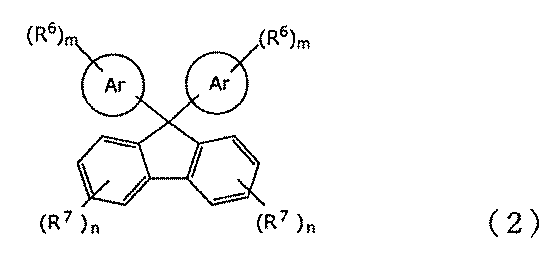
本明細書において、断り書きを設けない限り「△~△△」の表記は、「△以上△△以下」を意味する。また、「(メタ)アクリレート」は「アクリレートおよび/またはメタクリレート」を意味する。
本発明の樹脂組成物(以下、「アクリル樹脂組成物」という場合がある。)は、アクリル系ゴム含有重合体(A)、反応性基を有するアクリル系重合体(B)、化合物(D)を含有する。
分子構造的には分子内に架橋点を持ち、3次元の網目構造になっている架橋ゴム、又は加硫ゴムを含有している重合体を、本明細書において「ゴム含有重合体」と呼ぶ。ここで言う「ゴム」とは、アクリルゴム含有重合体(A)のアセトン不溶分に相当する重合体と定義する。後述の製造例1~3では、ゲル含有率として該アセトン不溶分の測定値を記載する。
アクリル系ゴム含有重合体(A)は、ガラス転移温度(以下、「Tg」ともいう。)が0℃未満の弾性重合体(I-A)と、Tgが20℃より高い硬質重合体(I-B)を基本構造とする多層構造のゴムである。
弾性重合体(I-A)のTgは、-60℃以上が好ましく、一方、-10℃以下が好ましい。
硬質重合体(I-B)のTgは、60℃以上が好ましく、一方、150℃以下が好ましい。
また、Tgは以下の方法で測定することもできる。先ず、アクリル樹脂組成物を溶融してシート状に成形し、厚さ1mm、幅6mm、長さ65mmの寸法の試験片を切り出す。動的粘弾性測定装置を用いて、ISO6721-4に準拠して、初期チャック間距離2cm、測定周波数0.1Hz、測定温度範囲-90~150℃、昇温速度2℃/分、窒素気流200mL/分の条件で、引張モードで前記試験片の貯蔵弾性率(E’)と損失弾性率(E”)を測定し、tanδ=E”/E’の式から各温度におけるtanδ(損失正接)を算出する。次にtanδの値を温度に対してプロットすると、二つ以上のピークが現れる。このうちの最も低温側に現れるピークに対応する温度を弾性重合体(I-A)のTgとする。また、20℃より高温に現れるピークのうち、tanδの値が最大のピークに対応する温度を硬質重合体(I-B)のTgとする。なお、硬質重合体(I-B)はアクリル系ゴム含有重合体の最外層であることが好ましい。
ゴム含有多段重合体の具体例としては、エステル基の炭素数が1~8のアクリル酸アルキルエステルおよび/またはエステル基の炭素数が1~4のメタクリル酸アルキルエステルと、グラフト交叉剤とを少なくとも重合体の構成成分とする弾性重合体(I-A)、エステル基の炭素数が1~4のメタクリル酸アルキルエステルを少なくとも重合体の構成成分とする硬質重合体(I-B)を、この順に重合して形成したものが挙げられる。
成分(A4)は、主としてそのエステルの共役不飽和結合がアリル基、メタリル基又はクロチル基よりはるかに早く反応し、化学的に結合する。
G´=(m´/M´)×100
式中、G´(%)はアクリル系ゴム含有重合体(A)のゲル含有率を示し、M´は所定量のアクリル系ゴム含有重合体(A)の質量(抽出前質量ともいう。)を示し、m´は該所定量のアクリル系ゴム含有重合体(A)のアセトン不溶分の質量(抽出後質量ともいう。)を示す。
反応性基を有するアクリル系重合体(B)としては、特に限定されるものではなく、化学構造として反応性基を有している直鎖のアクリル系重合体であればよい。また、反応性基を有するアクリル系重合体(B)(以下、「アクリル系重合体(B)」と記載した場合は同義である。)は、本実施形態に係る樹脂組成物を用いて得られるフィルムや成形体の艶を抑え外観性を良くする艶消剤として機能しうる。
アクリル系重合体(B)の添加量が、0.9質量部以上であれば十分な艶消外観が発現する。アクリル系重合体(B)の添加量が、40質量部以下であれば、成形時の流動性及び熱安定性が低くなりすぎず、溶融粘度をより低く抑えることができ、成形機内での滞留をより少なくでき樹脂の熱劣化を抑えられるので好ましい。得られるフィルムの、熱劣化物に起因するフィッシュアイと呼ばれる欠陥が経時的に増加する等の不具合が生じにくくなり、比較的長時間に亘ってフィルム成形等の溶融押出をすることが可能である。
本発明のアクリル樹脂組成物は、反応性基を有さないアクリル系重合体(C)(以下、「アクリル系重合体(C)」と記載する際は同義とする。)を含んでいてもよい。反応性基を有さないアクリル系重合体(C)とは、構成単位として反応性基を有さない(メタ)アクリル酸アルキルエステル単位を30質量%以上有し、かつ実質的に反応性基を有さない直鎖の重合体である。なお、反応性基を有さない(メタ)アクリル酸アルキルエステルとしては、上述した単量体が例として挙げられる。また、本発明において、実質的に反応性基を有さないとは、重合体を構成する単量体成分100質量%中の反応性基を有する単量体の合計割合が1.0質量%以下であることを意味するものとする。
本発明者は、アクリル系樹脂組成物に化合物(D)を添加することによって、該アクリル系樹脂組成物を成形して得られるアクリル艶消樹脂フィルムの外観不良となるフィッシュアイを低減できることを見出した。化合物(D)を添加することで、上記効果が発現したメカニズムは明らかになっていないが、本発明者の予想では、アクリル樹脂組成物の混錬において、反応性基を有するアクリル系重合体(B)の周囲に化合物(D)が存在することで、反応性基を有するアクリル系重合体(B)の分散性を良好にしていると考えている。

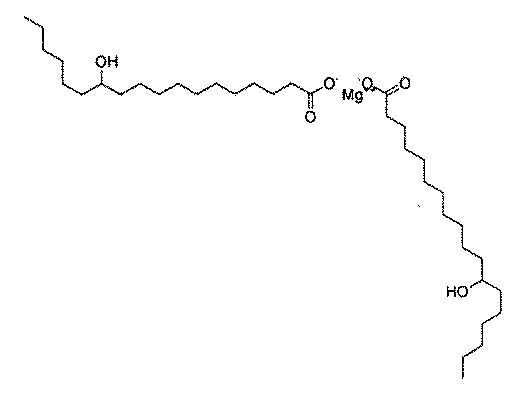


0.34≦VRing/X ・・・式(3)
VRing/Xが0.34以上であると、反応性基を有するアクリル系重合体(B)の分散性が良好となり、アクリル艶消樹脂フィルムのフィッシュアイを低減することができる。0.35以上がより好ましく、0.36以上がさらに好ましく、0.40以上が特に好ましい。VRing/Xの上限は特に制限ないが、例えば、1.5以下が好ましく、1.0以下がより好ましい。
まず環とそれ以外の部位を結ぶ単結合を切断し、生じたダングリングボンドを水素原子で終端することで環部分とそれ以外の部位に対応するモデル分子を作成する。この際、環同士を結ぶ単結合は切断しない。続いて分割前の分子と分割後のそれぞれのモデル分子に対してUniversalForceField(J.Am.Chem.Soc.114(1992)10024)を用いて構造最適化を行い、ファンデルワールス体積を算出する。モデル分子はダングリングボンドに水素原子を結合する事によりファンデルワールス体積が増加することからこの増分を除く補正を考慮し、以下の式により環部分に対応するファンデルワールス体積の合計VRing[Å3]を算出することができる。

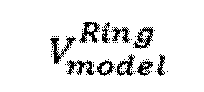
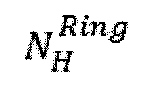

また環構造に対する置換基の結合位置(置換位置)は、特に限定されない。また、好ましい置換数は、0~3、より好ましくは0~2、さらに好ましくは0又は1である。

また環a~dに対する置換基の結合位置(置換位置)は、特に限定されない。また、好ましい置換数は、0~3、より好ましくは0~2、さらに好ましくは0又は1である。
BPEF:9,9-ビス[4-(2-ヒドロキシエトキシ)フェニル]フルオレン


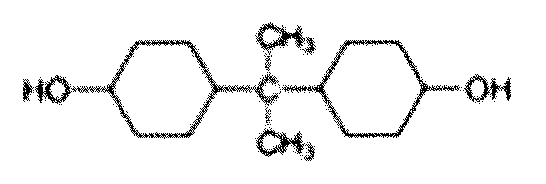
さらに、フルオレン化合物は下記一般式(2)で表される化合物群から選択される少なくとも一種であることが好ましい。
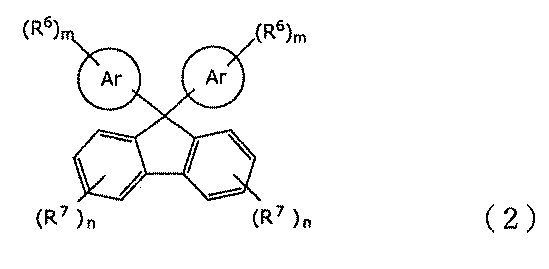
なお、反応性基を有さない基としては、特段の制限はないが、例えば、炭素数1~6の直鎖状又は分岐状のアルキル基が挙げられる。但し、2つの環Arがそれぞれ有するR6および反応性基を有さない基は互いに同じ基であってもよいし、異なる基であってもよいが同じ基であることが好ましい。
9,9-ビス(ヒドロキシアリール)フルオレン類のアルキレンオキシド付加体としては、前記例示のビス(モノ乃至ジヒドロキシアリール)フルオレン類にアルキレンオキシド(C2-4アルキレンオキシド、特にC2-3アルキレンオキシド)が付加した化合物が挙げられる。アルキレンオキシド単位の付加数(前記式(2)におけるk)は、前記と同様(例えば、1~12、好ましくは1~8、さらに好ましくは1~6、特に1~4程度)であり、特に限定されないが、以下に、一例として、kが1の化合物を例示する。
本発明の艶消性を有するアクリル樹脂組成物は、必要に応じて、例えば、安定剤、滑剤、加工助剤、可塑剤、耐衝撃助剤、発泡剤、充填剤、抗菌剤、防カビ剤、離型剤、帯電防止剤、着色剤、紫外線吸収剤、光安定剤、酸化防止剤等の添加剤を含むことができる。
特に本発明のアクリル艶消樹脂フィルム(または、アクリル樹脂組成物)が基材の保護層として使用される際は、耐候性を付与するためにアクリル樹脂組成物中には紫外線吸収剤及び/又は光安定剤が含有されていることが好ましい。更には、紫外線吸収剤及び/又は光安定剤の熱分解を抑制するために酸化防止剤が含有されていることが好ましい。
紫外線吸収剤としては公知のものを用いることができ、共重合タイプのものを使用することもできる。使用される紫外線吸収剤の分子量は300以上であることが好ましく、より好ましくは400以上である。分子量が300以上の紫外線吸収剤を使用すると、射出成形金型内で真空成形又は圧空成形を施す際の紫外線吸収剤の揮発による金型汚れ等を防止することができる。また一般的に、分子量が高い紫外線吸収剤ほど、フィルム状態に加工した後の長期的なブリードアウトが起こりにくく、分子量が低いものよりも紫外線吸収性能が長期間に渡り持続する。
紫外線吸収剤自身の長期熱安定性の観点から、アデカスタブLA-31RGを好適に用いることができる。
光安定剤としては公知のものを用いることができ、特にヒンダードアミン系光安定剤等のラジカル捕捉剤が好ましい。
例えば、以下の化合物を用いることができる。Tetrakis(1,2,2,6,6-pentamethyl-4-piperidyl) butane-1,2,3,4-tetracarboxylate(Cas No.:91788-83-9、分子量847、製品例:ADEKA社製アデカスタブLA-52)、Tetrakis(2,2,6,6-tetramethyl-4-piperidyl) butane-1,2,3,4-tetracarboxylate(Cas No.:64022-61-3、分子量791、製品例:ADEKA社製アデカスタブLA-57、アデカスタブLA-57G)、1,2,3,4-Butanetetracarboxylic acid, tetramethyl ester, reaction products with 1,2,2,6,6-pentamethyl-4-piperidinol and β,β,β',β'-tetramethyl-2,4,8,10-tetraoxaspiro[5.5]undecane-3,9-diethanol(Cas No.:101357-36-2,85631-00-1(製品例:ADEKA社製アデカスタブLA-63P)、1,2,3,4-Butanetetracarboxylic acid, tetramethyl ester, reaction products with 2,2,6,6-tetramethyl-4-piperidinol and β,β,β',β'-tetramethyl-2,4,8,10-tetraoxaspiro[5.5]undecane-3,9-diethanol(Cas No.:101357-37-3,85631-01-2(製品例:ADEKA社製アデカスタブLA-68)、Bis(1,2,2,6,6-pentamethyl-4-piperidyl) sebacate(Cas No.:41556-26-7、製品例:ADEKA社製アデカスタブLA-72)、Bis(2,2,6,6-tetramethyl-4-piperidyl) sebacate(Cas No.:52829-07-9、分子量481、製品例:ADEKA社製アデカスタブLA-77Y、アデカスタブLA-77G)、Bis(1-undecanoxy-2,2,6,6-tetramethylpiperidin-4-yl)carbonate(Cas No.:705257-84-7、分子量681、製品例:ADEKA社製アデカスタブLA-81)、1,6-hexanediamine, N, N'-bis(2,2,6,6-tetramethyl-4-piperidinyl)-, polymer with 2,4,6-trichloro-1,3,5-triazine, reaction products with 2,4,4,-trimethyl-2-pentanamine(Cas No.:70624-18-9、分子量2,000~3,000、製品例:ADEKA社製アデカスタブLA-94G)等、N,N'-Bis(2,2,6,6-tetramethyl-4-piperidinyl)-1,6-hexanediamine polymer with 2,4,6-trichloro-1,3,5-triazine reaction products with N-butyl-1-butanamine and N-butyl-2,2,6,6-tetramethyl-4-piperidinamine;1,6-Hexanediamine, N,N-bis(2,2,6,6-tetramethyl-4-piperidinyl)-, polymer with 2,4,6-trichloro-1,3,5-triazine, reaction products with, N-butyl-1-butanamine and N-butyl-2,2,6,6-tetramethyl-4-piperidinamine;1,6-Hexanediamine, N1,N6-bis(2,2,6,6-tetramethyl-4-piperidinyl)-, polymer with 2,4,6-trichloro-1,3,5-triazine, reaction products with, N-butyl-1-butanamine and N-butyl-2,2,6,6-tetramethyl-4-piperidinamine(Cas No: 192268-64-7、分子量2600~3400、製品例:BASF社製Chimassorb2020FDL)、Poly[[6-[(1,1,3,3-tetramethylbutyl)amino]-s-triazine-2,4-diyl]-[(2,2,6,6-tetramethyl-4-piperidyl)imino]-hexamethylene-[(2,2,6,6-tetramethyl-4-piperidyl)imino]](Cas No.:71878-19-8、分子量2000~3100、製品例:BASF社製Chimassorb944FDL)等が挙げられる。
光安定剤の添加量は、アクリル樹脂組成物を構成する樹脂100質量部に対して、0.1~2質量部の範囲で用いることが好ましい。アクリル樹脂組成物の耐候性の観点から、0.2質量部以上がより好ましい。他方、アクリル樹脂組成物のMFR保持率(M2/M1)の観点から、1質量部以下がより好ましく、0.5質量部以下が更に好ましい。光安定剤の添加量が0.1質量部以上であれば、アクリル艶消樹脂フィルムの耐候性を向上させることができる。光安定剤の添加量が2質量部以下であれば、成形時の熱安定性をより高くし樹脂の熱劣化による溶融粘度の上昇をより低く抑えることができ、成形機内での滞留をより少なくでき、樹脂の熱劣化を抑えられるので好ましい。得られるフィルムは、熱劣化物に起因するフィッシュアイと呼ばれる欠陥が経時的に増加する等の不具合が生じにくく、長時間に亘ってフィルム成形等の溶融押出をすることが可能である。
酸化防止剤としては公知のものを用いることができ、特に限定されるものではないが、フェノール系酸化防止剤やリン系酸化防止剤が好ましい。
フェノール系酸化防止剤としては、例えば、(株)ADEKA製の商品名:アデカスタブAO-20、アデカスタブAO-30、アデカスタブAO-40、アデカスタブAO-50、アデカスタブAO-60、アデカスタブAO-80、アデカスタブAO-330等、BASFジャパン(株)製の商品名:Irganox1010、Irganox1035、Irganox1076、Irganox1098、Irganox1135、Irganox1330、Irganox1425WL、Irganox1520L、Irganox245、Irganox259、Irganox3114、Irganox565等を挙げることができる。フェノール系酸化防止剤は一種を単独で用いてもよく、二種以上を併用してもよく、他の酸化防止剤と併用してもよい。
フェノール系酸化防止剤の添加量は、アクリル樹脂組成物を構成する樹脂100質量部に対して、0.2~10質量部の範囲で用いることが好ましい。成形時の熱安定性及び耐候性の観点から、0.4質量部以上がより好ましく、0.6質量部以上が更に好ましい。
他方、製膜時の工程汚れを防止する観点や成形体の透明性の観点から、5質量部以下がより好ましく、3質量部以下が更に好ましい。
炭素数8以上のアルキル基を有するリン系酸化防止剤の添加量が、2.00質量%以下であれば、アクリル樹脂組成物を用いたアクリル艶消樹脂フィルムの艶消外観を向上させることができる。より詳しくは、アクリル樹脂組成物を製造するコンパウンド工程において、溶融樹脂の粘度が適切な範囲になるため反応性基を有するアクリル系重合体(B)の分散度合いが良好となり、アクリル樹脂組成物を用いたアクリル艶消樹脂フィルムの艶消外観が向上する。
(MFR保持率)
アクリル樹脂組成物のMFR保持率(M2/M1)は、JIS K7210(A法)に準拠し、温度240℃及び荷重49Nの条件で測定される保持時間20分間のメルトフローレート(M2)とJIS K7210(A法)に準拠し、温度240℃及び荷重49Nの条件で測定される保持時間4分間のメルトフローレート(M1)との比で算出される。
MFR保持率(M2/M1)は、0.85~1.15の範囲であることが好ましく、0.9~1.1の範囲であることがより好ましい。
少なくでき、樹脂の熱劣化を抑えられるので好ましい。得られる成形体がフィルムの場合は、熱劣化物に起因するフィッシュアイと呼ばれる欠陥が経時的に増加する等の不具合が生じにくく、長時間に亘ってフィルム成形等の溶融押出をすることが可能である。
MFR保持率(M2/M1)が1.15以下であれば、成形時の熱安定性をより高くし樹脂の熱分解をより低く抑えることができ、副反応による樹脂の熱劣化を抑えられるため好ましい。得られる成形体がフィルムの場合は、熱劣化物に起因するフィッシュアイと呼ばれる欠陥が経時的に増加する等の不具合が生じにくく、長時間に亘ってフィルム成形等の溶融押出をすることが可能である。
アクリル樹脂組成物は、一般的なコンパウンド加工である押出機を用いた一軸混練法、同方向二軸混練法、異方向二軸混練法等の公知の方法によって製造することができるが、二軸混練法等の混練効果の大きい方法が好ましい。
好ましい二軸押出機としては、東芝機械(株)製のTEMシリーズ等が挙げられる。また、スクリュー構成としては、アクリル樹脂組成物を搬送する搬送部とニーディングゾーンや溶融物の送り方向が逆のスクリューセグメント(螺旋の巻き方向が逆のスクリューセグメント)等のアクリル樹脂組成物を混練するための混練部を有するスクリュー構成が挙げられる。
本発明の樹脂組成物は、艶消フィルム用であることが好ましい。本発明の艶消性を有するアクリル樹脂組成物を成形することにより、本発明のアクリル艶消フィルムを製造することができる。本発明のアクリル艶消フィルムは、艶消し性および熱安定性に優れる。さらに、フィルム製造時のフィッシュアイの発生を低減できることから、得られるフィルムは外観欠陥の極めて少ない特徴を有する。
本発明に係るアクリル艶消樹脂フィルムは、少なくとも一方の面の60°表面光沢度(Gs60°)が100%未満であることが好ましい。なお、本発明では、Gs60°が100%未満である面を「艶消性を有する面」という。また、Gs60°が100%以上の面を「艶消性を有さない面」という。
単層フィルムの場合、少なくとも一方の表面が艶消性を有する面からなる艶消アクリル樹脂フィルムである。
艶消性を有する面のGs60°が1%以上100%未満であれば、得られるアクリル艶消樹脂フィルムは艶消性を有し、高級感や深み感等の意匠性や加飾性に優れる。
また、Gs60°が70%未満であれば、加工条件や製膜条件による影響が少なく、艶消外観の安定性に優れる。一方、Gs60°が5%以上であれば、艶消し剤を多量に添加しなくてよく、流動性が過剰に低下せず、ロングラン性が良好になる。また経済的な観点から好ましい。なお、フィルムの表面光沢度は、JIS Z8741に準じて測定した値である。
フィルムの算術平均粗さ(Ra)は、0.05以上が好ましく0.10以上がより好ましく、0.15以上がさらに好ましく、一方、0.80以下が好ましく、0.70以下がより好ましく、0.55以下がさらに好ましく、0.50以下が特に好ましい。Raが0.05以上であればギラツキ感が低く、高級感や深み感等の意匠性や加飾性に優れる。Raが0.06以下であれば、艶消しのきめが細かく、外観意匠性に優れる。なお、算術平均粗さ(Ra)は、JIS B0601-2001に準じ測定した値である。
フィルムの輪郭曲線要素の平均長さ(Rsm)は、30以上が好ましく、35以上がより好ましく、40以上がさらに好ましい。また、90以下が好ましく、85以下がより好ましく、80以下がさらに好ましい。Rsmが30以上であればギラツキ感が低く、高級感や深み感等の意匠性や加飾性に優れる。Rsmが90以下であれば艶消しのきめが細かく、外観意匠性に優れる。なお、輪郭曲線要素の平均長さ(Rsm)は、JIS B0601-2001に準じ測定した値である。
フィルムの光の透過率としては、JIS K7361-1に準じて測定した全光線透過率が80%以上であることが好ましく、85%以上がより好ましく、90%以上がさらに好ましい。全光線透過率が80%以上であれば、フィルムに印刷された加飾層を、加飾層が印刷されていない面から視認した際に美麗である。
フィルムのフィッシュアイ数としては、外観意匠性の点から、厚さ40μmのフィルムにおける0.001mm2以上の大きさのフィッシュアイ数が500個/0.5m2未満であることが好ましく、450個/0.5m2未満であることがより好ましく、400/0.5m2以下であることがさらに好ましい。0.001mm2以上のフィッシュアイ数が500個/0.5m2未満であれば、フィルムの外観不良が少なくなり、加工時のラミネート性や印刷性が良好になり、製品のロスが少なくなる。フィッシュアイ数は少なければ少ないほどよく、下限値は0個/0.5m2以上が好ましく、0個/0.5m2が最も好ましい。
フィルムの厚さは、フィルムの取扱い性、ラミネート性が良好となる点から、1μm以上が好ましく、5μm以上がより好ましい。また、フィルム状に成形する製膜性、加工性が良好となる点から、500μm以下が好ましく、300μm以下がより好ましい。
本発明の積層フィルムは、上記した艶消性を有するアクリル樹脂組成物からなる艶消アクリル樹脂層と透明アクリル樹脂層との積層構造を有する。積層フィルムは、上記した単層のアクリル艶消樹脂フィルムと、透明アクリル樹脂フィルム(透明アクリル樹脂層)とをラミネートすることで製造してもよいし、艶消性を有するアクリル樹脂組成物と、透明アクリル樹脂層を形成する組成物とを、共押出成形することにより、製造してもよい。
艶消性を有する面は、後述する艶消性を有するアクリル樹脂組成物を用いて形成することができる。透明アクリル樹脂層は、後述する艶消性を発現しない透明アクリル樹脂組成物を用いて形成することができる。
艶消性を有さない面の60°表面光沢度(Gs60°)が100%以上であれば、印刷適性とラミネート適性が向上する。すなわち、積層フィルムの場合、透明アクリル樹脂層の非積層面は平滑性に優れるので、印刷抜けを極めて低減することができる。さらに、印刷を施した後の積層フィルムを基材上に積層して積層体とする場合は、透明アクリル樹脂層の平滑性に優れた面を基材に接するよう積層できるので、ラミネート適性に優れる。
アクリル艶消樹脂積層フィルムにおける、透明アクリル樹脂層を構成する透明アクリル樹脂組成物は、特に限定されるものではなく、艶消性を発現せず、主成分としてアクリル樹脂を含む組成物であればよい。
透明アクリル樹脂組成物としては、艶消性を有するアクリル樹脂組成物において艶消成分(艶消剤)として例示した成分を含有しないアクリル樹脂組成物が挙げられ、好ましい例としては、艶消性を発現する成分(艶消剤)である反応性基を有するアクリル系重合体(B)以外は、前述の艶消性を有するアクリル樹脂組成物で用いることができるアクリルゴム含有重合体(A)、反応性基を有さないアクリル系重合体(C)、紫外線吸収剤、光安定剤、酸化防止剤、及び各種添加剤等を含有するアクリル樹脂組成物を好適に用いることができる。
本発明のアクリル艶消樹脂積層フィルムの透明アクリル樹脂層側を、基材に積層して、積層体とする場合における、基材の材質としては、例えば、樹脂、木材単板、木材合板、パーティクルボード、中密度繊維板(MDF)等の木材板、木質繊維板等の水質板、鉄、アルミニウム等の金属等が挙げられる。
アクリル艶消樹脂フィルムは、溶融流延法、Tダイ法、インフレーション法等の公知の方法によって製造することができるが、経済性の点からTダイ法が好ましい。また、積層フィルムの場合、Tダイ多層法等によって、上記の艶消性を有するアクリル樹脂組成物を用いてなる艶消アクリル樹脂層と、上記の透明アクリル樹脂組成物を用いて透明アクリル樹脂層を共押出しすることで積層フィルムとすることができる。
上述した処理の中でも、印刷処理を施す場合には、フィルムに片側印刷処理を行うことが好ましく、中でも、印刷面を基材樹脂との接着面に配した裏面印刷処理が、印刷面の保護や高級感の付与の点から特に好ましい。
本発明の積層体は、上記した積層フィルムの透明アクリル樹脂層側を、基材にラミネートすることで製造することができる。
先ず、評価方法、アクリル系ゴム含有重合体(A)、及び反応性基を有するアクリル系重合体(B)の製造例を説明する。

(反応性基を有するアクリル系重合体(B)の平均粒子径)
HORIBA(株)製のレーザ回折散乱式粒度分布測定装置LA-910を用いて反応性基を有するアクリル系重合体(B)の質量平均粒子径を測定した。
クロロホルム溶媒中、25℃において、サン電子工業製AVL-2C自動粘度計により反応性基を有するアクリル系重合体(B)の固有粘度を測定した。
大塚電子(株)製の光散乱光度計DLS-700(商品名)を用い、動的光散乱法でアクリル系ゴム含有重合体(A)の質量平均粒子径を測定した。
抽出前質量Mとして0.5gのアクリル系ゴム含有重合体(A)をアセトン50mLに溶解したアセトン溶液を、65℃で4時間還流させる。得られた抽出液に対し、高速冷却遠心機(日立工機(株)製、商品名:CR21G)を用いて、4℃において14000rpmの回転数で、30分間遠心分離を行う。溶液をデカンテーションで取り除き、残存した固体を得る。この固体に対し、還流、遠心分離、デカンテーションを再度繰り返し、得られた固体を50℃で24時間乾燥して得られたアセトン不溶分の質量を、抽出後質量mとして測定した。抽出前質量Mおよび抽出後質量mから下記式によりアクリル系ゴム含有重合体(A)のゲル含有率G(%)を算出した。
ゲル含有率G(%)=(抽出後質量m(g)/抽出前質量M(g))×100
Tgは、各単量体成分の単独重合体のTgの値(ポリマーハンドブック[Polymer Handbook, J. Brandrup, Interscience, 1989]に記載されているもの)を用いてFOXの式から算出した。
アクリルゴム含有重合体(A)の分子量(Mw)は、GPCカラムとしてTSKgel SuperMultiporeHZ-N、TSKgel guardcolumn SuperMP(HZ)-H、TSKgel Super H-RCを連結したものをセットした高速GPC装置HLC-8420GPC(東ソー社製)を使用し、溶媒THFにて、ポリスチレン換算で測定した。
メルトインデクサー(立山科学工業(株)製、型式:L227-42(L220タイプ))を用い、JIS K7210(A法)に従い、サンプル量4gを温度240℃及び荷重49Nの条件で測定される保持時間4分間のメルトフローレート(M1)を測定した。
試料切り取り時間間隔は試料のメルトフローレート(M1)に応じ30秒~120秒とすることで単位時間当たりの吐出量を測定し、g/10minのメルトフローレート(M1)を算出した。
メルトインデクサー(立山科学工業(株)製、型式:L227-42(L220タイプ))を用い、JIS K7210(A法)に従い、サンプル量4gを温度240℃及び荷重49Nの条件で測定される保持時間20分間のメルトフローレート(M2)を測定した。試料切り取り時間間隔は試料のメルトフローレート(M2)に応じ30秒~120秒とすることで単位時間当たりの吐出量を測定し、g/10minのメルトフローレート(M2)を算出した。
MFR保持率(M2/M1)は、前述の保持時間20分間のメルトフローレート(M2)と保持時間4分間のメルトフローレート(M1)との比で算出した。
示差熱熱重量同時測定装置(セイコーインスツルメンツ社製、型式:TG/DTA6200)を用い、大気雰囲気下、昇温速度10℃/minにて化合物(D)の5%重量減少温度を測定した。各実施例で使用した化合物(D)及び比較例で使用の化合物の5%重量減少温度を表2に示した。
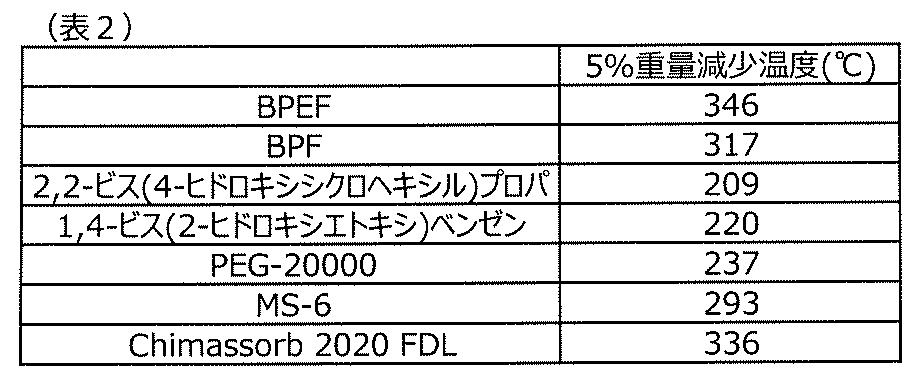


環構造に対応するファンデルワールス体積の合計VRing[Å3]は以下の方法で算出した。
まず環とそれ以外の部位を結ぶ単結合を切断し、生じたダングリングボンドを水素原子で終端することで環構造とそれ以外の部位に対応するモデル分子を作成した。この際、環同士を結ぶ単結合は切断しなかった。続いて分割前の分子と分割後のそれぞれのモデル分子に対してUniversalForceField(J.Am.Chem.Soc.114(1992)10024)を用いて構造最適化を行い、ファンデルワールス体積を算出した。モデル分子はダングリングボンドに水素原子を結合する事によりファンデルワールス体積が増加することからこの増分を除く補正を考慮し、以下の式により環構造に対応するファンデルワールス体積の合計VRing[Å3]を算出した。
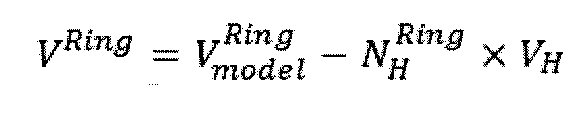


ヘイズメーター(日本電色工業(株)製、商品名:Haze Meter NDH4000)を用い、光源D65、温度25℃の条件で、全光線透過率はJIS K7361-1に従い測定し、ヘイズはJIS K7136に従い測定した。
光沢計(コニカミノルタ(株)製、商品名:GM-268Plus)を用い、JIS Z8741に従い、フィルムの艶消性を有する面の長手方向(MD)、及び幅方向(TD)の60°表面光沢度を測定した。
表面粗さ測定機((株)東京精密製、商品名:SURFCOM 1400D)を用い、JIS B0601-2001に従い、測定長さ4.0mm、評価長さ4.0mm、カットオフ波長0.8mm、測定速度0.3mm/sの条件で測定される算術平均粗さ(Ra)および輪郭曲線要素の平均長さ(Rsm)を測定した。なお、フィルムのような長尺なサンプルを測定する場合は、幅方向(TD)または、長手方向(MD)のいずれでも測定できるが、評価に当たっては、TDのみか、MDのみのどちらかで行う必要がある。
なお、算術平均粗さ(Ra)は、粗さ曲線からその平均線の方向に基準長さだけを抜き取り、この抜取り部分の平均線の方向にX軸を、縦倍率の方向にY軸を取り、粗さ曲線をy=f(x)で表したときに、次の式によって求められる値をマイクロメートル(μm)で表したものをいう。
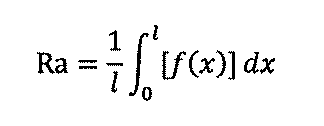

オフライン型FEカウンター((株)メック、型式:LSC-4500)を用い、フィルム中の0.001mm2以上の大きさのフィッシュアイを検出した。また、測定面積は計0.5m2となるように設定し、0.5m2中のフィッシュアイの総数を測定した。
(製造例1)ゴム含有多段重合体(I)の製造
攪拌機を備えた容器内に脱イオン水10.8部を仕込んだ後、MMA0.3部、n-BA4.5部、BDMA0.2部、AMA0.05部及びCHP0.025部からなる単量体成分(i-a-1)を投入し、室温下にて攪拌混合した。次いで、攪拌しながら、RS610 1.3部を上記容器内に投入し、攪拌を20分間継続して「乳化液1」を調製した。
た。このようにして第一弾性重合体(I-a1)及び第二弾性重合体(I-a2)含む弾性重合体(I-A)を得た。なお、第一弾性重合体(I-a1)用及び第二弾性重合体(I-a2)用の各単量体成分を、それぞれ別個に、前記と同条件で重合した場合、重合体(I-a1)のTgは-48℃、重合体(I-a2)のTgは-10℃であった。
各単量体成分を表4に示すように変更した以外は、製造例1と同様の方法により、ゴム多段重合体(II)を製造した。
攪拌機を備えた容器内に脱イオン水10.8部を仕込んだ後、MMA0.3部、n-BA4.5部、BDMA0.2部、AMA0.05部及びCHP0.025部からなる単量体成分を投入し、室温下にて攪拌混合した。次いで、攪拌しながら、RS610 1.1部を上記容器内に投入し、攪拌を20分間継続して「乳化液」を調製した。
各単量体成分を表3に示すように変更した以外は、製造例1と同様の方法により、ゴム多段重合体(III)を製造した。
還流冷却器付き重合容器内に脱イオン水186.3部を投入し、79℃に昇温した。さらに、脱イオン水3.4部にソジウムホルムアルデヒドスルホキシレート0.25部、硫酸第一鉄0.000025部及びEDTA0.000075部を加えた混合物を調製し、この混合物を前記重合容器内に投入した。

(製造例4)ヒドロキシ基含有重合体の製造
還流冷却器付き重合容器内に脱イオン水262部、第三リン酸カルシウム10%スラリー13.8部、MMA60.0部、MA10.0部、メタクリル酸2-ヒドロキシエチル30.0部、n-ドデシルメルカプタン0.25部及びラウロイルパーオキサイド0.52部からなる単量体混合物を投入し、重合容器内の雰囲気を充分に窒素ガスで置換した。次に、単量体混合物を攪拌しながら78℃に昇温し、窒素雰囲気下で2時間反応させた。
続いて、重合容器内の液温度を85℃に昇温した後、過硫酸カリウム0.022部を添加し、更に90分保持して重合体のビーズを得た。得られた重合体のビーズを150メッシュ(目開き100μm)の条件で篩別を行ない、メッシュを通過したビーズを脱水、乾燥して水酸基含有重合体のビーズを得た。得られたヒドロキシ基含有重合体のガラス転移温度は77℃であり、固有粘度は、0.069L/g、平均粒子径は90μmであった。
(製造例5)透明アクリル樹脂組成物の製造
製造例1で得られたゴム含有多段重合体(I)を80部、及び製造例3で得られたゴム含有多段重合体(III)を10部、反応性基を有さないアクリル系重合体(C)としてメタクリル酸アルキル-アクリル酸アルキル共重合体(三菱ケミカル(株)製;商品名:アクリペットMD)を10部、添加剤としてベンゾトリアゾール系紫外線吸収剤(BASFジャパン(株)製;商品名:Tinuvin234)を1.4部、ヒンダードアミン系光安定剤((株)ADEKA製;商品名:アデカスタブLA-57G)を0.3部、ヒンダードフェノール系酸化防止剤(BASFジャパン(株)製;商品名:Irganox1076)を0.1部、を添加した後、ヘンシェルミキサーを用いて混合した。その後、二軸押出機(東芝機械(株)製、商品名:TEM-35B、以下同様)を用いてシリンダー温度180~240℃及びダイヘッド温度240℃の条件で、スクリーンメッシュ(日本精線(株)製、商品名:NF-12T、公称ろ過径40μm)で夾雑物を取り除きながらストランド状に押出し、水槽を通し冷却後に切断して透明アクリル樹脂組成物のペレットを得た。
表5に示す艶消性を有するアクリル樹脂組成物として、アクリルゴム含有重合体(A)である製造例1で得られたゴム含有多段重合体(I)を75部、反応性基を有さないアクリル系重合体(C)としてメタクリル酸アルキル-アクリル酸アルキル共重合体(三菱ケミカル(株)製;商品名:アクリペットVH(MMA/MA=97/3))を23部、反応性基を有するアクリル系重合体(B)として製造例4で得られたヒドロキシ基含有重合体を2部、化合物(D)として9,9-ビス[4-(2-ヒドロキシエトキシ)-フェニル]フルオレン(ビスフェノキシエタノールフルオレン,BPEF、大阪ガスケミカル(株)製;商品名:オグソールMF-11)を2.5部、アクリル系高分子外部滑剤(三菱ケミカル(株)製;商品名:メタブレンL-1000)を1.6部、および、高分子量アクリル重合体(三菱ケミカル(株)製;商品名:メタブレンP-551A)を1部、添加剤として、リン系酸化防止剤(城北化学工業(株)製;商品名:JP-333E)を1.1部、ベンゾトリアゾール系紫外線吸収剤((株)ADEKA製;商品名:アデカスタブLA-31RG)を1.1部、ヒンダードアミン系光安定剤((株)ADEKA製;商品名:アデカスタブLA-57G)を0.9部、ヒンダードフェノール系酸化防止剤((株)ADEKA製;商品名:アデカスタブAO-60)を0.7部、を添加した後、ヘンシェルミキサーを用いて混合した。その後、二軸押出機(東芝機械(株)製、商品名:TEM-35B)を用いてシリンダー温度170~240℃及びダイヘッド温度240℃の条件で、200メッシュのスクリーンメッシュで夾雑物を取り除きながらストランド状に押出し、水槽を通し冷却後に切断してペレット化した。スクリュー回転数280rpm、吐出量20.0kg/hでのダイス出口樹脂温度は286℃であった。得られたペレットのメルトフローレート(M1)は5.8g/10min、メルトフローレート(M2)は5.8g/10min、MFR保持率(M2/M1)は1.01であった、評価結果を表5に示す。
艶消性を有するアクリル樹脂組成物を表5~7に示す組成とした以外は、実施例1と同様に実施した。尚、実施例20~23、及び比較例5、6では、光安定剤としてBASF(株)製;商品名:Chimassorb2020 FDL(分子量2600~3400)を使用した。得られたペレットとアクリル艶消樹脂フィルムの評価結果を表5~7に示す。
艶消アクリル樹脂層を構成する艶消性を有するアクリル樹脂組成物として実施例12で得られたペレットと、透明アクリル樹脂層を構成する透明アクリル樹脂組成物として製造例5で得られたペレットを85℃で一昼夜除湿乾燥した。200メッシュのスクリーンメッシュを設けた30mmφのノンベントスクリュー型押出機を用いて、シリンダー温度200~240℃の条件で艶消性を有するアクリル樹脂組成物を可塑化し、他方、500メッシュのスクリーンメッシュを設けた40mmφのノンベントスクリュー型押出機を用いて、シリンダー温度220~240℃の条件で、透明アクリル樹脂組成物を可塑化し、次いで245℃に設定した500mm幅の2種2層用マルチマニホールドTダイで、透明アクリル樹脂層側が鏡面冷却ロールに接するようにして厚さ75μmの積層フィルムを作製した。


本発明の艶消性を有するアクリル樹脂組成物を用いたアクリル艶消フィルム、および、積層フィルム(実施例1~23)は、化合物(D)を添加していないアクリル樹脂組成物を用いた比較例のフィルムに比べて、フィッシュアイ数が低減されていることが示された。
例えば、化合物(D)の有無以外は、同様の組成を有するアクリル艶消樹脂フィルム(実施例3、4、9、10、及び11)及び、比較例1のフィルム、さらには実施例17と比較例2のフィルムとを比較してもフィッシュアイ数が低減されていることが示された。さらには、特許文献1(WO2019/244791)の実施例を参照し、生産した艶消性を有するアクリル樹脂組成物を用いたアクリル艶消樹脂フィルム(比較例5,6)に対しても、良好なフィッシュアイ数であった。そのうえ、環構造を有さず、反応性基のみを有する化合物を用いた比較例7、8では、フィッシュアイ数の低減が見られなかった。また、実施例1~23のアクリル艶消樹脂フィルムは、艶消外観の高級感や深み感等の意匠性や加飾性が良好であった。
Claims (17)
- 少なくとも0℃未満のTgを有するアクリル系ゴム含有重合体(A)と、30℃以上のTgを有し、反応性基を有するアクリル系重合体(B)と、化合物(D)とを含有し、前記化合物(D)は、分子内に環構造と反応性基を有する基を含有し、環構造に対応するファンデルワールス体積の合計VRing[Å3]と化合物(D)の分子量Xが以下の式(3)を満たす、樹脂組成物。
0.34≦VRing/X ・・・式(3) - 前記化合物(D)が、下記一般式(1)で表される化合物である、請求項1に記載の樹脂組成物。

*Lは、直接結合又は環構造を有さない2価の基であり、
環a、環b、環c、及び環dは、それぞれ独立して、環構造を有さない置換基を有していてもよい2価の基であり、
lは、0又は1を表し、
m及びnは、それぞれ独立して0以上の整数であり、
q及びrは、1以上の整数であり、
R1及びR2は、反応性基を有する基であり、qが2以上の場合、2以上のR1はそれぞれ同じ基であってもよいし異なる基であってもよく、rが2以上の場合、2以上のR2はそれぞれ同じ基であってもよいし異なる基であってもよい。 - 前記式(1)中、R1及びR2は、カルボキシ基、ヒドロキシ基、酸無水物基、エポキシ基、イソシアネート基、アミド基、アミノ基、シアノ基及びイミン基よりなる群から選択された一つである、請求項2に記載の樹脂組成物。
- 前記式(1)中、環aがフルオレニレン基、フェニレン基、又はシクロヘキシル基から選択され、環b、c、及びdがフェニレン基、ナフチレン基、又はシクロヘキシル基から選択された一つであり、m=0~2、n=0~2、q=1又は2、r=1又は2の整数である、請求項2または3に記載の樹脂組成物。
- 前記化合物(D)のAir雰囲気下における5%重量減少温度が300℃以上である、請求項1~4の何れか1項に記載の樹脂組成物。
- 前記化合物(D)がフルオレン化合物である、請求項1~5のいずれか1項に記載の樹脂組成物。
- 前記フルオレン化合物が下記一般式(2)で表される化合物群から選択される少なくとも一種であり、前記フルオレン化合物の含有量が0.5~8.0質量%である、請求項6に記載の樹脂組成物。

- 前記反応性基を有するアクリル系重合体(B)の含有量が、前記アクリル系ゴム含有重合体(A)、任意に存在する反応性基を有さないアクリル系重合体(C)、前記反応性基を有するアクリル系重合体(B)の合計100質量部に対して、0.9~40質量部である、請求項1~7のいずれか1項に記載の樹脂組成物。
- 前記反応性基を有するアクリル系重合体(B)が有する反応性基が、カルボキシ基、ヒドロキシ基、酸無水物基、エポキシ基、イソシアネート基、アミド基、アミノ基、シアノ基及びイミン基よりなる群から選択された一つである、請求項1~8のいずれか1項に記載の樹脂組成物。
- JIS K7210に準拠し、温度240℃、荷重49Nの条件で測定される保持時間4分間のメルトフローレート(M1)とJIS K7210に準拠し、温度240℃、荷重49Nの条件で測定される保持時間20分間のメルトフローレート(M2)との比であるMFR保持率(M2/M1)が0.85~1.15である、請求項1~9のいずれか1項に記載の樹脂組成物。
- 艶消フィルム用である、請求項1~10のいずれか1項に記載の樹脂組成物。
- 請求項1~11のいずれか1項に記載の樹脂組成物からなり、60°表面光沢度(Gs60°)が100%未満である表面をフィルムの少なくとも一方に有する、フィルム。
- 厚みが1~500μmである、請求項12に記載のフィルム。
- 厚み40μmのフィルムの0.5m2あたりのフィッシュアイ数が500個未満である、請求項12に記載のフィルム。
- 厚み40μmのフィルムの0.5m2あたりのフィッシュアイ数が400個未満である、請求項12に記載のフィルム。
- 請求項1~11のいずれか1項に記載の樹脂組成物からなる艶消アクリル樹脂層と透明アクリル樹脂層との積層構造を有するアクリル艶消樹脂積層フィルム。
- 請求項16のアクリル艶消樹脂積層フィルムをさらに基材に積層した、積層体。
Priority Applications (4)
| Application Number | Priority Date | Filing Date | Title |
|---|---|---|---|
| JP2023511440A JPWO2022210806A1 (ja) | 2021-03-29 | 2022-03-29 | |
| CN202280024990.5A CN117083341A (zh) | 2021-03-29 | 2022-03-29 | 树脂组合物、膜、层叠膜和层叠体 |
| EP22781017.3A EP4316828A4 (en) | 2021-03-29 | 2022-03-29 | RESIN COMPOSITION, FILM, LAMINATE FILM AND LAMINATE |
| US18/371,428 US20240010776A1 (en) | 2021-03-29 | 2023-09-21 | Resin composition, film, laminate film, and laminate |
Applications Claiming Priority (2)
| Application Number | Priority Date | Filing Date | Title |
|---|---|---|---|
| JP2021-056237 | 2021-03-29 | ||
| JP2021056237 | 2021-03-29 |
Related Child Applications (1)
| Application Number | Title | Priority Date | Filing Date |
|---|---|---|---|
| US18/371,428 Continuation-In-Part US20240010776A1 (en) | 2021-03-29 | 2023-09-21 | Resin composition, film, laminate film, and laminate |
Publications (1)
| Publication Number | Publication Date |
|---|---|
| WO2022210806A1 true WO2022210806A1 (ja) | 2022-10-06 |
Family
ID=83456455
Family Applications (1)
| Application Number | Title | Priority Date | Filing Date |
|---|---|---|---|
| PCT/JP2022/015734 Ceased WO2022210806A1 (ja) | 2021-03-29 | 2022-03-29 | 樹脂組成物、フィルム、積層フィルム、および、積層体 |
Country Status (5)
| Country | Link |
|---|---|
| US (1) | US20240010776A1 (ja) |
| EP (1) | EP4316828A4 (ja) |
| JP (1) | JPWO2022210806A1 (ja) |
| CN (1) | CN117083341A (ja) |
| WO (1) | WO2022210806A1 (ja) |
Families Citing this family (1)
| Publication number | Priority date | Publication date | Assignee | Title |
|---|---|---|---|---|
| CN118355062A (zh) * | 2021-12-07 | 2024-07-16 | Dic株式会社 | 气体阻隔膜、及包装材料 |
Citations (9)
| Publication number | Priority date | Publication date | Assignee | Title |
|---|---|---|---|---|
| JPS6094494A (ja) * | 1983-10-31 | 1985-05-27 | Mitsui Petrochem Ind Ltd | 安定化有機化合物組成物 |
| WO1997028950A1 (en) | 1996-02-09 | 1997-08-14 | Modern Machinery Co., Ltd. | Roll, machine and method for forming a thin-film sheet |
| JP2808251B2 (ja) | 1994-11-29 | 1998-10-08 | 千葉機械工業株式会社 | 合成樹脂製シートの成型方法及びその成型装置 |
| JP2003238704A (ja) * | 2002-02-20 | 2003-08-27 | Mitsubishi Rayon Co Ltd | アクリル樹脂フィルム、その製造方法およびそれを積層した積層シート |
| JP2009286960A (ja) * | 2008-05-30 | 2009-12-10 | Mitsubishi Rayon Co Ltd | アクリル樹脂フィルムの組成物ならびそれを用いた成形品 |
| JP2012144714A (ja) * | 2010-12-21 | 2012-08-02 | Mitsubishi Rayon Co Ltd | アクリル系樹脂組成物、アクリル系樹脂フィルム、積層シート及び積層成形品 |
| WO2019003531A1 (ja) * | 2017-06-27 | 2019-01-03 | 三菱ケミカル株式会社 | 熱可塑性樹脂組成物及び熱可塑性樹脂成形体 |
| WO2019244791A1 (ja) | 2018-06-21 | 2019-12-26 | 三菱ケミカル株式会社 | アクリル艶消樹脂フィルム |
| JP2020180184A (ja) | 2019-04-24 | 2020-11-05 | 株式会社クラレ | (メタ)アクリル系樹脂組成物およびその成形体 |
Family Cites Families (2)
| Publication number | Priority date | Publication date | Assignee | Title |
|---|---|---|---|---|
| WO2016002750A1 (ja) * | 2014-06-30 | 2016-01-07 | 株式会社クラレ | メタクリル樹脂またはメタクリル樹脂組成物 |
| JP6783112B2 (ja) * | 2015-10-20 | 2020-11-11 | 株式会社クラレ | アクリル系樹脂フィルムおよびその製造方法 |
-
2022
- 2022-03-29 WO PCT/JP2022/015734 patent/WO2022210806A1/ja not_active Ceased
- 2022-03-29 EP EP22781017.3A patent/EP4316828A4/en active Pending
- 2022-03-29 JP JP2023511440A patent/JPWO2022210806A1/ja active Pending
- 2022-03-29 CN CN202280024990.5A patent/CN117083341A/zh active Pending
-
2023
- 2023-09-21 US US18/371,428 patent/US20240010776A1/en active Pending
Patent Citations (9)
| Publication number | Priority date | Publication date | Assignee | Title |
|---|---|---|---|---|
| JPS6094494A (ja) * | 1983-10-31 | 1985-05-27 | Mitsui Petrochem Ind Ltd | 安定化有機化合物組成物 |
| JP2808251B2 (ja) | 1994-11-29 | 1998-10-08 | 千葉機械工業株式会社 | 合成樹脂製シートの成型方法及びその成型装置 |
| WO1997028950A1 (en) | 1996-02-09 | 1997-08-14 | Modern Machinery Co., Ltd. | Roll, machine and method for forming a thin-film sheet |
| JP2003238704A (ja) * | 2002-02-20 | 2003-08-27 | Mitsubishi Rayon Co Ltd | アクリル樹脂フィルム、その製造方法およびそれを積層した積層シート |
| JP2009286960A (ja) * | 2008-05-30 | 2009-12-10 | Mitsubishi Rayon Co Ltd | アクリル樹脂フィルムの組成物ならびそれを用いた成形品 |
| JP2012144714A (ja) * | 2010-12-21 | 2012-08-02 | Mitsubishi Rayon Co Ltd | アクリル系樹脂組成物、アクリル系樹脂フィルム、積層シート及び積層成形品 |
| WO2019003531A1 (ja) * | 2017-06-27 | 2019-01-03 | 三菱ケミカル株式会社 | 熱可塑性樹脂組成物及び熱可塑性樹脂成形体 |
| WO2019244791A1 (ja) | 2018-06-21 | 2019-12-26 | 三菱ケミカル株式会社 | アクリル艶消樹脂フィルム |
| JP2020180184A (ja) | 2019-04-24 | 2020-11-05 | 株式会社クラレ | (メタ)アクリル系樹脂組成物およびその成形体 |
Non-Patent Citations (4)
| Title |
|---|
| "Polymer Handbook", 1989, J. BRANDRUP: INTERSCIENCE |
| CAS, no. 13023-13-7 |
| J. AM. CHEM. SOC., vol. 114, 1992, pages 10024 |
| See also references of EP4316828A4 |
Also Published As
| Publication number | Publication date |
|---|---|
| CN117083341A (zh) | 2023-11-17 |
| JPWO2022210806A1 (ja) | 2022-10-06 |
| EP4316828A4 (en) | 2024-10-09 |
| EP4316828A1 (en) | 2024-02-07 |
| US20240010776A1 (en) | 2024-01-11 |
Similar Documents
| Publication | Publication Date | Title |
|---|---|---|
| JP7735051B2 (ja) | アクリル艶消樹脂フィルム | |
| CN106103584B (zh) | 丙烯酸类树脂组合物及其制造方法、以及丙烯酸类树脂薄膜 | |
| JPH10291282A (ja) | 積層シート又はフィルム及びその成形体 | |
| JP7045994B2 (ja) | メタクリル樹脂組成物とその製造方法、成形体、フィルム、積層フィルム、積層成形体 | |
| JP6657950B2 (ja) | 積層フィルム、積層成形品及びその製造方法 | |
| EP3130637A1 (en) | Acrylic resin composition, acrylic resin film, and molded body | |
| EP3006208B1 (en) | Acrylic resin laminate film, manufacturing method therefor, and melamine decorative board | |
| CN102712726B (zh) | 丙烯酸树脂组合物以及丙烯酸树脂成型体 | |
| CN110431182A (zh) | 树脂组合物、氟系薄膜、氟系层叠薄膜及层叠成型体 | |
| WO2022210806A1 (ja) | 樹脂組成物、フィルム、積層フィルム、および、積層体 | |
| EP3647353B1 (en) | Thermoplastic resin composition and thermoplastic resin molded body | |
| JP2006327173A (ja) | 艶消しアクリル樹脂フィルム、その製造方法、および積層体 | |
| JP4400852B2 (ja) | アクリルフィルム及び該フィルムを積層した積層品 | |
| JP7585803B2 (ja) | 樹脂組成物、フィルム及び成形体 | |
| JP2024144104A (ja) | 樹脂組成物、フィルム、積層フィルム、及び成形品 | |
| JP2017007292A (ja) | 熱可塑性樹脂成形体の製造方法、及び熱可塑性樹脂成形体 |
Legal Events
| Date | Code | Title | Description |
|---|---|---|---|
| 121 | Ep: the epo has been informed by wipo that ep was designated in this application |
Ref document number: 22781017 Country of ref document: EP Kind code of ref document: A1 |
|
| ENP | Entry into the national phase |
Ref document number: 2023511440 Country of ref document: JP Kind code of ref document: A |
|
| WWE | Wipo information: entry into national phase |
Ref document number: 202280024990.5 Country of ref document: CN |
|
| WWE | Wipo information: entry into national phase |
Ref document number: 2022781017 Country of ref document: EP |
|
| NENP | Non-entry into the national phase |
Ref country code: DE |
|
| ENP | Entry into the national phase |
Ref document number: 2022781017 Country of ref document: EP Effective date: 20231030 |