WO2022215580A1 - Matériau électroluminescent et élément électroluminescent organique - Google Patents
Matériau électroluminescent et élément électroluminescent organique Download PDFInfo
- Publication number
- WO2022215580A1 WO2022215580A1 PCT/JP2022/015058 JP2022015058W WO2022215580A1 WO 2022215580 A1 WO2022215580 A1 WO 2022215580A1 JP 2022015058 W JP2022015058 W JP 2022015058W WO 2022215580 A1 WO2022215580 A1 WO 2022215580A1
- Authority
- WO
- WIPO (PCT)
- Prior art keywords
- substituted
- unsubstituted
- group
- aromatic
- carbon atoms
- Prior art date
- Legal status (The legal status is an assumption and is not a legal conclusion. Google has not performed a legal analysis and makes no representation as to the accuracy of the status listed.)
- Ceased
Links
Images
Classifications
-
- C—CHEMISTRY; METALLURGY
- C09—DYES; PAINTS; POLISHES; NATURAL RESINS; ADHESIVES; COMPOSITIONS NOT OTHERWISE PROVIDED FOR; APPLICATIONS OF MATERIALS NOT OTHERWISE PROVIDED FOR
- C09K—MATERIALS FOR MISCELLANEOUS APPLICATIONS, NOT PROVIDED FOR ELSEWHERE
- C09K11/00—Luminescent materials, e.g. electroluminescent or chemiluminescent
- C09K11/06—Luminescent materials, e.g. electroluminescent or chemiluminescent containing organic luminescent materials
-
- C—CHEMISTRY; METALLURGY
- C07—ORGANIC CHEMISTRY
- C07D—HETEROCYCLIC COMPOUNDS
- C07D487/00—Heterocyclic compounds containing nitrogen atoms as the only ring hetero atoms in the condensed system, not provided for by groups C07D451/00 - C07D477/00
- C07D487/12—Heterocyclic compounds containing nitrogen atoms as the only ring hetero atoms in the condensed system, not provided for by groups C07D451/00 - C07D477/00 in which the condensed system contains three hetero rings
- C07D487/16—Peri-condensed systems
-
- C—CHEMISTRY; METALLURGY
- C07—ORGANIC CHEMISTRY
- C07D—HETEROCYCLIC COMPOUNDS
- C07D491/00—Heterocyclic compounds containing in the condensed ring system both one or more rings having oxygen atoms as the only ring hetero atoms and one or more rings having nitrogen atoms as the only ring hetero atoms, not provided for by groups C07D451/00 - C07D459/00, C07D463/00, C07D477/00 or C07D489/00
- C07D491/22—Heterocyclic compounds containing in the condensed ring system both one or more rings having oxygen atoms as the only ring hetero atoms and one or more rings having nitrogen atoms as the only ring hetero atoms, not provided for by groups C07D451/00 - C07D459/00, C07D463/00, C07D477/00 or C07D489/00 in which the condensed system contains four or more hetero rings
-
- H—ELECTRICITY
- H10—SEMICONDUCTOR DEVICES; ELECTRIC SOLID-STATE DEVICES NOT OTHERWISE PROVIDED FOR
- H10K—ORGANIC ELECTRIC SOLID-STATE DEVICES
- H10K50/00—Organic light-emitting devices
- H10K50/10—OLEDs or polymer light-emitting diodes [PLED]
- H10K50/11—OLEDs or polymer light-emitting diodes [PLED] characterised by the electroluminescent [EL] layers
-
- H—ELECTRICITY
- H10—SEMICONDUCTOR DEVICES; ELECTRIC SOLID-STATE DEVICES NOT OTHERWISE PROVIDED FOR
- H10K—ORGANIC ELECTRIC SOLID-STATE DEVICES
- H10K85/00—Organic materials used in the body or electrodes of devices covered by this subclass
- H10K85/60—Organic compounds having low molecular weight
- H10K85/649—Aromatic compounds comprising a hetero atom
- H10K85/656—Aromatic compounds comprising a hetero atom comprising two or more different heteroatoms per ring
-
- H—ELECTRICITY
- H10—SEMICONDUCTOR DEVICES; ELECTRIC SOLID-STATE DEVICES NOT OTHERWISE PROVIDED FOR
- H10K—ORGANIC ELECTRIC SOLID-STATE DEVICES
- H10K85/00—Organic materials used in the body or electrodes of devices covered by this subclass
- H10K85/60—Organic compounds having low molecular weight
- H10K85/649—Aromatic compounds comprising a hetero atom
- H10K85/657—Polycyclic condensed heteroaromatic hydrocarbons
- H10K85/6572—Polycyclic condensed heteroaromatic hydrocarbons comprising only nitrogen in the heteroaromatic polycondensed ring system, e.g. phenanthroline or carbazole
-
- C—CHEMISTRY; METALLURGY
- C09—DYES; PAINTS; POLISHES; NATURAL RESINS; ADHESIVES; COMPOSITIONS NOT OTHERWISE PROVIDED FOR; APPLICATIONS OF MATERIALS NOT OTHERWISE PROVIDED FOR
- C09K—MATERIALS FOR MISCELLANEOUS APPLICATIONS, NOT PROVIDED FOR ELSEWHERE
- C09K2211/00—Chemical nature of organic luminescent or tenebrescent compounds
- C09K2211/10—Non-macromolecular compounds
- C09K2211/1003—Carbocyclic compounds
- C09K2211/1011—Condensed systems
-
- C—CHEMISTRY; METALLURGY
- C09—DYES; PAINTS; POLISHES; NATURAL RESINS; ADHESIVES; COMPOSITIONS NOT OTHERWISE PROVIDED FOR; APPLICATIONS OF MATERIALS NOT OTHERWISE PROVIDED FOR
- C09K—MATERIALS FOR MISCELLANEOUS APPLICATIONS, NOT PROVIDED FOR ELSEWHERE
- C09K2211/00—Chemical nature of organic luminescent or tenebrescent compounds
- C09K2211/10—Non-macromolecular compounds
- C09K2211/1018—Heterocyclic compounds
-
- C—CHEMISTRY; METALLURGY
- C09—DYES; PAINTS; POLISHES; NATURAL RESINS; ADHESIVES; COMPOSITIONS NOT OTHERWISE PROVIDED FOR; APPLICATIONS OF MATERIALS NOT OTHERWISE PROVIDED FOR
- C09K—MATERIALS FOR MISCELLANEOUS APPLICATIONS, NOT PROVIDED FOR ELSEWHERE
- C09K2211/00—Chemical nature of organic luminescent or tenebrescent compounds
- C09K2211/10—Non-macromolecular compounds
- C09K2211/1018—Heterocyclic compounds
- C09K2211/1025—Heterocyclic compounds characterised by ligands
- C09K2211/1044—Heterocyclic compounds characterised by ligands containing two nitrogen atoms as heteroatoms
-
- C—CHEMISTRY; METALLURGY
- C09—DYES; PAINTS; POLISHES; NATURAL RESINS; ADHESIVES; COMPOSITIONS NOT OTHERWISE PROVIDED FOR; APPLICATIONS OF MATERIALS NOT OTHERWISE PROVIDED FOR
- C09K—MATERIALS FOR MISCELLANEOUS APPLICATIONS, NOT PROVIDED FOR ELSEWHERE
- C09K2211/00—Chemical nature of organic luminescent or tenebrescent compounds
- C09K2211/10—Non-macromolecular compounds
- C09K2211/1018—Heterocyclic compounds
- C09K2211/1025—Heterocyclic compounds characterised by ligands
- C09K2211/1059—Heterocyclic compounds characterised by ligands containing three nitrogen atoms as heteroatoms
-
- C—CHEMISTRY; METALLURGY
- C09—DYES; PAINTS; POLISHES; NATURAL RESINS; ADHESIVES; COMPOSITIONS NOT OTHERWISE PROVIDED FOR; APPLICATIONS OF MATERIALS NOT OTHERWISE PROVIDED FOR
- C09K—MATERIALS FOR MISCELLANEOUS APPLICATIONS, NOT PROVIDED FOR ELSEWHERE
- C09K2211/00—Chemical nature of organic luminescent or tenebrescent compounds
- C09K2211/10—Non-macromolecular compounds
- C09K2211/1018—Heterocyclic compounds
- C09K2211/1025—Heterocyclic compounds characterised by ligands
- C09K2211/1074—Heterocyclic compounds characterised by ligands containing more than three nitrogen atoms as heteroatoms
-
- C—CHEMISTRY; METALLURGY
- C09—DYES; PAINTS; POLISHES; NATURAL RESINS; ADHESIVES; COMPOSITIONS NOT OTHERWISE PROVIDED FOR; APPLICATIONS OF MATERIALS NOT OTHERWISE PROVIDED FOR
- C09K—MATERIALS FOR MISCELLANEOUS APPLICATIONS, NOT PROVIDED FOR ELSEWHERE
- C09K2211/00—Chemical nature of organic luminescent or tenebrescent compounds
- C09K2211/10—Non-macromolecular compounds
- C09K2211/1018—Heterocyclic compounds
- C09K2211/1025—Heterocyclic compounds characterised by ligands
- C09K2211/1074—Heterocyclic compounds characterised by ligands containing more than three nitrogen atoms as heteroatoms
- C09K2211/1077—Heterocyclic compounds characterised by ligands containing more than three nitrogen atoms as heteroatoms with oxygen
-
- C—CHEMISTRY; METALLURGY
- C09—DYES; PAINTS; POLISHES; NATURAL RESINS; ADHESIVES; COMPOSITIONS NOT OTHERWISE PROVIDED FOR; APPLICATIONS OF MATERIALS NOT OTHERWISE PROVIDED FOR
- C09K—MATERIALS FOR MISCELLANEOUS APPLICATIONS, NOT PROVIDED FOR ELSEWHERE
- C09K2211/00—Chemical nature of organic luminescent or tenebrescent compounds
- C09K2211/10—Non-macromolecular compounds
- C09K2211/1018—Heterocyclic compounds
- C09K2211/1025—Heterocyclic compounds characterised by ligands
- C09K2211/1074—Heterocyclic compounds characterised by ligands containing more than three nitrogen atoms as heteroatoms
- C09K2211/1081—Heterocyclic compounds characterised by ligands containing more than three nitrogen atoms as heteroatoms with sulfur
Definitions
- the present invention relates to a luminescent material and an organic electroluminescence device (referred to as an organic EL device) using the luminescent material in the luminescent layer.
- Patent Literature 1 discloses an organic EL element that utilizes a TTF (Triplet-Triplet Fusion) mechanism, which is one mechanism of delayed fluorescence.
- TTF Triplet-Triplet Fusion
- the TTF mechanism utilizes a phenomenon in which singlet excitons are generated by the collision of two triplet excitons, and is theoretically believed to increase the internal quantum efficiency to 40%.
- the efficiency is lower than that of phosphorescent organic EL devices, there is a demand for further improvement in efficiency.
- Patent Document 2 discloses an organic EL element using a thermally activated delayed fluorescence (TADF) mechanism.
- the TADF mechanism utilizes the phenomenon of reverse intersystem crossing from triplet excitons to singlet excitons in materials with a small energy difference between the singlet and triplet levels. It is believed that it can be increased to 100%.
- Patent Literature 2 discloses a thermally activated delayed fluorescence material comprising an indolocarbazole compound.
- Patent Documents 3, 4, and 5 disclose a material composed of a polycyclic aromatic compound containing an indolophenadine skeleton and an organic EL device using the material.
- an organic EL device using a material composed of a polycyclic aromatic compound containing an indolofenadine skeleton as a light-emitting material.
- Non-Patent Document 1 discloses a material composed of a polycyclic aromatic compound containing a carbazole skeleton, which is a partial skeleton of an indolofenadine skeleton, and a blue organic EL device using the material as a light-emitting material.
- a material composed of a polycyclic aromatic compound containing a carbazole skeleton which is a partial skeleton of an indolofenadine skeleton
- a blue organic EL device using the material as a light-emitting material.
- it does not have a luminous efficiency that can withstand practical use.
- the present invention has been made in view of such circumstances, and provides a light-emitting material capable of obtaining a practically useful organic EL device that emits light with high efficiency and has high driving stability, and the same.
- An object of the present invention is to provide an organic EL device using the method.
- the present invention is a luminescent material represented by the following general formula (1) or (1-1).
- each A 1 is independently CR 1 , C or N. However, the number of N present in one six-membered ring containing A 1 in general formula (1) is 2 or less.
- Each R 1 is independently hydrogen, a cyano group, deuterium, a substituted or unsubstituted diarylamino group having 12 to 44 carbon atoms, a substituted or unsubstituted arylheteroarylamino group having 12 to 44 carbon atoms, a substituted or unsubstituted diheteroarylamino group having 12 to 44 carbon atoms, aliphatic hydrocarbon group having 1 to 10 carbon atoms, substituted or unsubstituted aromatic hydrocarbon group having 6 to 30 carbon atoms, substituted or unsubstituted carbon 3 to 30 aromatic heterocyclic groups, or substituted or unsubstituted linked aromatic groups in which 2 to 9 of these aromatic groups are linked.
- R 1 When R 1 is a substituted or unsubstituted diarylamino group, arylheteroarylamino group, diheteroarylamino group, aromatic hydrocarbon group, or substituted or unsubstituted aromatic heterocyclic group, R 1 has the formula directly with the aromatic ring having A 1 to which R 1 is attached in (1), or —O—, —S—, —Si(R a ) 2 —, —C(R a ) 2 —, or —NR One or more bonds may be formed through a— to form a condensed ring.
- Each R a is independently hydrogen, deuterium, an aliphatic hydrocarbon group having 1 to 10 carbon atoms, a substituted or unsubstituted aromatic hydrocarbon group having 6 to 30 carbon atoms, a substituted or unsubstituted 3 carbon atoms to 30 aromatic heterocyclic groups, or substituted or unsubstituted linked aromatic groups in which 2 to 9 of these aromatic groups are linked.
- Each ring E is independently a heterocyclic ring represented by formula (1a), and the ring E is fused with the adjacent ring at any position.
- Each X 1 is independently a group represented by Si(R d ) 2 , C(R d ) 2 , O, S, Se, or NL 1 -(Ar 1 ) e .
- Each R d is independently hydrogen, deuterium, an aliphatic hydrocarbon group having 1 to 10 carbon atoms, a substituted or unsubstituted aromatic hydrocarbon group having 6 to 30 carbon atoms, a substituted or unsubstituted 3 carbon atoms to 30 aromatic heterocyclic groups, or substituted or unsubstituted linked aromatic groups in which 2 to 9 of these aromatic groups are linked.
- Each L 1 is independently a substituted or unsubstituted C 6-30 aromatic hydrocarbon group or a substituted or unsubstituted C 3-30 aromatic heterocyclic group
- each Ar 1 is independently , a substituted or unsubstituted aromatic hydrocarbon group having 6 to 30 carbon atoms, a substituted or unsubstituted aromatic heterocyclic group having 3 to 30 carbon atoms, or 2 to 9 of these aromatic rings are linked is a substituted or unsubstituted linked aromatic group consisting of L 1 is directly connected to the aromatic ring adjacent to the heterocyclic ring to which L 1 is attached, or —O—, —S—, —Si(R c ) 2 —, —C(R c ) 2 —, or —NR
- One bond may be formed through c- to form a condensed ring.
- Each R c is independently hydrogen, deuterium, an aliphatic hydrocarbon group having 1 to 10 carbon atoms, a substituted or unsubstituted aromatic hydrocarbon group having 6 to 30 carbon atoms, a substituted or unsubstituted 3 carbon atoms to 30 aromatic heterocyclic groups, or substituted or unsubstituted linked aromatic groups in which 2 to 9 of these aromatic groups are linked.
- At least one R 1 or L 1 is directly with the aromatic having A 1 to which R 1 is attached in formula (1) or the aromatic ring to which L 1 is adjacent, or —O—, —S—, —Si One or more bonds may be formed via (R a ) 2 —, —C(R a ) 2 —, or —NR a — to form a condensed ring. Also, at least one L1 may be directly bonded to an adjacent aromatic ring to form a condensed ring.
- At least one R 1 is a substituted or unsubstituted carbazolyl group, and the aromatic ring to which the carbazolyl group is bonded directly or —O—, —S—, —Si(R a ) 2 —, —C(R a ) 2- or -NR a - may form one or more bonds to form a condensed ring.
- Each A 2 is independently CR 2 , C or N; However, the number of N present in one six-membered ring containing A 2 in general formula (1-1) is 2 or less.
- Each R 2 is independently hydrogen, a cyano group, deuterium, a substituted or unsubstituted diarylamino group having 12 to 44 carbon atoms, a substituted or unsubstituted arylheteroarylamino group having 12 to 44 carbon atoms, a substituted or unsubstituted diheteroarylamino group having 12 to 44 carbon atoms, aliphatic hydrocarbon group having 1 to 10 carbon atoms, substituted or unsubstituted aromatic hydrocarbon group having 6 to 30 carbon atoms, substituted or unsubstituted carbon 3 to 30 aromatic heterocyclic groups, or substituted or unsubstituted linked aromatic groups in which 2 to 9 of these aromatic groups are linked.
- R 2 When R 2 is a substituted or unsubstituted diarylamino group, arylheteroarylamino group, diheteroarylamino group, aromatic hydrocarbon group, or substituted or unsubstituted aromatic heterocyclic group, R 2 has the formula directly with the aromatic ring having A 2 to which R 2 is attached in (1-1), or —O—, —S—, —Si(R b ) 2 —, —C(R b ) 2 —, or One or more bonds may be formed through —NR b — to form a condensed ring.
- Each R b is independently hydrogen, deuterium, an aliphatic hydrocarbon group having 1 to 10 carbon atoms, a substituted or unsubstituted aromatic hydrocarbon group having 6 to 30 carbon atoms, a substituted or unsubstituted 3 carbon atoms to 30 aromatic heterocyclic groups, or substituted or unsubstituted linked aromatic groups in which 2 to 9 of these aromatic groups are linked.
- Each ring F is independently an aromatic ring represented by formula (1-1a), and the ring F is fused with an adjacent ring at any position.
- x, y, w, and z each independently represent 0 or 1;
- a+b+c+d it is preferable that a+b+c+d ⁇ 2. Also, b and c may be 1, or a and d may be 1.
- x+y+z+w it is preferable that x+y+z+w ⁇ 2. Also, x and z may be 1, or y and w may be 1.
- the luminescent material represented by the general formula (1) can be a luminescent material represented by the following general formula (2) or (3).
- ring E is synonymous with general formula (1).
- each of the above rings E is independently a group represented by NL 1 -(Ar 1 ) e for X 1 in formula (1a).
- the light-emitting material represented by the general formula (1) or general formula (1-1) can be a light-emitting material represented by the following general formula (4).
- each A 1 is independently CR 1 or N.
- R 1 is the same as R 1 in general formula (1).
- the number of N present in one six-membered ring containing A 1 in general formula (4) is 2 or less.
- the light emitting material represented by the general formula (1) or general formula (1-1) has a difference ( ⁇ EST) between the excited singlet energy (S1) and the excited triplet energy (T1) of 0.40 eV or less. is desirable.
- the present invention also provides an organic electroluminescence device comprising one or more light-emitting layers between an anode and a cathode facing each other, wherein at least one light-emitting layer contains the above-described light-emitting material. is.
- the luminescent material of the present invention it is possible to obtain a practically useful organic EL device that emits light with high efficiency and has high driving stability.
- the luminescent material of the invention also exhibits a maximum wavelength in the blue, light blue or green spectral region. This luminescent material exhibits a wavelength maximum in particular between 410 nm and 550 nm, preferably between 430 nm and 495 nm.
- the photoluminescence quantum yield of the luminescent material of the present invention can be 40% or more. Use of the luminescent materials of the present invention results in more efficient devices. Further, an organic EL device having a light-emitting layer containing this has high luminous efficiency and color.
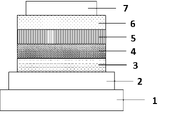
- FIG. 1 is a schematic cross-sectional view showing a structural example of an organic EL device used in the present invention.
- the luminescent material of the present invention is represented by the general formula (1) or general formula (1-1).
- it is a luminescent material represented by the general formula (2), general formula (3), or general formula (4).
- the organic EL device of the present invention has one or more light-emitting layers between an anode and a cathode facing each other, and at least one of the light-emitting layers is represented by general formula (1) or general formula (1-1). It contains the represented compound as a light-emitting material.
- This organic EL device has a plurality of layers between an anode and a cathode facing each other. At least one of the layers is a light-emitting layer, and the light-emitting layer can contain a host material if necessary.
- General formula (1) will be described below.
- the compound represented by general formula (1) typically has a structure in which a plurality of indole rings are condensed to a phenazine ring or a structure similar thereto.
- a 1 is CR 1 , N, or a carbon atom.
- the number of N in A 1 present in one six-membered ring containing A 1 in general formula (1) is 2 or less.
- This six-membered ring containing A 1 may be fused with the adjacent ring E, in which case two of A 1 are carbon atoms, which are shared with ring E.
- Each R 1 is independently hydrogen, a cyano group, deuterium, a substituted or unsubstituted diarylamino group having 12 to 44 carbon atoms, a substituted or unsubstituted arylheteroarylamino group having 12 to 44 carbon atoms, a substituted or unsubstituted diheteroarylamino group having 12 to 44 carbon atoms, aliphatic hydrocarbon group having 1 to 10 carbon atoms, substituted or unsubstituted aromatic hydrocarbon group having 6 to 30 carbon atoms, substituted or unsubstituted carbon 3 to 30 aromatic heterocyclic groups, or substituted or unsubstituted linked aromatic groups in which 2 to 9 of these aromatic groups are linked.
- R 1 represents an unsubstituted diarylamino group, an unsubstituted arylheteroarylamino group, an unsubstituted diheteroarylamino group, or an aliphatic hydrocarbon group
- specific examples include diphenylamino, dibiphenylamino, Phenylbiphenylamino, naphthylphenylamino, dinaphthylamino, dianthranylamino, diphenanthrenylamino, dibenzofuranylphenylamino, dibenzofuranylbiphenylamino, bisdibenzofuranylamino, methyl, ethyl, propyl, butyl, pentyl , hexyl, heptyl, octyl, nonyl and decyl.
- R 1 being an unsubstituted aromatic hydrocarbon group, an aromatic heterocyclic group, or a linked aromatic group
- R 1 being an unsubstituted aromatic hydrocarbon group, an aromatic heterocyclic group, or a linked aromatic group
- benzene naphthalene, acenaphthene, acenaphthylene, azulene, anthracene, chrysene, pyrene, phenanthrene, triphenylene, fluorene, benzo[a]anthracene, pyridine, pyrimidine, triazine, thiophene, isothiazole, thiazole, pyridazine, pyrrole, pyrazole, imidazole, triazole, thiadiazole, pyrazine, furan, isoxazole, quinoline, isoquinoline, quinoxaline, quinazoline, thiadiazole , phthalazine, t
- aromatic hydrocarbon group the aromatic heterocyclic group, or the linked aromatic group may each have a substituent.
- the substituent is a cyano group, an aliphatic hydrocarbon group having 1 to 10 carbon atoms, a diarylamino group having 12 to 30 carbon atoms, an arylheteroarylamino group having 12 to 30 carbon atoms, and 12 carbon atoms. diheteroarylamino groups of up to 30, alkoxy groups of 1 to 10 carbon atoms, aryloxy groups of 6 to 18 carbon atoms, alkylthio groups of 1 to 10 carbon atoms, and arylthio groups of 6 to 18 carbon atoms.
- the substituent when it is an aliphatic hydrocarbon group having 1 to 10 carbon atoms, it may be linear, branched or cyclic.
- the diarylamino group, arylheteroarylamino group, diheteroarylamino group, aryloxy group, and arylthio group are the aromatic hydrocarbon group, the aromatic heterocyclic group, the aromatic ring of the linked aromatic group, Alternatively, when substituting an aryl group or heteroaryl group contained in a diarylamino group, an arylheteroarylamino group, or a diheteroarylamino group, nitrogen and carbon, oxygen and carbon, or sulfur and carbon are bonded with a single bond.
- the number of substituents is 0-5, preferably 0-2.
- the number of carbon atoms in the substituent is not included in the calculation of the number of carbon atoms. However, it is preferable that the total carbon number including the carbon number of the substituent satisfies the above range.
- substituents include cyano, methyl, ethyl, propyl, butyl, pentyl, hexyl, heptyl, octyl, nonyl, decyl, diphenylamino, naphthylphenylamino, dinaphthylamino, dianthranylamino, and diphenane.
- Threnylamino dibenzofuranylphenylamino, dibenzofuranylbiphenylamino, bisdibenzofuranylamino, methoxy, ethoxy, phenol, diphenyloxy, methylthio, ethylthio, thiophenol, or diphenylthio.
- cyano methyl, ethyl, propyl, butyl, pentyl, hexyl, heptyl, octyl, diphenylamino, naphthylphenylamino, dinaphthylamino, dibenzofuranylphenylamino, dibenzofuranylbiphenylamino, bisdibenzofuranylamino , phenol, or thiophenol.
- a linked aromatic group refers to an aromatic group in which the carbon atoms of the aromatic rings of the aromatic group are linked by single bonds.
- An aromatic group is an aromatic group in which two or more are linked, and these may be linear or branched.
- the aromatic group may be an aromatic hydrocarbon group or an aromatic heterocyclic group, and plural aromatic groups may be the same or different.
- Aromatic groups that correspond to linking aromatic groups are different from substituted aromatic groups.
- hydrogen may be deuterium. That is, in the general formulas (1) to (4), (1-1), etc., part or all of H in a skeleton such as carbazole and a substituent such as R 1 and Ar 1 is deuterium. good too.
- Each ring E is independently a heterocyclic ring represented by formula (1a), and ring E is fused to an adjacent ring at any position.
- each X 1 is independently a divalent group represented by Si(R d ) 2 , C(R d ) 2 , O, S, Se, or NL 1 -(Ar 1 ) e ; O, S, or NL 1 -(Ar 1 ) e is preferred, and NL 1 -(Ar 1 ) e is more preferred.
- Each R d is independently hydrogen, deuterium, an aliphatic hydrocarbon group having 1 to 10 carbon atoms, a substituted or unsubstituted aromatic hydrocarbon group having 6 to 30 carbon atoms, a substituted or unsubstituted 3 carbon atoms to 30 aromatic heterocyclic groups, or substituted or unsubstituted linked aromatic groups in which 2 to 9 of these aromatic groups are linked.
- an aliphatic hydrocarbon group having 1 to 4 carbon atoms More preferably, hydrogen, an aliphatic hydrocarbon group having 1 to 4 carbon atoms, a substituted or unsubstituted aromatic hydrocarbon group having 6 to 10 carbon atoms, a substituted or unsubstituted aromatic heterocyclic ring having 2 to 12 carbon atoms or a substituted or unsubstituted linked aromatic group formed by linking 2 to 4 of these aromatic groups.
- R d is an aliphatic hydrocarbon group having 1 to 10 carbon atoms, a substituted or unsubstituted aromatic hydrocarbon group having 6 to 30 carbon atoms, a substituted or unsubstituted aromatic heterocyclic group having 3 to 30 carbon atoms, or Specific examples of substituted or unsubstituted linked aromatic groups in which 2 to 9 of these aromatic groups are linked are the same as in the case of R 1 .
- Each L 1 independently represents a substituted or unsubstituted C 6-30 aromatic hydrocarbon group or a substituted or unsubstituted C 3-30 aromatic heterocyclic group. Preferably, it represents a substituted or unsubstituted C6-C20 aromatic hydrocarbon group or a substituted or unsubstituted C2-C20 aromatic heterocyclic group. More preferably, it represents a substituted or unsubstituted C6-C10 aromatic hydrocarbon group or a substituted or unsubstituted C2-C12 aromatic heterocyclic group.
- unsubstituted L 1 examples include benzene, naphthalene, acenaphthene, acenaphthylene, azulene, anthracene, chrysene, pyrene, phenanthrene, triphenylene, fluorene, benzo[a]anthracene, pyridine, pyrimidine, triazine, thiophene, isothiazole, Thiazole, pyridazine, pyrrole, pyrazole, imidazole, triazole, thiadiazole, pyrazine, furan, isoxazole, quinoline, isoquinoline, quinoxaline, quinazoline, thiadiazole, phthalazine, tetrazole, indole, benzofuran, benzothiophene, benzoxazole, benzothiazole, indazole, benz A group obtained by removing 1+e
- Ar 1 is a substituted or unsubstituted aromatic hydrocarbon group having 6 to 30 carbon atoms, a substituted or unsubstituted aromatic heterocyclic group having 3 to 30 carbon atoms, or the aromatic hydrocarbon group and the aromatic heterocyclic group. It represents a substituted or unsubstituted linked aromatic group composed of linked aromatic rings of 2 to 9 aromatic groups selected from cyclic groups.
- a substituted or unsubstituted aromatic hydrocarbon group having 6 to 20 carbon atoms, a substituted or unsubstituted aromatic heterocyclic group having 3 to 20 carbon atoms, or the aromatic hydrocarbon group and the aromatic heterocyclic ring represents a substituted or unsubstituted linked aromatic group formed by connecting 2 to 6 aromatic rings of an aromatic group selected from groups.
- a substituted or unsubstituted aromatic hydrocarbon group having 6 to 10 carbon atoms, a substituted or unsubstituted aromatic heterocyclic group having 3 to 12 carbon atoms, or the aromatic hydrocarbon group and the aromatic heterocyclic group It represents a substituted or unsubstituted linked aromatic group formed by linking 2 to 4 aromatic rings of an aromatic group selected from cyclic groups.
- aromatic hydrocarbon group, aromatic heterocyclic group and linked aromatic group are also referred to as aromatic groups.
- unsubstituted aromatic groups include benzene, naphthalene, acenaphthene, acenaphthylene, azulene, anthracene, chrysene, pyrene, phenanthrene, triphenylene, fluorene, benzo[a]anthracene, pyridine, pyrimidine, triazine, thiophene, iso Thiazole, thiazole, pyridazine, pyrrole, pyrazole, imidazole, triazole, thiadiazole, pyrazine, furan, isoxazole, quinoline, isoquinoline, quinoxaline, quinazoline, thiadiazole, phthalazine, tetrazole, indole, benzofuran, benzothiophene, benzoxazole, benzothiazole, indazole , benzimidazole, benzo
- Preferred embodiments of general formula (1) include general formula (2), general formula (3), and general formula (4).
- general formulas (1) to (4) common symbols have the same meanings.
- General formula (2) corresponds to a structure in which b and c are both 1 and a and d are 0 in general formula (1).
- Ring E has the same definition as in general formula (1).
- General formula (3) corresponds to a structure in which both a and d are 1 and b and c are 0 in general formula (1).
- Ring E has the same definition as in general formula (1).
- the general formula (4) corresponds to a structure in which a, b, c and d are all 0 in the general formula (1).
- each A 1 is CR 1 or N independently.
- R 1 is the same as the general formula (1).
- the number of N in A 1 present in one six-membered ring containing A 1 in general formula (4) is 2 or less.
- R 1 is a substituted or unsubstituted diarylamino group, arylheteroarylamino group, diheteroarylamino group, aromatic hydrocarbon group, or substituted or unsubstituted aromatic
- R 1 is directly with the aromatic ring having A 1 to which R 1 is attached in formula (1), or —O—, —S—, —Si(R a ) 2 —,
- One or more bonds may be formed via —C(R a ) 2 — or —NR a — to form a condensed ring.
- Each R a is independently hydrogen, deuterium, an aliphatic hydrocarbon group having 1 to 10 carbon atoms, a substituted or unsubstituted aromatic hydrocarbon group having 6 to 30 carbon atoms, a substituted or unsubstituted 3 carbon atoms to 30 aromatic heterocyclic groups, or substituted or unsubstituted linked aromatic groups in which 2 to 9 of these aromatic groups are linked.
- an aliphatic hydrocarbon group having 1 to 4 carbon atoms More preferably, hydrogen, an aliphatic hydrocarbon group having 1 to 4 carbon atoms, a substituted or unsubstituted aromatic hydrocarbon group having 6 to 10 carbon atoms, or a substituted or unsubstituted aromatic heterocyclic ring having 3 to 12 carbon atoms or a substituted or unsubstituted linked aromatic group formed by linking 2 to 4 of these aromatic groups.
- R a is an aliphatic hydrocarbon group having 1 to 10 carbon atoms, a substituted or unsubstituted aromatic hydrocarbon group having 6 to 30 carbon atoms, a substituted or unsubstituted aromatic heterocyclic group having 3 to 30 carbon atoms, or Specific examples of substituted or unsubstituted linked aromatic groups in which 2 to 9 of these aromatic groups are linked are the same as in the case of R 1 .
- R 1 is a substituted or unsubstituted diarylamino group, arylheteroarylamino group, diheteroarylamino group, aromatic hydrocarbon group, or substituted or unsubstituted aromatic a heterocyclic group directly with the aromatic ring to which R 1 is bonded, or —O—, —S—, —Si(R a ) 2 —, —C(R a ) 2 —, or —NR a —
- structures such as the following exemplary compounds (D226) to (D236) can be obtained.
- R 1 is a substituted or unsubstituted diarylamino group, arylheteroarylamino group, diheteroarylamino group, aromatic hydrocarbon group, or substituted or unsubstituted aromatic a heterocyclic group directly with the aromatic ring to which R 1 is bonded, or —O—, —S—, —Si(R a ) 2 —, —C(R a ) 2 —, or —NR a —
- structures such as the following exemplary compounds (D237) to (D240) can be obtained.
- Each R c is independently hydrogen, deuterium, an aliphatic hydrocarbon group having 1 to 10 carbon atoms, a substituted or unsubstituted aromatic hydrocarbon group having 6 to 30 carbon atoms, a substituted or unsubstituted 3 carbon atoms to 30 aromatic heterocyclic groups, or substituted or unsubstituted linked aromatic groups in which 2 to 9 of these aromatic groups are linked.
- an aliphatic hydrocarbon group having 1 to 4 carbon atoms More preferably, hydrogen, an aliphatic hydrocarbon group having 1 to 4 carbon atoms, a substituted or unsubstituted aromatic hydrocarbon group having 6 to 10 carbon atoms, or a substituted or unsubstituted aromatic heterocyclic ring having 3 to 12 carbon atoms or a substituted or unsubstituted linked aromatic group formed by linking 2 to 4 of these aromatic groups.
- R c is an aliphatic hydrocarbon group having 1 to 10 carbon atoms, a substituted or unsubstituted aromatic hydrocarbon group having 6 to 30 carbon atoms, a substituted or unsubstituted aromatic heterocyclic group having 3 to 30 carbon atoms, or Specific examples of substituted or unsubstituted linked aromatic groups in which 2 to 9 of these aromatic groups are linked are the same as in the case of R 1 .
- the general formula (1-1) will be explained below.
- the compound represented by general formula (1-1) typically has a structure in which a plurality of benzene rings are condensed to a phenazine ring or a structure similar thereto.
- One of preferred embodiments is represented by general formula (4).
- a 2 is CR 2 , N, or a carbon atom.
- the number of N in A 2 present in one six-membered ring containing A 2 in general formula (1-1) is 2 or less.
- This six-membered ring containing A2 may be fused to the adjacent ring F, in which case two of A2 are carbon atoms, which are shared with ring F.
- Each R 2 is independently hydrogen, a cyano group, deuterium, a substituted or unsubstituted diarylamino group having 12 to 44 carbon atoms, a substituted or unsubstituted arylheteroarylamino group having 12 to 44 carbon atoms, a substituted or unsubstituted diheteroarylamino group having 12 to 44 carbon atoms, aliphatic hydrocarbon group having 1 to 10 carbon atoms, substituted or unsubstituted aromatic hydrocarbon group having 6 to 30 carbon atoms, substituted or unsubstituted carbon 3 to 30 aromatic heterocyclic groups, or substituted or unsubstituted linked aromatic groups in which 2 to 9 of these aromatic groups are linked.
- R 2 Specific examples of unsubstituted R 2 are the same as those of R 1 .
- R 2 is a substituted or unsubstituted diarylamino group, arylheteroarylamino group, diheteroarylamino group, aromatic hydrocarbon group, or substituted or unsubstituted aromatic heterocyclic ring.
- R 2 is a substituted or unsubstituted diarylamino group, arylheteroarylamino group, diheteroarylamino group, aromatic hydrocarbon group, or substituted or unsubstituted aromatic heterocyclic ring.
- R 2 is directly with the aromatic ring having A 2 to which R 2 is attached in formula (1-1), or —O—, —S—, —Si(R b ) 2 —,
- the structure can be as shown in the following exemplary compound (D169).
- Each R b is independently hydrogen, deuterium, an aliphatic hydrocarbon group having 1 to 10 carbon atoms, a substituted or unsubstituted aromatic hydrocarbon group having 6 to 30 carbon atoms, a substituted or unsubstituted 3 carbon atoms to 30 aromatic heterocyclic groups, or substituted or unsubstituted linked aromatic groups in which 2 to 9 of these aromatic groups are linked.
- an aliphatic hydrocarbon group having 1 to 4 carbon atoms More preferably, hydrogen, an aliphatic hydrocarbon group having 1 to 4 carbon atoms, a substituted or unsubstituted aromatic hydrocarbon group having 6 to 10 carbon atoms, a substituted or unsubstituted aromatic heterocyclic ring having 2 to 12 carbon atoms or a substituted or unsubstituted linked aromatic group formed by linking 2 to 4 of these aromatic groups.
- R b is an aliphatic hydrocarbon group having 1 to 10 carbon atoms, a substituted or unsubstituted aromatic hydrocarbon group having 6 to 30 carbon atoms, a substituted or unsubstituted aromatic heterocyclic group having 3 to 30 carbon atoms, or Specific examples of substituted or unsubstituted linked aromatic groups in which 2 to 9 of these aromatic groups are linked are the same as in the case of R 1 .
- luminescent materials represented by general formulas (1) to (4) and (1-1) are shown below, but are not limited to these exemplary compounds.
- the organic EL By including the light emitting material represented by the general formula (1) or general formula (1-1) in the light emitting layer, the organic EL emits light with high efficiency and has high driving stability and is excellent in practical use. element.
- FIG. 1 is a cross-sectional view showing a structural example of a general organic EL device used in the present invention, wherein 1 is a substrate, 2 is an anode, 3 is a hole injection layer, 4 is a hole transport layer, and 5 is a light emitting layer. , 6 represents the electron transport layer and 7 represents the cathode.
- the organic EL device of the present invention may have an exciton blocking layer adjacent to the light emitting layer, or may have an electron blocking layer between the light emitting layer and the hole injection layer.
- the exciton blocking layer can be inserted either on the cathode side or the anode side of the light-emitting layer, or both can be inserted at the same time.
- the organic EL device of the present invention has an anode, a light-emitting layer, and a cathode as essential layers. It is preferable to have a hole blocking layer between the transport layers.
- the hole injection transport layer means either or both of the hole injection layer and the hole transport layer
- the electron injection transport layer means either or both of the electron injection layer and the electron transport layer.
- the organic EL element As described above, the layers constituting the laminated structure on the substrate other than the electrodes such as the anode and the cathode are sometimes collectively referred to as the organic layer.
- the organic EL device of the present invention is preferably supported by a substrate.
- the substrate is not particularly limited as long as it is conventionally used in organic EL elements, and can be made of, for example, glass, transparent plastic, quartz, or the like.
- anode material in the organic EL element a material having a large work function (4 eV or more) metal, alloy, electrically conductive compound, or a mixture thereof is preferably used.
- electrode materials include metals such as Au, conductive transparent materials such as CuI, indium tin oxide (ITO), SnO 2 and ZnO.
- a material such as IDIXO (In 2 O 3 —ZnO) that is amorphous and capable of forming a transparent conductive film may also be used.
- the anode may be formed by forming a thin film of these electrode materials by a method such as vapor deposition or sputtering, and forming a pattern of a desired shape by photolithography.
- a pattern may be formed through a mask having a desired shape during vapor deposition or sputtering of the electrode material.
- a coatable substance such as an organic conductive compound
- a wet film forming method such as a printing method or a coating method may be used.
- the transmittance is desirably higher than 10%, and the sheet resistance of the anode is preferably several hundred ⁇ / ⁇ or less.
- the film thickness depends on the material, it is usually selected in the range of 10 to 1000 nm, preferably 10 to 200 nm.
- a cathode material a material composed of a metal having a small work function (4 eV or less) (referred to as an electron-injecting metal), an alloy, an electrically conductive compound, or a mixture thereof is used.
- electrode materials include sodium, sodium-potassium alloys, magnesium, lithium, magnesium/copper mixtures, magnesium/silver mixtures, magnesium/aluminum mixtures, magnesium/indium mixtures, aluminum/aluminum oxide (Al 2 O 3 ) mixtures, indium, lithium/aluminum mixtures, rare earth metals and the like.
- a mixture of an electron injection metal and a second metal that has a higher work function and is more stable such as a magnesium/silver mixture, magnesium /aluminum mixtures, magnesium/indium mixtures, aluminum/aluminum oxide (Al 2 O 3 ) mixtures, lithium/aluminum mixtures, aluminum and the like are suitable.
- the cathode can be produced by forming a thin film of these cathode materials by a method such as vapor deposition or sputtering.
- the sheet resistance of the cathode is preferably several hundred ⁇ / ⁇ or less, and the film thickness is usually selected in the range of 10 nm to 5 ⁇ m, preferably 50 to 200 nm.
- the film thickness is usually selected in the range of 10 nm to 5 ⁇ m, preferably 50 to 200 nm.
- a transparent or translucent cathode can be produced by forming the above metal in a thickness of 1 to 20 nm on the cathode and then forming the conductive transparent material mentioned in the explanation of the anode thereon. By applying this, it is possible to fabricate a device in which both the anode and the cathode are transparent.
- the light-emitting layer is a layer that emits light after recombination of holes and electrons injected from the anode and the cathode to generate excitons.
- a light-emitting material represented by general formula (1) or general formula (1-1) may be used alone, or this light-emitting material may be used together with a host material. When a light-emitting material is used with a host material, the light-emitting material is responsible for light emission in the device.
- the content of the luminescent material is preferably 0.1 to 50 wt%, more preferably 0.1 to 40 wt%, relative to the host material.
- host materials used in phosphorescent light-emitting devices and fluorescent light-emitting devices can be used.
- Known host materials that can be used include compounds having hole-transporting ability and electron-transporting ability and having a high glass transition temperature, and the triplet excitation energy (T1 ), preferably have a triplet excitation energy (T1) greater than .
- T1 triplet excitation energy
- a TADF-active compound may be used as the host material. preferable.
- host materials are known from many patent documents, etc., and can be selected from them.
- Specific examples of the host material include, but are not limited to, indole compounds, carbazole compounds, indolocarbazole compounds, pyridine compounds, pyrimidine compounds, triazine compounds, triazole compounds, oxazole compounds, oxadiazole compounds, and imidazole compounds.
- Carbazole compounds, indolocarbazole compounds, pyridine compounds, pyrimidine compounds, triazine compounds, anthracene compounds, triphenylene compounds, carborane compounds, and porphyrin compounds are preferred.
- Only one type of host may be used in one light-emitting layer, or two or more types of hosts may be used.
- at least one is preferably an electron-transporting compound such as the triazine compound or anthracene compound described above, and the other hosts are carbazole compounds or indolocarbazole compounds. It is preferably a hole-transporting compound such as
- each host is vapor-deposited from a different vapor deposition source, or a pre-mixture is formed by pre-mixing before vapor deposition so that multiple types of hosts can be simultaneously vapor-deposited from one vapor deposition source. .
- the light-emitting material and the host material can be vapor-deposited from different vapor deposition sources, or the light-emitting material and the host material can be simultaneously vapor-deposited from one vapor deposition source by premixing them before vapor deposition to form a premix.
- premixing method a method that can mix uniformly as much as possible is desirable, and examples thereof include pulverization and mixing, heating and melting under reduced pressure or in an inert gas atmosphere such as nitrogen, and sublimation.
- the method is not limited.
- the form of the host and its preliminary mixture may be powder, stick, or granule.
- the injection layer is a layer provided between an electrode and an organic layer to reduce driving voltage and improve luminance. and between the cathode and the light-emitting layer or electron-transporting layer.
- An injection layer can be provided as required.
- the hole-blocking layer has the function of an electron-transporting layer. can improve the recombination probability of electrons and holes in the light-emitting layer.
- the hole blocking layer can be any known hole blocking material. Also, a plurality of types of hole blocking materials may be used in combination.
- Electron blocking layer has the function of a hole-transporting layer, and by blocking electrons while transporting holes, it is possible to improve the probability of recombination of electrons and holes in the light-emitting layer.
- a known electron blocking layer material can be used as the material for the electron blocking layer.
- Exciton blocking layer is a layer that prevents excitons generated by recombination of holes and electrons in the light-emitting layer from diffusing into the charge-transporting layer. It becomes possible to efficiently confine them in the light-emitting layer, and the light-emitting efficiency of the device can be improved.
- An exciton blocking layer can be inserted between two adjacent light-emitting layers in a device in which two or more light-emitting layers are adjacent to each other.
- a known exciton blocking layer material can be used as a material for such an exciton blocking layer.
- Layers adjacent to the light-emitting layer include a hole-blocking layer, an electron-blocking layer, an exciton-blocking layer, and the like. Become.
- the hole-transporting layer is made of a hole-transporting material having a function of transporting holes, and the hole-transporting layer can be provided as a single layer or multiple layers.
- the hole-transporting material has either hole injection or transport or electron barrier properties, and may be either organic or inorganic. Any compound can be selected from conventionally known compounds and used for the hole transport layer. Examples of such hole-transporting materials include porphyrin derivatives, arylamine derivatives, triazole derivatives, oxadiazole derivatives, imidazole derivatives, polyarylalkane derivatives, phenylenediamine derivatives, arylamine derivatives, amino-substituted chalcone derivatives, oxazole derivatives, styrylanthracene.
- arylamine derivatives fluorenone derivatives, hydrazone derivatives, stilbene derivatives, silazane derivatives, aniline copolymers, conductive polymer oligomers, especially thiophene oligomers, etc.
- porphyrin derivatives, arylamine derivatives and styrylamine derivatives can also be used.
- an arylamine compound is used.
- the electron transport layer is made of a material having a function of transporting electrons, and the electron transport layer can be provided as a single layer or multiple layers.
- the electron-transporting material (sometimes also serving as a hole-blocking material) should have the function of transmitting electrons injected from the cathode to the light-emitting layer.
- any compound can be selected and used from conventionally known compounds.
- each layer when producing the organic EL element of the present invention is not particularly limited, and it may be produced by either a dry process or a wet process.
- S1 and T1 are measured as follows.
- a sample compound thermalally activated delayed fluorescence material
- a quartz substrate by a vacuum vapor deposition method at a degree of vacuum of 10 ⁇ 4 Pa or less to form a vapor-deposited film with a thickness of 100 nm.
- S1 measures the emission spectrum of this deposited film, draws a tangent line to the rising edge of the emission spectrum on the short wavelength side, and obtains the wavelength value ⁇ edge [nm] at the intersection of the tangent line and the horizontal axis using the following formula (i). to calculate S1.
- S1[eV] 1239.85/ ⁇ edge (i)
- T1 measures the phosphorescent spectrum of the vapor deposited film, draws a tangent line to the rise on the short wavelength side of the phosphorescent spectrum, and calculates the wavelength value ⁇ edge [nm] at the intersection of the tangent line and the horizontal axis by the formula (ii). to calculate T1.
- T1[eV] 1239.85/ ⁇ edge (ii)
- Example 1 A thin film shown below was formed on a quartz substrate at a degree of vacuum of 4.0 ⁇ 10 ⁇ 5 Pa by a vacuum deposition method.
- BH-1 as a host and compound (D1) as a dopant were co-deposited from different deposition sources to form a light-emitting layer having a thickness of 100 nm. At this time, the co-evaporation was carried out under the condition that the concentration of the compound (D1) was 2% by mass.
- An organic thin film according to Example 1 was produced.
- the above organic thin film was subjected to photoluminescence quantum yield (PLQY) measurement using the Absolute PL Quantum Yield Measurement C9920-03G system (Hamamatsu Photonics Co., Ltd.).
- PLQY photoluminescence quantum yield
- C9920-03G Absolute PL Quantum Yield Measurement C9920-03G system
- the photoexcitation and emission spectrum of the organic thin film can be continuously measured, and the PLQY of the organic thin film can be calculated by calculating the energy balance at this time.
- Maximum emission wavelength, half-width, PLQY and CIE coordinates are determined using software U6039-05 version 3.6.0. Maximum emission wavelength and half-width are given in nm, PLQY in % and CIE coordinates as x,y values.
- the excitation wavelength in PLQY measurement was set to 340 nm.
- Example 2 An organic thin film according to Example 2 was produced in the same manner as in Example 1, except that the compound (D69) was used as the dopant.
- Example 3 A solution was prepared by adjusting the concentration of compound (D41) to 5 ⁇ 10 ⁇ 6 M in toluene. For this solution, the maximum emission wavelength, half width, PLQY and CIE coordinates were determined in the same manner as in Example 1.
- Example 4 A solution was prepared by adjusting the concentration of compound (D122) to 5 ⁇ 10 ⁇ 6 M in toluene. For this solution, the maximum emission wavelength, half width, PLQY and CIE coordinates were determined in the same manner as in Example 1.
- Comparative example 1 An organic thin film was prepared in the same manner as in Example 1, except that BH-1 was used as the dopant.
- Table 1 shows the results of measuring the maximum emission wavelength, half width, chromaticity (CIEx, CIEy) and PLQY of the emission spectrum of the produced organic thin film and solution.
- the luminescent material of the present invention has highly efficient characteristics, and it can be seen from the maximum emission wavelength that it emits blue light.
- Example 5 Each thin film shown below was laminated at a degree of vacuum of 4.0 ⁇ 10 ⁇ 5 Pa by a vacuum deposition method on a glass substrate on which an anode made of ITO with a film thickness of 70 nm was formed.
- HAT-CN shown above was formed to a thickness of 10 nm as a hole injection layer on ITO, and then HT-1 was formed to a thickness of 25 nm as a hole transport layer.
- HT-2 was formed with a thickness of 5 nm as an electron blocking layer.
- BH-2 as a host and compound (D122) as a dopant were co-deposited from different vapor deposition sources to form a light-emitting layer having a thickness of 30 nm.
- Table 2 shows the maximum emission wavelength, external quantum efficiency, and lifetime of the produced organic EL device.
- the maximum emission wavelength and external quantum efficiency are values at a drive current density of 2.5 mA/cm 2 , and are initial characteristics.
- the lifetime was measured by measuring the time until the brightness decayed to 90% of the initial brightness when the driving current density was 40 mA/cm 2 .
- the organic EL device using the luminescent material of the present invention has high characteristics, and it can be seen from the maximum emission wavelength that it emits blue light. In addition, particularly excellent results were obtained with respect to life characteristics.
- the luminescent material of the present invention it is possible to obtain a practically useful organic EL device that emits light with high efficiency and has high driving stability.
- the luminescent material of the invention also exhibits a maximum wavelength in the blue, light blue or green spectral region. This luminescent material exhibits a wavelength maximum in particular between 410 nm and 550 nm, preferably between 430 nm and 495 nm.
- the photoluminescence quantum yield of the luminescent material of the present invention can be 40% or more. Use of the luminescent materials of the present invention results in more efficient devices. Further, an organic EL device having a light-emitting layer containing this has high luminous efficiency and color.
Landscapes
- Chemical & Material Sciences (AREA)
- Organic Chemistry (AREA)
- Engineering & Computer Science (AREA)
- Materials Engineering (AREA)
- Physics & Mathematics (AREA)
- Spectroscopy & Molecular Physics (AREA)
- Optics & Photonics (AREA)
- Electroluminescent Light Sources (AREA)
Abstract
Priority Applications (5)
| Application Number | Priority Date | Filing Date | Title |
|---|---|---|---|
| KR1020237030947A KR20230167351A (ko) | 2021-04-08 | 2022-03-28 | 발광 재료, 및 유기 전계 발광 소자 |
| JP2023512953A JPWO2022215580A1 (fr) | 2021-04-08 | 2022-03-28 | |
| US18/279,313 US20240179929A1 (en) | 2021-04-08 | 2022-03-28 | Light-emitting material, and organic electroluminescent element |
| CN202280023607.4A CN117083276A (zh) | 2021-04-08 | 2022-03-28 | 发光材料、及有机电场发光元件 |
| EP22784564.1A EP4322236A4 (fr) | 2021-04-08 | 2022-03-28 | Matériau électroluminescent et élément électroluminescent organique |
Applications Claiming Priority (2)
| Application Number | Priority Date | Filing Date | Title |
|---|---|---|---|
| JP2021066013 | 2021-04-08 | ||
| JP2021-066013 | 2021-04-08 |
Publications (1)
| Publication Number | Publication Date |
|---|---|
| WO2022215580A1 true WO2022215580A1 (fr) | 2022-10-13 |
Family
ID=83545484
Family Applications (1)
| Application Number | Title | Priority Date | Filing Date |
|---|---|---|---|
| PCT/JP2022/015058 Ceased WO2022215580A1 (fr) | 2021-04-08 | 2022-03-28 | Matériau électroluminescent et élément électroluminescent organique |
Country Status (6)
| Country | Link |
|---|---|
| US (1) | US20240179929A1 (fr) |
| EP (1) | EP4322236A4 (fr) |
| JP (1) | JPWO2022215580A1 (fr) |
| KR (1) | KR20230167351A (fr) |
| CN (1) | CN117083276A (fr) |
| WO (1) | WO2022215580A1 (fr) |
Cited By (1)
| Publication number | Priority date | Publication date | Assignee | Title |
|---|---|---|---|---|
| CN117024426A (zh) * | 2023-08-08 | 2023-11-10 | 浙江八亿时空先进材料有限公司 | 一种咔唑衍生物及其应用 |
Citations (9)
| Publication number | Priority date | Publication date | Assignee | Title |
|---|---|---|---|---|
| WO2010134350A1 (fr) | 2009-05-22 | 2010-11-25 | 出光興産株式会社 | Élément électroluminescent organique |
| WO2011070963A1 (fr) | 2009-12-07 | 2011-06-16 | 新日鐵化学株式会社 | Matière électroluminescente organique et élément électroluminescent organique |
| JP2012234873A (ja) | 2011-04-28 | 2012-11-29 | Konica Minolta Holdings Inc | 有機エレクトロルミネッセンス素子材料、有機エレクトロルミネッセンス素子、表示装置および照明装置 |
| WO2014008967A2 (fr) | 2012-07-10 | 2014-01-16 | Merck Patent Gmbh | Matériaux conçus pour des dispositifs électroluminescents organiques |
| KR20180008283A (ko) * | 2016-07-14 | 2018-01-24 | 주식회사 엘지화학 | 화합물 및 이를 포함하는 유기 전자 소자 |
| CN110759925A (zh) * | 2018-12-06 | 2020-02-07 | 广州华睿光电材料有限公司 | 含氮稠环有机化合物及其应用 |
| CN111892607A (zh) | 2020-08-26 | 2020-11-06 | 上海天马有机发光显示技术有限公司 | 一种n杂联苯类有机化合物及其应用 |
| US20210098715A1 (en) * | 2019-09-30 | 2021-04-01 | Samsung Display Co., Ltd. | Organic electroluminescence device and polycyclic compound for organic electroluminescence device |
| KR20210096958A (ko) * | 2020-01-29 | 2021-08-06 | 덕산네오룩스 주식회사 | 유기전기 소자용 화합물, 이를 이용한 유기전기소자 및 그 전자 장치 |
Family Cites Families (4)
| Publication number | Priority date | Publication date | Assignee | Title |
|---|---|---|---|---|
| JP2012243983A (ja) * | 2011-05-20 | 2012-12-10 | Nippon Hoso Kyokai <Nhk> | 有機エレクトロルミネッセンス素子 |
| CN115368370A (zh) * | 2021-05-20 | 2022-11-22 | 浙江虹舞科技有限公司 | 一种稠合氮杂环化合物及其应用以及包含该化合物的有机电致发光器件 |
| KR20230116106A (ko) * | 2022-01-26 | 2023-08-04 | 삼성디스플레이 주식회사 | 헤테로고리 화합물, 이를 포함한 발광 소자 및 상기 발광 소자를 포함한 전자 장치 |
| CN116731043A (zh) * | 2022-03-09 | 2023-09-12 | 环球展览公司 | 有机电致发光材料和装置 |
-
2022
- 2022-03-28 US US18/279,313 patent/US20240179929A1/en active Pending
- 2022-03-28 JP JP2023512953A patent/JPWO2022215580A1/ja active Pending
- 2022-03-28 CN CN202280023607.4A patent/CN117083276A/zh active Pending
- 2022-03-28 KR KR1020237030947A patent/KR20230167351A/ko active Pending
- 2022-03-28 WO PCT/JP2022/015058 patent/WO2022215580A1/fr not_active Ceased
- 2022-03-28 EP EP22784564.1A patent/EP4322236A4/fr active Pending
Patent Citations (9)
| Publication number | Priority date | Publication date | Assignee | Title |
|---|---|---|---|---|
| WO2010134350A1 (fr) | 2009-05-22 | 2010-11-25 | 出光興産株式会社 | Élément électroluminescent organique |
| WO2011070963A1 (fr) | 2009-12-07 | 2011-06-16 | 新日鐵化学株式会社 | Matière électroluminescente organique et élément électroluminescent organique |
| JP2012234873A (ja) | 2011-04-28 | 2012-11-29 | Konica Minolta Holdings Inc | 有機エレクトロルミネッセンス素子材料、有機エレクトロルミネッセンス素子、表示装置および照明装置 |
| WO2014008967A2 (fr) | 2012-07-10 | 2014-01-16 | Merck Patent Gmbh | Matériaux conçus pour des dispositifs électroluminescents organiques |
| KR20180008283A (ko) * | 2016-07-14 | 2018-01-24 | 주식회사 엘지화학 | 화합물 및 이를 포함하는 유기 전자 소자 |
| CN110759925A (zh) * | 2018-12-06 | 2020-02-07 | 广州华睿光电材料有限公司 | 含氮稠环有机化合物及其应用 |
| US20210098715A1 (en) * | 2019-09-30 | 2021-04-01 | Samsung Display Co., Ltd. | Organic electroluminescence device and polycyclic compound for organic electroluminescence device |
| KR20210096958A (ko) * | 2020-01-29 | 2021-08-06 | 덕산네오룩스 주식회사 | 유기전기 소자용 화합물, 이를 이용한 유기전기소자 및 그 전자 장치 |
| CN111892607A (zh) | 2020-08-26 | 2020-11-06 | 上海天马有机发光显示技术有限公司 | 一种n杂联苯类有机化合物及其应用 |
Non-Patent Citations (2)
| Title |
|---|
| JOURNAL OF MATERIAL CHEMISTRY C, vol. 5, no. 3, 2017, pages 709 |
| See also references of EP4322236A4 |
Cited By (1)
| Publication number | Priority date | Publication date | Assignee | Title |
|---|---|---|---|---|
| CN117024426A (zh) * | 2023-08-08 | 2023-11-10 | 浙江八亿时空先进材料有限公司 | 一种咔唑衍生物及其应用 |
Also Published As
| Publication number | Publication date |
|---|---|
| CN117083276A (zh) | 2023-11-17 |
| JPWO2022215580A1 (fr) | 2022-10-13 |
| EP4322236A4 (fr) | 2024-12-18 |
| EP4322236A1 (fr) | 2024-02-14 |
| KR20230167351A (ko) | 2023-12-08 |
| US20240179929A1 (en) | 2024-05-30 |
Similar Documents
| Publication | Publication Date | Title |
|---|---|---|
| WO2018173598A1 (fr) | Élément électroluminescent organique | |
| KR102659607B1 (ko) | 유기 전계 발광 소자 | |
| WO2022255241A1 (fr) | Deutérure et élément électroluminescent organique | |
| JP7742829B2 (ja) | 有機電界発光素子 | |
| JP2025157550A (ja) | 有機電界発光素子 | |
| CN116710535A (zh) | 有机电致发光元件及其制造方法 | |
| EP4486097A1 (fr) | Matériau pour élément électroluminescent organique, et élément électroluminescent organique | |
| JP7754821B2 (ja) | 有機電界発光素子 | |
| WO2022215580A1 (fr) | Matériau électroluminescent et élément électroluminescent organique | |
| WO2025041677A1 (fr) | Matériau pour élément électroluminescent organique et élément électroluminescent organique | |
| WO2024058146A1 (fr) | Matériau luminescent, et élément électroluminescent organique | |
| WO2024135277A1 (fr) | Élément électroluminescent organique | |
| JP7801712B2 (ja) | 発光材料、及び有機電界発光素子 | |
| JP2020105341A (ja) | 熱活性化遅延蛍光発光材料、及び有機電界発光素子 | |
| KR102870351B1 (ko) | 유기 전계 발광 소자용 재료 및 유기 전계 발광 소자 | |
| CN116348569A (zh) | 有机电场发光元件用材料及有机电场发光元件 | |
| CN115443551A (zh) | 有机电场发光元件用材料及有机电场发光元件 | |
| WO2023157629A1 (fr) | Substance luminescente et élément électroluminescent organique | |
| WO2025169870A1 (fr) | Matériau mélangé pour un élément électroluminescent organique et élément électroluminescent organique | |
| WO2025182720A1 (fr) | Matériau mélangé pour un élément électroluminescent organique et élément électroluminescent organique | |
| WO2025105314A1 (fr) | Matériau mixte d'élément électroluminescent organique et élément électroluminescent organique | |
| WO2026058766A1 (fr) | Matériau pour élément électroluminescent organique, matériau mixte pour élément électroluminescent organique, et élément électroluminescent organique | |
| WO2024048535A1 (fr) | Matériau hôte pour éléments électroluminescents organiques, mélange préliminaire et élément électroluminescent organique | |
| WO2024048536A1 (fr) | Élément électroluminescent organique | |
| KR20260055415A (ko) | 유기 전계 발광 소자용 혼합 재료 및 유기 전계 발광 소자 |
Legal Events
| Date | Code | Title | Description |
|---|---|---|---|
| 121 | Ep: the epo has been informed by wipo that ep was designated in this application |
Ref document number: 22784564 Country of ref document: EP Kind code of ref document: A1 |
|
| WWE | Wipo information: entry into national phase |
Ref document number: 18279313 Country of ref document: US |
|
| WWE | Wipo information: entry into national phase |
Ref document number: 2023512953 Country of ref document: JP |
|
| WWE | Wipo information: entry into national phase |
Ref document number: 202280023607.4 Country of ref document: CN |
|
| WWE | Wipo information: entry into national phase |
Ref document number: 2022784564 Country of ref document: EP |
|
| NENP | Non-entry into the national phase |
Ref country code: DE |
|
| ENP | Entry into the national phase |
Ref document number: 2022784564 Country of ref document: EP Effective date: 20231108 |