WO2022220212A1 - アントラキノン化合物、該化合物を含む液晶組成物及び調光素子 - Google Patents
アントラキノン化合物、該化合物を含む液晶組成物及び調光素子 Download PDFInfo
- Publication number
- WO2022220212A1 WO2022220212A1 PCT/JP2022/017467 JP2022017467W WO2022220212A1 WO 2022220212 A1 WO2022220212 A1 WO 2022220212A1 JP 2022017467 W JP2022017467 W JP 2022017467W WO 2022220212 A1 WO2022220212 A1 WO 2022220212A1
- Authority
- WO
- WIPO (PCT)
- Prior art keywords
- formula
- linear
- group
- carbon atoms
- liquid crystal
- Prior art date
- Legal status (The legal status is an assumption and is not a legal conclusion. Google has not performed a legal analysis and makes no representation as to the accuracy of the status listed.)
- Ceased
Links
Classifications
-
- C—CHEMISTRY; METALLURGY
- C07—ORGANIC CHEMISTRY
- C07C—ACYCLIC OR CARBOCYCLIC COMPOUNDS
- C07C323/00—Thiols, sulfides, hydropolysulfides or polysulfides substituted by halogen, oxygen or nitrogen atoms, or by sulfur atoms not being part of thio groups
- C07C323/23—Thiols, sulfides, hydropolysulfides or polysulfides substituted by halogen, oxygen or nitrogen atoms, or by sulfur atoms not being part of thio groups containing thio groups and nitrogen atoms, not being part of nitro or nitroso groups, bound to the same carbon skeleton
- C07C323/31—Thiols, sulfides, hydropolysulfides or polysulfides substituted by halogen, oxygen or nitrogen atoms, or by sulfur atoms not being part of thio groups containing thio groups and nitrogen atoms, not being part of nitro or nitroso groups, bound to the same carbon skeleton having the sulfur atom of at least one of the thio groups bound to a carbon atom of a six-membered aromatic ring of the carbon skeleton
- C07C323/38—Thiols, sulfides, hydropolysulfides or polysulfides substituted by halogen, oxygen or nitrogen atoms, or by sulfur atoms not being part of thio groups containing thio groups and nitrogen atoms, not being part of nitro or nitroso groups, bound to the same carbon skeleton having the sulfur atom of at least one of the thio groups bound to a carbon atom of a six-membered aromatic ring of the carbon skeleton with the sulfur atom of the thio group bound to a carbon atom of a six-membered aromatic ring being part of a condensed ring system
-
- C—CHEMISTRY; METALLURGY
- C07—ORGANIC CHEMISTRY
- C07C—ACYCLIC OR CARBOCYCLIC COMPOUNDS
- C07C323/00—Thiols, sulfides, hydropolysulfides or polysulfides substituted by halogen, oxygen or nitrogen atoms, or by sulfur atoms not being part of thio groups
- C07C323/22—Thiols, sulfides, hydropolysulfides or polysulfides substituted by halogen, oxygen or nitrogen atoms, or by sulfur atoms not being part of thio groups containing thio groups and doubly-bound oxygen atoms bound to the same carbon skeleton
-
- C—CHEMISTRY; METALLURGY
- C09—DYES; PAINTS; POLISHES; NATURAL RESINS; ADHESIVES; COMPOSITIONS NOT OTHERWISE PROVIDED FOR; APPLICATIONS OF MATERIALS NOT OTHERWISE PROVIDED FOR
- C09B—ORGANIC DYES OR CLOSELY-RELATED COMPOUNDS FOR PRODUCING DYES, e.g. PIGMENTS; MORDANTS; LAKES
- C09B1/00—Dyes with anthracene nucleus not condensed with any other ring
- C09B1/56—Mercapto-anthraquinones
- C09B1/58—Mercapto-anthraquinones with mercapto groups substituted by aliphatic, cycloaliphatic, araliphatic or aryl radicals
-
- C—CHEMISTRY; METALLURGY
- C09—DYES; PAINTS; POLISHES; NATURAL RESINS; ADHESIVES; COMPOSITIONS NOT OTHERWISE PROVIDED FOR; APPLICATIONS OF MATERIALS NOT OTHERWISE PROVIDED FOR
- C09K—MATERIALS FOR MISCELLANEOUS APPLICATIONS, NOT PROVIDED FOR ELSEWHERE
- C09K19/00—Liquid crystal materials
- C09K19/04—Liquid crystal materials characterised by the chemical structure of the liquid crystal components, e.g. by a specific unit
- C09K19/06—Non-steroidal liquid crystal compounds
- C09K19/08—Non-steroidal liquid crystal compounds containing at least two non-condensed rings
- C09K19/10—Non-steroidal liquid crystal compounds containing at least two non-condensed rings containing at least two benzene rings
-
- C—CHEMISTRY; METALLURGY
- C09—DYES; PAINTS; POLISHES; NATURAL RESINS; ADHESIVES; COMPOSITIONS NOT OTHERWISE PROVIDED FOR; APPLICATIONS OF MATERIALS NOT OTHERWISE PROVIDED FOR
- C09K—MATERIALS FOR MISCELLANEOUS APPLICATIONS, NOT PROVIDED FOR ELSEWHERE
- C09K19/00—Liquid crystal materials
- C09K19/52—Liquid crystal materials characterised by components which are not liquid crystals, e.g. additives with special physical aspect: solvents, solid particles
- C09K19/60—Pleochroic dyes
- C09K19/603—Anthroquinonic
-
- G—PHYSICS
- G02—OPTICS
- G02F—OPTICAL DEVICES OR ARRANGEMENTS FOR THE CONTROL OF LIGHT BY MODIFICATION OF THE OPTICAL PROPERTIES OF THE MEDIA OF THE ELEMENTS INVOLVED THEREIN; NON-LINEAR OPTICS; FREQUENCY-CHANGING OF LIGHT; OPTICAL LOGIC ELEMENTS; OPTICAL ANALOGUE/DIGITAL CONVERTERS
- G02F1/00—Devices or arrangements for the control of the intensity, colour, phase, polarisation or direction of light arriving from an independent light source, e.g. switching, gating or modulating; Non-linear optics
- G02F1/01—Devices or arrangements for the control of the intensity, colour, phase, polarisation or direction of light arriving from an independent light source, e.g. switching, gating or modulating; Non-linear optics for the control of the intensity, phase, polarisation or colour
- G02F1/13—Devices or arrangements for the control of the intensity, colour, phase, polarisation or direction of light arriving from an independent light source, e.g. switching, gating or modulating; Non-linear optics for the control of the intensity, phase, polarisation or colour based on liquid crystals, e.g. single liquid crystal display cells
-
- C—CHEMISTRY; METALLURGY
- C07—ORGANIC CHEMISTRY
- C07C—ACYCLIC OR CARBOCYCLIC COMPOUNDS
- C07C2603/00—Systems containing at least three condensed rings
- C07C2603/02—Ortho- or ortho- and peri-condensed systems
- C07C2603/04—Ortho- or ortho- and peri-condensed systems containing three rings
- C07C2603/22—Ortho- or ortho- and peri-condensed systems containing three rings containing only six-membered rings
- C07C2603/24—Anthracenes; Hydrogenated anthracenes
Definitions
- the present invention relates to a novel anthraquinone compound, a liquid crystal composition containing the compound, and a light control device.
- Dichroic dyes are commonly used as dyes for liquid crystal light control films.
- a GH (guest-host) type light control device using a liquid crystal composition containing a dichroic dye is known, and various dichroic dyes have been proposed (see Patent Documents 5, 6, and 7). .
- Patent Documents 5 to 7 disclose dichroic dyes suitable for dimming applications, but the dyes in these documents are insufficient in contrast, light resistance, and electrical heat resistance.
- a first object of the present invention is to provide novel anthraquinone compounds.
- Another object of the present invention is to provide dichroic dyes which are novel anthraquinone compounds, liquid crystal compositions containing the anthraquinone compounds, and tones containing the compositions which are excellent in contrast, light resistance and electrical heat resistance. It is to provide an optical element.
- the present inventors have succeeded in obtaining a novel anthraquinone compound with a specific structure.
- the present inventors have found that by using a liquid crystal composition containing a dichroic dye, which is a novel anthraquinone compound with such a specific structure, a light control device having excellent contrast, light resistance, and electrical heat resistance can be produced. I have found that you can get That is, aspects included in the present invention are as follows. [1].
- Formula (1) below (In the formula, R 1 represents a hydrogen atom, a linear or branched alkyl group having 1 to 12 carbon atoms, or a linear or branched alkoxy group having 1 to 12 carbon atoms.
- R 2 represents the following formula (a ) (wherein R 3 is a hydrogen atom, a linear or branched alkyl group having 1 to 8 carbon atoms, a linear or branched alkoxy group having 1 to 8 carbon atoms, or —CH 2 OR 4 and R 4 represents a linear or branched alkyl group having 1 to 8 carbon atoms.) or the following formula (b) (In the formula (b), R 5 represents a hydrogen atom, a linear or branched alkyl group having 1 to 8 carbon atoms, or a substituent represented by —CH 2 OR 6 , and R 6 has 1 to 8 carbon atoms.
- R 2 in formula (1) is a substituent represented by formula (a)
- R 3 in formula (a) is a hydrogen atom, a linear or branched alkyl group having 1 to 8 carbon atoms, or carbon
- the anthraquinone compound according to the preceding item [1] which is a linear or branched alkoxy group of numbers 1 to 8. [3].
- R 2 in formula (1) is a substituent represented by formula (b), and R 5 in formula (b) is a hydrogen atom or a linear or branched alkyl group having 1 to 8 carbon atoms,
- R 5 in formula (b) is a hydrogen atom or a linear or branched alkyl group having 1 to 8 carbon atoms
- a liquid crystal composition comprising the anthraquinone compound according to any one of [1] to [8] above and a liquid crystal material. [10].
- a light modulating element formed by sandwiching a cured product. [14].
- the light modulating element according to [13] above, wherein both of the pair of substrates are transparent substrates having transparent electrodes.
- novel anthraquinone compounds are provided. Further, by using the liquid crystal composition containing the anthraquinone compound of the present invention, it is possible to obtain a light modulating device excellent in contrast, light resistance and electrical heat resistance.
- the anthraquinone compound of the present invention is represented by the following formula (1).
- R 1 represents a hydrogen atom, a linear or branched alkyl group having 1 to 12 carbon atoms, or a linear or branched alkoxy group having 1 to 12 carbon atoms.
- the alkyl group having 1 to 12 carbon atoms represented by R 1 in formula (1) may be linear or branched. Specific examples thereof include methyl group, ethyl group, n-propyl group, iso-propyl group, n-butyl group, iso-butyl group, sec-butyl group, t-butyl group, n-pentyl group and iso-pentyl.
- a linear or branched alkyl group having 1 to 8 carbon atoms is preferable, a linear or branched alkyl group having 4 to 8 carbon atoms is preferable, and a linear alkyl group having 4 to 8 carbon atoms is preferable. groups are more preferred.
- the alkoxy group having 1 to 12 carbon atoms represented by R 1 in formula (1) may be linear or branched. Specific examples include methoxy, ethoxy, n-propoxy, iso-propoxy, n-butoxy, iso-butoxy, sec-butoxy, t-butoxy, n-pentyloxy, iso- pentyloxy group, neo-pentyloxy group, t-pentyloxy group, hexyloxy group, heptyloxy group, octyloxy group, nonyloxy group, decyloxy group, undecyloxyl group, dodecyloxy group, 2-ethylhexyloxy group, 2 -propylhexyloxy group, 2-butylhexyloxy group, 2-pentylhexyloxy group and 2-pentylheptyloxy group.
- a linear or branched alkoxy group having 1 to 8 carbon atoms is preferable, a linear or branched alkoxy group having 4 to 8 carbon atoms is more preferable, and a linear alkoxy group having 4 to 8 carbon atoms is preferred. groups are more preferred.
- R 1 in formula (1) is preferably a linear or branched alkyl group having 1 to 8 carbon atoms, or a linear or branched alkoxy group having 1 to 8 carbon atoms, and a linear or branched chain having 4 to 8 carbon atoms. or a linear alkoxy group having 4 to 8 carbon atoms.
- R 2 represents a substituent represented by formula (a) or (b) below.
- R 3 is a hydrogen atom, a linear or branched alkyl group having 1 to 8 carbon atoms, a linear or branched alkoxy group having 1 to 8 carbon atoms, or —CH 2 OR 4 and R 4 represents a linear or branched alkyl group having 1 to 8 carbon atoms.
- the alkyl group having 1 to 8 carbon atoms represented by R 3 in formula (a) may be linear or branched. Specific examples thereof include methyl group, ethyl group, n-propyl group, iso-propyl group, n-butyl group, iso-butyl group, sec-butyl group, t-butyl group, n-pentyl group and iso-pentyl. group, neo-pentyl group, t-pentyl group, hexyl group, heptyl group, octyl group and 2-ethylhexyl group.
- a linear or branched alkyl group having 1 to 4 carbon atoms is preferable, and a branched alkyl group having 3 or 4 carbon atoms is more preferable.
- the alkoxy group having 1 to 8 carbon atoms represented by R 3 in formula (a) may be linear or branched. Specific examples include methoxy, ethoxy, n-propoxy, iso-propoxy, n-butoxy, iso-butoxy, sec-butoxy, t-butoxy, n-pentyloxy, iso- pentyloxy group, neo-pentyloxy group, t-pentyloxy group, hexyloxy group, heptyloxy group, octyloxy group and 2-ethylhexyloxy group; A straight or branched alkoxy group having 1 to 4 carbon atoms is preferable, and a branched alkoxy group having 3 or 4 carbon atoms is more preferable.
- R 3 in formula (a) is preferably a hydrogen atom, a linear or branched alkyl group having 1 to 8 carbon atoms, or a linear or branched alkoxy group having 1 to 8 carbon atoms, and is preferably a hydrogen atom or a carbon number 1 to 8 linear or branched alkyl groups are more preferred.
- the alkyl group having 1 to 8 carbon atoms represented by R 4 in the substituent —CH 2 OR 4 represented by R 3 in formula (a) may be linear or branched. Specific examples thereof include methyl group, ethyl group, n-propyl group, iso-propyl group, n-butyl group, iso-butyl group, sec-butyl group, t-butyl group, n-pentyl group and iso-pentyl. group, neo-pentyl group, t-pentyl group, hexyl group, heptyl group, octyl group and 2-ethylhexyl group.
- a linear or branched alkyl group having 2 to 6 carbon atoms is preferable, and a linear alkyl group having 2 to 6 carbon atoms is more preferable.
- R 5 represents a hydrogen atom, a linear or branched alkyl group having 1 to 8 carbon atoms, or a structure represented by —CH 2 OR 6 , where R 6 is a C 1 to 8 represents a straight or branched chain alkyl group.
- the alkyl group having 1 to 8 carbon atoms represented by R 5 in formula (b) may be linear or branched. Specific examples thereof include methyl group, ethyl group, n-propyl group, iso-propyl group, n-butyl group, iso-butyl group, sec-butyl group, t-butyl group, n-pentyl group and iso-pentyl. group, neo-pentyl group, t-pentyl group, hexyl group, heptyl group, octyl group and 2-ethylhexyl group.
- a linear or branched alkyl group having 1 to 4 carbon atoms is preferable, and a branched alkyl group having 3 to 4 carbon atoms is more preferable.
- R 5 in formula (b) is preferably a hydrogen atom or a linear or branched alkyl group having 1 to 8 carbon atoms.
- the alkyl group having 1 to 8 carbon atoms represented by R 6 in the substituent —CH 2 OR 6 represented by R 5 in formula (b) may be linear or branched. Specific examples thereof include methyl group, ethyl group, n-propyl group, iso-propyl group, n-butyl group, iso-butyl group, sec-butyl group, t-butyl group, n-pentyl group and iso-pentyl. group, neo-pentyl group, t-pentyl group, hexyl group, heptyl group, octyl group and 2-ethylhexyl group.
- a linear or branched alkyl group having 2 to 6 carbon atoms is more preferable, and a linear alkyl group having 2 to 6 carbon atoms is more preferable.
- R 2 in formula (1) is preferably a substituent represented by formula (a).
- the compound represented by formula (1) can be synthesized using a conventionally known method described in, for example, WO87/02688.
- the anthraquinone compound represented by Formula (1) of the present invention has a high order parameter (S value).
- the order parameter (S value) in the present invention is based on the spectroscopic measurement of the dichroic ratio of the anthraquinone compound (dichroic dye) represented by formula (1), and is described in "Liquid Crystal Device Handbook" (Japan Society for the Promotion of Science). 142nd Committee, Nikkan Kogyo Shimbun, 1989).
- S (A // - A ⁇ )/(2A ⁇ +A // )
- “A // ” and “A ⁇ ” indicate the absorbance of the dye for light polarized parallel and perpendicular to the alignment direction of the liquid crystal, respectively.
- the calculated S value ranges from 0 to 1. Theoretically, the closer the value is to 1, the better the contrast when used as a GH (guest-host) light control device.
- the liquid crystal composition of the present invention (hereinafter also simply referred to as "the composition of the present invention") contains an anthraquinone compound represented by formula (1) and a liquid crystal material.
- the content of the anthraquinone compound represented by formula (1) in the liquid crystal composition is not particularly limited, but is preferably 0.5 to 10 parts by weight, preferably 0.5 to 10 parts by weight, based on 100 parts by weight of the liquid crystal material. It is more preferably 5 parts by mass.
- a dichroic dye (described later) other than the compound represented by the formula (1) is used in combination
- the anthraquinone compound represented by the formula (1) and the dichroic dye other than the compound represented by the formula (1) is preferably within the above range (0.5 to 10 parts by weight per 100 parts by weight of the liquid crystal material).
- the liquid crystal material contained in the liquid crystal composition of the present invention is not particularly limited as long as it is a material having liquid crystallinity (compound having liquid crystallinity) such as nematic liquid crystal, cholesteric liquid crystal, smectic liquid crystal. preferable.
- Examples of compounds having liquid crystallinity include liquid crystals described in "Liquid Crystal Device Handbook” (edited by Japan Society for the Promotion of Science, 142nd Committee, Nikkan Kogyo Shimbun, 1989), paragraphs 154 to 192 and paragraphs 715 to 722. compound.
- the liquid crystal composition of the present invention comprises a dichroic dye other than an anthraquinone compound represented by the formula (1), an optically active substance exhibiting a liquid crystal phase such as cholesteryl noenanoate, or an optically active substance exhibiting no liquid crystal phase, an ultraviolet ray.
- an optically active substance exhibiting a liquid crystal phase such as cholesteryl noenanoate, or an optically active substance exhibiting no liquid crystal phase, an ultraviolet ray.
- Each additive such as an absorbent and an antioxidant, a photocurable compound, a photopolymerization initiator, and the like may be contained.
- the photocurable compound that can be contained in the liquid crystal composition of the present invention is not particularly limited as long as it is a compound having a functional group that can be polymerized by the action of a photopolymerization initiator, which will be described later, when irradiated with light.
- the photocurable compound include compounds having a (meth)acrylate group, compounds having a vinyl group, and compounds having an allyl group. Compounds with (meth)acrylate groups are preferred.
- the term "(meth)acrylate” means "methacrylate and/or acrylate".
- the (meth)acrylate compound contained in the liquid crystal composition of the present invention includes, for example, a mono(meth)acrylate compound having one (meth)acrylate group in one molecule and a compound having two (meth)acrylate groups in one molecule. and di(meth)acrylate compounds having
- the mono(meth)acrylate compound is preferably a mono(meth)acrylate having a linear, cyclic or branched alkyl group with 5 to 13 carbon atoms.
- Specific examples include pentyl (meth)acrylate, hexyl (meth)acrylate, heptyl (meth)acrylate, octyl (meth)acrylate, nonyl (meth)acrylate, decyl (meth)acrylate, undecyl (meth)acrylate, dodecyl Linear alkyl mono (meth) acrylates such as (meth) acrylate and tridecyl (meth) acrylate, cyclic alkyl mono (meth) acrylates such as isobornyl (meth) acrylate, 2-methylhexyl (meth) acrylate, 2-ethylhexyl ( Branched alkyl mono(meth)acrylates such as meth)acrylate, 2-propylhexyl
- Di(meth)acrylate compounds include, for example, 1,4-butanediol di(meth)acrylate, 1,5-pentanediol di(meth)acrylate, 1,6-hexanediol di(meth)acrylate, 1,7 -heptanediol di(meth)acrylate, 1,8-octanediol di(meth)acrylate, 1,9-nonanediol di(meth)acrylate, 1,10-decanediol di(meth)acrylate, 1,11-undecane Diol di(meth)acrylate, 1,12-dodecanediol di(meth)acrylate and 1,13-tridecanediol di(meth)acrylate, and trialkylene glycol di(meth)acrylate such as triethylene glycol di(meth)acrylate. ) acrylates and the like.
- a mono(meth)acrylate compound and a di(meth)acrylate compound may be used together in the liquid crystal composition of the present invention.
- the mass ratio of the mono(meth)acrylate compound to the di(meth)acrylate compound is 10:90 to 96:4.
- a ratio of 50:50 to 95:5 is preferred.
- the photopolymerization initiator that can be contained in the composition of the present invention is not particularly limited as long as it is a compound capable of polymerizing a photocurable compound upon irradiation with light. It is preferable that the dichroic dye such as the anthraquinone compound represented by the formula (1) does not remain in the cured product after light irradiation and does not deteriorate.
- the photopolymerization initiator for example, alkylphenone photopolymerization initiators such as Darocure 1173, Irgacure 651 and Irgacure 184, and phosphine oxide photopolymerization initiators such as Irgacure TPO are preferably used.
- the mixing ratio of the sum of the anthraquinone compound represented by formula (1) and the liquid crystal material to the photocurable compound is 90 by mass. :10 to 50:50 is preferred, 80:20 to 50:50 is more preferred, and 65:35 to 50:50 is even more preferred.
- the mixing ratio of the total liquid crystal material and the photocurable compound is preferably within the above range (90:10 to 50:50 in mass ratio).
- the more preferred range and the more preferred range are also the same as above.
- the content of the photopolymerization initiator is preferably 0.1 to 5 parts by mass with respect to 100 parts by mass of the photocurable compound.
- a dichroic dye other than the anthraquinone compound represented by Formula (1) can be used in combination with the composition of the present invention.
- Dichroic dyes that can be used in combination are not particularly limited, and examples include azo dyes, anthraquinone dyes, perylene dyes, quinophthalone dyes, merocyanine dyes, azomethine dyes, phthaloperylene dyes, indigo dyes, azulene dyes, dioxazine dyes, polythiophene dyes, and the like. You can choose. Specific examples include those described in "Dichroic dyes for Liquid Crystal Display” (AV Ivashchenko, CRC, 1994). Among these, azo dyes, anthraquinone dyes, perylene dyes, or quinophthalone dyes are preferably used in combination, and azo dyes and anthraquinone dyes are more preferably used in combination.
- the content of the anthraquinone compound represented by formula (1) in the total dichroic dye impairs the effects of the present invention. It is not particularly limited as long as it does not The amount is preferably 1 to 80% by mass, more preferably 5 to 70% by mass, even more preferably 10 to 50% by mass.
- composition of the present invention further contains benzotriazole-based, benzophenone-based and hindered amine-based light stabilizers, phosphite-based and hindered phenol-based antioxidants, thermal polymerization inhibitors, thiol compounds, and light stabilizers.
- Sensitizer, Photosensitizer, Chain transfer inhibitor, Polymerization inhibitor, Adhesion agent, Defoaming agent, Cross-linking agent, Surfactant, Thermosetting accelerator, Thermoplastic resin, Thermosetting resin, Urethane diacrylate You may use together the thickeners, etc., such as.
- a spherical or cylindrical spacer made of silica, glass, plastic, ceramic, or the like may be added in order to control the cell gap as a light modulating element.
- the cell gap at this time can be set in the range of 2 to 100 ⁇ m.
- the composition of the present invention comprises an anthraquinone compound and a liquid crystal material represented by formula (1), which are essential components, and optionally a photocurable compound, a photopolymerization initiator, and optional components to be added, which are mixed and stirred.
- a photocurable compound, a photopolymerization initiator, and optional components to be added which are mixed and stirred.
- a device such as a magnetic stirrer is effective.
- heating may be applied during stirring and mixing.
- Stirring and mixing under a light source that emits the absorption wavelength of the photopolymerization initiator are preferably carried out in as short a time as possible.
- the mixture may be filtered using a mesh, membrane filter, or the like.
- cured product By irradiating the composition of the present invention containing a photocurable compound and a photopolymerization initiator with light, a cured product of the liquid crystal composition in which the photocurable compound component is cured (polymerized) can be obtained.
- cured product means a state in which the functional groups of the photocurable compound are polymerized or copolymerized by irradiation with light, and the anthraquinone compound represented by the formula (1), liquid crystal material, or the like is not necessarily It does not mean a cured product that contributed to the curing reaction.
- the light source for light irradiation is not particularly limited as long as it can irradiate light having a wavelength that is absorbed by the photopolymerization initiator.
- Preferred light sources include high-pressure mercury lamps, metal halide lamps, xenon lamps and halogen lamps capable of irradiating ultraviolet rays.
- the light-modulating device of the present invention comprises a pair of substrates, at least one of which is a transparent substrate having a transparent electrode, arranged opposite to each other, and a layer of the liquid crystal composition or its photocured product is sandwiched between the pair of substrates.
- the substrate include inorganic transparent materials such as glass and quartz, and colorless transparent, colored transparent, and opaque materials such as metals, metal oxides, semiconductors, ceramics, plastic plates, and plastic films.
- the electrode is formed on the substrate by a known coating method, printing method, vapor deposition method such as sputtering, or the like, using a thin film of metal oxide, metal, semiconductor, organic conductive material, or the like, on the entire surface or part of the substrate. It is.
- a vapor deposition method such as sputtering or a printing method, etc.
- ITO indium oxide, tin oxide
- both of the pair of substrates are transparent substrates having transparent electrodes.
- wiring for connecting the electrodes or the electrodes to the outside may be provided on the substrate.
- an electrode substrate for segment driving, an electrode substrate for matrix driving, an electrode substrate for active matrix driving, or the like may be used.
- the electrode surface provided on the substrate is covered with a protective film or an alignment film made of organic compounds such as polyimide, polyamide, silicone, and cyanide compounds, inorganic compounds such as SiO 2 , TiO 2 , and ZrO 2 , or mixtures thereof. It may be covered entirely or partially.
- the light modulating element can be used by sandwiching it between a pair of flat or curved glass, hard plastic, or the like via an adhesive layer such as polyvinyl butyral, vinyl acetate, double-sided tape, or adhesive.
- the light modulating element can be used by sticking it on a sheet of flat or curved glass, hard plastic, or the like with a double-sided tape, an adhesive, or the like.
- it may be sandwiched between soft plastics or stuck on one side or both sides.
- a protective layer such as a hard coat, an ultraviolet cut layer, an infrared cut layer, or a half mirror may be provided on the substrate surface opposite to the electrode surface of the light modulating element.
- a child filter may be attached.
- it may be laminated as an electroluminescence display element, a light-emitting diode display element, an electrochromic display element, or another liquid crystal display element.
- a driving device for applying a voltage to the light modulating element of the present invention is a device capable of applying a DC voltage of 2 to 100 V or an AC voltage of 10 to 1000 Hz. Anything that opens or shorts is acceptable. Further, this drive device may include a voltage application circuit for segment drive, a voltage application circuit for matrix drive, a voltage application circuit for active matrix, and the like.
- the anthraquinone compound represented by the formula (1) of the present invention has a high order parameter, and a light control device using a liquid crystal composition containing the compound can realize high-contrast display. It also has excellent light resistance and electrical heat resistance for long-term outdoor exposure. Therefore, the light modulating element is most suitable for in-vehicle use or building material use.
- Example 1 Synthesis of the Anthraquinone Compound of the Present Invention Represented by Formula (1)
- Step 1-1 Synthesis of an intermediate compound represented by the following formula (2) DMF 120 parts 1,5-dichloroanthraquinone 10.0 parts and potassium carbonate 7.3 parts, 4-hydroxybenzenethiol 6.0 parts was added and stirred at 60° C. for 4 hours. After cooling the reaction solution to 25° C., 240 parts of methanol was added and stirred for 1 hour. The reaction product was collected by filtration and dried in a hot air dryer at 80° C. for 24 hours to obtain 6.3 parts of an intermediate compound represented by the following formula (2).
- Step 1-2 Synthesis of an intermediate compound represented by the following formula (3)
- DMF 70 parts of the intermediate compound represented by the formula (2) obtained in step (1-1) 6.3 parts, carbonic acid 3.6 parts of potassium and 5.7 parts of 4-octylbenzenethiol were added and stirred at 60° C. for 2 hours.
- 140 parts of methanol was added and stirred for 1 hour.
- the reaction product was collected by filtration and washed with toluene, it was dried in a hot air dryer at 80° C. for 24 hours to obtain 5.1 parts of an intermediate compound represented by the following formula (3).
- Step (1-3) Specific example No. Synthesis of the compound represented by 7 5.1 parts of the intermediate compound represented by the formula (3) obtained in step (1-2), 1.5 parts of potassium carbonate and 2.2 parts of benzyl bromide were added to 50 parts of DMF. and stirred at 100° C. for 2 hours, the reaction solution was cooled to 25° C., 200 parts of methanol was added, and the mixture was stirred for 1 hour. The reaction product was collected by filtration, washed with methanol, and dried with a hot air dryer at 80° C. for 24 hours. The resulting crude product was dissolved in toluene, and column purification was performed using toluene as a developing solvent.
- the solvent was distilled off from the purified solution under reduced pressure, and dried in a hot air dryer at 80°C for 24 hours to obtain No. 1 of the above specific example. 4.0 parts of the compound represented by 7 were obtained as an orange solid. The maximum absorption wavelength of this compound in methanol was 449 nm.
- Example 2 (Synthesis of the Anthraquinone Compound of the Present Invention Represented by Formula (1)) Step (2-1) Specific example No. Synthesis of compound represented by 10 4-octylbenzenethiol 5.7 parts in step 1-2 is changed to 4-n-butylbenzenethiol 4.3 parts, benzyl bromide 2.2 parts in step 1-3 In the same manner as in Example 1, except that 2.4 parts of 4-i-propylbenzyl chloride was used, No. 2 of the above specific example was prepared. 3.3 parts of the compound represented by 10 were obtained as an orange solid. The maximum absorption wavelength of this compound in methanol was 450 nm.
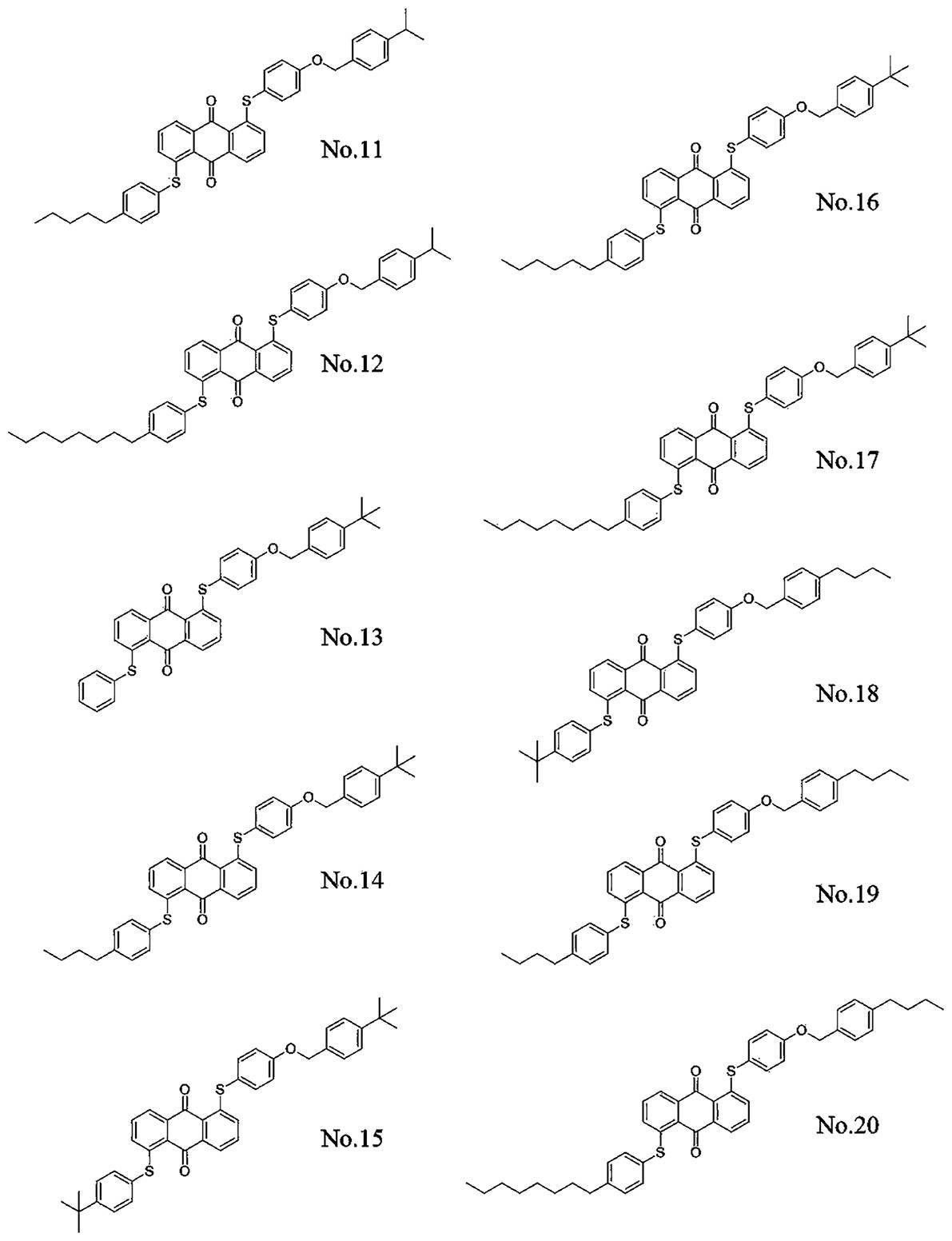
- Example 3 (Synthesis of the Anthraquinone Compound of the Present Invention Represented by Formula (1)) (Step 3-1) Specific example No. Synthesis of compound represented by 15 4-octylbenzenethiol 5.7 parts in step 1-2 was changed to 4-t-butylbenzenethiol 4.3 parts, and benzyl bromide 2.2 parts in step 1-3 was changed to In the same manner as in Example 1, except that 2.4 parts of 4-t-butylbenzyl chloride was used, No. 1 of the above specific example was prepared. 3.5 parts of the compound represented by 15 were obtained as an orange solid. The maximum absorption wavelength of this compound in methanol was 450 nm.
- Example 4 Synthesis of the Anthraquinone Compound of the Present Invention Represented by Formula (1) (Step 4-1) Specific example No. Synthesis of Compound Represented by No. 17
- Step 4-1 Specific example No. Synthesis of Compound Represented by No. 17
- 2.2 parts of benzyl bromide in step 1-3 was changed to 2.4 parts of 4-t-butylbenzyl chloride
- No. 1 of the above specific example was prepared. 3.0 parts of the compound represented by 17 were obtained as an orange solid.
- the maximum absorption wavelength of this compound in methanol was 449 nm.
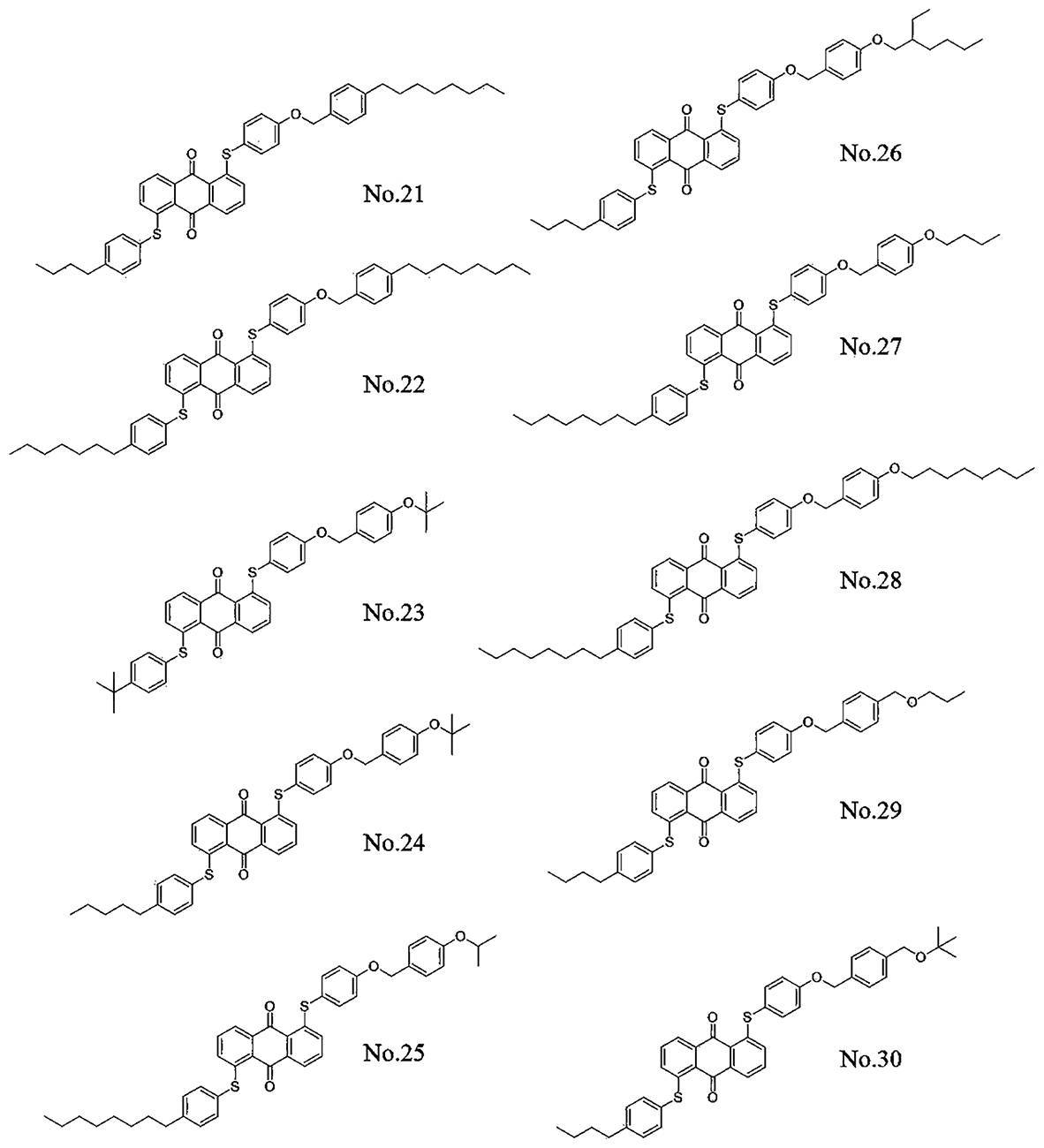
- Example 5 (Synthesis of the Anthraquinone Compound of the Present Invention Represented by Formula (1)) (Step 5-1) Specific example No. Synthesis of compound represented by 48 5.7 parts of 4-octylbenzenethiol in step 1-2 was changed to 5.9 parts of 4-octyloxybenzenethiol, and 2.2 parts of benzyl bromide in step 1-3 was converted to 4 No. 1 of the above specific example was repeated in the same manner as in Example 1, except that 2.4 parts of t-butylbenzyl chloride was used. 3.9 parts of the compound represented by 48 were obtained as an orange solid. The maximum absorption wavelength of this compound in methanol was 452 nm.
- Synthesis Example 1 (Synthesis of Comparative Compound) No. 2 in Table 2 of JP-A-63-72760 was prepared by a known synthesis method. A compound represented by 2 (a compound represented by the following formula (X)) was obtained.
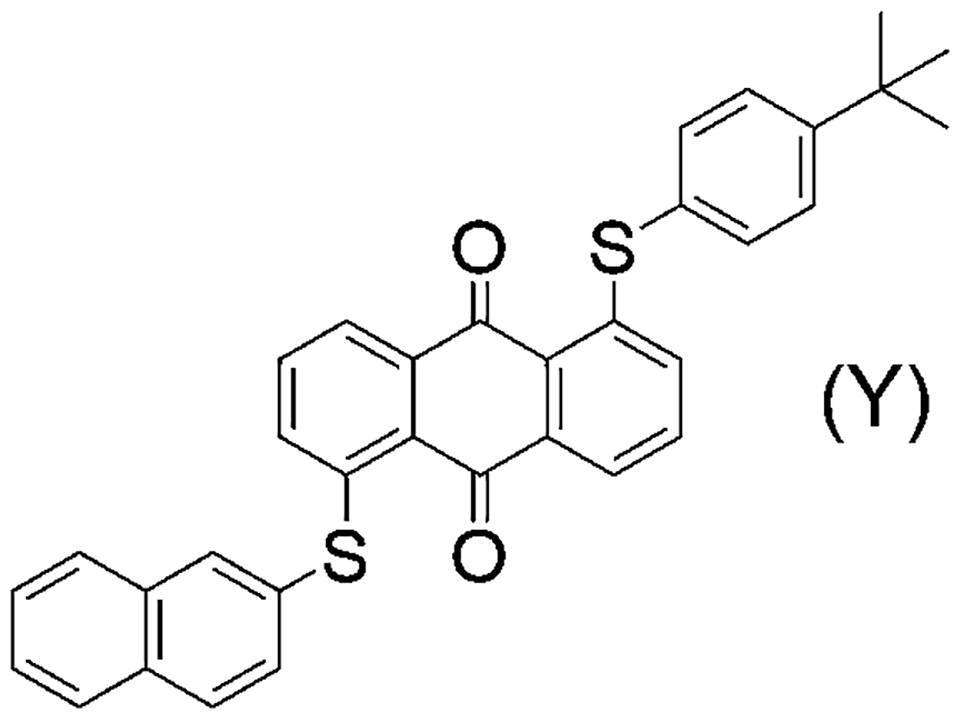
- Synthesis Example 2 (Synthesis of Comparative Compound) No. 1 in Table 2 of JP-A-62-101657 was prepared by a known synthesis method. A compound represented by 1 (a compound represented by the following formula (Y)) was obtained.
- Example 6 (Preparation of liquid crystal composition of the present invention) No. 1 of the specific example obtained in Example 1. 0.003 parts of the compound represented by 7, 0.306 parts of 1-cyano-4'-n-pentylbiphenyl, 0.15 parts of 1-cyano-4'-n-heptylbiphenyl, 1-cyano-4'- 0.096 parts of n-octyloxybiphenyl and 0.048 parts of 1-cyano-4′′-n-pentylterphenyl were mixed at room temperature to prepare the liquid crystal composition of the present invention.
- Examples 7 to 10 and Comparative Examples 1 to 3 Preparation of liquid crystal composition for the present invention and comparison
- the compound represented by No. 7 of the specific example obtained in Example 2 was used.
- a liquid crystal composition of the present invention and a liquid crystal composition for comparison were obtained according to Example 6, except that the compound represented by Z) was changed.
- Example 11 (Fabrication of light modulating device of the present invention)
- the liquid crystal composition obtained in Example 6 has a transparent electrode, and the surface in contact with the liquid crystal is rubbed with a polyamide resin to give a homogenous alignment treatment. enclosed in.
- the liquid crystal was in a homogeneous alignment state when no voltage was applied, and the dye molecules (the anthraquinone compound obtained in Example 1) were in a similar alignment state according to the liquid crystal.
- Examples 12 to 15 and Comparative Examples 4 to 6 Preparation of light modulating elements for the present invention and comparison
- Example 11 except that the liquid crystal composition obtained in Example 6 was changed to each of Examples 7 to 10 and Comparative Examples 1 to 3, the present invention and comparative light modulating elements were produced.
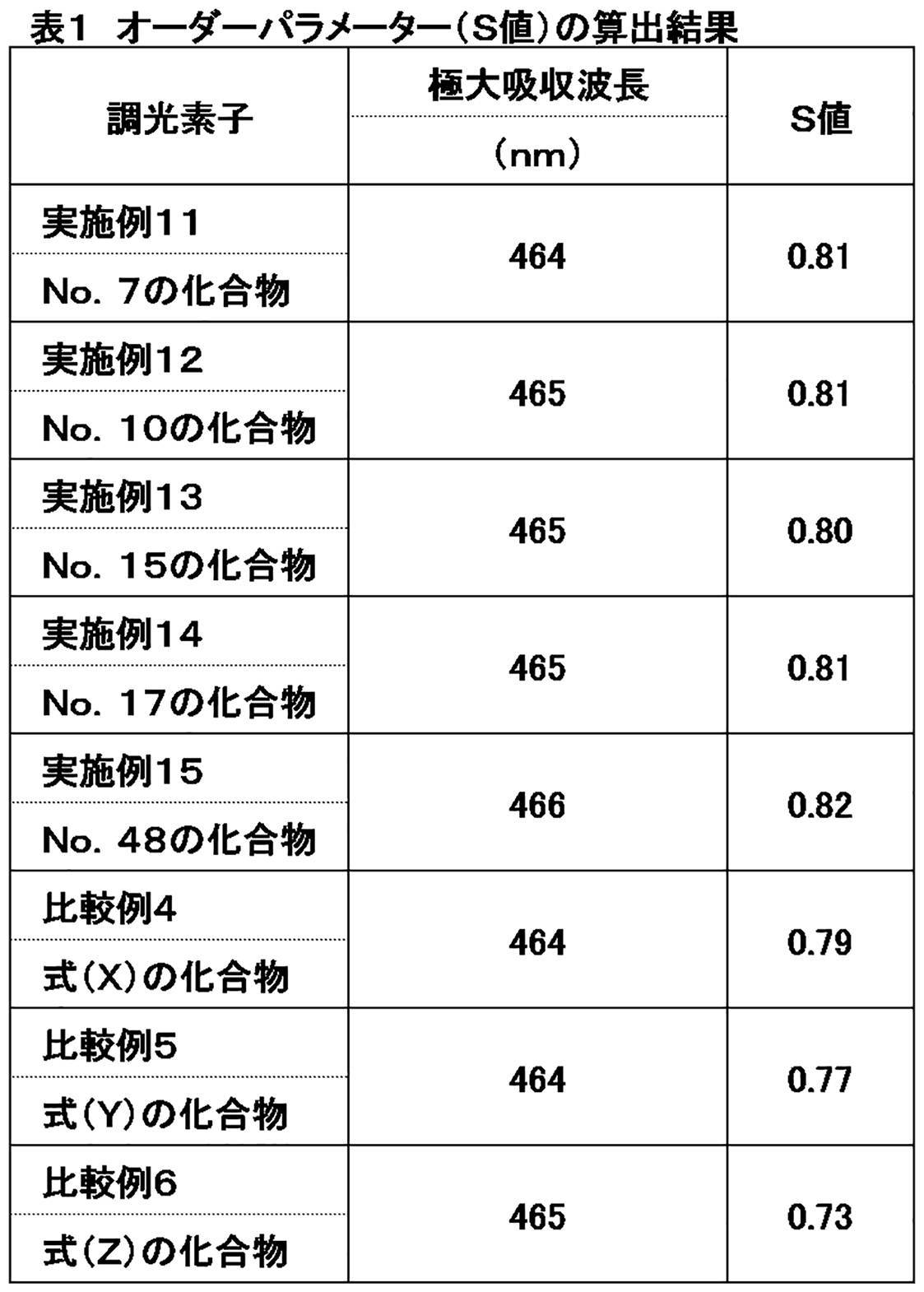
- the light modulating elements of Examples 11 to 15 have higher order parameters than the light modulating elements of Comparative Examples 4 to 6, and are clearly superior as light modulating elements.
- Example 16 (Preparation of liquid crystal composition of the present invention) No. of the specific example obtained in Example 2.
- Examples 17, 18 and Comparative Example 7 Preparation of liquid crystal composition for the present invention and comparison No. of the specific example obtained in Example 2.
- the compound represented by No. 10 of the specific example obtained in Example 3 was used. 15, the specific example No. 1 obtained in Example 4;
- the liquid crystal composition of the present invention and the liquid crystal composition for comparison were prepared according to Example 16 except that the compound represented by Formula 17 and the compound represented by Formula (X) obtained in Synthesis Example 1 were changed. Got each.
- Examples 19 to 21 and Comparative Example 8 (Preparation of light modulating element for the present invention and comparison)
- the liquid crystal compositions obtained in Examples 16 to 18 and Comparative Example 7 were each applied onto the ITO film of the 5 cm square PET film provided with the ITO film using an applicator to form a liquid crystal composition layer. Then, this film and a 5 cm square PET film provided with the same ITO film as described above were superimposed so that the liquid crystal composition layer on the ITO film faced the ITO film. After that, the sample of the laminate of the two films and the liquid crystal composition layer obtained in this way was maintained at 23 ° C. with a thermoplate, and the light intensity of the LED lamp at 365 nm was 9 mW / cm 2 .
- the light-modulating element of the present invention and a light-modulating element for comparison were obtained by setting and light-irradiating for 1 minute to photo-cure the photo-curable compound.
- Example 22 (Preparation of black light control element) In the same manner as in Example 16, except that 0.012 parts of LCD121 (anthraquinone compound, manufactured by Nippon Kayaku Co., Ltd.) and 0.009 parts of LCD212 (anthraquinone compound, manufactured by Nippon Kayaku Co., Ltd.) were added. Using the prepared liquid crystal composition of the present invention, a black light-modulating device was produced in the same manner as in Examples 19-21. The obtained black light-modulating device had an average transmittance difference of 32% in the range from 400 to 700 nm, showing high contrast.
- the black light-modulating element obtained in Example 22 had no change in transmittance even after 500 hours in the xenon light resistance test, and had excellent light resistance during long-term exposure to light. Further, even when a 100 V AC (50 Hz sine wave) voltage was applied under the condition of 110° C., there was no change in the transmittance, and the resistance to electric heat was excellent. These results show that the black light control element of Example 22 is a black liquid crystal light control element having high contrast, excellent light resistance, and excellent electrical heat resistance.
- liquid crystal composition containing the anthraquinone compound of the present invention By using the liquid crystal composition containing the anthraquinone compound of the present invention, it is possible to obtain a light modulating element excellent in contrast, light resistance and electrical heat resistance.
- a light modulating element having these excellent properties is suitable for vehicle use or building material use.
Landscapes
- Chemical & Material Sciences (AREA)
- Organic Chemistry (AREA)
- Crystallography & Structural Chemistry (AREA)
- Physics & Mathematics (AREA)
- Engineering & Computer Science (AREA)
- Materials Engineering (AREA)
- Nonlinear Science (AREA)
- General Physics & Mathematics (AREA)
- Optics & Photonics (AREA)
- Organic Low-Molecular-Weight Compounds And Preparation Thereof (AREA)
- Liquid Crystal (AREA)
- Liquid Crystal Substances (AREA)
Abstract
Description
本発明の他の目的は、この新規なアントラキノン化合物である二色性色素、該アントラキノン化合物を含有する液晶組成物、ならびに、該組成物を含有するコントラスト、耐光性及び通電耐熱性に優れた調光素子を提供することである。
また、本発明者らは、そのような特定構造の新規なアントラキノン化合物である二色性色素を含有する液晶組成物を用いることにより、コントラスト、耐光性及び通電耐熱性に優れた調光素子を得ることができることを見出した。
すなわち、本発明に包含される諸態様は、以下のとおりである。
[1].下記式(1)

(式中、R1は水素原子、炭素数1乃至12の直鎖若しくは分岐鎖のアルキル基、又は炭素数1乃至12の直鎖若しくは分岐鎖のアルコキシ基を表す。R2は下記式(a)
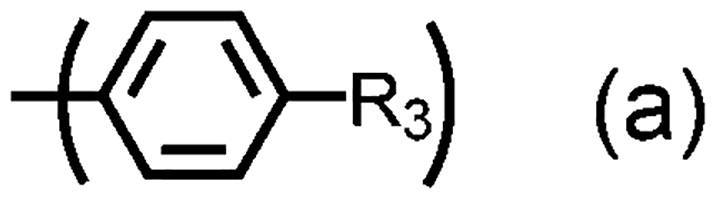
(式(a)中、R3は水素原子、炭素数1乃至8の直鎖若しくは分岐鎖のアルキル基、炭素数1乃至8の直鎖若しくは分岐鎖のアルコキシ基、又は-CH2ОR4で表される置換基を表し、R4は炭素数1乃至8の直鎖又は分岐鎖のアルキル基を表す。)
又は下記式(b)
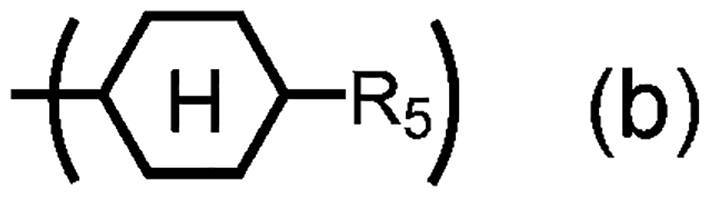
(式(b)中、R5は水素原子、炭素数1乃至8の直鎖若しくは分岐鎖のアルキル基、又は-CH2ОR6で表される置換基を表し、R6は炭素数1乃至8の直鎖又は分岐鎖のアルキル基を表す。)
で表される置換基を表す。)
で表されるアントラキノン化合物。
[2].式(1)におけるR2が、式(a)で表される置換基であり、式(a)におけるR3が水素原子、炭素数1乃至8の直鎖若しくは分岐鎖のアルキル基、又は炭素数1乃至8の直鎖若しくは分岐鎖のアルコキシ基である、前項[1]に記載のアントラキノン化合物。
[3].式(a)におけるR3が、水素原子、又は炭素数1乃至8の直鎖若しくは分岐鎖のアルキル基である、前項[2]に記載のアントラキノン化合物。
[4].式(1)におけるR2が式(b)で表される置換基であり、式(b)におけるR5が水素原子、又は炭素数1乃至8の直鎖若しくは分岐鎖のアルキル基である、前項[1]に記載のアントラキノン化合物。
[5].式(1)におけるR1が炭素数1乃至8の直鎖又は分岐鎖アルコキシ基である、前項[1]乃至[4]のいずれか一項に記載のアントラキノン化合物。
[6].式(1)におけるR1が炭素数4乃至8の直鎖のアルコキシ基である、前項[5]に記載のアントラキノン化合物。
[7].式(1)におけるR1が、水素原子、又は炭素数1乃至8の直鎖若しくは分岐鎖のアルキル基である、前項[1]乃至[4]のいずれか一項に記載のアントラキノン化合物。
[8].式(1)におけるR1が炭素数4乃至8の直鎖のアルキル基である、前項[7]に記載のアントラキノン化合物。
[9].前項[1]乃至[8]のいずれかに記載のアントラキノン化合物、及び液晶材料を含有する液晶組成物。
[10].光硬化性化合物及び光重合開始剤を更に含有する、前項[9]に記載の液晶組成物。
[11].更に、前項[1]に記載のアントラキノン化合物以外の色素化合物を少なくとも1つ以上含む、前項[9]又は[10]に記載の液晶組成物。
[12].前項[10]又は[11]に記載の液晶組成物の光硬化物。
[13].少なくとも一方が透明電極を有する透明基板である対向配置された一対の基板間に、前項[9]乃至[11]のいずれか一項に記載の液晶組成物、又は前項[12]に記載の光硬化物を挟持してなる調光素子。
[14].一対の基板の両方が透明電極を有する透明基板である、前項[13]に記載の調光素子。
また、本発明のアントラキノン化合物を含有する液晶組成物を用いることにより、コントラスト、耐光性及び通電耐熱性に優れた調光素子を得ることができる。
本発明のアントラキノン化合物は、下記式(1)で表される。

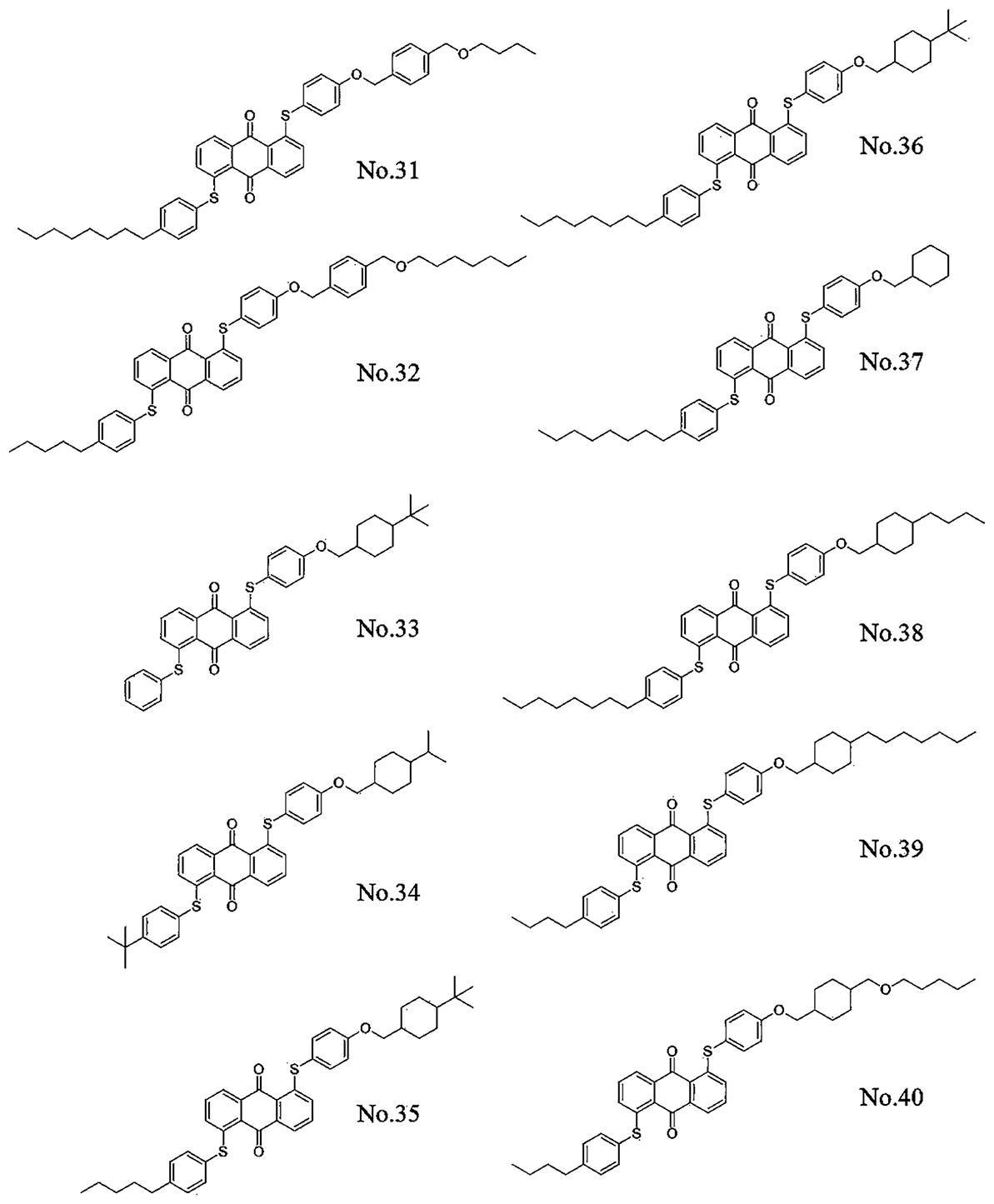
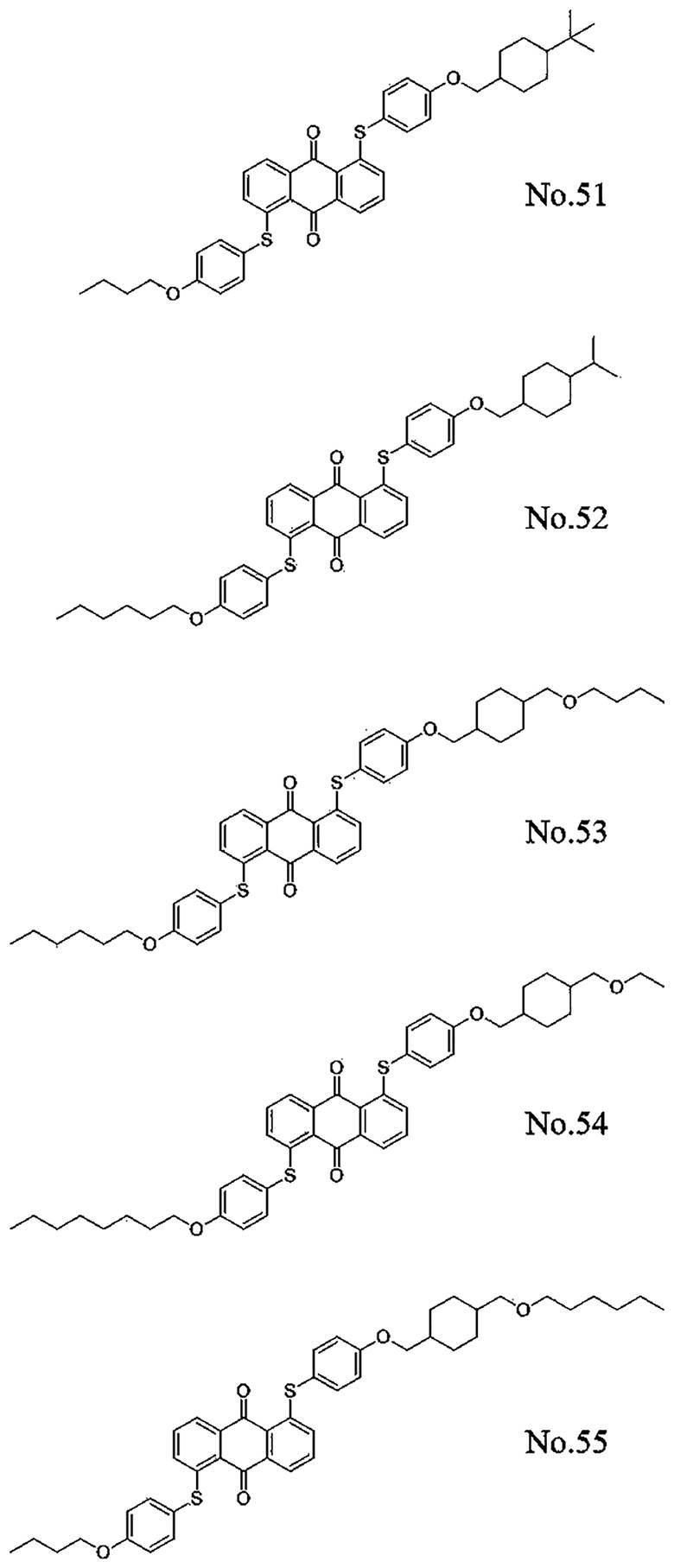
式(1)のR1が表す炭素数1乃至12のアルキル基は、直鎖状又は分岐鎖状のいずれでもよい。その具体例としては、メチル基、エチル基、n-プロピル基、iso-プロピル基、n-ブチル基、iso-ブチル基、sec-ブチル基、t-ブチル基、n-ペンチル基、iso-ペンチル基、neo-ペンチル基、t-ペンチル基、ヘキシル基、ヘプチル基、オクチル基、ノニル基、デシル基、ウンデシル基、ドデシル基、2-エチルヘキシル基、2-プロピルヘキシル基、2-ブチルヘキシル基、2-ペンチルヘキシル基及び2-ペンチルへプチル基等が挙げられる。炭素数1乃至8の直鎖状又は分岐鎖状のアルキル基が好ましく、炭素数4乃至8の直鎖状又は分岐鎖状のアルキル基よりが好ましく、炭素数4乃至8の直鎖状のアルキル基が更に好ましい。



本発明におけるオーダーパラメーター(S値)は、式(1)で表されるアントラキノン化合物(二色性色素)の二色比の分光学的な測定に基づき、「液晶デバイスハンドブック」(日本学術振興会第142委員会編、日刊工業新聞社、1989年)に記載の次式から求めることができる。
S=(A//―A⊥)/(2A⊥+A//)
式中、「A//」及び「A⊥」は、それぞれ液晶の配向方向に対して平行及び垂直に偏光した光に対する色素の吸光度を示す。算出したS値は、0乃至1の範囲の値をとり、理論上はその値が1に近づく程、GH(ゲストホスト)型調光素子とした際のコントラストが向上する。
光重合開始剤としては、例えば、ダロキュア1173、イルガキュア651、イルガキュア184等のアルキルフェノン系光重合開始剤や、イルガキュアTPO等のホスフィンオキシド系光重合開始剤が好ましく用いられる。
尚、式(1)で表される化合物以外の二色性色素(後述)を併用する場合、本発明の組成物における式(1)で表されるアントラキノン化合物を含む全ての二色性色素および液晶材料の合計と光硬化性化合物との配合割合は、上記の範囲(質量比で90:10乃至50:50)が好ましい。より好ましい範囲及び更に好ましい範囲も上記と同じである。
併用し得る二色性色素は、特に限定されないが、例えば、アゾ色素、アントラキノン色素、ペリレン色素、キノフタロン色素、メロシアニン色素、アゾメチン色素、フタロペリレン色素、インジゴ色素、アズレン色素、ジオキサジン色素、ポリチオフェン色素等より選択すればよい。具体的には、「Dichroic dyes for Liquid Crystal Display」(A.V.Ivashchenko著、CRC社、1994年)に記載されているもの等が挙げられる。
これらの中でも、アゾ色素、アントラキノン色素、ペリレン色素又はキノフタロン色素を併用することが好ましく、アゾ色素、アントラキノン色素を併用することがより好ましい。
また、調光素子としてのセルギャップを制御するために、シリカやガラス、プラスチック、セラミック等の球状あるいは円筒状のスペーサーを加えてもよい。この際のセルギャップは2乃至100μmの範囲に設定できる。
光を照射する際の光源としては、光重合開始剤の吸収する波長の光を照射可能な光源であれば特に限定されない。好ましい光源としては、紫外線を照射可能な高圧水銀灯、メタルハライドランプ、キセノンランプ及びハロゲンランプ等が挙げられる。
(工程1-1)下記式(2)で表される中間体化合物の合成
DMF120部に1,5-ジクロロアントラキノン10.0部及び炭酸カリウム7.3部、4-ヒドロキシベンゼンチオール6.0部を加え、60℃で4時間撹拌した。反応液を25℃まで冷却した後、メタノール240部を加え、1時間撹拌した。反応生成物をろ取し、80℃の熱風乾燥機で24時間乾燥して下記式(2)で表される中間体化合物6.3部を得た。

DMF70部に工程(1-1)で得られた式(2)で表される中間体化合物6.3部、炭酸カリウム3.6部及び4-オクチルベンゼンチオール5.7部を加え、60℃で2時間撹拌した。反応液を25℃まで冷却した後、メタノール140部を加えて1時間撹拌した。反応生成物をろ取してトルエンで洗浄した後、80℃の熱風乾燥機で24時間乾燥して下記式(3)で表される中間体化合物5.1部を得た。

DMF50部に工程(1-2)で得られた式(3)で表される中間体化合物5.1部、炭酸カリウム1.5部及びベンジルブロミド2.2部を加え、100℃で2時間撹拌した後、反応液を25℃まで冷却してメタノール200部を加え、1時間撹拌した。反応生成物をろ取してメタノールで洗浄した後、80℃の熱風乾燥機で24時間乾燥した。得られた粗体をトルエンに溶解し、展開溶媒にトルエンを用いてカラム精製を行った。精製後の溶液から溶媒を減圧留去し、80℃の熱風乾燥機で24時間乾燥することにより上記具体例のNo.7で表される化合物4.0部を橙色固体として得た。この化合物のメタノール中の極大吸収波長は449nmであった。
工程(2-1)具体例のNo.10で表される化合物の合成
工程1-2における4-オクチルベンゼンチオール5.7部を4-n―ブチルベンゼンチオール4.3部に変更し、工程1-3におけるベンジルブロミド2.2部を4-i-プロピルベンジルクロリド2.4部に変更した以外は実施例1と同様にして、上記具体例のNo.10で表される化合物3.3部を橙色固体として得た。この化合物のメタノール中の極大吸収波長は450nmであった。
(工程3-1)具体例のNo.15で表される化合物の合成
工程1-2における4-オクチルベンゼンチオール5.7部を4-t-ブチルベンゼンチオール4.3部に変更し、工程1-3におけるベンジルブロミド2.2部を4-t-ブチルベンジルクロリド2.4部に変更した以外は実施例1と同様にして、上記具体例のNo.15で表される化合物3.5部を橙色固体として得た。この化合物のメタノール中の極大吸収波長は450nmであった。
(工程4-1)具体例のNo.17で表される化合物の合成
工程1-3におけるベンジルブロミド2.2部を4-t-ブチルベンジルクロリド2.4部に変更した以外は実施例1と同様にして、上記具体例のNo.17で表される化合物3.0部を橙色固体として得た。この化合物のメタノール中の極大吸収波長は449nmであった。
(工程5-1)具体例のNo.48で表される化合物の合成
工程1-2における4-オクチルベンゼンチオール5.7部を4-オクチルオキシベンゼンチオール5.9部に変更し、工程1-3におけるベンジルブロミド2.2部を4-t-ブチルベンジルクロリド2.4部に変更した以外は実施例1と同様にして、上記具体例のNo.48で表される化合物3.9部を橙色固体として得た。この化合物のメタノール中の極大吸収波長は452nmであった。
公知の合成方法により、特開昭63-72760号公報の表2のNo.2で表される化合物(下記式(X)で表される化合物)を得た。

公知の合成方法により、特開昭62-101657号公報の表2の1のNo.1で表される化合物(下記式(Y)で表される化合物)を得た。
公知の合成方法により、EP59036A1号公報の例11で表される化合物(下記式(Z)で表される化合物)を得た。

実施例1で得られた具体例のNo.7で表される化合物0.003部、1-シアノ-4’-n-ペンチルビフェニル0.306部、1-シアノ-4’-n-ヘプチルビフェニル0.15部、1-シアノ-4’-n-オクチルオキシビフェニル0.096部、及び1-シアノ-4’’-n-ペンチルターフェニル0.048部を室温で混合し、本発明の液晶組成物を調製した。
実施例1で得られた具体例のNo.7で表される化合物を、実施例2で得られた具体例のNo.10で表される化合物、実施例3で得られた具体例のNo.15で表される化合物、実施例4で得られた具体例のNo.17で表される化合物、実施例5で得られた具体例のNo.48で表される化合物、合成例1で得られた式(X)で表される化合物、合成例2で得られた式(Y)で表される化合物、合成例3で得られた式(Z)で表される化合物にそれぞれ変更した以外は実施例6に準じて、本発明の液晶組成物及び比較用の液晶組成物をそれぞれ得た。
実施例6で得られた液晶組成物を、透明電極を有し、液晶と接する面にポリアミド系樹脂をラビングしてホモジニアス配向処理を施した上下2枚のガラス基板からなる基板間ギャップ15μmの素子に封入した。このように得られた素子内では、液晶は電圧無印加の時にはホモジニアス配向状態であり、色素分子(実施例1で得られたアントラキノン化合物)も液晶に従って同様の配向状態であった。
実施例6で得られた液晶組成物を実施例7乃至10及び比較例1乃至3の各々に変更した以外は実施例11に準じて、本発明及び比較用の調光素子をそれぞれ作製した。
実施例11乃至15及び比較例4乃至6で得られた調光素子について、極大吸収波長及びオーダーパラメーターの測定を行った。作製した調光素子に、配向方向に対して平行な直線偏光、及び配向方向に対して垂直な直線偏光を入射した。その時のそれぞれのスペクトルから、着色したセルの配向方向に平行な直線偏光に対する吸光度(A//)、及び配向方向に垂直な偏光に対する吸光度(A⊥)を測定し、偏光度ρが最大となる極大吸収波長におけるオーダーパラメータ(S値)を下記の式から求めた。結果を表1に示した。
S=(A//―A⊥)/(2A⊥+A//)
実施例2で得られた具体例のNo.10で表される化合物0.01部、イソボルニルアクリレート(大阪有機化学工業製、モノアクリレート)0.380部、トリエチレングリコールジメタクリレート(新中村化学社製)0.020部、1-シアノ-4’-n-ペンチルビフェニル0.306部、1-シアノ-4’-n-ヘプチルビフェニル0.15部、1-シアノ-4’-n-オクチルオキシビフェニル0.096部、1-シアノ-4’’-n-ペンチルターフェニル0.048部、イルガキュアTPO(BASF社製)0.004部、イルガキュア184(BASF社製)0.004部、及び直径20μmのスペーサー剤(積水化学株式会社製「ミクロパール(登録商標)SP220」)0.010部を室温で混合し、50℃で2時間撹拌した。次いで、この混合液を室温まで冷却し、1μmのメンブレンフィルターを通すことにより、本発明の液晶組成物を調製した。
実施例2で得られた具体例のNo.10で表される化合物を、実施例3で得られた具体例のNo.15で表される化合物、実施例4で得られた具体例のNo.17で表される化合物及び合成例1で得られた式(X)で表される化合物にそれぞれ変更した以外は実施例16に準じて、本発明の液晶組成物及び比較用の液晶組成物をそれぞれ得た。
ITO膜が設けられた5cm角のPETフィルムのITO膜上に、アプリケーターを用いて実施例16乃至18及び比較例7で得られた液晶組成物をそれぞれ塗布し、液晶組成物層を形成した。次いで、このフィルムと、前記と同じITO膜が設けられた5cm角のPETフィルムとを、ITO膜上の液晶組成物層とITO膜とが対向する様に重ね合わせた。その後、このように得られた2枚のフィルムと液晶組成物層との積層体のサンプルをサーモプレートで23℃に維持したまま、LEDランプの365nmの光強度が9mW/cm2になる位置にセットし、1分間光照射を行って光硬化性化合物を光硬化させることにより、本発明の調光素子及び比較用の調光素子をそれぞれ得た。
実施例19乃至21及び比較例8で得られた調光素子について、前記した手法により極大吸収波長を測定すると共に、100V交流電圧(50Hz正弦波)印加時と無印加時の極大吸収波長における透過率(%)の測定結果から透過率差(透過率変化)を算出した。
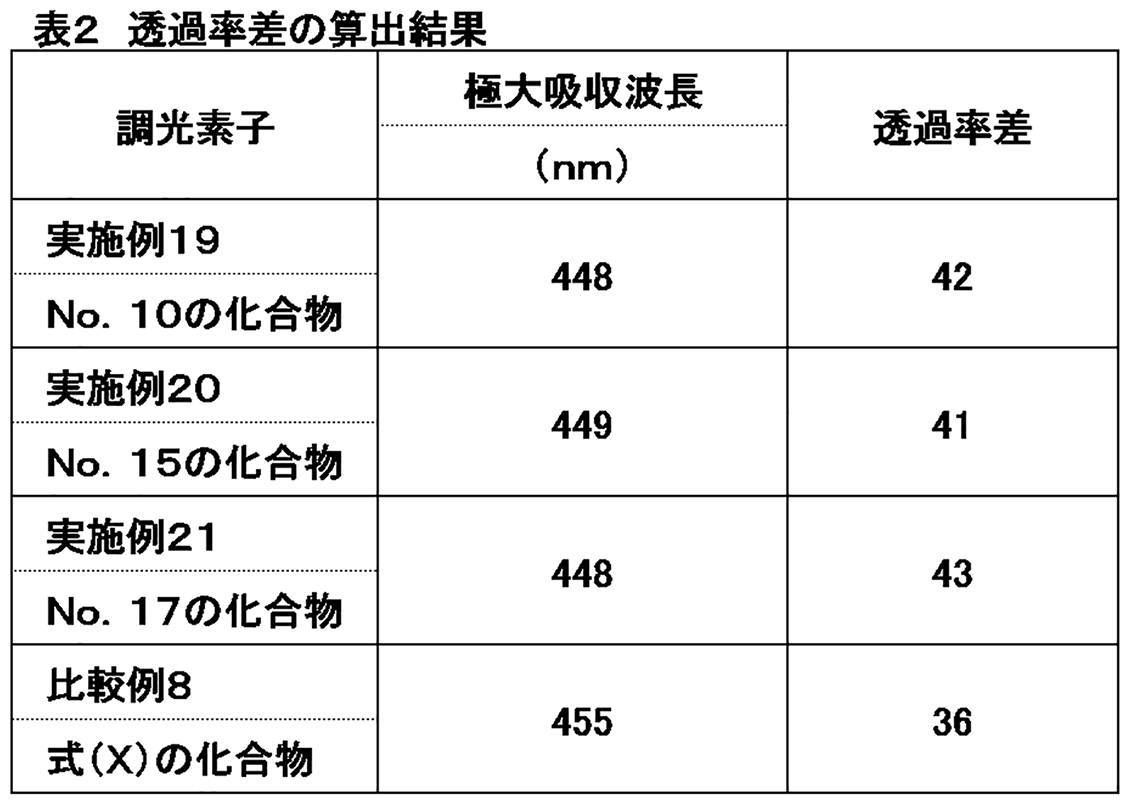
LCD121(アントラキノン系化合物、日本化薬(株)製)0.012部及びLCD212(アントラキノン系化合物、日本化薬(株)製)0.009部を加えた以外は、実施例16と同様にして調製した本発明の液晶組成物を用いて、実施例19乃至21と同様の方法で黒色調光素子を作製した。得られた黒色調光素子の400乃至700nmにおける平均透過率差は32%であり高いコントラストを示した。
Claims (14)
- 下記式(1)

(式中、R1は水素原子、炭素数1乃至12の直鎖若しくは分岐鎖のアルキル基、又は炭素数1乃至12の直鎖若しくは分岐鎖のアルコキシ基を表す。R2は下記式(a)
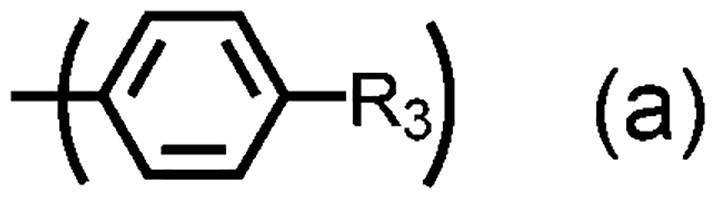
(式(a)中、R3は水素原子、炭素数1乃至8の直鎖若しくは分岐鎖のアルキル基、炭素数1乃至8の直鎖若しくは分岐鎖のアルコキシ基、又は-CH2ОR4で表される置換基を表し、R4は炭素数1乃至8の直鎖又は分岐鎖のアルキル基を表す。)
又は下記式(b)

(式(b)中、R5は水素原子、炭素数1乃至8の直鎖若しくは分岐鎖のアルキル基、又は-CH2ОR6で表される置換基を表し、R6は炭素数1乃至8の直鎖又は分岐鎖のアルキル基を表す。)
で表される置換基を表す。)
で表されるアントラキノン化合物。 - 式(1)におけるR2が、式(a)で表される置換基であり、式(a)におけるR3が水素原子、炭素数1乃至8の直鎖若しくは分岐鎖のアルキル基、又は炭素数1乃至8の直鎖若しくは分岐鎖のアルコキシ基である、請求項1に記載のアントラキノン化合物。
- 式(a)におけるR3が、水素原子、又は炭素数1乃至8の直鎖若しくは分岐鎖のアルキル基である、請求項2に記載のアントラキノン化合物。
- 式(1)におけるR2が式(b)で表される置換基であり、式(b)におけるR5が水素原子、又は炭素数1乃至8の直鎖若しくは分岐鎖のアルキル基である、請求項1に記載のアントラキノン化合物。
- 式(1)におけるR1が炭素数1乃至8の直鎖又は分岐鎖アルコキシ基である、請求項1乃至4のいずれか一項に記載のアントラキノン化合物。
- 式(1)におけるR1が炭素数4乃至8の直鎖のアルコキシ基である、請求項5に記載のアントラキノン化合物。
- 式(1)におけるR1が、水素原子、又は炭素数1乃至8の直鎖若しくは分岐鎖のアルキル基である、請求項1乃至4のいずれか一項に記載のアントラキノン化合物。
- 式(1)におけるR1が炭素数4乃至8の直鎖のアルキル基である、請求項7に記載のアントラキノン化合物。
- 請求項1乃至8のいずれかに記載のアントラキノン化合物、及び液晶材料を含有する液晶組成物。
- 光硬化性化合物及び光重合開始剤を更に含有する、請求項9に記載の液晶組成物。
- 更に、請求項1に記載のアントラキノン化合物以外の色素化合物を少なくとも1つ以上含む、請求項9又は10に記載の液晶組成物。
- 請求項10又は11に記載の液晶組成物の光硬化物。
- 少なくとも一方が透明電極を有する透明基板である対向配置された一対の基板間に、請求項9乃至11のいずれか一項に記載の液晶組成物、又は請求項12に記載の光硬化物を挟持してなる調光素子。
- 一対の基板の両方が透明電極を有する透明基板である、請求項13に記載の調光素子。
Priority Applications (4)
| Application Number | Priority Date | Filing Date | Title |
|---|---|---|---|
| CN202280015603.1A CN116917270A (zh) | 2021-04-14 | 2022-04-11 | 蒽醌化合物、包含该化合物的液晶组合物及调光元件 |
| EP22788137.2A EP4324823A4 (en) | 2021-04-14 | 2022-04-11 | Anthraquinone compound, liquid crystal composition containing said compound, and dimming element |
| JP2023514638A JP7723078B2 (ja) | 2021-04-14 | 2022-04-11 | アントラキノン化合物、該化合物を含む液晶組成物及び調光素子 |
| US18/283,329 US12172951B2 (en) | 2021-04-14 | 2022-04-11 | Anthraquinone compound, liquid crystal composition containing said compound, and dimming element |
Applications Claiming Priority (2)
| Application Number | Priority Date | Filing Date | Title |
|---|---|---|---|
| JP2021068179 | 2021-04-14 | ||
| JP2021-068179 | 2021-04-14 |
Publications (1)
| Publication Number | Publication Date |
|---|---|
| WO2022220212A1 true WO2022220212A1 (ja) | 2022-10-20 |
Family
ID=83640087
Family Applications (1)
| Application Number | Title | Priority Date | Filing Date |
|---|---|---|---|
| PCT/JP2022/017467 Ceased WO2022220212A1 (ja) | 2021-04-14 | 2022-04-11 | アントラキノン化合物、該化合物を含む液晶組成物及び調光素子 |
Country Status (5)
| Country | Link |
|---|---|
| US (1) | US12172951B2 (ja) |
| EP (1) | EP4324823A4 (ja) |
| JP (1) | JP7723078B2 (ja) |
| CN (1) | CN116917270A (ja) |
| WO (1) | WO2022220212A1 (ja) |
Cited By (1)
| Publication number | Priority date | Publication date | Assignee | Title |
|---|---|---|---|---|
| WO2023100848A1 (ja) * | 2021-12-01 | 2023-06-08 | 日本化薬株式会社 | アントラキノン化合物、該化合物を含む液晶組成物及び調光素子 |
Families Citing this family (2)
| Publication number | Priority date | Publication date | Assignee | Title |
|---|---|---|---|---|
| JP7787149B2 (ja) * | 2021-03-11 | 2025-12-16 | 日本化薬株式会社 | アントラキノン化合物、該化合物を含有する液晶組成物、及び調光素子 |
| JP7723078B2 (ja) * | 2021-04-14 | 2025-08-13 | 日本化薬株式会社 | アントラキノン化合物、該化合物を含む液晶組成物及び調光素子 |
Citations (7)
| Publication number | Priority date | Publication date | Assignee | Title |
|---|---|---|---|---|
| JPS6264865A (ja) * | 1985-09-18 | 1987-03-23 | Mitsubishi Chem Ind Ltd | アントラキノン系化合物及び該化合物を含有する液晶組成物 |
| WO1987002688A1 (fr) | 1985-10-29 | 1987-05-07 | Mitsubishi Chemical Industries Limited | Composes a base d'anthraquinone et composition a base de cristaux liquides les contenant |
| JPS62101657A (ja) | 1985-10-29 | 1987-05-12 | Mitsubishi Chem Ind Ltd | アントラキノン系化合物及び液晶組成物 |
| JPS6372759A (ja) * | 1986-09-16 | 1988-04-02 | Mitsubishi Kasei Corp | アントラキノン系化合物及びこれを含有する液晶組成物 |
| JPS6372760A (ja) | 1986-09-16 | 1988-04-02 | Mitsubishi Kasei Corp | アントラキノン系化合物及びこれを含有する液晶組成物 |
| JPS63278969A (ja) * | 1987-05-11 | 1988-11-16 | Mitsubishi Kasei Corp | アントラキノン系化合物及びこれを含有する液晶組成物 |
| JP2011190314A (ja) * | 2010-03-12 | 2011-09-29 | Mitsubishi Chemicals Corp | 調光用液晶組成物、並びに、その光硬化物及び調光素子 |
Family Cites Families (14)
| Publication number | Priority date | Publication date | Assignee | Title |
|---|---|---|---|---|
| EP0044666B1 (en) * | 1980-07-16 | 1985-05-29 | Minnesota Mining And Manufacturing Company | Helichromic compounds and displays |
| EP0142617B1 (en) | 1981-02-25 | 1987-07-22 | Imperial Chemical Industries Plc | Pleochroic anthraquinone dyes |
| JPS6187756A (ja) * | 1984-10-05 | 1986-05-06 | Mitsui Toatsu Chem Inc | アントラキノン系二色性染料及びこれを用いてなる液晶組成物 |
| ATE122156T1 (de) | 1985-09-17 | 1995-05-15 | Univ Kent State Ohio | Flüssigkristalline, licht-modulierende materialien. |
| ES8802407A1 (es) | 1985-09-17 | 1988-05-16 | Univ Kent State Ohio | Dispositivo fotomodulador electricamente sensible. |
| JPH0347392A (ja) | 1989-07-12 | 1991-02-28 | Natl House Ind Co Ltd | 液晶パネル |
| US7736533B2 (en) * | 2007-10-10 | 2010-06-15 | Fujifilm Corporation | Liquid crystal composition, liquid crystal device, reflective display material and light modulating material |
| JP2010202799A (ja) | 2009-03-04 | 2010-09-16 | Fujifilm Corp | 液晶組成物及び反射型表示素子 |
| JP5387952B2 (ja) * | 2009-03-16 | 2014-01-15 | 株式会社リコー | デンドロン型アントラキノン化合物、液晶組成物、及び液晶素子 |
| JP6213653B2 (ja) | 2015-11-13 | 2017-10-18 | 大日本印刷株式会社 | 調光フィルム及び合わせガラス |
| DE112021002330T5 (de) * | 2020-06-25 | 2023-02-23 | Nippon Kayaku Kabushiki Kaisha | Anthrachinonverbindung, flüssigkristallzusammensetzung zum dimmen, die diese verbindung beinhaltet, und dimmelement |
| US12378474B2 (en) * | 2021-01-21 | 2025-08-05 | Nippon Kayaku Kabushiki Kaisha | Liquid-crystal composition containing anthraquinone compound and light-modulating element |
| JP7787149B2 (ja) * | 2021-03-11 | 2025-12-16 | 日本化薬株式会社 | アントラキノン化合物、該化合物を含有する液晶組成物、及び調光素子 |
| JP7723078B2 (ja) * | 2021-04-14 | 2025-08-13 | 日本化薬株式会社 | アントラキノン化合物、該化合物を含む液晶組成物及び調光素子 |
-
2022
- 2022-04-11 JP JP2023514638A patent/JP7723078B2/ja active Active
- 2022-04-11 WO PCT/JP2022/017467 patent/WO2022220212A1/ja not_active Ceased
- 2022-04-11 CN CN202280015603.1A patent/CN116917270A/zh active Pending
- 2022-04-11 US US18/283,329 patent/US12172951B2/en active Active
- 2022-04-11 EP EP22788137.2A patent/EP4324823A4/en active Pending
Patent Citations (7)
| Publication number | Priority date | Publication date | Assignee | Title |
|---|---|---|---|---|
| JPS6264865A (ja) * | 1985-09-18 | 1987-03-23 | Mitsubishi Chem Ind Ltd | アントラキノン系化合物及び該化合物を含有する液晶組成物 |
| WO1987002688A1 (fr) | 1985-10-29 | 1987-05-07 | Mitsubishi Chemical Industries Limited | Composes a base d'anthraquinone et composition a base de cristaux liquides les contenant |
| JPS62101657A (ja) | 1985-10-29 | 1987-05-12 | Mitsubishi Chem Ind Ltd | アントラキノン系化合物及び液晶組成物 |
| JPS6372759A (ja) * | 1986-09-16 | 1988-04-02 | Mitsubishi Kasei Corp | アントラキノン系化合物及びこれを含有する液晶組成物 |
| JPS6372760A (ja) | 1986-09-16 | 1988-04-02 | Mitsubishi Kasei Corp | アントラキノン系化合物及びこれを含有する液晶組成物 |
| JPS63278969A (ja) * | 1987-05-11 | 1988-11-16 | Mitsubishi Kasei Corp | アントラキノン系化合物及びこれを含有する液晶組成物 |
| JP2011190314A (ja) * | 2010-03-12 | 2011-09-29 | Mitsubishi Chemicals Corp | 調光用液晶組成物、並びに、その光硬化物及び調光素子 |
Non-Patent Citations (2)
| Title |
|---|
| "Committee of Japan Society for the Promotion of Science", 1989, NIKKAN KOGYO SHIMBUN, LTD., article "Liquid Crystal Device Handbook" |
| See also references of EP4324823A4 |
Cited By (1)
| Publication number | Priority date | Publication date | Assignee | Title |
|---|---|---|---|---|
| WO2023100848A1 (ja) * | 2021-12-01 | 2023-06-08 | 日本化薬株式会社 | アントラキノン化合物、該化合物を含む液晶組成物及び調光素子 |
Also Published As
| Publication number | Publication date |
|---|---|
| EP4324823A1 (en) | 2024-02-21 |
| US12172951B2 (en) | 2024-12-24 |
| EP4324823A4 (en) | 2025-01-22 |
| JP7723078B2 (ja) | 2025-08-13 |
| CN116917270A (zh) | 2023-10-20 |
| TW202302768A (zh) | 2023-01-16 |
| US20240140907A1 (en) | 2024-05-02 |
| JPWO2022220212A1 (ja) | 2022-10-20 |
Similar Documents
| Publication | Publication Date | Title |
|---|---|---|
| CN118176265B (zh) | 蒽醌化合物、含该化合物的液晶组合物及调光元件 | |
| JP7796050B2 (ja) | アントラキノン化合物を含有する調光用液晶組成物、その光硬化物及び調光素子 | |
| JP7654655B2 (ja) | アントラキノン化合物、該化合物を含む調光用液晶組成物及び調光素子 | |
| JP7723078B2 (ja) | アントラキノン化合物、該化合物を含む液晶組成物及び調光素子 | |
| WO2023100848A1 (ja) | アントラキノン化合物、該化合物を含む液晶組成物及び調光素子 | |
| WO2023063408A1 (ja) | アントラキノン化合物、該化合物を含む液晶組成物及び調光素子 | |
| JP7796048B2 (ja) | アントラキノン化合物を含有する調光用液晶組成物、その光硬化物及び調光素子 | |
| EP4306616B1 (en) | Anthraquinone compound, liquid crystal composition containing said compound, and dimming element | |
| TWI916548B (zh) | 蒽醌化合物、包含該化合物的液晶組成物及調光元件 | |
| JP2025138606A (ja) | アントラキノン化合物を含有する液晶組成物及び調光素子 | |
| JP2025149927A (ja) | アントラキノン化合物を含有する液晶組成物及び調光素子 |
Legal Events
| Date | Code | Title | Description |
|---|---|---|---|
| 121 | Ep: the epo has been informed by wipo that ep was designated in this application |
Ref document number: 22788137 Country of ref document: EP Kind code of ref document: A1 |
|
| ENP | Entry into the national phase |
Ref document number: 2023514638 Country of ref document: JP Kind code of ref document: A |
|
| WWE | Wipo information: entry into national phase |
Ref document number: 202280015603.1 Country of ref document: CN |
|
| WWE | Wipo information: entry into national phase |
Ref document number: 18283329 Country of ref document: US |
|
| WWE | Wipo information: entry into national phase |
Ref document number: 2022788137 Country of ref document: EP |
|
| NENP | Non-entry into the national phase |
Ref country code: DE |
|
| ENP | Entry into the national phase |
Ref document number: 2022788137 Country of ref document: EP Effective date: 20231114 |