WO2022230936A1 - 粘着テープ及び粘着剤組成物 - Google Patents
粘着テープ及び粘着剤組成物 Download PDFInfo
- Publication number
- WO2022230936A1 WO2022230936A1 PCT/JP2022/019073 JP2022019073W WO2022230936A1 WO 2022230936 A1 WO2022230936 A1 WO 2022230936A1 JP 2022019073 W JP2022019073 W JP 2022019073W WO 2022230936 A1 WO2022230936 A1 WO 2022230936A1
- Authority
- WO
- WIPO (PCT)
- Prior art keywords
- pressure
- sensitive adhesive
- weight
- adhesive tape
- less
- Prior art date
- Legal status (The legal status is an assumption and is not a legal conclusion. Google has not performed a legal analysis and makes no representation as to the accuracy of the status listed.)
- Ceased
Links
Images

Classifications
-
- C—CHEMISTRY; METALLURGY
- C09—DYES; PAINTS; POLISHES; NATURAL RESINS; ADHESIVES; COMPOSITIONS NOT OTHERWISE PROVIDED FOR; APPLICATIONS OF MATERIALS NOT OTHERWISE PROVIDED FOR
- C09J—ADHESIVES; NON-MECHANICAL ASPECTS OF ADHESIVE PROCESSES IN GENERAL; ADHESIVE PROCESSES NOT PROVIDED FOR ELSEWHERE; USE OF MATERIALS AS ADHESIVES
- C09J7/00—Adhesives in the form of films or foils
- C09J7/30—Adhesives in the form of films or foils characterised by the adhesive composition
- C09J7/38—Pressure-sensitive adhesives [PSA]
- C09J7/381—Pressure-sensitive adhesives [PSA] based on macromolecular compounds obtained by reactions involving only carbon-to-carbon unsaturated bonds
- C09J7/385—Acrylic polymers
-
- C—CHEMISTRY; METALLURGY
- C09—DYES; PAINTS; POLISHES; NATURAL RESINS; ADHESIVES; COMPOSITIONS NOT OTHERWISE PROVIDED FOR; APPLICATIONS OF MATERIALS NOT OTHERWISE PROVIDED FOR
- C09J—ADHESIVES; NON-MECHANICAL ASPECTS OF ADHESIVE PROCESSES IN GENERAL; ADHESIVE PROCESSES NOT PROVIDED FOR ELSEWHERE; USE OF MATERIALS AS ADHESIVES
- C09J7/00—Adhesives in the form of films or foils
- C09J7/30—Adhesives in the form of films or foils characterised by the adhesive composition
-
- C—CHEMISTRY; METALLURGY
- C08—ORGANIC MACROMOLECULAR COMPOUNDS; THEIR PREPARATION OR CHEMICAL WORKING-UP; COMPOSITIONS BASED THEREON
- C08F—MACROMOLECULAR COMPOUNDS OBTAINED BY REACTIONS ONLY INVOLVING CARBON-TO-CARBON UNSATURATED BONDS
- C08F220/00—Copolymers of compounds having one or more unsaturated aliphatic radicals, each having only one carbon-to-carbon double bond, and only one being terminated by only one carboxyl radical or a salt, anhydride ester, amide, imide or nitrile thereof
- C08F220/02—Monocarboxylic acids having less than ten carbon atoms; Derivatives thereof
- C08F220/10—Esters
- C08F220/12—Esters of monohydric alcohols or phenols
- C08F220/16—Esters of monohydric alcohols or phenols of phenols or of alcohols containing two or more carbon atoms
- C08F220/18—Esters of monohydric alcohols or phenols of phenols or of alcohols containing two or more carbon atoms with acrylic or methacrylic acids
- C08F220/1804—C4-(meth)acrylate, e.g. butyl (meth)acrylate, isobutyl (meth)acrylate or tert-butyl (meth)acrylate
-
- C—CHEMISTRY; METALLURGY
- C08—ORGANIC MACROMOLECULAR COMPOUNDS; THEIR PREPARATION OR CHEMICAL WORKING-UP; COMPOSITIONS BASED THEREON
- C08F—MACROMOLECULAR COMPOUNDS OBTAINED BY REACTIONS ONLY INVOLVING CARBON-TO-CARBON UNSATURATED BONDS
- C08F290/00—Macromolecular compounds obtained by polymerising monomers on to polymers modified by introduction of aliphatic unsaturated end or side groups
- C08F290/02—Macromolecular compounds obtained by polymerising monomers on to polymers modified by introduction of aliphatic unsaturated end or side groups on to polymers modified by introduction of unsaturated end groups
- C08F290/04—Polymers provided for in subclasses C08C or C08F
- C08F290/042—Polymers of hydrocarbons as defined in group C08F10/00
-
- C—CHEMISTRY; METALLURGY
- C08—ORGANIC MACROMOLECULAR COMPOUNDS; THEIR PREPARATION OR CHEMICAL WORKING-UP; COMPOSITIONS BASED THEREON
- C08L—COMPOSITIONS OF MACROMOLECULAR COMPOUNDS
- C08L57/00—Compositions of unspecified polymers obtained by reactions only involving carbon-to-carbon unsaturated bonds
- C08L57/02—Copolymers of mineral oil hydrocarbons
-
- C—CHEMISTRY; METALLURGY
- C08—ORGANIC MACROMOLECULAR COMPOUNDS; THEIR PREPARATION OR CHEMICAL WORKING-UP; COMPOSITIONS BASED THEREON
- C08L—COMPOSITIONS OF MACROMOLECULAR COMPOUNDS
- C08L93/00—Compositions of natural resins; Compositions of derivatives thereof
-
- C—CHEMISTRY; METALLURGY
- C09—DYES; PAINTS; POLISHES; NATURAL RESINS; ADHESIVES; COMPOSITIONS NOT OTHERWISE PROVIDED FOR; APPLICATIONS OF MATERIALS NOT OTHERWISE PROVIDED FOR
- C09J—ADHESIVES; NON-MECHANICAL ASPECTS OF ADHESIVE PROCESSES IN GENERAL; ADHESIVE PROCESSES NOT PROVIDED FOR ELSEWHERE; USE OF MATERIALS AS ADHESIVES
- C09J11/00—Features of adhesives not provided for in group C09J9/00, e.g. additives
- C09J11/08—Macromolecular additives
-
- C—CHEMISTRY; METALLURGY
- C09—DYES; PAINTS; POLISHES; NATURAL RESINS; ADHESIVES; COMPOSITIONS NOT OTHERWISE PROVIDED FOR; APPLICATIONS OF MATERIALS NOT OTHERWISE PROVIDED FOR
- C09J—ADHESIVES; NON-MECHANICAL ASPECTS OF ADHESIVE PROCESSES IN GENERAL; ADHESIVE PROCESSES NOT PROVIDED FOR ELSEWHERE; USE OF MATERIALS AS ADHESIVES
- C09J133/00—Adhesives based on homopolymers or copolymers of compounds having one or more unsaturated aliphatic radicals, each having only one carbon-to-carbon double bond, and at least one being terminated by only one carboxyl radical, or of salts, anhydrides, esters, amides, imides, or nitriles thereof; Adhesives based on derivatives of such polymers
- C09J133/02—Homopolymers or copolymers of acids; Metal or ammonium salts thereof
-
- C—CHEMISTRY; METALLURGY
- C09—DYES; PAINTS; POLISHES; NATURAL RESINS; ADHESIVES; COMPOSITIONS NOT OTHERWISE PROVIDED FOR; APPLICATIONS OF MATERIALS NOT OTHERWISE PROVIDED FOR
- C09J—ADHESIVES; NON-MECHANICAL ASPECTS OF ADHESIVE PROCESSES IN GENERAL; ADHESIVE PROCESSES NOT PROVIDED FOR ELSEWHERE; USE OF MATERIALS AS ADHESIVES
- C09J133/00—Adhesives based on homopolymers or copolymers of compounds having one or more unsaturated aliphatic radicals, each having only one carbon-to-carbon double bond, and at least one being terminated by only one carboxyl radical, or of salts, anhydrides, esters, amides, imides, or nitriles thereof; Adhesives based on derivatives of such polymers
- C09J133/04—Homopolymers or copolymers of esters
- C09J133/06—Homopolymers or copolymers of esters of esters containing only carbon, hydrogen and oxygen, the oxygen atom being present only as part of the carboxyl radical
-
- C—CHEMISTRY; METALLURGY
- C09—DYES; PAINTS; POLISHES; NATURAL RESINS; ADHESIVES; COMPOSITIONS NOT OTHERWISE PROVIDED FOR; APPLICATIONS OF MATERIALS NOT OTHERWISE PROVIDED FOR
- C09J—ADHESIVES; NON-MECHANICAL ASPECTS OF ADHESIVE PROCESSES IN GENERAL; ADHESIVE PROCESSES NOT PROVIDED FOR ELSEWHERE; USE OF MATERIALS AS ADHESIVES
- C09J133/00—Adhesives based on homopolymers or copolymers of compounds having one or more unsaturated aliphatic radicals, each having only one carbon-to-carbon double bond, and at least one being terminated by only one carboxyl radical, or of salts, anhydrides, esters, amides, imides, or nitriles thereof; Adhesives based on derivatives of such polymers
- C09J133/04—Homopolymers or copolymers of esters
- C09J133/06—Homopolymers or copolymers of esters of esters containing only carbon, hydrogen and oxygen, the oxygen atom being present only as part of the carboxyl radical
- C09J133/08—Homopolymers or copolymers of acrylic acid esters
-
- C—CHEMISTRY; METALLURGY
- C09—DYES; PAINTS; POLISHES; NATURAL RESINS; ADHESIVES; COMPOSITIONS NOT OTHERWISE PROVIDED FOR; APPLICATIONS OF MATERIALS NOT OTHERWISE PROVIDED FOR
- C09J—ADHESIVES; NON-MECHANICAL ASPECTS OF ADHESIVE PROCESSES IN GENERAL; ADHESIVE PROCESSES NOT PROVIDED FOR ELSEWHERE; USE OF MATERIALS AS ADHESIVES
- C09J151/00—Adhesives based on graft polymers in which the grafted component is obtained by reactions only involving carbon-to-carbon unsaturated bonds; Adhesives based on derivatives of such polymers
- C09J151/06—Adhesives based on graft polymers in which the grafted component is obtained by reactions only involving carbon-to-carbon unsaturated bonds; Adhesives based on derivatives of such polymers grafted on to homopolymers or copolymers of aliphatic hydrocarbons containing only one carbon-to-carbon double bond
-
- C—CHEMISTRY; METALLURGY
- C09—DYES; PAINTS; POLISHES; NATURAL RESINS; ADHESIVES; COMPOSITIONS NOT OTHERWISE PROVIDED FOR; APPLICATIONS OF MATERIALS NOT OTHERWISE PROVIDED FOR
- C09J—ADHESIVES; NON-MECHANICAL ASPECTS OF ADHESIVE PROCESSES IN GENERAL; ADHESIVE PROCESSES NOT PROVIDED FOR ELSEWHERE; USE OF MATERIALS AS ADHESIVES
- C09J155/00—Adhesives based on homopolymers or copolymers, obtained by polymerisation reactions only involving carbon-to-carbon unsaturated bonds, not provided for in groups C09J123/00 - C09J153/00
- C09J155/005—Homopolymers or copolymers obtained by polymerisation of macromolecular compounds terminated by a carbon-to-carbon double bond
-
- C—CHEMISTRY; METALLURGY
- C09—DYES; PAINTS; POLISHES; NATURAL RESINS; ADHESIVES; COMPOSITIONS NOT OTHERWISE PROVIDED FOR; APPLICATIONS OF MATERIALS NOT OTHERWISE PROVIDED FOR
- C09J—ADHESIVES; NON-MECHANICAL ASPECTS OF ADHESIVE PROCESSES IN GENERAL; ADHESIVE PROCESSES NOT PROVIDED FOR ELSEWHERE; USE OF MATERIALS AS ADHESIVES
- C09J2203/00—Applications of adhesives in processes or use of adhesives in the form of films or foils
- C09J2203/326—Applications of adhesives in processes or use of adhesives in the form of films or foils for bonding electronic components such as wafers, chips or semiconductors
-
- C—CHEMISTRY; METALLURGY
- C09—DYES; PAINTS; POLISHES; NATURAL RESINS; ADHESIVES; COMPOSITIONS NOT OTHERWISE PROVIDED FOR; APPLICATIONS OF MATERIALS NOT OTHERWISE PROVIDED FOR
- C09J—ADHESIVES; NON-MECHANICAL ASPECTS OF ADHESIVE PROCESSES IN GENERAL; ADHESIVE PROCESSES NOT PROVIDED FOR ELSEWHERE; USE OF MATERIALS AS ADHESIVES
- C09J2301/00—Additional features of adhesives in the form of films or foils
- C09J2301/30—Additional features of adhesives in the form of films or foils characterized by the chemical, physicochemical or physical properties of the adhesive or the carrier
- C09J2301/312—Additional features of adhesives in the form of films or foils characterized by the chemical, physicochemical or physical properties of the adhesive or the carrier parameters being the characterizing feature
-
- C—CHEMISTRY; METALLURGY
- C09—DYES; PAINTS; POLISHES; NATURAL RESINS; ADHESIVES; COMPOSITIONS NOT OTHERWISE PROVIDED FOR; APPLICATIONS OF MATERIALS NOT OTHERWISE PROVIDED FOR
- C09J—ADHESIVES; NON-MECHANICAL ASPECTS OF ADHESIVE PROCESSES IN GENERAL; ADHESIVE PROCESSES NOT PROVIDED FOR ELSEWHERE; USE OF MATERIALS AS ADHESIVES
- C09J2301/00—Additional features of adhesives in the form of films or foils
- C09J2301/40—Additional features of adhesives in the form of films or foils characterized by the presence of essential components
- C09J2301/408—Additional features of adhesives in the form of films or foils characterized by the presence of essential components additives as essential feature of the adhesive layer
-
- C—CHEMISTRY; METALLURGY
- C09—DYES; PAINTS; POLISHES; NATURAL RESINS; ADHESIVES; COMPOSITIONS NOT OTHERWISE PROVIDED FOR; APPLICATIONS OF MATERIALS NOT OTHERWISE PROVIDED FOR
- C09J—ADHESIVES; NON-MECHANICAL ASPECTS OF ADHESIVE PROCESSES IN GENERAL; ADHESIVE PROCESSES NOT PROVIDED FOR ELSEWHERE; USE OF MATERIALS AS ADHESIVES
- C09J2433/00—Presence of (meth)acrylic polymer
-
- C—CHEMISTRY; METALLURGY
- C09—DYES; PAINTS; POLISHES; NATURAL RESINS; ADHESIVES; COMPOSITIONS NOT OTHERWISE PROVIDED FOR; APPLICATIONS OF MATERIALS NOT OTHERWISE PROVIDED FOR
- C09J—ADHESIVES; NON-MECHANICAL ASPECTS OF ADHESIVE PROCESSES IN GENERAL; ADHESIVE PROCESSES NOT PROVIDED FOR ELSEWHERE; USE OF MATERIALS AS ADHESIVES
- C09J2451/00—Presence of graft polymer
Definitions
- the present invention relates to an adhesive tape and an adhesive composition used for the adhesive tape.
- Adhesive tapes are used for assembly in mobile electronic devices such as mobile phones and personal digital assistants (PDAs) (for example, Patent Documents 1 and 2). Adhesive tapes are also used for bonding optical members (for example, Patent Document 3).
- Adhesive tapes used for fixing such members are required to have both resistance to peeling (adhesive strength) and resistance to lateral displacement (holding power).
- adhesive strength resistance to peeling
- holding power resistance to lateral displacement
- An object of the present invention is to provide a pressure-sensitive adhesive tape having both excellent adhesive strength and holding power, and a pressure-sensitive adhesive composition used for the pressure-sensitive adhesive tape.
- the present invention is a pressure-sensitive adhesive tape having a pressure-sensitive adhesive layer, wherein the pressure-sensitive adhesive layer has a shear storage modulus of 4.0 ⁇ 10 4 at 100° C. measured at a measurement frequency of 1 Hz using a dynamic viscoelasticity measuring device.
- the pressure-sensitive adhesive tape has a tensile strength of 1.0 ⁇ 10 6 Pa or more and a breaking elongation of 800% or more at 25° C. measured at a tensile speed of 300 mm/min using a tensile tester.
- the present invention will be described in detail below.
- the adhesive tape of the present invention is an adhesive tape having an adhesive layer, and the adhesive layer has a shear storage modulus at 100 ° C. measured at a measurement frequency of 1 Hz using a dynamic viscoelasticity measuring device (hereinafter, simply (referred to as shear storage modulus) is 4.0 ⁇ 10 4 Pa or more and 1.0 ⁇ 10 6 Pa or less.
- shear storage modulus When the shear storage elastic modulus of the pressure-sensitive adhesive layer is within the above range, it is possible to obtain a pressure-sensitive adhesive tape with excellent holding power (resistance to lateral shift) and exhibit high holding power even at high temperatures. can.
- the shear storage modulus of the adhesive layer is preferably 6.0 ⁇ 10 4 Pa or more, more preferably 8.0 ⁇ 10 4 Pa or more, and 8.1 ⁇ 10 4 Pa or more.
- the shear storage modulus of the pressure-sensitive adhesive layer is adjusted according to the monomer species, polymerization ratio, molecular weight, gel fraction, presence or absence of a tackifying resin, and the type and content of the tackifying resin constituting the pressure-sensitive adhesive constituting the pressure-sensitive adhesive layer. can do.
- the shear storage modulus of the pressure-sensitive adhesive layer can be measured by the following method. First, a measurement sample consisting of only an adhesive layer is produced. For the obtained measurement sample, using a dynamic viscoelasticity measuring device such as a viscoelasticity spectrometer (for example, DVA-200 manufactured by IT Keisoku Co., Ltd., or equivalent), 5 ° C. in a slow heating shear deformation mode. /min, the measurement frequency is 1 Hz, and the storage modulus at 100°C is measured when the dynamic viscoelasticity spectrum is measured from -50°C to 200°C. When the adhesive tape has a base material, the base material is removed, and the measurement is performed after preparing a sample of only the adhesive layer.
- a dynamic viscoelasticity measuring device such as a viscoelasticity spectrometer (for example, DVA-200 manufactured by IT Keisoku Co., Ltd., or equivalent)
- the measurement frequency is 1 Hz
- the storage modulus at 100°C is measured when the dynamic viscoelasticity spectrum is measured from -50
- the method for removing the substrate is not particularly limited as long as treatment using a solvent, treatment involving a chemical reaction, or treatment at high temperature is avoided in order to avoid denaturation of the pressure-sensitive adhesive layer.
- a method of selecting an appropriate temperature and peeling speed, peeling off the substrate and the adhesive layer and removing the substrate, or a method of removing the substrate include a method of physically grinding the material.
- the pressure-sensitive adhesive layer has a breaking elongation (hereinafter simply referred to as breaking elongation) of 800% or more at 25° C. measured at a tensile speed of 300 mm/min using a tensile tester.
- breaking elongation hereinafter simply referred to as breaking elongation
- the elongation at break of the pressure-sensitive adhesive layer is preferably 900% or more, more preferably 1000% or more.
- the upper limit of the breaking elongation of the pressure-sensitive adhesive layer is not particularly limited, and the higher the elongation, the better.
- the breaking elongation of the pressure-sensitive adhesive layer includes the monomer species and polymerization ratio constituting the pressure-sensitive adhesive constituting the pressure-sensitive adhesive layer, the molecular weight of the pressure-sensitive adhesive, the gel fraction, the presence or absence of the tackifying resin, and the type and content of the tackifying resin. , can be adjusted by the tape thickness.
- the breaking elongation of the pressure-sensitive adhesive layer was measured using a tensile tester (e.g., Shimadzu's tensile Using a testing machine AG-IS, Orientec RTC-1310A, etc.), the distance between jigs was set to 10 mm, and the adhesive layer alone was pulled at 25 ° C.
- the method for removing the substrate is not particularly limited as long as treatment using a solvent, treatment involving a chemical reaction, or treatment at high temperature is avoided in order to avoid denaturation of the pressure-sensitive adhesive layer.
- a method of selecting an appropriate temperature and peeling speed, peeling off the substrate and the adhesive layer and removing the substrate, or a method of removing the substrate include a method of physically grinding the material.
- the pressure-sensitive adhesive layer preferably has a loss tangent (tan ⁇ , hereinafter simply referred to as loss tangent) at 100°C measured at a measurement frequency of 1 Hz using a dynamic viscoelasticity measuring device of 0.01 or more and 0.5 or less. .
- loss tangent loss tangent
- the loss tangent of the pressure-sensitive adhesive layer is more preferably 0.05 or more, still more preferably 0.10 or more, more preferably 0.40 or less, and 0.30 or less. More preferred.
- the loss tangent of the pressure-sensitive adhesive layer can be obtained by performing dynamic viscoelasticity measurement under the same conditions as for the shear storage modulus.
- the pressure-sensitive adhesive layer preferably has a gel fraction of less than 50%.
- the gel fraction of the pressure-sensitive adhesive layer is less than 50%, that is, the cross-linking ratio of the pressure-sensitive adhesive is low, the pressure-sensitive adhesive molecules can be easily stretched, so that the pressure-sensitive adhesive strength can be further increased, and the breakage The elongation can be easily adjusted within the above range.
- the gel fraction of the pressure-sensitive adhesive layer is more preferably 30% or less, even more preferably 15% or less.
- the lower limit of the gel fraction of the pressure-sensitive adhesive layer is not particularly limited, it is, for example, 0%.
- the thickness of the pressure-sensitive adhesive layer is not particularly limited, but is preferably 5 ⁇ m or more, more preferably 10 ⁇ m or more, still more preferably 15 ⁇ m or more, preferably 200 ⁇ m or less, and 150 ⁇ m or less. is more preferable, and 100 ⁇ m or less is even more preferable. When the thickness of the pressure-sensitive adhesive layer is within this range, the pressure-sensitive adhesive tape can have excellent adhesive strength, holding power, and handleability.
- the pressure-sensitive adhesive layer is not particularly limited as long as it satisfies the shear storage modulus and the breaking elongation. It is preferable to contain an acrylic copolymer (hereinafter referred to as an acrylic copolymer) having a structure derived from an olefin polymer having a saturated double bond.
- the acrylic copolymer is preferably the main component in the polymer component (that is, the component contained in more than 50% by weight of the polymer component).
- the above acrylic copolymer has a structure in which olefinic polymer sites are aggregated by interaction to form pseudo-crosslinking points.
- the acrylic copolymer exhibits a property of being hard like a cross-linked pressure-sensitive adhesive when the strain is small and having a high holding power.
- the pseudo cross-linking points are broken and the molecules of the acrylic copolymer are elongated, so that the pressure-sensitive adhesive exhibits a property of high flexibility. That is, by using the acrylic copolymer as the adhesive that constitutes the adhesive layer, it is possible to easily satisfy the shear storage modulus and the breaking elongation.
- (meth)acrylic acid refers to acrylic acid or methacrylic acid.
- the (meth)acrylic acid alkyl ester is not particularly limited, and examples thereof include an acrylate alkyl ester having a linear or branched alkyl group having 1 to 24 carbon atoms. Specifically, methyl (meth) acrylate, ethyl (meth) acrylate, n-butyl (meth) acrylate, s-butyl (meth) acrylate, t-butyl (meth) acrylate, isobutyl (meth) acrylate, n-pentyl (meth) acrylate, isopentyl (meth) acrylate, n-hexyl (meth) acrylate, ishexyl (meth) acrylate, isoheptyl (meth) acrylate, n-heptyl (meth) acrylate, 2-ethylhexyl (meth) acrylate, n-octyl (meth)acrylate, isooc
- acrylic acid alkyl esters are selected in consideration of the type of olefinic polymer having a polymerizable unsaturated double bond at the end, which is the raw material of the acrylic copolymer, other monomers, and the additives to be blended. It is appropriately selected so as to satisfy the shear storage modulus and the elongation at break.
- the glass transition temperature decreases as the number of carbon atoms increases, and when the number of carbon atoms in the alkyl group is 9 or more, the glass transition temperature increases as the number of carbon atoms increases.
- alkyl acrylates having an alkyl group having 4 to 8 carbon atoms are preferable, and butyl acrylate is more preferable, because they easily satisfy the above shear storage modulus and breaking elongation.
- These (meth)acrylic acid alkyl esters may be used alone, or two or more of them may be used in combination.
- the acrylic copolymer preferably contains 50% by weight or more and 95% by weight or less of the structure derived from the (meth)acrylic acid alkyl ester.
- the content of the structure derived from the (meth)acrylic acid alkyl ester in the acrylic copolymer is more preferably 60% by weight or more, still more preferably 70% by weight or more, and 90% by weight or less. is more preferably 85% by weight or less.
- the olefinic polymer having a polymerizable unsaturated double bond at one end may have a polymerizable unsaturated double bond at one end, or may have a polymerizable unsaturated double bond at both ends.
- an olefinic polymer having a polymerizable unsaturated double bond at one end is preferable because chemical cross-linking in the molecule hardly occurs.
- the polymerizable unsaturated double bond include a (meth)acryloyl group, a vinyl ether group, and a styryl group.
- a (meth)acryloyl group is preferred because of its excellent copolymerizability with (meth)acrylic acid alkyl esters.
- the olefin polymer examples include ethylene-butylene copolymers, ethylene-propylene copolymers, ethylene polymers, propylene polymers, and butylene polymers.
- Specific examples of the olefinic polymer having a polymerizable unsaturated double bond at one end include an ethylene macromonomer having a (meth)acryloyl group at one end and a propylene macromonomer having a (meth)acryloyl group at one end.
- Examples include monomers, ethylene-butylene macromonomers having a (meth)acryloyl group at one end, and ethylene-propylene macromonomers having a (meth)acryloyl group at one end.
- an ethylene-butylene macromonomer having a (meth)acryloyl group at one end and an ethylene-propylene macromonomer having a (meth)acryloyl group at one end are preferable because they easily satisfy the glass transition temperature described later.
- These olefinic polymers having polymerizable unsaturated double bonds at their terminals may be used alone, or two or more of them may be used in combination.
- the macromonomer here refers to a monomer having a polymerizable functional group with a weight average molecular weight of about 1,000 to 100,000.
- the acrylic copolymer preferably contains 5% by weight or more and 30% by weight or less of a structure derived from an olefinic polymer having a polymerizable unsaturated double bond at the terminal.
- a structure derived from an olefinic polymer having a polymerizable unsaturated double bond at the terminal in the acrylic copolymer is 5% by weight or more, a moderate number of pseudo-crosslinking points are formed. It is possible to make it easier to satisfy the range of the shear storage modulus. Further, when the content of the structure derived from the olefinic polymer having a polymerizable unsaturated double bond at the terminal is 30% by weight or less, cohesive failure can be further suppressed.
- the content of the structure derived from the olefin polymer having a polymerizable unsaturated double bond at the terminal in the acrylic copolymer is more preferably 8% by weight or more, and more preferably 10% by weight or more. is more preferably 27% by weight or less, and even more preferably 25% by weight or less.
- the content of structures derived from monomers containing two or more polymerizable unsaturated double bonds is preferably 0.1% by weight or less.
- the olefinic polymer site of the acrylic copolymer forms a pseudo-crosslinking point, so that when the strain is small, it exhibits properties like a pressure-sensitive adhesive having a crosslinked structure. increases, the pseudo cross-linking points are cut off and the adhesive exhibits a property like that of a pressure-sensitive adhesive without a cross-linked structure.
- the acrylic copolymer molecule can be converted when the strain increases. It can be made easier to stretch, and the adhesive strength can be further improved. More preferably, the content of the structure derived from the monomer containing two or more polymerizable unsaturated double bonds is 0%.
- the acrylic copolymer preferably has a structure derived from a polar group-containing monomer.
- the polar groups interact with each other, so that the adhesion and holding power can be increased.
- the polar group-containing monomer include unsaturated monomonomers such as (meth)acrylic acid, (meth)acryloylacetic acid, (meth)acryloylpropionic acid, (meth)acryloylbutyric acid, (meth)acryloylpentanoic acid, and crotonic acid.
- Carboxylic acid maleic acid, fumaric acid, citraconic acid, mesaconic acid, itaconic acid, N-vinyl-2-pyrrolidone, (meth)acryloylmorpholine, (meth)acrylamide, N,N-dimethyl(meth)acrylamide, N- Isopropyl (meth)acrylamide, dimethylaminoethyl (meth)acrylate, diethylaminoethyl (meth)acrylate and the like can be mentioned.
- the polar group-containing monomer preferably has a carboxyl group because it can further increase adhesive strength and holding power. These polar group-containing monomers may be used alone, or two or more of them may be used in combination.
- the acrylic copolymer preferably contains 0.1% by weight or more and 10% by weight or less of the structure derived from the polar group-containing monomer.
- the content of the structure derived from the polar group-containing monomer in the acrylic copolymer is 0.1% by weight or more, the interaction between the polar groups can be further enhanced. With this, the acrylic copolymer does not become too hard and the adhesion can be further increased.
- the content of the structure derived from the polar group-containing monomer in the acrylic copolymer is more preferably 1% by weight or more, still more preferably 3% by weight or more, and 8% by weight or less. is more preferable, and 6% by weight or less is even more preferable.
- the above acrylic copolymer preferably has a glass transition temperature in the range of -100 to 200°C when measured by differential scanning calorimetry, and all the glass transition temperatures are -20°C or lower.
- the acrylic copolymer has a glass transition temperature in the above temperature range, and all the glass transition temperatures are ⁇ 20° C. or lower, that is, the acrylic copolymer has a high glass transition temperature. By not containing, the molecules of the acrylic copolymer can be easily stretched, so that the adhesive strength can be further increased.
- the glass transition temperature is preferably ⁇ 30° C. or lower, more preferably ⁇ 35° C. or lower.
- the above glass transition temperature can be adjusted by the kind of the monomer that is the material of the acrylic copolymer.
- the glass transition temperature is measured in accordance with JIS K6240:2011 using a differential scanning calorimeter (e.g., 220C manufactured by Seiko Instruments Inc.) under a nitrogen atmosphere (nitrogen flow, flow rate 50 mL/min). It can be obtained by measuring at a temperature of -100 to 200°C and a heating rate of 10°C/min.
- a differential scanning calorimeter e.g., 220C manufactured by Seiko Instruments Inc.
- the acrylic copolymer preferably has a weight average molecular weight of 200,000 or more and 2,000,000 or less.
- the weight average molecular weight of the acrylic copolymer is more preferably 500,000 or more, and more preferably 1,500,000 or less.
- the weight-average molecular weight can be determined, for example, by the GPC method using a polystyrene standard.
- the acrylic copolymer preferably has a molecular weight distribution (Mw/Mn) of 1.0 or more and 6.0 or less. When the molecular weight distribution of the acrylic copolymer is within the above range, the shear storage modulus and the breaking elongation can be easily satisfied.
- the molecular weight distribution of the acrylic copolymer is more preferably 1.5 or more, and more preferably 4.5 or less.
- the pressure-sensitive adhesive layer preferably contains a high hydroxyl value tackifying resin having a hydroxyl value of 15 mgKOH/g or more. Since the tackifying resin having a hydroxyl value within the above range has a high polarity, it is difficult to be compatible with the olefinic polymer moiety having a low polarity. As a result, the adhesive force can be further improved without inhibiting the formation of pseudo-crosslinking points due to the interaction of the olefinic polymer sites with low polarity.
- the hydroxyl value of the high hydroxyl value tackifying resin is more preferably 30 mgKOH/g or more, preferably 200 mgKOH/g or less, and more preferably 150 mgKOH/g or less. Examples of the high hydroxyl value tackifier resin include terpene phenol resins and polymerized rosin ester resins.
- the pressure-sensitive adhesive layer preferably contains 1 part by weight or more and 40 parts by weight or less of the high hydroxyl value tackifying resin with respect to 100 parts by weight of the acrylic copolymer.
- the content of the high hydroxyl value tackifying resin is more preferably 20 parts by weight or more, and more preferably 35 parts by weight or less.
- the content of the low hydroxyl value tackifying resin having a hydroxyl value of less than 15 mgKOH/g is preferably 5 parts by weight or less per 100 parts by weight of the acrylic copolymer. Since the tackifying resin having a hydroxyl value of less than 15 mgKOH/g has low polarity, it is easily compatible with the constituent units derived from the olefin polymer. With the above content, it is possible to suppress the inhibition of the formation of pseudo cross-linking points due to interactions between the olefinic polymer moieties. As a result, it is possible to obtain an adhesive tape having excellent holding power. More preferably, the content of the low hydroxyl value tackifying resin having a hydroxyl value of less than 15 mgKOH/g is 0 parts by weight with respect to 100 parts by weight of the acrylic copolymer.
- the low hydroxyl value tackifying resin As described above, from the viewpoint of increasing the holding power, it is preferable to use the low hydroxyl value tackifying resin as little as possible. However, from the viewpoint of further improving the initial adhesive strength, the content of the low hydroxyl value tackifying resin having a hydroxyl value of less than 15 mgKOH/g in the pressure-sensitive adhesive layer per 100 parts by weight of the acrylic copolymer It is preferably 5 parts by weight or more and 70 parts by weight or less, and more preferably used in combination with the high hydroxyl value tackifying resin. Although the reason why the initial adhesive strength is improved by using the low hydroxyl value tackifying resin is not completely clear, it is thought to be due to the following mechanism.
- the tackifier resin having a hydroxyl value of less than 15 mgKOH/g has low polarity, it is easily compatible with the structural unit derived from the olefin polymer. Therefore, it is thought that the low hydroxyl value tackifying resin is compatible with the pseudo cross-linking points, thereby moderately softening the pseudo cross-linking points and improving the adhesive strength.
- the decrease in holding power can be reduced by using the high hydroxyl value tackifying resin in combination, and the initial adhesive strength can be improved while holding. Power can also be secured.
- the content of the low hydroxyl value tackifying resin is more preferably more than 5 parts by weight, more preferably 60 parts by weight or less, still more preferably 10 parts by weight or more, and 50 parts by weight or less. is more preferably 20 parts by weight or more, even more preferably 30 parts by weight or more, and even more preferably 40 parts by weight or more.
- Examples of the low hydroxyl value tackifying resin include terpene resins and petroleum resins.
- the pressure-sensitive adhesive layer may contain conventionally known fine particles and additives such as inorganic fine particles, conductive fine particles, antioxidants, foaming agents, organic fillers and inorganic fillers, if necessary.
- the acrylic copolymer By using the acrylic copolymer, the tackifying resin, and the additive described above, it is possible to easily form a pressure-sensitive adhesive layer that satisfies the shear storage modulus at 100°C and the breaking elongation at 25°C.
- Such an acrylic copolymer having a structure derived from a (meth)acrylic acid alkyl ester and a structure derived from an olefinic polymer having a polymerizable unsaturated double bond at the terminal, and the acrylic The system copolymer has a glass transition temperature in the range of -100 to 200 ° C. when differential scanning calorimetry is performed, and all the glass transition temperatures are -20 ° C. or lower. It is one of the present invention.
- the same acrylic copolymer, tackifying resin and additives as those used in the above-described pressure-sensitive adhesive layer can be used.
- the pressure-sensitive adhesive tape of the present invention and the pressure-sensitive adhesive tape having a pressure-sensitive adhesive layer made of the pressure-sensitive adhesive composition of the present invention are measured using a dynamic viscoelasticity measuring device by shearing the pressure-sensitive adhesive layer at a measurement frequency of 1 Hz.
- loss tangent preferably has a peak at 40 degrees or less.
- the pressure-sensitive adhesive layer more preferably has a loss tangent peak at 35° C. or lower, and more preferably at 25° C. or lower.
- the temperature of the peak of the loss tangent can be adjusted by the kind and copolymerization ratio of the monomers constituting the acrylic copolymer, additives, and the like.
- the loss tangent is -100 under the conditions of 5° C./min and 1 Hz in the low-speed heating shear deformation mode using a viscoelastic spectrometer (manufactured by IT Keisoku Co., Ltd., DVA-200, or equivalent). It can be obtained by measuring dynamic viscoelasticity spectrum from °C to 200 °C.
- the pressure-sensitive adhesive tape of the present invention may be a non-support type having no base material, or a support type pressure-sensitive adhesive layer formed on a base material.
- the pressure-sensitive adhesive tape of the present invention preferably has a base material, and has a pressure-sensitive adhesive layer on at least one surface of the base material, since it has excellent reworkability. It is more preferable to have
- the base material is not particularly limited. Examples include an opened sheet.
- the thickness of the substrate is not particularly limited, it is preferably 5 ⁇ m or more and 200 ⁇ m or less. When the thickness of the base material is within this range, the pressure-sensitive adhesive tape can have appropriate stiffness and be excellent in handleability. More preferably, the thickness of the substrate is 10 ⁇ m or more and 150 ⁇ m or less.
- the method for producing the pressure-sensitive adhesive tape of the present invention is not particularly limited, and conventionally known methods can be used.
- the alkyl (meth)acrylate, the olefinic polymer having a polymerizable unsaturated double bond at the terminal, and optionally other monomers are copolymerized in a conventional manner to obtain an acrylic copolymer.
- the obtained acrylic copolymer, and if necessary, a tackifying resin and a pressure-sensitive adhesive solution containing other additives are applied on a film that has been subjected to a mold release treatment, and can be produced by drying.
- the pressure-sensitive adhesive tape produced by the above method can be used as a pressure-sensitive adhesive layer, and a support-type pressure-sensitive adhesive tape can be obtained by laminating the pressure-sensitive adhesive layer to a base material.
- the adhesive composition used for the adhesive tape and this adhesive tape which are compatible with the outstanding adhesive force and holding power can be provided.
- the resulting acrylic copolymer 1 was measured using a differential scanning calorimeter (220C, manufactured by Seiko Instruments Inc.) under a nitrogen atmosphere (nitrogen flow, flow rate 50 mL/min) by a method in accordance with JIS K6240:2011.
- the glass transition temperature was measured under conditions of a temperature of -100 to 200°C and a heating rate of 10°C/min.
- the weight average molecular weight and molecular weight distribution were measured using 2690 Separations Module (manufactured by Waters) as a measuring instrument, GPC KF-806L (manufactured by Showa Denko) as a column, ethyl acetate as a solvent, a sample flow rate of 1 mL/min, and column temperature. Measurement was performed at 40°C.
- Ethylene-butylene macromonomer olefin polymer having a methacryloyl group at one end, manufactured by Kraton Polymer Japan, HPVM-L1253, weight average molecular weight 7000, glass transition temperature -68°C Methyl methacrylate macromonomer: acrylic polymer having a methacryloyl group at one end, manufactured by Toagosei Co., Ltd., AA-6, weight average molecular weight 11600, glass transition temperature 100°C
- Ethylene glycol macromonomer Oxyalkylene polymer having a methacryloyl group at one end, manufactured by NOF Corporation, PME-4000, weight average molecular weight 4000, glass transition temperature -65°C
- Example 1 An adhesive solution was obtained by adding 30 parts by weight of YS Polyster G150 as a tackifying resin to 100 parts by weight of the solid content of the ethyl acetate solution of acrylic copolymer 1 and mixing. The resulting pressure-sensitive adhesive solution was applied with a doctor knife to a dry film thickness of 40 ⁇ m on the release-treated surface of a 50 ⁇ m polyethylene terephthalate (PET) film that had been subjected to a release treatment on one side. The pressure-sensitive adhesive tape was obtained by drying the coating solution by heating at °C for 5 minutes.
- the details of the tackifying resin are as follows.
- YS Polyster G150 terpene phenolic resin, manufactured by Yasuhara Chemical Co., Ltd., hydroxyl value 140 mgKOH/g
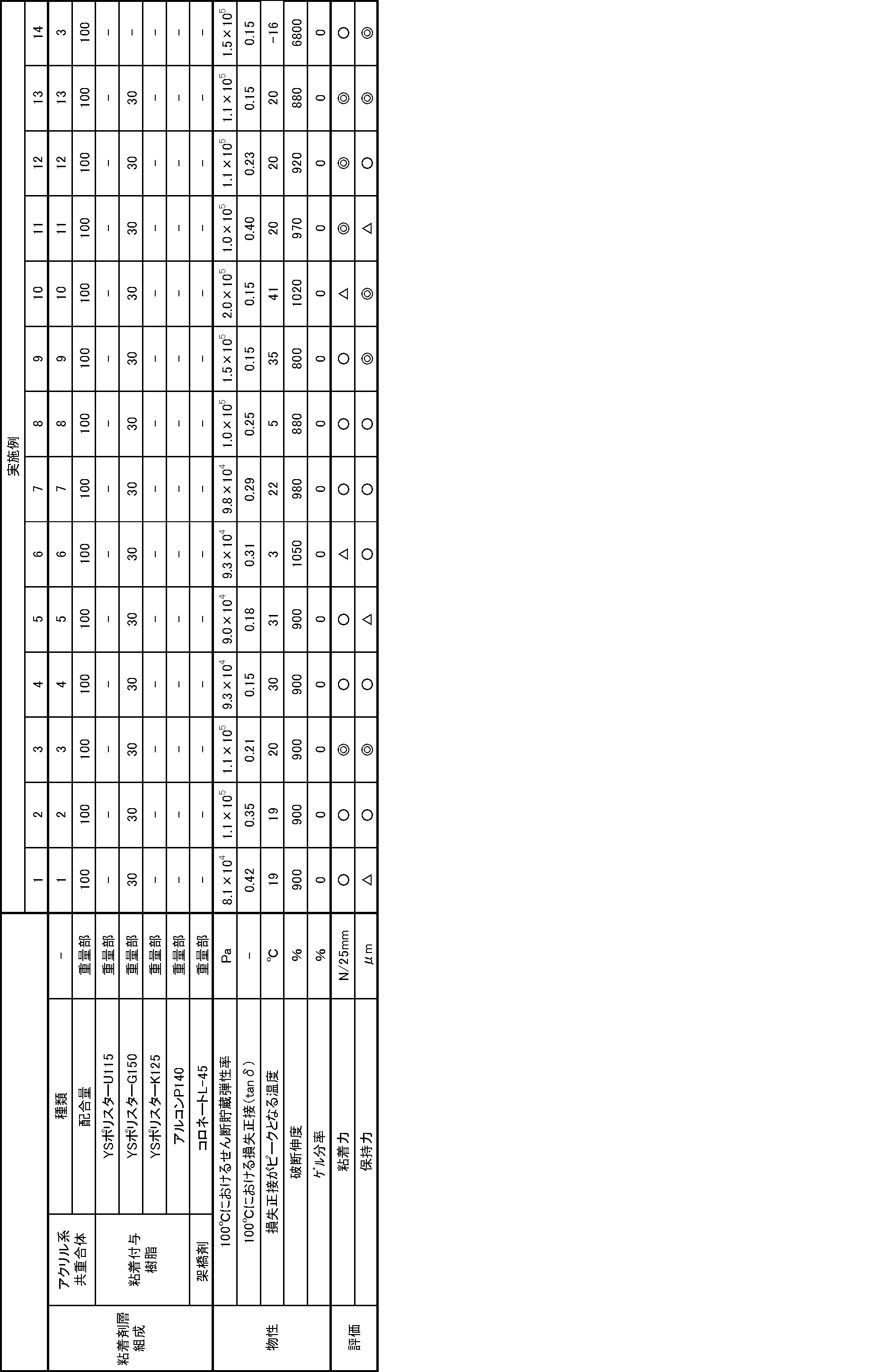
- Examples 2 to 28, Comparative Examples 1 to 4 An adhesive tape was obtained in the same manner as in Example 1, except that the formulation of the adhesive solution was as shown in Tables 3 and 4.
- the details of the tackifying resin and the cross-linking agent are as follows.
- YS Polyster U115 Terpene phenolic resin, manufactured by Yasuhara Chemical Co., Ltd., hydroxyl value 20 mgKOH/g YS Polystar K125: terpene phenolic resin, manufactured by Yasuhara Chemical Co., Ltd., hydroxyl value 200 mgKOH/g Alcon P140: Hydrogenated petroleum resin, manufactured by Arakawa Chemical Co., Ltd., hydroxyl value 0 mgKOH/g YS resin PX800: terpene resin, manufactured by Yasuhara Chemical Co., hydroxyl value 0 mgKOH/g Coronate L-45: isocyanate cross-linking agent, manufactured by Tosoh Corporation
- test piece was prepared by cutting the adhesive tape into a width of 25 mm. Next, the obtained test piece was attached to a SUS plate and pressure-bonded by reciprocating once with a 1 kg rubber roller to prepare a measurement sample. After that, it was cured at 23° C. for 24 hours, and the obtained measurement sample was subjected to a 180° peel test at a tensile speed of 300 mm/min according to JIS Z 0237:2009, and the adhesive strength (N/25 mm) at 23° C. was measured. , the adhesive strength was evaluated according to the following criteria.
- the holding force of the obtained pressure-sensitive adhesive tape was measured by the following method using the shear creep measuring device (manufactured by Asahi Seiko Co., Ltd., NST1) shown in FIG. First, the release film on one side of the obtained adhesive tape was peeled off, and a corona-treated polyethylene terephthalate (PET) film was attached to the exposed adhesive layer, and then cut into a piece of 1 cm wide by 12 cm long. A test piece 5 was obtained.
- the temperature controller 4 of the apparatus was set to 60° C. and left until the set temperature was stabilized. In addition, the temperature controller 4 was used in combination with the following.
- Temperature controller SA100 model: SA100FK08-MN-4 NN-NN, copper water-cooled Peltier unit manufactured by Takagi Seisakusho Co., Ltd., model: PU-50W, EYELA cooling water circulation device manufactured by Takagi Seisakusho Co., Ltd. Cool Ace, model: CCA1111 type, Tokyo Rika Kikai manufactured by the company
- the other release film of the test piece 5 is peeled off from the end by about 3 cm and removed, and the exposed adhesive layer is applied to the adherend 3 (JIS Z 0237 stainless steel) so that the adhesion area is 1 cm ⁇ 1 cm. pasted.
- adherend 3 JIS Z 0237 stainless steel
- a quartz block 2 quartz glass coated with chromium
- a test piece 5 was attached to a wire connecting a weight 6 of 50 g. It was left in this state and kept at constant temperature for 5 minutes.
- the PC connected to the apparatus was operated to start applying a load, and a shear load was applied to the test piece 5 in the waterside direction for 3 minutes.
- the amount of displacement due to the deformation of the adhesive is detected as the amount of movement of the mirror-finished quartz block 2 on the test piece using a laser interferometer 1 (SI-F10, manufactured by Keyence Corporation), and the holding force is evaluated according to the following criteria. did. ⁇ : 10 ⁇ m or less ⁇ : greater than 10 ⁇ m and 50 ⁇ m or less ⁇ : greater than 50 ⁇ m and 100 ⁇ m or less ⁇ : greater than 100 ⁇ m
- the adhesive composition used for the adhesive tape and this adhesive tape which are compatible with the outstanding adhesive force and holding power can be provided.
Landscapes
- Chemical & Material Sciences (AREA)
- Organic Chemistry (AREA)
- Chemical Kinetics & Catalysis (AREA)
- Health & Medical Sciences (AREA)
- Medicinal Chemistry (AREA)
- Polymers & Plastics (AREA)
- Oil, Petroleum & Natural Gas (AREA)
- Adhesive Tapes (AREA)
- Adhesives Or Adhesive Processes (AREA)
- Laminated Bodies (AREA)
Abstract
Description
以下に本発明を詳述する。
上記粘着剤層のせん断貯蔵弾性率が上記範囲であることで、保持力(横ずれに対する耐性)に優れた粘着テープとすることができるとともに、高温下であっても高い保持力を発揮することができる。上記粘着剤層のせん断貯蔵弾性率は、6.0×10⁴Pa以上であることが好ましく、8.0×10⁴Pa以上であることがより好ましく、8.1×10⁴Pa以上であることが更に好ましく、9.0×10⁴Pa以上であることが更により好ましく、1.0×10⁵Pa以上であることが一層好ましく、8.0×10⁶Pa以下であることが好ましく、4.0×10⁵Pa以下であることがより好ましく、2.0×10⁵Pa以下であることが更に好ましい。上記粘着剤層のせん断貯蔵弾性率は、粘着剤層を構成する粘着剤を構成するモノマー種や重合比や分子量、ゲル分率、粘着付与樹脂の有無、粘着付与樹脂の種類及び含有量によって調整することができる。
まず、粘着剤層のみからなる測定サンプルを作製する。得られた測定サンプルについて、粘弾性スペクトロメーター(例えば、アイティー計測制御社製、DVA-200、又はその同等品)等の動的粘弾性測定装置を用い、低速昇温せん断変形モードの5℃/分、測定周波数1Hzの条件で、-50℃~200℃の動的粘弾性スペクトルを測定したときの100℃における貯蔵弾性率を測定する。なお粘着テープが基材を有する場合は、基材を取り除き、粘着剤層のみのサンプルを作製した後に測定を行う。基材を取り除く方法は、粘着剤層の変性を避けるため、溶剤を用いた処理や化学反応を伴う処理、高温での処理を避ければ、特に限定されない。具体的な方法としては、粘着剤層同士を貼り合わせた後、適切な温度および剥離速度を選択し、引きはがすことによって基材と粘着剤層で剥離し、基材を取り除く方法、又は、基材を物理的に研削する方法等が挙げられる。
粘着剤層の破断伸度が上記範囲であることで、粘着力(剥離に対する耐性)に優れた粘着テープとすることができる。上記粘着剤層の破断伸度は900%以上であることが好ましく、1000%以上であることがより好ましい。上記粘着剤層の破断伸度の上限は特に限定されず、高いほどよいものであるが、例えば、10000%以下である。上記粘着剤層の破断伸度は、粘着剤層を構成する粘着剤を構成するモノマー種や重合比や粘着剤の分子量、ゲル分率、粘着付与樹脂の有無、粘着付与樹脂の種類及び含有量、テープ厚みによって調整することができる。
なお、上記粘着剤層の破断伸度は、粘着剤層単体を厚み1.0mm、幅5.0mmとした測定サンプルについて、JIS K7127に準拠して、引張試験装置(例えば、島津製作所製の引張試験機AG-IS、オリエンテック社製のRTC-1310A等)を用いて、治具間距離を10mmに設定し、粘着剤層単体を25℃で300mm/minの速度で引っ張り、破断に至った際の伸度を測定することで求めることができる。
なお粘着テープが基材を有する場合は、基材を取り除いた後に測定を行う。基材を取り除く方法は、粘着剤層の変性を避けるため、溶剤を用いた処理や化学反応を伴う処理、高温での処理を避ければ、特に限定されない。具体的な方法としては、粘着剤層同士を貼り合わせた後、適切な温度および剥離速度を選択し、引きはがすことによって基材と粘着剤層で剥離し、基材を取り除く方法、又は、基材を物理的に研削する方法等が挙げられる。
粘着剤層の損失正接が上記範囲であることで、上記粘着剤層を上記せん断貯蔵弾性率と上記破断伸度の範囲に調節しやすくすることができる。上記粘着剤層の損失正接は、0.05以上であることがより好ましく、0.10以上であることが更に好ましく、0.40以下であることがより好ましく、0.30以下であることが更に好ましい。
なお、上記粘着剤層の損失正接は、上記せん断貯蔵弾性率と同様の条件で動的粘弾性測定を行うことで得ることができる。
上記粘着剤層のゲル分率が50%未満である、つまり、上記粘着剤の架橋の割合が低いことで、粘着剤の分子が伸びやすくなることから粘着力をより高めることができ、上記破断伸度を上記範囲に調節しやすくすることができる。
上記粘着剤層のゲル分率は30%以下であることがより好ましく、15%以下であることが更に好ましい。上記粘着剤層のゲル分率の下限は特に限定されないが、例えば、0%である。
まず、粘着剤層の粘着剤を0.1gこそぎ取って酢酸エチル50ml中に浸漬し、振とう機で温度23℃、200rpmの条件で24時間振とうする。振とう後、金属メッシュ(目開き#200メッシュ)を用いて、酢酸エチルと酢酸エチルを吸収し膨潤した粘着剤を分離する。分離後の粘着剤を110℃の条件下で1時間乾燥させる。乾燥後の金属メッシュを含む粘着剤の重量を測定し、下記式(1)を用いてゲル分率を算出する。
ゲル分率(%)=100×(W1-W2)/W0 (1)
(W0:初期粘着剤重量、W1:乾燥後の金属メッシュを含む粘着剤重量、W2:金属メッシュの初期重量)
上記アクリル系共重合体は、オレフィン系重合体部位が相互作用によって凝集し、擬似的な架橋点を形成した構造となっている。このような構造を取ることで、上記アクリル系共重合体は、ひずみが小さいときは架橋度された粘着剤のように固く、保持力が高い性質を示す。一方、ひずみが大きくなった時は上記擬似的な架橋点が切れて、上記アクリル系共重合体の分子が伸びることから、柔軟性が高い粘着剤の性質を示す。つまり、上記粘着剤層を構成する粘着剤として上記アクリル系共重合体を用いることで、上記せん断貯蔵弾性率と上記破断伸度を満たしやすくすることができる。なお、ここで(メタ)アクリル酸とは、アクリル酸又はメタクリル酸のことを指す。
上記アクリル系共重合体中における上記(メタ)アクリル酸アルキルエステルに由来する構造の含有量が上記範囲であることで、粘着力と保持量をより両立しやすくすることができる。
上記アクリル系共重合体における上記(メタ)アクリル酸アルキルエステルに由来する構造の含有量は、60重量%以上であることがより好ましく、70重量%以上であることが更に好ましく、90重量%以下であることがより好ましく、85重量%以下であることが更に好ましい。
上記片末端に重合性不飽和二重結合を有するオレフィン系重合体として、具体的には、片末端に(メタ)アクリロイル基を有するエチレンマクロモノマー、片末端に(メタ)アクリロイル基を有するプロピレンマクロモノマー、片末端に(メタ)アクリロイル基を有するエチレン-ブチレンマクロモノマー、片末端に(メタ)アクリロイル基を有するエチレン-プロピレンマクロモノマー等が挙げられる。なかでも、後述するガラス転移温度を満たしやすいことから、片末端に(メタ)アクリロイル基を有するエチレン-ブチレンマクロモノマー、片末端に(メタ)アクリロイル基を有するエチレン-プロピレンマクロモノマーが好ましい。なお、これらの末端に重合性不飽和二重結合を有するオレフィン系重合体は単独で用いてもよく、2種以上を併用してもよい。また、ここでマクロモノマーとは、重量平均分子量1000~100000程度の重合可能な官能基を有するモノマーを指す。
上記アクリル系共重合体中における上記末端に重合性不飽和二重結合を有するオレフィン系重合体に由来する構造の含有量が5重量%以上であることで、適度な数の擬似架橋点が形成され、より上記せん断貯蔵弾性率の範囲をより満たしやすくすることができる。また、上記末端に重合性不飽和二重結合を有するオレフィン系重合体に由来する構造の含有量が30重量%以下であることで、凝集破壊をより抑えることができる。
上記アクリル系共重合体における上記末端に重合性不飽和二重結合を有するオレフィン系重合体に由来する構造の含有量は、8重量%以上であることがより好ましく、10重量%以上であることが更に好ましく、27重量%以下であることがより好ましく、25重量%以下であることが更に好ましい。
上記アクリル系共重合体が極性基含有モノマーに由来する構造を有することで、極性基同士が相互作用するためより粘着力と保持力を高めることができる。上記極性基含有モノマーとしては例えば、例えば、(メタ)アクリル酸、(メタ)アクリロイル酢酸、(メタ)アクリロイルプロピオン酸、(メタ)アクリロイル酪酸、(メタ)アクリロイルペンタン酸、クロトン酸等の不飽和モノカルボン酸、マレイン酸、フマル酸、シトラコン酸、メサコン酸、イタコン酸、N-ビニル-2-ピロリドン、(メタ)アクリロイルモルフォリン、(メタ)アクリルアミド、N,N-ジメチル(メタ)アクリルアミド、N-イソプロピル(メタ)アクリルアミド、ジメチルアミノエチル(メタ)アクリレート、ジエチルアミノエチル(メタ)アクリレート等が挙げられる。なかでも、より粘着力と保持力を高めることができることから、前記極性基含有モノマーはカルボキシ基を有することが好ましい。なお、これらの極性基含有モノマーは単独で用いてもよく、2種以上を併用してもよい。
上記アクリル系共重合体中における上記極性基含有モノマーに由来する構造の含有量が0.1重量%以上であることで、より極性基間の相互作用を高めることができ、10重量%以下であることでアクリル系共重合体が硬くなりすぎず、より粘着力を高めることができる。
上記アクリル系共重合体中における上記極性基含有モノマーに由来する構造の含有量は1重量%以上であることがより好ましく、3重量%以上であることが更に好ましく、8重量%以下であることがより好ましく、6重量%以下であることが更に好ましい。
上記アクリル系共重合体が上記温度範囲にガラス転移温度を有し、かつ、そのすべてのガラス転移温度が-20℃以下である、つまり、上記アクリル系共重合体が高いガラス転移温度を有する構造を含まないことで、上記アクリル系共重合体の分子が伸びやすくなるため、粘着力をより高めることができる。上記ガラス転移温度は-30℃以下であることが好ましく、-35℃以下であることがより好ましい。上記ガラス転移温度はアクリル系共重合体の材料となるモノマーの種類によって調節することができる。
なお、上記ガラス転移温度は、窒素雰囲気下(窒素フロー、流量50mL/分)、示差走査熱量計(例えば、セイコーインスツルメンツ社製の220C等)を用いて、JIS K6240:2011に準拠した方法で測定温度-100~200℃、昇温速度10℃/分の条件下で測定を行うことにより求めることができる。
上記アクリル系共重合体の重量平均分子量が20万以上であることで、凝集力をより高めることができ、200万以下であることで粘着力の低下をより抑えることができる。上記アクリル系共重合体の重量平均分子量は50万以上であることがより好ましく、150万以下であることがより好ましい。
なお、上記重量平均分子量は、例えばGPC法によりポリスチレン標準で求めることができる。具体的には、例えば、測定機器としてWaters社製「2690 Separations Module」、カラムとして昭和電工社製「GPC KF-806L」溶媒として酢酸エチルを用い、サンプル流量1mL/min、カラム温度40℃の条件で測定することができる。
上記アクリル系共重合体の分子量分布が上記範囲であることで、上記せん断貯蔵弾性率と上記破断伸度を満たしやすくすることができる。上記アクリル系共重合体の分子量分布は、1.5以上であることがより好ましく、4.5以下であることがより好ましい。
上記範囲の水酸基価を有する粘着付与樹脂は極性が高いことから、極性の低いオレフィン系重合体部位と相溶しがたい。その結果、極性の低いオレフィン系重合体部位の相互作用による擬似的な架橋点の形成を阻害することなく粘着力をより向上させることができる。
上記高水酸基価粘着付与樹脂の水酸基価は30mgKOH/g以上であることがより好ましく、200mgKOH/g以下であることが好ましく、150mgKOH/g以下であることがより好ましい。上記高水酸基価粘着付与樹脂としては、例えば、テルペンフェノール樹脂、重合ロジンエステル樹脂等が挙げられる。
上記高水酸基価粘着付与樹脂の含有量は20重量部以上であることがより好ましく、35重量部以下であることがより好ましい。
水酸基価が15mgKOH/g未満の粘着付与樹脂は極性が低いため、上記オレフィン系重合体に由来する構成単位と相溶しやすい。上記含有量であることで、上記オレフィン系重合体部位同士の相互作用による擬似的な架橋点の形成が阻害されることを抑制することができる。この結果保持力により優れる粘着テープとすることができる。上記アクリル系共重合体100重量部に対する、水酸基価が15mgKOH/g未満の低水酸基価粘着付与樹脂の含有量は0重量部であることがより好ましい。
上記低水酸基価粘着付与樹脂の含有量は5重量部より多いことがより好ましく、60重量部以下であることがより好ましく、10重量部以上であることが更に好ましく、50重量部以下であることが更に好ましく、20重量部以上であることが更により好ましく、30重量部以上であることが一層好ましく、40重量部以上であることがより一層好ましい。
上記低水酸基価粘着付与樹脂としては、例えば、テルペン樹脂、石油樹脂等が挙げられる。
このような、(メタ)アクリル酸アルキルエステルに由来する構造と、末端に重合性不飽和二重結合を有するオレフィン系重合体に由来する構造とを有するアクリル系共重合体を含有し、前記アクリル系共重合体は示差走査熱量測定を行ったときに-100~200℃の範囲にガラス転移温度を有し、全ての前記ガラス転移温度が-20℃以下である、粘着剤組成物もまた、本発明の1つである。
本発明の粘着剤組成物は、上述した粘着剤層に用いられるアクリル系共重合体、粘着付与樹脂及び添加剤と同様のものを用いることができる。
なお、上記損失正接は、粘弾性スペクトロメーター(アイティー計測制御社製、DVA-200、又はその同等品)を用い、低速昇温せん断変形モードの5℃/分、1Hzの条件で、-100℃~200℃の動的粘弾性スペクトルを測定することで得ることができる。
上記基材は特に限定されず、例えば、アクリル、オレフィン、ポリカーボネート、塩化ビニル、ABS、ポリエチレンテレフタレート(PET)、ナイロン、ウレタン、ポリイミド等の樹脂からなるシート、網目状の構造を有するシート、孔が開けられたシート等が挙げられる。
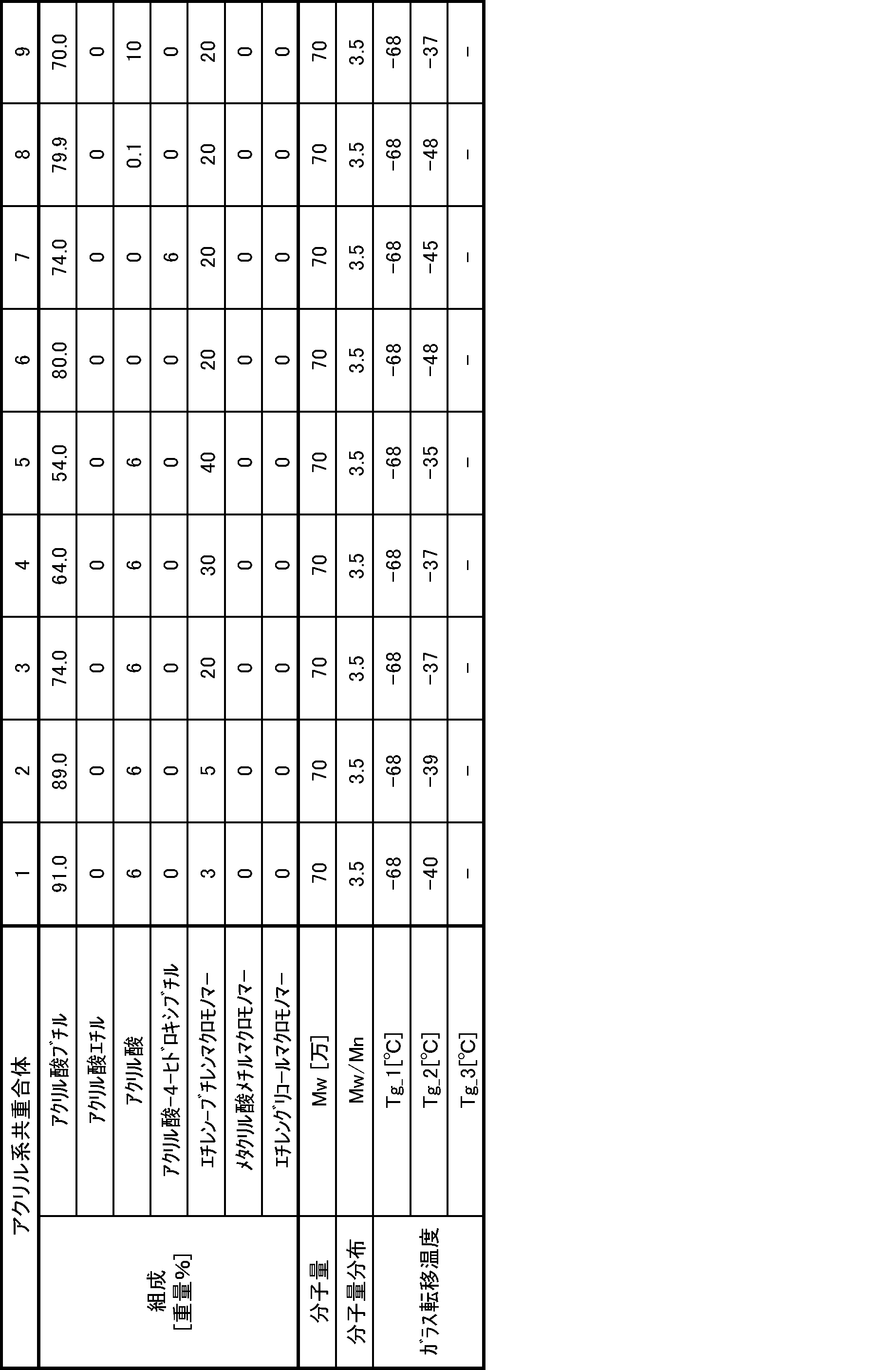
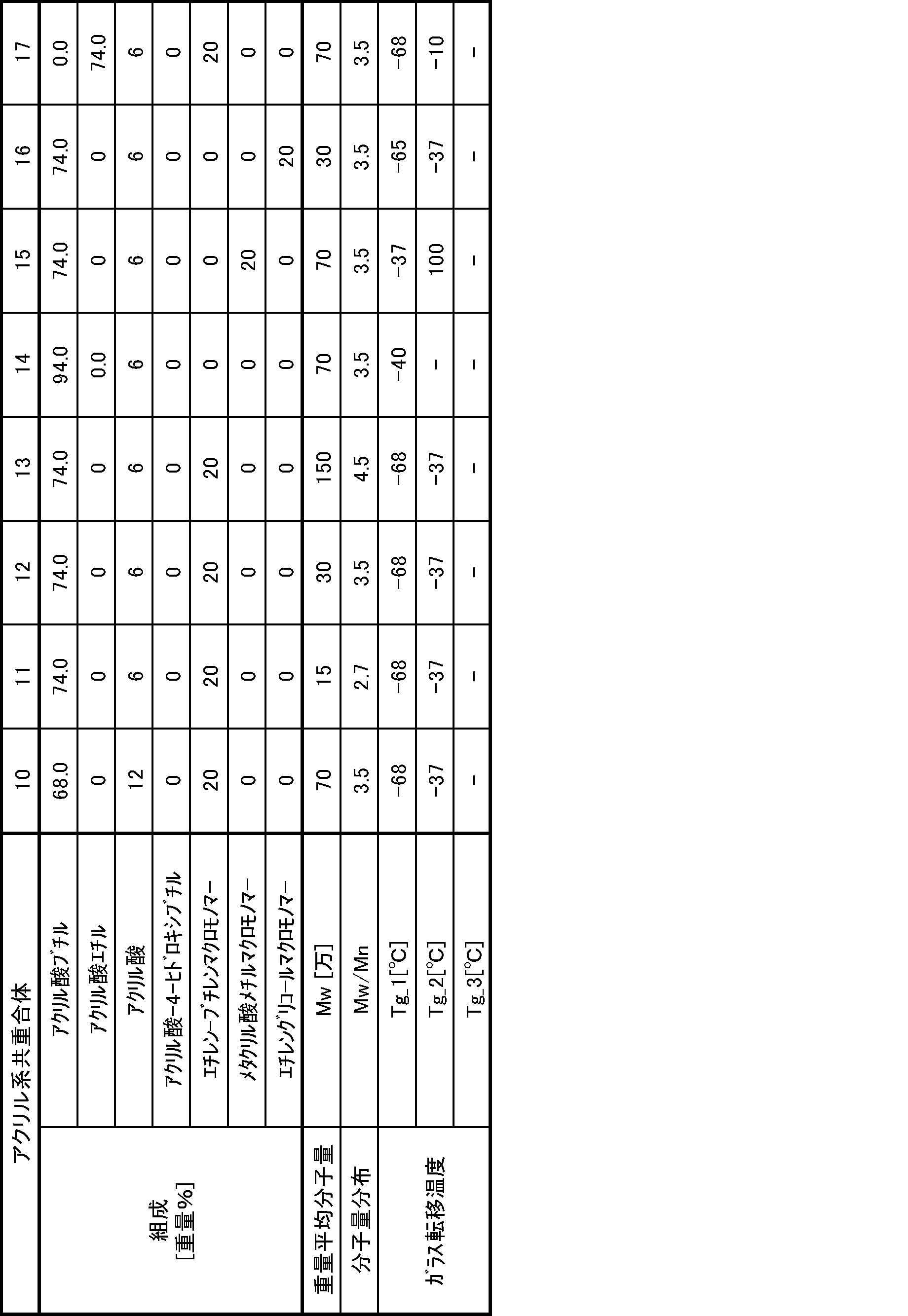
温度計、攪拌機、冷却管を備えた反応器を用意した。この反応器内に、アクリル酸ブチル91.0重量部、アクリル酸6重量部、エチレン-ブチレンマクロモノマー3重量部、ラウリルメルカプタン0.01重量部と、酢酸エチル80重量部を加えた後、反応器を加熱して還流を開始した。続いて、上記反応器内に、重合開始剤として1,1-ビス(t-ヘキシルパーオキシ)-3,3,5-トリメチルシクロヘキサン0.01重量部を添加し、還流下で重合を開始させた。次に、重合開始から1時間後及び2時間後にも、1,1-ビス(t-ヘキシルパーオキシ)-3,3,5-トリメチルシクロヘキサンを0.01重量部ずつ添加し、更に、重合開始から4時間後にt-ヘキシルパーオキシピバレートを0.05重量部添加して重合反応を継続させた。そして、重合開始から8時間後に、固形分55重量%、重量平均分子量70万、分子量分布(Mw/Mn)3.5の官能基含有アクリル系共重合体1の酢酸エチル溶液を得た。得られたアクリル系共重合体1について、示差走査熱量計(220C、セイコーインスツルメンツ社製)を用いて、窒素雰囲気下(窒素フロー、流量50mL/分)、JIS K6240:2011に準拠した方法で測定温度-100~200℃、昇温速度10℃/分の条件下でガラス転移温度を測定した。なお、重量平均分子量及び分子量分布は、測定機器として2690 Separations Module(Waters社製)、カラムとしてGPC KF-806L(昭和電工社製)、溶媒として酢酸エチルを用い、サンプル流量1mL/min、カラム温度40℃の条件で測定した。
原料の種類と組成を表1、2の通りとした以外はアクリル系共重合体1の製造と同様にしてアクリル系共重合体2~17の酢酸エチル溶液を得た。なお各マクロモノマーの詳細は以下の通りである。
エチレン-ブチレンマクロモノマー:片末端にメタクリロイル基を有するオレフィン系重合体、クレイトン・ポリマージャパン社製、HPVM-L1253、重量平均分子量7000、ガラス転移温度-68℃
メタクリル酸メチルマクロモノマー:片末端にメタクリロイル基を有するアクリル系重合体、東亞合成社製、AA-6、重量平均分子量11600、ガラス転移温度100℃
エチレングリコールマクロモノマー:片末端にメタクリロイル基を有するオキシアルキレン系重合体、日油社製、PME-4000、重量平均分子量4000、ガラス転移温度-65℃
アクリル系共重合体1の酢酸エチル溶液の固形分100重量部に対して、粘着付与樹脂としてYSポリスターG150を30重量部を加えて混合することで粘着剤溶液を得た。
片面に離型処理を施した50μmのポリエチレンテレフタレート(PET)フィルムの離型処理面上に、得られた粘着剤溶液を乾燥皮膜の厚さが40μmとなるようにドクターナイフで塗工し、110℃、5分間加熱して塗工溶液を乾燥させることで粘着テープを得た。なお、粘着付与樹脂の詳細は以下のとおりである。
YSポリスターG150:テルペンフェノール樹脂、ヤスハラケミカル社製、水酸基価140mgKOH/g
粘着剤溶液の配合を表3、4の通りとした以外は実施例1と同様にして粘着テープを得た。なお、粘着付与樹脂及び架橋剤の詳細は以下のとおりである。
YSポリスターU115:テルペンフェノール樹脂、ヤスハラケミカル社製、水酸基価20mgKOH/g
YSポリスターK125:テルペンフェノール樹脂、ヤスハラケミカル社製、水酸基価200mgKOH/g
アルコンP140:水添石油樹脂、荒川化学社製、水酸基価0mgKOH/g
YSレジンPX800:テルペン樹脂、ヤスハラケミカル社製、水酸基価0mgKOH/g
コロネートL-45:イソシアネート系架橋剤、東ソー社製
実施例及び比較例で得られた粘着テープについて以下の測定を行った。結果を表3、4に示した。
まず、上記方法により粘着剤層のみからなる測定サンプルを作製した。得られた測定サンプルについて、粘弾性スペクトロメーター(アイティー計測制御社製、DVA-200)を用い、低速昇温せん断変形モードの5℃/分、1Hzの条件で、-50℃~200℃の動的粘弾性スペクトルを測定した。得られた動的粘弾性スペクトルの100℃における貯蔵弾性率を100℃におけるせん断貯蔵弾性率とした。また、得られた動的粘弾性スペクトルから100℃における損失正接(tanδ)、及び、損失正接(tanδ)がピークとなる温度を得た。
まず、上記方法により得られた粘着剤層を積層することで、粘着剤層のみからなる厚み1.0mm、幅5.0mmとした測定サンプルを作製した。得られた測定サンプルについて、JIS K7127に準拠して、引張試験装置(引張試験機AG-IS、島津製作所社製)を用いて、治具間距離を10mmに設定し、粘着剤層を25℃、300mm/minの速度で引っ張り、破断に至った際の伸度(破断伸度)を測定した。
まず、粘着剤層の粘着剤を0.1gこそぎ取って酢酸エチル50ml中に浸漬し、振とう機で温度23℃、200rpmの条件で24時間振とうした。振とう後、金属メッシュ(目開き#200メッシュ)を用いて、酢酸エチルと酢酸エチルを吸収し膨潤した粘着剤を分離した。分離後の粘着剤を110℃の条件下で1時間乾燥させた。乾燥後の金属メッシュを含む粘着剤の重量を測定し、下記式(1)を用いてゲル分率を算出した。
ゲル分率(%)=100×(W1-W2)/W0 (1)
(W0:初期粘着剤重量、W1:乾燥後の金属メッシュを含む粘着剤重量、W2:金属メッシュの初期重量)
<評価>
実施例及び比較例で得られた粘着テープについて以下の評価を行った。結果を表3、4に示した。
粘着テープを25mm幅に裁断して試験片を作製した。次いで、得られた試験片をSUS板に貼り、1kgのゴムローラーで1往復することによって圧着して測定サンプルを作製した。その後、23℃において24hr養生し、得られた測定サンプルについてJIS Z 0237:2009に従い、引張速度300mm/minの条件で180°剥離試験を行い、23℃における粘着力(N/25mm)を測定し、下記基準で粘着力を評価した。
◎:45N/25mm以上
○:30N/25mm以上45N/25mm未満
△:20N/25mm以上30N/25mm未満
×:20N/25mm未満
得られた粘着テープについて、図1に示した剪断クリープ測定装置(旭精工社製、NST1)を用いて、以下の方法で保持力を測定した。
まず、得られた粘着テープの一方の面の離型フィルムを剥がし、露出した粘着剤層にコロナ処理を施したポリエチレンテレフタレート(PET)フィルムを貼り付けた後、幅1cm×縦12cmにカットして試験片5とした。装置の温調器4を60℃に設定し、設定温度で安定するまで放置した。なお、温調器4は以下のものを組み合わせて用いた。
温度調節器SA100、型式:SA100FK08-MN-4 NN-NN、高木製作所社製
銅製水冷ペルチェユニット、型式:PU-50W、高木製作所社製
EYELA冷却水循環装置クールエース、型式:CCA1111型、東京理化器械社製
◎:10μm以下
○:10μmより大きく50μm以下
△:50μmより大きく100μm以下
×:100μmより大きい

2 鏡面処理石英ブロック
3 被着体(JIS Z 0237規定ステンレス鋼)
4 温調器
5 試験片(両面粘着テープ)
6 分銅
7 粘着剤層
8 残存離型フィルム面
9 コロナ処理PETフィルム面
10 鏡面処理面
Claims (27)
- 粘着剤層を有する粘着テープであって、前記粘着剤層は、動的粘弾性測定装置を用いて測定周波数1Hzで測定した100℃におけるせん断貯蔵弾性率が4.0×10⁴Pa以上1.0×10⁶Pa以下であり、引張試験装置を用いて引張速度300mm/minにて測定した25℃における破断伸度が800%以上である、粘着テープ。
- 前記粘着剤層は、動的粘弾性測定装置を用いて測定周波数1Hzで測定した100℃における損失正接(tanδ)が0.01以上0.5以下である、請求項1記載の粘着テープ。
- 前記粘着剤層は、ゲル分率が50%未満である、請求項1又は2記載の粘着テープ。
- 前記粘着剤層はアクリル系共重合体を含有する請求項1、2又は3記載の粘着テープ。
- 前記粘着剤層は、(メタ)アクリル酸アルキルエステルに由来する構造と、末端に重合性不飽和二重結合を有するオレフィン系重合体に由来する構造とを有するアクリル系共重合体を含有する、請求項1~4のいずれかに記載の粘着テープ。
- 前記アクリル系共重合体は、末端に重合性不飽和二重結合を有するオレフィン系重合体に由来する構造を5重量%以上30重量%以下含有する、請求項5のいずれかに記載の粘着テープ。
- 前記アクリル系共重合体は極性基含有モノマーに由来する構造を有する、請求項4~6のいずれかに記載の粘着テープ。
- 前記極性基含有モノマーはカルボキシ基を有する、請求項7記載に記載の粘着テープ。
- 前記アクリル系共重合体は、前記極性基含有モノマーに由来する構造を0.1重量%以上10重量%以下含有する、請求項7又は8のいずれかに記載の粘着テープ。
- 前記アクリル系共重合体は、重量平均分子量が20万以上200万以下である、請求項1~9のいずれかに記載の粘着テープ。
- 前記粘着剤層は、水酸基価が15mgKOH/g以上である高水酸基価粘着付与樹脂を含有する、請求項1~11のいずれかに記載の粘着テープ。
- 前記高水酸基価粘着付与樹脂を前記アクリル系共重合体100重量部に対して1重量部以上40重量部以下含有する、請求項10記載の粘着テープ。
- 前記粘着剤層は、水酸基価が15mgKOH/g未満の低水酸基価粘着付与樹脂の含有量が前記アクリル系共重合体100重量部に対して5重量部以下である、請求項4~11のいずれかに記載の粘着テープ。
- 前記粘着剤層は、水酸基価が15mgKOH/g未満の低水酸基価粘着付与樹脂の含有量が前記アクリル系共重合体100重量部に対して10重量部以上60重量部以下である、請求項4~11のいずれかに記載の粘着テープ。
- 前記高水酸基価粘着付与樹脂を前記アクリル系共重合体100重量部に対して1重量部以上40重量部以下含有する、請求項14記載の粘着テープ。
- 前記粘着剤層の測定周波数1Hzでのせん断による動的粘弾性測定による損失正接tanδが40度以下においてピークを有する、請求項請求項1~15いずれかに記載の粘着テープ。
- 基材を有し、前記基材の少なくとも一方の面に粘着剤層を有する、請求項1~16いずれか記載の粘着テープ。
- (メタ)アクリル酸アルキルエステルに由来する構造と、末端に重合性不飽和二重結合を有するオレフィン系重合体に由来する構造とを有するアクリル系共重合体を含有し、
前記アクリル系共重合体は示差走査熱量測定を行ったときに-100~200℃の範囲にガラス転移温度を有し、
全ての前記ガラス転移温度が-20℃以下である、粘着剤組成物。 - 前記アクリル系共重合体は、重合性不飽和二重結合を2つ以上含むモノマーに由来する構造の含有量が0.1重量%以下である、請求項18記載の粘着剤組成物。
- 前記アクリル系共重合体は、末端に重合性不飽和二重結合を有するオレフィン系重合体に由来する構造を5重量%以上30重量%以下含有する、請求項18又は19記載の粘着剤組成物。
- 前記アクリル系共重合体は極性基含有モノマーに由来する構造を有する、請求項18~20のいずれかに記載の粘着剤組成物。
- 前記極性基含有モノマーはカルボキシ基を有する、請求項21記載の粘着剤組成物。
- 前記アクリル系共重合体は、前記極性基含有モノマーに由来する構造を0.1重量%以上10重量%以下有する、請求項21又は22記載の粘着剤組成物。
- 前記アクリル系共重合体は、重量平均分子量が20万以上200万以下である、請求項18~23のいずれかに記載の粘着剤組成物。
- 請求項18~24のいずれか記載の粘着剤組成物からなる粘着剤層を有する粘着テープ。
- 前記粘着剤層の測定周波数1Hzでのせん断による動的粘弾性測定による損失正接tanδが40度以下においてピークを有する、請求項25記載の粘着テープ。
- 基材を有し、前記基材の少なくとも一方の面に粘着剤層を有する、請求項25又は26記載の粘着テープ。
Priority Applications (5)
| Application Number | Priority Date | Filing Date | Title |
|---|---|---|---|
| KR1020237013288A KR20240004209A (ko) | 2021-04-30 | 2022-04-27 | 점착 테이프 및 점착제 조성물 |
| EP22795849.3A EP4332193A4 (en) | 2021-04-30 | 2022-04-27 | Adhesive tape and adhesive composition |
| US18/288,426 US20240209240A1 (en) | 2021-04-30 | 2022-04-27 | Adhesive tape and adhesive composition |
| CN202280007505.3A CN116529336A (zh) | 2021-04-30 | 2022-04-27 | 粘合带及粘合剂组合物 |
| JP2022535229A JPWO2022230936A1 (ja) | 2021-04-30 | 2022-04-27 |
Applications Claiming Priority (4)
| Application Number | Priority Date | Filing Date | Title |
|---|---|---|---|
| JP2021-077812 | 2021-04-30 | ||
| JP2021-077810 | 2021-04-30 | ||
| JP2021077812 | 2021-04-30 | ||
| JP2021077810 | 2021-04-30 |
Publications (1)
| Publication Number | Publication Date |
|---|---|
| WO2022230936A1 true WO2022230936A1 (ja) | 2022-11-03 |
Family
ID=83848544
Family Applications (1)
| Application Number | Title | Priority Date | Filing Date |
|---|---|---|---|
| PCT/JP2022/019073 Ceased WO2022230936A1 (ja) | 2021-04-30 | 2022-04-27 | 粘着テープ及び粘着剤組成物 |
Country Status (6)
| Country | Link |
|---|---|
| US (1) | US20240209240A1 (ja) |
| EP (1) | EP4332193A4 (ja) |
| JP (1) | JPWO2022230936A1 (ja) |
| KR (1) | KR20240004209A (ja) |
| TW (1) | TW202309217A (ja) |
| WO (1) | WO2022230936A1 (ja) |
Cited By (3)
| Publication number | Priority date | Publication date | Assignee | Title |
|---|---|---|---|---|
| WO2023145567A1 (ja) * | 2022-01-26 | 2023-08-03 | 積水化学工業株式会社 | 粘着テープ |
| WO2025028645A1 (ja) * | 2023-08-02 | 2025-02-06 | 積水化学工業株式会社 | 粘着剤、粘着テープ、ポリオレフィン樹脂成型体、複合構成体、自動車部材、及び、ポリオレフィン樹脂成型体の製造方法 |
| WO2025173519A1 (ja) * | 2024-02-14 | 2025-08-21 | 株式会社巴川コーポレーション | 粘着シート及びそれを用いた積層体 |
Families Citing this family (1)
| Publication number | Priority date | Publication date | Assignee | Title |
|---|---|---|---|---|
| KR20220103046A (ko) * | 2021-01-14 | 2022-07-21 | 신꼬오덴기 고교 가부시키가이샤 | 기판 고정 장치 |
Citations (9)
| Publication number | Priority date | Publication date | Assignee | Title |
|---|---|---|---|---|
| JP2000026818A (ja) * | 1998-07-14 | 2000-01-25 | Nitto Denko Corp | 粘着層、粘着シート及び使捨てカイロ |
| JP2000080134A (ja) * | 1998-06-23 | 2000-03-21 | Sekisui Chem Co Ltd | オレフィンマクロマ―含有共重合体、樹脂組成物、樹脂相溶化剤、ポリオレフィン系樹脂組成物、樹脂積層体及び樹脂成形体 |
| JP2003013028A (ja) * | 2001-06-29 | 2003-01-15 | Sekisui Chem Co Ltd | アクリル系粘着剤組成物及び粘着テープ |
| JP2005521774A (ja) * | 2002-03-25 | 2005-07-21 | ナショナル スターチ アンド ケミカル インベストメント ホールディング コーポレイション | ゴム‐アクリル接着剤配合物 |
| JP2009242541A (ja) | 2008-03-31 | 2009-10-22 | Sekisui Chem Co Ltd | 衝撃吸収テープ |
| JP2009258274A (ja) | 2008-04-15 | 2009-11-05 | Sekisui Chem Co Ltd | 表示装置前板用粘着シート |
| JP2011219665A (ja) * | 2010-04-13 | 2011-11-04 | Mitsubishi Plastics Inc | 透明粘着シートおよび画像表示装置 |
| JP2012214544A (ja) | 2011-03-31 | 2012-11-08 | Lintec Corp | 粘着剤および粘着シート |
| JP2014145054A (ja) * | 2013-01-30 | 2014-08-14 | Sekisui Chem Co Ltd | 光学用粘着シート及び光学積層体 |
Family Cites Families (6)
| Publication number | Priority date | Publication date | Assignee | Title |
|---|---|---|---|---|
| AU7324994A (en) * | 1993-07-08 | 1995-02-06 | Avery Dennison Corporation | Acrylic-saturated rubber hybrid pressure-sensitive adhesives |
| JPH08143847A (ja) * | 1994-11-17 | 1996-06-04 | Sekisui Chem Co Ltd | アクリル系粘着剤組成物 |
| JP2003013025A (ja) * | 2001-06-26 | 2003-01-15 | Sekisui Chem Co Ltd | 粘着剤組成物及び粘着テープ |
| JP2014189656A (ja) * | 2013-03-27 | 2014-10-06 | Toyo Ink Sc Holdings Co Ltd | 自動車内装材用粘着剤および自動車内装材用粘着シート |
| DE102013224773A1 (de) * | 2013-12-03 | 2015-06-03 | Tesa Se | Mehrphasige Polymerzusammensetzung |
| DE102013224774A1 (de) * | 2013-12-03 | 2015-06-03 | Tesa Se | Mehrschichtiges Produkt |
-
2022
- 2022-04-27 EP EP22795849.3A patent/EP4332193A4/en active Pending
- 2022-04-27 JP JP2022535229A patent/JPWO2022230936A1/ja active Pending
- 2022-04-27 KR KR1020237013288A patent/KR20240004209A/ko active Pending
- 2022-04-27 WO PCT/JP2022/019073 patent/WO2022230936A1/ja not_active Ceased
- 2022-04-27 US US18/288,426 patent/US20240209240A1/en active Pending
- 2022-04-28 TW TW111116229A patent/TW202309217A/zh unknown
Patent Citations (9)
| Publication number | Priority date | Publication date | Assignee | Title |
|---|---|---|---|---|
| JP2000080134A (ja) * | 1998-06-23 | 2000-03-21 | Sekisui Chem Co Ltd | オレフィンマクロマ―含有共重合体、樹脂組成物、樹脂相溶化剤、ポリオレフィン系樹脂組成物、樹脂積層体及び樹脂成形体 |
| JP2000026818A (ja) * | 1998-07-14 | 2000-01-25 | Nitto Denko Corp | 粘着層、粘着シート及び使捨てカイロ |
| JP2003013028A (ja) * | 2001-06-29 | 2003-01-15 | Sekisui Chem Co Ltd | アクリル系粘着剤組成物及び粘着テープ |
| JP2005521774A (ja) * | 2002-03-25 | 2005-07-21 | ナショナル スターチ アンド ケミカル インベストメント ホールディング コーポレイション | ゴム‐アクリル接着剤配合物 |
| JP2009242541A (ja) | 2008-03-31 | 2009-10-22 | Sekisui Chem Co Ltd | 衝撃吸収テープ |
| JP2009258274A (ja) | 2008-04-15 | 2009-11-05 | Sekisui Chem Co Ltd | 表示装置前板用粘着シート |
| JP2011219665A (ja) * | 2010-04-13 | 2011-11-04 | Mitsubishi Plastics Inc | 透明粘着シートおよび画像表示装置 |
| JP2012214544A (ja) | 2011-03-31 | 2012-11-08 | Lintec Corp | 粘着剤および粘着シート |
| JP2014145054A (ja) * | 2013-01-30 | 2014-08-14 | Sekisui Chem Co Ltd | 光学用粘着シート及び光学積層体 |
Non-Patent Citations (1)
| Title |
|---|
| See also references of EP4332193A4 |
Cited By (3)
| Publication number | Priority date | Publication date | Assignee | Title |
|---|---|---|---|---|
| WO2023145567A1 (ja) * | 2022-01-26 | 2023-08-03 | 積水化学工業株式会社 | 粘着テープ |
| WO2025028645A1 (ja) * | 2023-08-02 | 2025-02-06 | 積水化学工業株式会社 | 粘着剤、粘着テープ、ポリオレフィン樹脂成型体、複合構成体、自動車部材、及び、ポリオレフィン樹脂成型体の製造方法 |
| WO2025173519A1 (ja) * | 2024-02-14 | 2025-08-21 | 株式会社巴川コーポレーション | 粘着シート及びそれを用いた積層体 |
Also Published As
| Publication number | Publication date |
|---|---|
| US20240209240A1 (en) | 2024-06-27 |
| KR20240004209A (ko) | 2024-01-11 |
| TW202309217A (zh) | 2023-03-01 |
| JPWO2022230936A1 (ja) | 2022-11-03 |
| EP4332193A4 (en) | 2025-04-16 |
| EP4332193A1 (en) | 2024-03-06 |
Similar Documents
| Publication | Publication Date | Title |
|---|---|---|
| WO2022230936A1 (ja) | 粘着テープ及び粘着剤組成物 | |
| JP6050660B2 (ja) | 粘着剤、及び粘着シート | |
| CN102791817B (zh) | 光学构件用粘合剂组合物以及光学构件用粘合带 | |
| TWI478997B (zh) | Adhesive tape, laminated body and image display device | |
| TWI424036B (zh) | Adhesive, both sides of the adhesive film and display device | |
| JP5848327B2 (ja) | 粘着剤組成物及び光学部材用フィルム | |
| WO2023145567A1 (ja) | 粘着テープ | |
| JP2016000774A (ja) | 粘着シートおよびそれを用いた貼合体 | |
| JP2011162586A (ja) | 両面粘着シート | |
| JP2024066501A (ja) | 粘着剤組成物、及び、粘着テープ | |
| JP2022171614A (ja) | 粘着剤組成物及び粘着テープ | |
| WO2022230935A1 (ja) | 粘着テープ | |
| JP2002294193A (ja) | 粘着剤組成物および粘着ラベル又はテープ | |
| WO2024095971A1 (ja) | 粘着剤組成物、及び、粘着テープ | |
| WO2022210638A1 (ja) | 粘着テープ | |
| JP2012149200A (ja) | 粘着テープ | |
| JP7166052B2 (ja) | 粘着シート | |
| JP2002012629A (ja) | 重合性組成物、粘着剤、粘着テープ及び粘着シート | |
| JP6217506B2 (ja) | 粘着剤層形成用塗剤 | |
| CN116529336A (zh) | 粘合带及粘合剂组合物 | |
| CN116547360A (zh) | 粘合带 | |
| WO2025023178A1 (ja) | 粘着テープ及び粘着剤組成物 | |
| JP7844576B2 (ja) | 粘着テープ | |
| CN120731256A (zh) | 粘合带 | |
| JP2003003142A (ja) | 粘着剤組成物及び粘着テープ |
Legal Events
| Date | Code | Title | Description |
|---|---|---|---|
| ENP | Entry into the national phase |
Ref document number: 2022535229 Country of ref document: JP Kind code of ref document: A |
|
| 121 | Ep: the epo has been informed by wipo that ep was designated in this application |
Ref document number: 22795849 Country of ref document: EP Kind code of ref document: A1 |
|
| WWE | Wipo information: entry into national phase |
Ref document number: 202280007505.3 Country of ref document: CN |
|
| WWE | Wipo information: entry into national phase |
Ref document number: 18288426 Country of ref document: US |
|
| WWE | Wipo information: entry into national phase |
Ref document number: 2022795849 Country of ref document: EP |
|
| ENP | Entry into the national phase |
Ref document number: 2022795849 Country of ref document: EP Effective date: 20231130 |
|
| NENP | Non-entry into the national phase |
Ref country code: DE |