WO2022230947A1 - 光硬化性樹脂組成物、光硬化物、及び立体造形物の製造方法 - Google Patents
光硬化性樹脂組成物、光硬化物、及び立体造形物の製造方法 Download PDFInfo
- Publication number
- WO2022230947A1 WO2022230947A1 PCT/JP2022/019129 JP2022019129W WO2022230947A1 WO 2022230947 A1 WO2022230947 A1 WO 2022230947A1 JP 2022019129 W JP2022019129 W JP 2022019129W WO 2022230947 A1 WO2022230947 A1 WO 2022230947A1
- Authority
- WO
- WIPO (PCT)
- Prior art keywords
- meth
- resin composition
- photocurable resin
- acrylate
- acrylic acid
- Prior art date
- Legal status (The legal status is an assumption and is not a legal conclusion. Google has not performed a legal analysis and makes no representation as to the accuracy of the status listed.)
- Ceased
Links
Images


Classifications
-
- C—CHEMISTRY; METALLURGY
- C08—ORGANIC MACROMOLECULAR COMPOUNDS; THEIR PREPARATION OR CHEMICAL WORKING-UP; COMPOSITIONS BASED THEREON
- C08F—MACROMOLECULAR COMPOUNDS OBTAINED BY REACTIONS ONLY INVOLVING CARBON-TO-CARBON UNSATURATED BONDS
- C08F2/00—Processes of polymerisation
- C08F2/46—Polymerisation initiated by wave energy or particle radiation
- C08F2/48—Polymerisation initiated by wave energy or particle radiation by ultraviolet or visible light
-
- B—PERFORMING OPERATIONS; TRANSPORTING
- B29—WORKING OF PLASTICS; WORKING OF SUBSTANCES IN A PLASTIC STATE IN GENERAL
- B29C—SHAPING OR JOINING OF PLASTICS; SHAPING OF MATERIAL IN A PLASTIC STATE, NOT OTHERWISE PROVIDED FOR; AFTER-TREATMENT OF THE SHAPED PRODUCTS, e.g. REPAIRING
- B29C64/00—Additive manufacturing, i.e. manufacturing of three-dimensional [3D] objects by additive deposition, additive agglomeration or additive layering, e.g. by 3D printing, stereolithography or selective laser sintering
- B29C64/10—Processes of additive manufacturing
- B29C64/106—Processes of additive manufacturing using only liquids or viscous materials, e.g. depositing a continuous bead of viscous material
- B29C64/124—Processes of additive manufacturing using only liquids or viscous materials, e.g. depositing a continuous bead of viscous material using layers of liquid which are selectively solidified
- B29C64/129—Processes of additive manufacturing using only liquids or viscous materials, e.g. depositing a continuous bead of viscous material using layers of liquid which are selectively solidified characterised by the energy source therefor, e.g. by global irradiation combined with a mask
-
- B—PERFORMING OPERATIONS; TRANSPORTING
- B29—WORKING OF PLASTICS; WORKING OF SUBSTANCES IN A PLASTIC STATE IN GENERAL
- B29C—SHAPING OR JOINING OF PLASTICS; SHAPING OF MATERIAL IN A PLASTIC STATE, NOT OTHERWISE PROVIDED FOR; AFTER-TREATMENT OF THE SHAPED PRODUCTS, e.g. REPAIRING
- B29C64/00—Additive manufacturing, i.e. manufacturing of three-dimensional [3D] objects by additive deposition, additive agglomeration or additive layering, e.g. by 3D printing, stereolithography or selective laser sintering
- B29C64/10—Processes of additive manufacturing
- B29C64/106—Processes of additive manufacturing using only liquids or viscous materials, e.g. depositing a continuous bead of viscous material
- B29C64/124—Processes of additive manufacturing using only liquids or viscous materials, e.g. depositing a continuous bead of viscous material using layers of liquid which are selectively solidified
-
- B—PERFORMING OPERATIONS; TRANSPORTING
- B29—WORKING OF PLASTICS; WORKING OF SUBSTANCES IN A PLASTIC STATE IN GENERAL
- B29C—SHAPING OR JOINING OF PLASTICS; SHAPING OF MATERIAL IN A PLASTIC STATE, NOT OTHERWISE PROVIDED FOR; AFTER-TREATMENT OF THE SHAPED PRODUCTS, e.g. REPAIRING
- B29C64/00—Additive manufacturing, i.e. manufacturing of three-dimensional [3D] objects by additive deposition, additive agglomeration or additive layering, e.g. by 3D printing, stereolithography or selective laser sintering
- B29C64/20—Apparatus for additive manufacturing; Details thereof or accessories therefor
- B29C64/264—Arrangements for irradiation
-
- B—PERFORMING OPERATIONS; TRANSPORTING
- B33—ADDITIVE MANUFACTURING TECHNOLOGY
- B33Y—ADDITIVE MANUFACTURING, i.e. MANUFACTURING OF THREE-DIMENSIONAL [3D] OBJECTS BY ADDITIVE DEPOSITION, ADDITIVE AGGLOMERATION OR ADDITIVE LAYERING, e.g. BY 3D PRINTING, STEREOLITHOGRAPHY OR SELECTIVE LASER SINTERING
- B33Y10/00—Processes of additive manufacturing
-
- B—PERFORMING OPERATIONS; TRANSPORTING
- B33—ADDITIVE MANUFACTURING TECHNOLOGY
- B33Y—ADDITIVE MANUFACTURING, i.e. MANUFACTURING OF THREE-DIMENSIONAL [3D] OBJECTS BY ADDITIVE DEPOSITION, ADDITIVE AGGLOMERATION OR ADDITIVE LAYERING, e.g. BY 3D PRINTING, STEREOLITHOGRAPHY OR SELECTIVE LASER SINTERING
- B33Y70/00—Materials specially adapted for additive manufacturing
-
- C—CHEMISTRY; METALLURGY
- C08—ORGANIC MACROMOLECULAR COMPOUNDS; THEIR PREPARATION OR CHEMICAL WORKING-UP; COMPOSITIONS BASED THEREON
- C08F—MACROMOLECULAR COMPOUNDS OBTAINED BY REACTIONS ONLY INVOLVING CARBON-TO-CARBON UNSATURATED BONDS
- C08F2/00—Processes of polymerisation
- C08F2/46—Polymerisation initiated by wave energy or particle radiation
- C08F2/48—Polymerisation initiated by wave energy or particle radiation by ultraviolet or visible light
- C08F2/50—Polymerisation initiated by wave energy or particle radiation by ultraviolet or visible light with sensitising agents
-
- C—CHEMISTRY; METALLURGY
- C08—ORGANIC MACROMOLECULAR COMPOUNDS; THEIR PREPARATION OR CHEMICAL WORKING-UP; COMPOSITIONS BASED THEREON
- C08F—MACROMOLECULAR COMPOUNDS OBTAINED BY REACTIONS ONLY INVOLVING CARBON-TO-CARBON UNSATURATED BONDS
- C08F290/00—Macromolecular compounds obtained by polymerising monomers on to polymers modified by introduction of aliphatic unsaturated end or side groups
- C08F290/02—Macromolecular compounds obtained by polymerising monomers on to polymers modified by introduction of aliphatic unsaturated end or side groups on to polymers modified by introduction of unsaturated end groups
- C08F290/06—Polymers provided for in subclass C08G
- C08F290/067—Polyurethanes; Polyureas
-
- C—CHEMISTRY; METALLURGY
- C08—ORGANIC MACROMOLECULAR COMPOUNDS; THEIR PREPARATION OR CHEMICAL WORKING-UP; COMPOSITIONS BASED THEREON
- C08G—MACROMOLECULAR COMPOUNDS OBTAINED OTHERWISE THAN BY REACTIONS ONLY INVOLVING UNSATURATED CARBON-TO-CARBON BONDS
- C08G18/00—Polymeric products of isocyanates or isothiocyanates
- C08G18/06—Polymeric products of isocyanates or isothiocyanates with compounds having active hydrogen
- C08G18/28—Polymeric products of isocyanates or isothiocyanates with compounds having active hydrogen characterised by the compounds used containing active hydrogen
- C08G18/40—High-molecular-weight compounds
- C08G18/48—Polyethers
- C08G18/4833—Polyethers containing oxyethylene units
- C08G18/4837—Polyethers containing oxyethylene units and other oxyalkylene units
- C08G18/4845—Polyethers containing oxyethylene units and other oxyalkylene units containing oxypropylene or higher oxyalkylene end groups
-
- C—CHEMISTRY; METALLURGY
- C08—ORGANIC MACROMOLECULAR COMPOUNDS; THEIR PREPARATION OR CHEMICAL WORKING-UP; COMPOSITIONS BASED THEREON
- C08G—MACROMOLECULAR COMPOUNDS OBTAINED OTHERWISE THAN BY REACTIONS ONLY INVOLVING UNSATURATED CARBON-TO-CARBON BONDS
- C08G18/00—Polymeric products of isocyanates or isothiocyanates
- C08G18/06—Polymeric products of isocyanates or isothiocyanates with compounds having active hydrogen
- C08G18/28—Polymeric products of isocyanates or isothiocyanates with compounds having active hydrogen characterised by the compounds used containing active hydrogen
- C08G18/67—Unsaturated compounds having active hydrogen
- C08G18/671—Unsaturated compounds having only one group containing active hydrogen
- C08G18/6715—Unsaturated monofunctional alcohols or amines
-
- C—CHEMISTRY; METALLURGY
- C08—ORGANIC MACROMOLECULAR COMPOUNDS; THEIR PREPARATION OR CHEMICAL WORKING-UP; COMPOSITIONS BASED THEREON
- C08G—MACROMOLECULAR COMPOUNDS OBTAINED OTHERWISE THAN BY REACTIONS ONLY INVOLVING UNSATURATED CARBON-TO-CARBON BONDS
- C08G18/00—Polymeric products of isocyanates or isothiocyanates
- C08G18/06—Polymeric products of isocyanates or isothiocyanates with compounds having active hydrogen
- C08G18/28—Polymeric products of isocyanates or isothiocyanates with compounds having active hydrogen characterised by the compounds used containing active hydrogen
- C08G18/67—Unsaturated compounds having active hydrogen
- C08G18/671—Unsaturated compounds having only one group containing active hydrogen
- C08G18/672—Esters of acrylic or alkyl acrylic acid having only one group containing active hydrogen
-
- C—CHEMISTRY; METALLURGY
- C08—ORGANIC MACROMOLECULAR COMPOUNDS; THEIR PREPARATION OR CHEMICAL WORKING-UP; COMPOSITIONS BASED THEREON
- C08G—MACROMOLECULAR COMPOUNDS OBTAINED OTHERWISE THAN BY REACTIONS ONLY INVOLVING UNSATURATED CARBON-TO-CARBON BONDS
- C08G18/00—Polymeric products of isocyanates or isothiocyanates
- C08G18/06—Polymeric products of isocyanates or isothiocyanates with compounds having active hydrogen
- C08G18/70—Polymeric products of isocyanates or isothiocyanates with compounds having active hydrogen characterised by the isocyanates or isothiocyanates used
- C08G18/72—Polyisocyanates or polyisothiocyanates
- C08G18/74—Polyisocyanates or polyisothiocyanates cyclic
- C08G18/75—Polyisocyanates or polyisothiocyanates cyclic cycloaliphatic
- C08G18/751—Polyisocyanates or polyisothiocyanates cyclic cycloaliphatic containing only one cycloaliphatic ring
- C08G18/752—Polyisocyanates or polyisothiocyanates cyclic cycloaliphatic containing only one cycloaliphatic ring containing at least one isocyanate or isothiocyanate group linked to the cycloaliphatic ring by means of an aliphatic group
- C08G18/753—Polyisocyanates or polyisothiocyanates cyclic cycloaliphatic containing only one cycloaliphatic ring containing at least one isocyanate or isothiocyanate group linked to the cycloaliphatic ring by means of an aliphatic group containing one isocyanate or isothiocyanate group linked to the cycloaliphatic ring by means of an aliphatic group having a primary carbon atom next to the isocyanate or isothiocyanate group
- C08G18/755—Polyisocyanates or polyisothiocyanates cyclic cycloaliphatic containing only one cycloaliphatic ring containing at least one isocyanate or isothiocyanate group linked to the cycloaliphatic ring by means of an aliphatic group containing one isocyanate or isothiocyanate group linked to the cycloaliphatic ring by means of an aliphatic group having a primary carbon atom next to the isocyanate or isothiocyanate group and at least one isocyanate or isothiocyanate group linked to a secondary carbon atom of the cycloaliphatic ring, e.g. isophorone diisocyanate
-
- C—CHEMISTRY; METALLURGY
- C08—ORGANIC MACROMOLECULAR COMPOUNDS; THEIR PREPARATION OR CHEMICAL WORKING-UP; COMPOSITIONS BASED THEREON
- C08K—Use of inorganic or non-macromolecular organic substances as compounding ingredients
- C08K5/00—Use of organic ingredients
- C08K5/0008—Organic ingredients according to more than one of the "one dot" groups of C08K5/01 - C08K5/59
- C08K5/0025—Crosslinking or vulcanising agents; including accelerators
-
- C—CHEMISTRY; METALLURGY
- C09—DYES; PAINTS; POLISHES; NATURAL RESINS; ADHESIVES; COMPOSITIONS NOT OTHERWISE PROVIDED FOR; APPLICATIONS OF MATERIALS NOT OTHERWISE PROVIDED FOR
- C09D—COATING COMPOSITIONS, e.g. PAINTS, VARNISHES OR LACQUERS; FILLING PASTES; CHEMICAL PAINT OR INK REMOVERS; INKS; CORRECTING FLUIDS; WOODSTAINS; PASTES OR SOLIDS FOR COLOURING OR PRINTING; USE OF MATERIALS THEREFOR
- C09D175/00—Coating compositions based on polyureas or polyurethanes; Coating compositions based on derivatives of such polymers
- C09D175/04—Polyurethanes
- C09D175/14—Polyurethanes having carbon-to-carbon unsaturated bonds
-
- C—CHEMISTRY; METALLURGY
- C09—DYES; PAINTS; POLISHES; NATURAL RESINS; ADHESIVES; COMPOSITIONS NOT OTHERWISE PROVIDED FOR; APPLICATIONS OF MATERIALS NOT OTHERWISE PROVIDED FOR
- C09D—COATING COMPOSITIONS, e.g. PAINTS, VARNISHES OR LACQUERS; FILLING PASTES; CHEMICAL PAINT OR INK REMOVERS; INKS; CORRECTING FLUIDS; WOODSTAINS; PASTES OR SOLIDS FOR COLOURING OR PRINTING; USE OF MATERIALS THEREFOR
- C09D175/00—Coating compositions based on polyureas or polyurethanes; Coating compositions based on derivatives of such polymers
- C09D175/04—Polyurethanes
- C09D175/14—Polyurethanes having carbon-to-carbon unsaturated bonds
- C09D175/16—Polyurethanes having carbon-to-carbon unsaturated bonds having terminal carbon-to-carbon unsaturated bonds
Definitions
- the present invention relates to a photocurable resin composition, a photocured product, and a method for producing a three-dimensional object.
- a three-dimensional object made of a resin material is formed by irradiating a photocurable composition with light.
- the present invention has been made in view of such problems, and provides a photocurable resin composition for three-dimensional modeling that can suppress the occurrence of an out-of-design cured portion on the surface opposite to the light irradiation surface of a modeled object. It provides
- a photocurable resin composition containing a polymerizable organic compound component and a photopolymerization initiator, wherein the photocurable resin composition has an illuminance of 1.7 mW/cm 2
- a photocurable resin composition in which the light transmittance at a wavelength of 405 nm of a cured product having an average thickness of 100 ⁇ m cured by irradiation with light having an irradiation dose of 7.65 mJ/cm 2 is 24% or less.
- a photocured product of the photocurable resin composition is provided.
- a method for producing a three-dimensional object comprising a step of irradiating the photocurable resin composition with light.
- the polymerizable organic compound component includes at least one selected from monofunctional (meth)acrylic acid ester monomers and monofunctional (meth)acrylamide monomers, and polyfunctional (meth)acrylic acid.
- the photocurable resin composition according to (1) comprising an ester monomer.
- the monofunctional (meth)acrylic acid ester monomer includes a monofunctional (meth)acrylic acid ester monomer having a first cyclic structure, and the monofunctional (meth)acrylamide-based monomer is A monofunctional (meth)acrylamide-based monomer having a second cyclic structure, wherein the polyfunctional (meth)acrylic acid ester monomer is a polyfunctional (meth)acrylic acid ester monomer having a third cyclic structure
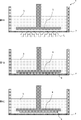
- FIGS. 1A-1C are schematic diagrams of a method for manufacturing a three-dimensional object according to one embodiment of the present invention. It is a schematic diagram showing the whole evaluation model M1.
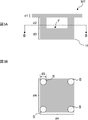
- FIG. 3A is an enlarged view of part of the evaluation model M1 viewed from a direction perpendicular to the molding direction.
- FIG. 3B is a cross-sectional view taken along line BB of FIG. 3A.
- FIG. 3 is a diagram for explaining a modeled object 11 and a non-design hardened portion 13 formed thereon;
- a photocurable resin composition according to an embodiment of the present invention includes a polymerizable organic compound component and a photopolymerization initiator.
- the polymerizable organic compound component is preferably at least one selected from a monofunctional (meth)acrylic acid ester monomer and a monofunctional (meth)acrylamide-based monomer, and a polyfunctional (meth)acrylic acid ester. and a monomer.
- a monofunctional (meth)acrylic acid ester monomer is a compound having one (meth)acryloyl group.
- a polyfunctional (meth)acrylate monomer is a compound having two or more (meth)acryloyl groups.
- a monofunctional (meth)acrylamide-based monomer is a (meth)acrylamide compound having one (meth)acryloyl group.
- the content of the polyfunctional (meth)acrylic acid ester monomer in 100% by mass of the polymerizable organic compound component is preferably 6 to 50% by mass, more preferably 20 to 50% by mass, and still more preferably. is 30 to 45% by mass. Specifically, the content is, for example, 6, 10, 15, 20, 25, 30, 35, 40, 45, 50% by mass, and within the range between any two of the numerical values illustrated here There may be.
- the monofunctional (meth)acrylate monomer preferably contains a monofunctional (meth)acrylate monomer having a cyclic structure (first cyclic structure).
- the first cyclic structure is, for example, a polycyclic structure or a cyclic structure of an alicyclic hydrocarbon group, preferably a cyclic structure that is both a polycyclic structure and a saturated hydrocarbon group.
- the monofunctional (meth)acrylic acid ester monomer preferably does not have at least one of an ether bond, an aromatic ring, and a heteroatom other than oxygen, and preferably does not have any of these. preferable.
- the acrylic equivalent of the monofunctional (meth)acrylate monomer is preferably 160-250, more preferably 180-220, still more preferably 200-215.
- the acrylic equivalent of a monofunctional (meth)acrylic acid ester monomer is a value obtained by dividing the molecular weight of the monofunctional (meth)acrylic acid ester monomer by the number of functional groups of the (meth)acryloyl group.
- the molecular weight of the monofunctional (meth)acrylate monomer is preferably 160-250, more preferably 180-220, still more preferably 200-215.
- Examples of monofunctional (meth)acrylate monomers include methyl (meth)acrylate, ethyl (meth)acrylate, n-butyl (meth)acrylate, iso-butyl (meth)acrylate, t-butyl (meth)acrylate.
- Acrylate 2-ethylhexyl (meth)acrylate, nonyl (meth)acrylate, tridecyl (meth)acrylate, hexadecyl (meth)acrylate, octadecyl (meth)acrylate, isoamyl (meth)acrylate, isodecyl (meth)acrylate, isostearyl (meth)acrylate )
- Acyclic aliphatic (meth)acrylates such as acrylates and lauryl (meth)acrylates;
- Aromatic (meth)acrylate such as benzyl (meth)acrylate, nonylphenoxyethyl (meth)acrylate, 2-hydroxy-3-phenoxypropyl (meth)acrylate, nonylphenoxyethyltetrahydrofurfuryl (meth)acrylate, phenoxyethyl (meth)acrylate, etc.
- acrylates Dicyclopentenyl (meth)acrylate, dicyclopentanyl (meth)acrylate, dicyclopentenyloxyethyl (meth)acrylate, tetracyclododecanyl (meth)acrylate, cyclohexyl (meth)acrylate, isobornyl (meth)acrylate, norbornyl ( Alicyclic (meth)acrylates such as meth)acrylate, adamantan-1-yl (meth)acrylate, 2-(meth)acryloyloxymethyl-2-methyladamantane; Hydroxyalkyl (meth)acrylates such as 2-hydroxyethyl (meth)acrylate, 2-hydroxypropyl (meth)acrylate, 4-hydroxybutyl (meth)acrylate, 3-chloro-2-hydroxypropyl (meth)acrylate; Ethoxyethoxyethyl (meth)acrylate, methoxyethyl (meth)acrylate, butoxyeth
- alicyclic (meth)acrylates alicyclic (meth)acrylic acid esters are preferred.
- at least one selected from the group consisting of acyclic aliphatic (meth)acrylates and alicyclic (meth)acrylates is preferred, and alicyclic (meth)acrylates are more preferred.
- Isobornyl (meth)acrylate is preferred from the standpoint of availability, glass transition temperature, and the like. These may be used alone or in combination of two or more.
- the monofunctional (meth)acrylamide-based monomer preferably includes a monofunctional (meth)acrylamide-based monomer having a cyclic structure (second cyclic structure).
- the second cyclic structure is, for example, a heterocyclic ring, preferably a cyclic structure containing a heteroatom such as an oxygen atom or a nitrogen atom.
- the second cyclic structure in one aspect, is preferably a cyclic structure that does not contain an aromatic ring.
- the second cyclic structure is, for example, a cyclic structure having a morpholine skeleton, a pyrrolidine skeleton, or the like.
- the acrylic equivalent of the monofunctional (meth)acrylamide-based monomer is preferably 100-200, more preferably 120-180, still more preferably 130-160.
- the acrylic equivalent of a monofunctional (meth)acrylamide-based monomer is a value obtained by dividing the molecular weight of the monofunctional (meth)acrylamide-based monomer by the number of functional groups of the (meth)acryloyl group.
- the molecular weight of the monofunctional (meth)acrylamide-based monomer is preferably 100-200, more preferably 120-180, still more preferably 130-160.
- Examples of monofunctional (meth)acrylamide-based monomers include (meth)acryloylmorpholine, dimethyl(meth)acrylamide, diethyl(meth)acrylamide, hydroxyethyl(meth)acrylamide, isopropyl(meth)acrylamide, dimethylaminopropyl (Meth)acrylamide, N-(meth)acryloyloxyethylhexahydrophthalimide and the like. From the viewpoint of availability, glass transition temperature, etc., one or more of the group consisting of (meth)acryloylmorpholine or N-(meth)acryloyloxyethylhexahydrophthalimide is preferred, and (meth)acryloylmorpholine is particularly preferred. preferable. These may be used alone or in combination of two or more.
- the polyfunctional (meth)acrylate monomer preferably contains a polyfunctional (meth)acrylate monomer having a cyclic structure (third cyclic structure).
- the third cyclic structure is, for example, a polycyclic structure or a cyclic structure of an alicyclic hydrocarbon group, preferably a cyclic structure that is both a polycyclic structure and a saturated hydrocarbon group.
- the polyfunctional (meth) acrylic acid ester monomer preferably does not have at least one of an ether bond, an aromatic ring, and a heteroatom other than oxygen, and more preferably does not have any of these. preferable.
- the polyfunctional (meth)acrylic acid ester monomer is preferably a bifunctional (meth)acrylic acid ester monomer.
- Polyfunctional (meth) acrylic acid ester monomers include bifunctional (meth) acrylic acid ester monomers, trifunctional (meth) acrylic acid ester monomers, and tetrafunctional or higher (meth) acrylic acid ester monomers. A body etc. are mentioned.
- the acrylic equivalent of the polyfunctional (meth)acrylate monomer is preferably 80-200, more preferably 100-180, still more preferably 120-160.
- the acrylic equivalent of the polyfunctional (meth)acrylic acid ester monomer is a value obtained by dividing the molecular weight of the polyfunctional (meth)acrylic acid ester monomer by the number of functional groups of the (meth)acryloyl group.
- the molecular weight of the polyfunctional (meth)acrylic acid ester monomer is preferably 200-2000, more preferably 250-1500, still more preferably 280-1000.
- Alicyclic di(meth)acrylate monomers such as 1,3-adamantanedimethanol di(meth)acrylate and tricyclodecanedimethanol di(meth)acrylate; 1,3-butanediol di(meth)acrylate, 1,4-butanediol di(meth)acrylate, 1,6-hexadiol di(meth)acrylate, 1,9-nonanediol di(meth)acrylate, 1, alkanediol di(meth)acrylate monomers such as 10-decanediol di(meth)acrylate; Di(meth)acrylic acid ester monomers having a neopentyl glycol structure such as neopentyl glycol di(meth)acrylate and neopentyl glycol-modified trimethylolpropane di(meth)acrylate; Tetramethylene glycol di(meth)
- trifunctional (meth)acrylic acid ester monomers examples include isocyanuric acid ethylene oxide-modified tri(meth)acrylate, pentaerythritol tri(meth)acrylate, trimethylolpropane tri(meth)acrylate, tris[(meth)acrylooxy ethyl]isocyanurate and the like.
- Tetra- or higher-functional (meth)acrylic acid ester monomers include ditrimethylolpropane tetra(meth)acrylate, dimethylolpropane tetra(meth)acrylate, pentaerythritol tetra(meth)acrylate, and pentaerythritol ethoxytetra(meth)acrylate. , dipentaerythritol penta(meth)acrylate, dipentaerythritol hexa(meth)acrylate and the like.
- the polymerizable organic compound component preferably contains a urethane (meth)acrylate oligomer.
- a urethane (meth)acrylate oligomer has at least one or more urethane bonds and at least one or more (meth)acrylate groups in the molecule.
- Addition of a urethane (meth)acrylate oligomer is also preferable from the viewpoint of curing shrinkage during molding, and can contribute to the bending strength of the molded object by stress relaxation in a low-temperature region.
- the urethane (meth)acrylate oligomer is preferably a polyfunctional urethane (meth)acrylate oligomer.
- the polyfunctional urethane (meth)acrylate oligomer is preferably a bifunctional or higher functional urethane (meth)acrylate oligomer, more preferably a 2- to 15-functional urethane (meth)acrylate oligomer, and still more preferably a 2- to 6-functional urethane ( A meth)acrylate oligomer, most preferably a bifunctional urethane (meth)acrylate oligomer.
- urethane (meth)acrylate oligomer it is preferable to exclude the aforementioned polyfunctional (meth)acrylic acid ester monomer.
- the aforementioned polyfunctional (meth)acrylic acid ester monomers are preferably excluding urethane (meth)acrylate oligomers.
- the urethane (meth)acrylate oligomer comprises an active hydrogen group-containing polyol component (a), a diisocyanate component (b) and an active hydrogen group-containing (meth)acrylic component (c).
- Component (a) is, for example, polyethylene glycol, polypropylene glycol, polytetramethylene glycol, ethylene oxide-modified bisphenol, propylene oxide-modified bisphenol, polyglycol obtained by copolymerization of ethylene oxide and propylene oxide, polyester polyol, polycarbonate polyol, Polyacrylic polyol, polybutadiene polyol and the like can be mentioned. These may be used alone or in combination of two or more.
- Component (b) is, for example, tolylene diisocyanate, xylylene diisocyanate, diphenylmethane diisocyanate, hexamethylene diisocyanate, trimethylhexamethylene diisocyanate, tetramethylxylylene diisocyanate, isophorone diisocyanate, hydrogenated tolylene diisocyanate, hydrogenated xylylene Mention may be made of diisocyanates, hydrogenated diphenylmethane diisocyanates. These may be used alone or in combination of two or more.
- Component (c) is, for example, 2-hydroxyethyl (meth)acrylate, 2-hydroxypropyl (meth)acrylate, 4-hydroxybutyl (meth)acrylate pentaerythritol triacrylate, hydroxyalkyl such as pentaerythritol tri(meth)acrylate (Meth)acrylates may be mentioned. These may be used alone or in combination of two or more.
- the urethane (meth)acrylate oligomer is produced by reaction (for example, polycondensation reaction) of the active hydrogen group-containing polyol component (a), the diisocyanate component (b), and the active hydrogen group-containing (meth)acrylic component (c).
- the weight average molecular weight of the urethane (meth)acrylate oligomer is preferably 1,000 to 60,000, more preferably 3,000 to 40,000, most preferably 5,000 to 10,000.
- the weight-average molecular weight is preferably determined by using tetrahydrofuran as a solvent under the following conditions, using a GPC system (SC-8010 manufactured by Tosoh Corporation) or the like, and preparing a calibration curve with commercially available standard polystyrene. The measurement conditions used in the experimental examples are shown below. Flow rate: 1.0ml/min Set temperature: 40 ° C.
- the polymerizable organic compound component contains a monofunctional (meth)acrylamide-based monomer, a polyfunctional (meth)acrylic acid ester monomer, and a urethane (meth)acrylate oligomer
- 100 mass of the polymerizable organic compound component % the content of the monofunctional (meth)acrylamide-based monomer is preferably 30 to 70% by mass, more preferably 40 to 60% by mass, and still more preferably 45 to 65% by mass.
- the polymerizable organic compound component contains a monofunctional (meth)acrylamide-based monomer, a polyfunctional (meth)acrylic acid ester monomer, and a urethane (meth)acrylate oligomer
- 100 mass of the polymerizable organic compound component % the content of the polyfunctional (meth) acrylic acid ester monomer is preferably 20 to 60% by mass, more preferably 30 to 50% by mass, and still more preferably 35 to 45% by mass. .
- the polymerizable organic compound component contains a monofunctional (meth)acrylamide-based monomer, a polyfunctional (meth)acrylic acid ester monomer, and a urethane (meth)acrylate oligomer
- 100 mass of the polymerizable organic compound component % the content of the urethane (meth)acrylate oligomer is preferably 0.1 to 30% by mass, more preferably 1 to 20% by mass, and still more preferably 5 to 15% by mass.
- the polymerizable organic compound component may contain other monomers such as vinyl compounds and epoxy compounds as long as the effects of the present invention are not impaired.
- vinyl compounds include vinylpyrrolidone and N-vinylformamide.
- photopolymerization initiators include benzophenone and its derivatives, benzyl and its derivatives, anthraquinone and its derivatives, benzoin, benzoin methyl ether, benzoin ethyl ether, benzoin propyl ether, benzoin isobutyl ether, benzyl dimethyl ketal and other benzoin derivatives, diethoxy Acetophenone, acetophenone derivatives such as 4-t-butyltrichloroacetophenone, 2-dimethylaminoethyl benzoate, p-dimethylaminoethyl benzoate, diphenyl disulfide, thioxanthone and its derivatives, camphorquinone, 7,7-dimethyl-2,3-di oxobicyclo[2.2.1]heptane-1-carboxylic acid, 7,7-dimethyl-2,3-dioxobicyclo[2.2.1]heptane-1-carboxylic
- the content of the photopolymerization initiator is preferably 0.5 to 10 parts by mass, more preferably 1 to 7 parts by mass, per 100 parts by mass of the polymerizable organic compound component. Within such a range, a sufficient curing rate can be obtained and storage stability is also good.
- the photocurable resin composition according to one embodiment of the present invention may contain a dye.
- the dye is preferably an organic dye.
- the organic dye preferably has a cyclic structure (fourth cyclic structure).
- the fourth cyclic structure is preferably an aromatic ring.
- the fourth cyclic structure does not have a nitrogen atom (not having a nitrogen atom as an atom forming the ring). Moreover, in one aspect, it is preferable that neither a nitrogen atom nor a sulfur atom is included.
- the fourth cyclic structure include aromatic rings, preferably aromatic rings that do not contain heteroatoms in the cyclic skeleton.
- the fourth cyclic structure is preferably a polycyclic structure, specifically a structure containing, for example, anthraquinone and its derivatives in its skeleton.
- An organic dye having a structure containing an anthraquinone and its derivative in its skeleton as the fourth cyclic structure is, for example, a compound represented by the following general formula (1).
- R 1 and R 2 are each independently a hydrogen atom, a hydroxyl group, or a monovalent organic group, preferably a hydrogen atom or a hydroxyl group.
- X and Y are each independently an oxygen atom (--O--), a sulfur atom (--S--) or a nitrogen atom (--NH--), preferably a nitrogen atom (--NH--).
- R 3 and R 4 are each independently a hydrogen atom, a hydroxyl group, or an alkyl group having 1 to 10 carbon atoms.
- the aromatic ring to which R 3 and R 4 are bonded may have a plurality of R 3 and R 4 respectively.
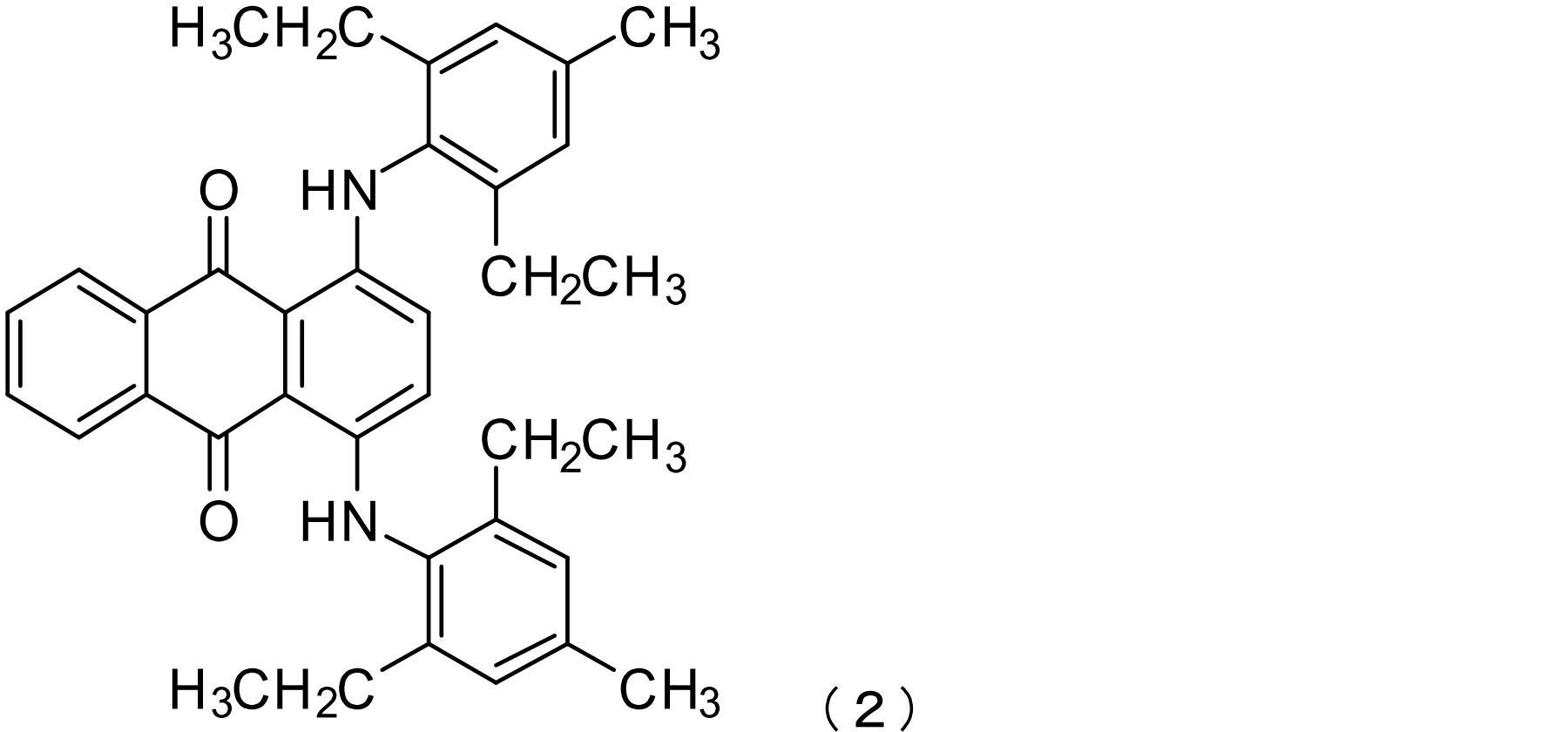
- the organic dye is, for example, a compound represented by the following structural formula (2) or structural formula (3).
- the content of the dye is preferably 0.001 to 1.0 parts by mass, more preferably 0.03 to 0.8 parts by mass, and 0.05 to 0.5 parts by mass with respect to 100 parts by mass of the polymerizable organic compound component. Parts by weight are most preferred.
- the content of the dye is specifically, for example, 0.001, 0.01, 0.02, 0.03, 0.04, 0.05, 0.001, 0.01, 0.02, 0.03, 0.04, 0.05, 0.05, 0.001, 0.01, 0.02, 0.03, 0.04, 0.05, 0.02, 0.03, 0.04, 0.05, 0.02, 0.03, 0.04, 0.05, 0.02, 0.03, 0.04, 0.05, 0.02, 0.03, 0.04, 0.05.
- the photocurable resin composition according to one embodiment of the present invention may optionally contain additives other than the above components, such as curing accelerators, chain transfer agents, and thickeners, as long as the physical properties of the present invention are satisfied.
- additives other than the above components such as curing accelerators, chain transfer agents, and thickeners, as long as the physical properties of the present invention are satisfied.
- Already known substances such as thickening agents, fillers, plasticizers and antirust agents may be contained.
- curing accelerators examples include those containing nitrogen atoms. Among them, tertiary amines having an alkyl group are preferred, and specific examples include dimethylpalmitylamine.
- the content of the curing accelerator is preferably 0.1 to 10 parts by mass, more preferably 0.3 to 7 parts by mass, based on 100 parts by mass of the polymerizable organic compound component.
- Organic phosphines are preferably exclusive of photoinitiators. Among organic phosphines, those having a skeleton in which three organic groups are bonded to a phosphorus atom are preferred. An aromatic group is preferred as the organic group. As the organic phosphine, triphenylphosphine is preferred.
- the content of the organic phosphine is preferably from 0.001 to 1.0 parts by mass, more preferably from 0.02 to 0.8 parts by mass, and from 0.03 to 0.00 parts by mass with respect to 100 parts by mass of the polymerizable organic compound component. 5 parts by weight is most preferred. Within such a range, a sufficient curing rate can be obtained and storage stability is also good.
- the photocurable resin composition according to one embodiment of the present invention has an illuminance of 1.7 mW/cm 2 and an average thickness of 100 ⁇ m when cured by irradiation with light having an irradiation dose of 7.65 mJ/cm 2 .
- the light transmittance of the cured product at a wavelength of 405 nm is 24% or less, preferably 23% or less. Due to manufacturing difficulties, the light transmittance is preferably 1% or more, more preferably 10% or more.
- the photocurable resin composition according to one embodiment of the present invention can be applied to various three-dimensional shaping methods in which the composition is polymerized by light irradiation and shaped. It is preferably used in a surface exposure method, particularly in a three-dimensional modeling method in which light is irradiated from below.
- a method for producing a three-dimensional object according to one embodiment of the present invention includes a step of irradiating the photocurable resin composition with light.
- the photocurable resin composition is cured by light irradiation to obtain a photocured product, which becomes a three-dimensional object.
- a method for manufacturing a three-dimensional object according to one embodiment of the present invention will be described in more detail with reference to FIG. a step of irradiating with light to form a cured layer.
- the light irradiation is by a surface exposure method, and more preferably the light irradiation is performed from below.
- the manufacturing method further includes a step of vertically moving the modeling substrate 5 or the modeling film 7 .
- the modeled object is moved vertically in order to peel off the modeled object from the modeled film 7 and to move to the light irradiation position of the next layer.
- the movement for peeling off may be increased more than the amount of movement required to move to the light irradiation position of the next layer, and then the modeling should proceed so as to return (lower) to the light irradiation position of the next layer. can be done.
- the manufacturing method further includes a step of filling the photocurable resin composition 3 .
- it includes a step of taking out the modeled object from the modeling apparatus 1, cleaning it, irradiating it with light, and further curing it.
- Hydroxy (meth) acrylate is 2 -hydroxyethyl acrylate.) 10 g, phenylbis(2,4,6-trimethylbenzoyl)phosphine oxide (I-819: manufactured by IGM Resins B.V.) 4 g, dimethylpalmitylamine (DM6098: manufactured by Kao Corporation) 0 .5 g, 50 mg of triphenylphosphine, and 50 mg of the dye of the above structural formula (2) (Macrolex Blue: manufactured by LANXESS) were mixed to prepare a photocurable resin composition.
- the photocurable resin composition coated on the substrate was irradiated with light having a wavelength of 405 nm and an illuminance of 1.7 mW/cm 2 for 4.5 seconds (irradiation amount 7.65 mJ/cm 2 ) to form a 45 mm long ⁇ 25 mm wide ⁇
- a test piece having a thickness of 100 ⁇ m was prepared. Then, using a spectrophotometer “SolidSpec-3700” manufactured by Shimadzu Corporation, the absorbance a at a wavelength of 405 nm in the thickness direction of the test piece separated from the substrate was measured. A sampling pitch was set to 1.0 nm, and an integrating sphere was used as a detector.
- the actual thickness b of the test piece was measured with a digital caliper "MDC-25MX" manufactured by Mitutoyo Corporation, and the transmittance T of light with a wavelength of 405 nm per 100 ⁇ m thickness was obtained by the following formula (3).
- T [%] 10 - a x 100/b [nm] x 100 (3)
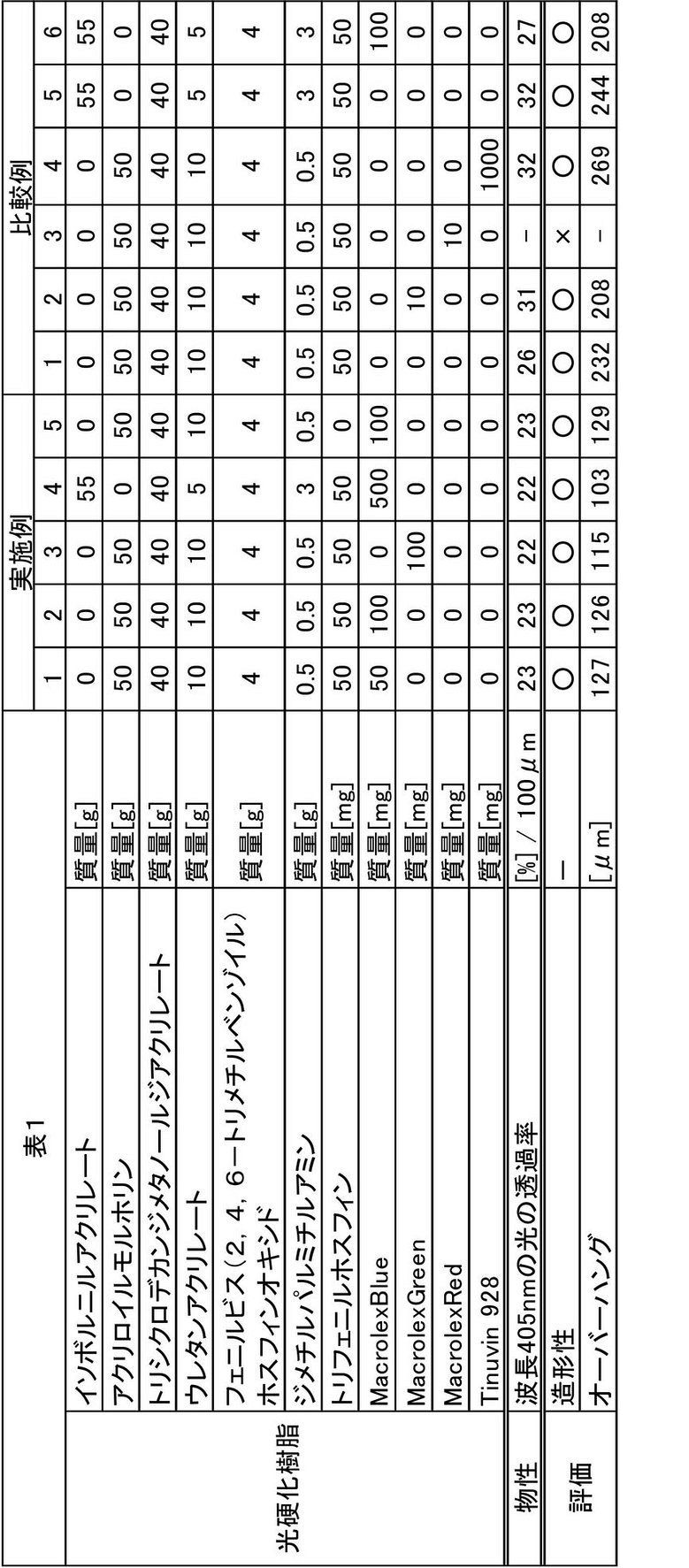
- Table 1 shows the measurement results.
- FIG. 3A is an enlarged view of a part of the formability evaluation model M1 viewed from a direction perpendicular to the formability direction.
- FIG. 3B is a cross-sectional view taken along line BB of FIG. 3A.
- the dimensions of each part are as follows.
- the cylinder S has a height of d2 and a diameter of d5.
- the occurrence of an undesigned cured portion on the surface opposite to the light irradiation surface of the object or the undesigned cured product may be referred to as "overhang”.
- Examples 2 to 5 and Comparative Examples 1 to 6 A photocurable resin composition was prepared according to the composition shown in Table 1, and the physical properties were measured and the molded model was evaluated in the same manner as in Example 1. In Comparative Example 3, a benzotriazole-based compound was added instead of the dye, but it was difficult to cure and shape.
- Modeling apparatus 3 Composition 5: Modeling substrate 7: Modeling film 9: Cured layer 11: Modeled object 13: Undesigned cured part L: Light M1: Evaluation model
Landscapes
- Chemical & Material Sciences (AREA)
- Materials Engineering (AREA)
- Engineering & Computer Science (AREA)
- Organic Chemistry (AREA)
- Health & Medical Sciences (AREA)
- Polymers & Plastics (AREA)
- Medicinal Chemistry (AREA)
- Chemical Kinetics & Catalysis (AREA)
- Manufacturing & Machinery (AREA)
- Physics & Mathematics (AREA)
- Mechanical Engineering (AREA)
- Optics & Photonics (AREA)
- Life Sciences & Earth Sciences (AREA)
- Wood Science & Technology (AREA)
- Toxicology (AREA)
- Polymerisation Methods In General (AREA)
Abstract
Description
(1)重合性有機化合物成分と、光重合開始剤と、を含む光硬化性樹脂組成物であって、前記光硬化性樹脂組成物を照度が1.7mW/cm2であり、かつ照射量が7.65mJ/cm2の光を照射して硬化させた平均厚みが100μmの硬化物の波長405nmにおける光線透過率が24%以下である、光硬化性樹脂組成物。
(2)前記重合性有機化合物成分は、単官能(メタ)アクリル酸エステル単量体及び単官能(メタ)アクリルアミド系単量体から選ばれる少なくとも何れか1種類と、多官能(メタ)アクリル酸エステル単量体と、を含む(1)に記載の光硬化性樹脂組成物。
(3)前記重合性有機化合物成分100質量%中、前記多官能(メタ)アクリル酸エステル単量体の含有量は、6~50質量%である、(2)に記載の光硬化性樹脂組成物。
(4)前記単官能(メタ)アクリル酸エステル単量体は、第1環状構造を有する単官能(メタ)アクリル酸エステル単量体を含む、(2)又は(3)に記載の光硬化性樹脂組成物。
(5)前記単官能(メタ)アクリルアミド系単量体は、第2環状構造を有する単官能(メタ)アクリルアミド系単量体を含む、(2)~(4)の何れか1項に記載の光硬化性樹脂組成物。
(6)前記多官能(メタ)アクリル酸エステル単量体は、第3環状構造を有する多官能(メタ)アクリル酸エステル単量体を含む、(2)~(5)の何れか1項に記載の光硬化性樹脂組成物。
(7)前記単官能(メタ)アクリル酸エステル単量体は、第1環状構造を有する単官能(メタ)アクリル酸エステル単量体を含み、前記単官能(メタ)アクリルアミド系単量体は、第2環状構造を有する単官能(メタ)アクリルアミド系単量体を含み、前記多官能(メタ)アクリル酸エステル単量体は、第3環状構造を有する多官能(メタ)アクリル酸エステル単量体を含み、(2)又は(3)に記載の光硬化性樹脂組成物。
(8)ウレタン(メタ)アクリレートオリゴマーを含む、(1)~(7)の何れか1項に記載の光硬化性樹脂組成物。
(9)染料を含む(1)~(8)の何れか1項に記載の光硬化性樹脂組成物。
(10)前記染料が有機染料である(9)に記載の光硬化性樹脂組成物。
(11)前記有機染料が第4環状構造を有する(9)又は(10)に記載の光硬化性樹脂組成物。
(12)前記第4環状構造が窒素原子を含まない(11)に記載の光硬化性樹脂組成物。
(13)(1)~(12)の何れか1項に記載の光硬化性樹脂組成物の光硬化物。
(14)(1)~(12)の何れか1項に記載の光硬化性樹脂組成物に対して、光照射する工程を備える、立体造形物の製造方法。
本発明の一実施形態にかかる光硬化性樹脂組成物は、重合性有機化合物成分と、光重合開始剤と、を含む。
重合性有機化合物成分は、好ましくは、単官能(メタ)アクリル酸エステル単量体及び単官能(メタ)アクリルアミド系単量体から選ばれる少なくとも何れか1種類と、多官能(メタ)アクリル酸エステル単量体と、を含む。
ベンジル(メタ)アクリレート、ノニルフェノキシエチル(メタ)アクリレート、2-ヒドロキシ-3-フェノキシプロピル(メタ)アクリレート、ノニルフェノキシエチルテトラヒドロフルフリル(メタ)アクリレート、フェノキシエチル(メタ)アクリレート等の芳香族(メタ)アクリレート;
ジシクロペンテニル(メタ)アクリレート、ジシクロペンタニル(メタ)アクリレート、ジシクロペンテニルオキシエチル(メタ)アクリレート、テトラシクロドデカニル(メタ)アクリレート、シクロヘキシル(メタ)アクリレート、イソボルニル(メタ)アクリレート、ノルボルニル(メタ)アクリレート、アダマンタン-1-イル(メタ)アクリレート、2-(メタ)アクリロイルオキシメチル-2-メチルアダマンタン等の脂環式(メタ)アクリレート;
2-ヒドロキシエチル(メタ)アクリレート、2-ヒドロキシプロピル(メタ)アクリレート、4-ヒドロキシブチル(メタ)アクリレート、3-クロロ-2-ヒドロキシプロピル(メタ)アクリレート等のヒドロキシアルキル(メタ)アクリレート;
エトキシエトキシエチル(メタ)アクリレート、メトキシエチル(メタ)アクリレート、ブトキシエチル(メタ)アクリレート、テトラヒドロフルフリル(メタ)アクリレート、グリシジル(メタ)アクリレート、カプロラクトン変性テトラヒドロフルフリル(メタ)アクリレート、4-t-ブチルシクロヘキシル(メタ)アクリレート、ウレタンモノ(メタ)アクリレート、(メタ)アクリル酸等が挙げられる。
脂環式(メタ)アクリレートの中では、脂環式(メタ)アクリル酸エステルが好ましい。脂環式(メタ)アクリル酸エステルの中では、ジシクロペンタニル(メタ)アクリレート、テトラシクロドデカニル(メタ)アクリレート、イソボルニル(メタ)アクリレート、ノルボルニル(メタ)アクリレート、アダマンタン-1-イル(メタ)アクリレートからなる群から選択される1種以上が好ましい。
これらの中では、非環式脂肪族(メタ)アクリル酸エステル、及び脂環式(メタ)アクリル酸エステルからなる群の1種以上が好ましく、脂環式(メタ)アクリル酸エステルがより好ましい。
入手の容易性やガラス転移温度等の観点からは、イソボルニル(メタ)アクリレートが好ましい。
これらは単独で使用しても2種以上を併用してもよい。
これらは単独で使用しても2種以上を併用してもよい。
1,3-アダマンタンジメタノールジ(メタ)アクリレート、トリシクロデカンジメタノールジ(メタ)アクリレート等の脂環式ジ(メタ)アクリル酸エステル単量体;
1,3-ブタンジオールジ(メタ)アクリレート、1,4-ブタンジオールジ(メタ)アクリレート、1,6-ヘキサジオールジ(メタ)アクリレート、1,9-ノナンジオールジ(メタ)アクリレート、1,10-デカンジオールジ(メタ)アクリレート等のアルカンジオールジ(メタ)アクリル酸エステル単量体;
ネオペンチルグリコールジ(メタ)アクリレート、ネオペンチルグリコール変性トリメチロールプロパンジ(メタ)アクリレート等のネオペンチルグリコール構造を有するジ(メタ)アクリル酸エステル単量体;
テトラメチレングリコールジ(メタ)アクリレート、ジエチレングリコールジ(メタ)アクリレート、トリエチレングリコールジ(メタ)アクリレート、テトラエチレングリコールジ(メタ)アクリレート、ポリエチレングリコールジ(メタ)アクリレート、プロピレングリコールジ(メタ)アクリレート、ジプロピレングリコールジ(メタ)アクリレート、トリプロピレングリコールジ(メタ)アクリレート、ポリプロピレングリコールジ(メタ)アクリレート等の(ポリ)アルキレングリコールジ(メタ)アクリル酸エステル単量体;
2,2-ビス(4-(メタ)アクリロキシジエトキシフェニル)プロパン、2,2-ビス(4-(メタ)アクリロキシプロポキシフェニル)プロパン、2,2-ビス(4-(メタ)アクリロキシテトラエトキシフェニル)プロパン等のビスフェノール構造を有するジ(メタ)アクリル酸エステル単量体;
ステアリン酸変性ペンタエリストールジ(メタ)アクリレート、イソシアヌル酸エチレンオキサイド変性ジ(メタ)アクリレート、ジグリセリンEO(エチレンオキシド)変性ジ(メタ)アクリレート等が挙げられる。
ウレタン(メタ)アクリレートオリゴマーとしては、前述の多官能(メタ)アクリル酸エステル単量体を除くことが好ましい。前述の多官能(メタ)アクリル酸エステル単量体は、ウレタン(メタ)アクリレートオリゴマーを除くことが好ましい。
成分(a)は、例えば、ポリエチレングリコール、ポリプロピレングリコール、ポリテトラメチレングリコール、エチレンオキサイド変性ビスフェノール、プロピレンオキサイド変性ビスフェノール、エチレンオキサイドとプロピレンオキサイドとの共重合で得られるポリグリコール、ポリエステルポリオール、ポリカーボネートポリオール、ポリアクリルポリオール、ポリブタジエンポリオール等を挙げることができる。これらは、単独で使用しても2種以上を併用してもよい。
ここで、ウレタン(メタ)アクリレートオリゴマーは、例えば、活性水素基含有ポリオール成分(a)とジイソシアネート成分(b)と活性水素基含有(メタ)アクリル成分(c)とを反応(例えば、重縮合反応)させることにより得られる。
ウレタン(メタ)アクリレートオリゴマーの重量平均分子量は、1000~60000が好ましく、3000~40000がより好ましく、5000~10000が最も好ましい。重量平均分子量は、下記の条件にて、溶剤としてテトラヒドロフランを用い、GPCシステム(東ソー社製SC-8010)等を使用し、市販の標準ポリスチレンで検量線を作成して求めることが好ましい。以下に実験例で使用した測定条件を示す。
流速:1.0ml/min
設定温度:40℃カラム構成:東ソー社製「TSK guardcolumn MP(×L)」6.0mmID×4.0cm1本、及び、東ソー社製「TSK-GELMULTIPOREHXL-M」7.8mmID×30.0cm(理論段数16,000段)2本、計3本(全体として理論段数32,000段)
サンプル注入量:100μl(試料液濃度1mg/ml)
送液圧力:39kg/cm2
検出器:RI検出器
ビニル化合物としては、ビニルピロリドン、N-ビニルホルムアミド等が挙げられる。
光重合開始剤としては、ベンゾフェノン及びその誘導体、ベンジル及びその誘導体、アントラキノン及びその誘導体、ベンゾイン、ベンゾインメチルエーテル、ベンゾインエチルエーテル、ベンゾインプロピルエーテル、ベンゾインイソブチルエーテル、ベンジルジメチルケタール等のベンゾイン誘導体、ジエトキシアセトフェノン、4-t-ブチルトリクロロアセトフェノン等のアセトフェノン誘導体、2-ジメチルアミノエチルベンゾエート、p-ジメチルアミノエチルベンゾエート、ジフェニルジスルフィド、チオキサントン及びその誘導体、カンファーキノン、7,7-ジメチル-2,3-ジオキソビシクロ[2.2.1]ヘプタン-1-カルボン酸、7,7-ジメチル-2,3-ジオキソビシクロ[2.2.1]ヘプタン-1-カルボキシ-2-ブロモエチルエステル、7,7-ジメチル-2,3-ジオキソビシクロ[2.2.1]ヘプタン-1-カルボキシ-2-メチルエステル、7,7-ジメチル-2,3-ジオキソビシクロ[2.2.1]ヘプタン-1-カルボン酸クロライド等のカンファーキノン誘導体、2-メチル-1-[4-(メチルチオ)フェニル]-2-モルフォリノプロパン-1-オン、2-ベンジル-2-ジメチルアミノ-1-(4-モルフォリノフェニル)-ブタノン-1等のα-アミノアルキルフェノン誘導体、ベンゾイルジフェニルホスフィンオキサイド、2,4,6-トリメチルベンゾイルジフェニルホスフィンオキサイド、ベンゾイルジエトキシポスフィンオキサイド、2,4,6-トリメチルベンゾイルジメトキシフェニルホスフィンオキサイド、2,4,6-トリメチルベンゾイルジエトキシフェニルホスフィンオキサイド、フェニルビス(2,4,6-トリメチルベンゾイル)ホスフィンオキシド等のアシルホスフィンオキサイド誘導体、オキシ-フェニル-アセチックアシッド2-[2-オキソ-2-フェニル-アセトキシ-エトキシ]-エチルエステル及びオキシ-フェニル-アセチックアシッド2-[2-ヒドロキシ-エトキシ]-エチルエステル等が挙げられる。これらの中では、造形速度の観点からは、アシルホスフィンオキサイド誘導体が好ましく、特にフェニルビス(2,4,6-トリメチルベンゾイル)ホスフィンオキシドが好ましい。
<染料>
本発明の一実施形態にかかる光硬化性樹脂組成物は、染料を含んでいてもよい。染料は、好ましくは有機染料である。有機染料は、好ましくは環状構造(第4環状構造)を有する。第4環状構造は、好ましくは芳香環である。

X及びYは、それぞれ独立して、酸素原子(-O-)、硫黄原子(-S-)又は窒素原子(-NH-)であり、好ましくは窒素原子(-NH-)である。
R3及びR4は、それぞれ独立して、水素原子、水酸基、又は炭素数1~10のアルキル基である。R3及びR4が結合する芳香環は、それぞれR3及びR4を複数有していてもよい。

本発明の一実施形態に係る光硬化性樹脂組成物は、本発明の物性を満たす範囲内であれば、上記の成分以外にも所望により添加剤、例えば、硬化促進剤、連鎖移動剤、増粘剤、充填剤、可塑剤及び防錆剤等の既に知られている物質を含有してもよい。
有機ホスフィンの含有量は、重合性有機化合物成分100質量部に対して、0.001~1.0質量部が好ましく、0.02~0.8質量部がより好ましく、0.03~0.5質量部が最も好ましい。このような範囲であれば、十分な硬化速度が得られ貯蔵安定性も良い。
本発明の一実施形態に係る光硬化性樹脂組成物は、照度が1.7mW/cm2であり、かつ照射量が7.65mJ/cm2の光を照射して硬化させた平均厚みが100μmの硬化物の波長405nmにおける光線透過率が24%以下であり、好ましくは23%以下である。製造上の困難性から当該光線透過率は、好ましくは1%以上であり、より好ましくは10%以上である。
本発明の一実施形態に係る光硬化性樹脂組成物は、光照射により重合を行い造形する種々の立体造形方法に適用できる。面露光方式、特に下方から光照射する立体造形において好ましく用いられる。
本発明の一実施形態に係る立体造形物の製造方法は、図1を参照し、さらに詳しく説明すると、造形基板5と造形フィルム7の間の光硬化性樹脂組成物3の少なくとも一部に対して光照射し硬化層を形成する工程を含む。
好ましくは、光照射は面露光方式による光照射であり、より好ましくは前記光照射が下方から行われる。
好ましくは、当該製造方法は、造形基板5又は造形フィルム7を上下方向に移動させる工程をさらに含む。
好ましくは、造形物を造形フィルム7から引き剥がすため、及び次層の光照射位置への移動のために上下方向へ移動させる。引き剥がしのための移動は、次層の光照射位置への移動に必要な移動分以上に大きく上昇させてもよく、その後次層の光照射位置へ戻す(降下させる)ように造形を進めることができる。
好ましくは、当該製造方法は、光硬化性樹脂組成物3を充填する工程をさらに含む。
好ましくは、造形装置1から造形物を取り出し、洗浄及び光照射を行いさらに硬化させる工程を含む。
アクリロイルモルフォリン(ACMO:KJケミカルズ社製、分子量:141.17、アクリル当量:141.17)50g、トリシクロデカンジメタノールジアクリレート(A-DCP:新中村化学工業社製、分子量:304.38、アクリル当量:152.19)40g、ウレタンアクリレート(重量平均分子量が6500であるポリエーテル系2官能ウレタンアクリート。ポリオール化合物は、ポリプロピレングリコール。有機ポリイソシアネート化合物はイソホロンジイソシアネート。ヒドロキシ(メタ)アクリレートは2-ヒドロキシエチルアクリレート。)10g、フェニルビス(2,4,6-トリメチルベンゾイル)ホスフィンオキシド(I-819:IGM Resins B.V.社製)4g、ジメチルパルミチルアミン(DM6098:花王社製)0.5g、トリフェニルホスフィン50mg及び上記構造式(2)の染料(Macrolex Blue:ランクセス社製)50mgを混合し、光硬化性樹脂組成物を調製した。
基体上に塗布した光硬化性樹脂組成物に、波長405nm、照度1.7mW/cm2の光を4.5秒間照射(照射量7.65mJ/cm2)して、縦45mm×横25mm×厚み100μmの試験片を作成した。そして、株式会社島津製作所製の分光光度計「SolidSpec-3700」を用いて、基体から分離した試験片の厚み方向の波長405nmの吸光度aを測定した。サンプリングピッチは1.0nmとし、検出器には積分球を用いた。
試験片の実際の厚みbは株式会社ミツトヨ製のデジタルノギス「MDC-25MX」にて測定し、下の式(3)にて厚み100μmあたりの波長405nmの光の透過率Tを求めた。
T[%] = 10-a×100/b[nm]×100 (3)
測定結果を表1に示す。
得られた光硬化性樹脂組成物を用いて、実際に評価モデルの造形を行いその造形性及びオーバーハングを評価した。造形装置(ML-48:武藤工業社製)を用い、積層厚みは25μm、照射時間は1.3秒/層という条件下で造形を行った。評価モデルは、図2に示す評価モデルM1を使用した。
d1=1.0mm
d2=3.0mm
d3=3.0mm
d4=5.0mm
d5=1.0mm
得られた光硬化性樹脂組成物を用いて、実際に評価モデルの造形を行いその造形性及びオーバーハングを評価した。造形装置(ML-48:武藤工業社製)を用い、積層厚みは25μm、照射時間は1.3秒/層という条件下で造形を行った。評価モデルは、図2に示す評価モデルM1を使用した。
硬化が不十分で途中で造形物が落ちてしまったり、モデル通りに造形出来なかったりしたものを×、モデル通りの形状に造形出来たものを○とした。
上記評価モデルM1の造形により得られた立体造形物について、図3~4に示すように、造形物11の光照射面の反対面F(図3A)上に設計外硬化部13がどの程度生じたかについて測定した。すなわち、設計上の造形物11の上面に生じた設計外硬化部13の高さH(μm)を測定した。測定結果を表1に示す。
表1に示すような組成により光硬化性樹脂組成物を調製し、実施例1と同様に物性測定及び造形した造形モデルの評価を行った。なお、比較例3では、染料の代わりにベンゾトリアゾール系化合物を添加したが、硬化・造形を行うことが困難であった。
・染料
Macrolex Green:ランクセス社製 (上記構造式(3)の染料)
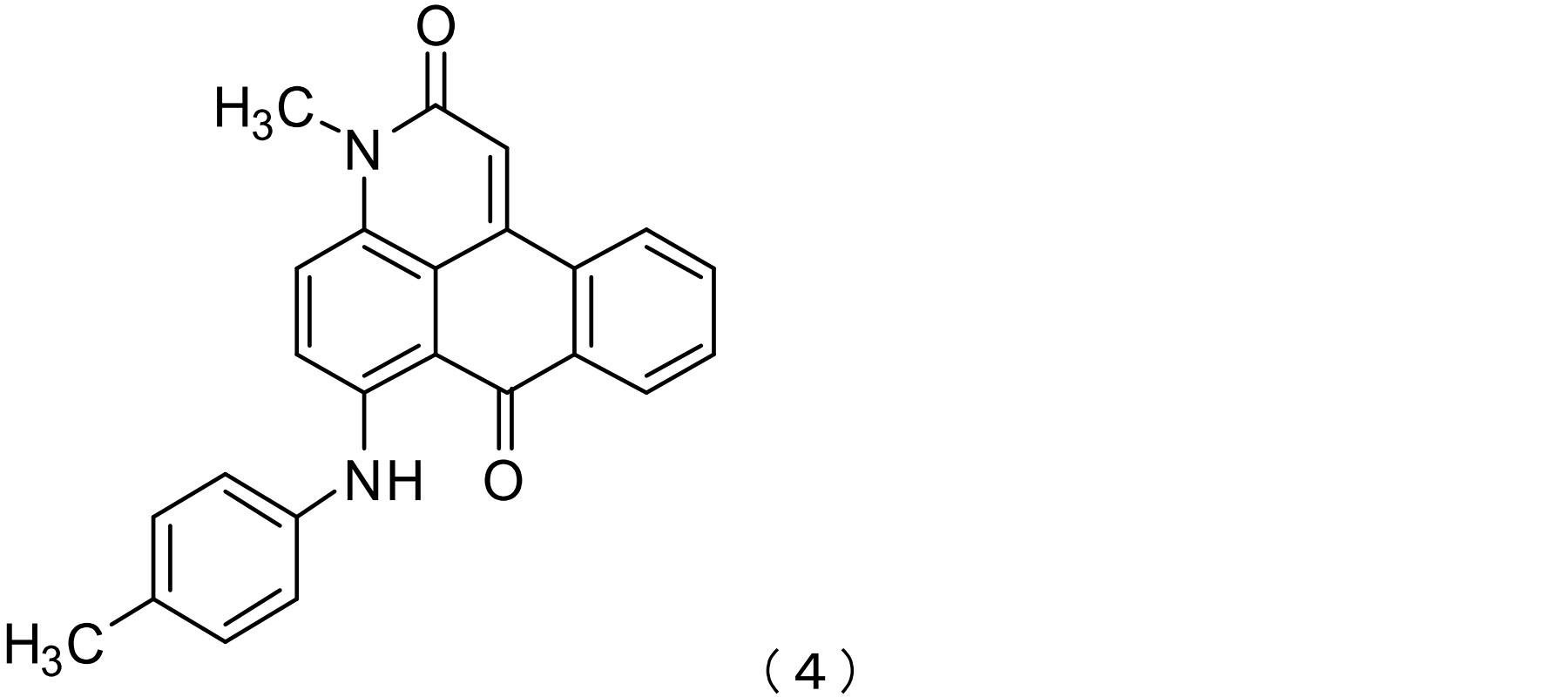
Macrolex Red:ランクセス社製 (下記構造式(4)の染料)
Tinuvin 928 「2-(2H-ベンゾトリアゾール-2-イル)-6-(1-メチル-1-フェニルエチル)-4-(1,1,3,3-テトラメチルブチル)フェノール」:BASFジャパン株式会社製
3:組成物
5:造形基板
7:造形フィルム
9:硬化層
11:造形物
13:設計外硬化部
L:光
M1:評価モデル
Claims (14)
- 重合性有機化合物成分と、光重合開始剤と、を含む光硬化性樹脂組成物であって、
前記光硬化性樹脂組成物を照度が1.7mW/cm2であり、かつ照射量が7.65mJ/cm2の光を照射して硬化させた平均厚みが100μmの硬化物の波長405nmにおける光線透過率が24%以下である、
光硬化性樹脂組成物。 - 前記重合性有機化合物成分は、単官能(メタ)アクリル酸エステル単量体及び単官能(メタ)アクリルアミド系単量体から選ばれる少なくとも何れか1種類と、多官能(メタ)アクリル酸エステル単量体と、を含む請求項1に記載の光硬化性樹脂組成物。
- 前記重合性有機化合物成分100質量%中、前記多官能(メタ)アクリル酸エステル単量体の含有量は、6~50質量%である、請求項2に記載の光硬化性樹脂組成物。
- 前記単官能(メタ)アクリル酸エステル単量体は、第1環状構造を有する単官能(メタ)アクリル酸エステル単量体を含む、
請求項2に記載の光硬化性樹脂組成物。 - 前記単官能(メタ)アクリルアミド系単量体は、第2環状構造を有する単官能(メタ)アクリルアミド系単量体を含む、
請求項2に記載の光硬化性樹脂組成物。 - 前記多官能(メタ)アクリル酸エステル単量体は、第3環状構造を有する多官能(メタ)アクリル酸エステル単量体を含む、
請求項2に記載の光硬化性樹脂組成物。 - 前記単官能(メタ)アクリル酸エステル単量体は、第1環状構造を有する単官能(メタ)アクリル酸エステル単量体を含み、
前記単官能(メタ)アクリルアミド系単量体は、第2環状構造を有する単官能(メタ)アクリルアミド系単量体を含み、
前記多官能(メタ)アクリル酸エステル単量体は、第3環状構造を有する多官能(メタ)アクリル酸エステル単量体を含み、
前記第1環状構造は、多環式構造又は脂環式炭化水素基であり、
前記第2環状構造は、複素環であり、
前記第3環状構造は、多環式構造又は脂環式炭化水素基である、
請求項2に記載の光硬化性樹脂組成物。 - ウレタン(メタ)アクリレートオリゴマーを含む、請求項1に記載の光硬化性樹脂組成物。
- 染料を含む請求項1に記載の光硬化性樹脂組成物。
- 前記染料が有機染料である請求項9に記載の光硬化性樹脂組成物。
- 前記有機染料が第4環状構造を有する請求項10に記載の光硬化性樹脂組成物。
- 前記第4環状構造が窒素原子を含まない請求項11に記載の光硬化性樹脂組成物。
- 請求項1~請求項12の何れか1項に記載の光硬化性樹脂組成物の光硬化物。
- 請求項1~請求項12の何れか1項に記載の光硬化性樹脂組成物に対して、光照射する工程を備える、立体造形物の製造方法。
Priority Applications (4)
| Application Number | Priority Date | Filing Date | Title |
|---|---|---|---|
| CN202280031653.9A CN117222676A (zh) | 2021-04-30 | 2022-04-27 | 光固化性树脂组合物、光固化物以及立体造型物的制造方法 |
| JP2023517602A JPWO2022230947A1 (ja) | 2021-04-30 | 2022-04-27 | |
| EP22795860.0A EP4317199A4 (en) | 2021-04-30 | 2022-04-27 | LIGHT-CURING RESIN COMPOSITION, LIGHT-CURED ARTICLE AND METHOD FOR PRODUCING A THREE-DIMENSIONAL MOLDED BODY |
| US18/287,932 US20240227284A1 (en) | 2021-04-30 | 2022-04-27 | Photocurable resin composition, photocured article, and method for producing three-dimensional molded article |
Applications Claiming Priority (2)
| Application Number | Priority Date | Filing Date | Title |
|---|---|---|---|
| JP2021078053 | 2021-04-30 | ||
| JP2021-078053 | 2021-04-30 |
Publications (1)
| Publication Number | Publication Date |
|---|---|
| WO2022230947A1 true WO2022230947A1 (ja) | 2022-11-03 |
Family
ID=83848570
Family Applications (1)
| Application Number | Title | Priority Date | Filing Date |
|---|---|---|---|
| PCT/JP2022/019129 Ceased WO2022230947A1 (ja) | 2021-04-30 | 2022-04-27 | 光硬化性樹脂組成物、光硬化物、及び立体造形物の製造方法 |
Country Status (6)
| Country | Link |
|---|---|
| US (1) | US20240227284A1 (ja) |
| EP (1) | EP4317199A4 (ja) |
| JP (1) | JPWO2022230947A1 (ja) |
| CN (1) | CN117222676A (ja) |
| TW (1) | TW202248232A (ja) |
| WO (1) | WO2022230947A1 (ja) |
Families Citing this family (1)
| Publication number | Priority date | Publication date | Assignee | Title |
|---|---|---|---|---|
| EP4624537A1 (de) * | 2024-03-25 | 2025-10-01 | LANXESS Deutschland GmbH | 3d druckerzeugnisse |
Citations (4)
| Publication number | Priority date | Publication date | Assignee | Title |
|---|---|---|---|---|
| JP2015038166A (ja) * | 2013-08-19 | 2015-02-26 | 電気化学工業株式会社 | 光造形用(メタ)アクリル系樹脂組成物及び支持体の製造方法 |
| JP2017210539A (ja) | 2016-05-25 | 2017-11-30 | Dic株式会社 | 光造形用硬化性組成物、光硬化物、及び成形品の製造方法 |
| JP2019059101A (ja) * | 2017-09-26 | 2019-04-18 | 富士ゼロックス株式会社 | 三次元造形用インク組成物、三次元造形用インクカートリッジ及び三次元造形装置 |
| JP2019081296A (ja) * | 2017-10-30 | 2019-05-30 | セイコーエプソン株式会社 | 三次元造形物の製造方法 |
Family Cites Families (1)
| Publication number | Priority date | Publication date | Assignee | Title |
|---|---|---|---|---|
| EP3658598B1 (en) * | 2017-07-28 | 2022-11-16 | Nikon Corporation | Photocurable composition and method of manufacturing three-dimensional object |
-
2022
- 2022-04-27 CN CN202280031653.9A patent/CN117222676A/zh active Pending
- 2022-04-27 US US18/287,932 patent/US20240227284A1/en not_active Abandoned
- 2022-04-27 JP JP2023517602A patent/JPWO2022230947A1/ja not_active Withdrawn
- 2022-04-27 EP EP22795860.0A patent/EP4317199A4/en not_active Withdrawn
- 2022-04-27 WO PCT/JP2022/019129 patent/WO2022230947A1/ja not_active Ceased
- 2022-04-29 TW TW111116318A patent/TW202248232A/zh unknown
Patent Citations (4)
| Publication number | Priority date | Publication date | Assignee | Title |
|---|---|---|---|---|
| JP2015038166A (ja) * | 2013-08-19 | 2015-02-26 | 電気化学工業株式会社 | 光造形用(メタ)アクリル系樹脂組成物及び支持体の製造方法 |
| JP2017210539A (ja) | 2016-05-25 | 2017-11-30 | Dic株式会社 | 光造形用硬化性組成物、光硬化物、及び成形品の製造方法 |
| JP2019059101A (ja) * | 2017-09-26 | 2019-04-18 | 富士ゼロックス株式会社 | 三次元造形用インク組成物、三次元造形用インクカートリッジ及び三次元造形装置 |
| JP2019081296A (ja) * | 2017-10-30 | 2019-05-30 | セイコーエプソン株式会社 | 三次元造形物の製造方法 |
Non-Patent Citations (1)
| Title |
|---|
| See also references of EP4317199A4 |
Also Published As
| Publication number | Publication date |
|---|---|
| CN117222676A (zh) | 2023-12-12 |
| EP4317199A1 (en) | 2024-02-07 |
| JPWO2022230947A1 (ja) | 2022-11-03 |
| TW202248232A (zh) | 2022-12-16 |
| US20240227284A1 (en) | 2024-07-11 |
| EP4317199A4 (en) | 2024-10-16 |
Similar Documents
| Publication | Publication Date | Title |
|---|---|---|
| US4912185A (en) | Cross-linkable casting compositions | |
| JP6092200B2 (ja) | インプリント用光硬化性樹脂組成物、その製造方法および構造体 | |
| JP7231119B2 (ja) | 光造形用硬化性樹脂組成物、硬化物及び立体造形物 | |
| JP2010060890A (ja) | 光学物品用活性エネルギー線硬化型樹脂組成物及び硬化物 | |
| US11787951B2 (en) | Photocurable composition for three-dimensional molding, three-dimensional molded product, and method for producing three-dimensional molded product | |
| JP2022099528A (ja) | 活性エネルギー線硬化性樹脂組成物 | |
| JP2010072428A (ja) | 光学物品用活性エネルギー線硬化型樹脂組成物及び硬化物 | |
| WO2022230947A1 (ja) | 光硬化性樹脂組成物、光硬化物、及び立体造形物の製造方法 | |
| JPH01101316A (ja) | 光学用材料 | |
| JPWO2008123358A1 (ja) | 注型重合用活性エネルギー線硬化型樹脂組成物及び硬化物 | |
| KR100285889B1 (ko) | 주형중합용수지조성물및광학재료 | |
| JP6893079B2 (ja) | 注形用紫外線硬化樹脂組成物 | |
| JP6390817B2 (ja) | 光学物品用活性エネルギー線硬化型樹脂組成物、硬化物及び光学シート | |
| JPS62236832A (ja) | 密着性に優れた塗料組成物 | |
| JP6997564B2 (ja) | 注形成型用組成物 | |
| JPWO2019044786A1 (ja) | 樹脂シート及びこれを製造するための硬化型組成物 | |
| JP5070678B2 (ja) | 光硬化性組成物、及び該光硬化性組成物で形成された樹脂成型品 | |
| JP4228768B2 (ja) | 注型重合用活性エネルギー線硬化型樹脂組成物 | |
| JPH11174201A (ja) | プラスチックレンズ用組成物およびプラスチックレンズ | |
| JP2024064680A (ja) | 活性エネルギー線硬化性樹脂組成物およびレンズシート | |
| JP2024064679A (ja) | 活性エネルギー線硬化型樹脂組成物、硬化塗膜及びレンズ | |
| JPH01103616A (ja) | プラスチックレンズ材料 | |
| CN118369363A (zh) | 压印用固化性组合物、图案形成方法及零件的制造方法 | |
| JPH0418454A (ja) | 被覆剤組成物 |
Legal Events
| Date | Code | Title | Description |
|---|---|---|---|
| 121 | Ep: the epo has been informed by wipo that ep was designated in this application |
Ref document number: 22795860 Country of ref document: EP Kind code of ref document: A1 |
|
| WWE | Wipo information: entry into national phase |
Ref document number: 2023517602 Country of ref document: JP |
|
| WWE | Wipo information: entry into national phase |
Ref document number: 18287932 Country of ref document: US |
|
| WWE | Wipo information: entry into national phase |
Ref document number: 22795860 Country of ref document: EP Ref document number: 2022795860 Country of ref document: EP |
|
| WWE | Wipo information: entry into national phase |
Ref document number: 202280031653.9 Country of ref document: CN |
|
| ENP | Entry into the national phase |
Ref document number: 2022795860 Country of ref document: EP Effective date: 20231026 |
|
| NENP | Non-entry into the national phase |
Ref country code: DE |
|
| WWW | Wipo information: withdrawn in national office |
Ref document number: 2022795860 Country of ref document: EP |