WO2022255331A1 - 熱伝導性シリコーン組成物及びその硬化物 - Google Patents
熱伝導性シリコーン組成物及びその硬化物 Download PDFInfo
- Publication number
- WO2022255331A1 WO2022255331A1 PCT/JP2022/022038 JP2022022038W WO2022255331A1 WO 2022255331 A1 WO2022255331 A1 WO 2022255331A1 JP 2022022038 W JP2022022038 W JP 2022022038W WO 2022255331 A1 WO2022255331 A1 WO 2022255331A1
- Authority
- WO
- WIPO (PCT)
- Prior art keywords
- group
- thermally conductive
- component
- carbon atoms
- silicone composition
- Prior art date
- Legal status (The legal status is an assumption and is not a legal conclusion. Google has not performed a legal analysis and makes no representation as to the accuracy of the status listed.)
- Ceased
Links
Classifications
-
- C—CHEMISTRY; METALLURGY
- C08—ORGANIC MACROMOLECULAR COMPOUNDS; THEIR PREPARATION OR CHEMICAL WORKING-UP; COMPOSITIONS BASED THEREON
- C08L—COMPOSITIONS OF MACROMOLECULAR COMPOUNDS
- C08L83/00—Compositions of macromolecular compounds obtained by reactions forming in the main chain of the macromolecule a linkage containing silicon with or without sulfur, nitrogen, oxygen or carbon only; Compositions of derivatives of such polymers
- C08L83/04—Polysiloxanes
-
- C—CHEMISTRY; METALLURGY
- C08—ORGANIC MACROMOLECULAR COMPOUNDS; THEIR PREPARATION OR CHEMICAL WORKING-UP; COMPOSITIONS BASED THEREON
- C08G—MACROMOLECULAR COMPOUNDS OBTAINED OTHERWISE THAN BY REACTIONS ONLY INVOLVING UNSATURATED CARBON-TO-CARBON BONDS
- C08G77/00—Macromolecular compounds obtained by reactions forming a linkage containing silicon with or without sulfur, nitrogen, oxygen or carbon in the main chain of the macromolecule
- C08G77/04—Polysiloxanes
- C08G77/14—Polysiloxanes containing silicon bound to oxygen-containing groups
- C08G77/18—Polysiloxanes containing silicon bound to oxygen-containing groups to alkoxy or aryloxy groups
-
- C—CHEMISTRY; METALLURGY
- C08—ORGANIC MACROMOLECULAR COMPOUNDS; THEIR PREPARATION OR CHEMICAL WORKING-UP; COMPOSITIONS BASED THEREON
- C08K—Use of inorganic or non-macromolecular organic substances as compounding ingredients
- C08K5/00—Use of organic ingredients
- C08K5/16—Nitrogen-containing compounds
- C08K5/34—Heterocyclic compounds having nitrogen in the ring
- C08K5/3467—Heterocyclic compounds having nitrogen in the ring having more than two nitrogen atoms in the ring
- C08K5/3472—Five-membered rings
- C08K5/3475—Five-membered rings condensed with carbocyclic rings
-
- C—CHEMISTRY; METALLURGY
- C08—ORGANIC MACROMOLECULAR COMPOUNDS; THEIR PREPARATION OR CHEMICAL WORKING-UP; COMPOSITIONS BASED THEREON
- C08L—COMPOSITIONS OF MACROMOLECULAR COMPOUNDS
- C08L83/00—Compositions of macromolecular compounds obtained by reactions forming in the main chain of the macromolecule a linkage containing silicon with or without sulfur, nitrogen, oxygen or carbon only; Compositions of derivatives of such polymers
- C08L83/04—Polysiloxanes
- C08L83/06—Polysiloxanes containing silicon bound to oxygen-containing groups
-
- C—CHEMISTRY; METALLURGY
- C08—ORGANIC MACROMOLECULAR COMPOUNDS; THEIR PREPARATION OR CHEMICAL WORKING-UP; COMPOSITIONS BASED THEREON
- C08G—MACROMOLECULAR COMPOUNDS OBTAINED OTHERWISE THAN BY REACTIONS ONLY INVOLVING UNSATURATED CARBON-TO-CARBON BONDS
- C08G77/00—Macromolecular compounds obtained by reactions forming a linkage containing silicon with or without sulfur, nitrogen, oxygen or carbon in the main chain of the macromolecule
- C08G77/04—Polysiloxanes
- C08G77/12—Polysiloxanes containing silicon bound to hydrogen
-
- C—CHEMISTRY; METALLURGY
- C08—ORGANIC MACROMOLECULAR COMPOUNDS; THEIR PREPARATION OR CHEMICAL WORKING-UP; COMPOSITIONS BASED THEREON
- C08G—MACROMOLECULAR COMPOUNDS OBTAINED OTHERWISE THAN BY REACTIONS ONLY INVOLVING UNSATURATED CARBON-TO-CARBON BONDS
- C08G77/00—Macromolecular compounds obtained by reactions forming a linkage containing silicon with or without sulfur, nitrogen, oxygen or carbon in the main chain of the macromolecule
- C08G77/04—Polysiloxanes
- C08G77/20—Polysiloxanes containing silicon bound to unsaturated aliphatic groups
-
- C—CHEMISTRY; METALLURGY
- C08—ORGANIC MACROMOLECULAR COMPOUNDS; THEIR PREPARATION OR CHEMICAL WORKING-UP; COMPOSITIONS BASED THEREON
- C08K—Use of inorganic or non-macromolecular organic substances as compounding ingredients
- C08K3/00—Use of inorganic substances as compounding ingredients
- C08K3/18—Oxygen-containing compounds, e.g. metal carbonyls
- C08K3/20—Oxides; Hydroxides
- C08K3/22—Oxides; Hydroxides of metals
- C08K2003/2227—Oxides; Hydroxides of metals of aluminium
-
- C—CHEMISTRY; METALLURGY
- C08—ORGANIC MACROMOLECULAR COMPOUNDS; THEIR PREPARATION OR CHEMICAL WORKING-UP; COMPOSITIONS BASED THEREON
- C08K—Use of inorganic or non-macromolecular organic substances as compounding ingredients
- C08K2201/00—Specific properties of additives
- C08K2201/001—Conductive additives
Definitions
- the present invention relates to a thermally conductive silicone composition and its cured product.
- heat-dissipating sheets and heat-dissipating greases are used as heat-dissipating materials that have good thermal conductivity and conformability to the surfaces of the members in order to prevent air from intervening between the heat-generating member and the cooling member.
- metal wiring such as copper wire is used for coils and bus bars, and the surface is generally coated with nickel or tin plating or epoxy coating. Corrosion of the metal wiring of coils and bus bars can be suppressed by coating the surface, but corrosion may progress from the exposed metal due to bending, scratches, and pinholes in the coating. Not yet. In particular, when cationic impurities are present in the heat dissipation material, there is a problem that they are electrically attracted and accelerate corrosion of these members.
- an object of the present invention is to provide a thermally conductive silicone composition that becomes a cured product (heat dissipation material) that can suppress corrosion of metal wiring and has excellent heat dissipation properties.
- the present inventors have found an alkenyl group-containing organopolysiloxane having a specific kinematic viscosity, a specific organohydrogenpolysiloxane, a thermally conductive filler, and one end of a molecular chain. It was found that a thermally conductive silicone composition containing trialkoxy-blocked dimethylpolysiloxane, benzotriazole and/or a benzotriazole derivative, and a specific organopolysiloxane can suppress corrosion of metal wiring. completed. That is, the present invention provides the following thermally conductive silicone composition and cured thermally conductive silicone.
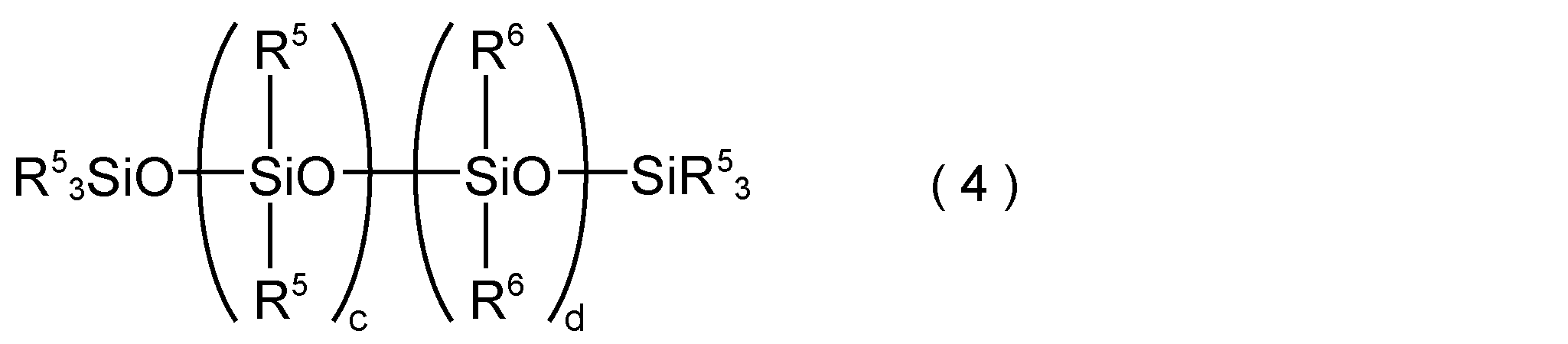
- R 5 is independently an alkyl group having 1 to 10 carbon atoms
- R 6 is a phenyl group
- c and d are numbers of 1 to 20, and the number of siloxane units in parentheses The ordering is random, alternating or block.
- R 3 is a hydrogen atom, a monovalent hydrocarbon group having 1 to 10 carbon atoms, or a group represented by the following formula (5) in the general formula (2);
- R 7 is a monovalent hydrocarbon group having 1 to 15 carbon atoms, or —(CH 2 ) e —Si(OR 8 ) 3 ⁇ R 8 is independently an alkyl group having 1 to 4 carbon atoms; or SiR 9 3 groups (R 9 is independently an alkyl group having 1-4 carbon atoms), and e is an integer of 1-6. ⁇ and * indicates a bond.
- [5] A cured product of the thermally conductive silicone composition according to any one of [1] to [4].
- the thermally conductive silicone composition of the present invention provides a cured product with excellent heat dissipation performance. A stable film is formed on the surface of metals such as copper, and corrosion can be suppressed. Therefore, the thermally conductive silicone composition of the present invention can be suitably used as a thermally conductive material (heat radiating material) for metal wiring cooling members such as bus bars and coils.
- the alkenyl group-containing organopolysiloxane as component (A) is an organopolysiloxane having two or more, preferably 2 to 10, and more preferably 2 to 5 silicon-bonded alkenyl groups per molecule. .
- the main chain portion is generally composed of repeating diorganosiloxane units, but this may include a branched structure as part of the molecular structure, or may be cyclic. However, linear diorganopolysiloxane is preferred from the viewpoint of physical properties such as mechanical strength of the cured product.
- alkenyl group examples include those having usually about 2 to 8 carbon atoms such as vinyl group, allyl group, propenyl group, isopropenyl group, butenyl group, hexenyl group and cyclohexenyl group.
- a lower alkenyl group such as a group is preferred, and a vinyl group is particularly preferred.
- the alkenyl group bonded to the silicon atom may exist either at the end of the molecular chain of the organopolysiloxane or in the middle of the molecular chain. Those having an alkenyl group attached to the atom are preferred.
- groups other than alkenyl groups bonded to silicon atoms include unsubstituted or substituted monovalent hydrocarbon groups such as methyl, ethyl, propyl, isopropyl, butyl, isobutyl, and tert-butyl groups.
- Alkyl groups such as pentyl group, neopentyl group, hexyl group, heptyl group, octyl group, nonyl group, decyl group and dodecyl group; Cycloalkyl groups such as cyclopentyl group, cyclohexyl group and cycloheptyl group; Aryl groups such as xylyl group, naphthyl group and biphenylyl group; aralkyl groups such as benzyl group, phenylethyl group, phenylpropyl group and methylbenzyl group; Groups which are all substituted with halogen atoms such as fluorine, chlorine, bromine, etc., or cyano groups, for example, chloromethyl group, 2-bromoethyl group, 3-chloropropyl group, 3,3,3-trifluoropropyl group , chlorophenyl group, fluorophenyl group, cyano
- the group other than the alkenyl group bonded to the silicon atom of the component (A) organopolysiloxane preferably has 1 to 10 carbon atoms, more preferably 1 to 6 carbon atoms.
- preferably unsubstituted or substituted alkyl groups having 1 to 3 carbon atoms such as methyl group, ethyl group, propyl group, chloromethyl group, bromoethyl group, 3,3,3-trifluoropropyl group, cyanoethyl group and phenyl unsubstituted or substituted phenyl groups such as radicals, chlorophenyl groups and fluorophenyl groups, and particularly preferably methyl groups.
- all groups other than alkenyl groups bonded to silicon atoms may be the same or different from each other.
- the kinematic viscosity of component (A) at 25° C. is in the range of 10 to 100,000 mm 2 /s, preferably in the range of 100 to 50,000 mm 2 /s. If the kinematic viscosity is less than 10 mm 2 /s, uniform mixing with the thermally conductive filler will be difficult, and if it exceeds 100,000 mm 2 /s, the viscosity of the composition will rise and the kneading operation itself will become difficult.
- the kinematic viscosity is a value at 25°C using an Ostwald viscometer.
- Component (A) includes, for example, dimethylpolysiloxane having both molecular chain ends blocked with dimethylvinylsiloxy groups, and dimethylpolysiloxane having one molecular chain end blocked with dimethylvinylsiloxy group and the other molecular chain end blocked with trimethylsiloxy group.
- Siloxane/methylvinylpolysiloxane copolymer trimethylsiloxy group-blocked dimethylsiloxane/methylvinylsiloxane copolymer at both molecular chain ends, trimethylsiloxy group-blocked methylvinylpolysiloxane at both molecular chain ends, dimethylvinylsiloxy group-blocked at both molecular chain ends
- Examples include dimethylsiloxane/methylvinylpolysiloxane copolymers, but are not limited to these.
- the component (A) may be used singly or in combination of two or more.
- the content of component (A) in the composition is preferably 0.5 to 10% by mass, more preferably 1 to 5% by mass.
- the component (B) organohydrogenpolysiloxane has 2 or more, preferably 2 to 30, more preferably 2 to 20 hydrogen atoms (Si—H groups) directly bonded to silicon atoms in one molecule. It is an organohydrogenpolysiloxane having a component (A) and acts as a cross-linking agent for the component (A). That is, the Si—H groups in component (B) and the alkenyl groups in component (A) are added by a hydrosilylation reaction promoted by a platinum group metal-based curing catalyst, component (E), to be described later. A three-dimensional network structure having a crosslinked structure is imparted to the cured product. If the number of Si—H groups in one molecule of the component (B) organohydrogenpolysiloxane is less than 2, the composition may not be cured.
- the component (B) may be linear, branched, or cyclic, and may have a plurality of these structures in the molecule.
- the Si—H group may be positioned either at the end of the molecular chain, in the middle of the molecular chain, or both.
- the organic group other than the Si—H group bonded to the silicon atom is an unsubstituted or substituted monovalent hydrocarbon group having 1 to 12 carbon atoms, particularly having 1 to 6 carbon atoms and having no aliphatic unsaturated bond. Specifically, methyl group, ethyl group, propyl group, butyl group, hexyl group, alkyl group such as dodecyl group, aryl group such as phenyl group, 2-phenylethyl group, 2-phenylpropyl group, etc.
- aralkyl group chloromethyl group, halogen-substituted hydrocarbon group such as 3,3,3-trifluoropropyl group, 2-glycidoxyethyl group, 3-glycidoxypropyl group, 4-glycidoxybutyl group, etc. and the like, and a methyl group is particularly preferred.
- Component (B) includes, for example, a copolymer consisting of (CH 3 ) 2 HSiO 1/2 units and (CH 3 ) 2 SiO 2/2 units, (CH 3 ) 2 HSiO 1/2 units and (CH 3 ) Copolymers of 3 SiO 1/2 units and (CH 3 ) 2 SiO units, (CH 3 ) 3 SiO 1/2 units, (CH 3 ) 2 SiO 2/2 units and (CH 3 )HSiO 2/2 units, ( CH3 )2HSiO1/ 2 units, (CH3) 3SiO1 /2 units , ( CH3 ) 2SiO2 / 2 units and ( CH3 ) HSiO2 /2 units, (CH 3 ) 3 SiO 1/2 units and (CH 3 )HSiO 2/2 units, (CH 3 ) 2 HSiO 1/2 units and (CH 3 ) Copolymers of 2 SiO 2/2 units and (CH 3 )HSiO 2/2 units, (CH 3 ) 3 SiO 1/2 units, (CH 3 )
- the (B) component organohydrogenpolysiloxane may be used alone or in combination of two or more.
- the amount of these components (B) added is such that the number of Si—H groups derived from component (B) is 0.5 to 1.5 per alkenyl group derived from component (A), preferably 0. .7 to 1.3. If the amount of Si—H groups in component (B) is less than 0.5 per alkenyl group derived from component (A), the composition may not cure, or the strength of the cured product may be insufficient. In some cases, the molded product cannot be handled because it cannot maintain its shape. If the amount of Si—H groups in the component (B) exceeds 1.5 per alkenyl group derived from the component (A), the crosslink density becomes too high and the flexibility of the cured product may be impaired. be.
- thermally conductive filler As the thermally conductive filler of component (C), one having a thermal conductivity of 10 W/m ⁇ K or more, preferably 15 W/m ⁇ K or more is used. This is because if the thermal conductivity is less than 10 W/m ⁇ K, the thermal conductivity of the thermally conductive silicone composition itself becomes small.
- thermally conductive fillers include aluminum powder, copper powder, silver powder, iron powder, nickel powder, gold powder, tin powder, metallic silicon powder, aluminum nitride powder, boron nitride powder, aluminum oxide (alumina) powder, oxide Examples include, but are not limited to, magnesium (magnesia) powder, diamond powder, carbon powder, indium powder, gallium powder, and zinc oxide powder.
- the shape of component (C) may be amorphous or spherical.
- the average particle size of component (C) is preferably in the range of 0.1 to 100 ⁇ m, more preferably in the range of 0.1 to 90 ⁇ m. If the average particle diameter is less than 0.1 ⁇ m, the filling property into the composition may deteriorate, and if it exceeds 100 ⁇ m, the surface of the cured product after molding may become rough, resulting in increased heat resistance.
- the average particle diameter is the volume average diameter [MV] measured by Microtrac MT330OEX manufactured by Nikkiso Co., Ltd.
- Component (C) may be used singly or in combination of two or more.
- the amount of (C) is in the range of 500 to 7,000 parts by mass, preferably 1,000 to 6,500 parts by mass, more preferably 2,000 to 7,000 parts by mass, per 100 parts by mass of component (A). 6,000 parts by mass. If it is less than 500 parts by mass, the thermal conductivity of the cured product will be low, and if it is more than 7,000 parts by mass, the viscosity of the composition will increase, leading to deterioration in moldability.
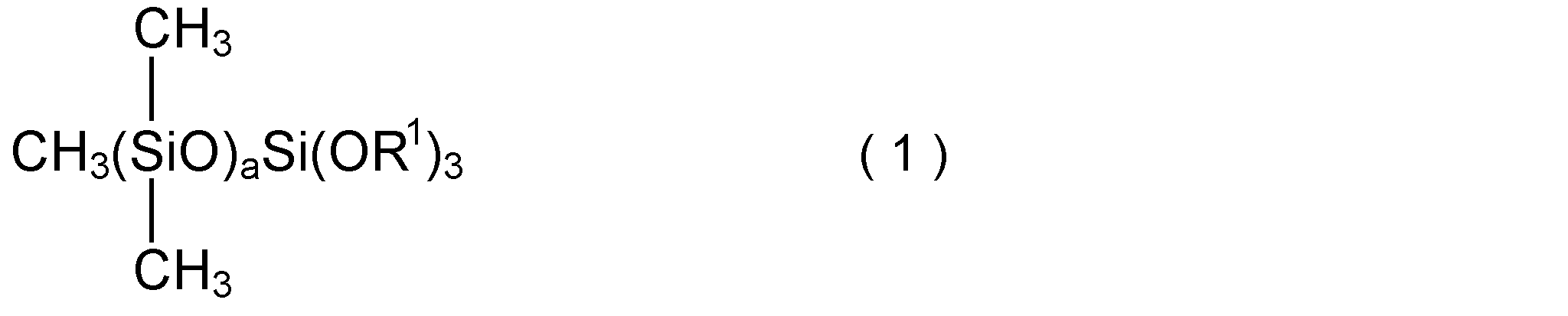
- Component (D) has the following general formula (1) (In formula (1), R 1 is independently an alkyl group having 1 to 6 carbon atoms, and a is a number of 5 to 100.) is a dimethylpolysiloxane in which one end of the molecular chain represented by is blocked with a trialkoxy group.
- alkyl groups having 1 to 6 carbon atoms represented by R 1 in formula (1) include methyl group, ethyl group, propyl group, isopropyl group, butyl group, isobutyl group, tert-butyl group, pentyl group, A neopentyl group, a hexyl group, and the like can be mentioned, and among them, a methyl group is preferable.
- a is a number from 5 to 100, preferably from 10 to 60. If a is less than 5, the dispersibility of the thermally conductive filler may be lowered, and if it is greater than 100, the thermal conductivity may be lowered.
- the blending amount of component (D) is 10 to 300 parts by mass, preferably 10 to 200 parts by mass, per 100 parts by mass of component (A). If the amount of component (D) is less than 10 parts by mass per 100 parts by mass of component (A), the dispersibility of the thermally conductive filler in the thermally conductive silicone composition will be reduced and the viscosity of the composition will increase. If the blending amount exceeds 300 parts by mass, the thermally conductive filler will be diluted, which may reduce the thermal conductivity.
- the component (E) platinum group metal curing catalyst is a catalyst for promoting the addition reaction between the alkenyl group derived from the component (A) and the Si—H group derived from the component (B), and is used in the hydrosilylation reaction.
- a well-known catalyst is mentioned as a catalyst used.
- platinum group metals such as platinum (including platinum black ), rhodium, and palladium ; , KaHPtCl6.nH2O , Na2PtCl6.nH2O , K2PtCl4.nH2O , PtCl4.nH2O , PtCl2 , Na2HPtCl4.nH2O (wherein , platinum chloride, chloroplatinic acid and chloroplatinates such as n is an integer from 0 to 6, preferably 0 or 6; alcohol-modified chloroplatinic acid (see US Pat. No.
- the amount of component (E) may be a so-called catalytic amount, and is usually about 0.1 to 1,000 ppm in terms of mass of the platinum group metal element with respect to component (A).
- Component (E) may be prepared by dissolving the various platinum group metal catalysts described above in a solvent such as 2-ethylhexanol.
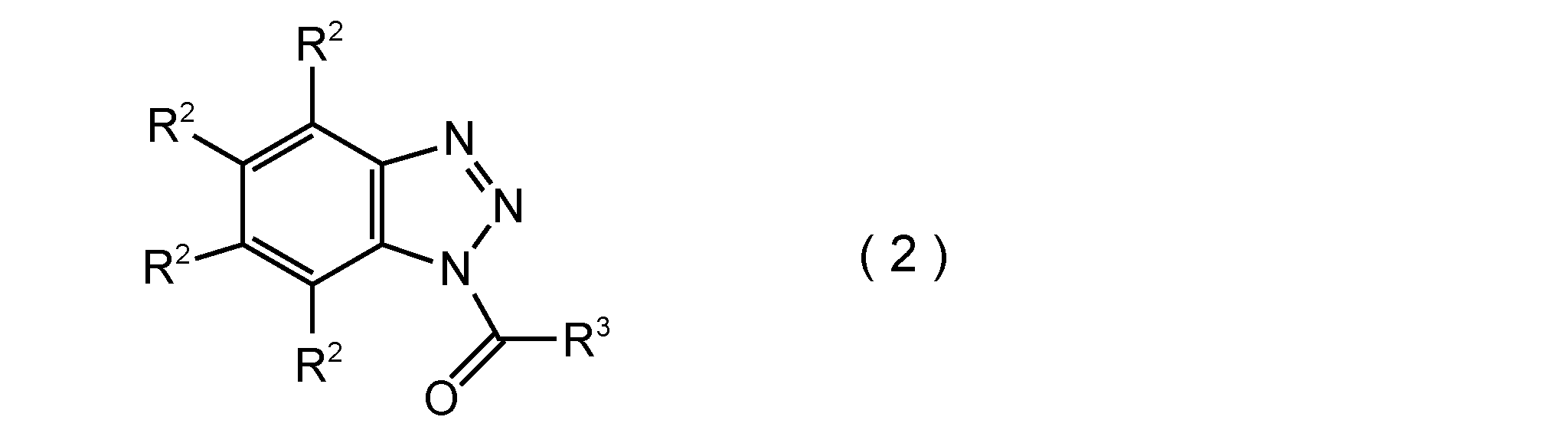
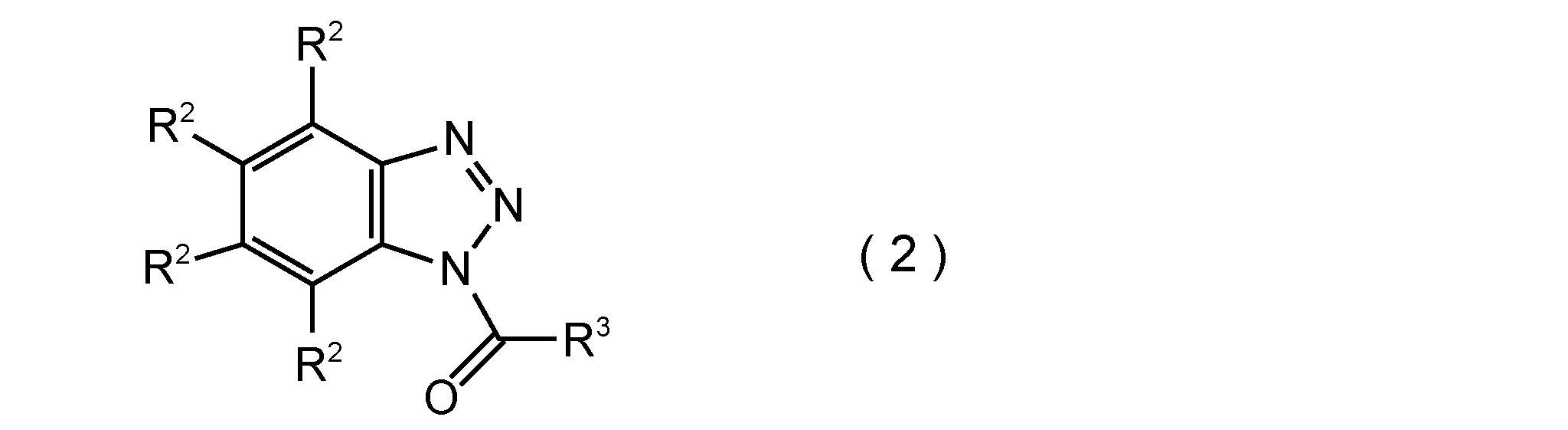
- (F) component is benzotriazole and / or the following general formula (2)
- R 2 is independently a hydrogen atom or a monovalent hydrocarbon group having 1 to 6 carbon atoms
- R 3 is a hydrogen atom or a monovalent organic group.
- the monovalent hydrocarbon group having 1 to 6 carbon atoms represented by R 2 includes methyl group, ethyl group, propyl group, isopropyl group, butyl group, isobutyl group, tert-butyl group, Alkyl groups such as pentyl group, neopentyl group, hexyl group and cyclohexyl group, and those in which some or all of the hydrogen atoms of these groups are substituted with halogen atoms such as fluorine, bromine and chlorine, cyano groups and the like, such as chloromethyl group, chloropropyl group, bromoethyl group, trifluoropropyl group, cyanoethyl group and the like.
- halogen atoms such as fluorine, bromine and chlorine, cyano groups and the like
- chloromethyl group chloropropyl group, bromoethyl group, trifluoropropyl group, cyanoethyl group
- Monovalent organic groups represented by R 3 include methyl, ethyl, propyl, isopropyl, butyl, isobutyl, tert-butyl, pentyl, neopentyl, hexyl and cyclohexyl groups.
- Monovalent hydrocarbon group having 1 to 10 carbon atoms such as aralkyl group such as benzyl group, phenylethyl group and phenylpropyl group; Examples thereof include groups represented by (5).
- R 7 is a monovalent hydrocarbon group having 1 to 15 carbon atoms, or —(CH 2 ) e —Si(OR 8 ) 3 ⁇ R 8 is independently an alkyl group having 1 to 4 carbon atoms; or SiR 9 3 group (R 9 is independently an alkyl group having 1 to 4 carbon atoms) and e is an integer of 1 to 6, preferably 1 to 3. ⁇ and * indicates a bond.
- R 7 is a monovalent hydrocarbon group having 1 to 15 carbon atoms, or —(CH 2 ) e —Si(OR 8 ) 3 ⁇ R 8 is independently an alkyl group having 1 to 4 carbon atoms; or SiR 9 3 group (R 9 is independently an alkyl group having 1 to 4 carbon atoms) and e is an integer of 1 to 6, preferably 1 to 3. ⁇ and * indicates a bond.
- Examples of monovalent hydrocarbon groups for R 7 include alkyl groups such as methyl group, ethyl group, propyl group, butyl group, hexyl group and dodecyl group, aryl groups such as phenyl group, 2-phenylethyl group and 2-phenylpropyl.
- An aralkyl group such as a group can be exemplified.
- alkyl groups for R 8 and R 9 include methyl group, ethyl group and propyl group.
- the blending amount of component (F) is in the range of 10 to 500 ppm, preferably 20 to 400 ppm, more preferably 30 to 300 ppm, based on the total mass of components (A) to (D). If the amount of component (F) is less than 10 ppm, it is not possible to impart sufficient corrosion resistance to the target metal, and if it is more than 500 ppm, it is necessary to add a large amount of the platinum group metal curing catalyst of component (E). and uneconomical.
- Component (G) has the following general formula (3): (In formula (3), R 4 is independently a monovalent hydrocarbon group having 1 to 10 carbon atoms and having no aliphatic unsaturated bond, and b is a number of 2 to 2,000.) It is an organopolysiloxane containing no aliphatic unsaturated bonds represented by. Since the component (G) exists as an oil in the composition without affecting the crosslinked structure, it gradually migrates from the composition together with the component (F) to the surface of the target metal, thereby enhancing the anticorrosion effect. be able to.
- Examples of monovalent hydrocarbon groups for R 4 include methyl group, ethyl group, propyl group, isopropyl group, butyl group, isobutyl group, tert-butyl group, pentyl group, neopentyl group, hexyl group, heptyl group and octyl group.
- nonyl, decyl, and other alkyl groups cyclopentyl, cyclohexyl, cycloheptyl, and other cycloalkyl groups
- phenyl, tolyl, xylyl, naphthyl, and other aryl groups aralkyl groups such as alkyl groups and methylbenzyl groups, as well as some or all of the hydrogen atoms bonded to the carbon atoms of these groups, substituted with halogen atoms such as fluorine, chlorine, bromine, etc., or cyano groups, etc.
- b is a number from 2 to 2,000, preferably from 2 to 200.
- Component (G) has the following general formula (4): (In formula (4), R 5 is independently an alkyl group having 1 to 10 carbon atoms, R 6 is a phenyl group, c and d are each numbers of 1 to 20, and the siloxane unit in parentheses is random, alternating, or block.) It is preferable that the phenyl group-containing organopolysiloxane represented by is included.
- the alkyl group for R5 includes methyl, ethyl, propyl, isopropyl, butyl, isobutyl, tert-butyl, pentyl, neopentyl, hexyl, heptyl, octyl, nonyl and decyl. and the like, and a methyl group is preferred.
- Component (G) is added in an amount of 1 to 100 parts by mass, preferably 2 to 90 parts by mass, more preferably 5 to 80 parts by mass, per 100 parts by mass of component (A). If the amount of component (G) is less than 1 part by mass, the anti-corrosion effect is difficult to obtain. The hardness of may increase significantly.
- the ratio of the compound represented by the general formula (4) is preferably 5 to 50% by mass, more preferably 10 to 40% by mass, based on the total amount of the component (G). more preferred.
- the thermally conductive silicone composition of the present invention further contains an addition reaction inhibitor as component (H) for the purpose of suppressing the catalytic activity of component (E) and extending the shelf life and pot life of the composition. can do.
- a known addition reaction controller can be used as the (H) component.
- Examples thereof include acetylene compounds such as 1-ethynyl-1-cyclohexanol, 3-butyn-1-ol and ethynylmethylidenecarbinol, nitrogen compounds, organic phosphorus compounds, oxime compounds, organic chloro compounds and the like.
- the amount of component (H) may be an effective amount, but is preferably about 0.01 to 1 part by mass per 100 parts by mass of component (A). May be used after dilution.
- the thermally conductive silicone composition of the present invention may further contain a filler other than component (C) as component (I) for the purpose of adjusting the viscosity of the composition and the hardness of the cured product.
- component (I) aluminum hydroxide and silica are preferable because they are inexpensive and have a relatively small specific gravity.
- the average particle size of component (I) is preferably in the range of 0.1 to 100 ⁇ m, more preferably in the range of 1 to 80 ⁇ m.
- component (I) When component (I) is blended, the blending amount is preferably 100 to 3,000 parts by mass, preferably 500 to It is more preferably 1,500 parts by mass.
- This component (I) may be added to the thermally conductive silicone composition of the present invention as it is, or may be added after being mixed with the component (C) in advance.
- the thermally conductive silicone composition of the present invention may further contain a coloring agent, an antioxidant, etc., within a range that does not impair the purpose of the present invention.
- the thermally conductive silicone composition of the present invention is produced by uniformly mixing the components described above.
- the mixing method may be according to a conventionally known method.
- mixing devices include Trimix, Twinmix, and Planetary Mixer (both registered trademarks of mixers manufactured by Inoue Seisakusho Co., Ltd.), Ultra Mixer (Mizuho Kogyo Co., Ltd. ), Hivis Dispermix (registered trademark of Tokushu Kika Kogyo Co., Ltd. mixer), and the like.
- all components to be blended may be mixed at once, or one or more components may be mixed in several steps, but component (C) and component (D) should be blended at the same time. is preferred.
- a cured product can be obtained by heating the thermally conductive silicone composition of the present invention at a temperature of preferably 80 to 180° C., particularly 90 to 170° C., for 30 to 150 minutes, particularly 40 to 140 minutes.
- the thermal conductivity of cured thermally conductive silicone is preferably 3.0 W/mK or more, more preferably 4.0 W/mK or more, as measured at 25°C by the hot disk method. is.
- the upper limit of the thermal conductivity of the cured product (molded body) is not particularly limited, for example, when magnesium oxide is used, the thermal conductivity is 40 W/m ⁇ K or less.
- Component (A) Dimethylpolysiloxane having both ends blocked with dimethylvinylsilyl groups (kinematic viscosity at 25°C: 600 mm 2 /s)
- Component (B) Organohydrogenpolysiloxane represented by the following formula (The sequence order of the siloxane units in parentheses is undefined.)
- C Component (C-1): Alumina powder (average particle size: 1 ⁇ m, thermal conductivity: 27 W/m K)
- C-2 Alumina powder (average particle size: 10 ⁇ m, thermal conductivity: 27 W/m K)
- C-3 Alumina powder (average particle size: 28 ⁇ m, thermal conductivity: 27 W/m K)
- C-4 Alumina powder (average particle size: 70 ⁇ m, thermal conductivity: 27 W/m K)
- C-5 Magnesia powder (average particle size: 55 ⁇ m, thermal conductivity: 40 W/m K)
- Component (D) Dimethylpolysiloxane having one molecular chain end blocked with a trimethoxy group represented by the following formula
- (F) component (F-1) a compound represented by the following formula (F-2): a compound represented by the following formula
- G component (G-1) dimethylpolysiloxane represented by the following formula (G-2): Methylphenylpolysiloxane represented by the following formula (In the formula, the sequence of the siloxane units in parentheses is undefined.)
- Component (I-1) Aluminum hydroxide powder (average particle size: 1 ⁇ m, thermal conductivity: 3.2 W/m ⁇ K)
- I-2) Aluminum hydroxide powder (average particle size: 12 ⁇ m, thermal conductivity: 3.2 W/m K)
- I-3) Aluminum hydroxide powder (average particle size: 64 ⁇ m, thermal conductivity: 3.2 W/m K)
- Examples 1 to 6, Comparative Examples 1 to 5 The following components were sequentially added in the blending amounts (parts by mass) shown in Tables 1 and 2. Using a 5-liter planetary mixer (manufactured by Inoue Seisakusho Co., Ltd.), components (A) and (D), and components (C) and (I) were premixed and kneaded for 60 minutes. Next, components (B), (E), (F), (G) and (H) were added and kneaded for 30 minutes to obtain a thermally conductive silicone composition.
- the hardness of the thermally conductive silicone cured product was measured with an Asker C hardness tester specified in SRIS0101.
- Copper corrosion test 1) Cleaning of copper plate After wiping off fats and oils on the surface of the copper plate with gauze impregnated with acetone, the copper plate was immersed in a 10% by mass sulfuric acid aqueous solution for 15 minutes. The removed copper plate was washed with pure water, dried and used for the test. 2) Test procedure The molded thermally conductive silicone cured product was placed on the copper plate and allowed to stand for 24 hours. Thereafter, the copper plate from which the thermally conductive silicone cured product was removed was stored in a high-temperature, high-humidity bath at 85° C. and 85% RH for aging. After 100 hours, 500 hours, and 1,000 hours of aging, the copper plate was taken out, and the presence or absence of corrosion on the surface of the copper plate was observed.
- the thermally conductive silicone cured products obtained in Examples 1 to 6 had a thermal conductivity of 3.0 W/m ⁇ K or more, and no corrosion was confirmed in a copper corrosion test up to 1000 hours of aging.
- the (F) component was not contained in a sufficient amount as in Comparative Examples 1 and 3, corrosion of copper was observed.
- Comparative Example 2 in which the component (F) was added in excess, no cured product was obtained due to the deactivation of the component (E).
- the component (G) was excessively added as in Comparative Example 5
- the proportion of the thermally conductive filler decreased, resulting in a thermal conductivity of less than 3.0 W/m ⁇ K.
Landscapes
- Chemical & Material Sciences (AREA)
- Health & Medical Sciences (AREA)
- Chemical Kinetics & Catalysis (AREA)
- Medicinal Chemistry (AREA)
- Polymers & Plastics (AREA)
- Organic Chemistry (AREA)
- Compositions Of Macromolecular Compounds (AREA)
Abstract
Description
即ち、本発明は、次の熱伝導性シリコーン組成物及び熱伝導性シリコーン硬化物を提供するものである。
(A)1分子中に少なくとも2個のケイ素原子に結合したアルケニル基を有する、25℃の動粘度が10~100,000mm2/sのオルガノポリシロキサン:100質量部、
(B)ケイ素原子に直接結合した水素原子を1分子中に少なくとも2個有するオルガノハイドロジェンポリシロキサン:ケイ素原子に直接結合した水素原子の個数が(A)成分のアルケニル基1個に対して0.5~1.5個となる量、
(C)10W/m・K以上の熱伝導率を有する熱伝導性充填材:500~7,000質量部、
(D)下記一般式(1)で表される分子鎖片末端がトリアルコキシ基で封鎖されたジメチルポリシロキサン:10~300質量部、
(E)白金族金属系硬化触媒:有効量、
(F)ベンゾトリアゾール、下記一般式(2)で表されるベンゾトリアゾール誘導体又はその両方:(A)~(D)成分の合計質量に対し10~500ppm、
及び
(G)下記一般式(3)で表されるオルガノポリシロキサン:1~100質量部、

を含む熱伝導性シリコーン組成物。
[2]
(G)成分が、下記一般式(4)で表されるオルガノポリシロキサンである[1]に記載の熱伝導性シリコーン組成物。
[3]
更に、(H)アセチレン化合物、窒素化合物、有機リン化合物、オキシム化合物及び有機クロロ化合物からなる群より選択される1種以上の反応制御剤を含む、[1]又は[2]に記載の熱伝導性シリコーン組成物。
[4]
一般式(2)において、R3が水素原子、炭素数1~10の一価炭化水素基、又は下記式(5)で表される基である[1]~[3]のいずれか1つに記載の熱伝導性シリコーン組成物。

[5]
[1]~[4]のいずれか1つに記載の熱伝導性シリコーン組成物の硬化物。
<(A)アルケニル基含有オルガノポリシロキサン>
(A)成分であるアルケニル基含有オルガノポリシロキサンは、ケイ素原子に結合したアルケニル基を1分子中に2個以上、好ましくは2~10個、より好ましくは2~5個有するオルガノポリシロキサンである。主鎖部分が基本的にジオルガノシロキサン単位の繰り返しからなるのが一般的であるが、これは分子構造の一部に分枝状の構造を含んだものであってもよく、また環状であってもよいが、硬化物の機械的強度等、物性の点から直鎖状のジオルガノポリシロキサンが好ましい。
(B)成分のオルガノハイドロジェンポリシロキサンは、1分子中に2個以上、好ましくは2~30個、より好ましくは2~20個のケイ素原子に直接結合する水素原子(Si-H基)を有するオルガノハイドロジェンポリシロキサンであり、(A)成分の架橋剤として作用する成分である。即ち、(B)成分中のSi-H基と(A)成分中のアルケニル基とが後述の(E)成分の白金族金属系硬化触媒により促進されるヒドロシリル化反応により付加して、得られる硬化物に架橋構造を有する3次元網目構造を与える。なお、(B)成分のオルガノハイドロジェンポリシロキサンのSi-H基の数が1分子中に2個未満の場合、硬化しないおそれがある。
(C)成分の熱伝導性充填材としては、熱伝導率が10W/m・K以上、好ましくは15W/m・K以上のものが使用される。熱伝導率が10W/m・Kより小さいと、熱伝導性シリコーン組成物の熱伝導率そのものが小さくなるためである。かかる熱伝導性充填材としては、アルミニウム粉末、銅粉末、銀粉末、鉄粉末、ニッケル粉末、金粉末、錫粉末、金属ケイ素粉末、窒化アルミニウム粉末、窒化ホウ素粉末、酸化アルミニウム(アルミナ)粉末、酸化マグネシウム(マグネシア)粉末、ダイヤモンド粉末、カーボン粉末、インジウム粉末、ガリウム粉末、酸化亜鉛粉末などが挙げられるが、これらに限定されるものではない。また、(C)成分の形状は、不定形であっても球形であってもよい。
(C)の配合量は、(A)成分100質量部に対して、500~7,000質量部の範囲であり、好ましくは1,000~6,500質量部、より好ましくは2,000~6,000質量部である。500質量部より少ないと硬化物の熱伝導率が小さくなり、7,000質量部より多いと組成物の粘度が上昇し、成形性の悪化につながる。
(D)成分は、下記一般式(1)

で表される分子鎖片末端がトリアルコキシ基で封鎖されたジメチルポリシロキサンである。
(E)成分の白金族金属系硬化触媒は(A)成分由来のアルケニル基と、(B)成分由来のSi-H基との付加反応を促進するための触媒であり、ヒドロシリル化反応に用いられる触媒として周知の触媒が挙げられる。その具体例としては、例えば、白金(白金黒を含む)、ロジウム、パラジウム等の白金族金属単体;H2PtCl4・nH2O、H2PtCl6・nH2O、NaHPtCl6・nH2O、KaHPtCl6・nH2O、Na2PtCl6・nH2O、K2PtCl4・nH2O、PtCl4・nH2O、PtCl2、Na2HPtCl4・nH2O(但し、式中、nは0~6の整数であり、好ましくは0又は6である)等の塩化白金、塩化白金酸及び塩化白金酸塩;アルコール変性塩化白金酸(米国特許第3,220,972号明細書参照);塩化白金酸とオレフィンとのコンプレックス(米国特許第3,159,601号明細書、同第3,159,662号明細書、同第3,775,452号明細書参照);白金黒、パラジウム等の白金族金属を酸化アルミニウム、シリカ、カーボン等の担体に担持させたもの;ロジウム-オレフィンコンプレックス;クロロトリス(トリフェニルフォスフィン)ロジウム(ウィルキンソン触媒);塩化白金、塩化白金酸又は塩化白金酸塩とビニル基含有シロキサン、特にビニル基含有環状シロキサンとのコンプレックスなどが挙げられる。(E)成分の配合量は、所謂触媒量でよく、通常、(A)成分に対する白金族金属元素の質量換算で、0.1~1,000ppm程度がよい。(E)成分は前記した各種白金族金属触媒を2-エチルヘキサノール等の溶剤に溶解したものを用いてもよい。
(F)成分は、ベンゾトリアゾール及び/又は下記一般式(2)
で示されるベンゾトリアゾール誘導体である。


(G)成分は、下記一般式(3):

で表される脂肪族不飽和結合を含まないオルガノポリシロキサンである。(G)成分は、組成物中において架橋構造に影響を与えることなくオイルとして存在するため、上記(F)成分と共に組成物中から徐々に対象金属の表面へ移行することにより防腐食効果を高めることができる。

で表されるフェニル基含有オルガノポリシロキサンを含むことが好ましい。
(G)成分のうち、一般式(4)で示されるものの割合は、(G)成分総量のうち質量基準で、5~50質量%であることが好ましく、10~40質量%であることがより好ましい。
本発明の熱伝導性シリコーン組成物には、さらに(H)成分として、上記(E)成分の触媒活性を抑制し、組成物のシェルフライフ、ポットライフを延長させる目的で付加反応制御剤を配合することができる。
本発明の熱伝導性シリコーン組成物には、さらに(I)成分として、組成物の粘度及び硬化物の硬度を調節する目的で、(C)成分以外の充填材を配合することができる。
本発明の熱伝導性シリコーン組成物は、上記した各成分を均一に混合することにより製造される。混合方法は、従来公知の方法に従えばよく、混合する装置としては、トリミックス、ツウィンミックス、プラネタリミキサー(いずれも(株)井上製作所製混合機の登録商標)、ウルトラミキサー(みずほ工業(株)製混合機の登録商標)、ハイビスディスパーミックス(特殊機化工業(株)製混合機の登録商標)等が挙げられる。また、配合する全成分を一度に混合してもよく、1種又は2種以上の成分を数段階に分けて混合してもよいが、(C)成分及び(D)成分は同時に配合することが好ましい。
本発明の熱伝導性シリコーン組成物を、好ましくは80~180℃、特に90~170℃にて30~150分間、特に40~140分間加熱することにより硬化物とすることができる。
本発明における硬化物(成形体)の熱伝導率は、ホットディスク法により測定した25℃における測定値が3.0W/m・K以上であることが好ましく、さらに好ましくは4.0W/mK以上である。なお、硬化物(成形体)の熱伝導率の上限は特に限定されないが、例えば、酸化マグネシウムを用いた場合、その熱伝導率40W/m・K以下である。
下記実施例に用いられている(A)~(H)成分を下記に示す。
両末端がジメチルビニルシリル基で封鎖されたジメチルポリシロキサン(25℃における動粘度600mm2/s)
下記式で表されるオルガノハイドロジェンポリシロキサン

(C-1):アルミナ粉末(平均粒径:1μm、熱伝導率:27W/m・K)
(C-2):アルミナ粉末(平均粒径:10μm、熱伝導率:27W/m・K)
(C-3):アルミナ粉末(平均粒径:28μm、熱伝導率:27W/m・K)
(C-4):アルミナ粉末(平均粒径:70μm、熱伝導率:27W/m・K)
(C-5):マグネシア粉末(平均粒径:55μm、熱伝導率:40W/m・K)
下記式で表される分子鎖片末端がトリメトキシ基で封鎖されたジメチルポリシロキサン

5%塩化白金酸2-エチルヘキサノール溶液
(F-1):下記式で表される化合物

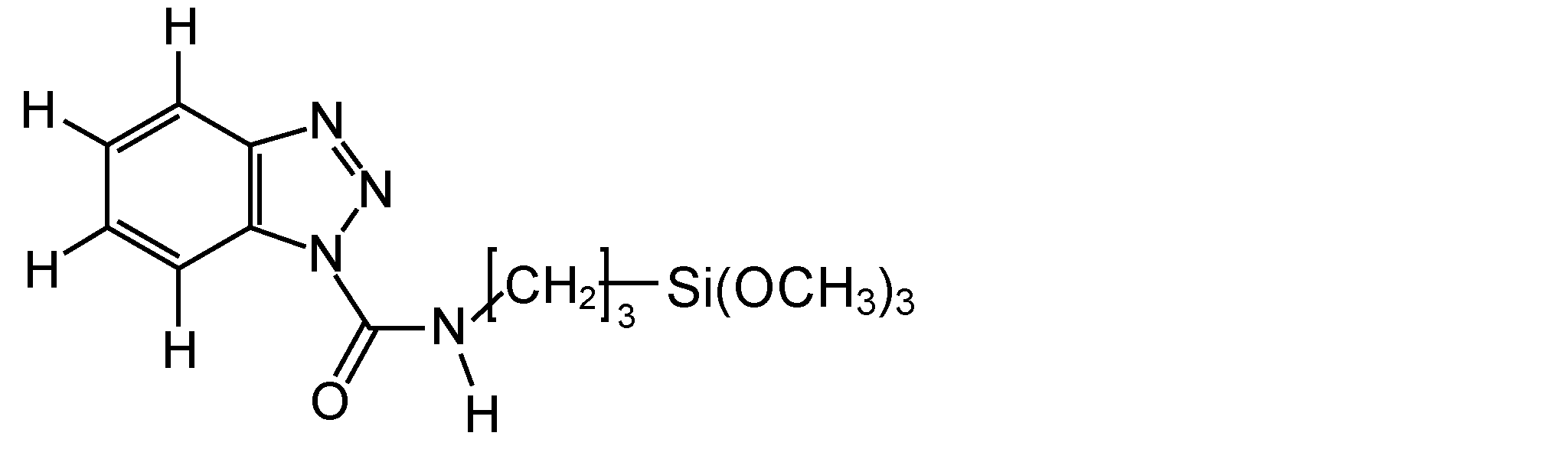
(G-1):下記式で表されるジメチルポリシロキサン

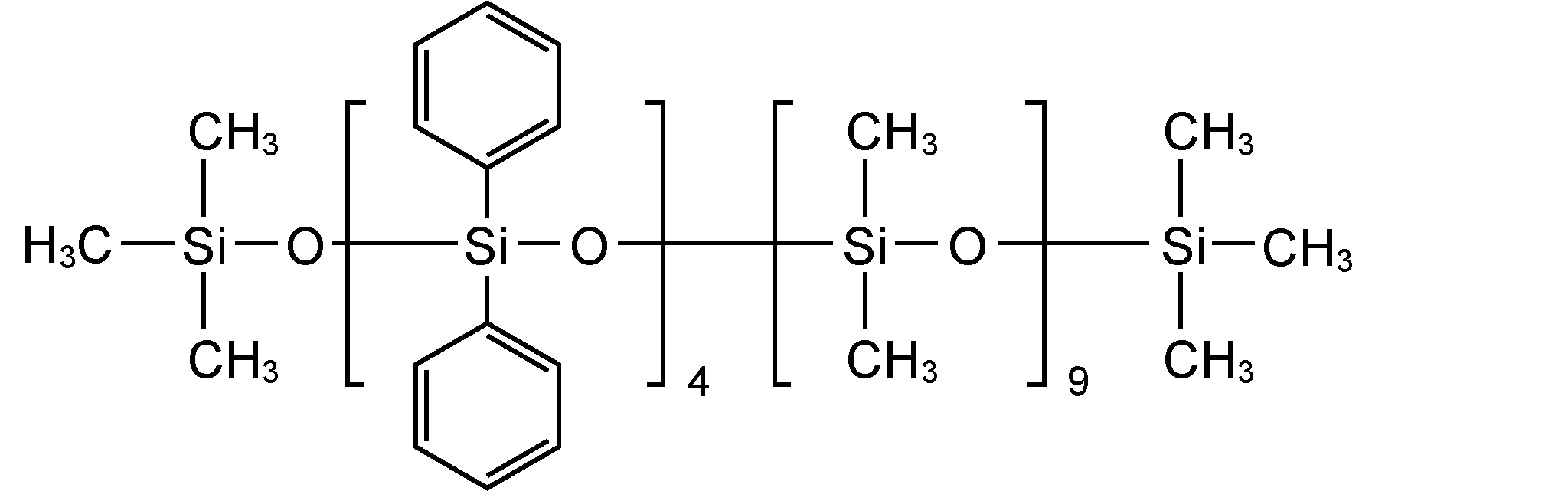
エチニルメチリデンカルビノール
(I-1):水酸化アルミニウム粉末(平均粒径:1μm、熱伝導率:3.2W/m・K)
(I-2):水酸化アルミニウム粉末(平均粒径:12μm、熱伝導率:3.2W/m・K)
(I-3):水酸化アルミニウム粉末(平均粒径:64μm、熱伝導率:3.2W/m・K)
表1及び表2に示す配合量(質量部)で下記成分を順次加えた。5リットルプラネタリーミキサー((株)井上製作所製)を用いて、(A)及び(D)成分、並びに、(C)成分及び(I)成分を予め混合したものを60分間混練した。次に成分(B)、(E)、(F)、(G)及び(H)成分を加えて30分間混練し、熱伝導性シリコーン組成物を得た。
調製した熱伝導性シリコーン組成物を60mm×60mm×6mmの金型に流し込み、金型開口部をPETフィルム2枚ではさんだ後、プレス成形機を用い、120℃で、10分間硬化させることで熱伝導性シリコーン硬化物(熱伝導性シリコーンシート)を得た。
熱伝導率:
下記実施例1~6及び比較例1~5で得られた6mm厚のシートを2枚用いて、熱伝導率計(TPA-501、京都電子工業株式会社製の商品名)により硬化物の熱伝導率を測定した。
熱伝導性シリコーン硬化物の硬度をSRIS0101に規定されているアスカーC硬度計で測定した。
1)銅板洗浄
アセトンを含侵させたガーゼで銅板の表面の油脂をふき取った後、10質量%硫酸水溶液に15分浸漬した。取り出した銅板を純水で洗浄後乾燥させ試験に用いた。
2)試験手順
成形した熱伝導性シリコーン硬化物を上記銅板上に設置し24時間静置した。その後、熱伝導性シリコーン硬化物を除去した銅板を85℃、85%RHの高温高湿槽中に保管し、エージングを実施した。エージング時間100時間、500時間、1,000時間経過後に銅板を取り出し、銅板表面の腐食の有無を観察した。
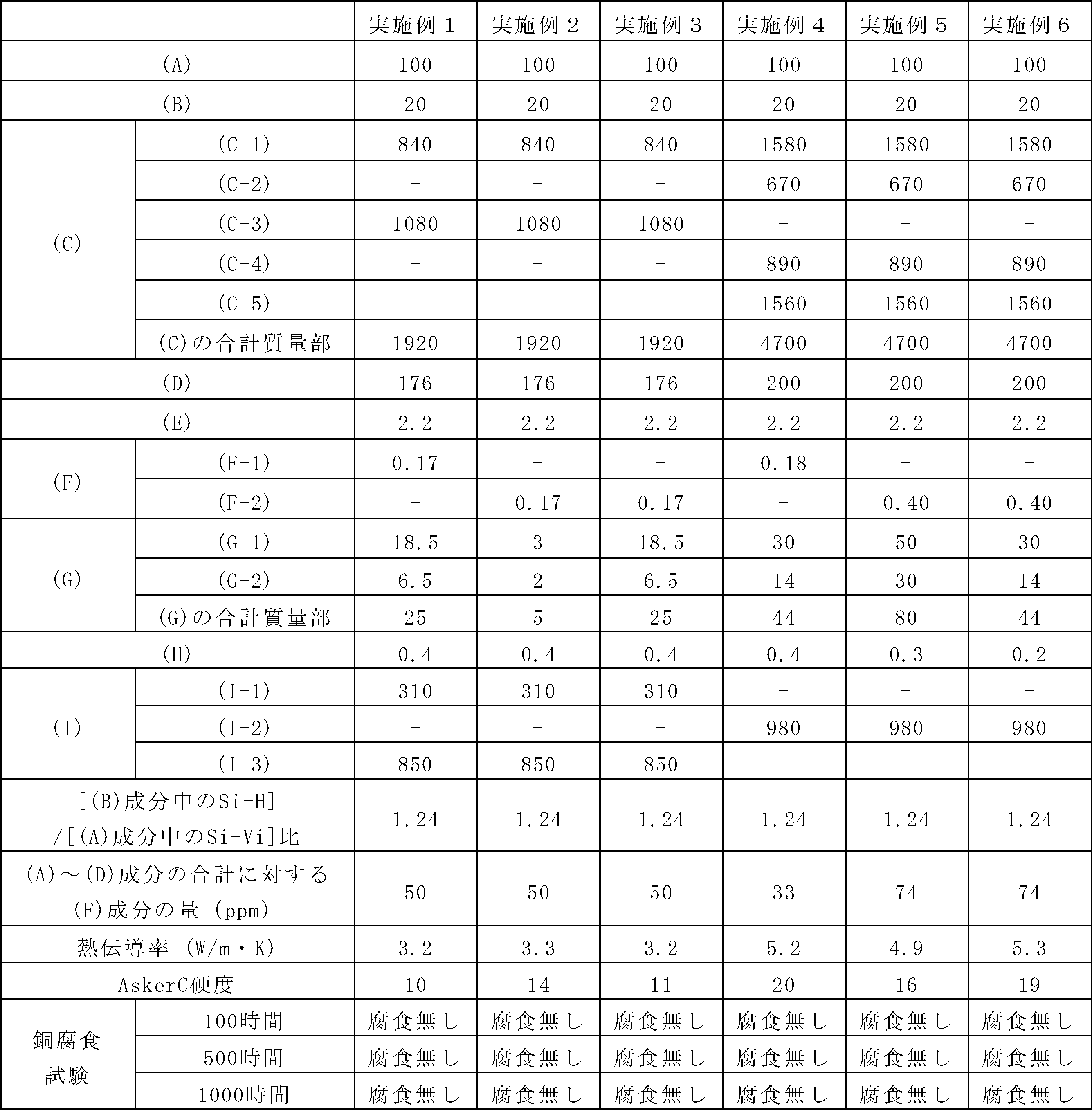

対して比較例1及び3のように(F)成分を十分な量含有しない場合、銅の腐食が見られた。一方、(F)成分を過剰に添加した比較例2では、(E)成分の失活により硬化物が得られなかった。また、比較例4のように(G)成分を含まない組成では、銅腐食試験500時間で腐食が発生した。更に、比較例5のように(G)成分を過剰に加えた場合、熱伝導性充填材の割合が低下し熱伝導率が3.0W/m・Kを下回る結果となった。
Claims (5)
- (A)1分子中に少なくとも2個のケイ素原子に結合したアルケニル基を有する、25℃の動粘度が10~100,000mm2/sのオルガノポリシロキサン:100質量部、
(B)ケイ素原子に直接結合した水素原子を1分子中に少なくとも2個有するオルガノハイドロジェンポリシロキサン:ケイ素原子に直接結合した水素原子の個数が(A)成分のアルケニル基1個に対して0.5~1.5個となる量、
(C)10W/m・K以上の熱伝導率を有する熱伝導性充填材:500~7,000質量部、
(D)下記一般式(1)で表される分子鎖片末端がトリアルコキシ基で封鎖されたジメチルポリシロキサン:10~300質量部、

(E)白金族金属系硬化触媒:有効量
(F)ベンゾトリアゾール、下記一般式(2)で表されるベンゾトリアゾール誘導体又はその両方:(A)~(D)成分の合計質量に対し10~500ppm
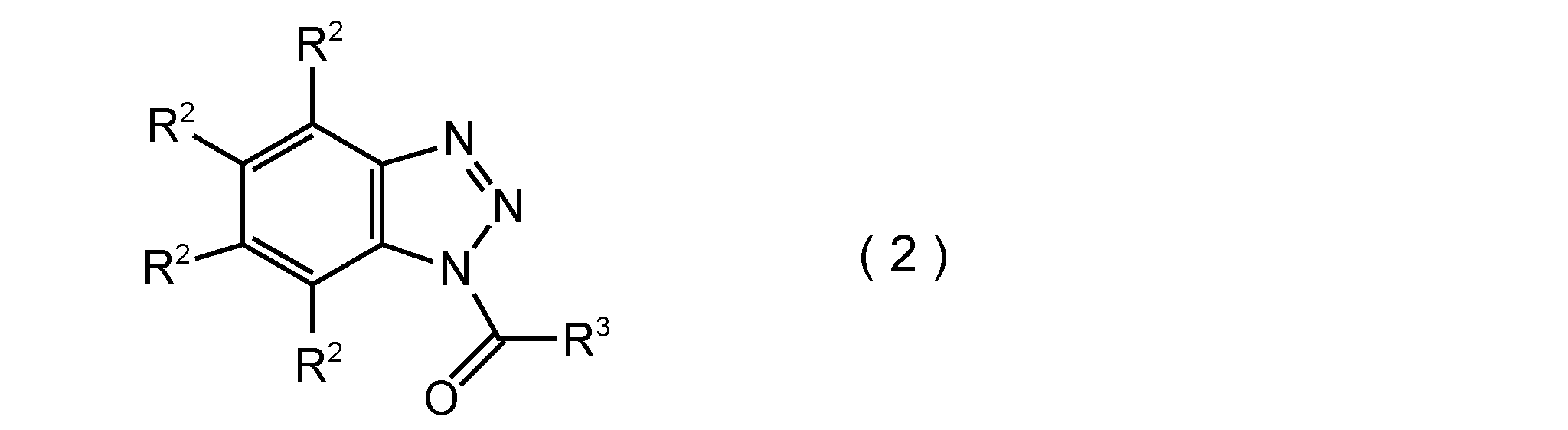
及び
(G)下記一般式(3)で表されるオルガノポリシロキサン:1~100質量部、
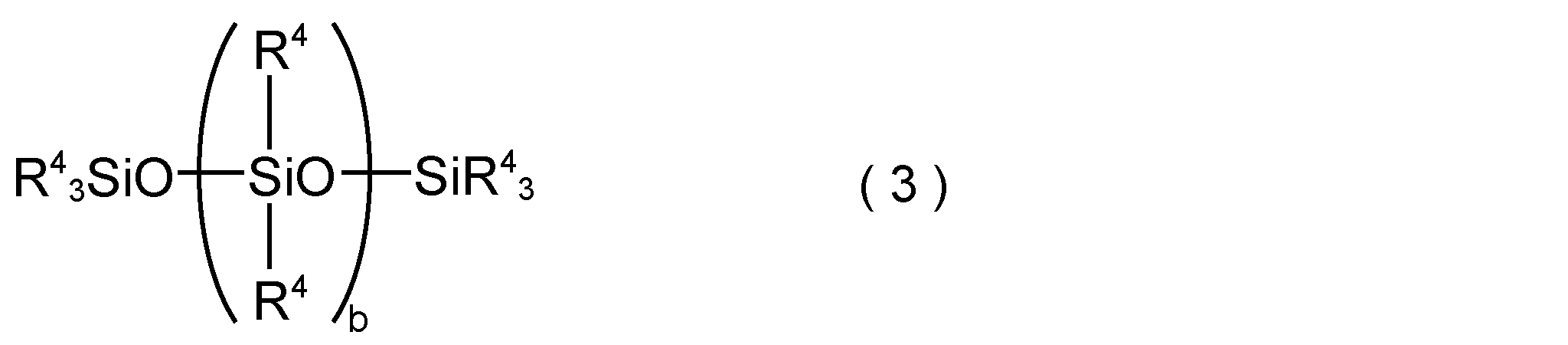
を含む熱伝導性シリコーン組成物。 - (G)成分が、下記一般式(4)で表されるオルガノポリシロキサンである請求項1に記載の熱伝導性シリコーン組成物。
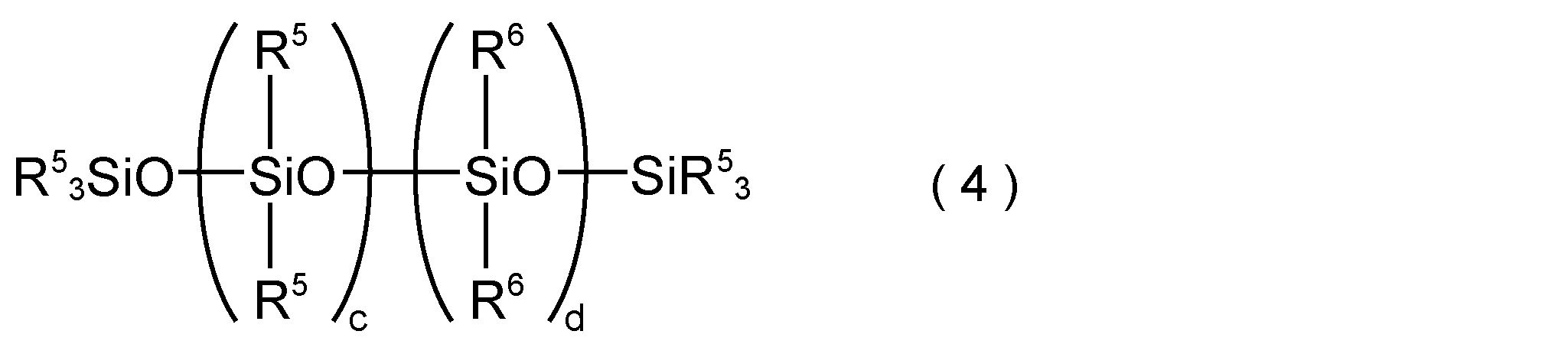
- 更に、(H)アセチレン化合物、窒素化合物、有機リン化合物、オキシム化合物及び有機クロロ化合物からなる群より選択される1種以上の付加反応制御剤を含む、請求項1又は2に記載の熱伝導性シリコーン組成物。
- 一般式(2)において、R3が水素原子、炭素数1~10の一価炭化水素基、又は下記式(5)で表される基である請求項1~3のいずれか1項に記載の熱伝導性シリコーン組成物。

- 請求項1~4のいずれか1項に記載の熱伝導性シリコーン組成物の硬化物。
Priority Applications (4)
| Application Number | Priority Date | Filing Date | Title |
|---|---|---|---|
| KR1020237044301A KR20240015664A (ko) | 2021-06-03 | 2022-05-31 | 열전도성 실리콘 조성물 및 그의 경화물 |
| US18/566,236 US20240294758A1 (en) | 2021-06-03 | 2022-05-31 | Thermally conductive silicone composition and cured product thereof |
| EP22816078.4A EP4349916A4 (en) | 2021-06-03 | 2022-05-31 | THERMALLY CONDUCTIVE SILICONE COMPOSITION AND CURED OBJECT OBTAINED THEREFROM |
| CN202280039532.9A CN117413021A (zh) | 2021-06-03 | 2022-05-31 | 热传导性有机硅组合物及其固化物 |
Applications Claiming Priority (2)
| Application Number | Priority Date | Filing Date | Title |
|---|---|---|---|
| JP2021093349A JP7523870B2 (ja) | 2021-06-03 | 2021-06-03 | 熱伝導性シリコーン組成物及びその硬化物 |
| JP2021-093349 | 2021-06-03 |
Publications (1)
| Publication Number | Publication Date |
|---|---|
| WO2022255331A1 true WO2022255331A1 (ja) | 2022-12-08 |
Family
ID=84323249
Family Applications (1)
| Application Number | Title | Priority Date | Filing Date |
|---|---|---|---|
| PCT/JP2022/022038 Ceased WO2022255331A1 (ja) | 2021-06-03 | 2022-05-31 | 熱伝導性シリコーン組成物及びその硬化物 |
Country Status (6)
| Country | Link |
|---|---|
| US (1) | US20240294758A1 (ja) |
| EP (1) | EP4349916A4 (ja) |
| JP (1) | JP7523870B2 (ja) |
| KR (1) | KR20240015664A (ja) |
| CN (1) | CN117413021A (ja) |
| WO (1) | WO2022255331A1 (ja) |
Families Citing this family (3)
| Publication number | Priority date | Publication date | Assignee | Title |
|---|---|---|---|---|
| WO2024024503A1 (ja) * | 2022-07-26 | 2024-02-01 | 信越化学工業株式会社 | 熱伝導性2液付加硬化型シリコーン組成物、硬化物及びシート |
| KR102893110B1 (ko) * | 2023-06-08 | 2025-12-03 | (주)씨엠테크 | 반도체 장비의 실리콘 방열패드용 조성물 및 이를 이용한 실리콘 방열패드 |
| JP2025159883A (ja) * | 2024-04-09 | 2025-10-22 | 信越化学工業株式会社 | 熱伝導性シリコーン接着剤組成物及び熱伝導性複合体 |
Citations (13)
| Publication number | Priority date | Publication date | Assignee | Title |
|---|---|---|---|---|
| US3159601A (en) | 1962-07-02 | 1964-12-01 | Gen Electric | Platinum-olefin complex catalyzed addition of hydrogen- and alkenyl-substituted siloxanes |
| US3159662A (en) | 1962-07-02 | 1964-12-01 | Gen Electric | Addition reaction |
| US3220972A (en) | 1962-07-02 | 1965-11-30 | Gen Electric | Organosilicon process using a chloroplatinic acid reaction product as the catalyst |
| US3775452A (en) | 1971-04-28 | 1973-11-27 | Gen Electric | Platinum complexes of unsaturated siloxanes and platinum containing organopolysiloxanes |
| JP2938428B1 (ja) | 1998-02-27 | 1999-08-23 | 信越化学工業株式会社 | 熱伝導性グリース組成物 |
| JP2938429B1 (ja) | 1998-02-27 | 1999-08-23 | 信越化学工業株式会社 | 熱伝導性シリコーン組成物 |
| JP3952184B2 (ja) | 2002-10-10 | 2007-08-01 | 信越化学工業株式会社 | 熱伝導性シート |
| JP2017165931A (ja) * | 2016-03-18 | 2017-09-21 | 信越化学工業株式会社 | 付加硬化性シリコーンゴム組成物及び硬化物 |
| WO2018079309A1 (ja) * | 2016-10-26 | 2018-05-03 | 信越化学工業株式会社 | 熱伝導性シリコーン組成物 |
| JP2019001900A (ja) * | 2017-06-15 | 2019-01-10 | 信越化学工業株式会社 | 熱伝導性シリコーン組成物 |
| JP2020041024A (ja) * | 2018-09-07 | 2020-03-19 | 信越化学工業株式会社 | 熱伝導性シリコーン組成物 |
| JP2020063380A (ja) * | 2018-10-18 | 2020-04-23 | 信越化学工業株式会社 | 熱伝導性シリコーン組成物 |
| JP2020066713A (ja) * | 2018-10-26 | 2020-04-30 | 信越化学工業株式会社 | 熱伝導性シリコーン組成物及びその硬化物 |
Family Cites Families (6)
| Publication number | Priority date | Publication date | Assignee | Title |
|---|---|---|---|---|
| JPH01190758A (ja) * | 1988-01-26 | 1989-07-31 | Shin Etsu Chem Co Ltd | 難燃性シリコーンオイル組成物 |
| US5354210A (en) * | 1991-08-23 | 1994-10-11 | The Whitaker Corporation | Sealant compositions and sealed electrical connectors |
| JP3022091B2 (ja) * | 1993-09-06 | 2000-03-15 | 信越化学工業株式会社 | 加熱硬化型シリコーンエラストマー組成物 |
| JP3301293B2 (ja) * | 1995-11-21 | 2002-07-15 | 信越化学工業株式会社 | 白金触媒組成物、その製造方法及び硬化性オルガノポリシロキサン組成物 |
| JP5015476B2 (ja) * | 2006-03-01 | 2012-08-29 | 東レ・ダウコーニング株式会社 | 電極・電気回路の保護剤組成物 |
| US11608419B2 (en) * | 2017-01-26 | 2023-03-21 | Shin-Etsu Chemical Co., Ltd. | Thermally conductive sheet |
-
2021
- 2021-06-03 JP JP2021093349A patent/JP7523870B2/ja active Active
-
2022
- 2022-05-31 KR KR1020237044301A patent/KR20240015664A/ko active Pending
- 2022-05-31 WO PCT/JP2022/022038 patent/WO2022255331A1/ja not_active Ceased
- 2022-05-31 US US18/566,236 patent/US20240294758A1/en active Pending
- 2022-05-31 EP EP22816078.4A patent/EP4349916A4/en active Pending
- 2022-05-31 CN CN202280039532.9A patent/CN117413021A/zh active Pending
Patent Citations (13)
| Publication number | Priority date | Publication date | Assignee | Title |
|---|---|---|---|---|
| US3159601A (en) | 1962-07-02 | 1964-12-01 | Gen Electric | Platinum-olefin complex catalyzed addition of hydrogen- and alkenyl-substituted siloxanes |
| US3159662A (en) | 1962-07-02 | 1964-12-01 | Gen Electric | Addition reaction |
| US3220972A (en) | 1962-07-02 | 1965-11-30 | Gen Electric | Organosilicon process using a chloroplatinic acid reaction product as the catalyst |
| US3775452A (en) | 1971-04-28 | 1973-11-27 | Gen Electric | Platinum complexes of unsaturated siloxanes and platinum containing organopolysiloxanes |
| JP2938428B1 (ja) | 1998-02-27 | 1999-08-23 | 信越化学工業株式会社 | 熱伝導性グリース組成物 |
| JP2938429B1 (ja) | 1998-02-27 | 1999-08-23 | 信越化学工業株式会社 | 熱伝導性シリコーン組成物 |
| JP3952184B2 (ja) | 2002-10-10 | 2007-08-01 | 信越化学工業株式会社 | 熱伝導性シート |
| JP2017165931A (ja) * | 2016-03-18 | 2017-09-21 | 信越化学工業株式会社 | 付加硬化性シリコーンゴム組成物及び硬化物 |
| WO2018079309A1 (ja) * | 2016-10-26 | 2018-05-03 | 信越化学工業株式会社 | 熱伝導性シリコーン組成物 |
| JP2019001900A (ja) * | 2017-06-15 | 2019-01-10 | 信越化学工業株式会社 | 熱伝導性シリコーン組成物 |
| JP2020041024A (ja) * | 2018-09-07 | 2020-03-19 | 信越化学工業株式会社 | 熱伝導性シリコーン組成物 |
| JP2020063380A (ja) * | 2018-10-18 | 2020-04-23 | 信越化学工業株式会社 | 熱伝導性シリコーン組成物 |
| JP2020066713A (ja) * | 2018-10-26 | 2020-04-30 | 信越化学工業株式会社 | 熱伝導性シリコーン組成物及びその硬化物 |
Non-Patent Citations (1)
| Title |
|---|
| See also references of EP4349916A4 |
Also Published As
| Publication number | Publication date |
|---|---|
| CN117413021A (zh) | 2024-01-16 |
| TW202248352A (zh) | 2022-12-16 |
| JP2022185620A (ja) | 2022-12-15 |
| KR20240015664A (ko) | 2024-02-05 |
| EP4349916A4 (en) | 2025-06-25 |
| JP7523870B2 (ja) | 2024-07-29 |
| EP4349916A1 (en) | 2024-04-10 |
| US20240294758A1 (en) | 2024-09-05 |
Similar Documents
| Publication | Publication Date | Title |
|---|---|---|
| TWI538996B (zh) | 導熱性聚矽氧潤滑脂組成物 | |
| JP5233325B2 (ja) | 熱伝導性硬化物及びその製造方法 | |
| JP5664563B2 (ja) | 熱伝導性シリコーン組成物及びその硬化物 | |
| CN104968728B (zh) | 导热性有机硅组合物、导热性层和半导体装置 | |
| TWI822954B (zh) | 導熱性矽氧組成物及其製造方法、以及導熱性矽氧硬化物 | |
| JP5947267B2 (ja) | シリコーン組成物及び熱伝導性シリコーン組成物の製造方法 | |
| WO2022255331A1 (ja) | 熱伝導性シリコーン組成物及びその硬化物 | |
| CN114729193B (zh) | 热传导性硅酮组合物和热传导性硅酮片材 | |
| KR20170127482A (ko) | 열 전도성 실리콘 조성물 | |
| JP7285231B2 (ja) | 熱伝導性シリコーン組成物及びその硬化物 | |
| CN105246977A (zh) | 热传导性硅酮组合物 | |
| JP6614362B2 (ja) | 熱伝導性シリコーン組成物 | |
| JP5472055B2 (ja) | 熱伝導性シリコーングリース組成物 | |
| JP5843364B2 (ja) | 熱伝導性組成物 | |
| JP2020002236A (ja) | 熱伝導性シリコーン組成物、熱伝導性シリコーンシート及びその製造方法 | |
| CN115667407B (zh) | 高导热性有机硅组合物 | |
| JP2015212318A (ja) | 熱伝導性シリコーン組成物 | |
| CN115698222A (zh) | 二液固化型导热性润滑脂用组合物、导热性润滑脂及电子设备 | |
| JP7485634B2 (ja) | 熱伝導性シリコーン組成物及びその硬化物 | |
| WO2023132192A1 (ja) | 高熱伝導性シリコーン組成物 | |
| TWI813738B (zh) | 熱傳導性矽氧組成物及其硬化物 | |
| JP7219728B2 (ja) | 熱伝導性シリコーン組成物 | |
| TWI916577B (zh) | 熱傳導性矽酮組合物及其固化物 | |
| JP7689935B2 (ja) | 熱伝導性シリコーン組成物及びその硬化物 | |
| TW202547908A (zh) | 熱傳導性聚矽氧組合物及硬化物 |
Legal Events
| Date | Code | Title | Description |
|---|---|---|---|
| 121 | Ep: the epo has been informed by wipo that ep was designated in this application |
Ref document number: 22816078 Country of ref document: EP Kind code of ref document: A1 |
|
| WWE | Wipo information: entry into national phase |
Ref document number: 18566236 Country of ref document: US Ref document number: 202280039532.9 Country of ref document: CN |
|
| ENP | Entry into the national phase |
Ref document number: 20237044301 Country of ref document: KR Kind code of ref document: A |
|
| WWE | Wipo information: entry into national phase |
Ref document number: 2022816078 Country of ref document: EP |
|
| NENP | Non-entry into the national phase |
Ref country code: DE |
|
| ENP | Entry into the national phase |
Ref document number: 2022816078 Country of ref document: EP Effective date: 20240103 |